


Abstract
Transition metal oxide SrCoOx (2.5 ≤ x ≤ 3.0) has attracted considerable attention owing to its reversible topotactic phase transition between the brownmillerite SrCoO2.5 phase (BM-SCO, an antiferromagnetic insulator) and the perovskite SrCoO3−δ phase (PV-SCO, a ferromagnetic metal). This phase transition is driven by continuous changes in oxygen stoichiometry and is accompanied by dramatic reconstruction of the valence state, spin state, and electronic ground state of cobalt ions, giving rise to order-of-magnitude differences in magnetic, electrical, optical, and thermal properties. This review systematically summarizes the crystal structures, physical properties, and regulation rules of oxygen vacancy channels (OVCs) in BM-SCO and PV-SCO. It summarizes recent advances in phase-transition regulation strategies, including ionic liquid gating, epitaxial strain engineering, topotactic redox, protonation/hydrogen intercalation, and triboelectric/mechanical-energy induction, with emphasis on frontier achievements such as in situ imaging of freestanding membranes, reduction-mediated oxidation, stepwise oxidation by water vapor, and neutron diffraction determination of magnetic order. Furthermore, the application potential is discussed in terms of resistive switching and memristive behavior, magnetoionics, optical electrochromism, and neuromorphic computing, along with key challenges and future directions concerning cycling stability, room-temperature ionic migration rate, and multi-parameter synergistic regulation.
1. Introduction
Transition metal oxides (TMOs) have been extensively investigated in the fields of optics, electronics, and catalysis owing to their variable valence states, unique electronic structures that readily undergo redox reactions, highly tunable ionic and electronic transport properties, and apparent thermodynamic and chemical stability, which, however, can be significantly degraded for oxygen-deficient compositions under redox cycling [1]. Oxygen stoichiometry plays a crucial role in determining the crystal structures and physical properties of TMOs. Because transition metals exhibit multiple valence states, variations in oxygen content within TMOs induce changes in the valence states of the transition-metal cations [2,3,4]. Accordingly, modifying the oxygen content in TMOs allows the crystal structure to be altered and the properties to be tuned [5,6,7], which enables applications in numerous advanced energy and information technologies, such as fuel cells, rechargeable batteries, and memory devices [8,9,10,11]. In certain TMOs, controlling the oxygen content can achieve reversible phase transitions, leading to pronounced differences in electrical conductivity [1], magnetism [12], and ionic conductivity [13].
In recent years, research on phase transitions in TMOs has attracted tremendous interest. TMOs with ordered oxygen vacancy channels, such as SrFeO2.5 [14,15] and SrCoO2.5 [16,17], can undergo reversible phase transitions by tuning oxygen stoichiometry, primarily manifested as the interconversion between the perovskite ABO3 structure and the brownmillerite ABO2.5 structure. TMOs are complex and diverse in nature, and the electron–electron and electron–phonon correlations arising from their distinct crystal structures endow them with unique physical and chemical properties [18,19]. Studies on phase transitions in TMOs have revealed that their performance varies with crystal structure. Among these materials, SrCoOx (2.5 ≤ x ≤ 3.0) is best described by two end-member structures, the brownmillerite SrCoO2.5 (BM-SCO) and the perovskite SrCoO3−δ (PV-SCO), together with accessible intermediate and chemically modified states such as SrCoO2, SrCoO2.75, and the protonated phase HSrCoO2.5 discussed in the relevant sections below. Consequently, reversible phase transitions can be achieved by adjusting the oxygen stoichiometric ratio, and the two phases exhibit markedly different optical, magnetic, and electrical properties [20]. This has led to rapidly growing interest in SrCoOx phase-transition research in recent years, with broad applications in electronic devices.
This review systematically introduces the regulation methods and application prospects of SrCoOx phase transitions. First, the crystal structures, electronic structures, and physical properties of the BM-SCO and PV-SCO phases are introduced, and the role of oxygen vacancy channels during phase transition is elucidated. Subsequently, the major regulation strategies that induce SrCoOx phase transitions are discussed in detail, including ionic liquid gating, strain engineering, triboelectric regulation, protonation/hydrogen intercalation, and topotactic redox. Finally, the application potential and existing challenges associated with TMO phase transitions are summarized and discussed. Despite the rapid growth of this field, most previous reviews have focused on individual regulation methods or isolated physical properties, and a critical synthesis connecting the oxygen vacancy pathways with the electrical, magnetic, optical, and mechanical control strategies has been lacking. This review provides an integrated account of the crystal-structure basis, the regulation of oxygen vacancy channels, the various phase-transition manipulation strategies, and their device implications within a comparative framework. It should be emphasized that all phase transformations and material properties summarized here are previously published results, this review reports no new experimental data.
2. Crystal Structure, Physical Properties, and Oxygen Vacancy Regulation of SrCoOx
2.1. Crystal Structures of BM-SCO and PV-SCO
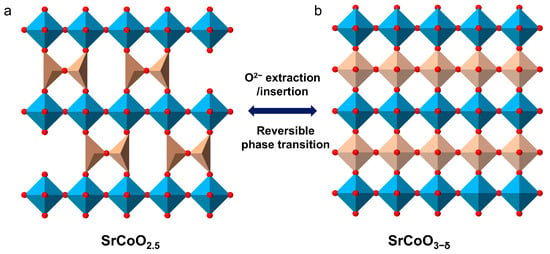
The crystal structure of BM-SCO is of the brownmillerite type. Its structure consists of alternating stacking of [CoO4]− tetrahedral layers and [CoO6]− octahedral layers along the a-axis, with Sr atoms occupying the interstitial sites between the polyhedra [21]. As shown in Figure 1a, BM-SCO possesses an orthorhombic unit cell with lattice parameters ao = 5.5739 Å, bo = 5.4697 Å, and co = 15.7450 Å. The crystal structure of BM-SCO can also be represented as a pseudotetragonal structure (at = 3.905 Å, ct/4 = 3.936 Å), which is used to estimate the lattice mismatch. The PV-SCO has an isotropic cubic structure with a lattice constant ac = 3.829 Å [22], as illustrated in Figure 1b. It should be noted that these lattice parameters correspond to the unstrained bulk phases; in epitaxial films, the in-plane and out-of-plane lattice constants and the effective oxygen content are modified by substrate-induced strain, film thickness, and growth conditions. The crystal structure reveals that BM-SCO possesses ordered one-dimensional oxygen vacancy channels. When the valence state of Co changes, additional oxygen can be accommodated, giving rise to a phase transition from BM-SCO to PV-SCO, and this process is reversible. The difference in oxygen stoichiometry between BM-SCO and PV-SCO leads to different valence states of Co, and the oxidation state of cobalt results in markedly different electronic and magnetic ground states. Previous reports have shown that the BM-SCO phase with ordered oxygen vacancy channels is easier to synthesize because the Co4+ valence state requires a high energy input, and during material growth, tends to convert to the more stable Co2+ and Co3+ states [17]. In early studies, the conversion of bulk BM-SCO to PV-SCO was rather difficult; it required annealing under extremely high oxygen pressure and elevated temperature for over ten hours, which greatly increased the complexity of phase-transition research [23]. Researchers have also grown BM-SCO and PV-SCO phases by epitaxial growth, and the desired phase can be obtained by adjusting the oxygen pressure during film growth, making research on SrCoOx film phase transitions more convenient [1]. Epitaxially grown BM-SCO films exhibit high activity during phase transitions, which plays a key role in subsequent studies of phase-transition-based memory devices and electrochemical sensors.
Figure 1.
The crystal structure diagram of (a) SrCoO2.5 (BM-SCO) and (b) SrCoO3−δ (PV-SCO).
2.2. Physical Properties of BM-SCO and PV-SCO
Owing to their structural differences, BM-SCO and PV-SCO exhibit distinctly opposite physical properties, as shown in Table 1. In terms of magnetism, BM-SCO is antiferromagnetic at room temperature, whereas PV-SCO is ferromagnetic. In terms of electrical properties, BM-SCO exhibits an insulating state, while PV-SCO exhibits a metallic state [24]. At room temperature, the resistivity of BM-SCO and PV-SCO differs by more than four orders of magnitude: a metallic state is clearly observed in PV-SCO films, whereas BM-SCO films are highly insulating. Optically, the phase transition is accompanied by pronounced changes in spectral transmittance: BM-SCO exhibits high transmittance in the infrared region, while PV-SCO is opaque in both the visible and near-infrared regions; the band-gap difference enables tunable transmittance in the visible range, and dual-ion regulation can achieve dual-band visible/infrared electrochromism [25,26]. In terms of thermal properties, Lu et al. found that the thermal conductivity of the PV phase is 2.5 times that of the BM phase and 4 times that of the HSrCoO2.5 phase, demonstrating phase-dependent thermal transport behavior [27]. The stark contrast in physical properties offers broad opportunities for resistive memory, catalysts, solid oxide fuel cells, and magnetoelectric devices.
Table 1.
Comparative physical properties of BM-SCO and PV-SCO.
2.3. Oxygen Ion Transport in SrCoOx
SrCoOx is known as a “natural oxygen sponge” material, and oxygen stoichiometry is a key factor determining its physical properties. The flexible oxygen vacancies in SrCoOx facilitate phase-transition research: by losing or injecting oxygen ions, SrCoOx can interconvert between BM-SCO and PV-SCO, and this process is reversible without destroying the overall crystal framework [5,29]. This is because the oxygen content can modify the valence state of Co without cation doping, and the different oxidation states of Co give rise to distinct physical properties in the two phases. BM-SCO possesses oxygen vacancy channels along the [110] direction of the orthorhombic brownmillerite unit cell, which in epitaxial films can be oriented either horizontally or vertically relative to the substrate, and they exhibit highly contrasting electronic ground states correlated with the oxidation state of Co, providing an excellent basis for investigating oxygen stoichiometry and the associated control of electronic properties [30].
Li et al. used SrCoOx epitaxial films as a model to study the oxygen–hydrogen exchange process, showing that the material can switch between a ferromagnetic metal and an antiferromagnetic insulator depending on the oxygen concentration [20]. It was found that, despite changes in the ordered vacancy structure, the out-of-plane lattice constant and oxygen vacancy concentration of SrCoOx are essentially reversible, providing a theoretical basis for the electrolyte-gating phase behavior in TMOs. Shih et al. observed the topotactic phase transition by plan-view TEM, revealing that the BM-SCO phase forms distinctive filamentary one-dimensional (1D) domain structures, which are closely related to the 1D oxygen vacancy channels that promote rapid oxygen ion diffusion [31]. These 1D domain structures directly demonstrate the anisotropic nature of the oxygen-diffusion-dominated topotactic phase transition, which is of great significance for deeply understanding the phase-transition mechanisms in complex oxides.
3. Phase Transition Regulation Methods for Transition Metal Oxide SrCoOx
3.1. Ionic Liquid Gating Induced Phase Transition
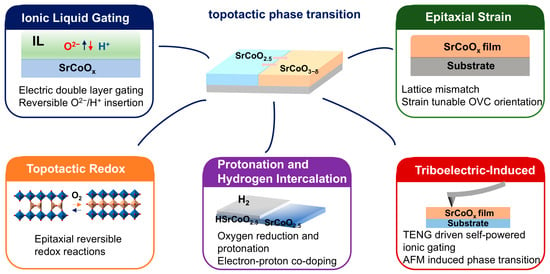
Phase transition is the transformation from one phase to another under external stimuli such as a magnetic field, thermal field, surface energy, external force, or electric field, accompanied by enormous differences in physical properties between the two phases [25]. In recent years, phase transitions and applications based on the SrCoOx system have attracted widespread attention, and exploring simple, convenient, and readily applicable phase-transition methods has become a research focus, as shown in Figure 2. The SrCoOx phase-transition regulation strategies are compared in Table 2. Researchers have attempted various approaches to achieve phase transitions. Ionic gating (IG), as a means of regulating the physical properties of materials, has attracted increasing attention in recent years [32]. IG technology transcends conventional gate structures such as field-effect transistors by exploiting electrochemical changes induced by the strong electric field in the electric double layer (EDL) formed at the electrolyte/solid interface to achieve functional regulation. In 2017, Yu et al. [12] investigated electric-field-controlled reversible phase transitions of dual ions (oxygen ions and hydrogen ions), along with the associated electrochromic and magnetoelectric properties. Independently controlling the insertion and extraction of oxygen and hydrogen ions enables reversible switching among three different phases: PV-SCO, BM-SCO, and a previously unexplored new phase, HSrCoO2.5. The three phases possess distinct optical absorption characteristics, magnetic and electrical properties. These findings hold broad application prospects in magnetoelectric and spintronic devices.
Figure 2.
The regulation method of the SrCoOx topotactic phase transition.
Subsequently, Han et al. demonstrated that synchronized local ionic gating can simultaneously regulate the electrical, magnetic, and optical properties of large-scale device arrays [33]. Such designed metasurface materials based on BM-SCO films exhibit anomalous light reflection that relies on the uniform and coherent response of all devices. Beyond oxides, almost all materials whose properties can be tuned by ion insertion/extraction can be used with this technique to construct novel metasurfaces. The same group further proposed that ionic liquid gating can regulate the arrangement of oxygen vacancies by using IG to insert/remove oxygen throughout a thick film. BM-SCO exhibits horizontally aligned oxygen vacancy channels (OVCs) (H-SCO) and can be converted into vertically aligned PV-SCO (V-SCO) [28]. Wang et al. [34] found that BM-SCO can transform into a metastable perovskite phase (M-SCO) in weakly acidic solution. M-SCO exhibits strong ferromagnetism and significantly increased conductivity. In addition, such M-SCO can be easily reconverted to B-SCO under vacuum or lower-temperature heating conditions. Notably, these processes are independent of the substrate-induced strain that favors the formation of H-SCO in the as-grown film. Cui et al. used in situ real-time high-resolution transmission electron microscopy to directly observe the reversible phase transition between the vacancy-ordered BM-SCO and the oxygen-ordered PV-SCO [35]. They found that the migration speed of the phase boundary is strongly anisotropic: the lateral velocity is approximately 30 times that along the film thickness direction. Exploiting this anisotropy, three-dimensional metallic structures such as cylinders and rings were successfully fabricated. This study provides theoretical guidance for constructing complex mesoscopic structures from the outer surface of materials.
3.2. Epitaxial Strain-Induced Phase Transition
Epitaxial strain induced by lattice mismatch is an important approach for tuning thin-film properties. By epitaxially growing films on substrates with different lattice mismatches, strain can be used to regulate the oxygen content of SrCoOx [22]. Lee et al. proved that epitaxial strain is an effective means to regulate oxygen content. The additional oxygen vacancies generated by tensile strain increase the catalytic activity of cobaltate for this important reaction by more than one order of magnitude [22]. Mishra et al. [36] grew films on different single-crystal substrates and altered the orientation of OVCs by tuning the strain state of BM-SCO films. Experiments showed that BM-SCO films grown on substrates producing in-plane compressive strain (such as (LaAlO3)0.3(Sr2TaAlO6)0.7 (LSAT) and STO) form horizontal oxygen vacancy bands, designated H-SCO. In contrast, in BM-SCO films deposited on substrates producing in-plane tensile strain (such as Pb(Mg1/3Nb2/3)O3-PbTiO3 (PMN-PT) and BaTiO3 (BTO)), the OVCs reorient to a vertical configuration, designated V-SCO. This study provides a simple engineering method for regulating OVCs in BM-SCO.
Song et al. treated Al|SrFeO3−δ films with an aqueous KOH solution and investigated the hydrogen distribution using an electron-proton co-doping approach [37]. They observed a graded distribution of hydrogen atoms in compressively strained SrFeO3−δ, with the highest concentration located near the interface rather than at the surface. Aberration-corrected high-angle annular dark-field scanning transmission electron microscopy (HAADF-STEM) measurements confirmed the presence of misfit dislocations in HSrFeO3−δ films. Through a spontaneous hydrogen incorporation mechanism, the authors demonstrated that the band gap of SrFeO3−δ can be controlled via a filling-controlled Mott transition, thereby forming insulating films. Under small compressive strain, HSrFeO3−δ samples retain the perovskite structure with negligible lattice distortion, showing promise as electrolyte materials for proton conduction at low temperatures. Ibrahim et al. [30] investigated the effect of coherent epitaxial strain on the properties of BM-SCO films and systematically studied the evolution of structural and electronic properties with film thickness. As the BM-SCO film thickness increases, the c-axis lattice constant decreases, indicating relaxation of the coherent epitaxial strain; meanwhile, the band gap widens and the Raman spectra exhibit significant softening.
From the perspective of functional oxide coatings, which is the scope of this journal, the choice of substrate, film thickness, strain-relaxation behavior, interfacial stability, and processing conditions are of direct relevance. Because the phase state and the OVC orientation of BM-SCO depend sensitively on the sign and magnitude of the epitaxial strain, the substrate lattice mismatch must be matched to the target phase [22,36]; thin films sustain coherent strain and thereby stabilize the desired OVC orientation, whereas thicker films undergo strain relaxation that can alter the phase-transition window. Interfacial stability governs the reversibility of oxygen exchange across the film/electrode interface, and the deposition oxygen pressure and post-annealing conditions determine the obtainable oxygen stoichiometry. These considerations are equally important for fabricating robust SrCoOx-based coatings and devices, linking the fundamental phase-transition science discussed here to coating engineering.
3.3. Topotactic Redox-Induced Phase Transition
The reversible redox behavior of SrCoOx was first demonstrated through the epitaxially stabilized “oxygen sponge” concept [38]. Jeen et al. showed that epitaxially stabilizing SrCoOx in either the perovskite or brownmillerite phase can significantly lower the redox temperature, enabling the film to absorb or release oxygen like a sponge and to rapidly and reversibly switch between the metallic perovskite and insulating brownmillerite phases at reduced temperatures [1]. The ordered oxygen vacancy channels in BM-SCO provide well-defined pathways for oxygen migration without disrupting the crystal framework, and the low thermodynamic barrier between the two phases underlies the robustness of the topotactic phase transition (TPT) [17].
Recent studies have revealed unexpected and more refined redox pathways. A strong reductant first reduces BM-SCO into a metastable polar intermediate phase, SrCoO2, which adopts an alternating octahedral-linear (AOL) layered structure [39]. Subsequently, this high-energy intermediate directly extracts lattice oxygen from the STO substrate and transforms into the perovskite phase at a remarkably low temperature of approximately 200 °C without external oxygen supply. This “reduce-first, oxidize-later” strategy demonstrates how metastable intermediates can bypass the large kinetic barriers in solid-state synthesis. Water vapor provides another efficient oxidation medium. Using in situ environmental TEM, Yang et al. demonstrated that under comparable conditions, water vapor oxidizes vacancy-ordered BM-SCO more effectively than molecular oxygen, exhibiting a distinctive “stepwise” behavior: a fully ordered intermediate phase, SrCoO2.75, is first formed, which then transforms into the PV-SCO phase [40]. Reversible nanoscale gaps formed at antiphase boundaries originating from substrate steps relieve strain through lattice contraction during oxidation, thereby preserving structural integrity over redox cycles.
At the interface level, Wenderott et al. used in situ coherent X-ray scattering to capture the kinetics of oxygen ion exchange in epitaxial BM-SCO/PV-SCO bilayers [41]. The kinetics exhibited pronounced asymmetry: the dynamics under reducing conditions were much slower than under oxidizing conditions, while the kinetics near the center of the BM-SCO crystal were essentially consistent with those near the heterointerfaces, indicating that the interfaces are stable and reversible. This makes SrCoOx an ideal model system for studying ionotronic behavior. Finally, Yang et al. directly showed by in situ TEM in vacancy-ordered SrFeO2.5 films that oxygen ion migration can be guided along two different diffusion pathways, producing SrFeO2.75 polymorphs with different electronic ground states before reaching the fully oxidized metallic SrFeO3 phase. Ab initio calculations elucidated the corresponding diffusion steps and reaction intermediates, establishing design principles for anisotropic ion transport in ordered oxides [13].
3.4. Protonation and Hydrogen Intercalation Induced Phase Transition
Proton intercalation has emerged as a rapid and versatile approach for tuning the magnetoelectric properties of TMOs [42,43]. In BM-SCO, proton-induced filling of oxygen vacancy channels transforms the brownmillerite phase into a metastable perovskite phase (M-SCO), which exhibits strong ferromagnetism (1.01 μB/Co, TC > 200 K) and an electrical conductivity approximately 104 times higher than that of the parent phase, resembling the behavior of the canonical PV-SCO. This metastable phase reversibly converts back to BM-SCO upon heating under vacuum or at low temperature [34]. Control experiments indicated that reactive oxygen species released during surface corrosion are the dominant filling mechanism, offering a new route for rapid oxygen injection through proton–oxide interactions.
The hydrogen-intercalated phase HSrCoO2.5 itself is an excellent proton conductor. Lu et al. reported that hydrogen-intercalated brownmillerite HSrCoO2.5 exhibits a high proton conductivity of 0.028–0.33 S·cm−1 between 40 and 140 °C, with a low activation energy of approximately 0.27 eV, which is attributed to the ordered vacancy channels and high proton concentration, making it promising as an electrolyte for low-temperature solid oxide fuel cells [44]. In the related Sr(Fe,Co)Oy system, DFT-guided experiments showed that increasing the cobalt content (x ≥ 0.3) stabilizes the oxygen vacancy ordering characteristic of the brownmillerite structure, thereby promoting proton incorporation into the lattice. Electrochemical proton insertion/extraction can reversibly modulate the resistance of Sr(Fe0.5Co0.5)O2.5 films by more than three orders of magnitude [45].
3.5. Triboelectric Induced Phase Transition
As a novel energy-harvesting technology, triboelectric nanogenerators (TENGs) can convert mechanical energy ubiquitously present in daily life into electrical energy and have been widely applied in self-powered systems [46,47,48]. Zhai et al. [49] employed a TENG as a self-powered source to fabricate an electric-field-controlled ionic liquid gating device for regulating phase transitions. The power supplied by the TENG can induce electrolysis of the ionic liquid, injecting oxygen ions into the film and achieving the phase transition from BM-SCO to PV-SCO. The reverse voltage provided by the management circuit of the self-powered system enables the reversibility of the phase transition. Furthermore, the difference in conductivity between the two phases can be exploited for resistive switching memory.
Subsequently, they repeatedly rubbed the surface of BM-SCO with an atomic force microscopy (AFM) probe in contact mode and achieved the phase transition from BM-SCO to PV-SCO [50]. Scanning Kelvin probe microscopy was used to map the surface potential difference after the phase transition, and applying a negative bias voltage enabled the reversible process. In addition, the effects of contact force, scanning cycles, contact area, and scanning time on the AFM-tip friction-induced phase transition were investigated separately. They further proposed a SrCoOx-based artificial synapse structure by AFM nanoscale sliding control [51]. The AFM tip sliding on the SrCoOx film triggers a phase transition, thereby altering conductivity and enabling precise modulation of excitatory and inhibitory responses. An artificial neural network based on SrCoOx synapses achieved an accuracy as high as 97% in a digit recognition task. This type of mechanical phase transition coupling provides an entirely new regulation dimension for micro/nanoelectronics and neuromorphic hardware.
Table 2.
Comparison of the five SrCoOx phase-transition regulation strategies.
4. Applications of Phase Transitions in Transition Metal Oxide SrCoOx
4.1. Electron Transport and Resistive Switching
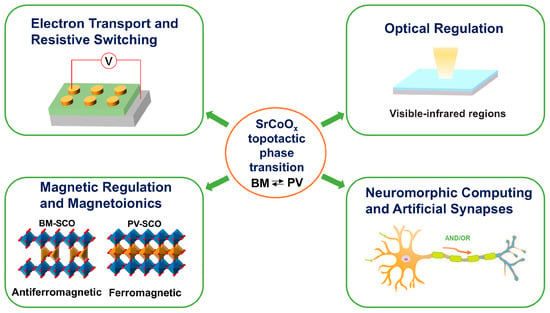
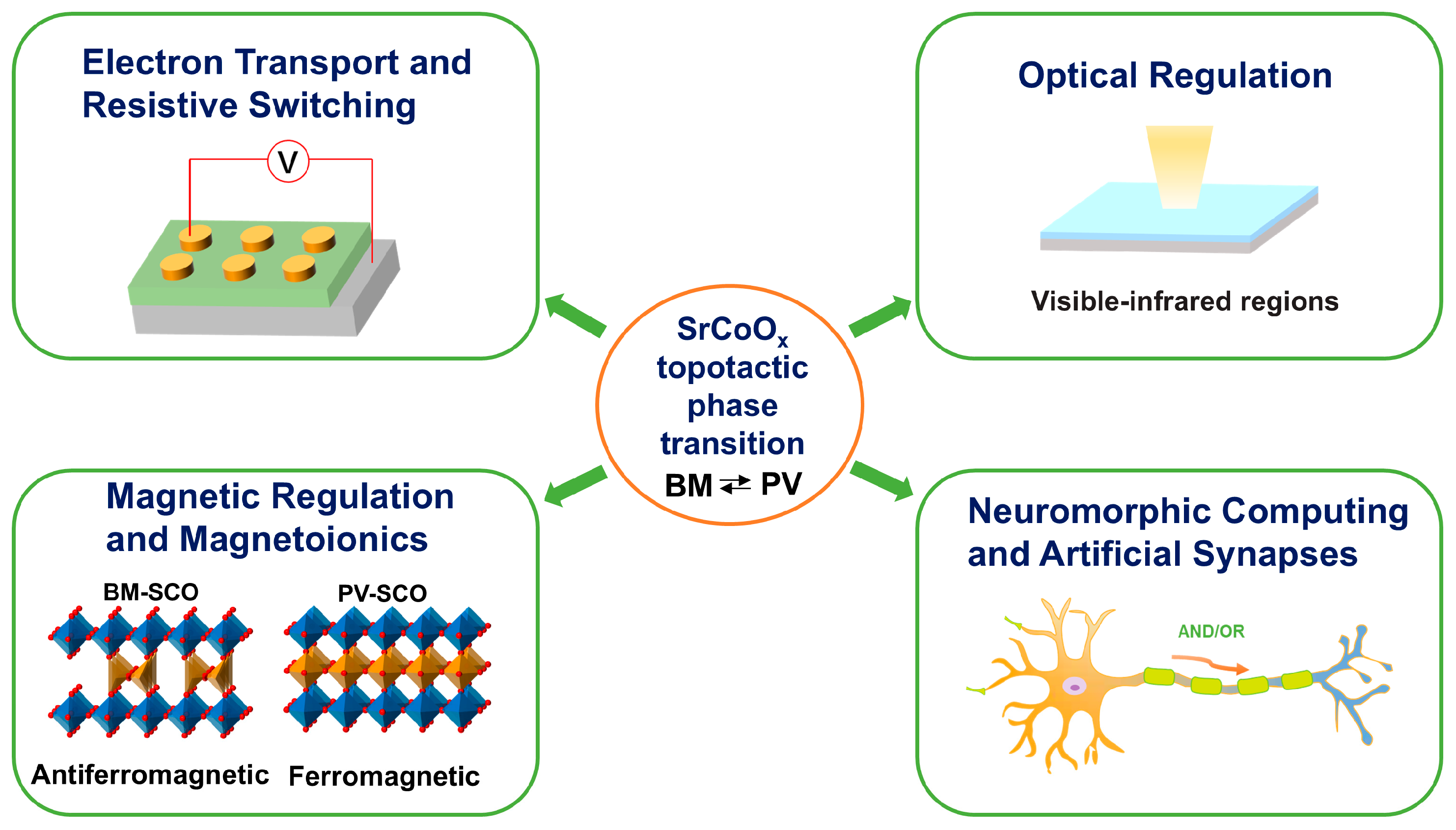
Owing to the pronounced differences between the two phases after phase transition, TMO phase transitions have been widely applied in chemical catalysis, fuel cells, resistive switching memory, synaptic transistors, and other fields [15,52]. Figure 3 summarizes several applications of the SrCoOx phase transition and Table 3 compares the SrCoOx phase-transition devices. Because BM-SCO possesses ordered oxygen vacancy channels and high oxygen mobility, and because the PV-SCO and BM-SCO phases exhibit different conductivities after phase transition, with the process being reversible and without destruction of the crystal framework, these materials show tremendous advantages for resistive memory switching applications [53,54,55]. Chen et al. used strain engineering to tune the resistive switching characteristics of BM-SCO epitaxial films [56]. Through first-principles calculations, they concluded that the memristive behavior can be attributed to strain effects on oxygen migration and the associated formation and rupture of conductive filaments.
Figure 3.
Application of SrCoOx topotactic phase transition.
4.2. Magnetic Regulation and Magnetoionics
The topotactic phase transition in the SrCoOx system is accompanied by dramatic reconstruction of the spin states, valence states, and magnetic exchange interactions of Co ions, making it a typical model system for magnetoionics research. Changes in oxygen nonstoichiometry directly determine the ground-state magnetic order: near-stoichiometric SrCoO3−δ exhibits ferromagnetic metallic behavior with a Curie temperature of approximately 220–280 K, whose exact value depends on the oxygen deficiency δ, film thickness, and strain state of the epitaxial film. When δ ≈ 0.5 and the system transforms into BM-SCO, it becomes a G-type antiferromagnetic insulator, with a marked decrease in macroscopic magnetization. Through electrochemical gate bias and ionic liquid gating, oxygen ions can be driven reversibly into and out of the film, achieving nonvolatile switching between ferromagnetic and antiferromagnetic states within tens of seconds, providing a regulation pathway for ionic magnetic memory [24]. Lu et al. applied a bias voltage to SrCoOx films in an electrochemical cell to continuously modulate the oxygen vacancy concentration in situ, observing reversible evolution of the magnetization and coercive field [12]. They confirmed that oxygen ion migration, rather than purely charge doping, dominates the reconstruction of magnetic order.
Epitaxial lattice strain can further couple with oxygen vacancy ordering to modulate the magnetic ground state of SrCoOx. Tensile strain tends to induce the formation of intrinsic oxygen vacancies, whereas compressive strain lowers the oxygen migration barrier, altering Co-O bond lengths and bond angles and modulating the t2g/eg orbital occupancy of Co ions, thereby enabling competition among ferromagnetic, weakly ferromagnetic, and antiferromagnetic states. Neutron diffraction and X-ray magnetic circular dichroism (XMCD) characterizations indicate that, under strain perturbation, BM-SCO films can exhibit a weak ferromagnetic component that deviates from the ideal G-type antiferromagnetism, arising from lattice-distortion-induced canting of magnetic moments [28]. Compared with conventional spin–orbit torque devices that rely on charge-to-spin conversion, SrCoOx magnetoionics uses ion migration as the order parameter, offering the advantages of voltage-driven operation, low power consumption, and multistability [21,57]. However, the oxygen ion migration rate, cycling stability, and room-temperature magnetic-state retention remain key issues that must be addressed for practical device implementation [58].
4.3. Optical Regulation
During the topotactic phase transition of SrCoOx, the band structure, carrier concentration, and band gap change significantly, yielding a reversible optical response with high contrast in the visible-to-infrared range, which holds application potential in electrochromic and reconfigurable infrared optical devices. The PV-SCO phase is a high-carrier metallic state with strong free-carrier absorption near the Fermi edge, rendering the film highly opaque overall; the BM-SCO phase is an insulating state with an enlarged band gap, resulting in markedly increased transmittance in the visible and near-infrared regions. The refractive index and extinction coefficient change by orders of magnitude, and the optical contrast originates from the synergistic reconstruction of Co 3d-O 2p hybridized bands and the metal–insulator phase transition [26].
Cutting-edge work has further achieved wavelength-selective modulation. Yu et al. used dual-ion gating to reversibly switch a single film between a metallic opaque phase and an insulating transparent phase, confirming that the optical response is highly coupled to the structural/magnetic phase transition [12]. Another study, using an STO capping layer to assist oxygen migration, selectively tuned the absorption of BM-SCO at approximately 2.6 eV (blue light, O 2p-Co 3d p-d charge transfer) and approximately 1.4 eV (red light, d-d transitions) without a complete topotactic phase transition; the color of the heterostructure was varied with the capping-layer thickness, providing a new route for designing emerging optical phenomena in oxygen-deficient oxides [26]. Synchronized local ionic gating has achieved anomalous light reflection in all-oxide metasurfaces [33]. Ultrafast optical fields can perturb the dielectric function on picosecond-to-nanosecond timescales to achieve nonthermal optical modulation; however, photoinduced topotactic phase transitions require high excitation fluence and are prone to thermal accumulation damage, which limits cycling performance [59]. Current bottlenecks include the limited cycling lifetime of electrochemical modulation, device relaxation due to interfacial oxygen diffusion, and the thermodynamic metastability of intermediate-stoichiometry phases at room temperature; future work should combine heterointerface engineering and protective-layer design to enhance stability. Strain and A/B-site doping can finely tune the electronic structure of SrCoOx, enabling blue or red shifts in the absorption edge to optimize the operating wavelength band [22].
4.4. Neuromorphic Computing and Artificial Synapses
The ability to establish multiple intermediate resistance states through partial phase conversion, together with the inherent nonvolatility and reversibility of the TPT, makes SrCoOx a strong candidate for artificial synapses and neuromorphic hardware [60]. Huang et al. demonstrated an electrolyte-gated synaptic device based on SrCoOx (SCO) films that achieves nonvolatile multilevel conduction states in the SCO film, successfully emulating synaptic functions [61]. Shi et al. employed a solid-state electrolyte gate and a SrFeO2.5 film channel; through electrolyte gating, oxygen ion insertion and extraction enable nonvolatile conductance switching in SrFeOx films [62]. This synaptic device achieves a large modulation range and multistate plasticity. Zhai et al. proposed an SCO-based artificial synapse controlled by an AFM tip (Section 3.5), in which nanoscale mechanical sliding of the AFM tip on the SrCoOx film modulates the device conductance and mimics the excitatory and inhibitory functions of biological synapses [51]. Based on updates of synaptic weights, an ANN algorithm was used to simulate targeted recognition of the MNIST dataset, achieving a high recognition accuracy, which is of great significance for future applications of micro/nanoelectronics in synaptic devices.
Table 3.
Summary of demonstrated SrCoOx phase-transition devices.
4.5. Application Outlook
As discussed above, the enormous differences in conductivity, magnetism, optical properties, and ionic transport induced by SrCoOx phase transitions endow it with broad application prospects in electronic devices such as resistive switching memory, magnetoionic devices, reconfigurable optical devices, and artificial synapses. On this basis, SrCoOx also holds important value in energy and catalysis. The large conductivity difference between the two phases and the reversible oxygen storage/release capability make it promising as an electrode material for solid oxide fuel cells, as an oxygen pump, or as an oxygen storage layer in rechargeable batteries, enabling dynamic optimization of device performance through oxygen ion regulation [33]. The reversible changes in Co valence state and coordination environment during the phase transition can effectively tune catalytic active sites, providing new insights for electrochemical catalysis such as the oxygen evolution reaction, oxygen reduction reaction, and selective oxidation. In addition, the highly oxygen-stoichiometry-sensitive electronic transport properties of SrCoOx give it application potential in electrochemical oxygen sensors, gas sensors, and ion-gated transistors [63].
Looking ahead, the applications of SrCoOx phase transitions are expected to expand in the following directions. First, multistable and multi-parameter cooperative regulation. Ionic liquid gating can independently achieve oxygen and hydrogen ion insertion and extraction in the same device, enabling reversible switching among multiple metastable states; combined with external stimuli such as electric field, strain, and temperature, this is expected to lead to multivalued logic memory and optical-electronic-magnetic multi-parameter coupled devices [26,44,51]. Second, device miniaturization and arrayed integration. Synchronized local ionic gating and large-scale epitaxial processes can integrate SrCoOx phase-transition devices into large-area arrays for reconfigurable metasurfaces, programmable optical devices, and large-scale neuromorphic computing chips, offering the possibility of constructing multifunctional systems-on-chip [60]. Third, compatibility and integration with mainstream semiconductor processes. SrCoOx epitaxial films can be fabricated on various oxide substrates, and their resistance, magnetism, and optical responses can all be regulated in situ by electrical means, making them promising for integration with CMOS processes and for advancing nonvolatile memory and compute-in-memory architectures [55,56].
It should be noted that the practical implementation of SrCoOx phase-transition devices still faces numerous challenges. First, the reversibility of the phase transition and cycling stability are insufficient; long-term oxygen ion insertion/extraction can readily induce interfacial degradation and structural fatigue, which must be addressed through heterointerface engineering, protective-layer design, and compositional optimization. Second, the oxygen ion migration rate at room temperature is limited, constraining the response speed of devices; one may draw on low-barrier pathways such as topotactic redox and protonation, or introduce strain and doping strategies to enhance ionic transport kinetics. Third, the correlation mechanism among oxygen vacancy channels, electronic ground states, and macroscopic performance remains to be elucidated, requiring further investigation using in situ characterization techniques and first-principles calculations. Overall, with a deeper understanding of phase-transition mechanisms and continuous maturation of fabrication processes, SrCoOx-based phase-transition devices are expected to find broader applications in information storage, intelligent sensing, energy conversion, and neuromorphic computing.
Stability of intermediate states for multilevel neuromorphic operation. Because SrCoOx (2.5 ≤ x ≤ 3.0) can access partially oxidized compositions such as SrCoO2.75 and SrCoO2, partial phase conversion can in principle provide a continuum of intermediate conductance states, which is attractive for multilevel synaptic weight storage. Whether these intermediate states are sufficiently stable at room temperature to serve as reliable conductance levels is a key open question: several intermediate-stoichiometry phases are thermodynamically metastable at room temperature and may relax over time, degrading retention. Engineered interfaces, capping layers, and compositional stabilization could help pin the intermediate states. Establishing the correlation between the oxygen stoichiometry, the number and stability of the accessible conductance levels, and the device retention is therefore a priority for neuromorphic applications.
For competitive neuromorphic hardware, typical targets include sub-picojoule-per-event switching energies, endurance of 106–109 cycles, retention exceeding 10 years at the operating temperature, and multiple (≥4) stable conductance levels with nanosecond-to-microsecond write times. For magnetoionic technologies, the key metrics are the write voltage and time, the energy per write operation, and the retention of the magnetic state. Against these targets, phase-transition switching of SrCoOx is currently realized on the timescale of seconds to tens of seconds for ionic gating and on shorter timescales for proton intercalation, which is orders of magnitude slower than the nanosecond write times of established HfO2-based resistive-switching memory or phase change memories; endurance is likewise constrained by interfacial degradation and structural fatigue upon repeated oxygen exchange. Nevertheless, SrCoOx offers the distinct advantage of multi-parameter (electrical, magnetic, and optical) nonvolatile control within a single material, which is difficult to achieve in conventional memristive systems. The quantitative gap between the current demonstrations and the required benchmarks therefore defines the central challenge for practical adoption.
5. Conclusions
This review systematically summarizes the phase-transition regulation strategies and research progress on the properties of the TMO SrCoOx system. As a typical oxygen vacancy-tunable material, SrCoOx undergoes a reversible topotactic phase transition between BM-SCO and PV-SCO through continuous variation of oxygen stoichiometry. Structurally, the two phases possess ordered one-dimensional oxygen vacancy channels and a dense perovskite framework, leading to distinctly different valence states, spin states, and electronic ground states of Co ions. This is manifested as the magnetic distinction between an antiferromagnetic insulator and a ferromagnetic metal, the electrical metal-insulator transition with resistivity spanning more than four orders of magnitude, and the pronounced optical modulation of transmittance and band gap from the visible to the infrared region.
Regarding phase-transition regulation, various strategies have been developed, including ionic liquid gating, triboelectric induction, epitaxial strain, topotactic redox, and protonation/hydrogen intercalation. Ionic liquid gating can reversibly drive oxygen/hydrogen ion injection at room temperature through an electric field, achieving multiphase switching and multi-parameter cooperative regulation. Triboelectric induction and strain engineering provide new driving forces for phase transitions from the perspectives of mechanical energy and lattice mismatch, respectively. The topotactic redox approach significantly lowers the temperature and oxygen pressure required for phase transitions through metastable intermediates and low-barrier oxygen-migration pathways, and protonation/hydrogen intercalation endows the system with additional degrees of magnetoelectric regulation. These methods are complementary and provide a rich toolkit for precise and reversible regulation of SrCoOx phase transitions.
Given the pronounced differences between the two phases, SrCoOx phase transitions have shown broad application prospects in electronic devices such as resistive switching memory, magnetoionic devices, reconfigurable optical devices, and artificial synapses. Meanwhile, bottleneck issues such as cycling stability, ion migration rate, and device integration density still need to be resolved through interface engineering, compositional optimization, and process improvement. As the understanding of oxygen vacancy channels and phase-transition mechanisms continues to deepen, the SrCoOx system will play an increasingly important role in information storage, intelligent sensing, energy conversion, and neuromorphic computing.
Author Contributions
Conceptualization, writing-original draft preparation, L.R.; investigation, L.D. and Y.F.; review and editing, C.C., M.P. and Z.S. All authors have read and agreed to the published version of the manuscript.
Funding
This research received no external funding.
Institutional Review Board Statement
Not applicable.
Informed Consent Statement
Not applicable.
Data Availability Statement
The original contributions presented in this study are included in the article. Further inquiries can be directed to the corresponding authors.
Conflicts of Interest
The authors declare no conflicts of interest.
References
- Jeen, H.; Choi, W.S.; Biegalski, M.D.; Folkman, C.M.; Tung, I.C.; Fong, D.D.; Freeland, J.W.; Shin, D.; Ohta, H.; Chisholm, M.F.; et al. Reversible Redox Reactions in an Epitaxially Stabilized SrCoOx Oxygen Sponge. Nat. Mater. 2013, 12, 1057–1063. [Google Scholar] [CrossRef] [Scilit] [PubMed]
- Mueller, D.N.; Machala, M.L.; Bluhm, H.; Chueh, W.C. Redox Activity of Surface Oxygen Anions in Oxygen-Deficient Perovskite Oxides During Electrochemical Reactions. Nat. Commun. 2015, 6, 6097. [Google Scholar] [CrossRef] [Scilit] [PubMed]
- Zhao, J.; Luo, Y.; Wang, J.-O.; Qian, H.; Liu, C.; He, X.; Zhang, Q.; Huang, H.; Zhang, B.; Li, S.; et al. Electronic Structure Evolutions Driven by Oxygen Vacancy in SrCoO3−x Films. Sci. China Mater. 2019, 62, 1162–1168. [Google Scholar] [CrossRef] [Scilit]
- Inoue, S.; Kawai, M.; Ichikawa, N.; Kageyama, H.; Paulus, W.; Shimakawa, Y. Anisotropic Oxygen Diffusion at Low Temperature in Perovskite-Structure Iron Oxides. Nat. Chem. 2010, 2, 213–217. [Google Scholar] [CrossRef] [Scilit] [PubMed]
- Yang, Q.; Cho, H.J.; Jeen, H.; Ohta, H. Macroscopic Visualization of Fast Electrochemical Reaction of SrCoOx Oxygen Sponge. Adv. Mater. Interfaces 2019, 6, 1901260. [Google Scholar] [CrossRef] [Scilit]
- Gu, Y.; Xu, K.; Song, C.; Zhong, X.; Zhang, H.; Mao, H.; Saleem, M.S.; Sun, J.; Liu, W.; Zhang, Z.; et al. Oxygen-Valve Formed in Cobaltite-Based Heterostructures by Ionic Liquid and Ferroelectric Dual-Gating. ACS Appl. Mater. Interfaces 2019, 11, 19584–19595. [Google Scholar] [CrossRef] [Scilit] [PubMed]
- Tsujimoto, Y.; Tassel, C.; Hayashi, N.; Watanabe, T.; Kageyama, H.; Yoshimura, K.; Takano, M.; Ceretti, M.; Ritter, C.; Paulus, W. Infinite-Layer Iron Oxide with a Square-Planar Coordination. Nature 2007, 450, 1062–1065. [Google Scholar] [CrossRef] [Scilit] [PubMed]
- Nallagatla, V.R.; Heisig, T.; Baeumer, C.; Feyer, V.; Jugovac, M.; Zamborlini, G.; Schneider, C.M.; Waser, R.; Kim, M.; Jung, C.U.; et al. Topotactic Phase Transition Driving Memristive Behavior. Adv. Mater. 2019, 31, 1903391. [Google Scholar] [CrossRef] [Scilit] [PubMed]
- Gonzalez-Rosillo, J.C.; Catalano, S.; Maggio-Aprile, I.; Gibert, M.; Obradors, X.; Palau, A.; Puig, T. Nanoscale Correlations between Metal-Insulator Transition and Resistive Switching Effect in Metallic Perovskite Oxides. Small 2020, 16, 2001307. [Google Scholar] [CrossRef] [Scilit] [PubMed]
- Huang, S.; Feng, S.; Lu, Q.; Li, Y.; Wang, H.; Wang, C. Cerium and Niobium Doped SrCoO3−δ as a Potential Cathode for Intermediate Temperature Solid Oxide Fuel Cells. J. Power Sources 2014, 251, 357–362. [Google Scholar] [CrossRef] [Scilit]
- Schöllhorn, R. Reversible Topotactic Redox Reactions of Solids by Electron/Ion Transfer. Angew. Chem. Int. Ed. 1980, 19, 983–1003. [Google Scholar] [CrossRef] [Scilit]
- Lu, N.; Zhang, P.; Zhang, Q.; Qiao, R.; He, Q.; Li, H.B.; Wang, Y.; Guo, J.; Zhang, D.; Duan, Z.; et al. Electric-Field Control of Tri-State Phase Transformation with a Selective Dual-Ion Switch. Nature 2017, 546, 124–128. [Google Scholar] [CrossRef] [Scilit] [PubMed]
- Yang, Z.; Wang, L.; Dhas, J.A.; Engelhard, M.H.; Bowden, M.E.; Liu, W.; Zhu, Z.; Wang, C.; Chambers, S.A.; Sushko, P.V.; et al. Guided Anisotropic Oxygen Transport in Vacancy Ordered Oxides. Nat. Commun. 2023, 14, 6068. [Google Scholar] [CrossRef] [Scilit] [PubMed]
- Tian, J.; Zhang, Y.; Fan, Z.; Wu, H.; Zhao, L.; Rao, J.; Chen, Z.; Guo, H.; Lu, X.; Zhou, G.; et al. Nanoscale Phase Mixture and Multifield-Induced Topotactic Phase Transformation in SrFeOx. ACS Appl. Mater. Interfaces 2020, 12, 21883–21893. [Google Scholar] [CrossRef] [Scilit] [PubMed]
- Saleem, M.S.; Cui, B.; Song, C.; Sun, Y.; Gu, Y.; Zhang, R.; Fayaz, M.U.; Zhou, X.; Werner, P.; Parkin, S.S.P.; et al. Electric Field Control of Phase Transition and Tunable Resistive Switching in SrFeO2.5. ACS Appl. Mater. Interfaces 2019, 11, 6581–6588. [Google Scholar] [CrossRef] [Scilit] [PubMed]
- Saleem, M.S.; Wang, Y.; Nie, C.; Zhang, X.; Zhang, Y.; Li, H.; Liu, K.; Song, J.; Cheng, M.; Ma, S.; et al. Laser Induced Fast Topotactic Phase Transition in Freestanding Oxide Membranes. Adv. Funct. Mater. 2025, 36, e24555. [Google Scholar] [CrossRef] [Scilit]
- Jeen, H.; Choi, W.S.; Freeland, J.W.; Ohta, H.; Jung, C.U.; Lee, H.N. Topotactic Phase Transformation of the Brownmillerite SrCoO2.5 to the Perovskite SrCoO3–δ. Adv. Mater. 2013, 25, 3651–3656. [Google Scholar] [CrossRef] [Scilit] [PubMed]
- Chae, S.; Ahn, E.; Shin, Y.; Lee, J.H.; Hong, H.; Lee, D. Critical Role of B-Site Cation in ABO2.5-Type Brownmillerite Proton Conductor: A First-Principles Study. Chem. Eng. J. 2026, 541, 177771. [Google Scholar] [CrossRef] [Scilit]
- Xing, Y.; Byun, J.; Kang, K.T.; Hwang, J.; Lee, J.; Choi, W.S.; Oh, S.H. Atomic-Scale Visualization of Vacancy-Ordered Intermediates and Pathway Selection in the Perovskite-Infinite-Layer Transformation. J. Am. Chem. Soc. 2026, 148, 36770–36781. [Google Scholar] [CrossRef] [Scilit] [PubMed]
- Li, Y.; Wenderott, J.K.; Billo, T.; Wang, M.; Chang, A.; Cao, H.; Yan, X.; Buchholz, D.B.; Feng, Z.; Zhou, H.; et al. In Situ Synchrotron X-Ray Studies of Epitaxial SrCoOx Films During Ionic Liquid Gating. APL Mater. 2025, 13, 061106. [Google Scholar] [CrossRef] [Scilit]
- Muñoz, A.; de la Calle, C.; Alonso, J.A.; Botta, P.M.; Pardo, V.; Baldomir, D.; Rivas, J. Crystallographic and Magnetic Structure of SrCoO2.5 Brownmillerite: Neutron Study Coupled with Band-Structure Calculations. Phys. Rev. B 2008, 78, 054404. [Google Scholar] [CrossRef] [Scilit]
- Petrie, J.R.; Jeen, H.; Barron, S.C.; Meyer, T.L.; Lee, H.N. Enhancing Perovskite Electrocatalysis through Strain Tuning of the Oxygen Deficiency. J. Am. Chem. Soc. 2016, 138, 7252–7255. [Google Scholar] [CrossRef] [Scilit] [PubMed]
- Taguchi, H.; Shimada, M.; Koizumi, M. The Effect of Oxygen Vacancy on the Magnetic System SrCoO3−δ (0 < δ < 0.5). J. Solid State Chem. 1979, 29, 221–225. [Google Scholar] [CrossRef] [Scilit]
- Postiglione, W.M.; Liang, J.; Nandakumaran, N.; Figari, L.; Aczel, A.A.; Leighton, C. Direct Neutron-Diffraction-Based Measurement of Magnetic Order in Brownmillerite SrCoO2.5 and La0.5Sr0.5CoO2.5 Thin Films. APL Mater. 2024, 12, 041123. [Google Scholar] [CrossRef] [Scilit]
- Behera, B.C.; Jana, S.; Bhat, S.G.; Gauquelin, N.; Tripathy, G.; Anil Kumar, P.S.; Samal, D. Evidence for Exchange Bias Coupling at the Perovskite/Brownmillerite Interface in Spontaneously Stabilized SrCoO3−δ/SrCoO2.5 Bilayers. Phys. Rev. B 2019, 99, 024425. [Google Scholar] [CrossRef] [Scilit]
- Chen, J.; Oh, J.Y.; Li, B.; Qiao, Z.; Zhang, H.; Li, D.; Men, E.; Wang, H.; Xi, S.; Chen, K.; et al. Wavelength-Selective Control of Visible Light Absorption through Capping-Assisted Oxygen Migration in Oxide Heterostructures. Nano Lett. 2025, 25, 9386–9393. [Google Scholar] [CrossRef] [Scilit] [PubMed]
- Lu, Q.; Huberman, S.; Zhang, H.; Song, Q.; Wang, J.; Vardar, G.; Hunt, A.; Waluyo, I.; Chen, G.; Yildiz, B. Bi-Directional Tuning of Thermal Transport in SrCoOx with Electrochemically Induced Phase Transitions. Nat. Mater. 2020, 19, 655–662. [Google Scholar] [CrossRef] [Scilit] [PubMed]
- Han, H.; Sharma, A.; Meyerheim, H.L.; Yoon, J.; Deniz, H.; Jeon, K.-R.; Sharma, A.K.; Mohseni, K.; Guillemard, C.; Valvidares, M.; et al. Control of Oxygen Vacancy Ordering in Brownmillerite Thin Films Via Ionic Liquid Gating. ACS Nano 2022, 16, 6206–6214. [Google Scholar] [CrossRef] [Scilit] [PubMed]
- Harrison, A.R.P.; Donat, F.; Steele, J.M.A.; Gebers, J.C.; Fairclough, S.M.; Willneff, E.A.; Britton, A.J.; Truscott, C.L.; Müller, C.R.; Ducati, C.; et al. In Situ Studies of Oxygen Transport Mechanisms in Ag/SrFeO3−δ Materials for Chemical Looping Catalysis. J. Mater. Chem. A 2025, 13, 32271–32289. [Google Scholar] [CrossRef] [Scilit]
- Zhao, J.; Guo, H.; He, X.; Zhang, Q.; Gu, L.; Li, X.; Jin, K.J.; Yang, T.; Ge, C.; Luo, Y.; et al. Manipulating the Structural and Electronic Properties of Epitaxial SrCoO2.5 Thin Films by Tuning the Epitaxial Strain. ACS Appl. Mater. Interfaces 2018, 10, 10211–10219. [Google Scholar] [CrossRef] [Scilit] [PubMed]
- Shih, H.A.; Zhou, J.; Snowden, I.L.; Takamura, Y.; Hong, S.S. Freestanding Perovskite and Brownmillerite SrCoOx Membranes for Direct Imaging of Topotactic Phase Transitions. Nano Lett. 2025, 25, 5860–5866. [Google Scholar] [CrossRef] [Scilit] [PubMed]
- Li, H.B.; Lu, N.; Zhang, Q.; Wang, Y.; Feng, D.; Chen, T.; Yang, S.; Duan, Z.; Li, Z.; Shi, Y.; et al. Electric-Field Control of Ferromagnetism through Oxygen Ion Gating. Nat. Commun. 2017, 8, 2156. [Google Scholar] [CrossRef] [Scilit] [PubMed]
- Han, H.; Sharma, A.; Yoon, J.; Wang, Z.; Körner, C.; Deniz, H.; Sharma, A.K.; Li, F.; Sturm, C.; Woltersdorf, G.; et al. All-Oxide Metasurfaces Formed by Synchronized Local Ionic Gating. Adv. Mater. 2024, 36, e2401064. [Google Scholar] [CrossRef] [Scilit] [PubMed]
- Wang, Q.; Gu, Y.; Chen, C.; Qiao, L.; Pan, F.; Song, C. Realizing Metastable Cobaltite Perovskite Via Proton-Induced Filling of Oxygen Vacancy Channels. ACS Appl. Mater. Interfaces 2022, 15, 1574–1582. [Google Scholar] [CrossRef] [Scilit] [PubMed]
- Cui, B.; Werner, P.; Ma, T.; Zhong, X.; Wang, Z.; Taylor, J.M.; Zhuang, Y.; Parkin, S.S.P. Direct Imaging of Structural Changes Induced by Ionic Liquid Gating Leading to Engineered Three-Dimensional Meso-Structures. Nat. Commun. 2018, 9, 3055. [Google Scholar] [CrossRef] [Scilit] [PubMed]
- Mishra, R.; Choudhary, S.; Chowdhury, S.; Ahlawat, A.; Jana, A.; Giglia, A.; Nannarone, S.; Hoesch, M.; Choudhary, R.J. Strain Tuning of Oxygen Vacancy Channels in SrCoO2.5 Thin Films. J. Appl. Phys. 2025, 137, 045301. [Google Scholar] [CrossRef] [Scilit]
- Fayaz, M.U.; Wang, Q.; Xu, M.; Chen, D.; Pan, F.; Song, C. Compressive Strain-Induced Uphill Hydrogen Distribution in Strontium Ferrite Films. ACS Appl. Mater. Interfaces 2025, 17, 21371–21379. [Google Scholar] [CrossRef] [Scilit] [PubMed]
- Lu, Q.; Yildiz, B. Voltage-Controlled Topotactic Phase Transition in Thin-Film SrCoOx Monitored by in Situ X-Ray Diffraction. Nano Lett. 2016, 16, 1186–1193. [Google Scholar] [CrossRef] [Scilit] [PubMed]
- Han, H.; Liang, Y.; Yang, B.; Yang, Z.; Chen, M.; Zhang, Y.; Zhang, Y.; Zheng, Z.; Huang, X.; Qin, J.; et al. Reduction-Mediated Oxidation and New Topotactic Phase Transition in SrCoOx. Acta Mater. 2026, 313, 122295. [Google Scholar] [CrossRef] [Scilit]
- Yang, Z.Z.; Qu, K.; Zhao, Y.F.; Wang, L.; Kovarik, L.; Sushko, P.V.; Lyu, Y.; Zhang, J.B.; Yu, P.; Duan, C.A.; et al. In Situ Atomic-Resolution Imaging of Water Vapor-Driven Multistep Oxidation Dynamics in Strontium Cobaltite. Sci. Adv. 2025, 11, 8. [Google Scholar] [CrossRef] [Scilit] [PubMed]
- Wenderott, J.K.; Dufresne, E.M.; Li, Y.; Cao, H.; Zhang, Q.; Narayanachari, K.V.L.V.; Buchholz, D.B.; Guha, S.; Fong, D.D. The Dynamics of Oxygen Ion Exchange in Epitaxial Strontium Cobaltite Bilayers. Adv. Mater. Interfaces 2023, 10, 2300127. [Google Scholar] [CrossRef] [Scilit]
- Li, H.B.; Lou, F.; Wang, Y.; Zhang, Y.; Zhang, Q.; Wu, D.; Li, Z.; Wang, M.; Huang, T.; Lyu, Y.; et al. Electric Field-Controlled Multistep Proton Evolution in HxSrCoO2.5 with Formation of H-H Dimer. Adv. Sci. 2019, 6, 1901432. [Google Scholar] [CrossRef] [Scilit] [PubMed]
- Yan, F.; Korostelev, V.; Cho, E.; Yang, K.; Wu, J.; Lu, Q.; Luo, F.; Ross, C.A.; Klyukin, K.; Ning, S. Ionic-Liquid-Gating-Induced Hydrogenation in Epitaxial Strontium Ferrite. Adv. Funct. Mater. 2024, 34, 2316608. [Google Scholar] [CrossRef] [Scilit]
- Lu, N.; Zhang, Z.; Wang, Y.; Li, H.-B.; Qiao, S.; Zhao, B.; He, Q.; Lu, S.; Li, C.; Wu, Y.; et al. Enhanced Low-Temperature Proton Conductivity in Hydrogen-Intercalated Brownmillerite Oxide. Nat. Energy 2022, 7, 1208–1216. [Google Scholar] [CrossRef] [Scilit]
- Isoda, Y.; Pham, T.N.; Aso, R.; Nakamizo, S.; Majima, T.; Hosokawa, S.; Nitta, K.; Morikawa, Y.; Shimakawa, Y.; Kan, D. Stabilization of Oxygen Vacancy Ordering and Electrochemical-Proton-Insertion-and-Extraction-Induced Large Resistance Modulation in Strontium Iron Cobalt Oxides Sr(Fe,Co)Oy. Nat. Commun. 2025, 16, 56. [Google Scholar] [CrossRef] [Scilit] [PubMed]
- Fan, F.-R.; Tian, Z.-Q.; Lin Wang, Z. Flexible Triboelectric Generator. Nano Energy 2012, 1, 328–334. [Google Scholar] [CrossRef] [Scilit]
- Jiang, P.; Zhang, L.; Guo, H.; Chen, C.; Wu, C.; Zhang, S.; Wang, Z.L. Signal Output of Triboelectric Nanogenerator at Oil-Water-Solid Multiphase Interfaces and Its Application for Dual-Signal Chemical Sensing. Adv. Mater. 2019, 31, 1902793. [Google Scholar] [CrossRef] [Scilit] [PubMed]
- Wu, C.; Tetik, H.; Cheng, J.; Ding, W.; Guo, H.; Tao, X.; Zhou, N.; Zi, Y.; Wu, Z.; Wu, H.; et al. Electrohydrodynamic Jet Printing Driven by a Triboelectric Nanogenerator. Adv. Funct. Mater. 2019, 29, 1901102. [Google Scholar] [CrossRef] [Scilit]
- Ren, L.; Xiao, J.; Wang, W.; Yu, A.; Zhang, Y.; Zhai, J. Self-Powered Phase Transition Driven by Triboelectric Nanogenerator. ACS Appl. Electron. Mater. 2023, 5, 2845–2852. [Google Scholar] [CrossRef] [Scilit]
- Ren, L.; Guo, P.; Jia, M.; Xiao, J.; Meng, D.; Liu, Y.; Wang, W.; Guo, D.; Wang, Z.L.; Zhai, J. Nanoscale Topotactic Phase Transformation Modulated by Triboelectrification for High Memory Storage. Nano Energy 2023, 107, 108169. [Google Scholar] [CrossRef] [Scilit]
- Ren, L.; Jia, M.; Tian, S.; Zhai, J. Nanoscale Sliding Modulated SrCoOx-Based Neuromorphic Memory Device. Nano Energy 2025, 134, 110555. [Google Scholar] [CrossRef] [Scilit]
- Tambunan, O.T.; Parwanta, K.J.; Acharya, S.K.; Lee, B.W.; Jung, C.U.; Kim, Y.S.; Park, B.H.; Jeong, H.; Park, J.-Y.; Cho, M.R.; et al. Resistance Switching in Epitaxial SrCoOx Thin Films. Appl. Phys. Lett. 2014, 105, 063507. [Google Scholar] [CrossRef] [Scilit]
- Acharya, S.K.; Jo, J.; Raveendra, N.V.; Dash, U.; Kim, M.; Baik, H.; Lee, S.; Park, B.H.; Lee, J.S.; Chae, S.C.; et al. Brownmillerite Thin Films as Fast Ion Conductors for Ultimate-Performance Resistance Switching Memory. Nanoscale 2017, 9, 10502–10510. [Google Scholar] [CrossRef] [Scilit] [PubMed]
- Acharya, S.K.; Nallagatla, R.V.; Togibasa, O.; Lee, B.W.; Liu, C.; Jung, C.U.; Park, B.H.; Park, J.Y.; Cho, Y.; Kim, D.W.; et al. Epitaxial Brownmillerite Oxide Thin Films for Reliable Switching Memory. ACS Appl. Mater. Interfaces 2016, 8, 7902–7911. [Google Scholar] [CrossRef] [Scilit] [PubMed]
- Lo, H.Y.; Yang, C.Y.; Huang, G.M.; Huang, C.Y.; Chen, J.Y.; Huang, C.W.; Chu, Y.H.; Wu, W.W. Observing Topotactic Phase Transformation and Resistive Switching Behaviors in Low Power SrCoOx Memristor. Nano Energy 2020, 72, 104683. [Google Scholar] [CrossRef] [Scilit]
- Xiang, X.; Rao, J.; Lim, C.; Huang, Q.; Zhao, S.; Fan, Z.; Han, J.W.; Chen, Y. Manipulating the Resistive Switching in Epitaxial SrCoO2.5 Thin-Film-Based Memristors by Strain Engineering. ACS Appl. Electron. Mater. 2022, 4, 2729–2738. [Google Scholar] [CrossRef] [Scilit]
- Cui, B.; Song, C.; Li, F.; Zhong, X.Y.; Wang, Z.C.; Werner, P.; Gu, Y.D.; Wu, H.Q.; Saleem, M.S.; Parkin, S.S.P.; et al. Electric-Field Control of Oxygen Vacancies and Magnetic Phase Transition in a Cobaltite/Manganite Bilayer. Phys. Rev. Appl. 2017, 8, 044007. [Google Scholar] [CrossRef] [Scilit]
- Long, Y.W.; Kaneko, Y.; Ishiwata, S.; Taguchi, Y.; Tokura, Y. Synthesis of Cubic SrCoO3 Single Crystal and Its Anisotropic Magnetic and Transport Properties. J. Phys.-Condens. Matter 2011, 23, 6. [Google Scholar] [CrossRef] [Scilit] [PubMed]
- Zhang, H.-J.; Zhu, C.-Q.; Yang, M.-W.; Lu, X.; Chen, J.; Jin, K.-J.; Chen, L.-M. Ultrafast Photo-Induced O2− Channel-Opening in Oxygen Vacancy Ordered SrCoO2.5 Film. Appl. Phys. Lett. 2024, 125, 161901. [Google Scholar] [CrossRef] [Scilit]
- Li, K.F.; Zhang, J.Q.; Chen, Y.; Pan, J.Y.; Zheng, Y.F.; Xu, S.J.; Zhao, R.; Li, M.S.; Qi, R.J.; Huang, R.; et al. In Situ Observation of Oxygen Ion Dynamics in Topological Phase Change Memristors Through Self-Assembled Interface Design. Sci. Adv. 2025, 11, 10. [Google Scholar] [CrossRef] [Scilit] [PubMed]
- Huang, H.Y.; Ge, C.; Zhang, Q.H.; Liu, C.X.; Du, J.Y.; Li, J.K.; Wang, C.; Gu, L.; Yang, G.Z.; Jin, K.J. Electrolyte-Gated Synaptic Transistor with Oxygen Ions. Adv. Funct. Mater. 2019, 29, 1902702. [Google Scholar] [CrossRef] [Scilit]
- Shi, P.; Wang, D.; Yu, T.; Xing, R.; Wu, Z.; Yan, S.; Wei, L.; Chen, Y.; Ren, H.; Yu, C.; et al. Solid-State Electrolyte Gated Synaptic Transistor Based on SrFeO2.5 Film Channel. Mater. Des. 2021, 210, 110022. [Google Scholar] [CrossRef] [Scilit]
- Zhou, H.; Qi, G.; Li, W.; Wang, Y.; Yuan, Z. Electrolyte-Gated SrCoOx Fet Sensor for Highly Sensitive Detecting Ph in Extreme Alkalinity Solution. Nano Res. 2023, 17, 3079–3086. [Google Scholar] [CrossRef] [Scilit]

Disclaimer/Publisher’s Note: The statements, opinions and data contained in all publications are solely those of the individual author(s) and contributor(s) and not of MDPI and/or the editor(s). MDPI and/or the editor(s) disclaim responsibility for any injury to people or property resulting from any ideas, methods, instructions or products referred to in the content. |
© 2026 by the authors. Licensee MDPI, Basel, Switzerland. This article is an open access article distributed under the terms and conditions of the Creative Commons Attribution (CC BY) license.