


Abstract
This investigation has yielded a remarkably efficient metallic catalyst. Copper (Cu), cobalt (Co), and nickel (Ni) nanoparticles were concurrently deposited onto micron-sized aluminum (µAl) through a displacement reaction, resulting in the formation of [nCu+nCo+nNi]/µAl composites. The interfacial layer of the nanocomposite facilitates the creation of efficient oxygen transport pathways, significantly augmenting thermal release. In the context of the ADN/AP oxidizer, the [nCu+nCo+nNi]/µAl configuration demonstrates a substantial synergistic catalytic effect, reducing its thermal decomposition temperature by an impressive 104.1 °C. Combustion experiments have corroborated that this composite markedly enhances flame intensity, combustion temperature, and the burning rate of the ADN/AP system. The underlying thermal-oxidative mechanism was elucidated through comprehensive thermal analysis of the composite both prior to and following a heat treatment at 1100 °C. Moreover, through an integration of thermal analysis and combustion experiments, the catalytic mechanism of [nCu+nCo+nNi]/µAl on the thermolysis of ADN/AP was elucidated, and a plausible reaction pathway under thermal stimulation was proposed (e.g., ). The developed nanocomposite significantly enhances the performance of oxidizers, presenting considerable potential for a wide array of applications in solid propellants.
1. Introduction
Micron aluminum powder (μAl), as a commonly used metal fuel in composite solid propellants (CSP), can significantly enhance the specific impulse and combustion heat of the propellant, and has key application value in the fields of national defense and aerospace [1,2,3,4]. However, its dense surface layer of aluminum oxide severely hinders the mass transfer process between aluminum and oxygen, resulting in high ignition temperature and low combustion efficiency, and the complex phase transformation of aluminum oxide further limits its energy release rate [5,6,7,8]. Therefore, how to destroy or regulate the surface oxide layer of μAl becomes the key to enhancing its reaction activity.
The introduction of nanocomposite metals represents an effective strategy to mitigate passivation caused by the native oxide layer and to optimize energy release. For instance, the Ni/Al composite material developed by Shafirovich et al. markedly reduced the ignition delay time [9]. Furthermore, Zhipeng Cheng et al. [10] successfully synthesized a novel Co/Al/AP composite fuel via a displacement reaction. Notably, a mere trace of Co is sufficient to substantially reduce the oxidation temperature of the composite fuel, thereby amplifying the thermal output of aluminum to 1.5 times its initial capacity. The Cu/Al composite material synthesized by Zhipeng Cheng and colleagues [11] enhanced thermal output by a factor of 1.8 and demonstrated improved combustion performance. Wang Yi et al. [12] reported that the nCu+nNi/µAl composite, synthesized via a displacement method, lowered the onset temperature of aluminum oxidation by nearly 400 °C. However, existing research mainly focuses on the modification of aluminum using single or binary metals, and there is still a lack of systematic research on the thermal oxidation mechanism of the oxide layer in composite structures where multiple transition metals (such as copper, cobalt, and nickel) are co-coated on μAl.
Given that oxidizers typically account for more than 50% of the solid propellant [13] formulation, their effectiveness plays a decisive role in the overall performance of the material. Ammonium perchlorate (AP), a widely employed oxidizer characterized by an oxygen balance of approximately +34%, uniquely yields exclusively gaseous products upon combustion. In comparison to alternative oxidizers, AP is capable of imparting a superior specific impulse to solid propellants. Nonetheless, its elevated thermal decomposition temperature—generally exceeding 430 °C—represents a significant kinetic limitation. In recent years, considerable research efforts have been dedicated to the development of catalysts that effectively lower the decomposition temperature of AP while preserving its combustion efficiency. Recent studies have elucidated that nanoparticles of copper (Cu), cobalt (Co), and nickel (Ni) can effectively lower the decomposition temperature of ammonium perchlorate (AP) by 130.2 °C, 76 °C, and 112.9 °C, respectively. The interplay among Cu, Co, Ni, and Al can generate a synergistic effect. This synergy, often manifested in a distinctive core–shell architecture, enhances performance through cooperative interactions between the constituent elements, effectively creating an energetic composite unit. In contrast to the energy profiles of conventional solid propellant formulations, the energetic efficacy of solid propellants incorporating these materials is poised for marked enhancement [14]. Thus, the introduction of the composite material [nCu+nCo+nNi]/µAl heralds a promising approach for catalyzing AP. Nonetheless, it is imperative to note that the combustion of AP generates hydrogen chloride, a substance detrimental to environmental integrity. The substitution of AP with ADN (ammonium dinitramide) not only significantly augments the energetic capacity of solid propellants but also aligns with environmental preservation standards due to its reduced smoke output and chlorine-free nature [15,16]. Ammonium dinitramide (ADN) is recognized as the preeminent oxidizer in propellant formulations. In contrast to the widely utilized oxidizer ammonium perchlorate (AP), ADN is devoid of chlorine, possesses lower detectable signature characteristics, and produces a relatively elevated thermal output [17,18]. Nevertheless, ADN exhibits a pronounced tendency for moisture absorption, which can lead to the agglomeration or even decomposition of the material during storage and transit, thereby posing significant challenges to its practical utility.
The implementation of the AP/ADN binary system provides a potential approach to coordinate performance and stability, thus providing opportunities for the development of new propellant designs. However, the potential interaction mechanism between this binary system and multi-metal composite aluminum powder remains to be clarified. In view of the identified research gaps, this study proposes a new hypothesis: the formation of a [nCu+nCo+nNi] multi-metal nanocomposite layer on the surface of μAl can effectively remove the surface oxide layer and change the thermal oxidation pathway of aluminum. In addition, when this composite fuel reacts with the AP/ADN binary oxidizer, it is expected that multiple metal components will synergize to catalyze the thermal decomposition of the dual oxidizer, jointly improving the combustion efficiency of the system. To confirm this hypothesis, the following research work will be carried out in this study:
- (1)
- Synthesizing a [nCu+nCo+nNi]/µAl composite material;
- (2)
- Assessing the uniformity and integrity of the nanocomposite metallic coatings (Cu, Co, Ni) on μAl using SEM, TEM, EDS, and XRD;
- (3)
- Examining the influence of this composite on the thermal decomposition of AP/ADN using thermal analysis;
- (4)
- Analyzing the combustion performance (burning rate, flame temperature, intensity) of the composite system;
- (5)
- Exploring the underlying mechanisms of thermal oxidation, pyrolysis, and catalysis.
This investigation seeks to illuminate the synergistic catalytic mechanisms of multi-metal-coated μAl within the context of AP/ADN binary oxidizers and to delineate the thermal reaction pathways of this novel composite fuel. It is anticipated that the findings will establish a foundational framework for the application of innovative high-energy fuels in composite solid propellants (CSPs) and will significantly advance the rapid development of next-generation high-energy, high-combustion efficiency CSPs.
2. Experimental Sections
2.1. Materials
Micro-aluminum (μAl, d50 ≈ 20 μm, > 98%), ferric chloride (FeCl3·6H2O, pure), cobalt chloride (CoCl2·6H2O, pure), copper chloride (CuCl2·6H2O, pure), tartaric acid (tartaric acid, pure), EDTA-2Na (C10H14N2Na2O8, pure) and ammonium fluoride (NH4F, pure) were purchased from China National Pharmaceutical Group (Beijing, China). Ammonium perchlorate (NH4ClO4, AP) was purchased from Gansu Yinguang Chemical Plant, and ammonium dinitramide (NH4N (NO2)2, ADN) was purchased from Gansu Yinguang Chemical Plant (Lanzhou, China).
2.2. Preparation of [nCu+nCo+nNi]/μAl Microspheres
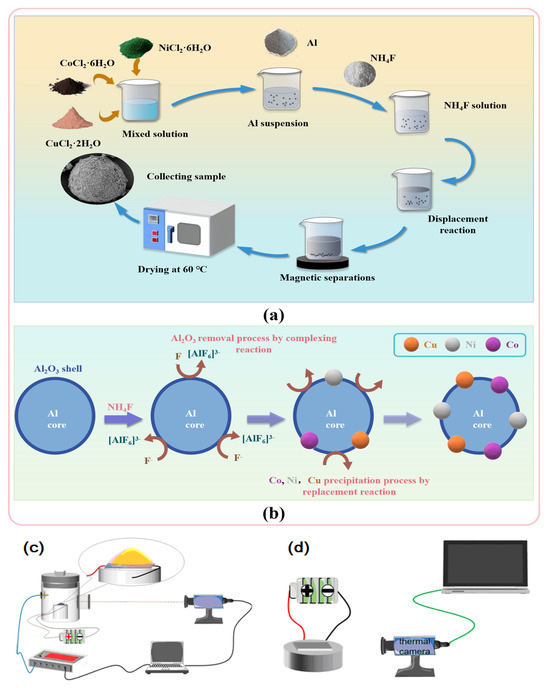
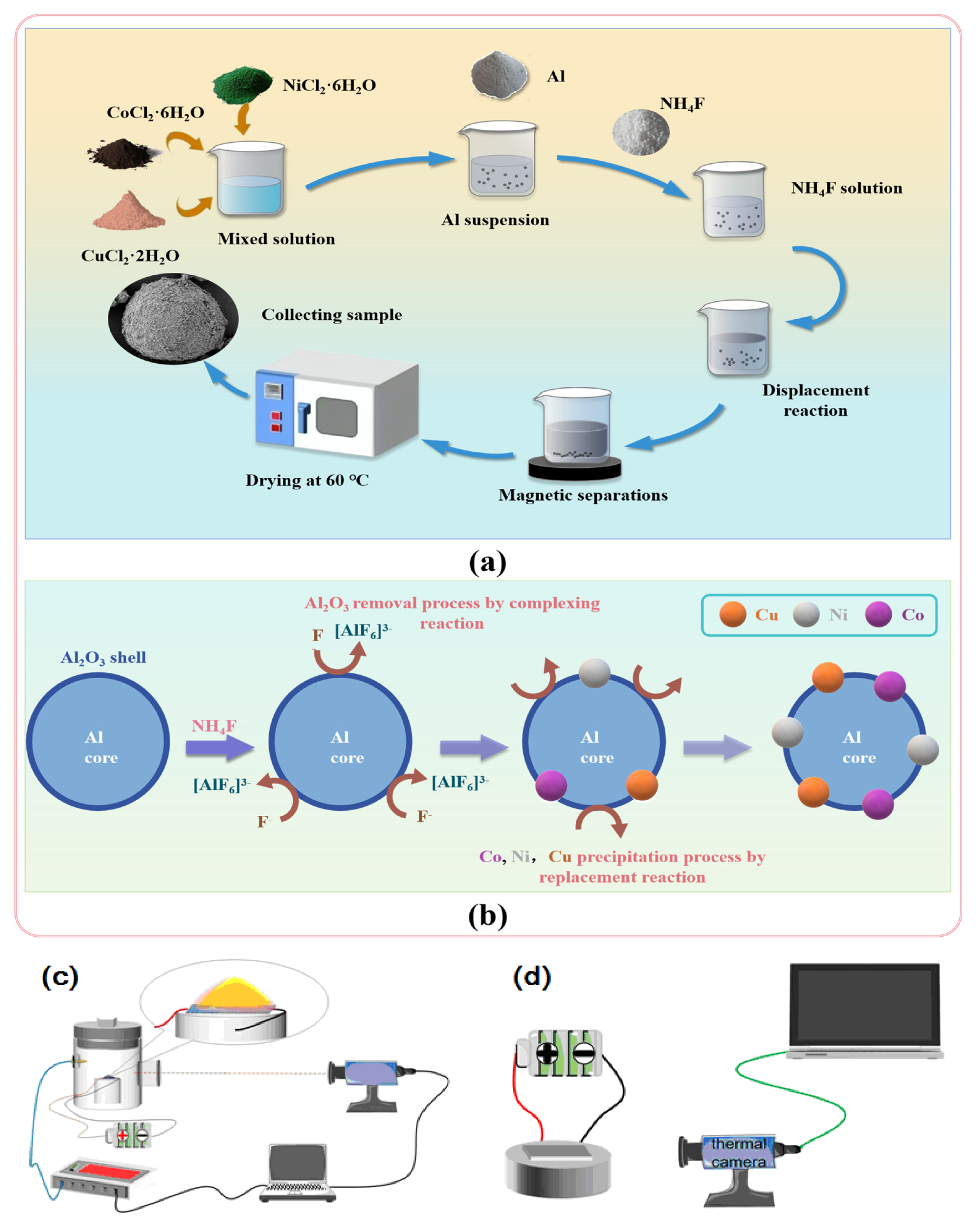
The preparation process of the [nCu+nCo+nNi]/µAl composite material is shown in Figure 1a: Dissolve copper chloride hexahydrate (20 g), cobalt chloride hexahydrate (20 g), nickel chloride hexahydrate (20 g), tartaric acid (6 g), and disodium ethylenediaminetetraacetate (2 g) in 1600 mL of deionized water to form a homogeneous solution. While continuously stirring, add ice cubes in two stages (8 cubes initially and 16 more after adding μAl) to control the reaction temperature. Disperse the pre-treated (ground) micrometer-sized aluminum powder (μAl, d50 = 20 μm, 150 g) into the above system, and then add an aqueous solution of ammonium fluoride (60 g dissolved in 150 mL of deionized water). After the reaction has lasted for 15 min, use a strong magnet at the bottom of the beaker to magnetically separate the product (based on the ferromagnetism of the Co/Ni components). Wash the product with deionized water to obtain the core–shell structure composite material [nCu+nCo+nNi]/µAl.
Figure 1.
Preparation process (a) and mechanism (b) of [nCu+nCo+nNi]/μAl and the testing device (c,d).
Reaction mechanism (Figure 1b): ammonium fluoride preferentially etches the alumina film on the surface of μAl to generate soluble [AlF6]3− complexes. The exposed fresh Al core drives the reduction of Cu2+, Co2+, and Ni2+ to the metallic state through the displacement reaction, and the reduced metals coat the aluminum surface to form a nano transition metal shell layer.
2.3. Characterization and Tests
The following methods were used for material characterization and performance testing: (1) Microscopic morphology was characterized using a TESCAN MIRA3 scanning electron microscope (SEM) (Beijing Tianyao Technology Company, Ltd., Beijing, China). Samples were coated with gold (~5 nm) by ion sputtering to enhance conductivity, and energy dispersive spectroscopy (EDS) was used for elemental surface distribution analysis. (2) Phase structure was characterized using an X-ray diffractometer (XRD) (Netherlands Panaco Company, Almelo, The Netherlands) and X-ray photoelectron spectroscopy (XPS) (ULVAC Japan Ltd., Mazaki, Japan). (3) Surface morphology parameters, including sphericity and roughness, were quantified using an OLS5000 laser confocal microscope (Olympus Corporation, Tokyo, Japan). (4) Magnetism was determined by measuring the hysteresis loop with a vibrating sample magnetometer (VSM) (Lake Shore Cryotronics, Westerville, OH, USA). (5) Molecular structure information was analyzed by Raman spectroscopy (HORIBA, Japan, Kyoto). (6) Thermal behavior was studied using a simultaneous thermal analysis instrument (TG-DSC) (PerkinElmer, Inc.; Waltham, MA, USA) to investigate exothermic characteristics. Among them, the thermolysis kinetic test of AP was carried out on a DSC-100 (Shanghai Jiezhun Co., Ltd.; Shanghai, China) differential scanning calorimeter (heating rates: 5/7/10/15 °C·min−1). (7) For constant-volume combustion, a high-speed camera was used to record the flame propagation in a closed bomb (Figure 1c). For constant-pressure combustion, an infrared thermal imager (HT30-300010001) (HIKMICRO, Hangzhou, China) was used to monitor the flame temperature field in an open environment (Figure 1d). The combustion heat value was measured with an automatic oxygen bomb calorimeter (ZDHW-4) (Hebi Hongyang Instrument Co., Ltd.; Hebi, China). Thermal sensitivity was tested by conducting a 5-s explosion point test according to Method 606.1 of GJB772A-97. A Wood’s alloy bath was used to heat a quantitative sample, and the delayed reaction time was recorded.
3. Results and Discussion
3.1. Characterization of [nCu+nCo+nNi]/μAl Microspheres
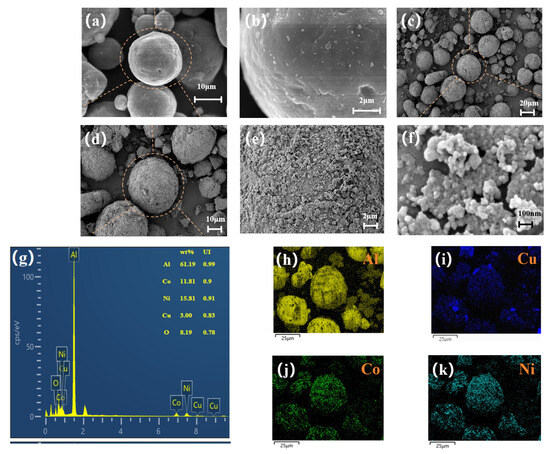
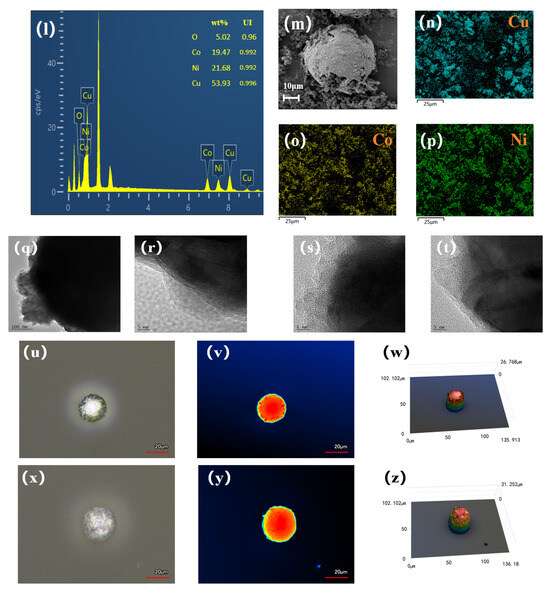
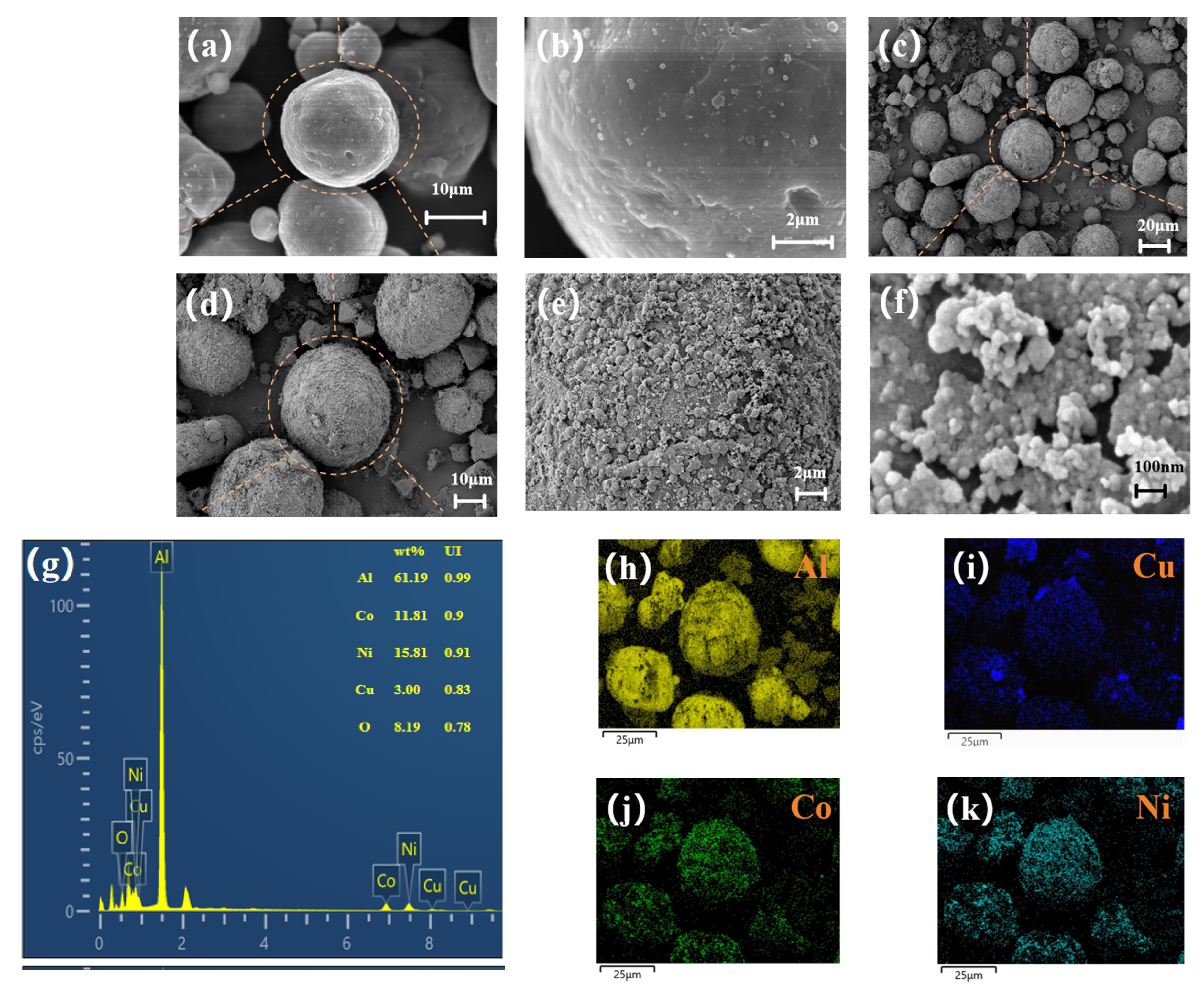
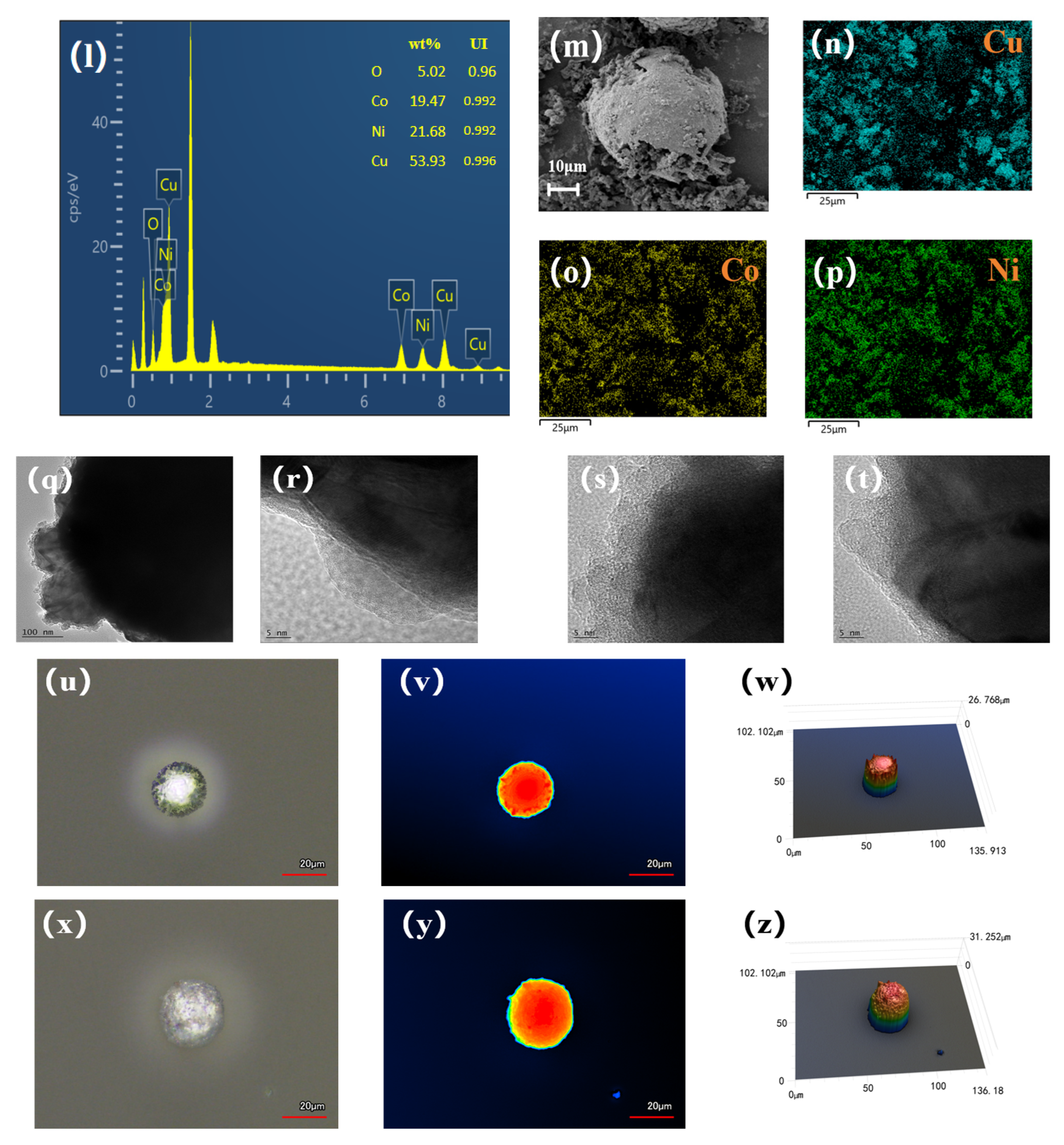
To ascertain the core–shell architecture and elemental composition of the [nCu+nCo+nNi]/µAl composites, we employed scanning electron microscopy (SEM), energy-dispersive X-ray spectroscopy (EDS), and transmission electron microscopy (TEM) for a comprehensive characterization of the surface morphology and elemental distribution (Figure 2). In stark contrast to the smooth, spherical surface exhibited by the pristine µAl (Figure 2a,b), the surface of the composite microspheres was uniformly adorned with nanoscale clusters while maintaining a distinctly spherical configuration (Figure 2e,f). This morphological change suggests the presence of deposited material, which was later confirmed to be transition metals by elemental analysis (see EDS results below). The elemental distribution maps displayed in Figure 2g–k illustrate a pronounced spatial coherence among Co, Ni, and Cu across the surface of the spheres, thereby confirming the uniformity in the distribution of the ternary metals. Following the core-dissolution treatment (Figure 2m), we observed the formation of typical open hollow spherical shells accompanied by dispersed nanoparticles, thereby validating the complete extraction of the aluminum core while preserving the integrity of the shell structure. Comprehensive elemental mapping of the metallic shell (Figure 2n–p) unequivocally demonstrated its composition as cobalt, nickel, and copper. This finding substantiates the efficacy of the etching mechanism facilitated by ammonium fluoride on the Al2O3 layer, as well as the adequacy of the displacement reaction, ultimately culminating in a uniformly coated core–shell architecture. Additionally, transmission electron microscopy (TEM) analysis (Figure 2q–t) further elucidates the sub-micron structure of the [nCu+nCo+nNi] shell. Nanoscale metallic clusters are observed to be uniformly distributed across the surface of the black alumina substrate (Figure 2s,t), a morphological characteristic that aligns closely with the results obtained from scanning electron microscopy (SEM). Figure 2u–z illustrate the laser confocal microscopy images of µAl and the composite [nCu + nCo + nNi]/µAl. The two-dimensional pseudocolor map reveals a circular distribution of hues within the composite microspheres, thereby affirming their preserved spherical integrity. Figure 2x,y demonstrate that, in comparison to µAl, the [nCu+nCo+nNi]/µAl microspheres exhibit a notably larger particle size while retaining a distinctly spherical morphology. From the top-down perspective illustrated in Figure 2z, one can discern point-like protrusions atop the [nCu+nCo+nNi]/µAl microspheres, thereby confirming the successful coating of Co, Ni, and Cu nanoparticles onto µAl. Furthermore, the delineated contour lines in the top view reveal that the surface of the [nCu+nCo+nNi]/µAl microspheres is relatively smooth, suggesting that the Co, Ni, and Cu nanoparticles adhere tightly to the aluminum particles. This observation indicates that the coating layer possesses remarkable structural uniformity and robust interfacial bonding strength. Through the integration of multi-scale characterization data, it has been substantiated that [nCu+nCo+nNi]/µAl has been adeptly synthesized into core–shell structured microspheres characterized by a smooth surface and an exquisitely regular spherical morphology.
Figure 2.
SEM images of samples: (a,b) raw μAl, (c–f) [nCu+nCo+nNi]/μAl; (g–k) EDS spectrum of [nCu+nCo+nNi]/μAl; (m) SEM images of [nCu+nCo+nNi]/μAl shell; (l,n–p) EDS spectrum of [nCu+nCo+nNi]/μAl shell; (q–t) TEM images of [nCu+nCo+nNi]/μAl shell; Laser confocal microscopy images: (u–w) raw μAl; (x–z) [nCu+nCo+nNi]/μAl.
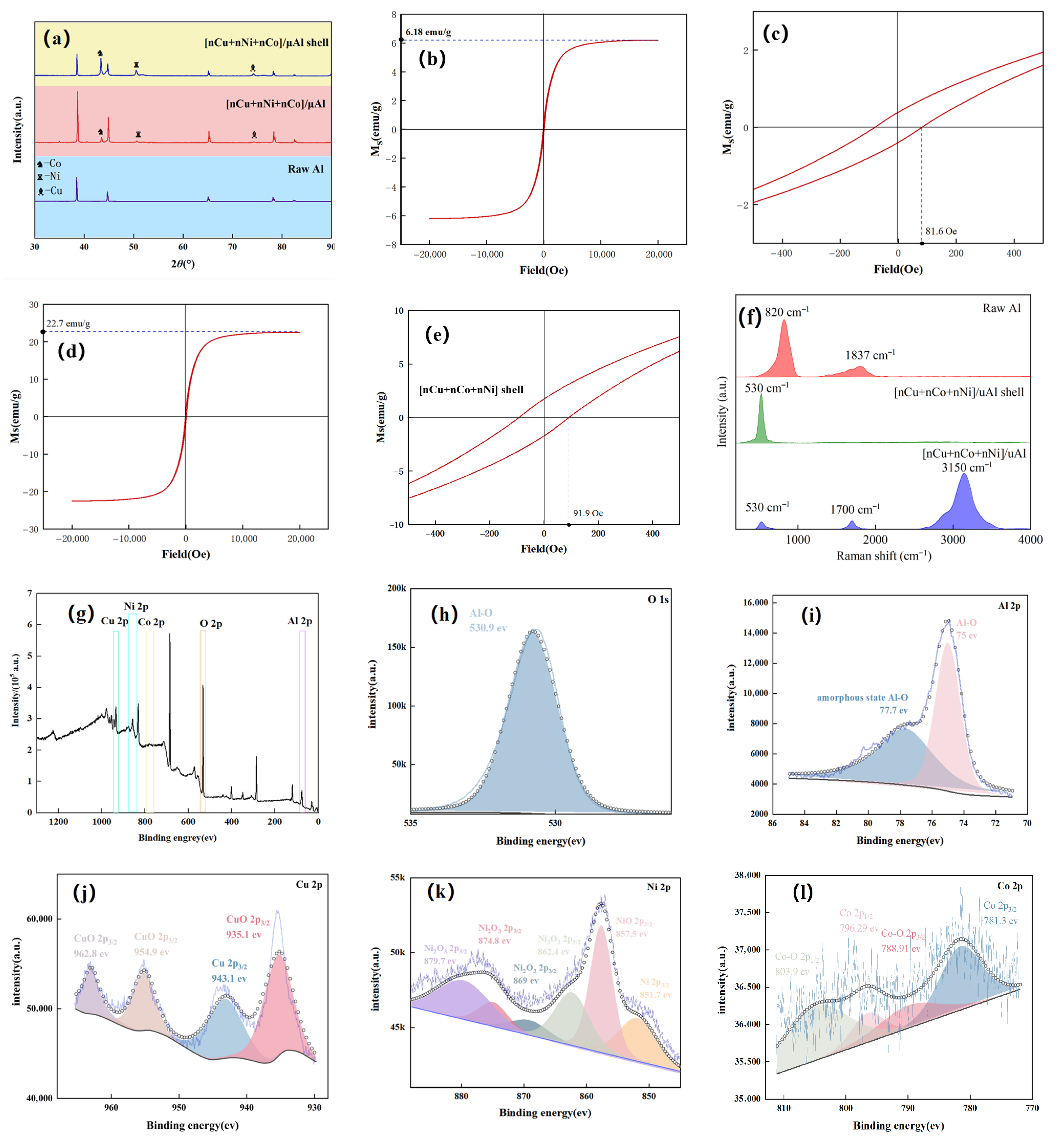
X-ray diffraction (XRD), vibrating sample magnetometry (VSM), and X-ray photoelectron spectroscopy (XPS) were utilized to carry out a qualitative elemental analysis of the [nCu+nCo+nNi]/µAl microspheres (Figure 3). A comprehensive examination of the elemental composition of their shell layers was undertaken to validate the successful fabrication of the core–shell architecture. The X-ray diffraction (XRD) pattern presented in Figure 3a demonstrates that the raw material µAl exclusively exhibits characteristic diffraction peaks corresponding to aluminum (Al), without any identifiable crystalline phase peaks of aluminum oxide (Al2O3). This observation suggests that the alumina generated through oxidation at ambient temperature is in an amorphous state. This inference aligns with the findings of the X-ray photoelectron spectroscopy (XPS) analysis (Figure 3i). In the diffraction pattern of the [nCu+nCo+nNi]/µAl shell layer sample, the characteristic peaks corresponding to cobalt (Co), nickel (Ni), and copper (Cu) are distinctly observable, with their intensities markedly surpassing those of the complete [nCu+nCo+nNi]/µAl composite powder. In stark contrast, the intensity of the aluminum (Al) peak exhibits a significant reduction. Notably, despite the removal of the aluminum core, diffraction peaks corresponding to crystalline aluminum are still discernible in the nCu+nCo+nNi shell layer sample. Given that SEM-EDS analysis confirmed the elimination of the bulk Al core (Figure 2l–p), these residual Al peaks likely originate from either trace amounts of unreacted metallic Al trapped within the shell, or a very thin, crystalline interfacial layer between the shell and the former core that was not fully removed during etching. The absence of clear crystalline Al2O3 peaks suggests that any alumina remaining in the shell is predominantly in an amorphous state. A thorough comparison of the diffraction patterns of the raw material µAl, the composite [nCu+nCo+nNi]/µAl, and their respective shell layers unequivocally demonstrates that the synthesized transition metal shell layer comprises a heterogeneous mixture of Co, Ni, and Cu nanoparticles.
Figure 3.
Microscopic structures of [nCu+nCo+nNi]/μAl: (a) XRD patterns; (b–e) VSM curves; (f) Raman spectra; (g–l) XPS spectra.
In the Co, Ni, Cu, O, Al system under consideration, only cobalt, nickel, and their corresponding oxides demonstrate magnetic properties. Through meticulous investigation of the magnetism present in the [nCu+nCo+nNi]/µAl microspheres using Vibrating Sample Magnetometer (VSM) analysis, we delve deeper into the composition of the [nCu+nCo+nNi]/µAl coating layer. The VSM images (Figure 3b–e) reveal a distinct manifestation of magnetism, characterized by observable coercivity, which aligns with findings reported in the existing literature [19]. Figure 3b,d illustrate that the saturation magnetization for the [nCu+nCo+nNi]/µAl microspheres is measured at 6.18 emu/g, whereas the [nCu+nCo+nNi] shell exhibits a higher saturation magnetization of 22.7 emu/g. Furthermore, as depicted in Figure 3c,e, the coercivity values for the [nCu+nCo+nNi]/µAl microspheres and the [nCu+nCo+nNi] shell are recorded at 81.6 Oe and 91.9 Oe, respectively. This evidence supports the conclusion that the magnetic response of the [nCu+nCo+nNi]/µAl microspheres to the external magnetic field predominantly originates from the external transition metal shell layer. Figure 3c,e provide decisive confirmation of the presence of magnetic materials within the composite. Given the synthesis methodology, wherein the [nCu+nCo+nNi]/µAl microspheres are produced through a displacement reaction involving exclusively three transition metals—cobalt (Co), nickel (Ni), and copper (Cu), the latter exhibiting diamagnetic properties—it is reasonable to deduce that the observed magnetic response is primarily attributable to the ferromagnetic characteristics of the Co and Ni constituents. This inference further corroborates the successful incorporation of Co and Ni into the composite structure.
To undertake a more comprehensive investigation into the internal functional groups and molecular architecture of [nCu+nCo+nNi]/µAl microspheres, Raman spectroscopy was employed for analytical detection. As illustrated in Figure 3f, raw µAl displays pronounced Raman characteristic peaks at 820 cm−1 and 1837 cm−1. Considering that µAl is a relatively simple compound, the presence of these Raman characteristic peaks is unexpected. This phenomenon may be ascribed to the oxidation of µAl during the grinding process, resulting in the formation of gamma-alumina [20]. The peak observed at 820 cm−1 signifies the stretching vibration of the Al-O bond, while the peak at 1837 cm−1 is indicative of the stretching vibration of the Al-O-C bond [21]. The [nCu+nCo+nNi]/uAl shell exhibits pronounced Raman characteristic peaks at 530 cm−1, with this particular peak exhibiting a notable red shift in comparison to the Raman peak of pristine µAl, which is observed at 820 cm−1. This red shift can be primarily attributed to the incorporation of Cu, Co, and Ni, which substitute for a fraction of the alumina, thereby diminishing the energy associated with the Al-O bond and consequently leading to an expansion of the core–shell architecture [22]. In addition to the peak at 530 cm−1, [nCu+nCo+nNi]/uAl showcases distinct Raman characteristic peaks at 1700 cm−1 and 3150 cm−1. Specifically, the peak at 530 cm−1 corresponds to the stretching vibration of the Al-O bond; however, its intensity is notably less than that of the characteristic peaks associated with the [nCu+nCo+nNi]/uAl shell. This attenuation in intensity is attributable to the partial degradation of the shell layer that occurs during the core dissolution process. At 1700 cm−1, the stretching vibration peak of the Al-O-C bond exhibits a discernible red shift accompanied by a reduction in peak intensity, providing further validation of the deposition of Cu, Co, and Ni onto uAl. Moreover, at 3150 cm−1, one observes, primarily, the Raman characteristic peaks attributable to the stretching vibrations of the C-H bonds in EDTA-2Na and tartaric acid [23]. The emergence and subsequent analysis of these Raman characteristic peaks robustly substantiate the coating of uAl with Cu, Co, and Ni.
High-resolution X-ray photoelectron spectroscopy (XPS) was employed to conduct a meticulous characterization of the surface of [nCu+nCo+nNi]/µAl microspheres, enabling a precise evaluation of the elemental composition and the distribution of chemical valence states. Prior to the analysis, the C1s peak at 284.8 eV served as a reference for charge correction. Examination of the wide spectrum (Figure 3g) alongside the fine spectrum reveals that the principal peak of the O 1s spectrum (Figure 3h) corresponds to the Al-O bond, thus affirming the predominance of aluminum oxide on the surface. Furthermore, the characteristic peaks associated with transition metal oxides are largely obscured by the robust Al-O signal, underscoring the transformative role of aluminum oxide in this context. The Al 2p spectrum (Figure 3i) exhibits the distinctive peaks associated with aluminum oxide, encompassing both crystalline and amorphous phases. Notably, the absence of a characteristic peak for elemental aluminum serves as compelling evidence that the coating layer entirely envelops the aluminum core. The valence state analysis of transition metals reveals that the Cu 2p spectrum (Figure 3j) demonstrates the distinctive characteristic of coexisting metallic copper and copper oxide. In contrast, the Ni 2p spectrum (Figure 3k) displays the presence of both metallic nickel and nickel oxide. Furthermore, the Co 2p spectrum (Figure 3l) identifies a mixture of valence states, including metallic cobalt, Co2+, and Co3+. This variation in the distribution of valence states arises from the differing oxidation propensities of the elements; during the brief exposure to air in the preparation process, a portion of the copper is oxidized to CuO, whereas nickel and cobalt experience pronounced surface oxidation. X-ray photoelectron spectroscopy (XPS) data corroborate that cobalt, nickel, and copper collectively form a composite metal oxide coating layer on the surface of the aluminum core.
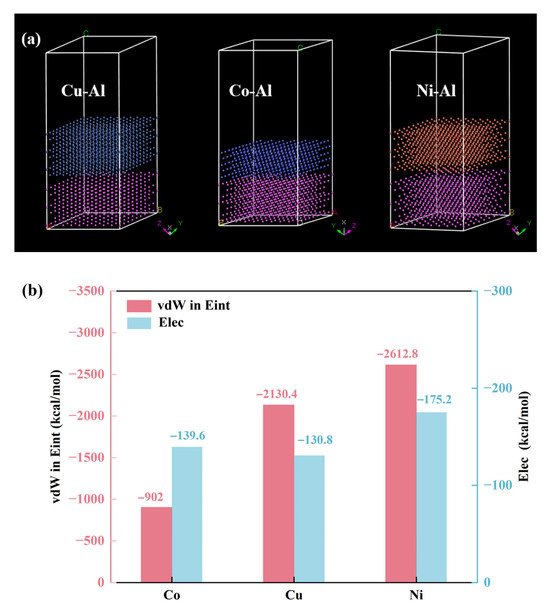
Additionally, molecular dynamics simulations were performed to investigate the adsorption properties of transition metals on aluminum surfaces. A preliminary model was developed utilizing Materials Studio 2024 software to derive layered functions, illustrated in Figure 4a. This constructed model served as a foundation for simulating and quantifying the adsorption affinity of aluminum for cobalt, copper, and nickel during the interface interaction of transition metal-coated aluminum. The execution of the molecular dynamics simulation adhered to the following methodology:
Figure 4.
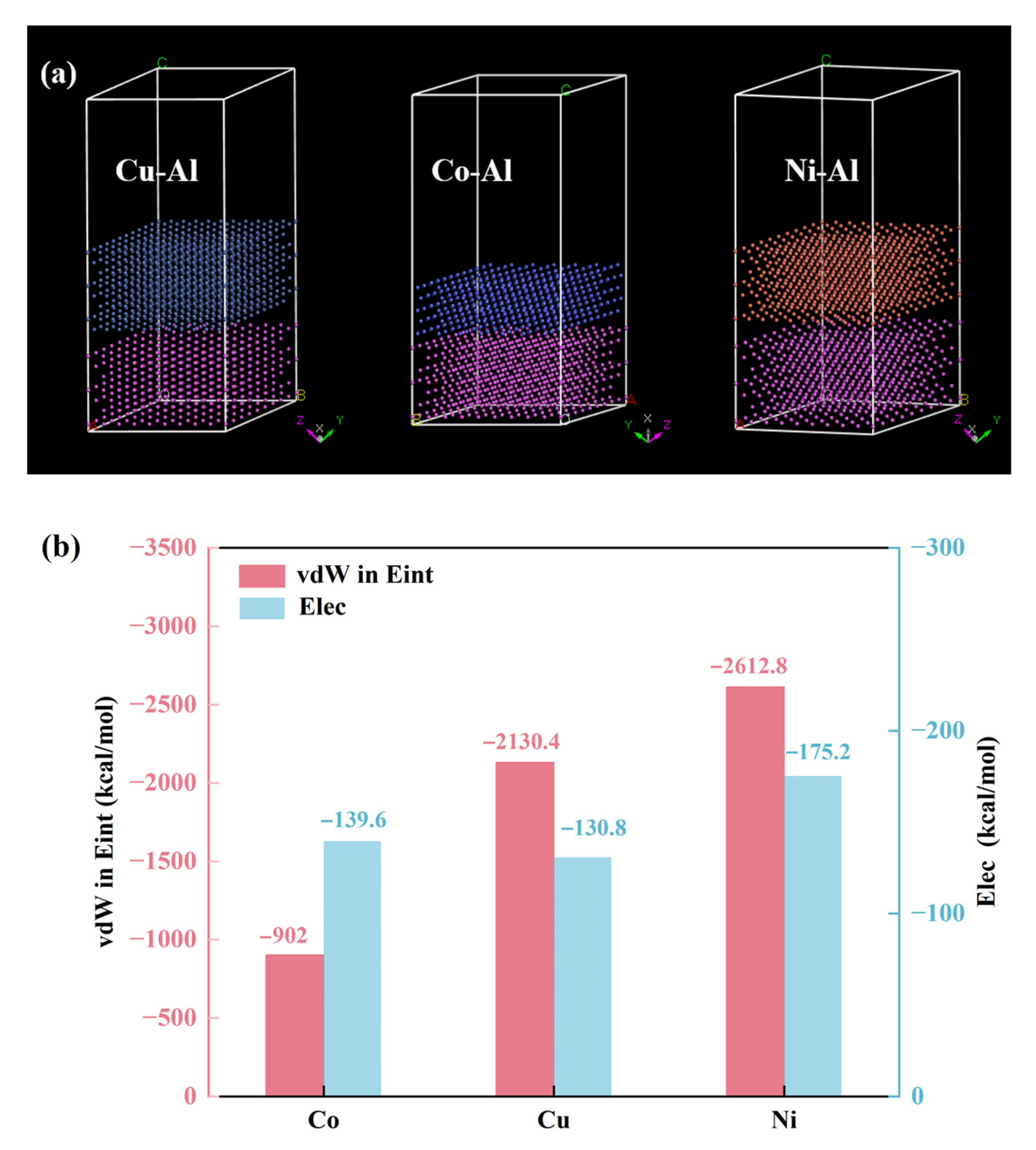
(a) Adsorption model of Al by nCu, nCo, and nNi. (b) Van der Waals forces and static energy.
Due to the medium quality setting, the corresponding truncation radius Rcut is 12.5 angstroms. When designing crystal surfaces, it is crucial to note that employing a model size that is excessively diminutive can result in erroneous computational outcomes, whereas a model that is unduly expansive may lead to an increased computational burden. During the modeling process, it is required that the length and width of the model be greater than 2Rcut (i.e., 25 angstroms). Furthermore, the initial separation between the crystal surfaces in the three models is designated at 5 angstroms, accompanied by a calculated vacuum layer thickness of 30 angstroms. All models presented in this manuscript utilize the COMPASS II force field [24], and geometric optimization is conducted using a hybrid system to yield more accurate structural configurations, thereby providing robust initial values for the subsequent molecular dynamics simulations. In the realm of geometric optimization, we have employed an advanced algorithm characterized by a synthesis of the steepest descent method, Adaptive Broyden–Fletcher–Goldfarb–Shanno (ABNR), and quasi-Newton techniques. The maximum iteration limit has been calibrated to 10,000. Intermolecular van der Waals forces and electrostatic interactions are meticulously computed using both atom-based and Ewald summation methods, with the Ewald precision distinctly configured to 0.001 kcal/mol. Furthermore, the cutoff distance for repulsive interactions is established at 12 angstroms. It is noteworthy that the current model is devoid of extensive macromolecules or polymeric structures. Additionally, models that incorporate crystalline surfaces are particularly susceptible to adsorption phenomena post-annealing treatment, which profoundly influences the subsequent calculations pertaining to interfacial binding energy. Consequently, no annealing procedures have been implemented within this model. Molecular dynamics simulations were performed on the geometric optimized configuration using the NVT (number of particles, volume, and temperature constant) ensemble for 1 nanosecond (reference for using NVT for crystal surface simulation). The first 0.5 nanoseconds were used for thermodynamic equilibrium, and the last 0.5 nanoseconds were used for statistical calculation and analysis [25]. The simulation step size was set to 1 femtosecond, with one frame output every 5000 steps, generating a total of 201 frames of data. All 201 frames of model data were used to analyze interfacial binding energy, and the statistical results are shown in Figure 4b.
The interaction energies—comprising both electrostatic and van der Waals forces—between transition metals and aluminum were meticulously measured [26,27,28], with the findings summarized in Table 1. When cobalt, copper, and nickel nanoparticles are positioned in proximity to the aluminum core, the binding of these three transition metals to aluminum occurs spontaneously (as evidenced by a total interaction energy less than zero). Moreover, a direct correlation exists: the greater the absolute value of the total interaction energy, the more pronounced the binding affinity. The ranking of the interaction energies reveals the hierarchy Ni-Al > Cu-Al > Co-Al, underscoring that the binding strength of the nickel coating layer is the most robust, followed in descending order by copper, while cobalt exhibits the least binding efficacy. Consequently, nickel, known for its exceptional binding affinity with aluminum, can significantly enhance the structural integrity of the entire coating shell. The hierarchy of thermodynamic stability is aligned with the gradient of binding energy levels; thus, disparities in binding affinity suggest that cobalt, exhibiting inferior thermodynamic stability during thermal oxidation, reacts preferentially. In contrast, the most thermally stable nickel can preserve the entirety of the interface structure, thereby offering a robust and stable reactive interface throughout the thermal oxidation process. This observation furnishes a theoretical foundation for investigating the mechanisms underlying synergistic catalysis.
Table 1.
Total interaction energy between transition metals and aluminum in molecular simulation.
3.2. Thermal Oxidation of [nCu+nCo+nNi]/μAl Microspheres
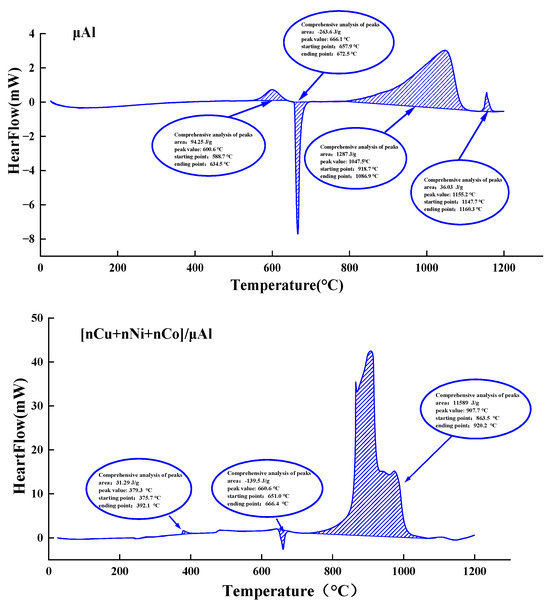
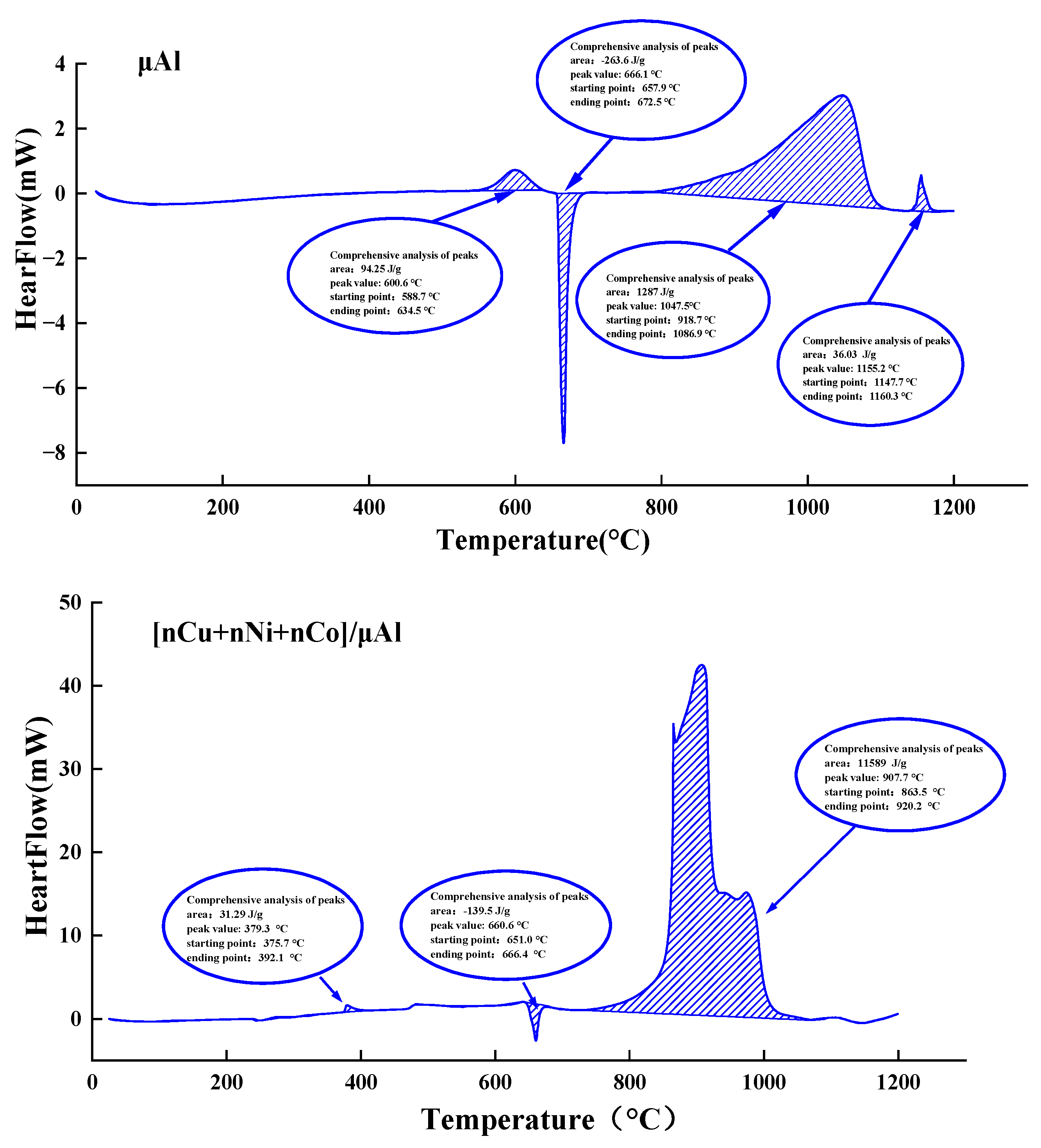
To elucidate the thermal oxidation mechanism of [nCu+nCo+nNi]/μAl, we performed a comparative differential scanning calorimetry (DSC) analysis in an oxygen-rich environment, as depicted in Figure 5. In stark contrast to the exothermic peak corresponding to the phase transformation of alumina in μAl, observed at 600.6 °C, the peak temperature of the composite microspheres displayed a significant advancement. Within the composite framework, the onset temperature of the endothermic peak associated with aluminum melting, recorded at 666.1 °C, exhibited a notable shift towards lower temperatures, accompanied by a reduction in the magnitude of the endothermic effect. Significantly, the principal exothermic peak at 1047.5 °C for the composite nCu+nCo+nNi/μAl showed a dramatic increase in heat output, reaching 11,589 J/g. This value is approximately nine times higher than the 1287 J/g recorded for pristine μAl. Furthermore, the onset temperature for this peak advanced by 55.2 °C, while the formation peak of α-Al2O3 at 1155.2 °C in μAl was effectively eliminated. These observations indicate that the transition metal coating layer effectively inhibits the alumina phase transformation, thereby reinstating the high-temperature oxidation pathway, which culminates in a significant doubling of energy release.
Figure 5.
DSC traces of raw μAl and [nCu+nCo+nNi]/μAl.
The significant advancement and enhancement of the exothermic peak observed through differential scanning calorimetry underscores a fundamental alteration in the high-temperature oxidation pathway of micron-sized aluminum particles, mediated by the transition metal shell structures. These metallic coatings not only serve a protective physical encapsulation function but also enable the nano-clusters of elements such as copper, cobalt, and nickel to potentially participate directly in the oxidation reactions at the atomic level. Molecular dynamics simulations (see Figure 4 and Table 1) reveal a remarkably strong binding affinity between nickel and aluminum, with a binding energy of −2778.0 kJ/mol, thus providing substantial thermodynamic impetus for interfacial interactions. Complementary analysis using X-ray photoelectron spectroscopy of residual metallic species (refer to Figure 6) suggests that diffusion or segregation of the transition metals, particularly nickel, occurs at the interface between aluminum and aluminum oxide under high-temperature conditions. This process can catalyze the formation of defects in the oxide layer or reduce the diffusion barriers for oxygen within the native oxide layer, ultimately compromising its stability and precipitating a more rapid and intense oxidation reaction of the aluminum core.
Figure 6.
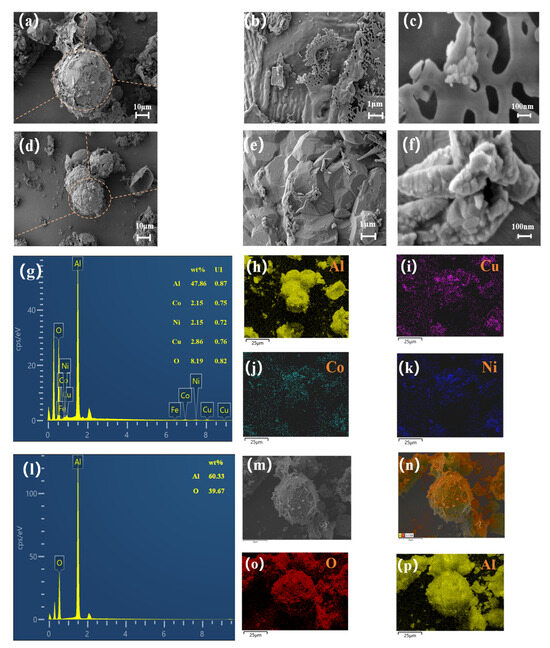
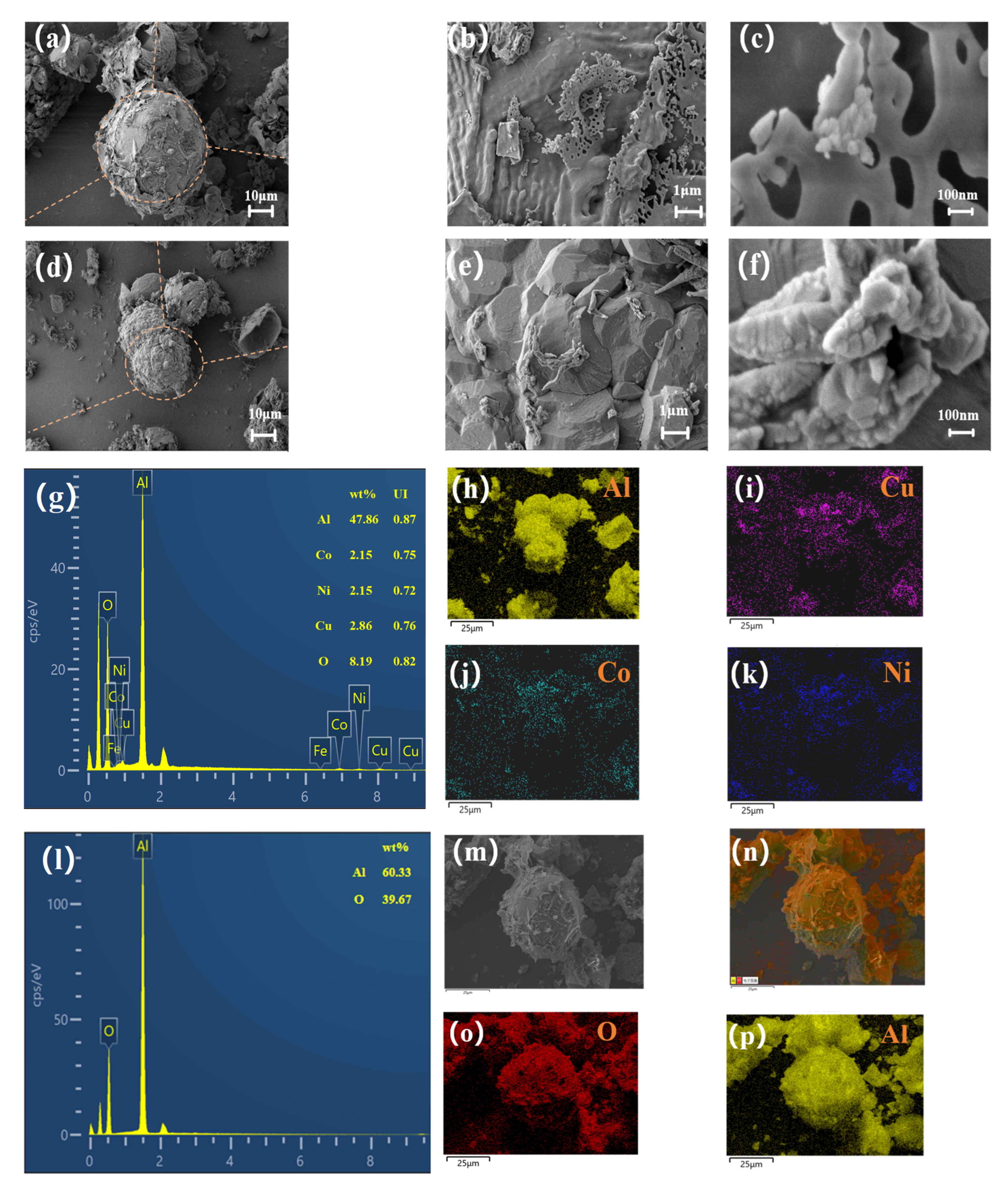
Microscopic morphologies and structures of oxidation residues of raw μAl and [nCu+nCo+nNi]/μAl: SEM images of (a–c) raw μAl and (d–f) [nCu+nCo+nNi]/μAl; EDS spectrum of (g–k) [nCu+nCo+nNi]/μAl and (l–p) raw μAl.
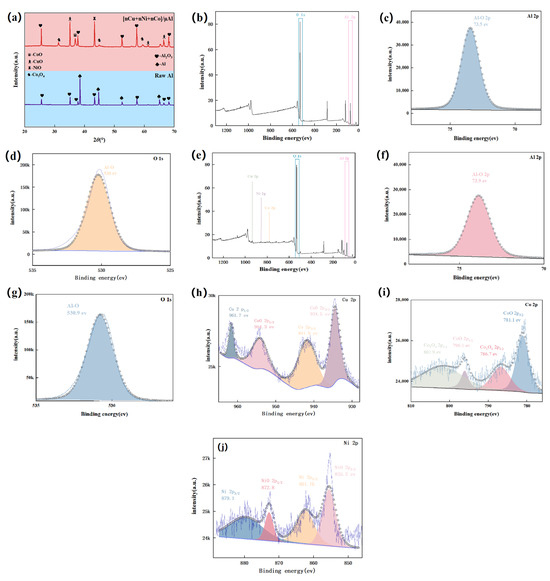
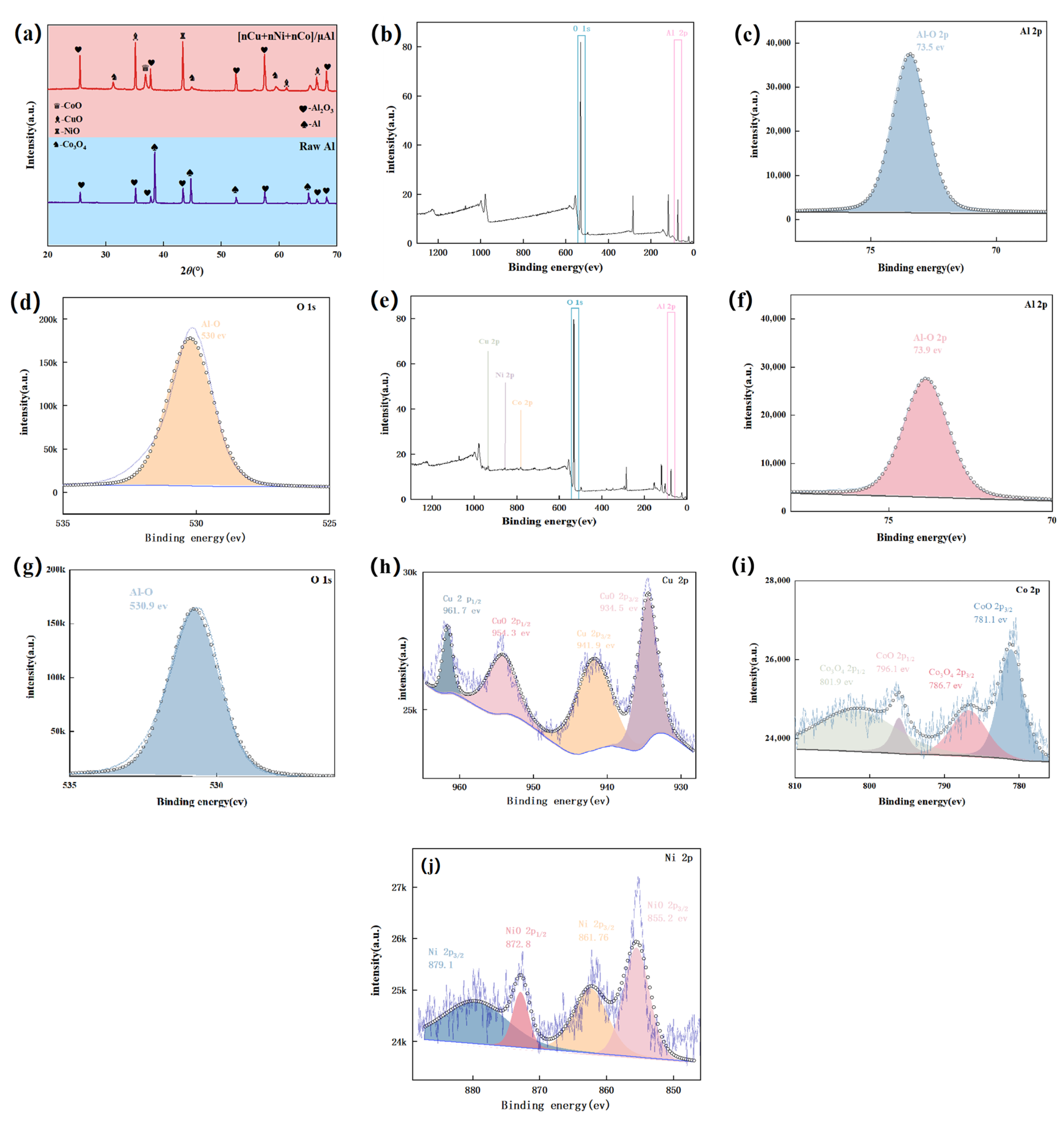
To thoroughly investigate the elemental transformation of [nCu+nCo+nNi]/μAl microspheres subsequent to oxidation treatment, this study utilized X-ray diffraction (XRD) and X-ray photoelectron spectroscopy (XPS) for characterization (refer to Figure 7). The XRD pattern illustrated in Figure 7a exhibited distinct characteristics, with the hallmark peaks associated with Cu, Co, and Ni fully transitioning into their respective metal oxides. This observation signifies the thorough oxidation of these elements. The residual diffraction peaks corresponding to aluminum indicate that either a fraction of the aluminum core was not fully consumed during the high-temperature oxidation, or that the coating layer became porous or fractured, allowing the underlying (partially oxidized) aluminum to be detected. No discernible phases of copper or nickel were detected, likely due to the inherent limitations in precision associated with X-ray diffraction (XRD). In contrast, high-sensitivity X-ray photoelectron spectroscopy (XPS) analysis (Figure 7b–j) further substantiated that the surface layer of the microspheres predominantly consists of oxide phases of transition metals. Notably, remnants of unoxidized metallic copper and nickel were discerned, thereby augmenting the insights obtained from X-ray diffraction (XRD) analysis. A comprehensive examination of the results derived from both XRD and X-ray photoelectron spectroscopy (XPS) elucidates that, subsequent to the high-temperature oxidation treatment, a composite shell layer, primarily composed of transition metal oxides, has emerged on the surface of the microspheres. This locally porous architecture enhances the interaction between the internal aluminum core and atmospheric oxygen, fostering a more intimate engagement.
Figure 7.
Microscopic morphologies and structures of oxidation residues of raw μAl and [nCu+nCo+nNi]/μAl: (a) XRD patterns; (b–j) XPS spectrum.
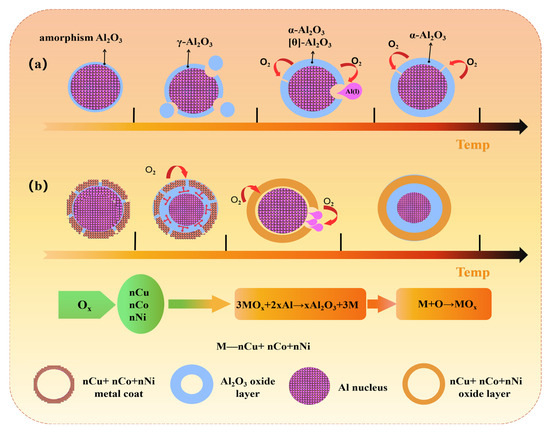
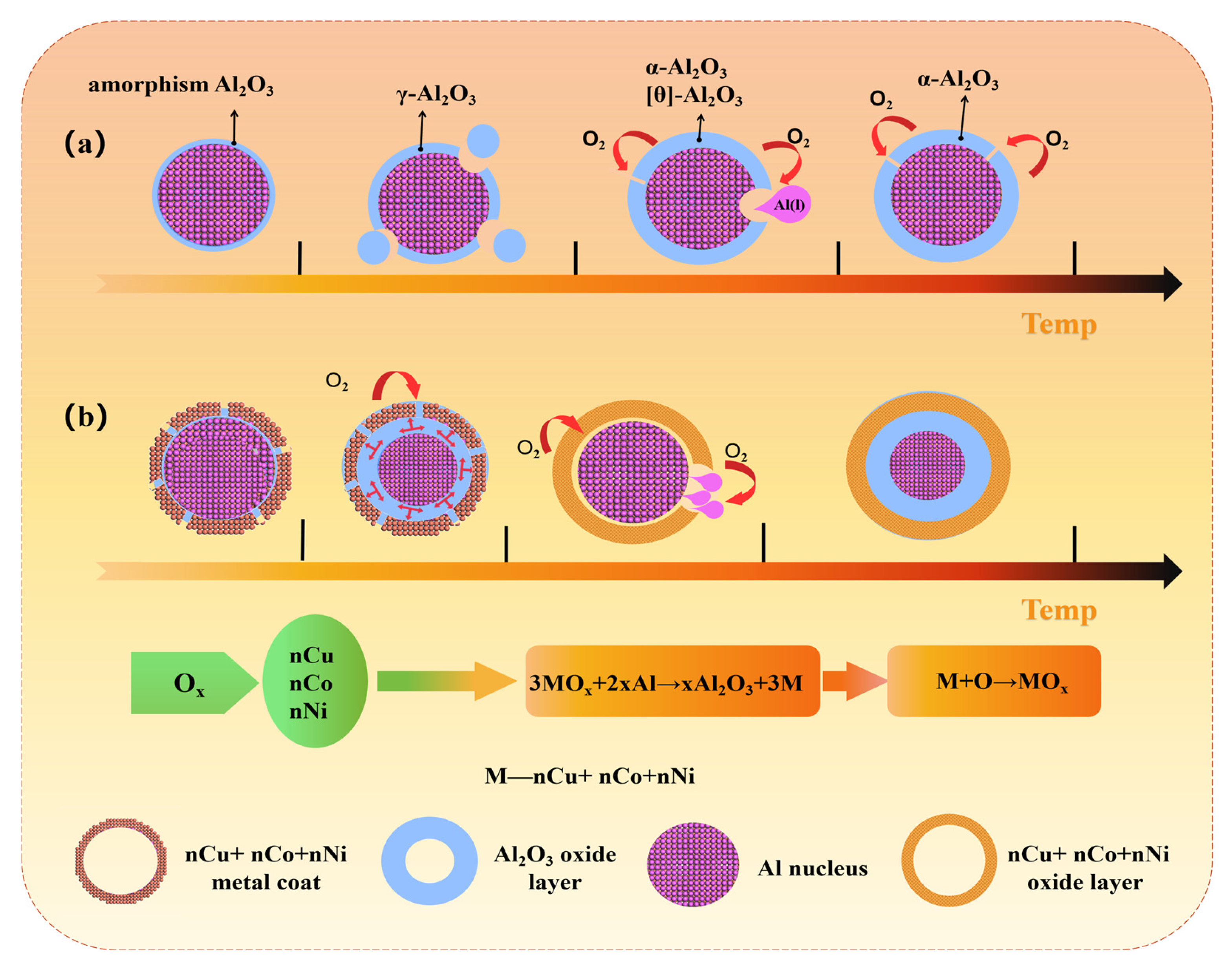
Based on the characterization data, we propose a distinct thermal oxidation pathway for μAl as well as for the composite system comprising [nCu+nCo+nNi]/μAl, as depicted in Figure 8.
Figure 8.
Thermal oxidation mechanism diagram of raw (a) μAl and (b) [nCu+nCo+nNi]/μAl.
- (1)
- Oxidation Mechanism of μAl: The phenomenon begins with the formation of a layer of amorphous aluminum oxide (Al2O3), characterized by a density of approximately 3.0 g/cm3. As thermal conditions intensify, this initiates a transformation to the γ-phase, which boasts a density of roughly 3.6 g/cm3. This transition precipitates both the contraction and subsequent fracturing of the thin film layer. Such ruptures afford exposure of the underlying aluminum core to localized oxidation, which in turn catalyzes the development of an oxide layer of considerable thickness. Further increments in temperature provoke a succession of phase transitions, evolving from the γ to the θ phase, and ultimately to the α phase, with the θ-phase registering a density near 3.8 g/cm3 and the α-phase achieving approximately 4.0 g/cm3. The transition to denser phases induces a secondary rupture of the film layer. Upon exceeding the critical temperature of 660 °C, the liquid aluminum penetrates the oxide layer as a consequence of internal pressure, thereby initiating a vigorous oxidation reaction, which is distinguished by a prominent exothermic peak of 1287 J/g. This process culminates in the development of porous α-Al2O3, accompanied by a significant decrease in density.
- (2)
- The oxidation mechanism of the composite [nCu+nCo+nNi]/μAl encompasses a transition metal shell layer that facilitates the establishment of an oxygen transport channel, proficiently overcoming the inhibition posed by the alumina diffusion barrier. Initially, oxygen molecules participate in reactions with the nanoparticles, culminating in the generation of M-Ox species. This interaction is further enhanced by an interfacial redox cycle (M-Ox + Al → M + AlOx), wherein oxygen atoms are judiciously transferred to the aluminum core. The thermal energy generated throughout this reaction precipitates the rupture of the shell layer. The resultant aluminum droplets engage in rapid reactions with oxygen, while concurrently, the released M particles undergo re-oxidation, thereby liberating additional heat and engendering a self-sustaining catalytic cycle. This elaborate mechanism amplifies the primary exothermic intensity to an outstanding 11,589 J/g and initiates the reaction at a temperature that is 55.2 °C lower than previously observed. This illustrates that the transition metal shell layer alters the energy release pathway through the following means: ① substituting the passive alumina barrier; ② creating an atomic-scale channel for oxygen transfer; and ③ facilitating the extensive oxidation of aluminum at diminished temperatures.
3.3. Catalysis of [nCu+nCo+nNi]/μAl on Themolysis of ADN/AP
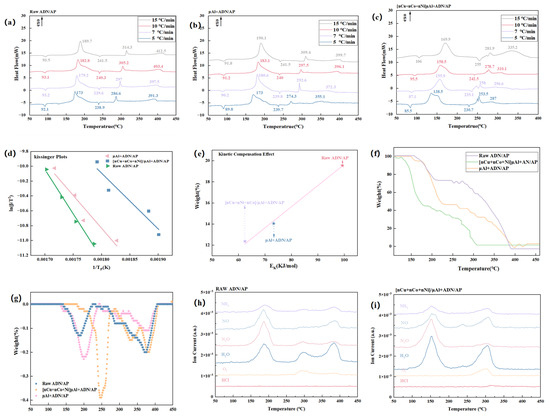
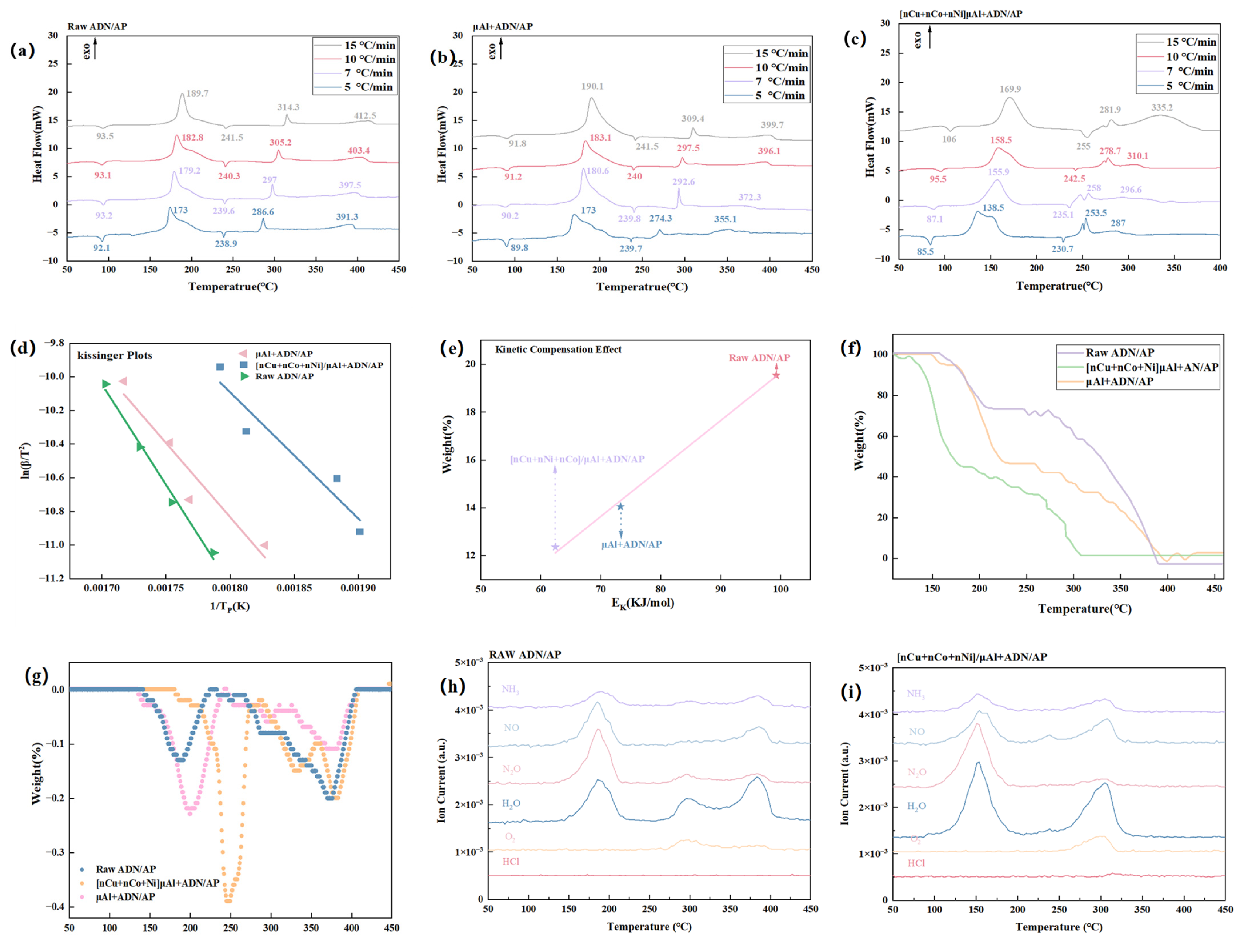
To elucidate the catalytic influence of the [nCu+nCo+nNi]/μAl composite on the oxidizer, three distinct experimental groups were established: the ADN/AP control group, the raw μAl+ADN/AP, and the [nCu+nCo+nNi]/μAl+ADN/AP composite. Following a meticulous process of grinding and homogenization, these samples were subjected to differential scanning calorimetry (DSC) analysis (as depicted in Figure 9a–e), thermogravimetric (TG) analysis (Figure 9f,g), and TG-mass spectrometry (TG-MS) analysis (Figure 9h,i). The results of the Differential Scanning Calorimetry (DSC) analysis, displayed in Figure 9a–e, revealed that within the temperature interval of 50 °C to 200 °C, Ammonium Dinitramide (ADN) exhibited a melting endothermic peak accompanied by a decomposition exothermic peak. Moreover, in the range of 200 °C to 450 °C, Ammonium Perchlorate (AP) demonstrated a melting endothermic peak, a low-temperature exothermic peak, and a high-temperature decomposition peak. Upon the introduction of μAl, a pronounced increase in the peak temperature associated with the exothermic phase of thermal decomposition was observed. This alteration was predominantly attributed to the accelerated emergence of the exothermic peak linked to ammonium perchlorate (AP), thereby underscoring the catalytic role of μAl in the thermolysis of AP. In the case of the [nCu+nCo+nNi]/μAl+ADN/AP composite, all phases associated with the exothermic peaks of thermal decomposition displayed remarkable advancement. In juxtaposition to μAl powder, which exclusively promoted the thermolysis of ammonium perchlorate (AP), the composite aggregate of [nCu+nCo+nNi]/μAl additionally exhibited a catalytic effect on the thermolysis of ADN. This effect was particularly pronounced under elevated temperature conditions, resulting in a substantial enhancement in performance. Drawing from the corpus of existing literature, the underlying explanation for this phenomenon can be delineated as follows: Firstly, the nanoscale particulates of copper (Cu), cobalt (Co), and nickel (Ni) exhibit a significantly elevated specific surface area. This distinctive characteristic augments the density of active sites available for reaction, thereby resulting in enhanced catalytic activity [29]. Furthermore, the shell layer of the [nCu+nCo+nNi]/μAl composite is distinguished by a porous architecture, which not only exhibits improved thermal reactivity but also facilitates the ingress of atmospheric oxygen into the composite’s interior. This interaction fosters a reaction with the aluminum core, significantly accelerating the overall process. A pivotal aspect of this investigation is the discernible capability of the Cu, Co, and Ni composites to induce considerable decomposition of the oxidizer at diminished temperatures. Moreover, the aluminum and nickel composites are proficient in markedly reducing the peak temperature associated with the high-temperature decomposition of the oxidizer, effectively amalgamating the high- and low-temperature decomposition peaks into a singular event. This phenomenon is especially prominent in Figure 9c, which illustrates conditions at a heating rate of β = 15 °C/min. More significantly, in specific low-intensity reactions, nickel reveals a notable catalytic efficacy [30], showcasing its ability to catalyze reactions even at reduced temperatures [31]. This observation suggests that nickel can proficiently penetrate the dense alumina layer enveloping the microaluminum particles at comparatively modest thermal conditions. Importantly, the exothermic interaction between nickel and aluminum intermetallics is crucial in augmenting the combustion dynamics of aluminum powder [32]. By employing Formula 1–5 [33], we meticulously calculated a comprehensive array of thermodynamic parameters to illuminate the kinetic and thermodynamic properties of the samples under scrutiny. The results are illustrated in Figure 9d. Significantly, a strong linear relationship is evident between 1/Tp and ln(β/Tp2) for all samples, emphasizing the exceptional accuracy of the activation energy and preexponential factor obtained from differential scanning calorimetry (DSC). Moreover, the kinetic compensation effect is exemplified by the linear correlation observed in the [EK − ln(AK)] data points, thereby substantiating the premise that the reaction conforms to a homogeneous kinetic mechanism. A meticulous cross-comparison of various modification techniques, as delineated in Table 2, underscores the advantages presented by this study: The remarkable enhancement of the decomposition peak of ammonium perchlorate (AP) at 104.1 °Csignificantly surpasses the modification effects documented in single-component systems (aluminum: 36 °C, cobalt: 23 °C, nickel: 89.2 °C), thereby revealing the preeminence of the synergistic catalytic effect realized through this methodology.
Figure 9.
Thermal analyses results: (a–c) DSC traces; (d) Kissinger Plots; (e) Kinetic Compensation Effect; (f) TG curves; (g) DTG curves; (h,i) TG-MS analysis.
Table 2.
Peak temperature of ADN/AP obtained via different modification methods.
Figure 9f,g present the thermogravimetric (TG) and derivative thermogravimetric (DTG) profiles of three distinct sample groups, subjected to a heating rate of 10 °C·min−1. In contrast to the dual-stage weight loss phenomena characteristic of the ADN/AP reference group and the μAl+ADN/AP sample, the formulation [nCu+nCo+nNi]/μAl+ADN/AP reveals a singular weight loss profile (Figure 9f). Furthermore, the initial decomposition temperature is significantly elevated, providing compelling evidence that the composite material efficiently amalgamates the dual decomposition peaks of ADN/AP into a unified peak. The pronounced slope of the thermogravimetric (TG) curve indicates a significant enhancement in reaction kinetics, while the elevated peak value in the derivative thermogravimetry (DTG) graph (Figure 9g) further substantiates an increase in the rate of thermal mass loss. A comprehensive analysis integrating Thermogravimetry and Mass Spectrometry (TG-MS), as depicted in Figure 9h,i, elucidates the evolution of gaseous by-products. Upon the introduction of the nCu+nCo+nNi/μAl catalyst, a remarkable augmentation in the yields of H2O and O2 was observed, whereas the formation of by-products such as N2O, NO, and NH4 was notably reduced. Simultaneously, the characteristic double-peak signatures associated with various gaseous products amalgamate into a singular peak, ultimately resulting in a tripartite validation with the peak merging phenomenon apparent in Differential Scanning Calorimetry (DSC) and thermogravimetric analyses. This convergence compellingly reinforces the notion that the composite material promotes effective synergistic catalysis by streamlining the mechanism for the decomposition of oxidizers.
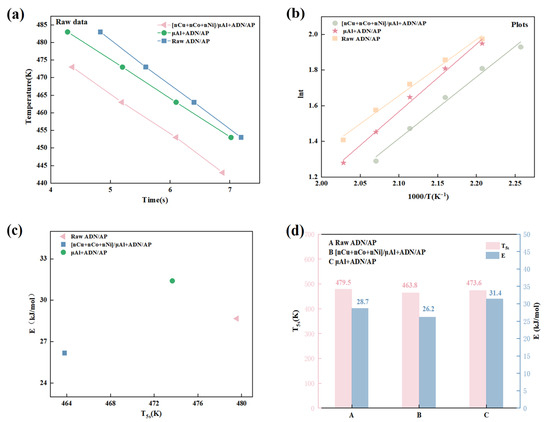
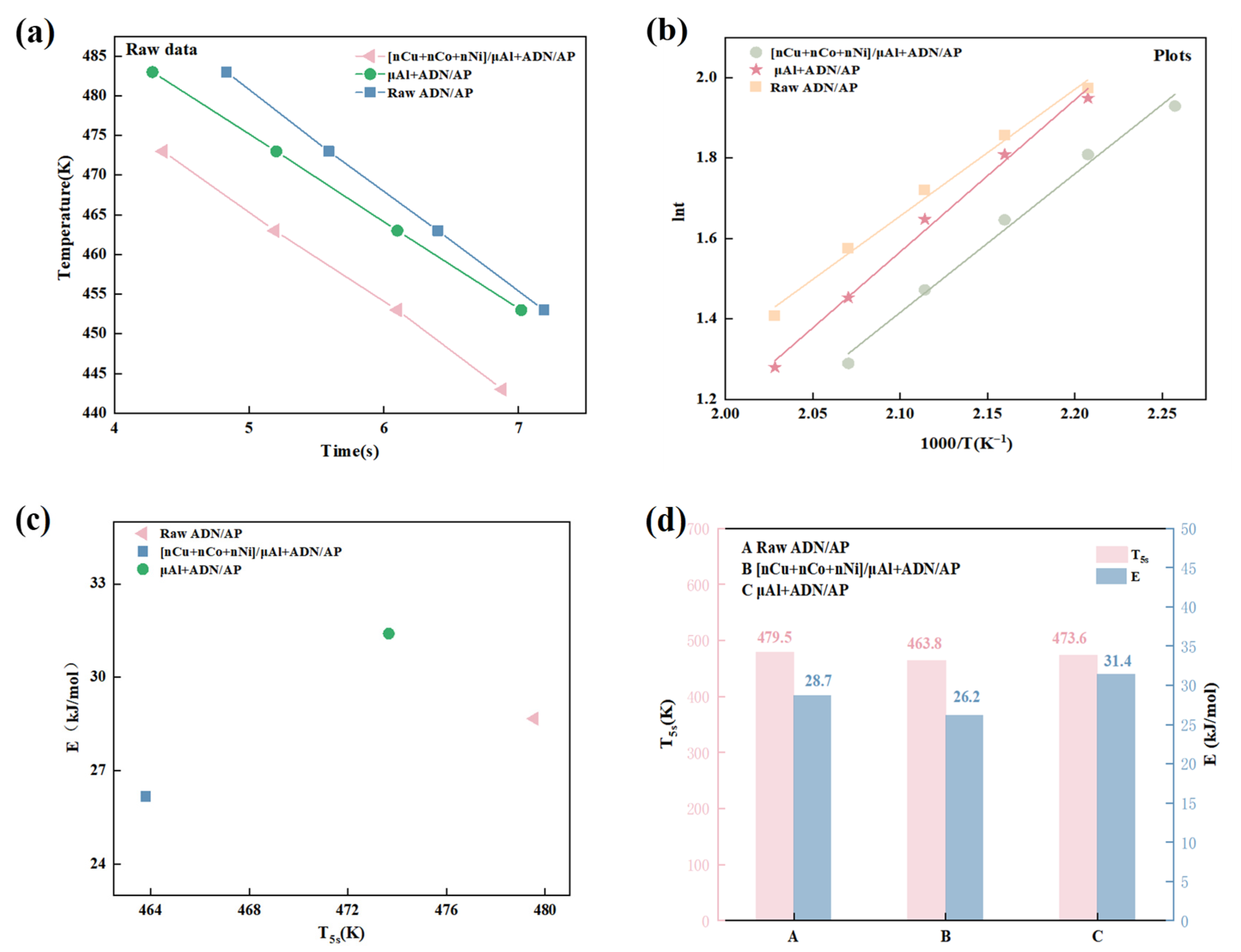
The pertinent kinetic and thermodynamic data summarized in Table 3 reveal that the activation energy (Ek) for all samples resides within the range of 60 to 100 kJ/mol. Notably, the activation energy associated with [nCu+nCo+nNi]/μAl+ADN/AP is markedly lower than that of the control group, suggesting it possesses the most diminished reaction energy barrier. This assertion is supported by a 1.54-fold enhancement in the reaction rate constant (k). Furthermore, the activation enthalpy (ΔH≠) of [nCu+nCo+nNi]/μAl+ADN/AP demonstrates a substantial reduction of 39%, indicating a significant decrease in the thermal energy requisite for the initiation of decomposition. The activation free energy (ΔG≠) values for all three samples remain positive, adhering rigorously to the thermodynamic characteristics of a non-spontaneous reaction. Consequently, decomposition can only transpire upon the application of thermal energy. The thermal sensitivity of the three samples was assessed through the explosion point experiment, with the findings illustrated in Figure 10. As highlighted in the literature [38], the T5s values for the three samples range from 440 K to 485 K, indicating that the explosion delay period diminishes as temperature increases. The incorporation of μAl results in a pronounced decrease in the T5s temperature. Specifically, the T5s of the composite [nCu+nCo+nNi]/μAl+ADN/AP experience a reduction of 15.7 K, while the activation energy (E) declines by 11.2 kJ/mol, thereby attesting to its superior thermal performance. This phenomenon arises from the effective thermal conduction network established by the transition metal composite particles. Upon the application of external thermal stimuli, heat diffusion into the interior of ADN/AP is accelerated, resulting in a swift escalation of local temperature and initiating chain decomposition. The activation energy (E) for the three samples ranges from 26 to 32 kJ/mol, which is notably lower than that of conventional explosives and solid propellants. This suggests [39,40] that the system can instigate a rapid combustion reaction with diminished input of external energy.
Table 3.
Thermodynamics and kinetics data and 5-s burst points.
Figure 10.
Burst point testing of samples: (a) raw data; (b) plots; (c) points of E to T5s; (d) columns for E and T5s.
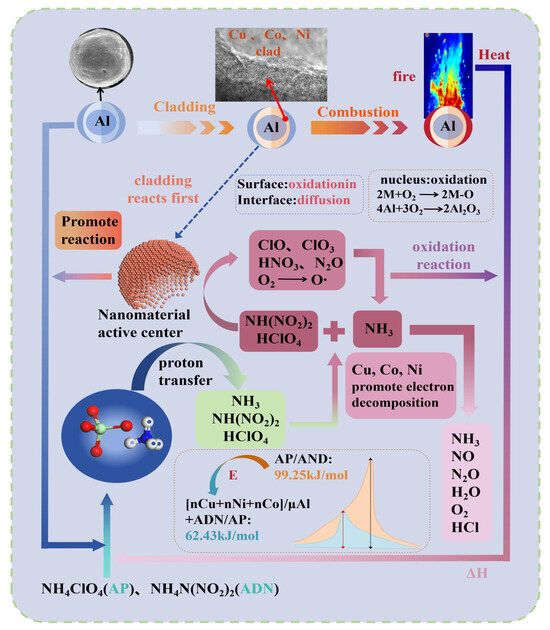
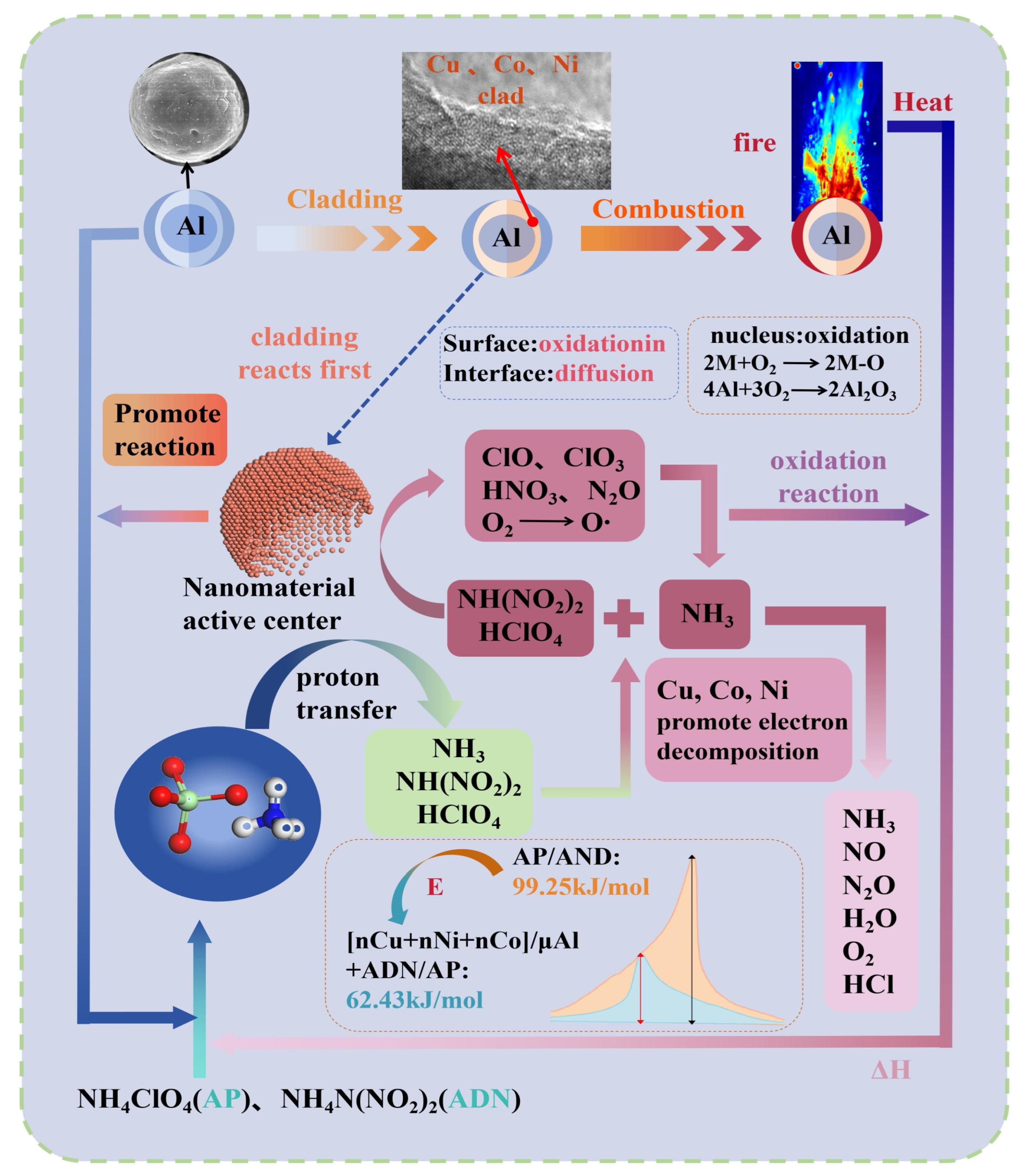
Drawing upon microscopic characterization and thermal analysis, we propose a multi-component synergistic mechanism governing the decomposition of ADN/AP, catalyzed by the composite [nCu+nCo+nNi]/μAl (see Figure 11):
Figure 11.
Schematic diagram of the catalytic mechanism of [nCu+nCo+nNi]/μAl.
- (1)
- Primary Dissociation of Oxidizers and Mediation by Transition Metals: The thermal decomposition of ammonium dinitramide (ADN) initiates the cleavage of N-H bonds present in the ammonium radical (·NH4) as well as the N-N and N-O bonds in the dinitramidic radical (·N(NO2)2) [41]. This process culminates in the formation of reactive intermediates, specifically NH(NO2)2 and NH3. Simultaneously, the dissociation of ammonium perchlorate (AP) generates hydrochloric acid (HClO4) along with ammonium (NH4+). These highly reactive species diffuse toward transition metals such as copper (Cu), cobalt (Co), and nickel (Ni), facilitating a dual transfer of protons and electrons. The introduction of electrons into molecular oxygen (O2) results in the formation of superoxide radicals (O·), while protons (·H) play a pivotal role in the synthesis of water (H2O), thereby attenuating the propagation of radicals. Nickel acts as a catalyst for the cleavage of N-H bonds [42,43], thereby promoting the conversion of ammonia (NH3) into amide ions (NH2−) and protons (H+). Cobalt is instrumental in activating dioxygen (O2), leading to the formation of reactive oxygen species (O·) [44]. Meanwhile, copper not only impedes the further reaction of nitrous oxide (N2O) [45] but also enhances the rate of proton transfer [46].
- (2)
- Transition Metal-Aluminum Core Energy Cycle and Oxygen Vacancy Chain Reaction: The transition metal coating (M = Cu/Co/Ni) acts as a critical “redox bridge”, facilitating the transition from M to M-Ox and ultimately culminating in the formation of Al2O3, thereby liberating significant amounts of energy. This mechanism induces an intensely vigorous thermal reaction at the interface of the coated shell, which propagates radially in all directions. The presence of transition metals enhances the comprehensive oxidation of ammonia (NH3), leading to an augmented production of reactive oxygen species. The elevated concentration of oxygen serves to expedite the oxidation of aluminum, thereby refining the oxidative pathway through the strategic intervention of a transition metal, culminating in the liberation of substantial thermal energy. The phenomenon of Synergistic Catalysis can be articulated as follows: Cobalt catalyzes the release of lattice oxygen, which leads to the formation of oxygen vacancies [47]. Subsequently, Nickel capitalizes on these vacancies to facilitate the oxidation of nitrogen-containing fragments [48], while Copper amplifies the adsorption of diatomic oxygen (O2), thus effectively restoring the oxygen vacancies [49]. This carefully orchestrated interaction establishes a directed pathway for oxygen transfer. The subsequent process incites significant oxidation, resulting in the generation of reactive oxygen species, which, in turn, catalyzes the combustion and thermal dissociation of the aluminum core. Ultimately, a self-sustaining cycle is established: the decomposition of ADN/AP ↔ catalysis mediated by oxygen vacancies driving oxygen generation ↔ rapid oxidation of aluminum ↔ energy feedback reinforcing the catalytic cycle. Remarkably, the overall activation energy is reduced by 30%.
3.4. Catalysis of [nCu+nCo+nNi]/μAl on Combustion of ADN/AP
3.4.1. Constant Volume Combustion
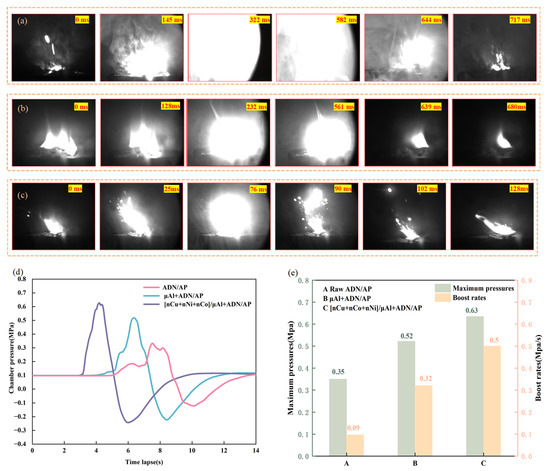
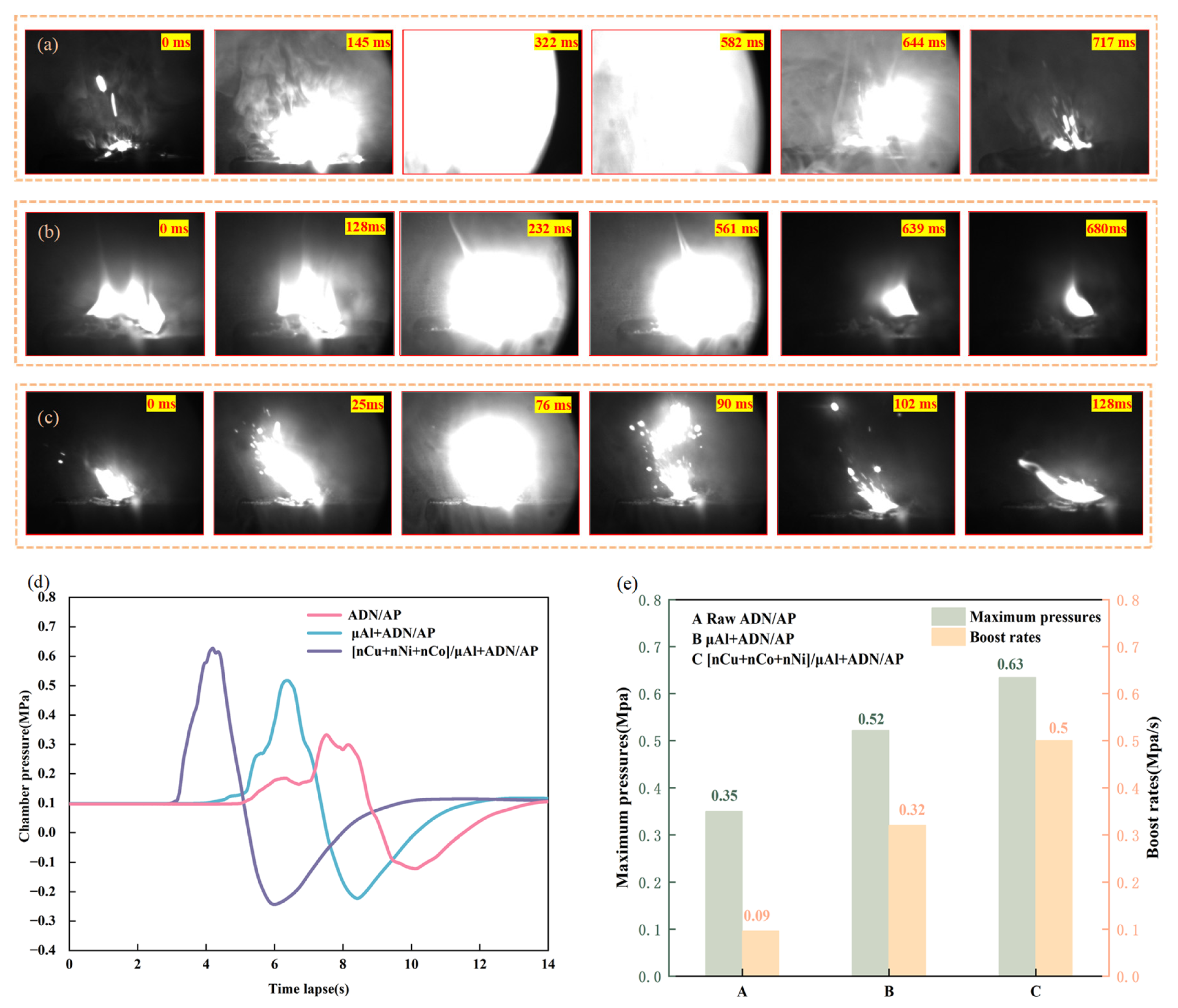
Drawing upon the insights derived from the Confined Explosion Test, as depicted in Figure 12, we elucidate the Constant Volume Combustion Characteristics of the assorted samples. Each specimen demonstrated phenomena including the initiation, propagation, and eventual quenching of the flame. Notably, the Composite System reached its zenith of flame intensity at 76 milliseconds—an impressive threefold acceleration compared to the 232 milliseconds recorded for μAl+ADN/AP, and an astonishing 4.2 times quicker than the 322 milliseconds observed for ADN/AP. The flame manifested a distinctive Quasi-Spherical configuration while concurrently revealing the phenomenon of Metal Particle Ejection, which highlighted the intense surface reactions taking place within the nanocomposite materials. The composite system achieved a remarkable peak combustion pressure of 0.63 MPa, reflecting an impressive 80% increase over the 0.35 MPa recorded for the ADN/AP configuration, and a 21.2% enhancement in comparison to the 0.52 MPa observed with the μAl + ADN/AP setup. Furthermore, the rate of pressure increase soared to 0.5 MPa·s−1, representing a striking 5.6-fold improvement over the ADN/AP system and a 1.6-fold increase relative to the μAl configuration. The consistent expansion of quasi-spherical flames highlights the optimization of reaction uniformity. Alongside the notable increase in flame height observed at 90 ms, these results substantiate the assertion that the composite system exhibits a substantially elevated heat release rate and energy density. Such significant progress can be attributed to the synergistic interactions of the nanocomposite metals.
Figure 12.
Combustion performances: (a) flame images for raw ADN/AP; (b) flame images for μAl+ADN/AP; (c) flame images for [nCu+nCo+nNi]/μAl +ADN/AP; (d) pressure curves; and (e) maximum pressures and boost rates.
- (1)
- Catalysis facilitates the comprehensive decomposition of ADN/AP, culminating in the generation of Active Oxygen.
- (2)
- A remarkably efficient oxidative pathway for the aluminum core has been delineated.
- (3)
- The exothermic feedback at the metal-aluminum interface sustains the progression of the combustion chain reaction.
The enhancement of combustion performance in the [nCu+nCo+nNi]/μAl+ADN/AP formulation can be ascribed to a dual synergistic mechanism. Firstly, there exists a significant advancement in the physical architecture: the integration of nanocomposite metals (Cu, Co, and Ni) replaces the compact Al2O3 layer, thereby creating a porous interface. This structural transformation markedly enhances the diffusion of ambient oxygen toward the active aluminum core while concurrently optimizing the reactivity of the reduction reactions between the oxidizer and aluminum. Furthermore, enhanced chemical catalysis is pivotal; the catalytic characteristics of the Ni/Al, Co/Al, and Cu/Al composites demonstrate a performance level that rivals that of other combinations, including Ni/Co, Ni/Cu, and Co/Cu. It is particularly noteworthy that the catalytic effect of the Al/Ni composite on the oxidizer is significantly more pronounced [32]. The incorporation of the Al/Ni composite instigates the Al–O decomposition reaction, conforming to both two-dimensional and three-dimensional nucleation and growth models [50]. In distinction to the two-dimensional framework, the three-dimensional model offers greater degrees of freedom, thereby facilitating an acceleration of the reaction kinetics. As a result, under the influence of the Al/Ni composite, the decomposition of the oxidizer transitions to a paradigm marked by an augmented degree of freedom and an elevated reaction rate. This shift culminates in a more concentrated release of thermal energy and a significantly enhanced rate of energy liberation.
3.4.2. Constant Pressure Combustion
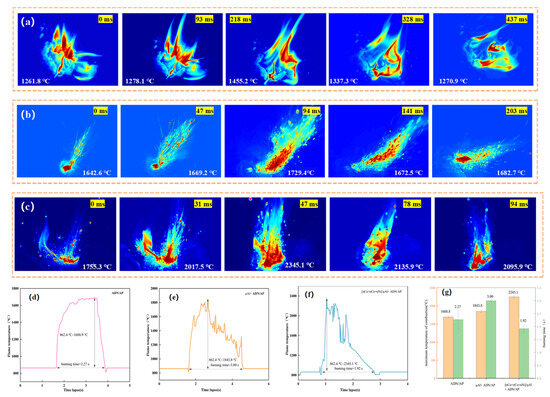
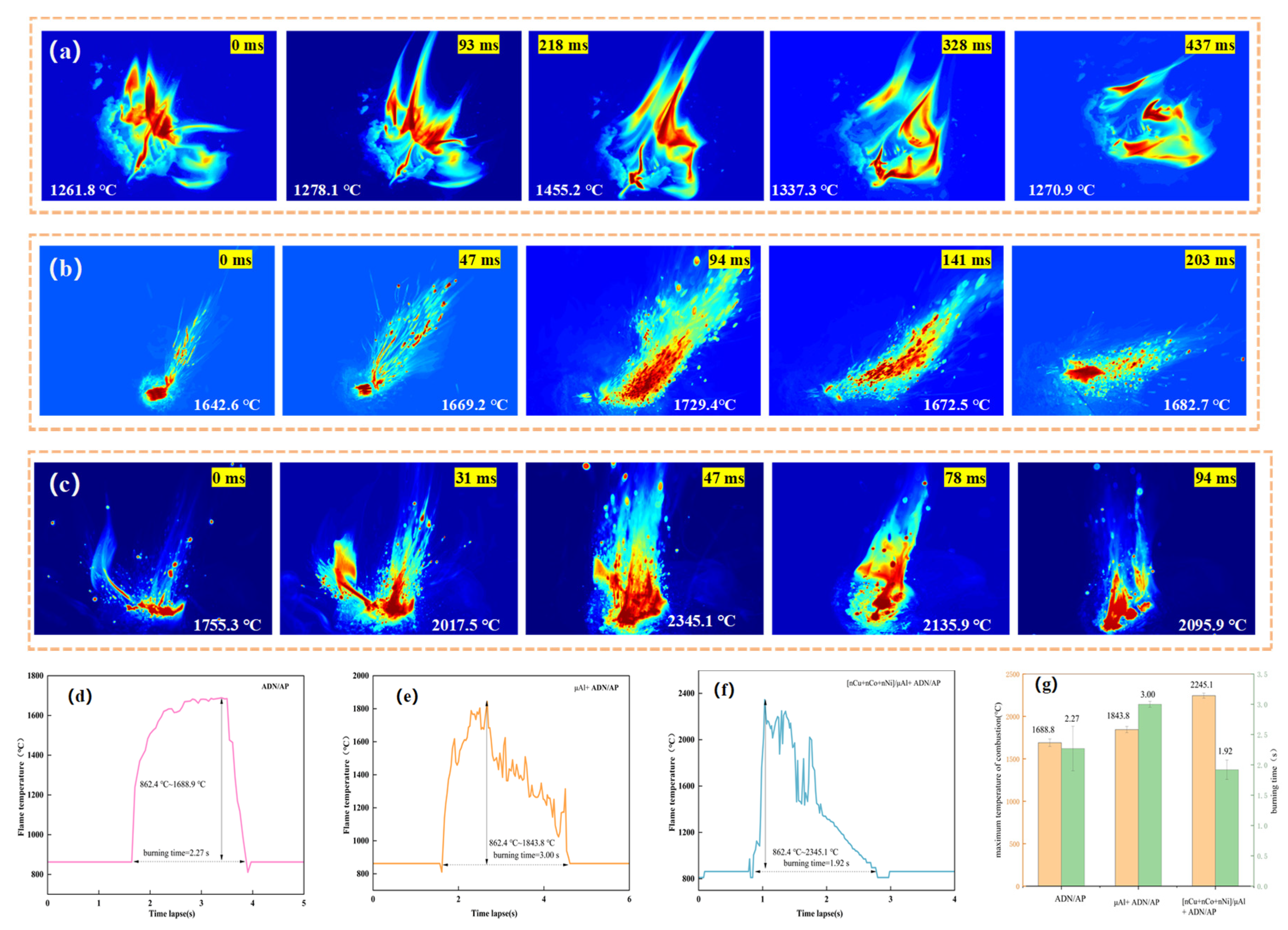
Infrared thermal imaging analysis performed under atmospheric conditions (Figure 13) indicates that the ADN/AP reference group displays an unstable diffusion flame, achieving a maximum temperature of 1455.2 °C at 218 milliseconds. Upon the introduction of μAl, the flame transforms into a well-defined directional jet, attaining an impressive temperature of 1729.4 °C in merely 94 milliseconds. This enhancement in combustion intensity can be ascribed to several contributing factors: The localized pressurization of gaseous products resulting from the AP/ADN reaction, which markedly improves mass transfer; The presence of active oxygen free radicals (O·) significantly amplifies the reactivity of the aluminum oxidation reaction. The [nCu+nCo+nNi]/μAl+ADN/AP system exhibits a remarkable enhancement in combustion efficacy. The temperature surges precipitously to 2345.1 °C within a mere 47 milliseconds, and the resulting flame is characterized by a vivid and intense ejection of particles (Figure 13c), thereby providing compelling evidence that the nanocomposite metals effectively catalyze the extensive oxidation of the aluminum core. Simultaneously, the radial expansion of the combustion products, driven by the pressure wave, is distinctly observable (Figure 13f). Collectively, these findings affirm that this system is endowed with an exceptionally high rate of energy release.
Figure 13.
Thermal infrared images of (a)ADN/AP, (b) μAl+ADN/AP, and (c) [nCu+nCo+nNi]/μAl+ ADN/AP; (d–f) are curves of the burning time vs. the flame temperature; (d) for ADN/AP; (e) for μAl+ADN/AP; (f) for [nCu+nCo+nNi]/μAl+ ADN/AP, (g) Statistical diagram of maximum temperature and combustion time.
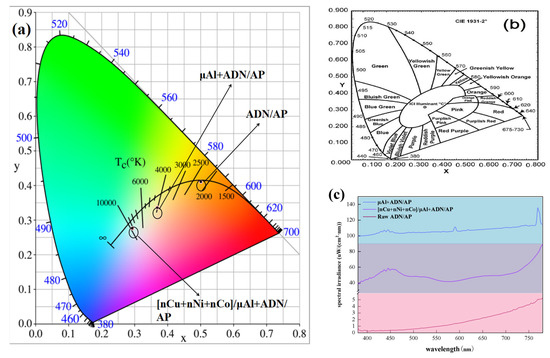
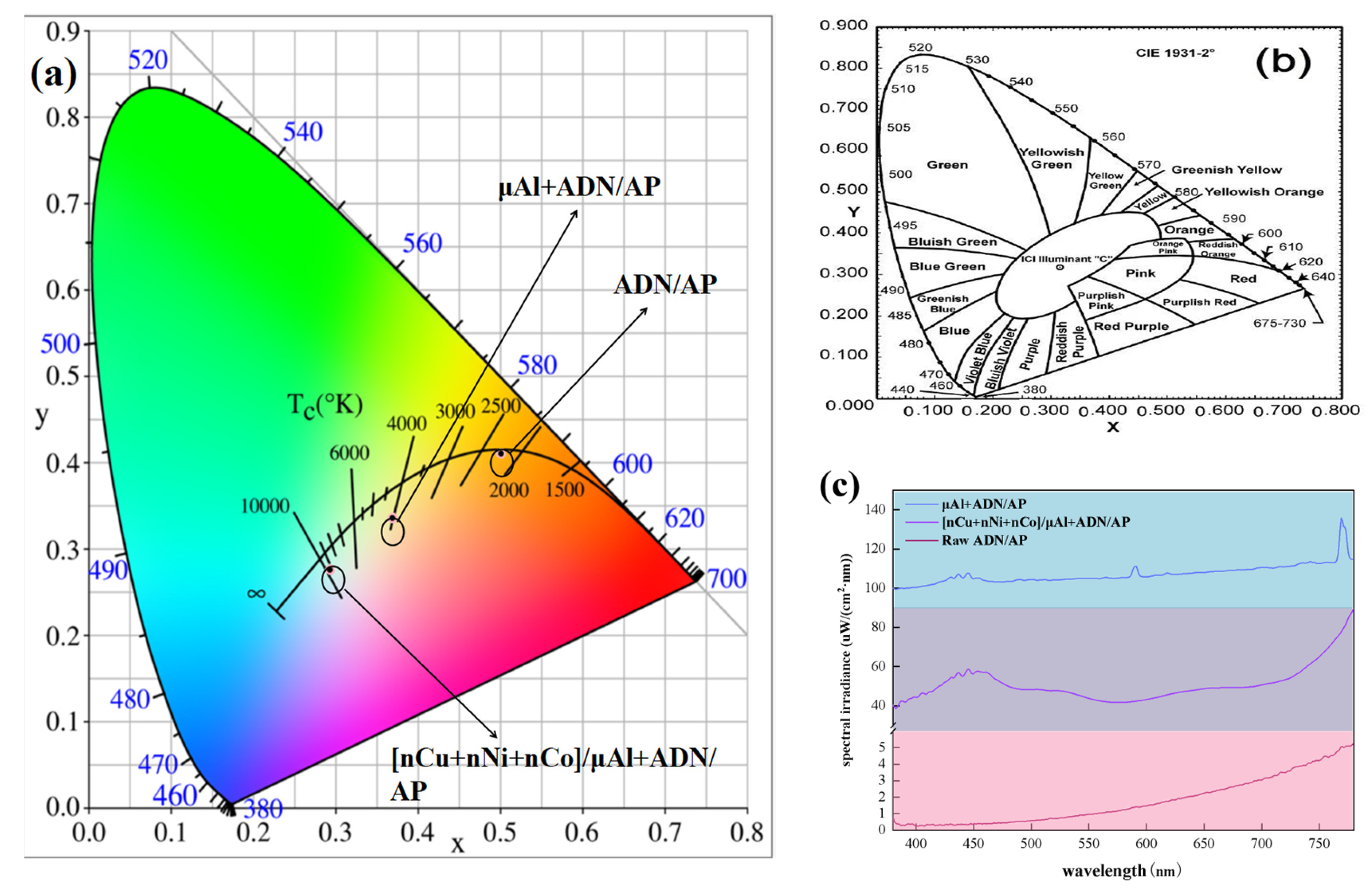
Flame spectrum analysis was performed using the OPT2000 apparatus (refer to Figure 14). The color coordinates of the ADN/AP reference group were situated within the orange region of the light spectrum (x = 0.5013, y = 0.4107), exhibiting no discernible emission peaks within the continuous spectrum. Upon the incorporation of μAl, a noteworthy alteration in the color coordinates was recorded, with a transition towards the yellow-white region (x = 0.3693, y = 0.3364). Furthermore, a distinctive emission peak linked to the Al-O complex emerged at 450 nm, while peaks attributed to impurities—specifically sodium (588 nm, Na+) and potassium (767 nm, K+)—cooperatively facilitated the generation of a yellow-white light emission. In the [nCu+nCo+nNi]/μAl+ADN/AP system, the chromatic coordinates reveal a significant blue shift, progressing into the blue-white spectrum (x = 0.2938, y = 0.2760), alongside a marked enhancement in the peak intensity of blue light at 450 nm. This phenomenon can be ascribed to the catalytic influence of transition metals on the decomposition of ADN/AP, which elevates the population of excited-state particles and subsequently intensifies the emission of blue light. As demonstrated in Table 4, the light intensity of the composite system is an impressive 17.9 times greater than that of ADN/AP, while luminous efficiency amplifies to 3.8 times its initial value. These results provide compelling evidence of a significant enhancement in both the energy release rate and the reaction dynamics of the system.
Figure 14.
(a) color coordinates; (b) CIE1931 chromaticity diagram; (c) spectrum.
Table 4.
Testing results of color pyrotechnics.
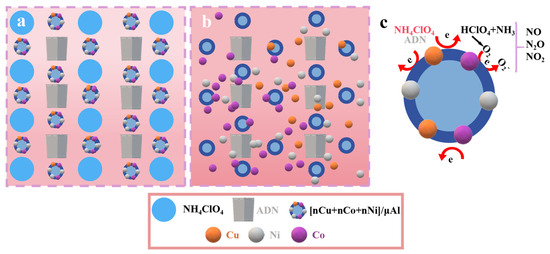
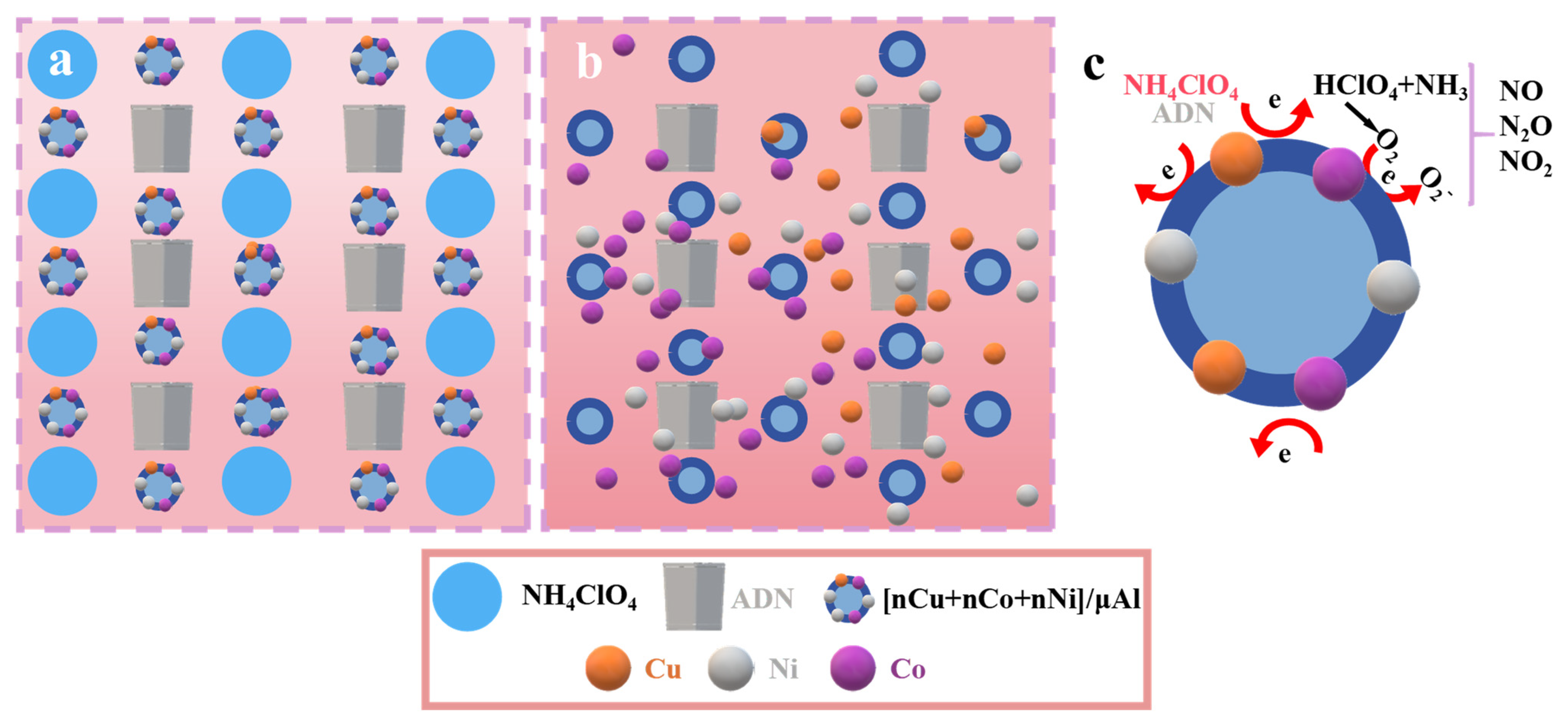
Based on the analysis of the above experimental results, the possible reaction mechanism of [nCu+nCo+nNi]/μAl+ADN/AP under thermal stimulation is proposed (as shown in Figure 15). In the composite designated as [nCu+nCo+nNi]/μAl+ADN/AP, the nano-metallic clusters comprising cobalt (Co), copper (Cu), and nickel (Ni) are meticulously distributed across the metallic matrix. This uniform distribution significantly enhances the dispersibility of the composite, which is characterized by an aluminum core, thus effectively reducing the agglomeration of particles. A pivotal mechanism in the decomposition of ammonium perchlorate (AP) and ADN entails the transfer of electrons to molecular oxygen (O2), culminating in the formation of superoxide anions (O2−). It is noteworthy that Co, Cu, and Ni exhibit comparable properties within this framework [51]. Both mechanisms contribute to the facilitation of electron transfer and the generation of superoxide radicals. The active aluminum notably enhances electron transfer in the redox reactions involving cobalt, copper, and nickel oxides. It plays a pivotal role in expediting the transfer of electrons from perchlorate (ClO4−) to ammonium (NH4+), as well as from molecular oxygen (O2) to the superoxide radical anion (O2−). Moreover, it promotes the subsequent decomposition of pyrolytic products derived from ammonia (NH3) and perchloric acid (HClO4), thereby accelerating a more thorough and rapid redox reaction between ammonium dinitramide (ADN) and ammonium perchlorate (AP) [52], ultimately culminating in the liberation of greater quantities of thermal energy. During the process of thermal excitation, the reactive aluminum (Al) undergoes oxidation, resulting in the formation of aluminum-oxygen (Al-O) compounds [53], which further enhances the dynamics of electron transfer. Concurrently, the superoxide anion (O2−) facilitates the combustion of aluminum. This synergistic interplay significantly amplifies the combustion of ammonium dinitramide (ADN) and ammonium perchlorate (AP), resulting in an enhanced liberation of thermal energy. As the temperature rises, protons (H+) are rapidly transferred from ammonium ions (NH4+) to nitrate ions (NO3−), yielding ammonia (NH3) and nitric acid (HNO3) as products. At elevated temperatures, nitric acid experiences thermal decomposition through homolytic cleavage, generating hydroxyl radicals (OH) and nitrogen dioxide (NO2). The hydroxyl radicals subsequently engage in a reaction with ammonia, yielding amine (NH2) and water (H2O). This amine is then subjected to oxidation by nitrogen dioxide, resulting in the formation of nitrous oxide (N2O) and supplementary water. Throughout this complex cascade of reactions, the reactive aluminum interacts with hydroxyl radicals in the nitric acid medium, thereby promoting the advancement of the ADN/AP combustion reaction and guaranteeing its complete combustion.
Figure 15.
Diagram of the combustion process and catalytic mechanism of the sample: (a) unburned [nCu+nCo+nNi]/μAl+ADN/AP; (b) burning [nCu+nCo+nNi]/μAl+ADN/AP; (c) the speculated promotion mechanism of nCo and nFe on the thermolysis of ADN/AP.
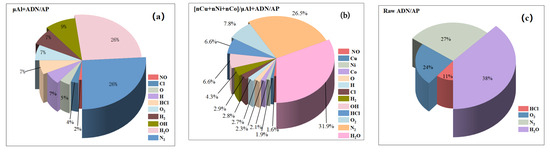
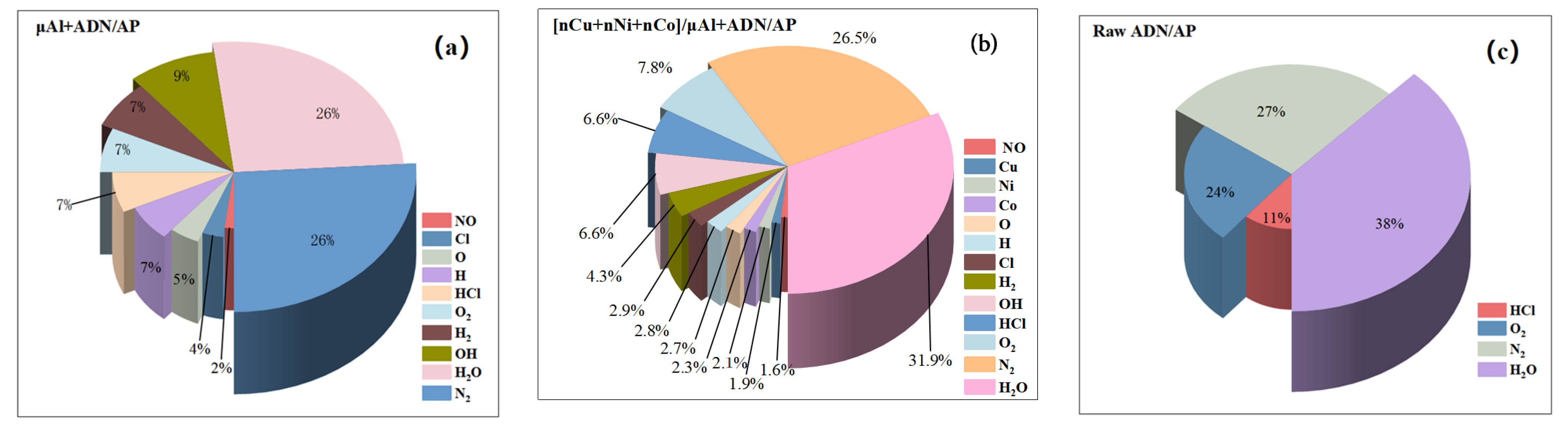
The thermodynamic simulation of combustion conducted using the REAL2.0 software (see Table 5 and Figure 16) reveals that the combustion enthalpy (ΔHC,cal) of the ADN/AP system is measured at −2096.0 kJ·kg−1. Subsequent incorporation of μAl results in a significant increase to −8061.7 kJ·kg−1, attributed to the highly exothermic oxidation of aluminum. In the Composite System, the enthalpy is recorded at −7639.7 kJ·kg−1, wherein the transition metal undergoes a partial endothermic oxidation process. Nevertheless, the specific impulse performance is markedly improved with the enhancement of the molar fractions of the gaseous combustion products, specifically nitrogen (N2) and hydrogen (H2). TTOP,exp denotes the apex temperature recorded in an open environment at a pressure of one atmosphere, as illustrated in Figure 13. The trajectory of the maximum combustion temperature, Tad,cal derived from the REAL2.0 simulation, aligns closely with the measured values, thereby affirming the integrity of the experimental results. The systematic disparity observed between the adiabatic flame temperature and the empirical data can be attributed to the impact of hydrogen content in the oxidizer on the heat of formation of the compound [54].
Table 5.
Thermodynamic data for the combustion of the samples at atmospheric pressure.
Figure 16.
Molar ratios of the combustion products of the samples: (a) for μAl+ADN/AP; (b) for [nCu+nCo+nNi]/μAl+ADN/AP; (c) for raw ADN/AP.
3.4.3. Combustion Heat Tests
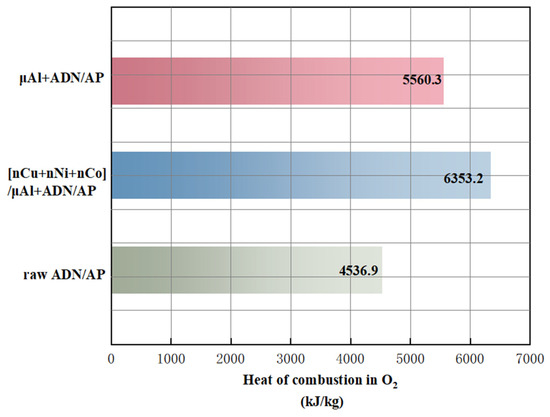
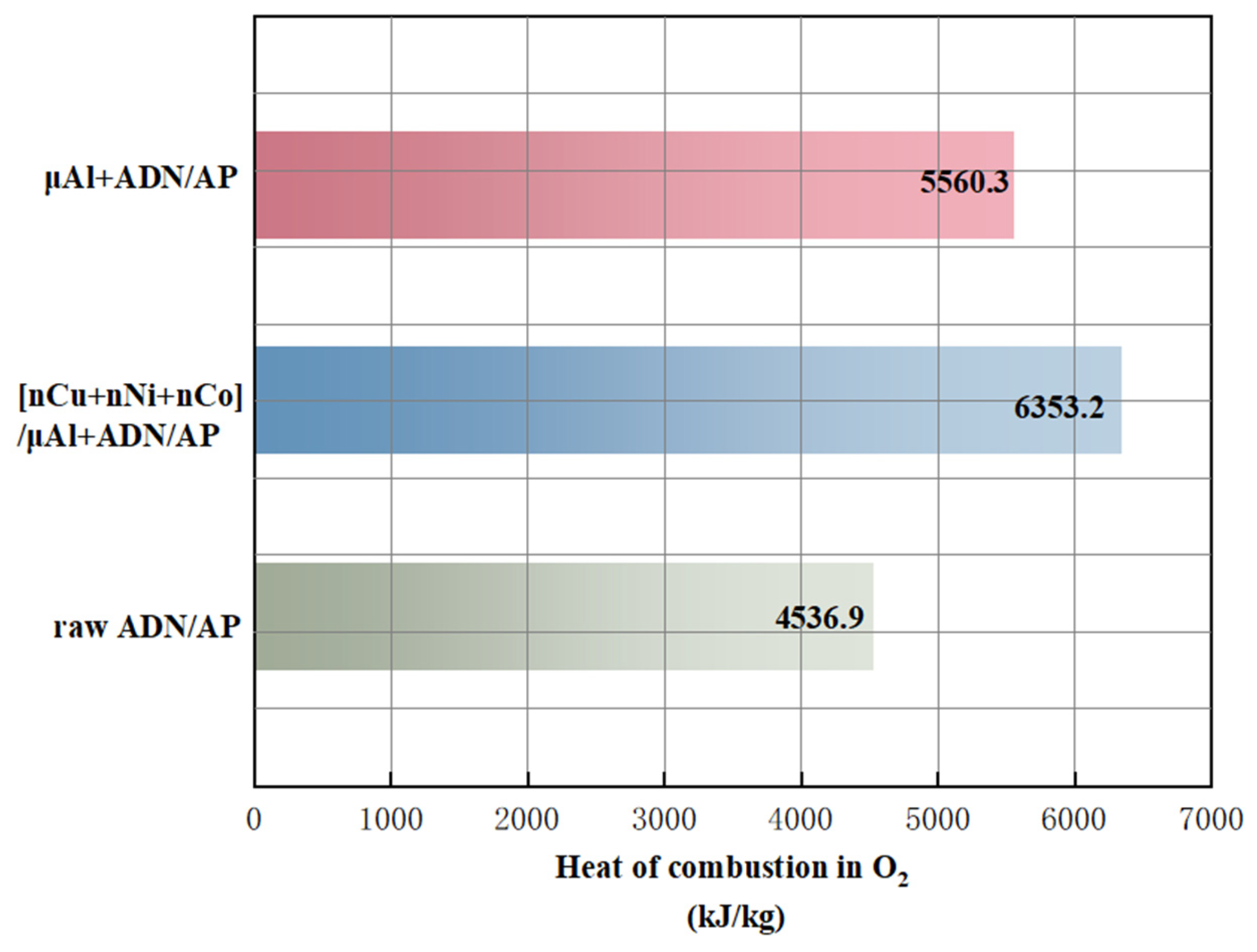
To explore the calorific values of the three samples, an automated calorimeter was utilized for testing under a pressure of 3 MPa in an environment of pure oxygen, as depicted in Figure 17. The combustion heat of the composite formulation [nCu+nCo+nNi]/μAl+ADN/AP was measured at an impressive 6353.2 kJ/kg, surpassing that of μAl+ADN/AP, which registered at −5560.3 kJ/kg, and significantly exceeding the calorific value of ADN/AP, recorded at −4536.9 kJ/kg. This observed trend is consistent with the combustion enthalpy predicted by the REAL2.0 simulation, albeit with the simulated values exhibiting a tendency to be more elevated in comparison. A compelling rationale for this discrepancy can be attributed to the hygroscopic properties of ammonium dinitramide (ADN). Throughout the pretreatment phase—including the evacuation of the oxygen bomb and its subsequent refilling with oxygen—the sample is prone to absorbing moisture, potentially leading to incomplete combustion. The existence of residual powder substantiates this hypothesis, thereby elucidating the divergence between the experimentally obtained values and those derived from the simulations.
Figure 17.
Heat release of combustion in pure and excessive oxygen.
4. Conclusions
In this study, a composite material featuring a Co-Cu-Ni nanoparticle-functionalized interface was successfully synthesized on micrometer-sized aluminum powder via a displacement reaction. Structural characterization elucidated that this transition metal shell layer proficiently formed an effective oxygen transport channel, thereby markedly enhancing the chemical reactivity of the aluminum core and augmenting exothermic efficiency (the intensity of the primary exothermic peak is ninefold that of μAl). Within the ADN/AP binary oxidizer system, the ratio [nCu+nCo+nNi]/μAl facilitated the amalgamation of the high and low-temperature decomposition peaks of ammonium perchlorate (AP), resulting in a notable reduction in the peak temperature by 104.1 °C. Differential scanning calorimetry (DSC) corroborated its catalytic influence on the decomposition of ADN/AP, occurring 62.3 °C earlier. Combustion performance assessments indicate that:
- (1)
- The maximum flame intensity is achieved within 76 ms during constant-volume combustion (4.2 times faster than the reference group);
- (2)
- The flame temperature at atmospheric pressure reaches 2345.1 °C;
- (3)
- The calorific value measured in the oxygen bomb is 6353.2 kJ/kg (3 MPa O2);
- (4)
- The light radiation intensity is significantly increased (by a factor of 17.9 compared to the ADN/AP reference group). The significant improvement in performance stems from the Cu-Co-Ni ternary Synergistic Catalysis mechanism, which reduces the activation energy and optimizes the reaction pathway.
This study proposes a potential thermal-oxidative mechanism for the nCu+nCo+nNi/µAl system, a catalytic mechanism for ADN/AP thermolysis, and a likely reaction pathway for the composite system under thermal stimulation. Together, these mechanisms establish a comprehensive “material-interface-reaction-performance” framework. The scientific significance of this investigation lies in its ability to establish a correlation between microscopic atomic behaviors and macroscopic combustion performance, thereby facilitating the enhancement of energetic micro-units and fostering their broader application in solid propellant technologies.
Author Contributions
Conceptualization, X.S. and Y.W.; Software, Y.W.; Formal analysis, W.Y. and Y.W.; Writing—original draft, W.Y.; Writing—review & editing, X.S. and Y.W.; Supervision, X.S. and Y.W. All authors have read and agreed to the published version of the manuscript.
Funding
This research received no external funding.
Institutional Review Board Statement
Not applicable.
Informed Consent Statement
Not applicable.
Data Availability Statement
The original contributions presented in this study are included in the article. Further inquiries can be directed to the corresponding authors.
Conflicts of Interest
There are no conflicts of interest to declare.
References
- Zhu, L.; Liang, B.; Liu, J.; Zhang, W. Effect of Aluminum Morphology on Burning Rate Characteristics of HTPB Propellant. Chin. J. Energetic Mater. 2017, 25, 799–803. [Google Scholar]
- Kaige, D. Combustion performance of ultrafine aluminum powder in AP/HTPB propellants. Chem. Eng. Equip. 2024, 10, 21–23. [Google Scholar]
- Chen, K.; Xue, X.; Yu, Y. A model for the combustion behavior of AP/HTPB propellant containing ultrafine aluminum. Propellants Explos. Pyrotech. 2024, 49, e202400049. [Google Scholar] [CrossRef] [Scilit]
- Xin, H.; Wang, K.; Ren, H.; Jiao, Q. Comparative study on combustion behavior of aluminum-based alloy fuels and aluminum powder in solid propellants. Metals 2023, 13, 1492. [Google Scholar] [CrossRef] [Scilit]
- Trunov, M.A.; Schoenitz, M.; Zhu, X.; Dreizin, E.L. Effect of polymorphic phase transformations in Al2O3 film on oxidation kinetics of aluminum powders. Combust. Flame 2005, 140, 310–318. [Google Scholar] [CrossRef] [Scilit]
- Jeurgens, L.P.H.; Sloof, W.G.; Tichelaar, F.D.; Mittemeijer, E.J. Composition and chemical state of the ions of aluminium-oxide films formed by thermal oxidation of aluminium. Surf. Sci. 2002, 506, 313–332. [Google Scholar] [CrossRef] [Scilit]
- Sánchez-López, J.C.; Fernández, A.; Conde, C.F.; Conde, A.; Morant, C.; Sanz, J.M. The melting behavior of passivated nanocrystalline aluminum. Nanostruct. Mater. 1996, 7, 813–822. [Google Scholar] [CrossRef] [Scilit]
- Wang, S.X.; Liang, K.M.; Zhang, X.H.; Wang, G.L. Influence of heating-rate on DTA curve of the aluminothermic reaction. J. Mater. Sci. Lett. 2003, 22, 855–856. [Google Scholar] [CrossRef] [Scilit]
- Shafirovich, E.; Escot Bocanegra, P.; Chauveau, C.; Gökalp, I.; Goldshleger, U.; Rosenband, V.; Gany, A. Ignition of single nickel-coated aluminum particles. Proc. Combust. Inst. 2005, 30, 2055–2062. [Google Scholar] [CrossRef] [Scilit]
- Cheng, Z.P.; Chu, X.Z.; Yin, J.Z.; Dai, B.L.; Zhao, W.; Jiang, Y.; Xu, J.M.; Zhong, H.; Zhao, P.S.; Zhang, L.L. Formation of composite fuels by coating aluminum powder with a cobalt nanocatalyst: Enhanced heat release and catalytic performance. Chem. Eng. J. 2020, 385, 123859. [Google Scholar] [CrossRef] [Scilit]
- Cheng, Z.P.; Chu, X.Z.; Zhao, W.; Yin, J.Z.; Dai, B.L.; Zhong, H.; Xu, J.M.; Jiang, Y. Controllable synthesis of Cu/Al energetic nanocomposites with excellent heat release and combustion performance. Appl. Surf. Sci. 2020, 513, 145704. [Google Scholar] [CrossRef] [Scilit]
- Wang, Y.; Song, X. Aluminum Microspheres Coated with Copper and Nickel Nanoparticles: Catalytic Activity in the Combustion of Ammonium Perchlorate. Catalysts 2025, 15, 354. [Google Scholar] [CrossRef] [Scilit]
- Wu, J. Study on the Micro-nano Structure ofAmmonium Perchlorate and It’s Anti-Hygroscopicity Property. Master’s Thesis, Southwest University of Science and Technology, Mianyang, China, 2017. [Google Scholar]
- Liu, Q.D.; Wu, Z.J.; Li, M.M.; Xu, Y.F.; Xin, X.P.; Xu, J.J.; Song, X.F. Integrated preparation of Al-based energetic micro-unit fuel toward combustion performance. J. Aeronaut. Mater. 2023, 43, 102–110. [Google Scholar]
- Qu, W.C.; Yan, J.W.; Xia, W.T.; Li, L.; Du, F.; Wu, P.; Lin, Y.H.; He, J.M.; Tao, B.W. Preparation and Properties of Modified Spherical ADN with Amine Compounds. Chin. J. Energetic Mater. 2025, 33, 127–135. [Google Scholar]
- Wu, Y.Y.; Shi, X.F.; Zhang, Z.J.; Zhang, W.H.; Wang, F.; Wang, J.Y. Preparation and Performance Study of ADN/NC/RDX Composite Micropropulsion System. Initiat. Pyrotech. 2025, 2, 24–30. [Google Scholar]
- Chen, F.Y.; Xuan, C.L.; Lu, Q.Q.; Xiao, L.; Yang, J.Q.; Hu, Y.B.; Zhang, G.P.; Wang, Y.L.; Zhao, F.Q.; Hao, G.Z.; et al. A review on the high energy oxidizer ammonium dinitramide: Its synthesis, thermal decomposition, hygroscopicity, and application in energetic materials. Def. Technol. 2023, 19, 163–195. [Google Scholar] [CrossRef] [Scilit]
- Pan, Y.F.; Wang, Y.L.; Chen, B.; Yan, Z.F.; Gao, F.L.; Ji, Y.P. Research Status of Spheroidization of Ammonium Dinitramide (ADN). Explos. Mater. 2018, 47, 1–8. [Google Scholar]
- Carignan, L.P.; Lacroix, C.; Ouimet, A.; Ciureanu, M.; Yelon, A.; Menard, D. Magnetic anisotropy in arrays of Ni, CoFeB, and Ni/Cu nanowires. J. Appl. Phys. 2007, 102, 023905. [Google Scholar] [CrossRef] [Scilit]
- Liu, Y.; Cheng, B.; Wang, K.K.; Ling, G.P.; Cai, J.; Song, C.L.; Han, G.R. Study of Raman spectra for γ-Al2O3 models by using first-principles method. Solid State Commun. 2014, 178, 16–22. [Google Scholar] [CrossRef] [Scilit]
- Assih, T.; Ayral, A.; Abenoza, M.; Phalippou, J. Raman study of alumina gels. J. Mater. Sci. 1988, 23, 3326–3331. [Google Scholar] [CrossRef] [Scilit]
- Hu, C.L.; Sy, C.; Chen, J.; Zhang, W.H.; Chen, X.D. Application Progress of Raman Spectroscopy in Polymer Study. Polym. Bull. 2014, 27, 30–45. [Google Scholar]
- Warmer, J.; Breuch, R.; Schning, M.J.; Wagner, P.; Kaul, P. Temperature-Dependent Operando Raman Analysis of a WO3-Based Metal-Oxide Gas Sensor Detecting Triacetone Triperoxide. Phys. Status Solidi (A) 2024, 221, 2300790. [Google Scholar] [CrossRef] [Scilit]
- Cheng, H.; Ding, Y.J.; Wang, Y.H.; Xu, J.; Xi, Y. Adaptability of molecular force fields to typical components in asphalt systems based on molecular simulation. Chem. Eng. 2024, 52, 82–87. [Google Scholar]
- Qi, X.; Yan, N.; Li, H.; Zhao, Y.; Liu, P.; Yan, Q. New insight into dynamic mechanical relaxation in N-butyl-N-(2-nitroxy-ethyl) nitramine plasticized nitrocellulose through molecular dynamic simulations. Cellulose 2022, 29, 1307–1314. [Google Scholar] [CrossRef] [Scilit]
- Song, Z.; Zhang, B.; Yang, Y.; Gao, G.; Tang, D.; Fang, Q.; Zhang, Y.; Shin, B.; Steinbach, D.; Ai, Q. Flaw-size-dependent mechanical interlayer coupling and edge-reconstruction embrittlement in van der Waals materials. Nat. Mater. 2025, 24, 1554–1560. [Google Scholar] [CrossRef] [Scilit]
- Sun, J.; Li, Y.; Song, H.O.; Li, H.X.; Lai, Q.; Gusunkiz, E.; Li, Q.M.; Zhang, S.P.; He, H.; Li, A.M. Enhanced capacitive deionization properties of activated carbon doped with carbon nanotube-bridged molybdenum disulfide. Chemosphere 2023, 310, 136740. [Google Scholar] [CrossRef] [Scilit]
- Lu, J.; Li, Y.; Wang, B.; Zhao, T.; Wang, M.; Si, H. Analysis of monomeric and competitive adsorption mechanisms of nutrient ions on biochar surfaces based on molecular dynamics simulations. Bioresour. Technol. 2025, 416, 131746. [Google Scholar] [CrossRef] [Scilit]
- Zhang, X. Controlled Preparation of Porous Oxide-Supported Noble Metal Catalysts and Their Catalytic Performance for the Oxidation of Typical Halogenated Hydrocarbons. Ph.D. Thesis, Beijing University of Technology, Beijing, China, 2021. [Google Scholar]
- Cheng, C.C.; Li, C.L.; Xu, X.L.; Cao, J.F. Comparision of performances of iron and cobalt in Fischer-Tropsch synthesis. Chem. Ind. Eng. Prog. 2012, 31, 154–157. [Google Scholar]
- Sui, B.K.; Liu, W.J.; Wang, G.; Pan, Y.X.; Peng, C. Effect of Ni and Co species on the performance of catalysts in residue hydrodemetallization. Petrochem. Technol. 2022, 51, 1161–1166. [Google Scholar]
- Yang, S.; Nie, H.; Yan, Q. Preparation and thermal reaction properties of Al/Ni-coated AP composite fuel. Energy Mater. 2022, 30, 648–658. [Google Scholar]
- Kissinger, H.E. Reaction kinetics in differential thermal analysis. Anal. Chem. 1957, 29, 1702–1706. [Google Scholar] [CrossRef] [Scilit]
- Guo, Y.Y.; Liu, Y.; Guan, Q.; Ma, Z.L.; An, C.W.; Wu, B.D. Preparation of Micron-Sized Ammonium Perchlorate with Narrow Particle Size Distribution Based on Microfluidic Technology. Initiat. Pyrotech. 2024, 6, 33–39. [Google Scholar]
- Zhang, T.T.; Jiang, Y.Q.; Huo, W.L. Preparation and Combustion Properties of AP@Al Composites. Solid Rocket. Technol. 2024, 36, 1−13. [Google Scholar]
- Liu, L.L.; Li, F.S.; Tan, L.; Ming, L.; Yi, Y. Effects of nanometer Ni, Cu, Al and Ni Cu powders on the thermal decomposition of ammonium perchlorate. Propellants Explos. Pyrotech. 2004, 29, 34–38. [Google Scholar] [CrossRef] [Scilit]
- Li, D.Y.; Zeng, D.W.; Li, H.T. Self-catalytical Performance for Ammoniam Perchlorate Thermal Decomposition by AP/Co MoF Core-shell Nanocomposites. Chem. Biol. Eng. 2016, 33, 15–18+22. [Google Scholar]
- Wang, Y.; Song, X.; Song, D. Synthesis, thermolysis, and sensitivities of HMX/NC energetic nanocomposites. J. Hazard. Mater. 2016, 312, 73–83. [Google Scholar] [CrossRef] [Scilit]
- Wang, Y.; Song, X.; Li, F. Thermal behavior and decomposition mechanism of ammonium perchlorate and ammonium nitrate in presence of nanometer triaminoguanidine nitrate. ACS Omega 2019, 4, 214–225. [Google Scholar] [CrossRef] [Scilit] [PubMed]
- Wang, Y.; Song, X.; Li, F. Nanometer ammonium perchlorate andammonium nitrate with 2D networkstructure prepared via rapid freezing technology. Nanomaterials 2019, 9, 1605. [Google Scholar] [CrossRef] [Scilit]
- Meng, W.F. Molecular Dynamics Study on Thermal Decomposition of ADN-Based Liquid Propellant. Master’s Thesis, North University of China, Taiyuan, China, 2024. [Google Scholar]
- Wang, X.T.; Wang, Z.Z.; Li, Y.; Wang, J.T.; Zhang, G.K. Efficient photocatalytic CO2 conversion over 2D/2D Ni-doped CsPbBr3/Bi3O4Br Z-scheme heterojunction: Critical role of Ni doping, boosted charge separation and mechanism study. Appl. Catal. B Environ. 2022, 319, 121895. [Google Scholar] [CrossRef] [Scilit]
- Guo, W.; Vlachos, D.G. Patched bimetallic surfaces are active catalysts for ammonia decomposition. Nat. Commun. 2015, 6, 8619. [Google Scholar] [CrossRef] [Scilit] [PubMed]
- Kang, T.; Kim, J. Optimal cobalt-based catalyst containing high-ratio of oxygen vacancy synthesized from metal-organic-framework (MOF) for oxygen evolution reaction (OER) enhancement. Appl. Surf. Sci. 2021, 560, 150035. [Google Scholar] [CrossRef] [Scilit]
- Hu, Y.; Wang, X.; Hao, J.; Jiang, S.; Zhang, J.; Yang, Y.; Lin, K.; Zheng, J.; Shuai, Y. The catalytic thermal decomposition of ammonium perchlorate on CuMxOy (M = Fe, Ni, Co and Zn) catalysts and their applications in solid propellant. J. Therm. Anal. Calorim. 2023, 148, 6013–6026. [Google Scholar] [CrossRef] [Scilit]
- Liang, H.S.; Liu, G.P. Effects of Nanometer Cu Powder on ADN Thermal Decomposition. Mater. Rep. 2014, 28, 42–45. [Google Scholar]
- Wang, Y.G.; Yang, X.F.; Li, J. Theoretical studies of CO oxidation with lattice oxygen on Co3O4 surfaces. Chin. J. Catal. 2016, 37, 193–198. [Google Scholar] [CrossRef] [Scilit]
- Sun, H.Y.; Lee, S.; Tang, R.; Wang, L.Z.; Yang, C.J.; Liang, W.B.; Zhao, S.L.; Dong, C.L.; Soon, A.; Huang, J. Electrocatalysis for urea evolution and oxidation through confining atomic Ni into In2O3 nanosheet catalysts. Adv. Funct. Mater. 2025, 35, 2415859. [Google Scholar] [CrossRef] [Scilit]
- Wang, J.; Han, Y.; Zhang, Y.; Zheng, J.; Huang, Z.; Han, X. Cu increases oxygen vacancies in MnO2 to improve chlorine resistance in CO oxidation reaction. Mol. Catal. 2025, 582, 115103. [Google Scholar] [CrossRef] [Scilit]
- Yan, Q.L.; Zhao, F.Q.; Kuo, K.K.; Zhang, X.H.; Zeman, S.; DeLuca, L.T. Catalytic effects of nano additives on decomposition and combustion of RDX-, HMX-, and AP-based energetic compositions. Prog. Energy Combust. Sci. 2016, 57, 75–136. [Google Scholar] [CrossRef] [Scilit]
- Yang, S.L.; Meng, K.J.; Xie, W.X.; Nie, H.Q.; Yan, Q.L. Tuning the reactivity of Al–Ni by fine coating of halogen-containing energetic composites. Def. Technol. 2022, 18, 1810–1821. [Google Scholar] [CrossRef] [Scilit]
- Tan, L.; Xu, J.; Zhang, X.; Hang, Z.; Jia, Y.; Wang, S. Synthesis of g-C3N4/CeO2 nanocomposites with improved catalytic activity on the thermal decomposition of ammonium perchlorate. Appl. Surf. Sci. 2015, 356, 447–453. [Google Scholar] [CrossRef] [Scilit]
- Lu, S.C.; Jia, Y.B.; Yang, Q.Y. Effect of composite catalyst on the stability of Al/HMX/CMDB propellants. Chem. Propellants Polym. Mater. 2014, 12, 57–62. [Google Scholar]
- He, J.X.; Wang, Y.T.; Cao, Y.L.; Tang, C.Z. Development direction of high-energy oxidizers for solid propellants. Chin. J. Energetic Mater. 2018, 26, 286–289. [Google Scholar]

Disclaimer/Publisher’s Note: The statements, opinions and data contained in all publications are solely those of the individual author(s) and contributor(s) and not of MDPI and/or the editor(s). MDPI and/or the editor(s) disclaim responsibility for any injury to people or property resulting from any ideas, methods, instructions or products referred to in the content. |
© 2026 by the authors. Licensee MDPI, Basel, Switzerland. This article is an open access article distributed under the terms and conditions of the Creative Commons Attribution (CC BY) license.