Article

Spin-Current Oscillations in Diluted Magnetic Semiconductor Multibarrier GaMnAs/GaAs: Role of Temperature and Bias Voltage
by
Najla S. Al-Shameri
and
Hassen Dakhlaoui
*
Basic and Applied Scientific Research Center (BASRC), Physics Department, College of Science of Dammam, Imam Abdulrahman Bin Faisal University, Dammam 31441, Saudi Arabia
*
Author to whom correspondence should be addressed.
Coatings 2022, 12(4), 504; https://doi.org/10.3390/coatings12040504

Submission received: 8 March 2022 / Revised: 31 March 2022 / Accepted: 6 April 2022 / Published: 8 April 2022
(This article belongs to the Special Issue Optical Thin Films: Preparation, Application and Development)

Abstract

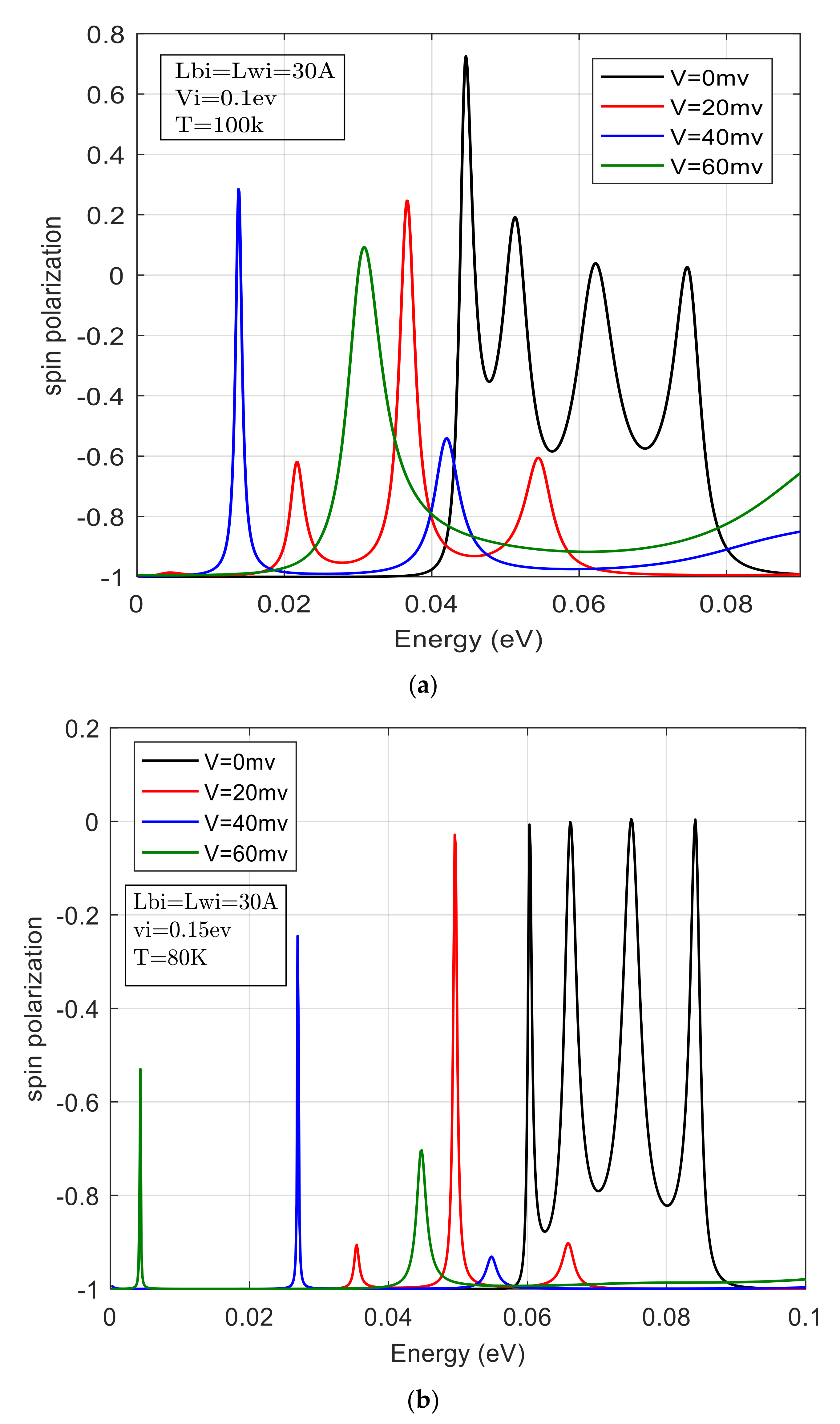
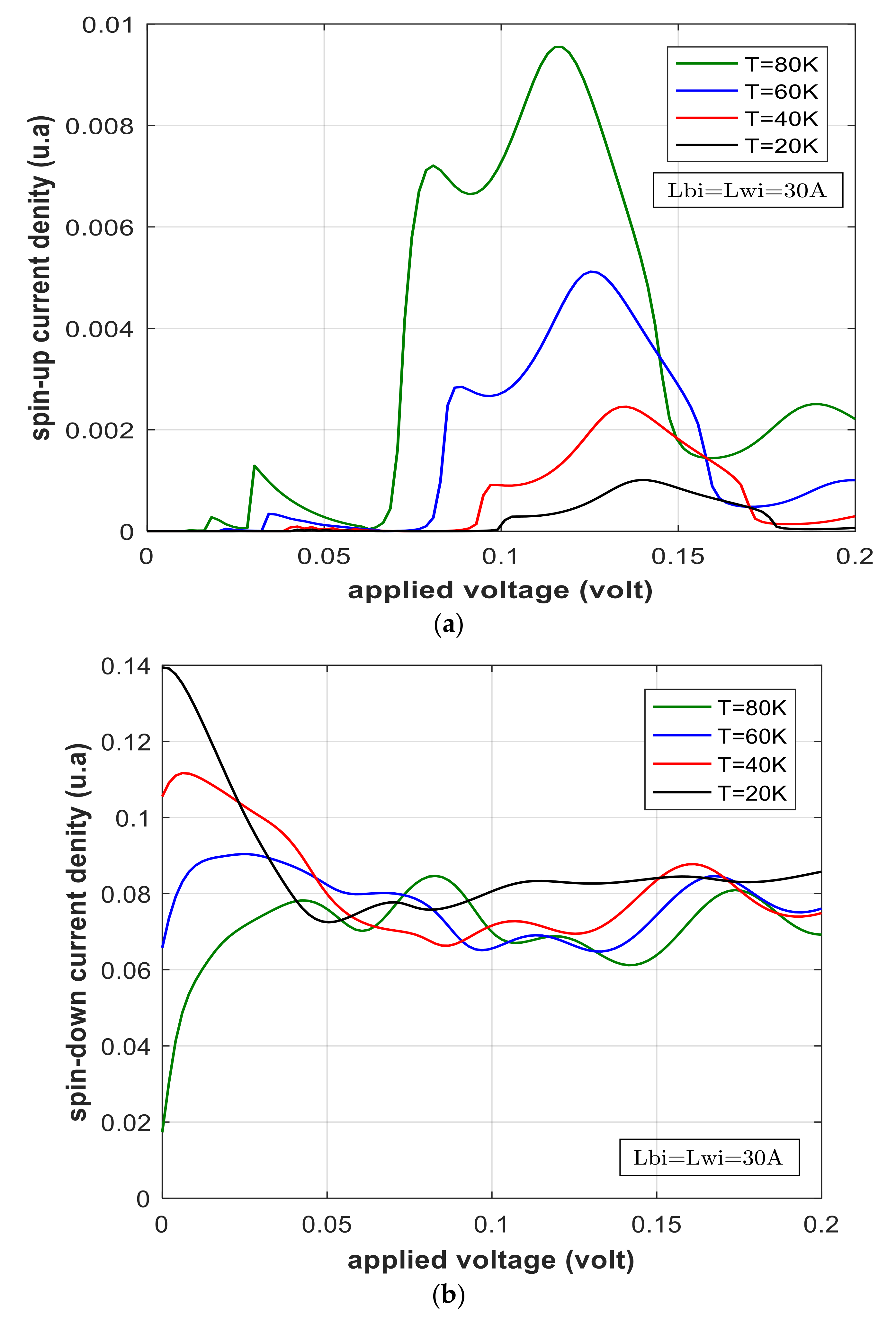
This paper has studied the electronic properties of multi-diluted magnetic semiconductor (DMS) layers Ga(1 − x)MnxAs interposed between nonmagnetic GaAs layers. The asymmetry of confining potential on the transmission coefficient by tuning the temperature and the size of the (DMS) layers was discussed. The diluted magnetic layers Ga(1 − x)MnxAs behave as barriers for spin-up holes and quantum wells for spin-down holes. Furthermore, we have addressed the impact of an applied bias voltage and the temperature on the variation of the spin-polarization and spin current densities. Our findings reveal that the transmission coefficients present an oscillating behavior due to the resonant states and strongly depend on the temperature of the system and the number of magnetic layers. Furthermore, the obtained results demonstrated that the number of these states is multiplied by augmenting the magnetic layers. Moreover, we demonstrate that the asymmetric structure presents a completely different transmission of holes than the symmetric structure. Furthermore, the negative differential resistance (NDR) is demonstrated in the current density variations. Especially, this (NDR) was more intense for spin-up holes than spin-down holes. The findings in the present paper can be useful in manufacturing spin-filters by adjusting the values of the temperature and the external voltages.
Keywords: transfer matrix method; 1d Schrödinger equation; spin-dependent transmission; diluted magnetic semiconductor GaMnAs transfer matrix method; 1d Schrödinger equation; spin-dependent transmission; diluted magnetic semiconductor GaMnAs