


Abstract
Objectives: The primary objective was to evaluate the antimicrobial susceptibility of Pseudomonas aeruginosa causing infection in elderly (≥65 years old) patients hospitalized in intensive care units (ICUs) of United States medical centers. Susceptibility results from isolates of elderly patients in ICUs were compared to isolates from elderly patients not in ICUs (elderly non-ICU) and adult ICU patients (18 to 64 years old; adult ICU). Methods: P. aeruginosa isolates were consecutively collected from 74 US medical centers in 2021–2025 and susceptibility tested by reference broth microdilution in the monitoring laboratory (Element Iowa City [JMI Laboratories]). The organism collection included 999 isolates from elderly ICU, 2027 isolates from elderly non-ICU, and 1022 isolates from adult ICU patients. Results: The most active agents against P. aeruginosa from all three patient groups were ceftazidime-avibactam (95.8% to 97.3% susceptible), ceftolozane-tazobactam (96.0% to 98.3% susceptible), imipenem-relebactam (97.6% to 98.7% susceptible), and tobramycin (91.4% to 94.7% susceptible). Susceptibility to piperacillin-tazobactam, ceftazidime, cefepime, meropenem, and imipenem were markedly lower among isolates from elderly and adult ICU patients compared to elderly non-ICU patients. Susceptibility to levofloxacin and tobramycin were lower among isolates from adult ICU patients compared to elderly ICU and non-ICU patients. Moreover, the frequency of multidrug-resistant (MDR) isolates was markedly higher among elderly (18.4%) and adult (22.4%) ICU patients compared to elderly non-ICU (11.0%) patients. An annual analysis of susceptibility to selected β-lactams showed a slight variation in susceptibility rates without a clear trend. Conclusions: Ceftazidime-avibactam, ceftolozane-tazobactam, and imipenem-relebactam were highly active and exhibited similar coverage against a large contemporary collection of P. aeruginosa isolates from ICU elderly, non-ICU elderly, and ICU adult patients. Cross-resistance among these β-lactamase inhibitor combinations (BLICs) varied markedly, indicating that all three should be tested in the clinical laboratory and available for clinical use.
1. Introduction
P. aeruginosa infections represent a particular challenge when treating elderly and critically ill patients [1,2]. A key factor that contributes to poor clinical outcomes are delays before starting effective antimicrobial therapy, which is more common among patients infected with organisms resistant to antimicrobial agents than among patients infected with susceptible organisms [3,4]. Moreover, many factors are responsible for increasing antimicrobial resistance in elderly patients hospitalized in ICUs, including comorbidities, invasive procedures, use of indwelling devices, prolonged hospital stays, and high use of antimicrobial agents [3,5].
The following antimicrobial classes with clinically meaningful antipseudomonal activity are approved by the US Food and Drug Administration (FDA) for treating systemic P. aeruginosa infections: cephalosporins (ceftazidime, cefepime, and cefiderocol), monobactam (aztreonam), carbapenems (imipenem and meropenem), β-lactamase inhibitor combinations (BLICs; piperacillin-tazobactam, ceftolozane-tazobactam, ceftazidime-avibactam, and imipenem-relebactam), fluoroquinolones (ciprofloxacin and levofloxacin), aminoglycosides (gentamicin, tobramycin, and amikacin), and lipopeptides (colistin and polymyxin B). The approved indications for each of these agents vary markedly [6]. Despite their potential in vitro activity, colistin and polymyxin B are considered inappropriate therapy for systemic P. aeruginosa infection. In addition to nephrotoxicity, the penetration of these lipopeptides into pulmonary tissue limits their effectiveness in pneumonia [7]. Meropenem-vaborbactam is approved for the treatment of P. aeruginosa infections by the European Medicine Agency (EMA), but not by the US FDA, and it is important to note that vaborbactam does not improve meropenem’s activity against P. aeruginosa [6,8].
The objective of this investigation was to evaluate the antimicrobial susceptibility of P. aeruginosa causing infection in elderly patients (≥65 years old) hospitalized in the ICUs (elderly ICU) of US medical centers. Susceptibility results of isolates from elderly ICU patients were compared to those from elderly patients hospitalized in other wards (elderly non-ICU) and from adults (18 to 64 years old; adult ICU) hospitalized in the same ICUs as the elderly patients during the same period.
2. Results
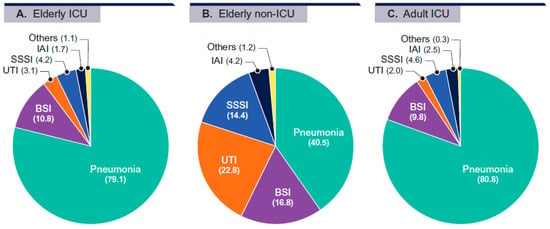
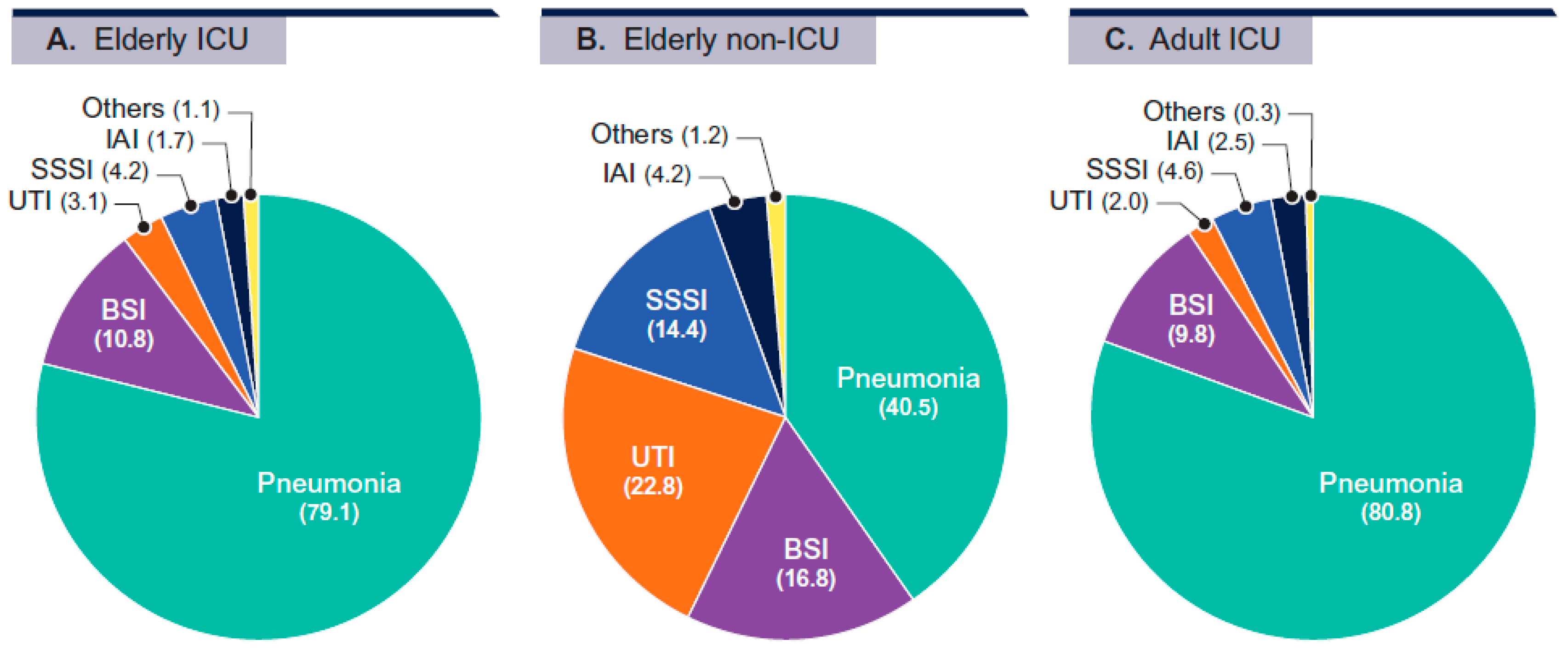
P. aeruginosa isolates from elderly ICU patients were largely from patients with pneumonia (79.1%) and bloodstream infection (BSI; 10.8%), whereas isolates from elderly non-ICU patients were predominantly from pneumonia (40.5%), urinary tract infection (UTI; 22.8%), and BSI (16.8%; Figure 1). P. aeruginosa isolates from adults in the ICU were mostly from patients with pneumonia (80.8%) and BSI (9.8%; Figure 1).
Figure 1.
Distribution of isolates by infection site.
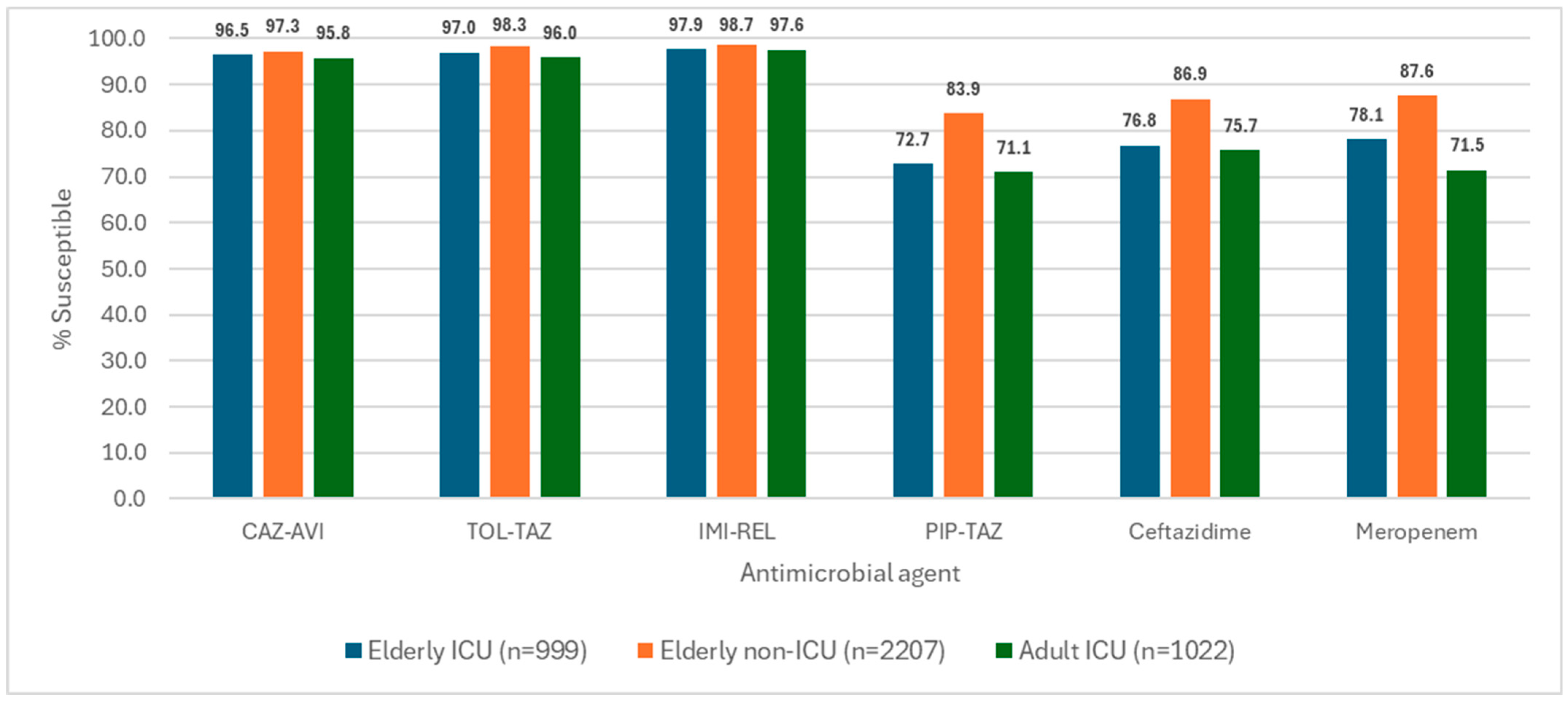
The most active agents against P. aeruginosa from all three patient groups (elderly ICU, elderly non-ICU, and adult ICU patients) were ceftazidime-avibactam (95.8% to 97.3% susceptible), ceftolozane-tazobactam (96.0% to 98.3% susceptible), and imipenem-relebactam (97.6% to 98.7% susceptible; Table 1 and Figure 2). These three BLICs were very active against isolates from these three patient groups, with susceptibility rates slightly higher among isolates from elderly non-ICU patients (97.3% to 98.7%) compared to elderly (96.5% to 97.9%) and adult ICU patients (95.8% to 97.6%; Table 1 and Figure 2).
Table 1.
Antimicrobial susceptibility rates of P. aeruginosa isolates from elderly patients hospitalized in ICU and non-ICU units and from adults hospitalized in ICU units (US hospitals; 2021–2025).
Figure 2.
Antimicrobial susceptibility of selected agents. Abbreviations: CAZ-AVI, ceftazidime-avibactam; TOL-TAZ, ceftolozane-tazobactam; IMI-REL, imipenem-relebactam; and PIP-TAZ, piperacillin-tazobactam.
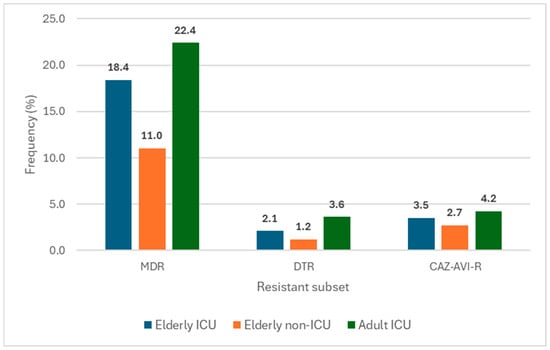
Susceptibility to piperacillin-tazobactam, ceftazidime, cefepime, meropenem, and imipenem were significantly lower among isolates from elderly ICU patients compared to elderly non-ICU patients (p < 0.001 for all agents listed above) and slightly lower among isolates from adult compared to elderly ICU patients (Table 1). Susceptibility to levofloxacin and tobramycin were similar between elderly ICU and non-ICU patients, while isolates from adult ICU patients showed lower susceptibility to these two agents when compared to elderly patients from both ICU and non-ICU clinical settings (Table 1). Most importantly, the frequency of MDR isolates was significantly higher among elderly ICU (18.4%; p < 0.001 [OR: 1.478–2.258]) and adult ICU (22.4%; p < 0.001 [OR: 1.908–2.860]) patients compared to elderly non-ICU (11.0%) patients. Similarly, the frequency of difficult-to-treat resistant (DTR) isolates was markedly higher among elderly (2.1%; p = 0.066 [OR: 0.958–3.087]) and adult (3.6%; p < 0.001 [OR: 1.801–5.025]) ICU patients when compared to elderly non-ICU patients (1.2%; Figure 3).
Figure 3.
Frequencies of multidrug-resistant (MDR), difficult-to-treat resistant (DTR), and ceftazidime-avibactam-resistant (CAZ-AVI-R) organisms.
When isolates from patients with pneumonia were analyzed separately, the BLICs ceftazidime-avibactam, ceftolozane-tazobactam, and imipenem-relebactam retained potent activity (>95% susceptible) and exhibited similar susceptibility rates against P. aeruginosa isolates from all three patient groups (Table 1). Susceptibility to piperacillin-tazobactam, ceftazidime, cefepime, meropenem, imipenem, levofloxacin, and tobramycin were lower among isolates from elderly ICU compared to non-ICU elderly patients and were lower among isolates from adult ICU compared to elderly ICU patients (Table 1).
Only the new BLICs ceftazidime-avibactam, ceftolozane-tazobactam, imipenem-relebactam, and tobramycin exhibited good activity against MDR and difficult-to-treat (DTR) P. aeruginosa. The most active agent against MDR P. aeruginosa from elderly ICU patients was imipenem-relebactam (MIC50/90, 1/4 mg/L; 88.8% susceptible), followed by ceftolozane-tazobactam (MIC50/90, 2/8 mg/L; 83.7% susceptible), ceftazidime-avibactam (MIC50/90, 4/16 mg/L; 81.0% susceptible), and tobramycin (MIC50/90, 0.5/4 mg/L; 76.1% susceptible; Table 1). The most active agents against DTR P. aeruginosa from elderly ICU patients were ceftolozane-tazobactam (MIC50/90, 2/8 mg/L; 85.7% susceptible), tobramycin (MIC50/90, 1/2 mg/L; 81.0% susceptible), ceftazidime-avibactam (MIC50/90, 8/16 mg/L; 71.4% susceptible), and imipenem-relebactam (MIC50/90, 2/4 mg/L; 71.4% susceptible; Table 1). Meropenem-vaborbactam inhibited 55.5% to 64.6% of MDR isolates and 24.3% to 42.9% of DTR isolates at the European Committee on Antimicrobial Susceptibility Testing (EUCAST) susceptible breakpoint of ≤8/8 mg/L (Table 1). Yearly analysis of susceptibility to selected β-lactams showed slight variation in susceptibility rates without a clear trend of increase or decrease over the years of the investigation (Table 2). Frequencies of MDR and DTR phenotypes showed a larger yearly variation, but again without a clear trend of increase or decrease over the years of the investigation (Table 3). Notably, we did not detect any pan-drug resistant isolate in this study.
Table 2.
Yearly susceptibility rates for selected β-lactam compounds.
Table 3.
Yearly frequency of resistance subsets.
Notably, ceftazidime-avibactam maintained in vitro activity against 33.8% and 59.1% of isolates not susceptible to ceftolozane-tazobactam and imipenem-relebactam, respectively. Ceftolozane-tazobactam retained activity against 52.2% and 60.5% of isolates not susceptible to ceftazidime-avibactam and imipenem-relebactam, respectively. Moreover, imipenem-relebactam remained active against 79.3% and 72.1% of isolates not susceptible to ceftazidime-avibactam and ceftolozane-tazobactam, respectively (Table 4).
Table 4.
Cross resistance rates among β-lactamases inhibitor combinations when testing P. aeruginosa isolates from elderly patients.
3. Discussion
P. aeruginosa is intrinsically resistant to many antibiotics and has a great ability to acquire or develop additional mechanisms to overcome multiple classes of antimicrobial agents. Therefore, P. aeruginosa poses a serious therapeutic challenge, and prompt initiation of effective antimicrobial therapy is essential to optimize clinical outcomes [1,2,3,6,8,9].
We evaluated the antimicrobial susceptibility of >4000 P. aeruginosa isolates from three groups: elderly ICU (n = 999), elderly non-ICU (n = 2027), and adult ICU (n = 1022) patients. Our results showed that the BLICs ceftazidime-avibactam, ceftolozane-tazobactam, and imipenem-relebactam continue to be very active against P. aeruginosa isolates causing infections in these patients.
Ceftazidime-avibactam and ceftolozane-tazobactam were approved for clinical use by the US FDA in late 2014 (ceftolozane-tazobactam) and early 2015 (ceftazidime-avibactam), and the approval of these agents represented a significant improvement in the treatment of P. aeruginosa infections [10,11]. Although these agents have been clinically used for more than 10 years, the results of this investigation demonstrate that they remain highly active against P. aeruginosa, including those causing infection in elderly and ICU patients.
Imipenem-relebactam was initially approved by the US FDA in July 2019 (for complicated UTI and complicated intra-abdominal infections in adults), with an expanded approval in June 2020 (for hospital-acquired and ventilator-associated bacterial pneumonia in adults) [12], and showed in vitro activity similar to ceftazidime-avibactam and ceftolozane-tazobactam. It is important to observe that resistance to these three BLICs did not increase during the 5-year study period (2021–2025). Also, isolates resistant to one of these BLICs may remain susceptible to one or both other BLICs. For instance, imipenem-relebactam remained active against 72.1% to 79.3% of isolates not susceptible to ceftazidime-avibactam or ceftolozane-tazobactam, whereas ceftazidime-avibactam and ceftolozane-tazobactam were active against approximately 60% of isolates not susceptible to imipenem-relebactam. In summary, cross-resistance among these BLICs varied markedly, indicating that all three should be tested and available for clinical use.
Our results also indicate that resistance to other β-lactams commonly used to treat P. aeruginosa infections, such as piperacillin-tazobactam, carbapenems (meropenem and imipenem), and cephalosporins (ceftazidime and cefepime), as well as the frequencies of MDR and DTR isolates, were higher among isolates from ICU patients (both elderly and adult patients) when compared to elderly non-ICU patients. The fact that resistance to these β-lactams was higher among both elderly and adult patients from the ICU compared to elderly non-ICU patients may indicate that increased resistance to β-lactams is more related to ICU conditions than to factors associated with age. In contrast, resistance to levofloxacin and tobramycin were higher among adult ICU compared to elderly ICU patients and similar between the two groups (ICU and non-ICU) of elderly patients. One important limitation of this study was the lack of evaluation of possible factors related to the differences in antimicrobial resistance rates among isolates from the three patient groups. Unfortunately, the INFORM program does not have access to patient data that could be linked to antimicrobial resistance, such as previous antimicrobial use, comorbidities, or invasive procedures [13].
Because the frequency of pneumonia was markedly higher among ICU patients (both elderly and adult patients) compared to elderly non-ICU patients, and isolates from pneumonia have been related to higher antimicrobial resistance compared to other infections [14], we analyzed isolates from pneumonia separately. Notably, similar differences in antimicrobial resistance rates among patient groups were observed with isolates from pneumonia compared to isolates from all infection types combined.
We could not find other studies that evaluated the antimicrobial susceptibility of P. aeruginosa in elderly ICU patients to compare with our results. Quiang et al. evaluated 2208 P. aeruginosa isolates from 75 hospitals across Hebei Province, China, between 2016 and 2021. The median age of patients with P. aeruginosa was 63 years. The results of their study indicate that P. aeruginosa bloodstream infections primarily affected hematology and ICU patients, mainly those who were middle-aged, elderly, and male. Notably, the investigators observed an overall downward trend in antimicrobial resistance from 2016 to 2021, with variations in resistance patterns across hospital units and age groups [15].
Mesquita et al. assessed antimicrobial resistance of P. aeruginosa from patients with pneumonia during the COVID-19 pandemic and pre-pandemic periods in Northeast Brazil and observed an increase in both the frequency of P. aeruginosa infections and antimicrobial resistance in elderly patients [16]. Golli et al. observed high resistance rates overall and increasing resistance to carbapenems among Acinetobacter spp. and Klebsiella spp. from elderly patients hospitalized in the ICU of a Romanian hospital between 2022 and 2024 [17].
Moreover, our group previously analyzed and reported the antimicrobial susceptibility of P. aeruginosa isolates collected from ICU and non-ICU patients (all ages) in 72 US medical centers from 2020–2022 [18]. Ceftazidime-avibactam was active against 96.3% of ICU isolates and 97.6% of non-ICU isolates, and ceftolozane-tazobactam was active against 97.2% of ICU isolates and 98.4% of non-ICU isolates, which are similar to the results obtained with isolates from elderly patients in the present study. Susceptibility rates for ceftolozane-tazobactam (97.2%/98.4% for ICU/non-ICU), imipenem-relebactam (97.1%/98.0% for ICU/non-ICU), meropenem-vaborbactam (90.0%/94.3% for ICU/non-ICU), meropenem (76.9%/85.8% for ICU/non-ICU) and imipenem (77.4%/84.3% for ICU/non-ICU) were also similar in both studies. In contrast, susceptibility rates for piperacillin-tazobactam (77.8%/84.6% for ICU/non-ICU), ceftazidime (81.4%/87.8% for ICU/non-ICU), and cefepime (84.7%/89.0% for ICU/non-ICU) were higher, and susceptibility rates for levofloxacin (73.3%/73.2% for ICU/non-ICU) and tobramycin (92.1%/92.1% for ICU/non-ICU) were slightly lower in the previous study [18] when compared to the present investigation. In summary, many factors affect the antimicrobial susceptibility of P. aeruginosa and resistance rates may vary widely among geographic regions, patient ages, infection types, and hospital units [19].
4. Methods
4.1. Organism Collection
Bacterial isolates were obtained through the International Network for Optimal Resistance Monitoring (INFORM) program [12]. Seventy-four US medical centers contributed isolates between January 2021 and December 2025. According to a common study protocol, medical centers collected a defined number of consecutive isolates (one per infection episode) from designated infection types, independent of bacterial species or hospital unit. We assessed the antimicrobial susceptibility of P. aeruginosa isolates from three groups of patients: (i) elderly patients (≥65 years old) hospitalized in ICUs (n = 999), (ii) elderly patients hospitalized in other (non-ICU) units (n = 2027), and (iii) adults (18 to 64 years old) hospitalized in the same ICUs as the elderly patients during the same period (n = 1022). Isolates were considered clinically significant by algorithms established by the participant medical centers.
4.2. Susceptibility Testing
Susceptibility testing was performed by the broth microdilution method using cation-adjusted Muller–Hinton media (Becton and Dickson Company [BD]; Franklin Lakes, NJ, USA), as described by the Clinical Laboratory Standard Institute (CLSI) [20]. CLSI and/or US FDA breakpoint criteria were used to interpret MIC values unless noted [20,21]. Neither the CLSI nor the US FDA have published breakpoint criteria for meropenem-vaborbactam against P. aeruginosa because this compound is not approved for treatment of P. aeruginosa infections in the US; thus, EUCAST criteria [22] were applied for this organism–drug combination for comparison purposes. MDR criteria were defined as nonsusceptibility to ≥1 agent in ≥3 antimicrobial classes according to criteria defined in 2012 by the joint European and US Centers for Disease Control [23]. The antimicrobial classes, representative agents and corresponding interpretive criteria for nonsusceptibility were: (1) anti-Pseudomonas cephalosporins and monobactams (ceftazidime [≥16 mg/L], cefepime [≥16 mg/L], and aztreonam [≥16 mg/L]); (2) carbapenems (meropenem [≥4 mg/L] and imipenem [≥4 mg/L]); (3) old BLICs (piperacillin/tazobactam [≥32/4 mg/L]); (4) new BLICs (ceftazidime-avibactam [≥16/4 mg/L], ceftolozane-tazobactam [≥8/4 mg/L], and imipenem-relebactam [≥4/4 mg/L]); (5) aminoglycosides (tobramycin [≥2 mg/L]); (6) fluoroquinolones (levofloxacin [≥2 mg/L] and ciprofloxacin [≥1 mg/L]); and (7) lipopeptides (colistin [≥4 mg/L]) [23]. DTR resistance was defined as nonsusceptibility to piperacillin-tazobactam, ceftazidime, cefepime, meropenem, imipenem, levofloxacin, and ciprofloxacin [24].
4.3. Statistical Analysis
The chi-square test was applied to find significant differences between two groups. Statistical analyses were performed with the Epi Info TM 7 statistical package version 7.2 (United States Centers for Disease Control and Prevention, Atlanta, GA, USA). A p value of <0.05 was considered statistically significant.
5. Conclusions
The main findings of this investigation were as follows: (1) The BLICs ceftazidime-avibactam, ceftolozane-tazobactam, and imipenem-relebactam remained very active against P. aeruginosa causing infection in elderly ICU, elderly non-ICU, and adult ICU patients; (2) Resistance to other β-lactams commonly used to treat P. aeruginosa infections was higher among elderly ICU and adult ICU patients than it was in elderly non-ICU patients; and (3) Resistance to levofloxacin and tobramycin was higher among adult ICU patients than it was in elderly ICU and elderly non-ICU patients. The results of this investigation expand the results of other reports and could help guide empirical therapy for systemic P. aeruginosa infections. Large surveillance programs are essential to monitor the in vitro activity and guide the clinical use of antimicrobial agents.
Author Contributions
H.S.S.: Conceptualization, Formal Analysis, Data Curation, Writing—Original Draft, Visualization, and Funding Acquisition; R.E.M.: Conceptualization, Validation, Resources, Supervision, and Funding Acquisition; T.B.D.: Methodology, Investigation, Data Curation, Software, Validation, and Supervision; M.L.W.: Methodology, Formal Analysis, Data Curation, Review and Editing, Software, Validation, and Supervision; M.C.: Conceptualization, Validation, Resources, Writing—Review and Editing, Supervision, and Funding Acquisition. All authors have read and agreed to the published version of the manuscript.
Funding
This study was supported by AbbVie (24-ALG-02 M8).
Institutional Review Board Statement
This study does not include factors necessitating patient consent.
Informed Consent Statement
Not applicable.
Data Availability Statement
The original contributions presented in this study are included in the article. Further inquiries can be directed to the corresponding author.
Acknowledgments
The authors thank all participant centers of the INFORM Program for their work in providing isolates. The authors also would like to thank Jill Arends and Gina Bartleson for editorial assistance.
Conflicts of Interest
The authors declare that this study received funding from AbbVie. The funder was not involved in the study design, collection, analysis, interpretation of data, the writing of this article or the decision to submit it for publication. Helio S. Sader, Rodrigo E. Mendes, Timothy B. Doyle, Marisa Winkler, and Mariana Castanheira are employees of Element Iowa City (JMI Laboratories), which was a paid consultant to AbbVie in connection with the development of this paper. Element Iowa City (JMI Laboratories) was contracted to perform services in 2024–2025 for AimMax Therapeutics, Amicrobe, Inc., Appili Therapeutics, Armata Pharmaceuticals, Astellas Pharma, Inc., Basilea Pharmaceutica AG, Biosergen AB, Bugworks, Cerba Research NV, Cidara Therapeutics, Cipla USA Inc., ContraFect Corporation, CorMedix Inc., Crestone, Inc., Curza Global, LLC, Diamond V, Discuva Ltd., Entasis Therapeutics, Enveda Biosciences, Evopoint Biosciences, Fedora Pharmaceuticals, Fox Chase Chemical Diversity Center, Genentech, Gilead Sciences, Inc., GSK plc, Iterum Therapeutics plc, Janssen Biopharma, Johnson & Johnson, Kaleido Biosciences, LifeMine Therapeutics, Medpace, Inc, Lysovant Sciences, Inc, Meiji Seika Pharma, Melinta Therapeutics, Menarini Group, Merck & Co., MicuRx Pharmaceutical Inc., Mundipharma International Ltd., Mutabilis, Nabriva Therapeutics, National Cancer Institute, National Institutes of Health, Ohio State University, Omnix Medical Ltd., Paratek Pharmaceuticals, Pfizer, PolyPid Ltd., PPD, Prokaryotics, Inc., Pulmocide Ltd., Qpex Biopharma, Revagenix, Roche Holding AG, Roivant Sciences, Scynexis, Inc., Shionogi & Co., Ltd., Sinovent Pharmaceuticals, Inc., Spero Therapeutics, Sumitovant Biopharma, Inc., TenNor Therapeutics, U.S. Food and Drug Administration, VenatoRx Pharmaceuticals, Washington University, Watershed Medical, LLC, Wockhardt, and Zoetis, Inc.
References
- Meletis, G.; Karastergiou, E. Resistance mechanisms and therapeutic strategies for Pseudomonas aeruginosa infections. Ther. Adv. Infect. Dis. 2025, 12, 20499361251388382. [Google Scholar] [CrossRef] [Scilit]
- Schwartz, B.; Klamer, K.; Zimmerman, J.; Kale-Pradhan, P.B.; Bhargava, A. Multidrug resistant Pseudomonas aeruginosa in clinical settings: A review of resistance mechanisms and treatment strategies. Pathogens 2024, 13, 975. [Google Scholar] [CrossRef] [Scilit]
- Bassetti, M.; Kanj, S.S.; Kiratisin, P.; Rodrigues, C.; Van Duin, D.; Villegas, M.V.; Yu, Y. Early appropriate diagnostics and treatment of MDR Gram-negative infections. JAC Antimicrob. Resist. 2022, 4, dlac089. [Google Scholar] [CrossRef] [Scilit]
- Lodise, T.P.; Berger, A.; Altincatal, A.; Wang, R.; Bhagnani, T.; Gillard, P.; Bonine, N.G. Antimicrobial resistance or delayed appropriate therapy-does one influence outcomes more than the other among patients with serious infections due to carbapenem-resistant versus carbapenem-susceptible Enterobacteriaceae? Open Forum Infect. Dis. 2019, 6, ofz194. [Google Scholar] [CrossRef] [Scilit]
- Paramythiotou, E.; Routsi, C. Association between infections caused by multidrug-resistant gram-negative bacteria and mortality in critically ill patients. World J. Crit. Care Med. 2016, 5, 111–120. [Google Scholar] [CrossRef] [Scilit]
- Horcajada, J.P.; Gales, A.C.; Isler, B.; Kaye, K.S.; Kwa, A.; Landersdorfer, C.B.; Montero, M.M.; Oliver, A.; Pogue, J.M.; Shields, R.K.; et al. Current and future options for the treatment of serious infections due to carbapenem-resistant Pseudomonas aeruginosa. Clin. Microbiol. Rev. 2025, 38, e0023324. [Google Scholar] [CrossRef] [Scilit]
- Heffernan, A.J.; Sime, F.B.; Lipman, J.; Dhanani, J.; Andrews, K.; Ellwood, D.; Grimwood, K.; Roberts, J.A. Intrapulmonary pharmacokinetics of antibiotics used to treat nosocomial pneumonia caused by Gram-negative bacilli: A systematic review. Int. J. Antimicrob. Agents 2019, 53, 234–245. [Google Scholar] [CrossRef] [Scilit]
- Tamma, P.D.; Heil, E.L.; Justo, J.A.; Mathers, A.J.; Satlin, M.J.; Bonomo, R.A. Infectious Diseases Society of America 2024 Guidance on the treatment of antimicrobial-resistant Gram-Negative Infections. Clin. Infect. Dis. 2024, ciae403. [Google Scholar] [CrossRef] [Scilit] [PubMed]
- Castanheira, M.; Kimbrough, J.H.; Lindley, J.; Doyle, T.B.; Ewald, J.M.; Sader, H.S. In vitro development of resistance against antipseudomonal agents: Comparison of novel β-lactam/β-lactamase inhibitor combinations and other β-lactam agents. Antimicrob. Agents Chemother. 2024, 68, e0136323. [Google Scholar] [CrossRef] [Scilit] [PubMed]
- Zhanel, G.G.; Lawson, C.D.; Adam, H.; Schweizer, F.; Zelenitsky, S.; Lagacé-Wiens, P.R.S.; Denisuik, A.; Rubinstein, E.; Gin, A.S.; Hoban, D.J.; et al. Ceftazidime-avibactam: A novel cephalosporin/beta-lactamase inhibitor combination. Drugs 2013, 73, 159–177. [Google Scholar] [CrossRef] [Scilit] [PubMed]
- Zhanel, G.G.; Chung, P.; Adam, H.; Zelenitsky, S.; Denisuik, A.; Schweizer, F.; Lagacé-Wiens, P.R.S.; Rubinstein, E.; Gin, A.S.; Walkty, A.; et al. Ceftolozane/tazobactam: A novel cephalosporin/beta-lactamase inhibitor combination with activity against multidrug-resistant gram-negative bacilli. Drugs 2014, 74, 31–51. [Google Scholar] [CrossRef] [Scilit]
- Campanella, T.A.; Gallagher, J.C. A clinical review and critical evaluation of imipenem-relebactam: Evidence to date. Infect. Drug Resist. 2020, 13, 4297–4308. [Google Scholar] [CrossRef] [Scilit]
- Sader, H.S.; Kimbrough, J.H.; Doyle, T.B.; Winkler, M.L.; Castanheira, M. Frequency, Antimicrobial susceptibility, and molecular characterization of carbapenem-resistant Enterobacterales stratified by United States Census Divisions: Results from the INFORM Program (2018–2022). Open Forum Infect. Dis. 2025, 12, ofaf005. [Google Scholar] [CrossRef] [Scilit]
- Sader, H.S.; Castanheira, M.; Duncan, L.R.; Flamm, R.K. Antimicrobial susceptibility of Enterobacteriaceae and Pseudomonas aeruginosa Isolates from United States medical centers stratified by infection type: Results from the International Network for Optimal Resistance Monitoring (INFORM) Surveillance Program, 2015–2016. Diagn. Microbiol. Infect. Dis. 2018, 92, 69–74. [Google Scholar] [CrossRef] [Scilit] [PubMed]
- Qiang, C.; Liu, X.; Qin, P.; Wen, H.; Li, Z.; Yang, J.; Niu, Y.; Wang, W.; Ouyang, Z.; Zhao, M.; et al. Multicenter surveillance of Pseudomonas aeruginosa isolates from blood: Clinical distribution characteristics and antibiotic resistance trends in Hebei Province, China (2016–2021). J. Infect. Drug Resist. 2025, 18, 703–713. [Google Scholar] [CrossRef] [Scilit] [PubMed]
- Mesquita, G.P.; Costa, M.C.C.; Silva, M.A.; Araújo, L.G.; Vila Nova, B.G.; Castro, É.J.M.; Branco, L.C.; da Silva, R.; Marques, S.; Abreu, A. Antimicrobial resistance of Pseudomonas aeruginosa isolated from patients with pneumonia during the COVID-19 pandemic and pre-pandemic periods in Northeast Brazil. Braz. J. Med. Biol. Res. 2023, 56, e12726. [Google Scholar] [CrossRef] [Scilit]
- Golli, A.L.; Zlatian, O.M.; Popa, S.G.; Turcu, F.L.; Balasoiu, A.T. Trends in the antimicrobial resistance pattern of bacterial gram-negative pathogens in elderly patients admitted to the intensive care unit. Microorganisms 2025, 13, 2330. [Google Scholar] [CrossRef] [Scilit]
- Sader, H.S.; Mendes, R.E.; Kimbrough, J.H.; Hubler, C.M.; Castanheira, M. Activity of aztreonam/avibactam and recently approved beta-lactamase inhibitor combinations against Enterobacterales and Pseudomonas aeruginosa from intensive care unit and non-intensive care unit patients. Antibiotics 2024, 13, 564. [Google Scholar] [CrossRef] [Scilit] [PubMed]
- Qin, J.; Zou, C.; Tao, J.; Wei, T.; Yan, L.; Zhang, Y.Z.; Wang, H. Carbapenem resistant Pseudomonas aeruginosa infections in elderly patients: Antimicrobial resistance profiles, risk factors and impact on clinical outcomes. Infect. Drug Resist. 2022, 15, 2301–2314. [Google Scholar] [CrossRef] [Scilit]
- CLSI M07Ed12; Methods for Dilution Antimicrobial Susceptibility Tests for Bacteria that Grow Aerobically. Clinical Laboratory Standard Institute: Berwyn, PA, USA, 2024.
- CLSI M100Ed35; Performance Standards for Antimicrobial Susceptibility Testing. 35th Informational Supplement; Clinical Laboratory Standard Institute: Berwyn, PA, USA, 2025.
- EUCAST. Breakpoint Tables for Interpretation of MICs and Zone Diameters; Version 15.0; European Committee on Antimicrobial Susceptibility Testing: Vaxjo, Sweden, 2025. [Google Scholar]
- Magiorakos, A.-P.; Srinivasan, A.; Carey, R.B.; Carmeli, Y.; Falagas, M.E.; Giske, C.G.; Harbarth, S.; Hindler, J.F.; Kahlmeter, G.; Olsson-Liljequist, B.; et al. Multidrug-resistant, extensively drug-resistant and pandrug-resistant bacteria: An international expert proposal for interim standard definitions for acquired resistance. Clin. Microbiol. Infect. 2012, 18, 268–281. [Google Scholar] [CrossRef] [Scilit]
- Tamma, P.D.; Aitken, S.L.; Bonomo, R.A.; Mathers, A.J.; van Duin, D.; Clancy, C.J. Infectious Diseases Society of America 2022 guidance on the treatment of extended-spectrum beta-lactamase producing Enterobacterales (ESBL-E), carbapenem-resistant Enterobacterales (CRE), and Pseudomonas aeruginosa with difficult-to-treat resistance (DTR-P. aeruginosa). Clin. Infect. Dis. 2022, 75, 187–212. [Google Scholar] [PubMed]

Disclaimer/Publisher’s Note: The statements, opinions and data contained in all publications are solely those of the individual author(s) and contributor(s) and not of MDPI and/or the editor(s). MDPI and/or the editor(s) disclaim responsibility for any injury to people or property resulting from any ideas, methods, instructions or products referred to in the content. |
© 2026 by the authors. Licensee MDPI, Basel, Switzerland. This article is an open access article distributed under the terms and conditions of the Creative Commons Attribution (CC BY) license.