


Abstract
Colistin is an important antimicrobial agent in the treatment of infections caused by multidrug resistant (MDR) Gram-negative bacteria. The horizontal transfer of mobile colistin resistance gene (mcr) poses a major threat to the public health worldwide. In this study, a total of thirteen mcr-carrying Escherichia coli (MCREC) strains were recovered from a tertiary hospital in Zhejiang, China, between 2016 and 2019. The minimum inhibitory concentration (MIC) of antimicrobial agents, epidemiological characteristics, and transmission dynamics of mcr-carrying isolates were analyzed using antimicrobial susceptibility testing, whole-genome sequencing, S1 nuclease pulsed-field gel electrophoresis (S1-PFGE), and southern blotting analysis. All strains were discovered to be resistant to colistin, and the majority displayed MDR phenotype. However, none of the 13 MCREC strains were resistant to carbapenems. The 13 MCREC isolates were divided into 10 different STs, including ST744, ST156, ST453, ST410, ST57, ST131, ST7034, ST2599, ST457, and ST13239, in which ST13239 was discovered for the first time. Based on core genome single nucleotide polymorphism (cgSNP) analysis, no clear epidemiological link was discovered in these strains with the exception of EC2118 and EC3807, which differ by just one SNP. A total of 35 antimicrobial resistance genes which can be divided into 14 classes were identified from the 13 MCREC isolates. According to S1-PFGE and southern blotting analyses, all 13 MCREC strains had plasmid-mediated mcr-1, and nine of them carried conjugative plasmids. In conclusion, our study revealed the emergence and dissemination of colistin-resistant E. coli isolates carrying mcr-1 in a Chinese hospital, which poses a potential risk to anti-infective therapy. More efforts should be taken to monitor the prevalence of mcr-1-carrying bacteria in China.
1. Introduction
Escherichia coli is a widespread pathogen that can cause a variety of infections in both humans and animals. The spread of antibiotic resistance genes (ARGs) by transposons and transmissible plasmids in clinical strains makes it more challenging to treat [1]. Polymyxins are a class of cationic polypeptide antibiotics produced by Bacillus polymyxa. There are five chemically distinct polymyxins—A, B, C, D, and E—of which only polymyxin E (colistin) and polymyxin B are used in clinical settings [2]. Colistin is a narrow-spectrum antibiotic that is effective against the majority of Enterobacterales and is used as a last resort antibiotic for MDR Gram-negative bacteria. When the positively charged colistin molecule binds to the negatively charged lipid A on the cell wall of Gram-negative bacteria, it causes the outflow of the cell’s contents and cell death [3]. Several retrospective studies have revealed colistin resistance in both humans and animals globally as a result of the overuse and misuse of colistin. Additionally, the emergence of colistin-resistant pathogens worldwide does not coincide with any prior exposure to the antibiotics, which raises the possibility of the horizontal transfer of colistin resistance [4]. The emergence of colistin resistance and its adaptability, existence, and prevalence poses a significant global pandemic risk for public health [5].
The primary mechanism for colistin resistance, which is well known, is horizontal gene transfer of the plasmid-mediated mobile colistin resistance gene (mcr). The mcr-1 gene was the first one to be described in an E. coli strain in China [6]. The mcr genes are frequently carried by a variety of plasmids, including IncI2, IncX4, IncP, IncX, and IncFII types [5,7]. Furthermore, a number of mobile genetic elements in plasmids, such as insertion sequences (particularly ISApl1), class 1–3 integrons, and transposons like Tn6330, TnAs2, and Tn3-family, were thought to be the primary drivers of horizontal gene transfer of the mcr genes [8,9].
Ten mcr homologues (mcr-1–10) have so far been identified, and mcr-1 continues to be the main character and is widely distributed [10,11,12]. The MIC of colistin in E. coli have been shown to increase by 4 to 8-fold when the mcr-1 gene is present, indicating that mcr-1 alone can provide adequate resistance against colistin in E. coli and other Enterobacteriaceae [2,13,14]. It is important to monitor the spread of mcr-carrying E. coli (MCREC) in clinical settings. To actively combat the threat posed by MDR Gram-negative Enterobacteriaceae, we must monitor MCREC strains and research their prevalence in order to stop further spread of these pathogens.
In this study, 13 MCREC isolates from a tertiary hospital in China were collected from 2016 to 2019. Whole-genome sequencing (WGS), S1 nuclease pulsed-field gel electrophoresis (S1-PFGE), and southern blotting analysis were performed to explore the antimicrobial resistant genes, epidemiological characteristics, and transmission dynamics of mcr-carrying isolates.
2. Results
2.1. Clinical Data of MCREC Isolates
A total of 882 clinical E. coli isolates were collected between 2016 and 2019. Urine is the most common (57.9%) of the clinical specimens, which also include blood (22.1%), sputum (4.9%), pus (3.6%), bile (3.4%), ascitic fluid (1.8%), and others. We collected 13 MCREC isolates from 12 patients. These MCREC clinical isolates were cultured from sputum (2/13), urine (8/13), pus (2/13), and ascitic fluid (1/13). The percentage of MCREC was 2.9% in 2016 (2/70), 3.4% in 2017 (6/175), 0.9% in 2018 (3/339), and 0.7% in 2019 (2/298). From 2018, there was a discernible decline in the occurrence of MCREC. Clinical data of the 12 patients with MCREC infection are presented in Table 1. Six of the twelve patients were male and six were female. Six patients were in the 65–90 age range, and five were in the 50–65 age range. The 11 patients were all inpatients, with the exception of one child patient who was only six months old and received care in an outpatient setting. Two patients passed away during the research period, and the remaining 10 patients gradually recovered and were discharged.
Table 1.
Clinical data and outcomes of the 12 inpatients with mcr-carrying E. coli infection.
2.2. Antimicrobial Susceptibility Profiles
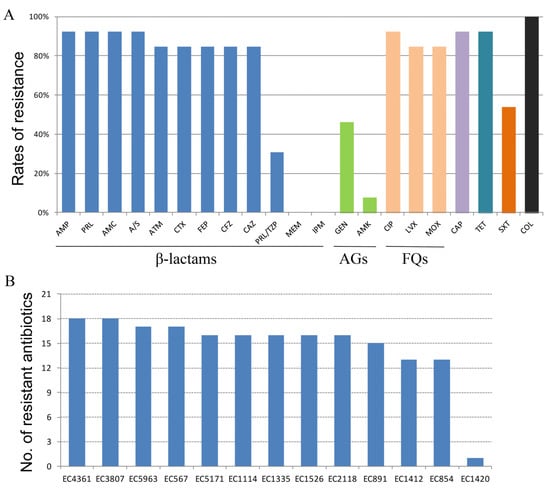
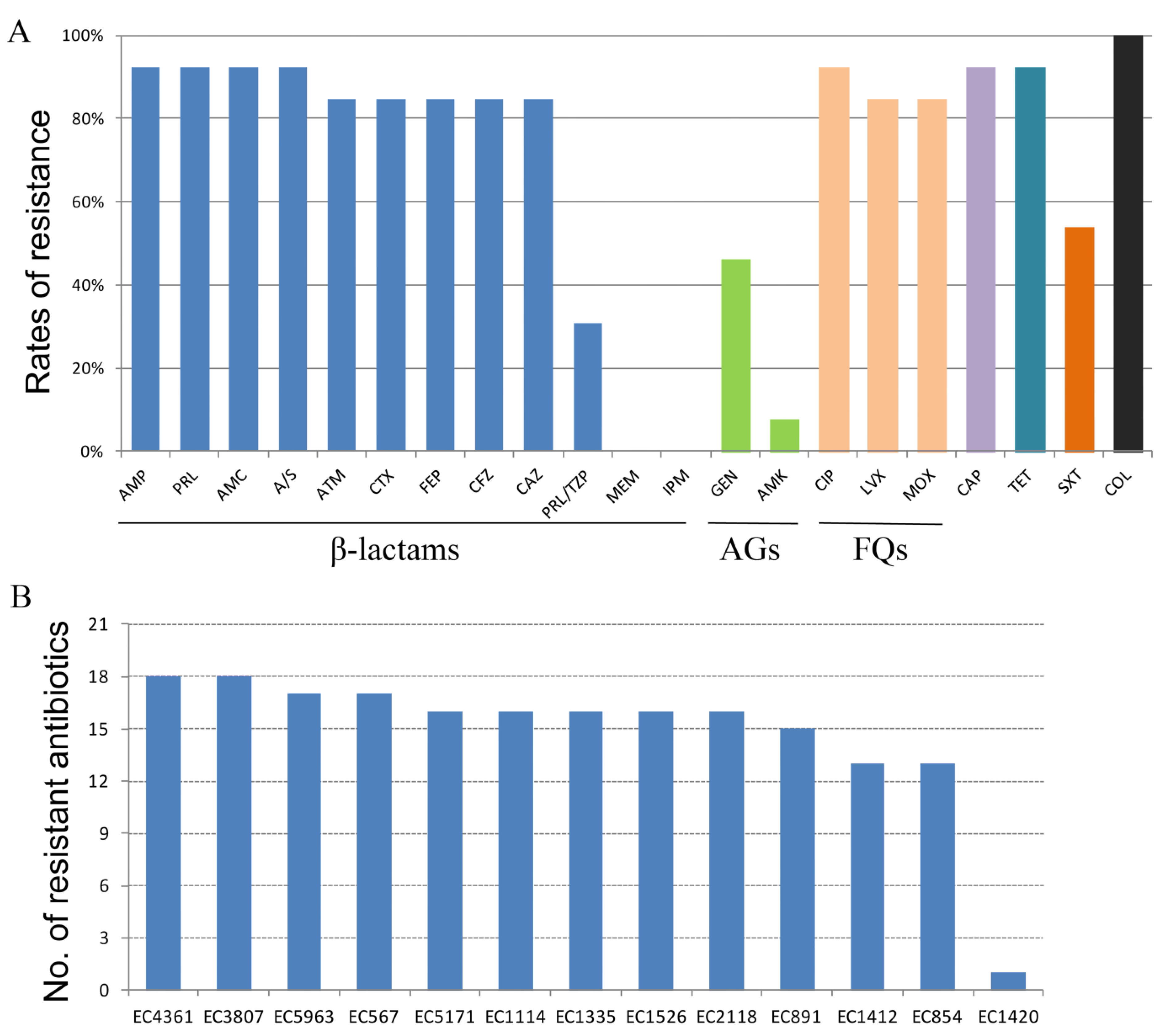
A total of 21 antimicrobial agents—ampicillin (AMP), piperacillin (PRL), aztreonam (ATM), cefotaxime (CTX), cefepime (FEP), meropenem (MEM), gentamicin (GEN), trimethoprim-sulfamethoxazole (SXT), levofloxacin (LVX), moxifloxacin(MOX), amoxicillin-clavulanic acid (AMC), ampicillin/sulbactam (A/S), piperacillin-tazobactam (PRL/TZP), cefazolin (CFZ), ceftazidime (CAZ), imipenem (IPM), amikacin (AMK), chloramphenicol (CAP), tetracycline (TET), ciprofloxacin (CIP), and colistin (COL)—were used. Antimicrobial susceptibility profiles of the 13 MCREC strains are presented in Table 2. Figure 1A,B illustrate the rates of antibiotic resistance to the 21 antibiotics utilized in this investigation among the 13 MCREC strains, as well as the number of drugs that have been rendered ineffective for each MCREC strain. Of the 13 MCREC strains, 12 of them, except for EC1420, were MDR, which showed resistant to five to seven classes of antibiotics. Colistin resistance was present in all 13 MCREC strains, with MICs ranging from 4 to >64 mg/L. All 13 MCREC strains were susceptible to MEM and IPM, and the majority of them were also susceptible to AMK (92.3%, 12/13, except for EC854). EC4361 and EC3807 revealed the similar antimicrobial resistance profiles among the 21 antibiotics employed in this study, with the highest resistance to a total of 18 medications (except for MEM, IPM, and AMK). EC1526 and EC1420 were isolated from the same patient. EC1526 was found to be super resistant to colistin, with a MIC > 64 mg/L, and resistant to 16 antibiotics, whereas EC1420 was found to be only resistant to colistin but susceptible to the other 20 antibiotics.
Table 2.
Minimal inhibitory concentrations (MICs, mg/L) of the 13 mcr-carrying E. coli isolates to different antimicrobials.
Figure 1.
Antimicrobial susceptibility profiles of the 13 MCREC strains. (A) Resistance rates to 21 antimicrobial agents among the 13 MCREC strains. Each of the color represent one class of antibiotics; (B) The number of antibiotics that have been rendered ineffective for each MCREC strain. AGs, Aminoglycosides; FQs, Fluoroquinolones; AMP, ampicillin; PRL, piperacillin; ATM, aztreonam; CTX, cefotaxime; FEP, cefepime; MEM, meropenem; GEN, gentamicin; SXT, trimethoprim-sulfamethoxazole; LVX, levofloxacin; MOX, moxifloxacin; AMC, amoxicillin-clavulanic acid; A/S, ampicillin/sulbactam; PRL/TZP, piperacillin-tazobactam; CFZ, Cefazolin; CAZ, ceftazidime; IPM, imipenem; AMK, amikacin; CAP, chloramphenicol; TET, tetracycline; CIP, ciprofloxacin; COL, colistin. MCREC, mcr-carrying Escherichia coli.
2.3. Genomic and Phylogenetic Analysis of mcr-Carrying Isolates
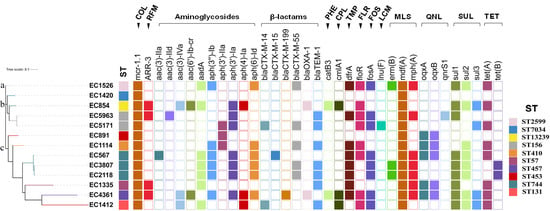
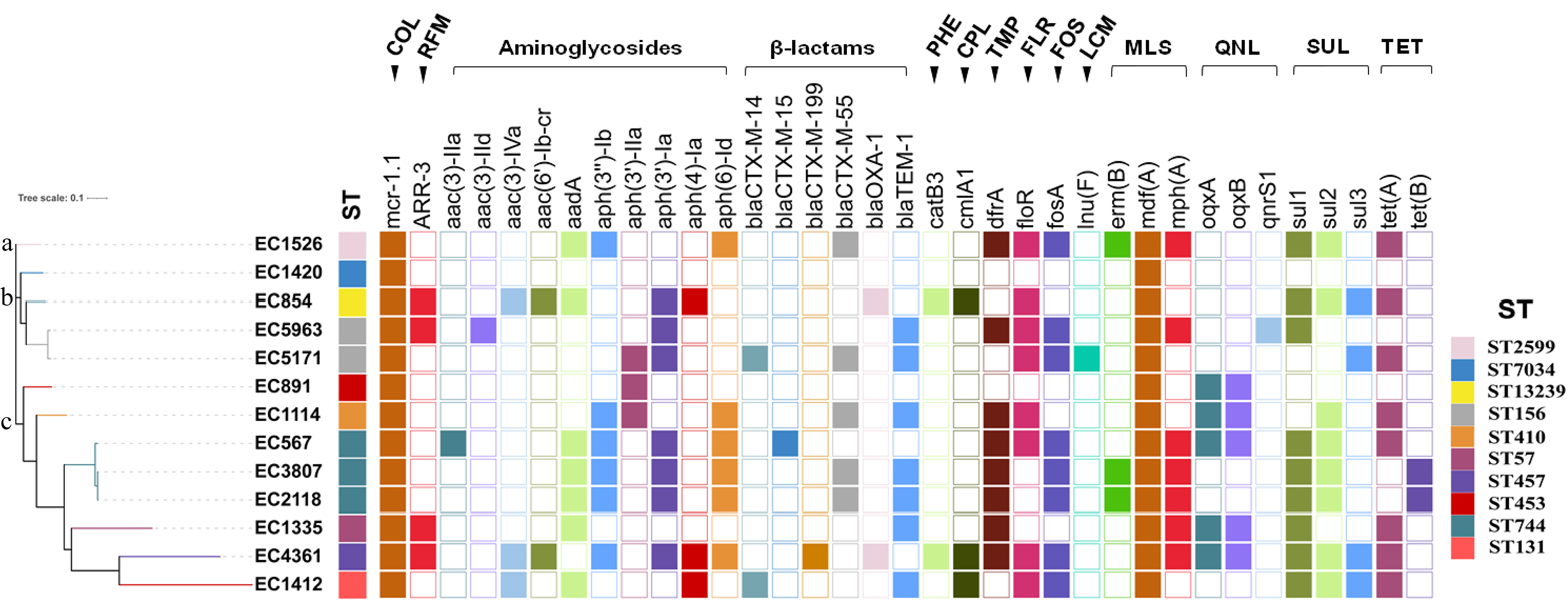
Antimicrobial resistance genes were identified and shown in Figure 2 based on WGS data from 13 MCREC isolates. A total of 35 antimicrobial resistance genes were identified, which can be classified into 14 classes, including one colistin-resistance gene (COL, mcr-1), six β-lactams-resistance genes (BLs, blaCTX-M-14, blaCTX-M-15, blaCTX-M-199, blaCTX-M-55, blaOXA-1 and blaTEM-1), ten aminoglycosides-resistance genes (AGs, aac(3)-IIa, aac(3)-IId, aac(3)-Iva, aac(6’)-Ib-cr, aadA, aph(3’’)-Ib, aph(3’)-IIa, aph(3’)-Ia, aph(4)-Ia, and aph(6)-Id), three sulfonamides-resistance genes (SUL, sul1, sul2 and sul3), two tetracyclines-resistance genes (TET, tet(A) and tet(B)), one trimethoprim-resistance gene (TMP, dfrA), one fosfomycin-resistance gene (FOS, fosA), three macrolides-resistance genes (MLS, erm(B), mdf(A) and mph(A)), three quinolones-resistance genes (QNL, oqxA, oqxB and qnrS1), one rifamycin-resistance gene (RFM, ARR-3), one florfenicol-resistance gene (FLR, floR), one chloramphenicol-resistance gene (CPL, cmlA1), one phenicol-resistance gene (PHE, catB3), and one lincosamide-resistance gene (LCM, lnu(F)). Colistin-resistance gene mcr-1 was found in all 13 MCREC isolates. Except for EC1420, all of the other 12 MCREC isolates had at least one BL and one AG antimicrobial resistance gene. EC1420 was found to have only two resistance genes, mcr-1 and mdf(A), which is consistent with its antibiotic susceptibility profile (susceptible to most antibiotics). SUL were found in 11 MCREC isolates, while TET were found in 10 MCREC isolates. On the other hand, only EC5171 possessed LCM (lnu(F)), EC4361 and EC854 possessed PHE (catB3), and EC4361, EC854, and EC1412 possessed CPL (cmlA1). The presence of up to 24 genes encoding resistance to 13 classes of antibiotics (except LCM) in EC4361 is consistent with its antimicrobial resistance profile (resistant to most antibiotics).
Figure 2.
Phylogenetic relationship of the 13 MCREC isolates. The cell in different colour indicates the presence of the antimicrobial resistance gene while the blank cell indicates the absence of the gene. COL, colistin, RFM, rifamycin, PHE, phenicol, CPL, chloramphenicol, TMP, trimethoprim, FLR, florfenicol, FOS, fosfomycin, LCM, lincosamide, MLS, macrolides, QNL, quinolones, SUL, sulfonamides, TET, tetracyclines.
Based on the phylogenetic tree (Figure 2), the 13 MCREC isolates were divided into three clades. Only EC1526 is in clade A, EC1420, EC854, EC5963, and EC5171 are in clade B, and the remaining eight MCREC isolates are in clade C. SNP analyses revealed that all of the MCREC isolates were sporadic, except for EC2118 and EC3807, which differ by only one SNP. MLST analyses of the 13 MCREC isolates revealed significant diversity, with the isolates assigned to 10 distinct STs, including three strains for ST744, two strains for ST156, and one strain for ST453, ST410, ST57, ST131, ST7034, ST2599, ST457, and ST13239, among which ST13239 is identified for the first time.
2.4. Conjugation Assay and Plasmid Analysis
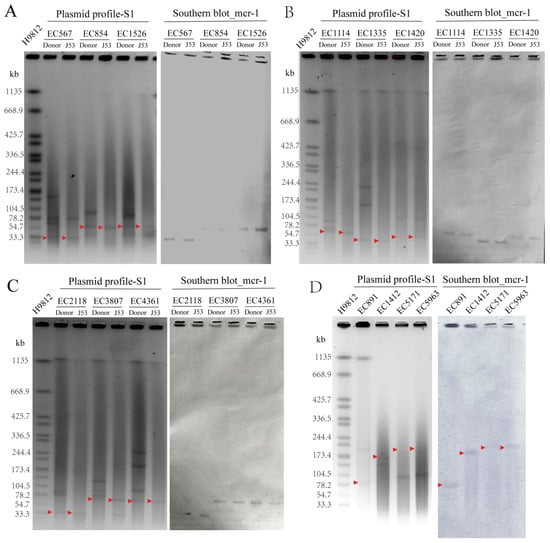
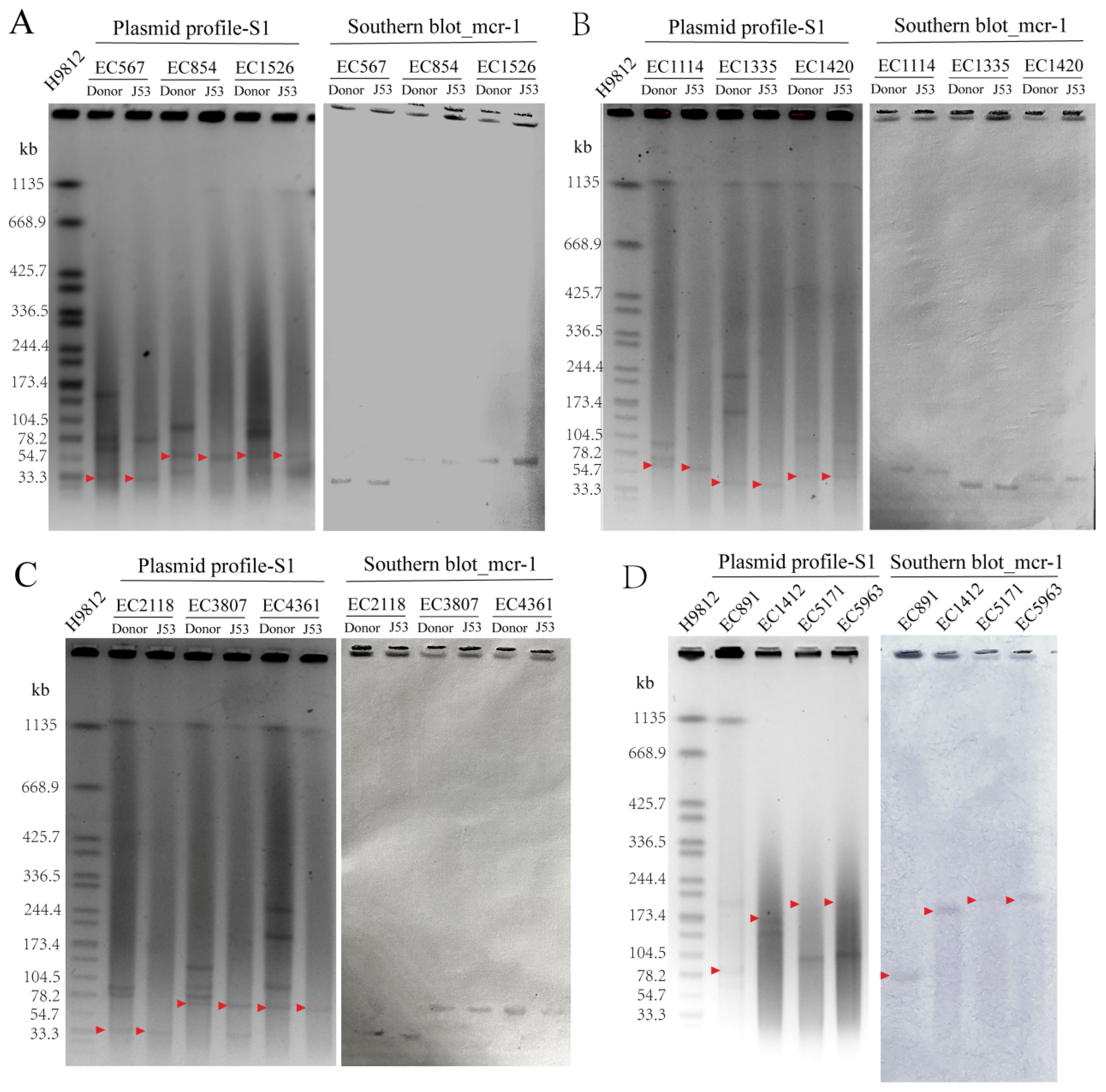
The transferability of mcr-1-carrying plasmids from the 13 MCREC isolates were determined by conjugation experiment. S1-PFGE and southern blotting analysis were performed to estimate the size of the mcr-1-carrying plasmid. Nine out of the thirteen MCRECs, with the exception of EC5963, EC5171, EC891, and EC1412, have conjugative plasmids carrying the mcr-1 gene. The conjugation efficiency is calculated with the high conjugation efficiency of 8.6 × 10⁻² for EC1335, 7.3 × 10⁻² for EC2118, and 1.1 × 10⁻² for EC3807, the middle conjugation efficiency of 2.1 × 10⁻³ for EC1526, 2.1 × 10⁻³ for EC854, 1.8 × 10⁻³ for EC1114, 8.0 × 10⁻⁴ for EC4361, and the low conjugation efficiency of 6.3 × 10⁻⁵ for EC1420, 3.5 × 10⁻⁶ for EC567. Figure 3 depicts the S1-PFGE and southern blot results. The size of mcr-1-carrying plasmids was heterogeneous, ranging from 30 kb to 250 kb. The size of mcr-1-carrying plasmids in the nine conjugative MCREC isolates can be divided into two types: the smaller one is between 33.3kb and 54.7 kb (for EC1420, EC567, EC2118, and EC1335), while the larger one is between 54.7 kb and 78.2 kb (for EC1526, EC854, EC1114, EC3807, EC4361). All of the mcr-1-carrying plasmids in the four nonconjugative MCREC isolates were between 80 kb and 250 kb in size. Furthermore, EC567, EC1526, and EC1420 harbored two types of plasmids of varying sizes that can be conjugative. According to WGS, the 13 MCREC plasmids were divided into three plasmid incompatibility groups: seven IncI2 (EC854, EC1114, EC1420, EC1526, EC4361, EC5171, EC5963), five IncX4 (EC567, EC891, EC1335, EC2118, EC3807), and one IncHI2 (EC1412).
Figure 3.
S1-PFGE and southern blotting for investigating plasmids containing mcr-1. MCREC isolates carrying conjugative mcr-1 plasmids were examined in panels (A–C). (D) Analysis of the four MCREC isolates that carrying nonconjugative mcr-1 plasmids. The Salmonella strain (H9812) was used as a marker. Red arrows represent the mcr-1-carrying plasmids.
3. Materials and Methods
3.1. Patients and Isolates
Between January 2016 and October 2019, a total of 882 E. coli clinical isolates were collected from patients at a tertiary hospital in Zhejiang province, China. Using the previously published primers, a standard PCR was used to detect the mcr-1 gene [6]. A total of 13 mcr-1 positive E. coli isolates from 12 patients were identified. Ascitic fluid, pus, urine, and sputum were among the specimens used to cultivate the isolates. All isolates were generated as part of routine clinical laboratory procedures. The patient administration system was used to extract demographic information, such as gender, age, the hospital department where the patient was admitted, the clinical diagnosis, and the outcome, without obtaining any personally identifiable information about the patient. This study was previously approved by the Research Ethics Committee of Zhejiang Provincial People’s Hospital.
3.2. Species Identification and Antimicrobial Susceptibility Testing
All isolates were identified using the MALDI-TOF-MS system (Bruker, Billerica, MA, USA). Antimicrobial susceptibility testing was conducted using standard broth microdilution tests following the guidelines of the Clinical and Laboratory Standards Institute (CLSI). E. coli ATCC 25922 was used as a quality control. The European Committee on Antibiotic Susceptibility Testing (EUCAST, https://www.eucast.org/ accessed on 16 July 2021) 12.0 guidelines were used to interpret the susceptibility breakpoint for colistin and isolates with MIC > 2 mg/L were interpreted as resistance. CLSI 2021 guidelines were used to interpret the susceptibility breakpoint for other antimicrobial agents [15]. MDR isolates were identified as those that were simultaneously resistant to three or more classes of antibiotics.
3.3. Whole-Genome Sequencing (WGS)
Isolates confirmed to carrying the mcr gene were sent for whole-genome sequencing using the Illumina NovaSeq 6000 platform (Illumina Inc., San Diego, CA, USA). In brief, genomic DNA was isolated using a QIAamp DNA MiniKit (Qiagen, Valencia, CA, USA) and sent for sequencing according to the paired-end 2 × 150-bp protocol. SPAdes 3.13.0 was used to assemble the draft genome sequences, and the NCBI Prokaryotic Genome Annotation Pipeline (PGAP) server was used to automatically annotate the genome sequences [16].
3.4. Genomic and Phylogenetic Relationship Analysis of mcr-Carrying Isolates
The MLST, acquired ARGs, and plasmid replicons of the mcr-carrying isolates were analyzed using the BacWGSTdb 2.0 server [17,18,19]. The phylogenetic relationship between mcr-carrying isolates was analyzed using the neighbor joining (NJ)/unweighted pair group method with arithmetic mean (UPGMA) phylogeny method (MAFFT version 7) based on a core genome single nucleotide polymorphism strategy [20]. The resulting SNPs were used to build a phylogenetic tree, and the maximum parsimony algorithm was used to remove recombination regions [21]. The Interactive Tree Of Life (iTOL) v6 web server was utilized for the phylogenetic tree visualization and annotation of ARGs [22].
3.5. Conjugation Experiments and Southern Blot
The transferability of mcr-carrying plasmids from isolates was assessed using filter mating with E. coli J53 as the recipient strain, and the transconjugants were chosen on BHI agar plates supplemented with 2 mg/L colistin. The mcr-1 gene was then detected in transconjugants by screening and sequencing, as previously described [23]. The conjugation efficiency was measured and calculated following the protocol in https://openwetware.org/wiki/conjugation, accessed on 16 July 2021. A Salmonella serotype Braenderup strain (H9812) was chosen as the common size standard [24]. S1-nuclease PFGE (S1-PFGE) was used to measure plasmid sizes, and southern blot analysis with mcr gene-specific probes was used to pinpoint the genetic location of mcr-1, as previously described [25].
3.6. Nucleotide Sequence Accession Numbers
We deposited the genome sequences of the mcr-1 positive E. coli strains in NCBI GenBank under the BioProject accession number PRJNA515159 (JANYUL000000000-JANYUX000000000).
4. Discussion
In China, E. coli is the most common species carrying plasmid-mediated colistin resistance in the Enterobacteriaceae [6]. In this study, we used PCR to screen for the presence of the gene mcr-1 in 882 E. coli strains that were isolated from human clinical samples in Zhejiang Province, China, between 2016 and 2019. These samples included sputum, urine, pus, and ascitic fluid. MCR-1 positivity and colistin resistance were found in 13 of the E. coli strains. Notably, the mcr-1 carriage rate dropped from 2.9% and 3.4% in 2016 and 2017 to 0.9% and 0.7% in 2018 and 2019. Colistin use in animal farming is thought to be a major driver in the dissemination of colistin resistance [6]. The decline in mcr-1 carriage rate may be related to the policy that the Ministry of Agriculture of China (Article number 2428) withdrew colistin as a feed additive and growth promoter in November 2016 and formally implemented in April 2017 [26]. Several other studies also indicated that colistin resistance reached peak around later 2016–mid 2017 in China because of the regulated use of colistin, which indicated that the banning had a significant effect on reducing colistin resistance in both animals and humans [27,28,29,30]. As colistin was thought to be a last resort for the treatment of serious Gram-negative bacterial infections, therefore, despite the fact that the spread of colistin resistance is slowing as a result of the ban, monitoring and tracking colistin resistance in Enterobacteriaceae is crucial, and additional investigation is still required to fully assess the molecular epidemiology of plasmid-mediated colistin resistance in Enterobacteriaceae.
Due to its high capacity to accumulate ARGs, E. coli has been reported to be a significant reservoir of ARGs [31]. Additionally, it has been established that E. coli, primarily through horizontal gene transfer, plays critical roles in the spread of the mcr genes [6]. In this study, the majority of MCREC strains also exhibited MDR with a high rate of resistance to common antibiotics used in clinical settings, such as ampicillin, piperacillin, aztreonam, cefotaxime, cefepime, levofloxacin, moxifloxacin, amoxicillin-clavulanic acid, ampicillin/sulbactam, cefazolin, ceftazidime, chloramphenicol, tetracycline, and ciprofloxacin. All 13 MCREC strains were colistin resistant and carried the mcr-1 gene on plasmids. However, MICs of these MCREC strains varied greatly, ranging from 4 to >64 mg/L. This has led us to speculate on the existence of other mechanisms, such as different expression activities of different mcr-carrying plasmid types or different genomic background of the MCREC strains which might possess active efflux pump or particular genetic mutations, and so on. Deeper sequencing and further analysis will give more information about the different mechanisms of colistin resistance.
In particular, the isolates EC1420 and EC1526 were taken from the same patient Pa1420, who passed away during this study, but the two strains were dispersed sporadic ones. The later isolate EC1526 showed super resistance to colistin with the MIC exceeding 64 mg/L and showed resistance to 16 antibiotics, whereas the earlier isolate EC1420 carried the fewest resistance genes and only demonstrated colistin resistance with a MIC of 8 mg/L. In addition, the plasmid carrying mcr-1 in EC1420 was the smaller one, ranging from 33.3 to 54.7 kb, and it demonstrated the lowest transferability frequency, whereas the plasmid carrying mcr-1 in EC1526 was the larger one, ranging from 54.7 to 78.2 kb, and it demonstrated a higher transferability frequency. It is possible that EC1526, not EC1420, was responsible for Pa1420’s final death from severe septicopyemia. However, further investigation is still required to identify the mechanisms underlying the extreme colistin resistance of EC1526. It was fortunate that none of the MCREC isolates were carbapenem-resistant isolates and that none of the 13 MCREC isolates contained any carbapenem-resistant genes.
WGS identified three groups of plasmids from the 13 MCREC, including IncI2, IncX4, and IncHI2. Despite the fact that we did not examine the complete plasmid sequences, we used S1-PFGE and southern blotting analysis to determine the size of the plasmids and the transferability of plasmids containing the mcr-1 gene. The plasmids were found to be between 30 and 250 kb in size. The plasmid carrying the transferable mcr-1 gene was present in nine of the thirteen MCREC isolates. It should be noted that the genome sequences of EC2118 and EC3807 differ only by one SNP, despite coming from different patients and being collected over nine months apart. Their plasmid profiles vary greatly from each other, which may be the cause of their various antimicrobial resistance profiles. It was hypothesized that EC2118 and EC3807 shared a common ancestor but had different plasmids when they underwent horizontal transfer.
5. Conclusions
In summary, our study revealed the emergence and dissemination of colistin-resistant E. coli isolates carrying mcr-1 in China, provided some genomic characteristics of mcr-harboring plasmids, and emphasized their role in dissemination of antimicrobial resistance in clinical settings. More efforts should be taken to monitor the prevalence of mcr-1 in a One Health approach.
Author Contributions
F.H. designed the experiments, J.X. contributed to review and editing, G.L. wrote the manuscript, X.L. performed the experiments, G.L. and Y.W. analyzed and visualized the data. All authors have read and agreed to the published version of the manuscript.
Funding
This study was supported by grants from the National Natural Science Foundation of China (82172314) and the Zhejiang Provincial Medical and Health Science and Technology plan (2022KY022, 2023KY119, 2023KY484).
Institutional Review Board Statement
This study was conducted in accordance with the Declaration of Helsinki and approved by the Ethics Committee of Zhejiang Provincial People’s Hospital (Permit Number: 2019KY244). Written informed consent from the patients was exempted by the Ethics Committee of Zhejiang Provincial People’s Hospital because the present study only focused on bacteria.
Informed Consent Statement
Informed consent was obtained from all subjects involved in the study.
Data Availability Statement
Data is contained within the article.
Conflicts of Interest
The authors declare no conflict of interest.
References
- Zhang, S.; Abbas, M.; Rehman, M.U.; Huang, Y.; Zhou, R.; Gong, S.; Yang, H.; Chen, S.; Wang, M.; Cheng, A. Dissemination of antibiotic resistance genes (ARGs) via integrons in Escherichia coli: A risk to human health. Environ. Pollut. 2020, 266, 115260. [Google Scholar] [CrossRef] [Scilit] [PubMed]
- Poirel, L.; Jayol, A.; Nordmann, P. Polymyxins: Antibacterial Activity, Susceptibility Testing, and Resistance Mechanisms Encoded by Plasmids or Chromosomes. Clin. Microbiol. Rev. 2017, 30, 557–596. [Google Scholar] [CrossRef] [Scilit] [PubMed]
- Baron, S.; Hadjadj, L.; Rolain, J.M.; Olaitan, A.O. Molecular mechanisms of polymyxin resistance: Knowns and unknowns. Int. J. Antimicrob. Agents 2016, 48, 583–591. [Google Scholar] [CrossRef] [Scilit] [PubMed]
- Mlynarcik, P.; Kolar, M. Molecular mechanisms of polymyxin resistance and detection of mcr genes. Biomed. Pap. Med. Fac. Univ. Palacky Olomouc. Czech Repub. 2019, 163, 28–38. [Google Scholar] [CrossRef] [Scilit] [PubMed]
- Zhang, S.; Abbas, M.; Rehman, M.U.; Wang, M.; Jia, R.; Chen, S.; Liu, M.; Zhu, D.; Zhao, X.; Gao, Q.; et al. Updates on the global dissemination of colistin-resistant Escherichia coli: An emerging threat to public health. Sci. Total Environ. 2021, 799, 149280. [Google Scholar] [CrossRef] [Scilit]
- Liu, Y.Y.; Wang, Y.; Walsh, T.R.; Yi, L.X.; Zhang, R.; Spencer, J.; Doi, Y.; Tian, G.; Dong, B.; Huang, X.; et al. Emergence of plasmid-mediated colistin resistance mechanism MCR-1 in animals and human beings in China: A microbiological and molecular biological study. Lancet Infect. Dis. 2016, 16, 161–168. [Google Scholar] [CrossRef] [Scilit]
- Trebosc, V.; Gartenmann, S.; Tötzl, M.; Lucchini, V.; Schellhorn, B.; Pieren, M.; Lociuro, S.; Gitzinger, M.; Tigges, M.; Bumann, D.; et al. Dissecting Colistin Resistance Mechanisms in Extensively Drug-Resistant Acinetobacter baumannii Clinical Isolates. mBio 2019, 10, e01083-19. [Google Scholar] [CrossRef] [Scilit]
- Sun, J.; Zhang, H.; Liu, Y.H.; Feng, Y. Towards Understanding MCR-like Colistin Resistance. Trends Microbiol. 2018, 26, 794–808. [Google Scholar] [CrossRef] [Scilit]
- Anyanwu, M.U.; Jaja, I.F.; Nwobi, O.C. Occurrence and Characteristics of Mobile Colistin Resistance (mcr) Gene-Containing Isolates from the Environment: A Review. Int. J. Environ. Res. Public Health 2020, 17, 1028. [Google Scholar] [CrossRef] [Scilit]
- Chatzidimitriou, M.; Kavvada, A.; Kavvadas, D.; Kyriazidi, M.A.; Meletis, G.; Chatzopoulou, F.; Chatzidimitriou, D. mcr Genes Conferring Colistin Resistance in Enterobacterales; a Five Year Overview. Acta Med. Acad. 2021, 50, 365–371. [Google Scholar] [CrossRef] [Scilit]
- Guan, J.; Li, L.; Zheng, L.; Lu, G.; Wang, Y.; Lakoh, S.; Sevalie, S.; Jiang, B.; Ji, X.; Sun, Y.; et al. First Report of the Colistin Resistance Gene mcr-10.1 Carried by Inc(pA1763-KPC) Plasmid pSL12517-mcr10.1 in Enterobacter cloacae in Sierra Leone. Microbiol Spectr. 2022, 10, e01127-22. [Google Scholar] [CrossRef] [Scilit] [PubMed]
- Valiakos, G.; Kapna, I. Colistin Resistant mcr Genes Prevalence in Livestock Animals (Swine, Bovine, Poultry) from a Multinational Perspective. A Systematic Review. Vet. Sci. 2021, 8, 265. [Google Scholar] [CrossRef] [Scilit] [PubMed]
- Tyson, G.H.; Li, C.; Hsu, C.H.; Ayers, S.; Borenstein, S.; Mukherjee, S.; Tran, T.T.; McDermott, P.F.; Zhao, S. The mcr-9 Gene of Salmonella and Escherichia coli Is Not Associated with Colistin Resistance in the United States. Antimicrob. Agents Chemother. 2020, 64, e00573-20. [Google Scholar] [CrossRef] [Scilit]
- Liao, W.; Cui, Y.; Quan, J.; Zhao, D.; Han, X.; Shi, Q.; Wang, Q.; Jiang, Y.; Du, X.; Li, X.; et al. High prevalence of colistin resistance and mcr-9/10 genes in Enterobacter spp. in a tertiary hospital over a decade. Int. J. Antimicrob. Agents 2022, 59, 106573. [Google Scholar] [CrossRef] [Scilit] [PubMed]
- Clinical and Laboratory Standards Institute (CLSI). Performance Standards for Antimicrobial Susceptibility Testing, 31st ed.; M100; CLSI: Wayne, PA, USA, 2021. [Google Scholar]
- Tatusova, T.; DiCuccio, M.; Badretdin, A.; Chetvernin, V.; Nawrocki, E.P.; Zaslavsky, L.; Lomsadze, A.; Pruitt, K.D.; Borodovsky, M.; Ostell, J. NCBI prokaryotic genome annotation pipeline. Nucleic Acids Res. 2016, 44, 6614–6624. [Google Scholar] [CrossRef] [Scilit] [PubMed]
- Ruan, Z.; Feng, Y. BacWGSTdb, a database for genotyping and source tracking bacterial pathogens. Nucleic Acids Res. 2016, 44, D682–D687. [Google Scholar] [CrossRef] [Scilit] [PubMed]
- Feng, Y.; Zou, S.; Chen, H.; Yu, Y.; Ruan, Z. BacWGSTdb 2.0: A one-stop repository for bacterial whole-genome sequence typing and source tracking. Nucleic Acids Res. 2020, 49, D644–D650. [Google Scholar] [CrossRef] [Scilit]
- Ruan, Z.; Yu, Y.; Feng, Y. The global dissemination of bacterial infections necessitates the study of reverse genomic epidemiology. Brief. Bioinform. 2020, 21, 741–750. [Google Scholar] [CrossRef] [Scilit]
- Katoh, K.; Rozewicki, J.; Yamada, K.D. MAFFT online service: Multiple sequence alignment, interactive sequence choice and visualization. Brief. Bioinform. 2019, 20, 1160–1166. [Google Scholar] [CrossRef] [Scilit]
- Jia, H.; Chen, Y.; Wang, J.; Xie, X.; Ruan, Z. Emerging challenges of whole-genome-sequencing-powered epidemiological surveillance of globally distributed clonal groups of bacterial infections, giving Acinetobacter baumannii ST195 as an example. Int. J. Med. Microbiol. IJMM 2019, 309, 151339. [Google Scholar] [CrossRef] [Scilit]
- Letunic, I.; Bork, P. Interactive Tree Of Life (iTOL) v5: An online tool for phylogenetic tree display and annotation. Nucleic Acids Res. 2021, 49, W293–W296. [Google Scholar] [CrossRef] [Scilit] [PubMed]
- Zheng, B.; Huang, C.; Xu, H.; Guo, L.; Zhang, J.; Wang, X.; Jiang, X.; Yu, X.; Jin, L.; Li, X.; et al. Occurrence and Genomic Characterization of ESBL-Producing, MCR-1-Harboring Escherichia coli in Farming Soil. Front. Microbiol. 2017, 8, 2510. [Google Scholar] [CrossRef] [Scilit] [PubMed]
- Hunter, S.B.; Vauterin, P.; Lambert-Fair, M.A.; Van Duyne, M.S.; Kubota, K.; Graves, L.; Wrigley, D.; Barrett, T.; Ribot, E. Establishment of a universal size standard strain for use with the PulseNet standardized pulsed-field gel electrophoresis protocols: Converting the national databases to the new size standard. J. Clin. Microbiol. 2005, 43, 1045–1050. [Google Scholar] [CrossRef] [Scilit] [PubMed]
- Feng, C.; Wen, P.; Xu, H.; Chi, X.; Li, S.; Yu, X.; Lin, X.; Wu, S.; Zheng, B. Emergence and Comparative Genomics Analysis of Extended-Spectrum-β-Lactamase-Producing Escherichia coli Carrying mcr-1 in Fennec Fox Imported from Sudan to China. mSphere 2019, 4, e00732-19. [Google Scholar] [CrossRef] [Scilit]
- Walsh, T.R.; Wu, Y. China bans colistin as a feed additive for animals. Lancet Infect. Dis. 2016, 16, 1102–1103. [Google Scholar] [CrossRef] [Scilit]
- Zhao, Q.; Li, Y.; Tian, Y.; Shen, Y.; Wang, S.; Zhang, Y. Clinical Impact of Colistin Banning in Food Animal on mcr-1-Positive Enterobacteriaceae in Patients From Beijing, China, 2009-2019: A Long-Term Longitudinal Observational Study. Front. Microbiol. 2022, 13, 826624. [Google Scholar] [CrossRef] [Scilit]
- Wang, Y.; Xu, C.; Zhang, R.; Chen, Y.; Shen, Y.; Hu, F.; Liu, D.; Lu, J.; Guo, Y.; Xia, X.; et al. Changes in colistin resistance and mcr-1 abundance in Escherichia coli of animal and human origins following the ban of colistin-positive additives in China: An epidemiological comparative study. Lancet Infect. Dis. 2020, 20, 1161–1171. [Google Scholar] [CrossRef] [Scilit]
- Tu, Z.; Gu, J.; Zhang, H.; Liu, J.; Shui, J.; Zhang, A. Withdrawal of Colistin Reduces Incidence of mcr-1-Harboring IncX4-Type Plasmids but Has Limited Effects on Unrelated Antibiotic Resistance. Pathogens 2021, 10, 1019. [Google Scholar] [CrossRef] [Scilit]
- Shen, C.; Zhong, L.L.; Yang, Y.; Doi, Y.; Paterson, D.L.; Stoesser, N.; Ma, F.; El-Sayed Ahmed, M.A.E.; Feng, S.; Huang, S.; et al. Dynamics of mcr-1 prevalence and mcr-1-positive Escherichia coli after the cessation of colistin use as a feed additive for animals in China: A prospective cross-sectional and whole genome sequencing-based molecular epidemiological study. Lancet Microbe 2020, 1, e34–e43. [Google Scholar] [CrossRef] [Scilit]
- Poirel, L.; Madec, J.Y.; Lupo, A.; Schink, A.K.; Kieffer, N.; Nordmann, P.; Schwarz, S. Antimicrobial Resistance in Escherichia coli. Microbiol. Spectr. 2018, 6, 4. [Google Scholar] [CrossRef] [Scilit]

Publisher’s Note: MDPI stays neutral with regard to jurisdictional claims in published maps and institutional affiliations. |
© 2022 by the authors. Licensee MDPI, Basel, Switzerland. This article is an open access article distributed under the terms and conditions of the Creative Commons Attribution (CC BY) license (https://creativecommons.org/licenses/by/4.0/).