


Abstract
Bismuth ferrite (BiFeO3, BFO) is a lead-free perovskite that combines robust ferroelectricity and antiferromagnetism at room temperature, making it one of the most extensively studied room-temperature multiferroics for spintronics, sensors, and multifunctional devices. In bulk ceramics, however, Bi volatility, oxygen-vacancy-driven leakage, and parasitic phases complicate synthesis and obscure intrinsic ferroic response. This review critically revisits the fundamental physical properties of bulk BiFeO3 ceramics by elucidating the relationships between crystal structure, defect chemistry, processing, and ferroic functionalities. Particular emphasis is placed on the evolution of the understanding of the intrinsic ferroelectric, magnetic, dielectric, and magnetoelectric properties of bulk BiFeO3, highlighting the landmark experimental and theoretical studies that have shaped the current picture of this material. The review further examines A-site (Bi) and B-site (Fe) substitutions and selected co-doping strategies, assessing how they modify structural stability and ferroic behavior. Finally, representative performance benchmarks for undoped and doped bulk ceramics are compared, and the remaining challenges toward achieving reproducible room-temperature magnetoelectric functionality are critically discussed. Overall, this review provides a unified framework linking crystal chemistry, processing methods, microstructure, doping engineering, and ferroic functionalities, offering practical guidelines for the rational design of high-performance BiFeO3-based bulk ceramics for next-generation multifunctional devices.
1. Introduction
Advances in functional materials strengthen modern technologies—from information and communication technology (ICT) and power electronics to advanced manufacturing and medical devices—delivering improvements in efficiency, functionality, and quality of life. A key area of ongoing research is the development of multifunctional materials that integrate multiple coexisting order parameters within a single phase, enabling further miniaturization and low-power operation, while expanding the range of achievable device functionalities. In this context, multiferroic materials combine ferroelectric and magnetic order, allowing information to be encoded in ferroic domains and written or read using either electric or magnetic fields, thereby enabling cross-field control for non-volatile, energy-efficient memory and hybrid devices [1,2,3,4].
Several classes of single-phase multiferroics have been extensively investigated, including BiMnO3, hexagonal manganites such as YMnO3, and spin-driven Type-II systems, such as TbMnO3 and Ni3V2O8, in which ferroelectric polarization emerges as a consequence of magnetic ordering. These materials exhibit different microscopic origins of ferroelectricity and magnetoelectric coupling, as discussed in detail in Section 2.2. However, in many of these systems, the coexistence of magnetic and ferroelectric order is restricted to temperatures well below room temperature, while spin-driven multiferroics generally exhibit relatively small spontaneous polarization. Among single-phase multiferroics, bismuth ferrite (BiFeO3, BFO) occupies a distinctive position because it combines robust ferroelectricity and G-type antiferromagnetic order at room temperature.
The antiferromagnetic order sets in below the Néel temperature (TN ≈ 643 K), whereas ferroelectricity persists below the Curie temperature (TC ≈ 1103 K) [5]. In bulk ceramics, however, defect chemistry—particularly oxygen vacancies and mixed Fe2+/Fe3+ valence states—strongly affects charge transport and dielectric response, often obscuring the intrinsic functional properties of BFO [6]. A particularly attractive feature of BFO is the coupling between its ferroelectric polarization and antiferromagnetic order through the magnetoelectric (ME) effect, enabling electric-field manipulation of magnetic states at room temperature. This electrical control of antiferromagnetic domains has been demonstrated in specific architectures, establishing a practical magnetoelectric (ME) pathway relevant to memory and sensing [7,8,9,10]. These results have driven broad theoretical and experimental studies of ME coupling across BFO forms and compositions [11,12].
BFO has been extensively investigated in different forms—including bulk ceramics, single crystals, thin films, and nanostructures—each offering distinct advantages and limitations [13,14,15]. Several review articles have summarized these developments from a complementary perspective. Rojac et al. [6] reviewed the processing, electrical, and electromechanical properties of BFO ceramics, highlighting the strong influence of processing and microstructure on the properties of bulk materials. Yang et al. [9] focused on BFO thin films, with particular emphasis on electric-field control of their multifunctional properties, while Liu et al. [8] discussed electrical, magnetoelectric, and optical functionalities through domain engineering. Wu et al. [16] provided a broader overview of BFO-based materials spanning bulk ceramics, thin films, and nanostructures. More recent reviews have further addressed magnetoelectric coupling, BFO-based lead-free multifunctional materials, and the enhancement of multiferroic properties through chemical substitution and structural phase transitions [13,17,18].
Among the different forms of BFO, bulk ceramics are particularly relevant for investigating processing-dependent structure–property relationships in polycrystalline materials without the additional influence of epitaxial constraints and, at the same time, represent a potentially scalable platform for multifunctional applications. Their preparation, however, remains particularly challenging because high-temperature processing can promote Bi volatility, secondary-phase formation, oxygen non-stoichiometry, and associated electrical leakage. Understanding how these interconnected factors govern the functional response is therefore essential both for identifying the intrinsic behavior of bulk BFO and for developing effective compositional and processing strategies.
The present review addresses this need by examining the literature on bulk BFO ceramics and systematically compiling the main results obtained through chemical substitution at the A and B sites and through co-doping strategies. Attention is given to the structural and functional properties of the investigated compositions in relation to their synthesis routes and microstructural characteristics, allowing the effects of chemical substitution to be considered together with processing- and microstructure-related contributions. To provide a broader perspective on the evolution of BFO properties, selected results obtained for undoped and doped BFO nanoparticles are also included, enabling comparison between bulk ceramics and nanoscale systems and providing further insight into the combined effects of chemical substitution and nanostructuring. Within this framework, the review aims to establish clearer structure–processing–defect–property relationships and to identify the main factors governing the functional response of BFO-based materials. Finally, key challenges and future research directions are critically discussed.
2. Fundamentals in Multiferroics
Multiferroic materials combine multiple ferroic order parameters within a single material, either intrinsically in a single phase or through interfacial coupling in artificially engineered heterostructures. Their unique appeal lies in the possibility of coupling these order parameters, allowing one ferroic state to be controlled through the external field conjugated to another. This concept extends beyond conventional ferroic materials, where coupling between an order parameter and its conjugate field gives rise to functional responses such as piezoelectricity, magnetostriction, and, in multiferroics, magnetoelectric coupling. The term ferroic encompasses the ferroelectric, ferromagnetic (including ferrimagnetic and antiferromagnetic), ferroelastic, and ferrotoroidic states [19,20]. Each ferroic order is characterized by a spontaneous order parameter that can be switched by its corresponding conjugate external field.
Figure 1 schematically illustrates the three primary ferroic orders in multiferroic materials—ferroelectricity, ferromagnetism, and ferroelasticity—together with their corresponding order parameters, conjugate external driving fields, and the principal coupling mechanisms connecting them. The interplay between these ferroic orders gives rise to a variety of cross-coupled physical phenomena that are at the origin of the multifunctional behavior of multiferroics. Among these coupling mechanisms, magnetoelectric (ME) coupling is particularly important because it allows the magnetic state to be manipulated by an electric field and, conversely, the electric polarization to be controlled by a magnetic field [1,2,3]. This bidirectional coupling forms the basis for numerous applications, including low-power non-volatile memory, sensors, actuators, and emerging spintronic and multifunctional electronic devices.
Figure 1.
(left) The three most common ferroic orders (ferroelectric, ferromagnetic, and ferroelastic) and their coupling via magnetoelectricity, piezoelectricity, and magnetoelasticity. (right) (a–d) The main ferroics (including also ferrotoroidic) with schematics for their ordering parameters, direct control fields, and hysteresis curves. The symmetry symbols that are used for the toroidal moments are related to the coaxial mirror plane cross-section of toroid cores with an even number of turns (windings) [20].
The coexistence and coupling of multiple ferroic orders within a single material arise from specific symmetry-breaking mechanisms in the crystal structure. As a result, ferroic order parameters that would otherwise be symmetry-forbidden can coexist and interact within the same phase. In particular, the reduction in crystal symmetry enables the simultaneous emergence of ferroic properties that are generally incompatible in higher-symmetry structures [20].
2.1. Magnetoelectric Coupling in Multiferroics
Among the various coupling phenomena occurring in multiferroics, magnetoelectric (ME) coupling is arguably the most technologically relevant because it enables direct interaction between electric polarization and magnetic order. The possibility of controlling magnetic order through an electric field provides a promising strategy for the development of ultra-low-power spintronic devices. It is also highly relevant for magnonics, where information is carried by spin waves rather than charge currents, thereby enabling low-power signal processing [21].
One of the most promising applications of ME coupling is magnetoelectric random-access memory (MERAM) [22], together with advanced magnetic sensors and reconfigurable spintronic devices [23]. Unlike conventional Magnetic Random Access Memory (MRAM) technologies, which rely on current-induced switching, MERAM combines the advantages of FeRAM (Ferroelectric Random Access Memory) and MRAM by exploiting electric-field control of magnetic order, significantly reducing write energy through modulation of the interfacial exchange coupling between a multiferroic material and an adjacent ferromagnet [22].
Beyond its technological impact, ME coupling represents a unique physical platform for investigating the interplay between spin, charge, lattice, and orbital degrees of freedom in strongly correlated materials. Understanding these interactions is essential for the rational design of next-generation multifunctional materials with enhanced magnetoelectric responses.
The scientific basis of ME coupling is rooted in crystal symmetry and energy minimization principles. Within this framework, Landau theory provides a phenomenological description of the magnetoelectric effect by expressing the free energy (F) of the system as a function of the electric (E) and magnetic (H) fields. Magnetoelectric coupling arises from symmetry-allowed terms in the free-energy expansion, with the lowest-order interaction described by the linear magnetoelectric tensor (α) [24,25]. This framework establishes the symmetry conditions for ME coupling and provides the thermodynamic basis for cross-field control of electric and magnetic order parameters. Using Einstein summation notation for an infinite, homogeneous, and stress-free medium, the free energy can be expressed as follows:
In Equation (1), the electric (E) and magnetic (H) fields are expressed through their Cartesian components, while εij and μij denote the dielectric permittivity and magnetic permeability tensors, respectively. The first term F0 represents the free energy density of the system in the absence of external electric and magnetic fields. In non-ferroic materials, both spontaneous polarization and spontaneous magnetization vanish in the absence of external fields, and consequently no ferroic hysteresis is observed. By contrast, in ferroic materials the second and third terms account for the contributions associated with the spontaneous polarization and spontaneous magnetization , respectively. The fourth and fifth terms describe the linear dielectric and magnetic responses of the material to externally applied electric and magnetic fields, respectively, whereas the sixth term represents the linear magnetoelectric interaction through the second-rank tensor αij. The third-rank tensors βijk and γijk account for higher-order magnetoelectric interactions [3].
Within this framework, the magnetoelectric response can be described in terms of the electric polarization Pi and magnetization Mi, both of which depend on the electric and magnetic fields. The constitutive relations for polarization Pi and magnetization Mi are obtained by differentiating the free-energy expansion with respect to their conjugate fields [2,3]:
whereas the corresponding constitutive relation for magnetization is given by
Equations (2) and (3) show that both the electric polarization and the magnetization depend not only on their respective conjugate fields but also on the complementary field through the magnetoelectric coupling terms, highlighting the intrinsic coupling between the electric and magnetic degrees of freedom. Therefore, a non-zero linear magnetoelectric coefficient αij implies that an applied magnetic field can induce electric polarization, while an applied electric field can induce magnetization. When the tensors βijk and γijk are non-zero, higher-order magnetoelectric contributions also arise. For the linear magnetoelectric response, thermodynamic stability imposes an upper bound on the magnitude of the magnetoelectric coefficient, relating it to the dielectric permittivity and magnetic permeability of the material [3]:
Equation (4) is obtained within the linear approximation of the free-energy expansion, where higher-order magnetoelectric coupling terms are neglected. It establishes an upper bound for the linear magnetoelectric coefficient, with the maximum allowed value determined by the geometric mean of the corresponding diagonal components of the dielectric permittivity and magnetic permeability tensors. Accordingly, large dielectric permittivity and magnetic permeability increase the thermodynamically allowed upper bound for, but do not necessarily lead to, a large magnetoelectric response. The actual magnitude of the magnetoelectric response ultimately depends on the effectiveness of the microscopic mechanisms coupling the electric and magnetic degrees of freedom.
2.2. Multiferroic Materials—A Journey
The experimental realization of magnetoelectric coupling has been the subject of extensive research for several decades. Debye [26] first introduced the term “magnetoelectric” in 1926 to describe the coupling between electric and magnetic properties. For the antiferromagnetic Cr2O3, Dzyaloshinskii [27] predicted the existence of the linear magnetoelectric effect on the basis of symmetry considerations, providing the first theoretical framework for magnetoelectric coupling. This prediction was experimentally confirmed shortly afterwards by Astrov [28], who demonstrated electric-field-induced magnetization, followed by complementary observations of magnetic-field-induced polarization by Rado and Folen [29,30]. These pioneering discoveries stimulated the search for single-phase materials combining magnetic and ferroelectric order. Early efforts, beginning in the 1950s, explored complex perovskite oxides combining ferroelectric and magnetic constituents [31]. Although these early studies established the foundations of multiferroic materials research, a major turning point occurred in 2003 with the landmark studies on TbMnO3 and BiFeO3 [32,33], which stimulated renewed interest in the microscopic mechanisms of multiferroicity and magnetoelectric coupling. Subsequent studies further demonstrated remarkable cross-coupled phenomena, including magnetic-field-induced polarization reversal and magnetically driven ferroelectric order [1,34,35].
The wide variety of multiferroic materials investigated over the past decades can be classified according to the microscopic origin of ferroelectricity and its relationship with magnetic ordering. Following the classification proposed by Khomskii [36], multiferroics are broadly divided into two principal classes, referred to as Type-I and Type-II systems. This distinction is particularly relevant because the microscopic origin of ferroelectricity and its relationship with magnetic order strongly influence the magnitude of the spontaneous polarization, the characteristic ordering temperatures, and the strength of the magnetoelectric coupling. As summarized in Table 1, Type-I multiferroics include materials in which ferroelectricity originates from lone-pair activity, charge ordering, or geometric distortions. In these materials, ferroelectricity and magnetism originate from different microscopic mechanisms, and coupling between the two order parameters may still produce a magnetoelectric response. Ferroelectric ordering generally occurs at considerably higher temperatures than magnetic ordering, while the spontaneous polarization is often relatively large compared with that of Type-II multiferroics. For example, YMnO3 exhibits a spontaneous polarization of approximately 6 µC cm−2 (TN = 75–76 K and TFE ∼ 914 K) [37], whereas BiFeO3 exhibits experimentally measured polarization values of approximately 60 μC cm−2 (TN = 643 K, TFE ≈ 1100 K) in high-quality samples [15]. In BiFeO3, the Fe3+ 3d electrons are responsible for the canted G-type antiferromagnetic order, while the stereochemically active Bi3+ 6s2 lone pair drives the ferroelectric distortion [36,38]. This design strategy has enabled the development of numerous Bi-based Type-I multiferroics [39]. A different route to coupling magnetic and polar degrees of freedom is provided by EuTiO3, where epitaxial strain can induce a ferroelectric distortion coupled to the Eu2+ magnetic moments [40]. Fluorides, BaMF4 (M = Mn, Ni, Co, Fe, and Cu), represent another important family of Type-I multiferroics that were discovered several decades ago but have attracted renewed attention in recent years [41,42,43]. In such materials, the collective rotation of MF6 octahedra is thought to be the source of ferroelectricity, while transition metals are responsible for magnetism. Some fluorides have ferroelectric Curie temperatures that can even approach 1000 K. The AFM ordering, however, normally appears at a considerably lower temperature, often TN ~ 50 K. Another representative family of Type-I multiferroics is the hexagonal manganites h-RMnO3 (R = rare-earth element, Y, Ho, Dy, In, etc.). Interestingly, chemical substitution and strain engineering can transform the hexagonal phase into the orthorhombic structure, resulting in completely different multiferroic behavior and magnetoelectric coupling (Table 1) [33,44,45]. Closely related hexagonal ferrites (h-RFeO3) also exhibit geometrically driven multiferroicity [46,47,48]. Compared with h-RMnO3, hexagonal RFeO3 is thermodynamically less stable than its orthorhombic counterpart but generally exhibits a significantly higher Néel temperature, making it particularly attractive for multiferroic applications [49]. Unlike BiFeO3, switchable ferroelectric photovoltaic effects have recently been demonstrated in h-RFeO3 [50].
Type-II multiferroics differ fundamentally from Type-I materials because the ferroelectric polarization is directly induced by magnetic ordering. Depending on the microscopic mechanism responsible for polarization, Type-II multiferroics can be broadly divided into two categories: (i) materials in which ferroelectricity is induced by spiral magnetic order and (ii) materials in which ferroelectricity arises within collinear magnetic structures. Numerous Type-II multiferroics have been reported in recent years, spanning transition-metal oxides and chalcogenides (Table 1). Representative examples include (Ni, Co)2V2O7 [51], LiFe(WO4)2 [52], α-NaFeO2 [53], Ni3V2O8 [54], RFeWO6 [55], (La, Bi)Mn3 Cr4 O12 [56,57], Mn2O3 [58], Ni3TeO6 [59,60], Co4Nb2O9 [61], (Fe, Mn)2Mo3O8 [62,63], Mn2MnWO6 [64], In2NiMnO6 [65], NaFeSi2O6 [66]. Beyond oxides, compounds containing other anions, such as sulfur and selenium, also exhibit Type-II multiferroicity, including BaFe2Se3 [67], CaOFeS [68], MnSb2S4 [69], CsCuCl3 [70], Cu3Bi(SeO3)2O2Cl [71], and CuBr2 [72]. The number of spin-driven multiferroics continues to grow, and materials exhibiting improved electric and magnetic responses at or near room temperature are actively being explored. Nevertheless, two major challenges remain. First, most spin-driven and collinear-magnetism-induced multiferroics exhibit multiferroicity only at temperatures well below room temperature. Second, the spontaneous polarization generated through magnetic ordering is generally much smaller than that found in conventional ferroelectrics [3,36]. Despite the stringent symmetry requirements governing multiferroicity, simultaneous ferroelectric and magnetic ordering have been achieved in only a limited number of single-phase materials, especially oxide multiferroics containing transition-metal cations, such as hexagonal YMnO3 and perovskite BiFeO3 and BiMnO3 [12,73,74,75]. Among these compounds, BiFeO3 occupies a unique position owing to the coexistence of robust ferroelectric and antiferromagnetic order well above room temperature, making it the benchmark single-phase multiferroic for both fundamental studies and technological development [12]. Together with its lone-pair-driven ferroelectricity and lead-free composition, these high ordering temperatures make BFO particularly attractive for non-volatile memories, sensors, actuators, and other multifunctional electronic devices [12,14]. Furthermore, concerns regarding the toxicity of lead and regulatory restrictions on lead-containing materials have stimulated the development of lead-free alternatives to conventional lead-based piezoelectric materials such as Pb(ZrxTi1−x)O3 (PZT) [76,77]. Consequently, the development of lead-free functional materials has become an important research direction for applications including sensors, actuators, and transducers. Although PZT remains the industrial benchmark and is still permitted under specific exemptions, the development of sustainable lead-free alternatives has become a major research priority [77].
Table 1.
Classification of Type-I and Type-II multiferroics according to the microscopic origins of ferroelectricity and magnetism. Representative compounds, characteristic properties, strengths, limitations, and major research and application areas are summarized. BiFeO3 is underlined as the benchmark room-temperature single-phase multiferroic and the primary focus of this review.
3. Bismuth Ferrite (BFO) Multiferroic Ceramics
Among the different forms of BFO, bulk ceramics are particularly relevant for investigating fundamental structure–property relationships while also providing a scalable platform for multifunctional devices. However, achieving high-performance bulk BFO remains considerably more challenging than fabricating thin films or single crystals. Although thin films often exhibit enhanced polarization and switching characteristics due to epitaxial strain and substrate-induced effects, bulk ceramics provide a practically scalable platform for studying structure–property relationships in polycrystalline BFO [81,82,83].
The preparation of single-phase BFO ceramics is, however, complicated by the volatility of Bi3+ during high-temperature processing, which is responsible for high leakage current in BFO ceramics, the narrow temperature range for phase stabilization, and the formation of secondary phases such as Bi25FeO39, Bi2Fe4O9, and Bi2O3 [79,84]. In addition, oxygen vacancies and mixed-valence iron ions (Fe3+/Fe2+) can substantially increase electrical conductivity, resulting in high leakage current, degraded dielectric and ferroelectric properties, and difficulty in achieving complete electrical poling [84,85,86]. Secondary phases and defect-mediated mechanisms can also affect the measured magnetic response. These processing- and defect-related challenges have motivated extensive research aimed at optimizing synthesis routes, controlling defect chemistry, and tailoring the structural and ferroic properties of BFO through compositional and microstructural engineering.
To improve functional properties, different ceramic processing strategies have been explored, including conventional solid-state reaction, microwave-assisted sintering, rapid liquid-phase sintering, ball-milling-assisted routes, spark plasma sintering, and two-step sintering. Indeed, the processing conditions can strongly affect phase formation, density, grain size, porosity, defect concentration, and, consequently, the resulting electrical and magnetic response. Alongside processing optimization, chemical substitution at the A site, B site, or simultaneously at both sites represents one of the most widely investigated strategies for controlling phase stability, defect chemistry, and the functional properties of BFO.
In this review, the principal results reported for A-site-, B-site-, and co-doped BFO ceramics are systematically compared, together with the available information on synthesis routes and microstructural characteristics. This approach allows the reported functional properties to be considered in relation not only to dopant chemistry and concentration but also to processing- and microstructure-dependent effects. Nanostructuring provides an additional route for modifying the properties of BFO.
BFO nanoparticles have been synthesized through several chemical routes, including sol–gel, co-precipitation, and hydrothermal methods, in which parameters such as temperature, precursor chemistry, solvent, and pressure can be used to control particle size, morphology, and crystallinity [87,88]. Size reduction can also strongly affect the magnetic response; in particular, dimensions approaching or below the characteristic spin-cycloid period (~62 nm) can contribute to enhanced magnetization through suppression or modification of the cycloidal spin structure. Selected results for undoped and doped BFO nanoparticles are therefore also considered in this review to provide a broader perspective on the effects of chemical substitution and nanostructuring on BFO properties and to facilitate comparison with corresponding bulk ceramic systems.
3.1. Crystal Structure of BFO Ceramics
The crystal structure of BiFeO3 has been extensively investigated owing to its fundamental role in determining the material’s ferroic properties. The rhombohedrally distorted perovskite structure of BFO was first established by Michel et al. using single-crystal X-ray diffraction in 1969 [89] and was subsequently confirmed by Moreau et al. through neutron diffraction studies on polycrystalline samples [90]. At room temperature and atmospheric pressure, bulk BFO crystallizes in the polar rhombohedral R3c space group, which represents the thermodynamically stable phase under ambient conditions (Table 2). As illustrated in Figure 2, the crystal structure may be described using three alternative crystallographic descriptions: the rhombohedral (rh), hexagonal (hex), and pseudocubic (pc) unit cells, where the crystallographic directions [111]rh, [001]hex, and [111]pc, are equivalent, respectively. In the rhombohedral description, the unit cell contains two formula units and may be geometrically viewed as two distorted perovskite pseudocells stacked along the threefold polar axis. Among these settings, the pseudocubic notation is commonly adopted for describing polarization, domain structures, and magnetic ordering, whereas the rhombohedral and hexagonal settings are generally preferred for crystallographic analysis.
Figure 2.
(a–d) Crystallographic representations of the BiFeO3 structure. (a) The hexagonal unit cell contains six formula units. (b) The rhombohedral unit cell contains two formula units. (c) The pseudocubic unit cell contains one formula unit. The [111] direction in the rhombohedral and the pseudocubic notation corresponds to the [001] direction in the hexagonal notation. Yellow and blue arrows indicate the displacements of the Bi3+ and Fe3+ cations, respectively, whereas green arrows represent the antiphase rotation of the FeO6 octahedra. (d) Top view showing FeO6 octahedral tilting, Bi ion positions, and the G-type antiferromagnetic ordering of Fe magnetic moments.
The rhombohedral distortion of the BiFeO3 perovskite structure originates from the combined effects of ionic size mismatch, octahedral rotations, and the stereochemically active Bi3+ lone-pair electrons. The structural stability of perovskite oxides is commonly described by the Goldschmidt tolerance factor, , where rA, rB, and rO represent the ionic radii of the A-site cation, B-site cation, and oxygen, respectively. For BiFeO3, the calculated tolerance factor is approximately 0.88 using Shannon’s ionic radii, typically considering Bi3+ in eightfold coordination and high-spin Fe3+ in sixfold coordination, indicating a significant deviation from the ideal cubic perovskite structure (t ≈ 1) [38,91]. The relatively small tolerance factor indicates that the ideal cubic perovskite framework is geometrically unstable, favoring cooperative antiphase rotations of the FeO6 octahedra about the three pseudocubic axes, corresponding to the Glazer tilt system a−,a−,a− [92] with octahedral rotation angles typically ranging from approximately 11° to 14°, depending on the experimental conditions and structural refinement [93]. Considered independently, this nonpolar distortion lowers the symmetry of the ideal cubic Pm perovskite to the centrosymmetric rhombohedral R structure. The additional polar displacements of the Bi3+ and Fe3+ cations along the pseudocubic [111] direction remove inversion symmetry and give rise to the polar R3c ground state [38,89,93]. The stereochemically active 6s2 lone-pair electrons of the Bi3+ ions drive pronounced off-center displacements of the A-site cations, while the Fe3+ ions undergo much smaller off-center shifts within the oxygen octahedra. Structural refinements and first-principles calculations generally indicate Bi3+ off-center displacements of approximately 0.5–0.6 Å, whereas Fe3+ exhibits substantially smaller displacements of approximately 0.1–0.2 Å, although these values depend on the refinement method and measurement conditions. These cooperative ionic displacements generate a spontaneous polarization oriented along the pseudocubic [111] direction, constituting the microscopic origin of ferroelectricity in BiFeO3. Thus, the room-temperature R3c structure can be understood as arising from two coupled structural distortions: antiphase rotations of the FeO6 octahedra and polar displacements of the Bi3+ and Fe3+ cations, as schematically illustrated in Figure 3 [94].
Figure 3.
Schematic illustration of the structural distortions of the rhombohedral BiFeO3 ground state into its two primary lattice distortions: (a) ideal cubic perovskite structure without octahedral tilting (a0a0a0); (b) centrosymmetric rhombohedral () structure generated by cooperative antiphase rotations of the FeO6 octahedra, corresponding to the Glazer tilt system (a−a−a−); and (c) polar rhombohedral (R3c) structure formed by the additional off-center displacement of the Bi3+ and Fe3+ cations along the pseudocubic [111] direction, resulting in spontaneous ferroelectric polarization. Adopted from [94].
These two structural distortions play distinct but complementary functional roles. Polar displacements of the Bi3+ and Fe3+ cations generate the spontaneous polarization, whereas FeO6 octahedral rotations modify the Fe–O–Fe bond angles and thereby control the strength and symmetry of the magnetic superexchange interactions between neighboring Fe3+ ions. Their coexistence within the same crystallographic framework establishes the structural conditions governing the ferroelectric polarization and Fe–O–Fe superexchange interactions in BiFeO3. Accordingly, even small variations in bond angles, displacement amplitudes, or local symmetry induced by temperature, pressure, defects, or chemical substitution can significantly modify its electrical, magnetic, and magnetoelectric response.
The crystallographic structure of BiFeO3 is also strongly dependent on temperature. With increasing temperature, gradual changes in the lattice parameters, unit-cell volume, Bi–O and Fe–O bond lengths, and Fe–O–Fe bond angles progressively modify the rhombohedral distortion and weaken the spontaneous polarization. At the Curie temperature (~1103 K), BiFeO3 undergoes a transition from the ferroelectric rhombohedral R3c phase to a paraelectric β phase, generally assigned to orthorhombic symmetry [95]. However, its exact space group remains debated because of the narrow stability range of the β phase and the onset of thermal decomposition at elevated temperatures. At still higher temperatures, a further transformation toward a higher-symmetry phase, frequently described as cubic or cubic-like, has been proposed. However, its precise symmetry and even its existence remain uncertain because BiFeO3 begins to decompose near this temperature, making experimental characterization particularly challenging [95]. These structural changes are accompanied by corresponding variations in the electrical, magnetic, and dielectric properties, highlighting the close relationship between crystal symmetry and the multifunctional behavior of BiFeO3. Recent work has further demonstrated that the R3c space-group symmetry is not merely a structural descriptor but a key parameter governing polarization, octahedral distortion, magnetic ordering, magnetoelectric coupling, and energy-related functionalities in BFO [96].
The close interplay between crystal structure and ferroic behavior makes structural engineering a powerful approach for tailoring the functional properties of BiFeO3. Variations in synthesis conditions, defect chemistry, grain size, and chemical substitution modify the octahedral rotation angles, polar displacement amplitudes, bond geometry, and local symmetry, thereby tailoring the ferroelectric, magnetic, dielectric, and magnetoelectric responses of the material. The polar distortions described above provide the microscopic basis of the dielectric and ferroelectric behavior of BiFeO3 examined in the following section.
Table 2.
Selected structural and physical properties of BiFeO3.
3.2. Dielectric Properties of BFO Ceramics
Dielectric spectroscopy has played a pivotal role in elucidating the intrinsic dielectric response of bulk BiFeO3, while simultaneously revealing the significant influence of extrinsic phenomena arising from electrical conductivity and microstructural heterogeneity. In BiFeO3, the measured dielectric response often cannot be interpreted solely in terms of intrinsic lattice polarization because oxygen vacancies, mixed-valence Fe2+/Fe3+ ions, grain boundaries, and electrode interfaces promote defect-assisted charge transport and interfacial polarization that often dominate the measured response [86,102]. Consequently, establishing the intrinsic dielectric behavior of BFO has required progressively refined experimental approaches, including temperature-dependent impedance spectroscopy, broadband dielectric spectroscopy, infrared reflectivity, microwave spectroscopy, and contact-free dielectric techniques. By measuring the frequency and temperature dependence of the dielectric permittivity (ε′) and dielectric loss (tan δ), dielectric spectroscopy provides valuable information on polarization mechanisms, dielectric relaxation, electrical conductivity, and defect-related charge transport in BiFeO3.
One of the first comprehensive studies addressing this issue was carried out by Kamba et al. [103], who combined broadband dielectric spectroscopy with infrared reflectivity measurements to separate lattice contributions from extrinsic dielectric effects. Their work demonstrated that the intrinsic static dielectric permittivity (approximately 40–55 over the investigated temperature range) is considerably smaller than many values previously reported in the literature and exhibits an almost linear increase with temperature (Figure 4a,b). More importantly, they showed that the exceptionally large dielectric constants frequently measured at low frequencies cannot be explained by the lattice response alone, providing further evidence that interfacial polarization and electrical conductivity make substantial contributions to the dielectric spectra. These findings represented a major step toward distinguishing the intrinsic dielectric response of BiFeO3 from measurement artifacts associated with conductive samples and interfacial effects.
Figure 4.
Landmark studies on the dielectric properties of bulk BiFeO3. (a) Temperature dependence of the intrinsic static dielectric permittivity determined from infrared reflectivity measurements, showing an approximately linear increase with temperature. (b) Temperature dependence of the dielectric permittivity (ε′) and dielectric loss (tan δ) measured at different frequencies, illustrating the strong frequency dispersion arising from extrinsic polarization and conductivity effects. (c) Low-temperature dielectric permittivity of BiFeO3 single crystals, revealing weak dielectric anomalies around 55, 140, and 215 K associated with spin-lattice interactions rather than additional ferroelectric phase transitions. (d) Corresponding dielectric response of polycrystalline BiFeO3 ceramics, showing analogous anomalies near 50, 200, and 230 K together with the dielectric loss, highlighting the influence of microstructure on the dielectric behavior. (e) Intrinsic dielectric permittivity of high-quality BiFeO3 single crystals obtained by contact-free millimeter-wave spectroscopy, providing a reliable estimate of the lattice dielectric constant, thereby minimizing Maxwell–Wagner and conductivity-related contributions. Panels (a,b) are reproduced from Kamba et al. [103], panels (c,d) from Redfern et al. [104], and panel (e) from Lu et al. [105].
Further insight into the dielectric response of BiFeO3 was provided by Catalan and co-workers, who investigated the low-temperature dielectric behavior of both single crystals and ceramics, revealing weak dielectric anomalies occurring around 50 K, 140 K, and 200 K–230 K [104] (Figure 4c,d). These anomalies coincide with previously reported magnetic and elastic transitions and were interpreted as signatures of subtle spin-lattice interactions rather than evidence of additional ferroelectric phase transitions. The relatively small amplitude of these anomalies, together with the absence of significant changes in dielectric loss, indicates that the ferroelectric polarization remains essentially unaffected, whereas changes occur in the magnetic and elastic subsystems. This work considerably strengthened the emerging view that the dielectric response of BiFeO3 is intimately coupled to its magnetic order and lattice dynamics, providing an important experimental basis for understanding magnetoelectric coupling in this multiferroic system.
A further milestone was achieved by Lu et al. [105], who combined broadband dielectric spectroscopy with contact-free millimeter-wave measurements on high-quality single crystals in order to isolate the intrinsic dielectric response from Maxwell–Wagner contributions. Their results demonstrated that conventional low-frequency measurements above room temperature are largely dominated by interfacial polarization, whereas contact-free measurements yield an intrinsic dielectric permittivity of approximately 53 at room temperature, decreasing smoothly upon cooling (Figure 4e). Moreover, the electrical conductivity exhibited thermally activated behavior with an activation energy of about 0.39 eV together with a pronounced frequency dependence characteristic of Fe2+/Fe3+ hopping conduction, confirming that defect-assisted charge transport is the principal origin of the large dielectric losses commonly observed in BiFeO3. Importantly, no convincing evidence of intrinsic structural or ferroelectric phase transitions below room temperature was found, further supporting the interpretation that many previously reported dielectric anomalies originate from extrinsic effects or weak spin-lattice interactions rather than changes in the ferroelectric state.
The understanding developed from single-crystal investigations has subsequently been extended to polycrystalline ceramics, where dielectric spectroscopy has highlighted the critical role of the microstructure. In dense ceramics, semiconducting grains are typically separated by highly resistive grain boundaries, giving rise to Maxwell–Wagner interfacial polarization. Consequently, space-charge polarization dominates the low-frequency dielectric response, giving rise to very large dielectric permittivity. As the applied frequency increases, the accumulated interfacial charges can no longer follow the alternating electric field, resulting in a progressive decrease in both dielectric permittivity and dielectric loss. The dielectric losses are further enhanced by oxygen-vacancy migration and electron hopping between Fe2+ and Fe3+ ions, making the dielectric response strongly dependent on synthesis conditions, oxygen stoichiometry, grain size, and phase purity [106,107,108]. These observations underline that the dielectric behavior of bulk BiFeO3 is governed by a delicate interplay between intrinsic lattice polarization and extrinsic microstructural effects. Therefore, reliable determination of the intrinsic dielectric properties requires highly insulating samples together with high-frequency or contact-free dielectric techniques capable of minimizing interfacial polarization.
3.3. Ferroelectricity in BFO Ceramics
The ferroelectric state of BiFeO3 remains stable up to a Curie temperature of approximately 1103 K (Table 2), reflecting the remarkable stability of its polar state [89,90]. In addition, spontaneous polarization values approaching 60 μC cm−2 have been reported for high-quality single crystals and epitaxial thin films, placing BFO among the strongest ferroelectric perovskite oxides known to date [32,79]. Although bulk ceramics generally exhibit lower remanent polarization than single crystals or epitaxial thin films owing to leakage current, domain-wall pinning, porosity, and other microstructural defects, they provide an ideal platform for investigating how defect chemistry and microstructure influence the intrinsic ferroelectric response of BiFeO3.
As discussed in Section 3.1, the polar R3c structure permits a spontaneous polarization along the pseudocubic [111] direction [90,91], giving rise to eight energetically equivalent ferroelectric domain variants. These variants correspond to the body diagonals of the pseudocubic perovskite lattice. Within an individual ferroelectric domain, the spontaneous polarization is uniformly oriented, whereas adjacent domains are separated by narrow domain walls that minimize the total electrostatic and elastic energy of the crystal [8].
Polarization reversal between neighboring domains occurs through three crystallographically distinct switching pathways, namely 71°, 109°, and 180° switching. These switching angles are defined by the angle between the spontaneous polarization vectors of adjacent domains rather than by the orientation of the domain wall itself (Figure 5). A 71° switch involves reversal of one polarization component, a 109° switch involves reversal of two components, whereas a 180° switch corresponds to complete reversal of all three polarization components. Consequently, 71° and 109° switching are both ferroelectric and ferroelastic, because they involve changes in both polarization and spontaneous strain, whereas 180° switching is purely ferroelectric, since the spontaneous strain remains unchanged [8,109,110].
Figure 5.
Ferroelectric domain variants and polarization switching mechanisms in rhombohedral BiFeO3. (a) Eight equivalent spontaneous polarization variants permitted by the rhombohedral R3c crystal symmetry, corresponding to the pseudocubic [111] directions. (b) Schematic illustration of the three crystallographically allowed polarization switching pathways (71°, 109°, and 180°), where the switching angle is defined by the angle between the spontaneous polarization vectors of adjacent domains. The preferred crystallographic orientations of the corresponding domain walls are also indicated. (c) Representative piezoresponse force microscopy (PFM) images together with the corresponding schematic domain configurations illustrating experimentally observed 71°, 109°, and 180° ferroelectric domain structures. (a,b) are adapted from Liu et al. [8], whereas (c) is adapted from Huyan et al. [109].
The crystallographic orientation of the domain walls is governed by simultaneous satisfaction of charge-neutrality and mechanical compatibility conditions. Accordingly, 71° domain walls preferentially lie on [110] planes, and 109° domain walls on [100] planes, whereas 180° domain walls may occur on crystallographic planes parallel to the spontaneous polarization direction. These crystallographic constraints govern the domain configurations commonly observed in BiFeO3 and strongly influence ferroelectric switching behavior and domain evolution under an applied electric field [8].
Early ferroelectric measurements performed during the late 1960s and early 1970s reported relatively small polarization values of approximately 6 μC cm−2 for single crystals, primarily because complete polarization saturation could not be achieved owing to leakage current, limited crystal quality, and experimental constraints [111]. More than three decades later, significant advances in crystal growth, thin-film deposition, and ceramic processing demonstrated that these low values did not represent the intrinsic behavior of BiFeO3. A major breakthrough was achieved by Lebeugle et al. [78,83], who reported the first well-saturated room-temperature ferroelectric hysteresis loops on high-quality BiFeO3 single crystals. Owing to the exceptionally high electrical resistivity of the crystals (6 × 10¹⁰ Ω cm), leakage-current effects were sufficiently suppressed to allow reliable polarization measurements. The authors measured a remanent polarization of approximately 60 μC cm−2 along the [012]hex direction and inferred an intrinsic spontaneous polarization close to 100 μC cm−2 along the polar [001]hex axis, in excellent agreement with first-principles calculations [112,113]. These results demonstrated that the giant polarization of BiFeO3 is an intrinsic property of the bulk crystal rather than a peculiar feature of epitaxial thin films (Figure 6a,b). Building upon these findings, Shvartsman et al. [114] demonstrated that an optimized low-temperature sintering route could produce high-quality BiFeO3 ceramics characterized by large, well-organized ferroelectric domains. Piezoresponse force microscopy (PFM) revealed a strong local electromechanical response, from which the authors estimated a polarization component of approximately 45 μC cm−2 along the measurement direction. After accounting for the crystallographic orientation of the polarization vector, an intrinsic spontaneous polarization of 75–80 μC cm−2 was inferred, in close agreement with first-principles calculations. This estimate was further supported by independent macroscopic polarization measurements using a conventional Sawyer–Tower circuit, which yielded saturation polarization values of approximately 40 μC cm−2 (Figure 6c). These findings provided evidence that the low polarization values previously reported for bulk BiFeO3 mainly resulted from extrinsic factors, including microstructural defects, porosity, random grain orientation, and incomplete polarization switching, rather than from intrinsic limitations of the material.
Figure 6.
Landmark experimental studies on the ferroelectric behavior of bulk BiFeO3. (a) Room-temperature polarization–electric field (P–E) hysteresis loop measured on a high-quality BiFeO3 single crystal, demonstrating a remanent polarization of approximately 60 μC cm−2 and confirming the existence of a giant intrinsic polarization in bulk crystals. (b) Evolution of the coercive field and spontaneous polarization during repeated electric-field cycling. (c) Saturated P–E hysteresis loop obtained for optimized BiFeO3 ceramics, demonstrating that optimized bulk polycrystalline BiFeO3 can exhibit large switchable polarization despite the presence of grain boundaries. (d) Temperature- and frequency-dependent dielectric response together with the corresponding conductivity, highlighting the increasing influence of Maxwell–Wagner polarization and thermally activated charge transport at elevated temperatures. (e) Ferroelectric hysteresis loops measured below 200 K, where leakage-current contributions are significantly reduced, providing a reliable assessment of the intrinsic ferroelectric response of BiFeO3 single crystals. Panels (a,b) reproduced from Lebeugle et al. [78], panel (c) from Shvartsman et al. [114], and panels (d,e) from Lu et al. [105].
A further milestone was provided by Lu et al. [115], who carried out one of the most comprehensive investigations of the intrinsic dielectric and ferroelectric properties of high-quality BiFeO3 single crystals (Figure 6d,e). By minimizing the influence of leakage currents, the authors demonstrated that reliable ferroelectric hysteresis loops could be obtained below 200 K, yielding a remanent polarization close to 40 μC cm−2 in excellent agreement with previous single-crystal studies. Their dielectric investigation also clarified the origin of the extrinsic contributions affecting conventional dielectric measurements, providing a comprehensive framework for interpreting the intrinsic dielectric response of BiFeO3, as discussed in the previous section.
Together, these studies established that the intrinsic dielectric and ferroelectric behavior of bulk BiFeO3 had long been obscured by leakage currents, defect-assisted conduction, and Maxwell–Wagner polarization. When these extrinsic effects are minimized through optimized synthesis and appropriate experimental methodologies, bulk BiFeO3 exhibits a spontaneous polarization fully consistent with first-principles predictions and comparable to that of epitaxial thin films. These findings also highlight that the ferroelectric performance of bulk ceramics is controlled not only by the intrinsic crystal structure but largely by the nature and concentration of structural defects introduced during processing. In polycrystalline BiFeO3, oxygen vacancies, mixed-valence Fe3+/Fe2+ ions, grain boundaries, residual porosity, and secondary phases strongly influence domain-wall dynamics by acting as pinning centers that hinder polarization switching.
Fine-grained ceramics are particularly susceptible to these effects because the higher density of grain boundaries disrupts domain continuity and increases charge trapping. Consequently, obtaining well-saturated polarization–electric field (P–E) hysteresis loops in bulk BiFeO3 ceramics remains challenging, as leakage currents frequently mask the intrinsic ferroelectric response and hinder complete domain switching. Nevertheless, optimized synthesis and measurement conditions have enabled well-defined and, in some cases, saturated P–E loops to be obtained [78,105,114].
The recognition that defect chemistry and microstructure govern the macroscopic ferroelectric response has stimulated extensive efforts to optimize the processing of bulk BiFeO3 ceramics. Among the various strategies explored, chemical substitution has proven particularly effective for modifying defect chemistry, suppressing leakage current, and promoting more complete polarization switching [86,116,117,118]. The influence of chemical substitution on the structural, ferroelectric, magnetic, and multifunctional properties of BiFeO3 is discussed in detail in Section 4.
3.4. Antiferromagnetism in BFO Ceramics
BiFeO3 exhibits long-range antiferromagnetic ordering below its Néel temperature of approximately 643 K (Table 2) [119,120]. The magnetic moments originate from the high-spin Fe3+ (3d5) ions occupying the B-sites of the perovskite lattice. Below the Néel temperature, neighboring Fe3+ ions are coupled through superexchange interactions mediated by oxygen ions, resulting in a G-type antiferromagnetic structure, in which each Fe3+ spin is surrounded by six antiparallel nearest neighbors [119]. One of the most distinctive features of BiFeO3, however, lies in the complexity of its magnetic ground state, which extends well beyond that of a conventional G-type antiferromagnet. As discussed in Section 3.1, the magnetic behavior of BiFeO3 is intimately linked to its crystallographic structure. In particular, the strength of the Fe–O–Fe superexchange interaction depends sensitively on the Fe–O–Fe bond angle established by the cooperative rotation of the FeO6 octahedra. Consequently, variations in the crystal structure induced by temperature, strain, defects, or chemical substitution modify the superexchange strength and can significantly alter the magnetic response of BiFeO3. For many years, BiFeO3 was assumed to exhibit a simple collinear G-type antiferromagnetic structure. A major breakthrough came with the neutron diffraction study of Sosnowska et al. [119], who demonstrated that the magnetic ground state is instead characterized by an incommensurate cycloidal spin structure with a remarkably long modulation period of approximately 62–64 nm. In this magnetic configuration, the local G-type antiferromagnetic ordering is preserved, while the antiferromagnetic vector continuously rotates through the crystal, giving rise to a long-wavelength spin modulation. The cycloidal modulation propagates along three equivalent crystallographic directions corresponding to the propagation vectors (δ, −δ, 0), (δ, 0, −δ), and (0, −δ, δ), thereby generating three symmetry-equivalent magnetic domains [121,122]. Within each domain, the spins rotate inside a magnetic easy plane perpendicular to the corresponding propagation vector, forming the long-wavelength spin cycloid.
The microscopic origin of this unusual magnetic ground state was subsequently clarified by Ederer and Spaldin through first-principles calculations based on the local spin-density approximation (LSDA) and LSDA + U formalism [93]. Their calculations demonstrated that weak ferromagnetism is an intrinsic consequence of the non-centrosymmetric R3c crystal structure, which permits an antisymmetric Dzyaloshinskii–Moriya (DM) interaction inducing a slight canting (≈1°) of neighboring Fe3+ spins and consequently generates a weak local ferromagnetic moment [93,119,123]. However, this uncompensated magnetization does not develop into a measurable macroscopic magnetic moment because the long-wavelength cycloidal modulation periodically averages the local spin canting over one cycloidal period. As a result, bulk BiFeO3 exhibits an extremely small net magnetization despite the presence of local spin canting.
The magnetic ground state was further refined by high-resolution neutron diffraction studies. In particular, Ramazanoglu et al. [124] provided one of the most complete experimental descriptions of the cycloidal magnetic structure using single-crystal neutron diffraction. Their work accurately determined the propagation vector, the spin rotation plane, and the relationship between the magnetic modulation and the crystallographic symmetry, while providing a refined microscopic picture of the cycloidal ground state. These results consolidated the current understanding of bulk BiFeO3 as a G-type antiferromagnet locally modulated by a long-wavelength spin cycloid, establishing one of the most complete experimental descriptions of its magnetic structure currently available.
Since the cycloidal spin modulation effectively suppresses the observable magnetization, considerable efforts have been devoted to destabilizing or completely suppressing this magnetic structure through chemical substitution, epitaxial strain, particle-size reduction, and interface engineering [125,126,127]. Suppressing the cycloidal modulation releases the underlying weak ferromagnetic component, enhances the measurable magnetization, and often strengthens the magnetoelectric response. Consequently, controlling the stability of the cycloidal spin structure has become one of the most effective strategies for tailoring the multifunctional properties of BiFeO3, as suppressing the cycloid releases the latent weak ferromagnetic moment and significantly enhances the measurable magnetoelectric response, as discussed in the following section.
The macroscopic magnetic response was subsequently clarified through high-quality magnetometry measurements on bulk single crystals, as illustrated in Figure 7. Lebeugle et al. [83] demonstrated (Figure 7a) that BiFeO3 exhibits an almost perfectly linear magnetization as a function of magnetic field up to several tesla, without measurable hysteresis, confirming the predominance of antiferromagnetic ordering despite the local spin canting predicted by theory. Complementary magnetic measurements by Lu et al. [115], shown in Figure 7b, included dc and ac susceptibility measurements on high-purity single crystals over an exceptionally broad temperature range (1.5–800 K). Their measurements revealed a clear antiferromagnetic transition at approximately 635 K, in excellent agreement with the accepted Néel temperature, followed by a smooth decrease in the magnetic susceptibility upon cooling without any additional anomalies. Moreover, field-cooled (FC) and zero-field-cooled (ZFC) magnetization curves were found to overlap over the entire investigated temperature range, while the ac susceptibility showed no frequency-dependent cusps or anomalies. These observations provided strong experimental evidence against the existence of intrinsic spin-glass freezing or spin-reorientation transitions in high-quality BiFeO3 single crystals, suggesting that several low-temperature magnetic anomalies previously interpreted as intrinsic magnetic transitions may instead originate from extrinsic effects, including oxygen non-stoichiometry, structural defects, or secondary magnetic phases.
Figure 7.
Landmark experimental studies on the magnetic properties of bulk BiFeO3. (a) Magnetic characterization of high-quality BiFeO3 single crystals reported by Lebeugle et al. [83]. Left: magnetization as a function of the applied magnetic field measured at different temperatures, showing an almost linear field dependence with negligible hysteresis, characteristic of the cycloidal antiferromagnetic ground state. Right: temperature dependence of the magnetization for untreated and chemically leached crystals, demonstrating that the removal of magnetic impurity phases markedly suppresses the low-temperature magnetic signal and confirms the intrinsically weak macroscopic magnetization of bulk BiFeO3. (b) Magnetic measurements performed by Lu et al. [115]. Left: temperature dependence of the dc magnetization measured up to 800 K, revealing the antiferromagnetic transition at the Néel temperature (≈643 K) together with the linear field dependence of the magnetization (inset). Right: overlapping zero-field-cooled (ZFC) and field-cooled (FC) magnetization curves together with the ac susceptibility (insets), providing strong evidence for the absence of intrinsic low-temperature spin-glass or spin-reorientation transitions in high-quality BiFeO3 single crystals.
Collectively, the studies of Lebeugle and Lu (Figure 7) established the intrinsic magnetic fingerprint of bulk BiFeO3: a robust G-type antiferromagnet with a long-wavelength cycloidal modulation, exhibiting an almost linear field dependence of the magnetization, a negligible macroscopic ferromagnetic moment, and no intrinsic low-temperature magnetic phase transitions. These benchmark results now provide experimental reference for assessing magnetic modifications induced by strain, chemical substitution, reduced dimensionality, or interface engineering.
3.5. Magnetoelectric Coupling in BFO Ceramics
Magnetoelectric (ME) coupling is one of the most distinctive characteristics of BiFeO3 because it enables coupling between the electric and magnetic order parameters within a single-phase material at room temperature. Owing to its high ferroelectric Curie temperature (TC ≈ 1103 K) and antiferromagnetic Néel temperature (TN ≈ 643 K), BiFeO3 has long been regarded as one of the most promising intrinsic multiferroics for electrically controlled spintronic, memory, and sensing applications [13,21,22,23,128,129]. Nevertheless, despite simultaneously exhibiting robust ferroelectricity and magnetic ordering, bulk BiFeO3 ceramics generally display only a weak measurable linear magnetoelectric response under ambient conditions. Consequently, improving the magnetoelectric coefficient (αME) has become one of the central objectives in BiFeO3 research, with numerous studies focusing on chemical substitution and microstructural engineering to enhance the observable coupling effect while preserving the intrinsic ferroic properties.
As discussed in Section 3.4, the G-type antiferromagnetic ordering is modulated by a long-wavelength cycloidal spin structure with a periodicity of approximately 62–64 nm. Although the Dzyaloshinskii–Moriya (DM) interaction locally cants neighboring Fe3+ spins and generates weak ferromagnetic moments, the continuous rotation of spins within the cycloid causes these local moments to cancel over one cycloidal period. Consequently, the macroscopic linear magnetoelectric response is largely suppressed under low magnetic fields, and the induced polarization is dominated by a quadratic magnetic-field dependence (P ∝ H2) rather than the linear contribution associated with the linear magnetoelectric effect [129,130,131].
Direct experimental evidence for this mechanism has been obtained from high magnetic-field studies. When the applied magnetic field approaches approximately 18–20 T, the cycloidal spin modulation collapses and transforms into a homogeneous canted antiferromagnetic state [132]. Correspondingly, the magnetically induced polarization evolves from a predominantly quadratic dependence (P ∝ H2) to an approximately linear response (P ∝ H), revealing the strong influence of the cycloidal spin structure on the intrinsic magnetoelectric response [132]. Simultaneously, recovery of the weak ferromagnetic moment associated with DM spin canting provides further evidence that the magnetic cycloid strongly controls the observable macroscopic magnetoelectric response of bulk BiFeO3 [133,134].
These observations have fundamentally influenced the development of BiFeO3 ceramics over the past two decades. Instead of attempting to increase polarization or magnetization independently, efforts have focused on destabilizing the cycloidal spin structure through chemical substitution, phase-boundary engineering, strain, and microstructural optimization, thereby enhancing the observable magnetoelectric response [86,117,135,136,137,138].
Representative studies illustrating the evolution from conventional chemical substitution toward approaches combining compositional, structural, and defect engineering are summarized in Table 3. Early investigations showed that A-site substitution with divalent cations such as Sr or Ba produced a measurable transverse magnetoelectric coefficient (αME), where the induced electric polarization is measured perpendicular to the applied magnetic field (αME ≈ 2.1 mV cm−1 Oe−1) [136]. The ME response was attributed by the authors to modifications of the magnetic/domain structure and magnetoelectric coupling.
Subsequent studies explored B-site substitution as a means of directly modifying the FeO6 octahedral network and altering the Fe–O–Fe superexchange interactions governing the magnetic ground state. Co-substituted BiFeO3 was reported to exhibit a pronounced magnetoelectric response, reaching αME = 11.3 mV cm−1 Oe−1 for BiFe0.97Co0.03O3. The authors attributed this response to Co-induced structural/magnetic modification and improved homogeneity resulting from the stirred hydrothermal synthesis route, which collectively contributed to the observable linear magnetoelectric response [137]. Similar improvements were reported for microwave-sintered La/Mn co-doped ceramics, where Bi0.90La0.10Fe0.95Mn0.05O3 exhibited αME = 10.11 mV cm−1 Oe−1, compared with 3.37 mV cm−1 Oe−1 for undoped BiFeO3 under identical measurement conditions. In this case, the enhancement was attributed to the combined effects of substantially reduced leakage current, improved insulation resistance, enhanced magnetic ordering, and microwave-induced lattice strain rather than to chemical substitution alone [138].
More recently, chemical substitutions have been increasingly employed to achieve phase-boundary engineering, in which the composition is tailored to stabilize the coexistence of two or more crystallographic phases (e.g., R3c/Pna21 or R3c/Pna21/Pbnm) near a structural phase boundary. This approach aims not only to destabilize the cycloidal spin structure but also to exploit phase coexistence to favor ferroelectric switching, magnetic ordering, and the magnetoelectric response in bulk BiFeO3 ceramics.
A representative example is the (1−x)Bi0.86Sm0.14FeO3–xSrTiO3 system, in which the introduction of SrTiO3 into Sm-substituted BiFeO3 induced a structural evolution involving Pna21, R3c, and Pm phases. In particular, at x = 0.05, the coexistence of these phases was accompanied by a remanent polarization of 32.28 μC cm−2, while the magnetoelectric coefficient (αME) increased from approximately 0.20 mV cm−1 Oe−1 at the lowest applied DC magnetic field to a maximum value of 1.01 mV cm−1 Oe−1 at 2700 Oe. The authors attributed the observed magnetoelectric response to the synergistic improvement of the microstructure, ferroelectric, and magnetic properties associated with SrTiO3 modification [117]. Importantly, phase coexistence in BiFeO3 ceramics should not be inferred solely from peak splitting or peak broadening in XRD patterns, because such features may also arise from microstructural or compositional heterogeneity. In the SrTiO3-modified system, the evolution and coexistence of Pna21, R3c, and Pm phases were evaluated using Rietveld refinement, providing stronger structural evidence than peak-shape changes alone [117]. In the multi-element La/Nd/Sm/Gd-substituted BiFeO3 system, the coexistence of R3c and Pna21 phases was likewise evaluated by Rietveld refinement, which provided quantitative phase fractions across the composition range [135]. For the x = 0.16 composition, this structural assignment was further supported by TEM/selected-area electron diffraction observations and by the uniform elemental distribution observed in the microstructure. Moreover, the change in the relative fractions of the R3c and Pna21 phases following electrical poling, together with the corresponding change in magnetization, provides additional evidence that the structural phases are functionally coupled to the electric-field-controlled magnetic response [135]. Nevertheless, these observations do not completely exclude local compositional or microstructural heterogeneity in polycrystalline ceramics. Therefore, enhancements in ferroic and magnetoelectric properties should be interpreted as arising from the combined effects of phase evolution, chemical substitution, defects, and microstructure rather than being attributed to phase coexistence alone.
Likewise, recent multi-element substitution strategies have demonstrated that careful control of the effective A-site ionic radius can stabilize the intermediate Pna21 phase, with important consequences for electric-field-controlled magnetism [86,135].
A representative example is Bi1-x(La0.25Nd0.25Sm0.25Gd0.25)xFeO3 ceramics. In this system, the effective ionic radius of the substituted rare-earth ions was designed to be approximately 1.100 Å, between the ionic radii of Nd3+ and Sm3+. With increasing substitution, the R3c phase fraction decreased while the Pna21 phase fraction increased. At x = 0.16, Rietveld refinement gave approximately 43.9% R3c and 50.5% Pna21, indicating that the two phases have comparable fractions. The authors associated this composition with a small free-energy difference between the competing phases and proposed that such a condition could facilitate manipulation of the Pna21 → R3c transformation under an external electric field [135].
The role of the effective A-site ionic radius becomes clearer when the four-element La/Nd/Sm/Gd system, Bi1−x(La0.25Nd0.25Sm0.25Gd0.25)xFeO3, is compared with the five-element La/Nd/Sm/Gd/Lu system, Bi1−x(La0.20Nd0.20Sm0.20Gd0.20Lu0.20)xFeO3, reported in Ref. [86]. In the latter, the much smaller Lu3+ ion produces a larger difference between the substituted A-site ion and Bi3+, resulting in greater lattice distortion and stronger chemical pressure. The five-element system exhibits a direct R3c → Pbnm structural evolution without the intermediate Pna21 phase. In contrast, the four-element La/Nd/Sm/Gd system exhibits the R3c → Pna21 → Pbnm evolution. These results suggest that the effective A-site ionic radius and associated chemical pressure are key factors controlling whether the intermediate Pna21 phase can be stabilized [86,135].
This structural evolution is accompanied by changes in the ferroic properties. For the four-element system, a remanent polarization of 39.1 μC cm−2 was obtained at x = 0.14. At x = 0.16, the change in remanent magnetization after electrical poling reached 35.3 emu mol−1 (ΔMr = 53.3%). Moreover, XRD measurements before and after poling showed a change in the relative R3c and Pna21 contributions, while the magnetic measurements were consistent with an electric-field-induced Pna21 → R3c phase transition associated with the observed electric-field-controlled magnetism [135]. Importantly, the observed properties cannot be attributed to phase evolution alone. The multi-element substitution also reduced the leakage current by approximately five orders of magnitude compared with the undoped BiFeO3 reference [135], while the authors associated the improved ferroelectric properties with both the reduced leakage current and the coexistence of R3c and Pna21 phases. Thus, the reported improvement is better understood as arising from the combined effects of structural phase evolution and improved electrical properties rather than from phase coexistence alone.
Although these studies indicate that chemical modification can substantially improve the observable magnetoelectric response, direct comparison of the reported αME values should be made with caution. As evident from Table 3, the measurements were performed using different frequencies, AC magnetic-field amplitudes, DC bias fields, sample geometries, and electrical poling conditions, all of which significantly influence the measured magnetoelectric voltage coefficient. Furthermore, the measured response of bulk ceramics can contain both intrinsic contributions arising from coupling between electric and magnetic order parameters and extrinsic contributions associated with microstructural features such as grain boundaries, porosity, leakage, domain-wall motion, and mechanically or strain-mediated effects [139,140,141]. Accordingly, large reported αME values should not, by themselves, be regarded as direct evidence of stronger intrinsic magnetoelectric coupling. Consequently, differences in processing conditions and microstructure may also produce substantial variations in the measured magnetoelectric response even for nominally similar compositions. These observations highlight the importance of understanding how chemical substitution influences the underlying structure–property relationships governing the multifunctional behavior of bulk BiFeO3 ceramics. The following section examines these effects through A-site substitution, B-site substitution, and co-doping strategies.
Table 3.
Representative strategies and reported magnetoelectric responses of bulk BiFeO3 ceramics. The table summarizes the composition, engineering strategy, measurement conditions, reported magnetoelectric coefficient (αME), proposed origin of the ME response, and reported limitations for selected ceramic studies.
4. Engineering the Functional Properties of BiFeO3 Through Chemical Substitution
The previous sections have shown that the multifunctional performance of bulk BiFeO3 is constrained by several interconnected intrinsic and processing-related factors, including Bi volatility during high-temperature sintering, the formation of oxygen vacancies and secondary phases, high leakage current, and the long-wavelength cycloidal spin structure that suppresses the macroscopic magnetoelectric response. Although optimization of synthesis and sintering conditions can improve phase purity, microstructure, and defect chemistry, it provides only limited control over the intrinsic structural and magnetic mechanisms governing the multifunctional response of BFO. Consequently, chemical substitution has emerged as a widely used and effective approach for tailoring the multifunctional behavior of bulk BiFeO3 by enabling simultaneous control of crystal structure, defect chemistry, electrical conductivity, magnetic ordering, and microstructure [17,18].
Importantly, chemical substitution in BiFeO3 directly alters the structural and electronic mechanisms governing its multifunctional response. Depending on the crystallographic site and nature of the dopant, substitution can modify the stereochemically active Bi3+ lone pair, alter Fe–O–Fe superexchange interactions, change lattice distortion and octahedral tilting, influence oxygen-vacancy formation, and destabilize the cycloidal spin structure [17,18]. Because these structural, electrical, and magnetic mechanisms are strongly coupled, modification at one crystallographic site frequently influences multiple ferroic properties simultaneously, leading to improved phase stability, reduced leakage current, enhanced ferroelectric polarization, enhanced magnetic response, and ultimately improved magnetoelectric performance [86].
From a crystal-chemical perspective, the effectiveness of chemical substitution is governed primarily by three factors: (i) the ionic radius of the dopant, which determines the degree of lattice distortion and internal chemical pressure; (ii) the dopant valence, which controls charge compensation and defect formation, particularly oxygen vacancies; and (iii) the crystallographic site occupied by the dopant, which dictates whether the modification predominantly affects the ferroelectric distortion associated with the Bi sublattice or the magnetic exchange interactions within the FeO6 octahedral framework [17,18]. Accordingly, substitution strategies are generally classified into A-site substitution, B-site substitution, and simultaneous A- and B-site substitution (co-doping). Figure 8 summarizes the chemical elements investigated for each substitution strategy in the literature reviewed in this work, while the corresponding structural evolution and multifunctional properties are discussed in Section 4.1, Section 4.2 and Section 4.3 and summarized in Table 4, Table 5 and Table 6.
Figure 8.
Periodic-table summary of the chemical elements investigated for substitution in bulk BiFeO3 ceramics. Blue, orange, and green indicate elements reported for A-site substitution, B-site substitution, and simultaneous A- and B-site co-doping, respectively, based on the literature reviewed in this work (Table 4, Table 5 and Table 6). Elements appearing in more than one category reflect their use in multiple substitution strategies.
4.1. A-Site (Bi-Site) Substitution
4.1.1. Structural Effects of A-Site Substitution
A-site substitution directly targets the Bi sublattice and has been widely explored to improve phase stability and control defect formation in bulk BiFeO3. In this approach, Bi3+ ions are partially replaced by suitable cations, typically at low substitution levels (generally ≤ 10 mol%), to stabilize the perovskite lattice while suppressing defect formation. Besides improving phase stability, A-site substitution introduces lattice distortion through ionic-size mismatch and local strain, thereby influencing the dielectric, ferroelectric, magnetic, and magnetoelectric properties of BiFeO3 [18].
A frequently reported effect of A-site substitution is the suppression of secondary phases and improvement of phase purity. This trend has been reported for a wide range of rare-earth dopants, including La3+ [14,143,144], Ce4+ [145,146], Sm3+ [147,148], Gd3+ [149], Nd3+ [150], Yb3+ [151,152,153], Eu3+ [154], Er3+ [144], and Ho3+ [155], as well as aliovalent substitutions such as Ba2+ [156], Ca2+ [157], and Pb2+ [158]. Despite differences in ionic radius and valence state, suppression of secondary phases and improved phase purity emerge as common effects across a wide range of A-site dopants. In addition to improving phase stability, A-site substitution also modifies the crystal symmetry through dopant-induced lattice distortion, although the structural evolution depends strongly on the ionic radius, valence state, and concentration of the substituting cation. As summarized in Table 4, the parent rhombohedral R3c structure is often retained at low substitution levels for many dopant systems, whereas increasing the dopant concentration can promote greater lattice distortion, mixed-phase regions, or structural transitions toward orthorhombic, tetragonal, or pseudo-tetragonal symmetries [144,147,150,154]. This dopant-dependent structural evolution can be illustrated by several representative examples. Ba substitution preserves the rhombohedral perovskite structure while eliminating Bi2O3 and Bi2Fe4O9 secondary phases and gradually shifting the diffraction peaks toward lower diffraction angles, indicating lattice expansion and structural distortion without a complete crystallographic phase transition [156]. In contrast, Nd substitution produces a progressive symmetry evolution from the rhombohedral R3c phase through an intermediate polar Pna21 phase toward the orthorhombic Pbnm structure via morphotropic phase boundaries [150]. Eu substitution follows a different structural pathway, where increasing Eu concentration induces a rhombohedral-to-orthorhombic (Pn21a) transition accompanied by lattice contraction near the optimum substitution level [154]. Collectively, these representative systems demonstrate that although suppression of secondary phases is a common consequence of A-site substitution, the accompanying structural evolution is highly dopant-dependent, ranging from subtle lattice distortion to symmetry modulation and crystallographic phase transformation.
4.1.2. Functional Properties of A-Site Substituted BiFeO3
The structural changes discussed above are directly reflected in the dielectric, ferroelectric, magnetic, and magnetoelectric properties of BiFeO3, although the extent of these improvements depends strongly on the nature and concentration of the A-site dopant.
As shown in Table 4, numerous A-site substitutions have been reported to modify—and in optimized compositions enhance—dielectric and/or ferroelectric properties relative to undoped BFO [14,143,146,149,151,158]. Ba-, Nd-, and Eu-substituted systems provide representative examples of how these functional enhancements can arise through different structural mechanisms rather than from substitution alone. In Ba-substituted BiFeO3, the dielectric constant reaches its maximum at x = 0.20, coinciding with the appearance of a well-saturated ferroelectric hysteresis loop with a remanent polarization of approximately 15 μC cm−2. Further Ba addition (x = 0.25) produces a larger apparent polarization, but this is accompanied by increased leakage current rather than improved intrinsic ferroelectric switching [156]. In Nd-substituted BiFeO3, the optimum ferroelectric response occurs near the morphotropic phase boundaries, where the remanent polarization reaches approximately 33.8 μC cm−2 at x = 0.10 and remains high (32.2 μC cm−2) at x = 0.12 owing to electric-field-induced transformation between the intermediate Pna21 and rhombohedral R3c phases. The PFM images further corroborate this behavior by revealing a clear evolution of the ferroelectric domain morphology across the morphotropic phase boundary, consistent with the enhanced switchable polarization observed near the optimum Nd concentration [150]. In contrast, Eu substitution exhibits its maximum dielectric response at x = 0.20, corresponding to the onset of the rhombohedral-to-orthorhombic structural transition, after which the dielectric constant decreases with further Eu addition [154]. These representative systems demonstrate that the functional response is intrinsically dopant-dependent, with structural distortion, symmetry modulation, or phase transformation governing the dielectric and ferroelectric behavior depending on the substitution chemistry. Consequently, the optimum performance is achieved only within a limited composition range rather than increasing monotonically with dopant concentration.
The magnetic response exhibits even greater composition dependence because it is strongly influenced by structural distortion and the resulting modification of the Fe–O–Fe magnetic exchange pathways. As summarized in Table 4, enhanced magnetic properties have been reported for numerous rare-earth and divalent-cation substitutions [144,147,149,151,152,155,159], although the magnitude of improvement varies considerably with dopant species, concentration, and processing conditions. The Ba-, Nd-, and Eu-substituted systems discussed above also provide representative examples of this composition-dependent magnetic behavior, with magnetic enhancement following distinct structure-dependent pathways. In Ba-substituted BiFeO3, the remanent and saturation magnetization initially increase, reaching maximum values of approximately 0.65 emu g−1 and 1.25 emu g−1, respectively, at x = 0.15 before decreasing at higher Ba concentrations. This behavior has been attributed to changes in Fe2+/Fe3+ interactions, spin canting, and partial suppression of the cycloidal spin structure [156]. Similarly, Nd substitution produces optimum magnetic performance near the morphotropic phase boundaries (x ≈ 0.22), where the remanent magnetization reaches approximately 91.7 emu g−1, which was attributed by the authors to suppression of the spiral spin structure, followed by a decline as the orthorhombic Pbnm phase becomes dominant [150]. Eu substitution likewise exhibits maximum saturation magnetization (1.8 emu g−1) and remanent magnetization (0.6 emu g−1) at x = 0.20, corresponding to the structural transition region where distortion of the Fe–O–Fe bond geometry and collapse of the spin cycloid promote weak ferromagnetism before the magnetic properties deteriorate at higher Eu concentrations [154]. These observations demonstrate that magnetic enhancement is primarily governed by dopant-induced structural distortion and the associated modification of magnetic exchange interactions rather than by the intrinsic magnetic moment of the substituting ion.
The studies discussed above, together with the broader comparison summarized in Table 4, demonstrate that the functional properties of BiFeO3 can be effectively tailored through A-site substitution; however, the magnitude and origin of the improvements are strongly dependent on the dopant chemistry and the resulting structural evolution. Rather than following a universal trend, different dopants enhance the multifunctional response through distinct mechanisms, including lattice distortion, symmetry modulation, and crystallographic phase transitions. A further extension of A-site substitution involves increasing composition complexity through the simultaneous incorporation of multiple cations. Recently, high-entropy-inspired A-site substitution was demonstrated in BiFeO3 through the incorporation of La, In, Y, Nd, and Gd, showing that compositional complexity can modify the structural, dielectric, and magnetic properties of bulk BFO [160]. Because A-site substitution primarily alters the Bi sublattice and its associated structural environment, increasing compositional complexity provides an additional route for tuning the structure, dielectric, and magnetic responses of BFO. However, its influence on the Fe–O–Fe magnetic exchange network remains indirect, providing a clear rationale for the B-site substitution strategies discussed in the following section.
4.2. B-Site (Fe-Site) Substitution
4.2.1. Structural Effects of B-Site Substitution
Unlike A-site substitution, which primarily modifies the Bi sublattice to improve structural stability and suppress defect-mediated electrical conduction, B-site substitution directly alters the FeO6 octahedral framework that governs the magnetic exchange interactions in BiFeO3. Since the antiferromagnetic ordering originates from Fe3+–O–Fe3+ superexchange, partial replacement of Fe3+ provides a direct crystal-chemical route for modifying the local octahedral environment and consequently the magnetic exchange pathways. Therefore, Fe-site substitution has emerged as a complementary strategy for tailoring the multifunctional properties of BiFeO3 through direct engineering of the magnetic sublattice [17,18].
The structural results summarized in Table 5 indicate that for most investigated dopants, the rhombohedral R3c perovskite structure remains stable over the reported substitution ranges, including Mn2+ (up to 20 mol%) [161], Ti4+ (25 mol%) [162], V5+ (3 mol%) [163], Ta5+ (3 mol%) [164], Zn2+ (10 mol%) [165], Ho3+ (15 mol%) [118], and Zr4+ (10 mol%) [166], although measurable variations in lattice parameters and octahedral distortion are commonly observed. By contrast, Dy substitution induces a rhombohedral-to-orthorhombic structural transformation at only 5 mol% substitution [167], whereas Co substitution exhibits a progressive structural evolution from rhombohedral (0 ≤ x ≤ 0.2) to monoclinic (x = 0.3) and ultimately to a tetragonal BiCoO3-type phase (0.5 ≤ x ≤ 0.6) with increasing Co concentration [168]. These observations demonstrate that structural evolution is dictated primarily by the crystal chemistry of the individual dopant rather than by B-site substitution itself.
The influence of B-site substitution on phase purity likewise varies with the substituting ion (Table 5). Several compositions, particularly Mn-, Ho-, and Zr-substituted BiFeO3, exhibit improved phase formation with suppression of secondary phases, whereas Ti-, Ta-, Zn-, and Ni-containing ceramics still contain detectable secondary phases, especially at higher substitution levels [118,162,164,165,166,168,169]. In the Co system, the dominant structural change is crystallographic phase evolution rather than simple impurity formation [168]. Collectively, these observations demonstrate that both phase evolution and phase purity are highly dopant-dependent, reflecting the combined influence of the substituting ion and the processing conditions. The implications of these structural changes for the dielectric, ferroelectric, and magnetic properties are discussed in the following section.
4.2.2. Functional Properties of B-Site-Substituted BiFeO3
Fe-site substitution alters the dielectric, ferroelectric, and magnetic responses through dopant-dependent modifications of the crystal structure, defect chemistry, and Fe–O–Fe exchange interactions. Two representative examples illustrate how B-site substitution modifies the structure–property relationships of BiFeO3 through distinct mechanisms. Mn-substituted BiFeO3 was reported by Deng et al. [170], whereas Ho-substituted BiFeO3 was investigated by Pradhan et al. [118]. Although both dopants occupy the Fe site, they produce different structural evolutions and consequently different multifunctional responses.
For the Mn-substituted system, XRD analysis reveals a gradual structural evolution from the rhombohedral R3c phase toward the rhombohedral R3m phase with increasing Mn concentration, accompanied by improved crystallinity and preferred grain orientation. This structural modification has been attributed to Mn incorporation into the Fe sublattice, which also reduces the concentration of oxygen vacancies. The dielectric spectra exhibit systematic changes with increasing Mn content, while the M–H loops show enhanced magnetic hysteresis compared with undoped BiFeO3. Nevertheless, the hysteresis loops remain unsaturated, indicating that the Mn-substituted ceramics retain their predominantly antiferromagnetic character with only weak ferromagnetic contributions arising from the local structural distortion and reduced defect concentration. In contrast, increasing Ho content progressively suppresses the secondary phases while preserving the rhombohedral R3c crystal structure. Correspondingly, increasing Ho concentration leads to a higher dielectric constant, enhanced magnetization, and progressively better-defined ferroelectric P–E hysteresis loops, indicating reduced leakage current and improved ferroelectric switching behavior. These improvements were attributed to suppression of Fe2+ formation, reduced oxygen-vacancy concentration, stabilization of the FeO6 octahedral network, and the resulting decrease in leakage current, with x = 0.15 exhibiting the optimum multifunctional performance.
Though Mn2+ and Ho3+ illustrate two distinct structure–property relationships, the wider literature demonstrates that the dielectric response varies substantially with the nature of the B-site dopant, with some substitutions increasing dielectric permittivity, others primarily reducing dielectric loss, and a few improving both simultaneously. For example, Mn substitution at x = 0.20 increased the dielectric permittivity from about 10 to 50 at 1 MHz, although the dielectric loss remains stable at 1 [161]. Ho substitution at x = 0.15 increased the dielectric constant to approximately 240 at 1 kHz [118], while it remains almost stable at 1 MHz (about 30 with losses in the range 0.1–0.15). Ti4+ substitution (x = 0.25) produced dielectric constants of approximately 250 at 1 MHz with relatively low dielectric losses (0.03) [162]. In general, the dielectric response depends strongly on the substituting ion and its substitution level.
As far as ferroelectric properties are concerned, Ho substitution provides one of the clearest improvements, with BiFe0.85Ho0.15O3 exhibiting a remanent polarization of approximately 8.4 μC cm−2 together with a well-developed hysteresis loop [118].
The trends observed for the representative Mn- and Ho-substituted systems are also reflected in the broader literature summarized in Table 5. Compared with the dielectric and ferroelectric responses, enhancement of the magnetic properties is more consistently reported across a wide range of B-site dopants. For example, Dy substitution (x = 0.05) increased the remanent magnetization to 1.45 emu g−1 and a magnetization value of 49 emu g−1 was recorded at 20 kOe [167]. Mn substitution induces a weak ferromagnetic contribution to the predominantly antiferromagnetic response of BiFeO3, with the remanent magnetization reaching a maximum of 5.5 × 10⁻³ emu g−1 at x = 0.10 before decreasing at higher substitution levels [161]. Ho substitution (x = 0.15) produced Ms ≈ 0.364 emu g−1 with Mr ≈ 0.0258 emu g−1 [118], whereas Ni substitution increased the remanent magnetization from 0.006 to 0.10 emu g−1 together with a saturation magnetization of approximately 0.41 emu g−1 at x = 0.05 [169].
As discussed in Section 3.3 and Section 3.5, these improvements are primarily associated with modification of the Fe–O–Fe exchange pathway, enhanced Dzyaloshinskii–Moriya spin canting, and partial suppression of the cycloidal spin structure, depending on the specific dopant and composition. Nevertheless, the extent of magnetic enhancement remains highly system-dependent, reflecting the combined influence of dopant chemistry, substitution level, and the associated lattice distortion [17].
4.3. A- and B-Site Co-Substitution
4.3.1. Structural Effects of A- and B-Site Co-Substitution
Although single-site substitution effectively improves selected properties of BiFeO3, neither A-site nor B-site engineering alone can simultaneously optimize its multifunctional response. A-site substitution primarily enhances structural stability and suppresses defect-mediated electrical leakage, whereas B-site substitution directly modifies the Fe–O–Fe exchange interactions responsible for magnetic ordering [17,18]. Their complementary effects have therefore motivated the development of co-doping, in which suitable cations are simultaneously introduced at both crystallographic sites to engineer structural stability, defect chemistry, electrical transport, and magnetic interactions in a cooperative manner.
As summarized in Table 6, a wide range of co-doping combinations have been explored, most commonly pairing rare-earth ions at the A site with transition-metal ions at the B site [163,171,172,173,174,175,176,177,178,179,180,181,182,183,184,185]. Compared with undoped BiFeO3, many co-doped systems exhibit improved phase purity and enhanced properties in one or more functional responses resulting from the cooperative engineering of both crystallographic sublattices. Structurally, simultaneous substitution provides greater flexibility for tuning the perovskite lattice than single-site doping, enabling rhombohedral-to-monoclinic, orthorhombic, tetragonal, or mixed-phase structures depending on the dopant combination and concentration [163,171,172,174,175]. For example, Ba2+/Ta5+ and Eu3+/Ti4+ substitutions promote rhombohedral-to-tetragonal evolution at higher dopant concentrations [171,172,186]. Likewise, Sm3+/Sc3+ and Nd3+/Nb5+ co-doping produce orthorhombic (Pnma) and mixed R3c–Pnma structures, respectively, illustrating that A- and B-site substitution offers an effective route for tailoring lattice distortion and phase stability [175,187].
4.3.2. Functional Properties of Co-Substituted BiFeO3
While the structural effects of co-substitution provide the basis for phase stabilization and lattice engineering, their practical significance ultimately lies in the resulting enhancement of the functional properties. The cooperative interaction between A- and B-site substitutions enables the simultaneous optimization of multiple ferroic responses, although the magnitude of these improvements remains strongly composition-dependent. The influence of co-substitution is particularly evident in the dielectric response, which exhibits a pronounced dependence on both the dopant combination and its concentration. Several co-doped systems show a simultaneous enhancement of dielectric permittivity and reduction in dielectric loss, although the optimum performance generally occurs within a limited composition range. For example, Zn/Ti co-doping increases the dielectric constant at 1 MHz from approximately 40 to 85 at x = 0.025 [188], while Ba/Ta co-doping increases it from 110 to 206 at x = 0.1 before decreasing with further substitution [172]. Likewise, Nd/Mn co-doping raises the dielectric constant from 45 to 160 at 1 MHz while reducing dielectric loss from 0.112 to 0.008 [180], as do Eu/Ti substitutions in which the dielectric constant increases from 20 to 320 at x = 0.15, followed by a small reduction in the dielectric loss from 0.1 to 0.07 [186]. However, not all co-doping systems follow this trend; La/Er exhibit a gradual reduction in dielectric constant with increasing dopant concentration [171]. These composition-dependent dielectric behaviors are further illustrated by the representative systems, where Ba/Ta primarily enhances dielectric permittivity at intermediate compositions, Eu/Ti effectively suppresses dielectric loss through defect engineering, and La/Er demonstrates that structural modification alone does not guarantee an increase in dielectric constant, highlighting the important role of defect chemistry, in addition to structural modification and dopant concentration, in determining the dielectric response. The ferroelectric response of co-doped BiFeO3 ceramics varies markedly with dopant combination and concentration, and the available data do not indicate a systematic enhancement upon co-substitution (Table 6). La/Er doping provides a clear example of a progressive weakening of ferroelectricity: although well-defined P–E loops are retained at low Er concentrations, the remanent polarization decreases with increasing Er content, and the composition approaches a nearly paraelectric response [171]. In contrast, Nd/Mn co-doping produces one of the most pronounced improvements reported among the systems considered here. Bi0.85Nd0.15Fe0.98Mn0.02O3 exhibits a well-saturated ferroelectric hysteresis loop with Pr ≈ 31 μC cm−2, accompanied by a marked reduction in leakage current; the authors associated this behavior with the reduced concentration of oxygen vacancies and secondary phases together with the accompanying structural transformation [180]. Eu/Ti co-doping also progressively improves the shape of the P–E loops as Ti content increases, consistent with the reduction in leakage current, although the reported remanent polarization remains small (Pr ≤ 0.048 μC cm−2) with unsaturated P-E loops [186]. By comparison, Ba/Ta co-doped ceramics do not exhibit conventional ferroelectric hysteresis loops: the low-Ta compositions are strongly affected by leakage, whereas the higher-Ta samples display predominantly lossy-dielectric behavior [172]. Overall, these contrasting trends show that co-substitution can either enhance, preserve, or suppress the ferroelectric response depending on the specific dopant combination and composition, structure, and reduced leakage.
Magnetic enhancement likewise reflects the cooperative nature of simultaneous A- and B-site substitutions. Several co-doped systems exhibit enhanced magnetic response compared with undoped BiFeO3 (see Table 6). For example, Eu/Ti co-doping progressively increases the saturation magnetization from 0.219 to 0.547 emu g−1 [186]. Similarly, La/Co co-doping increases the remanent magnetization (Mr) from 0.04 to 0.23 emu g−1 [178], while Ba/Ta co-doping achieves Mr values approaching 1.5 emu g−1, indicating a comparatively large magnetic response among the systems considered here [172]. These representative systems further demonstrate that the magnetic improvements originate from different mechanisms. Specifically, La/Er ceramics exhibit enhanced magnetization associated with structural distortion and modification of the magnetic structure [171]. In contrast, Eu/Ti co-doping combines lattice distortion and defect-related modifications to improve magnetic ordering, whereas Ba/Ta co-doping introduces an additional superparamagnetic contribution together with weak ferromagnetism [172,186]. These results indicate that magnetic behavior is governed by the cooperative interaction between structural distortion, defect chemistry, and magnetic exchange interactions rather than by simple substitution of magnetic ions.
Despite these encouraging results, the multifunctional response remains highly dependent on both the dopant combination and its concentration. Most co-doping systems exhibit an optimum composition, beyond which further substitution offers diminishing returns and may even compromise other functional properties. Consequently, different co-doping strategies should be viewed as complementary approaches for tailoring specific electrical, ferroelectric, or magnetic characteristics according to the intended application rather than as universal solutions for improving all ferroic properties simultaneously. This highlights the importance of rational dopant selection according to the targeted functional response and device application.
Table 4.
Effect of A-site (Bi-site) doping on the structural, dielectric, ferroelectric, and magnetic properties of BFO.
Table 5.
Effect of B-site doping on the structural, dielectric, ferroelectric, and magnetic properties of BFO.
Table 6.
Effect of co-doping on the structural, dielectric, ferroelectric, and magnetic properties of BFO.
5. Conclusions and Future Perspectives
5.1. Critical Assessment of Chemical Substitution Strategies in BiFeO3
A plethora of studies investigated strategies for tailoring the electrical and magnetic properties of BiFeO3. One such route is nanostructuring, whereby size reduction and the high surface-to-volume ratio of nanoparticles can modify the magnetic response. In particular, particle dimensions approaching or below the characteristic spin-cycloid period (~62 nm) can contribute to enhanced magnetization through suppression or modification of the cycloidal spin structure. Despite these potential advantages, the available evidence highlights several important limitations, such as impurity phases and high leakage in BiFeO3 nanoparticles. The literature shows considerable variability in synthesis methods, calcination and sintering conditions, precursor chemistry, grain size, density, oxygen-vacancy concentration, and secondary-phase formation, all of which strongly influence the measured functional properties. Consequently, nominally identical compositions frequently exhibit substantially different electrical and magnetic responses, preventing meaningful comparison between independent studies and often obscuring the intrinsic influence of chemical substitutions.
It is evident that strategic site-selective doping can tailor the magnetic and electrical properties of both ceramics and nanoparticles. The enhanced functional properties rarely originate from the chemical identity of the dopant alone. Instead, they result from a complex interaction between lattice distortion, defect compensation, suppression of oxygen vacancies, modification of the Fe–O–Fe superexchange interaction, grain growth, phase evolution, and partial suppression of the cycloidal spin structure. Consequently, it is difficult to identify a universally superior dopant, since different compositions often achieve comparable performance through similar structural and defect-mediated mechanisms. However, systematic A-site substitution offers distinct benefits, as it modifies the structure and controls the volatility of Bi ions, thus improving the microstructure and decreasing the secondary phases, leading to enhanced electric and magnetic behavior. A-site doping with an ion of similar valence could lead to a structural transition with an increase in doping from rhombohedral to orthorhombic to tetragonal. The instability created by the A-site doping can also influence the magnetic exchange interactions and the resulting magnetic response. Overall improvement in microstructure and phase purity of the sample enhances the ferroelectric and magnetic properties. On the other hand, aliovalent doping at the A-site could enhance magnetic behavior; however, charge compensation could create oxygen vacancies or variable Fe valence states.
Similarly, B-site substitution more directly modifies the FeO6 octahedral network and Fe–O–Fe superexchange interactions. Aliovalent substitution can promote spin canting and destabilization of the cycloidal spin structure, thereby enhancing the magnetic response; however, the associated charge-compensation mechanisms may also increase oxygen-vacancy concentration and leakage current, adversely affecting the electrical properties. Isovalent B-site substitution, such as Cr3+ for Fe3+, can instead modify the magnetic structure while limiting the need for charge compensation and the formation of oxygen vacancies. Appropriate Cr3+ concentrations have been associated with reduced secondary-phase formation and the emergence of weak ferromagnetism through modification of the antiferromagnetic spin structure.
Co-doping at A- and B-sites is predicted to enhance the ferroelectric and ferromagnetic properties. However, its effectiveness strongly depends on the appropriate selection and concentration of the substituting ions, since improvements in density and phase stability may coexist with defect-related contributions, such as oxygen vacancies, that adversely affect the ferroelectric behavior of BFO. The evidence discussed throughout this review further indicates that the multifunctional nature of BiFeO3 remains insufficiently explored. Most experimental studies remain focused on improving individual properties, such as polarization, dielectric constant, leakage current, or magnetization, whereas comprehensive investigations combining structural characterization with ferroelectric, magnetic, dielectric, and magnetoelectric measurements under identical experimental conditions remain comparatively scarce. This fragmented approach limits a complete understanding of the coupling mechanisms governing the multifunctional response and complicates the interpretation and cross-comparison of the reported improvements.
Finally, although numerous studies have successfully induced rhombohedral-to-orthorhombic, rhombohedral-to-tetragonal, or mixed-phase structures through chemical substitution, the precise relationship between structural phase evolution and multifunctional properties remains poorly understood. In particular, the role of morphotropic or polymorphic phase boundaries in enhancing polarization, piezoelectricity, magnetic ordering, and magnetoelectric coupling has not yet been systematically established for bulk BiFeO3 ceramics. Establishing these structure–property relationships represents one of the most important scientific challenges for the field.
5.2. Future Perspectives
Future research should move beyond empirical compositional optimization toward mechanism-driven materials design. Particular emphasis should be placed on establishing predictive structure–processing–defect–property relationships and on understanding how these interconnected factors influence ferroic coupling. Such knowledge would enable the rational selection of dopants capable of simultaneously optimizing ferroelectric, magnetic, and magnetoelectric properties.
Improving reproducibility should also become a major priority. Standardized synthesis protocols, processing conditions, and characterization methodologies are essential for reducing the significant variability currently observed between independent studies. More consistent reporting of grain size, density, secondary phases, oxygen-vacancy concentration, leakage current, and experimental measurement conditions would greatly facilitate meaningful comparison among published results and accelerate the development of reliable structure–property relationships.
Another promising direction involves a more systematic investigation of structural phase transitions, space-group symmetry, and phase coexistence. While numerous studies have reported enhanced functional responses near rhombohedral, orthorhombic, tetragonal, and mixed-phase regions, the mechanisms responsible for these improvements remain incompletely understood. Recent work has emphasized that space-group symmetry itself can serve as an important framework for understanding the relationship between structural distortions and the coupled ferroic and energy-related functionalities of BiFeO3. Future work should clarify whether morphotropic or polymorphic phase boundaries can be reliably engineered in bulk BiFeO3 through controlled chemical substitution and processing.
A particularly important challenge is achieving robust room-temperature magnetoelectric coupling. Although many studies report enhanced magnetization or improved ferroelectric behavior following chemical substitution, direct measurements of magnetoelectric coupling remain comparatively limited. Future investigations should combine advanced structural characterization with in situ electric and magnetic field measurements to establish quantitative relationships between spin cycloid suppression, magnetic exchange interactions, structural distortion, and the resulting magnetoelectric response. Particular attention should also be devoted to distinguishing intrinsic magnetoelectric coupling from extrinsic contributions and to standardizing measurement conditions to enable meaningful comparison of reported αME values.
BiFeO3 is an adaptive functional material where versatility is enabled through composition, and microstructure and structural engineering make it suitable for various applications. In ceramics, composition-induced changes in domain configuration and structural state can redirect the ferroelectric response toward functionalities such as capacitive energy storage [209]. With scalability, control over size, morphology, interfaces, and polarization provides additional degrees of freedom and can enable functionalities such as polarization-controlled ionic transport [210]. Such exploration in breadth of functionality portrays BiFeO3 as a chameleon where internal properties can be selectively reconfigured from ceramic energy storage devices to technologically scalable biomedical devices, sensors, and photocatalytic activities.
Ultimately, the future of bulk BiFeO3 lies not in identifying another high-performing dopant, but in developing predictive design principles that quantitatively relate composition, processing, crystal structure, defect chemistry, and coupled ferroic responses. This transition from empirical optimization to predictive, knowledge-driven materials engineering will lay the foundation for the next generation of high-performance, room-temperature multiferroic ceramics.
Author Contributions
Conceptualization, S.A., A.G.M., S.R., G.M.; writing—original draft preparation, S.A.; writing—review and editing, S.A., A.G.M., R.R., S.R., G.M., A.L., G.M.D.L., S.K. (Shahid Khalid) and S.K. (Sourav Kuila); visualization, S.A., A.G.M., R.R., S.R., G.M.; supervision, A.G.M., S.R. and G.M.; project administration, A.G.M., S.R. and G.M.; funding acquisition, G.M. All authors have read and agreed to the published version of the manuscript.
Funding
This research was partially funded by (1) Italian MUR-PRIN Project MoRe-SPIN “Tailoring magneto-electric and magneto-elastic couplings in artificial heterostructures for multifunctional devices and reconfigurable sensors”, prot. 2022BZYBWM; (2) Italian PNRR—M4C2I3.1 project IRIS (Innovative Research Infrastructure on applied Superconductivity), grant no. IR0000003; (3) UE-H2020-INFRADEV- Improving the sustainability of the European Magnetic Field Laboratory (ISABEL), Grant No. 871106.
Data Availability Statement
No new data were created or analyzed in this study. Data sharing is not applicable to this article.
Conflicts of Interest
The authors declare no conflicts of interest.
References
- Schmid, H. Multi-ferroic magnetoelectrics. Ferroelectrics 1994, 162, 317–338. [Google Scholar] [CrossRef] [Scilit]
- Fiebig, M. Revival of the magnetoelectric effect. J. Phys. D. Appl. Phys. 2005, 38, R123. [Google Scholar] [CrossRef] [Scilit]
- Eerenstein, W.; Mathur, N.D.; Scott, J.F. Multiferroic and magnetoelectric materials. Nature 2006, 442, 759–765. [Google Scholar] [CrossRef] [Scilit]
- Jie, W.; Hao, J. Graphene-based hybrid structures combined with functional materials of ferroelectrics and semiconductors. Nanoscale 2014, 6, 6346–6362. [Google Scholar] [CrossRef] [Scilit]
- Jiang, Q.; Nan, C.; Wang, Y.; Liu, Y.; Shen, Z. Synthesis and properties of multiferroic BiFeO3 ceramics. J. Electroceramics 2007, 21, 690–693. [Google Scholar] [CrossRef] [Scilit]
- Rojac, T.; Bencan, A.; Malic, B.; Tutuncu, G.; Jones, J.L.; Daniels, J.E.; Damjanovic, D. BiFeO3 ceramics: Processing, electrical, and electromechanical properties. J. Am. Ceram. Soc. 2014, 97, 1993–2011. [Google Scholar] [CrossRef] [Scilit]
- Lebeugle, D.; Colson, D.; Forget, A.; Viret, M.; Bataille, A.M.; Gukasov, A. Electric-field-induced spin-flop in BiFeO3 single crystals at room-temperature. Phys. Rev. Lett. 2008, 100, 227602. [Google Scholar] [CrossRef] [Scilit]
- Liu, Y.; Wang, Y.; Ma, J.; Li, S.; Pan, H.; Nan, C.W.; Lin, Y.H. Controllable electrical, magnetoelectric and optical properties of BiFeO3 via domain engineering. Prog. Mater. Sci. 2022, 127, 100943. [Google Scholar] [CrossRef] [Scilit]
- Yang, J.-C.; He, Q.; Yu, P.; Chu, Y.-H. BiFeO3 Thin Films: A Playground for Exploring Electric-Field Control of Multifunctionalities. Annu. Rev. Mater. Res. 2015, 45, 249–275. [Google Scholar] [CrossRef] [Scilit]
- Zhao, T.; Scholl, A.; Zavaliche, F.; Lee, K.; Barry, M.; Doran, A.; Cruz, M.P.; Chu, Y.H.; Ederer, C.; Spaldin, N.A.; et al. Electrical control of antiferromagnetic domains in multiferroic BiFeO3 films at room temperature. Nat. Mater. 2006, 5, 823–829. [Google Scholar] [CrossRef] [Scilit]
- Spaldin, N.A. Advances in magnetoelectric multiferroics. Nat. Mater. 2019, 18, 203–212. [Google Scholar] [CrossRef] [Scilit]
- You, L.; Wang, J. Multiferroism and Magnetoelectric Applications in Bismuth Ferrite. In Functional Materials and Electronics; Apple Academic Press: Palm Bay, FL, USA, 2018; pp. 97–162. [Google Scholar] [CrossRef] [Scilit]
- Srihari, N.V.; Vinayakumar, K.B.; Nagaraja, K.K. Magnetoelectric coupling in Bismuth Ferrite—Challenges and perspectives. Coatings 2020, 10, 1221. [Google Scholar] [CrossRef] [Scilit]
- Tu, C.S.; Ding, Y.; Yang, W.C.; Wang, T.H.; Chien, R.R.; Schmidt, V.H.; Yao, Y.D.; Wu, K.T. Dielectric permittivity and magnetoelectric coupling in multiferroic BiFeO3 and (Bi0.95La0.05)FeO3 ceramics. IEEE Trans. Magn. 2011, 47, 3343–3346. [Google Scholar] [CrossRef]
- Kumar, M.; Sati, P.C.; Kumar, A.; Sahni, M.; Negi, P.; Singh, H.; Chauhan, S.; Chaurasia, S.K. Recent advances on magnetoelectric coupling in BiFeO3: Technological achievements and challenges. Mater. Today Proc. 2021, 49, 3046–3049. [Google Scholar] [CrossRef] [Scilit]
- Wu, J.; Fan, Z.; Xiao, D.; Zhu, J.; Wang, J. Multiferroic bismuth ferrite-based materials for multifunctional applications: Ceramic bulks, thin films and nanostructures. Prog. Mater. Sci. 2016, 84, 335–402. [Google Scholar] [CrossRef] [Scilit]
- Jain, A.; Wang, Y.G.; Kumar, A.; Gupta, N.; Kumar, K.; Goyal, A.K. BiFeO3-based lead-free materials: Recent breakthroughs and their multifunctional applications. J. Alloys Compd. 2025, 1010, 177170. [Google Scholar] [CrossRef] [Scilit]
- Sharma, S.; Mahadevan, S.; Pandey, K.; Singh, P.; Chauhan, S.; Kumar, M.; Siqueiros, J.M.; Herrera, O.R. Phase transition driven enhancements of multiferroic properties in doped BiFeO3: A comprehensive review. Mater. Sci. Semicond. Process. 2025, 195, 109613. [Google Scholar] [CrossRef] [Scilit]
- Wadhawan, V.K. Ferroic Materials: A Primer. Resonance 2002, 7, 15–24. [Google Scholar] [CrossRef] [Scilit]
- Zheng, Y.; Chen, W.J.; Schmid, H. Some symmetry aspects of ferroics and single phase multiferroics*. J. Phys. Condens. Matter 2008, 20, 434201. [Google Scholar] [CrossRef] [Scilit]
- Chu, Y.-H.; Martin, L.W.; Holcomb, M.B.; Gajek, M.; Han, S.-J.; He, Q.; Balke, N.; Yang, C.-H.; Lee, D.; Hu, W.; et al. Electric-field control of local ferromagnetism using a magnetoelectric multiferroic. Nat. Mater. 2008, 7, 478–482, Erratum in Nat. Mater. 2008, 7, 678. [Google Scholar] [CrossRef] [Scilit]
- Bibes, M.; Barthélémy, A. Towards a magnetoelectric memory. Nat. Mater. 2008, 7, 425–426. [Google Scholar] [CrossRef] [Scilit]
- Bichurin, M.; Petrov, R.; Leontiev, V.; Semenov, G.; Sokolov, O. Magnetoelectric current sensors. Sensors 2017, 17, 1271. [Google Scholar] [CrossRef] [Scilit]
- Rivera, J.-P. On definitions, units, measurements, tensor forms of the linear magnetoelectric effect and on a new dynamic method applied to Cr-Cl boracite. Ferroelectrics 2011, 161, 165–180. [Google Scholar] [CrossRef] [Scilit]
- Schmid, H. Introduction to the proceedings of the 2nd international conference on magnetoelectric interaction phenomena in crystals, MEIPIC-2. Ferroelectrics 2011, 161, 1–28. [Google Scholar] [CrossRef] [Scilit]
- Debye, P. Bemerkung zu einigen neuen Versuchen über einen magneto-elektrischen Richteffekt. Z. Für Phys. 1926, 36, 300–301. [Google Scholar] [CrossRef] [Scilit]
- Dzyaloshinskiǐ, I. On the magneto-electrical effects in antiferromagnets. Sov. Phys. JETP 1960, 10, 628–629. [Google Scholar]
- Astrov, D.N. The Magnetoelectric Effect in Antiferromagnetics. J. Exptl. Theor. Phys. 1960, 11, 984–985. [Google Scholar]
- Rado, G.T.; Folen, V.J. Observation of the Magnetically Induced Magnetoelectric Effect and Evidence for Antiferromagnetic Domains. Phys. Rev. Lett. 1961, 7, 310. [Google Scholar] [CrossRef] [Scilit]
- Folen, V.J.; Rado, G.T.; Stalder, E.W. Anisotropy of the Magnetoelectric Effect in Cr2O3. Phys. Rev. Lett. 1961, 6, 607. [Google Scholar] [CrossRef] [Scilit]
- Smolenskiǐ, G.A.; Agranovskaya, A. Dielectric Polarization and Losses of Some Complex Compounds. Zhur. Tekh. Fiz. 1958, 28, 1491–1502. [Google Scholar] [CrossRef] [Scilit]
- Wang, J.; Neaton, J.B.; Zheng, H.; Nagarajan, V.; Ogale, S.B.; Liu, B.; Viehland, D.; Vaithyanathan, V.; Schlom, D.G.; Waghmare, U.V.; et al. Epitaxial BiFeO3 multiferroic thin film heterostructures. Science 2003, 299, 1719–1722. [Google Scholar] [CrossRef] [Scilit]
- Kimura, T.; Lawes, G.; Goto, T.; Tokura, Y.; Ramirez, A.P. Magnetoelectric phase diagrams of orthorhombic RMnO3 (R=Gd, Tb, and Dy). Phys. Rev. B Condens. Matter Mater. Phys. 2005, 71, 224425. [Google Scholar] [CrossRef] [Scilit]
- Hur, N.; Park, S.; Sharma, P.A.; Ahn, J.S.; Guha, S.; Cheong, S.W. Electric polarization reversal and memory in a multiferroic material induced by magnetic fields. Nature 2004, 429, 392–395. [Google Scholar] [CrossRef] [Scilit]
- Lawes, G.; Harris, A.B.; Kimura, T.; Rogado, N.; Cava, R.J.; Aharony, A.; Entin-Wohlman, O.; Yildirim, T.; Kenzelmann, M.; Broholm, C.; et al. Magnetically driven ferroelectric order in Ni3V2O8. Phys. Rev. Lett. 2005, 95, 087205. [Google Scholar] [CrossRef] [Scilit]
- Khomskii, D. Classifying multiferroics: Mechanisms and effects. Physics 2009, 2, 20. [Google Scholar] [CrossRef] [Scilit]
- Van Aken, B.B.; Palstra, T.T.M.; Filippetti, A.; Spaldin, N.A. The origin of ferroelectricity in magnetoelectric YMnO3. Nat. Mater. 2004, 3, 164–170. [Google Scholar] [CrossRef] [Scilit]
- Kubel, F.; Schmid, H. Structure of a ferroelectric and ferroelastic monodomain crystal of the perovskite BiFeO3. Acta Crystallogr. Sect. B 1990, 46, 698–702. [Google Scholar] [CrossRef] [Scilit]
- Belik, A.A. Polar and nonpolar phases of BiMO3: A review. J. Solid State Chem. 2012, 195, 32–40. [Google Scholar] [CrossRef] [Scilit]
- Lee, J.H.; Fang, L.; Vlahos, E.; Ke, X.; Jung, Y.W.; Kourkoutis, L.F.; Kim, J.W.; Ryan, P.J.; Heeg, T.; Roeckerath, M.; et al. A strong ferroelectric ferromagnet created by means of spin-lattice coupling. Nature 2010, 466, 954–958, Erratum in Nature 2011, 476, 114. [Google Scholar] [CrossRef] [Scilit]
- Ederer, C.; Spaldin, N.A. Origin of ferroelectricity in the multiferroic barium fluorides BaMF4: A first principles study. Phys. Rev. B Condens. Matter Mater. Phys. 2006, 74, 024102. [Google Scholar] [CrossRef] [Scilit]
- Scott, J.F.; Blinc, R. Multiferroic magnetoelectric fluorides: Why are there so many magnetic ferroelectrics? J. Phys. Condens. Matter 2011, 23, 113202. [Google Scholar] [CrossRef] [Scilit]
- Garcia-Castro, A.C.; Ibarra-Hernandez, W.; Bousquet, E.; Romero, A.H. Direct Magnetization-Polarization Coupling in BaCuF4. Phys. Rev. Lett. 2018, 121, 117601. [Google Scholar] [CrossRef] [Scilit]
- Iwata, N.; Kohn, K. Dielectric anomalies at magnetic transitions of hexagonal rare earth manganese oxides RMnO3. J. Phys. Soc. Jpn. 1998, 67, 3318–3319. [Google Scholar] [CrossRef] [Scilit]
- Aoyama, T.; Iyama, A.; Shimizu, K.; Kimura, T. Multiferroicity in orthorhombic RMnO3 (R = Dy, Tb, and Gd) under high pressure. Phys. Rev. B Condens. Matter Mater. Phys. 2015, 91, 081107. [Google Scholar] [CrossRef] [Scilit]
- Xu, X.; Wang, W. Multiferroic hexagonal ferrites (h-RFeO3, R = Y, Dy-Lu): A brief experimental review. Mod. Phys. Lett. B 2014, 28, 1430008. [Google Scholar] [CrossRef] [Scilit]
- Wang, W.; Zhao, J.; Wang, W.; Gai, Z.; Balke, N.; Chi, M.; Lee, H.N.; Tian, W.; Zhu, L.; Cheng, X.; et al. Room-temperature multiferroic hexagonal LuFeO3 films. Phys. Rev. Lett. 2013, 110, 237601. [Google Scholar] [CrossRef] [Scilit]
- Warshi, M.K.; Mishra, V.; Sagdeo, A.; Mishra, V.; Kumar, R.; Sagdeo, P.R. Structural, optical and electronic properties of RFeO3. Ceram. Int. 2018, 44, 8344–8349. [Google Scholar] [CrossRef] [Scilit]
- Disseler, S.M.; Luo, X.; Gao, B.; Oh, Y.S.; Hu, R.; Wang, Y.; Quintana, D.; Zhang, A.; Huang, Q.; Lau, J.; et al. Multiferroicity in doped hexagonal LuFeO3. Phys. Rev. B Condens. Matter Mater. Phys. 2015, 92, 054435. [Google Scholar] [CrossRef] [Scilit]
- Han, H.; Kim, D.; Chu, K.; Park, J.; Nam, S.Y.; Heo, S.; Yang, C.H.; Jang, H.M. Enhanced Switchable Ferroelectric Photovoltaic Effects in Hexagonal Ferrite Thin Films via Strain Engineering. ACS Appl. Mater. Interfaces 2018, 10, 1846–1853. [Google Scholar] [CrossRef] [Scilit]
- Chen, R.; Wang, J.F.; Ouyang, Z.W.; He, Z.Z.; Wang, S.M.; Lin, L.; Liu, J.M.; Lu, C.L.; Liu, Y.; Dong, C.; et al. Magnetic field induced ferroelectricity and half magnetization plateau in polycrystalline R2V2O7 (R = Ni, Co). Phys. Rev. B 2018, 98, 184404. [Google Scholar] [CrossRef] [Scilit]
- Liu, M.; Lin, L.; Zhang, Y.; Li, S.; Huang, Q.; Garlea, V.O.; Zou, T.; Xie, Y.; Wang, Y.; Lu, C.; et al. Cycloidal magnetism driven ferroelectricity in double tungstate LiFe(WO4)2. Phys. Rev. B 2017, 95, 195134. [Google Scholar] [CrossRef] [Scilit]
- Terada, N.; Ikedo, Y.; Sato, H.; Khalyavin, D.D.; Manuel, P.; Miyake, A.; Matsuo, A.; Tokunaga, M.; Kindo, K. Rich magnetoelectric phase diagrams of multiferroic single-crystal α-NaFeO2. Phys. Rev. B 2017, 96, 035128. [Google Scholar] [CrossRef] [Scilit]
- Liu, Y.J.; Wang, J.F.; He, Z.Z.; Lu, C.L.; Xia, Z.C.; Ouyang, Z.W.; Liu, C.B.; Chen, R.; Matsuo, A.; Kohama, Y.; et al. Unusual magnetoelectric memory and polarization reversal in the kagome staircase compound Ni3V2O8. Phys. Rev. B 2018, 97, 174429. [Google Scholar] [CrossRef] [Scilit]
- Ghara, S.; Suard, E.; Fauth, F.; Tran, T.T.; Halasyamani, P.S.; Iyo, A.; Rodríguez-Carvajal, J.; Sundaresan, A. Ordered aeschynite-type polar magnets RFeWO6 (R = Dy, Eu, Tb, and Y): A new family of type-II multiferroics. Phys. Rev. B 2017, 95, 224416. [Google Scholar] [CrossRef] [Scilit]
- Zhou, L.; Dai, J.; Chai, Y.; Zhang, H.; Dong, S.; Cao, H.; Calder, S.; Yin, Y.; Wang, X.; Shen, X.; et al. Realization of Large Electric Polarization and Strong Magnetoelectric Coupling in BiMn3Cr4O12. Adv. Mater. 2017, 29, 1703435. [Google Scholar] [CrossRef] [Scilit]
- Wang, X.; Chai, Y.; Zhou, L.; Cao, H.; Dela Cruz, C.; Yang, J.; Dai, J.; Yin, Y.; Yuan, Z.; Zhang, S.; et al. Observation of Magnetoelectric Multiferroicity in a Cubic Perovskite System: LaMn3Cr4O12. Phys. Rev. Lett. 2015, 115, 087601. [Google Scholar] [CrossRef] [Scilit]
- Cong, J.; Zhai, K.; Chai, Y.; Shang, D.; Khalyavin, D.D.; Johnson, R.D.; Kozlenko, D.P.; Kichanov, S.E.; Abakumov, A.M.; Tsirlin, A.A.; et al. Spin-induced multiferroicity in the binary perovskite manganite Mn2O3. Nat. Commun. 2018, 9, 2996. [Google Scholar] [CrossRef] [Scilit]
- Oh, Y.S.; Artyukhin, S.; Yang, J.J.; Zapf, V.; Kim, J.W.; Vanderbilt, D.; Cheong, S.W. Non-hysteretic colossal magnetoelectricity in a collinear antiferromagnet. Nat. Commun. 2014, 5, 3201. [Google Scholar] [CrossRef] [Scilit]
- Cai, G.H.; Greenblatt, M.; Li, M.R. Polar Magnets in Double Corundum Oxides. Chem. Mater. 2017, 29, 5447–5457. [Google Scholar] [CrossRef] [Scilit]
- Khanh, N.D.; Abe, N.; Sagayama, H.; Nakao, A.; Hanashima, T.; Kiyanagi, R.; Tokunaga, Y.; Arima, T. Magnetoelectric coupling in the honeycomb antiferromagnet Co4Nb2O9. Phys. Rev. B 2016, 93, 075117. [Google Scholar] [CrossRef] [Scilit]
- Wang, Y.; Pascut, G.L.; Gao, B.; Tyson, T.A.; Haule, K.; Kiryukhin, V.; Cheong, S.W. Unveiling hidden ferrimagnetism and giant magnetoelectricity in polar magnet Fe2Mo3O8. Sci. Rep. 2015, 5, 12268. [Google Scholar] [CrossRef] [Scilit]
- Kurumaji, T.; Ishiwata, S.; Tokura, Y. Doping-tunable ferrimagnetic phase with large linear magnetoelectric effect in a polar magnet Fe2Mo3O8. Phys. Rev. X 2015, 5, 031034. [Google Scholar] [CrossRef] [Scilit]
- Li, M.R.; McCabe, E.E.; Stephens, P.W.; Croft, M.; Collins, L.; Kalinin, S.V.; Deng, Z.; Retuerto, M.; Gupta, A.S.; Padmanabhan, H.; et al. Magnetostriction-polarization coupling in multiferroic Mn2MnWO6. Nat. Commun. 2017, 8, 2037. [Google Scholar] [CrossRef] [Scilit]
- Terada, N.; Khalyavin, D.D.; Manuel, P.; Yi, W.; Suzuki, H.S.; Tsujii, N.; Imanaka, Y.; Belik, A.A. Ferroelectricity induced by ferriaxial crystal rotation and spin helicity in a B -site-ordered double-perovskite multiferroic In2NiMnO6. Phys. Rev. B Condens. Matter Mater. Phys. 2015, 91, 104413. [Google Scholar] [CrossRef] [Scilit]
- Baum, M.; Komarek, A.C.; Holbein, S.; Fernández-Díaz, M.T.; André, G.; Hiess, A.; Sidis, Y.; Steffens, P.; Becker, P.; Bohatý, L.; et al. Magnetic structure and multiferroic coupling in pyroxene NaFeSi2O6. Phys. Rev. B Condens. Matter Mater. Phys. 2015, 91, 214415. [Google Scholar] [CrossRef] [Scilit]
- Dong, S.; Liu, J.M.; Dagotto, E. BaFe2Se3: A high TC magnetic multiferroic with large ferrielectric polarization. Phys. Rev. Lett. 2014, 113, 187204. [Google Scholar] [CrossRef] [Scilit]
- Zhang, Y.; Lin, L.; Zhang, J.J.; Huang, X.; An, M.; Dong, S. Exchange striction driven magnetodielectric effect and potential photovoltaic effect in polar CaOFeS. Phys. Rev. Mater. 2017, 1, 034406. [Google Scholar] [CrossRef] [Scilit]
- De, C.; Ter-Oganessian, N.V.; Sundaresan, A. Spin-driven ferroelectricity and large magnetoelectric effect in monoclinic MnSb2S4. Phys. Rev. B 2018, 98, 174430. [Google Scholar] [CrossRef] [Scilit]
- Miyake, A.; Shibuya, J.; Akaki, M.; Tanaka, H.; Tokunaga, M. Magnetic field induced polar phase in the chiral magnet CsCuCl3. Phys. Rev. B Condens. Matter Mater. Phys. 2015, 92, 100406. [Google Scholar] [CrossRef] [Scilit]
- Wu, H.C.; Chandrasekhar, K.D.; Yuan, J.K.; Huang, J.R.; Lin, J.Y.; Berger, H.; Yang, H.D. Anisotropic spin-flip-induced multiferroic behavior in kagome Cu3Bi(SeO3)2O2Cl. Phys. Rev. B 2017, 95, 125121. [Google Scholar] [CrossRef] [Scilit]
- Zhao, L.; Hung, T.L.; Li, C.C.; Chen, Y.Y.; Wu, M.K.; Kremer, R.K.; Banks, M.G.; Simon, A.; Whangbo, M.H.; Lee, C.; et al. CuBr2-A New Multiferroic Material with High Critical Temperature. Adv. Mater. 2012, 24, 2469–2473. [Google Scholar] [CrossRef] [Scilit]
- Polat, O.; Coskun, M.; Coskun, F.M.; Durmus, Z.; Caglar, M.; Turut, A. Os doped YMnO3 multiferroic: A study investigating the electrical properties through tuning the doping level. J. Alloys Compd. 2018, 752, 274–288. [Google Scholar] [CrossRef] [Scilit]
- Delaney, K.T.; Mostovoy, M.; Spaldin, N.A. Superexchange-driven magnetoelectricity in magnetic vortices. Phys. Rev. Lett. 2009, 102, 157203. [Google Scholar] [CrossRef] [Scilit]
- Kimura, T.; Kawamoto, S.; Yamada, I.; Azuma, M.; Takano, M.; Tokura, Y. Magnetocapacitance effect in multiferroic BiMnO3. Phys. Rev. B Condens. Matter Mater. Phys. 2003, 67, 2–5. [Google Scholar] [CrossRef] [Scilit]
- Akshayveer, A.; Buroni, F.C.; Melnik, R.; Rodriguez-Tembleque, L.; Saez, A. Environment-friendly technologies with lead-free piezoelectric materials: A review of recent developments, applications, and modelling approaches. arXiv 2025, arXiv:2502.20250. [Google Scholar]
- Bell, A.J.; Deubzer, O.J.; Bell, A.; Deubzer, O. Lead-free piezoelectrics-The environmental and regulatory issues. Mrs Bull. 2018, 43, 581–587. [Google Scholar] [CrossRef] [Scilit]
- Lebeugle, D.; Colson, D.; Forget, A.; Viret, M. Very large spontaneous electric polarization in BiFeO3 single crystals at room temperature and its evolution under cycling fields. Appl. Phys. Lett. 2007, 91, 022907. [Google Scholar] [CrossRef] [Scilit]
- Catalan, G.; Scott, J.F. Physics and applications of bismuth ferrite. Adv. Mater. 2009, 21, 2463–2485. [Google Scholar] [CrossRef] [Scilit]
- Lee, N.; Vecchini, C.; Choi, Y.J.; Chapon, L.C.; Bombardi, A.; Radaelli, P.G.; Cheong, S.W. Giant tunability of ferroelectric polarization in GdMn2O5. Phys. Rev. Lett. 2013, 110, 137203. [Google Scholar] [CrossRef] [Scilit]
- Kumar, M.; Yadav, K.L.; Varma, G.D. Large magnetization and weak polarization in sol–gel derived BiFeO3 ceramics. Mater. Lett. 2008, 62, 1159–1161. [Google Scholar] [CrossRef] [Scilit]
- Yin, L.H.; Zhao, B.C.; Fang, J.; Zhang, R.R.; Tang, X.W.; Song, W.H.; Dai, J.M.; Sun, Y.P. Improved leakage current and ferromagnetic properties in magnetic field annealed BiFeO3-based ceramics. J. Solid State Chem. 2012, 194, 194–198. [Google Scholar] [CrossRef] [Scilit]
- Lebeugle, D.; Colson, D.; Forget, A.; Viret, M.; Bonville, P.; Marucco, J.F.; Fusil, S. Room-temperature coexistence of large electric polarization and magnetic order in BiFeO3 single crystals. Phys. Rev. B 2007, 76, 024116. [Google Scholar] [CrossRef] [Scilit]
- Tu, C.S.; Chen, C.S.; Chen, P.Y.; Wei, H.H.; Schmidt, V.H.; Lin, C.Y.; Anthoniappen, J.; Lee, J.M. Enhanced photovoltaic effects in A-site samarium doped BiFeO3 ceramics: The roles of domain structure and electronic state. J. Eur. Ceram. Soc. 2016, 36, 1149–1157. [Google Scholar] [CrossRef] [Scilit]
- Luo, J.; Wang, L.; Sun, Z.; Liu, P.; Lai, Y.; Zhu, L.; Guo, H. Novel bismuth ferrite nanopowder prepared by polyethylene glycol-assisted two-step solid-state reaction: Synthesis and magneto-optical properties. Ceram. Int. 2021, 47, 3514–3519. [Google Scholar] [CrossRef] [Scilit]
- Liu, L.; Zhu, X.L.; Chen, X.M. Improved ferroelectricity and magnetoelectric coupling effect of multielements co-substituted BiFeO3 ceramics. J. Am. Ceram. Soc. 2024, 107, 933–944. [Google Scholar] [CrossRef] [Scilit]
- Kharbanda, S.; Dhanda, N.; Sun, A.C.A.; Thakur, A.; Thakur, P. Multiferroic perovskite bismuth ferrite nanostructures: A review on synthesis and applications. J. Magn. Magn. Mater. 2023, 572, 170569. [Google Scholar] [CrossRef] [Scilit]
- Priya, A.S.; Henry, J.; Indhumathi, R.; Brindha, E.; Aepuru, R. A comprehensive review on the effect of synthesis, doping, and composites on bismuth ferrite properties and applications. Ceram. Int. 2025, 51, 29877–29908. [Google Scholar] [CrossRef] [Scilit]
- Michel, C.; Moreau, J.M.; Achenbach, G.D.; Gerson, R.; James, W.J. The atomic structure of BiFeO3. Solid State Commun. 1969, 7, 701–704. [Google Scholar] [CrossRef] [Scilit]
- Moreau, J.M.; Michel, C.; Gerson, R.; James, W.J. Ferroelectric BiFeO3 X-ray and neutron diffraction study. J. Phys. Chem. Solids 1971, 32, 1315–1320. [Google Scholar] [CrossRef] [Scilit]
- Neaton, J.B.; Ederer, C.; Waghmare, U.V.; Spaldin, N.A.; Rabe, K.M. First-principles study of spontaneous polarization in multiferroic BiFeO3. Phys. Rev. B Condens. Matter Mater. Phys. 2005, 71, 014113. [Google Scholar] [CrossRef] [Scilit]
- Glazer, A.M. The classification of tilted octahedra in perovskites. Acta Crystallogr. Sect. B Struct. Crystallogr. Cryst. Chem. 1972, B28, 3384–3392. [Google Scholar] [CrossRef] [Scilit]
- Ederer, C.; Spaldin, N.A. Weak ferromagnetism and magnetoelectric coupling in bismuth ferrite. Phys. Rev. B 2005, 71, 060401. [Google Scholar] [CrossRef] [Scilit]
- Cai, S. Bismuth-Containing Multiferroics; Synthesis, Structure and Magnetic Properties. Master’s Thesis, Chalmers University of Technology, Gothenburg, Sweden, 2013. [Google Scholar]
- Ismailzade, I.G. X-Ray Diffraction Study of Phase Transitions in Bismuth Ferrite. Dokl. Akad. Nauk SSSR 1966, 170, 85–87. [Google Scholar]
- Singh, U.; Kashyap, A.; Kainthla, I.; Shandilya, M.; Vernardou, D.; Le, T.K.; Kumar, S. The role of space group symmetry in BiFeO3 for multifunctional energy harvesting applications. J. Electroceramics 2026, 2026, 1–47. [Google Scholar] [CrossRef] [Scilit]
- Bernardo, M.S. Synthesis, microstructure and properties of BiFeO3-based multiferroic materials: A review. Bol. Soc. Esp. Ceram. Vidr. 2014, 53, 1–14. [Google Scholar] [CrossRef] [Scilit]
- Selbach, S.M.; Einarsrud, M.A.; Tybell, T.; Grande, T. Synthesis of BiFeO3 by Wet Chemical Methods. J. Am. Ceram. Soc. 2007, 90, 3430–3434. [Google Scholar] [CrossRef] [Scilit]
- Thomas, N.W.; Beitollahi, A. Inter-relationship of octahedral geometry, polyhedral volume ratio and ferroelectric properties in rhombohedral perovskites. Acta Crystallogr. Sect. B 1994, 50, 549–560. [Google Scholar] [CrossRef] [Scilit]
- Guo, R.; Fang, L.; Dong, W.; Zheng, F.; Shen, M. Enhanced photocatalytic activity and ferromagnetism in Gd doped BiFeO3 nanoparticles. J. Phys. Chem. C 2010, 114, 21390–21396. [Google Scholar] [CrossRef] [Scilit]
- Bucci, J.D.; Robertson, B.K.; James, W.J. The precision determination of the lattice parameters and the coefficients of thermal expansion of BiFeO3. J. Appl. Crystallogr. 1972, 5, 187–191. [Google Scholar] [CrossRef] [Scilit]
- Abe, K.; Sakai, N.; Takahashi, J.; Itoh, H.; Adachi, N.; Ota, T. Leakage Current Properties of Cation-Substituted BiFeO3 Ceramics. Jpn. J. Appl. Phys. 2010, 49, 09MB01. [Google Scholar] [CrossRef] [Scilit]
- Kamba, S.; Nuzhnyy, D.; Savinov, M.; Šebek, J.; Petzelt, J.; Prokleška, J.; Haumont, R.; Kreisel, J. Infrared and terahertz studies of polar phonons and magnetodielectric effect in multiferroic BiFeO3 ceramics. Phys. Rev. B 2007, 75, 024403. [Google Scholar] [CrossRef] [Scilit]
- Redfern, S.A.T.; Wang, C.; Hong, J.W.; Catalan, G.; Scott, J.F. Elastic and electrical anomalies at low-temperature phase transitions inBiFeO3. J. Phys. Condens. Matter 2008, 20, 452205. [Google Scholar] [CrossRef] [Scilit]
- Lu, J.; Schmidt, M.; Lunkenheimer, P.; Pimenov, A.; Mukhin, A.A.; Travkin, V.D.; Loidl, A. Magnetic susceptibility, phonons and dielectric constant of single crystalline BiFeO3. J. Phys. Conf. Ser. 2010, 200, 012106. [Google Scholar] [CrossRef] [Scilit]
- Zhang, H.; Jo, W.; Wang, K.; Webber, K.G. Compositional dependence of dielectric and ferroelectric properties in BiFeO3–BaTiO3 solid solutions. Ceram. Int. 2014, 40, 4759–4765. [Google Scholar] [CrossRef] [Scilit]
- Monteduro, A.G.; Rizzato, S.; Leo, C.; Karmakar, S.; Sirsi, F.; Leo, A.; Tasco, V.; Esposito, M.; Passaseo, A.; Caricato, A.P.; et al. Dielectric and Ferroelectric Response of Multiphase Bi-Fe-O Ceramics. Phys. Status Solidi A 2019, 216, 1800584. [Google Scholar] [CrossRef] [Scilit]
- Palkar, V.R.; John, J.; Pinto, R. Observation of saturated polarization and dielectric anomaly in magnetoelectric BiFeO3 thin films. Appl. Phys. Lett. 2002, 80, 1628. [Google Scholar] [CrossRef] [Scilit]
- Huyan, H.; Li, L.; Addiego, C.; Gao, W.; Pan, X. Structures and electronic properties of domain walls in BiFeO3 thin films. Natl. Sci. Rev. 2019, 6, 669–683. [Google Scholar] [CrossRef] [Scilit]
- Streiffer, S.K.; Parker, C.B.; Romanov, A.E.; Lefevre, M.J.; Zhao, L.; Speck, J.S.; Pompe, W.; Foster, C.M.; Bai, G.R. Domain patterns in epitaxial rhombohedral ferroelectric films. I. Geometry and experiments. J. Appl. Phys. 1998, 83, 2742. [Google Scholar] [CrossRef] [Scilit]
- Teague, J.R.; Gerson, R.; James, W.J. Dielectric hysteresis in single crystal BiFeO3. Solid State Commun. 1970, 8, 1073–1074. [Google Scholar] [CrossRef] [Scilit]
- Ederer, C.; Spaldin, N.A. Effect of Epitaxial Strain on the Spontaneous Polarization of Thin Film Ferroelectrics. Phys. Rev. Lett. 2005, 95, 257601. [Google Scholar] [CrossRef] [Scilit]
- Ravindran, P.; Vidya, R.; Kjekshus, A.; Fjellvåg, H.; Eriksson, O. Theoretical investigation of magnetoelectric behavior in BiFeO3. Phys. Rev. B 2006, 74, 224412. [Google Scholar] [CrossRef] [Scilit]
- Shvartsman, V.V.; Kleemann, W.; Haumont, R.; Kreisel, J. Large bulk polarization and regular domain structure in ceramic BiFeO3. Appl. Phys. Lett. 2007, 90, 172115. [Google Scholar] [CrossRef] [Scilit]
- Lu, J.; Günther, A.; Schrettle, F.; Mayr, F.; Krohns, S.; Lunkenheimer, P.; Pimenov, A.; Travkin, V.D.; Mukhin, A.A.; Loidl, A. On the room temperature multiferroic BiFeO3: Magnetic, dielectric and thermal properties. Eur. Phys. J. B 2010, 75, 451–460. [Google Scholar] [CrossRef] [Scilit]
- Cheng, Z.X.; Li, A.H.; Wang, X.L.; Dou, S.X.; Ozawa, K.; Kimura, H.; Zhang, S.J.; Shrout, T.R. Structure, ferroelectric properties, and magnetic properties of the La-doped bismuth ferrite. J. Appl. Phys. 2008, 103, 137–140. [Google Scholar] [CrossRef] [Scilit]
- Long, S.; Liu, L.; Wang, Z.; Zhang, X. Enhanced ferroelectric and magnetoelectric properties of BiFeO3-based ceramics modified by SrTiO3. Ceram. Int. 2025, 51, 26702–26710. [Google Scholar] [CrossRef] [Scilit]
- Pradhan, S.K. Influence of iron deficiency on electric and magnetic behavior of Ho doped BiFeO3 electroceramic. J. Mater. Sci. Mater. Electron. 2013, 24, 1720–1726. [Google Scholar] [CrossRef] [Scilit]
- Sosnowska, I.; Neumaier, T.P.; Steichele, E. Spiral magnetic ordering in bismuth ferrite. J. Phys. C Solid State Phys. 1982, 15, 4835. [Google Scholar] [CrossRef] [Scilit]
- Ruette, B.; Zvyagin, S.; Pyatakov, A.P.; Bush, A.; Li, J.F.; Belotelov, V.I.; Zvezdin, A.K.; Viehland, D. Magnetic-field-induced phase transition in BiFeO3 observed by high-field electron spin resonance: Cycloidal to homogeneous spin order. Phys. Rev. B 2004, 69, 064114. [Google Scholar] [CrossRef] [Scilit]
- Sosnowska, I.; Przeniosło, R. Low-temperature evolution of the modulated magnetic structure in the ferroelectric antiferromagnet BiFeO3. Phys. Rev. B Condens. Matter Mater. Phys. 2011, 84, 144404. [Google Scholar] [CrossRef] [Scilit]
- Ramazanoglu, M.; Ratcliff, W.; Choi, Y.J.; Lee, S.; Cheong, S.-W.; Kiryukhin, V. Temperature-dependent properties of the magnetic order in single-crystal BiFeO3, Temperature-dependent properties of the magnetic order in single-crystal BiFeO3. Phys. Rev. B—Condens. Matter Mater. Phys. 2011, 83, 174434. [Google Scholar] [CrossRef] [Scilit]
- Przenioslo, R.; Regulski, M.; Sosnowska, I. Modulation in Multiferroic BiFeO3: Cycloidal, Elliptical or SDW? J. Phys. Soc. Jpn. 2006, 75, 084718. [Google Scholar] [CrossRef] [Scilit]
- Ramazanoglu, M.; Laver, M.; Ratcliff, W.; Watson, S.M.; Chen, W.C.; Jackson, A.; Kothapalli, K.; Lee, S.; Cheong, S.W.; Kiryukhin, V. Local Weak Ferromagnetism in Single-Crystalline Ferroelectric BiFeO3. Phys. Rev. Lett. 2011, 107, 207206. [Google Scholar] [CrossRef] [Scilit]
- Chen, P.; Günaydın-Şen, Ö.; Ren, W.J.; Qin, Z.; Brinzari, T.V.; McGill, S.; Cheong, S.-W.; Musfeldt, J.L. Spin cycloid quenching in Nd3+-substituted BiFeO3. Phys. Rev. B 2012, 86, 014407. [Google Scholar] [CrossRef] [Scilit]
- Fischer, P.; Polomska, M.; Sosnowska, I.; Szymanski, M. Temperature dependence of the crystal and magnetic structures of BiFeO3. J. Phys. C Solid State Phys. 1980, 13, 1931–1940. [Google Scholar] [CrossRef] [Scilit]
- Xu, T.; Kan, Y.; Jin, Y.; Lu, X.; Wu, H.; He, J.; Lu, X.; Zhu, W.; Huang, F.; Zhu, J. Effect of substrates on magnetization of BiFeO3 films. J. Appl. Phys. 2015, 118, 075303. [Google Scholar] [CrossRef] [Scilit]
- Liang, X.; Chen, H.; Sun, N.X. Magnetoelectric materials and devices. APL Mater. 2021, 9, 202901. [Google Scholar] [CrossRef] [Scilit]
- Kadomtseva, A.M.; Zvezdin, A.K.; Popov, Y.F.; Pyatakov, A.P.; Vorob’ev, G.P. Space-time parity violation and magnetoelectric interactions in antiferromagnets. J. Exp. Theor. Phys. Lett. 2004, 79, 571–581. [Google Scholar] [CrossRef] [Scilit]
- Mostovoy, M. Ferroelectricity in Spiral Magnets. Phys. Rev. Lett. 2006, 96, 067601. [Google Scholar] [CrossRef] [Scilit]
- Cheong, S.-W.; Mostovoy, M. Multiferroics: A magnetic twist for ferroelectricity. Nat. Mater. 2007, 6, 13–20. [Google Scholar] [CrossRef] [Scilit]
- Masashi, T.; Masaki, A.; Yuichi, S. High-Field Study of Strong Magnetoelectric Coupling in Single-Domain Crystals of BiFeO3. J. Phys. Soc. Jpn. 2010, 79, 064713. [Google Scholar] [CrossRef] [Scilit]
- Ederer, C.; Fennie, C.J. Electric-field switchable magnetization via the Dzyaloshinskii–Moriya interaction: FeTiO3 versus BiFeO3. J. Phys. Condens. Matter 2008, 20, 434219. [Google Scholar] [CrossRef] [Scilit]
- Kawachi, S.; Miyake, A.; Ito, T.; Dissanayake, S.E.; Matsuda, M.; Ratcliff, W.; Xu, Z.; Zhao, Y.; Miyahara, S.; Furukawa, N.; et al. Successive field-induced transitions in BiFeO3 around room temperature. Phys. Rev. Mater. 2017, 1, 024408. [Google Scholar] [CrossRef] [Scilit]
- Liu, L.; Li, Q.T.; Long, S.; Chen, X.M. Structural evolution and improved magnetoelectric coupling effect in BiFeO3 ceramics based on the multi-element co-substitution. J. Magn. Magn. Mater. 2026, 644, 173944. [Google Scholar] [CrossRef] [Scilit]
- Naik, V.B.; Mahendiran, R. Magnetic and magnetoelectric studies in pure and cation doped BiFeO3. Solid State Commun. 2009, 149, 754–758. [Google Scholar] [CrossRef] [Scilit]
- Marzouki, A.; Harzali, H.; Loyau, V.; Gemeiner, P.; Zehani, K.; Dkhil, B.; Bessais, L.; Megriche, A. Large magnetoelectric response and its origin in bulk Co-doped BiFeO3 synthesized by a stirred hydrothermal process. Acta Mater. 2018, 145, 316–321. [Google Scholar] [CrossRef] [Scilit]
- Kolte, J.; Daryapurkar, A.S.; Agarwal, M.; Gulwade, D.D.; Gopalan, P. Magnetoelectric properties of microwave sintered BiFeO3 and Bi0.90La0.10Fe0.95Mn0.05O3 nanoceramics. Mater. Chem. Phys. 2017, 193, 253–259. [Google Scholar] [CrossRef] [Scilit]
- Wang, N.; Cheng, J.; Pyatakov, A.; Zvezdin, A.K.; Li, J.F.; Cross, L.E.; Viehland, D. Multiferroic properties of modified BiFeO3-PbTiO3-based ceramics: Random-field induced release of latent magnetization and polarization. Phys. Rev. B—Condens. Matter Mater. Phys. 2005, B72, 104434. [Google Scholar] [CrossRef] [Scilit]
- Lee, D.; Kim, M.G.; Ryu, S.; Jang, H.M.; Lee, S.G. Epitaxially grown La-modified BiFeO3 magnetoferroelectric thin films. Appl. Phys. Lett. 2005, 86, 222903. [Google Scholar] [CrossRef] [Scilit]
- Béa, H.; Bibes, M.; Barthélémy, A.; Bouzehouane, K.; Jacquet, E.; Khodan, A.; Contour, J.-P.; Fusil, S.; Wyczisk, F.; Forget, A.; et al. Influence of parasitic phases on the properties of BiFeO3 epitaxial thin films. Appl. Phys. Lett. 2005, 87, 072508. [Google Scholar] [CrossRef] [Scilit]
- Jartych, E.; Pikula, T.; Kowal, K.; Dzik, J.; Guzdek, P.; Czekaj, D. Magnetoelectric Effect in Ceramics Based on Bismuth Ferrite. Nanoscale Res. Lett. 2016, 11, 234. [Google Scholar] [CrossRef] [Scilit]
- Ding, Y.; Wang, T.H.; Yang, W.C.; Lin, T.C.; Tu, C.S.; Yao, Y.D.; Wu, K.T. Magnetization, magnetoelectric effect, and structure transition in BiFeO3 and Bi0.95La0.05)FeO3 multiferroic ceramics. IEEE Trans. Magn. 2011, 47, 513–516. [Google Scholar] [CrossRef]
- Rai, R.; Mishra, S.K.; Singh, N.K.; Sharma, S.; Kholkin, A.L. Preparation, structures, and multiferroic properties of single-phase BiRFeO3, R = la and Er ceramics. Curr. Appl. Phys. 2011, 11, 508–512. [Google Scholar] [CrossRef] [Scilit]
- Bhushan, B.; Wang, Z.; van Tol, J.; Dalal, N.S.; Basumallick, A.; Vasanthacharya, N.Y.; Kumar, S.; Das, D. Tailoring the magnetic and optical characteristics of nanocrystalline BiFeO3 by Ce doping. J. Am. Ceram. Soc. 2012, 95, 1985–1992. [Google Scholar] [CrossRef] [Scilit]
- Dai, H.; Li, T.; Chen, Z.; Liu, D.; Xue, R.; Zhao, C.; Liu, H.; Huang, N. Studies on the structural, electrical and magnetic properties of Ce-doped BiFeO3ceramics. J. Alloys Compd. 2016, 672, 182–189. [Google Scholar] [CrossRef] [Scilit]
- Rhaman, M.M.; Matin, M.A.; Hakim, M.A.; Islam, M.F. Dielectric, ferroelectric and ferromagnetic properties of samarium doped multiferroic bismuth ferrite. Mater. Res. Express 2019, 6, 125080. [Google Scholar] [CrossRef] [Scilit]
- Nalwa, K.S.; Garg, A. Phase evolution, magnetic and electrical properties in Sm-doped bismuth ferrite. J. Appl. Phys. 2008, 103, 044101. [Google Scholar] [CrossRef] [Scilit]
- Vashisth, B.K.; Bangruwa, J.S.; Gairola, S.P.; Verma, V. Structural, dielectric, ferroelectric and magnetic properties of Gd doped BiFeO3. Integr. Ferroelectr. 2018, 194, 21–27. [Google Scholar] [CrossRef] [Scilit]
- Chen, J.; Xu, B.; Liu, X.Q.; Gao, T.T.; Bellaiche, L.; Chen, X.M. Symmetry Modulation and Enhanced Multiferroic Characteristics in Bi1-xNdxFeO3 Ceramics. Adv. Funct. Mater. 2019, 29, 1806399. [Google Scholar] [CrossRef] [Scilit]
- Remya, K.P.; Amirthapandian, S.; Manivel Raja, M.; Viswanathan, C.; Ponpandian, N. Effect of Yb substitution on room temperature magnetic and dielectric properties of bismuth ferrite nanoparticles. J. Appl. Phys. 2016, 120, 134304. [Google Scholar] [CrossRef] [Scilit]
- Ozdilek, C.; Ozenbas, M. Hydrothermal synthesis of Yb-doped BiFeO3 crystallites and their structural, magnetic and electrical properties. Ceram. Int. 2020, 46, 27800–27808. [Google Scholar] [CrossRef] [Scilit]
- Yan, Z.; Wang, K.F.; Qu, J.F.; Wang, Y.; Song, Z.T.; Feng, S.L. Processing and properties of Yb-doped BiFeO3 ceramics. Appl. Phys. Lett. 2007, 91, 082906. [Google Scholar] [CrossRef] [Scilit]
- Cyriac, J.; John, J.C.; Kalarikkal, N.; Augustine, S. Tailoring the dielectric and magnetic properties of Eu-substituted BiFeO3 nanoparticles. Mater. Today Proc. 2019, 25, 134–139. [Google Scholar] [CrossRef] [Scilit]
- Song, G.L.; Ma, G.J.; Su, J.; Wang, T.X.; Yang, H.Y.; Chang, F.G. Effect of Ho3+ doping on the electric, dielectric, ferromagnetic properties and TC of BiFeO3 ceramics. Ceram. Int. 2014, 40, 3579–3587. [Google Scholar] [CrossRef] [Scilit]
- Das, R.; Mandal, K. Magnetic, ferroelectric and magnetoelectric properties of Ba-doped BiFeO3. J. Magn. Magn. Mater. 2012, 324, 1913–1918. [Google Scholar] [CrossRef] [Scilit]
- Naushin, N.; Md Shahriar, S.; Roy, O.; Sharif, A. Modification in Structural, Morphological, Magnetic and Ferroelectric Properties of Calcium-Doped Bismuth Ferrite Nanoparticles. J. Eng. Sci. 2020, 11, 123–131. [Google Scholar] [CrossRef] [Scilit]
- Verma, K.C.; Kotnala, R.K. Tailoring the multiferroic behavior in BiFeO3 nanostructures by Pb doping. RSC Adv. 2016, 6, 57727–57738. [Google Scholar] [CrossRef] [Scilit]
- Maleki, H.; Zakeri, M.; Fathi, R. Experimental study of the effect of yttrium on the structural, thermal, and magnetic properties of BiFeO3. Appl. Phys. A 2018, 124, 728. [Google Scholar] [CrossRef] [Scilit]
- Aziz, S.; Monteduro, A.G.; Rawat, R.; Rizzato, S.; Leo, A.; Khalid, S.; Maruccio, G. Preparation and Characterization of BXFO High-Entropy Oxides. Magnetochemistry 2024, 10, 60. [Google Scholar] [CrossRef] [Scilit]
- Sharma, A.D.; Sharma, H.B. Electrical and Magnetic Properties of Mn-Doped BiFeO3 Nanomaterials. Integr. Ferroelectr. 2019, 203, 81–90. [Google Scholar] [CrossRef] [Scilit]
- Kumar, M.; Yadav, K.L. Study of room temperature magnetoelectric coupling in Ti substituted bismuth ferrite system. J. Appl. Phys. 2006, 100, 074111. [Google Scholar] [CrossRef] [Scilit]
- Bari, V.; de Maria, B.; Mazzucco, C.E. Effects of ion doping at different sites on electrical properties of multiferroic BiFeO3 ceramics. J. Phys. D. Appl. Phys. To 2008, 41, 65003. [Google Scholar] [CrossRef] [Scilit]
- Jun, Y.K.; Lee, S.B.; Kim, M.; Hong, S.H.; Kim, J.W.; Kim, K.H. Dielectric and magnetic properties in Ta-substituted BiFeO3 ceramics. J. Mater. Res. 2007, 22, 3397–3403. [Google Scholar] [CrossRef] [Scilit]
- Gholam, T.; Ablat, A.; Mamat, M.; Wu, R.; Aimidula, A.; Bake, M.A.; Zheng, L.; Wang, J.; Qian, H.; Wu, R.; et al. Local electronic structure analysis of Zn-doped BiFeO3 powders by X-ray absorption fine structure spectroscopy. J. Alloys Compd. 2017, 710, 843–849. [Google Scholar] [CrossRef] [Scilit]
- Wei, J.; Haumont, R.; Jarrier, R. Nonmagnetic Fe-site doping of BiFeO3 multiferroic ceramics. Appl. Phys. Lett. 2010, 96, 102509. [Google Scholar] [CrossRef] [Scilit]
- Thansanga, L.; Shukla, A.; Kumar, N.; Choudhary, R.N.P. Study of effect of Dy substitution on structural, dielectric, impedance and magnetic properties of bismuth ferrite. J. Mater. Sci. Mater. Electron. 2020, 31, 10006–10017. [Google Scholar] [CrossRef] [Scilit]
- Kubota, M.; Oka, K.; Yabuta, H.; Miura, K.; Azuma, M. Structure and Magnetic Properties of BiFe1–xCoxO3 and Bi0.9Sm0.1Fe1–xCoxO3. Inorg. Chem. 2013, 52, 10698–10704. [Google Scholar] [CrossRef] [Scilit]
- Yoo, Y.J.; Hwang, J.S.; Lee, Y.P.; Park, J.S.; Kang, J.H.; Kim, J.; Lee, B.W.; Seo, M.S. High ferromagnetic transition temperature in multiferroic BiFe 0.95Ni0.05O3 compound. J. Appl. Phys. 2013, 114, 163902. [Google Scholar] [CrossRef] [Scilit]
- Deng, X.L.; Cai, W.; Fu, C.L.; Zhang, Y.Q.; Gao, R.L.; Chen, G.; Huang, J.M. Effect of Mn Substitution on Microstructures, Dielectric and Magnetic Properties of BiFeO3 Ceramics. Mater. Sci. Forum 2015, 815, 188–193. [Google Scholar] [CrossRef] [Scilit]
- Pandit, P.; Satapathy, S.; Sharma, P.; Gupta, P.K.; Yusuf, S.M.; Sathe, V.G. Structural, dielectric and multiferroic properties of Er and La substituted BiFeO3 ceramics. Bull. Mater. Sci. 2011, 34, 899–905. [Google Scholar] [CrossRef] [Scilit]
- Islam, M.R.; Islam, M.S.; Zubair, M.A.; Usama, H.M.; Azam, M.S.; Sharif, A. Evidence of superparamagnetism and improved electrical properties in Ba and Ta co-doped BiFeO3 ceramics. J. Alloys Compd. 2018, 735, 2584–2596. [Google Scholar] [CrossRef] [Scilit]
- Srivastava, A.; Singh, A.K.; Srivastava, O.N.; Tewari, H.S.; Masood, K.B.; Singh, J. Magnetic and Dielectric Properties of La and Ni Co-substituted BiFeO3 Nanoceramics. Front. Phys. 2020, 8, 282. [Google Scholar] [CrossRef] [Scilit]
- Troyanchuk, I.O.; Tereshko, N.V.; Karpinsky, D.V.; Kholkin, A.L.; Kopcewicz, M.; Bärner, K. Enhanced piezoelectric and magnetic properties of Bi1−xCaxFe1−x/2Nbx/2O3 solid solutions. J. Appl. Phys. 2011, 109, 114102. [Google Scholar] [CrossRef] [Scilit]
- Lv, J.; Wu, J.; Wu, W. Enhanced Electrical Properties of Quenched (1−x)Bi1−ySmyFeO3−xBiScO3 Lead-Free Ceramics. J. Phys. Chem. C 2015, 119, 21105–21115. [Google Scholar] [CrossRef] [Scilit]
- Ratkovski, D.R.; Ribeiro, P.R.T.; Machado, F.L.A.; Banerjee, P.; Franco, A. On the magnetic properties of the multiferroic ceramics Bi0.99Y0.01Fe1−xNixO3 (0.01 ≤ x ≤ 0.05). J. Magn. Magn. Mater. 2018, 451, 620–624. [Google Scholar] [CrossRef] [Scilit]
- Shu, H.; Ma, Y.; Wang, Z.; Mao, W.; Chu, L.; Yang, J.; Wu, Q.; Min, Y.; Song, R.; Li, A. Structural, Optical and Multiferroic Properties of (Nd, Zn)-Co-doped BiFeO3 Nanoparticles. J. Supercond. Nov. Magn. 2017, 30, 3027–3034. [Google Scholar] [CrossRef] [Scilit]
- ShouYu, W.; Yu, F.; WeiFang, L.; DaShu, Y.; DeJun, L. Effects of Co doping on electronic structure and electric/magnetic properties of La0.1Bi0.9FeO3 ceramics. Sci. Chi-Na-Phys. Mech. Astron 2013, 56, 1861–1865. [Google Scholar] [CrossRef] [Scilit]
- Chaudhari, Y.A.; Singh, A.; Mahajan, C.M.; Jagtap, P.P.; Abuassaj, E.M.; Chatterjee, R.; Bendre, S.T. Multiferroic properties in Zn and Ni co-doped BiFeO3 ceramics by solution combustion method (SCM). J. Magn. Magn. Mater. 2013, 347, 153–160. [Google Scholar] [CrossRef] [Scilit]
- Hu, Z.; Li, M.; Yu, Y.; Liu, J.; Pei, L.; Wang, J.; Liu, X.; Yu, B.; Zhao, X. Effects of Nd and high-valence Mn co-doping on the electrical and magnetic properties of multiferroic BiFeO3 ceramics. Solid State Commun. 2010, 150, 1088–1091. [Google Scholar] [CrossRef] [Scilit]
- Pradhan, D.K.; Tripathy, S.N.; Mishra, K.K.; Sen, S.; Mishra, B.G.; Pradhan, D.K.; Palai, R. Phase transition and magneto-electric coupling of BiFeO3–YMnO3 multiferroic nanoceramics. J. Appl. Phys. 2013, 114, 144104. [Google Scholar] [CrossRef] [Scilit]
- Pillai, S.; Bhuwal, D.; Banerjee, A.; Shelke, V. Bulk interface engineering for enhanced magnetization in multiferroic BiFeO3 compounds. Appl. Phys. Lett. 2013, 102, 072907. [Google Scholar] [CrossRef] [Scilit]
- Pillai, S.; Tripathi, D.; Ahmad Para, T.; Das, A.; Shripathi, T.; Shelke, V. Confirmation of enhanced magnetic moment in interface-engineered BiFeO3-LaMnO3 composites. J. Appl. Phys. 2016, 120, 164103. [Google Scholar] [CrossRef] [Scilit]
- Rhaman, M.M.; Matin, M.A.; Hossain, M.N.; Khan, M.N.I.; Hakim, M.A.; Islam, M.F. Ferromagnetic, electric, and ferroelectric properties of samarium and cobalt co-doped bismuth ferrite nanoparticles. J. Phys. Chem. Solids 2020, 147, 109607. [Google Scholar] [CrossRef] [Scilit]
- Gu, Y.-H.; Liu, Y.; Yao, C.; Ma, Y.-W.; Wang, Y.; Chan, H.L.-W.; Chen, W.-P. Ho and Ti co-doped BiFeO3 multiferroic ceramics with enhanced magnetization and ultrahigh electrical resistivity. Chin. Phys. B 2014, 23, 037501. [Google Scholar] [CrossRef] [Scilit]
- Dai, H.; Xue, R.; Chen, Z.; Li, T.; Chen, J.; Xiang, H. Effect of Eu, Ti co-doping on the structural and multiferroic properties of BiFeO3 ceramics. Ceram. Int. 2014, 40, 15617–15622. [Google Scholar] [CrossRef] [Scilit]
- Wang, T.; Ye, H.; Wang, X.; Cui, Y.; Mei, H.; Song, S.; Zhao, Z.; Wang, M.; Rosaiah, P.; Ma, Q. Improved Ferroelectric and Magnetic Properties of Bismuth Ferrite-Based Ceramics by Introduction of Non-Isovalent Ions and Grain Engineering. Nanomaterials 2025, 15, 215. [Google Scholar] [CrossRef] [Scilit]
- Zhu, J.H.; Dai, J.Q.; Xu, J.W.; Li, X.Y. Effect of Zn and Ti Co-doping on structure and electrical properties of BiFeO3 ceramics. Ceram. Int. 2018, 44, 9215–9220. [Google Scholar] [CrossRef] [Scilit]
- Satyanarayana, S.; Sarma, S.C.; Peter, S.C.; Bhattacharya, S. Magnetic characterization of nano-sized terbium doped bismuth ferrite synthesized by sol-gel method. J. Magn. Magn. Mater. 2019, 491, 165571. [Google Scholar] [CrossRef] [Scilit]
- Notonegoro, H.A.; Soegijono, B.; Budianto, E.; Yogatama, A. Structural, non-volatile magnetization, and dielectric studies on zinc-doped BiFeO3. J. Phys. Conf. Ser. 2019, 1191, 012047. [Google Scholar] [CrossRef] [Scilit]
- Dhahri, J.; Boudard, M.; Zemni, S.; Roussel, H.; Oumezzine, M. Structure and magnetic properties of potassium doped bismuth ferrite. J. Solid State Chem. 2008, 181, 802–811. [Google Scholar] [CrossRef] [Scilit]
- Ahmed, M.A.; Mansour, S.F.; El-Dek, S.I.; Abu-Abdeen, M. Conduction and magnetization improvement of BiFeO3 multiferroic nanoparticles by Ag+ doping. Mater. Res. Bull. 2014, 49, 352–359. [Google Scholar] [CrossRef] [Scilit]
- Mishra, M.K.; Mahaling, R.N. Mg doping in BiFeO3: An advantage over pure BiFeO3 having enhanced ferroelectric and optical properties for opto-electronic device applications. Ferroelectrics 2017, 520, 184–195. [Google Scholar] [CrossRef] [Scilit]
- Chowdhury, S.S.; Kamal, A.H.M.; Hossain, R.; Hasan, M.; Islam, M.F.; Ahmmad, B.; Basith, M.A. Dy doped BiFeO3: A bulk ceramic with improved multiferroic properties compared to nano counterparts. Ceram. Int. 2017, 43, 9191–9199. [Google Scholar] [CrossRef] [Scilit]
- Zhang, H.; Liu, W.; Wu, P.; Hai, X.; Guo, M.; Xi, X.; Gao, J.; Wang, X.; Guo, F.; Xu, X.; et al. Novel behaviors of multiferroic properties in Na-Doped BiFeO3 nanoparticles. Nanoscale 2014, 6, 10831–10838. [Google Scholar] [CrossRef] [Scilit]
- Uniyal, P.; Yadav, K.L. Pr doped bismuth ferrite ceramics with enhanced multiferroic properties. J. Phys. Condens. Matter 2009, 21, 405901. [Google Scholar] [CrossRef] [Scilit]
- Taryana, E.; Soegijono, B.; Notonegoro, H. The Influence of Li-doping on the Microwave Absorption Properties of BiFeO3 Nanoparticles. J. Surf. Sci. Nanotechnol. 2021, 19, 60. [Google Scholar] [CrossRef] [Scilit]
- Anjitha, V.K.; Athulya, M.; Adarsh, V.S.; Vinod Kumar, R. Investigation of Structural, Optical, and Magnetic Properties of Molybdenum Substituted Bismuth Ferrite Nanoparticles. ChemistrySelect 2025, 10, e04883. [Google Scholar] [CrossRef] [Scilit]
- Chauhan, S.; Kumar, M.; Pal, P. Substitution driven structural and magnetic properties and evidence of spin phonon coupling in Sr-doped BiFeO3 nanoparticles. RSC Adv. 2016, 6, 68028–68040. [Google Scholar] [CrossRef] [Scilit]
- Kiani, M.; Tian, X.Q.; Kiani, A.B.; Rehman, S.U.; Khan, S.A.; Khan, K.; Tareen, A.K.; Khan, Q.U.; Mahmood, I. A first principle study: Effect of tin substitution on magnetic properties of bismuth ferrite nanoparticles prepared by sol-gel synthesis method. Inorg. Chem. Commun. 2021, 127, 108483. [Google Scholar] [CrossRef] [Scilit]
- Rizwan, S.; Umar, M.; Babar, Z.U.D.; Awan, S.U.; Rehman, M.A.U. Selenium-enriched flower-like of bismuth ferrite nanosheets assembly with associated magnetic properties. AIP Adv. 2019, 9, 055025. [Google Scholar] [CrossRef] [Scilit]
- Bai, P.; Zeng, Y.; Han, J.; Wei, Y.; Li, M. Influence of Al doping on structural, dielectric, and ferroelectric properties of multiferroic BiFeO3 ceramics. Ceram. Int. 2019, 45, 7730–7735. [Google Scholar] [CrossRef] [Scilit]
- Wang, Y.; Zhang, X. Cr doping effects on the structural and magnetic properties of BiFeO3 nanoparticles synthesized hydrothermal method. J. Magn. Magn. Mater. 2022, 560, 169570. [Google Scholar] [CrossRef] [Scilit]
- Najm, A.A.A.; Baqiah, H.; Shaari, A.H.; Kechik, M.M.A.; Kien, C.S.; Zahari, R.M.; Li, Q. Investigation of structural, dielectric, impedance and magnetic properties of BiFe1−xInxO3 (0.0 ≤ x ≤ 0.6) ceramics. Results Phys. 2021, 28, 104550. [Google Scholar] [CrossRef] [Scilit]
- Sathiya Priya, A.; Geetha, D. Impact of (Zr, Cu) Ion Substitution on the Optical, Dielectric, and Impedance Behavior of BiFeO3. Braz. J. Phys. 2021, 51, 40–46. [Google Scholar] [CrossRef] [Scilit]
- Cui, Y.F.; Zhao, Y.G.; Luo, L.B.; Yang, J.J.; Chang, H.; Zhu, M.H.; Xie, D.; Ren, T.L. Dielectric, magnetic, and magnetoelectric properties of La and Ti codoped BiFeO3. Appl. Phys. Lett. 2010, 97, 222904. [Google Scholar] [CrossRef] [Scilit]
- Abdelmadjid, K.; Lukacs, V.A.; Gheorghiu, F. Dielectric and magnetic properties of (Pb, Ti) co-doped BiFeO3 multiferroic ceramics. Ceram. Int. 2023, 49, 32711–32718. [Google Scholar] [CrossRef] [Scilit]
- Zhu, S.; Gu, Y.; Xiong, Y.; Zhou, X.; Liu, Y.; Wang, Y.; Chen, W. Effects of Ba and Ti co-doping on BiFeO3 multiferroic ceramics optimized through two-step doping. J. Adv. Ceram. 2016, 5, 204–209. [Google Scholar] [CrossRef] [Scilit]
- Zhou, Z.; Bai, W.; Liu, N.; Zhang, W.; Chen, S.; Wang, P.; Liu, J.; Zhai, J.; Guo, J.; Du, G.; et al. Ultrahigh capacitive energy storage of BiFeO3-based ceramics through multi-oriented nanodomain construction. Nat. Commun. 2025, 16, 2075. [Google Scholar] [CrossRef] [Scilit]
- Chiang, C.H.; Wei, C.C.; Kuo, P.C.; Hung, W.L.; Lin, Y.C.; Wang, L.S.; Lung, C.A.; Liu, T.R.; Cyue, Z.W.; Shiue, J.; et al. Single symmetric nanopores in ultrathin crystalline ferroelectric BiFeO3 as polarization-switchable ionic diodes. Nat. Commun. 2026, 17, 1542. [Google Scholar] [CrossRef] [Scilit]
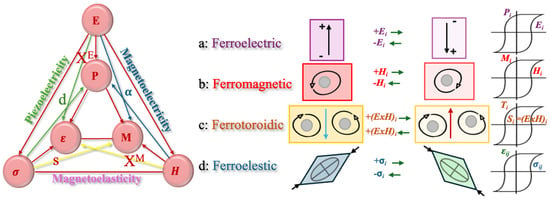
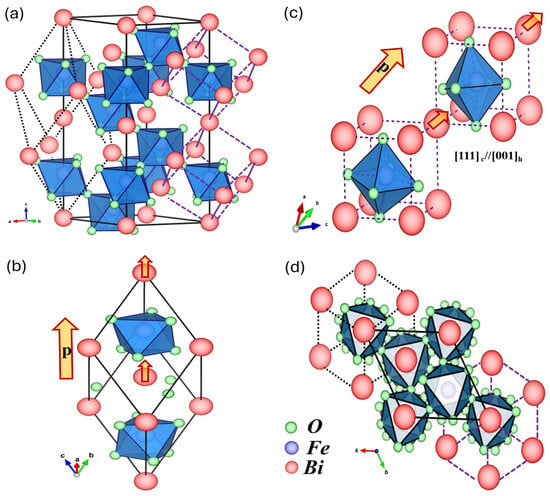
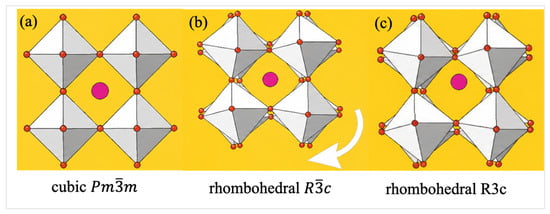
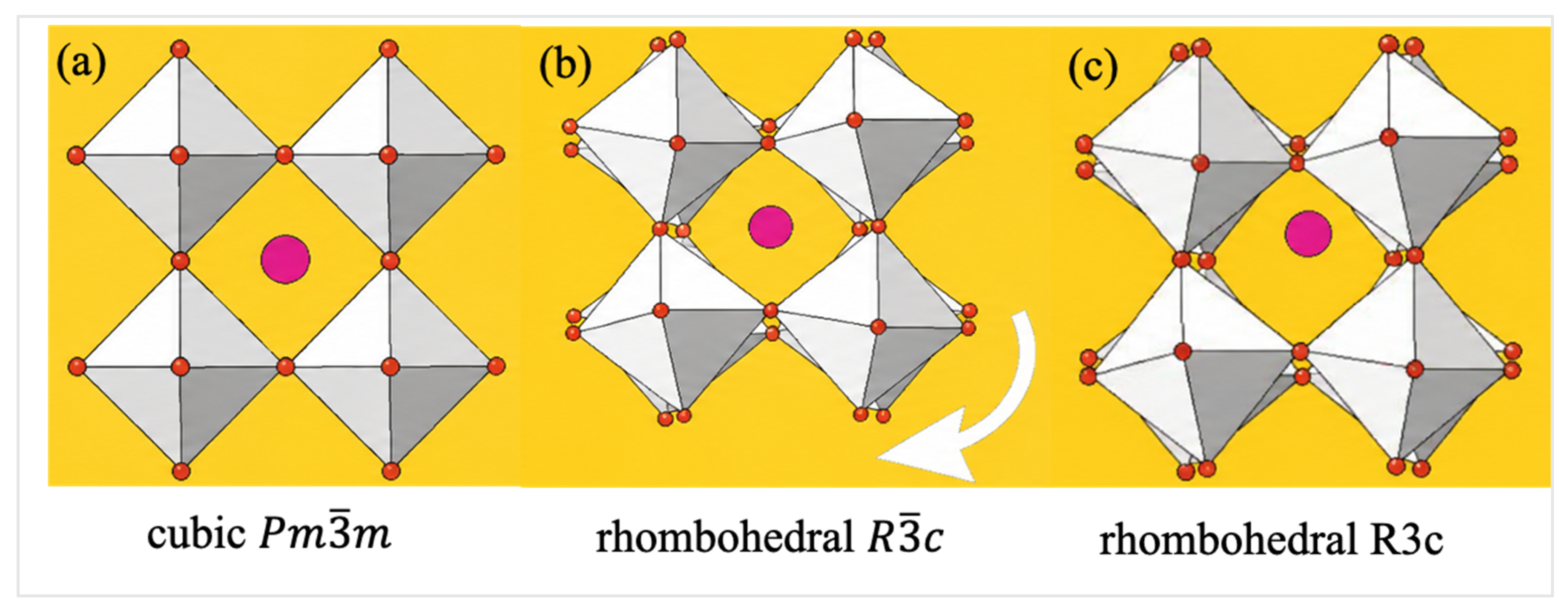
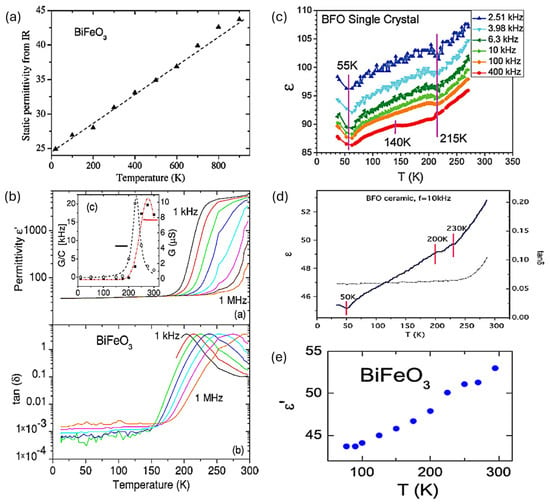
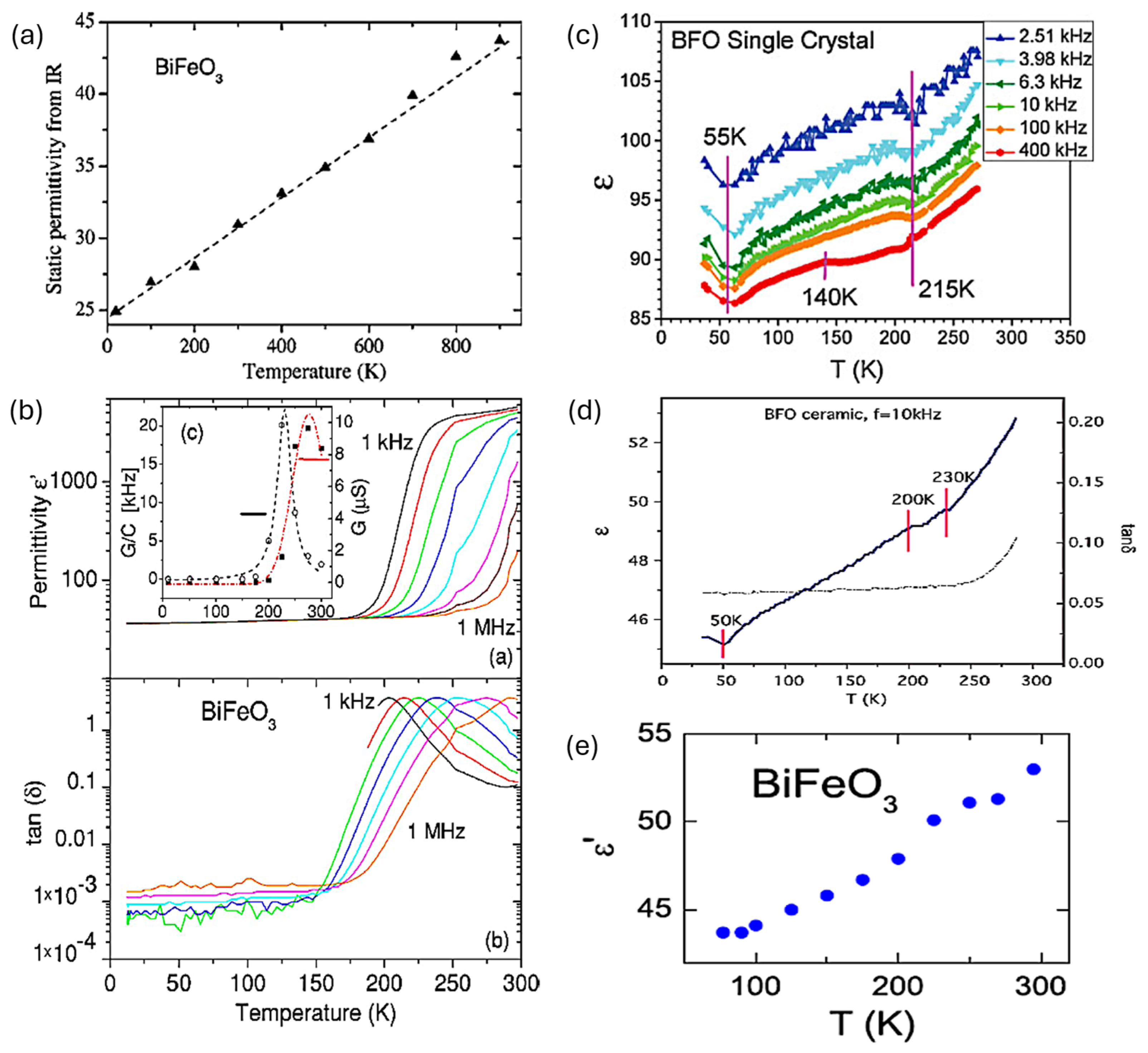
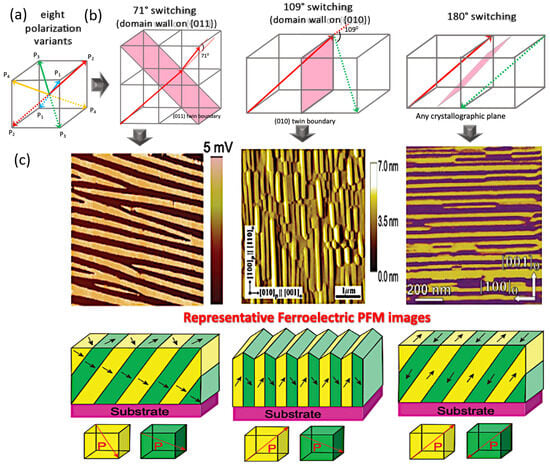
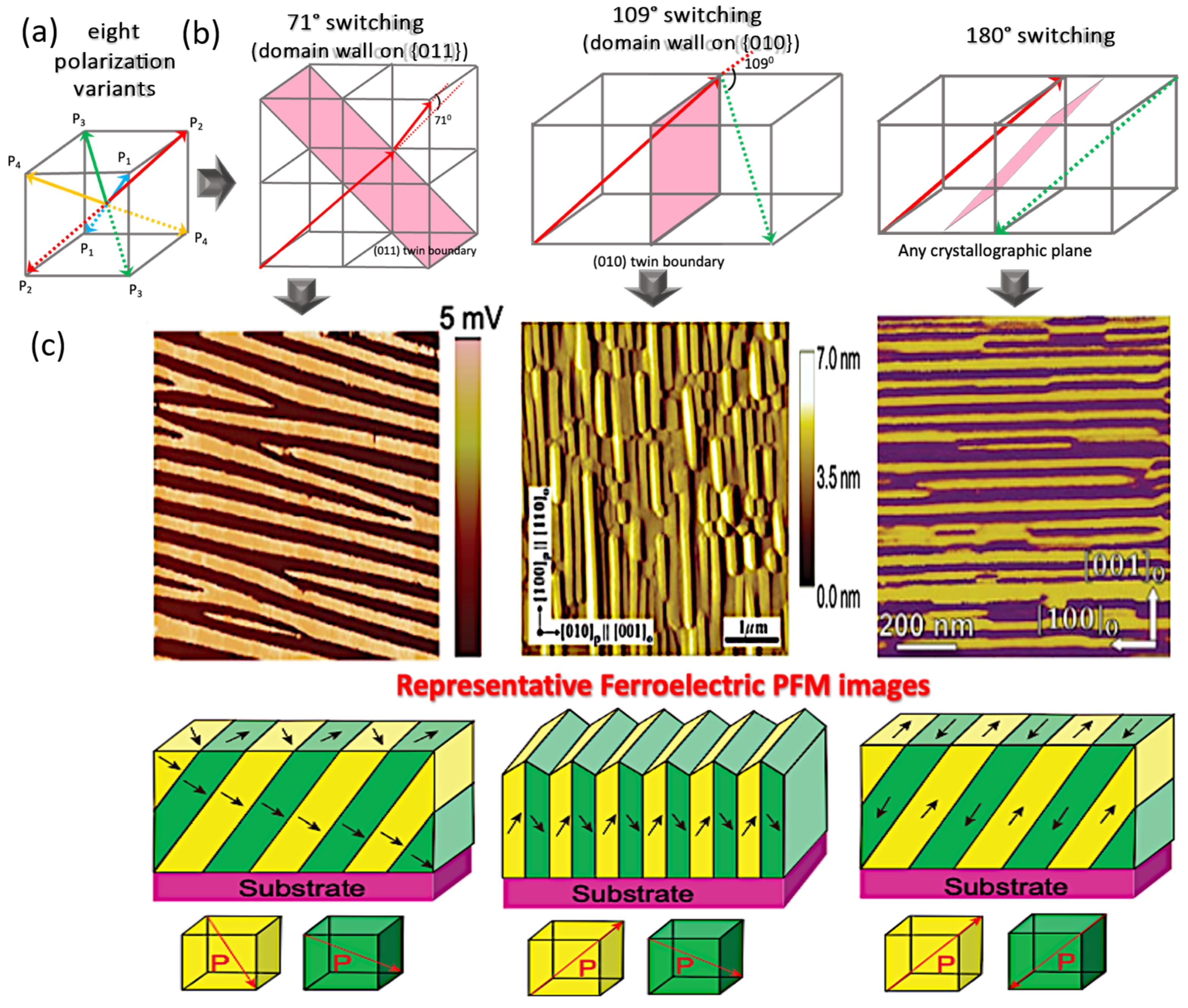
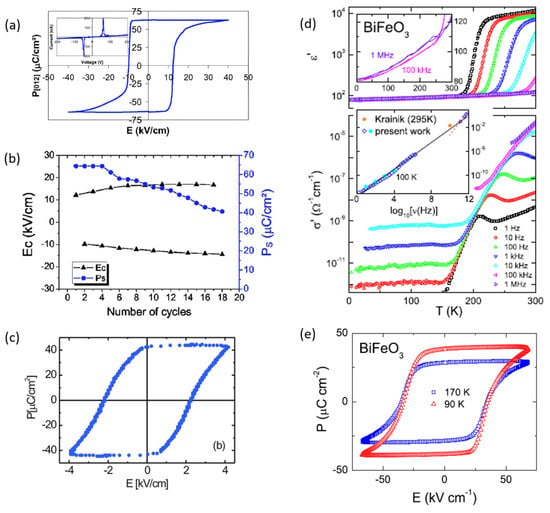
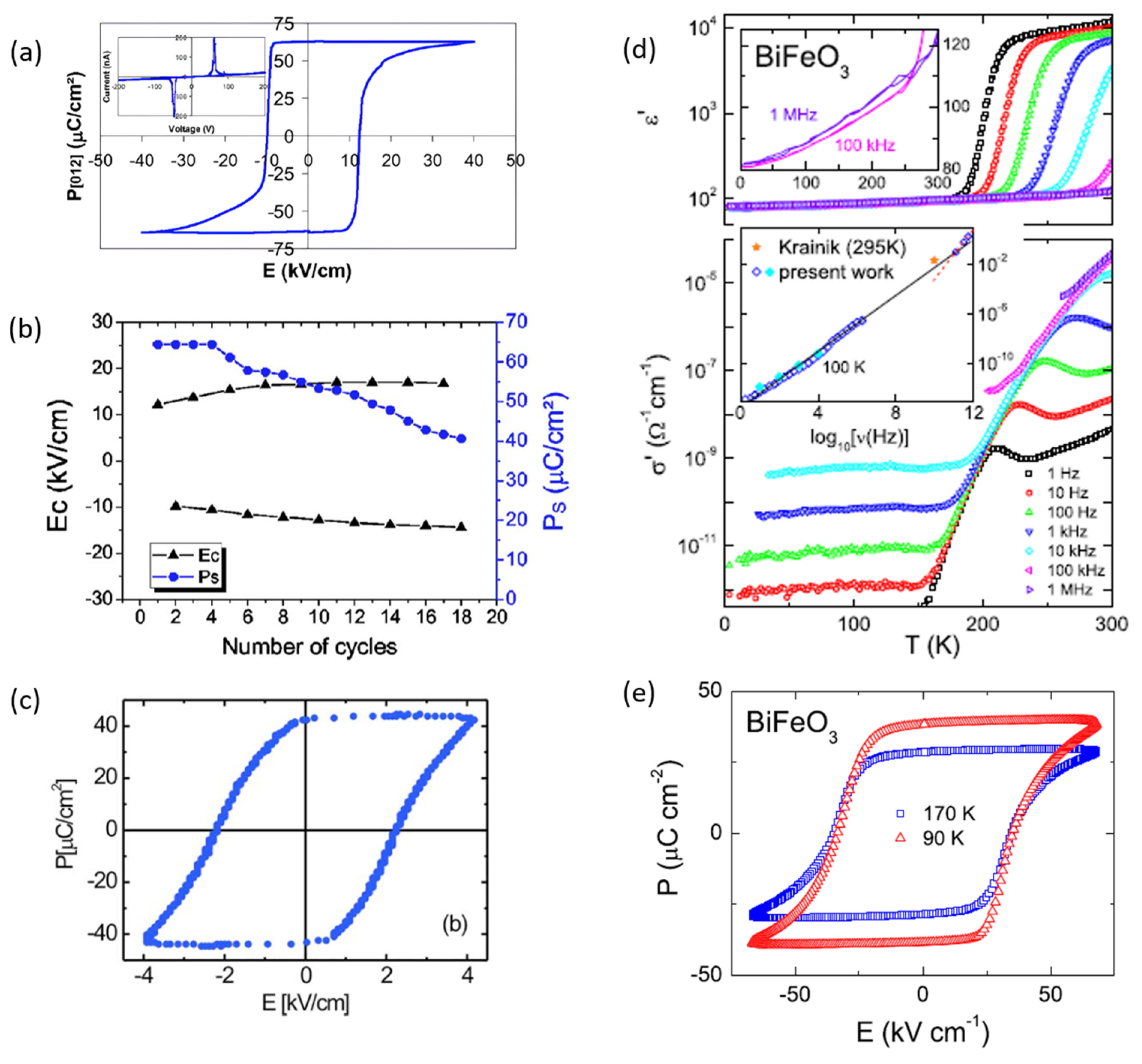
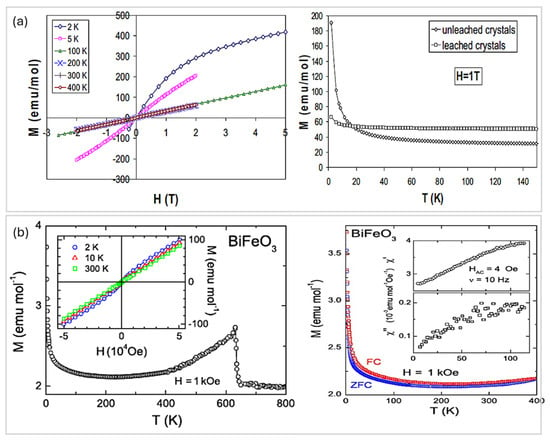
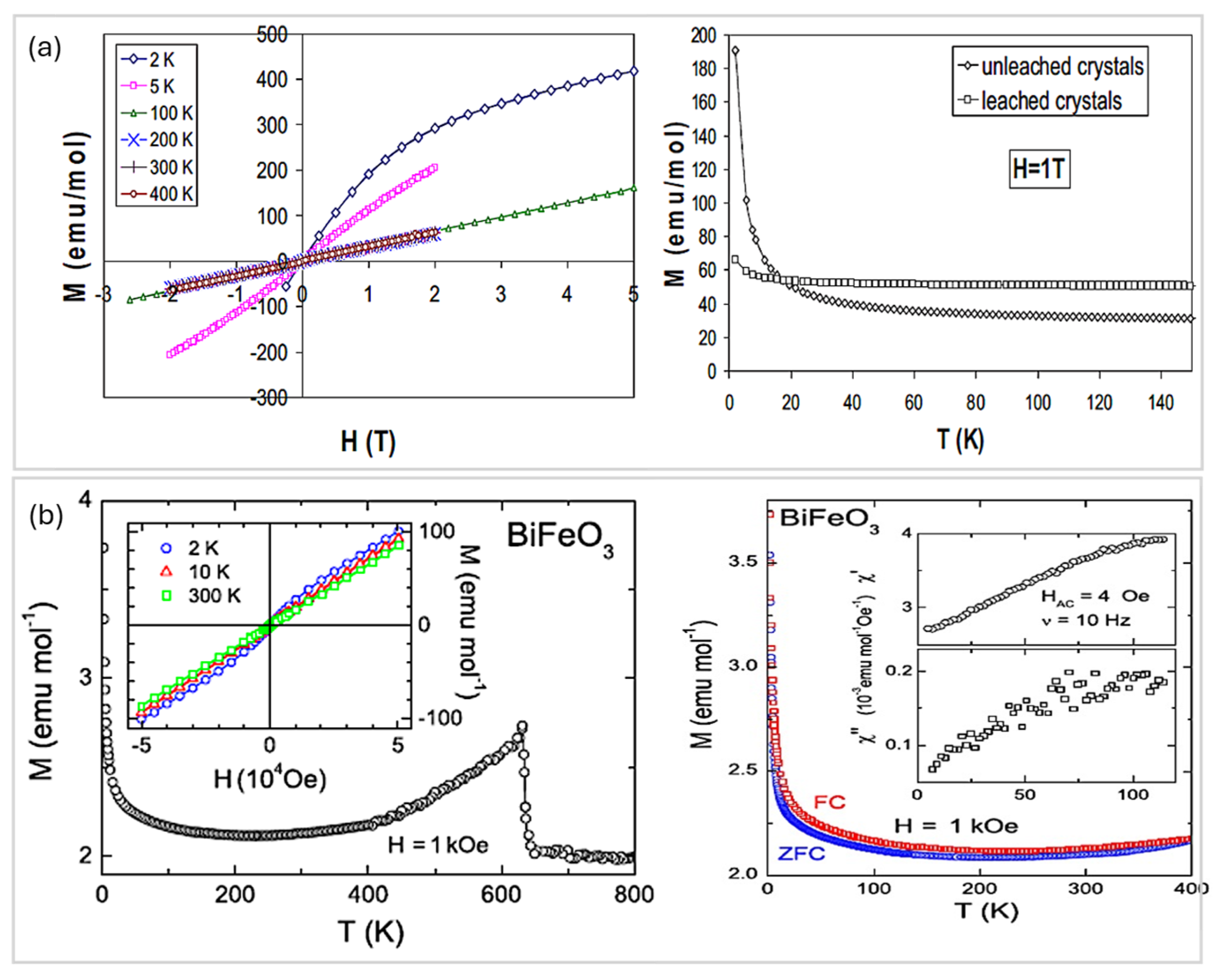
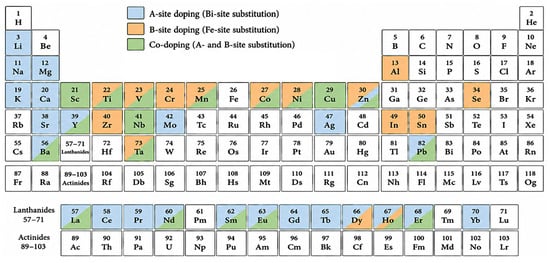
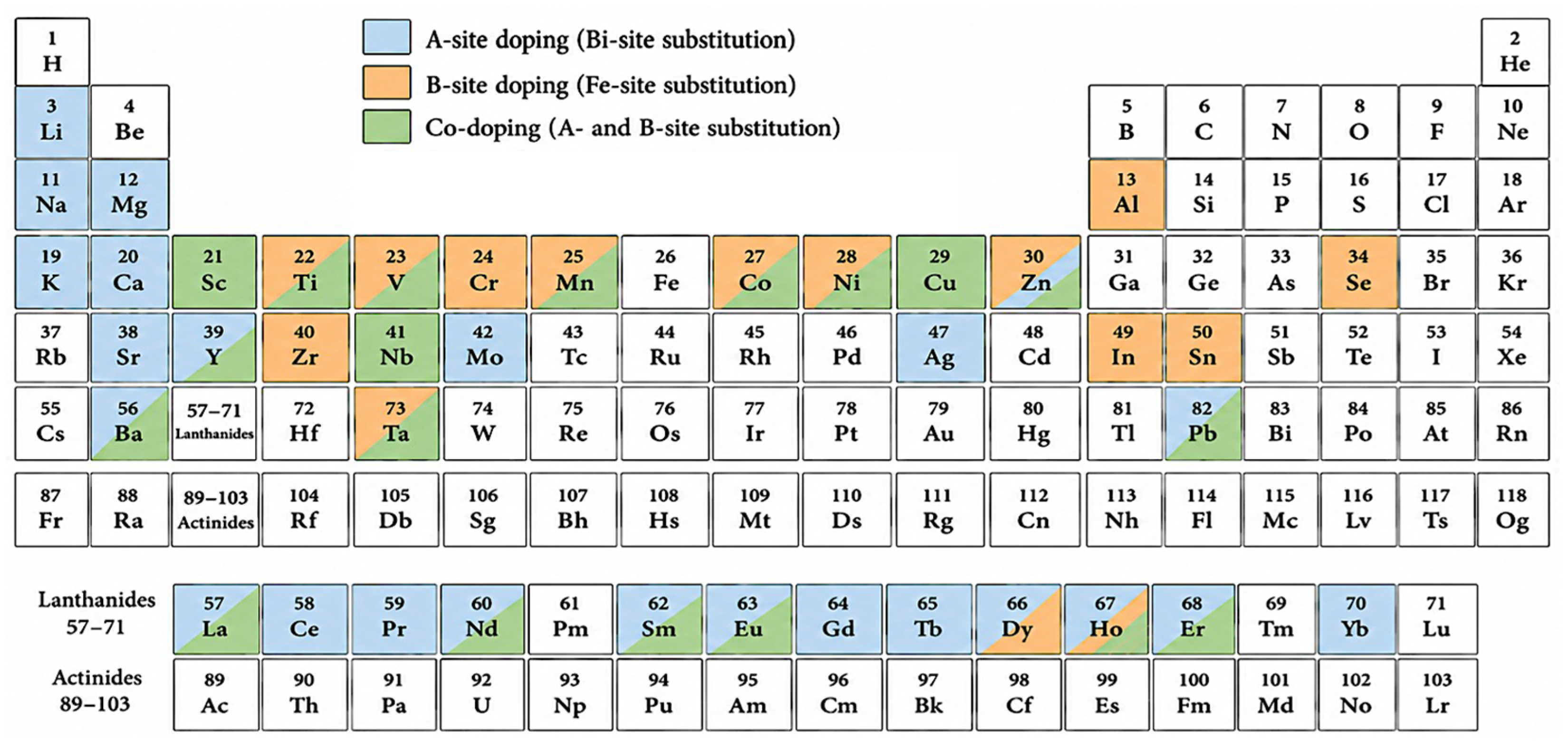
Disclaimer/Publisher’s Note: The statements, opinions and data contained in all publications are solely those of the individual author(s) and contributor(s) and not of MDPI and/or the editor(s). MDPI and/or the editor(s) disclaim responsibility for any injury to people or property resulting from any ideas, methods, instructions or products referred to in the content. |
© 2026 by the authors. Licensee MDPI, Basel, Switzerland. This article is an open access article distributed under the terms and conditions of the Creative Commons Attribution (CC BY) license.