


Abstract
In the temporal regime model proposed here, creative production under a real-time window draws on compiled knowledge and exercises inhibition, flexible switching, and sustained attention, whereas the deliberative window of a divergent-thinking test recruits working memory, the channel through which intelligence contributes to creativity. Improvisation-based instruction places learners in the real-time regime, so the model predicts transfer to executive and creative measures with a characteristic profile. We tested this in a PRISMA-guided systematic review and meta-analysis of controlled studies of such instruction in the performing arts with performance-based outcomes (Scopus, PubMed, ERIC, Crossref, searched October 2026; risk-of-bias ratings; 16 studies, N = 1244, 68 effect sizes). Small-study effects were pronounced, so the pooled effect, g = 0.70 [0.45, 0.94] (0.52 excluding derived values; creative thinking 0.82), is an upper bound: the bias-corrected estimates were −0.27, 0.12, and 0.48. The executive function estimate (g = 0.19 [−0.08, 0.47]) rested on four small studies, one randomized; its profile is descriptive, and no working memory effect could be estimated. Originality exceeded fluency in the point estimate only. The effects did not detectably depend on art form or dose; single sessions matched multi-week programs, a comparison confounded by the design. The profile partly matches the model, whose executive predictions remain untested.
1. Introduction
1.1. Wallas’s Stages and the Time a Creative Task Allows
The most influential description of the creative process is a sequence. Wallas (1926) divided creative thought into four stages: preparation, in which a problem is studied and relevant knowledge assembled; incubation, in which the problem is set aside and worked on, if at all, outside conscious attention; illumination, in which a solution or idea appears; and verification, in which it is tested and elaborated. He also described an intimation stage at the fringe of consciousness, just before illumination (Sadler-Smith, 2015). The sequence carries a temporal assumption that is rarely stated: incubation presupposes a window long enough for a problem to be set aside, and verification presupposes that what has been produced can still be changed. Where these presuppositions hold, the evidence is supportive; incubation benefits are larger for divergent tasks and after longer preparation (Sio & Ormerod, 2009). Accounts that describe the creative process as iterative and nonlinear (Sawyer, 2021) loosen the order of the stages but do not specify how the stages, and the abilities each draws on, depend on the time a task allows. The model is silent about what happens when there is no time to set a problem aside, which is the situation of every musician, dancer, and actor who improvises.
Three constructs are central to what follows. Creativity is used here in its standard sense: the production of ideas or products that are both original and effective, that is, appropriate to the task or context (Runco & Jaeger, 2012). In the studies synthesized below, it is measured either as divergent thinking, the generation of many and varied responses to an open problem, or as the rated quality of a product. Intelligence denotes the general capacity to reason, plan, solve problems, think abstractly, and learn from experience (Gottfredson, 1997), with fluid intelligence, the capacity to solve novel problems, distinguished from crystallized intelligence, the store of acquired knowledge (Cattell, 1963). Executive functions are the control processes that regulate thought and action, commonly divided into inhibition, the suppression of prepotent or habitual responses; shifting or cognitive flexibility, the switching between tasks, rules, or perspectives; and updating, the monitoring and manipulation of the contents of working memory (Miyake et al., 2000; Diamond, 2013). Time, finally, is not treated here as a neutral container in which creative work happens. Educational and social theory has long emphasized that time is constructed and plural, a matter of rhythms and of the meanings attached to them as much as of clock duration (Alhadeff-Jones, 2017). The present argument takes a deliberately narrow cut through that complexity: it asks what a creative task allows a person to do within the interval available, and treats the length of that interval, measured in clock time, as a property of the task that changes which cognitive operations are possible.
Whether intelligence contributes to creativity, and through which processes, remains one of the most persistent questions in research on human abilities. The threshold hypothesis, which held that intelligence supports creative potential only up to a moderately high level, has fared poorly in multivariate tests, although intelligence may still act as a necessary rather than a sufficient condition for creative achievement (Jauk et al., 2013; Karwowski et al., 2016; Weiss et al., 2020), and meta-analytic work has converged on a modest positive association: across 849 correlations from 112 studies, intelligence and divergent thinking correlated at r = 0.25, rising to about 0.31–0.37 under test-like conditions with instructions to be creative and originality scoring (Gerwig et al., 2021). The open question is therefore less whether the two constructs are related than when, and through which processes, the relation strengthens or weakens. Answers increasingly point to executive processes: instructions to be creative strengthen the association between fluid intelligence and the rated creativity of ideas (Nusbaum et al., 2014), and the link between fluid intelligence and originality runs largely through a general executive attention factor (Frith et al., 2021). Working memory capacity is closely related to fluid intelligence (Engle et al., 1999; Shipstead et al., 2016), while knowledge forms the core of crystallized intelligence and of expertise. Executive functions, in this reading, are the channel through which intelligence enters creative performance (Benedek et al., 2014). This literature motivates the model proposed below; the review that follows does not add to it directly, because the studies it synthesizes measured executive functions and creative thinking, and none measured intelligence.
The time a creative task allows has received far less theoretical attention than instructions, scoring, or modality, and it has been studied almost entirely as a testing condition. Longer time limits raise originality without changing fluency or flexibility (Said-Metwaly et al., 2020); the gains from additional time level off along an inverted-J curve (Paek et al., 2021); speeding up the same tasks lowers creative quality substantially without strengthening the relation between divergent thinking and mental speed (Forthmann et al., 2020); and timed versus untimed administration plays only a minor role in the relation between divergent thinking and reasoning (Preckel et al., 2011). Organizational research treats time pressure as an experienced stressor whose relation to creativity can be curvilinear (Baer & Oldham, 2006). These studies share a narrow band of variation: they vary time within a single session, from about two to about ten minutes. Whether the cognitive basis of creative performance changes when the available time shrinks to seconds, as it does in improvisation, has not been examined systematically.
1.2. Compressing Wallas: A Temporal Regime Model
We propose a model in which the temporal window of a creative task, the interval between its onset and the moment its output becomes fixed, determines which cognitive resources carry creative performance. A jazz pianist’s chorus illustrates the terms. While the band plays, each phrase becomes part of the performance the moment it is played: it is fixed, and it cannot be taken back. Before that moment, the pianist may, or may not, be able to try out a possibility internally, hearing a phrase in the mind, judging whether it fits the coming chord change, and discarding it for another; we call such an internally produced possibility a candidate, and the sequence of producing, holding, judging, and replacing candidates before anything is fixed a generate-and-evaluate cycle. Three affordances distinguish windows of different length: internal cycles; external memory, on any medium, such as notation, a recording, or a sketch, that holds material so that working memory need not; and interruption, the possibility of leaving the task and returning to it. Each becomes available only when the window exceeds a characteristic duration, and two thresholds partition the continuum into three regimes (Figure 1). Below the cycle threshold lies the real-time regime, in which generation and fixation coincide: the improviser who plays a phrase over a chord change cannot try two phrases and keep the better one. Between the cycle threshold and the offloading threshold lies the deliberative regime, in which candidates can be compared internally but nothing can be written down or set aside, as when a pianist works out a harmonization at the keyboard during a rehearsal break, or a participant completes a divergent-thinking test with a few minutes per item. Above the offloading threshold lies the distributed regime, in which notation, recording, and breaks relieve memory and make incubation possible, as in composing a piece over days or weeks.
Figure 1.
Proposed contribution of three cognitive resources to creative quality as a function of the temporal window (logarithmic axis), as derived from the model. Dotted vertical lines mark the cycle and offloading thresholds; shaded bands mark the three regimes of Table 1, with example practices indicated. Compiled domain knowledge (solid line) declines in relative importance from left to right; working memory and executive attention (dashed line) follow an inverted U peaking in the deliberative regime; evaluative knowledge and metacognitive regulation (dash-dotted line) rise toward the right. Arrows indicate the leftward shift in the thresholds with expertise. The curves are schematic rather than fitted to data, and the threshold positions are illustrative: the model fixes their order, not their values. The model’s testable content lies in that ordering and in the transfer predictions of Section 1.3, which the meta-analysis tests, not in the shapes of the curves. The figure was drawn with a Python (matplotlib) script (Figure 1_source.py) written with the assistance of Claude (Anthropic, San Francisco, CA, USA; Claude Fable 5.1) from the authors’ specifications; no image-generating model was used, and the script is available in Supplementary Material S3.
The three regimes correspond to a distinction familiar from research on professional practice. Schön (1983) separated reflection-in-action, the adjustment of an ongoing activity within what he called the action-present, from reflection-on-action, the later review of what was done, and he used jazz improvisation as an example of the former. The model specifies how much reflection each window permits. In the real-time regime, reflection-in-action can redirect what is played next but cannot revise what has been played; in the deliberative regime, it can compare and reject candidates before one is fixed; reflection-on-action, with its revision of a product through playback, notation, or a fresh hearing, belongs to the distributed regime.
The model makes two claims. The first concerns Wallas’s stages, and it is a derivation from the model rather than an empirical finding. Under a compressed window, the stages are not skipped but displaced: preparation and incubation move into the creator’s learning history, where a repertoire of patterns and procedures is compiled and consolidated; illumination fuses with production, so that the candidate retrieved is the one performed; and verification moves into the continuation of the performance, which can justify a phrase but cannot withdraw it (Table 1). The second claim concerns resources. Compiled domain knowledge—the stored patterns, schemas, and procedures that can be retrieved and executed without deliberation, such as the melodic figures, voicings, and chord-scale relations that a jazz musician has practiced until they run without conscious assembly—contributes everywhere but is decisive in the real-time regime, where nothing else can keep pace. Working memory and executive attention contribute most in the deliberative regime, where internal cycles are possible but nothing can be offloaded, and less at both extremes: below the cycle threshold because there is no time to run a cycle; above the offloading threshold because external memory relieves the load. Evaluative knowledge and its metacognitive regulation (Puryear et al., 2026) contribute most in the distributed regime, where the creator can generate and keep anything and must therefore decide what to keep. The thresholds are defined by what can be done within a window, and so they move with expertise: with practice, sequences that once required deliberate assembly become retrievable as units (Pressing, 1988), and experts hold and manipulate more domain material within the same interval than novices (Ericsson & Kintsch, 1995), so that a task which places a novice in the real-time regime may place an expert in the deliberative regime. A synthesis that pools novices with experienced performers may therefore pool samples for whom the same activity falls in different regimes; Section 3.2 reports what the included studies state about their participants’ experience, and Section 3.5 reports the estimates without the two samples of experienced performers.
Table 1.
Wallas’s stages across temporal regimes, as derived from the model (not empirical findings).
Table 1 and Figure 1 present the two claims in turn. Table 1 states the first, where each of Wallas’s stages is located in each regime; Figure 1 states the second, how the relative contribution of the three resources changes across the regimes that Table 1 defines. Neither is a summary of data. Both were constructed from the model’s premises, the three affordances and the two thresholds, together with the evidence cited in this section and in Section 1.3 on incubation, on the compilation of musical repertoire, and on the role of working memory in deliberate creative tasks.
For the intelligence–creativity relation, the model implies that laboratory divergent-thinking tasks sample one regime, the deliberative, almost exclusively, and that the moderate correlations they yield are estimates for that regime rather than for creativity in general. It also implies a mechanism by which experience in another regime could change the abilities that intelligence research measures. That implication is the subject of the present study.
1.3. Improvisation as the Real-Time Regime: What Should Transfer?
Improvisation is the clearest educational instance of the real-time regime. In music, dance, theater, and verbal play alike, the defining constraint is that output cannot be withdrawn: a note, a movement, or a line once produced belongs to the performance and can be justified, if at all, by what follows (Berliner, 1994). Pressing’s (1988) model treats musical improvisation as the real-time concatenation of material drawn from a stored repertoire of linked auditory and motor patterns, selected under the constraints of the idiom; Johnson-Laird (2002) showed computationally that improvising a melody must run fast enough to keep up with the music and so must minimize the load on working memory, whereas inventing the underlying chord sequence requires a process powerful enough to hold intermediate results. Corpus and interview evidence support this division of labor. In 48 improvised solos by Charlie Parker, 82.6% of notes began a recurring four-interval pattern (Norgaard, 2014); artist-level improvisers describe recalling well-learned ideas and inserting them into a solo alongside sketch-planning and monitoring (Norgaard, 2011); when artist-level pianists improvised under a concurrent counting task, they used significantly more repeated patterns than at baseline (Norgaard et al., 2016). When executive resources are withdrawn, real-time production falls back on compiled material.
Yet the real-time regime is not executively empty. Three demands remain and, on the model’s reading, are exercised every time a performer improvises; each corresponds to one of the executive functions defined in Section 1.1. The first is retrieval under constraint, which draws on inhibition: material must be selected from the repertoire that fits the harmonic, metric, or dramatic context of the moment, and a well-practiced figure that does not fit, or that was just played, must be held back. A saxophonist who has played the same lick over the last two choruses and stops herself from playing it a third time is exercising inhibition. The second is flexible switching, the behavioral signature of cognitive flexibility: an improviser must abandon a plan when the context changes, respond to a partner’s offer, or leave a pattern that no longer fits, as when the drummer doubles the tempo and the soloist moves at once from long phrases to short rhythmic figures. The third is sustained attention to a stream that cannot be paused: the soloist must keep track of the form, the chords, and the other players for the whole of the performance. What the regime does not afford is the holding and comparison of several candidates before one is fixed; that is the signature of working memory capacity, and it belongs to the deliberative regime. The model’s claim therefore concerns working memory in the complex sense, the maintenance of information while it is being processed, which complex-span tasks measure, and not simple short-term storage. Primary studies in this field have mostly used simple span tasks such as forward digit span, which limits how specifically the claim can be tested. Neuroimaging converges on this characterization: improvisation in professional pianists was accompanied by extensive deactivation of the dorsolateral prefrontal cortex, a region associated with executive control, alongside focal medial prefrontal activation (Limb & Braun, 2008); in jazz guitarists, improvisations rated higher in quality were accompanied by less activity over frontal regions associated with executive control, and experience shifted the balance between executive and associative processes (Rosen et al., 2020); flow states in experienced improvisers were accompanied by transient reductions in frontal activity (Rosen et al., 2024). Executive support supplied from outside, by instruction or by stimulation, helps novices and hinders experts (Rosen et al., 2016, 2017).
Individual-differences evidence is consistent with this account but thin. In ten undergraduate jazz students, cumulative practice predicted expert-rated improvisational creativity, while working memory and fluid intelligence showed mostly negative correlations with it, a pattern that the authors themselves attributed partly to restricted variance in so small a sample (Beaty et al., 2013). Semi-professional cellists with higher working memory capacity produced increasingly creative improvisations across successive trials, a series of attempts that allowed ideas to be carried forward and refined, which is closer to the deliberative regime than to a single real-time pass (De Dreu et al., 2012). Musicians trained in improvisation evaluated ideas less restrictively, and this evaluation mediated the relation between improvisation experience and divergent-thinking scores (Kleinmintz et al., 2014).
If the model is correct, instruction that repeatedly places learners in the real-time regime should produce transfer with a characteristic profile. The protocol (Supplementary Material S1) stated six hypotheses, four confirmatory and two exploratory. Improvisation-based instruction produces positive transfer to performance-based measures of executive functions and of creative thinking relative to comparison conditions (H1). Among executive functions, effects are larger for inhibition and cognitive flexibility, which the regime exercises, than for working memory capacity, which it does not (H2). Among measures of creative thinking, effects are larger for the indices that reflect breaking from established patterns, flexibility and originality, than for fluency, which indexes the rate of production that the deliberative regime of a divergent-thinking test already affords (H3). A rival expectation should be stated alongside it: improvisation is a highly generative activity, and practice in producing many responses may raise fluency as much as the other indices, a general practice effect that would shrink or remove the predicted difference. Effects are larger against passive comparison conditions than against active ones, because only an active comparison that matches the activity without its improvisational component isolates the real-time ingredient (H4). The two exploratory hypotheses concern format and domain. Because the regime can be entered within a single session, transfer may take two forms: an acute state effect, in which a brief period of improvisation shifts subsequent divergent production away from habitual responses, as schema-based accounts predict (Lewis & Lovatt, 2013), and a training effect, in which repeated engagement compiles repertoire and strengthens the control processes that real-time retrieval demands; the protocol expected effects to increase with dose, the number of sessions and the total minutes of improvisation, and acute single-session effects to be smaller than multi-session training effects (H5). The opposite expectation, that improvisation acts as a transient state, so that a single session produces effects as large as or larger than a program, was not a hypothesis of the protocol; we name it here as the rival account, and the results that bear on it (Section 3.4 and Section 4.2) are not tests planned in advance. Finally, because the affordances that define the regime are properties of the window and not of the art form, transfer should not differ between musical and other improvisation, whether theatrical, dance, or verbal (H6). The hypotheses concern the performing arts, in which the output of an improvisation is a performance that unfolds in time; they are not claims about crafts, design, or other creative practices whose products can be revised before they are shown.
1.4. Prior Syntheses and the Present Study
Three bodies of evidence bear on these hypotheses, and none has been synthesized with improvisation as the ingredient of interest. First, experimental and quasi-experimental studies have asked whether improvisation activities raise divergent thinking, from brief laboratory inductions in adults (Lewis & Lovatt, 2013) and children (Sowden et al., 2015) to multi-week programs in schools (Hainselin et al., 2018) and universities (Mourey, 2020). Second, a smaller set of studies has asked whether improvisation-based instruction transfers to executive functions, most directly in a classroom experiment in which middle school band students who were taught to improvise, but not students who received the same jazz instruction without improvising, improved in cognitive flexibility (Norgaard et al., 2019). Third, a large body of literature has examined whether music training in general transfers to executive functions and academic skills. Meta-analyses of that literature have reached opposite conclusions depending on the weight given to design quality (Sala & Gobet, 2020; Román-Caballero et al., 2022; Cai et al., 2025/2026), but none has distinguished instruction that requires real-time creative production from instruction that does not, even though the one study that made the comparison directly found that the type of music-making determined whether transfer occurred (Norgaard et al., 2019). Reviews of improvisation pedagogy are narrative (Biasutti, 2017; Chandler, 2018; Phipps, 2025), and meta-analyses of creativity training (Scott et al., 2004; Sio & Lortie-Forgues, 2024) treat improvisation, where it appears, as one of many program contents.
The present study therefore reports a systematic review and meta-analysis of controlled studies in which improvisation, in any performing art, was the defining component of an instructional activity or program, and in which executive functions or creative thinking were measured with performance-based tasks. It was designed to answer four questions. Does improvisation-based instruction produce measurable transfer to executive functions and to creative thinking (H1)? Does the profile of transfer match the model’s account of what the real-time regime exercises, with larger effects on inhibition and flexibility than on working memory capacity, and on flexibility and originality than on fluency (H2, H3)? Do effects depend on the comparison condition, the format and dose, and the domain of improvisation (H4–H6)? How robust is the evidence base, given the small samples and heterogeneous designs that characterize arts education research? The synthesis does not test the relation between intelligence and creativity: no included study measured intelligence, and the outcomes are executive functions and creative thinking. What it examines is one implication of the model, that experience in the real-time regime should leave a trace on executive measures and that the trace should have the predicted profile. Even this examination is indirect, because it bears on the model’s transfer predictions and not on the thresholds that bound the regimes or on the resources engaged within a window, which only within-person designs can measure (Section 4.6); a transfer profile of the predicted shape would be evidence consistent with the model, not a demonstration of its mechanism, and it would say nothing by itself about intelligence.
2. Materials and Methods
2.1. Protocol and Reporting
The review followed the PRISMA 2020 statement (Page et al., 2021). The protocol, including the eligibility criteria, search strings, coding scheme, and analysis plan, was written before screening began and is provided as Supplementary Material S1. The review was not registered (for example, in PROSPERO), so it has no registration number; there was insufficient time available to complete registration before the journal’s deadline. Departures from the protocol are reported in Section 2.7. Searches were run on 14–15 October 2026.
2.2. Eligibility Criteria
Studies were eligible if they met five criteria. (1) Participants were healthy or typically developing individuals of any age; studies of clinical samples (e.g., autism spectrum disorder, dementia, psychiatric diagnoses) were excluded. (2) The intervention was an activity or program in which participants generated novel musical, rhythmic, movement, dramatic, or verbal material in real time, and in which improvisation was the defining component: the activity was labeled as improvisation by the authors, and improvisation constituted either the only ingredient differing between conditions or the majority of session content. Programs in which improvisation was one minor component among several (e.g., multimodal music programs) and drama or creative-movement programs not framed as improvisation were excluded; this criterion is discussed in Section 4.5. Both multi-session programs (training) and single-session activities (acute) were eligible and were coded separately. (3) A comparison condition was present: no-treatment, wait-list, or business-as-usual (passive control), or a matched non-improvisational activity (active control); within-subject counterbalanced designs with a control activity were eligible for acute studies. (4) At least one outcome was a performance-based measure of executive function (inhibition, working memory, cognitive flexibility, attention, or a composite) or of creative cognition (divergent-thinking tests, convergent creative problem solving, or expert-rated creative products). Self-report measures of creativity, affect, well-being, and social skills were excluded. (5) Sufficient statistics were reported to compute a standardized mean difference. Peer-reviewed articles, dissertations, and conference papers in any language and from any year were eligible. The restriction to performance-based outcomes and to non-clinical samples follows from the model, whose predictions concern the executive and creative performance of the typical cognitive system, and from the exposure of self-report outcomes to the expectancy and demand effects discussed in Section 4.5.
2.3. Information Sources and Search
Four sources were searched systematically, chosen to cover the biomedical and psychological literature (PubMed), the educational literature (ERIC), and the multidisciplinary journal literature (Scopus), and, through Crossref, journals indexed in none of these. PubMed was searched through its web interface with the string improvisation AND (creativity OR “divergent thinking” OR “executive function” OR “working memory”) (336 records). ERIC was searched through its public interface with the strings improvisation AND (creativity OR “executive function”), improvisation AND “divergent thinking”, improvisation AND “executive function”, and improv AND creativity AND (experiment OR “control group” OR pretest) (254 records across the four strings). Crossref was queried through its bibliographic search with eight topic strings combining improvisation terms with outcome and design terms, and the first 60 records of each query were screened (480 records). Scopus was searched on 14 October 2026 in the title, abstract, and keyword fields with the full string given in Supplementary Material S1, which combines improvisation terms with outcome terms and design terms (1129 records). Web of Science could not be searched because no institutional subscription was available to the authors. These database searches were supplemented by backward citation chasing from the reference lists of included studies and of prior reviews (Biasutti, 2017; Chandler, 2018; Degé & Frischen, 2022; Rodriguez-Gomez & Talero-Gutiérrez, 2022; Phipps, 2025), and by targeted web searches in English, Spanish, Portuguese, German, Turkish, and Russian for gray literature and non-English reports (3 additional records that were not already in the database set). The search strings, dates, and record counts for every source are given in Supplementary Material S1; the complete lists of records returned by each search, the screening log for the Scopus set, and the list of all reports sought for retrieval with their sources and decisions are provided in Supplementary Material S3, so that the searches can be re-run and the screening audited. No restriction on publication date was applied, so that every controlled study of improvisation-based instruction could be found whatever its age: each database was searched from its earliest records to the search date (14–15 October 2026); the earliest included study was published in 2009.
2.4. Study Selection
Records were deduplicated by DOI and title. Titles and abstracts were screened against the eligibility criteria, and the full texts of all potentially eligible records were retrieved and assessed. Screening and data extraction were performed by the first author with the assistance of a generative AI tool (Claude, Anthropic), as described in the Acknowledgments. The same tool (Claude Fable 5.1) was used to write the analysis code and the Python (matplotlib) scripts that draw Figures 1–4 from the authors’ specifications, which are summarized in the Acknowledgments; no figure was produced by an image-generating model. The authors have reviewed and edited the output and take full responsibility for the content of this publication. At revision, to estimate the exclusion error of this procedure, the second author, without AI tools and without knowledge of the screening decisions, re-screened a simple random sample of 200 of the 1895 records excluded at title and abstract screening, mixed with the 38 database records that had been sought for retrieval, from the information available at screening (title, authors, source, and the record page with its abstract; sample, workbook, and key in Supplementary Material S3); the results are reported in Section 3.1. Because summaries produced by such tools were found during the work to contain fabricated statistics, no value entered the coding sheet from a summary: every statistic was taken from the published report or from page images of it, and every value in the coding sheet was checked against the source a second time: 20 of the 37 values judged most fragile (derived from inferential statistics or read from page images) by the first author, and the remaining 64 (the other 17 fragile values and the 47 values taken from reported means and standard deviations or reported only as non-significant) in documented AI-assisted passes over the full texts; none required correction. As a further check that does not depend on re-reading, the extracted means, standard deviations, and sample sizes were tested for consistency with the inferential statistics reported in the same sources wherever both were available (30 checks in nine studies): the pre-test–post-test correlation implied by each statistic together with the extracted values was computed, and an inadmissible value or, for ANCOVAs, a predicted group F more than a factor of two from the reported one was taken as an inconsistency. Twenty-five checks were consistent, two rank-based analyses could not be checked exactly, and in three outcomes (the originality ratio of Hainselin et al., 2018, and the originality and flexibility scores of Experiment 2 of Lewis & Lovatt, 2013), the source’s descriptive table and its own test statistic disagree. The main analysis keeps the tabled values, as the protocol specifies, and Section 3.5 reports the estimates with test-based substitutes for the three inconsistent outcomes. A complete second extraction was then performed by the second author, independently of the first. Working from the full texts alone, with the assistance of a separate instance of the same generative AI tool and without access to the first coding sheet, she coded the design characteristics, the five risk-of-bias items, and every statistic of the 15 studies whose full text was available to her (Richard et al., 2021, could not be re-coded) and checked the extraction against the PDF of each study. The two extractions were then compared field-by-field. For the statistics, 492 of the 536 values recorded by both were identical, and the 44 differences all concerned conventions rather than readings: the second extraction recorded standard errors where the first had converted them to standard deviations and used one rather than both comparison groups of Coubard et al. (2011), and it recorded the pre-test rather than the analyzed sample sizes of West et al. (2017); every raw value read from a table or a text agreed. Outcome classification agreed on 75 of 75 outcome domains, 67 of 75 subtypes, and 73 of 75 directions. Of the 286 design codes recorded by both, 234 agreed (82%); 41 of the 52 differences were values that the first extraction had derived (total minutes, zero weeks for a single session) and the second had left as not reported, and the 11 remaining conflicts were resolved against the sources, with four changes to the first coding (the age bands of Hainselin et al., 2018, and Schwenke et al., 2021; the assessment timing of Santos et al., 2021; and the program length of Méndez Martínez & Fernandez-Rio, 2021), two subtype changes in broad-set outcomes, and two corrections of direction in outcomes entered as zero. The risk of bias was rated independently by the second author on the same five items; the item-level agreement with the first author’s ratings was 55% (Cohen’s κ = 0.26), the first ratings having been the more lenient on allocation and attrition, and all 75 items were resolved by consensus against the rules of Section 2.5, which, together with the baseline criterion added at revision (Section 2.5), changed 30 of the first author’s item ratings and the overall judgment of three studies (Supplementary Table S5b). An earlier, partial re-extraction of the design characteristics of eight studies with a different tool (Grok, xAI, Palo Alto, CA, USA) is recorded in the verification log. The second extraction is therefore an independent extraction by the second author with AI assistance, not blind double coding by two human coders, and the distinction is maintained in Section 4.5; the second author’s workbook and the field-by-field comparison are provided in Supplementary Material S3. The flow of records is shown in Figure 2.
Figure 2.
PRISMA 2020 flow diagram. Records identified through the four databases are shown on the left; reports identified through citation chasing, targeted web searches, and a colleague’s suggestion that were not already in the database set are shown on the right. The two studies retained only for the broad-definition sensitivity analysis are counted separately from the 16 studies of the main analyses. The diagram was drawn from the tallied record counts with Python (matplotlib) scripts (prisma_tally.py and make_prisma.py) written with the assistance of Claude (Anthropic; Claude Fable 5.1) from the authors’ specifications; no image-generating model was used, and the scripts are available in Supplementary Material S3.
2.5. Data Extraction and Risk of Bias
For each study, we coded the publication type and year, country, sample age group (preschool 3–6 years; primary 7–12; secondary 13–18; university or young adult 19–30; adult 31–59; older adult 60 and above), sample size per condition, design (randomized, cluster-randomized, non-randomized with comparison group, within-subject counterbalanced), comparison type (passive or active), domain of improvisation (music, including rhythm-based music; theater or drama; dance or movement; verbal; mixed), dose, amount of improvisation a condition provided (number of sessions, weeks, minutes per session, and total minutes), whether the activity was acute (one session) or a training program (two or more sessions), outcome domain and subtype, measure, timing of the outcome assessment (immediate, within one week of the last session; delayed, later), and statistics required for effect size computation. Executive function outcomes were classified as inhibition, working memory, cognitive flexibility, attention, or composite; creative cognition outcomes were classified as divergent-thinking fluency, flexibility, originality, elaboration, composite, convergent problem solving, or domain-specific product creativity (expert ratings of improvised or designed products and domain measures such as Webster’s Measure of Creative Thinking in Music).
The risk of bias was assessed with five items adapted from the Cochrane RoB 2 and ROBINS-I tools to the designs common in arts education research: random allocation to conditions, baseline equivalence on the outcome (a pre-test difference reported as significant, or of at least half a pooled standard deviation computed from the reported pre-test data, rated high; the half-standard deviation criterion was added at revision), the blinding of the outcome assessment or use of objective scoring, completeness of the outcome data (units lost or excluded from the analysis below 20% in each condition and balanced across conditions), and completeness of reporting (statistics reported for all pre-specified outcomes). Each item was rated low, some concerns, or high, and a study-level judgment was derived as the worst item rating. Each item was rated independently by both authors, the first from the full reports and the extraction notes with the assistance described in Section 2.4, and the second in the independent extraction described there, and the ratings were compared and resolved by consensus against the rating rules given in the note to Supplementary Table S5b, which also provides the consensus item-level ratings with their justifications.
2.6. Effect Sizes
The effect size metric was the standardized mean difference in the pre-test standard deviation metric, oriented so that positive values favor the improvisation condition. For pre-test–post-test–control designs, we computed Morris’s (2008) d_ppc2, which standardizes the difference between the mean changes in the two conditions by the pooled pre-test standard deviation and applies the small-sample correction; its sampling variance was computed with Morris’s formula, assuming a pre-test–post-test correlation of ρ = 0.50, with ρ = 0.30 and ρ = 0.70 as sensitivity values; no included study reported this correlation directly, so a common assumed value was unavoidable, and the sensitivity values bound its influence on every estimate (Supplementary Table S6). The assumed value is, however, supported by the included studies themselves: wherever a source reported a test statistic that depends on the same means (an interaction F, a paired t, or an ANCOVA with its covariate F), the pre-test–post-test correlation implied by that statistic and the extracted means was computed (Section 2.4); over the 25 outcomes in seven experiments for which this was possible, the implied correlations had a median of 0.45 (interquartile range 0.39–0.65, range 0.20–0.88), which the sensitivity values of 0.30 and 0.70 bracket. For post-only randomized designs, we computed Hedges’ g from post-test means. Pooling d_ppc2 with post-test g treats the post-test standard deviation of a post-only design as an estimate of the pre-test standard deviation: the two metrics are commensurable if the intervention does not change the variance of the outcome, and if it increases the variance, post-test g underestimates the effect relative to d_ppc2. The two metrics were compared in a sensitivity analysis (Section 3.5). Where only inferential statistics were reported, d was derived from the between-groups t or F(1, df) for post-only comparisons, from F for ANCOVA-adjusted post-test comparisons (dividing the error variance by 1 − ρ2), from the independent-samples t on change scores, from the paired t statistics of each condition when only within-condition tests were reported, or from Mann–Whitney mean ranks through the probability of superiority (Ruscio, 2008). Reaction-time and error measures were reverse-scored. Outcomes reported only as non-significant, with no statistics, were assigned d = 0 with the variance implied by the sample sizes and were included only in a sensitivity analysis; the main analyses used reported statistics only. All derivations are documented effect-by-effect in Supplementary Table S2.
2.7. Synthesis
Because most studies contributed several effect sizes (multiple outcomes, subscales, or subsamples), we fitted three-level random-effects models in which effect sizes (level 2) were nested within studies (level 3), with the between-study and within-study variance components estimated by restricted maximum likelihood (Cheung, 2014; Van den Noortgate et al., 2013). Models were fitted separately for executive function outcomes and for creative cognition outcomes, and for all outcomes combined. The confidence intervals for the pooled effect used the Knapp–Hartung adjustment with k − p degrees of freedom; cluster-robust standard errors with a small-sample correction (CR2) were computed as a check on the model-based inference. Heterogeneity was summarized by the two variance components and by the three-level decomposition of I2 (Cheung, 2014). The hypotheses of Section 1.3 were tested by mixed-effects meta-regression with categorical moderators (outcome subtype, comparison type, acute versus training, domain of improvisation, age group, randomization) and continuous moderators (total minutes, log-transformed; number of sessions), each entered separately, with a minimum of four effect sizes from at least three studies per category. Because a non-significant omnibus test does not establish that categories are equivalent, the differences between categories were also estimated from the same models with Knapp–Hartung confidence intervals, and the width of those intervals is reported with the tests. At revision, the moderator p values were also adjusted for multiple testing with the Holm and Benjamini–Hochberg procedures, across the nine moderator tests on all outcomes and across all 21 reported tests; moderator findings are treated as exploratory. Robustness was examined by leave-one-study-out analysis, by excluding non-randomized studies, by excluding derived effect sizes, and by varying ρ; at revision, in response to peer review, the executive function estimate was re-estimated with each study omitted in turn, the pre-test–post-test metric was compared with the other metrics, the acute–training contrast was estimated within the randomized studies, the small-study relation was estimated separately within active and passive comparison studies, and the estimates were recomputed without the two samples that included experienced performers. These analyses were not in the protocol. Small-study effects were examined with a contour-enhanced funnel plot (Peters et al., 2008) of study-averaged effects, a multilevel Egger-type regression of effect sizes on their standard errors, PET–PEESE (Stanley & Doucouliagos, 2014), and trim-and-fill on study-averaged effects (Duval & Tweedie, 2000). Study-averaged (and, for Figure 3, sample-averaged) effects were computed as the unweighted mean of a study’s effect sizes, with a variance that assumes a correlation of 0.50 between effects from the same participants (Borenstein et al., 2009). The certainty of the evidence for each of the two outcome families was appraised across the five GRADE domains—risk of bias, inconsistency, indirectness, imprecision, and publication bias (Guyatt et al., 2008)—with the rules stated in Supplementary Material S8; the appraisal is informal, because GRADE was designed for randomized evidence and the present set mixes designs. Analyses were run in Python 3.12 with custom code validated against the reference implementation in the R package metafor (Viechtbauer, 2010) on published example datasets; the code and the coding sheet are provided as Supplementary Material S3. The analysis plan was followed as written with the following exceptions. Forward citation chasing of the five seed studies, which the protocol planned through Scopus, was not performed systematically, because Scopus access became available only at the end of the search period; the Scopus search itself was run with the full planned string. Crossref was screened to the first 60 records per query rather than the 200 stated in the protocol, because its bibliographic query has no field restriction and weak relevance ranking and, once Scopus became available, served only as a supplementary source. The protocol’s plan for the independent screening of a random quarter of the full-text records was not carried out, and the planned independent coding of all included studies by the second author was carried out for the 15 studies with available full text, with AI assistance, as described in Section 2.4, together with the verification procedure described there. The risk of bias was rated with the five items listed in Section 2.5; allocation concealment, which the protocol listed, was not rated separately because no study reported it, and the planned moderator test of risk of bias was not run because no study was rated low overall. The planned comparison of executive function subtypes could not be carried out, because fewer than three studies contributed to any subtype, and is replaced by a descriptive account. For the one study in which outcomes were measured at the level of dyads (Harinck & Dooren, 2023), the dyad was accepted as the unit of analysis: effect sizes were computed from the dyad-level statistics with the number of dyads as the sample size, so that the dependence of individuals within dyads is absorbed in the reported statistics and no further adjustment was required.
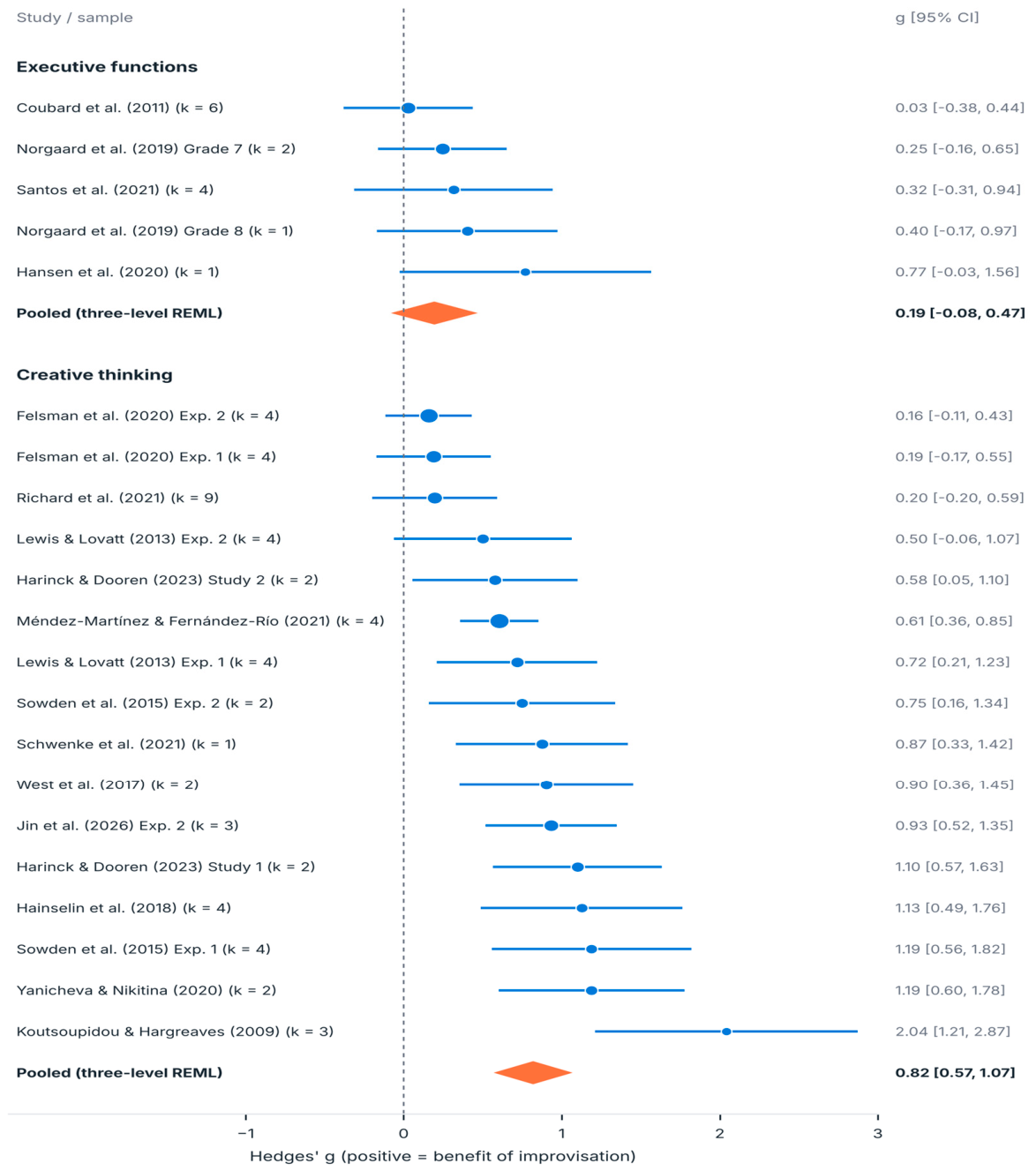
Figure 3.
Sample−level effect sizes (Hedges’ g, positive values favoring the improvisation condition) with 95% confidence intervals, grouped by outcome domain. Each row shows the unweighted mean of the k effect sizes of one independent sample, with a variance that assumes a correlation of 0.50 between effects from the same participants; the marker size is inversely proportional to the standard error. Diamonds show the three-level random-effects estimates for executive function outcomes (k = 14, m = 4) and creative-thinking outcomes (k = 54, m = 12). The plot was computed from the effect-size data with a Python (matplotlib) script (run_analysis.py) written with the assistance of Claude (Anthropic; Claude Fable 5.1) from the authors’ specifications; no image-generating model was used, and the script is available in Supplementary Material S3.
3. Results
3.1. Study Selection
The database searches returned 1129 records from Scopus, 336 from PubMed, 254 from ERIC, and 480 from Crossref, 2199 in all; 266 duplicates were removed, and 1933 records were screened by title and abstract (Figure 2). The screening excluded 1895 records, most of them studies of improvisation as a clinical intervention, neuroimaging or expert–novice studies of improvisers, descriptive or qualitative studies of improvisation pedagogy, studies of organizational improvisation, false hits on the stem improvis- (improvised devices and materials, Balanus improvisus), and studies with self-report outcomes only. In the re-screen added on revision (Section 2.4), the second author would have sent 3 of the 200 sampled excluded records for full-text assessment (1.5%, 95% CI 0.3–4.3%), none of which met the eligibility criteria on full text (0 of 200 eligible; upper 95% bound 1.8%), and she sent 36 of the 38 sought records, among them all the included studies, for full text; because she had extracted the included studies, this second part of the check was not blind. The full texts of 38 reports were sought, and three further reports that were not in the database set were identified through citation chasing, targeted web searches, and a suggestion from a colleague. Of these 41 reports, six could not be retrieved despite requests through the available channels, and 35 were assessed. Seventeen reports were excluded at this stage: a no non-improvisation comparison condition (n = 6); improvisation not the defining component of the program (a multimodal music program, a play-based executive function program, and an exercise program built on nonlinear pedagogy; n = 3); no instructional intervention (expert–novice and experience-group comparisons; n = 2); outcomes limited to self-report (n = 2); no eligible outcome (n = 1); a clinical sample (n = 1); statistics insufficient or internally inconsistent (n = 1); and a commentary without new controlled data (n = 1). The excluded and unretrieved reports are listed with reasons in Supplementary Table S5a. Sixteen studies in 16 reports met the strict eligibility criteria and were included in the main analyses. Two further studies in which improvisation formed a substantial but not defining part of a program labeled otherwise, a jazz piano program for older adults (Bugos et al., 2024) and a creative-drama course for postgraduate students (Karakelle, 2009), were retained for the broad-definition sensitivity analysis.
3.2. Characteristics of the Included Studies
Table 2 summarizes the 16 studies. They were published between 2009 and 2026 in 12 countries, and contributed 21 independent samples, 1244 participants (counting dyads as the unit where the study did), and 68 effect sizes based on reported statistics, with a further eight outcomes reported only as non-significant. Six studies allocated participants to conditions at random; ten used intact groups or self-selected samples with a comparison group. Five studies, all randomized, examined a single session of improvisation lasting 9 to 20 min (nine samples); the remaining 11 examined programs of 3 to 40 sessions over 4 to 25 weeks, with a total documented duration of 400 to 3510 min. The comparison condition was an active, duration-matched activity in 12 studies (sport, choir, aerobic dance, fall-prevention or Tai Chi classes, restricted movement to the same music, non-improvised music or drama instruction, non-improvisational games, or a jigsaw puzzle) and a no-treatment or business-as-usual condition in four. Theater improvisation was studied in nine samples (eight studies), musical improvisation in six samples (five studies), dance or movement improvisation in four samples (four studies), verbal improvisation games in one, and a mixed program in one. Participants were children of primary age in four studies, adolescents in two, university students in six, adults in two, and older adults in two. The median number of participants per condition was 22. Prior experience of improvisation or of the art form was rarely reported. Five studies stated that their participants, or those of one experiment, were novices in improvisation or in the art form studied (Lewis & Lovatt, 2013, Experiment 1; Sowden et al., 2015, Experiment 1; Norgaard et al., 2019, whose improvisation groups were band students with instrumental training but beginners in improvisation; Yanicheva & Nikitina, 2020; Schwenke et al., 2021). Two studies included experienced performers: musicians of grade 6 or above in Experiment 2 of Lewis and Lovatt (2013), and performing arts students of Hansen et al. (2020), nine of whom reported four or more years of improvisation. Santos et al. (2021) excluded older adults who were taking part in musical activities, two studies measured prior improvisation experience and reported only that conditions did not differ (Felsman et al., 2020; Harinck & Dooren, 2023), and the remaining seven did not report it. Experience was therefore too sparsely reported to be examined as a moderator.
Table 2.
Characteristics of the included studies and study-level effect sizes.
Executive function outcomes were reported in four studies (Norgaard et al., 2019; Hansen et al., 2020; Santos et al., 2021; Coubard et al., 2011), which contributed 14 effect sizes with reported statistics (cognitive flexibility, inhibition, a design fluency composite, planning, attention, and verbal fluency) and five outcomes reported only as non-significant, among them every working memory outcome in the set (forward digit span in the two grade cohorts of Norgaard et al., 2019). Creative-thinking outcomes were reported in 12 studies and contributed 54 effect sizes: 40 from divergent-thinking tests (fluency, flexibility, originality, elaboration, and composite scores on the Alternative Uses Task, the Torrance tests, the Test for Creative Thinking–Drawing Production, and the Verbaler Kreativitäts-Test) and 14 from domain-specific creative products (musical creativity on Webster’s measure, motor creativity, and consensually assessed products). All outcomes but those of Santos et al. (2021) and West et al. (2017), which were assessed up to two weeks after the last session, were measured at the end of the intervention. Of the 68 effect sizes, 42 were computed from reported means and standard deviations, nine were taken from reported standardized mean differences, and 17 were derived from inferential statistics (F, t, or mean ranks). Risk-of-bias ratings are given in Supplementary Table S5b. Twelve studies were rated at high risk on at least one item, seven because allocation was not random, and five because of unbalanced attrition, a baseline difference of at least half a standard deviation, or selective reporting, and the remaining four with some concerns; no study was rated low on all five items, and no randomized study described how its allocation sequence was generated. Baseline equivalence was established in five studies, was uncertain in seven, and was violated in four: in one, an outcome differed significantly at pre-test (Sowden et al., 2015, Experiment 2), and in three, the improvisation and comparison groups differed by about 0.8 pooled standard deviations on an outcome at pre-test, in each case to the disadvantage of the improvisation group (Coubard et al., 2011; Hainselin et al., 2018; Santos et al., 2021). Scoring was blinded or objective in eight studies, attrition was low or absent in seven, and reporting was complete in eight; the most common reporting problem was incomplete statistics (outcomes reported without means or standard deviations, or only as non-significant).
3.3. Overall Effects
Figure 3 displays the sample-level effects by outcome domain. Across all 68 effect sizes, the three-level model estimated a pooled standardized mean difference of g = 0.70 (95% CI [0.45, 0.94]; Knapp–Hartung t(67) = 5.76, p < .001) in favor of the improvisation condition. The cluster-robust standard error (0.12, df = 15; 95% CI [0.45, 0.94]) agreed with the model-based estimate. The heterogeneity was substantial and lay almost entirely between studies—τ2(3) = 0.18, τ2(2) = 0.01, I2 = 72% (67% between studies, 4% within)—and the likelihood-ratio test for the between-study variance component was significant (LR = 34.1, p < .001). The 95% prediction interval, [−0.21, 1.60], indicates that a new study drawn from the same population of studies could plausibly observe a null or a large effect.
For creative-thinking outcomes, the pooled effect was g = 0.82 (95% CI [0.57, 1.07]; k = 54, m = 12; τ2(3) = 0.17, I2 = 70%; prediction interval [−0.03, 1.67]). For executive function outcomes, the pooled effect was small and its confidence interval included zero—g = 0.19 (95% CI [−0.08, 0.47]; k = 14, m = 4; p = .15)—with no between-study variance and substantial within-study heterogeneity (τ2(2) = 0.13, I2 = 58%), which reflects the mixed profile of effects within each study described below. With four studies, the cluster-robust interval for this estimate (df = 3; [−0.19, 0.58]) is wide and not informative. The assumed pre-test–post-test correlation had little influence on the estimates (Supplementary Table S6): the overall effect was 0.73 [0.48, 0.98] at ρ = 0.30 and 0.65 [0.43, 0.86] at ρ = 0.70, and the executive function effect was 0.20 and 0.19, respectively.
3.4. Tests of the Model’s Predictions
Table 3 reports the moderator analyses for all outcomes; the corresponding analyses for creative-thinking outcomes alone gave the same pattern and are provided in Supplementary Table S4.
Table 3.
Moderator analyses (all outcomes; three-level mixed-effects models).
Executive function profile (H2). The prediction that transfer would be larger for inhibition and flexibility than for working memory could not be tested by meta-regression, because the executive function set contained four studies and because every working memory outcome was reported only as non-significant. The hypothesis therefore remains untested, and what follows is a descriptive account of the individual effects, which are listed in Table 4. Flexibility effects were positive in three of four cases: perseverative errors on the Wisconsin Card Sorting Test fell more in the improvising eighth-grade cohort than in the matched jazz cohort (g = 0.40), although the seventh-grade cohorts improved equally (g = −0.08), and switching on the Rule Shift Cards test improved more in older adults who practiced improvisation-based contemporary dance than in those who attended fall-prevention or Tai Chi classes (g = 0.47 and 0.59 for the two indices). The inhibition effects were mixed: Stroop interference fell more in the improvising seventh-grade cohort (g = 0.57), whereas in the older-adult study, the two Stroop indices pointed in opposite directions (0.32 and −0.48) and the eighth-grade Stroop difference was reported as non-significant. The design fluency composite in young adults (g = 0.77) and clock drawing in older adults (g = 1.20) were positive, whereas attention (g = 0.08, −0.43, −0.30) and verbal fluency (0.25 and −0.27) were not. When the five executive function outcomes reported only as non-significant, including both working memory outcomes, were entered as zero, the executive function estimate fell from 0.19 to 0.14 [−0.06, 0.34] (k = 19).
Table 4.
Executive function effects (k = 14, four studies).
Divergent-thinking profile (H3). Among the five outcome subtypes, originality (g = 0.81 [0.39, 1.23]) exceeded fluency (0.56 [0.26, 0.86]) as predicted, but flexibility (0.60 [0.17, 1.03]) was indistinguishable from fluency; elaboration was the smallest (0.34 [0.14, 0.53]), and domain-specific products the largest (0.93 [0.32, 1.54]). The omnibus test did not reject homogeneity across subtypes, F(4, 47) = 1.52, p = .21, and the confidence intervals of all subtypes overlapped. In a model restricted to the 38 divergent-thinking effects of the four subtypes (eight studies), the originality–fluency difference was 0.13 [−0.11, 0.38] and the flexibility–fluency difference −0.05 [−0.28, 0.18]. Classifying the fluency, flexibility, and originality scores of the two motor-creativity tests (Méndez Martínez & Fernandez-Rio, 2021; Richard et al., 2021) as divergent-thinking rather than domain-specific scores left this pattern unchanged (originality 0.76 [0.40, 1.13], flexibility 0.64 [0.29, 0.98], fluency 0.53 [0.29, 0.77]; F(4, 47) = 0.69, p = .60). The prediction therefore receives at most weak support: the point estimates favor originality, but the data cannot distinguish a profile from a uniform shift.
Comparison condition (H4). Effects were larger against passive comparisons (g = 1.00 [0.78, 1.22]; m = 4) than against active comparisons (0.63 [0.34, 0.92]; m = 12), a difference of 0.37 in the predicted direction that did not reach significance, F(1, 66) = 1.41, p = .24. Randomized studies yielded somewhat smaller effects (0.63 [0.33, 0.93]; m = 6) than non-randomized studies (0.75 [0.38, 1.13]; m = 10), without a significant difference, F(1, 66) = 0.18, p = .68.
Acute versus training effects and dose (H5). Single-session activities produced effects (g = 0.69 [0.38, 0.99]; m = 5, all randomized) that were indistinguishable from those of multi-session programs (0.70 [0.35, 1.06]; m = 11), F(1, 66) = 0.00, p = .99; the difference between the two formats was 0.00 [−0.53, 0.53], such that the data are compatible with an advantage of half a standard deviation for either format. This contrast is confounded by allocation: all five single-session studies were randomized, whereas only one of the eleven training studies was (Santos et al., 2021), and in the creative-thinking outcomes, the format and randomization moderators coincide. Within the randomized studies, the single-session estimate was 0.69 [0.38, 0.99] and the one randomized training study gave 0.30 [−0.79, 1.39], a difference of −0.41 [−1.26, 0.45] for training relative to single sessions, which rests on a single study. The comparison of formats therefore cannot show whether training adds to, or merely repeats, an acute effect. Within the set as a whole, neither the logarithm of total minutes (slope = −0.03 [−0.14, 0.07], p = .53) nor the logarithm of the number of sessions (−0.03 [−0.22, 0.15], p = .72) predicted effect size, and restricting the regressions to the training programs did not change this conclusion (total minutes: 0.01 [−0.54, 0.55], p = .98, k = 36, m = 10; sessions: −0.17 [−0.65, 0.32], p = .50, k = 39, m = 11).
Domain of improvisation (H6). Effects of musical improvisation (g = 0.69 [0.04, 1.34]; m = 5), theater improvisation (0.80 [0.54, 1.07]; m = 8), and dance or movement improvisation (0.56 [−0.00, 1.13]; m = 4) did not differ detectably, F(2, 60) = 0.47, p = .62, but the pairwise differences were imprecise (theater—music 0.23 [−0.25, 0.70]; theater—dance 0.02 [−0.47, 0.50]; music—dance −0.21 [−0.81, 0.39]), so that differences of half a standard deviation between domains cannot be excluded; the verbal and mixed programs were too few to be tested separately, and their study-level effects fell within the range of the other domains (Table 2). Age group did not reach significance as a categorical moderator, F(2, 48) = 2.63, p = .08 (the two adolescent samples fell below the minimum for a category), although the point estimates decreased from primary school samples (1.18 [0.76, 1.60]; m = 4) through adults (0.86) to university students (0.53 [0.25, 0.81]; m = 6), and mean age as a continuous moderator had a small negative slope (−0.012 per year [−0.023, −0.001], p = .03) that was driven by the contrast between the youngest samples and the rest and was not present within creative-thinking outcomes alone (p = .18). None of the moderator tests survives adjustment for multiple testing: across the nine moderator tests on all outcomes, the mean-age slope gives p = .26 after both Holm and Benjamini–Hochberg adjustment, and across all 21 reported moderator tests, the smallest adjusted p value is .61. The age findings are therefore exploratory.
Table 5 summarizes the six hypotheses, their operationalization, the relevant estimates, and a verdict for each from a fixed vocabulary.
Table 5.
Hypotheses of the protocol (Section 1.3; Supplementary Material S1), their operationalization, the relevant estimates, and verdicts.
3.5. Sensitivity Analyses and Small-Study Effects
The overall estimate was not driven by any single study: in the leave-one-study-out analysis, it ranged from 0.62 [0.42, 0.83], when the largest effect (Koutsoupidou & Hargreaves, 2009) was omitted, to 0.74 [0.51, 0.98], when the older-adult executive function study with mixed effects (Coubard et al., 2011) was omitted. Assigning zero to the eight outcomes reported only as non-significant reduced the estimate to 0.62 [0.40, 0.84]. Replacing the three outcomes whose source tables disagree with their own test statistics (Section 2.4) by estimates derived from those statistics gave 0.68 [0.45, 0.91] overall and 0.80 [0.57, 1.03] for creative-thinking outcomes. In two samples, the group sizes were not reported by condition and the split was assumed (Study 1 of Harinck & Dooren, 2023, 23/22 of 45 dyads; Experiment 2 of Sowden et al., 2015, 17/17 of 34 children; Supplementary Table S2); setting both to the most unequal split considered (25/20, the most unequal the source allows, and 12/22) changed the four effects by at most 0.04 and gave 0.70 [0.46, 0.94] overall and 0.82 [0.57, 1.07] for creative-thinking outcomes. Restricting the set to randomized studies gave 0.63 [0.33, 0.93] (k = 33, m = 6); restricting it to effects based on reported means or reported standardized differences, excluding those derived from inferential statistics, gave 0.52 [0.29, 0.75] (k = 51, m = 11); restricting it to training programs gave 0.70 [0.35, 1.06]; and excluding the two older-adult samples gave 0.78 [0.54, 1.01]. Excluding the two samples that included experienced performers (Hansen et al., 2020; Experiment 2 of Lewis & Lovatt, 2013; Section 3.2) gave 0.70 [0.45, 0.96] overall (k = 63, m = 15), 0.83 [0.58, 1.08] for creative-thinking outcomes, and 0.16 [−0.12, 0.44] for executive function outcomes, and the six samples stated to be novices in improvisation gave 0.82 [0.46, 1.18] (k = 14, m = 5). Under the broad definition, which adds the jazz piano program of Bugos et al. (2024) and the creative-drama course of Karakelle (2009), the overall estimate was 0.68 [0.46, 0.89] (m = 18), and the executive function estimate was 0.22 [0.02, 0.42] (k = 20, m = 5). The two effect size metrics gave similar estimates: 0.68 [0.36, 0.99] for effects in the pre-test–post-test metric (k = 46, m = 12) and 0.76 [0.43, 1.10] for post-test, ANCOVA-adjusted, and reported standardized differences (k = 22, m = 5), a difference of −0.02 [−0.52, 0.48], F(1, 66) = 0.01, p = .94. The executive function estimate was most sensitive to Coubard et al. (2011), the study with the largest baseline difference: without it, the estimate rose to 0.34 [−0.03, 0.71] (k = 8, m = 3); without Hansen et al. (2020), Norgaard et al. (2019), or Santos et al. (2021), it was 0.16 [−0.12, 0.44], 0.17 [−0.19, 0.52], and 0.17 [−0.16, 0.49]. No omission produced an interval that excluded zero.
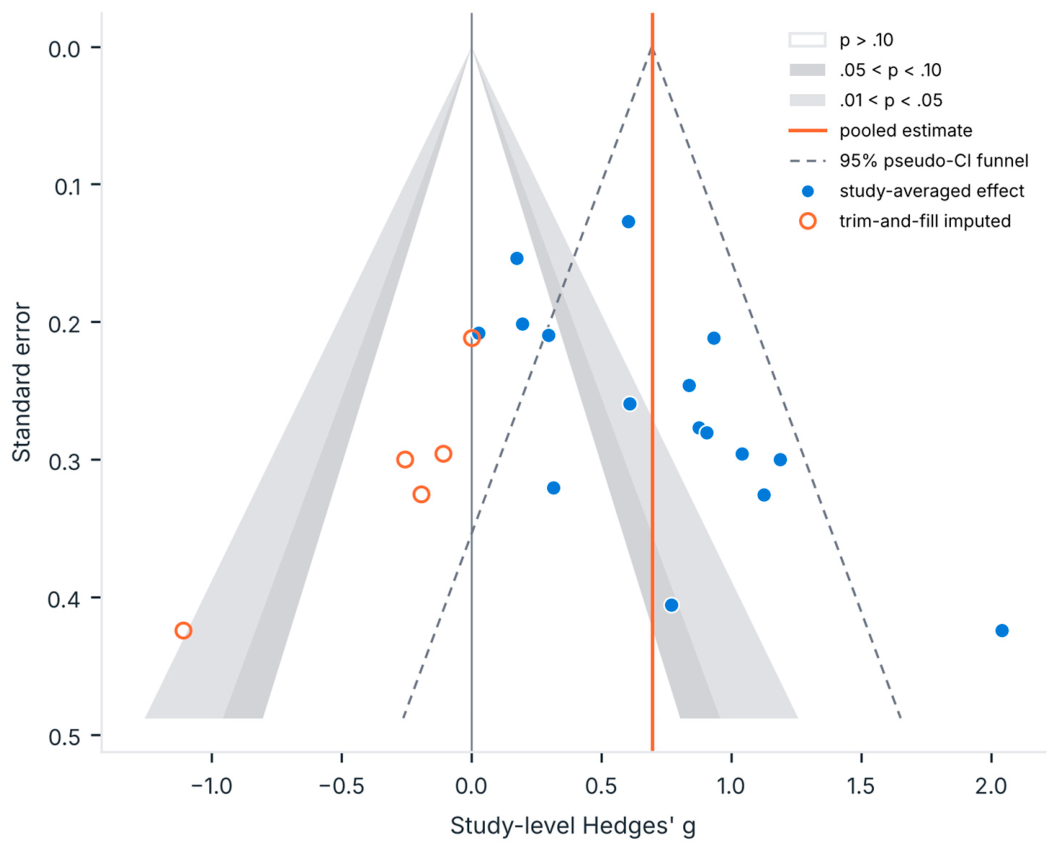
The contour-enhanced funnel plot of study-level effects (Figure 4) was asymmetric, with the small, imprecise studies concentrated at large positive values. The multilevel Egger regression confirmed a significant relation between effect size and standard error (slope = 3.11, SE = 0.95, p = .002). The PET estimate of the effect at zero standard error was −0.27 [−0.89, 0.34], and the PEESE estimate was 0.12 [−0.22, 0.46]; because the PET estimate was not significantly different from zero, PET is the conditional estimate. It means that a null effect cannot be excluded once the small-study relation is removed, not that the effect is null; with 16 studies, PET–PEESE is itself unreliable, such that this estimate marks the uncertainty rather than locating the effect. The small-study relation was not confined to the passive comparison studies, which gave the largest effects: it was present within the active comparison studies (Egger-type slope 3.83 [1.71, 5.94], p < .001; k = 62, m = 12) and absent within the four passive comparison studies (−0.85 [−4.87, 3.16], p = .59), such that the asymmetry cannot be attributed to that design difference. Trim-and-fill imputed five studies to the left of the funnel and reduced the study-level estimate from 0.68 to 0.48, although the number of imputed studies varied with the assumed pre-test–post-test correlation (0 at ρ = 0.30, 4 at ρ = 0.70), which illustrates the instability of that method in a set of 16 studies. Taken together, the sensitivity analyses locate the plausible average effect below the main estimate: the subsets least exposed to design and reporting bias (randomized studies, effects not derived from inferential statistics) and the bias-corrected estimates place the average for the set as a whole, which is dominated by creative-thinking outcomes, between roughly zero and 0.6 rather than at 0.70, and the executive function estimate, already small, rests on four studies with mixed within-study profiles. On the GRADE-style appraisal of Supplementary Table S8, the certainty of the evidence is low for creative-thinking outcomes, downgraded for risk of bias and for suspected publication bias, and very low for executive function outcomes, downgraded further for imprecision and inconsistency.
Figure 4.
Contour-enhanced funnel plot of the 16 study-averaged effects (filled circles) against their standard errors. Shaded regions are the significance contours centered on zero (white, p > .10; dark gray, .05 < p < .10; light gray, .01 < p < .05; white outside, p < .01). The orange line marks the three-level pooled estimate (g = 0.70), and the dashed lines its 95% pseudo-confidence funnel; hollow circles are the five studies imputed by trim-and-fill on the left side of the funnel. The plot was computed from the effect-size data with a Python (matplotlib) script (run_analysis.py) written with the assistance of Claude (Anthropic; Claude Fable 5.1) from the authors’ specifications; no image-generating model was used, and the script is available in Supplementary Material S3.
4. Discussion
4.1. Summary of Findings
Sixteen controlled studies, published over 17 years in 12 countries and spanning mean ages from 6 to 74, have asked whether placing learners in the real-time regime of improvisation changes how they perform on tests of executive function or creative thinking afterwards. Pooled, they give a moderate-to-large average effect (g = 0.70), but the size of that number is the least secure part of the result. The effect is carried almost entirely by creative-thinking outcomes (g = 0.82); the executive function estimate (g = 0.19) rests on four studies with mixed profiles and does not exclude zero. The between-study heterogeneity is substantial, such that a new study could plausibly find no effect (95% prediction interval −0.21 to 1.60); the funnel plot is asymmetric; and the subsets least exposed to design and reporting bias, together with the bias-corrected estimators, place the average somewhere between zero and about 0.6 standard deviations. The analyses answer the four questions posed in the Introduction in the following terms (Table 5). Transfer to creative-thinking tests is positive in the pooled estimate, at low certainty, whereas transfer to executive function tests is small and unproven (H1). The profile of transfer is only partly the one the model predicts: originality exceeded fluency in the point estimate, and the flexibility effects were positive in three of the four executive function studies, but neither contrast is statistically reliable, flexibility did not exceed fluency, the inhibition results are mixed, and no working memory effect could be estimated because the two working memory outcomes were reported only as non-significant (H2, H3). The effects were somewhat larger against passive than against active comparisons and showed no detectable dependence on dose, on whether improvisation was experienced once or over months, or on the performing art in which improvisation was practiced, although with 16 studies, these moderator tests could not have excluded differences of about half a standard deviation.
For practice, the defensible reading is therefore that a short improvisation activity raises performance on a divergent-thinking test taken immediately afterwards, by an amount that the bias-corrected estimates place between zero and about 0.6 standard deviations rather than at the pooled 0.70, and that whether improvisation trains executive capacity has not yet been adequately tested; the evidence base is small, heterogeneous, and affected by small-study effects, and these properties limit every stronger statement.
4.2. The Transfer Profile and the Temporal Regime Model
The model made four predictions about the profile of transfer (H2, H3, H5, and H6 in Table 5), and the results bear on each in a different way.
The first (H2) was that the real-time regime exercises inhibition and flexible switching but not the holding of candidates in working memory, such that transfer should appear on the former and not on the latter. The four executive function studies are partly consistent with this. The clearest positive effects fell on switching: perseverative errors on the Wisconsin Card Sorting Test in adolescents, the Rule Shift Cards test in older adults who practiced improvisation-based contemporary dance, and a design fluency composite that loads on inhibition and switching; clock drawing also improved. Inhibition was mixed, with a positive Stroop effect in adolescents but opposite-signed Stroop indices in the older-adult dance study, and the attention measures did not move. The two working memory outcomes in the set were both reported as null. The consistency should not be overstated: with four studies and a different task battery in each, the profile is descriptive and hypothesis-generating rather than a tested result. A pattern of this kind can arise when working memory span tasks are simply less sensitive to any intervention than interference tasks are, and the number of working memory outcomes is too small to separate the two explanations. Both outcomes were, moreover, forward digit span, which indexes short-term storage rather than the controlled-attention component of working memory that the model has in mind (Engle et al., 1999); whether real-time production leaves complex-span performance untouched is therefore untested rather than refuted. With four studies, a different battery in each, and no adequate working memory measure, the model’s predictions about executive functions remain untested, and the observations above are descriptive. What the pattern does establish is that the only direct classroom comparison of improvisation with matched non-improvisational instruction (Norgaard et al., 2019) produced its effects on the measures that the model identifies, and that no study has yet found transfer from improvisation to working memory capacity.
The second prediction (H3) concerned the divergent-thinking profile: larger effects on the indices that register departure from habitual responses than on the rate of production. Originality moved most and elaboration least, which is the expected order, but flexibility did not exceed fluency, and the differences between subtypes were small relative to their uncertainty. A general practice effect offers a simple account of the fluency result: improvisation is practice in producing many responses, and fluency rose by about as much as flexibility. The data cannot distinguish a profile from a uniform shift across indices, and a uniform shift is what one would expect if the main mechanism were motivational or attitudinal rather than cognitive—for instance, if improvisation games lower the self-censorship that suppresses unusual responses in a subsequent test (Lewis & Lovatt, 2013; Felsman et al., 2020). The strongest subtype effect, on domain-specific products, is also the least diagnostic: musical creativity after improvisation lessons (Koutsoupidou & Hargreaves, 2009), motor creativity after movement improvisation (Méndez Martínez & Fernandez-Rio, 2021; Richard et al., 2021), and consensually rated products after theater games (Sowden et al., 2015) are near-transfer outcomes, measured with tasks that resemble the training, and the model expects compiled repertoire to show first in the domain where it was compiled. They are also near in a second sense: an improvised musical or movement response rated by judges is itself produced in the real-time regime, whereas a divergent-thinking test draws the participant into the deliberative regime, such that the gradient from products to divergent-thinking scores confounds domain congruence with regime congruence, and the two cannot be separated with the present data.
The third prediction (H5, exploratory in the protocol) distinguished an acute state effect from a training effect and expected training effects to be larger. They were not: the five single-session experiments produced effects of the same order as the 11 multi-session programs, and within the programs, neither the number of sessions nor the total minutes predicted effect size. This comparison cannot be read as evidence about the two formats, however, because format and design are almost perfectly confounded: all five single-session experiments were randomized, and only one of the training programs was. Within the randomized studies, the contrast rests on that single program (Section 3.4), and the non-randomized training studies, which gave the larger effects, are also those most exposed to selection and expectancy effects. The absence of a dose–response relation, which the present data assert only within wide limits, is compatible with the view that much of what the creative-thinking tests register is an acute effect, a shift in the subsequent deliberative regime test toward less typical responses produced by a brief period in which typical responses were not an option, but the data do not establish it. This reading is consistent with schema-based accounts of divergent production (Lewis & Lovatt, 2013) and with the meta-analytic finding that divergent-thinking scores depend on the time allowed for the test and on the instructions given (Said-Metwaly et al., 2020; Paek et al., 2021), because both locate the variable part of divergent production in the strategy brought to the test rather than in a stable capacity. Nor do they rule out a training effect: the training studies have not yet been designed to detect one, because none measured outcomes after a retention interval long enough to exclude the acute component; the longest intervals, about two weeks, were those of Santos et al. (2021) and West et al. (2017).
The fourth prediction (H6), that transfer should not depend on the performing art in which improvisation is practiced, was supported in the limited sense that musical, theatrical, and dance or movement improvisation gave statistically indistinguishable effects and that the verbal and mixed programs fell within the same range. The affordances that define the regime, the model holds, belong to the window and not to the medium; the data do not contradict this, and they could not have confirmed it strongly with five musical, eight theatrical, and four movement studies, because differences of half a standard deviation between domains remain within the confidence intervals of the pairwise contrasts.
4.3. Implications for the Intelligence–Creativity Relation
The model links intelligence to creativity through executive attention, which it treats as the channel through which fluid ability contributes to creative performance in the deliberative regime and which, in the real-time regime, is exercised by the continuous demands of constrained retrieval, inhibition, and switching. The meta-analysis was designed to look for the trace that such exercise should leave on executive measures. The trace is there in outline and small in magnitude. An estimate of 0.19, bounded by zero on one side and by four studies on the other, is of the same order as the effects reported in meta-analyses of music training on cognitive outcomes, which are small overall and shrink toward zero in the best-designed studies (Sala & Gobet, 2020; Román-Caballero et al., 2022), and it is of the same order as the near-transfer effects that executive function training produces in children, which do not generalize far (Diamond & Ling, 2016; Kassai et al., 2019). On the present evidence, four studies with mixed profiles, there is no support for improvisation as a route to intelligence; the question is open rather than closed.
Two features of the pattern nevertheless matter for theory. The first is the contrast within Norgaard et al. (2019): students who improvised and students who received the same instruction without improvising differed on flexibility and inhibition, such that the real-time production of material, and not the music, was the active ingredient. If this replicates, it supports the claim that the regime, rather than the domain, is the unit at which transfer should be analyzed, and it suggests why general music training meta-analyses find little: they pool instruction that enters the real-time regime with instruction that never does. The second is that no study has yet found an effect on working memory, which is what the model predicts and what a general “arts build cognition” account does not; because the only outcomes were two simple span measures reported as non-significant, this is an absence of evidence and not a tested null. The real-time regime forbids exactly the operation that working memory tasks measure, the holding and comparison of several candidates before one is fixed, and an activity cannot be expected to train what it forbids. The implication for the intelligence–creativity relation is that the executive processes that carry it are not a single quantity that any demanding activity increases, and that studies of the relation should specify which process the task recruits and in which regime.
4.4. Implications for Education
For practice, the results support a modest and specific claim. A short improvisation activity, whether in music, drama, or movement, raised scores on creative-thinking tests taken immediately afterwards in every one of the 12 studies that measured them (study-level g from 0.17 to 2.04), although the bias-corrected estimates place the average between zero and about 0.6 standard deviations, and the five single-session experiments, all randomized, obtained effects of the same size as the multi-session programs. That comparison is imprecise and confounded with design, and it does not establish that a term adds nothing; what it shows is that an immediate effect has been obtained from a single session in five randomized experiments, such that a teacher who wants that effect does not need a program to obtain it, whereas whether a program adds anything durable is untested. This makes improvisation a cheap way of shifting students out of habitual responding before an ideation task, which is a legitimate pedagogical use. It does not make improvisation a training program for executive functions or for creativity as a stable disposition. On present evidence, improvisation should not be presented as a tool for developing executive functions: the executive function estimate rests on four studies, the clearest effects concern flexible switching, the inhibition results are mixed, and the question of working memory is untested rather than answered, because no study has measured working memory capacity with adequate power. The evidence for durable change is absent rather than negative, and the one creative-thinking study with a delayed assessment found an effect on figural creativity about two weeks after the last session (West et al., 2017) that no other study has yet tried to replicate.
The model adds a principle of sequencing that the included studies did not test but that follows from their results. Because real-time production draws on compiled material, instruction that builds a repertoire of patterns is not a shortcut around creativity but its precondition, and because the regime can be entered by shortening the window, a task can begin in the deliberative regime, where a student can select among candidates with executive support, and the window can then be shortened step-by-step until selection must happen in real time. In a music class, this takes the form of composing a short phrase with time and no notation, then preparing one during a single hearing of the form, and then trading phrases without pause; in a drama class, it takes the form of scripting a scene, then outlining it, and then playing it unscripted. The outcomes that should be monitored under such a sequence are the ones that the model identifies, inhibition and switching, and the outcomes that should not be expected to move are span measures.
A final educational implication concerns assessment. Divergent-thinking tests sample the deliberative regime. The present results show that their scores respond to a few minutes of real-time production, which suggests that part of what they measure is a transient strategy rather than a stable capacity, and which is a reason to assess real-time creative ability with real-time tasks.
4.5. Limitations
The limitations of this synthesis are those of its evidence base and of its own procedure. The evidence base is small: 16 studies, six of them randomized, with a median of 22 participants per condition. Small-study effects were pronounced, and the conditional PET estimate was not distinguishable from zero. We do not interpret this as proof that the true effect is zero, because PET–PEESE is itself unreliable with 16 studies, but the asymmetry was present within the active comparison studies and not concentrated in the passive comparison studies that gave the largest effects (Section 3.5), such that it cannot be explained by that design difference, and selective reporting remains a plausible part of it alongside other differences between small and large studies. We therefore treat the pooled estimate of 0.70 as an upper bound rather than as a point estimate. Ten of the 16 studies allocated intact groups or self-selected volunteers, or did not state how groups were formed; no randomized study described how its allocation sequence was generated; and 12 studies were rated at high risk of bias on at least one item (Supplementary Table S5b); the risk that the pooled estimate is inflated by non-random allocation is therefore not hypothetical, and expectancy and demand effects are difficult to exclude when the comparison activity is less engaging than the improvisation condition (Boot et al., 2013); the four studies with passive comparisons gave the largest effects. In three studies, the improvisation group started about 0.8 pooled standard deviations lower than the comparison group on an outcome (Section 3.2); with effect sizes based on the pre-test–post-test change, part of the larger gain of such a group may reflect regression to the mean, which would inflate those effects. The GRADE-style appraisal of Supplementary Table S8 summarizes these concerns: the certainty of the evidence is low for creative-thinking outcomes and very low for executive function outcomes, and the appraisal is itself informal, because the tool was designed for randomized evidence and the present set mixes designs.
Seventeen of the 68 effect sizes were derived from F, t, or rank statistics rather than from means and standard deviations, and a further nine were taken from reported standardized differences; the derivations required assumptions, most consequentially a pre-test–post-test correlation of 0.50, a value that the test statistics of the included studies themselves support (Section 2.6), and the estimate without the derived effects was 0.52. Eight outcomes were reported only as non-significant and could enter the analysis only as zeros. Executive function outcomes were measured in four studies, with different tasks in each, such that the executive function analyses describe rather than test the predicted profile. Every outcome was measured within two weeks of the intervention, and all but two within a week, which leaves the question of durability open. Prior experience of improvisation was stated in only six studies, and where it was stated that the participants were mostly novices in improvisation (Section 3.2); the estimates therefore describe chiefly what improvisation does for learners new to it, and whether experienced improvisers show more or less transfer could not be examined. Because the model’s thresholds move with expertise, pooling samples of different experience is a limitation of the test and not only of the description; removing the two samples that included experienced performers left the estimates unchanged (Section 3.5), but with experience unreported in seven studies, this does not settle the matter.
Three limitations belong to the review itself. The search covered PubMed, ERIC, Crossref, and Scopus, supplemented by citation chasing and multilingual web searches, but Web of Science could not be searched, six reports could not be retrieved (two of them, on the evidence of their abstracts, potentially eligible controlled studies), and the gray literature of arts education (conference papers and theses in languages other than those searched) is unlikely to have been covered fully. The likely direction of the resulting bias can be stated. Both potentially eligible reports describe positive effects in their abstracts (Mourey, 2020; Zhang, 2023), one of them persisting four months after a 10-week course, so their omission has not inflated the pooled estimate, although it has left the durability question thinner than it need be; the unreached gray literature, on the usual pattern of selective publication, is more likely to hold null results, so incomplete coverage biases the estimate upward, in the direction that the small-study analyses already indicate and the bias-corrected estimates already discount. Second, the eligibility criterion that improvisation be the defining component of the intervention, although fixed in the protocol before screening (Supplementary Material S1), required judgment at the boundary with creative-drama and multimodal programs, which share many exercises with improvisation training; the broad-definition sensitivity analysis shows that the two programs on the far side of that boundary did not change the estimates, but a review that drew the boundary elsewhere could include more studies and reach a different number. Third, screening and extraction were performed with the assistance of generative AI tools, and we found during the work that summaries of articles produced by such tools can contain fabricated statistics; every value in the coding sheet was therefore taken from the published article or its page images, every value was checked against the source a second time (Section 2.4), and the extracted values were tested for consistency with the test statistics the sources report. The screening was checked at revision: when the second author, without AI tools, re-screened a random sample of 200 excluded records mixed with the records that had been sought, none of the 200 would have qualified for inclusion (upper 95% bound 1.8%), which makes it unlikely that the AI-assisted screening excluded eligible studies in appreciable numbers (Section 3.1). The second extraction was performed by the second author with the assistance of a separate instance of the same AI tool and was checked by her against the PDFs; it was independent of the first extraction, and the two agreed on every raw value that they both recorded, but it was not blind double coding by two human coders, and the low agreement of the independent risk-of-bias ratings before consensus (55%; Cohen’s κ = 0.26) shows how much judgment the items require and means that the ratings should be read as consensus judgments, not as independently replicated ones. Both extractions were AI-assisted, and the checks described in Section 2.4 reduce but cannot remove the possibility that a fabricated or misread value went undetected; the checks that do not rely on an AI tool are the first author’s own check of the 20 most fragile values, the second author’s check of her extraction against each PDF, and the consistency of the extracted values with the test statistics that the sources report. We report this procedure in full, because the reliability of AI-assisted extraction is itself an open question; the coding sheet, the second author’s workbook, and the verification log are provided so that readers can audit every value and every resolution. Finally, no included study measured intelligence, so the synthesis bears on the executive processes through which the model links intelligence to creativity and not on that link itself, and the meta-analysis tests the model at one boundary only, that between the real-time and the deliberative regimes, and it tests it indirectly, through the profile of transfer rather than through any measurement of the resources engaged within a window or of the thresholds that separate the regimes; no included study measured outcomes in the distributed regime, and the model’s claims about evaluative knowledge and metacognitive regulation in that regime are not tested here.
4.6. Future Directions
The most useful next study is not another small comparison of an improvisation class with a passive control. Three designs would resolve the questions that the present synthesis leaves open. The first is a randomized comparison of improvisation-based instruction with matched instruction in the same domain that never requires real-time production, on the pattern of Norgaard et al. (2019), with a pre-registered executive function battery that includes inhibition, switching, and working memory span, and with outcomes assessed both immediately and after a retention interval long enough to exclude the acute component. The second is a dose–response design within a single program, which no study has yet attempted. The third is a within-person paradigm in which the same creative task is performed under windows of different length, so that the resource profile of each regime can be measured directly rather than inferred from transfer; the model’s central prediction, that the contribution of fluid intelligence to creative performance rises and then falls as the window lengthens, is testable only in such a design, and so are the two thresholds the model posits, the cycle threshold below which no candidate can be revised and the offloading threshold above which external representation takes over maintenance, whose locations in any given task remain to be measured rather than assumed.
The model’s claims about the real-time regime are not specific to the arts, and a non-musical test would be informative. Any task in which responses must be timed to an external stream, such as synchronizing and continuing taps to a changing beat, places the performer in the real-time regime without any artistic content, and the model predicts that performance in such tasks should relate to inhibition and switching and should be largely independent of working memory span, whereas the same participants’ divergent-thinking scores under generous time limits should relate to span. A study of this kind, in children or adults, would test the mechanism this meta-analysis could only trace.
5. Conclusions
Across 16 controlled studies, instruction that places learners in the real-time regime of improvisation raised scores on tests of creative thinking, by an amount that remains uncertain: the pooled estimate (g = 0.70) is an upper bound, and the bias-corrected estimates lie between zero and about half a standard deviation (−0.27, 0.12, and 0.48). It left at most a small trace on tests of executive function, and with four studies and no adequate working memory measure, the model’s predictions about executive functions remain untested. The profile of that trace, clearest for flexible switching and mixed for inhibition, with no estimable effect on working memory, is partly the one that the temporal-regime model predicts, although none of the profile contrasts is statistically reliable (Table 5), and the absence of a detectable difference between musical, theatrical, and movement improvisation is consistent with the model’s claim that the regime, not the medium, is what transfers, although the dance and verbal subsets are too small for that equivalence to count as established, and the larger effects on domain-specific products cannot separate congruence of domain from congruence of regime. Single sessions and long programs gave effects of the same order, but because the single-session studies were the randomized ones, that comparison cannot tell an acute shift away from habitual responding from a trained capacity; what it does show is that the training studies have not yet been designed to detect a training effect. These conclusions concern improvisation in the performing arts, where the output unfolds in time and cannot be withdrawn, and not creative practices whose products can be revised before they are shown. The evidence base is too small, too heterogeneous, and too exposed to small-study effects to support stronger conclusions, and its most important finding may be what it lacks: a randomized comparison with an active control, a working memory outcome measured with adequate power, and a retention interval. No included study measured intelligence. Those are the studies that would decide whether improvisation exercises the executive processes through which, on the model, intelligence contributes to creativity, or merely induces, for the duration of a session, a shift in strategy that the deliberative regime does not otherwise elicit. The model’s third regime, in which evaluative knowledge and metacognitive regulation are expected to carry creative quality, awaits a test of its own.
Supplementary Materials
The following supporting information can be downloaded at: https://www.mdpi.com/article/10.3390/jintelligence14110306/s1, S1, review protocol as written before screening, search documentation, and departures from the protocol; S2, effect size derivations for every included effect (Table S2); S3, coding sheet (CSV), record lists of all database searches, analysis code (Python), and the verification log; S4, moderator analyses for creative-thinking outcomes (Table S4); S5, reports excluded at full-text assessment with reasons and reports not retrieved (Table S5a), and risk-of-bias ratings (Table S5b); S6, sensitivity of all estimates to the assumed pre-test–post-test correlation (Table S6); S7, PRISMA 2020 checklist; S8, GRADE-style appraisal of the certainty of the evidence (Table S8).
Author Contributions
Conceptualization, K.A.T.; methodology, K.A.T. and S.S.N.; investigation (search, screening, and first data extraction), K.A.T.; validation (independent second extraction and risk-of-bias rating), S.S.N.; formal analysis, K.A.T.; data curation, K.A.T. and S.S.N.; writing—original draft preparation, K.A.T.; writing—review and editing, S.S.N. and K.A.T.; visualization, K.A.T.; project administration, K.A.T. All authors have read and agreed to the published version of the manuscript.
Funding
This research received no external funding.
Institutional Review Board Statement
Not applicable. The study is a meta-analysis of previously published data and involved no new data collection from human participants.
Informed Consent Statement
Not applicable.
Data Availability Statement
All data analyzed in this study were extracted from published reports and are provided in full in the Supplementary Materials (coding sheet and effect size derivations), together with the analysis code that reproduces every table and figure; the same archive (Supplementary Material S3) is openly available at Zenodo (version 3.0, revised, https://doi.org/10.5281/zenodo.24157009; the version cited at submission, https://doi.org/10.5281/zenodo.23422048, remains available, and https://doi.org/10.5281/zenodo.23422047 resolves to the latest version).
Acknowledgments
During the preparation of this manuscript, the authors used Claude (Anthropic; Claude Fable 5.1, accessed September–October 2026) for the following purposes: (i) It was used for running and recording the database searches, retrieving records and open-access full texts, and assisting the first author in title/abstract screening and in the extraction of the design characteristics and statistics from the included reports, with every derived or image-sourced value checked by the first author against the source; the second author performed an independent second extraction of all included studies except Richard et al. (2021), whose full text was not available to her, with the assistance of a separate instance of Claude and checked it against the PDFs, while an earlier partial re-extraction of the design characteristics of eight studies was performed with a different generative AI tool (Grok, xAI), and discrepancies between the extractions were resolved by the authors against the original reports. (ii) It was also used for writing and validating the analysis code against the reference implementation in the R package metafor on published example datasets. (iii) It was used for drafting and language editing the text under the authors’ direction. (iv) It was used for writing the Python (matplotlib) scripts that draw Figure 1, Figure 2, Figure 3 and Figure 4 from the authors’ specifications; no figure was produced by an image-generating model. No single prompts were used for the figures: the specifications were given step by step, in Turkish, in the course of a working conversation. In substance, the authors asked for a schematic of the three resource curves across the temporal window on a logarithmic axis, with the two thresholds and the three regimes of Table 1 marked (Figure 1); a PRISMA 2020 flow diagram filled in from the tallied record counts (Figure 2); a forest plot of the sample-level effect sizes grouped by outcome domain, with the pooled three-level estimates (Figure 3); and a contour-enhanced funnel plot of the study-averaged effects with the pooled estimate and the studies imputed by trim-and-fill (Figure 4). The figures are fully determined by the scripts in Supplementary Material S3. The authors have reviewed and edited all the output and take full responsibility for the content of this publication, including the eligibility decisions, the extracted data, and the interpretation of the results.
Conflicts of Interest
The authors declare no conflicts of interest.
References
- Alhadeff-Jones, M. (2017). Time and the rhythms of emancipatory education: Rethinking the temporal complexity of self and society. Routledge. [Google Scholar] [CrossRef] [Scilit]
- Baer, M., & Oldham, G. R. (2006). The curvilinear relation between experienced creative time pressure and creativity: Moderating effects of openness to experience and support for creativity. Journal of Applied Psychology, 91(4), 963–970. [Google Scholar] [CrossRef] [Scilit]
- Beaty, R. E., Smeekens, B. A., Silvia, P. J., Hodges, D. A., & Kane, M. J. (2013). A first look at the role of domain-general cognitive and creative abilities in jazz improvisation. Psychomusicology: Music, Mind, and Brain, 23(4), 262–268. [Google Scholar] [CrossRef] [Scilit]
- Benedek, M., Jauk, E., Sommer, M., Arendasy, M., & Neubauer, A. C. (2014). Intelligence, creativity, and cognitive control: The common and differential involvement of executive functions in intelligence and creativity. Intelligence, 46, 73–83. [Google Scholar] [CrossRef] [Scilit]
- Berliner, P. F. (1994). Thinking in jazz: The infinite art of improvisation. University of Chicago Press. [Google Scholar]
- Biasutti, M. (2017). Teaching improvisation through processes: Applications in music education and implications for general education. Frontiers in Psychology, 8, 911. [Google Scholar] [CrossRef] [Scilit]
- Boot, W. R., Simons, D. J., Stothart, C., & Stutts, C. (2013). The pervasive problem with placebos in psychology: Why active control groups are not sufficient to rule out placebo effects. Perspectives on Psychological Science, 8(4), 445–454. [Google Scholar] [CrossRef] [Scilit]
- Borenstein, M., Hedges, L. V., Higgins, J. P. T., & Rothstein, H. R. (2009). Introduction to meta-analysis. Wiley. [Google Scholar] [CrossRef] [Scilit]
- Bugos, J. A., Gbadamosi, A., Laesker, D., Chow, R., Sirocchi, S., Norgaard, M., Ghent, J., & Alain, C. (2024). Jazz piano training modulates neural oscillations and executive functions in older adults. Music Perception, 41(5), 378–392. [Google Scholar] [CrossRef] [Scilit]
- Cai, Y., Kang, D., & Xu, X. (2025). Boosting executive function in children aged 3–12 through musical training: A three-level meta-analysis. Frontiers in Psychology, 16, 1659927, (Erratum in 2026, Frontiers in Psychology, 17, 1773874). [Google Scholar] [CrossRef] [Scilit]
- Cattell, R. B. (1963). Theory of fluid and crystallized intelligence: A critical experiment. Journal of Educational Psychology, 54(1), 1–22. [Google Scholar] [CrossRef] [Scilit]
- Chandler, M. D. (2018). Improvisation in elementary general music: A review of the literature. Update: Applications of Research in Music Education, 37(1), 42–48. [Google Scholar] [CrossRef] [Scilit]
- Cheung, M. W.-L. (2014). Modeling dependent effect sizes with three-level meta-analyses: A structural equation modeling approach. Psychological Methods, 19(2), 211–229. [Google Scholar] [CrossRef] [Scilit]
- Coubard, O. A., Duretz, S., Lefebvre, V., Lapalus, P., & Ferrufino, L. (2011). Practice of contemporary dance improves cognitive flexibility in aging. Frontiers in Aging Neuroscience, 3, 13. [Google Scholar] [CrossRef] [Scilit]
- De Dreu, C. K. W., Nijstad, B. A., Baas, M., Wolsink, I., & Roskes, M. (2012). Working memory benefits creative insight, musical improvisation, and original ideation through maintained task-focused attention. Personality and Social Psychology Bulletin, 38(5), 656–669. [Google Scholar] [CrossRef] [Scilit]
- Degé, F., & Frischen, U. (2022). The impact of music training on executive functions in childhood: A systematic review. Zeitschrift für Erziehungswissenschaft, 25(3), 579–602. [Google Scholar] [CrossRef] [Scilit]
- Diamond, A. (2013). Executive functions. Annual Review of Psychology, 64, 135–168. [Google Scholar] [CrossRef] [Scilit]
- Diamond, A., & Ling, D. S. (2016). Conclusions about interventions, programs, and approaches for improving executive functions that appear justified and those that, despite much hype, do not. Developmental Cognitive Neuroscience, 18, 34–48. [Google Scholar] [CrossRef] [Scilit]
- Duval, S., & Tweedie, R. (2000). Trim and fill: A simple funnel-plot-based method of testing and adjusting for publication bias in meta-analysis. Biometrics, 56(2), 455–463. [Google Scholar] [CrossRef] [Scilit]
- Engle, R. W., Tuholski, S. W., Laughlin, J. E., & Conway, A. R. A. (1999). Working memory, short-term memory, and general fluid intelligence: A latent-variable approach. Journal of Experimental Psychology: General, 128(3), 309–331. [Google Scholar] [CrossRef]
- Ericsson, K. A., & Kintsch, W. (1995). Long-term working memory. Psychological Review, 102(2), 211–245. [Google Scholar] [CrossRef] [Scilit]
- Felsman, P., Gunawardena, S., & Seifert, C. M. (2020). Improv experience promotes divergent thinking, uncertainty tolerance, and affective well-being. Thinking Skills and Creativity, 35, 100632. [Google Scholar] [CrossRef] [Scilit]
- Forthmann, B., Lips, C., Szardenings, C., Scharfen, J., & Holling, H. (2020). Are speedy brains needed when divergent thinking is speeded—Or unspeeded? The Journal of Creative Behavior, 54(1), 123–133. [Google Scholar] [CrossRef] [Scilit]
- Frith, E., Kane, M. J., Welhaf, M. S., Christensen, A. P., Silvia, P. J., & Beaty, R. E. (2021). Keeping creativity under control: Contributions of attention control and fluid intelligence to divergent thinking. Creativity Research Journal, 33(2), 138–157. [Google Scholar] [CrossRef] [Scilit]
- Gerwig, A., Miroshnik, K., Forthmann, B., Benedek, M., Karwowski, M., & Holling, H. (2021). The relationship between intelligence and divergent thinking—A meta-analytic update. Journal of Intelligence, 9(2), 23. [Google Scholar] [CrossRef] [Scilit]
- Gottfredson, L. S. (1997). Mainstream science on intelligence: An editorial with 52 signatories, history, and bibliography. Intelligence, 24(1), 13–23. [Google Scholar] [CrossRef] [Scilit]
- Guyatt, G. H., Oxman, A. D., Vist, G. E., Kunz, R., Falck-Ytter, Y., Alonso-Coello, P., & Schünemann, H. J. (2008). GRADE: An emerging consensus on rating quality of evidence and strength of recommendations. BMJ, 336(7650), 924–926. [Google Scholar] [CrossRef] [Scilit]
- Hainselin, M., Aubry, A., & Bourdin, B. (2018). Improving teenagers’ divergent thinking with improvisational theater. Frontiers in Psychology, 9, 1759. [Google Scholar] [CrossRef] [Scilit]
- Hansen, P., Climie, E. A., & Oxoby, R. J. (2020). The demands of performance generating systems on executive functions: Effects and mediating processes. Frontiers in Psychology, 11, 1894. [Google Scholar] [CrossRef] [Scilit]
- Harinck, F., & Dooren, L. (2023). Improvisation exercises increase negotiators’ divergent thinking, and sometimes their negotiation outcomes. The Journal of Creative Behavior, 57(4), 606–621. [Google Scholar] [CrossRef] [Scilit]
- Jauk, E., Benedek, M., Dunst, B., & Neubauer, A. C. (2013). The relationship between intelligence and creativity: New support for the threshold hypothesis by means of empirical breakpoint detection. Intelligence, 41(4), 212–221. [Google Scholar] [CrossRef] [Scilit]
- Jin, Z., Wu, H., Yin, J., Yu, X., & Luo, J. (2026). Unlocking creativity: Evidence that improvised physical activities foster divergent thinking in adolescents. Learning and Instruction, 102, 102296. [Google Scholar] [CrossRef] [Scilit]
- Johnson-Laird, P. N. (2002). How jazz musicians improvise. Music Perception, 19(3), 415–442. [Google Scholar] [CrossRef] [Scilit]
- Karakelle, S. (2009). Enhancing fluent and flexible thinking through the creative drama process. Thinking Skills and Creativity, 4(2), 124–129. [Google Scholar] [CrossRef] [Scilit]
- Karwowski, M., Dul, J., Gralewski, J., Jauk, E., Jankowska, D. M., Gajda, A., Chruszczewski, M. H., & Benedek, M. (2016). Is creativity without intelligence possible? A necessary condition analysis. Intelligence, 57, 105–117. [Google Scholar] [CrossRef] [Scilit]
- Kassai, R., Futo, J., Demetrovics, Z., & Takacs, Z. K. (2019). A meta-analysis of the experimental evidence on the near- and far-transfer effects among children’s executive function skills. Psychological Bulletin, 145(2), 165–188. [Google Scholar] [CrossRef] [Scilit]
- Kleinmintz, O. M., Goldstein, P., Mayseless, N., Abecasis, D., & Shamay-Tsoory, S. G. (2014). Expertise in musical improvisation and creativity: The mediation of idea evaluation. PLoS ONE, 9(7), e101568. [Google Scholar] [CrossRef] [Scilit]
- Koutsoupidou, T., & Hargreaves, D. J. (2009). An experimental study of the effects of improvisation on the development of children’s creative thinking in music. Psychology of Music, 37(3), 251–278. [Google Scholar] [CrossRef] [Scilit]
- Lewis, C., & Lovatt, P. J. (2013). Breaking away from set patterns of thinking: Improvisation and divergent thinking. Thinking Skills and Creativity, 9, 46–58. [Google Scholar] [CrossRef] [Scilit]
- Limb, C. J., & Braun, A. R. (2008). Neural substrates of spontaneous musical performance: An fMRI study of jazz improvisation. PLoS ONE, 3(2), e1679. [Google Scholar] [CrossRef] [Scilit]
- Méndez Martínez, E., & Fernandez-Rio, J. (2021). Effects of a theatrical improvisation programme on students’ motor creativity. Research in Drama Education: The Journal of Applied Theatre and Performance, 26(2), 268–282. [Google Scholar] [CrossRef] [Scilit]
- Miyake, A., Friedman, N. P., Emerson, M. J., Witzki, A. H., Howerter, A., & Wager, T. D. (2000). The unity and diversity of executive functions and their contributions to complex “frontal lobe” tasks: A latent variable analysis. Cognitive Psychology, 41(1), 49–100. [Google Scholar] [CrossRef] [Scilit]
- Morris, S. B. (2008). Estimating effect sizes from pretest-posttest-control group designs. Organizational Research Methods, 11(2), 364–386. [Google Scholar] [CrossRef] [Scilit]
- Mourey, J. A. (2020). Improv comedy and modern marketing education: Exploring consequences for divergent thinking, self-efficacy, and collaboration. Journal of Marketing Education, 42(2), 134–148. [Google Scholar] [CrossRef] [Scilit]
- Norgaard, M. (2011). Descriptions of improvisational thinking by artist-level jazz musicians. Journal of Research in Music Education, 59(2), 109–127, (Erratum in 2011, Journal of Research in Music Education, 59(3), 314). [Google Scholar] [CrossRef] [Scilit]
- Norgaard, M. (2014). How jazz musicians improvise: The central role of auditory and motor patterns. Music Perception, 31(3), 271–287. [Google Scholar] [CrossRef] [Scilit]
- Norgaard, M., Emerson, S. N., Dawn, K., & Fidlon, J. D. (2016). Creating under pressure: Effects of divided attention on the improvised output of skilled jazz musicians. Music Perception, 33(5), 561–570. [Google Scholar] [CrossRef] [Scilit]
- Norgaard, M., Stambaugh, L. A., & McCranie, H. (2019). The effect of jazz improvisation instruction on measures of executive function in middle school band students. Journal of Research in Music Education, 67(3), 339–354. [Google Scholar] [CrossRef] [Scilit]
- Nusbaum, E. C., Silvia, P. J., & Beaty, R. E. (2014). Ready, set, create: What instructing people to “be creative” reveals about the meaning and mechanisms of divergent thinking. Psychology of Aesthetics, Creativity, and the Arts, 8(4), 423–432. [Google Scholar] [CrossRef] [Scilit]
- Paek, S. H., Abdulla Alabbasi, A. M., Acar, S., & Runco, M. A. (2021). Is more time better for divergent thinking? A meta-analysis of the time-on-task effect on divergent thinking. Thinking Skills and Creativity, 41, 100894. [Google Scholar] [CrossRef] [Scilit]
- Page, M. J., McKenzie, J. E., Bossuyt, P. M., Boutron, I., Hoffmann, T. C., Mulrow, C. D., Shamseer, L., Tetzlaff, J. M., Akl, E. A., Brennan, S. E., Chou, R., Glanville, J., Grimshaw, J. M., Hróbjartsson, A., Lalu, M. M., Li, T., Loder, E. W., Mayo-Wilson, E., McDonald, S., … Moher, D. (2021). The PRISMA 2020 statement: An updated guideline for reporting systematic reviews. BMJ, 372, n71. [Google Scholar] [CrossRef] [Scilit]
- Peters, J. L., Sutton, A. J., Jones, D. R., Abrams, K. R., & Rushton, L. (2008). Contour-enhanced meta-analysis funnel plots help distinguish publication bias from other causes of asymmetry. Journal of Clinical Epidemiology, 61(10), 991–996. [Google Scholar] [CrossRef] [Scilit]
- Phipps, B. (2025). A narrative review of cognitive load and student motivation in jazz improvisation pedagogy. Research Studies in Music Education, 1–19. [Google Scholar] [CrossRef] [Scilit]
- Preckel, F., Wermer, C., & Spinath, F. M. (2011). The interrelationship between speeded and unspeeded divergent thinking and reasoning, and the role of mental speed. Intelligence, 39(5), 378–388. [Google Scholar] [CrossRef] [Scilit]
- Pressing, J. (1988). Improvisation: Methods and models. In J. A. Sloboda (Ed.), Generative processes in music: The psychology of performance, improvisation, and composition (pp. 129–178). Clarendon Press. [Google Scholar]
- Puryear, J. S., Urban, K., & Urban, M. (2026). Revisiting the four stages of creativity: The role of metacognition. The Journal of Creative Behavior, 60(3), e70126. [Google Scholar] [CrossRef] [Scilit]
- Richard, V., Ben-Zaken, S., Siekańska, M., & Tenenbaum, G. (2021). Effects of movement improvisation and aerobic dancing on motor creativity and divergent thinking. The Journal of Creative Behavior, 55(1), 255–267. [Google Scholar] [CrossRef] [Scilit]
- Rodriguez-Gomez, D. A., & Talero-Gutiérrez, C. (2022). Effects of music training in executive function performance in children: A systematic review. Frontiers in Psychology, 13, 968144. [Google Scholar] [CrossRef] [Scilit]
- Román-Caballero, R., Vadillo, M. A., Trainor, L. J., & Lupiáñez, J. (2022). Please don’t stop the music: A meta-analysis of the cognitive and academic benefits of instrumental musical training in childhood and adolescence. Educational Research Review, 35, 100436. [Google Scholar] [CrossRef] [Scilit]
- Rosen, D. S., Erickson, B., Kim, Y. E., Mirman, D., Hamilton, R. H., & Kounios, J. (2016). Anodal tDCS to right dorsolateral prefrontal cortex facilitates performance for novice jazz improvisers but hinders experts. Frontiers in Human Neuroscience, 10, 579. [Google Scholar] [CrossRef] [Scilit]
- Rosen, D. S., Kim, Y. E., Mirman, D., & Kounios, J. (2017). All you need to do is ask? The exhortation to be creative improves creative performance more for nonexpert than expert jazz musicians. Psychology of Aesthetics, Creativity, and the Arts, 11(4), 420–427. [Google Scholar] [CrossRef] [Scilit]
- Rosen, D. S., Oh, Y., Chesebrough, C., Zhang, F. Z., & Kounios, J. (2024). Creative flow as optimized processing: Evidence from brain oscillations during jazz improvisations by expert and non-expert musicians. Neuropsychologia, 196, 108824. [Google Scholar] [CrossRef] [Scilit]
- Rosen, D. S., Oh, Y., Erickson, B., Zhang, F. Z., Kim, Y. E., & Kounios, J. (2020). Dual-process contributions to creativity in jazz improvisations: An SPM-EEG study. NeuroImage, 213, 116632. [Google Scholar] [CrossRef] [Scilit]
- Runco, M. A., & Jaeger, G. J. (2012). The standard definition of creativity. Creativity Research Journal, 24(1), 92–96. [Google Scholar] [CrossRef] [Scilit]
- Ruscio, J. (2008). A probability-based measure of effect size: Robustness to base rates and other factors. Psychological Methods, 13(1), 19–30. [Google Scholar] [CrossRef] [Scilit]
- Sadler-Smith, E. (2015). Wallas’ four-stage model of the creative process: More than meets the eye? Creativity Research Journal, 27(4), 342–352. [Google Scholar] [CrossRef] [Scilit]
- Said-Metwaly, S., Fernández-Castilla, B., Kyndt, E., & Van den Noortgate, W. (2020). Testing conditions and creative performance: Meta-analyses of the impact of time limits and instructions. Psychology of Aesthetics, Creativity, and the Arts, 14(1), 15–38. [Google Scholar] [CrossRef] [Scilit]
- Sala, G., & Gobet, F. (2020). Cognitive and academic benefits of music training with children: A multilevel meta-analysis. Memory & Cognition, 48(8), 1429–1441. [Google Scholar] [CrossRef] [Scilit]
- Santos, M. R. d., Krug, M. S., Brandão, M. R., Leon, V. S. d., Martinotto, J. C., Fonseca, J. D. d., Brasil, A. C., Machado, A. G., & Oliveira, A. A. d. (2021). Effects of musical improvisation as a cognitive and motor intervention for the elderly. Estudos de Psicologia (Campinas), 38, e190132. [Google Scholar] [CrossRef] [Scilit]
- Sawyer, R. K. (2021). The iterative and improvisational nature of the creative process. Journal of Creativity, 31, 100002. [Google Scholar] [CrossRef] [Scilit]
- Schön, D. A. (1983). The reflective practitioner: How professionals think in action. Basic Books. [Google Scholar]
- Schwenke, D., Dshemuchadse, M., Rasehorn, L., Klarhölter, D., & Scherbaum, S. (2021). Improv to improve: The impact of improvisational theater on creativity, acceptance, and psychological well-being. Journal of Creativity in Mental Health, 16(1), 31–48. [Google Scholar] [CrossRef] [Scilit]
- Scott, G., Leritz, L. E., & Mumford, M. D. (2004). The effectiveness of creativity training: A quantitative review. Creativity Research Journal, 16(4), 361–388. [Google Scholar] [CrossRef] [Scilit]
- Shipstead, Z., Harrison, T. L., & Engle, R. W. (2016). Working memory capacity and fluid intelligence: Maintenance and disengagement. Perspectives on Psychological Science, 11(6), 771–799. [Google Scholar] [CrossRef] [Scilit]
- Sio, U. N., & Lortie-Forgues, H. (2024). The impact of creativity training on creative performance: A meta-analytic review and critical evaluation of 5 decades of creativity training studies. Psychological Bulletin, 150(5), 554–585. [Google Scholar] [CrossRef] [Scilit]
- Sio, U. N., & Ormerod, T. C. (2009). Does incubation enhance problem solving? A meta-analytic review. Psychological Bulletin, 135(1), 94–120. [Google Scholar] [CrossRef] [Scilit]
- Sowden, P. T., Clements, L., Redlich, C., & Lewis, C. (2015). Improvisation facilitates divergent thinking and creativity: Realizing a benefit of primary school arts education. Psychology of Aesthetics, Creativity, and the Arts, 9(2), 128–138. [Google Scholar] [CrossRef] [Scilit]
- Stanley, T. D., & Doucouliagos, H. (2014). Meta-regression approximations to reduce publication selection bias. Research Synthesis Methods, 5(1), 60–78. [Google Scholar] [CrossRef] [Scilit]
- Van den Noortgate, W., López-López, J. A., Marín-Martínez, F., & Sánchez-Meca, J. (2013). Three-level meta-analysis of dependent effect sizes. Behavior Research Methods, 45(2), 576–594. [Google Scholar] [CrossRef] [Scilit]
- Viechtbauer, W. (2010). Conducting meta-analyses in R with the metafor package. Journal of Statistical Software, 36(3), 1–48. [Google Scholar] [CrossRef] [Scilit]
- Wallas, G. (1926). The art of thought. Jonathan Cape. [Google Scholar]
- Weiss, S., Steger, D., Schroeders, U., & Wilhelm, O. (2020). A reappraisal of the threshold hypothesis of creativity and intelligence. Journal of Intelligence, 8(4), 38. [Google Scholar] [CrossRef] [Scilit]
- West, S., Hoff, E., & Carlsson, I. (2017). Enhancing team creativity with playful improvisation theater: A controlled intervention field study. International Journal of Play, 6(3), 283–293. [Google Scholar] [CrossRef] [Scilit]
- Yanicheva, T. G., & Nikitina, S. V. (2020). Trening akterskoy improvizatsii kak instrument razvitiya kreativnosti u predstaviteley vozrasta ranney vzroslosti [Acting improvisation training as a tool for creativity development in early adulthood]. Peterburgskiy Psikhologicheskiy Zhurnal, 33, 61–74. [Google Scholar]
- Zhang, C. (2023). The role of musical improvisation in the development of creative thinking in children. Cultura y Educación, 35(3), 535–561. [Google Scholar] [CrossRef] [Scilit]
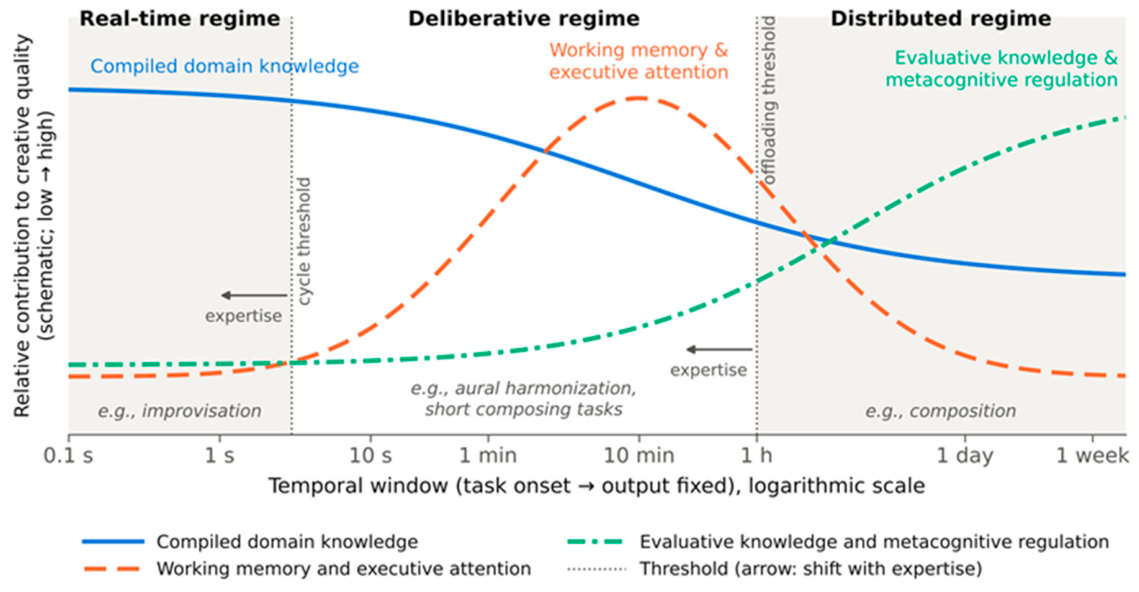
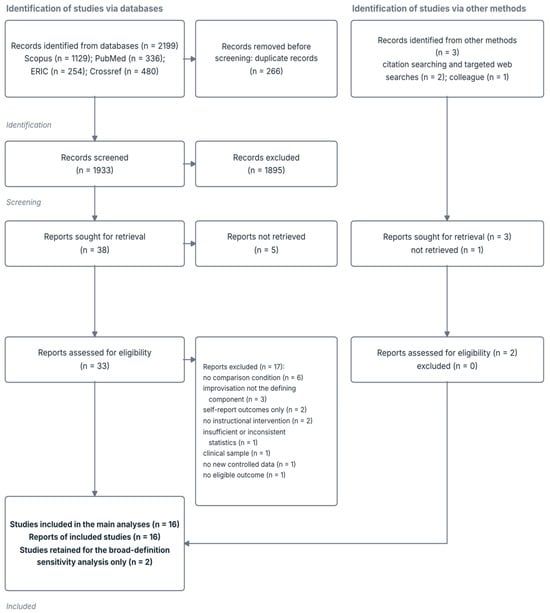
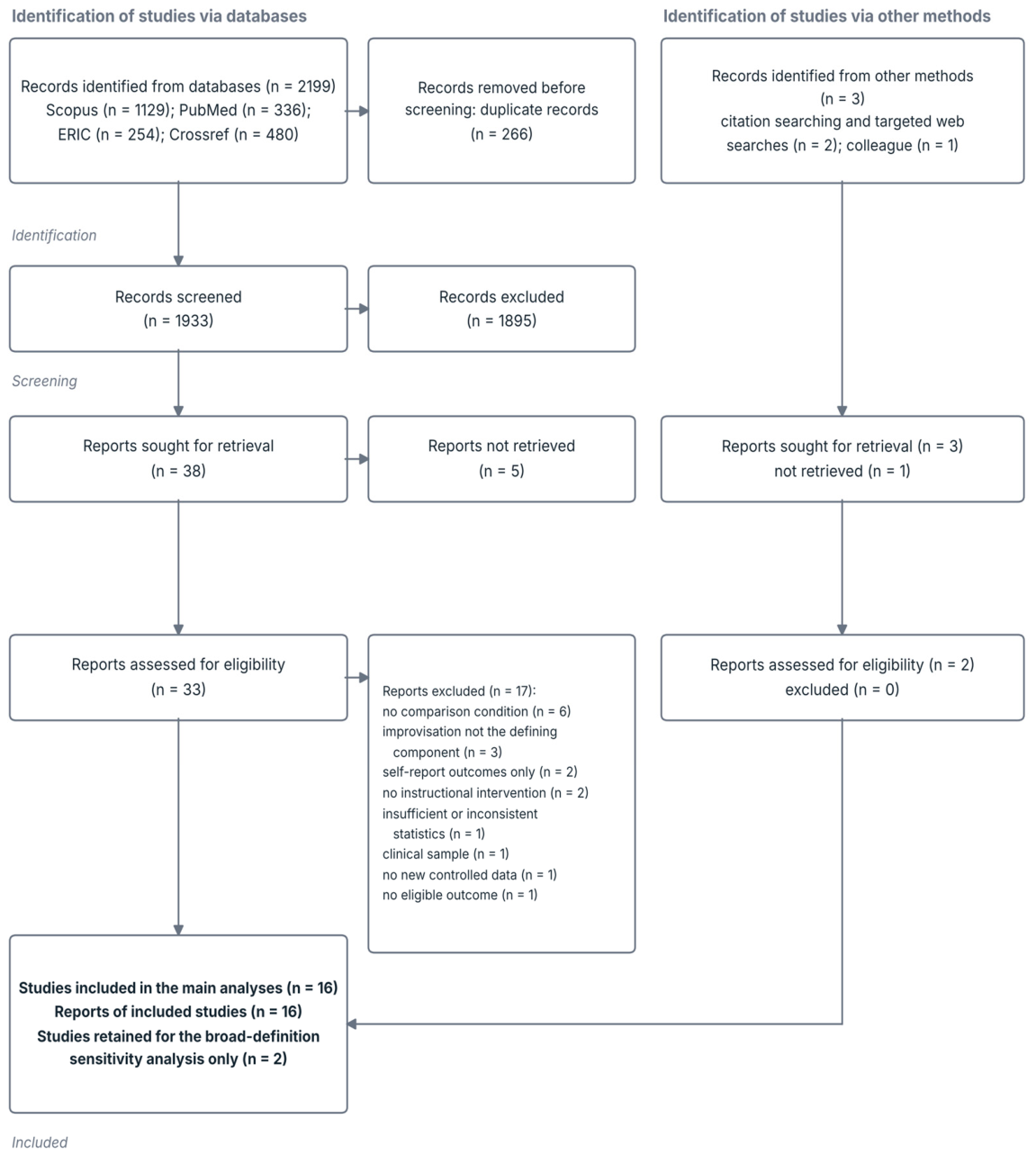

Disclaimer/Publisher’s Note: The statements, opinions and data contained in all publications are solely those of the individual author(s) and contributor(s) and not of MDPI and/or the editor(s). MDPI and/or the editor(s) disclaim responsibility for any injury to people or property resulting from any ideas, methods, instructions or products referred to in the content. |
© 2026 by the authors. Licensee MDPI, Basel, Switzerland. This article is an open access article distributed under the terms and conditions of the Creative Commons Attribution (CC BY) license.