Article

Public Trust in Generative AI: Risk Perceptions, Regulatory Safeguards, and the Acceptance of Deepfake Technology


1
Faculty of Computer Science, Engineering & Economics, Østfold University of Applied Sciences, BRA Veien 4, 1757 Halden, Norway
2
School of Hospitality Management and Culinary Arts, Valencia College, 601 W Livingston St, Orlando, FL 32802, USA
3
Harrah College of Hospitality, University of Nevada Las Vegas, 4505 S. Maryland Pkwy., Las Vegas, NV 89154, USA
4
School of Business, Alcorn State University, 1000 ASU Drive, Lorman, MS 39096, USA
5
School of Travel Industry Management, Shidler College of Business, University of Hawaii at Manoa, 2560 Campus Rd., George Hall 346, Honolulu, HI 96822, USA
*
Author to whom correspondence should be addressed.
Information 2026, 17(8), 757; https://doi.org/10.3390/info17080757
Submission received: 16 July 2026 / Revised: 2 August 2026 / Accepted: 4 August 2026 / Published: 6 August 2026
(This article belongs to the Section Artificial Intelligence)

Abstract

Generative artificial intelligence (GenAI) now produces synthetic text, images, audio, and video at a quality and cost that place convincing synthetic fabrication within reach of non-specialist users. Deepfakes, synthetic media that alter a person’s appearance, voice, or behavior through machine learning (ML), are one of the most contested applications of this capability, yet public willingness to accept them under regulation remains less understood. This study examines how perceived benefits, perceived risks, privacy concerns, and demographic characteristics relate to trust in deepfake technology under regulatory safeguards. Survey data from 924 respondents from several countries were analyzed using descriptive statistics, independent-samples t-tests, analysis of variance, multiple regression, and thematic analysis of open-ended responses. Respondents recognized the potential benefits of deepfake technology for digital content creation and education while expressing widespread concern about misinformation, privacy violations, and criminal misuse. When respondents evaluated deepfake technology under an assumed privacy-protecting regulatory scenario, perceived risks did not independently predict trust, while perceived benefits were the strongest predictors. The findings indicate that institutional confidence may contribute to public acceptance of beneficial applications of generative AI, although the cross-sectional design does not establish a causal effect of regulation.

Graphical Abstract

1. Introduction

Generative artificial intelligence (GenAI) has moved from research laboratories into everyday software within a decade. Systems that produce fluent text, photorealistic images, cloned voices, and convincing video are now embedded in consumer applications, enterprise workflows, and public communication, reshaping how organizations create, distribute, and verify information [1,2]. The same generative capacity that lowers the cost of creativity also lowers the cost of fabrication. This dual character has eroded public trust to a first-order question for the deployment of GenAI across industry and society. Adoption research shows that trust, AI literacy, and disclosure practices condition whether people accept AI-generated or AI-mediated content at all [3,4,5]. As GenAI becomes infrastructural, understanding how citizens evaluate these systems, and the safeguards intended to govern them, has become a research priority in its own right.
Among the most visible, socially consequential, and high-risk applications of GenAI are deepfakes. The rapid development of deepfake technology has increased the creation and dissemination of manipulated digital content across online platforms [6]. Kietzmann et al. [7] define deepfakes as synthetic media that generate or manipulate visual and audio information using advanced machine learning (ML) and artificial intelligence (AI) techniques. When one person’s likeness is seamlessly superimposed onto another, viewers can be led to believe that what they see or hear is genuine even when it is not. Deepfakes therefore concentrate, in a single application, the defining governance dilemma of GenAI: the technology’s value and its capacity for harm derive from the same underlying capability, namely the production of synthetic content indistinguishable from authentic recordings.
The growing use of deepfakes has raised substantial ethical and societal concerns. Privacy is among the most critical concerns since the technology can manipulate an individual’s image, voice, or identity without consent [8,9]. Lukács [10] defines privacy as “the right of the individual to decide about himself/herself” (p. 259) and argues that technological development has made privacy intrusions easier than ever before. Because deepfakes are highly realistic and widely accessible, they pose significant risks to individuals and institutions alike [11]. Previous work has studied the impact of deepfakes on disinformation, law enforcement, media literacy, and social risk [12,13,14,15].
While the technical capabilities of GenAI have advanced rapidly, there has been insufficient empirical research examining how citizens weigh the risks and benefits of its applications or how trust in regulatory safeguards shapes their acceptance. Current research on Generative AI and deepfakes focuses on technical detection, algorithmic development, and legal analysis, leaving a gap in research on questions of public trust, governance, and societal acceptance, which remain insufficiently examined [16]. The gap matters for practice as much as for theory. As AI applications emerge, perceptions of technological risk influence compliance with regulatory interventions and support for governance frameworks that affect the social legitimacy of AI [1,17]. Understanding how individuals evaluate risks and benefits can therefore inform the design of governance mechanisms aimed at reducing societal and institutional vulnerabilities.
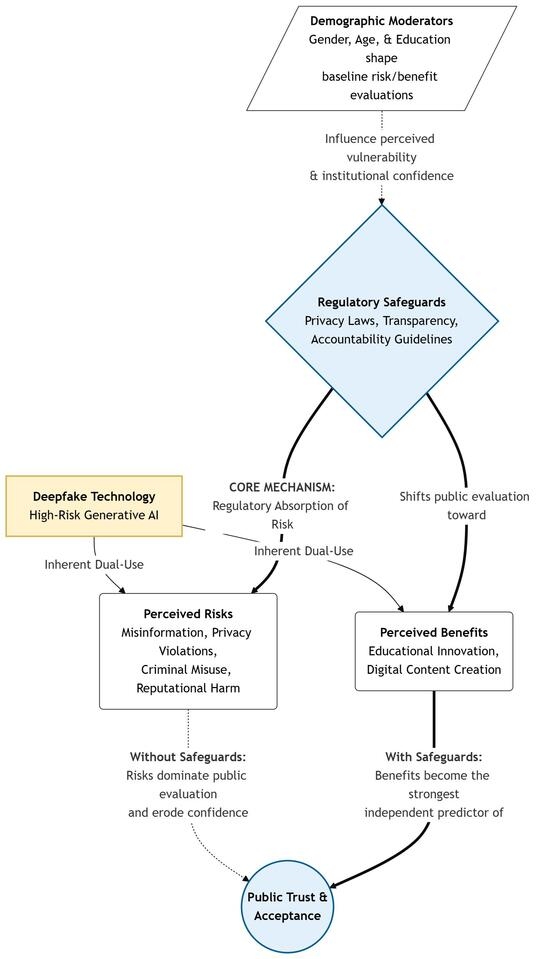
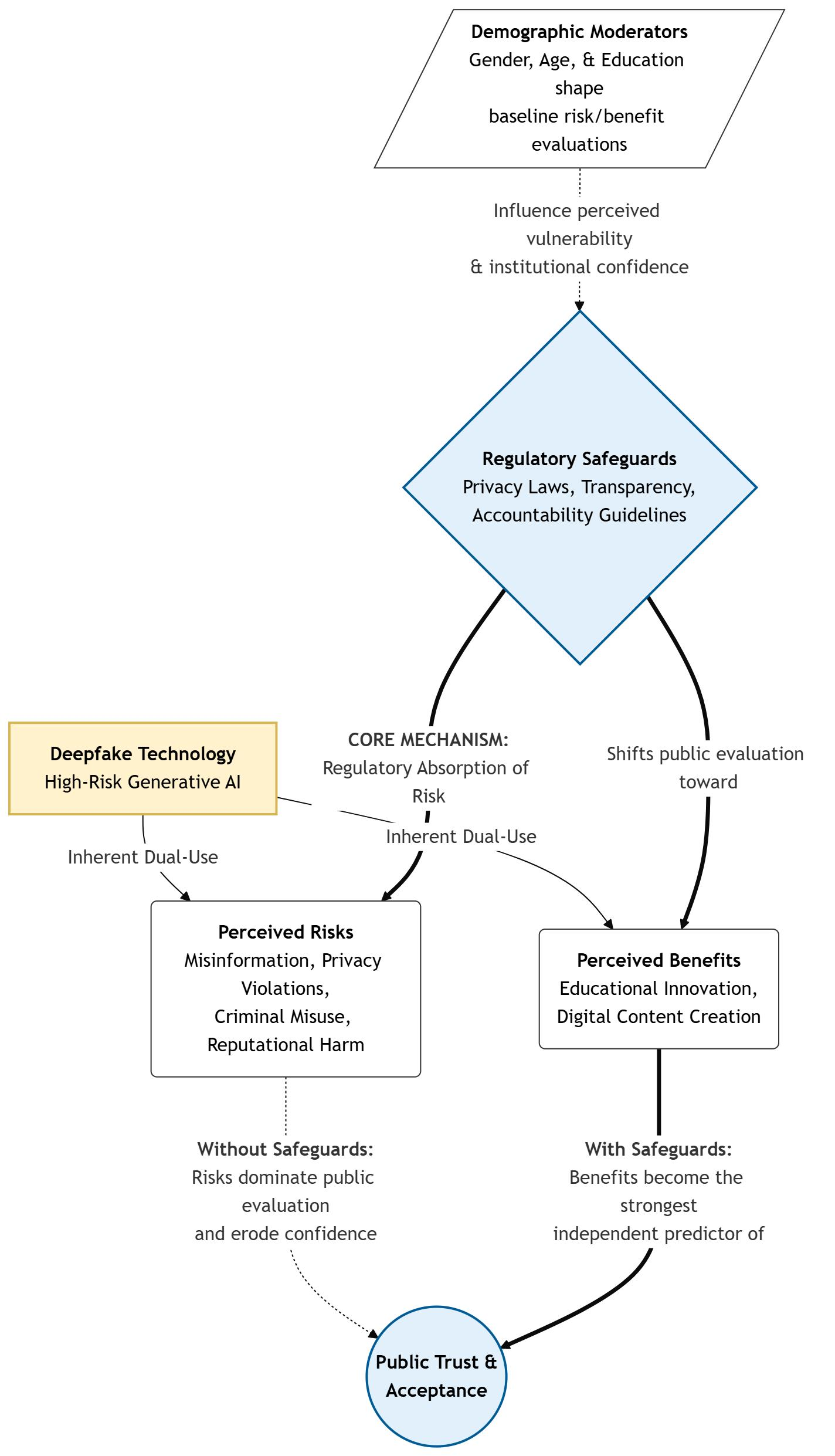
At the center of the public debate is not only whether deepfakes can be detected, but also whether people trust the safeguards proposed to manage them [18]. Trust in such safeguards is likely to shape both the acceptance of legitimate uses and support for limits on harmful ones [16,19]. In this study, trust in safeguards is operationalized as confidence in their effectiveness, fairness, and transparency across labeling, provenance, and enforcement mechanisms [20]. This study makes three main contributions. First, it explores how people balance the perceived benefits and risks of deepfake technology using survey data from respondents from several countries. Second, it suggests that when people believe effective regulatory safeguards are in place, perceived benefits become more important than perceived risks in shaping trust. This pattern can be described as the regulatory absorption of risk. Third, the study shows that attitudes toward deepfake technology differ across gender, age, and education, indicating that public perceptions are more complex than simple generational differences suggest. Considering that deepfakes constitute a demanding test case, a technology capable of producing deceptive content, evidence suggests that trust can be constructed around them through governance that carries implications for less adversarial GenAI applications as well. Consequently, this study addresses the following research questions:
RQ1: How do people perceive the benefits and risks of deepfake technology?
RQ2: How do perceptions of deepfake technology differ across demographic groups such as gender, age, and educational attainment?
RQ3: What factors influence trust in deepfake technology, and what societal concerns do individuals associate with its use?

2. Theoretical Framework

2.1. Risk Perception and the Evaluation of Emerging Technologies

Risk perception theory holds that people judge risk by how it feels and what it means, not by probabilities alone. Qualities such as dread, catastrophic potential, voluntariness, and controllability, together with the affect heuristic of “risk as feelings,” shape risk–benefit trade-offs; when benefits feel salient, perceived risk appears lower, and vice versa [21,22,23,24]. Beyond individual perceptions, social and institutional factors also influence risk evaluation. Media coverage can amplify perceived risks, whereas trust in institutions reduces uncertainty and supports acceptance of technologies and regulatory safeguards [25,26]. Similar mechanisms have been documented for information technologies. Privacy concerns shape perceived risk in online settings [27,28], while public wariness of AI remains widespread [29]. Interestingly, previous research has found that lower AI literacy is associated with greater receptivity to AI [4]. Whether this relationship persists when AI technologies are evaluated under credible regulatory safeguards, however, remains ambiguous. Guided by this research, the present framework examines how perceived risks, perceived benefits, and privacy concerns influence trust in deepfake technology, both directly and indirectly through trust in regulatory safeguards.

2.2. Institutional Trust and Procedural Justice

Research on trust in institutions indicates that baseline institutional trust and perceptions of procedural justice build confidence in safeguards and lend them legitimacy. Trust in this tradition is a willingness to accept vulnerability based on positive expectations of another party’s ability, goodwill, and integrity [19]. Procedural justice research demonstrates that people evaluate authorities as much by the fairness and transparency of their procedures as by their outcomes [30], and experimental evidence indicates that transparency increases the perceived trustworthiness of government organizations [31]. In algorithmic contexts, perceptions of fairness, accountability, and transparency jointly shape how users evaluate automated decisions [32], and independent auditing has been proposed as a mechanism for closing the accountability gap in AI systems [33]. Institutional confidence has itself been described as a form of governance capital [34], and the relationship between trust and regulation is reciprocal, suggesting that regulation can create trust, and trust conditions the acceptance of regulation [35]. The European Union’s Artificial Intelligence Act exemplifies an attempt to institutionalize such safeguards for GenAI at scale [36].

2.3. A Safeguard-Contingent Model of Acceptance

Combining these two traditions yields the study’s central conceptual claim. We propose that regulatory safeguards, when perceived as effective, fair, and transparent, function as a risk-absorption mechanism between a contested technology and its public. Under this account, individuals do not evaluate a GenAI application in isolation; they evaluate both the technology and the institutional arrangements governing its use. When these arrangements are deemed credible, individuals rely on the responsible institutions to manage potential risks. As a result, the perceived importance of those risks is reduced, and greater attention is given to the technology’s potential benefits. Empirical work on hazard acceptability supports the plausibility of this mechanism: trust in regulatory institutions influences the acceptability of hazards both directly and indirectly through perceived risk [37]. This mechanism also has implications for the source of trust. When individuals already trust the technology, reliance on the institutional safeguards should diminish, producing a substitution between technology-based and institution-based trust. Research on AI aversion likewise suggests that acceptance judgments are conditional based on the context and perceived adequacy of the surrounding arrangements rather than on the technology alone [38]. Higher institutional trust and positive views of safeguard features, including effectiveness, fairness, and transparency, are therefore expected to raise trust in safeguarded deepfake technology, which in turn should increase support for regulation and the acceptance of beneficial uses.

3. Literature Review

3.1. Deepfakes as a High-Risk Application of Generative AI

Deepfakes represent one of the highest-risk applications of Generative AI given that they combine sophisticated content generation with the capacity to manipulate identity, authenticity, and public trust. Deepfake technology is based on deep learning, a subfield of ML that allows systems to learn patterns from vast datasets and produce very realistic synthetic material [39]. Beyond technological capabilities, deepfakes have a strong dual-use nature. The same generative tools that increase access and creative possibilities also reduce the cost of persuasion and manipulation at scale, creating a tension between innovation and damage avoidance [18]. Open-source models, consumer apps, and online tutorials have led to the fast proliferation of deepfakes from expert areas to everyday use and the broader scope for misuse in politics, banking, and personal settings [40].
As the use of technology increases, it delivers documented benefits across many sectors. These benefits include enhanced performance, a reduction in production costs, and realistic digital content that supports groundbreaking entertainment experiences, advanced communication, and innovative teaching [41]. Misirlis and Munawar [42] have identified the advantageous applications of deepfake technology in education, business, and culture. Another example of the advantages of deepfakes is in the health care system, where they enhance virtual reality treatments for pain and mental health while supporting doctor–patient communication and assisting patients with cognitive impairments [43]. Deepfakes can produce tailored, engaging teaching content featuring familiar characters to improve the educational experience [44].
Although there are numerous advantages to using generative AI and deepfakes, there is a risk that users may experience issues such as identity theft, impersonation, and financial fraud, which may lead them to perceive the technology as more dangerous than beneficial [45]. Being able to generate realistic, fabricated images and videos raises concerns about misuse and erodes confidence in the technology. As the conflict between the benefits and harms of deepfakes grows, it motivates attention to privacy, security, trust, and governance in the sections that follow.

3.2. Privacy and Security Concerns

Privacy and security concerns are among the most frequently discussed risks associated with deepfakes, and the absence of consent is central to them. Because the technology permits the alteration of facial expressions, voices, and personal characteristics, individuals may feel they have little control over how their identity is represented [46]. Consent violations, dignity harms, and downstream reputational damage persist even where removal is possible, since copies and derivatives circulate indefinitely; this stickiness of harm defeats traditional takedown regimes [18].
Empirical research has documented people’s concerns regarding identity theft, financial fraud, impersonation, reputational harm, and the creation of non-consensual content [45,47]. Females are particularly vulnerable to the misuse involving non-consensual pornographic content, with potentially severe psychological and reputational consequences [48]. The growing accessibility of deepfake technologies and the limitations of current detection systems have intensified concerns regarding misuse of deepfakes [46]. In addition, privacy and security risks have had unsettling effects, deterring online participation and self-expression, particularly among groups disproportionately targeted by non-consensual content [18].

3.3. Trust, Misinformation, and the Liar’s Dividend

Trust is a precondition for the public acceptance of emerging technologies, and deepfakes threaten it from two directions. Misuse involving public figures and political leaders demonstrates how easily fabricated content can spread and influence public opinion [49]. At the same time, deepfakes create a “liar’s dividend”: the mere possibility of fabrication allows bad actors to dismiss authentic evidence as fake, eroding baseline trust in media and complicating accountability [18].
Scholars have argued that the absence of regulation increases the potential for manipulation and for the loss of trust in digital media and public institutions [9]. Deepfakes may also contribute to the spread of fake news, intensify social conflict, and undermine confidence in democratic processes [50]. The ongoing exposure to manipulated content increases doubts and complicates the separation of genuine media from fabricated ones [46]. These factors imply that confidence in regulation might act as a mediator between perceived risks and acceptance [35,37]. Public trust is therefore a function not only of detection accuracy but of perceived procedural fairness and transparency in how platforms and institutions apply safeguards and communicate decisions [30]. Collectively, this literature identifies trust in safeguards as the central pathway linking perceived risk to public acceptance and to support for regulation.

3.4. Governance and Regulatory Safeguards

Gaining public trust in safeguards depends on perceived effectiveness, proportionate targeting of harms that avoids overreach, fairness in equal treatment, and transparency regarding knowability and recourse [51,52]. The proposed precautions include disclosure and labeling, provenance and watermarking requirements, platform enforcement and takedowns, and legal remedies.
Trust in these systems is informed by past experience with content filtering and perceived due process [31], and institutional trust in regulators, platforms and media. Effective governance combines ex ante measures (e.g., provenance requirements, labeling, model risk assessments) with ex post remedies (e.g., takedowns, penalties, civil action), calibrated to be egalitarian and rights-preserving [18]. Co-regulatory strategies, in which sector standards and public monitoring develop together, might assist in increasing perceived legitimacy, provided enforcement is consistent, explainable and independently auditable [30]. Legitimacy is further enhanced by clear accountability chains between model developers, platforms and content providers that define who is responsible for prevention, detection, and redress [48].

3.5. Deepfakes as an Emerging Technology Risk

Deepfakes can be regarded as an emerging technology risk, as they pose problems for information validity, privacy protection, reputational security, and institutional credibility. As with other forms of technological and operational risk, their societal impact depends not only on the probability of misuse but on the effectiveness of the governance mechanisms available to mitigate harm. Trust in regulatory safeguards is therefore a component of technology risk management in its own right, since it conditions public confidence in the ability of institutions to identify, monitor, and respond to emerging threats [5,40,53]. Conceptualizing deepfakes in this way underscores the need for anticipatory governance.

3.6. Detection, Labeling, and Provenance

Technical safeguards such as detection models, watermarking, and content provenance standards aim to make synthetic content identifiable and traceable. Public trust hinges on whether these tools are accurate, consistently applied, and intelligible to non-experts, and on whether they preserve legitimate creative and accessibility uses rather than chilling them [20,54,55]. An arms-race dynamic persists: generative techniques improve to evade detection while detectors adapt, underscoring the need to embed technical measures within broader provenance, policy, and accountability frameworks [55]. Evidence from AI disclosure research is instructive here. Disclosing that content is AI-generated changes how audiences evaluate it, and the effect depends on the task and context in which the disclosure appears [8,16]; disclosure can lower trust in the immediate message while supporting trust in the disclosing organization [54]. Labeling and provenance tools are therefore most likely to earn trust when their operation is visible and their limitations are communicated candidly [16,20]. Since detection will never be perfect, communicating uncertainty can itself strengthen perceived fairness and transparency.

3.7. Individual Differences and Media Literacy

Demographics, political identity, and media literacy influence risk perceptions and trust formation [56]. Media literacy may attenuate perceived risks or increase support for safeguards by improving detection confidence, while privacy concern typically heightens perceived risk and support for regulation [41,56]. Media literacy interventions can reduce susceptibility to synthetic and misleading content by encouraging deliberation and source checking, though effects vary across audiences [41]. Demographic and attitudinal differences shape both perceived risk and support for safeguards; higher political interest and heavier social media use, for example, can amplify exposure and concern and thereby alter trust formation [56]. Subgroup analyses by gender, age, and education are accordingly appropriate for capturing heterogeneity in risk perception, trust, and support for safeguards.

4. Materials and Methods

4.1. Design and Procedure

The study employed a cross-sectional survey design with an embedded qualitative component. The questionnaire was administered online through an international data research company. Demographic data collected included gender, age, level of education, and country of residence, and the survey instrument combined both open-ended questions and closed-ended items measuring perceptions of deepfake technology. For the qualitative component, respondents watched short video clips illustrating deepfake content and were then asked to provide open-ended reflections on the technology and its implications.

4.2. Measures

The closed-ended portion of the instrument comprised eleven perception items: the perceived usefulness of deepfake technology; its potential to positively transform digital content creation; its potential to improve online learning and education; the belief that deepfakes can mislead people; concern that deepfakes could be used to spread false or misleading information; perceived difficulty in determining whether digital media are real or fake; the belief that deepfake technology puts personal data at risk through the unauthorized use of images or voices; concern about criminal misuse such as fraud or blackmail; discomfort with the prospect of a deepfake video being created of oneself; the influence of privacy concerns on willingness to use deepfake applications and tools; and trust in deepfake technology if it were regulated by privacy laws or regulatory guidelines. Items were rated on a five-point Likert-type scale with higher values indicating stronger agreement. Trust in deepfake technology under privacy-protecting laws and guidelines served as the focal dependent variable. The remaining ten items entered the regression analysis as predictors, and eight of them were examined in the demographic group comparisons reported below.

4.3. Analytical Strategy

Quantitative data were analyzed using IBM SPSS Statistics, Version 30.0. Descriptive statistics summarized participants’ perceptions of deepfake technology. Independent-samples t-tests and one-way analyses of variance (ANOVA), with Tukey post hoc comparisons, examined differences in perceptions across demographic groups; the significance threshold was set at p < 0.05. Multiple linear regression identified factors associated with trust in deepfake technology under privacy-protective regulation. Open-ended responses were analyzed thematically and grouped into overarching themes.

5. Results

5.1. Sample Characteristics

A total of 924 participants completed the survey, of whom 53.5% were female and 46.5% were male. A total of 47.0% were between the ages of 18 and 29, followed by 30–44 (24.2%), 45–59 (20.6%), and 60 or older (8.2%). In terms of education, 61.5% held a college degree while the remaining 38.5% reported having no higher education (Table 1). The top five countries of residence were Norway (36.4%), the United States (32.0%), France (13.4%), Germany (3.0%), and Georgia (3.0%).

5.2. Descriptive Findings

Most respondents (54.3%) indicated that deepfake technology can be useful. At the same time, 84.8% believed that deepfakes can mislead people, and 82.7% indicated that deepfake technology puts personal data at risk through the unauthorized use of images or voices (Table 2). These findings highlight a central theme of the study that although respondents recognized the potential benefits of deepfake technology, they also expressed widespread concern about its risks.

5.3. Inferential Analysis

5.3.1. Gender Differences

Participants were grouped by gender (male versus female). Independent-samples t-tests revealed statistically significant gender differences across all eight variables examined (Table 3), spanning perceptions of potential benefits, concerns about false or misleading information, perceptions of media authenticity, concerns about criminal misuse, personal discomfort, privacy concerns, and trust in regulation.
Female respondents expressed stronger agreement that deepfake technology has the potential to positively transform digital content creation (M = 3.44) than male respondents (M = 3.32), and greater agreement that deepfakes could improve online learning and education (M = 3.37 versus M = 3.30). Both differences were statistically significant.
Significant gender differences also emerged on the risk side. Female respondents expressed greater concern that deepfakes could be used to spread false or misleading information (M = 3.98) than male respondents (M = 3.86) and were more likely to agree that deepfakes make it problematic to determine whether digital media are real or fake (M = 4.26 versus M = 4.10). The same pattern held for concern about the use of deepfakes for criminal activities such as fraud or blackmail, with women (M = 4.02) reporting higher levels of concern than men (M = 3.82).
Female respondents further reported greater discomfort with the prospect of someone creating a deepfake video of them, stronger privacy concerns regarding the use of deepfake applications and tools, and greater trust in deepfake technology when it was supported by privacy laws or regulatory guidelines. All of these differences were statistically significant.
Overall, female respondents were more concerned about the personal consequences of deepfake technology, and they were also more confident in regulatory safeguards. They were also somewhat more positive than male respondents about the possible advantages of using deepfake technology in digital content creation and education.

5.3.2. Age Differences

Participants were grouped into four age categories (18–29, 30–44, 45–59, and 60 years or older). One-way ANOVA revealed statistically significant age differences across seven of the eight variables examined (Table 4): perceptions of the positive transformation of digital content creation, educational potential, concerns about misinformation, perceptions of media authenticity, concerns about criminal misuse, discomfort with personal deepfakes, and trust in regulation. No statistically significant age differences were found for privacy concerns affecting the use of deepfake applications and tools, F (3, 920) = 2.25, p = 0.081.
Age differences were found for beliefs that deepfake technology could positively transform digital content creation. Respondents aged 45–59 reported the highest agreement (M = 3.73), whereas respondents aged 60 years and older reported the lowest (M = 2.76), F (3, 920) = 13.36, p < 0.001. Older middle-aged respondents also expressed the strongest support for educational applications. Respondents aged 45–59 reported the highest agreement that deepfakes could improve online learning and education (M = 3.87), whereas respondents aged 60 years and older reported the lowest (M = 2.63), F (3, 920) = 24.32, p < 0.001. Tukey post hoc comparisons indicated that all four age groups differed significantly from one another on this variable.
Significant age differences were also observed in perceptions of misinformation and media authenticity. Respondents aged 45–59 expressed the greatest concern that deepfakes could be used to spread false or misleading information (M = 4.22), whereas respondents aged 30–44 reported the lowest concern (M = 3.85), F (3, 920) = 4.53, p = 0.004. Respondents between the ages of 30 and 44 reported the lowest level of agreement (M = 3.95), F (3, 918) = 8.02, p < 0.001, whilst respondents 60 and older were most likely to agree that deepfakes made it harder to distinguish between actual and manipulated material (M = 4.50). Tukey comparisons showed that respondents aged 30–44 differed significantly from those aged 45–59 and 60 years or older on both variables.
Age differences extended to personal impacts and security concerns. Respondents aged 45–59 reported the greatest concern about the criminal misuse of deepfakes, such as fraud or blackmail (M = 4.37), while respondents aged 30–44 reported the lowest concern (M = 3.84), F (3, 920) = 13.13, p < 0.001. Respondents aged 60 years and older and those aged 45–59 expressed the greatest discomfort with someone creating a deepfake video of them (both M = 4.39), whereas respondents aged 30–44 reported the lowest discomfort (M = 3.92), F (3, 920) = 7.77, p < 0.001. Tukey post hoc tests indicated that respondents aged 30–44 reported significantly lower levels of concern and discomfort than the two oldest age groups.
Finally, respondents aged 45–59 expressed the highest level of trust in deepfake technology if it were regulated by laws or privacy guidelines (M = 4.09), whereas respondents aged 60 years and older reported the lowest level of trust (M = 3.08), F (3, 918) = 16.42, p < 0.001. Tukey comparisons indicated that the 45–59 age group reported significantly greater trust than all other age groups, while respondents aged 60 years and older reported significantly lower trust than the remaining groups.
These findings indicate that age shapes several perceptions of deepfake technology in a pattern more nuanced than a simple generational gradient. Respondents aged 45–59 were the most positive about educational applications while also expressing the greatest concern about misinformation and criminal misuse. Respondents aged 60 years and older were more skeptical of the technology’s educational value, perceived greater difficulty distinguishing authentic from manipulated media, and expressed lower trust even when regulatory safeguards were assumed.

5.3.3. Educational Differences

Participants were categorized into six educational groups: less than a high school degree, a high school degree or equivalent, some college but no degree, an associate degree, a bachelor’s degree, and a graduate degree. One-way ANOVA revealed statistically significant differences across educational groups for all eight variables examined (Table 5).
Educational attainment was associated with perceptions of potential benefits. For educational applications, respondents with graduate degrees expressed the greatest belief that deepfakes could improve online learning and education (M = 3.77), followed closely by those with associate degrees (M = 3.69), whereas respondents with some college but no degree reported the lowest agreement (M = 2.81), F (5, 918) = 11.40, p < 0.001. Tukey post hoc comparisons indicated that respondents with graduate and associate degrees generally reported more favorable perceptions than respondents in several groups with lower educational attainment.
Differences by educational attainment were also observed in perceptions of misinformation and media authenticity. Respondents with graduate degrees (M = 4.22) and associate degrees (M = 4.22) reported the highest levels of concern that deepfakes could be used to spread false or misleading information, whereas respondents with less than a high school education reported the lowest concern (M = 3.07), F (5, 918) = 13.09, p < 0.001. Tukey comparisons indicated that respondents with the lowest level of education differed significantly from most of the remaining educational groups.
Concerns about criminal misuse and the personal impacts of the technology showed the same gradient. Respondents with graduate degrees reported the greatest concern about criminal uses such as fraud or blackmail (M = 4.17), whereas respondents with less than a high school education reported the lowest concern (M = 3.44), F (5, 918) = 4.35, p < 0.001. Respondents holding associate degrees expressed the highest level of discomfort with someone creating a deepfake video of them (M = 4.33), while respondents with less than a high school education reported the lowest discomfort (M = 3.59), F (5, 918) = 4.24, p < 0.001. Tukey post hoc tests showed that respondents with the lowest educational attainment consistently reported lower levels of concern than respondents with college or university education.
Educational attainment was also associated with privacy-related attitudes. Respondents holding associate degrees reported the greatest influence of privacy concerns on their willingness to use deepfake applications (M = 4.16), whereas respondents with less than a high school education reported the lowest level of concern (M = 3.19), F (5, 918) = 6.52, p < 0.001. Respondents with graduate degrees reported the highest level of trust in regulated deepfake technology (M = 3.94), whereas respondents with less than a high school education reported the lowest level of trust (M = 2.89), F (5, 916) = 10.64, p < 0.001. Tukey comparisons indicated that respondents with graduate and bachelor’s degrees generally expressed greater trust in regulated deepfake technology than respondents with lower educational attainment.
Taken together, these findings indicate that educational attainment was associated with all eight perceptions examined. Respondents with university-level education reported greater confidence in the educational and creative potential of deepfakes while simultaneously reporting higher levels of concern regarding misinformation, media authenticity, criminal misuse, privacy, and personal consequences, together with greater trust in deepfake technology under regulatory safeguards. Although the observed effect sizes were generally small, the pattern suggests that education contributes to a more differentiated assessment of both the benefits and the risks of the technology.

5.3.4. Regression Analysis

Multiple regression analysis identified factors associated with trust in deepfake technology under regulatory oversight. Participants’ trust in deepfake technology under privacy-protecting laws and guidelines served as the dependent variable. Predictors included perceived usefulness, educational benefits, concerns regarding misinformation, criminal misuse, privacy risks, and perceived positive impacts of deepfake technology.
The regression model (Table 6) was statistically significant, F (10, 909) = 51.89, p < 0.001, explaining 36.3% of the variance in trust toward regulated deepfake technology (R2 = 0.363, adjusted R2 = 0.356). Three variables showed significant positive associations with trust. The belief that deepfake technology has the potential to positively transform digital content creation was associated with higher trust (B = 0.208, p < 0.001). Beliefs that deepfakes could improve online learning and education were likewise associated with higher trust (B = 0.290, p < 0.001). Perceptions that deepfakes make it more difficult to distinguish real from fake media were likewise associated with higher trust (B = 0.114, p = 0.010). Perceived usefulness of deepfake technology was negatively associated with trust in regulated deepfake technology (B = −0.166, p < 0.001).
To assess potential multicollinearity among the predictors, variance inflation factors (VIF) and corresponding tolerance statistics were calculated. All VIF values ranged from 1.32 to 1.98 (corresponding tolerance values = 0.51–0.76). Given the low VIF values and the observed correlation pattern, the negative association is unlikely to reflect problematic multicollinearity and instead appears to represent an independent relationship. No significant effects were observed for beliefs that deepfakes could be used to mislead people, concerns about false or misleading information, personal data risk, or privacy concerns affecting use. However, concern about criminal misuse (B = 0.076, p = 0.063) and personal discomfort with being the subject of a deepfake (B = 0.077, p = 0.054) approached the conventional 5% significance threshold. Although these associations did not reach statistical significance in the present sample, they suggest that personal and security-related concerns may still contribute to trust judgments under regulatory safeguards.
Table 7 reports Pearson correlations among the regression predictors. The correlations were generally low to moderate, with the highest correlation observed between positive transformation of digital content creation and improvement of online learning and education (r = 0.68).
The results indicate that trust in regulated deepfake technology is driven primarily by perceived benefits, particularly in relation to education and digital content creation. Respondents who viewed deepfakes as beneficial for learning, content creation, and media awareness were more likely to trust the technology when supported by regulatory safeguards. Respondents thus appeared to distinguish between the existence of risks and the capacity of governance mechanisms to manage those risks. Although concerns about misinformation and privacy remained widespread, these concerns no longer independently predicted trust once perceptions of educational value, content creation benefits, and regulatory safeguards were taken into account. The negative association between perceived usefulness and trust therefore warrants substantive interpretation rather than being attributed to statistical artifacts, a point that is explored further in the discussion.
To further examine the robustness of the negative coefficient for perceived usefulness, a supplementary hierarchical regression analysis was conducted (Appendix A). Perceived usefulness was entered in Model 1, followed by the two specific perceived-benefit variables in Model 2, four risk-perception variables in Model 3, and three personal and privacy-related variables in Model 4. Perceived usefulness was negatively associated with trust when entered as the sole predictor (B = −0.511, β = −0.344, p < 0.001) and remained negative and statistically significant after the addition of the benefit variables (β = −0.123, p < 0.001), risk variables (β = −0.115, p < 0.001), and personal and privacy related variables (β = −0.111, p < 0.001). The benefit variables produced the largest increase in explained variance, ΔR2 = 0.202, F change (2, 916) = 135.94, p < 0.001. Risk perceptions contributed an additional 4.0% of explained variance, ΔR2 = 0.040, F change (4, 912) = 14.34, p < 0.001, whereas the final personal and privacy-related block did not significantly improve the model, ΔR2 = 0.003, F change (3, 909) = 1.50, p = 0.213. These results show that the negative relationship between perceived usefulness and trust was present before the inclusion of the remaining predictors and remained stable across successive model specifications.

5.4. Qualitative Findings

To gain a deeper understanding of participants’ perceptions, respondents watched three videos and provided open-ended reflections. Thematic analysis revealed three main themes: (1) deepfakes, reputation, and trust; (2) deepfakes, democracy, and society; and (3) personal, professional, and societal implications. Across all topics, respondents consistently expressed concerns about disinformation, reputational harm, dwindling trust in digital material, and the need for better legal, ethical, and regulatory safeguards. The themes are outlined in Table 8.

5.4.1. Deepfakes, Reputation, and Trust

Those surveyed in this study also commonly expressed concern that deepfake technology could undermine trust, as it enables the easier creation and spread of false or misleading content. One of the recurrent themes was the threat of deepfakes tarnishing the reputation of individuals, organizations and companies with the rapid spread of disinformation. A significant number of respondents felt that reputation was at a higher risk in an environment where realistic content created by AI can be produced with minimal effort and many highlighted that once misleading content is published the fallout can go well beyond the initial incident, with ramifications for personal safety, professional credibility and public confidence.
Another common theme was the increasing challenge to differentiate between real and falsified material. As deepfakes grow more convincing, respondents claimed that people may be more likely to trust misleading information or, conversely, doubt the validity of real digital material. This apparent loss of trust was considered one of the technology’s biggest social hazards. In response, many recognized legitimate uses in education, entertainment, and creative media production, but consistently framed these benefits as contingent on responsible use, claiming that legal safeguards, ethical standards, informed consent, and transparent labeling were essential to prevent misuse while still allowing for beneficial applications. Illustrative responses include the following:
“AI can spread fake information and damage a person or a company’s reputation; there might not be any consequences. I wonder if countries’ laws are keeping up.”
“AI-created media can cause personal pain in the form of damage to reputation, blackmail someone, or even cause danger in their real life. This can turn very ugly.”
“Some people will believe anything, no matter how crazy the information is.”
“Deepfakes are impressive technology with real creative potential, but the danger of manipulation and loss of trust is huge. Used with consent and clear labeling, it can be valuable—otherwise, it risks damaging people and institutions.”

5.4.2. Deepfakes, Democracy, and Society

Respondents in the survey also expressed concerns about the wider societal consequences of deepfake technology, including its capacity to impact political processes and weaken democratic institutions. Many participants stated that very realistic fake content may be used to convey disinformation, influence political discourse, and manipulate public opinion. Some respondents noted that deepfakes can be used as propaganda tools, especially during election campaigns when public confidence in information is paramount.
Respondents also cited the wider impacts of misinformation beyond elections: more division, diminished trust in conventional media and uncertainty over the authenticity of information online. As technology progresses and grows more sophisticated, many fear that it will be more difficult for governments, media organizations and society as a whole to identify legitimate from manipulated material. Even so, participants rarely advocated outright rejection. Most argued that positive applications could coexist with appropriate legal frameworks, ethical guidelines, and responsible governance designed to reduce misuse while supporting innovation. Illustrative responses include the following:
“While being dangerous due to potential framing, it’s even more dangerous in the political space where accurate information is vital.”
“I think it can be used as a form of propaganda or political warfare.”
“Deepfakes have both positive and negative sides. They can be useful in education, art, and accessibility, but they also spread misinformation and harm people’s privacy. Society needs clear rules and ethics to use them responsibly.”
“It could also be very dangerous if it’s used in a bad way, for example, fake news about politics.”

5.4.3. Personal, Professional, and Social Consequences

Respondents consistently described the possible repercussions of deepfake technology as severe and enduring. Numerous participants conveyed that manipulated content could damage an individual’s mental well-being, professional reputation, employment opportunities, and personal relationships. In addition, respondents described that not only individuals but also organizations face parallel vulnerabilities when misinformation and fabricated content are spread. The damage to corporate reputations can undermine stakeholder trust. Several participants stressed that once incorrect material has been released into the public domain, it might stay accessible long after it has been proven false, making it difficult to rebuild the image of individuals and organizations.
Participants in the study stressed that deepfakes can facilitate intimidation, blackmail, cyberbullying, and other forms of digital abuse with potentially serious psychological consequences, frequently mentioning emotional distress, social isolation, anxiety, and loss of confidence as possible outcomes when manipulated content spreads across social media. Numerous participants argue that stronger legal protections, greater public awareness, and improved digital literacy are needed to reduce these risks, and that individuals should retain greater control over their digital identity through clearer consent requirements and stronger legal consequences for malicious misuse. Illustrative responses include the following:
“It gives anyone the tools to destroy the social lives of anyone, with very little effort.”
“Misinformation can follow someone online for years, affecting how they’re seen by peers, employers, or society.”
“Misinformation and online harassment can deeply damage a person’s mental health, confidence, and reputation. False information spreads quickly, making it hard to correct and leading to public shame or isolation.”
“I feel like deepfake could potentially ruin an organization. If anyone wants to destroy a business, it is hard to fight back.”

6. Discussion

6.1. Principal Findings

This study explored how people evaluate deepfake technology within a risk–benefit framework. Although respondents saw clear potential for the technology in education and digital content creation, they expressed far greater concern about misinformation, privacy violations, criminal misuse, and reputational harm. The descriptive findings capture this asymmetry: a slight majority of participants considered the technology useful, while large majorities believed that deepfakes can mislead people and place personal data at risk. Public evaluations thus reflected an ongoing appraisal of benefits against risks, with harm-related concerns typically outweighing the recognition of advantages, a pattern consistent with the psychometric account of how lay publics evaluate hazardous technologies [21,22]. At the same time, the multivariate analyses demonstrated that these widespread concerns did not independently determine trust once respondents evaluated the technology within a regulatory context.
The demographic differences also provide additional context for the safeguard-contingent model proposed in this study. Respondents differed not only in their perceptions of the risks and benefits of deepfake technology, but also in the extent to which they appeared willing to place confidence in regulatory safeguards. These differences suggest that regulatory absorption of risk may not operate uniformly across populations, a possibility explored further below.

6.2. The Regulatory Absorption of Risk

The findings have implications that extend beyond deepfakes to other high-risk Generative AI applications. Deepfakes provide a particularly demanding test case because they combine substantial societal benefits with equally substantial risks. If institutional safeguards can build trust for such a high-risk GenAI application, similar governance mechanisms may also facilitate public acceptance of other forms of Generative AI.
Trust in deepfake technology under privacy-protecting regulation was driven primarily by perceived benefits rather than by perceived risks. Perceived educational benefits and the belief that the technology can positively transform digital content creation were significant positive predictors of trust, whereas concerns regarding misinformation, criminal misuse, privacy risks, and personal discomfort did not remain statistically significant after controlling for the remaining variables. This result is noteworthy because those same concerns were prevalent in both the quantitative and qualitative data, yet they did not independently predict trust once perceived benefits were considered. Diagnostic analyses further indicated that multicollinearity was not a concern, with low variance inflation factors and only moderate correlations among the predictors. Accordingly, the observed pattern appears to reflect substantive differences in how respondents evaluated benefits and governance rather than statistical overlap among the independent variables.
The researchers interpret this decoupling as evidence consistent with the safeguard-contingent model developed in Section 2.3: credible regulatory safeguards may reduce the independent role of perceived risk in trust judgments. When respondents assumed that privacy-protecting safeguards were in place, they appeared to delegate the management of risk to the governing institutions, and their own evaluation shifted toward benefit-related considerations. Trust, in other words, appeared to shift from the technology itself to the governance arrangements surrounding it. This reading is consistent with evidence that trust in regulatory institutions shapes hazard acceptability both directly and indirectly through perceived risk [37], and with the broader argument that regulation and trust are mutually constitutive [35]. It also refines the practical debate: public acceptance of synthetic media may depend less on the mere presence of perceived risks and more on whether people believe those risks can be managed, which places the perceived effectiveness, fairness, and transparency of governance at the center of acceptance rather than at its periphery [30,31,32].
The negative association between perceived usefulness and trust in regulated deepfake technology warrants particular attention. Because perceived usefulness was already negatively associated with trust when entered as the sole predictor and remained negative across all successive hierarchical regression models, the finding is unlikely to reflect multicollinearity, statistical suppression, or a coefficient reversal induced by the inclusion of conceptually related predictors. Instead, it appears to represent a robust and independent relationship that admits several complementary interpretations. Respondents who already regarded the technology as generally useful may have relied more heavily on their confidence in the technology itself and therefore placed less weight on external regulatory safeguards when evaluating trust. This pattern identifies trust substitution as a proposition for future testing.
Although age was not included as a predictor in the regression model, the demographic analyses suggest that familiarity with generative AI may also influence reliance on regulatory safeguards, a possibility that warrants direct empirical investigation. An alternative explanation concerns how respondents interpreted the perceived usefulness item. Rather than referring exclusively to socially beneficial applications, some respondents may have understood usefulness as reflecting the technology’s overall capability or effectiveness. Under this interpretation, a technology that is perceived as highly capable may also be viewed as having greater potential for misuse. Consequently, respondents could simultaneously acknowledge the technology’s usefulness while expressing lower trust in its deployment, even when regulatory safeguards were assumed.

6.3. A Demographic Topology of Gen AI Skepticism

Significant differences emerged across demographic groups, and their structure qualifies familiar generational narratives. Female respondents consistently reported stronger perceptions of both the benefits and the risks of deepfake technology. Compared with male respondents, women expressed greater concern regarding criminal misuse, media authenticity, privacy risks, and personal discomfort, and they showed greater trust in the technology when privacy protections were assumed. One plausible explanation is that women perceive greater personal vulnerability to identity misuse, online harassment, and non-consensual content creation, a vulnerability documented in prior work [48] and echoed in the qualitative responses, which repeatedly raised concerns about exploitation, reputational damage, and privacy violations.
Female respondents expressed greater concern about misinformation, criminal misuse, privacy, and personal consequences while simultaneously reporting greater trust when regulatory safeguards were assumed. This pattern is consistent with the possibility that individuals who perceive themselves as more vulnerable to digital harms may place greater value on credible institutional protections. Similarly, respondents with higher educational attainment recognized both the benefits and risks of deepfake technology while also expressing greater trust under regulatory safeguards, suggesting that more informed evaluations may be accompanied by greater confidence in governance mechanisms. In contrast, the lower trust reported by the oldest respondents, despite their heightened concern about manipulated media, indicates that regulatory safeguards may not fully offset perceived risks for all demographic groups. Together, these findings suggest that the extent to which individuals delegate responsibility for managing technological risks to institutions may depend on demographic and experiential factors, including perceived vulnerability and confidence in regulatory safeguards.

6.4. Implications for Generative AI Beyond Deepfakes

Although this study examined deepfakes, its findings bear on public acceptance of generative AI systems more broadly. Deepfakes constitute a demanding case for GenAI governance: the application’s defining capability can support deception, and its risks dominated respondents’ unconditional evaluations. That risk perceptions nonetheless ceased to independently predict trust once credible safeguards were assumed suggests that the proposed risk-absorption mechanism may extend to other Generative AI applications. At the same time, concerns about criminal misuse and personal discomfort approached conventional levels of statistical significance, suggesting that personal and security-related concerns may continue to influence trust under regulatory safeguards even though they did not emerge as independent predictors in the present model. If governance arrangements can support public trust for a technology capable of producing deceptive content, they may also matter for less adversarial applications such as large language models, AI assistants, synthetic voice technologies, and autonomous content generation, where disclosure and provenance practices are already reshaping audience responses [8,16,54]. The findings also imply that technological innovation alone will not secure public acceptance of GenAI. Mechanisms of governance such as transparent regulation, accountability chains, content verification, and open communication with the public appear to be equally important in the shaping of trust, which in turn supports ongoing international efforts to build responsible AI governance frameworks that balance innovation against misuse [1,33,36].
The qualitative findings reinforce this interpretation. Participants’ comments focused primarily on trust, reputation, democratic processes, privacy, and the wider social consequences of deepfake technology.
Participants repeatedly highlighted the need for legal protections, transparency, informed consent, and responsible governance, while recognizing genuine uses of deepfake technology in education and creative media/art. Taken together, these findings indicate that public trust may be increased not only by protections against abuse, but also by favorable views of how the technology should be used.

6.5. Practical Implications

The findings have implications for policymakers, AI developers, platform providers, educational institutions, and corporations employing generative artificial intelligence. Also, the effects of strong governmental protections contribute to building public confidence in policymakers. In the current study, respondents had more trust in deepfake technology when they believed that there were privacy rules and legal requirements. Perceived benefits, particularly educational applications and the positive transformation of digital content creation, emerged as the strongest predictors of trust, whereas perceived risks no longer independently predicted trust once regulatory safeguards were assumed. Legal frameworks also include authorization, identity protection, transparency, accountability and disclosure requirements for content created by AI, which are not just limits on the technology but also preconditions for its use. Once safeguards were in place, trust responded to perceived benefits. The rules should be designed to limit dangers and to offer clear support to legitimate activities such as education, access and creative output. The qualitative findings also confirm this view, with participants repeatedly highlighting the necessity of strong legal protections, transparent informed consent and responsible governance to be able to exploit the benefits of deepfake technology while reducing the possibility for misuse.
Recent legislative developments show growing regulatory attention to synthetic media. Hawaii recently enacted legislation addressing deceptive AI-generated content, joining jurisdictions including California, Texas, Tennessee, Virginia, and Washington. Internationally, the European Union, China, South Korea, and the United Kingdom have adopted or strengthened measures governing deepfakes and other forms of synthetic media [41,57]. Although these approaches differ in scope and implementation, they share an emphasis on transparency, identity protection, accountability, and disclosure of AI-generated media. The present findings are consistent with the possibility that confidence in such safeguards may support trust in legitimate applications of the technology [41,57].
The implications of the present findings may extend beyond deepfake technology to other forms of generative AI. Deepfakes represent one of the most socially and ethically contested applications of generative AI because they directly raise concerns about deception, misinformation, privacy, identity manipulation, and criminal misuse. They therefore provide a demanding case for examining public trust under conditions of perceived technological risk. The association between trust and perceived benefits under an assumed regulatory scenario suggests that confidence in governance mechanisms may also matter for public acceptance of large language models, AI assistants, and synthetic voice technologies. Because these technologies present distinct risks and uses, future research should test whether the safeguard-contingent model applies across different classes of generative AI technologies.
For developers and platform owners, the priority is to make governance legible. Content authentication, watermarking, and detection mechanisms that let users verify the authenticity of digital media can reduce uncertainty and concerns about manipulation, and systems should state plainly when content has been synthetically generated or modified [20,55]. Since detection will remain imperfect, communicating its limitations candidly is itself a trust-building act. For educators, media organizations, and public agencies, digital literacy initiatives should improve individuals’ ability to identify manipulated content and evaluate online information critically [15,58]. Perceptions of educational benefit emerged as one of the strongest predictors of trust, so such initiatives should demonstrate responsible and beneficial uses of the technology rather than emphasizing risks alone.

6.6. Limitations and Future Research

This study has several limitations that should be considered when interpreting the findings. First, the cross-sectional design and the use of a hypothetical regulatory scenario do not permit causal conclusions regarding the relationships among perceived benefits, perceived risks, trust, and technology acceptance. Consequently, the proposed regulatory absorption of risk should be regarded as a theoretically informed explanation that is consistent with the observed findings rather than as a demonstrated causal mechanism. Second, several variables were measured using single-item indicators designed to capture specific aspects of respondents’ evaluations rather than broader latent constructs. Third, although respondents were recruited from several countries, approximately two-thirds of the sample resided in Norway and the United States, and the findings should therefore not be interpreted as globally representative. Finally, the demographic analyses were exploratory and involved multiple subgroup comparisons; although effect sizes were generally small, these findings should be interpreted with appropriate caution and replicated in future research.
Future research may benefit from validated multi-item scales and experimental designs comparing regulated and unregulated conditions. In addition, research may also employ more geographically balanced samples and conduct formal cross-cultural comparisons. Forthcoming work may also examine how different AI governance mechanisms, including labeling, watermarking, provenance systems, and algorithmic auditing, influence trust across a broader range of generative AI applications.

7. Conclusions

This study examined public perceptions of deepfake technology as a paradigmatic application of generative AI, focusing on perceived benefits and risks, demographic differences, the determinants of trust, and broader societal concerns. Drawing on risk perception theory and research on institutional trust, it developed a safeguard-contingent model of acceptance. The observed associations were consistent with the possibility that confidence in regulatory safeguards reduces the independent role of perceived risk and shifts public evaluation toward perceived benefits, although the study design does not establish this process as a causal mechanism.
Regarding RQ1, respondents recognized potential benefits of deepfake technology, particularly in education and digital content creation, while expressing substantially greater concern regarding misinformation, privacy violations, criminal misuse, and reputational harm.
Regarding RQ2, clear demographic differences emerged: female respondents reported stronger perceptions of both benefits and risks together with greater conditional trust; respondents aged 45–59 combined the strongest support for educational applications with the highest trust in regulated deepfake technology; respondents aged 60 and older reported the greatest difficulty judging media authenticity and the lowest trust despite safeguards; and higher educational attainment was associated with more differentiated appraisals, though with small effects.
Regarding RQ3, perceived educational benefits and the potential for positive transformation of digital content creation predicted trust in regulated deepfake technology, whereas concerns about misinformation, privacy, criminal misuse, and personal discomfort did not remain significant once benefits were controlled. The qualitative data documented substantial concern about election integrity, misinformation, reputational damage, and the effects of online harassment on young people.
The study’s contribution is twofold. Empirically, it maps the public risk–benefit calculus for one of the most contested applications of generative AI using a large sample of respondents from several countries and mixed methods. Theoretically, it identifies the regulatory absorption of risk as a mechanism through which governance may shift public evaluation from risk-centered toward benefit-centered considerations, and it recognizes trust substitution between technology and institution as a proposition for future testing. As generative AI evolves beyond deepfakes toward multimodal systems that produce text, images, audio, and video at scale, the object of public trust will increasingly include the governance arrangements surrounding the technology. Building that trust will require safeguards that are effective, fair, and transparent, along with public communication that pairs openness about risk with concrete demonstrations of legitimate benefit.

Author Contributions

Conceptualization, C.L., G.R., J.L. and J.A.; methodology, C.L., G.R., J.L. and J.A.; validation, C.L., G.R., J.L. and J.A.; formal analysis, C.L., G.R., J.L., B.G. and J.A.; investigation, C.L., G.R., J.L., B.G. and J.A.; writing—original draft preparation, C.L., G.R., J.L. and J.A.; writing—review and editing, C.L., G.R., J.L., B.G. and J.A. All authors have read and agreed to the published version of the manuscript.

Funding

This research received no external funding.

Institutional Review Board Statement

The study was conducted in accordance with the Declaration of Helsinki and approved by the Institutional Review Board of NSD (protocol code 833252; approval date 22 June 2025).

Informed Consent Statement

Informed consent was obtained from all subjects involved in the study.

Data Availability Statement

The data are available from the corresponding author upon reasonable request.

Conflicts of Interest

The authors declare no conflicts of interest.

Appendix A

Table A1. Hierarchical model structure.
ModelVariables Entered
1Perceived usefulness
2Positive transformation of digital content creation; improvement of online learning and education
3Misleading people; false-information concern; harder to distinguish real from fake media; criminal misuse
4Personal discomfort; personal-data risk; privacy concerns
Table A2. Model summary.
ModelR2Adjusted R2ΔR2F Changedf Changep for Change
10.1180.1170.118123.041, 918<0.001
20.3200.3180.202135.942, 916<0.001
30.3600.3550.04014.344, 912<0.001
40.3630.3560.0031.503, 9090.213
R2 = 0.363, adjusted R2 = 0.356, F (10, 909) = 51.89, p < 0.001.
Table A3. Coefficients across the four models.
PredictorModel 1 βModel 2 βModel 3 βModel 4 β
Perceived usefulness−0.344 ***−0.123 ***−0.115 ***−0.111 ***
Positive transformation0.241 ***0.217 ***0.219 ***
Educational improvement0.305 ***0.310 ***0.311 ***
Mislead people−0.042−0.035
False-information concern0.0090.010
Harder to distinguish0.123 ***0.095 *
Criminal misuse0.083 *0.067 †
Personal discomfort0.069 †
Personal-data risk−0.018
Privacy concerns−0.020
*** p < 0.001. ** p < 0.01. * p < 0.05. † p < 0.10.
The hierarchical analysis provides particularly strong evidence that the negative coefficient is not a classical suppression effect caused by adding the other predictors. The direction is present in the bivariate model and persists throughout all four stages.

References

  1. Dwivedi, Y.K.; Hughes, L.; Al-Ahmadi, M.S.; Dutot, V.; Ahmed, S.Q.; Akter, S.; De’, R.; Li, K.; Singh, N.; Walton, P. GenAI’s impact on global IT management: A multi-expert perspective and research agenda. J. Glob. Inf. Technol. Manag. 2025, 28, 49–63. [Google Scholar] [CrossRef] [Scilit]
  2. Hughes, L.; Dwivedi, Y.K.; Li, K.; Appanderanda, M.; Al-Bashrawi, M.A.; Chae, I. AI agents and agentic systems: Redefining global IT management. J. Glob. Inf. Technol. Manag. 2025, 28, 175–185. [Google Scholar] [CrossRef] [Scilit]
  3. Li, Y.; Lee, S.O. Navigating the generative AI travel landscape: The influence of ChatGPT on the evolution from new users to loyal adopters. Int. J. Contemp. Hosp. Manag. 2025, 37, 1421–1447. [Google Scholar] [CrossRef] [Scilit]
  4. Tully, S.M.; Longoni, C.; Appel, G. Lower artificial intelligence literacy predicts greater AI receptivity. J. Mark. 2025, 89, 1–20. [Google Scholar] [CrossRef] [Scilit]
  5. Xiao, Y.; Yu, S. Can ChatGPT replace humans in crisis communication? The effects of AI-mediated crisis communication on stakeholder satisfaction and responsibility attribution. Int. J. Inf. Manag. 2025, 80, 102835. [Google Scholar] [CrossRef] [Scilit]
  6. Figueira, A.; Oliveira, L. The current state of fake news: Challenges and opportunities. Procedia Comput. Sci. 2017, 121, 817–825. [Google Scholar] [CrossRef] [Scilit]
  7. Kietzmann, J.; Lee, L.W.; McCarthy, I.P.; Kietzmann, T.C. Deepfakes: Trick or treat? Bus. Horiz. 2020, 63, 135–146. [Google Scholar] [CrossRef] [Scilit]
  8. Baek, T.H.; Kim, J.; Kim, J.H. Effect of disclosing AI-generated content on prosocial advertising evaluation. Int. J. Advert. 2026, 45, 171–192. [Google Scholar] [CrossRef] [Scilit]
  9. Kugler, M.B.; Pace, C. Deepfake privacy: Attitudes and regulation. Northwest. Univ. Law Rev. 2021, 116, 611–667. [Google Scholar]
  10. Lukács, A. What Is Privacy? The History and Definition of Privacy. Available online: https://core.ac.uk/reader/80769180 (accessed on 8 July 2026).
  11. Abdul Hussein, M.; Bogren, W. Social Media’s Take on Deepfakes: Ethical Concerns in the Public Discourse. Master’s Thesis, Uppsala University, Uppsala, Sweden, 2023. [Google Scholar]
  12. Alshamsi, M.S. The Future of Deep Fakes: Analyzing the Potential Future Consequences of the Widespread Use of Deepfakes on the Policing Sector. Master’s Thesis, Rochester Institute of Technology, Rochester, NY, USA, 2023. [Google Scholar]
  13. Eynern, C. Olaf Scholz Deepfake: How a Deepfake Impacts Public Trust. Bachelor’s Thesis, University of Twente, Enschede, The Netherlands, 2024. [Google Scholar]
  14. Kharvi, P.L. Understanding the impact of AI-generated deepfakes on public opinion, political discourse, and personal security in social media. IEEE Secur. Priv. 2024, 22, 115–122. [Google Scholar] [CrossRef] [Scilit]
  15. Naffi, N.; Charest, M.; Danis, S.; Pique, L.; Davidson, A.L.; Brault, N.; Bernard, M.-C.; Barman, S. Empowering youth to combat malicious deepfakes and disinformation. J. Constr. Psychol. 2025, 38, 119–140. [Google Scholar]
  16. Wu, L.; Dodoo, N.A.; Wen, T.J. Disclosing AI’s involvement in advertising to consumers: A task-dependent perspective. J. Advert. 2025, 54, 20–38. [Google Scholar] [CrossRef] [Scilit]
  17. Linnes, C.; Agrusa, J. Digital transformation in the hospitality and tourism sector in Hawaii. In Handbook on Crisis and Disaster Management in Tourism; Edward Elgar Publishing: Cheltenham, UK, 2024; pp. 192–203. [Google Scholar]
  18. Chesney, R.; Citron, D.K. Deep fakes: A looming challenge for privacy, democracy, and national security. Calif. Law Rev. 2019, 107, 1753–1819. [Google Scholar] [CrossRef] [Scilit]
  19. Mayer, R.C.; Davis, J.H.; Schoorman, F.D. An integrative model of organizational trust. Acad. Manag. Rev. 1995, 20, 709–734. [Google Scholar] [CrossRef] [Scilit]
  20. Vaccari, C.; Chadwick, A. Deepfakes and disinformation: Exploring the impact of synthetic political video on deception, uncertainty, and trust in news. Soc. Media Soc. 2020, 6, 1–13. [Google Scholar] [CrossRef] [Scilit]
  21. Fischhoff, B.; Slovic, P.; Lichtenstein, S.; Read, S.; Combs, B. How safe is safe enough? A psychometric study of attitudes toward technological risks and benefits. Policy Sci. 1978, 9, 127–152. [Google Scholar] [CrossRef] [Scilit]
  22. Slovic, P. Perception of risk. Science 1987, 236, 280–285. [Google Scholar] [CrossRef] [Scilit] [PubMed]
  23. Slovic, P.; Finucane, M.; Peters, E.; MacGregor, D.G. Risk as analysis and risk as feelings. Risk Anal. 2004, 24, 311–322. [Google Scholar] [CrossRef] [Scilit] [PubMed]
  24. Loewenstein, G.F.; Weber, E.U.; Hsee, C.K.; Welch, N. Risk as feelings. Psychol. Bull. 2001, 127, 267–286. [Google Scholar] [CrossRef] [Scilit] [PubMed]
  25. Kasperson, R.E.; Renn, O.; Slovic, P.; Brown, H.S.; Emel, J.; Goble, R.; Kasperson, J.X.; Ratick, S. The social amplification of risk: A conceptual framework. Risk Anal. 1988, 8, 177–187. [Google Scholar] [CrossRef] [Scilit]
  26. Siegrist, M.; Cvetkovich, G. Perception of hazards: The role of social trust and knowledge. Risk Anal. 2000, 20, 713–720. [Google Scholar] [CrossRef] [Scilit] [PubMed]
  27. Malhotra, N.K.; Kim, S.S.; Agarwal, J. Internet users’ information privacy concerns (IUIPC): The construct, the scale, and a causal model. Inf. Syst. Res. 2004, 15, 336–355. [Google Scholar] [CrossRef] [Scilit]
  28. Koester, N.; Cichy, P.; Antons, D.; Salge, T.O. Perceived privacy risk in the Internet of Things: Determinants, consequences, and contingencies in the case of connected cars. Electron. Mark. 2022, 32, 2333–2355. [Google Scholar] [CrossRef] [Scilit]
  29. Pew Research Center. Public Awareness of Artificial Intelligence in Everyday Activities. Available online: https://www.pewresearch.org/science/2023/02/15/public-awareness-of-artificial-intelligence-in-everyday-activities/ (accessed on 8 July 2026).
  30. Tyler, T.R. Procedural justice, legitimacy, and the effective rule of law. Crime Justice 2003, 30, 283–357. [Google Scholar] [CrossRef] [Scilit]
  31. Grimmelikhuijsen, S.G.; Meijer, A.J. Effects of transparency on the perceived trustworthiness of a government organization: Evidence from an online experiment. Public Adm. 2014, 92, 75–94. [Google Scholar]
  32. Shin, D. User perceptions of algorithmic decisions: The interplay of fairness, accountability, and transparency. Telemat. Inform. 2020, 54, 101469. [Google Scholar]
  33. Raji, I.D.; Smart, A.; White, R.; Mitchell, M.; Gebru, T.; Hutchinson, B.; Smith-Loud, J.; Theron, D.; Barnes, P. Closing the AI accountability gap: Defining an end-to-end framework for internal algorithmic auditing. In Proceedings of the ACM Conference on Fairness, Accountability, and Transparency (FAccT), Barcelona, Spain, 27–30 January 2020; pp. 33–44. [Google Scholar]
  34. Bello, I.O. The economics of trust: Why institutional confidence is the new currency of governance. Int. J. Technol. Manag. Humanit. 2020, 6, 74–92. [Google Scholar] [CrossRef] [Scilit]
  35. Verhoest, K.; Redert, B.; Maggetti, M.; Levi-Faur, D.; Jordana, J. Trust and regulation. In Handbook on Trust in Public Governance; Edward Elgar Publishing: Cheltenham, UK, 2025; pp. 360–380. [Google Scholar]
  36. European Parliament and Council. Regulation (EU) 2024/1689 of the European Parliament and of the Council of 13 June 2024 Laying Down Harmonised Rules on Artificial Intelligence (Artificial Intelligence Act). Off. J. Eur. Union. 2024, L 2024/1689. Available online: https://eur-lex.europa.eu/eli/reg/2024/1689/oj/eng (accessed on 3 August 2026).
  37. Bronfman, N.C.; Vázquez, E.L.; Dorantes, G. An empirical study for the direct and indirect links between trust in regulatory institutions and acceptability of hazards. Saf. Sci. 2009, 47, 686–692. [Google Scholar] [CrossRef] [Scilit]
  38. Kim, H.; Shin, H.; Yoon, H.; Shin, H. Why travelers prefer humans over artificial intelligence (AI): Developing and testing an AI aversion model in tourism. Tour. Manag. 2027, 118, 105494. [Google Scholar] [CrossRef] [Scilit]
  39. Goodfellow, I.; Bengio, Y.; Courville, A. Deep Learning; MIT Press: Cambridge, MA, USA, 2016. [Google Scholar]
  40. Brundage, M.; Avin, S.; Clark, J.; Toner, H.; Eckersley, P.; Garfinkel, B.; Dafoe, A.; Scharre, P.; Zeitzoff, T.; Filar, B.; et al. The Malicious Use of Artificial Intelligence: Forecasting, Prevention, and Mitigation; Future of Humanity Institute, University of Oxford: Oxford, UK, 2018. [Google Scholar]
  41. Broinowski, A.; Martin, F.R. Beyond the deepfake problem: Benefits, risks and regulation of generative AI screen technologies. Media Int. Aust. 2024, 191, 1–17. [Google Scholar] [CrossRef] [Scilit]
  42. Misirlis, N.; Munawar, H.B. From deepfake to deep useful: Risks and opportunities through a systematic literature review. arXiv 2023, arXiv:2311.15809. [Google Scholar]
  43. Navarro Martínez, O.; Fernández-García, D.; Cuartero Monteagudo, N.; Forero-Rincón, O. Possible health benefits and risks of deepfake videos: A qualitative study in nursing students. Nurs. Rep. 2024, 14, 2746–2757. [Google Scholar] [CrossRef] [Scilit] [PubMed]
  44. Caporusso, N. Deepfakes for the good: A beneficial application of contentious artificial intelligence technology. In Advances in Artificial Intelligence, Software and Systems Engineering; Springer: Cham, Switzerland, 2021; pp. 235–241. [Google Scholar]
  45. Wu, H.; Hui, P.; Zhou, P. Deepfake in the metaverse: An outlook survey. arXiv 2023, arXiv:2306.07011. [Google Scholar]
  46. Wazid, M.; Mishra, A.K.; Mohd, N.; Das, A.K. A secure deepfake mitigation framework: Architecture, issues, challenges, and societal impact. Cybersecur. Appl. 2024, 2, 100040. [Google Scholar] [CrossRef] [Scilit]
  47. Martin, K.; Zimmermann, J. Artificial intelligence and its implications for data privacy. Curr. Opin. Psychol. 2024, 58, 101829. [Google Scholar] [CrossRef] [Scilit] [PubMed]
  48. Tan, Z.K.; Chong, S.Z.; Kuek, C.Y.; Tay, E.S. Individual legal protection in the deepfake technology era. In Proceedings of the International Conference on Law and Digitalization (ICLD 2023), Melaka, Malaysia, 26–28 July 2023; pp. 119–129. [Google Scholar]
  49. Korshunov, P.; Marcel, S. Deepfakes: A new threat to face recognition? Assessment and detection. arXiv 2018, arXiv:1812.08685. [Google Scholar]
  50. Patz, J. The Dual Nature of Deepfakes: An Analysis of the Deepfake Discourse in the USA: Benefits, Threats, Challenges, and Solutions. Bachelor’s Thesis, University of Twente, Enschede, The Netherlands, 2024. [Google Scholar]
  51. Goold, B.J.; Lazarus, L.; Swiney, G. Public Protection, Proportionality, and the Search for Balance; Ministry of Justice: London, UK, 2007. [Google Scholar]
  52. Levy, H.V. Personalized law and personalized medicine: A critical study of normative divergence in the age of AI governance. Law Ethics Technol. 2026, 3, 1–24. [Google Scholar] [CrossRef] [Scilit]
  53. Lopez, A.; Garza, R. Consumer bias against evaluations received by artificial intelligence: The mediation effect of lack of transparency anxiety. J. Res. Interact. Mark. 2023, 17, 831–847. [Google Scholar] [CrossRef] [Scilit]
  54. Koning, B.; Voorveld, H.A.M. Disclaimer! This content is AI-generated: How AI-disclosures influence trust in advertisements and organizations. J. Interact. Advert. 2025, 25, 240–253. [Google Scholar] [CrossRef] [Scilit]
  55. Verdoliva, L. Media forensics and deepfakes: An overview. IEEE Signal Process. Mag. 2020, 37, 86–108. [Google Scholar]
  56. Guess, A.; Nagler, J.; Tucker, J. Less than you think: Prevalence and predictors of fake news dissemination on Facebook. Sci. Adv. 2019, 5, eaau4586. [Google Scholar] [CrossRef] [Scilit] [PubMed]
  57. Brestovansky, M. New Laws on Artificial Intelligence Enacted in Hawai‘i. Big Island Video News. 14 July 2026. Available online: https://www.bigislandvideonews.com/2026/07/14/new-laws-on-artificial-intelligence-enacted-in-hawai%CA%BBi/ (accessed on 15 July 2026).
  58. Pennycook, G.; Rand, D.G. Lazy, not biased: Susceptibility to partisan fake news is better ex. plained by lack of reasoning than by motivated reasoning. Cognition 2019, 188, 39–50. [Google Scholar] [CrossRef] [Scilit] [PubMed]
Table 1. Sample characteristics of respondents (n = 924).
VariableCategoryn%
GenderFemale49453.5
Male43046.5
Age18–29 years 434 47.0
30–44 years 224 24.2
45–59 years 190 20.6
60+ years 76 8.2
EducationLess than high school degree 54 5.8
High school degree or equivalent (e.q. GED) 152 16.5
Some college but no degree 150 16.2
Associate degree 90 9.7
Bachelor’s degree 290 31.4
Graduate degree 188 20.4
Table 2. Public perceptions of deepfake technology.
QuestionYesNoUnsure
Deepfake can be useful54.321.224.5
Deepfake can mislead people84.87.18.0
Deepfake can put personal data at risk82.76.710.6
Table 3. Gender differences in perceptions of deepfake technology.
VariableMale M (SD)Female M (SD)tp
Positive transformation of digital content creation3.13 (1.27)3.44 (1.21)−3.160.002
Improvement of online learning and education3.11 (1.27)3.36 (1.19)−2.430.015
Spread false or misleading information3.86 (1.06)3.98 (1.03)−2.110.035
Harder to determine real or fake media4.10 (0.96)4.26 (0.92)−2.340.020
Criminal activities (fraud/blackmail)3.82 (1.09)4.02 (1.00)−2.280.023
Discomfort with someone creating a deepfake of you4.00 (1.17)4.34 (0.95)−4.64<0.001
Privacy concerns affecting use of deepfake tools3.61 (1.19)3.96 (1.02)−4.24<0.001
Trust if regulated by privacy laws3.22 (1.26)3.81 (1.00)−6.52<0.001
Table 4. ANOVA results by age group.
Variable18–29 M (SD)30–44 M (SD)45–59 M (SD)60+ M (SD)Fp
Positive transformation of digital content creation3.25 (1.26)3.56 (1.24)3.73 (1.38)2.76 (1.29)13.36<0.001
Improvement of online learning and education3.12 (1.25)3.54 (1.37)3.87 (1.28)2.63 (1.29)24.32<0.001
Spread false or misleading information3.96 (1.01)3.85 (1.12)4.22 (1.00)4.08 (1.37)4.530.004
Harder to determine real or fake media4.22 (0.95)3.95 (1.23)4.35 (1.01)4.50 (0.89)8.02<0.001
Criminal activities (fraud/blackmail)3.87 (1.08)3.84 (1.14)4.37 (0.91)4.29 (1.20)13.13<0.001
Uncomfortable if someone created a deepfake of you4.25 (1.06)3.92 (1.25)4.39 (1.03)4.39 (1.05)7.77<0.001
Privacy concerns affecting use3.87 (1.06)3.77 (1.18)4.04 (1.25)4.00 (1.24)2.250.081
Trust if regulated by privacy laws3.49 (1.22)3.61 (1.15)4.09 (1.20)3.08 (1.39)16.42<0.001
Table 5. ANOVA results for deepfake perceptions by educational attainment.
VariableHighest Mean GroupLowest Mean GroupFpη2
Positive transformation of digital content creationGraduate degree (3.80)Some college, no degree (2.92)10.59<0.0010.055
Improve online learning and educationGraduate degree (3.77)Some college, no degree (2.81)11.40<0.0010.058
Spread false or misleading informationGraduate degree (4.22)Less than high school (3.07)13.09<0.0010.067
Harder to determine real or fake mediaGraduate degree (4.37)Less than high school (3.59)5.33<00010.028
Criminal misuse concernsGraduate degree (4.17)Less than high school (3.44)4.35<0.0010.023
Discomfort with someone creating a deepfake of youAssociate degree (4.33)Less than high school (3.59)4.24<0.0010.023
Privacy concerns affecting use of deepfake toolsAssociate degree (4.16)Less than high school (3.19)6.52<0.0010.034
Trust if regulated by privacy lawsGraduate degree (3.94)Less than high school (2.89)10.64<0.0010.055
Table 6. Multiple regression analysis predicting trust in regulated deepfake technology.
PredictorBSEStandardized βpVIFTolerance
Perceived usefulness−0.1660.045−0.112<0.0011.320.76
Positive transformation of digital content creation0.2080.0350.219<0.0011.960.51
Improvement of online learning and education0.2900.0350.311<0.0011.980.51
Deepfake technology can be used to mislead people−0.0740.065−0.0350.2571.330.75
Concern about false or misleading information0.0110.0400.0100.7761.720.58
Harder to distinguish real from fake media0.1140.0440.0950.0101.950.51
Concern about criminal misuse0.0760.0410.0670.0631.840.54
Personal discomfort with being deepfaked0.0770.0400.0690.0541.830.55
Personal data risk−0.0350.059−0.0180.5581.350.74
Privacy concerns affecting use−0.0210.034−0.0200.5301.430.70
Note. VIF = Variance Inflation Factor. VIF values ranged from 1.32 to 1.98, indicating no evidence of problematic multicollinearity.
Table 7. Pearson correlation matrix of regression predictor variables.
Predictor12345678910
1. Perceived usefulness
2. Positive transformation−0.39
3. Educational improvement−0.420.68
4. Mislead people0.140.050.04
5. False information concern−0.040.100.03−0.30
6. Harder to distinguish0.010.100.06−0.260.51
7. Criminal misuse−0.130.150.11−0.260.570.51
8. Personal discomfort−0.040.080.06−0.230.390.600.50
9. Personal data risk0.110.000.020.42−0.27−0.26−0.29−0.33
10. Privacy concerns0.010.080.06−0.220.350.450.400.46−0.29
Note. Pearson correlation coefficients are reported. Correlations were generally low to moderate, with the highest correlation observed between positive transformation of digital content creation and improvement of online learning and education (r = 0.68).
Table 8. Summary of qualitative themes.
ThemeDescriptionRepresentative Quote
Deepfakes, Reputation, and TrustParticipants expressed concern that deepfakes may damage the reputation of individuals, businesses, and organizations while reducing trust in digital content. Many emphasized the importance of legal safeguards, transparency, and responsible use to preserve trust.“AI can spread fake information and damage a person or a company’s reputation; there might not be any consequences. I wonder if countries’ laws are keeping up.”
Deepfakes, Democracy, and SocietyParticipants viewed deepfakes as a potential threat to democratic processes through misinformation, propaganda, political manipulation, and declining confidence in digital information. Many believed stronger regulation and ethical governance are needed.“I think it can be used as a form of propaganda or political warfare.”
Personal, Professional, and Social ConsequencesRespondents believed deepfakes may have lasting consequences for mental well-being, reputation, careers, social relationships, and the survival of businesses. Online harassment, misinformation, and reputational damage were identified as significant risks.“I feel like deepfake could potentially ruin an organization. If anyone wants to destroy a business, it is hard to fight back.”
Disclaimer/Publisher’s Note: The statements, opinions and data contained in all publications are solely those of the individual author(s) and contributor(s) and not of MDPI and/or the editor(s). MDPI and/or the editor(s) disclaim responsibility for any injury to people or property resulting from any ideas, methods, instructions or products referred to in the content.