


Abstract
Zero-shot learning (ZSL) enables the recognition of unseen categories by leveraging models trained only on labeled seen-class samples in the source domain. Traditional ZSL methods typically assume identical data distributions across source and target domains—an assumption that rarely holds in real-world scenarios and causes dramatic performance degradation under domain shift. While existing generative ZSL methods have achieved promising results, they overlook the fundamental challenge of distribution shift. This paper bridges this gap by proposing GM-CDZSL, a generative framework that unifies semantic-conditioned feature synthesis and multi-source domain alignment for cross-distribution zero-shot learning. Unlike conventional approaches that only align semantic and visual features while ignoring latent domain discrepancies, our method imposes explicit distribution consistency constraints in the embedding space. Specifically, we design a set of one-vs-all domain discriminators and construct a distribution-aware loss based on empirical H-divergence to mitigate domain gaps and learn domain-invariant representations. Extensive experiments on multiple public benchmarks demonstrate that our method achieves consistent performance improvements over representative ZSL and domain generalization baselines, offering a practical solution to realistic cross-distribution zero-shot recognition tasks.
1. Introduction
With the rapid advancement of deep convolutional neural networks (CNNs), state-of-the-art image recognition systems have now surpassed human performance in many tasks [1]. However, these models heavily depend on large volumes of labeled data, which is both costly and time-consuming to acquire [2]. As new classes of objects continue to emerge and labeling challenges persist, an important research question has arisen: how can we train image recognition models with limited or even no labeled training samples? Zero-shot learning (ZSL) has emerged as a promising solution, aiming to classify samples from unseen classes—those not present in the training dataset [3,4,5,6,7,8,9,10,11,12,13]. The growing interest in ZSL is also reflected in its successful application across diverse domains, including medical imaging [14], acoustic event classification [15], and fault diagnosis [16]. In existing ZSL approaches, both seen and unseen categories are represented in a shared semantic space, which is often composed of word embeddings [17,18] or manually defined attribute vectors [5]. The core challenge in ZSL is to transfer knowledge from the seen classes to unseen ones using these semantic representations. In early ZSL methods, the source domain consists only of seen class samples, while the target domain is restricted to unseen class samples.
However, in real-world scenarios, the target domain typically contains both seen and unseen class samples. Since only the seen class data is available during training, there is a strong tendency for the model to misclassify unseen class samples as belonging to seen ones. To address this issue, generative methods have been introduced. These methods synthesize artificial features by using seen class samples along with their corresponding semantic vectors as inputs [3,4,6,10]. Once the model is trained, the semantic vectors of unseen classes (e.g., attribute vectors) are fed into the generator to produce synthetic features for the unseen classes. These synthetic features are merged with the real features of the seen classes to train a more robust classifier. By leveraging feature generation, the zero-shot learning task is effectively transformed into a supervised learning problem, making it possible to achieve higher classification accuracy on both seen and unseen classes.
In traditional zero-shot learning paradigms, the training samples (source domain) and test samples (target domain) are drawn from the same distribution. However, numerous practical applications encounter scenarios where the source and target domains originate from different distributions. For example, a model trained on natural photos may need to classify sketches or artistic renditions, where the distribution shifts dramatically. Consequently, classifiers trained exclusively on the source domain face challenges in directly classifying data from the target domain. This paper formally defines this underexplored challenge as Cross-Distribution Zero-Shot Learning (CDZSL). Formally, the source domain contains K distributions with training samples , where indicates which source distribution the sample comes from, and (seen classes). The target domain has labels from (both seen and unseen classes), and its distribution differs from all source distributions . The goal is to learn that generalizes despite both distribution shift and class shift. Our theoretical derivation builds upon the convex hull assumption of source domain distributions, which provides a tight generalization bound for unseen target domains. To tackle the problem of distribution inconsistency, related research areas such as domain adaptation (DA) [19,20,21] and domain generalization (DG) [22,23] have been proposed. Recent surveys have provided comprehensive overviews of DG methods in various contexts, including AI-enabled semantic communication [24] and domain adaptive object detection [25], while CLIP-based approaches have shown particular promise for zero-shot cross-domain generalization [26]. Both strategies accommodate scenarios where training and test samples follow different distributions, but they diverge in their methodologies: domain adaptation can access test samples during the training phase, whereas domain generalization operates without access to test samples during training, reflecting a more realistic setting. Therefore, the objective in domain generalization is to identify a representation space that achieves superior performance across unknown, novel distributions.
The issue of cross-distribution zero-shot learning remains underexplored in the research community. Cross-distribution zero-shot learning aims to categorize target-domain data, encompassing both seen and unseen class samples, where the target-domain distribution diverges from the source-domain distribution. Addressing this challenge requires achieving two pivotal objectives: first, recognizing unseen classes, and second, learning a representation space that enhances performance on novel distributions not encountered during training.
Traditional machine learning and deep learning models often struggle with cross-distribution shifts and domain gaps, which significantly impair generalization in real-world scenarios. To address unstable and complex data distributions, recent research has focused on learning domain-invariant and robust representations. This further motivates us to design a more robust cross-distribution zero-shot learning framework based on generative models [27].
To tackle the identification of unseen categories, this paper introduces a method that leverages semantic vectors to synthesize samples of unseen categories. Specifically, it employs word2vec to obtain semantic vectors for all classes [11], and then designs a generator that synthesizes corresponding visual features from semantic vectors while preserving class separability in the generative space. To achieve this goal, the paper builds upon traditional zero-shot learning paradigms, adopting established algorithms such as f-CLSGAN [3], CE-GZSL [4], and DGZ [28] as foundational frameworks. Recent advances in generative ZSL have explored attribute distribution modeling [29] and continual learning scenarios [30]; however, these methods still assume consistent distributions between source and target domains.
Regarding the acquisition of an appropriate representation space, this paper adopts the hypothesis formulated by Isabela Albuquerque et al.: assuming that the distribution of the unknown domain lies within the convex hull of the training distributions, and encouraging minimal divergence among source-domain distributions, a risk generalization bound for the unknown domain can be rigorously derived [31]. Based on this theoretical foundation, we impose constraints to minimize distributional discrepancies across multiple source-domain distributions in the latent space. This is achieved by designing domain discriminators following a one-vs-all strategy, which separately align each source distribution and estimate the empirical H-divergence, thereby yielding a representation space that is consistent across distributions. This theoretical insight directly motivates our optimization objective: minimizing inter-source H-divergence to tighten the target risk bound.
Adversarial alignment and generative ZSL have been extensively studied separately, yet limited attention has been paid to systematically integrating them to handle both class-level unseen recognition and distribution-level domain shift simultaneously—in part because naively combining generator training with domain alignment introduces conflicting optimization pressures. Existing domain generalization methods cannot cope with unseen classes, while conventional ZSL ignores real-world domain discrepancy. This work resolves this conflict by integrating semantic-conditioned generation and one-vs-all adversarial distribution alignment into a unified pipeline. The one-vs-all discriminator design also provides better linear scalability with increasing source domains, offering a more practical alternative to pairwise alignment schemes.
In summary, this paper proposes a cross-distribution zero-shot learning algorithm based on a generative model (GM-CDZSL). The method synthesizes features for unseen classes via a semantic-to-visual generator to address class shift, while simultaneously aligning the latent space distributions of multiple source domains via a one-vs-all domain discriminator to mitigate distribution shift. By addressing both challenges within a unified framework, the proposed algorithm enables accurate classification on both seen and unseen classes under distribution-inconsistent scenarios. The main contributions of this work are as follows:
- 1.
- Problem Formalization. This paper systematically formalizes the practical cross-distribution zero-shot learning (CDZSL) setting, where the target domain contains both seen and unseen categories and follows a different distribution from the source domain.
- 2.
- Unified Integration Framework. We propose the GM-CDZSL framework that integrates generative zero-shot learning and multi-source domain alignment to jointly tackle class shift and distribution shift within a single model. While each technique has been studied individually, their systematic integration for the CDZSL setting has received limited attention.
- 3.
- Efficient Domain Alignment. A one-vs-all domain discriminator strategy is introduced, which scales linearly with the number of source domains and achieves competitive performance with lower computational overhead.
- 4.
- Comprehensive Experimental Validation. Extensive comparison and ablation experiments are conducted on four benchmarks (PACS, VLCS, CUB, and AWA2). Convex hull validation and scalability analysis are further verified on the PACS dataset due to its natural multi-domain structure.
2. Related Work
2.1. Zero-Shot Learning
Zero-shot learning (ZSL) aims to recognize target samples using models trained only on source-domain data [5]. Semantic information—either word embeddings [11] or manually defined attribute vectors [5]—is used to bridge seen and unseen classes. Over the years, a variety of ZSL methods have been developed. The zero-shot learning paradigm has also been extended beyond image classification to other domains, such as graph node classification [32], demonstrating its broader applicability.
Existing ZSL approaches fall into three categories. Embedding-based methods [5,6,7,8] learn a joint space for visual and semantic features but suffer from domain drift, where unseen-class features deviate from their semantic prototypes. Attribute-based methods [9] project visual features into the semantic space using class attributes; their performance relies heavily on the quality of the annotations. Generation-based methods [3,4,10] synthesize features for unseen classes using generative models, effectively converting ZSL into a standard supervised learning problem and achieving strong results.
Depending on the generative backbone, these methods are further divided into autoencoder (AE) and generative adversarial network (GAN) variants. AE-based approaches [10] use autoencoders, while GAN-based methods [3,4] adopt GANs. Representative works include f-CLSGAN [3], which trains a conditional Wasserstein GAN with a classification loss, and CE-GZSL [4], which introduces supervised contrastive learning to obtain more discriminative latent representations.
Critical limitation: All the above methods assume that source-domain and target-domain data come from the same distribution. When test data follows a different distribution (e.g., natural photos versus sketches), performance degrades significantly. This limitation raises a natural question: how can we handle distribution shifts while still recognizing unseen classes?
2.2. Domain Generalization
A related research area that addresses distribution shifts is domain generalization (DG). Unlike domain adaptation (DA), which requires unlabeled target-domain data during training, DG assumes no access to target-domain data. By learning from multiple source domains, DG builds models that generalize to unseen target distributions, making it more practical for real-world scenarios where target-domain data is unavailable.
Existing DG methods can be grouped into four categories. Data generation methods [31,33] augment the diversity of training data; for instance, Volpi et al. [33] use adversarial augmentation to synthesize hard training examples. Representation-based methods [34,35] learn domain-invariant features via feature disentanglement. Meta-learning methods, such as MLDG [36], simulate domain shifts by splitting source domains into meta-train and meta-test sets. Distribution alignment methods match cross-domain statistics: CORAL [37] aligns second-order moments, while GroupDRO [38] optimizes for worst-case domain performance. DomainBed [39] provides a standardized benchmark for DG evaluation.
However, DG has a fundamental limitation in the context of our setting: existing DG methods assume identical label spaces across domains and therefore cannot recognize novel classes—a requirement that is central to ZSL. In other words, DG handles distribution shifts but ignores class shifts. This observation naturally points to the need for generative models that can synthesize unseen-class features.
The challenge of domain shift is not limited to image classification. For instance, Porto et al. [40] addressed cross-domain human action recognition using multiview motion and textual descriptions, further highlighting the broad impact of domain generalization across different modalities.
2.3. Generative Adversarial Networks
Generative models offer a solution for synthesizing features of unseen classes. Among them, generative adversarial networks (GANs) [41] have become a cornerstone of image generation. In ZSL, GAN-based methods [3,4] condition a generator on semantic vectors and random noise to produce visual features for unseen classes, while a discriminator distinguishes real features from synthetic ones. This adversarial learning pipeline effectively converts ZSL into a supervised classification task. Beyond ZSL, GANs have also been successfully applied to object detection [42], graph learning [43], and graph anomaly detection [44].
To summarize the above discussion: ZSL methods perform well under identical distributions but fail under domain shifts; DG methods handle distribution shifts but cannot recognize unseen classes. Neither addresses the CDZSL setting, where both challenges coexist. This gap motivates the design of GM-CDZSL. Table 1 summarizes the key differences between CDZSL and related problem settings.
Table 1.
Comparison of problem settings.
2.4. Comparison with Existing Settings
Table 1 compares CDZSL with existing settings along three dimensions: whether a distribution shift exists, whether unseen classes appear, and whether target-domain data is accessible during training.
Why existing methods cannot solve CDZSL:
- 1.
- ZSL methods assume distribution consistency, so their performance degrades significantly under domain shifts.
- 2.
- DG methods cannot recognize unseen classes due to their lack of semantic-to-visual generation.
- 3.
- DA methods require target-domain data during training, which is typically unavailable in CDZSL scenarios.
- 4.
- Note that a direct comparison with DG baselines would be unfair because they lack generative capabilities. Therefore, we augment them with the same semantic generator while preserving their original alignment objectives (see Section 4.3 for details).
- 5.
- Accordingly, GM-CDZSL is designed for this task by integrating generative ZSL (for unseen-class recognition) with multi-source domain alignment (for distribution robustness) into a unified framework.
3. Cross-Distribution Zero-Shot Learning Algorithm Based on Generative Model
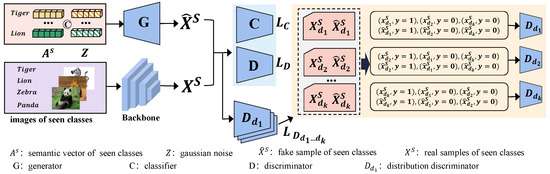
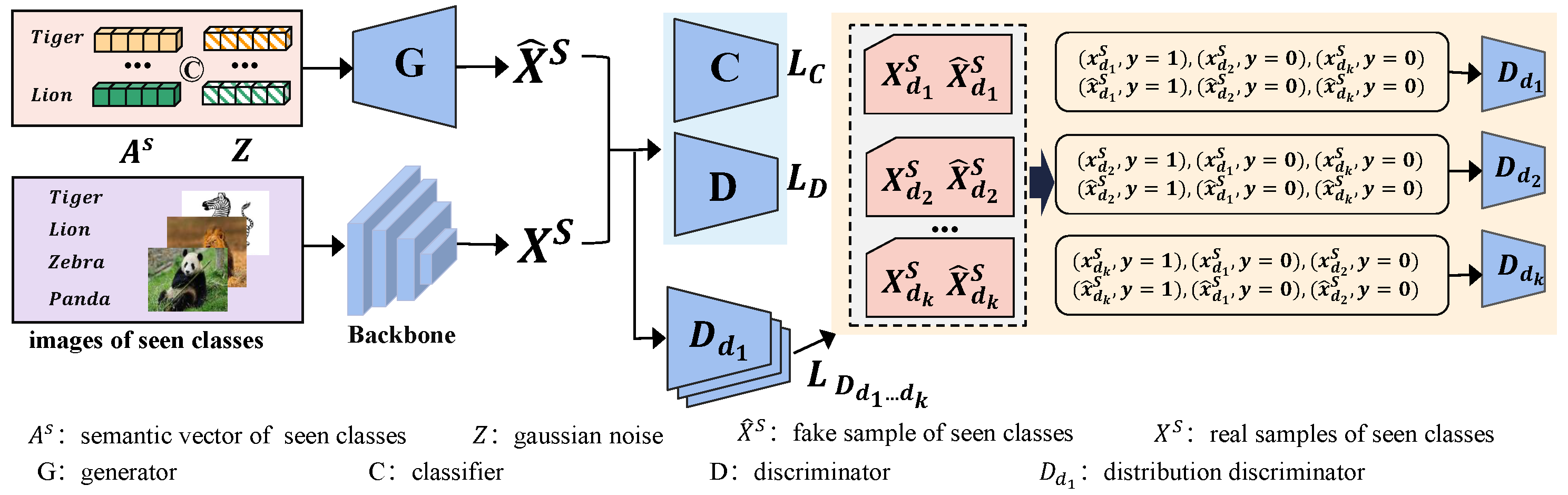
This section introduces the notation used in GM-CDZSL, elaborates on each model component, and presents the overall optimization pipeline. The framework and training procedure are illustrated in Figure 1 and Algorithm 1.
| Algorithm 1 Training Procedure for GM-CDZSL |
|
Figure 1.
Overall architecture of the proposed GM-CDZSL framework. The generator G takes semantic vectors of seen classes and Gaussian noise Z as input to synthesize fake visual features . The discriminator D distinguishes real features from synthetic features . The mapper N projects both real and synthetic features into a latent space, where the classifier C performs classification using semantic vectors as class weights. To handle distribution shift, K distribution discriminators are designed following a one-vs-all strategy: each takes the k-th source domain as positive examples and all other source domains as negative examples. Arrows indicate the data flow.
3.1. Problem Formulation
The source domain contains the training set , where n is the number of samples, d is the feature dimension, and indicates the source distribution of the i-th sample. The training set comprises distributions , with labels (seen classes). The target domain test set contains samples from all classes , where denotes the unseen classes. The target distribution differs from all source distributions . This setting is more challenging than conventional ZSL because it requires handling both class shift and distribution shift simultaneously. The goal is to learn a mapping that performs well under both shifts.
We adopt semantic vectors to bridge seen and unseen classes. Let and denote the sets of semantic vectors for seen and unseen classes, respectively. Our model builds a semantic-to-visual GAN to generate features conditioned on semantic vectors. To further enhance cross-domain generalization, we employ an empirical H-divergence estimator (EHE) to quantify the distance between distributions and impose explicit distribution consistency constraints in the latent space. We now describe its generative components.
3.2. Semantic→Visual Feature Generation GAN
Given a training dataset of seen classes, the primary objective of GM-CDZSL is to learn a semantic-to-visual generator using the source domain data, where Z represents random Gaussian noise and a is a semantic vector. The synthetic features, denoted as , should closely resemble the real visual features X. The discriminator D distinguishes real features from synthetic ones.
Following [3], we adopt the Wasserstein GAN framework with a gradient penalty to enforce the Lipschitz constraint [45]. Let denote real samples and denote generated samples. To compute the gradient penalty, we define with as random interpolations between real and generated samples. The discriminator loss and generator loss are defined as follows:
where is the gradient penalty coefficient, which we set to 10 in our experiments.
We introduce a mapper network N to project both real and synthetic features into a shared latent space , denoted as and . The generative and discriminative losses work together to encourage consistency between the real and synthetic features in this latent space. This latent space is designed to be domain-invariant while preserving semantic information.
We parameterize the classifier C using the semantic vectors of seen classes as weight vectors: , where . For unseen classes, we replace W with during inference.
The classification loss enforces class separability in the latent space, where the expectation is taken over real samples and over generated samples :
where denotes the dot-product similarity, i.e., , is the true class semantic vector, and are the semantic vectors of the seen classes.
The above formulation describes a conventional generative ZSL framework. While such methods work well when the source and target distributions are consistent, they impose no explicit constraints on domain discrepancies. As a result, their performance degrades significantly under distribution shifts. To address this limitation, we introduce a domain discriminator loss that explicitly aligns multiple source domains in the latent space.
3.3. Empirical H-Divergence Estimator
In the latent space, both synthetic and real samples originate from multiple source distributions. To enable the model to generalize well to unseen target distributions, we introduce a distribution discriminator loss that encourages these distributions to align.
Let denote the latent space, i.e., , where N is the mapper defined in Section 3.2.
Definition 1 (H-divergence [46]). For two distributions and over , the H-divergence with respect to hypothesis class is defined as:
Intuitively, if a classifier in can perfectly separate the two distributions, and decreases toward 0 as they become indistinguishable.
Theoretical Motivation. Following [31], we assume that the unknown target distribution lies within the convex hull of the source distributions . Let denote the error on source domain i. Then the target error satisfies the following generalization bound:
where , , and is a constant term related to the complexity of the hypothesis space (e.g., the VC dimension) [46].
This bound suggests that minimizing the target error requires reducing both the source errors and the divergences . However, since is unknown during training, we cannot directly minimize these divergences. Instead, we minimize an upper bound by encouraging the source distributions to be close to one another.
By the triangle inequality for H-divergence:
Consequently, minimizing the pairwise divergences among source domains reduces an upper bound on for any target distribution within the convex hull. This provides a theoretical justification for our inter-source divergence minimization objective.
From Pairwise to One-vs-All: A Relaxation. Minimizing all pairwise H-divergences directly is computationally prohibitive (). We therefore relax the objective to a one-vs-all formulation, which is computationally efficient () and serves as an upper bound for the pairwise divergences. Specifically, for any two source domains and , the following inequality holds:
Thus, by minimizing the maximum one-vs-all divergence (which our loss effectively does), we minimize an upper bound on the sum of all pairwise divergences, thereby preserving the theoretical guarantee derived from Equation (5). This relaxation provides a mathematically sound justification for adopting a one-vs-all strategy.
One-vs-All Distribution Discriminators. To implement this relaxation, we adopt a one-vs-all strategy, training K discriminators , one for each source domain. For the k-th discriminator , samples from are labeled 1, while samples from all other source domains () are labeled 0.
Our one-vs-all discriminator loss directly estimates and minimizes the relevant divergences via the empirical H-divergence estimator [46]:
This loss approximates the sum of pairwise H-divergences among source domains , thereby effectively minimizing an upper bound on the target generalization error.
The one-vs-all design requires only discriminators (one per source domain), compared to for pairwise discriminators, while still effectively encouraging all source distributions to align in the latent space.
Corollary 1.
Building on this distribution alignment loss, we now present the overall optimization objective that jointly trains all components of GM-CDZSL.
3.4. Model Optimization
The overall objective combines the classification loss, the GAN adversarial losses, and the distribution alignment loss:
This joint objective unifies semantic-visual generation, classification, and theoretically grounded distribution alignment.
Remark 1.
The total loss in Equation (9) integrates three complementary objectives: (1) encourages class separability; (2) maintains feature realism—this pair already encodes a min-max game where encourages the discriminator D to maximize the Wasserstein distance while encourages the generator G to minimize it, and the outer min-max in Equation (9) nests this adversarial relationship; and (3) implements the domain alignment derived in Corollary 1. By jointly optimizing these terms, the model learns a latent space that is both class-discriminative and domain-invariant, with theoretically motivated generalization bounds on unseen target distributions.
Optimization interpretation. The minimax optimization in Equation (9) involves two adversarial relationships:
- Maximization (adversaries):
- 1.
- The WGAN discriminator D maximizes to distinguish real features from synthetic ones.
- 2.
- The domain discriminators are trained to minimize (implemented in Step 1) to identify the source domains.
- Minimization (learners):
- 3.
- The generator G minimizes to fool the discriminator D, and minimizes (equivalently, maximizes ) to confuse the domain discriminators.
- 4.
- The mapper N has two roles: (1) In Step 2, N minimizes to help D distinguish real features from synthetic ones (a multi-task constraint); (2) In Step 3, N minimizes (i.e., maximizes ) together with G to confuse the domain discriminators.
- 5.
- The classifier C minimizes for accurate classification.
The negative sign creates a standard min–max domain adversarial game:
- The domain discriminators are trained to minimize (Step 1), aiming to identify the source domains.
- The generator G and mapper N are trained to maximize (Step 3), aiming to confuse the domain discriminators and learn domain-invariant representations.
3.5. Sample Generation and Prediction
After training, we fix the generator and feed the semantic vectors of unseen classes to synthesize fake features. Let M denote the number of synthetic feature vectors generated per unseen class. These M synthetic features are then combined with the real features of seen classes to train a final classifier, thereby converting the zero-shot learning task into a supervised learning problem.
where , , and the expectation over is approximated by averaging over M generated samples per unseen class.
Based on the ablation study in Section 4.7, we set for all experiments. Considering the trade-off between the computational overhead of feature generation and the marginal accuracy gain (increasing M from 200 to 500 yields only a 0.1 point improvement in H-mean), we choose , as it achieves comparable performance with significantly lower computational cost.
During inference, test samples are mapped to the latent space and then classified by the trained model.
Discussion on optimization strategy. The overall objective in Equation (9) is a minimax problem. Directly optimizing all variables simultaneously often leads to training instability. We therefore adopt an alternating update schedule: Step 1 trains the domain discriminators (with N fixed) to identify the source domains; Step 2 optimizes the WGAN discriminator D together with the mapper N (a multi-task constraint); and Step 3 jointly optimizes the generator G, the mapper N, and the classifier C to minimize the classification loss and confuse the domain discriminators. This schedule follows standard GAN training practice [3,45] and has been empirically verified to achieve stable convergence (see Section 4.7). The alternating updates effectively implement the global min–max objective, as each subproblem corresponds to a subset of the optimization variables.
4. Experimental Results and Analysis
4.1. Datasets
We adopted four benchmark datasets to evaluate our method across diverse cross-distribution scenarios.
PACS [22] comprises four natural domains (photo, art painting, cartoon, and sketch) with substantial style shifts, providing a standard benchmark for evaluating cross-domain generalization. The dataset contains seven object classes: dog, elephant, giraffe, guitar, horse, house, and person. Following the standard GZSL protocol [11], we split the classes into four seen classes and three unseen classes. We adopted the leave-one-domain-out protocol: three domains serve as the source (training) and the remaining domain serves as the target (testing). The source domain contains images of all seven classes, but only the seen classes are labeled; the target domain contains all seven classes with full labels for evaluation.
VLCS [47] aggregates four real-world datasets: VOC2007 [48], LabelMe [49], Caltech-101 [50], and SUN [51], with heterogeneous image sources. The dataset shares five common classes: bird, car, dog, chair, and person. Following the GZSL protocol [11], we split the classes into three seen classes and two unseen classes. We adopted the leave-one-domain-out protocol: three datasets serve as the source and the remaining dataset serves as the target. The source domain contains images of all five classes, but only the seen classes are labeled; the target domain contains all five classes with full labels.
CUB [52] is a fine-grained bird dataset with 200 species and 11,788 images. Since CUB lacks natural domain labels, we constructed three synthetic domains based on the provided occlusion attribute “occluded”: no occlusion, partial occlusion, and heavy occlusion. Each synthetic domain contains all 200 bird species, filtered by the corresponding occlusion level. Following the standard GZSL split [11], we used 150 seen classes and 50 unseen classes. We adopted a leave-one-domain-out protocol: two synthetic domains serve as the source and the remaining domain serves as the target. The source domain contains images of all 200 species, but only the seen classes are labeled; the target domain contains all 200 species with full labels. This setup introduces a distribution shift while preserving the GZSL evaluation protocol.
AWA2 [53] contains 37,322 images of 50 animal classes. We constructed three synthetic domains based on the habitat attribute: desert, savanna, and forest. Each domain contains all 50 animal classes, filtered by habitat. Following the standard GZSL split [11], we used 40 seen classes and 10 unseen classes. We adopted the same leave-one-domain-out protocol: two synthetic domains serve as the source and the remaining domain serves as the target. The source domain contains images of all 50 classes, but only the seen classes are labeled; the target domain contains all 50 classes with full labels.
Word vectors for all classes were obtained from word2vec [11]. For all datasets, we used a fixed ResNet-101 [1] pre-trained on ImageNet to extract visual features and kept the backbone frozen. These benchmarks are commonly adopted in existing zero-shot learning and domain generalization studies [14,15,16,29,30].
4.2. Evaluation Metrics
The test set included samples from both seen and unseen classes. Because only seen classes appear during training, models typically achieve higher accuracy on seen classes. To provide a balanced assessment, we report the average per-class accuracy on unseen classes (), the average per-class accuracy on seen classes (), and their harmonic mean . This metric is widely adopted in generalized zero-shot learning (GZSL) to avoid biased evaluation caused by over-reliance on seen classes. The harmonic mean penalizes extreme values, making it the standard metric for GZSL, where both and are equally important.
4.3. Comparison Methods
We compared GM-CDZSL with two categories of baselines: generative ZSL methods and domain generalization (DG) methods adapted to ZSL.
Generative ZSL Methods. We selected five representative methods: f-CLSGAN [3] (a conditional WGAN with a classification loss), CE-GZSL [4] (supervised contrastive learning), DGZ [28] (deconstructed generation), TF-VAEGAN [54] (latent embedding feedback), and FREE [55] (feature refinement). Recent advances [29,30] have extended this paradigm but still assume consistent source-target distributions.
Domain Generalization Methods Adapted to ZSL. Since CDZSL involves distribution shifts, we also compared with MLDG [36] (meta-learning), CORAL [37] (second-order statistic alignment), and GroupDRO [38] (worst-case optimization). These methods cannot synthesize unseen class features; therefore, we augmented them with the same semantic-conditioned generator and the same number of generated samples ( per unseen class) used in GM-CDZSL to help ensure a fair comparison.
The baselines described above assume either identical distributions (ZSL) or identical label spaces (DG), making them inherently ill-suited for the CDZSL task, which involves both class shifts and domain shifts. As shown in Table 2, Table 3, Table 4 and Table 5, they achieve high but low under distribution shifts. To enable a fair comparison, we added the proposed alignment loss to each baseline, denoting the enhanced variants as “+ours”.
Table 2.
Experimental results on PACS (P = Photo, A = Art Painting, C = Cartoon, S = Sketch).
Table 3.
Experimental results on VLCS (V = VOC2007, L = LabelMe, C = Caltech-101, S = SUN).
Table 4.
Experimental results on CUB (200 classes, fine-grained, occlusion-based domain shift).
Table 5.
Experimental results on AWA2 (50 classes, coarse-grained, habitat-based domain shift).
Fairness Guarantee. All methods share the same fixed ResNet-101 backbone, the same 300-dimensional word2vec embeddings, and the same feature extraction pipeline. For the DG baselines, we adopted a two-stage procedure: first, we trained the generator (see Section 3.2) on the seen classes; second, we used it to synthesize unseen features ( samples per unseen class) and then trained each DG method under its original objective, without additional tuning. All methods followed identical seen/unseen splits and domain partitions.
4.4. Experimental Settings
All experiments followed the CDZSL definition (Section 3.1) with standard GZSL splits. For PACS and VLCS, we used the four-domain protocol (each domain serves as the target, and the remaining three serve as the source). For CUB and AWA2, we created synthetic domain shifts as described in Section 4.1. Network architectures followed the best practices of the baselines [3,4,28,54,55].
The main focus of this paper is the design of the empirical H-divergence estimator, the parameter tuning of the loss function, and the alternating optimization strategy. Accordingly, the domain discriminators use a binary cross-entropy loss; we designed K one-vs-all discriminators as described in Section 3.3 with alternating optimization (see Algorithm 1).
The hyperparameters and q were tuned for each dataset. All experiments were run five times with different random seeds; the results are reported as the mean ± standard deviation. Statistical significance was assessed using a paired t-test (, ).
4.5. Implementation Details
All models were implemented in PyTorch 2.0.0 (CUDA 11.7) using NVIDIA GeForce RTX 3090 GPUs. For all baselines, we used identical feature extraction and semantic representations.
Feature Extraction. A fixed ResNet-101 [1] pre-trained on ImageNet produced 2048-dimensional visual features (the backbone was frozen).
Semantic Vectors. We used 300-dimensional word2vec embeddings [11] trained on the Google News corpus.
GM-CDZSL Architecture. The generator G uses a two-layer architecture (4096→2048) with LeakyReLU activation. Similarly, the discriminator D adopts a two-layer design that takes the concatenated visual features and semantic vectors as input. The mapper N has a symmetric 2048-4096-2048 structure. Each domain discriminator is a single layer with 256 units and ReLU activation, introducing only a modest number of additional parameters. The classifier C is a two-layer network (2048→1024→) with a dropout rate of 0.5.
Training Hyperparameters. We used the Adam optimizer with a learning rate of for all modules. The batch sizes were 64 for PACS and VLCS, and 128 for CUB and AWA2. Training was conducted for 200 epochs. The gradient penalty coefficient was set to 10. The hyperparameters and q were set as reported in Section 4.10, and was set as reported in the ablation study (Section 4.7). Five random seeds were used (42, 1234, 5678, 91,011, 121,314).
Computational Complexity. Compared with the base generative ZSL model (f-CLSGAN, with 1.8M parameters), GM-CDZSL introduces K additional domain discriminators. For PACS (), GM-CDZSL has approximately 2.2 M parameters, compared with 1.8 M for the base model—a modest increase that is justified by the observed performance advantages. The training time scales approximately linearly with K (see Table 6), while the inference time remains constant because the discriminators are discarded after training.
Table 6.
Scalability analysis (training time relative to baseline).
4.6. Experimental Results Analysis
As reported in Table 2, on PACS with large style shifts among domains (photo, art, cartoon, sketch), our method delivered stable accuracy gains across all settings. For instance, on the Photo domain, CE-GZSL+ours gained 9.9 points in and 4.8 points in H; across all baselines, the average H gain ranged from 3.6 to 6.6 points.
A slight decrease in on some domains reflects a typical trade-off: enforcing domain alignment may slightly reduce seen-class bias while improving cross-domain generalization. Notably, the harmonic mean H still shows consistent improvement, confirming that the trade-off is acceptable. The gains are most pronounced on Photo and Sketch, which differ most from the source domains (art, cartoon), aligning with our expectation that GM-CDZSL is particularly effective under substantial domain shifts. These results suggest that the proposed alignment module can help reduce domain discrepancy while preserving class discriminability.
Table 3 shows VLCS results, where source datasets originated from diverse real-world sources. Notably, the gain varies substantially across domains. For CE-GZSL+ours, the H-mean improvement on the Caltech-101 (C) domain reaches +9.1 points, while on the VOC2007 (V) domain it is only +2.3 points. This discrepancy can be explained by the domain characteristics: Caltech-101 has a distinct image collection that differs substantially in style and quality from the source domains (VOC2007, LabelMe, SUN), providing greater opportunity for the proposed alignment to reduce domain discrepancy. In contrast, VOC2007 shares similar image statistics with some source domains, resulting in smaller gains. This pattern suggests that GM-CDZSL is particularly effective when the target domain distribution differs markedly from the source distributions, which is where conventional ZSL methods typically struggle. Even when embedded into classic DG methods (MLDG, CORAL, GroupDRO), our alignment loss yielded clear performance advantages, demonstrating its broad compatibility.
From Table 4, we observe that on the fine-grained CUB dataset with occlusion-based domain shifts, our method delivered positive H gains across all occlusion levels (average 2.3–3.7 points). The largest gain (4.0 points) occurred on the Partial Occlusion domain, where occlusions partially obscure key features. In this setting, domain alignment helps suppress noise and focus on remaining semantic parts. The gain is smaller on Heavy Occlusion, likely because extreme occlusions remove too much semantic information, making the task inherently more difficult. On No Occlusion, the model already performs well, leaving less room for improvement. These results indicate that GM-CDZSL is able to handle moderate occlusion shifts by aligning latent distributions.
The results in Table 5 show that on the coarse-grained AWA2 dataset with habitat-based domain shifts, our method achieved consistent performance gains (averaging 2.2–3.2 points in H-mean). The stable accuracy increments across PACS (style shift), VLCS (source diversity), CUB (fine-grained + occlusion), and AWA2 (coarse-grained + habitat) demonstrate the robustness of the proposed one-vs-all alignment and H-divergence constraint across diverse CDZSL scenarios.
4.7. Ablation Studies
We conducted ablation experiments on PACS (four-target average) to quantify each component’s contribution, as summarized in Table 7. All results are five-run averages reporting H-mean.
Table 7.
Ablation study on PACS (average H-mean).
Domain discriminators. Removing domain discriminators led to a performance drop of 3.6 points, suggesting that domain alignment is essential. Pairwise discriminators achieved comparable accuracy (−0.3 points) but require independent discriminators, leading to quadratic computational cost that drastically increases training overhead as K grows. In contrast, our one-vs-all design needs only K discriminators with linear complexity, achieving nearly the same accuracy with significantly better scalability. This justifies our choice of the one-vs-all strategy. The shared multi-class discriminator underperformed (−1.6), likely due to class imbalance among domains.
H-divergence loss. Replacing H-divergence with MMD or KL divergence reduced H by 1.3 and 2.0 points, respectively. KL divergence suffered most because it requires density estimation, which is unstable under complex domain shifts. This justifies our choice of H-divergence for empirical domain discrepancy measurement.
Mapper N. Direct alignment on raw ResNet features (without N) caused a remarkable 5.5-point drop, while linear projection reduced the loss to 2.9 points. Raw ResNet features carry domain-specific noise such as texture and illumination, which hinders effective alignment. The nonlinear mapper effectively extracts domain-invariant semantic representations, which highlights its importance.
Adversarial training strategy. Joint training (updating N and together) or removing Step 1 weakened the domain confusion signal, dropping H by 1.7–2.3 points. The alternating schedule is designed to provide the mapper with strong adversarial pressure to learn domain-invariant representations.
Generated samples M. Increasing M from 50 to 200 improved H by 2.3 points, but further increase to 500 yielded negligible gain (+0.1). This diminishing return occurs because 200 samples sufficiently approximate the underlying feature distribution; additional samples add little new information.
4.8. Convex Hull Validation
We conducted convex hull validation on PACS only. PACS contains four natural domains (photo, art, cartoon, sketch) with continuous style variations, which naturally lend themselves to the geometric analysis required for validating the convex hull assumption introduced in Section 3.3. For CUB and AWA2, the synthetic domains are constructed from discrete attributes (occlusion level and habitat) and are primarily intended for evaluating classification performance under attribute-based domain shifts, as reported in Table 4 and Table 5. Therefore, we restrict the convex hull analysis to PACS.
To empirically validate the convex hull assumption, we conducted experiments on PACS using source domains P, A, C and target domain S. After training, we extracted latent features for all samples. We then computed the domain-wise mean feature vectors (referred to as domain centers) over all samples from each source domain. The convex hull of these source domain centers was computed using the Quickhull algorithm. We then measured the Euclidean distance from the target domain center to this convex hull, normalized by the maximum pairwise distance between any two source domain centers (denoted as the source domain diameter). This normalization yields scale invariance. All results were averaged over five independent runs.
Results. Random initialization: ; f-CLSGAN baseline: ; GM-CDZSL (ours): (mean ± std). A paired t-test (, ) confirmed that the reduction from baseline to ours is statistically significant.
GM-CDZSL reduced the target-to-hull distance by nearly half compared to the baseline. This result provides empirical support for our theoretical assumption in Section 3.3. According to the generalization bound in Equation (5), minimizing inter-source H-divergence tightens the upper bound of target error. Our total loss function in Equation (9) directly instantiates this principle: the term encourages the mapper N to learn domain-invariant features, which reduces the pairwise H-divergences among source domains and thus tightens the target risk bound. The observed reduction in target-to-hull distance suggests that our optimization objective helps to enforce the theoretical property derived in Section 3.3.
4.9. Scalability Analysis
Note. The synthetic domains in this scalability analysis are only added to the source sets of PACS to increase the number of source domains. This differs from the synthetic occlusion-based (CUB) and habitat-based (AWA2) domains constructed as target splits in Section 4.1, which are used to evaluate cross-domain generalization under specific attribute shifts.
We analyzed scalability with respect to source domain count K using synthetic data generated from PACS. Starting from the four original domains (P, A, C, S), we created additional domains by adding Gaussian noise to ResNet-101 features. The noise variance is tuned to introduce moderate distribution shifts without fully erasing category semantic information, preserving the discriminability of original classes while simulating continuous domain variations. Adding mild Gaussian noise to visual features is a standard strategy to simulate continuous domain shifts in domain generalization research, as it preserves semantic content while introducing a measurable distribution shift. Synthetic domains served as additional sources during training; target domains remained unchanged. Training and test splits followed the original PACS protocol.
Our one-vs-all design required K discriminators (linear), whereas pairwise discriminators required (quadratic). For , our method was faster (2.4× vs. 5.5× training time).
The model performance degraded gracefully: the average H-mean decreased from 62.3 at to 58.1 at , with a total drop of 4.2 points. This decline is expected because more source domains introduce greater distribution diversity, making complete alignment harder. Moreover, as K increases, the number of domain discriminators grows linearly, which may introduce additional optimization challenges such as imbalanced training among discriminators (e.g., some domains being easier to separate than others). Despite these challenges, the graceful degradation (approximately 0.7 points per additional source domain on average) suggests that our method remains robust even with up to 8 source domains, and the performance drop does not accelerate sharply, indicating good scalability. Nevertheless, performance remained acceptable up to , suggesting practical applicability.
4.10. Parameter Analysis
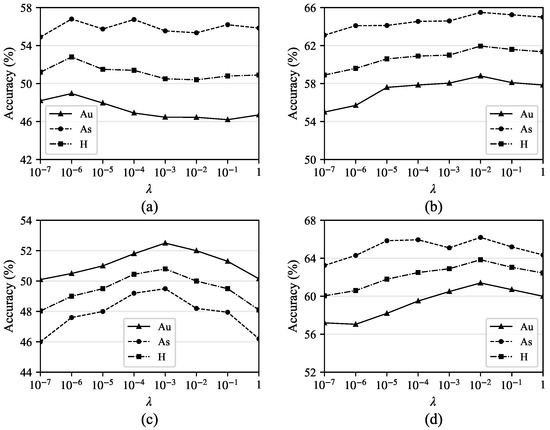
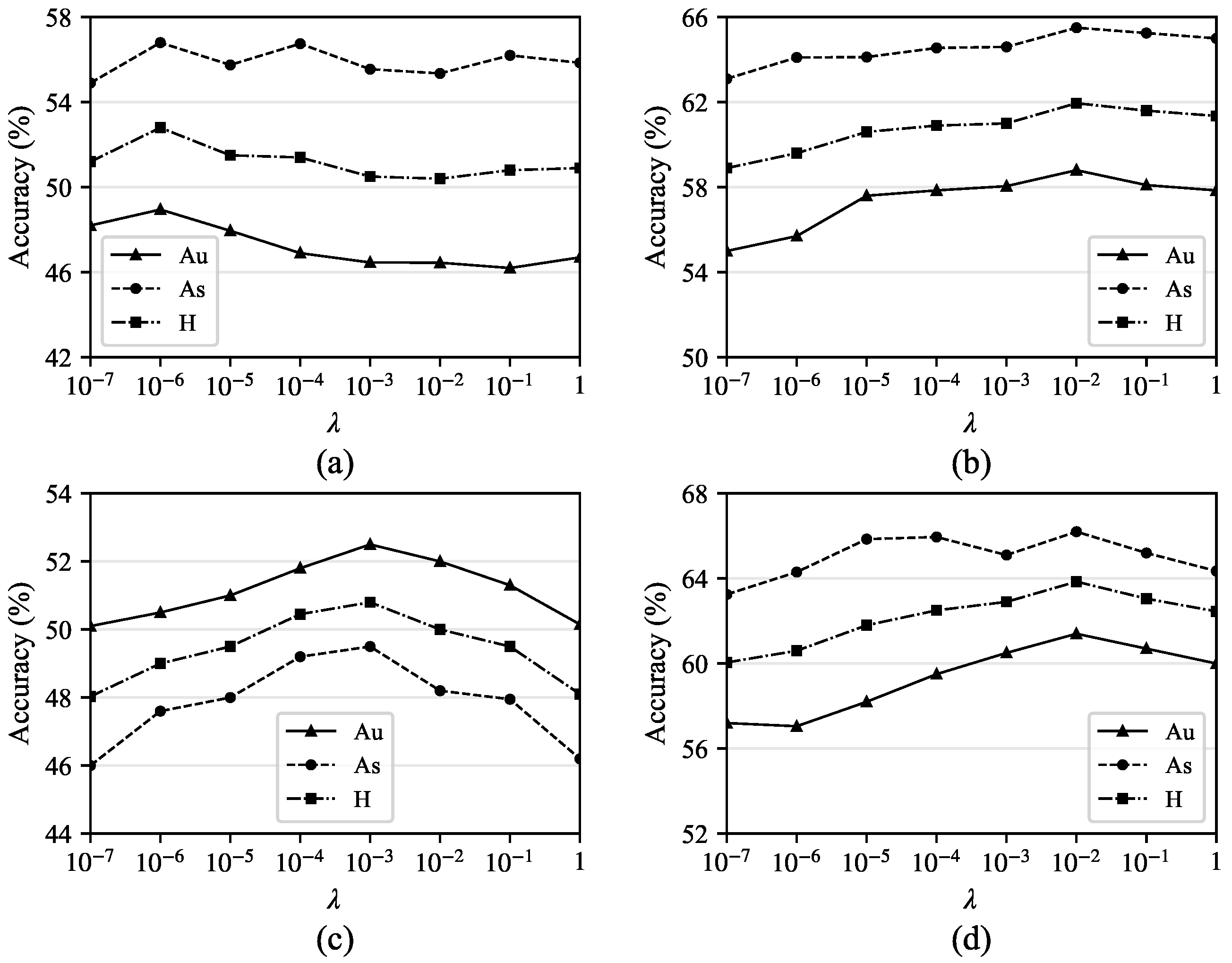
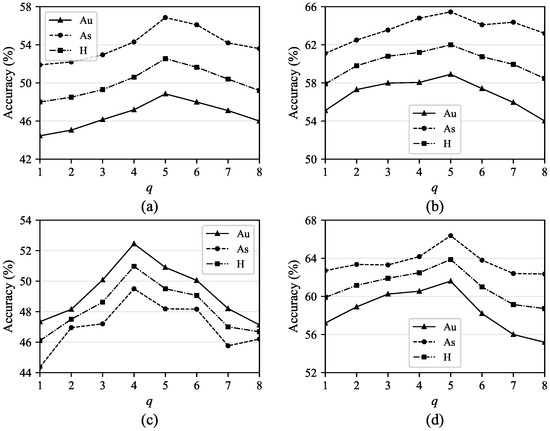
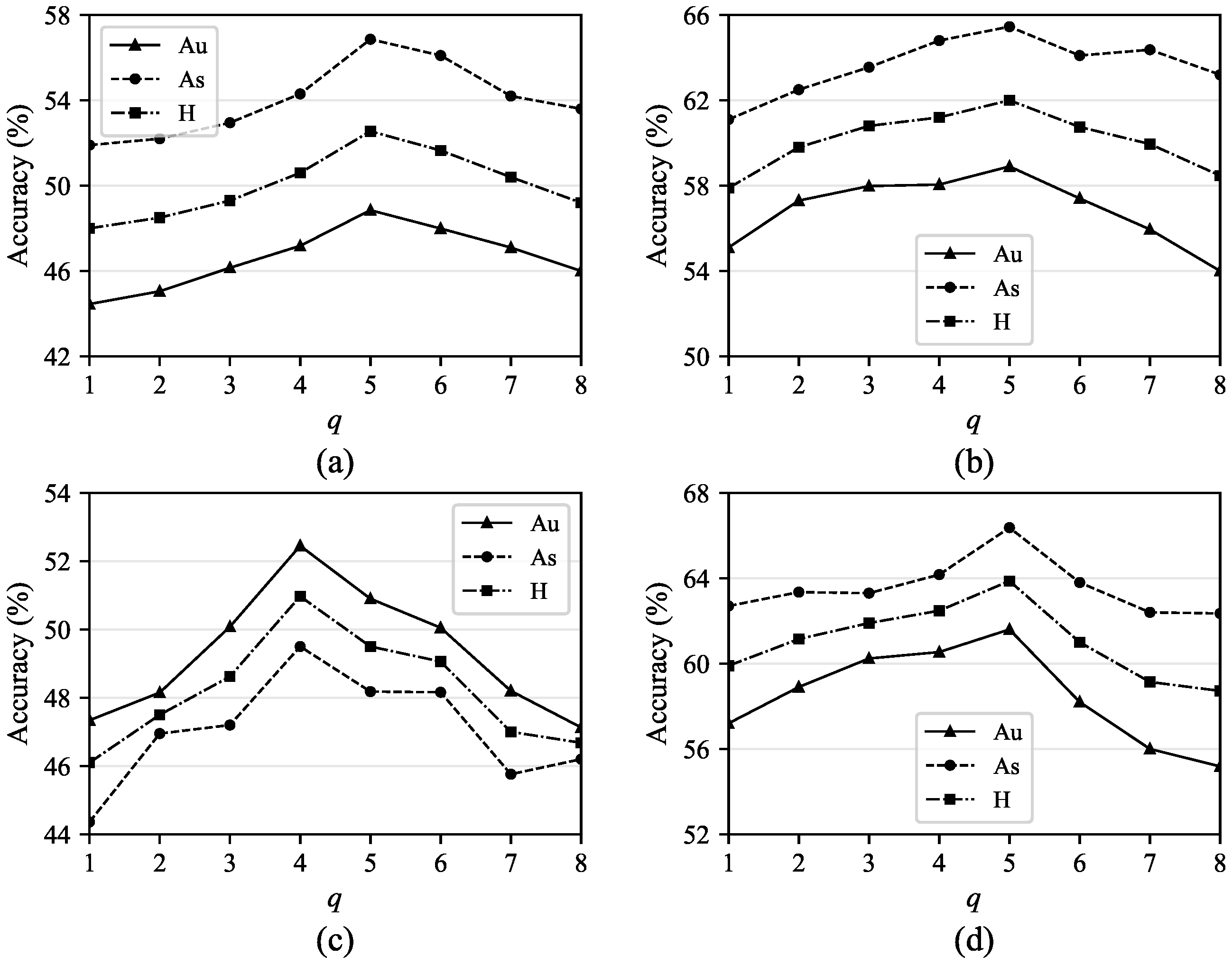
We analyzed two key hyperparameters: alignment weight and discriminator update frequency q. Table 8 and Table 9 report the average H-mean on PACS using CE-GZSL+ours. Figure 2 and Figure 3 further show the sensitivity on both PACS and VLCS, demonstrating consistent trends across datasets; the tabular results on VLCS are omitted for brevity.
Table 8.
Effect of on average H-mean (CE-GZSL+ours) on PACS.
Table 9.
Effect of q on average H-mean (CE-GZSL+ours) on PACS.
Figure 2.
Effect of on the experimental results. (a) PACS dataset with f-CLSGAN+ours; (b) PACS dataset with CE-GZSL+ours; (c) VLCS dataset with f-CLSGAN+ours; (d) VLCS dataset with CE-GZSL+ours. Au, As, and H denote the accuracy on unseen classes, seen classes, and their harmonic mean, respectively.
Figure 3.
Effect of q on the experimental results. (a) PACS dataset with f-CLSGAN+ours; (b) PACS dataset with CE-GZSL+ours; (c) VLCS dataset with f-CLSGAN+ours; (d) VLCS dataset with CE-GZSL+ours.
Effect of . When was too small (≤), the alignment loss was insufficient to reduce domain discrepancy, limiting improvement. The performance peaked at . Further increasing (≥) caused the alignment term to dominate the overall loss, interfering with classification and feature generation and gradually degrading model performance. Thus, we set the optimal to for CE-GZSL+ours on PACS.
Effect of q (discriminator updates per generator step). Too few updates () weakened the domain discriminators, providing insufficient adversarial pressure. Too many updates () caused the discriminators to overfit to domain identification, destabilizing training. The optimal balanced domain discrimination strength and training stability.
5. Conclusions
Conventional zero-shot learning assumes identical source–target distributions, which limits its applicability under real-world domain shifts. This paper addresses the more practical cross-distribution zero-shot learning (CDZSL) task by proposing GM-CDZSL, a unified generative framework that integrates semantic-conditioned feature generation with multi-source domain alignment. The framework comprises three components: (1) a semantic-conditioned generator that synthesizes unseen-class features to bridge the class gap; (2) a one-vs-all domain discriminator group that scales linearly with the number of source domains; and (3) an H-divergence-based alignment loss that explicitly minimizes inter-source distribution discrepancies. Theoretically, we show that minimizing pairwise H-divergences among source domains leads to a tighter generalization bound for unseen target domains. Experimentally, extensive evaluations on PACS, VLCS, CUB, and AWA2 demonstrate that GM-CDZSL achieves consistent improvements over both generative ZSL and domain generalization baselines, with statistically significant gains. These results confirm that integrating class-aware generation with distribution alignment effectively bridges the gap left by prior work that treated the two challenges in isolation. Notably, these gains are obtained with a fixed ResNet-101 backbone and static word2vec embeddings, which helps to ensure a fair comparison with baselines rather than pursuing maximum performance through stronger backbones.
Limitations and Future Work. Several limitations remain and guide future directions. First, performance depends on pre-trained semantic embeddings (word2vec); ambiguous or rare class semantics degrade embedding quality. We plan to explore lightweight vision-language alignment (e.g., CLIP) to enable adaptive semantic refinement. Second, the one-vs-all discriminator increases training cost linearly with K; for scenarios with many source domains (e.g., ), this becomes a bottleneck. Domain clustering to group similar distributions offers a promising remedy. Third, the synthetic domain divisions on CUB (occlusion) and AWA2 (habitat) do not fully capture real-world domain complexity. Augmenting synthetic domains with mixed perturbations (e.g., combining occlusion, illumination, and background changes) would better approximate real-world variations. Longer term, we intend to evaluate our method on real-world large-scale domain shift datasets.
In summary, GM-CDZSL provides a principled and effective solution for cross-distribution zero-shot learning, with theoretical grounding, comprehensive experimental validation, and clear pathways for future improvement. The proposed integration—rather than any single component—represents the primary contribution of this work, bridging the gap between generative ZSL and domain generalization.
Author Contributions
Conceptualization, Y.W. and T.G.; methodology, Y.W.; formal analysis, Y.W.; data curation, Y.W.; writing—original draft preparation, Y.W.; writing—review and editing, T.G. and Z.T.; supervision, T.G.; project administration, T.G.; funding acquisition, T.G. All authors have read and agreed to the published version of the manuscript.
Funding
This research was funded by the Natural Science Foundation of Shanxi Province, China (Grant No. 202403021222153); the Shanxi Provincial Key Laboratory (CICIP2024002); the Shanxi Higher Education Institutions Science and Technology Innovation Project (2024L164).
Institutional Review Board Statement
Not applicable.
Informed Consent Statement
Not applicable.
Data Availability Statement
Publicly available datasets were analyzed in this study. The PACS [17] and VLCS [26] datasets are openly accessible via the data downloading scripts provided in the DomainBed repository at https://github.com/facebookresearch/DomainBed (accessed on 15 March 2025). Detailed instructions to download and prepare the datasets can be found in the repository’s README file.
Acknowledgments
The authors would like to thank the anonymous reviewers for their valuable comments and suggestions.
Conflicts of Interest
The authors declare no conflict of interest.
References
- He, K.; Zhang, X.; Ren, S.; Sun, J. Deep residual learning for image recognition. In Proceedings of the IEEE Conference on Computer Vision and Pattern Recognition (CVPR), Las Vegas, NV, USA, 27–30 June 2016; pp. 770–778. [Google Scholar]
- Zhang, W.; Yang, C. Relation representation based on private and shared features for adaptive few-shot link prediction. J. Intell. Inf. Syst. 2024, 62, 1375–1401. [Google Scholar] [CrossRef] [Scilit]
- Xian, Y.; Lorenz, T.; Schiele, B.; Akata, Z. Feature generating networks for zero-shot learning. In Proceedings of the IEEE Conference on Computer Vision and Pattern Recognition (CVPR), Salt Lake City, UT, USA, 18–22 June 2018; pp. 5542–5551. [Google Scholar]
- Han, Z.; Fu, Z.; Chen, S.; Yang, J. Contrastive embedding for generalized zero-shot learning. In Proceedings of the IEEE/CVF Conference on Computer Vision and Pattern Recognition (CVPR), Virtual, 19–25 June 2021; pp. 2371–2381. [Google Scholar]
- Lampert, C.H.; Nickisch, H.; Harmeling, S. Learning to detect unseen object classes by between-class attribute transfer. In Proceedings of the IEEE Conference on Computer Vision and Pattern Recognition (CVPR), Miami, FL, USA, 20–25 June 2009; pp. 951–958. [Google Scholar]
- Zhu, P.; Wang, H.; Saligrama, V. Generalized zero-shot recognition based on visually semantic embedding. In Proceedings of the IEEE/CVF Conference on Computer Vision and Pattern Recognition (CVPR), Long Beach, CA, USA, 15–20 June 2019; pp. 2995–3003. [Google Scholar]
- Akata, Z.; Perronnin, F.; Harchaoui, Z.; Schmid, C. Label-embedding for attribute-based classification. In Proceedings of the IEEE Conference on Computer Vision and Pattern Recognition (CVPR), Portland, OR, USA, 23–28 June 2013; pp. 819–826. [Google Scholar]
- Li, J.; Lan, X.; Long, Y.; Liu, Y.; Chen, X.; Shao, L.; Zheng, N. A joint label space for generalized zero-shot classification. IEEE Trans. Image Process. 2020, 29, 5817–5831. [Google Scholar] [CrossRef] [Scilit]
- Xie, G.S.; Liu, L.; Jin, X.; Zhu, F.; Zhang, Z.; Qin, J.; Yao, Y.; Shao, L. Attentive region embedding network for zero-shot learning. In Proceedings of the IEEE/CVF Conference on Computer Vision and Pattern Recognition (CVPR), Long Beach, CA, USA, 15–20 June 2019; pp. 9384–9393. [Google Scholar]
- Verma, V.K.; Arora, G.; Mishra, A.; Rai, P. Generalized zero-shot learning via synthesized examples. In Proceedings of the IEEE Conference on Computer Vision and Pattern Recognition (CVPR), Salt Lake City, UT, USA, 18–22 June 2018; pp. 4281–4289. [Google Scholar]
- Xian, Y.; Lampert, C.H.; Schiele, B.; Akata, Z. Zero-shot learning—A comprehensive evaluation of the good, the bad and the ugly. IEEE Trans. Pattern Anal. Mach. Intell. 2018, 41, 2251–2265. [Google Scholar] [CrossRef] [Scilit]
- Hou, W.; Chen, S.; Chen, S.; Hong, Z.; Wang, Y.; Feng, X.; Khan, S.; Khan, F.S.; You, X. Visual-augmented dynamic semantic prototype for generative zero-shot learning. In Proceedings of the IEEE/CVF Conference on Computer Vision and Pattern Recognition (CVPR), Seattle, WA, USA, 16–22 June 2024; pp. 23627–23637. [Google Scholar]
- Tang, B.; Zhang, J.; Yan, L.; Yu, Q.; Sheng, L.; Xu, D. Data-free generalized zero-shot learning. In Proceedings of the AAAI Conference on Artificial Intelligence (AAAI), Vancouver, BC, Canada, 20–27 February 2024; Volume 38, pp. 5108–5117. [Google Scholar]
- Badawi, M.; Mohammedyahia, A.; Bhat, S.; Maier, A. Review of zero-shot and few-shot AI algorithms in the medical domain. arXiv 2024, arXiv:2406.16143. [Google Scholar]
- Uehara, K.; Takashima, R.; Takiguchi, T. Zero-shot learning for acoustic event classification using an attribute vector and conditional GAN. In Proceedings of the Interspeech, Rotterdam, The Netherlands, 17–21 August 2025. [Google Scholar]
- Wang, Z.; Wu, Z.; Hu, Y.; Gao, Y.; Xuan, F. YOTOnet: Zero-shot cross-domain fault diagnosis via domain-conditioned mixture of experts. arXiv 2026, arXiv:2605.04528. [Google Scholar]
- Mikolov, T.; Sutskever, I.; Chen, K.; Corrado, G.S.; Dean, J. Distributed representations of words and phrases and their compositionality. Adv. Neural Inf. Process. Syst. 2013, 26, 3111–3119. [Google Scholar]
- Du, C.; Li, X.; Li, Z. Semantic-enhanced reasoning question answering over temporal knowledge graphs. J. Intell. Inf. Syst. 2024, 62, 859–881. [Google Scholar] [CrossRef] [Scilit]
- Wang, M.; Deng, W. Deep visual domain adaptation: A survey. Neurocomputing 2018, 312, 135–153. [Google Scholar] [CrossRef] [Scilit]
- Li, J.; Yu, Z.; Du, Z.; Zhu, L.; Shen, H.T. A comprehensive survey on source-free domain adaptation. IEEE Trans. Pattern Anal. Mach. Intell. 2024, in press. [Google Scholar]
- Li, Z.; Cai, R.; Chen, G.; Sun, B.; Hao, Z.; Zhang, K. Subspace identification for multi-source domain adaptation. Adv. Neural Inf. Process. Syst. 2024, 36, 34504–34518. [Google Scholar]
- Li, D.; Yang, Y.; Song, Y.Z.; Hospedales, T.M. Deeper, broader and artier domain generalization. In Proceedings of the IEEE International Conference on Computer Vision (ICCV), Venice, Italy, 22–29 October 2017; pp. 5542–5550. [Google Scholar]
- Dessì, D.; Recupero, D.R. LexTex: A framework to generate lexicons using WordNet word senses in domain specific categories. J. Intell. Inf. Syst. 2022, 59, 21–44. [Google Scholar] [CrossRef] [Scilit]
- Zia, M.F.; Ouameur, M.A.; Bagaa, M.; Massicotte, D.; Ksentini, A. A survey of domain generalization in AI-enabled semantic communication. Phys. Commun. 2025, 73, 102857. [Google Scholar] [CrossRef] [Scilit]
- Zhou, T.; Wang, Y. A survey on domain adaptive object detection. Comput. J. 2026, 69, 357–375. [Google Scholar]
- Li, J.; Li, Y.; Fu, Y.; Liu, J.; Liu, Y.; Yang, M.; King, I. CLIP-powered domain generalization and domain adaptation: A comprehensive survey. IEEE Trans. Pattern Anal. Mach. Intell. 2026. Early Access. [Google Scholar]
- Lin, X.; Li, Y.; Wang, Z. An xLSTM–XGBoost ensemble model for forecasting non-stationary and highly volatile gasoline price. IEEE Access 2025, 13, 45678–45690. [Google Scholar]
- Chen, D.; Shen, Y.; Zhang, H.; Torr, P.H.S. Deconstructed generation-based zero-shot model. In Proceedings of the AAAI Conference on Artificial Intelligence (AAAI), Washington, DC, USA, 7–14 February 2023; Volume 37, pp. 295–303. [Google Scholar]
- Pu, H.; Li, Z.; Gao, Y.; Jia, Y. Attribute distribution modeling and semantic-visual alignment for generative zero-shot learning. arXiv 2026, arXiv:2603.06281. [Google Scholar]
- Han, N.; Chen, H.; Chen, B.; Zhang, L.; Huang, Y.; Luo, Q.; Fang, X. AugGen: A generative framework for continual generalized zero-shot learning. Neurocomputing 2026, 666, 132187. [Google Scholar] [CrossRef] [Scilit]
- Albuquerque, I.; Monteiro, J.; Darvishi, M.; Falk, T.H.; Mitliagkas, I. Generalizing to unseen domains via distribution matching. arXiv 2019, arXiv:1911.00804. [Google Scholar]
- Guo, T.; Wang, D.; Liang, J.; Zhang, K.; Zeng, J. SpeAr: A spectral approach for zero-shot node classification. Adv. Neural Inf. Process. Syst. 2024, 37, 69000–69021. [Google Scholar]
- Volpi, R.; Namkoong, H.; Sener, O.; Duchi, J.C.; Murino, V.; Savarese, S. Generalizing to unseen domains via adversarial data augmentation. Adv. Neural Inf. Process. Syst. 2018, 31, 5339–5349. [Google Scholar]
- Yue, X.; Zhang, Y.; Zhao, S.; Sangiovanni-Vincentelli, A.; Keutzer, K.; Gong, B. Domain randomization and pyramid consistency: Simulation-to-real generalization without accessing target domain data. In Proceedings of the IEEE/CVF International Conference on Computer Vision (ICCV), Long Beach, CA, USA, 15–20 June 2019; pp. 2100–2110. [Google Scholar]
- Peng, X.; Huang, Z.; Sun, X.; Saenko, K. Domain agnostic learning with disentangled representations. In Proceedings of the International Conference on Machine Learning (ICML), Long Beach, CA, USA, 9–15 June 2019; pp. 5102–5112. [Google Scholar]
- Li, D.; Yang, Y.; Song, Y.Z.; Hospedales, T.M. Learning to generalize: Meta-learning for domain generalization. In Proceedings of the AAAI Conference on Artificial Intelligence (AAAI), New Orleans, LA, USA, 2–7 February 2018; pp. 3490–3497. [Google Scholar]
- Sun, B.; Saenko, K. Deep CORAL: Correlation alignment for deep domain adaptation. In Proceedings of the European Conference on Computer Vision (ECCV), Amsterdam, The Netherlands, 11–14 October 2016; pp. 443–450. [Google Scholar]
- Sagawa, S.; Koh, P.W.; Hashimoto, T.B.; Liang, P. Distributionally robust neural networks. In Proceedings of the International Conference on Learning Representations (ICLR), Addis Ababa, Ethiopia, 26–30 April 2020. [Google Scholar]
- Gulrajani, I.; Lopez-Paz, D. In search of lost domain generalization. In Proceedings of the International Conference on Learning Representations (ICLR), Vienna, Austria, 3–7 May 2021. [Google Scholar]
- Porto, Y.; Martins, R.; Chalumeau, T.; Demonceaux, C. Cross-domain human action recognition from multiview motion and textual descriptions. arXiv 2026, arXiv:2605.22697. [Google Scholar] [CrossRef] [Scilit]
- Goodfellow, I.; Pouget-Abadie, J.; Mirza, M.; Xu, B.; Warde-Farley, D.; Ozair, S.; Courville, A.; Bengio, Y. Generative adversarial nets. Adv. Neural Inf. Process. Syst. 2014, 27, 2672–2680. [Google Scholar]
- Zhao, B.; Wang, C.; Fu, Q.; Han, Z. A novel pattern for infrared small target detection with generative adversarial network. IEEE Trans. Geosci. Remote Sens. 2020, 59, 4481–4492. [Google Scholar] [CrossRef] [Scilit]
- Yang, C.; Zhuang, P.; Shi, W.; Lu, A.; Li, P. Conditional structure generation through graph variational generative adversarial nets. Adv. Neural Inf. Process. Syst. 2019, 32, 1340–1351. [Google Scholar]
- Guo, T.; Pei, D.; Qiao, G.; Yao, K.; Wang, D. PAGE: Progressive anomaly generation network for semi-supervised graph anomaly detection. In Proceedings of the ACM Web Conference 2026 (TheWebConf); Association for Computing Machinery: New York, NY, USA, 2026; pp. 959–967. [Google Scholar]
- Gulrajani, I.; Ahmed, F.; Arjovsky, M.; Dumoulin, V.; Courville, A. Improved training of Wasserstein GANs. In Proceedings of the 31st International Conference on Neural Information Processing Systems (NIPS), Long Beach, CA, USA, 4–9 December 2017; pp. 5769–5779. [Google Scholar]
- Ganin, Y.; Ustinova, E.; Ajakan, H.; Germain, P.; Larochelle, H.; Laviolette, F.; March, M.; Lempitsky, V. Domain-adversarial training of neural networks. J. Mach. Learn. Res. 2016, 17, 1–35. [Google Scholar]
- Fang, C.; Xu, Y.; Rockmore, D.N. Unbiased metric learning: On the utilization of multiple datasets and web images for softening bias. In Proceedings of the IEEE International Conference on Computer Vision (ICCV), Sydney, Australia, 1–8 December 2013; pp. 1657–1664. [Google Scholar]
- Everingham, M.; Van Gool, L.; Williams, C.K.I.; Winn, J.; Zisserman, A. The Pascal visual object classes (VOC) challenge. Int. J. Comput. Vis. 2010, 88, 303–338. [Google Scholar] [CrossRef] [Scilit]
- Russell, B.C.; Torralba, A.; Murphy, K.P.; Freeman, W.T. LabelMe: A database and web-based tool for image annotation. Int. J. Comput. Vis. 2008, 77, 157–173. [Google Scholar] [CrossRef] [Scilit]
- Griffin, G.; Holub, A.; Perona, P. Caltech-256 Object Category Dataset; Technical Report 7694; California Institute of Technology: Pasadena, CA, USA, 2007. [Google Scholar]
- Choi, M.J.; Lim, J.J.; Torralba, A.; Willsky, A.S. Exploiting hierarchical context on a large database of object categories. In Proceedings of the IEEE Conference on Computer Vision and Pattern Recognition (CVPR), San Francisco, CA, USA, 13–18 June 2010; pp. 129–136. [Google Scholar]
- Wah, C.; Branson, S.; Welinder, P.; Perona, P.; Belongie, S. The Caltech-UCSD Birds-200-2011 Dataset; Technical Report CNS-TR-2011-001; California Institute of Technology: Pasadena, CA, USA, 2011. [Google Scholar]
- Xian, Y.; Schiele, B.; Akata, Z. Zero-shot learning—The good, the bad and the ugly. In Proceedings of the IEEE Conference on Computer Vision and Pattern Recognition (CVPR), Honolulu, HI, USA, 21–26 July 2017; pp. 4582–4591. [Google Scholar]
- Narayan, S.; Gupta, A.; Khan, F.S.; Snoek, C.G.M.; Shao, L. Latent embedding feedback for zero-shot learning. In Proceedings of the IEEE/CVF Conference on Computer Vision and Pattern Recognition (CVPR), Seattle, WA, USA, 13–19 June 2020; pp. 10667–10676. [Google Scholar]
- Chen, S.; Wang, W.; Xia, B.; Peng, Q.; You, X.; Zheng, F.; Shao, L. FREE: Feature refinement for generalized zero-shot learning. In Proceedings of the IEEE/CVF International Conference on Computer Vision (ICCV), Montreal, QC, Canada, 10–17 October 2021; pp. 982–991. [Google Scholar]

Disclaimer/Publisher’s Note: The statements, opinions and data contained in all publications are solely those of the individual author(s) and contributor(s) and not of MDPI and/or the editor(s). MDPI and/or the editor(s) disclaim responsibility for any injury to people or property resulting from any ideas, methods, instructions or products referred to in the content. |
© 2026 by the authors. Licensee MDPI, Basel, Switzerland. This article is an open access article distributed under the terms and conditions of the Creative Commons Attribution (CC BY) license.