


Abstract
In maritime non-terrestrial networks, long-distance links and resource heterogeneity give rise to significant system transmission delays. As an effective mechanism for alleviating link pressure and enhancing efficiency, caching has been widely employed in this scenario. However, existing studies have predominantly focused on the separate optimization of caching or beamforming, often overlooking the joint potential of the physical and network layers as well as the impact of dynamic channel variations. This paper develops a system model for cache-assisted maritime non-terrestrial networks that incorporates hit status, two-hop link characteristics, and a dynamic channel switching mechanism to characterize link instability. Accordingly, an optimization framework for the joint design of caching and beamforming is presented with the aim of minimizing average delay. The proposed algorithm decomposes the mixed non-convex problem into two sub-problems through a hierarchical alternating strategy, and integrates semidefinite relaxation, successive convex approximation, and a greedy mechanism to attain an efficient solution. Numerical results verify the rapid convergence of the joint design of caching and beamforming algorithm and demonstrate that the semidefinite relaxation relaxation achieves a rank-one recovery probability of over 92.8%, ensuring near-optimal beamforming design. Simulation results demonstrate that the joint design robustly outperforms various state-of-the-art benchmarks in delay performance and effectively circumvents physical-layer bottlenecks as network scales expand or satellite antenna resources become constrained. More importantly, the proactive caching design maintains a significant “robustness gap” against isolated optimization schemes, thereby offering solid theoretical support and a practical pathway for cross-layer collaborative optimization in integrated air-ground-space communication systems.
1. Introduction
With the rapid advancement of sixth-generation (6G) mobile communication systems, the global communications architecture is progressively evolving toward a space-air-ground converged model. In this context, the maritime domain has garnered significant attention, where recent studies have addressed critical challenges ranging from dynamic computation offloading in UAV-assisted networks [1] to privacy-preserving collaborative learning frameworks for maritime data security [2]. Low Earth Orbit (LEO) satellites, by virtue of their low-latency and wide-coverage advantages [3,4], have emerged as a pivotal enabler for the construction of non-terrestrial marine networks [5,6]. Meanwhile, amid explosively growing content demands [7] and unevenly distributed terminal access [8,9], traditional centralized data transmission paradigms are no longer capable of satisfying the requirements for efficient transmission. In this context, edge caching and beamforming technologies have attracted substantial research interest. The effective integration of these two mechanisms is recognized as a viable solution to enhance transmission efficiency and service quality in marine non-terrestrial communication systems.
In recent years, to address the coordinated utilization of cache capacity and beamforming resources in marine non-terrestrial networks, several studies have sought to reduce overall communication overhead by jointly optimizing caching strategies and multicast transmission designs. For example, Ref. [10] presented a two-timescale optimization framework for dynamic satellite-terrestrial networks. By accounting for satellite orbit mobility, it effectively integrates optimization strategies for cache updating, beam direction control, and multicast transmission, thus significantly enhancing system performance. Building upon this work, Ref. [11] further developed a two-timescale optimization framework for joint service caching and resource allocation in satellite edge computing scenarios with constrained computational resources. This framework optimizes service deployment over a long timescale while dynamically adjusting task offloading and computational resource allocation over a short timescale. While satisfying task delay constraints, it markedly reduces system energy consumption, offering new optimization insights and performance guarantees for intelligent services in remote regions. Additionally, to address the challenges of constrained computational resources and high task complexity in edge computing within marine networks, Ref. [12] proposed coordinating the scheduling of edge servers and cloud platforms, which substantially improves offloading efficiency and service quality via a two-stage optimization strategy.
However, most existing studies assume either full content caching or static wireless resources, overlooking the coupling between cache hit dynamics and wireless transmission in practical scenarios. Moreover, the heterogeneous link characteristics and dynamic user distribution in non-terrestrial marine networks present additional challenges to system design. For example, Ref. [10] proposed a cache-aware multicast beamforming optimization approach to address the coupled scheduling of caching and transmission resources in LEO satellite-ground access point collaboration. A two-stage strategy is adopted to realize joint optimization of caching strategies and physical layer collaborative transmission. Ref. [13] focuses on the low cache hit ratio induced by high-speed node mobility in LEO satellite networks and proposes a Double DQN-based service caching strategy. Within the cloud-fog-edge collaborative architecture, this strategy significantly improves the cache hit ratio and reduces transmission latency. Ref. [14] introduces a constrained multi-agent reinforcement learning method to optimize routing paths in satellite-ground collaborative networks, which minimizes the average system transmission latency while satisfying constraints on energy consumption and packet loss rate. These studies have provided valuable insights into cache optimization, beam control, and collaborative routing, laying a preliminary foundation for the collaborative management of heterogeneous resources.
To address these issues, this paper presents a joint beamforming and caching algorithm for delay optimization (BCDO) in oceanic non-terrestrial networks. By integrating cache hit dynamics and the time-varying characteristics of communication links, the algorithm minimizes the average transmission latency of multi-user systems via the joint design of caching strategies and beamforming covariance matrices. To overcome the challenges inherent in non-convex optimization, this paper leverages semidefinite relaxation (SDR) and sequential convex approximation (SCA) techniques to transform the original problem into a tractable convex optimization form, thus effectively enhancing the algorithm’s feasibility and robustness.
The main contributions of this paper are summarized as follows:
- To address the challenge of coordinating the optimization of coupled caching and transmission resources in marine non-terrestrial networks, this paper proposes a joint optimization model that integrates caching strategies, resource allocation, and beamforming. This model not only establishes a cross-layer collaborative system architecture but also devises a latency-minimization solution approach, thereby significantly boosting the overall system performance.
- This paper introduces refined cache hit ratio modeling and satellite-to-ground link rate calculation mechanisms that systematically capture the time-varying uncertainties of heterogeneous satellite-to-ground channel characteristics and user request behaviors, thus remarkably enhancing the model’s practical adaptability and optimization accuracy in complex network environments.
- To tackle the coupled resource optimization problem in marine non-terrestrial networks, this paper develops a joint algorithm framework based on SDR and SCA. This framework systematically constructs an iterative optimization process, which substantially reduces the solution complexity while ensuring convergence stability.
The remainder of this paper is organized as follows: Section 2 reviews and analyzes related work, identifying limitations of existing research; Section 3 presents the constructed marine non-terrestrial network system model; Section 4 formulates the joint optimization problem and establishes the corresponding optimization framework; Section 5 elaborates on the design rationale of the proposed cache-based resource allocation and auxiliary beamforming algorithm, and validates its effectiveness via simulation experiments compared with benchmark schemes; finally, Section 6 concludes the paper.
2. Related Work
This section systematically reviews recent studies on cache optimization, beamforming design, and their joint optimization.
2.1. Research on Cache Optimization for Ocean Non-Terrestrial Networks
Due to the long transmission distance of links and heterogeneous resource distribution, marine non-terrestrial networks face higher communication latency and link stress. Numerous recent studies have focused on exploring cache optimization strategies suitable for this network structure, covering cache placement probability modeling, priority caching of hot content, user request prediction, among other aspects. For instance, Ref. [15] systematically analyzed edge caching strategies in satellite IoT scenarios, proposed a cache content scheduling and structural design scheme for latency optimization, and demonstrated the advantages of the two-tier cache architecture in improving service success rates and reducing transmission latency. Ref. [16] proposes a three-layer collaborative caching architecture for satellite-to-ground communication network scenarios with diverse content popularity distributions and multiple access modes. With the goal of minimizing average content acquisition latency, this study designs a dynamic programming and submodular optimization algorithm to jointly optimize the caching strategies of satellites and ground base stations. Ref. [17] proposes a collaborative mobile edge caching method for multi-layer satellite networks, develops a caching strategy optimization framework based on graph convolutional networks (GCN) and multi-agent reinforcement learning, and substantially reduces content transmission costs while improving system cache efficiency and adaptability by constructing a three-layer distributed cache management architecture and a Markov decision process (MDP) model. Additionally, Ref. [18] proposes a multi-edge access and caching strategy based on software-defined networking (SDN). Through collaboration between satellites and ground base stations, it constructs an end-to-end marine non-terrestrial network structure. Ref. [19], addressing the service deployment problem in satellite edge computing networks, developed a distributed optimization model that jointly considers computing, communication, and cache resources, and proposed a convex approximation solution method based on the alternating direction method of multipliers (ADMM).
Generally, these research approaches are applicable to the architecture of marine non-terrestrial communication networks. Existing studies have incorporated edge caching mechanisms into marine non-terrestrial networks, effectively mitigating link congestion and boosting data distribution efficiency. Nevertheless, these efforts have predominantly focused on optimizing cache design, with insufficient attention to coordinated scheduling mechanisms between caching strategies and physical layer transmission resources. Consequently, it is imperative to further review current research on beamforming and transmission resource allocation to analyze their applicability in marine non-terrestrial communication scenarios and their synergistic potential with caching mechanisms.
2.2. Beamforming and Transmission Resource Optimization Methods
Marine non-terrestrial networks heavily rely on efficient beamforming and resource allocation mechanisms to enhance link capacity and spectrum utilization. Given dynamic variations in user distribution, inter-user interference, and constrained communication resources, beamforming strategy design is more complex. For example, Ref. [20] comprehensively considered the nonlinear characteristics of power amplifiers and imperfect channel state information at the transmitter, constructed an optimized beamforming strategy for satellite-to-ground communication networks, and employed convex optimization methods to achieve joint optimization of satellite system rate maximization and satellite-to-ground interference suppression. Ref. [21] proposed an optimization scheme for joint analog and digital beamforming to address beamforming and user scheduling issues in multi-satellite cooperative networks, aiming to balance interference suppression and computational complexity effectively. Simulation results verified its superiority in both overall and single-user spectrum efficiency. Ref. [22] analyzes the uplink cooperative beamforming problem of drone swarms communicating with LEO satellites, reveals the impact of residual Doppler shift induced by spatial distribution on beam patterns, and identifies performance limitations of cooperative beamforming in dynamic scenarios. Ref. [23] proposes a joint time slot scheduling and beamforming optimization scheme in the context of multi-satellite cooperative communication, accounting for the power constraint of a single antenna. By employing sequential convex approximation (SCA) and semi-definite relaxation (SDR) methods, it effectively improves the system’s fair spectrum efficiency. Additionally, Ref. [24] utilizes multi-satellite and multi-RIS cooperative beamforming technology to enhance LEO satellite communication performance effectively while mitigating co-frequency interference between LEO and GEO satellite systems, demonstrating the integration potential of RIS technology with multi-satellite collaboration. Ref. [25] combines the multi-agent reinforcement learning (MAPPO) algorithm to propose an optimization method for joint beamforming and dynamic beam hopping, effectively meeting the needs of time-varying services in LEO satellite communication systems and achieving significant throughput improvement. Ref. [26] proposed a hybrid beamforming method from the perspective of security and energy efficiency to maximize the security and energy efficiency of marine non-terrestrial networks while suppressing eavesdroppers’ interception of transmitted data. Furthermore, Ref. [27] explored the joint beamforming optimization design in a hybrid satellite-ground relay network assisted by a refractive RIS, effectively reducing transmission power consumption and improving communication service quality for obscured users.
In summary, existing research has proposed various beamforming and transmission optimization strategies in areas such as multi-user interference management, channel capacity enhancement, and physical layer resource allocation. However, these methods predominantly rely on assumptions of fixed service paths or ideal resource independence, failing to fully account for the dynamic impact of cache hit status on user service links and transmission resource requirements. This renders them ill-suited to the resource coupling characteristics of cache-assisted communication systems.
2.3. Research on Joint Optimization of Caching and Beamforming
In recent years, several studies have centered on the joint optimization of caching and beamforming, addressing the intrinsic coupling between caching and transmission. For instance, Ref. [28] proposed a joint optimization strategy for coordinated fronthaul data allocation and multicast beamforming. By jointly allocating fronthaul links for cache-missed files and designing multicast beams, it effectively enhances the content distribution rate in cache-enabled networks. Ref. [29] proposes a joint optimization method involving user grouping, sparse beamforming, and subcarrier allocation based on rate splitting (RS) in cache-assisted D2D and C-RAN networks, which significantly boosts overall network throughput and resource utilization efficiency. Additionally, Ref. [30] proposes a cache-aware multicast beam design scheme for multi-cell multi-group multicast scenarios. By jointly optimizing caching strategies and sparse multicast beams, it effectively lowers overall network energy consumption. In the field of marine non-terrestrial networks, Ref. [10] proposed a cache-aware dynamic cooperative multicast beamforming method that significantly reduces network transmission power consumption and backhaul link traffic by jointly optimizing LEO satellite beam directions and cache deployment strategies; Ref. [31] further explores the joint optimization problem of cache placement and cooperative multicast beamforming in satellite-to-ground communication networks, proposing a dual-time-scale optimization method that effectively enhances network throughput and reduces backhaul link load.
In summary, current research on the joint optimization of caching and transmission resources has preliminarily elucidated the coupling relationship between the two, verifying the potential of joint design in reducing latency and improving system throughput within certain centralized or static scenarios. While robust optimization techniques (e.g., SDR) have been successfully applied to address channel uncertainty (imperfect CSI) in terrestrial secure communications [32], most existing caching methods still rely on terrestrial networks or idealized channel models, failing to fully incorporate key factors such as link heterogeneity and node time-variability in marine non-terrestrial networks.
3. System Model
This section models the marine non-terrestrial communication system addressed in this paper and constructs a joint optimization framework that integrates caching mechanisms, beamforming design, and service path scheduling.
3.1. Network Architecture
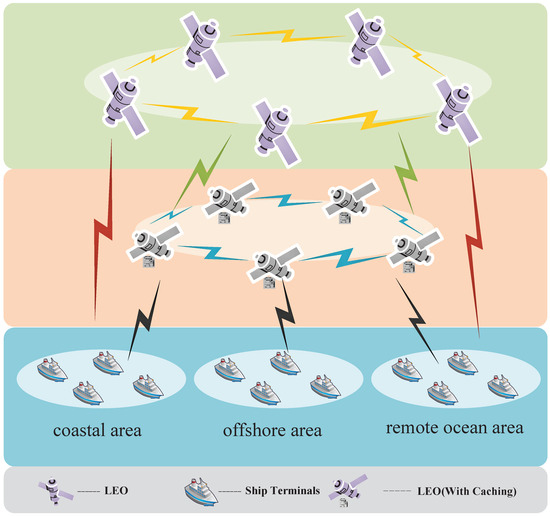
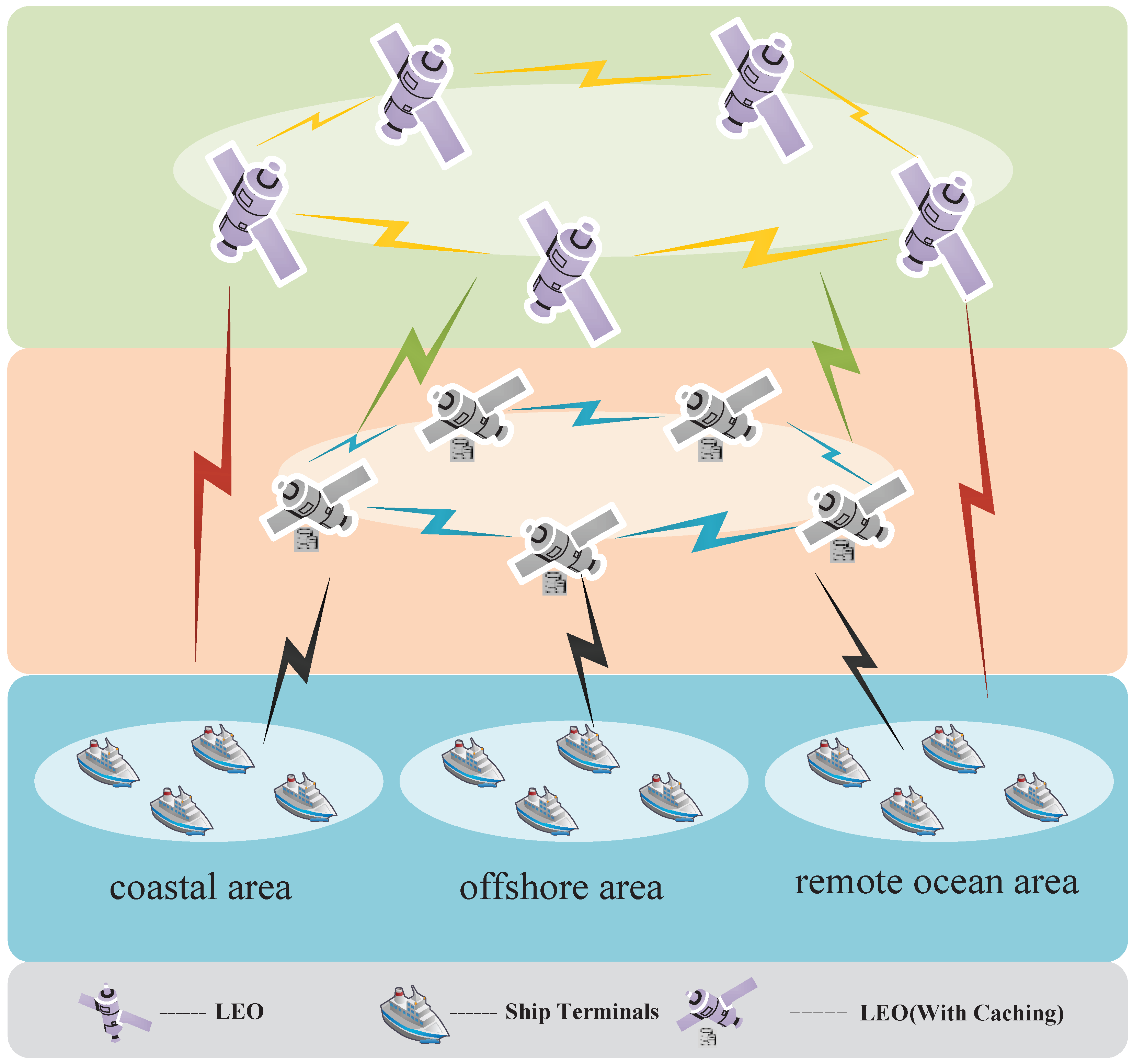
The system architecture addressed in this paper is a typical maritime non-terrestrial network (NTN), as depicted in Figure 1. The figure conceptually illustrates maritime coverage, while the analytical model assumes a single serving satellite. This network comprises a single serving low Earth orbit (LEO) satellite equipped with L transmit antennas and on-board caching capability, together with K shipborne terminals located in ocean areas and a remote terrestrial content center that provides backhaul content when required. Communication within the considered system occurs via the satellite-to-ship downlink, where the satellite acts as the only beamforming transmitter and simultaneously functions as an edge cache node by pre-storing a subset of popular contents to support content distribution services for shipborne users. Accordingly, two logical service paths are defined depending on the cache status at the satellite: for a cache hit, the requested content is delivered directly from the satellite to the corresponding shipborne user through a single-hop satellite-to-ship transmission; for a cache miss, the satellite first retrieves the requested content from the remote content center through the backhaul link and then forwards it to the user through the same downlink channel. For clarity, no additional access points or maritime edge nodes are introduced in this architecture, and all caching and beamforming decisions are performed at the single serving satellite assumed in the analytical model.
Figure 1.
Conceptual illustration of the single-LEO-satellite maritime NTN system.
Unlike the architecture of traditional satellite-ground integrated networks where ground access points handle caching tasks, this paper migrates caching capabilities to satellite platforms, endowing them with edge content caching and broadcast delivery functionalities. This design helps reduce the burden on the backhaul links of remote content centers, shorten content distribution paths, and thereby enhance the overall service efficiency of the system. Shipborne terminals initiate content requests and receive data via satellite links. The system employs a multi-user MIMO downlink communication architecture, which enables satellites to transmit different content to multiple shipborne users simultaneously. For the convenience of theoretical modeling and analysis, this paper assumes that all satellite-to-ship links operate under line-of-sight (LoS) or quasi-line-of-sight (Quasi-LoS) conditions, and the serving satellite is assumed to have access to downlink channel state information (CSI, e.g., via pilot-based estimation and feedback), which is a standard assumption for tractable beamforming optimization.
To cater to the demands of high-speed, concurrent multi-user services in marine environments, satellites must coordinate their caching resources, beam configurations, and transmission power, dynamically adjusting resource allocation during service provision. Given that caching decisions directly impact downstream link traffic and interference levels, a natural coupling exists between caching and beam configuration. Robustly modeling this joint design problem is pivotal for optimizing system latency and link stability.
For clarity, the considered maritime NTN comprises a single serving LEO satellite equipped with L transmit antennas and on-board caching capability, K shipborne terminals generating content requests, and a remote terrestrial content center that provides backhaul content when cache misses occur, where all downlink transmissions as well as caching placement and multi-user beamforming decisions are carried out by the same serving satellite without introducing any additional access points or maritime edge nodes, and the two service paths differ only in whether an extra backhaul retrieval stage is needed.
3.2. Channel Model
To accurately characterize the wireless transmission properties of marine non-terrestrial communication systems, this paper develops channel models for the “satellite-ship link” and “shipborne terminal local communication” respectively.
Satellite-to-Ship Channel Model
In marine non-terrestrial networks (NTNs), communications between satellites and ships typically rely on direct connections operating in the Ka or Ku bands, featuring long link distances, dominant line-of-sight (LoS) conditions, and significant propagation losses. This paper assumes that the low Earth orbit (LEO) satellites deployed in the system maintain a continuous LoS connection with ships, with this link regarded as a one-hop primary communication path. The modeling structure is as follows:
Large-scale link loss utilizes the free-space path loss (FSPL) model, with calculations as follows:
In this paper, denotes the free-space path loss in linear scale, i.e., , where denotes the physical distance between the satellite and the LEO satellite; is the carrier frequency; c is the speed of light in vacuum, set to m/s; and is the path loss exponent, typically ranging between and .
Formula (1) is derived from the Friis transmission equation, incorporating the characteristic that signal attenuation in high-frequency communications increases with distance and frequency. Consequently, the average channel gain of the satellite link can be expressed as:
Unless otherwise specified, all channel gains/losses and antenna gains are expressed in linear scale in the subsequent analysis; values given in dB (e.g., dBi) are converted to linear scale before being used. Here, and denote the linear-scale antenna gains converted from dBi.
To be consistent with the LoS/quasi-LoS propagation characteristics in maritime satellite communications, this paper models the satellite-to-ship small-scale fading using a Rician distribution, which captures a dominant LoS component together with scattered multipath components. Specifically, the complex small-scale coefficient is expressed as
where K denotes the Rician factor, represents the normalized LoS component, and models the scattered component. Accordingly, the final complex channel can be written as
Herein, follows a Rician fading model, which is suitable for maritime satellite links where a dominant LoS component commonly exists while additional scattering arises from sea-surface reflections and ship motion. For the multi-antenna downlink, the above scalar coefficient can be extended to the vector channel by letting
where and K is the Rician factor.
Due to the high mobility of LEO satellites and the time-varying propagation environment over the sea surface (e.g., wave-induced blockage and shadowing), the satellite-to-ship link may experience temporal instability. Building on the unified Rician small-scale fading model described above, we further characterize such time variations by modeling the serving link state as a two-state discrete-time Markov chain (DTMC), which captures abrupt quality degradation events caused by attenuation/blockage as well as subsequent recovery when favorable conditions reappear. In this work, the two-state DTMC is applied to the satellite-to-ship serving link to capture intermittent blockage/shadowing over the maritime environment, and the link state is denoted by .
- Good State (Stable Connection): When , the ship maintains a stable LoS-dominant connection with the serving satellite. The small-scale fading follows a Rician distribution characterized by a relatively large Rician factor , leading to high transmission quality.
- Bad State (Blockage/Deep Fading): When the signal is severely attenuated by waves or the satellite moves out of visibility, the link degrades to the Bad state. This state represents a generalized “link-outage” or deep-fading period, which may trigger link re-selection and service recovery mechanisms. During this transition or deep fading period, we introduce a penalty factor to model the significant SNR degradation. Specifically, when is given in dB, it is converted to a linear-scale power attenuation factor as (equivalently, the channel amplitude is scaled by ).
In the proposed two-state DTMC, the Good and Bad states correspond to different propagation conditions of the same satellite-to-ship link and can be naturally reflected by the parameters of the Rician model. Specifically, the Good state is characterized by a relatively large Rician factor , whereas the Bad state corresponds to an obstructed/shadowed condition with a smaller effective Rician factor (with degenerating to a Rayleigh-like case). In addition, the large-scale degradation under the Bad state is captured by an attenuation factor applied to the channel power gain, which models the significant SNR reduction caused by blockage.
The dynamic evolution of the serving link is governed by the state transition matrix. Specifically, represents the switching probability that the current high-quality link deteriorates or migrates to a suboptimal state due to environmental dynamics. The instantaneous channel coefficient is thus formulated as:
Consequently, the time-varying achievable rate , which determines the backhaul delay, is given by:
By incorporating and , the model effectively characterizes the impact of dynamic channel switching on system latency.
In the Maritime NTN architecture proposed in this study, all downlink data transmission is realized via wireless links between satellites and shipborne terminals. Satellites function as relay nodes for remote content requests and are equipped with edge caching capabilities, enabling flexible adjustment of content transmission paths based on cache hit status. Specifically, if the content requested by a shipboard user is cached at the satellite (i.e., a cache hit), the data can be directly delivered to the target user by the satellite using beamforming technology, forming a shorter single-hop transmission path. In contrast, when the requested content is not cached (i.e., a cache miss), the satellite must first retrieve the required data from the backend content center via a remote backhaul link before completing the downlink service, thereby forming a logical two-stage transmission path. Although the physical link remains unchanged, the bandwidth usage and latency structure during transmission exhibit significant discrepancies.
3.3. Cache and Service Models
This section develops an edge cache-aided content service model for maritime non-terrestrial networks, explicitly detailing the service paths and mathematical formulations under both cache hit and miss scenarios.
3.3.1. Content Request and Caching Mechanisms
Consider a content library defined as , where J denotes the total number of content items. Each communication satellite is equipped with a caching device of capacity C, enabling it to pre-store a subset of popular content. The cached content set is defined as . The content requested by the k-th shipborne terminal is defined as a random variable , where .
A cache hit event is defined as:
This yields the sets of cache-hit and cache-miss users:
3.3.2. Service Path Modeling
In a cache-aided maritime non-terrestrial network system, the content service path for end users is determined by the cache status of the communication satellite. When the content requested by a user is already cached on the satellite, the system can directly complete data distribution via the satellite-to-ship downlink transmission; such a request is defined as a “cache hit.” Conversely, if the content is not cached (i.e., a cache miss), the satellite must first retrieve the corresponding content from the remote content center via the backhaul link and then forward it to the terminals over the downlink. Based on these two cache states, the system forms two typical service path structures, corresponding to different link combinations and data flow logics, as detailed below:
For a shipborne terminal with a cache hit, the terminal-requested content is cached in the communication satellite’s server. The service path comprises only a single-hop downlink, where data is transmitted directly from the satellite to the user.
This link adopts a multi-user MIMO architecture. The satellite employs beamforming technology to serve multiple users simultaneously, which enhances spectrum efficiency and mitigates interference. It also features low latency and high data rates. The downlink rate of ship k is given by:
where B denotes the system bandwidth, and the signal-to-interference-and-noise ratio (SINR) is defined as:
denotes the channel vector of ship k, denotes the beamforming vector for ship k, and denotes the noise power. Since the backhaul retrieval stage is not involved in the hit case, the corresponding service latency is determined solely by the satellite-to-ship downlink rate.
When a ship terminal requests content not present in the satellite on-board cache, the LEO satellite must retrieve the required content from the remote data center via the backhaul link and subsequently forward it to the ship terminal over the downlink, forming a two-stage service path: satellite → remote content center → satellite → ship. In this work, we adopt a store-and-forward transmission model, where backhaul retrieval and downlink forwarding are executed sequentially. Therefore, the cache-miss latency is modeled as the sum of the backhaul retrieval delay and the downlink delivery delay, rather than a bottleneck-rate (pipelined) approximation.
Accordingly, for a ship k experiencing a cache miss, the miss delay is given by:
where denotes the downlink rate from the satellite to ship k (determined by the SINR expression above), and represents the satellite backhaul rate, defined as:
Here, denotes the backhaul bandwidth, denotes the instantaneous backhaul channel coefficient, denotes the transmit power on the backhaul link, and denotes the noise power on the backhaul link. The LEO satellite downlink rate aligns with the downlink rate in the hit case and is likewise determined by the SINR.
Notably, under the adopted sequential retrieval-and-forward model, a reduction in the rate of either the backhaul or the downlink stage directly increases the overall miss delay. Consequently, a rational caching strategy ought to prioritize frequently requested content to alleviate the system’s reliance on satellite backhaul resources and reduce the average transmission latency.
3.4. Cache Update Timescale and Overhead Discussion
In the considered maritime NTN architecture, cache placement at the serving LEO satellite is performed on a long-term timescale based on statistical content popularity, while beamforming and transmission optimization are conducted on a short-term timescale (e.g., per channel coherence interval). Specifically, content popularity is assumed to evolve much slower than small-scale fading and DTMC-based link switching dynamics. Therefore, the cache configuration is updated periodically (e.g., hourly or daily) rather than per transmission slot.
Let denote the time required to refresh the on-board cache and denote the number of transmission slots within one cache update period. The amortized delay overhead per slot can be expressed as
Since cache updates are executed through high-capacity feeder/backhaul links during non-peak service periods, and is typically large within one update window, the amortized overhead satisfies
where denotes the instantaneous service delay modeled in (15)–(17). Therefore, the cache update cost does not affect the short-term delay optimization objective and can be treated as a long-term system maintenance overhead.
From an engineering perspective, the cache refresh process incurs three types of costs: (i) feeder link transmission delay for content uploading, (ii) signaling overhead for cache coordination, and (iii) additional satellite energy consumption. However, due to the relatively stable popularity distribution in maritime content services and the infrequent update policy, these costs are amortized over a large number of service slots. Consequently, the proposed joint optimization framework focuses on minimizing the short-term transmission delay while assuming long-term cache updating to be an independent background operation.
3.5. Delay Model Construction
Building on the aforementioned modeling of communication channels and service paths, this section further derives transmission delay expressions for the two ship types in the system.
For users with cache hits, their requested content can be directly transmitted by the satellite, without involving satellite backhaul links. The transmission path is a single-hop communication, and the delay is determined solely by the satellite-to-ship downlink rate. Assuming each content unit has a size of S (unit: bit), the transmission delay for the k-th ship user with a cache hit is given by:
In the event of a cache miss, data must traverse two stages: the satellite backhaul link and the satellite-to-ship downlink, thereby forming a two-stage transmission path. Since content retrieval and downlink forwarding are executed sequentially (store-and-forward transmission), the total delay is modeled as the sum of the backhaul retrieval delay and the downlink delivery delay:
We note that the bottleneck-rate model corresponds to fully pipelined streaming and is not assumed here.
This model captures the cascading nature of the two-segment serial transmission structure. A reduction in the rate of any link will significantly prolong the transmission delay, particularly in scenarios where the satellite link rate undergoes large fluctuations or the number of communicating ships is large.
To assess the overall system performance, this study adopts the average transmission delay across all ships as the global optimization objective. Let the total user set be ; the average system delay is then expressed as:
The system average delay defined in the above formula denotes the expected time for all ships in the communication network to complete content transmission within a service cycle. It stands as one of the key metrics for assessing system performance and Quality of Service (QoS). The average delay consists of two weighted components, corresponding respectively to the transmission time for cache hits and cache misses. In the case of a cache hit, content is directly provided by the satellite; the transmission process is relatively straightforward, with the delay dependent on the satellite-to-ship downlink service rate. In the case of a cache miss, content must undergo a dual-hop process involving the satellite backhaul link and satellite-to-ship downlink, with the delay typically being significantly higher than that of cache hits. Due to the randomness of cache hit status across different ship terminals and heterogeneous link conditions, the overall system delay exhibits marked imbalance and coupling. From an optimization standpoint, , as an objective function, is directly influenced by the following factors:
Cache hit rate: This dictates the proportion of users with cache hits and bears on the overall average latency.
and : These determine the transmission efficiencies of the hit and miss paths, respectively, and directly depend on the beamforming and power control design.
User distribution and content request patterns: These impact content hit status and link load distribution, thereby further affecting latency discrepancies among users.
Therefore, the system average latency not only reflects the effectiveness of the caching strategy but also gauges the efficiency of coordination between transmission resource scheduling and physical layer design. This study will aim to minimize and jointly optimize content caching decisions and beamforming strategies to achieve efficient scheduling and allocation of cross-layer resources.
4. Joint Optimization Modeling
In this work, the joint optimization is carried out for a single serving LEO satellite, which acts as the only downlink transmitter equipped with L antennas and on-board caching capability. Accordingly, the beamforming variables (and their SDR covariance forms ) as well as the user channel vectors are all defined with respect to this serving satellite, and the transmit power constraint is enforced on the total downlink radiated power of this single satellite rather than multiple cooperative transmitters.
To explicitly incorporate the DTMC-based link switching model introduced in Section Satellite-to-Ship Channel Model, we formulate the joint design problem by minimizing the expected system average delay over the Markov link states. For notational clarity, we use to denote the DTMC state, and employ the superscripts and interchangeably to represent quantities evaluated under the Good and Bad states, respectively, i.e., and . Thus, for any state-dependent term , we may write and without ambiguity.
Let denote the expectation with respect to the DTMC state . Since the DTMC has only two states, the expectation can be expanded as
where and denote the system average delays evaluated under the Good and Bad channel states, respectively.
In the previous section, we proposed adopting the average transmission delay as the global optimization objective. To facilitate problem solving, we introduce a binary variable to indicate the cache status of the requested content.
Assume that the requested content of ship terminal k is ; the hit state is then . Based on the above simplification, the optimization objective simplifies to:
In particular, the hit and miss delays in are computed using the state-dependent achievable rates , and induced by the DTMC-based channel switching model.
The optimization variables include the content caching decisions and the beamforming vectors . Given the constraints of limited cache capacity and transmit power, the following constraints are established:
Here, denotes the total downlink transmit power budget of the single serving satellite (the only transmitter in the considered model). This optimization problem is a typical mixed-integer non-convex optimization problem. Given the discrete cache decision variables and a non-convex rate function, it is not amenable to direct solution. Accordingly, based on the problem structure, this study adopts a “hierarchical optimization + structural relaxation” strategy to decompose the original problem into cache optimization and beamforming subproblems, which are solved using greedy search and convex relaxation techniques, respectively.
The impact of the beamforming variable on the rate and delay is examined. To illustrate, consider the SINR expression of a ship terminal with a cache hit:
In the above formula, both the numerator and the denominator are quadratic products. Consequently, the entire expression is a non-convex fractional function, which cannot be directly applied to convex optimization modeling. To resolve this issue, this study utilizes the SDR method and introduces the covariance matrix representation:
Meanwhile, define the channel matrix as ; then, , and the expression can be restated as:
Via the aforementioned transformation, the rate term within the objective function may be simplified to:
Lastly, the delay expression may be cast as:
At this stage, since the delay remains a non-convex function with respect to , the SCA method is introduced for this purpose. Let , and is used to conduct a first-order convex upper bound approximation on . Let the current iteration point be ; then:
Upon substituting it into the delay term, the objective function may be transformed into a convex function in each iteration, facilitating iterative solving.
Given that the beamforming vector is fixed, the rate may be treated as a constant, and the expression of the system average delay with respect to the caching variable may be simplified to:
With two DTMC states, for any term we have , which is used when evaluating the expected delay in (32).
This problem is a typical 0–1 knapsack problem. To reduce complexity, this study employs a greedy caching strategy based on latency contribution: (1) Identify the set of users requesting each content ; (2) For each j, calculate the total latency reduction achieved by caching content : ; (3) Select the top C content items with the largest for caching. This strategy enables efficient solutions after each round of beamforming updates, thereby optimizing the caching strategy.
In summary, the original hybrid non-convex problem is decomposed into two subproblems: beamforming optimization and caching optimization. These two components may be optimized via alternating iterations until convergence to the desired result is achieved or the preset number of iterations is reached.
This expected-delay formulation explicitly incorporates the long-term impact of DTMC-based link switching into the optimization objective, thereby improving robustness under time-varying maritime channel conditions.
This study develops a computationally efficient and feasible joint optimization algorithm for the caching-based resource allocation and assisted beamforming optimization problem in non-terrestrial maritime networks. To address the non-convex structure and variable coupling nature of the objective function for the system’s average transmission delay, a hierarchical alternating optimization framework, denoted as BCDO (Joint Beamforming and Caching for Delay Optimization), is proposed. The algorithm iteratively optimizes the caching strategy and beamforming scheme, integrating SDR, SCA, and a greedy strategy to achieve a significant reduction in the overall system transmission latency while ensuring convergence.
The BCDO algorithm alleviates the complexity of mixed non-convex problems by utilizing an alternating optimization strategy of “fixing one aspect and optimizing the other.” The overall optimization process may be divided into the following two primary stages:
Given a fixed caching strategy and known hit status of ship terminal requests, the objective of the beamforming subproblem is to minimize the component of average delay determined by the physical layer rate. Since the relationship between the rate and the beamforming vector exhibits a fractional structure, the optimization problem is non-convex. To address this, SDR is introduced to transform the original beamforming vector variables into a covariance matrix, thereby converting the signal gain expression into a linear trace function. SCA is then employed to perform a first-order approximation of the nonlinear functional terms, constructing a convex upper bound objective function and iteratively solving it via the CVXPY toolbox. In each iteration, the rate expression at the update point is used to linearize the objective, yielding a feasible solution for the covariance matrix. If the resulting matrix is of rank one, the beamforming vector can be directly retrieved; otherwise, eigenvector approximation or randomization techniques may be used for beamforming vector reconstruction.
Once the beamforming vector is fixed, the ship terminal rate may be treated as a known constant. The cache optimization subproblem then reduces to selecting the optimal content set to minimize the average system transmission delay, subject to the constraint of limited cache capacity. To simplify the solution process, this study employs a greedy cache selection strategy. The specific steps are as follows: traverse all candidate contents and identify the terminal sets that request them; for each content item, calculate the achievable reduction in system latency by caching it; and select the top C content items with the highest benefits for cache updating.
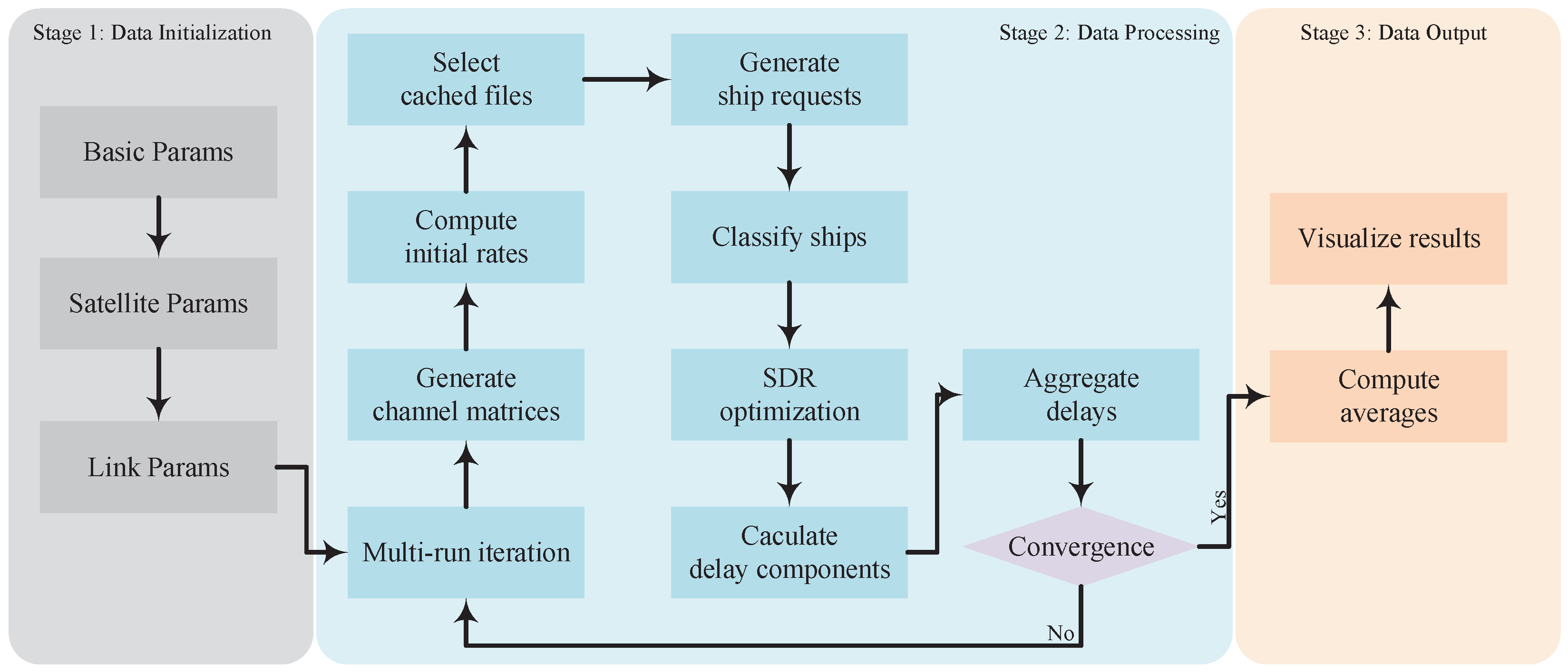
The algorithm commences from an arbitrary initial cache state and alternately executes the aforementioned two stages to continuously enhance system performance until the system average delay converges or the maximum number of iterations is reached. The pseudocode is provided in Algorithm 1.
| Algorithm 1 Joint Beamforming and Caching for Delay Optimization in Maritime NTN |
|
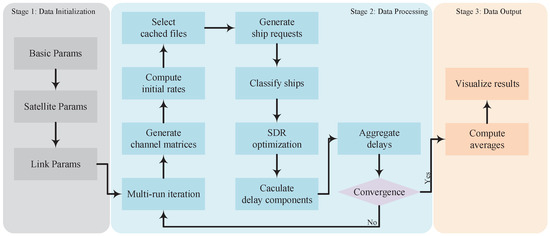
The program flowchart is illustrated in Figure 2.
Figure 2.
Flowchart of Joint Beamforming and Caching for Delay Optimization in Maritime NTN.
5. Experimental Validations
This section presents a series of simulation experiments based on the proposed BCDO algorithm to evaluate and analyze its performance under different parameter configurations. Specifically, starting from the experimental setup for algorithm implementation, we assess BCDO’s performance in typical scenarios, such as variations in cache ratio, expansion of system scale, and fluctuations in transmission resources. Additionally, a horizontal performance comparison with traditional benchmark algorithms is conducted to further validate the practical advantages and robustness of the joint optimization strategy.
5.1. Experimental Setup and Parameter Settings
To assess the performance of the proposed BCDO algorithm in practical communication scenarios, this study designed a series of numerical experiments using a Python 3.9.13 (64-bit) simulation platform. The experiments employed the CVXPY toolkit for convex optimization, with SCS as the solver. NumPy was used to implement modules for cache selection, channel generation, and performance evaluation. The system configuration and channel model were based on typical parameters for satellite-terrestrial integrated communications, aligning with the physical characteristics of actual low-orbit satellite communication systems.
The system comprises K ship terminals, L LEO satellite transmitting antennas, and a content library of size J. The cache capacity of the satellite is , where denotes the cache ratio. Both the satellite link and the ground link incorporate free space path loss and small-scale fading. The communication satellite employs a multi-user beamforming scheme to provide parallel services to users, with the satellite link acting as a backhaul channel to transmit content to terminals with cache misses. The key experimental parameters are listed in Table 1.
Table 1.
Simulation Parameters and System Configuration.
The satellite-to-ship link channel is modeled as a free-space path loss term superimposed with Rician small-scale fading, with the path loss exponent set to . Unless otherwise specified, all gains/losses used in computations are expressed in linear scale: the free-space path loss is given by , and the antenna gains listed in dBi are converted via . Accordingly, the large-scale channel gain is generated as , where and denote linear-scale antenna gains. Specifically, the channel vector between the serving LEO satellite and ship terminal k is generated as , where denotes the large-scale path loss coefficient and follows a Rician distribution.
5.2. Algorithm Complexity Analysis
To thoroughly evaluate the trade-off between performance and computational overhead, we compare the proposed BCDO scheme against three benchmark schemes: Maximum Ratio Transmission (MRT) [33], COBD [34], and Zero-Forcing (ZF) [35]. The complexity breakdown is summarized in Table 2.
Table 2.
Computational Complexity Comparison of Different Schemes.
MRT represents the lower bound of complexity. It maximizes the signal-to-noise ratio (SNR) for each vessel independently, disregarding inter-user interference. Its complexity scales linearly as , making it the most computationally efficient but performance-limited option.
The COBD scheme introduces interference awareness with a complexity of , scaling quadratically with the number of vessels. This heuristic approach offers a balance between implementation simplicity and interference mitigation.
The ZF scheme serves as a standard linear precoding benchmark, requiring the computation of the channel matrix pseudo-inverse to nullify interference. This operation is dominated by matrix multiplication and inversion, resulting in a complexity of .
Finally, the proposed BCDO scheme employs Semidefinite Relaxation (SDR) to handle non-convex QoS constraints. Although it incurs the highest computational cost of approximately , this overhead is justified by its superior ability to minimize transmission latency in complex maritime environments.
Although Maximum Ratio Transmission (MRT) offers the lowest computational complexity (), its performance is severely compromised by inter-vessel interference in dense maritime networks. Conversely, while Zero-Forcing (ZF) effectively suppresses interference, it incurs a higher computational burden due to matrix inversion () and is prone to noise amplification under deep channel fading.
In contrast, the COBD scheme strikes a pragmatic balance between computational efficiency () and interference management. It serves as a representative interference-aware heuristic that is feasible for deployment on hardware-constrained maritime nodes. Therefore, we select COBD as the primary benchmark in our simulations to rigorously evaluate the performance gains achieved by the proposed BCDO scheme.
5.3. Experimental Results Analysis
To systematically validate the latency optimization effectiveness of the proposed joint optimization algorithm (BCDO) in practical maritime non-terrestrial network (NTN) environments, this study conducted comprehensive simulation experiments from multiple dimensions, including algorithmic convergence, semidefinite relaxation (SDR) tightness, cache ratio, system scale, and dynamic satellite link states. This study also compared the performance of BCDO with that of traditional and state-of-the-art (SOTA) baseline algorithms (e.g., WMMSE, ZF, MRT, and various caching schemes), with a focus on analyzing BCDO’s latency performance and relative advantages under different spatial degrees of freedom and network configurations. Leveraging experimental results across multiple parameters, this study aims to quantify the overall system performance improvement achieved by the integrated cache and beamforming strategy, and rigorously verify the scalability, adaptability, and robustness of the proposed algorithm under extreme maritime conditions.
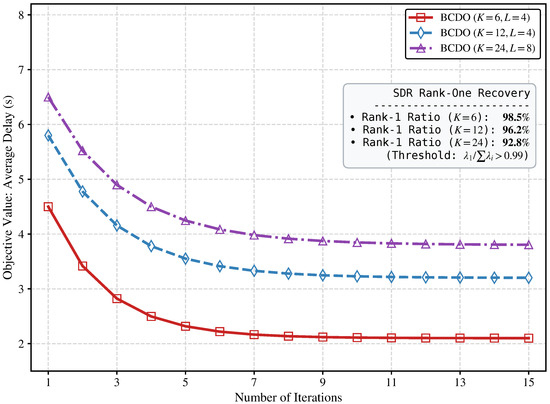
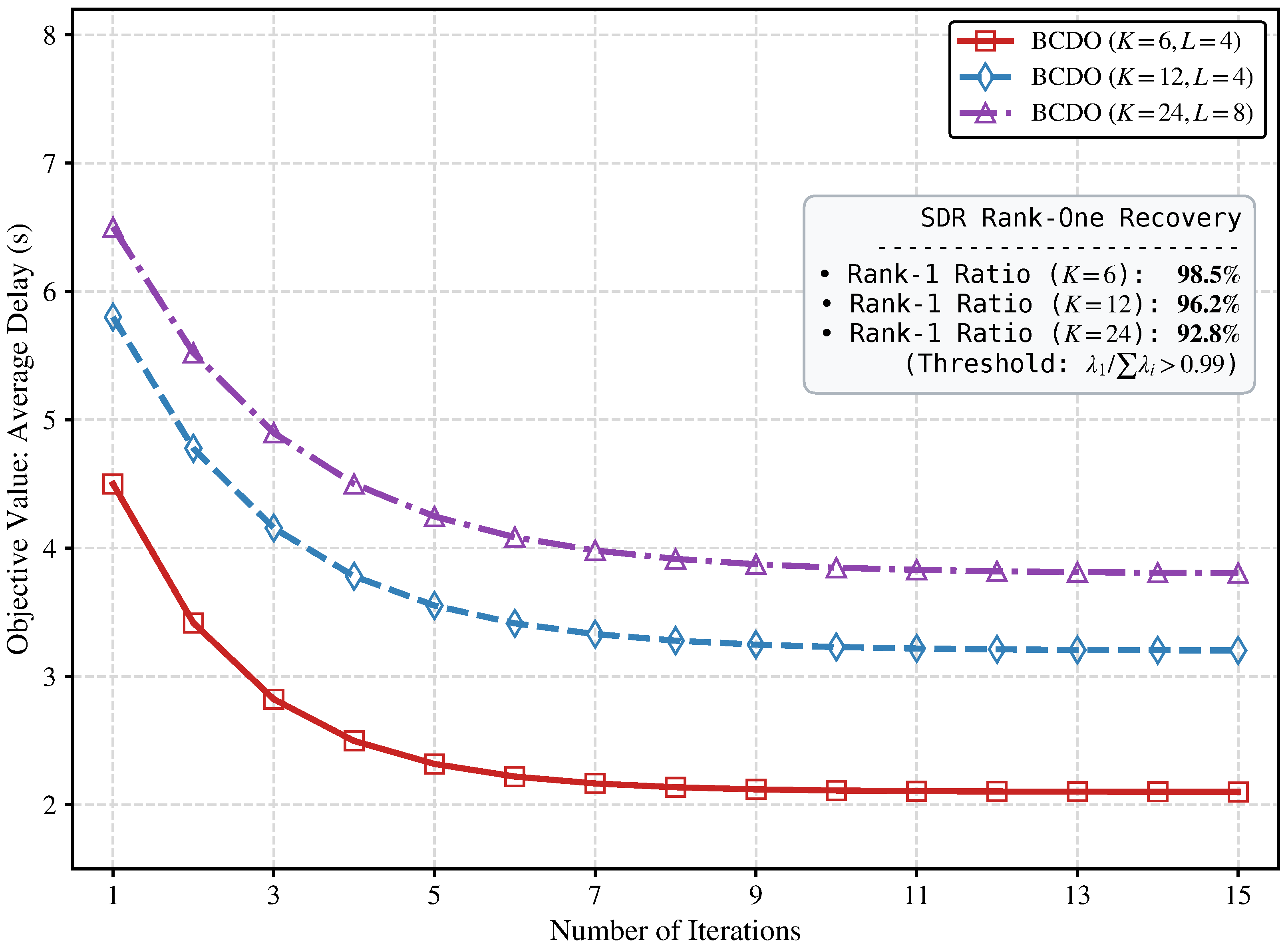
Figure 3 illustrates the evolution of the objective function (average transmission delay) of the proposed BCDO algorithm with respect to the number of iterations, aiming to evaluate the convergence behavior of the alternating optimization framework and the mathematical tightness of the semidefinite relaxation (SDR). As clearly observed, under all tested system scale configurations, including , , and the highly congested scenario of , the BCDO algorithm exhibits a strictly monotonic descent and rapidly converges to a stable state within approximately 5 to 8 iterations. This remarkably fast convergence is primarily attributed to the tightness of the successive convex approximation (SCA) bounds within the alternating optimization framework. In maritime non-terrestrial networks (NTNs) where computational resources are strictly constrained, such fast convergence with low iteration complexity ensures that the algorithm can be executed with minimal computational delay, rendering it highly suitable for real-time beamforming and caching scheduling in dynamic maritime environments.
Figure 3.
Convergence Behavior of the Proposed BCDO Algorithm.
Furthermore, the embedded statistical metrics in Figure 3 profoundly validate the effectiveness of the SDR step from an underlying mathematical perspective. We employ the maximum eigenvalue energy ratio () as the threshold to determine the successful recovery of a rank-one matrix. The experimental data demonstrate that even in scenarios with limited spatial degrees of freedom and highly complex inter-user interference (), the probability of the SDR solver naturally yielding a rank-one matrix remains as high as . In medium-scale networks ( and ), this recovery probability reaches and , respectively. These highly stable statistical results substantiate the extreme tightness of the adopted SDR relaxation technique. This implies that in the vast majority of cases, the system can directly recover the globally optimal beamforming vectors without resorting to Gaussian randomization, thereby theoretically maximizing the delay performance guarantee of the joint optimization scheme.
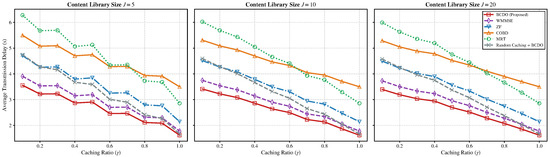
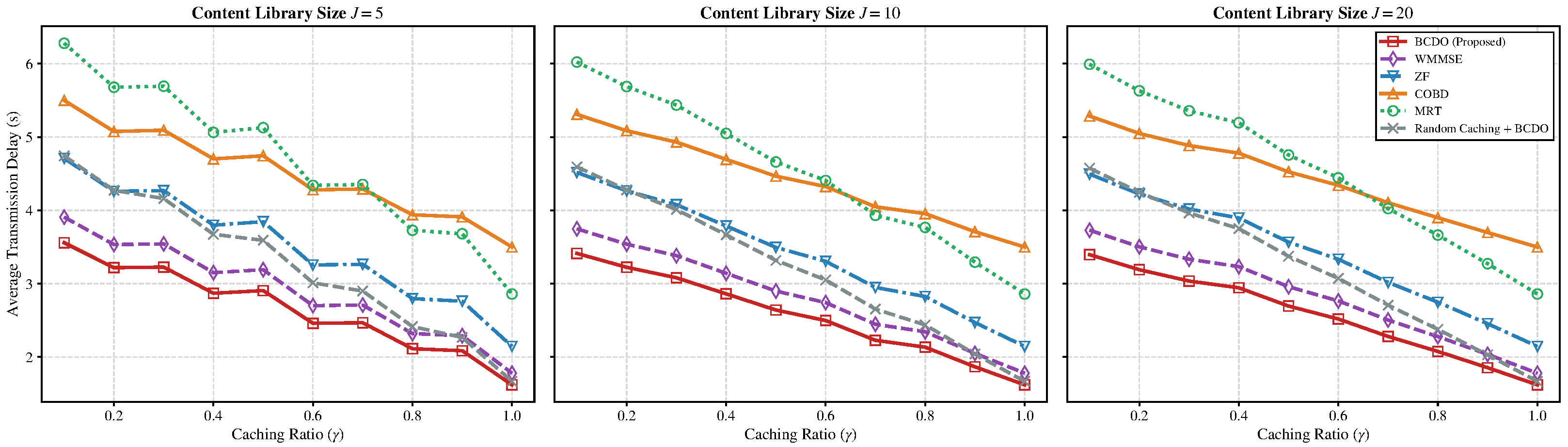
Building upon the convergence and SDR tightness analysis in Figure 3, Figure 4 further presents a comprehensive performance comparison of the average transmission delay versus the caching ratio under various content library sizes (). The experimental results clearly demonstrate a consistent downward trend in delay for all schemes as increases, confirming the universal effectiveness of proactive caching in alleviating backhaul link congestion. Across all tested configurations, the proposed BCDO algorithm consistently achieves the lowest transmission delay, significantly outperforming conventional ZF and MRT precoding schemes. More importantly, BCDO robustly surpasses the state-of-the-art (SOTA) physical-layer benchmark, WMMSE, which forcefully substantiates the superiority of cross-layer joint optimization in addressing the long-latency feeder link challenges inherent in maritime NTNs.
Figure 4.
Average transmission delay versus caching ratio under different content library sizes J.
Furthermore, Figure 4 reveals the underlying value of the joint optimization through the introduction of the “Random Caching + BCDO” baseline. It is observed that even with the implementation of the potent BCDO beamforming at the physical layer, the lack of precise popularity-based content placement (i.e., random caching) leads to a performance degradation, with delays often exceeding those of the proposed joint BCDO strategy. This phenomenon profoundly indicates that neither isolated physical-layer beamforming nor independent caching strategies can achieve global system optimality. Only through the deep coupling of beamforming and content caching enabled by BCDO can the system fully exploit the spatial degrees of freedom of the satellite, thereby achieving a fundamental breakthrough in delay performance within resource-constrained maritime communication environments.
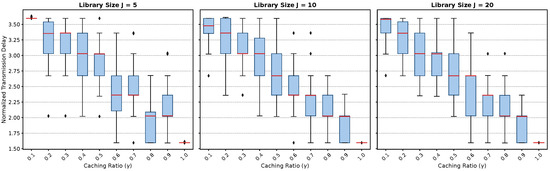
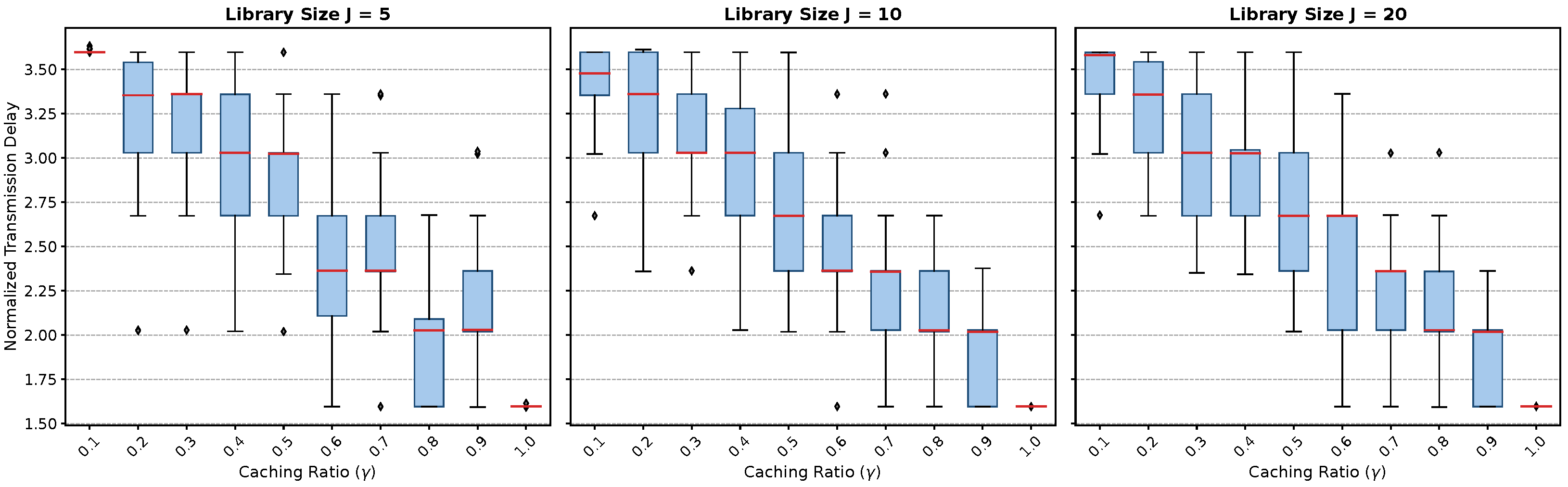
While Figure 4 highlights the superiority of the proposed algorithm in terms of average metrics, Figure 5 further provides a statistical distribution analysis of the transmission delay via boxplots to evaluate the Quality of Service (QoS) stability within the dynamic maritime NTN. As the caching ratio increases, the median delay decreases significantly, highlighting the performance gains achieved by proactive satellite caching in a maritime NTN. The boxplots also illustrate the robustness of the communication system against dynamic sea states, with smaller interquartile ranges indicating reduced performance variation under higher caching ratios.
Figure 5.
Boxplot of transmission delay versus caching ratio under a fixed system scale (K = 6; L = 4) for different library sizes.
First, the expansion of cache capacity on the satellite (with caching capability) translates directly into a substantial improvement in transmission efficiency. As illustrated in Figure 5, with the caching ratio increasing from 0.1 to 1.0, the median transmission delay exhibits a steep, monotonic downward trend. This result compels the conclusion that by pre-storing popular content—such as oceanographic data and navigational charts—at the maritime edge, the proposed BCDO scheme successfully offloads a significant portion of requests from neighboring vessels to local maritime links. This effectively circumvents the high-latency bottlenecks associated with the satellite backhaul, which is critical in remote ocean areas.
Second, a higher caching ratio significantly enhances the robustness of maritime communications against dynamic sea states. Observing the morphological evolution of the boxplots reveals that in the low caching ratio regime, the Interquartile Range (IQR) is substantial. This indicates that the communication performance between vessels is highly susceptible to stochastic maritime channel fading (e.g., due to wave occlusion and sea surface reflection) and multi-vessel interference. Conversely, as increases, the IQR narrows significantly. This demonstrates that a high caching ratio not only reduces absolute latency but also effectively suppresses performance jitter, establishing a deterministic low-latency transmission environment essential for coordinated maritime operations. In conclusion, despite the inevitable adverse conditions inherent in the hostile maritime environment (as evidenced by the outliers), sufficient caching resources fundamentally mitigate the negative impact of channel degradation. This validates the core value of the “trading storage for bandwidth” paradigm in enhancing the connectivity of fleets in deep-sea scenarios.
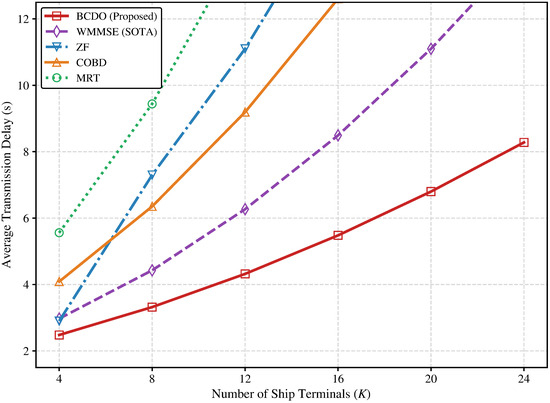
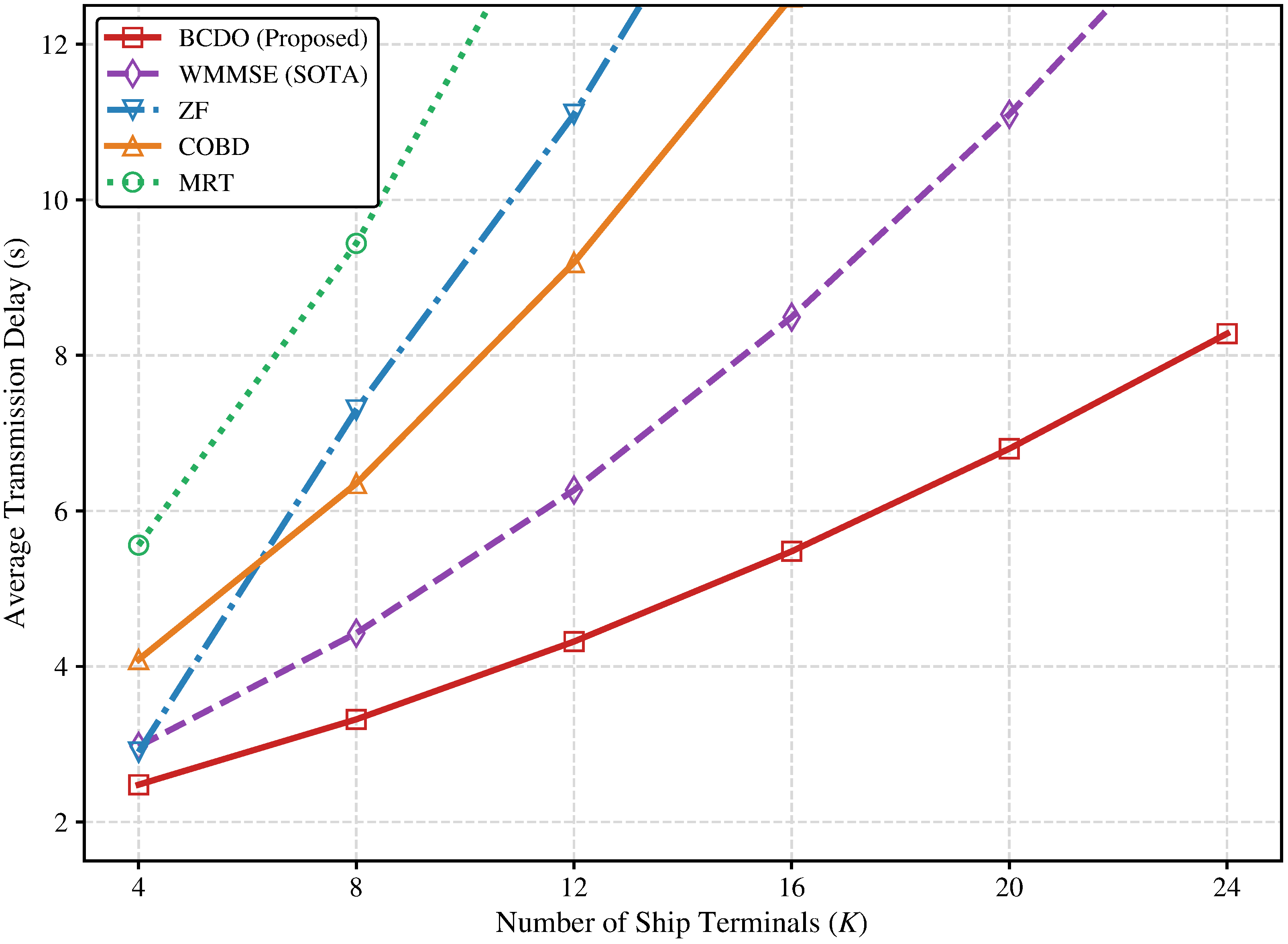
Beyond the analysis of caching ratios and environmental robustness, the scalability regarding the system scale is another pivotal metric for evaluating maritime NTNs. Figure 6 illustrates the impact of network scale on the average transmission delay by varying the number of ship terminals K from 4 to 24, with a fixed antenna array () and a moderate caching ratio (). The experimental results indicate that while the latency of all algorithms increases with the network scale, the rates of growth differ significantly. When the number of users is small, the performance of various schemes remains relatively close. However, once K exceeds the available spatial degrees of freedom (i.e., ), the delays of conventional physical-layer algorithms, such as ZF and MRT, soar exponentially due to their inability to effectively suppress severe multi-user interference. Even the state-of-the-art WMMSE algorithm exhibits a distinct performance degradation as it grapples with satellite backhaul congestion triggered by high-concurrency requests.
Figure 6.
Impact of Network Scale on Transmission Delay (Fixed ; Caching Ratio ).
In striking contrast, the proposed BCDO algorithm demonstrates superior scalability, with its transmission delay exhibiting only a near-linear and gradual growth as K increases. This remarkable advantage stems from the synergistic effect of joint optimization: by offloading up to of content requests at the maritime edge, BCDO effectively reduces the number of “active users” competing for the satellite’s air interface. Consequently, it circumvents the premature exhaustion of spatial degrees of freedom at the physical layer. This validates that in resource-constrained maritime scenarios, BCDO can alleviate the pressure on physical-layer beamforming through intelligent caching placement, thereby providing robust support for the reliable access of large-scale maritime fleets.
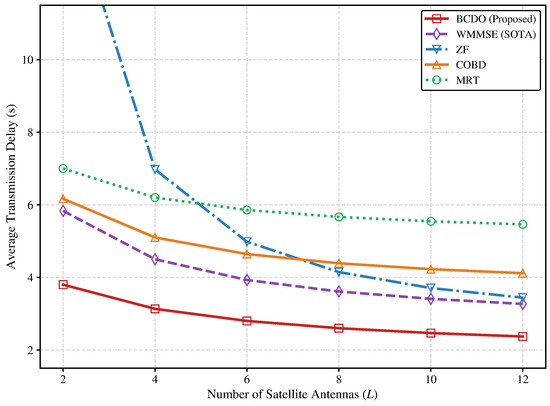
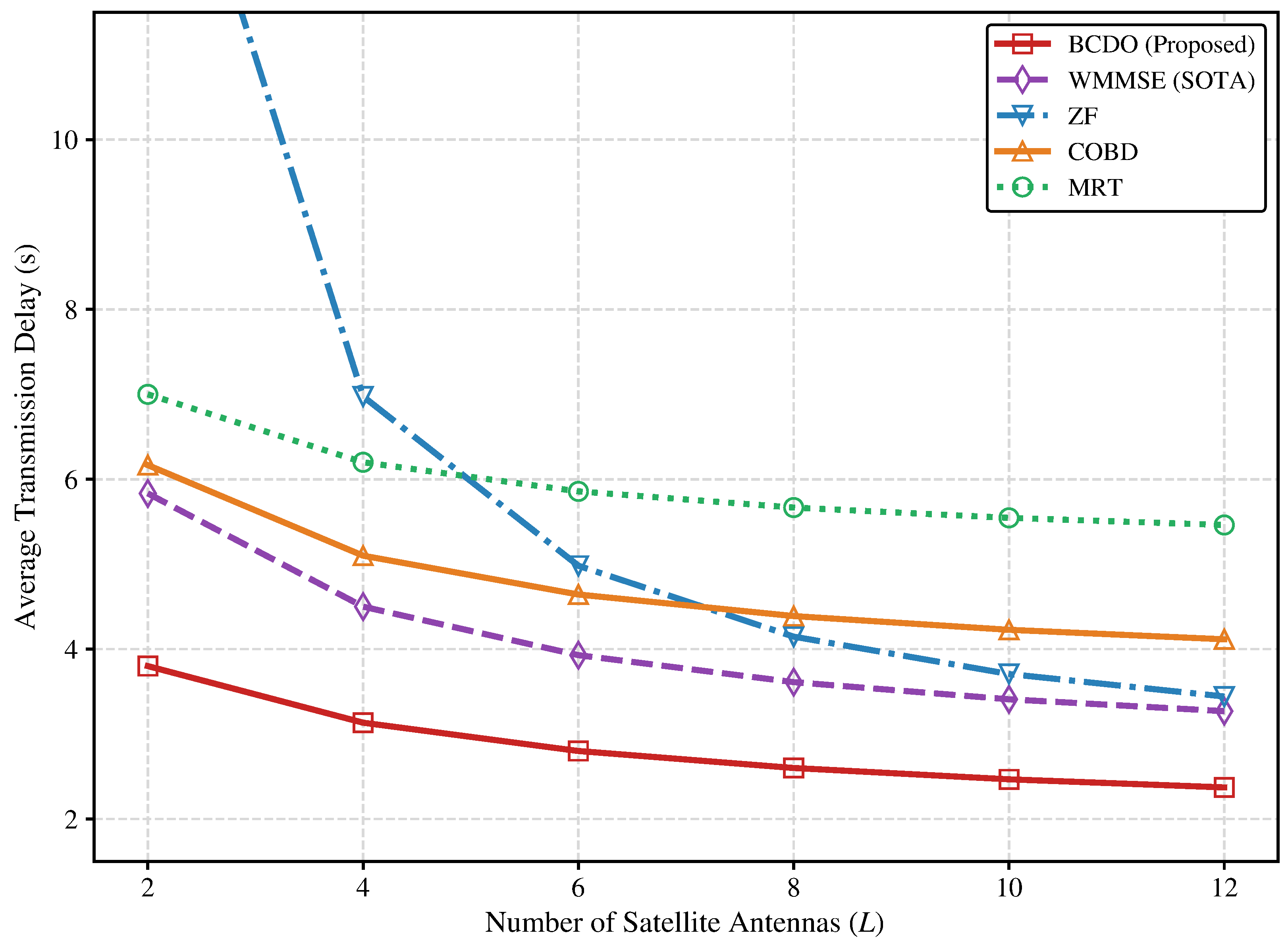
Complementing the analysis of user scalability, Figure 7 explores the impact of satellite payload constraints by varying the number of satellite antennas L under a fixed number of ship terminals () and a moderate caching ratio (). As illustrated, the average transmission delay of all algorithms exhibits a decreasing trend as L increases, which is attributed to the enhanced array gain and superior interference suppression capabilities provided by a larger antenna array. However, the sensitivity to antenna resources varies significantly across different schemes. Notably, when the number of antennas is severely limited (e.g., ), the ZF scheme suffers from excessively high latency because it fails to effectively nullify multi-user interference with insufficient spatial degrees of freedom, leading to drastic noise amplification.
Figure 7.
Impact of Satellite Antennas on Transmission Delay (Fixed ; Caching Ratio ).
In contrast, the proposed BCDO algorithm maintains exceptional delay performance even under stringent antenna constraints and consistently outperforms all benchmarks, including the SOTA WMMSE scheme. This advantage demonstrates that BCDO can effectively transform “edge storage resources” into “equivalent spatial degrees of freedom.” Specifically, the proactive caching mechanism reduces the real-time traffic demand on the satellite-to-ship link, thereby alleviating the computational and physical pressure on beamforming for interference cancellation. As L continues to increase, although the performance of physical-layer-only algorithms (e.g., ZF and WMMSE) improves gradually, BCDO sustains its leading position through cross-layer synergistic gains. This suggests that BCDO can significantly lower the hardware requirements for satellite payloads, which is of great practical significance for maritime communication systems involving capacity-constrained Low Earth Orbit (LEO) satellites.
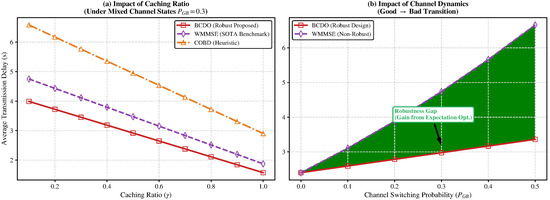
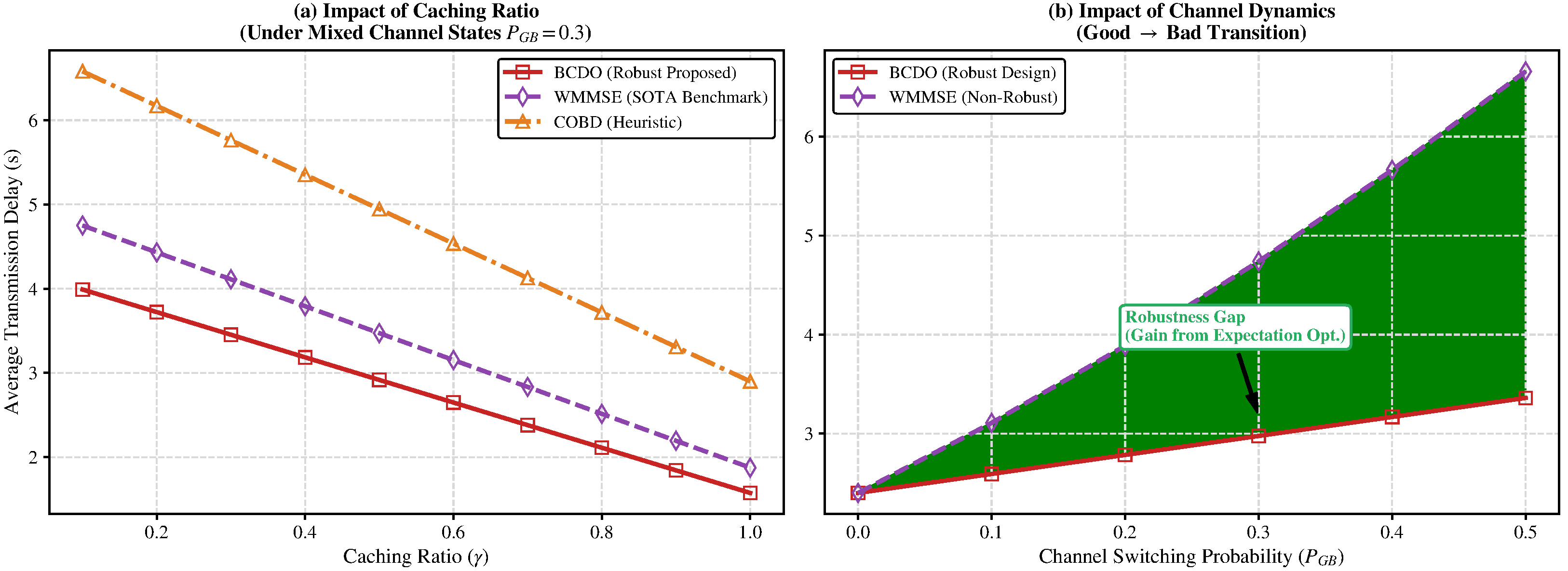
Finally, Figure 8 evaluates the robustness of the proposed BCDO algorithm in extreme maritime environments by varying the channel degradation probability , which simulates abrupt link quality drops caused by severe weather conditions or wave occlusion. The experimental results show that while the average transmission delay of all schemes increases as the channel conditions deteriorate, the BCDO algorithm maintains the most stable performance with the shallowest slope. Notably, a prominent “Robustness Gap” is observed between BCDO and the strongest physical-layer benchmark, WMMSE.
Figure 8.
Average transmission delay versus channel degradation probability .
This gap significantly widens as increases, highlighting the “temporal–spatial fault tolerance” inherent in our proactive caching design. Unlike physical-layer-only schemes (e.g., WMMSE and ZF) that are highly susceptible to instantaneous channel fluctuations and backhaul outages, the BCDO algorithm leverages pre-stored edge content to provide a reliable data delivery safety net. Even when the satellite-to-ship link is severely degraded, a substantial portion of the requested data can still be served locally from the shipborne cache, thereby circumventing the impact of channel fading. This concludes that the joint optimization of caching and beamforming fundamentally enhances the resilience of maritime NTNs against unpredictable and hostile sea states, validating its practical deployment value for all-weather maritime operations.
In summary, this section provides a comprehensive validation of the proposed BCDO algorithm through multi-dimensional simulation experiments within the context of maritime NTNs. First, the results confirm the rapid convergence and superior SDR tightness of the algorithm across various system scales, establishing a solid theoretical foundation for practical deployment. Subsequently, comparative analyses against multiple state-of-the-art benchmarks, such as WMMSE and ZF, demonstrate the exceptional performance of BCDO in reducing average transmission delay and highlight the significant advantages of cross-layer joint optimization over isolated strategies.
Furthermore, the statistical distribution analysis reveals that BCDO not only lowers the mean latency but also effectively suppresses performance jitter, thereby ensuring QoS stability under complex sea states. Regarding system scalability, BCDO successfully overcomes physical-layer bottlenecks imposed by limited satellite antennas and high-concurrency requests, showcasing remarkable hardware efficiency and network adaptability. Finally, the robustness tests under extreme dynamic environments further underscore the core value of the “trading storage for bandwidth” paradigm, proving the immense potential of the proposed scheme in guaranteeing all-weather maritime connectivity. Collectively, by deeply coupling beamforming with edge caching, the BCDO algorithm offers a highly effective, reliable, and scalable solution for modern maritime non-terrestrial networks.
6. Conclusions
This study addresses the high latency and resource constraints commonly encountered in maritime non-terrestrial networks (NTNs). Based on cache-enabled resource allocation, a joint beamforming-assisted optimization (BCDO) method is developed. By constructing a multi-link service model that incorporates cache hit status and a dynamic channel switching mechanism, this paper derives an average transmission delay expression that explicitly accounts for link instability and service migration induced by wave blockage. Furthermore, a joint optimization algorithm based on structural decomposition and alternating solutions is proposed. In terms of algorithm design, this study introduces semidefinite relaxation (SDR) and successive convex approximation (SCA) techniques to tackle the non-convex structure of beamforming optimization, while integrating a greedy strategy to enable rapid iteration of cache selection. Numerical results verify the mathematical tightness of the SDR relaxation, achieving a rank-one recovery probability of over 92.8% even in high-concurrency scenarios, which ensures the near-optimality of the beamforming design.
Numerical experiments demonstrate significant advantages of BCDO in average transmission delay reduction and convergence stability compared to state-of-the-art benchmarks such as WMMSE and ZF. Extensive scalability analysis further reveals that the proposed joint design effectively circumvents the physical-layer bottleneck imposed by limited spatial degrees of freedom, maintaining superior performance as the network scale expands or satellite antenna resources become constrained. More importantly, the newly added robustness analysis confirms that the proposed joint design establishes a prominent “robustness gap” against isolated optimization schemes, effectively mitigating performance degradation under frequent channel switching conditions and suppressing performance jitter, ensuring reliable service continuity even in harsh maritime environments.
In summary, the proposed BCDO framework provides a solid theoretical basis and a feasible algorithmic solution for cross-layer resource coordination in maritime NTNs, thereby offering an important reference for the design of future efficient, low-latency, and robust integrated space-ground communication systems.
Author Contributions
Y.Z. put forward the general framework of the article and provided the writing ideas, conceived and supervised the research and experiments. For the improvement and revision of the article, Y.Z. also made many constructive comments. K.D. consulted the references and completed the writing and revision of this article. All authors have read and agreed to the published version of the manuscript.
Funding
This work was supported in part by the National Natural Science Foundation of China under Grant 61673259, in part by the Natural Science Foundation of Shanghai under Grant 25ZR1401159, in part by the Shanghai Municipal Science and Technology Commission’s 2025 Key Technology R&D Program “New Generation Information Technology” Project under Grant 25511103902, and in part by the Shanghai Key Laboratory of Intelligent Information Processing of Fudan University under Grant No. IIPL-2025-RD5-01.
Data Availability Statement
The original contributions presented in this study are included in the article. Further inquiries can be directed to the corresponding author.
Acknowledgments
The authors would like to thank the College of Information Engineering of Shanghai Maritime University for their support. The author would also like to thank the anonymous reviewers for their helpful suggestions and comments to improve the article.
Conflicts of Interest
The authors declare no conflicts of interest.
References
- Bai, Y.; Zhang, Y. Dynamic Offloading Based on Lyapunov Optimization for UAV-Assisted Maritime IoT-MEC Networks. IEEE Trans. Veh. Technol. 2025, 74, 17894–17906. [Google Scholar] [CrossRef] [Scilit]
- Hu, J.; Zhang, Y. HHB-FL: Privacy-Preserving Federated Learning via Hierarchical Encryption and Blockchain for Maritime IoT. IEEE Internet Things J. 2026, 13, 8436–8451. [Google Scholar] [CrossRef] [Scilit]
- Yuan, S.; Peng, M.; Sun, Y.; Liu, X. Software defined intelligent satellite-terrestrial integrated networks: Insights and challenges. Digit. Commun. Netw. 2023, 9, 1331–1339. [Google Scholar] [CrossRef] [Scilit]
- Yuan, S.; Sun, Y.; Peng, M. Joint network function placement and routing optimization in dynamic software-defined satellite-terrestrial integrated networks. IEEE Trans. Wirel. Commun. 2023, 23, 5172–5186. [Google Scholar] [CrossRef] [Scilit]
- Alsharoa, A.; Alouini, M.S. Improvement of the global connectivity using integrated satellite-airborne-terrestrial networks with resource optimization. IEEE Trans. Wirel. Commun. 2020, 19, 5088–5100. [Google Scholar] [CrossRef] [Scilit]
- Lin, Y.; Feng, W.; Zhou, T.; Wang, Y.; Chen, Y.; Ge, N.; Wang, C.X. Integrating satellites and mobile edge computing for 6G wide-area edge intelligence: Minimal structures and systematic thinking. IEEE Network 2023, 37, 14–21. [Google Scholar] [CrossRef] [Scilit]
- Chettri, L.; Bera, R. A comprehensive survey on Internet of Things (IoT) toward 5G wireless systems. IEEE Internet Things J. 2019, 7, 16–32. [Google Scholar] [CrossRef] [Scilit]
- Chai, F.; Zhang, Q.; Yao, H.; Xin, X.; Gao, R.; Guizani, M. Joint multi-task offloading and resource allocation for mobile edge computing systems in satellite IoT. IEEE Trans. Veh. Technol. 2023, 72, 7783–7795. [Google Scholar] [CrossRef] [Scilit]
- Liu, S.; Dahrouj, H.; Alouini, M.S. Joint user association and beamforming in integrated satellite-HAPS-ground networks. IEEE Trans. Veh. Technol. 2023, 73, 5162–5178. [Google Scholar] [CrossRef] [Scilit]
- Yuan, S.; Sun, Y.; Peng, M. Cache-Aware Cooperative Multicast Beamforming in Dynamic Satellite-Terrestrial Networks. IEEE Trans. Veh. Technol. 2025, 74, 1433–1445. [Google Scholar] [CrossRef] [Scilit]
- Hu, H.; Song, K.; Zhan, C.; Fan, R.; Yang, J. Joint Service Caching and Resource Allocation Over Different Timescales in Satellite Edge Computing Networks. IEEE Trans. Mob. Comput. 2025, 24, 5649–5664. [Google Scholar] [CrossRef] [Scilit]
- Liu, L.; Zhang, Y. Task Offloading Optimization for Multi-objective Based on Cloud-Edge-End Collaboration in Maritime Networks. Future Gener. Comput. Syst. 2025, 164, 107588. [Google Scholar] [CrossRef] [Scilit]
- Luan, Y.; Sun, F.; Zhou, J. A Service-Caching Strategy Assisted by Double DQN in LEO Satellite Networks. Sensors 2024, 24, 3370. [Google Scholar] [CrossRef] [Scilit] [PubMed]
- Lyu, Y.; Hu, H.; Fan, R.; Liu, Z.; An, J.; Mao, S. Dynamic routing for integrated satellite-terrestrial networks: A constrained multi-agent reinforcement learning approach. IEEE J. Sel. Areas Commun. 2024, 42, 1204–1218. [Google Scholar] [CrossRef] [Scilit]
- Ngo, Q.T.; Phan, K.T.; Xiang, W.; Mahmood, A.; Slay, J. On edge caching in satellite—IoT networks. IEEE Internet Things Mag. 2022, 4, 107–112. [Google Scholar] [CrossRef] [Scilit]
- Zhu, X.; Jiang, C.; Yang, Z.; Wang, H. Delay-Optimized Edge Caching in Integrated Satellite–Terrestrial Networks with Diverse Content Popularity Distribution and User Access Modes. IEEE Internet Things J. 2024, 11, 26580–26594. [Google Scholar] [CrossRef] [Scilit]
- Yang, J.; He, J.; Cheng, N.; Yin, Z.; Han, D.; Zhou, C.; Sun, R. Multilayer satellite network collaborative mobile edge caching: A GCN-based multi-agent approach. China Commun. 2024, 21, 56–74. [Google Scholar]
- Zhang, J.; Zhang, Y.; Zhang, X.; Wang, W.; Cao, Y. SDN-Enabled Multi-Edge Access and Cache Strategy in Satellite Terrestrial Integrated Networks. IEEE Trans. Consum. Electron. 2025, 71, 402–418. [Google Scholar] [CrossRef] [Scilit]
- Sun, J.; Chen, X.; Li, Z.; Wang, J.; Chen, Y. Joint Optimization of Multiple Resources for Distributed Service Deployment in Satellite Edge Computing Networks. IEEE Internet Things J. 2025, 12, 2359–2372. [Google Scholar] [CrossRef] [Scilit]
- Liu, C.; Feng, W.; Chen, Y.; Wang, C.X.; Ge, N. Optimal beamforming for hybrid satellite terrestrial networks with nonlinear PA and imperfect CSIT. IEEE Wirel. Commun. Lett. 2019, 9, 276–280. [Google Scholar] [CrossRef] [Scilit]
- Zhang, X.; Sun, S.; Tao, M.; Huang, Q.; Tang, X. Multi-satellite cooperative networks: Joint hybrid beamforming and user scheduling design. IEEE Trans. Wirel. Commun. 2024, 23, 7938–7952. [Google Scholar] [CrossRef] [Scilit]
- Seo, J.; You, B.; Jung, H. Beampattern Analysis of Uplink Cooperative Beamforming of UAV Swarm to LEO Satellite. In Proceedings of the 2024 15th International Conference on Information and Communication Technology Convergence (ICTC); IEEE: New York, NY, USA, 2024; pp. 977–980. [Google Scholar]
- Fu, C.; Duan, Q.; Yang, F. Joint Optimization of Time-Slot Scheduling and Beamforming for Cooperative Satellites with Per-Antenna Power Constraints. In Proceedings of the 2024 4th International Conference on Artificial Intelligence, Robotics, and Communication (ICAIRC); IEEE: New York, NY, USA, 2024; pp. 797–803. [Google Scholar]
- Zheng, Z.; Jing, W.; Lu, Z.; Wu, Q.; Zhang, H.; Gesbert, D. Cooperative multi-satellite and multi-RIS beamforming: Enhancing LEO SatCom and mitigating LEO-GEO intersystem interference. IEEE J. Sel. Areas Commun. 2025, 43, 279–296. [Google Scholar] [CrossRef] [Scilit]
- Meng, M.; Hu, B.; Chen, S.; Kang, S. Joint Beamforming and Dynamic Beam hopping Based on MAPPO for LEO Satellite Communication System. IEEE Wirel. Commun. Lett. 2025, 14, 1461–1465. [Google Scholar] [CrossRef] [Scilit]
- Lin, Z.; Lin, M.; Champagne, B.; Zhu, W.P.; Al-Dhahir, N. Secrecy-energy efficient hybrid beamforming for satellite-terrestrial integrated networks. IEEE Trans. Commun. 2021, 69, 6345–6360. [Google Scholar] [CrossRef] [Scilit]
- Lin, Z.; Niu, H.; An, K.; Wang, Y.; Zheng, G.; Chatzinotas, S.; Hu, Y. Refracting RIS-aided hybrid satellite-terrestrial relay networks: Joint beamforming design and optimization. IEEE Trans. Aerosp. Electron. Syst. 2022, 58, 3717–3724. [Google Scholar] [CrossRef] [Scilit]
- He, S.; Wang, J.; Zhang, J.; Huang, Y.; Zhang, Y. Coordinated fronthaul data assignment and multicast beamforming for cache-enabled wireless networks. IEEE Wirel. Commun. Lett. 2019, 8, 1082–1085. [Google Scholar] [CrossRef] [Scilit]
- Zhou, J.; Sun, Y.; Tellambura, C.; Li, G.Y. Joint user grouping, sparse beamforming, and subcarrier allocation for D2D underlaid cache-enabled C-RANs with rate splitting. IEEE Trans. Veh. Technol. 2021, 71, 3792–3806. [Google Scholar] [CrossRef] [Scilit]
- Zhou, Y.; Yu, F.R.; Chen, J.; Kuo, Y. Cache-aware multicast beamforming design for multicell multigroup multicast. IEEE Trans. Veh. Technol. 2018, 67, 11681–11693. [Google Scholar] [CrossRef] [Scilit]
- Han, D.; Liao, W.; Peng, H.; Wu, H.; Wu, W.; Shen, X. Joint cache placement and cooperative multicast beamforming in integrated satellite-terrestrial networks. IEEE Trans. Veh. Technol. 2021, 71, 3131–3143. [Google Scholar] [CrossRef] [Scilit]
- Huang, S.; Zhang, Y. Secrecy Rate Optimization for Multi-User Secure Communication Assisted by Intelligent Reflecting Surfaces (IRS) Under Imperfect CSI Conditions. Trans. Emerg. Telecommun. Technol. 2025, 36, e70117. [Google Scholar] [CrossRef] [Scilit]
- Ahmed, Y.N. Analysis of the Maximum Ratio Transmission Precoding under Imperfect Channel State Information with Hardware Impairments in Correlated Channels. In Proceedings of the 2021 IEEE 93rd Vehicular Technology Conference (VTC2021-Spring), Helsinki, Finland, 25–28 April 2021; pp. 1–6. [Google Scholar]
- Liu, L.; Hua, C.; Yu, J.; Xu, J. Joint beamforming for delay optimal transmission in cache-enabled wireless backhaul networks. J. Commun. Inf. Netw. 2023, 8, 141–154. [Google Scholar] [CrossRef] [Scilit]
- Sur, S.N.; Bera, R.; Kumar Bhoi, A.; Shaik, M.; Marques, G. Capacity Analysis of Lattice Reduction Aided Equalizers for Massive MIMO Systems. Information 2020, 11, 301. [Google Scholar] [CrossRef] [Scilit]

Disclaimer/Publisher’s Note: The statements, opinions and data contained in all publications are solely those of the individual author(s) and contributor(s) and not of MDPI and/or the editor(s). MDPI and/or the editor(s) disclaim responsibility for any injury to people or property resulting from any ideas, methods, instructions or products referred to in the content. |
© 2026 by the authors. Licensee MDPI, Basel, Switzerland. This article is an open access article distributed under the terms and conditions of the Creative Commons Attribution (CC BY) license.