Task Offloading Based on Virtual Network Embedding in Software-Defined Edge Networks: A Deep Reinforcement Learning Approach



Abstract
1. Introduction
- (1)
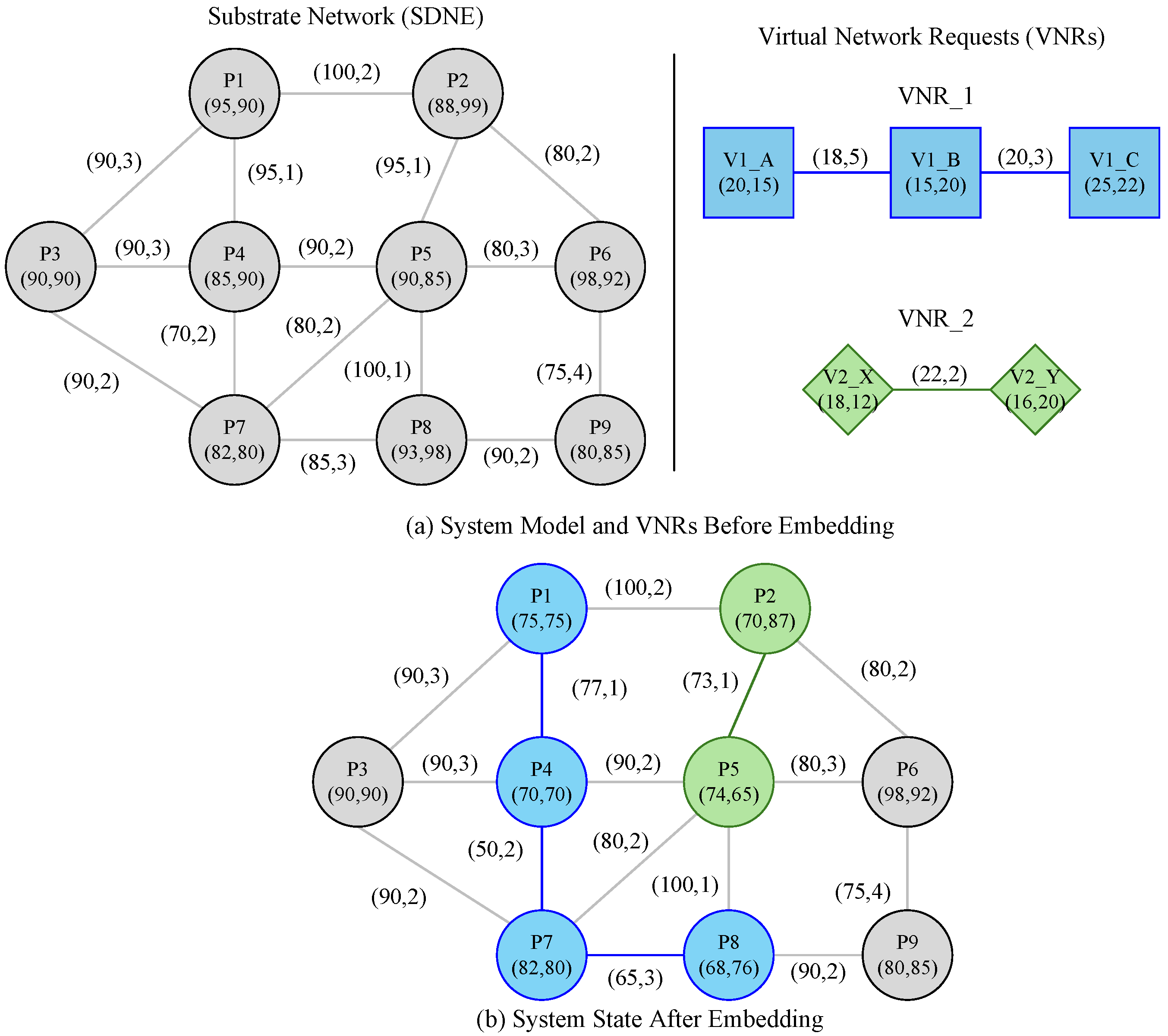
- A novel VNE-based formulation for task offloading in SDEC: We pioneer a formal model that transforms the intricate problem of application task offloading into a VNE problem. An application, composed of multiple interdependent subtasks, is abstracted as a Virtual Network Request (VNR), where virtual nodes represent the computational and storage demands of subtasks, and virtual links represent the data dependencies and communication bandwidth requirements between them. This modeling provides a unified and structured approach to the joint allocation of computing and network resources, which is a significant departure from conventional offloading models that often treat these resources disjointly.
- (2)
- A DRL framework for dynamic VNE: We design an intelligent and adaptive VNE algorithm based on the Soft Actor-Critic (SAC) model, a state-of-the-art DRL algorithm known for its sample efficiency and stability in continuous and large state spaces. The SDN controller acts as the learning agent, observing the global state of the edge network and making sequential embedding decisions. This framework is specifically tailored to learn a policy that maximizes long-term system performance in a highly dynamic environment where VNRs arrive stochastically.
- (3)
- DRL-driven optimization of key performance metrics: Our framework is meticulously designed to optimize critical long-term performance metrics for task offloading. This is achieved by engineering the reward function to directly reflect the revenue-to-cost ratio. By training the agent to maximize the cumulative reward, the learning process inherently steers the VNE policy towards solutions that not only increase revenue but also improve resource efficiency. As demonstrated in our experiments, this core optimization of the revenue-to-cost ratio consequently leads to significant improvements in the VNR acceptance rate and overall system revenue.
2. System Model and Problem Formulation
2.1. Software-Defined Edge Network Architecture
- Substrate Nodes (): The set comprises all physical nodes within the edge network. Each substrate node, , represents a physical entity such as an edge server or a base station equipped with computational capabilities. Each node is characterized by a vector of resource attributes, primarily its total computing capacity, denoted as , and its total storage or memory capacity, denoted as .
- Substrate Links (): The set represents the physical communication links interconnecting the substrate nodes. Each substrate link, , that connects two nodes and is defined by its total available bandwidth, , and its inherent communication latency, , which aggregates propagation, transmission, and processing delays.
2.2. Application Task Model as a Virtual Network Request
- Virtual Nodes (): The set corresponds to the individual subtasks or functional components of an application. Each virtual node, , specifies the resources necessary for its execution. These requirements are defined by the requested computational capacity, , and the requested memory capacity, .
- Virtual Links (): The set represents the data dependencies and required communication flows between the application’s subtasks. Each virtual link, , from to signifies that the output of subtask serves as input for subtask . Each virtual link is characterized by its requested data transfer bandwidth, , and a maximum tolerable delay constraint for the data transfer, .
2.3. Problem Formulation
- Node Mapping: Each virtual node must be exclusively mapped onto a single physical node capable of satisfying its computational and memory requirements. Let a binary variable indicate if is mapped to . The node mapping function is constrained by:
- Link Mapping: Each virtual link connecting virtual nodes and must be mapped onto a physical path, denoted as , in the substrate network. This path connects the physical nodes and that host and , respectively. The mapped path must collectively provide the required bandwidth and satisfy the end-to-end delay constraint. Let a binary variable indicate if substrate link is part of the path mapping virtual link .
3. VNE Constraint and Performance Indicators
3.1. VNE Constraints
- Node Resource Constraints: The aggregate resources required by all virtual nodes mapped onto a single physical node must not exceed its physical capacity.
- Link Resource Constraints: The sum of bandwidth allocated to all virtual links passing through a single physical link cannot exceed its total bandwidth capacity.
- Latency Constraint: The cumulative latency of the physical path selected for a virtual link must not surpass the VNR’s maximum tolerable delay.
3.2. Performance Evaluation Metrics
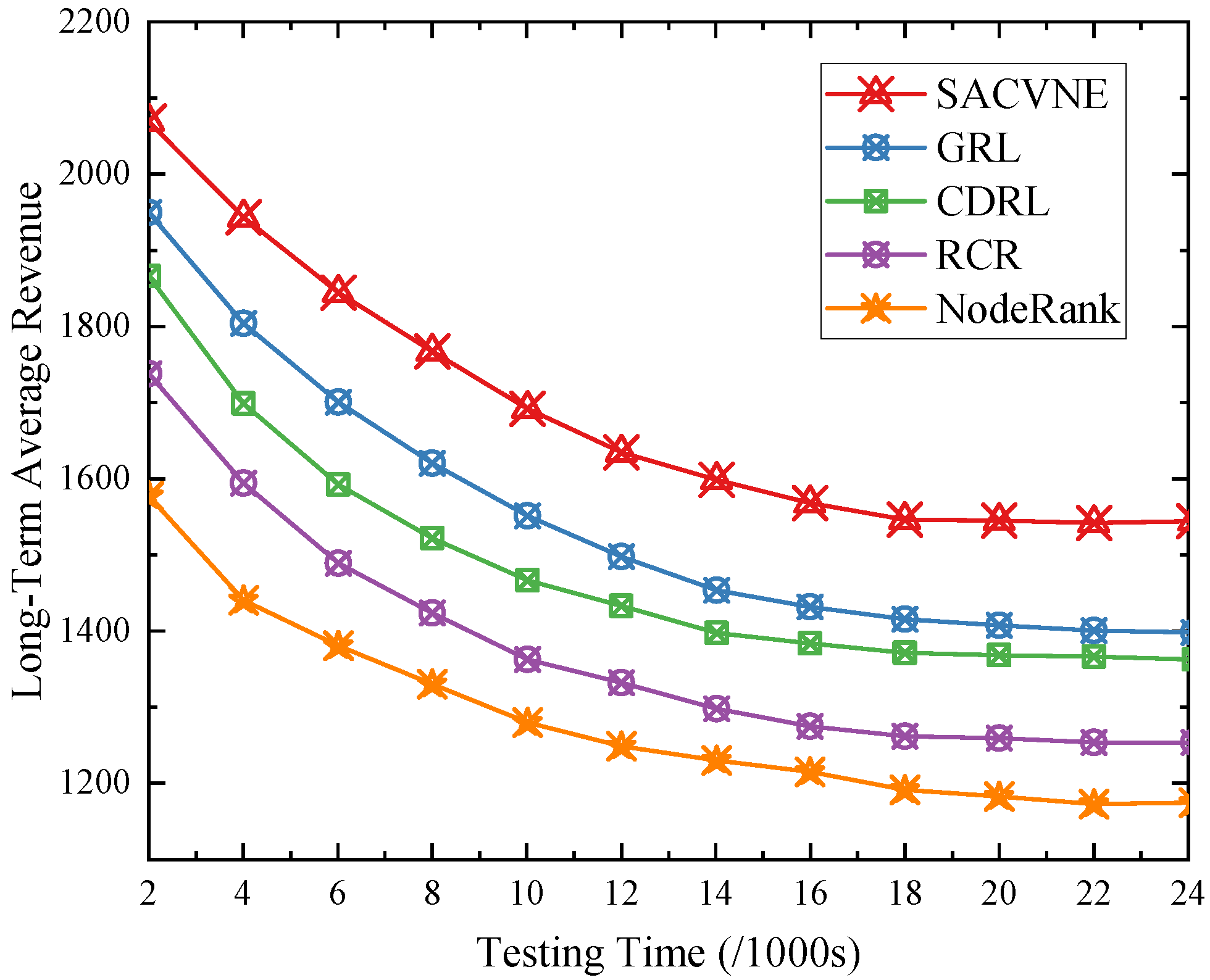
- Long-Term Average Revenue: This metric quantifies the total economic value generated by successfully accommodating VNRs over a sustained period. The revenue of a single VNR is a weighted sum of its requested resources, scaled by its lifetime.where , , and are unit price coefficients. The long-term average revenue over a time horizon T is:
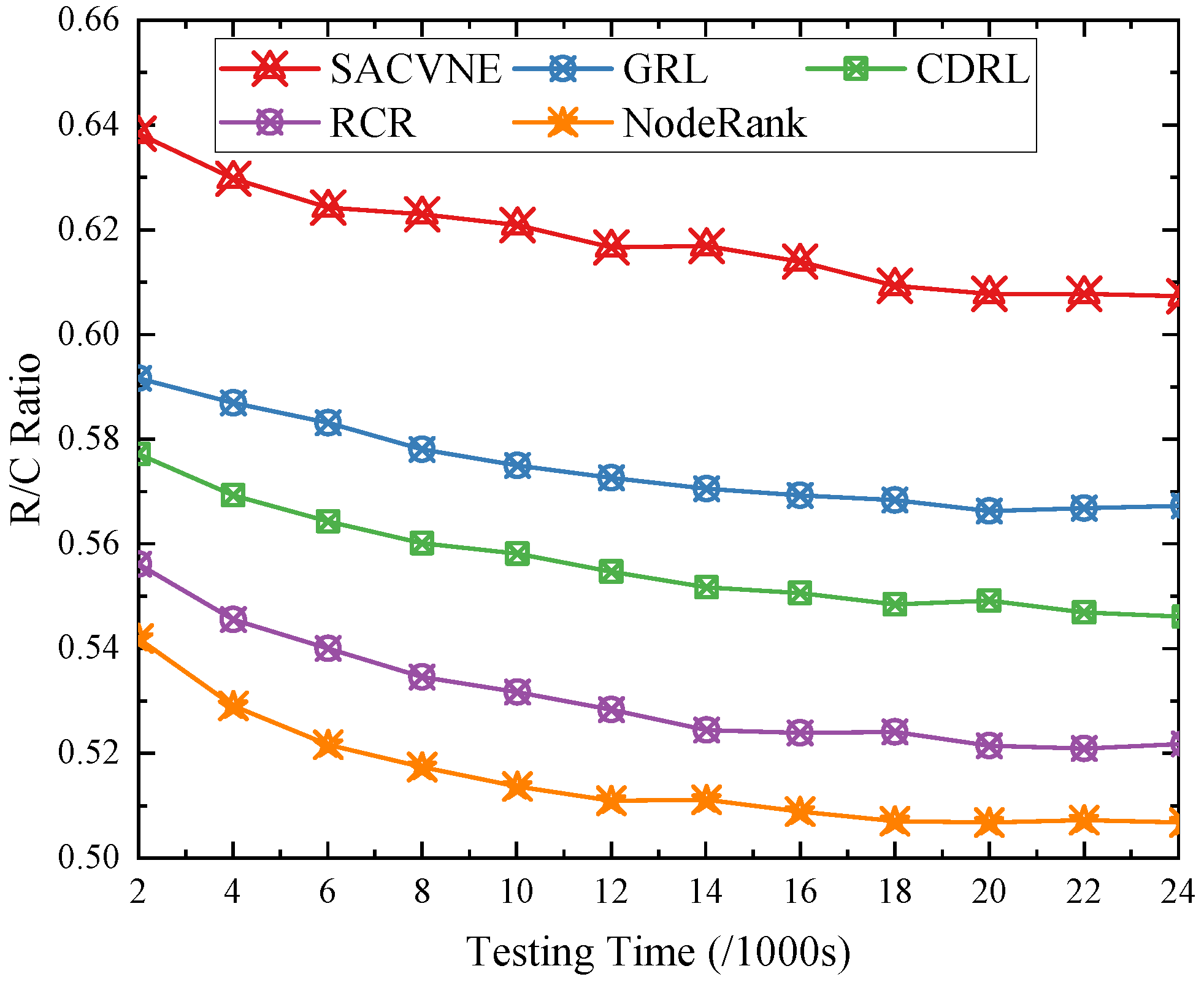
- Long-Term Average Revenue-to-Cost Ratio (R/C Ratio): This metric assesses the economic efficiency by comparing the revenue generated against the cost of the physical resources consumed. The cost of embedding a VNR includes its consumption of node resources and the network resources, where the latter is proportional to the number of hops in the mapped paths.where is the number of physical links in the path . The long-term R/C ratio is:
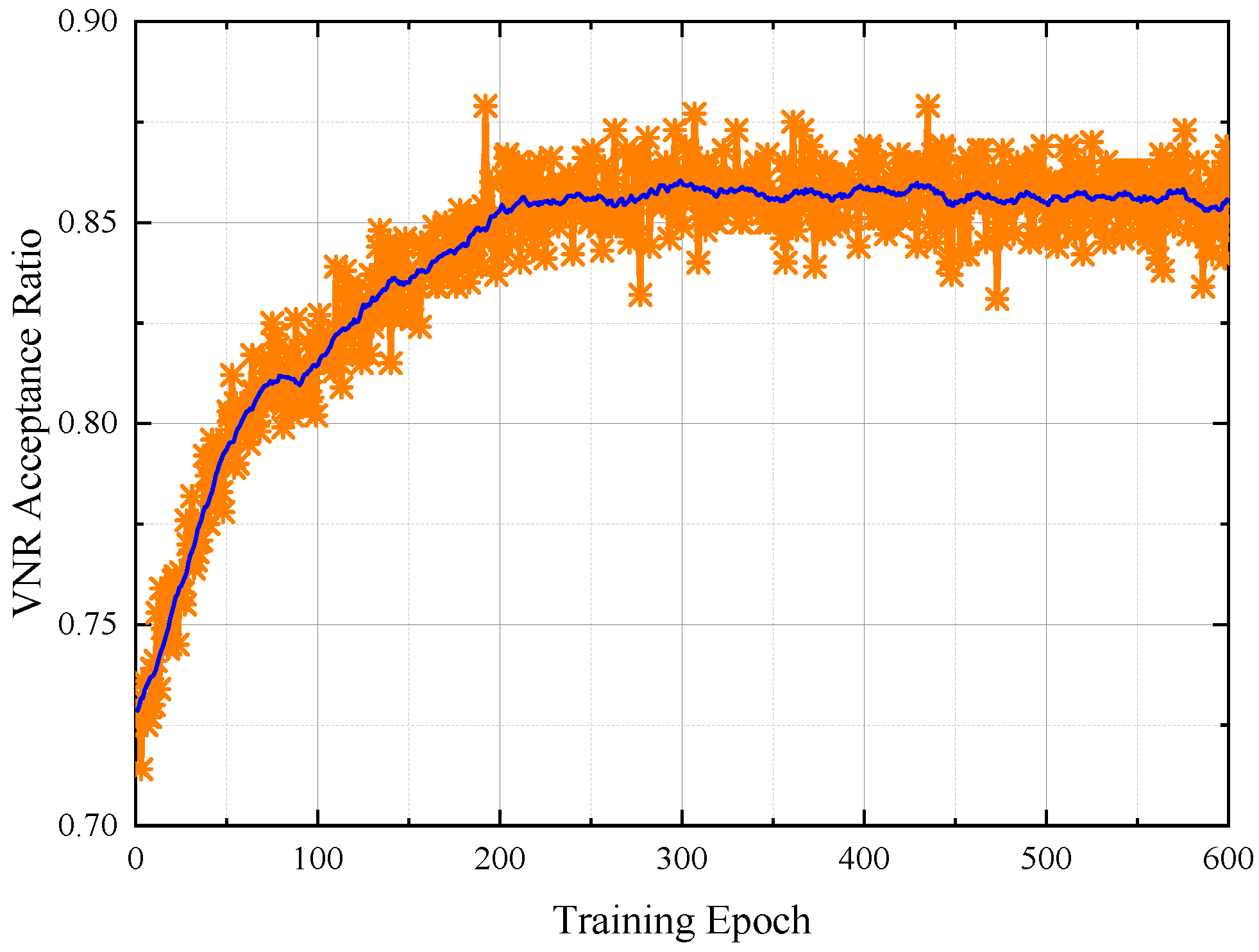
- VNR Acceptance Ratio: This fundamental KPI measures service availability and the system’s capacity to handle incoming demand. It is defined as the ratio of successfully embedded VNRs to the total number of VNRs that arrived over a time window.A high acceptance ratio signifies a robust and efficient embedding strategy that effectively mitigates resource fragmentation and minimizes service rejection.
4. The Proposed Task Offloading Algorithm Based VNE for SDEN
4.1. Markov Decision Process (MDP) Formulation
- (1)
- State Space (): The state at a given time step t must provide a comprehensive snapshot of the substrate network’s current resource availability. Building upon the models in Section 2, we define the state representation based on multi-dimensional features extracted for each physical node . For each node , the feature vector consists of:
- Available Computing Resources (): The residual computing capacity on node . This is defined as its total capacity minus the sum of capacities of all virtual nodes currently mapped to it:
- Available Memory Resources (): The residual memory capacity, defined similarly:
- Aggregated Available Bandwidth (): A measure of the network connectivity of node , defined as the sum of available bandwidth on all links incident to it:where is the set of links connected to and is the available bandwidth on link .
- (2)
- Action Space (): The embedding of a single VNR with virtual nodes is decomposed into a sequence of decision steps. At each step , the agent considers the k-th virtual node, , and performs an action, . This action is the selection of a single physical node for mapping. The action space at each step is therefore discrete, with . A composite action for an entire VNR is the ordered sequence of these individual node-mapping actions:where each . This sequential approach makes the complex combinatorial problem tractable for RL.
- (3)
- Reward Function (R): The reward function is designed to guide the agent towards learning a policy that maximizes resource efficiency. The primary optimization objective is the long-term revenue-to-cost ratio. Therefore, a reward is granted to the agent only upon the completion of a VNR embedding attempt. A successful embedding is rewarded with the calculated R/C ratio of that specific VNR. By maximizing the long-term cumulative reward, the agent is trained not just to accept VNRs, but to find economically efficient embeddings. This single-objective reward function implicitly encourages behaviors that also improve the other key metrics, such as leaving sufficient resources for future VNRs (enhancing the acceptance ratio) and prioritizing profitable requests (boosting revenue). The reward, , is formally defined as:
- (4)
- State Transition Probability () and Discount Factor (): The state transition probability, , is implicitly defined by the environment’s dynamics. The discount factor, , is set to 0.99, a standard value in DRL that encourages the agent to prioritize long-term cumulative rewards while giving immediate rewards significant weight.
4.2. The Soft Actor-Critic (SAC) Agent Architecture
- (1)
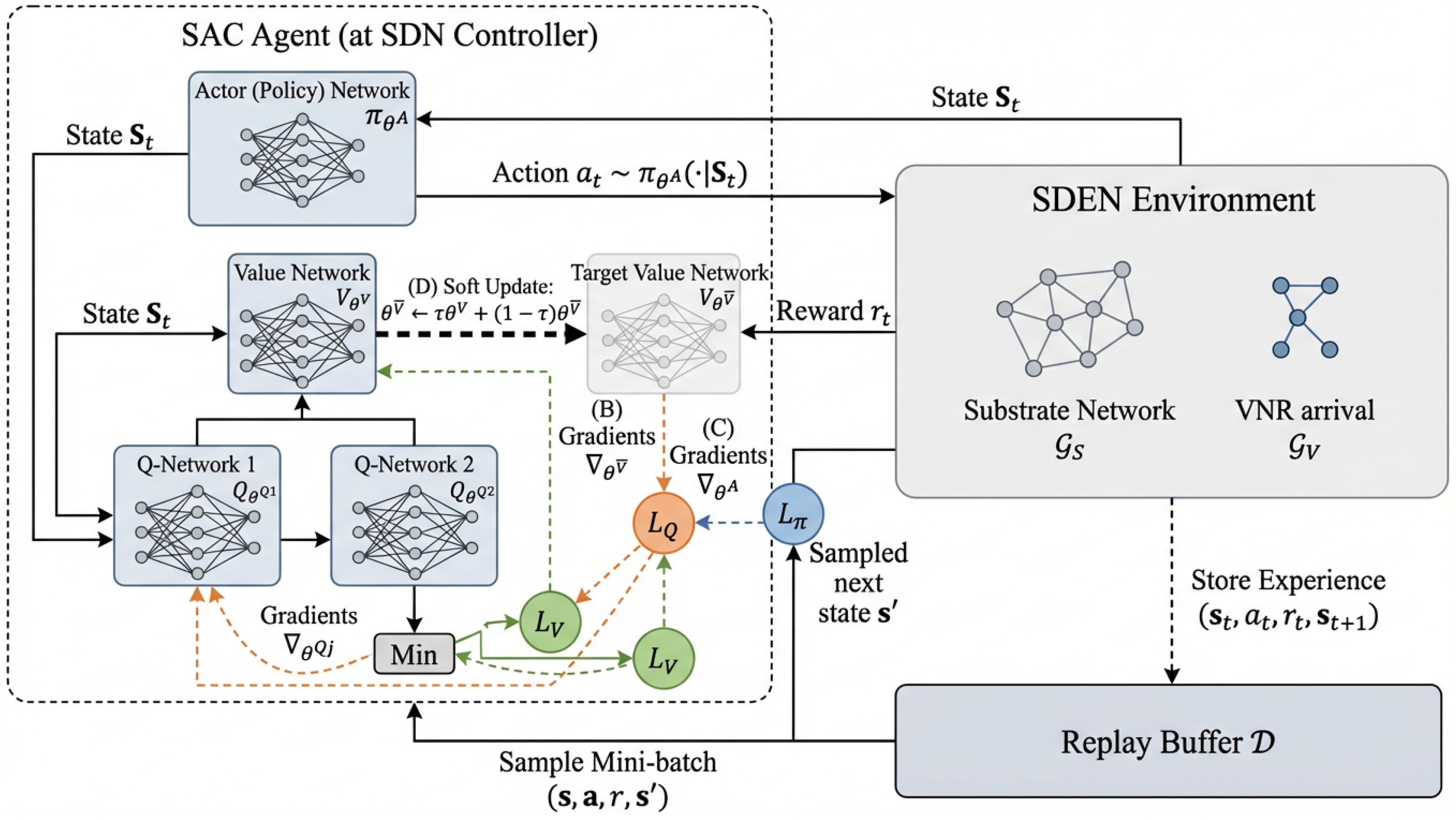
- Actor Network (): The actor, also known as the policy network, is parameterized by . It maps a given state to a probability distribution over the discrete action space, yielding . During an embedding, the agent samples an action (i.e., selects a physical node) from this distribution.
- (2)
- Critic Networks (Q-Networks and V-Network): To ensure stable training and mitigate the overestimation bias common in value-based methods, our SAC agent utilizes a set of critic networks:
- Two Q-Networks (): Following the principle of clipped double-Q learning, two distinct Q-networks, parameterized by and , are maintained. Each network takes a state-action pair as input and outputs its estimated value, . The minimum of these two Q-values is used during the Bellman updates to provide a conservative, lower-bound estimate of the action-value, which helps prevent overestimation.
- A Value Network (): This network, parameterized by , estimates the value of a state, . Its role is to simplify the update rules for the other networks.
- A Target Value Network (): A separate target V-network, with parameters , is maintained. Its parameters are not trained via gradient descent directly but are instead updated slowly as an exponential moving average of the main V-network’s parameters. This use of a “soft” target network provides a stable learning target for the Q-networks, a crucial element for convergence in temporal-difference learning.
4.3. Algorithm Optimization Process
- (1)
- Experience Replay Buffer (): The agent continuously interacts with the SDEN environment. Each complete interaction, from the start of a VNR embedding to its final outcome (success or failure), results in a trajectory of experience tuples. A summary tuple, , representing the initial state, the composite action sequence, the final reward, and the resulting network state, is stored in a large replay buffer . For training, mini-batches of these experience tuples are randomly sampled from . This practice breaks the temporal correlation between consecutive samples and leads to more stable and efficient learning.
- (2)
- Maximum Entropy Objective: In contrast to traditional RL algorithms that solely seek to maximize the cumulative reward, SAC enhances the objective with a policy entropy term. For a discrete action space, the entropy of the policy at state is defined as:
- (3)
- Network Parameter Updates: The neural networks are updated iteratively by minimizing their respective loss functions, calculated using mini-batches of experiences sampled from . Let a mini-batch experience be denoted by .
- Value Network Update: The V-network, parameterized by , is trained to minimize the soft Bellman residual. Its loss function, , is given by:
- Q-Network Update: The parameters of each Q-network are trained to minimize the mean squared Bellman error (MSBE). The learning target is computed using the reward r and the value of the next state from the target V-network:
- Actor Network Update: The actor (policy network) is updated by minimizing the Kullback–Leibler divergence between the policy distribution and the softmax of the Q-function values. This encourages the policy to favor actions with higher Q-values. The policy loss, , is:
- Target Network Soft Update: At each training step, the parameters of the target value network, , are updated via a soft update, which is an exponential moving average of the main value network’s parameters. This ensures smoother and more stable updates.where is the smoothing factor for the target update, typically a small value like .
4.4. VNE Decision and Learning Algorithm
| Algorithm 1: The Proposed Task Offloading Algorithm Based VNE for SDEN |
|
5. Simulation Experiment
5.1. Simulation Environment Setup
- Substrate Network (SDEN) Generation: The physical SDEN topology is generated using the GT-ITM topology generator, a standard tool for creating realistic network graphs. We simulate an edge network consisting of 100 physical nodes (), representing a moderately sized metropolitan area network. These nodes are interconnected by 500 physical links (). The computational and storage resources of the physical nodes, as well as the bandwidth and latency attributes of the physical links, are uniformly distributed within predefined ranges, reflecting the inherent heterogeneity of edge infrastructure. The specific resource distributions are detailed in Table 3.
- Virtual Network Request (VNR) Generation: To simulate a dynamic workload, VNRs arrive at the system according to a Poisson process, with a configurable average arrival rate (). The lifetime of each VNR follows an exponential distribution. The structural characteristics of each VNR, such as the number of virtual nodes and their connectivity, are also randomly generated. The number of virtual nodes per VNR is drawn from a uniform distribution between 2 and 10, and any two virtual nodes are connected with a probability of 0.5. The resource demands (computing, memory, bandwidth, and delay constraints) for each VNR are uniformly sampled from the ranges specified in Table 3.
- Experimental Parameters: Table 3 provides a comprehensive summary of all simulation parameters, including the physical network configuration, VNR characteristics, and the crucial hyperparameters used for training our SAC agent. These DRL parameters were determined through empirical tuning to ensure stable and efficient convergence.
5.2. Baseline Algorithms
- NodeRank: A classic greedy heuristic algorithm. It prioritizes the mapping of virtual nodes onto physical nodes with the highest “rank”, a metric that combines both available resources and topological importance. It is a widely used benchmark for its simplicity and effectiveness in static scenarios.
- RCR: This heuristic algorithm is designed to optimize the Revenue-to-Cost Ratio directly. It follows a greedy approach by always selecting the node and link mappings that yield the best immediate R/C ratio for the current VNR, without considering long-term consequences.
- CDRL: A pioneering RL-based VNE algorithm that models the node mapping as a sequential decision process. This provides a relevant DRL-based comparison, although its core algorithm may differ from our SAC implementation.
- GRL: A more advanced DRL algorithm that integrates a GCN to extract topological features from the substrate network. This serves as a state-of-the-art DRL baseline, allowing us to assess the specific benefits of our SAC formulation against other powerful network representation techniques.
- All baseline algorithms are implemented and executed within the identical simulation environment to ensure a fair and rigorous comparison.
5.3. Performance Analysis
- Stochastic VNR arrivals: VNRs arrive according to a Poisson process, a standard model for simulating random request arrivals. This naturally creates periods of high traffic intensity (high load) when many VNRs arrive in a short time, and periods of lower intensity (light/medium load).
- Finite VNR lifetimes: Each accepted VNR occupies resources for a finite, exponentially distributed lifetime before releasing them. The continuous cycle of resource allocation and deallocation ensures that the total occupied system resources (i.e., the system load) are constantly changing.
- Randomized resource demands: The resource requirements for each VNR are randomly generated from uniform distributions. This heterogeneity means that the impact of each VNR on the system load varies, further contributing to a dynamic load profile.
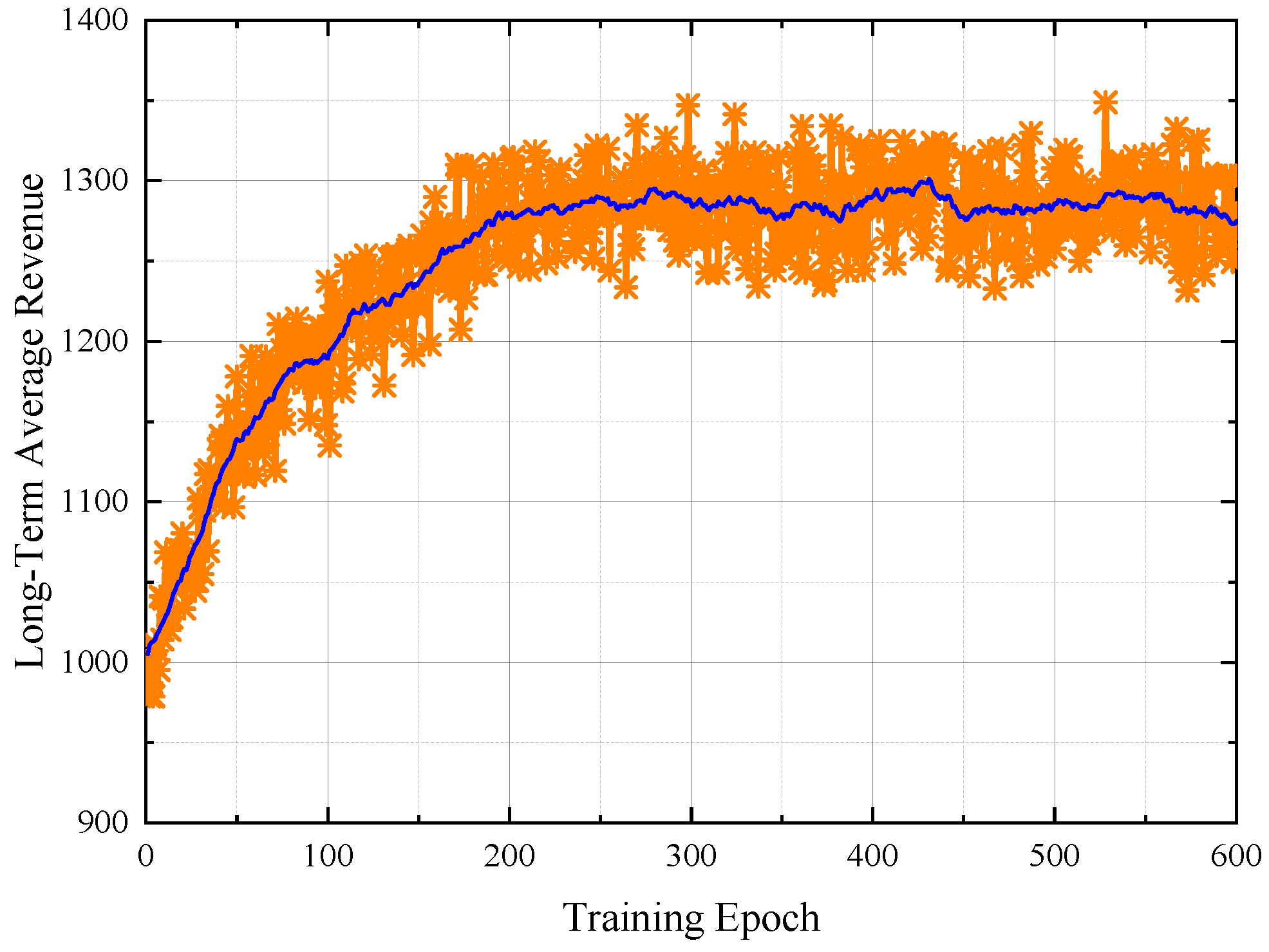
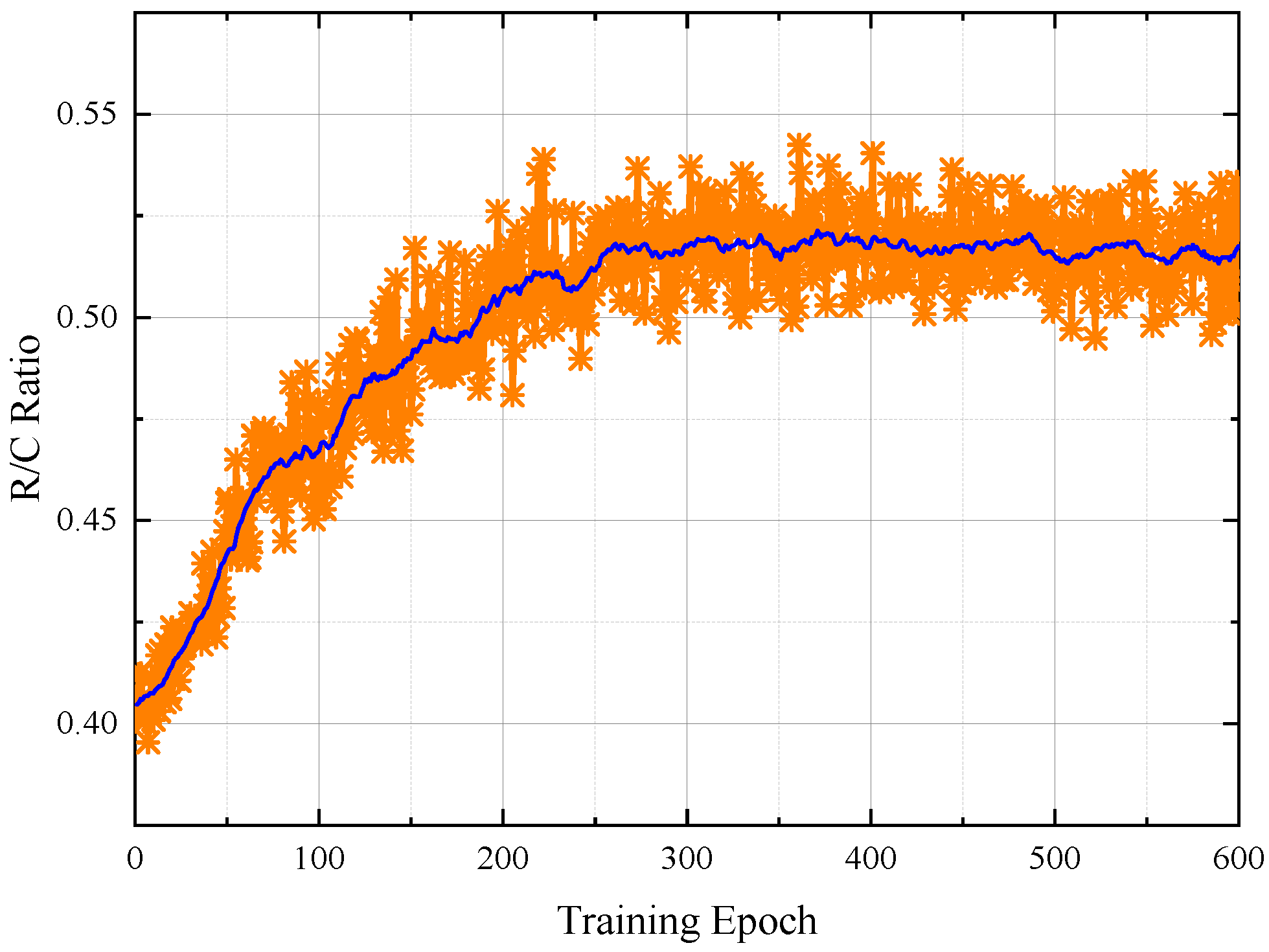
5.3.1. Training Performance and Convergence Analysis
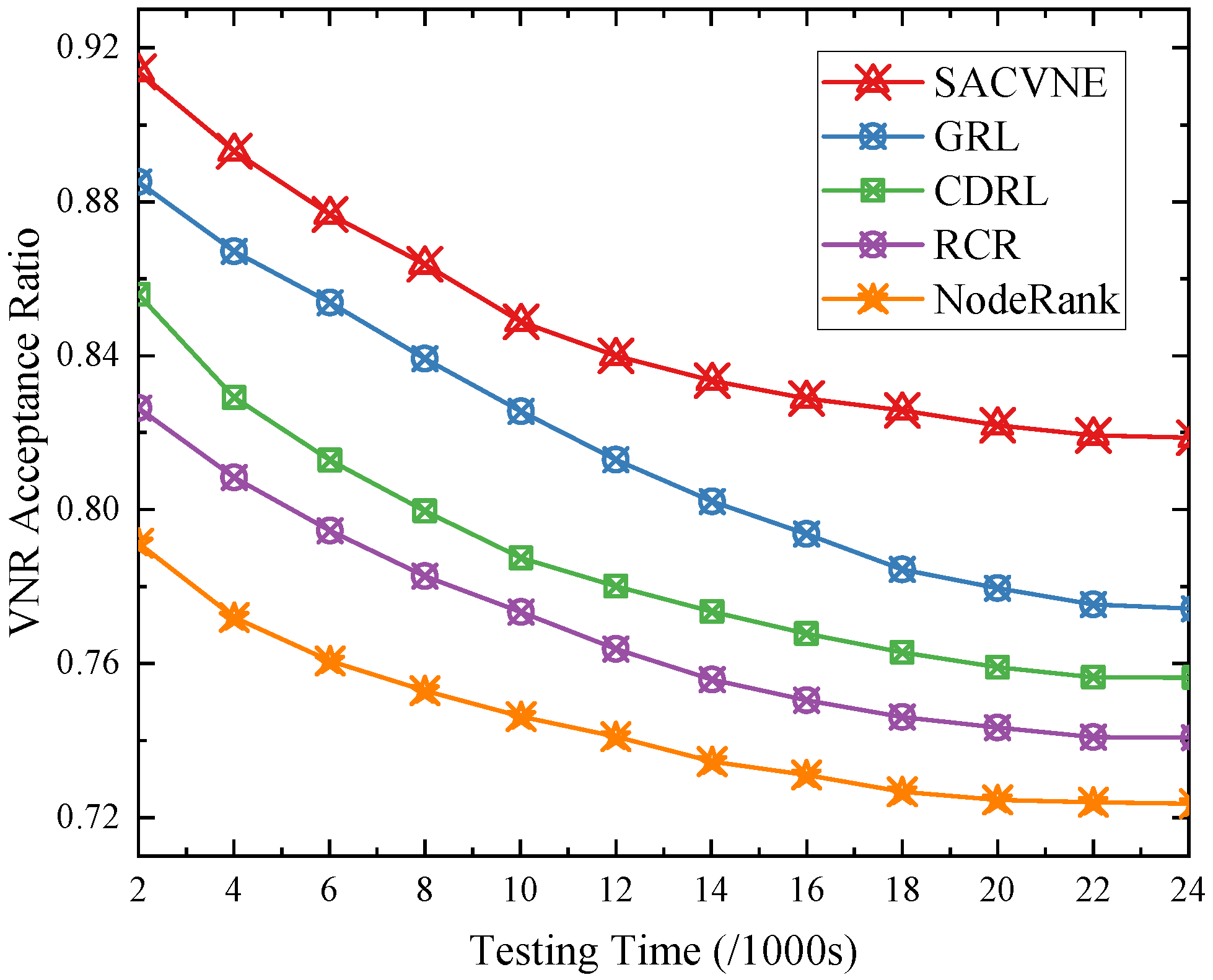
5.3.2. Comparative Performance Evaluation
5.3.3. Result Discussion and Justification
- Overcoming myopic heuristics: Heuristic methods like NodeRank and RCR make myopic, greedy decisions to satisfy immediate VNR demands, while this provides short-term gains, it inevitably leads to bottleneck resource exhaustion and severe network fragmentation over time, causing future profitable VNRs to be rejected. Our SAC agent, conversely, optimizes for the long-term cumulative discounted reward. It learns to strategically sacrifice short-term suboptimal placements to preserve critical node and link contiguity for future, highly profitable requests.
- Maximum entropy exploration: Compared to traditional DRL methods like CDRL, our algorithm leverages the SAC framework. SAC’s unique maximum entropy objective intrinsically encourages broader exploration of the vast action space (mapping combinations). This prevents the agent from converging prematurely to local optima, ensuring a more robust and adaptable policy under dynamic traffic conditions.
- Stability of double-Q learning: The incorporation of clipped double Q-learning within the critic network design actively mitigates the overestimation bias that commonly plagues temporal-difference learning in complex state spaces. This allows the SAC agent to evaluate the true long-term value of a mapping action more accurately than simpler DRL variants, translating directly into superior resource allocation efficiency (highest R/C ratio) and maximized sustained revenue.
6. Conclusions
Author Contributions
Funding
Institutional Review Board Statement
Informed Consent Statement
Data Availability Statement
Conflicts of Interest
References
- Mahmood, O.A.; Abdellah, A.R.; Muthanna, A.; Koucheryavy, A. Distributed Edge Computing for Resource Allocation in Smart Cities Based on the IoT. Information 2022, 13, 328. [Google Scholar] [CrossRef] [Scilit]
- Liu, Y.; Peng, M.; Shou, G.; Chen, Y.; Chen, S. Toward Edge Intelligence: Multiaccess Edge Computing for 5G and Internet of Things. IEEE Internet Things J. 2020, 7, 6722–6747. [Google Scholar] [CrossRef] [Scilit]
- Hu, M.; Luo, X.; Chen, J.; Lee, Y.C.; Zhou, Y.; Wu, D. Virtual reality: A survey of enabling technologies and its applications in IoT. J. Netw. Comput. Appl. 2021, 178, 102970. [Google Scholar] [CrossRef] [Scilit]
- Kuchuk, H.; Malokhvii, E. Integration of IoT with cloud, fog, and edge computing: A review. Adv. Inf. Syst. 2024, 8, 65–78. [Google Scholar] [CrossRef] [Scilit]
- Dong, S.; Tang, J.; Abbas, K.; Hou, R.; Kamruzzaman, J.; Rutkowski, L.; Buyya, R. Task offloading strategies for mobile edge computing: A survey. Comput. Netw. 2024, 254, 110791. [Google Scholar] [CrossRef] [Scilit]
- Shi, Y.; Xia, Y.; Gao, Y. Cross-Server Computation Offloading for Multi-Task Mobile Edge Computing. Information 2020, 11, 96. [Google Scholar] [CrossRef] [Scilit]
- Qin, Y.; Chen, J.; Jin, L.; Yao, R.; Gong, Z. Task offloading optimization in mobile edge computing based on a deep reinforcement learning algorithm using density clustering and ensemble learning. Sci. Rep. 2025, 15, 211. [Google Scholar] [CrossRef] [Scilit]
- Rafique, W.; Qi, L.; Yaqoob, I.; Imran, M.; Rasool, R.U.; Dou, W. Complementing IoT services through software defined networking and edge computing: A comprehensive survey. IEEE Commun. Surv. Tutor. 2020, 22, 1761–1804. [Google Scholar] [CrossRef] [Scilit]
- Wang, A.; Zha, Z.; Guo, Y.; Chen, S. Software-defined networking enhanced edge computing: A network-centric survey. Proc. IEEE 2019, 107, 1500–1519. [Google Scholar] [CrossRef] [Scilit]
- Hettiarachchi, E.D.S.I.; Sarkar, N.I.; Gutierrez, J. Impact of Southbound Expansion on Clustered OpenFlow Software-Defined Network Controller Synchronisation Using ODL and ONOS. Information 2024, 15, 440. [Google Scholar] [CrossRef] [Scilit]
- Wu, G.; Wang, H.; Zhang, H.; Shen, Y.; Shen, S.; Yu, S. Mean-Field Game-Based Task-Offloaded Load Balance for Industrial Mobile Edge Computing Systems Using Software-Defined Networking. IEEE Trans. Mob. Comput. 2024, 23, 13773–13786. [Google Scholar] [CrossRef] [Scilit]
- Van Anh, D.; Chehri, A.; Quy, N.M.; Hue, C.T.M.; Nguyen, D.C.; Quy, V.K. An Software Defined Networking (SDN) Enhanced Edge Computing Framework for Internet of Healthcare Things (IoHT). In Proceedings of the GLOBECOM 2024—2024 IEEE Global Communications Conference, Cape Town, South Africa, 8–12 December 2024; IEEE: Piscataway, NJ, USA, 2024; pp. 415–419. [Google Scholar] [CrossRef] [Scilit]
- Alnoman, A.; Sharma, S.K.; Ejaz, W.; Anpalagan, A. Emerging Edge Computing Technologies for Distributed IoT Systems. IEEE Netw. 2019, 33, 140–147. [Google Scholar] [CrossRef] [Scilit]
- Wu, S.; Chen, N.; Xiao, A.; Zhang, P.; Jiang, C.; Zhang, W. AI-Empowered Virtual Network Embedding: A Comprehensive Survey. IEEE Commun. Surv. Tutor. 2025, 27, 1395–1426. [Google Scholar] [CrossRef] [Scilit]
- Khan, L.U.; Guizani, M.; Yaqoob, I.; Al-Fuqaha, A.; Erbad, A.; Han, Z. Network Virtualization Empowered Metaverse: A Hierarchical Matching Approach. IEEE Trans. Netw. Sci. Eng. 2026, 13, 5403–5416. [Google Scholar] [CrossRef] [Scilit]
- Zhu, R.; Li, G.; Zhang, Y.; Fang, Z.; Wang, J. Load-Balanced Virtual Network Embedding Based on Deep Reinforcement Learning for 6G Regional Satellite Networks. IEEE Trans. Veh. Technol. 2023, 72, 14631–14644. [Google Scholar] [CrossRef] [Scilit]
- Rezaeimoghaddam, P.; Al-Anbagi, I. Trust-Aware Virtual Network Embedding in Wireless Sensor Networks. IEEE Sens. J. 2023, 23, 6326–6337. [Google Scholar] [CrossRef] [Scilit]
- Maity, I.; Vu, T.X.; Chatzinotas, S.; Minardi, M. D-ViNE: Dynamic Virtual Network Embedding in Non-Terrestrial Networks. In Proceedings of the 2022 IEEE Wireless Communications and Networking Conference (WCNC), Austin, TX, USA, 10–13 April 2022; IEEE: Piscataway, NJ, USA, 2022; pp. 166–171. [Google Scholar] [CrossRef] [Scilit]
- Cheng, X.; Su, S.; Zhang, Z.; Wang, H.; Yang, F.; Luo, Y.; Wang, J. Virtual network embedding through topology-aware node ranking. ACM SIGCOMM Comput. Commun. Rev. 2011, 41, 38–47. [Google Scholar] [CrossRef] [Scilit]
- Zhang, P.; Yao, H.; Liu, Y. Virtual Network Embedding Based on Computing, Network, and Storage Resource Constraints. IEEE Internet Things J. 2018, 5, 3298–3304. [Google Scholar] [CrossRef] [Scilit]
- Nguyen, K.T.; Huang, C. Distributed parallel genetic algorithm for online virtual network embedding. Int. J. Commun. Syst. 2021, 34, e4691. [Google Scholar] [CrossRef] [Scilit]
- Melo, M.; Sargento, S.; Killat, U.; Timm-Giel, A.; Carapinha, J. Optimal Virtual Network Embedding: Node-Link Formulation. IEEE Trans. Netw. Serv. Manag. 2013, 10, 356–368. [Google Scholar] [CrossRef] [Scilit]
- Fischer, A.; Botero, J.F.; Beck, M.T.; De Meer, H.; Hesselbach, X. Virtual network embedding: A survey. IEEE Commun. Surv. Tutor. 2013, 15, 1888–1906. [Google Scholar] [CrossRef] [Scilit]
- Hu, C.; Li, J.; Shi, H.; Ning, B.; Gu, Q. Decentralized Offloading Strategies Based on Reinforcement Learning for Multi-Access Edge Computing. Information 2021, 12, 343. [Google Scholar] [CrossRef] [Scilit]
- Zhu, Z.; Lin, K.; Jain, A.K.; Zhou, J. Transfer Learning in Deep Reinforcement Learning: A Survey. IEEE Trans. Pattern Anal. Mach. Intell. 2023, 45, 13344–13362. [Google Scholar] [CrossRef] [Scilit] [PubMed]
- Zhu, S.; Han, G.; Lin, C.; Tao, Q. Underwater Target Tracking Based on Hierarchical Software-Defined Multi-AUV Reinforcement Learning: A Multi-AUV Advantage-Attention Actor-Critic Approach. IEEE Trans. Mob. Comput. 2024, 23, 13639–13653. [Google Scholar] [CrossRef] [Scilit]
- Yao, H.; Ma, S.; Wang, J.; Zhang, P.; Jiang, C.; Guo, S. A continuous-decision virtual network embedding scheme relying on reinforcement learning. IEEE Trans. Netw. Serv. Manag. 2020, 17, 864–875. [Google Scholar] [CrossRef] [Scilit]
- Zhang, P.; Wang, C.; Kumar, N.; Zhang, W.; Liu, L. Dynamic Virtual Network Embedding Algorithm Based on Graph Convolution Neural Network and Reinforcement Learning. IEEE Internet Things J. 2022, 9, 9389–9398. [Google Scholar] [CrossRef] [Scilit]
- He, N.; Yang, S.; Li, F.; Trajanovski, S.; Zhu, L.; Wang, Y.; Fu, X. Leveraging Deep Reinforcement Learning With Attention Mechanism for Virtual Network Function Placement and Routing. IEEE Trans. Parallel Distrib. Syst. 2023, 34, 1186–1201. [Google Scholar] [CrossRef] [Scilit]
- Xiao, X. DVNE-DRL: Dynamic virtual network embedding algorithm based on deep reinforcement learning. Sci. Rep. 2023, 13, 19789. [Google Scholar] [CrossRef] [Scilit] [PubMed]
- Zhang, P.; Chen, N.; Li, S.; Choo, K.K.R.; Jiang, C.; Wu, S. Multi-Domain Virtual Network Embedding Algorithm Based on Horizontal Federated Learning. IEEE Trans. Inf. Forensics Secur. 2023, 18, 3363–3375. [Google Scholar] [CrossRef] [Scilit]
- Baktir, A.C.; Ozgovde, A.; Ersoy, C. How Can Edge Computing Benefit From Software-Defined Networking: A Survey, Use Cases, and Future Directions. IEEE Commun. Surv. Tutor. 2017, 19, 2359–2391. [Google Scholar] [CrossRef] [Scilit]
- Mano, T.; Inoue, T.; Wang, Y. Np-hardness boundary of virtual network embedding with node location constraints. IEEE Netw. Lett. 2021, 3, 186–190. [Google Scholar] [CrossRef] [Scilit]
- Haeri, S.; Trajković, L. Virtual network embedding via Monte Carlo tree search. IEEE Trans. Cybern. 2017, 48, 510–521. [Google Scholar] [CrossRef] [Scilit] [PubMed]
- Wu, S.; Chen, N.; Wen, G.; Xu, L.; Zhang, P.; Zhu, H. Virtual Network Embedding for Task Offloading in IIoT: A DRL-Assisted Federated Learning Scheme. IEEE Trans. Ind. Inform. 2024, 20, 6814–6824. [Google Scholar] [CrossRef] [Scilit]
- Haarnoja, T.; Zhou, A.; Abbeel, P.; Levine, S. Soft actor-critic: Off-policy maximum entropy deep reinforcement learning with a stochastic actor. In Proceedings of the International Conference on Machine Learning, Stockholm, Sweden, 10–15 July 2018; PMLR; JMLR: Cambridge, MA, USA, 2018; pp. 1861–1870. [Google Scholar]




| Symbol | Description |
|---|---|
| Substrate Network (SDEN) Parameters | |
| The undirected graph representing the substrate network. | |
| The set of physical (substrate) nodes in the SDEN. | |
| The set of physical (substrate) links in the SDEN. | |
| An individual physical node, . | |
| An individual physical link, . | |
| Total computing capacity of a physical node . | |
| Total memory/storage capacity of a physical node . | |
| Total bandwidth capacity of a physical link . | |
| Communication latency of a physical link . | |
| Virtual Network Request (VNR) Parameters | |
| The directed graph representing a Virtual Network Request. | |
| The set of virtual nodes (subtasks) in a VNR. | |
| The set of virtual links (data dependencies) in a VNR. | |
| An individual virtual node, . | |
| An individual virtual link, . | |
| Computing capacity required by a virtual node . | |
| Memory/storage capacity required by a virtual node . | |
| Bandwidth required by a virtual link . | |
| Maximum tolerable delay for a virtual link . | |
| Mapping and State Variables | |
| The VNE mapping function, . | |
| Binary variable; 1 if is mapped to , 0 otherwise. | |
| Binary variable; 1 if is used to map , 0 otherwise. | |
| A physical path in the substrate network, . | |
| Available computing capacity on physical node . | |
| Available memory capacity on physical node . | |
| Available bandwidth on physical link . | |
| Performance Metrics and Other Symbols | |
| Arrival time of the i-th VNR. | |
| Departure time of the i-th VNR. | |
| Lifetime of the i-th VNR. | |
| Revenue generated by the i-th VNR. | |
| Cost incurred by embedding the i-th VNR. | |
| Unit price coefficients for resources. | |
| The number of links (hops) in a physical path . | |
| T | A long-term time horizon for evaluation. |
| Long-term average revenue. | |
| Long-term revenue-to-cost ratio. | |
| VNR acceptance ratio. | |
| Network | Layer | Input → Output Dimension | Activation |
|---|---|---|---|
| Actor () | Input | ReLU | |
| Hidden | ReLU | ||
| Output | Softmax | ||
| Value () | Input | ReLU | |
| Hidden | ReLU | ||
| Output | Linear | ||
| Q-Critics () | Input | ReLU | |
| Hidden | ReLU | ||
| Output | Linear |
| Parameter Category | Configuration |
|---|---|
| Substrate Network (SDEN) Configuration | |
| Number of Physical Nodes () | 100 |
| Number of Physical Links () | 500 |
| Computing Capacity of Nodes () | U [50, 100] |
| Memory Capacity of Nodes () | U [50, 100] |
| Bandwidth of Links () | U [50, 100] |
| Latency of Links () | U [1, 20] |
| Virtual Network Request (VNR) Configuration | |
| Total Number of VNRs (training & testing) | 2000 (1000 + 1000) |
| Number of Virtual Nodes () | U [2, 10] |
| Virtual Link Connectivity Probability | 0.5 |
| Requested Computing () | U [1, 20] |
| Requested Memory () | U [1, 20] |
| Requested Bandwidth () | U [1, 20] |
| Max. Tolerable Delay () | U [1, 20] |
| SAC Agent Hyperparameter Configuration | |
| Actor Network Learning Rate () | 0.0001 |
| Critic Networks Learning Rate () | 0.0001 |
| Discount Factor () | 0.99 |
| Replay Buffer Size () | 50,000 |
| Batch Size | 128 |
| Target Network Update Factor () | 0.01 |
| Temperature Parameter () | 0.1 |
Disclaimer/Publisher’s Note: The statements, opinions and data contained in all publications are solely those of the individual author(s) and contributor(s) and not of MDPI and/or the editor(s). MDPI and/or the editor(s) disclaim responsibility for any injury to people or property resulting from any ideas, methods, instructions or products referred to in the content. |
© 2026 by the authors. Licensee MDPI, Basel, Switzerland. This article is an open access article distributed under the terms and conditions of the Creative Commons Attribution (CC BY) license.
Share and Cite
Ma, L.; Zhang, P.; Chen, N. Task Offloading Based on Virtual Network Embedding in Software-Defined Edge Networks: A Deep Reinforcement Learning Approach. Information 2026, 17, 278. https://doi.org/10.3390/info17030278
Ma L, Zhang P, Chen N. Task Offloading Based on Virtual Network Embedding in Software-Defined Edge Networks: A Deep Reinforcement Learning Approach. Information. 2026; 17(3):278. https://doi.org/10.3390/info17030278
Chicago/Turabian StyleMa, Lixin, Peiying Zhang, and Ning Chen. 2026. "Task Offloading Based on Virtual Network Embedding in Software-Defined Edge Networks: A Deep Reinforcement Learning Approach" Information 17, no. 3: 278. https://doi.org/10.3390/info17030278
APA StyleMa, L., Zhang, P., & Chen, N. (2026). Task Offloading Based on Virtual Network Embedding in Software-Defined Edge Networks: A Deep Reinforcement Learning Approach. Information, 17(3), 278. https://doi.org/10.3390/info17030278