


Abstract
Background: Attention deficit hyperactivity disorder (ADHD) is a neurodevelopmental disorder characterized by inattention, motor hyperactivity and verbal and cognitive impulsivity. Impairments in executive functions (EFs), in particular working memory, monitoring and organization of daily life, are frequently observed in children diagnosed with ADHD, and are reflected in behavioural, social-emotional and learning difficulties. The development and use of technologies such as virtual reality (VR), augmented reality (AR) and mixed reality (MR) for ADHD have increased in recent years, using a variety of tools to support including PC, video games, wearable devices and tangible interfaces. Objectives: To systematically map the current state of research on the use of AR, VR and MR technologies to assess and/or enhance EFs in children with ADHD. To evaluate the effects on their quality of life and on families’ and caregivers’ burden reduction. To explore the interventions’ clinical validity. Methods: A scoping review according to PRISMA-ScR guidelines was conducted. A systematic search was carried out in the Scopus and Web of Science databases for studies published between 2015 and 2025. Empirical studies published in English that examined children with ADHD aged <13 years were included. AR-, VR-, or MR-based interventions focused on EF were considered. For each study, the following features were recorded: year and country of publication, design, objectives, EFs considered, technology and hardware used, main results, and limitations. Results: Twenty studies were identified. The most frequently addressed functional domains were sustained and selective visual attention, working memory, and inhibition. Assessment interventions primarily involved the use of a head-mounted display (HMD) in conjunction with the Continuous Performance Test (CPT). Training interventions included immersive VR, serious video games, VR with motor or dual-task training, and MR. The results suggest that VR can enhance cognitive performance and sustained attention; however, longitudinal studies are required to evaluate its long-term effectiveness and integrate emotional skills. Conclusions: The use of these technologies is a promising strategy for the assessment and training of EFs in children with ADHD. These tools provide positive, inclusive feedback and motivating tasks. Nevertheless, larger sample studies and longitudinal follow-ups to confirm the suitability and effectiveness of the technology-based programs are warranted.
1. Introduction
Attention deficit hyperactivity disorder (ADHD) is one of the most prevalent neurodevelopmental disorders in children, with a prevalence ranging from 5.6% to 7.6% [1]. The disorder is frequently diagnosed during childhood, often persisting into adulthood [2], and it is characterized by persistent difficulties in attention, behavioural self-regulation, and response inhibition, resulting in impairments in daily life [3].
As demonstrated in the extant literature [4,5,6,7], children with ADHD exhibit immaturity in executive functions (EFs). EFs can be defined as a set of higher-order cognitive processes used to control and coordinate a wide range of mental processes and everyday behaviors [8,9]. There is a broad consensus that the underlying mechanisms of EFs can be categorized into three overarching domains: response inhibition, working memory (WM; updating), and cognitive shifting/flexibility [10,11]. These domains underpin more complex EFs, such as planning, problem solving, abstract reasoning, and behavioral and emotional self-regulation. A further classification differentiates between cool EF (cEF; cognitive) and hot EF (hEF; emotional) [12]. These dimensions overlap, although they are distinct, forming an integrated system that facilitates goal-oriented behaviors [13,14].
According to this distinction, cEFs function in emotionally neutral situations and require purely cognitive processes to solve abstract and decontextualized problems, such as Go/No Go tasks [15] or n-back tasks [16]. In contrast, hEFs are active in socially and emotionally significant situations, as well as in the choice between immediate gratification and greater long-term reward. These include the capacity to regulate emotions, make decisions, control impulses, and assess risk, as exemplified in tasks involving delayed gratification [17].
In children with ADHD, EFs deficits impair not only academic and social functioning, but also the management of daily activities and novel or complex task [17]. For this reason, they represent a key element in neuropsychological assessments and targeted clinical [18,19,20]. The assessment of EFs in ADHD is predominantly reliant upon the utilization of paper-based neuropsychological tests, questionnaires and subjective observation. Standard treatment includes behavioural therapy, paper-based and/or computer-based cognitive training, video games, mindfulness, exercise and pharmacological treatment (e.g., methylphenidate) [21]. In recent years, immersive technologies such as virtual reality (VR), augmented reality (AR), and mixed reality (MR) have gained increasing importance. VR can be defined as computer-simulated reality, and is a technology that simulates a three-dimensional (3D) environment in which an individual can fully immerse themselves through virtual agents [22]. AR is a technology that superimposes digital elements onto the real environment. This allows users to interact with virtual objects (e.g., text, images, 3D models) in the real world, thereby enriching it but not replacing it [23,24]. MR combines VR and AR to create a symbiotic environment in which real and virtual objects coexist and interact with each other in real time [25]. The current literature [14,26,27] has drawn attention to the fact that these technologies offer innovative approaches and significant advantages in terms of practicality, ecological validity, behavioural monitoring and experimental control. Traditional cognitive tests have limited ecological validity and poor generalizability because they assess cognitive functions in abstract and structured contexts, risking overestimating the real functional capacities of patients [28]. Immersive VR environments enable the assessment of EFs in realistic everyday settings [29], simulating complex and multitasking situations (e.g., supermarkets or kitchens).
Traditional rehabilitation exercises can be monotonous and reduce treatment adherence. Virtual environments, thanks to gaming elements, a variety of scenarios, and immersive components such as head-mounted displays (HMDs), motion controllers, haptic feedback, and 3D sound environments, improve the sense of presence, motivation, and number of repetitions during rehabilitation [29]. This makes assessments more representative of real-world functioning and facilitates the identification of difficulties that cannot be detected with standardized tests [30]. Standard assessments and laboratory training may be limited by anxiety, poor attention span, and variability in results [31]. Immersive technologies overcome these limitations creating more engaging environments, offering immediate, multimodal feedback and positive reinforcement [32]. Furthermore, the complexity of each task can be the use of sensors and tracking systems [33] and adjusted in real time based on the patient’s performance [34,35].
Virtual environments can simultaneously elicit the cEF and hEF [36], offering realistic multisensory environments that increase attention, motivation, and engagement. The cEF is activated by complex navigation, multitasking, problem solving, and working memory management, while the hEF emerges from immediate rewards, social interactions, impulse control, and frustration tolerance [37,38]. Real-time feedback use allows for modulation of the load on both systems, preventing overload [39,40].
A recent meta-analysis has indicated a significant correlation between VR-based and traditional assessments in measuring distinct aspects of EFs, including cognitive flexibility, attention, and inhibition, despite the high heterogeneity among the studies reviewed [30]. In rehabilitation, moderate-to-vigorous-intensity VR exercises produce positive effects on multiple subdomains of EFs, particularly inhibition, attention, working memory, switching, and planning [41,42]. Indeed, the immersive and motivating nature of user interaction in natural and social contexts induces a greater level of arousal that stimulates inhibitory control and cognitive flexibility skills [43].
In light of the above, this scoping review aims to explore and map the available studies on the use of VR, MR, and AR in the assessment and treatment of EFs in children diagnosed with ADHD. Specifically, it aims to identify the current empirical evidence, areas of application, strengths, limitations, and, finally, outline possible future directions for research and clinical practice.
A previous review has discussed some relevant sections on this topic [44]. This scoping review offers several key points that differ. First, the current work focuses exclusively on the specific domains of dysfunctional EFs and not on the management of other ADHD-related symptoms, such as academic performance. Second, the article focuses on children under the age of 13, highlighting a crucial stage in EFs development [45,46].
2. Methods
The scoping review was conducted in accordance with the Preferred Reporting Items for Systematic Reviews and Meta-Analyses Extension for Scoping Reviews (PRISMA-ScR) [47].
The review protocol was not prospectively registered.
The search was performed using the Web of Science and Scopus databases. Filters and limits were applied to include only full-text English-language publications from 2015 to 2025, in order to examine recent developments of technologies under consideration and their applicability.
The search was limited to empirical studies due to their higher methodological quality.
All sources were last searched on 22 May 2025.
The search strategy combined free-text terms in titles, abstracts, and keywords. Specifically, the search terms included “Attention Deficit Hyperactivity Disorder” (ADHD) and “executive functions” combined with “virtual reality (VR)/augmented reality (AR)/mixed reality (MR)” using Boolean operators (AND/OR).
The EFs under investigation were: namely, attention, working memory, planning, inhibition, cognitive flexibility, problem solving, and emotional regulation.
The term “Neurodevelopmental disorders” was also included among the keywords to avoid excluding relevant studies that, while not focusing exclusively on ADHD, included subgroups of participants with this diagnosis. In a subsequent phase of the review, specific data referring to participants with ADHD were extracted and analysed separately, if clearly identifiable within the study.
Initially, once duplicates were removed, the titles and abstracts of the studies were examined to ensure they met the eligibility criteria. Consequently, articles that were considered to be potentially relevant were subjected to a full-text review. Two reviewers screened titles/abstracts and full texts independently after a calibration exercise; disagreements were resolved by a third reviewer. The data extraction file was initially downloaded in Excel format from the reference databases and subsequently modified according to the specific needs of the review. No automation tools were used during screening. The data extracted included study characteristics (author, year, abstract), study design, type of technology and analysed EFs.
The eligibility criteria are outlined in the following section.
2.1. Inclusion Criteria
Studies meeting the following criteria were included:
- studies published between 2015 and 2025;
- studies in English;
- empirical studies;
- participants aged <13 years;
- participants with a confirmed diagnosis of ADHD according to DSM-5 (2013) orDSM-5-TR (2022) or ICD-11 (2019) criteria;
- use of VR, AR, or MR to assess or improve EFs in individuals with ADHD.
2.2. Exclusion Criteria
Studies were excluded if they had the following characteristics:
- participants ≥ 13 years of age;
- participants with suspected ADHD or undergoing diagnostic evaluation;
- review articles, commentaries, books, editorials, or letters;
- studies published in languages other than English;
- papers not relevant to the research objective;
- studies involving AI, biofeedback techniques, and applied neurophysiology;
- studies focused only on technological aspects and not on the effects of the assessment or intervention on participants.
2.3. Risk of Bias Assessment
Current guidelines indicate that methodological quality assessment in scoping reviews is optional and primarily descriptive [48]. We considered it appropriate to include an assessment of the methodological quality of the included studies, conducted using the Mixed Methods Appraisal Tool (MMAT) [49], a widely recognised and used tool for critically analysing quantitative, qualitative, and mixed-methods studies.
As the MMAT is applicable exclusively to empirical studies, a post-screening assessment was conducted for all included articles. This assessment focused on the article’s adherence to the research question and the adequacy of data collection procedures. In the context of this scoping review, all studies met basic methodological requirements (see Table 1). The MMAT assigns a quality score of 0, 25, 50, 75, or 100 (with 100 indicating the highest quality). The assessment is based on specific criteria, including selection bias, study design, data collection methods, sample size, intervention integrity, and data analysis.
Table 1.
Mixed Methods Appraisal Tool (MMAT).
Overall, the included studies met the MMAT checklist criteria. Ten articles (50%) achieved scores ranging from 75% to 100%, indicating high methodological quality. Six studies (45%) satisfied between 50% and 75% of the criteria, indicating moderate quality. Four studies (5%) were classified as low quality, with a score below 50%. The main methodological limitations were small sample sizes and incomplete control of confounding factors. In particular, studies lacked stratification by age or ADHD subgroup, and provided insufficient consideration of sex/gender differences as well as participants’ socioeconomic and cultural background. Some reporting was insufficient. In several cases, certain criteria were rated as “can’t tell,” suggesting incomplete reporting rather than clear evidence of systematic bias.
3. Results
The study selection process is described in Table S1 (Supplementary Materials).
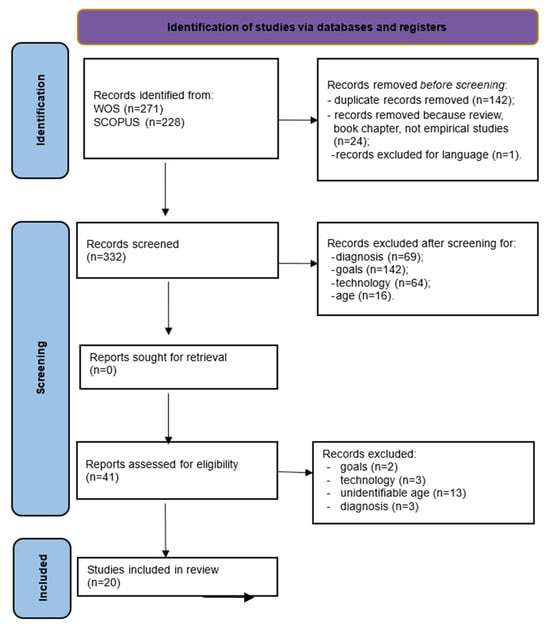
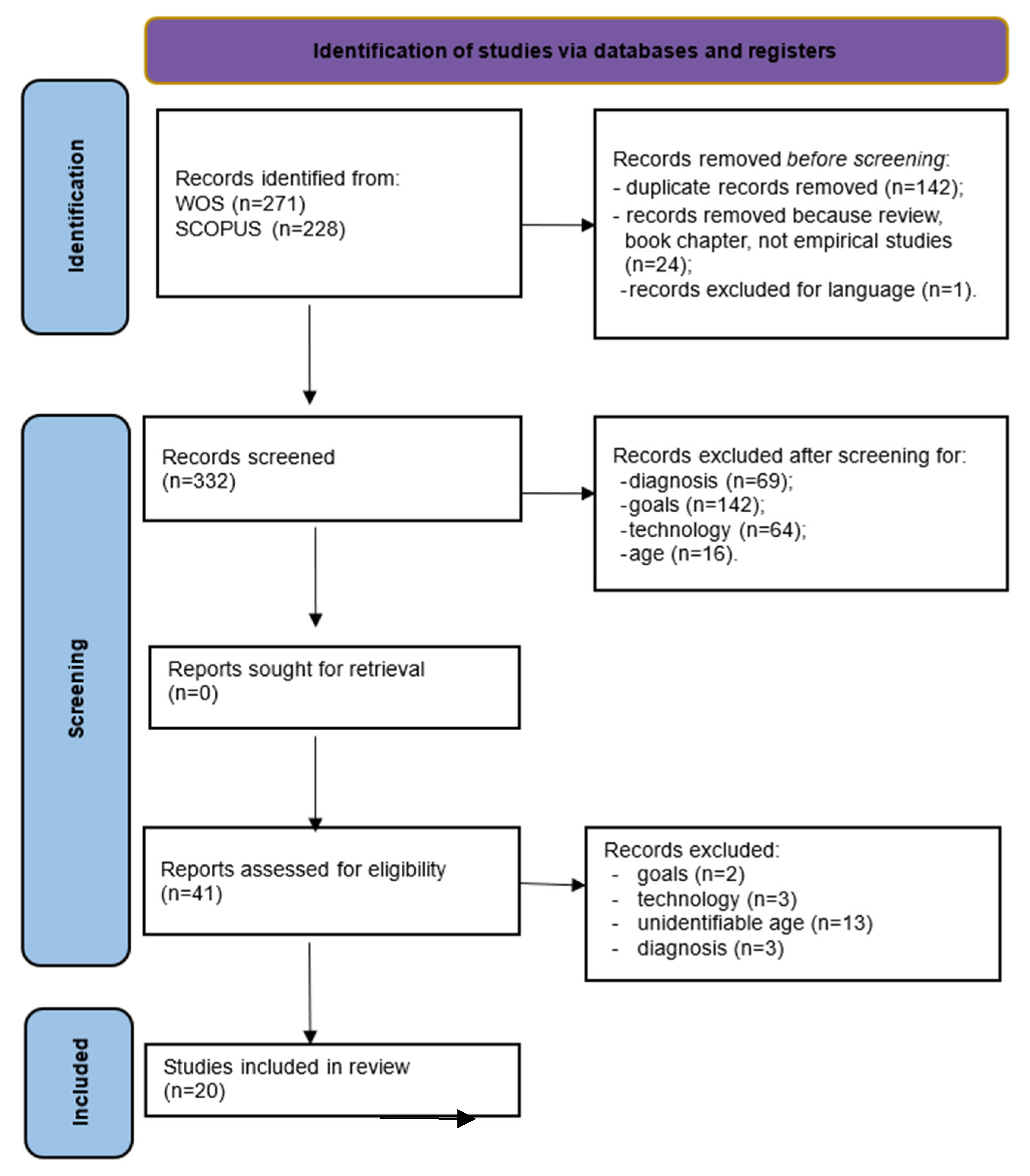
A total of 499 studies were identified, including 142 duplicates. After reviewing titles and abstracts, 291 articles were excluded, along with the aforementioned reasons. Forty-one articles were reviewed. Of these, 21 articles were excluded (see Figure 1).
Figure 1.
Flowchart of the studies analysed in this review, according to Preferred Reporting Items for Systematic reviews and Meta-Analyses extension for Scoping Reviews (PRISMA-ScR).
The scoping review ultimately included 20 relevant studies, which were selected based on predetermined inclusion and exclusion criteria.
The following information was extracted from the articles: research country, research design, participant characteristics, objectives, technology used, EFs investigated, and main results. A summary of this information is presented in Table 2.
Table 2.
Summary of the reviewed studies.
The included studies will be organized and discussed into two broad categories: (1) studies that used immersive technologies to assess EFs in children with ADHD; (2) studies that used these technologies as a rehabilitation intervention.
A total of 20 studies published between 2015 and 2025 from 10 countries were included in the analysis. Of these, 11 studies (55%) assessed EFs, while 9 studies (45%) conducted training interventions. VR was employed in 19 studies, while MR was utilized in a single study. Despite extensive research, no studies using AR that met the inclusion criteria were identified.
3.1. Assessment
Studies assessing EFs in children with ADHD (n = 11) primarily evaluated executive cognitive performance using VR head-mounted display (HMD) technology combined with immersive neuropsychological tests in a virtual environment.
Participants’ behaviour and executive performance were quantified through actions performed with game controllers and through automatic measures with HMDs or eye-tracking data. Integrating VR with eye tracking [60,66] increases the system’s sensitivity in identifying oculomotor markers of attentional control, highlighting greater frequency and duration of gaze shifts toward irrelevant stimuli and enabling real-time detection of distraction.
Negut [61] and, subsequently, Fang [54] reported that the VR based on Continuous Performance Test (CPT) outperformed the traditional CPT in children with ADHD, showing stronger and more significant correlations with conventional neuropsychological measures, particularly in domains of inattention, inhibition, and processing speed. Mühlberger [27] found that unmedicated ADHD children showed more omission errors and slower reaction times than treated, neurotypical ADHD children, highlighting the potential of VR in assessing selective and sustained visual attention.
Immersive virtual classroom environments enhance the ecological and discriminant validity of attentional assessments by closely replicating real classroom conditions. Specific characteristics of virtual environments that influence children’s attentional performance include the presence of a virtual teacher (avatar) [52] and the addition of social cues through visual (pointing gestures) or verbal instructions [55]. These appear to facilitate engagement and improve usability. In particular, the presence of realistic distractors often improves, rather than impairs, the identification of attentional deficits, supporting the ecological validity of immersive VR [56].
Naturalistic and immersive VR tasks are particularly effective in highlighting everyday problematic behaviours related to planning, time tracking, and attention skills.
Serious games and VR-based daily life simulations, such as EPELI (Executive Performance in Everyday Living) [64], show high discriminant and predictive validity in differentiating children with ADHD from neurotypical controls. Task performance correlates with parent-rated executive attention difficulties and ADHD symptom severity, while increased commission and omission errors in everyday VR scenarios, including kitchen and multitasking environments [57], reflect deficits in inhibition and sustained attention.
While working memory and planning performance were sometimes comparable to controls, higher levels of perseveration and reduced cognitive flexibility were consistently observed [62].
3.2. Training
The rehabilitation treatment studies (n = 9) simulated ecologically valid interactive situations for training EFs in children with ADHD. The applications analysed showed wide heterogeneity in terms of level of immersion, type of interaction, and therapeutic objectives. Overall, the main intervention categories were immersive VR systems with HMDs, VR serious games, VR combined with motor training or dual-task training, and mixed reality systems. The interventions lasted 3 weeks to 6 months, with a frequency of 1 to 3 sessions for week. Pre and post intervention outcomes were measured by using neuropsychological tests.
VR-based cognitive training interventions have been demonstrated to predominantly enhance inhibitory processes and attentional control, although the latter has exhibited less consistent outcomes. The benefits appear to be long-lasting, with effects observable even several weeks or months after the end of the intervention, and in some cases comparable to those obtained with pharmacological treatment [50,65,67].
Working memory appears to be particularly sensitive to VR interventions, especially when training includes cognitive or motor components [65,68]. However, the transfer of these improvements to sustained attentional performance appears to be more limited.
VR assessment provides empirical support for the effects of cognitive training. Coleman [53] used a VR-CPT to measure attention and response inhibition in children with ADHD before and after computerized cognitive training with Cogmed Working Memory training, finding that the improvement in WM also transferred to attentional aspects.
Emerging evidence suggests that VR and MR technologies can improve not only basic EFs, but also higher-order executive and socioemotional skills in children with ADHD. Serious games and social VR environments have been associated with improvements in planning, problem solving, and emotional regulation, particularly when scenarios are realistic and include real-time feedback [51,63]. Furthermore, technology-based interventions have shown improvements in selective and sustained visual attention as evidenced by breathing training games [58] and mixed reality eye contact games [59]. These findings underscore the efficacy of hybrid approaches in the rehabilitation of EFs.
The following Table 3 quickly shows which cognitive domains have stronger evidence than others, making it easier to interpret the collected data.
Table 3.
Interpretive summary table.
4. Discussion
Children with ADHD exhibit impairments in several EFs components [69,70,71]. Children with ADHD tend to perform a greater number of irrelevant actions, suggesting deficits in inhibitory control and action monitoring mechanisms [28].
In recent years, research on immersive technologies for ADHD has increased [44,72] significantly, proving to be a useful tool for assessing EFs performance in individuals with ADHD, distinguishing them from the neurotypical population. The present review aims to provide an update on the state of the art of interventions for the assessment and rehabilitation of EFs in children with ADHD aged 6 to 13 years, with particular reference to the use of VR, AR, and MR. In this age group, the majority of studies concentrate primarily on the assessment and/or enhancement of sustained attention in simulated and highly controlled contexts. There is a paucity of studies providing an integrated assessment of EFs, including both cognitive and socio-emotional components, using immersive tasks that simulate real-life contexts.
The analysis of the included studies shows that the most frequently investigated EFs include sustained attention, response inhibition, working memory, and planning.
Among the various technological systems, the potential of VR is highlighted, and in the current review, it is the predominant technology.
The included studies agree with the literature showing that VR allows ecologically valid environments, precise monitoring of behavioural responses, and replicable protocols, despite variability in children’s real-world exposure [73].
The potential effectiveness of VR in children with ADHD is highlighted by significant improvements observed in sustained and selective attention, as well as a reduction in impulsivity and average response times. These effects are comparable to those of pharmacological treatment, suggesting that VR may be an effective alternative or supplement to traditional therapies [28,50]. The role of distractors is interesting. Although children with ADHD are generally more distractible, studies show that distractors can temporarily improve attention under controlled conditions [74]. These findings suggest that moderate external stimulation can enhance cognitive performance, thus challenging the traditional approach of eliminating all distractions.
The improvements in EFs observed with immersive technologies can be explained by several interconnected mechanisms: (1) immersion creates a sense of presence, reducing external distractions and promoting sustained attention [75]; (2)the multisensory nature of virtual environments activates multiple perceptual channels simultaneously, compensating for deficits in cortical arousal in line with the Moderate Brain Arousal theory [76]; (3) interactivity provides immediate feedback, thereby enhancing procedural learning, emotional regulation and self-control through interaction with avatars. Practising social skills in a safe environment reduces performance anxiety and allows complex scenarios to be repeated without negative consequences [51]; (4) gamification increases motivation through reward and progression mechanisms, which are crucial for engaging children with ADHD [77]. This allows for longer training sessions with greater ecological validity than traditional paper-and-pencil tests.
This review did not identify any studies investigating the use of AR in relation to ADHD. This was likely due to the filters applied for the search, particularly the age range we focused on. Although some studies on AR were identified, they were excluded because they were not relevant (n = 8), reviews and meta-analyses (n = 5), or studies that combined neurophysiological techniques (n = 2). Further explanations could be traced back to technological limitations, as AR devices (smartphones, tablets, AR glasses) with environmental tracking and digital overlay capabilities have only recently become available for developmental research. Furthermore, the reasons for this gap could explained by safety concerns: while in VR the child is completely isolated from the physical environment (and therefore under control), in AR the child interacts simultaneously with real and virtual elements, increasing the risk of accidents, particularly in children with ADHD and high motor impulsivity [78].
This scoping review identifies key challenges regarding the transfer of gains observed in virtual environments to real-world settings. Only a limited number of studies have systematically examined the retention of these improvements over time or their generalization to non-virtual contexts.
Despite their promising potential, the integration of immersive technologies into routine clinical practice faces significant ethical and practical challenges. The high cost of equipment, particularly for mixed reality systems, limits access to care [79]. Furthermore, the complexity of the devices and the need to manage potential adverse effects (e.g., cybersickness) require clinical supervision and adequately trained personnel, resulting in further increased implementation costs [80].
Although the available evidence suggests that interactive technologies, particularly AR, could improve communication, emotional comfort and the therapeutic alliance in paediatric settings [81,82], significant ethical concerns remain.
These relate to the collection and protection of children’s behavioural and biometric data, as well as potential long-term effects of prolonged screen exposure on visual, postural, and social development [83].
Future research should focus on longitudinal studies that evaluate thepost-intervention effectiveness at 12 and 24 months. Real-world ecological outcome measures should be included, such as academic performance and classroom behaviour assessed by teachers using validated scales, and social functioning evaluated by parents through structured observations or standardized questionnaires. Future studies should implement randomized clinical trials and standardized protocols that specify the duration, frequency, and progression of sessions. It is also necessary to control for confounding biases, such as participant medication status, by stratifying samples or reporting treatment, dosage, and timing of psychostimulants in order to isolate the effects of immersive technologies.
Multicentre studies are also needed to test generalizability across populations, settings, and cultures, and to inform the development of personalized interventions.
An important finding of this review is that most studies have used VR primarily to replicate traditional CPT paradigms in immersive environments, rather than developing new assessment tools that fully exploit the potential of VR. While this approach facilitates comparability withtheexisting literature, it also represents a missed opportunity.
VR facilitates the development of ecologically valid scenarios. The concept of ecological validity [84,85] refers to the extent to which cognitive demands reflect those encountered in everyday life [86], not just visually familiar contexts. Recent studies have begun to explore multi-errand paradigms, such as SmartAction-VR [28], research in this area remains limited.
5. Limitations and Future Research Perspectives
This scoping review has several limitations that could impact the breadth and completeness of its findings.
First, the review was limited to articles published in English, potentially excluding valuable articles; second, studies using artificial intelligence and techniques such as biofeedback, EEG, and neurofeedback were excluded. This has not only reduced the number of studies on VR and, in particular, AR, but also restricted the inclusion of objective measures, limiting data interpretation to behavioural and observational assessments.
Because we were unable to precisely quantify the proportion or number of ADHD participants aged 6–13 years in mixed-sample studies, potentially relevant studies were excluded for mapping EFs interventions.
Despite the strengths of the works mentioned, there are two limitations to consider.
First, the generalizability of the results remains limited due to the small sample size of the studies reviewed and the lack of comparison with a control group in some studies. Only two studies [65,67] conducted a follow-up, making it difficult to assess the actual stability of the results obtained. Furthermore, significant variability in symptom severity was found, likely due to the presence of comorbidity with other disorders and/or medication use.
It is noteworthy that ADHD studies have repeatedly used VR–CPT, thereby constraining the research focus. Finally, given the young age of the participants, the studies could be affected by the novelty and arousal effects of first-time VR use.
In view of the methodological limitations previously referenced, the following recommendations are proposed:
- -
- greater uniformity among protocols regarding measures (frequency, duration, contexts, pre- and post-intervention tests), types of VR technology, presence or absence of distractors, and the use of control groups;
- -
- longitudinal studies with large samples to generalize and consolidate the results over time;
- -
- greater individualized treatment of emotional skills, as virtual environments may not faithfully replicate the wide range of real-world contexts and situations to which children are exposed [87].
Experimental methodologies and randomized controlled trials (RCTs) with samples of 6–13 children could prove particularly useful for increasing the robustness and replicability of the findings.
Were commended that future studies incorporate real-world outcome measures to enhance interpretability and impact. It is further recommended that studies be implemented using VR to investigate alterations in temporal perception [88,89,90]. Temporal perception is understood as a possible diagnostic criterion, and the implementation of VR in this capacity could facilitate the rehabilitation of the aforementioned deficit and associated EFs.
6. Conclusions
In conclusion, the results indicate that VR supports the assessment and rehabilitation of EFs in ADHD. An immersive environment can: (1) target attentional and inhibitory behaviours in more realistic contexts, although the results are inconclusive; (2) offer flexibility and immediate feedback; (3) improve children’s motivation to assess and improve executive difficulties; (4) integrate ecological data with standardized data.
In the absence of the eligible data, it is not possible to make conclusions on the use of AR for this review. Increasing the use of AR is recommended, as it could offer greater advantages in terms of accessibility and transferability of skills to real-world contexts.AR applications can run on common devices such as tablets and smartphones, reducing costs and increasing inclusiveness [91].
The recent literature highlights how AR is a tool capable of inducing cognitive changes. Specifically, following a four-week training period, there was a significant increase in scores on working memory, cognitive flexibility, inhibition, reaction time, and attention when compared to pre-intervention values [92]. Moreover, the enhancements were sustained at a six-month follow-up, indicating the enduring capacity of these methodologies to facilitate cognitive development [93].
VR could also potentially be used in non-laboratory settings such as schools, suitable for training EFs, support the teaching and learning process, and facilitate social interactions by promoting emotional skills [94].
Supplementary Materials
The following supporting information can be downloaded at: https://www.mdpi.com/article/10.3390/info17020186/s1, Table S1: PRISMA-ScRchecklist. Reference [47] is cited in the supplementary materials.
Author Contributions
L.A.V. conceived and drafted the paper; A.P. edited and revised the manuscript for methodological issues; F.S. revised the whole process and the manuscript. All authors have read and agreed to the published version of the manuscript.
Funding
This research received no external funding.
Institutional Review Board Statement
Not applicable.
Informed Consent Statement
Not applicable.
Data Availability Statement
No new data were created or analyzed in this study.
Conflicts of Interest
The authors declare no conflict of interest.
References
- Salari, N.; Ghasemi, H.; Abdoli, N.; Rahmani, A.; Shiri, M.H.; Hashemian, A.H.; Akbari, H.; Mohammadi, M. The Global Prevalence of ADHD in Children and Adolescents: A Systematic Review and Meta-Analysis. Ital. J. Pediatr. 2023, 49, 48. [Google Scholar] [CrossRef] [Scilit] [PubMed]
- Núñez-Jaramillo, L.; Herrera-Solís, A.; Herrera-Morales, W.V. ADHD: Reviewing the Causes and Evaluating Solutions. J. Pers. Med. 2021, 11, 166. [Google Scholar] [CrossRef] [Scilit] [PubMed]
- Diagnostic and Statistical Manual of Mental Disorders|Psychiatry Online. Available online: https://psychiatryonline.org/doi/book/10.1176/appi.books.9780890425596 (accessed on 5 January 2026).
- Barkley, R.A. Behavioral Inhibition, Sustained Attention, and Executive Functions: Constructing a Unifying Theory of ADHD. Psychol. Bull. 1997, 121, 65–94. [Google Scholar] [CrossRef] [Scilit]
- Castellanos, F.X.; Sonuga-Barke, E.J.S.; Milham, M.P.; Tannock, R. Characterizing Cognition in ADHD: Beyond Executive Dysfunction. Trends Cogn. Sci. 2006, 10, 117–123. [Google Scholar] [CrossRef] [Scilit]
- Martinussen, R.; Hayden, J.; Hogg-Johnson, S.; Tannock, R. A Meta-Analysis of Working Memory Impairments in Children with Attention-Deficit/Hyperactivity Disorder. J. Am. Acad. Child Adolesc. Psychiatry 2005, 44, 377–384. [Google Scholar] [CrossRef] [Scilit]
- Nigg, J.T. What Causes ADHD?: Understanding What Goes Wrong and Why; Guilford Press: New York, NY, USA, 2006. [Google Scholar]
- Anderson, P. Assessment and Development of Executive Function (EF) during Childhood. Child Neuropsychol. 2002, 8, 71–82. [Google Scholar] [CrossRef] [Scilit]
- Suchy, Y. Executive Functioning: Overview, Assessment, and Research Issues for Non-Neuropsychologists. Ann. Behav. Med. 2009, 37, 106–116. [Google Scholar] [CrossRef] [Scilit]
- Diamond, A. Executive Functions. Annu. Rev. Psychol. 2013, 64, 135–168. [Google Scholar] [CrossRef] [Scilit] [PubMed]
- Miyake, A.; Friedman, N.P.; Emerson, M.J.; Witzki, A.H.; Howerter, A.; Wager, T.D. The Unity and Diversity of Executive Functions and Their Contributions to Complex “Frontal Lobe” Tasks: A Latent Variable Analysis. Cogn. Psychol. 2000, 41, 49–100. [Google Scholar] [CrossRef] [Scilit]
- Zelazo, P.D.; Cunningham, W. Executive Function: Mechanisms Underlying Emotion Regulation. In Handbook of Emotion Regulation; Gross, J., Ed.; Guilford: New York, NY, USA, 2007; pp. 135–158. [Google Scholar]
- Sambol, S.; Suleyman, E.; Ball, M. The Interplay of Hot and Cool Executive Functions: Implications for a Unified Executive Framework. Cogn. Syst. Res. 2025, 91, 101360. [Google Scholar] [CrossRef] [Scilit]
- Tyburski, E.; Mak, M.; Sokołowski, A.; Starkowska, A.; Karabanowicz, E.; Kerestey, M.; Lebiecka, Z.; Preś, J.; Sagan, L.; Samochowiec, J.; et al. Executive Dysfunctions in Schizophrenia: A Critical Review of Traditional, Ecological, and Virtual Reality Assessments. J. Clin. Med. 2021, 10, 2782. [Google Scholar] [CrossRef] [Scilit] [PubMed]
- Hirose, S.; Chikazoe, J.; Watanabe, T.; Jimura, K.; Kunimatsu, A.; Abe, O.; Ohtomo, K.; Miyashita, Y.; Konishi, S. Efficiency of Go/No-Go Task Performance Implemented in the Left Hemisphere. J. Neurosci. 2012, 32, 9059–9065. [Google Scholar] [CrossRef] [Scilit]
- Jonides, J.; Smith, E.E. The Architecture of Working Memory. In Cognitive Neuroscience; Studies in Cognition; The MIT Press: Cambridge, MA, USA, 1997; pp. 243–276. [Google Scholar]
- Kalbfleisch, L. Neurodevelopment of the Executive Functions. In Executive Functions in Health and Disease; Elsevier Academic Press: San Diego, CA, USA, 2017; pp. 143–168. [Google Scholar]
- Chevignard, M.; Pillon, B.; Pradat-Diehl, P.; Taillefer, C.; Rousseau, S.; Le Bras, C.; Dubois, B. An Ecological Approach to Planning Dysfunction: Script Execution. Cortex 2000, 36, 649–669. [Google Scholar] [CrossRef] [Scilit]
- Fortin, S.; Godbout, L.; Braun, C.M.J. Cognitive Structure of Executive Deficits in Frontally Lesioned Head Trauma Patients Performing Activities of Daily Living. Cortex 2003, 39, 273–291. [Google Scholar] [CrossRef] [Scilit]
- Vaughan, L.; Giovanello, K. Executive Function in Daily Life: Age-Related Influences of Executive Processes on Instrumental Activities of Daily Living. Psychol. Aging 2010, 25, 343–355. [Google Scholar] [CrossRef] [Scilit]
- Qiu, H.; Liang, X.; Wang, P.; Zhang, H.; Shum, D.H.K. Efficacy of Non-Pharmacological Interventions on Executive Functions in Children and Adolescents with ADHD: A Systematic Review and Meta-Analysis. Asian J. Psychiatry 2023, 87, 103692. [Google Scholar] [CrossRef] [Scilit] [PubMed]
- Corrigan, N.; Păsărelu, C.-R.; Voinescu, A. Immersive Virtual Reality for Improving Cognitive Deficits in Children with ADHD: A Systematic Review and Meta-Analysis. Virtual Real. 2023, 27, 3545–3564. [Google Scholar] [CrossRef] [Scilit]
- Kaplan, A.D.; Cruit, J.; Endsley, M.; Beers, S.M.; Sawyer, B.D.; Hancock, P.A. The Effects of Virtual Reality, Augmented Reality, and Mixed Reality as Training Enhancement Methods: A Meta-Analysis. Hum. Factors 2021, 63, 706–726. [Google Scholar] [CrossRef] [Scilit] [PubMed]
- Muñoz-Saavedra, L.; Miró-Amarante, L.; Domínguez-Morales, M. Augmented and Virtual Reality Evolution and Future Tendency. Appl. Sci. 2020, 10, 322. [Google Scholar] [CrossRef] [Scilit]
- Mann, S.; Furness, T.; Yuan, Y.; Iorio, J.; Wang, Z. All Reality: Virtual, Augmented, Mixed (X), Mediated (X,Y), and Multimediated Reality. arXiv 2018. [Google Scholar] [CrossRef] [Scilit]
- Apochi, O.O.; Olusanya, M.D.; Wesley, M.; Musa, S.I.; Ayomide Peter, O.; Adebayo, A.A.; OlaitanKomolafe, D. Virtual, Mixed, and Augmented Realities: A Commentary on Their Significance in Cognitive Neuroscience and Neuropsychology. Appl. Neuropsychol. Adult 2024, 1–4. [Google Scholar] [CrossRef] [Scilit]
- Mühlberger, A.; Jekel, K.; Probst, T.; Schecklmann, M.; Conzelmann, A.; Andreatta, M.; Rizzo, A.A.; Pauli, P.; Romanos, M. The Influence of Methylphenidate on Hyperactivity and Attention Deficits in Children with ADHD: A Virtual Classroom Test. J. Atten. Disord. 2020, 24, 277–289. [Google Scholar] [CrossRef] [Scilit]
- Romero-Ayuso, D.; del Pino-González, A.; Torres-Jiménez, A.; Juan-González, J.; Celdrán, F.J.; Franchella, M.C.; Ortega-López, N.; Triviño-Juárez, J.M.; Garach-Gómez, A.; Arrabal-Fernández, L.; et al. Enhancing Ecological Validity: Virtual Reality Assessment of Executive Functioning in Children and Adolescents with ADHD. Children 2024, 11, 986. [Google Scholar] [CrossRef] [Scilit]
- Gounari, K.A.; Giatzoglou, E.; Kemm, R.; Beratis, I.N.; Nega, C.; Kourtesis, P. The Trail Making Test in Virtual Reality (TMT-VR): Examination of the Ecological Validity, Usability, Acceptability, and User Experience in Adults with ADHD. Psychiatry Int. 2025, 6, 31. [Google Scholar] [CrossRef] [Scilit]
- Lee, S.-A.; Kim, J.-Y.; Park, J.-H. Concurrent Validity of Virtual Reality-Based Assessment of Executive Function: A Systematic Review and Meta-Analysis. J. Intell. 2024, 12, 108. [Google Scholar] [CrossRef] [Scilit]
- Holleman, G.A.; Hooge, I.T.C.; Kemner, C.; Hessels, R.S. The ‘Real-World Approach’ and Its Problems: A Critique of the Term Ecological Validity. Front. Psychol. 2020, 11, 721. [Google Scholar] [CrossRef] [Scilit]
- Fang, H.; Fang, C.; Che, Y.; Peng, X.; Zhang, X.; Lin, D. Reward Feedback Mechanism in Virtual Reality Serious Games in Interventions for Children with Attention Deficits: Pre- and Posttest Experimental Control Group Study. JMIR Serious Games 2025, 13, e67338. [Google Scholar] [CrossRef] [Scilit] [PubMed]
- Yen, J.M.; Lim, J.H. A Clinical Perspective on Bespoke Sensing Mechanisms for Remote Monitoring and Rehabilitation of Neurological Diseases: Scoping Review. Sensors 2023, 23, 536. [Google Scholar] [CrossRef] [Scilit] [PubMed]
- Tajik-Parvinchi, D.; Wright, L.; Schachar, R. Cognitive Rehabilitation for Attention Deficit/Hyperactivity Disorder (ADHD): Promises and Problems. J. Can. Acad. Child Adolesc. Psychiatry/J. L’académie Can. Psychiatr. L’enfantL’adolescent 2014, 23, 207–217. [Google Scholar]
- Cho, B.-H.; Ku, J.; Jang, D.P.; Kim, S.; Lee, Y.H.; Kim, I.Y.; Lee, J.H.; Kim, S.I. The effect of virtual reality cognitive training for attention enhancement. Cyberpsychol. Behav. 2002, 5, 129–137. [Google Scholar] [CrossRef] [Scilit] [PubMed]
- Borgnis, F.; Baglio, F.; Pedroli, E.; Rossetto, F.; Uccellatore, L.; Oliveira, J.A.G.; Riva, G.; Cipresso, P. Available Virtual Reality-Based Tools for Executive Functions: A Systematic Review. Front. Psychol. 2022, 13, 833136, Correction in Front. Psychol. 2022, 13, 995038. https://doi.org/10.3389/fpsyg.2022.995038. [Google Scholar] [CrossRef] [Scilit]
- Parsons, T.D.; Gaggioli, A.; Riva, G. Virtual Reality for Research in Social Neuroscience. Brain Sci. 2017, 7, 42. [Google Scholar] [CrossRef] [Scilit]
- Güler, E.C.; Köse, B.; Temeltürk, R.D.; Aynigül, K.D.; Pekçetin, S.; Öztop, D.B. Investigation of the Effect of Second-Generation Virtual Reality Interventions on Hot and Cold Executive Functions in Children with Attention-Deficit/Hyperactivity Disorder: Single-Blind Randomized Controlled Study. Games Health J. 2025, 14, 1–10. [Google Scholar] [CrossRef] [Scilit]
- Rmus, M.; McDougle, S.D.; Collins, A.G. The Role of Executive Function in Shaping Reinforcement Learning. Curr. Opin. Behav. Sci. 2021, 38, 66–73. [Google Scholar] [CrossRef] [Scilit]
- Tripathy, J.; Balasubramani, M.; Rajan, V.A.; Vimalathithan, S.; Aeron, A.; Arora, M. Reinforcement Learning for Optimizing Real-Time Interventions and Personalized Feedback Using Wearable Sensors. Meas. Sens. 2024, 33, 101151. [Google Scholar] [CrossRef] [Scilit]
- Gu, Q.; Mao, J.; Sun, J.; Teo, W.-P. Exercise Intensity of Virtual Reality Exergaming Modulates the Responses to Executive Function and Affective Response in Sedentary Young Adults: A Randomized, Controlled Crossover Feasibility Study. Physiol. Behav. 2025, 288, 114719. [Google Scholar] [CrossRef] [Scilit]
- Sun, J.-L.; Chaw, X.-J.; Fresnoza, S.; Kuo, H.-I. Effects of Virtual Reality-Based Exercise Intervention in Young People with Attention-Deficit/Hyperactivity Disorder: A Systematic Review. J. Neuroeng. Rehabil. 2025, 22, 139. [Google Scholar] [CrossRef] [Scilit]
- Benzing, V.; Schmidt, M. The Effect of Exergaming on Executive Functions in Children with ADHD: A Randomized Clinical Trial. Scand. J. Med. Sci. Sports 2019, 29, 1243–1253. [Google Scholar] [CrossRef] [Scilit] [PubMed]
- Goharinejad, S.; Goharinejad, S.; Hajesmaeel-Gohari, S.; Bahaadinbeigy, K. The Usefulness of Virtual, Augmented, and Mixed Reality Technologies in the Diagnosis and Treatment of Attention Deficit Hyperactivity Disorder in Children: An Overview of Relevant Studies. BMC Psychiatry 2022, 22, 4. [Google Scholar] [CrossRef] [Scilit] [PubMed]
- Poon, K. Hot and Cool Executive Functions in Adolescence: Development and Contributions to Important Developmental Outcomes. Front. Psychol. 2017, 8, 2311. [Google Scholar] [CrossRef] [Scilit]
- Rapoport, J.L.; Giedd, J.N.; Blumenthal, J.; Hamburger, S.; Jeffries, N.; Fernandez, T.; Nicolson, R.; Bedwell, J.; Lenane, M.; Zijdenbos, A.; et al. Progressive Cortical Change during Adolescence in Childhood-Onset Schizophrenia. A Longitudinal Magnetic Resonance Imaging Study. Arch. Gen. Psychiatry 1999, 56, 649–654. [Google Scholar] [CrossRef] [Scilit]
- Tricco, A.C.; Lillie, E.; Zarin, W.; O’Brien, K.K.; Colquhoun, H.; Levac, D.; Moher, D.; Peters, M.D.J.; Horsley, T.; Weeks, L.; et al. PRISMA Extension for Scoping Reviews (PRISMA-ScR): Checklist and Explanation. Ann. Intern. Med. 2018, 169, 467–473. [Google Scholar] [CrossRef] [Scilit] [PubMed]
- Peters, M.D.J.; Marnie, C.; Tricco, A.C.; Pollock, D.; Munn, Z.; Alexander, L.; McInerney, P.; Godfrey, C.M.; Khalil, H. Updated Methodological Guidance for the Conduct of Scoping Reviews. JBI Evid. Synth. 2020, 18, 2119–2126. [Google Scholar] [CrossRef] [Scilit] [PubMed]
- Hong, Q.N.; Fàbregues, S.; Bartlett, G.; Boardman, F.; Cargo, M.; Dagenais, P.; Gagnon, M.-P.; Griffiths, F.; Nicolau, B.; O’Cathain, A.; et al. The Mixed Methods Appraisal Tool (MMAT) Version 2018 for Information Professionals and Researchers. Educ. Inf. 2018, 34, 285–291. [Google Scholar] [CrossRef] [Scilit]
- Bioulac, S.; Micoulaud-Franchi, J.-A.; Maire, J.; Bouvard, M.P.; Rizzo, A.A.; Sagaspe, P.; Philip, P. Virtual Remediation Versus Methylphenidate to Improve Distractibility in Children with ADHD: A Controlled Randomized Clinical Trial Study. J. Atten. Disord. 2020, 24, 326–335. [Google Scholar] [CrossRef] [Scilit]
- Wong, K.P.; Zhang, B.; Lai, C.Y.Y.; Xie, Y.J.; Li, Y.; Li, C.; Qin, J. Empowering Social Growth Through Virtual Reality–Based Intervention for Children with Attention-Deficit/Hyperactivity Disorder: 3-Arm Randomized Controlled Trial. JMIR Serious Games 2024, 12, e58963. [Google Scholar] [CrossRef] [Scilit]
- Cho, Y.J.; Yum, J.Y.; Kim, K.; Shin, B.; Eom, H.; Hong, Y.; Heo, J.; Kim, J.; Lee, H.S.; Kim, E. Evaluating Attention Deficit Hyperactivity Disorder Symptoms in Children and Adolescents through Tracked Head Movements in a Virtual Reality Classroom: The Effect of Social Cues with Different Sensory Modalities. Front. Hum. Neurosci. 2022, 16, 943478. [Google Scholar] [CrossRef] [Scilit]
- Coleman, B.; Marion, S.; Rizzo, A.; Turnbull, J.; Nolty, A. Virtual Reality Assessment of Classroom—Related Attention: An Ecologically Relevant Approach to Evaluating the Effectiveness of Working Memory Training. Front. Psychol. 2019, 10, 1851. [Google Scholar] [CrossRef] [Scilit]
- Fang, Y.; Han, D.; Luo, H. A Virtual Reality Application for Assessment for Attention Deficit Hyperactivity Disorder in School-Aged Children. Neuropsychiatr. Dis. Treat. 2019, 15, 1517–1523. [Google Scholar] [CrossRef] [Scilit]
- Eom, H.; Kim, K.; Lee, S.; Hong, Y.-J.; Heo, J.; Kim, J.-J.; Kim, E. Development of Virtual Reality Continuous Performance Test Utilizing Social Cues for Children and Adolescents with Attention-Deficit/Hyperactivity Disorder. CyberpsychologyBehav. Soc. Netw. 2019, 22, 198–204. [Google Scholar] [CrossRef] [Scilit]
- Hong, N.; Kim, J.; Kwon, J.-H.; Eom, H.; Kim, E. Effect of Distractors on Sustained Attention and Hyperactivity in Youth with Attention Deficit Hyperactivity Disorder Using a Mobile Virtual Reality School Program. J. Atten. Disord. 2022, 26, 358–369. [Google Scholar] [CrossRef] [Scilit]
- Ju, Y.; Kang, S.; Kim, J.; Ryu, J.-K.; Jeong, E.-H. Clinical Utility of Virtual Kitchen Errand Task for Children (VKET-C) as a Functional Cognition Evaluation for Children with Developmental Disabilities. Children 2024, 11, 1291. [Google Scholar] [CrossRef] [Scilit]
- Kim, J.; Hong, S.; Song, M.; Kim, K. Visual Attention and Pulmonary VR Training System for Children with Attention Deficit Hyperactivity Disorder. IEEE Access 2024, 12, 53739–53751. [Google Scholar] [CrossRef] [Scilit]
- Kim, S.; Ryu, J.; Choi, Y.; Kang, Y.; Li, H.; Kim, K. Eye-Contact Game Using Mixed Reality for the Treatment of Children with Attention Deficit Hyperactivity Disorder. IEEE Access 2020, 8, 45996–46006. [Google Scholar] [CrossRef] [Scilit]
- Merzon, L.; Pettersson, K.; Aronen, E.T.; Huhdanpää, H.; Seesjärvi, E.; Henriksson, L.; MacInnes, W.J.; Mannerkoski, M.; Macaluso, E.; Salmi, J. Eye Movement Behavior in a Real-World Virtual Reality Task Reveals ADHD in Children. Sci. Rep. 2022, 12, 20308. [Google Scholar] [CrossRef] [Scilit] [PubMed]
- Neguț, A.; Jurma, A.M.; David, D. Virtual-Reality-Based Attention Assessment of ADHD: ClinicaVR: Classroom-CPT versus a Traditional Continuous Performance Test. Child Neuropsychol. 2017, 23, 692–712. [Google Scholar] [CrossRef] [Scilit] [PubMed]
- Pasarín-Lavín, T.; García, T.; Abín, A.; Rodríguez, C. Neurodivergent Students. A Continuum of Skills with an Emphasis on Creativity and Executive Functions. Appl. Neuropsychol. Child 2024, 1–13. [Google Scholar] [CrossRef] [Scilit] [PubMed]
- Schena, A.; Garotti, R.; D’Alise, D.; Giugliano, S.; Polizzi, M.; Trabucco, V.; Riccio, M.P.; Bravaccio, C. IAmHero: Preliminary Findings of an Experimental Study to Evaluate the Statistical Significance of an Intervention for ADHD Conducted through the Use of Serious Games in Virtual Reality. Int. J. Environ. Res. Public Health 2023, 20, 3414. [Google Scholar] [CrossRef] [Scilit]
- Seesjärvi, E.; Puhakka, J.; Aronen, E.T.; Lipsanen, J.; Mannerkoski, M.; Hering, A.; Zuber, S.; Kliegel, M.; Laine, M.; Salmi, J. Quantifying ADHD Symptoms in Open-Ended Everyday Life Contexts with a New Virtual Reality Task. J. Atten. Disord. 2022, 26, 1394–1411. [Google Scholar] [CrossRef] [Scilit]
- Shema-Shiratzky, S.; Brozgol, M.; Cornejo-Thumm, P.; Geva-Dayan, K.; Rotstein, M.; Leitner, Y.; Hausdorff, J.M.; Mirelman, A. Virtual Reality Training to Enhance Behavior and Cognitive Function among Children with Attention-Deficit/Hyperactivity Disorder: Brief Report. Dev. Neurorehabilit. 2019, 22, 431–436. [Google Scholar] [CrossRef] [Scilit]
- Stokes, J.D.; Rizzo, A.; Geng, J.J.; Schweitzer, J.B. Measuring Attentional Distraction in Children with ADHD Using Virtual Reality Technology with Eye-Tracking. Front. Virtual Real. 2022, 3, 855895. [Google Scholar] [CrossRef] [Scilit] [PubMed]
- Tabrizi, M.; Manshaee, G.; Ghamarani, A.; Rasti, J. Comparison of the Effectiveness of Virtual Reality with Medication on the Memory of Attention Deficit Hyperactivity Disorder Students. Int. Arch. Health Sci. 2020, 7, 37–42. [Google Scholar] [CrossRef] [Scilit]
- Ou, Y.-K.; Wang, Y.-L.; Chang, H.-C.; Yen, S.-Y.; Zheng, Y.-H.; Lee, B.-O. Development of Virtual Reality Rehabilitation Games for Children with Attention-Deficit Hyperactivity Disorder. J. Ambient. Intell. Humaniz. Comput. 2020, 11, 5713–5720. [Google Scholar] [CrossRef] [Scilit]
- Gol, D.; Jarus, T. Effect of a Social Skills Training Group on Everyday Activities of Children with Attention-Deficit-Hyperactivity Disorder. Dev. Med. Child Neurol. 2005, 47, 539–545. [Google Scholar] [CrossRef] [Scilit]
- Sadozai, A.K.; Sun, C.; Demetriou, E.A.; Lampit, A.; Munro, M.; Perry, N.; Boulton, K.A.; Guastella, A.J. Executive Function in Children with Neurodevelopmental Conditions: A Systematic Review and Meta-Analysis. Nat. Hum. Behav. 2024, 8, 2357–2366. [Google Scholar] [CrossRef] [Scilit] [PubMed]
- El Wafa, H.E.A.; Ghobashy, S.A.E.L.; Hamza, A.M. A Comparative Study of Executive Functions among Children with Attention Deficit and Hyperactivity Disorder and Those with Learning Disabilities. Middle East Curr. Psychiatry 2020, 27, 64. [Google Scholar] [CrossRef] [Scilit]
- He, F.; Qi, Y.; Zhou, Y.; Cao, A.; Yue, X.; Fang, S.; Zheng, Y. Meta-Analysis of the Efficacy of Digital Therapies in Children with Attention-Deficit Hyperactivity Disorder. Front. Psychiatry 2023, 14, 1054831. [Google Scholar] [CrossRef] [Scilit] [PubMed]
- Capobianco, M.; Puzzo, C.; Di Matteo, C.; Costa, A.; Adriani, W. Current Virtual Reality-Based Rehabilitation Interventions in Neuro-Developmental Disorders at Developmental Ages. Front. Behav. Neurosci. 2025, 18, 1441615. [Google Scholar] [CrossRef] [Scilit]
- van Mourik, R.; Oosterlaan, J.; Heslenfeld, D.J.; Konig, C.E.; Sergeant, J.A. When Distraction Is Not Distracting: A Behavioral and ERP Study on Distraction in ADHD. Clin. Neurophysiol. 2007, 118, 1855–1865. [Google Scholar] [CrossRef] [Scilit]
- Tang, Q.; Wang, Y.; Liu, H.; Liu, Q.; Jiang, S. Experiencing an Art Education Program through Immersive Virtual Reality or iPad: Examining the Mediating Effects of Sense of Presence and Extraneous Cognitive Load on Enjoyment, Attention, and Retention. Front. Psychol. 2022, 13, 957037. [Google Scholar] [CrossRef] [Scilit]
- Sikström, S.; Söderlund, G. Stimulus-Dependent Dopamine Release in Attention-Deficit/Hyperactivity Disorder. Psychol. Rev. 2007, 114, 1047–1075. [Google Scholar] [CrossRef] [Scilit] [PubMed]
- Li, L.; Hew, K.F.; Du, J. Gamification Enhances Student Intrinsic Motivation, Perceptions of Autonomy and Relatedness, but Minimal Impact on Competency: A Meta-Analysis and Systematic Review. Educ. Technol. Res. Dev. 2024, 72, 765–796. [Google Scholar] [CrossRef] [Scilit]
- Clancy, T.A.; Rucklidge, J.J.; Owen, D. Road-Crossing Safety in Virtual Reality: A Comparison of Adolescents with and without ADHD. J. Clin. Child Adolesc. Psychol. 2006, 35, 203–215. [Google Scholar] [CrossRef] [Scilit]
- Babu, A.; Joseph, A.P. Integrating Virtual Reality into ADHD Therapy: Advancing Clinical Evidence and Implementation Strategies. Front. Psychiatry 2025, 16, 1591504. [Google Scholar] [CrossRef] [Scilit]
- Simón-Vicente, L.; Rodríguez-Cano, S.; Delgado-Benito, V.; Ausín-Villaverde, V.; Cubo Delgado, E. Cybersickness. A systematic literature review of adverse effects related to virtual reality. Neurologia 2024, 39, 701–709. [Google Scholar] [CrossRef] [Scilit] [PubMed]
- Savaş, E.H.; Coşkun, A.B.; Elmaoğlu, E.; Semerci, R.; Şahiner, N.C. Investigating the Effects of Augmented Reality-Based Interventions on Pediatric Patient Outcomes in the Clinical Setting: A Systematic Review. J. Pediatr. Nurs. 2025, 85, 39–47. [Google Scholar] [CrossRef] [Scilit]
- Tait, A.R.; Connally, L.; Doshi, A.; Johnson, A.; Skrzpek, A.; Grimes, M.; Becher, A.; Choi, J.E.; Weber, M. Development and Evaluation of an Augmented Reality Education Program for Pediatric Research. J. Clin. Transl. Res. 2020, 5, 96–101. [Google Scholar]
- Tychsen, L.; Foeller, P. Effects of Immersive Virtual Reality Headset Viewing on Young Children: Visuomotor Function, Postural Stability, and Motion Sickness. Am. J. Ophthalmol. 2020, 209, 151–159. [Google Scholar] [CrossRef] [Scilit]
- Chaytor, N.; Schmitter-Edgecombe, M. The Ecological Validity of Neuropsychological Tests: A Review of the Literature on Everyday Cognitive Skills. Neuropsychol. Rev. 2003, 13, 181–197. [Google Scholar] [CrossRef] [Scilit] [PubMed]
- Parsons, T.D. Virtual Reality for Enhanced Ecological Validity and Experimental Control in the Clinical, Affective and Social Neurosciences. Front. Hum. Neurosci. 2015, 9, 660. [Google Scholar] [CrossRef] [Scilit]
- Pinto, J.O.; Dores, A.R.; Peixoto, B.; Barbosa, F. Ecological Validity in Neurocognitive Assessment: Systematized Review, Content Analysis, and Proposal of an Instrument. Appl. Neuropsychol. Adult 2025, 32, 577–594. [Google Scholar] [CrossRef] [Scilit]
- Schöne, B.; Kisker, J.; Lange, L.; Gruber, T.; Sylvester, S.; Osinsky, R. The Reality of Virtual Reality. Front. Psychol. 2023, 14, 1093014. [Google Scholar] [CrossRef] [Scilit] [PubMed]
- De la Charie, A.; Delteil, F.; Labrell, F.; Colas, P.; Vigneras, J.; Câmara-Costa, H.; Mikaeloff, Y. Time Knowledge Impairments in Children with ADHD. Arch. Pediatr. 2021, 28, 129–135. [Google Scholar] [CrossRef] [Scilit] [PubMed]
- Noreika, V.; Falter, C.M.; Rubia, K. Timing Deficits in Attention-Deficit/Hyperactivity Disorder (ADHD): Evidence from Neurocognitive and Neuroimaging Studies. Neuropsychologia 2013, 51, 235–266. [Google Scholar] [CrossRef] [Scilit]
- Ptacek, R.; Weissenberger, S.; Braaten, E.; Klicperova-Baker, M.; Goetz, M.; Raboch, J.; Vnukova, M.; Stefano, G.B. Clinical Implications of the Perception of Time in Attention Deficit Hyperactivity Disorder (ADHD): A Review. Med. Sci. Monit. 2019, 25, 3918–3924. [Google Scholar] [CrossRef] [Scilit]
- Quintero, J.; Baldiris, S.; Rubira, R.; Cerón, J.; Velez, G. Augmented Reality in Educational Inclusion. A Systematic Review on the Last Decade. Front. Psychol. 2019, 10, 1835. [Google Scholar] [CrossRef] [Scilit]
- Nekar, D.M.; Lee, D.-Y.; Hong, J.-H.; Kim, J.-S.; Kim, S.-G.; Seo, Y.-G.; Yu, J.-H. Effects of Augmented Reality Game-Based Cognitive–Motor Training on Restricted and Repetitive Behaviors and Executive Function in Patients with Autism Spectrum Disorder. Healthcare 2022, 10, 1981. [Google Scholar] [CrossRef] [Scilit]
- Di Giusto, V.; Purpura, G.; Zorzi, C.F.; Blonda, R.; Brazzoli, E.; Meriggi, P.; Reina, T.; Rezzonico, S.; Sala, R.; Olivieri, I.; et al. Virtual Reality Rehabilitation Program on Executive Functions of Children with Specific Learning Disorders: A Pilot Study. Front. Psychol. 2023, 14, 1241860. [Google Scholar] [CrossRef] [Scilit] [PubMed]
- Mittmann, G.; Zehetner, V.; Hoehl, S.; Schrank, B.; Barnard, A.; Woodcock, K. Using Augmented Reality Toward Improving Social Skills: Scoping Review. JMIR Serious Games 2023, 11, e42117. [Google Scholar] [CrossRef] [Scilit]

Disclaimer/Publisher’s Note: The statements, opinions and data contained in all publications are solely those of the individual author(s) and contributor(s) and not of MDPI and/or the editor(s). MDPI and/or the editor(s) disclaim responsibility for any injury to people or property resulting from any ideas, methods, instructions or products referred to in the content. |
© 2026 by the authors. Licensee MDPI, Basel, Switzerland. This article is an open access article distributed under the terms and conditions of the Creative Commons Attribution (CC BY) license.