1. Introduction
In the fields of intelligent manufacturing, robotic manipulation, and autonomous systems, safe sequential decision-making in complex dynamic environments has become a central research challenge. In practical tasks, an agent must generate control policies in real time that are both efficient and satisfy stringent safety constraints under the coupled effects of multi-source uncertainties—such as stochastic disturbances, model mismatch, and environmental shifts [
1]. However, conventional approaches face a dual dilemma: on one hand, designs based on deterministic models or static safety margins struggle to adapt to dynamically evolving risks; on the other hand, existing learning-based decision paradigms, despite their strong representational capacity, often treat safety as a post hoc verification step or a heuristic penalty, lacking explicit modeling of constraint violation probabilities [
2,
3]. This leads to severe degradation in safety performance under distributional shifts or rare perturbations.
Chance-constrained optimization (CCO) [
4,
5] offers a probabilistic theoretical guarantee for safe decision-making by bounding the probability of constraint violation. However, its practical deployment is hindered by two major bottlenecks: first, it heavily relies on accurate analytical system models, resulting in prohibitive modeling costs in high-dimensional nonlinear settings; second, the indicator function underlying chance constraints is typically non-differentiable and discontinuous, making it difficult to integrate with deep learning frameworks in an end-to-end manner [
6,
7]. Consequently, CCO remains largely decoupled from modern data-driven policy learning pipelines, limiting its applicability in intelligent systems that require adaptive and real-time responses.
Critically, uncertainty in dynamic environments does not exist in isolation [
2]; rather, it propagates over time and couples intricately with state evolution and control inputs. Ignoring this temporal evolution renders risk assessment lagging behind the decision process, potentially triggering safety hazards. Recent advances in uncertainty quantification and propagation—such as surrogate modeling with Gaussian processes [
8], Bayesian neural networks [
9], and physics-informed deep learning [
10]—highlight the feasibility of online uncertainty forecasting. However, these methods rarely interface directly with constrained decision layers in a differentiable fashion. Therefore, there is an urgent need for a decision-making mechanism capable of online perception, propagation, and response to uncertainty information, unifying proactive risk modeling and performance optimization within a single information processing pipeline.
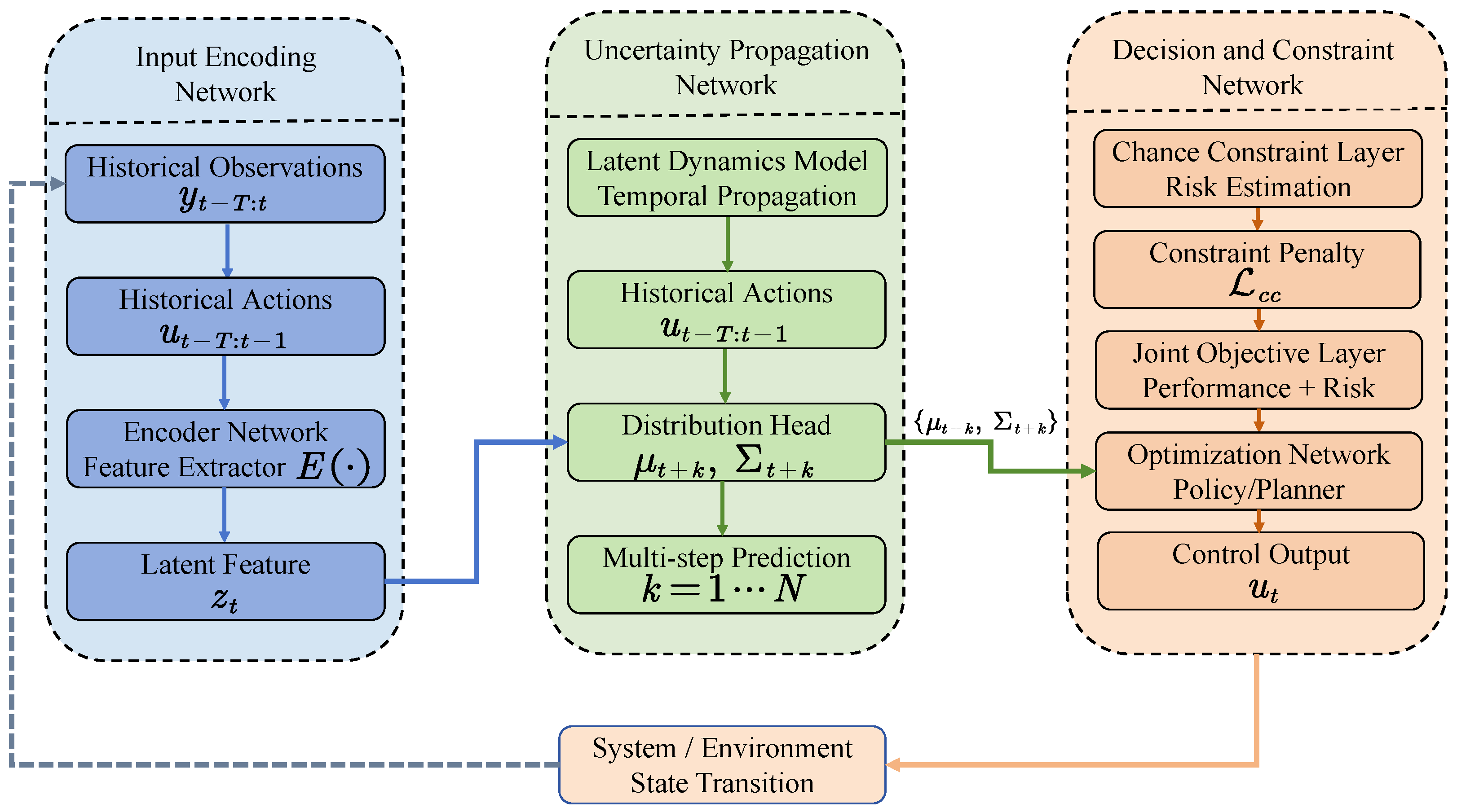
To this end, we propose DeepChance-OPT—an end-to-end differentiable disturbance-rejection decision framework tailored for dynamic grasping tasks in precision assembly. The framework achieves safe and efficient sequential decision-making through a three-stage information processing pipeline: (1) leveraging latent representation learning to extract low-dimensional dynamic features from historical observations and control sequences; (2) constructing an adaptive uncertainty propagation model in the latent space to predict the probability distribution of future states, thereby providing statistical priors for risk assessment; and (3) introducing a differentiable chance-constrained mechanism that translates safety requirements into a continuous and differentiable optimization objective, enabling synergistic optimization of performance and safety. The entire framework is trained and executed under a unified end-to-end architecture, supporting closed-loop online decision-making.
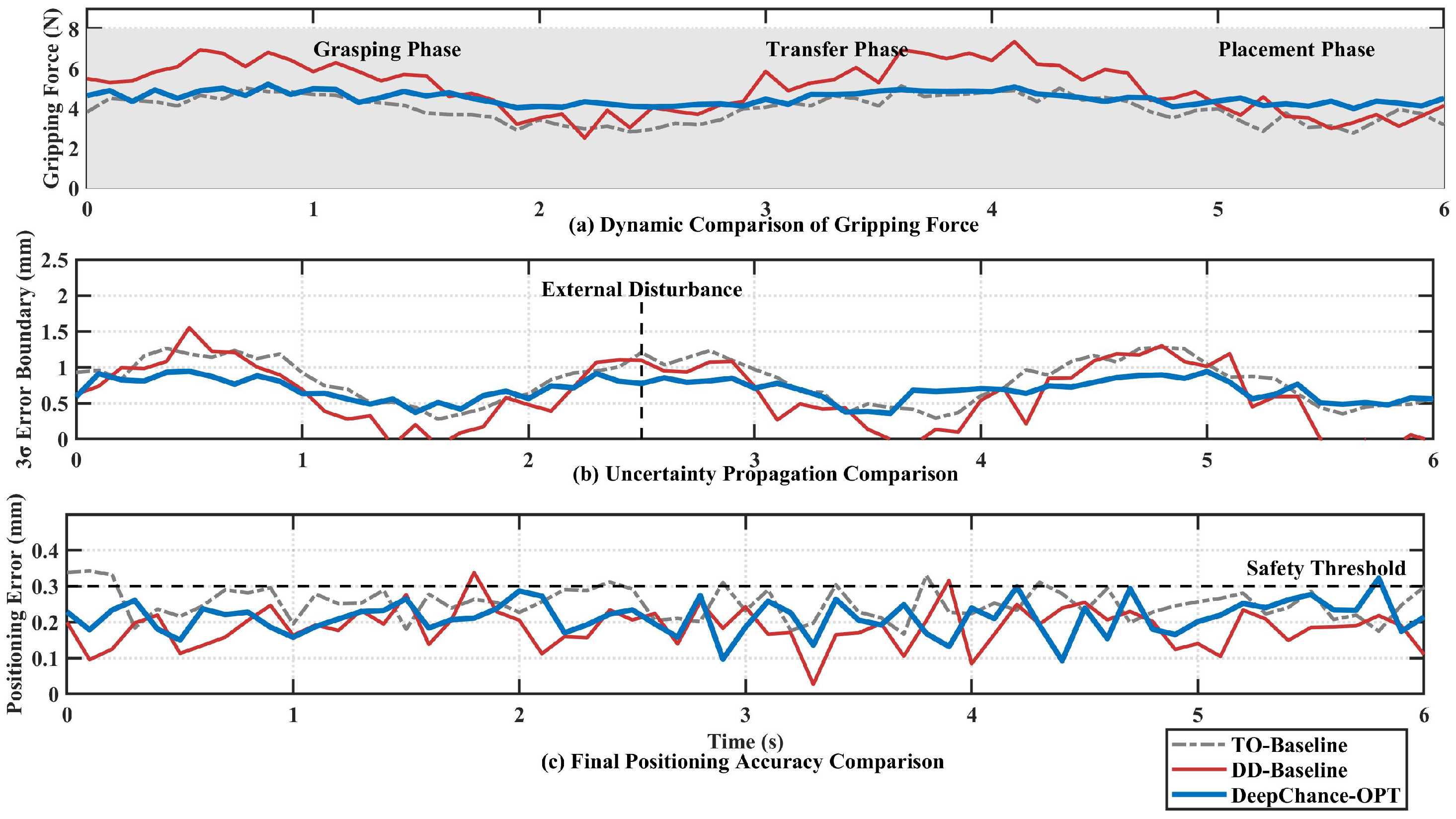
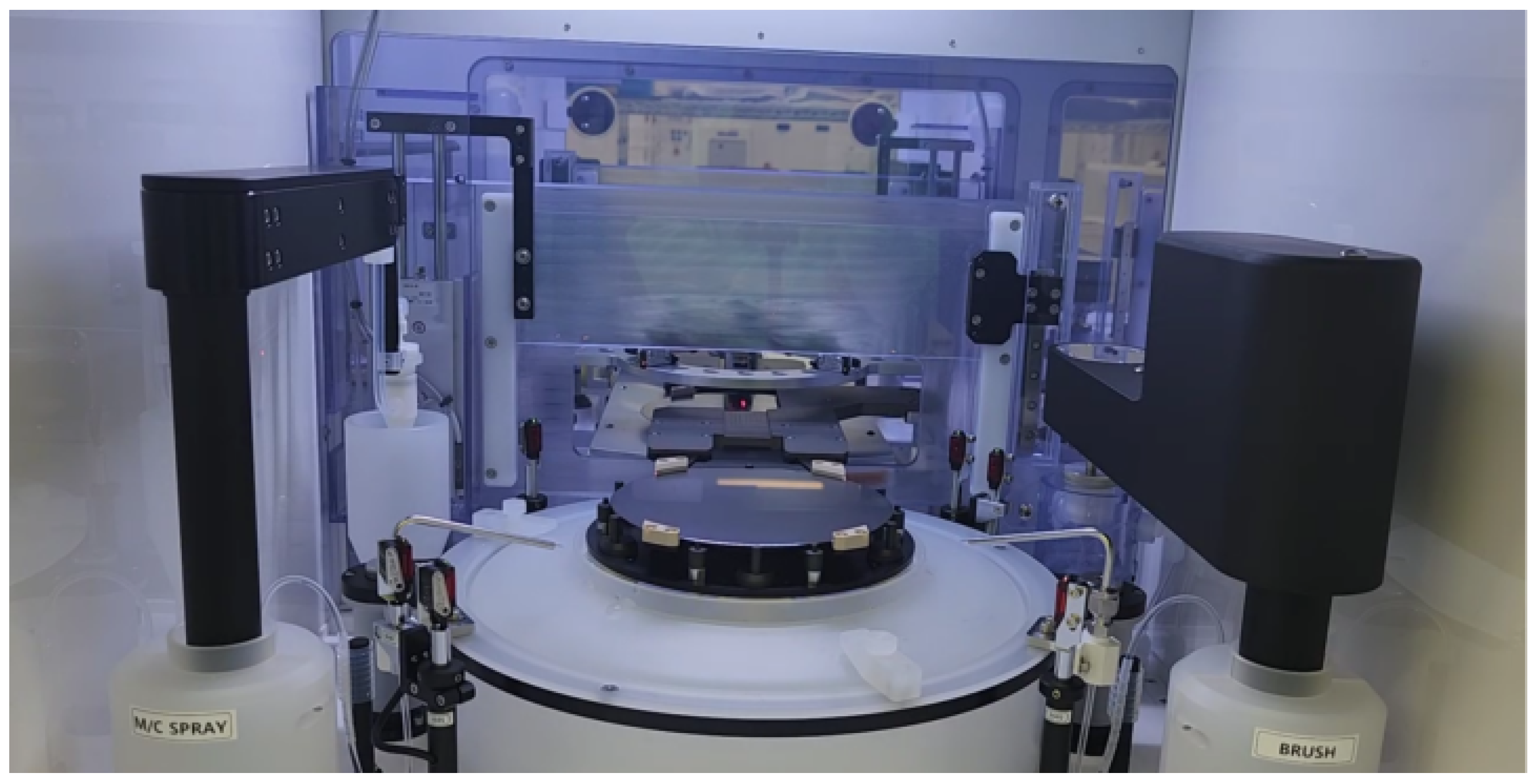
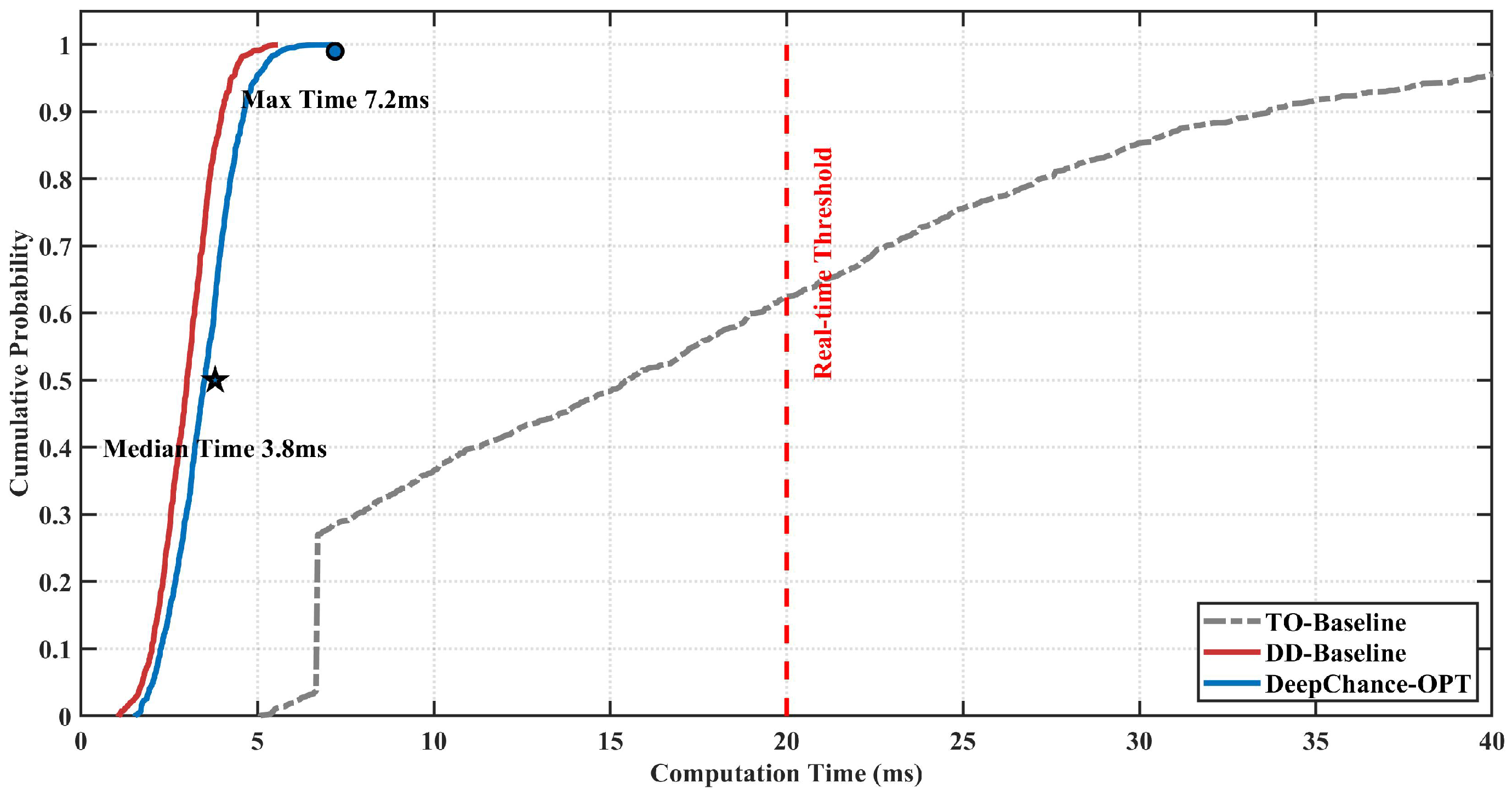
We systematically evaluate DeepChance-OPT on a representative industrial task: precision grasping of silicon carbide wafers. Experimental results show that the method achieves real-time performance (average latency < 4 ms) while reducing the constraint violation rate to 2.3%, significantly outperforming both traditional optimization and purely learning-based baselines. Under composite perturbations, it maintains a grasping success rate above 87.5%, fully validating its robustness and practicality.
The main contributions of this work are summarized as follows:
We propose DeepChance-OPT, the first disturbance-rejection decision framework that unifies temporal uncertainty propagation modeling, differentiable chance constraints, and end-to-end sequential decision-making.
We design a latent-representation-based adaptive uncertainty propagation mechanism that enables proactive quantification of future risk.
We develop a differentiable chance-constrained modeling approach, achieving, for the first time, end-to-end joint optimization between probabilistic safety constraints and deep policy networks.
We validate the proposed framework on a real-world precision assembly task, demonstrating its comprehensive advantages in safety, performance, and real-time capability, thereby offering a new paradigm for intelligent decision-making in high-precision manufacturing.
2. Related Work
This work intersects four interrelated research directions in safe sequential decision-making under uncertainty.
Uncertainty Optimization and Chance-Constrained Decision-Making. Chance-constrained programming (CCP), pioneered by Charnes and Cooper [
1], provides a foundational framework for ensuring probabilistic feasibility under stochasticity. Miller and Wagner [
11] extended CCP to joint chance constraints. With advances in computation, data-driven approaches have gained prominence: Geng and Xie [
12,
13] comprehensively reviewed scenario-based methods, sample average approximation (SAA), and robust optimization techniques. Küçükyavuz and Jiang [
5] surveyed reformulations under limited distributional information. Recently, distributionally robust chance-constrained programming (DRCCP) has attracted significant attention due to its resilience against distributional ambiguity. Representative formulations leverage Wasserstein distance [
14,
15], relative entropy [
16], and polyhedral ambiguity sets [
17]. DRCCP has been successfully applied to power systems [
4,
16], facility location [
14], and humanitarian logistics [
18].
Uncertainty Modeling and Propagation. Uncertainty quantification (UQ) and propagation are prerequisites for risk-aware decision-making. While traditional Monte Carlo methods are computationally prohibitive, modern UQ emphasizes efficient propagation. Zhang [
19] surveyed accelerated techniques like multilevel Monte Carlo. In the deep learning era, Bayesian neural networks [
9], Gaussian processes [
8,
20], and normalizing flows [
21] are employed to construct probabilistic surrogates that explicitly output predictive distributions. Notably, frameworks such as RBA [
9] and LVM-GP [
8] enable end-to-end uncertainty propagation, while Diamzon and Venturi [
22] derived analytical propagation formulas for leaky ReLU networks. Physics-informed deep learning has also been used for uncertainty propagation in geophysical inversion [
10]. Collectively, these methods drive a paradigm shift from point prediction to distributional prediction.
Data-Driven Safe Decision-Making. In safety-critical domains like autonomous driving and robotics, translating uncertainty into safe behaviors remains a core challenge. Zhou et al. [
23] proposed a knowledge-and-data-driven, risk-sensitive framework using large language models for high-risk scenarios. Mazumdar et al. [
24] introduced data-driven robust safety verification for Markov decision processes with high-confidence guarantees. Reinforcement learning approaches have also been explored: Zhu et al. [
25] designed a DDPG-based policy verified via formal methods; Yuan et al. [
26] constructed a safety envelope to constrain DRL exploration. Additionally, conformal prediction [
27] and chance constraint learning [
7] inject probabilistic safety guarantees into optimization. System-theoretic safety analysis methods like STPA have been extended to learning-enabled systems [
28], providing theoretical grounding for safe decision-making.
Integrated Learning-Optimization Frameworks. To overcome the suboptimality of two-stage “predict-then-optimize” pipelines, researchers advocate end-to-end differentiable architectures. Wang et al. [
29] reviewed sequential optimization, end-to-end learning, and direct learning paradigms. Differentiable optimization layers (e.g., BPQP [
6]) enable gradient backpropagation through optimization subproblems for joint training. Decision-focused learning (DFL) [
2] directly optimizes prediction models using decision loss. Yang et al. [
3] proposed decision-focused fine-tuning (DFF) to balance prediction accuracy and decision performance under limited data. In applications, Zhang et al. [
30] developed a cloud-edge-device collaborative closed-loop framework for smart manufacturing, while Shahnawaz and Safder [
31] integrated Bayesian learning with stochastic optimization for adaptive supply chain configuration. These efforts converge on a trend: deeply integrating learning, inference, and optimization into a unified “perception-decision-execution-feedback” intelligent loop. However, existing studies typically address uncertainty modeling, chance-constrained optimization, or learning-based decision-making as separate components, and often rely on either static uncertainty assumptions or post-hoc safety verification. In contrast, DeepChance-OPT explicitly fills this gap by providing an end-to-end differentiable framework that tightly integrates temporal uncertainty propagation, differentiable chance constraints, and online sequential decision-making, enabling joint optimization of performance and safety under dynamically evolving uncertainty.
3. Methodology
3.4. Adaptive Uncertainty Propagation Network
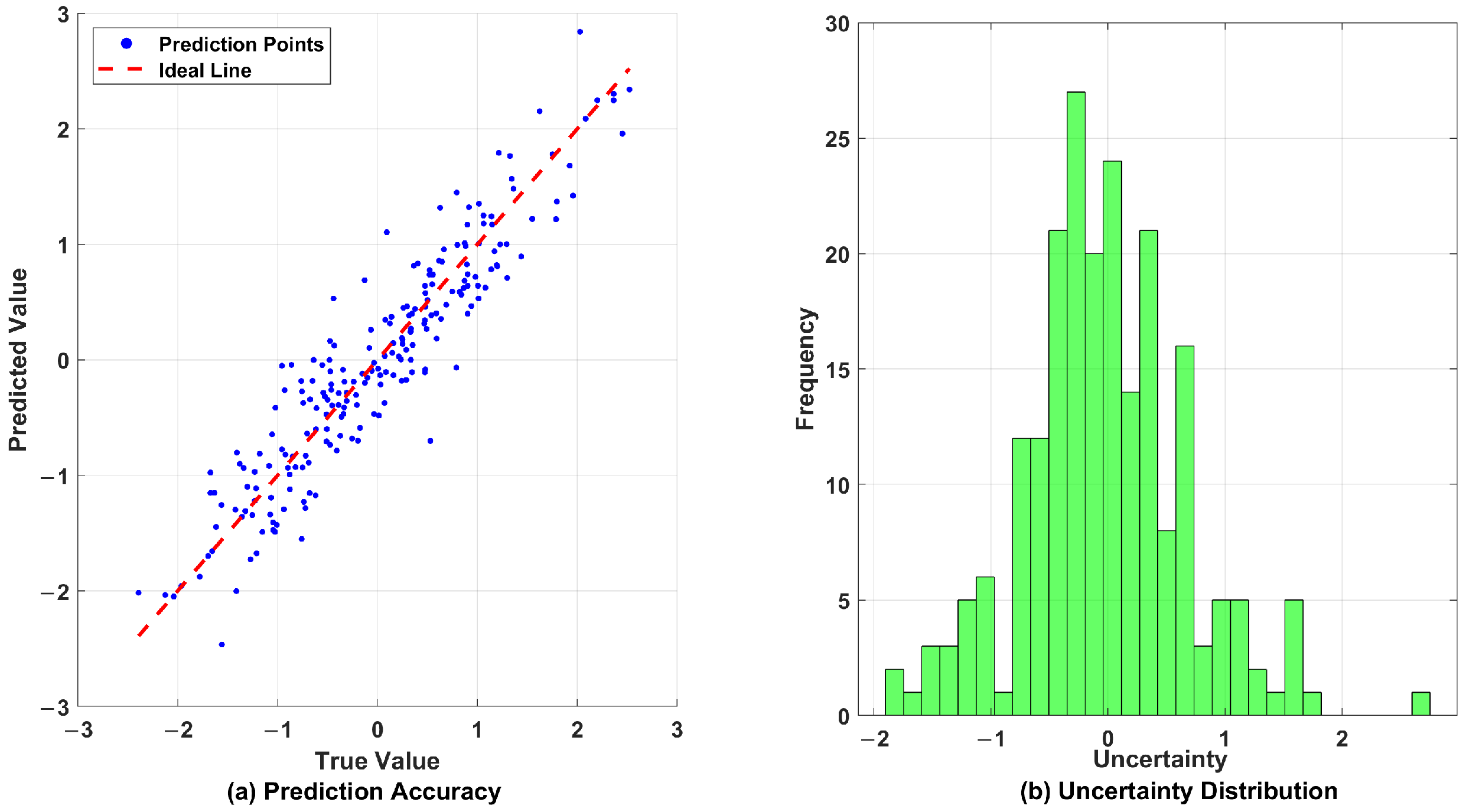
In dynamically uncertain environments, the evolution of future system states depends not only on the current state but also on historical information, control inputs, and multi-source uncertainties. Given the time-varying and multimodal nature of uncertainty, static or analytically defined propagation models often fail to accurately capture its dynamic evolution. To address this, we introduce a learning-based uncertainty propagation mechanism that predicts the uncertainty of future system states in the latent representation space.
Given the current latent representation
, the uncertainty propagation network aims to predict the distribution of system states over the prediction horizon
N. Unlike conventional point-prediction approaches, this model directly outputs the parameters of the predictive probability distribution, thereby explicitly characterizing uncertainty in system evolution. Formally,
where
and
denote the mean and covariance of the predicted state distribution at step
k, and
represents the learnable parameters of the propagation network.
Algorithmically, the uncertainty propagation network learns an implicit stochastic dynamic model that approximates the state evolution process in latent space. It does not rely on explicit dynamical equations; instead, it learns the statistical regularities of uncertainty propagation from historical data, thereby avoiding the high computational complexity and strong modeling assumptions inherent in traditional analytical methods for high-dimensional nonlinear systems.
Considering that the operating environment and uncertainty levels may vary over time, the propagation model must possess adaptive capabilities. In DeepChance-OPT, this adaptivity is achieved without online retraining or parameter updates. Instead, the uncertainty propagation network conditions its predictions on the current latent representation, which encodes recent observations, control history, and associated uncertainty patterns. When prediction residuals increase or system dynamics become more volatile, the latent representation shifts accordingly, leading the network to output more diffuse predictive distributions. Conversely, under stable conditions, the predicted uncertainty contracts naturally. This mechanism enables real-time adjustment of uncertainty through forward inference rather than explicit online learning. We therefore incorporate an adaptive mechanism that enables the model to dynamically adjust its propagation behavior based on the uncertainty characteristics reflected in the current latent representation. When the system is relatively stable, the model generates concentrated predictive distributions; under significantly elevated uncertainty, it produces more diffuse distributions to reflect increased risk. This adaptive propagation enhances sensitivity to anomalies and distributional shifts while maintaining prediction accuracy.
Importantly, the probability distributions output by the uncertainty propagation network are not final decisions but serve as critical inputs for subsequent chance-constrained risk assessment. By explicitly predicting future state distributions, the propagation network provides the necessary statistical information for computing constraint violation probabilities, enabling safety evaluation during the prediction phase and facilitating proactive, risk-aware decision-making.
3.5. Differentiable Chance-Constrained Modeling
A core challenge in safe decision-making under uncertainty is balancing system performance with strict control over constraint violation risk. Chance-constrained optimization provides a probabilistic characterization of safety by requiring constraints to hold with a specified confidence level. However, traditional chance constraints are typically expressed as non-differentiable probabilistic inequalities, which cannot be directly embedded into gradient-based learning and optimization frameworks, limiting their applicability in data-driven settings.
To overcome this limitation, we propose a differentiable chance-constrained modeling approach that transforms probabilistic constraints into risk penalty terms compatible with end-to-end optimization. The key idea is not to directly constrain the probability of constraint satisfaction, but to instead minimize the expected magnitude of constraint violations, thereby converting safety requirements into a continuous and differentiable objective.
Given the future state distribution predicted by the uncertainty propagation network, assume
and the safety constraint is
. We define the constraint violation amount as
. The corresponding risk measure is expressed as
In practice, this expectation does not admit a closed-form solution and is approximated via Monte Carlo sampling. Specifically, given the predictive distribution
, we draw
N samples
and compute
To enable gradient-based optimization through the expectation operator, we adopt a reparameterization trick by expressing the sampled state as
where
and
are outputs of the uncertainty propagation network. This formulation renders the risk evaluation differentiable with respect to the distribution parameters and allows gradients to be propagated through the chance-constrained objective during end-to-end training. By expressing state samples as deterministic functions of distribution parameters and standard noise, the expectation of the violation amount can be approximated via finite sampling, rendering the risk evaluation differentiable with respect to the distribution parameters.
Based on this, we construct a differentiable chance-constrained penalty term:
where
is the allowable maximum violation threshold. This penalty actively discourages high-risk decisions when the estimated risk exceeds the tolerance level.
Unlike conventional approaches that treat safety as a post-hoc verification step, our formulation integrates chance constraints into the learning phase. By embedding as a regularization term in the joint optimization objective, safety constraints influence latent representation learning, uncertainty propagation, and decision optimization through gradient backpropagation, enabling synergistic optimization of performance and safety.
Notably, this differentiable chance-constrained modeling does not rely on specific distributional assumptions and can accommodate various forms of constraint functions, offering broad applicability for safe learning in complex dynamic systems.