


Abstract
A multi-terminal network, in which an encoder is assisted by a side-information-aided helper, describes a memoryless identically distributed source to a receiver, is considered. The encoder provides a non-causal one-shot description of the source to both the helper and the receiver. The helper, which has access to causal side-information, describes the source to the receiver sequentially by sending a sequence of causal descriptions depending on the message conveyed by the encoder and the side-information subsequence it has observed so far. The receiver reconstructs the source causally by producing on each time unit an estimate of the current source symbol based on what it has received so far. Given a reconstruction fidelity measure and a maximal allowed distortion, we derive the rates-distortion region for this setting and express it in terms of an auxiliary random variable. When the source and side-information are drawn from an independent identically distributed Gaussian law and the fidelity measure is the squared-error distortion we show that for the evaluation of the rates-distortion region it suffices to choose the auxiliary random variable to be jointly Gaussian with the source and side-information pair.
1. Introduction
In the classical source coding with decoder side information problem, the source and side information are generated by independent drawings of the pair . The encoder forms a description of the source sequence using a map , while the decoder forms its reconstruction depending on both the side-information sequence and the index conveyed by the encoder. In their seminal work [1], Wyner and Ziv derived the rate distortion function for this setting, given a fidelity measure, when can depend on in an arbitrary manner. Yet, Wyner–Ziv source coding with non-causal decoder side-information involves binning the implementation of which is complex.
A successive refinement for the Wyner–Ziv problem with side-information is a variant of the Wyner–Ziv model, in which the encoder provides a two-layer description of the source sequence to a pair of decoders. Decoder 1, which obtains just the course description layer, has available as non-causal side-information the memoryless vector , while Decoder 2, which obtains both description layers, has available as non-causal side-information the memoryless vector . It is further assumed that the reconstruction formed by Decoder 2 should be of smaller distortion compared to that formed by Decoder 1. Such a model has been considered in [2], wherein a complete characterization of the rates-distortion region has been obtained for the case where Z is stochastically degraded to Y with respect to X—i.e., forms a Markov chain.
The work [3] studies an extension of the model of [2] where a conference link of given capacity allows the unidirectional cooperation between Decoder 1 and Decoder 2—i.e., Decoder 1 functions also as a helper. The results in [3] are partially tight in the sense that the characterization of the encoder rates is conclusive, the remaining gap being in the characterization of the helper’s rate. Thus, with non-causal side-information at both decoders, the successive refinement for the Wyner–Ziv problem with a helper is yet unsolved.
Motivated by practical delay-constrained sequential source coding with decoder side information Weissman and El Gamal considered in [4], a scheme with causal side information at the decoder, where the sequence of reconstructions is formed sequentially in a causal manner according to , and derived the corresponding rate distortion function. Similar to [1], the rate distortion function in [4] is expressed in terms of an auxiliary random variable, thus leaving the optimal choice of which an open issue depending on the specifics of the model. For the Gaussian setting where are Gaussian, the authors in [4] compute an upper bound on the rate distortion function by choosing the auxiliary random variable to be jointly Gaussian with X, while leaving the question of whether this choice is optimal yet an open problem.
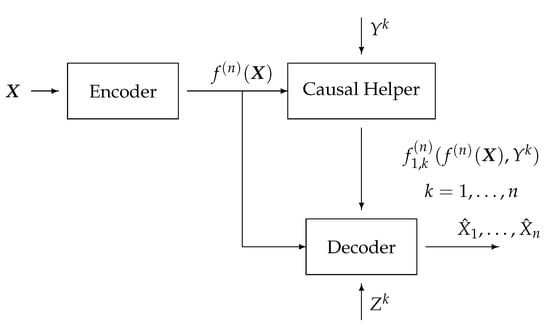
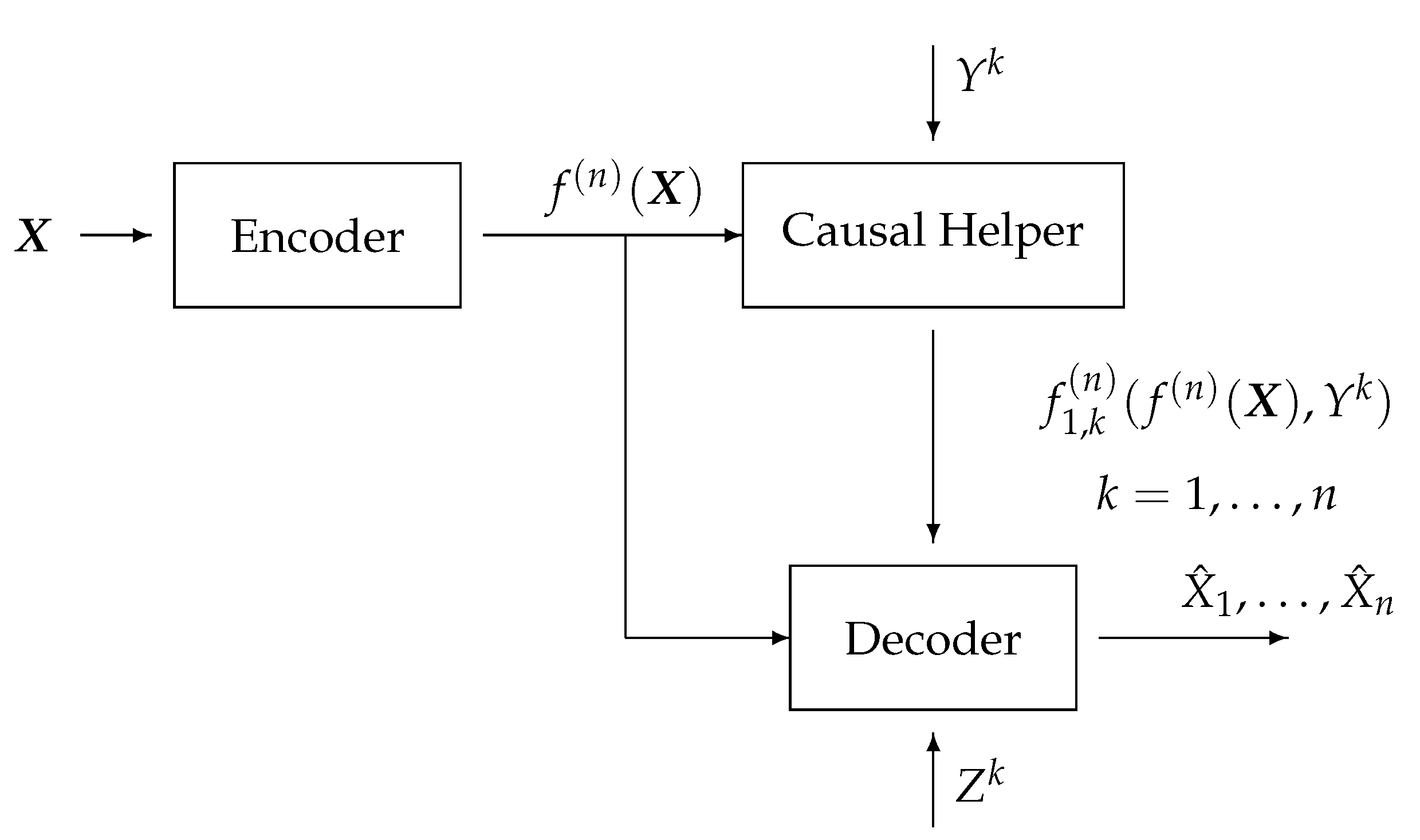
With the vision that modern network design will support the use of cooperation links in favor of reduction of encoding/decoding complexity and network deployment constraints, this work considers an extension of the model [4], involving a causal helper and causal side information at the decoder, which is described as follows. The components of a trivariate independent identically distributed (IID) finite-alphabet source are observed by three terminals. The source component is observed by the encoder, while the source component is observed by the helper. Both the encoder and the helper describe the length-n source sequence according to a given fidelity to the decoder in two steps. First, the encoder when given sends a rate-R description of it to both the helper and the decoder. Then, the helper sends to the decoder, per each source symbol , a causal description depending on the message it had received from the encoder and the source subsequence it had observed so far, with the aggregate rate not exceeding . The decoder, which observes the source component in a causal manner, per channel use k, uses the descriptions it had received so far and the source subsequence to form its reconstruction for the source symbol . Given a fidelity measure and a maximal allowed distortion, the goal is to determine the set of all rate pairs that satisfy the distortion constraint.
Causal decoder side information has been considered as well in context with successive refinement. With the aim of reducing encoder/decoder complexity, a two layer description model with successive refinement has been considered in [5], under the setting that the side information is available causally at each of the decoders. A single-letter characterization of the rates-distortion region is obtained in [5], irrespective of the relative ordering of the side information quality at the decoders. Furthermore, the direct part in [5] demonstrates that similarly to [4] with causal side-information at the decoders the optimal code avoids binning, hence its implementation is practically appealing. The extension of the model [5] with a causal helper has recently been studied in [6].
2. Problem Formulation
Formally, our problem can be stated as follows. A discrete memoryless source (DMS) is an infinite sequence of independent copies of a random variable X taking values in the finite set with generic law . Similarly, a triple source is an infinite sequence of independent copies of the triplet of random variables , taking values in the finite sets and , respectively, with generic joint law . Since our goal is to encode the source X, let denote any finite reconstruction alphabet and let be a single-letter distortion measure. The vector distortion measure is defined as
A system diagram appears in Figure 1.
Figure 1.
The causal listening-helper model.
Definition 1.
Ancode for the source X with causal side-information (SI)and causal helper, consists of:
- 1.
- An encoder mapping
- 2.
- A unidirectional conference between the helper and the decoder consisting of a sequence of causal descriptionsand
- 3.
- A sequence of decoder reconstructionssuch that
The rate tuple of the code is
Given a non-negative distortion D, the tuple is said to be D-achievable for X with causal SI if, for any , , and sufficiently large n, there exists an code for the source X with causal SI and causal helper. The collection of all D-achievable rate tuples is the achievable source-coding region and is denoted by .
In this work, we provide a single-letter characterization for . In contrast to [5], a consequence of Definition 1 is that may depend on the joint law of the triple , not only through the marginal laws and . This is due to the fact that the decoder acquires, in addition to its private side information Z, some additional side information on Y via the conference link. As a result, the expectation in (4), which takes into account the mapping , is taken over the joint law and not just over the marginal law , as is the case in [5].
Finally, although not of the finite alphabet, of particular interest to us is the Gaussian source. This is a memoryless source, where are centered jointly Gaussians with each pair drawn such that satisfies
where is a fixed constant, and are mutually independent. Moreover, is drawn according to
where a and b are real numbers and is independent of . Furthermore, in this case, the fidelity measure will be
in which case we may restrict the reproduction functions to be the MMSE estimates of given , the sequence of causal descriptions , and the side-information . That is,
In the Gaussian network setting, our focus will be on determining the optimal choice of the auxiliary random variable by means of which the rates-distortion region is defined. Specifically, we will show that choosing it to be jointly Gaussian with X is optimal.
3. Main Results
Given a maximal allowed distortion D, define to be the set of all rate pairs for which there exist random variables , taking values in finite alphabets , respectively, such that
- forms a Markov chain.
- Conditioned on U, forms a Markov chain.
- There exist deterministic mapssuch that, with ,
- The alphabets satisfy
- The rates R and satisfy
Our first result is a single-letter characterization of the rates-distortion region.
Theorem 1.
.
Proof.
See Section 4.1. □
Remark 1.
The converse holds as well for the setting where the causal helper and the reconstructor benefit from causal disclosure—i.e., are cognizant of the past realizations of the source sequence, hence they are allowed to depend also on , when forming and , respectively. That is,
3.1. The Gaussian Setting with .
To simplify the presentation, we consider first the Gaussian setting with . In this case, the region is defined as the set of rate pairs for which there exist random variables , taking real values, such that
- forms a Markov chain.
- Conditioned on U, forms a Markov chain.
- There exist deterministic mapssuch that, with ,
Our second result characterizes the optimal choice of in the Gaussian setting.
Theorem 2.
For the evaluation of when are Gaussian, it suffices to assume that are jointly Gaussian.
Proof.
For the treatment to follow, let us define the Gaussian channel where X has an arbitrary law with , is independent of X, and is the channel signal-to-noise ratio. We shall denote by the conditional law of Y given X for this additive Gaussian model. Furthermore, the notation would imply that and with independent of . Using this notation, the law defining (see also (45) ahead) may equivalently be expressed as
Henceforth, we denote a law which factors as in (16) by —i.e., conditioned on U, forms a Markov chain and, furthermore, independently of the rest.
Define the region (12a) and (12b) subject to constraint (15) by , where the subscript K denotes the covariance constraint (15). The region is a closed convex set.
In line with [7,8], we define a -parametrized family of functions which are related to the sum rate associated with .
Fix some , and consider the minimization of the -sum rate defined as
Observe that
where follows using the lower bounds (12a) and (12b). Since the marginal law of X in our model (6) is Gaussian, the differential entropy is fixed, thus for the minimization of (18) over a law of the form (16), we define the following functional of (i.e., of the conditional law )
Thus, the minimum in (17) may be expressed as
Henceforth, the set of laws defined by (16) which satisfy will be denoted by and will be attributed as the feasible set.
As shown below, with a proper choice of , the functional (19) exhibits a “pair grouping” property with respect to the input X in the sense that the value of does not increase under this operation. Having established that, we follow the same steps as in the proof of ([9] Theorem 9) to establish that the objective (20) is attained when is Gaussian. More specifically,
- Lemma 1 shows that the value of “improves” under the pair grouping operation.
Lemma 1.
Let be a law on , let , and let and be two independent copies of . Define
and similarly
with , there exists some such that for any , the following inequalities hold
Proof.
See Section 4.2. □
Assume that the infimum in (20) is attained, and let denote the subset of laws achieving the minimum. Suppose further that there exists a law such that, for , for any other where
Denote the value of the LHS of (23) by .
Lemma 2.
Fix . Let be an admissible law such that
There exists a law satisfying
and
where and denote independent copies of .
Proof.
See Section 4.3. □
Inequality (26) combined with assumption (23) and Lemma 6 in ([9] Section VI.B) establish the following.
Lemma 3.
There exists a sequence , such that for each , is feasible,
and there exists a feasible law on such that
and with , , where the tuple and the tuple are two independent copies of , we have
Finally, we apply to identity (28) the extended form of Bernstein’s theorem (see [10,11]), which is proved in ([9] Appendix A), to conclude that (i.e., the conditional random variable: conditioned on ) and are independent Gaussian random variables of equal variance.
Since the marginal of X is Gaussian, with no loss in generality, we may choose to be jointly Gaussian, which establishes our claim in Theorem 2. □
3.2. The Gaussian Setting with Decoder Side-Information Z
In the Gaussian setting where the decoder side-information Z in non-void, using our previous definition , let
for a pair of real numbers where is independent of and U. For arbitrary X with , let us define by the conditional law obtained by forming the pair , when given X, via the additive independent Gaussian pair as described above.
The rates-distortion region is defined in Theorem 1 with
and it is evaluated over a law of the form
Consequently, for the minimization of (20), we consider the functional
under a law of the form (31). Next, in Lemma 1, for , a law on and we let and be two independent copies of .
Upon defining and as before, we also define
It can be verified that
where and are independent. Furthermore, the pair is independent of and is equal in distribution to the pair . Thus, the simultaneous unitary transformation and preserves the Gaussian nature of the channel and factors according to
Observe that with the choice of and where and are two independent copies of such that and –i.e., is feasible for the minimization of (20), we have
Thus, Lemma 1 holds for this setting with decoder side-information Z as well.
4. Proofs
4.1. Proof of Theorem 1
Converse: Assume that the pair is D-achievable. For with the convention , define the RV’s
The rate R is lower bounded as follows
Here, follows since is memoryless, and follows since forms a Markov chain.
We may now lower bound as follows
where follows since is a deterministic function of .
Draw J uniformly from independently of , and define the RV’s , , , , and . Using J, we may express (37) as follows
and we may express (38) as follows
With regard to the expected distortion, we may write
Step is justified as follows: Since are deterministic functions of
is a Markov chain and, given , the tuple is independent of . As a consequence of that, Lemma 1 in ([12] Section II.B) guarantees the existence of a reconstruction which dominates in the sense that
This observation interpreted as the “data processing inequality” for estimation has already been made in ([12] Lemma 1).
Furthermore,
By (1) and the memoryless property of the sequence one can verify the Markov relation which implies the Markov relation . Similarly, the definitions of and and the memoryless property of imply that, conditioned on , forms a Markov chain.
Thus, conditioned on U, forms a Markov chain, hence
where denotes the conditional law induced by the marginal law . The combination of (40)–(42) and (44) together with the latter Markov relations establish the converse.
We shall now obtain an alternative characterization for the lower bound (38). For a law
and its induced conditional law , let
and let denote the lower convex envelope of .
Define
then by ([13] Section III.C, Lemma 1) is convex.
Note that
The integrand on the RHS of (46) is the entropy of the scalar quantizer of conditioned on where is defined in (36c). Now, conditioned on , Lemma 1 in ([12] Section II.B) ensures that
Consequently, we may lower bound the RHS of (46) as follows
where in we used the definition of Q and in its convexity. The lower bound (47) may be interpreted as follows. Fix and consider, for each , time shraing of at most two scalar quantizers for the “source” attaining a distortion level . The optimal helper time shares side-information-dependent scalar quantizers of (at most two per each side-information symbol ), while the reconstruction at the decoder is a function of .
Direct: To establish the achievability of , consider the codebook construction as follows. The codebook is obtained by drawing the n-length sequences independently of . (For the definition of —the set of -strongly typical n-sequences corresponding to a marginal law and a few properties of these sequences see [14,15,16]).
Given the source sequence x, is defined as follows.
- If the encoder searches for the first sequence in such that (s.t.) and sets .
- If , or s.t. , an encoding error is declared.
Given , the helper forms the sequence of descriptions that is sent causally to the decoder.
Decoding: Given as well as the sub-sequence , the decoder forms the reconstruction sequence .
Given that are jointly typical since is memoryless, the Markov lemma guarantees that, for large n, with high probability are also jointly typical. Since forms a Markov chain, by the Markov lemma, with high probability, as well as are jointly typical. Thus, with high probability, are jointly typical, hence the distortion constraint (10) is fulfilled for large n. That the sequence can be described at a conditional entropy rate satisfying (12b)–(47) can be established along similar lines as the proof of the direct part of Theorem 2 in ([13] Section III.C). Finally, standard error probability analysis verifies that, with high probability, are jointly typical as long as (12a) holds.
4.2. Proof of Lemma 1
If , then
where and are independent and the pair is equal in distribution to the pair . Thus, the unitary transformation preserves the Gaussian nature of the channel and factors according to (see (53) ahead)
To show (22a), consider the sequence of identities
Moreover, to show (22b), consider the sequence of identities
Starting with (50), consider the difference
under a law of the form
i.e., that forms a Markov chain (see also ([9] Section VI.A, Lemma 4)).
We distinguish between the two cases:
- (1)
- (2)
Observe that with the choice of and where and are two independent copies of such that and i.e., , we have
Thus, the unitary transformation picks a pair of independent copies of a law and “creates” a pair of laws, and , which factor jointly according to (53) with
hence are symmetric w.r.t. the inputs and . We shall define the latter set of laws by and, as shown above, .
Remark 2.
Suppose that with then, for both laws and , we have and . Since the image of the map
is a convex set, standard dimensionality reduction argument can be used to establish the existence of a law where is supported on a finite set and achieves any point in the image of the map (55) (See ([9] Section IV, Remark 2)).
By rate-distortion theory, the constraint with both U and V non-void implies that
Now, for any as per (49), conditioned on , the random variable V is dependent on i.e. . As a consequence of that, since the mutual information is strictly positive and, conditioned on , forms a Markov chain
Thus, the conditional mutual information is non-increasing under the conditioning on .
By the symmetry of the pair of laws and induced by , conditioned on , the random variable V is dependent on , hence
Now
hence
However, with the latter factorization, if indeed , i.e.,
then, since the conditional mutual information is non-increasing under the conditioning on , it follows that , which is in contradiction with (59). Consequently, for , , thus establishing that the expression (52) is positive.
Consequently, there exists some , such that for any
Here, follows by (50) and (62), and is true, since the set of laws over which the infimum on the RHS of (63) is evaluated is not empty. Indeed, the choice of and where and are two independent copies of such that and –i.e., (hence it is feasible for in (19)), satisfies (54), hence it belongs to the feasible set.
On the other hand, since both mappings and are invertible, then with
Here, follows since, conditioned on , and are independent, and follows since, conditioned on , and are independent.
When and where and are two independent copies of , such that and , then forms a Markov chain. Thus, and the RHS of (64) becomes thus establishing that,
where the inequality follows, since the infimum on the LHS is taken over a larger set than that on the RHS. The combination of (63) and (65) establishes (22a) for .
Now, returning to (51), consider the difference
under the law (53) i.e., that forms a Markov chain. By rate-distortion theory, the constraint with both U and V non-void implies that
Moreover, an argument similar to that leading to the conclusion that (52) is non-negative establishes that (66) is non-negative.
Consequently, there exist some such that for any
4.3. Proof of Lemma 2
Consider the tuple as defined in Lemma 1 that is constructed from independent copies of . With the transformation (21) and preserve the variance of and and preserve the variance of . Furthermore, as shown in the proof of Lemma 1, the unitary transformation picks a pair of independent copies of a law and “creates” a pair of laws, and , which factor jointly according to (53) with
hence are symmetric w.r.t., the inputs and and both are in the feasible set. Similarly, the unitary transformation picks a pair of independent copies of a law and “creates” a pair of laws, and , which are both in the feasible set (see the factorization (61)).
Consequently, by (20), each of the quantities , , and is at least . The assumption leads by (22) of Lemma 1 to an opposite conclusion. Therefore, all four quantities are equal and coincide with the minimum, i.e.,
Let be a Bernoulli random variable with values in the set independent of . Let be the complement of B in the set and define by and . Then
where the inequality follows by assumption (24a).
Furthermore, and by (54)
Next
Thus
Here,
- follows since forms a Markov chain,
- follows since forms a Markov chain, and
- follows since forms a Markov chain.
Funding
This research received no external funding.
Conflicts of Interest
The author declares no conflict of interest.
References
- Wyner, A.D.; Ziv, J. The rate-distortion function for source coding with side information at the receiver. IEEE Trans. Inform. Theory 1976, IT-22, 1–11. [Google Scholar] [CrossRef] [Scilit]
- Steinberg, Y.; Merhav, N. On successive refinement for the Wyner-Ziv problem. IEEE Trans. Inform. Theory 2004, 50, 1636–1654. [Google Scholar] [CrossRef]
- Bross, S.I.; Weissman, T. On successive refinement for the Wyner-Ziv problem with partially cooperating decoders. In Proceedings of the 2008 IEEE International Symposium on Information Theory (ISIT), Toronto, ON, Canada, 6–11 July 2008. [Google Scholar]
- Weissman, T.; Gamal, A.E. Source coding with limited-look-ahead side information at the decoder. IEEE Trans. Inform. Theory 2006, 52, 5218–5239. [Google Scholar] [CrossRef]
- Maor, A.; Merhav, N. On successive refinement with causal side information at the decoders. IEEE Trans. Inform. Theory 2008, 54, 332–343. [Google Scholar] [CrossRef] [Scilit]
- Bross, S.I. Scalable source coding with causal side information and a causal helper. In Proceedings of the 2020 IEEE International Symposium on Information Theory (ISIT), Los Angeles, CA, USA, 21–26 June 2020. [Google Scholar]
- Geng, Y.; Gohari, A.; Nair, C.; Yu, Y. The capacity region of classes of product broadcast channels. arXiv 2011, arXiv:1105.5438. [Google Scholar]
- Geng, Y.; Nair, C. The capacity region of the two-receiver Gaussian vector broadcast channel with private and common messages. IEEE Trans. Inform. Theory 2014, IT-60, 2087–2104. [Google Scholar] [CrossRef] [Scilit]
- Courtade, T.A. A strong entropy power inequality. IEEE Trans. Inform. Theory 2018, IT-64, 2173–2192. [Google Scholar] [CrossRef] [Scilit]
- Bernstein, S.N. On a property characteristic of the normal law. Trudy Leningrad. Polytech. Inst. 1941, 3, 21–22. [Google Scholar]
- Bryc, W. The Normal Distribution: Characterizations with Applications; Springer: New York, NY, USA, 2012; Volume 100. [Google Scholar]
- Choudhuri, C.; Kim, Y.-H.; Mitra, U. Causal state communication. IEEE Trans. Inform. Theory 2013, 59, 3709–3719. [Google Scholar] [CrossRef] [Scilit]
- Weissman, T.; Merhav, N. On causal source codes with side information. IEEE Trans. Inform. Theory 2005, 51, 4003–4013. [Google Scholar] [CrossRef]
- Cover, T.M.; Thomas, J.A. Elements of Information Theory; John Wiley and Sons: New York, NY, USA, 1991. [Google Scholar]
- Csiszár, I.; Körner, J. Information Theory: Coding Theorems for Discrete Memoryless Systems; Academic: New York, NY, USA, 1981. [Google Scholar]
- Gamal, A.E.; Kim, Y.H. Network Information Theory; Cambridge University Press: Cambridge, UK, 2012. [Google Scholar]
Publisher’s Note: MDPI stays neutral with regard to jurisdictional claims in published maps and institutional affiliations. |
© 2020 by the author. Licensee MDPI, Basel, Switzerland. This article is an open access article distributed under the terms and conditions of the Creative Commons Attribution (CC BY) license (http://creativecommons.org/licenses/by/4.0/).