


Abstract
Planetary health has emerged as a critical framework for understanding the interdependence of human, social and ecological systems in the face of escalating global challenges. While discussions of planetary health have largely focused on policy and systems-level interventions, comparatively little attention has been given to the developmental foundations that shape how future generations will respond to these challenges, including climate change, biodiversity loss and widening social inequities. This viewpoint highlights that early childhood flourishing represents a critical foundation for planetary health. Drawing on perspectives from early childhood development, relational health and planetary health, we examine how children’s flourishing is shaped by their relationships, environments and opportunities for growth. Recognising flourishing in early childhood as a planetary health concern broadens current understandings of prevention, early intervention and systems change. Supporting flourishing in early life is not only an investment in children’s present wellbeing, but also in the capacities future generations will need to contribute to sustainable futures and respond to planetary challenges.
1. Introduction
The future of planetary health may be shaped long before individuals can understand the impact of climate change or the concept of sustainability. It may begin in the everyday experiences of early childhood, when children, including those with diverse developmental profiles and health needs, learn to trust others, care for living things, explore their surroundings with curiosity and develop a sense of belonging within the world around them. While planetary health discussions often focus on policy reform and environmental action, less attention has been given to the developmental foundations in young children that may enable future generations to respond [1]. Yet the capacities required for a healthier future begin to emerge during the earliest years [2].
Planetary health recognises that health and wellbeing are inextricably linked to the health of the social, ecological and environmental systems [3]. Dealing with global challenges requires individuals and communities capable of embracing interdependence and acting with care toward the world around them rather than dealing with them through technical solutions. Early childhood represents a particularly important period in this regard [4]. During these formative years, rapid neurological, social, emotional and cognitive development establishes foundations for later health, relationships, learning and adaptive capacity [2,5].
If planetary health is concerned with creating conditions in which both people and the planet can thrive, then early childhood deserves far greater attention. The basics of how individuals relate to others, respond to uncertainty, solve problems and understand their place in the world are not established during adulthood. These foundations may begin to take shape in the earliest years of life. Childhood flourishing is not simply a matter of individual development but an investment required for future planetary flourishing. The ability to care, cooperate, imagine alternatives, adapt to change and recognise interdependence emerges through early experiences and relationships [2,6,7].
Flourishing in early childhood encompasses children’s sense of safety and emotional connection to their caregivers, openness and curiosity in learning new things, resilience around daily stress, and positive emotions and enjoyment in daily life [6,8,9]. These qualities are fostered through strong, positive, and nurturing relationships and are essential for individual wellbeing and for thriving within a rapidly changing world. Through relationships with caregivers, educators, peers, communities and the natural environment, children begin to develop empathy, cooperation, curiosity, responsibility and a sense of connection that extends beyond the self [7,10]. Nurturing relationships, supporting positive childhood experiences, prosocial behaviour, and the development of pro-planetary capacities in early life to ensure flourishing outcomes may therefore contribute not only to individual wellbeing but also support more sustainable futures. Such thinking aligns closely with planetary health perspectives, which emphasize interdependence, collective wellbeing, and the reciprocal relationship between people and the environments they inhabit [3].
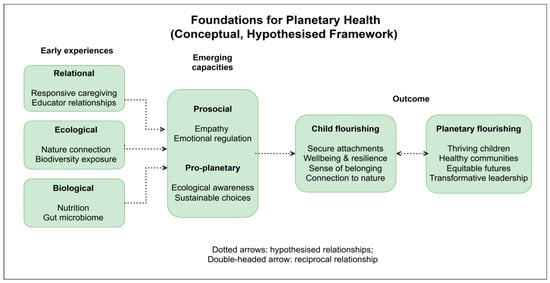
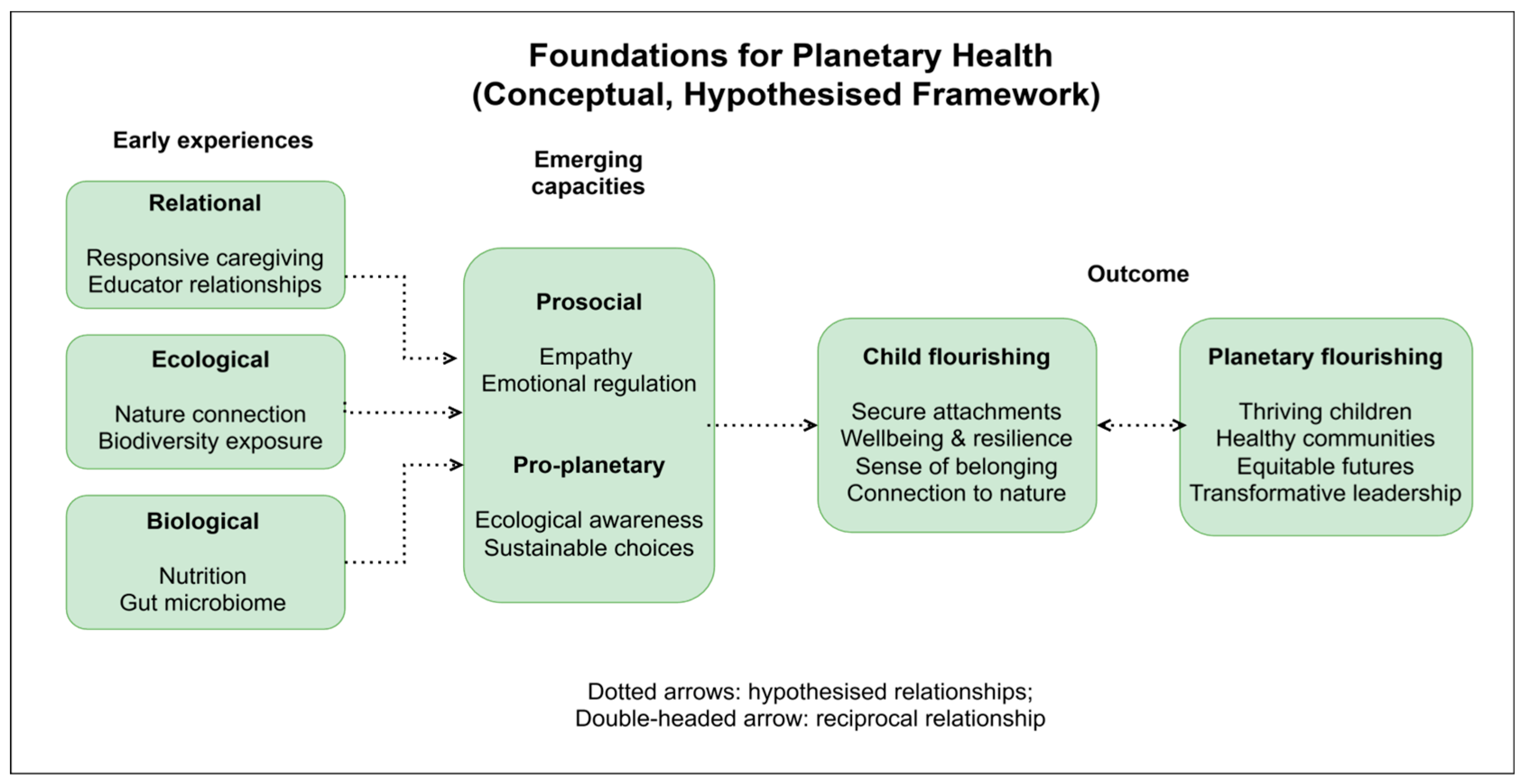
Children’s developmental experiences are shaped by the social, economic, cultural and environmental conditions in which they live. Poverty, food insecurity, conflict and environmental degradation can constrain opportunities for healthy development, while supportive relationships, stable and secure environments, and access to quality experiences can strengthen them in early childhood [6,8,11,12,13]. In this viewpoint, we explore how relational health, diverse sociocultural contexts, biological foundations and opportunities to cultivate prosocial and pro-planetary capacities during early childhood may contribute to childhood flourishing, and in turn to healthier, more equitable and more sustainable futures. By recognising early childhood as a critical foundation of future planetary health, we emphasise that supporting early flourishing is a planetary health imperative. Figure 1 below illustrates a conceptual, hypothesised framework linking how early relational, ecological and biological experiences shape prosocial and pro-planetary capacities that contribute to individual flourishing and, in turn, planetary flourishing. While shown as a linear sequence for clarity, these relationships are theoretical propositions rather than established causal pathways. Furthermore, future empirical work is needed to test the proposed relationships.
Figure 1.
Early childhood flourishing as a foundation for planetary health.
The framework’s central conceptual contribution is to position early childhood as a developmental leverage point for planetary health by linking children’s early experiences with the emergence of both prosocial and pro-planetary capacities. Within this framework, childhood flourishing refers to children’s wellbeing and positive development; prosocial capacities refer to emerging capacities for empathy, cooperation, care and reciprocity toward others; pro-planetary capacities refer to emerging capacities for nature connectedness, ecological awareness and environmental responsibility; and planetary flourishing refers to the broader wellbeing of people, communities and ecological systems. The relationship between childhood flourishing and planetary flourishing may also be understood as potentially reciprocal, extending beyond the developmental pathway proposed in this framework as shown in Figure 1. Children’s opportunities to flourish are influenced by the quality of the environments in which they grow [14,15]. At the same time, children who experience flourishing and develop capacities such as care, adaptability and ecological responsibility may, over the course of their lives contribute to healthier and more sustainable communities [14]. For example, children who develop a strong sense of connection with and responsibility towards the natural world may be more likely to participate in behaviours and collective practices that support the environments [16,17]. In this way, the conditions that support childhood flourishing may also be strengthened or transformed by the contributions of those who flourish within them, creating the possibility of reinforcing relationships across generations.
2. Relational Health with Caregivers and Early Childhood Professionals: Foundations for Planetary Flourishing
Caregivers and early childhood professionals provide a central relational foundation of early childhood flourishing. They shape the earliest conditions through which children with diverse abilities, developmental pathways and health circumstances develop emotional security, social understanding and ways of relating to the world. Flourishing in early childhood extends beyond the absence of illness or developmental difficulties; it is a dynamic and relationally embedded state in which children engage meaningfully with their surroundings [8,10,18].
These fundamentals are not built through formal instruction but through the accumulation of everyday relational micro-moments. A warm greeting at drop-off, a sensitive response to distress, encouragement during exploration and shared attention during play all shape how children understand themselves and others. These repeated interactions may form the emotional “foundation” through which children interpret the reliability of relationships. Children are already constructing internal expectations about trust and safety, before they acquire language or abstract concepts such as sustainability or climate change [19,20].
Responsive caregiving during early childhood can contribute to children’s developing capacities for stress and emotional regulation, executive functioning and socio-emotional development [21,22,23]. Children may experience heightened physiological stress responses when relational environments are characterised by unpredictability or emotional neglect. Within broader ecological systems of care, families, early childhood educators, peer groups and community networks collectively shape children’s daily atmospheres. Children experience continuity, safety and stability when there is coherence across these relational systems [19].
Many children experience adversity, trauma and relational disruption that can undermine developmental pathways. Although adversity can disrupt developmental trajectories, nurturing and responsive relationships provide essential protective processes that help children regulate stress, develop resilience in the face of significant hardship and recover from challenges within their everyday environments [24]. Rather than simply supporting optimal development under favourable conditions, relational health can also open pathways for healing and recovery, allowing children to adapt and flourish despite adversity. Evidence from studies of adverse and positive childhood experiences illustrates this protective effect directly: individuals reporting higher levels of positive relational experiences in childhood show better mental and relational health in adulthood even when exposed to significant adversity and difficult life circumstances [8,11]. Relational health therefore not only fosters optimal development under favourable conditions but can also provides opportunities for healing and recovery, helping children navigate adversity through supportive relationships that promote resilience and flourishing.
Within early childhood education and care (ECEC) settings, relational health further expands into peer-based collective environments where children begin to experience themselves as part of a shared social system. These experiences represent the first sustained engagement with functioning social systems beyond the family [25]. Play is central to this collective relational learning. Within peer play, children rehearse roles, test boundaries, repair ruptures and collaboratively construct shared worlds. These interactions require continuous perspective-taking and adaptation to multiple social cues [26]. From a planetary health perspective, these early group-based experiences provide a foundational rehearsal for life within interdependent systems. They therefore may constitute early developmental building blocks for the capacities required to engage at a collective level with complex social, cultural and environmental challenges.
The lived experience of interdependence is foundational for later ecological awareness and systems thinking, both of which are essential competencies for navigating complex planetary challenges. Relational networks are not limited to social relationships alone. They also mediate children’s earliest encounters with environment around them. When educators and caregivers include children in caring for the natural environment and plants, noticing seasonal change, or engaging with outdoor environments, they support early forms of integrated thinking [7].
The relational foundations established in early childhood give rise to empathy, cooperation, adaptability and stewardship, which are essential capacities for sustaining flourishing societies and a thriving planet [19]. By investing in supporting early relational health through responsive caregiving and attuned professional relationships, societies are not only supporting children’s immediate wellbeing but also cultivating resilience, connectedness and the capacities needed to flourish for a better world around them [27,28].
3. Socio-Ecological and Biological Foundations of Childhood Flourishing
Early childhood is a formative period in which patterns of relating, learning and caring begin to take shape, with implications that extend across the life course. Childhood flourishing is influenced by the social, cultural, material, ecological and biological conditions in which children live. Within these contexts, nurturing and responsive relationships provide a foundation for the development of relational health and flourishing, even in the presence of adversity [14]. Flourishing, in turn, may support the development of relational, cognitive and ecological capacities that contribute to caring, equitable and sustainable societies. Understanding these wider foundations is therefore essential for recognising both the opportunities and constraints experienced by children with diverse developmental profiles and health needs.
In high-income settings, children generally grow up with strong institutional support systems, including accessible healthcare and formal education. Care and socialization are increasingly organized through formal systems, digital platforms and tightly scheduled routines [29]. Community-based interaction has become less central to daily life. Contemporary patterns of intensive, parent-centred caregiving differ substantially from the broader, community-based systems of childrearing described across many cultures [30]. As caregiving becomes more privatized and time-constrained within nuclear family structures, children often experience fewer opportunities for spontaneous intergenerational and community interaction [31,32]. In many urban areas, children spend significantly less time in unstructured outdoor play or nature, with studies showing sharp declines in direct experiences with the natural environment [33]. For example, children in many cities now spend more hours indoors on screens than in green spaces. While cognitively stimulating in some domains, this pattern can weaken children’s embodied sense of interdependence with living systems. For navigating complex planetary systems, such shifts may constrain opportunities for embodied ecological learning and weaken children’s early development of interdependence. However, while these patterns are increasingly evident in many high-income settings, they are not uniform across all high-income contexts. Considerable within-country variation exists in children’s everyday experiences, shaped by urbanisation, socioeconomic inequality, neighbourhood characteristics, family circumstances, cultural practices and access to safe green and outdoor spaces. Some families and communities actively maintain strong connections with nature through parks, community gardens, outdoor education, cultural practices and nature-based recreation. Similarly, digital engagement and highly structured childhood routines vary substantially between families and communities. Evidence indicates that children’s nature-related experiences are influenced by local environmental and socioeconomic conditions, demonstrating that national income alone does not determine children’s relationship with nature [34].
In low- and middle-income contexts, childhood development is often embedded within extended family and community networks where caregiving is shared across multiple adults and generations. These relational systems provide important continuity of care and social learning. Children frequently grow up in environments where social interaction is continuous. This fosters practical ecological knowledge, collective responsibility and a lived understanding of interdependence [32]. For example, in rural areas children frequently participate in daily household and agricultural activities alongside multiple generations. However, they operate under conditions of persistent material strain. Challenges related to food security, access to healthcare, sanitation and safe housing stability place continuous pressure on caregiving and childhood environments. This creates a strong relational embedding alongside structural instability. Care is socially rich but frequently constrained by environmental stressors and resource uncertainty. However, these strengths exist alongside structural and environmental stressors that can disrupt stability, safety and continuity of care [35]. Moreover, although many low- and middle-income contexts may be characterised by strong family, intergenerational and community relationships alongside greater everyday contact with natural environments, these patterns are not universal, and substantial variation exists both between and within countries. Findings from a multi-country study across 12 LMICs highlight substantial variation in children’s play and outdoor experiences across urban and rural settings, with these experiences influenced by socioeconomic circumstances, family and cultural practices, and access to safe and supportive environments [36]. Furthermore, climate change also does not affect all children equally. Children who already face disadvantages are often more vulnerable to climate-related harms and have fewer resources to protect themselves [37]. Such variation highlights why national income alone may be insufficient to capture the diverse contexts in which children grow and develop.
Furthermore, environmental influences are not experienced equally across children or communities. Children’s opportunities to flourish may vary according to socioeconomic circumstances, housing conditions, food security, exposure to air pollution and other environmental hazards and access to safe green and outdoor spaces [10,37,38]. For instance, children living in densely populated or highly urbanised neighbourhoods may have different opportunities to access nature and safe outdoor spaces than children living in areas with greater access to natural environments, while children experiencing housing or food insecurity may face additional constraints on their health and wellbeing. Cultural contexts may also shape how children experience and develop relationships with their communities and natural environments. In particular, for Indigenous children and communities, relationships with land, culture, community and environmental stewardship may provide distinctive dimensions through which health and wellbeing are understood [39]. Despite contextual differences, children everywhere are increasingly affected by planetary-scale forces. Climate change, biodiversity collapse, pollution and ecosystem disruption are no longer peripheral concerns but active determinants of childhood surroundings [14,40,41]. What matters across settings is whether children have consistent opportunities to experience security, participation and connection with people, place and the more-than-human world. The more-than-human world refers to the living and non-living entities and ecological systems beyond humans. When children experience relational security together with rich, recurring engagement with communities, places and the more-than-human world, they are more likely to develop integrated thinking and the prosocial and pro-planetary dispositions essential for planetary health [7,42]. These socio-ecological conditions can also become biologically embedded. The microbiome provides one important example of how relational, nutritional and environmental experiences may influence the developing child. Rather than functioning as an independent determinant of flourishing, the microbiome represents an ecological interface through which experiences become biologically embedded and may shape developmental trajectories. The composition and diversity of the early childhood microbiome are shaped by a constellation of factors including nutrition, exposure to natural environments and caregiving quality [43,44,45]. Importantly, secure and responsive relationships provide the relational context within which other health-promoting experiences occur and are increasingly recognised as having biological consequences that extend beyond psychosocial wellbeing. Other biological experiences, including nutrition, also support children’s development, although their benefits are shaped by and embedded within the context of secure and responsive relationships. Emerging evidence identifies the developing microbiome and the gut–brain axis as critical biological mediators linking early environmental experiences to neurological, emotional and social development [44,46]. Through associations with stress reactivity, emotional regulation, social behaviour and oxytocin signalling, microbial development may contribute to the biological foundations of flourishing and emerging prosocial capacities [46,47]. These biological pathways may extend beyond prosocial capacities to shape pro-planetary orientation more specifically. The “Lovebug Effect” proposes that interactions between the microbiome, environment and brain may influence human affinity and connectedness with nature, with implications for long-term ecological resilience [43]. Relatedly, reduced early biodiversity exposure, described as an “extinction of experience,” may diminish opportunities to develop connection with and responsibility toward nature [44]. Thus, rather than suggesting that the microbiome directly determines pro-planetary behaviour, these findings point to a broader developmental pathway in which microbiome–environment interactions, socio-emotional development and direct nature experience may work together to support children’s emerging capacity for both relational and ecological care.
Taken together, these relational, socio-ecological and biological foundations position early childhood as a critical, context-sensitive leverage point for planetary health. The following section considers how these capacities may be cultivated through children’s everyday experiences.
5. Conclusions
The conditions for planetary health are established long before individuals engage with environmental policies or technological solutions—they begin in the relationships, environments and experiences of early childhood. The future of planetary health depends as much on how people learn to care, connect and live together as it does on environmental action.
This viewpoint positions early childhood as a critical leverage point for planetary health. Relational security, supportive socio-ecological conditions, healthy biological development and meaningful engagement with the natural world create foundations from which empathy, cooperation, creativity, adaptability and ecological responsibility can emerge. These capacities are important for children’s flourishing in the present and for the ability of future generations to navigate complexity, respond collectively to uncertainty, exercise transformative leadership and contribute to more equitable and sustainable societies.
Greater attention should therefore be given to the conditions that enable all children, including those with diverse developmental profiles and health needs, to flourish. Supporting flourishing in early life is not simply a developmental or social priority, but a long-term investment in collective resilience, ecological stewardship and planetary wellbeing. As the field of planetary health continues to evolve, early childhood should be recognised as an essential foundation for the relational, prosocial and pro-planetary capacities on which flourishing futures depend.
Author Contributions
Conceptualization, S.L.P., J.A.D. and C.B.; investigation, Y.M.; writing—original draft preparation, Y.M.; writing—review and editing, L.Y.G. and all authors.; visualization, Y.M.; supervision, S.L.P.; project administration, J.A.D. and Z.T.; funding acquisition, J.A.D. and D.S. All authors have read and agreed to the published version of the manuscript.
Funding
This research received no external funding.
Data Availability Statement
No new data were created or analyzed in this study. Data sharing is not applicable to this article.
Conflicts of Interest
The authors declare no conflicts of interest.
References
- Wells, N.M.; Lekies, K.S. Nature and the Life Course: Pathways from Childhood Nature Experiences to Adult Environmentalism. Child. Youth Environ. 2006, 16, 1–24. [Google Scholar] [CrossRef] [Scilit]
- Phillips, D.A.; Shonkoff, J.P. From Neurons to Neighborhoods: The Science of Early Childhood Development; National Academies Press: Washington, DC, USA, 2000. [Google Scholar]
- Whitmee, S.; Haines, A.; Beyrer, C.; Boltz, F.; Capon, A.G.; de Souza Dias, B.F.; Ezeh, A.; Frumkin, H.; Gong, P.; Head, P. Safeguarding Human Health in the Anthropocene Epoch: Report of The Rockefeller Foundation–Lancet Commission on Planetary Health. Lancet 2015, 386, 1973–2028. [Google Scholar] [CrossRef] [Scilit] [PubMed]
- Ardoin, N.M.; Bowers, A.W. Early Childhood Environmental Education: A Systematic Review of the Research Literature. Educ. Res. Rev. 2020, 31, 100353. [Google Scholar] [CrossRef] [Scilit] [PubMed]
- Cohen, S.D. Three Principles to Improve Outcomes for Children and Families. Science to Policy and Practice; Center on the Developing Child at Harvard University: Cambridge, MA, USA, 2017. [Google Scholar]
- Britto, P.R.; Lye, S.J.; Proulx, K.; Yousafzai, A.K.; Matthews, S.G.; Vaivada, T.; Perez-Escamilla, R.; Rao, N.; Ip, P.; Fernald, L.C.H. Nurturing Care: Promoting Early Childhood Development. Lancet 2017, 389, 91–102. [Google Scholar] [CrossRef] [Scilit] [PubMed]
- Chawla, L. Childhood Nature Connection and Constructive Hope: A Review of Research on Connecting with Nature and Coping with Environmental Loss. People Nat. 2020, 2, 619–642. [Google Scholar] [CrossRef] [Scilit]
- Bethell, C.D.; Gombojav, N.; Whitaker, R.C. Family Resilience and Connection Promote Flourishing among US Children, Even amid Adversity. Health Aff. 2019, 38, 729–737. [Google Scholar] [CrossRef] [Scilit] [PubMed]
- Bethell, C.; Willis, D. Child Flourishing: A Critical Indicator for Early Relational Health. Nurture Connection. 2024. Available online: https://nurtureconnection.org/child-flourishing-a-critical-indicator-for-erh/ (accessed on 16 July 2026).
- Davis, J.A.; Davey, B.; Segers, E.; Talati, Z.; Silva, D.; Prescott, S.L.; Gibson, L.Y. The Flourishing Child: Understanding How Adults and Children Perceive Flourishing from the Start of Life. Int. J. Appl. Posit. Psychol. 2025, 10, 18. [Google Scholar] [CrossRef] [Scilit]
- Bethell, C.; Jones, J.; Gombojav, N.; Linkenbach, J.; Sege, R. Positive Childhood Experiences and Adult Mental and Relational Health in a Statewide Sample: Associations across Adverse Childhood Experiences Levels. JAMA Pediatr. 2019, 173, e193007. [Google Scholar] [CrossRef] [Scilit] [PubMed]
- Bethell, C.D.; Garner, A.S.; Gombojav, N.; Blackwell, C.; Heller, L.; Mendelson, T. Social and Relational Health Risks and Common Mental Health Problems among US Children: The Mitigating Role of Family Resilience and Connection to Promote Positive Socioemotional and School-Related Outcomes. Child Adolesc. Psychiatr. Clin. 2022, 31, 45–70. [Google Scholar] [CrossRef] [Scilit] [PubMed]
- Black, M.M.; Walker, S.P.; Fernald, L.C.H.; Andersen, C.T.; DiGirolamo, A.M.; Lu, C.; McCoy, D.C.; Fink, G.; Shawar, Y.R.; Shiffman, J. Early Childhood Development Coming of Age: Science through the Life Course. Lancet 2017, 389, 77–90. [Google Scholar] [CrossRef] [Scilit] [PubMed]
- Clark, H.; Coll-Seck, A.M.; Banerjee, A.; Peterson, S.; Dalglish, S.L.; Ameratunga, S.; Balabanova, D.; Bhan, M.K.; Bhutta, Z.A.; Borrazzo, J. A Future for the World’s Children? A WHO–UNICEF–Lancet Commission. Lancet 2020, 395, 605–658. [Google Scholar] [CrossRef] [Scilit] [PubMed]
- Arola, T.; Aulake, M.; Ott, A.; Lindholm, M.; Kouvonen, P.; Virtanen, P.; Paloniemi, R. The Impacts of Nature Connectedness on Children’s Well-Being: Systematic Literature Review. J. Environ. Psychol. 2023, 85, 101913. [Google Scholar] [CrossRef] [Scilit]
- Harris, N.M.; Hartwell, B.; Thomas, L.; Grace, M. How Can Nature Connectedness and Behaviours for Learning Be Deliberately Developed in Children, Adolescents and Young Adults? A Systematic Literature Review. Child Adolesc. Ment. Health 2025, 30, 168–185. [Google Scholar] [CrossRef] [Scilit] [PubMed]
- Liu, J.; Green, R.J. Children’s pro-Environmental Behaviour: A Systematic Review of the Literature. Resour. Conserv. Recycl. 2024, 205, 107524. [Google Scholar] [CrossRef] [Scilit]
- Kebbeh, N.; Jelsma, E. The Impact of Child Flourishing on School Readiness: A Structural Equation Modeling Approach. Cogent Educ. 2025, 12, 2511445. [Google Scholar] [CrossRef] [Scilit]
- Backes, E.P.; Willis, D. Early Relational Health: Building Foundations for Child, Family, and Community Well-Being; The National Academies Press: Washington, DC, USA, 2025. [Google Scholar] [CrossRef] [Scilit] [PubMed]
- Li, J.; Ramirez, T.; Barnes, S. Early Relational Health: A Review of Research, Principles, and Perspectives; The Burke Foundation: Princeton, NJ, USA, 2023. [Google Scholar]
- Larsen, S.A.; Cohrssen, C. The Early Years Learning Framework for Australia and Existing Measures of Child Outcomes: Is There a Relationship? Aust. Educ. Res. 2025, 52, 2631–2663. [Google Scholar] [CrossRef] [Scilit]
- Martin, S.; Lynch, A.; Buckley, L.; Looney, E.; O’Toole, C. Infant and Early Childhood Mental Health Training for Early Years Practitioners. J. Early Child. Res. 2026, 24, 40–55. [Google Scholar] [CrossRef] [Scilit]
- Werchan, D.M.; Ku, S.; Berry, D.; Blair, C. Sensitive Caregiving and Reward Responsivity: A Novel Mechanism Linking Parenting and Executive Functions Development in Early Childhood. Dev. Sci. 2023, 26, e13293. [Google Scholar] [CrossRef] [Scilit] [PubMed]
- Garner, A.; Yogman, M. Preventing Childhood Toxic Stress: Partnering with Families and Communities to Promote Relational Health. Pediatrics 2021, 148, e2021052582. [Google Scholar] [CrossRef] [Scilit] [PubMed]
- Kutnick, P.; Colwell, J. Promoting Social Competence and Social Inclusion in the Preschool: A Peer-Based Relational Intervention. Early Child Dev. Care 2024, 194, 1212–1229. [Google Scholar] [CrossRef] [Scilit]
- Eggum-Wilkens, N.D.; Fabes, R.A.; Castle, S.; Zhang, L.; Hanish, L.D.; Martin, C.L. Playing with Others: Head Start Children’s Peer Play and Relations with Kindergarten School Competence. Early Child. Res. Q. 2014, 29, 345–356. [Google Scholar] [CrossRef] [Scilit] [PubMed]
- Wals, A.E.J. Sustainability by Default: Co-Creating Care and Relationality through Early Childhood Education. Int. J. Early Child. 2017, 49, 155–164. [Google Scholar] [CrossRef] [Scilit]
- Masten, A.S. Ordinary Magic: Resilience Processes in Development. Am. Psychol. 2001, 56, 227. [Google Scholar] [CrossRef] [PubMed]
- Skår, M.; Krogh, E. Changes in Children’s Nature-Based Experiences near Home: From Spontaneous Play to Adult-Controlled, Planned and Organised Activities. Child. Geogr. 2009, 7, 339–354. [Google Scholar] [CrossRef] [Scilit]
- Milkie, M.A.; Nomaguchi, K.M.; Denny, K.E. Does the Amount of Time Mothers Spend with Children or Adolescents Matter? J. Marriage Fam. 2015, 77, 355–372. [Google Scholar] [CrossRef] [Scilit]
- Hagestad, G.O.; Uhlenberg, P. The Social Separation of Old and Young: A Root of Ageism. J. Soc. Issues 2005, 61, 343–360. [Google Scholar] [CrossRef] [Scilit]
- Lancy, D.F. Raising Children: Surprising Insights from Other Cultures; Cambridge University Press: Cambridge, UK, 2017. [Google Scholar]
- Soga, M.; Yamanoi, T.; Tsuchiya, K.; Koyanagi, T.F.; Kanai, T. What Are the Drivers of and Barriers to Children’s Direct Experiences of Nature? Landsc. Urban Plan. 2018, 180, 114–120. [Google Scholar] [CrossRef] [Scilit]
- Jensen, J.K.; Alkan Olsson, J.; von Post, M.; Isaksson, C. Reconnecting Children to Nature: The Efficacy of a Wildlife Intervention Depends on Local Nature and Socio-economic Context, but Not on Urbanisation. People Nat. 2024, 6, 1987–2000. [Google Scholar] [CrossRef] [Scilit]
- Evans, D.K.; Jakiela, P.; Acosta, A.M. The Impacts of Childcare Interventions on Children’s Outcomes in Low-and Middle-Income Countries: A Systematic Review. In Proceedings of the AEA Papers and Proceedings; American Economic Association: Nashville, TN, USA, 2024; Volume 114, pp. 463–466. [Google Scholar]
- Iannelli, O.; Naderbagi, A.; Poulsen, A.; Alam, M.; Song, Y.J.C.; Hindmarsh, G.; Hickie, I.B.; LaMonica, H.M. Multistakeholder Perspectives on Children’s Play and the Systemic Factors That Influence It across 12 Low-and Middle-Income Countries. Humanit. Soc. Sci. Commun. 2025, 13, 57. [Google Scholar] [CrossRef] [Scilit]
- Parsons, E.S.; Jowell, A.; Veidis, E.; Barry, M.; Israni, S.T. Climate Change and Inequality. Pediatr. Res. 2025, 98, 1238–1245. [Google Scholar] [CrossRef] [Scilit] [PubMed]
- Sakhvidi, M.J.Z.; Mehrparvar, A.H.; Sakhvidi, F.Z.; Dadvand, P. Greenspace and Health, Wellbeing, Physical Activity, and Development in Children and Adolescents: An Overview of the Systematic Reviews. Curr. Opin. Environ. Sci. Health 2023, 32, 100445. [Google Scholar] [CrossRef] [Scilit]
- Redvers, N.; Celidwen, Y.; Schultz, C.; Horn, O.; Githaiga, C.; Vera, M.; Perdrisat, M.; Plume, L.M.; Kobei, D.; Kain, M.C. The Determinants of Planetary Health: An Indigenous Consensus Perspective. Lancet Planet. Health 2022, 6, e156–e163. [Google Scholar] [CrossRef] [Scilit] [PubMed]
- Herbst, M. The State of the World’s Children 2024: The Future of Childhood in a Changing World; UNICEF: New York, NY, USA, 2024. [Google Scholar]
- Mohamed, M.; Amin, S.; Lever, E.; Montini, A.; Machida, K.; Rajagopalan, S.; Costello, A.; McGushin, A.; Jennings, B.; Benoit, L. Climate Change and Child Wellbeing: A Systematic Evidence and Gap Map on Impacts, Mitigation, and Adaptation. Lancet Planet. Health 2025, 9, e337–e346. [Google Scholar] [CrossRef] [Scilit] [PubMed]
- Hosoda, C.; YunFeng, Z.; Watanabe, J.; Maruya, K.; Tabuchi, R.; Hosokawa, K.; Matsuhashi, T. The Importance of Childhood Social Capitals in the Future Well-Being of Children. Front. Psychol. 2024, 15, 1389269. [Google Scholar] [CrossRef] [Scilit] [PubMed]
- Robinson, J.M.; Breed, M.F. The Lovebug Effect: Is the Human Biophilic Drive Influenced by Interactions between the Host, the Environment, and the Microbiome? Sci. Total Environ. 2020, 720, 137626. [Google Scholar] [CrossRef] [Scilit] [PubMed]
- Prescott, S.L. A Butterfly Flaps Its Wings: Extinction of Biological Experience and the Origins of Allergy. Ann. Allergy Asthma Immunol. 2020, 125, 528–534. [Google Scholar] [CrossRef] [Scilit] [PubMed]
- Logan, A.C.; Katzman, M.A.; Balanzá-Martínez, V. Natural Environments, Ancestral Diets, and Microbial Ecology: Is There a Modern “Paleo-Deficit Disorder”? Part II. J. Physiol. Anthropol. 2015, 34, 9. [Google Scholar] [CrossRef] [Scilit] [PubMed]
- Cryan, J.F.; O’Riordan, K.J.; Cowan, C.S.M.; Sandhu, K.V.; Bastiaanssen, T.F.S.; Boehme, M.; Codagnone, M.G.; Cussotto, S.; Fulling, C.; Golubeva, A.V. The Microbiota-Gut-Brain Axis. Physiol. Rev. 2019, 99, 1877–2013. [Google Scholar] [CrossRef] [Scilit] [PubMed]
- Buffington, S.A.; Di Prisco, G.V.; Auchtung, T.A.; Ajami, N.J.; Petrosino, J.F.; Costa-Mattioli, M. Microbial Reconstitution Reverses Maternal Diet-Induced Social and Synaptic Deficits in Offspring. Cell 2016, 165, 1762–1775. [Google Scholar] [CrossRef] [Scilit] [PubMed]
- Nielsen, K.B.; Holmegaard, H.T. The Fox, the Flowers, and the Poking Stick: The Worlds of Young Children and Their Encounters with School Science. Cult. Stud. Sci. Educ. 2025, 20, 191–217. [Google Scholar] [CrossRef] [Scilit]
- Prescott, S.L.; Logan, A.C.; Albrecht, G.; Campbell, D.E.; Crane, J.; Cunsolo, A.; Holloway, J.W.; Kozyrskyj, A.L.; Lowry, C.A.; Penders, J. The Canmore Declaration: Statement of Principles for Planetary Health. Challenges 2018, 9, 31. [Google Scholar] [CrossRef] [Scilit]
- Baumgartner, J. Planetary Health: Protecting Nature to Protect Ourselves; Myers, S., Frumkin, H., Eds.; Island Press: Washington, DC, USA, 2021. [Google Scholar] [CrossRef] [Scilit]
- Montroy, J.J.; Bowles, R.P.; Skibbe, L.E.; McClelland, M.M.; Morrison, F.J. The Development of Self-Regulation across Early Childhood. Dev. Psychol. 2016, 52, 1744. [Google Scholar] [CrossRef] [Scilit] [PubMed]
- Bayındır, D.; Çiftçi, Ç. Preschool Children’s Affinity towards Nature (Biophilia) and Their Parents’ and Teachers’ Connectedness to the Nature. Education 3-13 2025, 1–11. [Google Scholar] [CrossRef] [Scilit]
- Chawla, L. Benefits of Nature Contact for Children. J. Plan. Lit. 2015, 30, 433–452. [Google Scholar] [CrossRef] [Scilit]
- Barthel, S.; Belton, S.; Raymond, C.M.; Giusti, M. Fostering Children’s Connection to Nature through Authentic Situations: The Case of Saving Salamanders at School. Front. Psychol. 2018, 9, 928. [Google Scholar] [CrossRef] [Scilit] [PubMed]
- Torkar, G.; Klofutar, Š. Enhancing Biodiversity Literacy in Early Learners: The Impact of Direct Outdoor Experience versus Classroom Instruction. J. Environ. Educ. 2026, 1–14. [Google Scholar] [CrossRef] [Scilit]
- Ettinger, A.K.; Risser, L.; Rahman, S.; Rigas, D.; Abromitis, R.; Stokes, L.R.; Chavis, V.; Miller, E. Defining and Measuring Child and Youth Thriving: A Scoping Review. Pediatrics 2022, 150, e2022056902. [Google Scholar] [CrossRef] [Scilit] [PubMed]
- Rule, A.; Abbey, C.; Wang, H.; Rozelle, S.; Singh, M.K. Measurement of Flourishing: A Scoping Review. Front. Psychol. 2024, 15, 1293943. [Google Scholar] [CrossRef] [Scilit] [PubMed]
- Moon, D.J.; Cruce, A. Child Flourishing Index: Confirmatory Factor Analysis and Measurement Invariance between Youth of Color and White Youth in the United States. Fam. Soc. 2026, 107, 715–732. [Google Scholar] [CrossRef] [Scilit]
- Talati, Z.; Kennare, J.; Bear, N.L.; Gibson, L.Y.; Power, R.; Kruger, V.Z.; Davis, J.A. The Flourishing Child: Study Protocol for an Acceptability and Feasibility Trial of a Digital Early Childhood Flourishing Intervention. Children 2026, 13, 581. [Google Scholar] [CrossRef] [Scilit] [PubMed]
Disclaimer/Publisher’s Note: The statements, opinions and data contained in all publications are solely those of the individual author(s) and contributor(s) and not of MDPI and/or the editor(s). MDPI and/or the editor(s) disclaim responsibility for any injury to people or property resulting from any ideas, methods, instructions or products referred to in the content. |
© 2026 by the authors. Licensee MDPI, Basel, Switzerland. This article is an open access article distributed under the terms and conditions of the Creative Commons Attribution (CC BY) license.