


Abstract
Sustainable diet transitions are required to protect human and planetary health, and consumers are important food systems actors who can foster positive changes. However, little is known about how consumers perceive the concept of sustainable diets. This study explored perceptions of sustainable diets across five high- and middle-income countries: Japan, Indonesia, Italy, Canada, and Mexico. Semi-structured interviews were conducted with 184 young adults (30–45 per country), and transcripts were analyzed using values coding to understand the values, attitudes, and beliefs that shape behaviours related to sustainable diets. Results revealed that defining “sustainable eating” was challenging for participants across all countries. While participants’ values regarding sustainable diets were often context-specific with marked differences across countries, common themes across countries included concern about food waste and packaging and the belief that sustainability should be the responsibility of all actors across the food system, not just the individual. These findings indicate that food policy should address both individual and systemic dimensions of food sustainability, specifically prioritizing strategies for waste and packaging infrastructure. Furthermore, public health strategies must be values-oriented and culturally tailored to ensure they resonate with local consumer priorities.
1. Introduction
Current diets across much of the world are of low nutritional quality [1] and include many foods produced using non-renewable inputs and unsustainable practices [2]. As identified in the original EAT-Lancet Commission on healthy diets from sustainable food systems [3] and further underscored in the revised 2025 EAT-Lancet Commission [4], to preserve both planetary and individual health, we need to identify and implement public health strategies that support consumers’ shift to consuming more healthy and sustainable diets.
The WHO and FAO have defined sustainable diets as “dietary patterns that promote all dimensions of individuals’ health and wellbeing; have low environmental pressure and impact; are accessible, affordable, safe and equitable; and are culturally acceptable” [5]. Reflecting this definition, sustainable diets are often conceptualized as a rather complex, multidimensional term composed of four dimensions of sustainability: health and nutrition, environmental, economic, and sociocultural [6].
Previous research examining consumer perceptions of sustainable diets, most of which has been quantitative in approach, suggests that there is some confusion among consumers over what is meant by the term and what behaviours support sustainable diets [7,8,9,10]. This confusion can make health messaging and behaviour change strategies focused on sustainable diets ineffective. As perceptions inform behaviour [11], an in-depth understanding of consumer perceptions of sustainable eating is critical to allow researchers and policymakers to develop effective health messaging, interventions, and policy approaches to support the adoption of sustainable diet patterns.
Existing qualitative research examining consumer perceptions of sustainable diets has often focused on a specific sustainable eating behaviour, i.e., reducing meat consumption, versus a general understanding of sustainable diets and the various related behaviours [9]. This has resulted in limited knowledge of how consumers perceive the more holistic concept of sustainable diets and how they perceive and compare the benefits and barriers of engaging in various sustainable eating behaviours. Gaining insight into consumers’ motivations and perceived barriers to engaging in various sustainable eating behaviours may facilitate the identification of those behaviours for which interventions are likely to be the most relevant and effective for a specific target group. In addition, no study has compared consumers’ perceptions of sustainable diets across a diverse sample of high- and middle-income countries (7). Understanding how these perceptions of sustainable diets differ across various high- and middle-income countries can help identify contextual differences that should be considered in developing health messaging and behaviour change approaches.
Building on this existing research, the objective of this study was to explore the perceptions of sustainable eating among young adults, ages 18–35 years, across five high- and middle-income countries using a qualitative approach. Specifically, this study aimed to explore whether and how young adults understand sustainable eating, what eating behaviours they identify as sustainable, and their perceived barriers related to sustainable eating. Young adults were selected, given that, compared to older adults, young adults may be more willing to engage in sustainable behaviours [12,13,14], and because behaviour change at this life stage can have a long-term impact [15]. Results can inform interventions and public health approaches designed to improve both individual and planetary health by supporting the adoption of sustainable diet patterns during this critical life stage across various country contexts.
2. Materials and Methods
2.1. Research Setting and Approach
This research was conducted in five countries: Japan, Indonesia, Italy, Canada, and Mexico. These countries represent diverse socioeconomic, nutritional, and environmental contexts as well as the regional expertise of the research team. Japan, Italy, Canada, and Mexico are countries whose national food-based dietary guidelines include recommendations related to sustainable eating. The Italian guidelines include a recommendation to “Select a sustainable diet” [16], and in Japan, their guidelines include a recommendation to “Reduce leftovers and waste through proper cooking and storage methods” [17]. In Canada, their guidelines include a recommendation to “Choose protein foods that come from plants more often” [18], and Mexican guidelines, released in 2025, recommend reducing food waste and promote the consumption of local, seasonal, and plant-based foods [19]. In contrast, Indonesian food-based dietary guidelines do not include recommendations related to sustainable diets [20]. Given that dietary guidelines can serve to guide countries’ nutrition, health, agriculture, and educational programmes and policies [21], exploring consumer perceptions and understanding of sustainable eating across these diverse countries can help elucidate how individual and systemic level factors may impact these perceptions.
This research was a cross-country collaboration among researchers from all five countries. Researchers across the five country contexts met monthly from September 2023 through December 2024 and were involved in all aspects of the research, from developing the recruitment and data collection protocols to data analysis and manuscript development.
A qualitative study involving individual semi-structured interviews in each country was conducted. Qualitative methodology is the recommended approach when the purpose of the research is to understand meaning or perspectives from the standpoint of participants [22], and compared to quantitative methods, qualitative methods can provide richer and more in-depth personal perspectives from participants [23]. Reporting of this research adheres to guidelines outlined in the Consolidated Criteria for Reporting Qualitative Research [24].
2.2. Participant Recruitment, Screening, and Consent
Participants were recruited using purposive self-selected sampling methods. Participants in each country were recruited between January 2024 and June 2024 using social media posts, posters at locations where young adults spend their time (e.g., libraries, grocery stores), word of mouth, and snowball sampling. Eligibility criteria included (1) being aged 18–35 years, (2) living in the country where the research was being conducted, and (3) being able to be interviewed in the relevant language, i.e., Japanese in Japan, Indonesian in Indonesia, Italian in Italy, English in Canada, and Spanish in Mexico. Individuals with a post-secondary (i.e., post-high school) degree in nutrition, environmental science, or sustainability and those following a vegan or vegetarian diet were excluded to avoid recruiting individuals with a high level of interest and knowledge in the topic.
Researchers have proposed that data saturation, i.e., when no new information is obtained, can often be reached with a sample from 30 to 60 participants when using a semi-structured interview approach [25]. However, this number depends on the heterogeneity of the sample and the level of complexity of the issues explored [25]. Thus, we aimed to complete 30–45 interviews in each country [26].
Quota sampling was used to ensure representation from subgroups who are typically underrepresented in nutrition and food research, i.e., men and those with low levels of education. In each country, a sampling quota of at least 30% was set for the recruitment of men and for those with low education [7,27]. Local team leaders in each country defined their criteria for low education based on their country’s average level of educational attainment. A target of at least 30% was also used for participants who lived in rural areas, as barriers to consuming plant-based diets have been shown to differ among urban and rural residents [28]. Given the different urban structures across the study countries, local team leaders also determined the definition of ‘rural’ that was most appropriate for their own setting.
In each country, interested participants completed study screening by phone or online using an online conferencing system, and those who were eligible and met the quotas were sent a copy of the consent form and invited to participate in an interview. Verbal informed consent was obtained before proceeding with the interview. Ethics review and approval were obtained per each country’s requirements.
2.3. Data Collection
The interview script was informed by previous research by Whittall et al. (2023) and Mann et al. (2018), who examined perceptions of sustainable diets among adults in the UK and Australia, respectively [10,29]. Researchers from each country pilot-tested the script among 2–4 young adults before study implementation. Based on pilot test results, it was decided to use the term “sustainable eating” instead of “sustainable diet” in communication with participants to avoid potential confusion with the concept of dieting for weight loss. Some pilot participants focused their discussion of sustainable eating on eating behaviours that could be sustained over time. Thus, to further explore participants’ perceptions of eating behaviours that may influence the environment, a probing question about “environmentally sustainable eating” was added to the script (see interview questions in Table 1).
Table 1.
Interview questions exploring perceptions of sustainable eating.
Interviews were conducted using online conferencing systems or via telephone if participants did not have access to a computer or the internet. Interviews were completed by researchers with previous experience and training in leading qualitative interviews. Participants received a cash incentive equivalent to $30 USD for completing the interview. All interviews were audio recorded. Recordings were transcribed and translated to English, as needed, by the bilingual researchers in each country, and any identifying information was removed.
2.4. Data Analysis
Two researchers with experience in qualitative research (JH &KP) conducted the analysis using a collaborative analysis approach, which involved both researchers coding all interviews following the six steps of Richards & Hemphill (2018) [30]. These steps included the following: (1) Preliminary organization and planning; this phase involved the researchers clarifying the overall plan for the analysis, including the use of a theory-informed thematic approach to Values coding [31] to understand the underlying values, attitudes, and beliefs that shape behaviours related to sustainable eating. (2) Open and axial coding; this phase involved both researchers reading all transcripts from two countries (Japan and Canada) to help gain an understanding of the concepts, patterns, and connections in the data. (3) The development of a preliminary codebook; our preliminary codebook was informed by the open and axial coding and a detailed review of existing literature examining perceptions and determinants of sustainable eating and included an “other” code to allow for emergent findings that did not fit within the existing codes. (4) Pilot testing the codebook; the codebook was tested by coding interviews from two countries (Japan and Indonesia) and helped determine and harmonize coding conventions across coders. (5) The final coding process; this step involved the codebook being applied to all project data, which was done for each country separately. (6) Review of the codebook and finalizing the themes; this step involved comparing results across countries and finalizing the results. NVivo software (version 14, Lumivero, Denver, CO, USA) was used to assist with the organizational aspects of the qualitative data analysis.
The two researchers coded transcripts independently and met routinely to discuss coding, review coding notes and observations, and to compare and reconcile any differences in coding. This process helped to ensure consistency in coding across both coders.
Given the multi-team and multi-lingual nature of data collection, the two researchers leading the analysis were not able to assess data saturation during data collection. Instead, confirmatory methods were used during data analysis to ascertain whether data saturation had been achieved. Analysts used their detailed memos and notes to record when new connections or ideas emerged. These records demonstrated that data saturation had been achieved, according to the ideas of code and meaning saturation [32] within each country’s interviews.
During the research team’s monthly meetings, local researchers in each country reviewed the findings for their country to confirm that the findings reflect what they heard during the interviews and to verify the meaning and interpretation of quotations within each country’s context. This process helped ensure conceptual equivalence in the interpretation of findings across countries. To present the qualitative findings across country contexts, summary coding matrices were created that identify the proportion of participants from each country who identified particular (1) values, attitudes, and beliefs and (2) behaviours related to sustainable eating.
2.5. Researcher Reflexivity
The coders are English-speaking, female, university-educated researchers residing in Canada. The coders’ perspectives are shaped by North American academic training and dietary norms. To mitigate potential cultural bias, all codes and themes were reviewed by the full research team, which included local researchers from each of the countries represented in the data. This collaborative oversight ensured that local contexts were considered and safeguarded the analysis against the imposition of North American-situated frameworks.
3. Results and Discussion
This section includes a summary of the participants’ demographics, followed by a description of the qualitative results for each of the following topics: understanding of sustainable eating; values, attitudes, and beliefs related to sustainable eating; identification of sustainable eating behaviours; and perceived barriers related to sustainable eating. Within each of these topics, interpretations of findings considering previous research are included.
3.1. Participants
Across all countries, a total of 184 participants completed interviews, with the number of participants ranging from 30 to 45 participants across the countries (Japan n = 35; Indonesia n = 35; Italy n = 45; Canada n = 30; and Mexico n = 39). Table 2 presents the demographics of these respondents for the total sample and for each country. The quota for recruiting at least 30% male participants was met in all countries. The quota for recruiting 30% participants with lower education was met in all but one country; in Canada, 27% of participants had lower education levels. Similarly, the quota for recruiting 30% of participants who live rurally was met in most countries; however, the percentage of participants who lived rurally in Canada (27%) and Japan (26%) fell just below the quota target. Although not variables on which quotas were established, participants’ perceived income adequacy and participants’ parental status were also measured.
Table 2.
Demographics by country and for the total sample of young adults (n = 184) who completed individual interviews exploring perceptions of sustainable eating.
3.2. Understanding of Sustainable Eating
Across all five countries, there were respondents who were unsure what the term “sustainable eating” meant or who had low confidence in their response when they did provide a definition of the term, with some respondents stating that “this is the first time I’ve heard of this term,” and “I’m not sure if I am right, but what I think is…”. These findings align with previous sustainable diet research, which has observed uncertainty about the term and/or a lack of sustainable diet knowledge among study participants from countries including Italy [34], Indonesia [35], Australia [36], Canada [8], and the UK [10]. Respondents in Italy were more likely to have heard of the term before and to provide definitions in line with the FAO definition than respondents in Japan, Indonesia, Canada, or Mexico:
“For me, the term “sustainable eating” means eating food that follows the cycle of the earth, without making products that are not in season. For example, tomatoes are available throughout the course of the year, but they certainly do not grow naturally at all times of the year, just as oranges also have their own seasonality. More attention should also be paid to animal management. Although I am not a vegetarian, and I think I would struggle to be one, I am convinced that attention should be paid to the many unsustainable farms that exist. Water, animal feed, mass production, intensive farming: these are all things that possibly impact the environment a lot. So I think if we had a more accurate and more respectful diet, with maybe seasonal ingredients, it would be better.”(Italy 2: male, high school diploma, rural)
This finding is consistent with other research that has shown that Italians have high levels of knowledge about sustainability including one study that compared Italians to people from Turkey [37] and a 2025 study that surveyed over 800 Italian adults and found that the vast majority of Italians (85%) identified sustainable foods as being healthy, having low environmental impact, and being locally sourced [38].
Despite respondents’ initial uncertainty with the term “sustainable eating,” as respondents across all five countries discussed what behaviours they perceived as sustainable, nearly all respondents discussed how sustainable eating should support health and nutrition:
“I think it is very important to have a sustainable eating because it means that we can eat more nutritious food for a longer period of time, and having nutritious food improves the state of our health.”(Japan 13: male, undergraduate degree, urban)
Among some respondents, particularly among those living in Indonesia or Mexico, the term sustainable was understood as a nutritious eating pattern that they could maintain for themselves over time, versus an eating pattern that is related to environmental sustainability:
“Yes, yes, it’s more like having a type of food consumption… but one that is constant, right? Like you can follow it as a lifestyle or something like… in your daily life, but with the intention to have a follow-up and be able to carry it out, I don’t know, in the long term.”(Mexico 18: male, undergraduate degree, urban)
However, when probed about environmentally sustainable eating, most respondents across all countries identified that to be sustainable, foods should be produced and consumed in ways that minimize harms to the environment, i.e., reduced carbon or methane emissions, support biodiversity, and minimize waste:
“Sustainable, hmm, maybe it’s like the implementation of regenerative agriculture where soil health is considered, and also biodiversity. It involves integrating livestock and crops, something like that.”(Indonesia 8: female, undergraduate degree, rural)
“I think that sustainable eating can benefit the environment in many ways, in a comprehensive way. For example, take deforestation: converting land into farmland or land for raising animals is one of the leading causes of deforestation, which contributes to biodiversity loss and rising CO2 emissions. Although at first it can be financially demanding, modernizing agricultural and livestock farming practices may lead to a major reduction in emissions and land exploitation.”(Italy 26: male, postgraduate degree, urban)
Respondents across all countries discussed the need for food to be affordable and accessible to all to be sustainable. They also described how their cultural norms influenced the acceptability of food choices in their countries and discussed how their eating behaviours should protect farmers, local producers, and animal welfare to be considered sustainable.
“For example, choosing products that come from transparent, responsible companies, that take care of their animals and practice sustainable agriculture without an intensive exploitation of the land or an excessive use of pesticides. I consider this important not only for our diet, but also for resources in general, such as the energy used in greenhouses or when rearing animals. A far-sighted approach concerns not only animal welfare, but also sustainably managing natural resources and adopting environmentally friendly practices… Animal welfare and safeguarding the land too have been key values in my family. Although we are not professional farmers, we’ve always had animals such as chickens and cattle on a small scale.”(Italy 15: female, undergraduate degree, rural)
3.3. Values, Attitudes, and Beliefs
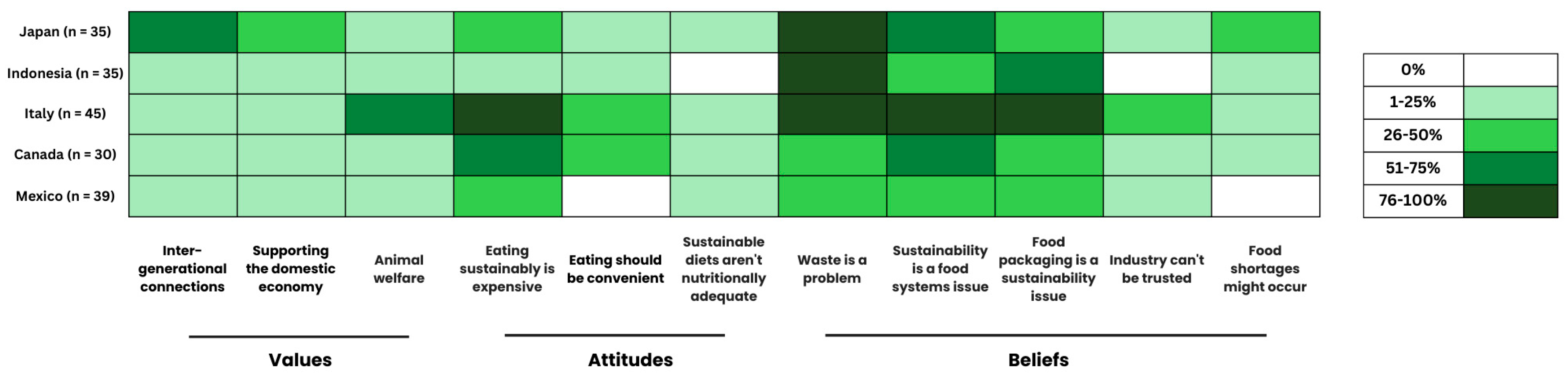
Overall, respondents’ values, attitudes, and beliefs regarding sustainable eating were context-specific, with some marked differences across the country contexts. Figure 1 provides a summary of the proportion of respondents from each country who identified various values, attitudes, and beliefs associated with sustainable eating. The 11 key values, attitudes, and beliefs identified through the interviews are outlined below.
Figure 1.
Proportion of respondents expressing values, attitudes, and beliefs associated with sustainable eating.
3.3.1. Intergenerational Connections
Intergenerational connections were coded as references to either elders who helped the respondent to learn about or practice sustainable eating, or as allusions to children or future generations who could be impacted by sustainable eating practices:
“I think that food loss is not good for children, because it makes them think that they don’t value food, or that it is OK to leave food behind. I think that is not good. We always talk about why some children cannot even eat. When we have meals at my home, I tell them that the farmers did their best to produce this food, so they should eat it properly, and I serve it to them in a way that they can eat it without leaving any leftovers… The most important thing is that it is a waste. Both my mother and grandmother told me to take good care of things.”(Japan 14: female, college diploma, urban)
“I think we have to start with a strong commitment. And we must not be selfish. We must be aware that we must protect the environment for the sake of our children and grandchildren. If we don’t have that mindset, I think it’s quite difficult to adopt sustainable diets.”(Indonesia 5: male, undergraduate degree, urban)
While intergenerational connections were raised in each country, this theme was most commonly discussed in Japan, which may reflect Japan’s traditional cultural value of filial piety, i.e., a Confucian virtue emphasizing respect, obedience, and care for elders and ancestors [39,40]. This finding is supported by previous quantitative research among 400 Japanese adults, which found that learning about the importance of reducing food waste as children predicted food waste reduction behaviours in adulthood [41].
3.3.2. Supporting the Domestic Economy
Respondents sometimes invoked the economic impacts of sustainable food systems, particularly with respect to domestic economic benefits to farmers and other food system actors:
“I mean part of it is like there’s environmental sustainability, but there’s also just like… economy sustainability, like the way the money is kind of going to a small farmer or a market.”(Canada 104: Female, undergraduate degree, urban)
This theme was discussed in all countries but was most prevalent in the Japanese interviews. While there is academic debate surrounding the relationship between domestic food production and sustainability outcomes, other research has also observed consumers’ desire to purchase local food as an act of community economic development [42].
3.3.3. Animal Welfare
Some respondents described their decision to eat less meat or to purchase locally produced meats as not only an environmental choice, but also as a values-driven choice to protect animal welfare:
“I mainly worry about both environmental sustainability and animal welfare. When I see terrible videos about how animals are treated, it’s heart-wrenching and I feel bad about eating meat, both chicken and beef. I do this to respect the environment and animal welfare, although I also see that my health benefits from this.”(Italy 18: female, high school diploma, rural)
This framing arose in all countries’ interviews but was most common in the Italian interviews. Previous research suggests that Italians commonly consider animal ethics when making food choices, with 69% of a sample of 969 Italians reporting that they consider animal welfare when purchasing food [43].
3.3.4. Eating Sustainably Is Expensive
Respondents from all countries expressed concerns about the costs of sustainable foods. The types of foods most commonly described as expensive included organic foods, local foods from farmers’ markets, or alternative protein products:
“Everything they bring you in packaging that says organic, many times it’s 30, 50% more expensive than the same thing that doesn’t say organic.”(Mexico 33: male, high school diploma, urban)
In contrast, some respondents noted that eating sustainably could be less expensive too. These respondents pointed to the cost savings associated with growing food for consumption, using low-cost meat substitutions (i.e., tofu or beans), eating less processed versions of foods (e.g., homemade salad versus prepared bagged salads), and purchasing certain local foods:
“If we are talking about local production for local consumption, I am sure that there are cheaper options available if one is willing to look for them. So, I think there is room for people to choose such things.”(Japan 32: male, undergraduate degree, urban)
“It’s cheaper. Because, well, I was telling you that in my town we plant things, and it is not very expensive for us here.”(Mexico 7: female, elementary school education, rural)
The theme of ‘eating sustainably is expensive’ was most prevalent in the Italy interviews, followed by Canada. These results are consistent with previous research in Italy where cost was identified as the greatest barrier to eating sustainably among consumers [34] and Canada, where 77% of survey respondents reported that the high cost made it somewhat or very difficult to eat sustainably [44]. This theme was least prevalent in the Indonesia interviews, which is in line with previous data from Indonesia where just 28% of respondents indicated that it was somewhat or very difficult to afford a sustainable diet [44]. It is possible that sustainable diets are relatively less expensive in these middle-income countries as compared to higher income countries. For example, an analysis in Mexico found that the EAT-Lancet healthy reference diet was more affordable when compared to food baskets based on the Mexican dietary guidelines or contemporary dietary intake [45]. Differences in perceptions of which types of foods are sustainable across middle- and high- income countries, e.g., locally produced vs. organic food, may also explain in what countries this theme was most prevalent.
3.3.5. Eating Should Be Convenient
An attitude that was sometimes raised as a barrier to eating sustainably was the idea that eating should be convenient:
“You know, if I’m a needing something to make tonight, like, hey, the farmers market is further away and it’s only open on certain days and stuff like that. It’s not just something that I can just go purchase right away—like I have to like, plan out and go.”(Canada 125: female, undergraduate degree, urban)
This theme was most common in the Western countries in the sample, i.e., Canada and Italy. No respondents from Mexico expressed this attitude. Other studies conducted in Western countries including Canada and the UK have found that perceived time, effort, and/or convenience influence consumer adherence to sustainable diets [10,46].
3.3.6. Sustainable Diets Are Not Nutritionally Adequate
Allusions to the nutritional inadequacy of sustainable diets were mostly in reference to vegan or vegetarian diets or meat alternatives:
“Personally, I would not totally eliminate meat because this could create a nutrient deficiency in the body, e.g., a lack of animal protein. I might reduce the amounts because too much meat is never good for you, but I would not eliminate it altogether.”(Italy 19: male, high school diploma, rural)
This framing was not common but was present in all countries’ interviews except for Indonesia. A large-scale survey in Europe similarly observed omnivores’ reluctance to transition to plant-based foods [47]. Some of the barriers to adapting plant-based diets reported in this study included a belief that humans are meant to eat meat as part of their diet, and that plant-based foods would not provide energy or strength to respondents.
3.3.7. Waste Is a Problem
The most commonly expressed belief across all countries was the idea that waste is a problem. Respondents sometimes invoked food waste, and sometimes packaging waste, when discussing this concern:
“Maybe the first thing I thought of when I heard the term, environmentally sustainable eating. The first thing that came to mind was the packaging, not the type of food… Whenever we buy something, it comes in a lot of packaging that is more difficult to recycle, right? Like foam board. Really? I don’t think anyone sells food wrapped in banana leaves these days, do they? It has to be paper or plastic, right?”(Indonesia 27: female, undergraduate degree, rural)
“When I thought about what meals should be included in the SDGs [Sustainable Development Goals], one of the first things that came to mind was to eliminate food loss, such as not leaving food out of the fridge… From the time I was a small child, I was imprinted with the feeling that it would be a waste to leave food behind or to throw food away. I think I was raised in this way, but I often felt that way, and I never left food behind.”(Japan 10: female, undergraduate degree, urban)
This theme was most common in the interviews from Indonesia and Japan. A 2020 study among young adults aged 16–24 in Indonesia also found that over half of those surveyed identified food waste as an urgent issue that must be resolved as soon as possible [48]. Soma (2020) describes food waste generation in Indonesia as an income-related behaviour, noting that the “buy-today-eat-today” culture of traditional food provisioning systems (such as mobile vegetable vendors) also frames local urban eating and wasting norms [49]. Concern about food waste in Japan may be the result of the 2019 Act on Promotion of Food Loss and Waste Reduction, which involved multiple government agencies implementing strategies to reduce food waste, including efforts to raise consumer awareness about food waste [50].
3.3.8. Sustainability Is a Food Systems Issue
Another common theme in the interviews was the idea that sustainability is not only the result of individual behaviours but is inherent to the organization of food systems overall. This belief was expressed regarding different nodes of the food value chain, including production, processing, retail, food service, consumption, and waste management:
“When it comes to sustainable eating, I think of the entire process related to food, especially when it’s connected to the environment. This includes respecting the entire food production chain, both with vegetables and animal products. It’s important to consider the environmental impact along the entire production chain, because this affects the final product and, ultimately, the consumer.”(Italy 27: male, high school diploma, urban)
Respondents expressing this belief sometimes invoked a holistic description of sustainability, referencing economic, social, or ethical dimensions of food systems. While present in all countries, this theme was most common in interviews from Italy, Canada, and Japan. It is possible that participants in these high-income countries are more aware of the organization of food systems as compared to participants in the middle-income countries studied. Our finding that participants from Indonesia and Mexico were more likely than those from higher-income countries to understand the term sustainable eating in relation to only the nutrition and health dimension of sustainability may suggest that these participants had a less structural understanding of sustainability and food systems. The term “intensive farming” was commonly used to describe systemically unsustainable food practices within the Italian interviews. Others have argued that less-intensive agricultural systems can be competitive and sustainable in parts of Italy, given the proper supports [51]. This context may inform the strong critique of intensive farming observed in the Italy interviews.
3.3.9. Food Packaging Is a Sustainability Issue
A commonly expressed belief across all contexts was that food packaging (as a food-related waste) is a sustainability issue:
“The packaging of products is very bad for the environment, both during production and when it is disposed of. For example, you go to the supermarket and find a salad in a cellophane film and a styrofoam tray. Why? Apples with styrofoam and cellophane packaging, why? Apples already have their peel.”(Italy 29: male, high school diploma, urban)
This theme was most common in the Italy interviews, followed by Indonesia. In Indonesia, food packaging was often described within the local context of food stall eating, and the plastic packaging that often accompanied this style of eating on-the-go [49].
3.3.10. Industry Can’t Be Trusted
The belief that industry cannot be trusted was expressed across most of the countries, although it was one of the less common discourses. Respondents invoking this theme described food industry actors as environmentally irresponsible, and sometimes as manipulating or misrepresenting food sustainability information:
“I think they are not truly environmentally responsible and conscious: they only promote themselves as such for marketing reasons. Big companies like this one don’t care about sustainability, they only focus on mass production.”(Mexico 17: female, undergraduate degree, urban)
This theme was discussed most often in the Italy interviews and was not found in the Indonesia interviews. A 2024 Organization for Economic Co-Operation and Development (OECD) cross-country comparison of trust in public institutions found that Italians level of trust was lower than the OECD average, with young adults, aged 18–29, reporting lower levels of trust as compared to older adults. Concerns regarding corruption and integrity among institutions have been identified as key factors leading to public mistrust [52,53]. The finding of consumer distrust aligns with results from a previous review study, which identified distrust of the food industry as a barrier to sustainable diets [54].
3.3.11. Food Shortages Might Occur
References to the possibility of food shortages were not common, but this was a sustainability concern expressed across different contexts:
“The world is running out of food to eat, we are running out of fish and meat. The population is growing too fast. That’s the image I have.”(Japan 3: female, undergraduate degree, urban)
This theme was most common in the Japan interviews, which may have been related to the food and water shortages that occurred in areas of Japan following the 2011 earthquake and tsunami [55]. This concern was not mentioned in the Mexican interviews.
3.4. Identification of Sustainable Eating Behaviours
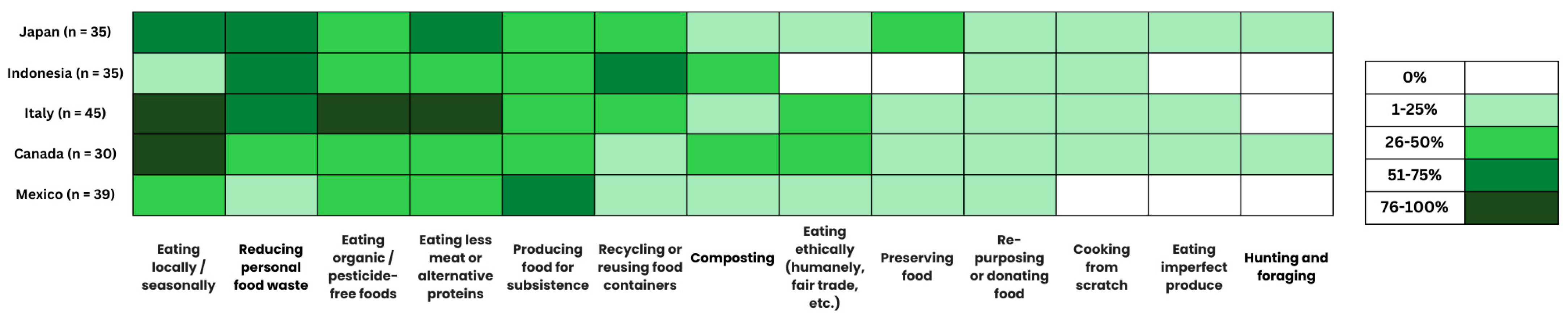
While there were cross-country differences in respondents’ familiarity of behaviours associated with sustainable eating, there were also some common themes across countries. Figure 2 provides a summary of the proportion of respondents from each country who identified various behaviours associated with sustainable eating. Behaviours that were commonly mentioned across most countries include: reducing personal food waste, eating locally and/or seasonally, eating organic or pesticide-free foods, eating less meat or eating more alternative proteins, and producing food for subsistence (such as a home or community garden, or raising backyard chickens for eggs).
Figure 2.
Proportion of respondents reporting behaviours associated with sustainable eating.
Some of the differences in respondents’ identification of sustainable eating behaviours across country contexts were related to how respondents framed the issue of sustainable eating, i.e., their values, attitudes, or beliefs regarding sustainable eating. For example, Italians’ prevalent discussion of animal welfare as a key value related to sustainability was related to the high number of respondents identifying eating less meat as a sustainable eating behaviour. In Japan, many respondents identified waste as a major problem, which translated into the high number of respondents who identified reducing food waste as a key sustainable diet behaviour. In their 2024 study comparing perceptions of sustainable behaviours among Japanese and German adults, Kawasaki and colleagues (2024) also identified that most Japanese adults identified reducing food waste as a sustainable dietary behaviour [56].
Less commonly, respondents described activities such as recycling or reusing food containers, composting, and eating ethically (including humanely raised livestock, fair trade imported products) as sustainable eating behaviours. Indonesian respondents were most likely to identify recycling or reusing food containers as a sustainable eating behaviour, which links with the commonly described belief that food packaging is a sustainability issue. Reusing food containers has also been highlighted in recent efforts to reduce plastic waste in Indonesia [57]. The least commonly described sustainability behaviours included preserving food, repurposing or donating food (e.g., feeding leftovers to animals, or giving leftover food to other people), cooking from scratch for environmental reasons, eating imperfect produce, and hunting or foraging.
A sustainable eating behaviour that emerged through the coding was reducing intake of “processed” or “highly processed” foods. Respondents across all countries discussed how reducing their intake of these foods was important for their own health, as it would help them to reduce their intake of “chemicals” and nutrients of concern like sugar or fat. Respondents also identified that reducing the intake of processed foods was important for the environment due to the high inputs needed to process and transport these foods:
“It means choosing a simple product that comes from a context in which resources are not exploited. This may mean choosing a less processed and less immediate product that comes from a context such as farms, and not from a greenhouse. It’s a choice that prioritizes quality and the origin of food, opting for products that aren’t hyper processed.”(Italy 10: female, postgraduate degree, urban)
“Fast food is like that, it’s processed too much, right? It’s just a waste of energy, you know… to process food in such a way.”(Indonesia 29: male, undergraduate degree, rural)
This concern about the environmental impacts of highly processed foods aligns with recent calls to focus attention on the role that highly processed foods have on the environment [58].
While nearly every respondent across all countries could identify behaviours associated with sustainable eating, some expressed doubt and uncertainty about the issues. For example, some respondents were not convinced that local or organic products were truly sustainable. This tension inherent in the impetus for individual behaviour as a means of effecting structural change has also been observed in environmental behaviour change research [59].
3.5. Barriers to Eating Sustainably
Respondents across the study countries discussed a number of barriers to incorporating more sustainable eating practices into their diets. These barriers were categorized into three primary themes: individual, interpersonal, and structural barriers.
3.5.1. Individual Barriers
Time-intensive: The perception that sustainable eating is more time-intensive was a common barrier to eating sustainably. Many respondents discussed this in relation to the time required to prepare and cook food at home, which they identified as a more sustainable behaviour than eating highly processed, ready-to-eat foods. Japanese respondents also highlighted the practical difficulty of managing food portions and preventing waste within small household structures as a barrier:
“There are times when I think it’s hard, because we live with two people, in terms of the amount of food we eat. For example, if I buy one cabbage because it’s cheap, and I try to use it up, I end up eating cabbage every day. It’s hard to think of recipes for that.”(Japan 10: female, undergraduate degree, urban)
These findings suggest that unless sustainable options are designed to match the “grab-and-go” ease of conventional processed foods, adoption will likely remain limited to highly motivated young adults.
Knowledge: Another common barrier is a general lack of knowledge regarding specific sustainable eating habits. Many participants identified that they, as well as other young adults they know, don’t have sufficient information about what foods are considered sustainable to support sustainable eating behaviours:
“…because when you go to buy your products you don’t know if it is sustainable, right?”(Mexico 18: male, undergraduate degree, urban)
These findings are in line with previous research [7,54] and suggest that even with high intent, consumers may inadvertently make unsustainable choices, highlighting a need for clearer, standardized sustainability labeling on packaging.
Acceptability: Some respondents in each country described sustainable options as unappetizing or undesirable. Some of the Japanese respondents discussed an aversion to entomophagy, which was raised as a sustainable eating habit. Despite being marketed as a sustainable protein source, the unacceptability of insects as a food source has also been observed in other Japanese studies [60]. Rather than marketing ‘sustainability,’ promotional strategies could focus on taste and culinary familiarity to increase the acceptability of sustainable foods that may be novel to the consumer.
3.5.2. Interpersonal Barriers
Social Norms: Respondents in every country discussed the challenges of feeding or eating with family members or friends who were not interested in changing their diets to be more sustainable as a key barrier to eating more sustainably:
“The challenge is to change people’s mindset, and the behaviours… and the behaviours of the people around them”(Indonesia 25: female, postgraduate degree, urban)
Cultural Norms: Some respondents identified that eating sustainably was unaligned with cultural values. For example, respondents in both Italy and Canada commented that giving up meat may be in contrast with their cultural or family values:
“I feel like I grew up in a family that is very meat and potatoes and even though like I love the alternatives, there’s a point where it’s just like I just want a big steak, big mashed potato, tons of butter.”(Canada 158: female, undergraduate degree, urban)
Meat-eating identity has previously been identified as an important barrier to eating more sustainably in Canada, with 53% of a nationally representative sample agreeing that a “proper meal” should include meat and 61% agreeing that meat provides necessary nutrition [61]. These findings suggest that sustainable diet interventions must be focused at the population level and be framed as “cultural evolution” rather than “cultural erasure” to avoid pushback from populations with strong culinary traditions.
3.5.3. Structural Barriers
Affordability: A common barrier was the perception that eating sustainably is significantly more expensive than maintaining a conventional diet. In particular, respondents discussed cost as a barrier to choosing local and organic foods:
“If I could afford it, I would buy only local.”(Japan 13: male, undergraduate degree, urban)
An important point raised in a Mexican interview was that sustainable eating was not a priority for many with low incomes:
“To begin with; the economy in Mexico is not the best. A big amount of people live day to day and with limited resources. These families need to worry about providing food and sustenance, sometimes they need to figure out how they will meet their needs. So, they disregard the fact if a food is sustainable or not.”(Mexico 17: female, undergraduate degree, urban)
Access: Challenges to accessing sustainable food products were identified as key barriers to sustainable eating across all countries. In Canada, respondents who lived rurally described having less access to sustainable foods, specifically manufactured food products such as meat alternatives, as compared to their urban counterparts. This contrasted with the findings in Mexico, where respondents perceived that it was harder to engage in sustainable eating behaviours in urban settings:
“Well, in the city, well, there is a lot of this culture of, like supermarkets and I don’t know, like food is a little more industrialized. And in the countryside it is a little more the culture of the markets, or like the butchers, the chicken shops, so it is more local, then… Well, that’s how I see it. In the city it is more difficult, like, to find those options.”(Mexico 20: male, undergraduate degree, urban)
Previous studies have also found that accessibility is a key barrier to sustainable eating [7,54]. These findings point to the importance of place-based research that recognizes the contextual importance of sustainable eating behaviours and values. They also underscore that policy solutions must be localized and consider the specific food distribution infrastructure within the various contexts.
3.6. Implications for Theory and Practice
To preserve both planetary and individual health, we must identify and implement public health strategies that support a shift toward sustainable diets. Achieving this requires an in-depth understanding of consumer perceptions to ensure the development of effective health messaging and interventions. This study, which was the first to explore and compare young adults’ perceptions of sustainable eating across high- and middle-income countries, found that defining sustainable eating was challenging for some respondents across all countries. Findings also suggest that respondents’ values regarding sustainable diets tended to be context-specific with marked differences across countries and that respondents’ values influenced their perceptions of sustainable eating behaviours.
Despite the fact that some respondents across all countries expressed uncertainty regarding how to define sustainable eating, our findings suggest that nearly all respondents, when probed to discuss behaviours related to sustainable eating, were able to describe aspects of sustainable eating that align with the four dimensions of sustainability, i.e., health and nutrition, environmental, economic, and sociocultural [6]. These findings align with previous research examining consumer perceptions of sustainable diets in Australia, Canada, and the UK [10,35,62] and suggest that while the terms “sustainable diet” or “sustainable eating” may not be well understood, most respondents were able to identify behaviours that could support the health of the planet. Thus, terms like “environmentally sustainable eating” or “environmentally friendly eating” may be more easily understood among consumers [7]. Future research could explore young adults’ perceptions and understanding of these terms to determine whether they are more easily understood and applied than “sustainable eating” and whether these terms elicit definitions that encompass all four dimensions of sustainability.
Our study results showed that respondents’ values, attitudes, and beliefs were context-specific with some key differences across countries. Findings also suggest these values influenced respondents’ perception of the behaviours associated with sustainability, e.g., Italians’ concern about animal welfare was related to their perception that reducing meat was a key sustainable eating behaviour. Behaviour change theories and decades of research underscore the importance of understanding the values, attitudes, and beliefs of a target population in order to inform effective behaviour change strategies [63,64,65,66]. By uncovering young adults’ values, attitudes, and beliefs related to sustainable eating, our findings can help inform values-oriented behaviour change messaging and intervention strategies designed to support the adoption of sustainable diet patterns during this critical life stage when lifelong habits are being established [15]. Our finding that some key values differed across countries indicates that these behaviour change messages and intervention strategies should be tailored to reflect the specific values held within the country contexts. Importantly, two key shared beliefs identified across all five countries were the recognition of waste and food packaging as significant sustainability concerns. This indicates that initiatives aimed at minimizing food waste and packaging could be relevant and effective across country contexts. This focus on reducing consumer food waste also aligns directly with the proposed solutions and actions from the 2025 EAT-Lancet Commission on healthy, sustainable, and just food systems to “reduce consumer waste through improved awareness, education, and skills” [4].
Another common belief identified across respondents from all five countries was that sustainability should be the responsibility of all actors across the food system, not just the individual. Respondents discussed how decisions and practices implemented throughout the food value chain, including at production, processing, retail, food service, consumption, and waste management, impact food sustainability, and that those practices earlier in the food value chain impact an individual’s ability to engage in sustainable eating practices. These findings highlight that while most young adults are interested in changing their individual behaviours to be more sustainable, they want actors across the food value chain to change their practices to support food sustainability and to make it easier for consumers to make sustainable food choices. Previous survey studies have found that young adults are concerned about climate change and that perceptions of lack of action by government and other actors in the food system are contributing to this high level of climate anxiety and related stress [12,14]. Sharing responsibility for sustainable food systems, which is also highlighted in the 2025 EAT-Lancet Commission Report [4], could help address this high level of climate anxiety, foster motivation for individual and collective sustainable behaviour change, and may also amend the erosion of trust in the food industry observed in this study.
Understanding the barriers to behaviour change is also critical to informing effective behaviour change strategies [63,64,65]. As shown in previous research examining barriers to engaging in sustainable eating behaviours [10,27,36,46,62], our study found that a lack of knowledge about sustainable eating habits, financial cost, and time required to access and prepare environmentally sustainable foods, and lack of access to sustainably produced foods were common barriers identified across all five countries. While most respondents were interested in making their diets more sustainable, many also identified that they needed more information about which eating habits are considered the most sustainable and which foods they should be selecting at the grocery store. These findings, coupled with our findings that many respondents were unsure what is meant by sustainable eating, suggest that public health messaging could be used to increase consumers’ knowledge and awareness of sustainable eating habits. This messaging could include guidance on which food habits have the greatest impact on sustainability, described by Whittall et al. (2023, p. 7) as “a hierarchy of sustainable actions” [10]. Using clear, standardized sustainability food labels could also support consumers in identifying which foods have been produced sustainably.
Incorporating sustainable eating education within school curricula was recommended by respondents as a way to increase knowledge and awareness of sustainable eating. To address perceived cost barriers to sustainable diets, health messaging and education could highlight potential cost savings associated with some sustainable behaviours, such as reducing food waste and replacing meat with minimally processed legumes. Tax policies, including subsidies for producing more sustainable foods, could increase the availability of sustainably produced foods and help ensure equitable access to these foods. While these policies and intervention approaches identified by our study participants align with the solutions and actions for a healthy, sustainable, and just food system identified in the 2025 EAT-Lancet Commission Report [4], the potential effectiveness of these intervention strategies will likely vary by country context. Redressing structural barriers to food access, while relevant in all countries, is likely particularly critical in low and middle-income countries. Thus, in addition to being tailored to consumers’ values and beliefs, intervention policies and approaches designed to protect our planet and our health by supporting sustainable eating behaviours must also be tailored to the countries’ socio-political and cultural context.
3.7. Limitations and Future Research
This study has some limitations that should be considered when interpreting study results. While our sample size is appropriate for qualitative research, participants self-selected into the study and, thus, our sample is not representative of the diversity of factors that may influence perceptions of sustainable eating. These study findings can, however, inform future, large-scale quantitative surveys that can provide a more definitive understanding of young adults’ perceptions of sustainable eating among more representative samples. This study did not include participants in low-income countries; thus, it is unknown whether these findings are generalisable to low-income country contexts. Future qualitative and quantitative studies examining perceptions of sustainable diets should include participants from low-income countries, which could allow for more in-depth cross-country comparisons. This study also excluded vegetarians and vegans to avoid engaging those with a high interest or knowledge of sustainable diets. Thus, our findings may not be generalisable to these groups and may not account for the behaviours, motivations, and dietary patterns of those who have already adopted more sustainable diets. Future research could include a more diverse sample to allow for a comparative analysis between those who eat animal-based proteins and those who do not.
4. Conclusions
Promoting planetary and individual health requires the implementation of strategies that facilitate sustainable diets. This study addresses a key gap in sustainable diet research by providing the first cross-country comparison of how young adults in high- and middle-income countries perceive sustainable eating. While most previous qualitative work has focused on specific sustainable behaviours like meat reduction, this study uncovered the personal values and contextual differences that shape consumer motivations and barriers across a wide range of sustainable behaviours. Findings suggest that terms such as “environmentally sustainable eating” or “environmentally friendly eating” may be better understood by young adult consumers than “sustainable diet” or “sustainable eating”, and consumers’ values regarding sustainable diets tended to be context-specific with marked differences across countries. However, there were some common themes across countries, including concern about waste and food packaging and the belief that sustainability should be the responsibility of all actors across the food system, not just the individual. Young adults’ perceptions of behaviours associated with sustainable diets were informed by their values and, therefore, differed across country contexts. Overall, study findings indicate that messaging and strategies to support sustainable eating patterns should be values-oriented, tailored to each country’s context, and should encompass both the individual and systemic dimensions of food sustainability.
Author Contributions
Conceptualization, J.H., K.P., K.F.E., F.H., Y.T., S.H., W.L., L.P., M.T., N.T., D.D.J.-J. and W.S.; methodology, J.H., K.P., K.F.E., F.H., Y.T., S.H., W.L., L.P., M.T., N.T., D.D.J.-J. and W.S.; formal analysis, J.H. and K.P.; investigation, K.F.E., F.H., Y.T., S.H., W.L., L.P., M.T., N.T. and D.D.J.-J.; data curation, J.H., K.P., K.F.E., F.H., Y.T., S.H., W.L., L.P., M.T., N.T. and D.D.J.-J.; writing—original draft preparation, J.H., K.P. and K.F.E.; writing—review and editing, J.H., K.P., K.F.E., F.H., Y.T., S.H., W.L., L.P., M.T., N.T., D.D.J.-J. and W.S.; funding acquisition, J.H., K.P., K.F.E., F.H., Y.T., S.H., W.L., L.P., M.T., N.T., D.D.J.-J. and W.S. All authors have read and agreed to the published version of the manuscript.
Funding
This research was funded by Danone Institute International. The funder was not involved in the development or implementation of this research or in the interpretation of study results.
Institutional Review Board Statement
The study was approved by the Research Ethics Review Committee, Kagawa Nutrition University (code 506 and dated 17 January 2024); Medical and Health Research Ethics Committee (MHREC), Faculty of Medicine, Public Health and Nursing, Universitas Gadjah Mada (code Ref. No. KE/FK/0578/EC/2024 and dated 18 April 2024); University of Guelph Research Ethics Board (code REB#23-10-018 and dated 16 November 2023); Research Ethics Committee of the Salvador Zubirán National Institute of Medical Sciences and Nutrition (code REF. 4901 and dated 23 January 2024).
Informed Consent Statement
Informed consent was obtained from all subjects involved in the study.
Data Availability Statement
The datasets presented in this article are not readily available as interview transcripts may contain identifiable data. Requests to access the datasets should be directed to jhaines@uoguelph.ca.
Acknowledgments
We acknowledge the following people who were instrumental in supporting the administration and data collection of this project: Lourdes Galhoz, Minako Minami, Nami Fujimoto, Laura Corridore, Alejandra Romero, Jaime Garcia Mena, and Kristie Leigh.
Conflicts of Interest
Jess Haines has received funding from the Danone Institute International and Danone Institute North America. Wendelin Slusser has received funding from the Danone Institute International and Danone Institute North America. Ludovica Principato and Martina Toni have received funding from Italian Fondazione Istituto Danone. Nimbe Torres and Diana De Jesus-Jacintos have received funding from Danone Institute International and Instituto Danone-México. All other authors declare that the research was conducted in the absence of any commercial or financial relationships that could be construed as a potential conflict of interest. The funders had no role in the design of the study; in the collection, analyses, or interpretation of data; in the writing of the manuscript; or in the decision to publish the results.
Abbreviations
The following abbreviations are used in this manuscript:
| CO2 | Carbon dioxide |
| FAO | Food and Agricultural Organization |
| OECD | Organization for Economic Co-Operation and Development |
| SDG | Sustainable Development Goals |
| UK | United Kingdom |
| USD | United States Dollars |
References
- Urbanization Is Transforming Agrifood Systems Across the Rural–Urban Continuum Creating Challenges and Opportunities to Access Affordable Healthy Diets; FAO: Rome, Italy, 2023; ISBN 978-92-5-138222-6.
- Vega Mejía, N.; Ponce Reyes, R.; Martinez, Y.; Carrasco, O.; Cerritos, R. Implications of the Western Diet for Agricultural Production, Health and Climate Change. Front. Sustain. Food Syst. 2018, 2, 88. [Google Scholar] [CrossRef] [Scilit]
- Willett, W.; Rockström, J.; Loken, B.; Springmann, M.; Lang, T.; Vermeulen, S.; Garnett, T.; Tilman, D.; DeClerck, F.; Wood, A.; et al. Food in the Anthropocene: The EAT–Lancet Commission on Healthy Diets from Sustainable Food Systems. Lancet 2019, 393, 447–492. [Google Scholar] [CrossRef] [Scilit]
- Rockström, J.; Thilsted, S.H.; Willett, W.C.; Gordon, L.J.; Herrero, M.; Hicks, C.C.; Mason-D’Croz, D.; Rao, N.; Springmann, M.; Wright, E.C.; et al. The EAT–Lancet Commission on Healthy, Sustainable, and Just Food Systems. Lancet 2025, 406, 1625–1700. [Google Scholar] [CrossRef] [Scilit] [PubMed]
- Sustainable Healthy Diets: Guiding Principles; Food and Agriculture Organization of the United Nations: Rome, Italy; World Health Organization: Geneva, Switzerland, 2019; ISBN 978-92-5-131875-1.
- Drewnowski, A.; Finley, J.; Hess, J.M.; Ingram, J.; Miller, G.; Peters, C. Toward Healthy Diets from Sustainable Food Systems. Curr. Dev. Nutr. 2020, 4, nzaa083. [Google Scholar] [CrossRef] [Scilit]
- Kenny, T.A.; Woodside, J.V.; Perry, I.J.; Harrington, J.M. Consumer Attitudes and Behaviors toward More Sustainable Diets: A Scoping Review. Nutr. Rev. 2023, 81, 1665–1679. [Google Scholar] [CrossRef] [Scilit]
- Ruzgys, S.; Pickering, G.J. Gen Z and Sustainable Diets: Application of The Transtheoretical Model and the Theory of Planned Behaviour. J. Clean. Prod. 2024, 434, 140300. [Google Scholar] [CrossRef] [Scilit]
- Van Bussel, L.M.; Kuijsten, A.; Mars, M.; Van ‘T Veer, P. Consumers’ Perceptions on Food-Related Sustainability: A Systematic Review. J. Clean. Prod. 2022, 341, 130904. [Google Scholar] [CrossRef] [Scilit]
- Whittall, B.; Warwick, S.M.; Guy, D.J.; Appleton, K.M. Public Understanding of Sustainable Diets and Changes towards Sustainability: A Qualitative Study in a UK Population Sample. Appetite 2023, 181, 106388. [Google Scholar] [CrossRef] [Scilit]
- McDonald, S.M. Perception: A Concept Analysis. Int. J. Nurs. Knowl. 2012, 23, 2–9. [Google Scholar] [CrossRef] [Scilit]
- Lawrance, E.L.; Jennings, N.; Kioupi, V.; Thompson, R.; Diffey, J.; Vercammen, A. Psychological Responses, Mental Health, and Sense of Agency for the Dual Challenges of Climate Change and the COVID-19 Pandemic in Young People in the UK: An Online Survey Study. Lancet Planet. Health 2022, 6, e726–e738. [Google Scholar] [CrossRef] [Scilit]
- Yamane, T.; Kaneko, S. Is the Younger Generation a Driving Force toward Achieving the Sustainable Development Goals? Survey Experiments. J. Clean. Prod. 2021, 292, 125932. [Google Scholar] [CrossRef] [Scilit]
- Hickman, C.; Marks, E.; Pihkala, P.; Clayton, S.; Lewandowski, R.E.; Mayall, E.E.; Wray, B.; Mellor, C.; Van Susteren, L. Climate Anxiety in Children and Young People and Their Beliefs about Government Responses to Climate Change: A Global Survey. Lancet Planet. Health 2021, 5, e863–e873. [Google Scholar] [CrossRef] [Scilit]
- Nelson, M.C.; Story, M.; Larson, N.I.; Neumark-Sztainer, D.; Lytle, L.A. Emerging Adulthood and College-aged Youth: An Overlooked Age for Weight-related Behavior Change. Obesity 2008, 16, 2205–2211. [Google Scholar] [CrossRef] [Scilit]
- FAO. Food-Based Dietary Guidelines—Italy. Available online: https://www.fao.org/nutrition/education/food-dietary-guidelines/regions/countries/italy/en/ (accessed on 2 December 2025).
- FAO. Food-Based Dietary Guidelines—Japan. Available online: https://www.fao.org/nutrition/education/food-dietary-guidelines/regions/countries/japan/en/ (accessed on 2 December 2025).
- FAO. Food-Based Dietary Guidelines—Canada. Available online: https://www.fao.org/nutrition/education/food-dietary-guidelines/regions/countries/canada/en/ (accessed on 2 December 2025).
- Guías Alimentarias Saludables y Sostenibles Para La Población Mexicana. Available online: https://www.gob.mx/salud/sinsamac/documentos/guias-alimentarias-saludables-y-sostenibles-para-la-poblacion-mexicana-2025 (accessed on 2 December 2025).
- FAO. Food-Based Dietary Guidelines—Indonesia. Available online: https://www.fao.org/nutrition/education/food-dietary-guidelines/regions/countries/indonesia/en/ (accessed on 2 December 2025).
- FAO. Dietary Guidelines: Background. Available online: https://www.fao.org/nutrition/education/dietary-guidelines/background/en/ (accessed on 2 December 2025).
- Hammarberg, K.; Kirkman, M.; De Lacey, S. Qualitative Research Methods: When to Use Them and How to Judge Them. Hum. Reprod. 2016, 31, 498–501. [Google Scholar] [CrossRef] [Scilit]
- Braun, V.; Clarke, V. Successful Qualitative Research: A Practical Guide for Beginners, 1st ed.; SAGE: London, UK, 2013; ISBN 978-1-84787-581-5. [Google Scholar]
- Buus, N.; Perron, A. The Quality of Quality Criteria: Replicating the Development of the Consolidated Criteria for Reporting Qualitative Research (COREQ). Int. J. Nurs. Stud. 2020, 102, 103452. [Google Scholar] [CrossRef] [Scilit]
- Morse, J.M. Determining Sample Size. Qual. Health Res. 2000, 10, 3–5. [Google Scholar] [CrossRef] [Scilit]
- Saunders, B.; Sim, J.; Kingstone, T.; Baker, S.; Waterfield, J.; Bartlam, B.; Burroughs, H.; Jinks, C. Saturation in Qualitative Research: Exploring Its Conceptualization and Operationalization. Qual. Quant. 2018, 52, 1893–1907. [Google Scholar] [CrossRef] [Scilit] [PubMed]
- Srinivasan, S.; Galvez, A.; Krieger, R.; Sebo, A.; Mckever, M.; Nestico, D.; Carlsson, L.; Wegener, J.; Everitt, T. Factors That Facilitate Consumer Uptake of Sustainable Dietary Patterns in Western Countries: A Scoping Review. Front. Sustain. Food Syst. 2024, 8, 1333742. [Google Scholar] [CrossRef] [Scilit]
- Pohjolainen, P.; Vinnari, M.; Jokinen, P. Consumers’ Perceived Barriers to Following a Plant-Based Diet. Br. Food J. 2015, 117, 1150–1167. [Google Scholar] [CrossRef] [Scilit]
- Mann, D.; Thornton, L.; Crawford, D.; Ball, K. Australian Consumers’ Views towards an Environmentally Sustainable Eating Pattern. Public Health Nutr. 2018, 21, 2714–2722. [Google Scholar] [CrossRef] [Scilit]
- Richards, K.A.R.; Hemphill, M.A. A Practical Guide to Collaborative Qualitative Data Analysis. J. Teach. Phys. Educ. 2018, 37, 225–231. [Google Scholar] [CrossRef] [Scilit]
- Saldaña, J. Fundamentals of Qualitative Research; Understanding Qualitative Research; Oxford University Press: New York, NY, USA, 2011; ISBN 978-0-19-973795-6. [Google Scholar]
- Hennink, M.M.; Kaiser, B.N.; Marconi, V.C. Code Saturation Versus Meaning Saturation: How Many Interviews Are Enough? Qual. Health Res. 2017, 27, 591–608. [Google Scholar] [CrossRef] [Scilit]
- Litwin, H.; Sapir, E.V. Perceived income adequacy among older adults in 12 countries: Findings from the Survey of Health, Ageing, and Retirement in Europe. Gerontologist 2009, 49, 397–406. [Google Scholar] [CrossRef] [Scilit] [PubMed]
- Aureli, V.; Nardi, A.; Palmieri, N.; Peluso, D.; Di Veroli, J.N.; Scognamiglio, U.; Rossi, L. Sustainability Perception of Italian Consumers: Is It Possible to Replace Meat, and What Is the Best Alternative? Nutrients 2023, 15, 3861. [Google Scholar] [CrossRef] [Scilit]
- Keisyafa, A.; Novaturahmah Sunarya, D.; Monna Aghniya, S.; Putri Maula, S. Analysis of Student’s Awareness of Sustainable Diet in Reducing Carbon Footprint to Support Sustainable Development Goals (SDGs) 2030. ASEAN J. Agric. Food Eng. 2024, 3, 67–74. [Google Scholar]
- Ronto, R.; Saberi, G.; Carins, J.; Papier, K.; Fox, E. Exploring Young Australians’ Understanding of Sustainable and Healthy Diets: A Qualitative Study. Public Health Nutr. 2022, 25, 2957–2969. [Google Scholar] [CrossRef] [Scilit]
- Migliavada, R.; Coricelli, C.; Bolat, E.E.; Uçuk, C.; Torri, L. The Modulation of Sustainability Knowledge and Impulsivity Traits on the Consumption of Foods of Animal and Plant Origin in Italy and Turkey. Sci. Rep. 2022, 12, 20036. [Google Scholar] [CrossRef] [Scilit]
- Aureli, V.; Nardi, A.; Palmieri, N.; Peluso, D.; Rossi, L. When Knowledge Is Not Enough: Understanding the Barriers to Sustainable Food Choices in Italy. Int. J. Food Sci. Nutr. 2025, 76, 560–570. [Google Scholar] [CrossRef] [Scilit] [PubMed]
- Kumagai, F.; Keyser, D.J. Unmasking Japan Today: The Impact of Traditional Values on Modern Japanese Society; Praeger: Westport, CT, USA; London, UK, 1996; ISBN 978-0-275-95144-3. [Google Scholar]
- Takagi, E.; Saito, Y. A Longitudinal Analysis of the Impact of Family Support on the Morale of Older Parents in Japan: Does the Parent’s Normative Belief in Filial Responsibilities Make a Difference? Ageing Soc. 2013, 33, 1053–1076. [Google Scholar] [CrossRef] [Scilit]
- Kawasaki, Y.; Akamatsu, R.; Warschburger, P. The Relationship between Traditional and Common Japanese Childhood Education and Adulthood towards Avoiding Food Waste Behaviors. Waste Manag. 2022, 145, 1–9. [Google Scholar] [CrossRef] [Scilit]
- Cvijanović, D.; Ignjatijević, S.; Vapa Tankosić, J.; Cvijanović, V. Do Local Food Products Contribute to Sustainable Economic Development? Sustainability 2020, 12, 2847. [Google Scholar] [CrossRef] [Scilit]
- Rubini, G.; Nannoni, E.; Di Pasquale, J.; Martelli, G.; Sardi, L. Update on Animal Welfare Perception by Italian Consumers: A Descriptive Survey. Ital. J. Food Saf. 2021, 10, 9588. [Google Scholar] [CrossRef] [Scilit]
- GlobeScan Grains of Truth 2023 Report. Available online: https://globescan.com/2024/01/05/grains-of-truth/#:~:text=This%20is%20the%20third%20edition,can%20make%20the%20most%20change (accessed on 2 December 2025).
- Batis, C.; Marrón-Ponce, J.A.; Stern, D.; Vandevijvere, S.; Barquera, S.; Rivera, J.A. Adoption of Healthy and Sustainable Diets in Mexico Does Not Imply Higher Expenditure on Food. Nat. Food 2021, 2, 792–801. [Google Scholar] [CrossRef] [Scilit]
- Mollaei, S.; Minaker, L.M.; Lynes, J.K.; Dias, G.M. Perceptions and Determinants of Adopting Sustainable Eating Behaviours among University Students in Canada: A Qualitative Study Using Focus Group Discussions. Int. J. Sustain. High. Educ. 2023, 24, 252–298. [Google Scholar] [CrossRef] [Scilit]
- Perez-Cueto, F.J.A.; Rini, L.; Faber, I.; Rasmussen, M.A.; Bechtold, K.-B.; Schouteten, J.J.; De Steur, H. How Barriers towards Plant-Based Food Consumption Differ According to Dietary Lifestyle: Findings from a Consumer Survey in 10 EU Countries. Int. J. Gastron. Food Sci. 2022, 29, 100587. [Google Scholar] [CrossRef] [Scilit]
- Lemy, D.M.; Rahardja, A.; Kilya, C.S. Generation Z Awareness on Food Waste Issues (a Study in Tangerang, Indonesia). J. Bus. Hosp. Tour. 2021, 6, 329. [Google Scholar] [CrossRef] [Scilit]
- Soma, T. Space to Waste: The Influence of Income and Retail Choice on Household Food Consumption and Food Waste in Indonesia. Int. Plan. Stud. 2020, 25, 372–392. [Google Scholar] [CrossRef] [Scilit]
- OECD. Beyond Food Loss and Waste Reduction Targets: Translating Reduction Ambitions into Policy Outcomes, 214th ed.; Agriculture and Fisheries Papers; OECD Food: Paris, France, 2025. [Google Scholar]
- Timpanaro, G.; Scuderi, A.; Guarnaccia, P.; Foti, V.T. Will Recent World Events Shift Policy-Makers’ Focus from Sustainable Agriculture to Intensive and Competitive Agriculture? Heliyon 2023, 9, e17991. [Google Scholar] [CrossRef] [Scilit]
- OECD. OECD Survey on Drivers of Trust in Public Institutions—2024 Results; OECD: Paris, France, 2024. [Google Scholar]
- OECD. Integrity Review of Italy: Reinforcing Public Sector Integrity, Restoring Trust for Sustainable Growth; OECD, Ed.; OECD Public Governance Reviews; OECD Publishing: Paris, France, 2013; ISBN 978-92-64-19381-9. [Google Scholar]
- Muñoz-Martínez, J.; Cussó-Parcerisas, I.; Carrillo-Álvarez, E. Exploring the Barriers and Facilitators for Following a Sustainable Diet: A Holistic and Contextual Scoping Review. Sustain. Prod. Consum. 2024, 46, 476–490. [Google Scholar] [CrossRef] [Scilit]
- Japan’s 2011 Earthquake and Tsunami: Food and Agriculture Implications; Congressional Research Service: Washington, DC, USA, 2011.
- Kawasaki, Y.; Nagao-Sato, S.; Shimpo, M.; Fujisaki, K.; Yoshii, E.; Böhnke, J.; Akamatsu, R.; Warschburger, P. Understanding Sustainable Dietary Behaviors in Japanese and German Adults: A Cross-Cultural Comparison. Resour. Conserv. Recycl. 2024, 201, 107330. [Google Scholar] [CrossRef] [Scilit]
- Apriadi, B.F.; Setiawan, R.P.; Firmansyah, I. Policy Scenario of Plastic Waste Mitigation in Indonesia Using System Dynamics. Waste Manag. Res. 2024, 42, 1008–1018. [Google Scholar] [CrossRef] [Scilit] [PubMed]
- Da Cruz, G.L.; Da Costa Louzada, M.L.; Silva, J.T.D.; Maria Fellegger Garzillo, J.; Rauber, F.; Schmidt Rivera, X.; Reynolds, C.; Levy, R.B. The Environmental Impact of Beef and Ultra-Processed Food Consumption in Brazil. Public Health Nutr. 2024, 27, e34. [Google Scholar] [CrossRef] [Scilit]
- Chater, N.; Loewenstein, G. The I-Frame and the s-Frame: How Focusing on Individual-Level Solutions Has Led Behavioral Public Policy Astray. Behav. Brain Sci. 2023, 46, e147. [Google Scholar] [CrossRef] [Scilit]
- Takeda, K.F.; Yazawa, A.; Yamaguchi, Y.; Koizumi, N.; Shineha, R. Comparison of Public Attitudes toward Five Alternative Proteins in Japan. Food Qual. Prefer. 2023, 105, 104787. [Google Scholar] [CrossRef] [Scilit]
- Abebe, G.K.; Ismail, M.R.; Kevany, K.; Haileslassie, H.A.; Young, L.; Pauley, T. Factors Influencing Intentions to Transition to Plant-based Protein Diets: Canadian Perspective. Food Sci. Nutr. 2024, 2, 8903–8919. [Google Scholar] [CrossRef] [Scilit]
- Ruzgys, S.; Pickering, G.J. Perceptions of a Sustainable Diet among Young Adults. Environ. Educ. Res. 2024, 31, 512–528. [Google Scholar] [CrossRef] [Scilit]
- Ajzen, I. The Theory of Planned Behavior. Organ. Behav. Hum. Decis. Process. 1991, 50, 179–211. [Google Scholar] [CrossRef] [Scilit]
- Bandura, A. Social Foundations of Thought and Action: A Social Cognitive Theory; Prentice Hall: Englewoods Cliffs, NJ, USA, 1986. [Google Scholar]
- Michie, S.; Van Stralen, M.M.; West, R. The Behaviour Change Wheel: A New Method for Characterising and Designing Behaviour Change Interventions. Implement. Sci. 2011, 6, 42. [Google Scholar] [CrossRef] [Scilit] [PubMed]
- Stern, P.C. New Environmental Theories: Toward a Coherent Theory of Environmentally Significant Behavior. J. Soc. Issues 2000, 56, 407–424. [Google Scholar] [CrossRef] [Scilit]


Disclaimer/Publisher’s Note: The statements, opinions and data contained in all publications are solely those of the individual author(s) and contributor(s) and not of MDPI and/or the editor(s). MDPI and/or the editor(s) disclaim responsibility for any injury to people or property resulting from any ideas, methods, instructions or products referred to in the content. |
© 2026 by the authors. Licensee MDPI, Basel, Switzerland. This article is an open access article distributed under the terms and conditions of the Creative Commons Attribution (CC BY) license.