
Article

Housing Retrofit at Scale: A Diffusion of Innovations Perspective for Planetary Health and Human Well-Being


by
Chamara Panakaduwa
1,*,
Paul Coates
1,
Nishan Mallikarachchi
2,
Harshi Bamunuachchige
1 and
Srimal Samansiri
1
1
School of Science, Engineering and Environment, University of Salford, 43 Crescent, Salford M5 4WT, UK
2
Newcastle Business School, Northumbria University, Newcastle upon Tyne NE1 8ST, UK
*
Author to whom correspondence should be addressed.
Challenges 2026, 17(1), 4; https://doi.org/10.3390/challe17010004
Submission received: 2 December 2025 / Revised: 13 January 2026 / Accepted: 14 January 2026 / Published: 16 January 2026
(This article belongs to the Section Energy Sustainability)

Abstract

Housing stock is observed to be associated with high carbon emissions, high fuel poverty and low comfort levels in the UK. Retrofitting the housing stock is one of the best solutions to address these problems. This paper directly corresponds with human and planetary health in terms of climate change, human health and mental health by addressing the challenges of housing retrofit at scale. Retrofitting houses can also contribute to social equity, reduced use of planetary resources and better financial and physical comfort. Despite the availability of the right technology, government grants and the potential to acquire supply chain and skilled labour, the progress of retrofit is extremely poor. Importantly, the UK is off track to achieve net zero by 2050, and the housing stock contributes 18.72% of the total emissions. The problem is further exacerbated by the 30.4 million units of housing stock. Robust strategies are required to retrofit the housing stock at scale. The study uses a qualitative modelling method under the diffusion of innovations theory to formulate a retrofit-at-scale strategy for the UK. Findings recommend focusing on skill development, show homes, research and innovation, supply chain development, business models, government grants and regulatory tools in a trajectory from 2025 to 2050. The proposed strategy is aligned with the segments of the diffusion of innovation theory. Although the analysis was performed with reference to the UK, the findings are transferable, considering the broader and urgent concerns related to human and planetary health.

1. Introduction

The fundamental relationship between the stability of Earth’s natural systems and human well-being is emphasised by planetary health [1]. Due to the unavoidable importance of housing in the lives of humans, the impact of housing on both human well-being and the Earth cannot be ignored. Furthermore, housing is a highly sensitive socio-economic, socio-political and technological criterion. The poor energy efficiency of the housing stock significantly contributes to public health, greenhouse gas emissions, unhealthy indoor environments, social inequalities and planetary resource depletion [2,3,4]. Improving the energy performance of the housing stock is a key challenge in ensuring planetary health.
According to the latest statistics, the United Kingdom has nearly 30.4 million houses as of 2023 [5]. This housing stock was reported to generate 18.72% of the total emissions in the UK in the same year [6]. Furthermore, the housing sector shows the third slowest progress in decarbonisation (34%) compared to the other sectors (electricity supply—82%, industry—69%, fuel supply—63%, all other sectors—54%, public buildings—47%, residential buildings—34%, domestic transport—15%, and commercial buildings—5%) from 1990 to 2024 [7].
In the UK, 3.17 million households (13%) are reported to be in fuel poverty, with residents struggling to afford energy bills [8]. The higher the energy efficiency of the properties, the less likely residents are to fall into fuel poverty. For example, private-rented and owner-occupier tenures have the lowest average energy efficiency ratings in England and Wales [9]. Private-rented and owner-occupier households are likely to be in fuel poverty, with 21.5% and 14.9% reported to be in fuel poverty, respectively. Importantly, they show the highest average gap in fuel poverty. Socially rented houses are comparatively more energy efficient, and they are less likely to be in fuel poverty (13%) and show the lowest gap [10].
Apart from this, the cost of poor housing in England to the National Health Service is reported to be GBP 848 million. This is mainly due to the negative health consequences of excess cold. It is estimated that the total cost of the repair of housing stock is GBP 6.0 billion, and the payback is only 7.1 years [11]. In general, UK houses are reported to be smaller, older and lower in comfort [12]. Approximately 4.5 million UK houses are reported to overheat during the summer [13]. Accordingly, there is an urgent requirement to improve the performance of houses in the UK to address a range of social and environmental problems.
One potential answer to the problem of poor-quality housing is to retrofit houses to a higher level of performance. Although not directly recognised by the International Standards Institution in the vocabulary of building and civil engineering works, retrofit can be recognised as the improvement of the performance of a built asset to a higher standard [14]. The British Standards Institution highlights the improvement of energy efficiency, ventilation, and carbon emission reduction as the key performance criteria in housing retrofit [15]. As far as the housing stock in England is concerned, 60% of houses have an Energy Performance Certificate (EPC), and the percentage in band “C” or above is 43.80% [16].
According to the UK Climate Change Committee, the EPC rating “C” can be regarded as the accepted performance level for their Balanced Pathway to Net Zero [17]. In response to this recommendation, the UK government expects to increase the EPC rating of almost all the houses in the UK to level “C” by 2035 in its Balanced Pathway to Net Zero 2050 [18]. This level informs a space heating efficiency level of 90 kWh/m2/yr according to the Social Housing Decarbonisation Fund (SHDF) Wave 2.1 performance requirement [19]. There are arguments about the sufficiency of this level due to the broader requirements of occupant health, fuel poverty, and other human comfort criteria. The Low Energy Transformation Initiative (LETI) has recommended an optimised range of energy efficiency for UK housing retrofit. Accordingly, the recommended minimum energy-efficiency levels are as follows: 68% of houses—65 kWh/m2/yr, 50% of houses—50 kWh/m2/yr, and 5% of houses—35 kWh/m2/yr. There will be a residual for heritage-constrained houses [20]. Extending the life of houses is another requirement of the housing stock, as 54.8% of the total UK houses are more than 60 years old [21].
Despite the urgency to retrofit existing houses in the UK, progress is unsatisfactory. With regard to decarbonisation, emissions from the housing stock have been reduced by 34% from 1990 to 2024, while overall emissions have been reduced by 54% in the same period [7]. The indicators of fuel poverty vary due to frequent fluctuations of fuel prices. Energy efficiency is a no-regret solution for fuel poverty, as it would likely address the problem better than any other potential solution. From the perspective of EPC ratings [16], approximately 8 million houses need to be retrofitted. However, not all the EPC “C” houses are decarbonised, and they use fossil fuel boilers [16]. Since there are no market-ready alternative energies for space and water heating of housing (such as hydrogen) so far, the minimal level of retrofit can be considered to be achieving an EPC “C” rating with a heat pump [18,22]. According to the Microgeneration Certification Scheme (MCS) statistics, the total number of heat pumps installed in the UK by December 2025 was around 335,000 [23] (There may be installations that were not certified by MCS. However, they are not considered best practice and do not qualify for government grants). This takes the UK back to square one; the UK needs to retrofit around 30 million houses before 2050 to achieve net zero by 2050.
While the energy performance of the housing stock is poor in the UK, other European and international contexts also do not show a considerable difference. Apart from heat pumps, some countries, such as Sweden, have sustainable district heating solutions [24]. A brief analysis was conducted to understand the likely percentage of houses that need to be retrofitted from the total housing stock of some European countries. These figures were collected only to obtain an understanding of the scope of the problem (Houses with an EPC rating from A to C were not required to be retrofitted, regardless of whether they used fossil fuels for heating. Please note that these are approximations based on the available EPC records. EPC calculation methodologies can differ from one country to another).
According to Table 1, it is clear that countries need to retrofit millions of houses by 2050, and the progress is nowhere near that. Regarding the UK, previous grant schemes such as the Social Housing Decarbonisation Fund and the Home Upgrade Grant have proven that the right technology is available to retrofit houses to meet the required change [25]. Quality assurance is addressed by retrofit specifications such as PAS 2030 and PAS 2035 [15,26] or standards such as BS 40104. The current Labour government of the UK allocated GBP 13.2 billion in funding for housing retrofit for 2024–2030 [27]. While there are concerns about the supply chain and skilled labour, it can be argued that these can be imported, subject to proper demand. However, is there demand from residents for retrofit?
The UK faces a challenge in retrofitting houses that goes beyond technology, quality assurance, supply chain, or skilled labour: poor demand from the residents [29]. Retrofit is not something which can be solved by throwing money at the problem or making rules. This is the exact reason why most of the government retrofit grant schemes were underutilised and poorly delivered [30]. The failed Green Deal in 2013 [31] and the failed Green Homes Grant Voucher scheme in 2020 [32] serve as examples of this.
The Green Deal misunderstood resident behaviour. The Green Deal was designed under the golden rule of paying back the investment through energy bill savings. This assumed a purely rational decision-maker, which was wrong from the beginning [33]. The Green Homes Grant was poorly designed with unrealistic objectives and timescales. Although the government had allocated GBP 1.5 billion for this scheme, only GBP 314 million (GBP 50 million for administrative expenses) had been spent by the end of the programme. Approximately 47,500 houses were retrofitted compared to the original 600,000 target [32]. Retrofit cannot be forced on residents through regulations. For example, the government had to withdraw the Minimum Energy Efficiency Standards (MEES) due to the fear of public objection [34].
In order to retrofit millions of houses by 2050, every country needs a strong strategy which puts residents at the centre [35]. A similar scenario was observed in the 1960s, when houses shifted from coal heating to gas heating. Around 13 million houses were converted from coal to gas heating from 1967 to 1977 in a centrally coordinated process. Although there are a number of similarities, the transition to net zero from gas is more complex than before in terms of cost, technology, infrastructure, policy, and project delivery [36]. Better strategic plans are required to consider the nature of the transition from gas to net zero.
Although retrofitting houses itself is not an innovation to the scientific community, residents will regard retrofitting as an innovation. It will affect their usual comfort zone and disrupt their daily routines. Retrofit can be regarded as an innovation for the residents. This study aims to propose a retrofit-at-scale strategy based on the theory of diffusion of innovation by Everette M. Rogers [37]. Consideration of retrofit as an innovation for residents is a key assumption of this study.
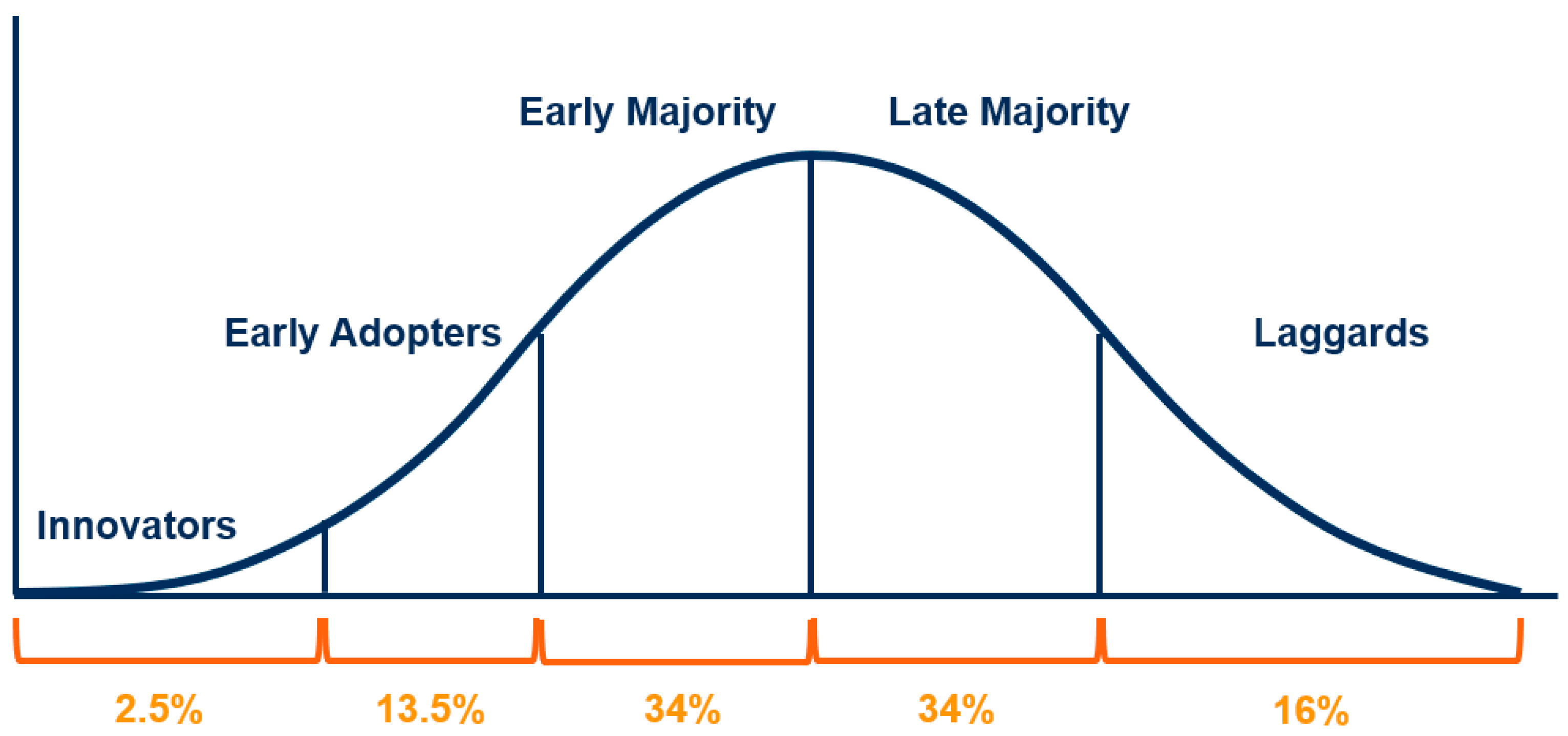
Figure 1 illustrates the diffusion of innovations theory. The theory was proposed by Everett M. Rogers in 1962 in his book Diffusion of Innovations following extensive publications on the topic. This theory proposes how the general population will respond to an innovation, in terms of adoption. There is a normal curve assumed for the level of adoption of innovations [37]. There are five distinct sets of people who will respond to an innovation differently in a normal population. They have different behaviours towards innovation. These characteristics are better explained in the discussion.

2. Materials and Methods

The diffusion of innovations theory was used as the basis for analysing the literature for this study. Segments of the population were reviewed according to their characteristics and the insights from the housing retrofit industry. The qualitative modelling methodology was used. According to Forbus, qualitative modelling is ideal when no granular-level quantitative data are available or required. Qualitative modelling uses a high level of abstraction and focuses on causality to draw conclusions. For example, quantitative modelling can inform the exact thermostat required for a tea warmer, while qualitative modelling can indicate that the tea is required to be kept at a drinkable temperature, without allowing it to boil [38].
The UK housing retrofit industry includes more than 30 million households, and their level of innovation adoption is uncertain. Despite the balanced path to Net Zero 2050 recommended by the Climate Change Committee [17], no proper strategy is observed. In this situation, the priority is to clarify the direction of a retrofitting strategy and the potential order of deliverables. Accordingly, this study first reviewed the housing retrofit scenario in the UK. The COM-B model was used to understand the required behavioural change for retrofit at scale. The COM-B model provides three key inputs required for behavioural change: capability (C), opportunity (O) and motivation (M). The letter “B” stands for “Behaviour.” [39] This model is an academically recognised model related to behavioural change studies. The model was useful to the study, since it mainly focused on the application of diffusion of innovations theory to household behaviour related to housing retrofit. Furthermore, the study proposes a retrofit-at-scale strategy in light of the diffusion of innovations theory. This strategy recommends key deliverables in each period from 2025 to 2050.
Around 63.1% of the UK housing stock is owned by owner-occupiers, while the remaining 36.9% is either socially or privately rented [21]. Due to the split interests of the rented households between tenants and landlords, this analysis is more applicable to the owner-occupier segment. Although the interests are different, social and private tenants will also experience the changes introduced by retrofit. The study has taken a holistic approach to include all the segments in the strategy.

3. Results

3.1. Innovators

3.1.1. Definition

In a normal population, 2.5% of people fall into this category. These people are highly enthusiastic about new innovations, and they have the capacity to acquire them. They also have the risk appetite to embrace these innovations. If the innovation fails, the innovators do not become demotivated, and their financial capacity can absorb the loss. When an innovation is announced, these people buy it before everyone else, and they enjoy showing that they are engaged with innovations [37]. These are the people who will wait in line from 4 am in the morning to buy the latest iPhone model on the day of its launch. According to the personal experience of the corresponding author as a retrofit advisor, there are people who installed heat pumps in the early 2010s. These heat pumps and their installations were not up to the standards, and most of them failed. Even after the failures, these people have not lost confidence in the heat pumps.

3.1.2. COM-B Analysis

Capability: Of the 30.4 million households in the UK, 760,000 fall into the innovators category [5]. These households have the financial capability to bear the cost of retrofitting their houses. According to UK national statistics, the richest fifth of households have an average annual income of GBP 71,077 as of 2024 [40]. This is twice the cost of an average retrofit of a house to the EPC “C” level under the recent Home Upgrade Grant [41]. These households are interested in retrofit, and they like to show off their retrofitted houses. They are the households that will retrofit their houses first in a street. Accordingly, not only do they have the financial capability, but they also have the psychological capability to take the risk of retrofitting their houses first and face any potential risks.
Opportunity: The COM-B model proposes two types of opportunities: physical and social [39]. The opportunities related to retrofitting can be given as the required supply chain, professional services, and skilled labour. The UK retrofit industry currently suffers from a lack of skilled labour. The number of new entrants is low, and the current workforce is ageing [30]. There are no proper supply chains available at the required level of scope [42]. Since this segment also highly values the recognition of being the first to adopt an innovation, appraising the benefits of retrofitting is a must. Unfortunately, around a quarter of the residents do not know their EPC (Energy Performance Certificate) rating, according to research conducted by Citizens Advice [43]. Certification schemes such as Passivhaus EnerPhit may play a key role in providing social recognition for housing retrofit quality [2].
Motivation: The innovators segment of the theory has an automatic motivation towards innovation. Apart from this automatic motivation, strategies can be recommended to improve the reflective motivation of the households by providing case studies and success stories. Further, quality assurance, financial incentives and risk management are also recommended. Retrofit risk management and quality assurance are already addressed by the PAS 2030 and 2035 specifications [15,26]. The level of financial incentives for this segment is currently low in England. Most of the government grant schemes are available only for low-income households [44]. However, the Boiler Upgrade Scheme (BUS) is available without income restrictions [45].

3.1.3. Logic Model—Innovators

Table 2 shows the logic model for the innovators. The needs of the innovators are basically to set the required background for the retrofit at scale. Training skilled labourers, incentivising research and developing show homes to attract homeowners (mainly early adopters) are the key priorities identified in the first five years.

3.2. Early Adopters

3.2.1. Definition

The second category of the population is called early adopters, and they represent around 13.5% of the population. These people have the capacity to welcome innovations, and they also have a positive mindset towards them. However, they are more cautious than the innovators, and they are more risk-sensitive. Although they take risks, they will not be happy if the outcomes are unsatisfactory. While the innovators will try again if they fail, early adopters will not [37]. The main characteristic of the early adopters is that they are the opinion leaders of innovations. All of the next segments will follow their advice. Not only will the early adopters test the innovations, but they will also provide feedback to the others. Indeed, early adopters are not the people to mess with if an innovation needs to be promoted [47]. Zaunbrecher et al. have highlighted the importance of the intermediaries of the retrofit process for driving sustainable housing retrofit [48]. According to the diffusion of innovations theory, the intermediaries act as the early adopters in the retrofit process, as their advice is highly recognised by potential homeowners.

3.2.2. COM-B Analysis

Capability: With reference to the previous statistics about household income in the UK, early adopters also have the financial capability to retrofit houses without additional financial help. Considering their proportion from the total population in the innovations curve, around 4.1 million households in the UK fall into this segment [5]. However, they may lack psychological capability, which needs to be instilled by the innovators segment. Early adopters will retrofit their houses with some insights from the innovators.
Opportunity: This segment is required to be provided with a better supply chain and quality assurance. Still, there is room for mistakes. However, if there are mistakes, they need to be rectified without allowing any negative feedback. While these mistakes may not cause many issues with the segment, unaddressed mistakes will prevent the rest of the segments from retrofitting. Some financial incentives would accelerate adoption in this segment, although they are not mandatory.
Motivation: Similar to the innovators segment, the early adopters also have an intrinsic motivation for adopting innovations. Although they do not prioritise being the first to adopt the innovations, they would be happy to use these innovations for their benefit. With a proper supply chain, skilled labour, quality assurance and risk management, this segment can be easily encouraged to adopt innovations.

3.2.3. Logic Model—Early Adopters

Table 3 shows the logic model for the early adopters. Addressing the needs of the early adopters will determine the failure or the success of the future of the retrofit at scale. Ensuring proper supply chains, efficient project delivery mechanisms, and effective business models is the required outcome of this segment. Approximately ten years are required to address these interventions. If something is not right, that needs to be rectified before moving out of this segment. The subsequent segments will depend on the recommendations of the early adopters to make their retrofit decisions.

3.3. Early Majority

3.3.1. Definition

Approximately 34% of the population falls into this category. The people in this category will never welcome innovations without clear case studies of success. They are risk-averse and not in a position to invest in speculative innovations. Mainly, they rely on the advice of the early adopters and their case studies to make decisions. They cannot directly afford the cost of innovations, and they rely on borrowing. This can be a key reason why they cannot take risks. They need reassurance for their investments. However, a positive point is that they are interested in innovation and have a positive attitude [37].

3.3.2. COM-B Analysis

Capability: There are several key aspects related to this segment. One is that there are 10.3 million households in this segment in the UK [5]. They have the financial capability to afford a loan to cover the cost of the retrofit. If the expected energy bill savings can pay for the loan instalment, that would be the ideal situation. However, energy bill reduction may be uncertain, and retrofitting can cause unintended consequences. This segment cannot afford these unintended consequences, as they have borrowed for these retrofit interventions. Because of that, although the financial requirement could be fulfilled with loans, the psychological stress of the loans would not be bearable if the retrofit performance is uncertain.
Opportunity: Apart from the usual supply chain and skilled labour requirements, this segment needs reassurance from the early adopters. There are no opportunities currently available to this segment to seek reassurance from the people who have already retrofitted their houses. Due to the requirement of borrowing to support the retrofit cost, better financial tools are required to support this segment. Ideally, this can be coupled with guaranteed energy bill savings and concessionary borrowing terms. For example, the ESCO (Energy Service Companies) and MESA (Managed Energy Service Agreements) are popular tools available in Europe, which can be highly helpful [49].
Motivation: This segment may not have an automatic motivation like the previous two segments towards innovation. Innovation is not a priority for them. If an innovation has clear benefits with few risks, they will choose the innovation. Otherwise, they will continue without innovations. However, they can be motivated by the benefits of retrofitting. These can include energy bill savings, better health and comfort and higher property values. Importantly, they will look at the early adopters and be motivated by realising how they are enjoying the benefits.

3.3.3. Logic Model—Early Majority

Table 4 shows the logic model for the early majority. The retrofitting business models should have been tested by this time. Now is the time to operationalise them. Furthermore, this segment will rely on loans to finance the retrofit. In this situation, the government should subsidise the monthly payments to make it attractive for householders. Importantly, the monthly commitment (mortgage and energy bill payments together) after the retrofit should not exceed the monthly commitment before the retrofit.

3.4. Late Majority

3.4.1. Definition

Again, the late majority accounts for 34% of the total population. These people have a neutral attitude towards innovations. They have other problems beyond the adoption of innovations. They are not in a position to afford innovations, sometimes even with loans. Although they recognize the benefits of the innovations, they have other priorities. They are sceptical and conservative. The late majority are fine with the existing practice and do not make the effort to adopt innovations. They may adopt innovations if they are given for free, if all the others are adopting them and if they are pressured with regulations [37].

3.4.2. COM-B Analysis

Capability: This segment also comprises 10.3 million households in the UK [5]. According to the diffusion of innovations theory, this segment lacks the financial capability to afford an innovation. Further, they also struggle to afford borrowing. This is the segment which clearly needs government grants to pay for its retrofit. In the UK, 7.7% of houses are social houses, which amounts to more than 5 million [21]. This housing stock would most likely fall under the late majority. Apart from that, there will be another five million houses which need government grants to retrofit. Psychological capability will also play a key role in addition to the financial capability of the homeowners. Even if the house is retrofitted under government grants, some residents may not welcome the retrofit. This has been witnessed in the lessons learned from housing retrofit drives under government grants [51].
Opportunity: This segment will not be driven to retrofit just by providing opportunities. They need deeper support and a push to drive them to retrofit. However, the industry should have a proper delivery mechanism when this segment becomes the priority. The retrofit should be a risk-free, highly certain intervention with clear delivery plans and technologies. The good news is that the hard work will be over by this segment. Since half of the households would have been retrofitted by this time, the delivery of retrofit to this segment will easily run at scale.
Motivation: Due to poor affordability, the late majority may not have a deeper motivation like the other three segments. However, they can be subject to the trends. If the neighbourhood of this segment has well retrofitted houses, they will also be motivated to follow the trend, subject to their capacity issues being addressed. Adoption can be accelerated with the help of regulations. For example, in the UK, nearly 19% of houses are privately rented, amounting to around 5.4 million [21]. These may be forced to retrofit using regulations such as MEES (Minimum Energy Efficiency Standards) [52]. Still, the government would have to provide financial incentives, as the homeowners do not have the interest or the capacity.

3.5. Laggards

3.5.1. Definition

The last 16% of the population is called laggards. They are resistant to change, are traditional and have only limited access to resources and information. Often, they are the last to adopt innovations, and an innovation may not be an innovation by the time they adopt it. They may never adopt the innovation, or they may do so only if they are forced by regulations. In terms of promoting innovations, laggards may not need to be prioritised or can even be ignored by the main strategy [37].

3.5.2. COM-B Analysis

Capability: This segment represents around 4.8 million households, accounting for 16% of the total households in the UK. They may or may not have the financial capability to adopt a retrofit. Importantly, they do not have the psychological capability. This can be due to the lack of information or resistance to change. It can be assumed that most of the older homeowners fall into this category, although there is no evidence for this [53].
Opportunity: The opportunities for retrofit are irrelevant to this segment. Since this segment is not interested in innovations, the households in this segment will not try to experiment with retrofitting despite the availability of opportunities. Higher levels of financial incentives and social interaction opportunities will be required to engage this segment to retrofit. Even without such ample opportunities, the situation will not be that critical by the time it reaches the laggards, since the majority of the houses will already be retrofitted and the objectives almost achieved.
Motivation: Providing timely and relevant information through trustworthy sources will motivate this segment to retrofit. Despite such soft motivations, regulatory tools are required to push this segment to retrofit their houses. This segment is usually not motivated by environmental concerns [54]. The UK government abolished the proposed minimum energy efficiency standard increase for privately rented houses in 2023 [34]. One reason could be the fear of losing votes from the landlords, as there are 5.4 million of them [21]. However, the government does not need to consider public resistance much by the time it approaches the laggard segment, if all other segments have retrofitted their houses.

3.5.3. Logic Model—Late Majority and Laggards

Table 5 shows the logic model for the late majority and laggards. These segments will not have either the financial or psychological capacity to welcome retrofitting. The financial capacity should be addressed with the grants, and the psychological capacity can be addressed with regulatory measures. For example, the Minimum Energy Efficiency Standards for the private-rented segment.

4. Retrofit-at-Scale Maturity Model

4.1. Level 0—Innovators

Nearly 760,000 households in the UK fall into this category. Given the existing level of heat pump deployment, the UK is still within the innovators segment. The most important action at this level is to set the foundation. This includes setting up quality assurance, risk management, supply chains and a skilled labour force. Through the PAS 2030, 2035 specifications and Trustmark quality assurance, risk management is considered satisfactorily addressed. It is also high time to focus on research and development. Innovators do not get discouraged by mistakes, even when things go wrong. Considering the importance of proper planning and the need for achieving net zero by 2050, the next five years—2025 to 2030—can be reserved for this purpose. The current Labour government has allocated GBP 13.2 billion for retrofitting for the next five years. The following priorities are recommended in a retrofit-at-scale strategy for the five years, from 2025 to 2030:
  • Train skilled labour force.
  • Research and development.
  • Create 400,000 show homes to attract early adopters through open days.
One of the key characteristics of innovators is their passion for showcasing innovations. There are nearly 382 local authorities and around 10,000 parish councils in the UK [55]. This means that by focusing on retrofitting around 1000 houses in a local authority, it would be possible to retrofit 40 houses for a parish council, and 1 house for every five postcodes. This will enable 1 retrofitted house to be within walking distance for every household in the UK. Since the innovators have the financial capacity, the cost of retrofitting does not need to be financed by the government (partial reimbursement of the retrofitting costs may be worth it). However, they can be paid for showing off their houses to the neighbours, ideally through periodical open days. For example, a local authority could enter into contracts with households to pay a certain fee for each open day, for a certain period, if they retrofitted their house themselves.
Innovators like to boast about having innovations anyway. They will be delighted if they are paid to do that. The purpose of this is to attract the early adopters and provide a real case study to everyone through their trusted social network. There are 4.1 million early adopters in the UK. Accordingly, each retrofitted show home needs to attract just over 10 households. Most people who would visit such a show home are early adopters. There may be some early majority people as well, but they are unlikely to be late majority or laggards.

4.2. Level 1—Early Adopters

This may be the most important segment of the whole population. According to the theory, the successful adoption of innovations by the early adopters will determine the future of innovations [56]. The show home concept can motivate this segment by providing real-life case studies. Since this segment has 4.1 million households, the first ten people who book a visit to each show home will be the early adopters (this is just a hypothesis). There should be a sufficient level of workforce and supply chain to support the delivery of retrofitting before focusing on this segment. Furthermore, technology, quality assurance and risk management should be in place to a satisfactory level. Although risk management and quality assurance can be considered satisfactory at present, it can be risky to engage this segment without having sufficiently skilled labour and a supply chain. An important aspect is the tolerance for errors with this segment. Mistakes are still possible with this segment, but they need to be rectified without causing an overall negative outcome.
  • Ensuring satisfactory levels of retrofit supply chains.
  • Achieving perfection and addressing shortcomings of retrofit delivery (technology, quality assurance, supply chain, skilled labour, efficiency, productivity, etc.).
  • Testing effective business models for retrofit funding.
If the initial groundwork is there by 2030, the UK can allocate around another five years to address the early adopters. These five years shall be used to bring the retrofit delivery to a higher standard. Importantly, there will be no more excuses for mistakes once the UK crosses this segment. Since this segment has the financial capacity for retrofitting their houses, excessive government incentives would not be required. However, partial reimbursing the cost will accelerate adoption. It is also important to test business models for retrofit funding to cater to the next segment, the early majority. Effective business models should be ready to address the early majority.

4.3. Level 2—Early Majority

As defined earlier, the early majority will do everything by looking at the early adopters. The UK is projected to have 10.3 million households in this category. The prerequisites for starting to focus on this segment will be an adequate supply of skilled labour, efficient supply chains, efficient project delivery, quality assurance, risk management and proven business models. Ideally, the UK will have ten more years to prepare for this segment. Furthermore, around 5 million households should have been retrofitted by the time the focus shifts to the early majority. This is the time the UK can expect rapid retrofit adoption rates. Ideally, the period from 2035 to 2040 can be allocated to deliver retrofit for this segment.
  • Operationalise business models to finance retrofitting.
  • Subsidise retrofit finance with government grants to keep the households’ monthly commitments lower.
A key requirement for this segment is funding. Although this segment cannot afford a retrofit on their own, they can afford to pay a loan instalment. It is important to have established business models to fund the initial cost of retrofitting. Ideally, the energy bill savings should pay the monthly instalments of the borrowings. The Green Deal retrofit initiative in 2013 failed due to poor participation. The golden rule of that retrofit drive was to repay the retrofit borrowing through energy bill savings [57]. It is important to learn lessons from these failures and design better models. The government can provide subsidies so that householders avoid paying more than before towards energy bills and mortgage payments. This would motivate the residents as they would enjoy better comfort and property values without paying more.

4.4. Level 3—Late Majority and Laggards

Innovators, early adopters and the early majority should have retrofitted their houses by the time it comes to the final two segments, late majority and laggards. According to the previous tentative timeline, this would be 2040. Although only ten years remain to retrofit half of the UK housing stock, the situation will be under control. These segments will not be interested in retrofitting, unlike the previous segments. They will also not have the financial capacity. Accordingly, the government will have to extend grants to support these segments. Although it was predicted that 10.3 million houses (early majority) would be retrofitted within five years, it will take more time for the late majority. However, almost all the required infrastructure will be there by that time. It will be a matter of time. Housing retrofit will no longer be an innovation, and there may be further innovations. These segments are not prioritised in the proposed trajectory of housing retrofit at scale in the UK.
  • Deliver retrofitting through government grants for everyone.
  • Enforce regulations to push retrofitting further.
Due to the issues related to affordability and interest, it is important to deliver the retrofitting through government grant programmes. Most of the households that could retrofit with their own funds or borrowing would have retrofitted their houses by now. Further, it is also important to enforce regulations to push the remaining households to retrofit. For example, this could be done through the Minimum Energy Efficiency Standards (MEES) for the private rented sector. Resident engagement will be easier as half of the houses will already have been retrofitted. The cost of retrofit will be lower due to economies of scale, and disruptions will be minimal due to the improved delivery models. As a result, the overall government funding allocation will be lower.

5. Discussion

As far as the existing government retrofit programmes are concerned, there are more failures than success stories. The Boiler Upgrade Scheme (BUS) and Energy Company Obligation (ECO) programmes have shown satisfactory delivery of their objectives [45,58]. However, the UK government recently announced that it will not continue the ECO scheme after April 2026, calling it a failure [59]. Despite these successes and failures, better strategies are required to deliver retrofitting at scale with the shortening time window before the year 2050. Considering the existing level of climate change, 2050 may already be a missed deadline [60].
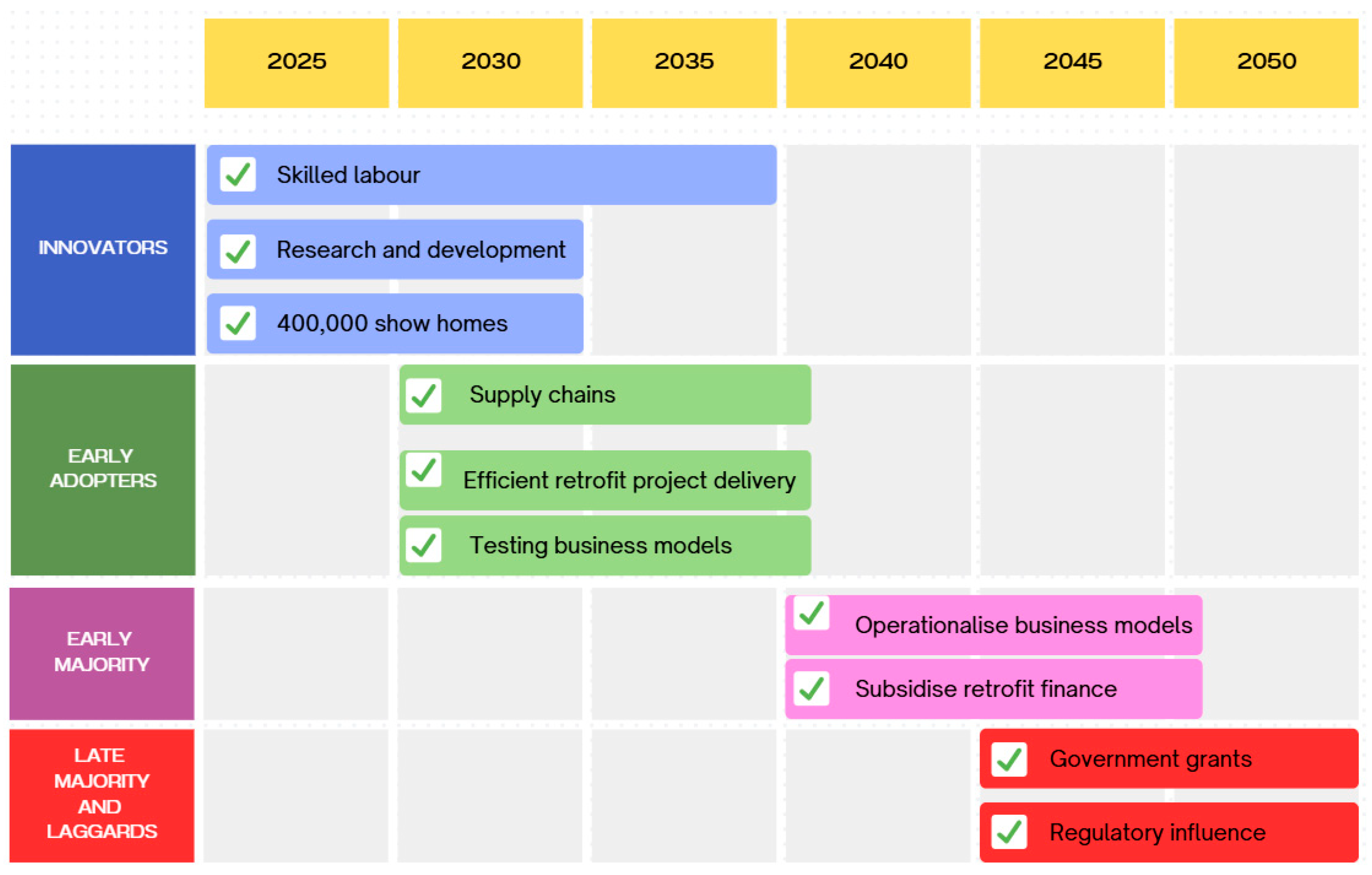
Figure 2 shows the proposed strategic priorities related to the diffusion of innovations theory against the timeline, from 2025 to 2050. The current UK strategy for housing retrofit is mainly based on government grants. The focused cohort is the low-income sector, mainly the households which receive government benefits. These retrofit grants also focus on low-energy-performing houses. According to the sources, there are 6.1 million households which receive benefits (Universal Credit) in the UK [61]. This seems to be rational, as people living in low-energy performing houses are mostly in fuel poverty [62].
Based on the housing retrofit drives during the past five years and the proposed Warm Homes grant scheme funding allocations, it is recommended to continue these government grants at the same level or a higher level, according to the prevailing poverty statistics from time to time. This will be a key requirement to address SDG 1 and 3, namely no poverty, good health and well-being. However, this will not be sufficient to achieve the retrofit-at-scale goals. These low-income households would fall into either the late majority or the laggard segments. There should be a proper strategy to engage innovators, early adopters and the early majority.
Considering the first three recommendations, according to Figure 2, it is important to train skilled labourers for retrofit, promote research and innovation and provide case studies through show homes. There was a retrofit skill development scheme in 2022. The government allocated GBP 6.9 million to develop skills [63]. Furthermore, there is another skill development training grant in 2025 for nearly GBP 17.3 million to train retrofit professionals [64]. Although not specifically allocated, the UKRI (United Kingdom Research and Innovation) seems to be awarding research grants generously for climate change-related projects. No case studies were found related to the show homes concept recommended by this article. Since this study is a qualitative analysis, it cannot recommend an exact scope for a retrofit-at-scale strategy.
The prioritisation of skills training will need to be extended to the segment of early adopters as well. Since the innovators segment covers only a fraction of the households, there will be a need for more retrofit professionals. The supply chain can be promoted with the right demand, as they can be easily imported from overseas. The supply chains need only to be prioritised for the early adopters. The need for optimising retrofit is recommended during the tenure of early adopters. The technology is already available to satisfactorily retrofit a house to a high level of energy efficiency. However, according to the Low Energy Transformation Initiative (LETI) recommendations for retrofit at scale, retrofit delivery needs to be optimised for shorter durations, lower costs and higher performance through innovative solutions [20]. This will not be possible with the early majority or subsequent segments. It is recommended to mainly focus on skills development, supply chain and project delivery optimisation within the next ten years up to 2035, over all other priorities.
It is also important to increase the number of retrofitted houses. The above recommendations will promote retrofit mainly among the able-to-pay sector, which includes the innovators and early adopters. This does not mean that the grants to retrofit their houses should be extended. This sector will be motivated to retrofit their houses if there are efficient delivery mechanisms, quality assurance, and risk management. Furthermore, it is recommended to focus on the newly built and highly energy-efficient houses. Currently, heat pumps are not generally welcome in the UK. According to a survey conducted in 2024, only 25% of the respondents welcomed heat pumps, 38% refused heat pumps and 29% had never heard of them [65]. Retrofitting and heat pump installation in the newer and highly energy-efficient houses will be easier and cheaper. Although it may not address the people in fuel poverty or low-income groups, it will increase the number of retrofitted houses with a heat pump. This will motivate others to follow the trend and welcome retrofitting in a positive way.
The third segment, the early majority, needs reassurance through effective business models. Brown and Panakaduwa et al. suggest retrofit business models such as ESCO or MESA to improve homeowner confidence. These models will reduce the risk to the homeowner and motivate them to adopt retrofit through these models [35,49]. These models need to be tested and validated by the time the early adopters are in the spotlight, most probably after 2035. Since the government expenditure for skills development, research and development, as well as supply chain development, will be completed by this period, the government can use funding to subsidise the cost of retrofitting for the homeowners in the early majority segment. They will not need 100% financing but rather to reduce the cost to make the retrofit affordable for them.
The final ten years, from 2040 to 2050, are allocated for the late majority and laggards segments. This study does not discuss the priorities in detail for this segment, as the situation may change greatly by this time. Most importantly, the government will have to extend grants to retrofit all of these households. Further regulatory measures will also be required.

6. Conclusions

Housing retrofit can address a range of issues related to planetary health, such as climate change, human health and well-being, social equity, the reduced use of planetary resources and better financial and physical comfort. This is particularly important in the UK due to its 30.4 million housing units, which contribute 18.72% of the total emissions. Despite the availability of finance, technology and the potential to obtain a supply chain and skilled labour, there is no proper strategy to accomplish mass-scale retrofitting of the housing stock before 2050. This study focused on the diffusion of innovations theory to brainstorm a strategy for retrofit at scale with the highest of resident engagement.
This study recommends initially focusing on retrofit skills development, research and development, the supply chain and the provision of practical examples through show homes. The able-to-pay sector and the able-to-borrow sector need to be focused on (not for government grants, but to set the foundation for efficient retrofit project delivery). Ideally, half of the housing stock will be retrofitted by 2040 with well-established supply chains, the availability of skilled labour, optimised retrofit delivery, effective business models and increased demand for retrofit among residents.
Government grants should be considered only for low-income households (for example, households on benefits) that show a genuine enthusiasm for retrofitting their houses, until the groundwork is laid. Current retrofit grants can be continued at the same or higher level until 2040. All the retrofit drives will be under government grants after 2040, as the remaining households will be either late majority or laggards who cannot afford a retrofit. The comparative costs of retrofit would be lower by this time due to the improved delivery methods, innovative products and economies of scale.
The study has been conducted as a qualitative study by focusing on the existing literature. One of the key assumptions is the consideration of retrofit as an innovation. The study also assumes a normal curve of innovations adoption among the UK population. An empirical study with data-driven validations will further optimise the strategy.

Author Contributions

Conceptualization, C.P. and P.C.; methodology, C.P. and P.C.; software, C.P. and S.S.; validation, N.M., S.S. and H.B.; formal analysis, C.P., P.C., N.M., S.S. and H.B.; investigation, N.M., H.B., S.S. and P.C.; resources, C.P. and S.S.; data curation, C.P. and S.S.; writing—original draft preparation, C.P.; writing—review and editing, N.M., S.S. and H.B.; visualization, N.M. and S.S.; supervision, P.C.; project administration, C.P.; funding acquisition, C.P. and P.C. All authors have read and agreed to the published version of the manuscript.

Funding

This research received no external funding.

Institutional Review Board Statement

Not applicable.

Informed Consent Statement

Not applicable.

Data Availability Statement

No new data were created or analysed in this study. Data sharing is not applicable to this article.

Acknowledgments

We sincerely acknowledge the critical and constructive feedback provided by Chris Twinn of Twinn Sustainability Innovation. His insights and innovative thinking have consistently guided us to explore new dimensions in retrofit at scale. https://twinnsustainabilityinnovation.com/ (accessed on 13 January 2026).

Conflicts of Interest

The authors declare no conflicts of interest.

Abbreviations

The following abbreviations are used in this manuscript:
BUSBoiler Upgrade Scheme
CMICommunity Municipal Investments
ECOEnergy Company Obligation
ESCOEnergy Service Companies
EPCEnergy Performance Certificate
HUGHome Upgrade Grant
MCSMicrogeneration Certification Scheme
MESAManaged Energy Service Agreements
MEESMinimum Energy Efficiency Standards
PASPublicly Available Specification
SHDFSocial Housing Decarbonisation Fund
UKRIUnited Kingdom Research and Innovation

References

  1. The Lancet Planetary Health. In desperate need of systems change. Lancet Planet. Health 2025, 9, 101420. [Google Scholar] [CrossRef] [PubMed]
  2. Traynor, J. EnerPHit: A Step by Step Guide to Low Energy Retrofit; RIBA Publishing: London, UK, 2019. [Google Scholar]
  3. Panakaduwa, C.; Coates, P.; Munir, M. Understanding Homeowner Decision-Making Through Demographics: Barriers to Housing Retrofit at Scale. PLoS ONE 2025, 20, e0338740. [Google Scholar] [CrossRef] [PubMed]
  4. Garrett, H.; Mackay, M.; Nicol, S.; Piddington, J.; Roys, M. The Cost of Poor Housing in England 2021 Briefing Paper; Building Research Establishment: London, UK, 2021. [Google Scholar]
  5. ONS. Dwelling Stock: By Tenure, United Kingdom, as at 31 March 2023; Office for National Statistics: London, UK, 2025.
  6. DESNZ. 2023 UK Greenhouse Gas Emissions: Final Figures—Dataset of Emissions by End User 1990–2022; Department for Energy Security and Net Zero: London, UK, 2025. Available online: https://assets.publishing.service.gov.uk/media/67e3e6202621ba30ed977630/final-greenhouse-gas-emissions-2023-end-user-dataset.ods (accessed on 12 August 2025).
  7. DESNZ. 2024 UK Greenhouse Gas Emissions, Provisional Figures; Department for Energy Security and Net Zero: London, UK, 2025.
  8. DESNZ. Annual Fuel Poverty Statistics Report; Department for Energy Security and Net Zero: London, UK, 2024.
  9. MHCLG. Accredited Official Statistics: Chapter 2: Energy Efficiency; Ministry of Housing, Communities and Local Government: London, UK, 2025. Available online: https://www.gov.uk/government/statistics/chapters-for-english-housing-survey-2023-to-2024-headline-findings-on-housing-quality-and-energy-efficiency/chapter-2-energy-efficiency (accessed on 13 December 2025).
  10. DESNZ. Annual Fuel Poverty Statistics in England, 2025 (2024 Data); Department for Energy Security and Net Zero: London, UK, 2025.
  11. BRE. The Cost of Poor Housing to the NHS; Building Research Establishment: London, UK, 2025. [Google Scholar]
  12. Suhr, M.; Hunt, R. Old House Eco Handbook: A Practical Guide to Retrofitting for Energy Efficiency and Sustainability, 3rd ed.; Quarto Publishing PLC: Lincoln, UK, 2019; ISBN 978071123977. [Google Scholar]
  13. CCC. UK Housing: Fit for the Future? Committee on Climate Change: London, UK, 2019. [Google Scholar]
  14. ISO 6707-1:2020; Buildings and Civil Engineering Works—Vocabulary. International Standards Organisation: Geneva, Switzerland, 2020.
  15. PAS 2035:2023; Retrofitting Dwellings for Improved Energy Efficiency–Specification and Guidance. The British Standards Institution: London, UK, 2023.
  16. HCLG. Live Tables on Energy Performance of Buildings Certificates; Ministry of Housing, Communities and Local Government: London, UK, 2025. Available online: https://www.gov.uk/government/statistical-data-sets/live-tables-on-energy-performance-of-buildings-certificates (accessed on 21 July 2025).
  17. CCC. The Sixth Carbon Budget: The UK’s path to Net Zero; Committee on Climate Change: London, UK, 2020. [Google Scholar]
  18. DBEIS. Heat and Buildings Strategy; Department for Business, Energy & Industrial Strategy: London, UK, 2021.
  19. DBEIS. Social Housing Decarbonisation Fund Wave 2.1 Competition Guidance Notes; Department for Business, Energy & Industrial Strategy: London, UK, 2022.
  20. Twinn, C. Retrofit-at-Scale: Upgrading Our Homes to Meet UK Climate Targets; Low Energy Transformation Initiative: London, UK, 2024. [Google Scholar]
  21. BRETrust. The Housing Stock of The United Kingdom; Building Research Establishment: London, UK, 2020. [Google Scholar]
  22. DESNZ. Heat Pump Investment Roadmap; Department for Business, Energy & Industrial Strategy: London, UK, 2023.
  23. MCS. MCS Certified Heat Pump Installations in the UK as at June 2025; Microgeneration Certification Scheme: London, UK, 2025. [Google Scholar]
  24. Malcher, X.; Gonzalez-Salazar, M. Strategies for decarbonizing European district heating: Evaluation of their effectiveness in Sweden, France, Germany, and Poland. Energy 2024, 306, 132457. [Google Scholar] [CrossRef]
  25. DESNZ. Warm Homes: Social Housing Fund Wave 3 Scheme Guidance; Department for Business, Energy & Industrial Strategy: London, UK, 2024.
  26. PAS 2030:2023; Energy Efficiency in Existing Dwellings. British Standards Institution: London, UK, 2023.
  27. Labour Party. Change: Labour Party Manifesto 2024; Labour Party: London, UK, 2024. [Google Scholar]
  28. Housing Europe. The State of Housing in Europe 2023. Available online: https://stateofhousing.eu/The_State_of_Housing_in_the_EU_2025.pdf#p=1 (accessed on 12 August 2025).
  29. Panakaduwa, C.; Coates, P.; Munir, M. One-Stop Shop Solution for Housing Retrofit at Scale in the United Kingdom. Architecture 2025, 5, 40. [Google Scholar] [CrossRef]
  30. Energy Security and Net Zero Committee. Retrofitting Homes for Net Zero; Energy Security and Net Zero Committee: London, UK, 2025. [Google Scholar]
  31. Rosenow, J.; Eyre, N. A Post Mortem of the Green Deal: Austerity, Energy Efficiency, and Failure in British Energy Policy. Energy Res. Soc. Sci. 2016, 21, 141–144. [Google Scholar] [CrossRef]
  32. NAO. Green Homes Grant Voucher Scheme; National Audit Office: London, UK, 2021.
  33. Rosenow, J.; Eyre, N. The Green Deal and the Energy Company Obligation. Proc. Inst. Civ. Eng.-Energy 2013, 166, 127–136. [Google Scholar] [CrossRef]
  34. Sunak, R. PM Speech on Net Zero: 20 September 2023. Available online: https://www.gov.uk/government/speeches/pm-speech-on-net-zero-20-september-2023 (accessed on 15 June 2025).
  35. Panakaduwa, C.; Gunasekara, I.; Coates, P.; Munir, M. Analysis of One-Stop-Shop Models for Housing Retrofit: A Systematic Review. Architecture 2025, 5, 47. [Google Scholar] [CrossRef]
  36. OBR. Decarbonising Domestic Heating: Lessons from the Switch to Natural Gas; Office for Budget Responsibility: London, UK, 2025; Available online: https://obr.uk/box/decarbonising-domestic-heating-lessons-from-the-switch-to-natural-gas/ (accessed on 10 June 2025).
  37. Rogers, E.M. Diffusion of Innovations, 5th ed.; Free Press: Cambridge, UK, 2003. [Google Scholar]
  38. Forbus, K.D. Chapter 9 Qualitative Modeling. In Foundations of Artificial Intelligence; van Harmelen, F., Lifschitz, V., Porter, B., Eds.; Elsevier: Amsterdam, The Netherlands, 2008; pp. 361–393. [Google Scholar] [CrossRef]
  39. Michie, S.; van Stralen, M.M.; West, R. The behaviour change wheel: A new method for characterising and designing behaviour change interventions. Implement. Sci. 2011, 6, 42. [Google Scholar] [CrossRef] [PubMed]
  40. ONS. Average Household Income; Office for National Statistics: London, UK, 2025. Available online: https://www.ons.gov.uk/peoplepopulationandcommunity/personalandhouseholdfinances/incomeandwealth/bulletins/householddisposableincomeandinequality/financialyearending2024 (accessed on 21 August 2025).
  41. DBEIS. Home Upgrade Grant: Phase 2 Guidance for Local Authorities; Department for Business, Energy & Industrial Strategy: London, UK, 2022.
  42. DBEIS. International Review of Domestic Retrofit Supply Chains; Department for Business, Energy & Industrial Strategy: London, UK, 2021.
  43. Holms, C. Demand: Net Zero Tackling the Barriers to Increased Homeowner Demand for Retrofit Measures; Citizens Advice: London, UK, 2023. [Google Scholar]
  44. DESNZ. Find Energy Grants for Your Home (Help to Heat); Department for Energy Security and Net Zero: London, UK, 2025. Available online: https://www.gov.uk/government/collections/find-energy-grants-for-you-home-help-to-heat (accessed on 17 August 2025).
  45. UK Parliament. The Boiler Upgrade Scheme (England and Wales) Regulations 2022 No. 565; The Stationery Office Ltd.: London, UK, 2022. [Google Scholar]
  46. DESNZ. Domestic Energy Efficiency Retrofit Supply Chain Final Report; Department for Energy Security and Net Zero: London, UK, 2025. [Google Scholar]
  47. Reinhardt, R.; Gurtner, S. Differences between early adopters of disruptive and sustaining innovations. J. Bus. Res. 2015, 68, 137–145. [Google Scholar] [CrossRef]
  48. Zaunbrecher, B.S.; Arning, K.; Halbey, J.; Ziefle, M. Intermediaries as gatekeepers and their role in retrofit decisions of house owners. Energy Res. Soc. Sci. 2021, 74, 39. [Google Scholar] [CrossRef]
  49. Brown, D. Business models for residential retrofit in the UK: A critical assessment of five key archetypes. Energy Effic. 2018, 11, 1497–1517. [Google Scholar] [CrossRef]
  50. Davis, M.; Davis, B. Crowdfunding and the Democratization of Finance; Bristol University Press: Bristol, UK, 2021; ISBN 978-1529216738. [Google Scholar]
  51. House of Commons. Green Homes Grant Voucher Scheme; House of Commons: London, UK, 2021. [Google Scholar]
  52. DESNZ. Domestic Private Rented Property: Minimum Energy Efficiency Standard—Landlord Guidance (2017); Department for Business, Energy & Industrial Strategy: London, UK, 2025. Available online: https://www.gov.uk/guidance/domestic-private-rented-property-minimum-energy-efficiency-standard-landlord-guidance (accessed on 15 October 2025).
  53. Huang, C.; Ma, J.; Song, K. Homeowners’ Willingness to Make Investment in Energy Efficiency Retrofit of Residential Buildings in China and Its Influencing Factors. Energies 2021, 14, 1260. [Google Scholar] [CrossRef]
  54. Triguero, A.; Moreno-Mondéjar, L.; Davia, M.A. Leaders and Laggards in Environmental Innovation: An Empirical Analysis of SMEs in Europe. Bus. Strategy Environ. 2016, 25, 28–39. [Google Scholar] [CrossRef]
  55. LGiU. Local Government Facts and Figures: England; Local Government Information Unit: London, UK, 2024. [Google Scholar]
  56. Nygrén, N.A.; Kontio, P.; Lyytimäki, J.; Varho, V.; Tapio, P. Early adopters boosting the diffusion of sustainable small-scale energy solutions. Renew. Sustain. Energy Rev. 2015, 46, 79–87. [Google Scholar] [CrossRef]
  57. DECC. The Green Deal: A Summary of the Government’s Proposals; Department of Energy & Climate Change: London, UK, 2010.
  58. OFGEM. Energy Company Obligation (ECO3) Guidance: Delivery Version 1.7; Office of Gas and Electricity Markets: London, UK, 2021. [Google Scholar]
  59. DESNZ. What Does the Autumn Budget Mean for Your Energy Bills? Department for Business, Energy & Industrial Strategy: London, UK, 2025.
  60. DWP. Universal Credit Statistics, 29 April 2013 to 10 July 2025; Department for Work and Pensions: London, UK, 2025. Available online: https://www.gov.uk/government/statistics/universal-credit-statistics-29-april-2013-to-10-july-2025/universal-credit-statistics-29-april-2013-to-10-july-2025 (accessed on 15 October 2025).
  61. Atwoli, L.; Baqui, A.H.; Benfield, T.; Bosurgi, R.; Godlee, F.; Hancocks, S.; Horton, R.; Laybourn-Langton, L.; Monteiro, C.A.; Norman, I.; et al. Call for Emergency Action to Limit Global Temperature Increases, Restore Biodiversity, and Protect Health. BMJ 2021, 374, n1734. [Google Scholar] [CrossRef] [PubMed]
  62. DESNZ. Annual Fuel Poverty Statistics Report 2025 (2024 Data); Department for Business, Energy & Industrial Strategy: London, UK, 2025.
  63. DBEIS. Green Homes Grant Skills Training Competition; Department for Business, Energy & Industrial Strategy: London, UK, 2020.
  64. DESNZ. Warm Homes Skills Programme Guidance, 2nd ed.; Department for Business, Energy & Industrial Strategy: London, UK, 2025.
  65. DESNZ. DESNZ Public Attitudes Tracker: Heat and Energy Use in the Home, Winter 2024; Department for Business, Energy & Industrial Strategy: London, UK, 2025. Available online: https://www.gov.uk/government/statistics/desnz-public-attitudes-tracker-winter-2024/desnz-public-attitudes-tracker-heat-and-energy-use-in-the-home-winter-2024-uk (accessed on 17 August 2025).
Figure 1. Diffusion of innovations theory [37].
Challenges 17 00004 g001
Figure 2. Proposed timescale for prioritised actions.
Challenges 17 00004 g002
Table 1. The percentage of houses that need retrofitting in some countries [28].
IrelandItalyFranceGermanySpainThe Netherlands
Total number of houses (M)2.125.737.443.125.98.0
Houses that need retrofitting (M)1.022.020.223.724.44.2
Percentage46%85.9%54%55%94.2%51.9%
Table 2. The logic model for innovators.
NeedInputs/InterventionActivitiesOutputsOutcomes/KPI
Skilled labourTrainingFunding allocation for training60,000 for the first five years [46]Trained retrofit professionals
Research and developmentIncentivisationUniversity research grants, Funding for innovationsFurther assessment and calculation required Project delivery optimisation, innovative products and methods
Show homesModellingFunding for open days400,000 houses within the first five yearsExample retrofitted houses which people can come and see
Table 3. The logic model for early adopters.
NeedInputs/InterventionActivitiesOutputsOutcomes/KPI
Supply chainsEnvironmental restructuringFunding startups Tax reliefSupply to the demand for retrofit at scaleSufficient supply chains
Efficient project deliveryModellingPilot projects
Innovations
Aim for 7-day retrofit project delivery [20]Quicker retrofit project delivery
Business modelsEnablementTesting business models Removing bottlenecksESCO, MESA [49], CMI [50]Viable business models to collaborate with stakeholders
Table 4. The logic model for the early majority.
NeedInputs/InterventionActivitiesOutputsOutcomes/KPI
Operationalise business modelsTraining, Modelling, PersuasionProvide training, Deploy business modelsAll the funded retrofits are operationalised through effective business modelsStakeholder engagement through business models
Subsidise retrofit financeIncentivisationProvide interest subsidy to lower the mortgage repaymentsHouseholders should not pay more for their mortgages and energy bills after the retrofitAffordable monthly commitments
Table 5. The logic model for late majority and laggards.
NeedInputs/InterventionActivitiesOutputsOutcomes/KPI
Government grantsIncentivisationFunding for housing retrofitApart from the heritage-constrained houses, all houses are retrofittedAll the residual retrofitting projects are funded by the government
Regulatory influenceRestriction, coercionRegulatory measures to push retrofittingResistant households are compelled to retrofit their homesAddressing the resistance to change in households
Disclaimer/Publisher’s Note: The statements, opinions and data contained in all publications are solely those of the individual author(s) and contributor(s) and not of MDPI and/or the editor(s). MDPI and/or the editor(s) disclaim responsibility for any injury to people or property resulting from any ideas, methods, instructions or products referred to in the content.