


Abstract
The Zhenshimingjing 真實名經, a Chinese Buddhist scripture translated from the Tibetan Nāmasaṃgīti, is preserved in multiple Tripitaka editions and multilingual manuscripts. Previous studies either confined themselves to intra-Chinese collation without the Tibetan source, or to multilingual comparison based solely on the Taisho Tripitaka. This study integrates both approaches by analyzing Chinese Tripitaka editions alongside two multilingual versions of the Zhenshimingjing. It clarifies the interrelationships among the extant versions and evaluates their correspondence to the Tibetan source text, thereby determining their philological value. The results show that the earliest Tripitaka editions already contained numerous graphic and phonetic corruptions, which later recensions largely perpetuated. Although the Yonglebei Tripitaka represents the most extensively collated recension, it remained limited by the collators’ lack of Tibetan knowledge. By contrast, the multilingual manuscripts—especially the Vira edition—preserve readings closer to the Tibetan Nāmasaṃgīti and demonstrate the diachronic continuity of transmission independent of the Tripitaka. The study underscores the necessity of combining intra-Chinese collation with multilingual comparison to reconstruct a more reliable text and reassess long-standing issues in the philological study of Chinese Buddhist translations.
1. Research Overview
The Sanskrit scripture Nāmasaṃgīti (hereafter NS) is a key text in the later development of Esoteric Buddhism. Originally composed in Sanskrit, it has been translated into several languages, including Tibetan, Chinese, Tangut, and Mongolian, among others. Moreover, multiple versions of these translations exist within each language. The NS has four Chinese translations, all of which are preserved in the Chinese Tripitaka. This study focuses exclusively on the version translated by Shizhi 釋智, entitled Sheng Miaojixiang ZhenshimingJing 聖妙吉祥真實名經 (hereafter NSC). Shizhi’s translation is based on the Tibetan version of NS (hereafter NST). To date, scholars have identified several distinct editions of NS, NST, and NSC, significantly contributing to the fields of textual collation, translation studies, comparative analysis, and historical research.
The following section presents an overview of current scholarship, with particular emphasis on philological studies of NS, NST, and NSC, as well as historical research on the NSC’s translator, Shizhi.
1.1. Collation and Study of the NS
The first Sanskrit edition of NS was published by I. P. Minaev, based on five original manuscripts (Minaev 1887). Raghu Vira compiled a trilingual manuscript comprising NS, NST, and a Mongolian version, based on three source manuscripts. In the appendix, he also included a facsimile of the original quadrilingual manuscript, which contains NS, NST, NSC, and the Mongolian translation (hereafter NSM) (Vira 1960)1. Durga Das Mukherji produced a bilingual edition of NS and NST, based on five original manuscripts (Mukherji 1963). Ronald M. Davidson subsequently synthesized the works of these scholars, creating a comprehensive Sanskrit edition of NS and providing a transcription and collation of the text. He annotated significant textual variations and translated the text into English (Davidson 1981). Davidson’s edition remains the most detailed edition currently available.
1.2. Collation and Study of the NST
Mukherji compared NST manuscripts included in the Derge and Narthang editions of the Kangyur, as well as a bilingual Sanskrit–Tibetan manuscript (Mukherji 1963). In 2000, Orofino discovered another NST manuscript at Khor chags Monastery. She provided an overview of the textual development of NST, identified this manuscript as a version translated by Rin chen bzang po through comparison with six other versions, and produced a transcription of the text together with a critical edition based on these comparisons (Orofino 2007). The Zhonghua Dazangjing·Kangyur (77) 中華大藏經(甘珠尔) 第77冊 edition, based on the Derge manuscript, employed seven other Tibetan Kangyur manuscripts as auxiliary texts to assist in collating NST (Zhongguo Zangxue Yanjiu Zhongxin Dazangjing Duikanju 2008). Later, Cairang transcribed, transliterated, and translated the NST manuscript from Dunhuang, specifically P.T. 99 (Cairang 2016). Zhoutaicairang followed this with a systematic study of the relationships among the four Dunhuang 敦煌 NST editions through the lens of translation studies and textual criticism. He clarified the textual history of NST by comparing three older translations with three more recent ones (Zhoutaicairang 2021).
1.3. Collation of NSC and Related Studies
The Zhonghua Tripitaka 中華大藏經(漢文部分) edition of NS was collated on the basis of the Qisha Tripitaka, with reference to four other editions of the Chinese Tripitaka. Scholars have also conducted research on NSC’s translator, Shizhi, as well as the location and date of its translation. Commonly used Tripitaka editions, such as the Taisho Tripitaka 大正新脩大藏經, often record Shizhi as “元講經律論習密教土番譯主聶崖沙門” and thus scholars have traditionally regarded Shizhi as a Yuan 元 Dynasty figure (Taisho Tripitaka 1983). For example, in his examination of the Dashengyaodaomiji 大乘要道密集, Lü Cheng identified Shizhi as a Yuan-period monk based on its colophon (Lü 1942). In addition, sources such as the Xinxu Gaoseng Zhuan 新續高僧傳 describe him as Tibetan. However, Hoong Teik Toh, in his doctoral dissertation, argued that Shizhi was not necessarily Tibetan and that he lived during the Xi Xia period, meaning NSC would be a product of that era (Toh 2004). Shen Weirong later supported Toh’s view based on the discovery of a Chinese translation of NSC unearthed at the Baisigou Pagoda (Shen 2017).
In 2006, Lin Yingjin compiled the Tangut edition of NSC and compared it to the Chinese edition, arguing that the former was translated from the latter (Lin 2008). Sun Bojun observed that mantras used in NSC exhibit linguistic features typical of Tangut translations of Buddhist scriptures (Sun 2010).
Zhang Yongfu compared the fragmentary editions of the NSC unearthed from Heishuicheng 黑水城, Baishigou 拜寺沟 Pagoda, and Shanzuigou 山嘴沟 with the version recorded in the Taisho Tripitaka, which he regarded as representative of the NSC preserved in the Chinese Tripitaka editions. He concluded that the Heishuicheng edition, the Baishigou edition, and the NSC preserved in the Chinese Tripitaka represent three distinct textual traditions (Zhang 2021).
In his subsequent doctoral dissertation, Zhang further collated the Tangut edition by comparing it with multiple versions of the Dunhuang NST manuscript recorded by Cairang (2016), and the NSC preserved in the Taisho Tripitaka, concluding that both the Tangut edition of NS and the NSC were translated directly from NST. He also conducted further research on Shizhi, drawing from the Xinxu Gaoseng Zhuan, and other writings by Shizhi. He concluded that Shizhi was active at Mati Mountain in Ganzhou during the late 12th and early 13th centuries, was likely of Tangut ethnicity, and, based on his translation of the NSC as well as several other Tibetan texts into Chinese, he inferred that Shizhi was fluent in at least Chinese and Tibetan (Zhang 2022).
In addition to scholarship directly addressing the NSC, there is also a body of research on the compilation and transmission of the Chinese Tripitaka as a whole (e.g., Li and He 2003; He 2014 and Li 2016). These studies have clarified the relationships among different recensions of the Tripitaka and provide important background for understanding the textual history of Buddhist scriptures in general. Furthermore, in 2020, Peking University Press published the Guojia tushuguan cang minzuwenziguji congshu, which includes a trilingual manuscript of NS, NST, and NSC (Chen and Sarengaowa 2020). To date, however, no research has been conducted on this manuscript.
Despite the progress of previous scholarship, two significant gaps remain.
First, although the Zhonghua Tripitaka (1994) incorporates several important recensions of the Chinese canon, it does not include the Yonglebei Tripitaka, which underwent extensive editorial revision and served as the base text for both the later Jingshan Tripitaka and the Qianlong Tripitaka. Moreover, it pays little attention to NSC texts preserved outside the Tripitaka tradition, such as those reproduced in the appendix of Vira (1960) and Chen and Sarengaowa (2020).
Second, existing approaches remain methodologically limited. Textual-critical studies of NSC within the Chinese Tripitaka, as represented by the Zhonghua Tripitaka (1994), have been confined to intra-Chinese comparisons. Since NSC was translated from NST, however, any collation that does not incorporate NST cannot adequately determine which NSC edition is closer to the original. Conversely, cross-linguistic studies such as Zhang (2022) have utilized multilingual evidence but have focused exclusively on the NSC text preserved in the Taisho Tripitaka, without considering other Tripitaka versions. In short, current textual-critical research has neglected the NST, while cross-linguistic studies have overlooked the multiplicity of NSC editions.
In view of the above, this study conducts a textual comparison between the Qisha Tripitaka version, as preserved in Zhonghua Tripitaka (1994), and the collation notes from three other Chinese Tripitaka editions—Yonglenan Tripitaka, Jingshan Tripitaka, and Qianlong Tripitaka—as well as the Yonglebei Tripitaka (Yonglebei Tripitaka n.d.), which is not included in Zhonghua Tripitaka (1994). However, since the collation notes of the Zhonghua Tripitaka occasionally omit certain variants, this study does not rely solely on these notes. Rather, it also directly consults the original printed editions of the Qisha (Qisha Tripitaka 2005), Yonglenan (Yonglenan Tripitaka n.d.), Jingshan (Jingshan Tripitaka n.d.) and Qianlong (Qianlong Tripitaka 2010) Tripitaka editions. All these Chinese editions (hereafter “Tripitaka editions”) are compared with corresponding passages in the NSC of Vira (1960), Chen and Sarengaowa (2020) and the Taisho Tripitaka.
This study primarily investigates the interrelationships among the extant NSC versions and examines the extent to which they correspond to the NST, thereby determining their philological value. To this end, it analyzes the stemmatic relationships among the Tripitaka editions, the types of textual variants across different versions, and the results of cross-linguistic comparison. On this basis, the study also identifies several issues in existing NSC scholarship and points out their limitations.
This study undertakes a comparative analysis of both the multilingual manuscripts and the Tripitaka editions of the NSC. By integrating cross-version and cross-linguistic approaches, his study contributes in the following ways:
1. It examines the NSC texts preserved in Vira (1960) and Chen and Sarengaowa (2020), which had not previously been examined in scholarship, and demonstrates that these two, together with the Tripitaka editions, represent variant forms of the same translation, thereby establishing the value of their comparison.
2. It supplements existing collation work by incorporating the Yonglebei Tripitaka (absent from the Zhonghua Tripitaka), and identifies variant readings overlooked in previous collations, and comparing the Taisho Tripitaka with other editions.
3. It shows that the NSC text in Vira (1960) correspond more closely to the NST than those preserved in the Tripitaka editions and in Chen and Sarengaowa (2020), thereby affirming their significance for textual criticism and Buddhist philology.
4. It contextualizes the textual variants among the different editions within the editorial history of the Chinese Tripitaka, thereby providing an explanation of how and why these divergent readings came into being.
5. It employs a methodological framework that combines versional collation with cross-linguistic comparison, which may also be applied to other Chinese Buddhist translations from Sanskrit and Tibetan.
2. Comparative Study of the NSC Editions
2.1. Survey of the NSC Texts in Different Editions
According to Vira, the source manuscript used in his edition (hereafter “Vira edition”) is currently housed in the National Museum of Ulaanbaatar. However, the facsimile he published inadvertently lacks six pages from the original. The original manuscript concludes with colophons in both Chinese and Mongolian. According to Qiaoji’s research, the Mongolian colophon indicates that the text was commissioned by Baiyao Baduer Taiji 摆腰把都儿台吉, grandson of Altan Khan, and composed by his son, Lama Fahai 法海, in 1591 (Qiaoji 2011). Toh (2004), drawing on the Chinese colophon, identified the sponsors and proposed a date of printing. Drawing on historical materials, he deduced that it was printed in 1502CE by either Fanjingchang 番經廠 or Xijingchang 西經廠 during the Ming 明 Dynasty, and may have been sent to Mongolia in 1573 at the request of Altan Khan.
According to the description of Chen and Sarengaowa (2020), the trilingual manuscript contains NS, NST, and NSC (hereafter “Peking edition”), catalogued as Zang2239 (Chen and Sarengaowa 2020). In view of the fact that both the Vira edition and the Peking edition preserve texts in multiple languages, the NSC contained in these two sources will hereafter be referred to collectively as “the Multilingual editions.”
To date, no study has directly focused on the NSC texts preserved in the Tripitaka editions. Only three studies on the Tripitaka editions are directly relevant to this research. The first is the systematic study by Li Fuhua and He Mei on various Tripitaka editions (Li and He 2003). The second is He Mei’s research on the catalogues of successive Tripitaka editions (He 2014). The third is Li Jining’s research on the secret scriptures in the Qisha Tripitaka and Puning Tripitaka (Li 2016).
According to He Mei’s research, seven editions of the Tripitaka compiled in ancient China contain NSC: Qisha Tripitaka, Puning Tripitaka 普寧藏, Chukenan Tripitaka 初刻南藏, Yonglenan Tripitaka 永樂南藏, Yonglebei Tripitaka 永樂北藏, Jingshan Tripitaka 徑山藏, and Qianlong Tripitaka 乾隆藏 (He 2014). These NSC editions were compiled before the Taisho Tripitaka, yet the NSC texts they contain have received little scholarly attention.
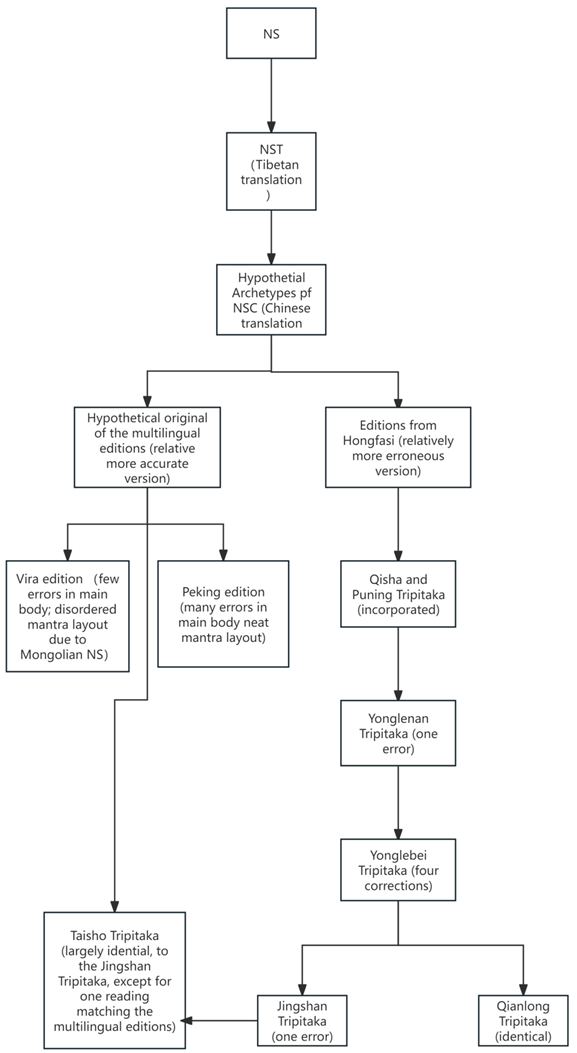
With respect to the interrelationships among these Tripitaka editions, Li and He (2003) show that the Qisha Tripitaka is the earliest. Based on the colophon of the NSC text of the Qisha Tripitaka, it was sourced from Dadu Hongfasi 大都弘法寺 and was printed in 1307 CE. The Chukenanzang Tripitaka replicates the Qisha Tripitaka, while the Yonglenan Tripitaka reprints the Chukenanzang Tripitaka. The Yonglebei Tripitaka is closely related to the Yonglenan Tripitaka but underwent extensive revisions. The Jingshan Tripitaka is based on the Yonglebei Tripitaka and was also cross-checked with the Qisha Tripitaka, Puning Tripitaka, and Yonglenan Tripitaka. The Qianlong Tripitaka was printed later in time than the Jingshan Tripitaka. By contrast, the Taisho Tripitaka represents a composite recension that draws upon the Zifu Tripitaka 資福藏, the Puning Tripitaka, the Jingshan Tripitaka, as well as several Japanese manuscript and printed collections. Furthermore, according to Li (2016), the secret scriptures of the Qisha Tripitaka and Puning Tripitaka belonging to NSC were printed from the same woodblocks.
This comparison reveals that the most significant differences appear in the mantra sections (See Appendix C). The mantra sections in the Multilingual editions are largely consistent across both texts, whereas the Tripitaka editions share a separate yet internally consistent set of mantras. Notably, Mantra Systems 1 and 2 show no textual overlap2.
Beyond the mantras, the Tripitaka editions contain chapter annotations or praise (anuśaṃsā) sections, which are absent from the Multilingual editions. Within the main body of the text, 44 additional differences have been observed (See Appendix A): two concerning the title and authorial attribution, and 42 in the main textual content. Given that NS contains 165 verses of four lines each, for a total of 660 lines, and only 42 differences exist, with most involving only one or two words, it is safe to conclude that the Tripitaka editions and the Multilingual editions derive from the same source manuscript and are thus textually comparable.
2.2. Classification of Textual Variants in the Main Body
In examining the main body sections, this study adopts a multilingual, textual-critical methodology. By systematically collating two multilingual manuscripts with six editions from the Chinese Tripitaka, it categorizes textual variants to reconstruct their textual lineage. Given the particular nature of the Taisho Tripitaka, its textual variants will be discussed separately at the end.
Based on the textual variants and their relationship to each edition, the 42 differences in the main body of the scripture (excluding the title and author) can be categorized into 6 groups. The classification is presented below according to sentence number. (Note: Sentences 15 and 18 contain multiple types of divergences, which are specified in parentheses.)
1. Variants unique to the Peking edition:
3, 4, 5, 6, 7, 9 (生-主), 10, 11, 12, 13, 14, 15 (大-相), 16, 18 (有-三), 20, 24, 25, 28, 30, 31, 36, 39, 42, 43.
2. Variant unique to the Vira edition:
35.
3. Variants unique to the Jingshan Tripitaka:
9 (王-主).
4. Variants shared by the Peking, Vira, Qisha Tripitaka and Puning Tripitaka editions, while all other editions are identical among themselves:
23.
5. Variants shared by the Qisha Tripitaka, Puning Tripitaka, and Yonglenan Tripitaka editions, while all other editions are identical among themselves:
26, 34.
6. Variants shared by the Peking, Vira, Qisha Tripitaka, Puning Tripitaka, and Yonglenan Tripitaka editions, while all other editions are identical among themselves:
15 (具-是), 29.
7. Variants shared by the Peking and Vira editions, while the Tripitaka editions are identical among themselves:
8, 18 (時-師), 19, 21, 22, 27, 32, 33, 37, 38, 40, 41, 44.
These differences can be systematically classified into two broad categories: Category 1 includes groups 1, 2, and 3, whose variants are unique to specific editions, and Category 2 includes groups 4, 5, 6, and 7, in which variants are shared across multiple versions.
Regarding Category 1, the textual variants in groups 1, 2 and 3 represent unique readings confined to individual editions. The particularly large number of variants in Group 1 demonstrates that the Peking edition represents a carelessly copied version, characterized by irregular scribal practices. Moreover, when cross-referenced with other manuscripts, these variants are clearly shown to result from differences in word choice or scribal errors. These may be further divided into the following types:
Differences in usage, as in sentences 3, 10.
Scribal errors caused by similar sounds or shapes, as in sentences 4, 7, 9, 11, 12, 13, 14, 16, 17, 20, 24, 25, 28, 30, 31, 35, 39.
Errors introduced through intertextual contamination, as in sentences 4, 15 (大-相), 42.
Omissions, as in sentences 6, 43.
Reversed order of words, as in sentence 36.
As for Category 2, variants appear in 12 sentences of Group 7, significantly outnumbering those in groups 4, 5, and 6, indicating that systematic divergences between the multilingual and Tripitaka editions are not confined to mantra sections alone. This phenomenon suggests that significant textual variants between the multilingual and Tripitaka editions are present not only in the mantra sections but also the main body text.
In summary, this classification demonstrates that variants confined to individual manuscripts (Categories 1, 2, and 3) can reasonably be attributed to scribal or transmission errors. This allows the study to focus instead on the systematic divergences shared across multiple editions (Categories 4–7), which carry greater philological and interpretive significance.
The textual variants of the Taisho Tripitaka exhibit distinctive features. As noted in Section 2.1, its principal sources include the “Songzang” (宋藏, i.e., the Zifu Tripitaka), the “Yuanzang” (元藏, i.e., the Puning Tripitaka), and the “Mingzang” (明藏, i.e., the Jingshan Tripitaka), among which the latter two contain the NSC. According to the collation notes, the version of the NSC preserved in the Taisho Tripitaka derives from the Jingshan Tripitaka, and the collation notes contain no comparison with the Puning Tripitaka version. However, there is one variant (32, verse 124) in which the Taisho Tripitaka diverges from the Jingshan Tripitaka and corresponds to the Multilingual editions.
Su (2024) remarks that the phenomenon whereby the Taisho Tripitaka records a reading labeled as the “Mingzang” (明藏) that differs from the Jingshan Tripitaka preserved at the University of Tokyo may be explained in three ways: (1) errors caused by oversight in collating or transcribing variant readings during the compilation of the Taisho Tripitaka; (2) the existence of divergent versions of the Jiaxing Tripitaka; or (3) a mistaken attribution by the Taisho collators, who may have identified another edition as “Mingzang.” He further observes that the precise reason for this discrepancy can no longer be traced. In the case of the NSC, the difference in wording should likewise be understood as arising from one of these three possibilities, though it cannot be further investigated.
In summary, the analyses presented in Section 2.1 and Section 2.2 demonstrate that the Multilingual editions constitute a closely affiliated textual group, whereas the Tripitaka editions form a distinct cluster, thereby reflecting the presence of two divergent textual traditions. Although many of the unique variants can plausibly be attributed to incidental scribal or transmissional errors, the systematic divergences shared across multiple witnesses point to deeper textual dynamics that shaped the transmission of the NSC. These systematic variants, rather than isolated errors, provide the most critical evidence not only for reconstructing the textual history of the scripture, but also for evaluating which extant version of the NSC most closely corresponds to the NST. The following section will therefore address this task.
3. Collation and Analysis of Textual Variants
Since the Multilingual editions preserve parallel Sanskrit and Tibetan texts, this study is able to conduct further comparative and translational analysis of textual variants between NS, NST, and the NSC, as preserved in both the Multilingual editions and Tripitaka editions. In particular, the following analysis concentrates on how these variants clarify the extent to which each NSC version corresponds to the NST, which constitutes the central question of this study. Category 1 variants, as previously noted, are clearly scribal errors unique to specific editions and will therefore not be examined further here, owing to space constraints. Instead, this paper focuses exclusively on the comparatively more significant textual variants, that is, Category 2. Due to frequent textual variations among NS, NST, and NSC, each has been provided with its own English translation to facilitate more precise comparative analysis. The Sanskrit and Tibetan texts employed for comparison derive from Davidson (1981) and the Multilingual editions. The Sanskrit text, as well as the verse numbering, follows Davidson (1981), and the Tibetan text follows the Multilingual editions.3 Variants in the Chinese texts are marked by parentheses. In interpreting the NS, this study also draws on the Nāmasaṃgītiṭippanī Amṛtakaṇikā4. For each NSC sentence, two English translations are provided: Translation 1 corresponds to the former, and Translation 2 to the latter. The reconstructed pronunciations in Middle Chinese follow Li and Zhou (1999)5.
For Group 4 of the identified variants, the former corresponds to the Qisha Tripitaka, Puning Tripitaka, and Yonglenan Tripitaka editions, while the latter corresponds to all other editions.
Group 4: 23 (Verse 97)
Translation: He is partless, with total access, all-pervading, yet subtle, beyond seed and without impurities.
NST: mi ‘gyur kun ‘gro khyab pa po/phra zhing zag med sa bon bral/
Translation: He is changeless, with total access, all-pervading, subtle, without impurities and beyond seed.
NSC: 雖(往/性)不改亦普遍,微細無漏離種性。
Translation: 1. Although departing without return is all-pervading, he is subtle, without impurities, beyond the nature of the seed.
2. Although nature without return is all-pervading, he is subtle, without impurities, beyond the nature of the seed.
In this verse, the NSC text diverges significantly from both NS and NST. A comparative analysis reveals that in NST, the term “kun ‘gro” means “total access,”(corresponding to the Sanskrit “sarvago”) and “’gro” means “to go” or “to depart”. In view of the translator’s rendering of ‘gro ba as “往” in Verse 115, the translator appears to have misconstrued kun ‘gro as ‘gro (departing), resulting in the rendering now seen as “雖往不改亦普遍.” The alternate reading, “雖性不改亦普遍” also does not correspond to NST. Given the visual similarity between the Chinese characters “往” (departing) and “性” (nature), it is plausible that “性” was the result of a scribal error, and that the intended character was “往.” This suggests that the original intended reading was “往” rather than “性.”
Regarding Group 4, it is clear that the Peking, Vira, Qisha Tripitaka, and Puning Tripitaka editions are correct, while the other editions are erroneous. Considering the formation timeline of the various Tripitaka editions, it is clear that the error originated during the reprinting of Chukenan Tripitaka or Yonglenan Tripitaka, and was subsequently inherited by Yonglebei Tripitaka and later Tripitaka editions.
For Group 5, the former corresponds to the multilingual editions and Qisha Tripitaka, while the latter corresponds to all other Tripitaka editions except Qisha Tripitaka.
Group 5: 26 (Verse 104)
NS: trailokyatilakaḥ kāntaḥ śrīmāṃ8 nakṣatramaṇḍalaḥ //
Translation: He is the triple world in the form of a tilaka, is beloved, is glorious, and has a mandala of constellations.
NST: sdug gu ‘jig rten gsum gyi mchog / dpal ldan rgyu skar dkyil ‘khor can/
Translation: He is beloved, supreme over the triple world, glorious, and has a mandala of constellations.
NSC:(今/入)意三界中殊勝,吉祥遊宿具中圍。
Translation: 1. Now, his mind is supreme over the triple world, he is endowed with a mandala of auspicious stars.
2. He is beloved. His mind is supreme over the triple world. He is endowed with a mandala of auspicious stars.
In this verse, the NST text “sdug gu,” meaning “pleasant,” corresponds to the NS text’s use of “kāntaḥ,” and aligns with the NSC reading “入意.” The variant “今意”—literally “now mind”—is semantically incompatible with both the NS and NST versions. When written vertically, the character “入” may be visually conflated with the upper component “立” of the following character “意,” creating the appearance of “今.” It is therefore plausible that “今” arose as a scribal corruption of “入.” This possibility remains speculative, yet it offers a reasonable explanation for the divergence.
Group 5: 33 (Verse 128)
NS: bodhyaṃgakusumāmodas9 tathāgataguṇodadhiḥ //
Translation: He is the one whose delight is the fragrance of the flowers of the limbs of enlightenment, he is the ocean of the Tathāgata’s qualities.
NST: byang chub yan lag me tog spos / de bzhin gshegs pa’i yon tan mtsho /
Translation: He is fragrance of the flowers of the limbs of enlightenment, he is the ocean of the Tathāgata’s qualities.
NSC: 以(十/七)覺支為花香,即是如來功德海。
Translation: 1. He takes the ten limbs of enlightenment as the fragrance of the flowers and he is the ocean of the Tathāgata’s qualities.
2. He takes the seven limbs of enlightenment as the fragrance of the flowers and he is the ocean of the Tathāgata’s qualities.
In this verse, neither the NS nor the NST text contains any numeral corresponding to the Chinese “十” (ten) or “七” (seven). The distinction between these two readings therefore cannot be adjudicated on the basis of Sanskrit or Tibetan evidence. Since Buddhist doctrine universally recognizes only the “seven limbs of enlightenment”, the reading “十” lacks doctrinal foundation and is best understood as a routine graphic corruption of “七.”
For Group 6, the former corresponds to the multilingual editions, Qisha Tripitaka, and Yonglenan Tripitaka, while the latter corresponds to the remaining Tripitaka editions.
Group 6: 15 (Verse 67)
Translation: He is a skeleton baring its fangs, hundred-headed, Halāhala.
NST: keng rus mche ba gtsigs pa po/hā la ha la gdong brgya pa /
Translation: He is a skeleton baring its fangs, Halāhala, hundred-headed.
NSC: 亦(具/是)骨相咬牙者,曷辣曷辣具百面。
Translation: 1. He also possesses the form of a skeleton baring its fangs, Halāhala, and has a hundred faces.
2. He is also in the form of a skeleton baring its fangs, Halāhala, and has a hundred faces.
In this verse, neither the NS nor the NST text contains terms that directly correspond to the Chinese “具” (possesses) or “是” (is). While the choice between “具” and “是” introduces a subtle difference in nuance—with “是” being more syntactically natural in Chinese—both readings convey the intended idea. Therefore, either usage is acceptable. Of course, it is also possible that the occurrence of “具” arose through local influence during the processes of transcription or block-carving, but this does not undermine its semantic validity.
Group 6: 29 (Verse 115)
NS: samantabhadraḥ12 sumatiḥ kṣitigarbho jagaddhṛtiḥ //
Translation: As Samantabhadra he is very intelligent; as Kṣitigarbha, he upholds the world.
NST: kun du bzang po blo gros bzang/sa yi snying po ‘gro ba ‘dzin /
Translation: Samantabhadra is very intelligent, and Kṣitigarbha supports the world.
NSC: 一切殊勝妙智慧,即(是/於)心地持往復。
Translation: 1. All supreme and marvelous wisdom is precisely heart and ground holding, going, and returning.
2. All supreme and marvelous wisdom is precisely to hold back-and-forth in mind ground.
In this verse, NSC contains an apparent mistranslation. The NST text “sa yi snying po” refers to the bodhisattva Kṣitigarbha. However, when broken down, “sa” means “earth,” and “snying po” means “heart.” The term “‘gro ba” refers to “sentient beings” (corresponding to “jagat” in Sanskrit), but it can also mean “going and returning” or “movement.” “‘Dzin” means “to hold.” Possibly due to insufficient familiarity with Tibetan and its proper names, the translator seems to have misconstrued these expressions as an ordinary phrase, rendering it as “to hold the back-and-forth between earth and heart.” In this reading, the character “於” functions as a locative marker, suggesting the sense of “between.” If the alternative character “是” is used instead of “於,” the sentence becomes grammatically smoother, allowing it to be rendered as “the back-and-forth held by the mind ground.” However, this leads to another misinterpretation: “心地” means “mind ground,” a term with doctrinal significance in Chinese Buddhism, which further distorts the original meaning of the text. A comparison of the two renderings indicates that “於” more closely aligns with the Tibetan original. This case underscores the importance of distinguishing between translation errors originating at the time of rendering and later scribal mistakes introduced in transmission.
With respect to Group 5, these two variants indicate that the NSC in the Tripitaka editions contains scribal errors caused by the visual similarity of characters. Considering the formation timeline of the various Tripitaka editions, these two errors should be attributed to the version sourced at Dadu Hongfasi, which underlies both the Qisha Tripitaka and the Puning Tripitaka. The Yonglenan Tripitaka inherited these two errors, whereas the Yonglebei Tripitaka corrected them during its editorial process. This correction was subsequently inherited by the later Jingshan Tripitaka and Qianlong Tripitaka.
As for Group 6, especially the case of verse 115, although the original NSC sentence is difficult to understand in Chinese, it does indeed correspond to the Tibetan text of the NST—albeit as a misinterpreted rendering of the original, so this error should therefore be attributed to a problem of translation rather than a scribal mistake. Considering the formation timeline of the various Tripitaka editions, the variants found in the Yonglebei Tripitaka and later inherited by the Jingshan Tripitaka and Qianlong Tripitaka represent editorial corrections first made in the Yonglebei Tripitaka. From verse 67, it appears that the Yonglebei Tripitaka carried out corrections on the basis of syntactic fluency in Chinese. However, verse 115 illustrates the drawback of this method: while this correction rendered the sentence more fluent in Chinese, it further distanced its meaning from the Tibetan NST.
Taken together, the analysis highlights the importance of distinguishing ordinary scribal transmission errors, which are common in the Dazangjing editions, from deeper translation-level misunderstandings of the Tibetan source, such as that in verse 115. This distinction is crucial for reconstructing the textual history of the scripture and for evaluating the relative reliability of different editions.
For Group 7, the former corresponds to the multilingual editions, and the latter corresponds to the Tripitaka editions.
Group 7: 8 (Verse 33)
NS: mahānāmā13 mahodāro mahāvipulamaṇḍalaḥ //
Translation: With exalted name he is very noble, having a grand expansive maṇḍala.
NST: ming yang che zhing rgya che ba/dkyil ‘khor chen po yangs pa yin /
Translation: Exalted name and great noble, great maṇḍala is expansive.
NSC: 大(名/明)及與大廣大,大中圍者是廣大。
Translation: 1. Exalted name and great noble, great maṇḍala is expansive.
2. Big light and great noble, great maṇḍala is expansive.
In this verse, the NST text uses “ming yang che” (“great name”), corresponding to the NS text’s use of “mahānāma,” and aligning with the NSC reading “大名.” The variant “大明”—literally “great radiance”—is semantically incompatible with both the NS and NST versions. From a phonological perspective, however, Middle Chinese readings of the characters “名” and “明” are /mǐɐŋ①/ and /mǐɛŋ①/, respectively, whereas in Old mandarin they are /miəŋ①/ and /miəŋ②/. Since the two characters were phonetically similar in Middle Chinese and Old Mandarin, it can be inferred that the use of “明” is simply a phonetic corruption of “名.”
Group 7: 18 (Verse 86)
NS: sarvakleśamalātītas tryadhvānadhvagatiṃ14 gataḥ //
Translation: Beyond the filth of all defilements, he thoroughly comprehends the three times and timelessness.
NST: nyon mongs dri ma kun las ‘das/dus gsum dus med rtogs pa po /
Translation: Liberated from the filth of all defilements, he comprehends the three times and timelessness.
NSC: 超越一切煩惱垢,能解三時及無(時/師)。
Translation: 1. Beyond the filth of all defilements, he comprehends the three times and timelessness.
2. Beyond the filth of all defilements, he comprehends the three times and without teacher.
In this verse, the NST text’s use of “dus med,” meaning “timelessness,” corresponds to the NS text’s use of “anadhva,” and aligns with the NSC reading “無時.” The textual variant “無師”—literally “without teacher”—is semantically incompatible with both the NS and NST versions. From a phonological perspective, Middle Chinese readings of the characters “時” and “師” are reconstructed as /ʑĭe①/ and /ʃi①/, respectively, while in Old mandarin they are /ʂï②/ and /ʂï①/. In Middle Chinese, despite differences in the initial consonants, the two characters share similar tonal categories and main vowels, whereas in Old Mandarin their distinction lies only in tone. These correspondences are sufficient to suggest that the use of “師” may be interpreted as a phonetic corruption of “時.”
Group 7: 19 (Verse 86)
NS: sarvasattvamahānāgo guṇaśekharaśekharaḥ //
Translation: He is the great snake for all beings, the crown of the crown of merit.
NST: sems can kun gyi klu chen po/yon tan thod can rnams gyi thod /
Translation: He is the great snake among all beings, the crown among those crowned with qualities.
NSC: 諸有情中即大(龍/尊),功德帶中之鬓帶。
Translation: 1. He is the great dragon among all beings, the head sash of those sashes of merit.
2. He is the great Sage among all beings, the head sash of those sashes of merit.
In this verse, the NST text uses “klu chen po,” meaning “great dragon,” which corresponds to the NS text’s use of “mahānāga.” It also aligns with the NSC reading “大龍.” The variant reading “大尊”—literally “great Sage”—is semantically incompatible with both the NS and NST versions. The two differ entirely in terms of both phonology and graphic form, making the cause of this scribal error uncertain.
Group 7: 21 (Verse 87)
NS: sarvopadhivinirmukto vyomavartmani susthitaḥ //
Translation: Free from all residues, he is well established in the track of space.
NST: nyon mongs kun las rnam grol ba/nam mkha’ lam la rab gnas pa /
Translation: Completely free from all affliction, he is well established in the track of space.
NSC: 諸有身中即解(脫/勝),虛空道中真實住。
Translation: 1. He is free from the bodies of existence, he is truly established in the track of space.
2. Among the bodies of existence, he perceives the extremes and is truly established in the track of space.
In this verse, the NST text uses “rnam grol ba,” meaning “completely free from,” corresponding to the NS text’s use of “vinirmukta” and aligning with the NSC reading “解脫.” The variant reading “解勝”—literally “perceives the extremes”—is semantically incompatible with both the NS and NST versions. Given that the characters “脫” and “勝” share the same left-hand radical (“月”) and exhibit slight graphic similarity, it seems plausible to hypothesize that “勝” may have arisen as a graphic confusion for “脫.” This possibility remains speculative, yet it offers a reasonable explanation for the divergence.
Group 7: 22 (Verse 92)
Translation: Possessing excellence, excellent benefactor, most splendid, giving refuge—he is the highest refuge.
NST: mchog ldan mchog sbyin gtso bo ste/skyabs gyi dam pa skyabs su ‘os /
Translation: He is the lord who possesses and gives excellence, the highest refuge, worthy of refuge.
NSC: 具勝施勝是尊者,微妙歸處堪歸(敬/救)。
Translation: 1. He is the lord who possesses and gives excellence, the profound refuge, worthy of refuge and salute.
2. He is the lord who possesses and gives excellence, the profound refuge, worthy of refuge and veneration.
In this verse, the NST text uses “skyabs,” meaning “refuge,” which corresponds to the NS text’s use of “śaraṇya” and “śaraṇa.” “歸敬” connotes “refuge and salute,” whereas “歸救”17 conveys the sense of “refuge and veneration.” However, Both “歸敬” and “歸救” can correspond to the NST text’s use of “skyabs,” depending on whether the emphasis is on salutation or protection. Therefore, either interpretation is acceptable.
Group 7: 27 (Verse 105)
Translation: As the lotus dancing lord, he is glorious, with a jewel umbrella, the great overlord.
NST: dpal ltan pad ma gar gyi bdag/khyab bdag chen po rin chen gdugs /
Translation: As the lotus dancing lord, he is glorious, the great lord of the Universe with a jewel umbrella.
NSC: 吉祥蓮花舞自在,廣大(遍/邊)主大寶傘。
Translation: 1. He is the glorious lotus dancing lord, the great lord of the Universe with a jewel umbrella.
2. He is the glorious lotus dancing lord, the great lord of the Edge with a jewel umbrella.
In this verse, the NST text’s use of “khyab bdag,” meaning “lord of the Universe,” corresponds to the NS text’s “vibhu” and aligns with the NSC reading “遍主.” The variant reading “邊主”—literally “lord of the edge” or “border”—is semantically incompatible with both the NS and NST versions. From a phonological perspective, Middle Chinese readings of the characters “遍” and “邊” are reconstructed as /pien③/ and /pien①/, respectively; the two differ only in tone, while their initials and finals are identical. In Old Mandarin, the readings are reconstructed as /piɛn④/ for “遍” and /piɛn①/ for “邊,” likewise distinguished solely by tone. Given that “遍” and “邊” not only exhibit phonological similarity across both Middle Chinese and Old Mandarin, but also share the same radical “辶” and display notable graphic resemblance, it is plausible that “邊” arose as a scribal graphic error for “遍.”
Group 7: 32 (Verse 124)
NS: bhavarāgādyatītaś ca bhavatrayamahāratiḥ //
Translation: Having overcome the desire and so forth within existence, his great pleasure is toward the three kinds of existence.
NST: srid pa’i ‘dod chags sogs spangs pa/srid gsum dga’ ba chen po ste /
Translation: Having abandoned desires for existence and so forth, great pleasure is the three kinds of existence.
NSC: 捨離三有之貪欲,(二/三)有歡喜廣大者。
Translation: 1. Having abandoned desires for the three kinds of existence, great pleasure is the two kinds of existence.
2. Having abandoned desires for the three kinds of existence, great pleasure is the three kinds of existence.
In this verse, the NST text’s use of “gsum,” meaning “three,” which aligns with the NSC reading “三.” The variant reading “二” means “two,” is semantically incompatible with both the NS and NST versions. Given the visual similarity between the Chinese characters “二” (two) and “三” (three), it is plausible that “二” was the result of a scribal error, and that the intended character was “三.”
Group 7: 33 (Verse 126)
NS: mahāmaṇimayū21khaśrīr buddhanirmāṇabhūṣaṇaḥ //
Translation: Glorious with the lustre of great jewels, his ornaments are transformations of the Buddha.
NST:nor bu chen po ‘or chags dpal / sangs rgyas sprul pa’i rgyan dang ldan /
Translation: The great jewel emanates auspiciousness, and he is adorned with ornaments emanated by the Buddha.
NSC: 大寶光明具吉祥,正覺化身莊嚴(足/具)。
Translation: 1. The great jewel emanates auspiciousness, and he is an emanation from Buddha and is full of solemnity.
2. The great jewel emanates auspiciousness, and he is adorned with ornaments emanated by the Buddha.
In this verse, the NST text’s use of rgyan (“ornament, decoration”) corresponds to the NS text’s bhūṣaṇa, which most directly aligns with the NSC reading “莊嚴具.” The variant reading “莊嚴足”—literally “complete in solemnity”—may, in principle, be read adjectivally to mean “fully adorned” or “complete in adornment.” However, this interpretation does not correspond as closely to the semantics of “bhūṣaṇa” and “rgyan” as “莊嚴具,” which preserves the sense of “ornament” more precisely. From a phonological perspective, moreover, Middle Chinese readings of “具” (/gĭwɔ③/) and “足” (/tsĭwɔk④/) share certain phonetic features, while their graphic similarity may also have facilitated confusion. It is therefore most likely that “莊嚴足” represents either a secondary interpretive rendering or a corruption of “莊嚴具,” with the latter providing the closer correspondence to the NS and NST texts.
Group 7: 37 (Verse 136)
NS: oghodadhisamuttīrṇo // yogaḥ kāntāranisṛtaḥ //
Translation: Crossed over the ocean and stream, he has departed the wildness of the adhesions.
NST: chu bo rgya mtsho kun las rgyal/sbyor ba’i dgon pa las byung ba /
Translation: He has overcome all the rivers and oceans and has departed from clinging wilderness.
NSC: 過於一切江海中,寂靜(加/如)行中出現。
Translation: 1. He has crossed over all the rivers and oceans and has come from solitary yoga practice.
2. He has crossed over all the rivers and oceans and has come from the solitude like practice.
In this verse, the NST text uses “sbyor ba,” meaning “adhesion” or “yoga practice,” corresponding to the NS text’s “yoga” and aligning with the NSC reading “加行.” The variant reading “如行”—literally “like practice”—is semantically incompatible with both the NS and NST versions. Given that the characters “加” and “如” share the same right-hand radical (“口”) and are graphically similar, it is reasonable to assume that “如” is a scribal error for “加.”
Moreover, NSC contains an apparent mistranslation: the terms “dgon pa” and “sbyor ba” are rendered as “solitary” (寂静) and “yoga practice” (加行), respectively. However, “dgon pa” actually refers to a “solitary place” (e.g., a retreat or forest hermitage), rather than the abstract concept of solitude. Moreover, “dgon pa” functions as the head noun, with “sbyor ba” as its modifier. Therefore, even if “sbyor ba” were interpreted as “yoga practice,” the phrase “sbyor ba’i dgon pa” would be more accurately translated as “a solitary place of yoga practice” rather than “solitary yoga practice.”
Group 7: 38 (Verse 138)
NS: sarvasaṃjñāprahīṇārtho//vijñānārtho ni22rodhadhṛk //
Translation: His purpose the casting off of all conceptions, toward the objects of consciousness he maintains suppression.
NST: ‘du shes kun gyi don spangs shing/rnam shes don ni ‘gag par byed /
Translation: He abandoned the purpose of all conceptions and will make the purpose of consciousness cease.
NSC: 一切想意(悉/皆)捨棄,亦令滅除心識意。
Translation: 1. He abandoned the purpose of all conceptions and will make the purpose of consciousness cease.
2. He abandoned the purpose of all conceptions and will make the purpose of consciousness cease.
In this verse, the NST text’s use of “kun,” meaning “all,” corresponds to the NS text’s use of “sarva.” Since both “一切…悉” and “一切…皆” correspond to the NST term “kun,” either interpretation is acceptable.
Group 7: 40 (Verse 144)
NS: pañcākṣaro mahāśūnyo//binduśūnyaḥ śatākṣaraḥ //
Translation: With five syllables and greatly void, he is voidness in the bindu, with one hundred syllables.
Translation: The great void is five syllables, and the void bindu is one hundred syllables.
NSC: 大空即是五種字,空明點者(百/六)種字。
Translation: 1. The great void is five syllables, and the void bindu is one hundred syllables.
2. The great void is five syllables, and the void bindu is six syllables.
In this verse, the NST text uses “yig ge,” meaning “one hundred,” corresponding to the NS term “śata.” This aligns with the NSC reading “百.” The variant reading, “六,” would appear to be incompatible with NST and NS; however, according to Zhang (2022), a discrepancy between the numbers “one hundred” and “six” has long existed across different translations of the text. The Sanskrit tradition itself includes both “śatākṣaraḥ” (“100 syllables”) and “ṣaḍakṣaraḥ” (“six syllables”) as variant readings. Moreover, other Tibetan translations and the Tangut version also adopt the reading “six.” Therefore, the use of the character “六” (“six”) in NSC may reflect transmission from alternate Sanskrit or Tibetan recensions that adopted the “ṣaḍakṣaraḥ” variant, rather than a simple copying error.
Group 7: 41 (Verse 150)
NS: prajñākhaḍgadhanurbāṇaḥ//kleśājñānaraṇaṃjahaḥ //
Translation: With the sword of prajñā, a sword, a bow and an arrow, he has abandoned the battle against defilements and unknowing.
NST: shes rab ral gri mda’ gzhu thegs/nyon mongs mi shes g.yul ngo sel /
Translation: He has a sword of wisdom, bearing bow and arrow, overcomes the battle of defilements and unknowing.
NSC: 智慧(為/如)劍持弓箭,欲離不解煩惱敵。
Translation: 1. His wisdom is the sword, bears bow and arrow, and wants to leave the enemies of defilements and unknowing.
2. He has wisdom like a sword, bears bow and arrow, and wants to leave the enemies of defilements and unknowing.
In this verse, the NST text has no words that directly correspond to the Chinese terms “為” (“is”) or “如” (“like”). However, “shes rab ral gri,” meaning “wisdom sword,” corresponds to the NS term “prajñākhaḍga” and further aligns with the NSC reading “智慧(為/如)劍.” “為” conveys an identity relationship (“wisdom is the sword”), whereas “如” suggests a simile (“wisdom is like a sword”). However, Both “智慧為劍” and “智慧如劍” can be seen as reasonable interpretations of the NST text’s phrase, “shes rab ral gri.”
Group 7: 44 (Verse 164)
NS: anyaiś ca bahuvidhair nāthair//guhyendrair25 vajrapāṇibhiḥ //…krodharājānaiḥ
Translation: And with many other various protectors, Vajrapāṇis as the Lord of Secrets, … kings of wrath.
NST: de ni mgon po gsang ba’i bdag/lag na rdo rje khro bo’i rgyal/sna tshogs gzhan dang…
Translation: And the leader of esoteric protectors, Vajrapāṇis and king of wrath.
NSC: 復次尊者密自性,持金剛之(忿怒/金剛)王。所餘種種同……
Translation: 1. And the esoteric own-being master, and wrath king of Vajrapāṇis.
2. And the esoteric own-being master, and Vajra king of Vajrapāṇis.
In this verse, the NST text uses “khro bo’i rgyal,” meaning “wrath king,” corresponding to the NS text’s “krodharājan,” and aligning with the NSC reading “忿怒王.” The variant reading “金剛王”—literally “Vajra king”—is semantically incompatible with both the NS and NST versions. Since the preceding sentence in NSC contains the term “金剛,” it is reasonable to assume that the appearance of “金剛王” was the result of dittography or contextual conflation with the preceding reference to “金剛.”
The Group 7 variants comprise a total of thirteen readings, which can be classified as follows: eight variants show that the readings in the Multilingual editions correspond more closely to the NST, while the readings in the Tripitaka editions reflect errors attributable to phonetic similarity, graphic resemblance, dittography, or other unidentified causes. In three variants, the readings of both versions can be matched with the NST. In one case, the reading in the Tripitaka editions corresponds more closely to the NST, while the reading in the Multilingual editions appears to result from phonetic or graphic error. In one further case, the reading in the Multilingual editions corresponds more closely to the NST, but the reading in the Tripitaka editions may reflect a different underlying NS or NST manuscript. Taken together, these comparisons demonstrate that the Multilingual editions more accurately reflect the NST than the Tripitaka editions, and therefore possess greater philological value. Moreover, owing to the numerous transcriptional errors in the Peking edition, the Vira edition preserves the most accurate rendering of the Main Body section among the extant versions of the NSC.
The classification of the thirteen variants in Group 7 is presented as follows (See Table 1):
Table 1.
Summary of Textual Variants Showing Correspondence of Multilingual and Tripitaka Editions to the NST.
4. The Mantra Sections
Although the main body sections of the scripture largely correspond across different translations, the content of the mantra sections in the Multilingual editions and in the Tripitaka editions is entirely distinct, overlapping only in a handful of individual characters. As a result, direct textual comparison is unfeasible. Nevertheless, a comparative analysis of the two mantra systems reveals the following insights.
- 1.
- Differences in Layout Between the Peking and Vira Editions
A comparison between NSC and NS reveals that the Peking edition consistently uses vertically arranged phonetic double characters to represent Sanskrit consonant clusters which cannot be represented by a single Chinese character. By contrast, the Vira edition exhibits inconsistent use of vertical arrangement. As discussed in Section 2, in the main body the particularly large number of variants in the Peking edition indicates that it is a carelessly copied version, characterized by irregular scribal practices, whereas the Vira edition presents a relatively clean and accurate text. In the mantra sections, however, this trend is reversed. An examination of the text layout in the Multilingual editions suggests that this phenomenon stems from the inclusion of NSM (See Appendix E). Unlike Mongolian, which is written vertically, Sanskrit and Chinese are written horizontally. In the main body text, scribes positioned the Mongolian text directly beneath the Chinese since vertical phonetic arrangements were unnecessary. However, in the mantra sections, where stacked phonetic compounds are employed, the presence of vertically written Mongolian disrupted the established layout, resulting in inconsistent textual arrangements.
This pattern supports the hypothesis that NSM was added later. According to this theory, the source text of the Vira edition likely derives from the same trilingual Sanskrit–Tibetan–Chinese base as the Peking edition, with NSM incorporated during later copying stages.
- 2.
- Differences in Supplementary Features Between the mantra sections of the Multilingual editions and of the Tripitaka editions
In terms of supplementary features, the mantra sections of the Multilingual editions frequently employ small-character annotations to accompany the Sanskrit mantras. These annotations include “二合” for consonant clusters, “长呼” or “引” for long vowels, and small numerals for punctuation. By contrast, the mantra sections of the Tripitaka editions lack such annotations altogether. Instead, it uses vertically arranged double characters for consonant clusters, refrains from using small-character annotations to indicate vowel length, and omits other small-character notations. This difference may be attributed to the presence of Sanskrit phonetic elements represented directly in Lantsa script and Tibetan, thus eliminating the need for such notations within the NSC text.
There is insufficient evidence to explain why the mantra sections of the Multilingual editions and those of the Tripitaka editions diverge so markedly as to be nearly irreconcilable. Nevertheless, drawing upon the research of Sun (2010), it can be observed that the mantra sections in the Tripitaka editions correspond to the Hexi dialect of Chinese as spoken during the Western Xia period (1038–1227), namely the time and place of the NSC’s translation, and differ considerably from both Middle Chinese and Old Mandarin.
Consider, for example, the transcription of the Sanskrit syllable jñā. In the mantra sections of the Tripitaka editions, this syllable is rendered by the character 嘿, which shares its pronunciation with 黑. According to Li and Zhou (1999), the reconstructed reading of 黑 is /hək④/ in Middle Chinese, /hei③/ in Old Mandarin, and /hei①/ in Modern Standard Chinese. All three reconstructions differ significantly from the Sanskrit original, both in vowel and consonant articulation. Thus, the transcription 嘿 in the mantra sections of the Tripitaka editions aligns solely with the phonological features of Western Xia Hexi Chinese. In other phonological systems, the discrepancy between Chinese and Sanskrit pronunciations becomes too great to sustain phonetic accuracy.
By contrast, the two sources that preserve the mantra sections of the Multilingual editions—the Vira edition and the Peking edition—were copied in 1591 and during the Qing dynasty (1644–1911), respectively. Phonological comparison further indicates that the mantra sections of the Multilingual editions correspond more closely to the phonetic system of Modern Standard Chinese. According to Li and Zhou (1999), the reconstructed pronunciation of 加 is /ka①/ in Middle Chinese, /kia①/ in Old Mandarin, and /ʨia①/ in Modern Standard Chinese. The vowels /a/ and /ia/ both approximate the long ā of jñā, while the initial consonant /ʨ/ in Modern Standard Chinese provides a closer match to the palatal j of the Sanskrit. It shows that the transcriptions in the Multilingual editions reflect the phonological conditions of their own time, rather than those prevailing at the time of the NSC’s translation.
Taken together, these observations indicate that the mantra sections of the Tripitaka editions are more closely aligned with the phonological system of Chinese spoken at the time and place of the NSC’s translation, whereas the mantra sections of the Multilingual editions correspond more closely to Modern Standard Chinese. Since the Vira edition was printed in 1502, it can be inferred that the mantra sections of the Tripitaka editions must have taken shape before that date. However, while rhyme books from the Ming dynasty have survived, there remains a lack of comprehensive phonological reconstructions of Ming Mandarin in modern scholarship. For this reason, we can only hypothesize that the mantra sections of the Multilingual editions were developed at a later stage than those of the Tripitaka editions—most likely during the Yuan–Ming period, when Old Mandarin and its evolutionary stages that eventually gave rise to Modern Standard Chinese constituted the dominant spoken language, and prior to 1502. These sections appear to have been produced by redactors who recognized that the earlier transcriptions no longer matched contemporary phonological standards. Subsequent editors may then have selected new Chinese characters in line with the phonology of their own time, thereby creating a revised system that more closely approximated the Sanskrit source text. Although the evidence for this hypothesis remains limited, it nonetheless provides a plausible explanation for the substantial divergence observed between the two mantra systems.
In summary, the above comparison demonstrates that the mantra sections of the Multilingual editions reflect a phonological system entirely different from that of the Tripitaka editions. According to Sun (2010), the mantra sections of the Tripitaka editions reflect the Hexi dialect of Chinese spoken during the Western Xia period, whereas the present comparison suggests that the mantra sections of the Multilingual editions more likely reflect the phonology of Chinese during the Yuan–Ming period, prior to 1502. Moreover, although the Vira edition corresponds more closely to the NST in the main body section, in the mantra sections—due to the incorporation of NSM—its accuracy is in fact inferior to that of the Peking edition. Therefore, with regard to the mantra sections, the Peking edition possesses greater philological value.
5. The NSC in the Chinese Tripitaka: Constraints on Its Philological Value
As discussed above, previous studies of the NSC have taken two main approaches: intra-Chinese collation, represented by the Zhonghua Tripitaka (1994), and multilingual comparison, represented by Zhang (2022). The former did not incorporate the NST, while the latter relied solely on the Taisho Tripitaka. By integrating both approaches and introducing the previously unexamined multilingual manuscripts (Vira 1960; Chen and Sarengaowa 2020), this study moves beyond these limitations. The comparative and collation analyses yield the following results:
1. Through comparative analysis, this study demonstrates that although the Multilingual editions had not previously been examined in collation research, they derive from the same source manuscript as the Tripitaka editions while preserving multiple variant readings. Accordingly, the NSC in the Multilingual editions is of equal significance to that in the Tripitaka editions for a comprehensive collation of the text.
2. The results of the textual comparison indicate that the Multilingual editions derive from one textual system, while the Tripitaka editions represent another. The Multilingual editions correspond more closely to the NST than the Tripitaka editions, thereby confirming their philological value. Moreover, although the Taisho Tripitaka is textually closest to the Jingshan Tripitaka among the Tripitaka editions, one variant (32, verse 124) aligns with the Multilingual editions, suggesting that its compilers drew upon additional sources beyond the Jingshan tradition.
3. Among the Tripitaka editions, the Qisha Tripitaka and the Puning Tripitaka, which were sourced from Dadu Hongfasi, are the earliest editions. The Yonglenan Tripitaka introduced one instance of graphic corruption during its reprinting, which was inherited by subsequent versions. The Yonglebei Tripitaka made four revisions to NSC, two of which corrected graphic corruption, one of which did not change the original meaning, and one of which caused the sentence to deviate further from its original meaning. In contrast, all other Tripitaka editions introduced no meaningful emendations compared with their immediate predecessors.
4. Cross-linguistic comparison with the NST reveals three notable mistranslations in the NSC (verses 97, 115, and 136). Crucially, the mistranslations of NSC still maintain a literal correspondence with the NST, and the same readings are attested across all extant NSC editions. This consistency rules out the possibility that these differences resulted from later scribal mistakes such as phonetic or graphic corruption, omissions, or miscopying. Rather, it demonstrates that these errors originated in the translation process itself.
Based on the analyses in Section 2 and Section 3, it becomes evident that the NSC was from the outset a translation of the NST already marked by numerous mistranslations. Moreover, the Qisha Tripitaka and the Puning Tripitaka—the earliest sources of the Tripitaka tradition—preserve an edition that had already accumulated a substantial number of graphic and phonetic corruptions. As the subsequent Yonglenan Tripitaka and Jingshan Tripitaka demonstrate, additional errors of transmission continued to accrue in the course of textual reproduction.
According to Li and He (2003), the Yonglebei Tripitaka underwent at least seven rounds of collation. My own cross-edition comparison likewise demonstrates that the Yonglebei Tripitaka contributes four unique variant readings to the Chinese recensions—two of which are clear corrections of graphic corruption—whereas the other Tripitaka editions, when compared with their immediate predecessors, introduced no meaningful emendations. These findings indicate that the Yonglebei Tripitaka was the most extensively collated recension among the extant Chinese Tripitaka editions, although this does not imply the absence of shortcomings. When measured against the NST, the limitations of this collation become clear. Deprived of both direct knowledge of Tibetan and access to the NST as a reference, the collators could do little more than correct graphic or phonetic corruptions, leaving mistranslations that generated semantic incoherence unresolved. In some cases, their interventions even introduced further distortions—for example, in verse 29 (115), where an originally NST-consistent reading was altered so as to diverge further from the source.
Later Chinese Tripitaka editions offered little substantive improvement. The Jingshan Tripitaka and the Qianlong Tripitaka perpetuated the inherited text with minimal alteration. The Taisho Tripitaka likewise transmitted the Jingshan edition almost unchanged, differing only by a single character that happened to reflect a more accurate reading.
The Zhonghua Tripitaka, although based on the Qisha Tripitaka—the earliest source of the Tripitaka editions—and incorporating four additional Tripitaka editions into its collation notes, is nevertheless constrained by three major limitations: (1) its apparatus is confined to the Tripitaka corpus, with no reference to the Multilingual editions that preserve readings closer to the NST; (2) in the absence of the NST as a comparative baseline, its editors could do little more than enumerate internal variants without the capacity to adjudicate their fidelity to the original; and (3) it omits the Yonglebei Tripitaka, the recension subjected to the most rigorous collation, and furthermore fails to record certain variants from other Chinese Tripitaka editions.
Collectively, these factors—the mistranslations embedded in the original translation, the numerous graphic and phonetic corruptions transmitted through the Chinese Tripitaka, and the inability of successive collators to draw upon either the NST or materials outside the Tripitaka corpus—have ensured that all subsequent Chinese Tripitaka editions, including even the modern compilations of the Taisho Tripitaka and the Zhonghua Tripitaka, preserve an NSC text replete with mistranslations and scribal corruptions. As a result, their philological value is significantly constrained.
On the basis of these conclusions, it becomes clear that the Taisho Tripitaka employed by Zhang (2022) in his multilingual collation is essentially identical to the Jingshan Tripitaka, except for a single variant reading. It can neither represent the Tripitaka editions nor be regarded as a reliable recension of the NSC, given its numerous obvious graphic and phonetic corruptions. This limitation undermines the precision of his collation study. Two examples may illustrate this point:
1. In verse 33, drawing upon the Taisho Tripitaka, the Qisha Tripitaka, and the Heishuicheng edition, Zhang argued that the NSC traditionally miswrote “大明” as “大名” and, on this basis, denied the possibility that the Tangut translation derived from the NSC. However, the Multilingual editions attest to the existence of NSC versions without this scribal error, indicating that such an argument requires reconsideration.
2. In verse 144, Zhang noted that the Taisho Tripitaka reads “六種字” rather than “百種字” and, from this, concluded that the NSC corresponded to the version of the NST translated by Blo gros brtan pa. Yet the Multilingual editions demonstrate that both readings coexisted within the NSC tradition, suggesting that this conclusion likewise warrants reconsideration.
Furthermore, although Zhang (2022) inferred from the historical fact that Shizhi translated the NST into Chinese that the translator must have been proficient in Tibetan, the three demonstrable mistranslations identified in the NSC suggest that this conclusion warrants reconsideration.
In addition, Zhang (2021) reconstructed a table of variant readings from the fragmentary Heishuicheng and Baisigou manuscripts (see Appendix B). This evidence indicates that during the Tangut period, and in the Tangut region, manuscripts of the NSC distinct from both the Taisho Tripitaka and the Tripitaka editions were still in circulation. The present study further demonstrates that even in the Ming and Qing periods—several centuries after the Tangut era—when the NSC had already been incorporated into the Chinese Tripitaka editions, versions independent of the Tripitaka tradition continued to circulate (Regarding the transmission relationships among the various NSC versions, see Appendix D). This diachronic continuity across multiple historical stages highlights a dimension of the textual history of the NSC that has hitherto been overlooked.
6. Conclusions and Methodological Implications
Taken together, the results demonstrate that the NSC is preserved in two distinct textual traditions—one represented by the Chinese Tripitaka editions and the other by the Multilingual editions—and that, among all extant witnesses, the Multilingual editions hold particular philological value.
Specifically:
1. Textual Problems in the NSC. From the outset, the NSC was a translation of the NST already marked by mistranslations. Subsequent transmission within the Chinese Tripitaka accumulated additional graphic and phonetic corruptions, which were never fully eliminated by later collations. Even the most carefully revised recension—the Yonglebei Tripitaka—remained constrained by the collators’ lack of Tibetan knowledge and their exclusive reliance on the Chinese tradition. As a result, all later Chinese Tripitaka editions, including modern compilations such as the Taisho and Zhonghua Tripitaka, continued to preserve a corrupted NSC text.
2. Value of the Multilingual editions. Textual comparison demonstrates that the Multilingual and Tripitaka editions constitute two distinct textual systems. The earliest witness of the Multilingual system, the Vira edition, was printed in 1502, whereas the earliest Tripitaka witness, the Qisha Tripitaka, dates to 1307. Although chronologically later, the Multilingual editions—when scribal errors are excluded—preserve a higher degree of fidelity to the NST than the Tripitaka editions, thereby illustrating that chronological priority does not necessarily correlate with textual reliability. Among all extant witnesses, the Vira edition exhibits the closest alignment with the NST and is therefore indispensable for textual reconstruction. By contrast, the Peking edition contains twenty-five identifiable errors in the main body, indicating irregularities in its transcription and rendering it less reliable than the Vira edition in this respect. In the mantra sections, however, the situation is reversed: the inclusion of Mongolian translations in the Vira edition produces significant disruption of textual layout, whereas the Peking edition maintains a comparatively more systematic structure. Consequently, the Vira edition provides a more reliable witness for the main body of the text, while the Peking edition offers a more accurate transmission of the mantra sections. Both editions, therefore, possess distinct and complementary philological value.
3. Diachronic Continuity of Independent Versions. The evidence from Tangut manuscripts (Heishuicheng, Baisigou) and the later Ming-Qing circulation of non-Tripitaka versions reveals a diachronic continuity of independent NSC traditions. This dimension of the text’s history has hitherto been overlooked in scholarship.
These textual conclusions also carry methodological implications. Beyond these textual findings, this study underscores both the strengths and the limitations of intra-Chinese collation when assessed in isolation. A more rigorous methodology emerges from combining two approaches: (1) intra-Chinese collation to identify errors introduced through scribal transmission, and (2) multilingual comparison to evaluate semantic fidelity against the NST and other non-Chinese witnesses. Only by integrating these methods can scholars reconstruct a text closer to its original translation and critically assess its quality. Although the present study has focused on a scripture translated from Tibetan, the same approach may be extended to Chinese Buddhist translations from Sanskrit or other languages. In this respect, the NSC serves as a test case illustrating how cross-linguistic and cross-versional analysis can illuminate long-standing textual problems that neither tradition-specific collation nor multilingual comparison, taken in isolation, is sufficient to resolve.
Author Contributions
Conceptualization, A.W. and S.F.; methodology, A.W.; formal analysis, A.W.; investigation, A.W.; resources, A.W.; data curation, A.W.; writing—original draft preparation, A.W.; writing—review and editing, S.F.; project administration, S.F.; funding acquisition, S.F. These authors contributed equally to this work and should be considered co-first authors. All authors have read and agreed to the published version of the manuscript.
Funding
This research was supported by the China Postdoctoral Science Foundation under Grant (Number 2025M771881).
Institutional Review Board Statement
Not applicable.
Informed Consent Statement
Not applicable.
Data Availability Statement
Data is contained within the article. The original contributions presented in this study are included in the article. Further inquiries can be directed to the corresponding author.
Conflicts of Interest
The authors declare no conflict of interest.
Abbreviations
The following abbreviations are used in this manuscript:
| Multilingual editions | The NSC portion of the Vira edition and the Peking edition |
| NS | Ārya mañjuśrī nāma saṃgīti |
| NSC | Shengmiaojixiangzhenshimingjing 聖妙吉祥真實名經 |
| NST | ‘jam dpal ye shes sems dpa’i don dam pa’i mtshan yang dag par brjod pa |
| Peking edition | Facsimile of the three-language manuscript published in Chen and Sarengaowa (2020) |
| Tripitaka editions | The NSC portion of Qisha Tripitaka, Yonglenan Tripitaka, Yonglebei Tripitaka, Jingshan Tripitaka, and Qianlong Tripitaka |
| Vira edition | Facsimile of the four-language manuscript published in Vira (1960) |
Appendix A. List of Textual Variants Among the Versions of the NSC
Words that differ across editions are indicated in bold.; sections without corresponding content are marked with “/”; illegible characters are marked with “○”.
| No. | Location | The Multilingual Editions | The Tripitaka Editions | ||||
| Peking Edition | Vira Edition | Zhonghua Tripitaka (1994) (Qisha Tripitaka Facsimile, with Collation Notes from Puning Tripitaka, Yonglenan Tripitaka, Jingshan Tripitaka, and Qianlong Tripitaka) | Zhonghua Tripitaka (1994) (Critical Apparatus,“-” Indicates Sentences Not Cited in the Collation Notes) | Yonglebei Tripitaka | Taisho Tripitaka | ||
| 1 | colophon | 唐言聖妙吉祥真實名經 | 唐言聖妙吉祥真實名經 | 唐言誦聖妙吉祥真實名 | Yonglenan Tripitaka: 唐言誦聖妙吉祥真實名經 Jingshan Tripitaka: 聖妙吉祥真實名經 Qianlong Tripitaka: 此云誦聖妙吉祥真實名經 | 此云誦聖妙吉祥真實名經 | 此云誦聖妙吉祥真實名經 |
| 2 | colophon | / | / | 講經律論習密教土番譯主聶崖沙門釋智譯 | Jingshan Tripitaka/Qianlong Tripitaka: 元講經律論習密教土番譯主聶崖沙門釋智譯 | 元講經律論習密教土番譯主聶崖沙門釋智譯 | 元講經律論習密教土番譯主聶崖沙門釋智譯 |
| 3 | verse 4 | 有大慈悲及知慧 | 有大慈悲及智慧 | 有大慈悲及智慧 | - | 有大慈悲及智慧 | 有大慈悲及智慧 |
| 4 | verse 17 | 復出釋迦出有壞 | 復次釋迦出有壞 | 復次釋迦出有壞 | - | 復次釋迦出有壞 | 復次釋迦出有壞 |
| 5 | verse 18 | 有具皆具三惡趣 | 有情皆具三惡趣 | 有情皆具三惡趣 | - | 有情皆具三惡趣 | 有情皆具三惡趣 |
| 6 | verse 18 | 為現清净微相 | 為現清淨微笑相 | 為現清淨微笑相 | - | 為現清淨微笑相 | 為現清淨微笑相 |
| 7 | verse 24 | 大種大吉應觀察 | 大種大髻應觀○ | 大種大髻應觀察 | - | 大種大髻應觀察 | 大種大髻應觀察 |
| 8 | verse 33 | 大名及與大廣大 | 大名及與大廣大 | 大明及與大廣大 | - | 大明及與大廣大 | 大明及與大廣大 |
| 9 | verse 46 | 真如自性清淨生 | 真如自性清淨主 | 真如自性清淨主 | Jingshan Tripitaka: 真如自性清淨王26 | 真如自性清淨主 | 真如自性清淨王 |
| 10 | verse 47 | 無我獅子具音聲 | 無我師子具音聲 | 無我師子具音聲 | - | 無我師子具音聲 | 無我師子具音聲 |
| 11 | verse 49 | 集王集王集自在 | 集王集主集自在 | 集王集主集自在 | - | 集王集主集自在 | 集王集主集自在 |
| 12 | verse 51 | 救如緣覺及獨覺 | 教如緣覺及獨覺 | 教如緣覺及獨覺 | - | 教如緣覺及獨覺 | 教如緣覺及獨覺 |
| 13 | verse 53 | 世間善遊勝明解 | 世間善逝勝明解 | 世間善逝勝明解 | - | 世間善逝勝明解 | 世間善逝勝明解 |
| 14 | verse 65 | 宣說最勝三種法 | 宣說最勝三乘法 | 宣說最勝三乘法 | - | 宣說最勝三乘法 | 宣說最勝三乘法 |
| 15 | verse 67 | 亦具骨大咬牙者 | 亦具骨相咬牙者 | 亦具骨相咬牙者 | Jingshan Tripitaka/Qianlong Tripitaka: 亦是骨相咬牙者 | 亦是骨相咬牙者 | 亦是骨相咬牙者 |
| 16 | verse 72 | 今剛劒斷令無餘 | 金剛劒斷令無餘 | 金剛劒斷令無餘 | - | 金剛劒斷令無餘 | 金剛劒斷令無餘 |
| 17 | verse 75 | 執金剛鬘具吉祥 | 執金剛髮具吉祥 | 執金剛髮具吉祥 | - | 執金剛髮具吉祥 | 執金剛髮具吉祥 |
| 18 | verse 86 | 能解有時及無時 | 能解三時及無時 | 能解三時及無師 | - | 能解三時及無師 | 能解三時及無師 |
| 19 | verse 86 | 諸有情中即大龍 | 諸有情中即大龍 | 諸有情中即大尊 | - | 諸有情中即大尊 | 諸有情中即大尊 |
| 20 | verse 86 | 功德帶中之鬢帶 | 功德帶中之鬘帶 | 功德帶中之鬘帶 | - | 功德帶中之鬘帶 | 功德帶中之鬘帶 |
| 21 | verse 87 | 諸有身中即解脫 | 諸有身中即解脫 | 諸有身中即解勝 | - | 諸有身中即解勝 | 諸有身中即解勝 |
| 22 | verse 92 | 微妙歸處堪歸敬 | 微妙歸處堪歸敬 | 微妙歸處堪歸救 | - | 微妙歸處堪歸救 | 微妙歸處堪歸救 |
| 23 | verse 97 | 雖往不改亦普遍 | 雖往不改亦普遍 | 雖往不改亦普遍 | Yonglenan Tripitaka27/Jingshan Tripitaka /Qianlong Tripitaka: 雖性不改亦普遍 | 雖性不改亦普遍 | 雖性不改亦普遍 |
| 24 | verse 99 | 識心超越於法惟 | 識心超越於法性 | 識心超越於法性 | - | 識心超越於法性 | 識心超越於法性 |
| 25 | verse 103 | 能離痛刻無有上 | 能離痛刺無有上 | 能離痛刺無有上 | - | 能離痛刺無有上 | 能離痛刺無有上 |
| 26 | verse 104 | 入意三界中殊勝 | 入意三界中殊勝 | 今意三界中殊勝 | Jingshan Tripitaka/Qianlong Tripitaka: 入意三界中殊勝 | 入意三界中殊勝 | 入意三界中殊勝 |
| 27 | verse 105 | 廣大遍主大寶傘 | 廣大遍主大寶傘 | 廣大邊主大寶傘 | - | 廣大邊主大寶傘 | 廣大邊主大寶傘 |
| 28 | verse 113 | 詣到彼岸皆究竟 | 諸到彼岸皆究竟 | 諸到彼岸皆究竟 | - | 諸到彼岸皆究竟 | 諸到彼岸皆究竟 |
| 29 | verse 115 | 即是心地持往復 | 即是心地持往復 | 即是心地持往復 | Jingshan Tripitaka/Qianlong Tripitaka: 即於心地持往復 | 即於心地持往復 | 即於心地持往復 |
| 30 | verse 119 | 諸有情中殊勝等 | 諸有情中殊勝尊 | 諸有情中殊勝尊 | - | 諸有情中殊勝尊 | 諸有情中殊勝尊 |
| 31 | verse 121 | 能令動於百種于 | 能令動於百種手 | 能令動於百種手 | - | 能令動於百種手 | 能令動於百種手 |
| 32 | verse 124 | 三有歡喜廣大者 | 三有歡喜廣大者 | 二有歡喜廣大者 | - | 二有歡喜廣大者 | 三有歡喜廣大者 |
| 33 | verse 126 | 正覺化身莊嚴足 | 正覺化身莊嚴足 | 正覺化身莊嚴具 | - | 正覺化身莊嚴具 | 正覺化身莊嚴具 |
| 34 | verse 128 | 以七覺支為花香 | 以七覺支為花香 | 以十覺支為花香 | Jingshan Tripitaka/Qianlong Tripitaka: 以七覺支為花香 | 以七覺支為花香 | 以七覺支為花香 |
| 35 | verse 128 | 解八道支義理故 | 解入道支義理故 | 解八道支義理故 | - | 解八道支義理故 | 解八道支義理故 |
| 36 | verse 132 | 拔十二支有三根 | 拔十二支三有根 | 拔十二支三有根 | - | 拔十二支三有根 | 拔十二支三有根 |
| 37 | verse 136 | 寂靜加行中出現 | 寂靜加行中出現 | 寂靜如行中出現 | - | 寂靜如行中出現 | 寂靜如行中出現 |
| 38 | verse 138 | 一切想義悉弃捨 | 一切想義悉弃捨 | 一切想義皆弃捨 | - | 一切想義皆棄捨 | 一切想義皆棄捨 |
| 39 | verse 143 | 出密呪處無支字 | 出密呪處無文字 | 出密呪處無文字 | - | 出密呪處無文字 | 出密呪處無文字 |
| 40 | verse 144 | 空明點者百種字 | 空明點者百種字 | 空明點者六種字 | - | 空明點者六種字 | 空明點者六種字 |
| 41 | verse 150 | 智慧為劍持弓箭 | 智慧為劍持弓箭 | 智慧如劍持弓箭 | - | 智慧如劍持弓箭 | 智慧如劍持弓箭 |
| 42 | verse 154 | 大神足者超世界 | 大神足者超世間 | 大神足者超世間 | - | 大神足者超世間 | 大神足者超世間 |
| 43 | verse 158 | 正覺菩提敬禮 | 正覺菩提我敬禮 | 正覺菩提我敬禮 | - | 正覺菩提我敬禮 | 正覺菩提我敬禮 |
| 44 | verse 164 | 持金剛之忿怒王 | 持金剛之忿怒王 | 持金剛之金剛王 | - | 持金剛之金剛王 | 持金剛之金剛王 |
Appendix B. Variant Readings Corresponding to the Multilingual Editions (Based on Zhang 2021)
| Provenance | Location | Taisho Tripitaka | The Fragmentary Editions of NSC |
| Heishuicheng | verse 22 | 唯然末遏鑁善哉 | 唯然末阿鑁善哉 |
| verse 26 | 啞阿長呼依倚引烏鄔引𠸄唉引一 | 啞阿長呼依倚引烏鄔引哀㗒引一 | |
| verse 26 | 默捺沒隆二合低三 | 孃捺沒隆二合低三 | |
| verse 76 | 亦法犍椎大音聲 | 亦法犍雅大音聲 | |
| verse 156 | 尊者即是法施主 | 尊者即是法师主 | |
| verse 156 | 有情奉施殊勝主 | 有情奉师殊勝主 | |
| Baishigou | verse 115 | 即於心地持往復 | 即是心地持往復 |
Appendix C. The Mantra Sections
Mantra section of the Multilingual editions
Content within ““||”” indicates parts missing in the Vira edition, items within ““[]”” are vertically arranged phonetic characters.
|// a ā i ī u ū e ai o au aṃ aḥ sthito hṛdi // jñānamūrttirahaṃbuddho // buddhānāṃ tryadhvava28rttinān //
啞啞依依烏烏耶耶窩窩 啞剃朵[紇里]低 加納目兒帝囉含卜多 卜荅喃[嘚囉][牙多]斡29兒帝喃|
啞剃朵[紇里]低 加納目兒帝囉含卜多 卜荅喃[嘚囉][牙多]斡29兒帝喃|// oṃ vajratīkṣṇaduḥkhaccheda // prajñājñānamūrttaye // jñānakāyavāgīśvara // arapacana yatenamaḥ //
// oṃ sarvadharmābhāvasvabhāva // viśuddhavajra34 a ā aṃ aḥ prakṛtipariśuddhāsarvadharmāḥ yaduta sarvatathāgata //
jñānakāyamañjuśrīpariśuddhitā // mupādāyeti aṃ āḥ // oṃ sarvatathāgatahṛdaya // hara hara oṃ hūṃ hrīḥ bhagavan //
jñānamūrttivāgīśvara mahāvācasarvadharma // gaganāmalasupariśuddha // dharmadhātujñāna garbhaāḥ //
Mantra section of the Tripitaka editions


Appendix D. Stemma Diagram
This figure was generated by the author to illustrate the Origin and Textual Transmission of NSC, with the contents in parentheses indicating the relationship between each version and the previous one.
Appendix E. Layout of Mantra Sections
The following facsimile examples, reproduced from the original prints, illustrate part of the mantra sections in the Vira and Peking editions, shown as corresponding passages.
Figure A1.
Facsimile pages from the Vira edition, with the NSM glosses inserted vertically alongside the main text, disrupting the horizontal flow.
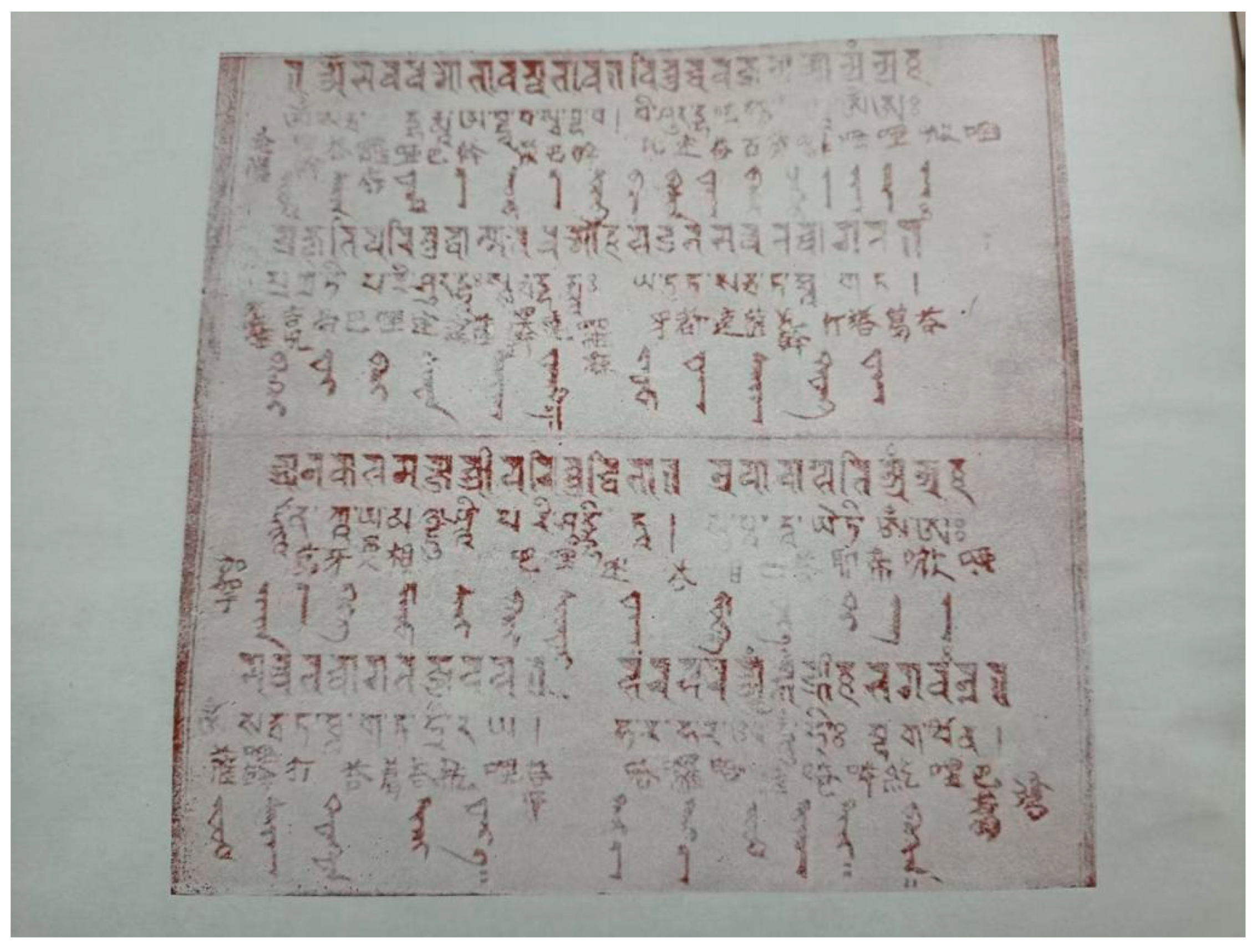
Figure A2.
Facsimile pages from the Vira edition, with the NSM glosses inserted vertically alongside the main text, disrupting the horizontal flow.
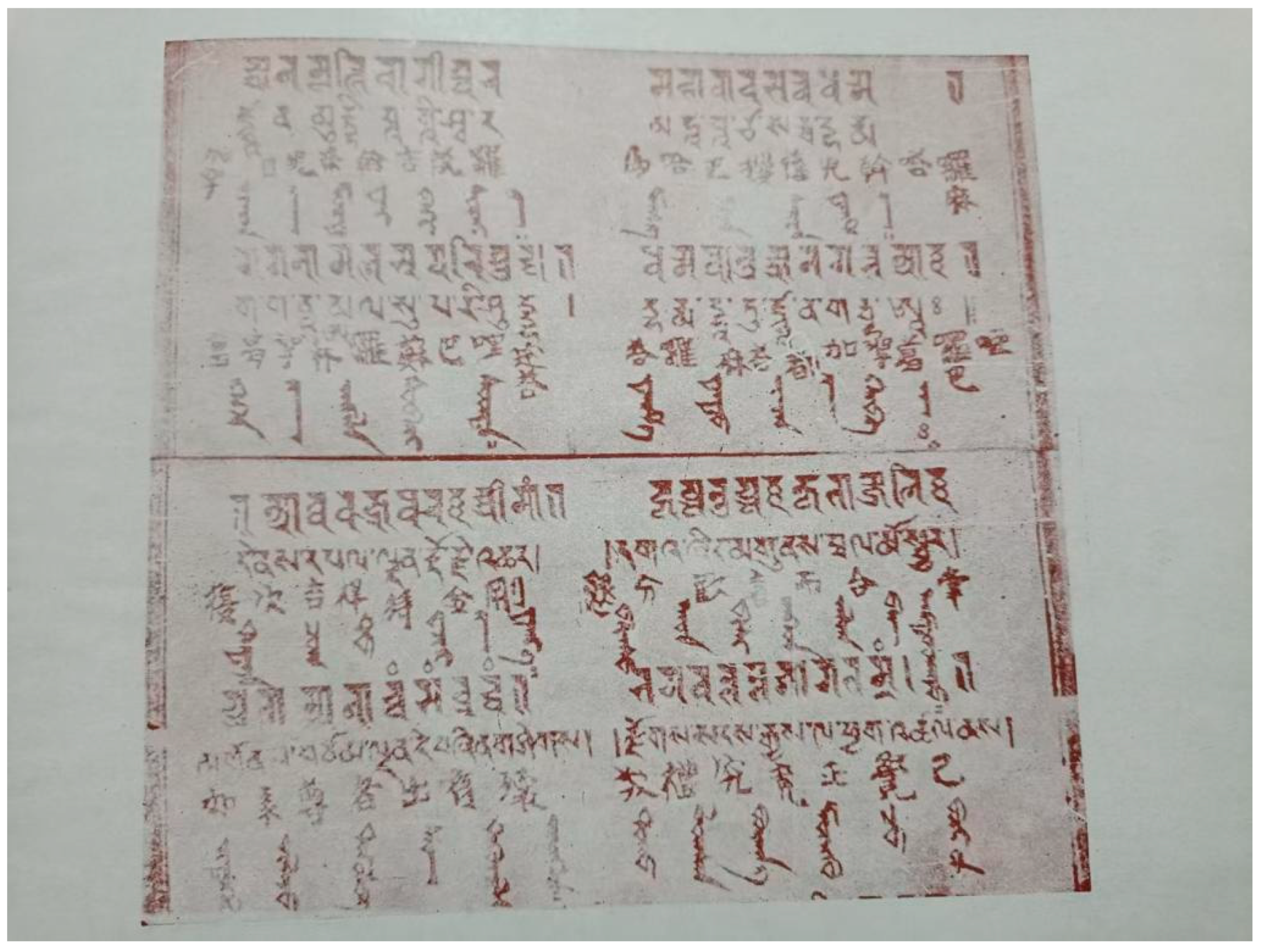
Figure A3.
Facsimile page from the Peking edition, where the layout is comparatively more systematic.
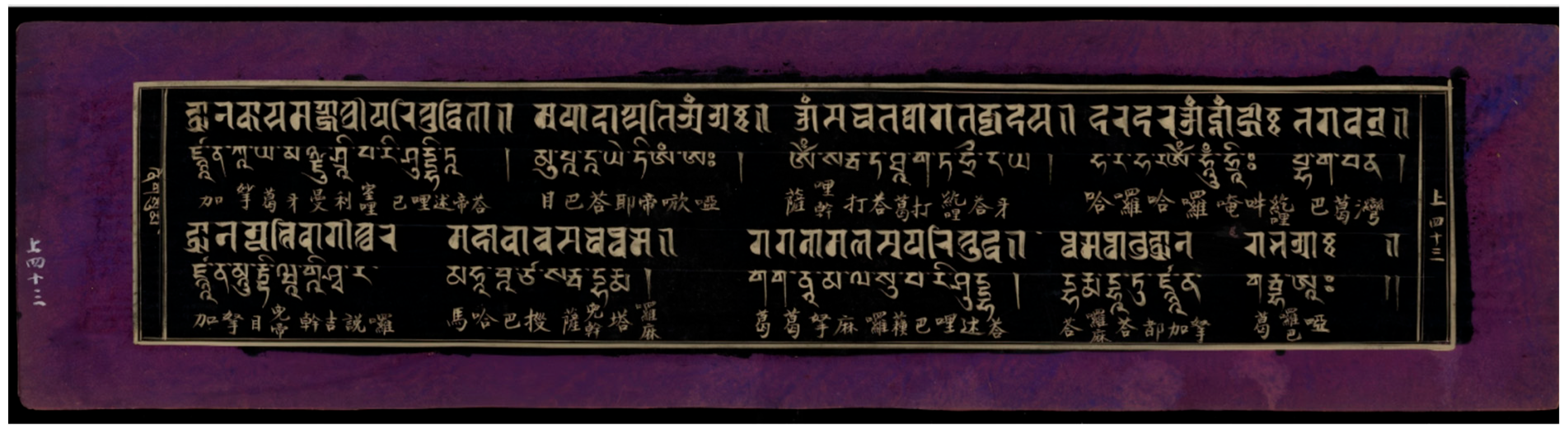
Notes
| 1 | Perhaps because he did not have sufficient command of Chinese, Vira did not include the Chinese text from the quadrilingual manuscript in his collation, but only reproduced it in his Appendix. |
| 2 | See Appendix C. |
| 3 | As Davidson has noted, the meter, declensions, and saṃdhi of NS are very irregular, and this tendency is also observed in other texts from this period, such as the Hevajra Tantra, Saṃvarodaya Tantra, and Caṇḍamahāroṣaṇa Tantra. Accordingly, Davidson’s text is preserved verbatim here, with only the divergences from the Multilingual editions indicated. |
| 4 | For the Nāmasaṃgītiṭippanī Amṛtakaṇikā, this study refers to Lal (1994) and Tribe (1994). Wayman (1985) has also been consulted for interpretive guidance. |
| 5 | Middle Chinese reconstructions in Li and Zhou (1999) are based on Wang Li, Hanyu Shigao 汉语史稿, vol. 1, while Old Mandarin reconstructions are based on Ning Jifu, Zhongyuan Yinyun Biaogao 中原音韵表稿. |
| 6 | the Multilingual editions: niṣkalas. |
| 7 | Davidson (1981) and the multilingual editions read bījam. The phrase may alternatively be derived from sūkṣmo ‘bījam, in which case the avagraha (’) is optional and often omitted in manuscripts. As bījam conforms neither to standard Sanskrit grammar nor to NST conventions, ’bījam is adopted in the present text. |
| 8 | the Multilingual editions: śrīmān. |
| 9 | the Multilingual editions: bodhyaṅgakusumāmodas. |
| 10 | the Multilingual editions: daṃṣṭrākara lakaṅkālo, Nāmasaṃgītiṭippanī Amṛtakaṇikā: daṃṣṭrākarālaḥ kaṅkālo. |
| 11 | Vira edition: hā. |
| 12 | the Multilingual editions: samantabhadras. |
| 13 | the Multilingual editions: mahānāma. |
| 14 | the Multilingual editions: stryadhvānadhvagatiṅ. |
| 15 | the Multilingual editions: varaṇyo. |
| 16 | Peking edition: svaḥ. |
| 17 | The term “歸救” is attested in two translations by the Song-dynasty monk Fahu 法護: (1) Foshuo dabei kongzhi jingang dajiaowang yigui jing 《佛說大悲空智金剛大教王儀軌經》, juan 3: “應如我以大威力於生死泥拔濟沈溺,作大歸救。” (Taisho Tripitaka 1983) ; (2) Shishelun 《施設論》, juan 3: “我當廣行布施、植諸勝福,長養一切眾生,淨持戒行。世間癡暗無歸救者,悉為救度。” (Taisho Tripitaka 1983) . In both of these examples, the term “歸救” may be understood as conveying the sense of “refuge and veneration.” |
| 18 | the Multilingual editions: padmanartteśvaraḥ. |
| 19 | The multilingual editions: śrīmāṃ. |
| 20 | the Multilingual editions: ratnacchatro. |
| 21 | Peking edition: yu. |
| 22 | Peking edition: dhi. |
| 23 | Peking edition: yi ··· |
| 24 | Peking edition: yi ··· |
| 25 | the Multilingual editions: guhyendrer. |
| 26 | This variant is not noted in the collation notes of the Zhonghua Tripitaka (1994). |
| 27 | This variant is not noted in the collation notes of the Zhonghua Tripitaka (1994). |
| 28 | Here the Sanskrit letter in both the Vira edition and the Peking edition is mistakenly written as “ra”; based on the Tibetan transcription “va” and the corresponding Chinese transliteration “斡,” it should be corrected to “va.” |
| 29 | Peking edition: 幹. |
| 30 | Vira edition: [爹思][納都][渴節荅]. |
| 31 | Peking edition: 不動. |
| 32 | Vira edition: [加加]. |
| 33 | Here the Chinese character in both the Vira edition and the Peking edition is mistakenly written as “幹”; based on the Sanskrit letter and the Tibetan transcription “va,” it should be corrected to “斡.” |
| 34 | Here, the Sanskrit in both the Vira and Peking editions reads “viśuddhavajravajra,” while the Tibetan transcription is “viśuddhavajracakṣu.” Based on Davidson (1981) and the Chinese rendering, both “vajra” and “cakṣu” are superfluous elements. |
| 35 | The text corresponding to “斡” below is rendered as “幹” throughout the Peking edition. |
| 36 | Vira edition: [資囉]. |
| 37 | Peking edition: 杳. |
| 38 | The text corresponding to “打塔(荅)葛打” below is rendered as “打塔(荅)葛荅” throughout the Vira edition. |
| 39 | Vira edition: [加㧝], Peking edition: 加  . . |
| 40 | Vira edition: 相,Peking edition: 利. |
| 41 | Peking edition: 已. |
| 42 | Vira edition: 紇哩[荅牙]. |
| 43 | Vira edition: 紇哩[巴葛]. |
| 44 | Vira edition: [加㧝],the text corresponding to “拏” below is rendered as “㧝” throughout the Vira edition. |
| 45 | Vira edition: [兒帝]. |
| 46 | Vira edition: 兒斡. |
| 47 | Vira edition: 嗒. |
| 48 | Peking edition:  . . |
| 49 | Vira edition: [述荅]. |
| 50 | Vira edition: 囉麻. |
| 51 | Yonglebei Tripitaka: 引一. |
| 52 | Yonglebei Tripitaka: 二. |
| 53 | Yonglebei Tripitaka: 三. |
| 54 | Yonglebei Tripitaka: 上声. |
| 55 | Yonglebei Tripitaka: 四. |
| 56 | Yonglebei Tripitaka: 五. |
| 57 | Yonglebei Tripitaka: 六. |
| 58 | Yonglebei Tripitaka: 七. |
| 59 | Yonglebei Tripitaka: 寧各切. |
| 60 | Yonglebei Tripitaka:  . . |
| 61 | Yonglebei Tripitaka: 巴梨說. |
References
- Cairang 才让. 2016. Putiyi zhu: Dunhuang zangwen Fojiao wenxian de zhengli yu jiedu 菩提遗珠:敦煌藏文佛教文献的整理与解读 [Bodhi Gems: Collation and Interpretation of Tibetan Buddhist Manuscripts from Dunhuang]. Shanghai: Shanghai Guji Chubanshe. [Google Scholar]
- Chen, Hongyan 陈红彦, and Sarengaowa 萨仁高娃, eds. 2020. Guojia tushuguan cang minzu wenzi guji congshu di liu ce 国家图书馆藏民族文字古籍丛书 第六册 [Ancient Books in National Minority Scripts Preserved in the National Library of China, vol. 6]. Beijing: Beijing Daxue Chubanshe. [Google Scholar]
- Davidson, Ronald M. 1981. The Litany of Names of Mañjuśrī: Text and Translation of the Mañjuśrīnāmasaṃgīti. In Tantric and Taoist Studies in Honour of R. A. Stein. Edited by Michel Strickmann. Brussels: Institut Belge des Hautes Études Chinoises, vol. 1, pp. 1–69. [Google Scholar]
- He, Mei 何梅. 2014. Lidai Hanwen Dazangjing mulu xinkao 历代汉文大藏经目录新考 [A New Study of Catalogues of Chinese Buddhist Canons Through the Ages]. Beijing: Shehui Kexue Wenxian Chubanshe. [Google Scholar]
- Lal, Banarsi. 1994. Āryamañjuśrīnāmasaṃgīti with Amṛtakaṇikā-Ṭippaṇī by Bhikṣu Raviśrījñāna and Amṛtakaṇikodyota-Nibandha of Vibhūticandra. Sarnath and Varanasi: Central Institute of Higher Tibetan Studies. [Google Scholar]
- Li, Fuhua 李富华, and Mei He 何梅. 2003. Hanwen Fojiao Dazangjing Yanjiu 汉文佛教大藏经研究 [Research on the Chinese Tripitaka]. Beijing: Zhongjiaowenhua Chubanshe. [Google Scholar]
- Li, Jining 李际宁. 2016. The secret scriptures in both the Qisha Canon and Puning Canon. Chinese Religions 2: 157–72. [Google Scholar] [CrossRef] [Scilit]
- Li, Zhenhua 李珍华, and Changji Zhou 周长楫, eds. 1999. Hanzi gujin yinbiao 汉字古今音表 [A Phonological Chart of Chinese Characters, Past and Present]. Beijing: Zhonghua Shuju. [Google Scholar]
- Lin, Yingjin 林英津. 2008. Xixia yu yi Zhenshiming jing shiwen yanjiu 西夏语译《真实名经》释文研究 [A Study on the Xixia Translation of the Mañjuśrīnāmasaṃgīti]. Beijing: Zhongguo Shehui Kexue Chubanshe. [Google Scholar]
- Lü, Cheng 呂澂. 1942. Han Zang Fojiao guanxi shiliao ji 漢藏佛教關係史料集 [A Collection of Historical Materials on Han–Tibetan Buddhist Relations]. Chengdu: Huaxi Xiehe Daxue. [Google Scholar]
- Minaev, Ivan Pavlovich. 1887. Buddizm. Izsledovaniya i Materialy. St. Petersburg: Publisher not specified, vol. 2, pp. 137–59. [Google Scholar]
- Mukherji, Durga Das. 1963. Ārya Mañjuśrīnāma Saṃgīti: Sanskrit and Tibetan Texts. Calcutta: Calcutta University Press. [Google Scholar]
- Orofino, Giacomella. 2007. From Archaeological Discovery to Text Analysis. The Khor chags Monastery Findings and the Manjuśrīnāmasaṃgīti Fragment. In Discoveries in Western Tibet and Western Himalaya. Essays on History, Literature, Archaeology and Art, Proceedings of the X Seminar of the International Association of Tibetan Studies. Leiden: Brill, vol. 10/8, pp. 85–128. [Google Scholar]
- Qianlong Tripitaka. 2010. Qianlong Dazangjing vol. 37 乾隆大藏经 第37册 [Qianlong Tripitaka vol. 119]. Beijing: Zhongguo Shudian. [Google Scholar]
- Qiaoji 乔吉. 2011. Mengguzu quanshi di si juan: Zongjiao juan 蒙古族全史第四卷 宗教卷 [A Complete History of the Mongols, vol. 4: Religion]. Hohhot: Neimenggu Daxue Chubanshe. [Google Scholar]
- Qisha Tripitaka. 2005. Qisha Dazangjing: Yingyin Song-Yuan ban 119 碛砂大藏经 影印宋元版 第119册 [Qisha Tripitaka: Facsimile of the Song-Yuan Edition vol. 119]. Beijing: Xianzhuang Shuju. [Google Scholar]
- Shen, Weirong 沈卫荣. 2017. Zangchuan Fojiao zai Xiyu he Zhongyuan de chuanbo: Dachen yaodao miji yanjiu chubian 藏传佛教在西域和中原的传播:《大乘要道密集》研究初编 [The Spread of Tibetan Buddhism in the Western Regions and the Central Plains: A Preliminary Study on the Dasheng Yaodao Miji]. Beijing: Beijing Shifan Daxue Chubanshe. [Google Scholar]
- Su, Ken. 2024. Dazhengzang jiaokan zhuji Mingban yidu zhi jianshi: Yi Ahanjing yu Fajujing wei zhu 《大正藏》校勘註記「明版」異讀之檢示:以《阿含經》與《法句經》為主 [An Examination of Variant Readings of the “Mingban” in the Collation Notes of the Taisho Tripitaka: Focusing on the Āgamas and the Dharmapada]. Fuyan foxue yanjiu 福嚴佛學研究 19: 1–29. [Google Scholar]
- Sun, Bojun 孙伯君. 2010. Xixia xinyi tuoluoni de duoyin yanjiu 西夏新译陀罗尼的对音研究 [A Study of Phonetic Transcription in Newly Translated Xixia Dhāraṇī Texts]. Beijing: Zhongguo Shehui Kexue Chubanshe. [Google Scholar]
- Takakusu, Junjiro, Watanabe Kaigyoku, and Ono Genmyo. 1983. Taisho Tripitaka. vol. 18, 20, 26 大正新脩大藏經 第18, 20, 26冊. Taipei: Xinwenfeng Publishing. [Google Scholar]
- The Jingshan Tripitaka 徑山藏. n.d. Available online: https://dzkimgs.l.u-tokyo.ac.jp/utlib_kakouzou/100_1/0002&lang=& (accessed on 6 October 2025).
- Toh, Hoong Teik. 2004. Tibetan Buddhism in Ming China. Doctoral dissertation, Harvard University, Cambridge, MA, USA. [Google Scholar]
- Tribe, Anthony. 1994. The Names of Wisdom: A Critical Edition and Annotated Translation of Chapters 1–5 of Vilāsavajra’s Commentary on the Nāmasaṃgīti, with Introduction and Textual Notes. Unpublished Doctoral dissertation, University of Oxford, Oxford, UK. [Google Scholar]
- Vira, Raghu. 1960. Mañjuśrī Nāma Saṃgīti in Mongolian, Tibetan, Sanskrit and Chinese and Sekoddeśa in Tibetan and Mongolian. New Delhi: International Academy of Indian Culture. [Google Scholar]
- Wayman, Alex. 1985. Chanting the Names of Mañjuśrī: The Mañjuśrī Nāma-saṃgīti, Sanskrit and Tibetan Texts. Boston and London: Shambhala. [Google Scholar]
- Yonglebei Tripitaka 永樂北藏. n.d. Available online: http://58.59.15.37:9500/#/homeDetails/2-2771/0508010504 (accessed on 6 October 2025).
- Yonglenan Tripitaka 永樂南藏. n.d. Available online: http://58.59.15.37:9500/#/homeDetails/1-2916/0508010403 (accessed on 6 October 2025).
- Zhang, Yongfu 张永富. 2021. Zhenshiming jing Han, Xia yiben kaolüe 《真实名经》汉、夏译本考略 [A Preliminary Study of the Chinese and Xixia Versions of the Mañjuśrīnāmasaṃgīti]. Xixia xue 西夏学 2(Tangutology Issue 2), 185–95. [Google Scholar]
- Zhang, Yongfu 张永富. 2022. Text Translation and Cultural Transmission—Comparison and Study of Tangut, Tibetan and Chinese Arya-Manjusri-Nama-Samgiti. Doctoral dissertation, Renmin University of China, Beijing, China. [Google Scholar]
- Zhongguo Zangxue Yanjiu Zhongxin Dazangjing Duikanju 中国藏学研究中心《大藏经》对勘局 [Collation Bureau for the Buddhist Canon, China Tibetology Research Center], ed. 2008. Zhonghua Dazangjing·Kangyur (77) 中華大藏經(甘珠尔) 第77冊 [The Kanjur, vol. 77]. Beijing: Zhongguo Zangxue Chubanshe. [Google Scholar]
- Zhonghuadazangjing Bianjiju 《中華大藏經》編輯局 [Editorial Office of the Zhonghua Buddhist Canon], ed. 1994. Zhonghua Dazangjing (Hanwen bufen) 71 中華大藏經(漢文部分) 第71冊 [Zhonghuadazangjing: Hanwen bufen Tripitaka vol. 71]. Beijing: Zhonghua Shuju. [Google Scholar]
- Zhoutaicairang 周太才让. 2021. A Study on the Ancient Tibetan Manuscript Āryamaṅjuśrināmasaṃgīti from Dunhuang. Doctoral dissertation, Northwest Minzu University, Lanzhou, China. [Google Scholar]

Disclaimer/Publisher’s Note: The statements, opinions and data contained in all publications are solely those of the individual author(s) and contributor(s) and not of MDPI and/or the editor(s). MDPI and/or the editor(s) disclaim responsibility for any injury to people or property resulting from any ideas, methods, instructions or products referred to in the content. |
© 2026 by the authors. Licensee MDPI, Basel, Switzerland. This article is an open access article distributed under the terms and conditions of the Creative Commons Attribution (CC BY) license.