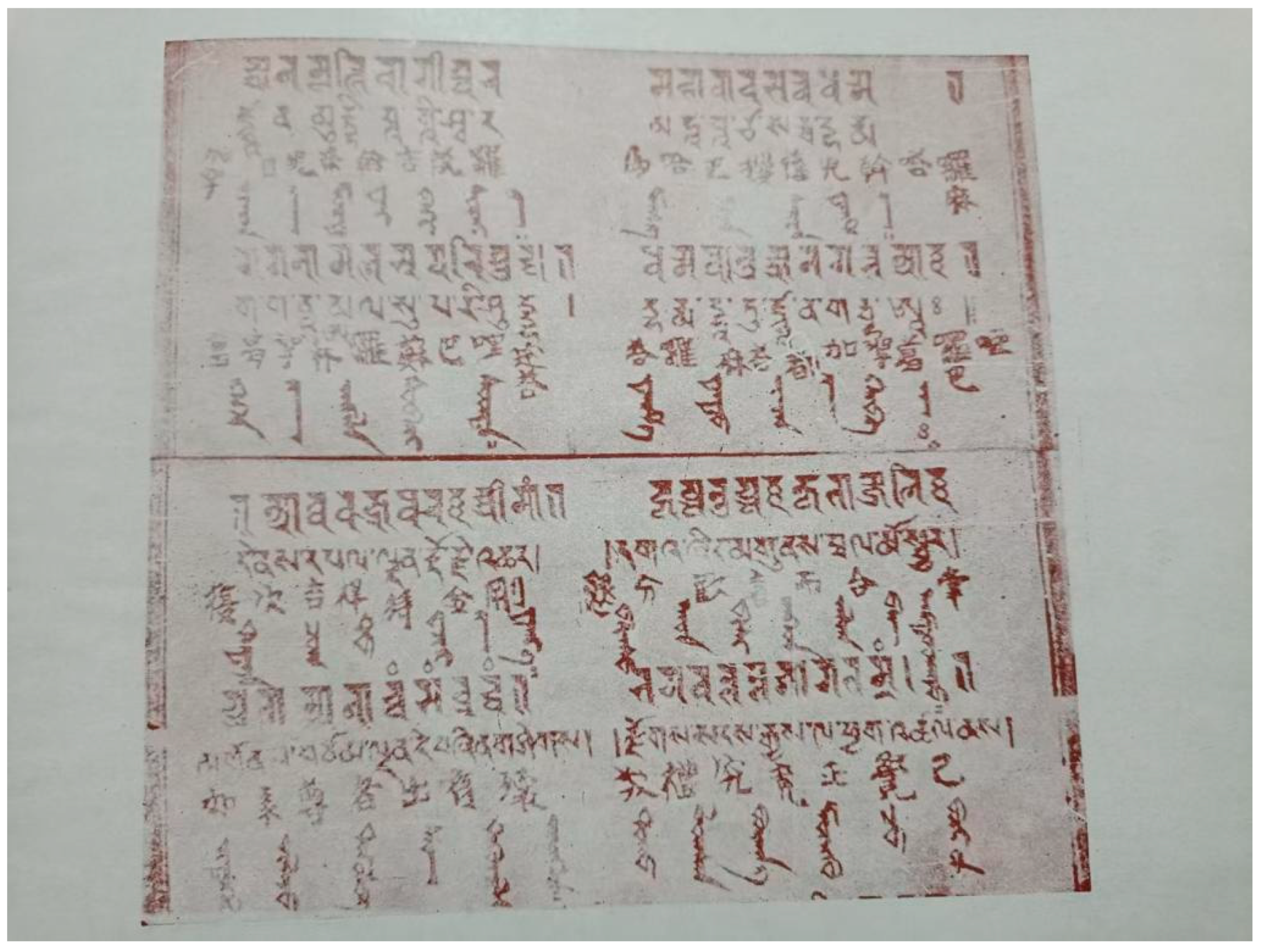
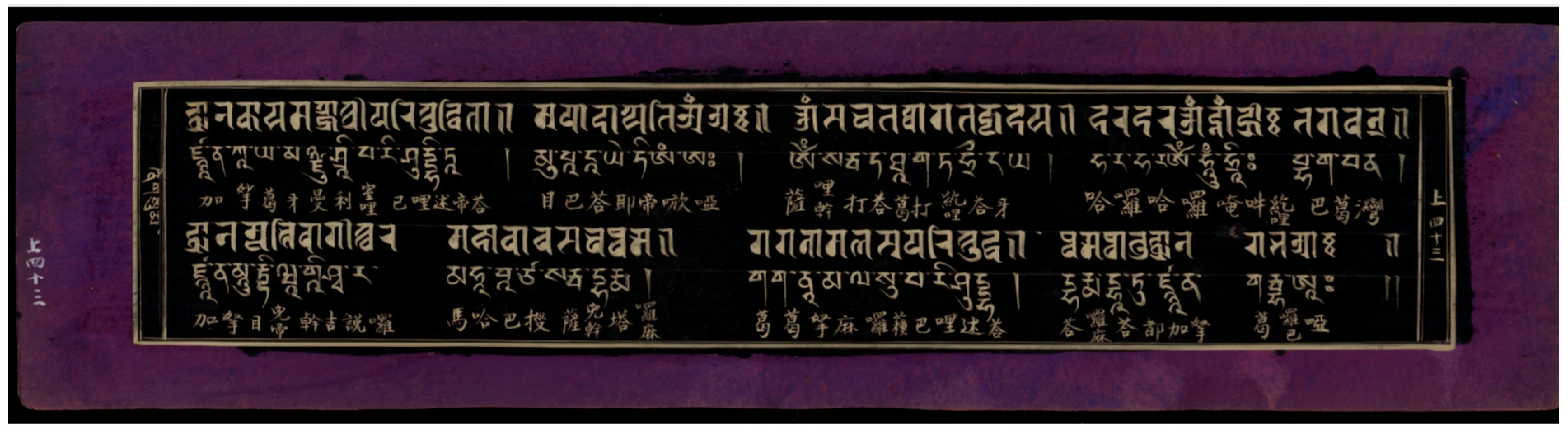
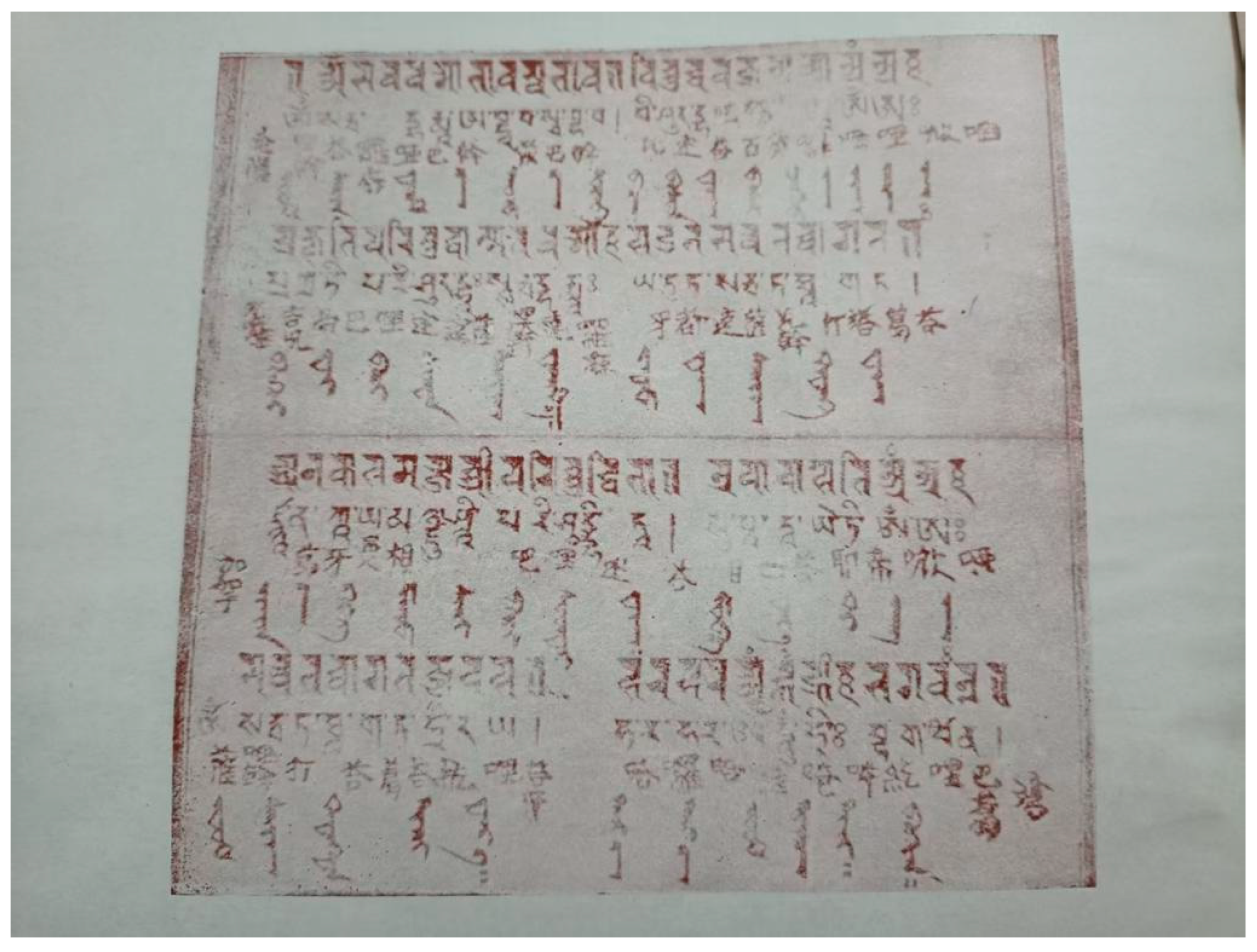
A Multilingual Collation and Comparative Study of Multiple Editions of the Zhenshimingjing: Textual Variants, Editorial History, and Philological Value

Abstract
1. Research Overview
1.1. Collation and Study of the NS
1.2. Collation and Study of the NST
1.3. Collation of NSC and Related Studies
2. Comparative Study of the NSC Editions
2.1. Survey of the NSC Texts in Different Editions
2.2. Classification of Textual Variants in the Main Body
3. Collation and Analysis of Textual Variants
4. The Mantra Sections
- 1.
- Differences in Layout Between the Peking and Vira Editions
- 2.
- Differences in Supplementary Features Between the mantra sections of the Multilingual editions and of the Tripitaka editions
5. The NSC in the Chinese Tripitaka: Constraints on Its Philological Value
6. Conclusions and Methodological Implications
Author Contributions
Funding
Institutional Review Board Statement
Informed Consent Statement
Data Availability Statement
Conflicts of Interest
Abbreviations
| Multilingual editions | The NSC portion of the Vira edition and the Peking edition |
| NS | Ārya mañjuśrī nāma saṃgīti |
| NSC | Shengmiaojixiangzhenshimingjing 聖妙吉祥真實名經 |
| NST | ‘jam dpal ye shes sems dpa’i don dam pa’i mtshan yang dag par brjod pa |
| Peking edition | Facsimile of the three-language manuscript published in Chen and Sarengaowa (2020) |
| Tripitaka editions | The NSC portion of Qisha Tripitaka, Yonglenan Tripitaka, Yonglebei Tripitaka, Jingshan Tripitaka, and Qianlong Tripitaka |
| Vira edition | Facsimile of the four-language manuscript published in Vira (1960) |
Appendix A. List of Textual Variants Among the Versions of the NSC
| No. | Location | The Multilingual Editions | The Tripitaka Editions | ||||
| Peking Edition | Vira Edition | Zhonghua Tripitaka (1994) (Qisha Tripitaka Facsimile, with Collation Notes from Puning Tripitaka, Yonglenan Tripitaka, Jingshan Tripitaka, and Qianlong Tripitaka) | Zhonghua Tripitaka (1994) (Critical Apparatus,“-” Indicates Sentences Not Cited in the Collation Notes) | Yonglebei Tripitaka | Taisho Tripitaka | ||
| 1 | colophon | 唐言聖妙吉祥真實名經 | 唐言聖妙吉祥真實名經 | 唐言誦聖妙吉祥真實名 | Yonglenan Tripitaka: 唐言誦聖妙吉祥真實名經 Jingshan Tripitaka: 聖妙吉祥真實名經 Qianlong Tripitaka: 此云誦聖妙吉祥真實名經 | 此云誦聖妙吉祥真實名經 | 此云誦聖妙吉祥真實名經 |
| 2 | colophon | / | / | 講經律論習密教土番譯主聶崖沙門釋智譯 | Jingshan Tripitaka/Qianlong Tripitaka: 元講經律論習密教土番譯主聶崖沙門釋智譯 | 元講經律論習密教土番譯主聶崖沙門釋智譯 | 元講經律論習密教土番譯主聶崖沙門釋智譯 |
| 3 | verse 4 | 有大慈悲及知慧 | 有大慈悲及智慧 | 有大慈悲及智慧 | - | 有大慈悲及智慧 | 有大慈悲及智慧 |
| 4 | verse 17 | 復出釋迦出有壞 | 復次釋迦出有壞 | 復次釋迦出有壞 | - | 復次釋迦出有壞 | 復次釋迦出有壞 |
| 5 | verse 18 | 有具皆具三惡趣 | 有情皆具三惡趣 | 有情皆具三惡趣 | - | 有情皆具三惡趣 | 有情皆具三惡趣 |
| 6 | verse 18 | 為現清净微相 | 為現清淨微笑相 | 為現清淨微笑相 | - | 為現清淨微笑相 | 為現清淨微笑相 |
| 7 | verse 24 | 大種大吉應觀察 | 大種大髻應觀○ | 大種大髻應觀察 | - | 大種大髻應觀察 | 大種大髻應觀察 |
| 8 | verse 33 | 大名及與大廣大 | 大名及與大廣大 | 大明及與大廣大 | - | 大明及與大廣大 | 大明及與大廣大 |
| 9 | verse 46 | 真如自性清淨生 | 真如自性清淨主 | 真如自性清淨主 | Jingshan Tripitaka: 真如自性清淨王26 | 真如自性清淨主 | 真如自性清淨王 |
| 10 | verse 47 | 無我獅子具音聲 | 無我師子具音聲 | 無我師子具音聲 | - | 無我師子具音聲 | 無我師子具音聲 |
| 11 | verse 49 | 集王集王集自在 | 集王集主集自在 | 集王集主集自在 | - | 集王集主集自在 | 集王集主集自在 |
| 12 | verse 51 | 救如緣覺及獨覺 | 教如緣覺及獨覺 | 教如緣覺及獨覺 | - | 教如緣覺及獨覺 | 教如緣覺及獨覺 |
| 13 | verse 53 | 世間善遊勝明解 | 世間善逝勝明解 | 世間善逝勝明解 | - | 世間善逝勝明解 | 世間善逝勝明解 |
| 14 | verse 65 | 宣說最勝三種法 | 宣說最勝三乘法 | 宣說最勝三乘法 | - | 宣說最勝三乘法 | 宣說最勝三乘法 |
| 15 | verse 67 | 亦具骨大咬牙者 | 亦具骨相咬牙者 | 亦具骨相咬牙者 | Jingshan Tripitaka/Qianlong Tripitaka: 亦是骨相咬牙者 | 亦是骨相咬牙者 | 亦是骨相咬牙者 |
| 16 | verse 72 | 今剛劒斷令無餘 | 金剛劒斷令無餘 | 金剛劒斷令無餘 | - | 金剛劒斷令無餘 | 金剛劒斷令無餘 |
| 17 | verse 75 | 執金剛鬘具吉祥 | 執金剛髮具吉祥 | 執金剛髮具吉祥 | - | 執金剛髮具吉祥 | 執金剛髮具吉祥 |
| 18 | verse 86 | 能解有時及無時 | 能解三時及無時 | 能解三時及無師 | - | 能解三時及無師 | 能解三時及無師 |
| 19 | verse 86 | 諸有情中即大龍 | 諸有情中即大龍 | 諸有情中即大尊 | - | 諸有情中即大尊 | 諸有情中即大尊 |
| 20 | verse 86 | 功德帶中之鬢帶 | 功德帶中之鬘帶 | 功德帶中之鬘帶 | - | 功德帶中之鬘帶 | 功德帶中之鬘帶 |
| 21 | verse 87 | 諸有身中即解脫 | 諸有身中即解脫 | 諸有身中即解勝 | - | 諸有身中即解勝 | 諸有身中即解勝 |
| 22 | verse 92 | 微妙歸處堪歸敬 | 微妙歸處堪歸敬 | 微妙歸處堪歸救 | - | 微妙歸處堪歸救 | 微妙歸處堪歸救 |
| 23 | verse 97 | 雖往不改亦普遍 | 雖往不改亦普遍 | 雖往不改亦普遍 | Yonglenan Tripitaka27/Jingshan Tripitaka /Qianlong Tripitaka: 雖性不改亦普遍 | 雖性不改亦普遍 | 雖性不改亦普遍 |
| 24 | verse 99 | 識心超越於法惟 | 識心超越於法性 | 識心超越於法性 | - | 識心超越於法性 | 識心超越於法性 |
| 25 | verse 103 | 能離痛刻無有上 | 能離痛刺無有上 | 能離痛刺無有上 | - | 能離痛刺無有上 | 能離痛刺無有上 |
| 26 | verse 104 | 入意三界中殊勝 | 入意三界中殊勝 | 今意三界中殊勝 | Jingshan Tripitaka/Qianlong Tripitaka: 入意三界中殊勝 | 入意三界中殊勝 | 入意三界中殊勝 |
| 27 | verse 105 | 廣大遍主大寶傘 | 廣大遍主大寶傘 | 廣大邊主大寶傘 | - | 廣大邊主大寶傘 | 廣大邊主大寶傘 |
| 28 | verse 113 | 詣到彼岸皆究竟 | 諸到彼岸皆究竟 | 諸到彼岸皆究竟 | - | 諸到彼岸皆究竟 | 諸到彼岸皆究竟 |
| 29 | verse 115 | 即是心地持往復 | 即是心地持往復 | 即是心地持往復 | Jingshan Tripitaka/Qianlong Tripitaka: 即於心地持往復 | 即於心地持往復 | 即於心地持往復 |
| 30 | verse 119 | 諸有情中殊勝等 | 諸有情中殊勝尊 | 諸有情中殊勝尊 | - | 諸有情中殊勝尊 | 諸有情中殊勝尊 |
| 31 | verse 121 | 能令動於百種于 | 能令動於百種手 | 能令動於百種手 | - | 能令動於百種手 | 能令動於百種手 |
| 32 | verse 124 | 三有歡喜廣大者 | 三有歡喜廣大者 | 二有歡喜廣大者 | - | 二有歡喜廣大者 | 三有歡喜廣大者 |
| 33 | verse 126 | 正覺化身莊嚴足 | 正覺化身莊嚴足 | 正覺化身莊嚴具 | - | 正覺化身莊嚴具 | 正覺化身莊嚴具 |
| 34 | verse 128 | 以七覺支為花香 | 以七覺支為花香 | 以十覺支為花香 | Jingshan Tripitaka/Qianlong Tripitaka: 以七覺支為花香 | 以七覺支為花香 | 以七覺支為花香 |
| 35 | verse 128 | 解八道支義理故 | 解入道支義理故 | 解八道支義理故 | - | 解八道支義理故 | 解八道支義理故 |
| 36 | verse 132 | 拔十二支有三根 | 拔十二支三有根 | 拔十二支三有根 | - | 拔十二支三有根 | 拔十二支三有根 |
| 37 | verse 136 | 寂靜加行中出現 | 寂靜加行中出現 | 寂靜如行中出現 | - | 寂靜如行中出現 | 寂靜如行中出現 |
| 38 | verse 138 | 一切想義悉弃捨 | 一切想義悉弃捨 | 一切想義皆弃捨 | - | 一切想義皆棄捨 | 一切想義皆棄捨 |
| 39 | verse 143 | 出密呪處無支字 | 出密呪處無文字 | 出密呪處無文字 | - | 出密呪處無文字 | 出密呪處無文字 |
| 40 | verse 144 | 空明點者百種字 | 空明點者百種字 | 空明點者六種字 | - | 空明點者六種字 | 空明點者六種字 |
| 41 | verse 150 | 智慧為劍持弓箭 | 智慧為劍持弓箭 | 智慧如劍持弓箭 | - | 智慧如劍持弓箭 | 智慧如劍持弓箭 |
| 42 | verse 154 | 大神足者超世界 | 大神足者超世間 | 大神足者超世間 | - | 大神足者超世間 | 大神足者超世間 |
| 43 | verse 158 | 正覺菩提敬禮 | 正覺菩提我敬禮 | 正覺菩提我敬禮 | - | 正覺菩提我敬禮 | 正覺菩提我敬禮 |
| 44 | verse 164 | 持金剛之忿怒王 | 持金剛之忿怒王 | 持金剛之金剛王 | - | 持金剛之金剛王 | 持金剛之金剛王 |
Appendix B. Variant Readings Corresponding to the Multilingual Editions (Based on Zhang 2021)
| Provenance | Location | Taisho Tripitaka | The Fragmentary Editions of NSC |
| Heishuicheng | verse 22 | 唯然末遏鑁善哉 | 唯然末阿鑁善哉 |
| verse 26 | 啞阿長呼依倚引烏鄔引𠸄唉引一 | 啞阿長呼依倚引烏鄔引哀㗒引一 | |
| verse 26 | 默捺沒隆二合低三 | 孃捺沒隆二合低三 | |
| verse 76 | 亦法犍椎大音聲 | 亦法犍雅大音聲 | |
| verse 156 | 尊者即是法施主 | 尊者即是法师主 | |
| verse 156 | 有情奉施殊勝主 | 有情奉师殊勝主 | |
| Baishigou | verse 115 | 即於心地持往復 | 即是心地持往復 |
Appendix C. The Mantra Sections
 啞剃朵[紇里]低 加納目兒帝囉含卜多 卜荅喃[嘚囉][牙多]斡29兒帝喃|


Appendix D. Stemma Diagram

Appendix E. Layout of Mantra Sections


| 1 | Perhaps because he did not have sufficient command of Chinese, Vira did not include the Chinese text from the quadrilingual manuscript in his collation, but only reproduced it in his Appendix. |
| 2 | See Appendix C. |
| 3 | As Davidson has noted, the meter, declensions, and saṃdhi of NS are very irregular, and this tendency is also observed in other texts from this period, such as the Hevajra Tantra, Saṃvarodaya Tantra, and Caṇḍamahāroṣaṇa Tantra. Accordingly, Davidson’s text is preserved verbatim here, with only the divergences from the Multilingual editions indicated. |
| 4 | |
| 5 | Middle Chinese reconstructions in Li and Zhou (1999) are based on Wang Li, Hanyu Shigao 汉语史稿, vol. 1, while Old Mandarin reconstructions are based on Ning Jifu, Zhongyuan Yinyun Biaogao 中原音韵表稿. |
| 6 | the Multilingual editions: niṣkalas. |
| 7 | Davidson (1981) and the multilingual editions read bījam. The phrase may alternatively be derived from sūkṣmo ‘bījam, in which case the avagraha (’) is optional and often omitted in manuscripts. As bījam conforms neither to standard Sanskrit grammar nor to NST conventions, ’bījam is adopted in the present text. |
| 8 | the Multilingual editions: śrīmān. |
| 9 | the Multilingual editions: bodhyaṅgakusumāmodas. |
| 10 | the Multilingual editions: daṃṣṭrākara lakaṅkālo, Nāmasaṃgītiṭippanī Amṛtakaṇikā: daṃṣṭrākarālaḥ kaṅkālo. |
| 11 | Vira edition: hā. |
| 12 | the Multilingual editions: samantabhadras. |
| 13 | the Multilingual editions: mahānāma. |
| 14 | the Multilingual editions: stryadhvānadhvagatiṅ. |
| 15 | the Multilingual editions: varaṇyo. |
| 16 | Peking edition: svaḥ. |
| 17 | The term “歸救” is attested in two translations by the Song-dynasty monk Fahu 法護: (1) Foshuo dabei kongzhi jingang dajiaowang yigui jing 《佛說大悲空智金剛大教王儀軌經》, juan 3: “應如我以大威力於生死泥拔濟沈溺,作大歸救。” (Taisho Tripitaka 1983) ; (2) Shishelun 《施設論》, juan 3: “我當廣行布施、植諸勝福,長養一切眾生,淨持戒行。世間癡暗無歸救者,悉為救度。” (Taisho Tripitaka 1983) . In both of these examples, the term “歸救” may be understood as conveying the sense of “refuge and veneration.” |
| 18 | the Multilingual editions: padmanartteśvaraḥ. |
| 19 | The multilingual editions: śrīmāṃ. |
| 20 | the Multilingual editions: ratnacchatro. |
| 21 | Peking edition: yu. |
| 22 | Peking edition: dhi. |
| 23 | Peking edition: yi ··· |
| 24 | Peking edition: yi ··· |
| 25 | the Multilingual editions: guhyendrer. |
| 26 | This variant is not noted in the collation notes of the Zhonghua Tripitaka (1994). |
| 27 | This variant is not noted in the collation notes of the Zhonghua Tripitaka (1994). |
| 28 | Here the Sanskrit letter in both the Vira edition and the Peking edition is mistakenly written as “ra”; based on the Tibetan transcription “va” and the corresponding Chinese transliteration “斡,” it should be corrected to “va.” |
| 29 | Peking edition: 幹. |
| 30 | Vira edition: [爹思][納都][渴節荅]. |
| 31 | Peking edition: 不動. |
| 32 | Vira edition: [加加]. |
| 33 | Here the Chinese character in both the Vira edition and the Peking edition is mistakenly written as “幹”; based on the Sanskrit letter and the Tibetan transcription “va,” it should be corrected to “斡.” |
| 34 | |
| 35 | The text corresponding to “斡” below is rendered as “幹” throughout the Peking edition. |
| 36 | Vira edition: [資囉]. |
| 37 | Peking edition: 杳. |
| 38 | The text corresponding to “打塔(荅)葛打” below is rendered as “打塔(荅)葛荅” throughout the Vira edition. |
| 39 | Vira edition: [加㧝], Peking edition: 加  . . |
| 40 | Vira edition: 相,Peking edition: 利. |
| 41 | Peking edition: 已. |
| 42 | Vira edition: 紇哩[荅牙]. |
| 43 | Vira edition: 紇哩[巴葛]. |
| 44 | Vira edition: [加㧝],the text corresponding to “拏” below is rendered as “㧝” throughout the Vira edition. |
| 45 | Vira edition: [兒帝]. |
| 46 | Vira edition: 兒斡. |
| 47 | Vira edition: 嗒. |
| 48 | Peking edition:  . . |
| 49 | Vira edition: [述荅]. |
| 50 | Vira edition: 囉麻. |
| 51 | Yonglebei Tripitaka: 引一. |
| 52 | Yonglebei Tripitaka: 二. |
| 53 | Yonglebei Tripitaka: 三. |
| 54 | Yonglebei Tripitaka: 上声. |
| 55 | Yonglebei Tripitaka: 四. |
| 56 | Yonglebei Tripitaka: 五. |
| 57 | Yonglebei Tripitaka: 六. |
| 58 | Yonglebei Tripitaka: 七. |
| 59 | Yonglebei Tripitaka: 寧各切. |
| 60 | Yonglebei Tripitaka:  . . |
| 61 | Yonglebei Tripitaka: 巴梨說. |
References
- Cairang 才让. 2016. Putiyi zhu: Dunhuang zangwen Fojiao wenxian de zhengli yu jiedu 菩提遗珠:敦煌藏文佛教文献的整理与解读 [Bodhi Gems: Collation and Interpretation of Tibetan Buddhist Manuscripts from Dunhuang]. Shanghai: Shanghai Guji Chubanshe. [Google Scholar]
- Chen, Hongyan 陈红彦, and Sarengaowa 萨仁高娃, eds. 2020. Guojia tushuguan cang minzu wenzi guji congshu di liu ce 国家图书馆藏民族文字古籍丛书 第六册 [Ancient Books in National Minority Scripts Preserved in the National Library of China, vol. 6]. Beijing: Beijing Daxue Chubanshe. [Google Scholar]
- Davidson, Ronald M. 1981. The Litany of Names of Mañjuśrī: Text and Translation of the Mañjuśrīnāmasaṃgīti. In Tantric and Taoist Studies in Honour of R. A. Stein. Edited by Michel Strickmann. Brussels: Institut Belge des Hautes Études Chinoises, vol. 1, pp. 1–69. [Google Scholar]
- He, Mei 何梅. 2014. Lidai Hanwen Dazangjing mulu xinkao 历代汉文大藏经目录新考 [A New Study of Catalogues of Chinese Buddhist Canons Through the Ages]. Beijing: Shehui Kexue Wenxian Chubanshe. [Google Scholar]
- Lal, Banarsi. 1994. Āryamañjuśrīnāmasaṃgīti with Amṛtakaṇikā-Ṭippaṇī by Bhikṣu Raviśrījñāna and Amṛtakaṇikodyota-Nibandha of Vibhūticandra. Sarnath and Varanasi: Central Institute of Higher Tibetan Studies. [Google Scholar]
- Li, Fuhua 李富华, and Mei He 何梅. 2003. Hanwen Fojiao Dazangjing Yanjiu 汉文佛教大藏经研究 [Research on the Chinese Tripitaka]. Beijing: Zhongjiaowenhua Chubanshe. [Google Scholar]
- Li, Jining 李际宁. 2016. The secret scriptures in both the Qisha Canon and Puning Canon. Chinese Religions 2: 157–72. [Google Scholar] [CrossRef] [Scilit]
- Li, Zhenhua 李珍华, and Changji Zhou 周长楫, eds. 1999. Hanzi gujin yinbiao 汉字古今音表 [A Phonological Chart of Chinese Characters, Past and Present]. Beijing: Zhonghua Shuju. [Google Scholar]
- Lin, Yingjin 林英津. 2008. Xixia yu yi Zhenshiming jing shiwen yanjiu 西夏语译《真实名经》释文研究 [A Study on the Xixia Translation of the Mañjuśrīnāmasaṃgīti]. Beijing: Zhongguo Shehui Kexue Chubanshe. [Google Scholar]
- Lü, Cheng 呂澂. 1942. Han Zang Fojiao guanxi shiliao ji 漢藏佛教關係史料集 [A Collection of Historical Materials on Han–Tibetan Buddhist Relations]. Chengdu: Huaxi Xiehe Daxue. [Google Scholar]
- Minaev, Ivan Pavlovich. 1887. Buddizm. Izsledovaniya i Materialy. St. Petersburg: Publisher not specified, vol. 2, pp. 137–59. [Google Scholar]
- Mukherji, Durga Das. 1963. Ārya Mañjuśrīnāma Saṃgīti: Sanskrit and Tibetan Texts. Calcutta: Calcutta University Press. [Google Scholar]
- Orofino, Giacomella. 2007. From Archaeological Discovery to Text Analysis. The Khor chags Monastery Findings and the Manjuśrīnāmasaṃgīti Fragment. In Discoveries in Western Tibet and Western Himalaya. Essays on History, Literature, Archaeology and Art, Proceedings of the X Seminar of the International Association of Tibetan Studies. Leiden: Brill, vol. 10/8, pp. 85–128. [Google Scholar]
- Qianlong Tripitaka. 2010. Qianlong Dazangjing vol. 37 乾隆大藏经 第37册 [Qianlong Tripitaka vol. 119]. Beijing: Zhongguo Shudian. [Google Scholar]
- Qiaoji 乔吉. 2011. Mengguzu quanshi di si juan: Zongjiao juan 蒙古族全史第四卷 宗教卷 [A Complete History of the Mongols, vol. 4: Religion]. Hohhot: Neimenggu Daxue Chubanshe. [Google Scholar]
- Qisha Tripitaka. 2005. Qisha Dazangjing: Yingyin Song-Yuan ban 119 碛砂大藏经 影印宋元版 第119册 [Qisha Tripitaka: Facsimile of the Song-Yuan Edition vol. 119]. Beijing: Xianzhuang Shuju. [Google Scholar]
- Shen, Weirong 沈卫荣. 2017. Zangchuan Fojiao zai Xiyu he Zhongyuan de chuanbo: Dachen yaodao miji yanjiu chubian 藏传佛教在西域和中原的传播:《大乘要道密集》研究初编 [The Spread of Tibetan Buddhism in the Western Regions and the Central Plains: A Preliminary Study on the Dasheng Yaodao Miji]. Beijing: Beijing Shifan Daxue Chubanshe. [Google Scholar]
- Su, Ken. 2024. Dazhengzang jiaokan zhuji Mingban yidu zhi jianshi: Yi Ahanjing yu Fajujing wei zhu 《大正藏》校勘註記「明版」異讀之檢示:以《阿含經》與《法句經》為主 [An Examination of Variant Readings of the “Mingban” in the Collation Notes of the Taisho Tripitaka: Focusing on the Āgamas and the Dharmapada]. Fuyan foxue yanjiu 福嚴佛學研究 19: 1–29. [Google Scholar]
- Sun, Bojun 孙伯君. 2010. Xixia xinyi tuoluoni de duoyin yanjiu 西夏新译陀罗尼的对音研究 [A Study of Phonetic Transcription in Newly Translated Xixia Dhāraṇī Texts]. Beijing: Zhongguo Shehui Kexue Chubanshe. [Google Scholar]
- Takakusu, Junjiro, Watanabe Kaigyoku, and Ono Genmyo. 1983. Taisho Tripitaka. vol. 18, 20, 26 大正新脩大藏經 第18, 20, 26冊. Taipei: Xinwenfeng Publishing. [Google Scholar]
- The Jingshan Tripitaka 徑山藏. n.d. Available online: https://dzkimgs.l.u-tokyo.ac.jp/utlib_kakouzou/100_1/0002&lang=& (accessed on 6 October 2025).
- Toh, Hoong Teik. 2004. Tibetan Buddhism in Ming China. Doctoral dissertation, Harvard University, Cambridge, MA, USA. [Google Scholar]
- Tribe, Anthony. 1994. The Names of Wisdom: A Critical Edition and Annotated Translation of Chapters 1–5 of Vilāsavajra’s Commentary on the Nāmasaṃgīti, with Introduction and Textual Notes. Unpublished Doctoral dissertation, University of Oxford, Oxford, UK. [Google Scholar]
- Vira, Raghu. 1960. Mañjuśrī Nāma Saṃgīti in Mongolian, Tibetan, Sanskrit and Chinese and Sekoddeśa in Tibetan and Mongolian. New Delhi: International Academy of Indian Culture. [Google Scholar]
- Wayman, Alex. 1985. Chanting the Names of Mañjuśrī: The Mañjuśrī Nāma-saṃgīti, Sanskrit and Tibetan Texts. Boston and London: Shambhala. [Google Scholar]
- Yonglebei Tripitaka 永樂北藏. n.d. Available online: http://58.59.15.37:9500/#/homeDetails/2-2771/0508010504 (accessed on 6 October 2025).
- Yonglenan Tripitaka 永樂南藏. n.d. Available online: http://58.59.15.37:9500/#/homeDetails/1-2916/0508010403 (accessed on 6 October 2025).
- Zhang, Yongfu 张永富. 2021. Zhenshiming jing Han, Xia yiben kaolüe 《真实名经》汉、夏译本考略 [A Preliminary Study of the Chinese and Xixia Versions of the Mañjuśrīnāmasaṃgīti]. Xixia xue 西夏学 2(Tangutology Issue 2), 185–95. [Google Scholar]
- Zhang, Yongfu 张永富. 2022. Text Translation and Cultural Transmission—Comparison and Study of Tangut, Tibetan and Chinese Arya-Manjusri-Nama-Samgiti. Doctoral dissertation, Renmin University of China, Beijing, China. [Google Scholar]
- Zhongguo Zangxue Yanjiu Zhongxin Dazangjing Duikanju 中国藏学研究中心《大藏经》对勘局 [Collation Bureau for the Buddhist Canon, China Tibetology Research Center], ed. 2008. Zhonghua Dazangjing·Kangyur (77) 中華大藏經(甘珠尔) 第77冊 [The Kanjur, vol. 77]. Beijing: Zhongguo Zangxue Chubanshe. [Google Scholar]
- Zhonghuadazangjing Bianjiju 《中華大藏經》編輯局 [Editorial Office of the Zhonghua Buddhist Canon], ed. 1994. Zhonghua Dazangjing (Hanwen bufen) 71 中華大藏經(漢文部分) 第71冊 [Zhonghuadazangjing: Hanwen bufen Tripitaka vol. 71]. Beijing: Zhonghua Shuju. [Google Scholar]
- Zhoutaicairang 周太才让. 2021. A Study on the Ancient Tibetan Manuscript Āryamaṅjuśrināmasaṃgīti from Dunhuang. Doctoral dissertation, Northwest Minzu University, Lanzhou, China. [Google Scholar]

| Number | Variant Numbers | Description |
|---|---|---|
| 8 | 8, 18, 19, 21, 27, 32, 37, 44 | the Multilingual editions correspond more closely to the NST, while the Tripitaka editions reflect errors caused by phonetic confusion, graphic similarity, repetition, or other unidentified factors. |
| 3 | 22, 38, 42 | Both the Multilingual editions and the Tripitaka editions correspond to the NST. |
| 1 | 33 | The Tripitaka editions correspond more closely to the NST, while the Multilingual editions show phonetic or graphic error. |
| 1 | 41 | the Multilingual editions correspond more closely to the NST, while the Tripitaka editions may reflect a different underlying NS or NST manuscript. |
Disclaimer/Publisher’s Note: The statements, opinions and data contained in all publications are solely those of the individual author(s) and contributor(s) and not of MDPI and/or the editor(s). MDPI and/or the editor(s) disclaim responsibility for any injury to people or property resulting from any ideas, methods, instructions or products referred to in the content. |
© 2026 by the authors. Licensee MDPI, Basel, Switzerland. This article is an open access article distributed under the terms and conditions of the Creative Commons Attribution (CC BY) license.
Share and Cite
Wang, A.; Feng, S. A Multilingual Collation and Comparative Study of Multiple Editions of the Zhenshimingjing: Textual Variants, Editorial History, and Philological Value. Religions 2026, 17, 85. https://doi.org/10.3390/rel17010085
Wang A, Feng S. A Multilingual Collation and Comparative Study of Multiple Editions of the Zhenshimingjing: Textual Variants, Editorial History, and Philological Value. Religions. 2026; 17(1):85. https://doi.org/10.3390/rel17010085
Chicago/Turabian StyleWang, An, and Sheng Feng. 2026. "A Multilingual Collation and Comparative Study of Multiple Editions of the Zhenshimingjing: Textual Variants, Editorial History, and Philological Value" Religions 17, no. 1: 85. https://doi.org/10.3390/rel17010085
APA StyleWang, A., & Feng, S. (2026). A Multilingual Collation and Comparative Study of Multiple Editions of the Zhenshimingjing: Textual Variants, Editorial History, and Philological Value. Religions, 17(1), 85. https://doi.org/10.3390/rel17010085