


Abstract
Maritime target detection under complex adverse weather conditions (e.g., fog, rain, and low light) is crucial for Unmanned Surface Vehicle (USV) navigation. However, achieving high detection accuracy and efficiency remains challenging due to coupled environmental interference and limited computing resources. In this paper, we propose W-MTD, a task-specific distillation framework designed for weather-robust and lightweight maritime target detection based on knowledge distillation. Building upon the Fine-grained Distribution Refinement (D-FINE) detection model, this method constructs a dual-path knowledge distillation framework tailored for maritime scenes. Through the synergistic optimization of feature similarity constraints and decoupled distillation, it facilitates multi-level knowledge transfer from a teacher model to a lightweight student model, mitigating feature degradation caused by model compression. A multi-scenario augmentation strategy is designed to balance convergence across different weather conditions. Experiments show that W-MTD’s student model improves detection accuracy by 7.0–13.9% under three adverse weather conditionscompared to the baseline teacher model trained solely on clear weather data while maintaining comparable clear-weather performance. With only 4 M parameters and 7 GFLOPs, the student model demonstrates favorable performance and efficiency compared to other real-time detectors, indicating its potential suitability for USV deployment.
1. Introduction
As a core carrier of intelligent marine equipment, Unmanned Surface Vehicles (USVs) demonstrate significant strategic value in fields such as marine resource exploration, environmental monitoring, and security defense. Maritime target detection technology is a key foundation for enabling autonomous navigation, intelligent obstacle avoidance, and mission execution for USVs. Its performance directly impacts the operational effectiveness and safety of USVs in complex marine environments [1,2].
In recent years, deep learning-based target detection methods, such as single-stage detectors like the YOLO series [3,4,5,6,7,8] and DETR [9,10,11,12] and two-stage detectors like Faster R-CNN [13,14,15,16,17] and Mask R-CNN [18,19,20], have made significant progress in perception tasks for maritime scenes.
To enhance model adaptability in harsh marine environments, existing research primarily follows three technical paths: First, image enhancement augmentation improves input image quality through preprocessing, e.g., by combining dehazing, deblurring, or low-light enhancement algorithms to improve feature visibility [21,22,23,24,25,26,27]. Second, multi-sensor fusion compensates for the limitations of unimodal perception by integrating heterogeneous data such as optical images, radar, and AIS (Automatic Identification System) readings [28,29,30]. Third, specialized network designs explore dedicated network architectures to protect against complex degradations (e.g., MFP-DETR [11] and WODIS [31]). However, these methods mainly focus on addressing the problem of specific or limited combinations of interference. When facing multiple weather influences (e.g., fog, rain, and low light) in real marine environments, the model’s robustness and generalization ability remain insufficient. Furthermore, these methods often come with high computational complexity, making them difficult to deploy directly on resource-constrained embedded platforms of USVs.
Addressing the computational power and energy consumption constraints of marine equipment, some lightweight models [32,33,34,35,36,37,38,39,40,41,42,43,44] (e.g., improved YOLOv5 versions [33,34,35,38] and YOLOX-ViT [36]) have reduced model size and computational complexity through techniques like pruning, quantization, and knowledge distillation [45]. However, the model compression process can easily lead to a significant drop in multi-target detection accuracy. The severely limited hardware resources of small USVs further exacerbate the trade-off between real-time performance and detection accuracy.
To address these challenges, this work presents W-MTD, a distillation framework designed to enhance the weather robustness of a lightweight maritime target detector. Based on the D-FINE [46] (Fine-grained Distribution Refinement) architecture, it leverages knowledge transfer and multi-scenario data augmentation to enhance detection performance under adverse maritime conditions, including fog, rain, and low-light scenarios. The resulting student model requires only 4M parameters and 7 GFLOPs. Our primary contributions are outlined as follows:
- We design a dual-path knowledge distillation framework called W-MTD for weather-robust and lightweight maritime target detection. Through the synergistic optimization of feature similarity constraints and decoupled distillation, it addresses multi-scale feature degradation in a lightweight student model, improving target detection accuracy in maritime scenarios.
- We propose a maritime multi-scenario data augmentation training strategy. Through interference noise injection (with an empirically validated ratio), clear weather data retention, and secondary fine-tuning, the strategy accelerates model convergence under challenging weather conditions while mitigating forgetting of clear-weather knowledge. This enables synchronous performance improvements in foggy, rainy, and low-light scenarios.
2. Related Work
Target detection in complex maritime environments is a key technology for autonomous USV navigation and mission execution. Current studies emphasize environmental adaptability and lightweight model optimization to cope with multi-scenario interference (rain, fog, and low resolution) and limited embedded resources.
2.1. Techniques for Maritime Environmental Adaptation
To improve model robustness for target detection in complex maritime environments, researchers have conducted in-depth studies mainly from the perspectives of image enhancement and augmentation and multi-sensor fusion.
Image enhancement methods aim to improve input image quality through preprocessing, optimizing target feature extraction. Early research primarily focused on target detection in single environments. For instance, Akhmedov et al. [22] adopted a process of dehazing followed by detection to enhance target features under low-visibility conditions. Liu et al. [23] used Generative Adversarial Networks (GANs) to simulate data distributions under different illumination intensities, combined with local enhancement strategies and hybrid loss functions, improving the clarity of low-light images and target detection capability. Wang et al. [27] combined image restoration with target detection through dynamic enhancement learning, enhancing robustness for target detection in complex maritime backgrounds.
Data augmentation techniques can alleviate the problem of insufficient training data for maritime scenes. For example, Dong et al. [24] proposed ShipGAN, which uses GANs to convert simulated images into realistic images suitable for USV data augmentation. Yan et al. [25] designed an augmentation strategy based on simulated samples of remote sensing images for ship detection. Existing methods often optimize for a single interference factor (such as fog or low illumination). However, the actual maritime environment involves interference from multiple meteorological factors, which limits the cross-domain generalization ability of single-factor optimization strategies.
Multi-sensor fusion methods aim to compensate for the shortcomings of single sensors and enhance the robustness of marine environment perception by integrating multi-source heterogeneous data such as vision (cameras), electromagnetic (radar and AIS), and laser (LiDAR) data. For instance, Duan et al. [28] proposed a network model based on multimodal radar echo data fusion, extracting features in time, frequency, and time–frequency domains and introducing a self-attention mechanism to optimize feature fusion, making it suitable for weak target detection in complex marine environments. Abuolaim and Brown [29] proposed a method for generating realistic Dual-Pixel (DP) sensor data and utilized the synthesized DP data for image deblurring. Liu et al. [30] improved position estimation and tracking accuracy using an Interacting Multiple-Model Kalman Filter (IMMKF) applicable to maritime target tracking.
Additionally, some studies have attempted to directly design network structures inherently robust to adverse weather factors. For example, Zou et al. [11] proposed MFP-DETR, which mitigates image blur caused by rapid motion by introducing a multi-scale motion-blur perception module. To effectively suppress water–sky interference and improve small target detection capability, Chen et al. [31] proposed the WODIS network, which achieved precise segmentation of maritime obstacles by integrating attention mechanisms and feature fusion modules.
Although frameworks that fuse optical, meteorological, and hydrological data can enhance environmental adaptability, training models to handle multi-scenario interference without losing key target features remains challenging. Additionally, multi-sensor systems further increase hardware costs and data processing complexity.
2.2. Lightweight Model Optimization Methods
Aimed at the computational power and storage limitations of USV-embedded platforms, model compression techniques are a key research direction. Such techniques include pruning and quantization, knowledge distillation, and model structure optimization [47].
Pruning and quantization aim to reduce model size and computational load by removing redundant parameters (pruning) or reducing the precision of weights/activations (quantization). For example, Yang et al. [37] proposed a precise pruning method that significantly compresses the YOLOv8 model while maintaining accuracy. Liu [38] proposed an improved YOLOv5 method by introducing a small target feature detection layer to improve accuracy and using channel pruning technology to compress the model, reducing computational resource consumption.
Knowledge distillation aims to achieve lightweighting while maintaining performance by transferring knowledge from a large teacher model to a small student model. Different distillation methods minimize the discrepancy between the student and teacher models from different angles, such as pixel-level relationships [40], feature matching [39], and output probability distributions [41]. In maritime research, Aubard et al. [36] constructed the YOLOX-ViT target detection model and investigated the effect of knowledge distillation on model compression; they applied their model to side-scan sonar image detection, and it was proven suitable for resource-constrained environments. Yuan et al. [41] designed a marine optical remote sensing object detection architecture based on Transformer and dual-path architectures (MOD-TD). The MOD-TD model employs intermediate feature guidance and output-level probability calibration to achieve model distillation, improving the model’s applicability in marine monitoring systems.
Model structure optimization directly improves the efficiency of network architectures. For example, Zhang et al. [42] improved YOLOv8 for USV constraints, introducing RCSOSA, SPDConv, and focal modulation modules to enhance target feature extraction and detection accuracy. Cheng et al. [43] modified YOLOv7 by enhancing backbone feature extraction and strengthening global information modeling, improving small target detection accuracy in side-scan sonar images. Ding et al. [44] coupled YOLOv9s with a lightweight StarNet network to reduce the model’s size while integrating a convolution attention mixing module to improve the model’s performance in small maritime target recognition.
A review of existing research indicates that real-time target detection for USVs in complex maritime environments still faces the following key challenges: (1) Existing models provide insufficient generalization to multi-scenario interference and limited robustness to various types of weather-factor interference, like fog, rain, and low light. (2) Traditional knowledge distillation methods struggle to balance knowledge transfer between clear weather and multiple adverse scenarios, lacking feature alignment mechanisms tailored to the characteristics of the marine environment and the multi-scale nature of targets.
3. Method
The proposed W-MTD aims to achieve lightweight maritime target detection for USVs and perform robustly, even under complex weather conditions such as fog, rain, and low resolution. It is built upon the D-FINE [46] object detector, optimized by a dual-path knowledge distillation framework and a multi-scenario data augmentation training strategy.
3.1. Baseline D-FINE Model
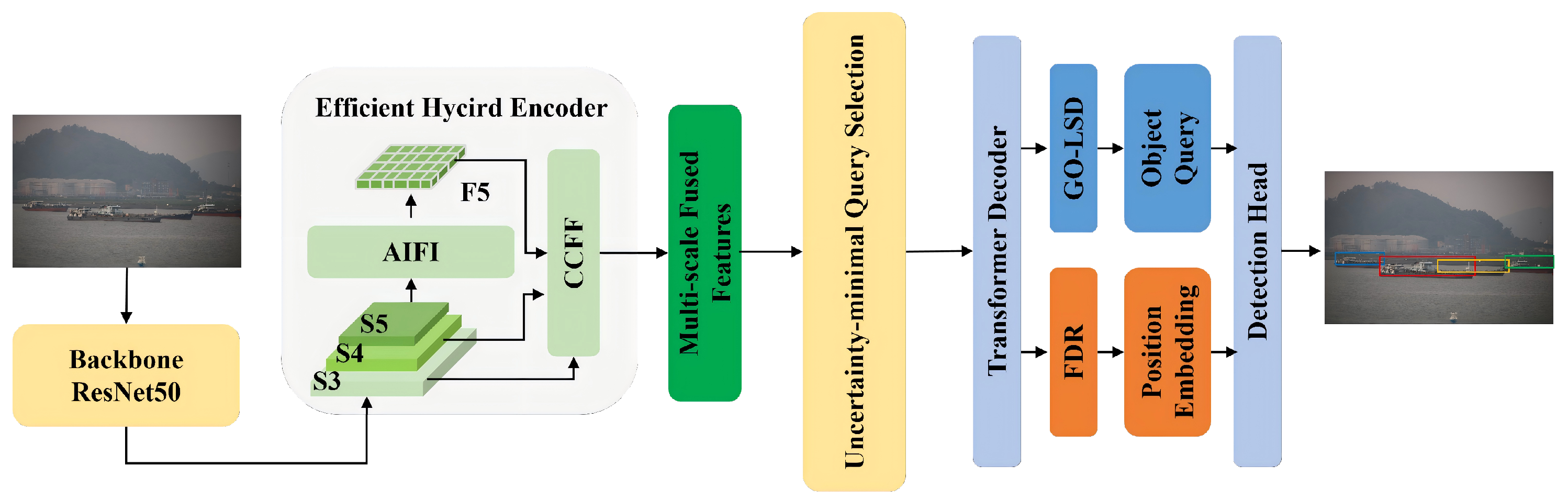
D-FINE [46] is an efficient object detection model based on the Transformer architecture, inherited from DETR [48] (particularly real-time variants such as RT-DETR [49]). It is innovative in redefining bounding-box regression, proposing two key mechanisms: (1) Fine-grained Distribution Refinement (FDR), which uses probability distributions instead of fixed coordinates to iteratively regress boundaries and independently refines each boundary edge to improve localization accuracy, and (2) Global Optimal Localization Self-Distillation (GO-LSD), which uses the refined localization information learned in the deep decoder layer to self-supervise shallow layers, which improves feature learning in early layers and accelerates the convergence of training.
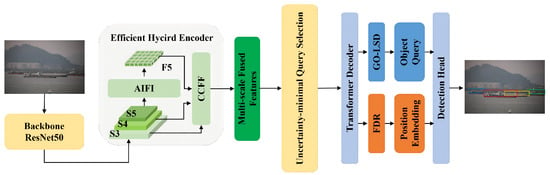
D-FINE consists of three core components: a backbone network, an efficient hybrid encoder, and a Transformer decoder. Its overall architecture is shown in Figure 1.
Figure 1.
D-FINE architecture diagram.
DEIM [50] is an enhanced training architecture based on D-FINE. Relying on the design of dense One-to-One (O2O) matching and Matchability-Aware Loss (MAL), DEIM improves the convergence speed and detection accuracy of D-FINE. Dense O2O augments input images using Mosaic/Mixup to make a single image contain more targets, providing richer object sources for subsequent encoding. The MAL loss, as calculated in Equation (1), incorporates the IoU between matched queries and targets with classification confidence, which optimizes the matches across varying box-quality levels and improves the utility of limited positive samples during training.
where denotes the ground-truth class, with for positive samples (i.e., target objects) and for negative samples (i.e., non-target objects); represents the predicted probability for the foreground class; and q represents the IoU between the predicted bounding box and its target bounding box. For foreground samples (), the target label is set to q; for background samples (), the target label is set to 0.
This paper selects D-FINE under DEIM-enhanced training as the baseline model for the following reasons: (1) The end-to-end architecture of D-FINE requires no post-processing (e.g., Non-Maximum Suppression (NMS)), reducing complexity when deploying the model on USVs. (2) Its efficient hybrid encoder strengthens multi-scale target perception capability, which is advantageous for recognizing targets of different scales on the sea surface. (3) The DEIM training mechanism accelerates convergence and improves the matching quality of target boxes, which benefits precise localization of maritime targets.
Despite the above advantages, the robustness of D-FINE remains insufficient when facing complex sea conditions under interference by various weather impacts, such as fog, low light, and rain. This is crucial in practical USV tasks.
3.2. W-MTD Method
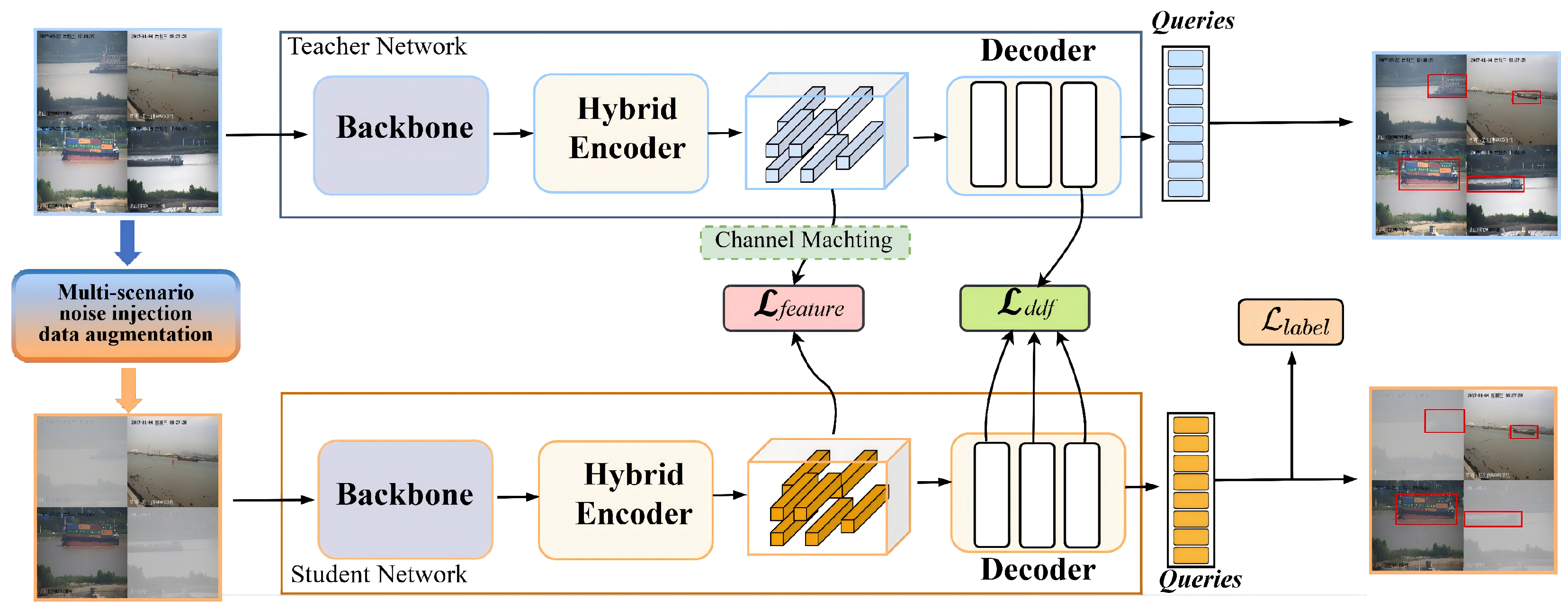
The W-MTD maritime target detection method adopts a teacher–student distillation architecture, as shown in Figure 2. It includes two key components:
(1) Teacher-Student distillation
Both the teacher and student models adopt the D-FINE [46] network but differ in model scale. The teacher model is based on the D-FINE-S network, trained on a clear-weather dataset using the DEIM [50] training strategy. This pre-trained teacher model is referred to as W-MTD-T. It extracts multi-scale feature maps (S3, S4, and S5) through the backbone network, inputs them into the hybrid encoder for feature fusion, outputs fused features (), and achieves accurate prediction of the target-focused distribution.
The student model takes D-FINE-N (the Nano version of D-FINE) as the base network. This initial model extracts multi-scale feature maps (S4 and S5) through the backbone network, inputs them into the hybrid encoder for feature fusion, and outputs fused features (). Through fusion feature distillation and object distribution distillation, it fully leverages the target detection capability learned by W-MTD-T and is fine-tuned on the noise-injected training set to achieve better adaptation performance for complex maritime scenes. We name the student model W-MTD-S.
The parameters of the two specific models (teacher and student) are presented in the experimental section.
(2) Multi-Scenario data augmentation
To address the issues of convergence disparity across adverse weather scenarios and knowledge forgetting, a multi-scenario data augmentation module is constructed. It integrates a multi-scenario noise augmentation unit to generate rainy, foggy, and low-light interference data and initiates random multi-scenario interference injection based on a noise injection ratio, which is optimized based on convergence balance experiments (Section 4.2). Simultaneously, a clear-weather data retention mechanism is designed to preserve key feature representations for clear-weather scenes.
The entire network is trained with a two-stage progressive distillation training strategy. The final goal is to obtain a lightweight W-MTD-S model, serving as a weather-robust maritime target detector that meets the accuracy and real-time deployment requirements of USVs.
Figure 2.
The overall framework of W-MTD. and are the loss functions for knowledge distillation, and is the loss between the predictions and ground truth.
3.3. Dual-Path Knowledge Distillation Framework
To enhance the feature modeling and target localization capabilities of the lightweight student model in complex marine environments, this paper designs a dual-path knowledge distillation framework. Through the synergistic optimization of feature similarity constraints and decoupled distillation, effective knowledge transfer from the teacher model to the student model is achieved.
3.3.1. Feature Similarity Distillation Based on Dynamic Channel Matching
To ensure the effective learning capability of the W-MTD-S model for maritime target features, this paper designs a feature similarity constraint mechanism based on dynamic channel matching. This mechanism reinforces the consistency of the fused features from the hybrid encoders of the teacher and student models, ensuring efficient transfer of key semantic information (e.g., ship edges and textures) and suppressing feature degradation in the student model caused by complex weather interference. The specific design is described as follows:
(1) Dynamic channel-matching modeling
The teacher model (using clear-weather data as input) and the student model (using multi-scenario augmented data as input) output multi-scale fused feature maps through their hybrid encoder modules. Assume the feature map generated by the teacher model is and that generated by the student model is , where and represent the number of channels for the teacher- and student-fused features, respectively, and is the spatial dimension of the feature map (H is height and W is width). By defining a channel distance matrix (), the semantic difference between the student-fused feature channel (i) and teacher-fused feature channel (j) is quantified:
where and represent the feature values of the i-th student feature channel and the j-th teacher feature channel at the k-th spatial position, respectively. , , .
Typically, since the teacher model’s channel number () is several times that of the student model (), a many-to-one matching approach is adopted. To distribute the error process evenly across feature channels, each student channel is constrained to be associated with teacher channels. Therefore, the dynamic channel matching between the student and teacher models is a constrained linear assignment problem. By solving this problem using the Hungarian algorithm with capacity expansion, we can obtain the optimal matching matrix (). This matrix encodes the correspondence between channels, where when the i-th student channel is associated with the j-th teacher channel. Therefore, the balanced many-to-one matching () must satisfy the following:
where means that each teacher channel can match with, at most, one student channel; means that each student channel can match with teacher channels; and denotes the set of matching matrices that satisfy the above constraints. The Hungarian algorithm employed for our channel-matching task exhibits complexity. Since the channels after feature fusion are often in the scale of (e.g., 256), the matching operation leads to operations (e.g., ). This computational cost is around 0.05% of the computational cost of a single forward pass in the training process (e.g., ), which has a negligible impact on computational load.
Then, the matched multiple teacher channels are dynamically reduced via Absolute Max Pooling (AMP) to ensure dimensionality consistency with the student features:
where represents the feature values of the teacher channels associated with the current student channel. AMP retains the activation with the maximum absolute value, outputting the reduced feature () with the same dimension as the student-fused features, which enhances the ability to extract discriminative features under extreme interference.
(2) Feature similarity loss function
Using the mean squared error (MSE) loss, we minimize the difference between the teacher model’s reduced features () and the student model’s fused features (), achieving cross-model fused feature alignment. The feature similarity loss function () is defined as follows:
where is a teacher feature transformation function with a negative margin and is a constant obtained statistically from the feature distribution of the training data. This function aims to filter weak negative activations caused by noise. is the feature value at the i-th channel and j-th spatial position of the teacher’s reduced feature (), and is the feature value at the i-th channel and j-th spatial position of the student’s fused feature (). denotes the total number of feature elements, which normalizes the loss to satisfy the gradient stability requirements during training.
This feature distillation mechanism pays special attention to spatial details and texture features that are easily lost under adverse weather conditions. Through dynamic matching and feature alignment, it alleviates the feature degradation problem caused by model lightweighting.
To address the problem of insufficient target localization accuracy in complex scenes, we adopt a decoupled distillation mechanism based on object distribution alignment. Drawing on the GO-LSD method proposed in D-FINE, this mechanism achieves localization knowledge transfer from the teacher model to the student model through the decoupled distillation focal (DDF) loss ().
3.3.2. Decoupled Distillation Based on Distribution Alignment
(1) Localization distribution alignment mechanism
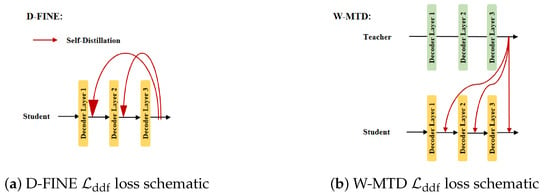
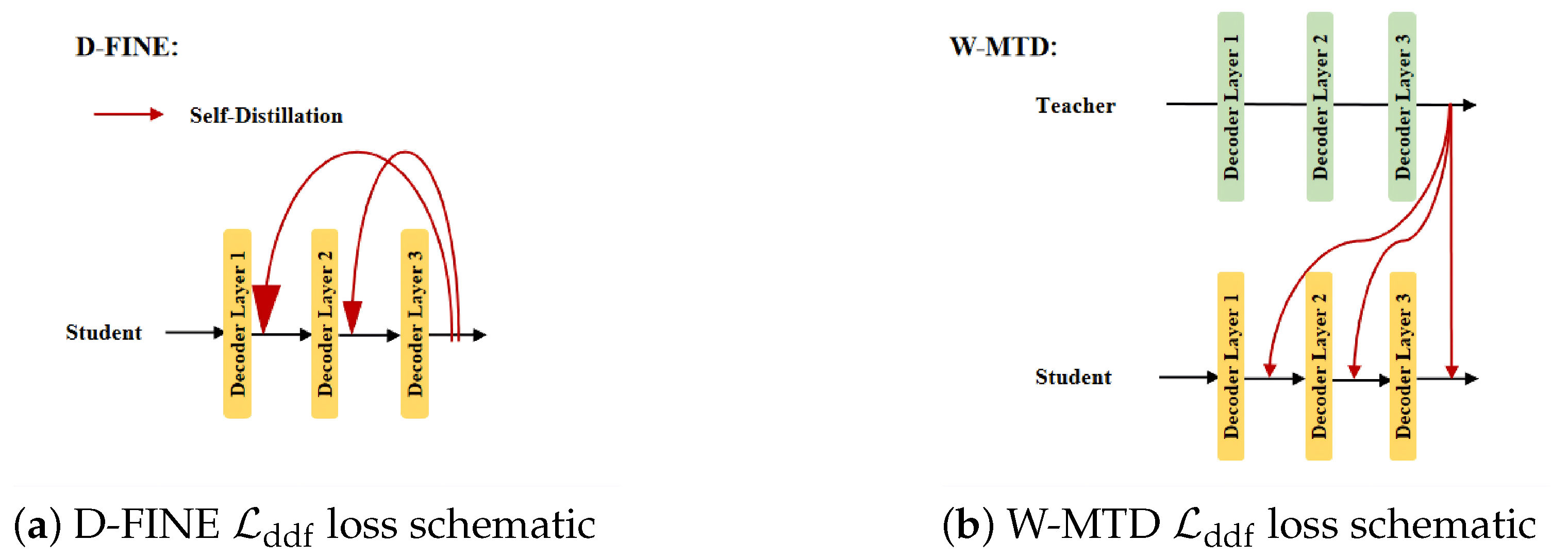
The original D-FINE model uses a self-distillation mechanism, where the probability distribution of the prediction boxes output by the last layer of the student model’s decoder guides the prediction probability distributions of its earlier shallow layers (as shown in Figure 3a). However, in complex maritime scenes where target distribution is sparse and noise interference is significant, the target localization capability of the student model is easily affected under such a self-distillation mechanism.
Figure 3.
Schematic diagram of the loss design.
Our method uses the high-quality localization distribution at the last decoder layer of the teacher model as a global supervision signal to guide the localization learning process of all decoder layers in the student model (as shown in Figure 3b). This mechanism enforces the prediction alignment of each decoder layer of W-MTD-S with the deep-layer refined distribution of W-MTD-T, accelerating the convergence of student model training and improving the overall localization accuracy of objects.
(2) Decoupled distribution focal loss function
The goal of the loss function is to achieve effective transfer of localization knowledge by minimizing the probability distribution difference between the outputs of each decoder layer of W-MTD-S and the output of the last layer of W-MTD-T. Decoupled weighting strategies are employed to ensure appropriate weighting for high-IoU but low-confidence predictions, as well as for matched and unmatched predictions.
Assume the W-MTD-S model has L decoder layers. For each decoder layer (), the predicted probability distribution is , and the predicted probability distribution of the last layer of W-MTD-T is . The decoupled distillation loss function () based on distribution alignment is defined as follows: The decoupled distillation loss function () based on distribution alignment is defined as follows:
where denotes the Kullback–Leibler divergence used to measure the difference between two probability distributions and is the temperature parameter used to smooth the probability distributions and avoid gradient explosion (typically ). represents the probability distribution of the k-th prediction at the l-th decoder layer of W-MTD-S. This distribution corresponds to the offsets of the four bounding-box edges (left, top, right, and bottom), represented by discretized bins [46]. represents the probability distribution of the k-th prediction at the last decoder layer (L) of W-MTD-T. and denote the numbers of matched and unmatched bounding-box predictions, respectively. The matching process is based on the IoU between the prediction boxes of W-MTD-S and the ground-truth boxes, using the Hungarian algorithm [48] for optimal assignment.
and are dynamic weight coefficients for the k-th matched and unmatched predictions, respectively, defined as follows:
where is the IoU between the k-th matched prediction of the l-th decoder layer of W-MTD-S and the corresponding ground-truth bounding box, reflecting localization quality. is the classification confidence of the k-th unmatched prediction of the l-th decoder layer of W-MTD-S, reflecting classification reliability. The weight coefficients are normalized by and to balance the contributions of matched and unmatched predictions, avoiding bias caused by quantity imbalance.
(3) Joint optimization mechanism
In the target detection network, the label loss is the core function measuring the difference between the model’s predictions and the ground truth. In the complex maritime target detection task, this paper utilizes DEIM’s Matchability-Aware Loss (MAL) as the label loss (; see Equation (1)), strengthening the supervision signal for low-quality targets. By jointly optimizing the localization and classification tasks, it improves the target recall rate while driving the continuous optimization of the student model.
The dual-path knowledge distillation framework achieves synergistic enhancement through joint optimization: the feature similarity constraint ensures the integrity of basic semantic features, and the decoupled distillation optimizes the modeling accuracy of spatial relationships. Combined with the fundamental supervision of , it forms the complete optimization objective:
where , , and represent the weight coefficients for , , and , respectively. Specific parameter configurations will be detailed in the experimental section (Section 4.1.2).
3.4. Multi-Scenario Data Augmentation Training Strategy
To enhance the model’s robustness across various adverse scenarios, this paper proposes a multi-scenario data augmentation training strategy adapted to maritime scenes. This training strategy consists of two parts: adverse weather scenario simulation and a two-stage progressive distillation strategy.
(1) Adverse weather scenarios simulation and data augmentation
To simulate various weather influences (e.g., rain, low light, and fog) faced by USVs in real sea conditions, three typical interference modes—rain, low light (lowLig), and fog—are introduced during training for data augmentation. This constructs a noise-injected dataset, generating input data for the W-MTD-S model in the multi-scenario fine-tuning distillation stage, with the original clear-weather data serving as the baseline scenario. Specific interference noise simulation methods are listed in Table 1.
Table 1.
Adverse weather interference simulation methods and parameters.
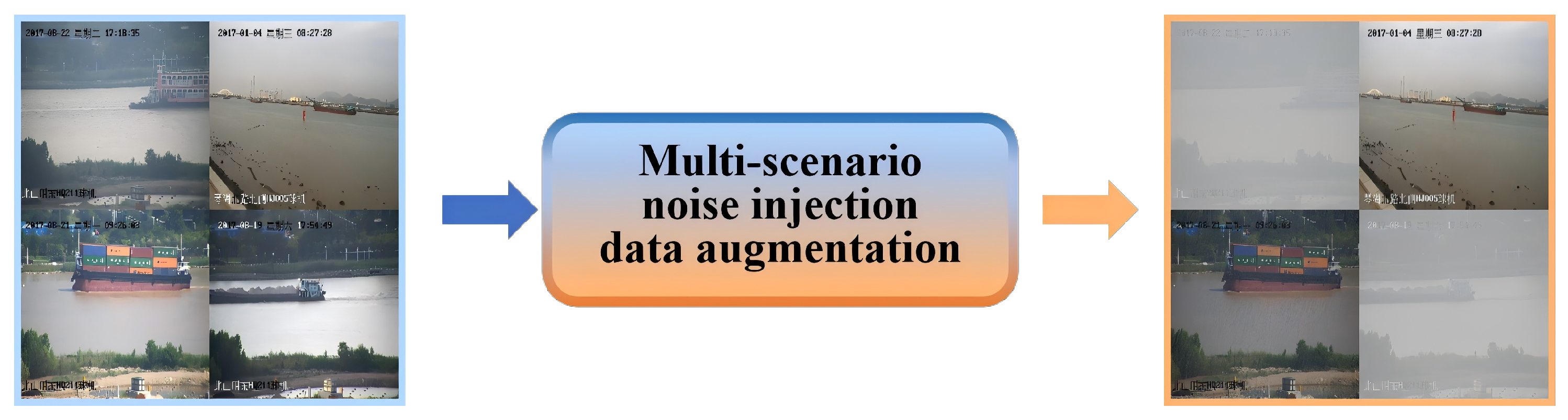
Drawing on the idea of dense O2O [50] data augmentation, four maritime images with different weather characteristics are randomly stitched into a single training sample (as shown in Figure 4), increasing scene complexity and target density. During training, 75% of the student model’s input data (i.e., f out of 4 maritime images) corresponding to interference scenes are randomly added according to the noise-injection ratio, i.e., rain:lowLig:fog = 1:1:2, which is determined based on experiments (detailed in Section 4.2). To prevent the model from forgetting key features (especially clear-weather scene knowledge) during the fine-tuning process, the student model’s input data has a 25% probability of retaining the original non-interfered clear-weather data.
Figure 4.
An example of training sample generation.
By constructing multi-scale target fusion scenes, this method not only increases the number of targets per sample but also enhances the model’s adaptability to complex maritime scenes through diversified background information.
(2) Two-stage progressive distillation training
In knowledge distillation, progressive strategies are often used to alleviate the capacity gap between teacher and student models, e.g., by introducing intermediate dimensions or gradually reducing the number of network layers to achieve smooth knowledge transfer. However, the main difficulty in the distillation problem addressed in this paper does not stem from model parameter differences but, rather, from the domain gap between clear-weather and adverse-weather scenarios.
To mitigate the impact of cross-domain differences on distillation effectiveness, this paper proposes a two-stage progressive distillation strategy:
Stage 1: Clear-weather knowledge distillation. First, the teacher model (W-MTD-T) is trained on the clear-weather dataset to acquire high-precision detection capability under normal weather conditions. Then, the weights of W-MTD-T are fixed, and the student model (W-MTD-S) is trained on the clear-weather dataset under the proposed dual-path knowledge distillation framework. This enables the student model to learn reliable feature representations in normal weather conditions and improves its baseline performance.
Stage 2: Multi-scenario fine-tuning distillation. A multi-scenario data augmentation strategy is employed to generate training data under complex weather conditions as input for the student model. Meanwhile, the learning rate is reduced by half, and the second-stage distillation is performed. By leveraging knowledge extracted by W-MTD-T from clear-weather scenarios, the student model learns discriminative features under adverse weather conditions. This single fine-tuning process enhances the generalization and adaptability of W-MTD-S, avoiding computational redundancy resulting from overly complex multi-stage distillation.
The model training procedure is summarized in Algorithm 1.
| Algorithm 1: W-MTD Training Procedure |
|
4. Experiments and Results
This section provides comprehensive evaluations of the proposed W-MTD target detection method.
4.1. Experimental Setup
4.1.1. Data Preparation
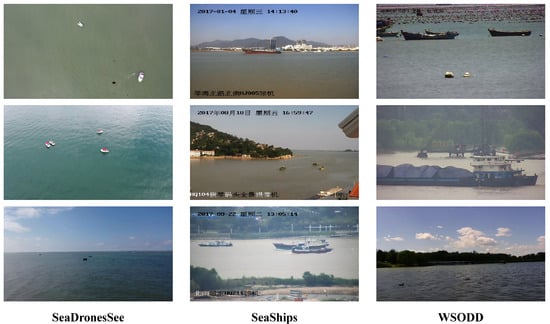
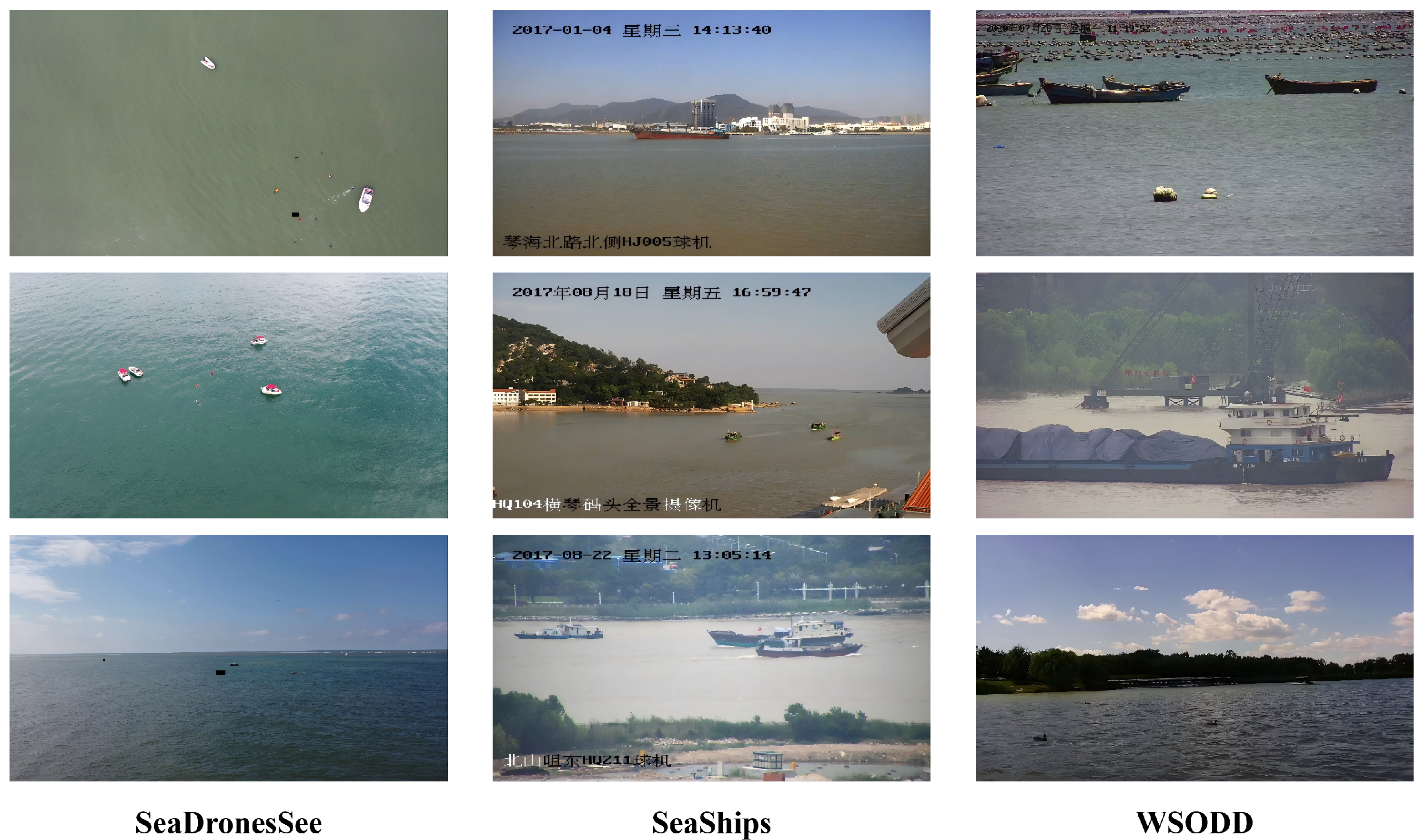
To comprehensively evaluate model performance in complex maritime environments, this study integrates three public datasets—WSODD [51], SeaShips [52], and SeaDronesSee [53]—to construct a comprehensive maritime object dataset called MOOD (Maritime Object Omni-Dataset). As shown in Figure 5, the three public datasets contain various target categories. WSODD covers 14 types of typical nearshore and water-related targets, including buoy, rock, and rubbish, enriching the coverage of static obstacles and small floating objects. SeaShips focuses on six types of large commercial vessels (e.g., ore and bulk carriers) in maritime and shoreline scenes, providing large dynamic vessel targets with clear structural features that WSODD lacks. SeaDronesSee further supplements key categories such as person, animal, and life_saving_appliances, enhancing the representation of targets related to maritime operations and emergency rescue. The integration of the three datasets enables MOOD to cover 15 categories, expanding the model’s category recognition scope. Meanwhile, MOOD exhibits high heterogeneity in environmental backgrounds and shooting perspectives, simulating complex scenes that USVs may encounter in real marine environments.
Figure 5.
Typical image examples from the three source datasets.
MOOD provides 25421 high-quality labeled images, ensuring a sufficient amount of training samples. All annotations follow the COCO format standard, guaranteeing consistency in data integration and model evaluation. MOOD is split into a training set (MOOD_train) and a test set (MOOD_test) at a ratio of 4:1 (see Table 2).
Table 2.
Target numbers of each category in the MOOD dataset.
4.1.2. Experimental Details
The experiments were conducted on a high-performance computing platform equipped with eight NVIDIA RTX 4090 GPUs. The software environment was based on Python 3.11, the PyTorch 2.0 deep learning framework, and the CUDA 11.8 parallel computing architecture. Using D-FINE as the baseline model, hyperparameters such as the learning rate and training epochs for the first distillation phase were consistent with DEIM. In the second distillation phase, the learning rate was reduced to half of the previous value, while all other hyperparameters remained unchanged.
In the overall loss function (see Equation (9)), the weights for each loss term are set as follows: , , and . This configuration is based on the following considerations: originates from the MAL loss in the DEIM framework, and setting it to 1 maintains the strength of the fundamental supervision signal; is set to 1, making the decoupled distillation loss comparable in magnitude to the basic supervision loss and ensuring that localization knowledge transfer dominates the optimization; and is set to 0.01 because feature-layer outputs are typically much larger than task losses. Lowering the feature distillation weight prevents excessive interference with the main task optimization during feature alignment while still enabling effective transfer of the teacher model’s structured representations.
In terms of evaluation metrics, the widely used Average Precision (AP) and mean Average Precision (mAP) were adopted as the core evaluation standards. The mAP is calculated as the average of AP values over all categories under multiple IoU thresholds (from 0.5 to 0.95 with a step size of 0.05), comprehensively evaluating model performance under different localization accuracy requirements.
4.2. Hyperparameter Sensitivity Analysis
4.2.1. Noise-Injection Ratio Analysis
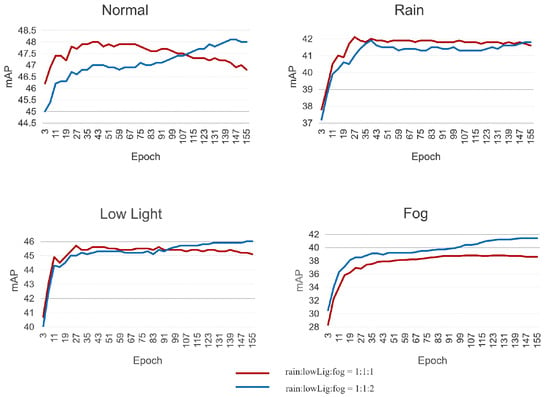
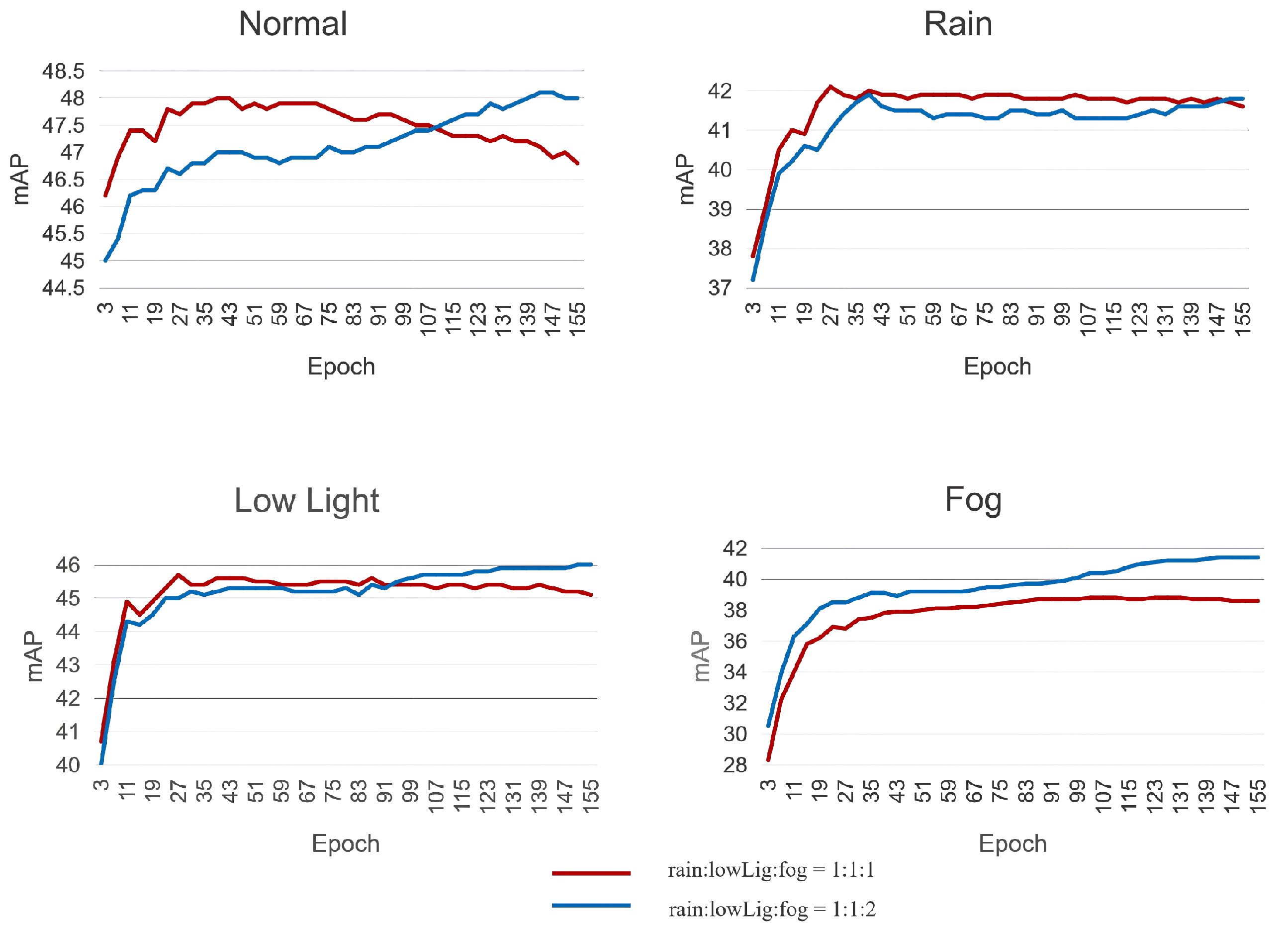
The data augmentation ratios for the three typical interference modes of rain, lowLig, and fog were determined through convergence balance experiments. Figure 6 shows the mAP curves on the validation set for the four scenarios—clear (Normal), low light (lowLig), rain (Rain), and fog (Fog)—versus fine-tuning epochs.
Figure 6.
Detection accuracy convergence curves for different scenarios under varying noise-injection ratios.
Experimental results show that when noise injection uses a ratio of rain:lowLig:fog = 1:1:1, the foggy (Fog) scenario converges slowly, and the model tends to overfit fog-related features. This leads to performance degradation in the clear (Normal), rainy (Rain), and low-light (lowLig) scenarios compared to their potential best levels. When using a ratio of 1:1:2, the convergence speed of the foggy scenario is improved, while the clear, low-light, and rainy scenarios maintain stable performance in the later stages of training, without significant degradation. Therefore, adopting a multi-scenario data allocation ratio of rain:lowLig:fog = 1:1:2 during training is most effective. It balances the convergence speed across adverse scenarios (rain, low-light, and fog), ensuring that each scenario is synchronously optimized to its best state during fine-tuning and avoiding performance regression in other scenarios caused by overfitting to a single scenario (e.g., fog).
4.2.2. Temperature Parameter Analysis
The temperature parameter () in knowledge distillation governs the smoothness of the output probability distributions from the teacher model, influencing the gradient properties and the stability of the knowledge transfer process. To assess the sensitivity of the proposed W-MTD framework to this hyperparameter, we conducted experiments by varying while keeping all other components and training configurations fixed. The lightweight W-MTD-S was trained and evaluated on the clear-weather MOOD test set. The performance metrics under different values are presented in Table 3.
Table 3.
Performance of W-MTD-S with a varying temperature parameter () (mAP, %).
The experimental results demonstrate a non-monotonic trend between model performance and the temperature parameter (). Specifically, performance elevates progressively as increases from 3 to 5, achieving optimal performance at = 5 (mAP = 49.1%, = 79.6%, = 49.4%). When exceeds 5, a slight performance drop is observed, which can be attributed to the fact that excessive smoothing erodes the discriminative information encoded in the teacher’s soft labels. Importantly, the overall mAP fluctuates by only 0.5 percentage points throughout the tested range (3–7), verifying that the model possesses moderate sensitivity to this hyperparameter. This stability benefits the practical deployment of the framework. Based on these results, = 5 was selected as the optimal parameter in this study.
4.3. Distillation Performance Analysis
To verify the effectiveness of the proposed W-MTD in knowledge distillation, Table 4 compares the performance metrics of W-MTD-S with those of W-MTD-T (i.e., D-FINE-S) on four test sets: clear weather (MOOD_test), rain (rain_MOOD_test), low light (lowLig_MOOD_test), and fog (fog_MOOD_test). In the experiments, the input image size is consistent with D-FINE. The parameter count of the student model (W-MTD-S) is identical to that of its initial backbone model (D-FINE-N) [46]. The inference latency is measured on an actual NVIDIA Jetson AGX Xavier platform with TensorRT FP16 acceleration embedded.
Table 4.
Performance comparison between W-MTD-T and W-MTD-S models.
Key results indicate that W-MTD-S achieves higher detection accuracy (mean Average Precision, mAP) than W-MTD-T under three adverse weather conditions: a 12.6% mAP improvement in rain, 7.0% in low light, and 13.9% in fog. Meanwhile, on the clear-weather test set (MOOD_test), W-MTD-S attains an mAP of 48.1%, which is nearly identical to the teacher model’s 48.2%, demonstrating that knowledge distillation does not compromise performance under favorable weather conditions.
Notably, this comparison is asymmetric: W-MTD-T was trained solely on clear-weather data, whereas W-MTD-S leveraged multi-scenario augmented training. This validates the framework’s ability to adapt lightweight models to harsh weather conditions rather than reflecting the inherent superiority of the student model over the teacher model.
Regarding inference latency, tests conducted on the NVIDIA Jetson AGX Xavier embedded platform show that latency decreases from 17.45 ms to 10.60 ms, corresponding to a reduction of approximately 39.3%. Collectively, these results confirm that the proposed distillation framework, integrated with multi-scenario data augmentation, achieves a balance among robustness, lightweight design, and real-time performance, thereby meeting the deployment requirements of USV platforms.
4.4. Ablation Study
The ablation study aims to verify the effectiveness of the proposed distillation framework, the multi-scenario data augmentation training strategy, and each loss-function component. We adopted a controlled variable strategy and progressively introduced each component and evaluated the model’s mAP performance on the four test sets. The results are listed in Table 5, where “Noisy Dataset” refers to the usage of data generated by multi-scenario noise injection data augmentation, and "Fine-tuning" refers to the second-stage refinement training, during which the learning rate is reduced to half of that used in the initial stage. The training configurations for each mode are described as follows:
Mode 1: Baseline student model trained directly on clean-weather data using the DEIM strategy;
Mode 2: Baseline student model obtained through the dual-path knowledge distillation;
Mode 3: Fine-tuning Mode 1 using the multi-scenario augmented noisy dataset;
Mode 4: Student model directly trained on noisy dataset using the DEIM strategy;
Mode 5: Adding decoupled distillation loss to Mode 3;
Mode 6: The complete W-MTD-S (proposed).
Table 5.
Ablation study results. denotes self-distillation loss function.
(1) Analysis of the effectiveness of the distillation framework: Comparing Mode 1 and Mode 2 shows that distilling clear-weather knowledge from the teacher model improves the mAP in clear-weather scenarios from 48.5% to 48.9%, compared to training solely on clear-weather data. This demonstrates the effectiveness of the distillation framework for learning under clear weather. Furthermore, comparing Mode 3 and Mode 4 shows that when both use the multi-scenario augmented dataset for training, the model with the distillation framework achieves improvements on all four validation sets: +2.8% for clear weather, +0.5% for rain, +2.1% for low light, and +0.3% for fog. This verifies the effectiveness of the proposed distillation framework in improving learning in adverse scenes.
(2) Analysis of the effectiveness of the multi-scenario data augmentation training strategy: Comparing Mode 1 vs. Mode 4 and Mode 2 vs. Mode 6 shows that, regardless of whether the distillation framework is used, models trained with the noisy dataset achieve significant improvements in detection accuracy for adverse scenes: +4.9% and +6.9% for rain, +3.4% and +6.4% for low light, and +9.3% and +11.6% for fog, respectively. This validates the effectiveness of the multi-scenario data augmentation training strategy for improving learning in adverse scenes. Comparing Mode 4 and Mode 5 further shows that, compared to training directly on noisy data, the model trained with the second-stage progressive distillation achieves improvements on all four validation sets: +3.4% for clear weather, +1.2% for rain, +2.7% for low light, and +2.1% for fog. This verifies the necessity and effectiveness of the progressive distillation strategy for cross-domain knowledge transfer.
(3) Analysis of the effectiveness of the loss-function joint constraint: Comparing Mode 3, Mode 5, and Mode 6, the results show the following:
- Using only yields the lowest performance in adverse scenes (rain, 40.7%; lowLig, 45.3%; fog, 39.4%), indicating that relying solely on label supervision is insufficient for learning under noise interference.
- Adding improves performance across all scenes, with a notable +4.6% improvement in fog, proving the importance of using the teacher model’s precise localization knowledge to guide the student.
- Further adding achieves the best overall performance across all scenes. Compared to using only , it gains +0.8%, +1.0%, +0.7%, and +2.1% in clear, rain, low-light, and fog scenarios, respectively. This indicates that , through intermediate-layer feature alignment, effectively enhances robustness to noise interference. It complements in high-level semantic localization, producing a synergistic effect that jointly improves adaptability and robustness across various adverse scenarios.
4.5. Comparative Experiments
To comprehensively evaluate the performance of W-MTD and its balance between detection accuracy and deployment feasibility, we conducted comparative experiments against both mainstream lightweight models and representative heavyweight architectures. All models were trained under identical experimental conditions to ensure a rigorous and fair comparison. Specifically, the same training dataset (MOOD_train) was used with consistent training epochs, optimizer configurations, and input image resolutions across all methods. The only variation was that our proposed multi-scenario data augmentation training strategy was employed only for W-MTD-S. All comparison models were trained using the standard data augmentation techniques prescribed in their original publications or official implementations, thereby preserving the integrity of each compared approach. Performance evaluation was conducted uniformly on the same four validation subsets: clear weather, rain, low light, and fog.
4.5.1. Quantitative Evaluation
The evaluation metrics include mAP (IoU thresholds from 0.5 to 0.95 with a step size of 0.05), , , model parameters, and GFLOPs. The detailed results are reported in Table 6.
Table 6.
Comparative results with lightweight and heavyweight architectures (mAP, %).
(1) Performance of W-MTD-S among lightweight models: W-MTD-S achieves leading or competitive performance across most test scenarios. In the foggy environment, it attains an mAP of 41.5%, outperforming the second-best lightweight model, YOLOv12-S (20.8%), by 20.7 percentage points. Under rainy and low-light conditions, W-MTD-S reaches mAP values of 41.7% and 46.0%, respectively, outperforming all other lightweight baselines. These results indicate cross-scene generalization capability, supporting the utility of the proposed multi-scenario enhanced training strategy and distillation mechanism.
Across different IoU thresholds, W-MTD-S exceeds 70% in across all four test environments, achieving 70.1% in fog—outperforming all lightweight counterparts. This demonstrates target recognition capability under relaxed overlap criteria. Moreover, W-MTD-S maintains an advantage in , reaching 42.8% in foggy scenes, which reflects localization accuracy and resilience to challenges such as heavy occlusion and low visibility.
(2) Trade-off between heavyweight and lightweight architectures: Heavyweight models such as YOLOv11-L and D-FINE-L achieve higher mAP values under clear weather conditions (up to 50.4%) compared to most lightweight models. However, their performance advantage diminishes in adverse weather. For instance, in foggy environments, D-FINE-L achieves an mAP of 20.5%, which is notably lower than that of W-MTD-S (41.5%), while YOLOv11-L lags far behind, with an mAP of 18.5%. More importantly, the high computational cost of these heavyweight models (60.9–82.9 GFLOPs) limits their suitability for real-time deployment on resource-constrained platforms such as USVs. This large advantage of W-MTD-S, especially in fog scenarios, should be attributed to our multi-scenario noise injection training strategy, which demonstrates the effectiveness of this strategy in improving the model’s applicability.
(3) Balance of accuracy and deployability: W-MTD-S achieves a balance between detection performance and operational feasibility. Under clear weather, it attains a competitive mAP of 48.1%, approaching the performance of larger heavyweight models (49.1% for YOLOv11-L and 50.4% for D-FINE-L). This high baseline accuracy is maintained without sacrificing efficiency, as the model remains lightweight, with 4M parameters and 7 GFLOPs.
It should be further noted that on the MOOD dataset constructed in this study, the overall mAP of the evaluated models exhibits a decrease relative to results reported for single-source datasets such as WSODD [59] and SeaDronesSee [60]. For example, YOLOv12 attains an mAP of 85.2% on the WSODD dataset [59], whereas its mAP on the MOOD dataset is 46.2%, as verified by our experimental results. This phenomenon is mainly attributed to the MOOD dataset covering 15 maritime target categories with substantially higher scene diversity and environmental complexity, thereby constituting a more realistic and challenging evaluation benchmark. Under these more stringent test conditions, the proposed method still achieves stable and leading performance, fully verifying its strong generalization ability and practical value and indicating that it can better meet the requirements of USVs executing diverse tasks in real complex marine environments.
4.5.2. Qualitative Analysis
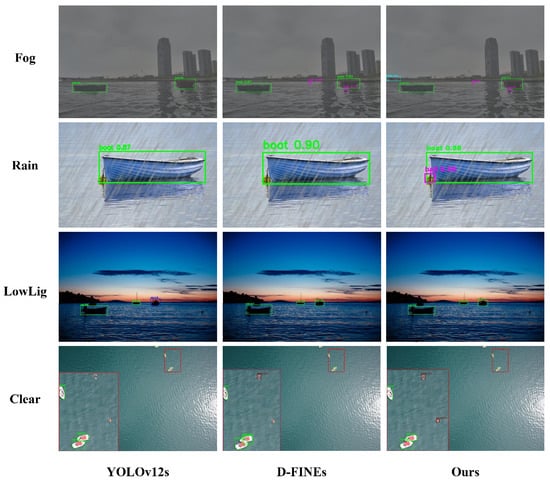
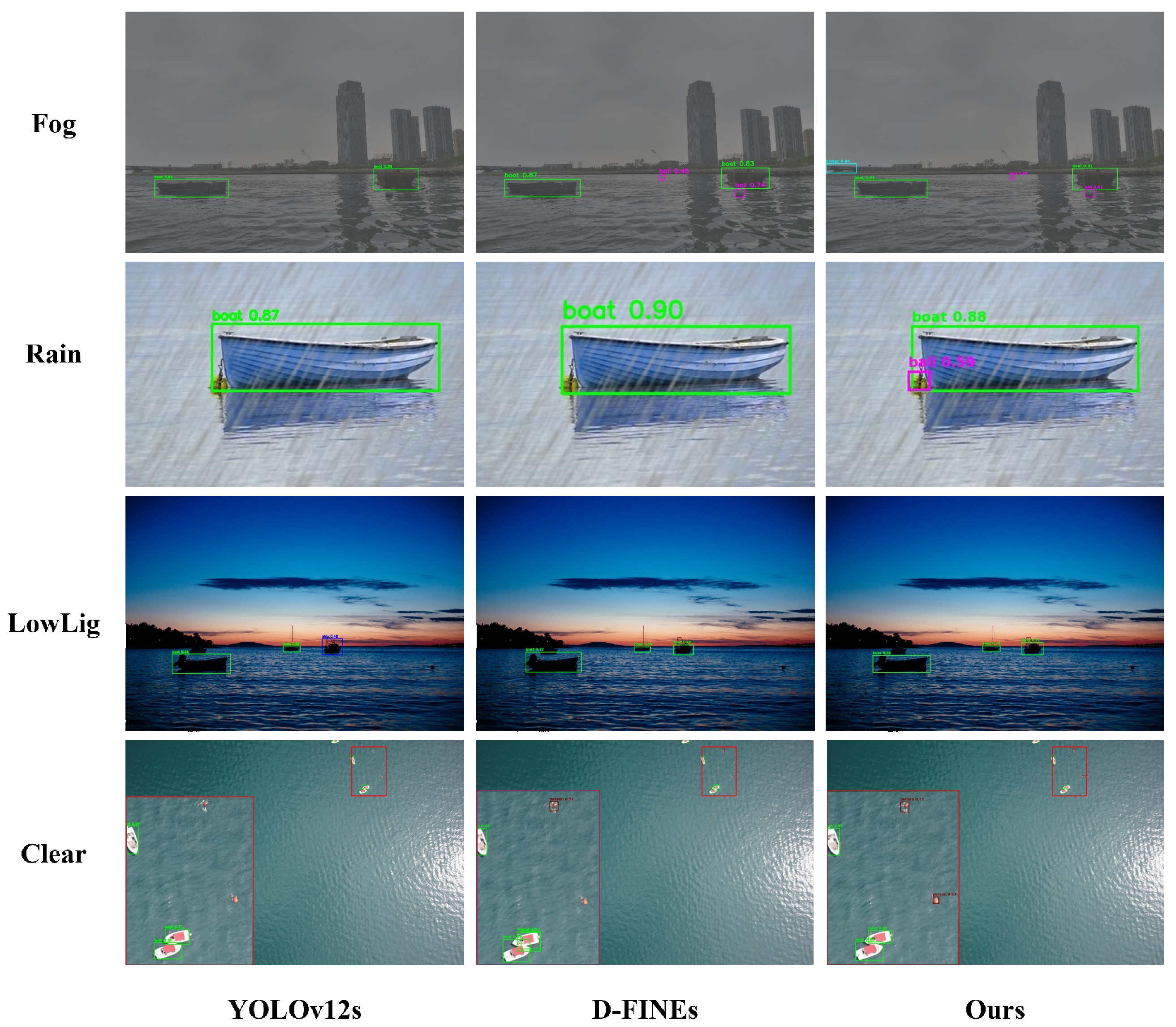
Figure 7 visualizes the target detection results of YOLOv12-S (a representative YOLO-based model), D-FINE-S (teacher model) and W-MTD-S in four typical maritime weather scenarios: fog, rain, low light, and clear weather.
Figure 7.
Visual Comparisons of Maritime Target Detection Results by Different Methods.
In the foggy scenario, YOLOv12-S only identified the “boat” category, while D-FINE-S detected both “boat” and “ball”. W-MTD-S further identified a “bridge” target, demonstrating stronger multi-target capture capability in blurred and complex backgrounds.
Under rainy conditions, both YOLOv12-S and D-FINE-S successfully detected “boat” but missed “ball”. By comparison, W-MTD-S identified both “boat” and “ball” under the same conditions.
In low-light conditions, YOLOv12-S tended to produce misclassification for vessel categories, with some hulls misclassified as other target types, reflecting insufficient semantic feature modeling in low-illumination environments. D-FINE-S and W-MTD-S predicted the same categories in this scenario, indicating that both possess relatively stable classification capability under low-light conditions. Moreover, the prediction confidence of W-MTD-S for the same targets is higher than that of D-FINE-S (0.86 vs. 0.72 for the large boat), suggesting higher classification reliability and detection stability in low-light environments.
In the clear-weather scenario, YOLOv12-S detected “boat” but missed “person”. D-FINE-S detected “boat” but still missed some “person” targets, and its “boat” bounding boxes overlapped, likely due to confusion caused by small inter-target distances. In contrast, W-MTD-S accurately detected all “boat” and “person” instances, demonstrating strong discrimination and localization capability in dense-target scenes.
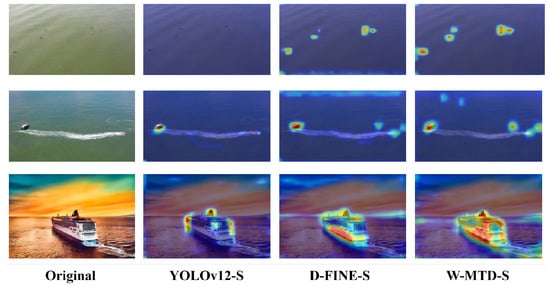
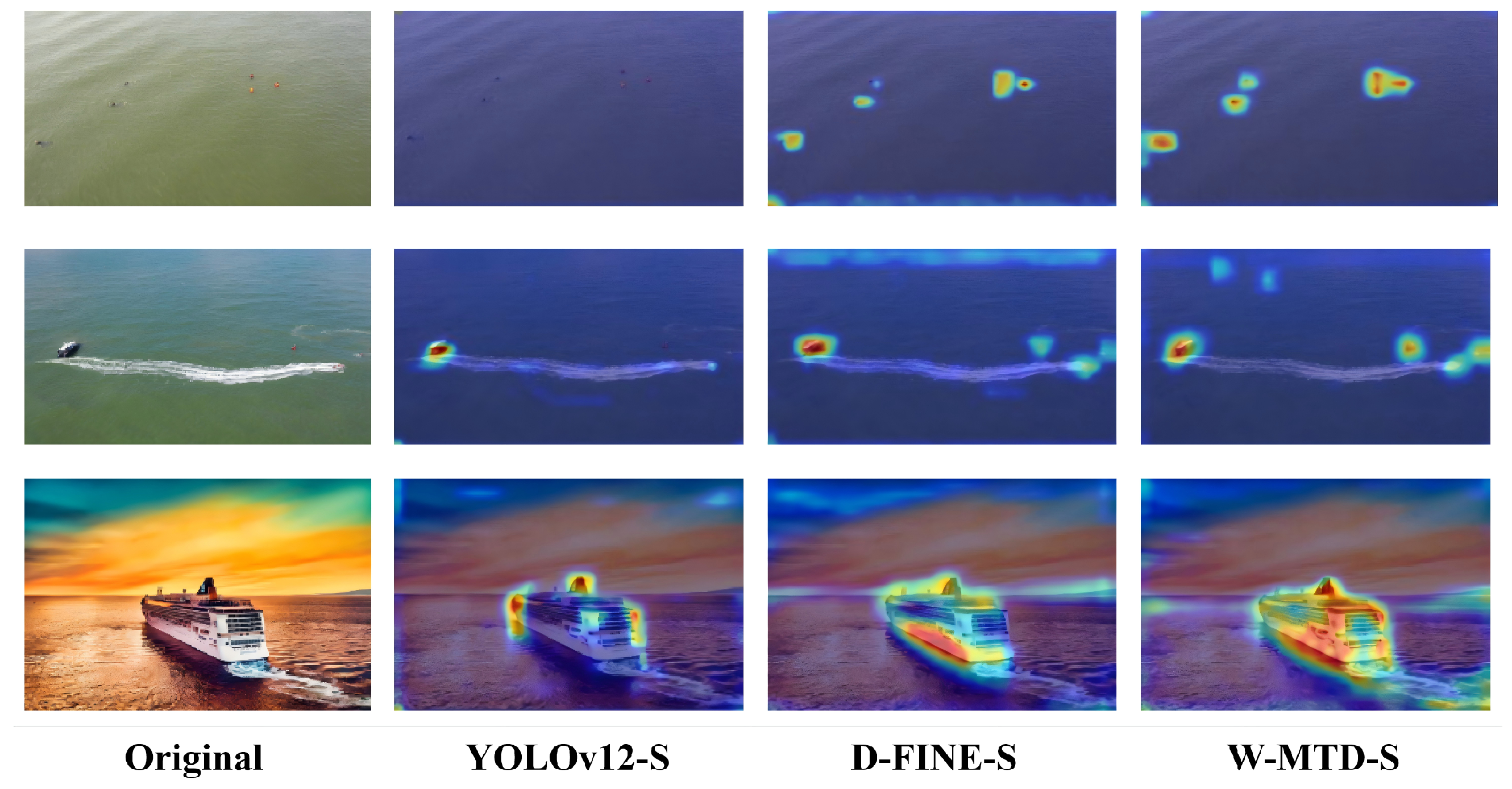
The performance of maritime target detectors can be explained using the heatmaps generated by Grad-CAM. As shown in Figure 8, the proposed W-MTD-S model exhibits a more reasonable attention distribution in complex maritime scenes. Its activated regions not only cover more targets but also respond more accurately to the locations of real targets. This suggests that, benefiting from the feature alignment and decoupled distillation mechanisms in the dual-path knowledge distillation framework, W-MTD-S can better learn discriminative feature representations from W-MTD-T, thereby improving the robustness and accuracy of maritime target detection while maintaining a lightweight design.
Figure 8.
Heatmap Comparisons of Maritime Target Detection Results by Different Methods.
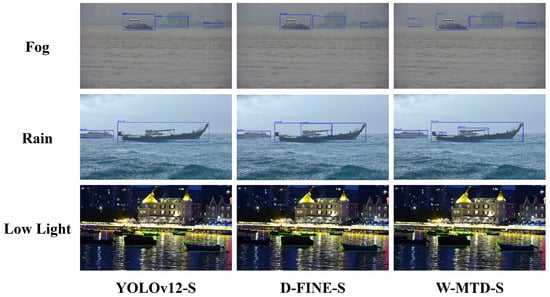
Considering that simulated weather datasets may not truly reflect real adverse weather situations, we further verify the model’s generalization ability in realistic severe-weather scenarios. Because real-world maritime datasets seldom include adverse weather conditions, we manually screened and selected images corresponding to rainy, foggy, and low-light scenarios from existing maritime datasets and performed validation experiments on these images.
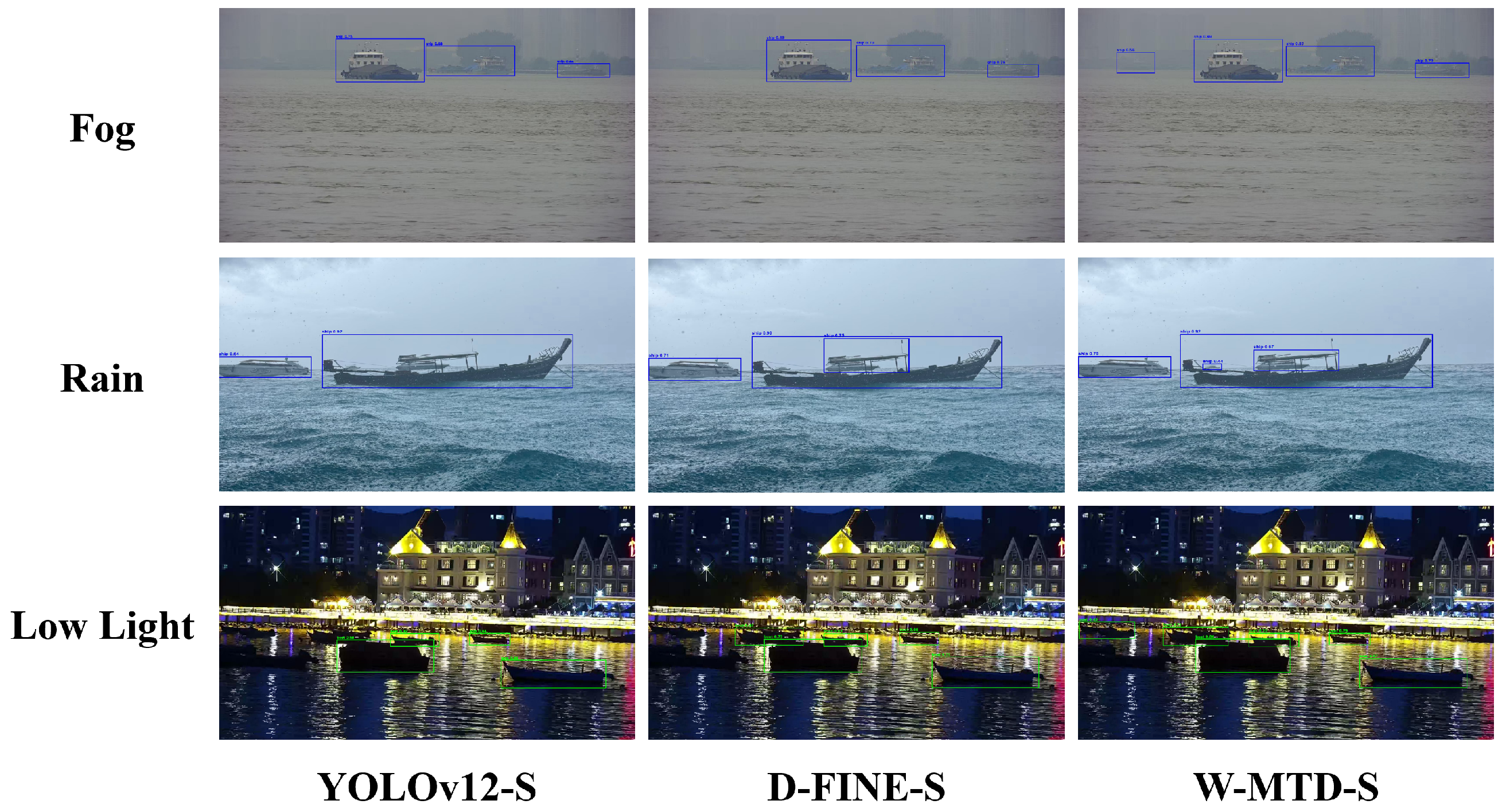
As shown in Figure 9, W-MTD-S maintains a significant advantage in complex maritime environments. In real foggy maritime scenes, the W-MTD-S model detects more vessels, with accurate localization and higher confidence scores. In real low-light maritime scenes, YOLOv12-S exhibits the most missed detections, followed by D-FINE-S. In contrast, the W-MTD-S model identifies the highest number of valid vessel targets. Similarly, on real rainy maritime datasets, both D-FINE-S and YOLOv12-S tend to miss small-scale or overlapping vessels, whereas W-MTD-S maintains high detection integrity in these challenging scenarios.
Figure 9.
Visual Comparisons of Maritime Target Detection Results on Real-world Adverse Weather Scenes.
5. Conclusions
This study proposed W-MTD, a knowledge distillation framework for obtaining a weather-robust and lightweight maritime target detector. By integrating a dual-path distillation mechanism (feature similarity constraints and decoupled distribution alignment) with a multi-scenario augmentation strategy, the method enhances model performance across diverse adverse weather conditions while maintaining high computational efficiency. Experiments on the MOOD dataset confirm significant accuracy improvements in fog, rain, and low-light scenarios, with the student model achieving real-time performance suitable for USV deployment.
Several limitations should be noted: First, the adverse weather data used in this study are synthetically generated and may not fully represent real-world noise distributions, therefore requiring validation on in-the-wild adverse weather imagery; additionally, robustness claims are specific to the maritime domain and the studied weather conditions, so extension to other domains or unseen weather types would require separate investigation. Second, the framework is closely coupled with the D-FINE/DEIM architecture; its generalizability to other detector families (e.g., YOLO and other DETRs) requires further study.
This work provides a task-specific solution for maritime target detection in complex weather. Future work with in-the-wild tests will contribute to the enhancement of USV perception and operational safety in challenging marine environments.
Author Contributions
Conceptualization, M.G., W.S. and Q.Z.; Methodology, M.G. and Q.Z.; Software, Q.Z. and Y.Z.; Validation, M.G. and W.S.; Formal analysis, M.G. and Q.Z.; Investigation, W.S. and Z.N.; Data curation, M.G. and Y.Z.; Writing—original draft, M.G.; Writing—review and editing, W.S. and Z.N.; Visualization, M.G., Y.Z. and Z.N.; Supervision, W.S.; Funding acquisition, W.S. All authors have read and agreed to the published version of the manuscript.
Funding
This research received no external funding.
Data Availability Statement
Data is contained within the article.
Conflicts of Interest
The authors declare no conflicts of interest.
References
- Lou, J.K.; Xu, M.Y.; Feng, W.Q.; Wang, H.D. Unmanned surface vehicle intelligent navigation technology progress and frontiers. China Ship Res. 2025, 20, 3–14. [Google Scholar] [CrossRef]
- Prasad, D.K.; Rajan, D.; Rachmawati, L.; Rajabally, E.; Quek, C. Video processing from electro-optical sensors for object detection and tracking in a maritime environment: A survey. IEEE Trans. Intell. Transp. Syst. 2017, 18, 1993–2016. [Google Scholar] [CrossRef] [Scilit]
- Hu, X.; Wang, J.; Zhang, C.; Tong, Y.S. Deep learning-enabled variational optimization method for image dehazing in maritime intelligent transportation systems. J. Adv. Transp. 2021, 2021, 6658763. [Google Scholar] [CrossRef] [Scilit]
- Liu, T.; Pang, B.; Zhang, L.; Yang, W.; Sun, X. Sea surface object detection algorithm based on YOLOv4 fused with reverse depthwise separable convolution for USV. J. Mar. Sci. Eng. 2021, 9, 753. [Google Scholar] [CrossRef] [Scilit]
- Chen, D.; Sun, S.; Lei, Z.; Shao, H.; Wang, Y. Ship target detection algorithm based on improved YOLOv3 for maritime image. J. Adv. Transp. 2021, 2021, 9440212. [Google Scholar] [CrossRef] [Scilit]
- Li, Y.; Li, S.; Du, H.; Chen, L.; Zhang, D.; Li, Y. YOLO-ACN: Focusing on small target and occluded object detection. IEEE Access 2020, 8, 227288–227303. [Google Scholar] [CrossRef] [Scilit]
- Wang, Z.; Zhang, X.; Li, J.; Luan, K. A YOLO-based target detection model for offshore unmanned aerial vehicle data. Sustainability 2021, 13, 12980. [Google Scholar] [CrossRef] [Scilit]
- Zhang, M.; Rong, X.; Yu, X. Light-SDNet: A lightweight CNN architecture for ship detection. IEEE Access 2022, 10, 86647–86662. [Google Scholar] [CrossRef] [Scilit]
- Sun, B.; Tang, H.; Gao, L.; Bi, K.; Wen, J. RTDETR-MARD: A multi-scale adaptive real-time framework for floating waste detection in aquatic environments. J. Mar. Sci. Eng. 2025, 13, 996. [Google Scholar] [CrossRef] [Scilit]
- Yin, H.; Wang, P.; Li, S.; Yan, J.; Watzenig, D. WS-DETR: Robust Water Surface Object Detection Through Vision-Radar Fusion with Detection Transformer. arXiv 2025, arXiv:2504.07441. Available online: https://arxiv.org/abs/2504.07441 (accessed on 1 September 2025).
- Zou, T.; Ge, Q.; Huang, Y. MFP-DETR: Marine UAV target detection based on multi-scale fuzzy perception. Neurocomputing 2025, 635, 129843. [Google Scholar] [CrossRef] [Scilit]
- Guo, H.; Wu, Q.; Wang, Y. AUHF-DETR: A lightweight transformer with spatial attention and wavelet convolution for embedded UAV small object detection. Remote Sens. 2025, 17, 1920. [Google Scholar] [CrossRef] [Scilit]
- Li, Y.B.; Yang, J.; Huang, Z.Y. Improved Faster R-CNN algorithm for sea object detection under complex sea conditions. Int. J. Adv. Netw. Monitor. Control. 2020, 5, 76–82. [Google Scholar] [CrossRef] [Scilit]
- Loran, T.; Barros Cardoso da Silva, A.; Joshi, S.K.; Baumgartner, S.V.; Krieger, G. Ship detection based on Faster R-CNN using range-compressed airborne radar data. IEEE Geosci. Remote Sens. Lett. 2023, 20, 3500205. [Google Scholar] [CrossRef] [Scilit]
- Jiang, M.; Gu, L.; Li, X.; Gao, F.; Jiang, T. Ship contour extraction from SAR images based on Faster R-CNN and Chan–Vese model. IEEE Trans. Geosci. Remote Sens. 2023, 61, 5203414. [Google Scholar] [CrossRef] [Scilit]
- Ren, S.; He, K.; Girshick, R.; Sun, J. Faster R-CNN: Towards real-time object detection with region proposal networks. IEEE Trans. Pattern Anal. Mach. Intell. 2017, 39, 1137–1149. [Google Scholar] [CrossRef] [Scilit]
- Lyu, H.; Shao, Z.; Cheng, T.; Yin, Y.; Gao, X. Sea-surface object detection based on electro-optical sensors: A review. IEEE Intell. Transp. Syst. Mag. 2022, 15, 190–216. [Google Scholar] [CrossRef] [Scilit]
- Bharati, P.; Pramanik, A. Deep learning techniques—R-CNN to Mask R-CNN: A survey. In Computational Intelligence in Pattern Recognition; Springer: Singapore, 2020; pp. 657–668. [Google Scholar]
- Liu, J.; Pu, Z.; Zhu, L.; Yao, T.; Liang, X. SS R-CNN: Self-supervised learning improving Mask R-CNN for ship detection in remote sensing images. Remote Sens. 2022, 14, 4383. [Google Scholar] [CrossRef] [Scilit]
- He, K.; Gkioxari, G.; Dollár, P.; Girshick, R. Mask R-CNN. IEEE Trans. Pattern Anal. Mach. Intell. 2017, 42, 386–397. [Google Scholar] [CrossRef] [Scilit]
- Guo, J.; Feng, H.; Xu, H.; Yu, W.; Shuzhi Ge, S. D3-Net: Integrated multi-task convolutional neural network for water surface deblurring, dehazing and object detection. Eng. Appl. Artif. Intell. 2023, 117, 105558. [Google Scholar] [CrossRef] [Scilit]
- Akhmedov, F.; Nasimov, R.; Abdusalomov, A. Dehazing algorithm integration with YOLO-v10 for ship fire detection. Fire 2024, 7, 332. [Google Scholar] [CrossRef] [Scilit]
- Liu, R.; Liu, N.; Huang, Y.; Guo, Y. Attention-guided lightweight generative adversarial network for low-light image enhancement in maritime video surveillance. J. Navig. 2022, 75, 1100–1117. [Google Scholar] [CrossRef] [Scilit]
- Dong, Y.; Wu, P.; Wang, S.; Liu, Y. ShipGAN: Generative adversarial network based simulation-to-real image translation for ships. Appl. Ocean Res. 2023, 131, 103456. [Google Scholar] [CrossRef] [Scilit]
- Yan, Y.; Tan, Z.; Su, N. A data augmentation strategy based on simulated samples for ship detection in RGB remote sensing images. ISPRS Int. J. Geo-Inf. 2019, 8, 276. [Google Scholar] [CrossRef] [Scilit]
- Yang, Q.; Meng, H.; Gao, Y.; Gao, D. A real-time object detection method for underwater complex environments based on FasterNet-YOLOv7. J. Real-Time Image Process. 2024, 21, 8. [Google Scholar] [CrossRef] [Scilit]
- Wang, Y.; Yan, X.; Zhang, K.; Gong, L.; Xie, H.; Wang, F.L.; Wei, M. TogetherNet: Bridging image restoration and object detection together via dynamic enhancement learning. Comput. Graph. Forum 2022, 41, 465–476. [Google Scholar] [CrossRef] [Scilit]
- Duan, G.; Wang, Y.; Zhang, Y.; Wu, S.; Lv, L. A network model for detecting marine floating weak targets based on multimodal data fusion of radar echoes. Sensors 2022, 22, 9163. [Google Scholar] [CrossRef] [Scilit]
- Abuolaim, A.; Brown, M.S. Defocus deblurring using dual-pixel data. In Proceedings of the Computer Vision—ECCV 2020, Glasgow, UK, 23–28 August 2020; Springer: Cham, Switzerland, 2020; pp. 111–126. [Google Scholar] [CrossRef] [Scilit]
- Liu, W.; Liu, Y.; Gunawan, B.A.; Bucknall, R. Practical moving target detection in maritime environments using fuzzy multi-sensor data fusion. Int. J. Fuzzy Syst. 2020, 22, 1860–1878. [Google Scholar] [CrossRef] [Scilit]
- Chen, X.; Liu, Y.; Achuthan, K. WODIS: Water obstacle detection network based on image segmentation for autonomous surface vehicles in maritime environments. IEEE Trans. Instrum. Meas. 2021, 70, 7503213. [Google Scholar] [CrossRef] [Scilit]
- Zhang, M.; Xu, S.; Song, W.; He, Q.; Wei, Q. Lightweight underwater object detection based on YOLOv4 and multi-scale attentional feature fusion. Remote Sens. 2021, 13, 4706. [Google Scholar] [CrossRef] [Scilit]
- Zhang, J.L.; Jin, J.C.; Ma, Y.; Ma, Y.; Ren, P. Lightweight object detection algorithm based on YOLOv5 for unmanned surface vehicles. Front. Mar. Sci. 2023, 9, 1058401. [Google Scholar] [CrossRef] [Scilit]
- Ma, Z.; Wan, Y.; Liu, J.; An, R.; Wu, L. A kind of water surface multi-scale object detection method based on improved YOLOv5 network. Mathematics 2023, 11, 29360. [Google Scholar] [CrossRef] [Scilit]
- Deng, L.; Liu, Z.; Wang, J.; Yang, B. ATT-YOLOv5-Ghost: Water surface object detection in complex scenes. J. Real-Time Image Process. 2023, 20, 97. [Google Scholar] [CrossRef] [Scilit]
- Aubard, M.; Antal, L.; Ábrahám, E. Knowledge Distillation in YOLOX-ViT for Side-Scan Sonar Object Detection. arXiv 2024, arXiv:2409.03313. Available online: https://arxiv.org/abs/2409.03313 (accessed on 1 September 2025).
- Yang, D.; Solihin, M.I.; Zhao, Y.; Cai, B.; Chen, C.; Wijaya, A.A.; Ang, C.K.; Lim, W.H. Model compression for real-time object detection using rigorous gradation pruning. iScience 2024, 28, 111618. [Google Scholar] [CrossRef] [Scilit] [PubMed]
- Liu, L. Research on pedestrian detection model and compression technology for UAV images. Sensors 2022, 22, 9171. [Google Scholar] [CrossRef] [Scilit]
- Zhang, L.; Ma, K. Structured knowledge distillation for accurate and efficient object detection. IEEE Trans. Pattern Anal. Mach. Intell. 2023, 45, 15706–15724. [Google Scholar] [CrossRef] [Scilit]
- Peng, J.; Zhang, Y. Knowledge distillation for object detection based on inconsistency-based feature imitation and global relation imitation. Neurocomputing 2024, 566, 127060. [Google Scholar] [CrossRef] [Scilit]
- Yuan, Y.; Wu, Y.; Zhao, L.; Liu, Y.; Chen, J. Knowledge distillation-enhanced marine optical remote sensing object detection with transformer and dual-path architecture. Front. Mar. Sci. 2025, 12, 1509633. [Google Scholar] [CrossRef] [Scilit]
- Zhang, J.; Huang, W.; Zhuang, J.; Zhang, R.; Du, X. Detection technique tailored for small targets on water surfaces in unmanned vessel scenarios. J. Mar. Sci. Eng. 2024, 12, 22. [Google Scholar] [CrossRef] [Scilit]
- Cheng, C.; Wang, C.; Yang, D.; Wen, X.; Liu, W.; Zhang, F. Underwater small target detection based on dynamic convolution and attention mechanism. Front. Mar. Sci. 2024, 13, 883. [Google Scholar] [CrossRef] [Scilit]
- Ding, W.; Li, H.; Chew, C.; Zhang, X.; Huang, H. Deep learning-based recognition of small maritime targets for obstacle avoidance in visual wave gliders. Ocean Eng. 2025, 322, 120471. [Google Scholar] [CrossRef] [Scilit]
- Hinton, G.; Vinyals, O.; Dean, J. Distilling the Knowledge in a Neural Network. arXiv 2015, arXiv:1503.02531. Available online: https://arxiv.org/abs/1503.02531 (accessed on 1 September 2025).
- Peng, Y.S.; Li, H.B.; Zhang, Y.; Sun, X.; Wu, F. D-FINE: Redefine Regression Task in DETRs as Fine-Grained Distribution Refinement. arXiv 2024, arXiv:2410.13842. Available online: https://arxiv.org/abs/2410.13842 (accessed on 1 September 2025).
- Mittal, P. A comprehensive survey of deep learning-based lightweight object detection models for edge devices. Artif. Intell. Rev. 2024, 57, 242. [Google Scholar] [CrossRef] [Scilit]
- Carion, N.; Massa, F.; Synnaeve, G.; Usunier, N.; Kirillov, A.; Zagoruyko, S. End-to-end object detection with transformers. In Proceedings of the Computer Vision—ECCV 2020, Glasgow, UK, 23–28 August 2020; Springer: Cham, Switzerland, 2020; pp. 213–229. [Google Scholar] [CrossRef] [Scilit]
- Zhao, Y.; Lv, W.; Xu, S.; Wei, J.; Wang, G.; Dang, Q.; Liu, Y.; Chen, J. DETRs beat YOLOs on real-time object detection. In Proceedings of the 2024 IEEE/CVF Conference on Computer Vision and Pattern Recognition (CVPR), Seattle, WA, USA, 16–22 June 2024; IEEE: Piscataway, NJ, USA, 2024; pp. 16965–16974. [Google Scholar] [CrossRef] [Scilit]
- Huang, S.; Lu, Z.; Cun, X.; Yu, Y.; Zhou, X.; Shen, X. DEIM: DETR with improved matching for fast convergence. In Proceedings of the 2025 IEEE/CVF Conference on Computer Vision and Pattern Recognition (CVPR), Nashville, TN, USA, 10–17 June 2025; IEEE: Piscataway, NJ, USA, 2025. [Google Scholar] [CrossRef] [Scilit]
- Zhou, Z.; Sun, J.; Yu, J.; Liu, K.; Duan, J.; Chen, L.; Chen, C.P. An image-based benchmark dataset and a novel object detector for water surface object detection. Front. Neurorobot. 2021, 15, 723336. [Google Scholar] [CrossRef] [Scilit]
- Shao, Z.; Wu, W.; Wang, Z.; Du, W.; Li, C. SeaShips: A large-scale precisely annotated dataset for ship detection. IEEE Trans. Multimed. 2018, 20, 2593–2604. [Google Scholar] [CrossRef] [Scilit]
- Varga, L.A.; Kiefer, B.; Messmer, M.; Zell, A. Seadronessee: A Maritime Benchmark for Detecting Humans in Open Water. arXiv 2021, arXiv:2105.01922. Available online: https://arxiv.org/abs/2105.01922 (accessed on 1 June 2025).
- Khanam, R.; Hussain, M. Yolov11: An Overview of the Key Architectural Enhancements. arXiv 2024, arXiv:2410.17725. Available online: https://arxiv.org/abs/2410.17725 (accessed on 1 September 2025).
- Wang, A.; Chen, H.; Liu, L.; Chen, K.; Lin, Z.; Han, J. YOLOv10: Real-time end-to-end object detection. Adv. Neural Inf. Process. Syst. 2024, 37, 107984–108011. [Google Scholar] [CrossRef] [Scilit]
- Tian, Y.J.; Ye, Q.X.; Doermann, D. Yolov12: Attention-Centric Real-Time Object Detectors. arXiv 2025, arXiv:2502.12524. Available online: https://arxiv.org/abs/2502.12524 (accessed on 1 September 2025).
- Lei, M.Q.; Li, S.Q.; Wu, Y.H.; Hu, H.; Zhou, Y.; Zheng, X.H.; Ding, G.G.; Du, S.Y.; Wu, Z.Z.; Gao, Y. YOLOv13: Real-Time Object Detection with Hypergraph-Enhanced Adaptive Visual Perception. arXiv 2025, arXiv:2506.17733. Available online: https://arxiv.org/abs/2506.17733 (accessed on 1 September 2025).
- Lyu, R. Nanodet-Plus: Super Fast and High Accuracy Lightweight Anchor-Free Object Detection Model. 2021. Available online: https://github.com/RangiLyu/nanodet (accessed on 5 October 2025).
- Wu, W.; Fan, X.; Hu, Z.; Zhao, Y. CGDU-DETR: An end-to-end detection model for ship detection in day–night transition environments. J. Mar. Sci. Eng. 2025, 13, 1155. [Google Scholar] [CrossRef] [Scilit]
- Ming, X.C.; Fei, Z.; Yang, R.; Xie, Y.; Deng, D.; Li, J.; Niu, F. An improved model based on YOLOv8 for tiny object detection in the maritime environment. In Proceedings of the 2024 4th International Symposium on Artificial Intelligence and Intelligent Manufacturing (AIIM), Chengdu, China, 20–22 December 2024; IEEE: Piscataway, NJ, USA, 2024. [Google Scholar] [CrossRef] [Scilit]

Disclaimer/Publisher’s Note: The statements, opinions and data contained in all publications are solely those of the individual author(s) and contributor(s) and not of MDPI and/or the editor(s). MDPI and/or the editor(s) disclaim responsibility for any injury to people or property resulting from any ideas, methods, instructions or products referred to in the content. |
© 2026 by the authors. Licensee MDPI, Basel, Switzerland. This article is an open access article distributed under the terms and conditions of the Creative Commons Attribution (CC BY) license.