Article

Remote Sensing Retrieval of Chlorophyll-a in Turbid Waters Using Sentinel-3 OLCI: Application of Machine Learning in the Pearl River Estuary (China)


1
School of YonYou Digital and Intelligence, Nantong Institute of Technology, Nantong 226002, China
2
School of Marine Sciences, Nanjing University of Information Science and Technology, Nanjing 210044, China
3
Faculty of Social Science, Chinese University of Hong Kong, Hong Kong 999077, China
4
School of Nursing, The Hong Kong Polytechnic University, Hong Kong 999777, China
5
College of Marine Science and Technology, Zhejiang Ocean University, Zhoushan 316022, China
*
Authors to whom correspondence should be addressed.
J. Mar. Sci. Eng. 2026, 14(4), 360; https://doi.org/10.3390/jmse14040360
Submission received: 30 December 2025 / Revised: 8 February 2026 / Accepted: 9 February 2026 / Published: 13 February 2026

Abstract

The accurate remote sensing retrieval of chlorophyll-a (Chla) concentrations in highly turbid estuarine waters remains challenging due to complex optical conditions. In this study, a small sample machine learning-based retrieval framework tailored for limited training samples was developed for the Pearl River Estuary (PRE) by integrating Sentinel-3 OLCI satellite imagery with long-term fixed-station Chla observations from the Hong Kong Environmental Protection Department. Normalized remote sensing reflectance features derived from multiple OLCI spectral bands were used as model inputs, and the performance of support vector regression (SVR) and a back propagation neural network (BPNN) was evaluated and compared with those of traditional second-order polynomial models. The results show that SVR achieves the best overall performance on both training and independent testing datasets, with a higher accuracy, smaller systematic bias, and more stable generalization capability, demonstrating its effectiveness in capturing complex nonlinear relationships under limited sample conditions. Specifically, for the training and testing datasets, the correlation coefficients between SVR-predicted and measured Chla reach 0.88 and 0.78, RMSEs are 1.75 and 1.23 mg/m3, and biases are −0.29 and 0 mg/m3, respectively. The retrieval results further reveal the clear spatiotemporal patterns of Chla concentration in the PRE, characterized by a west–high and east–low spatial distribution and pronounced seasonal migration. Elevated Chla concentrations occur mainly in the lower estuary during summer, retreat toward the upper estuary in winter, and shift to the middle estuary during spring and autumn. This study provides a practical methodological reference for the operational remote sensing monitoring of water quality in optically complex and highly turbid estuarine environments.

1. Introduction

Estuarine waters represent one of the most dynamic transition zones between terrestrial and marine systems, playing a critical role in material transport, biogeochemical cycling, and ecosystem functioning [1,2,3]. As major conduits for the riverine inputs of nutrients, suspended sediments, and anthropogenic pollutants into the ocean, estuaries often exhibit highly variable and complex water quality conditions [4]. These environments are therefore particularly sensitive to both climate-driven changes and intensified human activities. Consequently, long-term, large-scale, and high-resolution monitoring of estuarine water quality has become increasingly important for understanding ecosystem responses, supporting environmental management, and ensuring sustainable coastal development [5,6].
Chlorophyll-a (Chla), as a proxy for phytoplankton biomass and primary productivity, is one of the most widely used indicators for assessing the status of the aquatic ecosystem and eutrophication levels [7,8,9]. In estuarine and coastal waters, variations in Chla reflect the combined effects of nutrient availability, light conditions, hydrodynamic processes, and biological responses [10]. Consequently, accurately monitoring Chla is of great scientific and practical significance. In contrast to traditional ship-based measurements, satellite remote sensing provides a cost-effective means to observe Chla over broad spatial extents and extended temporal scales, enabling the investigation of spatiotemporal variability that is otherwise difficult to capture through in situ observations alone [11,12,13,14].
Over recent decades, numerous satellite-based algorithms have been developed for Chla retrieval [15,16,17], which can generally be classified into empirical and semi-empirical approaches. Empirical algorithms are typically constructed directly from statistical relationships between Chla concentration and remote sensing reflectance (Rrs) at different spectral bands [18]. These methods are computationally simple, but their accuracy depends strongly on the quality of the in situ observations used for model development. Meanwhile, semi-empirical algorithms derive the inherent optical properties (IOPs) of water bodies through mathematical formulations based on simplified bio-optical principles [19]. However, these approaches are computationally more complex, which limits their practical implementation in routine applications [20].
Early Chla retrieval methods were mainly based on empirical or semi-empirical blue-to-green-band ratio models. These models perform well in optically simple open-ocean (Case I) waters, where phytoplankton dominates the optical signal [21,22,23]. However, in optically complex estuarine and coastal (Case II) waters, strong contributions from suspended sediments and colored dissolved organic matter (CDOM) substantially alter the water-leaving radiance, leading to the failure of traditional blue-to-green algorithms [24,25]. To address this issue, algorithms exploiting red and near-infrared spectral bands, such as those based on chlorophyll fluorescence or red-edge features, have been proposed.
Nevertheless, the existing mature empirical and semi-empirical Chla retrieval algorithms generally suffer from weak cross-regional transferability. Due to pronounced spatial and seasonal variability in the inherent optical properties of aquatic waters, algorithm accuracy is largely constrained by the in situ datasets used during their development. As a result, these algorithms often require frequent recalibration for different seasons or specific sub-regions [26,27], and their performance tends to be unstable under low Chla concentrations or highly variable optical conditions [25].
With advances in sensor technology and computational capability, machine learning techniques have increasingly been applied to water quality remote sensing [28,29,30]. Algorithms such as support vector machines (SVMs), artificial neural networks (ANNs), and random forests (RFs) are capable of capturing complex nonlinear relationships between spectral features and target variables without requiring explicit assumptions about underlying bio-optical processes [31,32,33]. These approaches have displayed promising performance in optically complex waters. Nevertheless, machine learning models are highly dependent on feature selection and training data quality. In estuarine regions, where available satellite in situ matchups are often limited and optical variability is strong, developing robust machine learning-based Chla retrieval models while avoiding overfitting remains a significant challenge.
The Pearl River Estuary (PRE) is one of the most important estuarine systems in China, receiving substantial freshwater and nutrient inputs from the Pearl River Basin and bordering the highly urbanized Pearl River Delta [14,34]. Water quality variations in this region have profound impacts on the northern South China Sea ecosystem and regional socio-economic development. The PRE is characterized by complex hydrodynamic conditions driven by river discharge, tides, monsoonal winds, and bathymetry, resulting in pronounced spatial and temporal heterogeneity. High concentrations of suspended particulate matter, together with the coexistence of multiple optically active constituents, make the PRE a typical example of optically complex Case II waters [20,35,36]. These characteristics pose significant challenges for conventional ocean color algorithms.
The Ocean and Land Colour Instrument (OLCI) onboard the Sentinel-3 satellites offers new opportunities for estuarine water quality remote sensing. The OLCI is equipped with a multispectral configuration covering the visible to near-infrared spectral range, including several bands specifically optimized for aquatic applications, particularly in the red and red-edge regions. These spectral bands exhibit an enhanced sensitivity to chlorophyll-related optical features under highly turbid conditions, thereby improving the capability to resolve chlorophyll signals in optically complex waters. Furthermore, the high radiometric accuracy and signal-to-noise ratio of the OLCI provide a solid basis for robust atmospheric correction and the reliable retrieval of remote-sensing reflectance in estuarine environments [37,38,39].
In this context, the study focuses on the PRE and aims to develop a robust Chla retrieval framework by integrating long-term in situ measurements with Sentinel-3 OLCI observations. First, normalized remote-sensing reflectance (NRrs) is employed to reduce systematic radiometric uncertainties and enhance spectral shape information related to Chla. The relationships between various NRrs band combinations and Chla are examined, and several second-order polynomial models are established as baseline approaches. Subsequently, support vector regression (SVR) and back propagation neural network (BPNN) models are introduced to further capture the nonlinear relationships between spectral features and Chla concentration. The performance of different models is evaluated using independent test samples. Through this integrated approach, the study seeks to improve Chla retrieval accuracy in highly turbid estuarine waters and to provide technical support for long-term water quality monitoring and ecological assessment in the PRE.

2. Materials and Methods

2.1. Study Area

The PRE is located in the South China subtropical monsoon region [40] and forms a bell-shaped estuary where the Pearl River, the second largest river in China by discharge, enters the South China Sea through eight major outlets [41]. The hydrodynamic environment of the estuary is highly complex and governed by river discharge, tides, monsoonal forcing, and Earth’s rotation, resulting in pronounced seasonal variability. During the wet summer season, river discharge can reach approximately 20,000 m3 s−1, whereas it decreases sharply to about 1500 m3 s−1 during the dry winter season. The tidal range increases landward from the open sea and varies between 0.8 and 1.7 m, characterizing it as a weak to moderate tidal system. In winter, strong northeasterly winds enhance sediment resuspension, while in summer, weaker southwesterly winds dominate and are often accompanied by coastal upwelling.
The underwater topography in the PRE is characterized by a system of “three shoals and two channels”, where shallow shoals such as the West Shoal and East Shoal alternate with deep channels, including the main Lingdingyang navigation channel. Under the combined influence of river discharge and the Coriolis force, the Pearl River freshwater plume exhibits a pronounced westward deflection [14,42], resulting in strong lateral gradients in salinity, turbidity, and nutrient concentrations across the estuary. Estuarine fronts frequently form at the interface between low-salinity plume waters and high-salinity offshore waters, serving as zones of intensified biogeochemical activity.
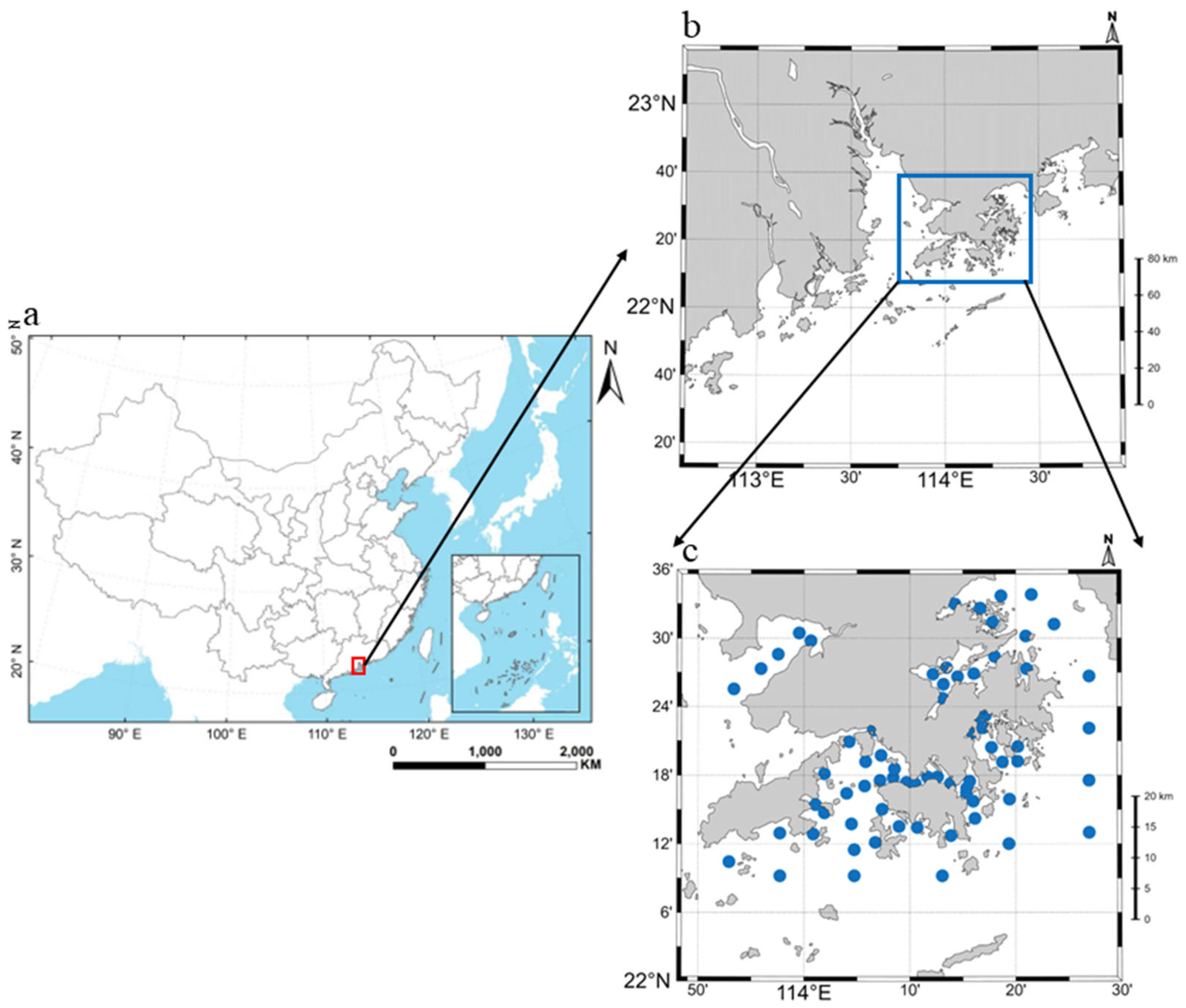
The waters of the PRE are typical high-turbidity Case II waters (Figure 1). The interaction between complex hydrodynamic processes and substantial terrestrial inputs leads to high concentrations of suspended particulate matter and optically complex waters, characterized by the coexistence of mineral suspended sediments, CDOM, and phytoplankton [43]. Consequently, conventional ocean color algorithms based on blue-to-green-band ratios perform poorly in this region. This pronounced optical complexity makes the PRE an ideal natural laboratory for the development and validation of remote sensing retrieval algorithms designed for turbid coastal waters, particularly those based on machine learning approaches [40]. This underscores the critical need for the high-accuracy, long-term satellite monitoring of key water quality parameters such as Chla.
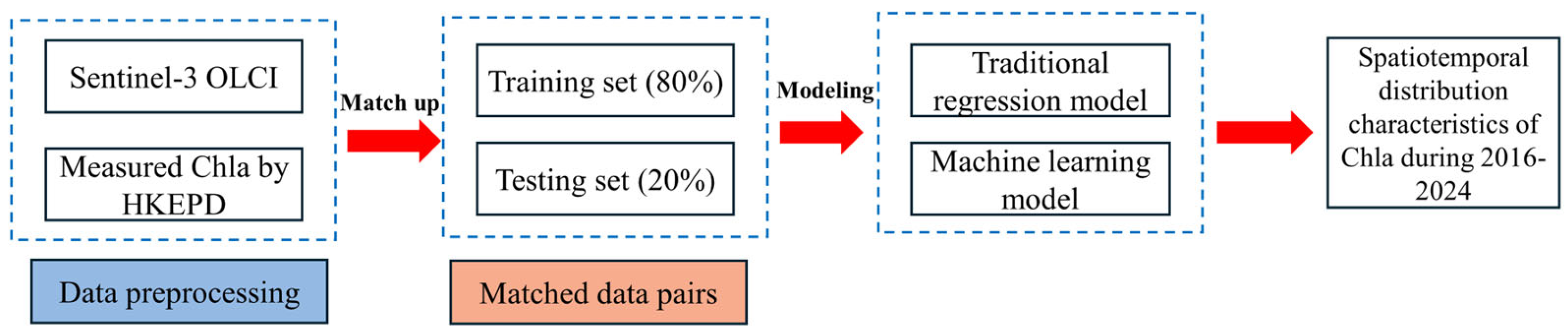
Figure 2 presents the flowchart of data processing. In brief, the Sentinel-3 OLCI images underwent atmospheric correction in this study, and the remote sensing reflectance (Rrs) was matched with Chla data from the Hong Kong Environmental Protection Department (HK EPD) to obtain paired datasets. These matched pairs were then divided into training and testing sets. Retrieval models were developed based on traditional regression algorithms and machine learning methods. Based on the performance differences between these models, the study analyzed the spatial and temporal distribution characteristics of Chla in the Pearl River Estuary from 2016 to 2024.

2.2. In Situ Data

All in situ observations used for model development were obtained from the network of long-term fixed monitoring stations established by the Hong Kong Environmental Protection Department (HKEPD) in the PRE under its jurisdiction. This monitoring network has been in continuous operation since 1986 [31]. Monthly observations collected from January 2016 to December 2024 were used in this study, providing a nine-year dataset that effectively captures both the seasonal cycles and interannual variability of water quality in the study region (Figure 1b). All measurements strictly followed the standard operating procedures and quality control protocols defined by the HKEPD, ensuring the reliability and consistency of the data. The spatial distribution of the monitoring stations covers key areas from the inner Lingdingyang of the PRE to the southern waters of Hong Kong, allowing for a robust representation of the water quality gradient from estuarine to nearshore environments. Furthermore, the use of fixed station locations and regular sampling frequency facilitates accurate spatiotemporal matching with satellite overpasses, thereby supporting high-precision satellite-based water quality retrievals.

2.3. Sentinel-3 OLCI

We utilized all available Sentinel-3 OLCI satellite imagery acquired between 2016 and 2024, comprising a total of 144 scenes. The data were obtained from the European Space Agency (ESA) at https://dataspace.copernicus.eu/explore-data/data-collections/sentinel-data/sentinel-3 (accessed on 25 December 2025). These datasets offer significant advantages for chlorophyll-a (Chla) retrieval. The OLCI sensor provides 21 spectral bands covering wavelengths from 400 to 1020 nm, including bands specifically optimized for ocean color remote sensing [44,45]. For example, bands centered at 443 nm, 490 nm, 510 nm, and 560 nm are commonly used to construct traditional blue-to-green-band ratio algorithms. In contrast, bands at 620 nm, 665 nm, and 709 nm exhibit a high sensitivity to Chla fluorescence signals and high-concentration waters, enabling the effective detection of Chla spectral features, particularly in turbid aquatic environments.
OLCI provides a spatial resolution of 300 m and, through the dual satellite constellation, achieves a revisit frequency of approximately one to two days [46]. This temporal coverage is well suited for resolving both short-term variability and seasonal dynamics of Chla concentrations in the PRE. In addition, the sensor features high radiometric accuracy and a high signal-to-noise ratio, which supports accurate atmospheric correction and reliable reflectance retrieval in optically complex waters. Appropriate processing of Level 1 data yields high-quality remote sensing reflectance (Rrs) products, providing stable and reliable spectral inputs for machine learning-based Chla retrieval models. This capability effectively overcomes the limitations of traditional sensors in high-turbidity estuarine regions.

2.3.1. Atmospheric Correction

Atmospheric correction was applied to Sentinel-3 OLCI Level 1 data using the ACOLITE 20251013.0 software package to derive water surface Rrs. ACOLITE is specifically designed for coastal and inland waters and has been demonstrated to perform robustly in highly turbid environments such as the PRE [47]. During the correction process, shortwave infrared bands were used to estimate and remove aerosol scattering and atmospheric path radiance. A built-in dark spectrum fitting algorithm was applied to achieve more stable retrievals of atmospheric parameters under high-turbidity conditions, coupled with an optimized selection of an exponential aerosol model to better match regional atmospheric characteristics. In addition, ACOLITE automatically performs sun glint correction and mitigates adjacency effects caused by radiative contamination from neighboring pixels. The final output consists of accurately atmospherically corrected Rrs products, which provide high-quality and physically consistent spectral inputs for subsequent Chla retrieval models [48]. These products form a reliable data foundation for machine learning-based inversion of Chla concentrations in optically complex estuarine waters.

2.3.2. Data Matching and Feature Engineering

To develop a reliable remote sensing retrieval model, high-precision spatiotemporal matching between in situ measurements and satellite observations was performed. For each in situ sampling location, spectral data were extracted from a 3 × 3 pixel window centered on the corresponding position in the Sentinel-3 OLCI imagery. The mean coefficient of variation of Rrs for all valid pixels within each window was then calculated. Windows exhibiting a coefficient of variation exceeding 0.3 were considered spatially heterogeneous and discarded. In addition, only matchups with at least four valid pixels within the 3 × 3 window were retained. To minimize the impact of outliers, the median Rrs of all valid pixels within each window was used to represent the satellite observation corresponding to the in situ measurement. After applying these stringent spatiotemporal matching and quality control criteria, a total of 229 valid in situ satellite matchup pairs were selected and applied. The full dataset was subsequently randomly divided into a training set with 182 point samples, accounting for 80% of the data, and a testing set of 46 point samples, accounting for 20%.
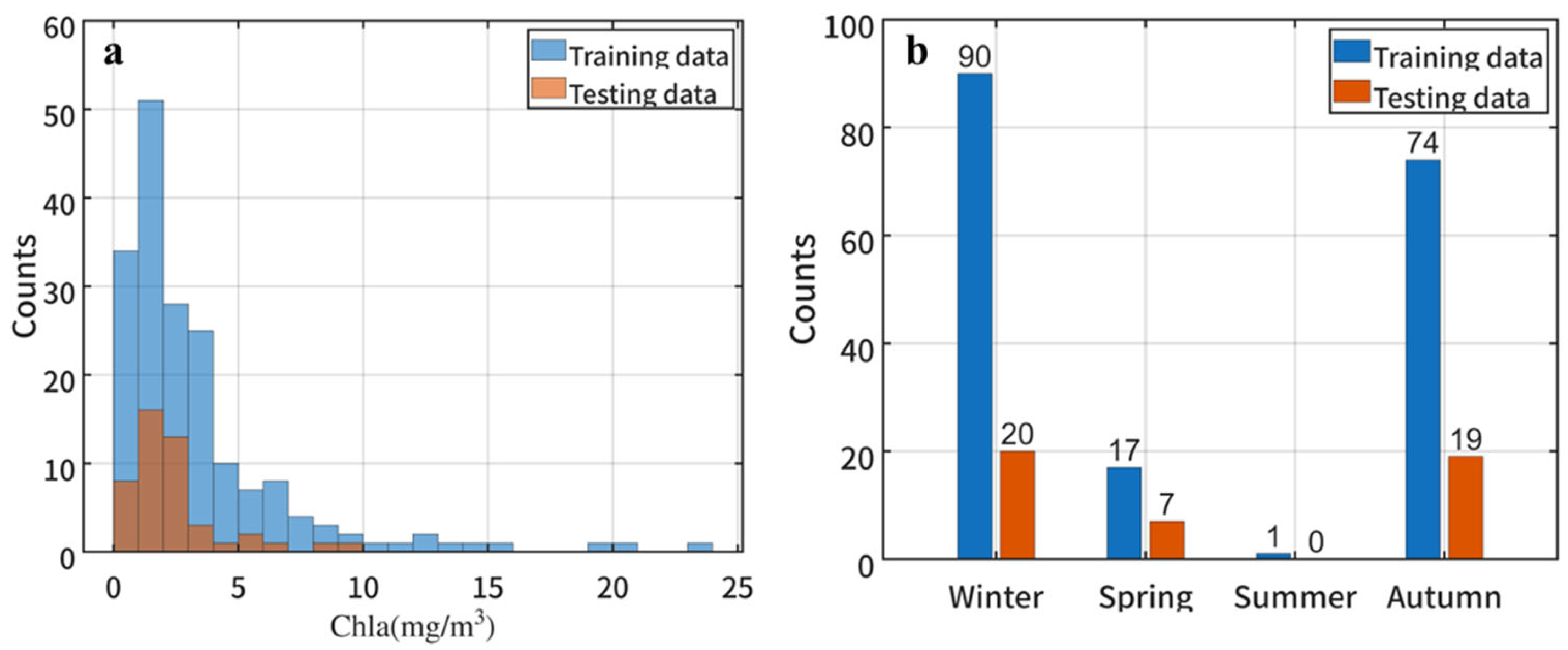
Figure 3a shows the distribution ranges of the training and testing datasets. Chla concentrations are primarily concentrated within the range of 0 to 5 mg m−3, with a small number of samples exceeding 15 mg m−3. Seasonal analysis indicates that the majority of valid matchups occur during autumn and winter, reflecting the relatively cloud-free and low-precipitation conditions in the PRE during these seasons. Fewer valid matchups are available in spring, while matches in summer are negligible due to persistent cloud cover and rainfall, as shown in Figure 3b.
Based on previous studies [49,50,51], Chla retrieval commonly uses Rrs from 443 to 682 nm. We calculated the normalized remote sensing reflectance (NRrs) from the Rrs of eight spectral bands ranging from 443 to 682 nm (Formula (1)). First, residual aerosol effects and sensor calibration uncertainties often manifest as systematic biases across all spectral bands, and normalization effectively suppresses such common-mode errors, thereby improving model robustness to radiometric calibration uncertainty and residual atmospheric correction errors. Second, normalization reduces reflectance level fluctuations caused by bulk variations in other water constituents such as suspended particulate matter and colored dissolved organic matter. This process emphasizes spectral shape information that is more directly related to Chla concentration, thereby enhancing the model’s ability to identify Chla-specific spectral features.
N R r s i , j = R r s ( i ) R r s ( j ) R r s ( i ) + R r s ( j ) ,   i < j
Among them, Rrs(i) and Rrs(j) refer to Rrs(443), Rrs(490), Rrs(510), Rrs(560), Rrs(620), Rrs(665), Rrs(674), and Rrs(682), respectively. Moreover, Rrs(λi) ≠ Rrs(λj). In this case, there are a total of 28 combinations for NRr(λi, λj).

2.3.3. Correlation Between NRrs and Chla

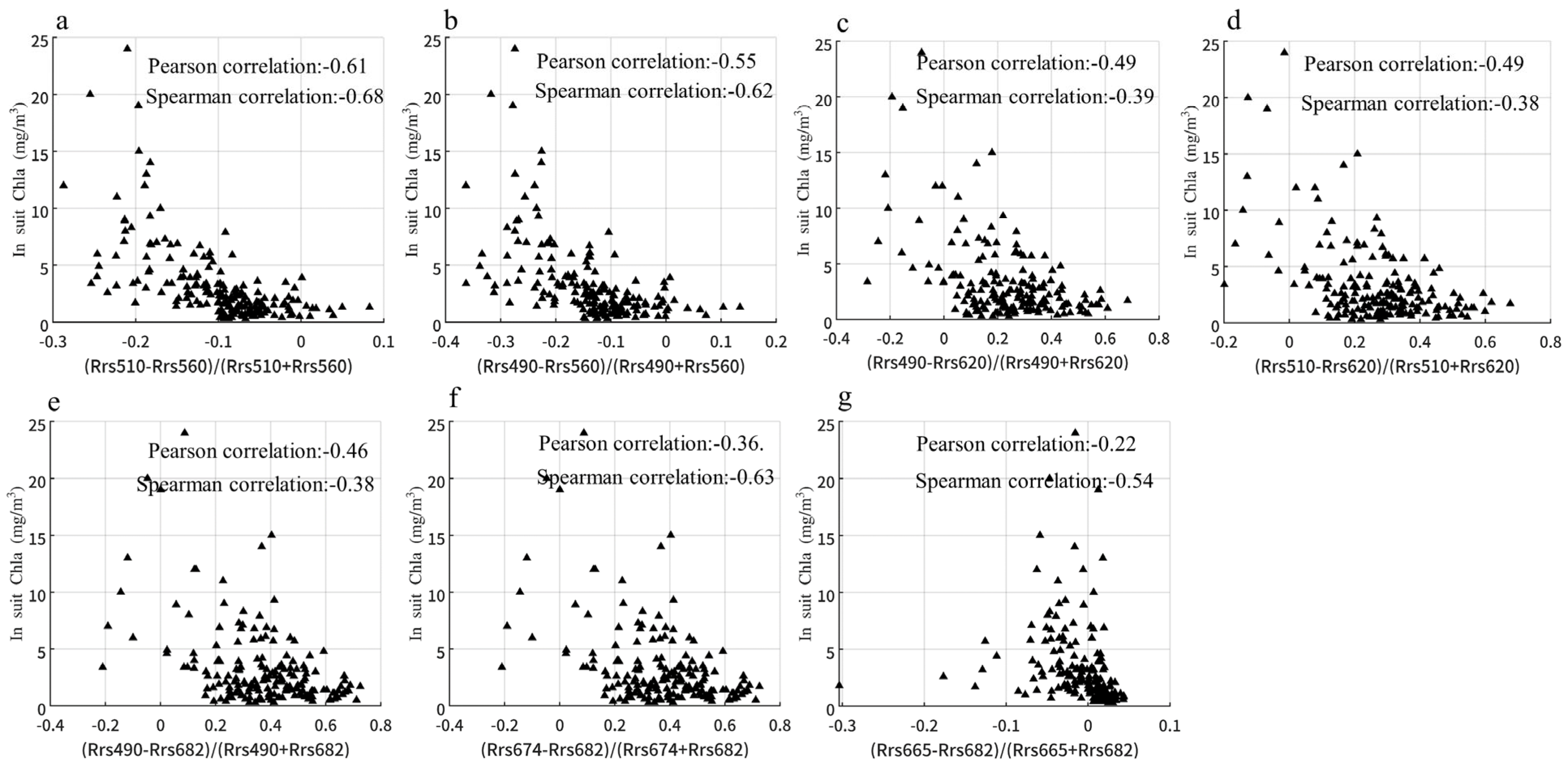
From the 8 spectral bands, a total of 28 possible band ratio combinations were generated. Pearson correlation (R) and spearman correlation analysis was then performed to examine the relationship between NRrs and Chla concentration using the training dataset. The five combinations with the highest Pearson correlation coefficients are NRrs(510,560), NRrs(490,560), NRrs(490,620), NRrs(510,620), and NRrs(490,682). The five combinations with the highest Spearman correlation coefficients are NRrs(510,560), NRrs(490,560), NRrs(490,620), NRrs(674,682), and NRrs(665,682), as shown in Figure 3.
Compared with a simple linear relationship, the association between NRrs and Chla displays a more pronounced nonlinear pattern. This nonlinearity is particularly evident in the relationships shown in Figure 4a,b, where NRrs exhibits a clear nonlinear dependence on Chla concentration. Therefore, in the test dataset, we established third-order polynomial, second-order polynomial, exponential, and linear models, respectively, to fit the relationships between NRrs(510,560), NRrs(490,560), NRrs(490,620), NRrs(510,620), NRrs(490,682), NRrs(674,682), NRrs(665,682) and Chla concentration (Tables S1–S4). The established regression models were then compared with the test data (Tables S5–S8). Based on the model accuracy on the test data, we listed the optimal regression model for each model type, as shown in Table 1.

2.3.4. Improving Chla Retrieval Using Machine Learning

The relationship between NRrs and Chla exhibits significant nonlinear characteristics. Therefore, we selected two machine learning methods, SVR and BPNN, which can further improve the retrieval accuracy of Chla by effectively capturing the nonlinear relationships between input variables and the target parameter. SVR has well-established advantages in small-sample learning scenarios [52]. It is grounded in statistical learning theory and follows the principle of structural risk minimization, which seeks an optimal balance between model complexity and training error. BPNN, on the other hand, is a widely used machine learning method for retrieving water quality parameters [53,54,55,56].
The inputs for the machine learning models are NRrs(510,560), NRrs(490,560), NRrs(490,620), NRrs(510,620), and NRrs(490,682). Based on the polynomial, exponential, and linear regression models we established, these variables can provide information about Chla to some extent for both the training and validation sets (Tables S1–S8). In contrast, the accuracy of polynomial, exponential, and linear models using NRrs(674,682) and NRrs(665,682) is relatively low. Therefore, we consider that NRrs(674,682) and NRrs(665,682) can be excluded from the machine learning modeling.
In MATLAB 2025b, we implemented SVR model using the Gaussian radial basis function kernel via the fitrsvm function. We set the Epsilon parameter to its default value of 0.2001 and configured KernelScale as “auto.” Consequently, only the regularization parameter C required determination. Using 5-fold cross-validation combined with a grid search approach on the training data, we identified the optimal C value within the range of [1:1:15]. Ultimately, C was set to 10.
The BPNN was also constructed in MATLAB 2025b [57]. The network architecture consisted of two hidden layers, each containing 32 neurons. During training, the maximum number of epochs is 500, the learning rate was set to 0.001, the activation function used is sigmoid, and the loss function is MSE. To mitigate overfitting under limited sample conditions, five-fold cross-validation on the training data was employed together with an early stopping strategy. Training was automatically terminated when the validation loss failed to decrease for six consecutive epochs, and the model parameters corresponding to the best validation performance were retained.

3. Results

3.1. Model Performance Assessment

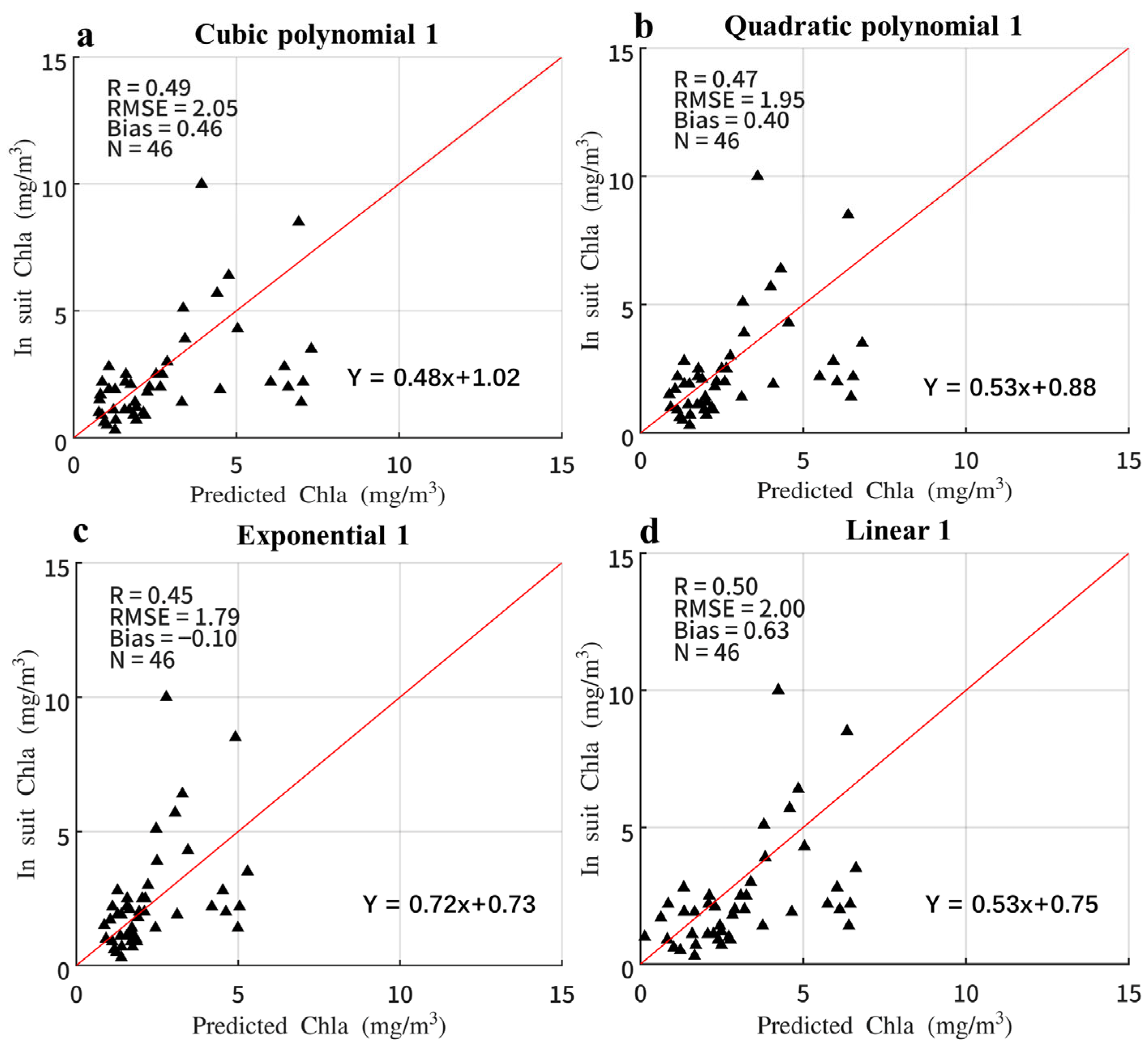
Figure 5 shows a comparison between the Chla concentrations predicted by cubic polynomial, quadratic polynomial, exponential, and linear models based on NRrs(510,560) and the test samples. The majority of test samples cluster in the low-concentration range of approximately 0 to 5 mg m−3, while high-concentration samples are relatively scarce. This uneven distribution contributes to increased scatter in the upper range. Among these four models, the linear model demonstrates the most robust performance on the test set, with an R value of 0.50, an RMSE of 2.00 mg m−3, and a bias of 0.63 mg m−3 based on 46 test samples. It is followed by the cubic polynomial model, which yields an R value of 0.49, an RMSE of 2.05 mg m−3, and a bias of 0.46 mg m−3.
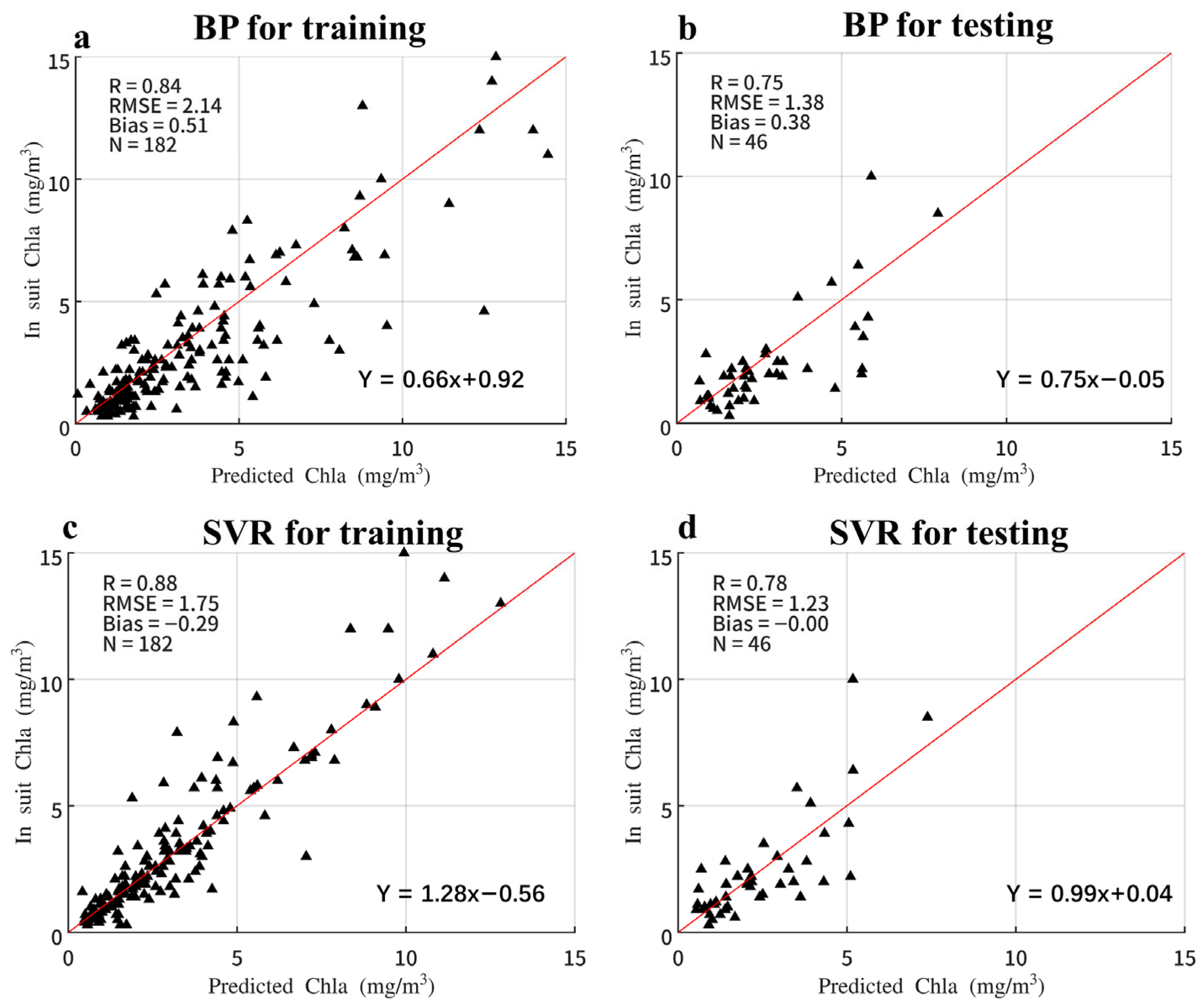
Figure 6 presents the Chla retrieval results obtained using the BPNN and SVR models, with scatter plots comparing predicted and observed values for both the training and testing datasets. The BPNN exhibits satisfactory fitting performance on the training dataset, as shown in Figure 5a, with an R of 0.84, RMSE of 2.14 mg m−3, and bias of 0.51 mg m−3 based on 182 samples. On the testing dataset shown in Figure 5b, the model achieves an R of 0.75, RMSE of 1.38 mg m−3, and bias of 0.38 mg m−3 based on 46 samples, indicating a strong linear agreement between predicted and observed Chla concentrations.
In comparison, the SVR model achieves superior performance on the training dataset, as illustrated in Figure 5c, with an R of 0.88, RMSE of 1.75 mg m−3, and bias of −0.29 mg m−3 based on 182 samples. On the testing dataset shown in Figure 5d, the R increases to 0.78, the RMSE decreases to 1.23 mg m−3, and the bias is close to 0 based on 46 samples. Relative to the BPNN, the SVR model consistently yields a higher R and lower RMSE for both training and testing datasets, while exhibiting minimal bias on the testing dataset. This indicates reduced systematic error and more stable generalization performance.
Overall, both machine learning models substantially outperform the traditional polynomial models in Chla retrieval accuracy. Among them, the SVR model demonstrates the most favorable performance in terms of accuracy and robustness.
We divided the Chla concentrations in the test set into three intervals and evaluated the performance of SVR and BPNN separately (Table 2). Overall, across these three intervals, SVR outperformed BPNN. In the Chla concentration range of 1–5 mg/m3, SVR yielded better results, achieving a correlation coefficient of 0.67, an RMSE of 0.81 mg/m3, and a bias of 0.08 mg/m3. However, when Chla concentrations were below 1 mg/m3, both SVR and BPNN showed relatively low accuracy.

3.2. Spatial Distribution of Chla in the PRE

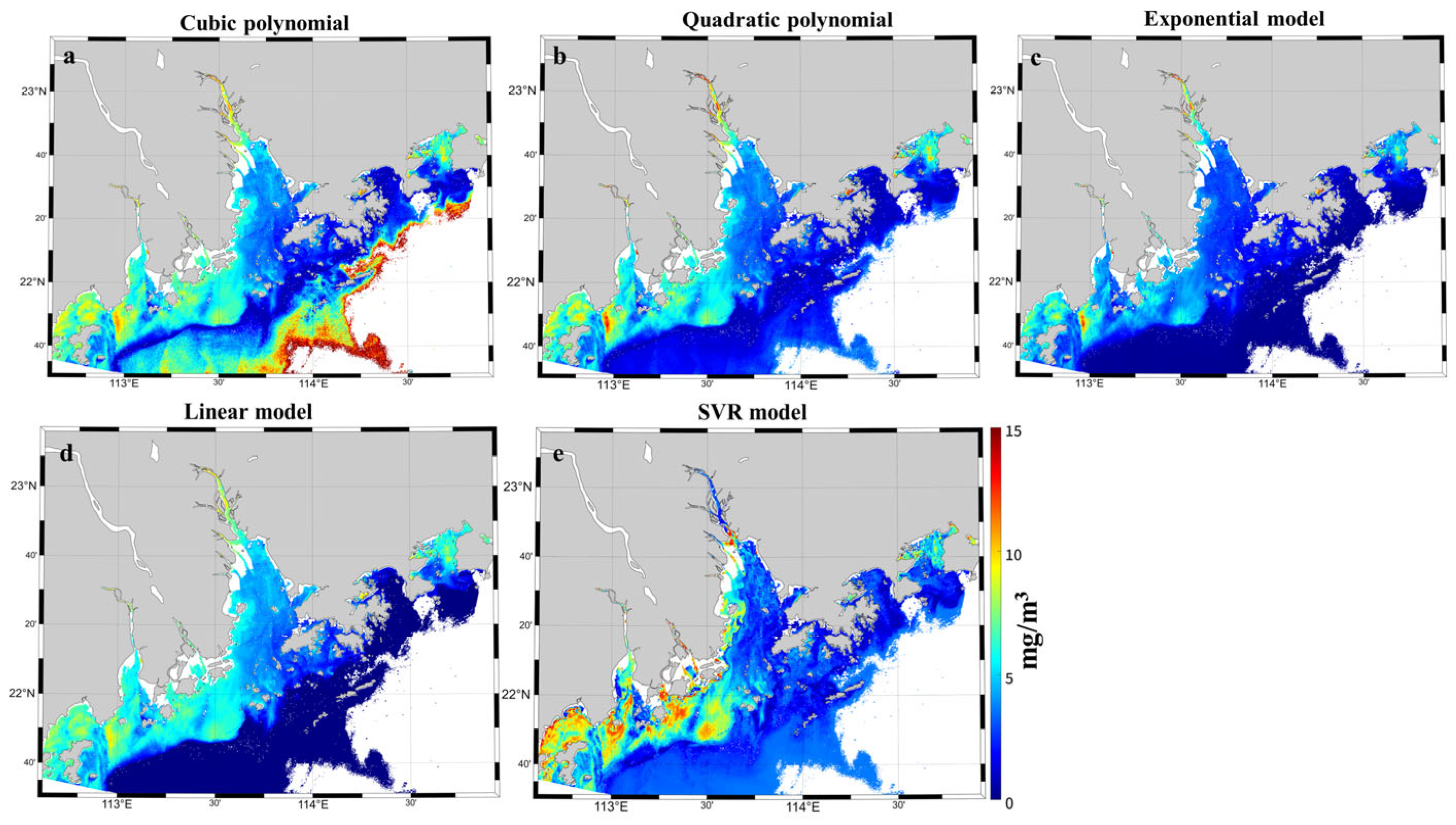
Figure 7 illustrates the spatial distribution of Chla concentration on 17 September 2016. Figure 7e presents the results derived from the SVR model. Overall, both methods exhibit similar large-scale spatial patterns, characterized by higher Chla concentrations in the western region of the estuary and lower concentrations in the eastern region. Elevated Chla values are mainly concentrated near multiple river outlets and extend seaward in tongue-shaped or plume-like patterns. In addition, one or more nearshore high concentration bands are evident, indicating that nutrients transported by river discharge are redistributed and dispersed under the combined influence of tidal mixing and coastal currents. This feature is particularly pronounced in the SVR-derived results shown in Figure 7e. This indicates that, compared to the traditional regression model, SVR can more accurately delineate the spatial distribution of Chla. Therefore, the application of SVR is effective in enhancing the retrieval accuracy of Chla.
Since polynomial regression represents a global functional form, Chla concentrations in the high value range tend to be underestimated, as also reflected in the nonlinear relationship shown in Figure 3a. This leads to a reduced magnitude and spatial extent of high Chla values in the estuarine region. In contrast, SVR, as a kernel-based method, is capable of learning more flexible nonlinear mappings from local data distributions. As a result, it is more effective at capturing high Chla concentrations in the estuary.
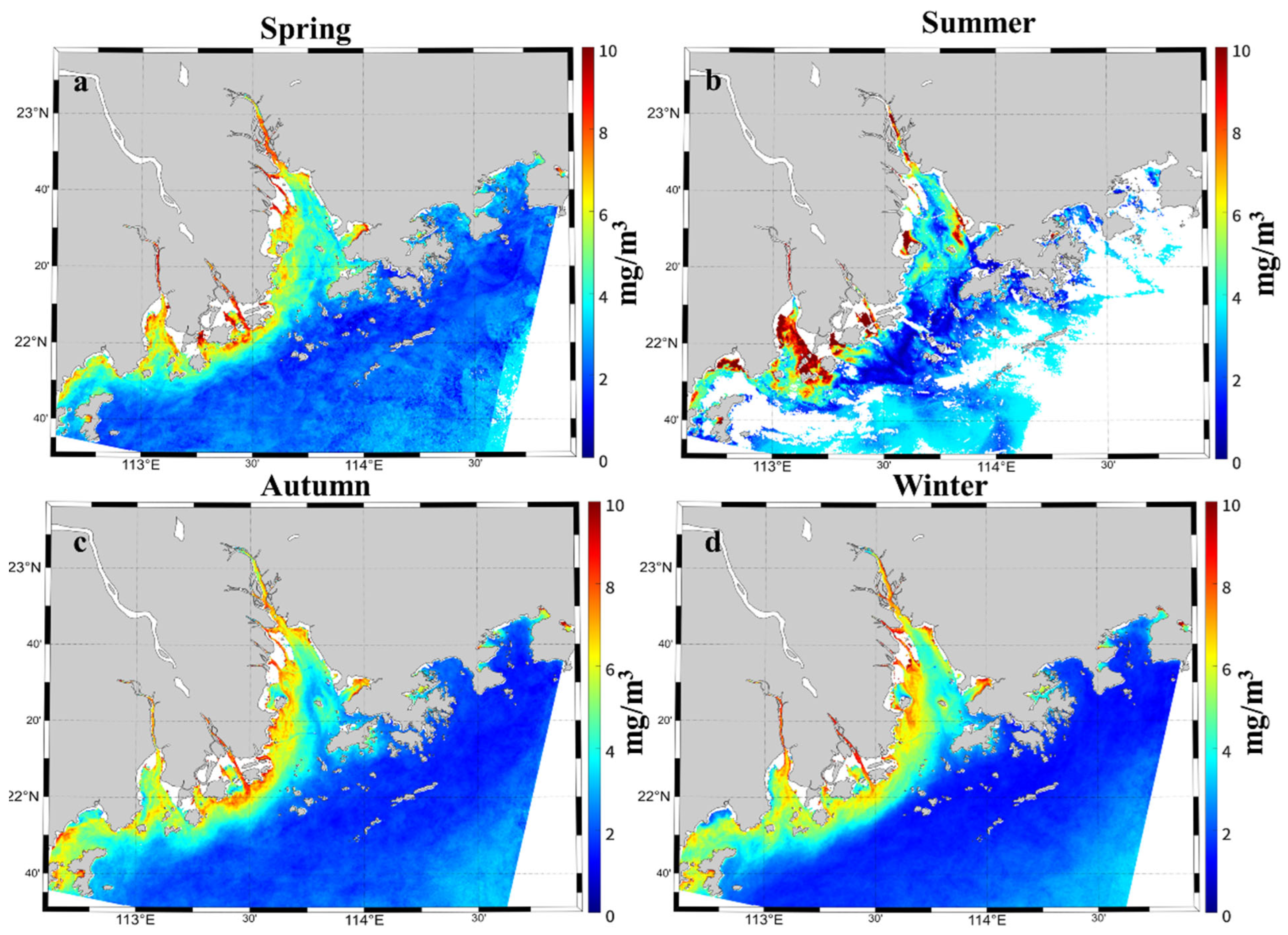
Figure 8 presents the seasonal mean spatial distributions of Chla concentration in the PRE from 2016 to 2024 based on SVR retrievals. Pronounced seasonal variability is observed, with the highest mean concentrations occurring in summer and the lowest in winter. The spatial pattern of Chla also exhibits clear seasonal shifts. In winter, high-concentration regions are primarily located in the upper estuary, while in spring and autumn they move toward the middle estuary. During summer, high Chla concentrations are mainly distributed in the lower estuary. This seasonal migration pattern is consistent with previous findings reported by Ma et al. [53].
Higher sea surface temperatures in summer favor phytoplankton growth. However, enhanced river discharge during this season strengthens water column stratification and shortens residence time in the upper estuary, which is unfavorable for phytoplankton accumulation. In contrast, downstream regions characterized by lower suspended sediment concentrations and longer residence times provide more favorable conditions for phytoplankton growth and bloom formation. During winter, reduced river discharge leads to longer residence times in the upper estuary, promoting phytoplankton growth in upstream areas.
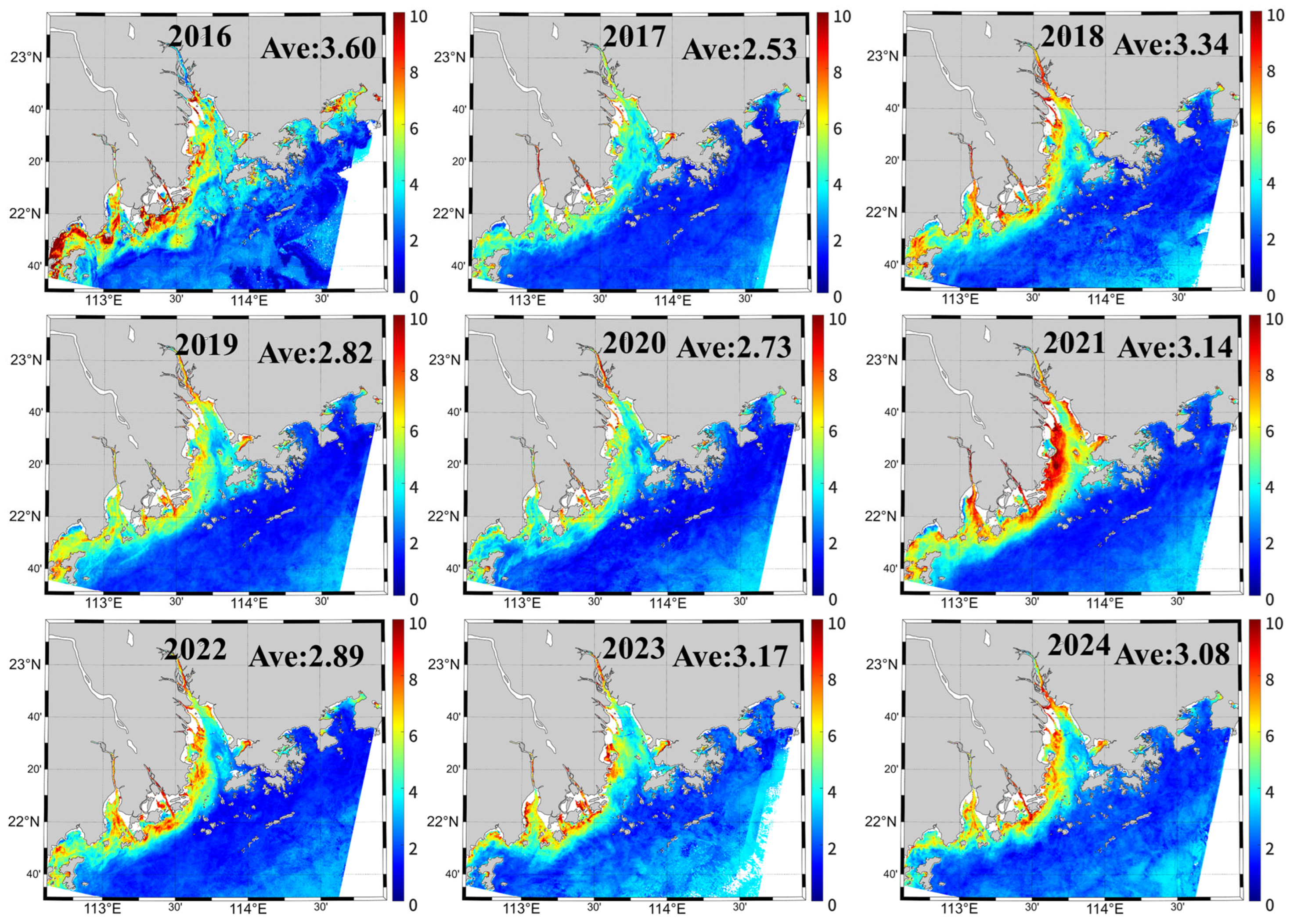
Figure 9 shows the annual mean spatial distribution of Chla concentration in the PRE. Overall, the pattern of higher concentrations in the west and lower concentrations in the east persists throughout the study period, with no pronounced interannual shifts in spatial structure. However, in 2021, an extensive area of elevated Chla concentration is observed in the western estuary, with values reaching approximately 9 mg m−3.

4. Discussion

This study developed a Chla retrieval model tailored for small sample sizes in the PRE by integrating Sentinel-3 OLCI imagery with long-term fixed-station monitoring data from the HKEPD. The results demonstrate that the SVR model achieves the best performance on both the training and independent testing datasets within these optically complex and turbid waters. This confirms the effectiveness of SVR in capturing the complex nonlinear relationships between Chla and multi-band reflectance under limited sample conditions. Furthermore, the retrieval results reveal a distinct “west–high, east–low” spatial pattern of Chla in the PRE, along with a clear seasonal migration characterized by higher concentrations shifting to the lower estuary in summer, retreating toward the upper estuary in winter, and transitioning to the middle estuary during spring and autumn. These patterns align well with regional hydrodynamic and ecological processes.

4.1. Comparison with Existing Studies

In the remote sensing retrieval of Chla concentration in turbid estuaries, traditional blue–green-band ratio algorithms often fail due to interference from total suspended matter (TSM) and colored dissolved organic matter (CDOM) [58,59,60]. On the one hand, CDOM exhibits strong absorption in the blue spectral region, with absorption intensity decreasing as wavelength increases. Consequently, empirical regression models based on blue–green spectral bands may lead to reduced accuracy in Chla retrieval. On the other hand, increased TSM concentration elevates the background signal through strong scattering, thereby masking Chla-related information [53]. This explains why, in traditional regression models using only Rrs510 and Rrs560, the correlation between predicted and measured Chla concentrations was only 0.50.
In recent years, machine learning methods have been gradually introduced. For example, Liu et al. (2023) estimated Chla concentration using XGBoost based on Landsat imagery, achieving R ≈ 0.77 and RMSE ≈ 4.37 mg/m3 [61]; Ma et al. (2022) applied a BPNN model in the Pearl River Estuary, with an RMSE of about 4.71 mg/m3 [53]. In this study, with only 182 training samples, the SVR model attained R = 0.78 and RMSE = 1.23 mg/m3 on the test set, demonstrating a performance comparable to studies using larger sample sizes and highlighting the advantage of SVR in small-sample learning scenarios.

4.2. Possible Influence of Machine Learning Model Overfitting

After data screening, only 182 measured values were used for model training, which is why we selected SVM as the retrieval model, as it is a machine learning method suitable for small sample sizes. Additionally, we implemented several strategies to mitigate the risk of overfitting. First, the hyperparameter tuning of the machine learning model was performed on the training set using 5-fold cross-validation, while the model’s accuracy was evaluated on the validation set. Second, based on the comparison of spatial distributions, the Chla distribution obtained using SVR displays clearer features than that from the traditional regression model (Figure 6). It clearly shows that elevated Chla values are primarily concentrated near multiple river outlets and extend seaward in plume-like or tongue-shaped patterns. Therefore, whether assessed through scatterplot results on the test set or comparisons of spatial distributions, the improved accuracy of SVR is not attributable to overfitting.

4.3. Limitations and Future Directions

First, the atmospheric contribution accounts for approximately 90% of the total signal received by satellites over the ocean [53,60]. An accurate atmospheric correction algorithm is therefore essential for quantitatively deriving Chla concentration information from satellite data. Particularly in highly turbid Case II waters such as the Pearl River Estuary (PRE), where aerosol types are variable and adjacency effects from land are significant, atmospheric correction becomes a major bottleneck for accurate Chla estimation [61,62]. Currently, there is no universally applicable atmospheric correction method, and different correction approaches exhibit varying accuracies across different water bodies and spectral bands [58]. Pahlevan et al. (2021) compared the effects of different atmospheric correction algorithms on water quality parameters and noted that a 20–30% uncertainty in atmospheric correction could lead to approximately 25–70% uncertainty in the retrieval of Chla and TSM [63]. ACOLITE is an atmospheric correction tool based on the Dark Spectrum Fitting (DSF) algorithm. Vanhellemont et al. [64] compared various atmospheric correction methods for Case II waters and found that the DSF algorithm introduces a relative error of approximately 7–27% in the retrieved Rrs within the visible range compared to in situ Rrs. Nevertheless, ACOLITE still demonstrates the highest accuracy among the compared atmospheric correction software packages. It should be noted that the DSF algorithm assumes the presence of at least one spectral band with negligible water reflectance in the scene, which may not hold in highly turbid waters [65]. Future research should explore multiple atmospheric correction algorithms tailored to the PRE region and evaluate their impact on Chla retrieval to further assess model accuracy and applicability.
Second, the extremely limited number of observation samples also constrains model accuracy. As shown in Table 2, the majority of observed data are concentrated in the range of 1–5 mg/m3, which contributes to larger errors in the low Chla concentration range (<1 mg/m3). Therefore, future efforts should collect more data to ensure more uniform sampling across temporal and spatial scales, or develop separate algorithms for different seasons. Additionally, during the wet season in the PRE, cloud cover significantly reduces the availability of usable satellite imagery. Future studies could incorporate data from other satellites, such as MODIS and VIIRS, for joint observations to fill data gaps. Finally, the algorithm developed in this study is empirical and not directly transferable to other regions. However, it can serve as a foundation for subsequent research. With Chla observation data from other estuarine regions, the same workflow could be applied to enable Chla retrieval across broader areas.

5. Conclusions

This study developed a machine learning-based water quality retrieval model tailored for small-sample scenarios for the PRE, a representative high-turbidity estuarine system, by integrating Sentinel-3 OLCI satellite observations with long-term fixed-station Chla measurements provided by the HKEPD. The main conclusions are summarized as follows.
SVR demonstrates a superior retrieval performance under limited sample conditions. Compared with traditional regression models, SVR effectively captures the complex nonlinear relationships between input features and Chla concentration. It achieves the best overall performance on both the training dataset and the independent testing dataset, characterized by a higher accuracy, smaller systematic bias, and more stable generalization capability.
The retrieval results reveal the typical spatiotemporal distribution patterns of Chla concentration in the PRE. Spatially, Chla exhibits a distinct west–high and east–low distribution pattern, with elevated concentrations closely associated with river outlets and extending seaward in plume-like patterns. Seasonally, the Chla concentration is highest in summer, with high-value regions located in the lower estuary, and lowest in winter, when high-value regions retreat toward the upper estuary. During spring and autumn, high-concentration regions shift toward the middle estuary. These patterns are jointly governed by river discharge, water column stratification, suspended sediment concentration, and thermal and light conditions, and are consistent with existing hydrodynamic and ecological understanding of the region.
This study provides a methodological reference for the operational remote sensing monitoring of water quality in high-turbidity estuaries. By coupling Sentinel-3 OLCI data with rigorous spatiotemporal matching and quality control, targeted feature engineering, and machine learning algorithms suitable for small sample sizes, the developed SVR model enables reliable spatial mapping and seasonal monitoring of the Chla concentration in the PRE. The results demonstrate the application potential of this technical framework in optically complex waters.
The main limitation of this study lies in the limited representation of extremely high Chla concentrations above 15 mg m−3. Future work should incorporate additional in situ observations during bloom periods to improve model performance across the full concentration range. In addition, auxiliary environmental variables such as sea surface temperature and photosynthetically active radiation may be incorporated as input features to enhance the physical interpretability of the model and its adaptability to varying hydrodynamic conditions.

Supplementary Materials

The following supporting information can be downloaded at: https://www.mdpi.com/article/10.3390/jmse14040360/s1, Table S1: Coefficients and performance statistics of the Cubic polynomial models; Table S2: Coefficients and performance statistics of the quadratic polynomial models; Table S3: Coefficients and performance statistics of the exponential models; Table S4: Coefficients and performance statistics of the linear models; Table S5: Coefficients and performance statistics of the Cubic polynomial models; Table S6: Coefficients and performance statistics of the second-order polynomial models; Table S7: Coefficients and performance statistics of the exponential models; Table S8: Coefficients and performance statistics of the linear models.

Author Contributions

Conceptualization, Y.Z. and J.F.; methodology, J.F.; software, J.C.; validation, K.P.W., J.C. and J.Q.; formal analysis, Y.Z.; investigation, F.W.; resources, J.Q.; data curation, J.F.; writing—original draft preparation, Y.Z.; writing—review and editing, K.P.W.; visualization, F.W.; supervision, J.F.; project administration, F.W.; funding acquisition, Y.Z. All authors have read and agreed to the published version of the manuscript.

Funding

This research received no external funding.

Data Availability Statement

The raw data supporting the conclusions of this article will be made available by the authors on request.

Acknowledgments

Data used in the study from the Sentinel-3 OLCI satellite observations and local datasets in yellow books from Hong Kong are highly appreciated.

Conflicts of Interest

The authors declare no conflicts of interest.

References

  1. Dogliotti, A.I.; Ruddick, K.; Nechad, B.; Doxaran, D.; Knaeps, E. A Single Algorithm to Retrieve Turbidity from Remotely-Sensed Data in All Coastal and Estuarine Waters. Remote Sens. Environ. 2015, 156, 157–168. [Google Scholar] [CrossRef]
  2. Tanaka, Y.; Minggat, E.; Roseli, W. The Impact of Tropical Land-Use Change on Downstream Riverine and Estuarine Water Properties and Biogeochemical Cycles: A Review. Ecol. Process. 2021, 10, 40. [Google Scholar] [CrossRef]
  3. Wetz, M.S.; Yoskowitz, D.W. An ‘Extreme’ Future for Estuaries? Effects of Extreme Climatic Events on Estuarine Water Quality and Ecology. Mar. Pollut. Bull. 2013, 69, 7–18. [Google Scholar] [CrossRef]
  4. Freeman, L.A.; Corbett, D.R.; Fitzgerald, A.M.; Lemley, D.A.; Quigg, A.; Steppe, C.N. Impacts of Urbanization and Development on Estuarine Ecosystems and Water Quality. Estuaries Coasts 2019, 42, 1821–1838. [Google Scholar] [CrossRef]
  5. Mahrad, B.E.; Newton, A.; Icely, J.D.; Kacimi, I.; Abalansa, S.; Snoussi, M. Contribution of Remote Sensing Technologies to a Holistic Coastal and Marine Environmental Management Framework: A Review. Remote Sens. 2020, 12, 2313. [Google Scholar] [CrossRef]
  6. Zhao, L.; Fan, X.; Xiao, S. Remote-Sensing Indicators and Methods for Coastal-Ecosystem Health Assessment: A Review of Progress, Challenges, and Future Directions. Water 2025, 17, 1971. [Google Scholar] [CrossRef]
  7. Li, J.; Gao, M.; Feng, L.; Zhao, H.; Shen, Q.; Zhang, F.; Wang, S.; Zhang, B. Estimation of Chlorophyll-a Concentrations in a Highly Turbid Eutrophic Lake Using a Classification-Based MODIS Land-Band Algorithm. IEEE J. Sel. Top. Appl. Earth Obs. Remote Sens. 2019, 12, 3769–3783. [Google Scholar] [CrossRef]
  8. Kim, H.G.; Hong, S.; Chon, T.-S.; Joo, G.-J. Spatial Patterning of Chlorophyll a and Water-Quality Measurements for Determining Environmental Thresholds for Local Eutrophication in the Nakdong River Basin. Environ. Pollut. 2021, 268, 115701. [Google Scholar] [CrossRef]
  9. Li, M.; Sun, Y.; Li, X.; Cui, M.; Huang, C. An Improved Eutrophication Assessment Algorithm of Estuaries and Coastal Waters in Liaodong Bay. Remote Sens. 2021, 13, 3867. [Google Scholar] [CrossRef]
  10. Pan, Y.; Chen, Y.; Zhao, H. Spatial Distribution of the Summer Chlorophyll a and Nutrients in the Pearl River Estuary. Mar. Pollut. Bull. 2025, 220, 118479. [Google Scholar] [CrossRef]
  11. Lins, R.C.; Martinez, J.-M.; da Motta Marques, D.; Cirilo, J.A.; Fragoso, C.R., Jr. Assessment of Chlorophyll-a Remote Sensing Algorithms in a Productive Tropical Estuarine-Lagoon System. Remote Sens. 2017, 9, 516. [Google Scholar] [CrossRef]
  12. Cui, T.; Zhang, J.; Wang, K.; Wei, J.; Mu, B.; Ma, Y.; Zhu, J.; Liu, R.; Chen, X. Remote Sensing of Chlorophyll a Concentration in Turbid Coastal Waters Based on a Global Optical Water Classification System. ISPRS J. Photogramm. Remote Sens. 2020, 163, 187–201. [Google Scholar] [CrossRef]
  13. Wang, S.; Peng, H.; Liang, S. Prediction of Estuarine Water Quality Using Interpretable Machine Learning Approach. J. Hydrol. 2022, 605, 127320. [Google Scholar] [CrossRef]
  14. Chen, S.; Fang, L.; Li, H.; Chen, W.; Huang, W. Evaluation of a three-band model for estimating chlorophyll-a concentration in tidal reaches of the pearl river estuary, China. ISPRS J. Photogramm. Remote Sens. 2011, 66, 356–364. [Google Scholar] [CrossRef]
  15. Yang, H.; Kong, J.; Hu, H.; Du, Y.; Gao, M.; Chen, F. A Review of Remote Sensing for Water Quality Retrieval: Progress and Challenges. Remote Sens. 2022, 14, 1770. [Google Scholar] [CrossRef]
  16. Zhang, Y.; Lin, H.; Chen, C.; Chen, L.; Zhang, B.; Gitelson, A.A. Estimation of chlorophyll-a concentration in estuarine waters: Case study of the Pearl River estuary, South China Sea. Environ. Res. Lett. 2011, 6, 24016–24019. [Google Scholar] [CrossRef]
  17. Carmona, F.; Rivas, R.; Fonnegra, D.C. Vegetation Index to Estimate Chlorophyll Content from Multispectral Remote Sensing Data. Eur. J. Remote Sens. 2015, 48, 319–326. [Google Scholar] [CrossRef]
  18. O’Reilly, J.E.; Maritorena, S.; Mitchell, B.G.; Siegel, D.A.; Carder, K.L.; Garver, S.A.; Kahru, M.; McClain, C. Ocean Color Chlorophyll Algorithms for SeaWiFS. J. Geophys. Res. Ocean. 1998, 103, 24937–24953. [Google Scholar] [CrossRef]
  19. Maritorena, S.; Siegel, D.A.; Peterson, A.R. Optimization of a Semianalytical Ocean Color Model for Global-Scale Applications. Appl. Opt. 2002, 41, 2705–2714. [Google Scholar] [CrossRef]
  20. Ye, H.; Tang, S.; Yang, C. Deep Learning for Chlorophyll-a Concentration Retrieval: A Case Study for the Pearl River Estuary. Remote Sens. 2021, 13, 3717. [Google Scholar] [CrossRef]
  21. Matthews, M.W. A Current Review of Empirical Procedures of Remote Sensing in Inland and Near-Coastal Transitional Waters. Int. J. Remote Sens. 2011, 32, 6855–6899. [Google Scholar] [CrossRef]
  22. Konik, M.; Kowalczuk, P.; Zabłocka, M.; Makarewicz, A.; Meler, J.; Zdun, A.; Darecki, M. Empirical Relationships between Remote-Sensing Reflectance and Selected Inherent Optical Properties in Nordic Sea Surface Waters for the MODIS and OLCI Ocean Colour Sensors. Remote Sens. 2020, 12, 2774. [Google Scholar] [CrossRef]
  23. Zhang, R.; Zheng, Z.; Liu, G.; Du, C.; Du, C.; Lei, S.; Xu, Y.; Xu, J.; Mu, M.; Bi, S.; et al. Simulation and Assessment of the Capabilities of Orbita Hyperspectral (OHS) Imagery for Remotely Monitoring Chlorophyll-a in Eutrophic Plateau Lakes. Remote Sens. 2021, 13, 2821. [Google Scholar] [CrossRef]
  24. Siegel, D.A.; Maritorena, S.; Nelson, N.B.; Behrenfeld, M.J. Independence and Interdependencies among Global Ocean Color Properties: Reassessing the Bio-Optical Assumption. J. Geophys. Res. Ocean. 2005, 110, C07011. [Google Scholar] [CrossRef]
  25. Huang, Y.; Pan, J.; Devlin, A.T. Enhanced Estimate of Chromophoric Dissolved Organic Matter Using Machine Learning Algorithms from Landsat-8 OLI Data in the Pearl River Estuary. Remote Sens. 2023, 15, 1963. [Google Scholar] [CrossRef]
  26. Boucher, J.; Weathers, K.C.; Norouzi, H.; Steele, B. Assessing the Effectiveness of Landsat 8 Chlorophyll a Retrieval Algorithms for Regional Freshwater Monitoring. Ecol. Appl. 2018, 28, 1044–1054. [Google Scholar] [CrossRef]
  27. Nezlin, N.P.; Son, S.; Salem, S.I.; Ondrusek, M.E. Chlorophyll-a in the Chesapeake Bay Estimated by Extra-Trees Machine Learning Modeling. Remote Sens. 2025, 17, 2151. [Google Scholar] [CrossRef]
  28. Ahmed, A.N.; Othman, F.B.; Afan, H.A.; Ibrahim, R.K.; Fai, C.M.; Hossain, M.S.; Ehteram, M.; Elshafie, A. Machine Learning Methods for Better Water Quality Prediction. J. Hydrol. 2019, 578, 124084. [Google Scholar] [CrossRef]
  29. Kolluru, S.; Tiwari, S.P. Modeling Ocean Surface Chlorophyll-a Concentration from Ocean Color Remote Sensing Reflectance in Global Waters Using Machine Learning. Sci. Total Environ. 2022, 844, 157191. [Google Scholar] [CrossRef]
  30. Zhang, Z.; Chen, P.; Zhang, S.; Huang, H.; Pan, Y.; Pan, D. A Review of Machine Learning Applications in Ocean Color Remote Sensing. Remote Sens. 2025, 17, 1776. [Google Scholar] [CrossRef]
  31. Hafeez, S.; Wong, M.; Ho, H.; Nazeer, M.; Nichol, J.; Abbas, S.; Tang, D.; Lee, K.; Pun, L. Comparison of Machine Learning Algorithms for Retrieval of Water Quality Indicators in Case-II Waters: A Case Study of Hong Kong. Remote Sens. 2019, 11, 617. [Google Scholar] [CrossRef]
  32. Wang, F.; Wang, Y.; Zhang, K.; Hu, M.; Weng, Q.; Zhang, H. Spatial Heterogeneity Modeling of Water Quality Based on Random Forest Regression and Model Interpretation. Environ. Res. 2021, 202, 111660. [Google Scholar] [CrossRef] [PubMed]
  33. Wang, X.; Li, Y.; Qiao, Q.; Tavares, A.; Liang, Y. Water Quality Prediction Based on Machine Learning and Comprehensive Weighting Methods. Entropy 2023, 25, 1186. [Google Scholar] [CrossRef] [PubMed]
  34. Ma, Z.; Zhao, Y.; Zhao, W.; Feng, J.; Liu, Y.; Tsou, J.Y.; Zhang, Y. Estimating Total Suspended Matter and Analyzing Influencing Factors in the Pearl River Estuary (China). J. Mar. Sci. Eng. 2024, 12, 167. [Google Scholar] [CrossRef]
  35. Shen, Y.; Zhang, H.; Tang, J. Hydrodynamics and Water Quality Impacts of Large-Scale Reclamation Projects in the Pearl River Estuary. Ocean. Eng. 2022, 257, 111432. [Google Scholar] [CrossRef]
  36. Ma, X.; Brookes, J.; Wang, X.; Han, Y.; Ma, J.; Li, G.; Chen, Q.; Zhou, S.; Qin, B. Water Quality Improvement and Existing Challenges in the Pearl River Basin, China. J. Water Process Eng. 2023, 55, 104184. [Google Scholar] [CrossRef]
  37. Toming, K.; Kutser, T.; Uiboupin, R.; Arikas, A.; Vahter, K.; Paavel, B. Mapping Water Quality Parameters with Sentinel-3 Ocean and Land Colour Instrument Imagery in the Baltic Sea. Remote Sens. 2017, 9, 1070. [Google Scholar] [CrossRef]
  38. Rodrigues, G.; Potes, M.; Penha, A.M.; Costa, M.J.; Morais, M.M. The Use of Sentinel-3/OLCI for Monitoring the Water Quality and Optical Water Types in the Largest Portuguese Reservoir. Remote Sens. 2022, 14, 2172. [Google Scholar] [CrossRef]
  39. Xie, Y.; Zhou, Y.; Tao, Z.; Shao, W.; Yang, M. Remote Sensing Inversion of the Total Suspended Matter Concentration in the Nanyi Lake Based on Sentinel-3 OLCI Imagery. IEEE J. Sel. Top. Appl. Earth Obs. Remote Sens. 2024, 17, 10380–10389. [Google Scholar] [CrossRef]
  40. Yang, Y.; Cheng, Q.; Tsou, J.-Y.; Wong, K.-P.; Men, Y.; Zhang, Y. Multiscale Analysis and Prediction of Sea Level in the Northern South China Sea Based on Tide Gauge and Satellite Data. J. Mar. Sci. Eng. 2023, 11, 1203. [Google Scholar] [CrossRef]
  41. Liu, B.; Peng, S.; Liao, Y.; Long, W. The Causes and Impacts of Water Resources Crises in the Pearl River Delta. J. Clean. Prod. 2018, 177, 413–425. [Google Scholar] [CrossRef]
  42. Zhang, G.; Cheng, W.; Chen, L.; Zhang, H.; Gong, W. Transport of Riverine Sediment from Different Outlets in the Pearl River Estuary during the Wet Season. Mar. Geol. 2019, 415, 105957. [Google Scholar] [CrossRef]
  43. Li, Y.; Song, G.; Massicotte, P.; Yang, F.; Li, R.; Xie, H. Distribution, Seasonality, and Fluxes of Dissolved Organic Matter in the Pearl River (Zhujiang) Estuary, China. Biogeosciences 2019, 16, 2751–2770. [Google Scholar] [CrossRef]
  44. Zhu, X.; Guo, H.; Huang, J.J.; Tian, S.; Xu, W.; Mai, Y. An Ensemble Machine Learning Model for Water Quality Estimation in Coastal Area Based on Remote Sensing Imagery. J. Environ. Manag. 2022, 323, 116187. [Google Scholar] [CrossRef]
  45. Li, Y.; Li, S.; Song, K.; Liu, G.; Wen, Z.; Fang, C.; Shang, Y.; Lyu, L.; Zhang, L. Sentinel-3 OLCI Observations of Chinese Lake Turbidity Using Machine Learning Algorithms. J. Hydrol. 2023, 622, 129668. [Google Scholar] [CrossRef]
  46. Shen, M.; Duan, H.; Cao, Z.; Xue, K.; Qi, T.; Ma, J.; Liu, D.; Song, K.; Huang, C.; Song, X. Sentinel-3 OLCI Observations of Water Clarity in Large Lakes in Eastern China: Implications for SDG 6.3. 2 Evaluation. Remote Sens. Environ. 2020, 247, 111950. [Google Scholar] [CrossRef]
  47. Wolters, T.; Detenbeck, N.E.; Rego, S.; Freeman, M. Evaluation of Atmospheric Preprocessing Methods and Chlorophyll Algorithms for Sentinel-2 Imagery in Coastal Waters. Remote Sens. 2025, 17, 3503. [Google Scholar] [CrossRef]
  48. Maciel, F.P.; Pedocchi, F. Evaluation of ACOLITE Atmospheric Correction Methods for Landsat-8 and Sentinel-2 in the Río de La Plata Turbid Coastal Waters. Int. J. Remote Sens. 2022, 43, 215–240. [Google Scholar] [CrossRef]
  49. Guo, H.; Liu, W.; Lyu, H.; Liu, H.; Xu, J.; Li, Y.; Dong, X.; Zhu, Y.; Zheng, Y.; Miao, S. A novel algorithm for estimating phytoplankton algal density in inland eutrophic lakes based on Sentinel-3 OLCI images. Int. J. Appl. Earth Obs. Geoinf. 2024, 129, 103800. [Google Scholar] [CrossRef]
  50. Sherman, J.; Tzortziou, M.; Turner, K.J.; Goes, J.; Grunert, B. Chlorophyll dynamics from Sentinel-3 using an optimized algorithm for enhanced ecological monitoring in complex urban estuarine waters. Int. J. Appl. Earth Obs. Geoinf. 2023, 118, 103223. [Google Scholar] [CrossRef]
  51. Binh, N.A.; Hoa, P.V.; Thao, G.T.P.; Duan, H.D.; Thu, P.M. Evaluation of Chlorophyll-a estimation using Sentinel 3 based on various algorithms in southern coastal Vietnam. Int. J. Appl. Earth Obs. Geoinf. 2022, 112, 102951. [Google Scholar] [CrossRef]
  52. Ren, J.; Cui, J.; Dong, W.; Xiao, Y.; Xu, M.; Liu, S.; Wan, J.; Li, Z.; Zhang, J. Remote Sensing Inversion of Typical Offshore Water Quality Parameter Concentration Based on Improved SVR Algorithm. Remote Sens. 2023, 15, 2104. [Google Scholar] [CrossRef]
  53. Ma, C.; Zhao, J.; Ai, B.; Sun, S.; Yang, Z. Machine learning based long-term water quality in the turbid Pearl River Estuary, China. J. Geophys. Res. Ocean. 2022, 127, e2021JC018017. [Google Scholar] [CrossRef]
  54. Cao, Z.; Wang, M.; Ma, R.; Zhang, Y.; Duan, H.; Jiang, L.; Hu, M. A decade-long chlorophyll-a data record in lakes across China from VIIRS observations. Remote Sens. Environ. 2024, 301, 113953. [Google Scholar] [CrossRef]
  55. Jiang, B.; Liu, H.; Xing, Q.; Cai, J.; Zheng, X.; Li, L.; Meng, L. Evaluating traditional empirical models and BPNN models in monitoring the concentrations of chlorophyll-A and total suspended particulate of eutrophic and turbid waters. Water 2021, 13, 650. [Google Scholar] [CrossRef]
  56. Wang, X.; Cui, J.; Xu, M. A Chlorophyll-a concentration inversion model based on backpropagation neural network optimized by an improved metaheuristic algorithm. Remote Sens. 2024, 16, 1503. [Google Scholar] [CrossRef]
  57. Lei, S.; Luo, J.; Tao, X.; Qiu, Z. Remote Sensing Detecting of Yellow Leaf Disease of Arecanut Based on UAV Multisource Sensors. Remote Sens. 2021, 13, 4562. [Google Scholar] [CrossRef]
  58. O’Reilly, J.E.; Werdell, P.J. Chlorophyll algorithms for ocean color sensors-OC4, OC5 & OC6. Remote Sens. Environ. 2019, 229, 32–47. [Google Scholar]
  59. Tong, Y.; Feng, L.; Zhao, D.; Xu, W.; Zheng, C. Remote sensing of chlorophyll-a concentrations in coastal oceans of the Greater Bay Area in China: Algorithm development and long-term changes. Int. J. Appl. Earth Obs. Geoinf. 2022, 112, 102922. [Google Scholar] [CrossRef]
  60. Hu, C.; Lee, Z.; Franz, B. Chlorophyll aalgorithms for oligotrophic oceans: A novel approach based on three-band reflectance difference. J. Geophys. Res. Ocean. 2012, 117, C01011. [Google Scholar] [CrossRef]
  61. Liu, J.; Qiu, Z.; Feng, J.; Wong, K.P.; Tsou, J.Y.; Wang, Y.; Zhang, Y. Monitoring Total Suspended Solids and Chlorophyll-a Concentrations in Turbid Waters: A Case Study of the Pearl River Estuary and Coast Using Machine Learning. Remote Sens. 2023, 15, 5559. [Google Scholar] [CrossRef]
  62. Ji, C.; Zhang, Y.; Nejstgaard, J.C.; Ogashawara, I. Assessment of the sediment load in the pearl river estuary based on land use and land cover changes. Catena 2025, 250, 108726. [Google Scholar] [CrossRef]
  63. Pahlevan, N.; Smith, B.; Alikas, K.; Anstee, J.; Barbosa, C.; Binding, C.; Bresciani, M.; Cremella, B.; Giardino, C.; Gurlin, D.; et al. Simultaneous retrieval of selected optical water quality indicators from Landsat-8, Sentinel-2, and Sentinel-3. Remote Sens. Environ. 2022, 270, 112860. [Google Scholar] [CrossRef]
  64. Vanhellemont, Q.; Ruddick, K. Atmospheric correction of Sentinel-3/OLCI data for mapping of suspended particulate matter and chlorophyll-a concentration in Belgian turbid coastal waters. Remote Sens. Environ. 2021, 256, 112284. [Google Scholar] [CrossRef]
  65. Renosh, P.R.; Doxaran, D.; Keukelaere, L.D.; Gossn, J.I. Evaluation of atmospheric correction algorithms for sen-tinel-2-MSI and sentinel-3-OLCI in highly turbid estuarine waters. Remote Sens. 2020, 12, 1285. [Google Scholar] [CrossRef]
Figure 1. (a) Map of China, (b) location of the PRE, (c) spatial distribution of in situ chlorophyll a sampling stations.
Jmse 14 00360 g001
Figure 2. The flowchart of data processing.
Jmse 14 00360 g002
Figure 3. (a) Distribution of Chla concentrations in the training and testing datasets. (b) Seasonal distribution of valid in situ satellite matchups.
Jmse 14 00360 g003
Figure 4. Relationships between NRrs(a) and Chla concentration. NRrs(510,560) (a), NRrs(490,560) (b), NRrs(490,620) (c), NRrs(510,620) (d), NRrs(490,682) (e), NRrs(674,682) (f), Rrs(665,682) (g).
Jmse 14 00360 g004
Figure 5. Comparison of Chla retrieval performance of the Cubic polynomial model (a), Quadratic polynomial model (b), Exponential model (c) and linear model (d) using the testing dataset (N = 46).
Jmse 14 00360 g005
Figure 6. Comparison of chlorophyll a retrieval results obtained using the BPNN and SVR models. (a) BPNN training dataset. (b) BPNN testing dataset. (c) SVR training dataset. (d) SVR testing dataset.
Jmse 14 00360 g006
Figure 7. Spatial distribution of Chla concentration on 17 September 2016. (ad) Results retrieved using the cubic Polynomial Model, quadratic polynomial, exponential model and linear model; (e) results retrieved using the SVR model.
Jmse 14 00360 g007
Figure 8. Seasonal mean spatial distributions of Chla concentration in the PRE from 2016 to 2024. (a) Spring. (b) Summer. (c) Autumn. (d) Winter.
Jmse 14 00360 g008
Figure 9. Annual mean spatial distribution of Chla concentration in the PRE.
Jmse 14 00360 g009
Table 1. Coefficients and performance statistics of the five second-order polynomial models.
ModelNRrFormula
Cubic polynomial 1NRrs(510,560)Y = 587.92 * X3 + 310.2 * X2 + 5.62 * X + 0.80
Quadratic polynomial 1NRrs(510,560)Y = 127.78 * X2 − 5.50 * X + 0.88
Exponential 1NRrs(510,560)Y = 0.86 * exp(−9.15 * X)
Linear 1NRrs(510,560)Y = −33.95 * X − 0.12
Table 2. Performance assessment of SVR and BPNN for different Chl-a (unit: mg/m3) concentrations.
ConcentrationNRRMSEBias
SVR0 < Chla ≤ 1100.020.830.24
1 < Chla ≤ 5310.670.810.08
Chla > 550.702.48−2.11
BPNN0 < Chla ≤ 110−0.070.530.32
1 < Chla ≤ 5310.551.070.23
Chla > 550.642.54−2.10
Disclaimer/Publisher’s Note: The statements, opinions and data contained in all publications are solely those of the individual author(s) and contributor(s) and not of MDPI and/or the editor(s). MDPI and/or the editor(s) disclaim responsibility for any injury to people or property resulting from any ideas, methods, instructions or products referred to in the content.