


Abstract
In the current context of the energy transition, the reuse of offshore oil and gas (O&G) structures that have reached the end of their operational life presents new engineering challenges. Many projects aim to adapt existing facilities for a range of alternative uses. This paper outlines guidelines for identifying the most suitable conversion options aligned with the goals of the ongoing energy transition, focusing on the Italian offshore area. The study promotes the reuse—instead of partial or full removal—of existing offshore platforms originally built for the exploitation of hydrocarbon reservoirs. From an engineering perspective, the project describes the development of guidelines based on an innovative methodology to identify new uses for both offshore oil and gas platforms and the depleted reservoirs, with a focus on safety and environmental impact. The guidelines identify the most suitable and effective conversion option for the platform–reservoir system under consideration. To ensure a realistic approach, the developed methodology allows one to identify the preferable conversion option even when some piece of information is missing or incomplete, as often happens in the early stages of a feasibility study. The screening process provides an associated level of uncertainty related to the degree of data incompleteness. The outcome is a complete evaluation procedure divided into five phases: definition of criteria; assignment of an importance scale to determine how critical each criterion is; connection of indices and weights to each criterion; and analysis of the relationships between them. The guidelines are implemented in a software tool that supports and simplifies the decision-making process. The results are very promising. The developed methodology and the related guidelines applied to a case study have proven to be an effective decision-support for analysts. The study shows that it is possible to identify the most suitable conversion option from a technical, engineering, and operational point of view while also considering its environmental impact and safety implications.
1. Introduction
The energy transition, guided by the European Green Deal’s goal of achieving climate neutrality by 2050 [1], presents significant challenges for the energy sector, placing it at the forefront of research for sustainable solutions that balance environmental and economic considerations. A key aspect of this transition is the management and reuse of existing infrastructures, including offshore oil and gas platforms reaching their end of life and the associated depleted hydrocarbon reservoirs. The decommissioning of these offshore platforms, which required significant resources for construction and maintenance, would have a high cost and environmental impact. Therefore, more sustainable alternatives at the end of their life cycle than pure decommissioning, either complete or partial [2,3], should be investigated. Converting these platforms for other applications would provide an effective solution to minimizing the environmental impact and making better use of the available resources, especially in combination with the potential conversion of the associated depleted hydrocarbon reservoirs for underground fluid storage (UFS) purposes.
The reconversion of offshore platforms is a real opportunity to combine ecological transition with social development. This approach aims not only to extend the lifecycle of the engineered system while reducing emissions and promoting renewable energy but also to provide benefits in terms of employment, training, and the improvement of the marine environment. From a social point of view, reconversion helps to avoid industrial abandonment while promoting a circular economy and the regeneration of existing infrastructure.
Despite its environmental and social relevance, offshore platform conversion is not governed by universally binding decommissioning requirements. Instead, industrial standards, national regulations, and international agreements play a decisive role in shaping acceptable end-of-life pathways [4].
The applicable legal framework comprises conventions and guidelines that vary by region [5]. The key instruments include the Geneva Conventions of 12 August 1949 [6], which first addressed issues related to offshore installation decommissioning.
Further relevant references include UNCLOS [7] and International Maritime Organization (IMO) guidance [8], which allow the reuse of structures as artificial reefs. The 1972 London Convention [9] seeks to prevent marine pollution by restricting waste disposal at sea.
Regional agreements also influence policy and practice. These include the Oslo (1972) and Paris (1992) Conventions (OSPAR) [10] and the 1976 Barcelona Convention for the Protection of the Mediterranean Sea [11].
Additional principles are set out in the 1989 Basel Convention on hazardous waste [12] and the 1992 Helsinki Convention on protecting the marine environment [13]. At the EU level, Regulation 2021/1119 [14] supports the (re)use of geological formations for CO2 sequestration, consistent with the European Union’s emission-reduction objectives.
In practice, decommissioning decisions are typically taken by national authorities. These decisions are increasingly informed by evolving engineering research and assessment methodologies [15].
2. Literature Review
2.1. Reuse and Decommissioning Alternatives
In recent years, interest has progressively shifted from complete or partial decommissioning of platforms to more sustainable solutions, such as on-site reuse. Programs like “Rigs-to-Reefs” promote the conversion of platforms into artificial reefs, offering potential ecological and social benefits. Other initiatives explore repurposing the structures for renewable energy production, particularly wind and solar power [15,16]. A closer view of the state of the art in the countries hosting most of the offshore platforms in their coastal waters shows that Australia [3] recognizes the importance of addressing the end of life of O&G platforms in a holistic way by setting a multidisciplinary research agenda as the current regulatory framework is not ready to deal with decommissioning or reuse. Conversion is not envisaged for the instance, but partial decommissioning with the Rigs-to-Reefs solution is debated.
In Brazil, delaying the decommissioning of O&G infrastructures by their conversion for other uses, such as renewable energy generation plants, is under consideration, and Braga et al. [15] present a technical and economic analysis of projects aiming to produce offshore wind energy.
In the US [17], federal policy allows for partial decommissioning and reuse of obsolete O&G facilities as artificial reefs by waiving platform removal requirements under stated conditions. No other alternatives are considered.
In several Asian countries, artificial reef planning has moved toward integrated R&D programs for resource enhancement, conservation, and management.
In the North Sea and Europe, most countries adhere to the principle stated by international organizations of removal of the platform infrastructure to safeguard navigation, the marine environment, and allow multiple uses of the seafloor. Guidelines and rules also allow for a reasonable justification on a case-by-case basis for a new use to be determined by the coastal state with jurisdiction.
From the technical and engineering perspective, various industrial guidelines govern the design of these conversion options, including IEC 62600-2 (2016) [18], which provides criteria for designing marine energy converters; DNVGL ST-0126 (2016) [19], focused on support structures for wind turbines; API RP 2A (2000) [20], used in the offshore oil and gas industry; DNV-STD-F101 [21], which offers guidance on pipeline decommissioning; ISO 13623 [22], in particular Section 13.2.4, which specifies that long-term inactive pipelines must be maintained submerged or buried, with cathodic protection; and ISO 13628-5 [23], which, in Annex A, Section 2.8, aims to identify high-level requirements for the management of decommissioned pipelines.
In Italy, the regulatory framework is updated according to the provisions of the Ministerial Decree of 15 February 2019 [24], where Article 5 assigns the Ministry of Environment and Energy Security (MASE) the task of evaluating decommissioned mining platforms for potential reuse. Italy is among the few countries worldwide that consider the full reconversion of existing end-of-life offshore platform–reservoir systems and offers guidance about the potential solutions to adopt.
2.2. Existing Decision-Support Frameworks
A few research groups worldwide have shown interest in using structured methods to make decisions about alternative solutions. Indeed, several multicriteria methods [25] are applied to identify the most suitable decommissioning procedure for a given platform or to compare total decommissioning with reuse of the platform for other purposes, but very little is said about decision-support methods to screen among alternatives for reusing the structure.
For example, Ref. [26] addresses issues related to the selection of a sustainable and circular business model that can be used to support the transformation and/or decommissioning of oil platforms and the way it could be applied to the case of a platform considering social and environmental impacts.
Researchers from Brazil [15] discuss a technical and economic analysis for the conversion of O&G infrastructures into offshore wind power farms compared to decommissioning. The technical analysis mainly refers to the environmental and structural assessment of a selected platform. The selection process is based on a comparative analysis and is related to the identification of the most suitable sites and platform features for a feasible and economically advantageous transformation. Alternative solutions to wind farms are not investigated. It should also be highlighted that some reuse options could induce additional stresses and damages, as mentioned in [27] for offshore wind reuse of jackets. The choice of reuse options must be coherent with the general safety and integrity principles applied to the specific infrastructure.
For more than a decade, representatives of the Italian regulator and researchers have recognized that appropriate decision-making tools should be available to screen the most efficient, sustainable, and safe decommissioning or reuse options to enable an objective, traceable, and transparent assessment of the various alternatives. This principle has been discussed in [28], where a first overview of a study performed on decision-support system methodologies is presented, with a focus on a multicriteria analysis (MCA) that can back up decision-making among all the possible options to be followed in the decommissioning phase. However, they acknowledge that a total removal policy may not always warrant social, environmental, and economic benefits because other options could be more advantageous. The adoption of alternative solutions, such as leave in place, partial removal, reuse for other purposes, or nearby relocation, is thus stimulating a lively debate among stakeholders to tackle challenges and opportunities in the short and long term.
Following this trend, in Italy, projects and studies are being developed to convert and reuse offshore platforms that are no longer operational. As discussed above, to make these projects successful, a clear and structured method is needed, with the primary objective of helping to check if and how a platform can be reused and how efficient the new use would be.
In the literature, one of the most recent and significant contributions on the subject is the study by Zanuttigh et al. (2025) as described in the article: “A novel framework for sustainable decision-making on reusing Oil & Gas offshore platforms with application to the Adriatic Sea” [29], which proposes a methodological framework to support the decision-making process between reuse and decommissioning of offshore platforms. This framework is based on an integrated, multicriteria, and quantitative evaluation approach that considers economic, environmental, and social indicators. The methodology is twofold, with a multicriteria analysis for a qualitative assessment of the best reuse option and quantitative Key Performance Indicators (KPIs) for the assessment of the sustainable selection between decommissioning and reuse. It is applied through an iterative process and requires the inputs of experts and stakeholders with different roles and backgrounds. By applying this approach to the “Amelia B” platform in the Adriatic Sea, the authors demonstrated that the sustainability of reuse depends on the availability of marine space and the ability to generate positive environmental and social impacts through activities such as aquaculture, renewable energy production, and educational tourism.
2.3. The Italian Context
Further to the provisions of the Ministerial Decree of 15 February 2019 [24], over the years, several solutions for the repurposing of offshore platforms have been developed in Italy; some of the most notable examples and selected options for investigation are mentioned hereafter.
- The ReLife Project explores how offshore platforms can be reused to produce renewable energy. This could provide both environmental and economic benefits [30].
- The reuse assessment study, financed by the Italian Ministry for Environment and Energy Security, in the framework of the Clypea Agreement, investigates the technological feasibility up to the basic design of three specific options, with the last two also considering the reconversion of the associated hydrocarbon reservoir. These options, together with their main requirements, are listed below:
- Option 1 (platform only)—photovoltaic system: A photovoltaic system is installed onboard the platform to power a seawater desalination unit. The goal is to produce freshwater for nearby platforms. For this reason, it is essential to assess the presence of platform clusters. For maximum exposure to solar radiation, the photovoltaic system is located on the highest deck of the platform (weather deck). Therefore, the first requirement is that this deck has a large available surface area to allow the installation of a sufficient number of panels to maximize renewable energy production. Environmental conditions must also be considered, knowing that severe weather events could damage the photovoltaic system, reduce its performance, and cause physical degradation of the panels. Eventually, the energy yield of the system is evaluated, including not only solar radiation levels but also the efficiency of system components, which must be suitable for the extreme environmental conditions in which the system will operate [31].
- Option 2 (platform–reservoir system)—conversion of the depleted gas reservoir into a UFS system for CH4 + H2 mixtures: A fit-for-purpose system is installed on the platform so that the reservoir can be used as temporary storage for CH4 + H2 mixtures. The system is required to operate in two modes—injection and withdrawal—during alternating seasonal storage cycles. The reservoir volume (specifically the volume of gas originally in place, GOIP) is a key parameter in determining the volume of mobile gas remaining in place at the end of the primary production phase and therefore the volume of working gas that can be moved during the storage cycles, while the reservoir permeability and the number of wells affect the system’s performance and its ability to deliver high peak flow rates. The minimum storage efficiency of the reservoir, calculated as the ratio between the working gas over the total gas volume (working gas + cushion gas), was set to be ≥30%, as required by national regulations (Decree of 4 February 2011) [32]. The average depth of the reservoir is also a significant factor. It affects fluid behavior and the injection/withdrawal performance of the wells. Depth is usually related to the original reservoir pressure, which limits the maximum pressure that can be reached during injection. The sealine is also critical. It allows onshore–offshore transport of gas, so it is necessary to verify that its design specifications are compatible with the new operating conditions. The sealine materials must be compatible with the hydrogen mixtures to allow safe movement of the CH4 + H2 blend. It is also essential to check the difference between the sealine’s design pressure and the actual operating pressure after conversion. Another factor should be considered when evaluating the performance of a UFS system: the water drive, which can negatively affect performance by reducing the pore volume available for the working gas during storage cycles and cause water production during withdrawal cycles [33].
- Option 3 (platform–reservoir system)—conversion of the depleted gas reservoir into a long-term storage system for CO2: A dedicated system is integrated on the platform to allow the continuous injection of CO2, captured in gaseous form from an industrial facility and transported through the subsea pipeline (sealine) to the platform, properly equipped to inject compressed CO2 into the reservoir. Several key factors must be evaluated in establishing the system performance: The average depth of the reservoir, which influences the behavior of fluids and the injection performance; the difference between the sealine’s design pressure and its operating pressure during conversion conditions; the reservoir volume (GOIP), which strongly and directly affects the amount of CO2 that can be stored in the reservoir; and the presence of a water drive, which negatively impacts the system performance by reducing the pore volume and therefore the volume of CO2 that can be injected during the system’s lifetime [31].
In the face of a multitude of alternative options and the need for well-founded arguments for the selection of the most suitable to a specific scenario, the paper proposes new and practical guidelines to determine which solution is most efficient for the platform taken into consideration to usefully support the technical staff involved in the study. A robust methodology associated with such guidelines for their application is a crucial element to bridge the gap between the various conversion options currently promoted and the technical feasibility for each specific platform. This means that, even if a particular solution is deemed suitable for one platform, it does not necessarily represent the best option for all platforms as their adaptability depends on the specific characteristics of the system being evaluated.
The core of this study, a pioneer in its genre, focuses on the development of a systematic methodology to guide the offshore platform conversion process, evaluating the most effective option among a few candidates in terms of efficiency and adaptability, while adhering to the principles of the energy transition. The proposed methodology supports the feasibility of converting Italian offshore platforms according to the current regulations, promoting the change toward more sustainable solutions. The focus is on the Italian context, but the examined principles can be extended to offshore platforms located in all geographical areas around the world.
The derived guidelines, implemented in a user-friendly software tool, have provided the framework for a detailed analysis of the conversion options illustrated above and were applied to a case study to assess the methodological approach applicability.
3. Materials and Methods
The methodology is designed to fit any potential repurposed plant alternatives and allows one to evaluate which conversion option represents the most suitable solution for the specific offshore infrastructure under assessment and the related reservoir. Its application highlights not only the actual technical value of one option compared to others but also the contribution of the solution identified from an environmental and sustainability perspective. The analysis procedure is systematic and structured in five steps, ensuring high flexibility and independence from the options under consideration; therefore, if a new plant solution is to be considered, the methodology structure will remain the same, but only the relevant elements will be applied.
The five steps are as follows:
- Definition of criteria.
- Definition of the significance of each criterion.
- Assignment of an index to each criterion.
- Assignment of a weight to each criterion.
- Score evaluations.
The provision of guidelines based on this methodology offers structured support for decision-making, helping to identify the most suitable design solution based on structural, environmental, and operational assessments. The analysis procedure has been integrated into a tool specifically developed for this study [34] to support the analysts and make the guidelines accessible and efficient. The results obtained are the outcome of technical and engineering analyses, specifically:
- A percentage score assigned to a specific option under consideration: this value reflects the degree of adaptability of an installation to a given conversion option; the higher the score obtained for a specific option, the greater its compatibility with the reference platform.
- Comparison of the adaptability level of the various options: the elements for determining why one conversion option is preferable to the others. For example, a conversion solution may be preferable for sustainability reasons, while another option may be preferable for structural assessments.
- A percentage score obtained through benchmarking analysis: the objective is to evaluate how the platform under consideration compares with the “best platform case”, representative of the best performance that an offshore infrastructure can achieve for that design alternative.
- The uncertainty range of the overall score, related to the analyst’s unknowns of some quantitative information. Each alternative is therefore considered reliable within a defined uncertainty range.
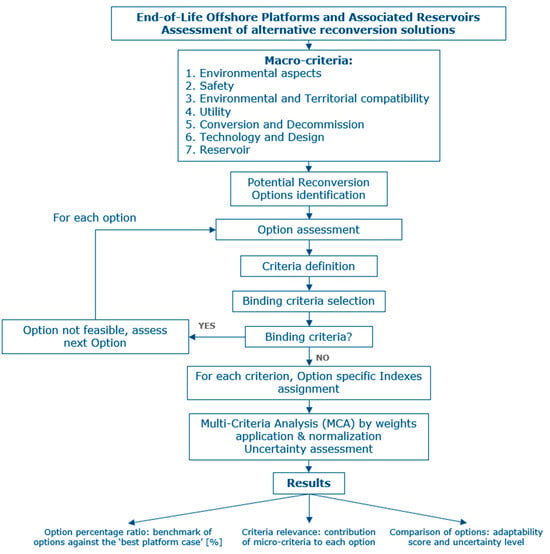
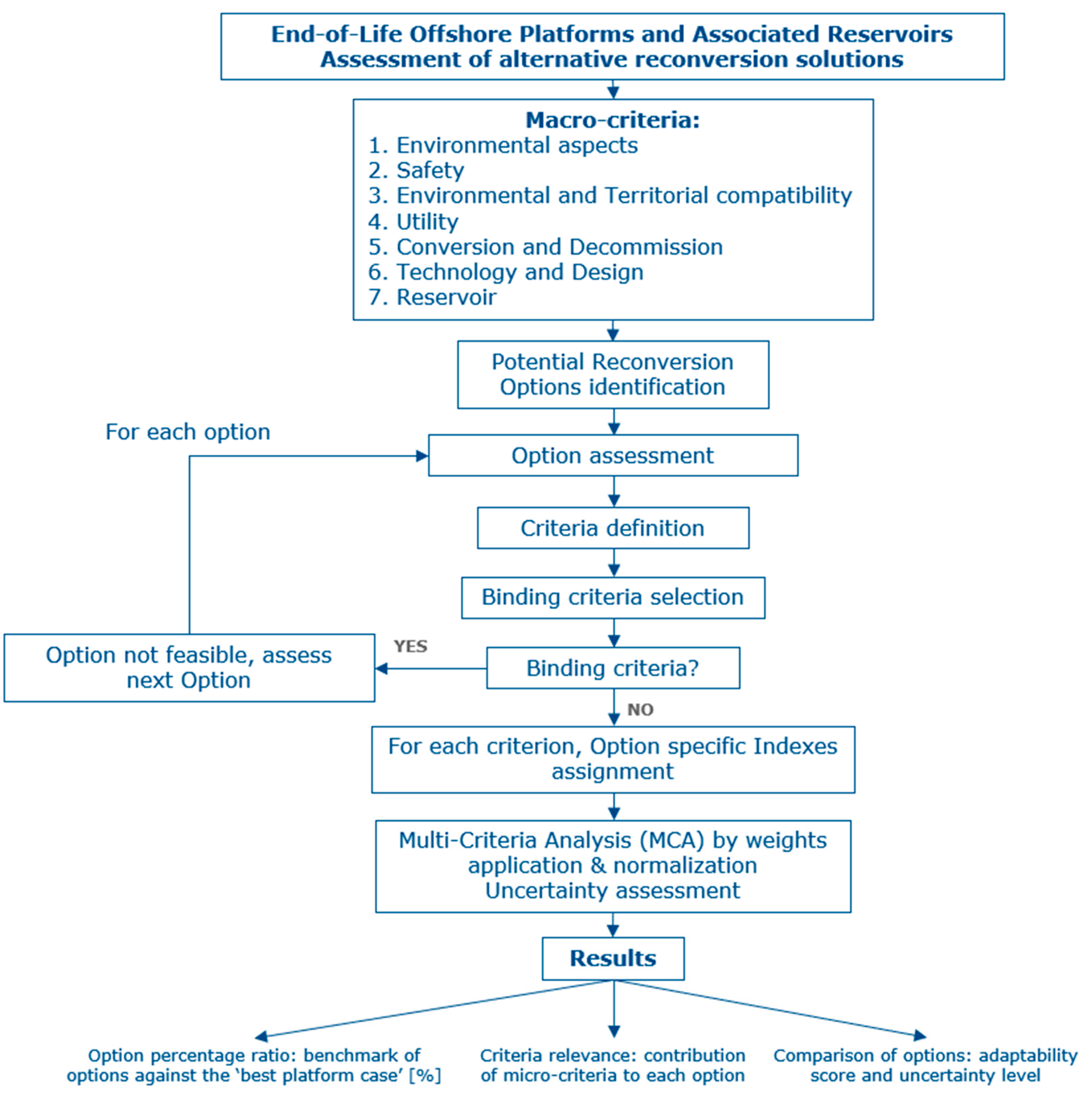
Figure 1 summarizes the methodological framework and highlights the key stages that are discussed in detail in the following sections.
Figure 1.
Methodology flow-chart.
3.1. Definition of Criteria
Assessing whether a platform can be adapted to a specific conversion option requires identifying the key factors that influence its feasibility—referred to as criteria. The criteria are characteristics of the platform and its surrounding environment, like the site where it is located, the conversion option implemented, the reservoir characteristics, or the cluster to which it is associated. They have an impact on the realization of one or more conversion options and provide a comprehensive overview of the platform’s general conditions. The criteria have been divided into seven macro-categories:
Environmental aspects (platform): Identification of the environmental impacts that would occur following the repurposing of the offshore platform during normal operation. For instance, the criterion “Expected annual emissions of greenhouse gases and vapours into the atmosphere compared to the pre-conversion conditions”.
Safety: Identification of all risks related to the system. For example, for process deviations, consideration of the quantities stored for each hazardous chemical substance and the potential consequences in case of accidental release is required. For instance, the criterion “Quantity of flammable substances (liquid phase) on board”.
Utility: Identification of all criteria that allow one to understand how much an option aligns with the goal of achieving climate neutrality by 2050, in line with the European Green Deal. For instance, the criterion “Expected annual quantity of CO2 captured during the post-conversion conditions”.
Technologies and design: Identification of the main structural and geometric characteristics of the platform, which are relevant for defining the adaptability level of each option for the platform under examination. For instance, the criterion “Available surface area on the weather deck for installation of new equipment”.
Environmental and territorial compatibility (surroundings): Identification of all the environmental and territorial characteristics of the area to assess whether the implementation of one of the options is compatible with the environment near the platform. For instance, the criterion “Expected maximum wind speed in the area where the platform is located”.
Conversion and decommissioning (repurposing works): Identification of the environmental impacts resulting from reconversion and decommissioning operations. For instance, the criterion “Amount of waste produced due to conversion and decommissioning operations”.
Reservoir: Identification of the relevant characteristics of the reservoir associated with the offshore platform to determine the degree of adaptability, for example for Options 2 and 3 described above. For instance, the criterion “Volume of the Reservoir (GOIP)”.
Each macro-category is detailed in a set of criteria. In the frame of this study, a total of 72 criteria were identified, but their number may extend or reduce depending on the specific case under investigation.
A list of the 72 criteria is provided in the Supplementary Materials of this paper.
According to the proposed methodology, at this stage, each macro-category is equally important. The attribution of specific indexes and weights to the set of criteria belonging to a macro-category determines their different relevance, thereby introducing a non-compensatory logic when assessed according to the weighted sum aggregation method, as described in the following paragraphs.
Some criteria depend only on the specificity of the platform itself. For instance, the criterion “Expected maximum wind speed in the area where the platform is located” is related to the installation site and is independent of the conversion project. Other criteria depend on both the platform and the selected conversion option. For example, the criterion “Difference between the load caused by average annual snowfall and the maximum load compatible with the equipment on board” reflects both the environmental conditions at the site (average snowfall) and the technical limits of the selected conversion option (maximum allowable load for the equipment). Therefore, this type of criterion will be assessed differently depending on the conversion scenario being considered. Each criterion requires the input of information in its appropriate unit of measure or as a qualitative evaluation (e.g., far less, less, more, or far more).
All relevant characteristics were integrated into the methodology and translated into criteria. The criteria are a fundamental component of the guidelines, allowing for the consideration of key aspects in the conversion process—whether they are technical-engineering, regulatory, or related to the sustainability of the project. Defining the criteria required a detailed analysis of offshore platform features, from both environmental and structural perspectives, as well as an in-depth evaluation of the available conversion options. This phase was crucial to identifying the core aspects that determine how suitable a platform is for new uses, ensuring that the analysis results are consistent and meaningful. The entire guideline development process was preceded by a preliminary study phase, during which both the characteristics of existing offshore platforms worldwide and potential reuse solutions were thoroughly examined. Experts from the relevant disciplines were also interviewed to confirm the selected criteria and/or add new ones. This enabled the identification of the key elements that influence the success of conversion projects.
3.2. Definition of the Significance of Each Criterion
Once the criteria are defined, it is crucial to identify the ones that present characteristics that are binding for the implementation of a specific conversion option. Consequently, the second step of the methodology suggests an analysis that distinguishes binding from non-binding criteria by assigning an indicator of importance:
Binding: The binding criteria, if not met, prevent the implementation of a selected potential conversion option on a specific platform.
Non-binding: The non-binding criteria, while they may be more or less important, do not prevent the implementation of a given solution if not met.
A criterion is not binding ‘a priori’, but the importance of a criterion depends on the conversion option: what is binding for a particular option may not be for another. It is important to note that, if a binding criterion is not met, the level of adaptability of the platform to a given option is reset; that solution is discarded and therefore cannot be selected for conversion.
For example, in the conversion Option 1 described above, involving a photovoltaic system to power a seawater desalination unit, a binding criterion is “the platform is a part of a cluster” of nearby platforms since Option 1 is designed to produce freshwater for such platforms.
The binding criteria provide constraints that are non-compensatory in the weighted sum aggregation method as it is applied to this study as they set thresholds, gates, barriers, etc., towards which each criterion is assessed before each proposed option is accepted for the multicriteria analysis.
3.3. Assignation of an Index to Each Criterion
Since the definition of criteria identifies the specific characteristics relevant to the implementation of conversion solutions, it is essential to determine whether these characteristics are present in the platform–reservoir system and to what extent. This assessment could be conducted automatically by assigning indices to the criteria characteristics. The added value of index-based approaches lies in translating the criterion into a parameter, physical variable, and specific quantity or a combination of variables and quantities, enabling a more convenient and objective assessment. The methodology proposed requires a predefinition of ranges for each criterion as the analyst does not identify the index but inserts the value of a variable or parameter or a combination of variables that describe the criterion and the methodology univocally associates that value with an index.
For criteria that describe a positive characteristic, the indices are as follows:
- 4 = It indicates the most favorable possible condition related to the analyzed criterion.
- 3 = It indicates a medium/high condition related to the criterion analyzed.
- 2 = It indicates a medium/low condition related to the criterion analyzed.
- 1 = It indicates the least favorable condition related to the criterion analyzed.
Positive characteristic means a technical, environmental, and structural property that favors the implementation of one or more conversion options. The objective is to ensure that these favorable conditions are widely present in the proposed solution. For example, “Available surface area on the weather deck for installation of new equipment”: as the deck area increases, the available space for installing new equipment also grows. The ideal index to assign to this criterion is 4 as it identifies the best conditions.
For criteria that describe a negative characteristic, the indices are as follows:
- 1 = It indicates the most favorable possible condition related to the analyzed criterion.
- 2 = It indicates a medium/high condition related to the criterion analyzed.
- 3 = It indicates a medium/low condition related to the criterion analyzed.
- 4 = It indicates the least favorable condition related to the criterion analyzed.
A negative characteristic is a technical, environmental, or structural property that does not favor the implementation of a specific conversion solution. Since this criterion describes a condition that does not facilitate the adoption of a specific option, the objective is to minimize the presence of such adverse conditions. For example, for the criterion “Expected annual release of polluting liquids into the sea compared to the pre-conversion conditions”, the greater the quantity of liquids released into the sea during normal operations, the higher the environmental impact. The ideal index to assign to this criterion is 1 as it identifies the best conditions, i.e., low liquid releases into the sea.
Table 1 provides an example of two criteria that illustrate the concepts just discussed.
Table 1.
Positive and negative criteria.
As shown in Table 1, each index corresponding to a specific criterion can be assigned a range of values directly related to the characteristic being evaluated. For the sake of completeness and for checking the applicability of the methodology, for each of the 72 criteria considered, a thorough study was carried out to define a coherent, valid, and reliable range of values for each index. These ranges were determined after a detailed analysis of each criterion, with the goal of realistically representing relevant operational, environmental, and structural conditions. The definition of the ranges was based on documented sources, including the technical and scientific literature, industrial reports, technical databases, and data from real-world case studies, and carried out by experts in the field. This means that the definition of these ranges should not be left to the analyst applying the guidelines. Indeed, the ranges were established during the development phase of the methodology. Therefore, the analyst must use the predefined ranges for each criterion and is not allowed to modify them during the assessment process. Finding reliable data was not always straightforward, and defining the range limits—an essential step to ensure the validity and relevance of the analysis—proved to be one of the major challenges of this phase. However, the definition of ranges and thresholds can be varied by the methodology developer following the availability of new information, improved technologies, and, in any case, when new options become of interest.
In contrast, the binding criteria have not been assigned any functional ranges to define a score. The analyst only identifies the presence or absence of the characteristic described by the criterion.
Four index levels were selected to ensure a sufficiently detailed analysis without compromising the clarity and effectiveness of the evaluation process.
Using only two levels (for example, A and B), where A represents the most favorable option and B the least desirable, would not have allowed for an adequate distinction of intermediate conditions, resulting in an overly simplified classification. On the other hand, using six or more levels would have significantly increased the complexity of defining and managing the criteria without providing a proportionate improvement in analytical accuracy.
Following an in-depth review of the literature, which does not define a fixed number of levels for an effective multicriteria analysis, the choice of four indices emerged as the optimal solution. This decision was validated through practical tests of the methodology, which showed that this configuration offers a good compromise between assessment accuracy and the time required to define value ranges for each index across all criteria. In summary, the use of four levels proved to be the most balanced choice for conducting a robust multicriteria analysis in this study.
3.4. Assignation of Weight to Each Criterion
For the non-binding criteria, a scale of importance is established, variable for each conversion option to identify the most relevant criteria for the implementation of a given solution. This scale of importance is based on the assignment to each criterion a weight with a value ranging from −3 to +3: the more relevant the criterion is for a given conversion option, the higher the weight assigned to it will be. The presence or absence of a characteristic significantly increases or decreases the level of adaptability only if the absolute value of the weight attributed to the criterion is high. The weight assigned to each criterion is strongly dependent on the option considered as what is significant or decisive for one option may not necessarily be equally relevant for another. This reflects the contextual nature of multicriteria analysis, where the importance of individual criteria can vary depending on the specific characteristics associated with each alternative. Table 2 illustrates an example of this concept.
Table 2.
Assignation of weights to each criterion.
As with the selection of the optimal number of indices, to ensure a proper analysis without exceeding the necessary level of detail, the weights have been identified in a range between −3 and +3. To this end, a symmetrical range from −3 to +3 was adopted, allowing both positive and negative assessments to be expressed in a balanced way with respect to the relative importance of each criterion.
The weight value is positive if the property defined by a given criterion has a positive effect on the implementation of the conversion option according to the directions outlined in par. 3.3 above; conversely, the value is negative if the property has a negative effect on the implementation of the solution under analysis. To achieve a high level of adaptability, it is essential that all positive criteria, with the highest absolute weight values, receive a high index score (3–4), while negative criteria, with higher absolute weights, should have an index value of 1–2. This means that the key characteristics—both positive and negative—are fully compatible with the proposed conversion option for the decommissioning platform. This is one of the most complex points for the definition of guidelines as it is necessary to identify an analysis procedure that is consistent for all the options and is specific to each criterion at the same time.
To ensure maximum objectivity in the analysis, the assignment of weights to individual criteria is also not left to the analyst applying the guidelines; the weights were defined during the development phase of the methodology through a process involving domain experts who considered the relative importance of each criterion within the relevant application context. As a result, analysts apply a predefined weighting system that cannot be altered. This approach ensures neutrality in evaluations, minimizing the risk of introducing subjective elements during the application of the methodology.
3.5. Allocation of Weights and Indices
The final and crucial step of the methodology is to establish a process for associating the indices with the weights to achieve as a result the adaptability level of the retained options that have passed the binding/non-binding criteria selection process. If this logical step is not completed, the previous two steps would remain separated without having the possibility of reaching the goal. The chosen method is the weighted sum, widely used in multicriteria analyses, and considered sufficient for the qualitative results expected by the application of the guidelines as a support to decision-making. To apply it by maintaining in the meantime the current importance associated with each criterion, the weights have been normalized using the Simos method [35], which establishes a hierarchy of criteria and assigns them normalized numerical values. The Simos method organizes criteria using a progressive numbering system, from the lowest to the highest weight. This approach ensures that criteria initially assigned to a higher weight retain a greater normalized value compared to what would be obtained through standard homogenous normalization, while criteria with the same weight share the same ranking position.
Once all the preliminary steps have been completed, using the weighted sum method, the result for each conversion option can be obtained by the following formula:
The formula is
- = Level of adaptability of the platform under consideration with respect to the i-th option.
- = Index assigned to the J-th criterion of the K-th macro-category.
- = Weight assigned to the J-th criterion of the K-th macro-category.
Once the score is obtained, a benchmarking analysis is performed to analyze how the platform under consideration compares with the “best platform case”, representative of the best performance that an offshore infrastructure can achieve for that design alternative. To obtain this benchmark, the ideal virtual platform is identified, considering for each criterion the best score that such an alternative could offer. In particular, the highest level of performance corresponds to the highest score (4) for a criterion with a positive weight () and to the lowest score (1) for a criterion with a negative weight (). A KPI (Key Performance Indicator) that characterizes the performance is then introduced to allow the comparison with a reference value. Therefore, for each option, the following KPI, defined as a percentage ratio, was identified:
where
- = adaptability level of the platform for the i-th option.
- = score that would obtain the best platform considering the i-th option.
3.6. Case Study
Upon completing the development of the methodology, validation tests have been conducted to ensure that the derived guidelines correctly lead the analysts while evaluating a real reuse problem. To facilitate this process, the methodology has been integrated into a dedicated software tool, specifically designed for this study, to enhance accessibility, improve efficiency, and assist analysts in achieving accurate results. The tool was developed using MATLAB R2024a [36], and it incorporates a general algorithm capable of interacting with multiple graphical user interfaces (GUIs) created with App Designer [34].
To understand the wide range of applicability of the approach presented in this paper, it is important to recall here that the overall development process leading to the guidelines for selecting the most appropriate conversion solution for each platform follows a general method and is not specific to any platform or conversion option. To ensure such a general nature, a “typical platform” was chosen for the case study and called GREEN1. The platform characteristics are meant to be representative of most Italian installations. It is assumed that GREEN1 was originally intended for natural gas production, and it is located in the Adriatic Sea 18 km from the coast, where the seabed is at a depth of 25 m below water level. The platform is a six-leg lattice structure with four wells and five decks. Its connection to the shore is ensured by a sealine that, during its operative life, was dedicated to the transport of natural gas from the platform to the coast. The gas reservoir associated with GREEN1 is characterized by an original pressure of 20 MPa at a reference depth of 2000 m subsea level. [31].
The conversion options that the methodology can address are numerous and continuously evolving. To evaluate the effectiveness of the methodology, three plant solutions were selected, as presented in [31]. Their key characteristics are summarized below:
Option 1: Installation of a photovoltaic system to power a seawater desalination system, aimed at supplying neighboring platforms. Critical factors include the availability of space on the weather deck, weather conditions, and the resistance of the materials used.
Option 2: Utilization of the reservoir for the temporary storage of a CH4 + H2 mixture. Key factors include the compatibility of the sealine with the hydrogen mixture, the reservoir depth, the volume of gas that can be stored, and the storage efficiency (with a minimum requirement of 30%, as established by the decree of the 4th of February 2011 [32]).
Option 3: CO2 sequestration in the reservoir. Critical factors include the sealine compatibility, the reservoir depth, the available pore volume in the reservoir, and the presence of an aquifer, which may reduce the pore volume and therefore limit the storage capacity.
4. Results (Case Study “GREEN1”)
After defining the platform and the conversion options that are going to be analyzed, the implemented method proceeds to the testing phase. Through the graphical user interface, the analyst inputs data according to the criteria relevant to the case study. The tool collects this information and applies a multicriteria analysis to generate graphical outputs that help to determine the most suitable conversion option. Specifically, based on the provided data, the tool outputs are as follows:
- The scores for each conversion option.
- The contributions of each macro-category to the overall adaptability level.
- The benchmarking analysis.
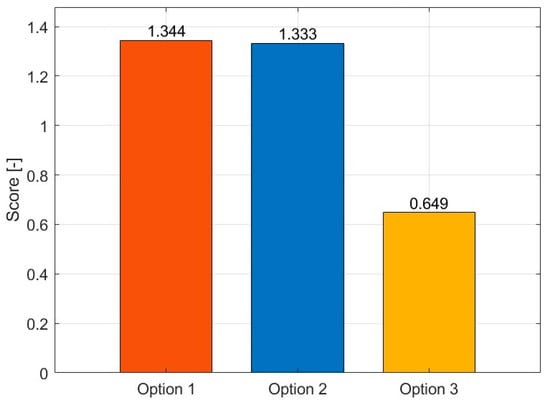
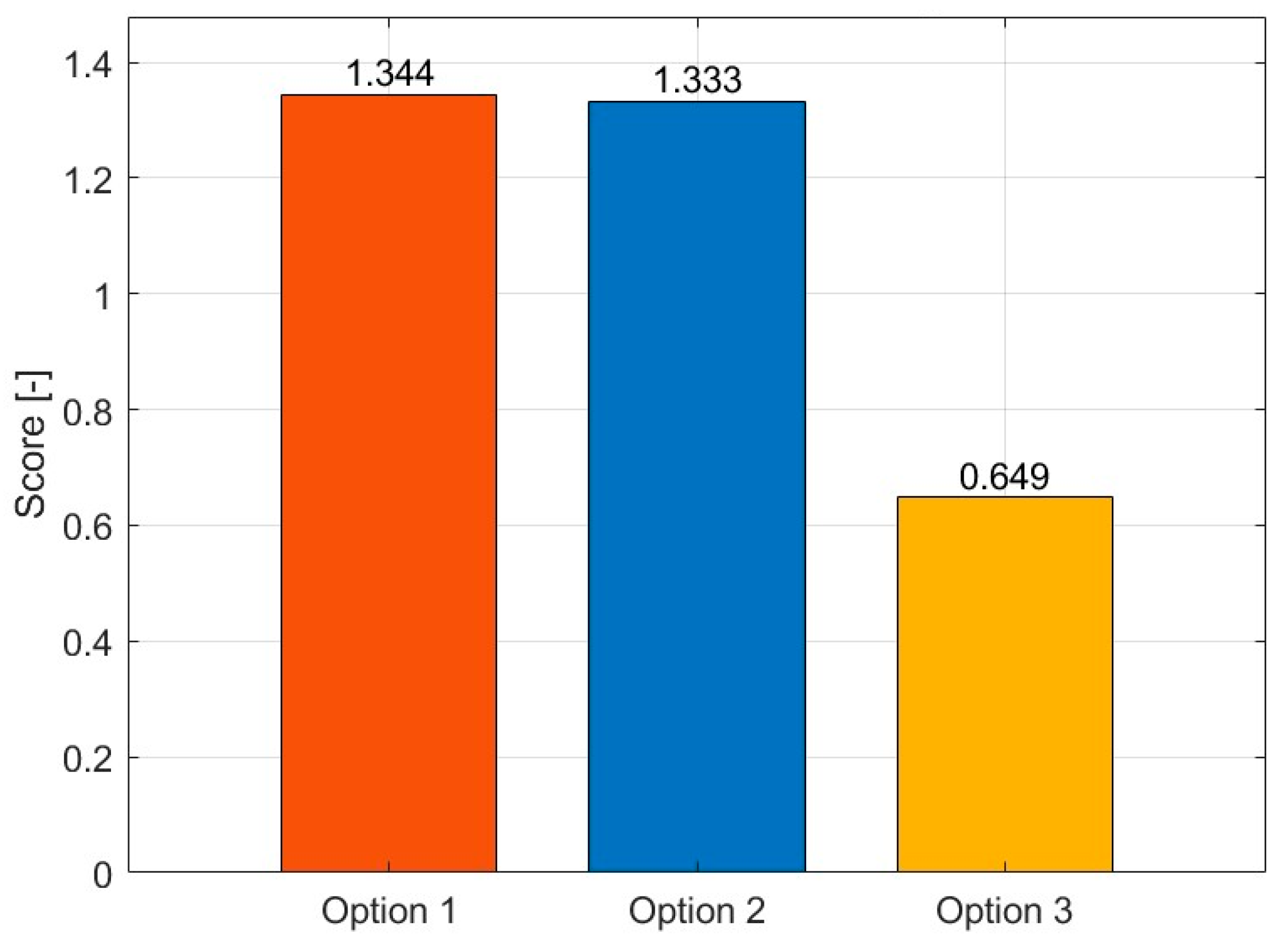
The following section presents the results obtained for the implementation of the three conversion options for the GREEN1 platform. Figure 2 illustrates the final score for each option, determined using the weighted sum method. The scores assigned to Option 1 and Option 2 are similar, while Option 3 emerges as the least favorable choice for this case study, with a significantly lower score compared to the other two options. Based on these results, it can be concluded that repurposing the depleted reservoir for CO2 storage is decidedly the least suitable option from a technical, engineering, and operational point of view for reasons that will be discussed hereafter.
Figure 2.
Scores for each conversion option.
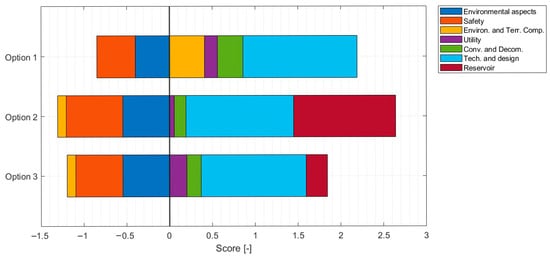
The results presented in Figure 2 represent a first high-level classification of the suitability for conversion of the three alternatives. This information is then complemented by additional details to support the analyst to make an informed decision. In particular, the tool also identifies the score obtained for each macro-category, as shown in Figure 3. This step is crucial as it allows the analyst to assess the contribution of the seven macro-categories, determining which ones negatively impact a given scenario—reflected by a lower score—and which ones contribute to a higher score. In this way, the apparent compensatory nature of the weighted sum aggregation when only the final aggregated results are considered for decision-making is overcome by the knowledge of the current contribution of each macro-category, thus providing the analyst a structured base of knowledge for assessment. Details about the contribution of each criterion within a macro-category are also made available to the analyst when considered useful for the evaluation.
Figure 3.
Contributions of each macro-category.
Regarding the environmental impact under normal operating conditions, Option 1 exhibits the lowest carbon footprint. The plant is expected to use mostly renewable energy, which helps to reduce emissions of pollutants and greenhouse gases. In comparison, the other two options have higher environmental impacts, partly due to gas turbine exhaust or electric compressors. Overall, the desalination plant has about 25% less environmental impact than the others. Option 1 also has the lowest safety risks since it does not involve handling dangerous substances like CO2 or CH4 + H2 mixtures. It only stores chemicals used to treat seawater, which are mainly corrosive or irritating to breathe but not hazardous. Finally, Option 1 is slightly better in terms of design and technology. It removes some heavy equipment, reducing the weight on structural supports, which is a small but useful advantage. When looking at environmental compatibility, Option 1 is slightly less favorable only because its components are less resistant to extreme weather, like hailstorms, which could damage them and reduce production. Still, Option 1 scores higher overall in this category thanks to the advantages of the photovoltaic system. From a safety perspective, Option 2 is the riskiest. It involves large amounts of flammable and explosive substances, like the CH4 + H2 mix, which could pose risks even to nearby platforms. However, Option 2 achieves the same score as Option 1 because it benefits from good reservoir characteristics and storage performance. Option 3, which involves CO2 disposal, aligns best with the sustainability goals because it reduces greenhouse gases in the atmosphere. But it has a higher environmental impact than Option 1 due to the energy needed for compression. From a safety perspective, it is also not advantageous because it handles asphyxiant substances. Overall, this makes it the least favorable option, also because the reservoir properties are not as suitable for long-term CO2 storage as in the case of Option 2 for temporary storage. To ensure a good level of adaptability, Option 3 would require a higher GOIP value as this is the parameter that most determines the performance level of the system and, in particular, the quantity of CO2 that can be disposed of in the reservoir in the long term.
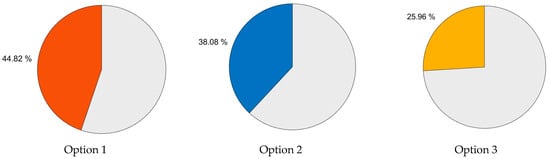
4.1. The Benchmarking Analysis
As shown in Figure 4, Option 1 is the best choice among the investigated options. This means Option 1 is better than the others but still not ideal. The platform is not fully suited for this kind of conversion. Some parts of the system do not fit properly. For example, there is little space on the weather deck, so it is difficult to add new equipment. Also, the platform receives less sunlight than those farther south. This lowers the system’s performance. The lower percentages observed for Options 2 and 3 are primarily due to the following factors: limited GOIP (gas originally in place) values, especially for CO2 disposal; and unfavorable aquifer conditions (strong water drive), which reduce the pore volume available for both CH4 + H2 storage and CO2 disposal. Both configurations also diverge from an ideal scenario in terms of safety as any potential incident would cause large damage zones.
Figure 4.
Benchmark analysis.
4.2. Level of Uncertainty Due to Lack of Data
In the absence of quantitative information available to the analyst, the methodology allows for the omission of numerical input data by estimating a level of uncertainty. This feature is implemented in the software tool that can determine an associated uncertainty range for the overall score based on the percentage of completed criteria.
It is important to note that this estimation is independent of the quality of the measured data. Indeed, the responsibility for verifying the reliability of the input data is left to the analyst.
Rather, the tool accounts for situations in which the analyst is unable to provide all the required information to assess which conversion project best fits the platform–reservoir system under evaluation. In such cases, the tool returns a score for each alternative, considered reliable within a defined uncertainty range.
To represent this uncertainty range, the upper and lower bounds within which each option’s score is considered valid are calculated.
To set the upper bound, the “best platform case” was used. In this case, all missing data achieve the best possible score. If a criterion is positive, it gets an index value of 4. If it is negative, it gets a 1. This shows the highest score an option could reach if all data were available. The lower bound is based on the “worst platform case.” Here, missing data are assigned the worst possible scores. If a criterion is positive, it gets a 1. If it is negative, it gets a 4. This shows the lowest score an option could reach if all data were available. The formulas used to compute the uncertainty range are reported below. Each boundary is calculated by adding or subtracting from the score obtained.
where
- = the score obtained by the platform under evaluation for the i-th option.
- = the default score assigned to the j-th detailed (quantitative) criterion for which the analyst, due to lack of data, did not provide an input.
- = the weight of the j-th detailed (quantitative) criterion for which the analyst did not provide an input.
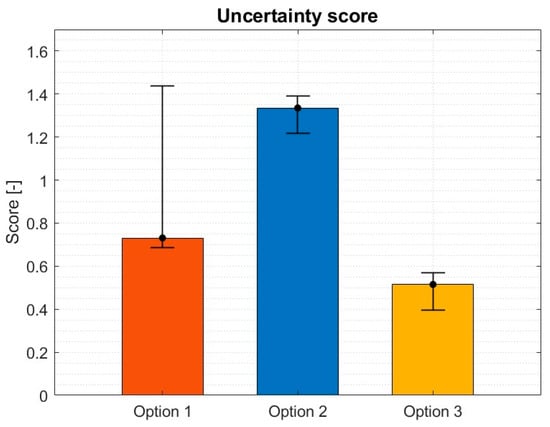
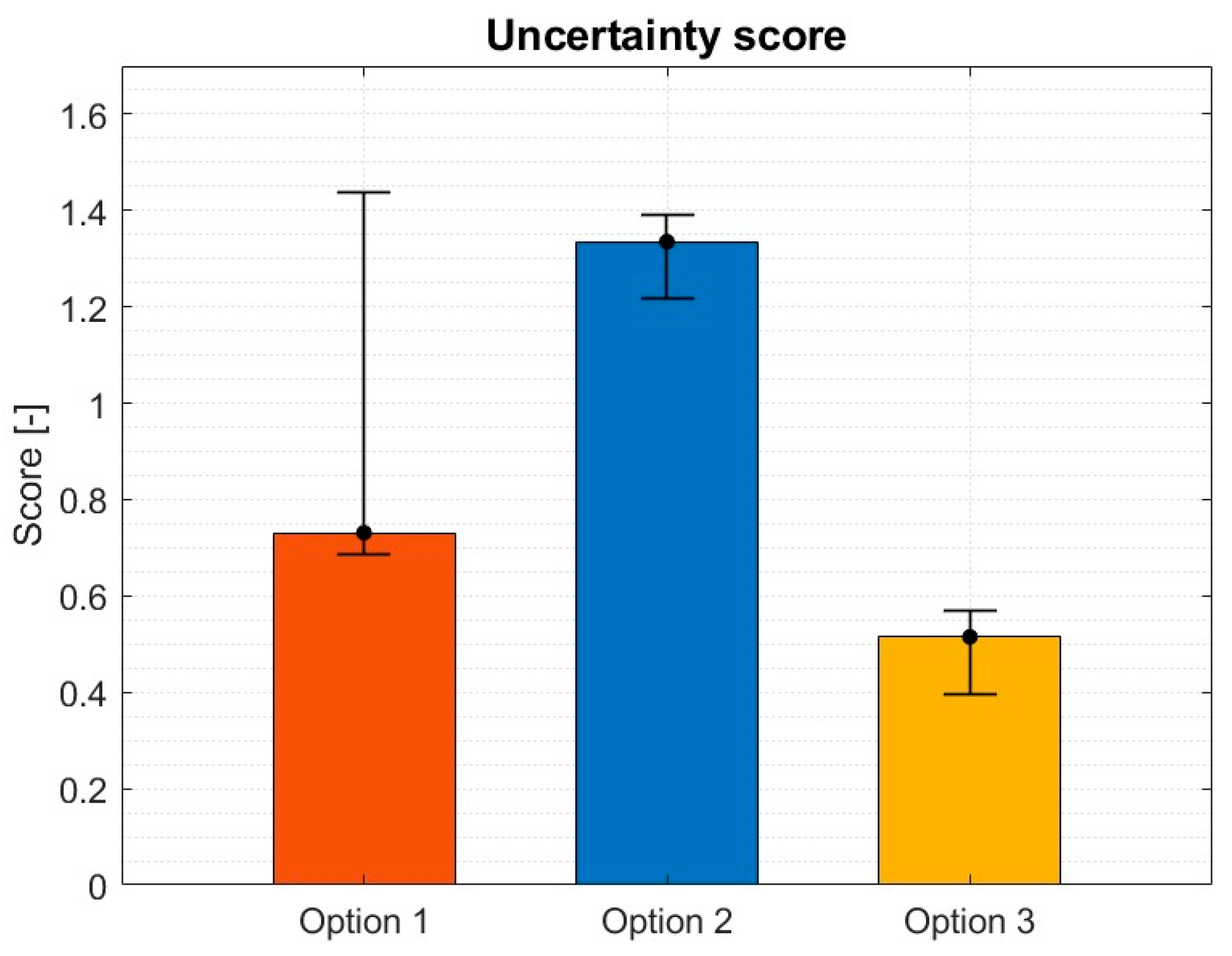
Figure 5 shows an example.
Figure 5.
Applicative example of score ranges due to uncertainty induced by lack of data.
Figure 5 shows the uncertainty intervals associated with the overall scores for the different options considered. In this example, the same case study as in the previous analysis is used but assuming that some Utility and Technology and Design criteria are now unknown to the analyst, precisely the CO2 emitted and captured in the post-conversion configuration; the area available on the weather deck. It is clear how the level of uncertainty due to the lack of these data can significantly influence the result, especially for options that in the case study examined above have similar score values (i.e., Option 1 and Option 2 in Figure 2). In fact, in the specific case, the width of the uncertainty range means that Option 2, the option with the highest score, can be less efficient than Option 1 for the analyzed platform. This demonstrates how missing information can affect not only the overall score and the uncertainty range but also the final decision regarding the platform and reservoir reconversion.
5. Discussion
In recent decades, engineering has played a key role in addressing the challenges of the ongoing energy transition. Due to the current lack of dedicated regulations—particularly concerning the conversion of offshore oil and gas platforms at end of life—there is an urgent need to develop guidelines that can support analysts in the decision-making process for identifying the most suitable conversion option as an alternative to full or partial decommissioning of a given platform.
The proposed methodology considers both the international regulatory framework—particularly in terms of environmental protection and safety—and the Italian legislative context. The key national reference is the Ministerial Decree of 15 February 2019 [24], which requires companies to report a list of structures scheduled to cease production and eligible for decommissioning. This methodology offers a technically sound and indispensable support tool for stakeholders opting for alternative solutions to platforms’ complete decommissioning and, therefore, interested in evaluating the most suitable platform conversion option by taking into account the overall platform–reservoir system. The derived guidelines are general in purpose and friendly to use by analysts with average sector knowledge.
Organized according to a five-step methodology that considers all the relevant characteristics of the platform and the reservoir under assessment, their application is facilitated by a dedicated software tool. Thanks to the inclusion of global performance indicators, direct comparison between alternatives, and a detailed assessment of strengths and weaknesses specific to the analyzed platform–reservoir system, the decision-making process is streamlined and delivers a comprehensive, well-justified, and immediately interpretable overview. The guidelines’ flexibility and adaptability to evolving scenarios are ensured by a structured phased approach.
As this is an innovative approach, the effectiveness of the proposed methodology was evaluated through a case study, which examined three conversion options:
- Option 1: Basic design to install a photovoltaic system onboard the platform and use the energy produced to power a seawater desalination system serving a cluster of surrounding platforms.
- Option 2: Basic design to install infrastructures onboard the platform for converting the associated depleted reservoir into an underground fluid storage system with seasonal injection and withdrawal of CH4 + H2 mixtures.
- Option 3: Basic design to install onboard the platform infrastructures for sequestration of CO2 in the associated depleted gas reservoir.
The results obtained are encouraging: the methodology provided consistent and meaningful results in relation to the characteristics of a representative scenario, represented by the generic GREEN1 platform and an associated depleted reservoir.
It is important to note that economic aspects were not considered during this phase of guideline development. This design choice was made because the main objective of the study was to assess the technical feasibility of the guidelines—specifically to evaluate their practical applicability in engineering contexts and their potential contribution to operational effectiveness. The aim was to determine whether the proposed approach could be applied starting from an engineering perspective. However, nothing is preventing the integration of a cost-related macro-category in later stages of the project to include the economic dimension in the multicriteria analysis. In that case, the evaluation outcomes for the different options could likely change.
The implementation of the guidelines and the tool made it possible to fully achieve the defined objectives. The graphical representation of the results facilitates the interpretation and comparison of the different alternatives, thereby improving the effectiveness of the decision-making process.
It can therefore be stated that the methodology can provide reliable and well-justified results. During the design phase, the structure of the guidelines was intentionally developed to ensure flexibility and applicability for the evaluation of new options. To maintain a comprehensive assessment, it will be sufficient, if necessary, to consider the following:
- An increase in the number of macro-categories: this may occur if new options introduce specific aspects that cannot be classified under any of the currently defined macro-categories.
- An increase in the number of binding criteria: it will be necessary to assess whether any features—if not met—would prevent the implementation of new options. If so, these features should be included in the list of binding criteria, which will apply only to the additional options.
- An increase in the number of non-binding criteria: new indices and weights will need to be defined for any newly introduced criteria.
Although the approach is general in nature and applicable to various contexts, a preliminary analysis phase is required. The developed methodology requires the analyst to characterize the platform and the associated hydrocarbon reservoir by entering a structured set of general and specific features. Based on this input, the system evaluates the compatibility of the analyzed conversion options. At this stage, critical features that influence the compatibility between the platform–reservoir system and the conversion option must be identified so that these parameters can be appropriately integrated into the data processing workflow.
All the knowledge incorporated into the guidelines has been directly integrated into the software tool. This approach allows the tool to be used even by a single analyst with average sector knowledge without the need to involve multidisciplinary teams of experts with specialized skills in different fields.
The approach described in this study presents innovative features. Unlike the methodology developed by B. Zanuttigh et al. in the article “A novel framework for sustainable decision-making on reusing Oil & Gas offshore platforms with application to the Adriatic Sea” [29], it adopts a distinctly engineering-oriented perspective. This work focuses specifically on technical and engineering aspects, such as structural adaptability, safety, and the environmental impact of the individual installation, and it integrates the valorization of the reservoir potential, allowing a comprehensive platform–reservoir system assessment. This approach is further strengthened by the development of structured guidelines, implemented within a software tool that enables analysts to systematically evaluate and compare various repurposing options while taking into account the specific characteristics of the platform–reservoir system under consideration. Unlike in [29], such characteristics form a knowledge base that is available to the analyst, who is therefore not compelled to set up expert elicitation sessions during the assessment unless deemed useful for some specific project-related needs.
An additional distinctive feature of this methodology is the introduction of a technical benchmarking system, which allows for the comparison between the real platform–reservoir system and an ideal system profile associated with each reuse option, with the goal of identifying the solution that is technically most consistent with the condition and configuration of the asset. This makes it unique with respect to other comparison approaches presented in the literature, where the reuse options are benchmarked against the decommissioning option.
Furthermore, this study represents a fully integrated approach, taking into account the whole platform–reservoir system and considering the technical feasibility of converting depleted reservoirs into underground fluid storage (UFS) systems for both CH4 + H2 mixtures and CO2, which currently represent very interesting and promising reuse options due to their strategic relevance in the context of the ongoing energy transition.
6. Conclusions
The circular economy and decarbonization goals promoted by the European Green Deal through a series of communications, directives, and regulations underscore, among the several measures to be adopted, the need to explore conversion scenarios for end-of-life offshore platforms and associated reservoirs, favoring this perspective over partial or complete decommissioning. Leveraging existing infrastructure to repurpose sites and generate renewable energy represents the ideal scenario. Revamping existing infrastructure with new green technological solutions is essential to contribute to the energy transition objectives, reduce waste, and partly offset CO2 emissions into the atmosphere.
In this context, the guidelines presented in this paper aim to support the implementation of the European Green Deal in Italy and contribute to the achievement of the goals set in the Integrated National Energy and Climate Plan [37]. Although the methodology has been developed with the Italian context in mind, its potential applicability at the international level in countries enforcing a similar regulatory framework is not prevented as it was designed to be easily adaptable.
The guidelines, tested on the three selected options defined in the framework of the Clypea Agreement, are capable not only of identifying the most suitable conversion option based on the general and specific technical, engineering, and operational characteristics of the platform–reservoir system under evaluation but also of providing the analyst with the rationale behind the screening of the options. In fact, the assessment procedure can return the score obtained for each macro-category of criteria, for each criterion, and highlight the potentially positive and negative impacts. The result is a comprehensive engineering evaluation framework that offers a detailed analysis of the strengths and weaknesses of each conversion alternative in support of the decisions to be taken regarding the considered infrastructure. The tests performed had the purpose of investigating the functionality of the method in a familiar environment, and the indexes and weights adopted were set according to experts, the literature, and personal knowledge.
The guidelines are primarily addressed to operators preparing for a permitting application for a repurposed use of the platform and provide the engineering rationale with an operational basis for the selection of a preferred solution among the investigated ones. Some of them also include the conversion and reuse of the depleted hydrocarbon reservoirs associated with the platforms.
The level of adaptability is highly dependent on the characteristics identified during the preliminary analysis phase and the knowledge base created to feed the software tool. The more the knowledge base is enriched by data, the more complete the comparative assessment provided by the tool for the reuse of a given offshore platform (as the suitability of a certain option may vary when applied to a different platform). The proposed methodology and the associated guidelines have general validity and are not limited to the three options studied. Indeed, they can be applied to future conversion and reuse scenarios that have not yet been fully explored.
The results will have to be validated according to other influencing factors, such as economic viability, social acceptance, energy policy constraints, and new rules and regulations, which are not specifically covered by the guidelines. This task could be facilitated by cooperation with research groups that specialize in those disciplines.
Supplementary Materials
The following supporting information can be downloaded at https://www.mdpi.com/article/10.3390/jmse14030239/s1, table of criteria grouped per macro-criteria.
Author Contributions
Conceptualization, A.M., R.G., A.C.U. and A.C.; methodology, A.M., R.G., A.C.U., C.V., F.V., G.G. and A.C.; software, A.M. and E.B.; validation, A.M., R.G., F.V., G.G., E.B. and A.C.; formal analysis, A.M. and E.B.; investigation, A.M.; resources, A.M., A.C.U. and A.C.; data curation, A.M.; writing—original draft preparation, A.M., R.G., C.V. and E.B.; writing—review and editing, A.M., R.G., C.V., E.B., F.V., G.G. and A.C.; visualization, A.M., E.B. and C.V.; supervision, R.G. and A.C. All authors have read and agreed to the published version of the manuscript.
Funding
This research received no external funding.
Data Availability Statement
The original contributions presented in this study are included in the article. Further inquiries can be directed to the corresponding author.
Acknowledgments
The authors are thankful to the Directorate General for Energy Sources and Permits of the Ministry of Environment and Energy Security (formerly Ministry of Economic Development) for their support regarding this research. The authors are also grateful to Daniele Congedi, who supported the implementation of the methodology and the software development.
Conflicts of Interest
Author Anna Chiara Uggenti was employed by the company RAMS&E srl and Author Claudia Vivalda was employed by the company NIDIA srl. The remaining authors declare that the research was conducted in the absence of any commercial or financial relationships that could be construed as a potential conflict of interest.
References
- European Parliament. European Green Deal: The Key to a Sustainable and Climate Neutral EU, 25 June 2020. Available online: https://www.europarl.europa.eu/ (accessed on 16 November 2024).
- Sommer, B.; Fowler, A.M.; Macreadie, P.I.; Palandro, D.A.; Aziz, A.C.; Booth, D.J. Decommissioning of Offshore Oil and Gas Structures–Environmental Opportunities and Challenges. Sci. Total Environ. 2019, 658, 973–981. [Google Scholar] [CrossRef] [Scilit] [PubMed]
- Chandler, J.; White, D.; Techera, E.J.; Gourvenec, S.; Draper, S. Engineering and Legal Considerations for Decommissioning of Offshore Oil and Gas Infrastructure in Australia. Ocean Eng. 2017, 131, 338–347. [Google Scholar] [CrossRef] [Scilit]
- Reda, A.; Amaechi, C.V.; Diaz Jimenez, L.V.; Sultan, I.A.; Rawlinson, A. Guideline for the Decommissioning/Abandonment of Subsea Pipelines. J. Mar. Sci. Eng. 2024, 12, 8. [Google Scholar] [CrossRef] [Scilit]
- Margheritini, L.; Colaleo, G.; Contestabile, P.; Larsen Bjørgård, T.; Simonsen, M.E.; Lanfredi, C.; Dell’Anno, A.; Vicinanza, D. Development of an Eco-Sustainable Solution for the Second Life of Decommissioned Oil and Gas Platforms: The Mineral Accretion Technology. Sustainability 2020, 12, 3742. [Google Scholar] [CrossRef] [Scilit]
- United Nations. Convention on the Continental Shelf; United Nations: Geneva, Switzerland, 1958. [Google Scholar]
- United Nations. United Nations Convention on the Law of the Sea (UNCLOS). Adopted 10 December 1982, Montego Bay, Jamaica, Entered into Force 16 November 1994. Available online: https://www.un.org/depts/los/convention_agreements/texts/unclos/unclos_e.pdf (accessed on 15 December 2025).
- International Maritime Organization. Guidelines and Standards for the Removal of Offshore Installations and Structures on the Continental Shelf and in the Exclusive Economic Zone, Resolution A.672(16). Available online: https://wwwcdn.imo.org/localresources/en/KnowledgeCentre/IndexofIMOResolutions/AssemblyDocuments/A.672(16).pdf (accessed on 15 December 2025).
- International Maritime Organization. London Convention. Available online: https://wwwcdn.imo.org/localresources/en/OurWork/Environment/Documents/PROTOCOLAmended2006.pdf (accessed on 15 December 2025).
- OSPAR Commission. OSPAR Convention. Available online: https://www.ospar.org/convention (accessed on 18 January 2026).
- Tavoso, M.A. The Barcelona Convention for the Protection of the Mediterranean Sea Against Pollution and Sustainable Development; MAP Technical Reports Series; UNEP: Nairobi, Kenya, 1997. [Google Scholar]
- Jaron, A. Basel Convention on the Control of Transboundary Movements of Hazardous Wastes. Available online: https://www.basel.int/portals/4/basel%20convention/docs/text/baselconventiontext-e.pdf (accessed on 18 January 2026).
- Ehlers, P. The Baltic Sea area: Convention on the protection of the marine environment of the Baltic Sea area (Helsinki Convention) of 1974 and the revised convention of 1992. Mar. Pollut. Bull. 1994, 29, 617–621. [Google Scholar] [CrossRef] [Scilit]
- European Union. Regulation (EU) 2021/1119 of the European Parliament and of the Council of 30 June 2021 Establishing the Framework for Achieving Climate Neutrality and Amending Regulations (EC) No 401/2009 and (EU) 2018/1999 (‘European Climate Law’); European Union: Brussels, Belgium, 2021. [Google Scholar]
- Braga, J.; Santos, T.; Shadman, M.; Silva, C.; Assis Tavares, L.F.; Estefen, S. Converting Offshore Oil and Gas Infrastructures into Renewable Energy Generation Plants: An Economic and Technical Analysis of the Decommissioning Delay in the Brazilian Case. Sustainability 2022, 14, 13783. [Google Scholar] [CrossRef] [Scilit]
- Syriac, R.; Prakash, M.N.S. A review on the reuse possibilities of decommissioned offshore fixed platforms for marine renewable energy applications. J. Nav. Archit. Mar. Eng. 2022, 19, 71–82. [Google Scholar] [CrossRef] [Scilit]
- Bull, A.S.; Love, M.S. Worldwide oil and gas platform decommissioning: A review of practices and reefing options. Ocean. Coast. Manag. 2019, 168, 274–306. [Google Scholar] [CrossRef] [Scilit]
- IEC TS 62600-2; Marine Energy—Wave, Tidal and Other Water Current Converters—Part 2: Design Requirements for Marine Energy Systems; Technical Specification. IEC: Geneva, Switzerland, 2019.
- DNVGL. DNVGL-ST-0126_STANDARD Support Structures for Wind Turbines. 2016. Available online: https://www.dnv.com/energy/standards-guidelines/dnv-st-0126-support-structures-for-wind-turbines/ (accessed on 18 January 2026).
- API. Recommended Practice for Planning, Designing and Constructing Fixed Offshore Platforms—Working Stress Design, American Petroleum Institute Recommended Practice; API: Washington, DC, USA, 2000. [Google Scholar]
- DNV. Submarine Pipeline Systems: DNV-ST-F101; DNV A/S: Hovik, Norway, 2021. [Google Scholar]
- ISO 13623:2017; Petroleum and Natural Gas Industries—Pipeline Transportation Systems. ISO: Geneva, Switzerland, 2017.
- ISO 13628-5:2009; Petroleum and Natural Gas Industries—Design and Operation of Subsea Production Systems—Part 5: Subsea Umbilicals. ISO: Geneva, Switzerland, 2009.
- Italian Ministry for Energy Security and the Environment. Ministerial Decree of 15 February 2019. Linee Guida Nazionali per la Dismissione Mineraria Delle Piattaforme per la Coltivazione di Idrocarburi in Mare e Delle Infrastrutture Connesse. Available online: https://unmig.mase.gov.it/decreto-ministeriale-15-febbraio-2019/ (accessed on 18 January 2026).
- Martins, I.D.; Moraes, F.F.; Tavora, G.; Soares, H.L.F.; Infante, C.E.; Arruda, E.F.; Bahiense, L.; Caprace, J.; Lourenço, M.I. A review of the multicriteria decision analysis applied to oil and gas decommissioning problems. Ocean. Coast. Manag. 2020, 184, 105000. [Google Scholar] [CrossRef] [Scilit]
- Basile, V.; Vona, R. Sustainable and Circular Business Model for Oil & Gas Offshore Platform Decommissioning. Int. J. Bus. Manag. 2021, 16, 1–20. [Google Scholar] [CrossRef] [Scilit]
- Liu, D.P.; Heo, T.; Manuel, L. On the performance of a repurposed oil and gas platform for offshore wind energy generation. Appl. Ocean. Res. 2025, 161, 104696. [Google Scholar] [CrossRef] [Scilit]
- Grandi, S.; Airoldi, D.; Antoncecchi, I.; Camporeale, S.; Danelli, A.; Da Riz, W.; de Nigris, M.; Girardi, P.; Martinotti, V.; Santocchi, N. Planning for a Safe and Sustainable Decommissioning of Offshore Hydrocarbon Platforms: Complexity and Decision Support Systems. Preliminary Considerations. Geoingegneria Ambientale e Mineraria, Anno LIV, n. 3, Dicembre 2017. pp. 101–108. Available online: https://unmig.mase.gov.it/wp-content/uploads/2019/09/Planning_for_a_safe_andsustainable_decommissioning_of_offshore_hydrocarbon_platforms.pdf (accessed on 18 January 2026).
- Zanuttigh, B.; Dallavalle, E.; Zagonari, F. A novel framework for sustainable decision-making on reusing Oil & Gas offshore platforms with application to the Adriatic Sea. Renew. Sustain. Energy Rev. 2025, 211, 115252. [Google Scholar] [CrossRef] [Scilit]
- Leporini, M.; Marchetti, B.; Corvaro, F.; Polonara, F. Reconversion of offshore oil and gas platforms into renewable energy sites production: Assessment of different scenarios. Renew. Energy 2019, 135, 1121–1132. [Google Scholar] [CrossRef] [Scilit]
- Uggenti, A.C.; Gerboni, R.; Carpignano, A.; Ballocco, G.; Tortora, A.; Aliberti, A. Definition of a Basic Design for Conversion of an Offshore Fixed Platform on a Depleted Reservoir Into a Sustainable Plant. ASCE-ASME J. Risk Uncertain. Eng. Syst. Part B Mech. Eng. 2022, 8, 041101. [Google Scholar] [CrossRef] [Scilit]
- Italian Ministry for Energy Security and the Environment. Directorial Decree 4 February 2011. Procedure Operative di Attuazione del Decreto Ministeriale 21 Gennaio 2011 e Modalità di Svolgimento Delle Attività di Stoccaggio e di Controllo, ai Sensi Dell’articolo 13, Comma 4 del Decreto Ministeriale 21 Gennaio 2011. Available online: https://unmig.mase.gov.it/decreto-direttoriale-4-febbraio-2011/ (accessed on 18 January 2026).
- Uggenti, A.C.; Rech, G.; Gerboni, R.; Ledda, G.; Aliberti, A.; Vivalda, C.; Bruno, E.; Carpignano, A. Hydrogen-Methane Blend Storage in Depleted Reservoirs: An Option for Reusing Decommissioned Offshore Platforms. Fluid Dyn. Mater. Process. 2025, 21, 757–782. [Google Scholar] [CrossRef] [Scilit]
- Congedi, D. Metodologia Tecnico-Ingegneristica per la Valutazione della Riconversione Green di Piattaforme Oil&Gas Offshore. Sviluppo e Applicazione di un Tool di Supporto alle Decisioni. Master’s Thesis, Politecnico di Torino, Torino, Italy, 2024. Available online: https://webthesis.biblio.polito.it/30593/ (accessed on 18 January 2026).
- Figueira, J.; Greco, S.; Ehrgott, M. Multiple Criteria Decision Analysis, State of the Art Surveys, 2005th ed.; Springer: New York, NY, USA, 2005; p. 298. [Google Scholar]
- MATLAB, version 2024a; The MathWorks, Inc.: Natick, MA, USA, 2024. Available online: https://www.mathworks.com (accessed on 18 January 2026).
- European Commission. Integrated National Energy and Climate Plan (PNIEC), Italy. Available online: https://commission.europa.eu/publications/italy-final-updated-necp-2021-2030-submitted-2024_en (accessed on 18 January 2026).

Disclaimer/Publisher’s Note: The statements, opinions and data contained in all publications are solely those of the individual author(s) and contributor(s) and not of MDPI and/or the editor(s). MDPI and/or the editor(s) disclaim responsibility for any injury to people or property resulting from any ideas, methods, instructions or products referred to in the content. |
© 2026 by the authors. Licensee MDPI, Basel, Switzerland. This article is an open access article distributed under the terms and conditions of the Creative Commons Attribution (CC BY) license.