Article

Hydrocarbon Accumulation Controls in the Upper Sinian–Lower Silurian, Laoshan Uplift, South Yellow Sea Basin, China

1
Qingdao Institute of Marine Geology, China Geological Survey, Qingdao 266237, China
2
Laboratory for Marine Mineral Resources, Qingdao Marine Science and Technology Center, Qingdao 266237, China
3
Shandong Engineering Research Center of Offshore CO2 Geological Storage, Qingdao 266237, China
4
Qingdao Engineering Research Center of Offshore CO2 Geological Storage, Qingdao 266237, China
5
Qingdao Key Laboratory of Offshore CO2 Geological Storage, Qingdao 266237, China
*
Authors to whom correspondence should be addressed.
J. Mar. Sci. Eng. 2026, 14(3), 240; https://doi.org/10.3390/jmse14030240
Submission received: 5 December 2025 / Revised: 18 January 2026 / Accepted: 19 January 2026 / Published: 23 January 2026
(This article belongs to the Section Geological Oceanography)

Abstract

Despite complex geological conditions and limited exploration activity, the South Yellow Sea Basin has not yet yielded a commercial hydrocarbon discovery. Recent studies indicate substantial hydrocarbon potential within the Upper Sinian–Lower Silurian strata; however, the mechanisms controlling hydrocarbon accumulation in these sequences remain poorly understood. In this study, outcrop, drilling, organic geochemical, and seismic data from the Yangtze Plate are integrated using a land–sea comparison approach to evaluate petroleum geological conditions, identify key controlling factors, and predict hydrocarbon accumulation in the Upper Sinian–Lower Silurian sequences of the Laoshan Uplift. The results indicate that the Upper Sinian–Lower Silurian strata possess favorable petroleum geological conditions, including two effective source–reservoir–seal assemblages. Key controls on deep hydrocarbon accumulation include high-quality Lower Cambrian source rocks, early development of the Laoshan paleo-uplift, structural stable zones, and Lower Silurian detachment layers. Three hydrocarbon accumulation evolution models are proposed: (1) early stage lateral hydrocarbon supply from adjacent depressions, (2) early stage lower-source–upper-reservoir charging, and (3) late-stage deep-burial cracking with structural adjustment. These findings provide important guidance for deep hydrocarbon exploration the Upper Sinian–Lower Silurian sequences of the Laoshan Uplift in the South Yellow Sea Basin.

1. Introduction

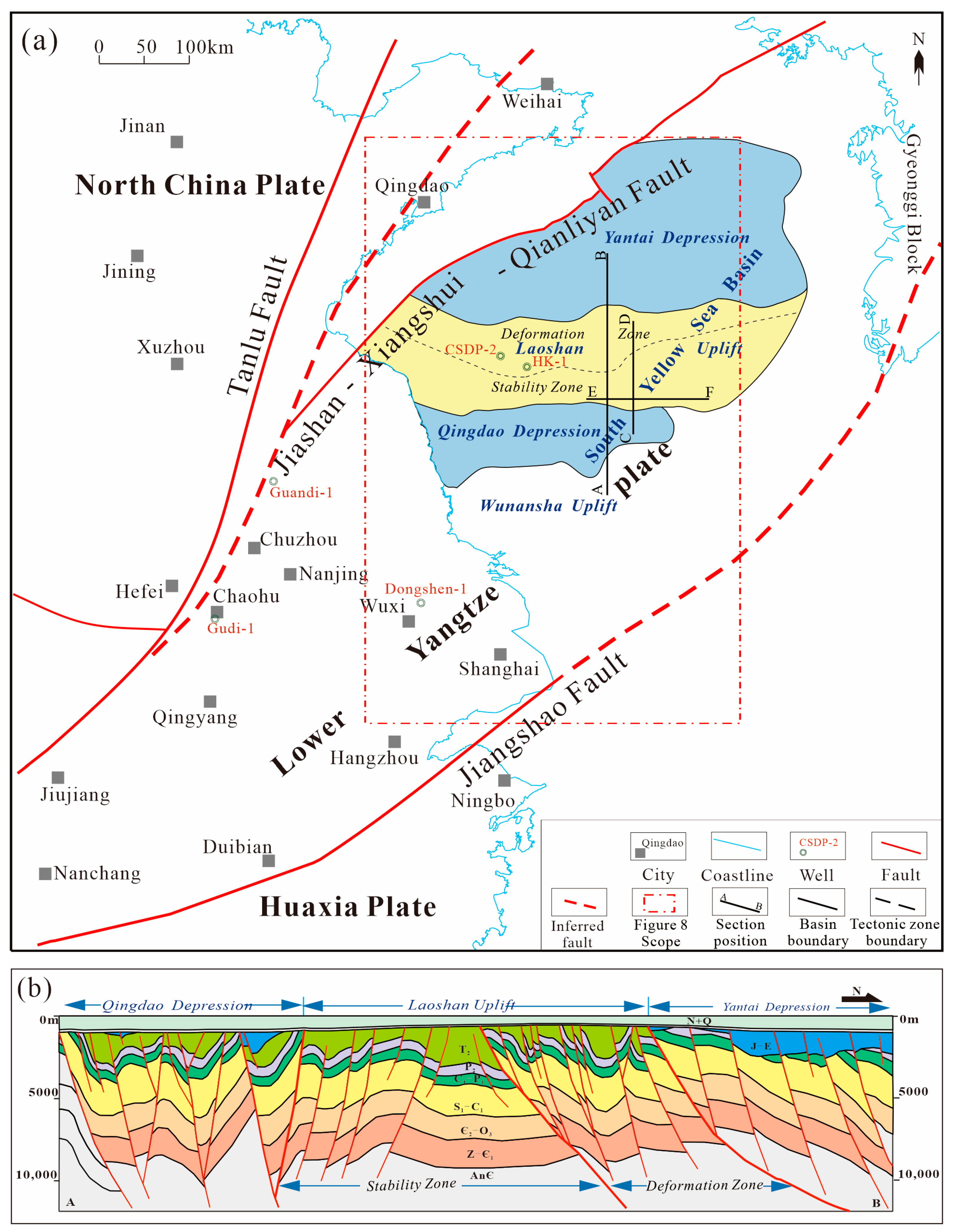
Hydrocarbon exploration in the South Yellow Sea Basin began in the early 1960s, initially targeting the Paleogene strata. After 1983, exploration efforts shifted to the marine Mesozoic–Paleozoic strata of the Laoshan Uplift [1,2]; subsequently, exploration and comprehensive geological research in the basin have been progressively intensified. During the Sinian–Early Triassic depositional period, the Upper, Middle, and Lower Yangtze plates occupied distinct tectonic domains of the Yangtze Plate [3,4,5,6]. Previous studies indicate that the South Yellow Sea Basin represents both the offshore extension and the main body of the Lower Yangtze Plate [7,8] (Figure 1). The basin preserves sedimentary sequences ranging from the Late Sinian to the Early Triassic, which correlate with those found in the onshore Lower Yangtze region [9,10], and share similar petroleum geological conditions [11]. To date, Well CSDP-2 on the Laoshan Uplift has penetrated strata from the Lower Silurian Gaojiabian Formation to the Lower Triassic, whereas Well HK-1 encountered Ordovician to Lower Triassic successions [12].
Numerous hydrocarbon shows—including crude oil, oil staining, oil traces, fluorescence, natural gas, and solid bitumen—have been documented from the Upper Sinian to Triassic strata in the onshore Lower Yangtze region [13]. Notably, the Taishan paleo-oil reservoir was discovered within the Upper Sinian Dengying Formation in the Yuhang area, Zhejiang Province [14,15]. In addition, abundant bitumen and hydrocarbon fluid inclusions have been identified by the authors in the Dengying Formation through the Ordovician strata of the Chaohu area, Anhui Province. Offshore, Well CSDP-2 encountered hydrocarbon shows of varying intensity from the Lower Silurian Gaojiabian Formation to the Lower Triassic interval, confirming the existence of paleo-hydrocarbon accumulations in the Laoshan Uplift [16]. These onshore and offshore paleo-reservoir discoveries indicate that large-scale hydrocarbon migration and accumulation once occurred throughout the Lower Yangtze Plate. However, multiple tectonic events—particularly the Indosinian and Yanshanian orogenies—have substantially modified or destroyed many early hydrocarbon accumulations.
Previous investigations of hydrocarbon accumulation in the marine Mesozoic–Paleozoic strata of the Yangtze Plate have mainly focused on basic petroleum system elements, including source rocks, reservoirs, and seals, with emphasis on post-Silurian strata [17,18]. In contrast, the controlling factors for deep hydrocarbon accumulation within pre-Silurian sequences remain poorly constrained.
Major discoveries in the Upper Sinian Dengying Formation and the Lower Cambrian Longwangmiao Formation in the Weiyuan and Anyue areas of the Upper Yangtze (Sichuan Basin) demonstrate that a detailed understanding of petroleum geological conditions and accumulation controls is critical for exploration success. These findings highlight the importance of high-quality Lower Cambrian source rocks and carbonate reservoirs in forming hydrocarbon accumulations within the Upper Sinian and Lower Paleozoic, with accumulation patterns strongly influenced by the distribution of rift troughs and paleo-uplifts [19,20,21,22]. The lack of significant hydrocarbon breakthroughs in the deep marine sequences of the South Yellow Sea Basin is therefore attributed not only to limited exploration activity but also to an incomplete understanding of the controlling factors governing deep hydrocarbon accumulation.
Therefore, clarifying the controls on hydrocarbon accumulation within the Upper Sinian–Lower Paleozoic sequences has become a critical geological issue. In this study, a land–sea comparative approach is employed, integrating seismic data analysis and interpretation with a range of analytical techniques. Geological data from the onshore Lower Yangtze Plate, Middle Yangtze Plate, and Sichuan Basin (Upper Yangtze Plate)—including stratigraphic and seismic correlation, outcrop and core observations, and geochemical and petrophysical analysis—are systematically compared to establish the seismic sequence framework of the Laoshan Uplift. Based on an analysis of petroleum geological conditions in the Upper Sinian–Lower Paleozoic sequences, the key controlling factors for hydrocarbon accumulation are identified, and evolutionary models for hydrocarbon accumulation in the Laoshan Uplift are proposed. These findings hold significant scientific importance for guiding future hydrocarbon exploration. The novelty of this study lies in proposing the controlling factors for deep hydrocarbon accumulation in the Laoshan Uplift and in establishing corresponding accumulation evolution models, thereby providing a scientific basis for future exploration in the South Yellow Sea Basin.
Figure 1. Structural setting and geological framework of the study area (basin tectonic zonation modified after Xu Ming et al. [23]. Geological section modified after Zhang et al. [24]): (a) structural setting; (b) geological framework.
Jmse 14 00240 g001

2. Geological Background

The South Yellow Sea is bounded to the north by Chengshan Cape of the Shandong Peninsula (China) and Baengnyeong Island of the Korean Peninsula, and to the south by the East China Sea, along a line connecting the Yangtze River estuary, Jeju Island, and the southwestern tip of Korea Peninsula. Tectonically, the South Yellow Sea forms part of the Yangtze Plate and represents both the offshore extension and the main body of the Lower Yangtze Plate (Figure 1).
The Lower Yangtze Plate is bounded by the North China Plate to the north and the Cathaysia Block to the south, with its western, northern, and southern margins defined by the TanLu Fault, the Jiashan–Xiangshui–Qianliyan Fault, and the Jiangshao Fault, respectively. Eastward, it extends to the central-southern Korean Peninsula, with the South Yellow Sea Basin occupying its offshore portion (Figure 1). The basin is a multi-cycle superimposed basin composed of three main depositional systems: platform, rift, and depression basins [25,26]. Platform basins contain thick Neoproterozoic–Mesozoic marine sequences; rift basins are characterized by Mesozoic–Cenozoic continental deposits; and depression basins are dominated by Neogene and Quaternary strata.
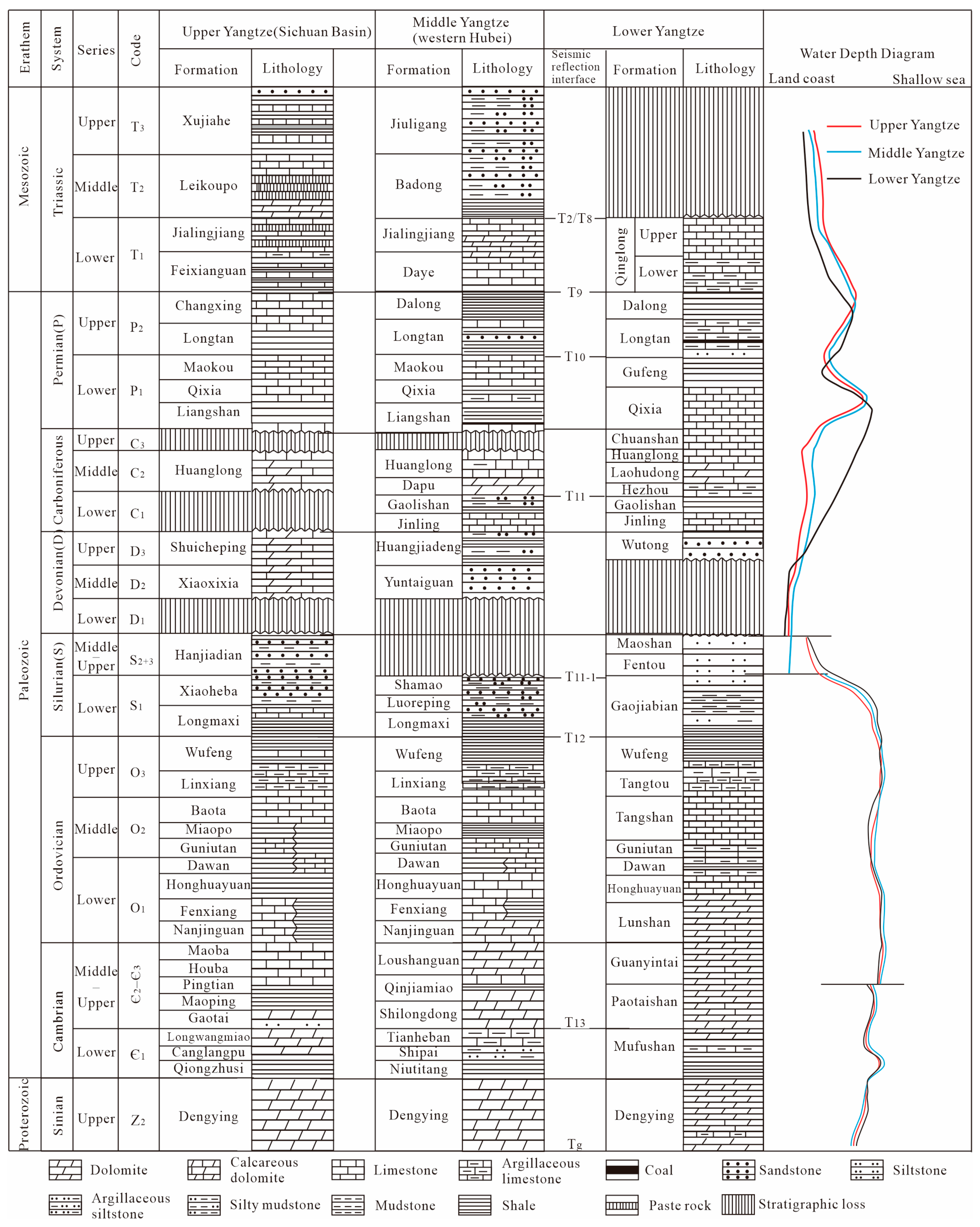
Platform–basin strata include the Upper Sinian, Cambrian, Ordovician, Silurian, Devonian, Carboniferous, Permian, and Lower Triassic (Figure 2). The Upper Sinian, Middle Cambrian–Ordovician, Carboniferous, Lower Permian, and Lower Triassic are dominated by carbonate rocks, whereas the Lower Cambrian, Silurian, and Upper Permian comprises clastic lithologies. Structurally, the South Yellow Sea Basin comprises three secondary tectonic units, from north to south: the Yantai Depression, the Laoshan Uplift, and the Qingdao Depression. Among these, the Laoshan Uplift represents the most structurally stable zone for Upper Sinian–Mesozoic marine strata, with pre-Silurian strata displaying simpler structures and weaker deformation than the Silurian–Lower Triassic sequences [27].
Since the Sinian, the Laoshan Uplift has undergone multiple tectonic events, including the Jinning, Jixian, Guangxi (Caledonian), Dongwu, Indosinian, Yanshanian, and Himalayan orogenies. Among these, the Indosinian and early Yanshanian movements exerted the strongest influence, producing intense deformation in the Silurian–Lower Triassic strata, whereas older strata remained comparatively stable [26]. Tectonic evolution since the Early Cambrian includes the following: (1) Caledonian Laoshan Uplift formation (Early Cambrian–Silurian); (2) Hercynian to early Indosinian stable platform deposition (Late Devonian–Early Triassic); (3) late Indosinian to early Yanshanian compressional thrusting (Middle Triassic–Jurassic); (4) late Yanshanian to early Himalayan planation (Cretaceous–Oligocene); and (5) late Himalayan to Quaternary regional subsidence (Miocene–Quaternary) [27].
Intense uplift during the Middle Triassic–Jurassic, followed by prolonged subaerial exposure during the Cretaceous–Oligocene, resulted in severe erosion of the Triassic strata. Consequently, only remnants of the Lower Triassic are preserved, and in parts of the eastern Laoshan Uplift, Neogene strata directly overlie the Lower Triassic or Permian units. From the Yanshanian to Himalayan periods, rift-depression sedimentation dominated the South Yellow Sea Basin, leading to the accumulation of Jurassic to Paleogene strata and contributing to the present rift–depression structural framework of the Laoshan Uplift (Figure 1b).

3. Materials and Methods

3.1. Land–Sea Comparative Analysis

The South Yellow Sea Basin shares marine sedimentary successions and comparable depositional and tectonic evolutionary histories with the onshore Yangtze Plate from the Upper Sinian to the Lower Triassic [25,26] (Figure 2). Existing drilling has penetrated Ordovician to Lower Triassic strata within the basin, confirming that their sedimentary characteristics and petroleum geological conditions closely resemble those of the onshore Yangtze Plate. Accordingly, hydrocarbon geological analysis of the Upper Sinian–Lower Silurian sequences in the South Yellow Sea Basin can be conducted through systematic comparison with the onshore Lower Yangtze Plate, Middle Yangtze Plate, and Sichuan Basin (Upper Yangtze Plate).

3.2. Seismic Analysis and Interpretation

Seismic data analysis and interpretation were conducted using the Landmark R5000 software. The workflow included seismic data loading, wavelet analysis, well-to-seismic calibration, lateral correlation of reflection packages, fault interpretation, horizon tracking, and analysis of stratigraphic attributes. The Lower Silurian–Lower Triassic interval of the Laoshan Uplift has been penetrated by drilling. Well-seismic ties were used to calibrate seismic horizons, after which laterally continuous reflection packages were traced and interpreted.
For deeper, undrilled strata, interpretation followed a two-steps approach: (1) identification and lateral tracking of seismic horizons based on reflection characteristics; and (2) correlation of these reflection packages with seismic profiles from the Lower and Middle Yangtze Plates to constrain stratigraphic position and lithology.
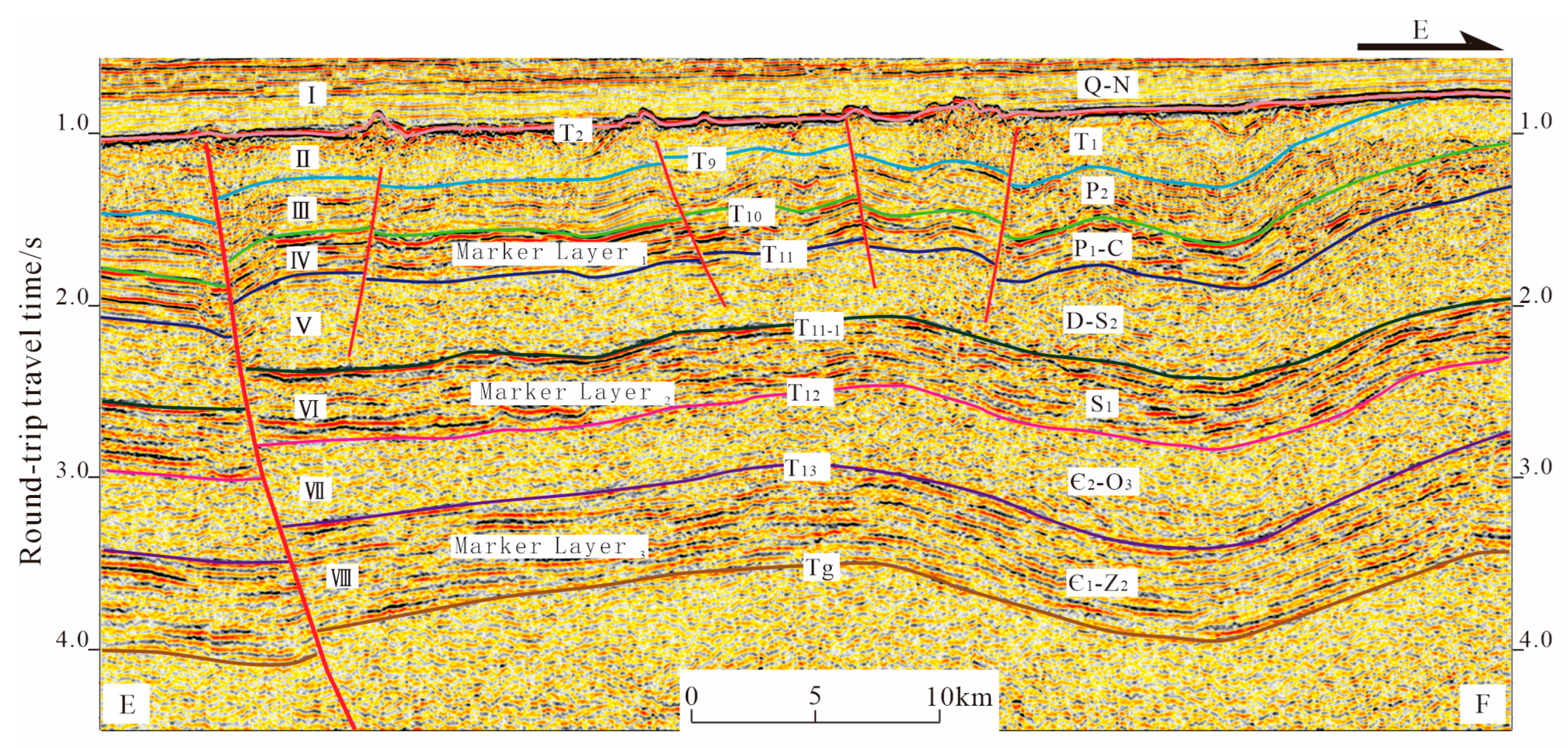
Three prominent seismic markers (Markers 1–3) are recognized in the deep marine strata of the Laoshan Uplift (Figure 3) [28]. These markers are characterized by parallel to sub-parallel, continuous, and laterally stable reflections separated by intervals of weaker reflectivity, and they serve as key reference horizons for deep seismic interpretation.
Marker 1, encountered by multiple wells, corresponds to the Lower Permian Qixia Formation to Middle–Upper Carboniferous limestone. Marker 2, penetrated by Well CSDP-2 and correlated with onshore wells (e.g., Dongshen-1 and Wuxi), represents the Lower Silurian Gaojiabian Formation, dominated by mudstones. Marker 3 has not been drilled within the basin but correlates with strong to moderately continuous reflections in the Yichang area of the Middle Yangtze Plate [29], where drilling indicates Upper Sinian to Lower Cambrian strata. Accordingly, Marker 3 in the South Yellow Sea Basin is interpreted to represent the Upper Sinian dolomite overlain by Lower Cambrian mudstone.

3.3. Rock Sample Analysis and Testing

Rock samples from the Lower Cambrian Mufushan Formation in Well Guandi-1 (GD1), Lower Yangtze region, were analyzed for total organic carbon (TOC), kerogen maceral composition, kerogen carbon isotopes, and vitrinite reflectance. The dataset includes 34 samples for TOC analysis, 17 for Ro analysis, 10 for kerogen maceral analysis, and 12 for kerogen isotope analysis. Additionally, eight carbonate samples from the Upper Sinian Dengying Formation in Well GD1 were selected for porosity and permeability analysis. Mudstone samples from the Mufushan Formation (GD1) and the Lower Silurian Gaojiabian Formation in Well CSDP-2 were tested for breakthrough pressure to evaluate sealing capacity.
TOC measurements were conducted using a Rock-Eval VI (Vinci Technologies, France) analyzer. Kerogen carbon isotope analyses were performed using an isotope ratio mass spectrometer (EURO EA3000 GV-Isoprime, GV, UK). Kerogen maceral composition and reflectance were analyzed using a Leitz MPV-III microphotometer (Leitz, Germany). Porosity and permeability were obtained using a DSK-II whole-core porosity–permeability analyzer (Hai’an Petroleum Research Instrument Co., Ltd., China), and breakthrough pressure tests were conducted using an MTS automatic rock-physics testing system (MTS, USA).
Because higher land plants were absent during the Early Cambrian, measured reflectance values from these source rocks correspond to bitumen reflectance (Rb) rather than vitrinite reflectance (Ro). To evaluate thermal maturity, Rb values were converted to equivalent Ro values using the empirical relationship established by Jacob [30]:
Ro = 0.618Rb + 0.4
Based on this relationship, hydrocarbon generation is inferred to begin when Ro reaches 0.5%. Source rocks are considered mature at Ro values of 0.6–1.3%, highly mature at 1.3–2.0%, and over-mature when Ro > 2.0% [31].

4. Results

4.1. Seismic Sequence Division and Geological Structural Characteristics

Based on seismic interpretation, the stratigraphy framework of the Laoshan Uplift was divided into eight seismic sequences (Figure 3), designated from top to bottom as Seismic Sequence 1 to 8. These sequences correspond, respectively, to the Quaternary–Neogene, Lower Triassic, Upper Permian, Lower Permian–Carboniferous, Upper Devonian–Middle Silurian, Lower Silurian, Upper Ordovician, Middle Cambrian, and Lower Cambrian–Upper Sinian stratigraphic intervals.
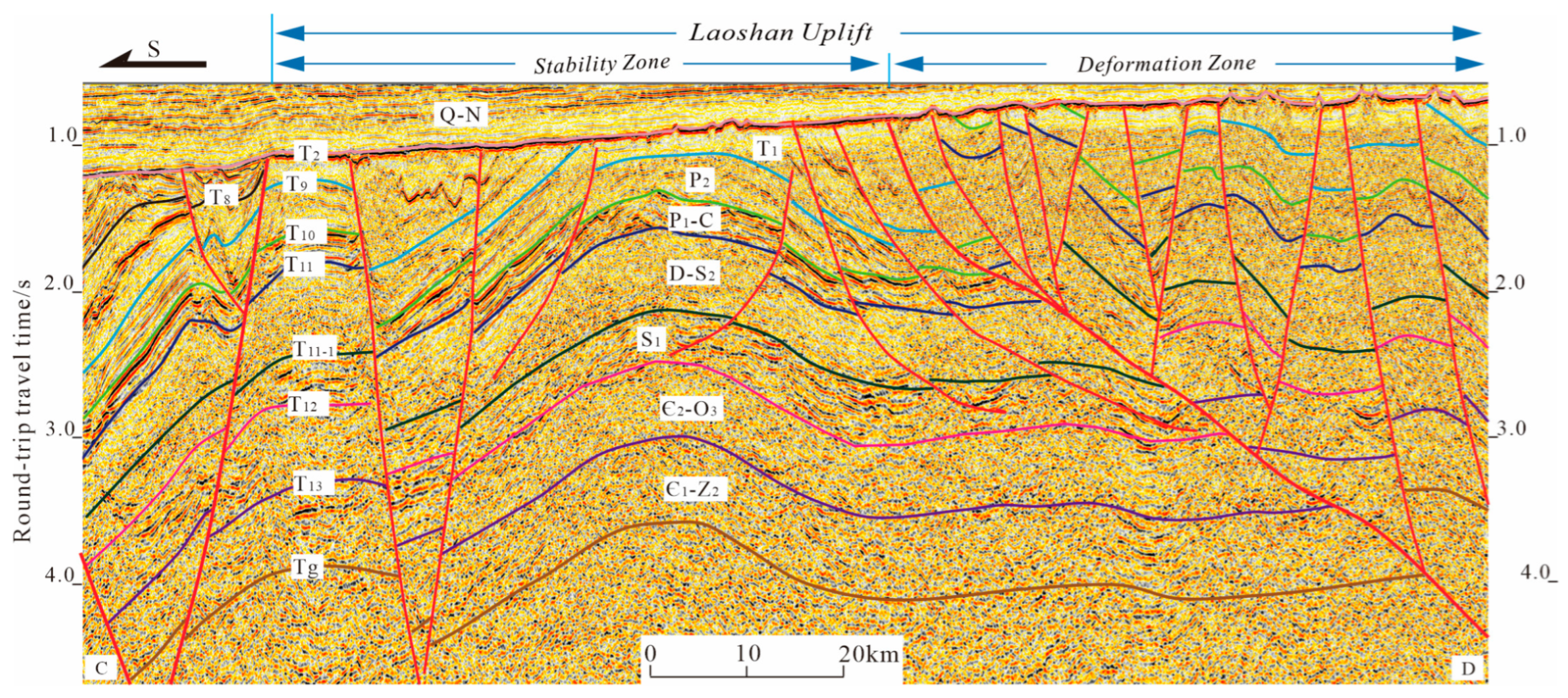
The structural style of the Laoshan Uplift differs markedly between its northern and southern parts. The northern sector is characterized by well-developed faults and intense deformation, manifested mainly as thrust–nappe structures. In contrast, the southern sector has been marked by fewer faults, with a gently northward-thrust strata, and overall weaker deformation (Figure 4). Based on fault density and stratigraphic deformation characteristics, the Laoshan Uplift can be subdivided into two secondary structural units: a northern structural deformation zone and a southern structural stability zone (Figure 1 and Figure 4).

4.2. Petroleum Geological Conditions

4.2.1. Source Rock Conditions

Source rocks represent the fundamental prerequisite for hydrocarbon accumulation in petroliferous basins [32,33]. Based on seismic interpretation and land–sea comparative analysis, two regionally developed source rock intervals are identified within the Upper Sinian–Lower Silurian of the Lower Yangtze Plate: the Lower Cambrian Mufushan Formation and the Lower Silurian Gaojiabian Formation [34,35,36,37,38,39]. Among these, the Mufushan Formation is the primary source rock for the Upper Sinian–Ordovician petroleum system.
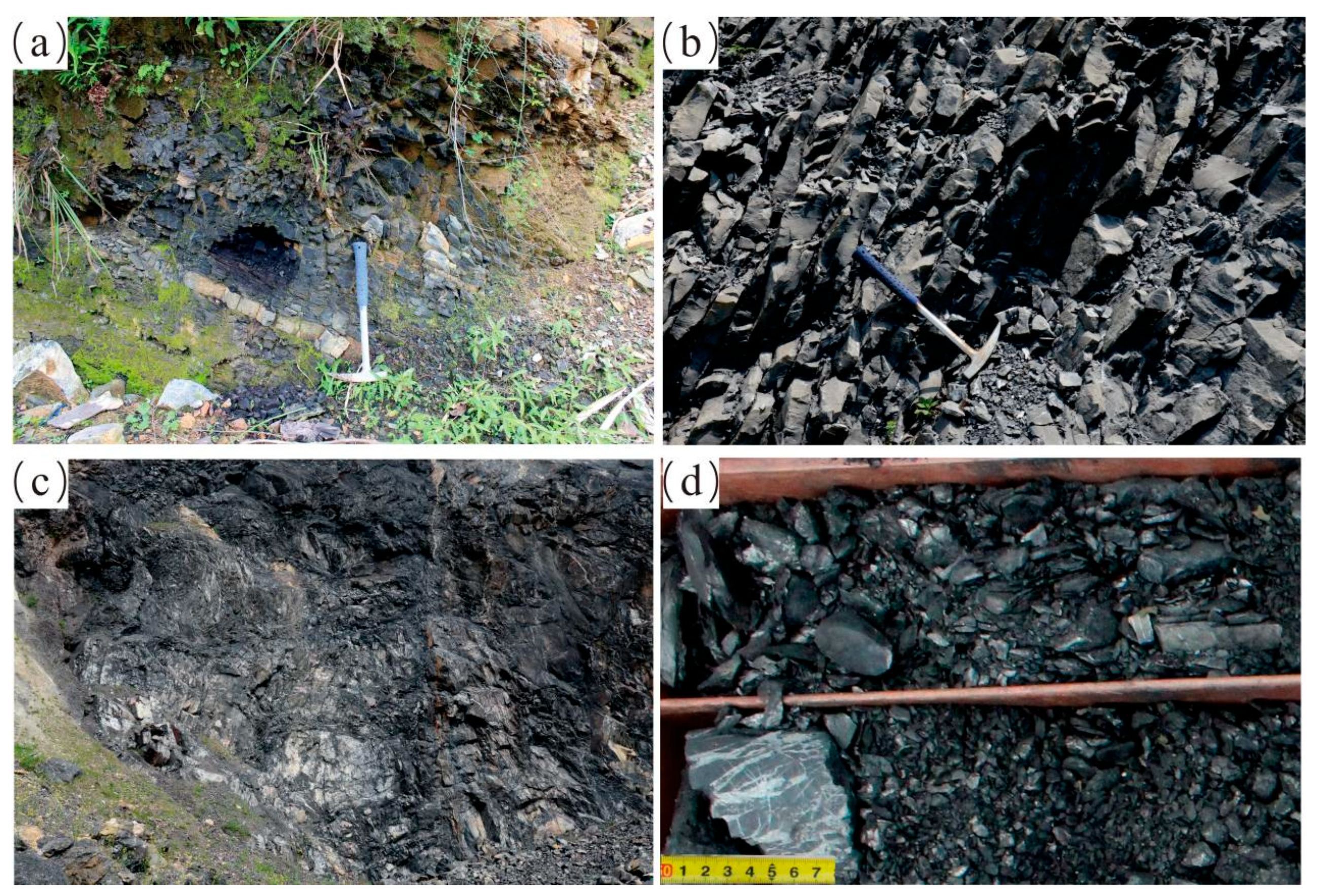
Outcrop observations from Jiangshan (Zhejiang), Quanjiao (Anhui), and Nanjing (Figure 5a–c), together with drilling data from Well Guandi-1 (GD1) in the Xuyi area (Figure 5d), indicate that the Mufushan Formation is mainly composed of dark gray to black shale and carbonaceous shale, exhibiting horizontal bedding and abundant framboidal pyrite, suggesting deposition under reducing conditions in a to-basin setting. In Well GD1, the cumulative thickness of the Mufushan Formation exceeds 192.55 m.
Geochemical analysis of 34 samples from Well GD1 shows TOC values ranging from 1.2% to 47.7% (Table 1). Kerogen maceral analysis of 10 samples indicates that sapropelinite accounts for 89.44–93.92%, vitrinite for 5.32–10.73%, inertinite for 0.64–1.30%, and for exinite 0.3–1.18%, with some samples below detection limits (Table 2). These results, together with kerogen maceral data from outcrops samples [40], indicate that the organic matter of the Mufushan Formation source rocks is predominantly Type I–II kerogen.
Kerogen carbon isotope (δ13C) values from the Mufushan Formation source rocks from Well GD1 range from –26.61‰ to –31.48‰ (Table 3). Liang Digang et al. [41] proposed that, for marine source rocks, δ13C values of –26‰ and –29‰ can be used as threshold boundaries to distinguish Type III, II, and I kerogen. Based on these criteria, the organic matter of the Mufushan Formation source rocks in Well GD1 can be classified as Type I-II kerogen. Consistent results were reported by Zhang Feiyan et al. [42], who analyzed 26 outcrop samples of the Mufushan Formation in the Lower Yangtze region and obtained δ13C values ranging from −29‰ to −28‰, indicating Type I kerogen.
Thermal maturity analysis indicates that Mufushan Formation source rocks are in a late over-mature stage. Rb values from Well GD1 range from 5.11 to 6.18%, corresponding to Ro values of 3.58–4.22% (Table 4). In the Jiangshan–Tonglu area, Cambrian source rocks display Ro values ranging from 2.25 to 3.67%, which are comparable to equivalent Lower Cambrian source rocks in the Upper Yangtze region (generally 2.0–5.8%) [43,44]. These results indicate that the Lower Cambrian Mufushan Formation in the Lower Yangtze region represents a high-quality source rock characterized by abundant organic matter and high thermal maturity, generating sufficient hydrocarbons to charge Upper Sinian–Ordovician reservoirs.

4.2.2. Reservoir Conditions

Land–sea comparative analysis indicates that the Laoshan Uplift in the South Yellow Sea Basin contains well-developed carbonate reservoirs within the Upper Sinian–Ordovician sequences, mainly hosted in Upper Sinian and Middle Cambrian–Ordovician dolomites and limestones. Carbonate rocks commonly form diverse reservoir types, including dissolution–porosity, fracture, and paleokarst weathering crust reservoirs. Major hydrocarbon discoveries in the Upper Sinian paleokarst reservoirs of the Sichuan Basin (Upper Yangtze Plate), such as Wubaidi, Anyue, and Weiyuan–Longnvsi gas fields, demonstrate the high exploration potential of this reservoir type [19,45].
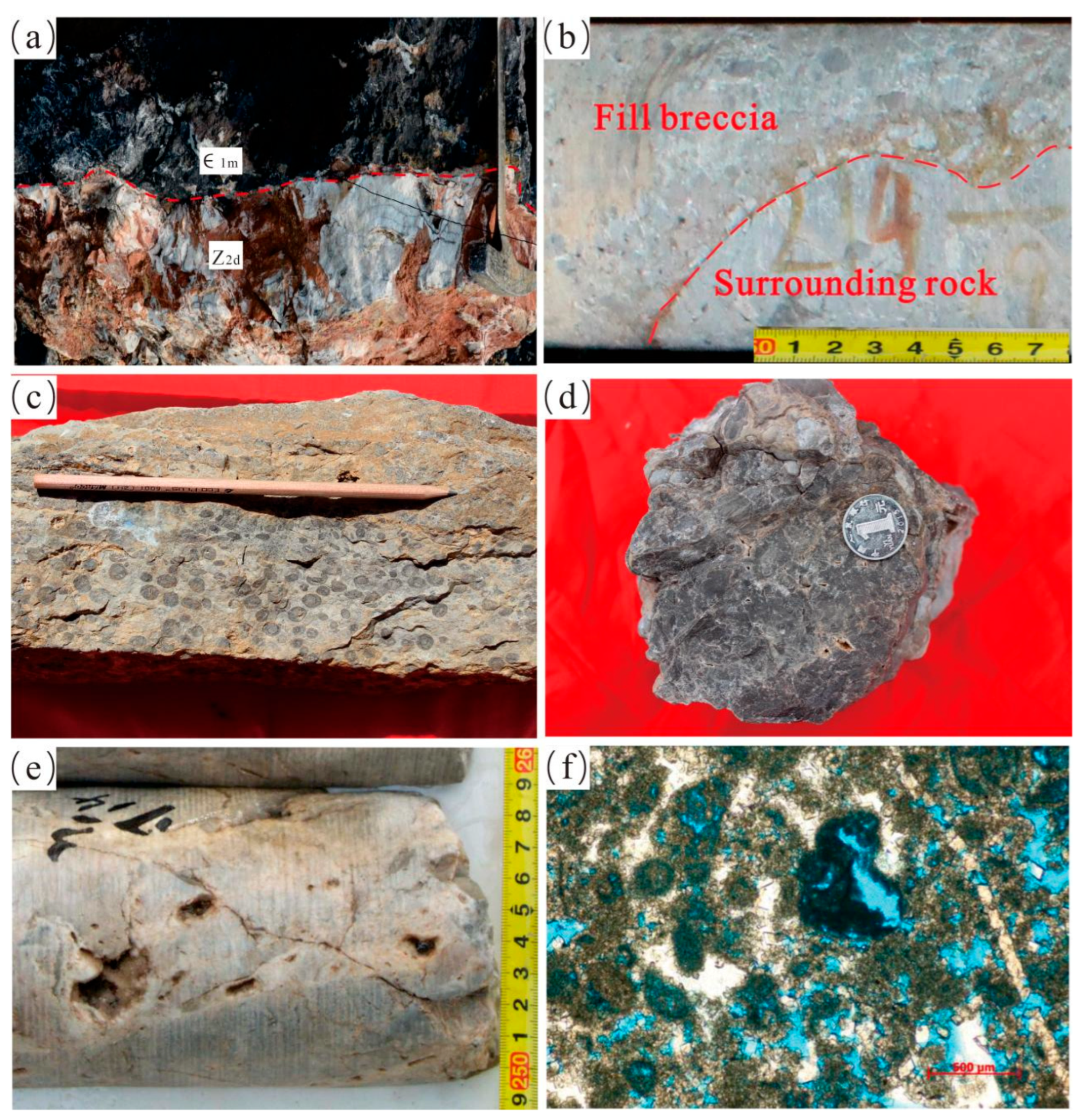
Typical paleokarst carbonate reservoirs occur at the top of the Upper Sinian Dengying Formation in the Lower Yangtze Plate, as observed in outcrops from the Liuhe area, Nanjing, and in cores from Well GD1 in Jurong (Figure 6a,b). These reservoirs display well-developed karst features that provide effective reservoir space. Carbonate shoal reservoirs are also widespread, including the bioclastic limestone of the Ordovician Baota Formation and oncolitic dolomite in the lower part of the Lower Cambrian (Figure 6c). Both outcrops and core observations show abundant dissolution pores and vugs in limestone and dolomite (Figure 6d–f), indicating favorable reservoir quality.
Petrophysical analysis was conducted on dolomite samples from the Upper Sinian Dengying Formation in onshore Well GD1 in the Lower Yangtze region. Results from eight samples show considerable variability in porosity and permeability. Porosity values range from 1.2 to 9.19%, with most values concentrated between 1.67 and 2.47%. Permeability values are generally lower than 1 mD, although one sample reaches 9.01 mD (Table 5). Previous studies of Middle and Upper Cambrian carbonate reservoirs in onshore wells of the Lower Yangtze region indicate that reservoir space is dominated by dissolution pores, vugs, and fractures, with highly variable petrophysical properties (Table 6). Reported porosity values range from 0.2 to 88.51%, and permeability in Well SC1 ranges from 29.7 mD to 1164.1 mD [46,47].
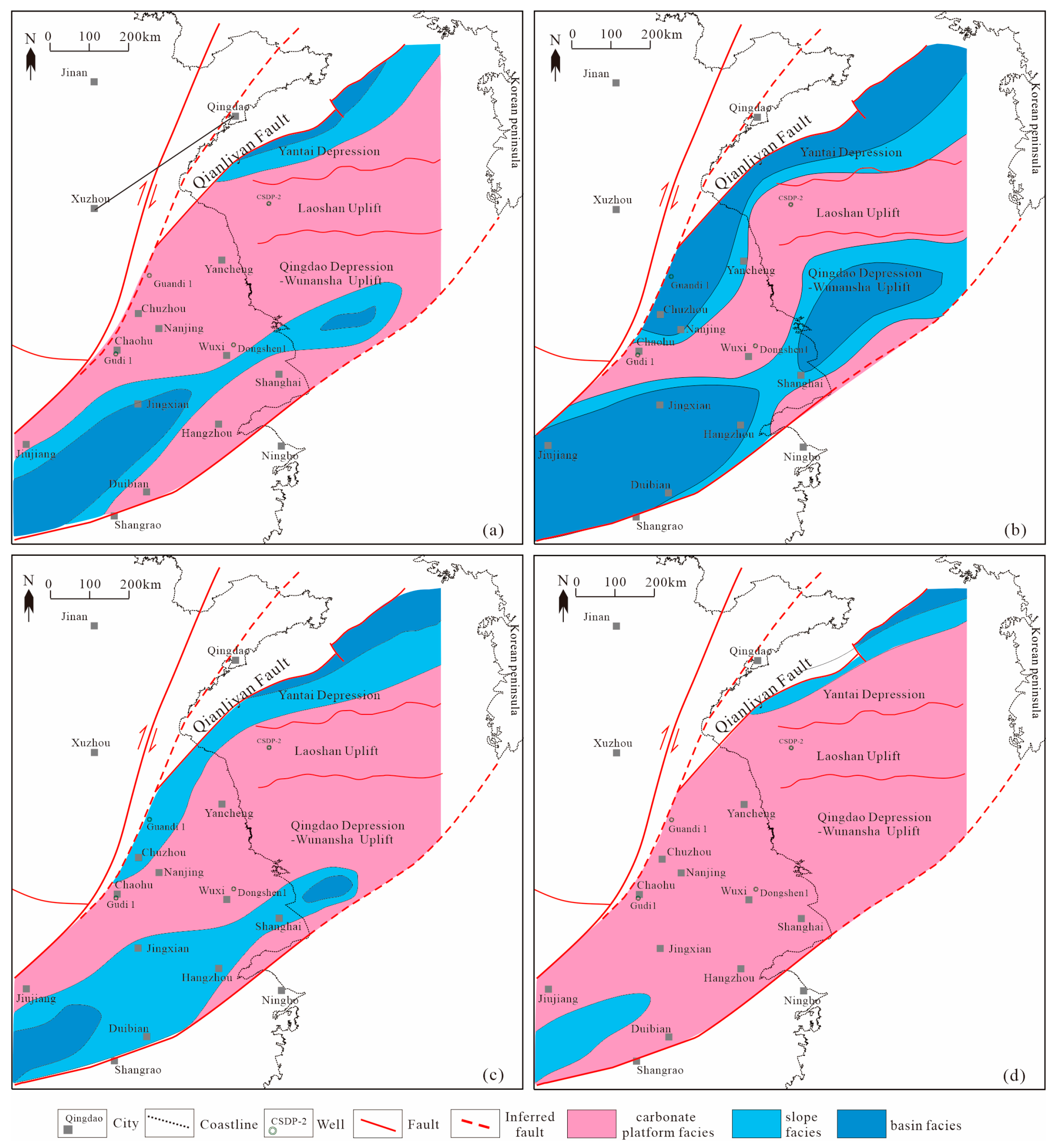
As the offshore extension of the Lower Yangtze Plate, the South Yellow Sea Basin shares similar sedimentary characteristics and lithologies with the onshore region from the Upper Sinian to Lower Triassic, as confirmed by existing drilling results. For example, Well CSDP-2 penetrated clastic and carbonate strata from the upper part of the Lower Silurian to the Lower Triassic, and Well HK-1 encountered Ordovician platform facies bioclastic limestone [12,48]. Based on outcrop observations and well data from the onshore Lower Yangtze Plate, and by reference to previous studies on the sedimentary facies of the Upper Sinian to Ordovician in this region [40,42,49,50], the offshore distribution of sedimentary facies was predicted. The prediction integrates trends from onshore sedimentary facies from the Upper Sinian to Ordovician with offshore seismic facies and the lithofacies of the Ordovician encountered in Well HK-1, extending from the onshore Lower Yangtze region into the South Yellow Sea area. On this basis, the distribution of sedimentary facies of the Upper Sinian, Cambrian, and Ordovician was reconstructed. On this basis, the distribution of sedimentary facies of the Upper Sinian, Cambrian, and Ordovician was reconstructed (Figure 7). The Upper Sinian, Lower Cambrian, Middle–Upper Cambrian, and Ordovician successions are predominantly composed of carbonate platform, slope, and basin facies (Figure 7). The distribution of these facies belts exhibits distinct zonation: slope and basin facies dominate the northern and southern parts, while carbonate platform facies occupy the central region. Furthermore, the overall trend of sedimentary facies from the onshore Lower Yangtze region into the South Yellow Sea Basin is oriented northeast. Within the carbonate platform facies, the lithology of the Upper Sinian, Lower Cambrian, and Middle–Upper Cambrian is primarily dolomite. Algal dolomite is particularly well-developed in the Upper Sinian. This platform facies dolomite has been confirmed by wells such as Gudi-1, GD1, and Dongsheng-1, as well as outcrops in surrounding areas. For the Ordovician, the platform facies lithology is mainly limestone, with subordinate dolomite, as evidenced by numerous outcrops and wells, including Well Dongshen-1, outcrops in Chaohu and Nanjing, and Well HK-1. The slope facies in the Upper Sinian, Lower Cambrian, and Middle–Upper Cambrian primarily consist of interbedded thin shale, argillaceous dolomite, and dolomite [40,49], while in the Ordovician, they are characterized by interbedded thin argillaceous limestone and limestone [40]. Sedimentary structures indicative of slope environments include cross-bedding, convolute bedding, small-scale wavy bedding, as well as nodular and lenticular structures (especially in the Lower Cambrian) [40]. Outcrops in the onshore Lower Yangtze reveal the Middle–Upper Cambrian slope facies composed of thin shale, argillaceous dolomite, and dolomite interbeds. The basin facies are characterized by shale, siliceous shale, and siliceous rocks, displaying horizontal bedding. This facies is well-documented by multiple outcrops and wells, such as outcrops in Nanjing and Huanglishu (Figure 5a–c), and Well GD1 (Figure 5d). The extensively developed carbonate platform facies provides the essential material foundation for reservoirs in the Lower Yangtze region. Based on the integrated land–sea sedimentary facies analysis and prediction, it is inferred that the Upper Sinian, Lower Cambrian, Middle–Upper Cambrian, and Ordovician sequences on the Laoshan Uplift in the South Yellow Sea Basin are dominated by carbonate platform facies. Within these intervals, the development of favorable reef–shoal complexes and dolomites within the carbonate platforms constitutes promising reservoirs, alongside extensive paleokarst development at the top of the Upper Sinian.

4.2.3. Seal Conditions

The Lower Cambrian Mufushan Formation mudstones and shales act both as high-quality source rocks and regional seals. Drilling and outcrop data indicate that their thickness increases northward and southward across the Lower Yangtze Plate and decreases toward the central region. In the southern Yi’an area, Well Dinye-2 penetrated approximately 460 m of mudstone and siliceous mudstone, whereas Well GD1 in the northern Jurong area encountered over 192 m of mudstone and shale. In contrast, Well Sudong-121 in the central Shita area recorded only 146 m. Based on drilling, outcrop, and sedimentary facies data (Figure 6b), the thickness of the Mufushan Formation seal within the Laoshan Uplift is inferred to be thinner, with an estimated thickness of 30–100 m. Breakthrough pressure measurements from three Well GD1 samples range from 26 to 28 MPa (Table 7), indicating strong sealing capacity.
The Lower Silurian Gaojiabian Formation is regionally extensive, laterally stable, and well-preserved. It is composed mainly of thick mudstone and shale and constitutes an effective regional seal. In most areas of Jiangsu Province, its thickness exceeds 600 m and reaches up to 1400 m in the Shita and Huangqiao areas. In the Chaohu area, Well Padi-1 penetrated approximately 1220 m, while within the Laoshan Uplift, Well CSDP-2 encountered 237 m of Gaojiabian mudstone; Well HK-1 recorded a total thickness of 1534 m [12]. Breakthrough pressure tests conducted on three CSDP-2 samples yield values ranging from 16.5 to 18.5 MPa (Table 7), confirming strong sealing performance.

5. Discussion

5.1. Source–Reservoir–Seal Assemblages

The Laoshan Uplift contains two complete source–reservoir–seal assemblages within the Upper Sinian to Lower Silurian sequences (Figure 2). Assemblage I extends from the Upper Sinian Dengying Formation to the Lower Cambrian Mufushan Formation. In this assemblage, the source rock consists of argillaceous units of the Lower Cambrian Mufushan Formation; the reservoir is represented by carbonate rocks of the Upper Sinian Dengying Formation, and the seal is provided by the thick argillaceous units of the Mufushan Formation. This assemblage is widely distributed across the Laoshan Uplift and constitutes a major exploration target in the South Yellow Sea Basin.
Assemblage II spans from the Lower Cambrian Mufushan Formation to the Lower Silurian Gaojiabian Formation. In this case, the source rock is the Mufushan Formation; the reservoir is mainly composed of Middle Cambrian–Ordovician carbonates, and the seal is formed by thick mudstone of the Lower Silurian Gaojiabian Formation. Among these two assemblages, Assemblage I exhibits hydrocarbon accumulation conditions comparable to those of the Weiyuan Gas Field in the Sichuan Basin and therefore shows favorable exploration potential, whereas Assemblage II represents a secondary but still promising exploration target.

5.2. Controlling Factors for Hydrocarbon Accumulation

5.2.1. High-Quality Source Rock Governs Hydrocarbon Supply

During the Early Cambrian, the Yangtze Plate experienced regional extension and transgression [51]. North–south extensional tectonics established a distinctive depositional framework characterized by “one platform and two troughs” in the Lower Yangtze Plate [52,53], comprising northern and southern troughs flanking a central platform. Slope and basin facies were predominantly developed within the troughs, while carbonate platform facies dominated the central platform area. This framework is reflected in the lateral lithofacies variation in the Lower Cambrian Mufushan Formation observed in outcrops and drilling data. Dark mudstone, siliceous mudstone, and shale dominate the northern trough (Chuzhou–Xuyi, Jiangsu) and southern trough (Qingyang–Jiangshan, Anhui–Zhejiang), whereas dolomite is prevalent on the central platform (Chaohu–Wuxi). These lithofacies associations indicate slope-to-basin deposition within the troughs and carbonate platform deposition in the central area (Figure 7b). The organic-rich mudstones and shales developed within the troughs constitute high-quality source rocks.
As the offshore extension of the Lower Yangtze Plate, the South Yellow Sea Basin inherited this Early Paleozoic depositional framework. Consequently, the Yantai Depression to the north of the Laoshan Uplift and the Qingdao Depression–Wunansha Uplift to the south served as major depocenters for the development of Mufushan Formation source rocks, providing abundant hydrocarbons for accumulation within the Laoshan Uplift.

5.2.2. Paleo-Uplift Control on Reservoir Development and Hydrocarbon Accumulation

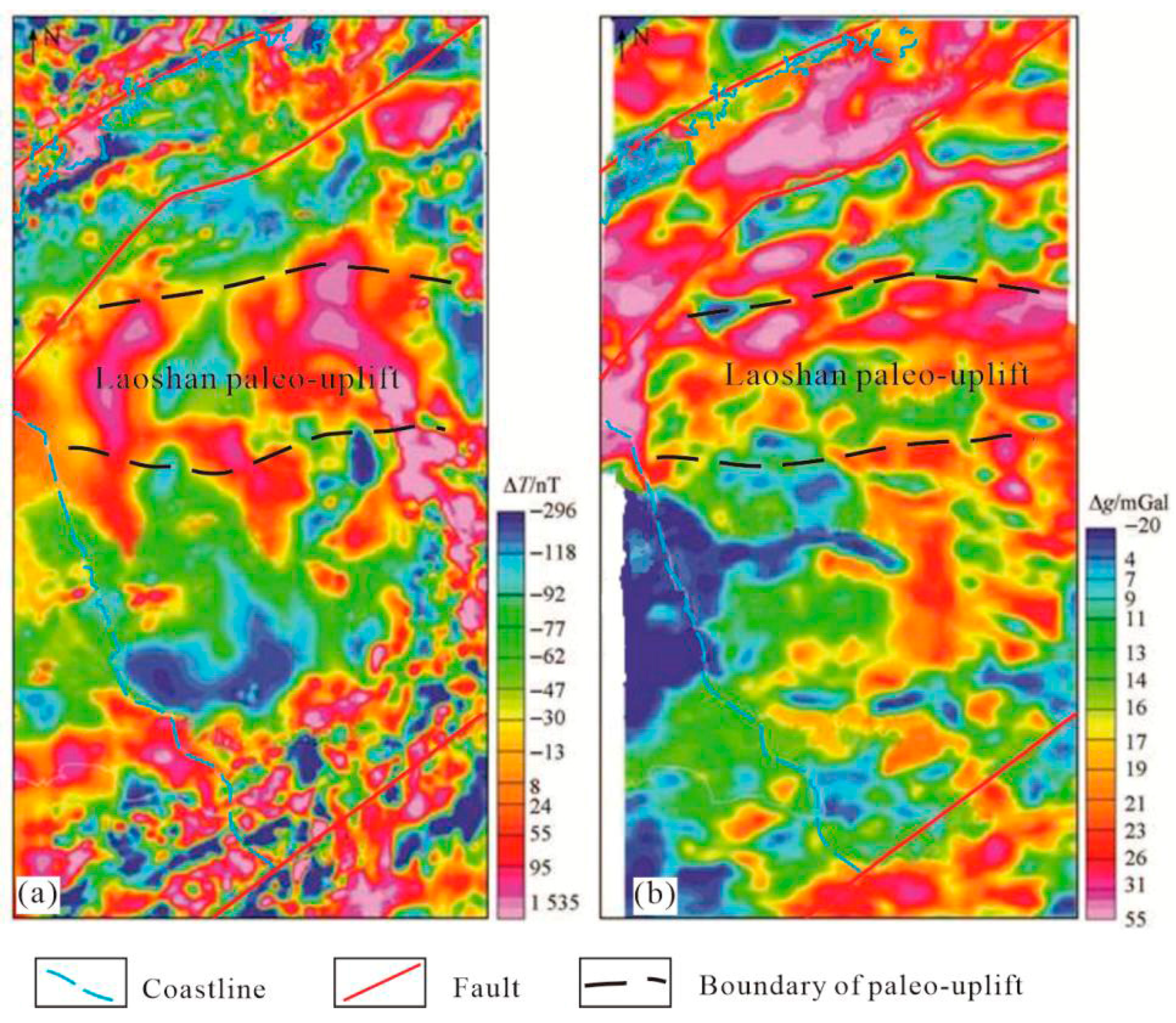
The South Yellow Sea Basin developed upon an ancient and rigid metamorphic crystalline basement [54]. Aeromagnetic reduced-to-pole (RTP) anomalies and Bouguer gravity data reveal alternating patterns of uplifts and depressions across the basin (Figure 8). The Laoshan Uplift is characterized by strong positive RTP magnetic and Bouguer gravity anomalies, indicating a stable magnetic basement and defining it as a positive structural element. These geophysical features support the presence of an underlying Laoshan paleo-uplift, whose spatial extent slightly exceeds that of the present uplift. Direct evidence for this paleo-uplift is provided by Well HK-1, which encountered Upper Ordovician strata directly overlying Neoproterozoic granite [12].
Depositional highs associated with paleo-uplifts are favorable locations for the development of carbonate reef–shoal reservoirs [55]. For example, the Dazhou–Kaijiang paleo-uplift in the Sichuan Basin hosts extensive mound–shoal facies within the Dengying Formation and grain–shoal facies within the Longwangmiao Formation [56]. Similarly, within the Lower Yangtze platform corresponding to the Laoshan paleo-uplift, mound–shoal dolomites occur in the Dengying Formation, grain–shoal oncolitic and oolitic dolomites develop during the Lower Cambrian, and shoal–facies bioclastic limestones form in the Ordovician Baota Formation. These analogs suggest that carbonate shoal facies are well-developed in the Upper Sinian–Ordovician sequences overlying the Laoshan paleo-uplift, providing favorable reservoir conditions for hydrocarbon accumulation.
Global exploration demonstrates that large paleo-uplifts commonly function as major hydrocarbon migration pathways and accumulation centers, as exemplified by the Tazhong and Bachu paleo-uplifts in the Tarim Basin [57,58] and the Gaoshiti–Moxi paleo-uplift in the Sichuan Basin [59,60]. The Laoshan paleo-uplift originated during the Neoproterozoic [12], with its main formation during the Caledonian, followed by modification during subsequent tectonic events [27]. Basin modeling indicates that the Lower Cambrian Mufushan Formation source rocks reached peak oil generation during the Early Silurian and peak gas generation during the Late Silurian [16]. Therefore, the formation and activity of the Laoshan paleo-uplift predated and overlapped with the main hydrocarbon generation stages. This favorable spatial relationship, together with the spatial proximity of high-quality Mufushan source rocks, developed in adjacent northern and southern troughs, indicates that the Laoshan paleo-uplift acted as an optimal migration pathway and a key zone for hydrocarbon migration.
Figure 8. Aeromagnetic and gravity anomaly maps of the South Yellow Sea Basin and adjacent areas (modified after Tong et al. [61]): (a) aeromagneticanomaly map; (b) gravity anomaly map.
Jmse 14 00240 g008

5.2.3. Structural Stability Zone Controls Hydrocarbon Preservation

Previous studies indicate that the marine Mesozoic–Paleozoic sequences of the South Yellow Sea Basin are structurally more stable than their onshore counterparts in the Lower Yangtze region [11]. Within this framework, the Laoshan Uplift represents one of the most stable areas of the basin. However, bidirectional north–south compressional thrusting during the Indosinian to early Yanshanian resulted in pronounced structural differentiation within the Upper Sinian–Lower Triassic sequences, forming a northern deformation zone and a southern structural stability zone.
The northern deformation zone is characterized by a large-scale thrust–nappe system, fragmented strata, variable bedding dips, intense deformation, and a complex fault network (Figure 4). In contrast, the southern structural stability zone is located mainly within the foreland depression of the compressional system and preserves relatively intact strata with fewer faults and weaker deformation. These structural characteristics provide more favorable conditions for hydrocarbon preservation.

5.2.4. Structural Detachment Layers Effectively Protect Primary Hydrocarbon Accumulations

Structural detachment layers are commonly associated with stratigraphic discontinuities and low-strength, high-ductility rocks [62]. Such layers typically consist of mudstone, marl, evaporite (salt), and coal measures, which act as mechanical lubricants that facilitate relative sliding between overlying and underlying strata [56]. In the Laoshan Uplift, detachment layers are dominated by low-strength, high-ductility mudstones. Three major Paleozoic detachment horizons are recognized: the Lower Cambrian Mufushan Formation, the Lower Silurian Gaojiabian Formation, and the Upper Permian. The Mufushan and Gaojiabian formations comprise thick mudstone and shale, while the Upper Permian includes mudstone, shale, and coal seams.
The Upper Permian and, in particular, the Lower Silurian Gaojiabian detachment layers play a critical role in protecting the Upper Sinian–Ordovician sequences. During intense thrusting and nappe deformation associated with the Indosinian to early Yanshanian tectonic events, compressional deformation was strongest above the Carboniferous strata and progressively weakened downward, becoming significantly reduced below the Gaojiabian detachment layer (Figure 3). As a result, the Upper Sinian–Ordovician interval remained structurally simpler and more stable, thereby minimizing disruption to deep hydrocarbon accumulations and effectively preserving primary reservoirs.

5.3. Discussion on Hydrocarbon Accumulation Evolution Models

A hydrocarbon accumulation model is a conceptual framework describing the key conditions, driving mechanisms, formation processes, and evolutionary history of similar hydrocarbon systems. Such models may involve single elements or integrate multiple factors [63]. Their construction requires comprehensive analysis of all relevant geological elements and should be adapted to the level of exploration maturity and research objectives [64]. Given the limited exploration of deep marine sequences in the Laoshan Uplift, three hydrocarbon accumulation evolution models are proposed for the Upper Sinian–Ordovician. These models are defined by the spatial relationships between source rocks and reservoirs, the structural characteristics and tectonic evolution of the Laoshan Uplift, and fault development patterns.

5.3.1. Early Stage Lateral Hydrocarbon Supply Model

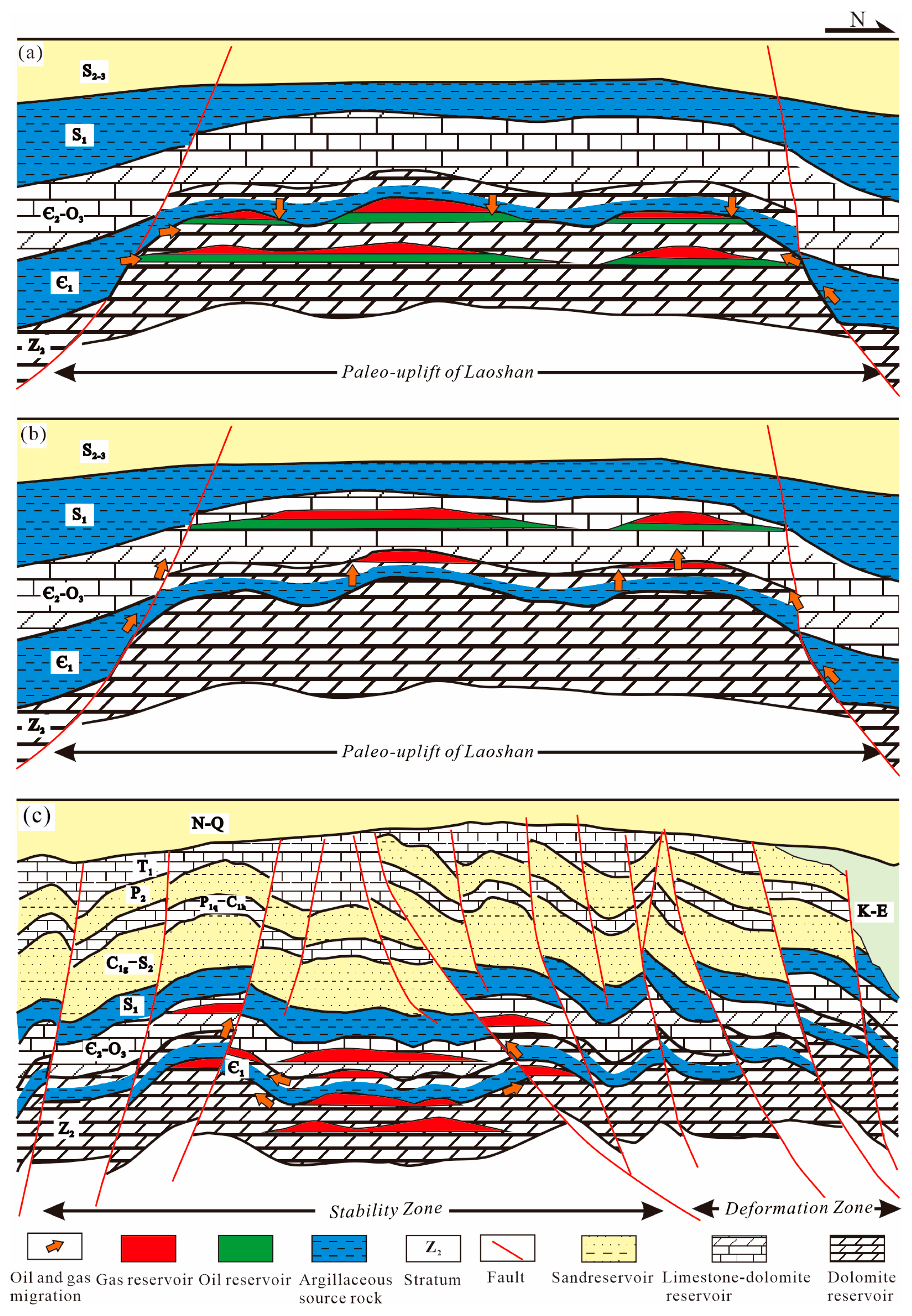
Thermal modeling indicates that the Lower Cambrian Mufushan Formation source rocks in the Laoshan Uplift reached peak oil generation in the Early Silurian and peak gas generation in the Late Silurian [16]. During the Caledonian orogeny, the South Yellow Sea Basin was dominated by uplift, resulting in limited fault development within the Laoshan Uplift, with faults mainly developed along its northern and southern margins. Hydrocarbons generated from the Mufushan Formation source rocks in the adjacent Yantai Depression to the north and the Qingdao Depression–Wunansha Uplift to the south migrated along these marginal faults into the central Dengying Formation reservoirs of the Laoshan Uplift, forming early hydrocarbon accumulations.
These accumulations were established mainly in the late Caledonian stage and comprise coexisting oil and gas (Figure 9a). This model closely resembles early Caledonian hydrocarbon accumulation in the Weiyuan and Anyue gas fields of the Sichuan Basin [65,66].

5.3.2. Early Stage Lower-Source–Upper-Reservoir Charging Model

In this model, the Lower Cambrian Mufushan Formation source rocks supply hydrocarbons to overlying Middle Cambrian–Ordovician carbonate reservoirs. The Mufushan Formation provided abundant hydrocarbons to these reservoirs. The thermal evolution history of the source rock is identical to that described for the early stage lateral hydrocarbon supply model, ultimately forming coexisting oil and gas accumulations within the Middle Cambrian–Ordovician sequences (Figure 9b).

5.3.3. Late-Stage Deep-Burial Cracking and Structural Adjustment Model

Following Caledonian uplift, the Laoshan Uplift underwent substantial burial during the Hercynian to Indosinian stages, accumulating thick Upper Devonian to Triassic successions. Strong compressional uplift and faulting occurred during the Late Indosinian. This late-stage tectonic evolution led to (1) thermal cracking of crude oil in the Upper Sinian Dengying and Middle Cambrian–Ordovician reservoirs during deep burial, generating secondary gas; (2) late Triassic fault activity providing migration pathways while locally disrupting earlier accumulations; and (3) intense thrusting during the late Indosinian to early Yanshanian, resulting in major adjustment and redistribution of hydrocarbons.
Consequently, hydrocarbons in the structurally complex northern deformation zone were severely disrupted and largely dissipated, whereas the southern structural stability zone preserved part of the primary accumulations (Figure 9c).

6. Conclusions

This study demonstrates that the Upper Sinian–Ordovician sequences of the Laoshan Uplift, South Yellow Sea Basin, possess favorable petroleum geological conditions, defined by two effective source–reservoir–seal assemblages: (1) the Upper Sinian Dengying Formation–Lower Cambrian Mufushan Formation assemblage, and (2) the Lower Cambrian Mufushan Formation–Lower Silurian Gaojiabian Formation assemblage.
Hydrocarbon accumulation in the Laoshan Uplift is primary controlled by four factors: (1) the development of high-quality source rocks in adjacent troughs, which govern hydrocarbon supply; (2) the controlling role of the Laoshan paleo-uplift in reservoir development and hydrocarbon accumulation; (3) the influence of structural stability in determining favorable preservation zones; and (4) the effective protection of primary hydrocarbon accumulations by Upper Permian and Lower Silurian detachment layers.
Three principal hydrocarbon accumulation evolution models are recognized: (1) an early stage lateral hydrocarbon supply; (2) an early stage lower-source–upper-reservoir charging; and (3) a late-stage deep-burial thermal cracking and structural adjustment. Among these, the late-stage model provides key guidance for deep hydrocarbon exploration. Based on the combined effects of structural preservation and accumulation evolution, the southern structural stability zone of the Laoshan Uplift is identified as the most favorable target for future exploration.

Author Contributions

Conceptualization, Y.Z., Y.Y. (Yanqiu Yang), J.C. and J.L.; methodology, Y.Z., Y.Y. (Yanqiu Yang) and Y.Y. (Yong Yuan); software, Y.Z. and Y.Y. (Yanqiu Yang); validation, Y.Y. (Yong Yuan) and D.Q.; investigation, Y.Z.; data curation, J.W. and J.C.; writing—original draft preparation, Y.Z.; writing—review and editing, D.Q.; supervision, J.C. and J.L.; project administration, Y.Z., J.C., J.L. and Y.Y. (Yong Yuan). All authors have read and agreed to the published version of the manuscript.

Funding

This research was supported by the National Natural Science Foundation of China (Nos. 42206234, 42476228), the key R&D project of Shandong Province (No. 2024SFGC0302), the project of Laoshan Laboratory (LSKJ202203404), and the project of China Geology Survey (Nos. DD20211353, DD20221723, DD202503023).

Data Availability Statement

All the data and materials used in this paper are available from the corresponding authors upon request.

Acknowledgments

We would like to express our gratitude for the support from the Ocean Negative Carbon Emissions (ONCE) Program.

Conflicts of Interest

The authors declare no conflicts of interest.

Abbreviations

The following abbreviations are used in this manuscript:
SYSBSouth Yellow Sea Basin
TOCTotal organic carbon
RoVitrinite reflectance
Rbbitumen reflectance
GD1Well Guandi-1
RTPReduced-to-pole

References

  1. Zhang, J.Q. Exploration prospects for oil and gas in the Mesozoic-Palaeozoic in the South Yellow Sea. Mar. Geol. Lett. 2002, 18, 25. [Google Scholar]
  2. Chen, J.W. Discovery of multiple large-scale trap structures in the Marine Mesozoic-Palaeozoic in the Laoshan Uplift of the South Yellow Sea. Mar. Geol. Front. 2016, 32, 69–70. [Google Scholar]
  3. Liu, H.F.; Lian, H.S.; Cai, L.G.; Shen, F. Structural styles of the Longmenshan thrust belt and evolution in western Sichuan Province, China. Acta Geol. Sin. 1994, 68, 101–117. [Google Scholar] [CrossRef]
  4. Ding, D.G.; Wang, D.Y.; Liu, Y.L. Transformation and deformation of the Paleozoic basins in lower Yangtze areas. Earth Sci. Front. 2009, 16, 61–72. [Google Scholar]
  5. Wang, X.W.; Wo, Y.J.; Zhou, Y. The kinematics of the fold- thrust zones in the western Yangtze Area. Earth Sci. Front. 2010, 17, 200–212. [Google Scholar]
  6. Cai, Z.R.; Huang, Q.T.; Xia, B.; Xiang, J.Y. Differences in shale gas exploration prospects of the upper Yangtze Platform and the lower Yangtze Platform: Insights from computer modelling of tectonic development. J. Nat. Gas Sci. Eng. 2016, 36, 42–53. [Google Scholar] [CrossRef]
  7. Cai, F.; Xiong, B.H. Marine Mesozoic-Paleozoic stratigraphic correlation and evaluation of hydrocarbon source rocks in the South Yellow Sea and the Lower Yangtze. Mar. Geol. Front. 2007, 23, 1–6. [Google Scholar]
  8. Chen, J.W.; Gong, J.M.; Li, G.; Li, H.J.; Yuan, Y.; Zhang, Y.X. The potential of marine Mesozoic-Paleozoic oil and gas resources is huge in the South Yellow Sea Basin. Mar. Geol. Front. 2016, 32, 1–7. [Google Scholar]
  9. Yao, Y.J.; Xia, B.; Feng, Z.Q.; Wang, L.L.; Xu, X. Tectonic evolution of the South Yellow Sea since the Paleozoic. Pet. Geol. Exp. 2005, 27, 124–128. [Google Scholar] [CrossRef]
  10. Li, H.J.; Zhang, X.H.; Niu, S.Y.; Yu, K.N.; Sun, A.Q.; Zhang, J.Z.; Chen, C. Geological features and forming mechanism of the Yellow Sea Basin. Mar. Geol. Quat. Geol. 2011, 31, 73–78. [Google Scholar] [CrossRef]
  11. Chen, J.W.; Shi, J.; Liu, J.; Yuan, Y.; Zhang, Y.X. Seimic geological conditions of the marine Mesozoic-Paleozoic in the South Yellow Sea Basin. Mar. Geol. Front. 2016, 32, 1–8. [Google Scholar]
  12. Xu, C.G.; Wang, X.; Wu, H.C.; Yang, B.; Zhang, R.C.; Yang, H.F.; Huang, Z.; Han, Z.J.; Fang, Q. Ordovician integrative stratigraphy of the HK-1 Borehole in the South Yellow Sea and its geochronological and paleoclimatic implication. Palaeogeogr. Palaeoclimatol. Palaeoecol. 2025, 675, 113057. [Google Scholar] [CrossRef]
  13. Guo, T.L. Superimposition and modification of the Mesozoic and Paleozoic basins and multi-stages of hydrocarbon accumulation with multiple source rocks in Lower Yangtze Area. Pet. Geol. Exp. 2004, 26, 319–323. [Google Scholar]
  14. Luo, Z. Taishan Ancient oilfield in Yuhang county of Zhejiang. Geol. Zhejiang 1995, 11, 63–68. [Google Scholar]
  15. Luo, Z.; Wu, S.Q.; Xu, K.D. Analysis of typical paleo-oil reservoirs in marine strata in the Lower Yangtze Area. Mar. Orig. Pet. Geol. 1996, 1, 34–39. [Google Scholar]
  16. Chen, J.W.; Zhang, Y.G.; Ou, G.X.; Liang, J.; Yuan, Y.; Wu, S.Y. Inclusions evidence of multistage petroleum accumulation in the Paleozic of the southern Yellow Sea. Mar. Geol. Front. 2018, 34, 74–76. [Google Scholar]
  17. Xia, Z.L. Petroleum accumulation in Upper Paleozoic, Huangqiao Region, Lower Yangtze Basin. Pet. Geol. Exp. 2011, 33, 505–512. [Google Scholar]
  18. Wang, D.Y.; Peng, J.N.; Qiu, Q.; Lu, J.X. Hydrocarbon accumulation model and controlling factors in the Upper Paleozoic in Jurong Area, Lower Yangtze Region. Pet. Geol. Exp. 2017, 39, 640–646. [Google Scholar]
  19. Liu, S.G.; Ma, Y.S.; Wang, G.Z.; Cai, X.Y.; Huang, W.M.; Zhang, C.J.; Xu, G.S.; Yong, Z.Q.; Pan, C.L. Formation and conservation mechanism of the high-quality reservoirs in Sinian-lower Palaeozoic in Sichuan Basin. Pet. Geol. Recovery Effic. 2008, 15, 1–5. [Google Scholar]
  20. Wei, G.Q.; Jiao, G.H.; Yang, W.; Xie, Z.Y.; Li, D.J.; Xie, W.R.; Liu, M.C.; Zeng, F.Y. Hydrocarbon pooling conditions and exploration potential of Sinian-Lower Paleozoic gas reservoirs in the Sichuan Basin. Nat. Gas Ind. 2010, 30, 5–9. [Google Scholar]
  21. Liu, S.G.; Sun, W.; Song, J.M.; Deng, B.; Zhong, Y.; Luo, C.; Peng, H.L. Tectonics-controlled distribution of marine petroleum accumulations in the Sichuan Basin, China. Earth Sci. Front. 2015, 22, 146–159. [Google Scholar]
  22. Liu, H.; Han, S.; Ye, M.; Zhan, W.Y.; Wu, X.F.; Wei, Y.; Chen, C. Medium to large gas fields in Sichuan Basin: Distribution characteristics and exploration prospects. Nat. Gas Explor. Dev. 2018, 42, 55–62. [Google Scholar]
  23. Xu, M.; Chen, J.W.; Lei, B.H.; Shi, J.; Liu, H. Tectonic background of Mesozoic foreland basin development in the Southern Yellow Sea. Geoscience 2019, 33, 13–24. [Google Scholar]
  24. Zhang, P.H.; Fu, Y.L.; Liang, J.; Chen, J.W.; Zhang, Y.G.; Bao, Y.J.; Li, H.J. Hydrocarbon geological conditions and exploration prospects of Lower Paleozoic in the Soutio Yellow Sea Basin. Geol. Bull. China 2021, 40, 243–251. [Google Scholar]
  25. Pang, Y.M.; Zhang, X.H.; Xiao, G.L.; Wen, Z.H.; Guo, X.W.; Sun, J.W.; Zhao, W.N. Comparative study of tectonic evolution and petroleum geological conditions of typical superimposed basins in Upper and Lower Yangtze Block. Mar. Geol. Quat. Geol. 2016, 36, 133–141.0256–1492. [Google Scholar]
  26. Chen, J.W.; Lei, B.H.; Liang, J.; Zhang, Y.G.; Wu, S.Y.; Shi, J.; Wang, J.Q.; Yuan, Y.; Zhang, Y.X.; Li, G.; et al. New progress of petroleum resources survey in South Yellow Sea Basin. Mar. Geol. Quat. Geol. 2018, 38, 1–23. [Google Scholar]
  27. Lei, B.H.; Zhang, Y.G.; Wang, M.J.; Chen, J.W.; Liang, J.; Wang, W.J. Structural characteristics and hydrocarbon exploration prospect of the Laoshan Uplift in the South Yellow Sea Basin. Mar. Geol. Quat. Geol. 2022, 42, 131–143. [Google Scholar]
  28. Chen, J.W.; Yuan, Y.; Shi, J.; Liang, J.; Liu, J.; Zhang, Y.G.; Lei, B.H. “High, rich, and strong” seismic technologies for deeper layers in offshore China and discoveries in marine strata of South Yellow Sea Basin. Nat. Gas Explor. Dev. 2019, 42, 46–57. [Google Scholar]
  29. Luo, S.Y.; Chen, X.H.; Yue, Y.; Li, P.J.; Cai, Q.S.; Yang, R.Z. Analysis of sedimentary-tectonic evolution characteristics and shale gas enrichment in Yichang area, Middle Yangtze. Nat. Gas Geosci. 2020, 31, 1052–1068. [Google Scholar]
  30. Jacob, H. Transportation of asphalt. Nat. Gas Explor. Dev. 1986, 3, 81–87. [Google Scholar]
  31. Tissot, B.P.; Welte, D.H. Petroleum Formation and Occurrence; Springer: Berlin/Heidelberg, Germany, 1984. [Google Scholar]
  32. Yi, S.W.; Du, J.H.; Yang, H.J.; Li, J.; Li, Y. Controlling Factors and exploration idea about reservoir formation of Lower Palaeozoic, Tarim Basin. Pet. Geol. 2012, 3, 1–7. [Google Scholar]
  33. Tian, X.W.; Sun, Y.T.; Yang, D.L.; Wang, Y.L.; Peng, H.X.; Ma, K.; Zhang, X.H.; Wang, H.; Ye, M.; Xu, L.; et al. A further discussion on source-control theory-by the example of marine carbonate gas reservoir in the Sichuan Basin. J. Sichuan Geol. 2020, 40, 410–414. [Google Scholar]
  34. Zhang, H.; Zhou, L.Q.; Li, J.Q. Hydrocarbon exploration potential analysis of the lower marine formation assemblage in the Lower Yangtze Region. Pet. Geol. Exp. 2006, 28, 15–20. [Google Scholar]
  35. Liang, D.G.; Guo, T.L.; Chen, J.P.; Bian, L.Z.; Zhao, Z. Distribution of four suites of regional marine source rocks some progress on studies of hydrocarbon generation and accumulation in marine sedimentary regions Southern China (Part 1). Mar. Orig. Pet. Geol. 2008, 13, 1–16. [Google Scholar]
  36. Pan, J.P.; Qiao, D.W.; Li, S.Z.; Zhou, D.S.; Xu, L.F.; Zhang, M.Y.; Song, X.Y. Shale-gas geological conditions and exploration prospect of the Paleozoic marine strata in lower Yangtze area, China. Geol. Bull. China 2011, 30, 338–341. [Google Scholar]
  37. Li, H.Y.; Liu, Q.R.; Xue, L.F. Development and significance of Mesozoic-Paleozoic marine hydrocarbon source rocks in Subei Basin. Glob. Geol. 2014, 31, 178–188. [Google Scholar]
  38. Luo, K.P.; Ye, D.L.; Zhou, L.F.; Peng, J.N.; Lu, Y.D.; Lü, J.X. Composition and effectiveness of marine hydrocarbon sources in the Lower Yangtze area. Pet. Geol. Exp. 2016, 38, 9–14. [Google Scholar]
  39. Yuan, Y.; Chen, J.W.; Liang, J.; Xu, M.; Lei, B.H.; Zhang, Y.X.; Cheng, Q.S.; Wang, J.Q. Hydrocarbon geological conditions and exploration potential of Mesozoic–Paleozoic marine strata in the South Yellow Sea Basin. J. Ocean. Univ. China 2019, 18, 1329–1343. [Google Scholar] [CrossRef]
  40. Liu, J.Y.; Zhang, F.Y.; Yin, Y.L. Lithofacies and paleogeographic study on late Cambrian hydrocarbon source rocks in Lower Yangtze region. Mar. Geol. Quat. Geol. 2018, 38, 85–94. [Google Scholar]
  41. Liang, D.G.; Guo, T.L.; Chen, J.P.; Bian, L.Z.; Zhao, Z. Some Progresses on studies of hydrocarbon generation and accumulation in marine sedimentary regions, Southern China (Part 2): Geochemical characteristics of four suits of regional marine source rocks, South China. Mar. Oil Gas Geol. 2009, 14, 1–15. [Google Scholar]
  42. Zhang, F.Y. Lower Yangtze Region Lower Cambrian series source rock geochemical features analysis. Coal Geol. China 2018, 30, 36–42. [Google Scholar] [CrossRef]
  43. Wei, J.C.; Zhu, D.M.; Huang, W.M. Characteristics and limitation analysis of the source rock of Niutitang Form in the lower part of Hanwang Formation in southeast Sichuan. J. Sichuan Geol. 2012, 32, 69–73. [Google Scholar]
  44. Leng, K.; Deng, X.H.; Wang, W.; Li, S.H.; Dai, X. Characteristics and evaluation of Triassic-Cambrian source rocks in Sichuan Basin. Petrochem. Appl. 2013, 32, 45–47. [Google Scholar]
  45. Han, K.Y.; Sun, W. Conditions for the formation of large marine gas fields and gas field clusters in Sichuan Basin. Oil Gas Geol. 2014, 35, 10–18. [Google Scholar]
  46. Wang, Y.H. Diagenesis of Marine Carbonate Rocks in the Middle and Lower Yangtze Region; Science and Technology Literature Press: Beijing, China, 1991. [Google Scholar]
  47. Liang, B.; Duan, H.L.; Li, H.D. Hydrocarbon Accumulation Conditions and Exploration Evaluation of Marine Strata in the Lower Yangtze Region; Petroleum Industry Press: Beijing, China, 2013. [Google Scholar]
  48. Xu, C.G.; Xiong, F.H.; Zhou, J.X.; Zhang, R.C.; Yang, B.; Yang, H.F.; Chen, J.W.; Ogg, J.G.; Xing, F.; Foulger, G.R.; et al. Evidence for arc-related extension on the periphery of Rodinia: First report of Neoproterozoic magmatism in the South Yellow Sea, China. Gondwana Res. 2025, 148, 27–42. [Google Scholar] [CrossRef]
  49. He, L.L.; He, J.G.; Huo, H.Y.; Zhang, N.; Yan, S.; Dong, X.G.; Wang, X.Y.; Yang, S.; Wang, X. Sedimentary paleogeographic characteristics of marine Paleozoic in south China and exploration potential of the lower Yangtze. Geophys. Prospect. Petroleum. 2023, 62, 134–146. [Google Scholar]
  50. Zhou, D.S.; Dong, H.Z.; Huang, X.W.; Liang, Y.F.; Deng, Z.Y.; Huang, J.; Jiang, S. The paleo-oceanic environment and organic matter enrichment mechanism of the early Cambrian in the southern Lower Yangtze platform, China. Mar. Pet. Geol. 2024, 170, 107119. [Google Scholar] [CrossRef]
  51. Hu, Z.Q.; Gao, Z.Q.; Liu, Z.B.; Jiang, W.; Wei, D.; Li, Y. Characteristics of Cambrian tectonic-lithofacies paleogeography in China and the controls on hydrocarbons. J. Pet. Sci. Eng. 2022, 214, 110473. [Google Scholar] [CrossRef]
  52. Yu, K.; Guo, N.F. Evaluation On the geologic conditions of the Lower Paleozoic hydrocarbon in Lower Yangtze Area. Pet. Geol. Exp. 2004, 23, 41–46, 51. [Google Scholar]
  53. Zhang, Y.G.; Chen, Q.H.; Chen, J.W.; Gong, J.M.; Wu, S.Y.; Wang, J.Q. Controlling factors on the Mesozoic-Plaeozoic marine source rocks in the Louer Yangtze Platform. Mar. Geol. Front. 2016, 32, 8–12. [Google Scholar]
  54. Chen, J.W. The Report on the Research Results of the Oil and Gas Prospect of the Pre Tertiary in the South Yellow Sea; Qingdao Institute of Marine Geology: Qingdao, China, 2010.
  55. Zhao, W.Z.; Wang, Z.C.; Hu, S.Y.; Pan, W.Q.; Yang, Y.; Bao, H.J.; Wang, H.P. Large-scale hydrocarbon accumulation factors and characteristics of marine carbonate reservoirs in three large onshore cratonic basins in China. Acta Pet. Sin. 2012, 33, 1–10. [Google Scholar]
  56. Yang, Y.M.; Wen, L.; Luo, B.; Song, J.R.; Chen, J.; Wang, X.J.; Hong, H.T.; Zhou, G.; He, Q.L.; Zhang, X.L.; et al. Sedimentary tectonic evolution and reservoir-forming conditions of the Dazhou-Kaijiang paleo-uplift, Sichuan Basin. Nat. Gas Ind. 2016, 36, 1–10. [Google Scholar] [CrossRef]
  57. Zhang, Z.M.; Jia, C.Z. Palaeohighs in craton Basin of Talimu and the exploration objectives. J. Xi’an Pet. Inst. 1997, 12, 8–13. [Google Scholar]
  58. Zhao, J.Z.; Wang, Q.H.; Shi, B.H.; Qin, S.F.; Liu, H.J.; Yang, B.Y.; Cao, Q. Marine hydrocarbon enrichment rules and palaeouplift-controlling hydrocarbon theory for the Paleozoic Tarim eraton basin. Oil Gas Geol. 2007, 28, 703–712. [Google Scholar]
  59. Zou, C.N.; Du, J.H.; Xu, C.C.; Wang, Z.C.; Zhang, B.M.; Wei, G.Q.; Wang, T.S.; Yao, G.S.; Deng, S.H.; Liu, J.J.; et al. Formation, distribution, resource potential and discovery of the Sinian−Cambrian giant gas field, Sichuan Basin, SW China. Pet. Explor. Dev. 2014, 41, 278–293. [Google Scholar] [CrossRef]
  60. Wei, G.Q.; Yang, W.; Du, J.H.; Xu, C.C.; Zhou, C.N.; Xie, W.R.; Wu, S.J.; Zeng, F.Y. Tectonic features of Gaoshiti-Moxi paleo-uplift and its controls on the formation of a giant gas field, Sichuan Basin, SW China. Pet. Explor. Dev. 2015, 42, 283–292. [Google Scholar] [CrossRef]
  61. Tong, J.; Zhang, W.; Zhang, X.J.; Xiong, S.Q. Characteristics of marine strata distribution in South Yellow Sea Based on areborne gravity and magnetic data. Geol. Surv. China 2020, 7, 95–106. [Google Scholar]
  62. Wu, L.M.; Ding, W.L.; Zeng, W.T.; Xu, J.C.; Jiu, K. The relationship between detachment structure and hydrocarbon accumulation. Spec. Oil Gas Reserv. 2011, 18, 60–63. [Google Scholar]
  63. Wu, C.L.; Lin, Z.M.; Mao, X.P.; Wang, L.J. Concept, research status and trend of “hydrocarbon pooling patterns”. Oil Gas Geol. 2009, 30, 673–683. [Google Scholar]
  64. Li, S.Z.; Kang, Z.H.; Qiu, H.J.; Meng, M.M.; Feng, Z.G.; Li, S.C. Hydrocarbon accumulation model of the southwest depression in Thrim Basin. Geol. China 2014, 41, 387–398. [Google Scholar]
  65. Liu, S.G.; Sun, W.; Luo, Z.L.; Song, J.M.; Zhong, Y.; Tian, Y.H.; Peng, H.L. Xingkai taphrogenesis and petroleum exploration from Upper Sinian to Canbrian strata in Sichuan Basin, China. J. Chengdu Univ. Technol. Sci. Technol. Ed. 2013, 40, 511–520. [Google Scholar]
  66. Wei, G.Q.; Yang, W.; Xie, W.R.; Jin, H.; Su, N.; Sun, A.; Shen, Y.H.; Hao, C.G. Accumulation modes and exploration domains of Sinia-Cambrian natural gas in Sichuan Basin. Acta Pet. Sin. 2018, 39, 1317–1327. [Google Scholar]
Figure 2. Correlation chart of marine Mesozoic–Paleozoic strata of the Upper Yangtze Plate (Sichuan Basin), Middle Yangtze Plate (western Hubei), and Lower Yangtze Plate (modified after Chen et al. [26]).
Jmse 14 00240 g002
Figure 3. Seismic reflection marker characteristic profile of the Laoshan Uplift, South Yellow Sea Basin, based on survey line E–F shown in Figure 1.
Jmse 14 00240 g003
Figure 4. Seismic profile illustrating the geological structure of the Laoshan Uplift, South Yellow Sea Basin, based on survey line C–D shown in Figure 1.
Jmse 14 00240 g004
Figure 5. Characteristics of the Lower Cambrian Mufushan Formation source rock: (a) black shale, siliceous mudstone, and siliceous rock, outcrop, Xiongbian, Jiangshan; (b) black shale and siliceous mudstone, outcrop, Huangguoshu, Chuzhou; (c) black shale, outcrop, Liuhe, Nanjing; (d) black shale and siliceous mudstone, core from Well Guandi-1 (GD1), Xuyi.
Jmse 14 00240 g005
Figure 6. Characteristics of carbonate reservoirs from outcrop, core, and under microscopic observations: (a) carbonate weathering crust (dolomite at the top of the Upper Sinian, filled with carbonate breccia and argillaceous material), Upper Sinian Dengying Formation, overlying Lower Cambrian black shale; (b) karst breccia within the weathering crust (filled with sandy–argillaceous breccia), Upper Sinian Dengying Formation; (c) carbonate shoal–facies reservoir (oncolitic dolomite), Lower Cambrian; (d) dissolution pores and vugs in carbonate of the Upper Sinian Dengying Formation; (e) dissolution pores, vugs, and fractures in Lower Ordovician carbonate; (f) microscopic dissolution pores in dolomite of the Upper Sinian Dengying Formation.
Jmse 14 00240 g006
Figure 7. Predicted sedimentary facies distribution of the Upper Sinian–Ordovician in the Lower Yangtze Plate: (a) Upper Sinian; (b) Lower Cambrian; (c) Middle–Upper Cambrian; (d) Ordovician. Note: The onshore facies distribution is based on well data, outcrops, and previous studies [40,42,49,50]. Offshore prediction extrapolates these trends, constrained by seismic sequences and calibrated with Ordovician lithology from Well HK-1 (see text for detailed description).
Jmse 14 00240 g007
Figure 9. Hydrocarbon accumulation evolution models for the Upper Sinian–Lower Silurian of the Laoshan Uplift: (a) early stage lateral hydrocarbon supply model; (b) early stage lower-source–upper-reservoir charging model; (c) late-stage deep-burial cracking and structural adjustment model.
Jmse 14 00240 g009
Table 1. Total organic carbon data for Lower Cambrian source rocks from Well GD1.
No.Depth (m)LithologyTOC (%)No.Depth (m)LithologyTOC (%)
142.55Mudstone5.0118434.15Mudstone15.30
247.65Mudstone5.7619443.75Mudstone32.00
352.15Mudstone3.5920448.55Mudstone13.50
457.85Mudstone7.1921448.95Mudstone23.70
559.25Mudstone24.1022452.35Mudstone3.05
659.65Mudstone4.5423456.2Mudstone12.90
764.60Mudstone6.6524458.3Mudstone28.60
871.75Mudstone18.0025469.55Mudstone3.59
9114.40Mudstone13.3026475.2Mudstone3.35
10145.80Mudstone5.1127477.6Mudstone1.82
11186.1Mudstone1.5928478.4Mudstone3.96
12238.45Mudstone5.0129479.6Mudstone2.86
13247.25Mudstone1.9530480.4Mudstone47.70
14296.75Mudstone1.2031481.25Mudstone9.35
15412.05Mudstone4.7432481.6Mudstone31.60
16431.8Mudstone5.1533483.2Mudstone39.30
17432.25Mudstone3.3534484.4Mudstone19.90
Table 2. Kerogen maceral composition of Lower Cambrian source rocks from Well GD1.
No.Depth (m)TypeOrganic Maceral Composition (%)
VitriniteInertiniteExiniteSaproPelinite
XYG-165.35Kerogen10.73//89.27
XYG-2256.15Kerogen8.82/1.1890.00
XYG-3265.35Kerogen8.891.110.5689.44
XYG-4425.55Kerogen9.091.30/89.61
XYG-5432.25Kerogen5.320.76/93.92
XYG-6440.75Kerogen10.20/0.3389.47
XYG-7445.85Kerogen6.090.64/93.27
XYG-8452.35Kerogen9.210.660.3389.80
XYG-9496.15Kerogen6.33//93.67
XYG-10477.75Kerogen9.12/0.3390.55
Table 3. Kerogen carbon isotope data for Lower Cambrian source rocks from Well GD1.
No.Depth (m)Typeδ13C (‰)
XYG-165.35Kerogen−28.94
XYG-2256.15Kerogen−26.61
XYG-3265.35Kerogen−26.66
XYG-4425.55Kerogen−26.21
XYG-5432.25Kerogen−26.69
XYG-6440.75Kerogen−27.32
XYG-7445.85Kerogen−27.44
XYG-8452.35Kerogen−27.34
XYG-9496.15Kerogen−27.30
XYG-10477.75Kerogen−27.92
XYG-11−481.25Kerogen−30.56
XYG-12−483.8Kerogen−31.48
Table 4. Vitrinite reflectance and equivalent bitumen reflectance data for Lower Cambrian source rocks, Well GD1.
No.Depth (m)Rb (%)Ro (%)Measurement PointsStandard Deviation (%)No.Depth (m)Rb (%)Ro (%)Measurement PointsStandard Deviation (%)
155.45.153.58350.3310425.555.263.65350.29
257.85.253.64380.3011427.155.193.61250.25
365.355.263.65350.3312432.255.163.59280.39
468.255.183.60350.2913437.555.323.69300.30
573.255.333.69350.2714445.855.543.82350.23
6265.355.113.56200.5315481.256.034.13340.55
7247.255.163.59280.4616483.86.184.22350.71
8292.955.213.62250.3617496.155.313.68350.25
9421.155.383.72350.24
Table 5. Reservoir property data for the Upper Sinian Dengying Formation, Well GD1.
Sample No.Depth (m)LithologyLength (cm)Diameter (cm)Permeability (mD)Porosity (%)Density (g/cm3)
QZJ-1597.6Dolomite14.796.310.271.222.81
QZJ-2594.8Dolomite9.4196.310.981.672.79
QZJ-3590.75Dolomite8.376.310.242.472.78
QZJ-4548.85Dolomite8.5656.310.101.282.83
QZJ-5529.7Dolomite14.7776.310.051.752.80
QZJ-6506.3Dolomite10.1716.310.742.332.79
QZJ-7502.8Dolomite9.7036.311.241.202.80
QZJ-8496.2Dolomite11.0146.3299.019.192.61
Table 6. Reservoir property data from representative wells in the Lower Yangtze region (compiled from Wang Yinghua [47]; Liang Bing et al. [48]).
Well IDFormationDepth (m)Porosity (%)Permeability (mD)Pore System
S121 Upper Cambrian680.2~88.51/Dissolution pores and vugs
X24Upper Cambrian83.20.6~5.7/Dissolution pores, vugs, and fractures
XC1 Middle Cambrian49.2~34.429.7~1164.1Dissolution pores and fractures
S103 Middle Cambrian5.60.63~2.73/Dissolution pores, vugs, and intercrystalline pores
X9Middle Cambrian81.20.5~3/Dissolution pores, vugs, and fractures
Table 7. Breakthrough pressure data for mudstones from onshore and offshore wells in the Lower Yangtze region (measured under constant pressure for 120 min).
Well IDFormationDepth (m)LithologyBreakthrough Pressure (MPa)
CSDP-2Lower Silurian Gaojiabian Fm2835.9Mudstone18.5
CSDP-2Lower Silurian Gaojiabian Fm2838.0Mudstone18.5
CSDP-2Lower Silurian Gaojiabian Fm2838.9Mudstone16.5
GD1Lower Cambrian Mufushan Fm429.60Mudstone28.0
GD1Lower Cambrian Mufushan Fm441.80Mudstone28.0
GD1Lower Cambrian Mufushan Fm448.00Mudstone26.0
Disclaimer/Publisher’s Note: The statements, opinions and data contained in all publications are solely those of the individual author(s) and contributor(s) and not of MDPI and/or the editor(s). MDPI and/or the editor(s) disclaim responsibility for any injury to people or property resulting from any ideas, methods, instructions or products referred to in the content.