


Abstract
Experiments were conducted to investigate the scour protection performance of four-corner hollow blocks (FCHBs) for monopile foundations of offshore wind turbines (OWTs) subjected to long-period oscillatory flow. In this protection scheme, FCHBs were installed on the seabed around the monopile foundation. The temporal evolution of scour depth and the bed morphology were measured and analyzed to reveal the scour protection performance of FCHBs. First, the effects of block placement pattern, number of laying layers, and coverage on scour protection performance were investigated. The results demonstrate that FCHBs can effectively mitigate local scour around monopile. Especially, for the optimal configuration (coverage of 5.2D with 3 layers, where D is the monopile diameter), the scour depth was reduced to 0.4D, representing a 75% reduction compared to the unprotected condition. Although the irregular arrangement leads to a wider overall scour extent, regular and irregular arrangements produce comparable maximum scour depths. Second, the effect of secondary block placement was studied. It was found that secondary laying also reduced the scour depth near the monopile to approximately 0.4D under long-period oscillatory flow, while it intensified the edge scour depth to 0.8D due to a foundation enlargement effect. Finally, the influence of flow period was examined under flow periods ranging from 1 h to 4 h. The scour depth remained at around 0.4D, indicating that the flow period exerts no obvious influence on the scour protection performance of FCHBs. In conclusion, FCHBs provide an effective scour protection measure for monopile foundations under long-period oscillatory flow.
1. Introduction
Offshore wind energy has substantial development potential and broad prospects for large-scale application. Monopile foundations are the most widely adopted foundation type for offshore wind turbines (OWTs). Long-term exposure to complex marine environments renders these foundations susceptible to local scour induced by ocean currents and waves. In severe cases, such scour hazards can jeopardize the operational safety of wind turbines and even result in the exposure of key components including submarine cables. Accordingly, the protection of OWT foundations and their adjacent cables against local scour has become a critical research topic in the field of ocean engineering [1].
Breusers and Raudkivi [2] demonstrated that long-period oscillatory flows with time-varying velocities generate far more intricate local scour patterns than unidirectional flows. A single oscillatory flow period can cover both clear-water and live-bed scour regimes, further increasing the complexity of foundation scour evolution. Yao et al. [3] experimentally revealed that long-period oscillatory flows induce alternating scour and backfilling processes, thereby causing periodic fluctuations in scour depth. Compared with unidirectional flow conditions, long-period oscillatory flows yield a slightly smaller scour depth, a slower scour development rate, and a more symmetric scour hole morphology. Furthermore, a complete flow period encompasses three distinct scour stages: the no-scour, clear-water, and live-bed scour phases. Similarly, Escarameia and May [4] investigated the temporal evolution of scour depth around various marine structures including cylindrical piles under long-period oscillatory flows. Their results indicated that flow reversal triggers scour hole backfilling, leading to a reduced scour depth relative to that induced by unidirectional flow. These studies demonstrate that scour characteristics under long-period oscillatory flows differ substantially from those under unidirectional flows, which is predominantly attributed to the periodic flow reversal and cyclic sediment backfilling behavior.
Further experimental investigations have provided insights into the evolution of scour morphology over successive oscillatory cycles. McGovern et al. [5] experimentally explored the scour evolution process under long-period oscillatory flows. In the initial half flow cycle, the scour development behavior is analogous to that under unidirectional flow. Nevertheless, flow reversal in the subsequent half cycle reshapes the scour hole into a symmetric morphology. After three flow cycles, the scope and depth of the scour hole barely vary, and a stable symmetric scour profile with constant scour depth is ultimately achieved in the fourth cycle. These observations demonstrate that flow direction reversal not only governs the temporal evolution of scour but also plays a crucial role in determining the final equilibrium scour morphology.
Due to the limitations of experimental facilities for simulating reversing flows, long-period oscillatory flows are commonly simplified in existing physical model tests. Schendel et al. [6] reported that a unidirectional scour test adopting the maximum oscillatory flow velocity Umax as the representative flow velocity substantially overestimates the scour depth compared with that under real long-period oscillatory flow conditions. Their experimental observations further revealed distinct scour characteristics under different sediment scour regimes. Under live-bed conditions, the scour morphology around a monopile develops consistently and recovers periodically with flow reversal. Under clear-water conditions, however, the scour evolution is less consistent, with the maximum scour depth remaining predominantly on the upstream side during the initial half-cycle. Whitehouse and Stroescu [7] found that using a trapezoidal flow profile provides a reliable and time-efficient approximation for simulating long-period oscillatory flow scour processes under live-bed conditions. In contrast to a sinusoidal profile, the trapezoidal shape accelerates scour development per cycle and reduces the overall experimental duration. May and Escarameia [8] demonstrated that a square-wave current profile can effectively reproduce the key features of long-period oscillatory flow scour under clear-water conditions, with the equilibrium scour depth being higher than that under a sinusoidal flow. Under live-bed conditions, the difference between the two waveforms becomes negligible. Wang et al. [9] experimentally investigated local scour around a pile under square-wave currents. Compared with sinusoidal flows, square-wave currents produce a more “serrated” scour development process with a higher initial scour rate, whereas the geometric characteristics of the scour holes are largely similar to those induced by sinusoidal flows. These findings validate the feasibility of adopting a simplified square-wave flow profile in physical model tests, which serves as a time-efficient and reliable alternative for the experimental investigation and engineering design of pile foundation scour under long-period oscillatory flows.
To mitigate local scour around monopile foundations, various protection measures have been proposed. Currently, scour protection measures can be broadly divided into two categories [10]: active protection and passive protection. Active protection aims to dissipate local flow energy around the pile and thereby decrease scour intensity, typically through structural geometry optimization and the installation of flow-deflecting devices. Passive protection focuses on improving the erosion resistance of the seabed by reinforcing surface sediments, with representative techniques including riprap covering, sand mattress, and soil solidification.
Among active protection methods, foundation-mounted collars act as a typical flow-altering countermeasure. Such collars function as streamline obstacles to reshape the near-pile flow field and mitigate local scour depth. Their protective mechanism is mainly attributed to the effective suppression of downflow and horseshoe vortex intensity, which are the primary causes of pile scour [10]. Dargahi [11] experimentally investigated the protection performance of pile-mounted collars. The results indicated that the scour protection efficiency of collars is strongly dependent on their installation height. Specifically, an excessively high installation position above the seabed may even aggravate local scour instead of providing protection. Kumar et al. [12] also conducted laboratory experiments to investigate the performance of collars against local scour. The results verified that the protective efficiency of collars can be further optimized by lowering the collar installation height. Especially, placing it flush with or slightly below the seabed allows it to function more effectively. In this case, the collar loses its flow-modulating capacity and acts instead as a passive protective structure relying on bed shielding. Furthermore, increasing the outer diameter of the collar expands its effective protection coverage, thereby improving the scour mitigation effect on pile foundations. Their quantitative results indicated that when the collar outer diameter exceeds three times the pile diameter, the scour depth can be reduced by approximately 50%. Chen et al. [13] performed physical-model tests on multi-layer collars and reported that the elevation of the lowest collar governs protection performance, while adding extra collar layers cannot compensate for the loss of bed-level protection caused by elevating the lowest collar. Chiew [14] indicated that creating slots in a cylinder can serve as an effective scour protection measure. In particular, when the flow direction coincides with the orientation of the slots, the scour can be substantially reduced. Sacrificial piles represent another active protection approach that modifies the upstream flow and weakens the vortex system around the main foundation. Wang et al. [15] adopted experimental and numerical approaches to explore the scour mitigation performance of sacrificial piles for pile foundations. The results revealed that sacrificial piles can effectively suppress local scour around the main pile. The installation of sacrificial piles accelerates the attainment of scour equilibrium, and the wake zone formed behind these subsidiary piles acts as a dominant factor governing local scour development. Consequently, the arrangement of sacrificial piles significantly affects their protective performance. Melville and Hadfield [16] experimentally investigated how local scour around circular and square piles is influenced by the number of sacrificial piles, arrangement angle, pile spacing, and the separation distance between subsidiary sacrificial piles and the main pile, under both clear-water and live-bed conditions. Grimaldi et al. [17] proposed a downstream bed sill as a flow-altering countermeasure and demonstrated its remarkable effectiveness in reducing local scour. The protection effect is closely related to the distance between the pile and the sill: the closer the distance, the better the protection. When the bed sill was positioned close to the pier, the maximum scour depth was concentrated mainly in front of the sill. Furthermore, previous flume-based bridge-pier studies have demonstrated that combining multiple flow-altering devices (e.g., collars paired with bed sills) can yield enhanced scour-mitigation performance [18,19]. It should be noted that some of the above-mentioned studies on scour countermeasures were carried out under steady unidirectional flow. For long-period oscillatory flow, each half-cycle features quasi-steady flow conditions, and the generation of downflow and horseshoe vortices is similar to that in steady flow; hence, these studies offer qualitative mechanistic references. However, quantitative conclusions about optimal geometry and scour-reduction performance cannot be directly extrapolated to reversing-flow conditions owing to scour-hole backfilling and cyclic vortex evolution induced by flow reversal.
Passive protection measures, particularly riprap, have been extensively adopted in practical engineering for protecting monopile foundations [10]. They boast prominent advantages including convenient material preparation, straightforward construction and flexible field operation [20,21,22]. Chiew et al. [23] conducted laboratory flume experiments to reveal the protection mechanism and typical failure modes of riprap cover. Three primary failure patterns induced by local scour were summarized in their research: (1) shear failure: sustained hydrodynamic impact drives the gradual displacement and migration of rock blocks, which ultimately triggers the collapse of the riprap system; (2) subsidence failure: water seeps through the interstices of rocks and erodes the underlying bed sediment, destabilizing the rock cushion and resulting in integral structural damage; and (3) edge failure: intensive scour concentrates on the riprap periphery, causing gradual abrasion and reducing the overall protective performance of the riprap. It should be noted that gabion-confined rock armor improves rock stability for river-bank protection, yet it is not a mainstream countermeasure for pile local scour. Practical concerns including wire-mesh corrosion-abrasion and installation complexity limit its application [24]. Loose riprap remains the prevailing bed-armoring option for monopile foundations. Xu [25] investigated the protection effect of an expanded foundation through laboratory experiments. The results indicated that the area of the expanded foundation significantly influences its protection effectiveness: the larger the area, the better the protection. This is because a larger foundation area can effectively disperse and withstand the scouring force of the flow, thereby enhancing protection. Its effectiveness can be quantified by C1 = (D1 − d)/(2Le), where D1 is foundation diameter, d is pile diameter, and Le is unprotected scour radius. When C1 > 1, no scour occurs upstream.
Although riprap has been widely applied because of its convenient installation and relatively low construction complexity, the stability of individual rocks remains a major concern under strong hydrodynamic loading [26]. Riprap generally has low initial cost when suitable rock materials are readily accessible on-site, yet it is vulnerable to particle displacement, undercutting and edge failure under flow, which may result in considerable maintenance expenditure over the service life. The displacement and migration of rock particles can progressively expose the underlying seabed and consequently compromise the long-term protection performance. Furthermore, stones with suitable dimensions are often difficult to obtain locally, which can drive up overall project costs for sites lacking adequate nearby rock resources [27]. In contrast, pre-fabricated artificial concrete blocks are manufactured off-site in factories and thus circumvent the dependency on locally available qualified rock materials. This reduces material-sourcing constraints and offers a more predictable cost profile. For offshore monopiles exposed to strong oscillatory flow, where routine maintenance is logistically challenging, such prefabricated blocks can therefore provide a more favourable overall cost–benefit balance than riprap. Moreover, artificial concrete blocks with specially designed geometries have been successfully employed in coastal and marine engineering structures, such as breakwaters, revetments, and scour aprons, where their larger mass and tailored geometric characteristics provide enhanced stability and effective flow-energy dissipation. This concept provides an alternative approach for developing more stable scour protection systems for OWT monopile foundations. This study proposes a scour protection method for OWT monopile foundations adopting four-corner hollow blocks (FCHBs). The hollow configuration of theses blocks enhances energy dissipation and weakens the horseshoe vortex around the monopile, enabling effective suppression of local scour. Similar prefabricated geometrically structured scour-mitigation alternatives have been tested for monopile foundations, including honeycomb structures, sand-ribbed geotextile mattresses (SRGMs), and bionic-grass systems [28]. Honeycomb structures rely on cellular sediment confinement: small-compartment variants achieve decent performance under steady current, yet larger cells are vulnerable to subsurface sediment winnowing, becoming undermined and lifted off the seabed to trigger global failure. Sand-ribbed geotextile mattresses, ballasted permeable fabric coverings, provide effective scour suppression especially for circular layouts but carry potential offshore-deployment environmental risks. Bionic-grass systems utilize flexible blades for flow damping and sediment deposition, whose performance is highly sensitive to blade width; furthermore, they suffer from durability limitations such as blade detachment under long-term hydrodynamic loading. In contrast, FCHBs form a discrete permeable multi-layer armor that combines direct bed-covering protection and flow-energy dissipation through hollow internal geometry; local settlement or displacement of individual blocks will not induce catastrophic failure of the whole protective system.
The protection performance of FCHBs under long-period oscillatory flow is investigated through laboratory experiments, with particular focus on the effects of block placement scheme, secondary placement, and flow period. The remainder of this paper is organized as follows: Section 2 describes the experimental setup, including the flume facility, model configuration, instrumentation, sediment properties, and flow conditions. Section 3 presents and discusses the experimental results, focusing on the effects of placement scheme, secondary placement, and flow period on the scour protection performance of FCHBs. Section 4 summarizes the main conclusions of this study.
2. Experimental Setup
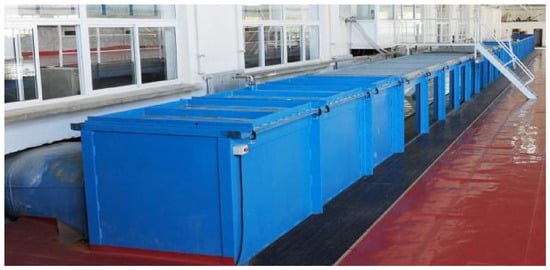
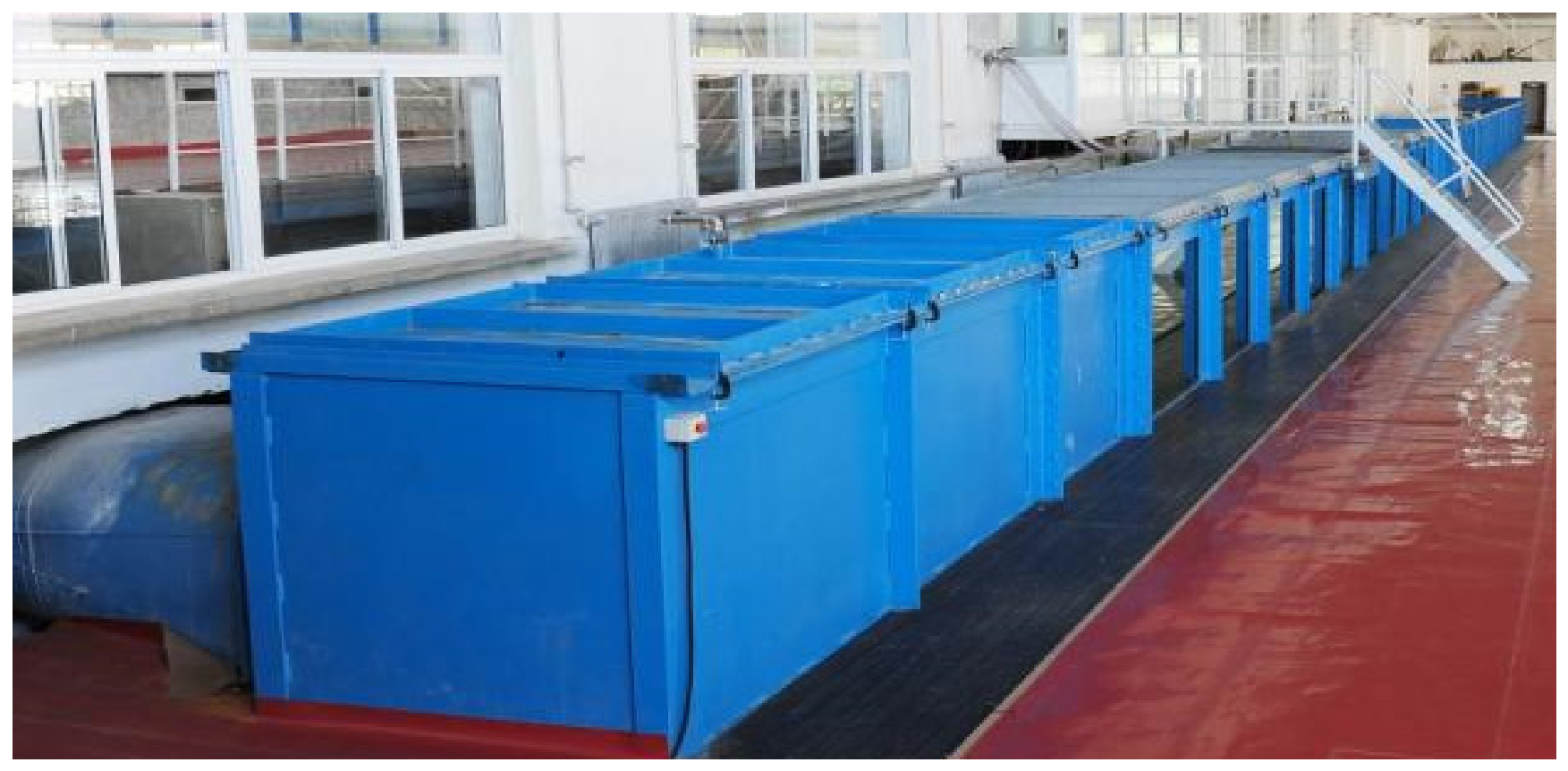
The experiments were conducted in the O-Tube flume at the State Key Laboratory of Coastal and Offshore Engineering, Dalian University of Technology, as shown in Figure 1. The annular flume enables the generation of controlled flow conditions with adjustable flow velocity and flow direction, making it suitable for simulating long-period oscillatory flows. During the tests, an Acoustic Doppler Velocimeter (ADV) was used to precisely measure the velocity profile within the flume. Meanwhile an Ultrasonic Doppler Velocimeter (UDV) was employed to monitor the temporal variation in scour depth around the pile foundation. A three-dimensional topographic scanner was used to capture the scour topography after the completion of each test.
Figure 1.
O-Tube flume.
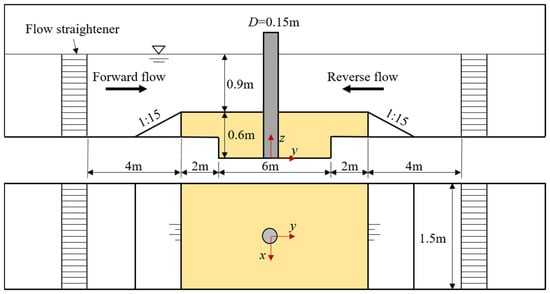
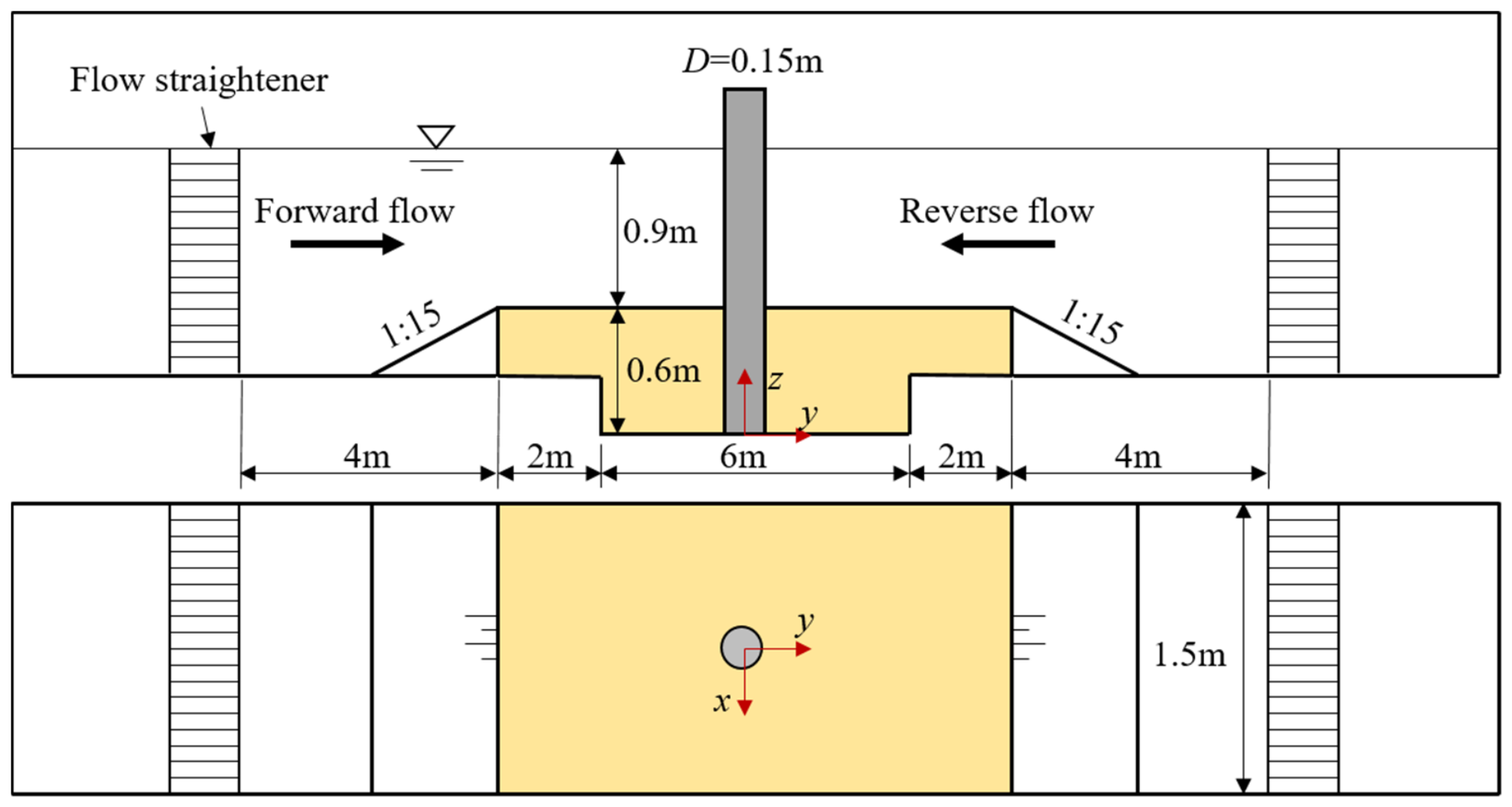
The experimental setup is shown in Figure 2. The test section features a total length of 10 m and a sand bed height of 0.6 m. To ensure sufficient sediment supply during the tests, 2 m long sediment beds with a thickness of 0.2 m were arranged upstream and downstream of the test section. Gentle slopes with a gradient of 1:15 were configured at both ends of the test section to guarantee smooth flow transition and eliminate abnormal flow disturbance. The model monopile foundation was fabricated from transparent Perspex circular pipe with a diameter D of 0.15 m, and the water depth was maintained steadily at 0.90 m throughout the experiments.
Figure 2.
Schematic diagram of water tank layout.
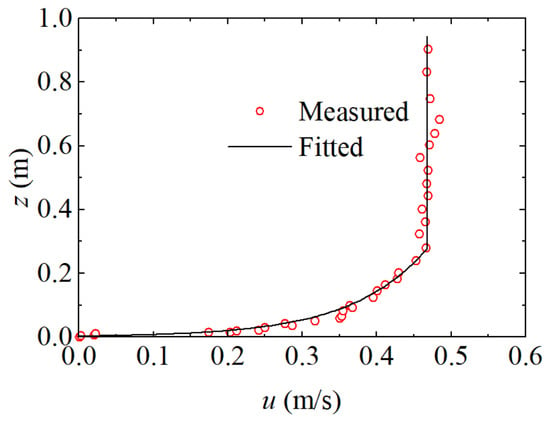
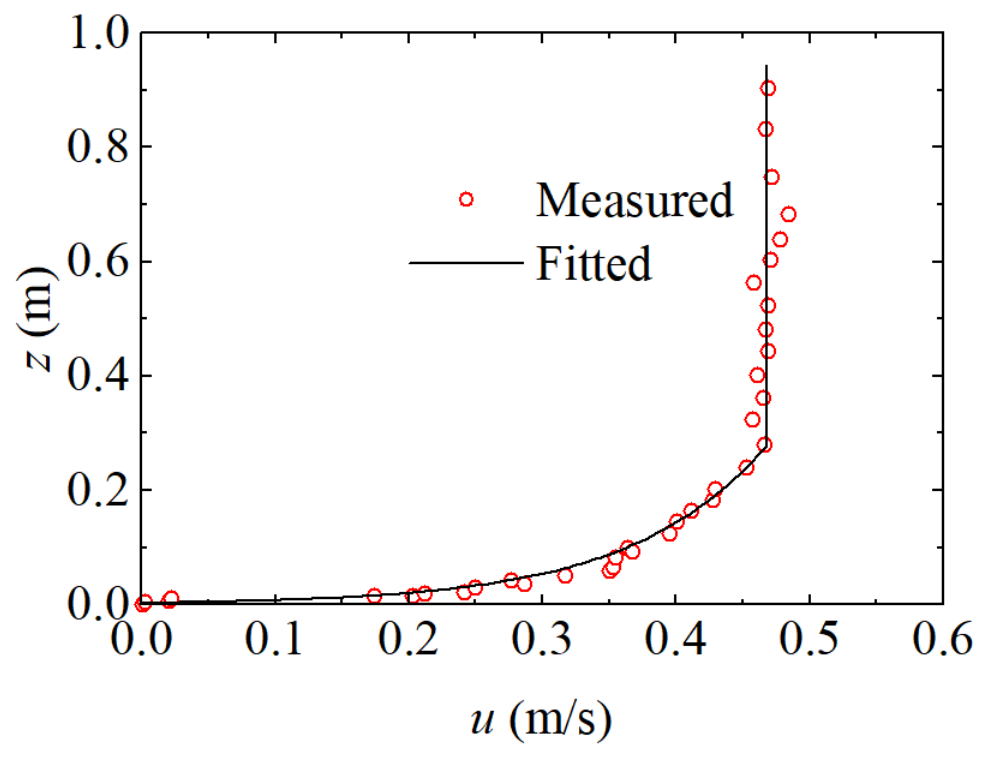
Although the first straight flume segment shown in Figure 2 is 4 m long, an extra 5 m reach is arranged upstream of the pile, providing a total upstream flow-development length of 9 m. Preliminary velocity-profile measurement without the pile was performed at the test section before formal tests. As illustrated in Figure 3, the measured velocity profile in the boundary layer matches the log-law fitting curve, verifying fully developed boundary layer flow at the pile location.
Figure 3.
Measured distribution of velocity in water depth.
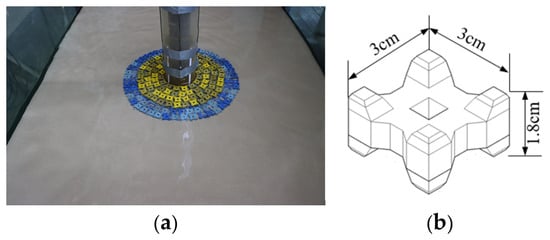
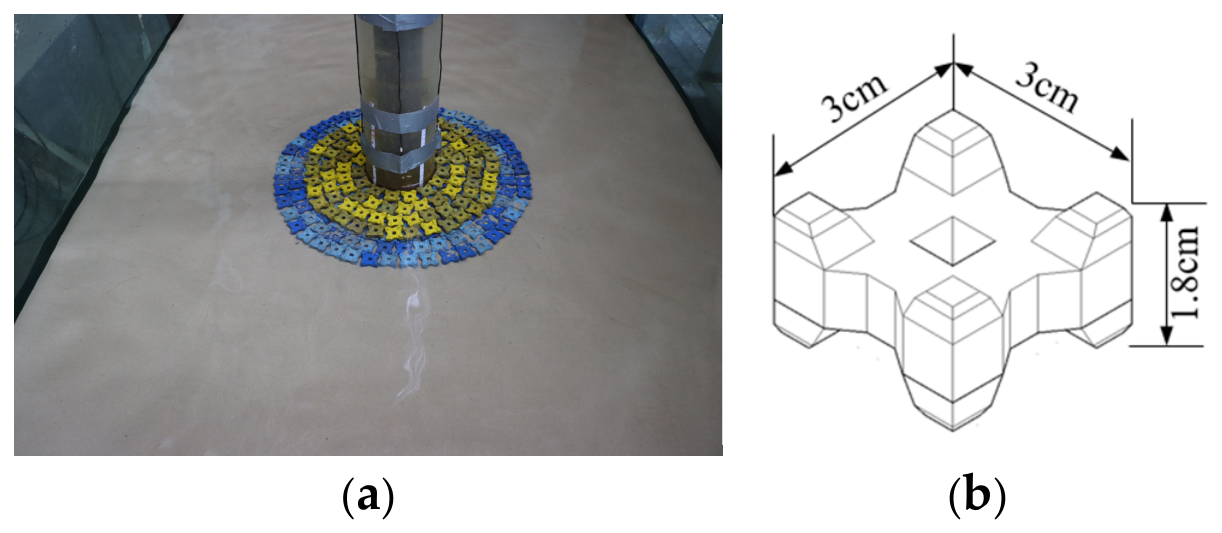
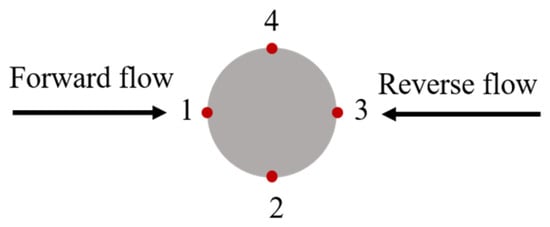
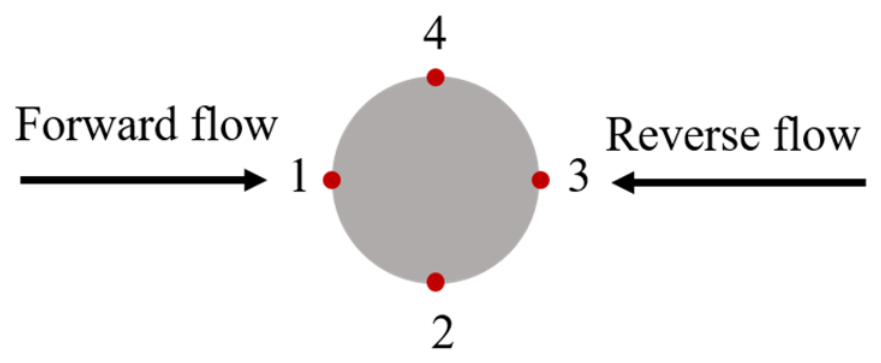
For scour protection, FCHBs were arranged around the pile foundation, as shown in Figure 4a. The blue and yellow blocks denote FCHBs deployed in different layers. The detailed geometric dimensions of a single FCHB are presented in Figure 4b, with a length and width of 3 cm and a height of 1.8 cm. To continuously monitor the temporal variation in bed elevation around the foundation during scour development, four probes were installed in the vicinity of the foundation. As shown in Figure 5, these probes were arranged on the forward flow side, reverse flow side, and two lateral sides of the pile to achieve comprehensive monitoring.
Figure 4.
Four-corner hollow blocks: (a) photograph of the placement; (b) structural diagram.
Figure 5.
Layout schematic of local scour monitoring probes.
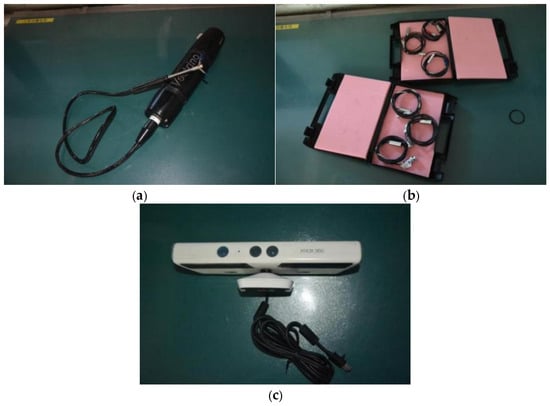
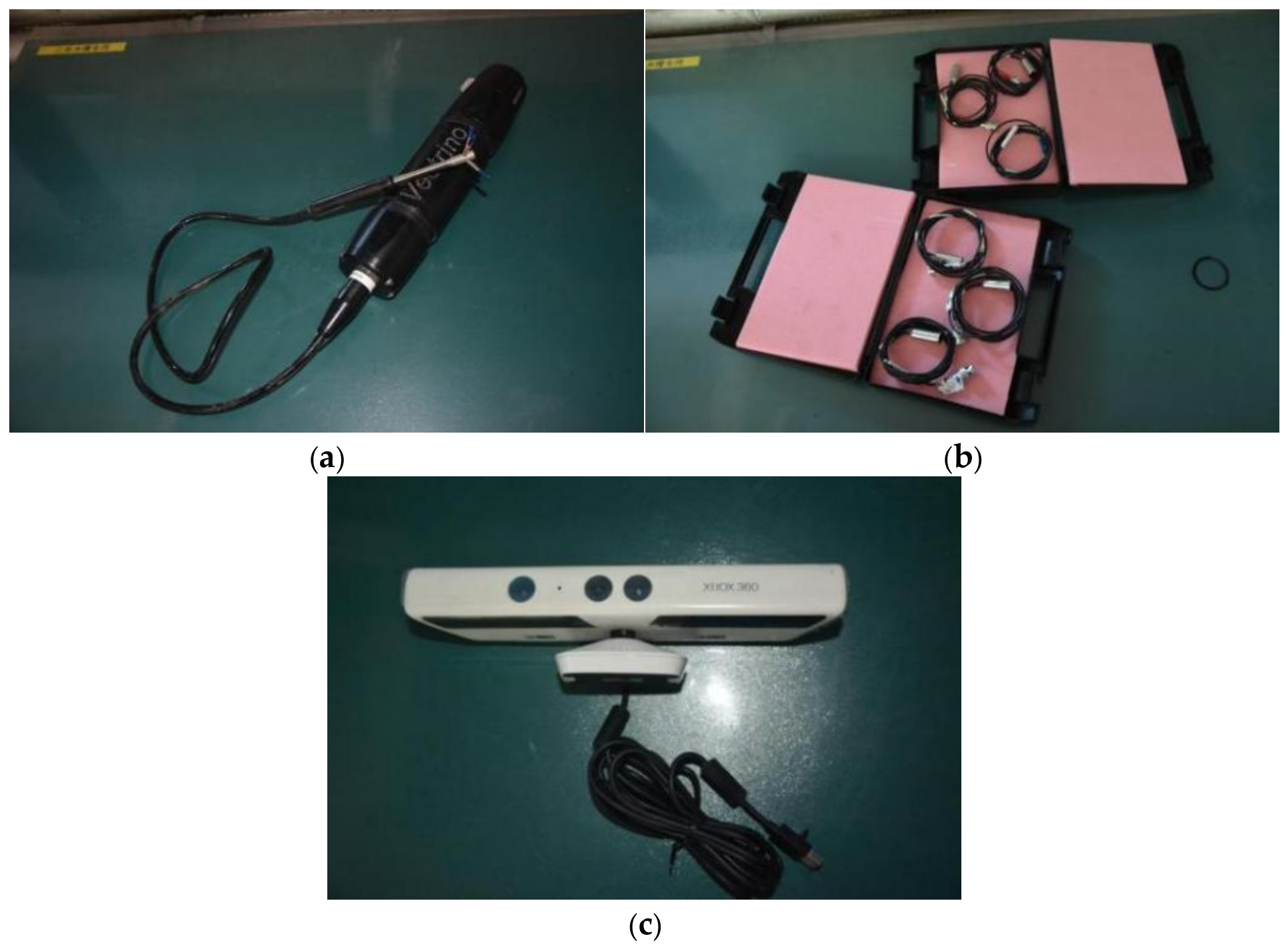
The ADV, shown in Figure 6a, is a device that measures flow velocity based on the Doppler principle. Equipped with a remote sampling module, the instrument measures flow velocity at a fixed point spaced apart from its probe head, which ensures high measurement precision. During the tests, the ADV was installed at the center of the flume cross-section, 1 m upstream of the monopile foundation to acquire reliable flow velocity data. Velocity profiles were calibrated at three transverse positions across the flume cross-section, which were 0.5 m, 0.8 m, and 1.1 m away from the left sidewall, respectively. Calibration results verified that the incoming flow exhibited uniform transverse distribution. Additionally, to minimize potential flow interference caused by the probe, the sampling volume was set 3 cm below the probe. The sampling frequency was set to 25 Hz, with each sampling period lasting 1 min, following the experimental practice of Zhao et al. [29]. The raw ADV velocity samples were first processed to remove spurious outliers. Subsequently, the velocity profile was obtained by averaging the cleaned samples, which suppresses noise and instantaneous fluctuations. The measured velocity profile in the boundary layer (Figure 3) agrees well with the logarithmic law, verifying the reliability of the flow measurements. The UDV, shown in Figure 6b, operates based on the transmission and reception of ultrasonic waves. Bed elevation variations are derived from the travel time of reflected ultrasonic signals, which corresponds to the distance from the probe to the bed surface. Accordingly, time-history curves of scour depth were acquired to characterize the temporal evolution of local scour around the monopile foundation, providing continuous and accurate monitoring. Such measurements facilitate comprehensive insight into the scour process and provide a basis for the rational design of scour countermeasures. The 3D topographic scanner, composed of a driving unit and a laser sensor with a measurement accuracy of ±0.2 mm, is presented in Figure 6c. Upon the completion of each scour test, the flume water was drained to expose the sediment bed, allowing the laser sensor to capture reflected signals from the bed surface. Based on these signals, the scoured bed topography was scanned and mapped. Post-processing of the scanned point cloud data further yielded scour contour maps of the scour hole, which enabled intuitive and quantitative analysis of bed morphological variations.
Figure 6.
Measurement instruments: (a) acoustic Doppler velocimetry (ADV); (b) ultrasound Doppler velocimetry (UDV); and (c) 3D topographic scanner.
Both the 3D topographic scanner and the UDV system provide millimeter-level measurement resolution for bed-profile measurements. For the present tests, the absolute scour depth is substantially larger than this resolution. Therefore, the relative measurement uncertainty for scour depth is low. Such small-magnitude measurement errors may cause minor deviations in absolute scour-depth values, but they cannot affect the relative comparison and main conclusions regarding the scour-reduction efficiency of FCHBs.
The test sediment was thoroughly washed prior to the experiments. Particle size analysis was performed on sand samples, yielding a median grain size d50 = 0.198 mm, a relative density s = 2.65, a uniformity coefficient σg = (d86/d14)1/2 = 1.33, and a natural angle of repose ϕ = 36°. The critical Shields parameter θcr for sediment incipient motion can be calculated using the empirical formula (Equation (1)) proposed by Soulsby [30].
where D∗ is the dimensionless particle diameter, defined as follows:
where υ is the kinematic viscosity of water and g is the gravitational acceleration.
The formula for calculating the Shields parameter θ is as follows:
where τs is the bed shear stress, κ is the von Kármán constant, taken as 0.4, and z0 is the bed roughness height, defined as z0 = d50/12, h is the water depth, and ρ is the fluid density. κ and z0 may deviate under strong sediment transport or rippled beds. Nevertheless, these simplified parameterizations are standard practice in local scour experiments and are sufficient to estimate the scour regime [29,31]. Based on the sediment parameters, the critical Shields parameter is calculated to be θcr = 0.048, and the corresponding critical incipient velocity of sediment is Ucr = 0.31 m/s. Although these formulas were originally developed for steady unidirectional flow, the long-period square-wave oscillatory flow adopted in the present experiments features quasi-steady flow within each half-cycle and can be reasonably approximated as unidirectional flow. Therefore, these empirical relationships are applicable for calculating the basic sediment and flow parameters in this test.
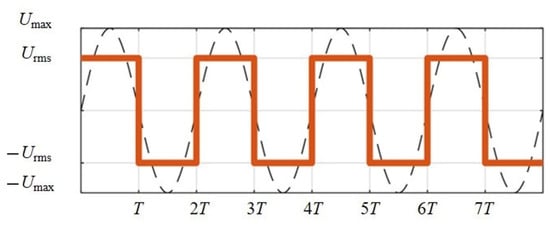
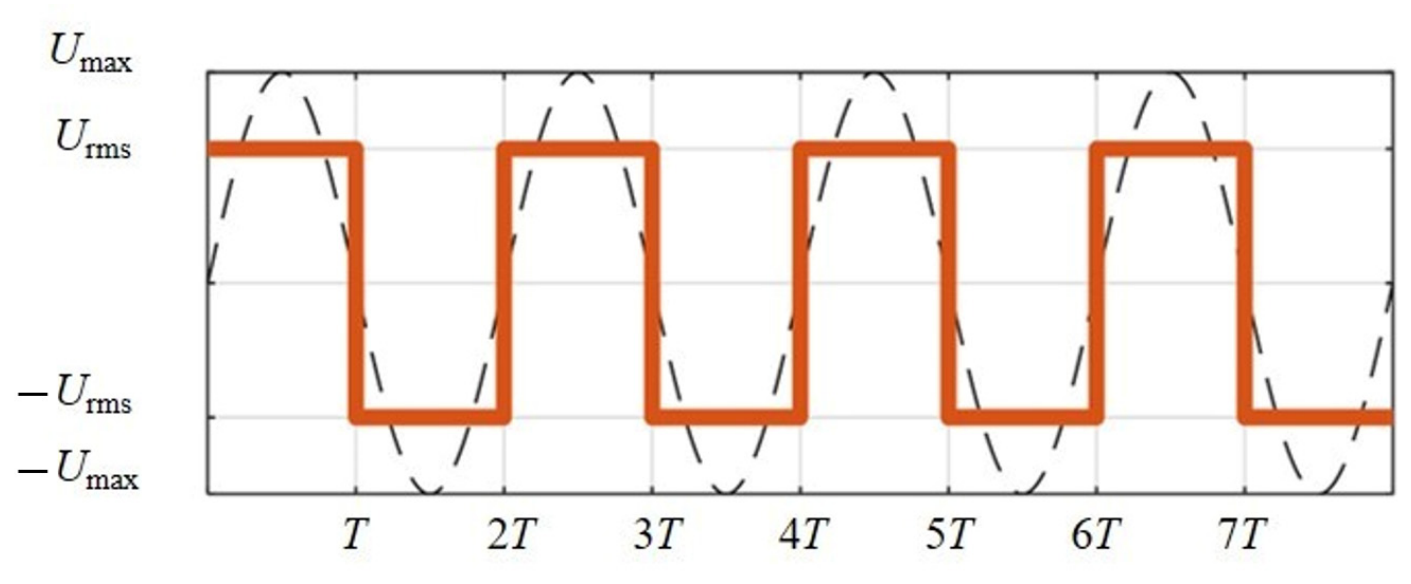
The square-wave reversing flow, whose root-mean-square velocity is illustrated in Figure 7, produces a local scour depth comparable to that observed under long-period oscillatory flow. Accordingly, this simplified flow mode was adopted in the present tests to simulate long-period oscillatory flow conditions. The velocity amplitude Umax and root-mean-square velocity Urms of the oscillatory flow follow the correlation given in Equation (6). In the present study, the square-wave flow velocity was uniformly set to 0.45 m/s, which exceeds the critical incipient velocity of the sediment and thereby yields live-bed scour conditions. Live-bed scour is widely representative of real offshore conditions. This velocity was selected to balance experimental constraints: a lower velocity would lead to an impractically slow scour development, while a much higher velocity would induce extensive general bed degradation, which masks the local scour signal around the pile and hinders data interpretation. Under this flow condition, bed evolution is dominated by local scour.
Figure 7.
Temporal variation in long-period oscillatory flow velocity.
3. Results and Discussion
This study experimentally investigates the protection performance of FCHBs for monopile foundations under long-period oscillatory flow. The flow velocity was kept at a constant value of 0.45 m/s, corresponding to a Shields parameter ratio (θ/θcr) of 2.15. During the experiments, an ultrasonic Doppler velocimeter (UDV) was used to monitor the temporal evolution of scour depth and characterize the dynamic development process of local scour. After each test, a terrain scanner was adopted to obtain high-precision bed topography of the scour zone. The experimental investigation focuses on the following aspects: (1) the protection performance of FCHBs with different placement patterns and coverage; (2) the protection performance of secondary FCHB placement; and (3) comparisons of the protection performance of FCHBs under different flow periods. Detailed test conditions are summarized in Table 1. Tests C0-C5 were conducted to study the effect of FCHB placement, and tests CT0–CT3 were performed to investigate the influence of flow period on scour protection performance.
Table 1.
Test conditions.
3.1. Effect of Placement Scheme on FCHB Protection Performance
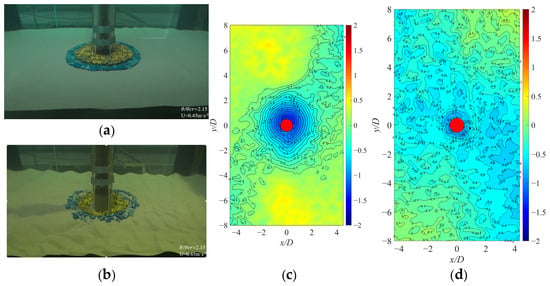
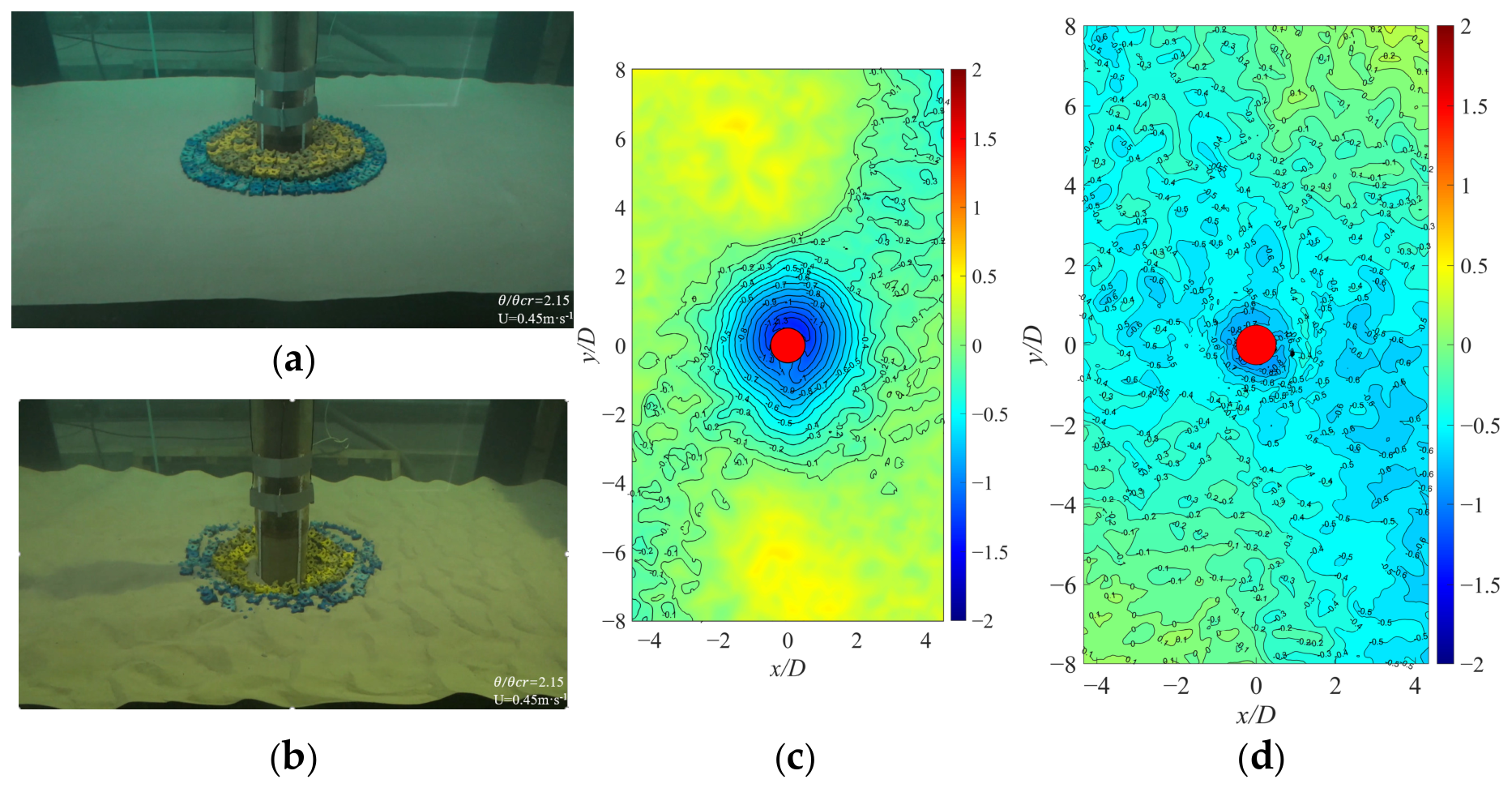
This section evaluates the influence of FCHB placement schemes on the scour protection performance, with particular emphasis on placement pattern (regular vs. irregular arrangements), coverage, and number of layers. The effectiveness of FCHBs in scour protection is first examined by comparing the unprotected Test C0 with Test C1, which adopts a regular placement of two FCHB layers covering 3.8D. Figure 8 shows the experimental photographs and the contour maps of scour topography for Tests C0 and C1, where x/D and y/D are bed coordinates normalized by the monopile diameter D, x is aligned with the incoming flow direction and y denotes the transverse direction perpendicular to the flow. In Test C1, outward displacement of the FCHBs was observed along the boundary of the protected area as a result of edge scour. Meanwhile, blocks adjacent to the foundation undergo vertical settlement and sink into the seabed sediment. This phenomenon arises as flow penetrates the interstices between blocks and erodes the underlying sediment. However, the overall displacement of the blocks is small, and the maximum scour depth is about 1.0D, smaller than the value of 1.6D measured in Test C0 (without the protection of FCHBs). Compared with Test C0, the scour hole formed in Test C1 is less distinct, and the scour extent is remarkably reduced. The diameter of the scour hole exceeds 4D in Test C0, whereas it is restricted to roughly 2D in Test C1. These results demonstrate that FCHBs can effectively suppress both the depthwise and lateral development of local scour around the monopile under long-period oscillatory flow.
Figure 8.
Test conditions C0 and C1: (a) experimental photograph of Test C1 before scouring; (b) experimental photograph of Test C1 at the end of the test; (c) scour topography contour map of Test C0; and (d) scour topography contour map of Test C1.
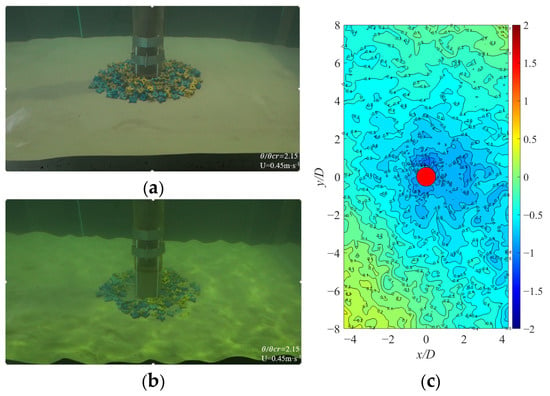
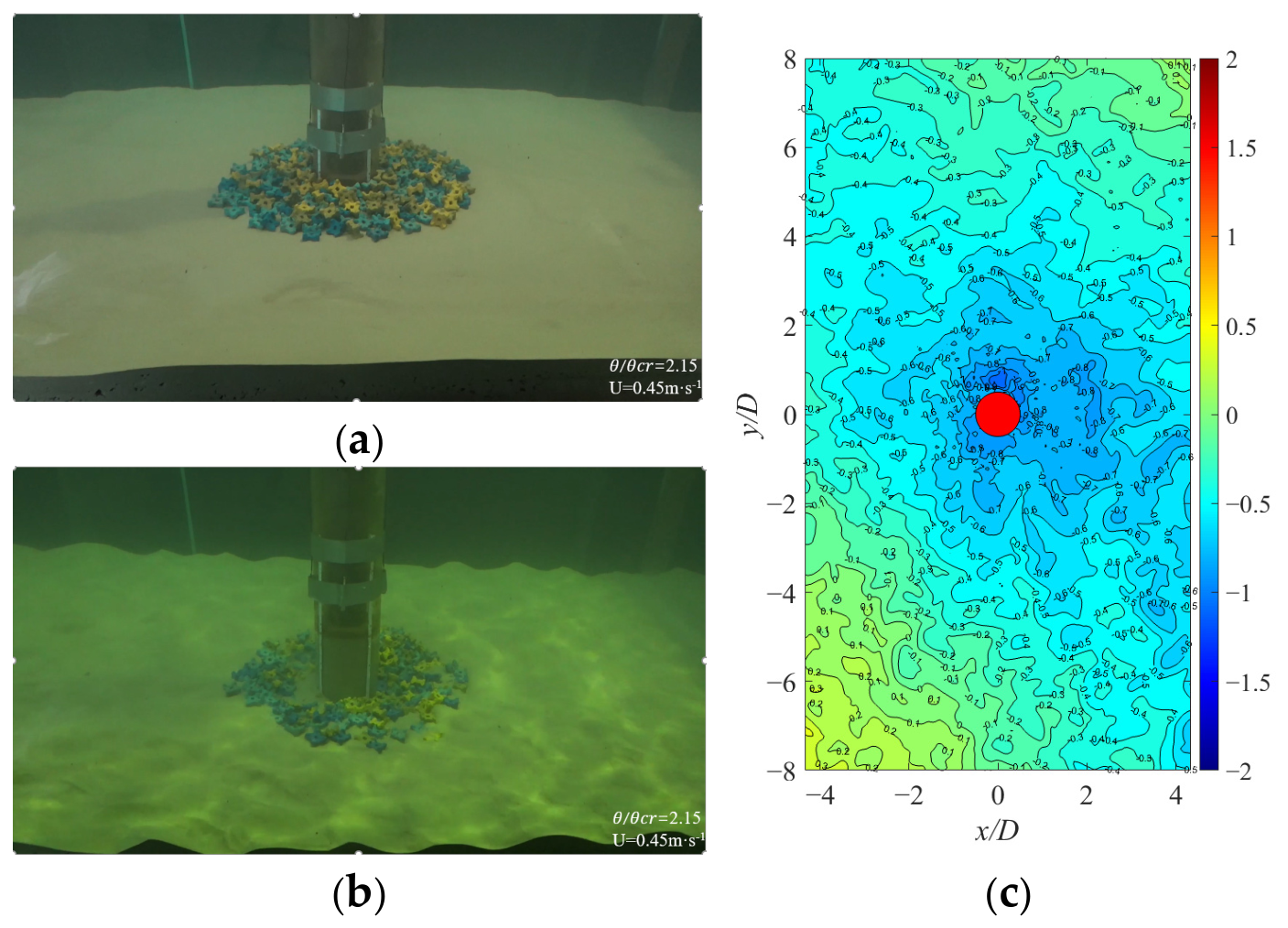
It should be noted that the regular arrangement tested herein serves as a laboratory reference baseline rather than a recommended on-site construction target. In realistic offshore environments, even if FCHBs are initially placed in an ordered pattern, block settlement and lateral displacement driven by long-period oscillatory flow will gradually transform the layout into an irregular state. Thus, a perfectly regular arrangement of the FCHBs is difficult to maintain in practical engineering due to the complex flow conditions. To investigate the influence of FCHB placement pattern on local scour, Test C2 was conducted, where the FCHB coverage was the same as that in Test C1. The only difference lies in block arrangement: FCHBs were placed irregularly in Test C2, namely, randomly dumped within the identical coverage adopted for Test C1. The experimental photographs and contour map of the scour topography for Test C2 are shown in Figure 9. The overall displacement of blocks in Test C2 is comparable to that in Test C1 yet marginally greater. In particular, inward settlement of the blocks is more pronounced, accompanied by a wider scour hole. Despite the greater scour extent, the maximum scour depth under irregular placement was not significantly different from that under regular placement. Accordingly, the overall scour protection performance of the two placement patterns remained comparable. This indicates that although random dumping generates an expanded scour hole, it does not substantially degrade the overall scour mitigation efficiency. In practical engineering, strict regularity of the placement pattern is not essential, and the blocks can be randomly dumped, reducing the construction difficulty.
Figure 9.
Test condition C2: (a) experimental photograph before scouring; (b) experimental photograph at the end of the test; and (c) contour map of the scoured bed.
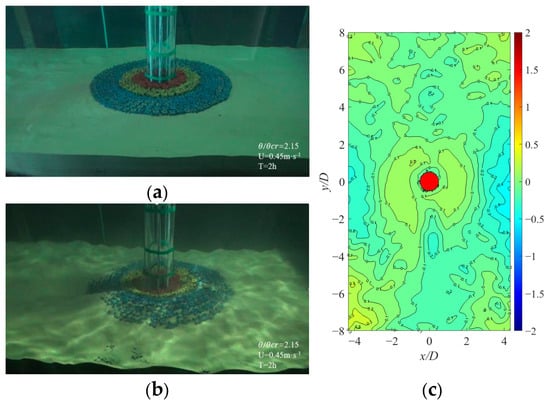
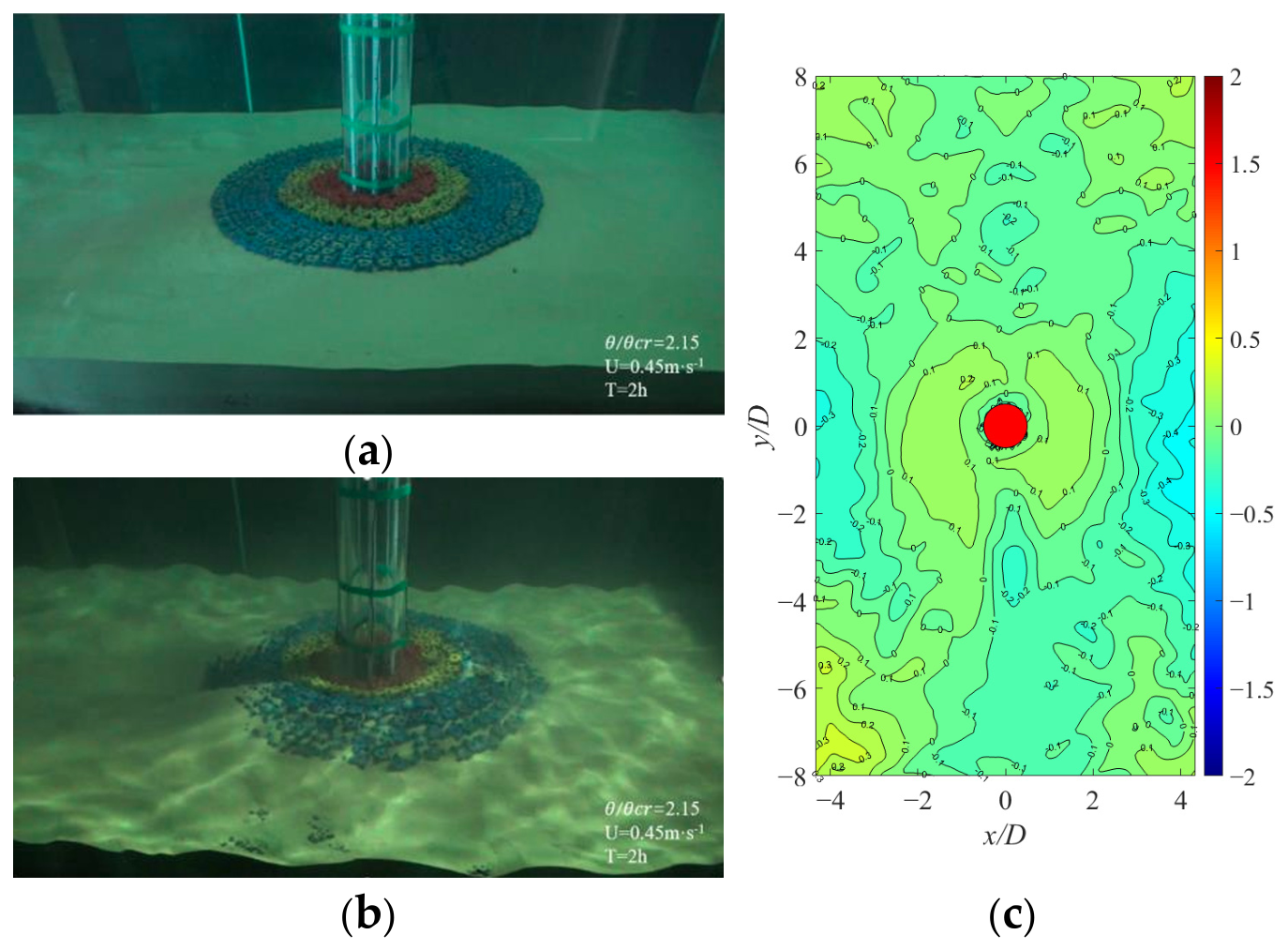
The influence of the FCHB coverage and layer number on scour protection performance was further examined in Test C4. In this test, the FCHB coverage was expanded from 3.8D to 5.2D. This expanded coverage largely covers the region of concentrated streamlines surrounding the monopile foundation, effectively mitigating the adverse impacts of edge scour. In addition, an extra layer of red protective blocks was added, as shown in Figure 10a. The experimental photographs and contour map of the scour topography for Test C4 are also presented in Figure 10. Overall, the protection performance in Test C4 is significantly improved compared to Tests C1 and C2. Although outward sliding of the outer blocks due to edge scour and vertical settlement of the inner blocks are still observed, both are considerably less pronounced than in the previous two tests. This improvement originates from the combined effect of FCHB protection coverage and layer number, as these two parameters were varied simultaneously. The combined configuration shifts the outer edge of the protective system out of the zone with strongly concentrated streamlines near the foundation and hinders near-bed flow penetration into the sediment beneath the blocks, which jointly alleviates edge scour and suppresses sediment winnowing that may induce block settlement [23]. As a result, the supporting seabed beneath the FCHBs remained more stable, effectively reducing the tendency for block settlement. As indicated by the scour contour maps, the maximum scour depth in this test primarily occurs at the edge of the protective layer due to edge scour, while nearly no negative bed topography is observed in the vicinity of the foundation. Therefore, Test C4 verifies that increasing both the protection extent and the number of block layers substantially enhances the scour protection performance of FCHBs, effectively mitigating edge scour and block settlement simultaneously.
Figure 10.
Test condition C4: (a) experimental photograph before scouring; (b) experimental photograph at the end of the test; and (c) contour map of the scoured bed.
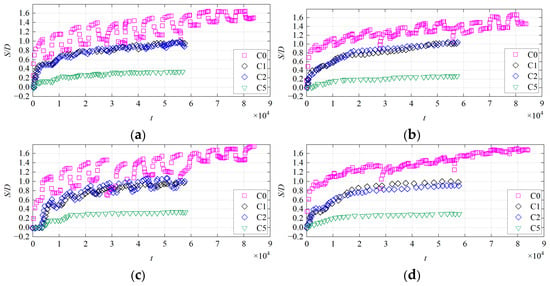
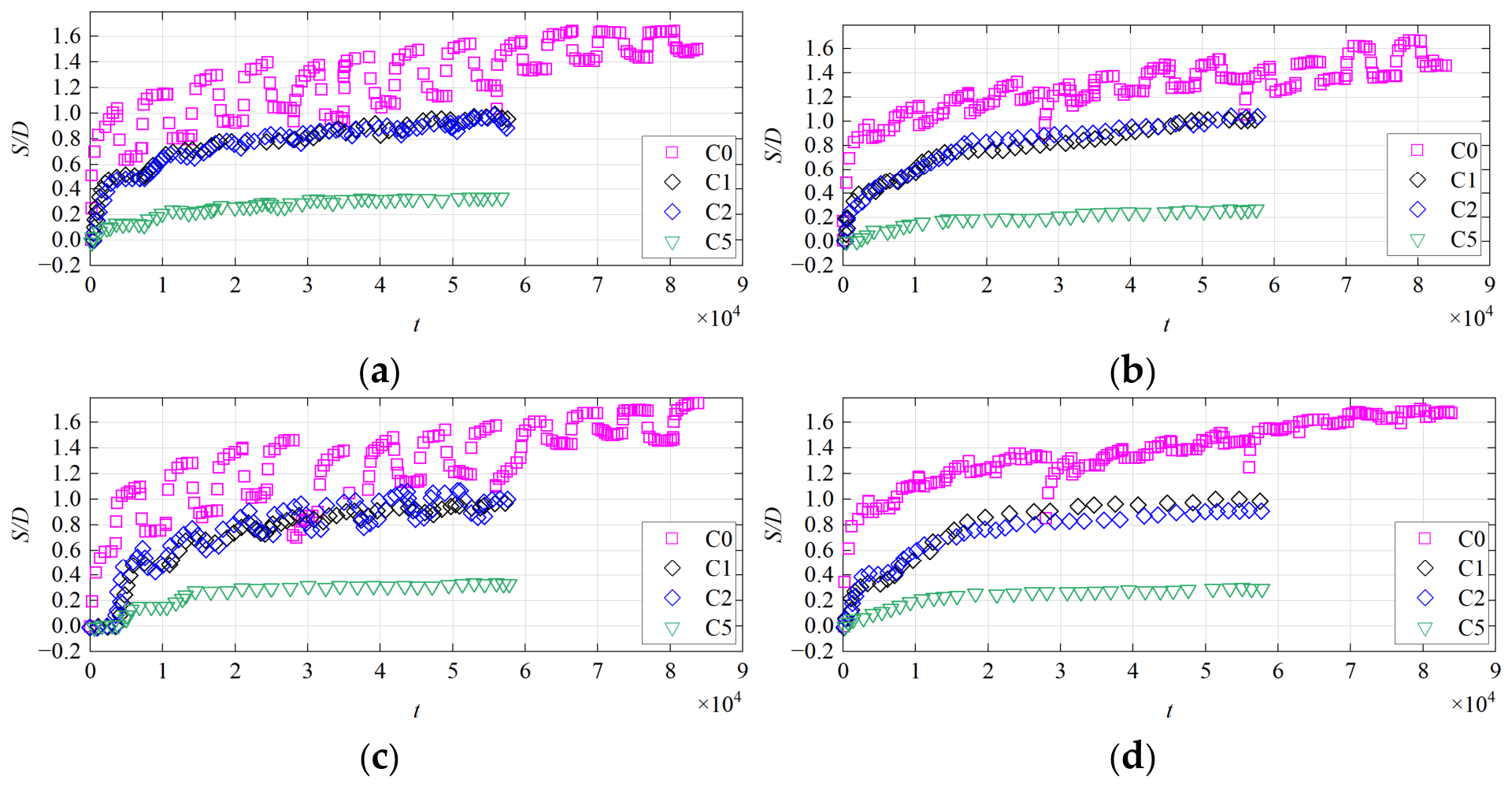
To further compare the scour protection performance of different FCHB placement schemes in detail, Figure 11 presents the temporal evolution of local scour depth at multiple measurement points (see Figure 5) for Test C0 (no FCHBs), Test C1, and Test C2, where S/D is the dimensionless scour depth and t is the time. For Test C0, the scour development exhibits prominent fluctuations due to the reversing oscillatory flow, with an average scour depth of 1.6D at the end of the test. After the installation of FCHBs, the scour depth is reduced to approximately 1.0D, corresponding to a reduction rate η of about 37.5% relative to the unprotected condition Test C0 (η = (S0 − Sp)/S0 is adopted to quantify the scour-mitigation performance, where S0 and Sp denote the scour depths for the unprotected and protected monopile). Moreover, the temporal evolutions of Tests C1 and C2 are nearly the same, indicating the placement pattern of the blocks does not significantly influence the scour development process. Regardless of whether scour protection is applied, the scour depths at the four measurement points are relatively similar indicating the scour hole presents a nearly symmetrical distribution. Figure 11 also compares the scour evolution between the Test C0 and Test C5. It is found that the maximum scour depth under condition C5 does not exceed 0.4D, representing a reduction rate η of approximately 75% compared to the unprotected Test C0, and about η = 60% compared to Tests C1 and C2. This confirms that increasing both the coverage and the number of block layers can substantially improve the scour protection performance of FCHBs.
Figure 11.
Temporal evolution of local scour depth at various measuring points for tests C0, C1, C2 and C5: (a) point 1; (b) point 2; (c) point 3; and (d) point 4.
Based on the above results, FCHBs can provide reliable and effective protection against monopile local scour under long-period oscillatory flow. Block placement patterns exert negligible effects on scour protection performance, which greatly reduces the on-site construction difficulty and improves the engineering applicability of FCHB protection.
It should be noted that the final scour depth adopted in this work does not correspond to fully static bed topography, but a state in which scour progresses at a very low rate. For unprotected piles, scour persisted for a long time without a clear stopping tendency, so further extension of test duration would yield limited additional insight. For protected-pile cases, the countermeasure suppresses local scour around the structure. Tests were terminated once no prominent bed-level lowering could be observed, at which the scour rate decreased to below approximately 7.5 × 10⁻⁴ mm/s. In the present experiment, all protected-pile test cases ran for approximately 13–16 h to ensure full scour development. Even though slight residual scour may still take place, the corresponding scour rate is markedly lower than that for unprotected piles. Accordingly, further prolonged hydraulic loading would not alter the main conclusions regarding relative scour-mitigation efficiency.
3.2. Effect of Secondary Placement of FCHBs on Scour Protection Performance
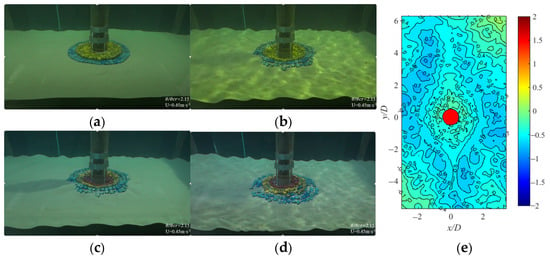
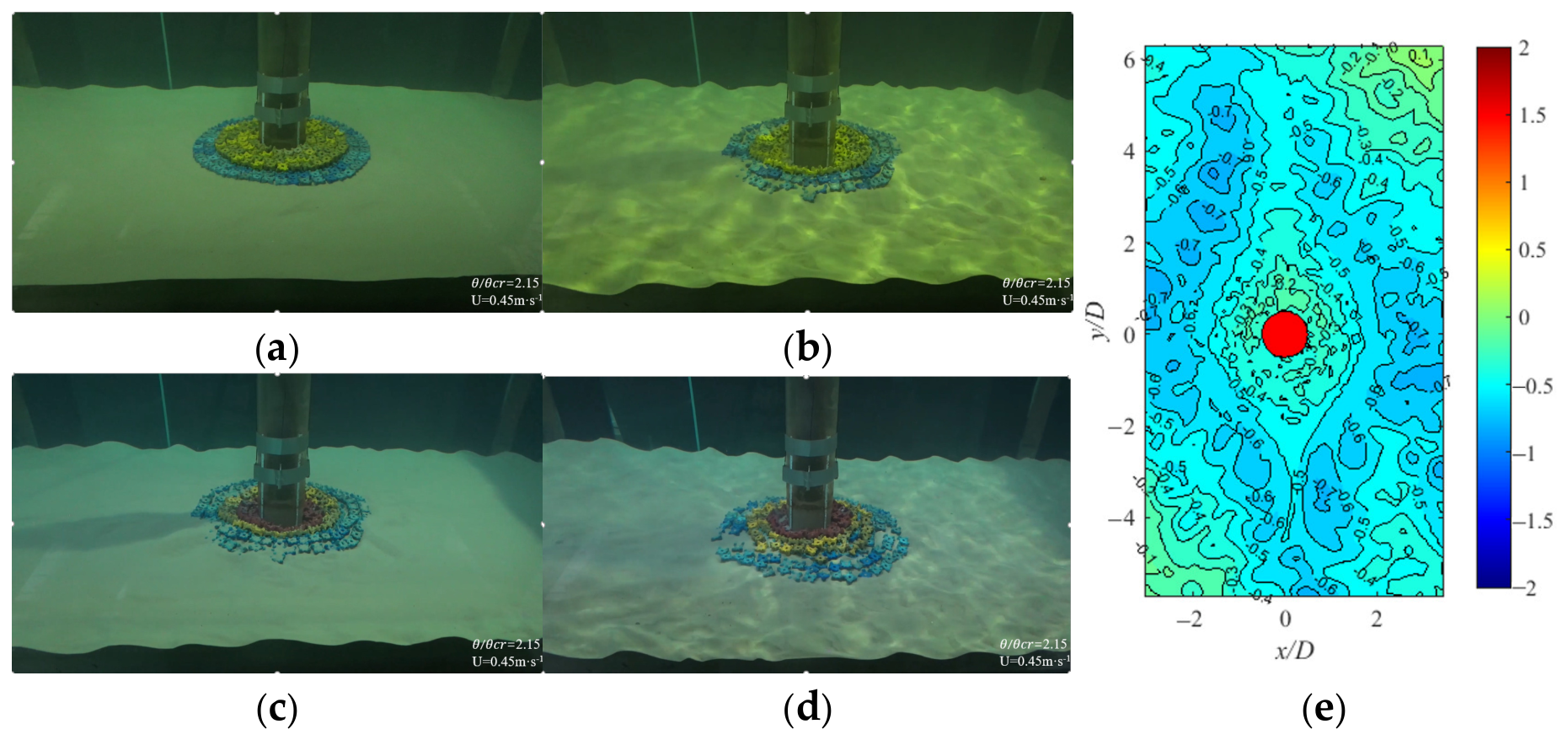
During the scour process, continuous changes in bed morphology may induce settlement and lateral sliding of the initially placed blocks. Such movements may degrade the structural stability of the protective layer and impair the long-term scour protection performance of FCHBs. In practical applications, therefore, it is important to determine whether FCHBs can be supplemented after partial scour development to restore the protective capacity and suppress further scour around the monopile. To investigate the effect of secondary placement of FCHBs on scour protection performance, Test C3 was conducted. At the beginning of the test, two layers of blocks were initially arranged around the foundation with a coverage of 3.8D. After two hours of continuous scour development, a third layer of FCHBs was supplemented on the existing protective structure. The experimental photographs and contour map of the scour topography for Test C3 are shown in Figure 12.
Figure 12.
Test condition C3: (a) experimental photograph prior to scouring; (b) experimental photograph at t = 2 h; (c) experimental photograph for secondary FCHB placement; (d) experimental photograph at the end of the test; and (e) contour map of the scoured bed.
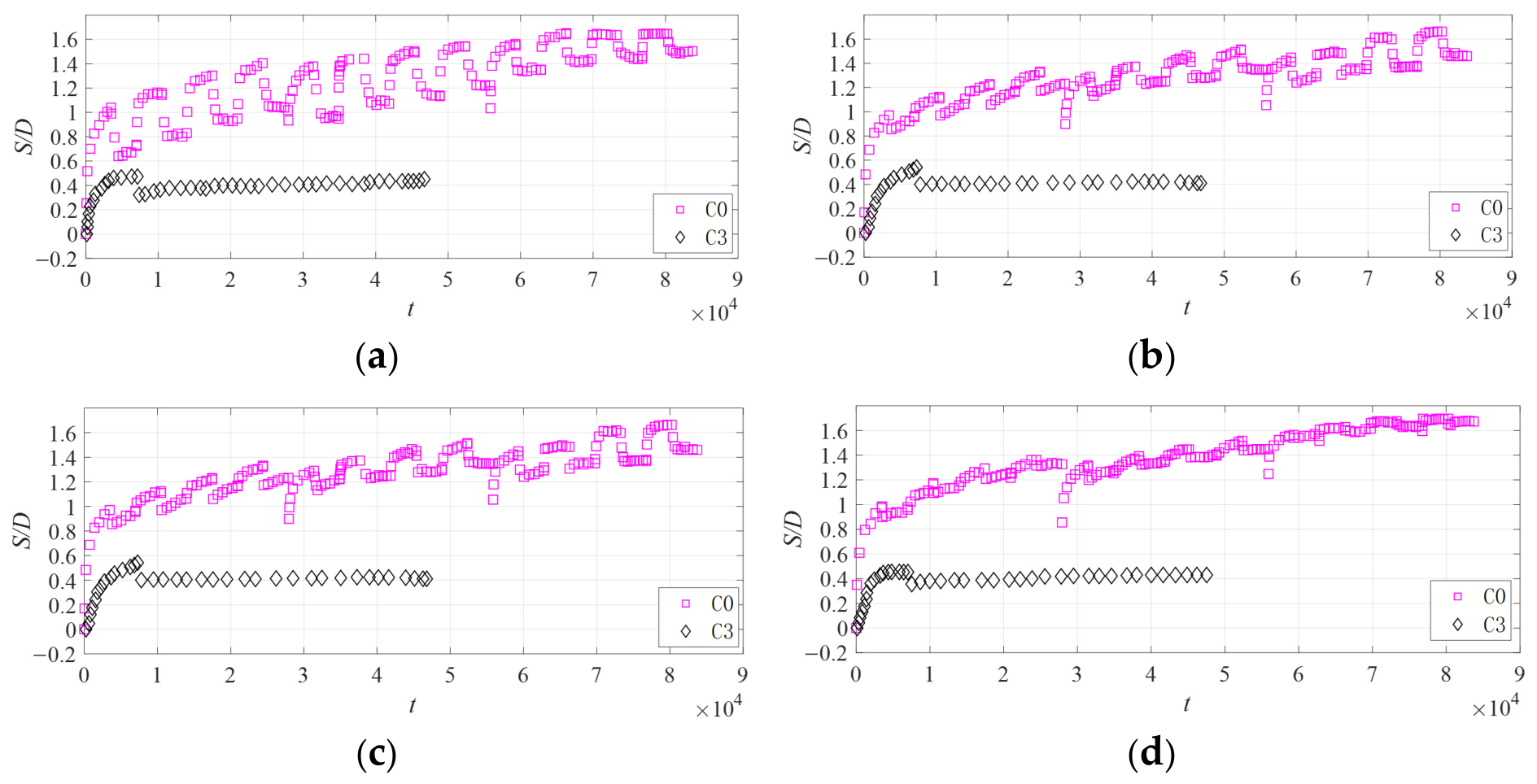
From the experimental results shown in Figure 12, it can be seen that although the scour depth within the protection area around the monopile foundation is limited, edge scour still occurs around the blocks. The contour map indicates the presence of a scour hole around the blocks, with a maximum scour depth reaching 0.8D. Although this represents a reduction rate η = 50% in the maximum scour depth compared to the unprotected condition, the scour extent became significantly larger. Moreover, scour occurs away from the pile foundation, primarily because a secondary placement of FCHBs is carried out during the scour process, which effectively acts as a widened foundation, consequently enlarging the scour extent.
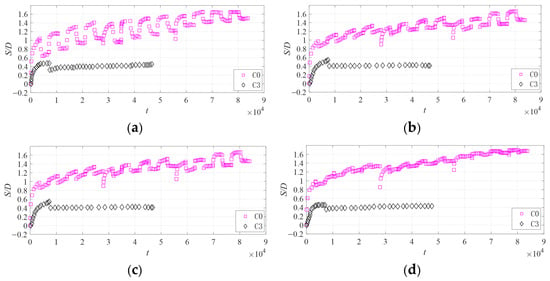
Figure 13 presents the temporal evolution of local scour depth at different measurement points for Test C0 and Test C3. It can be seen from the figure that with the installation of a scour protection measure, the scour depth around the pile foundation is significantly reduced, with a scour depth of approximately 0.4D. Specifically, the secondary placement of FCHBs changes the scour process around the monopile, making the scour depth comparable to that of Test C5 (shown in Figure 11). This indicates that the secondary placement of FCHBs effectively protects the monopile foundation against local scour.
Figure 13.
Temporal evolution of local scour depth at various measuring points for tests C0 and C3: (a) point 1; (b) point 2; (c) point 3; and (d) point 4.
The present findings have important practical implications for the application of FCHBs in offshore engineering. Despite its excellent performance in alleviating pile-adjacent local scour, the elevated FCHB layout resulting from the secondary placement modifies the near-bed flow, which intensifies the scour outside the protection coverage and may endanger subsea cables adjacent to the foundations. This trade-off originates from the flow-redirection effect of the block assembly: the secondary layer dissipates the downward impinging flow and weakens the horseshoe vortex near the pile, but simultaneously diverts high-momentum flow radially outwards. The accelerated near-bed flow beyond the block perimeter enhances sediment transport and triggers secondary scour. Unlike the local scour at the pile, this outer scour develops over a wider footprint. A balance should therefore be struck between local scour control and integral seabed stability. For offshore wind projects, subsea cables are generally routed in the vicinity of monopile foundations. Accordingly, the secondary-layer arrangement requires careful layout coordination: the protection boundary and cable routing plan should be jointly designed to keep vulnerable cable segments away from the zone of diverted high-momentum flow. Where such spatial separation cannot be achieved, supplementary protective measures should be implemented for cables. Further parametric studies on the combined influences of layer thickness and coverage are needed to identify optimized FCHB placement schemes and improve their applicability to offshore engineering practices.
3.3. Effect of Flow Period on FCHB Protection Performance
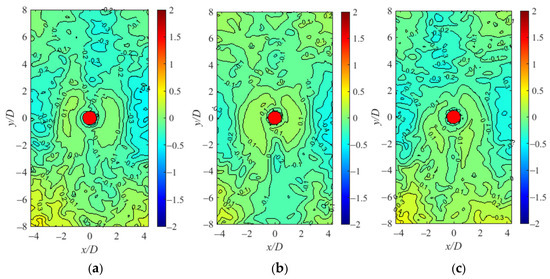
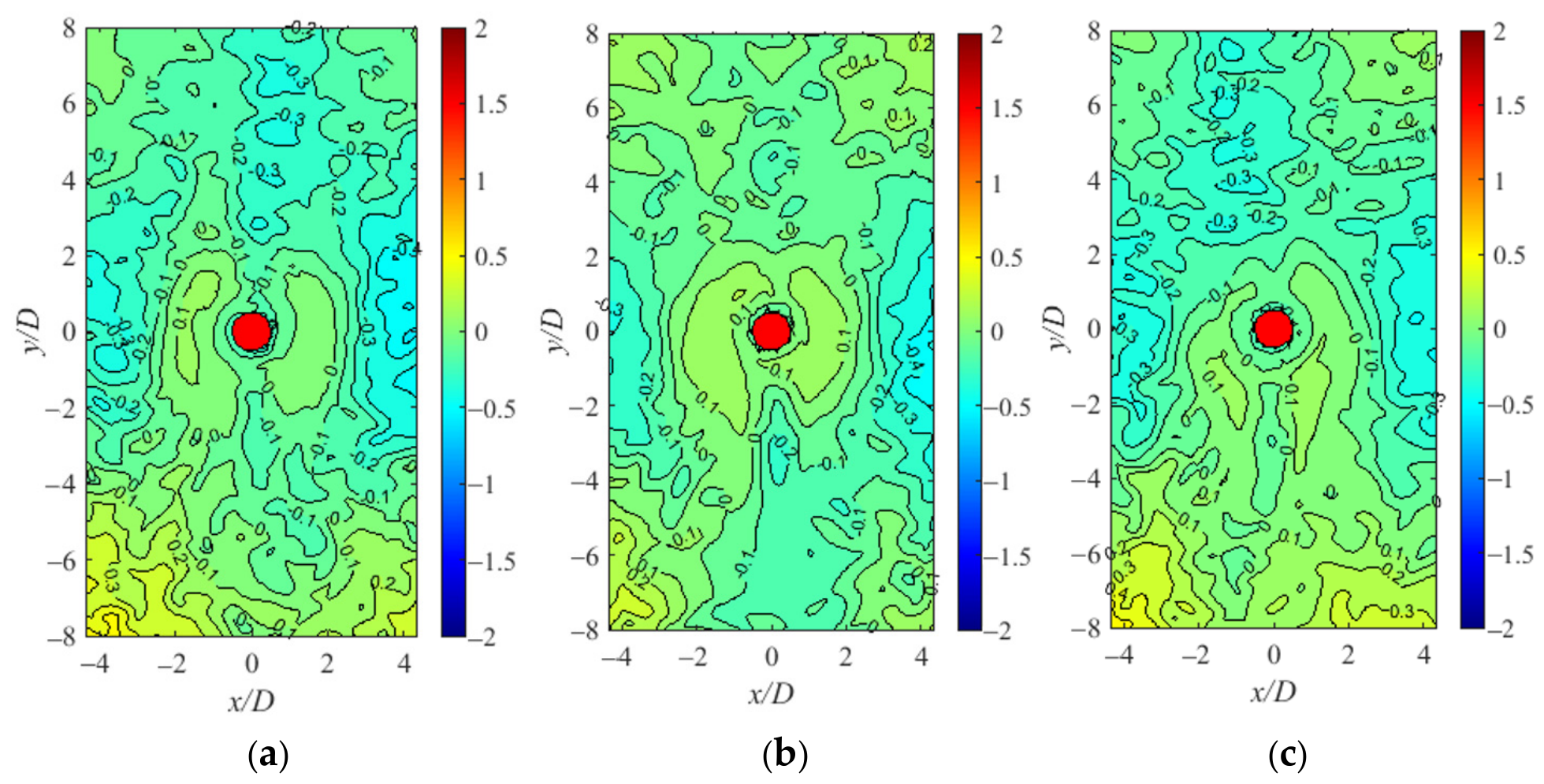
To explore the influence of flow period on the scour protection performance of the FCHBs, three tests were conducted with flow periods of 1 h, 2 h, and 4 h, respectively. All tests adopted a consistent FCHB coverage of 5.2D. The scour topography contour maps obtained at the final scour state are illustrated in Figure 14. The experimental results reveal that the scour topography remains highly consistent across the three flow-period conditions, with the maximum scour depth stabilized at approximately 0.4D, despite the difference in flow periods.
Figure 14.
Contour maps for different periods: (a) 1 h; (b) 2 h; and (c) 4 h.
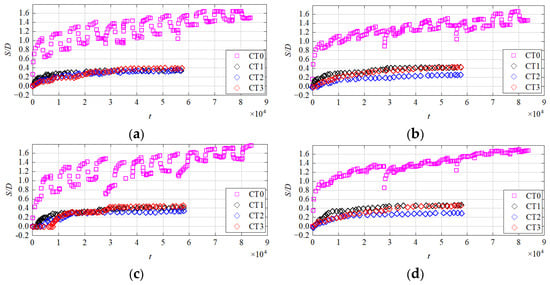
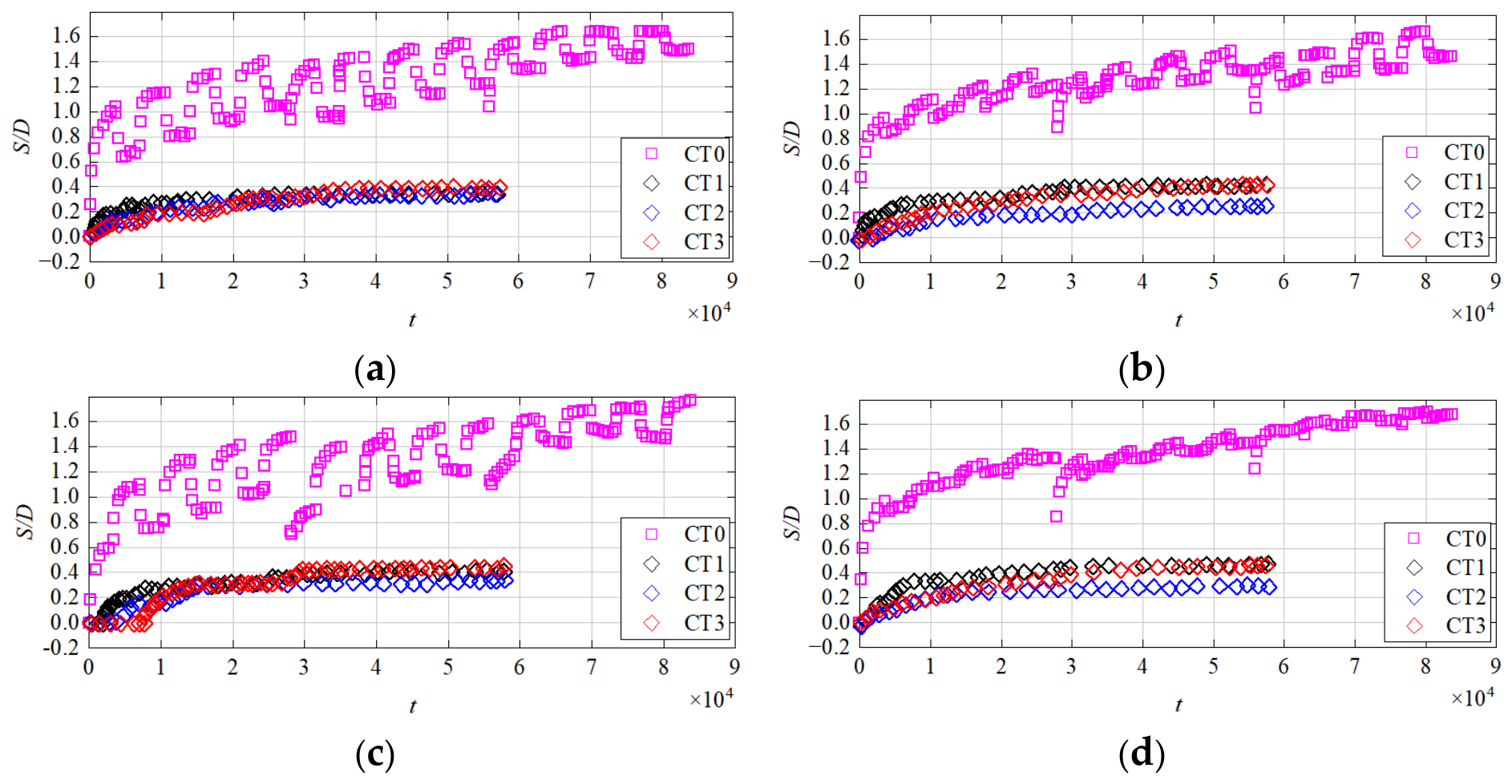
To further clarify the scour development under different flow conditions, Figure 15 compares the time-histories of scour depth at multiple measurement points. As shown in the figure, the scour depths for tests CT1-CT3 equipped with FCHB protection are markedly lower than those of CT0 (without FCHB protection). In addition, the temporal development of scour depth with different flow periods exhibits no prominent discrepancies. These results indicate that within the conditions investigated in the present study, the tidal-flow period exhibits negligible observable influence on the scour-protection performance. Whether this finding can be generalized to other conditions warrants further investigation.
Figure 15.
Temporal evolution of local scour depth at various measurement points for tests CT0, CT1, CT2 and CT3: (a) point 1; (b) point 2; (c) point 3; and (d) point 4.
The present study demonstrates that FCHBs serve as an effective scour countermeasure. Nevertheless, further in-depth investigations are still required to quantitatively clarify the influencing factors, refine relevant mechanisms, and provide targeted guidance for practical engineering applications.
4. Discussion
As sediment winnowing through the openings of FCHBs is identified as a key failure pathway, it is necessary to further clarify the hydraulic stability and scaling considerations of the armor blocks. The hydraulic stability of FCHBs and bed sediment mobility are governed by distinct scaling laws and should be treated separately. For the FCHBs used in this study, the stability parameter can be expressed as Nb = U/(ΔbgDb)0.5, the relative submerged density is defined as Δb = (ρb − ρ)/ρ and the nominal block size is Db = Vb1/3, where ρb and Vb are the density and volume of the FCHB. A smaller Nb corresponds to higher hydraulic stability of the block. The ratio bop/d50 can be used to characterize the potential for sediment winnowing through the openings of the blocks, where bop is the characteristic opening width. Based on the tested blocks, the volume is Vb = 8.06 cm3 and the material density is ρb = 2400 kg/m3. At the test velocity of U = 0.45 m/s, the stability parameter is Nb = 0.86. Furthermore, the characteristic opening width is bop = 2.01 cm, which gives a ratio of bop/d50 = 102. These parameters support the evaluation of the overall scour-protection performance of FCHBs. It should be noted that the geometry of individual FCHBs keeps constant across all tests in the present study. The present study mainly focuses on the influence of macroscopic layout schemes, i.e., coverage ratio and layer number. Accordingly, these block-related parameters are treated as fixed baseline conditions rather than experimental variables, and their influences are not investigated in the present study.
Complete dynamic similarity for both sediment transport and armor block stability cannot be satisfied simultaneously in this small-scale physical model. Accordingly, caution should be exercised when extrapolating the absolute quantitative results to prototype monopile foundations. Nevertheless, the relative trends and scour-protection mechanisms revealed in the experiments are considered robust and can provide useful references for practical engineering.
Although the armor blocks exhibit good scour-mitigation performance in laboratory oscillatory-flow tests, several practical limitations exist for real-field deployment. The laboratory flow, sediment and block-sediment relative-size conditions are simplified. This work is a mechanistic investigation, and scale effects are not considered in the present tests. These conditions cannot fully replicate the complex hydrodynamic and seabed conditions at offshore sites. Thus, caution is therefore needed when extrapolating these laboratory observations to full-scale field scenarios. In addition, construction deviations and uneven seabed may form gaps triggering sediment winnowing and cyclic wave-current loading may induce block displacement. Future improvements could focus on optimizing interlocking block geometry and adopting underlying filter layers to suppress edge scour and sediment winnowing. Moreover, all tests in this study were carried out under long-period oscillatory flow. Further experiments are required to explore the scour-protection behavior of FCHBs under the combined load of oscillatory flow and superimposed unidirectional current.
5. Conclusions
This study experimentally investigates the protection performance of FCHBs against local scour around monopile foundations under long-period oscillatory flow. The temporal evolution of local scour depth and the resulting scour topography were recorded throughout the tests. The effects of FCHB placement pattern, protection coverage, and number of block layers were examined to clarify the influence of the initial protection configuration on scour development. In addition, the effects of secondary FCHB placement and flow period on scour protection performance were also explored. The primary conclusions are summarized as follows:
- (1)
- The installation of FCHBs around the monopile foundations can effectively reduce local scour depth. For the tests with a protective coverage of 3.8D and 2-layer FCHB placement (Tests C1 and C2), the maximum scour depth was reduced by approximately 37.5% compared with the unprotected condition (Test C0). For the scheme with an expanded coverage of 5.2D with 3 FCHB layers (Test C5), the reduction rate reached about 75%.
- (2)
- Secondary placement of FCHBs (i.e., the addition of a third block layer after two hours of scour development) enhances scour protection performance near the monopile but may aggravate scour outside the protective coverage. This is because the additional layer effectively enlarges the foundation, inducing secondary scour at the outer boundary of the protective coverage. Accordingly, the elevation of the secondary protective layer should be strictly controlled in practical engineering to mitigate excessive edge scour.
- (3)
- Within the investigated range of flow periods (1 h, 2 h, and 4 h) and under the present hydraulic, sediment, and protection conditions, flow period has a negligible effect on the scour protection performance of FCHBs, as both scour depth and morphology remain highly consistent under the same flow velocity. Whether this finding can be generalized to other conditions warrants further investigation.
Author Contributions
Conceptualization, W.X. and T.Q.; methodology, T.Q. and W.X.; formal analysis, W.J.; investigation, Z.Z. and B.Z.; resources, G.T.; data curation, X.L.; writing—original draft preparation, W.X. and X.L.; writing—review and editing, W.X., H.T. and B.Z.; visualization, Z.Z.; supervision, G.T.; project administration, G.T.; funding acquisition, W.X. All authors have read and agreed to the published version of the manuscript.
Funding
This work was supported by the National Key R&D Program of China (Grant No. 2024YFB4207200).
Data Availability Statement
The data presented in this study are available on request from the corresponding author.
Conflicts of Interest
Authors Wenfei Xue, Tao Qi, Zirui Zhu, Weidong Ji, and Hong Tan were employed by Goldwind Science & Technology Co., Ltd. The remaining authors declare that the research was conducted in the absence of any commercial or financial relationships that could be construed as a potential conflict of interest.
References
- Wei, W.; Malekjafarian, A.; Salauddin, M. Scour Protection Measures for Offshore Wind Turbines: A Systematic Literature Review on Recent Developments. Energies 2024, 17, 1068. [Google Scholar] [CrossRef] [Scilit]
- Breusers, H.N.C.; Raudkivi, A.J. Scouring; Taylor & Francis Group: London, UK, 1991. [Google Scholar]
- Yao, W.; An, H.; Draper, S.; Cheng, L.; Zhao, M.; Jesudoss, J.S.; Tang, G. Experimental Study of Local Scour around Piles in Tidal Current. In Proceedings of the 20th Australasian Fluid Mechanics Conference, Perth, Australia, 5–8 December 2016. [Google Scholar]
- Escarameia, M.; May, R.W.P. Scour Around Structures in Tidal Flows; HR Wallingford: Wallingford, UK, 1999. [Google Scholar]
- McGovern, D.J.; Ilic, S.; Folkard, A.M.; McLelland, S.J.; Murphy, B.J. Time Development of Scour around a Cylinder in Simulated Tidal Currents. J. Hydraul. Eng. 2014, 140, 04014014. [Google Scholar] [CrossRef] [Scilit]
- Schendel, A.; Hildebrandt, A.; Goseberg, N.; Schlurmann, T. Processes and Evolution of Scour around a Monopile Induced by Tidal Currents. Coast. Eng. 2018, 139, 65–84. [Google Scholar] [CrossRef] [Scilit]
- Whitehouse, R.J.S.; Stroescu, E.I. Scour Depth Development at Piles of Different Height under the Action of Cyclic (Tidal) Flow. Coast. Eng. 2023, 179, 104225. [Google Scholar] [CrossRef] [Scilit]
- May, R.W.P.; Escarameia, M. Local Scour around Structures in Tidal Flows. In Proceedings of the First International Conference on Scour of Foundations, College Station, TX, USA, 17–20 November 2002. [Google Scholar]
- Wang, S.-Y.; Qi, W.-G.; Li, B.; Wang, C.; Gao, F.-P. Tidal Currents-Induced Scour Development around Pile Foundations: Effects of Flow Velocity Hydrograph. Coast. Eng. 2024, 191, 104533. [Google Scholar] [CrossRef] [Scilit]
- Chen, J.; Qu, Y.; Sun, Z. Protection Mechanisms, Countermeasures, Assessments and Prospects of Local Scour for Cross-Sea Bridge Foundation: A Review. Ocean Eng. 2023, 288, 116145. [Google Scholar] [CrossRef] [Scilit]
- Dargahi, B. Controlling Mechanism of Local Scouring. J. Hydraul. Eng. 1990, 116, 1197–1214. [Google Scholar] [CrossRef] [Scilit]
- Kumar, V.; Raju, K.G.R.; Vittal, N. Reduction of Local Scour around Bridge Piers Using Slots and Collars. J. Hydraul. Eng. 1999, 125, 1302–1305. [Google Scholar] [CrossRef] [Scilit]
- Chen, H.; Zhang, J.; Liang, D.; Tong, L.; Ji, Y.; Cai, S. Scour Reduction Performance of Multi-Layer Collars around a Cylindrical Monopile. Ocean Eng. 2026, 367, 128108. [Google Scholar] [CrossRef] [Scilit]
- Chiew, Y.-M. Scour Protection at Bridge Piers. J. Hydraul. Eng. 1992, 118, 1260–1269. [Google Scholar] [CrossRef] [Scilit]
- Wang, C.; Liang, F.; Yu, X. Experimental and Numerical Investigations on the Performance of Sacrificial Piles in Reducing Local Scour around Pile Groups. Nat. Hazards 2017, 85, 1417–1435. [Google Scholar] [CrossRef] [Scilit]
- Melville, B.W.; Hadfield, A.C. Use of Sacrificial Piles as Pier Scour Countermeasures. J. Hydraul. Eng. 1999, 125, 1221–1224. [Google Scholar] [CrossRef] [Scilit]
- Grimaldi, C.; Gaudio, R.; Calomino, F.; Cardoso, A.H. Control of Scour at Bridge Piers by a Downstream Bed Sill. J. Hydraul. Eng. 2009, 135, 13–21. [Google Scholar] [CrossRef] [Scilit]
- Tafarojnoruz, A.; Gaudio, R.; Calomino, F. Bridge Pier Scour Mitigation under Steady and Unsteady Flow Conditions. Acta Geophys. 2012, 60, 1076–1097. [Google Scholar] [CrossRef] [Scilit]
- Gaudio, R.; Tafarojnoruz, A.; Calomino, F. Combined Flow-Altering Countermeasures against Bridge Pier Scour. J. Hydraul. Res. 2012, 50, 35–43. [Google Scholar] [CrossRef] [Scilit]
- Lagasse, P.F.; Clopper, P.E.; Zevenbergen, L.W.; Girard, L.G. Countermeasures to Protect Bridge Piers from Scour; Transportation Research Board: Washington, DC, USA, 2007. [Google Scholar]
- Lauchlan, C.S.; Melville, B.W. Riprap Protection at Bridge Piers. J. Hydraul. Eng. 2001, 127, 412–418. [Google Scholar] [CrossRef] [Scilit]
- Lim, F.-H.; Chiew, Y.-M. Parametric Study of Riprap Failure around Bridge Piers. J. Hydraul. Res. 2001, 39, 61–72. [Google Scholar] [CrossRef] [Scilit]
- Chiew, Y.-M. Mechanics of Riprap Failure at Bridge Piers. J. Hydraul. Eng. 1995, 121, 635–643. [Google Scholar] [CrossRef] [Scilit]
- Behera, R.K.; Padhi, E.; Singhal, G.D. Recent Trends in Local Scour Countermeasure for Bridge Piers. Eng. Sci. Technol. Int. J. 2026, 77, 102367. [Google Scholar] [CrossRef] [Scilit]
- Xu, Y. Experimental Investigation of Scour around Vertical Piles in Steady Currents. Master’s Thesis, Dalian University of Technology, Dalian, China, 2019. [Google Scholar]
- Wang, X.; Huang, H.; Lin, P.; Yuan, J.; Liu, X.; Wang, M.; Wang, W. Detailed Observations of Edge Scour of Riprap Scour Protection for Offshore-Wind Monopile and Its Effect on Monopile’s Bearing Capacity. Appl. Ocean Res. 2025, 165, 104822. [Google Scholar] [CrossRef] [Scilit]
- Cui, J.; Bao, T.; Ding, X.; Tang, C.; Li, T.; Zhou, W. Scour Prediction, Monitoring, and Protection Measures for Offshore Wind Turbines: Recent Advancements and Insights. Ocean Eng. 2025, 339, 122194. [Google Scholar] [CrossRef] [Scilit]
- Wang, G.; Xu, S.; Zhang, Q.; Zhang, J. An Experimental Study of the Local Scour Protection Methods around the Monopile Foundation of Offshore Wind Turbines. Ocean Eng. 2023, 273, 113957. [Google Scholar] [CrossRef] [Scilit]
- Zhao, M.; Cheng, L.; Zang, Z. Experimental and Numerical Investigation of Local Scour around a Submerged Vertical Circular Cylinder in Steady Currents. Coast. Eng. 2010, 57, 709–721. [Google Scholar] [CrossRef] [Scilit]
- Soulsby, R. Dynamics of Marine Sands; Thomas Telford: London, UK, 1997. [Google Scholar]
- Dhamelia, V.; Zhao, M.; Hu, P.; Palmer, H.; Munir, A. Experiment Investigation of Scour and Self-Burial of Sagging Subsea Pipelines in Steady Current. Ocean Eng. 2025, 340, 122211. [Google Scholar] [CrossRef] [Scilit]

Disclaimer/Publisher’s Note: The statements, opinions and data contained in all publications are solely those of the individual author(s) and contributor(s) and not of MDPI and/or the editor(s). MDPI and/or the editor(s) disclaim responsibility for any injury to people or property resulting from any ideas, methods, instructions or products referred to in the content. |
© 2026 by the authors. Licensee MDPI, Basel, Switzerland. This article is an open access article distributed under the terms and conditions of the Creative Commons Attribution (CC BY) license.