


When this Special Issue was conceived, the aim was to capture a field that is changing quickly. Ship fluid mechanics has always been rooted in classical hydrodynamics, but the questions now being asked are broader, and the tools available to answer them are considerably more powerful [1,2,3]. High-fidelity CFD, multiphase modelling, fluid–structure interaction, data-driven methods, and improved experimental techniques are increasingly being used together rather than in isolation [4,5]. At the same time, the expectations placed on marine engineering have changed: hydrodynamic performance must now be considered alongside safety, energy efficiency, environmental impact, and real operational conditions [6].
The nine papers collected in this Special Issue reflect that transition. They do not follow a single methodological path, nor should they. Instead, they show how modern ship fluid mechanics is expanding from the prediction of resistance, propulsion, and motions towards a more integrated understanding of ships and marine systems. Across the collection, fluid mechanics becomes a link between physical behaviour and engineering decisions, from submarine wakes and emergency surfacing to LNG sloshing, propeller cavitation, air lubrication, ship–helicopter interaction, accident reconstruction, and hull-surface conditions.
A particularly clear theme is the increasing fidelity with which complex flow fields can now be represented. Lu et al. (Contribution 1) investigated the coupled hydrodynamic and thermal wake of an underwater vehicle using Delayed Detached Eddy Simulation together with the Volume of Fluid method. By considering different speeds, submergence depths, and thermal-discharge conditions, the work moves beyond a conventional resistance calculation and examines the structure and persistence of wake signatures. This is representative of a broader shift in naval hydrodynamics: the quantity of interest is no longer always a single integrated coefficient but may instead be the evolution of a three-dimensional, unsteady, and multiphysics flow field.
The contribution by Guo et al. (Contribution 2) approaches a related problem from a very different direction. Their spatio-temporal graph neural network combines graph-based learning with recurrent modelling to predict SUBOFF flow fields on unstructured grids. This is important because unstructured CFD meshes are natural representations of complex marine geometries, yet they are not easily handled by conventional image-based neural networks. The study shows the potential for data-driven models to reproduce the temporal development of hydrodynamic fields at a fraction of the computational cost of conventional CFD. Rather than suggesting that machine learning should replace physics-based simulation, the paper points towards a more useful future relationship: high-fidelity CFD can generate physically meaningful information, while carefully constructed learning models can make that information available much more rapidly for design exploration, optimisation, and real-time applications.
Safety-critical submarine operation is addressed by Chen et al. (Contribution 3), who developed a coupled numerical treatment of high-pressure air expulsion from ballast tanks and emergency surfacing motion. Emergency surfacing is inherently a system problem: tank pressure, water discharge, buoyancy, vehicle motion and the surrounding flow evolve together. Treating these processes independently can cause important feedback between them to be missed. The study therefore illustrates another defining direction in modern marine simulation—the move from isolated component models towards coupled models that better represent how a vessel actually behaves in operation.
Multiphase and coupled phenomena also feature strongly elsewhere in this collection. Zhao et al. (Contribution 4) investigated sloshing and boil-off gas generation in Type B LNG tanks during emergency stopping. The study connects violent liquid motion with heat and mass transfer and demonstrates that filling condition and vessel motion can influence both impact loading and BOG behaviour. Problems of this kind remind us that “fluid mechanics” in marine engineering is rarely only about the flow: the practical consequences may involve structural safety, cargo management, thermal processes, and operational decisions.
Huang et al. (Contribution 5) provide a complementary example through their investigation of composite propeller cavitation using two-way fluid–structure interaction. The hydrodynamic loading deforms the propeller, while that deformation in turn changes the hydrodynamic and cavitation response. By examining different ply orientations, the study treats structural tailoring as part of hydrodynamic design. This is a valuable perspective. As propulsion systems become lighter and more adaptable, the boundary between structural design and fluid-mechanical design becomes less distinct, and meaningful optimisation increasingly requires both to be considered together.
The interaction between complex flows and marine operations is further illustrated by Ma et al. (Contribution 6), who studied a helicopter hovering over a ship flight deck using unsteady CFD coupled with an aerodynamic trim procedure. The ship airwake and rotor flow form a strongly unsteady aerodynamic environment, while the aircraft controls must continually respond to the resulting loads. Although this problem sits at the interface between marine and aerospace engineering, it belongs naturally within modern ship fluid mechanics because safe shipboard aviation depends directly on understanding the flow field generated around the vessel and its interaction with the aircraft.
Two papers in the collection address a challenge that is becoming central to shipping: reducing energy use and emissions through better control of the flow close to the hull. Min et al. (Contribution 7) examined the sensitivity of CFD predictions for air-lubrication systems to numerical modelling choices. Air lubrication is attractive because of its potential to reduce frictional resistance, but the air–water interface and the resulting air-layer behaviour are difficult to predict reliably. By systematically examining modelling parameters against experimental observations, the study provides something particularly useful to the community: not simply another numerical result, but guidance on how such results should be generated and interpreted.
Bordbar et al. (Contribution 8) focused on the other side of the same near-wall problem—the effect of real surface conditions on turbulent skin friction. Combining surface characterisation with RANS- and LES-based analysis, the study considered coated, biofouled, and post-cleaning marine surfaces. Its importance lies as much in the methodology as in the individual predictions: it creates a route from measured surface topography to an engineering estimate of hydrodynamic penalties. The work also highlights the need for caution when linking surface treatment directly to performance changes, particularly when coating conditions and water exposure may also influence the measured roughness. This type of careful interpretation is essential if laboratory and numerical research is to inform practical hull-maintenance and decarbonisation decisions.
The paper by Kim and Valanto (Contribution 9) offers another perspective on the role of computation in marine safety. Revisiting the MV Estonia accident, the authors combined numerical simulations of flooding and sinking with a statistical treatment involving multiple random wave sequences. In accident reconstruction, a single simulation can demonstrate that a scenario is possible, but it cannot establish how likely that behaviour is relative to alternative scenarios. The use of simulation ensembles therefore represents an important methodological step towards uncertainty-aware forensic hydrodynamics. More broadly, the study shows that numerical methods can contribute not only to the design of future vessels but also to the careful interpretation of complex events from the past.
Taken together, these nine contributions reveal several common lessons. The first is that higher fidelity is useful only when it is accompanied by verification, validation and an understanding of modelling uncertainty [7]. Whether the method is DDES, URANS, LES, VOF, FSI or a neural network, complexity alone does not guarantee insight. The second is that coupling matters. Many of the most important marine problems arise precisely because flow interacts with something else: heat transfer, structural deformation, internal flooding, control systems, free-surface motion or operational manoeuvres. The third is that computational efficiency is becoming almost as important as computational accuracy. High-fidelity methods remain indispensable, but the growing use of surrogate modelling, graph learning, and reduced-cost numerical strategies reflects the need to bring sophisticated hydrodynamics into optimisation loops, digital twins, and operational decision support.
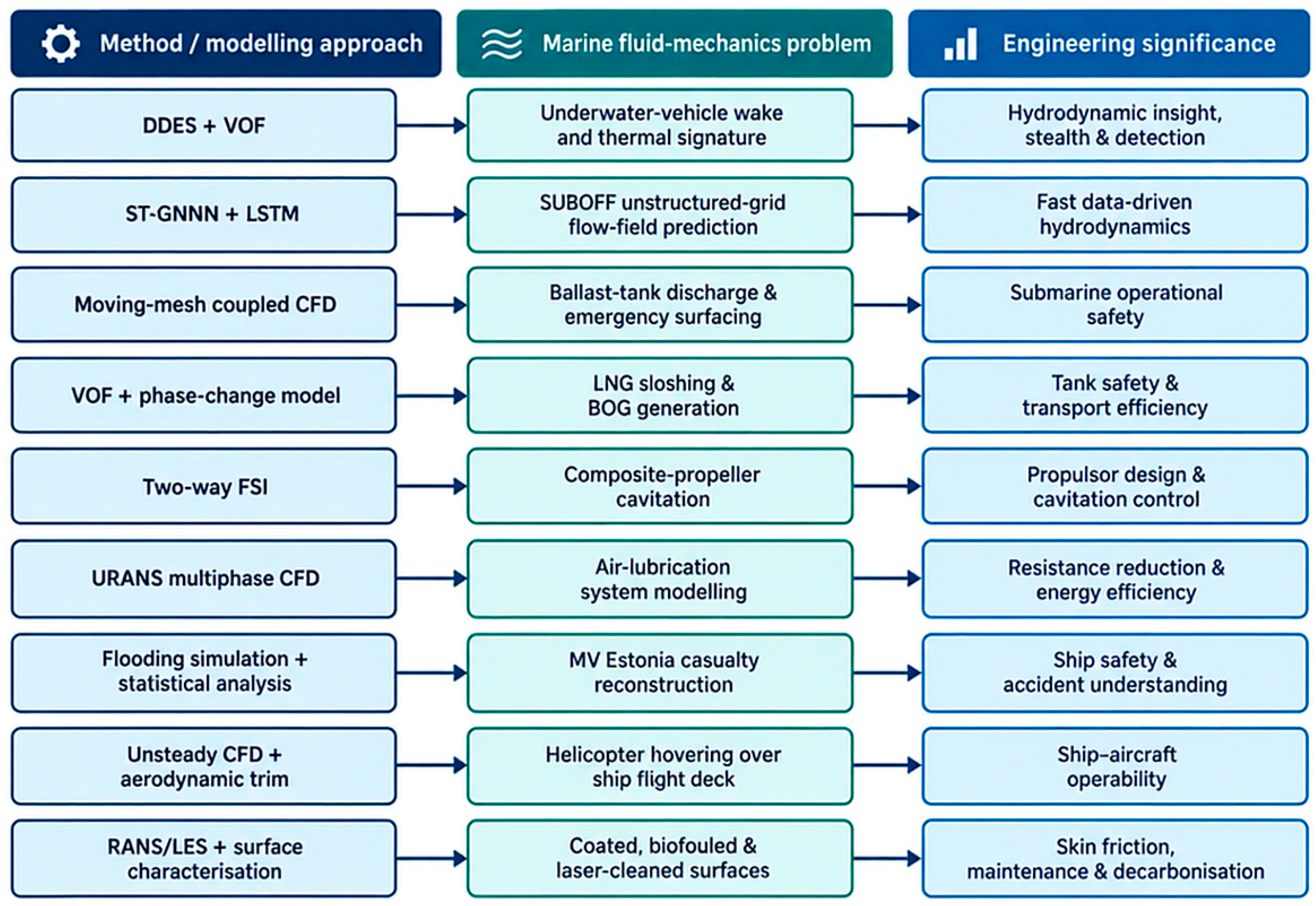
Figure 1 summarises this breadth by linking the principal modelling approach of each contribution with the marine problem addressed and its wider engineering significance. The figure also makes clear that the papers are connected less by one numerical technique than by a common direction: using better representations of fluid behaviour to make marine engineering decisions safer, faster, and more sustainable.
Figure 1.
Thematic map of the nine contributions to the Special Issue Advanced Studies in Ship Fluid Mechanics, showing the relationship between their principal modelling approaches, marine applications, and wider engineering significance.
Looking ahead, I expect this convergence to continue. The next stage of ship fluid mechanics will likely combine high-fidelity physics-based simulations with data-driven acceleration, a method increasingly supported by full-scale measurements. Physics-informed and graph-based learning, uncertainty quantification, differentiable and adjoint methods, improved multiphase modelling, and real-time digital-twin applications all offer considerable opportunities. Yet the fundamental challenge remains familiar: models must represent the important physics at the level of accuracy required by the engineering decision. Maintaining that connection between sophisticated methods and meaningful physical understanding will be crucial.
It has been a pleasure to serve as the Guest Editor for this Special Issue. I am grateful to all authors for entrusting their work to this collection and to the reviewers whose careful assessments helped strengthen the published papers. I also thank the editorial team of the Journal of Marine Science and Engineering for their support throughout the process. I hope that readers will find the collection useful not only as a record of current advances but also as an indication of where ship fluid mechanics is heading: towards a more connected discipline in which computation, experiments, data, and engineering judgement work together to address the increasingly complex demands placed on ships and marine systems.
Funding
This research received no external funding.
Acknowledgments
We sincerely thank all authors, reviewers, and the JMSE editorial team for their valuable contributions, constructive feedback, and professional support in making this Special Issue possible.
Conflicts of Interest
The author declares no conflicts of interest.
List of Contributions
- Lu, Y.; Cui, J.; Liu, B.; Shi, S.; Shao, W. Wake Characteristics and Thermal Properties of Underwater Vehicle Based on DDES Numerical Simulation. J. Mar. Sci. Eng. 2025, 13, 1371. https://doi.org/10.3390/jmse13071371.
- Guo, W.; Cheng, C.; Huang, C.; Lu, Z.; Chen, K.; Ding, J. A Spatio-Temporal Graph Neural Network for Predicting Flow Fields on Unstructured Grids with the SUBOFF Benchmark. J. Mar. Sci. Eng. 2025, 13, 1647. https://doi.org/10.3390/jmse13091647.
- Chen, J.; Peng, L.; Lv, B.; Pan, W.; Wang, Y. Coupled Simulation Study on the High-Pressure Air Expulsion from Submarine Ballast Tanks and Emergency Surfacing Dynamics. J. Mar. Sci. Eng. 2025, 13, 1769. https://doi.org/10.3390/jmse13091769.
- Zhao, H.; Wu, G.; Chen, J.; Pu, X.; Wang, S.; Yuan, Y.; Sun, A. Impact of Fluid Sloshing on BOG Generation in Type B LNG Tanks During Ship Emergency Stops. J. Mar. Sci. Eng. 2025, 13, 2100. https://doi.org/10.3390/jmse13112100.
- Huang, Z.; Chen, Z.; Lin, S.; Wu, S. Influence of Ply Angle on the Cavitation Performance of Composite Propellers. J. Mar. Sci. Eng. 2025, 14, 57. https://doi.org/10.3390/jmse14010057.
- Ma, C.; Wang, Y.; Zhao, N. Numerical Investigation of Unsteady Airloads for a Helicopter Hovering over a Ship Flight Deck. J. Mar. Sci. Eng. 2026, 14, 1500. https://doi.org/10.3390/jmse14161500.
- Min, G.; Yun, H.; Do, Y.; Kim, K.; Jung, K.; Dai, S.; Atlar, M.; Kim, D.; Kim, S.; Kim, S.; et al. Influence of CFD Modelling Parameters on Air Injection Behaviour in Ship Air Lubrication Systems. J. Mar. Sci. Eng. 2026, 14, 234. https://doi.org/10.3390/jmse14020234.
- Bordbar, A.; Georgoulas, K.; Nazemian, A.; Aung, M.Z.; Tadros, M.; Savitski, V.; Gardner, A.; Dai, S.; Boulougouris, E. Investigation of Turbulent Skin Friction Behaviour over Coated, Biofouled, and Laser-Cleaned Marine Surfaces. J. Mar. Sci. Eng. 2026, 14, 1599. https://doi.org/10.3390/jmse14171599.
- Kim, S.; Valanto, P. Revisiting the MV Estonia Accident Using Numerical Simulations with a Statistical Approach. J. Mar. Sci. Eng. 2026, 14, 503. https://doi.org/10.3390/jmse14050503.
References
- Visonneau, M.; Deng, G.; Guilmineau, E.; Leroyer, A.; Queutey, P.; Wackers, J. Computational Fluid Dynamics for Naval Hydrodynamics. Comptes Rendus Mécanique 2024, 350, 187–205. [Google Scholar] [CrossRef] [Scilit]
- Ghadimi, P.; Nazemian, A. Bow Shape Modification through Multi-Objective Hydrodynamic Optimization: Methodology Comparison between CAD-Based FreeForm Deformation and Mesh-Based Radial Basis Function Approach. Proc. Inst. Mech. Eng. Part M J. Eng. Marit. Environ. 2022, 236, 658–675. [Google Scholar] [CrossRef] [Scilit]
- Stern, F.; Yang, J.; Wang, Z.; Sadat-Hosseini, H.; Mousaviraad, M. Computational Ship Hydrodynamics: Nowadays and Way Forward. Int. Shipbuild. Prog. 2013, 60, 3–105. [Google Scholar]
- Karniadakis, G.E.; Kevrekidis, I.G.; Lu, L.; Perdikaris, P.; Wang, S.; Yang, L. Physics-Informed Machine Learning. Nat. Rev. Phys. 2021, 3, 422–440. [Google Scholar] [CrossRef] [Scilit]
- Brunton, S.L.; Noack, B.R.; Koumoutsakos, P. Machine Learning for Fluid Mechanics. Annu. Rev. Fluid Mech. 2020, 52, 477–508. [Google Scholar] [CrossRef] [Scilit]
- International Maritime Organization (IMO). 2023 Imo Strategy on Reduction of GHG Emissions from Ships; Brill Publishers: Leiden, The Netherlands, 2023. [Google Scholar]
- Maki, K.; Zhao, F.; Horn, P.; Banks, J.; Martio, J.; Starke, B.; Zaghi, S.; Villa, D.; Vitola, M.; Yoon, H.S.; et al. Practical Guidelines for Ship CFD Applications, ITTC Recommended Procedures and Guidelines 7.5-03-02-03, Revision 02; ITTC International Towing Tank Conference: Zürich, Switzerland, 2024. [Google Scholar]
Disclaimer/Publisher’s Note: The statements, opinions and data contained in all publications are solely those of the individual author(s) and contributor(s) and not of MDPI and/or the editor(s). MDPI and/or the editor(s) disclaim responsibility for any injury to people or property resulting from any ideas, methods, instructions or products referred to in the content. |
© 2026 by the author. Licensee MDPI, Basel, Switzerland. This article is an open access article distributed under the terms and conditions of the Creative Commons Attribution (CC BY) license.