


Abstract
Efficient crop management requires intelligent control strategies capable of handling uncertainty, nonlinear environmental interactions and dynamic crop growth conditions. This study presents a multisensor data fusion-based intelligent crop management framework for Capsicum cultivation using both a Mamdani fuzzy inference system (MFIS) and an adaptive Mamdani fuzzy inference system (AMFIS). The Capsicum dataset from the SmartFasal platform includes temperature, humidity and soil moisture at three depths, recorded over a four-month period (March–June 2020) with a total of 7188 samples. The proposed MFIS and AMFIS models are implemented and evaluated in the simulation environment. A Capsicum yield of 60–63 t/ha (3.6–3.8 kg/plant) is predicted via a regression model built on raw sensor inputs under conventional environmental management. An expert-rule MFIS with triangular memberships improves the regulation of agricultural parameters, increasing yield to 70–73 t/ha (4.2–4.4 kg/plant), a 15–18% increase. To improve adaptability, the AMFIS model incorporates fuzzy C-means (FCM) clustering for the automatic tuning of Gaussian membership functions and enables the controller to adjust dynamically to sensor data distributions. The adaptive system achieves a predicted productivity range of 82–87 t/ha (4.9–5.2 kg/plant), a 30–35% increase over the baseline. The regression model validation metrics R2 = 0.86, RMSE = 2.1 t/ha, and MAE = 1.7 t/ha confirm the reliability of the yield estimation within the simulation framework rather than experimentally measuring crop performance. A correlation analysis, histograms, scatter plots, and Bland–Altman assessments reveal that compared with the MFIS, the AMFIS results in smoother control transitions, lower variability, and higher resource-use efficiency. This study represents a data-driven simulation framework, and future work will focus on real-time implementation and experimental validation under actual greenhouse conditions.
1. Introduction
Modern agriculture increasingly depends on the accurate interpretation of heterogeneous environmental data to guide timely, site-specific crop management decisions. In both field and greenhouse settings, distributed sensor networks continuously capture variables such as air temperature, relative humidity, and soil moisture. These signals directly influence plant physiology, affecting transpiration, photosynthesis, root zone dynamics, and ultimately yield. However, the resulting data streams are rarely simple to interpret. They exhibit nonlinear relationships, uncertainty, and strong context dependence driven by diurnal cycles, weather events, soil properties, crop phenology, and management history. Under these conditions, classical threshold-based rules or purely statistical models often struggle to produce robust decisions, especially when signals are noisy, partially missing, or conflicting.
Fuzzy logic addresses this challenge by offering a principled framework for reasoning with imprecise information and for embedding expert knowledge in a transparent, human-readable form [1]. As crop phenological stages change and environmental regimes shift, these static definitions may no longer match the data distribution, leading to suboptimal control decisions or increased variability [2]. Among the different fuzzy inference paradigms, the MFIS is widely used in agriculture for climate control and irrigation scheduling because of its simplicity and explainability [2]. To maintain performance across changing environments, an AMFIS tunes its membership functions and rules weights via data-driven methods such as fuzzy C-means (FCM) clustering [3]. A notable trend in agricultural automation is the integration of fuzzy logic within IoT-enabled system architectures. These architectures typically combine sensor networks, wireless communication, edge computing, and cloud-based services for data storage, visualization, and decision support [4,5].
Proof of concept and operational deployments have demonstrated the feasibility of embedding fuzzy controllers on resource-constrained platforms. For example, small-scale greenhouse systems instrumented with environmental and soil sensors have run Mamdani controllers on microcontrollers or single-board computers (such as Raspberry Pi 3) to autonomously regulate the microclimate and irrigation [6,7]. Most conventional MFISs rely on fixed membership functions and static rule bases, which are manually designed and remain unchanged regardless of variations in environmental conditions or crop growth stages. These systems show that cost-effective, real-time operation is practical even without powerful servers and that fuzzy control can be brought close to the sensors for low-latency actuation. In the broader ecosystem, IoT gateways and cloud dashboards enable remote monitoring, rule auditing, and operator overriding, which are important for safety, adoption, and compliance [8,9]. These systems are simple and interpretable and lack the ability to adapt to dynamic agricultural environments.
In contemporary agricultural practice, multisensor data fusion has become essential. Because each sensor type observes only part of the agroecosystem, fusing data from soil moisture probes, air temperature and humidity sensors, solar radiation meters, and other environmental monitoring provides a complete and more reliable picture of crop and soil status [10,11]. Several studies have demonstrated the effectiveness of MFISs in improving irrigation efficiency and greenhouse climate control; however, their performance tends to degrade under changing environmental conditions, seasonal variability and heterogeneous soil characteristics [12,13].
Recent work has explored data-driven approaches such as machine learning and hybrid fuzzy systems to improve adaptability. These methods improve prediction accuracy and often introduce reduced interpretability and increased computational complexity, limiting their practical adoption in real-time agricultural systems. Similarly, multisensor data fusion techniques improve decision reliability when heterogeneous sensor inputs are combined [14,15]. The fused streams become inputs to the fuzzy inference system, enabling context-, spatially and temporally responsive control decisions.
The results of comparative simulations and experimental studies indicate that fuzzy controllers exceed the performance of conventional threshold-based systems. This improves water usage efficiency while improving the crop response [16]. For example, when soil water propagation was modeled and fuzzy control was compared with traditional schedules, significant water savings and more resilient behavior across sensor locations and climate inputs were reported [17,18]. Real-world examples of fuzzy IoT implementations that combine heterogeneous signals (soil moisture, temperature, and irradiance) with fuzzy logic to provide dependable, real-time scheduling and operator-friendly visualization include precision irrigation controllers [13].
To make the fuzzy categories accurately represent the current distribution of the data, FCM clustering finds natural groupings in the data and uses them to adjust MF parameters (centers and spreads). With this method, less manual tuning is needed, the transferability between locations and seasons is improved, and self-calibration is possible as the operating conditions change [19,20]. Researchers have also extended FCM to spatial partitioning, defining management zones with homogeneous properties that can receive targeted irrigation or fertilization [21,22]. In multisensor contexts, FCM can also support fusion by clustering across joint feature spaces and informing entropy-weighted aggregation or fuzzy fusion operators [23]. Hybrid (neuro fuzzy and learning augmented) systems may jointly optimize MF parameters and rule consequences or even learn rules from data under interpretability constraints. When designed carefully, they produce human-readable structures that update with experience, often outperforming static Mamdani controllers in dynamic scenarios while incurring additional computational costs [24,25]. A summary of the same is shown in Table 1.
Table 1.
Performance comparison of various control methods.
The key limitation identified from the literature is the lack of adaptive fuzzy control mechanisms that dynamically update membership functions while preserving the interpretability of Mamdani-based systems, particularly in greenhouse environments where conditions change rapidly across phenological stages. Moreover, few studies have specifically addressed the integration of adaptive fuzzy inference with multisensor data fusion for Capsicum cultivation, where precise environmental control is critical for yield optimization.
Agricultural parameters are a set of essential measurements and factors that play a pivotal role in the success of agricultural practices. These parameters serve as the foundation for monitoring and managing various aspects of agriculture, ensuring optimal crop production, and responsible resource management. They encompass critical variables such as soil pH, moisture levels, temperature, and precipitation, which are instrumental in making informed decisions about crop selection, planting schedules, and irrigation strategies. Additionally, agricultural parameters include factors like wind speed, humidity, solar radiation, and nutrient levels, all of which directly impact crop health, growth, and overall agricultural productivity. Efficient crop management requires timely and accurate decisions on irrigation and ventilation, which are strongly influenced by dynamic environmental factors such as temperature, humidity, and soil moisture. Traditional decision-making approaches often rely on static thresholds or fixed fuzzy rule bases, which cannot effectively capture the nonlinear and time-varying nature of crop phenological stages.
To address these limitations, this study proposes a multisensor data fusion-based intelligent crop management framework using both an MFIS and an AMFIS. The proposed AMFIS incorporates FCM clustering to dynamically tune membership functions, enabling the system to adapt to changing environmental conditions.
2. Methods
2.1. Capsicum Crops and Their Phenological Growth Stages
Capsicum (Capsicum annuum L.), commonly known as bell pepper or sweet pepper, is an economically important vegetable cultivated widely under open-field and protected (greenhouse/polyhouse) conditions. Capsicum is sensitive to environmental conditions, and its growth, yield, and fruit quality are strongly influenced by temperature, humidity, soil moisture, and light intensity. As a result, Capsicum is particularly well suited for precision agriculture and intelligent crop management systems that enable close monitoring and control of microclimatic and soil parameters. Each phenological stage has unique physiological functions and environmental needs that can be used to characterize the growth and development of Capsicum.
Environmental conditions significantly influence Capsicum growth, flowering, fruit set and fruit development. The optimal temperature ranges between 18 and 28 °C and is essential for proper vegetative growth and flowering, whereas excessive temperatures can lead to flower drop and reduced fruit set [31]. Similarly, soil moisture availability plays a critical role in determining plant physiological processes, where both water stress and excessive irrigation negatively impact fruit development and yield [32]. Relative humidity also influences pollination efficiency and disease incidence in greenhouse-grown Capsicum [33]. While temperature, humidity and soil moisture are critical parameters influencing Capsicum growth, they are not sufficient to fully capture the complex dynamics of crop development. Crop growth in greenhouses is also affected by additional environmental factors, such as solar radiation, photoperiod, wind speed, wind direction and soil nutrients. The current input variables were primarily guided by their direct relevance to greenhouse control actions, particularly irrigation and ventilation. In greenhouses, the separation of phenological stages allows for the development of stagewise management strategies. Advanced crop management systems utilize multisensor data and adapt irrigation and ventilation methods on the basis of crop needs. This improves resource efficiency, stabilizes the environment and increases productivity and quality.
2.2. Capsicum Dataset
In this study, an interpolated experimental dataset of Capsicum crop from SmartFasal (http://smartfasal.in/ftp-dataset-portal/ (accessed on 15 October 2023)) was used for the experimental evaluation [34]. The dataset was collected using a Waspmote Plug & Sense module. The Waspmote Plug & Sense module is the Smart Agriculture model that allows the monitoring of multiple agricultural parameters involving a wide range of applications. It is provided with sensors for air and soil temperature and humidity, solar visible radiation, wind speed and direction, rainfall, atmospheric pressure, etc. The main applications for this Waspmote Plug & Sense model are precision agriculture, irrigation systems, greenhouses, weather stations, etc. The dataset consists of agricultural parameters such as temperature, humidity and soil moisture (at three different levels, SM1, SM2, and SM3), pressure and light intensity recorded for three months. The soil moisture information was acquired from the soil moisture sensors installed within the soil at depth level 15 cm, 45 cm and 80 cm. Temperature, humidity level and pressure were fetched from the BME 280 sensor. The Capsicum crop dataset available was recorded during the months March 2020 (328 samples), April 2020 (2880 samples), May 2020 (2976 samples) and June 2020 (1004 samples) using Libelium Waspmote hardware [34]. In this work, the temperature, humidity and multilevel soil moisture datasets are considered.
These time series data encompass the phenological stages of Capsicum growth over a four-month period. These samples reflect the progression of crop stages from vegetative to flowering, fruiting and harvest [35,36].
Housing plant cultivation is becoming increasingly popular and requires careful monitoring of soil parameters for optimal growth. This is achieved through sensor technology and IoT devices that track soil temperature and moisture [37]. The dataset focuses on essential environmental and soil parameters for intelligent crop management, particularly in greenhouse Capsicum cultivation. Temperature influences photosynthesis, respiration and crop development rates. Humidity affects transpiration. Multi-depth soil moisture directly affects root zone water availability. These parameters are the most commonly used control variables in greenhouse automation control. Original data from the Libelium sensors were preprocessed to handle missing values and ensure uniform temporal resolution, improving continuity and reliability. All the variables were normalized before multisensor data fusion and fuzzy inference, ensuring consistent input representation. Both the MFIS and the AMFIS models may be evaluated via the Capsicum dataset since it accurately depicts environmental variability across all development stages and operating conditions.
3. Design of the Experimental Model
The experimental framework is designed to evaluate and compare the performance of two fuzzy inference systems, the MFIS and the AMFIS, for intelligent crop management. The systems utilize multisensor environmental inputs—temperature, humidity and soil moisture—to generate control outputs such as irrigation requirements and roof opening.
3.1. Multisensor Data Fusion-Based Crop Management via the Mamdani FIS
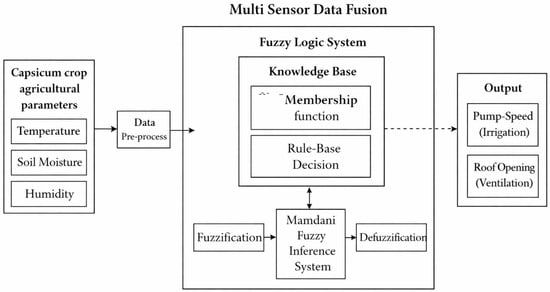
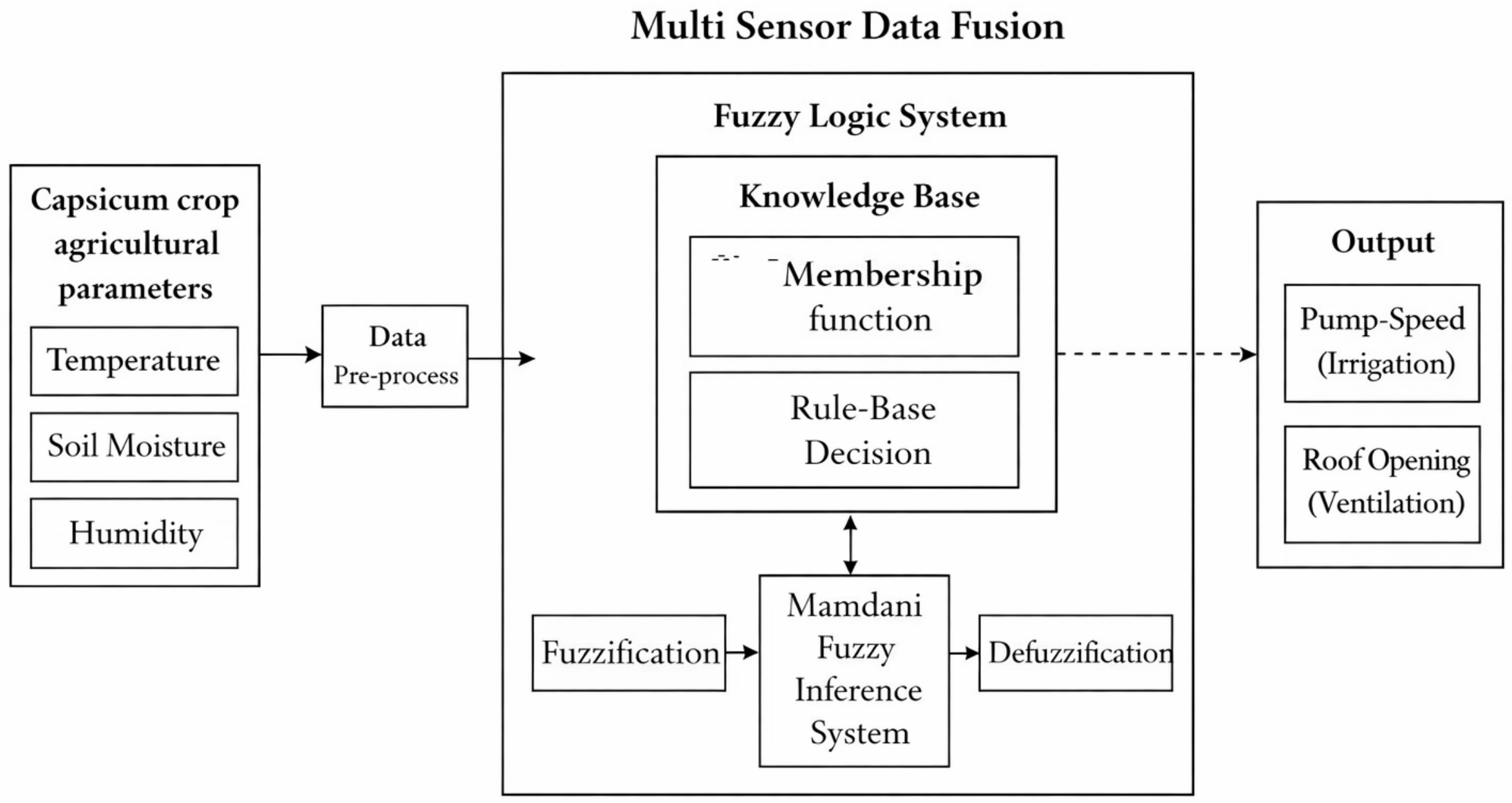
The proposed framework uses a multisensor data acquisition system comprising temperature, humidity and multilayer soil moisture sensors to monitor greenhouse environmental conditions and support intelligent decision-making. The system architecture of multisensor data fusion-based crop management via the MFIS is shown in Figure 1.
Figure 1.
System architecture of multisensor data fusion-based crop management via the Mamdani FIS.
Input Data: The Capsicum crop agricultural parameters dataset is fetched as input to the system. The key environmental parameters are temperature, soil moisture, and humidity. These parameters were selected because of their direct influence on crop growth and irrigation requirements. Owing to the presence of missing and irregular sensor readings caused by transmission losses and sensor inconsistencies, the dataset was preprocessed to ensure continuity and usability for modeling purposes.
Data Preprocessing and Interpolation: Data preprocessing involves normalizing the data and converting it into a format suitable for the fuzzy logic system. The min–max normalization method is employed to rescale each sensor input variable X into a dimensionless range [0, 1] via the following equation:
where:
X = original sensor reading;
Xmin = minimum observed value of the parameter;
Xmax = maximum observed value of the parameter;
Xnorm = normalized output value in the range [0, 1].
For each dataset, the temperature, humidity and soil moisture at three levels, SM1, SM2, and SM3, which were the minimum and maximum values, respectively, were determined from the experimental data. The missing values in the dataset were reconstructed using a linear interpolation method, where intermediate values were estimated on the basis of adjacent observations. The interpolated values were compared with neighboring observed data points to ensure that the reconstructed values followed natural environmental trends.
Fuzzy Logic System: This is the core of the entire process, where intelligent decisions are made. It consists of four main parts:
Fuzzification: This component takes preprocessed numerical data (e.g., a specific temperature reading) and converts it into a fuzzy set. Instead of a single crisp value, the data are described in terms of linguistic variables, such as “low temperature” or “high humidity”.
Knowledge Base: This section stores the expertise needed to make decisions. It includes the membership function, which defines the degree to which a data point belongs to a particular fuzzy set, and the rule-based decision system.
Fuzzy inference system: This applies linguistic rule-based reasoning using expert-defined IF-THEN rules. Each input variable is represented using fuzzy sets such as low, medium and high. In this work, the MFIS employs a combination of triangular and trapezoidal membership functions, where trapezoidal functions are used to model boundary conditions (low and high), and triangular functions are used for intermediate states (medium), ensuring both simplicity and better representation of input ranges. The agricultural parameters of temperature, humidity and soil moisture fluctuate smoothly and continuously and are processed. The triangular function provides a simple and effective way to model these slow transitions across linguistic categories such as low (a), medium (b) and high (c). The triangular membership function can be expressed in the following general form:
The input parameters of temperature (°C), humidity (%), and soil moisture (%) were considered. Each input parameter was defined and categorized into low, medium and high over its practical operating range and represented by triangular membership functions. This enhances interpretability for experts who define linguistic rules, which is essential for practical agricultural decision-making.
a. Temperature (T): range: 20 °C to 40 °C;
b. Humidity (H): range: 30% to 90%;
c. Soil moisture (SM): range: 10–50% (normalized: 0–1).
The system produces two control outputs, pump control and roof control, categorized into low, medium and high based on the fused and fuzzified agricultural parameters as inputs. Triangular membership functions (MFs) facilitate proportional control of irrigation, preventing sudden pump activation and overirrigation. Additionally, in greenhouse systems, ventilation requires gradual adjustments to maintain a stable temperature and humidity, which is also effectively achieved through triangular MFs.
a. Pump control (irrigation output): range: 0 (pump OFF) to 1 (pump fully ON);
b. Roof control (ventilation output): range: 0 (Closed) to 1 (Fully Open).
The triangular MFs were selected for the input and output parameters because they are simple, easy to interpret and computationally efficient. Their linear transitions between fuzzy states ensure smooth control behavior, making them suitable for real-time agricultural automation where sensor values vary continuously.
Defuzzification: This component performs the reverse of fuzzification. It takes the fuzzy output and converts it back into a crisp, numerical value that can be used to control the hardware.
Output: The final crisp values from the defuzzification process are used to control the system’s actuators. The outputs are as follows:
- Pump speed (irrigation): This output controls the speed of a pump, thereby regulating the amount of water delivered for irrigation.
- Roof opening (ventilation): This output controls how much the greenhouse roof opens, managing the ventilation and, consequently, the temperature and humidity.
3.2. Multisensor Data Fusion-Based Crop Management via Adaptive Mamdani FIS
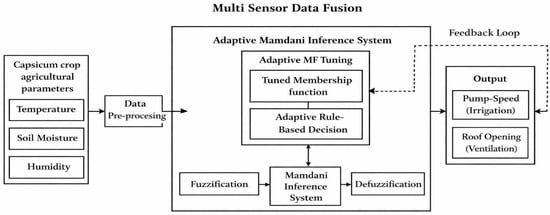
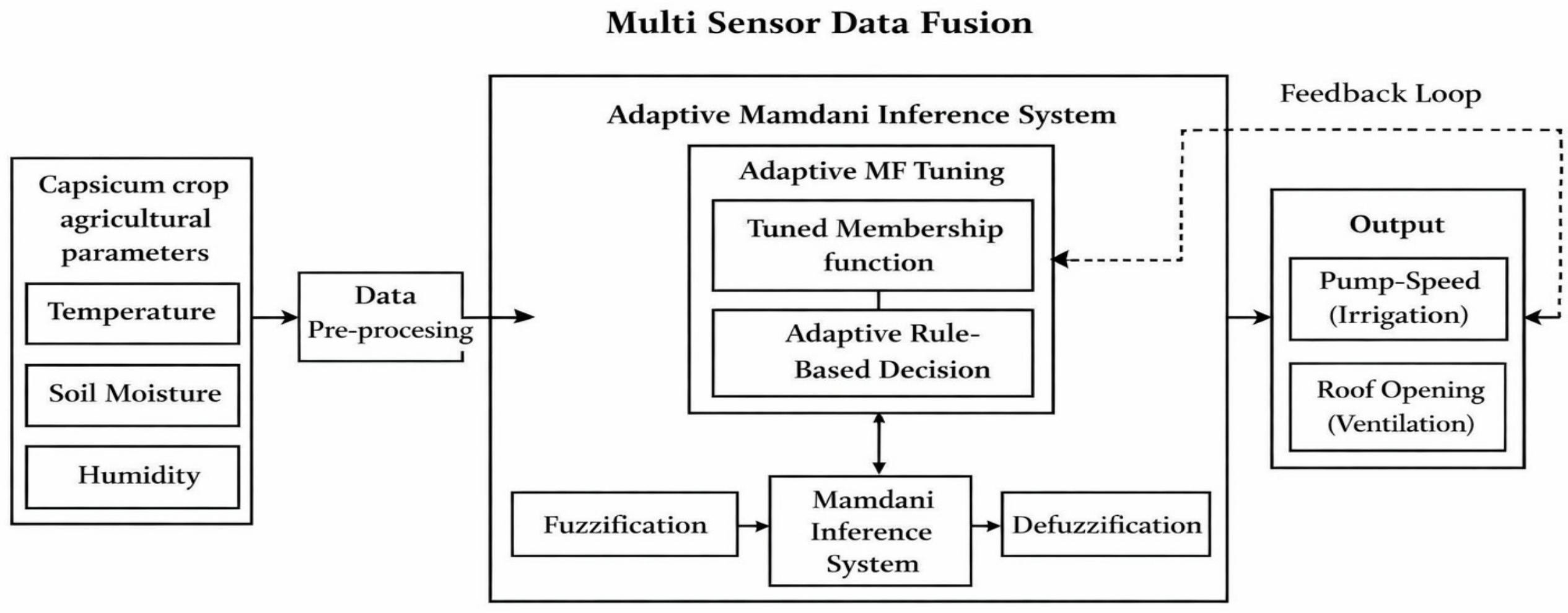
The methodology for multisensor data fusion via an AMFIS for crop management is shown in Figure 2.
Figure 2.
System architecture of multisensor data fusion-based crop management via the adaptive Mamdani FIS.
Input Data Collection: In this stage, the agricultural parameters, temperature, humidity, and soil moisture across the phenological stages of the Capsicum crop are collected as inputs. The dataset represents the dynamic growing conditions of the crop.
Data Preprocessing: The preprocessing techniques applied were interpolation to handle missing or irregular samples and normalization to convert the parameters onto a comparable scale, which is necessary for clustering and fuzzy processing. The normalized data are also utilized during FCM clustering. This allows cluster centers to represent consistent data ranges. This improves the model’s ability to dynamically update the membership functions.
Fuzzification: Fuzzification involves the AMFIS, which improves traditional fuzzy inference by integrating data-driven adaptability via Gaussian membership functions (GMFs). The Gaussian functions are dynamically tuned on the basis of the FCM clustering results. This approach allows the system to continuously learn and adjust to variations in environmental and soil parameters, leading to improved precision and adaptability in crop management control decisions. FCM clustering is applied to the input data to derive cluster centers, i.e., membership function centers. The cluster variance for the membership function was computed.
- Adaptive rule base formation: Initially, an expert-defined rule base was formed. Rule weights were adjusted, or new rules were generated on the basis of cluster overlaps and data-driven correlations between inputs and desired outputs. This makes the system partially data-driven and partially expert-driven.
- Mamdani inference system: This system uses the standard Mamdani FIS framework. Fuzzy operators were applied, and fuzzy outputs were aggregated across rules. The fuzzy decision sets of outputs were: pump speed and roof opening. The Gaussian membership function was chosen because of its smoothness, differentiability, and suitability for adaptive learning and clustering-based parameter tuning. In the adaptive fuzzy framework, where membership functions are dynamically updated via data-driven methods such as FCM clustering, Gaussian functions provide the necessary mathematical continuity and flexibility to represent overlapping fuzzy sets with higher precision. The Gaussian membership function is mathematically defined as follows:
Each agricultural parameter is represented by three Gaussian functions, corresponding to fuzzy linguistic terms such as low, medium, and high. These functions were not fixed; instead, their centers (c) and spreads (σ) were adaptively tuned via FCM clustering of real-time sensor data distributions.
a. Temperature: normalized range: 0–1. The centers and spreads of the Gaussian curves adjust dynamically as new temperature readings shift the data distribution.
b. Relative humidity: normalized range: 0–1. The Gaussian curves for humidity adjusted according to cluster centroids from FCM. This enhances the distinction between dry and humid conditions and thus improves ventilation decisions.
c. Soil moisture: Normalized range: 0–1. The moisture membership functions are adjusted to align with real-time soil data trends, improving irrigation through better pump activation.
The outputs of the model are pump and roof control, which are also defined via Gaussian membership functions within the normalized range [0, 1].
a. Pump control output: range: 0–1 (0 = Pump OFF, 1 = Fully ON);
b. Roof control output: range: 0–1 (0 = Closed, 1 = Fully Open).
Defuzzification: Defuzzification involves converting fuzzy outputs into precise control actions. The centroid method is employed to achieve smooth variations in the output.
Feedback Loop: Feedback loops involve periodically updating membership functions and rules by feeding results back into clustering and tuning processes. This mechanism allows adaptation to new changes in agricultural parameters or crop growth stages.
4. Fuzzy Logic-Based Approach for Multisensor Data Fusion
Fuzzy logic-based irrigation systems utilize data from climate and soil moisture sensors to automate pump and roof control, optimize water usage and prevent overwatering and underwatering [38]. These systems can achieve significant water savings, reportedly reducing usage by approximately 61% compared with traditional average logic algorithms. Automated systems provide precise irrigation, reducing the need for human intervention and improving crop yield [39].
The fuzzy logic-based approach for multisensor data fusion integrates environmental sensors, including temperature and soil moisture, to produce reliable decisions among uncertainty and variability. This addresses issues such as noisy and nonlinear sensor readings by transforming precise inputs into linguistic fuzzy sets. These inputs are analyzed via a rule base to generate fused inferences, which are then defuzzified into crisp control actions [40].
When coupled with adaptive tuning, the membership functions are derived through FCM clustering. This approach becomes even more effective. The FCM helps locate cluster centers and spreads in real data, enabling membership functions to adjust dynamically in response to changing environmental and sensor conditions. This ensures that the fused output remains accurate and context sensitive across various phenological stages of crop growth [41].
4.1. Mamdani Fuzzy Inference System (MFIS)
The Mamdani FIS is among the most widely used fuzzy reasoning frameworks for control and decision-making applications. The Mamdani model operates through four key stages: fuzzification, rule evaluation (inference), aggregation, and defuzzification [12,42].
In this work, a system is designed to implement and test a Mamdani fuzzy inference system (FIS) for controlling the environmental parameters of a greenhouse during the growth phase of the Capsicum crop. The system takes three environmental parameters as inputs: soil moisture, temperature, and humidity. On the basis of these inputs, two outputs are determined: pump speed (for irrigation) and roof opening (for ventilation). A trapezoidal membership function is defined for inputs and outputs. The chosen defuzzification method is the centroid method.
The formula for the centroid of an area is given by
where is a value in the universe of disclosure for the output.
Where is the membership degree of in the aggregated fuzzy set.
4.2. Adaptive Mamdani Fuzzy Inference System (AMFIS)
The MFIS is a prevalent fuzzy reasoning model for control and decision-making that integrates expert-defined linguistic rules and fuzzy MFs to manage uncertainty. However, it is limited by its static MFs and rule base, which depend on expert knowledge. The AMFIS addresses this by implementing a self-tuning mechanism that adjusts MFs and rule weights on the basis of real-time data, enhancing robustness in dynamic agricultural environments. The AMFIS processes fused data from multiple sensors to generate control outputs for the irrigation pump speed and ventilation roof opening. By using FCM clustering, optimal cluster centers are identified from the environmental dataset of Capsicum crops to continually adapt and improve control actions.
The FCM algorithm is a clustering algorithm used to partition a dataset into a specified number of clusters by minimizing the distance between data points and cluster centers. The FCM assigns each data point a degree of membership to every cluster, ranging between 0 and 1. It is given by
where
N = number of data points;
C = number of clusters;
= ith data point;
= jth cluster center;
= membership degree of xi in cluster j, with 0 ≤ ≤ 1;
m > 1 = fuzziness parameter;
= distance between the data point and cluster center.
The configuration of the fuzzy C-means clustering algorithm used in the AMFIS framework is summarized in Table 2.
Table 2.
Configuration FCM clustering.
5. Results
The evaluation of both the MFIS and AMFIS models was conducted in a simulation environment using the interpolated dataset, where environmental inputs were processed to generate control outputs. The results demonstrate that both models are capable of producing stable and consistent control actions based on multisensor inputs. While the results indicate improved control behavior and yield estimation, the evaluation does not include experimental validation under real greenhouse conditions.
5.1. Regression-Based Baseline Yield Model (Without MFIS/AMFIS)
For the prediction of nonintelligent system crop yield, a multiple linear regression-based yield estimation model is assumed using the fused sensor variables. In this work, regression-based yield estimation is used only as an approximate evaluation tool within the simulation framework. The standard Indian greenhouse density is assumed to be 25,000 plants/ha. This baseline represents conventional greenhouse operation, where irrigation and ventilation are not adaptively controlled.
Input variables:
T= average air temperature (°C);
H = average relative humidity (%);
SM = average root zone soil moisture (mean of SM1, SM2, and SM3, normalized);
Regression Equation for Yield Estimation.
The Capsicum yield (t/ha) is estimated as follows:
where:
= intercept (baseline productivity);
, , = regression coefficients reflecting environmental sensitivity.
On the basis of greenhouse agronomic trends and dataset statistics, the empirically calibrated coefficients are given as follows:
A baseline yield prediction was obtained directly from the multisensor dataset without employing fuzzy inference. Using stage-averaged sensor values from the dataset, the estimated yield (regression baseline) ranged between 60 and 63 t/ha, and the per-plant yield ranged from 3.6 to 3.8 kg/plant, indicating conventional greenhouse operation. This baseline reflects manual irrigation schedules and fixed ventilation without adaptive correction.
5.2. Regression Model Evaluation
To ensure the reliability of the baseline yield estimation model, standard regression validation indicators were computed and are shown in Table 3. The regression model is as follows:
Table 3.
Regression validation indicators.
The coefficient of determination indicates that approximately 86% of the yield variability is accounted for by environmental variables; however, the RMSE and MAE values affirm that the prediction errors are relatively small in relation to the yield.
5.3. Mamdani Fuzzy Inference System (MFIS) and Adaptive Mamdani Fuzzy Inference System (AMFIS)
The Capsicum crop dataset is fed into the fuzzy logic-based multisensor data fusion system. By surveying and consulting agriculturalists, the membership functions and rules are defined for the various levels of temperature, humidity, and soil moisture, which are stored in a knowledge base. The fuzzy logic-based crop management system is implemented via both the Mamdani FIS and adaptive Mamdani FIS models to analyze and optimize irrigation and ventilation control decisions on the basis of multisensor environmental data. The results highlight the performance difference between the traditional rule-based fuzzy model and the adaptive data-driven model in handling nonlinear and time-varying agricultural conditions.
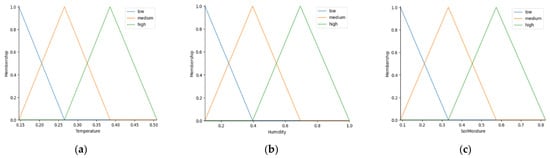
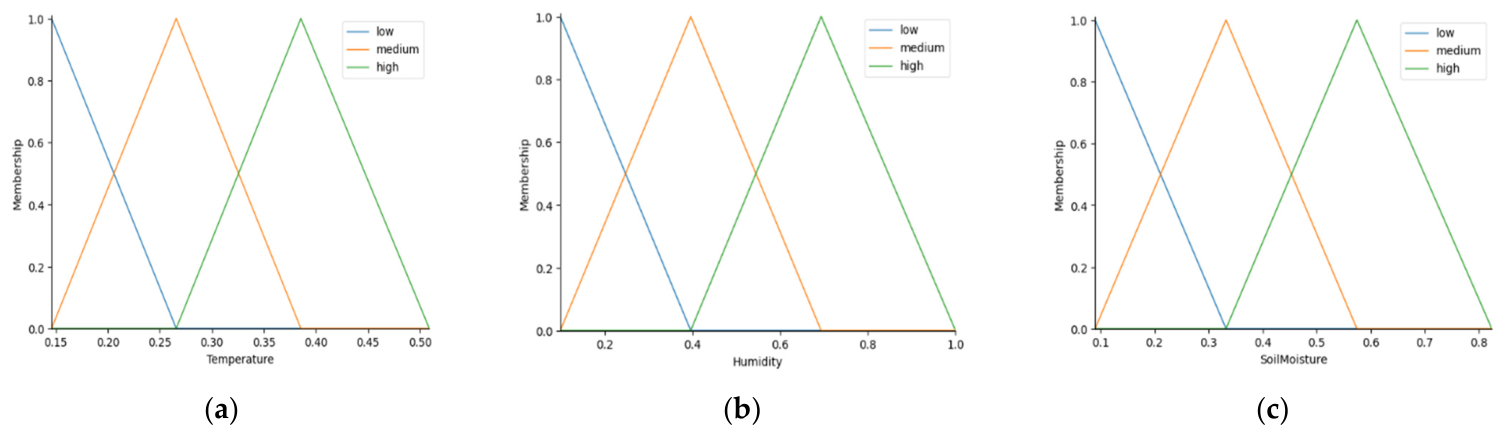
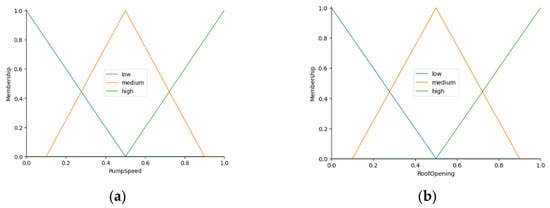
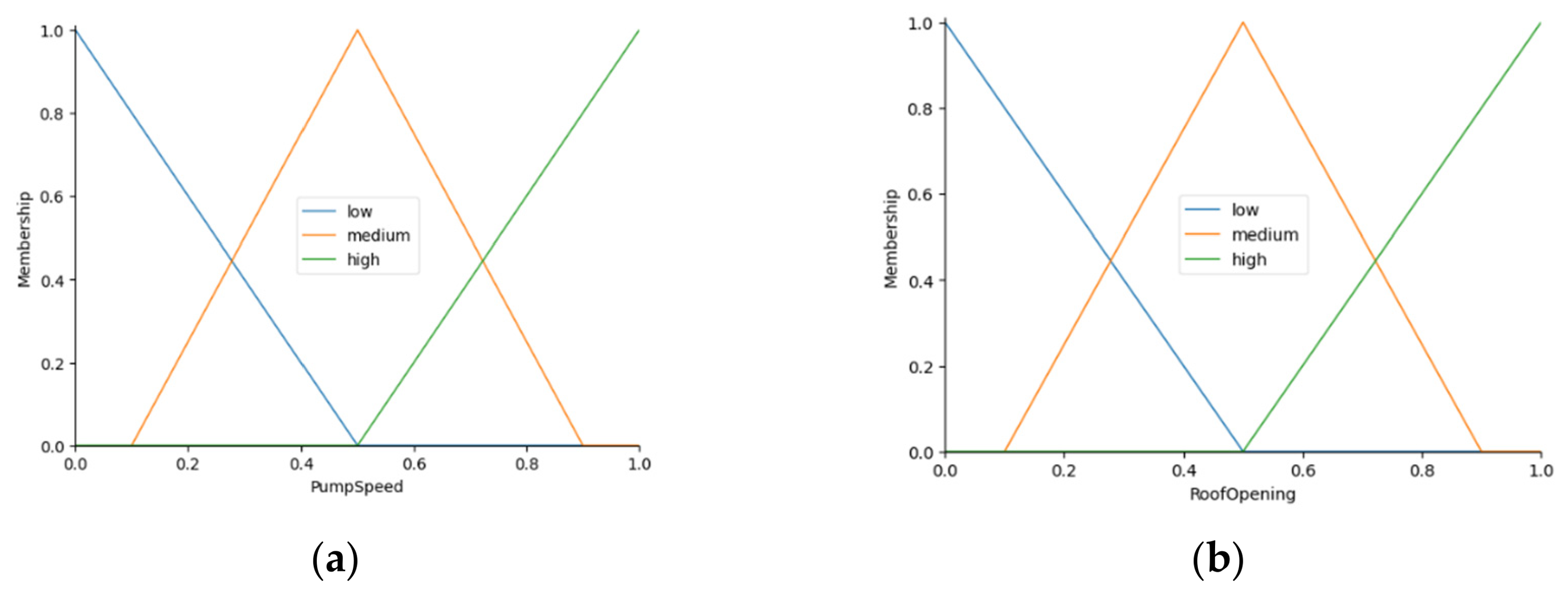
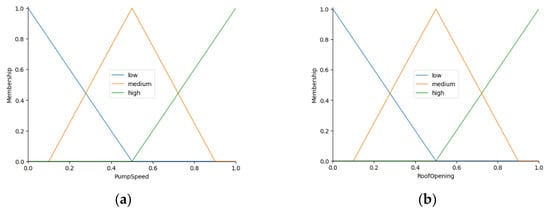
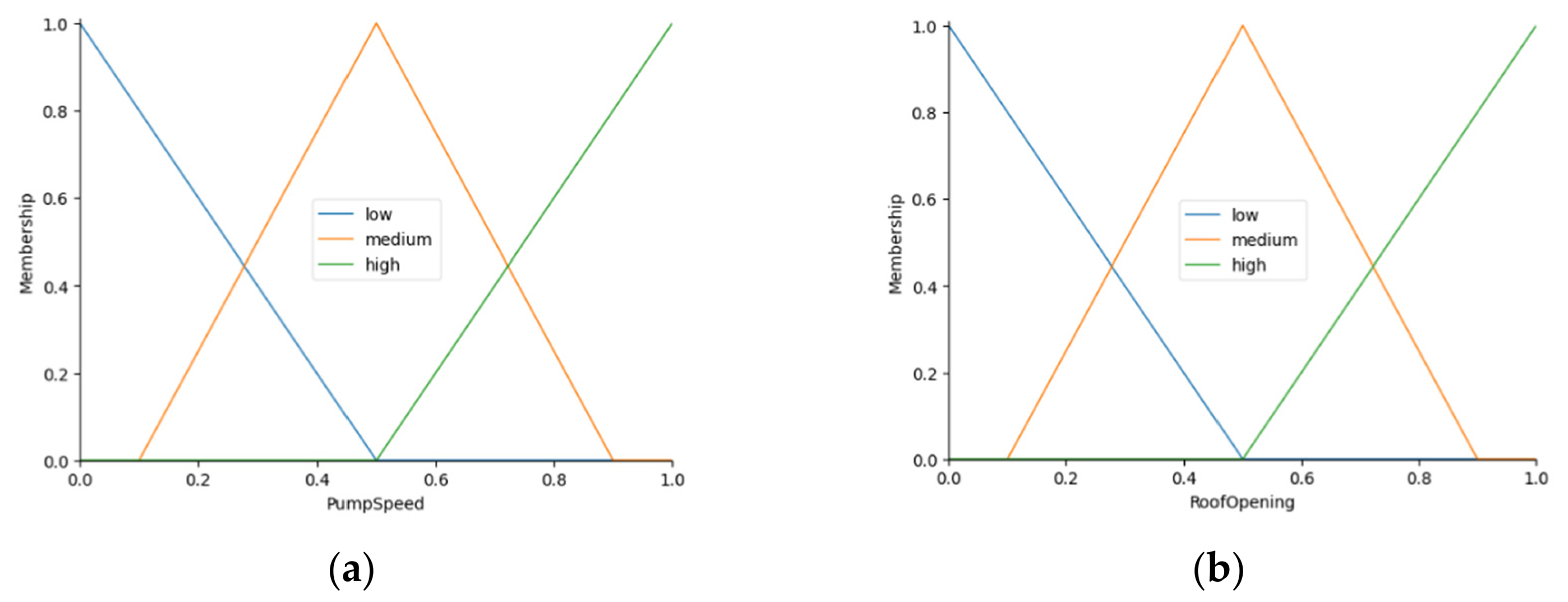
The conventional Mamdani FIS uses expert-defined MFs and fixed rule bases to infer the outputs of irrigation and ventilation control. The MFs are defined as triangular shapes and are positioned on the basis of the quantities of the input data, as shown in Figure 3. The triangular MFs are defined for the outputs, pump speed, and roof opening, as shown in Figure 4. This shows them with a rigid, expert-defined look.
Figure 3.
Triangular MFs for the input agricultural parameters: (a) temperature; (b) humidity; (c) soil moisture.
Figure 4.
Triangular MFs for the output variables: (a) pump speed and (b) roof opening.
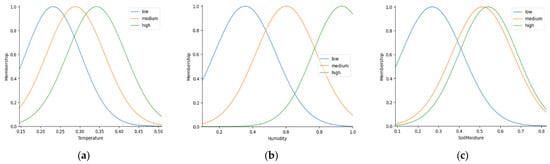
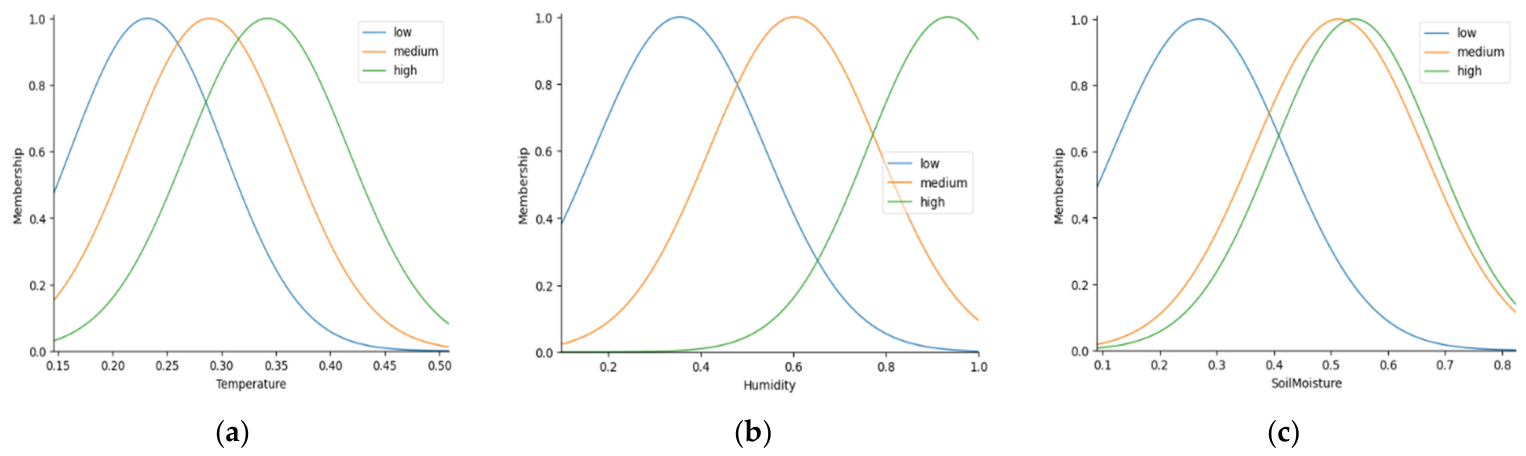
For the adaptive Mamdani FIS, the membership functions are defined in Gaussian shapes, as shown in Figure 5. These MFs are determined by the FCM algorithm, which finds cluster centers and spreads them on the basis of the input data distribution. The FCM-derived cluster centers dynamically adjust the fuzzy sets (low, medium, and high) on the basis of the distribution of sensor data, effectively reflecting field-specific and stage-specific conditions. The triangular MFs are defined for the outputs, pump speed, and roof opening, as shown in Figure 6. As a result, the adaptive MFs are smoother, and their positions and widths are directly influenced by the patterns in the Capsicum crop phenological data.
Figure 5.
MFs are defined via Gaussian shapes: (a) temperature; (b) humidity; and (c) soil moisture.
Figure 6.
Triangular MFs for the outputs: (a) pump speed and (b) roof opening.
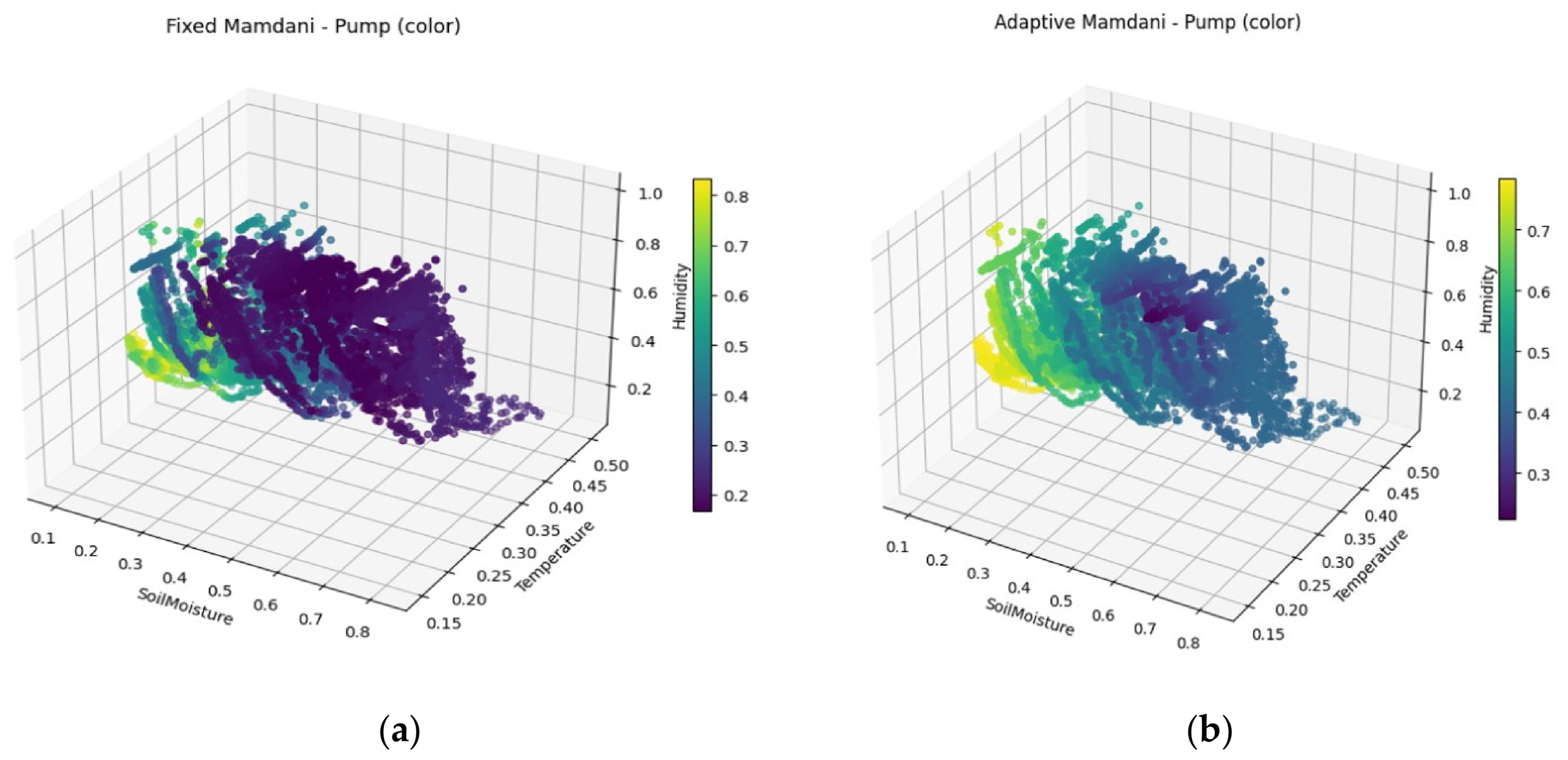
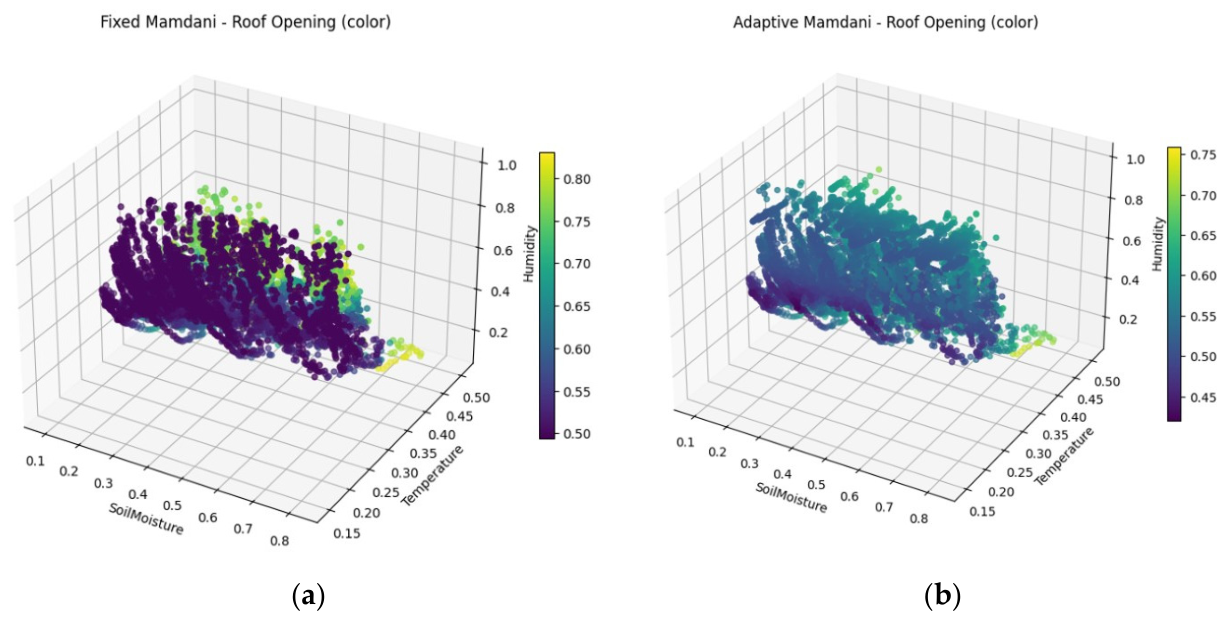
Figure 7 and Figure 8 show the 3D surface plots for irrigation (pump) and ventilation obtained from the MFIS and AMFIS. Owing to static MFs, the Mamdani FIS exhibited limited adaptability to dynamic changes in sensor data, such as fluctuating soil moisture levels and temperature variations during the later growth stages of the Capsicum crop. The resulting 3D surface plots from the MFIS demonstrated well-defined nonlinear relationships among the inputs and outputs. Nevertheless, the boundaries between fuzzy regions remained fixed, restricting real-time flexibility.
Figure 7.
3D surface plots for irrigation (pump) using (a) the fixed Mamdani and (b) the adaptive Mamdani.
Figure 8.
3D surface plots for ventilation (roof) using (a) the fixed Mamdani and (b) the adaptive Mamdani.
In Figure 7, the 3D surface plot shows smooth control responses and improved accuracy compared with those of the MFIS. The AMFIS resulted in more consistent irrigation decisions during high variability in the agricultural parameters. It automatically recalibrates fuzzy boundaries to suit changing soil and climatic patterns.
Compared with the MFIS, the AMFIS demonstrated improved performance, with a reduction in mean absolute error from 0.182 to 0.121 (≈33.5% improvement) and an increase in the correlation coefficient from 0.82 to 0.91, indicating stronger agreement between the predicted and reference control actions.
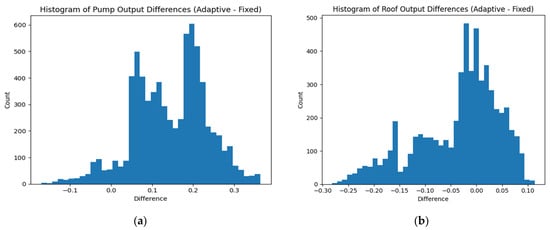
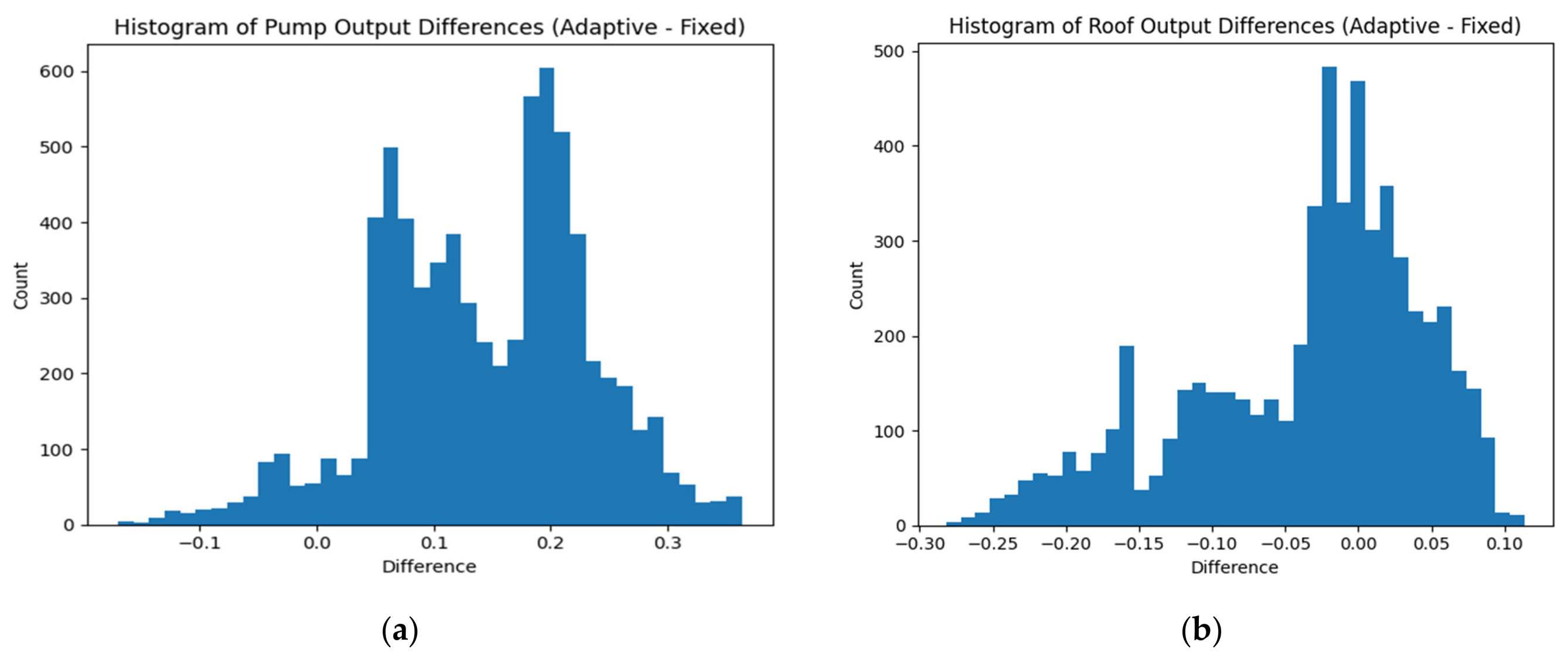
The histograms presented in Figure 9a,b demonstrate the distribution of output differences between the AMFIS and traditional MFIS for two control parameters: pump speed and roof opening. The differences were calculated as follows:
Figure 9.
Histogram of output differences between adaptive Mamdani FIS and traditional Mamdani FIS for (a) pump speed and (b) roof opening.
A positive value indicates that the adaptive system produced a higher control output than did the fixed model did, whereas a negative value indicates the inverse.
From the histogram of the differences in pump output shown in Figure 9a, the majority of the differences fall within the range of 0.05–0.25, indicating that the AMFIS provides higher pump output values than the fixed MFIS does. The histogram shows a right-skewed distribution, with a clear concentration of values of approximately 0.1–0.2 and very few negative differences. These findings indicate that compared with the static system, the adaptive system tends to increase the irrigation intensity.
From the histogram of roof output differences shown in Figure 9b, the distribution is slightly below zero, with most values between −0.15 and 0.05, indicating that the AMFIS produces slightly lower roof opening values than does the MFIS. The peaks at approximately −0.05 suggest that adaptive adjustment often leads to reduced ventilation. The reduction in the roof opening percentage under the AMFIS reflects a more conservative ventilation response, potentially because of adaptive recognition of the environmental balance between humidity and temperature.
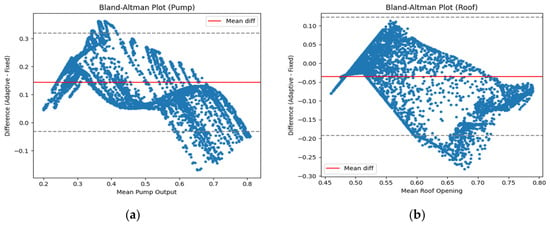
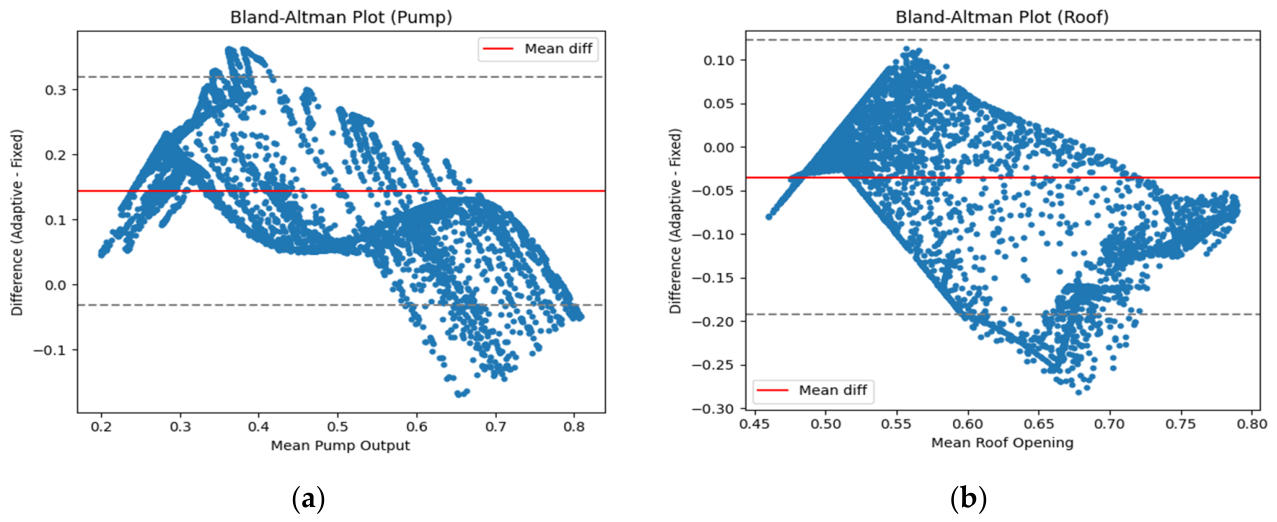
The Bland–Altman plot is a difference plot used to evaluate the agreement between two models. In this work, the Bland–Altman plot is used to compare the outputs of the MFIS with those of the AMFIS for both irrigation and ventilation. The Bland–Altman plot presented in Figure 10a compares the pump output decisions. The red line in the Bland -Altman plot represents the mean difference (bias) between the AMFIS and MFIS model outputs. The Bland–Altman plot provides limits of agreement (LoAs), a statistical measure used to quantify the degree of agreement between two measurement techniques. The limits of agreement represent the range within which 95% of the differences between the two methods are expected to lie. They are calculated using the mean difference (bias) and the standard deviation (SD) of the differences:
where
Figure 10.
Bland–Altman plot of differences between AMFIS and MFIS decisions for (a) pump output and (b) roof output.
Bias = mean of the differences (AMFIS–MFIS);
SD = standard deviation of the differences.
The LoA provides a quantitative boundary that helps determine how similar or different the outputs of the two systems are. The red line in the plot indicates the mean difference, and the dashed lines denote the upper and lower LoAs. The mean difference (bias) line lies above zero, indicating that, on average, the AMFIS produces higher pump outputs than the MFIS does. There is a systematic trend visible in the difference pattern:
a. For lower mean outputs (0.2–0.4), the adaptive model shows a positive bias, suggesting higher irrigation recommendations.
b. Around the mid-range outputs (0.45–0.55), the difference decreases and approaches zero.
c. At higher outputs (0.6–0.8), the difference tends to decrease and even becomes slightly negative for some samples.
This trend indicates that the AMFIS adjusts the control of irrigation adaptively on the basis of environmental data. When the soil moisture is low or the temperature is high, compared with the MFIS, the AMFIS tends to recommend a higher pump speed, ensuring better hydration and cooling. The LoAs are relatively narrow (approx. ± 0.3), indicating that the adaptive model’s deviations from the fixed model remain within acceptable operational bounds. The shape of the distribution shows heteroscedastic behavior, which means that the difference slightly depends on the output magnitude. With respect to pump control, the LoA reveals how the AMFIS increases the irrigation intensity relative to that of the MFIS under dry conditions. The Bland–Altman plot confirms that compared with the fixed Mamdani FIS, the AMFIS offers superior adaptability and consistency in terms of irrigation control.
The Bland–Altman plot presented in Figure 10b for roof output was used to evaluate the agreement between the AMFIS and the MFIS in predicting ventilation control (roof opening percentage). The mean bias is slightly negative (~−0.05), which means that the adaptive model predicts lower roof opening values than the fixed model does. The distribution is as follows:
a. At lower mean roof openings of 0.45–0.55, the difference is close to zero or slightly positive.
b. Between 0.55 and 0.65, the differences fluctuate more, with a cluster of small positive and negative deviations.
c. Beyond 0.65, the difference becomes increasingly negative, showing that compared with the MFIS, the AMFIS consistently reduces the ventilation intensity.
The limits of agreement span approximately +0.1–0.25, indicating that the two models are generally consistent. The AMFIS occasionally outputs considerably lower roof opening values. The negative bias also supports energy-efficient control, as smaller roof openings reduce mechanical effort and maintain stable humidity without frequent actuation. With respect to roof control, the LoA indicates whether adaptive tuning results in smoother or more conservative ventilation behavior. The analysis confirms that while both systems produce similar patterns in terms of roof control, the AMFIS enhances precision and energy efficiency by dynamically optimizing the output magnitude on the basis of real-time fused sensor data.
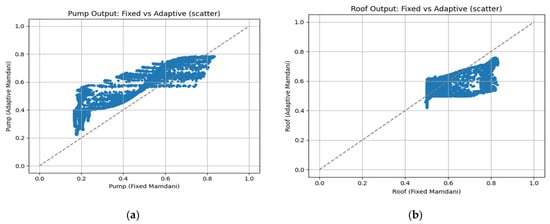
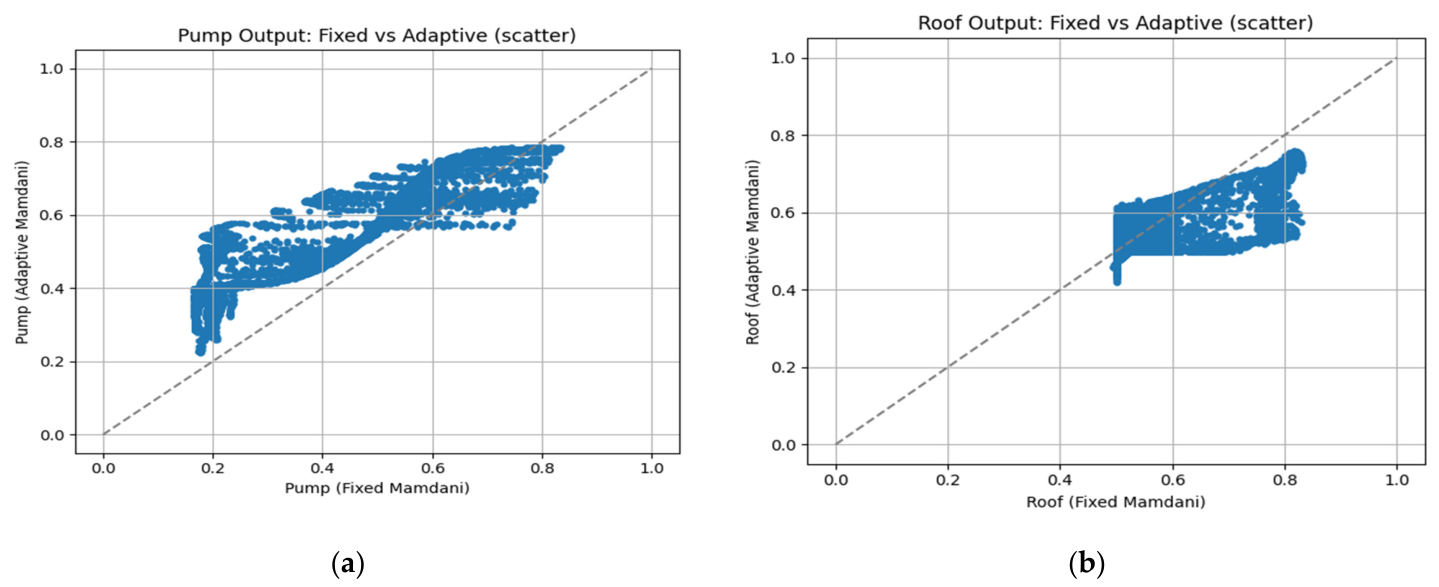
The scatter plots in Figure 11a,b show the relationships between the control outputs generated by the MFIS and the AMFIS for both pump speed–irrigation control and roof opening–ventilation control, respectively. The dashed line represents the ideal agreement, where the AMFIS output would be equal to MFIS output. The scatter plot for the pump outputs shows a dense concentration of points above the diagonal line in the range of fixed pump = 0.2–0.6. These findings indicate that, for most conditions, compared with the static MFIS, the AMFIS results in higher irrigation outputs. As the pump output increases beyond 0.7, the data points cluster close to the diagonal, suggesting that both models align under high-irrigation-demand conditions. Most of the data points in the roof output scatter plot are below the diagonal line, suggesting that compared with the MFIS, the AMFIS predicts a lower percentage of roof opening.
Figure 11.
Scatter plot of MFIS vs. AMFIS for (a) pump speed and (b) roof opening.
The analysis reveals that both the AMFIS and the MFIS are highly correlated and have similar decision patterns. However, compared with the traditional MFIS, the AMFIS enhances control actions, resulting in a more balanced and efficient method. A baseline regression model is applied to the raw sensor inputs without fuzzy control, and the estimated average Capsicum yield is 3.6–3.8 kg/plant, approximately 60–63 t/ha under Indian greenhouse cultivation conditions.
To evaluate the impact of intelligent control strategies on Capsicum yield, a regression-based yield estimation model utilizing optimized environmental outputs from both the MFIS and the AMFIS was used. When the MFIS-regulated irrigation and ventilation were used in a regression model, the crop yield improved, reaching 4.2–4.4 kg/plant, approximately 70–73 t/ha. This reflects a 15–18% increase in yield over the baseline due to the optimal management of resources, enhancing stability during flowering and fruiting. The advantages of rule-based fuzzy control include alleviating water stress and promoting optimal growth conditions, as evidenced by the histograms and scatter plots in Figure 9 and Figure 11. With the AMFIS-based control strategy, which uses fuzzy C-means clustering, a further improvement in the yield was achieved. The system enabled dynamic adjustments of irrigation and ventilation based on sensor data. The regression-based yield estimation indicated an average yield of 4.9–5.2 kg/plant, which is equal to 82–87 t/ha. This represents a 30–35% increase over the baseline model and a 12–15% improvement over the MFIS.
These results indicate that the AMFIS has the potential to improve crop productivity under optimized environmental control conditions. The current evaluation remains simulation-based, and direct measurement of the metrics of irrigation and ventilation effectiveness was not possible because of the absence of real greenhouse implementation. However, it must be emphasized that these yield values are estimated using a regression model based on simulated control outputs and do not represent experimentally measured crop yields. Future work will focus on incorporating quantitative performance indicators such as water use efficiency, energy efficiency and environmental stability indices, along with experimental validation.
6. Discussion
The Capsicum crop agricultural dataset used in this study originates from the Smart Fasal project, which employs the Waspmote Plug & Sense platform for monitoring agricultural environmental parameters. The availability of multi-depth soil moisture data provides valuable insight into root zone dynamics and supports more informed irrigation control decisions. The Capsicum dataset was used to assess the performance of the MFIS and AMFIS models for crop management. The adaptive model employs FCM clustering to adjust membership functions dynamically on the basis of multisensor inputs.
The results of the pump control output analysis presented in Table 4 reveal that the mean output of the adaptive model is significantly greater than that of the fixed model, with a 14.4% increase in irrigation.
Table 4.
Pump control output analysis.
The roof control output analysis presented in Table 5 indicates that the adaptive model (AMFIS) reduces the ventilation intensity by approximately 3.5% compared with that of the MFIS model, with smoother operation and reduced fluctuations. Quantitative metrics such as water use efficiency and ventilation efficiency could not be directly computed because of the absence of real greenhouse implementation. To assess the effects of intelligent control strategies on Capsicum yield, a regression-based yield estimation model was utilized, which uses control outputs from the MFIS and AMFIS. Table 6 summarizes the comparisons of the baseline (regression-only), MFIS, and AMFIS yield performances for Capsicum.
Table 5.
Roof control output analysis.
Table 6.
Comparative yield performance of the baseline, MFIS, and AMFIS models for Capsicum crops.
The results show a significant improvement in yield with the implementation of advanced models. The baseline regression model is a base model, while the integration of fuzzy logic in the MFIS leads to an 18% yield increase through stable rule-based control. The AMFIS further enhances productivity by 35% via adaptive learning and real-time tuning of membership functions. The results demonstrate that the proposed AMFIS framework improves decision-making capability and control stability compared with the MFIS within a simulation environment. However, the findings are based on interpolated data and model-based evaluation, and further experimental validation is needed to confirm real-world applicability.
7. Conclusions
This study presented a multisensor data fusion-based intelligent crop management framework for Capsicum cultivation using both an MFIS and an AMFIS. The analysis was conducted using a dataset from the Smart Fasal project, collected via the Waspmote Plug & Sense platform, which enables the monitoring of multiple agricultural environmental parameters. The models utilized environmental parameters such as temperature, humidity and soil moisture for data-driven irrigation and ventilation management. A baseline regression model indicated an average yield of 60–63 t/ha but lacked dynamic regulation. The implementation of the MFIS improved yields by 15–18%, achieving 70–73 t/ha. Further improvements with the AMFIS, which adapts fuzzy parameters through fuzzy C-means clustering, yielded the highest productivity of 82–87 t/ha, a 30–35% increase over the baseline. Statistical analysis confirmed the adaptive framework’s decision precision and operational stability, illustrating the advantages of combining multisensor data with adaptive fuzzy intelligence for improved irrigation and crop productivity.
The simulation results indicate that compared with the conventional MFIS, the AMFIS-based adaptive fuzzy framework has the potential to improve greenhouse environmental control and crop productivity, demonstrating improved irrigation responsiveness and reduced control variability rather than experimentally validated outcomes. Nevertheless, the findings are based on a simplified sensor configuration and simulation-based evaluation, and the use of a regression model for yield estimation limits the ability to fully validate real-world performance. This framework provides a strong foundation for future intelligent farming systems aimed at sustainable resource utilization and improved crop yield under varying environmental conditions. Future experimental validation is needed to confirm its effectiveness in real-world agricultural applications.
Author Contributions
Conceptualization, D.K.M., J.S.K. and S.K.V.; methodology, D.K.M., J.S.K., S.K.V. and B.R.N.; software, D.K.M. and S.K.V.; validation, J.S.K., B.R.N. and S.K.V.; formal analysis, B.R.N. and S.K.V.; investigation, S.K.V. and J.S.K.; resources, B.R.N. and S.K.V.; data curation, S.K.V., B.R.N. and J.S.K.; writing—original draft preparation, D.K.M. and B.R.N.; writing—review and editing, S.K.V. and J.S.K.; visualization, B.R.N., J.S.K. and S.K.V. All authors have read and agreed to the published version of the manuscript.
Funding
This research received no external funding.
Institutional Review Board Statement
Not applicable.
Informed Consent Statement
Not applicable.
Data Availability Statement
The original contributions presented in this study are included in the article. Further inquiries can be directed to the corresponding author.
Conflicts of Interest
The authors declare that they have no conflicts of interest.
References
- Kumar, V.; Sharma, K.V.; Kedam, N.; Patel, A.; Kate, T.R.; Rathnayake, U. A comprehensive review on smart and sustainable agriculture using IoT technologies. Smart Agric. Technol. 2024, 8, 100487. [Google Scholar] [CrossRef] [Scilit]
- Surendra, H.J.; Deka, P.C.; Rajakumara, H.N. Application of Mamdani model-based fuzzy inference system in water consumption estimation using time series. Soft Comput. 2022, 26, 11839–11847. [Google Scholar] [CrossRef] [Scilit]
- Abdurohman, A.; Siregar, M.; Sereati, C.O.; Windasari, S.; Pandjaitan, M.L.W. Implementation and Analysis of Fuzzy Inference System (FIS) and Adaptive Neuro-Fuzzy Inference System (ANFIS) for Irrigation. Int. J. Eng. Contin. 2025, 4, 210–231. [Google Scholar] [CrossRef] [Scilit]
- Lavanya, M.; Srinivasan, S. A survey on agriculture and greenhouse monitoring using IoT and WSN. Int. J. Eng. Technol. 2018, 7, 673–677. [Google Scholar] [CrossRef] [Scilit]
- Sahour, A.; Boumehrez, F.; Benouaret, M.; Mokhneche, A. Greenhouse climate controller by using of internet of things technology and fuzzy logic. Instrum. Meas. Métrologie 2021, 20, 29–38. [Google Scholar] [CrossRef] [Scilit]
- Thomopoulos, V.; Tolis, F.; Blounas, T.F.; Tsipianitis, D.; Kavga, A. Application of Fuzzy logic and IoT in a small-scale Smart Greenhouse System. Smart Agric. Technol. 2024, 8, 100446. [Google Scholar] [CrossRef] [Scilit]
- Benyezza, H.; Bouhedda, M.; Kara, R.; Rebouh, S. Smart platform based on IoT and WSN for monitoring and control of a greenhouse in the context of precision agriculture. Internet Things 2023, 23, 100830. [Google Scholar] [CrossRef] [Scilit]
- Morchid, A.; Said, Z.; Abdelaziz, A.Y.; Siano, P.; Qjidaa, H. Fuzzy logic-based IoT system for optimizing irrigation with cloud computing: Enhancing water sustainability in smart agriculture. Smart Agric. Technol. 2025, 11, 100979. [Google Scholar] [CrossRef] [Scilit]
- Sabrina, F.; Sohail, S.; Farid, F.; Jahan, S.; Ahamed, F.; Gordon, S. An Interpretable Artificial Intelligence Based Smart Agriculture System. Comput. Mater. Contin. 2022, 72, 3777–3797. [Google Scholar] [CrossRef] [Scilit]
- Barbedo, J.G.A. Resolving Ambiguities and Closing Data Gaps. Sensors 2022, 22, 2285. [Google Scholar] [CrossRef] [Scilit]
- Sinha, M.K.; Tiwari, R.K. A Comprehensive Survey of Fuzzy Logic Utilization in Different Agricultural Sectors. J. Stat. Math. Eng. 2024, 10, 1–7. [Google Scholar] [CrossRef] [Scilit]
- Jaiswal, S.; Ballal, M.S. Fuzzy inference based irrigation controller for agricultural demand side management. Comput. Electron. Agric. 2020, 175, 105537. [Google Scholar] [CrossRef] [Scilit]
- Benzaouia, M.; Hajji, B.; Mellit, A.; Rabhi, A. Fuzzy-IoT smart irrigation system for precision scheduling and monitoring. Comput. Electron. Agric. 2023, 215, 108407. [Google Scholar] [CrossRef] [Scilit]
- Jiang, X.; Fan, X.; Zhang, T.; Hu, L. A Multi Sensor Data Fusion Method for Smart Agriculture. World Sci. Res. J. 2024, 10, 24–30. [Google Scholar] [CrossRef]
- Allu, A.R.; Mesapam, S. Impact of remote sensing data fusion on agriculture applications: A review. Eur. J. Agron. 2025, 164, 127478. [Google Scholar] [CrossRef] [Scilit]
- Bouketir, O.; Saib, A.; Fenni, A. A Fuzzy Logic-Based Greenhouse Smart System for Sustainable Tomato Production in Algeria. Eng. Technol. Appl. Sci. Res. 2025, 15, 24110–24116. [Google Scholar] [CrossRef] [Scilit]
- Morchid, A.; Alblushi, I.G.M.; Khalid, H.M.; Qjidaa, H.; El Alami, R. Integrating IoT and fuzzy logic for intelligent irrigation in sustainable agriculture for improving water scarcity: Benefits and challenges. Sustain. Comput. Inform. Syst. 2025, 48, 101191. [Google Scholar] [CrossRef] [Scilit]
- Neugebauer, M.; Akdeniz, C.; Demir, V.; Yurdem, H. Fuzzy logic control for watering system. Sci. Rep. 2023, 13, 18485. [Google Scholar] [CrossRef] [Scilit]
- Tunc, M.; Rufaioglu, S.B.; Ipekesen, S.; Yakar, M.; Yorulmaz, L.; Bicer, B.T. Evaluation of the Possibility of Using Fuzzy C-Means Clustering, AMMI Analysis and GGE Biplot Methods to Predict the Yield of Chickpea Genotypes Cultivated in Different Environments. Agronomy 2025, 15, 300. [Google Scholar] [CrossRef] [Scilit]
- DelSanto, A.; Palmer, R.N.; Andreadis, K. Fuzzy C-Means clustering for physical model calibration and 7-day, 10-year low flow estimation in ungaged basins: Comparisons to traditional, statistical estimates. Front. Water 2024, 6, 1332888. [Google Scholar] [CrossRef] [Scilit]
- Rossini, P.R.; Ciampitti, I.A.; Hefley, T.; Patrignani, A. A soil moisture-based framework for guiding the number and location of soil moisture sensors in agricultural fields. Vadose Zone J. 2021, 20, e20159. [Google Scholar] [CrossRef] [Scilit]
- Bazzi, C.L.; Schenatto, K.; Upadhyaya, S.; Rojo, F.; Kizer, E.; Ko-Madden, C. Optimal placement of proximal sensors for precision irrigation in tree crops. Precis. Agric. 2019, 20, 663–674. [Google Scholar] [CrossRef] [Scilit]
- Majumder, S.; Pratihar, D.K. Multisensors data fusion through fuzzy clustering and predictive tools. Expert Syst. Appl. 2018, 107, 165–172. [Google Scholar] [CrossRef] [Scilit]
- Kisi, O.; Khosravinia, P.; Heddam, S.; Karimi, B.; Karimi, N. Modelling wetting front redistribution of drip irrigation systems using a new machine learning method: Adaptive neuro- fuzzy system improved by hybrid particle swarm optimization—Gravity search algorithm. Agric. Water Manag. 2021, 256, 107067. [Google Scholar] [CrossRef] [Scilit]
- Deo, R.C.; Downs, N.J.; Adamowski, J.F.; Parisi, A.V. Adaptive Neuro-Fuzzy Inference System integrated with solar zenith angle for forecasting subtropical Photosynthetically Active Radiation. Food Energy Secur. 2019, 8, e00151. [Google Scholar] [CrossRef] [Scilit]
- Castrignanò, A.; Buttafuoco, G.; Khosla, R.; Mouazen, A.; Moshou, D.; Naud, O. (Eds.) Agricultural Internet of Things and Decision Support for Precision Smart Farming; Academic Press: Cambridge, MA, USA, 2020. [Google Scholar]
- Heiß, A.; Paraforos, D.S.; Sharipov, G.M.; Ullrich, P.; Bruns, J.; Abecker, A.; Griepentrog, H.W. Versatile and user-centered concept for temporally and spatially adapted nitrogen application based on multiple parameters. Eur. J. Agron. 2023, 145, 126792. [Google Scholar] [CrossRef] [Scilit]
- Gong, S.; Hua, G.; Gao, W. Connectivity Analysis of Bipolar Fuzzy Networks. Math. Probl. Eng. 2022, 2022, 6398599. [Google Scholar] [CrossRef] [Scilit]
- Mingzhi, Z.; Yingjie, L.; Zheng, H.; Chun, C.; Daorina, B.; Rasakhodzhaev, B.S.; Jobir, A. Research on the influence of solar radiation fuzzy adaptive system on the wet and hot environment in greenhouse. Case Stud. Therm. Eng. 2024, 58, 104440. [Google Scholar] [CrossRef] [Scilit]
- Dhatterwal, J.S.; Kaswan, K.S.; Chithaluru, P. Agricultural cyber-physical systems: Evolution, basic, and fundamental concepts. In Agri 4.0 and the Future of Cyber-Physical Agricultural Systems; Kadry, S., Sharma, V., Dhanaraj, R.K., Jhaveri, R.H., Vendhan, G., Eds.; Academic Press: Cambridge, MA, USA, 2024; pp. 19–35. ISBN 9780443131851. [Google Scholar] [CrossRef] [Scilit]
- Dorji, K.; Behboudian, M.H.; Zegbe-Dominguez, J.A. Water relations, growth, yield, and fruit quality of hot pepper under deficit irrigation and partial rootzone drying. Sci. Hortic. 2005, 104, 137–149. [Google Scholar] [CrossRef] [Scilit]
- Kirnak, H.; Kaya, C.; Tas, I.; Higgs, D. The influence of water deficit on vegetative growth, physiology, fruit yield and quality in eggplants. Bulg. J. Plant Physiol. 2001, 27, 34–46. [Google Scholar]
- Bosland, P.W.; Votava, E.J.; Votava, E.M. Peppers: Vegetable and Spice Capsicums; Cabi: Oxfordshire, UK, 2012; Volume 22. [Google Scholar]
- Available online: http://smartfasal.in/ftp-dataset-portal/ (accessed on 1 July 2022).
- Available online: https://www.haifa-group.com/articles/crop-guide-growing-peppers (accessed on 21 March 2023).
- Available online: https://www.sqmnutrition.com/in/articulos/14-higher-export-yield-due-to-better-root-development-and-lower-incidence-of-apical-rot-in-capsicum-bell-pepper-with-ultrasoline-k-plus (accessed on 14 June 2023).
- Singh, S.; Ojha, U.; Prabhu, P.M.; Reddi, P.R.; Hiremath, S. Analysis of Soil Viability Monitoring System for In-House Plantation Growth Using an Internet of Things Approach. Pertanika J. Sci. Technol. 2024, 32, 2591–2608. [Google Scholar] [CrossRef] [Scilit]
- Katharria, A.; Rajwar, K.; Pant, M.; Velásquez, J.D.; Snášel, V.; Deep, K. Information Fusion in Smart Agriculture: Machine Learning Applications and Future Research Directions. Inf. Fusion. 2026, 129, 104040. [Google Scholar] [CrossRef] [Scilit]
- Sinha, M.K.; Tiwary, R.K. Utilizing Fuzzy Logic in Precision Agriculture: Techniques for Disease Detection and Management. J. Stat. Math. Eng. 2024, 10, 35–40. [Google Scholar] [CrossRef] [Scilit]
- Furizal, F.; Ma’arif, A.; Wijaya, S.A.; Murni, M.; Suwarno, I. Analysis and Performance Comparison of Fuzzy Inference Systems in Handling Uncertainty: A Review. J. Robot. Control (JRC) 2024, 5, 1203–1215. [Google Scholar]
- Halder, S.; Bhattacharya, S.; Roy, M.B.; Roy, P.K. Application of fuzzy C-means clustering and fuzzy EDAS to assess groundwater irrigation suitability and prioritization for agricultural development in a complex hydrogeological basin. Environ. Sci. Pollut. Res. 2023, 30, 57529–57557. [Google Scholar] [CrossRef] [Scilit] [PubMed]
- Salim, M. Fuzzy Logic Based Greenhouse Climate Control for Tomato Production. ARPN J. Agric. Biol. Sci. 2017, 12, 345–351. [Google Scholar]
- Tunç, E. Analysis and Future Projections of Seasonal Shifts in Türkiye. Master’s Thesis, Middle East Technical University, Çankaya/Ankara, Türkiye, 2025. Available online: https://open.metu.edu.tr/handle/11511/118220 (accessed on 20 June 2024).

Disclaimer/Publisher’s Note: The statements, opinions and data contained in all publications are solely those of the individual author(s) and contributor(s) and not of MDPI and/or the editor(s). MDPI and/or the editor(s) disclaim responsibility for any injury to people or property resulting from any ideas, methods, instructions or products referred to in the content. |
© 2026 by the authors. Licensee MDPI, Basel, Switzerland. This article is an open access article distributed under the terms and conditions of the Creative Commons Attribution (CC BY) license.