


Abstract
Climate change poses a significant threat to the livelihoods of smallholder farmers in South Africa, particularly in rural areas where dependence on rain-fed agriculture and limited institutional support heighten vulnerability. This study investigates how different forms of social capital (bonding, bridging, and linking) influence climate change adaptation strategies among smallholder farmers in Bergville, KwaZulu-Natal. A mixed-methods design was employed, combining a household survey (n = 150), focus group discussions, and key informant interviews. Households engaged in smallholder farming were purposively identified and randomly selected within the study ward. To accommodate varying literacy levels, structured questionnaires were administered through interviewer-led surveys. Quantitative data were analysed using descriptive statistics, chi-square tests, and a probit regression model, while qualitative data were thematically analysed to contextualise adaptation decisions and social dynamics. The findings show that trust in peer information, farmer group membership, collective action, and access to extension services significantly increase the likelihood of adopting climate adaptation practices (p < 0.05). While bonding social capital supports short-term coping, limited bridging and linking social capital constrain access to institutional resources and climate information. By explicitly operationalising and empirically distinguishing these dimensions of social capital, the study provides context-specific evidence on how uneven social networks shape adaptation outcomes. Strengthening inclusive institutional linkages and extension services is essential for promoting long-term climate resilience among smallholder farmers in rural South Africa. This study contributes to the international literature by providing empirical evidence on the differentiated roles of social capital dimensions in shaping adaptation outcomes in resource-constrained rural contexts. The findings highlight the need for policy interventions that strengthen institutional linkages, improve extension service delivery, and promote inclusive access to adaptation resources to enhance long-term climate resilience.
1. Introduction
Climate change poses a profound threat to global food systems, with smallholder farmers among the most severely affected due to their dependence on natural resources and rain-fed production systems [1]. According to the Intergovernmental Panel on Climate Change (IPCC), climate variability and extreme weather events are already reducing agricultural productivity and exacerbating livelihood insecurity in many low-income rural regions [2]. In Sub-Saharan Africa (SSA), smallholders cultivate plots typically under two hectares and produce more than 70% of the region’s food supply [3]. Despite their central role in food production, their adaptive capacity is constrained by limited access to credit, infrastructure, climate information, and institutional support [4]. In South Africa, recurrent droughts, floods, and increasingly erratic rainfall patterns have intensified these vulnerabilities, undermining food security and agricultural sustainability [5].
While biophysical exposure to climate risks is significant, adaptation outcomes are not determined by environmental factors alone. International development frameworks, including those advanced by the United Nations Development Programme (UNDP), emphasise that resilience-building requires not only technological and infrastructural interventions but also strong social systems that enable cooperation, knowledge exchange, and access to resources [6]. The Sustainable Livelihoods Framework (SLF) similarly conceptualises resilience as an outcome of interactions among multiple forms of capital human, natural, financial, physical, and social within a given vulnerability context [7]. Within this framework, social capital plays a critical role by facilitating collective action, information exchange, and institutional engagement, all of which are essential for adaptation to climate stressors.
Social Capital Theory defines social capital as the networks, norms, trust, and reciprocity that enable individuals and groups to act collectively [8]. It is commonly conceptualised in three interrelated dimensions: bonding, bridging, and linking social capital. Bonding social capital refers to close relationships within homogeneous groups, such as family members and local farmer networks, which facilitate trust, mutual support, and collective action [9]. Bridging social capital connects individuals across different social groups, enabling access to new knowledge, ideas, and resources beyond immediate communities [10]. Linking social capital refers to vertical relationships with formal institutions, such as government agencies and extension services, which provide access to external support, information, and policy interventions [11].
These dimensions play distinct but complementary roles in climate change adaptation. Bonding social capital often supports short-term coping mechanisms such as labour sharing and informal credit systems, while bridging and linking social capital are essential for accessing innovation, climate advisories, markets, and the institutional resources necessary for long-term and transformative adaptation [12]. However, the existing literature often treats social capital as a uniform construct, overlooking the differentiated roles and uneven distribution of these dimensions across contexts [13].
This study contributes to the literature by explicitly examining how these three dimensions operate within a rural South African context. While bonding social capital may enhance short-term coping strategies through community-based support systems, bridging and linking social capital are critical for accessing innovation, institutional resources, and long-term adaptation opportunities [14]. By empirically distinguishing these dimensions, the study provides context-specific insights into how different forms of social capital shape climate change adaptation among smallholder farmers.
Behavioural perspectives further reinforce the importance of socially embedded adaptation processes. The Norm Activation Model suggests that pro-environmental behaviour is influenced by social norms and moral obligations, while Social Cognitive Theory highlights the role of observational learning, collective efficacy, and perceived capability in shaping adaptive action [15]. These frameworks suggest that climate adaptation decisions are socially mediated rather than purely individual or technological responses [16]. However, such behavioural dimensions are rarely examined alongside differentiated forms of social capital in smallholder farming contexts.
Empirical studies across SSA demonstrate that social networks and collective action strongly influence farmers’ responses to climate variability by enabling timely information sharing, mobilising labour and financial resources, and strengthening linkages with extension services and climate advisory institutions [17,18,19]. However, much of this literature treats social capital as a relatively uniform construct, without sufficiently examining how different forms of social capital operate unevenly across contexts. This limit understanding of which social relationships matter most for adaptation, under what conditions, and for whom. Moreover, while behavioural perspectives such as social learning and motivation-based adaptation have been acknowledged in climate research, they are often implicitly embedded rather than empirically examined in smallholder contexts.
In South Africa, existing studies have demonstrated the adaptive value of social capital in rural communities. Research in uMsinga shows how indigenous knowledge systems and kinship networks supported households during drought periods [20], while studies in uMkhanyakude highlight the role of cooperatives, savings groups, and informal associations in shaping adaptation behaviour [21]. Despite these contributions, empirical evidence remains geographically concentrated, and relatively little is known about how social capital functions in other ecologically and institutionally distinct regions. In particular, Bergville in KwaZulu-Natal has received limited scholarly attention, despite being characterised by environmental fragility, strong traditional governance systems, high poverty levels, and youth outmigration [22].
Bergville, located in the northern Drakensberg region of KwaZulu-Natal, represents one such underexplored context. The area is characterised by environmental fragility, including soil erosion, water scarcity, and increasing rainfall variability. Livelihoods depend heavily on rain-fed agriculture, including maize, beans, vegetables, and small-scale livestock production [23]. These conditions shape how farmers mobilise social networks, engage with traditional authority structures, and interact with extension services, making Bergville a critical yet understudied site for examining socially embedded adaptation processes; they position Bergville’s smallholder farmers at the frontline of climate change impacts and necessitate a deeper understanding of the social and institutional factors shaping their adaptive capacity.
Although South African policy has largely prioritised technological and infrastructural adaptation measures such as drought-tolerant crop varieties, irrigation, and soil conservation [24], these often overlook the social and institutional dynamics that enable or constrain their uptake. In marginalised rural settings like Bergville, where formal support systems are uneven, farmers frequently rely on community networks and collective action to cope with climate risks [17]. Understanding how different forms of social capital operate in such contexts is therefore essential for designing inclusive and sustainable adaptation strategies.
This study addresses this gap by investigating how bonding, bridging, and linking social capital influence climate change adaptation strategies and resilience among smallholder farmers in Bergville, KwaZulu-Natal. Specifically, the study contributes to the literature by (i) empirically distinguishing between different forms of social capital, (ii) examining their uneven influence on adaptation decisions in a marginalised rural setting, and (iii) integrating quantitative and qualitative evidence to provide context-specific insights. By situating the analysis within broader debates on social capital, livelihoods, and climate resilience, the study generates policy-relevant knowledge for strengthening smallholder adaptation in KwaZulu-Natal and similar environments. Despite growing research on climate change adaptation, limited studies have explicitly examined how different dimensions of social capital interact to influence adaptation outcomes in rural African contexts. Most studies treat social capital as a single construct, overlooking the distinct roles of bonding, bridging, and linking social capital. This study addresses this gap by providing an integrated analysis of these dimensions and their influence on adaptation behaviour among smallholder farmers in Bergville. The findings contribute to a more nuanced understanding of how social networks and institutional relationships shape resilience in climate-vulnerable regions.
1.1. Significance of the Study
Smallholder farming plays a critical role in South Africa’s rural economy, engaging millions of households and contributing to food security and livelihoods. Despite its importance, smallholder agriculture remains highly vulnerable to climate variability, particularly in resource-constrained rural areas where access to institutional support and climate information is limited.
While existing studies have examined climate change adaptation among smallholder farmers, limited attention has been given to the multidimensional role of social capital in shaping adaptation outcomes. In particular, few studies explicitly distinguish between bonding, bridging, and linking social capital and their differentiated effects on farmers’ ability to access information, mobilise resources, and engage with institutional support systems.
This study addresses this gap by providing an integrated analysis of how different forms of social capital influence climate change adaptation among smallholder farmers in Bergville, KwaZulu-Natal. By combining quantitative and qualitative approaches, the study offers context-specific insights into the social dynamics that underpin adaptation decisions.
The findings contribute to both theory and practice by demonstrating how social capital operates as both an enabling and constraining factor in climate adaptation. The results have important implications for policymakers, development practitioners, and extension services, particularly in designing interventions that strengthen institutional linkages, promote inclusive participation, and enhance long-term climate resilience among smallholder farmers.
1.2. Theoretical and Conceptual Framework
This study adopts Social Capital Theory and the Sustainable Livelihoods Framework (SLF) to examine the role of social relationships in enhancing climate change resilience among smallholder farmers in Bergville. Social Capital Theory, as described by [25], emphasises the importance of social networks, norms of trust, and reciprocity in facilitating cooperation and access to resources.
Social networks including family ties, farmer groups, and institutional linkages enable farmers to share knowledge, labour, and support when responding to climate-related challenges [26]. Table 1 presents the operationalization of social capital variables used in this study, categorized into bonding, bridging, and linking dimensions. Each variable is defined in terms of its measurement and description, capturing key aspects such as trust, interac-tion, group participation, and access to institutional support. These indicators provide a structured framework for analyzing how different forms of social capital influence climate change adaptation among smallholder farmers.
Table 1.
Theoretical and Conceptual Framework of Social Capital.
This study is guided by Social Capital Theory and the Sustainable Livelihoods Framework (SLF). Social Capital Theory conceptualises social relationships as resources that facilitate collective action, information exchange, and access to support. The SLF situates social capital alongside other livelihood assets within a vulnerability context shaped by climate change.
The conceptual framework adapts the SLF to illustrate how bonding, bridging, and linking social capital influence access to information, collective action, and institutional support, which in turn shape farmers’ adaptation strategies and resilience outcomes. This integrated framework informs variable selection, model specification, and interpretation of results.
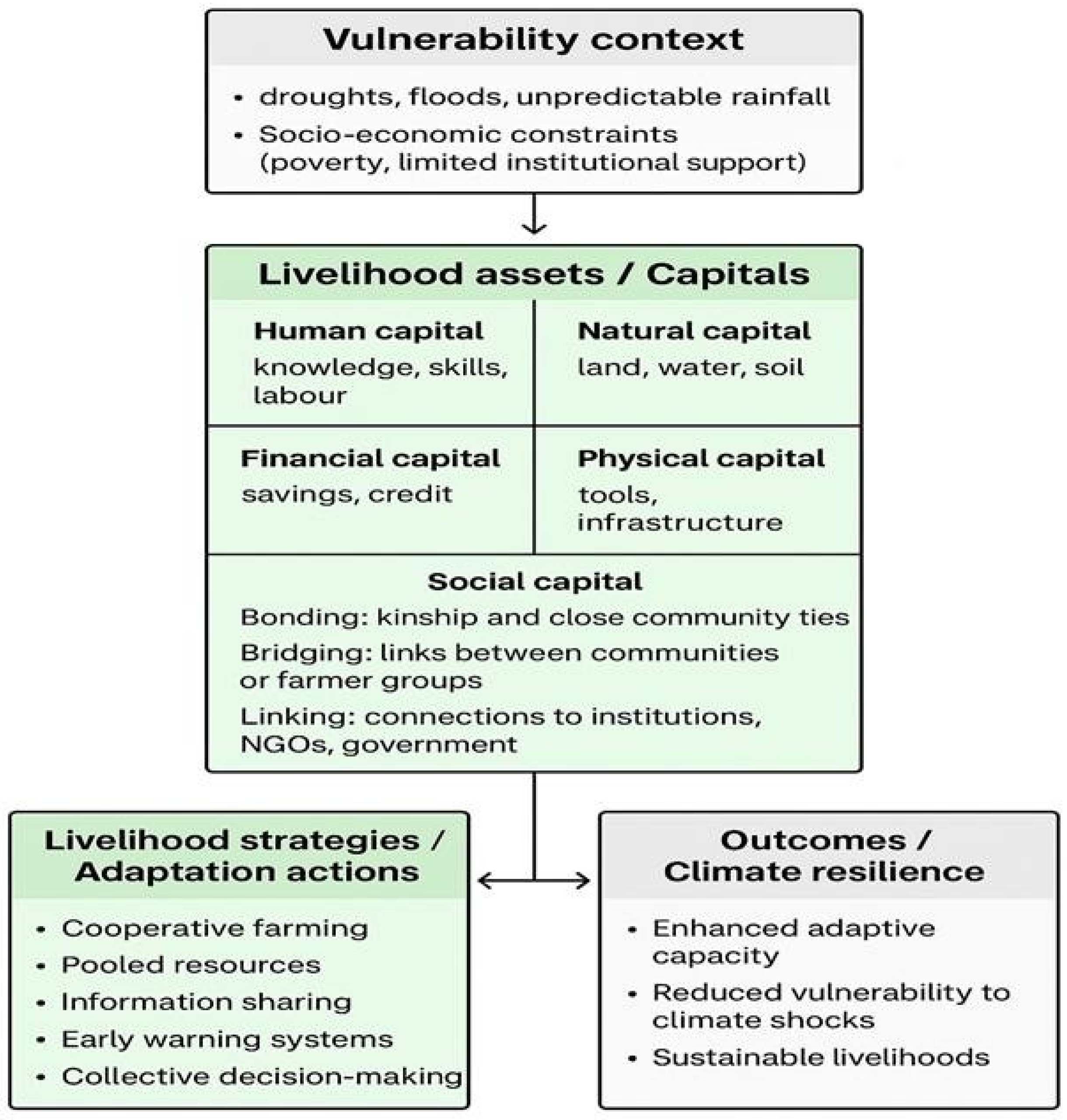
The Sustainable Livelihoods Framework (SLF) considers social capital as one of five core livelihood assets, alongside human, natural, financial, and physical capital [27]. The SLF explains how individuals, operating within a vulnerability context such as climate change utilise these assets to pursue livelihood strategies that enhance well-being and resilience [28]. Within this framework, social capital contributes to adaptation strategies, including cooperative farming, pooled resources, and access to early warning systems. Figure 1 illustrates how the various livelihood capitals particularly social capital interact with the vulnerability context to shape adaptation strategies and ultimately influence climate resilience outcomes. This conceptual representation shows the linkages between bonding, bridging, and linking social capital and the adaptive actions commonly undertaken by smallholder farmers.
The integration of these frameworks provides a comprehensive understanding of how resilience is not only shaped by infrastructure or finance, but also by social cohesion and institutional support [29]. Social capital enhances adaptive capacity by enabling information flow, mutual support, and institutional engagement all of which are crucial for smallholder farmers facing climate change [17].
Figure 1 illustrates the conceptual relationships between social capital and climate change adaptation. Bonding social capital supports local cooperation and mutual assistance, bridging social capital facilitates knowledge exchange across groups, and linking social capital enhances access to institutional resources and extension services. These dimensions interact to influence farmers’ adaptation strategies and resilience outcomes.
Figure 1.
Theoretical Framework Linking Social Capital and Climate Resilience adapted from the Sustainable Livelihoods Framework by [30] with additional modifications by the author.
2. Methodology
2.1. Description of Study Area
The study was conducted in Ward 2 of Bergville, a rural town located in the uKhahlamba Local Municipality within the uThukela District of KwaZulu-Natal, South Africa (28.7311° S, 29.3517° E). Bergville lies in the northern Drakensberg region and is characterised by mountainous terrain, high levels of soil erosion, and a strong reliance on rain-fed agriculture. Farming systems in the area are predominantly small-scale and include maize, beans, vegetables, and small livestock production.
The area is governed through a dual institutional system comprising municipal authorities and traditional leadership structures. Bergville experiences recurrent droughts, erratic rainfall, and water scarcity, which exacerbate livelihood vulnerability. High poverty levels, limited access to extension services, and youth outmigration further constrain farmer’s adaptive capacity, making the area suitable for examining the role of social capital in climate change adaptation.
2.2. Research Design
A mixed-methods research design was adopted to capture both the measurable effects of social capital on climate change adaptation and the underlying social processes shaping farmer’s decisions. Combining quantitative and qualitative approaches enabled triangulation of findings and enhanced the validity and robustness of the analysis.
The quantitative component assessed the statistical relationship between social capital variables and adaptation behaviour, while the qualitative component provided contextual insights into how farmers perceive, mobilise, and experience social networks in response to climate risks.
2.3. Sampling Procedure and Sample Size
A purposive sampling was used to identify Ward 2 in Bergville as the study site based on its high dependence on rain-fed agriculture, exposure to climate variability, and presence of active smallholder farming households. Within the ward, households were considered eligible if they were actively engaged in crop or livestock production.
A complete household list for Ward 2 was obtained from local administrative records and served as the sampling frame. The estimated number of farming households in Ward 2 is approximately 280, based on official local records. From this list, households were randomly selected to participate in the survey, resulting in a final sample of 150 smallholder farmers. This procedure ensured that each household had an equal probability of selection, thereby reducing selection bias and enhancing the representativeness of the sample.
The achieved sample represents approximately 53.6% of the total farming population in the ward, indicating substantial coverage. Furthermore, following the commonly applied rule-of-thumb for binary response models.
The sample size is consistent with comparable household-level climate adaptation studies conducted in Sub-Saharan Africa and is sufficient for probit regression analysis given the specified number of explanatory variables. Given that the study focuses on a single ward, the sampling strategy prioritises in-depth contextual analysis of local socio-economic and institutional dynamics rather than statistical generalisation to broader populations. The selection of a single ward allows for context-specific, in-depth analysis of social capital dynamics, which are highly localised and socially embedded. This approach is consistent with micro-level rural livelihood studies. The study focuses on in-depth contextual analysis rather than generalisation.
The sample size is statistically adequate for binary response models such as probit regression. According to econometric guidelines, a minimum of 10 observations per explanatory variable is recommended [30]. To complement the survey data, qualitative data were collected through focus group discussions (FGDs) and key informant interviews (KIIs). Data collection was conducted in May, 2025 in Ward 2 of Bergville, KwaZulu-Natal.
A total of two FGDs were conducted, comprising 14 participants (7 male and 7 female smallholder farmers). Participants were purposively selected based on their active involvement in farming and participation in local social networks to ensure they could provide relevant insights into climate change adaptation and community dynamics. The FGDs were gender-disaggregated to encourage open discussion and capture diverse perspectives. Each session lasted approximately 60–90 min and was facilitated by the researcher with the assistance of a trained note-taker.
Discussions were conducted in isiZulu and transcribed verbatim and translated into English.
A semi-structured discussion guide was used to ensure consistency while allowing flexibility for participants to share their experiences. The guide focused on key themes related to social capital and climate change adaptation, including community networks, collective action, trust and information-sharing mechanisms, barriers to collaboration, and strategies for strengthening resilience.
In addition, a total of 5 key informant interviews (KIIs) were conducted with agricultural extension officers, traditional leaders, and representatives of local institutions. Key informants were purposively selected based on their knowledge and involvement in agricultural support systems, community governance and institutional support structures. The interviews followed a semi-structured format and explored institutional linkages, access to extension services, governance structures, and challenges affecting adaptation. Each interview lasted approximately 20–30 min and was conducted in isiZulu or English, depending on participant preference. FGDs were used to explore collective experiences and social interactions, while KIIs were conducted to obtain institutional and governance perspectives relevant to climate change adaptation.
The participants involved in the FGDs and KIIs represented diverse socio-economic backgrounds, including variations in age, farming experience, and levels of education. Most participants were smallholder farmers with several years of farming experience and active involvement in local agricultural and social networks. This diversity ensured a comprehensive understanding of community dynamics and adaptation strategies.
FGDs were employed to capture shared experiences and collective perspectives among farmers, while KIIs provided in-depth insights from key stakeholders with expert knowledge of institutional and governance structures. Thematic analysis was chosen due to its suitability for identifying patterns and meanings within qualitative data.
Data collection continued until saturation was reached, where no new themes emerged. To enhance validity, themes were reviewed and refined through team discussions and cross-verification of coded transcripts.
2.3.1. Quantitative Analysis
Quantitative data were coded and analysed using IBM SPSS Statistics (Version 29). Descriptive statistics, including frequencies, percentages, and means, were used to summarise the demographic and socio-economic characteristics of the respondents.
To examine relationships between categorical variables, cross-tabulation analysis was employed in conjunction with the chi-square (χ2) test of independence. This approach enabled the assessment of associations between key variables such as social capital indicators and climate adaptation practices. The chi-square test compares observed and expected frequencies to determine whether statistically significant relationships exist between variables. Statistical significance was assessed at the 5% level (p < 0.05).
Given the binary nature of the dependent variable (adoption vs. non-adoption of climate change adaptation strategies), a probit regression model was applied. Binary choice models, such as probit and logit, are widely used in analysing discrete decision-making behaviour and are appropriate when the dependent variable is dichotomous [31].
The probit model estimates the probability that a farmer adopts at least one climate adaptation strategy as a function of explanatory variables:
where Yi is a binary dependent variable equal to 1 if the farmer adopted at least one climate adaptation strategy and 0 otherwise; Xi represents a vector of explanatory variables; β denotes the parameters to be estimated; and Φ represents the cumulative distribution function of the standard normal distribution. The explanatory variables included demographic characteristics (age, gender, level of education, and farming experience) and social capital indicators (trust in peer information, group membership, frequency of interaction, participation in collective action, and access to extension services).
P(Yi = 1 | Xi) = Φ(Xiβ)
The model was estimated using maximum likelihood estimation (MLE). To facilitate interpretation, marginal effects were computed, indicating the change in the probability of adoption associated with a unit change in each explanatory variable, holding other variables constant.
To ensure robustness of the model, diagnostic tests were conducted. Multicollinearity among explanatory variables was assessed using Variance Inflation Factors (VIF), with all values below the threshold of 5, indicating no serious multicollinearity.
The adequacy of the sample size was also assessed based on established econometric guidelines. Following the commonly applied rule-of-thumb for binary response models, which recommends a minimum of 10 observations per explanatory variable [32] the model with nine explanatory variables requires at least 90 observations. The sample size of 150 observations exceeds the minimum requirement for the number of predictors included in the model, thereby ensuring sufficient statistical power and reliability of estimates [33].
The reported coefficients represent average marginal effects, indicating the change in the probability of adoption associated with a one-unit change in each explanatory variable, holding other factors constant. For dummy variables, marginal effects capture the discrete change in probability when the variable shifts from 0 to 1. These effects are reported as percentage-point changes in probability to enhance interpretability.
Independent variables were selected based on Social Capital Theory and empirical literature and included trust in peer information, group membership, participation in collective action, access to extension services, institutional linkages, and selected demographic controls (age, gender, education) (Table 2).
Table 2.
Independent variables to be used in the probit regression model.
2.3.2. Qualitative Analysis
Qualitative data from FGDs and KIIs were analysed using thematic analysis following the framework of [34]. Qualitative data obtained from focus group discussions (FGDs) and key informant interviews (KIIs) were transcribed verbatim. Interviews conducted in isiZulu were translated into English to ensure accuracy and preserve contextual meaning, translated transcripts were cross-checked against the original recordings.
A hybrid coding approach was employed, combining deductive and inductive techniques. Deductive codes were derived from the study objectives and conceptual framework (e.g., trust, collective action, institutional linkages), while inductive codes emerged from participants narratives. The analysis followed a systematic process involving open coding, categorisation of related codes, and the development of overarching themes.
Coding was conducted manually, and to enhance analytical rigour and reliability, a subset of transcripts was independently cross-checked among members of the research team to ensure consistency in coding and interpretation. The resulting themes captured key dimensions of social capital, including trust, knowledge sharing, collective action, and institutional support, as well as constraints affecting adaptation.
The qualitative findings were triangulated with quantitative results to provide a comprehensive understanding of climate change adaptation. This integration allowed for the validation and contextualisation of statistical findings by incorporating farmer’s lived experiences, thereby strengthening the overall credibility and robustness of the study.
2.4. Ethical Considerations
Ethical approval for this study was obtained from the University of KwaZulu-Natal Humanities and Social Sciences Research Ethics Committee (HSSREC/00008251/2025). Participants were informed about the purpose of the study, confidentiality of responses, voluntary participation, and their right to withdraw at any time. Written and verbal informed consent was obtained prior to data collection. No personal identifiers were recorded to ensure anonymity.
3. Results
3.1. Descriptive Characteristics of Smallholder Farmers
Table 3 presents the demographic and farm characteristics of the surveyed households (n = 150). Women constituted 52% of respondents, while men represented 48%. The majority of farmers (65%) were older than 50 years. Regarding education, 14% had no formal schooling, 32.7% had primary education, 40% had secondary education, and 13.3% had tertiary education.
Table 3.
Demographic profile of surveyed households in Bergville (n = 150).
Most households (78%) reported more than 10 years of farming experience. Farm sizes were generally small, with 80% cultivating less than two hectares. Household sizes ranged between 1 and 3 members (26%), 4–6 members (44.7%), and 7 or more members (29.3%).
These results indicate a predominantly ageing smallholder farming population operating on small landholdings with moderate levels of formal education.
3.2. Social Capital Patterns Among Smallholder Farmers in Bergville
Table 4 summarises key social capital indicators. Bonding social capital indicators show that 58% of respondents belonged to farmer groups, cooperatives, or stokvels. Trust in peer information was reported as high by 61.3% of respondents, moderate by 26%, and low by 12.7%. Participation in collective action was reported by 52% of farmers.
Table 4.
Social capital indicators among surveyed households in Bergville (n = 150).
Bridging and linking social capital indicators were comparatively lower. Regular contact with extension services was reported by 36% of respondents, occasional contact by 30%, and no contact by 34%. Only 28% reported linkages with NGOs or government institutions. These findings suggest stronger intra-community ties compared to institutional linkages.
3.3. Key Determinants of Social Capital and Adaptation
Chi-square analysis revealed statistically significant associations between social capital variables and adaptation practices (Table 5).
Table 5.
Key determinants of social capital and adaptation (n = 150).
Trust in peer information was significantly associated with adoption of climate-smart practices (χ2 = 12.45, p = 0.002). Group membership was significantly associated with adoption of improved crop varieties (χ2 = 10.38, p = 0.001). Participation in collective action was significantly associated with the use of soil conservation practices (χ2 = 9.87, p = 0.002).
Extension contact was significantly associated with crop diversification (χ2 = 8.54, p = 0.014), while linkages with NGOs or government were significantly associated with access to climate information (χ2 = 11.23, p = 0.001).
3.4. Influence of Social Capital Dimensions on Climate Change Adaptation
Table 6 presents the average marginal effects from the probit regression model estimating the probability of adopting at least one climate change adaptation strategy.
Table 6.
Probit Regression Estimates of the Influence of Social Capital Dimensions on Adoption of Climate Change Adaptation Strategies.
Trust in peer information increased the likelihood of adoption by 32% (p < 0.01). Group membership increased the probability by 27% (p < 0.05), while participation in collective action increased it by 21% (p < 0.05). Access to extension services increased adoption probability by 25% (p < 0.05), and institutional linkages increased probability by 30% (p < 0.01). Education had a positive effect (+0.18, p < 0.10), while age and gender were not statistically significant predictors.
These results indicate that both bonding and linking dimensions of social capital are significant predictors of adaptation behaviour.
3.5. Qualitative Insights and Integration with Quantitative Findings
In addition to the quantitative analysis, qualitative data obtained from focus group discussions (FGDs) and key informant interviews (KIIs) were analysed to provide deeper insights into the social processes influencing climate change adaptation. A total of 14 FGDs and 5 KIIs were conducted with smallholder farmers and extension officers. Thematic analysis revealed key themes, including trust and information sharing, collective action, institutional linkages, barriers to social capital, and recommendations for enhancing resilience. These findings complement and help explain the statistical relationships observed in the quantitative results.
The qualitative findings highlight that trust is a critical determinant of adaptation behaviour. Farmers reported relying heavily on peer networks for climate-related information, often valuing local knowledge over external advice. One participant stated that “advice from fellow farmers is more trusted than external sources.” This supports the quantitative results, where trust-related variables were found to be statistically significant predictors of adaptation. The findings suggest that bonding social capital strengthens informal information-sharing systems, which play a central role in shaping farmer’s responses to climate variability.
Collective action emerged as an important strategy for coping with climate stress. Farmers described engaging in shared labour arrangements, joint planting activities, and mutual support during drought periods. These practices reduce individual risk and enhance adaptive capacity through resource pooling. This is consistent with the quantitative findings, which show a positive and significant relationship between group membership and adaptation behaviour. The qualitative evidence therefore reinforces the importance of farmer organisations and social networks in facilitating climate change adaptation.
While social networks at the community level were strong, institutional linkages were found to be relatively weak. Many participants reported limited and irregular contact with extension officers, restricting access to formal climate information and advisory services. This finding aligns with the quantitative results, where linking social capital variables showed weaker or less consistent effects compared to bonding and bridging social capital. It suggests that insufficient institutional engagement may constrain the effectiveness of formal adaptation support mechanisms.
The study also identified several barriers that limit the effectiveness of social capital in promoting adaptation. These include lack of trust among some community members, poor communication, and unequal participation in farmer groups. Participants highlighted issues such as conflicts and exclusion, which weaken collective action and reduce access to shared resources. These barriers help explain variations observed in the quantitative analysis, where not all social capital variables were uniformly significant.
Participants emphasised the need for stronger government support, improved extension service delivery, and increased access to training on climate adaptation strategies. Strengthening collaboration between farmers and institutions was identified as essential for improving adaptive capacity. These recommendations support the quantitative findings, which indicate the importance of both social networks and institutional support in shaping adaptation outcomes (Table 7).
Table 7.
Summary of Qualitative Themes from FGDs and KIIs.
4. Discussion
This study examined the role of social capital in shaping climate change adaptation among smallholder farmers in Bergville, KwaZulu-Natal. The findings reveal several important insights regarding how bonding, bridging, and linking social capital influence adaptation behaviours.
Firstly, bonding social capital particularly trust in peer information, group membership, and collective action plays a pivotal role in farmer’s adaptation decisions [35]. The findings show that farmers rely heavily on socially embedded knowledge systems, especially in contexts where formal advisory services are limited. This aligns with Social Capital Theory, which emphasises trust and reciprocity as critical for cooperation and knowledge exchange [36]. Qualitative evidence from FGDs and KIIs further confirms that farmers often rely on peers for guidance on planting dates, crop selection, and soil management. These results are consistent with studies across Sub-Saharan Africa, where trust-based networks facilitate information sharing, reduce uncertainty, and support the adoption of adaptation strategies [18,37]. Bonding networks also provide risk-sharing mechanisms such as collective labour and savings clubs, which strengthen short-term coping capacity [38]. Comparable results have been documented in Ethiopia, where collective labour arrangements have been shown to reduce vulnerability and support the adoption of sustainable land management practices [39].
However, these networks sometimes reproduce existing inequalities through exclusion or unequal participation, reflecting findings in other African rural contexts [40]. Secondly, the study identifies significant gaps in bridging and linking social capital. While regression results demonstrate that stronger institutional linkages increase the probability of adaptation, engagement with extension services and NGOs remains limited. This suggests structural constraints in accessing formal knowledge systems, resulting in uneven adaptation opportunities. Similar patterns have been observed in rural development literature, where weak institutional connections hinder farmers from moving beyond short-term coping strategies toward transformative adaptation (e.g., KZN, South Africa, SADC region [41]. Within the Sustainable Livelihoods Framework, insufficient linking capital constrains the effective mobilisation of other livelihood assets, limiting adaptive capacity. Qualitative data corroborate this, as farmers reported irregular contact with extension officers, poor communication, and frustration with resource shortages. Strengthening these institutional connections is therefore critical for improving adaptive outcomes. Similar findings were reported by [42].
Thirdly, structural and gendered inequalities shape the effectiveness of social capital. Women were found to be more engaged in informal networks, such as savings clubs, while men participated more in formal livestock associations [43], similar patterns were also reported by [44]. Despite their active participation in community networks, women reported limited access to formal extension services, highlighting a gendered gap in linking social capital. This observation is consistent with studies in Ghana and other African contexts, where power dynamics and institutional barriers influence access to social and climate adaptation resources [45]. These inequalities underscore the need for inclusive approaches to extension services and adaptation programmes. Such policies should address entrenched socio-cultural and institutional constraints by promoting women’s participation in extension design, enhancing access to tailored information, and strengthening institutional accountability for equitable service delivery [46].
Overall, the integration of quantitative and qualitative findings demonstrates that social capital acts both as an enabling resource and as a constraint. Bonding networks enhance immediate coping strategies through mutual assistance and collective action, but without strong bridging and linking connections, adaptation remains incremental rather than transformative. Qualitative insights also revealed challenges such as exclusion, conflict, and unequal participation, suggesting that social ties can sometimes reinforce inequalities rather than overcome them.
Policy implications emerge clearly from these findings. Strengthening bonding social capital through farmer groups and collective action initiatives can enhance community-level resilience. At the same time, improving bridging and linking social capital through expanded and inclusive extension services, better institutional engagement, and equitable access to external support systems is critical for enabling transformative adaptation. Addressing gendered and structural inequalities is particularly important to ensure that all farmers, regardless of gender, can fully benefit from adaptation interventions. These findings suggest that strengthening institutional linkages and inclusive extension services is critical for enhancing climate resilience among smallholder farmers
5. Conclusions and Recommendations
This study examined the role of social capital in influencing climate change adaptation among smallholder farmers in Bergville. The findings demonstrate that bonding social capital significantly enhances adaptation through trust-based networks and collective action. However, bridging and linking social capital remain weak, limiting access to institutional support and formal knowledge systems.
The study further shows that social capital operates both as an enabling and constraining factor, with structural inequalities, particularly gender disparities, shaping access to adaptation resources. These findings confirm that while community networks support short-term coping, stronger institutional linkages are required for transformative adaptation.
Overall, the study successfully addressed its research objectives by providing an integrated analysis of how different dimensions of social capital influence adaptation behaviour in a climate-vulnerable rural context.
5.1. Policy Implications and Recommendations
Strengthening bridging and linking social capital should be prioritised to enhance climate resilience. Expanding extension coverage, promoting inclusive farmer organisations, and fostering sustained partnerships between community structures and state institutions can improve access to information, resources, and climate advisory services. Gender-sensitive extension approaches and support for marginalised households are particularly important to ensure equitable participation in adaptation initiatives.
Investments in farmer-to-farmer learning platforms combined with stronger institutional coordination can help transition adaptation from short-term coping to longer-term resilience-building strategies.
Policy interventions should recognise the distinct roles of different forms of social capital. Strengthening bonding social capital can enhance community-based adaptation through support for farmer groups, savings clubs, and collective action initiatives. Promoting bridging social capital can facilitate knowledge exchange across communities by supporting farmer networks, training programmes, and peer-learning platforms. Enhancing linking social capital is particularly critical for long-term resilience, requiring improved access to extension services, stronger institutional engagement, and inclusive policy support mechanisms. Targeted interventions across these dimensions can enable more effective and sustainable climate change adaptation among smallholder farmers.
The findings of this study highlight the need for targeted and multi-level policy interventions that recognise the differentiated roles of social capital in climate change adaptation. Strengthening linking social capital should be prioritised by expanding the reach and effectiveness of agricultural extension services, improving institutional coordination, and fostering sustained partnerships between community structures and government agencies. This will enhance farmer’s access to climate information, financial support, and adaptation programmes.
At the community level, strengthening bonding social capital can support immediate coping and resilience-building through farmer groups, savings clubs, and collective action initiatives. These platforms facilitate trust, labour sharing, and local knowledge exchange, which are critical in resource-constrained environments.
Promoting bridging social capital is essential for facilitating knowledge transfer and innovation across communities. This can be achieved through farmer-to-farmer learning platforms, training programmes, and the development of inclusive farmer networks that connect different social groups and geographic areas.
Importantly, policy interventions must adopt a gender-sensitive and inclusive approach to ensure that women and other marginalised groups have equitable access to extension services, institutional support, and adaptation resources. Addressing these structural inequalities is critical for enhancing overall adaptive capacity.
Overall, strengthening the interaction between bonding, bridging, and linking social capital can support a transition from short-term coping strategies to more sustainable and transformative climate resilience among smallholder farmers.
5.2. Study Limitations and Future Research
The study is geographically confined to a single ward in Bergville, limiting generalisability to other regions. The cross-sectional design captures associations rather than causal relationships, restricting inference about long-term adaptation patterns. In addition, reliance on self-reported data introduces potential recall and self-selection bias. While the qualitative component provided rich contextual insights, it may not reflect the full diversity of experiences within the community.
Future research should employ longitudinal and multi-site designs to examine the causal pathways and comparative dynamics of social capital and adaptation across different rural contexts.
Author Contributions
Conceptualization, P.M. (Pearl Musenge) and P.M. (Paramu Mafongoya); methodology, P.M. (Pearl Musenge); formal analysis, P.M. (Pearl Musenge); investigation, P.M. (Pearl Musenge); data curation, P.M. (Pearl Musenge); writing—original draft preparation, P.M. (Pearl Musenge) and P.M. (Paramu Mafongoya); writing—review and editing, P.M. (Pearl Musenge), P.M. (Paramu Mafongoya), and S.L.; supervision, P.M. (Paramu Mafongoya) and S.L. All authors have read and agreed to the published version of the manuscript.
Funding
This research was funded by South Africa’s National Research Foundation (NRF) grant number (86893).
Institutional Review Board Statement
The study was conducted in accordance with the Declaration of Helsinki and approved by the Research Ethics Committee of the University of KwaZulu-Natal (HSSREC/00008251/2025) on 13 May 2025.
Informed Consent Statement
Informed consent was obtained from all respondents involved in the study.
Data Availability Statement
The data presented in this study are available from the corresponding author upon reasonable request.
Acknowledgments
The authors acknowledge NRF for funding this study.
Conflicts of Interest
The authors declare no conflicts of interest.
References
- Toromade, A.S.; Soyombo, D.A.; Kupa, E.; Ijomah, T.I. Reviewing the impact of climate change on global food security: Challenges and solutions. Int. J. Appl. Res. Soc. Sci. 2024, 6, 1403–1416. [Google Scholar] [CrossRef] [Scilit]
- IPCC. Climate Change 2022: Impacts, Adaptation and Vulnerability; Working Group II Contribution to the Sixth Assessment Report of the Intergovernmental Panel on Climate Change; IPCC: Cambridge, UK, 2022. [Google Scholar]
- Giller, K.E.; Delaune, T.; Silva, J.V.; van Wijk, M.; Hammond, J.; Descheemaeker, K.; van de Ven, G.; Schut, A.G.; Taulya, G.; Chikowo, R. Small farms and development in sub-Saharan Africa: Farming for food, for income or for lack of better options? Food Secur. 2021, 13, 1431–1454. [Google Scholar] [CrossRef] [Scilit]
- Gezie, M. Farmer’s response to climate change and variability in Ethiopia: A review. Cogent Food Agric. 2019, 5, 1613770. [Google Scholar] [CrossRef] [Scilit]
- Lottering, S.; Mafongoya, P.; Lottering, R. Drought and its impacts on small-scale farmers in sub-Saharan Africa: A review. S. Afr. Geogr. J. 2021, 103, 319–341. [Google Scholar] [CrossRef] [Scilit]
- Naheed, S. Understanding disaster risk reduction and resilience: A conceptual framework. In Handbook of Disaster Risk Reduction for Resilience: New Frameworks for Building Resilience to Disasters; Springer: Berlin/Heidelberg, Germany, 2021; pp. 1–25. [Google Scholar]
- Natarajan, N.; Newsham, A.; Rigg, J.; Suhardiman, D. A sustainable livelihoods framework for the 21st century. World Dev. 2022, 155, 105898. [Google Scholar] [CrossRef] [Scilit]
- Portes, A. Social capital: Its origins and applications in modern sociology. In New Critical Writings in Political Sociology; Routledge: Abingdon, UK, 2024; pp. 53–76. [Google Scholar]
- Wahid, W.; Salman, D.; Demmallino, E. Bonding, bridging, and linking social capital combinations in maize agribusiness system. J. Infrastruct. Policy Dev. 2024, 8, 2817. [Google Scholar] [CrossRef] [Scilit]
- Ceci, F.; Masciarelli, F.; Poledrini, S. How social capital affects innovation in a cultural network: Exploring the role of bonding and bridging social capital. Eur. J. Innov. Manag. 2020, 23, 895–918. [Google Scholar] [CrossRef] [Scilit]
- Adams, C. Toward an institutional perspective on social capital health interventions: Lay community health workers as social capital builders. Sociol. Health Illn. 2020, 42, 95–110. [Google Scholar] [CrossRef] [Scilit] [PubMed]
- Noll, D.; Rivera, M. Enhancing Sustainable Rural Development Through Social Capital; Imprensa Universidade de Évora: Évora, Portugal, 2023. [Google Scholar]
- Gannon, B.; Roberts, J. Social capital: Exploring the theory and empirical divide. Empir. Econ. 2020, 58, 899–919. [Google Scholar] [CrossRef] [Scilit]
- Williams, T.; McCall, J.; Berner, M.; Brown-Graham, A. Beyond bridging and bonding: The role of social capital in organizations. Community Dev. J. 2022, 57, 769–792. [Google Scholar] [CrossRef] [Scilit]
- Qiu, L. Pro-environment behavior in China: Unveiling the role of self and collective efficacy, individual and social norms. Front. Psychol. 2025, 16, 1696917. [Google Scholar] [CrossRef] [Scilit]
- Barnes, M.L.; Wang, P.; Cinner, J.E.; Graham, N.A.; Guerrero, A.M.; Jasny, L.; Lau, J.; Sutcliffe, S.R.; Zamborain-Mason, J. Social determinants of adaptive and transformative responses to climate change. Nat. Clim. Change 2020, 10, 823–828. [Google Scholar] [CrossRef] [Scilit]
- Dapilah, F.; Nielsen, J.Ø.; Friis, C. The role of social networks in building adaptive capacity and resilience to climate change: A case study from northern Ghana. Clim. Dev. 2020, 12, 42–56. [Google Scholar] [CrossRef] [Scilit]
- Silvert, C.J.; Ochieng, W.; Perez Orozco, J.; Asanzi, A. Dissecting the roles of social Capital in Farmer-to-Farmer Extension: A review. J. Int. Agric. Ext. Educ. 2022, 29, 7–26. [Google Scholar] [CrossRef] [Scilit]
- Carmen, E.; Fazey, I.; Ross, H.; Bedinger, M.; Smith, F.M.; Prager, K.; McClymont, K.; Morrison, D. Building community resilience in a context of climate change: The role of social capital. Ambio 2022, 51, 1371–1387. [Google Scholar] [CrossRef] [Scilit] [PubMed]
- Lottering, S.J.; Mafongoya, P.; Lottering, R. The impacts of drought and the adaptive strategies of small-scale farmers in uMsinga, KwaZulu-Natal, South Africa. J. Asian Afr. Stud. 2021, 56, 267–289. [Google Scholar] [CrossRef] [Scilit]
- Maziya, M. Smallholder Farmers’ Perceptions and Adaptation to Climate Change: A Case of Umkhanyakude District in Kwazulu-Natal Province of South Africa. Doctoral Dissertation, University of the Free State, Bloemfontein, South Africa, 2023. [Google Scholar]
- Ncube, T.; Zualii, L.; Murray, U.; Nguyen, N.; Liebig, T.; Krendelsberger, A.; Pacillo, G.; McKeown, P.C.; Läderach, P.; Spillane, C. Understanding the climate, migration, social protection nexus from a youth mobility dimension: Can social protection address the drivers of climigration? Clim. Dev. 2025, 17, 436–457. [Google Scholar] [CrossRef] [Scilit]
- Mabizela, H.; Matsiliza, N.S. Uncovering the gaps in the provision of services in the rural Okhahlamba Municipality of KwaZulu-Natal province. Afr. Public Serv. Deliv. Perform. Rev. 2020, 8, a390. [Google Scholar] [CrossRef] [Scilit]
- Olabanji, M.F.; Chitakira, M. The adoption and scaling of climate-smart agriculture innovation by smallholder farmers in South Africa: A review of institutional mechanisms, policy frameworks and market dynamics. World 2025, 6, 51. [Google Scholar] [CrossRef] [Scilit]
- Sakamoto, M. The role of social capital in community development: Insights from behavioral game theory and social network analysis. Sustain. Dev. 2024, 32, 5240–5258. [Google Scholar] [CrossRef] [Scilit]
- de Brito, R.P.; de Sá, M.M.; di Araújo, N.M. The Role of Social Capital in Climate Change Adaptation: Small Farmers’ Perspective. J. Macromarketing 2024, 44, 704–722. [Google Scholar] [CrossRef] [Scilit]
- Mohammadi, A.; Omidi Najafabadi, M.; Poursaeed, A. A comprehensive sustainable development framework; community capitals and village-cooperative initiative. Braz. J. Biol. 2023, 84, e269509. [Google Scholar] [CrossRef] [Scilit]
- Banu, N.; Fazal, S. Climate change, livelihood crisis and resilience: An introduction. In Livelihoods and Well-Being in the Era of Climate Change: Risk to Resilience Across India; Springer: Berlin/Heidelberg, Germany, 2025; pp. 3–18. [Google Scholar]
- Jewett, R.L.; Mah, S.M.; Howell, N.; Larsen, M.M. Social cohesion and community resilience during COVID-19 and pandemics: A rapid scoping review to inform the United Nations research roadmap for COVID-19 recovery. Int. J. Health Serv. 2021, 51, 325–336. [Google Scholar] [CrossRef] [Scilit]
- DFID. Sustainable Livelihoods Guidance Sheets; DFID: London, UK, 1999; 445, p. 710.
- Hoffman, S.D.; Duncan, G.J. Multinomial and conditional logit discrete-choice models in demography. Demography 1988, 25, 415–427. [Google Scholar] [CrossRef] [Scilit] [PubMed]
- Van Belle, G. Statistical Rules of Thumb; John Wiley & Sons: Hoboken, NJ, USA, 2011. [Google Scholar]
- Ogunleye, A.; Kehinde, A.; Mishra, A.; Ogundeji, A. Impacts of farmers’ participation in social capital networks on climate change adaptation strategies adoption in Nigeria. Heliyon 2021, 7, e08624. [Google Scholar] [CrossRef] [Scilit] [PubMed]
- Braun, V.; Clarke, V. Using thematic analysis in psychology. Qual. Res. Psychol. 2006, 3, 77–101. [Google Scholar] [CrossRef] [Scilit]
- Zhang, Z.; Yang, A.; Wang, Y. How do social capital and village-level organizational trust affect farmers’ climate-related disaster adaptation behavior? Evidence from Hunan Province, China. Int. J. Disaster Risk Reduct. 2023, 99, 104083. [Google Scholar] [CrossRef] [Scilit]
- Saijo, E. Understanding the role of social capital in promoting knowledge-based growth in Europe. J. Policy Options 2022, 5, 1–7. [Google Scholar]
- Chang, Z.; Ahmed, N.; Li, R.; Huai, J. Social Capital, Crop Differences, and Farmers’ Climate Change Adaptation Behaviors: Evidence from Yellow River, China. Agriculture 2025, 15, 1399. [Google Scholar] [CrossRef] [Scilit]
- Yang, Y.; Huang, Y.; Huang, J.; Nie, F. The role of social capital in the impact of multiple shocks on households’ coping strategies in underdeveloped rural areas. Sci. Rep. 2024, 14, 14218. [Google Scholar] [CrossRef] [Scilit]
- Asefa, A.; Haile, M.; Berhe, M.; Zenebe, A. Climate smart land management practices for livelihood resilience in Ethiopia: A systematic review. Heliyon 2025, 11, e42950. [Google Scholar] [CrossRef] [Scilit]
- Gluckman, P.D.; Spoonley, P.; Poulton, R.; Te Ahukaramū Charles Royal, S.; Sridhar, H.; Clyne, D.; Bardsley, A. Addressing the Challenges to Social Cohesion; Koi Tū, The Centre for Informed Futures, University of Auckland: Auckland, New Zealand, 2023. [Google Scholar]
- Ruwanza, S.; Thondhlana, G.; Falayi, M. Research progress and conceptual insights on drought impacts and responses among smallholder farmers in South Africa: A review. Land 2022, 11, 159. [Google Scholar] [CrossRef] [Scilit]
- Makamane, A.S. Capacity of extension and advisory services in supporting farmers to adapt to climate change in the Eastern Cape, South Africa. Doctoral Dissertation, University of the Free State, Bloemfontein, South Africa, 2023. [Google Scholar]
- Oranu, C.O.; Onah, O.G.; Nkhonjera, E. Informal saving group: A pathway to financial inclusion among rural women in Nigeria. Asian J. Agric. Ext. Econ. Sociol. 2020, 38, 22–30. [Google Scholar] [CrossRef] [Scilit]
- Lukwa, A.T.; Odunitan-Wayas, F.; Lambert, E.V.; Alaba, O.A.; Collaborators, S.f.H.I. Can informal savings groups promote food security and social, economic and health transformations, especially among women in urban Sub-Saharan Africa: A narrative systematic review. Sustainability 2022, 14, 3153. [Google Scholar] [CrossRef] [Scilit]
- Gyan, C.; Kwakye, J. Building Resiliency in Community Development: The Experiences of Women in Rural Communities in Ghana. Soc. Incl. 2025, 13, 8705. [Google Scholar] [CrossRef] [Scilit]
- Asanwana, V.A.; Uloh, C.O. Gender-responsive agricultural extension policies and rural women’s empowerment in Akwa Ibom State, Nigeria. Strateg. Stud. 2025, 1, 137–149. [Google Scholar]

Disclaimer/Publisher’s Note: The statements, opinions and data contained in all publications are solely those of the individual author(s) and contributor(s) and not of MDPI and/or the editor(s). MDPI and/or the editor(s) disclaim responsibility for any injury to people or property resulting from any ideas, methods, instructions or products referred to in the content. |
© 2026 by the authors. Licensee MDPI, Basel, Switzerland. This article is an open access article distributed under the terms and conditions of the Creative Commons Attribution (CC BY) license.