


Abstract
The Qilian Mountains serve as a crucial ecological security barrier in western China, and the soil structural stability of alpine meadows directly affects regional ecological security and the sustainable utilization of grasslands. However, current research on grazing mostly relies on short-term artificially controlled experiments, which differ greatly from the pattern of long-term natural grazing. Herein, this study abandoned the artificially controlled grazing method and selected sampling areas with stable grazing regimes for more than a decade. Taking no grazing (CK) as the control, four treatments were established, including light grazing (LG), moderate grazing (MG), heavy grazing (HG) and extreme grazing (EG). The particle size distribution and stability of mechanically stable and water-stable soil aggregates in different soil layers were determined. Combined with environmental and biological factors, the effects of grazing on the structure and stability of soil aggregates were elucidated. The results showed that no grazing improved the mechanical stability of soil aggregates but reduced their water stability. Light and moderate grazing maintained a balanced and resistant soil structure, with the surface soil being more fragile than the subsurface soil. Heavy and extreme grazing led to severe structural degradation, with the subsurface soil being more fragile than the surface soil. Soil aggregate stability was jointly regulated by elevation, soil properties, root biomass, nitrogen forms, mineralization and microbial biomass. In conclusion, from the perspective of soil structural stability and sustainable utilization, light and moderate grazing represent the optimal utilization mode for the alpine meadows of the Qilian Mountains. This mode not only maintains the structural stability of subsurface soil aggregates but also balances biological cementation and physical disturbance, thus avoiding the insufficient water stability under no grazing and the risk of structural fragmentation under heavy or extreme grazing. Environmental and biological factors mediated the divergent responses of mechanical and water stability to different grazing intensities. The findings of this study provide a scientific basis and new insights for the rational grazing management and soil conservation of alpine meadows in the Qilian Mountains.
1. Introduction
The Qilian Mountains feature a distinctive geographical location and serve as a vital ecological security barrier and a national key ecological function zone in China, with alpine meadow as the dominant grassland type. This type of grassland is one of the grassland ecosystems with the largest area and the highest altitude worldwide [1]. The alpine meadow ecosystem is sensitive and fragile, subject to the dual impacts of climate change and human activities. Grazing directly affects the vegetation community, soil structure and ecosystem multifunctionality of alpine meadows [2]. Soil structure acts as a core regulator of the ecological functions of the alpine meadow ecosystem, exerting important effects on nutrient cycling, microbial communities, hydrological processes, productivity and ecosystem stability.
As the basic unit of soil structure, the formation of soil aggregates is associated with oxide cementation [3] and involves a dynamic and complex process [4,5]. The composition and stability of soil aggregates influence the physical and chemical properties as well as biological characteristics of soils. Soil aggregates act as carriers of nutrients [6], regulating nutrient storage and soil and water conservation, and also serve as habitats for microorganisms [7]; microbial biomass affects nutrient storage and aggregate stability [8]. Aggregates with different particle sizes perform distinct functions, and the correlation between nutrient content and particle size remains controversial [9,10,11,12,13]. The mechanical and water stability of soil aggregates are the key criteria for evaluating soil structure quality [14], which can reflect the resistance of soil aggregates to external damage and water erosion, and are of great significance for maintaining productivity and mitigating ecosystem degradation [15]. Their composition and stability are affected by soil organic matter, land use patterns and other factors [16]. The study has indicated that grassland degradation leads to a decrease in the proportion of macroaggregates and an increase in microaggregates [17], which impairs soil structure and stability and exerts a severe negative impact on ecosystem stability. Therefore, clarifying the effects of grazing intensity on the composition and stability of soil aggregates is crucial for the conservation and restoration of alpine meadows.
Soil aggregate structure and stability are important indicators reflecting soil quality, which are regulated by various factors. As a major human disturbance in grassland ecosystems, the impact of grazing on soil aggregates has become a research focus. Haonian et al. showed that the soil aggregate structure and stability under grazing exclusion were significantly better than those under other grazing methods, and plant growth characteristics, species diversity, and grazing methods were the key factors determining aggregate stability [18]. In semi-arid grasslands, a study by Li et al. (2025) further found that soil aggregate stability was not only jointly affected by grazing intensity and soil depth, but also significantly correlated with soil bulk density, underground biomass, and soil microbial biomass carbon; meanwhile, they also pointed out that although higher grazing intensity was conducive to the improvement of soil aggregate stability to a certain extent, it had adverse effects on soil bulk density and underground biomass [19].
Studies on different types of grasslands have also drawn different conclusions: in desert grasslands, relevant studies have confirmed that grazing exclusion can effectively improve soil structure and enhance aggregate stability [20], while in the Stipa kirschnii steppe of Inner Mongolia, studies have found that soil aggregate stability decreases with the increase in grazing intensity [21]. In addition, Sarker et al. (2025) clarified that different grazing measures have significant differences in their impacts on soil aggregates [22]; a study in Virginia showed that the soil aggregate stability of artificially controlled pastures remained at a high level [23]. Regarding the optimal selection of grazing intensity, Wang (2020) proposed that light grazing was the most reasonable grazing intensity in his study area, which could achieve a balance between ecological protection and resource utilization [24].
Yet as summarized above, the current research still lacks an understanding of the evolution of soil aggregates in alpine meadows under long-term natural grazing or no-grazing conditions, and the differential responses of mechanical and water stability, vertical differentiation characteristics and driving mechanisms remain unclear. Based on this, this study aims to address the following: (1) the effects of grazing intensity on the composition, mechanical stability and water stability of soil aggregates; (2) the vertical differentiation characteristics of soil aggregate stability in the 0–10 cm and 10–20 cm soil layers. We hypothesize that light and moderate grazing can optimize the composition and stability of soil aggregates, while no grazing and heavy grazing will result in poor soil structure performance. Meanwhile, the above responses are jointly regulated by comprehensive factors including elevation, root biomass, soil nitrogen forms (ammonium nitrogen and nitrate nitrogen), microbial biomass carbon, nitrogen and phosphorus, and nitrogen mineralization rate (as an important indicator reflecting microbial activity) [25,26,27], and soil aggregate stability will exhibit obvious vertical differentiation characteristics across different soil layers. This study is intended to elucidate the response patterns, vertical differentiation characteristics and key driving factors of soil aggregates to grazing intensity in the alpine meadows of the Qilian Mountains, identify the suitable grazing intensity for maintaining soil structural stability, and provide a scientific basis for grassland ecological protection and precise grazing management.
2. Materials and Methods
2.1. Study Area Overview
The study area is located in Tianzhu Tibetan Autonomous County, Wuwei City, Gansu Province, in the eastern section of the Qilian Mountains (102°07′–103°46′ E, 36°31′–37°55′ N), with an altitude ranging from 2040 m to 4874 m. The annual average sunshine duration in the study area is 2500–2700 h, the annual average temperature is −8–4 °C, the relative frost-free period is 90–145 d, and the annual average precipitation is 265–632 mm. During the index monitoring and sampling period in August 2024, the monthly average temperature was 17.3 °C, the average air relative humidity was 65%, and the monthly precipitation was 118.0 mm.
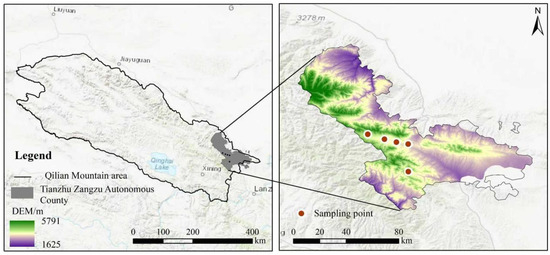
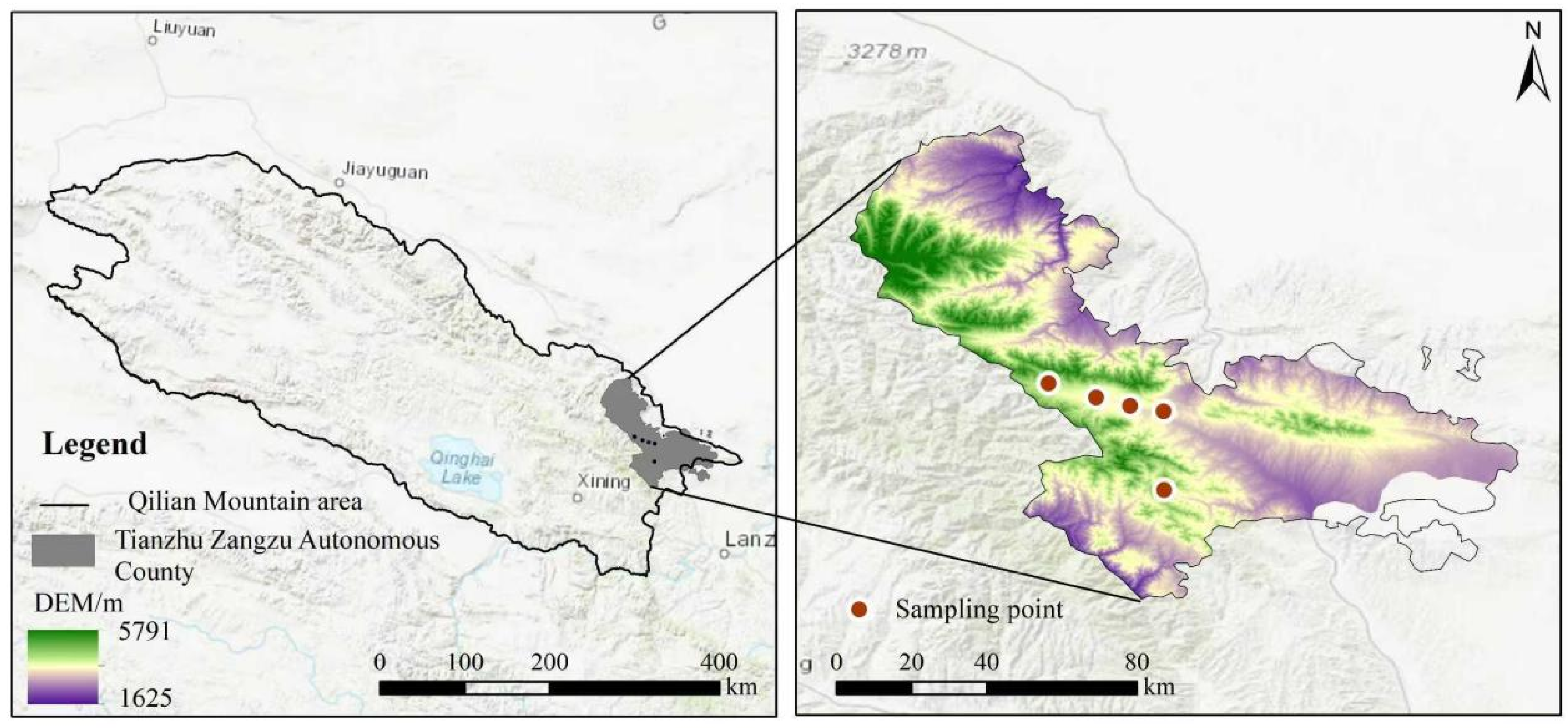
The stocking rate was calculated based on field surveys, with the grazing rate converted as sheep unit (grazing duration × grazing area) (1 white yak = 4.5 sheep units, 1 Tianhua Merino sheep = 1 sheep unit, 1 Gansu fine-wool sheep = 1 sheep unit). Combined with the survey data, five different grazing gradients were selected (Figure 1). The seasonal pasture in Honggeda Village was set as the light grazing (LG) (2.24 sheep units·hm−2·a−1) site, with Elymus nutans, Polygonum viviparum and Kobresia humilis as the dominant species. The rotational grazing experimental field in the Tianzhu Alpine Grassland Ecosystem Experimental Station of Gansu Agricultural University was the moderate grazing (MG) (4.17 sheep units·hm−2·a−1) site, where Kobresia humilis, Melilotoides ruthenica and Elymus nutans dominated. The public pasture in Shizhuanggou Village was the heavy grazing (HG) (5.25 sheep units·hm−2·a−1) site, with Potentilla candicans, Kobresia humilis and Polygonum viviparum as the dominant species. The livestock track in Daiqian Village was the extreme grazing (EG) (7.86 sheep units·hm−2·a−1) site, where Kobresia humilis, Potentilla candicans and Leymus secalinus were the dominant species. The long-term no-grazing alpine meadow in the core area of the Qilian Mountains National Park was set as the control (CK) (0 sheep units·hm−2·a−1), with Elymus nutans, Polygonum viviparum and Kobresia humilis as the dominant species. All plots were alpine meadows. Soil samples were collected from all 5 treatments with 6 replicates, and the soil texture was measured by Microtrac Sync laser particle size analyzer (Microtrac MRB, Montgomeryville, PA, USA/Düsseldorf, Germany) to be basically consistent, showing no significant difference (p > 0.05). A supplementary comparison of soil texture under different grazing intensities is provided in Table S1 (Supplementary Materials). The sampling sites in this study had consistent site conditions and long-term fixed grazing patterns and intensities, which avoided the impacts of short-term artificial control and microclimate differences.
Figure 1.
Overview of the Sampling Sites. Note: Six replicates were selected for all plots, and the soil texture was measured to be basically consistent using a Microtrac Sync laser particle size analyzer (Microtrac MRB, USA/Germany). Note: Dots indicate sampling locations.
2.2. Experimental Methods
Six replicates were established for each of the five alpine meadow plots under different grazing gradients, with five sampling points randomly distributed in each replicate plot. Since the 0–20 cm soil layer is the dense distribution layer of plant roots in the alpine meadows of the study area, soil samples were collected separately from the 0–10 cm topsoil and 10–20 cm subsurface soil layers. For soil sampling, the surrounding soil at each sampling position was excavated with a small soil spade, and the soil in its original state was completely collected at the fixed depth. The soil samples were transported back to the laboratory in rigid containers to preserve their physical structure. Gravel, litter, animal feces and other foreign materials were manually picked out from the soil samples, which were then air-dried in a dark place. The air-dried soil samples were broken along natural fractures into clods with a diameter of approximately 10 mm. The clods were gently placed on the top layer of a nest of sieves, which was fixed with iron clamps and rubber bands and had aperture sizes of 5 mm, 2 mm, 1 mm, 0.5 mm and 0.25 mm [6], to determine the composition of mechanically stable soil aggregates. The soil samples were fully immersed in water using a sedimentation bucket, and the water-stable soil aggregates were determined via the wet sieving method in an aqueous environment. All determinations were performed for each replicate individually without mixing the samples.
Vegetation and soil environmental factors of the alpine meadows in the study area were measured at each sampling point. Soil bulk density was determined using a 100 cm3 cutting ring. Soil cores with a depth of 20 cm were collected using a soil auger with a 5 cm diameter for the determination of environmental factors, and soil mineralization rate (SMR) was determined by the alkali absorption method. The contents of ammonium nitrogen (NH4+-N) and nitrate nitrogen (NO3−-N) were measured using a flow injection analyzer (San++Compact, Skalar Analytical B.V., Breda, The Netherlands). Aboveground biomass was determined by clipping vegetation at ground level in 50 × 50 cm quadrats, and underground roots were excavated from the clipped quadrats thereafter. A sampling depth of 50 cm was selected for root collection to ensure the integrity of root samples. The altitude (ALT) of each sampling point was measured with a GPS device. All determinations were conducted for each replicate individually without sample mixing.
2.3. Data Analysis
2.3.1. Calculation Formulas
Soil aggregate stability was quantified by the mean weight diameter (MWD), geometric mean diameter (GMD) and fractal dimension (D), which reflect the particle size distribution characteristics and structural stability of soil aggregates from different dimensions.
The calculation formulas for MWD, GMD and D are as follows:
where Ri is the mean diameter of soil aggregates in the i-th particle size fraction (mm); Wi is the mass percentage of soil aggregates in the i-th particle size fraction (%).
where D is the fractal dimension; Mi (i = 1, 2, 3, ⋯) is the total mass of aggregates with particle size smaller than di (g); M0 is the total mass of all soil aggregates (g); di is the mean diameter between adjacent particle size fractions of aggregates (mm); dmax is the diameter of the largest particle size fraction of aggregates (mm). The linear relationship between the logarithm of soil aggregate particle size and the logarithm of cumulative mass was fitted using Origin 2021 software, and the fractal dimension D was solved based on the fitting equation.
The Aggregate Water Stability Relative Change Index (AWSRCI) was used to quantify the stability change of soil aggregates with specific particle sizes under the action of water relative to that under physical mechanical force. The calculation formula is as follows:
where DSd is the mass percentage of aggregates with particle size d determined by dry sieving, and WSd is the mass percentage of aggregates with the corresponding particle size determined by wet sieving.
2.3.2. Statistical Analysis
The Shapiro–Wilk test was used to check the normality of all data, and the results indicated that all data followed a normal distribution (p > 0.05). IBM SPSS Statistics 27.0 Software was used to conduct one-way analysis of variance (One-way ANOVA) on the mass proportion of soil aggregate fractions to test the significance of differences in indices (gas flux data and influencing factors) among different treatment groups. When there were significant differences among groups (p < 0.05), multiple comparisons were further conducted to identify the sources of differences, with Duncan’s new multiple range test used for post hoc multiple comparisons. This method was adopted because it is widely recognized and commonly used for multiple comparisons among treatment means in ecological and soil-related studies, and is suitable for detecting significant differences between different grazing intensity treatments with relatively balanced sample sizes. Two-way analysis of variance (Two-way ANOVA) was applied to explore the effects of soil depth and grazing intensity on the mass proportion of soil aggregate fractions and soil aggregate stability indices, as well as their interaction. Pearson correlation analysis was used to analyze the correlations between soil aggregate particle size distribution, stability and environmental factors.
3. Results
3.1. Composition and Distribution of Soil Aggregate Fractions in Alpine Meadows Under Different Grazing Intensities
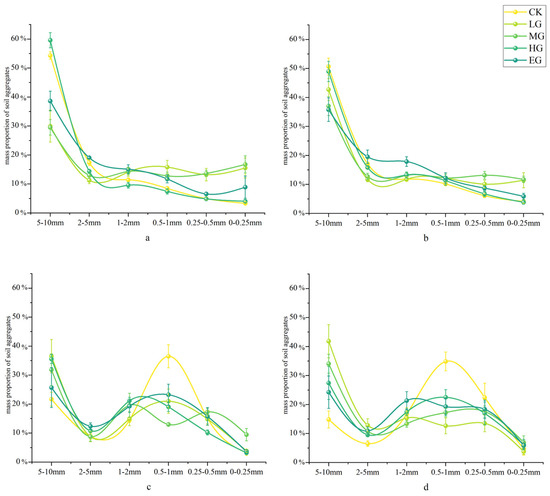
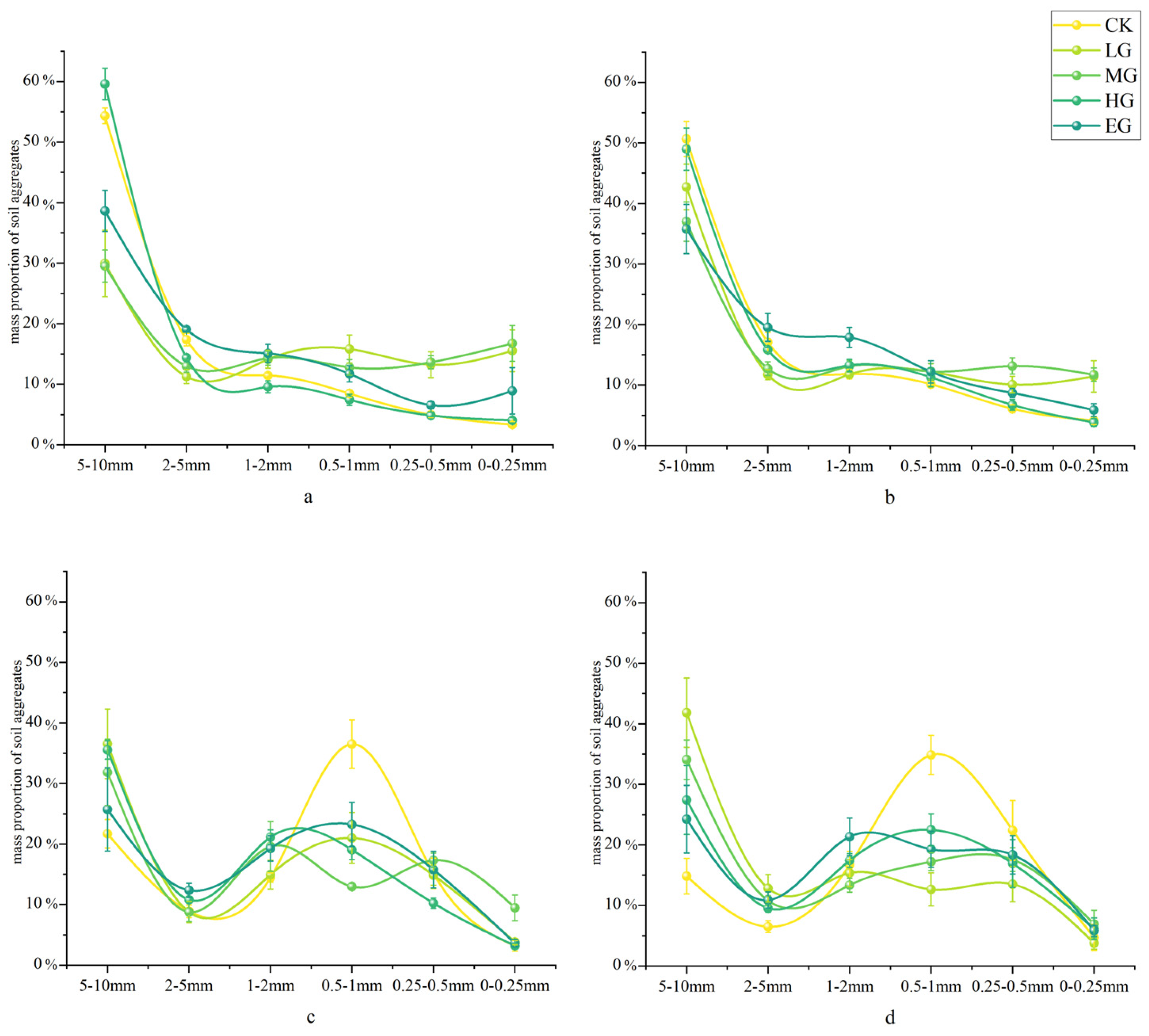
As shown in Figure 2a,b, the mass proportion of mechanically stable soil aggregates with the 5–10 mm particle size was the highest under all grazing intensities and varied obviously. In the topsoil, the mass proportion of this fraction followed the order of HG > CK > EG > LG > MG; there was no significant difference between HG and CK (p > 0.05), but both were significantly higher than that under other grazing intensities (p < 0.01), being approximately twice that under LG and MG. Except for the 5–10 mm fraction, the mass proportion of all other aggregate fractions fluctuated between 10% and 20%, and there were no significant differences in these fractions under LG and MG (p > 0.05). The mass proportion of mechanically stable soil aggregates with the 0–0.25 mm particle size under LG and MG was significantly higher in the topsoil than that under HG, EG and CK, and significantly higher in the subsoil than that under HG and CK. The variation in soil structure with grazing intensity was greater in the topsoil than in the subsoil.
Figure 2.
Effects of Grazing Intensity on the Mass Proportion of mechanically stable and Water-Stable Soil Aggregates in Different Soil Layers. (a) Mechanical stable; (b) Mechanical stable; (c) Water-stable; (d) Water-stable. Note: CK = no grazing (control), LG = light grazing, MG = moderate grazing, HG = heavy grazing, EG = extreme grazing. X-axis: Particle size (mm); Y-axis: Mass proportion (%). Soil layers: (a,c) 0–10 cm, (b,d) 10–20 cm.
As shown in Figure 2c,d, the mass proportion of water-stable soil aggregates with the 5–10 mm particle size was the lowest under the no-grazing condition, while that of the 0.5–1 mm fraction was the highest. The mass proportion of water-stable soil aggregates with the 5–10 mm particle size under LG and MG was approximately twice that under the no-grazing condition (14.85% in the topsoil and 21.70% in the subsoil). The mass proportion of water-stable aggregates with particle size > 1 mm in the subsoil was higher than that in the topsoil under light and moderate grazing, while the opposite was true under heavy, extreme grazing and no grazing. The soil layer difference of aggregates under LG was the largest (coefficient of variation 24.8%), while that under CK was the smallest (coefficient of variation 5%).
Two-way ANOVA on the structural characteristics of soil aggregates under different grazing intensities and soil depths showed that: grazing intensity had an extremely significant effect on the content of mechanically stable soil aggregates in all particle size fractions (p < 0.001), and a significant effect only on the content of water-stable aggregates with the 5–10 mm (p < 0.05, F = 5.509) and 0–0.25 mm particle sizes (p < 0.05, F = 3.189). Soil depth had no significant effect on the content of soil aggregates (p > 0.05). The interaction between grazing intensity and soil depth only had a significant effect on the content of mechanically stable aggregates with the 5–10 mm particle size (p < 0.05, F = 3.731).
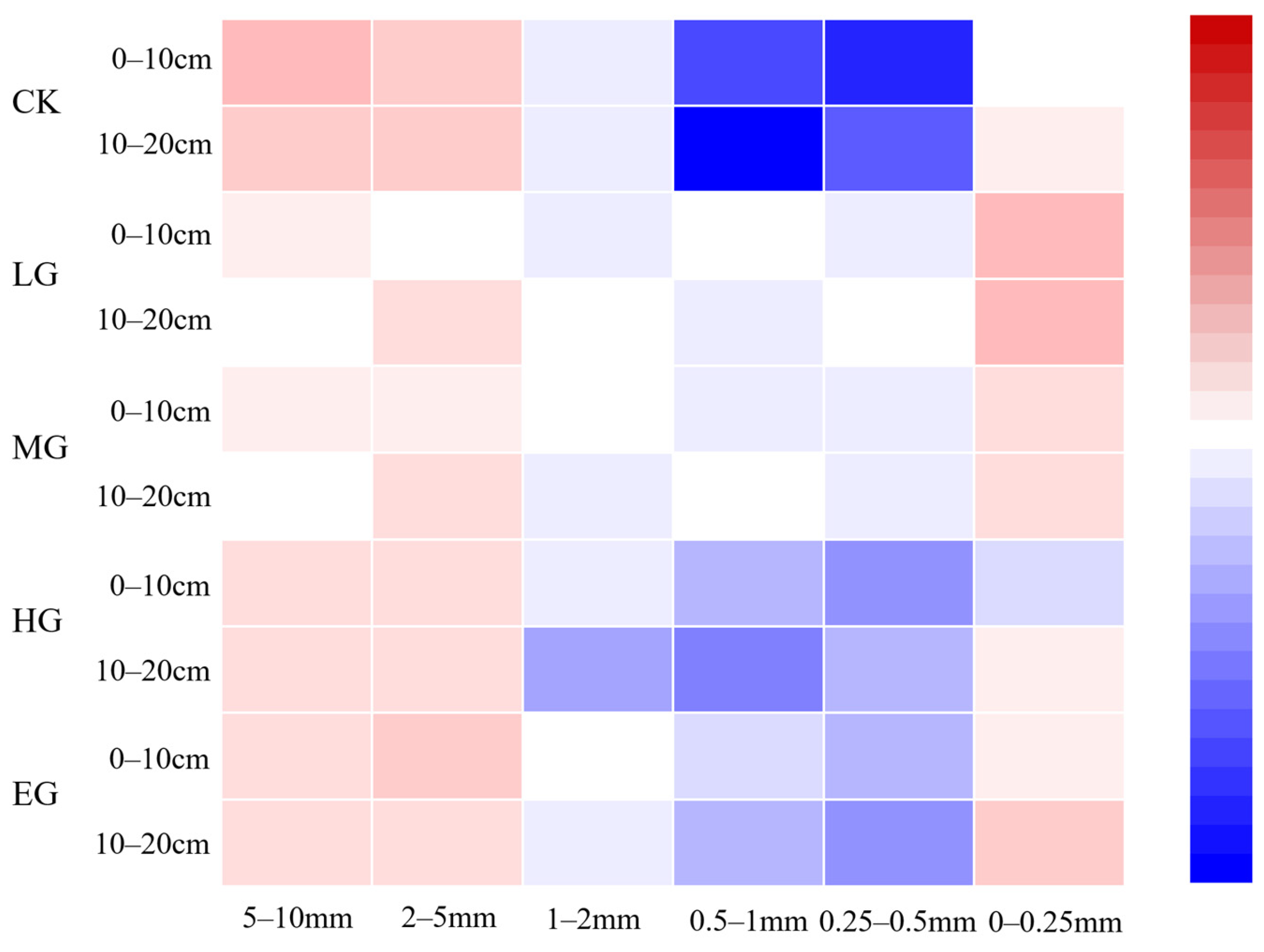
As shown in Figure 3, the AWSRCI of soil aggregates with the 5–10 mm and 2–5 mm particle sizes were all positive, and the values approached 0 under LG and MG. The AWSRCI of 1–2 mm soil aggregates in the subsoil under HG was much lower than that under other treatments. The AWSRCI of soil aggregates with the 0.5–1 mm and 0.25–0.5 mm particle sizes varied most significantly under different grazing intensities: the values approached 0 under LG and MG, while negative values were observed under other treatments, with the values under CK (330.54% in the topsoil and 205.43% in the subsoil) being extremely significantly different from those under other treatments (p < 0.001). The AWSRCI of 0–0.25 mm soil aggregates was positive under all treatments except for the topsoil under HG.
Figure 3.
Heatmap of Soil Aggregate Water Stability Relative Change Index (AWSRCI) under Different Grazing Intensities and Soil Depths. Note: The color scale indicates the Aggregate Water Stability Relative Change Index (AWSRCI). Blue represents negative values, red represents positive values, and colors closer to white indicate values approaching 0. Abbreviations: CK = Control (no grazing); LG = Light Grazing; MG = Moderate Grazing; HG = Heavy Grazing; EG = Extreme Grazing.
3.2. Soil Aggregate Stability Parameters in Alpine Meadows Under Different Grazing Intensities
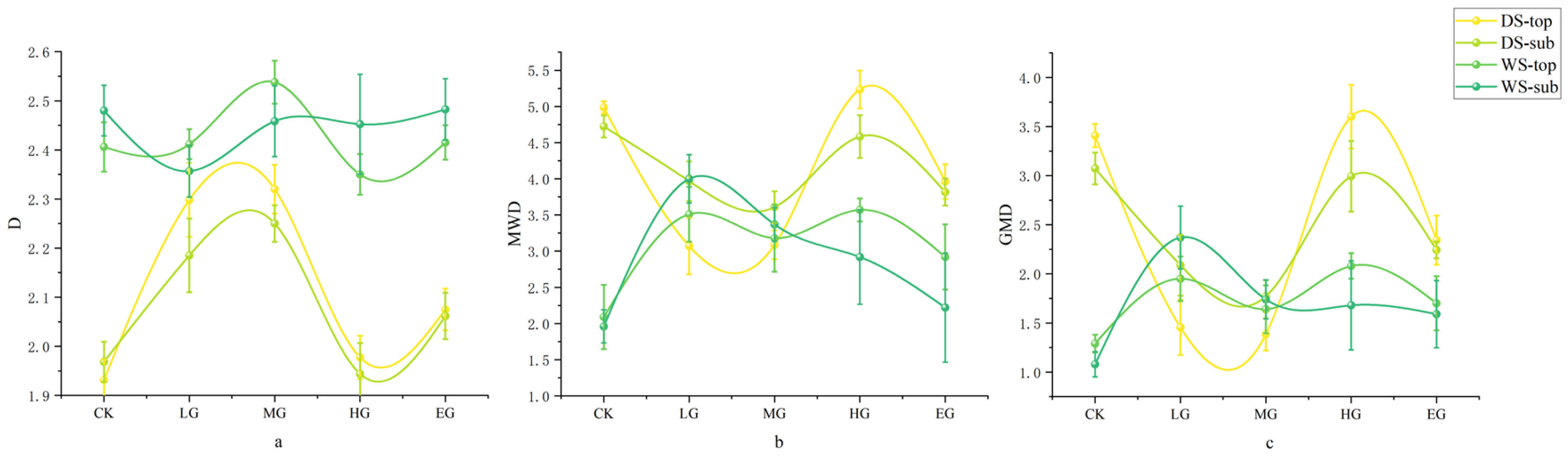
As shown in Figure 4, the variation trends of MWD and GMD were highly consistent (correlation coefficient > 0.9), while the trend of D was basically opposite to that of the two indices. Under light and moderate grazing, the MWD and GMD of mechanically stable soil aggregates were smaller and the D value was larger, while the opposite was true under heavy and extreme grazing. There was a significant difference in indices between extreme grazing and no grazing (p < 0.05), while no significant difference was found between heavy grazing and the no-grazing control (p > 0.05).
Figure 4.
Stability Indices of Soil Aggregates Separated by Different Sieving Methods at Various Depths in the Alpine Meadow of Qilian Mountains Under Different Grazing Intensities. (a) Changes in Fractal Dimension (D) under different grazing intensities; (b) Changes in Mean Weight Diameter (MWD) under different grazing intensities; (c) Changes in Geometric Mean Diameter (GMD) under different grazing intensities. Note: DS = Dry Sieving, WS = Wet Sieving; MWD = Mean Weight Diameter, GMD = Geometric Mean Diameter, D = Fractal Dimension; CK = no grazing (control), LG = light grazing, MG = moderate grazing, HG = heavy grazing, EG = extreme grazing.
The variation in stability indices of water-stable aggregates under different grazing conditions was smaller than that of mechanically stable aggregates. No grazing was the treatment with the smallest MWD (2.09 mm in the topsoil and 1.96 mm in the subsoil) and GMD (1.29 mm in the topsoil and 1.08 mm in the subsoil) of water-stable aggregates. The MWD and GMD of water-stable aggregates in the subsoil decreased with the increase in grazing intensity, with the highest values observed under light grazing (MWD 4.00 mm, GMD 2.37 mm), which were approximately twice those under no grazing. In the topsoil, the MWD and GMD slightly increased under heavy grazing, and the remaining variation trends were consistent with those in the subsoil. The inter-treatment difference in MWD (2.04 mm) was 1.58 times that in GMD (1.29 mm). The stability indices of soil aggregates in the subsoil were higher than those in the topsoil under light and moderate grazing, while the opposite was true under other treatments.
Two-way ANOVA results showed that grazing intensity had an extremely significant effect on all mechanical stability parameters of soil aggregates (p < 0.001), with the F-values of fractal dimension (D), mean weight diameter (MWD) and geometric mean diameter (GMD) being 20.615, 18.014 and 20.027, respectively. Grazing intensity exerted a significant effect on two water stability parameters of soil aggregates, namely mean weight diameter (MWD) (p < 0.05, F = 5.362) and geometric mean diameter (GMD) (p < 0.05, F = 4.620). The interaction between grazing intensity and soil depth only had a significant effect on the MWD of mechanically stable soil aggregates (p < 0.05, F = 9.896).
3.3. Correlation Analysis Between Soil Aggregate Stability Indices and Environmental Factors
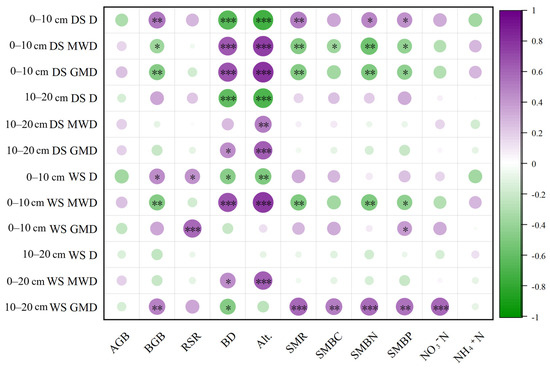
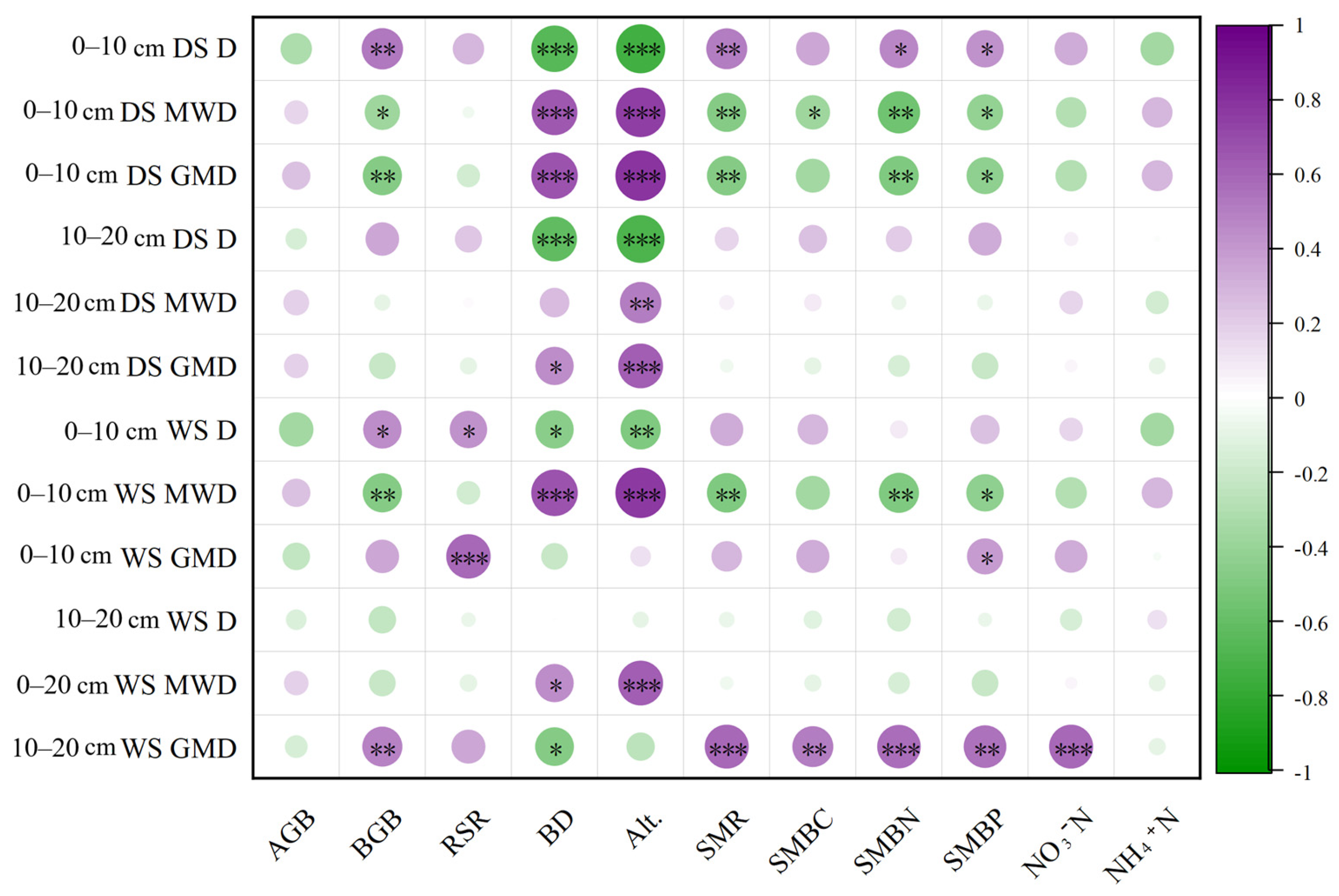
Correlation analysis (Figure 5) showed that the D value was significantly negatively correlated with altitude and soil bulk density (p < 0.05) except for that of water-stable aggregates in the subsoil. Altitude was significantly positively correlated with the MWD value (p < 0.01), and extremely significantly positively correlated with the GMD value of mechanically stable soil aggregates (p < 0.001), while the correlation with the GMD of water-stable soil aggregates was not significant (p > 0.05). Soil bulk density was extremely significantly positively correlated with the MWD value of aggregates in the topsoil (p < 0.01), while the correlation with the MWD of mechanically stable aggregates in the subsoil was not significant (p > 0.05). Except for water-stable aggregates in the topsoil, soil bulk density was significantly positively correlated with the GMD value (p < 0.05). The correlations between soil microbial biomass carbon, nitrogen, phosphorus and soil aggregate stability indices were not uniform: they were significantly positively correlated with the GMD of water-stable aggregates, but negatively correlated with mechanically stable indices and other water-stable indices. Belowground biomass, soil mineralization rate and nitrate nitrogen showed the same correlation trend as microbial biomass carbon, nitrogen and phosphorus. Belowground biomass was significantly correlated with all stability indices in the topsoil except for the GMD of water-stable aggregates (p < 0.05), and extremely significantly correlated with the GMD of water-stable aggregates in the subsoil (p < 0.01), while the correlations with other indices were not significant (p > 0.05). Soil mineralization rate was only significantly positively correlated with the D and GMD of water-stable aggregates in the topsoil (p < 0.05). Nitrate nitrogen was only extremely significantly positively correlated with the GMD of water-stable aggregates in the subsoil (p < 0.001), while the correlations with other stability indices were not significant (p > 0.05). Aboveground biomass and ammonium nitrogen showed the opposite correlation trend to microbial biomass carbon, nitrogen and phosphorus, and the correlations were not significant (p > 0.05). The correlations between soil aggregate stability indices and environmental factors were generally higher in the topsoil than in the subsoil, and the correlations of mechanically stable aggregate stability indices with environmental factors were overall higher than those of water-stable aggregate stability indices.
Figure 5.
Correlation heatmap between soil aggregate stability indices under different sieving methods and environmental factors. Note: The abbreviations used in this correlation heatmap are defined as follows: DS = Dry Sieving method; WS = Wet Sieving method; Larger dots indicate stronger correlations, while smaller dots indicate weaker correlations; BD in the figure represents soil bulk density. MWD = Mean Weight Diameter; GMD = Geometric Mean Diameter; D = Fractal Dimension; RSR =Root-Shoot Ratio; AGB = Aboveground Biomass; BGB = Belowground Biomass; Alt. = Elevation; SMR = Soil Mineralization Rate; SMBC = Soil Microbial Biomass Carbon; SMBN = Soil Microbial Biomass Nitrogen; SMBP = Soil Microbial Biomass Phosphorus. Asterisks indicate significant correlation: * p < 0.05, ** p < 0.01, *** p < 0.001.
4. Discussion
Soil structure is a core element sustaining ecosystem functions and soil quality, which directly regulates the processes of water transfer, gas exchange and nutrient cycling [28]. Essentially, soil structure refers to the spatial arrangement pattern of soil aggregates and particles with different particle sizes [6], and its formation and evolution are comprehensively regulated by environmental conditions, biological processes and anthropogenic disturbances (e.g., grazing) [29]. Soil aggregates are the core indices characterizing soil structure quality [30], and their compositional characteristics are of great significance for assessing changes in soil quality under grazing disturbance. The study found that grazing intensity had a significant effect on the composition of soil aggregates in alpine meadows, which was consistent with the conclusion of previous research on alpine steppes [31]. However, soil depth and its interaction with grazing intensity had no significant effect on the composition of soil aggregates.
4.1. Effects of Different Grazing Intensities on the Composition and Stability of Soil Aggregates
In the study, soil aggregates with a particle size of 5–10 mm were the dominant fraction in the soil aggregate structure, and the variation in their mass proportion could directly reflect the disturbance effect of grazing on soil structure. The mass proportion of 5–10 mm aggregates in the topsoil was the highest under heavy grazing. This might be attributed to the accumulation of a large amount of animal and plant residues as well as livestock manure on the soil surface caused by long-term high-intensity grazing. Manure input provides a favorable breeding environment for microorganisms and stimulates them to secrete extracellular polymeric substances, which bond microaggregates to form macroaggregates through chemical cementation combined with the physical entanglement of plant roots [32]. The higher proportion of macroaggregates under heavy and extreme grazing may be due to the increased soil bulk density caused by physical compaction from overgrazing [21]. The mass proportion of macroaggregates under extreme grazing was still lower than that under heavy grazing, as severe grassland degradation induced by extreme grazing led to a significant reduction in plant biomass. The variation trends of soil aggregate composition with grazing intensity overlapped under light and moderate grazing, indicating that mechanically stable soil aggregates of different particle sizes were in a dynamic balance of fragmentation and cementation. Soil macroaggregates were moderately crushed into small and medium-sized aggregates by trampling, while the small and medium-sized aggregates could be re-polymerized through stable cementing substances such as humus and polyvalent cations. The high mass proportion of 5–10 mm mechanically stable soil aggregates under no grazing indicated that no grazing is conducive to improving soil mechanical stability, which is consistent with the research result of Wen et al. in the Inner Mongolia grassland [33]. The proportion of 5–10 mm water-stable aggregates under no grazing was lower than that under all other treatments and much lower than that of 5–10 mm mechanically stable aggregates under the same condition. This may be because no grazing cuts off the manure input from livestock [32], thus reducing the substrates for microbial survival. Another possibility is that the underground root system of grasslands under no grazing does not grow as well as that under moderate grazing [34], resulting in a weak maintenance effect of roots on water-stable aggregates and poor resistance to water erosion. Light and moderate grazing were the least affected by the difference in sieving methods, and the subsurface soil was more stable than the topsoil, which proved that suitable grazing is beneficial to improving the water erosion resistance of grasslands [35,36,37,38].
Soil aggregate stability can directly reflect the anti-interference ability and the potential of water and nutrient retention of soil structure [30]. In the study, the characteristics of soil aggregates were determined by the dry sieving method and wet sieving method, and three stability parameters including the mean weight diameter (MWD), geometric mean diameter (GMD) and fractal dimension (D) were calculated. The effects of grazing intensity and soil depth on aggregate stability were analyzed, and the relationship between environmental factors and aggregate stability was revealed. Among the stability indices of mechanically stable soil aggregates, the MWD and GMD under light and moderate grazing were lower than those under other treatments, while the D value was higher. This is because no grazing reduces biological damage, and animal trampling and manure input under overgrazing lead to an increase in soil macroaggregates [21,32]. Such macroaggregate accumulation, however, is a physicochemically induced aggregation rather than an indication of improved soil quality. Among the stability indices of water-stable aggregates, the no-grazing control was significantly lower than all other treatments, and the water-stable aggregate stability indices were also lower than the mechanical stability indices of the no-grazing control. The stability indices of water-stable soil aggregates in the subsurface soil decreased with the increase in grazing intensity, while those in the topsoil increased under heavy grazing with the remaining trends unchanged. Field observations found that heavy and extreme grazing led to the concentrated foraging of livestock or their aggregation during transhumance, and a large amount of manure covering the soil surface may improve the water stability of the topsoil [34], which can explain this phenomenon.
Two-way ANOVA in the study found that soil aggregate structure and stability were extremely significantly affected by grazing intensity (p < 0.001), while soil depth had a minor effect, which was consistent with the conclusion of previous research [31,39,40]. Mechanically stable soil aggregates were more affected by grazing than water-stable soil aggregates [41], possibly because the damage of grazing to aggregates is mainly mechanical fragmentation [32], and the re-aggregation of microaggregates under the wet sieving method leads to a reduction in differences.
4.2. Effects of Biological and Environmental Factors on Soil Aggregate Stability
Correlation analysis of environmental factors showed that altitude was significantly positively correlated with soil aggregate stability (p < 0.05), which was consistent with the research result of Zhu et al. in Xuebaoding Mountain, Sichuan Province [42]. Relevant research in the Helan Mountains has also confirmed this phenomenon [43]. Li et al. [44] further pointed out that the high-altitude environment optimizes the arrangement of soil particles by regulating soil bulk density, thus improving structural stability. In the study, soil bulk density was also significantly positively correlated with aggregate stability (p < 0.05).
Soil mineralization rate was significantly positively correlated with aggregate stability (p < 0.05). A higher mineralization rate reflects vigorous microbial activity [45], and grazing has an extremely significant effect on the mineralization process [30]. This may be because humus and polysaccharides produced by microorganisms during organic matter decomposition bond soil particles through chemical bridging and physical entanglement. In addition, nutrients released by mineralization may promote the growth of plant roots and mycorrhizal fungi, and the secretions of mycorrhizal fungi can significantly improve aggregate stability [46]. There was a significant positive correlation between grassland belowground biomass and aggregate stability (p < 0.05), as the physical entanglement of roots is an important driving force for aggregate formation [19]. In the study, the stability of water-stable aggregates decreased with the increase in grazing intensity, which was consistent with the research conclusion of Zhang et al. in the Stipa krylovii steppe of Inner Mongolia [24]. This may be because overgrazing inhibits root growth and microbial activity, thus weakening biological cementation.
Soil microbial biomass carbon, nitrogen and phosphorus had negative effects on most aggregate stability indices, which is related to the dual effects of microorganisms. Microorganisms can stabilize soil structure by regulating the arrangement of soil particles, yet excessive microorganisms consume substrates and decompose aggregate cementing agents, and this decomposition effect plays a dominant role in the process [47]. Among the water-stable indices, GMD was significantly positively correlated with microbial biomass, because extracellular polymeric substances secreted by microorganisms can directly promote the increase in geometric mean diameter [48,49].
In the study, nitrate nitrogen was positively correlated with aggregate stability, while ammonium nitrogen was negatively correlated. This difference is related to the regulatory effects of different nitrogen forms on the soil environment and microbial community. Nitrate nitrogen can promote the growth of fungi, and their hyphal networks and secreted extracellular polymeric substances are the key to the formation of macroaggregates. Meanwhile, OH− released by plants during nitrate nitrogen absorption helps maintain soil pH stability, thus indirectly enhancing aggregate structure [50]. Ammonium nitrogen exerts the opposite effect: for each nitrate ion produced during the nitrification of ammonium nitrogen, two hydrogen ions are generated concomitantly, leading to soil acidification. Such acidification alters the microbial community structure and thus reduces aggregate stability [51]. In addition, nitrate nitrogen can inhibit the degradation of unstable organic carbon more effectively than ammonium nitrogen, further strengthening aggregate stability [46].
4.3. Study Limitations
This study has several limitations. First, samples were only collected in the growing season, and seasonal changes (e.g., freezing–thawing cycles [44]) and interannual climate fluctuations were not considered, and the study area was limited to the eastern Qilian Mountains with poor spatial universality [41]. Second, key cementing substances for soil aggregates [6,33] and deep soil (20–50 cm) data were lacking, and microbial community structure and enzyme activities were not analyzed [8,47]. Third, the grazing regime was simplified, ignoring the differential effects of grazing animal species and seasonal grazing [32,36]. Fourth, the sieving methods could not simulate natural erosion [41], and only linear correlation analysis was used, failing to quantify the driving effects of environmental factors [24,29].
5. Conclusions
No grazing (CK) maintained relatively high mechanical stability of soil aggregates but had a weaker resistance to water erosion than grazed grasslands. Light and moderate grazing (2.24–4.17 sheep units·hm−2·a−1) resulted in a stable soil structure with a strong resistance to adverse external factors, whereas heavy and extreme grazing aggravated the fragmentation of soil structure and led to an overall decline in stability. Mechanically stable soil aggregates in the alpine meadow were more sensitive to grazing intensity than water-stable soil aggregates, and the dry sieving method was more effective in reflecting the effects of grazing on grasslands. The topsoil of the alpine meadow was more sensitive to grazing intensity than the subsurface soil; the stability of soil aggregates in the subsurface soil was superior to that in the topsoil under light and moderate grazing, while the opposite pattern was observed under no grazing, heavy grazing and extreme grazing, as the subsurface soil was less disturbed by grazing trampling. Altitude, soil bulk density, belowground biomass and soil mineralization rate were all significantly positively correlated with the structure and stability of soil aggregates; nitrate nitrogen exerted a positive effect on aggregate stability, while ammonium nitrogen had a negative effect; soil microbial biomass carbon, nitrogen and phosphorus exhibited dual effects, being significantly positively correlated with the geometric mean diameter (GMD) of water-stable soil aggregates but negatively correlated with the mechanical stability indices and other water stability indices. Overall, obvious differences exist between the responses of mechanical stability and water stability of soil aggregates in alpine meadows to grazing intensity. Future research could further focus on the synergistic mechanisms of soil–root–microbe interactions under long-term grazing gradients, to deeply reveal the long-term effects of different grazing regimes on soil structural stability in alpine meadows, so as to provide a more systematic scientific basis for the sustainable utilization, soil conservation and adaptive management of alpine grassland ecosystems.
Supplementary Materials
The following supporting information can be downloaded at: https://www.mdpi.com/article/10.3390/agriculture16070754/s1, Table S1: Soil texture (clay, silt, sand) under different grazing conditions.
Author Contributions
Conceptualization, D.L. and X.L.; methodology, X.L.; formal analysis, X.L.; investigation, X.L., Z.L., T.Q., G.S. and H.W.; writing—original draft preparation, X.L.; writing—review and editing, D.L. and Y.S.; supervision, D.L.; project administration, D.L.; funding acquisition, D.L. All authors have read and agreed to the published version of the manuscript.
Funding
This research was funded by Open Project of the Key Laboratory of Grassland Ecosystem, Ministry of Education (KLGE202209), National Natural Science Foundation of China (32260354), Open Competition for Tackling Key Problems Project of the Key Laboratory of Grassland Ecosystem, Ministry of Education (KLGE-2024-01), Lanzhou Youth Science and Technology Talents Innovation Project (2023-QN-46), and Key Team Construction Project of Grassland Ecology and Management, Pratacultural Science Discipline, Gansu Agricultural University (2500011004).
Data Availability Statement
The original contributions presented in the study are included in the article. Further inquiries can be directed to the corresponding author.
Acknowledgments
We would like to express our sincere gratitude to the Zhangye Branch of Gansu Provincial Administration Bureau of Giant Panda Qilian Mountain National Park, Hualong Nature Protection Station, and Hongyazi Resource Management and Protection Station for their strong support and assistance in the field investigation and sample collection of this study. We are also deeply grateful to the Tianzhu Alpine Grassland Ecosystem Experiment Station, Gansu Agricultural University, for providing the experimental site and facilities. Special thanks are extended to Jiangang Chen from the College of Pratacultural Science, Gansu Agricultural University, for his valuable guidance and suggestions throughout the research. We also thank our classmates Zhipeng Bao, Weiwei Luo, Xinying Hua, and Yinuo Song for their great help in field work and laboratory analysis.
Conflicts of Interest
The authors declare no conflicts of interest.
Abbreviations
The following abbreviations are used in this manuscript:
| CK | No Grazing (Control) |
| LG | Light Grazing |
| MG | Moderate Grazing |
| HG | Heavy Grazing |
| EG | Extreme Grazing |
| MWD | Mean Weight Diameter |
| GMD | Geometric Mean Diameter |
| D | Fractal Dimension |
| AWSRCI | Aggregate Water Stability Relative Change Index |
| SMR | Soil Mineralization Rate |
| NH4+-N | Ammonium Nitrogen |
| NO3−-N | Nitrate Nitrogen |
| ALT | Altitude |
| SMBC | Soil Microbial Biomass Carbon |
| SMBN | Soil Microbial Biomass Nitrogen |
| SMBP | Soil Microbial Biomass Phosphorus |
| AGB | Aboveground Biomass |
| BGB | Belowground Biomass |
| RSR | Root-Shoot Ratio |
| BD | Bulk Density |
| DS | Dry Sieving method |
| WS | Wet Sieving method |
| Top | Topsoil (0–10 cm) |
| Sub | Subsoil (10–20 cm) |
References
- Zhang, W.; Yi, S.; Chen, J.; Qin, Y.; Sun, Y.; Shangguan, D. Characteristics and controlling factors of alpine grassland vegetation patch patterns on the central Qinghai-Tibetan plateau. Ecol. Indic. 2021, 125, 107570. [Google Scholar] [CrossRef] [Scilit]
- Li, M.; Zhang, X.; He, Y.; Wu, J. Assessment of the vulnerability of alpine grasslands on the Qinghai-Tibetan Plateau. PeerJ 2020, 8, e8513. [Google Scholar] [CrossRef] [Scilit] [PubMed]
- Rhoton, F.E.; Römkens, M.J.M.; Lindbo, D.L. Iron oxides erodibility interactions for soils of the Memphis catena. Soil Sci. Soc. Am. J. 1998, 62, 1693–1703. [Google Scholar] [CrossRef] [Scilit]
- Lehmann, A.; Leifheit, E.F.; Rillig, M.C. Mycorrhizas and Soil Aggregation; Elsevier: Amsterdam, The Netherlands, 2017; pp. 241–262. [Google Scholar]
- Rillig, M.C.; Muller, L.A.; Lehmann, A. Soil aggregates as massively concurrent evolutionary incubators. ISME J. 2017, 11, 1943–1948. [Google Scholar] [CrossRef] [Scilit]
- Tisdall, J.M.; Oades, J.M. Organic matter and water-stable aggregates in soils. J. Soil Sci. 1982, 33, 141–163. [Google Scholar] [CrossRef] [Scilit]
- Rabbi, S.M.; Daniel, H.; Lockwood, P.V.; Wilson, B.R.; Young, I.M. Physical soil architectural traits are functionally linked to carbon decomposition and bacterial diversity. Sci. Rep. 2016, 6, 33012. [Google Scholar] [CrossRef] [Scilit]
- Murugan, R.; Djukic, I.; Keiblinger, K.; Zehetner, F.; Bierbaumer, M.; Zechmeister-Boltenstern, S.; Jørgensen, R.G. Spatial distribution of microbial biomass and residues across soil aggregate fractions at different elevations in the Central Austrian Alps. Geoderma 2019, 339, 1–8. [Google Scholar] [CrossRef] [Scilit]
- Feng, D.; Yao, Y.; Zhou, J.; Kong, W.; Gai, J.; Zhang, Q.; Jia, X.; Shao, M.; Wei, X.; Qiu, L. Responses of soil nutrients and enzyme activities to afforestation species and age on China’s Loess Plateau: An investigation from soil aggregates aspect. Agric. Ecosyst. Environ. 2025, 393, 109804. [Google Scholar] [CrossRef] [Scilit]
- Wang, A.N.; Zha, T.G.; Zhang, Z.Q. Variations in soil organic carbon storage and stability with vegetation restoration stages on the Loess Plateau of China. CATENA 2023, 228, 107142. [Google Scholar] [CrossRef] [Scilit]
- Wu, C.X.; Yan, B.S.; Jing, H.; Wang, J.; Gao, X.; Liu, Y.; Liu, G.; Wang, G. Application of organic and chemical fertilizers promoted the accumulation of soil organic carbon in farmland on the Loess Plateau. Plant Soil 2023, 483, 285–299. [Google Scholar] [CrossRef] [Scilit]
- Kleber, M.; Bourg, I.C.; Coward, K.E.; Hansel, C.M.; Myneni, S.C.B.; Nunan, N. Dynamic interactions at the mineral–organic matter interface. Nat. Rev. Earth Environ. 2021, 2, 402–421. [Google Scholar] [CrossRef] [Scilit]
- Jilling, A.; Keiluweit, M.; Gutknecht, J.L.M.; Grandy, A.S. Priming mechanisms providing plants and microbes access to mineral-associated organic matter. Soil Biol. Biochem. 2021, 158, 108265. [Google Scholar] [CrossRef] [Scilit]
- Udawatta, R.P.; Kremer, R.J.; Adamson, B.W.; Anderson, S.H. Variations in soil aggregate stability and enzyme activities in a temperate agroforestry practice. Appl. Soil Ecol. 2008, 39, 153–160. [Google Scholar] [CrossRef] [Scilit]
- Pohl, M.; Alig, D.; Körner, C.; Rixen, C. Higher plant diversity enhances soil stability in disturbed alpine ecosystems. Plant Soil 2009, 324, 91–102. [Google Scholar] [CrossRef] [Scilit]
- Domżł, H.; Hodara, J.; Słowińska-Jurkiewicz, A.; Turski, R. The effects of agricultural use on the structure and physical properties of three soil types. Soil Tillage Res. 1993, 27, 365–382. [Google Scholar] [CrossRef] [Scilit]
- Arshad, M.A.; Coen, G.M. Characterization of soil quality: Physical and chemical criteria. Am. J. Altern. Agric. 1992, 7, 25–31. [Google Scholar] [CrossRef] [Scilit]
- Haonian, L.; Ruibing, M.; Zhongju, M.; Rile, G.E.; Xiaolong, W.U. Influence of grazing patterns on the stability of soil aggregates in semi-arid grasslands. J. Arid Land 2026, 18, 322–338. [Google Scholar] [CrossRef] [Scilit]
- Li, H.; Yang, Z.; Guo, X.; Li, H.; Li, X.; Wu, Y.; Han, Y.; Li, Z.; Zhang, J.; Miao, B.; et al. Responses of soil aggregate characteristics to grazing intensity differ between topsoil and subsoil in a typical steppe. Front. Environ. Sci. 2025, 13, 1610919. [Google Scholar] [CrossRef] [Scilit]
- Yang, Y.; Meng, Z.; Li, H.; Gao, Y.; Li, T.; Qin, L. Soil porosity as a key factor of soil aggregate stability: Insights from restricted grazing. Front. Environ. Sci. 2025, 12, 1535193. [Google Scholar] [CrossRef] [Scilit]
- Zhang, X.; Zhang, W.; Sai, X.; Chun, F.; Li, X.; Lu, X.; Wang, H. Grazing altered soil aggregates, nutrients and enzyme activities in a Stipa kirschnii steppe of Inner Mongolia. Soil Tillage Res. 2022, 219, 105327. [Google Scholar] [CrossRef] [Scilit]
- Sarker, C.T.; Somenahally, C.A.; Romero, A.; Rouquette, M., Jr.; Smith, G.; Ganjegunte, G. Assessing organic carbon sequestration in soil aggregates for building high quality carbon stocks in improved grazing lands. Agric. Ecosyst. Environ. 2025, 380, 109403. [Google Scholar] [CrossRef] [Scilit]
- Franzluebbers, J.A. Soil aggregation and surface- soil properties under grazed pastures and other conservation land uses in Virginia. Agron. J. 2024, 116, 1730–1745. [Google Scholar] [CrossRef] [Scilit]
- Wang, J.; Zhao, C.; Zhao, L.; Wen, J.; Li, Q. Effects of grazing on the allocation of mass of soil aggregates and aggregate-associated organic carbon in an alpine meadow. PLoS ONE 2020, 15, e0234477. [Google Scholar] [CrossRef] [Scilit] [PubMed]
- Ma, Q.J.; Luan, F.; Jia, B.; Zhang, Q.; Wang, L.; Cui, Z.; Li, X.G. Agricultural soil aggregation is affected by the crop root biomass rather than morphological characteristics. J. Plant Nutr. Soil Sci. 2023, 186, 339–350. [Google Scholar] [CrossRef] [Scilit]
- Wu, H.; Dannenmann, M.; Fanselow, N.; Wolf, B.; Yao, Z.; Wu, X.; Brüggemann, N.; Zheng, X.; Han, X.; Dittert, K.; et al. Feedback of grazing on gross rates of N mineralization and inorganic N partitioning in steppe soils of Inner Mongolia. Plant Soil 2011, 340, 127–139. [Google Scholar]
- Wu, H.; Wiesmeier, M.; Yu, Q.; Steffens, M.; Han, X.; Kögel-Knabner, I. Labile organic C and N mineralization of soil aggregate size classes in semiarid grasslands as affected by grazing management. Biol. Fertil. Soils 2012, 48, 305–313. [Google Scholar]
- Vogel, H.J.; Balseiro-Romero, M.; Kravchenko, A.; Otten, W.; Pot, V.; Schlüter, S.; Weller, U.; Baveye, P.C. A holistic perspective on soil architecture is needed as a key to soil functions. Eur. J. Soil Sci. 2022, 73, e13152. [Google Scholar] [CrossRef] [Scilit]
- Bronick, C.J.; Lal, R. Soil structure and management: A review. Geoderma 2005, 124, 3–22. [Google Scholar] [CrossRef] [Scilit]
- Six, J.; Elliott, E.T.; Paustian, K. Soil macroaggregate turnover and microaggregate formation: A mechanism for C sequestration under no-tillage agriculture. Soil Biol. Biochem. 2000, 32, 2099–2103. [Google Scholar] [CrossRef] [Scilit]
- Hu, Y.; Yu, G.; Zhou, J.; Li, K.; Chen, M.; Abulaizi, M.; Cong, M.; Yang, Z.; Zhu, X.; Jia, H. Grazing and reclamation-induced microbiome alterations drive organic carbon stability within soil aggregates in alpine steppes. CATENA 2023, 231, 107306. [Google Scholar] [CrossRef] [Scilit]
- Velis, K.M. Biological Benefits of Manure Application on Agricultural Soils [EB/OL]. 2024. Available online: https://water.unl.edu/article/animal-manure-management/biological-benefits-manure-application-agricultural-soils/ (accessed on 19 March 2026).
- Wen, D.; He, N.; Zhang, J. Dynamics of Soil Organic Carbon and Aggregate Stability with Grazing Exclusion in the Inner Mongolian Grasslands. PLoS ONE 2016, 11, e0146757. [Google Scholar] [CrossRef] [Scilit] [PubMed]
- Tian, T.; Guo, J.; Yang, Z.; Yao, Z.; Liu, X.; Wang, Z. Effects of different grazing treatments on the root system of Stipa krylovii Steppe. Sustainability 2024, 16, 3975. [Google Scholar] [CrossRef] [Scilit]
- Drewry, J.J.; Cameron, K.C.; Buchan, G.D. Effect of simulated dairy cow treading on soil physical properties and ryegrass pasture yield. N. Z. J. Agric. Res. 2001, 44, 181–190. [Google Scholar] [CrossRef] [Scilit]
- Wiesmeier, M.; Steffens, M.; Mueller, C.W.; Kölbl, A.; Reszkowska, A.; Peth, S.; Horn, R.; Kögel-Knabner, I. Aggregate stability and physical protection of soil organic carbon in semi-arid steppe soils. Eur. J. Soil Sci. 2012, 63, 22–31. [Google Scholar]
- Taylor, K.; Derner, J.D.; Liptzin, D.; Porensky, L.M.; Lavallee, J.M.; Augustine, D.J.; Hoover, D.L. Soil health responses to long-term grazing intensity gradients in two semiarid rangelands. Agric. Ecosyst. Environ. 2025, 385, 109548. [Google Scholar] [CrossRef] [Scilit]
- Jiang, Z.Y.; Hu, Z.M.; Lai, D.Y.F.; Han, D.R.; Wang, M.; Liu, M.; Zhang, M.; Guo, M.Y. Light grazing facilitates carbon accumulation in subsoil in Chinese grasslands: A meta-analysis. Glob. Change Biol. 2020, 26, 7186–7197. [Google Scholar]
- Ortiz, C.; Fernández-Alonso, M.J.; Kitzler, B.; Díaz-Pinés, E.; Saiz, G.; Rubio, A.; Benito, M. Variations in soil aggregation, microbial community structure and soil organic matter cycling associated to long-term afforestation and woody encroachment in a Mediterranean alpine ecotone. Geoderma 2022, 405, 115450. [Google Scholar] [CrossRef] [Scilit]
- Ao, D.; Wang, B.; Wang, Y.; Chen, Y.; Liang, C.; An, S. Arbuscular mycorrhizal fungi communities and glomalin mediate particulate and mineral-associated organic carbon formation in grassland patches. Commun. Earth Environ. 2025, 6, 553. [Google Scholar] [CrossRef] [Scilit]
- Blaud, A.; Menon, M.; van der Zaan, B.; Lair, G.J.; Banwart, S.A. Effects of dry and wet sieving of soil on identification and interpretation of microbial community composition. Adv. Agron. 2017, 142, 119–142. [Google Scholar]
- Zhu, M.K.; Yang, S.Q.; Ai, S.H.; Ai, X.; Jiang, X.; Chen, J.; Li, R.; Ai, Y. Artificial soil nutrient, aggregate stability and soil quality index of restored cut slopes along altitude gradient in southwest China. Chemosphere 2020, 246, 125687. [Google Scholar]
- Wu, M.; Pang, D.; Chen, L.; Li, X.; Liu, L.; Liu, B.; Li, J.; Wang, J.; Ma, L. Chemical composition of soil organic carbon and aggregate stability along an elevation gradient in Helan Mountains, northwest China. Ecol. Indic. 2021, 131, 108228. [Google Scholar] [CrossRef] [Scilit]
- Li, Y.; Ma, Z.; Liu, Y.; Cui, Z.; Mo, Q.; Zhang, C.; Sheng, H.; Zhang, Y. Variation in soil aggregate stability due to land use changes from alpine grassland in a high-altitude watershed. Land 2023, 12, 393. [Google Scholar] [CrossRef] [Scilit]
- Huang, J.; Zhang, C.; Cheng, D.; Hu, B.; Zhang, P.; Wang, Z.; Liu, J.; Li, Z. Soil organic carbon mineralization in relation to microbial dynamics in subtropical red soils dominated by differently sized aggregates. Open Chem. 2019, 17, 381–391. [Google Scholar] [CrossRef] [Scilit]
- Rillig, M.C.; Mummey, D.L. Mycorrhizas and soil structure. New Phytol. 2006, 171, 41–53. [Google Scholar] [CrossRef] [Scilit] [PubMed]
- Philippot, L.; Chenu, C.; Kappler, A.; Rillig, M.C.; Fierer, N. The interplay between microbial communities and soil properties. Nat. Rev. Microbiol. 2024, 22, 226–239. [Google Scholar] [CrossRef] [Scilit]
- Zhang, M.; Wu, Y.; Qu, C.; Huang, Q.; Cai, P. Microbial extracellular polymeric substances (EPS) in soil: From interfacial behaviour to ecological multifunctionality. Geo-Bio Interfaces 2024, 1, e4. [Google Scholar] [CrossRef] [Scilit]
- Zhang, C.; Zhang, X.Y.; Zou, H.T.; Kou, L.; Yang, Y.; Wen, X.F.; Li, S.G.; Wang, H.M.; Sun, X.M. Contrasting effects of ammonium and nitrate additions on the biomass of soil microbial communities and enzyme activities in subtropical China. Biogeosciences 2017, 14, 4815–4827. [Google Scholar] [CrossRef] [Scilit]
- Cheng, C.; Shang-Guan, W.; He, L.; Sheng, X. Effect of exopolysaccharide-producing bacteria on water-stable macro-aggregate formation in soil. Geomicrobiol. J. 2020, 37, 738–745. [Google Scholar] [CrossRef] [Scilit]
- Su, S.; Zhang, Z.; Lin, J.; Owens, G.; Chen, Z. How nitrate and ammonium impact soil organic carbon transformation with reference to aggregate size. Sci. Total Environ. 2024, 949, 175213. [Google Scholar] [CrossRef] [Scilit]
Disclaimer/Publisher’s Note: The statements, opinions and data contained in all publications are solely those of the individual author(s) and contributor(s) and not of MDPI and/or the editor(s). MDPI and/or the editor(s) disclaim responsibility for any injury to people or property resulting from any ideas, methods, instructions or products referred to in the content. |
© 2026 by the authors. Licensee MDPI, Basel, Switzerland. This article is an open access article distributed under the terms and conditions of the Creative Commons Attribution (CC BY) license.