1. Introduction
Sulfur (S) deficiency has re-emerged as an important constraint in modern cropping systems because S inputs to agricultural soils have declined in many regions over recent decades. Reduced atmospheric S deposition following stricter environmental regulations, together with the widespread use of high-analysis fertilizers containing little or no S, has lowered the amount of plant-available S entering agroecosystems. Current S deposition rates are now below the levels considered adequate for optimal cereal and oilseed production in several regions [
1,
2,
3]. Predictive assessments further indicate a continuing decline in soil S availability, raising concern for cereal-based production systems that increasingly depend on balanced nutrient management to sustain yield and grain quality [
4].
In this perspective, the purpose of this review is to synthesize current knowledge on the agronomic and physiological consequences of declining S availability in cereal crops and to highlight its implications for grain protein quality. Specifically, this review aims to: (i) examine the major drivers responsible for the decline in soil S availability in contemporary cropping systems; (ii) evaluate how S deficiency affects physiological processes, metabolism, nutrient allocation, and ultimately cereal yield; (iii) assess the consequences of inadequate S nutrition for grain composition and protein quality; and (iv) discuss genetic and nutrient-management strategies that could improve S use efficiency and help mitigate S deficiency in cereal production systems. By focusing on these aspects, this review provides an updated framework for understanding why S management has become increasingly important for sustaining cereal productivity and end-use quality.
2. Background of Increased S Deficiency
2.1. Role of Sulfur in Plant Growth
Sulfur (S) is an essential macronutrient required for plant growth and development because it is involved in the formation of proteins, antioxidants, chloroplast membrane lipids, coenzymes, and vitamins. It is mainly important for the synthesis of cysteine, methionine, and other S-containing metabolites that support protein formation, redox regulation, and plant stress responses [
5]. Sulfur also contributes to antioxidant and defense systems through compounds such as glutathione and several other S-containing defense metabolites, thereby helping plants cope with oxidative, biotic, and abiotic stresses [
6,
7].
Recent quantitative evidence indicates that the productivity penalty associated with inadequate S supply is agronomically important across cereal systems. For instance, in wheat, a meta-analysis reported that S fertilization increased grain yield by 16.2% on average, with stronger responses under low soil-S availability and adequate N supply [
8]. In food barley, application of 20 kg S ha
−1 increased grain yield by 16.8% over the unfertilized control in multi-year field trials in Ethiopia [
9]. At a broader scale, a recent meta-analysis from China found that cereal yields increased by 7.4% on average with S fertilization, thus confirming that S limitation remains relevant under modern intensive production systems [
10]. These findings show that yield losses linked to S deficiency are not merely qualitative but can fall within substantial and agronomically important ranges, largely because inadequate S supply disrupts photosynthesis, protein synthesis, and nutrient use efficiency.
2.2. History of Sulfur in Relation to Cropping
Sulfur has long been recognized as important in both industry and plant nutrition, with its essentiality for plants established as early as 1804 [
11]. Although S-containing materials such as gypsum were used in agriculture during the eighteenth and nineteenth centuries, the benefits were not initially linked clearly to S itself. Later, the use of superphosphate and other fertilizer inputs, together with substantial atmospheric S deposition, created the perception that crop S requirements were being adequately met without specific S fertilization. This view began to change after yield responses to S application were reported in the Pacific Northwest of the USA and later in parts of the UK and Ireland, confirming that S deficiency could limit crop productivity under certain soil and climatic conditions [
12,
13,
14]. In recent decades, however, the issue has become more relevant because reduced atmospheric S deposition and the widespread use of high-analysis fertilizers with little or no S have lowered S inputs to agricultural soils, increasing the risk of S deficiency in modern cropping systems [
15].
Currently, S is commercially available in two primary forms in inorganic fertilizers: sulphate and elemental S (ES). Sulphate, present in fertilizers such as ammonium sulphate and gypsum, is readily available for plant uptake, whereas ES requires oxidation to convert into a plant-available form [
16]. Common S fertilizers include ES, gypsum, and S-incorporated NPK products such as ammonium sulphate, potassium sulphate, langbeinite, and phosphoric fertilizers (MAP, DAP, TSP, and SSP).
Optimizing S fertilization involves managing the release rate of S in the soil. To this end, recent advancements include the coating of ES and sulphates to regulate their dissolution rates, reducing S losses to the environment through leaching and volatilization. Despite these measures, a considerable proportion of applied S remains unabsorbed by crops, ultimately re-entering the environment through the S cycle. The S cycle is a dynamic process encompassing mineralization, immobilization, reduction, and oxidation, during which S continuously transitions between various oxidation states. Alterations in these steps can significantly influence S availability in soils, potentially exacerbating S deficiencies in crops. Understanding these dynamics is crucial for developing effective S management strategies in contemporary cropping systems.
2.3. Current Status of Sulfur in Croplands
Globally, declining soil S availability is increasingly recognized not as an isolated regional issue but as a broader consequence of changes in modern agricultural systems. Recent evidence indicates that plant-available soil S declined by 34–86% between 2000 and 2020, largely due to reduced atmospheric S deposition, greater crop removal under high-yield systems, widespread use of high-analysis fertilizers containing little or no S, and reduced incidental S inputs from other agrochemicals and management practices [
17]. Modeling studies further suggest that atmospheric S deposition to agricultural soils across the Northern Hemisphere may decline by 70–90%, increasing the future risk of S deficiency if nutrient management is not adjusted accordingly [
4]. This transition is already evident in practice; for example, sulfur fertilizer use in the Midwestern United States rose markedly between 1985 and 2015 as atmospheric deposition declined, highlighting that S must now be managed more deliberately within crop nutrient budgets rather than assumed to be supplied passively from the environment [
18,
19]. In the United States, S deficiency is prevalent along the Pacific Coast, Northwest, and Southeast regions. Notable yield responses to S fertilization have been observed in crops such as corn, soybean, alfalfa, cotton, and cereals. In several states, soil S content has decreased markedly, from 11–18 pounds per acre in 2001 to 2–7 pounds per acre in 2015 [
20,
21]. Canada has also experienced widespread S deficiency, particularly in Alberta, British Columbia, and Saskatchewan. Similarly, in Central and South America, soil S depletion has been reported in the West Indies and various regions, impacting crop yields. In Europe, declining S availability has likewise been documented; for example, S deposition in Germany was projected to decrease from 7–8 kg ha
−1 in 2007 to 5 kg ha
−1 by 2020 [
22]. In Africa, S deficiency has been documented in several regions, including West, Central, and East Africa, where long-term leaching has further aggravated depletion. In Oceania, S deficiency has been widely reported in New Zealand and Australia, especially in sandy and low S-sorbing soils. In Australia, deficiency was first recognized in the 1950s, later became economically important in canola and wheat systems, and has remained particularly important in Western Australia, where responses to S fertilization and deficiency symptoms in wheat and lupins have been reported across multiple soil types and growing regions [
23,
24,
25,
26,
27,
28,
29,
30].
Ultimately, these reports indicate that the global decline in soil S availability is driven by a common set of factors rather than isolated regional causes. The most consistent drivers include reduced atmospheric S deposition, long-term crop removal without adequate S replenishment, the use of fertilizers containing little or no S, intensive cultivation, leaching losses in coarse-textured soils, and limited S retention in low-organic-matter soils. Although the severity of deficiency varies with soil type, rainfall, and cropping system, the recurring pattern across continents suggests that S deficiency has become a broader nutrient-management challenge in modern agriculture rather than a location-specific anomaly.
2.4. Reasons for the Gradual Acceleration of Sulfur Deficiency
As outlined in the preceding section, S deficiency is increasingly prevalent in agricultural soils worldwide due to evolving cropping management practices and environmental factors [
3]. As discussed in the following section, many of these contributing factors are challenging to mitigate or control.
Application of S-Free High-Analysis NPK Fertilizers: Historically, commercially available fertilizers such as ammonium sulfate and superphosphate supplied appreciable amounts of S even when S fertilization was not planned explicitly [
31]. However, modern fertilizer programs increasingly rely on high-analysis products such as urea, monoammonium phosphate (MAP), and diammonium phosphate (DAP), which contain little or no S, thereby reducing incidental S inputs to soils and increasing the likelihood of deficiency over time [
17,
32,
33]. This shift is reflected in regional nutrient-use trends; for instance, in the Midwestern United States, atmospheric S deposition declined from 4.7 to 1.1 kg S ha
−1 yr
−1 between 1987 and 2019, while S fertilizer inputs increased from 1.3 to 4.9 kg S ha
−1 between 1985 and 2015, indicating that S, now needs to be supplied more deliberately through fertilizer management rather than being obtained passively from atmospheric sources [
18]. Recent formulation research further illustrates this transition, with S-fortified MAP and DAP products now being developed to include approximately 3–12% S, indicating efforts to reintroduce S into concentrated fertilizer systems that were originally S-free or S-poor [
34]. The decreasing use of S-containing pesticides has further contributed to the reduction in incidental S additions to agricultural soils.
Decline in Atmospheric S Deposition: S inputs from atmospheric deposition have declined significantly in recent decades due to stricter air-pollution control measures and reduced sulfur dioxide emissions from fossil-fuel combustion [
1,
35]. Recent report further suggests that atmospheric S deposition to agricultural soils across the Northern Hemisphere may decline by 70–90% by the end of the century relative to 2005–2009 levels, thus increasing the risk of future nutrient deficiencies if fertilizer management is not adjusted [
4]. A clear regional example comes from the Midwestern United States, where atmospheric S deposition declined from 4.7 to 1.1 kg S ha
−1 yr
−1 between 1987 and 2019, while S fertilizer use increased in parallel to compensate for the loss of atmospheric inputs [
18]. Studies also indicate that declining atmospheric S supply, together with intensive crop removal and greater use of high-analysis fertilizers with little or no S, has contributed to the widespread re-emergence of S deficiency in modern cropping systems [
17].
Increased S Uptake by High-Yielding Varieties and Intensive Cultivation: The demand for higher agricultural productivity has led to the adoption of high-yielding crop cultivars that absorb more S than traditional varieties, exacerbating S depletion in soils [
35]. This trend has heightened the demand for S fertilization, especially in areas where crop residues are removed from the field or where oilseed crops, such as soybean and canola, are frequently cultivated. Intensive cultivation practices, particularly in developing countries, further intensify S deficiency [
15,
36].
Reduction in S Mineralization Due to No-Tillage Practices: No-tillage farming, increasingly adopted to promote environmental sustainability, keeps soil temperatures lower, slowing the mineralization of organic S and thus reducing S availability to crops [
37].
Intense Early-Season Rainfall: Intense rainfall early in the growing season can leach S beyond the root zone, effectively removing it from the soil system [
31,
38]. S leaching primarily occurs in the form of sulfate, with dissolved organic S contributing a smaller proportion [
39].
Decline in Soil Organic Matter: Organic matter deficiency in soils reduces the pool of available S since up to 95% of soil S is present in organic forms [
31]. Soil microbial activity is essential for converting organic S into plant-available forms, highlighting the importance of maintaining adequate soil organic matter content [
40].
Limited S Fertilizer Application by Farmers: Unlike N and P fertilizers, which visibly enhance crop growth in the early stages, the effects of S fertilizers are less immediately apparent, leading to lower adoption rates [
41,
42]. Additionally, the elemental form of S requires oxidation by soil bacteria to become available to plants, a time-consuming process that may further discourage farmers from applying S fertilizers. S deficiency symptoms, which manifest first in younger leaves, can also be mistaken for N deficiency, resulting in misdiagnosis and missed S applications [
43,
44].
Historical Practices and Regional Differences in S Fertilization: In some regions, agricultural soils have historically received S through by-products of oil and gas refining, such as “Agronomy match,” which is rich in S content [
45]. This practice was common in the Middle East, Asia, Europe, and the United States [
46,
47,
48]. However, in regions like Australia, the transition to high-analysis N and P fertilizers has not been accompanied by corresponding S supplementation, resulting in more rapid S depletion. Furthermore, farmers may prioritize yield over quality, overlooking mild S deficiencies that predominantly affect crop quality rather than yield [
49].
2.5. Both Uptake and Assimilation Process Contribute to Sulfur Deficiency
The S requirement for plants varies throughout the life cycle, encompassing vegetative growth, reproductive development, and seed formation to optimize protein content and grain development [
50]. The S demand is particularly high during seed development in grain crops, where S is essential for maximizing protein content, whereas in most vegetable crops, S is more critical during vegetative growth. Plants are generally more efficient in S uptake during the vegetative stage. However, S uptake is inherently programmed to prioritize vegetative growth, leading to potential S limitations during later stages, such as grain filling, particularly if S supply is limited [
51]. S uptake is regulated by the S/N ratio because N and S metabolism are tightly linked, and plants maintain a relatively stable ratio of organic N to organic S in vegetative tissues [
52]. When N supply exceeds S availability, synthesis of the sulfur-containing amino acids cysteine and methionine is constrained, thereby limiting protein assembly despite adequate N uptake. As a result, N use efficiency declines, non-protein N compounds may accumulate, and grain protein composition can be adversely affected. Excess sulfate may be temporarily stored in vacuoles and remobilized later when S demand increases or external supply declines [
53].
Therefore, S uptake, distribution, and assimilation must remain coordinated with plant developmental stage and soil S availability. Under S deficiency, plants enhance sulfate uptake and prioritize S use for essential metabolic functions, but total supply often remains insufficient. When S availability is intermittent, plants can temporarily store sulfate in vegetative tissues and later remobilize it to support reproductive growth and grain filling. In cereals, this remobilization is particularly important because both S and N must be supplied in balance to sustain protein accumulation in developing grains. Under excess S supply, uptake is downregulated to avoid unnecessary sulfate accumulation and metabolic inefficiency, although high-demand crops may retain larger sulfate pools in vegetative tissues [
17,
54]. Effective S remobilization is as important as root uptake for maintaining an adequate S supply during grain development. In wheat, S transfer to the grain is less efficient than that of N and P, which makes continued S availability during the post-anthesis period especially important. Stable-isotope work showed that about 50% of grain S at maturity can originate from post-anthesis uptake, highlighting that grain S accumulation depends not only on remobilization from vegetative tissues but also on continued S acquisition during grain filling. Recent studies further support this view by showing that improved S nutrition during grain filling enhances wheat physiological performance, grain filling, and grain protein accumulation, reinforcing the need to maintain S supply throughout the crop cycle [
55,
56].
During the past two decades, substantial progress has been made in elucidating the pathways involved in S uptake and assimilation, as reviewed in several comprehensive reports [
57]. Notably, the patterns of S redistribution in wheat have been extensively documented by [
50,
58]. However, the roles of specific transporters and the signals regulating the partitioning process remain inadequately characterized. Plants absorb inorganic sulfate via specific transporters, which is subsequently reduced to sulfide through a series of complex biochemical processes and ultimately assimilated into cysteine [
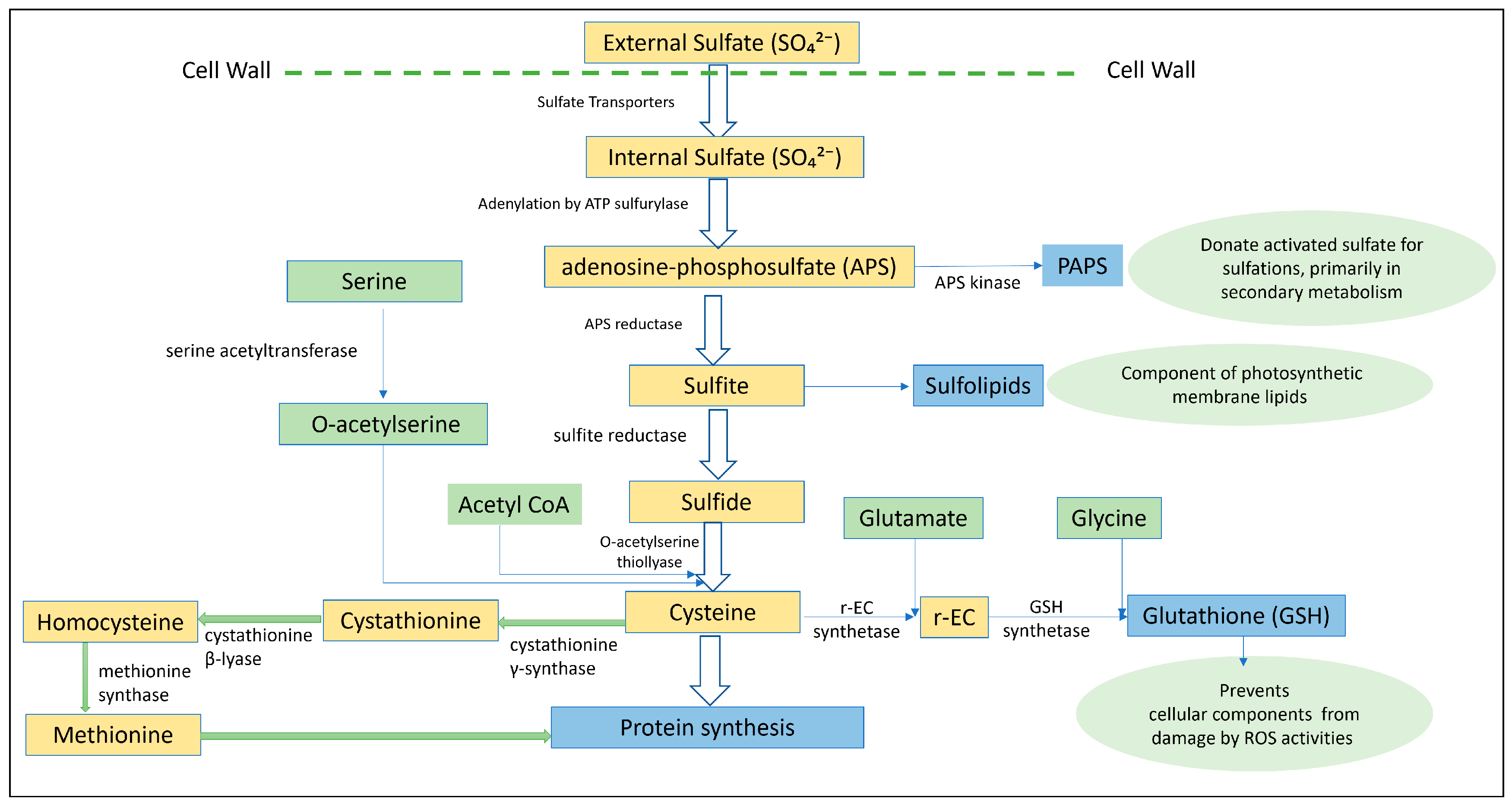
59]. The S metabolic pathway is described in
Figure 1.
2.6. Sulfur Deficiencies vs. Excesses in Soils and Plants
In cereal systems, s nutrition should be a balance because both deficiency and poorly managed excess can be detrimental [
17,
19]. For example, in wheat, balanced S fertilization improves physiological performance, grain filling, and final yield [
8,
55,
56,
60]. Similar effects are also being reported in barley, where a balanced S is essential for plant height, biomass, chlorophyll content, and grain yield, with clear genotypic differences in sensitivity [
61]. Furthermore, excessive S inputs can contribute to soil acidification and related soil-chemical imbalances, highlighting the need for balanced and site-specific S management rather than indiscriminate fertilizer addition [
19].
3. Effects of Sulfur Deficiency on Plant Biology
Sulfur-containing metabolites participate in several interconnected biological pathways, and sulfur deficiency therefore disrupts plant processes at the levels of gene regulation, enzyme activity, and metabolite balance [
59,
62]. These coordinated changes influence growth, development, and resource allocation and ultimately affect crop performance. Metabolite profiling under S starvation has helped clarify these responses [
63]. The following sections summarize the major biological effects of S deficiency.
3.1. Down Regulates Physiological Processes and Plant Growth
S deficiency has been shown to downregulate various physiological processes, including biomass production, protein synthesis, and photosynthesis [
64,
65,
66,
67,
68]. Reduction in these physiological activities is primarily mediated through the reprogramming of multiple metabolic pathways. For instance, S, carbon (C), and N are partitioned through the accumulation of metabolites along the O-acetylserine to serine to glycine pathway and are further channeled, together with the N-rich compound glutamine, into allantoin [
59]. Thus, S deficiency has been associated with disruptions in S assimilation, N imbalance, lipid breakdown, purine metabolism, and enhanced photorespiration [
69]. The metabolic imbalances induced by S deficiency can affect multiple physiological processes, ultimately reducing plant growth and development [
57,
70]. Consequently, plants grown under S-deficient conditions exhibit lower seed yield, compromised seed germination, and reduced seed viability and vigor [
57,
70,
71,
72].
3.2. Reduces Concentrations of Metabolites and Alters Metabolic Pathways
S deficiency also leads to a substantial decline in the concentrations of S-containing and S-related metabolites. Metabolites such as cystine, glutathione, sulfolipids, and glucosinolates of all three classes (aliphatic, indolyl, and aralkyl) are significantly reduced under S deficiency [
69]. Additionally, lipid and chlorophyll metabolite levels are decreased. Conversely, metabolites within the amino acids, organic acids, sugars, and sugar alcohols exhibit variable responses; some decrease in concentration while others increase [
62]. The extent of these metabolic changes varies by species, growth stage, plant tissue, and environmental conditions.
In cereals, the most consistent decreases occur in sulfate, cysteine, glutathione, and related reduced-sulfur pools, whereas responses of sugars, organic acids, and many non-sulfur amino acids are more variable and depend on tissue, developmental stage, and severity of deficiency. Recent omics studies support this view. In bread wheat, sulfur application at anthesis altered 542 differentially accumulated metabolites, mainly in amino-acid metabolism, glutathione metabolism, and starch–sucrose metabolism, indicating that sulfur availability strongly affects both protein-related and carbon-related pathways during grain filling [
73]. In einkorn grain, sulfur deficiency increased the pool of free amino acids (particularly Gln, Asn, Asp, and Lys) while glutathione was lower, and co-accumulation analysis identified the grain N:S ratio as a major variable associated with changes in storage-protein and metabolite composition [
74].
Responses of different metabolites to S deficiency, reported in several published articles, have been summarized in
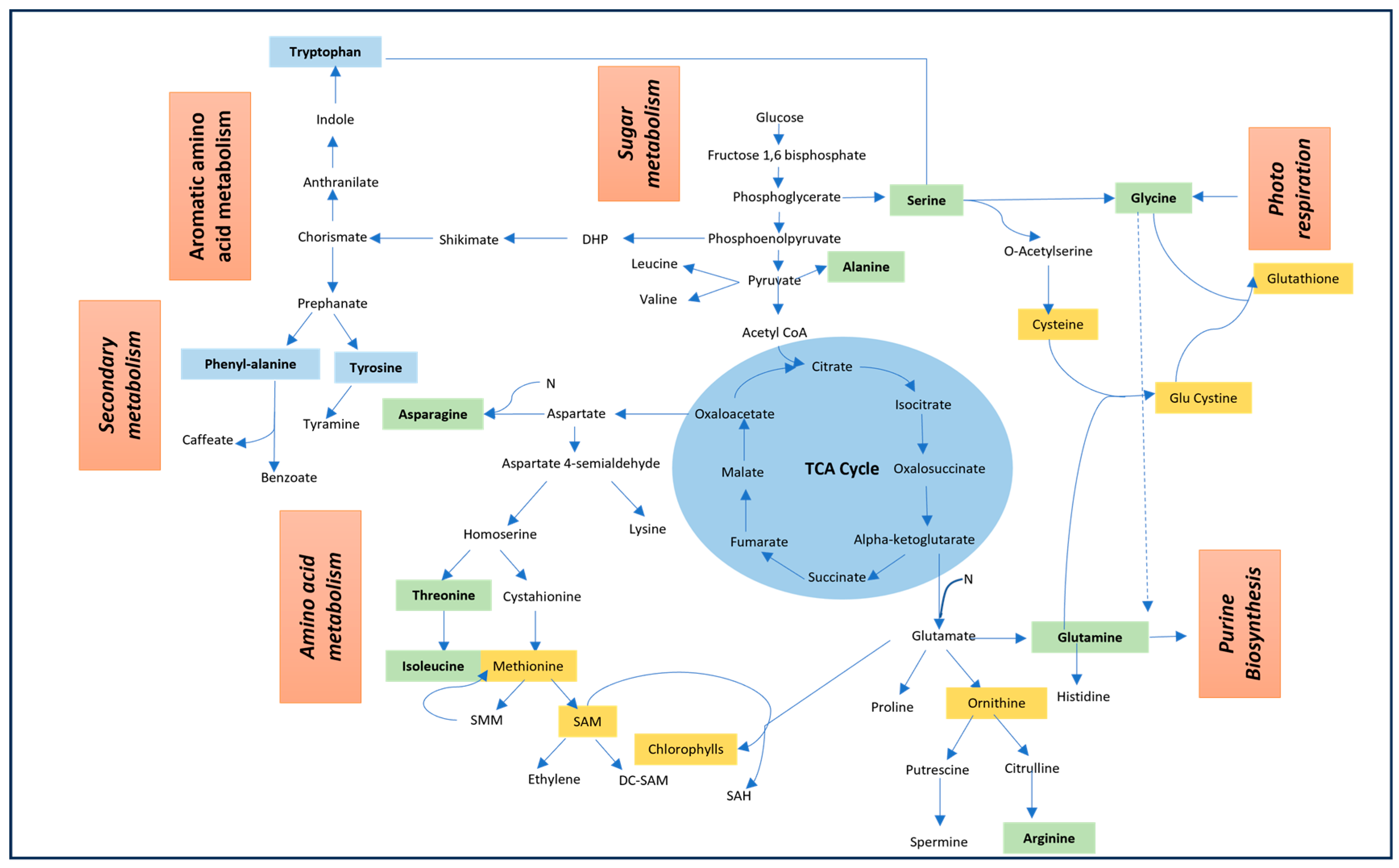
Table 1. How those S-responsive metabolites are involved in different pathways and how they are cross-connected has been presented in
Figure 2. Generally, S-responsive metabolites such as glucosinolates, tryptophan, glutathione, γ-glutamylcysteine, cysteine, thiols, methionine, glutamate, and sulfate are reported to decrease under S deficiency. In contrast, anthocyanins, O-acetylserine (OAS), tryptophan, serine, glycine, alanine, threonine, aspartate, asparagine, glutamate, glutamine, and arginine often increase in concentration [
62,
69,
75]. Meanwhile, certain metabolites, such as carbon, phosphate, nitrate, arginine, and aspartate, remain relatively unaffected by S deficiency.
These metabolic alterations are part of the plant’s strategy to prioritize resource allocation under S-deficient conditions, often resulting in visible physiological changes such as restricted vegetative growth, early flowering, reduced seed number, and lower seed quality [
69]. For instance, increased purine catabolism has been observed under S-deficient conditions, leading to the conversion of excess N to ureides via the purine metabolism pathway [
75]. In Arabidopsis, this mechanism functions as a N storage strategy to mitigate S/N imbalance. Furthermore, increased photorespiration under S deficiency may generate additional ammonia, further contributing to C, S, and N imbalances [
75]. Thus, redirecting excess N through purine metabolism is considered a detoxification mechanism, maintaining metabolic balance under S-deficient conditions.
3.3. Lowers the Lipid Content
S deficiency also significantly reduces lipid content in crop plants [
64,
72]. Lipid biosynthesis involves the transfer of synthesized fatty acids to glycerol-3-phosphate (G3P) to form diacylglycerol (DAG), which is then converted to glycolipids such as monogalactosyl diacylglycerol (MGDG), digalactosyl diacylglycerol (DGDG), sulfolipids, or phospholipids [
89]. S deficiency has been shown to disrupt the metabolic flux from G3P to DAG, thereby limiting the formation of essential lipids, including membrane lipids, chloroplast anionic lipids, phospholipid phosphatidylglycerol (PG), and S-containing glycolipid sulfolipid [
90]. Similarly, lipid accumulation in microalgae is also substantially reduced under S-deficient conditions [
91] Two S-containing molecules, acetyl-CoA and acyl carrier protein, are involved in fatty acid biosynthesis, suggesting that S deficiency impairs lipid biosynthesis by restricting the availability of these essential molecules [
92].
3.4. Reduces Chlorophylls Synthesis and Energy Assimilation Process
Similar reductions in chlorophyll content have been reported in other crops, including barley, spinach, oilseed rape, sugar beet, and rice [
30,
41] S deficiency also disrupts chlorophyll synthesis and impairs photosynthetic performance in plants. Several studies have reported significant reductions in S-adenosylmethionine (SAM) under S deficiency, a metabolite involved in a critical step near the end of the chlorophyll biosynthetic pathway [
53,
93]. Earlier work in wheat showed that S deficiency can reduce mesophyll cell density by up to 62%, chlorophyll content per chloroplast by up to 75%, and in vitro non-cyclic electron transport by ~75% [
94]. More recent evidence supports these physiological effects under agronomically relevant conditions. In a two-year field study in the North China Plain, sulfur fertilization increased flag-leaf SPAD values, delayed post-anthesis senescence, and improved photosynthetic capacity in winter wheat, resulting in yield gains of 0.58–1.54 t ha
−1 in one cultivar and 1.36–1.49 t ha
−1 in another relative to the S-omitted control [
56]. Likewise, under drought conditions, foliar sulfur application in durum wheat improved grain yield by about 12.23%, and late-season SPAD values were strongly associated with both grain yield and protein content, further indicating the importance of S in maintaining photosynthetically active foliage [
95]. Similar reductions in chlorophyll content have been reported in other crops [
30,
41].
Moreover, S deficiency adversely affects the light-harvesting process, thereby reducing energy assimilation [
96]. Reduced chlorophyll content diminishes photosynthetic efficiency, and the decline in sulfolipids impairs the structural integrity of thylakoid membranes. The downregulation of genes encoding accessory proteins involved in electron transport and membrane-associated energy conservation further compromises photosynthesis [
81]. Additionally, the reduction in anionic lipids in S-deficient plants affects chloroplast function, potentially rendering them non-functional [
97]. Rubisco-encoding genes are also downregulated, further limiting energy assimilation [
81]. The decrease in Rubisco content severely restricts photosynthesis, and the resulting metabolic imbalance may increase photorespiration, which negatively impacts energy assimilation [
98,
99].
3.5. Imbalance Other Nutrient Uptake and Assimilation Process
S deficiency should not be viewed as an isolated nutrient shortage because it reshapes the plant ionome through three different mechanisms: reduced root growth and uptake capacity, competition among chemically similar ions, and shared metabolic requirements for transport, chelation, and cofactor synthesis. Thus, decreases in N, K, and Mg under S deficiency are often partly indirect consequences of impaired growth and reduced uptake capacity, whereas the N–S interaction is more physiologically consequential. When N supply exceeds S availability, the synthesis of cysteine and methionine becomes limiting, non-protein N tends to accumulate, and protein assembly is constrained despite adequate N uptake. In cereals, this imbalance is predominantly important because grain protein composition and end-use quality depend on coordinated N and S assimilation rather than N supply alone [
17,
55,
100].
The interaction between S and P is also more complex than a simple antagonistic or synergistic effect. Sulfate and phosphate are taken up by distinct transporter systems, but recent work shows that their homeostasis is coordinated through shared signaling and transporter regulation. As a result, P may accumulate under S deficiency in some tissues, yet this response is not universal and depends on genotype, organ, developmental stage, and the extent of remobilization. For this reason, P enrichment under S stress should be interpreted as a context-dependent regulatory response rather than as a consistent antagonistic relationship [
101].
Among micronutrients, the most direct interactions with S involve structurally similar oxyanions. Because sulfate transporters can also transport selenate and molybdate, S deficiency often upregulates these transport systems and can increase Se and Mo accumulation, as shown in wheat. By contrast, interactions with Fe, Cu, and Zn are less likely to reflect simple ionic competition and more likely to arise from the dependence of micronutrient homeostasis on S-containing metabolites, phytosiderophores, and Fe–S cluster biosynthesis. Thus, shifts in Fe, Cu, or Zn concentration under S deficiency should be interpreted cautiously, because they may reflect altered transport, redistribution, or metabolic adjustment rather than improved micronutrient status [
102,
103,
104]. Overall, the evidence suggests that sulfur interacts with other nutrients through a hierarchy of mechanisms: strong physiological synergism with N, context-dependent regulatory crosstalk with P, and transporter- or cofactor-mediated interactions with micronutrients such as Se, Mo, Fe, Cu, and Zn. This means that nutrient shifts observed under S deficiency should not be generalized as fixed antagonisms or synergies across crops. Instead, they should be interpreted in relation to crop type, developmental stage, tissue sampled, and whether the response arises from direct transporter competition or from broader metabolic disruption.
3.6. Affects Plant’s Defense Mechanism
S deficiency weakens plant stress tolerance primarily by limiting the synthesis of reduced sulfur compounds required for redox buffering and detoxification. Among these, glutathione plays a central role because it participates directly in reactive oxygen species scavenging through the Halliwell–Asada cycle and contributes to tolerance against chilling, salinity, and other oxidative stresses [
47,
105,
106]. Reduced sulfur availability therefore lowers antioxidant capacity and disrupts stress-buffering metabolism, increasing vulnerability to adverse environmental conditions. In addition to glutathione, other sulfur-containing defense metabolites such as glucosinolates and camalexin are also involved in plant protection and reflect the close connection between sulfur nutrition and defense-related metabolism [
107,
108,
109]. The biosynthesis of these compounds is closely linked with sulfur assimilation and is regulated through jasmonate-dependent pathways involving MYB and MYC transcription factors, which coordinate sulfate assimilation and glucosinolate biosynthesis at the transcriptional level [
110,
111,
112,
113]. Together, these observations indicate that S deficiency affects defense responses through impaired glutathione-mediated redox homeostasis and broader alterations in sulfur-containing defense metabolism. Other sulfur-containing compounds such as alliin and S-alk(en)yl cysteine sulfoxides have also been implicated in plant protection, although their precise roles and regulatory mechanisms remain less clearly resolved [
114].
3.7. Interactive Metabolic Network Model at S Deficiency
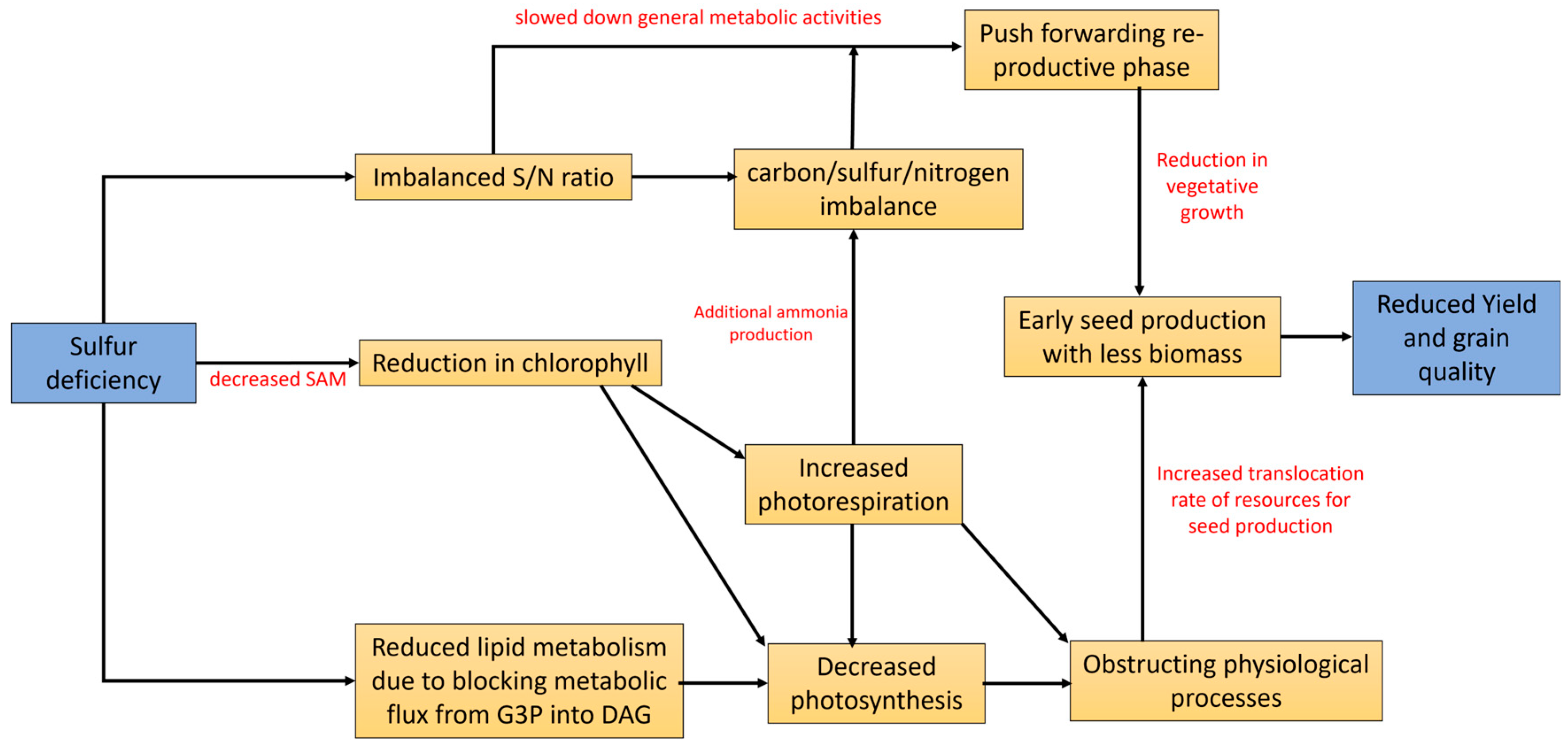
As discussed above, sulfur deficiency induces coordinated changes across multiple metabolic pathways that collectively help the plant sustain essential biological functions and complete its life cycle under limited S availability. These responses form an interconnected network, summarized in
Figure 3, in which S deficiency leads to S/N imbalance, decreased SAM and chlorophyll synthesis, disrupted lipid metabolism, reduced photosynthetic efficiency, and enhanced photorespiration. Together, these alterations promote carbon–sulfur–nitrogen imbalance, additional ammonia production, reduced vegetative growth, and an accelerated shift toward the reproductive phase. Consequently, plants increasingly redirect resources toward seed production at the expense of biomass accumulation, ultimately resulting in reduced yield and grain quality.
4. Sulfur Deficiency Effect on Grain Protein
Approximately half of the total internal S in plants is allocated to proteins, highlighting the substantial impact of S deficiency on protein synthesis, which has been well-documented across several plant species [
57]. This phenomenon can be attributed to the strong correlation between S-responsive metabolites (e.g., serine, putrescine, glutathione, and allantoin) and the expression of genes involved in protein synthesis [
74]. The mechanism through which S deficiency influences protein production, with a particular focus on wheat grain, is further explored in the following sections.
4.1. Grain Protein Classifications in Relation to S Content
Seed proteins are functionally classified into three main groups: storage proteins, structural proteins, and metabolic and protective proteins. Storage proteins are further categorized into albumins, globulins, prolamins, and glutelins, based on their solubility in water, saline solutions, diluted alcohol, and diluted acids or alkalis, respectively [
115]. Prolamins constitute the predominant storage proteins in many cereal crops, particularly wheat, representing approximately 50% of the total grain N content [
115]. Regarding S content, prolamins in the Triticeae tribe (wheat, barley, and rye) are classified into three distinct types: S-rich, S-poor, and high-molecular-weight prolamins, which contain intermediate S levels. The S-rich prolamins are further divided into several subgroups [
116], as summarized in
Table 2. The S-poor prolamins primarily include omega-gliadins, which lack cysteine and methionine residues and constitute 10–20% of the total prolamin fraction. The S-rich prolamins consist of alpha- and gamma-gliadins and the low-molecular-weight (LMW) subunits of glutenins, containing 2–3 mol% cysteine. This group is the most abundant in wheat, representing 70–80% of all prolamins. The third group, the high-molecular-weight (HMW) glutenin subunits, exhibits an intermediate cysteine content (0.5–1.5 mol%) and comprises 6–10% of the prolamin fraction. Aside from prolamins, globulins, particularly albumins, are rich in S-containing amino acids. Notably, this classification based on S content does not directly correspond to protein size, as both S-rich and S-poor proteins can form polymeric and monomeric structures. Despite their differences, S-rich, S-poor, and HMW prolamins share extensive repetitive sequences. Additionally, the repeat motifs in the S-rich and S-poor groups are related, and sequence similarities are also observed between the non-repetitive domains of the S-rich and HMW prolamins.
4.2. Involvement of S in Grain Protein Biosynthesis
Sulfur is an important macronutrient involved in grain protein biosynthesis alongside nitrogen. While nitrogen fertilization mainly increases total protein content, sulfur fertilization more consistently influences protein composition and functionality [
60]. Its primary role in grain protein formation is through the synthesis of the sulfur-containing amino acids cysteine and methionine, with cysteine generally showing greater responsiveness to sulfur availability than methionine [
118]. Recent evidence also indicates that the effect of sulfur on grain protein concentration is often modest at the whole-grain level, whereas its influence on the balance and assembly of storage proteins is much more pronounced [
60].
Different cereal storage-protein classes differ in their cysteine and methionine contents and therefore in their sulfur requirement for synthesis. Sulfur-rich fractions, such as α-gliadins, γ-gliadins, and low-molecular-weight glutenin subunits (LMW-GS), are more dependent on adequate sulfur supply than sulfur-poor fractions such as ω-gliadins and, to a lesser extent, high-molecular-weight glutenin subunits (HMW-GS) [
30,
119,
120]. Accordingly, under sulfur limitation, cereals tend to reduce the synthesis of sulfur-rich proteins and compensate by increasing the relative abundance of sulfur-poor fractions, thereby maintaining grain nitrogen deposition but altering protein functionality. This pattern has been described most clearly in wheat, but recent work in einkorn also confirms that sulfur availability during grain filling regulates grain protein-related metabolism and storage-protein accumulation [
74]. In addition, foliar sulfur application has recently been shown to increase the content of specific HMW glutenin subunits and improve flour-processing quality, further supporting the role of sulfur in protein assembly rather than only total protein accumulation [
121].
The involvement of sulfur in grain protein biosynthesis is closely linked to its metabolic conversion into cysteine, which serves not only as the most abundant sulfur-containing amino acid in cereal grains but also as a precursor for methionine and other sulfur-containing compounds such as glutathione and S-adenosylmethionine. Because nitrogen and sulfur metabolism are strongly interdependent, efficient protein synthesis depends on a balanced N/S ratio; in cereals, and especially wheat, an approximate ratio of 1:15 (by weight) has often been considered favorable for protein synthesis [
122]. When sulfur is limiting relative to nitrogen, non-protein nitrogen compounds such as amides may accumulate, indicating that sulfur deficiency restricts not only amino-acid synthesis but also the efficient conversion of absorbed nitrogen into functionally important grain proteins.
4.3. S Deficiency Alters Grain Protein Composition
Although total protein may change only moderately, sulfur deficiency consistently alters the relative proportions of storage-protein classes, thereby impacting grain functional properties [
119]. Studies across various cereal crops have demonstrated that S deficiency significantly reduces the levels of S-rich gamma-gliadins and LMW-GS. In contrast, alpha-gliadins, another S-rich protein class, exhibit only a slight reduction [
30,
123,
124]. Conversely, the abundance of S-free omega-gliadins increases markedly, while S-poor HMW-GS show a moderate rise [
119]. S deficiency also alters the “relative comparison indices” of seed storage proteins. Under S-deficient conditions, the gliadin/glutenin ratio increases, largely driven by the increased proportion of omega-gliadins. Additionally, the ratio of HMW to LMW glutenin subunits rises due to the substantial reduction in LMW glutenins [
30]. This reduction in LMW subunits, the primary components of glutenin, also decreases the total amount of polymeric proteins.
In recent years, wheat-focused studies provide quantitative support for these compositional shifts. In a four-cultivar bread wheat field trial on S-deficient soil, application of 30 kg S ha
−1 increased the glutenin/gliadin ratio from 0.25–0.41 to 0.58–0.75 and reduced total gliadins by 18.8–22.0%, with cultivar-dependent declines of 21.3–31.4% for ω-gliadins, 23.8–37.5% for ω5-gliadins, and 18.6–24.2% for α/β-gliadins [
55]. By contrast, in einkorn supplied with N and S during grain filling, sulfur increased the accumulation of α/β- and γ-gliadins, indicating that the response of individual storage-protein fractions is not fixed across all cereal systems [
74]. These two findings show that the magnitude and direction of protein-fraction changes depend on cereal type/genotype, the timing of sulfur availability, and whether sulfur is correcting field deficiency or being supplied post-anthesis under controlled conditions. For this reason, the most agronomically relevant understanding for bread wheat is that sulfur deficiency generally shifts grain proteins toward a less favorable gluten balance, even when total protein changes only moderately.
4.4. S Deficiency Influences the End-Product Quality
Baking quality: S deficiency has a pronounced impact on the rheological and baking properties of wheat dough. The end-product effect of sulfur deficiency has been demonstrated in wheat, where altered storage-protein balance translates directly into poorer dough functionality. Sulfur deficiency generally shifts protein composition away from sulfur-rich fractions and toward sulfur-poor fractions, which weakens gluten quality even when total grain protein changes only modestly. As a result, dough produced from S-deficient wheat is typically less extensible and more resistant to extension, while indicators of functional gluten quality such as polymeric-to-monomeric protein ratio and farinograph stability decline. In winter wheat grown on S-deficient soil, sulfur application increased the ratio of polymeric to monomeric proteins in both study years, raised lactic acid–SDS solvent retention values by 217–308% in 2018, and increased average farinograph stability from 9.2 to 14.6 min, confirming that sulfur supply improves rheological performance rather than merely total protein concentration [
120]. Thus, the main quality consequence of S deficiency is not simply lower gluten quantity, but poorer gluten functionality resulting from less favorable protein composition and polymer formation. Wheat grown under S-deficient conditions typically produces doughs with reduced extensibility and increased resistance to extension, resulting in lower loaf volume and poorer texture quality [
118,
119]. The deterioration in dough rheology under S deficiency can be explained by changes in the relative composition of gluten proteins, particularly the HMW/LMW glutenin ratio, unextractable polymeric protein percentage (UPP%), and total glutenin content [
30,
125,
126]. Current evidence suggests that the quantity of glutenin or glutenin macropolymer is more closely associated with breadmaking quality than subunit composition or total protein content [
115]. Furthermore, adequate S availability is essential for synthesizing gel protein, a key determinant of baking performance. Gel protein refers to the gel layer formed after wheat flour is shaken with 1.5% (
w/
v) SDS solution and centrifuged, predominantly consisting of glutenins [
122]. Therefore, S deficiency impairs the formation of gel protein, further compromising baking quality.
Nutritional quality (amino acid balancing): S is vital for the biosynthesis of sulfolipids, antioxidants, cofactors, secondary metabolites, and essential amino acids critical for human nutrition [
64]. Consequently, a reduction in S availability can adversely affect the concentration of these compounds in grains, posing nutritional concerns. From a nutritional perspective, S-containing amino acids such as cysteine are particularly important for balancing the amino acid profile of cereal grains. However, since methionine is not the most limiting amino acid in wheat, its reduced synthesis under S deficiency is not considered a major nutritional concern. Additionally, S deficiency has been shown to decrease lysine and threonine content, particularly under high N availability [
127]. This reduction is likely attributable to a dilution effect caused by the accumulation of aspartic acid and asparagine. Sulfur deficiency in wheat can significantly increase free asparagine accumulation, with reported rises ranging from several-fold to as much as 30-fold under severe deficiency [
120].
4.5. Human Health Issues Related to Altered Grain Protein Composition by S Deficiency
Cereal grains cultivated under S deficiency pose significant health concerns due to the accumulation of acrylamide, a chemical compound classified as a probable carcinogen [
128,
129]. Over the past few decades, reports of acrylamide presence in processed foods, particularly baked products, have increased [
130]. Acrylamide is predominantly formed through the Maillard reaction, a chemical process that occurs between free amino acids and reducing sugars during high-temperature food processing, such as baking [
131,
132]. While this reaction is essential for developing the desired color, aroma, and flavor of baked goods, it also inadvertently leads to acrylamide formation [
130,
131,
132].
Free amino acid accumulation in grain typically results from conditions that disrupt regular protein synthesis [
133]. Asparagine, the most abundant free amino acid involved in the Maillard reaction, plays a key role in acrylamide formation [
134]. Research has identified S deficiency, particularly under adequate N availability, as the primary cause of elevated asparagine levels in cereal grains [
120,
123,
135]. Under an imbalanced S/N ratio, plants reduce the synthesis of certain seed storage proteins, leading to the accumulation of excess N in the form of free amino acids, particularly asparagine. Multiple studies have shown that S fertilization effectively reduces asparagine and acrylamide concentrations in baked products [
136,
137]. In field-grown wheat, grain free asparagine reached 66 mmol kg
−1 in plots receiving no sulfur, compared with only 3.7 mmol kg
−1 at 40 kg S ha
−1. Even 10 kg S ha
−1 was insufficient, leaving grain with more than twice the free asparagine concentration and resulting in 58% higher acrylamide formation after heating than grain from the 40 kg S ha
−1 treatment [
128]. These findings show that the most immediate quality risk of sulfur deficiency is not only altered amino-acid balance, but also increased processing-related food-safety risk.
Excess acrylamide can form during the production of a wide range of common cereal-based products, including bread and biscuits [
129]. Consequently, one of the primary recommendations for the baking industry is to avoid using grains grown in S-deficient soils [
138]. However, reducing asparagine through S fertilization may also negatively impact bread volume, a key quality parameter [
139,
140]. The optimal S fertilization rate for maximizing asparagine reduction while maintaining flour quality remains uncertain, as responses vary depending on genotype and environmental conditions [
141]. Thus, further research is necessary to determine optimal S application rates based on specific cultivars and growing conditions to effectively manage asparagine levels without compromising end-product quality.
5. Genetic Approach to Improve S-Utilization Efficiency
S deficiency has been associated with reduced plant growth, yield, and grain quality over the past two decades. Although S fertilization can mitigate these effects, it is not always a reliable solution, as inconsistent S application and imbalanced soil chemistry can adversely impact crop productivity. Additionally, S availability is often influenced by seasonal variation and timing of fertilizer application. Therefore, enhancing the plant’s intrinsic ability to efficiently assimilate and distribute S is a promising strategy for improving S utilization efficiency, especially under fluctuating S availability.
The capacity for S uptake and assimilation varies among crop species and cultivars, indicating a strong genetic basis that could be targeted for genetic improvement. Sulfate uptake, the primary form of S available to plants, is largely mediated by root-specific high-affinity sulfate transporters, particularly SULTR1;1 and SULTR1;2 [
53,
142]. Once absorbed, sulfate is transported into plastids by SULTR3 transporters [
143,
144], where it is further assimilated through a series of enzyme-mediated reactions, extensively described in previous studies [
145,
146]. The regulation of sulfate uptake and distribution is controlled by multiple genetic and epigenetic factors. Among these, the transcription factor SLIM1 (SULFUR LIMITATION 1) has been identified as a key regulator of S metabolism under deficiency conditions [
147,
148]. Additionally, epigenetic modifications such as DNA methylation and histone modifications have been implicated in S homeostasis, indicating their potential roles in modulating plant responses to S deficiency [
53].
Given the genetic regulation of S uptake and metabolism, several genetic targets could be explored to improve S utilization efficiency: increasing the expression of SULTR1;1, SULTR1;2, and SULTR3 to enhance sulfate uptake and intracellular transport under S-limited conditions; targeting key enzymes in S assimilation, such as ATP sulfurylase, APS reductase, and cysteine synthase, to improve the efficiency of S incorporation into essential metabolites; developing cultivars capable of accumulating greater S reserves during periods of sufficient supply and effectively remobilizing these reserves under deficiency conditions. Despite the promising potential of these genetic targets, most studies have been conducted on model plants, particularly Arabidopsis thaliana, with limited research focused on economically important crops. Furthermore, while S deficiency is known to disrupt the metabolism of other essential nutrients, such as N, research on the genetic improvement of S use efficiency has lagged behind other macronutrients. Addressing these knowledge gaps through targeted genetic approaches could provide valuable insights into optimizing S utilization in crops, thereby enhancing stress tolerance, yield stability, and grain quality under variable S conditions.
6. Future Directions of Research on the Optimization of Sulfur Content in Soils and Plants
Future research on optimizing sulfur content in soils and plants should adopt a more integrated and cereal-focused framework that links soil S dynamics with crop physiology, grain protein composition, and end-use quality. One major priority is to establish robust critical thresholds for soil-available S and plant S status across different cereal-growing environments, because current recommendations often fail to account for variation in soil texture, organic matter, rainfall, leaching risk, and nitrogen input. Greater attention is also needed to the timing of S supply, particularly during post-anthesis stages, since emerging evidence suggests that continued S availability during grain filling is essential not only for yield maintenance but also for proper protein assembly, gluten functionality, and efficient N utilization. Future studies should therefore move beyond simple yield-response trials and quantify how S management influences specific grain quality traits, such as the balance between S-rich and S-poor storage proteins, amino acid composition, and processing performance in cereals. At the same time, breeding and physiological research should identify genotypes with superior S uptake, remobilization, and utilization efficiency under low-S conditions, as genotypic variation is likely to become increasingly important where atmospheric S inputs continue to decline. Another important direction is the development of diagnostic and precision-management tools that can distinguish true S deficiency from broader nutrient imbalance, especially under high-N systems where N–S disequilibrium may impair protein synthesis even when total N supply is sufficient. Therefore, future progress will depend on integrating soil chemistry, crop physiology, genotype-specific responses, and precision fertilization strategies so that sulfur is managed not merely as a corrective nutrient, but as a key determinant of cereal productivity, grain quality, and nutrient-use efficiency.
7. Conclusions
Over the past two decades, S deficiency in agricultural soils has been increasing, driven primarily by two factors: (1) a decline in unintentional S deposition due to reduced atmospheric S pollution and increased use of S-free, high-analysis NPK fertilizers, and (2) greater S uptake by high-yielding, high-biomass crop cultivars. Despite these trends, the use of S fertilization remains variable across cropping systems, thus reflecting differences in soil S status, crop requirements, fertilizer practices, and the extent to which S deficiency is identified as a production constraint. While considerable progress has been made in elucidating S uptake and assimilation pathways, the broader impacts of S deficiency on plant metabolic processes remain underexplored. This review has summarized the interconnected metabolic networks and physiological processes that plants modulate under S deficiency, highlighting how limited S availability forces plants to accelerate reproductive development at the expense of vegetative growth, ultimately reducing yield potential. Although minor S deficiency may not significantly impact yield, it can substantially alter grain protein composition, adversely affecting baking quality. Additionally, grains produced under S-deficient conditions may pose human health risks due to elevated acrylamide levels formed through the Maillard reaction during baking. Addressing S deficiency through direct fertilization is not a straightforward solution, given the complexity of S uptake, distribution, and assimilation, which are tightly regulated by plant demand. A more sustainable approach involves enhancing the genetic capacity of crops to optimize S uptake during periods of sufficiency and to efficiently utilize stored S under deficiency. This genetic strategy offers considerable potential, yet it remains under-researched compared to other major nutrients such as N, P, and K. Thus, further research is warranted to identify genetic targets and regulatory networks that can be leveraged to improve S uptake and utilization efficiency, ultimately promoting sustainable crop production and mitigating the adverse effects of S deficiency.
Author Contributions
Conceptualization, S.I., V.S. and W.M.; methodology, S.I. and V.S.; resources, S.I. and W.M.; data curation, S.K.; writing—original draft preparation, S.I. and B.M.; writing—review and editing, W.M. and V.S.; visualization, S.I. and B.M.; supervision, W.M. and V.S.; project administration, S.I. and W.M.; funding acquisition, S.I. and W.M. All authors have read and agreed to the published version of the manuscript.
Funding
This work was partly supported by the USDA, National Institute of Food and Agriculture (NIFA) Hatch project number 7005543 and Murdoch University, Perth, Western Australia.
Data Availability Statement
No new data were created or analyzed in this study.
Acknowledgments
During the preparation of this study, the authors used AI tool, ChatGPT 5.1 for the purposes of improving language and grammar only. The authors have reviewed and edited the output and take full responsibility for the content of this publication.
Conflicts of Interest
The authors declare no conflicts of interest.
References
- Aas, W.; Mortier, A.; Bowersox, V.; Cherian, R.; Faluvegi, G.; Fagerli, H.; Hand, J.; Klimont, Z.; Galy-Lacaux, C.; Lehmann, C.M.B.; et al. Global and regional trends of atmospheric sulfur. Sci. Rep. 2019, 9, 953. [Google Scholar] [CrossRef]
- Bouranis, D.L.; Gasparatos, D.; Zechmann, B.; Bouranis, L.D.; Chorianopoulou, S.N. The Effect of Granular Commercial Fertilizers Containing Elemental Sulfur on Wheat Yield under Mediterranean Conditions. Plants 2018, 8, 2. [Google Scholar] [CrossRef] [PubMed]
- Etienne, P.; Sorin, E.; Maillard, A.; Gallardo, K.; Arkoun, M.; Guerrand, J.; Cruz, F.; Yvin, J.-C.; Ourry, A. Assessment of Sulfur Deficiency under Field Conditions by Single Measurements of Sulfur, Chloride and Phosphorus in Mature Leaves. Plants 2018, 7, 37. [Google Scholar] [CrossRef] [PubMed]
- Feinberg, A.; Stenke, A.; Peter, T.; Hinckley, E.-L.S.; Driscoll, C.T.; Winkel, L.H.E. Reductions in the deposition of sulfur and selenium to agricultural soils pose risk of future nutrient deficiencies. Commun. Earth Environ. 2021, 2, 101. [Google Scholar] [CrossRef]
- Narayan, O.P.; Kumar, P.; Yadav, B.; Dua, M.; Johri, A.K. Sulfur nutrition and its role in plant growth and development. Plant Signal Behav. 2023, 18, 2030082. [Google Scholar] [CrossRef]
- Foyer, C.H.; Noctor, G. Redox regulation in photosynthetic organisms: Signaling, acclimation, and practical implications. Antioxid. Redox Signal 2009, 11, 861–905. [Google Scholar] [CrossRef] [PubMed]
- Noctor, G.; Queval, G.; Mhamdi, A.; Chaouch, S.; Foyer, C.H. Glutathione. Arab. Book 2011, 2011, 1–32. [Google Scholar] [CrossRef]
- Castellari, M.P.; Poffenbarger, H.J.; Van Sanford, D.A. Sulfur fertilization effects on protein concentration and yield of wheat: A meta-analysis. Field Crops Res. 2023, 302, 109061. [Google Scholar] [CrossRef]
- Assefa, S.; Shewangizaw, B.; Yassin, K.K.; Getaneh, L. Growth, yield components, and yield response of food barley (Hordeum vulgare L.) to the application of sulfur nutrient under balanced fertilization at North Central Highland of Ethiopia. J. Crop Sci. Biotechnol. 2021, 24, 461–467. [Google Scholar] [CrossRef]
- Lu, Z.; Zhang, S.; Li, G.; Ge, Y.; Haim, P.G.; Mey-Tal, S.; Magen, H.; Huang, C. Sulfur fertilization contribute to China’s food security: A meta-analysis. Eur. J. Agron. 2025, 164, 127510. [Google Scholar] [CrossRef]
- Millar, N.; Ndufa, J.K.; Cadisch, G.; Baggs, E.M. Nitrous oxide emissions following incorporation of improved-fallow residues in the humid tropics. Glob. Biogeochem. Cycles 2004, 18, GB1032. [Google Scholar] [CrossRef]
- Powers, W.L. Progress of Sulfur Investigations with Oregon Soils1. Agron. J. 1923, 15, 158–160. [Google Scholar] [CrossRef]
- Cooke, G.W. Fertilizing for Maximum Yield, 3rd ed.; Granada Publishing Ltd.: St Albans, UK, 1982. [Google Scholar]
- Murphy, M.D.; Boggan, J.M. Sulphur Deficiency in Herbage in Ireland: 1. Causes and Extent. Ir. J. Agric. Res. 1988, 27, 83–90. [Google Scholar]
- Degryse, F.; Ajiboye, B.; Baird, R.; da Silva, R.C.; McLaughlin, M.J. Availability of fertiliser sulphate and elemental sulphur to canola in two consecutive crops. Plant Soil. 2016, 398, 313–325. [Google Scholar] [CrossRef]
- Degryse, F.; da Silva, R.C.; Baird, R.; Beyrer, T.; Below, F.; McLaughlin, M.J. Uptake of elemental or sulfate-S from fall- or spring-applied co-granulated fertilizer by corn—A stable isotope and modeling study. Field Crops Res. 2018, 221, 322–332. [Google Scholar] [CrossRef]
- Sharma, R.K.; Cox, M.S.; Oglesby, C.; Dhillon, J.S. Revisiting the role of sulfur in crop production: A narrative review. J. Agric. Food Res. 2024, 15, 101013. [Google Scholar] [CrossRef]
- Hinckley, E.-L.S.; Driscoll, C.T. Sulfur fertiliser use in the Midwestern US increases as atmospheric sulfur deposition declines with improved air quality. Commun. Earth Environ. 2022, 3, 324. [Google Scholar] [CrossRef]
- Gerson, J.R.; Hinckley, E.S. It Is Time to Develop Sustainable Management of Agricultural Sulfur. Earth’s Future 2023, 11, e2023EF003723. [Google Scholar] [CrossRef]
- Camberato, J.; Casteel, S. Sulfur Deficiency; Agronomy Department, Purdue University: West Lafayette, IN, USA, 2017; Available online: https://www.agry.purdue.edu/ext/corn/news/timeless/sulfurdeficiency.pdf (accessed on 14 March 2026).
- Michalovicz, L.; Dick, W.A.; Tormena, C.A.; Müller, M.M.L.; Cervi, E.C. Temporal trends of sulfur levels in soils of northwest Ohio (USA) between 2002 and 2014. Land Degrad. Dev. 2021, 32, 573–582. [Google Scholar] [CrossRef]
- Pötzsch, F.; Lux, G.; Lewandowska, S.; Schmidtke, K. Does Lupinus angustifolius L. need sulfur fertilization under central European conditions? J. Plant Nutr. Soil. Sci. 2019, 182, 31–39. [Google Scholar] [CrossRef]
- Spencer, K. Soil properties in relation to the sulphur and phosphorus status of some basaltic soils. Soil. Res. 1966, 4, 115–130. [Google Scholar] [CrossRef]
- Barrow, N.J.; Spencer, K. A Plant Nutrient Survey of the Principal Soils of the Northern Tablelands of New South Wales; CSIRO Division of Plant Industry: Canberra, Australia, 1963. [Google Scholar]
- Hocking, P.; Pinkerton, A.; Good, A. Recovery of field-grown canola from sulfur deficiency. Aust. J. Exp. Agric. 1996, 36, 79–85. [Google Scholar] [CrossRef]
- Norton, R.M.; Roberts, T. Nutrient management to nutrient stewardship. In Proceedings of the 16th Australian Agronomy Conference, Armidale, NSW, Australia, 14–18 October 2012. [Google Scholar]
- ANRA. Austrlalian Natural Resources Atlas. 2013. Available online: https://researchdata.edu.au/australian-natural-resources-atlas-anra/3979262 (accessed on 17 March 2026).
- Robson, A.; Osborne, L.; Snowball, K.; Simmons, W. Assessing sulfur status in lupins and wheat. Aust. J. Exp. Agric. 1995, 35, 79–86. [Google Scholar] [CrossRef]
- McArthur, W.M. Reference Soils of South-Western Australia; Department of Agriculture, Western Australia (for Australian Soil Science Societ, WA Branch): Crawley, Australia, 2004.
- Yu, Z.; Juhasz, A.; Islam, S.; Diepeveen, D.; Zhang, J.; Wang, P.; Ma, W. Impact of mid-season sulphur deficiency on wheat nitrogen metabolism and biosynthesis of grain protein. Sci. Rep. 2018, 8, 2499. [Google Scholar] [CrossRef] [PubMed]
- Ercoli, L.; Arduini, I.; Mariotti, M.; Lulli, L.; Masoni, A. Management of sulphur fertiliser to improve durum wheat production and minimise S leaching. Eur. J. Agron. 2012, 38, 74–82. [Google Scholar] [CrossRef]
- Zörb, C.; Steinfurth, D.; Gödde, V.; Niehaus, K.; Mühling, K.H. Metabolite profiling of wheat flag leaf and grains during grain filling phase as affected by sulfur fertilisation. Funct. Plant Biol. 2012, 39, 156–166. [Google Scholar] [CrossRef] [PubMed]
- Chien, S.H.; Teixeira, L.A.; Cantarella, H.; Rehm, G.W.; Grant, C.A.; Gearhart, M.M. Agronomic Effectiveness of Granular Nitrogen/Phosphorus Fertilizers Containing Elemental Sulfur with and without Ammonium Sulfate: A Review. Agron. J. 2016, 108, 1203–1213. [Google Scholar] [CrossRef]
- Lu, Z.; Liu, J.; Zhu, Y.; Wang, Y.; Huang, C. The Effects of Ammonium Phosphate with Different Sulfur Additions on Crop Yield and Nutrient Uptake in Calcareous Soil. Agronomy 2024, 14, 1145. [Google Scholar] [CrossRef]
- Bender, R.R.; Haegele, J.W.; Ruffo, M.L.; Below, F.E. Nutrient Uptake, Partitioning, and Remobilization in Modern, Transgenic Insect-Protected Maize Hybrids. Agron. J. 2013, 105, 161–170. [Google Scholar] [CrossRef]
- Tao, Z.; Chang, X.; Wang, D.; Wang, Y.; Ma, S.; Yang, Y.; Zhao, G. Effects of sulfur fertilization and short-term high temperature on wheat grain production and wheat flour proteins. Crop J. 2018, 6, 413–425. [Google Scholar] [CrossRef]
- Shen, Y.; McLaughlin, N.; Zhang, X.; Xu, M.; Liang, A. Effect of tillage and crop residue on soil temperature following planting for a Black soil in Northeast China. Sci. Rep. 2018, 8, 4500. [Google Scholar] [CrossRef] [PubMed]
- Anderson, G.C.; Fillery, I.R.P.; Ripper, F.H.; Leach, B.J. Sulfur mineralisation in a coarse-textured soil after different sulfate fertilisation histories, and yield responses of wheat and lupin. Soil. Res. 2006, 44, 165–174. [Google Scholar] [CrossRef]
- Kopáček, J.; Hejzlar, J.; Porcal, P.; Posch, M. Sulphate leaching from diffuse agricultural and forest sources in a large central European catchment during 1900–2010. Sci. Total Environ. 2014, 470–471, 543–550. [Google Scholar] [CrossRef]
- Kertesz, M.A.; Mirleau, P. The role of soil microbes in plant sulphur nutrition. J. Exp. Bot. 2004, 55, 1939–1945. [Google Scholar] [CrossRef]
- Samborska, I.A.; Kalaji, H.M.; Sieczko, L.; Borucki, W.; Mazur, R.; Kouzmanova, M.; Goltsev, V. Can just one-second measurement of chlorophyll a fluorescence be used to predict sulphur deficiency in radish (Raphanus sativus L. sativus) plants? Curr. Plant Biol. 2019, 19, 100096. [Google Scholar] [CrossRef]
- Zuber, H.; Poignavent, G.; Le Signor, C.; Aimé, D.; Vieren, E.; Tadla, C.; Lugan, R.; Belghazi, M.; Labas, V.; Santoni, A.-L.; et al. Legume adaptation to sulfur deficiency revealed by comparing nutrient allocation and seed traits in Medicago truncatula. Plant J. 2013, 76, 982–996. [Google Scholar] [CrossRef]
- Ayala-Silva, T.; Beyl, C.A. Changes in spectral reflectance of wheat leaves in response to specific macronutrient deficiency. Adv. Space Res. 2005, 35, 305–317. [Google Scholar] [CrossRef]
- Camberato, J.; Casteel, S. Keep an Eye Open for Sulfur Deficiency in Wheat; Agronomy Department, Purdue University: West Lafayette, IN, USA, 2010; Available online: https://extension.entm.purdue.edu/pestcrop/2010/issue3/index.html (accessed on 15 March 2026).
- Jabir, A.S.; Habeeb, K.H. The Effect of Sulfur Sources, Levels and Time of Addition on Kinetics of Sulfur. AL Qadisiyah J. Agric. Sci. 2017, 7, 142–153. [Google Scholar]
- Kanwar, J.S.; Mudahar, M.S. Fertilizer Sulfur and Food Production; Springer: Berlin/Heidelberg, Germany, 1986. [Google Scholar] [CrossRef]
- Bloem, E.; Haneklaus, S.; Schnug, E. Milestones in plant sulfur research on sulfur-induced-resistance (SIR) in Europe. Front. Plant Sci. 2015, 5, 779. [Google Scholar] [CrossRef] [PubMed]
- Martin, W.E. Sulfur Deficiency Widespread. Calif. Agric. 1958, 12, 10–12. [Google Scholar]
- Hawkesford, M.J. Plant responses to sulphur deficiency and the genetic manipulation of sulphate transporters to improve S-utilization efficiency. J. Exp. Bot. 2000, 51, 131–138. [Google Scholar] [CrossRef]
- Steinfurth, D.; Zörb, C.; Braukmann, F.; Mühling, K.H. Time-dependent distribution of sulphur, sulphate and glutathione in wheat tissues and grain as affected by three sulphur fertilization levels and late S fertilization. J. Plant Physiol. 2012, 169, 72–77. [Google Scholar] [CrossRef]
- Hawkesford, M.J.; De Kok, L.J. Managing sulphur metabolism in plants. Plant Cell Environ. 2006, 29, 382–395. [Google Scholar] [CrossRef] [PubMed]
- Sutradhar, A.K.; Kaiser, D.E.; Fernández, F.G. Does Total Nitrogen/Sulfur Ratio Predict Nitrogen or Sulfur Requirement for Corn? Soil Sci. Soc. Am. J. 2017, 81, 564–577. [Google Scholar] [CrossRef]
- Huang, X.-Y.; Li, M.; Luo, R.; Zhao, F.-J.; Salt, D.E. Epigenetic regulation of sulfur homeostasis in plants. J. Exp. Bot. 2019, 70, 4171–4182. [Google Scholar] [CrossRef] [PubMed]
- Zhou, J.; Zhang, H.; Huang, Y.; Jiao, S.; Zheng, X.; Lu, W.; Jiang, W.; Bai, X. Impact of Sulfur Deficiency and Excess on the Growth and Development of Soybean Seedlings. Int. J. Mol. Sci. 2024, 25, 11253. [Google Scholar] [CrossRef]
- Yu, Z.; She, M.; Zheng, T.; Diepeveen, D.; Islam, S.; Zhao, Y.; Zhang, Y.; Tang, G.; Zhang, Y.; Zhang, J.; et al. Impact and mechanism of sulphur-deficiency on modern wheat farming nitrogen-related sustainability and gliadin content. Commun. Biol. 2021, 4, 945. [Google Scholar] [CrossRef]
- Duan, H.; Li, W.; Jiang, Y.; Du, Y.; Zhao, L.; Jia, J.; Liu, S.; Zhao, C. Optimizing Sulfur Fertilization for Enhanced Physiological Performance, Grain Filling Characteristics, and Grain Yield of High-Yielding Winter Wheat Under Drip Irrigation. Agriculture 2025, 15, 1012. [Google Scholar] [CrossRef]
- Bouranis, D.L.; Malagoli, M.; Avice, J.-C.; Bloem, E. Advances in Plant Sulfur Research. Plants 2020, 9, 256. [Google Scholar] [CrossRef]
- Anderson, J.W.; Fitzgerald, M.A. Sulphur Distribution and Redistribution in Vegetative and Generative Plants. In Sulphur in Plants; Abrol, Y.P., Ahmad, A., Eds.; Springer: Berlin/Heidelberg, Germany, 2003. [Google Scholar]
- Koprivova, A.; Kopriva, S. Sulfur metabolism and its manipulation in crops. J. Genet. Genom. 2016, 43, 623–629. [Google Scholar] [CrossRef]
- Roa, G.A.; Quintana-Obregón, E.A.; González-Renteria, M.; Ruiz Diaz, D.A. Increasing Wheat Protein and Yield through Sulfur Fertilization and Its Relationship with Nitrogen. Nitrogen 2024, 5, 553–571. [Google Scholar] [CrossRef]
- Qiu, C.-W.; Dawood, M.; Zhao, J.; Chen, Z.-H.; Wu, F. Differential physiological and proteomic responses of barley genotypes to sulfur availability. Plant Growth Regul. 2025, 105, 1591–1604. [Google Scholar] [CrossRef]
- Kopriva, S.; Malagoli, M.; Takahashi, H. Sulfur nutrition: Impacts on plant development, metabolism, and stress responses. J. Exp. Bot. 2019, 70, 4069–4073. [Google Scholar] [CrossRef]
- Armbruster, L.; Uslu, V.V.; Wirtz, M.; Hell, R. The Recovery from Sulfur Starvation Is Independent from the mRNA Degradation Initiation Enzyme PARN in Arabidopsis. Plants 2019, 8, 380. [Google Scholar] [CrossRef] [PubMed]
- Abadie, C.; Tcherkez, G. Plant sulphur metabolism is stimulated by photorespiration. Commun. Biol. 2019, 2, 379. [Google Scholar] [CrossRef] [PubMed]
- Batool, S.; Uslu, V.V.; Rajab, H.; Ahmad, N.; Waadt, R.; Geiger, D.; Malagoli, M.; Xiang, C.-B.; Hedrich, R.; Rennenberg, H.; et al. Sulfate is Incorporated into Cysteine to Trigger ABA Production and Stomatal Closure. Plant Cell 2018, 30, 2973. [Google Scholar] [CrossRef]
- Courbet, G.; Gallardo, K.; Vigani, G.; Brunel-Muguet, S.; Trouverie, J.; Salon, C.; Ourry, A. Disentangling the complexity and diversity of crosstalk between sulfur and other mineral nutrients in cultivated plants. J. Exp. Bot. 2019, 70, 4183–4196. [Google Scholar] [CrossRef] [PubMed]
- Jobe, T.O.; Zenzen, I.; Rahimzadeh Karvansara, P.; Kopriva, S. Integration of sulfate assimilation with carbon and nitrogen metabolism in transition from C3 to C4 photosynthesis. J. Exp. Bot. 2019, 70, 4211–4221. [Google Scholar] [CrossRef]
- Zhang, L.; Kawaguchi, R.; Morikawa-Ichinose, T.; Allahham, A.; Kim, S.-J.; Maruyama-Nakashita, A. Sulfur Deficiency-Induced Glucosinolate Catabolism Attributed to Two β-Glucosidases, BGLU28 and BGLU30, is Required for Plant Growth Maintenance under Sulfur Deficiency. Plant Cell Physiol. 2020, 61, 803–813. [Google Scholar] [CrossRef]
- Maruyama-Nakashita, A. Metabolic changes sustain the plant life in low-sulfur environments. Curr. Opin. Plant Biol. 2017, 39, 144–151. [Google Scholar] [CrossRef]
- Nakajima, T.; Kawano, Y.; Ohtsu, I.; Maruyuama-Nakashita, A.; Allahham, A.; Sato, M.; Sawada, Y.; Hirai, M.Y.; Yokoyama, T.; Ohkama-Ohtsu, N. Effects of Thiosulfate as a Sulfur Source on Plant Growth, Metabolites Accumulation and Gene Expression in Arabidopsis and Rice. Plant Cell Physiol. 2019, 60, 1683–1701. [Google Scholar] [CrossRef]
- D’Hooghe, P.; Picot, D.; Brunel-Muguet, S.; Kopriva, S.; Avice, J.-C.; Trouverie, J. Germinative and Post-Germinative Behaviours of Brassica napus Seeds Are Impacted by the Severity of S Limitation Applied to the Parent Plants. Plants 2019, 8, 12. [Google Scholar] [CrossRef]
- Mondal, S.; Pramanik, K.; Panda, D.; Dutta, D.; Karmakar, S.; Bose, B. Sulfur in Seeds: An Overview. Plants 2022, 11, 450. [Google Scholar] [CrossRef]
- Liu, Z.; Liu, D.; Fu, X.; Du, X.; Zhang, Y.; Zhen, W.; Li, S.; Yang, H.; He, S.; Li, R. Integrated transcriptomic and metabolomic analyses revealed the regulatory mechanism of sulfur application in grain yield and protein content in wheat (Triticum aestivum L.). Front. Plant Sci. 2022, 13, 935516. [Google Scholar] [CrossRef] [PubMed]
- Bonnot, T.; Martre, P.; Hatte, V.; Dardevet, M.; Leroy, P.; Bénard, C.; Falagán, N.; Martin-Magniette, M.-L.; Deborde, C.; Moing, A.; et al. Omics Data Reveal Putative Regulators of Einkorn Grain Protein Composition under Sulfur Deficiency. Plant Physiol. 2020, 183, 501. [Google Scholar] [CrossRef]
- Nikiforova, V.J.; Daub, C.O.; Hesse, H.; Willmitzer, L.; Hoefgen, R. Integrative gene-metabolite network with implemented causality deciphers informational fluxes of sulphur stress response. J. Exp. Bot. 2005, 56, 1887–1896. [Google Scholar] [CrossRef]
- Blake-Kalff, M.M.A.; Harrison, K.R.; Hawkesford, M.J.; Zhao, F.J.; McGrath, S.P. Distribution of Sulfur within Oilseed Rape Leaves in Response to Sulfur Deficiency during Vegetative Growth. Plant Physiol. 1998, 118, 1337. [Google Scholar] [CrossRef]
- Aarabi, F.; Kusajima, M.; Tohge, T.; Konishi, T.; Gigolashvili, T.; Takamune, M.; Sasazaki, Y.; Watanabe, M.; Nakashita, H.; Fernie, A.R.; et al. Sulfur deficiency–induced repressor proteins optimize glucosinolate biosynthesis in plants. Sci. Adv. 2016, 2, e1601087. [Google Scholar] [CrossRef] [PubMed]
- Falk, K.L.; Tokuhisa, J.G.; Gershenzon, J. The Effect of Sulfur Nutrition on Plant Glucosinolate Content: Physiology and Molecular Mechanisms. Plant Biol. 2007, 9, 573–581. [Google Scholar] [CrossRef] [PubMed]
- Dixit, G.; Singh, A.P.; Kumar, A.; Dwivedi, S.; Deeba, F.; Kumar, S.; Suman, S.; Adhikari, B.; Shukla, Y.; Trivedi, P.K.; et al. Sulfur alleviates arsenic toxicity by reducing its accumulation and modulating proteome, amino acids and thiol metabolism in rice leaves. Sci. Rep. 2015, 5, 16205. [Google Scholar] [CrossRef]
- Hirai, M.Y.; Fujiwara, T.; Awazuhara, M.; Kimura, T.; Noji, M.; Saito, K. Global expression profiling of sulfur-starved Arabidopsis by DNA macroarray reveals the role of O-acetyl-l-serine as a general regulator of gene expression in response to sulfur nutrition. Plant J. 2003, 33, 651–663. [Google Scholar] [CrossRef]
- Nikiforova, V.; Freitag, J.; Kempa, S.; Adamik, M.; Hesse, H.; Hoefgen, R. Transcriptome analysis of sulfur depletion in Arabidopsis thaliana: Interlacing of biosynthetic pathways provides response specificity. Plant J. 2003, 33, 633–650. [Google Scholar] [CrossRef]
- Dai, Z.; Plessis, A.; Vincent, J.; Duchateau, N.; Besson, A.; Dardevet, M.; Prodhomme, D.; Gibon, Y.; Hilbert, G.; Pailloux, M.; et al. Transcriptional and metabolic alternations rebalance wheat grain storage protein accumulation under variable nitrogen and sulfur supply. Plant J. 2015, 83, 326–343. [Google Scholar] [CrossRef]
- Karmoker, J.L.; Clarkson, D.T.; Saker, L.R.; Rooney, J.M.; Purves, J.V. Sulphate deprivation depresses the transport of nitrogen to the xylem and the hydraulic conductivity of barley (Hordeum vulgare L.) roots. Planta 1991, 185, 269–278. [Google Scholar] [CrossRef]
- Howarth, J.R.; Parmar, S.; Jones, J.; Shepherd, C.E.; Corol, D.-I.; Galster, A.M.; Hawkins, N.D.; Miller, S.J.; Baker, J.M.; Verrier, P.J.; et al. Co-ordinated expression of amino acid metabolism in response to N and S deficiency during wheat grain filling. J. Exp. Bot. 2008, 59, 3675–3689. [Google Scholar] [CrossRef]
- Kim, H.; Hirai, M.Y.; Hayashi, H.; Chino, M.; Naito, S.; Fujiwara, T. Role of O-acetyl-l-serine in the coordinated regulation of the expression of a soybean seed storage-protein gene by sulfur and nitrogen nutrition. Planta 1999, 209, 282–289. [Google Scholar] [CrossRef] [PubMed]
- Postles, J.; Curtis, T.Y.; Powers, S.J.; Elmore, J.S.; Mottram, D.S.; Halford, N.G. Changes in Free Amino Acid Concentration in Rye Grain in Response to Nitrogen and Sulfur Availability, and Expression Analysis of Genes Involved in Asparagine Metabolism [Original Research]. Front. Plant Sci. 2016, 7, 917. [Google Scholar] [CrossRef] [PubMed]
- Gilbert, S.M.; Clarkson, D.T.; Cambridge, M.; Lambers, H.; Hawkesford, M.J. SO42- Deprivation Has an Early Effect on the Content of Ribulose-1,5-Bisphosphate Carboxylase/Oxygenase and Photosynthesis in Young Leaves of Wheat. Plant Physiol. 1997, 115, 1231–1239. [Google Scholar] [CrossRef]
- Allahham, A.; Kanno, S.; Zhang, L.; Maruyama-Nakashita, A. Sulfur Deficiency Increases Phosphate Accumulation, Uptake, and Transport in Arabidopsis thaliana. Int. J. Mol. Sci. 2020, 21, 2971. [Google Scholar] [CrossRef] [PubMed]
- Aarabi, F.; Salem, M.A.; Arrivault, S.; Bulut, M.; Schöttler, M.A.; Giavalisco, P.; Fernie, A.R.; Hoefgen, R. The regulation of sulfolipids under sulfur starvation. Plant Mol. Biol. 2023, 112, 195–198. [Google Scholar] [CrossRef]
- Hoefgen, R.; Nikiforova, V.J. Metabolomics integrated with transcriptomics: Assessing systems response to sulfur-deficiency stress. Physiol. Plant 2008, 132, 190–198. [Google Scholar] [CrossRef]
- Salas-Montantes, C.J.; González-Ortega, O.; Ochoa-Alfaro, A.E.; Camarena-Rangel, R.; Paz-Maldonado, L.M.T.; Rosales-Mendoza, S.; Rocha-Uribe, A.; Soria-Guerra, R.E. Lipid accumulation during nitrogen and sulfur starvation in Chlamydomonas reinhardtii overexpressing a transcription factor. J. Appl. Phycol. 2018, 30, 1721–1733. [Google Scholar] [CrossRef]
- Somerville, C.; Browse, J.; Jaworski, J.G.; Ohlrogge, J. Lipids. In Biochemistry and Molecular Biology of Plants; Buchanan, B., Gruissem, W., Jones, R.L., Eds.; American Society of Plant Physiologists: Rockville, MD, USA, 2000; pp. 456–527. [Google Scholar]
- Yuan, Y.; Xu, X.; Gong, Z.; Tang, Y.; Wu, M.; Yan, F.; Zhang, X.; Zhang, Q.; Yang, F.; Hu, X.; et al. Auxin response factor 6A regulates photosynthesis, sugar accumulation, and fruit development in tomato. Hortic. Res. 2019, 6, 85. [Google Scholar] [CrossRef]
- Burke, J.J.; Holloway, P.; Dalling, M.J. The Effect of Sulfur Deficiency on the Organisation and Photosynthetic Capability of Wheat Leaves. J. Plant Physiol. 1986, 125, 371–375. [Google Scholar] [CrossRef]
- Melash, A.A.; Bytyqi, B.; Nyandi, M.S.; Vad, A.M.; Ábrahám, É.B. Chlorophyll Meter: A Precision Agricultural Decision-Making Tool for Nutrient Supply in Durum Wheat (Triticum turgidum L.) Cultivation Under Drought Conditions. Life 2023, 13, 824. [Google Scholar] [CrossRef]
- Garai, S.; Tripathy, B.C. Alleviation of Nitrogen and Sulfur Deficiency and Enhancement of Photosynthesis in Arabidopsis thaliana by Overexpression of Uroporphyrinogen III Methyltransferase (UPM1) [Original Research]. Front. Plant Sci. 2018, 8, 2265. [Google Scholar] [CrossRef] [PubMed]
- Yu, B.; Benning, C. Anionic lipids are required for chloroplast structure and function in Arabidopsis. Plant J. 2003, 36, 762–770. [Google Scholar] [CrossRef] [PubMed]
- Dhingra, A.; Portis, A.R.; Daniell, H. Enhanced translation of a chloroplast-expressed RbcS gene restores small subunit levels and photosynthesis in nuclear RbcS antisense plants. Proc. Natl. Acad. Sci. USA 2004, 101, 6315. [Google Scholar] [CrossRef]
- Ogren, W.L. Affixing the O to Rubisco: Discovering the source of photorespiratory glycolate and its regulation. Photosynth. Res. 2003, 76, 53–63. [Google Scholar] [CrossRef] [PubMed]
- Bouranis, D.L.; Chorianopoulou, S.N. Foliar Application of Sulfur-Containing Compounds—Pros and Cons. Plants 2023, 12, 3794. [Google Scholar] [CrossRef]
- Courbet, G.; D’Oria, A.; Lornac, A.; Diquélou, S.; Pluchon, S.; Arkoun, M.; Koprivova, A.; Kopriva, S.; Etienne, P.; Ourry, A. Specificity and Plasticity of the Functional Ionome of Brassica napus and Triticum aestivum Subjected to Macronutrient Deprivation. Front. Plant Sci. 2021, 12, 641648. [Google Scholar] [CrossRef]
- Shinmachi, F.; Buchner, P.; Stroud, J.L.; Parmar, S.; Zhao, F.-J.; McGrath, S.P.; Hawkesford, M.J. Influence of Sulfur Deficiency on the Expression of Specific Sulfate Transporters and the Distribution of Sulfur, Selenium, and Molybdenum in Wheat. Plant Physiol. 2010, 153, 327–336. [Google Scholar] [CrossRef]
- Astolfi, S.; Celletti, S.; Vigani, G.; Mimmo, T.; Cesco, S. Interaction Between Sulfur and Iron in Plants. Front. Plant Sci. 2021, 12, 670308. [Google Scholar] [CrossRef] [PubMed]
- Fan, X.; Zhou, X.; Chen, H.; Tang, M.; Xie, X. Cross-Talks Between Macro- and Micronutrient Uptake and Signaling in Plants. Front. Plant Sci. 2021, 12, 663477. [Google Scholar] [CrossRef]
- Rausch, T.; Wachter, A. Sulfur metabolism: A versatile platform for launching defence operations. Trends Plant Sci. 2005, 10, 503–509. [Google Scholar] [CrossRef] [PubMed]
- Zenda, T.; Liu, S.; Dong, A.; Duan, H. Revisiting Sulphur—The Once Neglected Nutrient: It’s Roles in Plant Growth, Metabolism, Stress Tolerance and Crop Production. Agriculture 2021, 11, 626. [Google Scholar] [CrossRef]
- Bednarek, P.; Pislewska-Bednarek, M.; Svatos, A.; Schneider, B.; Doubsky, J.; Mansurova, M.; Humphry, M.; Consonni, C.; Panstruga, R.; Sanchez-Vallet, A.; et al. A glucosinolate metabolism pathway in living plant cells mediates broad-spectrum antifungal defense. Science 2009, 323, 101–106. [Google Scholar] [CrossRef] [PubMed]
- Geu-Flores, F.; Møldrup, M.E.; Böttcher, C.; Olsen, C.E.; Scheel, D.; Halkier, B.A. Cytosolic γ-glutamyl peptidases process glutathione conjugates in the biosynthesis of glucosinolates and camalexin in Arabidopsis. Plant Cell 2011, 23, 2456–2469. [Google Scholar] [CrossRef]
- Yang, L.; Zhang, Y.; Guan, R.; Li, S.; Xu, X.; Zhang, S.; Xu, J. Co-regulation of indole glucosinolates and camalexin biosynthesis by CPK5/CPK6 and MPK3/MPK6 signaling pathways. J. Integr. Plant Biol. 2020, 62, 1780–1796. [Google Scholar] [CrossRef]
- Miao, H.; Wei, J.; Zhao, Y.; Yan, H.; Sun, B.; Huang, J.; Wang, Q. Glucose signalling positively regulates aliphatic glucosinolate biosynthesis. J. Exp. Bot. 2013, 64, 1097–1109. [Google Scholar] [CrossRef]
- Frerigmann, H.; Gigolashvili, T. MYB34, MYB51, and MYB122 Distinctly Regulate Indolic Glucosinolate Biosynthesis in Arabidopsis thaliana. Mol. Plant 2014, 7, 814–828. [Google Scholar] [CrossRef]
- Schweizer, F.; Fernández-Calvo, P.; Zander, M.; Diez-Diaz, M.; Fonseca, S.; Glauser, G.; Lewsey, M.G.; Ecker, J.R.; Solano, R.; Reymond, P. Arabidopsis basic helix-loop-helix transcription factors MYC2, MYC3, and MYC4 regulate glucosinolate biosynthesis, insect performance, and feeding behavior. Plant Cell 2013, 25, 3117–3132. [Google Scholar] [CrossRef]
- Wawrzyńska, A.; Sirko, A. Sulfate Availability and Hormonal Signaling in the Coordination of Plant Growth and Development. Int. J. Mol. Sci. 2024, 25, 3978. [Google Scholar] [CrossRef]
- Rose, P.; Whiteman, M.; Moore, P.K.; Zhu, Y.Z. Bioactive S-alk(en)yl cysteine sulfoxide metabolites in the genus Allium: The chemistry of potential therapeutic agents. Nat. Prod. Rep. 2005, 22, 351–368. [Google Scholar] [CrossRef]
- Ma, W.; Yu, Z.; She, M.; Zhao, Y.; Islam, S. Wheat gluten protein and its impacts on wheat processing quality. Front. Agric. Sci. Eng. 2019, 6, 279–287. [Google Scholar] [CrossRef]
- Shewry, P.R.; Napier, J.A.; Tatham, A.S. Seed storage proteins: Structures and biosynthesis. Plant Cell 1995, 7, 945–956. [Google Scholar] [CrossRef] [PubMed]
- Shewry, P.R.; Halford, N.G. Cereal seed storage proteins: Structures, properties and role in grain utilization. J. Exp. Bot. 2002, 53, 947–958. [Google Scholar] [CrossRef] [PubMed]
- Järvan, M.; Lukme, L.; Adamson, A.; Akk, A. Responses of wheat yield, quality and bread-making properties on the sulphur fertilization. Acta Agric. Scand. Sect. B—Soil Plant Sci. 2017, 67, 444–452. [Google Scholar] [CrossRef]
- Li, X.; Tyl, C.E.; Kaiser, D.E.; Annor, G.A. Effect of sulfur fertilization rates on wheat (Triticum aestivum L.) functionality. J. Cereal Sci. 2019, 87, 292–300. [Google Scholar] [CrossRef]
- Wilson, T.L.; Guttieri, M.J.; Nelson, N.O.; Fritz, A.; Tilley, M. Nitrogen and sulfur effects on hard winter wheat quality and asparagine concentration. J. Cereal Sci. 2020, 93, 102969. [Google Scholar] [CrossRef]
- Zang, F.; Zhang, M.; Zhou, Q.; Wang, X.; Zhong, Y.; Huang, M.; Dai, T.; Jiang, D.; Cai, J. Effect of sulfur and potassium foliar applications on wheat grain protein quality. Field Crops Res. 2024, 319, 109639. [Google Scholar] [CrossRef]
- Zhao, F.J.; Hawkesford, M.J.; McGrath, S.P. Sulphur Assimilation and Effects on Yield and Quality of Wheat. J. Cereal Sci. 1999, 30, 1–17. [Google Scholar] [CrossRef]
- Granvogl, M.; Wieser, H.; Koehler, P.; Von Tucher, S.; Schieberle, P. Influence of Sulfur Fertilization on the Amounts of Free Amino Acids in Wheat. Correlation with Baking Properties as well as with 3-Aminopropionamide and Acrylamide Generation during Baking. J. Agric. Food Chem. 2007, 55, 4271–4277. [Google Scholar] [CrossRef] [PubMed]
- Zörb, C.; Steinfurth, D.; Seling, S.; LangenkÄmper, G.; Koehler, P.; Wieser, H.; Lindhauer, M.G.; Mühling, K.H. Quantitative Protein Composition and Baking Quality of Winter Wheat as Affected by Late Sulfur Fertilization. J. Agric. Food Chem. 2009, 57, 3877–3885. [Google Scholar] [CrossRef] [PubMed]
- Agustín, F.A.; William, J.R.; Gabriela, E.T.; Adriana, C.A.; Deborah, P.R. Nitrogen–sulfur fertilisation effects on gluten composition and industrial quality in Argentinean bread wheat cultivars differing in apparent sulfur recovery. Crop. Pasture Sci. 2021, 72, 183–196. [Google Scholar] [CrossRef]
- Rakita, S.; Dokić, L.; Dapčević Hadnađev, T.; Hadnađev, M.; Torbica, A. Predicting rheological behavior and baking quality of wheat flour using a GlutoPeak test. J. Texture Stud. 2018, 49, 339–347. [Google Scholar] [CrossRef]
- Galili, G.; Amir, R.; Fernie, A.R. The Regulation of Essential Amino Acid Synthesis and Accumulation in Plants. Annu. Rev. Plant Biol. 2016, 67, 153–178. [Google Scholar] [CrossRef] [PubMed]
- Raffan, S.; Oddy, J.; Halford, N.G. The Sulphur Response in Wheat Grain and Its Implications for Acrylamide Formation and Food Safety. Int. J. Mol. Sci. 2020, 21, 3876. [Google Scholar] [CrossRef]
- Rannou, C.; Laroque, D.; Renault, E.; Prost, C.; Sérot, T. Mitigation strategies of acrylamide, furans, heterocyclic amines and browning during the Maillard reaction in foods. Food Res. Int. 2016, 90, 154–176. [Google Scholar] [CrossRef]
- Halford, N.G.; Curtis, T.Y.; Muttucumaru, N.; Postles, J.; Elmore, J.S.; Mottram, D.S. The acrylamide problem: A plant and agronomic science issue. J. Exp. Bot. 2012, 63, 2841–2851. [Google Scholar] [CrossRef]
- Becalski, A.; Lau, B.P.Y.; Lewis, D.; Seaman, S.W.; Hayward, S.; Sahagian, M.; Ramesh, M.; Leclerc, Y. Acrylamide in French Fries: Influence of Free Amino Acids and Sugars. J. Agric. Food Chem. 2004, 52, 3801–3806. [Google Scholar] [CrossRef] [PubMed]
- Elmore, J.S.; Parker, J.K.; Halford, N.G.; Muttucumaru, N.; Mottram, D.S. Effects of Plant Sulfur Nutrition on Acrylamide and Aroma Compounds in Cooked Wheat. J. Agric. Food Chem. 2008, 56, 6173–6179. [Google Scholar] [CrossRef]
- Lea, P.J.; Sodek, L.; Parry, M.A.J.; Shewry, P.R.; Halford, N.G. Asparagine in plants. Ann. Appl. Biol. 2007, 150, 1–26. [Google Scholar] [CrossRef]
- Mottram, D.S.; Wedzicha, B.L.; Dodson, A.T. Acrylamide is formed in the Maillard reaction. Nature 2002, 419, 448–449. [Google Scholar] [CrossRef]
- Muttucumaru, N.; Halford, N.G.; Elmore, J.S.; Dodson, A.T.; Parry, M.; Shewry, P.R.; Mottram, D.S. Formation of high levels of acrylamide during the processing of flour derived from sulfate-deprived wheat. J. Agric. Food Chem. 2006, 54, 8951–8955. [Google Scholar] [CrossRef] [PubMed]
- Curtis, T.Y.; Powers, S.J.; Wang, R.; Halford, N.G. Effects of variety, year of cultivation and sulphur supply on the accumulation of free asparagine in the grain of commercial wheat varieties. Food Chem. 2018, 239, 304–313. [Google Scholar] [CrossRef]
- Soofizada, Q.; Pescatore, A.; Guerrini, L.; Fabbri, C.; Mancini, M.; Orlandini, S.; Napoli, M. Effects of Nitrogen plus Sulfur Fertilization and Seeding Density on Yield, Rheological Parameters, and Asparagine Content in Old Varieties of Common Wheat (Triticum aestivum L.). Agronomy 2022, 12, 351. [Google Scholar] [CrossRef]
- Palermo, M.; Gökmen, V.; De Meulenaer, B.; Ciesarová, Z.; Zhang, Y.; Pedreschi, F.; Fogliano, V. Acrylamide mitigation strategies: Critical appraisal of the FoodDrinkEurope toolbox. Food Funct. 2016, 7, 2516–2525. [Google Scholar] [CrossRef]
- Curtis, T.Y.; Muttucumaru, N.; Shewry, P.R.; Parry, M.A.; Powers, S.J.; Elmore, J.S.; Mottram, D.S.; Hook, S.; Halford, N.G. Effects of genotype and environment on free amino acid levels in wheat grain: Implications for acrylamide formation during processing. J. Agric. Food Chem. 2009, 57, 1013–1021. [Google Scholar] [CrossRef]
- Trevisan, S.; Khorshidi, A.S.; Sopiwnyk, E.; Xie, Y.; Zhou, Z.; House, J.D.; Scanlon, M.G. Asparagine and dough quality: Gluten strength factors in hard red spring wheat. Cereal Chem. 2023, 100, 213–224. [Google Scholar] [CrossRef]
- Szafrańska, A.; Podolska, G.; Świder, O.; Kotyrba, D.; Aleksandrowicz, E.; Podolska-Charlery, A.; Roszko, M. Factors Influencing the Accumulation of Free Asparagine in Wheat Grain and the Acrylamide Formation in Bread. Agriculture 2024, 14, 207. [Google Scholar] [CrossRef]
- Rouached, H.; Wirtz, M.; Alary, R.; Hell, R.; Arpat, A.B.; Davidian, J.-C.; Fourcroy, P.; Berthomieu, P. Differential Regulation of the Expression of Two High-Affinity Sulfate Transporters, SULTR1.1 and SULTR1.2, in Arabidopsis. Plant Physiol. 2008, 147, 897. [Google Scholar] [CrossRef] [PubMed]
- Cao, M.-J.; Wang, Z.; Wirtz, M.; Hell, R.; Oliver, D.J.; Xiang, C.-B. SULTR3;1 is a chloroplast-localized sulfate transporter in Arabidopsis thaliana. Plant J. 2013, 73, 607–616. [Google Scholar] [CrossRef]
- Chen, Z.; Zhao, P.-X.; Miao, Z.-Q.; Qi, G.-F.; Wang, Z.; Yuan, Y.; Ahmad, N.; Cao, M.-J.; Hell, R.; Wirtz, M.; et al. SULTR3s Function in Chloroplast Sulfate Uptake and Affect ABA Biosynthesis and the Stress Response. Plant Physiol. 2019, 180, 593. [Google Scholar] [CrossRef]
- Davidian, J.-C.; Kopriva, S. Regulation of Sulfate Uptake and Assimilation—The Same or Not the Same? Mol. Plant 2010, 3, 314–325. [Google Scholar] [CrossRef]
- Takahashi, H.; Kopriva, S.; Giordano, M.; Saito, K.; Hell, R. Sulfur Assimilation in Photosynthetic Organisms: Molecular Functions and Regulations of Transporters and Assimilatory Enzymes. Annu. Rev. Plant Biol. 2011, 62, 157–184. [Google Scholar] [CrossRef] [PubMed]
- Maruyama-Nakashita, A.; Watanabe-Takahashi, A.; Inoue, E.; Yamaya, T.; Saito, K.; Takahashi, H. Sulfur-Responsive Elements in the 3′-Nontranscribed Intergenic Region Are Essential for the Induction of SULFATE TRANSPORTER 2;1 Gene Expression in Arabidopsis Roots under Sulfur Deficiency. Plant Cell 2015, 27, 1279–1296. [Google Scholar] [CrossRef]
- Wawrzyńska, A.; Sirko, A. EIN3 interferes with the sulfur deficiency signaling in Arabidopsis thaliana through direct interaction with the SLIM1 transcription factor. Plant Sci. 2016, 253, 50–57. [Google Scholar] [CrossRef]
Figure 1.
Schematic representation of sulfur uptake, assimilation, and incorporation into major cellular metabolites in plants. External sulfate (SO42−) is taken up through sulfate transporters and activated to adenosine-phosphosulfate (APS), which serves as a metabolic branch point for either sulfation reactions via 3′-phosphoadenosine-5′-phosphosulfate (PAPS) or reductive assimilation to sulfite and sulfide. Sulfide is incorporated into O-acetylserine to form cysteine, the primary organic sulfur donor, which subsequently supports methionine biosynthesis, glutathione formation, and protein synthesis. The figure also highlights the link between sulfur metabolism and cellular protection, showing the role of glutathione in antioxidant defense and sulfolipids in photosynthetic membrane structure.
Figure 1.
Schematic representation of sulfur uptake, assimilation, and incorporation into major cellular metabolites in plants. External sulfate (SO42−) is taken up through sulfate transporters and activated to adenosine-phosphosulfate (APS), which serves as a metabolic branch point for either sulfation reactions via 3′-phosphoadenosine-5′-phosphosulfate (PAPS) or reductive assimilation to sulfite and sulfide. Sulfide is incorporated into O-acetylserine to form cysteine, the primary organic sulfur donor, which subsequently supports methionine biosynthesis, glutathione formation, and protein synthesis. The figure also highlights the link between sulfur metabolism and cellular protection, showing the role of glutathione in antioxidant defense and sulfolipids in photosynthetic membrane structure.
Figure 2.
Schematic overview of the major metabolic pathways affected by sulfur deficiency and their interconnections. The figure highlights how sulfur deficiency alters amino acid metabolism, aromatic amino acid metabolism, sugar metabolism, photorespiration, purine biosynthesis, and secondary metabolism, with the tricarboxylic acid (TCA) cycle acting as a central metabolic hub. Decreases in key sulfur-containing metabolites such as cysteine, glutathione, SAM, and chlorophyll-related intermediates are linked with broader changes in serine–glycine metabolism, nitrogen reallocation, and carbon–nitrogen–sulfur balance. The diagram also illustrates that sulfur deficiency does not induce isolated metabolite changes, but instead triggers a coordinated reprogramming of interconnected pathways involved in growth, redox regulation, and resource allocation.
Figure 2.
Schematic overview of the major metabolic pathways affected by sulfur deficiency and their interconnections. The figure highlights how sulfur deficiency alters amino acid metabolism, aromatic amino acid metabolism, sugar metabolism, photorespiration, purine biosynthesis, and secondary metabolism, with the tricarboxylic acid (TCA) cycle acting as a central metabolic hub. Decreases in key sulfur-containing metabolites such as cysteine, glutathione, SAM, and chlorophyll-related intermediates are linked with broader changes in serine–glycine metabolism, nitrogen reallocation, and carbon–nitrogen–sulfur balance. The diagram also illustrates that sulfur deficiency does not induce isolated metabolite changes, but instead triggers a coordinated reprogramming of interconnected pathways involved in growth, redox regulation, and resource allocation.
Figure 3.
Conceptual framework illustrating the principal pathways through which sulfur deficiency affects cereal growth, metabolism, and final productivity. Sulfur deficiency initiates primary biochemical disturbances, including an imbalanced S/N ratio, reduced chlorophyll formation, decreased S-adenosylmethionine (SAM), and impaired lipid metabolism due to blockage of metabolic flux from glycerol-3-phosphate (G3P) to diacylglycerol (DAG). These early disruptions contribute to several metabolic consequences, such as slowed general metabolic activity, carbon–sulfur–nitrogen imbalance, additional ammonia production, increased photorespiration, and decreased photosynthesis. Collectively, these changes alter plant developmental responses by pushing the crop toward reproductive transition, reducing vegetative growth, promoting early seed production with lower biomass, and increasing the translocation of resources toward seed production. The combined impairment of these physiological and metabolic processes ultimately constrains cereal performance, leading to reduced yield and deterioration in grain quality.
Figure 3.
Conceptual framework illustrating the principal pathways through which sulfur deficiency affects cereal growth, metabolism, and final productivity. Sulfur deficiency initiates primary biochemical disturbances, including an imbalanced S/N ratio, reduced chlorophyll formation, decreased S-adenosylmethionine (SAM), and impaired lipid metabolism due to blockage of metabolic flux from glycerol-3-phosphate (G3P) to diacylglycerol (DAG). These early disruptions contribute to several metabolic consequences, such as slowed general metabolic activity, carbon–sulfur–nitrogen imbalance, additional ammonia production, increased photorespiration, and decreased photosynthesis. Collectively, these changes alter plant developmental responses by pushing the crop toward reproductive transition, reducing vegetative growth, promoting early seed production with lower biomass, and increasing the translocation of resources toward seed production. The combined impairment of these physiological and metabolic processes ultimately constrains cereal performance, leading to reduced yield and deterioration in grain quality.

Table 1.
Summary of the responses of different metabolites to Sulfur deficiency in different plant species.
Table 1.
Summary of the responses of different metabolites to Sulfur deficiency in different plant species.
| Mode of Change | Metabolites Name | Crop Species Investigated |
|---|
| Decreases accumulation | Glucosinolates | Oilseed rape [76]; Arabidopsis [77,78] |
| Asp | Rice [79] |
| Ala | Rice [79] |
| Glutathione | oilseed rape [76]; Arabidopsis [80,81]; Wheat [82] |
| His | Rice [79] |
| Cys | Oilseed rape [78]; Arabidopsis [81]; Rice [79] |
| Glu | Barley [83]; Rice [79]; wheat [84] |
| Pro | Rice [79] |
| Phe | Rice [79] |
| Ile | Rice [79] |
| Thr | Rice [79] |
| Leu | Rice [79]; Wheat [84] |
| Val | Rice [79] |
| Sucrose | Wheat [82] |
| Increases accumulation | Anthocyanins | Arabidopsis [81] |
| OAS | Soybean [85]; Arabidopsis [80,81] |
| Trp | Arabidopsis [81]; Rice [79] |
| Tyr | Wheat [82]; Rice [79] |
| Ser | Barley [83]; Arabidopsis [81], Rice [79]; Wheat [84] |
| Gly | Barley [83]; Rice [79] |
| Ala | Barley [83] |
| Thr | Barley [83] |
| Lys | Wheat [83,84]; Rice [79] |
| Leu | Wheat [82] |
| Asp | Wheat [82,84]; Rye [86] |
| Asn | Barley [83]; Wheat [82] |
| Gln | Barley [83]; wheat [82,84] |
| Arg | Wheat [82], Rice [79] |
| Val | Wheat [82] |
| Citrate | Wheat [82] |
| Malate | Wheat [82] |
| Nitrate | Wheat [87] |
| Phosphate | Arabidopsis [88] |
| Unchanged | Phosphate | Arabidopsis [80] |
| Nitrate | Arabidopsis [80] |
| Asp | Barley [83] |
| Cys | Arabidopsis [80] |
| Met | Rice [79] |
| Starch | Wheat [82] |
| Glucose | Wheat [82] |
| Fructose | Wheat [82] |
Table 2.
Wheat grain prolamin classification based on S content.
Table 2.
Wheat grain prolamin classification based on S content.
| Classification Based on S Content | Protein Names | Relative Content of Prolamin | Major Amino Acid Composition |
|---|
| S-rich prolamins | gama-gliadins | 70–80% | 30–35% Gly, 10–16% Pro, 15–20% Gly, 0.5–1.5% Cys,
0.7–1.4% Lys |
| alpha-gliadins |
| B- and C-type LMW subunits of glutenin |
| Intermediate S containing prolamins | HMW subunits of glutenin | 6–10% | 30–40% Gln, 15–20% Pro, 2–3% Cys |
| S-poor prolamins | omega-gliadins | 10–20% | 40–50% Gln, 20–30% Pro, 8–9% Phe, 0–0.5% Lys,
0–0.5% Cys |
| D-type LMW subunits of glutenin |
| Disclaimer/Publisher’s Note: The statements, opinions and data contained in all publications are solely those of the individual author(s) and contributor(s) and not of MDPI and/or the editor(s). MDPI and/or the editor(s) disclaim responsibility for any injury to people or property resulting from any ideas, methods, instructions or products referred to in the content. |