


Abstract
Intensive horticultural and fruit production in Chile relies on pesticides, raising concerns about compliance with residue limits and the continued availability of highly hazardous pesticides (HHPs). Recent national monitoring data from Chile indicate frequent detections of HHPs in plant-based foods and repeated exceedances of Maximum Residue Limits (MRLs). This study analyzed official datasets from Chile’s Ministry of Agriculture, combining food residue monitoring data from 2015 to 2023 with pesticide sales and import statistics as additional indicators of availability. Active ingredients were standardized to ISO names and CAS numbers and classified for HHP status based on FAO/WHO hazard criteria, with cross-referencing to the Pesticide Action Network (PAN). The results present surveillance indicators focusing on detection rates and MRL exceedance proportions. Between 2015 and 2023, residues were identified in 82.8% of the collected samples. The most frequently detected residues overall included fludioxonil, acetamiprid, pyrimethanil, fenhexamid, and boscalid, indicating a detection profile primarily characterized by fungicides with substantial contributions from insecticides. When restricting to HHPs classified residues, the most frequently detected HHPs included tebuconazole, captan, iprodione, spirodiclofen, chlorantraniliprole, and carbendazim, indicating a detection profile primarily characterized by fungicides, with significant contributions from insecticides. Records of exceedances were concentrated within a limited subset of residues, predominantly acetamiprid and dithiocarbonates, and were most frequently associated with apples, table grapes, cherries, blueberries, pears, and certain vegetables, notably leafy vegetables. The active ingredients classified within HHPs included fludioxonil, fenhexamid, tebuconazole, cyprodinil, and lambda-cyhalothrin. The findings support agronomic decision-making by emphasizing GAP/PHI reinforcement, targeted monitoring, and IPM-based substitution options for activities involving recurrent HHP detection.
1. Introduction
In modern agriculture, pesticides are necessary for controlling pests and diseases, both pre- and post-harvest [1]. However, improper use of pesticides, such as overuse and harvesting before the Pre-Harvest Interval (PHI), can lead to multiple residues and concentrations, thereby increasing exposure and adversely affecting human health, the environment, and food safety [2]. According to the World Health Organization (WHO), the Food and Agriculture Organization of the United Nations (FAO), and related international conventions (Rotterdam, Stockholm, and Montreal), some pesticides are classified as Highly Hazardous Pesticides (HHPs) due to serious human health and environmental hazards [3]. Highly Hazardous Pesticides pose an international concern, prompting institutions worldwide to address this issue by advocating environmentally friendly alternatives for producing fresh food and by enhancing national regulatory capacities to conduct risk assessments for decision-makers [4]. As evidence of the risk assessment, the European Union’s decisions highlight the hazards of HHPs, including the non-renewal of authorizations for chlorothalonil [5] and mancozeb [6], and the revocation of authorizations for chlorpyrifos [7], with maximum residue limits reduced to the default level in most commodities [8].
In recent years, WHO and FAO have outlined eight hazard based criteria encompassing acute toxicity, carcinogenicity, mutagenesis, reproductive toxicity and listing under key international conventions that classify certain pesticides as HHPs: pesticides that are carcinogenic according to the Globally Harmonized System of Classification and Labeling of Chemicals (GHS); pesticides identified as mutagens by the GHS; pesticides displaying reproductive toxicity, as noted by the GHS, the International Chemical Safety Cards (ICSC), the Pesticide Database of the European Union, the European Chemical Agency (ECHA), the OECD e-Chem Portal, and the WHO-International Agency for Research on Cancer (IARC); pesticides listed in Annexes A and B of the SC on Persistent Organic Pollutants (POPs); pesticides listed in Annex III of the RC; pesticides identified under the MP on ozone-depleting substances; and pesticides that result in a high incidence of severe or irreversible adverse effects on human health or the environment, as reported by FAO and WHO [3]. Most HHPs are older-generation products that are persistent and bioaccumulative, remain off-patent, and are readily available in markets in developing countries [9,10]. These countries require more effective registration schemes and enhanced capacity to monitor and enforce the proper use of pesticides in agriculture [11]. The high cost of new-generation pesticides and the implementation of Good Agricultural Practices (GAP) have been identified as limitations to reducing HHP use in developing countries [12].
Various sources indicate that, in Chile, pesticides are not sufficiently regulated for importation, registration, and monitoring by the Ministry of Health and the Ministry of Agriculture [13]. Registration of pesticides takes almost 11 months, and renovation or modification takes more than 12 months. The Agricultural and Livestock Services (SAG) has exclusive authority for pesticide authorization, excluding actions by the Ministry of Health or the Environment of Chile [14]. In the process, the rule requires evidence of the formulations’ efficiency in controlling pests and diseases. Still, it does not consider the scientific evidence on the impacts of the active ingredients and their metabolites on human health and the environment [15]. The labeling of pesticides used in agriculture does not include chronic toxicity, carcinogenicity, endocrine-disrupting capacity, or pictograms under the Global Harmonized System of Classification and Labeling of Chemicals (GHS), resulting in a lack of relevant information for farmers to consider the hazards and risks to human health and the environment [16]. In addition, recent evidence suggests a concerning increase in the smuggling and distribution of counterfeit pesticides in Chile, reflecting a broader global trend in the illicit trade of agrochemicals. This illegal market not only undermines regulatory systems and erodes trust in food supply chains but also poses significant risks to crop health, environmental sustainability, and human safety [17].
In Chile, a country with a substantial and robust agricultural export economy, the current use of HHPs presents a complex challenge. Despite regulatory efforts and international pressure to ban these pesticides, many HHPs are still frequently misused, with limited awareness of their environmental and health risks [18,19]. In this context, the Office of the Comptroller General of Chile (OCGCh), the country’s leading authority overseeing public administration and enforcing national laws and regulations, evaluated the pesticide registration process in Chile (Audit 3E) conducted by SAG between 2017 and 2019 [20]. The conclusions of Final Report Nº 174/2021, delivered in 2021, compare Chile with the European Union, revealing a critical situation regarding pesticide registration due to a lack of available data, the absence of a risk assessment, and the absence of an official methodology for estimating potential health risks to humans and the environment from exposure to HHPs in the country. This critical situation was particularly evident in the approvals of 99 HHPs in Chile, which are banned in Europe due to established environmental and health risks. Since 1984, approximately 35 active ingredients have been restricted or banned from the official list of prohibited pesticides reported by the SAG [21]. Most banned organophosphate pesticides worldwide are still utilized in Chilean agriculture. The study hypothesized that surveillance of Chile would reveal persistent commodity-specific MRL-exceedance signals, and that the active ingredients most frequently associated with exceedances and sales indicators would overlap with FAO/WHO hazard-based HHP criteria. The period spanning from 2015 to 2023 was selected because it aligns with the continuous timeframe covered by the official residue surveillance microdata available for analysis at the time of extraction. This selection facilitates the assessment of persistent MRL exceedance signals across multiple years within the national monitoring framework. Accordingly, this study aims to; (a) quantify detection and MRL exceedance patterns across commodity groups and, where available, by region, 2015–2023; (b) summarize official sales indicators using the units as reported by SAG; (c) identify and document HHPs present in monitoring records to support agronomical risk management actions (GAP/PHI) reinforcement, monitoring prioritization, and substitution with IPM.
2. Materials and Methods
2.1. Data Sources and Governance
Analyses were conducted using secondary data from official datasets obtained in 2024 through information requests submitted to the National Council of Transparency from the Ministry of Agriculture and the Ministry of Health of Chile. Microdata from SAG, obtained via transparency requests, were integrated with international sources, including the FAO. Access to the administrative pesticide sales extract required a formal transparency request, and the structure of the returned extract may vary by year and request type. This limitation is therefore treated as a data-governance constraint and motivates the use of an independent external availability indicator (Customs/imports) for contextualization. For each dataset, the custodian, legal basis, coverage years, variables retained, and inclusion/exclusion criteria are documented. SAG sales data were used in two complementary ways: a national sales series with coverage spanning 2001–2023 (with gaps in the years not returned in the transparency extracts) to describe long-term patterns in domestic availability and active ingredient levels sales indicators for the periods in which ingredient level details were available to support the HHP summary. Because the extract did not provide annual values for (2013–2017, 2020–2022), the sales series is treated as non-contiguous, and values are not interpreted as a continuous annual trend across missing years. National food monitoring microdata, evaluated only for vegetables and fruits, covered the 2015–2023 period. Domestic sales and international imports were analyzed separately, without aggregation. Sales denote quantities marketed within Chile, whereas imports denote cross-border inflows; both are presented separately without aggregation. A side-by-side comparison was provided to ensure directional consistency, while quantitative summation was avoided to prevent double-counting of the product. Import statistics were obtained from Chile’s Servicio Nacional de Aduana (National Customs Services) and used as an external indicator of cross-border inflows of pesticide products. A harmonized import time series for pesticide products was compiled from official trade records provided by the Chilean National Customs Service for the period 2001–2023. Records were extracted using Harmonized System (HS) codes corresponding to pesticide preparations and related products under HS heading 3808. To consistently reflect the different types of pesticides across years, HS subheadings were mapped to functional pesticide groups based on the HS descriptions: insecticides, fungicides, herbicides, and other pesticide-related groups (miscellaneous: rodenticides, plant growth regulators, disinfectants, and anti-sprouting products). Import quantities were standardized to a common annual metric for visualization and descriptive analysis. When multiple reporting units were present across years, values were converted to metric tons using direct unit conversions. No attempt was made to convert quantities into active-ingredient equivalents because formulation composition is not available at the HS aggregation level. To address potential HS nomenclature revisions over time, the series was harmonized to the most stable level available in the extract and then summarized annually by pesticide group. Customs imports are treated as an external inflow indicator and are not assumed to equal domestic use in the same year because of inventory dynamics, market structure, and potential re-exports.
2.2. Food Monitoring Sampling Strategy
National residue surveillance adheres to a risk-based framework. Between 2015 and 2023, samples were systematically collected from retail outlets, wholesale markets, street vendors, and small farms. Each record included the following essential fields: the commodity name and its associated crop group, the active ingredient (AI, ISO denomination, and CAS number), analytical results expressed in mg/kg, laboratory detection limits (LOD and LOQ), and the national Maximum Residue Limit (MRL) in effect on the sampling date. Records lacking key identifiers or containing contradictory entries were omitted. The surveillance dataset comprised 9145 samples, including 2634 vegetables and 6511 fruits.
2.3. Sampling Frequency and Representativeness
National residue surveillance employs a risk-based approach. Sampling occurs year-round with intensified activity during predefined high-risk window defined operationally as: (a) peak harvest and marketing periods for commodities with historically higher MRL exceedance signals; (b) seasons with elevated pest pressure that typically increase pesticide application intensity; (c) periods following surveillance triggers such as prior exceedances, export interceptions, targeted inspections, or official alerts issued with the SAG program. These “high-risk windows” are used to prioritize monitoring resources toward commodity, region, and season combinations with a higher likelihood of detecting non-compliance signals, consistent with a targeted (risk-based) surveillance design. Because probability sampling is not used, the outputs are interpreted as monitoring indicators rather than population prevalence estimates. Specifically, the surveillance data are well-suited to identifying recurrently detected active ingredients and those that disproportionately contribute to MRL exceedance signals; flag commodities and crop groups that repeatedly appear in exceedance and therefore merit targeted agronomic follow-up; and highlight geographic areas and marketing channels. Conversely, these data are not intended to estimate the national mean proportion of contaminated samples because detection frequencies are influenced by the targeted (risk-based) sampling strategy. Collection points include retail outlets, wholesale markets, street vendors, and small farms. Since it does not use probability sampling, the results are considered indicators of the monitoring program. The annual report details the number of samples analyzed and the instances of MRL exceedances. When data is available, regional breakdowns are presented, and all spatial comparisons remain descriptive.
2.4. Analytical Stance on Sales and Imports
The SAG sales extract was provided in a single combined reporting field (k/L), without the separation of mass and volume. Customs imports are reported as the mass of imported products. Therefore, both indicators are interpreted as directional availability signals rather than directly comparable absolute quantities. Because product density and formulation vary across commodities and brands, no conversion between liter and kilogram is valid without product-level density metadata. Imports were not converted to active-ingredient equivalents because formulation composition was not available at the HS level. Therefore, this study does not convert the reported values and interprets them strictly as indicators of administrative availability.
2.5. Data Harmonization and QA/QC
Data were extracted, cleaned, and standardized variables related to commodity, region, active ingredients (AI), and concentration (mg/kg). Our QA/QC process included: (a) removing duplicates based on composite keys (date, location, commodity, a.i); (b) normalizing units and checking value ranges; (c) addressing left-censored data (<LOD/<LOQ) through substitution (primary: LOQ/2), with sensitivity analysis using zero and LOD/2; (d) confirming that exceedances were assessed against the relevant MRL on the sampling date. No spatial statistics are provided, and regional summaries are solely descriptive. For the sales/usage series, data used complete-case processing. Records with missing active ingredient identifiers or missing quantities were excluded from ingredient-specific summaries. The study does not impute missing annual sales values because the underlying reporting completeness by year and formulation is not documented in the official extract.
2.6. Sales/Usage Field from SAG
Quantities from the SAG sales extract are reported in the source combined kg/L field and are therefore treated as directional administrative indicators (see Section 2.4). No assumption equating liter and kilograms was applied, and no density-based conversion was attempted. The original files do not differentiate between mass and volume, nor do they include formulation-specific densities. Since disaggregation is not feasible, and densities were not provided. These series are comparable to the SAG time trend but cannot be directly compared with mass-only or volume-only statistics from other sources that include import data; they are displayed side by side without aggregation to avoid unit mismatches or double counting.
2.7. Exceedance Indicator and Interpretation Under Risk-Based Surveillance
For each stratum (year x commodity group x region), the MRL exceedance indicator was computed as PS = Ys/Ns, where Ys is the number of analyzed samples exceeding the national MRL applicable on the sampling date, and Ns is the total number of analyzed samples in that stratum. As the surveillance program operates on a risk-based approach, Ps should be regarded as indicators of monitoring rather than as estimates of population prevalence. Furthermore, ‘risk’ pertains to regulatory non-compliance rather than health risks. In strata characterized by small Ns, Ps may exhibit statistical instability and should be interpreted with caution, prioritizing consistent multi-year signals over isolated fluctuations. MRL exceedances were evaluated against the national regulatory framework applicable at the time of sampling as reflected in the monitoring program records. Because monitoring practices and analytical scope/sensitivity can evolve over time, temporal patterns are interpreted cautiously as risk-based surveillance signals rather than as strict estimates of changes in population prevalence. The monitoring program operates under a risk-based (targeted) surveillance framework, meaning that sampling is intentionally focused on commodity/season/market contexts where non-compliance is more likely, and on historically high-signal commodities, peak marketing windows, and alert-triggered follow-up, rather than using probability sampling designed to estimate national prevalence. Consequently, Ps is interpreted as a surveillance signal and is influenced by both underlying residue occurrence in the supply chain and the sampling, including targeting, timing, and sampling frequency. Throughout the manuscript, “risk” refers strictly to regulatory non-compliance signals and does not represent quantified dietary or occupational health risk. Importantly, exceedance signals cannot be attributed exclusively to deliberate non-compliance. They may reflect multiple drivers, including the continued availability of legacy/outdated active ingredients, stewardship constraints affecting GAP/PHI implementation, and regulatory transitions (including changes in MRL threshold). In addition, residue occurrence and exceedance signals may persist even under formal compliance when broader pesticide risk governance and systematic human health and environmental risk assessment components are only partially, fragmented, or inconsistently integrated across agencies. Accordingly, interpretations avoid causal attributions and focus on identifying recurring commodity/active-ingredient combinations that warrant targeted agronomic follow-up and strengthened stewardship.
2.8. Highly Hazardous Pesticide Classification Workflow and Resolution of Discrepancies
Active ingredients were standardized to ISO names and CAS numbers before classification. Each active ingredient was assessed against the FAO/WHO hazard-based criteria for Highly Hazardous Pesticides [3]. For transparency, the study recorded which criteria were triggered for each active ingredient. When classification differed across sources, FAO/WHO hazard-based criteria were treated as the primary decision standard for HHP assignment; the Pesticide Action Network (PAN) listing was retained as a secondary flag to document discordance and support interpretation, but it did not override the FAO/WHO assignment [22]. For mixture products, classification was conducted based on the active ingredients. Any formulation that includes at least one FAO/WHO HHPs active ingredient is marked as containing an HHP. All results are reported at the active ingredient level.
2.9. Documentary Sources and Citation Policy
Statements regarding regulatory design and interagency coordination originate from official documentary sources. The study reviewed policy frameworks, technical guides, and audit reports published by Chile’s national authorities, including the Ministries of Health, Agriculture, and Environment. These sources are cited by title, issuing authority, publication year, and access date. Data refrain from making normative claims that are not directly supported by these documents.
2.10. Qualitative Prioritization of Management Options
To translate surveillance signals into agronomically actionable options, a qualitative, criteria-based prioritization was applied to active ingredients showing recurrent detection and/or exceedance signals during 2015–2023. The framework considered the surveillance signals persistence and concentration of exceedance by commodity group region across year, the hazard profile (HHP designation using FAO/WHO hazard-based criteria as the primary decision standard), the agronomic feasibility availability of effective alternatives, resistance-management need, and stewardship requirements, market relevance (export-market context and regulatory posture in major destination markets where relevant), and implementation feasibility practicality of phased measures considering seasonality and supply chains. The framework yields graduated management options, enhanced stewardship (GAP/PHI verification and targeted monitoring), substitution/rotation within IPM, and phased restriction where alignment and feasible alternatives exist. This prioritization is presented as qualitative decision support; no cost–benefit analysis, probabilistic trade modeling, or new dietary exposure assessment was performed.
3. Results and Discussion
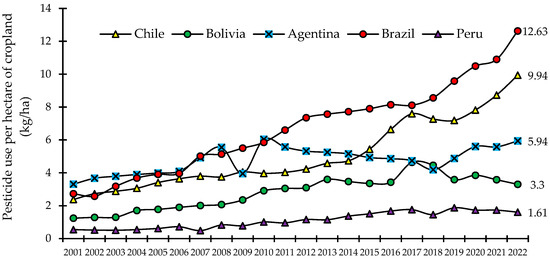
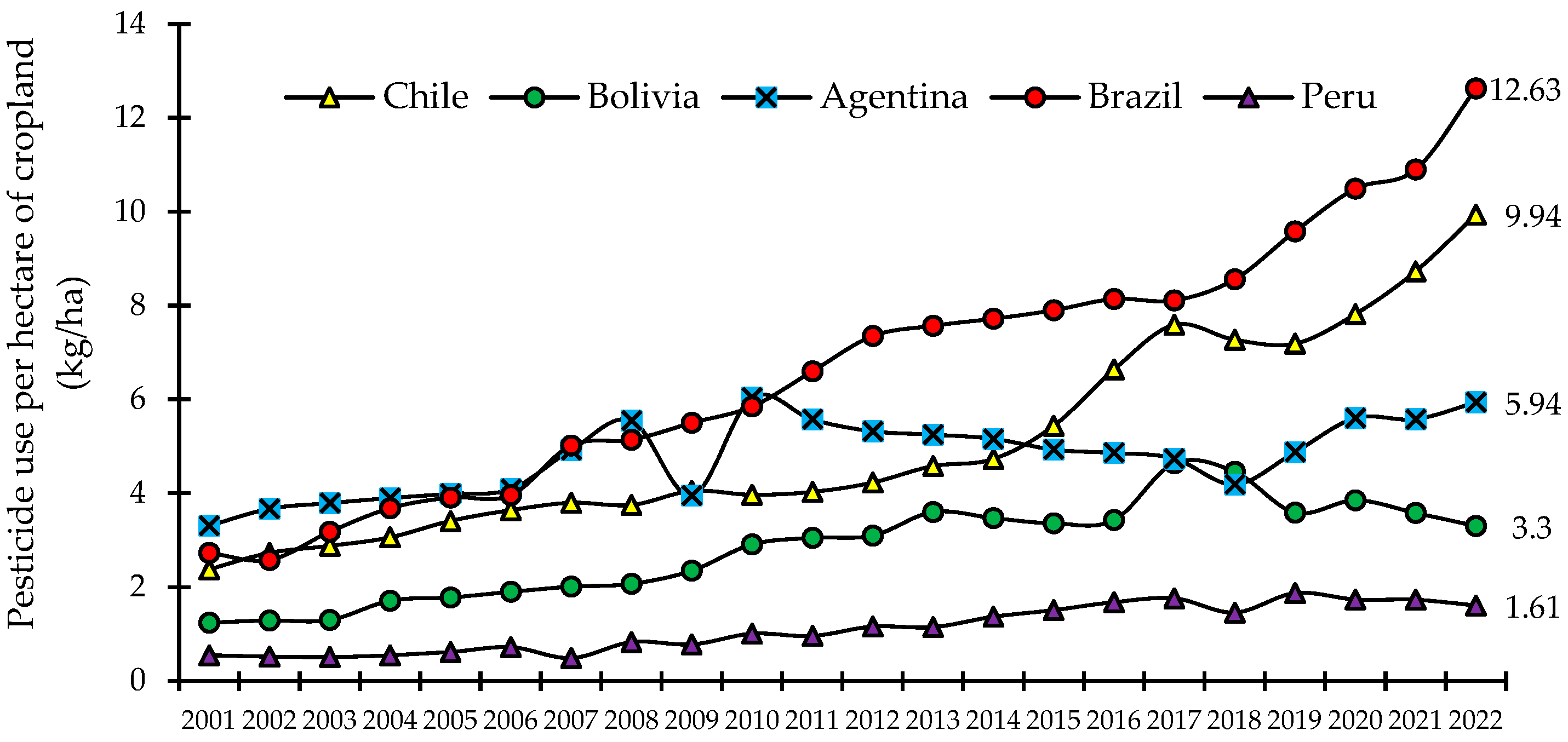
Results are presented as annual and stratified proportions, and interpretations remain program indicators under risk-based sampling. Based on available data, pesticide use per hectare of cropland in Chile [23] increased from 3 kg/ha in 2001 to 9.94 kg/ha in 2022, primarily due to the high intensity of agriculture in the Central region of Chile (Figure 1). The expansion of agricultural exports, the introduction of monoculture systems, climate change, emerging pest threats, weak enforcement of pesticide regulations, the growing market for pesticides in Chile, and the perception that pesticides are essential for competitiveness contribute to understanding this situation [13].
Figure 1.
Pesticide use (kg/ha) per hectare of cropland in some South American countries [23].
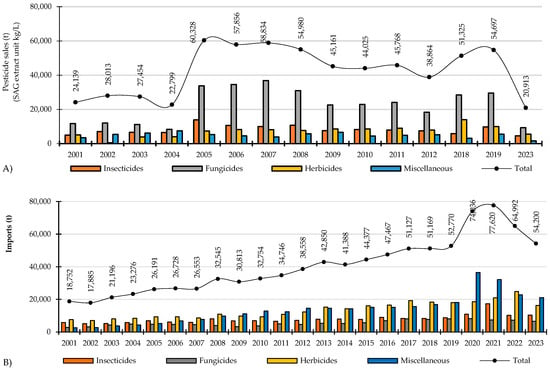
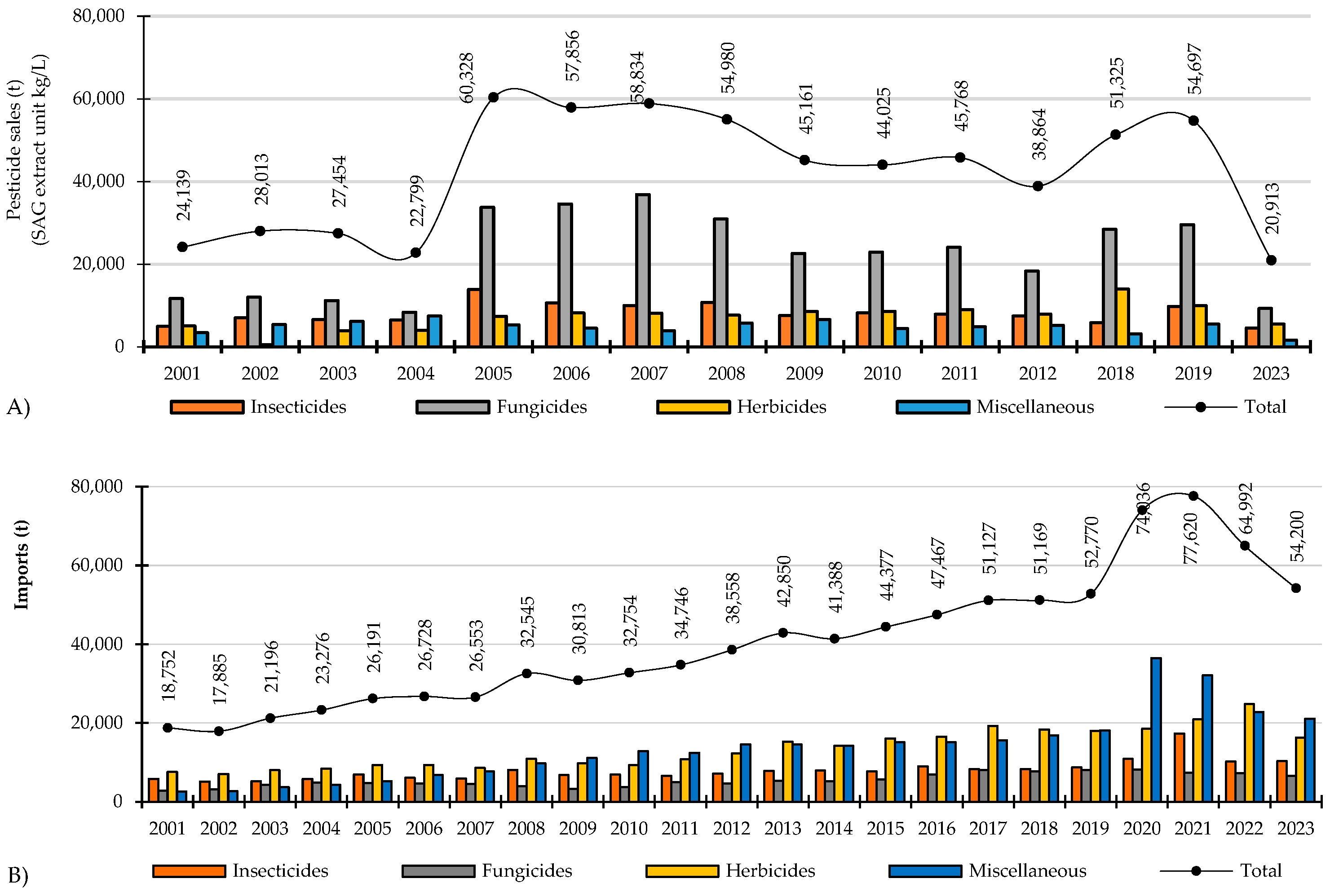
On the other hand, official SAG sales indicators are available as a historical series from 2001 to 2019 (Figure 2A). The data was categorized into herbicides, fungicides, and insecticides. Additionally, a category labeled “Miscellaneous” is incorporated to encompass non-disaggregated or unspecified product groups within the source dataset, such as mixed or unspecified preparations, entries lacking a specific product-group classification, or minor categories consolidated in the original dataset. This import includes HS3808 preparations not mapped into core crop-protection groups (disinfectants and other biocides, including rodenticides), and annual inflows may reflect inventory timing and potential re-export. Apparent cases where the import total exceeded the domestic sales declaration should not be interpreted as a like-for-like comparison, because imports are reported as a mass of formulated products under HS3808, whereas SAG sales are reported in a combined administrative kg/L field without mass-volume separation. Total reported sales increased from 24,138,998 kg/L in 2001 to 54,697,125 kg/L in 2019 (last year of the historical series). Because SAG reporting does not separate mass from volume and does not provide formulation densities, we present the series as provided and interpret trends within it. To complement these indicators, results are presented as 2001–2023 import statistics from the National Customs Services (Figure 2B), side by side, as a directional signal of pesticide availability; imports and domestic sales are not aggregated due to differences in scope, units, and potential inventory/re-export effects. This dual presentation improves interpretability while avoiding double-counting or invalid unit conversions. Some active ingredients are produced locally, whereas others are imported, including some that are not approved for use in developed countries. Currently, Chile has 1492 formulations from various sources worldwide available for diverse agricultural purposes [24]. These formulations are crucial for the intensive production systems of high-value exports, such as table grapes, avocados, berries, cherries, and citrus fruits, which are shipped to numerous markets.
Figure 2.
Domestic pesticide sales reported by SAG, with coverage spanning 2001–2023, by product group (A). Annual SAG sales values were not available for 2013–2017 and 2020–2023 in the transparency extract. Quantities are displayed in the original units provided by each source. (B) shows a harmonized import series (2001–2023) derived from official records of Chile’s National Customs Service for HS heading 3808, mapped to pesticide-type groups. “Miscellaneous” denotes records in the source extract that were not disaggregated into the major pesticide product groups, such as desinfectants, biocides, and rodenticides [25].
The marked increases observed around 2004–2005 and during 2012–2019 are approached with caution, as the series reflects administrative sales extracts reported in a combined kg/L field and may be influenced by modifications in extract structure and coverage over the years. These increases likely indicate a combination of changes in product composition, with a significant contribution from fungicides, consistent with intensive fruit and horticultural production systems, as well as market dynamics and crop protection demand, as captured by the administrative declarations. Furthermore, annual variations in the recording or aggregation methods for product groups within the extract may contribute to apparent step changes. Consequently, these spikes are regarded as directional signals of availability rather than accurate estimates of applied quantities.
To contextualize domestic availability indicators with an external continuous source, pesticide imports were summarized from official Chilean customs records compiled by ODEPA under HS heading 3808 (formulated pesticide preparations) for 2001–2023, grouped into insecticides, fungicides, herbicides, and other HS3808 biocide categories. Import volumes are treated as cross-border inflows (availability indicators) and are not aggregated with SAG sales declarations because of differences in scope, product composition, potential inventory dynamics, and re-exports. In Figure 2B, the total HS3808 inflows increased from 18.8 thousand tons in 2001 to 52.8 thousand tons in 2019, peaking in 2021 (77.6 thousand tons) and remaining elevated in 2023 (54.2 thousand tons). Because HS3808 includes disinfectants and other biocides that can inflate the total, additionally report a crop protection subset (insecticides + fungicides + herbicides), which doubled from the protection subset, dominated by herbicides (16.2 thousand tons in 2001 to 33.1 thousand tons in 2023. In 2023, the crop-protection subset was dominated by herbicides (16.3 thousand tons; 49%), followed by insecticides (10.3 thousand tons; 31%). This external import series provides a continuous availability signal that complements the non-continuous domestic sales extract and supports the interpretation of long-term patterns of pesticide availability alongside residue surveillance findings.
The availability signals for pesticides in Chile exemplify why usage trends may vary across metrics and data pipelines. Domestic administrative sales extracts (SAG) serve as a significant long-term indicator of the pressure exerted by marketed pesticides; however, their utility for quantitative inference is limited due to structural weaknesses. The sales data are reported in a combined unit of kilograms per liter (kg/L), with annual coverage being non-contiguous in transparency extracts, and detailed ingredient information available only for a subset of years. This restricts the reproducible linkage between marketed quantities and residue surveillance signals. Conversely, the Chilean Customs/ODEPA HS 3808 import series provides a continuous, externally anchored indicator of imports of formulated pesticide preparations. Nevertheless, HS 3808 consolidates heterogeneous products; thus, the total imports must be interpreted with careful subgrouping and cannot be assumed to represent active ingredients without considering formulation compositions. The dual limitations of non-standardized domestic sales units and broad HS aggregation mean that neither source can serve as a definitive estimate of national pesticide use alone. Instead, both should be regarded as complementary indicators of availability, alongside residue monitoring. This interpretation aligns with recent evidence indicating that internationally harmonized pesticide use series may be biased downward when national reporting is incomplete, and that trade-informed reconstructions significantly revise inferred trajectories (GloPUT) [26]. This statement aligns with the wider body of methodological literature demonstrating that sales records necessitate explicit harmonization and metadata to serve as policy-informative tools. It underscores the significance of adopting standardized, high-resolution reporting systems for effective governance [27]. Finally, because mass-based availability indicators can differ from hazard-weighted impact metrics, trends in marketed quantities should not be confused with risk trajectories. Toxicity-weighted approaches can behave differently than mass flows, emphasizing the need for transparent hazard and exposure integration within national governance [28]. Taken together, the SAG/Customs discrepancy represents more than a simple data inconsistency; it signifies a governance constraint. Currently, Chile lacks a stable, harmonized, and publicly accessible system to connect sales, imports, active ingredients, use patterns, and surveillance outcomes within a unified risk governance framework. This deficiency diminishes the capacity to attribute exceedance signals to specific market drivers and delays the implementation of targeted substitutions and stewardship actions. Furthermore, it is probable that substantial imports of various pesticide categories (e.g., HS 380891) occur, which are not publicly accessible but are typically reported in liters. This constitutes additional volume that is not accounted for [29]. Since 2001, the discrepancy, coupled with inconsistencies in the official data, has raised serious concerns about the underestimation of actual pesticide availability [30]. Chile’s domestic manufacturing and formulation capacity is limited, with the industry primarily relying on imported active ingredients and formulated products. Consequently, customs data act as a valuable supplementary indicator of availability flows, although they may also reflect re-export stockpiling.
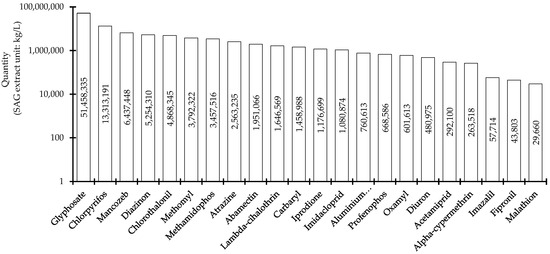
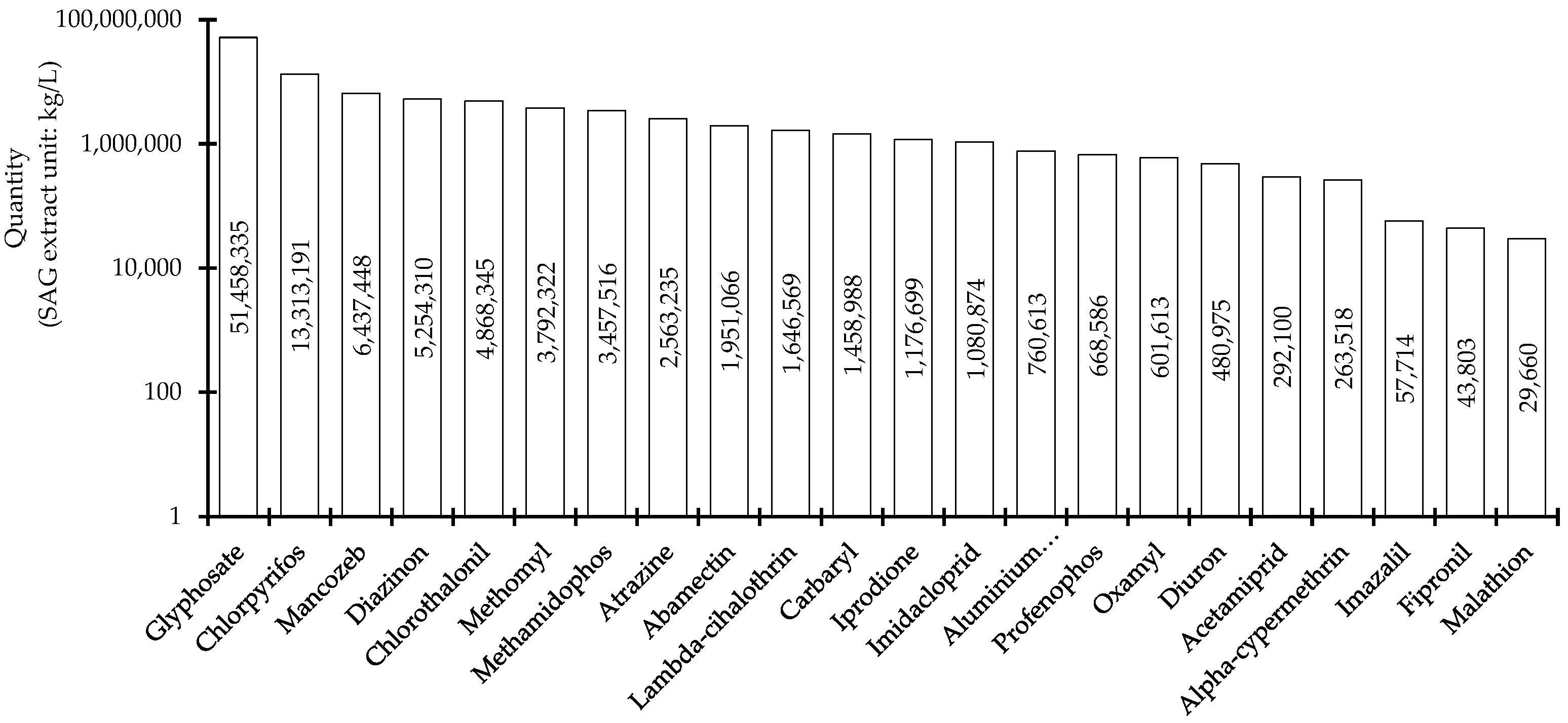
To enhance interpretability, Figure 3 summarizes the availability/top-selling HHP active ingredients across the available years 2018 and 2019. Accordingly, the figure does not imply an increase in sales over time; it summarizes the cumulative magnitude to identify which HHP active ingredient contributes most to the availability signal, subject to administrative reporting constraints. Temporal interpretation is addressed separately through the surveillance exceedance indicators and the long-term availability context, rather than by inferring a continuous annual trend from non-contiguous sales data. Chilean sales in 2018 and 2019 were dominated by several active classes commonly classified as HHPs. Several of these substances have been reevaluated or withdrawn from the European Union, revealing differences in how hazards are managed and approved. For example, the EU chose not to renew the approval for mancozeb in agricultural use as of February 2021 [6]. Chile uses a formal pesticide sales declaration mandated by SAG. However, the system primarily functions as a statistical tool and lacks regulatory enforcement capacity to restrict or phase out toxic pesticides [31]. Figure 3 shows that several HHPs, including glyphosate, chlorpyrifos, mancozeb, abamectin, diazinon, lambda-cyhalothrin, and chlorothalonil, were among the most active ingredients sold in Chile during 2018 and 2019. Notably, lambda-cyhalothrin was the most common pesticide residue found in commonly consumed vegetables in Chile during that period [32], and chlorothalonil was detected in samples of Chilean avocados and peaches [33]. In 2019, pesticide sales were, in most cases, higher than those in 2018, except for chlorothalonil, atrazine, profenophos, and diuron. Furthermore, most of these active ingredients are classified as HHPs according to FAO/WHO criteria due to their effects on human health and the environment.
Figure 3.
Availability indicator for the active ingredients of top-selling highly hazardous pesticides derived from the SAG administrative sale extract. Values are presented in the source reported unit (SAG administrative field) and are interpreted as directional availability signals (Section 2.4). The bars represent the total reported quantity, summed across the available years in Chile, specifically 2018 to 2019. Import statistics are not included in this figure and are presented separately as a Custom import indicator [25].
Chile primarily uses older-generation organochlorines and organophosphates, which persist longer and are more toxic than newer pesticides, thereby increasing the risk to food safety and human health [34]. Many HHPs authorized in Chile have been banned internationally due to their risks to humans and ecosystems. More than 30% of the authorized pesticides are locally manufactured, whereas the remainder are imported, despite some active ingredients being prohibited for use in developed countries [31].
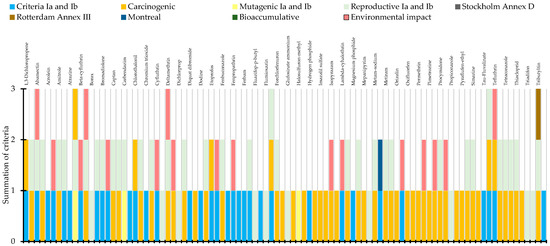
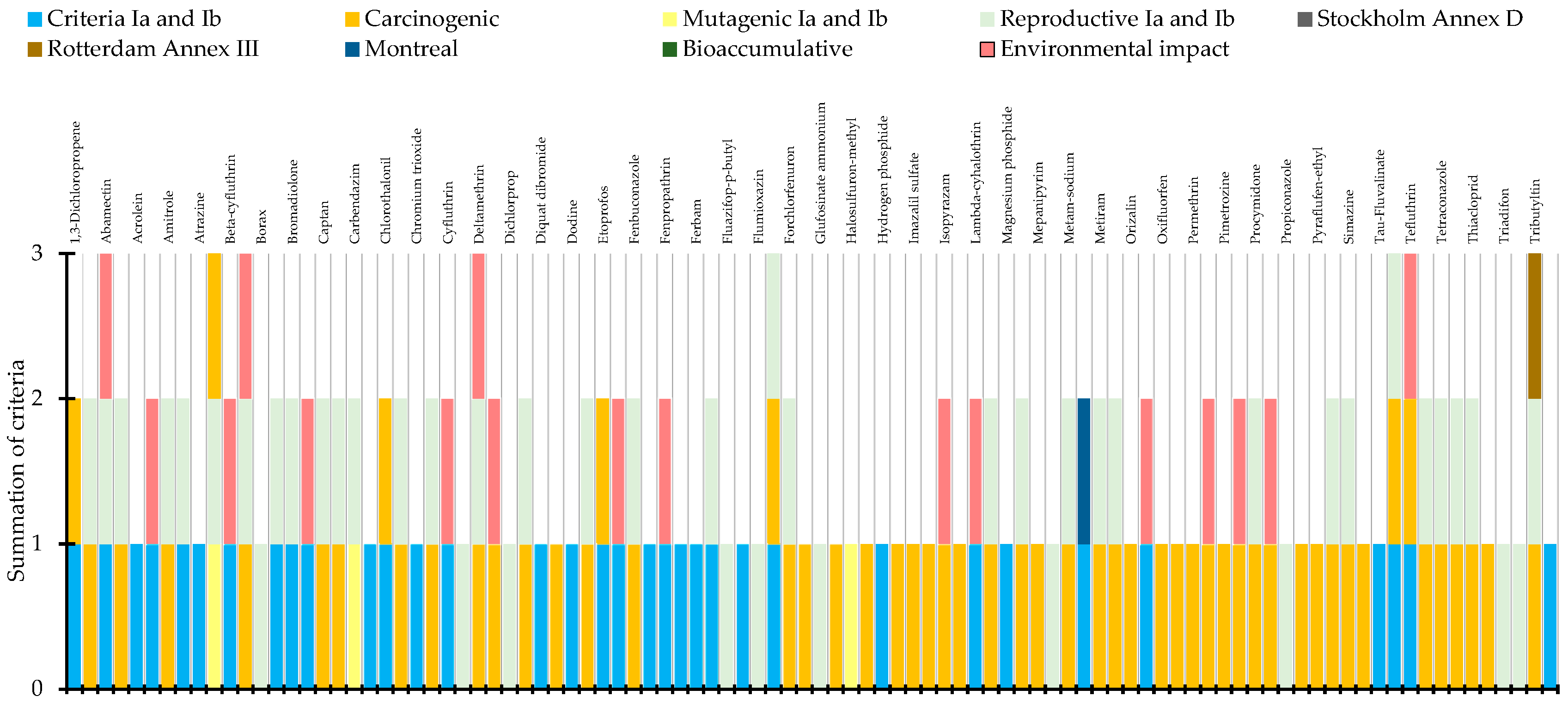
Highly hazardous pesticides from older generations, which are persistent and bioaccumulate, remain off-patent and are easily accessible in developing countries’ markets, where registration systems are weak, and the capacity for health risk assessment is limited [13]. Currently, some HHPs can be purchased in Chile for agricultural purposes without any restrictions, controls, or tracking. Figure 4 presents the hazard-criteria trigger profile for the combined set of HHPs highlighted in Figure 3 and Figure 5. Some of them are carcinogenic and genotoxic, having a direct impact on human health [35]. Factors such as enforcement and national surveillance have been identified as barriers to the adoption of the International Convention on Plant Protection (ICPM) in Latin American countries, as they hinder the adoption of good agricultural practices [36]. Pesticide standards vary across countries and are complex, multidimensional, and challenging to harmonize. This issue is particularly critical in developing countries that are significantly affected by stringent pesticide regulations. The ICPM encourages governments to introduce policies, legislation, or restrictions on pesticides that align with the guidelines of the FAO and WHO [37].
Figure 4.
FAO/WHO hazard-criteria triggers profile for the union set of HHPs active ingredients shown in Figure 3 and Figure 5 [36]. Criteria are reported at the active-ingredient level, as highlighted in Figure 3 and Figure 5 (Section 2.8). Criteria are reported at the active ingredient level. Each active ingredient appears once on the x-axis as a labeled block. With each block, colored bars indicate which hazard criteria are triggered. Vertical separator delineates the boundary between active ingredients to prevent misreading of the criteria assignment across adjacent pesticides.
Figure 5.
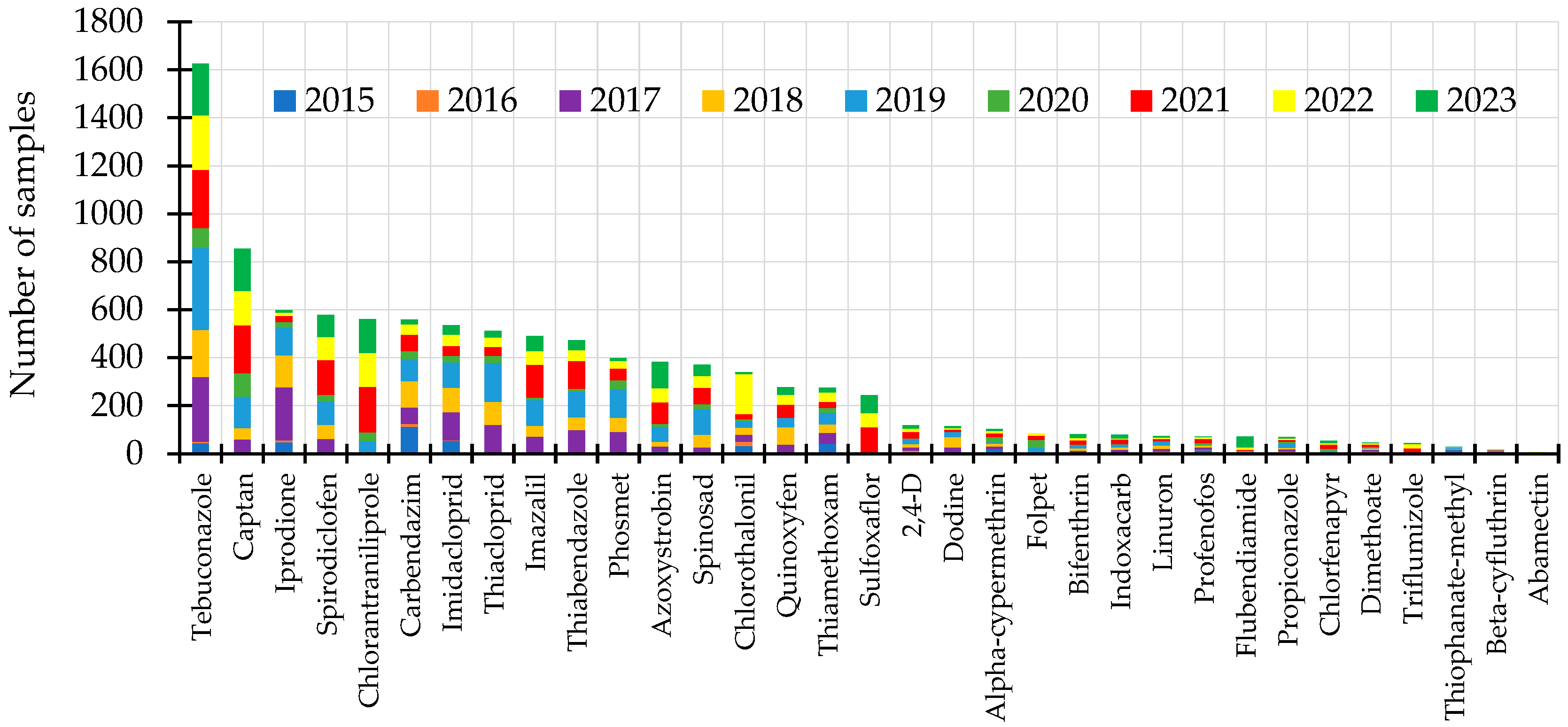
Most frequently detected HHP-classified active ingredient residues in plant-based foods from the national surveillance conducted by the Agricultural and Livestock Service from 2015 to 2023. Frequencies reflect risk-based monitoring and are interpreted as surveillance signals rather than population prevalence estimates.
Currently, pesticide trading companies worldwide rely on international data to support their registrations. However, in Chile, local environmental factors such as soil composition, climate, and hydrology are often overlooked when assessing formulation behavior. This results in a lack of relevant information on the fate of certain toxic pesticides and their metabolites in soils or water bodies, which have unique physicochemical properties [38]. The absence of environmental exposure data and their uneven distribution have prompted calls to develop local scenarios that accurately reflect these conditions.
Compared with European regulations, such as CE Nº 1107/2009 and 128/2009 CEE, there is no dietary risk assessment for decisions to ban, restrict, or prohibit a pesticide in Chile [39,40]. The SAG manages authorizations and post-registration data in Excel spreadsheets. Sometimes, international information must be translated into Spanish, leaving insufficient information to update and regulate the active ingredients. The SAG is responsible for registering and authorizing pesticides for agricultural use. The legal framework is based on Regulations No. 3557 of 1980 and Resolution No. 1557 of 2014, as well as their subsequent amendments, including those made in 1400/2015, 1028/2016, and 54482/2016. Other regulations cover their application, production, storage, transportation, final disposal, and waste [13].
The latest report reveals several inconsistencies and errors in the authorizations, resulting in a lack of transparency and traceability of the records, which is contrary to the international standards proposed by the WHO and FAO [41]. Therefore, it is necessary to adopt the precautionary principle for pesticides to regulate their authorization for use in agriculture and to evaluate their acute and chronic impacts on human health and the environment.
In Chile, pesticide residues in raw vegetables are regulated by MRLs. The MRLs are extremely useful for understanding the connection between pesticide residues and compliance with Good Agricultural Practices. The Ministry of Health of Chile established the MRLs based on the CODEX Alimentarius, as well as the standards of the European Union, the United States, and Japan, by Resolution No. 209/2020 [42].
Over the last few years, several studies have raised serious concerns about HHP residues in various matrices, thereby increasing the risk to human and environmental health. According to Chilean regulations on MRLs for pesticide residues in fruits, the highest number of transgressions was recorded in 2019, with more than 1500 samples exceeding the MRLs. Since 2015, the MRL transgression rate has been 23.2% across 492 samples, reaching 27% in 2018 across 407 samples evaluated. In the same year, the notification rate for pesticide residues in the RASFF system in Europe was 2–4% of the total number of fruit or vegetable samples [43]. In 2023, EFSA reported 13,246 samples under the coordinated program, with 1% non-compliance, and an additional 132,793 risk-based samples, with 2% non-compliance. These rates are significantly lower than the excess proportions observed in some Chilean vegetables throughout the years. However, differences in sampling frames and enforcement should be considered [44]. EU non-compliance percentages are provided here only as contextual benchmarks because the Chilean program is risk-based; direct numerical comparability is not assumed, and it interprets differences as population-level contrasts. In several years, exceedance proportions exceeded 20–30% in vegetables, mainly in the Central regions of Chile. Also, in 2019, more than 30% of the fresh vegetables evaluated exceeded their corresponding MRLs [45]. The areas of Chile with the highest transgressions of the national regulation were Arica, Coquimbo, Valparaíso, Metropolitan, O’Higgins, and Maule. From 2015 to 2023, the most frequently detected HHPs in the evaluated food samples were tebuconazole, captan, iprodione, chlorothalonil, carbendazim, imidacloprid, and thiacloprid (Figure 5). To provide a functional interpretation consistent with agronomic practice, the most frequently detected active ingredients were grouped into primary pesticide classes (fungicides, insecticides, herbicides; acaricides reported separately). Among the top 30 detected residues, detections were dominated by fungicides (20,590 records; 72% of detections within the top 30), followed by insecticides (7170; 25%) and acaricides (578; 2%). Herbicide residues were rare among the high-frequency detections. This pattern is consistent with residue surveillance in harvested commodities, where fungicides and insecticides are commonly targeted by multi-residue panels and more likely to persist as measurable residues in edible matrices, whereas many herbicides are either less represented in commodity-focused residue panels or show different residue behavior.
Between 2015 and 2023, 73 out of 124 detected active ingredients were classified as operational HHP, representing 58.9% of unique active ingredients. At the record level, those classified as HHP made up 59.5% of all detection records and 44.6% of MRL exceedance records. This shows that high-hazard substances are a significant part of both detection counts and non-compliance signals in the monitoring program. From 2015 to 2023, frequent detections and significant MRL exceedances occurred in leafy vegetables, solanaceous crops, and certain fruits. These exceedances often involved commodities such as lettuce, chard, spinach, tomatoes, peppers, grapes, apples, blueberries, and cabbage, which are important for production and consumption in central Chile [45,46,47,48,49,50,51,52,53]. A relevant source of exceedance events was identified from samples collected at wholesale and street markets, as well as other monitored sites within the national program [53]. These findings should be viewed as signals from the monitoring program within a risk-based sampling framework and used to prioritize targeted follow-up, such as GAP/PHI verification and focused monitoring of recurring active ingredients. To facilitate agronomic interpretation in the manuscript, HHPs focused on the most frequently detected residues, summarized by principal pesticide classes: fungicides, insecticides, and herbicides. Respective HHP-classified residues were quantified as a proportion of detections and exceedances across the years 2015–2023.
Although this study does not include dietary exposure estimation or probabilistic health risk assessment, the surveillance indicators presented help identify commodity-active-ingredient combinations that should be prioritized for further evaluation and agronomic management. Initially, the country can perform deterministic screening using national consumption data and toxicological reference values, Acceptable Daily Intake (ADI)/Acute Reference Dose (ARfD) for the active ingredients that are repeatedly detected, while applying cumulative approaches for shared endpoints when suitable. From an agronomic perspective, the main value of these findings is to improve verification of GAP and PHI compliance, focus monitoring efforts on high-signal commodities and regions, and aid in substitution planning within Integrated Pest Management (IPM) for frequently used HHP active ingredients.
While this study emphasizes public health relevance, it does not carry out new dietary exposure calculations or quantitative risk assessments. Instead, interpret “human health implications” using surveillance indicators, MRL exceedance rates, and the repeated detection of HHPs serving as practical proxies for potential consumer health concerns and, from an agricultural standpoint, for possible violations of Good Agricultural Practices and pre-harvest intervals. Notably, the patterns of active ingredients in commodities discussed here align with those identified in Chilean deterministic dietary risk assessments, including ready-to-eat leafy vegetables from Santiago markets and tomatoes and lettuce from the Metropolitan Region, in which methamidophos and chlorpyrifos were consistently identified as major contributors to potential acute risk. Consequently, our findings offer an evidence-based prioritization framework for subsequent assessments that combine national food consumption data with toxicological reference values (ADI/ARfD) and, where possible, cumulative exposure evaluations, while maintaining the current study’s focus on surveillance, MRL compliance, sales/import metrics, and HHP profiling.
These management options are discussed, considering surveillance signals (recurring commodity/active/ingredient combinations), hazard classification (HHP status), and agronomic feasibility, consistent with the qualitative prioritization described in Section 2.10. From a governance perspective, persistent exceedance signals should be interpreted not only as potential starship challenges but also as indicators of structural limitations in risk governance (e.g., incomplete integration of hazard characterization, dietary exposure screening, and environmental endpoints into registration and post-registration oversight). Strengthening surveillance utility would require harmonized reporting of pesticide availability and use indicators, and a clear linkage between monitoring outputs and risk governance actions.
Correlation analyses relating application volumes to detection frequency, as well as climatic contamination modeling, were not conducted due to the limitations of the available administrative dataset, which does not permit robust inference. Domestic sales are aggregated into a single “kg/L” field, lacking formulation metadata. Imports are documented at the formulated product HS level, and surveillance efforts are risk-based, thereby indicating that detection frequency is influenced by both target specifications and the presence of residues. Furthermore, sample-linked agroclimatic covariates, a mass-based use indicator, ingredient-level reporting, and geocoded agroclimatic covariates were utilized to assess the availability, detection, and climate-residue relationships within an explicit causal framework.
4. Conclusions
The extensive use of HHPs in Chile raises notable food safety concerns for consumers and represents a significant public health challenge that has not been sufficiently addressed. This study identifies recurring detections of HHPs and multiple signals of MRL exceedances in specific commodities within Chile’s national risk-based residue surveillance from 2015 to 2023. Since the monitoring is targeted rather than probabilistic, the proportions of exceedances should be viewed as indicators of non-compliance and monitoring priorities, rather than as estimates of population prevalence.
From an agronomic management standpoint, the findings highlight the importance of focusing on high-signal commodities and recurring active ingredients. This approach facilitates targeted verification of Good Agricultural Practices and Pre-Harvest Intervals, enhances market-level insights, and supports substitution planning within integrated pest management. The sale and usage indicators reported by SAG (kg/L) provide valuable trend information but should not be treated as directly comparable to total mass, given the use of non-separable units.
While this work does not evaluate dietary exposure or quantify health risks, it offers a clear foundation for a criteria-based regulatory approach to priority active ingredients. These ingredients are frequently involved in surveillance exceedances and/or classified as HHPs under the FAO/WHO hazard endpoint. Future research should incorporate deterministic and probabilistic dietary exposure models, conduct feasibility and transition studies for agronomic alternatives, and assess export market scenarios based on destination-specific MRL requirements.
Author Contributions
Conceptualization, S.E.; methodology, S.E.; validation, S.E. and C.F.; resources, S.E.; writing—original draft preparation, S.E. and M.C.; writing—review and editing, M.C., C.F., S.M., A.A., C.Z., S.C.-D., G.Z. and S.E.; funding acquisition, S.E. All authors have read and agreed to the published version of the manuscript.
Funding
This research was funded by ANID FONDECYT no. 1230872.
Data Availability Statement
The datasets analyzed during the current study are available from the corresponding author upon reasonable request.
Acknowledgments
We acknowledge the National Council of Transparency of Chile, the Agricultural and Livestock Services, and the Ministry of Health for facilitating access to the dataset used in this study, and we thank colleagues who provided technical feedback on data harmonization and interpretation. ANID FONDECYT grant number 1230872 (S.E.), ANID FONDECYT grant number 11220544 (A.A.), and ANID FONDECYT grant number 11280838 (M.C.).
Conflicts of Interest
The authors declare no conflicts of interest.
References
- Popp, J.; Pető, K.; Nagy, J. Pesticide productivity and food security. A review. Agron. Sustain. Dev. 2013, 33, 243–255. [Google Scholar] [CrossRef] [Scilit]
- Beyuo, M.; Appiah, J.A.; Tetteh, J.; Owusu, V.; Asare, R. Improper application, incorrect selection, and inadequate pre-harvest intervals can accumulate harmful residues in produce. Environ. Monit. Assess. 2024, 196, 275. [Google Scholar] [CrossRef] [Scilit]
- Food and Agriculture Organization of the United Nations (FAO); World Health Organization (WHO). Guidelines on Highly Hazardous Pesticides; FAO/WHO: Rome, Italy, 2016. Available online: https://openknowledge.fao.org/server/api/core/bitstreams/7c65af6a-52ca-4e44-8c57-4303d076bea4/content (accessed on 2 December 2025).
- Food and Agriculture Organization of the United Nations (FAO). Reducing the Global Risk from Highly Hazardous Pesticides (HHPs); FAO: Rome, Italy, 2025; Available online: https://www.fao.org/pest-and-pesticide-management/pesticide-risk-reduction/reducing-global-risk-from-hhp/en/ (accessed on 2 July 2025).
- European Commission. Commission Implementing Regulation (EU) 2019/677 of 29 April 2019 concerning the non-renewal of the approval of the active substance chlorothalonil. Off. J. Eur. Union 2019, L 114, 15–17. [Google Scholar]
- European Commission. Commission Implementing Regulation (EU) 2020/2087 of 14 December 2020 concerning the non-renewal of the approval of the active substance mancozeb. Off. J. Eur. Union 2020, L 423, 51–53. [Google Scholar]
- European Commission. Chlorpyrifos & Chlorpyrifos-Methyl: Renewal of Approval; European Commission Directorate-General for Health and Food Safety: Brussels, Belgium, 2020; Available online: https://food.ec.europa.eu/plants/pesticides/approval-active-substances-safeners-and-synergists/renewal-approval/chlorpyrifos-chlorpyrifos-methyl_en (accessed on 2 December 2025).
- European Commission. EU Legislation on Maximum Residue Levels (MRLs); European Commission—Food Safety: Brussels, Belgium, 2025; Available online: https://food.ec.europa.eu/plants/pesticides/maximum-residue-levels/eu-legislation-mrls_en (accessed on 1 August 2025).
- Phillips, M.W.A. Agrochemical industry development, trends in R&D and the impact of regulation. Pest. Manag. Sci. 2020, 76, 3348–3356. [Google Scholar] [CrossRef] [Scilit]
- Ansari, I.; Ahmad, W.; Sardar, S.; Niazi, N.K.; Shahid, M.; Bundschuh, J.; Naidu, R. Persistent organic pollutants and pesticides: A review of environmental fate, health risks, and policies in developing countries. Sci. Total Environ. 2024, 870, 161913. [Google Scholar] [CrossRef] [Scilit]
- Kubiak-Hardiman, P.; Czarnota, K.; Płonka-Szydełko, J.; Brzezińska, K. Identifying gaps and challenges in global pesticide regulation: Implications for trade, health, and environmental protection. J. Soils Sediments 2023, 23, 5614–5625. [Google Scholar] [CrossRef] [Scilit]
- Brunelle, T.; Ramasamy, S.; Adhikari, R.; Smith, L.; Velez, M. Reducing chemical inputs in agriculture requires a system change: Challenges and policy limitations in low-income regions. Nat. Sustain. 2024, 7, 1021–1032. [Google Scholar] [CrossRef] [Scilit]
- Coria, J.; Elgueta, S. Towards safer use of pesticides in Chile. Environ. Sci. Pollut. Res. 2022, 29, 22785–22797. [Google Scholar] [CrossRef] [Scilit]
- Servicio Agrícola y Ganadero (SAG). Resolución Exenta Nº 1.557 de 2014 que Establece Exigencias Para la Autorización, Registro, Modificación y Renovación de Plaguicidas; SAG: Santiago, Chile, 2014. Available online: https://www.bcn.cl/leychile/navegar?idNorma=1060172 (accessed on 2 December 2025).
- Concha, C.; Manzano, C.A. Priority pesticides in Chile: Predicting their environmental distribution, bioaccumulation, and transport potential. Integr. Environ. Assess. Manag. 2023, 19, 676–683. [Google Scholar] [CrossRef] [Scilit]
- Rother, H.-A. South African farm workers’ interpretation of risk assessment data expressed as pictograms on pesticide labels. Environ. Res. 2008, 108, 419–427. [Google Scholar] [CrossRef] [Scilit]
- Bayoumi, A.E. Counterfeit Pesticides. ACS Chem. Health Saf. 2021, 28, 232–237. [Google Scholar] [CrossRef] [Scilit]
- Pathak, V.M.; Verma, V.K.; Rawat, B.S.; Kaur, B.; Babu, N.; Sharma, A.; Dewali, S.; Yadav, M.; Kumari, R.; Singh, S.; et al. Current status of pesticide effects on environment, human health and it’s eco-friendly management as bioremediation: A comprehensive review. Front. Microbiol. 2022, 13, 962619. [Google Scholar] [CrossRef] [Scilit]
- Desye, B.; Tesfaye, A.H.; Daba, C.; Alemseged, E.A.; Angaw, Y.; Ebrahim, A.M.; Natnael, T.; Hassen, S.; Woretaw, L. Pesticide safe use practice and acute health symptoms, and associated factors among farmers in developing countries: A systematic review and meta-analysis. BMC Public Health 2024, 24, 20817. [Google Scholar] [CrossRef] [Scilit] [PubMed]
- Contraloría General de la República de Chile. Informe Final N.º 174: Auditoría al Proceso de Autorización de Plaguicidas de Uso Agrícola Realizado por el Servicio Agrícola y Ganadero (SAG) Entre el 1 de Enero de 2017 y el 31 de Diciembre de 2019; Contraloría General de la República: Santiago, Chile, 2021. Available online: https://www.contraloria.cl/buscadorpdf/auditoria/318bf06bc86be907de40fb96696376a9/html (accessed on 2 December 2025).
- Muñoz-Quezada, M.T.; Iglesias, V.; Zúñiga-Venegas, L.A.; Pancetti, F.; Foerster, C.; Landeros, N.; Lucero, B.; Schwantes, D.; Cortés, S. Exposure to pesticides in Chile and its relationship with carcinogenic potential: A review. Front. Public Health 2025, 13, 1531751. [Google Scholar] [CrossRef] [Scilit] [PubMed]
- Pesticide Action Network International. PAN International List of Highly Hazardous Pesticides (HHPs), December 2024 ed.; PAN Germany for PAN International: Hamburg, Germany, 2024; Available online: https://pan-international.org/wp-content/uploads/PAN_HHP_List.pdf (accessed on 28 December 2024).
- Food and Agriculture Organization of the United Nations (FAO). Land, Inputs and Sustainability: Pesticides Use [dataset], FAOSTAT Pesticides Use Domain; FAO: Rome, Italy, 2024; Available online: https://www.fao.org/statistics/en/#data/RP (accessed on 28 December 2024).
- Servicio Agrícola y Ganadero (SAG). Planilla Resumen de Plaguicidas Autorizados; SAG: Santiago, Chile, 2025. Available online: https://www.sag.gob.cl/content/planilla-resumida-de-plaguicidas-autorizados (accessed on 2 December 2025).
- Oficina de Estudios y Políticas Agrarias (ODEPA). Matriz Detallada de Comercio Exterior (Información del Servicio Nacional de Aduanas). Available online: https://aplicativos.odepa.gob.cl/matriz.do (accessed on 1 March 2026).
- Shattuck, A.; Werner, M.; Mempel, F.; Dunivin, Z.; Galt, R.E. Base de datos mundial sobre el uso y el comercio de plaguicidas (GloPUT): Nuevas estimaciones muestran que las tendencias de uso de plaguicidas en países de bajos ingresos están subestimadas. Cambio Ambient. Glob. 2023, 81, 102693. [Google Scholar] [CrossRef] [Scilit]
- Martin, P.; Ramalanjaona, L.; Truche, C.; Ballot, R.; Carozzi, M.; Pomeon, T. Modelización de la espacialización de las ventas de pesticidas para el seguimiento de las políticas ambientales en Francia. J. Clean. Prod. 2023, 403, 136880. [Google Scholar] [CrossRef] [Scilit]
- Li, J.-A.; Xie, W.-J.; Zhou, W.-X. Estructura y evolución de las redes internacionales de comercio de plaguicidas. Front. Phys. 2021, 9, 681788. [Google Scholar] [CrossRef] [Scilit]
- Valbuena, D.; Cely-Santos, M.; Obregón, D. Agrochemical pesticide production, trade, and hazard: Narrowing the information gap in Colombia. J. Environ. Manag. 2021, 286, 112141. [Google Scholar] [CrossRef] [Scilit]
- Li, J.-A.; Wang, L.; Xie, W.-J.; Zhou, W.-X. Evolving community structure in the international pesticide trade networks. Heliyon 2023, 9, e21076. [Google Scholar] [CrossRef] [Scilit]
- Sigoña, P.; Panez-Pinto, A.; Lobos-Castro, F. Pesticide Pollution of Surface Waters: Investigating Agricultural Transformations and Community Exposure in Chile’s Central Valley. Sustainability 2025, 17, 7911. [Google Scholar] [CrossRef] [Scilit]
- Calderón, R.; García-Hernández, J.; Palma, P.; Leyva-Morales, J.B.; Zambrano-Soria, M.; Bastidas-Bastidas, P.J.; Godoy, M. Assessment of pesticide residues in vegetables commonly consumed in Chile and Mexico: Potential impacts for public health. J. Food Compos. Anal. 2022, 108, 104420. [Google Scholar] [CrossRef] [Scilit]
- Lapierre, L.; Quintrel, M.; Lagos-Susaeta, F.; Hervé-Claude, L.P.; Riquelme, R.; Oviedo, P.; Maino, M.; Cornejo, J. Assessment of Antimicrobial and Pesticide Residues in Food Products Sourced from Peasant Family Farming in Chile. J. Food Prot. 2019, 82, 1583–1590. [Google Scholar] [CrossRef] [Scilit] [PubMed]
- Hilber, I.; Bahena-Juárez, F.; Chiaia-Hernández, A.C.; Elgueta, S.; Escobar-Medina, A.; Friedrich, K.; González-Curbelo, M.Á.; Grob, Y.; Martín-Fleitas, M.; Miglioranza, K.S.B.; et al. Pesticides in Soil, Groundwater and Food in Latin America as Part of One Health. Environ. Sci. Pollut. Res. 2024, 31, 14333–14345. [Google Scholar] [CrossRef] [Scilit] [PubMed]
- Landeros, N.; Muñoz-Quezada, M.T.; Aguilera, F.; Lucero, B.; Foerster, C.; Zúñiga-Venegas, L.A.; Iglesias, V. Genotoxicity and Reproductive Risk in Workers Exposed to Pesticides in Rural Areas of Curicó, Chile: A Pilot Study. Int. J. Environ. Res. Public Health 2022, 19, 16608. [Google Scholar] [CrossRef] [Scilit]
- Alwang, J.; Norton, G.W.; Larochelle, C. Obstacles to widespread diffusion of Integrated Pest Management in developing countries: Lessons from the field. J. Integr. Pest Manag. 2019, 10, 1–8. [Google Scholar] [CrossRef] [Scilit]
- Food and Agriculture Organization of the United Nations (FAO); World Health Organization (WHO). International Code of Conduct on Pesticide Management; FAO/WHO: Rome, Italy, 2014. Available online: https://www.fao.org/fileadmin/templates/agphome/documents/Pests_Pesticides/Code/CODE_2014Sep_ENG.pdf (accessed on 5 January 2025).
- Boonupara, T.; Udomkun, P.; Khan, E.; Kajitvichyanukul, P. Airborne Pesticides from Agricultural Practices: A Critical Review of Pathways, Influencing Factors, and Human Health Implications. Toxics 2023, 11, 858. [Google Scholar] [CrossRef] [Scilit]
- European Commission. Regulation (EC) No 1107/2009 of the European Parliament and of the Council of 21 October 2009 Concerning the Placing of Plant Protection Products on the Market. Off. J. Eur. Union 2009, L309, 1–50. [Google Scholar]
- European Commission. Regulation (EC) No 396/2005 of the European Parliament and of the Council of 23 February 2005 on Maximum Residue Levels of Pesticides in or on Food and Feed of Plant and Animal Origin and Amending Council Directive 91/414/EEC. Off. J. Eur. Union 2005, L70, 1–16. [Google Scholar]
- Contraloría General de la República de Chile (CGR). Informe Final N° 3E-2021: Auditoría al Proceso de Registro y Control de Plaguicidas de Uso Agrícola Ejecutado por el Servicio Agrícola y Ganadero (SAG); CGR: Santiago, Chile, 2021.
- Ministerio de Salud de Chile (MINSAL). Resolución Exenta No. 209/2020. Establece Límites Máximos de Residuos de Plaguicidas en Alimentos de Origen Vegetal y Animal. Gobierno de Chile, Santiago, 2020. Available online: https://www.bcn.cl/leychile/navegar?idNorma=1144310 (accessed on 1 July 2025).
- European Food Safety Authority (EFSA). The 2018 European Union report on pesticide residues in food. EFSA J. 2020, 18, 6057. [Google Scholar] [CrossRef] [Scilit]
- Elgueta, S.; Donoso, A.; Hernández, J.; Liu, S.; Zhao, G.; Saavedra, G.; Kehr, E.; Jana, C.; Molinett, S. Current State of Chemical Food Safety and Risk Assessment in Fresh Vegetables Produced in Chile. In Studies in Systems, Decision and Control; Springer: Cham, Switzerland, 2025; Volume 557, pp. 33–44. [Google Scholar] [CrossRef] [Scilit]
- Chilean Agency for Food Safety and Quality (ACHIPIA). RIAL Annual Report 2019–2020: Food Information and Alerts Network; ACHIPIA: Santiago, Chile, 2025. Available online: https://www.achipia.gob.cl/wp-content/uploads/2024/06/Informe_RIAL_2019_2020.pdf (accessed on 17 July 2025).
- Chilean Agency for Food Safety and Quality (ACHIPIA). RIAL Annual Report 2015: Food Information and Alerts Network; ACHIPIA: Santiago, Chile, 2025. Available online: https://www.achipia.gob.cl/wp-content/uploads/2024/06/Informe_RIAL_2015.pdf (accessed on 17 July 2025).
- Chilean Agency for Food Safety and Quality (ACHIPIA). RIAL Annual Report 2016: Food Information and Alerts Network; ACHIPIA: Santiago, Chile, 2025. Available online: https://www.achipia.gob.cl/wp-content/uploads/2024/06/Informe_RIAL_2016.pdf (accessed on 17 July 2025).
- Chilean Agency for Food Safety and Quality (ACHIPIA). RIAL Annual Report 2017: Food Information and Alerts Network; ACHIPIA: Santiago, Chile, 2025. Available online: https://www.achipia.gob.cl/wp-content/uploads/2024/06/Informe_RIAL_2017.pdf (accessed on 17 July 2025).
- Chilean Agency for Food Safety and Quality (ACHIPIA). RIAL Annual Report 2018: Food Information and Alerts Network; ACHIPIA: Santiago, Chile, 2025. Available online: https://www.achipia.gob.cl/wp-content/uploads/2024/06/Informe_RIAL_2018.pdf (accessed on 17 July 2025).
- Chilean Agency for Food Safety and Quality (ACHIPIA). RIAL Annual Report 2021: Food Information and Alerts Network; ACHIPIA: Santiago, Chile, 2025. Available online: https://www.achipia.gob.cl/wp-content/uploads/2024/08/Informe_RIAL_2021.pdf (accessed on 17 July 2025).
- Chilean Agency for Food Safety and Quality (ACHIPIA). RIAL Annual Report 2022: Food Information and Alerts Network; ACHIPIA: Santiago, Chile, 2025. Available online: https://www.achipia.gob.cl/wp-content/uploads/2024/08/Informe_RIAL_2022.pdf (accessed on 17 July 2025).
- Chilean Agency for Food Safety and Quality (ACHIPIA). RIAL Annual Report 2023: Food Information and Alerts Network; ACHIPIA: Santiago, Chile, 2025. Available online: https://www.achipia.gob.cl/wp-content/uploads/2025/01/Informe_RIAL_2023-2.pdf (accessed on 17 July 2025).
- Chilean Agency for Food Safety and Quality (ACHIPIA). RIAL Annual Report 2024: Food Information and Alerts Network; ACHIPIA: Santiago, Chile, 2025. Available online: https://www.achipia.gob.cl/wp-content/uploads/2025/09/RIAL_Reporte_notificaciones_2024_16.pdf (accessed on 17 July 2025).
Disclaimer/Publisher’s Note: The statements, opinions and data contained in all publications are solely those of the individual author(s) and contributor(s) and not of MDPI and/or the editor(s). MDPI and/or the editor(s) disclaim responsibility for any injury to people or property resulting from any ideas, methods, instructions or products referred to in the content. |
© 2026 by the authors. Licensee MDPI, Basel, Switzerland. This article is an open access article distributed under the terms and conditions of the Creative Commons Attribution (CC BY) license.