Review

Spring Bread Wheat (Triticum aestivum L.) Grain Quality in Northern Kazakhstan: Status and Potential for Improvement for Domestic and Export Markets


1
Research and Production Center of Grain Farming Named After A.I. Barayev, Naýchnyı 021601, Kazakhstan
2
Biodiversity Department, Al-Farabi Kazakh National University, Almaty 050051, Kazakhstan
3
Departamento de Genética, Escuela Técnica Superior de Ingeniería Agronómica y de Montes, Edificio Gregor Mendel, Campus de Rabanales, Universidad de Córdoba, CeiA3, ES-14071 Córdoba, Spain
*
Author to whom correspondence should be addressed.
Agriculture 2026, 16(7), 724; https://doi.org/10.3390/agriculture16070724
Submission received: 2 February 2026 / Revised: 11 March 2026 / Accepted: 12 March 2026 / Published: 25 March 2026
(This article belongs to the Section Agricultural Product Quality and Safety)

Abstract

Kazakhstan is one of the world’s major wheat producers and exporters, playing an important role in regional and global food security. However, increasing quality requirements in domestic and export markets have exposed limitations in the country’s capacity to consistently supply high-quality spring bread wheat (Triticum aestivum L.). This review aims to assess the current status of spring wheat grain quality in Northern Kazakhstan, identify the main factors driving its variation, and outline pathways for quality improvement. The analysis is based on published literature, official statistics, national quality standards, and recent data on wheat production, grading, breeding systems, agronomic practices, and trade patterns. The review reveals that wheat production is dominated by medium-quality grain (primarily class 3), while high-quality classes suitable for premium and improver markets represent a small share. Compared with major exporters such as Canada, the United States, and Australia, Kazakh wheat is generally inferior across key quality parameters. Structural constraints include the limited integration of quality assessments within breeding programs, insufficient laboratory infrastructure, weak agroecological zoning by quality classes, and suboptimal agronomic management, particularly regarding nitrogen use. Environmental heterogeneity and climate change further influence the yield–quality balance. Overall, the findings suggest that improving wheat grain quality in Kazakhstan will require coordinated advances in breeding, agronomy, institutional capacity, and market alignment, enabling a gradual shift toward a more competitive, quality-oriented wheat production system.

1. Introduction

Kazakhstan is a landlocked country in the middle of the Eurasian continent with a total area of 2725 M km2, and a population exceeding 20.4 M. Over the last 150 years, Kazakhstan has evolved from a nomadic society to an upper-middle-income country with a developed economy and agriculture. Agricultural developments of Kazakhstan have been described by Mutaliyeva et al. (2023) [1]. The agricultural system was shaped by settlements of nomads and collective farms in the 1920s–1930s, irrigation development in Southern Kazakhstan in the 1950s–1960s, large-scale conversion of northern virgin lands to cereal production, and the post-independence collapse of agriculture, followed by a shift toward more industrialized production. Total arable land in 2025 comprised 23.6 M ha, including wheat (12.3 M ha), barley (2.3 M ha), legumes (1.4 M ha), and oil crops (4.0 M ha) (Bureau of National Statistics of the Republic of Kazakhstan, 2026) [2]. Animal production accounted for cattle (4.6 M heads), sheep (12.0 M), horses (2.7 M), pigs (0.33 M), camels (0.17 M), and poultry (41.3 M) as of 1 December 2025. Owing to its size and geography, Kazakhstan has several distinct agroecological zones (World Bank, 2024) [3]: 1. North (Akmola, Karagandy, Kostanay, and North Kazakhstan regions), the main cereal and oilseed production area with total arable land exceeding 16 M ha. 2. East (Pavlodar, Abay, and East Kazakhstan regions), with nearly 3 M ha used for spring wheat, barley, sunflower, and forage crops. 3. Southeast (Almaty, Zhambyl, and Zhetisu regions), which cultivates more than 1.7 M ha of partly irrigated land with winter wheat, spring barley, maize (for both grain and silage), soybean, safflower, potatoes, and vegetables. 4. South (Turkistan and Qyzylorda regions) that is predominantly irrigated, with 1.5 M ha cultivating rice, cotton, forage crops, and winter wheat. 5. West (Aktobe and West Kazakhstan regions) with an arid continental climate, and over 1.2 M ha of land devoted to spring cereals, oilseeds, and forage crops.
Wheat remains the main crop across all agroecological regions. Depending on the year, Kazakhstan exports 5–12 M t of grain, contributing to regional and global food security (Tsypin et al. 2025) [4]. Despite diversification tendencies and the expansion of oilseeds and pulse areas, wheat remains the key commodity which defines a farm’s profitability and rural livelihoods. Its production has improved in the last two years, exceeding 16 M t. The export routes for Kazakh wheat grains have also diversified, expanding the established and adding new markets. Increasingly, the grain quality requirements of domestic and export markets define the demand for and price of wheat grains. A lack of information and analysis of the grain quality sector in Kazakhstan limits perspectives for its enhancement for the benefit of producers and consumers. The current review aims to provide a comprehensive assessment of spring bread wheat (Triticum aestivum L.) grain quality in Kazakhstan, focusing specifically on the main breadbasket—the northern agroecological region—and evaluates its use in the domestic market, export structure, and the factors influencing grain quality, including cultivars and agronomic practices, in order to identify opportunities for its improvement.

2. Spring Wheat Grain Production and Quality

2.1. Production Areas, Environment, and Yield

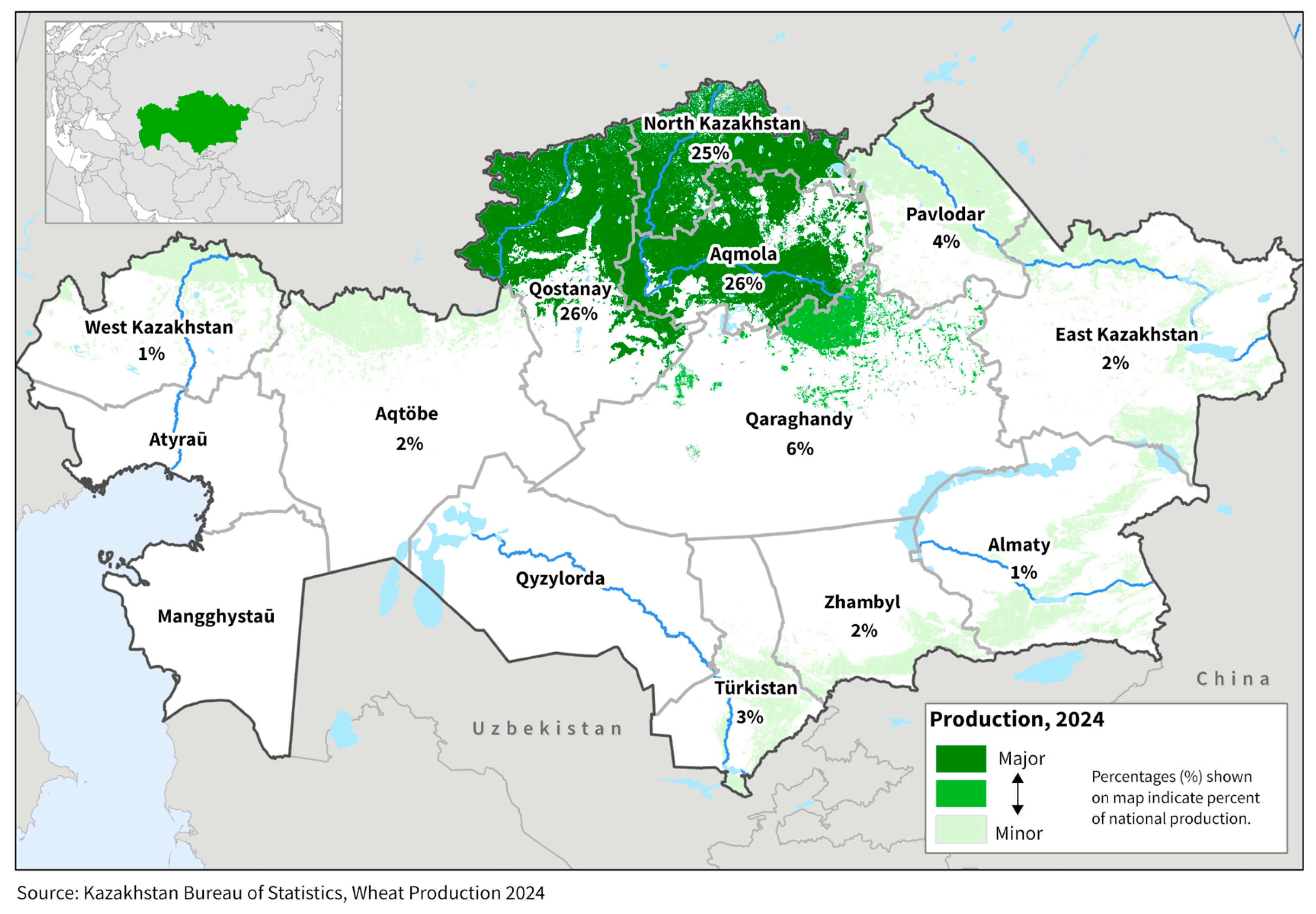
The distribution of wheat areas in Kazakhstan in 2024 is presented in Figure 1. Three Northern regions (Kostanay, North Kazakhstan and Akmola) cultivated over 75% of the total wheat areas in the country. The respective wheat areas were 3.65 M ha in Kostanay, 2.53 M ha in North Kazakhstan, and 3.92 in Akmola regions. This is almost entirely spring bread wheat, as winter wheat occupied an insignificant area, while spring durum wheat (T. turgidum ssp. durum Desf. em. Husn.) was grown on 0.52 M ha in three regions.
The Northern region is characterized by a continental climate with cold winters and hot summers with an average spring wheat growing season of 90–110 days. Average January air temperature falls below −16 °C while it is in a range of 20 °C in July. Annual precipitation is 350–450 mm with 55–60% during the field season from April to August. July is the month with the most rainfall reaching on average 70 mm. Precipitation increases while moving from the South to North and from West to East. Moisture availability is the main challenge for crop production with droughts taking place, on average, two years out of five (Baisholanov et al. 2017) [5]. Soils are represented by different types of chernozem with 3–5% of organic matter. The soils maintain a relatively high natural fertility, having been cultivated for only 70–80 years.
Spring wheat in the region is a short season crop normally planted in mid-May and harvested in late August-September (World Bank, 2024) [3]. It is rotated with oil crops (sunflower, flax, rapeseeds), pulses (dry peas and lentils), other cereals (barley, oats) and forage crops. Planting wheat after wheat is not uncommon but is gradually reducing as crop diversification takes place. Traditionally, minimal tillage has been applied for soil preparation. Weed control by using herbicides is common and fields are normally weed-free. Application of fungicides to control rusts, Septoria, and leaf spots is common and frequently preventive. The majority of the seeds are treated prior to planting. Very limited amounts of fertilizers are used for spring wheat.
Average spring wheat yield in 2015–2024 was 1.04 t/ha in the Akmola region, 1.06 t/ha in Kostanay and 1.47 t/ha in the North Kazakhstan region. The yields are low compared to the similar ecologies of North America (Morgounov et al. 2018) [6] and Russia (Syromyatnikov et al. 2024) [7]. The main factors affecting grain yield are low moisture availability, lack of fertilizer application, diseases, and pests in favorable years.

2.2. Grain Quality Grading System

Wheat grown in Kazakhstan is divided into six main types (ST RK 1046-2008) [8]:
  • I—Hard red spring wheat (Triticum aestivum) for bread-making.
  • II—Spring durum wheat (Triticum durum) for pasta production.
  • III—Hard white spring (Triticum aestivum) for bread-making.
  • IV—Hard red winter (Triticum aestivum) for bread-making.
  • V—Soft white winter (Triticum aestivum) for confectionary purposes.
  • VI—Winter durum (Triticum durum) for pasta production.
The list of representative cultivars is available for each type (Table S1). Type I (hard red spring) is by far the most cultivated in the country, followed by type IV (hard red winter) and type II (spring durum). The remaining types are hardly grown, and, for some, even representative cultivars are not available.
The next level of grain quality gradation is the assignment of released cultivars to four quality groups (Table 1). Specific criteria include protein and gluten content and their quality according to Kazakhstan standard ST RK 1046-2008 “Wheat. Specifications” [8]. It is based on the Russian state standard GOST 9353-2016 [9], along with Belarus, Kyrgyzstan, and Armenia. The Kazakhstan Catalogue of released cultivars (Azhgaliev, 2025) [10] specifies if a cultivar belongs to strong or valuable groups. The remaining cultivars from the medium and weak groups have no assignments.
The breeding targets for US Hard Red Spring Wheat (HRSW) types are the following: test weight > 772 g/L; protein content at 12.5 moisture > 14.5%; ash at 14.0 moisture < 1.65%; vitreous kernels > 80%; falling number > 400; farinograph absorption > 67% and stability 15–17 min.; and loaf volume > 1050 mL (25US HRSW). Kazakh and US breeding systems for grain quality are different with different target traits and, generally, HRSW targets strong wheat quality groups compared to Kazakh classification. For example, Grade 2 HRSW typically contains, on average, 14–15% of protein in commercial transactions (protein content is not a factor used to define grades in the United States) (U.S. Wheat Associates), which represents about one percentage point more protein than its equivalent in Kazakh wheat classified as “Valuable wheat.”
The quality of commercial wheat grains in Kazakhstan is determined by the standard ST RK 1046-2008 “Wheat. Technical Specifications” (Basic National Standard, effective from 1 July 2009 (1046-2008)). It applies to wheat grains for food and non-food purposes, as well as for international trade. All bread wheat grain is assigned to six classes based on five main quality parameters (Table 2). Gluten quantity and quality are the main criteria for class assignments, along with the falling number and test weight. The differences in grain quality classification in Kazakhstan and other major wheat-producing countries was reviewed by Abugalieva and Pena (2010) [11]. The grading systems in Northern America are similar in using test weight and falling number in the definition of the classes. The main difference in the Kazakhstan system is the usage of protein and gluten content and its quality. In Canada and the United States, wheat-grading systems are mainly based on the physical quality of the grain rather than directly on protein content, although protein levels still influence the price within each grade.
Comparison of US HRSW grain quality from the 2025 harvest (25 USHRSW) may indicate a higher quality compared to Kazakh wheat. North Dakota produced 7 M t of spring wheat in 2025, and its average protein content was 16.2% for dry matter basis; test weight was 816 g/L and falling number 409; wet gluten 33.7% and gluten index 96. Canada Western Red Spring wheat, 2025 harvest, was characterized by the following parameters: protein content 16.2 (dry matter basis), test weight 830 g/L, falling number 418, wet gluten 35.7%, with gluten index 95.5 (Grains Canada, 2025) [12]. Essentially, North Dakota and Canadian spring wheat grain can be classified as class 1 according to the Kazakhstan grading system. Australia grows primarily white wheat, which is grouped into nine classes (Blakeney et al., 2010) [13], with the Australian Premium White class being close to Kazakhstan spring bread wheat. The requirements for this class are the following: protein content > 10.5% (at 11% moisture), gluten content ranges from 34.4 to 37.6%, test weight > 760 g/L, and falling number > 300. Australian Premium White would classify as class 1 and 2 according to Kazakhstan grading. There is a perception in Kazakhstan agricultural community about the superior quality of local spring wheat. However, while comparing the dominant Kazakh class 3 parameters with the grains from North America and Australia, it appears to be lower across all traits.

2.3. Grain Distribution Across Quality Grades

Spring wheat yield and share of grain quality classes across three northern regions are presented in Table 3. Evidently, the most valuable classes 1 and 2 were below 5% in the Akmola region in 2019. These two quality classes were not recorded in 2024. The third quality class was by far the most common across all years and varied from 46 to 92% depending on the region and year. In the dry Akmola region, the share of the third class was higher compared to Kostanay and North Kazakhstan. Weather conditions during harvest were unfavorable in 2024 due to rain resulting in higher share of the 4th and 5th quality classes. Overall, despite the wide variation in grain quality classes for Hard Red Spring Wheat—in reality the third and fourth classes dominate the production. These classes are suitable for bread and other wheat products but lack the superior quality of improvers compared to classes 1 and 2. They are certainly inferior in quality compared to North American and Australian spring wheat.

3. Policies on Wheat Grain Quality in Kazakhstan

3.1. Cultivars Release Process

The wheat breeding framework for Northern Kazakhstan has largely remained unchanged in recent decades. The system is based primarily on public research and breeding institutions as parts of the Kazakh National Agricultural Research and Education Center (NASEC, 2026) [15]. The lack of financial resources to carry out field and laboratory experiments is the most limiting constraint for the success in breeding activities in Kazakhstan. Nevertheless, the inadequate availability of laboratory infrastructure and the inadequate number of breeders are also major issues. The breeding programs mostly apply standard approaches and tools in breeding with limited application of modern phenomics or genomics methods.
The system of varieties release is a key element of the state’s regulation of breeding and seed production activities in Kazakhstan (Ministry of Justice of the Republic of Kazakhstan, 2026) [16]. Kazakhstan is not a member of UPOV but is in the accession stage. The Ministry of Agriculture of the Republic of Kazakhstan is the main body responsible for carrying out the procedure for releasing varieties. The key role is played by the State Commission for Variety Testing of Agricultural Crops, which organizes and controls variety testing, maintains a register of breeding achievements, and issues patents for breeding achievements (https://gcomsort.kz, accessed on 17 January 2026). The State Commission includes testing stations, which conduct field tests and assess the adaptability of varieties to local conditions. This extensive network makes it possible to obtain reliable data on the behavior of varieties in various agroecological conditions of the country.
State variety testing takes place in stages. First, a preliminary trial of one to two years evaluates economic potential and identifies testing zones. This is followed by a main trial lasting two to three years, where the variety is fully assessed, compared with local checks, and its target zones defined. The process relies on strict methodology: comparisons with standard varieties, repeated experiments for statistical accuracy, randomized plot placements, and ecological tests across different soils and climates to assess adaptability. Plot sizes are between 50 and 100 m2, with four to six replications and standards placed regularly. Agricultural practices follow regional guidelines and are kept uniform to ensure fair and optimal evaluation of each variety’s potential.
The main indicators for evaluating varieties are yields, stability of yields by years and test sites, and adaptability to various growing conditions. Particular attention is paid to the resistance of varieties to diseases and pests, drought, low and high temperatures, and lodging and shattering. Quantitative minimum requirements include exceeding the yield of the check by 5–7%, yield variability of no more than 15–20%, disease damage no more than that of the standard, and product quality not lower than the check cultivar. The release system favors high grain quality and, if the cultivar candidate meets the requirements of “strong” or “valuable” quality grade, the expectations for grain yield can be lowered. Grain quality tests are conducted at the Central State Commission Lab in Almaty. Consequently, a key difference between Kazakhstan and other countries specialized in the export of high-quality grain—such as Canada, the United States, and Australia—and an aspect that should be strengthened within the Kazakhstan system, is that, in the latter countries, quality evaluation is deeply integrated into the breeding pipeline. This integration is achieved through close cooperation among public and private breeding programs, grain commissions, and end users (both domestic and international). Multi-location quality testing, early-generation screening for quality-related traits and genes (e.g., glutenins), and standardized end-use evaluations ensure alignment with milling and baking requirements, going beyond the mere attainment of minimum quality thresholds across diverse quality traits.

3.2. Production and Marketing Support Affecting Grain Quality

The total amount of subsidies for the agro-industrial complex of Kazakhstan was 534.5 B Kazakh tenge, or around 1 B USD in 2025 (https://adilet.zan.kz/rus/docs/V2000020209, accessed on 12 January 2026). There are no specific subsidies to support wheat grain quality improvement. However, a number of support tools contribute to crop production, including wheat, and positively affect grain quality. The main tools include: (a) support for seeds production compensating farmers’ purchase of elite seeds; (b) fertilizer purchase and application support; (c) support of crop protection against pests and diseases. Normally, a certain share of the associated costs is reimbursed to the producers. In addition, the Ministry of Agriculture supports investment projects for priority areas, which may be related to wheat production and quality. Interest rates for credits to purchase agricultural machinery and equipment are also supported, contributing to timely field operations and grain processing. Collectively, these measures contribute to higher wheat production and grain quality improvement.
The efficiency of agricultural subsidies in Kazakhstan was recently reviewed by the World Bank (2023) [17]. The reports states that the current objectives of the government’s agriculture policy in Kazakhstan—increasing production and productivity—lag behind the policy objectives set by other countries that have developed successful agriculture sectors and realized their export potential. Growth and development would require a comprehensive set of measures of public support to agriculture, including investment in agricultural science, experimental stations, model farms, digital agriculture technologies, and information systems. A recent analysis by Sarbassova et al. (2025) [18] supports these conclusions by emphasizing the importance of integrating subsidies with other measures—such as infrastructure modernization, digitalization, and improved access to financial resources.

4. Wheat Grain Domestic Use and Export

4.1. Wheat Balance, Domestic Use, and Quality Requirements

Wheat production in Kazakhstan varies across years depending on weather conditions, but produces far more than needed for domestic consumption (Table 4). The country also imports a substantial amount of wheat, mainly from Russia. This grain is used domestically for milling and poultry feed. Its volume is subject to the relative prices of grain in Kazakhstan and Russia, and is regulated through bilateral agreements. Domestic supply varies from 5.4 to 6 M t and is primarily used for the manufacturing of bread and other wheat products, seeds, and feed. Losses are still substantial and account for around 4% of production.
Kazakhstan has a well-developed milling industry with export potential. The country exported 2.79 M t of flour in 2023 and 2.57 M t in 2024. The milling industry is generally satisfied with the price and quality balance of the third class spring wheat produced in Northern Kazakhstan. The feed use of wheat grain is not a specific production target, and neither is a specific quality grade. The lower quality grain which is not purchased for food purpose or exported would be used for feed.

4.2. Wheat Export Destinations and Quality Requirements

The dynamic of wheat and flour exports since the 2021–2022 marketing year is presented in Table 5. There is a substantial 100% variation from year to year depending on the production volume. Central Asian countries, including Afghanistan, are the main market for Kazakh grain and flour, accounting for 70–80% of the volume. Export volume to these countries also varies and probably depends on the local wheat production to make up the volume needed for local consumption. China emerges as an important wheat importer for Kazakhstan. New markets are represented by Vietnam and Morocco. Some traditional importers of Kazakh grain like Turkey and Iran have substantially reduced their purchases recently.
The quality requirements for Kazakh wheat grain imported to Central Asia largely depend on the quality of the local wheat. Irrigated winter wheat is produced across Central Asia with grain yields of 3–5 t/ha (Lorena and Djanibekov, 2021) [20]. Limited application of nitrogen fertilizers results in low protein and gluten content and weak dough properties (Juraev et al. 2023) [21]. Local wheat normally would be of poor quality for traditional tandyr bread and industrial bread-making. Therefore, imported Kazakh spring wheat grain and flour is used as an improver to local wheat. Ideally, classes 1 and 2 of the Kazakh wheat grades would be ideal for this purpose. However, the local industry in Central Asia has adapted to the effective use of class 3 wheat for local bread production. There is also the balance between price and quality. Central Asian consumers recognize the advantages of Kazakh flour and value it for all products (Lorena and Djanibekov, 2021) [20].
Table 5. Wheat grain and flour exports from Kazakhstan in 2021–2025 marketing years (×1000 t in wheat grain equivalent) (USDA FAS, 2025) [22].
Country2021–20222022–20232023–2024September 2023–March 2024September 2024–March 2025% Change 2024–2025 to 2023–2024
World811010,873782551426457+25.5
Uzbekistan31594649343821782913+33.7
Afghanistan200126041912133013280
Tajikistan97211871125709870+22.7
China30429624322161−50.0
Italy295450342308234−24.0
Turkmenistan49560818615898−38.0
Kyrgyzstan27358555211283.6
Russia132755932320
Azerbaijan19227622423+21,050.0
Latvia754101037+270.0
Georgia511030n.a.
Morocco000083n.a.
Turkey12215617172−88.2
Iran6311630000
Note. n.a.—not applicable.
In the last few years, there has been a demand for hi-pro bread wheat grains in domestic and foreign markets. Hi-pro quality requirements include a protein content above 15.6%, gluten content > 28%, test weight > 760 g/L, and falling number > 300 (Grain Partners, 2026) [23]. The price premium for the hi-pro grade is attractive and justifies efforts in production of this grade. The Chinese market demanded feed flour made out of low-quality wheat in 2025. This offers an additional opportunity for Kazakh classes 4 and 5. Analysis of China’s potential in importing Kazakh wheat demonstrated that the volume can be increased six times (Rustenova et al. 2024) [24]. Thus, the export market is very dynamic with the largest share of class 3 wheat being exported. Evidently, it satisfies the export markets with a balance of price and quality. New specialty grades are being pursued by developing markets, including hi-pro wheat and feed flour.

4.3. Marketing Channels for Wheat Grain

Wheat grain marketing in Kazakhstan, described by Dzholdasbaeva and Beisekova (2021) [25], depends on the size of the producers. Individual farmers and agricultural enterprises are involved in crop production. The former cultivates 22% of wheat area in the Akmola region, 40% in Kostanay, and 23% in North Kazakhstan according to national statistics in 2025 (Bureau of National Statistics of the Republic of Kazakhstan, 2026) [2]. The average individual farm area is around 1000 ha. They normally have limited resources for production and grain storage. Therefore, after harvest, they either sell the grain to traders or deposit it into commercial storage facilities. Agricultural enterprises vary in land area from 5000 to 50,000 ha and normally have facilities for the initial cleaning, drying, and storage of grains. Some large enterprises would own large grain elevators and provide respective services. They are more flexible in selling the grain to local traders or exporting it abroad directly. Overall, storage facilities can accommodate all wheat grain produced either through on-farm options (storage buildings and small–average silos) or central grain elevators. Plastic sleeves on the grounds have been utilized recently to accommodate large harvests from 2024 and 2025.
The main player in the wheat grain market is the Kazakh Food Contract Corporation, a government body implementing state policy in the grain industry through active participation in ensuring food security; stabilization of the domestic grain market; and the implementation of measures of financial support for agricultural entities (https://fcc.kz/ru/o-korporaczii/obshhaya-informacziya/, accessed on 12 January 2026). In the 2024–2025 marketing year, the corporation purchased 1.3 M t of grain for domestic needs and export to 12 countries. Qaztrade, another government entity, supports exporters through consulting and targeted subsidies.
The Eurasian Trade System is a commodity exchange located in Astana, allowing grain transactions and export contracts. International (Cargill, Viterra, Louis Dreyfus Company, ADM) and Kazakh (Harvest Kazakhstan, Agro-Star Grain) trading companies are actively involved in the purchase and export of wheat and other grains. Companies Astyktrans and Kaztemirtrans operate over 10,000 wagons carrying grain. The Grain Union of Kazakhstan comprises 91 producers, grain storage companies, traders service, and logistics and certification companies, annually exporting 5 M t of grain (Grain Union of Kazakhstan, 2026) [26]. The Union’s mission is the development of favorable conditions for the sustainable development of Kazakhstan’s grain market. Purchases of wheat grain are conducted according to the quality classes and indicators presented in Table 2.
The total annual capacity for grain transportation outside of the country is limited to 11–12 M t. The main transportation mode is via railway to Uzbekistan (for the Central Asia market) and China. The Caspian port Aktau serves markets in Iran and Azerbaijan. The main Trans-Siberian Railway passes through Northern Kazakhstan and can be used for exports to Russia, Europe, and ports on the Black and Baltic seas. The government realizes that the current transportation capacity needs expansion and has respective development plans. Starting in 2025, support has been provided for the transportation of Kazakh grain to faraway markets which requires passing through Russia and loading at the Black Sea and Baltic ports. This opens new markets like Morocco, which require certain quality grades. From a grain quality perspective, it makes sense to export less but higher quality grain to overcome the transportation bottlenecks and associated costs.
While competition in wheat grain export to the Central Asian market is limited, Kazakhstan competes with Russia and other countries for export to Southern Caucasus (Armenia, Azerbaijan, and Georgia) (Gafarova et al. 2023) [27], China, Europe, and North Africa. Since 2025, the government has started to subsidize the railway transportation costs through Russia (https://eldala.kz/specproekty/23925-rost-cen-na-pshenicu-prines-fermeram-500-mln-dopolnitelnogo-dohoda, accessed on 17 January 2026). Transit of 1 t of wheat grain through Russia to the Black or Baltic sea ports would cost 90 USD and the subsidy covers 40 USD, making it profitable for producers and also raising the grain price in Central Asian markets to $238 per ton FOB at the Uzbekistan border. Additional income from wheat transportation subsidies is estimated at 500 M USD.
Wang et al. (2022) [28] analyzed Kazakhstan’s export potential and mentioned an unbalanced structure along with limited international competitiveness. More research and development on production technologies are needed; for example, enriching seed cultivation, and promoting technology for disease and pest control. Investment in the construction of international transportation, logistics infrastructure, and information network should be increased (Kamalova and Xu, 2024) [29]. Mutual benefit and win-win development can be achieved through the integration of cross-border subregional agriculture. Ukubassova et al. (2025) [30] additionally proposed the development of a strong Kazakhstan grain brand.

5. Environment Effect on Grain Quality

Northern Kazakhstan wheat production region agroecology was analyzed by Baisholanov (2017, 2018) [5,31]. Five sub-regions were identified based on the sum of effective temperatures and precipitation. Two southern sub-regions are characterized by higher summer temperatures, lower rainfall, and more frequent droughts. Spring wheat yields in these sub-regions are lower compared to northern sub-regions, and spring wheat is the more dominant crop due to a lack of other viable economic crop options. As a rule, wheat grain quality is better due to higher protein and gluten content and their physical properties. Traditional spring wheat cultivars with high local adaptation and good grain quality are grown in the southern sub-regions. These also include white-grained wheat valued by some export markets.
Chernozems are the main soils of the northern spring wheat production region. They have been classified into four groups depending on the humus content, slope, and moisture availability (Djalankuzov et al. 2009) [32]. These are generally fertile soils with some inclusion of salinity spots. The soil’s fertility gradient coincides with the agroecology described above. Southern, drier subregions have soils with lower humus content and lower grain productivity, but higher protein and gluten content.
The agroecological differences between the subregions of Northern Kazakhstan have not been utilized for the allocation of specific spring wheat production areas or quality grades. This is a common practice in major wheat exporters like Australia, Canada, and USA where specific agroecological zones are allocated for the production of certain types of wheat of quality grade (U.S. Wheat Associates 2025) [33]. In Canada, the Prairie Provinces are subdivided into production zones where specific wheat classes such as Canada Western Red Spring (CWRS), Canada Prairie Spring (CPS), or Canada Western Amber Durum are grown under well-defined environmental conditions (Blakeney et al., 2010) [14]. This zoning allows long-term consistency in grain quality supplied to domestic processors and export markets. Similarly, in the USA, Hard Red Spring Wheat (HRSW) is primarily produced in North Dakota, Minnesota, and Montana, regions characterized by relatively short growing seasons and moderate moisture stress, conditions that favor high protein accumulation. The US system integrates production environment, cultivar choice, and grading standards into a coherent supply chain, ensuring predictability of quality parameters such as protein content, gluten strength, and falling number. In contrast, Northern Kazakhstan currently lacks formal zoning of spring wheat production by quality class or market destination. Adoption of a similar agroecological zoning approach would allow the targeted production of higher protein and stronger gluten wheat in drier southern subregions, while allocating higher yielding but medium-quality wheat to more humid northern areas (Kemzheali and Makhmetova, 2024) [34]. This would strengthen Kazakhstan’s positioning in premium export markets while maintaining volume-oriented production where appropriate. This would also help to establish longer-term association between the producers and markets—both domestic and foreign. Inittal work in this area has been done by Baisholanov et al (2022) [35]. The first step to achieve this would be comprehensive analysis of the types of wheat and cultivars grown, quality grades of harvested wheat, variation across and within subregions and years, and possible market destinations.
Climate change in the Republic of Kazakhstan resulted in warming at a more significant rate than the globe on average: a 0.32 °C increase over 10 years versus 0.18 °C globally over the same period (Anonymous, 2022) [36]. A comparison of the long-term average ambient temperature values in the 1961–1990 and 1991–2020 periods indicates that the country’s average annual temperature has increased by 0.9 °C. February and March are the months that have warmed the most significantly, by 2.0 °C and 1.7 °C, respectively. The average annual precipitation has not changed much, although some months show an increase (February), while others show decreases (September and October). However, in the last few years, there has been a shift in maximum rainfall from July to August and September, which negatively affected grain quality.
Teleubay et al. (2024) [37] modeled future spring wheat productivity changes under climate change in Northern Kazakhstan. The research findings indicated the loss of more than 10% of wheat in the arid steppe zone, 7.6% in the small hilly zone, and 7.5% in the forest steppe zone due to climate change, if the modeled RCP 8.5 scenario occurs without any technological modernization and genetic modification. Romanovska et al. (2024) [38] concluded that human-induced climate change had a critical impact on wheat production in Northern Kazakhstan through increases in daily minimum temperatures and extreme heat. This has resulted in a decrease in yields during 2000–2019 by approximately 6.2–8.2% and an increased likelihood of low-production events by 1.5–4.7 times. Overall, reduction in spring wheat grain yield is normally associated with increased protein and gluten content and its quality (Amalova et al. 2025, Sidorov et al. 2025) [39,40]. Therefore, climate change scenarios ought to be taken into consideration while modeling future wheat quality evolution.

6. Cultivars’ Effect on Grain Quality

Overall, 87 spring bread wheat cultivars are officially released in the country, including 53% of Kazakh origin, 37% from Russia, and 10% from Europe and North America (Azhgaliev, 2025) [11]. The current government regulations do not require a cultivar to be officially released to be cultivated by the producers. Therefore, there is a number of cultivars being grown that are not reflected in the list of registered cultivars. However, their market share is not high. The list of “strong” quality cultivars includes 24 genotypes (27.6%) while the “valuable” quality group comprises six cultivars (6.9%) (Table S2). Thus, collectively, only 34.5% of the officially released cultivars belong to high-quality groups. They are equally shared between the germplasm originating from Kazakhstan and from Russia. None of Western-origin cultivars belong to high-quality material. Strong quality spring wheat cultivars from Kazakhstan represent old material released prior to 2000. The Russian strong quality group mostly originated from the Omsk Agrarian Research Center and are also old—the latest was released in 2013. The only new valuable quality cultivar, Aygul, was released in 2023.
There is obvious deterioration of the grain quality of cultivars in the last 10–20 years judging by the frequency of high-quality releases. Popular Kazakh, Russian, and foreign cultivars provide high grain yield, some resistance to diseases, and have short statures, but they do not provide stable superior grain quality (Amakova and Lebedev, 2024) [41]. Some breeding lines from Northern Kazakhstan programs meet the requirements for strong wheat quality, but their frequency is low (Kradetskaya et al. 2024) [42].
The spring wheat breeding framework for Northern Kazakhstan is based almost entirely on public programs: A.I. Barayev Research and Production Centre for Grain Farming (Shortandy, Akmola region), Karabalyk Agricultural Experimental Station (AES) (Karabalyk, Kostanay region), Karagandy AES (Tsentralnoye, Karagandy reg.), and North Kazakhstan AES (Shagalaly, North Kazakhstan region). The breeding programs are integrated in the respective research institutions, being part of the National Agricultural Science and Education Center.
Wheat breeding for grain quality is based on traditional approaches, crosses, and selection, and takes 10–12 years (Shelayeva et al. 2022) [43]. The diversity of Kazakh germplasm for high-molecular-weight glutenins and gliadins has been studied (Utebayev et al. 2019a,2019b) [44,45] but not routinely utilized in breeding. Genomic research identified molecular markers contributing to grain protein, gluten content, and sedimentation value in spring wheat (Amalova et al. 2025) [39], but is again far from practical implementation.
Spring wheat breeding at A.I. Barayev Research and Production Center for Grain Farming is focused not only on yield, but also on the development of varieties with high technological indicators that consistently form high quality (Dashkevich et al. 2022) [46]. At the early stages of breeding, the protein content and its quality are controlled by the sedimentation method. In advanced breeding nurseries, the physical and physicochemical properties of grain are evaluated, and rheological and baking properties are analyzed. Such a comprehensive assessment makes it possible to determine the technological potential of the future variety and develop recommendations for the further use of its grain. The best quality cultivars are Shortandinskaya 2012, Asyl Sapa, and Taymas with protein contents exceeding 15% (Dashkevich et al. 2024) [47]. Bread made from the flour of these cultivars were distinguished by a good shape and color of the crust, fine uniform porosity, and good restorability of the crumb.
There is only one full-scale quality evaluation lab at the A.I. Barayev Research and Production Centre for Grain Farming. The lab supports its own breeding and provides limited support to other breeding programs which use NIR and other indirect methods. This situation is clearly insufficient to increase the frequency of high-quality cultivar releases, which points to a structural weakness in the system. A coordinated intra- and inter-institutional effort is therefore required among organizations involved in wheat breeding to increase the number of quality laboratories capable of supporting breeding programs or being fully integrated within them. This effort should be accompanied by appropriate training initiatives aimed at expanding the number of experts in grain quality genetic improvement, as well as providing specialized training for breeders. Such training would enable them to effectively integrate the full set of quality traits that define each wheat class without compromising grain yield.
Yield performance of spring wheat germplasm and its diversity was recently accessed by Savin et al. (2025) [48]. The study concluded that the current spring wheat breeding framework in Kazakhstan requires fundamental revisions to remain competitive. Firstly, the application of modern tools and approaches requires rapid introduction and adoption. Phenotyping precision and scale using modern physiological approaches and tools is worth consideration. The speed breeding platform has been established in Kazakhstan and needs integration into practical wheat breeding. Secondly, closer cooperation between the programs is well justified, targeting coordinated crossing programs, speed breeding, and other cooperative tools. Thirdly, the utilization of novel genetic resources, especially in addressing challenging traits, is well justified. Artys et al. (2025) [49]. studied wheat lines from three CIMMYT nurseries (13th SATYN-DRGT, 3rd HZWYT-EM, and 1st SAWYT-EM) at the North Kazakhstan Agricultural Experimental Station in 2024–2025. A number of CIMMYT lines showed good adaptation to local conditions and yields comparable to or exceeding the standard cultivar Astana. For grain quality, CIMMYT lines surpassed the local cultivar Aina: protein content reached 15.1–17.5%, gluten 33.3–38.0%, and sedimentation up to 73.8 mL. Resistance to leaf and stem rust was also confirmed. International cooperation with advanced research and breeding institutions in the country and abroad is crucial for maintaining competitiveness and advancing genetic progress.
There is an obvious lack of studies and publications on the genetics and breeding for spring wheat grain quality in Kazakhstan.

7. Agronomy Effect on Grain Quality

Effect of production technology and its components on spring wheat grain quality have been reviewed recently by several authors (Saquee et al., 2023, Markad, 2024, Hoque and Islam, 2024) [50,51,52]. The role of nitrogen in grain quality is very important. Unfortunately, the rate of application of mineral fertilizers in Kazakhstan is very low (World Bank, 2024) [3]. In 2024, it was applied only to 17% of the arable land with an average rate of 26 kg/ha. This makes less than 5 kg/ha, and nitrogen 3 kg/ha. More profitable oil crops and vegetables would thus have priority for nitrogen nutrition over spring wheat. Farmers are aware of fertilizers’ benefits for grain quality improvement but are hesitant to apply it due to risky cost–benefit economics and moisture stress possibility, making investment in nitrogen hardly justified. Once again, there are few references on this subject from Kazakhstan. A recent study on fertilizer application in spring wheat in the northern region demonstrated yield improvements of 20% by the application of 75 kg/ha of ammonium phosphate (Yaskak et al. 2026) [53]. However, grain quality was not even considered in the study. The research in the neighboring regions of Russia demonstrated the positive effects of intensive cultivation technology on grain yield and quality (Yushkevich, 2023) [54]. Grain yield increased two times relative to extensive production. Resource-saving tillage in cereal–fallow crop rotation increases grain yield by 9–15%. The effect of all inputs was positive, and herbicides accounted for 12% of yield increase: fertilizers 19%; fungicides 36%. Inputs increased 1000 grains’ weights to 35.1–36.1 g; test weight—up to 750–762 g/L, and gluten content—up to 26.4–29.4%. Bobrenko et al. (2024) [55] showed the positive effect of fallow fields on spring wheat protein and gluten content. Application of N30, Cu, and Zn micro-fertilizers was optimal for protein content and its quality. Barkovskaya and Gladysheva (2025) [56] found that applying nitrogen fertilizers at different phases of plant development increased protein content in the grain by 0.86–1.38% relative to the control. Application of N64P64K64+N30 resulted in an increase in the gluten content of flour by 2.5%, sedimentation volume by 12.5%, and flour strength by 14.1% compared to control.
Molod et al. (2025) [57] studied the relationships between the level of mineral nutrition, the number of pests, and the effectiveness of various crop protection schemes. Application of nitrogen fertilizers at a dose of N35 contributed to an increase in the number of wheat thrips by 1.5 times compared to the unfertilized plot. The use of the insecticide Espero decreased the number of thrips by 36–50%, but repeated treatment was still needed. The highest yield (2.50 t/ha) was achieved with the integrated use of herbicides, fungicides, insecticides, and foliar fertilization (urea + Aqualis). The increase in yield on the fertilized background amounted to 0.58 t/ha (30%) compared to the control. The quality indicators of grain (protein content—16.7–17.6%, gluten content—32.1–35.8%) met the requirements of the first class. The effect of the Septoria blight on wheat quality has been studied in Northern Kazakhstan in 2018–2019 (Babkenova et al. 2020) [58]. On average, over the two years of the study, grain vitreousness, protein and gluten content, and ultimate dough resilience were higher in the variants with the use of fungicide.
The identification of agronomic management practices, capable of enhancing yield and grain quality in Kazakhstan, would benefit from an assessment of strategies applied in countries with similar agroclimatic conditions, and in regions known for the production of high-quality grain. Canada’s spring wheat production environment is similar to Northern Kazakhstan; hence, its experience is relevant for grain quality improvement. The key challenge for producers is to manage their crop production systems in order to minimize losses of nitrogen to air or water, while achieving crop yield and quality goals (Zebarth et al. 2009) [59]. Many strategies have been developed in recent years to meet this challenge: development of new tools to measure crop N status in order to refine in-season fertilizer N management, development of new soil N tests to improve predictions of soil N supply, development of new fertilizer N products with release patterns more closely matched to crop N uptake patterns, and the development of site-specific N management strategies. In the European Union, especially in intensive wheat systems, split nitrogen applications combined with late-season foliar feeding are commonly used to enhance protein content without excessive lodging or yield penalties. Disease control strategies are similarly optimized to protect grain filling and maintain functional quality. Australia’s experience is particularly relevant for low-input, moisture-limited systems. Australian growers frequently manage wheat quality through tactical nitrogen applications in response to seasonal rainfall forecasts and soil moisture availability, accepting yield variability while maintaining minimum quality standards as required by export markets.

8. Conclusions

This paper provides a comprehensive overview of the current status of spring bread wheat grain quality in Northern Kazakhstan, placing it within the broader context of production systems, breeding frameworks, agroecological conditions, policies, and domestic and export markets. Although Kazakhstan remains a major wheat producer and exporter, the analysis highlights a persistent dominance of medium-quality grain (primarily class 3), with a very limited share of high-quality wheat suitable for premium and improver markets. In comparison with other leading exporters, Kazakh wheat is generally inferior across key quality parameters despite a widespread perception of its competitiveness. Recent production data indicate that classes 1 and 2 represent only a very small proportion of commercial deliveries, while classes 3 and 4 dominate the market, confirming that current production systems are largely oriented toward medium-quality grain rather than premium segments. The greater use of varieties such as Astana 2, Aygul, Lyubava, Omskaya 38, and Tselina-50 which show good quality and competitive yields, could help promote the production of high-quality grain in the country.
International experience from major wheat-producing and exporting countries demonstrate that sustained improvement of wheat grain quality is achieved through an integrated approach combining targeted public policies, agroecological zoning, breeding strategies focused on end-use quality, and agronomic practices adapted to local environments. Experiences from the EU, Canada, USA, and Australia are particularly relevant for Northern Kazakhstan due to similarities in climate, scale of production, and export orientation. Key transferable elements include the agroecological zoning of wheat quality classes, stricter quality-oriented breeding pipelines, agronomic intensification targeted at protein and gluten stability, and policy frameworks that reward quality differentiation. In particular, the agroecological diversity of Northern Kazakhstan offers an opportunity to allocate higher protein wheat production to drier subregions, while maintaining higher yielding but medium-quality production in more humid areas. Given Kazakhstan’s scale, export orientation, and agroecological diversity, these approaches are not only applicable, but strategically necessary to enhance competitiveness in global wheat markets. Future progress will depend on strengthening institutional cooperation, investing in quality-focused breeding capacity, expanding applied research, and aligning production systems with evolving domestic and export market demands. Improving the availability of high-protein wheat could also allow Kazakhstan to better supply emerging premium markets and reinforce its traditional role as a quality improver for wheat produced in neighboring Central Asian countries. Such a transition would allow Kazakhstan to shift from volume-oriented exports toward a more competitive, quality-driven wheat sector.

Supplementary Materials

The following supporting information can be downloaded at: https://www.mdpi.com/article/10.3390/agriculture16070724/s1, Table S1: List of cultivars representative for five wheat types; Table S2: List of spring wheat cultivars of strong and valuable quality grade released in three regions of Northern Kazakhstan in 2025.

Author Contributions

Conceptualization, T.S., A.M., I.C. and C.G.; methodology, T.S., A.M., I.C. and C.G.; resources, T.S. and A.M.; writing—original draft preparation, A.M. and C.G.; writing—review and editing, T.S., A.M., I.C. and C.G.; project administration, T.S. and A.M.; funding acquisition, T.S. and A.M. All authors have read and agreed to the published version of the manuscript.

Funding

This research has been funded by the Ministry of Agriculture of the Republic of Kazakhstan BR24892821 “Breeding, seed production of grain crops to increase the potential of productivity, quality, stress resistance in various soil-climatic zones of Kazakhstan”.

Data Availability Statement

No new data were created or analyzed in this study. Data sharing is not applicable to this article.

Acknowledgments

The authors are thankful to S. Dashkevich for suggestions on the manuscript.

Conflicts of Interest

The authors declare no conflicts of interest.

References

  1. Mutaliyeva, A.; Yesbolova, A.; Dyrka, S.; Saparbayev, M.; Kazanbayeva, Z.; Balabekova, D.; Orazova, B. Formation and History of the Agrarian Economy of Kazakhstan: The State of Development Today. Acad. J. Interdiscip. Stud. 2023, 12, 401–409. [Google Scholar] [CrossRef]
  2. Bureau of National Statistics of the Agency for Strategic Planning and Reforms of the Republic of Kazakhstan. Statistics of Agriculture, Forestry, Hunting and Fisheries. Available online: https://stat.gov.kz/ru/industries/business-statistics/stat-forrest-village-hunt-fish/ (accessed on 4 January 2026).
  3. World Bank. Republic of Kazakhstan: Climate Adaptation Options and Opportunities in the Agriculture Sector; World Bank Group: Washington, DC, USA, 2024; 75p. [Google Scholar]
  4. Tsypin, A.; Vavilina, A.; Komarova, T.; Firsova, A. Analysis of grain production in the Republic of Kazakhstan and prospects for ensuring food security. Sci. Pap. Ser. Manag. Econ. Eng. Agric. Rural. Dev. 2025, 25, 937–944. [Google Scholar]
  5. Baisholanov, S.S.; Zhakieva, A.R.; Gabbasova, M.S.; Chernov, D.A. Agroclimatic zoning of agricultural crops in northern Kazakhstan. Hydrometeorol. Ecol. 2017, 3, 17–28. [Google Scholar]
  6. Morgounov, A.; Sonder, K.; Abugalieva, A.; Bhadauria, V.; Cuthbert, R.D.; Shamanin, V.; Zelenskiy, Y.; DePauw, R.M. Effect of climate change on spring wheat yields in North America and Eurasia in 1981–2015 and implications for breeding. PLoS ONE 2018, 13, e0204932. [Google Scholar] [CrossRef]
  7. Syromyatnikov, D.; Salimova, S.; Kolpak, E.; Mukhametov, A. Analyzing the impact of competitiveness factors on increasing grain production in Kazakhstan and Russia. Heliyon 2024, 10, e39751. [Google Scholar] [CrossRef]
  8. ST RK 1046-2008; Wheat, Specification. Committee for Technical Regulation and Metrology: Astana, Kazakhstan, 2008; 14p.
  9. GOST 9353-2016; Wheat, Technical Conditions. Interstate Council for Standardization, Metrology and Certification: Moscow, Russia, 2019; 15p.
  10. Azhgaliev, T.B. State Register of Breeding Achievements Recommended for Use in the Republic of Kazakhstan; Ministry of Agriculture: Nursultan, Kazakhstan, 2025; pp. 7–12. [Google Scholar]
  11. Abugalieva, A.; Roberto, J. Peña Grain Quality of Spring and Winter Wheat of Kazakhstan. Asian Australas. J. Plant Sci. Biotechnol. 2010, 4, 87–90. [Google Scholar]
  12. Grains Canada. Quality of Canada Western Red Spring Wheat in 2025. Available online: https://www.grainscanada.gc.ca/en/grain-research/grain-harvest-export-quality/wheat/2025/harvest-quality-report-cwrs-2025.html (accessed on 8 January 2026).
  13. Blakeney, A.B.; Cracknell, R.L.; Crosbie, G.B.; Jefferies, S.P.; Miskelly, D.M.; O’Brien, L.; Panozzo, J.F.; Suter, D.A.I.; Solah, V.; Watts, T.; et al. 2010 Understanding Australian Wheat Quality; GRDC: Toowoomba, Australia, 2011; 40p. [Google Scholar]
  14. Ministry of Agriculture of the Republic of Kazakhstan. Available online: https://www.gov.kz/memleket/entities/moa (accessed on 15 December 2025).
  15. National Agrarian Science and Education Center (NASEC). Official Website. Available online: https://nasec.kz/ru/ (accessed on 17 January 2026).
  16. Ministry of Justice of the Republic of Kazakhstan: Legal Framework “Adilet”. Law of the Republic of Kazakhstan “On Selection Achievements”. Rules for Conducting State Variety Testing. Regulations on the State Register of Breeding Achievements. Methods of Variety Testing of Agricultural Crops. DSTU 3768:2019 Wheat. Specifications. Available online: https://adilet.zan.kz (accessed on 2 February 2026).
  17. World Bank. Republic of Kazakhstan Just-In-Time Policy Advice on Agricultural Subsidies; World Bank: Danvers, MA, USA, 2023; 62p. [Google Scholar]
  18. Sarbassova, R.S.; Aimurzina, B.T.; Mataibaeva, G.A. Effectiveness of agricultural subsidies in Kazakhstan as a factor of inclusive development. Econ. Ser. Bull. LN Gumilyov ENU 2025, 3, 205–226. [Google Scholar] [CrossRef]
  19. FAO. FAOSTAT Statistical Database. Food and Agriculture Organization of the United Nations. 2026. Available online: https://www.fao.org/faostat/ (accessed on 8 January 2026).
  20. Lorena, L.; Djanibekov, N. Can wheat self-sufficiency policy improve food security? An inter-temporal assessment of the wheat value-chain in Uzbekistan. Eurasian Geogr. Econ. 2021, 62, 1–20. [Google Scholar]
  21. Juraev, D.; Amanov, O.; Dilmurodov, S.; Boysunov, N.; Turaeva, S.; Mamadjanova, N.; Raimova, D. Winter wheat assessment for growth, grain yield, and quality parameters under diverse soil and climatic conditions. SABRAO J. Breed. Genet. 2023, 55, 1193–1204. [Google Scholar] [CrossRef]
  22. USDA FAS. Grain and Feed Update: Kazakhstan; GAIN Report KZ2025-0009; U.S. Department of Agriculture, Foreign Agricultural Service: Washington, DC, USA, 2025. [Google Scholar]
  23. Grain Partners. Quality Parameters for Wheat Grain. Available online: https://www.grainpartners.kz/assets/quality_params.pdf (accessed on 6 January 2026).
  24. Rustenova, E.; Ibyzanova, A.; Akhmetzhanova, N.; Talapbayeva, G.; Yerniyazova, Z. Opportunities for Kazakhstan’s agricultural exports to the Chinese market. J. East. Eur. Cent. Asian Res. 2024, 11, 871–886. [Google Scholar]
  25. Dzholdasbaeva, G.; Beisekova, P. Cluster method and interaction mechanisms in the organization of grain production. In Reports of the National Academy of Sciences of the Republic of Kazakhstan; National Academy of Sciences of the Republic of Kazakhstan: Almaty, Kazakhstan, 2021; Volume 1, pp. 119–124. [Google Scholar]
  26. Grain Union of Kazakhstan. 2026. Available online: https://www.grainunion.kz/en/info-system/ (accessed on 23 March 2025).
  27. Gafarova, G.; Perekhozhuk, O.; Glauben, T. The Oligopolistic Behavior of Kazakh and Russian Wheat Exporters in the South Caucasus: Evidence from a Residual Demand Elasticity Analysis. J. Ind. Compet. Trade 2023, 23, 1–32. [Google Scholar] [CrossRef]
  28. Wang, Y.; Huang, P.; Khan, Z.A.; Wei, F. Potential of Kazakhstan’s grain export trade. Cienc. Rural 2022, 52, e20210199. [Google Scholar] [CrossRef]
  29. Kamalova, N.; Xu, L. Competitiveness of Kazakhstan’s Agricultural Export: Influencing Factor Analysis. Int. J. Bus. Mark. Manag. (IJBMM) 2024, 9, 11–20. [Google Scholar]
  30. Ukubassova, G.; Mukhamejanova, A.; Zhumatayeva, B.; Primzharova, K.; Galiyeva, A. Marketing strategies for the development of agricultural exports of Kazakhstan in world markets: Interregional comparative analysis. Sci. Horiz. 2025, 28, 193–209. [Google Scholar] [CrossRef]
  31. Baisholanov, S.S.; Pavlova, V.N.; Zhakieva, A.R.; Chernov, D.A.; Gabbasova, M.S. Agroclimatic resources of Northern Kazakhstan. Hydrometeorol. Stud. Forecast. 2018, 1, 168–184. [Google Scholar]
  32. Djalankuzov, T.D.; Oshakbayeva, Z.O.; Seitmenbetova, A.T.; Zhamanbayeva, G.T. Modern state of land fertility of chernozem zone of Kazakhstan. Soil Sci. Agrochem. 2009, 4, 10–15. [Google Scholar]
  33. U.S. Wheat Associates. 2025 US Hard Red Spring Wheat Quality Report. 2025. Available online: https://uswheat.org/wp-content/uploads/2025/10/2025-Hard-Red-Spring-Regional-Report.pdf (accessed on 7 January 2025).
  34. Kemzheali, Y.; Makhmetova, A. Analysis of sustainable agricultural development in Kazakhstan: Key economic and climatic indicators. Eurasian J. Econ. Bus. Stud. 2024, 68, 47–60. [Google Scholar] [CrossRef]
  35. Baisholanov, S.S.; Akshalov, K.A.; Aueskhanov, D.; Baimukanova, O. Relationship of spring wheat yield with agrometeorological indicators in the territory of the North Kazakhstan region of the Republic of Kazakhstan. Hydrometeorol. Stud. Forecast. 2022, 3, 130–146. [Google Scholar] [CrossRef]
  36. Anonymous. Eighth National Communication and Fifth Biennial Report of the Republic of Kazakhstan to the UN Framework Convention on Climate Change; Ministry of Ecology, Geology and Natural Resources: Astana, Kazakhstan, 2022; 473p. [Google Scholar]
  37. Teleubay, Z.; Yermekov, F.; Rustembayev, A.; Topayev, S.; Zhabayev, A.; Tokbergenov, I.; Garkushina, V.; Igilmanov, A.; Shelia, V.; Hoogenboom, G. Comparison of Climate Change Effects on Wheat Production under Different Representative Concentration Pathway Scenarios in North Kazakhstan. Sustainability 2024, 16, 293. [Google Scholar] [CrossRef]
  38. Romanovska, P.; Undorf, S.; Schauberger, B.; Duisenbekova, A.; Gornott, C. Human-induced climate change has decreased wheat production in northern Kazakhstan. Environ. Res. Clim. 2024, 3, 031005. [Google Scholar] [CrossRef]
  39. Amalova, A.; Griffiths, S.; Abugalieva, A.; Abugalieva, S.; Turuspekov, Y. Identification of Quantitative Trait Loci for Grain Quality Traits in a Pamyati Azieva × Paragon Bread Wheat Mapping Population Grown in Kazakhstan. Plants 2025, 14, 1728. [Google Scholar] [CrossRef] [PubMed]
  40. Sidorov, A.V.; Fedosenko, D.F.; Gerasimova, N.S. Influence of genotype and weather conditions on protein content in the grain of spring soft wheat in the forest-steppe of the Krasnoyarsk Territory. Newsletter Novosibirsk State Agrar. Univ. 2025, 76, 190–197. [Google Scholar] [CrossRef]
  41. Amakova, T.V.; Lebedev, V.E. Qualitative Indicators of Grain of Spring Wheat Varieties of Foreign Selection under the Conditions of the Irkutsk Region. Actual Issues of Sustainable Development of the Agro-Industrial Complex/Materials of the National Scientific and Practical Conference with International Participation: Youth; Irkutsk State Agrarian University Publishing House: Molodezhny, Russia, 2024; pp. 88–92. [Google Scholar]
  42. Kradetskaya, O.O.; Dashkevich, S.M.; Uralovich, U.M.; Vladimirovna, C.I.; Muratovna, Z.D.; Konspekovich, K.E. Amino acid composition of grain proteins of varieties and lines of spring soft wheat in the conditions of northern Kazakhstan. Bull. Sci. Kazakh Agrotech. Res. Univ. 2024, 120, 90–106. [Google Scholar]
  43. Shelayeva, T.V.; Dzhazina, D.M.; Utebayev, M.U. Ecological testing of spring soft wheat varieties in the conditions of northern Kazakhstan. Bull. Ulyanovsk State Agric. Acad. 2022, 204, 94–99. [Google Scholar] [CrossRef]
  44. Utebayev, M.; Dashkevich, S.; Bome, N.; Bulatova, K.; Shavrukov, Y. Genetic diversity of gliadin-coding alleles in bread wheat (Triticum aestivum L.) from Northern Kazakhstan. PeerJ 2019, 7, e7082. [Google Scholar] [CrossRef]
  45. Utebayev, M.; Dashkevich, S.; Kunanbayev, K.; Bome, N.; Sharipova, B.; Shavrukov, Y. Genetic polymorphism of glutenin subunits with high molecular weight and their role in grain and dough qualities of spring bread wheat (Triticum aestivum L.) from Northern Kazakhstan. Acta Physiol. Plant. 2019, 41, 71. [Google Scholar] [CrossRef]
  46. Dashkevich, S.M.; Utebaev, M.U.; Chilimova, I.V.; Kradetskaya, O.O.; Shelaeva, T.V. Evaluation of spring bread wheat varieties by technological traits. Theor. Appl. Sci. 2022, 6, 101–106. [Google Scholar] [CrossRef]
  47. Dashkevich, S.; Utebaev, M.; Kairzhanov, E.; Kradetskaya, O.; Chilimova, I. Comparative analysis of spring bread wheat varieties by grain quality. Stud. Results (Izdenister Nətijeler) 2024, 3, 222–230. [Google Scholar]
  48. Savin, T.; Turuspekov, Y.; Amalova, A.; Anuarbek, S.; Babkenov, A.; Chudinov, V.; Fedorenko, E.; Kairzhanov, Y.; Maulenbay, A.; Sereda, G.; et al. Spring Wheat Breeding in Northern Kazakhstan: Drivers of Diversity and Performance. Crops 2025, 5, 63. [Google Scholar] [CrossRef]
  49. Artys, A.; Fedorenko, Y.; Yesimbekova, M.; Abdullina, V.; Tyulendinova, S.; Morgunov, A. Study of the genetic resources of spring bread wheat of the International Center CIMMYT for breeding in the conditions of the North Kazakhstan region. Bull. Sci. S. Seifullin Kazakh Agrotech. Res. Univ. Interdiscip. 2025, 128, 108–118. [Google Scholar]
  50. Saquee, F.S.; Diakite, S.; Kavhiza, N.J.; Pakina, E.; Zargar, M. The Efficacy of Micronutrient Fertilizers on the Yield Formulation and Quality of Wheat Grains. Agronomy 2023, 13, 566. [Google Scholar] [CrossRef]
  51. Markad, A. Role of Nitrogen in Wheat Production System and Nitrogen for Improving Wheat Yield and Quality: A Review. J. Exp. Agric. Int. 2024, 46, 599–609. [Google Scholar] [CrossRef]
  52. Hoque, M.N.; Islam, S. Comprehensive Review of the Quality and Processing Suitability of U.S. Hard Red Spring Wheat: Current Strategies, Challenges, and Future Potential Scope. Agriculture 2024, 14, 853. [Google Scholar] [CrossRef]
  53. Yaskak, A.; Nugmanov, A.; Tulayev, Y.; Kuanyshbaev, S.; Somova, S.; Chashkov, V.; Paramonova, T.; Yermoldina, G.; Daribayeva, S. Effect of precision farming and differential nitrogen and phosphorus doses on spring wheat yield in the Northern Kazakhstan climatic zone. Int. J. Agric. Biosci. 2026, 15, 840–849. [Google Scholar]
  54. Yushkevich, L.V. Improving the productivity and quality of spring wheat grain in the Southern Forest Steppe of Western Siberia. Bull. KSAU 2023, 11, 73–79. [Google Scholar] [CrossRef]
  55. Bobrenko, I.A.; Krasnitsky, V.M.; Kormin, V.P.; Martemyanov, A.D. Yield and grain quality of spring bread wheat varieties when applying foliar feedings for various predecessors. Soil Fertil. 2024, 2, 27–30. [Google Scholar]
  56. Barkovskaya, T.A.; Gladysheva, O.V. Influence of mineral nutrition on the baking qualities of spring wheat grain. Soil Fertil. 2025, 3, 21–25. [Google Scholar]
  57. Molod, Y.F.; Ershov, V.L.; Molod, C.C. The influence of wheat thrips on the quality and grain yield of spring soft wheat in the southern forest-steppe of Western Siberia. Vestn. Omsk. SAU 2025, 2, 34–40. [Google Scholar]
  58. Babkenova, S.A.; Babkenov, A.T.; Abdullaev, K.K.; Shabdan, A.A. The influence of frondiferous diseases on the main indicators of spring wheat quality. Ecol. Environ. Conserv. 2020, 26, 738–742. [Google Scholar]
  59. Zebarth, B.J.; Drury, C.F.; Tremblay, N.; Cambouris, A.N. Opportunities for improved fertilizer nitrogen management in production of arable crops in eastern Canada: A review. Can. J. Soil Sci. 2009, 89, 113–132. [Google Scholar] [CrossRef]
Figure 1. Wheat production areas in Kazakhstan (source: https://www.fas.usda.gov/data/production/kz, accessed on 4 January 2026).
Agriculture 16 00724 g001
Table 1. Wheat grain quality criteria for assignment of released cultivars to quality groups.
Quality TraitStrong WheatValuable WheatMedium Wheat (Fillers)Weak Wheat
Protein content, % (14% moisture)≥14.5≥13.5–14.412.0–13.5<12.0
Vitreousness, %>60>50>40-
Gluten content, % (hand wash)≥28≥25–2820–25<20
Gluten quality, IDK value45–7545–8535–1000–120
Farinograph dough liquefaction BU<60<80<150>150
Alveograph W>280260–280180–240<180
Alveograph P/L0.7–2.00.7–2.20.3–2.6<0.3; >2.6
Farinograph Valorimeter value>70>55>30<30
Loaf volume, mL>1200>1100>800<800
Baking qualitiesExcellent, improves weak wheatGood, without improversSatisfactory, needs improvementLow
Main applicationImprover, premium bread, exportBakery, mass productionMixtures with strong wheatFeed, technical processing
Table 2. Commercial wheat grain quality classes description.
ParametersSuperiorClass 1Class 2Class 3Class 4Class 5
Wheat Types I, IV, Strong and Valuable Quality GroupsWheat Types I, III, IVWheat Types I, III, IV, V and Mixtures
Protein content, % (dry matter)>15.0>13.5>12.5>11.5>9.5Not limited
Gluten content, %>32>28.0>25.0>23.0>18.0Not limited
Gluten index (%) by Glutomatic50–10050–10050–10020–10020–100Not limited
Falling number, sec>200>200>200>160>80Not limited
Test weight, g/L>760>750>730>710>710Not limited
Moisture content, %<14.0
Weed impurity, %<5.0
Grain impurity, %<15.0
Pest infestationNot allowed
Table 3. Grain yield and variation in bread wheat grain quality classes distribution in Kazakhstan, 2019 and 2024 (Ministry of Agriculture of the Republic of Kazakhstan, 2026) [14].
YearRegionGrain Yield, t/haShare (%) of Bread Wheat Grain Received at Storage Facilities Belonging to the Following Classes:
12345Unclassified
2019Akmola0.922.51.791.82.51.00.6
Kostanay0.730.00.283.610.00.36.0
N. Kazakhstan1.420.00.051.935.711.41.0
2024Akmola1.240.00.063.222.09.25.6
Kostanay1.300.00.061.225.910.42.5
N. Kazakhstan1.860.00.046.043.84.35.9
Table 4. Wheat production, import, export, and domestic use in Kazakhstan in 2022–2023 (FAO, 2026) [19].
Wheat Use (Mt)20222023
Production16,40412,111
Import quantity22513985
Export quantity886710,178
Domestic supply quantity54206057
Food18401955
Feed9471318
Seed15471697
Losses650530
Processing2415
Non-food232358
Residuals181185
Disclaimer/Publisher’s Note: The statements, opinions and data contained in all publications are solely those of the individual author(s) and contributor(s) and not of MDPI and/or the editor(s). MDPI and/or the editor(s) disclaim responsibility for any injury to people or property resulting from any ideas, methods, instructions or products referred to in the content.