


Abstract
Virgin olive oil (VOO) quality is strongly influenced by olive cultivar and fruit maturity stage, yet their combined effects remain insufficiently characterized in many traditional olive-growing regions. This study evaluated the physicochemical parameters, phenolic compounds content, antioxidant activity, fatty acid profile, volatile compounds, and sensory attributes of VOOs obtained from five autochthonous cultivars of Extremadura (Spain)—‘Corniche’, ‘Manzanilla Cacereña’, ‘Morisca’, ‘Pico Limón’, and ‘Verdial de Badajoz’—harvested at three ripening stages (Green, Verging-on-ripe, and Ripe). Early harvest oils exhibited significantly higher total phenolic content (up to 478 mg/kg expressed by caffeic acid equivalent, CAE), oxidative stability (up to 188 h), intense green-fruity notes dominated by (E)-2-hexenal and (Z)-3-hexenal, and stronger bitterness and pungency. As ripening progressed, phenolic compounds and LOX-derived C6 volatiles markedly decreased, while oil yield, linoleic acid, saturated aldehydes, and oxidation markers increased in most cultivars. Cultivar-specific responses were evident: ‘Corniche’ and ‘Manzanilla Cacereña’ maintained higher oleic acid and stability, whereas ‘Morisca’ and ‘Pico Limón’ were more prone to phenolic compound loss and sensory deterioration at full ripeness. Multivariate analysis confirmed strong genotype × maturity interactions shaping oil quality. Optimal harvest timing must therefore be tailored to each cultivar to maximize phenolic content, oxidative stability, and sensory excellence while balancing industrial yield.
1. Introduction
Olive oil is one of the most emblematic agricultural products of the Mediterranean basin and a cornerstone of its agri-food economy [1]. Its nutritional value, high oxidative stability, and characteristic sensory profile have made it a central component of the Mediterranean diet, which is widely associated with reduced risks of cardiovascular, metabolic, and inflammatory diseases [2]. Extra-virgin olive oil (EVOO), in particular, is prized for its high content of monounsaturated fatty acids, phenolic compounds, and volatile molecules that contribute to both its health benefits and its unique sensory attributes [3]. However, the final chemical composition and quality of an olive oil depend on a complex interplay between genetic, agronomic, and technological factors. Among them, cultivar and maturity stage stand out as two of the most influential determinants of oil phenotype and market classification.
The genetic background of each olive cultivar defines its potential for oil yield, phenolic composition, antioxidant activity, and volatile profile [4]. Several studies have shown that cultivars differ not only in their response to environmental conditions but also in their intrinsic capacity to accumulate phenolics, synthesize volatile compounds through the lipoxygenase pathway (LOX), and resist oxidative degradation [5]. For example, some varieties consistently produce oils richer in secoiridoids, which are responsible for bitterness, pungency, and antioxidant potential, whereas others tend to generate milder oils with lower phenolic intensity [6]. These inherent differences justify the increasing scientific interest in characterizing cultivar-specific oil profiles, especially in regions where multiple traditional varieties coexist.
In parallel, the ripening stage of the olive fruit has been widely recognized as a critical factor affecting oil extractability, acidity, peroxide value, oxidative stability, phenolic content, and sensory profile [7]. During maturation, olives undergo major biochemical and structural transformations, including chlorophyll degradation, color changes, softening of the mesocarp, variation in moisture content, and alteration of enzymatic activity [8]. These changes significantly impact both the quantity and the quality of the extracted oil. Generally, oils produced from early harvest (green) olives contain higher levels of phenolic compounds, resulting in stronger bitterness, pungency, and greater oxidative stability. In contrast, oils obtained from fully ripe olives tend to have higher oil yields but lower phenolic concentration, reduced bitterness, and diminished antioxidant power [9]. Identifying the optimal maturity index (MI) for each cultivar is therefore essential to balance sensory attributes, nutritional value, and industrial profitability [10].
The interaction between cultivar and maturity stage adds complexity to this pattern. Several authors have demonstrated that the magnitude and direction of phenolic and sensory changes during ripening are cultivar dependent [11]. For instance, some varieties show a marked and rapid decrease in phenolics during the transition from Green to Verging-on-ripe, whereas others exhibit more gradual declines. Similarly, changes in bitterness, fruitiness, and pungency throughout maturation vary among cultivars, making it difficult to generalize ripening effects across different genetic backgrounds [12]. This cultivar-specific response highlights the importance of region-based studies, given that environmental conditions—such as temperature, soil composition, and water availability—can modulate fruit metabolism and influence oil characteristics [13].
The Extremadura Region (southwestern Spain) is one of Spain’s most significant olive-growing areas, characterized by its Mediterranean climate, sandy-loam soils, and long agricultural tradition [14]. Despite its strategic importance, the scientific characterization of oils produced from local cultivars at different maturity stages remains limited. Understanding the combined effects of cultivar and ripening on oil quality parameters—such as acidity, peroxide value, phenolic content, antioxidant capacity, and sensory attributes—can provide valuable insights for producers, cooperatives, and regional quality labels. Additionally, such research contributes to optimizing harvest timing, improving oil classification, and supporting the valorization of traditional cultivars within competitive markets.
The present study aims to investigate the influence of olive maturity stage and cultivar on the physico-chemical, phenolic, antioxidant, and sensory quality of virgin olive oils produced in Extremadura. Five cultivars commonly grown in the region—‘Corniche’, ‘Manzanilla Cacereña’, ‘Morisca’, ‘Pico Limón’, and ‘Verdial de Badajoz’—were evaluated at three ripening stages (Green, Verging-on-ripe, and Ripe). By integrating physico-chemical analyses, phenolic quantification, antioxidant assays, and sensory evaluation, this work provides a comprehensive understanding of how genetic and ripening factors shape oil quality. Furthermore, establishing correlations between chemical markers and sensory attributes can support more precise harvest decision-making and enhance the traceability and authenticity of regional olive oils. Overall, this study contributes to strengthening the scientific knowledge of olive oil variability in southwestern Spain and to promoting higher quality standards within the sector. Therefore, this study was designed to test the hypothesis that olive cultivar and ripening stage interact significantly in determining the chemical composition, oxidative stability, volatile profile, and sensory attributes of virgin olive oils, leading to cultivar-specific quality trajectories during maturation and, consequently, to distinct optimal harvest windows for each variety rather than a single general maturity stage applicable to all. Accordingly, the main objective of this work was to quantify the combined effects of cultivar and maturity stage on key quality parameters of virgin olive oils from Extremadura and to identify the maturity stages that best balance sensory excellence, phenolic richness, oxidative stability, and industrial extractability for each cultivar.
2. Materials and Methods
2.1. Plant Material and Sampling
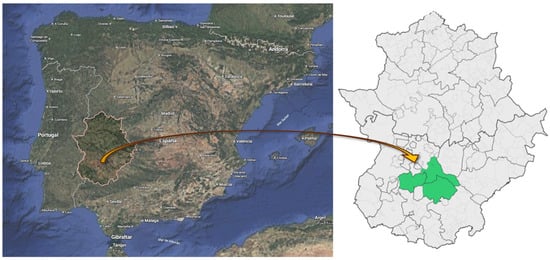
Olive fruits (Olea europaea L.) were collected during the 2024/2025 growing season from an experimental olive grove managed by the Centre for Scientific and Technological Research of Extremadura (CICYTEX), located in the Tierra de Barros region (Badajoz, Spain; 38°51′22″ N, 6°40′11″ W) (Figure 1). The orchard is situated in a Mediterranean climate with an average annual precipitation of approximately 584 mm and is characterized by deep (~2 m) sandy-loam soils. Trees were 15 years old and planted in a 6 × 6 m grid. Standard agronomic practices were applied throughout the season, including drip irrigation from 15 May to 18 November (3.582 m3/ha) and weed control via post-emergence herbicides without soil tillage, in line with previous work conducted in this olive-growing area.
Figure 1.
Geographical location of the study area. Left: Position of Extremadura within the Iberian Peninsula (Spain).
Five cultivars widely grown in southwestern Spain, Corniche, ‘Manzanilla Cacereña’, ‘Morisca’, ‘Pico Limón’ and ‘Verdial de Badajoz’, were selected to represent the varietal diversity of the region. The experimental layout followed a randomized block design with three replicates per cultivar, each replicate comprising three trees, in order to minimize positional and environmental heterogeneity and to allow robust comparison of cultivar and ripening effects on fruit and oil quality. Olives were harvested at three ripening stages, defined according to the maturity index (MI) scale based on skin and flesh coloration: Green (MI 0–1), Verging-on-ripe (MI 2–3) and Ripe (MI 3–5) according to the Uceda–Frías maturity index [15]. For each cultivar × ripening stage × replicate combination, a composite sample of 6 kg of fruit was collected between October and January by hand-picking in the morning from all orientations of the central canopy. In total, forty-five samples (5 cultivars × 3 maturity stages × 3 replicates) were obtained. After harvesting, fruits were placed in ventilated plastic trays, transported to the laboratory at 4 °C, and processed within 24 h for oil extraction and analytical determinations.
2.2. Olive Oil Extraction
Olive oil was extracted using an Abencor laboratory system (MC2 Ingeniería y Sistemas S.L., Seville, Spain), following the classical procedure described by Martínez-Suárez et al. [16]. For each of the forty-five fruit samples, 6 kg of olives were crushed in a stainless-steel hammer mill equipped with a 5 mm sieve to obtain a homogeneous paste. The paste was then malaxed at 25 °C for 30 min at 30 rpm in a thermostated mixer, without the addition of water, in order to favor oil droplet coalescence while preserving endogenous enzymes and minimizing dilution of hydrophilic components. The malaxed paste was centrifuged in a basket centrifuge at 3500 rpm (approximately 1500× g) for 3 min to separate the liquid phase. After decantation, the oil layer was filtered through qualitative paper filters to remove suspended solids. Oils were immediately transferred into dark amber glass bottles, filled up to the neck to reduce headspace, capped, and stored at 4 °C in the dark until analysis. All physico-chemical, biochemical, sensory and volatile analyses were carried out within 30 days after extraction. Oil yield was expressed as the percentage of extracted oil (g) per 100 g of fresh olive paste, and all extraction measurements were performed in triplicate and reported as mean values.
2.3. Determination of Fruit Physico-Chemical Characteristics
Fruit physico-chemical traits were characterized prior to oil extraction. The maturity index (MI) of each sample was determined on 100 randomly selected fruits, classified into eight color classes and the MI value was calculated as a weighted average [15]. These MI values were then grouped into the three ripening stages defined as Green, Verging-on-ripe and Ripe. A separate set of 100 fruits per sample was inspected visually to assess health status; the proportion of healthy olives, free from visible insect damage (olive fly), fungal growth, mechanical injuries or decay, was expressed as the percentage of healthy fruit. Moisture content and total oil content of the olive paste were measured using a near-infrared (NIR) spectrometer (FOSS OliveScan, Hillerød, Denmark), previously calibrated for olive analysis. Approximately 50 g of homogenized paste was analyzed in triplicate, and moisture (%) and oil content (% of fresh mass) were recorded. Oil content on a dry matter basis (%) was calculated from these values, and the approximate industrial oil extractability was estimated by combining NIR determinations of total oil with residual oil measurements in the pomace obtained by Soxhlet extraction with hexane according to AOAC procedures [17]. Extractability was expressed as the percentage of oil recovered relative to total oil content in the fruit. Thus, extractability represents the proportion of total fruit oil that was effectively recovered during mechanical extraction.
2.4. Physico-Chemical Quality Parameters of Olive Oil
Virgin olive oil quality indices were determined following the European Union. Commission Delegated Regulation (EU) 2022/2104 of 29 July 2022 [18]. Free acidity, expressed as percentage of oleic acid, was quantified by titration of the oil dissolved in an ethanol–ether mixture with 0.1 N KOH, using phenolphthalein as an indicator (IOC/T.20/Doc. No. 34) [19]. The peroxide value, expressed as milliequivalents of active oxygen per kilogram of oil (mEq O2/kg), was measured by iodometric titration after reaction of the oil with acetic acid–chloroform and potassium iodide, and titration of liberated iodine with sodium thiosulfate (IOC/T.20/Doc. No. 35) [20]. Each parameter was analyzed in triplicate, and mean values were used for statistical analysis.
2.5. Bioactive Compounds Composition and Antioxidant Activity
Oxidative stability of the oils was evaluated using the Rancimat method (AOCS Cd 12b-92) with a Metrohm 743 Rancimat apparatus (Metrohm, Basel, Switzerland) [21]. For each determination, 3 g of oil were weighed into the reaction vessel and subjected to forced aeration at 10 L/h while being heated at 100 °C. The induction time, defined as the point of sudden increase in the conductivity of distilled water due to the arrival of volatile oxidation products, was recorded automatically and expressed in hours.
Total phenolic content was determined using the Folin–Ciocalteu colorimetric method adapted for virgin olive oil [22]. Phenolic compounds were extracted from 2 g of oil by liquid–liquid extraction with 2 mM NaF methanol:water (80:20, v/v), vortexed, sonicated in an ultrasonic bath for 15 min at 20 °C and centrifuged at 16,000× g for 20 min at 4 °C to separate the hydroalcoholic phase. An aliquot of the extract was mixed with Folin–Ciocalteu reagent and sodium carbonate and incubated in the dark, and the absorbance was measured at 765 nm using a Tecan Spark multimode microplate reader (Tecan, Grödig, Austria). Caffeic acid was used as the calibration standard, and results were expressed as mg caffeic acid equivalents (CAE) per kg of oil.
Total antioxidant activity (TAA) was assessed by the ABTS radical cation decolorization assay [23]. The ABTS•+ radical cation was generated by reacting ABTS with potassium persulfate and allowing the mixture to stand in the dark for 12–16 h. Before analysis, the ABTS•+ solution was diluted with ethanol to an absorbance of approximately 0.70 at 734 nm. An aliquot of the extract for phenolic compounds analysis was mixed with the ABTS•+ working solution. Absorbance at 734 nm was recorded with the Tecan Spark reader, and TAA was expressed as mmol Trolox equivalents per kg oil, using Trolox calibration curves
2.6. Volatile Organic Compounds (VOC) Analysis
Volatile organic compounds (VOCs) were analyzed by headspace solid-phase microextraction coupled to gas chromatography–mass spectrometry (HS-SPME-GC-MS), following approaches widely used by Flamini (2007) [24]. Approximately 2–3 g of oil was placed in 10 mL headspace vials and sealed with PTFE/silicone septa and equilibrated at 30 °C. A DVB/CAR/PDMS SPME fiber (50/30 µm) was exposed to the headspace for 30 min to adsorb volatile compounds. After sampling, the fiber was inserted into the GC injector and thermally desorbed at 250 °C for 5 min in splitless mode. Separation was achieved on an apolar capillary column (DB-5, 30 m × 0.25 mm i.d., 0.25 µm film thickness) with a temperature program starting at 60 °C and increasing at 3 °C/min up to 220 °C. The GC–MS system operated in electron impact mode (70 eV), scanning an appropriate m/z range. Volatile compounds were identified by comparison of their retention times, linear retention indices (L.R.I) and comparison of their mass spectra with those of library databases (NIST 14) and homemade ones obtained from pure compounds or known mixtures.
2.7. Fatty Acid Composition (GC-FID Analysis)
Fatty acid composition of the virgin olive oil samples was determined by gas chromatography with flame ionization detection (GC-FID), following the official methodology established by the International Olive Council (IOC/T.20/Doc. No. 33) [25]. In brief, fatty acids were converted into their corresponding methyl esters (FAMEs) by cold transesterification. Approximately 100 mg of oil were dissolved in 2 mL of n-heptane, followed by the addition of 0.2 mL of 2 N methanolic potassium hydroxide. After vigorous shaking and phase separation, the upper organic layer containing FAMEs was recovered and directly injected.
Chromatographic separation was performed using a polar fused-silica capillary column suitable for FAME analysis (DB-23 60 m × 0.25 mm × 0.25 mm, Agilent Technologies, Palo Alto, CA, USA). The GC-FID system operated under the following conditions: injector temperature of 260 °C (split ratio 1:100), detector temperature of 280 °C, and hydrogen as a carrier gas at constant flow. The oven temperature was programmed starting at 185 °C (held for 2 min), then increased to 220 °C at 5 °C/min, with a final hold of 15 min. Identification of individual fatty acids was achieved by comparing retention times with certified FAME standards (C4:0–C24:1), while quantification was performed by area normalization, expressing fatty acids as a percentage of total FAMEs (% total fatty acids).
2.8. Sensory Evaluation
Sensory evaluation of the oils was performed by a panel of 12 trained assessors with extensive experience in virgin olive oil quality control, in accordance with the IOC method for sensory assessment of virgin olive oil (IOC/T.20/Doc. No. 15) [26].
Tastings were conducted in individual booths in a standardized tasting room, under controlled temperature (28 ± 2 °C) and neutral lighting. Samples (15 mL) were served in standard blue tasting glasses, covered with watch glasses and equilibrated in a thermostatic heater before evaluation. Panelists assessed the intensity of positive attributes (fruitiness, bitterness and pungency) and possible negative attributes (fusty/muddy, winey, musty, rancid, metallic and others) using a 10 cm unstructured scale. For each sensory attribute, the median of panelists’ scores was taken as the official value for the sample, and evaluations were considered valid when the coefficient of variation did not exceed 20%. The IOC/Mario Solinas tasting sheet was used to record and classify the samples, allowing integration of sensory data with chemical and volatile profiles.
2.9. Statistical Analysis
Statistical analyses were performed using XLSTAT software version 2024.4.0.1424 (Addinsoft, New York, NY, USA). The influence of ripening stage and variety on each measured parameter was evaluated by analysis of variance (ANOVA). When significant differences were detected, mean values were compared using Tukey’s honestly significant difference (HSD) post hoc test at p < 0.05. Data are presented as mean ± standard deviation, and different superscript letters in tables and figures denote statistically significant differences between ripening stages and varieties.
3. Results
3.1. Maturity and Fruit Quality Parameters
The data show clear variations among cultivars and ripening stages for the maturity index, fruit health, and fruit weight (Table 1). At the Green stage, all cultivars exhibited very low maturity index values, with ‘Verdial de Badajoz’ and ‘Morisca’ presenting the lowest ripeness levels (0.18 ± 0.03 and 0.27 ± 0.02), while ‘Corniche’ and ‘Manzanilla Cacereña’ reached slightly higher values (0.92 ± 0.02 and 0.81 ± 0.03). Fruit health was optimal at this stage, remaining at 98–100% for all varieties. Fruit weight also differed notably among cultivars, with ‘Morisca’ (530.01 ± 10.10 g/100 fruits) and ‘Verdial de Badajoz’ (476.61 ± 12.43 g/100 fruits) producing much larger fruits compared with ‘Pico Limón’ and ‘Manzanilla Cacereña’.
Table 1.
Analytical characteristics of olive samples.
At the Verging-on-ripe stage, the maturity index increased substantially for all cultivars, reaching values between 2.40 ± 0.21 and 2.90 ± 0.13. Fruit health began to decline in some varieties, particularly ‘Verdial de Badajoz’ (78.33 ± 3.06%) and ‘Morisca’ (84.00 ± 2.00%), while it remained high in others such as ‘Manzanilla Cacereña’. Fruit weight reached its highest levels at this stage in several cultivars, especially ‘Morisca’ (818.86 ± 14.00 g/100 fruits), ‘Verdial de Badajoz’ (754.34 ± 13.94 g/100 fruits) and ‘Pico Limón’ (673.25 ± 7.13 g/100 fruits).
At the Ripe stage, maturity index values continued to increase, with ‘Morisca’ showing the highest level (4.24 ± 0.09) and ‘Corniche’ the lowest (2.97 ± 0.29). Fruit health decreased sharply in certain cultivars, most notably ‘Corniche’ (21.00 ± 2.65%) and ‘Verdial de Badajoz’ (54.33 ± 3.06%) or ‘Pico Limón’ (55.00 ± 3.61%) indicating significant deterioration. Fruit weight tended to decline or stabilize depending on the variety, with ‘Morisca’ and ‘Verdial de Badajoz’ maintaining higher weights compared with ‘Corniche’ and ‘Manzanilla Cacereña’.
3.2. Oil Quality Parameters
In this study, oil quality was interpreted according to both regulatory and compositional criteria. From a legal standpoint, extra virgin olive oil classification requires low free acidity (≤0.8%), low peroxide value, and absence of sensory defects according to IOC/EU standards [18]. From a compositional perspective, higher phenolic content, enhanced oxidative stability, and intense positive sensory attributes (fruitiness, bitterness, and pungency) are widely recognized as markers of superior nutritional, technological, and sensory quality. Therefore, oils combining these characteristics were considered to exhibit higher overall quality.
Moisture content showed a general increase from the Green to the Verging-on-ripe stage in all cultivars, followed by a decrease at full ripeness in ‘Corniche’, ‘Morisca’ and ‘Pico Limón’, while ‘Verdial de Badajoz’ maintained high moisture at maturity (Table 2). Oil yield measured by the Abencor system varied strongly among cultivars and stages. ‘Corniche’ and ‘Morisca’ reached the highest values at the Ripe stage (18.77 ± 0.29% and 18.76 ± 0.03%), whereas ‘Manzanilla Cacereña’ consistently presented the lowest yields across all stages. ‘Pico Limón’ and ‘Verdial de Badajoz’ showed intermediate behavior, with moderate increases at full ripeness.
Table 2.
Oil quality and extraction parameters of olive samples.
Extractability increased with ripeness in most cultivars, reaching maximum values in Ripe ‘Morisca’ (81.80 ± 0.11%) and Ripe ‘Corniche’ (76.90 ± 0.89%). ‘Manzanilla Cacereña’ displayed very low extractability at all stages, whereas ‘Verdial de Badajoz’ and ‘Pico Limón’ showed intermediate but variable values depending on maturity. Oil yield and extractability are inherently influenced by fruit moisture content, since higher water levels dilute oil concentration on a fresh weight basis and can hinder oil release during mechanical extraction. Therefore, both parameters typically show an inverse relationship with moisture during fruit ripening. In this study, results were expressed on a fresh weight basis to reflect industrial extraction conditions, rather than on a dry weight basis, which would primarily describe compositional oil concentration rather than technological performance.
Acidity remained low in most samples at early and mid-ripening stages. However, two cultivars showed sharp increases at full ripeness: Corniche’ (2.24 ± 0.01%) and especially ‘Morisca’ (7.02 ± 0.03%), reflecting a strong decline in fruit integrity. The other cultivars maintained acidity values below 0.40%. Peroxide values remained low across all cultivars and stages, with only slight increases observed in mid- or late-ripening samples for ‘Morisca’, ‘Pico Limón’ and ‘Verdial de Badajoz’. No sample exceeded values typically associated with early oxidation.
A remarkable increase in free acidity was observed in the Ripe samples of ‘Corniche’ and ‘Morisca’, reaching 2.24 ± 0.01% and 7.02 ± 0.03%, respectively, values far exceeding the legal limits established for virgin olive oil classification. According to current standards, such acidity levels indicate severe triglyceride hydrolysis associated with fruit tissue disruption, lipase activity, and poor sanitary status of the olives prior to processing. Consequently, this oil would not qualify as virgin olive oil from a commercial or regulatory perspective. The high acidity is consistent with the reduced oxidative stability and the likely degradation of minor antioxidants observed at this stage. In this study, these samples were nevertheless included for comparative scientific purposes to evaluate the effect of extreme ripening and fruit deterioration on oil composition and stability, thereby providing a broader understanding of cultivar behavior across maturity stages rather than to represent marketable quality categories.
3.3. Total Phenolic Content, Oxidative Stability and Antioxidant Properties
Total phenolic content (TPC, expressed by mg caffeic acid/kg oil) showed clear differences among cultivars and maturity stages. In all cultivars, Green samples displayed the highest phenolic levels (Table 3). ‘Corniche’ had the largest value at this stage (477.8 ± 5.1 mg/kg), followed by ‘Verdial de Badajoz’ (394.9 ± 11.2 mg/kg) and ‘Morisca’ (351.5 ± 11.3 mg/kg). ‘Pico Limón’ and ‘Manzanilla Cacereña’ showed intermediate levels (319.7 ± 11.9 and 297.6 ± 9.0 mg/kg). At the Verging-on-ripe stage, phenolic content generally decreased in most cultivars, with reductions of more than half in ‘Corniche’ and ‘Verdial de Badajoz’. However, this behavior was not strictly monotonic. ‘Manzanilla Cacereña’ showed a moderate increase at Verging-on-ripe (338.5 ± 8.2 mg/kg) compared with the Green stage (297.6 ± 9.0 mg/kg). At full ripeness, phenolic values remained low in most cultivars, although ‘Corniche’ and ‘Verdial de Badajoz’ exhibited a partial recovery compared with the mid-ripening stage.
Table 3.
Oxidative stability and antioxidant properties of olive oil samples.
These deviations suggest that phenolic evolution during ripening is cultivar-dependent rather than uniformly progressive. The transient increases observed in ‘Manzanilla Cacereña’ and ‘Verdial de Badajoz’ may be associated with enhanced enzymatic hydrolysis of secoiridoid glycosides, releasing more extractable phenolic derivatives, together with tissue softening of the mesocarp that improves phenolic partition into the oil phase during malaxation. Additionally, genotype-specific metabolic or stress responses may contribute to these temporary increases.
Oxidative stability followed a similar decreasing pattern from Green to Verging-on-ripe in all cultivars. ‘Corniche’ displayed the highest stability at the Green stage (188.5 ± 3.1 h), followed by ‘Manzanilla Cacereña’ (108.6 ± 0.5 h). At the mid-ripening stage, stability consistently declined, particularly in ‘Morisca’, where it decreased from 48.1 ± 0.2 h to 22.3 ± 0.2 h. At full ripeness, ‘Corniche’ showed a very sharp drop to 36.3 ± 1.3 h, while ‘Manzanilla Cacereña’ and ‘Verdial de Badajoz’ maintained moderate values around 63.2 ± 2.1 h and 23.3 ± 0.9 h, respectively. ‘Morisca’ reached the lowest stability at full ripeness (19.0 ± 0.3 h). The marked reduction in oxidative stability observed in ‘Corniche’ at the Ripe stage was not fully proportional to the decrease in total phenolic content. Although TPC declined compared with the Green stage, the loss of stability was considerably greater, suggesting that additional factors contributed to oxidation susceptibility. Changes in fatty acid composition likely played a relevant role: despite the high oleic acid content, small increases in linoleic acid and the consequent reduction of the MUFA/PUFA ratio may have enhanced lipid peroxidation kinetics. Moreover, advanced fruit maturity and the poorer health status recorded at this stage may promote degradation of minor antioxidants such as tocopherols, pigments, and other lipophilic protective compounds that are not quantified by the Folin–Ciocalteu assay. Therefore, oxidative stability appears to depend not only on phenolic concentration but also on the combined effects of fatty acid profile and the preservation of minor antioxidant fractions.
Total antioxidant activity (TTA, mmol Trolox/kg oil) showed more variability among cultivars. ‘Corniche’, ‘Manzanilla Cacereña’, and ‘Morisca’ presented their highest antioxidant values at the Green stage. For ‘Corniche’ and ‘Morisca’, antioxidant activity decreased progressively across ripening stages. In contrast, ‘Manzanilla Cacereña’ and ‘Verdial de Badajoz’ showed higher antioxidant levels in Ripe samples compared with their Verging-on-ripe values, reaching 7.9 ± 0.2 and 7.4 ± 0.1 mmol Trolox/kg, respectively. ‘Pico Limón’ showed the highest antioxidant value at mid-ripening, differing from the general trend.
3.4. Fatty Acid Composition
The fatty acid profiles showed clear cultivar-dependent differences and distinct variations across maturity stages. Saturated fatty acids (notably palmitic and stearic acids) and monounsaturated fatty acids (mainly oleic acid) displayed the widest differences among cultivars (Table 4).
Table 4.
Changes in fatty acid composition (%) of the studied olive oils during three maturity stages (Green, Verging-on-ripe and Ripe).
Palmitic acid (C16:0) decreased slightly with ripening in all cultivars, most notably in ‘Corniche’ (from 14.96 ± 0.32% to 10.77 ± 0.25%) and ‘Manzanilla Cacereña’ (from 12.73 ± 0.29% to 11.36 ± 0.26%). ‘Morisca’ and ‘Pico Limón’ showed higher palmitic values overall, reaching 15–17% at the Green and Verging-on-ripe stages. ‘Verdial de Badajoz’ maintained intermediate levels (from 14.60 ± 0.35% to 12.61 ± 0.29%).
Palmitoleic acid (C16:1) increased with ripening in most cultivars. ‘Morisca’ and ‘Pico Limón’ showed the highest values at the mid-ripening stage (1.62 ± 0.11% and 2.42 ± 0.15%), while ‘Verdial de Badajoz’ presented the lowest across all stages (0.68 ± 0.06–0.55 ± 0.05%).
Oleic acid (C18:1), the major monounsaturated fatty acid, also showed marked cultivar differences. ‘Corniche’ and ‘Manzanilla Cacereña’ recorded the highest oleic values (76–79%) with small increases at ripeness. In contrast, ‘Morisca’ and ‘Verdial de Badajoz’ exhibited significantly lower oleic levels (58.49 ± 0.62–63.35 ± 0.68% for ‘Morisca’; 60.93 ± 0.64–63.22 ± 0.67% for ‘Verdial de Badajoz’), with slight rises at the Ripe stage. ‘Pico Limón’ showed intermediate oleic values, ranging from 59.91 ± 0.64% to 67.13 ± 0.71% depending on the stage.
Linoleic acid (C18:2) tended to increase from Green to the Verging-on-ripe stage in most cultivars. ‘Morisca’ showed the highest levels (16.59 ± 0.39–19.46 ± 0.45%) across all stages, while ‘Verdial de Badajoz’ and ‘Pico Limón’ also displayed high linoleic contents at mid-ripening. ‘Corniche’ and ‘Manzanilla Cacereña’ had the lowest linoleic values (around 3–5%). This confirms the strong divergence between cultivars in terms of polyunsaturated fatty acid composition.
Stearic acid (C18:0) varied moderately among cultivars, with higher levels generally observed in ‘Verdial de Badajoz’ (3.45 ± 0.15–3.80 ± 0.17%) and ‘Corniche’ (2.51 ± 0.11–3.14 ± 0.14%), while ‘Manzanilla Cacereña’ consistently presented the lowest values (around 1.65 ± 0.08–1.94 ± 0.10%).
Linolenic acid (C18:3) remained stable across ripening stages, with values between 0.65 ± 0.05% and 1.01 ± 0.07%. ‘Morisca’ and ‘Pico Limón’ recorded the highest values at full ripeness, whereas ‘Verdial de Badajoz’ and ‘Corniche’ exhibited the lowest throughout the stages.
Minor fatty acids such as arachidic (C20:0), behenic (C22:0) and erucic (C22:1) showed minimal variations and remained at low percentages in all samples.
3.5. Volatile Organic Compounds (VOCs)
3.5.1. Aldehydes (LOX C5–C9)
Aldehydes represented the most abundant family across all cultivars and maturity stages (Table 5). E-2-hexenal was consistently the dominant compound, reaching its highest values in ‘Manzanilla Cacereña’ (61.60 ± 4.31% at Green) and ‘Pico Limón’ (62.40 ± 4.37% at Ripe). ‘Corniche’ showed more stable concentrations across ripening (27.90 ± 1.95–30.90 ± 2.16%), whereas ‘Verdial de Badajoz’ exhibited a gradual increase from Green (17.40 ± 1.22%) to Ripe (44.90 ± 3.14%). (Z)-3-hexenal decreased sharply with ripening in all cultivars, with particularly high values in ‘Verdial de Badajoz’ (23.80 ± 1.67% at Green). Hexanal was detected mainly in ‘Pico Limón’, ‘Verdial de Badajoz’, ‘Manzanilla Cacereña’, and ‘Morisca’, with the highest values in ‘Morisca’ at the Ripe stage (10.60 ± 0.80%). Nonanal increased during ripening in ‘Corniche’ (from 2.40 ± 0.18% to 6.50 ± 0.49%) and remained moderate in ‘Morisca’ and ‘Pico Limón’. Octanal and heptanal were present at low levels, generally below 1%, and appeared sporadically depending on cultivar and stage. Overall, aldehydes showed clear patterns of decrease in C6 unsaturated aldehydes with ripening and increases in saturated aldehydes in some cultivars.
Table 5.
Volatile organic compounds (%) of the studied varieties during three maturity stages (Green, Verging-on-ripe and Ripe).
3.5.2. Alcohols (C6 LOX and Related Alcohols)
Alcohols were less abundant and more cultivar-specific than aldehydes. (E)-2-hexen-1-ol appeared across several cultivars, reaching its highest value in ‘Manzanilla Cacereña’ at the Verging-on-ripe stage (10.90 ± 0.82%). 1-hexanol was detected mainly in late-ripening samples of ‘Morisca’, ‘Pico Limón’, and ‘Verdial de Badajoz’, with values up to 4.70 ± 0.35% in ‘Morisca’ Ripe. (Z)-3-hexen-1-ol was only found in ‘Pico Limón’ Green (13.20 ± 0.92%), indicating a strong cultivar-specific occurrence. Phenylethyl alcohol appeared sporadically in ‘Corniche’ Ripe, ‘Pico Limón’ Ripe, and ‘Verdial de Badajoz’ Ripe. Alcohols generally increased with ripening in cultivars where they were detected.
3.5.3. Esters
Esters were present in low concentrations but showed clear cultivar associations. (Z)-3-hexenyl acetate was the most abundant ester and appeared specifically in ‘Manzanilla Cacereña’, ‘Morisca’, and ‘Verdial de Badajoz’ (Table 5). The highest values were observed in ‘Morisca’ Ripe (3.20 ± 0.33%). 1-hexyl acetate was detected only in ‘Manzanilla Cacereña’ Green and ‘Morisca’ mid- and late-ripening stages. Methyl salicylate was found in ‘Manzanilla Cacereña’ Verging-on-ripe, ‘Verdial de Badajoz’ Green, and ‘Verdial de Badajoz’ Ripe. Esters tended to increase with ripening in cultivars where they were present.
3.5.4. Terpenes (Monoterpenes)
Terpenes were detected mainly in ‘Manzanilla Cacereña’ and ‘Verdial de Badajoz’. Limonene appeared only in ‘Manzanilla Cacereña’ (1.90 ± 0.15%) and ‘Verdial de Badajoz’ (0.40 ± 0.04%) Ripe. E-β-ocimene was more widespread, occurring in ‘Manzanilla Cacereña’, ‘Morisca’, ‘Pico Limón’, and ‘Verdial de Badajoz’, with its maximum level in ‘Verdial de Badajoz’ Verging-on-ripe (5.20 ± 0.40%). Terpenes were absent in ‘Corniche’ and mostly absent in ‘Morisca’ and ‘Pico Limón’. Their distribution showed strong cultivar dependency (Table 5).
3.5.5. Sesquiterpenes
Sesquiterpenes exhibited distinct patterns (Table 5), with (E,E)-α-farnesene being the most prominent. Very high levels occurred in ‘Manzanilla Cacereña’ Ripe (17.00 ± 1.28%) and in ‘Verdial de Badajoz’ Verging-on-ripe and Ripe (11.60 ± 0.87% and 16.10 ± 1.21%). α-Copaene was also present in several cultivars, especially ‘Manzanilla Cacereña’ and ‘Verdial de Badajoz’. β-Caryophyllene appeared only in ‘Verdial de Badajoz’, while (Z)-β-farnesene and α-muurolene were detected sporadically at low levels. Sesquiterpenes showed clear cultivar specificity, with ‘Manzanilla Cacereña’ and ‘Verdial de Badajoz’ being the richest sources.
3.5.6. Polyunsaturated Hydrocarbons (Diene Compounds)
This group was abundant in all cultivars and particularly prominent in ‘Pico Limón’, where values reached up to 14.00 ± 1.02% for 3,7-decadiene isomer 2 at the Green stage (Table 5). ‘Corniche’ and ‘Verdial de Badajoz’ also exhibited high levels of diene compounds, while ‘Manzanilla Cacereña’ presented lower concentrations. The 3,7-decadiene isomers were consistently the most abundant across cultivars. These compounds generally decreased with ripening, with many becoming undetectable in Ripe samples.
3.6. Sensory Evaluation Results
Sensory evaluation revealed clear differences among cultivars and maturity stages (Table 6). ‘Corniche’ showed an increase in olfactory and taste attributes from Green to Verging-on-ripe (27.2 ± 2.6 to 28.2 ± 2.0; 36.7 ± 2.4 to 40.4 ±11.8), followed by a sharp decline at the Ripe stage, resulting in the lowest total score (48.0 ± 3.5). This trend was accompanied by a marked reduction in fruitiness (from 8.4 ± 0.9 to 2.1 ± 0.3), bitterness (from 3.8 ± 0.6 to 0.4 ± 0.5), and pungency (from 3.8 ± 0.5 to 0.8 ± 0.7). ‘Manzanilla Cacereña’ maintained relatively stable performance across maturity, with total scores between 66.1 ± 4.9 and 71.6 ± 4.0. This stability was also reflected in minor changes in fruitiness (7.1± 0.6–7.7± 0.8), bitterness (3.0± 0.4–3.1± 0.5), and pungency (3.3± 0.3–3.4± 0.8). ‘Morisca’ exhibited the most pronounced decrease, dropping from 75.6 ± 3.7 at Green to only 38.9 ± 1.9 at Ripe due to reductions in olfactory (12.8 ± 2.8) and global perception (2.2 ± 1.1). This decline was accompanied by a strong reduction in fruitiness (from 7.8 ± 0.8 to 2.1 ± 0.3), bitterness (from 3.9 ± 0.2 to 0.4 ± 0.4), and pungency (from 3.8 ± 0.5 to 0.6 ± 0.5). ‘Pico Limón’ maintained high sensory quality across all stages, reaching 76.9 ± 5.2 at Green and remaining above 69.4 ± 1.5 at Ripe. Fruitiness remained relatively stable (7.4 ± 0.9–8.5 ± 0.6), while bitterness (from 3.1 ± 0.3 to 2.0 ± 1.0) and pungency (from 3.1 ± 0.9 to 2.1 ± 0.6) showed moderate decreases. ‘Verdial de Badajoz’ also displayed consistent and elevated sensory performance, with total scores ranging from 73.6 ± 3.6 to 76.4 ± 2.3, showing only minor fluctuations with ripening. This stability was reflected in sustained fruitiness (7.6 ± 0.8–8.1 ± 0.9) and relatively constant bitterness (2.8 ± 0.5–2.9 ± 0.6) and pungency (3.1 ± 0.7–3.7 ± 1.0) across maturity stages.
Table 6.
Sensory evaluation scores (fruitiness, total olfactory, bitterness, pungency, total taste, global, and total) of the five cultivars at three maturity stages.
Overall, ripening led to a general reduction in the intensity of key positive sensory attributes, particularly fruitiness, bitterness, and pungency, although the magnitude of this effect was strongly cultivar dependent.
3.7. Multivariate Analysis
3.7.1. PCA Interpretation at the Green Maturity Stage
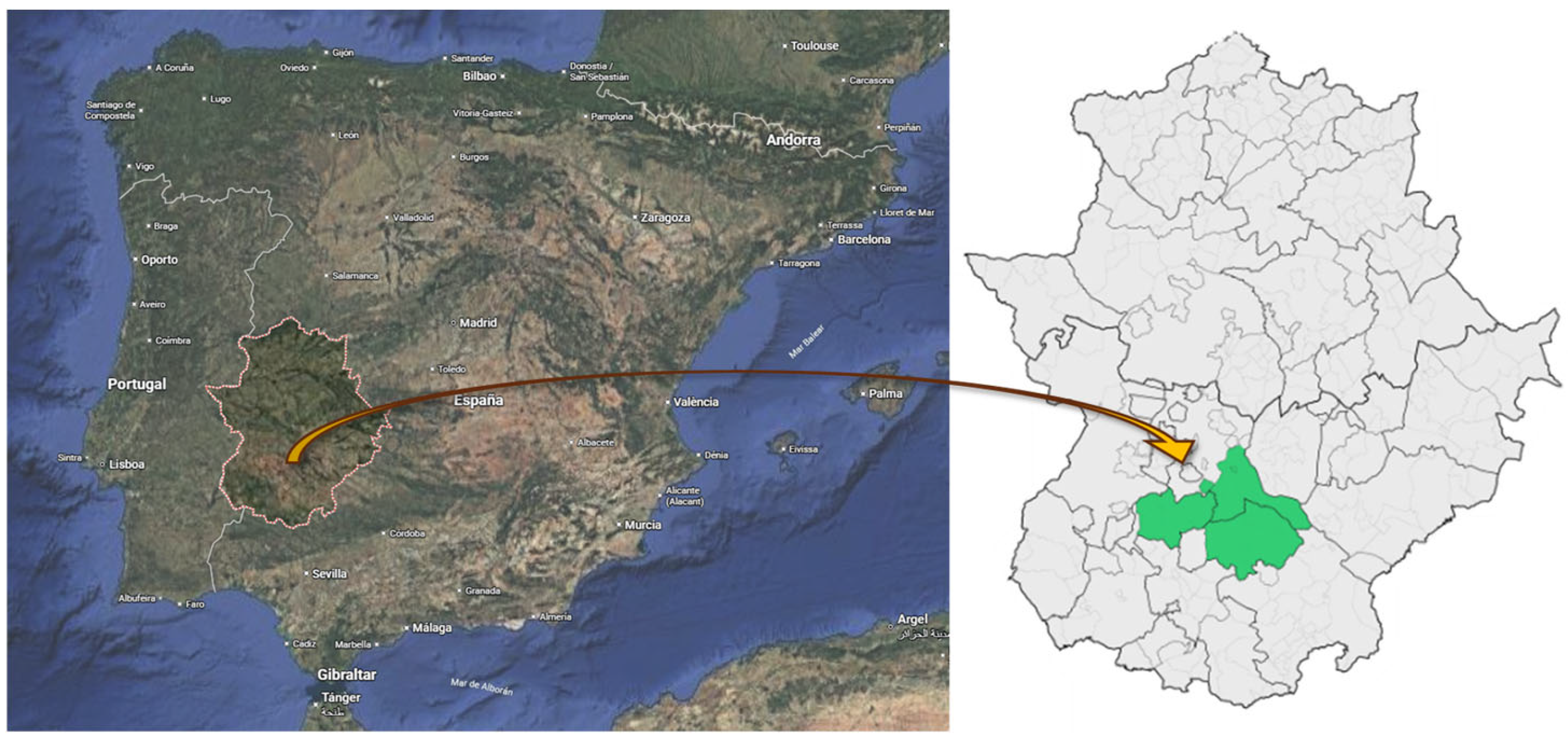
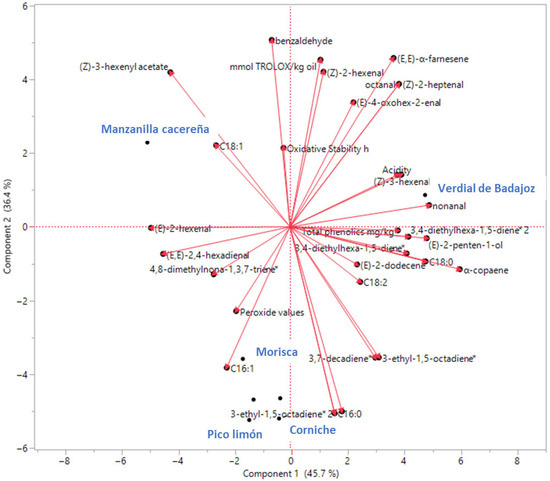
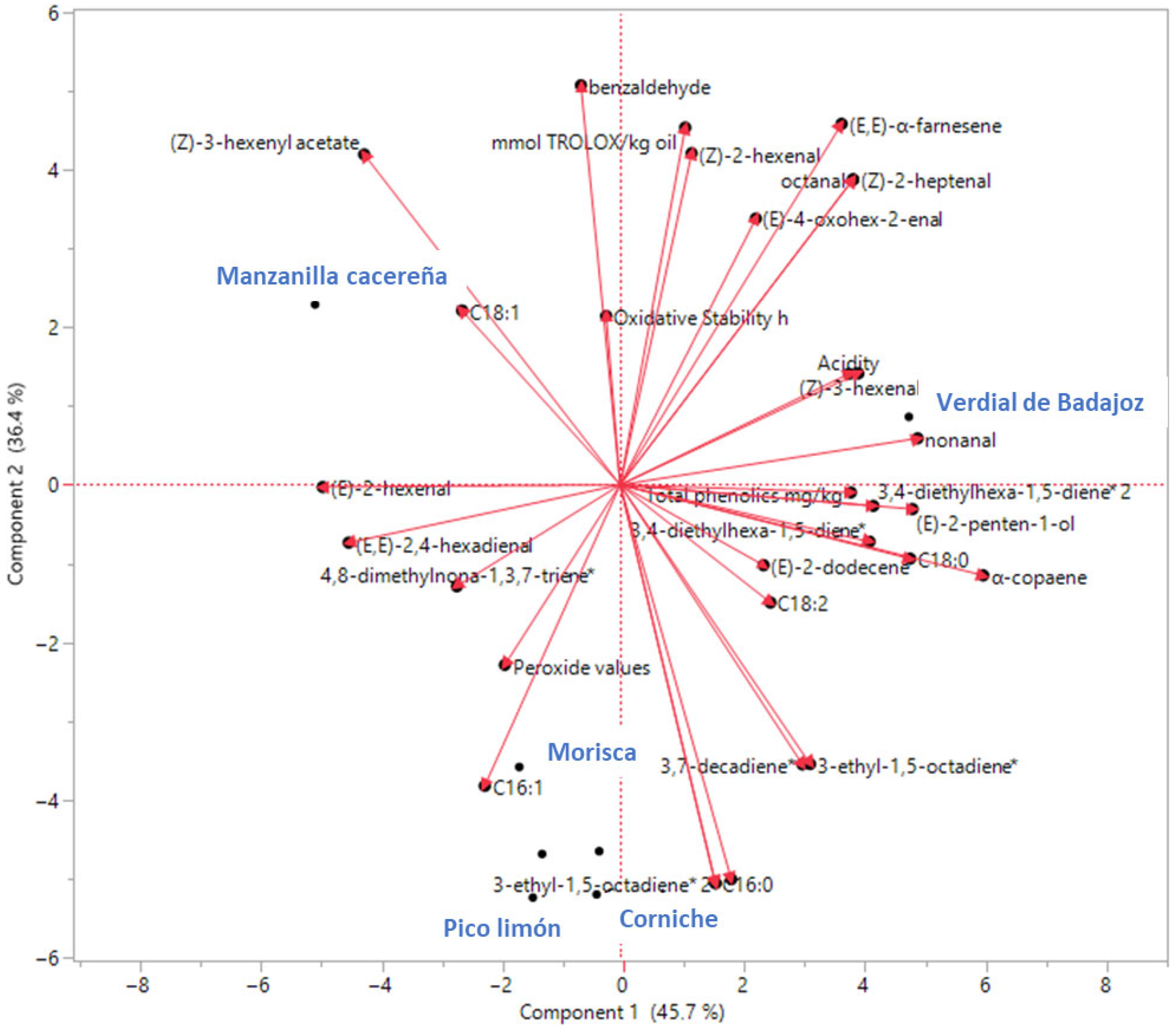
The PCA performed for the Green maturity stage revealed a clear multivariate structure linking oxidative quality indices with the formation of key volatile compounds (Figure 2). Samples positioned on the positive side of PC1 were characterized by higher total phenolic compounds, greater oxidative stability, and elevated antioxidant capacity, together with a strong contribution of C6 aldehydes—particularly (E)-2-hexenal and (Z)-3-hexenal—indicating an active lipoxygenase pathway and a typical “green–fruity” aromatic profile. These variables clustered with oleic acid (C18:1), confirming the protective role of monounsaturated fatty acids in early harvest oils. In contrast, the negative side of PC1 grouped peroxide value, palmitic and palmitoleic acids, and several dienic hydrocarbons (e.g., 3,7-decadiene, 3-ethyl-1,5-octadiene), which are associated with the onset of primary oxidation even in immature fruits. PC2 further distinguished oils with more complex aromatic signatures—such as benzaldehyde, (E,E)-α-farnesene, and (Z)-3-hexenyl acetate—from those richer in polyunsaturated hydrocarbons and hexadienals, reflecting cultivar-dependent differences in volatile biosynthesis. Overall, the PCA demonstrates that, at the Green stage, oils with higher phenolic content and stronger oxidative stability are closely associated with LOX-derived C6 aldehydes, whereas cultivars more susceptible to oxidation cluster with saturated and dienic compounds, highlighting early varietal divergence in both oxidative behavior and aromatic expression.
Figure 2.
PCA interpretation at the Green maturity stage. The asterisk (*) refer to correct isomer has can not be determined.
3.7.2. PCA Interpretation at the Verging-on-Ripe Stage
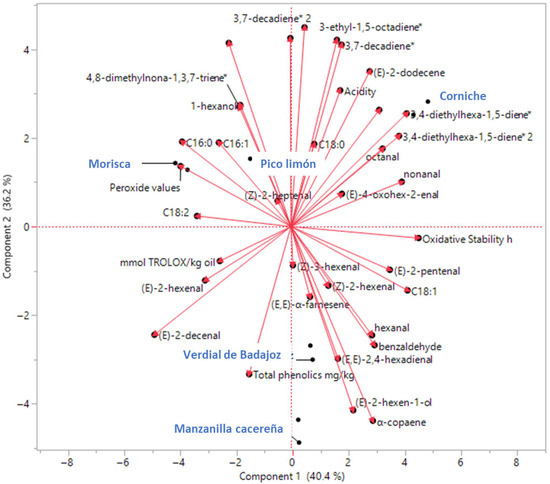
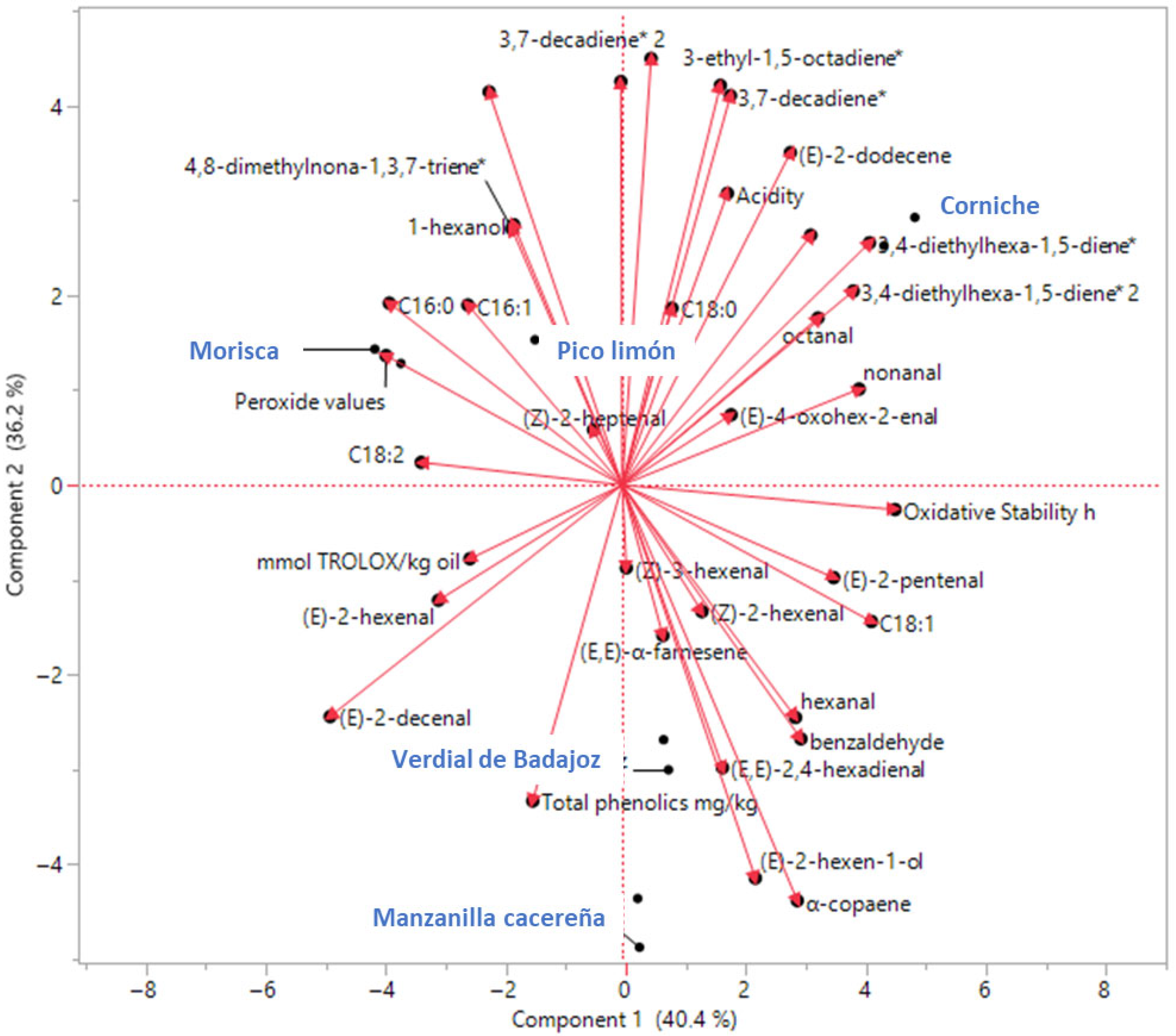
The PCA for the Verging-on-ripe stage (PC1 = 40.4%, PC2 = 36.2%) revealed a marked reorganization of relationships between oxidative parameters, fatty acids, and volatile compounds as fruits progressed toward intermediate ripening (Figure 3). Along PC1, oils with higher oxidative stability and elevated C18:1 content clustered on the positive side, together with LOX-derived aldehydes such as (E)-2-pentenal, (Z)-3-hexenal, and (Z)-2-hexenal, indicating the persistence of “green–fruity” volatiles in samples maintaining stronger antioxidant protection. In contrast, the negative side of PC1 grouped samples richer in peroxide values, linoleic acid (C18:2), and early oxidation markers including (E,E)-2,4-decadienal and (E)-2-decenal, suggesting increased susceptibility to autoxidation during the transition from Green to Verging-on-ripe. PC2 further distinguished samples based on the rise of polyunsaturated hydrocarbons and dienes—such as 3,7-decadiene, 3-ethyl-1,5-octadiene, and 4,8-dimethylnona-1,3,7-triene—which loaded strongly on the upper part of the axis and are indicative of intensified lipid peroxidation activity. Conversely, compounds contributing to more complex aromatic nuances, including benzaldehyde, nonanal, hexanal, and (E)-4-oxohex-2-enal, were positioned on the lower PC2 region, reflecting cultivar-dependent shifts toward more mature fruit notes. The positioning of cultivars, notably ‘Morisca’ on the oxidative side and ‘Manzanilla Cacereña’ and ‘Verdial de Badajoz’ near the pole of phenolics and LOX markers, underscores substantial varietal divergence in oxidative behavior during mid-ripening. Overall, the PCA demonstrates that the Verging-on-ripe stage is characterized by a dynamic balance between the progressive decline of green LOX volatiles and the emergence of oxidation-derived compounds, revealing both ripening effects and genotype-specific responses.
Figure 3.
PCA interpretation at the Verging-on-ripe maturity stage. The asterisk (*) refer to correct isomer has can not be determined.
3.7.3. PCA Interpretation at the Ripe Stage
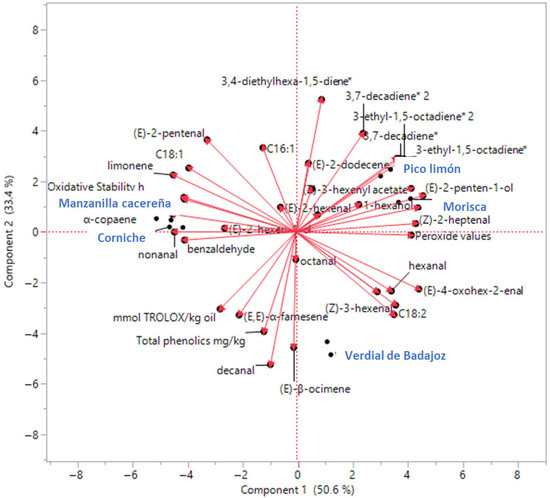
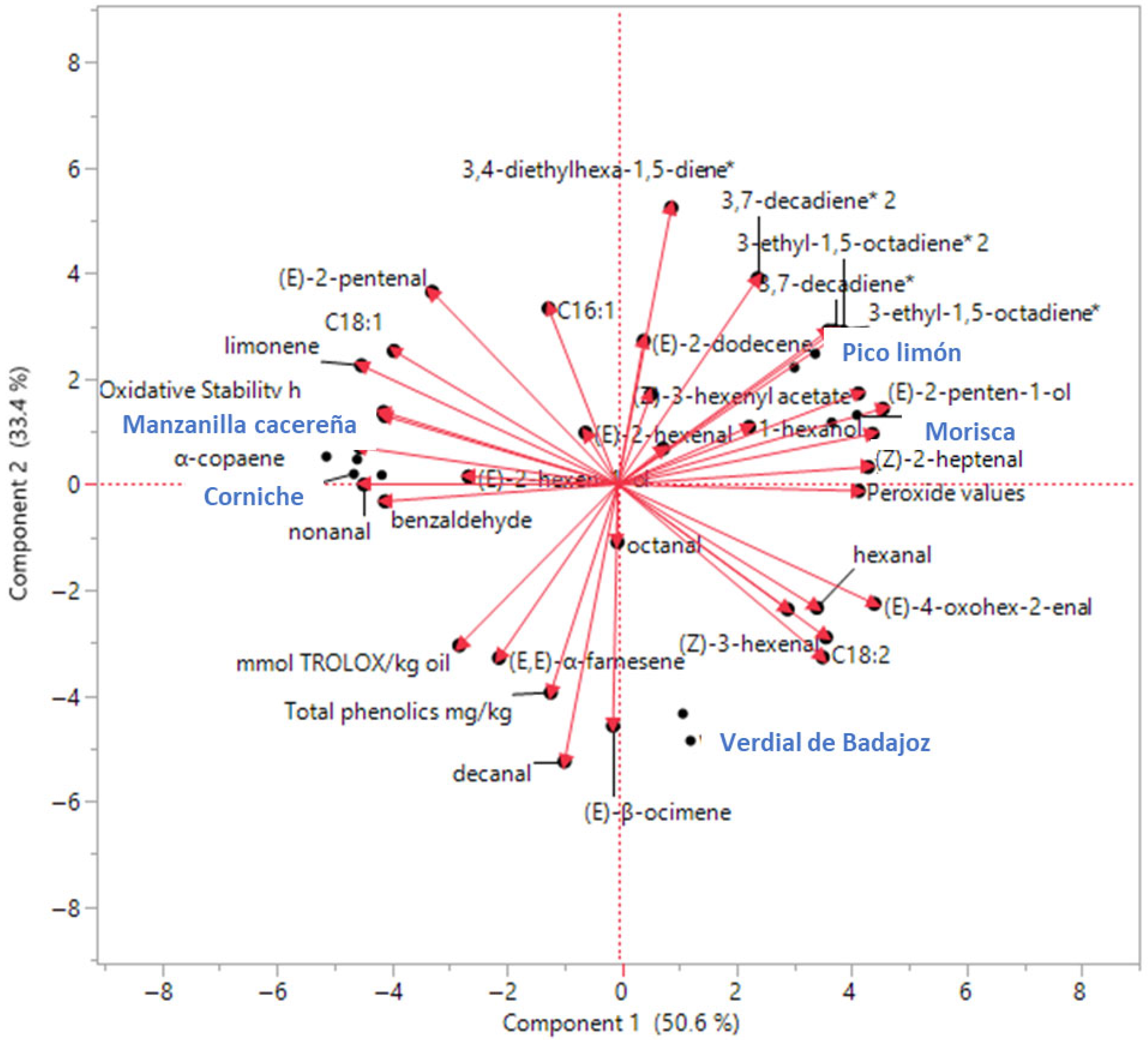
The PCA for the Ripe maturity stage (PC1 = 50.6%, PC2 = 33.4%) showed a pronounced shift in the chemical–aromatic landscape of the oils as ripening progressed toward full maturity (Figure 4). Along PC1, samples associated with higher peroxide values, elevated linoleic acid (C18:2), and several oxidation-related volatiles—including hexanal, (E)-4-oxohex-2-enal, and (Z)-3-hexenal—clustered on the positive side, reflecting the increased susceptibility of ripe fruits to autoxidation and the decline of protective phenolic compounds. This region also concentrated polyunsaturated hydrocarbons such as 3,7-decadiene and 3-ethyl-1,5-octadiene, confirming the intensification of secondary lipid peroxidation pathways at advanced maturity. Conversely, the negative side of PC1 grouped variables indicative of higher oxidative stability—namely oleic acid (C18:1), antioxidant activity, and total phenolics—together with fruitier or more nuanced volatiles such as benzaldehyde, nonanal, limonene, and α-copaene. PC2 further separated samples richer in sesquiterpenes and monoterpenes (e.g., (E)-β-ocimene, (E,E)-α-farnesene) from those dominated by LOX-derived compounds and hydrocarbons, highlighting strong cultivar-specific modulation of volatile metabolism at late ripening. Cultivar positioning illustrated this divergence: ‘Pico Limón’, ‘Morisca’, and ‘Verdial de Badajoz’ aligned with oxidized or polyunsaturated markers, while ‘Manzanilla Cacereña’ and ‘Corniche’ remained closer to the pole of oxidative stability. Overall, the PCA indicates that full ripening leads to a marked decline in antioxidant protection and green LOX volatiles, accompanied by an accumulation of oxidation products and hydrocarbons, underscoring the strong combined influence of ripening progression and genotype on the final aroma and stability of virgin olive oil.
Figure 4.
PCA interpretation at the Ripe maturity stage. The asterisk (*) refer to correct isomer has can not be determined.
4. Discussion
The olive cultivars ‘Corniche’, ‘Manzanilla Cacereña’, ‘Morisca’, ‘Pico Limón’ and ‘Verdial de Badajoz’ have been evaluated in various Spanish comparative trials, with ‘Corniche’ consistently demonstrating the highest oil yield and extractability among the studied genotypes, while its oils meet extra-virgin quality standards [27]. In contrast, ‘Manzanilla Cacereña’ is characterized by a markedly high oleic acid content (typically exceeding 77% of total fatty acids, although it exhibits the lowest fruit oil content and extractability across ripening stages; phenolic accumulation and antioxidant responses in this cultivar are strongly modulated by maturity index and irrigation regime [27,28,29,30]. ‘Morisca’ shows a distinctly different profile, with comparatively lower oleic acid (around 68%) and higher linoleic acid levels (often >13–14.5%), accompanied by elevated total phenolic compounds concentrations (approximately 550 mg·kg−1 in certain regional studies) and satisfactory industrial oil yields that can reach ≈21% in favorable conditions, although its oxidative stability remains moderate [28,30,31]. ‘Pico Limón’ and ‘Verdial de Badajoz’ have been included in monovarietal chemical profiling in Extremadura, where they are generally positioned as relatively richer in linoleic acid, yet detailed quantitative data on their fatty acid and phenolic composition are not fully reported in the available abstracts [30]. Across all five cultivars, substantial knowledge gaps persist with respect to comprehensive morphological descriptions of tree, leaf, fruit and endocarp characteristics, quantitative assessments of vigor and disease resistance, geographic origin and current distribution beyond the Spanish trial locations, as well as molecular marker data or genetic diversity studies, with the partial exception of intravarietal diversity analyses conducted within the broader Manzanilla group [32]. Primary utilization is oriented toward oil production for ‘Corniche’, ‘Morisca’, ‘Pico Limón’ and ‘Verdial de Badajoz’, whereas ‘Manzanilla Cacereña’ retains dual-purpose potential, being traditionally and commercially important for table olive production in addition to oil extraction [28,30,33].
The present study demonstrates that both cultivar and maturity stage exert strong and interactive influences on the physicochemical, phenolic, volatile, and sensory characteristics of virgin olive oils from the Extremadura region. The observed decline in phenolic compounds and oxidative stability from the Green to the Verging-on-ripe stage, followed by partial recovery or stabilization at full maturity in some cultivars, is consistent with the well-established pattern of phenolic dilution and enzymatic degradation during ripening [5,34]. Early harvest oils were characterized by high total phenolic content and long induction times, confirming the protective antioxidant role of secoiridoids and their derivatives [35]. These findings align with previous reports indicating that oils obtained from early stages exhibit stronger bitterness, pungency, and resistance to oxidative degradation due to their higher phenolic load [7,36].
The evolution of volatile organic compounds across maturity stages further supports the dynamic biochemical processes occurring during ripening. At the Green stage, oils exhibited a volatile profile dominated by LOX-derived C6 aldehydes—especially (E)-2-hexenal and (Z)-3-hexenal—responsible for the characteristic “green–fruity” attributes of high-quality extra-virgin oils [3,37]. PCA results confirmed the strong positive association between these aldehydes, phenolic concentration, and oxidative stability. As ripening progressed, a marked shift occurred toward increased levels of saturated aldehydes, dienes, and oxidation-related compounds, particularly hexanal, octanal, and (E)-4-oxohex-2-enal. This pattern reflects both enhanced substrate availability (higher unsaturated fatty acids) and increased susceptibility to autoxidation in more mature fruits [38,39].
The fatty acid profile also displayed clear cultivar-dependent and ripening-associated variations. Consistent with previous research, oleic acid tended to increase or remain stable at advanced ripening stages in cultivars such as ‘Corniche’ and ‘Manzanilla Cacereña’, while cultivars with inherently higher linoleic acid, such as ‘Morisca’ and ‘Pico Limón’, showed greater oxidative vulnerability [29,40]. The strong negative correlation between C18:2 and oxidative stability observed in PCA reinforces the well-established inverse relationship between polyunsaturated fatty acids and resistance to lipid oxidation [41].
Sensory evaluation highlighted similar trends, with early harvest oils presenting higher intensities of bitterness, pungency, and green notes, in agreement with previous studies linking sensory attributes to phenolic and C6 LOX-derived volatiles [42]. The significant sensory deterioration observed in ‘Morisca’ at full ripeness reflects its lower phenolic stability and higher linoleic acid content, consistent with previous literature describing cultivar-specific vulnerability to ripening-related degradation [21].
The multivariate analyses from PCA provide an integrated interpretation of these phenomena. At the Green stage, oils clustered according to high phenolic concentration, LOX-derived aldehydes, and strong oxidative stability, resembling the profiles described in high-quality early harvest oils in multiple Mediterranean cultivars [7,43]. At the Verging-on-ripe and Ripe stages, however, samples were increasingly separated along gradients of oxidation products and hydrocarbons, consistent with progressive enzymatic and autoxidative processes associated with ripening [44]. The differentiation of cultivars across PCA space highlights genotype-specific metabolic pathways shaping volatile biosynthesis and oxidative responses, reinforcing the importance of varietal characterization in regional olive oil production systems.
Overall, the findings confirm that optimal harvest timing must be cultivar-specific, balancing the trade-off between oil yield, oxidative stability, phenolic composition, and sensory properties. The strong influence of cultivar on the magnitude and direction of ripening effects underscores the necessity of regionally tailored strategies for quality optimization. Future research should expand on these findings by including multi-year datasets to capture climatic variability, exploring transcriptomic or metabolomic markers underlying varietal differences in LOX activity, and assessing the impact of controlled agronomic practices on maintaining phenolic integrity and volatile expression during ripening. Such integrative approaches may further elucidate the biochemical and genetic mechanisms driving oil quality and support improved management practices in Mediterranean olive-growing regions.
The results confirmed our initial hypothesis that olive cultivar and ripening stage interact strongly in shaping virgin olive oil quality, as evidenced by the marked genotype-dependent differences observed in phenolic evolution, oxidative stability, volatile composition, and sensory attributes throughout maturation. Rather than following a uniform pattern, each cultivar exhibited a distinct quality trajectory, demonstrating that optimal harvest timing cannot be generalized but must be defined individually for each variety to achieve the best balance between technological yield and oil excellence.
5. Conclusions
This study demonstrates that both olive cultivar and maturity stage exert strong, interactive effects on virgin olive oil quality in the Extremadura region (Spain), as hypothesized in the Introduction. Early harvest (Green stage) consistently produced oils with the highest phenolic content (up to 478 mg CAE/kg), oxidative stability (up to 188 h), antioxidant capacity, intense green-fruity notes dominated by C6 LOX aldehydes, and superior sensory scores, especially in ‘Corniche’, ‘Manzanilla Cacereña’, and ‘Verdial de Badajoz’. As ripening progressed, phenolic compounds and desirable volatiles declined sharply, while oil yield, linoleic acid, and oxidation markers increased. ‘Morisca’ and ‘Pico Limón’ were particularly sensitive to over-ripening, showing marked quality loss and sensory deterioration at the Ripe stage. Cultivar was the main driver of ripening response: ‘Manzanilla Cacereña’ and ‘Corniche’ retained relatively high stability and oleic acid even at later stages, whereas ‘Morisca’ exhibited the greatest vulnerability. Optimal harvest timing must therefore be cultivar specific. Early harvesting maximizes nutritional and sensory excellence for premium oils, while controlled mid-to-late harvest can be applied to more tolerant cultivars to balance yield and quality. These findings provide practical guidance for regional producers to enhance oil differentiation and competitiveness.
Author Contributions
Conceptualization, methodology, formal analysis and data curation, M.A.M.-C., H.M.-D. and G.F.; investigation, M.A.M.-C., A.G.-T., H.M.-D., G.F., I.G.-C. and D.C.-M.; writing—original draft preparation, M.A.M.-C. and H.M.-D.; writing—review and editing, M.A.M.-C., D.C.-M., A.G.-T. and H.M.-D.; supervision, project administration and funding acquisition, M.A.M.-C. All authors have read and agreed to the published version of the manuscript.
Funding
This research was funded by the European FEDER Fund and Junta de Extremadura (VaVegEx project).
Data Availability Statement
The raw data supporting the conclusions of this article will be made available by the authors on request.
Conflicts of Interest
The authors declare no conflicts of interest.
Abbreviations
The following abbreviations are used in this manuscript:
| TAA | Total antioxidant activity |
| MI | Maturity index |
| LOX | Lipoxygenase |
| PCA | Principal component analysis |
| M | Maturity stage |
| G | Green |
| V | Verging-on-ripe |
| R | Ripe |
| EVOO | Extra-virgin olive oil |
| HS-SPME-GC-MS | Headspace solid-phase microextraction coupled to gas chromatography–mass spectrometry |
| VOC | Volatile organic compounds |
| GC-FID | Gas chromatography with flame ionization detection |
| FAME | Fatty acid methyl ester |
| IOC | International Olive Council |
| ANOVA | Analysis of variance |
| C14:0 | Myristic acid |
| C16:0 | Palmitic acid |
| C16:1 | Palmitoleic acid |
| C17:0 | Heptadecanoic acid |
| C17:1 | Heptadecenoic acid |
| C18:0 | Stearic acid |
| C18:1 | Oleic acid |
| C18:2 | Linoleic acid |
| C18:3 | Linolenic acid |
| C20:0 | Arachidic acid |
| C20:1 | Gondoic acid |
| C22:0 | Behenic acid |
| C22:1 | Erucic acid |
References
- Martinho, V.J.P.D. Agri-Food Contexts in Mediterranean Regions: Contributions to Better Resources Management. Sustainability 2021, 13, 6683. [Google Scholar] [CrossRef] [Scilit]
- Schwingshackl, L.; Morze, J.; Hoffmann, G. Mediterranean Diet and Health Status: Active Ingredients and Pharmacological Mechanisms. Br. J. Pharmacol. 2020, 177, 1241–1257. [Google Scholar] [CrossRef] [Scilit]
- Angerosa, F.; Servili, M.; Selvaggini, R.; Taticchi, A.; Esposto, S.; Montedoro, G. Volatile Compounds in Virgin Olive Oil: Occurrence and Their Relationship with the Quality. J. Chromatogr. A 2004, 1054, 17–31. [Google Scholar] [CrossRef]
- Yılmaz-Düzyaman, H.; Medina-Alonso, M.G.; Sanz, C.; Pérez, A.G.; de la Rosa, R.; León, L. Influence of Genotype and Environment on Fruit Phenolic Composition of Olive. Horticulturae 2023, 9, 1087. [Google Scholar] [CrossRef] [Scilit]
- Hachicha Hbaieb, R.; Kotti, F.; García-Rodríguez, R.; Gargouri, M.; Sanz, C.; Pérez, A.G. Monitoring Endogenous Enzymes during Olive Fruit Ripening and Storage: Correlation with Virgin Olive Oil Phenolic Profiles. Food Chem. 2015, 174, 240–247. [Google Scholar] [CrossRef] [Scilit] [PubMed]
- Faci, M.; Douzane, M.; Hedjal, M.; Daas, M.S.; Fougere, L.; Lesellier, E. Changes in Secoiridoids Content and Chemical Characteristics of Cultivated and Wild Algerian Olive Oil, in Term of Fruit Maturation. PLoS ONE 2021, 16, e0260182. [Google Scholar] [CrossRef] [Scilit] [PubMed]
- Baccouri, O.; Guerfel, M.; Baccouri, B.; Cerretani, L.; Bendini, A.; Lercker, G.; Zarrouk, M.; Daoud Ben Miled, D. Chemical Composition and Oxidative Stability of Tunisian Monovarietal Virgin Olive Oils with Regard to Fruit Ripening. Food Chem. 2008, 109, 743–754. [Google Scholar] [CrossRef] [Scilit]
- Conde, C.; Delrot, S.; Gerós, H. Physiological, Biochemical and Molecular Changes Occurring during Olive Development and Ripening. J. Plant Physiol. 2008, 165, 1545–1562. [Google Scholar] [CrossRef] [Scilit]
- Alowaiesh, B.; Singh, Z.; Fang, Z.; Kailis, S.G. Harvest Time Impacts the Fatty Acid Compositions, Phenolic Compounds and Sensory Attributes of Frantoio and Manzanilla Olive Oil. Sci. Hortic. 2018, 234, 74–80. [Google Scholar] [CrossRef] [Scilit]
- Kafkaletou, M.; Ouzounidou, G.; Tsantili, E. Fruit Ripening, Antioxidants and Oil Composition in Koroneiki Olives (Olea europea L.) at Different Maturity Indices. Agronomy 2021, 11, 122. [Google Scholar] [CrossRef] [Scilit]
- Díaz-Montaña, E.J.; Barbero-López, M.; Aparicio-Ruiz, R.; Morales, M.T. Does A Flavoured Extra Virgin Olive Oil Have Higher Antioxidant Properties? Antioxidants 2022, 11, 550. [Google Scholar] [CrossRef] [Scilit] [PubMed]
- García-Pizarro, Á.; Romero, A.; Schorn-García, D.; Ezenarro, J.; Mestres, M.; Aceña, L. Improving Sensory Differentiation: Refining the ‘Fruitiness’ Descriptor in Extra Virgin Olive Oil. Foods 2025, 14, 1390. [Google Scholar] [CrossRef] [Scilit] [PubMed]
- Didevarasl, A.; Costa Saura, J.M.; Spano, D.; Deiana, P.; Snyder, R.L.; Mulas, M.; Nieddu, G.; Zelasco, S.; Santona, M.; Trabucco, A. Modeling Phenological Phases across Olive Cultivars in the Mediterranean. Plants 2023, 12, 3181. [Google Scholar] [CrossRef] [Scilit] [PubMed]
- Honorio, F.; Aguirado, C.; Paniagua, L.L.; García-Martín, A.; Rebollo, L.; Rebollo, F.J. Exploring the Climate and Topography of Olive Orchards in Extremadura, Southwestern Spain. Land 2024, 13, 495. [Google Scholar] [CrossRef] [Scilit]
- Uceda, M.; Frías, L. Épocas de Recolección. Evolución Del Contenido Graso Del Fruto y de La Composición y Calidad Del Aceite. In Proceedings of the II Seminario Oleícola International, Cordoba, Spain, 6–17 October 1975; Volume 2, pp. 25–46. [Google Scholar]
- Martinez, S.; Aranda, M.; Mendoza, A.; Rey, L. Informe Sobre Utilización Del Analizador de Rendimientos Abencor. Grasas Aceites 1975, 20, 379–385. [Google Scholar]
- Official Methods of Analysis, 17th ed.; AOAC Scientific Research Publishing: Gaithersburg, MD, USA, 2000.
- European Union. Commission Delegated Regulation (EU) 2022/2104 of 29 July 2022 Supplementing Regulation (EU) No 1308/2013 of the European Parliament and of the Council as Regards Marketing Standards for Olive Oil, and Repealing Commission Regulation (EEC) No 2568/91 and Commission Implementing Regulation (EU) No 29/2012. Available online: http://data.europa.eu/eli/reg_del/2022/2104/2024-06-10 (accessed on 1 November 2025).
- IOOC. Determination of Free Fatty Acids, Cold Method; COI/T.20/Doc. No 34/Rev.1; IOOC: Madrid, Spain, 2017. [Google Scholar]
- IOOC. Determination of Peroxide Value; COI/T.20/Doc. No 35/Rev.1; IOOC: Madrid, Spain, 2017. [Google Scholar]
- Gutiérrez, F.; Jímenez, B.; Ruíz, A.; Albi, M.A. Effect of Olive Ripeness on the Oxidative Stability of Virgin Olive Oil Extracted from the Varieties Picual and Hojiblanca and on the Different Components Involved. J. Agric. Food Chem. 1999, 47, 121–127. [Google Scholar] [CrossRef] [Scilit]
- Gutfinger, T. Polyphenols in Olive Oils. J. Am. Oil Chem. Soc. 1981, 58, 966–968. [Google Scholar] [CrossRef] [Scilit]
- Re, R.; Pellegrini, N.; Proteggente, A.; Pannala, A.; Yang, M.; Rice-Evans, C. Antioxidant Activity Applying an Improved ABTS Radical Cation Decolorization Assay. Free Radic. Biol. Med. 1999, 26, 1231–1237. [Google Scholar] [CrossRef] [Scilit]
- Flamini, G. Headspace Analyses in Valuable and Functional Foods: Application of SPME in the Quality Control and Characterization of Olive Oils. Curr. Anal. Chem. 2007, 3, 149–159. [Google Scholar] [CrossRef] [Scilit]
- IOOC. Determination of Fatty Acid Methyl Esters by Gas Chromatography; COI/T.20/DOC. No 33; IOOC: Madrid, Spain, 2017. [Google Scholar]
- IOOC. Sensory Analysis of Olive Oil. Method for The Organoleptic Assessment of Virgin Olive Oil; COI/T.20/DOC. No 15/Rev. 11; IOOC: Madrid, Spain, 2024. [Google Scholar]
- Concepción, R.; García, P.; Medina, E.; Brenes, M. The PDO and PGI Table Olives of Spain. Eur. J. Lipid Sci. Technol. 2019, 121, 1800136. [Google Scholar] [CrossRef] [Scilit]
- Costero, B.; Teich, I.; Taborda, R.J.; Toro, A.; Prenol, L.; Torres, L. Diversidad intravarietal del cv. Manzanilla de olivo (Olea europaea L.) y genotipos selectos relacionados de la colección INTA-Catamarca y huertos de Cruz del Eje, Córdoba (Argentina). AgriScientia 2021, 38, 75–88. [Google Scholar] [CrossRef] [Scilit]
- Montaño, A.; Hernández, M.; Garrido, I.; Llerena, J.L.; Espinosa, F. Fatty Acid and Phenolic Compound Concentrations in Eight Different Monovarietal Virgin Olive Oils from Extremadura and the Relationship with Oxidative Stability. Int. J. Mol. Sci. 2016, 17, 1960. [Google Scholar] [CrossRef] [Scilit]
- Sáinz, J.A.; Garrido, I.; Hernández, M.; Montaño, A.; Llerena, J.L.; Espinosa, F. Influence of Cultivar, Irrigation, Ripening Stage, and Annual Variability on the Oxidant/Antioxidant Systems of Olives as Determined by MDS-PTA. PLoS ONE 2019, 14, e0215540. [Google Scholar] [CrossRef] [Scilit] [PubMed]
- López-López, A.; Cortés-Delgado, A.; Garrido-Fernández, A. Effect of Green Spanish-Style Processing (Manzanilla and Hojiblanca) on the Quality Parameters and Fatty Acid and Triacylglycerol Compositions of Olive Fat. Food Chem. 2015, 188, 37–45. [Google Scholar] [CrossRef] [Scilit] [PubMed]
- Morales-Sillero, A.; García, J.M. Impact Assessment of Mechanical Harvest on Fruit Physiology and Consequences on Oil Physicochemical and Sensory Quality from ‘Manzanilla de Sevilla’ and ‘Manzanilla Cacereña’ Super-High-Density Hedgerows. A Preliminary Study. J. Sci. Food Agric. 2015, 95, 2445–2453. [Google Scholar] [CrossRef] [Scilit]
- Franco, M.N.; Sánchez, J.; De Miguel, C.; Martínez, M.; Martín-Vertedor, D. Influence of the Fruit’s Ripeness on Virgin Olive Oil Quality. J. Oleo Sci. 2015, 64, 263–273. [Google Scholar] [CrossRef] [Scilit]
- Briante, R.; Patumi, M.; Limongelli, S.; Febbraio, F.; Vaccaro, C.; Di Salle, A.; La Cara, F.; Nucci, R. Changes in Phenolic and Enzymatic Activities Content during Fruit Ripening in Two Italian Cultivars of Olea europaea L. Plant Sci. 2002, 162, 791–798. [Google Scholar] [CrossRef] [Scilit]
- Trombetta, D.; Smeriglio, A.; Marcoccia, D.; Giofrè, S.V.; Toscano, G.; Mazzotti, F.; Giovanazzi, A.; Lorenzetti, S. Analytical Evaluation and Antioxidant Properties of Some Secondary Metabolites in Northern Italian Mono- and Multi-Varietal Extra Virgin Olive Oils (EVOOs) from Early and Late Harvested Olives. Int. J. Mol. Sci. 2017, 18, 797. [Google Scholar] [CrossRef] [Scilit]
- Taiti, C.; Masi, E.; Flamminii, F.; Di Mattia, C.; Mancuso, S.; Marone, E. Does the Harvest Type Affect Olive Health? Influence of the Harvesting System and Storage Time on the Chemical, Volatile and Sensory Qualities of Extra Virgin Olive Oils. Plants 2023, 12, 3843. [Google Scholar] [CrossRef] [Scilit]
- Kalua, C.M.; Allen, M.S.; Bedgood, D.R.; Bishop, A.G.; Prenzler, P.D.; Robards, K. Olive Oil Volatile Compounds, Flavour Development and Quality: A Critical Review. Food Chem. 2007, 100, 273–286. [Google Scholar] [CrossRef] [Scilit]
- Beltrán, G.; Rio, C.; Sánchez, S.; Martínez, L. Influence of Harvest Date and Crop Yield on the Fatty Acid Composition of Virgin Olive Oils from Cv. Picual. J. Agric. Food Chem. 2004, 52, 3434–3440. [Google Scholar] [CrossRef] [Scilit] [PubMed]
- Morales, M.T.; Rios, J.J.; Aparicio, R. Changes in the Volatile Composition of Virgin Olive Oil during Oxidation: Flavors and Off-Flavors. J. Agric. Food Chem. 1997, 45, 2666–2673. [Google Scholar] [CrossRef] [Scilit]
- Dag, A.; Kerem, Z.; Yogev, N.; Zipori, I.; Lavee, S.; Ben-David, E. Influence of Time of Harvest and Maturity Index on Olive Oil Yield and Quality. Sci. Hortic. 2011, 127, 358–366. [Google Scholar] [CrossRef] [Scilit]
- García-González, D.L.; Aparicio, R. Research in Olive Oil: Challenges for the Near Future. J. Agric. Food Chem. 2010, 58, 12569–12577. [Google Scholar] [CrossRef] [Scilit]
- Rotondi, A.; Bendini, A.; Cerretani, L.; Mari, M.; Lercker, G.; Toschi, T.G. Effect of Olive Ripening Degree on the Oxidative Stability and Organoleptic Properties of Cv. Nostrana Di Brisighella Extra Virgin Olive Oil. J. Agric. Food Chem. 2004, 52, 3649–3654. [Google Scholar] [CrossRef] [Scilit]
- Servili, M.; Esposto, S.; Fabiani, R.; Urbani, S.; Taticchi, A.; Mariucci, F.; Selvaggini, R.; Montedoro, G.F. Phenolic Compounds in Olive Oil: Antioxidant, Health and Organoleptic Activities According to Their Chemical Structure. Inflammopharmacology 2009, 17, 76–84. [Google Scholar] [CrossRef] [Scilit]
- Aparicio, R.; Morales, M.T. Characterization of Olive Ripeness by Green Aroma Compounds of Virgin Olive Oil. J. Agric. Food Chem. 1998, 46, 1116–1122. [Google Scholar] [CrossRef] [Scilit]

Disclaimer/Publisher’s Note: The statements, opinions and data contained in all publications are solely those of the individual author(s) and contributor(s) and not of MDPI and/or the editor(s). MDPI and/or the editor(s) disclaim responsibility for any injury to people or property resulting from any ideas, methods, instructions or products referred to in the content. |
© 2026 by the authors. Licensee MDPI, Basel, Switzerland. This article is an open access article distributed under the terms and conditions of the Creative Commons Attribution (CC BY) license.