


Abstract
Dryland farming on the Loess Plateau faces significant challenges due to water scarcity and low nitrogen use efficiency. Although conventional urea sustains crop yields, it is associated with elevated greenhouse gas emissions and nitrogen losses. Despite growing interest in both slow-release fertilizers and plastic mulching, their environmental footprints remain insufficiently evaluated. This study, therefore, aimed to identify a management strategy that maximizes productivity while minimizing environmental impacts. Using a life-cycle assessment (LCA) framework, we compared four cultivation strategies, flat cultivation with urea (NU), flat cultivation with slow-release fertilizer (NS), mulching with urea (PU), and mulching with slow-release fertilizer (PS), each at nitrogen rates of 125, 225, and 325 kg ha−1. The results demonstrated that PS reduced the carbon footprint per unit of net ecosystem economic benefits (NEEB) by 3.74–27.86% and the nitrogen footprint per unit of NEEB by 10.48–47.41%. At 225 kg ha−1, PS increased grain yield and NEEB by 7.40% and 9.87%, respectively, compared to 125 kg ha−1. Compared to 325 kg ha−1, the 225 kg ha−1 rate improved energy use efficiency by 19.81% while reducing carbon emissions, carbon, and nitrogen footprint per unit of NEEB by 10.29%, 14.36%, and 24.47%, respectively. In conclusion, mulching combined with slow-release fertilizer at 225 kg ha−1 represents a balanced and regionally appropriate strategy, achieving strong agronomic performance alongside reduced environmental costs and improved economic returns.
1. Introduction
The rapid increase in greenhouse gas (GHG) emissions is accelerating global warming, and agriculture, which accounts for approximately one-quarter of global emissions, represents a significant contributor to atmospheric carbon emissions [1,2]. Beyond GHG emissions, reactive nitrogen (RN) losses such as N2O, NH3, NO3−, and NH4+ have emerged as critical indicators of the environmental impacts of agricultural activities [3]. To mitigate these effects, it is crucial to assess and manage the ecological impacts of agricultural inputs using environmental indicators such as carbon and nitrogen footprints (GHG emissions and RN losses per unit of grain yield). However, these environmental impacts are shaped not only by management inputs but also by physical factors and biogeochemical processes regulating carbon and nitrogen transformations. Such interactions generate pronounced spatial and temporal variability, often manifested as emission hotspots and episodic pulses [4,5,6]. A comprehensive assessment framework that accounts for these complexities is therefore essential to reduce environmental costs while maintaining food security [7,8].
Spring maize is the dominant staple crop on the Loess Plateau and plays a central role in regional food security and agricultural economic development [9,10]. Its cultivated area has expanded steadily and now accounts for more than 30% of the total grain cropping area, surpassing traditional crops such as winter wheat. This expansion is largely attributable to its comparatively high water use efficiency and yield potential under semi-arid conditions. Nevertheless, agricultural productivity in the region remains constrained by limited and uneven precipitation (300–550 mm annually, with 60–70% concentrated between July and September), restricted groundwater availability, and inherently poor soil fertility [11].
To mitigate water limitations, plastic film mulching has been widely adopted across the Loess Plateau. By increasing soil temperature and conserving moisture, mulching enhances crop establishment and yield stability in dryland systems [12,13]. However, prolonged and intensive plastic use may negatively affect soil quality by altering organic matter dynamics, disrupting decomposition processes, and potentially increasing soil GHG emissions [14,15,16]. Balancing the agronomic benefits of mulching with its long-term environmental consequences has therefore emerged as a research priority [17,18,19].
Alongside water management, optimizing nitrogen input is equally essential for improving both productivity and environmental performance. In film mulching systems, fertilizer type and application rate strongly influence nitrogen use efficiency and environmental losses [20,21,22]. Slow-release fertilizers, designed to synchronize nutrient release with crop demand, have been shown to reduce nitrogen leaching and ammonia volatilization, while sustaining high yields [23]. By improving temporal matching between nitrogen supply and plant uptake, SRFs can potentially reduce total nitrogen inputs compared to conventional urea. In contrast, excessive nitrogen application exacerbates reactive nitrogen losses and GHG emissions, while insufficient inputs constrain productivity [24,25,26]. Determining an appropriate nitrogen rate is therefore fundamental to achieving agronomic and environmental balance.
Although numerous studies have demonstrated that mulching improves spring maize yields in semi-arid regions of the Loess Plateau [12,27,28,29], relatively few have systematically examined how fertilizer type and nitrogen rate interact under mulched, rainfed conditions to influence yield, energy efficiency, carbon footprint, nitrogen footprint, and net ecosystem economic benefit (NEEB). In particular, quantitative evidence identifying a nitrogen rate that simultaneously maximizes economic returns and minimizes environmental costs in this system remains limited. Therefore, this study aims to: (1) evaluate the effects of different nitrogen fertilizer management strategies on yield, environmental footprints, and NEEB in film-mulched systems, (2) analyze energy inputs, outputs, and energy use efficiency under contrasting practices, and (3) propose a regionally appropriate management strategy that balances food production, economic performance, and environmental sustainability in the dryland agroecosystems of the Loess Plateau.
2. Materials and Methods
2.1. Experimental Site
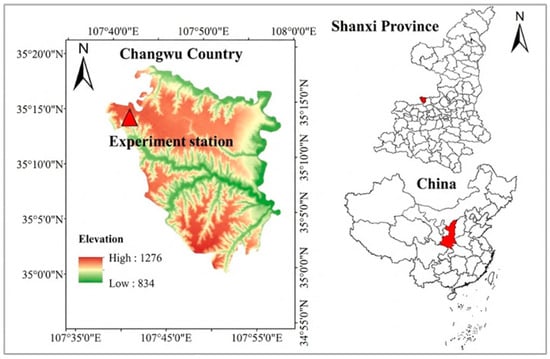
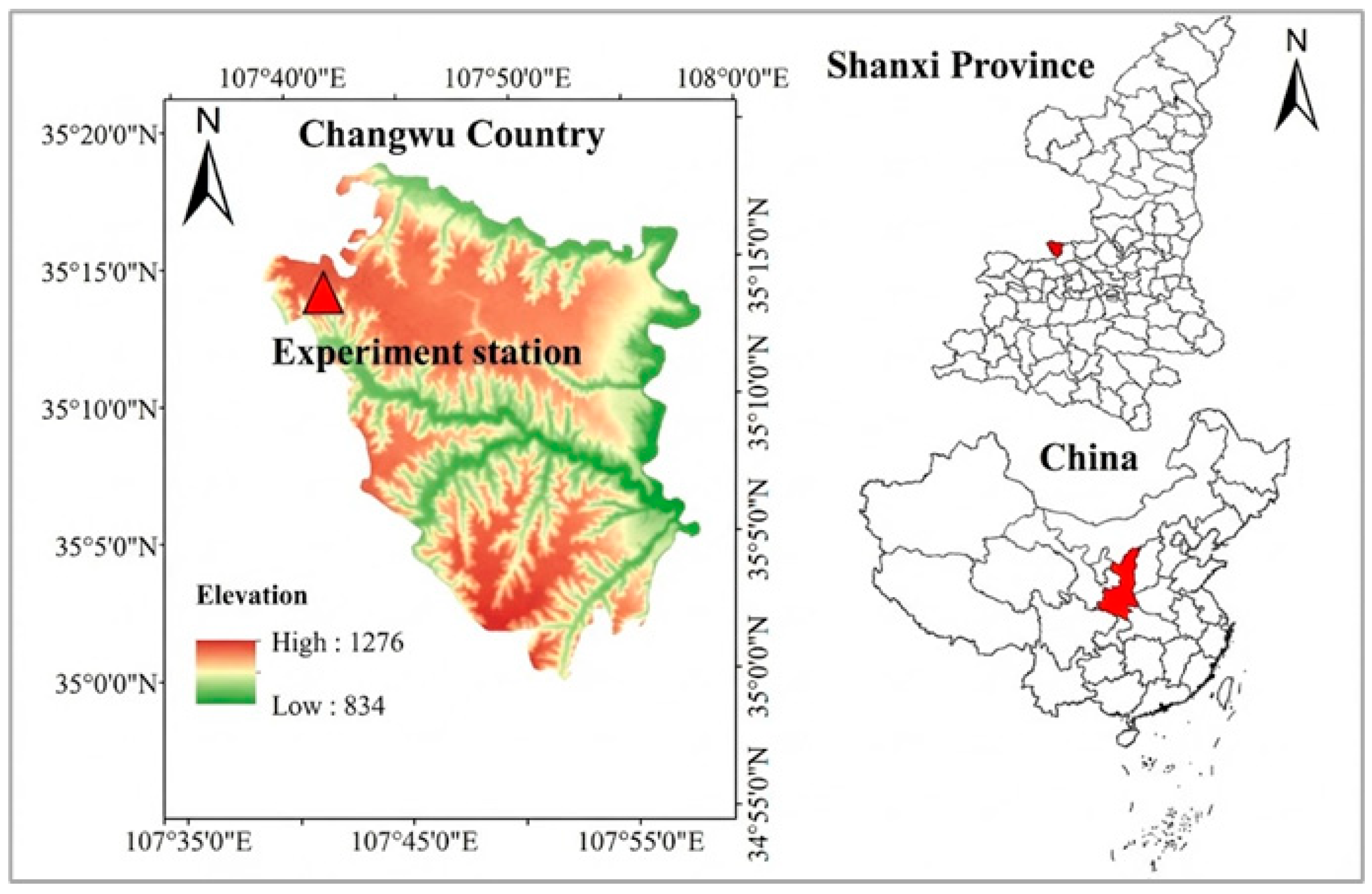
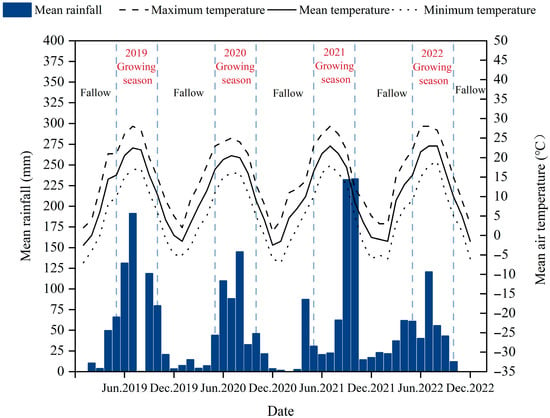
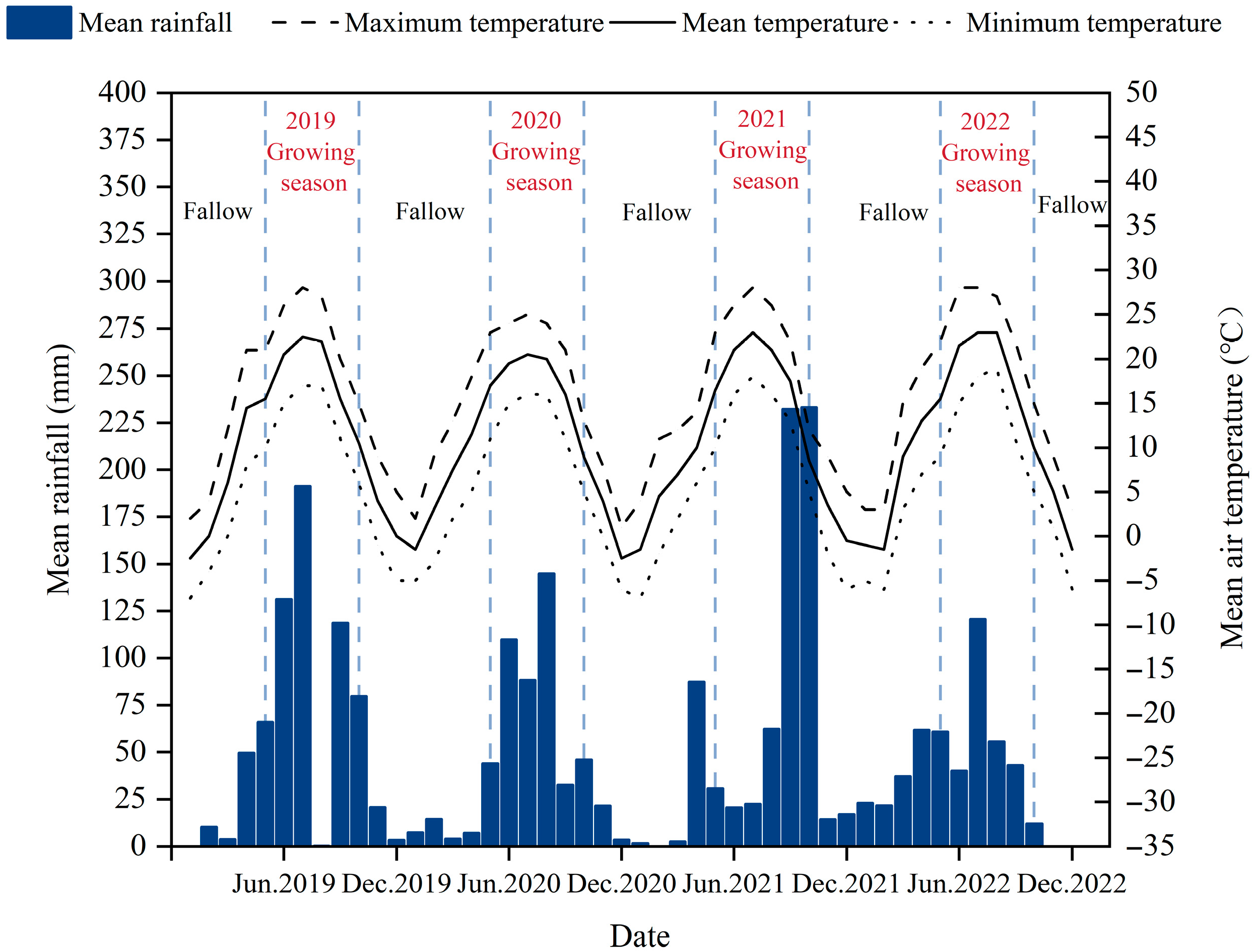
This experiment was conducted from 2019 to 2022 at the Changwu Ecological Agricultural Experimental Station (35°14′ N, 107°41′ E; 1200 m a.s.l.), located in Changwu County, Xianyang City, Shaanxi Province, China, within the Weibei Dry Plateau region of the Loess Plateau (Figure 1). The site has a warm-temperate, semi-humid continental monsoon climate. During the experimental period, the mean annual temperature was 10.74 °C and total annual rainfall precipitation was 598.93 mm, of which 496.33 mm occurred during the maize growing season (Figure 2). The frost-free period averaged 171 days.
Figure 1.
Geographic location of the Changwu Ecological Agricultural Experimental Station (35°14′ N, 107°41′ E; 1200 m a.s.l), situated in Changwu County, Xianyang City, Shaanxi Province, China.
Figure 2.
Total rainfall (mm), maximum temperature (°C), mean temperature (°C), and minimum temperature (°C) at the experimental site from 2019 to 2022.
Before the initiation of the experiment (2019), soil properties in the 0–20 cm layer included 7.60 g kg−1 soil organic carbon (SOC), 0.85 g kg−1 total nitrogen, a bulk density of 1.05 g cm−3, and a pH of 8.44. The soil is classified as Malan loess (medium loam texture), characterized by good permeability and water retention, and is widely cultivated across the Loess Plateau.
2.2. Experimental Design
The experiment employed a three-factor randomized complete block design with four replicates. The factors included mulching practice (two levels: no mulching and plastic film mulching), nitrogen fertilizer type (two levels: conventional urea and slow-release fertilizer), and nitrogen fertilizer rate (three levels: 125, 225, and 325 kg N ha−1), resulting in 12 treatments. Individual plot size was 4.3 m × 3.5 m. The treatments were flat cultivation with urea (NU), flat cultivation with slow-release fertilizer (NS), mulching with urea (PU), and mulching with slow-release fertilizer (PS).
The slow-release fertilizer was a dual-coated compound fertilizer (Shandong Linyi Woli Compound Fertilizer Co., Ltd.) consisting of an inner biological coating and an outer polymer coating designed to synchronize nutrient release with the crop demand. Its nutrient composition was 28% N, 6% P2O5, and 6% K2O (w/w). Conventional urea contained 46% N. According to product specifications, cumulative nutrient release at 25 °C was ≤15% within 24 h, ≤75% within 28 days, and ≥75% over the designated release period [30,31]. To maintain a consistent N: P2O5: K2O ratio across treatments, supplemental phosphorus and potassium were added to urea treatments to match the slow-release fertilizer nutrient proportions. Fertilizer inputs are detailed in Table S1. All fertilizers were applied as basal dressing before sowing, incorporated into the 0–20 cm soil layer through rotary tillage. The experimental field followed a continuous spring maize cropping system.
In late April each year, maize (cv. ‘Xianyu 335’) was sown at a density of 62,500 plants ha−1. In mulching treatments, the plots were covered with transparent polyethylene film (100 cm width, 0.1 mm thickness, non-perforated) before sowing. The film was laid flat, secured at the edges, and maize was manually planted through holes punched in the film. Maize was harvested in September, and the residual film was removed in October. The system was rainfed throughout the study. Herbicides and pesticides were applied only in the unmulched treatments as required.
2.3. Measurements and Calculations
2.3.1. Grain Yield
In each plot, 15 representative maize ears were randomly sampled to determine yield components (rows per ear, grains per row, and 100-grain weight), consistent with established regional protocols [10,13]. The 100-grain weight was measured after oven-drying the grains in a forced-air oven at 75 °C to a constant weight. The final grain yield was adjusted to 14% standard moisture content [9].
2.3.2. Life-Cycle Assessment
Environmental impacts were quantified using a cradle-to-farm-gate life-cycle assessment (LCA) approach. The system boundary included upstream processes (raw material extraction, fertilizer and film production, transportation) and on-farm operations (machinery use and field emissions). Indirect emissions were calculated by multiplying input quantities by localized emission factors. Grain yield was the functional unit, and no allocation was required.
Carbon (CFYield) and nitrogen (NFYield) footprints were calculated by normalizing total greenhouse gas (GHG) emissions and reactive nitrogen (RN) losses to grain yield. Emission factors were prioritized from localized studies in the Loess Plateau and national guidelines (including IPCC standards) to ensure regional relevance (Table S2).
Carbon Footprint
Greenhouse gas emissions included those from fertilizer production and transportation, mulch, diesel, direct and indirect emissions from nitrogen fertilizer, and decomposition of maize roots and stubble [32,33,34]. Key metrics included net GHG emissions (GHGNet, kg CO2-eq.kg ha−1), total GHG emissions (GHGTotal, kg CO2-eq.kg ha−1), emissions from nitrogen fertilizer application (GHGN, kg CO2-eq.kg ha−1), emissions from maize roots (GHGR, kg CO2-eq.kg ha−1), changes in emissions from organic carbon storage (GHGSOC, kg CO2-eq.kg ha−1), and carbon footprint per unit of yield (CFYield, kg CO2-eq.kg−1), calculated as follows:
where NF and NR represent the quantity of N applied as inorganic fertilizer (kg N ha−1) and maize residue nitrogen (kg N ha−1). In and EFn represent agricultural inputs and emission factors during maize production (Tables S1 and S2). The emission factors and coefficients were prioritized from localized studies in the Loess Plateau or national standards (IPCC) to ensure regional relevance. Direct N2O emissions from nitrogen fertilizer were calculated by multiplying nitrogen application rates by specific emission factors (EFFN). The base emission factor for urea (EFFN-Urea) was rectified using total precipitation during the maize growing period (P) as 0.0186 × P kg N2O-N kg−1 [35]. For treatments using slow-release fertilizer, a specialized emission factor (EFFN-SRF) was applied, calculated as 42.51% of the urea-based factor (0.4251 × EFFN-UREA, kg N2O-N kg−1) [36]. Fracvol represents the fraction of fertilizer nitrogen volatilized as NH3-N and NOx-N, while Fracleach represents the fraction of fertilizer and maize residue nitrogen for NO3− leaching; EFvol and EFleach represent N2O emission factor for volatilized NH3-N and NOx-N and nitrate leaching; the above values related to volatilization and leaching, as well as the corresponding references, were all shown in Table S2. EFRN represents the emission factor for maize residue nitrogen (0.0059 P, kg N kg−1) [37], SOC2022 and SOC2019 represent soil organic carbon content (0–40 cm) in 2022 and 2019, respectively, which were determined using the potassium dichromate (K2Cr2O7) oxidation method. In this study, 44/28 is the conversion coefficient (N2O-N to N2O), 44/12 is the carbon conversion coefficient (CO2 to organic carbon), 298 is the global warming potential for N2O for 100 years [38], h is soil depth (m), and ρ is soil bulk density (g cm−3).
Nitrogen Footprint
Nitrogen loss components included NH3 volatilization, direct emission of N2O, and NO3− and NH4+ leaching. Metrics were calculated using established formulas [39]. Key metrics included RN losses (kg N-eq ha−1), RN losses due to volatilization of nitrogen fertilizer (N-NH3, kg N-eq ha−1), RN losses due to N2O emissions (N-N2O, kg N-eq ha−1), RN losses due to NO3−-N leaching (N-NO3−, kg N-eq ha−1), RN losses due to NH4+-N leaching (N-NH4+, kg N-eq ha−1), and the nitrogen footprint per unit of yield (NFYield, kg N Mg−1) can be calculated using the following formulas:
where NFn represents RNLoss per unit of agricultural input (10−3 kg N unit−1). NF represents the quantity of N applied as inorganic fertilizer (kg N ha−1). TotalN2O is calculated according to Yue et al. [40]. Temp means the annual average temperature (°C); Clay indicates the fraction of clay (%). FracvolNH3, FracleachNO3− and FracleachNH4+ represent the fraction of RNLoss volatilized as NH3-N, RNLoss for NO3− leaching, and RNLoss for nitrate leaching; NFvol and NFleach represent reactive nitrogen loss coefficients for volatilized NH3-N and nitrate leaching; the above values related to volatilization and leaching, as well as the corresponding references, were all shown in Table S2. 17/14, 44/28, 62/14, and 18/14 are conversion factors for N-NH3, N-N2O, N-NO3−, and N-NH4+, respectively. Slow-release fertilizers can significantly reduce nitrogen oxide emissions, nitrogen leaching, and ammonia volatilization by 23.8%, 27.1%, and 39.4%, respectively [41]. Other factors and coefficients are detailed in Table S2.
2.3.3. Energy Use Efficiency
Energy inputs comprised direct (e.g., diesel and labor) and indirect sources (e.g., fertilizers, mulch). Outputs included energy from grain and stalks. Renewable (e.g., labor, seeds) and non-renewable inputs (e.g., diesel, fertilizers) were categorized. Key metrics include net output energy (NE, 10−3 MJ ha−1) and energy use efficiency (EUE, kg MJ−1), calculated as follows:
where Oe and Ie represent the total output and input energies of the agricultural production system, respectively. Conversion factors for input and output materials are detailed in Table S3.
2.3.4. Net Ecosystem Economic Benefits
The net ecosystem economic benefit (NEEB) was calculated on agricultural input costs, carbon emission costs, and income from food production [42]. Key metrics included NEEB (CNY ha−1 year−1), carbon footprint per unit of NEEB (CFNEEB, kg CO2-eq.CNY−1 year−1), and nitrogen footprint per unit of NEEB (NFNEEB, kg N CNY−1 year−1), calculated as follows:
where GR represents the benefits obtained from food production, AIcost represents the costs generated by fertilizers and films invested in agricultural production (see Tables S1 and S4 for related inputs and prices), and GHGcost represents the costs generated by carbon emissions (carbon trading price multiplied by GHG emissions).
2.4. Statistical Analysis
Statistical analyses and data visualization were conducted to evaluate the effects of nitrogen management on crop productivity and environmental indicators. Analysis of variance (ANOVA) was performed with SPSS 22.0 (IBM, Chicago, IL, USA), and the least significant difference (LSD) method was employed for multiple comparisons among treatment means at a significance level of p < 0.05. Other figures, including treatment comparisons and trend analyses, were generated using Origin 2018 (Origin Lab, Northampton, MA, USA). The study site map and geographical distributions were created using ArcGIS 10.8 (ESRI, Redlands, CA, USA).
3. Results
3.1. Maize Grain Yield
The precipitation in this region from 2019 to 2022 was primarily concentrated between May and October, aligning with the growing season of local spring maize. July recorded the highest average temperature, ranging from 20.5 °C (2020) to 23.0 °C (2021 and 2022). Among these years, 2021 experienced the highest average rainfall (723.5 mm), while 2022 had the lowest rainfall (475.4 mm) and the highest average temperature (11.0 °C). The rainfall trends during the growing season were consistent with these annual variations (Figure 2). Planting year, nitrogen application rate, film mulching, and fertilizer type significantly affected grain yield. Additionally, significant interaction effects occurred for planting year × fertilizer type, planting year × film mulching, and nitrogen application rate × fertilizer type, but not for film mulching × nitrogen application rate × fertilizer type (Table S5).
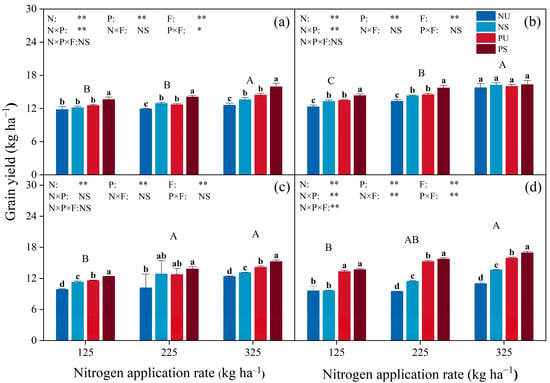
Over four years, after film mulching (PU and PS), the average grain yield under different nitrogen application rates increased significantly by 13.69–20.40% compared to traditional flat cultivation (NU and NS). Application of slow-release fertilizers (NS and PS) increased grain yield by 6.03–14.12% compared to urea (NU and PU). Among treatments, the PS treatment produced the highest grain yields under varying nitrogen application rates (125, 225, and 325 kg ha−1), with increases by 6.03–23.55%, 8.12–30.17%, and 6.46–24.14%, respectively. This indicates that the combination of slow-release fertilizer and film mulching is particularly effective for boosting yield. For PS treatment, when nitrogen was applied at 225 kg ha−1, the yield decreased by 8.17% compared with 325 kg ha−1 but increased by 9.52% compared to 125 kg ha−1 (Figure 3).
Figure 3.
Grain yield (kg ha−1) under different mulching and fertilizer treatments (NU: flat cultivation with urea; NS: flat cultivation with slow-release fertilizer; PU: mulching cultivation with urea; PS: mulching cultivation with slow-release fertilizer) from 2019 to 2022 (a–d). Error bars indicate standard deviations of the mean (n = 4). Lowercase letters indicate significant differences among treatments at the same nitrogen application rate; uppercase letters indicate significant differences across all treatments and nitrogen application rates (p < 0.05). N: nitrogen application rate (125, 225, and 325 kg ha−1); P: plastic film mulching or no mulching; F: different fertilizer types (urea or slow-release fertilizer). ** Significant difference at 0.01 level; * Significant difference at 0.05 level; NS: no significant difference.
3.2. Average Total Greenhouse Gas Emissions and Reactive Nitrogen Losses
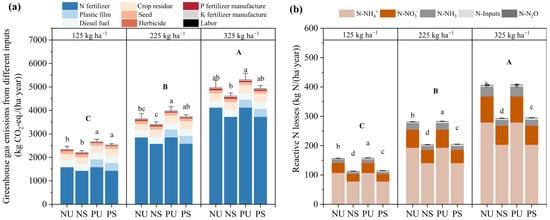
Over a four-year average, total greenhouse gas (GHGTotal) emissions after film mulching increased by 6.64–14.68% compared to traditional flat cultivation under varying nitrogen application rates. However, when slow-release fertilizer was used, GHGTotal emissions decreased by 5.02–7.35% compared to urea. Compared to PU, GHGTotal emissions from PS decreased by 5.02%, 6.20%, and 6.99% under varying nitrogen application rates. A significant increase in GHGTotal was observed as nitrogen application rates increased across all treatments (NU, NS, PU, and PS), while a reduction of 24.39% in GHGTotal was noted when the nitrogen application rate was reduced to 225 kg ha−1 compared to 325 kg ha−1. Among all agricultural inputs, nitrogen fertilizer accounted for the largest share of GHGTotal emissions, ranging from 56.12 to 84.11%, due to its production, transportation, and application processes (Figure 4a). The use of slow-release fertilizer instead of urea reduced GHGTotal emissions associated with nitrogen fertilizers by 90.54–592.72 kg CO2-eq ha−1 under varying nitrogen application rates over the four years.
Figure 4.
(a) Average total greenhouse gas emissions (GHGTotal, kg CO2-eq.kg−1 ha−1) and (b) reactive nitrogen (RN) losses due to NH4+-N leaching (N-NH4+, kg N-eq ha−1), NO3−-N leaching (N-NO3−, kg N-eq ha−1), NH3 volatilization (N-NH3, kg N-eq ha−1), N2O emissions (N-N2O, kg N-eq ha−1), agricultural inputs (N-inputs, kg N-eq ha−1), and total RN losses (RNLoss, kg N-eq ha−1) under different mulching and fertilizer treatments (NU: flat cultivation with urea; NS: flat cultivation with slow-release fertilizer; PU: mulching cultivation with urea; PS: mulching cultivation with slow-release fertilizer) from 2019 to 2022. Error bars indicate standard deviations of the mean (n = 4). Lowercase letters indicate significant differences among treatments at the same nitrogen application rate; uppercase letters indicate significant differences across all treatments and nitrogen application rates (p < 0.05).
Reactive nitrogen losses also varied with nitrogen application rates. Over a four-year average, film mulching increased RN losses by 0.97–13.40% compared to flat cultivation, but decreased them by 27.50–27.81% when slow-release fertilizer was used instead of urea. Compared with PU, the RN losses of PS decreased by 27.50%, 27.65%, and 27.71% under varying nitrogen application rates of 125, 225, and 325 kg ha−1. As nitrogen application rates increased, the RN losses rose significantly across all treatments. Specifically, at 225 kg ha−1, the RN losses of PS were reduced by 30.58% compared to 325 kg ha−1 (Figure 4b). The study also revealed that nitrogen leaching and ammonia volatilization accounted for 89.55–91.50% and 6.68–8.09% of total RN losses, respectively. Among nitrogen-leaching components, NH4+ contributed the largest amount, while ammonia volatilization was second only to NO3− leaching. Compared to urea, slow-release fertilizer reduced the total nitrogen leaching and ammonia volatilization by 43.36–112.74 kg N ha−1 year−1 (Figure 4b).
3.3. Carbon Footprint and Nitrogen Footprint
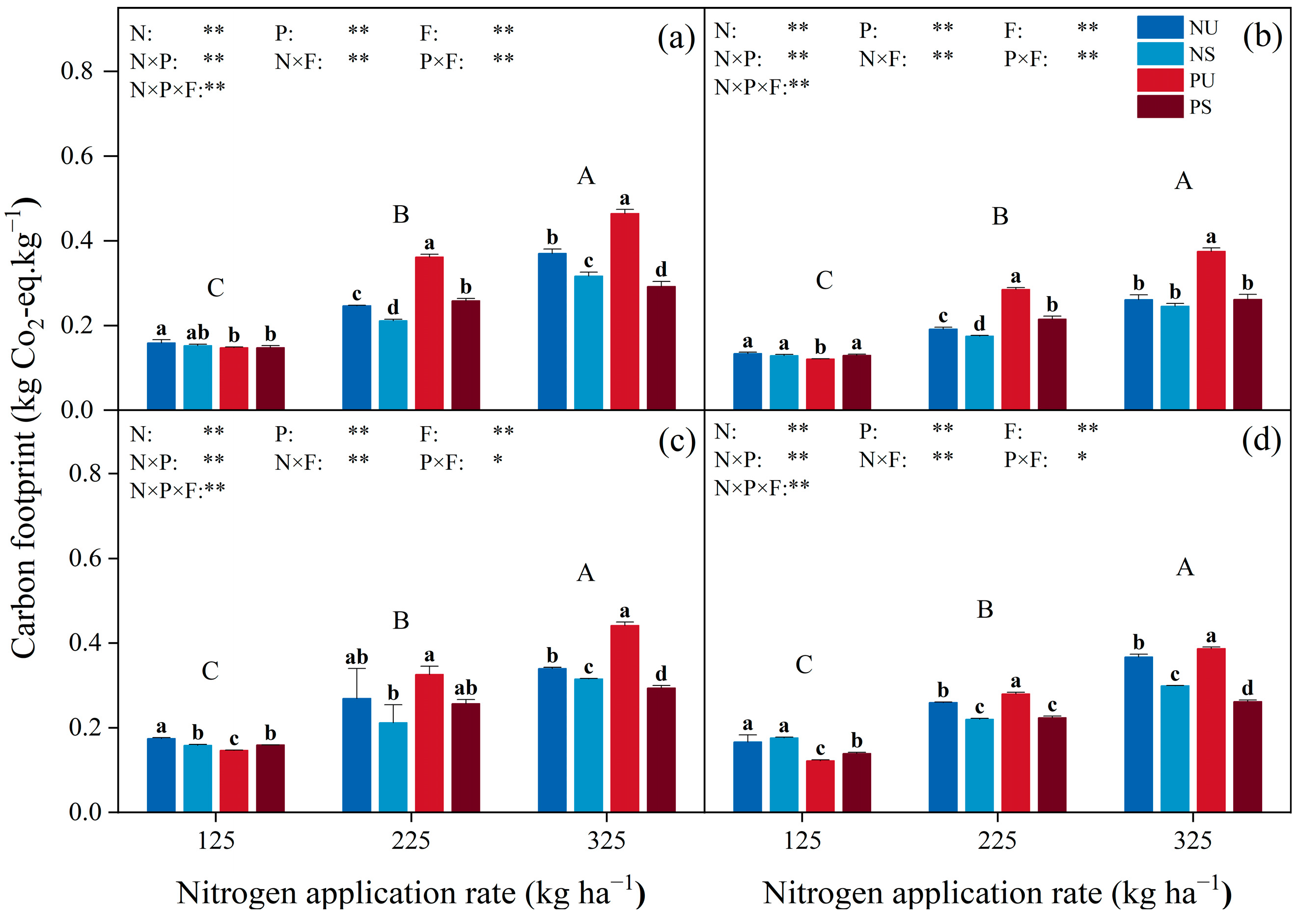
Planting years, nitrogen application rates, film mulching, fertilizer types, and interactions significantly influenced the carbon footprint (CFYield) (p < 0.05) (Table S5). Over a four-year average, the CFYield of PU at a nitrogen application rate of 125 kg ha−1 was the lowest, showing no significant difference from PS. At 225 kg ha−1, the CFYield of PU was the highest, while the CFYield of PS was significantly reduced by 23.86% compared to PU. At 325 kg ha−1, PS exhibited the lowest CFYield, with no significant difference from NS. Notably, CFYield increased significantly with higher nitrogen application rates. At 325 kg ha−1, the CFYield rose by 38.67–110.04%, 36.95–81.70%, 29.01–206.81%, and 13.27–90.55% in the NU, NS, PU, and PS treatments, respectively, compared to 125 and 225 kg ha−1. For PS, reducing the nitrogen application rate from 325 kg ha−1 to 225 kg ha−1 decreased CFYield by 14.06% (Figure 5).
Figure 5.
Carbon footprint (CFYield, kg CO2-eq.kg−1) for various mulching and fertilizer treatments (NU: flat cultivation with urea; NS: flat cultivation with slow-release fertilizer; PU: mulching cultivation with urea; PS: mulching cultivation with slow-release fertilizer) from 2019 to 2022 (a–d). Error bars indicate standard deviations of the mean (n = 4). Lowercase letters indicate significant differences among treatments at the same nitrogen application rate; uppercase letters indicate significant differences across all treatments and nitrogen application rates (p < 0.05). N: nitrogen application rate (125, 225, and 325 kg ha−1); P: plastic film mulching or no mulching; F: different fertilizer types (urea or slow-release fertilizer). ** Significant difference at 0.01 level; * Significant difference at 0.05 level; NS: no significant difference.
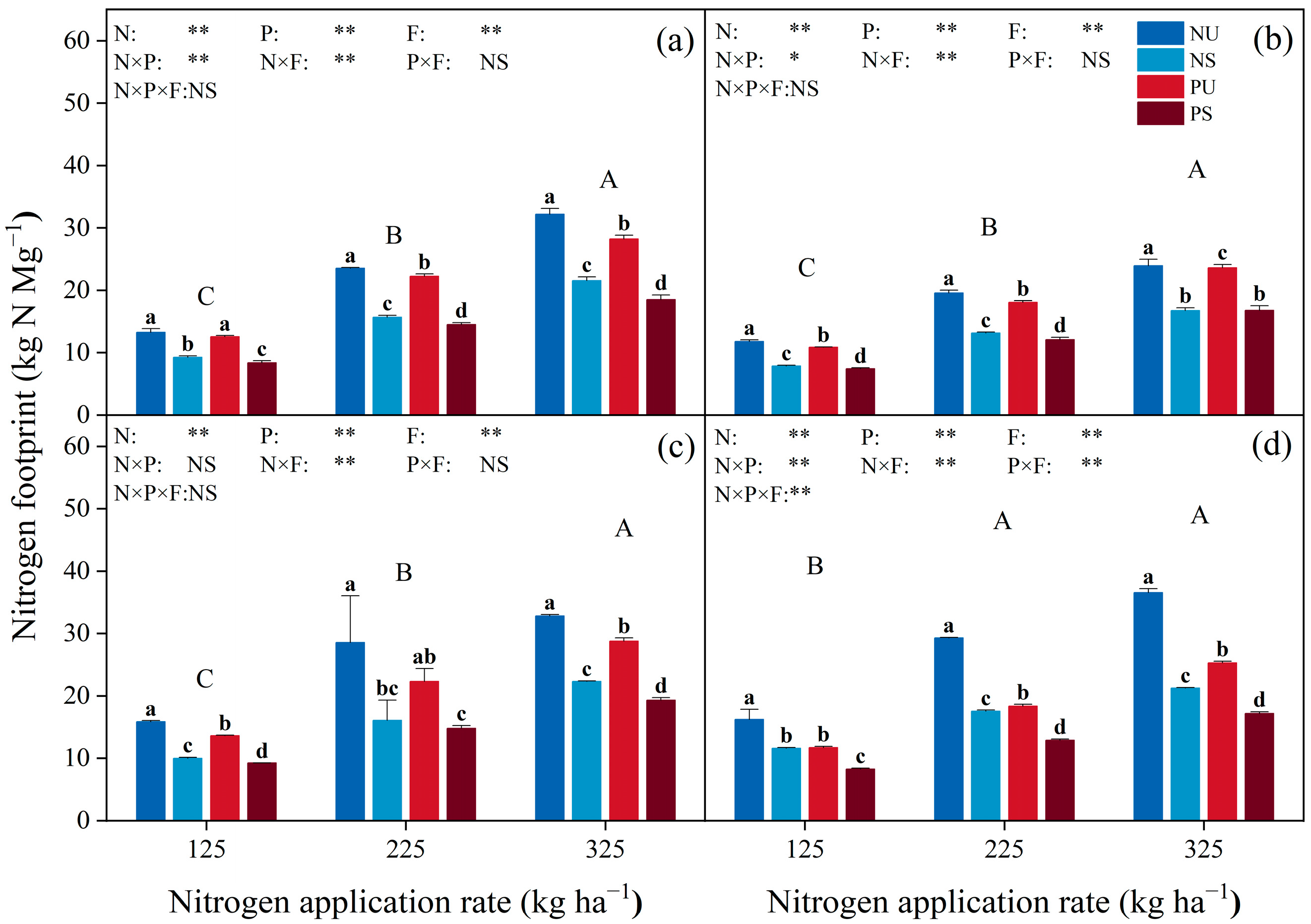
Similarly, nitrogen footprint (NFYield) was significantly (p < 0.05) affected by planting years, different nitrogen application rates, film mulching, fertilizer types, and their interactions (Table S5). Over four years, PS had the lowest NFYield across nitrogen application rates, showing no significant difference from NS. Compared to PU, PS reduced NFYield by 31.59%, 32.99%, and 32.17% under 125, 225, and 325 kg ha−1, respectively. NFYield increased significantly with an increase in nitrogen application rates, with 325 kg ha−1 showing a sharp increase of 25.30–119.61%, 30.58–110.60%, 30.31–117.10%, and 31.90–115.24% in the NU, NS, PU, and PS treatments. For PS, reducing the nitrogen application rate from 325 kg ha−1 to 225 kg ha−1 decreased NFYield by 24.18% (Figure 6).
Figure 6.
Nitrogen footprint (NFYield, kg N Mg−1) for various mulching and fertilizer treatments (NU: flat cultivation with urea; NS: flat cultivation with slow-release fertilizer; PU: mulching cultivation with urea; PS: mulching cultivation with slow-release fertilizer) from 2019 to 2022 (a–d). Error bars indicate standard deviations of the mean (n = 4). Lowercase letters indicate significant differences among treatments at the same nitrogen application rate; uppercase letters indicate significant differences across all treatments and nitrogen application rates (p < 0.05). N: nitrogen application rate (125, 225, and 325 kg ha−1); P: plastic film mulching or no mulching; F: different fertilizer types (urea or slow-release fertilizer). ** Significant difference at 0.01 level; * Significant difference at 0.05 level; NS: no significant difference.
3.4. Production Cost and Net Ecosystem Economic Benefits
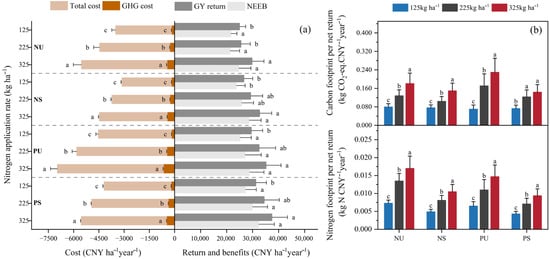
Planting years, nitrogen application rates, film mulching, and fertilizer types significantly impacted NEEB, CFNEEB, and NFNEEB (Table S5). Over a four-year average, the total cost of PS, including agricultural carbon emissions, was reduced by 8.49–19.46% compared to PU under varying nitrogen application rates. Reducing the nitrogen application rate from 325 kg ha−1 to 225 kg ha−1 lowered the total cost by 10.29%. The NEEB for PU and PS increased by 12.80–27.02% compared to NU and NS, and by 8.24–20.90% compared to NU and PU when slow-release fertilizer was used (NS and PS) under 125, 225, 325 kg ha−1. Furthermore, increasing nitrogen application rates increased NEEB across treatments (Figure 7a).
Figure 7.
(a) Total costs from fertilizers and film inputs (Total cost, CNY ha−1 year−1), greenhouse gas-related costs (GHG cost, CNY ha−1 year−1), economic returns from grain yield (GY return, CNY ha−1 year−1), and net ecosystem economic benefit (NEEB, CNY ha−1 year−1), and (b) carbon footprint per net return (kg CO2-eq. CNY−1 year−1) and nitrogen footprint per net return (kg N CNY−1 year−1) under different mulching and fertilizer treatments (NU: flat cultivation with urea; NS: flat cultivation with slow-release fertilizer; PU: mulching cultivation with urea; PS: mulching cultivation with slow-release fertilizer) from 2019 to 2022. Error bars indicate standard deviations of the mean (n = 4). Lowercase letters indicate significant differences across nitrogen application rates for each treatment (p < 0.05).
Combining NEEB with GHGNet emissions and RN losses, the CFNEEB of each treatment at 125 kg ha−1 did not significantly differ, but the NFNEEB declined by 41.10%, 12.24%, and 33.85%, respectively, under PS compared to NU, NS, and PS. Compared to PU, under 225 kg ha−1 and 325 kg ha−1, the CFNEEB for PS significantly declined by 27.86% and 37.28%, respectively, and the NFNEEB reduced by 35.45% and 36.05%, respectively. The CFNEEB and NFNEEB increased significantly with increasing nitrogen application rate. However, reducing the nitrogen application rate from 325 kg ha−1 to 225 kg ha−1 decreased CFNEEB and NFNEEB by 14.36% and 25.17%, respectively (Figure 7b).
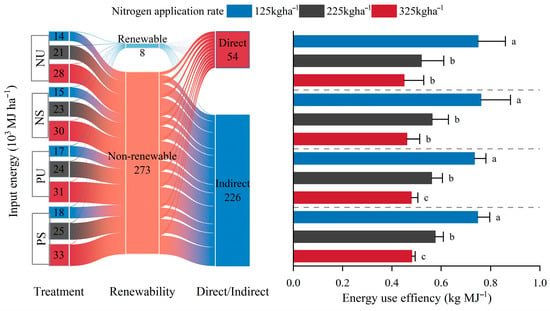
3.5. Energy Flow and Energy Use Efficiency
Among the various sources of energy input, fertilizer contributed the largest share, accounting for 51.48–81.61%, followed by diesel at 12.64–31.99%. Most of the energy input in the treatment came from non-renewable energy, predominantly indirect energy. Increases in nitrogen application rates, film mulching, and the use of slow-release fertilizer further elevated the proportion of indirect non-renewable energy consumption. The net energy output was highest for PS under 125, 225, and 325 kg ha−1, increasing by 17.83–50.23% compared to other treatments. Net energy output also increased with higher nitrogen rates. In terms of EUE, a gradual decline was observed across treatments as nitrogen application rates increased. NU and NS had no significant difference between 225 kg ha−1 and 325 kg ha−1, but were notably less efficient than at 125 kg ha−1. The EUE of PU and PS at 225 kg ha−1 performed significantly better than at 325 kg ha−1 (by 17.31% and 19.81%, respectively), and PS achieved 2.58% higher EUE than PU (Figure 8).
Figure 8.
Average energy flow of input energy (Ie, 10−3 MJ ha−1) and energy use efficiency (EUE, kg MJ−1) for various mulching and fertilizer treatments (NU: flat cultivation with urea; NS: flat cultivation with slow-release fertilizer; PU: mulching cultivation with urea; PS: mulching cultivation with slow-release fertilizer) from 2019 to 2022. Error bars indicate standard deviations of the mean (n = 4). Lowercase letters indicate significant differences across different nitrogen application rates for each treatment (p < 0.05).
4. Discussion
4.1. Effect of Film Mulching and Nitrogen Fertilizer Management on Maize Yield
Consistent with its established role in soil water conservation and growth promotion [43], transparent film flat cultivation significantly enhanced grain yield by 13.69–20.40% relative to traditional methods (Figure 3). However, limited rainfall during the early growing season constrains nitrogen uptake, while nitrogen demand increases during later stages. Conventional urea applications fail to meet these dynamic needs [44,45]. Moreover, previous research has indicated that fertilizer application can significantly enhance the diversity and richness of soil bacteria, thereby fostering a more robust microbial community to support crop growth [46]. In our study, although microbial dynamics were not directly measured, it is inferred that the controlled-release mechanism of slow-release fertilizers likely provided a stable nutrient environment that favors microbial proliferation, aligning better with crop uptake patterns and significantly enhancing maize yields [47,48]. This enhancement may be further attributed to the reduction of nitrogen losses via ammonia volatilization and nitrogen leaching while potentially improving enzymatic activity related to carbon and nitrogen metabolism. These benefits are suggested to enhance net photosynthesis, increasing biomass and nitrogen accumulation [49,50,51].
Previous studies have also shown that higher nitrogen rates from slow-release fertilizers can increase grain number and weight [48,52], consistent with our findings (Table S6). However, additional N inputs no longer significantly enhance biomass or grain number, as the photosynthetic machinery and sink capacity become limited by other factors rather than N availability [22,48]. Consequently, the diminishing marginal returns at higher N rates indicate that the extra fertilizer primarily accumulates in the soil profile instead of contributing to grain formation. Furthermore, despite these productivity gains, the long-term sustainability of film mulching remains a concern. Beyond the immediate hydrothermal benefits, the accumulation of plastic film residues in the soil can lead to degraded soil structure and hindered root penetration, potentially offsetting yield benefits over time [13,16].
4.2. Effect of Film Mulching and Nitrogen Fertilizer Management on Total Greenhouse Gas Emissions and Carbon Footprint
In this study, GHGTotal emissions from mulched maize fields with optimal nitrogen fertilizer ranged from 2107.99 to 5687.52 kg CO2-eq ha−1 year−1 (Figure 4a), while the CFYield ranged from 0.13 to 0.47 kg CO2-eq kg−1 (Figure 5). These values are lower than those reported for rainfed maize in the same region [53,54], highlighting the potential of nitrogen fertilizer management to mitigate GHGTotal emissions from mulched maize fields in the Loess Plateau region.
Nitrogen fertilizer production and application contributed the most to total emissions (Figure 4a), as reported in other studies [39,55], reinforcing the importance of optimizing nitrogen inputs. In our study, we observed that slow-release fertilizer can effectively reduce emissions under film mulching, particularly when nitrogen application is optimized [26,56]. Our results further showed that slow-release fertilizer improved soil organic matter, total nitrogen [57], and soil organic carbon (SOC) storage compared to urea [8,21,58]. This improvement is likely due to their controlled release supporting higher biomass production; specifically, it can be inferred that greater root biomass contributes to more root residues to the soil, enhancing SOC [59]. In addition, slow-release fertilizers likely create favorable conditions for microbial activity, further stabilizing organic matter and promoting SOC accumulation [60,61]. While we observed a tradeoff where higher nitrogen inputs—while increasing SOC—also resulted in higher GHG emissions due to production-related emissions of fertilizer [55,62]. Our data supported that SOC sequestration under PS at 225 kg ha−1 was 57.19% lower than at 325 kg ha−1, but GHGTotal emissions were also lower (Figure 4a), demonstrating the importance of balancing soil health improvements with emission reductions [57,63].
4.3. Effect of Film Mulching and Nitrogen Fertilizer Management on Reactive Nitrogen Losses and Nitrogen Footprint
Reducing nitrogen losses is crucial for minimizing environmental and human health risks [64]. Our results show that using slow-release fertilizer reduced RN losses across all nitrogen rates, with PS treatments exhibiting the lowest NFYield (Figure 4b and Figure 6). This improvement is attributed to the delayed hydrolysis of nitrogen in slow-release fertilizer, which curtails rapid nutrient losses [63,65]. Compared to urea, slow-release fertilizer reduced nitrogen leaching and ammonia volatilization in our study (Figure 4b), consistent with previous findings [66]. The gradual nutrient release from slow-release fertilizer reduces soil nitrogen concentrations, minimizing ammonia volatilization [67], suppresses nitrification and denitrification rates, lowering N2O emissions [68], and limits nitrogen leaching by synchronizing release with crop demand. Additionally, the granule structure and coatings of slow-release fertilizers help further reduce leaching losses [69].
Furthermore, replacing urea with slow-release fertilizers has been shown to mitigate nitrogen leaching and ammonia volatilization while maintaining crop requirements at reduced application rates [23,70]. Beyond specialized formulations, broader precision nutrient management strategies—such as site-specific diagnostic tools and tailored fertilizers—are essential for synchronizing nutrient supply with crop demand [71]. By optimizing these inputs, nitrogen losses are minimized, directly addressing the primary driver of agricultural N2O emissions [72,73]. Our study also found that RN losses and NFYield increased as the nitrogen application rate rose (Figure 4b and Figure 6). This aligns with other research showing that ammonia volatilization, N2O emission, and N leaching are often linearly or exponentially correlated with nitrogen fertilization rates, providing valuable insights for determining optimal nitrogen application rates [74,75]. While sustained high N inputs—even via slow-release fertilizers—risk soil acidification and nitrate leaching [63], reducing the application rate from 325 to 225 kg ha−1 in this study lowered nitrogen loss and footprint by 30.58% and 24.18%, respectively (Figure 4b and Figure 6). Such reductions are essential for mitigating the ecological impact of intensive agriculture and advancing sustainable intensification.
4.4. Effect of Film Mulching and Nitrogen Fertilizer Management on Net Ecosystem Economic Benefits and Energy Use Efficiency
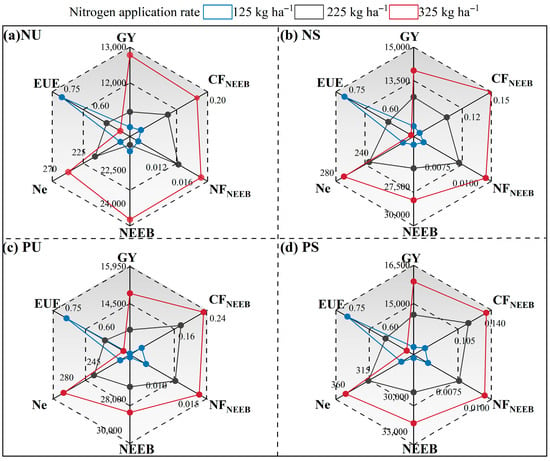
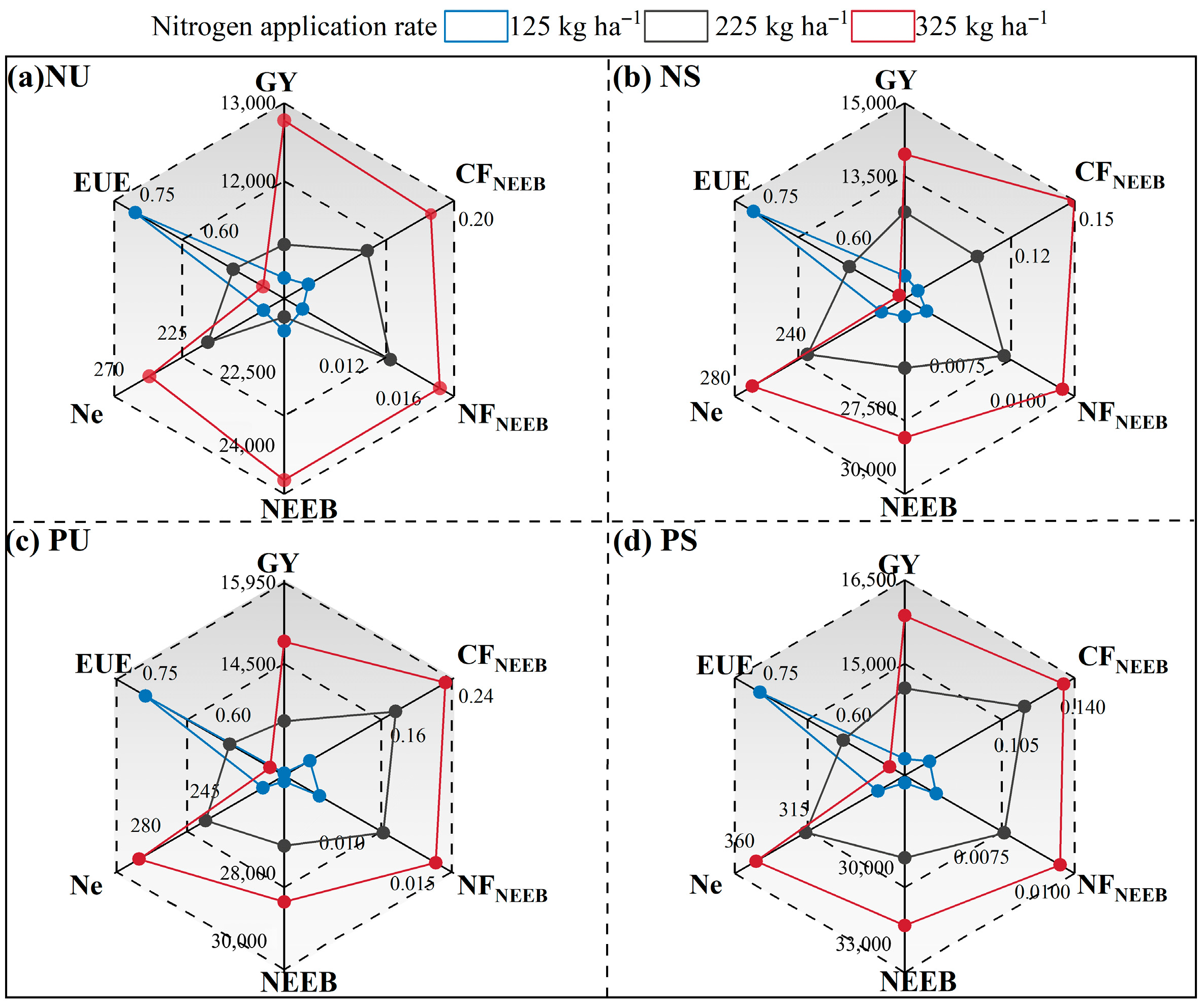
Film mulching practices have been shown to increase ecological and economic costs associated with carbon emissions compared to flat cultivation [76]. Furthermore, factors such as labor costs, technological access, and market price influence the feasibility of slow-release fertilizers adoption. Reducing fertilizer inputs to minimize GHGTotal emissions and RN losses is only feasible if economic returns are maintained [77]. In this study, we found that slow-release fertilizer under film mulching can reduce emissions and improve economic returns (Figure 4a and Figure 7a). In addition, this approach not only helped sustain yields but also reduced energy waste, demonstrating the potential to produce more food with less energy input (Figure 8 and Figure 9). However, the holistic environmental cost should also account for the ecological risks of plastic residues. While film mulching improves energy use efficiency, the potential for long-term soil degradation and microplastic pollution necessitates the exploration of biodegradable films to ensure the system’s future sustainability [13,76].
Figure 9.
Radar chart showing the effects of different mulching and fertilizer treatments. (a) NU: flat cultivation with urea; (b) NS: flat cultivation with slow-release fertilizer; (c) PU: mulching cultivation with urea; (d) PS: mulching cultivation with slow-release fertilizer on average maize yield (GY, kg ha−1), average net ecosystem economic benefit (NEEB, CNY ha−1 year−1), average GHGNet emissions per unit of NEEB (CFNEEB, kg CO2-eq. CNY−1 year−1), average reactive nitrogen losses per unit of NEEB (NFNEEB, kg N CNY−1 year−1), average net output energy (Ne, 10−3 MJ ha−1), and average energy use efficiency (EUE, kg MJ−1) from 2019 to 2022.
While net economic and ecological benefit effectively quantifies sustainability trade-offs, these results are sensitive to market volatility and regional policy frameworks. Our findings—anchored in current local input costs and grain prices—remain subject to fluctuations in fertilizer premiums and commodity markets. Furthermore, the integration of government subsidies or carbon pricing could significantly shift the cost–benefit equilibrium. Consequently, while mulching with slow-release fertilizer at 225 kg ha−1 provides a robust benchmark for the Loess Plateau, these economic outcomes should be interpreted as dynamic, scenario-dependent indicators rather than fixed parameters.
4.5. Limitations
Several uncertainties warrant consideration. First, life-cycle assessment results depend on emission factors, which may vary across years and climatic conditions. Second, long-term impacts of plastic film residues on soil structure, microbial communities, and ecosystem functioning were not quantified. Third, these findings are specific to the semi-arid soils of the study region; extrapolation to regions with different rainfall regimes or soil textures should be undertaken cautiously. Future research should prioritize long-term monitoring of SOC dynamics, in situ GHG flux measurements, and evaluation of biodegradable mulching alternatives to ensure that productivity gains do not compromise soil resilience.
5. Conclusions
This study demonstrates that integrating plastic film mulching with optimized nitrogen management can substantially improve the environmental and economic performance of rainfed maize systems in the Loess Plateau. Replacing conventional urea with slow-release fertilizer at 225 kg N ha−1 achieved the most favorable balance among yield, greenhouse gas mitigation, reactive nitrogen reduction, energy efficiency, and net ecosystem economic benefit. Increasing nitrogen to 325 kg ha−1 provided limited additional yield but significantly elevated carbon and nitrogen footprints, highlighting the inefficiency of high-input strategies. Future research should focus on overcoming current measurement limitations by developing robust monitoring technologies to quantify soil carbon sequestration and respiration fluxes more accurately, thereby enhancing the precision of environmental assessments in agroecosystems.
Supplementary Materials
The following supporting information can be downloaded at: https://www.mdpi.com/article/10.3390/agriculture16050532/s1, Table S1: Average agricultural inputs (kg·ha–1·year–1) for different mulch and fertilizer type practices in the 2019–2022 spring maize growing seasons on the Loess Plateau; Table S2: Greenhouse gas emissions and reactive nitrogen loss coefficients for agricultural inputs; Table S3: Energy equivalents of inputs and outputs in agricultural production system; Table S4: Average price of agricultural inputs and maize grain from 2019–2022; Table S5: Multivariate analysis of variance results; Table S6: Effects of different testing factors on yield and yield components [20,38,74,78,79,80,81,82,83,84,85,86,87,88,89,90,91,92,93,94].
Author Contributions
Conceptualization, X.Q.; Methodology, Y.C., M.F. and K.H.M.S.; Validation, P.D., M.Z. and L.L.; Formal analysis, X.H. and C.X.; Data curation, X.H. and C.X.; Writing—review & editing, Y.C., M.F., K.H.M.S., P.D., M.Z., L.L., L.Z., S.W., X.P. and X.Q.; Visualization, X.H. and C.X.; Supervision, X.Q. Funding acquisition, X.Q. All authors have read and agreed to the published version of the manuscript.
Funding
The funds were supported by the National Natural Science Foundation of China (No. 32071980), the Key Projects of Shaanxi Agricultural Collaborative Innovation and Extension Alliance (LMZD202201), and the Key R&D Project in Shaanxi Province (2021LLRH-07).
Data Availability Statement
The raw data supporting the conclusions of this article will be made available by the authors on request.
Acknowledgments
We are grateful to Xiaoliang Qin for his invaluable assistance in the management and smooth execution of the experimental project. We also extend our thanks to our senior colleagues for their contributions to data analysis, curation, and writing support. Additionally, we acknowledge all friends and colleagues who contributed in various ways but are not listed as authors.
Conflicts of Interest
The authors declare that the research was conducted in the absence of any commercial or financial relationships that could be construed as a potential conflict of interest.
References
- Hu, J.; Dong, J.; Xu, D.; Yang, Q.; Liang, J.; Li, N.; Wang, H. Trends in Global Agricultural Carbon Emission Research: A Bibliometric Analysis. Agronomy 2024, 14, 2617. [Google Scholar] [CrossRef] [Scilit]
- Laborde, D.; Mamun, A.; Martin, W.; Piñeiro, V.; Vos, R. Agricultural subsidies and global greenhouse gas emissions. Nat. Commun. 2021, 12, 2601. [Google Scholar] [CrossRef] [Scilit]
- Ying, H.; Yin, Y.; Zheng, H.; Wang, Y.; Zhang, Q.; Xue, Y.; Stefanovski, D.; Cui, Z.; Dou, Z. Newer and select maize, wheat, and rice varieties can help mitigate N footprint while producing more grain. Glob. Change Biol. 2019, 25, 4273–4281. [Google Scholar]
- Parton, W.J.; Gutmann, M.P.; Merchant, E.R.; Hartman, M.D.; Adler, P.R.; McNeal, F.M.; Lutz, S.M. Measuring and mitigating agricultural greenhouse gas production in the US Great Plains, 1870–2000. Proc. Natl. Acad. Sci. USA 2015, 112, E4681–E4688. [Google Scholar] [CrossRef] [Scilit] [PubMed]
- Jia, M.; Lapen, D.R.; Su, D.; Mayer, K.U. Multi-domain reactive transport modeling of GHG emissions from macroporous agricultural soils with a focus on N2O hotspots and hot moments. Water Resour. Res. 2025, 61, e2025WR040588. [Google Scholar] [CrossRef] [Scilit]
- Burney, J.A.; Davis, S.J.; Lobell, D.B. Greenhouse gas mitigation by agricultural intensification. Proc. Natl. Acad. Sci. USA 2010, 107, 12052–12057. [Google Scholar] [CrossRef] [Scilit] [PubMed]
- Dachraoui, M.; Sombrero, A. Effect of tillage systems and different rates of nitrogen fertilisation on the carbon footprint of irrigated maize in a semiarid area of Castile and Leon, Spain. Soil Tillage Res. 2020, 196, 104472. [Google Scholar] [CrossRef] [Scilit]
- Wang, X.; Chen, Y.; Yang, K.; Duan, F.; Liu, P.; Wang, Z.; Wang, J. Effects of legume intercropping and nitrogen input on net greenhouse gas balances, intensity, carbon footprint and crop productivity in sweet maize cropland in South China. J. Clean. Prod. 2021, 314, 127997. [Google Scholar] [CrossRef] [Scilit]
- Dong, Q.; Dang, T.; Guo, S.; Hao, M. Effect of different mulching measures on nitrate nitrogen leaching in spring maize planting system in south of Loess Plateau. Agric. Water Manag. 2019, 213, 654–658. [Google Scholar] [CrossRef] [Scilit]
- He, L.; Zhang, A.; Wang, X.; Li, J.; Hussain, Q. Effects of different tillage practices on the carbon footprint of wheat and maize production in the Loess Plateau of China. J. Clean. Prod. 2019, 234, 297–305. [Google Scholar] [CrossRef] [Scilit]
- Zhang, G.; Mo, F.; Shah, F.; Meng, W.; Liao, Y.; Han, J. Ridge-furrow configuration significantly improves soil water availability, crop water use efficiency, and grain yield in dryland agroecosystems of the Loess Plateau. Agric. Water Manag. 2021, 245, 106657. [Google Scholar] [CrossRef] [Scilit]
- Ren, A.; Zhou, R.; Mo, F.; Liu, S.T.; Li, J.Y.; Chen, Y.; Zhao, L.; Xiong, Y. Soil water balance dynamics under plastic mulching in dryland rainfed agroecosystem across the Loess Plateau. Agric. Ecosyst. Environ. 2021, 312, 107354. [Google Scholar] [CrossRef] [Scilit]
- Song, Q.; Zhang, F.; Li, X.; Yue, S.; Luo, Z.; Li, S. Understanding of maize root responses to changes in water status induced by plastic film mulching cultivation on the Loess Plateau, China. Agric. Water Manag. 2024, 301, 108932. [Google Scholar] [CrossRef] [Scilit]
- Fu, W.; Fan, J.; Hao, M.; Hu, J.; Wang, H. Evaluating the effects of plastic film mulching patterns on cultivation of winter wheat in a dryland cropping system on the Loess Plateau, China. Agric. Water Manag. 2021, 244, 106550. [Google Scholar] [CrossRef] [Scilit]
- He, G.; Wang, Z.; Li, S.; Malhi, S. Plastic mulch: Tradeoffs between productivity and greenhouse gas emissions. J. Clean. Prod. 2018, 172, 1311–1318. [Google Scholar] [CrossRef] [Scilit]
- Steinmetz, Z.; Wollmann, C.; Schaefer, M.; Buchmann, C.; David, J.; Tröger, J.; Muñoz, K.; Frör, O.; Schaumann, G. Plastic mulching in agriculture. Trading short-term agronomic benefits for long-term soil degradation? Sci. Total Environ. 2016, 550, 690–705. [Google Scholar] [CrossRef] [Scilit]
- Bai, J.; Chen, D.; Zhang, Z.; Huang, Y.; Bai, Y.; Hao, J.; Song, J.; Li, N.; Ren, G.; Wang, X.; et al. Minimizing environment footprint through half-plastic film mulch and straw incorporation in maize-based system. Agric. Ecosyst. Environ. 2024, 367, 108957. [Google Scholar] [CrossRef] [Scilit]
- Luo, X.; Li, C.; Lin, N.; Wang, N.; Chu, X.; Feng, H.; Chen, H. Plastic film-mulched ridges and straw-mulched furrows increase soil carbon sequestration and net ecosystem economic benefit in a wheat-maize rotation. Agric. Ecosyst. Environ. 2023, 344, 108311. [Google Scholar] [CrossRef] [Scilit]
- Zhang, M.; Han, X.; Dang, P.; Wang, H.; Chen, Y.; Qin, X.; Siddique, K.H.M. Decreased carbon footprint and increased grain yield under ridge–furrow plastic film mulch with ditch-buried straw returning: A sustainable option for spring maize production in China. Sci. Total Environ. 2022, 838, 156412. [Google Scholar] [CrossRef] [Scilit]
- Cheng, K.; Pan, G.; Smith, P.; Luo, T.; Li, L.; Zheng, J.; Zhang, X.; Han, X.; Yan, M. Carbon footprint of China’s crop production—An estimation using agro-statistics data over 1993–2007. Agric. Ecosyst. Environ. 2011, 142, 231–237. [Google Scholar] [CrossRef] [Scilit]
- Jiang, Z.; Zhong, Y.; Yang, J.; Wu, Y.; Li, H.; Zheng, L. Effect of nitrogen fertilizer rates on carbon footprint and ecosystem service of carbon sequestration in rice production. Sci. Total Environ. 2019, 670, 210–217. [Google Scholar] [CrossRef] [Scilit]
- Yan, X.; Chen, X.; Ma, C.; Cai, Y.; Cui, Z.; Chen, X.; Wu, L.; Zhang, F. What are the key factors affecting maize yield response to and agronomic efficiency of phosphorus fertilizer in China? Field Crops Res. 2021, 270, 108221. [Google Scholar] [CrossRef] [Scilit]
- Li, G.; Cheng, G.; Li, L.; Lu, D.; Lu, W. Effects of slow-released fertilizer on maize yield, biomass production, and source-sink ratio at different densities. J. Plant Nutr. 2020, 43, 725–738. [Google Scholar] [CrossRef] [Scilit]
- Guardia, G.; Aguilera, E.; Vallejo, A.; Sanz-Cobena, A.; Alonso-Ayuso, M.; Quemada, M. Effective climate change mitigation through cover cropping and integrated fertilization: A global warming potential assessment from a 10-year field experiment. J. Clean. Prod. 2019, 241, 118307. [Google Scholar] [CrossRef] [Scilit]
- Hou, P.; Liu, Y.; Liu, W.; Liu, G.; Xie, R.; Wang, K.; Ming, B.; Wang, Y.; Zhao, R.; Zhang, W.; et al. How to increase maize production without extra nitrogen input. Resour. Conserv. Recycl. 2020, 160, 104913. [Google Scholar] [CrossRef] [Scilit]
- Xia, L.; Lam, S.; Chen, D.; Wang, J.; Tang, Q.; Yan, X. Can knowledge-based N management produce more staple grain with lower greenhouse gas emission and reactive nitrogen pollution? A meta-analysis. Glob. Change Biol. 2017, 23, 1917–1925. [Google Scholar] [CrossRef] [Scilit]
- Lv, S.; Li, J.; Yang, Z.; Yang, T.; Li, H.; Wang, X.; Peng, Y.; Zhou, C.; Wang, L.; Abdo, A. The field mulching could improve sustainability of spring maize production on the Loess Plateau. Agric. Water Manag. 2023, 279, 108156. [Google Scholar] [CrossRef] [Scilit]
- Thidar, M.; Gong, D.; Mei, X.; Gao, L.; Li, H.; Hao, W.; Gu, F. Mulching improved soil water, root distribution and yield of maize in the Loess Plateau of Northwest China. Agric. Water Manag. 2020, 241, 106340. [Google Scholar] [CrossRef] [Scilit]
- Wang, N.; Ding, D.; Malone, R.; Chen, H.; Wei, Y.; Zhang, T.; Luo, X.; Li, C.; Chu, X.; Feng, H. When does plastic-film mulching yield more for dryland maize in the Loess Plateau of China? A meta-analysis. Agric. Water Manag. 2020, 240, 106290. [Google Scholar] [CrossRef] [Scilit]
- Trenkel, M.E. Slow and Controlled-Release and Stabilized Fertilizers; International Fertilizer Industry Association: Paris, France, 2010; pp. 1–163. [Google Scholar]
- Fertahi, S.; Ilsouk, M.; Zeroual, Y.; Oukarroum, A.; Barakat, A. Recent trends in organic coating based on biopolymers and biomass for controlled and slow release fertilizers. J. Control. Release 2021, 330, 341–361. [Google Scholar] [CrossRef] [Scilit]
- Han, K.; Li, X.; Jia, L.; Yu, D.; Xu, W.; Chen, H.; Song, T.; Liu, P. Optimizing tillage and fertilization practices to improve the carbon footprint and energy efficiency of wheat-maize cropping systems. J. Integr. Agric. 2024, 24, 3789–3802. [Google Scholar] [CrossRef] [Scilit]
- Ma, B.; Liang, B.; Biswas, D.; Morrison, M.; McLaughlin, N. The carbon footprint of maize production as affected by nitrogen fertilizer and maize-legume rotations. Nutr. Cycl. Agroecosyst. 2012, 94, 15–31. [Google Scholar] [CrossRef] [Scilit]
- Sun, J.; Wang, Z.; Du, Y.; Zhang, E.; Gan, H.; Sun, D.; Niu, W. Optimized tillage improves yield and energy efficiency while reducing carbon footprint in winter wheat-summer maize rotation systems. Sci. Total Environ. 2022, 820, 153278. [Google Scholar] [CrossRef] [Scilit] [PubMed]
- Lu, Y.; Huang, Y.; Zou, J.; Zheng, X. An inventory of N2O emissions from agriculture in China using precipitation-rectified emission factor and background emission. Chemosphere 2006, 65, 1915–1924. [Google Scholar] [CrossRef] [Scilit] [PubMed]
- Xu, Y.X.; Guo, L.P.; Xie, L.Y.; Yun, A.P.; Li, Y.C.; Zhang, X.; Zhao, X.; Diao, T.T. Characteristics of background emissions and emission factors of N2O from major upland fields in China. Sci. Agric. Sin. 2016, 49, 1729–1743. [Google Scholar]
- Xiong, L.; Liang, C.; Ma, B.; Shah, F.; Wu, W. Carbon footprint and yield performance assessment under plastic film mulching for winter wheat production. J. Clean. Prod. 2020, 270, 122468. [Google Scholar] [CrossRef] [Scilit]
- IPCC. IPCC Guidelines for National Greenhouse Gas Inventories; Institute for Global Environmental Strategies: Hayama, Japan, 2006. [Google Scholar]
- Wang, L.; Li, L.; Cheng, K.; Pan, G. Comprehensive evaluation of environmental footprints of regional crop production: A case study of Chizhou City, China. Ecol. Econ. 2019, 164, 106360. [Google Scholar] [CrossRef] [Scilit]
- Yue, Q.; Ledo, A.; Cheng, K.; Albanito, F.; Lebender, U.; Sapkota, T.; Brentrup, F.; Stirling, C.; Smith, P.; Sun, J.; et al. Re-assessing nitrous oxide emissions from croplands across Mainland China. Agric. Ecosyst. Environ. 2018, 268, 70–78. [Google Scholar] [CrossRef] [Scilit]
- Zhang, W.; Liang, Z.; He, X.; Wang, X.; Shi, X.; Zou, C.; Chen, X. The effects of controlled release urea on maize productivity and reactive nitrogen losses: A meta-analysis. Environ. Pollut. 2019, 246, 559–565. [Google Scholar] [CrossRef] [Scilit]
- Lan, C.; Zou, J.; Li, J.; Xu, H.; Lin, W.; Weng, P.; Fang, C.; Zhang, Z.; Chen, H.; Lin, W. Slow-release fertilizer deep placement increased rice yield and reduced the ecological and environmental impact in Southeast China: A life-cycle perspective. Field Crops Res. 2024, 306, 109224. [Google Scholar] [CrossRef] [Scilit]
- Zhang, P.; Wei, T.; Cai, T.; Ali, S.; Han, Q.; Ren, X.; Jia, Z. Plastic-film mulching for enhanced water-use efficiency and economic returns from maize fields in semiarid China. Front. Plant Sci. 2017, 8, 512. [Google Scholar] [CrossRef] [Scilit] [PubMed]
- Liu, S.; Li, W.; Liu, L.; Wen, X.; Liao, Y.; Zhang, G.; Han, J. Optimizing sowing patterns and nitrogen management strategies used to balance maize crop productivity, N2O Emissions, and economic benefits in the Loess Plateau region of China. Agronomy 2023, 13, 2220. [Google Scholar] [CrossRef] [Scilit]
- Ma, Q.; Wang, M.; Zheng, G.; Yao, Y.; Tao, R.; Zhu, M.; Ding, J.; Li, C.; Guo, W.; Zhu, X. Twice-split application of controlled-release nitrogen fertilizer met the nitrogen demand of winter wheat. Field Crops Res. 2021, 267, 108163. [Google Scholar] [CrossRef] [Scilit]
- Arunrat, N.; Sansupa, C.; Sereenonchai, S.; Hatano, R. Stability of soil bacteria in undisturbed soil and continuous maize cultivation in Northern Thailand. Front. Microbiol. 2023, 14, 1285445. [Google Scholar] [CrossRef] [Scilit]
- Gao, Y.; Song, X.; Liu, K.; Li, T.; Zheng, W.; Wang, Y.; Liu, Z.; Zhang, M.; Chen, Q.; Li, Z.; et al. Mixture of controlled-release and conventional urea fertilizer application changed soil aggregate stability, humic acid molecular composition, and maize nitrogen uptake. Sci. Total Environ. 2021, 789, 147778. [Google Scholar] [CrossRef] [Scilit]
- Li, G.; Cheng, G.; Lu, W.; Lu, D. Differences of yield and nitrogen use efficiency under different applications of slow release fertilizer in spring maize. J. Integr. Agric. 2021, 20, 554–564. [Google Scholar] [CrossRef] [Scilit]
- Gamit, M.; Bavalgave, V.; Patel, K.; Ganvit, J. Effect of different levels and times of nitrogen application on grain and forage quality of sweet corn (Zea mays L. saccharata). Int. J. Environ. Clim. Change 2023, 13, 457–464. [Google Scholar] [CrossRef] [Scilit]
- Li, G.; Zhao, B.; Dong, S.; Zhang, J.; Liu, P.; Vyn, T.J. Interactive effects of water and controlled release urea on nitrogen metabolism, accumulation, translocation, and yield in summer maize. Sci. Nat. 2017, 104, 72. [Google Scholar] [CrossRef] [Scilit]
- Liu, Z.; Gao, J.; Gao, F.; Dong, S.; Liu, P.; Zhao, B.; Zhang, J. Integrated agronomic practices management improve yield and nitrogen balance in double cropping of winter wheat-summer maize. Field Crop. Res. 2018, 221, 196–206. [Google Scholar] [CrossRef] [Scilit]
- Li, T.; Liu, J.; Wang, S.; Zhang, Y.; Zhan, A.; Li, S. Maize yield response to nitrogen rate and plant density under film mulching. Agron. J. 2018, 110, 996–1007. [Google Scholar] [CrossRef] [Scilit]
- Qi, J.; Yang, S.; Xue, J.; Liu, C.; Du, T.; Hao, J.; Cui, F. Response of carbon footprint of spring maize production to cultivation patterns in the Loess Plateau, China. J. Clean. Prod. 2018, 187, 525–536. [Google Scholar] [CrossRef] [Scilit]
- Zhang, W.; He, X.; Zhang, Z.; Gong, S.; Zhang, Q.; Zhang, W.; Liu, D.; Zou, C.; Chen, X. Carbon footprint assessment for irrigated and rainfed maize (Zea mays L.) production on the Loess Plateau of China. Biosyst. Eng. 2018, 167, 75–86. [Google Scholar] [CrossRef] [Scilit]
- Daly, E.J.; Hernandez-Ramirez, G. Sources and priming of soil N2O and CO2 production: Nitrogen and simulated exudate additions. Soil Biol. Biochem. 2020, 149, 107942. [Google Scholar] [CrossRef] [Scilit]
- Han, X.; Dang, P.; Liao, L.; Song, F.; Zhang, M.; Zhang, M.; Li, G.; Wen, S.; Yang, N.; Pan, X.; et al. Combining slow-release fertilizer and plastic film mulching reduced the carbon footprint and enhanced maize yield on the Loess Plateau. J. Environ. Sci. 2025, 147, 359–369. [Google Scholar] [CrossRef] [Scilit] [PubMed]
- Tian, X.; Li, C.; Zhang, M.; Li, T.; Lu, Y.; Liu, L. Controlled release urea improved crop yields and mitigated nitrate leaching under cotton-garlic intercropping system in a 4-year field trial. Soil Tillage Res. 2018, 175, 158–167. [Google Scholar] [CrossRef] [Scilit]
- Xu, C.; Xu, X.; Ju, C.; Chen, H.; Wilsey, B.; Luo, Y.; Fan, W. Long-term, amplified responses of soil organic carbon to nitrogen addition worldwide. Glob. Change Biol. 2021, 27, 1170–1180. [Google Scholar] [CrossRef] [Scilit]
- Gao, Y.; Feng, H.; Zhang, M.; Shao, Y.; Wang, J.; Liu, Y.; Li, C. Straw returning combined with controlled-release nitrogen fertilizer affected organic carbon storage and crop yield by changing humic acid composition and aggregate distribution. J. Clean. Prod. 2023, 415, 137783. [Google Scholar] [CrossRef] [Scilit]
- Gao, Y.; Song, X.; Zheng, W.; Wu, L.; Chen, Q.; Yu, X.; Li, Z.; Li, R.; Gao, F.; Tian, H.; et al. The controlled-release nitrogen fertilizer driving the symbiosis of microbial communities to improve wheat productivity and soil fertility. Field Crop. Res. 2022, 289, 108712. [Google Scholar] [CrossRef] [Scilit]
- Meng, T.; Shi, J.; Zhang, X.; Zhao, X.; Zhang, D.; Chen, L.; Lu, Z.; Cheng, Y.; Hao, Y.; Zhao, X.; et al. Slow-release nitrogen fertilizer application regulated rhizosphere microbial diversity to increase maize yield. Front. Plant Sci. 2024, 15, 1481465. [Google Scholar] [CrossRef] [Scilit]
- Lu, X. Fertilizer types affect soil organic carbon content and crop production: A meta-analysis. Agric. Res. 2020, 9, 94–101. [Google Scholar] [CrossRef] [Scilit]
- Ti, C.; Xia, L.; Chang, S.; Yan, X. Potential for mitigating global agricultural ammonia emission: A meta-analysis. Environ. Pollut. 2019, 245, 141–148. [Google Scholar] [CrossRef] [Scilit]
- Zhang, X.; Davidson, E.; Mauzerall, D.; Searchinger, T.; Dumas, P.; Shen, Y. Managing nitrogen for sustainable development. Nature 2015, 528, 51–59. [Google Scholar] [CrossRef] [Scilit] [PubMed]
- Liu, L.; Zhang, X.; Xu, W.; Liu, X.; Li, Y.; Wei, J.; Wang, Z.; Lu, X. Ammonia volatilization as the major nitrogen loss pathway in dryland agro-ecosystems. Environ. Pollut. 2020, 265, 114862. [Google Scholar] [CrossRef] [Scilit] [PubMed]
- Yang, M.; Zhu, X.; Bai, Y.; Sun, D.; Zou, H.; Fang, Y.; Zhang, Y. Coated controlled-release urea creates a win-win scenario for producing more staple grains and resolving N loss dilemma worldwide. J. Clean. Prod. 2021, 288, 125660. [Google Scholar] [CrossRef] [Scilit]
- Kumar, R.; Bordoloi, N. Role of slow-release fertilizers and nitrification inhibitors in greenhouse gas nitrous oxide (N2O) emission reduction from rice-wheat agroecosystem. In Agricultural Greenhouse Gas Emissions: Problems and Solutions; Springer: Singapore, 2024; pp. 245–259. [Google Scholar]
- Li, X.; Li, Z. Global trends and current advances in slow/controlled-release fertilizers: A bibliometric analysis from 1990 to 2023. Agriculture 2024, 14, 1502. [Google Scholar] [CrossRef] [Scilit]
- Priya, E.; Sarkar, S.; Maji, P. A review on slow-release fertilizer: Nutrient release mechanism and agricultural sustainability. J. Environ. Chem. Eng. 2024, 12, 113211. [Google Scholar] [CrossRef] [Scilit]
- Yin, M.; Li, Y.; Xu, Y. Comparative effects of nitrogen application on growth and nitrogen use in a winter wheat/summer maize rotation system. J. Integr. Agric. 2017, 16, 2062–2072. [Google Scholar] [CrossRef] [Scilit]
- Ali, A.M.; Salem, H.M.; Bijay-Singh. Site-Specific Nitrogen Fertilizer Management Using Canopy Reflectance Sensors, Chlorophyll Meters and Leaf Color Charts: A Review. Nitrogen 2024, 5, 828–856. [Google Scholar] [CrossRef] [Scilit]
- Liu, D.; Zhang, W.; Wang, X.; Guo, Y.; Chen, X. Greenhouse gas emissions and mitigation potential of hybrid maize seed production in northwestern China. Environ. Sci. Pollut. Res. 2022, 29, 17787–17798. [Google Scholar] [CrossRef] [Scilit]
- Zhang, Q.; Zhang, X.; Duan, P.; Jiang, X.; Shen, H.; Yan, X.; Xiong, Z. The effect of long-term biochar amendment on N2O emissions: Experiments with N15-O18 isotopes combined with specific inhibition approaches. Sci. Total Environ. 2021, 769, 144533. [Google Scholar] [CrossRef] [Scilit]
- Chen, X.; Cui, Z.; Fan, M.; Vitousek, P.; Zhao, M.; Ma, W.; Wang, Z.; Zhang, W.; Yan, X.; Yang, J.; et al. Producing more grain with lower environmental costs. Nature 2014, 514, 486–489. [Google Scholar] [CrossRef] [Scilit] [PubMed]
- Therond, O.; Hengsdijk, H.; Casellas, E.; Wallach, D.; Adam, M.; Belhouchette, H.; Oomen, R.; Russell, G.; Ewert, F.; Bergez, J.; et al. Using a cropping system model at regional scale: Low-data approaches for crop management information and model calibration. Agric. Ecosyst. Environ. 2011, 142, 85–94. [Google Scholar] [CrossRef] [Scilit]
- Zhang, L.; Qin, R.; Wei, H.; Zhang, K.; Yu, C.; Li, F.; Zhang, F. Optimum plastic mulching application to reduce greenhouse gas emissions without compromising on crop yield and farmers’ income. Sci. Total Environ. 2022, 809, 151998. [Google Scholar] [CrossRef] [Scilit] [PubMed]
- Wang, W.; Koslowski, F.; Nayak, D.R.; Smith, P.; Saetnan, E.; Ju, X.; Guo, L.; Han, G.; de Perthuis, C.; Lin, E.; et al. Greenhouse gas mitigation in Chinese agriculture: Distinguishing technical and economic potentials. Glob. Environ. Change 2014, 26, 53–62. [Google Scholar] [CrossRef] [Scilit]
- Yue, S. Optimum Nitrogen Management for High-Yielding Wheat and Maize Cropping System. Ph.D. Thesis, China Agricultural University, Beijing, China, 2013. (In Chinese with English abstract). [Google Scholar]
- Zhang, W.; Dou, Z.; He, P.; Ju, X.-T.; Powlson, D.; Chadwick, D.; Norse, D.; Lu, Y.-L.; Zhang, Y.; Wu, L.; et al. New Technologies Reduce Greenhouse Gas Emissions from Nitrogenous Fertilizer in China. Proc. Natl. Acad. Sci. USA 2013, 110, 8375–8380. [Google Scholar] [CrossRef] [Scilit]
- Zhang, W. Greenhouse Gas Emissions and Reactive Nitrogen Losses Assessment, Mitigation Potentials and Management Approaches of Maize Production in China. Ph.D. Thesis, China Agricultural University, Beijing, China, 2019. (In Chinese with English abstract). [Google Scholar]
- Lal, R. Carbon Emission from Farm Operations. Environ. Int. 2004, 30, 981–990. [Google Scholar] [CrossRef] [Scilit]
- Zhou, J.; Li, B.; Xia, L.; Fan, C.; Xiong, Z. Organic-Substitute Strategies Reduced Carbon and Reactive Nitrogen Footprints and Gained Net Ecosystem Economic Benefit for Intensive Vegetable Production. J. Clean. Prod. 2019, 225, 984–994. [Google Scholar] [CrossRef] [Scilit]
- Pei, Y.; Chen, X.; Niu, Z.; Su, X.; Wang, Y.; Wang, X. Effects of Nitrogen Fertilizer Substitution by Cow Manure on Yield, Net GHG Emissions, Carbon and Nitrogen Footprints in Sweet Maize Farmland in the Pearl River Delta in China. J. Clean. Prod. 2023, 399, 136676. [Google Scholar] [CrossRef] [Scilit]
- West, T.O.; Marland, G. A Synthesis of Carbon Sequestration, Carbon Emissions, and Net Carbon Flux in Agriculture: Comparing Tillage Practices in the United States. Agric. Ecosyst. Environ. 2002, 91, 217–232. [Google Scholar] [CrossRef] [Scilit]
- Clark, S.; Khoshnevisan, B.; Sefeedpari, P. Energy Efficiency and Greenhouse Gas Emissions during Transition to Organic and Reduced-Input Practices: Student Farm Case Study. Ecol. Eng. 2016, 88, 186–194. [Google Scholar] [CrossRef] [Scilit]
- Gan, Y.; Liang, C.; Campbell, C.A.; Zentner, R.P.; Lemke, R.L.; Wang, H.; Yang, C. Carbon Footprint of Spring Wheat in Response to Fallow Frequency and Soil Carbon Changes over 25 Years on the Semiarid Canadian Prairie. Eur. J. Agron. 2012, 43, 175–184. [Google Scholar] [CrossRef] [Scilit]
- Williams, A.G.; Audsley, E.; Sandars, D.L. Determining the Environmental Burdens and Resource Use in the Production of Agricultural Commodities; Final Report to Defra on Project ISO205, 2006. Available online: www.defra.gov.uk (accessed on 15 August 2025).
- Niu, H.S.; Li, D.P.; Zhang, N.; Hao, W.W.; Xu, W.X.; Zhang, Y.; Zhao, Y.; Hu, C. Effect of Irrigation Modes on Carbon Budget in Winter Wheat Field. Ecol. Environ. Sci. 2014, 23, 749–755. [Google Scholar]
- Gan, Y.; Liang, C.; Chai, Q.; Lemke, R.L.; Campbell, C.A.; Zentner, R.P. Improving Farming Practices Reduces the Carbon Footprint of Spring Wheat Production. Nat. Commun. 2014, 5, 5012. [Google Scholar] [CrossRef] [Scilit] [PubMed]
- Wang, F.S.; Chang, L.; Sun, C.H.; Huang, C.X.; Han, F.X.; Chai, S.X. Effects of Straw Returning and Plastic Film Mulching on Dryland Maize Yield in Northwest China. J. Irrig. Drain. 2014, 33, 109–112. [Google Scholar]
- Aravindakshan, S.; Rossi, F.J.; Krupnik, T.J. What Does Benchmarking of Wheat Farmers Practicing Conservation Tillage in the Eastern Indo-Gangetic Plains Tell Us about Energy Use Efficiency? An Application of Slack-Based Data Envelopment Analysis. Energy 2015, 90, 483–493. [Google Scholar] [CrossRef] [Scilit]
- Jackson, T.M.; Khan, S.; Hafeez, M. A Comparative Analysis of Water Application and Energy Consumption at the Irrigated Field Level. Agric. Water Manag. 2010, 97, 1477–1485. [Google Scholar] [CrossRef] [Scilit]
- Xu, X.; Ma, F.; Zhou, J.; Du, C. Controlled-Release Urea Improved Agricultural Production Efficiency and Reduced the Ecological and Environmental Impact in Rice–Wheat Rotation System: A Life-Cycle Perspective. Field Crops Res. 2022, 278, 108445. [Google Scholar] [CrossRef] [Scilit]
- Yin, W.; Chai, Q.; Fan, Z.; Hu, F.; Fan, H.; Guo, Y.; Zhao, C.; Yu, A. Energy Budgeting, Carbon Budgeting, and Carbon Footprints of Straw and Plastic Film Management for Environmentally Clean Wheat–Maize Intercropping System in Northwestern China. Sci. Total Environ. 2022, 826, 154220. [Google Scholar] [CrossRef] [Scilit]
Disclaimer/Publisher’s Note: The statements, opinions and data contained in all publications are solely those of the individual author(s) and contributor(s) and not of MDPI and/or the editor(s). MDPI and/or the editor(s) disclaim responsibility for any injury to people or property resulting from any ideas, methods, instructions or products referred to in the content. |
© 2026 by the authors. Licensee MDPI, Basel, Switzerland. This article is an open access article distributed under the terms and conditions of the Creative Commons Attribution (CC BY) license.