


Abstract
Sorting defective cocoons is a critical procedure in the silk reeling industry to ensure the quality of raw silk products. Currently, this process relies heavily on manual inspection, which is labor-intensive, subjective, and inefficient. While automated sorting based on machine vision offers a promising alternative, existing object detection algorithms struggle to balance accuracy and computational complexity, particularly when detecting tiny surface defects or distinguishing morphologically similar cocoons in dense scenarios. To address these challenges, this paper proposes an efficient silkworm cocoon defect detection model named LMD-YOLO, based on the YOLOv10 architecture. In this model, we introduce three key improvements to enhance feature extraction and multi-scale perception. First, we integrate a Large Separable Kernel Attention (LSKA) module into the C2f structure (C2f-LSKA) of the backbone. This design decomposes large kernels to capture global shape features with minimal computational cost, effectively distinguishing double cocoons from normal ones. Second, we replace standard upsampling with a DySample module in the neck, which utilizes dynamic point sampling to recover fine-grained texture details of tiny defects like surface stains. Third, a Multi-Scale Dilated Attention (MSDA) mechanism is embedded before the detection heads to aggregate semantic information across different scales, improving robustness against background interference. YOLOv10 was selected as the baseline due to its NMS-free characteristic, which mitigates the latency caused by post-processing in high-speed sorting tasks. Evaluations on a self-constructed multi-category dataset indicate that LMD-YOLO surpasses established detectors, including YOLOv8n and Faster R-CNN. Relative to the YOLOv10n baseline, our method improves mAP@0.5 by 3.11%, achieving 94.46%. Notably, Precision and Recall are increased by 3.50% and 2.97%, reaching 89.98% and 93.61%, respectively. With a compact size of 2.68 M parameters and an inference speed of 115 FPS, the proposed model offers a practical trade-off between accuracy and latency for real-time cocoon defect detection.
1. Introduction
Cocoon is the cornerstone of the silk industry. Its quality directly determines the grade and economic benefits of raw silk. According to the national standard GB/T 9111-2015 [1], cocoons must be strictly graded based on appearance defects, such as yellow stains, rotten cocoons, and deformities. Traditional manual sorting is not only inefficient due to its labor-intensive nature but also difficult to unify standards as it relies heavily on subjective experience. With the rise of the “Industry 4.0” paradigm, automated detection technology based on computer vision has become a key path to break through the bottleneck of sericulture production efficiency [2].
Early deep learning research mainly followed the image classification paradigm. It judges categories based on cropped single-cocoon images or color difference features [3,4]. Although traditional image processing methods combined with Support Vector Machines (SVMs) have been extensively explored [5,6], these methods are limited by their shallow feature extraction capabilities. In the broader field of generic industrial inspection, deep learning has achieved remarkable success in detecting surface defects on materials such as steel and fabrics [7], yet applying these general models to biological materials like silkworm cocoons remains challenging due to irregular textures. With the evolution of Convolutional Neural Networks (CNNs), Liu et al. [8] proposed a model based on Bilinear Pooling. It significantly improves fine-grained classification accuracy through adaptive feature fusion. However, Mishra et al. [9] pointed out that classification networks have inherent limitations in pipeline scenarios with multiple targets. They must rely on additional localization algorithms, which increases the computational complexity and deployment difficulty of the system.
To meet the stringent real-time requirements of industrial scenarios, one-stage object detection algorithms represented by YOLO have gradually become mainstream. Li et al. [10] pioneered the use of improved YOLOv3 to achieve rapid identification of cocoon groups, but this method is limited to large targets with distinct features and is not sensitive to subtle differences. Later, although Zhang [11], Jiang [12], and other researchers improved single-target recognition accuracy based on YOLOv4, it came at the cost of computational efficiency. To address this trade-off issue, Wen et al. [13] introduced the MobileNetV3 lightweight backbone network, verifying the feasibility of low-power detection on embedded devices. With the deepening of research, the focus has shifted to improving robustness in complex scenarios. CA-YOLOv5, proposed by Shi et al. [14], effectively distinguishes diseased individuals under mixed conditions; CD-YOLO, developed by Liu et al. [15], optimizes anchor boxes using K-Canopy clustering, significantly improving the detection rate of yellow-stained cocoons and thin-skinned cocoons in densely stacked scenarios; Gao et al. [16] verified the advantages of multi-scale models in behavior recognition through RDM-YOLO. More recently, advanced real-time detectors such as RTMDet [17] and Gold-YOLO [18] have explored efficient feature aggregation mechanisms to enhance small object detection, but they often struggle to balance the trade-off between large receptive fields and inference latency on edge devices. Recently, Zheng [19], Chen [20], and other scholars further introduced attention mechanisms and multi-scale fusion into YOLOv8, alleviating the problems of occlusion and fine feature loss and demonstrating the application potential of deep learning in intelligent sorting systems.
Despite the remarkable progress made in existing research, mainstream algorithms are still constrained by the following technical bottlenecks when facing the high-speed and high-precision requirements of practical sorting. Models such as YOLOv5 and YOLOv8 all rely on Non-Maximum Suppression (NMS) to remove redundant bounding boxes, which leads to post-processing latency. Wang et al. [21] pointed out that the computational complexity of NMS increases linearly with the number of targets, and its robustness is insufficient when dealing with dense occlusion, which limits the end-to-end inference speed. Existing models generally adopt small 3 × 3 convolution kernels, whose effective receptive field is limited. Recent studies on RepLKNet [22] have demonstrated that large-kernel convolutions (31 × 31) can significantly enlarge the Effective Receptive Field (ERF) to capture global shapes, which is critical for distinguishing categories like “fugongjian” that rely on overall contours. Liu et al. [23] proved that traditional nearest-neighbor upsampling cannot effectively restore high-frequency details, resulting in the missed detection of fine-grained defects. Although dynamic upsampling methods like CARAFE [24] have been proposed to address this by reassembling features based on content awareness, their high computational complexity often hinders real-time industrial application.
To effectively overcome the aforementioned limitations and improve the performance of cocoon surface defect detection, an improved algorithm named LMD-YOLO (Large kernel, Multi-scale, Dynamic-upsampling YOLO) is proposed in this study. Built upon the YOLOv10 baseline model, YOLOv10 was selected as the baseline due to its NMS-free characteristic, which mitigates the latency caused by post-processing in high-speed sorting tasks. The main contributions of this work are summarized as follows:
- 1.
- Standard convolutions struggle to capture global morphological features, which are critical for identifying “fugongjian” or “surface defect” cocoons. To solve this problem, the C2f-LSKA module is constructed by embedding Large Separable Kernel Attention. This enables the model to capture long-range dependencies and global shapes with linear computational complexity. This design alleviates the limitation of the receptive field and helps improve detection accuracy and robustness.
- 2.
- Feature loss of tiny surface defects caused by nearest neighbor upsampling represents a major bottleneck [25]. To resolve this issue, the DySample operator is introduced. This content-aware dynamic upsampling mechanism actively reconstructs fine-grained texture details during feature fusion. This method solves the problem of insensitivity to tiny defects and helps improve detection recall.
- 3.
- To tackle the drastic scale disparity among different defect types, the MSDA (Multi-Scale Dilated Attention) mechanism is integrated before the detection heads to adaptively aggregate multi-scale contexts. This approach handles scale variations during convolution and helps further improve detection accuracy.
2. Materials and Methods
2.1. Dataset
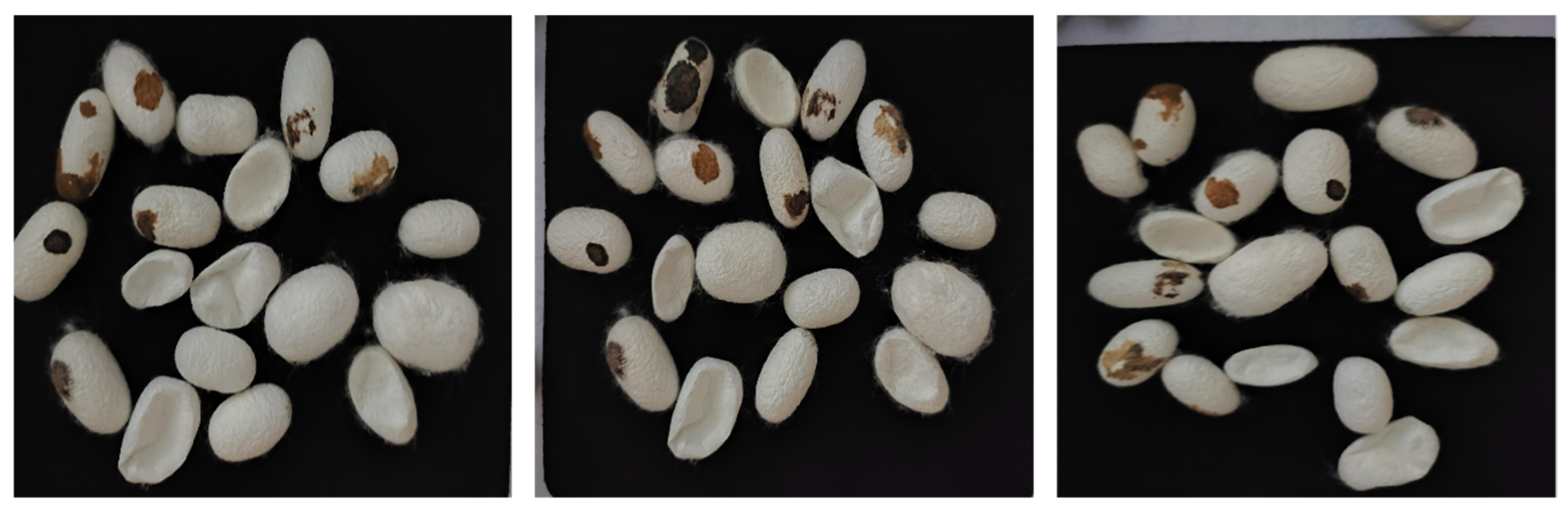
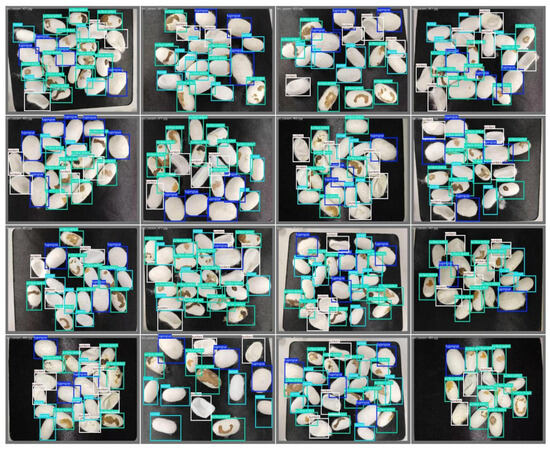
The data in this study were collected from the Cocoon Testing Center in Nantong City, Jiangsu Province, China. Known as the “Hometown of Silk”, Nantong has a widespread practice of silkworm breeding among local residents. The industrial camera Shengyue SY012HD (Shenzhen Shengyue Technology Co., Ltd., Shenzhen, China) was used for image acquisition, with images captured in BMP format with a resolution of 1920 × 1080 pixels. During the acquisition process, LED light sources were used for illumination to ensure uniform light on the cocoons. A black backdrop was selected as the workbench background to better highlight the detailed features of the cocoons. A total of 1000 cocoon images were collected, with approximately 17 cocoons in each image, as shown in Figure 1. The LabelImg software (version 1.8.6) was used to label the quality grades of cocoons in each image, in accordance with the grading method specified in the national standard GB/T 9111-2015 Test Methods for Dried Silkworm Cocoons.
Figure 1.
Dataset images.
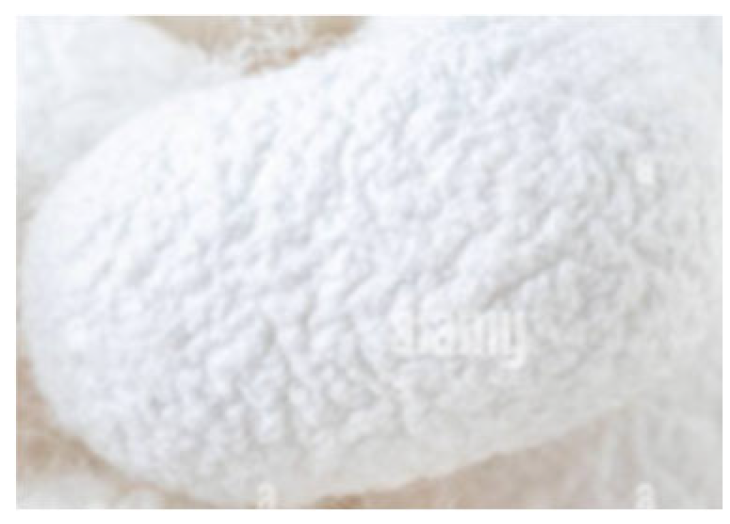
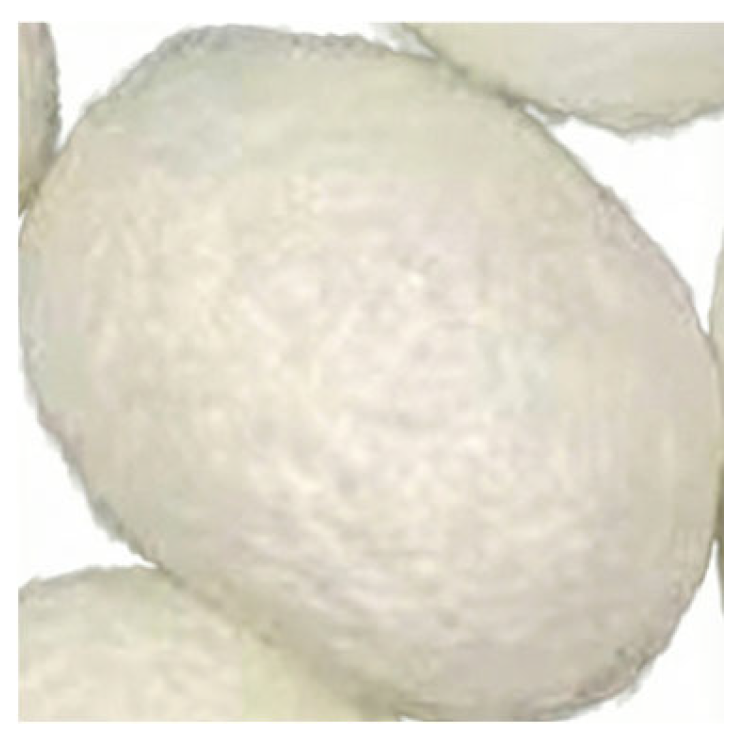
In this study, cocoons were roughly divided into four categories for annotation, with a total of 17,000 targets labeled. The annotated cocoon quality types were categorized into four classes: “fugongjian”, “normal”, “sunken”, and “surface defect”. Among the annotated objects, there were 4358, 4255, 4316, and 4327 in the four categories, respectively. The specific definitions of each cocoon quality type are presented in Table 1. During the experiment, the dataset was split into a training set, a validation set, and a test set at a ratio of 8:1:1. The training set was used for the training of the network model, the validation set for verifying the model fitting performance during the training process, and the test set for validating the detection effect of the trained model.
Table 1.
Introduction to cocoon quality classification.
2.2. Methodology
2.2.1. YOLOv10 Network Architecture
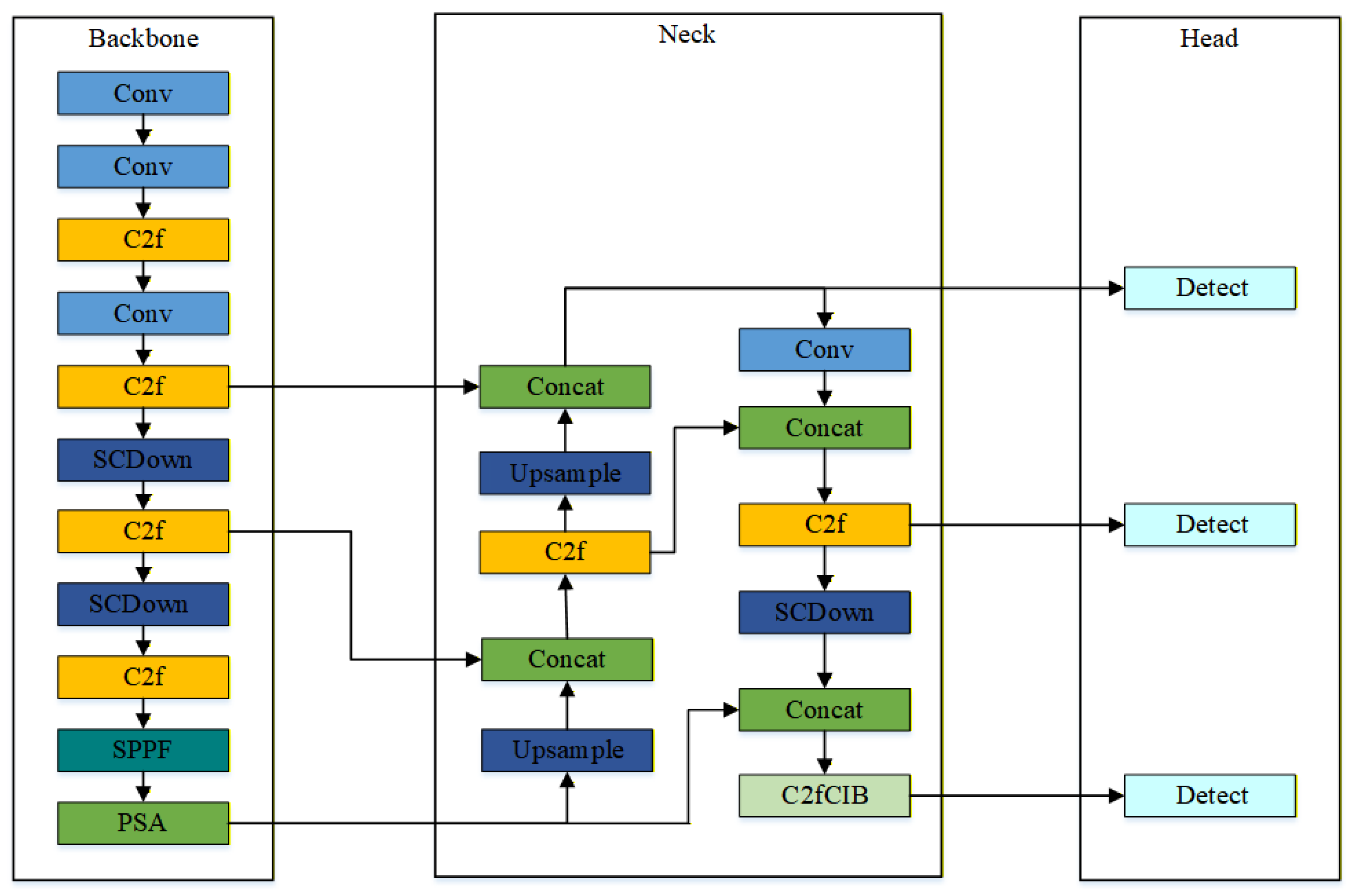
YOLO series algorithms are recognized as classical methods for small object detection, and YOLOv10 is the improved version. As shown in Figure 2, YOLOv10 consists of four components: the backbone network, neck, head, and special modules. The backbone adopts an enhanced CSPNet, which extracts features via 3 × 3 convolution kernels and incorporates residual connections and the SCDown module for spatial and channel downsampling. The SPPF module performs multi-scale pooling and concatenation on feature maps, while the PSA module integrates global learning capability at a low computational cost. The neck part implements bottom-up and top-down feature fusion: it enlarges the size of feature maps through upsampling modules and fuses low-level and high-level semantic information using the Concat module. The head detector is composed of convolutional layers, responsible for object localization, classification, and recognition and bounding box prediction. A lightweight classification head is employed here to improve detection efficiency.
Figure 2.
Architecture of YOLOv10.
YOLOv10 was selected for this research on object and behavior detection of silkworm cocoons. Compared with previous YOLO models, including YOLOv3, YOLOv5, YOLOv6, YOLOv8n, and YOLOv9, YOLOv10 has achieved remarkable progress in balancing computational efficiency and detection accuracy. Specifically, while maintaining a similar or better Average Precision (AP) compared with its predecessors, YOLOv10 significantly reduces the number of model parameters and Floating Point Operations per Second (FLOPs), thus achieving a more optimal computation–accuracy trade-off.
YOLOv10n was adopted in this experiment, a lightweight variant of the YOLOv10 series designed for resource-constrained environments. It minimizes model size and computational requirements while preserving a certain level of detection accuracy. In comparison with other versions of YOLOv10, YOLOv10n places greater emphasis on model lightweighting and efficient operation on resource-constrained devices.
2.2.2. Feature Extraction: C2f-LSKA
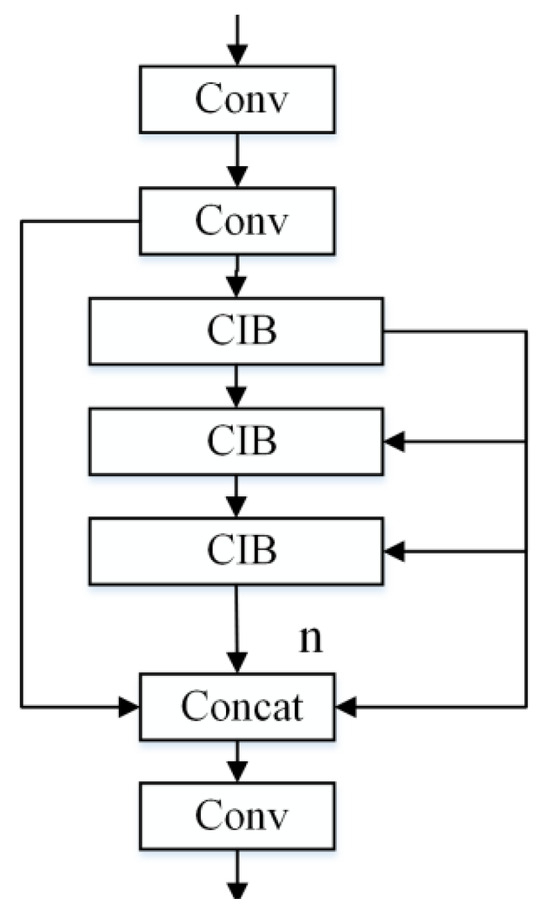
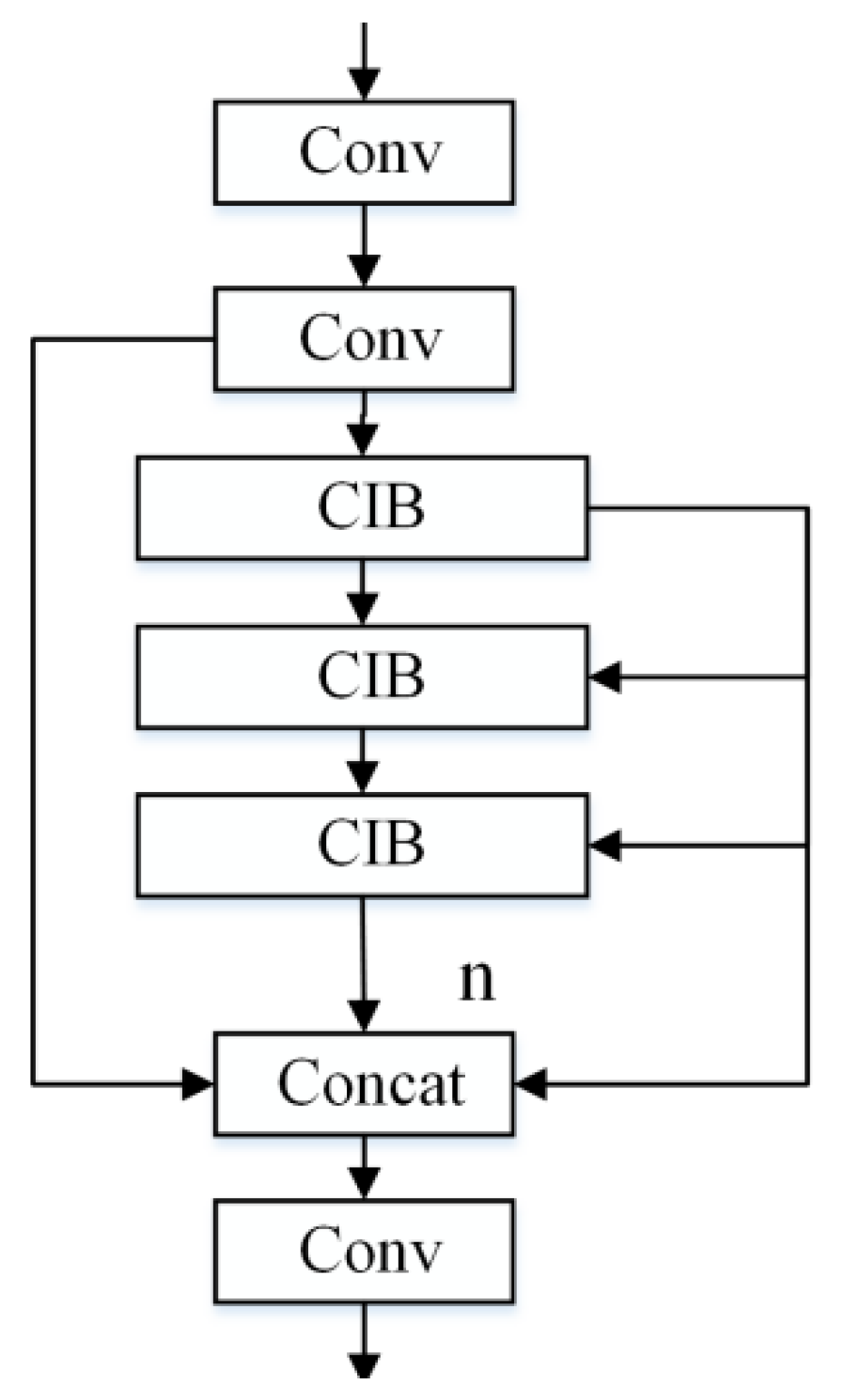
The C2f structure in the YOLOv10 model is illustrated in Figure 3. Its drawbacks lie in the difficulty of eliminating redundant introduced features and its high computational complexity. Cocoons in the dataset images were annotated based on their distinct colors and shapes. Color differences were prominent in the cocoons, while some shape-related defects were less obvious.
Figure 3.
C2f structure diagram.
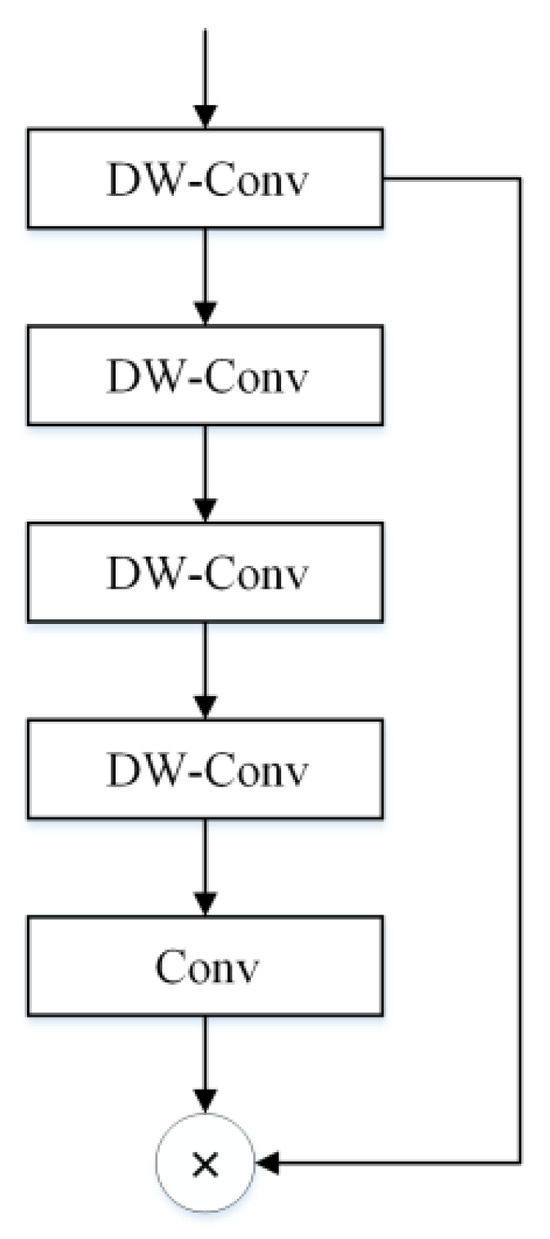
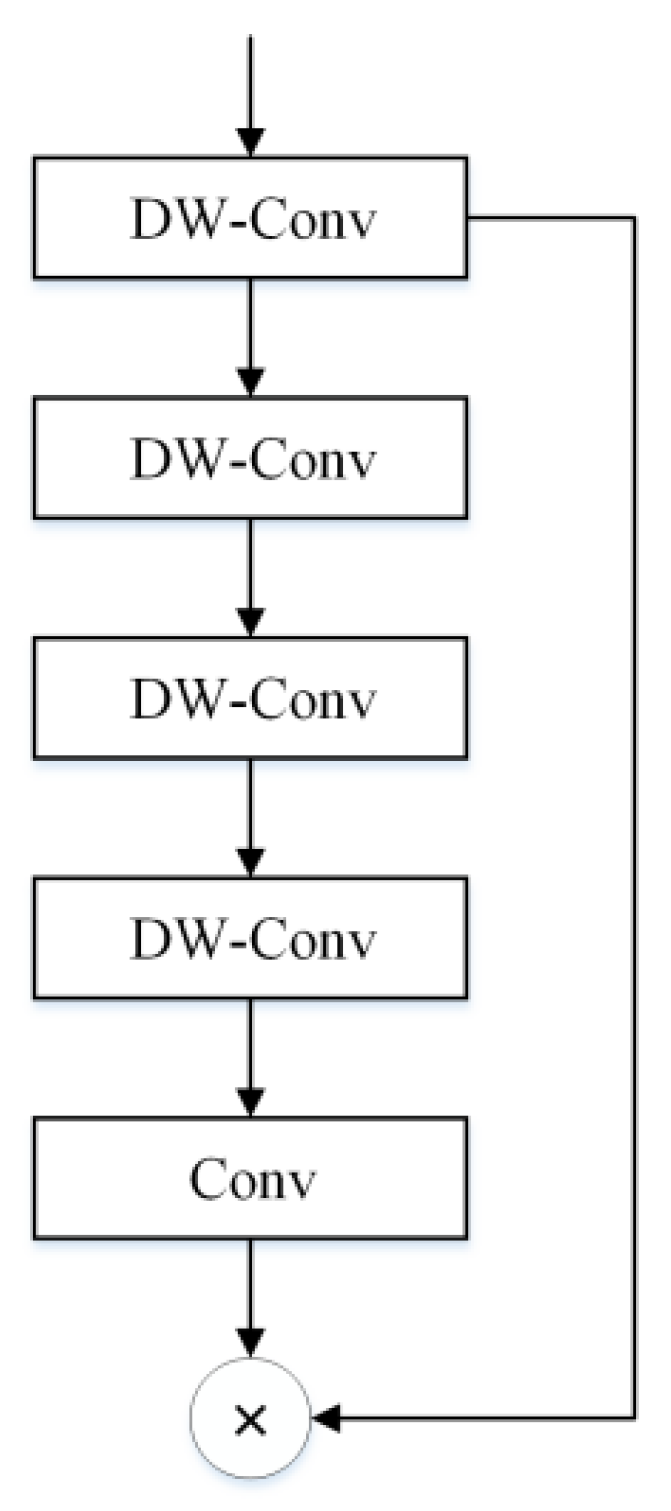
To address this issue, this study introduces the Large Separable Kernel Attention (LSKA) convolution [26]. LSKA can better focus on the shape features of targets, while also reducing computational complexity and memory usage to boost model performance. LSKA decomposes the 2D convolution kernel of the depthwise convolution layer into serial 1D convolution kernels. Each LSKA module consists of 2 DW-Conv layers, followed by 2 DW-D-Conv layers and 1 conv layer. Through a series of depthwise separable convolution and pointwise convolution operations, it achieves efficient feature extraction and adaptive weighting of the input feature maps, with its structure shown in Figure 4. The Visual Attention Network (VAN), constructed based on LSKA, significantly reduces computational complexity and memory footprints and indicates excellent performance in tasks such as object recognition and object detection.
Figure 4.
Architecture of LSKA.
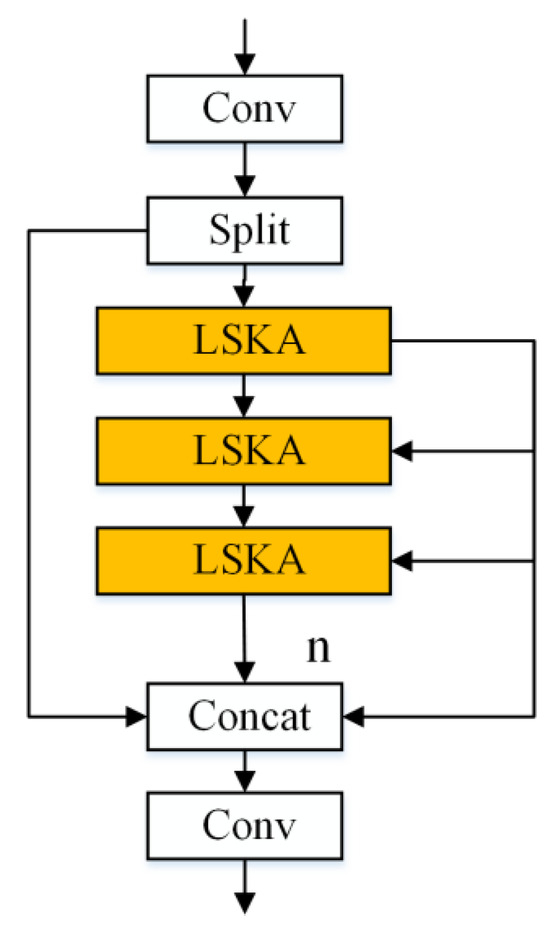
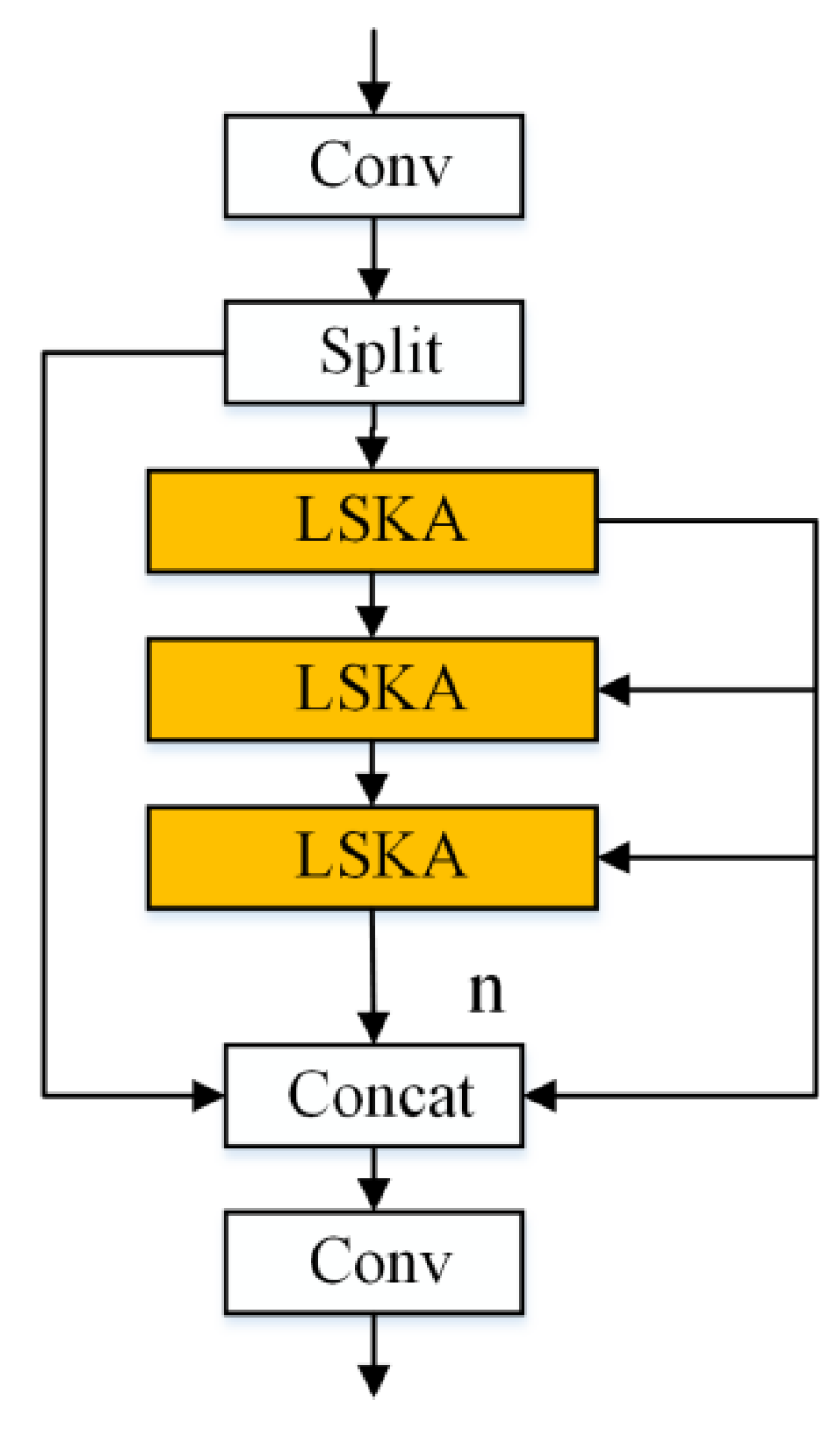
In this study, the C2f module in YOLOv10 was improved by embedding the LSKA module into it to form a new structure named C2f-LSKA. Specifically, the CIB module in C2f is replaced with the LSKA module. This integration fully leverages the feature fusion capability of C2f and the efficient feature extraction capability of LSKA. The addition of C2f-LSKA allows for better handling of the global morphology of the fugongjian. This provides the model with richer feature representations and helps to improve detection accuracy and robustness. Its structure is shown in Figure 5, and the integration process is derived from Formula (1) to Formula (2).
Figure 5.
Architecture of C2f-LSKA.
2.2.3. DySample Upsampling
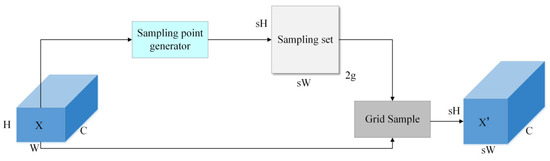
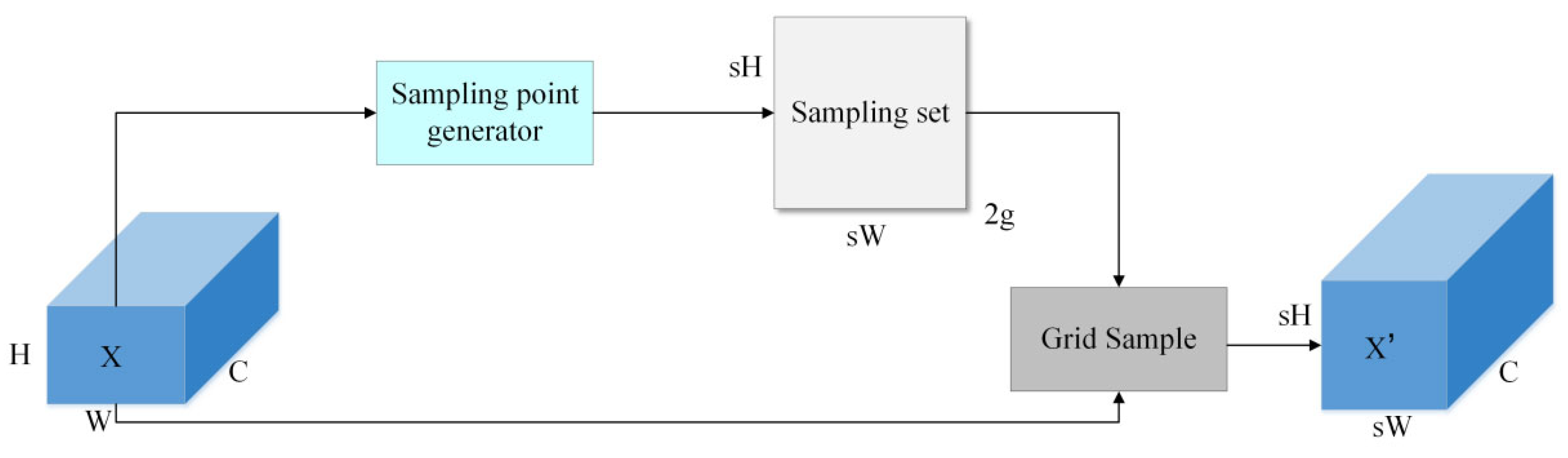
The upsampling layer in the YOLOv10 architecture primarily adopts the nearest neighbor interpolation method. This method only relies on the values of neighboring pixels, making it difficult to effectively capture subtle variations and rich semantic information in images, which, in turn, leads to a certain degree of image distortion. Especially during image upscaling, the image is prone to blurring, and its receptive field is relatively small. To address this issue, this study proposes an ultra-lightweight and efficient dynamic upsampling operator, whose core idea is to redefine the upsampling process as point sampling and achieve upsampling by learning the coordinates of sampling points in the input feature map. The flow chart of DySample is shown in Figure 6.
Figure 6.
Flow chart of DySample.
First, a 1 × 1 convolutional layer is used to process the input feature map and generate the offset of each sampling point. These offsets represent the moving direction and distance of the sampling points relative to their original positions. To prevent the sampling points from exceeding the valid range of the feature map due to excessive offsets, DySample introduces a dynamic range factor. This factor is generated by another 1 × 1 convolutional layer; its value is constrained to the range of [0, 1] through the Sigmoid activation function and then multiplied by a scaling factor to restrict the offsets, ensuring that the movement of sampling points is within a reasonable range. Subsequently, DySample uses the grid_sample function for feature reconstruction. Specifically, a grid is generated to represent the position of each pixel in the original feature map. These positions are then adjusted according to the offsets to generate the final coordinates of the sampling points. These coordinates are normalized to the range of [−1, 1] to meet the requirements of the grid_sample function. Through bilinear interpolation, the grid_sample function retrieves pixel values from the input feature map based on the offset sampling point coordinates, generating a high-resolution feature map after upsampling. In this paper, DySample upsampling is introduced, which facilitates the detection of small targets in silkworm cocoons, thereby improving the detection recall.
2.2.4. Multi-Scale Dilated Attention (MSDA) Mechanism
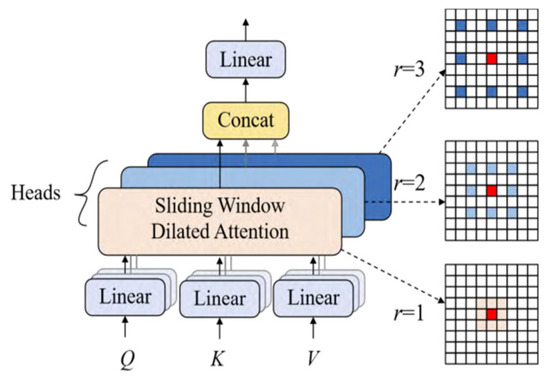
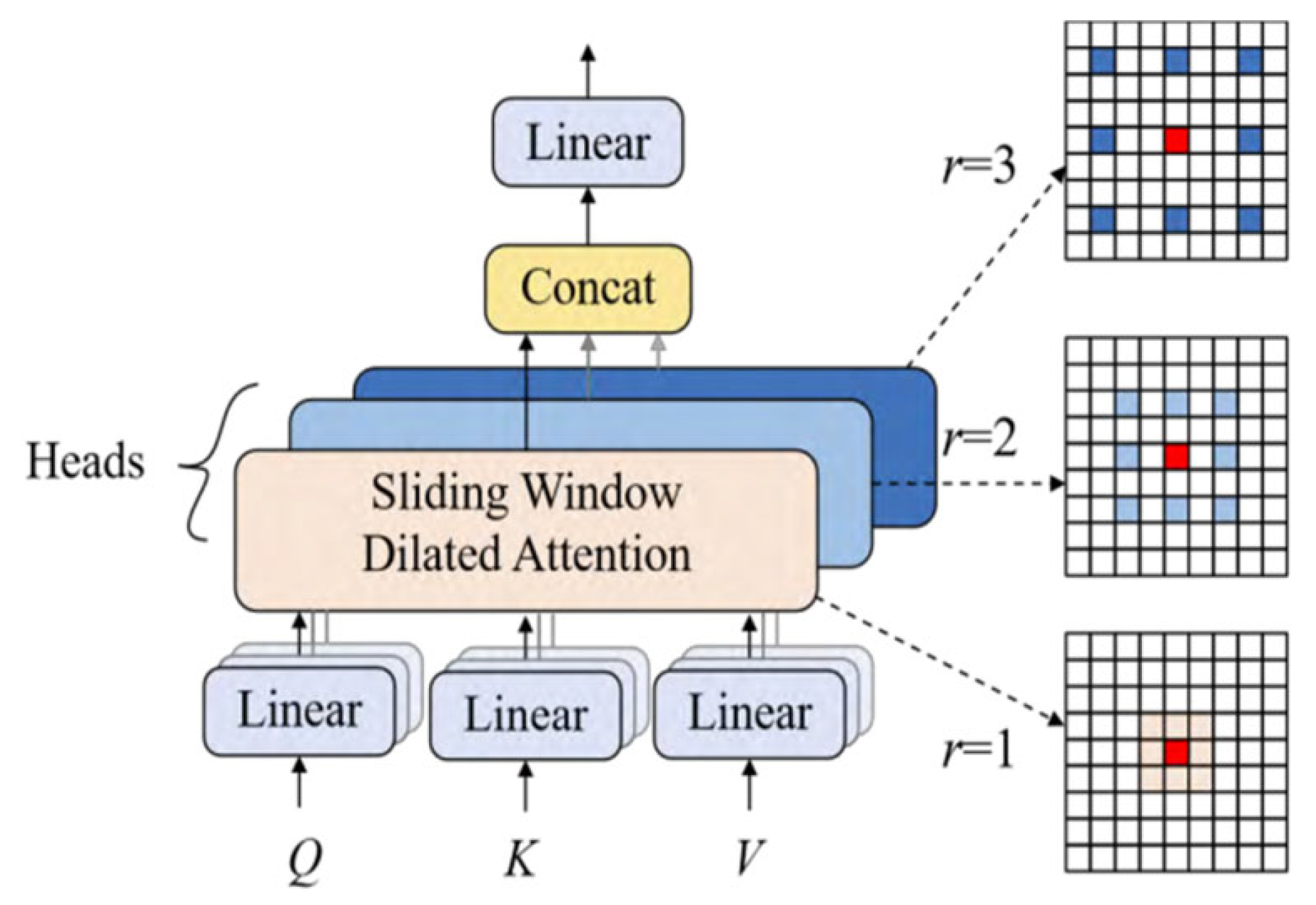
The YOLOv10 model takes an input image, extracts multi-level features through the backbone to generate feature maps of different scales, and fuses these feature maps via upsampling and concatenation operations to enhance the detection capability for targets of various sizes. The fused feature maps are then fed into the Detection Head for object detection and classification, yielding the final results. However, the features between different cocoon quality grades are not prominent and thus hard to distinguish, which calls for higher-precision detection, yet the aforementioned method cannot effectively address this challenge. Therefore, this study introduces the Multi-Scale Dilated Attention (MSDA) mechanism [27] to improve detection accuracy, as illustrated in Figure 7.
Figure 7.
Architecture of MSDA.
MSDA adopts a multi-head design and can simulate the local and sparse interaction of image patches within a small range. It first generates queries (Q), keys (K), and values (V) from the input feature map through linear transformation, which are then fed into a multi-head attention structure composed of multiple parallel heads. Each head processes the features using sliding window dilated attention with different dilation rates (r) to capture multi-scale information. The processed features are concatenated across all heads to form a comprehensive multi-scale feature representation. Finally, the concatenated features are further processed through a linear layer to complete feature fusion and provide an enhanced feature representation for subsequent tasks such as classification and detection.
This method can focus on the aggregated semantic information at different scales within the receptive field, effectively reduce redundancy in the self-attention mechanism, and improve object detection accuracy while avoiding complex operations and additional computational overhead. In this paper, the introduction of the MSDA module can address the scale variation of silkworm cocoon images during convolution, endowing the model with a better receptive field.
2.2.5. Improved LMD-YOLO
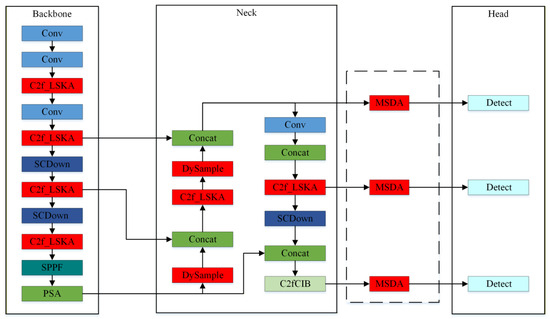
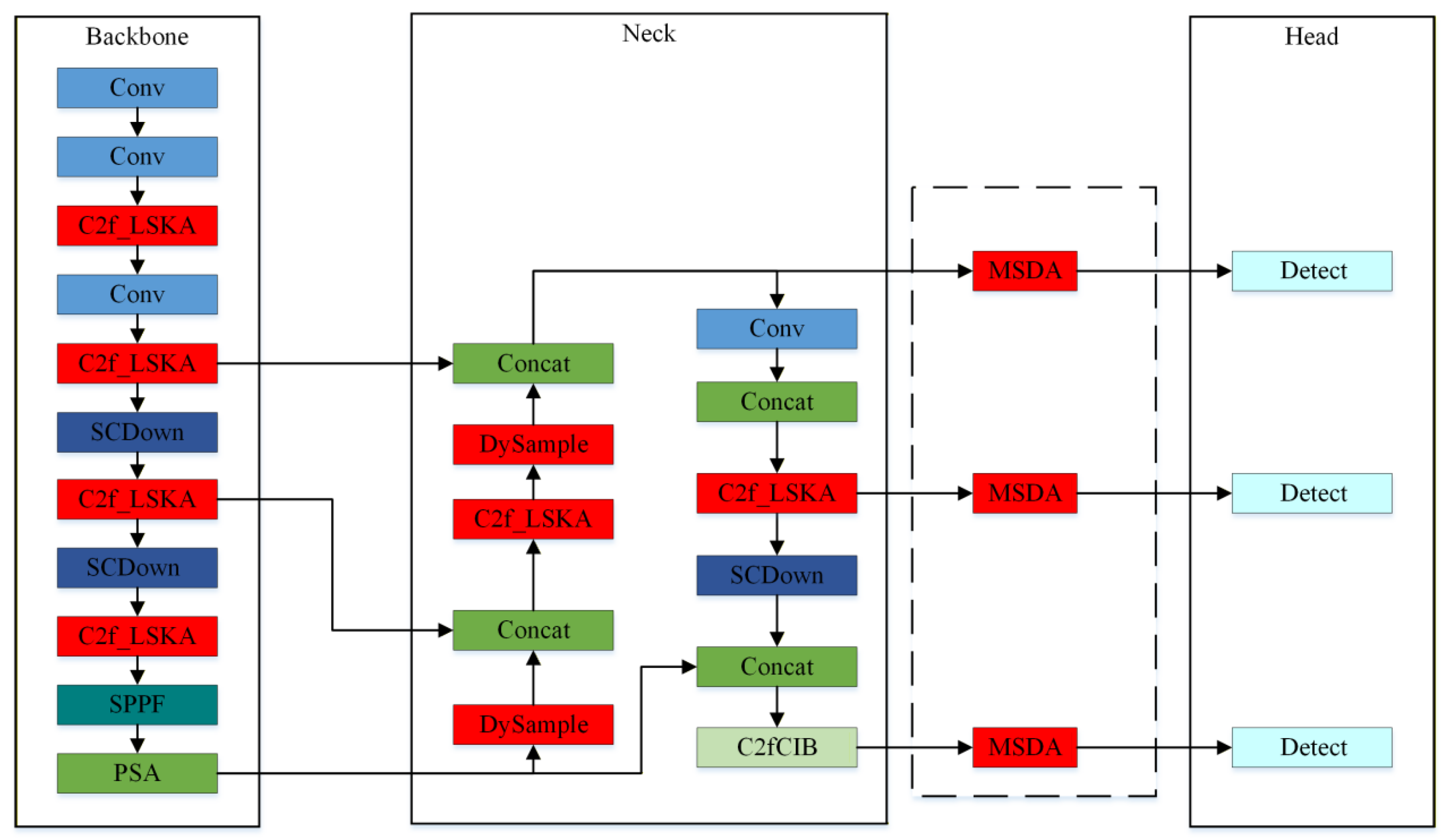
Aiming at the challenges in cocoon quality detection—including the high miss-detection rate of tiny defects, the difficulty in distinguishing morphological features, and the stringent real-time requirements for industrial deployment—this study integrates the aforementioned improvement strategies and proposes an improved lightweight object detection model named LMD-YOLO (Large Kernel, Multi-Scale, Dynamic-Upsampling YOLO). Its overall network architecture is illustrated in Figure 8, where the core improved regions of this study are clearly marked with red modules.
Figure 8.
LMD-YOLO model structure diagram.
As shown on the left side of Figure 8, some convolutional modules in the original backbone are replaced with the C2f-LSKA structure. The judgment of fugongjian or sunken relies on the overall geometric contour, yet the traditional 3 × 3 convolution has a limited receptive field. By leveraging the large kernel decomposition mechanism, C2f-LSKA expands the effective receptive field without significantly increasing the number of parameters, enabling the backbone network to more efficiently extract the global shape features of cocoons while reducing computational redundancy. In the middle Neck region of Figure 8, DySample upsampling is introduced, with the original static interpolation upsampling replaced by the DySample module (marked as red rectangles in the figure). Located in the upward path of feature fusion, this module can dynamically generate sampling points based on content, thereby effectively preserving the texture details of tiny defects during the feature map upscaling process and avoiding the blurring effect caused by interpolation. In the processing stage after feature concatenation, the C2f-LSKA module is also adopted. This ensures that after multi-scale feature fusion, deep extraction of semantic information can still be maintained at a low computational cost.
As shown in the dashed box on the right side of Figure 8, MSDA (Multi-Scale Dilated Attention) modules are embedded before each of the three final detection heads, respectively. Due to the large-scale variation of defects in the cocoon dataset, MSDA enables the model to adaptively aggregate contextual information of different scales before outputting prediction boxes through the multi-head dilated attention mechanism. This not only improves the discrimination robustness for various types of defects but also effectively suppresses the interference of background noise on classification results.
In summary, LMD-YOLO constructs a synergistic architecture balancing accuracy and efficiency by introducing C2f-LSKA, DySample, and MSDA at specific positions. This design greatly enhances the feature representation capability while strictly controlling the model parameters and computational overhead, establishing a robust framework for the real-time operation of the cocoon sorting system on embedded edge devices.
3. Results
3.1. Experimental Platform and Evaluation Metrics
This experiment was conducted on the Windows 10 operating system, based on the Anaconda (version 23.7.4) software. The programming language used was Python 3.8, the deep learning framework was PyTorch 1.10, and the CUDA version was 11.3. The hardware configuration included an 11th Gen Intel (R) Core (TM) i5-11260H @ 2.60GHz (2.61 GHz) processor, 16 GB of RAM, and an RTX 3060 graphics card. During the training phase, the Stochastic Gradient Descent (SGD) optimizer was employed to update the network weights. The initial learning rate was set to 0.01 with a momentum of 0.937 and a weight decay of 0.0005. To ensure training stability, a warm-up strategy was used for the first three epochs. The learning rate was adjusted using a cosine annealing scheduler. The input images were resized to 640 × 640. The batch size was set to six. Regarding weight initialization, the model was initialized with pre-trained weights on the COCO dataset to accelerate convergence. The NMS IoU threshold was set to 0.7. The network parameter configuration of LMD-YOLO is presented in Table 2.
Table 2.
Network parameter configuration.
To evaluate the performance of the proposed method, we conducted a comprehensive comparison with several state-of-the-art object detection models, including Faster R-CNN, SSD, YOLOv5, YOLOv6, YOLOv8, and the baseline YOLOv10. All models were evaluated on the same test set after the training process had fully converged. For the task of cocoon quality detection, we adopted standard object detection metrics: Precision (P), Recall (R), and Mean Average Precision (mAP). These metrics are calculated based on the Intersection over Union (IoU) of bounding boxes. Following the COCO evaluation protocol, the overlap between the predicted bounding box and the ground truth bounding box was examined. A detection was considered a True Positive (TP) if the IoU with a ground truth box exceeded a specific threshold and the predicted class matched the ground truth.
P represents the proportion of correct positive predictions among all positive predictions. The formula for P is given by Equation (3) as follows:
where FP refers to the number of predicted bounding boxes that have an IoU lower than the threshold or detect background as an object. R measures the proportion of actual positive instances that are correctly identified. Recall is calculated using Equation (4) as follows:
where FN refers to the number of ground truth bounding boxes that the model failed to detect. Average Precision (AP) is the area under the Precision–Recall (P-R) curve, which is used to evaluate the detection performance of a single category (see Equation (5)). mAP, as a measure of overall performance, is the average value of AP across all categories (see Equation (6)).
Considering that the model needed to be deployed on computationally constrained embedded devices in the later stage, accuracy metrics alone were insufficient to comprehensively evaluate the practicality of the model. Therefore, this study also introduces three engineering metrics—Params, GFLOPs, and FPS—to conduct a comprehensive evaluation of the model from three dimensions: space complexity, time complexity, and real-time performance.
Params represents the total number of all learnable parameters (e.g., weights and biases) in the model, which directly reflects the model size and space complexity, with the unit usually being millions (M). In this project, a lower number of parameters means the model occupies less storage space (ROM) and runtime memory (RAM), which is crucial for deployment on edge computing devices with limited storage resources. GFLOPs, short for Giga Floating-point Operations Per Second, has a unit of G. It is a core metric for measuring a model’s computational complexity (time complexity), representing the number of floating-point operations required for a model to complete a single forward inference. In this project, GFLOPs was directly related to the computational load and energy consumption of the hardware. In the cocoon sorting scenario, a model with low GFLOPs could reduce hardware heat generation and power consumption, extend device service life, and lower the reliance on high-performance GPUs. FPS, short for Frames Per Second, refers to the number of images that a model can process per second, including the total time consumption of preprocessing, inference, and postprocessing (e.g., NMS). It is the most intuitive metric for measuring a model’s inference speed. In this project, FPS determined the production efficiency of the sorting system. To meet the demand for the high-speed operation of industrial production lines, the FPS of the detection algorithm must be higher than the acquisition frame rate of the camera or the transmission speed of the production line to achieve real-time and delay-free sorting.
3.2. Training of the LMD-YOLO Model
3.2.1. Data Annotation Results
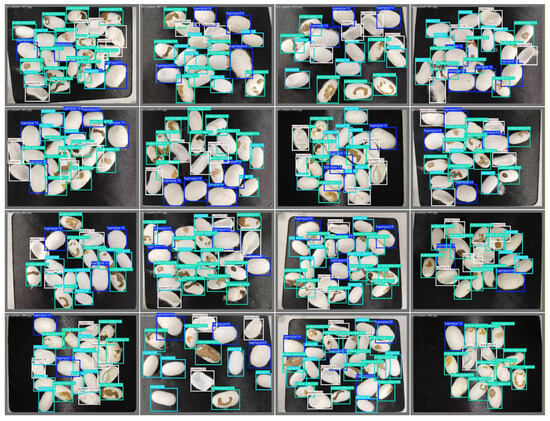
The acquired image data were manually annotated in this study, with the LabelImg tool employed for the annotation work. Approximately 1000 image samples were annotated, containing around 17,000 cocoon targets. On average, 17 cocoon targets were accurately annotated per image, and each image included cocoon targets of four quality grades. The annotated image data are illustrated in Figure 9.
Figure 9.
Annotated image data.
3.2.2. Training Results of the LMD-YOLO Model
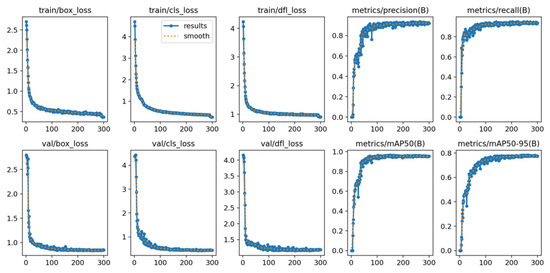
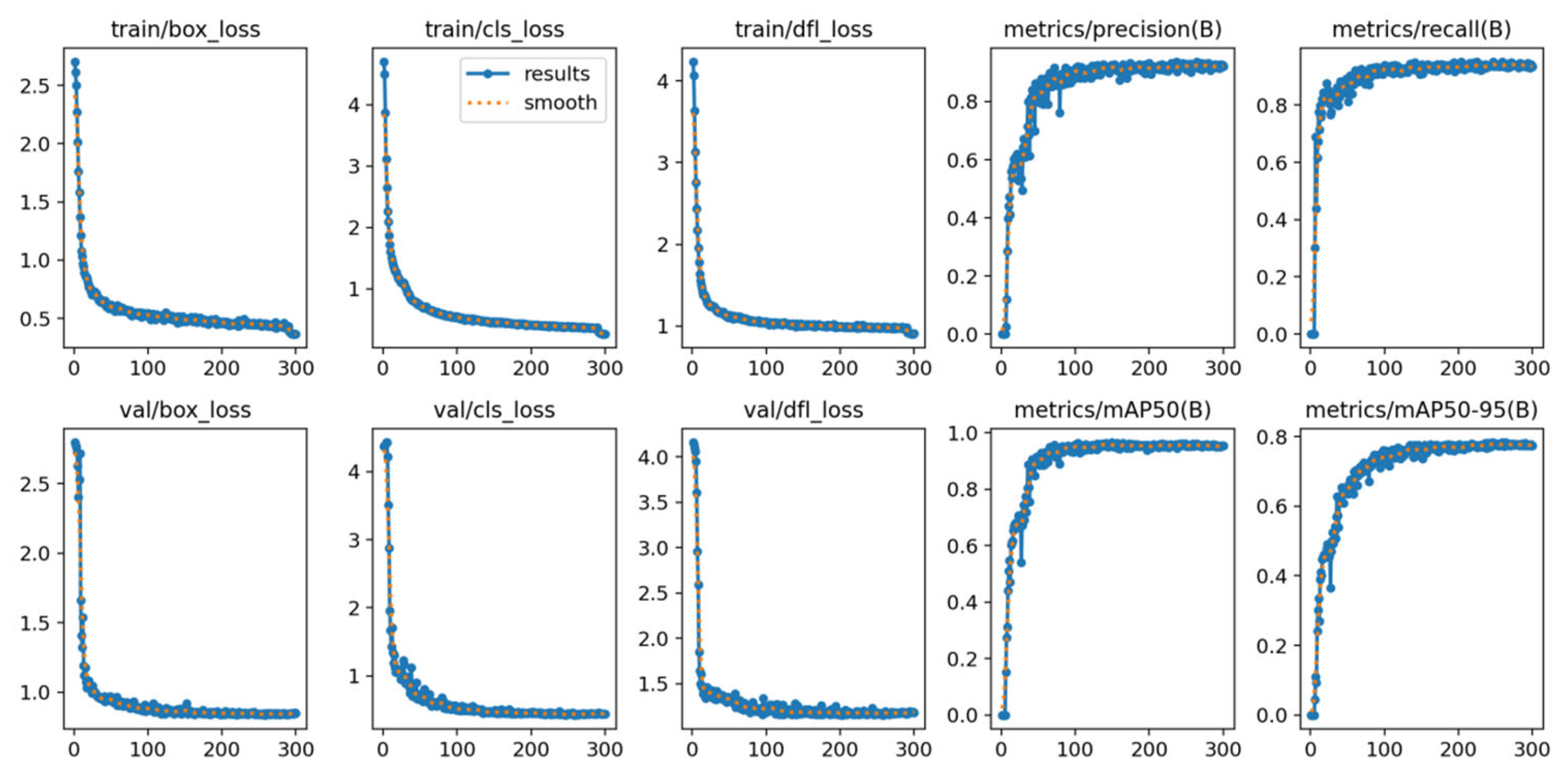
The annotated cocoon dataset was input into the LMD-YOLO network for training. The number of model iterations was set to 300, with the total training time being approximately 3.2 h. Figure 10 shows the loss convergence curve and the variation of performance metrics of the improved model during the training process. It can be observed that the model achieved a relatively high performance level when trained to around 100 epochs and maintained stability in the subsequent training. Finally, P stabilized at 91.32%, Recall stabilized at 92.61%, and mAP@0.5 even exceeded 95.46%. These data indicate the effectiveness of the improvement strategies and the high efficiency of the model.
Figure 10.
Metric data during the training process.
3.2.3. Visualization Results of LMD-YOLO Validation Data
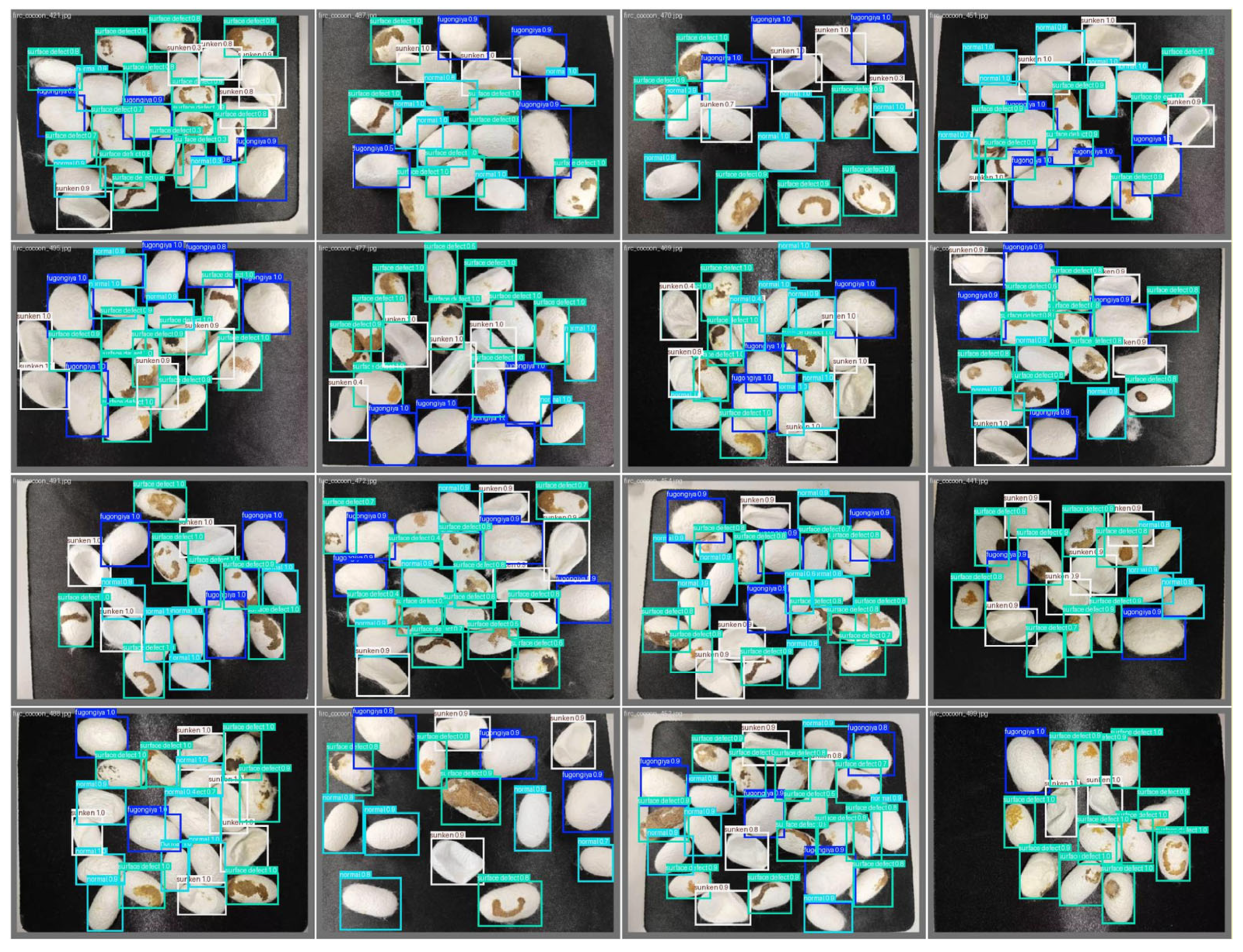
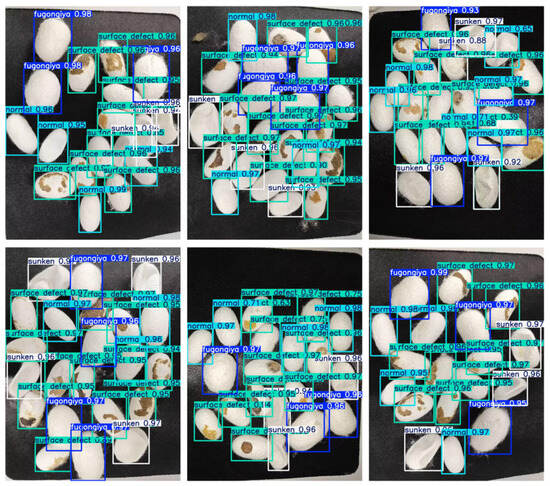
To qualitatively evaluate the model’s performance, we visualized the inference results on the validation set as shown in Figure 11. It can be observed that the LMD-YOLO effectively handled complex situations such as overlapping cocoons and diverse defect sizes. Both surface defects and fugongjian were detected with a high confidence score of 0.9, verifying the effectiveness of the introduced MSDA and DySample modules.
Figure 11.
Visualization of detection results on the validation set using the proposed LMD-YOLO.
3.3. Experiments and Results of the LMD-YOLO Model
3.3.1. Test Data of the LMD-YOLO Model
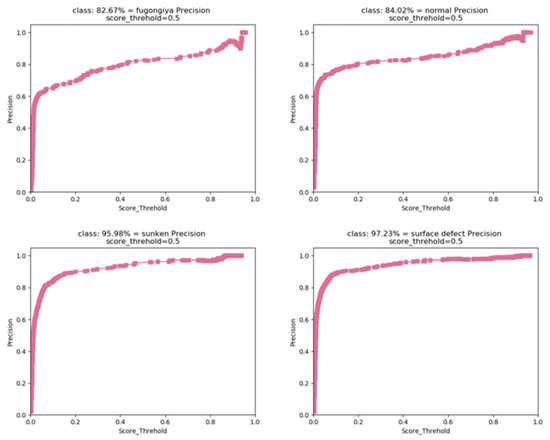
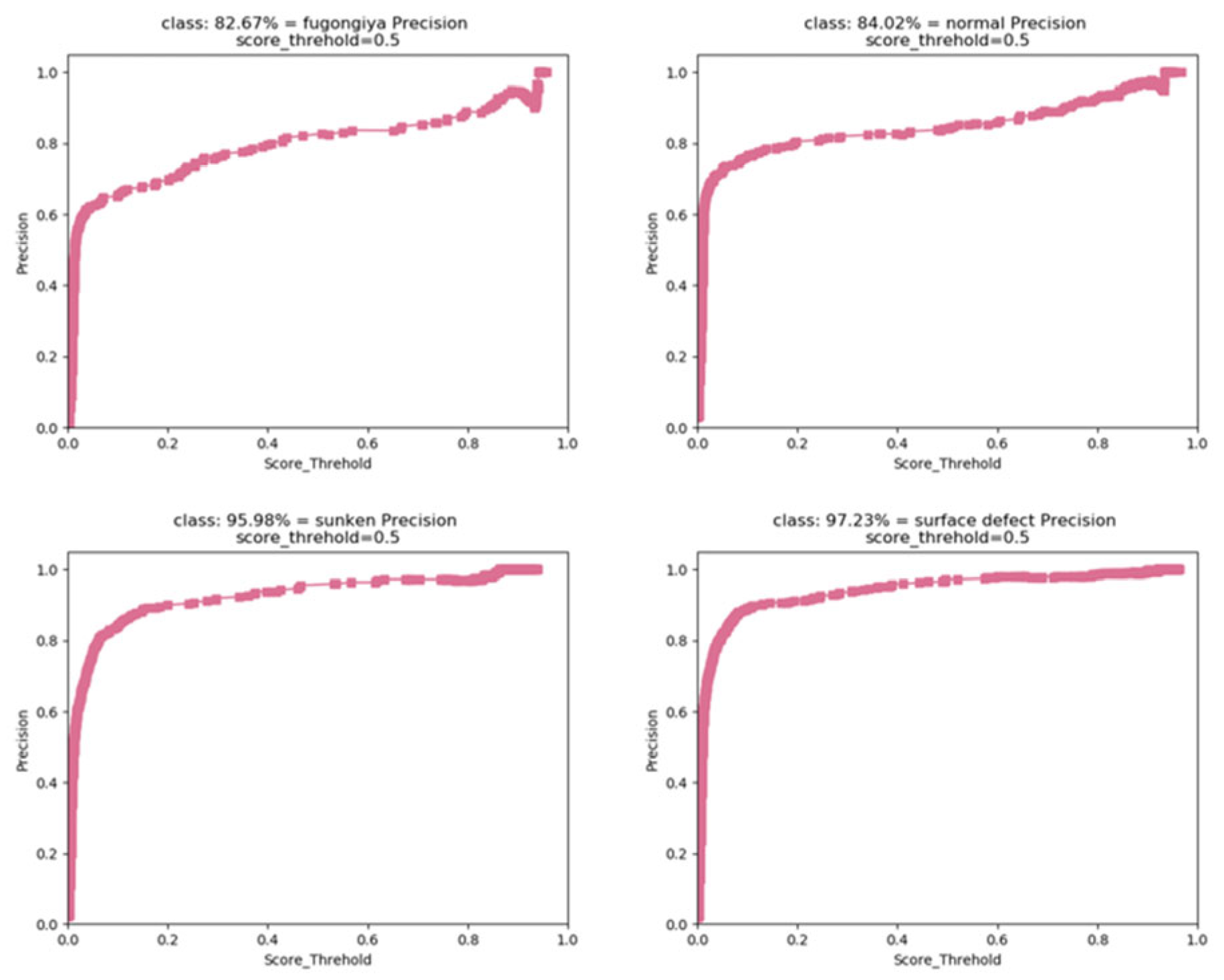
The trained model was used for actual testing, and the test data results are shown in the following figures. Among them, Figure 12 illustrates the Precision–Confidence curves for each category. The curves for sunken and surface defects rise sharply and plateau near 1.0, even at lower confidence thresholds. This indicates that the proposed model extracted highly robust features for defect detection, effectively minimizing false alarms in industrial quality control. In contrast, the fugongjian and normal classes exhibited a more gradual increase in precision. Specifically, at a standard threshold of 0.5, their precisions reached 82.67% and 84.02%, respectively. This behavior highlights the inherent visual ambiguity between large normal and fugongjian. Finally, the average precision of these four cocoon categories reached 89.98%.
Figure 12.
P metrics of LMD-YOLO model test results.
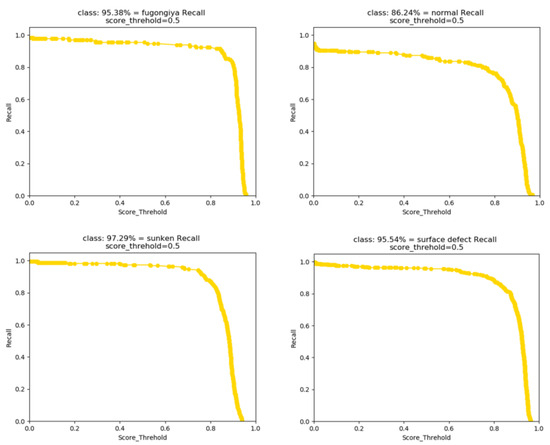
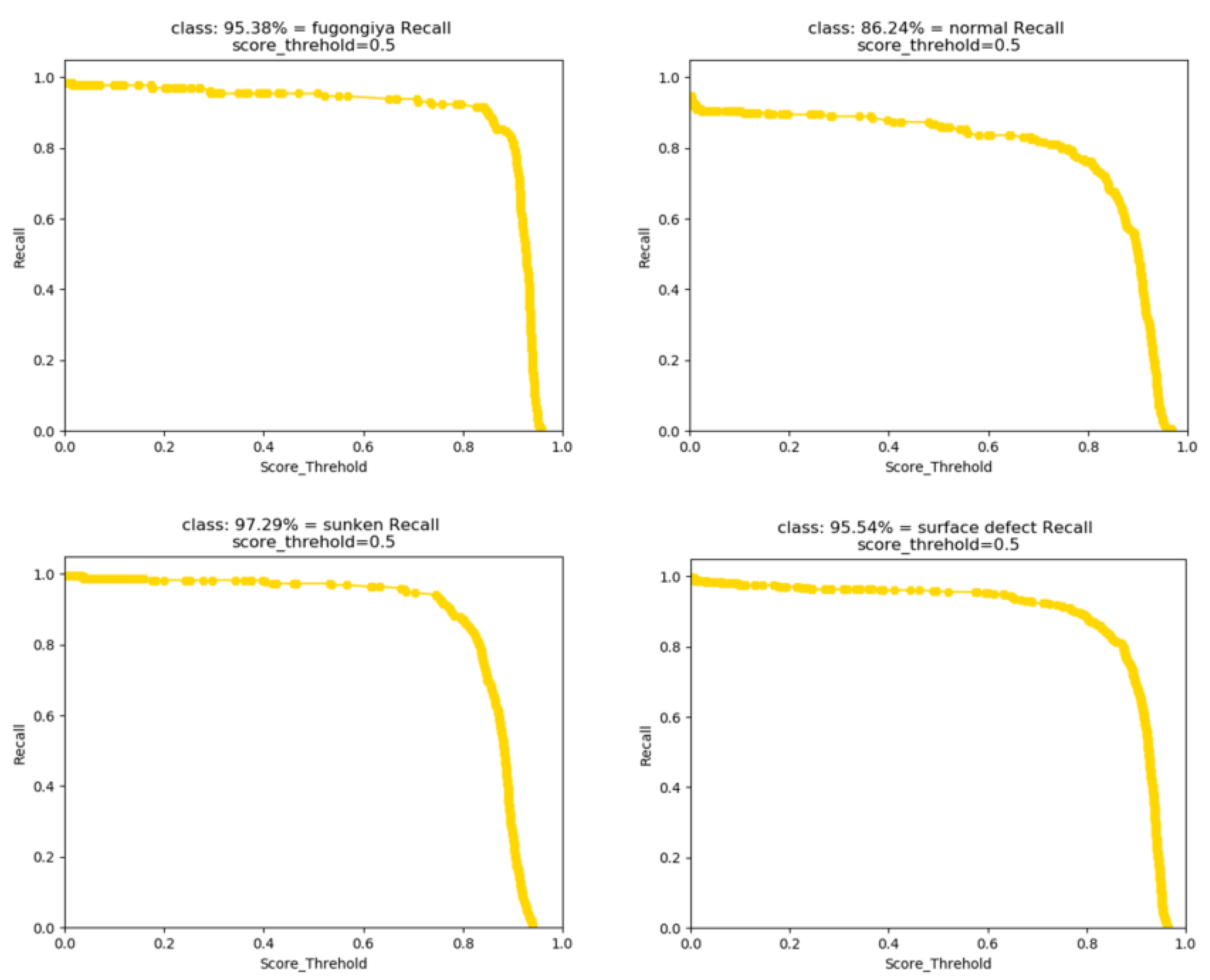
Figure 13 shows the Recall–Confidence curves of the LMD-YOLO model for different categories. The curves for sunken and surface defects remain stable across a wide range of thresholds (0.0 to ~0.8). This implies that the LMD-YOLO model assigns high confidence scores to true defects, ensuring a minimal miss rate even under strict filtering conditions. The normal class shows a gradual decline in recall as the threshold increased, with a value of 86.24% at the 0.5 threshold. This suggests that a subset of normal cocoons was detected with relatively lower confidence, likely due to variations in lighting or minor texture irregularities that made them less distinguishable from the background. Finally, the average recall of these four cocoon categories reached 93.61%.
Figure 13.
R metrics of LMD-YOLO model test results.
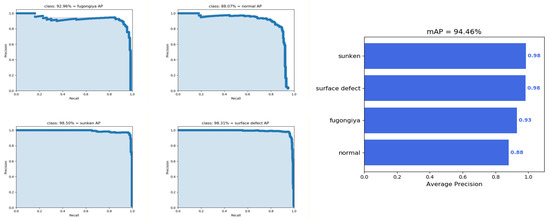
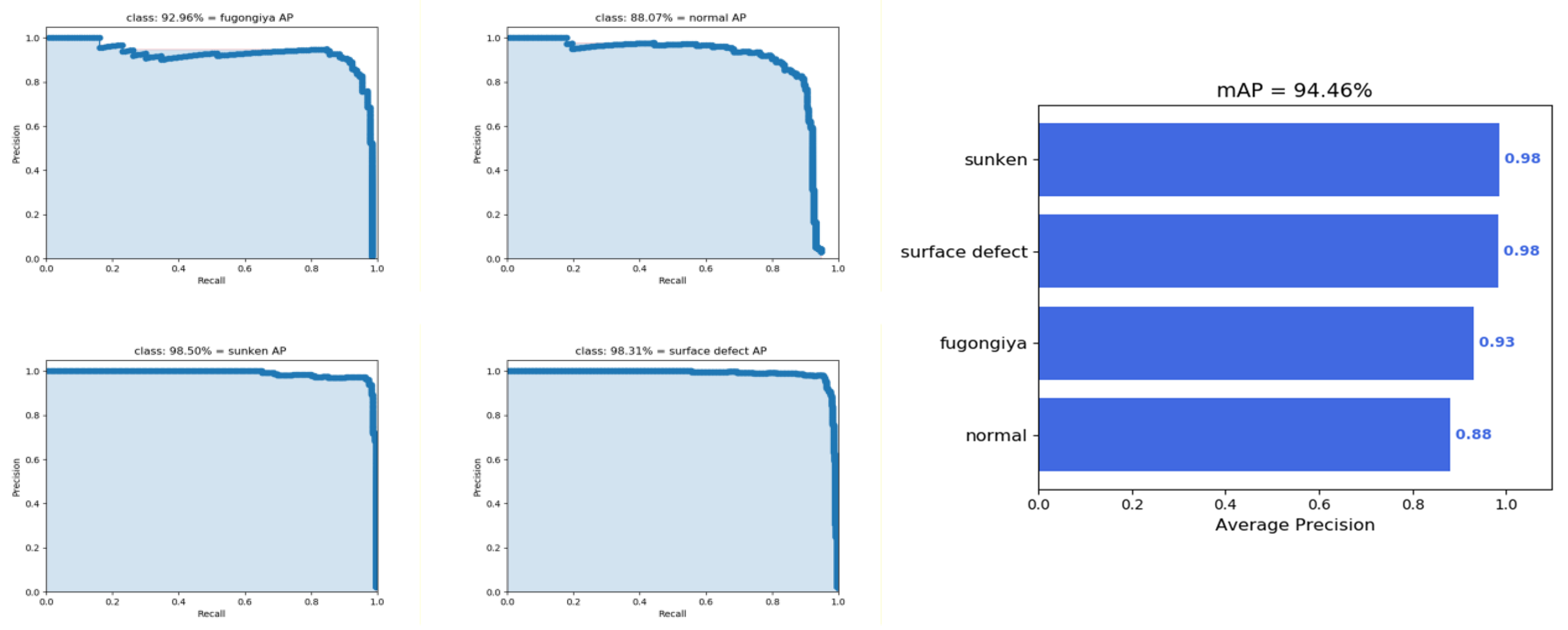
Figure 14 shows the P–R curves of the LMD-YOLO model for different categories. The model achieved outstanding performance on the sunken and surface defect categories, with AP reaching 98.50% and 98.31%, respectively. The curves show that precision remained close to 1.0 even at high recall rates. This confirms that the DySample module proposed in this study effectively recovers fine-grained texture details and geometric deformation features, enabling the model to distinguish prominent defects from the background with high confidence. In contrast, the AP values of fugongjian and normal were relatively lower, at 92.96% and 88.07%, respectively. The sharp drop in precision at the tail of the normal curve indicates that there were certain challenges in distinguishing high-quality normal cocoons from those with subtle anomalies. This is mainly attributed to the intra-class variance of normal and their visual similarity to some fugongjian. Despite the aforementioned challenges, the overall mAP reached 94.46%, which illustrates that the LMD-YOLO model successfully balances the trade-off between Precision and Recall and meets the stringent requirements of industrial grading systems.
Figure 14.
AP metrics of LMD-YOLO model test results.
3.3.2. Detection Results of the LMD-YOLO Model
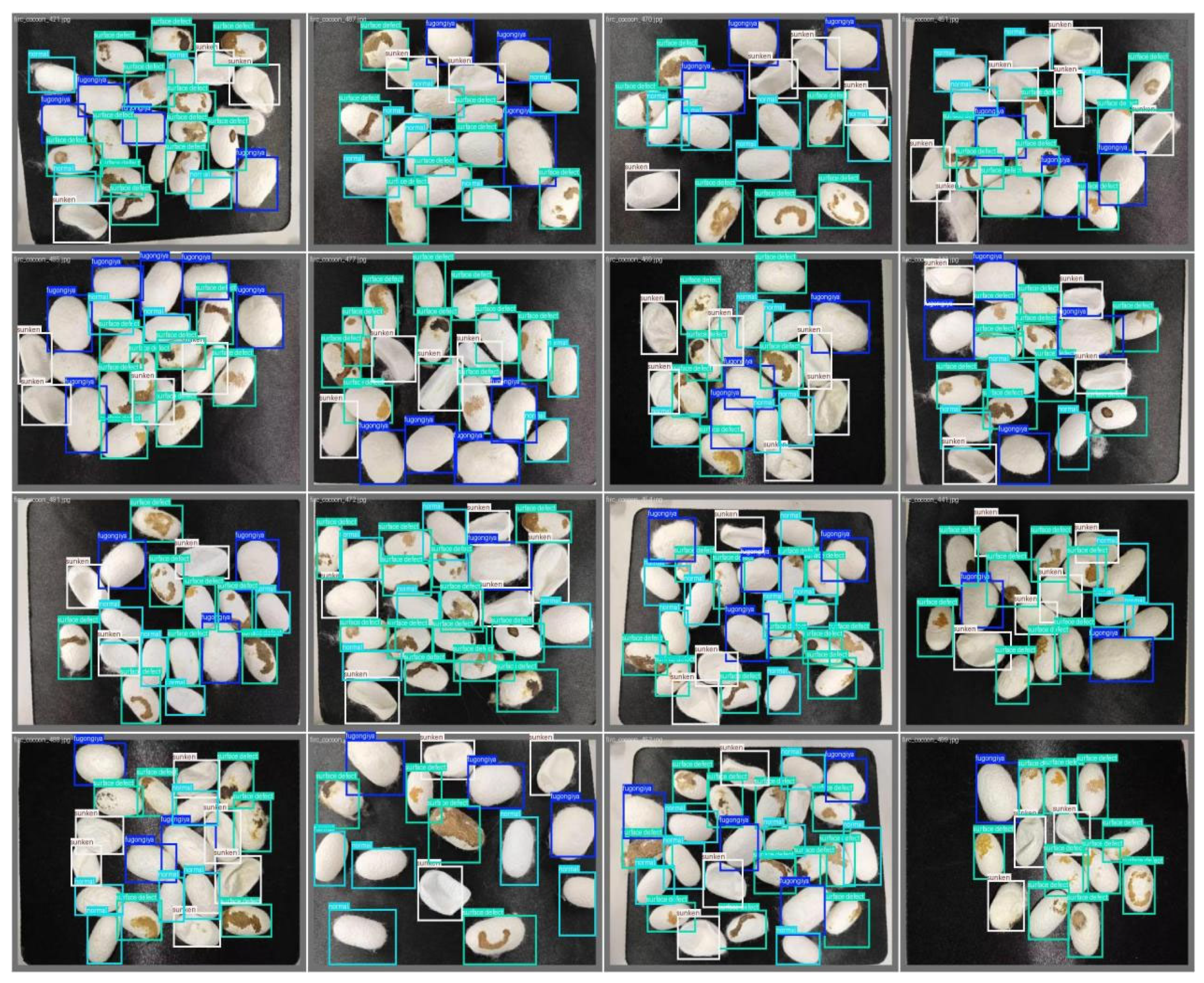
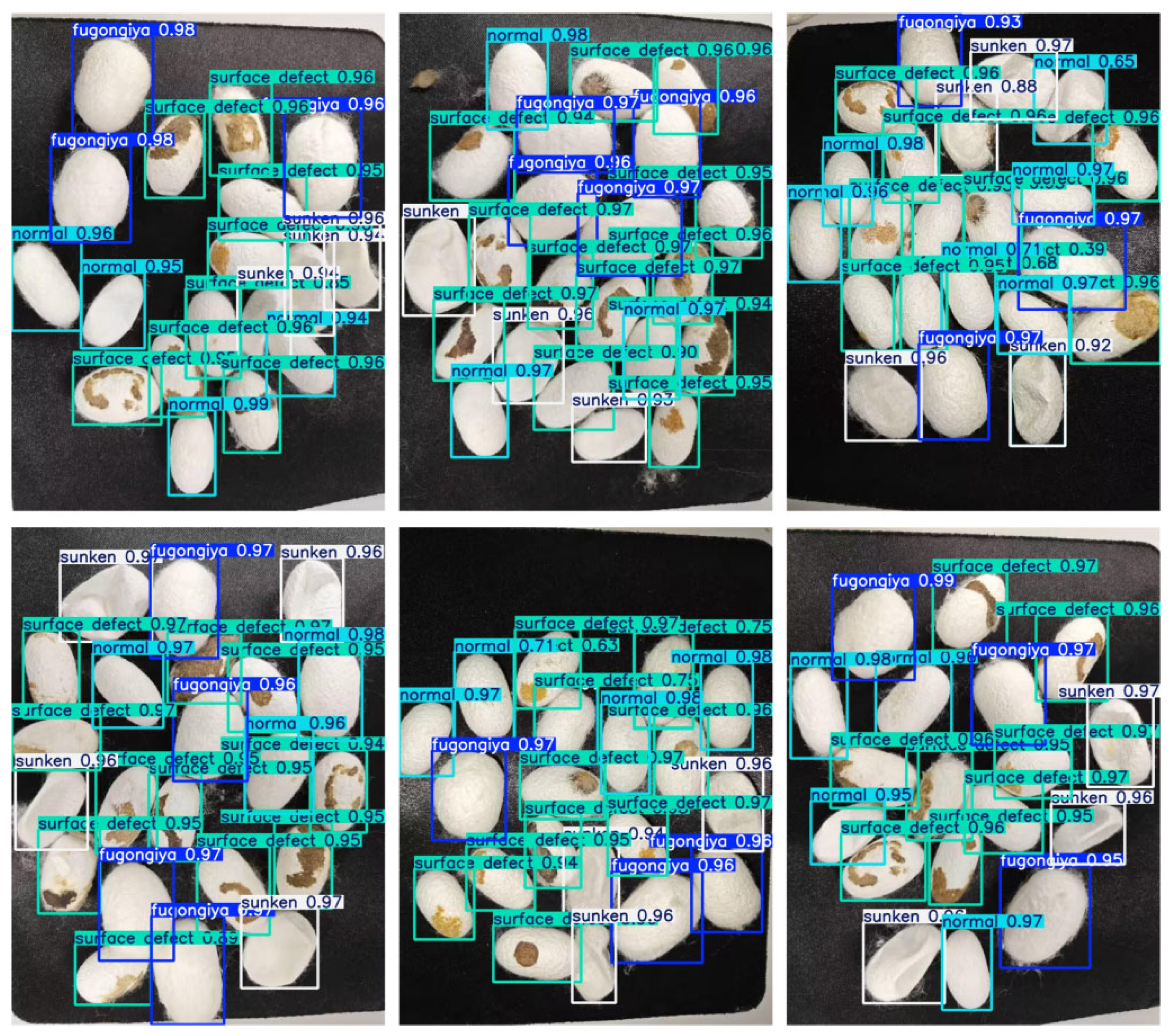
To intuitively evaluate the effectiveness of the improved algorithm in actual sorting scenarios, an inference visualization of the test set images was conducted in this study, with the results shown in Figure 15. It can be seen from the visualization results that the cocoons in the dataset presented a high-density random distribution, and a large number of samples were attached to each other or partially occluded. Benefiting from the improvement of the global receptive field by the C2f-LSKA module introduced in this study, the LMD-YOLO illustrated robust performance in complex environments. As shown in the figure, even in areas where cocoons were closely adjacent, the model could still accurately generate independent bounding boxes for each individual cocoon, without missed or false detections caused by overlapping multiple boxes, which illustrates the sorting reliability of the model in complex industrial production line scenarios.
Figure 15.
Detection results of the LMD-YOLO model.
For surface defects and sunken, the two most challenging defect categories, the model indicated excellent fine-grained feature extraction capability. The model could assign high confidence scores to pinhead-sized black spots, oil stains, or irregular yellow stains on the cocoon surface. This indicates that the DySample dynamic upsampling module effectively preserves the texture details of tiny defects, and, combined with the MSDA multi-scale attention mechanism, the model can acutely capture subtle color contrasts from a white background. For sunken cocoons with morphological collapse, the model could accurately fit their irregular edge contours, with confidence stably above 0.90, which illustrates the algorithm’s sensitivity to geometric deformation features. Fugongjian and normal are highly visually confusing, but the visualization results show that the LMD-YOLO can accurately identify large and round fugongjian with confidence as high as 0.98. Meanwhile, the model can also judge standard normal cocoons with high confidence. This is attributed to the modeling capability of the LSKA large kernel attention mechanism for the aspect ratio and overall topological structure of targets, which effectively reduces inter-class confusion.
In summary, the LMD-YOLO model exhibits the characteristics of high confidence, high positioning accuracy, and low missed detection rate in qualitative tests. The model indicates robust performance in identifying both subtle texture defects and macroscopic morphological variations, confirming its suitability for automated cocoon quality inspection.
4. Discussion
4.1. Comparative Experiments and Results of Different Model Trainings
To verify the effectiveness of YOLO v10, the selected baseline model, experimental comparisons of different detection algorithms were conducted in this study [28]. Faster R-CNN, SSD, YOLO v5, YOLO v6, and YOLO v8 were trained separately, with P, R, and mAP for cocoon quality detection as the main comparison metrics to evaluate model performance. Meanwhile, the Params, GFLOPs, and FPS of different models were also compared to indicate the engineering advantages of the YOLO v10 model in cocoon quality detection. As shown in Table 3, a multi-dimensional quantitative evaluation of six mainstream object detection algorithms was carried out in this study, covering detection accuracy (P, R, mAP), model complexity (Params, GFLOPs), and inference speed (FPS).
Table 3.
Evaluation metric results of different algorithms.
The data analysis shows that Faster R-CNN, a traditional two-stage algorithm, achieves acceptable performance in terms of recall and mAP, yet its computational cost is high, with the number of parameters reaching 41.5 M and GFLOPs hitting 180 G. This results in an inference speed of only 18 FPS, which is completely unable to meet the requirements of real-time detection. In contrast, although SSD increases the FPS to 45, its mAP is merely 72.45%, making it difficult to maintain high reliability in complex scenarios. This further confirms the inherent advantages of one-stage YOLO series algorithms in balancing speed and accuracy. A vertical comparison of the YOLO series reveals a clear trajectory of technological evolution: with version iterations, the models have achieved a continuous rise in accuracy while significantly reducing the number of parameters. In terms of accuracy, YOLO v10 achieves a mAP of 91.35%, which is 1.57% and 7.06% higher than that of YOLO v8 and YOLO v6, respectively. In terms of P and R, YOLO v10 also leads among all comparative models, with 86.48% and 90.64%. On the premise of maintaining the highest accuracy, YOLO v10 compresses its parameter count to only 2.3 M and its computational load to 6.5 GFLOPs. Compared with YOLO v8, its closest competitor, YOLO v10 reduces the number of parameters by about 28% and further boosts the inference speed from 145 FPS to 165 FPS.
YOLO v10 adopts the more advanced C2f module, which enables it to extract features more effectively when processing complex cocoon images, thus improving detection accuracy. In the detection of surface defects on different types of cocoons, YOLO v10 exhibits better detection performance for various defect types such as stains, damages, and deformities, which further illustrates its superiority. Therefore, based on the above comprehensive analysis, the YOLO v10 model has good performance and is more suitable as the baseline model for cocoon surface defect detection.
4.2. Ablation Experiments
To verify the performance gain brought by each improvement strategy to the model, a comprehensive set of ablation experiments was conducted in this study. The YOLOv10n model was used as the baseline, and the cocoon defect dataset was employed for both training and testing. The ablation experiments were divided into six groups in total: Group 1 was the baseline YOLOv10 model; Group 2 was YOLOv10 integrated with the DySample module; Group 3 was YOLOv10 with the C2f-LSKA module inserted; Group 4 was YOLOv10 with the MSDA module inserted; Group 5 was the improvement with DySample + MSDA; and Group 6 was the improvement with DySample + MSDA + C2f-LSKA, which is also the improved model LMD-YOLO proposed in this study. The quantitative results are detailed in Table 4.
Table 4.
Ablation experiment results.
In the baseline model of Group 1, the mAP@0.5 reached 91.35%, the number of parameters was 2.3 M, and the inference speed was recorded as 165 FPS. This performance was set as the benchmark for subsequent comparisons. In Group 2, the DySample module was introduced, replacing the standard nearest-neighbor upsampling in the neck. The mAP@0.5 was improved by 0.8% to 92.15%, with P and R increasing to 87.25% and 91.30%, respectively. Notably, the number of parameters remained unchanged at 2.3 M, and the GFLOPs were maintained at 6.5 G. The fine-grained details of tiny defects were effectively preserved by DySample, and this improvement was achieved at a negligible computational cost.
In Group 3, the C2f-LSKA module was integrated into the backbone network to replace the standard C2f blocks. It can be seen that the mAP@0.5 was improved to 92.45%, achieving a 1.10% increase compared with the baseline. The number of parameters slightly increased to 2.52 M, and the inference speed decreased to 140 FPS. Long-range dependencies were effectively captured, and the limitation of the baseline in recognizing global morphological features (such as fugongjian or sunken cocoons) was mitigated. Although the parameter computation was marginally higher, the enhanced capability to distinguish complex cocoon shapes justifies the trade-off.
In Group 4, the MSDA module was integrated into the baseline and embedded before the detection head. It can be seen that the mAP@0.5 was improved to 92.88%, achieving a 1.53% increase compared with the baseline. The number of parameters slightly increased to 2.45 M and the inference speed decreased to 145 FPS. Multi-scale contextual information was adaptively aggregated, and the challenge of extreme scale variations in cocoon defects was addressed. Although the computational load was slightly increased, the significant accuracy gain justifies this.
In Group 5, both the DySample and MSDA modules were introduced simultaneously. The mAP@0.5 was further improved to 93.65%, indicating the synergistic effect of the two innovations. The details of tiny defects were preserved by DySample, and multi-scale features were captured by MSDA, effectively combining the advantages of the two modules.
In Group 6, the C2f-LSKA module was embedded into the backbone network to construct the complete LMD-YOLO model, which achieved optimal detection performance. The mAP@0.5 reached 94.46%, achieving an overall improvement of 3.11% compared with the baseline. P was increased by 3.5% and R by 2.97%. The number of parameters was recorded as 2.68 M, GFLOPs were controlled at 7.4 G, and the inference speed was maintained at 115 FPS. The large-size 2D convolution kernel in LSKA was decomposed into separable 1D convolution kernels, which captured the global receptive field with linear computational complexity and effectively suppressed background texture interference.
As indicated by the gradual improvements from Group 1 to Group 6, the effectiveness of each module was verified. The results of the ablation experiments indicate that the LMD-YOLO model proposed in this study can be effectively applied to the detection of cocoon surface defects. Despite the marginal increase in computational cost introduced, the model remains lightweight, meeting the requirements of high-precision detection and supporting real-time inference.
4.3. Comparison of Detection Results
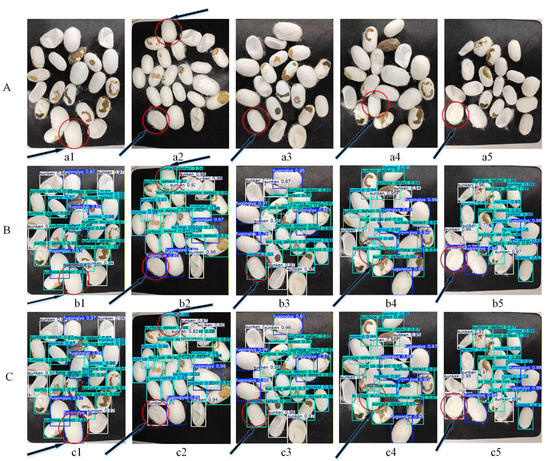
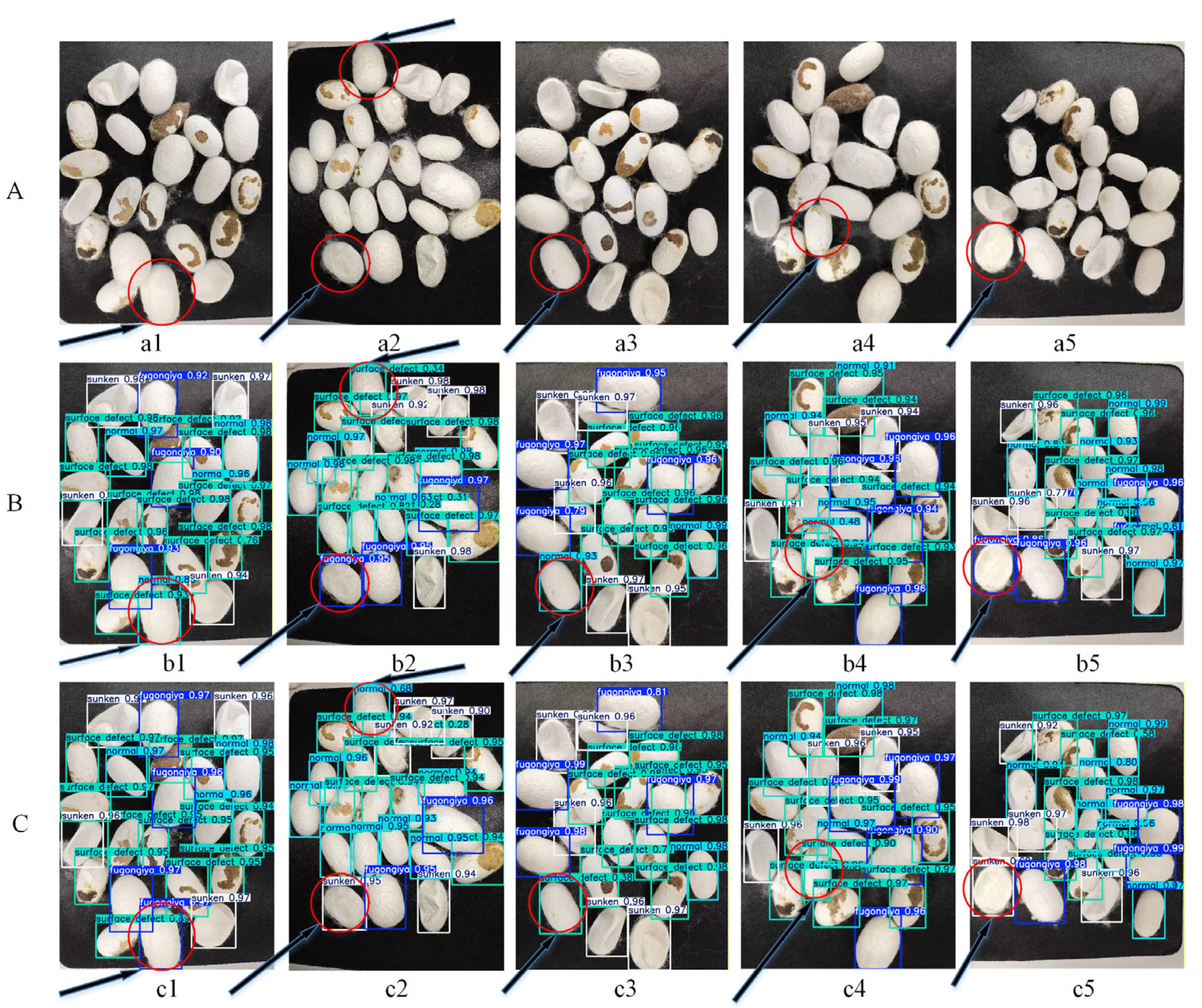
To verify the effectiveness of the LMD-YOLO model, a comparison of detection results between the original and improved YOLOv10 models was conducted in this study, with the visualized detection results shown in Figure 16. Rows A, B, and C in the figure represent the test images, YOLOv10 detection results, and LMD-YOLO detection results, respectively. For a more intuitive demonstration of the improvement effect, several representative challenging detection regions are highlighted with red circles and arrows in the figure. The targets in these regions mainly have two characteristics: one is being located at the image edges (e.g., a1 and a2) and the other is having severe deformation or irregular features (e.g., the sunken cocoons in a4 and a5).
Figure 16.
Detection results before and after model improvement. Row A (a1–a5) displays the original test images. B shows the detection results from the baseline YOLOv10 model. C presents the detection results from the improved LMD-YOLO model. Red circles and arrows highlight representative challenging detection scenarios and cocoons with severe deformation or irregular features, to intuitively demonstrate the improvement in detection performance.
A comparison of the detection results in Rows B and C reveals that the LMD-YOLO model exhibits high-efficiency detection performance. At the positions marked by red circles, the model in Row B failed to detect the targets and incurred serious detection errors. It can be seen that the annotated targets in a1, b1, and c1 were occluded; the LMD-YOLO model could detect them correctly, while the YOLOv10 model made detection errors due to occlusion. A comparison of the detection results for b2 and c2 and b5 and c5 shows that the YOLOv10 model misdetected sunken cocoons, indicating its poor detection performance for targets with irregular features. In contrast, for the LMD-YOLO model, the DySample and MSDA modules enhanced the model’s ability to reconstruct features for irregular shapes, thus effectively solving the problem of missed detections in complex scenarios. A comparison of the detection results for b3 and c3 and b4 and c4 indicates that the YOLOv10 model had detection errors for small targets, especially for the surface defect category. For the LMD-YOLO model, however, the introduced C2f-LSKA module expanded the receptive field through the large kernel attention mechanism, enabling the model to capture more contextual information when processing small targets and edge targets.
In summary, the visualized comparison experiments intuitively reveal the limitations of the original YOLOv10 model in dealing with occlusion, irregular deformation, and tiny features. In contrast, benefiting from the large receptive field of the C2f-LSKA module and the feature reconstruction capabilities of the DySample and MSDA modules, the LMD-YOLO model can accurately capture key features in complex scenarios. This result illustrates that the improved model successfully solves the problems of missed detection and false detection and significantly improves the robustness and accuracy in the task of cocoon detection.
While LMD-YOLO demonstrates significant improvements in cocoon defect detection, this study has two main limitations. First, the dataset was collected under controlled lighting and background conditions at a single facility. Due to the seasonal nature of silkworm cocoon production, cross-domain validation on data from different acquisition environments was not performed; thus, the model’s robustness in unconstrained industrial scenarios requires further verification. Second, due to computational resource constraints during the evaluation phase, the comparative experiments were conducted on a single standard dataset split without statistical variability analysis. Although the ablation study shows consistent monotonic gains, future optimizations will include robust cross-validation to establish strict statistical confidence intervals and incorporate multi-center data to ensure generalization.
4.4. Analysis of LMD-YOLO Detection Capability
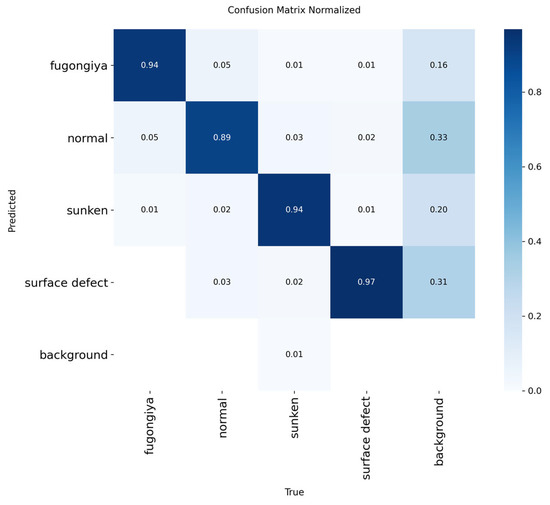
To further analyze the discriminative details of the LMD-YOLO model across different categories, a normalized confusion matrix was plotted using the detection results of the test set in this study [29], as shown in Figure 17. In the figure, the horizontal axis represents the true labels and the vertical axis represents the predicted labels, with the values on the diagonal indicating the recall accuracy of each category. Observing the diagonal of the matrix reveals that the model exhibits excellent discriminative ability for the core defect categories. The prediction accuracy of the surface defect category was as high as 0.97, which means that 97% of the true surface defects were correctly classified, with only 0.03 of the samples being misjudged. This indicates the effectiveness of the DySample dynamic upsampling module in recovering fine textures as the model rarely misclassified defective cocoons as qualified ones. The prediction accuracy of the sunken category reached 0.94; despite the diverse morphologies of sunken cocoons, the model had only a 0.01 probability of missing and classifying them as the background, indicating that the MSDA multi-scale attention mechanism effectively covers deformation features of varying degrees.
Figure 17.
Confusion matrix.
However, the most significant confusion in the matrix occurred between the normal and fugongjian categories, which reveals the physical bottleneck of current visual detection. The accuracy of the normal category was 0.89, the lowest among all categories. The matrix shows that 0.05 of normal were misjudged as fugongjian. The accuracy of the fugongjian category was 0.94, and, similarly, 0.05 of fugongjian were misjudged as normal cocoons. This symmetric misjudgment indicates that there is a high degree of visual feature overlap between some large-sized normal and small-sized fugongjian. Although the LSKA large kernel attention was introduced to enhance global perception, it was still somewhat difficult to distinguish these two types of edge samples solely by visual appearance in this model, which is the main reason for the relatively low AP value of the normal category. Observing the bottom row of the matrix, the miss rate of all categories was almost 0, except for a 0.01 miss rate in the sunken category. This indicates that the LMD-YOLO model has target capture capability, and serious quality accidents caused by missed detections would rarely occur in industrial applications.
The analysis results of the confusion matrix show that the LMD-YOLO model adopts a stringent defect filtering strategy. It achieved good performance in distinguishing qualified cocoons from defective ones while maintaining a low and balanced misjudgment rate in distinguishing qualified cocoons from sub-qualified ones. This characteristic is highly consistent with the requirements of cocoon sorting, which meets the industrial demand of eliminating suspected fugongjian and never letting defective cocoons pass. The test results once again indicate that the LMD-YOLO model proposed in this study can effectively address the detection of cocoon quality. The confusion matrix reveals that misclassification between normal and fugongjian persists. This challenge stems from the conceptual definition of the classes: fugongjian are essentially a morphological variation of normal, sharing identical texture features. In a standard one-stage detector, these classes are treated as mutually exclusive labels, ignoring their hierarchical relationship. Consequently, the decision boundary in the appearance space is not cleanly separable, leading to ambiguity in borderline cases. This phenomenon will be one of the key focuses in our future work.
To further address the separability issue between morphologically similar classes, future work will explore alternative formulations beyond flat classification, adopting a coarse-to-fine strategy where the model first localizes the cocoon object and subsequently classifies its sub-type using a specialized attribute classifier, thereby integrating geometric priors into the loss function. Since double cocoons typically exhibit larger areas and specific aspect ratios, adding a geometric constraint loss or a multi-task learning branch to regress shape parameters could provide stronger supervision than visual features alone.
5. Conclusions
To address the problems of extreme scale variation between large double cocoons and tiny surface defects, the loss of fine-grained texture details during feature upsampling, and the visual ambiguity between morphologically similar cocoon categories, we designed LMD-YOLO, an efficient cocoon defect detection model based on Large Separable Kernel Attention and dynamic upsampling. First, we proposed an improved feature extraction module, named C2f-LSKA, by integrating the Large Separable Kernel Attention mechanism. This design expands the receptive field to capture long-range dependencies, thereby enhancing the model’s ability to discriminate fugongjian from normal. Secondly, we introduced the DySample module to replace traditional static upsampling methods. By utilizing content-aware dynamic point sampling, this module minimizes the loss of fine-grained texture information, which significantly improves the detection accuracy of tiny surface defects. Finally, based on the optimized feature extraction and fusion network, the Multi-Scale Dilated Attention (MSDA) mechanism was embedded before the detection heads to aggregate multi-scale semantic information, and the final object detection algorithm, LMD-YOLO, was constructed. Extensive experiments indicated that the constructed LMD-YOLO achieves the best balance between accuracy and efficiency compared to other state-of-the-art models.
Although LMD-YOLO outperforms current lightweight models, distinguishing normal cocoons from those with subtle morphological defects remains challenging. Therefore, we will further explore the following aspects in our future work: (1) We will expand the dataset to make it more comprehensive, covering diverse lighting conditions and rare defect types to enhance the model’s robustness and generalization capability. (2) We will investigate advanced model compression techniques, such as knowledge distillation and quantization, to further reduce hardware requirements, facilitating deployment on low-power edge devices. (3) We plan to collect a multi-center dataset encompassing various lighting conditions and camera angles to rigorously evaluate and improve the model’s generalization ability for broader industrial deployment.
Author Contributions
Conceptualization, J.Z. and Y.Z.; methodology, J.Z.; software, X.M.; validation, D.G., J.Z., and S.C.; formal analysis, Y.G.; writing—original draft preparation, J.Z.; writing—review and editing, J.Q.; visualization, S.C.; supervision, J.Q.; funding acquisition, D.G. All authors have read and agreed to the published version of the manuscript.
Funding
This work was supported by the (1) Natural Science Foundation of Nantong City (JC2023023), (2) Social Livelihood Science and Technology Plan of Nantong City (MSZ2024122, MS2024016, MSZ2025156), (3) Jiangsu Province Higher Education Informatisation Research Major Project (2025JSETKT036), and General Project of Philosophy and Social Science Research in Colleges and Universities in Jiangsu Province (2025SJYB1268).
Data Availability Statement
All the data and codes can be obtained from https://pan.baidu.com/s/1l8vAGwaUJrGiHV5O55wWdw?pwd=qfu3 (accessed on 24 February 2026). The dataset will be made available upon request by the authors. The raw data supporting the conclusions of this article will be made available by the authors upon request.
Acknowledgments
We were grateful to the Nantong Silkworm Cocoon Detection Center for providing the data.
Conflicts of Interest
The authors declare no conflicts of interest.
References
- GB/T 9111-2015; Methods of Mulberry Silkworm Dried Cocoons. China National Standardization Administration: Beijing, China, 2015.
- Wang, Q.; Li, Z.; Gu, T.; Ye, F.; Wang, X. Cocoons Counting and Classification Based on Image Processing. In Proceedings of the 2020 13th International Congress on Image and Signal Processing, BioMedical Engineering and Informatics (CISP-BMEI), Chengdu, China, 17–19 October 2020; pp. 148–152. [Google Scholar]
- Chen, H.; Yang, Z.; Liu, X.; Shao, L. Study on auxiliary testing method for mulberry silkworm cocoon sorting based on MATLAB. J. Silk 2016, 53, 32–36. [Google Scholar]
- Liu, M.; Li, R.; Yan, X.; Yan, Y.; Li, F.; Liu, S. Detection and elimination of yellow spotted cocoon in mountage based on FCM algorithm and HSV color model. Trans. Chin. Soc. Agric. Mach. 2018, 49, 31–38. [Google Scholar]
- Firouz, M.S.; Sardari, H. Defect detection in fruit and vegetables by using machine vision systems and image processing. Food Eng. Rev. 2022, 14, 353–379. [Google Scholar] [CrossRef] [Scilit]
- Tao, D.; Wang, Z.; Li, G.; Qiu, G. Radon Transform-Based Motion Blurred Silkworm Pupa Image Restoration. Int. J. Agric. Biol. Eng. 2019, 12, 152–159. [Google Scholar] [CrossRef] [Scilit]
- Chen, Y.; Ding, Y.; Zhao, F.; Zhang, E.; Wu, Z.; Shao, L. Surface Defect Detection Methods for Industrial Products: A Review. Appl. Sci. 2021, 11, 7657. [Google Scholar] [CrossRef] [Scilit]
- Liu, M.; Hou, X.; Shang, M.; Owoola, E.O.; Zhang, G.; Wei, W.; Song, Z.; Yan, Y. A Classification Model for Fine-Grained Silkworm Cocoon Images Based on Bilinear Pooling and Adaptive Feature Fusion. Agriculture 2024, 14, 2363. [Google Scholar] [CrossRef] [Scilit]
- Mishra, N.K.; Singh, P.; Gupta, A.; Joshi, S.D. PP-CNN: Probabilistic pooling CNN for enhanced image classification. Neural Comput. Appl. 2025, 37, 4345–4361. [Google Scholar] [CrossRef] [Scilit]
- Li, S.; Sun, W.; Liang, M.; Shao, T. Research on the Identification Method of Silkworm Cocoon Species Based on Improved YOLOv3. In Proceedings of the 2020 5th International Conference on Mechanical, Control and Computer Engineering (ICMCCE), Harbin, China, 25–27 December 2020; pp. 1119–1123. [Google Scholar]
- Zhang, Y.; Yang, H.; Zhu, S.; He, Z. Machine Vision Real Time Detection of Inferior Cocoons Based on Lightweight Manipulation Network. Trans. Chin. Soc. Agric. Mach. 2022, 53, 261–270. [Google Scholar]
- Jiang, Z.; Ying, J.; Wang, C.; Song, L.; He, Q.; Guo, P.; Lin, X.G.; Deng, L.L. Research on cocoon segmentation and double cocoon recognition based on two-parameter thresholds. J. Silk 2023, 60, 18–25. [Google Scholar]
- Wen, C.; Wen, J.; Li, J.; Luo, Y.; Chen, M.; Xiao, Z.; Xu, Q.; Liang, X.; An, H. Lightweight Silkworm Recognition Based on Multi-Scale Feature Fusion. Comput. Electron. Agric. 2022, 200, 107234. [Google Scholar] [CrossRef] [Scilit]
- Shi, H.K.; Xiao, W.F.; Zhu, S.P.; Li, L.B.; Zhang, J.F. CA-YOLOv5: Detection model for healthy and diseased silkworms in mixed conditions based on improved YOLOv5. Int. J. Agric. Biol. Eng. 2023, 16, 236–245. [Google Scholar] [CrossRef] [Scilit]
- Liu, J.; Zhang, J.; Ma, Z.; Li, E.; Yuan, J. An Online Quality Detection Algorithm for Cocoon Clusters Based on CD-YOLO. IEEE Access 2025, 13, 196143–196154. [Google Scholar] [CrossRef] [Scilit]
- Gao, J.; Sun, J.; Wu, X.; Dai, C. RDM-YOLO: A Lightweight Multi-Scale Model for Real-Time Behavior Recognition of Fourth Instar Silkworms in Sericulture. Agriculture 2025, 15, 1450. [Google Scholar] [CrossRef] [Scilit]
- Wang, P.; Ge, Z.; Gao, R. Gold-YOLO: Efficient Object Detector with Gather-and-Distribute Mechanism. In Advances in Neural Information Processing Systems (NeurIPS); Curran Associates, Inc.: Red Hook, NY, USA, 2023; Volume 36, pp. 56214–56228. [Google Scholar]
- Ding, X.; Zhang, X.; Han, J.; Ding, G. Scaling Up Your Kernels to 31x31: Revisiting Large Kernel Design in CNNs. In Proceedings of the IEEE/CVF Conference on Computer Vision and Pattern Recognition (CVPR), New Orleans, LA, USA, 18–24 June 2022; pp. 11963–11975. [Google Scholar]
- Zheng, H.; Guo, X.; Ma, Y.; Zeng, X.; Chen, J.; Zhang, T. Fine-Grained Detection Model Based on Attention Mechanism and Multi-Scale Feature Fusion for Cocoon Sorting. Agriculture 2024, 14, 700. [Google Scholar] [CrossRef] [Scilit]
- Chen, J.; Guo, X.; Zhang, T.; Zheng, H. Efficient defective cocoon recognition based on vision data for intelligent picking. Electron. Res. Arch. 2024, 32, 3299–3312. [Google Scholar] [CrossRef] [Scilit]
- Wang, A.; Chen, H.; Liu, L.; Chen, K.; Lin, Z.; Han, J.; Ding, G. YOLOv10: Real-Time End-to-End Object Detection. arXiv 2024, arXiv:2405.14458. [Google Scholar]
- Lyu, C.; Zhang, W.; Huang, H.; Zhou, Y.; Wang, S.; Liu, Y.; Zhang, S.; Chen, K. RTMDet: An Empirical Study of Designing Real-Time Object Detectors. arXiv 2022, arXiv:2212.07784. [Google Scholar] [CrossRef] [Scilit]
- Liu, W.; Lu, H.; Fu, H.; Ma, Z. Learning to upsample by learning to sample. In Proceedings of the 2023 IEEE/CVF International Conference on Computer Vision (ICCV), Paris, France, 2–6 October 2023; pp. 6004–6014. [Google Scholar]
- Wang, J.; Chen, K.; Xu, R.; Liu, Z.; Loy, C.C.; Lin, D. CARAFE: Content-Aware ReAssembly of FEatures. In Proceedings of the IEEE/CVF International Conference on Computer Vision (ICCV), Seoul, Republic of Korea, 27 October–2 November 2019; pp. 3007–3016. [Google Scholar]
- Jin, Y.; Liu, X.; Nan, K.; Wang, S.; Wang, T.; Zhang, Z.; Zhang, X. A Real-Time Fabric Defect Detection Method Based on Improved YOLOv8. Appl. Sci. 2025, 15, 3228. [Google Scholar] [CrossRef] [Scilit]
- Lau, K.W.; Po, L.M.; Rehman, Y.A.U. Large Separable Kernel Attention: Rethinking the Large Kernel Attention Design in CNN. Expert Syst. Appl. 2024, 236, 121352. [Google Scholar] [CrossRef] [Scilit]
- Jiao, J.Y.; Tang, Y.M.; Lin, K.Y.; Gao, Y.; Ma, J.; Wang, Y.; Zheng, W.S. DilateFormer: Multi-scale dilated transformer for visual recognition. IEEE Trans. Multimed. 2023, 25, 8906–8919. [Google Scholar] [CrossRef] [Scilit]
- Zhu, J.; Qiu, J.; Chen, S.; Chen, S.; Zhang, H. An application of YOLOv8 integrated with attention mechanisms for detection of grape leaf black rot spots. PLoS ONE 2025, 20, e0321788. [Google Scholar] [CrossRef] [Scilit]
- Zhu, J.; Zhu, C. Research on the innovative application of Shen Embroidery cultural heritage based on convolutional neural network. Sci. Rep. 2024, 14, 9574. [Google Scholar] [CrossRef] [Scilit]

Disclaimer/Publisher’s Note: The statements, opinions and data contained in all publications are solely those of the individual author(s) and contributor(s) and not of MDPI and/or the editor(s). MDPI and/or the editor(s) disclaim responsibility for any injury to people or property resulting from any ideas, methods, instructions or products referred to in the content. |
© 2026 by the authors. Licensee MDPI, Basel, Switzerland. This article is an open access article distributed under the terms and conditions of the Creative Commons Attribution (CC BY) license.