


Abstract
Agricultural development is vital to rural economies in developing countries. Rural e-commerce has emerged as an important instrument for promoting rural economic transformation, yet its impact on agricultural development remains underexplored. Using panel data for 1345 counties in China from 2010 to 2022, this study exploits a quasi-natural experiment created by the phased implementation of the Rural E-Commerce Demonstration County (REDC) program and applies a staggered difference-in-differences approach to identify its causal effects on agricultural development. The results show that the REDC program significantly promotes agricultural development, mainly through expanded consumer demand and greater social investment. Its effects are particularly evident in regions with balanced production and consumption and in economically developed counties. Moreover, the REDC program shows no evidence of a significant negative siphon effect within 50 km of pilot counties but generates strong positive spillovers in the 50–200 km surrounding range. Taken together, these findings provide empirical evidence supporting the advancement of rural e-commerce and agricultural scaling in China, while also offering policy implications for other developing countries seeking to promote rural e-commerce.
1. Introduction
The digital economy has driven global economic growth [1,2]. As a crucial component of this transformation, e-commerce plays a significant role in accelerating economic and social development, which is supported by advances in information technology and logistics infrastructure [3,4,5]. Between 2014 and 2023, global retail e-commerce sales increased from $1.34 trillion to approximately USD 5.8 trillion. In this context, rural e-commerce has emerged as a strategic tool for developing countries to bridge the urban-rural divide and foster rural economic growth [6,7,8]. For example, Egypt, India, and Vietnam have implemented rural information and communication initiatives to promote rural development through e-commerce [9].
Research confirms the significant positive external economic effects of rural e-commerce development. It has contributed to increasing farmers’ income [10,11,12], promoting rural poverty alleviation [13], reducing rural income inequality [14] and the rural-urban income gap [15], mitigating farmland abandonment [8,16], accelerating the growth of the footwear industry [17] and broader regional economies [18]. These effects suggest that rural e-commerce is increasingly becoming a key driver of rural economic development.
Rural economies in developing countries are predominantly agricultural, and agricultural development is critical for improving farmers’ incomes and promoting rural economic growth [19,20]. However, the relationship between rural e-commerce and agricultural development remains largely underexplored in the literature. Investigating how rural e-commerce influences agricultural development is thus crucial for advancing inclusive and sustainable rural development in developing countries.
China provides an excellent case for studying the impact of rural e-commerce on agricultural development. The country has prioritized high-quality agricultural development, aiming to shift from quantitative growth to qualitative improvements [21]. Despite this policy emphasis, the sector still faces persistent challenges, including short agricultural industrial chains, inefficient resource use, and weak operational capacity among agricultural actors [17,22]. To address these barriers, China launched the Rural E-Commerce Demonstration County (REDC) program in 2014. As a national-level initiative, the REDC program promotes the integration of e-commerce into rural areas, facilitates the digital transformation of traditional agricultural sectors, and supports rural economic revitalization. In addition to enhancing infrastructure and support services for rural e-commerce, the program has played a key role in reshaping agricultural value chains [23].
By 2024, 1489 counties across China (excluding those reselected in multiple rounds) had implemented the REDC program. This rollout led to the establishment of nearly 3000 county-level public service and logistics centers and more than 158,000 village-level e-commerce service centers. Widely recognized as one of the most comprehensive and effective rural e-commerce policies in the developing world [5], the REDC program provides a valuable empirical setting. Its staggered and gradual implementation creates quasi-natural experimental conditions that allow for rigorous analysis of the effects of rural e-commerce on agricultural development.
As the most extensively implemented and influential policy in China’s digital rural development, the REDC program has attracted considerable scholarly attention. Existing studies have focused primarily on positive external economic effects, examining outcomes such as rural income growth [24], farmers’ incomes [25], economic resilience [26], county-level economic development [5,27], county-level economic inequality [28], agricultural labor productivity [22], and industrial structural transformation [29]. Some studies have also highlighted potential negative externalities, such as regional imbalances in development [30]. However, the relationship between the REDC program and agricultural development has been addressed only narrowly, primarily through agricultural labor productivity [22]. The broader and more nuanced pathways through which the REDC program may influence agricultural development remain underexplored. These internal mechanisms are often treated as a ‘black box’ in the literature, highlighting a critical gap that this study seeks to address.
This study investigates the extent to which rural e-commerce promotes agricultural development and explores the mechanisms underlying this relationship. Leveraging the quasi-natural experimental setting created by the staggered rollout of the REDC program, we use county-level panel data from China spanning 2010 to 2022 to conduct both theoretical analysis and empirical evaluation. The study makes four main contributions.
First, this study provides a more systematic evaluation of the impact of the Rural E-Commerce Demonstration County (REDC) program on agricultural development by shifting the focus from single outcome indicators to a multidimensional perspective. While existing studies and policy reports primarily examine outcomes such as rural income growth [24], county-level economic performance [5,27], or industrial upgrading [29], this study constructs a composite index of agricultural development that jointly captures agricultural economic performance, employment, and mechanization. This approach allows for a more integrated assessment of how rural e-commerce policies affect agriculture as a whole.
Second, this study contributes new evidence on the mechanisms through which the REDC program influences agricultural development. Rather than treating rural e-commerce as a “black box,” the analysis explicitly examines consumer demand expansion and social investment as two transmission channels, combining demand-side and supply-side perspectives. This mechanism-based analysis helps clarify how rural e-commerce policies translate into agricultural outcomes, extending beyond the descriptive correlations emphasized in prior research.
Third, this study extends existing evaluations of rural e-commerce policies by incorporating a spatial perspective. Using county-level data, it documents the presence of distance-dependent spillover effects of the REDC program, with positive impacts observed in surrounding counties within a 50–200 km range and no evidence of significant negative siphon effects in nearby areas. This spatial evidence highlights policy effects that are not captured by conventional single-region analyses.
Fourth, this study provides systematic evidence on the heterogeneous effects of the REDC program across different types of counties. The results show that policy impacts vary by regional economic conditions and by production–consumption structures, with stronger effects observed in economically developed counties and in production–consumption balanced zones. By explicitly documenting this heterogeneity, the study moves beyond “average effect” evaluations and offers insights into the conditions under which rural e-commerce policies are more likely to be effective, which is particularly relevant for the refinement of similar initiatives in China and other developing countries.
2. Institutional Background
In 2014, the Chinese government launched the REDC program to promote the diffusion of e-commerce in rural areas. The program aims to facilitate two-way flows between urban and rural markets, promoting the upward mobility of agricultural products into urban centers and the downwards distribution of industrial goods into the countryside. Ultimately, the REDC program seeks to stimulate local economic development, alleviate rural poverty, and narrow the urban-rural divide.
The REDC program employs a competitive selection mechanism. Each province nominates candidate counties on the basis of economic development, industrial foundations, and existing e-commerce infrastructure. Final selections are made by the central government, reflecting alignment with local development priorities.
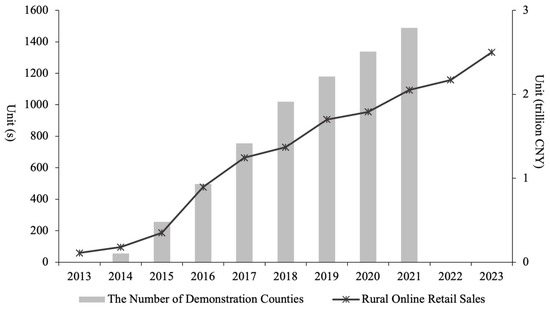
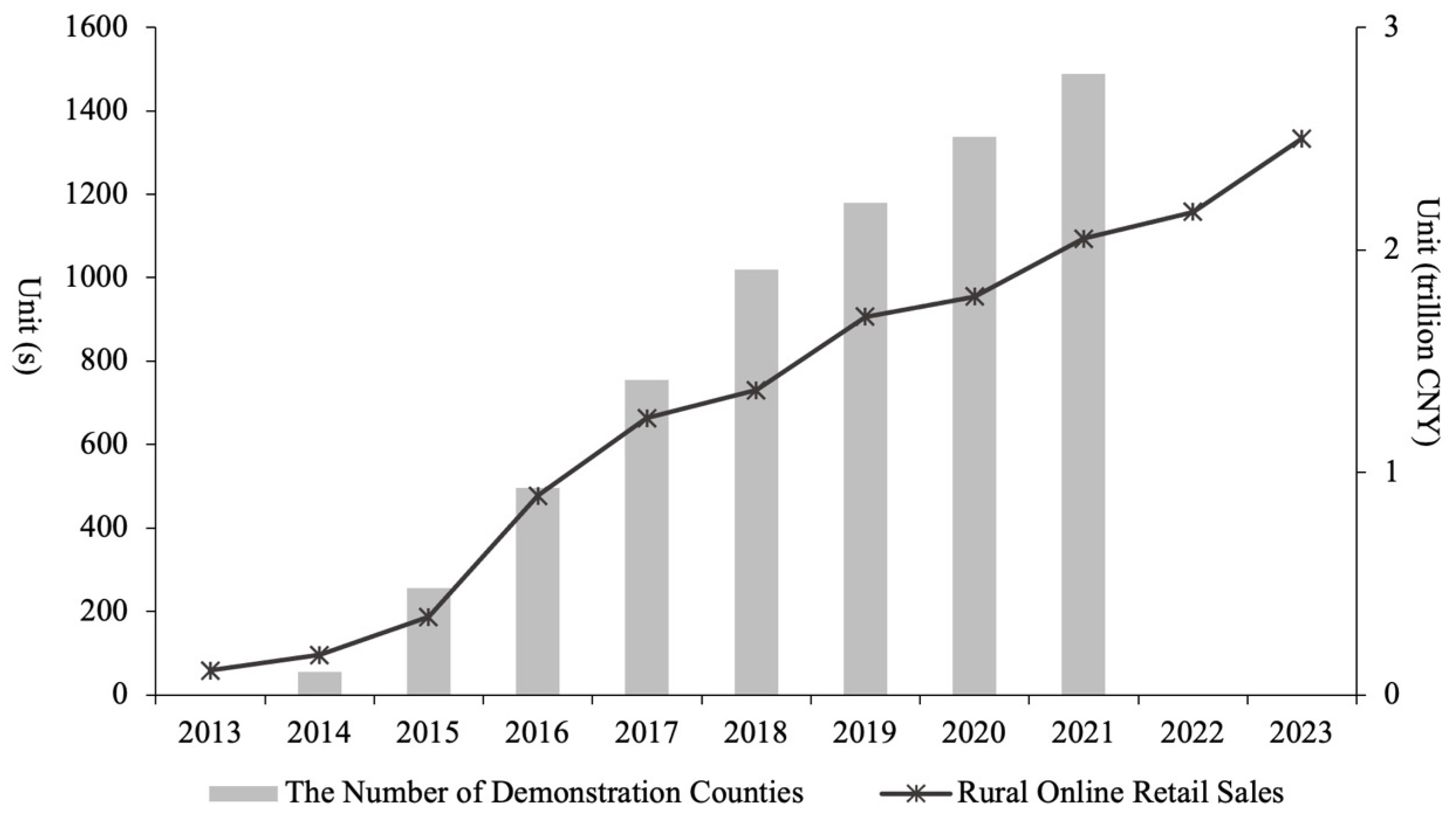
As shown in Figure 1, the REDC program was implemented in a phased manner. The first batch in 2014 included 56 counties, followed by 200 in 2015 and 240 in 2016. Since 2017, the program has increasingly targeted poverty-stricken regions. Among the 520 counties added in 2017 and 2018, 475 were national-level poor counties. By 2019, the program had fully covered all eligible poor counties, and reapplications from previously supported or high-potential counties were permitted. In 2019, 2020, and 2021, 215, 225, and 206 counties, respectively, were selected. To date, a total of 1489 counties (excluding reselections) have implemented the REDC program. Concurrently, China’s rural online retail sales surged from CNY 0.18 trillion in 2014 to CNY 2.5 trillion in 2023, underscoring the rapid development of rural e-commerce.
Figure 1.
The number of demonstration counties and rural online retail sales.
To ensure effective implementation, each REDC county receives CNY 20 million in central government funding, with local governments required to contribute at least 20% in matching funds. These funds are directed towards addressing key bottlenecks in rural e-commerce development, focusing on three primary areas:
- i.
- Strengthening rural e-commerce service systems
The REDC program supports the development of county-level e-commerce public service centers and village-level service stations. These centers integrate local industries—such as agricultural products, handicrafts, folk culture, and rural tourism—with services, including processing, packaging, marketing, and finance. Resources from postal services, supply and marketing cooperatives, express delivery, financial institutions, and local governments are consolidated to expand service capacity and market access.
- ii.
- Building rural logistics infrastructure
The program promotes the creation of a three-tier logistics distribution system across counties, townships, and villages. Market-oriented collaboration is encouraged among postal agencies, logistics firms, supply and marketing cooperatives, and private logistics providers. Funding is allocated for constructing or renovating county logistics hubs and township delivery stations to develop joint delivery mechanisms, lower logistics costs, and solve ‘first-mile’ and ‘last-mile’ challenges.
- iii.
- Facilitating the digital transformation of rural commerce
REDC funding also supports the modernization of rural commerce through technologies such as big data, cloud computing, and mobile internet. The program encourages centralized procurement, unified distribution, and inventory management for small and medium-sized rural businesses, helping to build efficient, localized supply chains tailored to rural consumer needs.
In addition, provincial governments are required to establish full-process performance management systems for their REDC counties. They are expected to monitor project progress, manage fund allocation, and resolve real-time implementation issues. The Ministry of Commerce conducts annual performance evaluations, and counties that fail to meet performance targets risk losing their REDC designation, thereby ensuring program accountability and effectiveness.
Therefore, as one of the most intensively implemented and widely covered policy programs in China, the REDC program provides important policy support for advancing agricultural and rural modernization and also offers a valuable context for examining the relationship between rural e-commerce and agricultural development.
3. Research Hypothesis
The REDC program has significantly strengthened logistics and express delivery networks, warehousing, cold chain facilities, and information services across the county, township, and village levels, providing digital platforms that connect agricultural producers to markets [31]. The shift from offline to online agricultural sales channels [3] has alleviated challenges such as high transport costs and limited market access caused by geographical isolation [32], while lowering market-entry barriers for agricultural producers [17]. The program has also promoted the development of e-commerce industrial parks in demonstration counties [22], attracting agricultural enterprises that were previously constrained by remoteness. The integration of agriculture and e-commerce extends agricultural value chains and raises the value-added of agricultural products [33], enhancing both productivity and competitiveness. Lower transaction costs and improved market efficiency have, in turn, increased agricultural trade volumes [26]. Therefore, the REDC program has created favorable internal and external conditions for agricultural development. On this basis, the first research hypothesis is proposed.
Hypothesis 1.
The REDC program improves agricultural development.
According to demand-side theory, economic growth is driven by the expansion of consumer demand [34], which activates and realizes latent demand by improving market access and reducing transaction costs, thereby fostering industrial development. The REDC program promotes agricultural development by strengthening this demand channel. By accelerating the growth of rural e-commerce, the program connects production and consumption across regions. Owing to its cross-regional and borderless nature, e-commerce reduces spatial barriers [35], lowers urban–rural trade frictions, and deepens the integration of agriculture with markets [4,10], thereby improving market access for farm products and enlarging consumer markets [36]. E-commerce platforms bring producers and consumers into a shared digital space [31,37], enabling low-cost, real-time information exchange [3] and mitigating information asymmetries [28,29]. This allows agricultural producers to adjust output according to changing consumer preferences, aligning supply with demand more accurately [9]. The resulting responsiveness enhances producers’ ability to adapt to market fluctuations while offering consumers a wider range of choices, further enhancing the realization of existing purchasing power. An expansion in effective consumer demand is associated with greater investment and innovation in agriculture, improving product quality and service delivery [38] and generating higher economic returns. Together, these dynamics foster sustained agricultural growth. Given the above analysis, the second research hypothesis is proposed:
Hypothesis 2.
The REDC program facilitates agricultural development by expanding consumer demand.
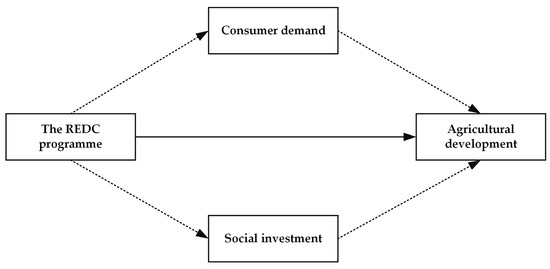
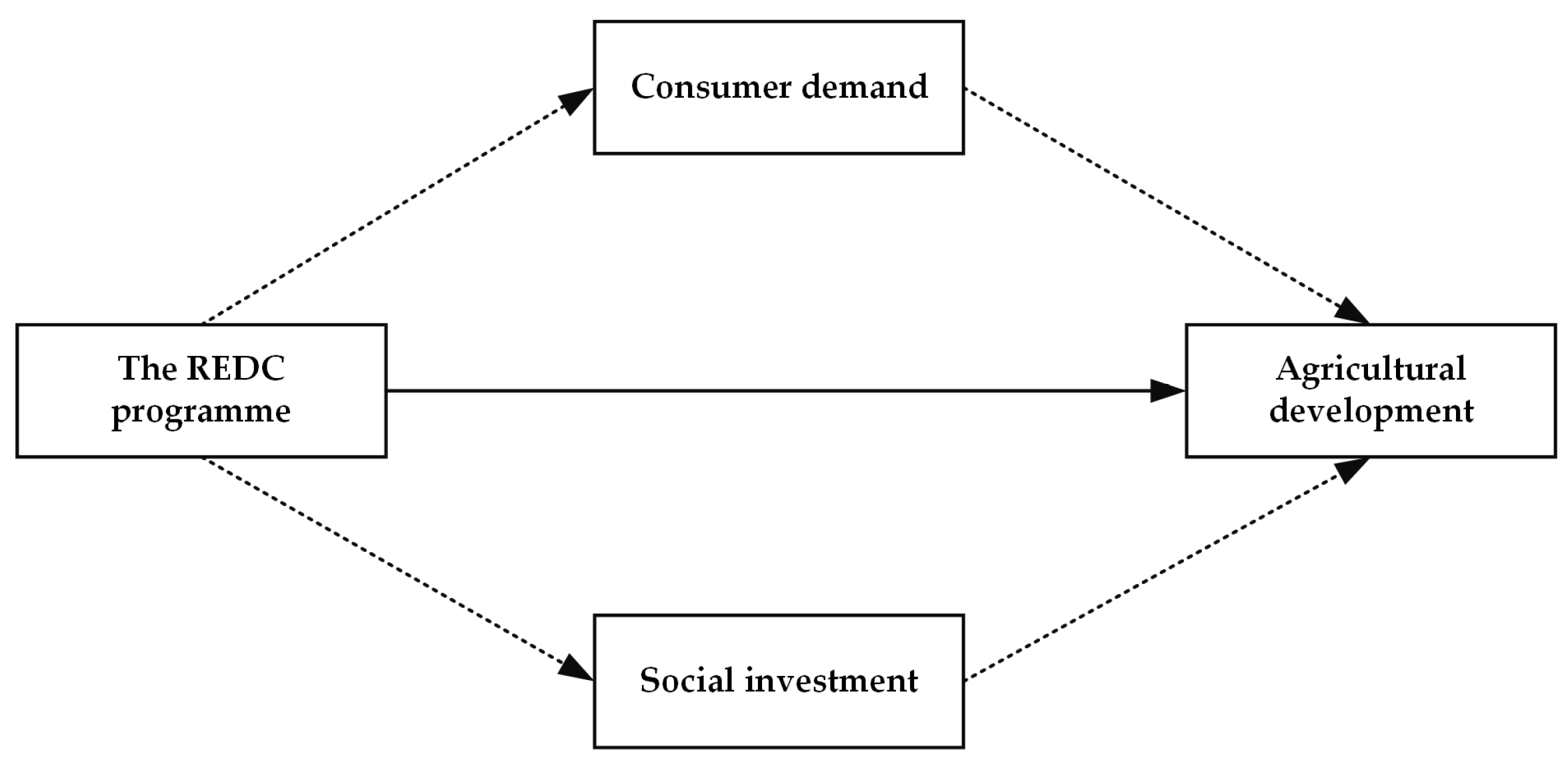
However, relying solely on demand-side forces may create imbalances between agricultural supply and demand. Sustainable agricultural growth also depends on stable supply capacity [26], and balanced interaction between demand and supply is essential for long-term development. In contrast to demand-side theory, supply-side theory highlights improvements in production capacity and resource allocation as the foundation for industrial upgrading and economic expansion [39]. The REDC program strengthens the supply side of agriculture by stimulating social investment and upgrading infrastructure. Its implementation has encouraged demonstration counties to refine credit-incentive policies [30], providing institutional support for agricultural activity. These reforms have improved the rural market environment and increased agriculture’s appeal to private and collective capital [3,18]. The program has also promoted the regional reallocation of social capital, drawing investment from more developed regions into demonstration areas and expanding the overall scale of rural investment [33]. Greater participation of social capital mitigates rural capital outflow, eases financing constraints, and supports the modernization of agriculture [26]. In addition, social capital contributes to agricultural upgrading by fostering regional branding, advancing digital transformation, and enabling platform-based operations [40]. Together these developments have enhanced infrastructure and service provision along the agricultural value chain, strengthened supply capacity and market competitiveness, and ultimately advanced agricultural development. Based on the above reasoning, the third research hypothesis is formulated. Figure 2 illustrates the analytical framework underlying the mechanism analysis in this study.
Figure 2.
Mechanism analysis framework.
Hypothesis 3.
The REDC program contributes to agricultural development by enhancing social investment.
4. Data and Methods
4.1. Subsection Data and Methods
4.1.1. Outcome Variable
Agricultureit represents the level of agricultural development. However, existing studies have not established a unified metric for measuring agricultural development. Many studies commonly use the total industrial output value to evaluate the development of a particular industry, reflecting its contribution to economic growth. Nevertheless, some scholars argue that other factors, such as the number of industry personnel [41] and the level of mechanization [42,43], also serve as important indicators of industrial development. Drawing on the literature, we construct an index for measuring agricultural development in three dimensions: employment development, economic development, and mechanization development (as shown in Table 1). The data are derived from the China County Statistical Yearbooks and the Economy Prediction System. The level of agricultural development is measured using the entropy method, with detailed calculation formulas provided in Appendix A.
Table 1.
Agricultural development evaluation index system.
4.1.2. Explanatory Variable
E-commerceit is a dummy variable equal to 1 if a county implements the REDC program and 0 otherwise. The list of counties for the REDC program is sourced from the Ministry of Commerce website. In the sample of 1345 counties, 949 were designated as demonstration counties, forming the treatment group, while the remainder serve as the control group.
4.1.3. Mechanism Variables
Consumer demand (Demand) and social investment (Investment) are key mechanism variables capturing distinct channels through which the REDC program may exert influence. Consumer demand is measured by total retail sales of consumer goods, which indicate the overall level and trend of local consumption [30]. Social investment is proxied by total fixed asset investment, reflecting the scale, structure, and growth of regional capital formation [44]. Both variables are sourced from the China County Statistical Yearbooks.
4.1.4. Control Variables
To mitigate potential estimation bias arising from omitted variables, we select a set of control variables following the existing literature. The financial credit level (Finance) is represented by the ratio of the annual loan balance of financial institutions to the regional gross domestic product. Fiscal expenditure (Fiscal) is measured by local government general budget expenditures. Entrepreneurial activity (Enterprise) is represented by the annual number of new business registrations. Population density (Population) is expressed as the ratio of the total regional population to the area of the administrative region per year. Resident income (Income) is measured by the balance of savings deposits of urban and rural residents. The data on entrepreneurial activity are sourced from the Tianyancha website, which is a business information query platform in China. Other variable data come from the China County Statistical Yearbooks and Economy Prediction System. The descriptive statistics for each variable are shown in Table 2. The sample consists of 1345 counties observed over the period 2010–2022, yielding a total of 17,485 observations.
Table 2.
Descriptive statistics of the variables.
4.2. Model Specification
4.2.1. Baseline Model
Considering the phased implementation of the REDC program and the variation in its impact across counties over time, we employ a staggered difference-in-differences (DID) approach to examine the program’s effect on agricultural development. The baseline model is specified as follows:
where the subscripts i and t represent counties and years, respectively. X′it contains control variables. λi and μt are county fixed effects and year fixed effects, respectively, which control for time-invariant factors at the county level and time-varying factors that do not vary across counties. εit is the error term.
Agricultureit = β0
+ β1E-commerceit + ΣmρmX′it + μt + λi + εit
4.2.2. Mechanism Model
We adopt the mediation analysis framework developed by Baron and Kenny [45] to examine whether the REDC program promotes agricultural development through consumer demand and social investment. According to mediation effect analysis, when an explanatory variable (X) influences an outcome variable (Y) through a third variable (M), the variable M is defined as a mediator in the relationship between X and Y. Based on this framework, the mediation model is specified as follows:
where Mit denotes the mechanism variable. According to the mediation testing procedure, the analysis is conducted in three steps. First, Equation (1) examines whether the REDC program has a statistically significant effect on agricultural development. If a significant effect is identified, the mediation analysis proceeds. Second, the mediating variables are separately introduced into Equation (2) to test the impact of the REDC program on each mediator, yielding the estimated coefficient α1. Third, Equation (3) incorporates both the REDC program and the mediating variables to jointly examine their effects on agricultural development, producing the estimated coefficients θ1, and θ2. If α1, θ1, and θ2 are all positive and statistically significant, the mediating variable is considered to play a partial mediating role. In contrast, if α1 and θ2 are positive and statistically significant while θ1 becomes statistically insignificant, the mediating variable is regarded as exerting a full mediating effect.
Mit = α0
+ α1Agricultureit + ΣmρmX′it + μt + λi + εit
Agricultureit = θ0
+ θ1E-commerceit + θ2Mit + ΣmρmX′it + μt + λi + εit
4.2.3. Event Study
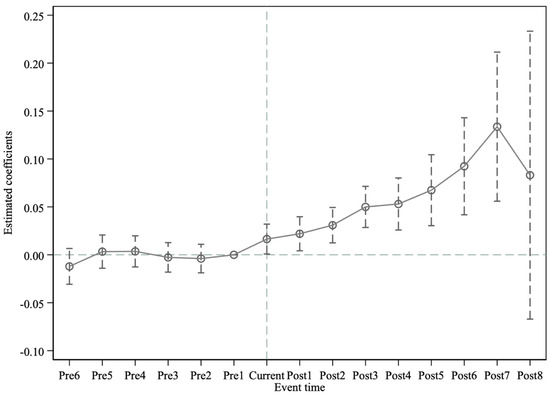
The validity of the staggered DID approach relies on the parallel trend assumption, which requires that the trajectories of agricultural development across counties follow similar trends before the REDC program is implemented. We adopt the event study approach to test this assumption, with the specific model specified as follows:
Here, represents a set of event-time dummy variables that capture the relative time difference between year t and the REDC program initiation year ti0 for county i. The parameter k denotes the event time: when k = 0, it indicates the year in which the county first implemented the REDC program; when , it refers to years before policy implementation; and when , it corresponds to k years after implementation. The distribution of observations across event-time periods is inherently unbalanced because of the staggered timing of policy adoption, potentially resulting in high estimation variance. To enhance estimation precision, all years six or more years prior to the REDC program () are grouped together, and the year immediately preceding implementation () is used as the reference period. The coefficients δk capture the difference in agricultural development for each relative year compared with the reference year, thereby identifying the dynamic effects of the policy.
4.2.4. Distance-Based Spatial Spillover Effects
To account for the potential spatial spillover effects of the REDC program, we follow Wang and Bu [46] and specify the following model to examine the spatial heterogeneity of the policy effects.
Building on Equations (1) and (5) introduces the variable , where s denotes the geographic distance between counties (in kilometers, s ≥ 50). The great-circle distance between counties is used to measure spatial proximity. If at least one REDC pilot county lies within the distance band (s − 50, s] kilometers of county i in year t, then ; otherwise, . The coefficient φs captures the marginal impact of the REDC program on agricultural development in neighboring counties located within each 50-km ring. To examine the spatial spillover effects, counties are grouped into eight consecutive 50 km rings: (0–50), (50–100), (100–150), (150–200), (200–250), (250–300), (300–350), and (350–400) km.
5. Results
5.1. Baseline Results
We use the baseline model to test whether the REDC program has promoted agricultural development. To reduce the absolute deviation of the variable values and facilitate model estimation, all the variables, except for the explanatory variable, are transformed using natural logarithms. The estimation results are presented in Table 3. After controlling for time-invariant factors, county-specific time trends, and other variables that may influence agricultural development, the estimated coefficient of the REDC program remains significantly positive. This suggests that the REDC program has a promoting effect on agricultural development, providing preliminary support for Hypothesis 1.
Table 3.
Baseline results.
5.2. Robustness Checks
5.2.1. Parallel Trend Test
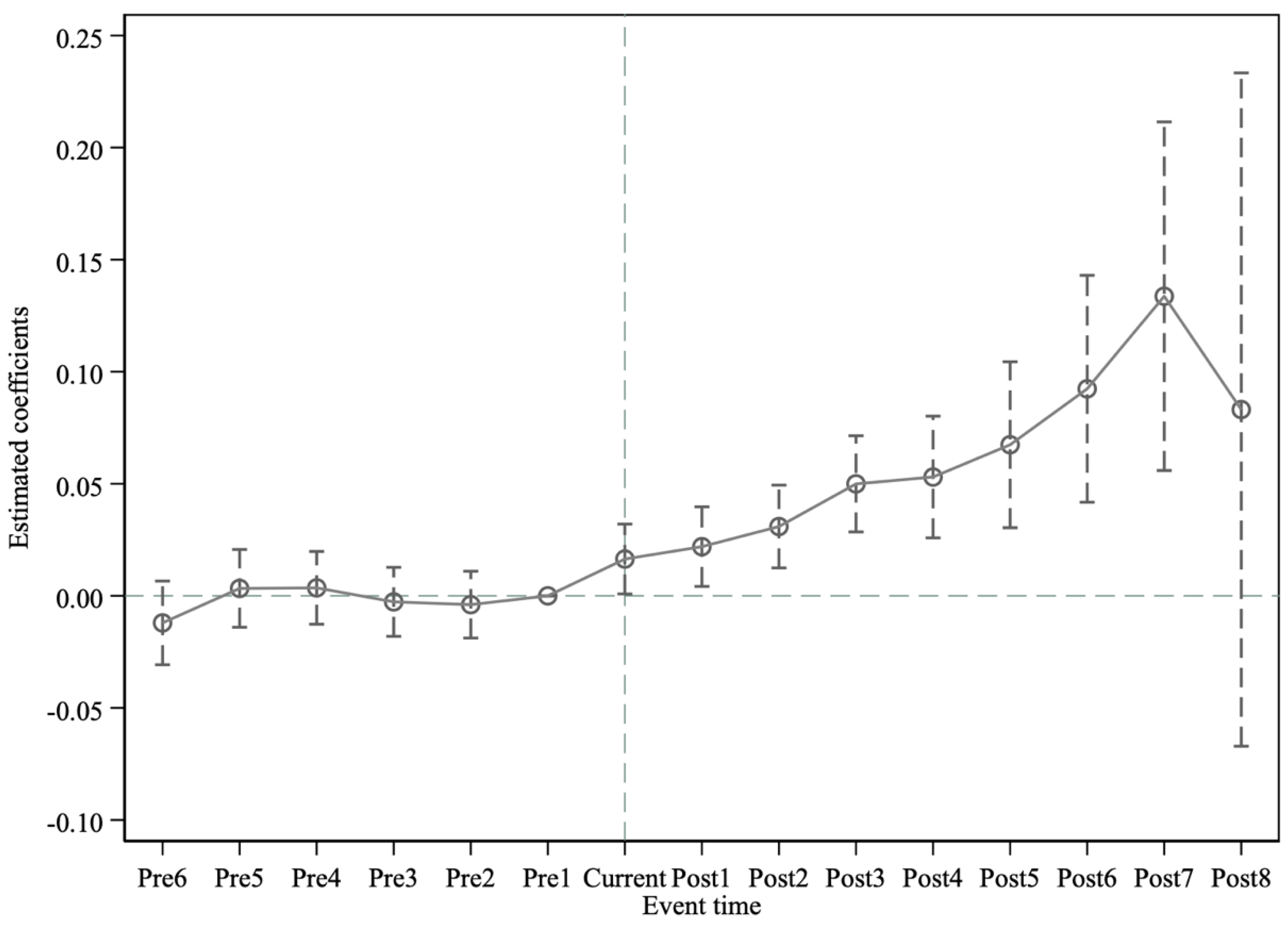
Figure 3 illustrates the dynamic effects of the REDC program implementation estimated using the event-study approach. The horizontal axis represents event time relative to the policy adoption year, whereas the vertical axis plots the estimated coefficients for each event period. As shown, the estimated coefficients for the pre-implementation periods are statistically insignificant, with confidence intervals overlapping the zero line. This indicates that the treatment and control groups exhibited similar development trajectories prior to the REDC program, lending strong support to the parallel-trends assumption. Following the REDC program implementation, the estimated coefficients exhibit an overall upward trajectory, with most post-treatment effects remaining significantly positive.
Figure 3.
Results of the parallel trends test.
5.2.2. Heterogeneous Treatment Effects
If there is heterogeneity in treatment effects in the staggered DID approach, meaning that the same program produces varying impacts across different treatment groups [47], it would violate the assumption of homogeneous treatment effects. This assumption posits that the impact of a given policy is identical across all treated groups and remains constant over time for any given group [48]. In such cases, using the two-way fixed effects model for staggered DID estimation may lead to substantial bias in the estimated effects. To address this issue, we employ the Goodman–Bacon decomposition method to assess the degree of treatment effect heterogeneity. Furthermore, we recalculate heterogeneity-robust estimates by referring to the group-time average treatment effect approach and the stacked difference-in-differences method, as proposed by Callaway and Sant’Anna [48] and Cengiz et al. [49], respectively.
The results of the Goodman–Bacon decomposition test are presented in Table 4. The Goodman–Bacon decomposition method breaks down the two-way fixed effects estimator into three types of DID comparisons. Among them, the “later treatment vs. early treatment” comparison is considered a “bad control group” because the pretreatment trends for this group have already diverged from those of the other two groups, potentially leading to estimation bias. In terms of weighting, the DID estimator for the “later treatment vs. early treatment” group accounts for only 1.7% of the total weight, indicating a relatively small influence. This suggests that the use of the TWFE model in the staggered DID setting does not introduce substantial bias. Table 5 reports the results of the heterogeneity-robust estimator tests. The estimated effects obtained from both the stacked regression estimator and the group-time average treatment effects approach remain significantly positive, indicating that treatment effect heterogeneity is not a serious concern in this study.
Table 4.
Goodman–Bacon decomposition test.
Table 5.
Heterogeneity-robust estimator test.
5.2.3. Placebo Test
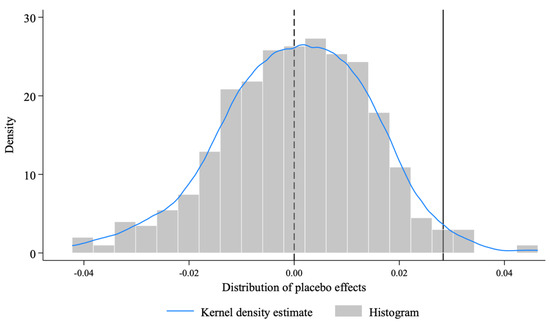
To ensure that the baseline regression results are not driven by random factors, this study conducts a mixed placebo test to assess the robustness of the REDC program’s estimated effects. From the full sample of counties, 949 counties are randomly selected as “pseudo-treatment groups,” and placebo implementation years are randomly assigned between 2014 and 2021. The reconstructed treatment variable is then included in Model (1), and 500 placebo estimates are generated. The regression results are subjected to statistical analysis, and the distribution of the placebo regression coefficients is plotted in Figure 4. The distribution of coefficients from the 500 random trials is centered on zero and approximately follows a normal distribution. The black vertical line in the figure indicates the true coefficient from the baseline regression (0.028), which deviates from the placebo estimates, suggesting that the baseline results are unlikely to be driven by randomness and are therefore robust.
Figure 4.
Placebo test results.
5.2.4. Propensity Score Matching Difference-in-Differences
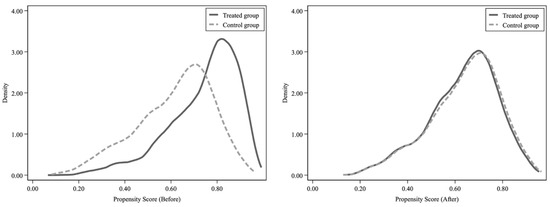
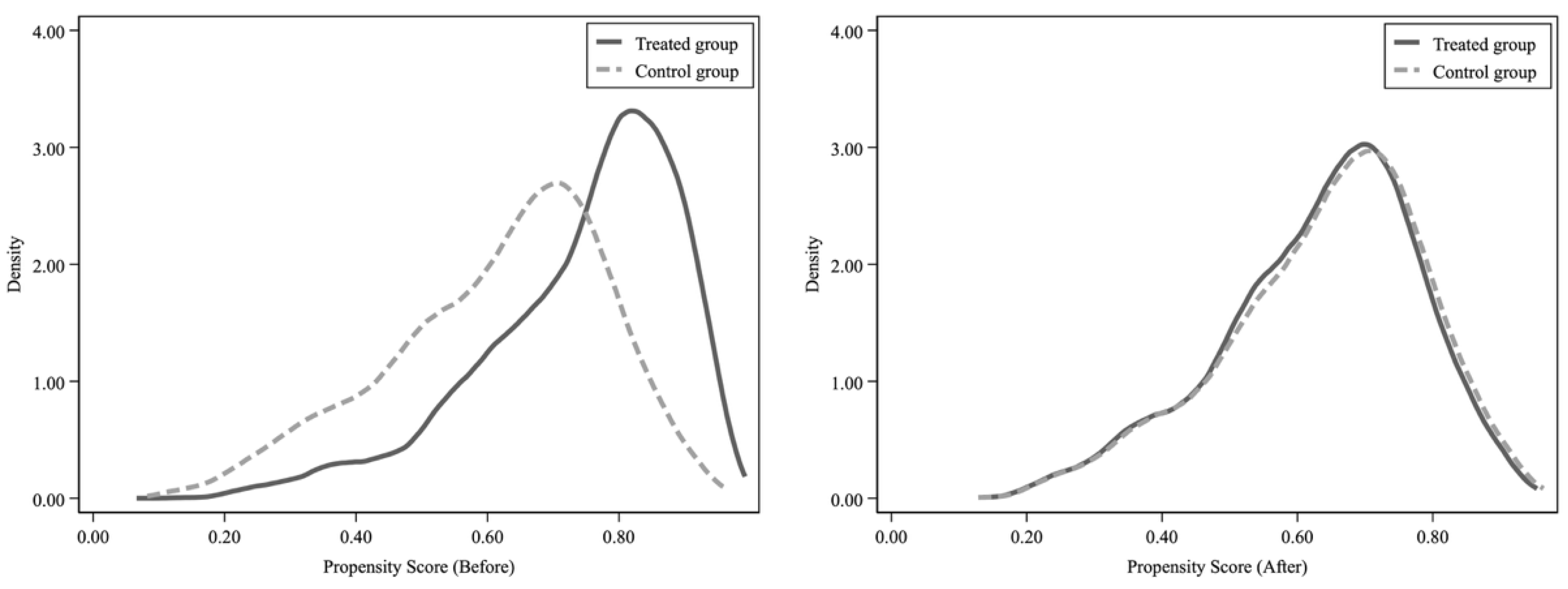
To address potential sample-selection bias arising from the non-random designation of pilot counties, we employ a propensity score matching difference-in-differences (PSM-DID) approach. Matching covariates include the value added of the primary, secondary, and tertiary industries, gross domestic product, population size, local fiscal expenditure, and loan balances of financial institutions at year-end. Propensity scores are estimated using a logit model, followed by a nearest-neighbor matching procedure (1:1, caliper = 0.01). After matching, covariate balance improves markedly, and the detailed results are provided in Table A1, Table A2, Table A3 and Table A4 of Appendix B. The treatment and control groups exhibit similar kernel density distributions (Figure 5), indicating good match quality. As reported in column (1) of Table 5, the PSM-DID estimates align closely with the baseline results, confirming the robustness and reliability of the empirical findings.
Figure 5.
Distribution of propensity scores.
5.2.5. Controlling for Other Policy Shocks
In addition to random factors, the implementation of the Comprehensive Demonstration Program for E-commerce in Rural Areas may inevitably be influenced by other similar pilot policies implemented during the same period [30], which could in turn affect the estimation results of this study. Drawing on the studies of Lu and Hong [30], Tu and Cao [31], and Ye et al. [25], we identify the following five relevant policies. Among them, the National Information Access to Villages and Households Project (Policy1) and the National Information Benefiting People Pilot Cities Policy (Policy2) were launched in approximately 2014. The former aimed to enhance the agricultural information service system and promote resource integration across agricultural departments. It initially designated 22 pilot counties in 2014, followed by 94 additional counties in 2015. The latter focused on establishing an equitable, high-quality, and efficient public service information system, with 80 cities selected as national pilot cities. The National E-commerce Demonstration Cities Pilot Policy (Policy3) was introduced to accelerate the development of supporting infrastructure, such as online payments and logistics. The first batch of 23 pilot cities was announced in 2011, with 30 more cities added in 2014 and another 17 in 2017. Furthermore, the Policy to Support Migrant Workers and Others Returning to Rural Areas for Entrepreneurship (Policy4) aimed to promote local employment and stimulate rural industries. To support this initiative, three batches of pilot counties were established in 2016 and 2017, consisting of 90, 116, and 135 counties. In addition, the Rural Integration of Primary, Secondary, and Tertiary Industries Pilot Demonstration Policy (Policy5) was implemented in 137 counties in 2016 to foster rural transformation, enhance agricultural upgrading, and promote integrated rural economic development.
Considering that the implementation of the aforementioned related policies may interfere with the identification of the effects of the REDC program, we include interaction terms between the dummy variables for the five policies and the REDC program in the regression model to control for their potential confounding influences. This approach helps to further ensure the validity of the baseline estimation results. As shown in Table 6, the coefficient of the REDC program remains significantly positive after accounting for the potential interference of these additional policies, suggesting that the program’s effect on promoting agricultural development is robust and not confounded by other related policy interventions. However, it is worth highlighting that the interaction term between the REDC program and Policy4 is significantly negative. Although Policy4 has temporarily increased rural population inflows and entrepreneurial activity, its primary focus lies in supporting self-employment and microenterprises in nonagricultural sectors. Consequently, relatively few returnees have directly participated in agricultural production. This shift has, to some extent, intensified the nonagricultural diversion of rural labor, thereby weakening the positive effect of the REDC program on agricultural development.
Table 6.
Results of PSM-DID estimation and controlling for other policy shocks.
5.3. Mechanism Analysis
Columns (2) and (4) of Table 7 show that the REDC program has a significantly positive effect on both consumption demand and social investment, indicating that the program effectively stimulates local demand and investment activities. Columns (3) and (5) further indicate that the coefficients of the REDC program, consumption demand, and social investment are all positive and statistically significant, suggesting that consumption demand and social investment constitute important channels through which the REDC program influences agricultural development. The program enhances the integration of agriculture with consumer markets by fostering rural e-commerce platforms and improving agricultural product distribution systems [4,10]. These developments reduce information asymmetries in agricultural transactions [29] and broaden the reach of rural consumer markets. The expansion of consumer demand further encourages agricultural producers to invest in R&D, improve product quality, and upgrade service delivery [38], thereby enhancing the value added and competitiveness of agricultural products. At the same time, the REDC program has significantly improved the rural investment environment in demonstration counties, making the agricultural sector more attractive to social capital [3]. The inflow of social capital not only eases financing constraints on agricultural development [26] but also facilitates infrastructure investment along the agricultural value chain, which strengthens production capacity and market competitiveness.
Table 7.
Mechanism test results.
5.4. Test for Spatial Spillover Effects by Distance Bands
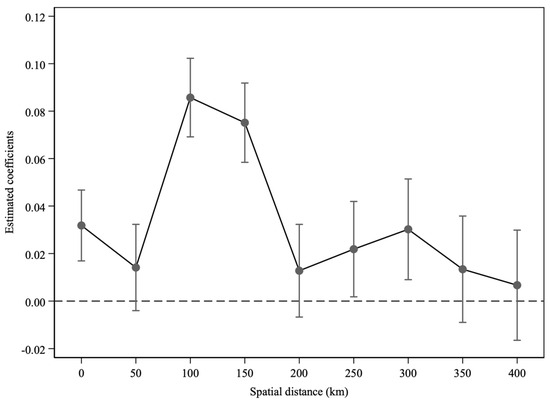
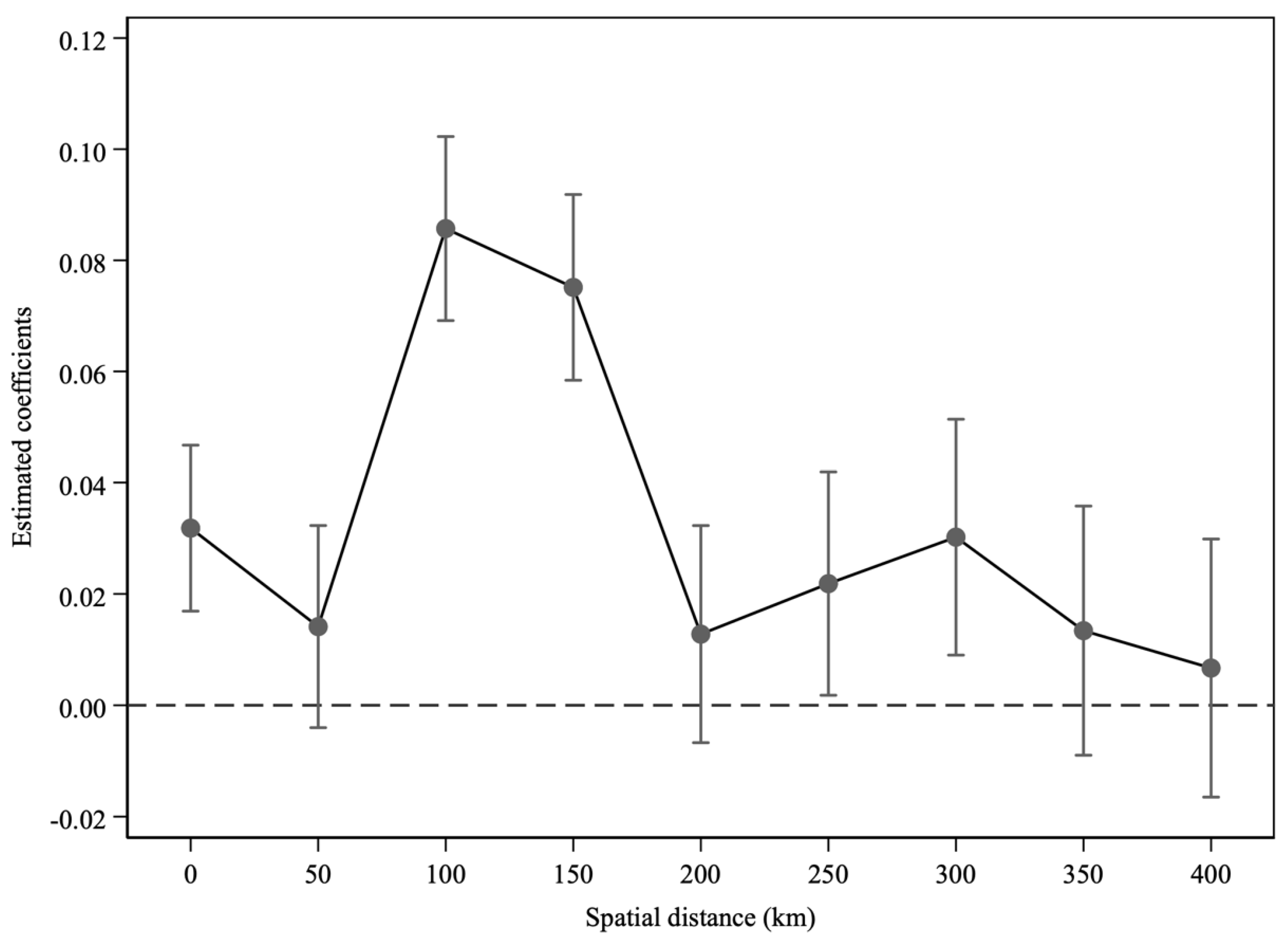
Figure 6 illustrates how the estimated coefficients of , derived from Equation (5), vary with geographic distance (95% confidence interval). The REDC program exhibits a wave-shaped pattern in its spatial spillover effects: weak within 0–50 km, peaking around 100 km, and diminishing beyond 350 km. The strongest positive impact appears within the 50–200 km range, revealing a clear distance threshold in the spatial diffusion of policy benefits. This pattern is consistent with the agglomeration–diffusion framework in spatial economics. Areas located very close to pilot counties experience an agglomeration shadow effect, where resource competition and market diversion constrain their ability to capture policy spillovers. In contrast, medium-distance regions gain more from enhanced e-commerce infrastructure, information flows, and industrial linkages, which jointly promote synergistic agricultural growth. Beyond this range, the transmission of the REDC program impacts weakens, and the spillover effects gradually fade.
Figure 6.
Spatial spillover effects of the REDC program by distance bands.
5.5. Test for Heterogeneity
China’s counties differ in their agricultural functions and economic development levels, which may lead to heterogeneous effects of the REDC program. We further examine whether the impact of the REDC program on agricultural development varies according to differences in agricultural functional zones and economic development levels.
5.5.1. Heterogeneity by Agricultural Functional Zones
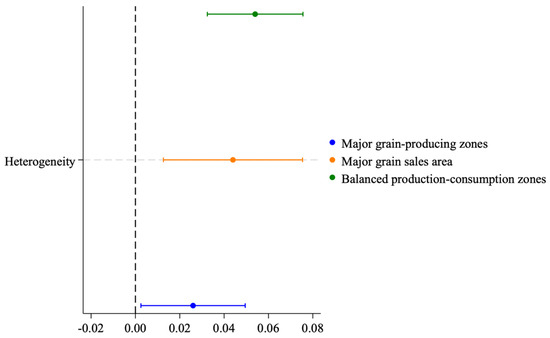
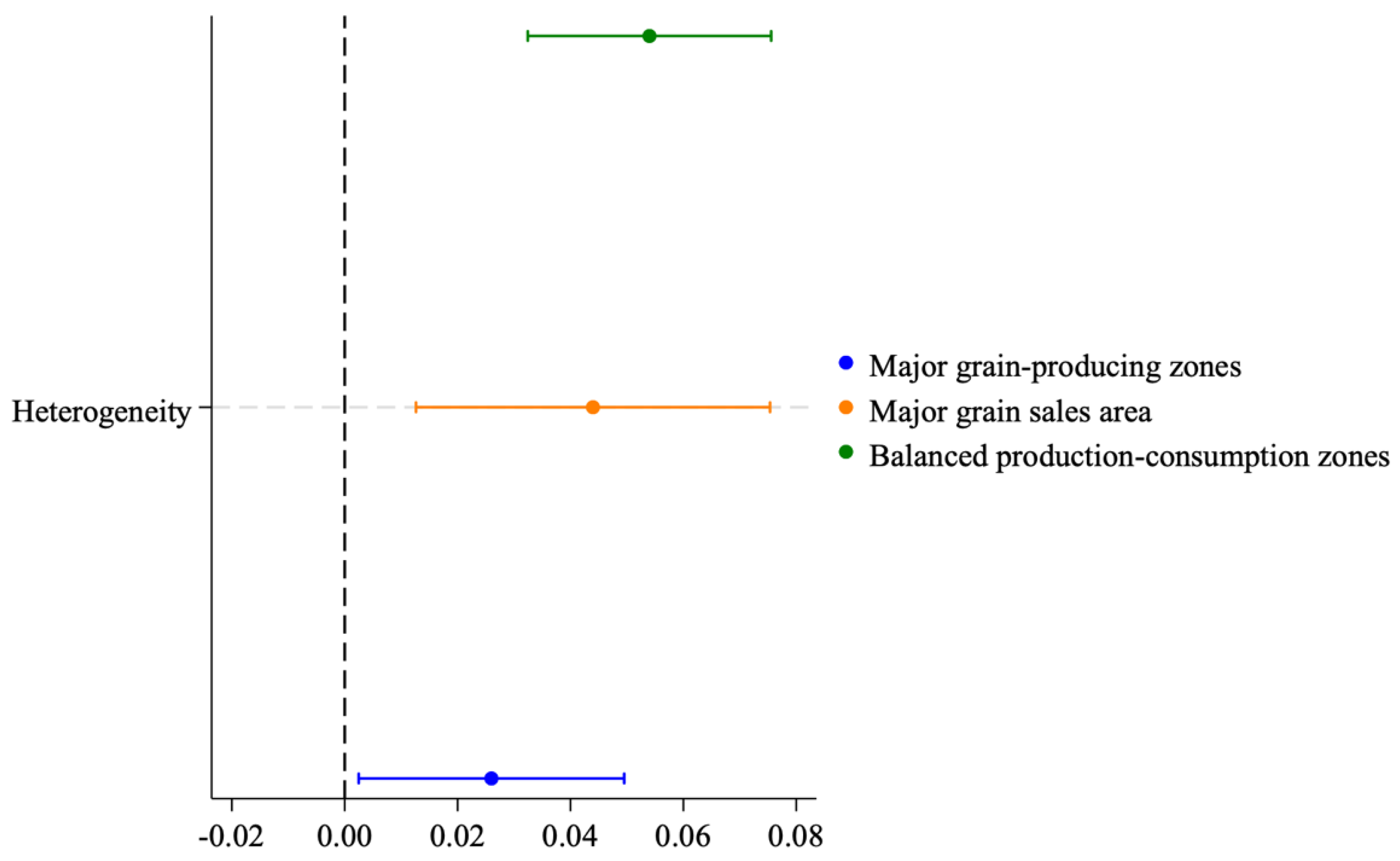
In accordance with the National Food Security Medium- and Long-Term Plan (2008–2020), we classify the 1345 counties in the sample into three categories: major grain-consuming zones, major grain-producing zones, and balanced production-consumption zones. As shown in Figure 7, the REDC program significantly promoted agricultural development across all three types of zones, with the strongest effect observed in the balanced production-consumption zones. Compared with other zones, these zones benefit from both robust agricultural production capacity and substantial local consumer markets. The REDC program has accelerated the development of e-commerce infrastructure and improved distribution systems in these zones, facilitating localized production and consumption. This has led to shorter agricultural supply chains, reduced transaction and transportation costs, and greater local consumer demand. Furthermore, given the relatively high level of marketization in balanced production-consumption zones, the program has further improved the business environment and rural infrastructure, thereby increasing the attractiveness of the agricultural sector to social capital. As a result, social capital is more likely to flow into agriculture, enhancing organizational coordination and enabling agricultural scaling. These combined factors contribute to the substantially greater impact of the REDC program on agricultural development in balanced production-consumption zones.
Figure 7.
Regression results across agricultural functional zones.
5.5.2. Heterogeneity by Economic Development Level
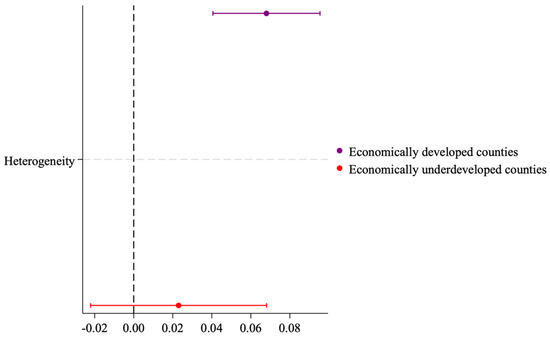
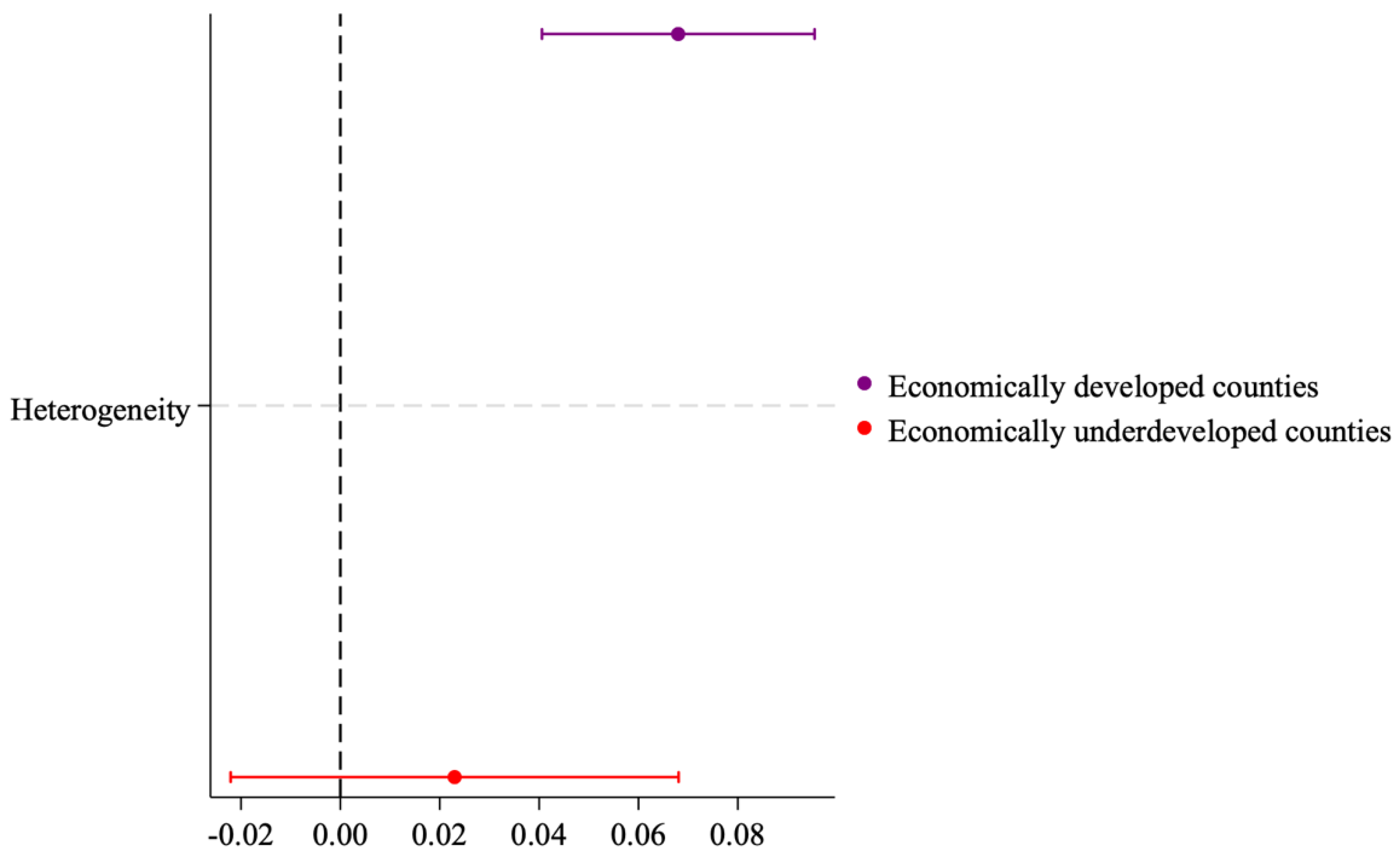
Based on the average per capita GDP of the sample counties, we classify counties with values above the mean as economically developed and those below the mean as economically underdeveloped. As reported in Figure 8, the REDC program has a more pronounced effect on agricultural development in economically developed counties. Compared with their underdeveloped counterparts, these counties tend to have higher income levels and greater consumption capacity. Consequently, e-commerce platforms in such regions are better positioned to meet the diversified and high value-added demand for agricultural products, thereby incentivizing agricultural producers to expand their production scale. In addition, economically developed counties generally benefit from stronger infrastructure, more advanced financial services, and a more favorable business environment, all of which facilitate the effective implementation of e-commerce initiatives. The REDC program has further enhanced the investment appeal of agricultural projects in these areas, encouraging greater engagement of social capital in the agricultural sector. This, in turn, has accelerated the agglomeration of key production factors such as capital, technology, and human resources, ultimately resulting in significant improvements in agricultural development outcomes.
Figure 8.
Regression results across economic development levels.
6. Discussion and Limitation
Rural e-commerce has become an important instrument for alleviating poverty and promoting rural economic development in China. Like in other developing countries, the Chinese government has introduced a series of policies to support the growth of rural e-commerce. This study employs a staggered DID approach to examine how the REDC program impacts agricultural development.
This study evaluates the implementation effects of the REDC program and demonstrates its positive impact on agricultural development. Existing research has largely examined the program’s effects on income inequality [18], economic resilience [26], county-level growth [5], and industrial restructuring [29,40]. In contrast, this study extends the literature by revealing the program’s contribution to agricultural development, thereby enriching the understanding of its overall economic effects. Our findings differ from those of Tao et al. [40], who argued that the REDC program promoted service-sector growth through industrial upgrading, reducing the share of the primary sector in county economies. A plausible explanation lies in the measurement framework, as Tao et al. [40] captured agricultural activity only through the share of primary industry output, whereas this study evaluates agricultural development comprehensively across three dimensions—employment, economic output, and mechanization—better reflecting agriculture-specific dynamics. The REDC program has also advanced rural infrastructure and facilitated the establishment of e-commerce industrial parks. The integration of agriculture and e-commerce has expanded marketing channels and increased the value added of agricultural products [17,33] while mitigating high transportation costs and limited market accessibility caused by geographical constraints [32]. These improvements have boosted agricultural trade volumes [26], thereby reinforcing agricultural development. Moreover, the REDC program exhibits significant spatial spillovers. The results show no evidence of a significant negative siphon effect within 50 km of pilot counties but reveal strong positive spillovers in the 50–200 km surrounding range. This pattern aligns with the agglomeration–diffusion framework in spatial economics. Counties located in close proximity to pilot areas may experience an “agglomeration shadow” effect, where resource competition and market diversion limit their ability to capture spillover benefits. In contrast, medium-distance regions benefit more from improved e-commerce infrastructure, information flows, and industrial linkages, which jointly stimulate synergistic agricultural growth. Beyond this range, the transmission of policy effects weakens and spillovers gradually dissipate.
By integrating demand-side and supply-side theories, this study investigates the mechanisms through which the REDC program enhances agricultural development, thereby deepening the understanding of the interplay between these two dimensions. On the demand side, the REDC program reduces urban-rural trade barriers and promotes the deep integration of agriculture with markets [4,10]. It improves market accessibility, mitigates information asymmetries between producers and consumers [29], and enables producers to align supply more accurately with expanding market demand [9]. Additionally, it provides consumers with a broader range of agricultural products, better catering to diverse preferences and ultimately expanding effective demand and generating greater economic returns.
On the supply side, the REDC program enhances the rural market environment, increases the attractiveness of agriculture to social capital [3,18], and increases investment in demonstration counties [33]. These improvements alleviate financial constraints and strengthen industrial infrastructure [26], thus fostering agricultural development from the supply-side perspective. Our findings not only offer empirical evidence to support the advancement of rural e-commerce and agricultural scaling in China but also provide policy implications for other developing countries, such as India, Vietnam, Egypt, Brazil, and Russia, that are seeking to develop rural e-commerce sectors [7,9].
We further examine whether the impact of the REDC program on agricultural development exhibits regional heterogeneity. The results indicate that the program has a significantly stronger positive effect on economically developed counties than on underdeveloped counties. This finding is consistent with previous studies showing that economically developed counties tend to benefit more from rural e-commerce initiatives [30]. In these counties, higher household income levels and stronger consumption capacity enable e-commerce platforms to better match demand for diversified and high–value-added agricultural products, thereby encouraging agricultural producers to scale up operations. Moreover, superior infrastructure, financial services, and business environments facilitate the effective implementation of the REDC program and attract greater inflows of social capital into the agricultural sector, accelerating the aggregation of key production factors such as capital, technology, and human resources. These results suggest that the effects of the REDC program vary across regions depending on local economic and market conditions, leading to differentiated development outcomes rather than uniform impacts. Consistent with this pattern, the program’s effects also differ across agricultural functional zones. Specifically, the REDC program generates the strongest benefits in balanced production–consumption zones compared with major grain-producing and grain-consuming zones. This can be attributed to the combination of solid agricultural production capacity and robust local consumer markets in these areas. By improving e-commerce infrastructure, distribution systems, and market accessibility for agricultural products, the program facilitates consumption growth and attracts social investment, thereby supporting high-quality agricultural development.
Although this study provides a systematic analysis of the effects of the REDC program on agricultural development, several limitations remain. First, agricultural development is measured primarily along the dimensions of economic development, employment development, and mechanization development. Due to the limited availability of county-level statistical data in China, indicators related to agricultural sustainability—such as non-point source pollution—could not be incorporated into the analysis. This constraint limits the extent to which the sustainability dimension of agricultural development can be fully captured. Future research could extend the analysis by incorporating environmental and sustainability indicators as data availability improves. Second, the analysis focuses on evaluating the overall impact of the REDC program on county-level agricultural development and does not explicitly examine farmers’ technological decision-making or the underlying micro-level behavioral mechanisms. Digital platforms may influence agricultural development by shaping farmers’ production choices and operational practices. Future research combining farmer-level data could further explore how rural e-commerce policies affect farmers’ behavior and agricultural outcomes from a micro-level perspective.
7. Conclusions and Implication
Using panel data from 1345 county-level cities in China from 2010 to 2022, this study employs a staggered DID approach to examine the impact of the REDC program on agricultural development and to investigate the underlying mechanisms. The results indicate that the REDC program significantly promotes agricultural development, and this conclusion remains robust across a series of specifications and placebo tests. The REDC program shows no evidence of a significant negative siphon effect within 50 km of pilot counties but generates strong positive spillovers in the 50–200 km surrounding range. Expanding consumer demand and increasing social investment are identified as key channels through which the REDC program facilitates agricultural development. Moreover, the program’s effects are heterogeneous, with significantly stronger impacts observed in balanced production-consumption zones and economically developed counties than in major grain-producing zones, major grain-consuming zones, and economically underdeveloped counties. Based on the findings, several policy recommendations are proposed.
Based on the conclusions of this study, four targeted policy recommendations are proposed for developing countries beyond China. First, the construction of rural e-commerce infrastructure should be promoted in a phased and prioritized manner. Policymakers may initially focus on improving logistics systems and digital service networks in regions with relatively balanced production and consumption, and then gradually extend these improvements to surrounding areas within a 50–200 km radius by leveraging positive spatial spillover effects from core regions. This approach helps avoid resource misallocation associated with indiscriminate large-scale expansion.
Second, policies should aim to balance the two-way empowerment of supply and demand. On the supply side, e-commerce platforms can facilitate market access for agricultural products and help overcome geographical constraints faced by rural producers. On the demand side, farmers can be guided to better adapt to market needs by adjusting production structures based on information and data provided by digital platforms.
Third, differentiated policy strategies should be adopted according to regional development levels. In relatively developed regions, efforts can focus on fostering e-commerce industrial clusters and developing branded agricultural products to attract social capital investment. In less developed regions, priority should be given to strengthening basic logistics infrastructure and improving digital literacy, thereby laying a solid foundation for future e-commerce-driven agricultural development.
Fourth, it is important to enhance policy coordination and regulatory oversight. Governments should establish performance management systems for rural e-commerce development to ensure standardized fund utilization and effective project implementation. At the same time, collaboration with financial institutions is needed to design financial products tailored to the characteristics of small-scale agricultural producers, easing financing constraints and promoting the high-quality, coordinated development of rural e-commerce and agriculture.
Author Contributions
Conceptualization, Q.J. and J.Y.; Formal analysis, Q.J.; Data curation, Q.J.; Methodology, Q.J.; Visualization, Q.J.; Writing—original draft, Q.J.; Writing—review and editing, Q.J., J.Y. and W.Z.; Supervision, J.Y. and W.Z.; Funding acquisition, J.Y. and W.Z. All authors have read and agreed to the published version of the manuscript.
Funding
This study was supported by the National Social Science Fund of China (Grant No. 22AGL030), the Fundamental Research Funds for the Central Universities (Grant No. 1243100012), and the Doctoral Dissertation Scholarship Program of the China Institute for Rural Studies, Tsinghua University (Grant No. 202302).
Institutional Review Board Statement
Not applicable.
Data Availability Statement
The annual number of enterprise registrations in the county-level cities used in this study is sourced from the Tianyancha website (accessed on 12 April 2024, https://www.tianyancha.com). The data for the other variables come from the China County Statistical Yearbooks (accessed on 26 March 2024, https://data.cnki.net/yearBook?type=type&code=A) and the Economy Prediction System (accessed on 26 March 2024, https://www.epsnet.com.cn/index.html#/Index). The list of counties for China’s Rural E-Commerce Demonstration County Program is sourced from the Ministry of Commerce website (accessed on 28 March 2024, https://www.mofcom.gov.cn), and the list of counties for the National Information Access to Villages and Households Project is sourced from the Ministry of Agriculture and Rural Affairs (accessed on 28 March 2024, https://www.moa.gov.cn). The lists of cities covered by the National Information Benefiting People Pilot Cities Policy and the National E-commerce Demonstration Cities Pilot Policy, as well as counties included in the Rural Integration of Primary, Secondary, and Tertiary Industries Pilot Demonstration Policy and the Policy to Support Migrant Workers and Others Returning to Rural Areas for Entrepreneurship, are obtained from the official website of the National Development and Reform Commission (accessed on 28 March 2024, https://www.ndrc.gov.cn).
Conflicts of Interest
The authors declare no conflicts of interest.
Appendix A
Computation Steps for the Entropy Method
As an objective weighting approach, the entropy method can overcome the interference of subjective human factors in determining indicator weights, ensuring the objectivity of the evaluation results. Equations (A1)–(A6) present the specific calculation steps of the entropy method. The entropy method is implemented through the following steps. In the formulas below, xij denotes the value of the jth indicator for the ith county.
Standardization of indicator data:
Calculate the weight of the ith county under the jth indicator:
Calculate the entropy value of the jth indicator:
Calculate the differentiation coefficient of the jth indicator:
gj = 1 − ej
Calculate the weight of the jth indicator:
Calculate the agricultural development level of each county:
Appendix B
Table A1.
Balance test results—1.
Table A2.
Balance test results—2.
Table A3.
Balance test results—3.
Table A4.
Balance test results—4.
References
- Qi, J.; Zheng, X.; Guo, H. The formation of Taobao villages in China. China Econ. Rev. 2019, 53, 106–127. [Google Scholar] [CrossRef] [Scilit]
- Skare, M.; Gavurova, B.; Rigelsky, M. Innovation activity and the outcomes of B2C, B2B, and B2G e-commerce in EU countries. J. Bus. Res. 2023, 163, 113874. [Google Scholar] [CrossRef] [Scilit]
- Dong, K.; Yang, S.; Wang, J. How digital economy lead to low-carbon development in China? The case of e-commerce city pilot reform. J. Clean. Prod. 2023, 391, 136177. [Google Scholar] [CrossRef] [Scilit]
- Kwak, J.; Zhang, Y.; Yu, J. Legitimacy building and e-commerce platform development in China: The experience of Alibaba. Technol. Forecast. Soc. Change 2019, 139, 115–124. [Google Scholar] [CrossRef] [Scilit]
- Qin, Y.; Fang, Y. The effects of e-commerce on regional poverty reduction: Evidence from China’s rural e-commerce demonstration county program. China World Econ. 2022, 30, 161–186. [Google Scholar] [CrossRef] [Scilit]
- Liu, M.; Min, S.; Ma, W.; Liu, T. The adoption and impact of e-commerce in rural China: Application of an endogenous switching regression model. J. Rural Stud. 2021, 83, 106–116. [Google Scholar] [CrossRef] [Scilit]
- Karine, H.A.J.I. E-commerce development in rural and remote areas of BRICS countries. J. Integr. Agric. 2021, 20, 979–997. [Google Scholar] [CrossRef] [Scilit]
- Wang, Y.; Yang, A.; Li, Y.; Yang, Q. Effect of e-commerce popularization on farmland abandonment in rural China: Evidence from a large-scale household survey. Land Use Policy 2023, 135, 106958. [Google Scholar] [CrossRef] [Scilit]
- Couture, V.; Faber, B.; Gu, Y.; Liu, L. Connecting the countryside via e-commerce: Evidence from China. Am. Econ. Rev. Insights 2021, 3, 35–50. [Google Scholar] [CrossRef] [Scilit]
- Li, G.; Qin, J. Income effect of rural e-commerce: Empirical evidence from Taobao villages in China. J. Rural Stud. 2022, 96, 129–140. [Google Scholar] [CrossRef] [Scilit]
- Li, W.; He, W. Revenue-increasing effect of rural e-commerce: A perspective of farmers’ market integration and employment growth. Econ. Anal. Policy 2024, 81, 482–493. [Google Scholar] [CrossRef] [Scilit]
- Zhang, N.; Yang, W.; Ke, H. Does rural e-commerce drive up incomes for rural residents? Evidence from Taobao villages in China. Econ. Anal. Policy 2024, 82, 976–998. [Google Scholar] [CrossRef] [Scilit]
- Zhang, H.; Millan, E.; Money, K.; Guo, P. E-commerce development, poverty reduction and income growth in rural China. J. Strategy Manag. 2025, 18, 148–176. [Google Scholar] [CrossRef] [Scilit]
- Guan, X.; He, L.; Hu, Z. Impact of rural e-commerce on farmers’ income and income gap. Agriculture 2024, 14, 1689. [Google Scholar] [CrossRef] [Scilit]
- Li, L.; Zeng, Y.; Ye, Z.; Guo, H. E-commerce development and urban-rural income gap: Evidence from Zhejiang Province, China. Pap. Reg. Sci. 2021, 100, 475–495. [Google Scholar] [CrossRef] [Scilit]
- Zhou, R.; Ji, M.; Zhao, S. Does e-commerce participation among farming households affect farmland abandonment? Evidence from a large-scale survey in China. Land 2024, 13, 376. [Google Scholar] [CrossRef] [Scilit]
- Tang, W.; Zhu, J. Informality and rural industry: Rethinking the impacts of e-commerce on rural development in China. J. Rural Stud. 2020, 75, 20–29. [Google Scholar] [CrossRef] [Scilit]
- Wei, Y.D.; Lin, J.; Zhang, L. E-commerce, Taobao villages and regional development in China. Geogr. Rev. 2020, 110, 380–405. [Google Scholar] [CrossRef] [Scilit]
- Brenes, E.R.; Ciravegna, L.; Marcotte, P. Assessing agri-business firms’ performances: Organizational and marketing business models of high/low sales and ROE outcomes. J. Bus. Res. 2016, 69, 3415–3426. [Google Scholar] [CrossRef] [Scilit]
- Misra, K.; Basu, D. To reform and to procure: An analysis of the role of the state and the market in Indian agriculture. J. Dev. Stud. 2024, 60, 724–744. [Google Scholar] [CrossRef] [Scilit]
- Liu, Y.; He, Z. Synergistic industrial agglomeration, new quality productive forces and high-quality development of the manufacturing industry. Int. Rev. Econ. Financ. 2024, 94, 103373. [Google Scholar] [CrossRef] [Scilit]
- Tan, C.; Yang, J.; Sun, J.Z. How can rural e-commerce improve agricultural labor productivity under the background of digital economy: A quasi-natural experiment based on e-commerce entering rural comprehensive demonstration county. World Agric. 2022, 77–89. [Google Scholar] [CrossRef]
- Deichmann, U.; Goyal, A.; Mishra, D. Will digital technologies transform agriculture in developing countries? Agric. Econ. 2016, 47, 21–33. [Google Scholar] [CrossRef] [Scilit]
- Chao, P.E.N.G.; Biao, M.A. Poverty alleviation through e-commerce: Village involvement and demonstration policies in rural China. J. Integr. Agric. 2021, 20, 998–1011. [Google Scholar] [CrossRef] [Scilit]
- Ye, Y.; Fang, J.; Ye, J. Does E-commerce construction boost farmers’ incomes? Evidence from China. Sustainability 2024, 16, 4595. [Google Scholar] [CrossRef] [Scilit]
- Huang, Z.; Wang, L.; Meng, J. Does rural e-commerce improve the economic resilience of family farms? Int. Rev. Econ. Financ. 2024, 95, 103505. [Google Scholar] [CrossRef] [Scilit]
- Qin, Q.; Guo, H.; Shi, X.; Chen, K. Rural e-commerce and county economic development in China. China World Econ. 2023, 31, 26–60. [Google Scholar] [CrossRef] [Scilit]
- Yang, R.F.; Chen, C. Will e-commerce development help alleviate economic inequality? Evidence from a quasi-natural experiment of the policy of introducing e-commerce into rural comprehensive demonstration county. World Agric. 2023, 7, 86–97. [Google Scholar] [CrossRef]
- Hong, Q.; Su, J. The impact of rural e-commerce platforms on the transformation of industrial structure: Evidence from China. Rev. Dev. Econ. 2024, 28, 1267–1291. [Google Scholar] [CrossRef] [Scilit]
- Lu, S.F.; Hong, J.T. Rural e-commerce construction and regional coordinated development: Evidence from China’s e-commerce pilot in rural areas. Econ. Rev. 2023, 5, 71–88. [Google Scholar] [CrossRef]
- Tu, Q.; Cao, Z.D. Can e-commerce promote rural entrepreneurship? A quasi-natural experiment based on the demonstration policy of e-commerce in rural areas. China Rural. Surv. 2022, 6, 163–180. [Google Scholar] [CrossRef]
- Onayev, A.; Espey, C.; Swei, O. What explains the rising price of highway infrastructure? J. Manag. Eng. 2022, 38, 04022030. [Google Scholar] [CrossRef] [Scilit]
- Deng, L.; Qian, P. Mitigating effect of digital payments on the micro-enterprises’ financing constraints. Financ. Res. Lett. 2024, 62, 105209. [Google Scholar] [CrossRef] [Scilit]
- Muellbauer, J. Aggregation, income distribution and consumer demand. Rev. Econ. Stud. 1975, 42, 525–543. [Google Scholar] [CrossRef] [Scilit]
- Autio, E.; Mudambi, R.; Yoo, Y. Digitalization and globalization in a turbulent world: Centrifugal and centripetal forces. Glob. Strategy J. 2021, 11, 3–16. [Google Scholar] [CrossRef] [Scilit]
- Morepje, M.T.; Sithole, M.Z.; Msweli, N.S.; Agholor, A.I. The influence of E-commerce platforms on sustainable agriculture practices among smallholder farmers in Sub-Saharan Africa. Sustainability 2024, 16, 6496. [Google Scholar] [CrossRef] [Scilit]
- Yu, H.; Cui, L. China’s e-commerce: Empowering rural women? China Q. 2019, 238, 418–437. [Google Scholar] [CrossRef] [Scilit]
- Wei, X.; Yang, Z.; Yan, Y.; Sun, J. Rural e-commerce, digital finance, and urban–rural common prosperity: A quasi-natural experiment based on China’s comprehensive demonstration of e-commerce entering rural areas policy. Financ. Res. Lett. 2024, 69, 106237. [Google Scholar] [CrossRef] [Scilit]
- Lucas, R.E., Jr. Supply-side economics: An analytical review. Oxf. Econ. Pap. 1990, 42, 293–316. [Google Scholar] [CrossRef] [Scilit]
- Tao, T.; Fan, K.X.; Zhu, Z.Y. Digital rural construction and the upgrading of county industrial structure: Quasi-natural experiment based on the policy of e-commerce penetration in rural comprehensive demonstration counties. China Bus. Mark. 2022, 36, 3–13. [Google Scholar] [CrossRef]
- Frijns, J.; Van Vliet, B. Small-scale industry and cleaner production strategies. World Dev. 1999, 27, 967–983. [Google Scholar] [CrossRef] [Scilit]
- Shete, M.; Rutten, M. Impacts of large-scale farming on local communities’ food security and income levels: Empirical evidence from Oromia Region, Ethiopia. Land Use Policy 2015, 47, 282–292. [Google Scholar] [CrossRef] [Scilit]
- Ma, W.; Jiang, G.; Zhou, T.; Qu, Y. Do decaying rural communities have an incentive to maintain large-scale farming? A comparative analysis of farming systems for peri-urban agriculture in China. J. Clean. Prod. 2023, 397, 136590. [Google Scholar] [CrossRef] [Scilit]
- Cai, X.; Zhang, Z.H. How infrastructure investment composition affects industrial structure optimization: Based on the perspective of economic and social infrastructure. Inq. Into Econ. Issues 2024, 6, 107–123. [Google Scholar]
- Baron, R.M.; Kenny, D.A. The moderator–mediator variable distinction in social psychological research: Conceptual, strategic, and statistical considerations. J. Personal. Soc. Psychol. 1986, 51, 1173–1182. [Google Scholar] [CrossRef]
- Wang, X.Y.; Bu, L.F. International export trade and enterprise innovation: Research based on a quasi-natural experiment of “CR Express”. China Ind. Econ. 2019, 10, 80–98. [Google Scholar]
- Goodman-Bacon, A. Difference-in-differences with variation in treatment timing. J. Econom. 2021, 225, 254–277. [Google Scholar] [CrossRef] [Scilit]
- Callaway, B.; Sant’Anna, P.H. Difference-in-differences with multiple time periods. J. Econom. 2021, 225, 200–230. [Google Scholar] [CrossRef] [Scilit]
- Cengiz, D.; Dube, A.; Lindner, A.; Zipperer, B. The effect of minimum wages on low-wage jobs. Q. J. Econ. 2019, 134, 1405–1454. [Google Scholar] [CrossRef] [Scilit]

Disclaimer/Publisher’s Note: The statements, opinions and data contained in all publications are solely those of the individual author(s) and contributor(s) and not of MDPI and/or the editor(s). MDPI and/or the editor(s) disclaim responsibility for any injury to people or property resulting from any ideas, methods, instructions or products referred to in the content. |
© 2026 by the authors. Licensee MDPI, Basel, Switzerland. This article is an open access article distributed under the terms and conditions of the Creative Commons Attribution (CC BY) license.