Article

Land Use Classification, Prediction, and the Relationship Between Land Use and Sediment Loss in the Lam Phra Phlong Watershed, Thailand


by
Uma Seeboonruang
1,
Ranadheer Mandadi
1,*,
Prapas Thammaboribal
2,
Arlene L. Gonzales
3 and
Satya Venkata Sai Aditya Bharadwaz Ganni
4
1
Civil Engineering Department, School of Engineering, King Mongkut’s Institute of Technology Ladkrabang, Bangkok 10520, Thailand
2
Remote Sensing and Geographic Information Systems Field of Study (FoS), Asian Institute of Technology, Pathum Thani 12120, Thailand
3
Department of Environmental Science, College of Agriculture, Food and Sustainable Development, Mariano Marcos State University, Batac 2906, Philippines
4
Disaster Preparedness, Mitigation and Management, Asian Institute of Technology, Pathum Thani 12120, Thailand
*
Author to whom correspondence should be addressed.
Agriculture 2026, 16(4), 448; https://doi.org/10.3390/agriculture16040448
Submission received: 8 January 2026 / Revised: 10 February 2026 / Accepted: 11 February 2026 / Published: 14 February 2026
(This article belongs to the Section Agricultural Water Management)

Abstract

This study aims to assess the evolution of land cover in the Lam Phra Phloeng (LPP) watershed and predict future land use patterns. By employing the Gray Level Co-occurrence Matrix (GLCM) and several spectral indices, high classification accuracy (>92%) was achieved using the Random Forest (RF) algorithm. Based on classified land use maps from 2003 and 2023, future land use predictions for 2030, and 2050 were generated using the CA-Markov chain model. The predictions suggest a gradual trend toward deforestation and the expansion of croplands, driven by population growth and increased anthropogenic activity in the region. The Sediment Delivery Ratio (SDR) model, part of the Integrated Valuation of Ecosystem Services and Tradeoffs (InVEST) suite, was used to simulate soil loss in the LPP watershed. The results indicate minimal soil loss in vegetated areas and significant erosion in regions adjacent to water bodies, primarily due to rainfall erosivity. This research highlights the social, ecological, and economic implications of land use change. Furthermore, best management practices (BMPs) are identified as effective strategies for land restoration and erosion reduction. The study also discusses three widely adopted soil erosion control techniques, providing recommendations for reforestation and erosion mitigation programmes.

1. Introduction

The rate, scope, and spatial extent of human-induced changes to the Earth’s surface are unprecedented. Land use refers to the application of human purpose or intent to the biophysical characteristics of the Earth’s surface, while land cover describes the physical and biological attributes of that surface [1]. Global land-use change and anthropogenic land-cover modification exert profound influences on Earth system functioning. They are a primary driver of soil degradation [2], directly affect globaneeds [3,4], alter ecosystem services and the capacity of natural systems to support human needs [4] and contribute to local and regional climate variability [5] as well as global climate warming [6]. Changes in land use also strongly affect biogeochemical cycles, including terrestrial carbon exchange and the fluxes of biologically active compounds. Poor land management practices can further accelerate ecological degradation through the introduction of invasive species, leading to shifts in flora, fauna, and biogeographic patterns [7].
Although the biogeophysical effects of land-use change on local climate have historically received less attention, their importance is increasingly recognized. The direct radiative forcing associated with land-use change since preindustrial times has been estimated to be relatively small at the global scale [8]; however, the impacts of land-use and land-cover change are highly regionalized [9]. These impacts manifest through alterations in surface energy balance, particularly in the partitioning of sensible and latent heat fluxes [10]. At the same time, approximately 12,750 Mha of land worldwide is suitable for human use, and nearly 38% of the global land surface is currently occupied by agriculture, making it the single largest land use on the planet [11]. As a result, humans have modified more than one-third of the Earth’s land surface [12]. The expansion of cropland and pasture for food and livestock production [13], as well as biofuel and plantation crops [14], has been closely associated with deforestation, particularly in tropical regions, where approximately 83% of newly developed agricultural land between 1980 and 2000 replaced forest cover [15].
Within this broader context, the Lam Phra Phloeng (LPP) watershed, originally developed for flood protection and irrigation, is experiencing progressive capacity loss due to sediment accumulation resulting from soil erosion [16]. Intense rainfall and surface runoff mobilize soil from surrounding hillslopes and transport sediment into streams and ultimately into the reservoir. Several studies have examined erosion and sedimentation processes in the LPP watershed using process-based and climate-driven approaches. For example, earlier assessments applied the universal soil loss equation (USLE) and Sediment Delivery Ratio (SDR) models to estimate long-term soil erosion and future sediment yield, reporting low average errors when compared with field observations [17]. Subsequent studies incorporated climate projections derived from the IPSL-CM5A-MR model and demonstrated that increasing rainfall intensity, particularly under high-emission scenarios such as RCP 8.5, leads to elevated soil erosion and sediment delivery [18,19,20]. Long-term sedimentation analyses have further shown that periods of extensive deforestation coincided with high sediment inflow to the reservoir, whereas increases in forest cover were associated with substantial reductions in erosion rates [21]. Collectively, these studies highlight the strong sensitivity of sediment dynamics in the LPP watershed to land-use change, rainfall intensity, and vegetation cover.
At the national scale, Thailand has experienced substantial agricultural expansion over recent decades. Between 1961 and 1988, agricultural land increased by approximately 13.12 million hectares, accompanied by a comparable reduction in forest area [22]. Agriculture remains a cornerstone of Thailand’s economy and a critical source of livelihood for rural populations [23]. Despite the implementation of a national logging ban in 1989 aimed at forest conservation, agricultural land has continued to expand over the past three decades [24]. Policy-driven shifts toward cash crops such as cassava, sugarcane, and rubber have further accelerated land conversion [25,26]. While these changes have contributed to economic growth, they have also constrained food production [27] and adversely affected hydrological processes and water quality [28]. Rapid land-use change and deforestation have intensified soil erosion across Thailand, particularly in the northern and northeastern regions [29,30,31,32,33], leading to on-site soil degradation, nutrient loss, reduced agricultural productivity, and off-site impacts such as reservoir sedimentation and channel siltation [34,35,36,37].
Climate change further compounds these pressures by modifying rainfall intensity, volume, and spatial distribution, all of which strongly influence erosion processes [38,39,40]. Rising temperatures affect soil moisture regimes and indirectly alter erosion dynamics [41], while anthropogenic responses to changing climate conditions, such as shifts in crop types, management practices, and harvesting schedules, introduce additional feedbacks [42,43,44,45]. Consequently, future soil erosion patterns are shaped by the combined effects of climatic variability and land-use decisions.
Despite extensive research on land-use and land-cover change and soil erosion, many studies continue to examine these processes independently [46]. While numerous assessments quantify historical land conversion or estimate erosion rates under static land-use conditions, empirical models such as USLE/RUSLE dominate over one-third of applications across forested watershed studies [47,48,49]. Alarmingly few studies integrate long-term dynamic land-use trajectories with spatially explicit sediment delivery modelling at the watershed scale, as underscored by recent authoritative reviews on soil erosion modelling and tropical hydro-morphology [50,51,52]. This critical gap is particularly pronounced in tropical monsoon regions, where rapid agricultural expansion, steep terrain, and intense rainfall interact to amplify erosion risks [46]. As a result, land managers and policymakers often lack forward-looking, integrated evidence to support sustainable land-use planning in erosion-prone watersheds.
To address this gap, this study aims to (i) quantify historical LULC changes in the Lam Phra Phloeng watershed between 2003 and 2023 using Landsat imagery and machine learning-based classification, (ii) project future land-use patterns under a trend-based scenario using the CA–Markov model for 2030, and 2050, and (iii) evaluate how both observed and projected land-use changes influence soil erosion and sediment delivery using the InVEST Sediment Delivery Ratio model. By integrating land-use classification, long-term projection, and sediment delivery modelling within a unified analytical framework, this study provides a forward-looking assessment of erosion risk that supports sustainable land management in tropical and subtropical watersheds experiencing similar land-use pressures.

2. Study Area

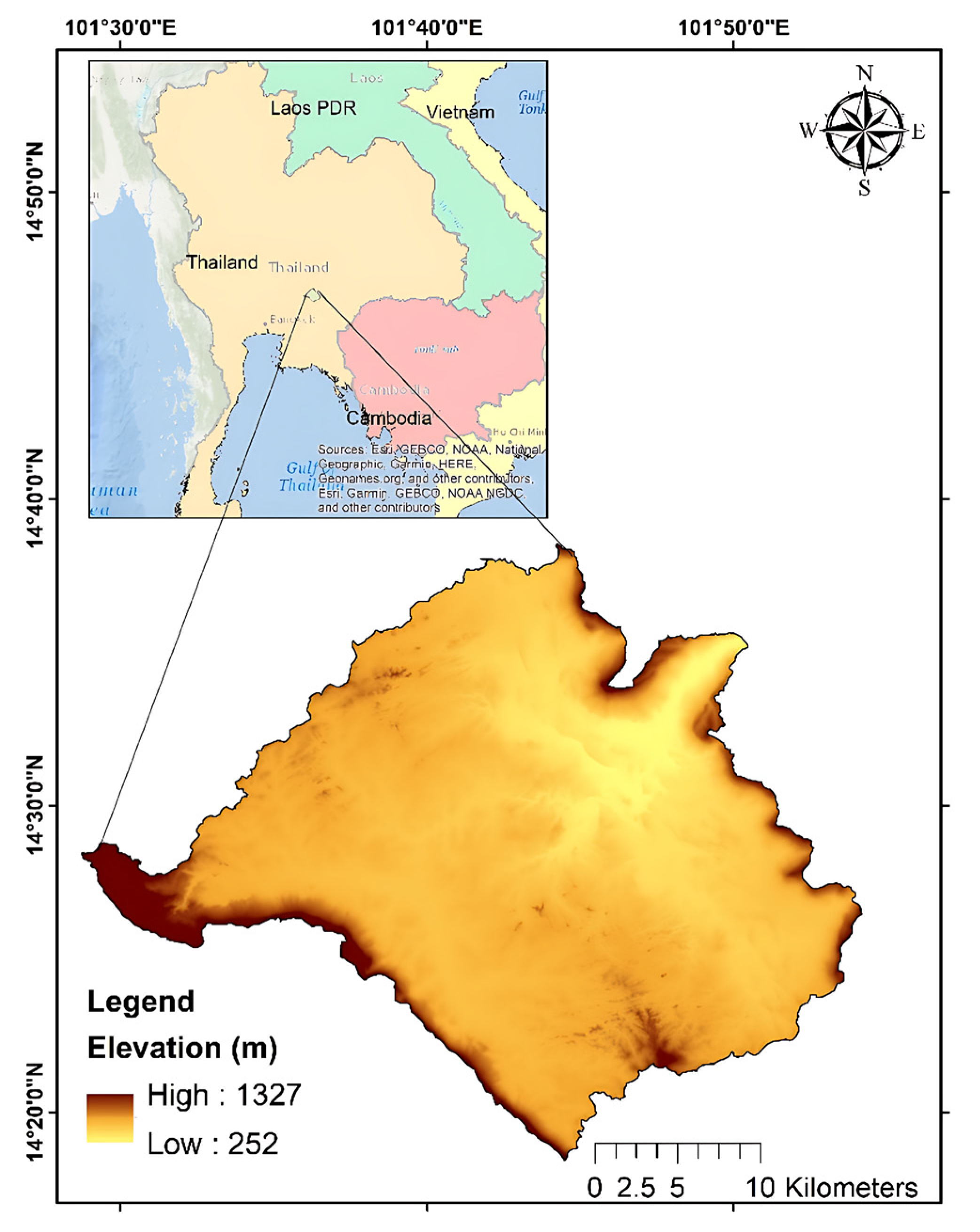
The Lam Phra Phloeng River is a tributary of the Mun River and is located in the Takob sub-district of Pak Thongchai District, Nakhon Ratchasima Province. The Lam Phra Phloeng Reservoir is a major water body within the LPP watershed and is primarily intended for water retention and irrigation support [53]. The watershed covers approximately 807 km2 with an average elevation of about 263 m (Figure 1), and nearly 52% of its area lies within Khao Yai National Park, Thailand’s first national park and a UNESCO World Heritage Site designated on 14 July 2005. The region is characterized by a tropical monsoon climate, with a pronounced rainy season from May to October and a dry season from November to April, during which most of the annual rainfall, approximately 1100 to 1400 mm, is concentrated. Dominant soil types in the watershed are mainly sandy loam to loam textures derived from sandstone and shale parent materials, generally exhibiting moderate to high erodibility and low to moderate organic matter content, particularly in cultivated areas. Historically, the basin experienced frequent flooding during the rainy season, prompting the Thai Royal Irrigation Department (RID) to construct a dam in 1967 to regulate flood flows and provide irrigation water during dry periods [54]. These combined climatic, topographic, and soil conditions contribute to the high susceptibility of the watershed to soil erosion during intense rainfall events.
In the LPP watershed, agriculture represents the primary livelihood of local communities and has strongly influenced land-use patterns in the lower and central portions of the basin. Areas dominated by natural and semi-natural vegetation are mainly concentrated in the upper watershed, particularly in zones adjacent to the national park, while agricultural land occupies a substantial portion of the lower slopes. Since the 1980s, large areas of the watershed have been converted to agricultural use, including zones designated as protected buffer areas for the national park [55]. The expansion of cash-crop cultivation, particularly sugarcane and cassava, has increased soil exposure following harvest periods, making these areas susceptible to sheet erosion. The LPP watershed was selected as the study area because it exhibits pronounced soil erosion risks driven by steep topography and land-use pressure associated with agricultural expansion and urban development [56].

3. Datasets and Methodology

3.1. Datasets Used

Landsat Thematic Mapper (TM) (2003) and Operational Land Imager (OLI) (2023) data from the Landsat program, operated by the U.S. Geological Survey (USGS), Reston, VA, USA, data were used in this study for generating both land use maps and prediction via the CA-Markov chain model. Apart from that, several datasets were used for the simulation of the InVEST SDR model. The inputs for the InVEST SDR model are depicted in Table 1.
A biophysical table is one in which each LULC code corresponds to the biophysical features of that LULC class. There must be matching entries in this table for every value in the LULC raster. “usle_c” is the cover management factor of the universal soil loss equation. Smaller numbers (close to 0) suggest that this type of LULC is likely to cause less erosion. Values nearer 1 suggest that this land use type is likely to cause more erosion. The support practice factor is “usle_p” in the universal soil loss equation. One can use a value of 1 to show that no erosion-reduction measures are being taken. When the value is less than 1, it means that erosion-reducing management techniques are being used.

3.2. Model Descriptions

3.2.1. Ca-Markov Chain Model

The CA–Markov model, which integrates Cellular Automata with Markov processes, has been proposed for land use change prediction because it is more efficient compared to other methods [57]. Cellular automata serve as a dynamic model that illustrates complex natural phenomena and are often applied in the simulation of self-replicating systems [58]. Although ANN (“Artificial Neural Network”)-based models and ML (machine learning)-based spatial predictions can be used to model land use changes [59,60], in this study, the CA–Markov model is used instead of ANN and ML due to its integrated approach, which accounts for both temporal and spatial dynamics [61]. CA, unlike other dynamic models, excels at effectively modelling complex systems by utilizing its logic and functionality to accurately simulate intricate natural occurrences [58,62]. The CA model in land-use research has the following four main components: discrete cellular structure, finite states, a distinct neighbourhood structure, and transition rules that determine state changes [63]. Alternative dynamic models such as statistical regression and equation-based systems often fail to accurately represent the intricacies of land-use change over space and time [64]. CA–Markov is therefore more effective for land-use dynamics, producing realistic simulations and highlighting key anthropogenic drivers such as agricultural expansion and deforestation that simpler models frequently overlook [29].
CA–Markov provides a robust framework for understanding how historical land-use patterns shaped by spatial correlations influence future land-cover scenarios [59]. Despite some residual uncertainty, this approach has been widely applied for geographic forecasting and land-use prediction [65,66,67]. The Markov process is suitable for land-use change analysis because different land-use classes can transition over time (e.g., vegetation to cropland), and such transitions are difficult to represent using deterministic equations. The CA–Markov model applied in this study is therefore well suited for watershed-scale land-use analysis due to its synergistic integration of Cellular Automata and Markov chains [59], where transition probabilities derived from the Markov process predict future states based on the present condition [68]. The integration of spatial contiguity and temporal transition probabilities enables efficient simulation of land-use changes primarily driven by agricultural intensification and deforestation [69,70].
To validate the CA–Markov predictions, the 2003 LULC map was used as the baseline input and the 2013 LULC map was treated as the reference end year to simulate LULC conditions for 2023. The resulting predicted map was compared with the independently classified 2023 LULC dataset derived from Landsat OLI imagery. Model performance was quantitatively assessed using overall accuracy, Kappa coefficient, and class-level agreement based on a cross-tabulated error matrix. The model meets accepted performance thresholds (OA > 0.85), supporting its application for projecting LULC changes for 2030, and 2050.
Although ANN and other machine-learning models can be applied to land-use prediction, the CA–Markov approach is more suitable for this study because it integrates temporal transition probabilities with spatial dependency and neighbourhood effects represented by Cellular Automata. This capability allows simulation of landscape dynamics such as agricultural expansion, forest fragmentation, and settlement growth that exhibit strong spatial contiguity in the LPP watershed. Comparative studies have shown that CA–Markov performs as well as, or better than, ANN-based and other ML-based spatial prediction models, particularly when long prediction intervals or limited training datasets constrain model performance [45,59,60,63]. In contrast, many ML approaches require extensive multi-temporal datasets and lack explicit mechanisms for neighbourhood interaction unless complex architectures are used.
The applicability of CA–Markov is further supported by its extensive use in watershed-scale studies examining forest loss, agricultural intensification, urban expansion, and other LULC transitions [47,60,63,64]. Collectively, these studies demonstrate its reliability for representing land-use change in regions experiencing rapid yet spatially coherent landscape transformations. Given these strengths, CA–Markov provides a transparent, computationally efficient, and context-appropriate framework for forecasting future LULC transitions in the LPP watershed compared with ANN or other ML models.
It is acknowledged that projecting land use to the end of the century introduces uncertainty, particularly because CA–Markov models assume stationary transition probabilities. Projections beyond 2050 are therefore interpreted as trend-based scenarios illustrating potential long-term consequences of continued land-use trajectories observed during 2003–2023. Similar long-horizon projections have been employed in watershed and land-change studies to explore plausible futures under unchanged structural conditions. Accordingly, results for 2050 should be interpreted cautiously as indicative of directional change rather than deterministic forecasts.

3.2.2. Random Forest (Rf) Model

The RF model is a more sophisticated form of CART that consists of many decision trees. In this method, several decision trees combine to form an ensemble, which produces more accurate predictions [71]. Random Forest was selected over alternative classifiers such as CART, SVM, and ANN because it consistently demonstrates higher robustness when applied to medium-resolution multispectral data with mixed land-cover signals [72,73]. Numerous comparative studies confirm that RF outperforms alternatives such as SVM, CART, and ANN in Landsat-based LULC classification, achieving higher overall accuracies (e.g., up to 95% for RF vs. 83% for SVM [74]), particularly by effectively handling non-linear relationships, correlated and multicollinear input features, limited training samples, and spectral similarities in heterogeneous landscapes, while substantially reducing overfitting relative to single decision trees or neural network models [73,75,76]. In heterogeneous tropical landscapes, where cropland and natural vegetation exhibit similar spectral responses, RF has been shown to outperform SVM and CART classifiers in terms of overall accuracy and class separability, making it well suited for the objectives of this study [77].

3.2.3. Invest SDR Model

Agricultural production can be negatively impacted by soil loss from the land, and changes in sediment load can affect downstream irrigation, water treatment, and reservoir performance. These consequences may be economically assessed by integrating InVEST SDR model results with information on saved mitigation and replacement costs. The SDR model only considers overland erosion and does not consider gully, bank, or mass erosion. The model generates the sediment load supplied to the stream on an annual basis, as well as the quantity of sediment eroded in the watershed and retained by vegetation and each land use class [78].
The quantity of soil loss on pixel i (uslei) is calculated as per the Revised Universal Soil Loss Equation (RUSLE) as shown in Equation (1):
RUSLE = Ri × Ki × Lsi × Ci × Pi
where Ri is rainfall erosivity, Ki is soil erodibility, Lsi is a slope length-gradient factor, Ci is a cover-management factor, and Pi is a support practice factor. A key limitation of the model lies in its validation, which is constrained by the unavailability of long-term observed time series data for the study region.

3.3. Methodology

3.3.1. Land Use Mapping

Landsat TM (for 2003) and OLI (for 2023) data were used to create land use maps. The land use classes identified in this research are built-up area, cropland, vegetation, and waterbodies. At first, three indices, namely the built-up index (BUI), normalized difference vegetation index (NDVI), and normalized difference water index (NDWI), were derived from the Landsat datasets. These three indices each have their utility; BUI is used to identify settlements, NDVI is good for highlighting vegetation, and NDWI is used to distinguish waterbodies. These indices are employed in the current work to improve LULC classification, and they are regarded as feature parameters collected from satellite image data sets. In addition, the elevation data, along with slope and aspect generated from it, were used as surface feature parameters for LULC classification.
One of the main limitations of using Landsat imagery for LULC classification is the low spectral separability between cropland and vegetation. These classes often share similar reflectance patterns, particularly when croplands are covered with green foliage or when mixed pixels occur at the 30 m resolution. In the LPP watershed, many cropped areas contain perennial species such as cassava and sugarcane, whose spectral signatures closely resemble those of natural vegetation in the visible and near-infrared bands. During post-harvest periods, croplands may also appear partially or fully bare, further increasing confusion with sparsely vegetated surfaces. This spectral similarity contributed to the lower user and producer accuracies for cropland observed in the CART and SVM classifications.
To improve class discrimination, we incorporated GLCM-derived texture metrics, NDVI, and elevation-based variables (slope and aspect) into the classification workflow. These additional features helped capture structural and environmental differences between croplands and natural vegetation, enhancing overall separability. The Random Forest classifier, which handles mixed spectral classes and high-dimensional feature sets effectively, demonstrated the best performance in distinguishing these land-cover types. Nevertheless, some degree of uncertainty remains due to the intrinsic spectral overlap, and this limitation should be taken into account when interpreting the classification results.
Texture analysis was also used as input in the classification process, which was performed using the Gray Level Co-occurrence Matrix (GLCM) in ENVI software (version 5.6; NV5 Geospatial Solutions, Boulder, CO, USA). An 8-bit grey-level imagery is used as the input for the GLCM algorithm. The algorithm generates a texture image by linearly combining the Green, Red, and Near-Infrared bands of the original or initial composite images using the equation below:
Grey = 0.3NIR + 0.11GREEN + 0.59RED
In the GLCM process, six metrics, namely contrast, mean, variance, homogeneity, correlation, and angular second momentum were derived for both datasets. The indices were calculated for both the years 2003 TM and 2023 OLI.
After proper normalization, a Principal Component Analysis (PCA) using the six GLCM metrics was carried out to produce a single representative band (PC1), which usually contains the vast majority of the texture-based data.
It is acknowledged that the effectiveness of texture measures derived from GLCM is constrained by the spatial resolution of Landsat imagery, particularly in heterogeneous agricultural landscapes. To minimize the introduction of noise, texture features were used only as supplementary inputs to the Random Forest classifier and were evaluated alongside spectral and topographic variables. This integrated approach reduced reliance on texture information alone and allowed the classifier to selectively weight features based on their contribution to classification performance.
The use of GLCM-derived texture measures with medium-resolution Landsat imagery has recognized limitations, particularly in heterogeneous agricultural landscapes where fine-scale textures may not be fully resolved. In this study, texture features were not used in isolation but in combination with spectral indices and terrain variables. This combination helps capture structural and environmental differences between cropland and natural vegetation that are not evident from spectral information alone. Nevertheless, some uncertainty remains due to the spatial resolution of the data, and this limitation is considered when interpreting classification results.

3.3.2. Ca-Markov Prediction

The baseline data for the CA-Markov model were taken from the land use of 2003. Then, based on 2003, a land use prediction was made for 2023. Now, the land use of 2023 was also made separately from the features extracted by the GLCM and RF algorithm, as mentioned previously. Now, the two land use results, one from the CA-Markov prediction and another from the GLCM-RF-based method, were critically assessed to observe the accuracy of the CA-Markov model.
The CA–Markov model assumes that transition probabilities derived from historical land-use change remain constant over time. While this assumption allows for the exploration of long-term land-use trajectories, it does not account for potential future changes driven by policy interventions, economic development, demographic shifts, or climate variability. In this study, projections beyond 2030, including those for 2050, are therefore not intended as precise forecasts but as exploratory, trend-based scenarios that illustrate the possible long-term implications of continued land-use dynamics observed during the 2003–2023 period.
The inclusion of a long projection horizon serves to examine the cumulative spatial effects of persistent land-use transitions rather than to predict exact land-cover states at the end of the century. Accordingly, results for 2050 should be interpreted with caution and used primarily to understand the direction and relative magnitude of potential land-use impacts on erosion processes.
The prediction of land use for the years 2030 and 2050 was made with the optimized model. Apart from the past and recent land use, the other parameters used in the prediction process are the transport network (road, railway, and river), and indices derived from the elevation raster (slope, aspect, and drainage).
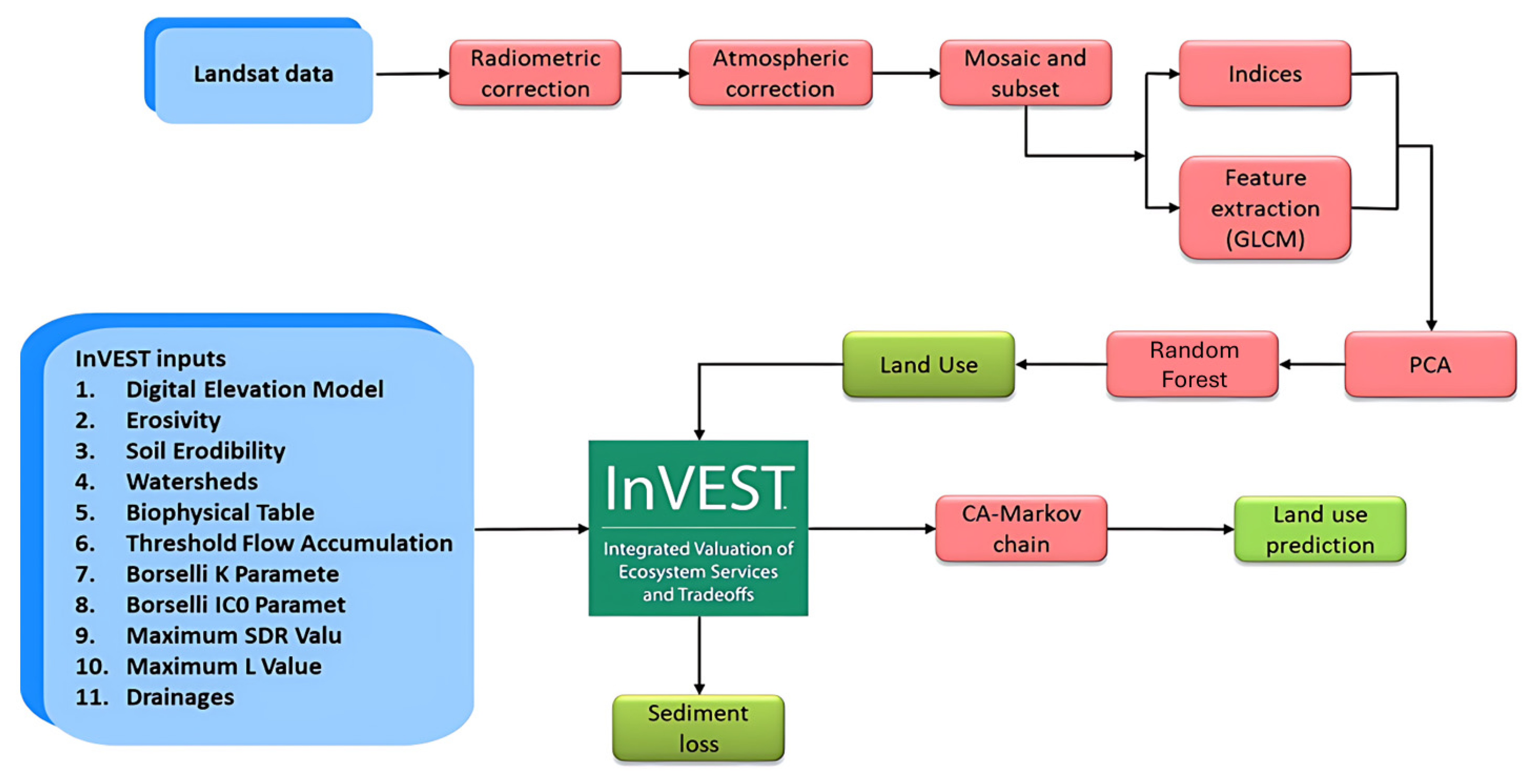
The change analysis and cubic trend were also performed to observe the transition of one class to another. The land use, along with other inputs mentioned in Table 1, was used for the InVEST SDR model simulation to get the net sediment loss of the LPP watershed. The whole methodology is briefly described in Figure 2.

3.4. Model Evaluation

Classification performance was evaluated using a confusion matrix, from which true positives (TPs), true negatives (TNs), false positives (FPs), and false negatives (FNs) were derived for each land-use class. Overall accuracy (OA) was calculated as the proportion of correctly classified samples relative to the total number of reference samples (Equation (3)). Producer’s accuracy (PA) and user’s accuracy (UA) were computed to quantify omission and commission errors, respectively (Equations (4) and (5)), while the Kappa coefficient (κ) was used to measure agreement beyond chance (Equation (6)).
O A = T P + T N T P + T N + F P + F N
P A = T P + T N T P + F N
U A = T P + T N T P + F P
κ = T P + T N E T P + T N + F P + F N E

4. Results

Land Use Classification and Future Projections

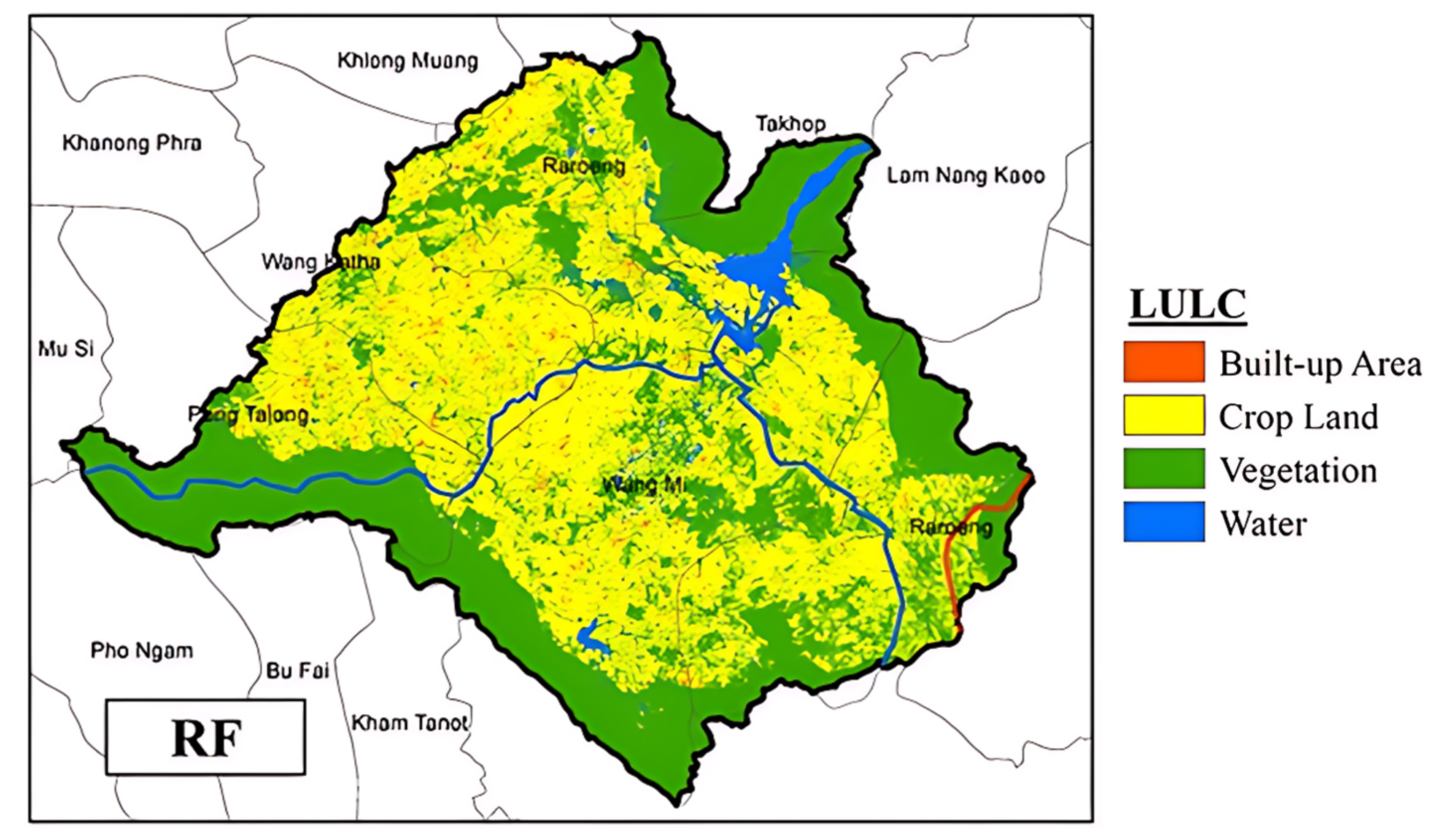
Land-use and land-cover changes are reported using generalized classes (vegetation, cropland, built-up area, and water body), which form the basis for subsequent erosion modelling, while crop-specific processes are interpreted in relation to these broader categories. The classification maps of land use in LPP of 2003 using RF is presented in Figure 3.
Table 2 represents the accuracy information for the land use classification of LPP derived from Landsat data using the RF classifier. The accuracy information provided in this section corresponds to the classified LPP map for the year 2003. The overall accuracy (OA) and kappa coefficient achieved were 93.8% and 0.89, respectively. This indicates that the LULC classification is satisfactory, as the OA is greater than 85% and the kappa coefficient is greater than 0.80. Therefore, the classified LULC map is reliable and can be used for LULC prediction.
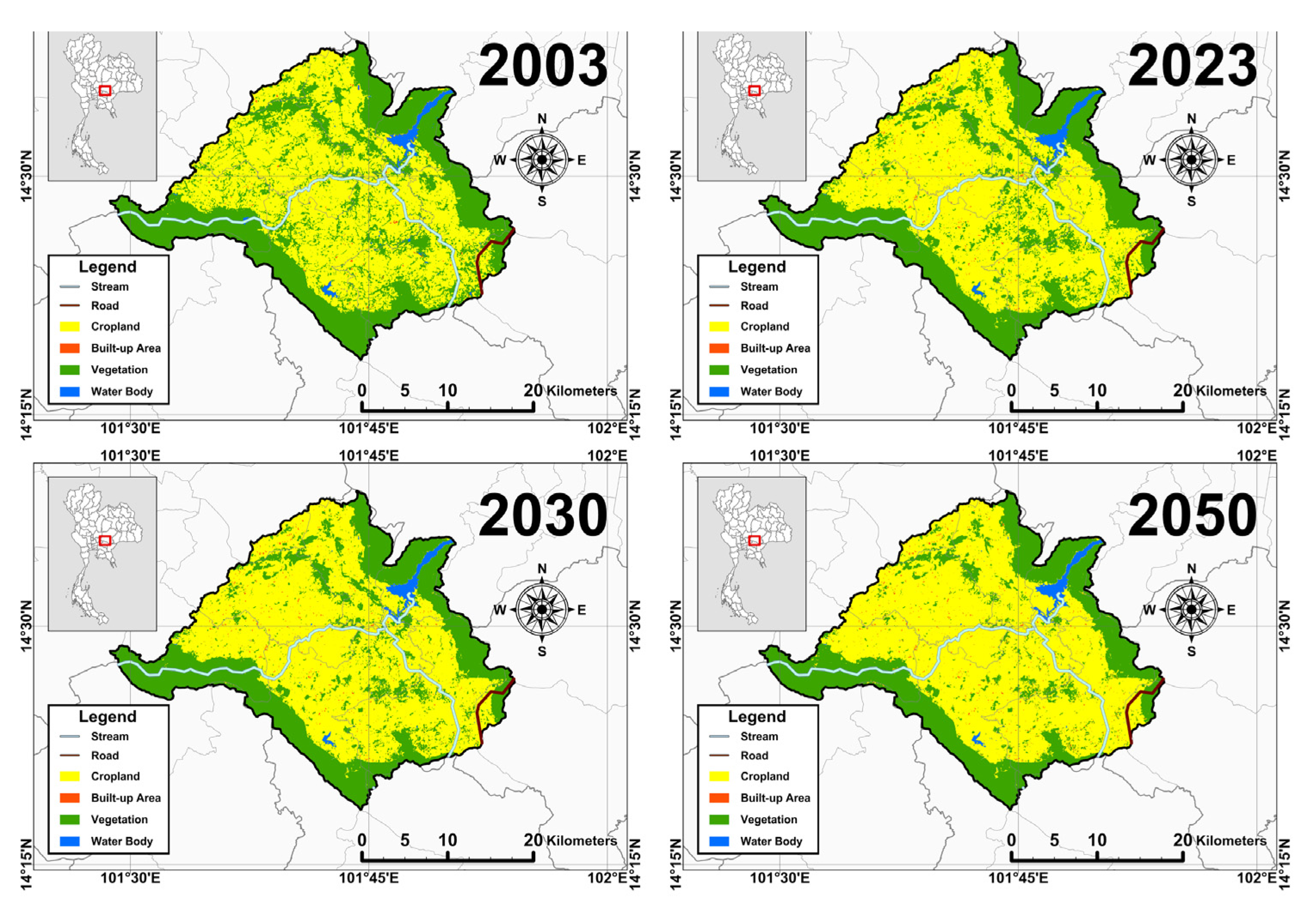
Figure 3 represents the land use maps of LPP for 2003, 2023, 2030, and 2050, where 2003 and 2023 were made using texture information from GLCM. The images for 2030 and 2050 were derived using the CA-Markov model. The classified image of 2003 was used as the baseline information or training data and the classified image of 2023 was used for testing data in the CA-Markov chain model. From Figure 4, it is evident that the vegetation cover at both boundaries of the study area has been predicted to decrease. The forest patches in the southern sector of the study area are also predicted to decrease in 2050.
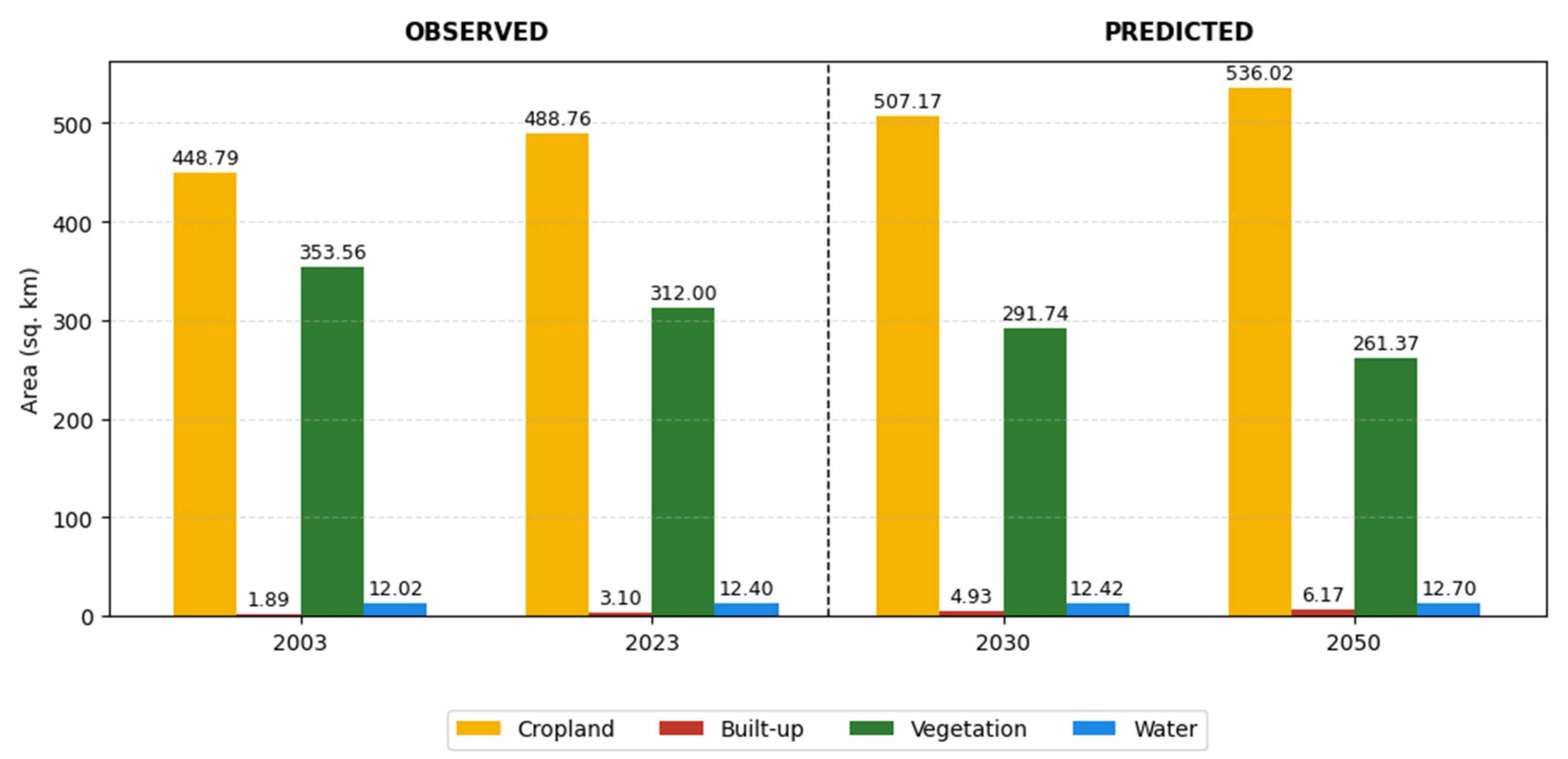
Figure 4 represents different land use classes and their respective areas for 2003, 2023, 2030 and 2050. The underlying data suggest that cropland and built-up areas have been gradually increasing between 2003 and 2050, whereas vegetation cover has been gradually decreasing in that time frame. Between 2003 and 2023, the observed change in cropland was from 448.79 sq.km to 488.76 sq.km. The predicted data suggest that the cropland in LPP will further increase and occupy 507.17 sq.km in 2030, 536.02 sq.km in 2050 and 600.33 sq.km in 2050. The rapid increase in cropland predicted by the CA-Markov chain model is alarming as it is often associated with the destruction of vegetation class. The observed change in the vegetation class between 2003 and 2023 was from 353.56 sq.km to 312 sq.km, and the prediction suggests that it will drastically decrease to 291.74 sq.km, 261.37 sq.km, and 191.56 sq.km in 2030 and 2050 respectively. As the other two classes, waterbodies and built-up areas did not show much change in the timescale, therefore, land conversion of vegetation to cropland is very prominent in LPP.
To further quantify land use dynamics, we calculated the annual rate of change in cropland and forest cover between 2003 and 2023. Cropland increased from 448.79 km2 to 488.76 km2, representing a net gain of 39.97 km2 over 20 years, or an average annual expansion of approximately 2.0 km2/year (0.45% per year). In contrast, forest/vegetation declined from 353.56 km2 to 312.00 km2, a net loss of 41.56 km2, corresponding to an average annual reduction of about 2.1 km2/year (0.60% per year).
These annualized trends clearly demonstrate a persistent shift from forest to agricultural land, consistent with the modelled future projections (2030–2050). The annual trend analysis further strengthens the evidence that cropland expansion is the dominant driver of vegetation loss in the LPP watershed.
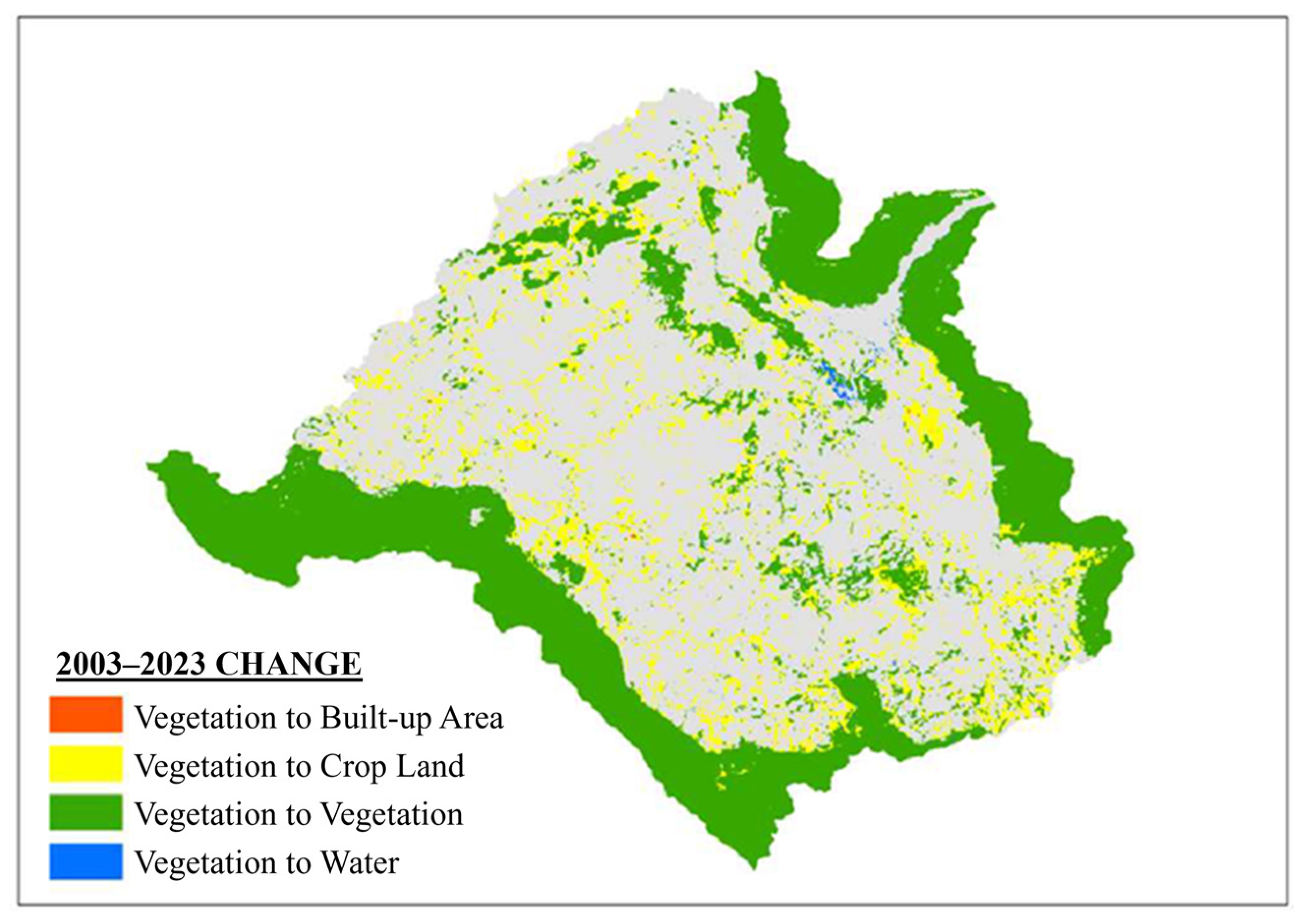
The conversion of vegetation to croplands was further investigated to observe the spatiotemporal changes in land conversion at LPP (Figure 5). The yellow patches in Figure 5 indicate the places where vegetation cover has been destroyed to make agricultural fields. Field observations suggest that the conversion mainly occurred near built-up areas, where anthropogenic activities predominate. The sporadic nature of land conversion, without any distinct pattern, indicates further replication of this phenomenon as population pressure and demand for food continue to increase in this part of the world.
The spatial distribution of land use change (Figure 6) indicates that cropland expansion is most concentrated in the southern and central portions of the watershed, particularly near built-up areas and transport corridors where population pressure is high. These areas correspond with steep slope terrain, which increases susceptibility to erosion following deforestation.
The land-use/land-cover (LULC) transition matrix for the period 2003–2023 (Table 3) indicates a generally stable landscape, with most classes maintaining a high degree of persistence over the two decades. Built-up areas show the highest retention, with 97% of pixels remaining within the same category, and only minor conversions to cropland (1%) and vegetation (2%). Cropland also exhibits strong stability, with 88% of its 2003 extent preserved in 2023, although some transitions to vegetation (approximately 4.8%) and built-up areas (8%) are evident, suggesting gradual land conversion associated with agricultural change or settlement expansion.
Vegetation displays a more dynamic pattern: while 62% of vegetated areas remained unchanged, notable proportions transitioned to cropland (23%) and, to a lesser extent, built-up (12%). These shifts imply pressures on vegetated zones, likely due to agricultural intensification or encroachment from expanding settlements. Waterbodies remain largely stable, with 97% persistence and only minimal transitions to other classes, reflecting limited hydrological or anthropogenic alteration during the study period.
Overall, the transition matrix highlights strong stability in built-up and waterbody classes, moderate persistence in cropland, and the greatest degree of change occurring within vegetation, which serves as the primary source of conversions to both cropland and built-up areas. This pattern points to ongoing land development and agricultural expansion as the main drivers of LULC change between 2003 and 2023.
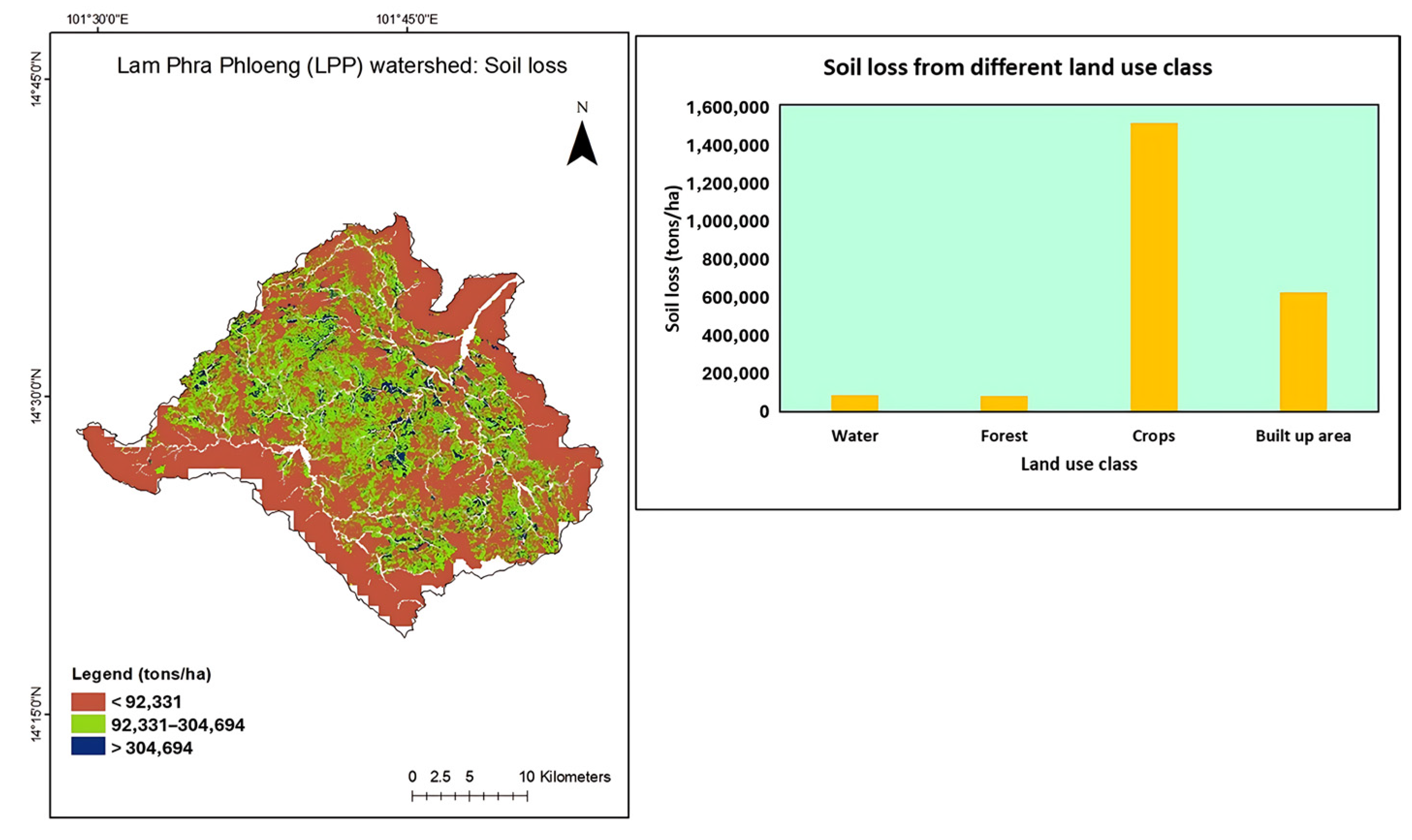
These land-use transitions, particularly the conversion of vegetation to cropland on sloping terrain, provide the spatial context for the soil erosion patterns presented in the following section. The soil loss distribution (Figure 6) further illustrates the critical erosion zones. High soil loss values are concentrated along the riparian corridors and southern slopes, where rainfall erosivity and proximity to water bodies accelerate sediment delivery. Moderate erosion zones are found in agricultural fields located on mid-slopes, while minimal soil loss is evident in the forest-dominated areas of the upper watershed, particularly within Khao Yai National Park.
These spatial patterns highlight that erosion is not uniformly distributed across the LPP watershed but is rather highly localized in areas undergoing rapid conversion from vegetation to cropland. Identifying these hotspots is crucial for targeting soil conservation interventions, such as establishing riparian buffers, constructing check dams, and implementing slope-specific agricultural practices.
Figure 7 shows the scenario of soil loss distribution across the LPP watershed based on the modelled output of InVEST SDR. It shows that soil loss differs significantly based on land use. Forested areas with dense vegetation underwent the least soil loss due to their capacity to intercept rainfall and stabilize soil via root systems [79]. Figure 6 indicates that agricultural areas have under moderate level of soil loss. A recent study [80] found annual soil loss in the upper Mun River Basin exceeding 12.5 t/ha, attributed mainly to agricultural practices and rainfall impacts.
Observations of elevated soil loss rates in certain built-up areas are predominantly attributed to heightened surface runoff and terrain disturbance accompanying urban expansion, especially on sloping topography. Within the InVEST Sediment Delivery Ratio model, built-up areas do not inherently function as erosion-resistant surfaces, since sediments originating from adjacent upslope croplands and exposed soils can be conveyed through impervious and disturbed zones [81]. Comparable trends are documented in other watershed-scale erosion studies, where urban development aligns with enhanced runoff connectivity.
Agriculture has intensified erosion compared to forests, but it is less severe than the erosion adjacent to water bodies, wherein the soil loss scenario is maximum due to rainfall-induced sediment transport. These are particularly the critical zones, along the water bodies, wherein substantial soil loss led to increased sediment transport in downstream waterways [82].
Agricultural zones highlight the hotspots of severe soil loss caused by steep slopes, poor conservation practices, and recent vegetation removal. Identifying these areas is vital for soil conservation efforts across the LPP watershed. Thus, based on the InVEST SDR output, identifying soil loss hotspots and addressing them in these critical zones is imperative for effectively mitigating erosion and safeguarding soil health throughout the LPP watershed.
The land-use dynamics of the LPP watershed involve not only changes in area but also the types of crops cultivated and the management practices applied. Several dominant cash crops in the region, particularly cassava, sugarcane, and increasingly rubber have characteristics that heighten susceptibility to water erosion. Cassava, for example, is typically planted at wide spacing and exhibits slow canopy development during the early growing season. This prolonged period of exposed soil creates conditions that favour high rates of on-site erosion, a pattern consistently reported in empirical studies from Thailand under conventional management practices.
Sugarcane can likewise contribute to soil instability on sloping terrain, especially where intensive tillage or post-harvest residue removal is common. Rubber plantations present a more variable picture: mature stands with closed canopies can reduce erosion relative to annual crops, yet the expansion of rubber into steep slopes or the conversion of forest and mixed agroforestry systems to monoculture rubber can increase runoff and soil loss. These outcomes depend strongly on factors such as planting density, groundcover management, and site preparation, with recent landscape-scale assessments indicating that large-scale rubber expansion may exacerbate erosion where ground vegetation is removed.
Beyond crop type, specific management practices play a decisive role in shaping erosion risk. Intensive tillage, removal of crop residues, and monocropping tend to increase bare-soil exposure and surface runoff. In contrast, conservation-oriented practices, such as contour farming, residue retention, cover cropping, and intercropping (e.g., cassava combined with legumes) can markedly reduce soil detachment and transport. Consequently, interventions that focus on minimizing bare-soil periods, maintaining groundcover, and reducing tillage intensity are likely to be more effective at reducing erosion than strategies based solely on changes in cultivated area.
Soil erosion in the upper basin increases sediment loads that reduce reservoir storage capacity, elevate turbidity, and raise water-treatment costs. In agricultural areas, the loss of nutrient-rich topsoil threatens crop yields and increases reliance on external inputs. These impacts are felt most acutely by smallholder farmers, for whom erosion contributes to declining productivity, heightened financial vulnerability, and downstream consequences such as increased flood risk and degraded water quality. Together, these effects underscore the importance of integrated watershed management, targeted soil-conservation support for farmers, and policies that connect upland land stewardship with downstream water security.

5. Discussion

LULC Classification
This study investigated land-use change and its implications for soil erosion in the Lam Phra Phloeng (LPP) watershed using an integrated geospatial modelling framework. The land-use maps and future projections (Figure 4) indicate a decreasing trend in vegetation cover alongside an expansion of cropland and built-up areas. Vegetation loss is most evident along the hilly terrains of the northeast and southwest boundaries of the watershed, as well as in fragmented patches within the central valley, reflecting increasing anthropogenic pressure. Conversion of vegetation to cropland represents a dominant transition pathway, as illustrated in Figure 5 and Figure 6.
The spatial distribution of soil loss simulated using the InVEST SDR model (Figure 6) shows elevated erosion in the southern and central portions of the watershed. These patterns are primarily driven by the combined influence of steep slopes, exposed cropland, and high rainfall intensity during the early monsoon period. In contrast, areas retaining vegetation cover exhibit comparatively lower soil loss, underscoring the protective role of land cover. These findings are consistent with previous studies applying similar modelling approaches in tropical watersheds. For example, Sirikaew et al. [83] reported elevated soil erosion rates in the LPP watershed under land-use intensification scenarios, particularly in areas characterized by steep slopes and agricultural expansion. Comparable erosion magnitudes have been documented in the Winike watershed, Ethiopia [84], the Lake Tana Basin under land-use intensification and rainfall variability [85], and the Vietnamese Mekong Delta [86,87].
Crop-specific land-use changes strongly influence erosion dynamics within the watershed. Expansion of cassava and sugarcane cultivation, often occurring on sloping terrain without contour management, exposes soil surfaces to high rainfall erosivity following harvest, increasing susceptibility to sheet and rill erosion. Similarly, rubber plantations promoted under national agricultural policies have contributed to land conversion from food crops and forested areas. Monoculture rubber systems, particularly in the absence of intercropping or ground cover, increase surface runoff and reduce soil stability, consistent with previous findings linking cash-crop expansion to higher sediment yields in Thailand.
Uncertainty associated with long-term land-use projections should be carefully considered when interpreting the results. The CA–Markov approach captures continuation of historical transition patterns but cannot account for abrupt changes in land management, policy interventions, or external socioeconomic drivers. Consequently, projected erosion patterns beyond mid-century represent plausible outcomes under unchanged transition dynamics rather than definitive future conditions, highlighting the value of scenario-based modelling approaches in future studies. While climate scenarios are referenced to establish contextual relevance, the current study does not integrate projected land-use changes for 2030 and 2050 with shifts in precipitation regimes; this constitutes a limitation of the analysis and represents a priority for future scenario-based research that incorporates climate-driven rainfall variability.
From a land management perspective, the results indicate that erosion mitigation efforts should prioritize high-risk areas within the LPP watershed. Measures such as establishing riparian buffer zones with native vegetation [88], constructing erosion control structures, and promoting sustainable agricultural practices including contour farming and conservation tillage [89] could substantially reduce soil loss. Afforestation and reforestation initiatives also remain important for stabilizing erosion-prone slopes and enhancing landscape resilience [89].
Thailand’s land-use policies have evolved considerably over recent decades. While the 1989 logging ban and earlier conservation legislation contributed to retaining forest cover in parts of the watershed, subsequent agricultural policies promoting cash crops have intensified land conversion pressures. These shifts have increased economic returns but have also resulted in unintended consequences, including soil erosion, water scarcity, and reduced ecosystem services [90,91]. More recently, Thailand’s 20-Year National Strategy on Natural Resources and Environment (2018–2037) emphasizes integrated sustainable land management and watershed protection, although implementation challenges persist due to ongoing urbanization pressures [92].
Comparisons with other watersheds in Thailand further emphasize the vulnerability of the LPP watershed to erosion. Northern basins such as Mae Nam Nan experience substantial erosion challenges in regions characterized by steep slopes and intensive agriculture [93], while the Wang River Basin exhibits increased sediment yield associated with agricultural practices and road development [94]. In northeastern Thailand, the Mun River Basin shows similar erosion patterns driven by deforestation, agricultural expansion, and climate variability [83], indicating that the processes observed in the LPP watershed reflect broader regional land-use pressures.
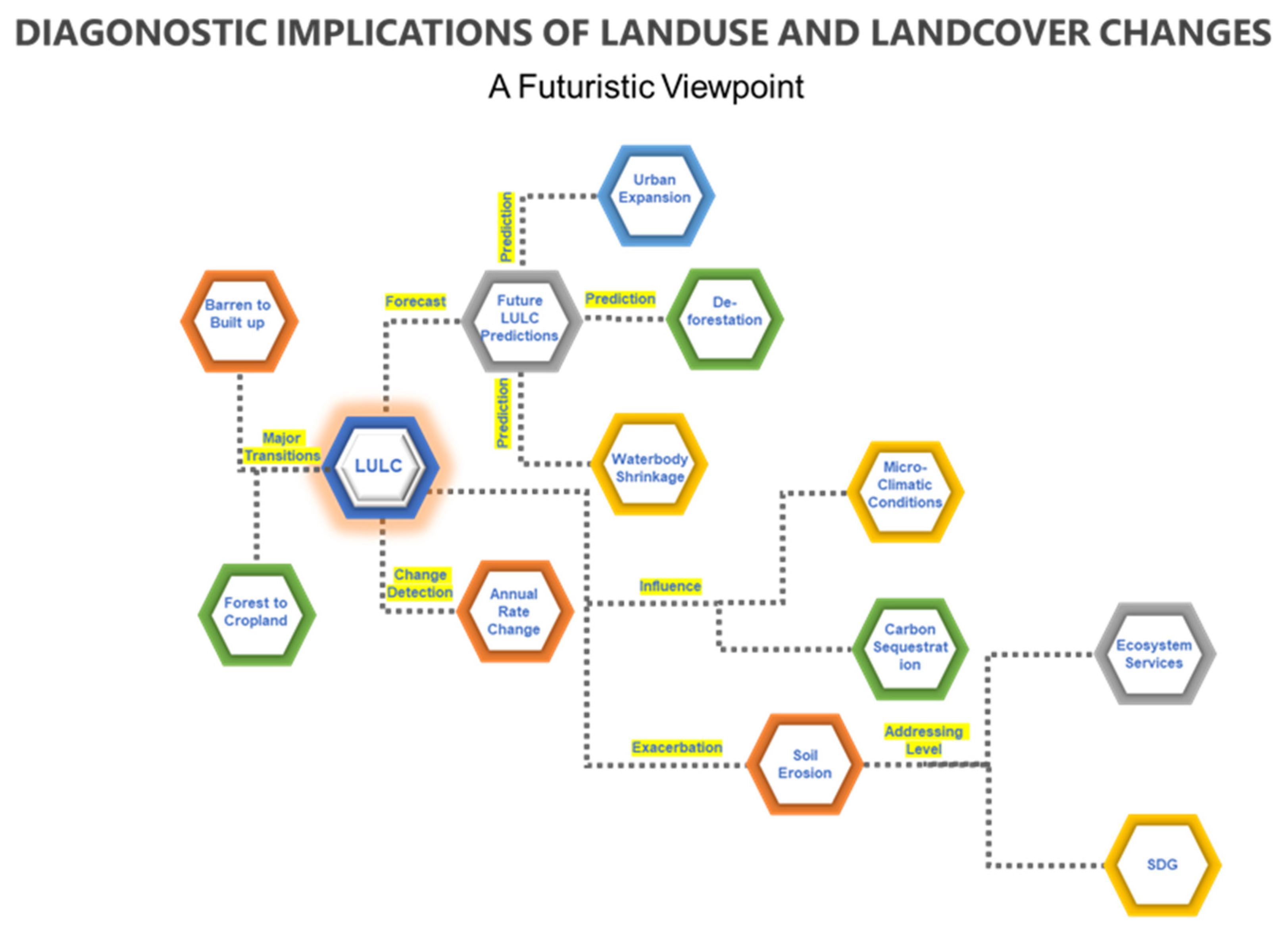
This study also presents a futuristic viewpoint of land use changes in Figure 8. Changes in land use and land cover have important diagnostic ramifications for social, ecological and economic parameters. These changes are frequently caused by anthropogenic activities that modify land use along with ecological processes, such as urbanization, deforestation, agriculture, and industrialization. Diagnostic evaluations of land use changes offer vital information about their effects, including habitat loss, biodiversity decline, and local climate change. Land use also affects soil quality, carbon storage capacity, and hydrological cycles. Comprehending these consequences aids in creating sustainable land management plans and reducing adverse impacts on ecosystems and human well-being. Furthermore, LULC diagnostics are essential for urban planning, policymaking, and environmental health monitoring to strike a balance between ecological preservation and development demands. The Sustainable Development Goal 15 by the United Nations states “Protect, restore and promote sustainable use of terrestrial ecosystems, sustainably manage forests, combat desertification, and halt and reverse land degradation and halt biodiversity loss”. Therefore, sound land use practices are needed in Thailand for adaptation and mitigation against rapid erosion and build resilience against natural disasters like landslides and severe erosion.

6. Future Works and Recommendation

Future research should build upon the current study by integrating scenario-based land-use projections that incorporate diverse policy, socioeconomic, and developmental pathways, moving beyond exclusive dependence on trend-based extrapolations. Incorporating climate-induced variability (such as anticipated shifts in rainfall intensity and patterns) would enhance the modelling of erosion processes under projected future conditions. Improving model inputs, especially via dynamic soil properties and management parameters, would better capture evolving agricultural practices and conservation efforts. Furthermore, integrating sediment delivery models with empirical field monitoring and high-resolution remote sensing would improve calibration and validation, thereby lowering uncertainties in erosion predictions. Ultimately, subsequent studies should evaluate targeted land management strategies (including riparian buffers, crop diversification, and conservation agriculture) through simulations of their effects on mitigating erosion and fostering watershed sustainability.

7. Conclusions

This study aimed to quantify long-term land use and land cover change, project future land-use trajectories, and assess their implications for soil erosion and sediment delivery at the watershed scale. Using Landsat-based classification, CA–Markov land-use projection, and the InVEST Sediment Delivery Ratio model, the analysis provides an integrated assessment of how land-use dynamics influence erosion processes over time.
The findings reveal that the expansion of cropland and the conversion of forested areas on sloping terrain represent the principal drivers of heightened soil loss within the Lam Phra Phloeng watershed. Regions subject to persistent agricultural intensification consistently overlap with high sediment delivery zones, underscoring the cumulative and spatially targeted effects of land-use changes on erosion vulnerability. Long-term projections indicate that, under continued current land-use trajectories, erosion-susceptible areas are likely to expand further, especially in upland agricultural regions.
A primary strength of this study is the integration of land-use classification, long-term land-use forecasting, and spatially explicit sediment delivery modelling into a cohesive analytical framework. This methodology allows for the detection of prospective erosion hotspots in data-limited watersheds and yields spatially detailed insights unattainable via static or short-term erosion evaluations. Nonetheless, the framework entails certain limitations: trend-based CA–Markov projections are unable to accommodate sudden policy shifts or socioeconomic changes, and erosion estimates rely on modelled inputs rather than ongoing field-measured sediment data.
Future investigations should emphasize scenario-driven land-use projections that incorporate diverse policy and development scenarios, the inclusion of climate-induced variability in rainfall and land management practices, and the refinement of model parameters using temporally dynamic soil and conservation data. Linking these modelling approaches with empirical field measurements and high-resolution remote sensing data would enhance calibration accuracy, mitigate uncertainties, and facilitate more effective erosion control strategies at the watershed scale.

Author Contributions

Methodology: U.S., R.M., A.L.G. and S.V.S.A.B.G.; Software: R.M.; Validation, R.M. and A.L.G.; Formal Analysis: R.M. and P.T.; Data Curation: U.S. and R.M.; Writing—Original Draft: R.M., U.S. and P.T.; Writing—Review and Editing: U.S., R.M., A.L.G. and S.V.S.A.B.G.; Visualization: R.M., P.T. and S.V.S.A.B.G.; Supervision: U.S.; Project Administration: U.S.; Funding Acquisition: U.S. All authors have read and agreed to the published version of the manuscript.

Funding

King Mongkut’s Institute of Technology Ladkrabang, School of Engineering [2566-02-01-033] Project titled “Impact of Future Land Use Change and Climate Change on Soil Erosion by Using Remote Sensing and GIS Techniques in Lam Phra Phloeng Watershed, Nakhon Ratchasima, Thailand”.

Data Availability Statement

The original data presented in the study are openly available from the United States Geological Survey (USGS) EarthExplorer repository at https://earthexplorer.usgs.gov (accessed on 11 February 2025). The Landsat satellite imagery (e.g., Landsat 8/9) can be accessed using the corresponding scene IDs for the study area.

Acknowledgments

This work was financially supported by King Mongkut’s Institute of Technology Ladkrabang [KMITL] [Grant number 2566-02-01-033].

Conflicts of Interest

The authors declare no conflicts of interest.

References

  1. Lambin, E.F.; Geist, H.J.; Lepers, E. Land-Use and Land-Cover Change (LUCC): Implementation Strategy. 1999. Available online: https://digital.library.unt.edu/ark:/67531/metadc12005/ (accessed on 13 July 2025).
  2. Borrelli, P.; Robinson, D.A.; Fleischer, L.R.; Lugato, E.; Ballabio, C.; Alewell, C.; Meusburger, K.; Modugno, S.; Schütt, B.; Ferro, V.; et al. An assessment of the global impact of 21st century land use change on soil erosion. Nat. Commun. 2017, 8, 2013. [Google Scholar] [CrossRef]
  3. Oliver, T.H.; Morecroft, M.D. Interactions between climate change and land use change on biodiversity: Attribution problems, risks, and opportunities. WIREs Clim. Change 2014, 5, 317–335. [Google Scholar] [CrossRef]
  4. Hasan, S.S.; Zhen, L.; Miah, M.G.; Ahamed, T.; Samie, A. Impact of land use change on ecosystem services: A review. Environ. Dev. 2020, 34, 100527. [Google Scholar] [CrossRef]
  5. Williams, J.J.; Newbold, T. Local climatic changes affect biodiversity responses to land use: A review. Divers. Distrib. 2020, 26, 76–92. [Google Scholar] [CrossRef]
  6. Tubiello, F.N.; Salvatore, M.; Rossi, S.; Ferrara, A.; Fitton, N.; Smith, P. The contribution of agriculture, forestry and other land use activities to global warming, 1990–2012. Glob. Change Biol. 2015, 21, 2655–2660. [Google Scholar] [CrossRef]
  7. Martínez-Fernández, J.; Ruiz-Benito, P.; Zavala, M.A. Recent land cover changes in Spain across biogeographical regions and protection levels: Implications for conservation policies. Land Use Policy 2015, 44, 62–75. [Google Scholar] [CrossRef]
  8. IPCC. Climate Change 2007: The Physical Science Basis. Contribution of Working Group I; Cambridge University Press: Cambridge, UK, 2007. [Google Scholar]
  9. Pielke, R.A.; Niyogi, D. The role of landscape processes within the climate system. In Landform—Structure, Evolution, Process Control; Series Lecture Notes in Earth Sciences; Springer: Berlin/Heidelberg, Germany, 2009; Volume 115, pp. 67–85. [Google Scholar] [CrossRef]
  10. Pitman, A.J.; de Noblet-Ducoudré, N.; Cruz, F.T.; Davin, E.L.; Bonan, G.B.; Brovkin, V.; Claussen, M.; Delire, C.; Ganzeveld, L.; Gayler, V.; et al. Uncertainties in climate responses to past land cover change: First results from the LUCID intercomparison study. Geophys. Res. Lett. 2009, 36, L14814. [Google Scholar] [CrossRef]
  11. Foley, J.A.; Ramankutty, N.; Brauman, K.A.; Cassidy, E.S.; Gerber, J.S.; Johnston, M.; Mueller, N.D.; O’Connell, C.; Ray, D.K.; West, P.C.; et al. Solutions for a cultivated planet. Nature 2011, 478, 337–342. [Google Scholar] [CrossRef]
  12. Jones, K.R.; Venter, O.; Fuller, R.A.; Allan, J.R.; Maxwell, S.L.; Negret, P.J.; Watson, J.E.M. One-third of global protected land is under intense human pressure. Science 2018, 360, 788–791. [Google Scholar] [CrossRef]
  13. Wirsenius, S.; Azar, C.; Berndes, G. How much land is needed for global food production under scenarios of dietary changes and livestock productivity increases in 2030? Agric. Syst. 2010, 103, 621–638. [Google Scholar] [CrossRef]
  14. Taheripour, F.; Tyner, W.E. Biofuels and land use change: Applying recent evidence to model estimates. Appl. Sci. 2013, 3, 14–38. [Google Scholar] [CrossRef]
  15. Gibbs, H.K.; Ruesch, A.S.; Achard, F.; Clayton, M.K.; Holmgren, P.; Ramankutty, N.; Foley, J.A. Tropical forests were the primary sources of new agricultural land in the 1980s and 1990s. Proc. Natl. Acad. Sci. USA 2010, 107, 16732–16737. [Google Scholar] [CrossRef] [PubMed]
  16. Cropper, M.; Griffiths, C.; Mani, M. Roads, population pressures, and deforestation in Thailand, 1976–1989. Land Econ. 1999, 75, 58–73. [Google Scholar] [CrossRef]
  17. Arunyawat, S.; Shrestha, R.P. Assessing land use change and its impact on ecosystem services in northern Thailand. Sustainability 2016, 8, 768. [Google Scholar] [CrossRef]
  18. Hares, M. Forest conflict in Thailand: Northern minorities in focus. Environ. Manag. 2009, 43, 381–395. [Google Scholar] [CrossRef]
  19. Trisurat, Y.; Alkemade, R.; Verburg, P.H. Projecting land-use change and its consequences for biodiversity in northern Thailand. Environ. Manag. 2010, 45, 626–639. [Google Scholar] [CrossRef]
  20. Lambin, E.F.; Geist, H.J.; Lepers, E. Dynamics of land-use and land-cover change in tropical regions. Annu. Rev. Environ. Resour. 2003, 28, 205–241. [Google Scholar] [CrossRef]
  21. Carlson, K.M.; Curran, L.M.; Asner, G.P.; Pittman, A.M.D.; Trigg, S.N.; Adeney, J.M. Committed carbon emissions, deforestation, and community land conversion from oil palm plantation expansion in West Kalimantan, Indonesia. Proc. Natl. Acad. Sci. USA 2012, 109, 7559–7564. [Google Scholar] [CrossRef]
  22. Wösten, J.H.M.; Clymans, E.; Page, S.E.; Rieley, J.O.; Limin, S.H. Peat–water interrelationships in a tropical peatland ecosystem in Southeast Asia. Catena 2008, 73, 212–224. [Google Scholar] [CrossRef]
  23. Sthiannopkao, S.; Takizawa, S.; Homewong, J.; Wirojanagud, W. Soil erosion and its impacts on water treatment in the northeastern provinces of Thailand. Environ. Int. 2007, 33, 706–711. [Google Scholar] [CrossRef]
  24. Putthacharoen, S.; Howeler, R.H.; Jantawat, S.; Vichukit, V. Nutrient uptake and soil erosion losses in cassava and six other crops in a Psamment in eastern Thailand. Field Crops Res. 1998, 57, 113–126. [Google Scholar] [CrossRef]
  25. Krishna Bahadur, K.C. Mapping soil erosion susceptibility using remote sensing and GIS: A case of the Upper Nam Wa Watershed, Nan Province, Thailand. Environ. Geol. 2009, 57, 695–705. [Google Scholar] [CrossRef]
  26. Paiboonvorachat, C.; Oyana, T.J. Land-cover changes and potential impacts on soil erosion in the Nan watershed, Thailand. Int. J. Remote Sens. 2011, 32, 6587–6609. [Google Scholar] [CrossRef]
  27. Wijitkosum, S. Impacts of land use changes on soil erosion in Pa Deng sub-district, adjacent area of Kaeng Krachan National Park, Thailand. Soil Water Res. 2012, 7, 10–17. [Google Scholar] [CrossRef]
  28. Li, Z.; Fang, H. Impacts of climate change on water erosion: A review. Earth-Sci. Rev. 2016, 163, 94–117. [Google Scholar] [CrossRef]
  29. Lal, R. Soil erosion and the global carbon budget. Environ. Int. 2003, 29, 437–450. [Google Scholar] [CrossRef]
  30. Pimentel, D.; Burgess, M. Soil erosion threatens food production. Agriculture 2013, 3, 443–463. [Google Scholar] [CrossRef]
  31. Dutta, S. Soil erosion, sediment yield and sedimentation of reservoir: A review. Model. Earth Syst. Environ. 2016, 2, 123. [Google Scholar] [CrossRef]
  32. Tang, J.L.; Zhang, B.; Li, Y.; Zhao, J.; Liu, B. Rainfall and tillage impacts on soil erosion of sloping cropland with subtropical monsoon climate. J. Mt. Sci. 2015, 12, 134–144. [Google Scholar] [CrossRef]
  33. Bangash, R.F.; Passuello, A.; Sanchez-Canales, M.; Terrado, M.; López, A.; Elorza, F.J.; Ziv, G.; Acuña, V.; Schuhmacher, M. Ecosystem services in Mediterranean river basin: Climate change impact on water provisioning and erosion control. Sci. Total Environ. 2013, 458–460, 246–255. [Google Scholar] [CrossRef]
  34. Maeda, E.E.; Pellikka, P.K.E.; Siljander, M.; Clark, B.J.F. Potential impacts of agricultural expansion and climate change on soil erosion in the Eastern Arc Mountains of Kenya. Geomorphology 2010, 123, 279–289. [Google Scholar] [CrossRef]
  35. Nearing, M.A.; Pruski, F.F.; O’Neal, M.R. Expected climate change impacts on soil erosion rates: A review. J. Soil Water Conserv. 2004, 59, 43–50. [Google Scholar] [CrossRef]
  36. Mukhopadhyay, A.; Chatterjee, S.; Roy, S.; Chakraborty, A.; Ghosh, S. Using artificial intelligence and deep learning algorithms to extract land features from high-resolution Pléiades data. J. Indian Soc. Remote Sens. 2025, 53, 1841–1853. [Google Scholar] [CrossRef]
  37. Garbrecht, J.D.; Steiner, J.L.; Cox, C.A. The times they are changing: Soil and water conservation in the 21st century. Hydrol. Process. 2007, 21, 3039–3041. [Google Scholar] [CrossRef]
  38. Garbrecht, J.D.; Zhang, X.C. Soil Erosion from Winter Wheat Cropland Under Climate Change in Central Oklahoma. Available online: https://scienceon.kisti.re.kr/srch/selectPORSrchArticle.do?cn=NART77677387 (accessed on 13 July 2025).
  39. Parajuli, P.B.; Jayakody, P.; Sassenrath, G.F.; Ouyang, Y. Assessing the impacts of climate change and tillage practices on stream flow, crop and sediment yields from the Mississippi River Basin. Agric. Water Manag. 2016, 168, 112–124. [Google Scholar] [CrossRef]
  40. Kosa, P.; Sukwimolseree, T. Simulation of flood protection using HEC-RAS modeling: A case study of the Lam Phra Phloeng River Basin. J. Appl. Res. Sci. Technol. 2024, 23, 254752. [Google Scholar] [CrossRef]
  41. Sirikaew, U.; Seeboonruang, U.; Tanachaichoksirikun, P.; Wattanasetpong, J.; Chulkaivalsucharit, V.; Chen, W. Impact of climate change on soil erosion in the Lam Phra Phloeng watershed. Water 2020, 12, 3527. [Google Scholar] [CrossRef]
  42. Cho, K.M.; Zoebisch, M.A. Land-use changes in the Upper Lam Phra Phloeng watershed, northeastern Thailand: Characteristics and driving forces. J. Agric. Rural Dev. Trop. Subtrop. 2003, 104, 15–29. [Google Scholar]
  43. Huang, Y.; Yang, B.; Wang, M.; Liu, B.; Yang, X. Analysis of the future land cover change in Beijing using CA–Markov chain model. Environ. Earth Sci. 2020, 79, 60. [Google Scholar] [CrossRef]
  44. Wolfram, S. Cellular automata as models of complexity. Nature 1984, 311, 419–424. [Google Scholar] [CrossRef]
  45. Tripathi, N.; Thammaboribal, P. Predicting land use and land cover changes in Pathum Thani, Thailand: A comprehensive analysis from 2013 to 2023 using landsat satellite imagery and CA-ANN algorithm, with projections for 2028 and 2038. Int. J. Geoinform. 2024, 20, 13–27. [Google Scholar] [CrossRef]
  46. Hares, M. Community Forestry and Environmental Literacy in Northern Thailand. Available online: https://researchportal.helsinki.fi (accessed on 13 July 2025).
  47. Benavidez, R.; Jackson, B.; Maxwell, D.; Norton, K. A Review of the (Revised) Universal Soil Loss Equation ((R)USLE): With a View to Increasing Its Global Applicability and Improving Soil Loss Estimates. Hydrol. Earth Syst. Sci. 2018, 22, 6059. [Google Scholar] [CrossRef]
  48. Owens, P.N. Soil Erosion and Sediment Dynamics in the Anthropocene: A Review of Human Impacts during a Period of Rapid Global Environmental Change. J. Soils Sediments 2020, 20, 4115. [Google Scholar] [CrossRef]
  49. Yosef, B.A.; Gomi, T.; Ohira, M. Soil Erosion Modeling in Forested Watersheds: A Comprehensive Review. J. Sediment. Environ. 2025, 10, 1101–1116. [Google Scholar] [CrossRef]
  50. Kayitesi, N.M.; Guzha, A.C.; Mariéthoz, G. Impacts of Land Use Land Cover Change and Climate Change on River Hydro-Morphology—A Review of Research Studies in Tropical Regions. J. Hydrol. 2022, 615, 128702. [Google Scholar] [CrossRef]
  51. Rose, C.W.; Haddadchi, A. Review of Soil Erosion Modelling Involving Water with Field Applications. Soil Res. 2023, 61, 735. [Google Scholar] [CrossRef]
  52. Palled, V.D. A Comparative Review of Soil Erosion Models: From Empirical Equations to Process-Based Simulations. Int. J. Res. Appl. Sci. Eng. Technol. 2025, 13, 1266. [Google Scholar] [CrossRef]
  53. Belgiu, M.; Drăguț, L. Random forest in remote sensing: A review of applications and future directions. ISPRS J. Photogramm. Remote Sens. 2016, 114, 24–31. [Google Scholar] [CrossRef]
  54. Guan, D.; Li, H.; Inohae, T.; Su, W.; Nagaie, T.; Hokao, K. Modeling urban land use change by the integration of cellular automaton and Markov model. Ecol. Model. 2011, 222, 3761–3772. [Google Scholar] [CrossRef]
  55. White, R.; Engelen, G. Cellular automata as the basis of integrated dynamic regional modelling. Environ. Plan. B 1997, 24, 235–246. [Google Scholar] [CrossRef]
  56. Itami, R.M. Simulating spatial dynamics: Cellular automata theory. Landsc. Urban Plan. 1994, 30, 27–47. [Google Scholar] [CrossRef]
  57. Verburg, P.H.; Soepboer, W.; Veldkamp, A.; Limpiada, R.; Espaldon, V.; Mastura, S.S.A. Modeling the spatial dynamics of regional land use: The CLUE-S model. Environ. Manag. 2002, 30, 391–405. [Google Scholar] [CrossRef] [PubMed]
  58. Dede, M.; Asdak, C.; Setiawan, I. Spatial dynamics model of land use and land cover changes: A comparison of CA, ANN, and ANN–CA. Regist. J. Ilm. Teknol. Sist. Inf. 2021, 8, 38–49. [Google Scholar] [CrossRef]
  59. Hamad, R.; Balzter, H.; Kolo, K. Predicting land use/land cover changes using a CA–Markov model under two different scenarios. Sustainability 2018, 10, 3421. [Google Scholar] [CrossRef]
  60. Nouri, J.; Gharagozlou, A.; Arjmandi, R.; Faryadi, S.; Adl, M. Predicting urban land use changes using a CA–Markov model. Arab. J. Sci. Eng. 2014, 39, 5565–5573. [Google Scholar] [CrossRef]
  61. Guan, D.; Gao, W.; Watari, K.; Fukahori, H. Land use change of Kitakyushu based on landscape ecology and Markov model. J. Geogr. Sci. 2008, 18, 455–468. [Google Scholar] [CrossRef]
  62. Zhang, Z.; Hörmann, G.; Huang, J.; Fohrer, N. A random forest-based CA–Markov model to examine the dynamics of land use/cover change aided with remote sensing and GIS. Remote Sens. 2023, 15, 2128. [Google Scholar] [CrossRef]
  63. Behera, M.D.; Borate, S.N.; Panda, S.N.; Behera, P.R.; Roy, P.S. Modelling and analyzing watershed dynamics using a cellular automata–Markov model. J. Earth Syst. Sci. 2012, 121, 1011–1024. [Google Scholar] [CrossRef]
  64. Natural Capital Project. InVEST User Guide. Available online: https://naturalcapitalproject.stanford.edu/software/invest (accessed on 13 July 2025).
  65. Morgan, R.P.C. Soil Erosion and Conservation, 3rd ed.; Wiley: Oxford, UK, 2009. [Google Scholar]
  66. Bridhikitti, A.; Ruamchalerm, P.; Keereesuwannakul, M.; Prabamroong, T.; Liu, G.; Huang, C. Magnitude and factors influencing soil loss and sedimentation in the Mun River Basin, Thailand. Catena 2022, 210, 105872. [Google Scholar] [CrossRef]
  67. Lal, R. Soil degradation by erosion. Land Degrad. Dev. 2001, 12, 519–539. [Google Scholar] [CrossRef]
  68. Breiman, L. Random forests. Mach. Learn. 2001, 45, 5–32. [Google Scholar] [CrossRef]
  69. Aneseyee, A.B.; Elias, E.; Soromessa, T.; Feyisa, G.L. Land use/land cover change effect on soil erosion and sediment delivery in the Winike watershed, Ethiopia. Sci. Total Environ. 2020, 728, 138776. [Google Scholar] [CrossRef] [PubMed]
  70. Tikuye, B.G.; Gill, L.; Rusnak, M.; Manjunatha, B.R. Modelling the impacts of changing land use and climate on sediment and nutrient retention in Lake Tana Basin, Ethiopia. Ecol. Model. 2023, 482, 110383. [Google Scholar] [CrossRef]
  71. Banerjee, S.; Pal, I.; Loc, H.H. Modeling the impacts of climate and land use changes on nutrient export using the InVEST model in the Vietnamese Mekong Delta. In The Mekong Delta Environmental Research Guidebook; Elsevier: Amsterdam, The Netherlands, 2025; pp. 349–363. [Google Scholar] [CrossRef]
  72. Akar, Ö.; Güngör, O. Classification of multispectral images using the random forest algorithm. J. Geod. Geoinf. 2012, 1, 105–113. [Google Scholar] [CrossRef]
  73. Bandopadhyay, S.; Dey, S.; Grover, L.; Ghosh, S.; Das, B. Sensing the dynamics of small landholding in India through Earth observation. EarthArXiv 2024. [Google Scholar] [CrossRef]
  74. Guo, Z.; Zhao, Q.; Shi, X. A long-term wetland classification dataset for the Yangtze River Basin. Total Environ. Adv. 2024, 11, 200111. [Google Scholar] [CrossRef]
  75. Ouchra, H.; Belangour, A.; Erraissi, A. Supervised machine learning algorithms for land cover classification in Casablanca, Morocco. Ing. Syst. Inf. 2024, 29, 377. [Google Scholar] [CrossRef]
  76. Ramachandra, T.V.; Mondal, T.; Setturu, B. Relative performance evaluation of machine learning algorithms for land use classification. SN Appl. Sci. 2023, 5, 274. [Google Scholar] [CrossRef]
  77. Tassi, A.; Vizzari, M. Object-oriented LULC classification in Google Earth Engine. Remote Sens. 2020, 12, 3776. [Google Scholar] [CrossRef]
  78. Banerjee, S.; Pal, I.; Loc, H.H.; Tran, D.D.; Nguyen, T.T. Assessing the sensitivity of physiographical parameters in modeling hydrological ecosystem services. Model. Earth Syst. Environ. 2025, 11, 239. [Google Scholar] [CrossRef]
  79. Correll, D.L. Principles of planning and establishment of buffer zones. Ecol. Eng. 2005, 24, 433–439. [Google Scholar] [CrossRef]
  80. Hobbs, P.R.; Sayre, K.; Gupta, R. The role of conservation agriculture in sustainable agriculture. Philos. Trans. R. Soc. B 2008, 363, 543–555. [Google Scholar] [CrossRef] [PubMed]
  81. McVey, I.; Michalek, A.; Mahoney, T.; Husic, A. Urbanization as a limiter and catalyst of watershed-scale sediment transport: Insights from probabilistic connectivity modeling. Sci. Total Environ. 2023, 894, 165093. [Google Scholar] [CrossRef] [PubMed]
  82. Brooks, K.N.; Ffolliott, P.F.; Magner, J.A. Hydrology and the Management of Watersheds, 4th ed.; Wiley: Hoboken, NJ, USA, 2012. [Google Scholar] [CrossRef]
  83. Fox, J.; Castella, J.-C.; Ziegler, A.; Westley, S. Rubber plantations expand in mountainous Southeast Asia: What are the consequences for the environment? AsiaPac. Issues 2014, 114, 1–8. [Google Scholar]
  84. Ahrends, A.; Hollingsworth, P.M.; Ziegler, A.D.; Fox, J.M.; Chen, H.; Su, Y.; Xu, J. Current trends of rubber plantation expansion may threaten biodiversity and livelihoods. Glob. Environ. Change 2015, 34, 48–58. [Google Scholar] [CrossRef]
  85. Gitz, V.; Penot, E.; Baral, H. Sustainable Development of Rubber Plantations: Challenges and Opportunities; FAO: Rome, Italy, 2022. [Google Scholar]
  86. Poppenborg, P.; Koellner, T. Do attitudes toward ecosystem services determine agricultural land use practices? Land Use Policy 2013, 31, 422–429. [Google Scholar] [CrossRef]
  87. Ango, T.G.; Börjeson, L.; Senbeta, F.; Hylander, K. Balancing ecosystem services and disservices. Ecol. Soc. 2014, 19, 30. [Google Scholar] [CrossRef]
  88. FAO. Voluntary Guidelines for Sustainable Soil Management; FAO: Rome, Italy, 2017; Available online: https://openknowledge.fao.org (accessed on 13 July 2025).
  89. Plangoen, P.; Babel, M.S.; Clemente, R.S.; Shrestha, S.; Tripathi, N.K. Simulating the impact of future land use and climate change on soil erosion. Sustainability 2013, 5, 3244–3274. [Google Scholar] [CrossRef]
  90. Kiguchi, M.; Someth, P.; Pokhrel, Y.; Yoshimura, K.; Kanae, S. A review of climate-change impact and adaptation studies for the water sector in Thailand. Environ. Res. Lett. 2021, 16, 023002. [Google Scholar] [CrossRef]
  91. Wahid, S.M.; Babel, M.S.; Gupta, A.D.; Routray, J.K.; Clemente, R.S. Degradation–environment–society spiral. Nat. Resour. Forum 2008, 32, 290–304. [Google Scholar] [CrossRef]
  92. Sumalatha, I.; Asha, B.; Sugunan, R.; Thethi, H.P.; Pratap, B.; Fallah, M.H.; Maan, P. Integrating forest management and Watershed health for Sustainable Water sources. E3S Web Conf. 2024, 529, 3015. [Google Scholar] [CrossRef]
  93. Leake, H. Bridging the Gap: Policies and Practices on Indigenous Peoples’ Natural Resource Management; UNDP: Bangkok, Thailand, 2008. [Google Scholar]
  94. Delang, C.O. Social and economic adaptations to a changing landscape. In Living at the Edge of Thai Society; Routledge: London, UK, 2004; pp. 155–182. [Google Scholar] [CrossRef]
Figure 1. Lam Phra Phloeng upstream watershed and reservoir in Nakhon Ratchasima Province, Thailand.
Agriculture 16 00448 g001
Figure 2. Flowchart of the methodology used in this study.
Agriculture 16 00448 g002
Figure 3. Land use maps of LPP for 2003 using three different classification algorithms.
Agriculture 16 00448 g003
Figure 4. Land use maps for 2003, 2023, 2030 and 2050.
Agriculture 16 00448 g004
Figure 5. Areas under different land use in LPP.
Agriculture 16 00448 g005
Figure 6. Change detection between 2003 and 2023 of vegetation class.
Agriculture 16 00448 g006
Figure 7. Soil loss map and statistics of different land use classes in LPP.
Agriculture 16 00448 g007
Figure 8. Diagnostic implications of land use and land cover changes.
Agriculture 16 00448 g008
Table 1. Datasets used for the InVEST SDR model.
DataProviderSourceFormatResolution
Digital Elevation Model (DEM)Shuttle Radar Topography Mission (SRTM) provided by NASAhttps://earthexplorer.usgs.gov/ accessed on 11 February 2025Raster (GeoTIFF)30 m
Erosivity European Centre for Medium-Range Weather Forecasts (ECMWF)https://www.ecmwf.int/en/forecasts/dataset/ecmwf-reanalysis-v5 accessed on 11 February 2025Raster (GeoTIFF)30 m
Soil Erodibility Global Rainfall Erodibility Data from the European Soil Data Centre (ESDAC)https://esdac.jrc.ec.europa.eu/themes/global-rainfall-erosivity accessed on 11 February 2025Raster (GeoTIFF)30 m
Land Use/Land Cover LULC classification using Landsat imageryhttps://earthexplorer.usgs.gov/ accessed on 11 February 2025Raster (GeoTIFF)30 m
Watersheds BoundaryDIVA-GIShttps://diva-gis.org/data.html accessed on 11 February 2025Vector (Shapefile)30 m
Model ParametersThreshold Flow Accumulation
Borselli Parameters
Maximum SDR Value
Maximum L Value
Default value in InVEST modelRaster (GeoTIFF)/Vector (Shapefile)30 m
The LULC dataset was classified into aggregated thematic classes, including vegetation, cropland, built-up area, and water bodies. These classes were selected to ensure compatibility with Landsat spatial resolution and the requirements of the CA–Markov and InVEST SDR models. Although specific crop types such as cassava, sugarcane, and rubber are not mapped as separate classes, they represent dominant agricultural practices within the cropland class and are referenced in the interpretation of results based on previous studies conducted in the Lam Phra Phloeng watershed.
Table 2. Accuracy information for RF classification.
Classified/ReferenceWaterCrop LandBuilt-UpVegetationRow TotalUser Accuracy (%)Producer Accuracy (%)
Water10532111194.5995.45
Crop Land2983310692.4594.23
Built-Up2196310294.1293.20
Vegetation1229510095.0093.14
Column Total110104103102420Overall Accuracy: 93.8%Kappa Coefficient: 0.89
Table 3. CA-Markov transition probability matrix from 2003 to 2023.
ClassBuilt-UpCroplandVegetationWaterbody
Built-up0.970.010.020.00
Cropland0.080.880.0480.00
Vegetation0.120.230.620.03
Waterbody0.000.020.010.97
Disclaimer/Publisher’s Note: The statements, opinions and data contained in all publications are solely those of the individual author(s) and contributor(s) and not of MDPI and/or the editor(s). MDPI and/or the editor(s) disclaim responsibility for any injury to people or property resulting from any ideas, methods, instructions or products referred to in the content.