


Abstract
Anthocyanin accumulation has been associated with extended shelf life and improved postharvest quality of tomato; however, whether similar effects occur in pepper remains unclear. Therefore, this study investigated purple and green near-isogenic Capsicum annuum lines at economical and biological ripeness during six weeks of storage at 10 and 25 °C. Physical quality traits, antioxidant-related parameters, individual phenolic compounds, and fruit decay were all evaluated via spectrophotometry and HPLC. Storage temperature and time strongly affected fruit quality, with higher temperature accelerating weight loss and softening. At 25 °C, purple fruits showed greater weight loss than green fruits, whereas firmness declined more strongly in green fruits, although differences between the green and purple fruits’ firmness were not significant. In contrast, the purple phenotype showed a distinct phytochemical profile, with higher total phenolic and flavonoid contents, anthocyanin accumulation, and antioxidant capacity. HPLC analyses showed fruit colour, storage time, and temperature-dependent changes in individual phenolic compounds. Spontaneous rot occurred at 25 °C, but no overall fruit colour effect on decay was detected. These results indicate that, unlike in purple tomato, anthocyanin accumulation in pepper does not necessarily confer a consistent shelf-life advantage but is associated more with possibly more advantageous phytochemical and antioxidant characteristics.
1. Introduction
Pepper (Capsicum annuum L.) is an economically important horticultural crop valued for its high nutritional and phytochemical value; however, with the increasing interest in functional foods, characteristics, such as purple fruit coloration, are also gaining attention. Despite their commercial value, pepper fruits are highly susceptible to postharvest deterioration; estimated losses are as high as 25–40% annually in the case of bell peppers [1,2]. Water loss, chilling injuries, softening, changes in soluble solids and acidity, and the development of microbial decay progressively reduce marketability during storage [3]. Among these factors, water loss and chilling injuries are amongst the most influential physiological factors during postharvest handling that affect consumers’ acceptance of the fruits [4,5].
Storage temperature is one of the major determinants of pepper shelf life: higher temperatures generally accelerate water loss, softening, respiration, and decay [6], whereas appropriate low-temperature storage can delay deterioration. Conversely, temperatures below the optimum may lead to chilling injuries, the severity of which is further affected by the genotype or phenophase studied [7,8]. Following the external storage conditions, the postharvest performance of pepper fruits may also be influenced by their internal biochemical composition, which is affected by genotype and ripening stage. Pepper fruits are rich in bioactive compounds, including ascorbic acid, carotenoids, and a diverse range of phenolic compounds [9], whose concentrations and composition may undergo a considerable change upon fruit development and ripening [10,11]. Among the polyphenolic compounds, anthocyanins are of special interest due to their antioxidant properties and involvement in plant responses to biotic and abiotic stresses [12,13].
Furthermore, anthocyanins have been associated with postharvest performance as well. The presence of these compound has been correlated with the alleviation of weight loss and decay rate [14]. Even when applied exogenously, anthocyanins have been associated with delayed senescence of blueberries as they inhibited fruit softening [15], as their exogenous application enhanced the endogenous anthocyanin biosynthesis and inhibited abscisic acid accumulation, fruit softening, and the build-up of active oxygen. In a recent study, exogenous anthocyanin treatment of blueberries exhibited a reduction in decay incidence and reduced the weight loss of the berries while increasing enzymatic antioxidant activities [16].
In pepper fruits, the most abundant anthocyanin compounds that create the fruits’ characteristic purple colouration are predominantly delphinidin derivatives [17,18]. In transgenic purple tomatoes expressing the Delila and Rosea1 transcription factors, delphinidin derivative anthocyanins have also been identified among the major anthocyanins of the fruits. The fruits’ high anthocyanin accumulation has been associated with increased antioxidant capacity [19]. Zhang et al. studied the same Del/Ros1 fruits and linked their anthocyanin accumulation to delayed overripening and an approximately two-fold extension of postharvest shelf life, which reduced their susceptibility to the postharvest pathogen Botrytis cinerea [20]. Comparable postharvest effects were observed in non-transgenic Aft/Aft atv/atv tomatoes obtained via conventional introgression breeding, where anthocyanins accumulated predominantly in the fruit skin [21]. Similarly to the transgenic fruits, these fruits exhibited delayed softening, as they showed slower decrease in both skin firmness and fresh weight loss during storage [21]. The skin-specific anthocyanin accumulation of the fruits was also associated with reduced susceptibility to B. cinerea [21].
In purple pepper fruits, anthocyanins predominantly accumulate in the outer cell layers of the pericarp, with their concentration decreasing towards the inner mesocarp [22]. The outer tissues of the fruits are especially important from a postharvest perspective because they are directly involved in water loss, mechanical integrity, and interactions with microorganisms [23]. Considering the beneficial postharvest effects associated with anthocyanin accumulation in tomato and the same localization of these compounds in the outer pericarp of purple pepper, a question arises regarding whether the quality of purple pepper fruit can be maintained during storage. Despite our increasing knowledge of anthocyanin biosynthesis and composition in pepper, its potential contribution to postharvest performance remains unclear.
Therefore, this study aimed to investigate whether purple peppers can be associated with improved postharvest performance. Purple and green fruits of near-isogenic lines were examined at commercial ripeness and, following ripening, as red fruits at biological ripeness after six weeks of storage at 10 °C, at the optimum storage temperature range for peppers (which is 7 °C to 13 °C [24]), and at 25 °C, which is room temperature. Postharvest performance was assessed based on changes in fruit weight, firmness, pH, and soluble solids, as well as on total phenolic, flavonoid, and monomeric anthocyanin contents, antioxidant capacity, and high-performance liquid chromatography (HPLC) analysis of the changes in individual phenolic compounds and vitamin C during storage. In addition, the occurrence of decay and the microorganisms associated with deteriorating fruits were characterized. Based on the literature data, we hypothesized that higher anthocyanin contents and thus the polyphenol contents of the purple fruits might be associated with improved fruit quality during storage compared with their green near-isogenic counterparts.
2. Materials and Methods
2.1. Plant Materials and Storage Conditions
Near-isogenic lines (NILs) of cherry peppers (Capsicum annuum var. cerasiforme) maintained by Gábor Csilléry were collected from green houses at Szentes, Hungary, in 2025. The two NILs have a distinct fruit colour at their economical ripeness, purple and green, respectively; however, both of them mature into a red-coloured fruit. Thus, this study tested the following four colour groups; purple, green, red from purple fruit, and red from green fruit. Fruits were collected based on uniform maturity with no visible symptoms. To assess their economical ripeness, green and purple fruits were collected 30 days post-anthesis (dpa), and to assess their biological ripeness, the fruits were harvested at 60 dpa when they were fully red. The collected fruits were surface-sterilized with 3% v/v sodium hypochlorite for 20 min, then rinsed with sterile water, air-dried to remove moisture from the surface, precooled, and stored in individual sterile containers under dark conditions in Memmert-type HPP 260 growth chambers (Memmert GmbH + Co. KG, Schwabach, Germany) set to 10 and 25 °C. The containers were opened daily for aeration under sterile conditions.
2.2. Physical and Phytochemical Properties Measured
To measure the fresh weight loss of the four colour groups, seven fruits from each colour group were kept throughout the six-week storage test and measured weekly for their weight loss. For every other measurement, 3 biological replicates from each colour group were taken randomly each week starting from week zero, the time of the harvest. The firmness of the fruits was measured using a PCE-FM 200 Kraftmessgerät penetrometer (PCE Instruments (PCE), Meschede-Freienohl, Germany) with a 16 mm diameter 90° conical head in three technical replicates. To determine the pH of the pepper fruits, their seeds were removed, and juice was obtained by pressing the fruit flesh. The pH of the resulting juice was measured using a Thermo Scientific Orion 3-Star™ (Thermo Fisher Scientific Inc., Beverly, MA, USA). From the same juice, the soluble solids content (°Brix) of the samples was determined using a digital refractometer PR-201α, ATAGO® (ATAGO® Co., Ltd., Tokyo, Japan).
Spectrophotometric measurements were taken, including the antioxidant capacity using the Ferric Reducing Ability of Plasma (FRAP) assay, total polyphenol content (TPC), total flavonoid content (TFC), and total monomeric anthocyanin content (TMA). The assays were carried out in a U-2900 spectrophotometer (Hitachi High-Technologies Corporation, Tokyo, Japan) in triplicate. For these measurements, the pericarp of the fruits was used with the placenta and seeds removed. The samples were ground in liquid nitrogen and extracted with 2 mL of methanol–water–formic acid solution (60:39:1, v/v%). Extracts were then centrifuged at 2890× g for 15 min at 4 °C. The resulting supernatants were used for the assays.
The antioxidant capacity based on the FRAP assay was measured according to Benzie and Strain (1996), at λ = 593 nm [25], and calculated based on the calibration curve of 0, 6, 12, 18, 24, and 30 µmol/L ascorbic acid. The results are expressed as µmol ascorbic acid (As) equivalent/g dry weight. The TPC was measured according to Singleton and Rossi (1965), at λ = 760 nm [26], and calculated based on the calibration curve of 0, 6, 12, 18, 24, and 30 µg/mL gallic acid. The results are expressed as mg gallic acid equivalent (Ga)/g dry weight. The TMA measurement followed the pH differential method of Lee et al. (2005) at λ = 520 and 700 nm [27]. TMA was calculated using the following formula:
where A = (A520nm − A700nm) pH 1.0 − (A520nm − A700nm) pH 4.5, MW (molecular weight) = 449.2 g/mol for cyanidin-3-glucosyde, Df = dilution factor, ε = 26,900 (the molar extinction coefficient for cyanidin-3-glucosyde), and l = path length in cm. The results are expressed as µg cyanidin-3-glucosyde/g dry weight. While the TFC was measured according to Sytar et al.’s (2018) aluminum chloride colorimetric protocol at λ = 415 nm [28], the calculation was carried out based on the calibration curve of the quercetin standard, for which 0, 20, 40, 80, 120, 160, and 200 µg/mL quercetin was used. The results are expressed as mg quercetin equivalent (Qe)/g dry weight.
2.3. HPLC Determinations of Polyphenolics, Anthocyanins, and Vitamin C
For the extraction of the samples, 25 mL of 70:30 v/v% 3% metaphosphoric acid/methanol was used. For the measurements, fresh samples were used, and the pericarp of the fruits was used without the placenta or seeds. Between 2 and 4 g of the samples was crushed with a mortar and pistil in the presence of 1 g of quartz sea sand (Carl Roth GmbH + Co. KG, Karlsruhe, Germany). Then, 25 mL of the extraction solvent was added in a stepwise manner, and the mixture was transferred to a falcon tube. The mixture was shaken for 15 min at 300 rpm in a GFL 3005 orbital shaker (GFL Gesellschaft für Labortechnik mbH, Burgwedel, Germany) and then subjected to an ultrasound bath (UCD-150, RAYPA, Terrassa, Spain) for 5 min, centrifugation at approximately 3470× g for 5 min in a Biofuge Primo instrument (Heraeus Instruments GmbH, Osterode, Germany), and filtration through a 0.22 µm pore-size PTFE syringe filter (CNW, ANPEL Scientific Instrument Co., Ltd., Shanghai, China) into glass vials. For the measurements, an HPLC system (Hitachi Chromaster, Tokyo, Japan) was used with the following column type: Supelco Ascentis® Express 90 Å C18-PCP (St. Louis, MO, USA), 15 cm × 4.6 mm, 2.7 µm, with gradient elution of 1% ortho-phosphoric acid (A) and acetonitrile (B). The gradient elution started with 1% B in A, changed to 20% B in 20 min, remained isocratic for 10 min, changed to 30% B in 5 min, remained isocratic for 10 min, and changed to 1% B in 5 min. The DAD detection range was between 190 nm and 700 nm. For data processing, EZChrome Elite software (ver. 3.3.2) was used. The injection volume was 20 µL, and the oven temperature was 25 °C. Peak identification was based on measuring the retention time and spectral characteristics and comparing them with available standards acquired by Sigma Aldrich (St. Louis, MO, USA); if no standard was available, the data were compared to values in the literature. In total, 1 mg of standards was dissolved in 10 mL of methanol, and then, a working solution was prepared in different dilutions and used as a calibration curve. Quantification was performed using delphinidin chloride for anthocyanins, rutin for flavonoids, chlorogenic acid for the non-flavonoid polyphenols, and L-ascorbic acid for vitamin C. Three biological replicates were applied for the measurements.
2.4. Identification of Microorganisms Causing Fruit Rot
To identify the causative microorganisms, the flesh of the rotten fruits was aseptically transferred to Rose Bengal Chloramphenicol Agar (Biolab Diagnostics Laboratory Inc., Budapest, Hungary) and to Potato Dextrose Agar (VWR® Chemicals, Leuven, Belgium). The inoculated plates were incubated at 30 °C, and morphologically distinct colonies that developed from the affected tissues were subcultured onto fresh media. Subculturing was repeated as necessary until pure cultures were isolated for subsequent molecular identification. From the pure cultures, DNA was isolated following the Macherey-Nagel™ NucleoSpin™ Plant II kit (Düren, Germany) protocol. In the case of the bacterial cultures, the primers were designed for 16S [29], 27F: 5’-AGAGTTTGATCMTGGCTCAG-3’, 1492R: 5’-TACGGYTACCTTGTTACGACTT, while for fungal isolates ITS1, primers TCCGTAGGTGAACCTGCGG and ITS4: TCCTCCGCTTATTGATATGC [30] were applied. PCR was carried out in Biometra Tone (Analytik Jena, Jena, Germany) using Phusion™ High–Fidelity DNA Polymerase (Thermo Scientific™, Vilnius, Lithuania) according to the manufacturer’s instructions. Fragments were then cleaned from the agarose gel with Macherey-Nagel™ NucleoSpin™ Gel and a PCR Clean-up kit (Düren, Germany) according to the manufacturer’s instructions. The cleaned fragments were then sent to BIOMI Ltd., Gödöllő, Hungary, for sequencing.
2.5. Statistical Analyses
Prior to statistical analysis, technical replicates were averaged to obtain independent biological replicate values. Analysis of variance (one way and multiple) (ANOVA) was applied (where data showed a normal distribution) to assess the statistical significance between the different colour groups, storage time, and temperature in terms of the postharvest qualities (weight loss, firmness, pH, °Brix) and antioxidant and phytochemical changes (TPC, TFC, FRAP) measured. Where a statistically significant effect was found (p-value < 0.05), Tukey’s test was used. TFC data were transformed using ln(1 + x) to improve normality and the homogeneity of residual variance. The transformed data were analyzed using Type III three-way ANOVA with storage time, temperature, and fruit colour as fixed factors, including all two- and three-way interactions. Due to the fruit-colour-dependent distribution of anthocyanins, TMA was analyzed separately according to fruit colour. In purple fruits, TMA was analyzed using a Gamma generalized linear model (GLM) with a log link, whereas TMA detectability (TMA > 0) in red-from-purple fruits was analyzed using Firth’s penalized logistic regression to account for separation; green and red-from-green fruits, where anthocyanins were undetectable, were evaluated descriptively. Storage time, temperature, and their interaction were tested using likelihood ratio tests. Statistical analyses were performed in R (R Core Team, Vienna, Austria, version 4.5.0) using the car, emmeans, multcomp, multcompViewm and logistf packages for model-based analyses and post hoc comparisons. Multivariate analyses and graphical visualizations were performed using FactoMineR, factoextra, ComplexHeatmap, circlize, and ggplot2.
3. Results
3.1. Changes in Postharvest Physical Quality During Storage
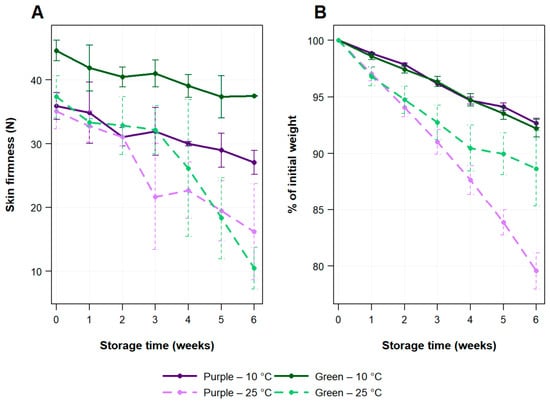
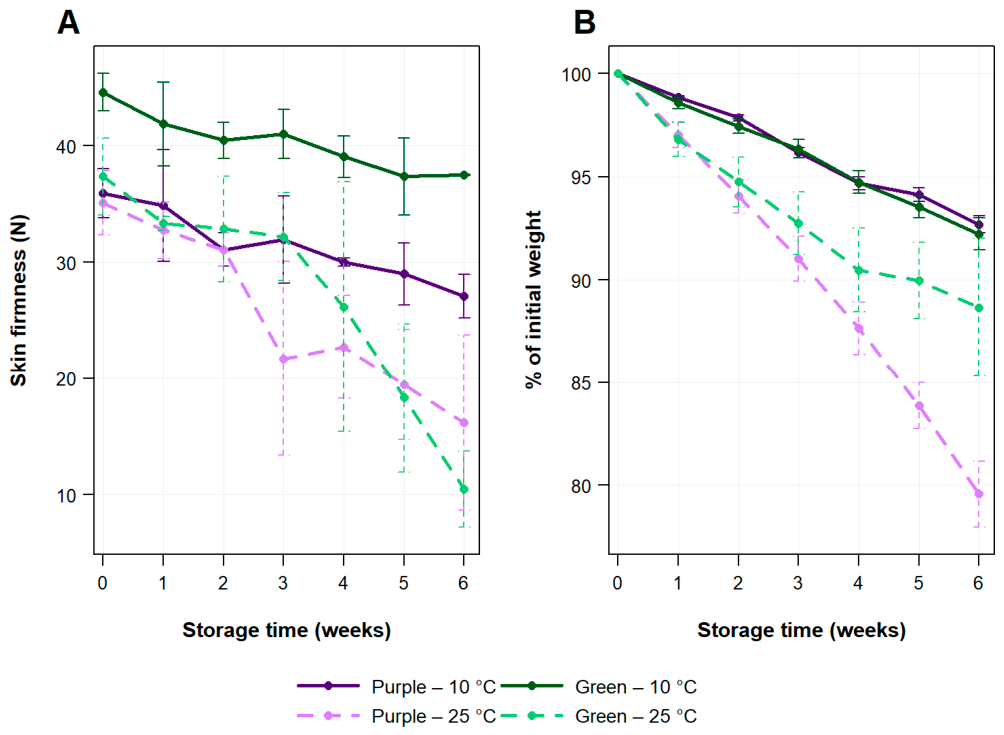
To test whether anthocyanins add to the overall postharvest performance of the pepper fruits, a storage test was performed at two different temperatures. Both the purple and green NILs at two different ripening stages—economical and biological—were surface-sterilized and stored individually in sterile containers. Regarding their physical properties, their firmness and weight loss were measured. Specifically, at 10 °C, the firmness of the purple fruits decreased by 24.5%, while that of the green fruits’ decreased by only 15.9% between weeks 0 and 6 (Figure 1A). At 25 °C, firmness declined by 53.8% in purple fruits and by 71.9% in green fruits, but direct pairwise comparisons between purple and green fruits did not show significant differences in firmness within individual storage weeks and temperatures (Table S1A).
Figure 1.
Changes in the physical characteristics of the purple and green fruits during storage at 10 and 25 °C: (A) firmness of the fruits, (B) fresh weight loss of the fruits. Values represent the mean ± SE, and significant differences are indicated in Table A1.
Skin firmness was significantly influenced by storage time (F = 12.056, p < 0.001), temperature (F = 49.614, p < 0.001), and fruit colour (F = 4.865, p = 0.0032); but none of the combined interactions was significant (Table 1).
Table 1.
ANOVA results for storage time, storage temperature, fruit colour, and their interactions on the skin firmness, remaining weight, pH, and soluble solids content (°Brix) of pepper fruits during storage.
After six weeks of storage at 10 °C, the weight loss of the purple and green fruits was comparable; reductions of 7.3% and 7.8% were measured, respectively. At 25 °C, purple fruits lost 20.4% of their initial weight, while the reduction was only 11.3% for the green fruits. Fresh weight loss showed a genotype- and temperature-dependent response during storage (Figure 1B). Storage time (F = 88.446, p < 0.001), temperature (F = 178.597, p < 0.001), and fruit colour (F = 20.538, p < 0.001) all had significant effects (Table 1). In addition, significant time × temperature (F = 11.020, p < 0.001), time × fruit colour (F = 3.266, p < 0.001), and temperature × fruit colour interactions (F = 7.397, p < 0.001) were observed. Tukey-adjusted comparisons between fruits at the same developmental stage showed no significant difference between purple and green fruits during the first four weeks of storage at either temperature (Table S1B). At 25 °C, purple fruits had significantly higher weight loss than green fruits at week 5 (adjusted p = 0.0013) and week 6 (adjusted p < 0.001).
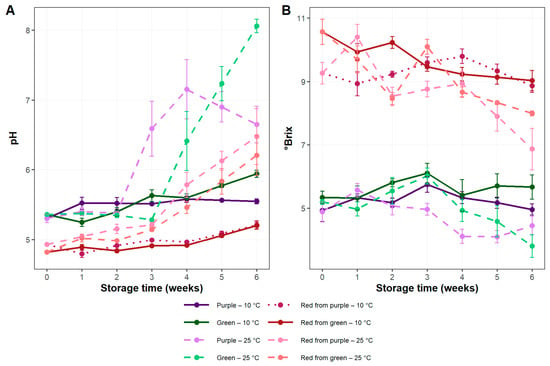
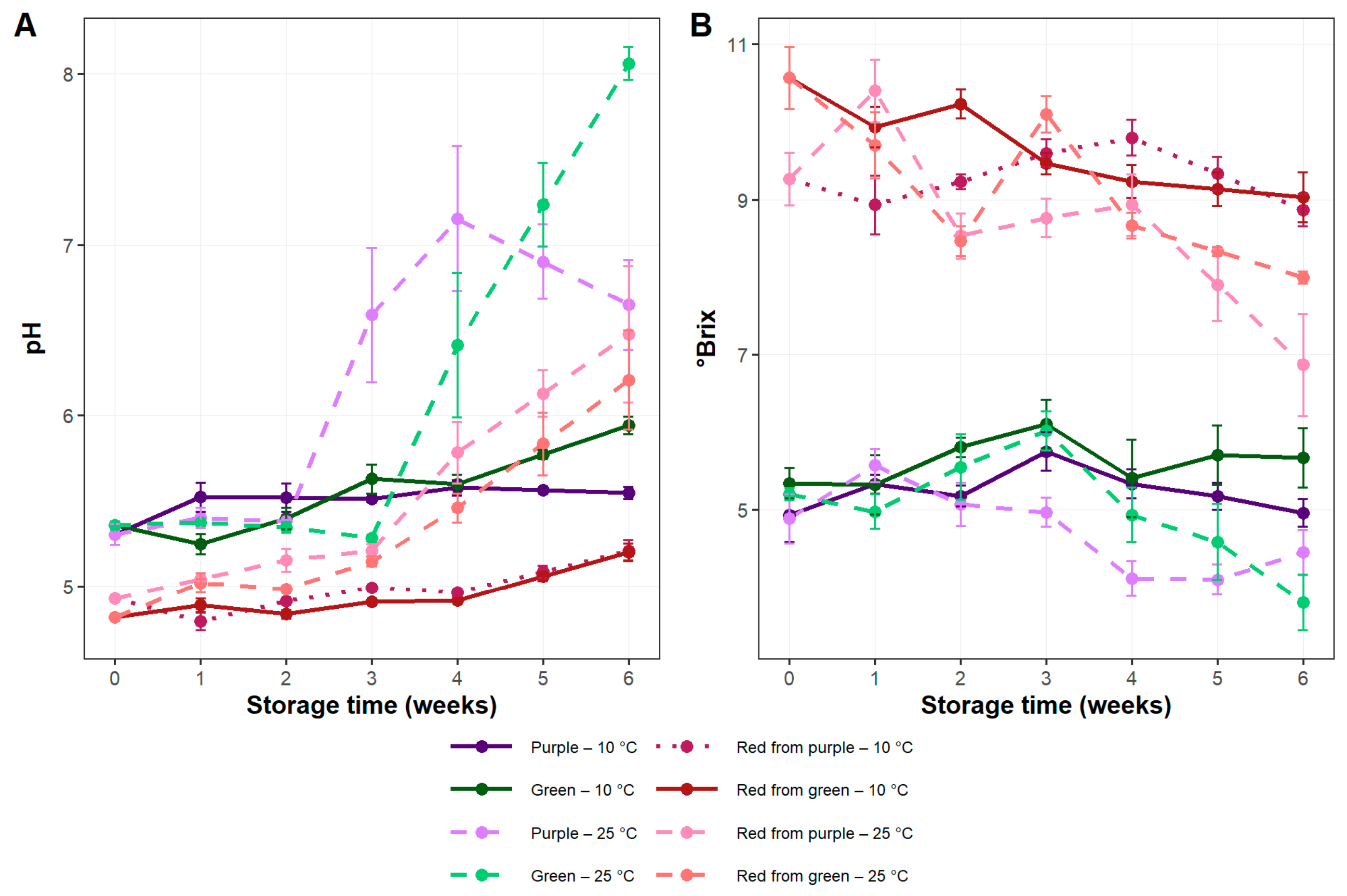
Fruit pH was significantly affected by storage time (F = 17.766, p < 0.001), temperature (F = 54.780, p < 0.001), and fruit colour (F = 25.208, p < 0.001), with a significant time × temperature interaction (F = 8.425, p < 0.001) (Table 1; Figure 2A). Fruit pH was also strongly associated with the health status of the fruits. Rotten fruits exhibited a significantly higher pH than healthy fruits (6.76 ± 1.12 vs. 5.28 ± 0.39; Mann–Whitney test, p < 0.001), and this difference remained significant after taking storage time, temperature, and fruit colour into consideration (p < 0.001). Tukey-adjusted comparisons showed that purple and green fruits exhibited similar pH values within individual weeks and temperatures, with two exceptions at 25 °C. At week 3, pH was significantly higher in purple fruits than in green fruits (adjusted p = 0.0079), whereas at week 6, purple fruits showed a significantly lower pH than green fruits (adjusted p = 0.0033; Table S1C).
Figure 2.
Changes in the pH (A) and °Brix (B) value of the purple, green, red-from-green, and red-from-purple fruits at the two storage temperatures during the 6-week storage period. Values represent the mean ± SE (significant differences are indicated in Table A2).
Soluble solids content (°Brix) was mainly affected by fruit colour (Figure 2B). Storage time (F = 5.877, p < 0.001) and temperature (F = 17.388, p < 0.001) also had significant effects, but the fruit-type effect was the strongest (F = 286.451, p < 0.001) (Table 1). A significant week × temperature interaction was detected (F = 2.594, p = 0.0216), whereas none of the interactions involving fruit colour was significant.
3.2. Antioxidant and Phytochemical Changes During Storage
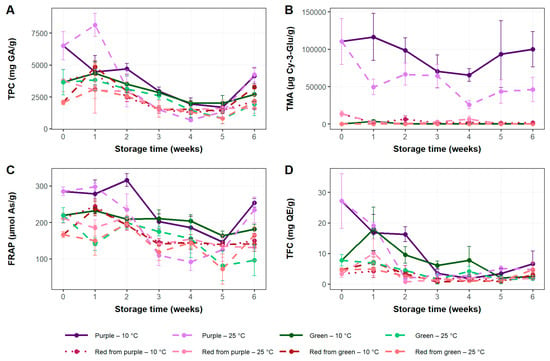
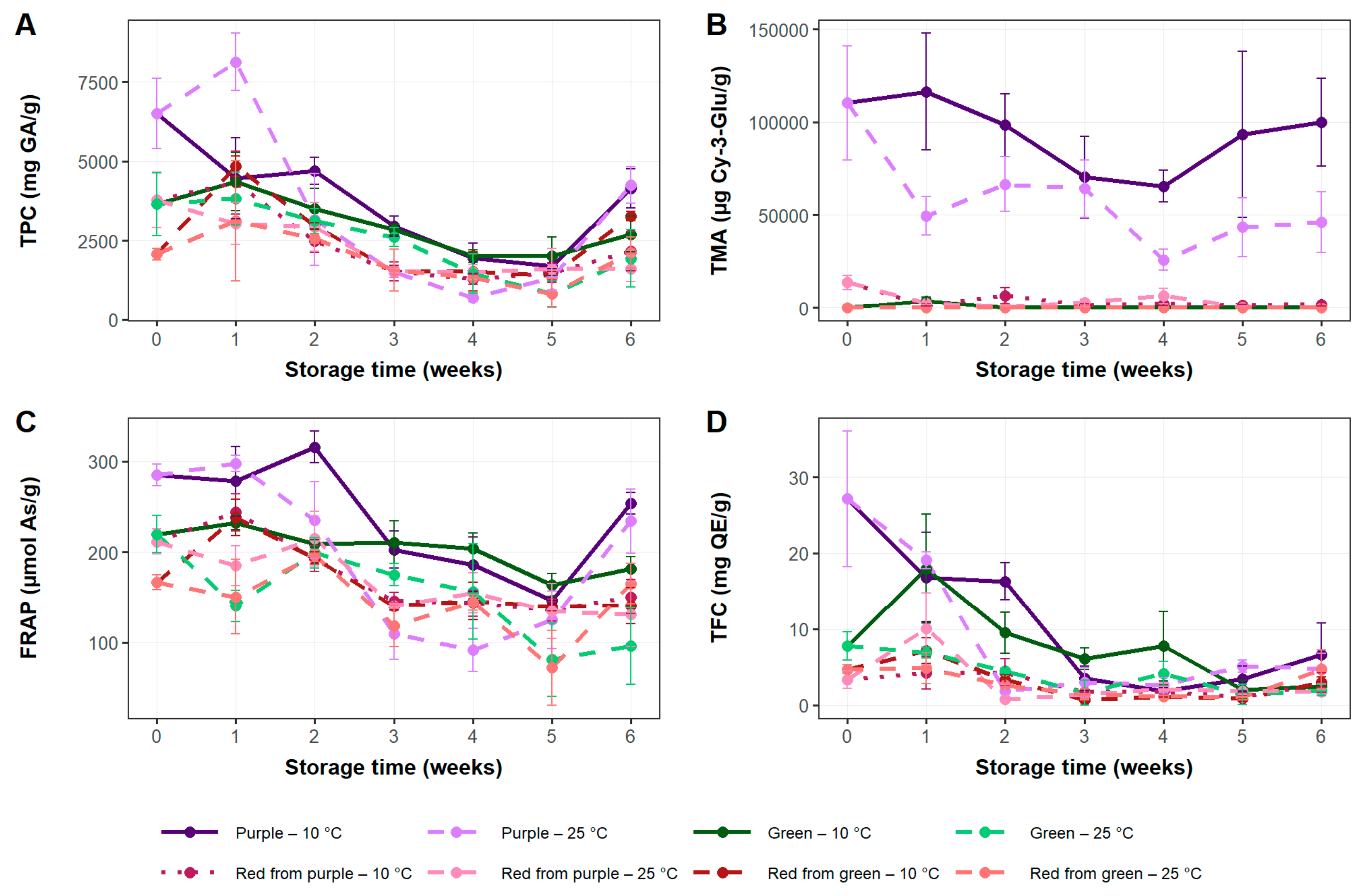
Storage significantly affected the measured phytochemicals of the fruits, although the effect is not consistent across fruit colours (Figure 3; Table 2).
Figure 3.
Changes in the total polyphenolic content (A), total monomeric anthocyanin content (B), antioxidant capacity (C), and total flavonoid content (D) of the four colour groups during the six-week storage period. Values represent the mean ± SE (significant differences are indicated in Table A3 and Table A4).
Table 2.
ANOVA results for storage time, storage temperature, fruit colour, and their interactions on total phenolic content (TPC), total monomeric anthocyanin content (TMA), FRAP antioxidant capacity, and total flavonoid content (TFC).
Total phenolic content (TPC), for example, was significantly affected by storage time (F = 26.188, p < 0.001) and fruit colour (F = 13.826, p < 0.001), whereas the overall effect of storage temperature was not significant (F = 3.612, p = 0.060). A significant time × fruit colour interaction was also detected (F = 2.531, p = 0.0016). At the beginning of the storage test, significantly higher TPC values were measured in the purple fruits than in the green fruits (adjusted p = 0.0156), and the difference remained significant at week 1 at 25 °C (adjusted p < 0.001); however, as the weeks progressed, the difference between them was no longer statistically significant (Figure 3A, Table S2A).
TMA was strongly effected by time, temperature, and their combined effects (Table 2). In purple fruits, TMA concentration was significantly affected by storage time, temperature, and their interaction (all p ≤ 0.001). Temperature-dependent differences became visible as the weeks progressed, with higher TMA concentrations at 10 °C than at 25 °C at weeks 4–6.
Similarly, the TPC the antioxidant capacity (FRAP) was significantly influenced by storage time (F = 17.231, p < 0.001), temperature (F = 14.014, p < 0.001), and fruit colour (F = 16.202, p < 0.001). Furthermore, significant time × fruit colour interaction (F = 3.439, p < 0.001) and time × temperature × fruit colour (F = 2.130, p = 0.0089) effects were also detected (Table 2). Regarding the effect of the storage temperature, significant differences were determined between the two storage temperatures, with unusually higher values detected at 10 °C. For example, in purple fruits, FRAP was significantly higher at 10 °C at weeks 2–4, whereas significant 10 vs. 25 °C differences in green fruits occurred at weeks 1, 5, and 6. Purple fruits overall showed higher FRAP than green fruits with significant differences detected at different time points, such as at week 2 at 10 °C (adjusted p = 0.0240) and at weeks 1 and 6 at 25 °C (adjusted p < 0.001) (Figure 3C, Table S2C).
Total flavonoid content (TFC) was significantly affected by storage time (F = 23.809, p < 0.001) and fruit colour (F = 21.216, p < 0.001), and storage temperature was observed to have a lesser effect (F = 5.313, p = 0.0230). Considering the combined effects, the time × fruit colour interaction (F = 2.285, p = 0.0046) and time × temperature interaction (F = 2.692, p = 0.0177) were significant (Table 2). At the beginning of the storage period, purple fruits had significantly higher TFC than green fruits (adjusted p = 0.0449), but this difference was no longer significant during the subsequent weeks of storage, only at week 5 at 25 °C (adjusted p = 0.0288) (Figure 3D). No significant differences were detected between red-from-purple and red-from-green fruits at any storage time point or temperature (Table S2D).
3.3. Changes in Individual Polyphenolic and Anthocyanin Compounds During Storage
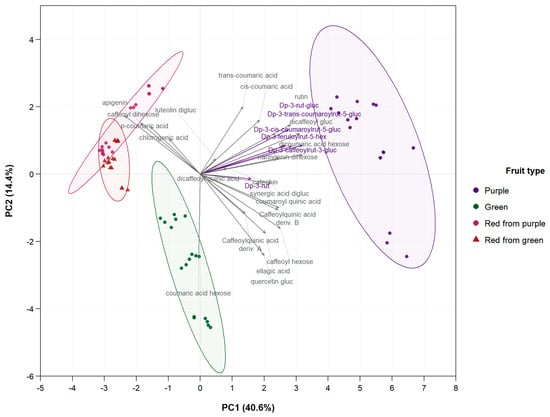
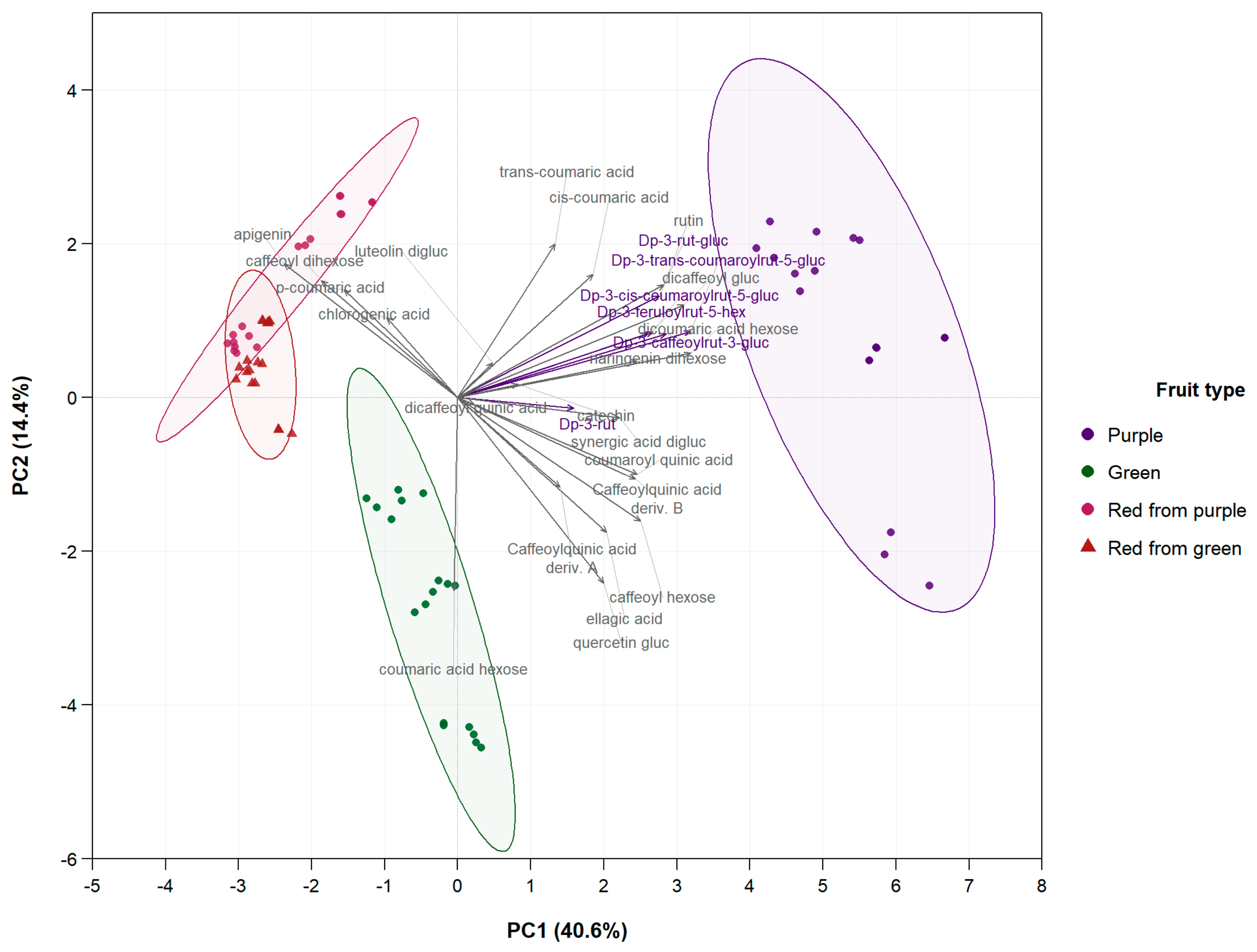
HPLC analysis showed the strong association of the polyphenolic composition and fruit colour of the peppers during storage. Principal component analysis (PCA) showed a separation of the four fruit colour groups, with PC1 and PC2 explaining 40.6% and 14.4% of the total variance, respectively (Figure 4).
Figure 4.
Principal component analysis (PCA) of polyphenolics identified via HPLC of the four pepper fruit colour groups during storage. Ellipses indicate the 95% confidence regions of each fruit colour group; hex: hexoside; rut: rutinoside; gluc: glucoside; dp: delphinidin.
Purple fruits formed the most distinct cluster on the positive PC1 axis, which was associated with delphinidin derivatives, including delphinidin-3-transcoumaroylrutinoside-5-glucoside, delphinidin-3-caffeoylrutinoside-3-glucoside, and delphinidin-3-rutinoside-glucoside. However, several non-anthocyanin phenolics, including rutin and dicaffeoyl glucoside, also contributed strongly to this separation (Figure 4).
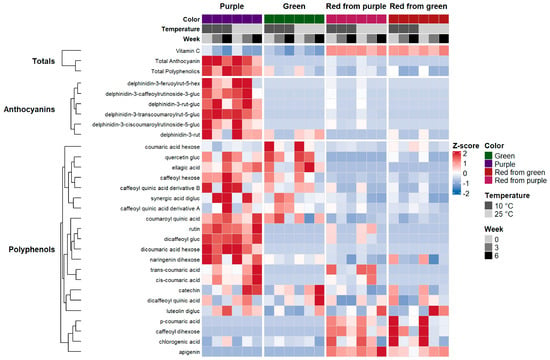
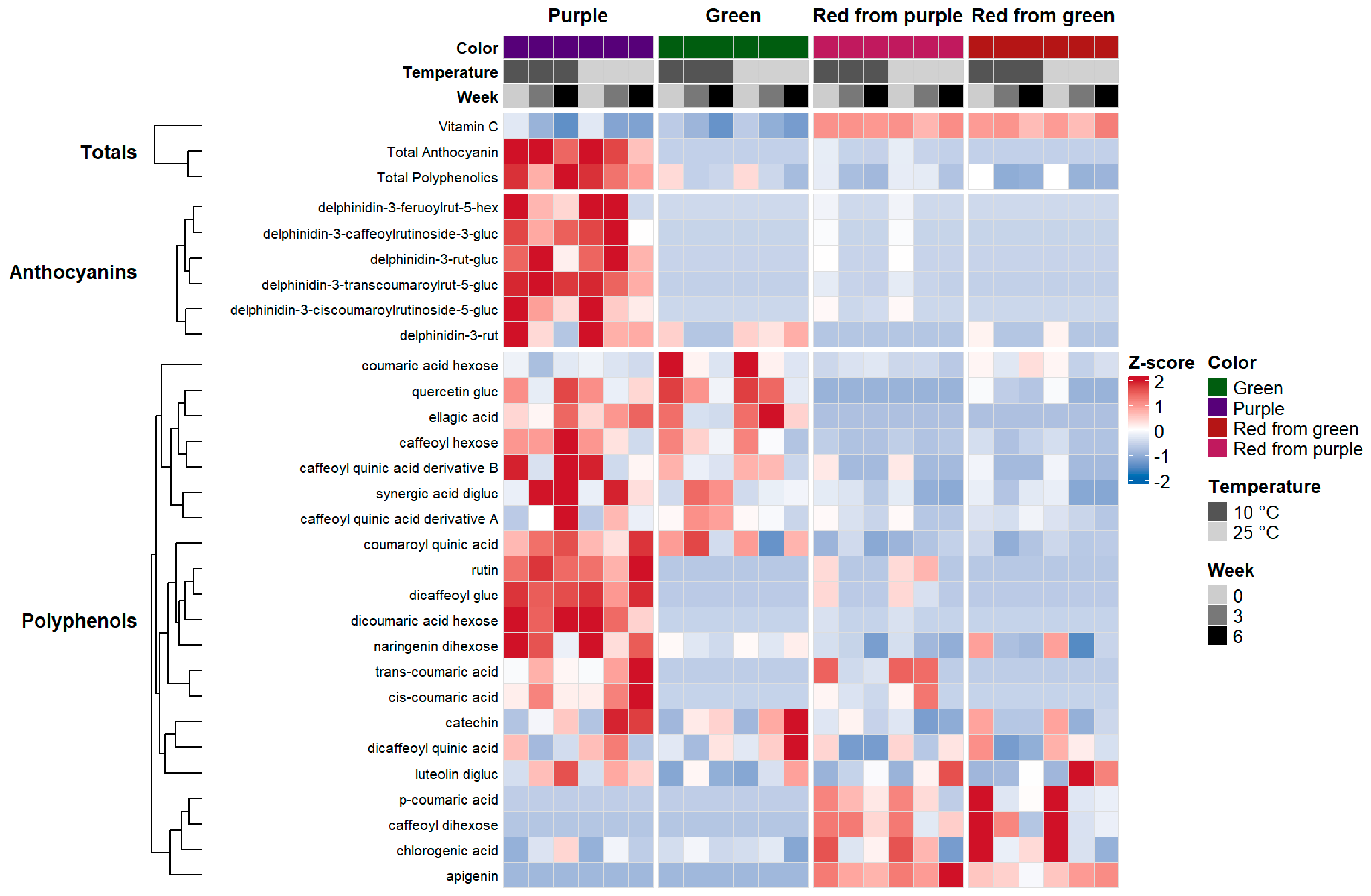
To further study the metabolite profile of the four fruit colour groups and their changes during storage, a heatmap based on the Z-score-standardized abundance of all tentatively identified compounds was generated (Figure 5). In line with the PCA results, the heatmap further exhibited a fruit-colour-dependent separation of some of the studied metabolites; furthermore, phenophase- and storage-time-dependent changes were also scored (Figure 5, Table A5, Table A6 and Table A7). The red-from-purple and red-from-green fruits exhibited a different metabolite profile than the economically ripe fruits. Several compounds such as p-coumaric acid chlorogenic acid and apigenin showed higher relative concentrations during biological ripeness than economical ripeness (Figure 5). With respect to the storage time, in the case of luteolin diglucoside, an increase can be observed as the weeks progressed, while the opposite trend can be observed in the case of delphinidin derivates or in the case of p-coumaric acid (Figure 5).
Figure 5.
Heatmap of HPLC-identified metabolites of the four pepper fruit colours during storage at 10 and 25 °C. Metabolite concentrations were Z-score-standardized across samples, with red and blue indicating relatively higher and lower abundances. Columns represent combinations of fruit colour, storage temperature, and storage weeks. Compounds are grouped as totals, anthocyanins, and non-anthocyanin polyphenols, with the hierarchical clustering shown within them. hex: hexoside; rut: rutinoside; gluc: glucoside. The means and SE are presented in Table A5, Table A6 and Table A7.
These fruit-colour- and storage-condition-dependent differences were further supported by compound-wise statistical analyses.
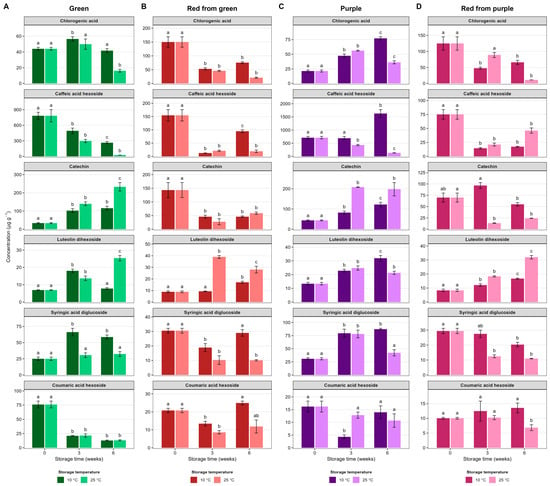
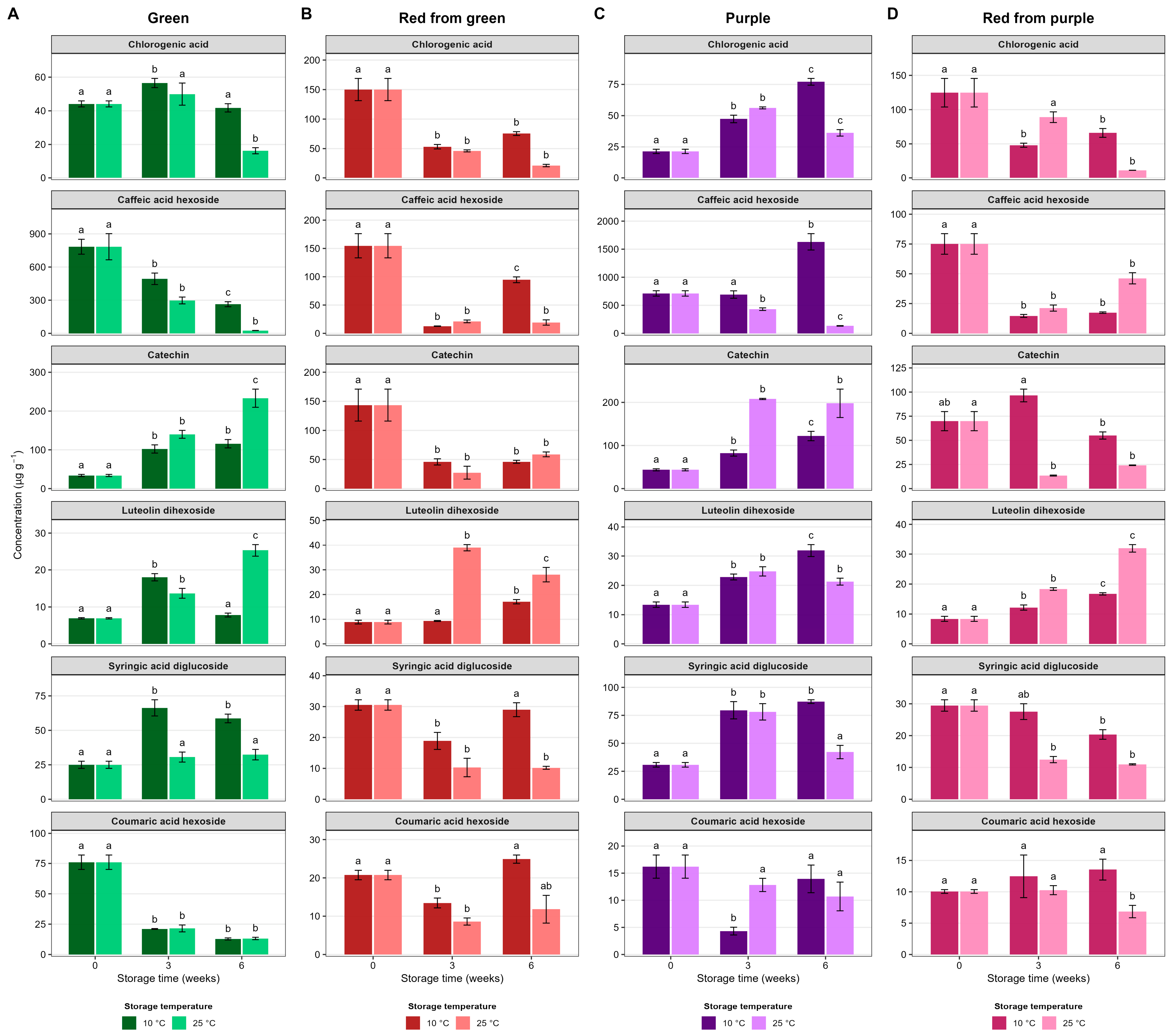
Following Benjamini–Hochberg correction, fruit colour had the most widespread effect on the individual HPLC-detected compounds, significantly affecting 25 of the 27 compounds analyzed, followed by storage time, which also exerted a great effect, with significant changes detected for 22 compounds, and temperature, which significantly affected 18 of the 27 compounds (Table S3). The storage time × fruit colour combined effect was significant for 25 compounds, while significant storage time × temperature and temperature × fruit colour interactions were detected for 22 and 18 compounds, respectively. The three-way storage time × temperature × fruit colour combined effect was significant for 23 of the 27 tentatively identified compounds. Despite the widespread statistical effects on the identified compounds, the order and direction of these responses vary amongst them. Therefore, six phenolic compounds were selected for visualization based on their possible biological importance and their fruit-colour-, phenophase-, storage-time-, and temperature-dependent response (Figure 6).
Figure 6.
Storage-dependent changes in non-anthocyanin polyphenolic compounds in economically (A,C) and biologically ripe (B,D) pepper fruits stored at 10 and 25 °C. Bars represent mean concentrations [µg/g] ± SE. Different letters indicate significant differences among storage time × temperature combinations within each fruit colour based on Tukey-adjusted post hoc comparisons (p < 0.05).
All of these selected six compounds were significantly affected by storage time and fruit colour, and significant time × fruit colour interactions were detected for each compound (Table S3). Temperature significantly affected five of the six compounds; coumaric acid hexoside was the exception. Significant three-way interactions were detected for caffeic acid hexoside, catechin, luteolin dihexoside, and syringic acid diglucoside.
In purple fruits, chlorogenic acid, catechin, and luteolin dihexoside generally increased during storage, although the magnitude of these changes depended on temperature. However, as the ripening stage also affected the concentration of these molecules, in the case of red-from-green and red-from-purple fruits, we detected a higher concentration of chlorogenic acid that decreased as the storage time progressed (Figure 6B,D). Conversely, luteolin dihexoside also showed an increase during storage in the biologically ripe fruits, and this increase was higher in the samples kept at 25 °C. Besides luteolin dihexoside, the concentration of catechin was also higher at 25 °C but only in the economically ripe fruits, while the concentration of most of the identified compounds decreased at 25 °C compared to 10 °C (Figure 5 and Figure 6). Thus, the polyphenolics identified did not respond uniformly to storage as their concentration was strongly affected by fruit colour, phenophase, storage temperature, and time. As for the anthocyanins, a more consistent pattern was detected as most of the identified compounds showed a decrease in their concentration during storage (Figure 5).
3.4. Identification of Microorganisms from Fruits Showing Symptoms of Rot
Although the fruits were surface-sterilized and kept in sterile containers, some of the fruits started to show symptoms of rot as the weeks progressed. Microorganisms were isolated from all fruit colour groups, exclusively from fruits stored at 25 °C, with the first isolates being identified from week 2 (Table 3). A total of 23 microbial isolates were identified, out of which 15 were filamentous fungi and yeast and 8 were bacterial isolates. The fungal isolates included several Fusarium species as well as Alternaria alternata and different yeast taxa (Meyerozyma and Pichia).
Table 3.
Microorganisms isolated from rotten pepper fruits during storage and their molecular identification based on ITS or 16S rRNA gene sequencing.
The occurrence of rotten fruits was strongly affected both by storage time (LR χ2 = 106.14, p < 0.001) and temperature (LR χ2 = 105.13, p < 0.001); however, the effect of fruit colour was not significant, whereas a significant three-way interaction between storage time, temperature, and fruit colour was detected (LR χ2 = 10.95, p = 0.012) (Table 4). Despite the significant three-way interaction, no overall effect of fruit colour on the incidence of fruit rot was detected (p = 0.635), meaning that there is no evidence for a consistently lower occurrence of rot in purple fruits compared to in green NILs.
Table 4.
Observed fruit rot evaluation via bias-reduced binomial logistic regression.
4. Discussion
Fruit quality preservation and shelf life extension are among the main considerations when it comes to postharvest storage. According to previous studies, anthocyanin accumulation has already been associated with improved postharvest characteristics of Solanum lycopersicum. In these studies, purple tomato fruits have been reported to exhibit delayed overripening and extended shelf life compared to wild-type fruits [20,21,31]. These findings raise the question of whether anthocyanins exert a similar effect on pepper fruits.
Postharvest changes, amongst other factors, are linked to physiological processes. Among these, the major determinants of postharvest fruit quality are water loss and softening. Both of which are severely affected by storage conditions such as temperature, duration, or humidity [32]. Our results are in line with the literature data in that pepper fruits stored at 25 °C exhibit higher weight loss % than those stored at 10 °C, which was further affected by the storage duration [33]. Cheng et al. also concluded that, irrespective of the pepper genotype studied, higher storage temperature led to a significant increase in weight loss % [6], which coincides with our results, as storage temperature had a significant effect on the weight loss of the samples. Although the overall effect of fruit colour was significant on the weight loss of the fruits, based on the post hoc analyses, we could differentiate the purple and green NILs at 25 °C at weeks 5 and 6 only, with the purple NILs exhibiting higher weight loss % than the green ones. This finding contrasts with the results reported for purple tomatoes, reporting that the anthocyanin-accumulating fruits exhibited a slower decrease in their weight loss than the red ones [21]. Although water loss can contribute to fruit softening through a reduction in cellular turgor, softening is further influenced by structural modifications and degradation of cell-wall polysaccharides, including pectin, hemicellulose, and cellulose. Pectin solubilization and depolymerization are governed by several cell-wall-modifying enzymes, e.g., pectate lyase, pectin methylesterase, β-galactosidase, and polygalacturonase [34,35], which can be of endogenous origin. However, microbial colonization may further accelerate tissue softening, as several spoilage-associated fungi and bacteria produce pectinolytic enzymes. These processes are genotype-dependent [36], although postharvest storage conditions can further influence the enzymatic effectivity [33,37]. Although water loss and firmness are closely related [38], the two parameters did not follow the same pattern in this study, as at 25 °C, purple fruits exhibited greater weight loss than green fruits during the later stages of storage, whereas the decline in firmness was higher in green fruits. By week 6, firmness had decreased by approximately 54% in purple fruits compared with approximately 72% in green fruits, which resembles the tendency reported by Zhang et al., specifically in that anthocyanin-rich tomatoes retained their firmness for a prolonged period of storage [20]. Conversely, comparisons between the green and purple NILs were not statistically significant at individual storage times, and therefore, our results do not provide evidence for a general anthocyanin-related preservation of skin firmness. Thus, in our study, differences in water loss alone cannot explain the observed softening patterns.
According to Rao et al., the pH values of peppers increase with the duration of storage and they are generally higher at higher temperatures [33]. This is in line with our findings, as we also detected increasing pH values with the progression of time; nevertheless, phenophase also affected the pH as the economically ripe green and purple fruits exhibited slightly higher initial values than their red counterparts. This difference diminished especially at 25 °C, where the highest load of microorganisms was detected. The increase in pH during storage coincided with the development of fruit rot. This agrees with findings in naturally rotting tomato, where the occurrence of fungal pathogens was associated with the alkalization of the tissues [39]. One study identified the microbial community of decaying pepper fruits, and our experiment showed an overlap with the storage-associated pepper microbiome [40]. Klebsiella, Bacillus, Pantoea, and Staphylococcus were identified among the predominant bacterial genera of the decaying pepper fruits, all of which were also recovered from decayed fruits in this study. A similar correspondence was observed for the fungal community for Fusarium, Acremonium, and Alternaria. Among these, Fusarium was repeatedly identified from different fruit phenotypes and storage times in our experiment, including isolates identified as F. fujikuroi, F. subglutinans, and F. verticillioides.
Regarding the °Brix, our results partially agree with published data as an increase in the °Brix of the peppers at both 10 °C and 25 °C was noted during the 18 days of storage [33], while this study, economically ripe fruits stored at 10 °C or at 25 °C exhibited an increase for 3 weeks, followed by a decrease, while the biologically ripe ones exhibited a decrease in their soluble solids content at both temperatures. This difference between the studies may be related to the longer observation period in this study, as the trends were comparable during the overlapping storage period, while the subsequent decline in °Brix became detectable only during prolonged storage. Biologically ripe fruits showed higher values compared to the economically ripe ones, which agrees with the findings of Bernardo et al., which also noted higher °Brix at the red, ripe stages [41]. In another study, higher values at the full biological ripeness of bell peppers were also recorded, and it was further noted that storage affects the °Brix differently in distinct phenophases of fruit ripening [42]. The phenophase dependency can be attributed to the accumulation of soluble solids during storage in economically ripe fruits as a natural ripening process, whereas fruits harvested at biologically ripe stages can show stable or decreasing °Brix due to the degradation of sugars utilized through respiration [43]. Weight loss also affects the °Brix; for example, when the fruits experience water loss during storage, the concentration of the soluble solids increases in the juice.
Regarding the phytochemicals (TMA, TPC, TFC, and FRAP), TPC was mainly affected by storage time and fruit type, with the purple fruits exhibiting the highest values at both studied temperatures. Although this difference diminished with the progression of the weeks, purple fruits still showed significantly higher values even at week 6 compared to the other colours. The effect of phenophase was also detected, with the economically ripe fruits exhibiting higher values than the red, ripe fruits. With respect to the strong influence of phenophase, the polyphenolic composition has also been reported by Kasampalis et al., while Yeboah et al. observed different postharvest TPC responses in bell peppers harvested at different colouring stages [42,44]. In line with their study, we also observed an increase in TPC values in economically ripe fruits at weeks 5 and 6 [44]. Storage temperature has been reported to affect not only the TPC but also the antioxidant capacity of the samples [45]. In this study, temperature significantly affected TMA, FRAP, and TFC but not TPC. Higher TPC values in the early phenophases of pepper fruit ripening have also been reported [46,47], including a 4-5 fold decrease in the phenolic content from the green to red ripe stage [9]. Conversely, the TFC and TPC values observed in green bell peppers have been lower than those in their red, ripe counterparts [43]. These contrasting findings indicate the significance of both genotypes and phenophases in determining the content of polyphenolics [48]. The genotype dependency of TPC and TFC levels and their responses to prolonged storage have also been reported [49]. The effect of the genotype on the antioxidant constituents and polyphenolic profile was further verified by several studies [50,51,52]. TPC and FRAP showed a strong positive correlation (r = 0.808, p < 0.001) throughout the study, meaning that the fruits’ antioxidant capacity declined as storage time progressed and that it was influenced by the phenophase of the fruits. The highest values were recorded in the purple fruits, which aligns with the findings of Bassolino et al., who reported that purple tomatoes exhibited a higher antioxidant capacity than that of the red ones [21]. Upon studying the postharvest characteristics of transgenic purple tomatoes, Jian et al. found that not only the anthocyanin content but also the total flavonoids and antioxidant capacity was higher in the transgenic tomatoes [31]. This was further confirmed by Zhang et al. who reported that purple tomatoes exhibited the highest antioxidant activity, which was associated with the delayed overripening of the fruits [20]. Nevertheless, in their study, they also linked anthocyanin accumulation to the enhanced resistance to B. cinerea; meanwhile, in our previous study, purple peppers did not show a significant correlation with the infection severity caused by Botrytis [53]. However, even in our case, the highest TMA, TPC, and FRAP values were detected in the purple fruits, indicating that anthocyanins might add to the overall TPC and therefore the antioxidant capacity. In this study, FRAP was influenced by storage temperature, showing higher values at 10 °C than at 25 °C, which is consistent with previous findings [45]. FRAP was further influenced by storage time as we also observed a decreasing trend and significantly lower values at week 6 than at week 0, which is in agreement with the results of an earlier study [54]. Similarly, a decrease in TFC in the non-treated samples during storage has been reported [54,55]. A declining trend in TFC during maturity has also been documented, which can be explained by the conversion of these metabolites to secondary phenolics or through degradation via enzymatic activity [56]. Our results align with these studies, as we detected higher levels of TFC in the purple and green NILs, which decreased during storage. The amounts of these phytochemicals can be further affected through different post- or preharvest treatments; for example, Barzegar reported an increase in the TFC, TPC, and antioxidant capacity upon foliar application of calcium lactate and ascorbic acid [57]; similarly, foliar application of salicylic acid increased the TPC through 21 days of storage [37]. TMA was influenced by storage time and temperature and their interaction. At 10 °C, fruits maintained higher anthocyanin content throughout the storage period. Decay was also an influencing factor of not only the TMA but also TPC, FRAP, and TFC; their values were all significantly lower in decayed fruits compared to healthy ones.
When analyzing the individual compounds, we detected distinct patterns for the green and purple NILs, while the red, ripe fruits scored similar polyphenolic profiles. Nevertheless, each metabolome composition was greatly affected by storage time and temperature. Zamljen et al. found that pepper fruits exhibited significantly higher chlorogenic acid concentrations after three weeks storage [58]. In our case, the concentration of chlorogenic acid was higher at week three in economically ripe fruits and exhibited a decrease in biologically ripe fruits. Guilherme et al. noted phenophase-dependent changes as well, with green peppers having higher concentrations of chlorogenic, coumaric, and, in the case of conventional production, caffeic acid [47]. These observations partially support our findings, as the concentrations of caffeic and coumaric acids were usually higher in the early phenophase, except for the chlorogenic acid, for which higher initial concentrations were detected in the red, ripe peppers. A study on ‘Habanero’ peppers concluded that chlorogenic acid is amongst the polyphenolics that determine the antioxidant capacity of the mature phenophases, while the amount of catechin was correlated with the antioxidant capacity at both immature and mature phases [59]. The amount of catechin and cholorogenic acid was higher in the purple NILs than in the green ones both in the early and late phenophases of ripening. Chlorogenic acid has also been identified as a major bioactive compound in purple tomatoes [60]; furthermore, it is also considered to greatly contribute to the antioxidant activity in potato selections [61]. Moreover, vitamin C is also a strong antioxidant compound; Rosa-Martínez et al. found that out of the identified compounds, vitamin C represents 82% of the antioxidants of peppers [62]. In our case, vitamin C showed a strong phenophase dependency with the highest amounts detected in the red, ripe fruits. Out of the anthocyanins, in our case, delphinidin derivates were mostly identified, and delphinidin-3-transcoumaroylrutinoside-5-glucoside was the most abundant. From the anthocyanins, delphinidins are characterized as the most potent antioxidants based on Vitamin C Equivalent Antioxidant Capacity assays [63]. Jian el al. also detected delphinidin-3-O-rutinoside and delphinidin-3-O-glucoside as the most abundant anthocyanins in purple transgenic tomatoes associated with longer shelf life [31].
Several limitations should be considered when interpreting the results of this study. Although the experimental design was inspired by that of previous studies demonstrating the improved postharvest performance of purple tomatoes, this study was conducted with Capsicum annuum, and species-specific differences in fruit anatomy, ripening physiology, and secondary metabolism may have resulted in different postharvest responses. Furthermore, the experiment involved a pair of near-isogenic pepper lines from the Cerasiforme group under two controlled storage temperatures; therefore, the observed responses cannot necessarily be translated to other pepper genotypes or groups such as the Grossum (bell pepper) group, as a strong genotype dependency was observed for most of the studied parameters but not under other storage conditions.
5. Conclusions
This study investigated whether the improved postharvest performance previously associated with anthocyanin accumulation in tomato could also be observed in pepper fruits. Unlike in previous studies on purple tomato, anthocyanin accumulation could not be directly linked to a consistent advantage in the physical preservation of pepper fruits. At 25 °C, purple fruits exhibited greater fresh weight loss during the later stages of storage, and although firmness declined more strongly in green fruits, after directly comparing the firmness of the purple and green fruits, no significant difference was observed at the individual storage times. Moreover, no overall fruit colour effect was detected on the occurrence of spoilage, indicating that the purple fruits do not necessarily have a longer postharvest shelf life. In contrast, purple peppers exhibited a more favourable phytochemical characteristic. Purple fruits generally showed higher total phenolic and flavonoid contents and greater antioxidant capacity than their green counterparts, but these differences were also affected by storage time and temperature. Based on HPLC analyses, purple fruits were characterized by not only high concentrations of delphinidin derivates but also by differences in several non-anthocyanin phenolic compounds. Thus, while the physical postharvest behaviour observed in purple tomato cannot be directly translated to pepper, the purple pepper phenotype may provide an advantage in terms of its phytochemical and antioxidant properties. These results indicate that anthocyanin accumulation in pepper may be more relevant for maintaining or enhancing the nutritional and bioactive characteristics of the fruit than for improving its postharvest performance.
Supplementary Materials
The following supporting information can be downloaded at https://www.mdpi.com/article/10.3390/agriculture16212430/s1: Table S1A: Tukey-adjusted pairwise comparisons of skin firmness between purple and green fruit backgrounds by storage weeks and temperatures. Table S1B: Tukey-adjusted pairwise comparisons of remaining weight (fresh weight loss) between purple and green fruit backgrounds by storage weeks and temperatures. Table S1C: Tukey-adjusted pairwise comparisons of fruit pH between purple and green fruit backgrounds by storage weeks and temperatures; Table S1D: Tukey-adjusted pairwise comparisons of soluble solids content (°Brix) between purple and green fruit backgrounds within storage weeks and temperatures; Table S2A: Tukey-adjusted pairwise comparisons of total phenolic content (TPC) between purple and green fruit backgrounds by storage weeks and temperatures. Table S2B: Model-based post hoc comparisons for total monomeric anthocyanin content (TMA). Purple fruits were analyzed for positive TMA concentration using a Gamma generalized linear model with a log link, whereas red-from-purple fruits were analyzed for TMA presence/absence using Firth penalized logistic regression; Table S2C: Tukey-adjusted pairwise comparisons of FRAP antioxidant capacity between purple and green fruit backgrounds within storage weeks and temperatures. Table S2D: Tukey-adjusted pairwise comparisons of log1p-transformed total flavonoid content (TFC) between purple and green fruit backgrounds by storage weeks and temperatures. Table S3: Effects of storage time, temperature, and fruit colour on individual HPLC-detected compounds. The values are Benjamini–Hochberg false-discovery-rate-adjusted p-values from compound-wise factorial models. Significant effects (FDR-adjusted p < 0.05) are marked with an asterisk. Vitamin C, total flavonoid content, and total anthocyanin content were not included in this 27-compound count.
Author Contributions
Conceptualization, Z.K., Á.T., and Á.J.; validation, A.V., A.S., and G.C.; investigation, H.G.D.; data curation, J.B., B.P., A.K.T.-L., and C.M.; writing—original draft preparation, Z.K.; writing—review and editing, Á.T. and Á.J.; supervision: G.C. All authors have read and agreed to the published version of the manuscript.
Funding
This research received no external funding.
Institutional Review Board Statement
Not applicable.
Data Availability Statement
The original contributions presented in this study are included in the article. Further inquiries can be directed to the corresponding author.
Acknowledgments
Supported by the EKÖP-MATE/2026/27/K University Research Scholarship Programme of the Ministry of Science and Technology from the source of the National Research, Development and Innovation Fund.
Conflicts of Interest
The authors declare no conflicts of interest. Author Gábor Csilléry is employed by PepGen Ltd. The pepper lines used in this study were provided by Gábor Csilléry. The remaining authors declare that the research was conducted in the absence of any commercial or financial relationships that could be construed as a potential conflict of interest.
Abbreviations
The following abbreviations are used in this manuscript:
| ANOVA | Analysis of variance |
| DAD | Diode-array detection |
| DNA | Deoxyribonucleic acid |
| FRAP | Ferric Reducing Ability of Plasma |
| GLM | Generalized linear model |
| HPLC | High-performance liquid chromatography |
| ITS | Internal transcribed spacer |
| NIL | Near-isogenic line |
| PCA | Principal component analysis |
| PCR | Polymerase chain reaction |
| rRNA | Ribosomal RNA |
| SE | Standard error |
| TFC | Total flavonoid content |
| TMA | Total monomeric anthocyanin content |
| TPC | Total phenolic content |
Appendix A
Table A1.
Mean ± SE of weight loss and skin firmness at two temperatures during the six weeks of storage.
Table A2.
Mean ± SE of pH and °Brix at two temperatures during the six weeks of storage.
Table A3.
Mean ± SE of the total polyphenolic content (TPC) and ferric-reducing ability of plasma (FRAP) at two temperatures during the six weeks of storage.
Table A4.
Mean ± SE of total flavonoid content (TFC) and total monomeric anthocyanin (TMA) content at two temperatures during the six weeks of storage.
Table A5.
Mean ± SE of vitamin C, total polyphenolic content, and total anthocyanin content [µg/g DW] measured via HPLC at two temperatures at weeks 0, 3, and 6 of storage.
Table A6.
Mean ± SE of anthocyanins [µg/g DW] measured via HPLC at two temperatures at weeks 0, 3, and 6 of storage.
Table A7.
Mean ± SE of non-anthocyanin polyphenolics [µg/g DW] measured via HPLC at two different temperatures at weeks 0, 3, and 6 of storage.
Figure A1.
(A) Purple and green NILs harvested at their economical and biological ripeness, (B) examples of purple and green NILs stored at 10 and at 25 °C.
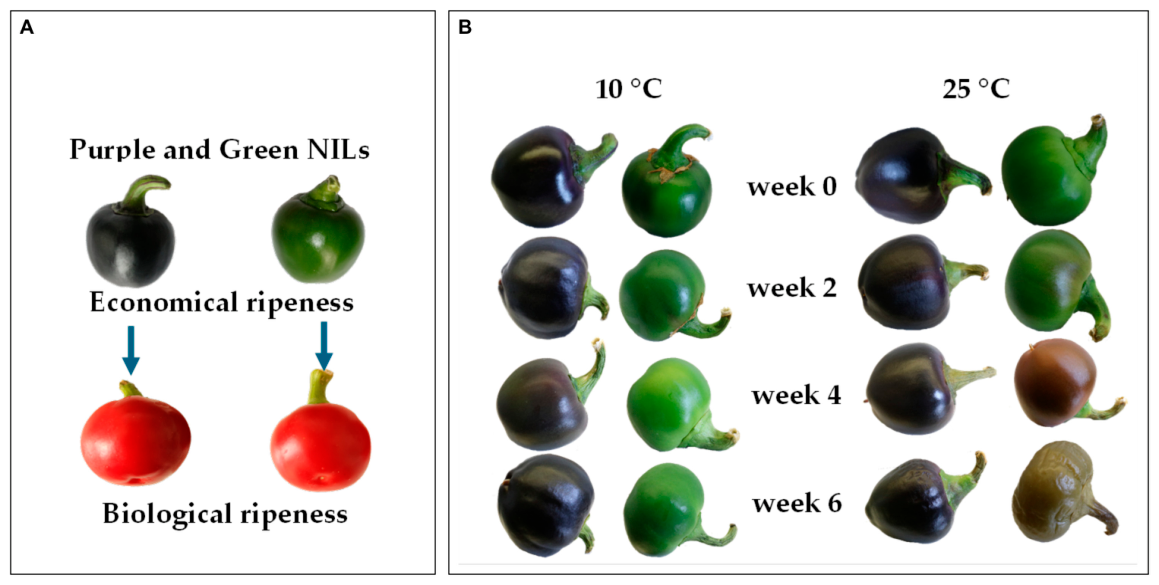
Figure A2.
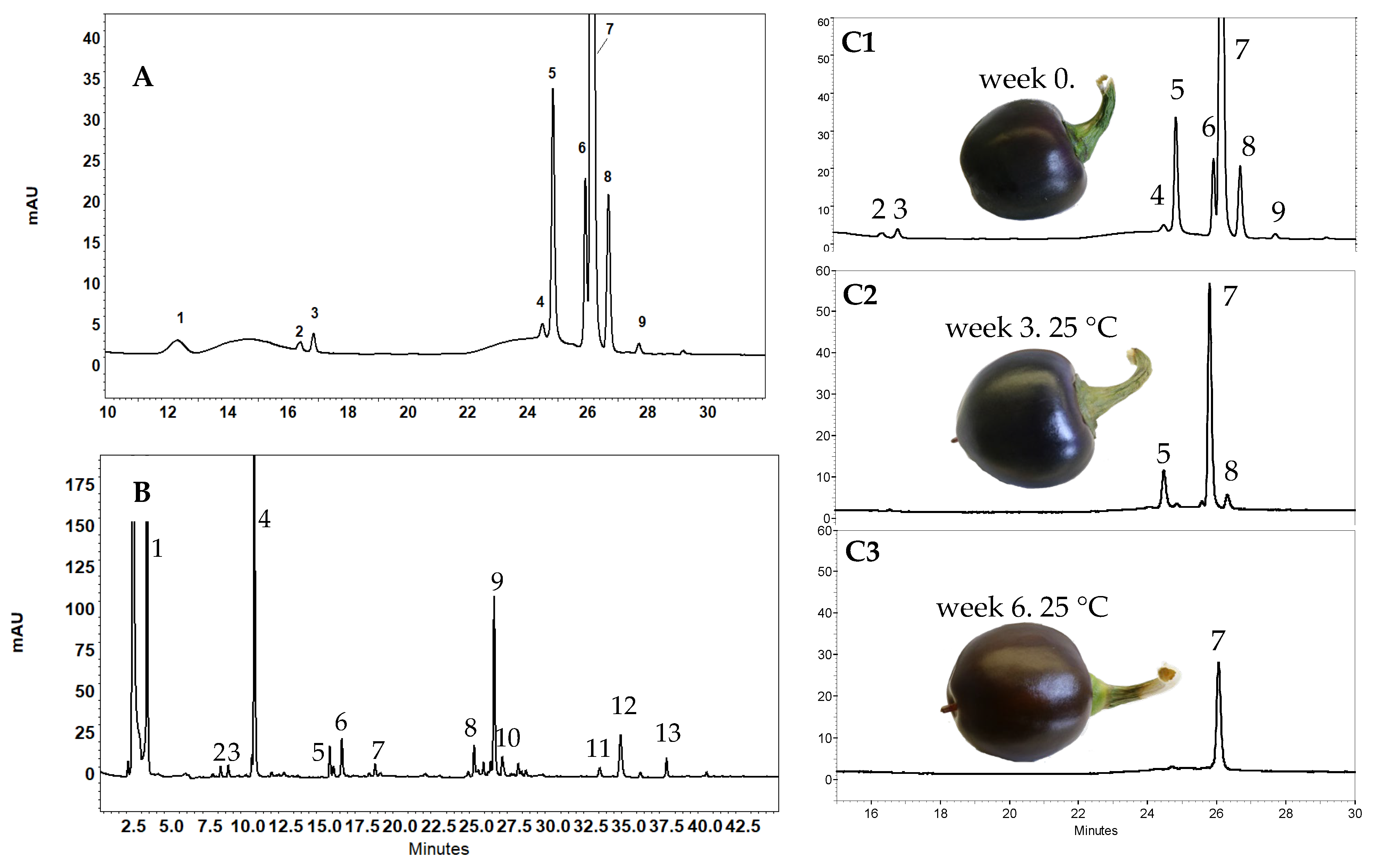
(A) Anthocyanins identified at week 0 at 520 nm—1: delphinidin-3-rutinoside-glucoside; 2: delphinidin-3-glucoside; 3: delphinidin-3-rutinoside; 4: delphinidin-rhamnoside; 5: delphinidin-3-caffeoylrutinoside-3-glucoside; 6: delphinidin-3-ciscoumaroylrutinoside-5-glucoside; 7: delphinidin-3-transcoumaroylrutinoside-5-glucoside; 8: delphinidin-3-feruloylrutinoside-5-hexoside; 9: delphinidin-3-kaempferoyl-hexoside. (B) Major non-anthocyanin polyphenolics and vitamin C detected at 280 nm—1: vitamin C; 2: caffeoyl quinic acid; 3: coumaric acid hexose; 4: caffeoyl hexose; 5: caffeoyl quinic acid; 6: catechin; 7: p-coumaric acid; 8: dicoumaric acid hexose; 9: delphinidin-3-transcoumaroylrutinoside-5-glucoside; 10: delphinidin-3-feruloylrutinoside-5-hexoside; 11: rutin; 12: luteolin-3-glucoside; 13: luteolin-3-galactoside. (C1) Anthocyanins identified at week 0, (C2) anthocyanins identified at week 3 at 25 °C, (C3) anthocyanins identified at week 6 at 25 °C; the peaks are same as in ‘(A)’.
References
- Tiamiyu, Q.O.; Adebayo, S.E.; Ibrahim, N. Recent advances on postharvest technologies of bell pepper: A review. Heliyon 2023, 9, e15302. [Google Scholar] [CrossRef] [Scilit] [PubMed]
- Cheema, A.; Padmanabhan, P.; Amer, A.; Parry, M.J.; Lim, L.-T.; Subramanian, J.; Paliyath, G. Postharvest hexanal vapor treatment delays ripening and enhances shelf life of greenhouse grown sweet bell pepper (Capsicum annum L.). Postharvest Biol. Technol. 2018, 136, 80–89. [Google Scholar] [CrossRef] [Scilit]
- O’Donoghue, E.M.; Brummell, D.A.; McKenzie, M.J.; Hunter, D.A.; Lill, R.E. Sweet capsicum: Postharvest physiology and technologies. N. Z. J. Crop Hortic. Sci. 2018, 46, 269–297. [Google Scholar] [CrossRef] [Scilit]
- Cuadra-Crespo, P.; del Amor, F.M. Effects of postharvest treatments on fruit quality of sweet pepper at low temperature. J. Sci. Food Agric. 2010, 90, 2716–2722. [Google Scholar] [CrossRef] [Scilit] [PubMed]
- Singh, R.; Giri, S.; Kotwaliwale, N. Shelf-life enhancement of green bell pepper (Capsicum annuum L.) under active modified atmosphere storage. Food Packag. Shelf Life 2014, 1, 101–112. [Google Scholar] [CrossRef] [Scilit]
- Cheng, Y.; Gao, C.; Luo, S.; Yao, Z.; Ye, Q.; Wan, H.; Zhou, G.; Liu, C. Effects of storage temperature at the early postharvest stage on the firmness, bioactive substances, and amino acid compositions of chili pepper (Capsicum annuum L.). Metabolites 2023, 13, 820. [Google Scholar] [CrossRef] [Scilit] [PubMed]
- Lim, C.S.; Kang, S.M.; Cho, J.L.; Gross, K.C.; Woolf, A.B. Bell pepper (Capsicum annuum L.) fruits are susceptible to chilling injury at the breaker stage of ripeness. HortScience 2007, 42, 1659–1664. [Google Scholar] [CrossRef] [Scilit]
- Lee, J.G.; Seo, J.; Kang, B.-C.; Choi, J.H.; Lee, E.J. Jasmonate resistant 1 and ethylene responsive factor 11 are involved in chilling sensitivity in pepper fruit (Capsicum annuum L.). Sci. Rep. 2022, 12, 3141. [Google Scholar] [CrossRef] [Scilit] [PubMed]
- Marín, A.; Ferreres, F.; Tomás-Barberán, F.A.; Gil, M.I. Characterization and quantitation of antioxidant constituents of sweet pepper (Capsicum annuum L.). J. Agric. Food Chem. 2004, 52, 3861–3869. [Google Scholar] [CrossRef] [Scilit] [PubMed]
- Kovács, Z.; Bedő, J.; Pápai, B.; Tóth-Lencsés, A.K.; Csilléry, G.; Szőke, A.; Bányai-Stefanovits, É.; Kiss, E.; Veres, A. Ripening-induced changes in the nutraceutical compounds of differently coloured pepper (Capsicum annuum L.) breeding lines. Antioxidants 2022, 11, 637. [Google Scholar] [CrossRef] [Scilit] [PubMed]
- Lahbib, K.; Bnejdi, F.; Pandino, G.; Lombardo, S.; El-Gazzah, M.; El-Bok, S.; Dabbou, S. Changes in yield-related traits, phytochemical composition, and antioxidant activity of pepper (Capsicum annuum) depending on its variety, fruit position, and ripening stage. Foods 2023, 12, 3948. [Google Scholar] [CrossRef] [Scilit] [PubMed]
- Naing, A.H.; Kim, C.K. Abiotic stress-induced anthocyanins in plants: Their role in tolerance to abiotic stresses. Physiol. Plant. 2021, 172, 1711–1723. [Google Scholar] [CrossRef] [Scilit] [PubMed]
- Li, Z.; Ahammed, G.J. Plant stress response and adaptation via anthocyanins: A review. Plant Stress 2023, 10, 100230. [Google Scholar] [CrossRef] [Scilit]
- Yang, M.; Ban, Z.; Luo, Z.; Li, J.; Lu, H.; Li, D.; Chen, C.; Li, L. Impact of elevated O2 and CO2 atmospheres on chemical attributes and quality of strawberry (Fragaria× ananassa Duch.) during storage. Food Chem. 2020, 307, 125550. [Google Scholar] [CrossRef] [Scilit] [PubMed]
- Dai, H.; Li, B.; Song, Z.; Tian, J.; Wei, B.; Lang, X.; Zhou, Q. Anthocyanin treatment delays the senescence of blueberry fruit by regulating abscisic acid and anthocyanin synthesis processes. Food Qual. Saf. 2024, 8, fyad053. [Google Scholar] [CrossRef] [Scilit]
- Dai, H.; Ji, S.; Zhou, X.; Zhu, Y.; Song, Z.; Zhou, Q. Mechanism by Which Exogenous Anthocyanin Treatment Regulates Antioxidant Capacity and Maintains Fruit Quality of Postharvest Blueberry. Food Sci. 2026, 47, 283–290. [Google Scholar]
- Meng, Y.; Zhang, H.; Fan, Y.; Yan, L. Anthocyanins accumulation analysis of correlated genes by metabolome and transcriptome in green and purple peppers (Capsicum annuum). BMC Plant Biol. 2022, 22, 358. [Google Scholar] [CrossRef] [Scilit] [PubMed]
- Aza-González, C.; Ochoa-Alejo, N. Characterization of anthocyanins from fruits of two Mexican chili peppers (Capsicum annuum L.). J. Mex. Chem. Soc. 2012, 56, 149–151. [Google Scholar]
- Butelli, E.; Titta, L.; Giorgio, M.; Mock, H.-P.; Matros, A.; Peterek, S.; Schijlen, E.G.; Hall, R.D.; Bovy, A.G.; Luo, J. Enrichment of tomato fruit with health-promoting anthocyanins by expression of select transcription factors. Nat. Biotechnol. 2008, 26, 1301–1308. [Google Scholar] [CrossRef] [Scilit] [PubMed]
- Zhang, Y.; Butelli, E.; De Stefano, R.; Schoonbeek, H.-j.; Magusin, A.; Pagliarani, C.; Wellner, N.; Hill, L.; Orzaez, D.; Granell, A. Anthocyanins double the shelf life of tomatoes by delaying overripening and reducing susceptibility to gray mold. Curr. Biol. 2013, 23, 1094–1100. [Google Scholar] [CrossRef] [Scilit] [PubMed]
- Bassolino, L.; Zhang, Y.; Schoonbeek, H.j.; Kiferle, C.; Perata, P.; Martin, C. Accumulation of anthocyanins in tomato skin extends shelf life. New Phytol. 2013, 200, 650–655. [Google Scholar] [CrossRef] [Scilit] [PubMed]
- Lightbourn, G.J.; Griesbach, R.J.; Novotny, J.A.; Clevidence, B.A.; Rao, D.D.; Stommel, J.R. Effects of anthocyanin and carotenoid combinations on foliage and immature fruit color of Capsicum annuum L. J. Hered. 2008, 99, 105–111. [Google Scholar] [CrossRef] [Scilit] [PubMed]
- Lara, I.; Belge, B.; Goulao, L.F. The fruit cuticle as a modulator of postharvest quality. Postharvest Biol. Technol. 2014, 87, 103–112. [Google Scholar] [CrossRef] [Scilit]
- González-Aguilar, G. Pepper. In The Commercial Storage of Fruits, Vegetables, and Florist and Nursery Crops; Agriculture Handbook; United States Department of Agriculture, Agricultural Research Service: Beltsville, MD, USA, 2004. [Google Scholar]
- Benzie, I.F.; Strain, J.J. The ferric reducing ability of plasma (FRAP) as a measure of “antioxidant power”: The FRAP assay. Anal. Biochem. 1996, 239, 70–76. [Google Scholar] [CrossRef] [Scilit] [PubMed]
- Singleton, V.L.; Rossi, J.A. Colorimetry of total phenolics with phosphomolybdic-phosphotungstic acid reagents. Am. J. Enol. Vitic. 1965, 16, 144–158. [Google Scholar] [CrossRef] [Scilit]
- Lee, J.; Durst, R.W.; Wrolstad, R.E. Determination of total monomeric anthocyanin pigment content of fruit juices, beverages, natural colorants, and wines by the pH differential method: Collaborative study. J. AOAC Int. 2005, 88, 1269–1278. [Google Scholar] [CrossRef] [Scilit]
- Sytar, O.; Bośko, P.; Živčák, M.; Brestic, M.; Smetanska, I. Bioactive phytochemicals and antioxidant properties of the grains and sprouts of colored wheat genotypes. Molecules 2018, 23, 2282. [Google Scholar] [CrossRef] [Scilit] [PubMed]
- Lane, D.i.J. 16S/23S rRNA sequencing. In Nucleic Acid Techniques in Bacterial Systematics; John Wiley & Sons: Hoboken, NJ, USA, 1991. [Google Scholar]
- Bellemain, E.; Carlsen, T.; Brochmann, C.; Coissac, E.; Taberlet, P.; Kauserud, H. ITS as an environmental DNA barcode for fungi: An in silico approach reveals potential PCR biases. BMC Microbiol. 2010, 10, 189. [Google Scholar] [CrossRef] [Scilit] [PubMed]
- Jian, W.; Ou, X.; Sun, L.; Chen, Y.; Liu, S.; Lu, W.; Yang, X.; Zhao, Z.; Li, Z. Characterization of anthocyanin accumulation, nutritional properties, and postharvest attributes of transgenic purple tomato. Food Chem. 2023, 408, 135181. [Google Scholar] [CrossRef] [Scilit] [PubMed]
- Dong, G.; Yang, T.; Ba, L.; Luo, D.; Zhao, Z.; Cao, S.; Wang, T. Research Progress on Post-Harvest Preservation Technology of Capsicum L.: A Review. Horticulturae 2026, 12, 596. [Google Scholar] [CrossRef] [Scilit]
- Rao, T.R.; Gol, N.B.; Shah, K.K. Effect of postharvest treatments and storage temperatures on the quality and shelf life of sweet pepper (Capsicum annum L.). Sci. Hortic. 2011, 132, 18–26. [Google Scholar] [CrossRef] [Scilit]
- Gross, K.C.; Watada, A.E.; Kang, M.S.; Kim, S.D.; Kim, K.S.; Lee, S.W. Biochemical changes associated with the ripening of hot pepper fruit. Physiol. Plant. 1986, 66, 31–36. [Google Scholar] [CrossRef] [Scilit]
- Li, P.; Zhang, R.; Zhou, H.; Mo, Y.; Wu, S.; Zhang, X.; Xie, Z.; Zhang, T.; Zhao, K.; Lv, J. Melatonin delays softening of postharvest pepper fruits (Capsicum annuum L.) by regulating cell wall degradation, membrane stability and antioxidant systems. Postharvest Biol. Technol. 2024, 212, 112852. [Google Scholar] [CrossRef] [Scilit]
- Li, Z.; Zhao, W.; Wang, P.; Zhao, S.; Wang, D.; Zhao, X. Transcriptome analysis integrated with changes in cell wall polysaccharides of different fresh-cut chili pepper cultivars during storage reveals the softening mechanism. Food Chem. 2024, 452, 139445. [Google Scholar] [CrossRef] [Scilit] [PubMed]
- Dobón-Suárez, A.; Giménez, M.J.; García-Pastor, M.E.; Zapata, P.J. Salicylic acid foliar application increases crop yield and quality parameters of green pepper fruit during postharvest storage. Agronomy 2021, 11, 2263. [Google Scholar] [CrossRef] [Scilit]
- Díaz-Pérez, J.; Muy-Rangel, M.; Mascorro, A. Fruit size and stage of ripeness affect postharvest water loss in bell pepper fruit (Capsicum annuum L.). J. Sci. Food Agric. 2007, 87, 68–73. [Google Scholar]
- Wade, W.N.; Beuchat, L.R. Proteolytic fungi isolated from decayed and damaged raw tomatoes and implications associated with changes in pericarp pH favorable for survival and growth of foodborne pathogens. J. Food Prot. 2003, 66, 911–917. [Google Scholar] [CrossRef] [Scilit] [PubMed]
- Yuan, S.; Yang, N.; Wang, X.; Jia, L.; Xu, X.; Yue, X.; Zheng, S.; Wang, B.; Wang, Q. Spatial and temporal changes in the microbial community associated with postharvest decay in chili pepper fruits. LWT 2026, 242, 119149. [Google Scholar] [CrossRef] [Scilit]
- Bernardo, A.; Martinez, S.; Alvarez, M.; Fernandez, A.; Lopez, M. The composition of two Spanish pepper varieties (Fresno de la Vega and Benavente-Los Valles) in different ripening stages. J. Food Qual. 2008, 31, 701–716. [Google Scholar] [CrossRef] [Scilit]
- Kasampalis, D.S.; Tsouvaltzis, P.; Ntouros, K.; Gertsis, A.; Gitas, I.; Moshou, D.; Siomos, A.S. Nutritional composition changes in bell pepper as affected by the ripening stage of fruits at harvest or postharvest storage and assessed non-destructively. J. Sci. Food Agric. 2022, 102, 445–454. [Google Scholar] [CrossRef] [Scilit] [PubMed]
- Kusumiyati, K.; Amelia, A.; Farida, F. Optimizing shelf life and postharvest quality of bell pepper through the application of edible coating. Int. J. Food Prop. 2026, 29, 2677293. [Google Scholar] [CrossRef] [Scilit]
- Yeboah, S.; Hong, S.J.; Park, Y.; Choi, J.H.; Eum, H.L. Postharvest quality improvement of bell pepper (Capsicum annuum L. cv Nagano) with forced-air precooling and modified atmosphere packaging. Foods 2023, 12, 3961. [Google Scholar] [CrossRef] [Scilit] [PubMed]
- Park, M.-H.; Eum, H.L.; Park, P.H.; Baek, D.R.; Malka, S.K. The effect of storage temperature on antioxidant capacity and storability of paprika. Food Sci. Preserv. 2024, 31, 15–23. [Google Scholar] [CrossRef] [Scilit]
- Ghasemnezhad, M.; Sherafati, M.; Payvast, G.A. Variation in phenolic compounds, ascorbic acid and antioxidant activity of five coloured bell pepper (Capsicum annum) fruits at two different harvest times. J. Funct. Foods 2011, 3, 44–49. [Google Scholar] [CrossRef] [Scilit]
- Guilherme, R.; Aires, A.; Rodrigues, N.; Peres, A.M.; Pereira, J.A. Phenolics and antioxidant activity of green and red sweet peppers from organic and conventional agriculture: A comparative study. Agriculture 2020, 10, 652. [Google Scholar] [CrossRef] [Scilit]
- Deepa, N.; Kaur, C.; George, B.; Singh, B.; Kapoor, H. Antioxidant constituents in some sweet pepper (Capsicum annuum L.) genotypes during maturity. LWT-Food Sci. Technol. 2007, 40, 121–129. [Google Scholar] [CrossRef] [Scilit]
- Garra, A.; Alkalai-Tuvia, S.; Telerman, A.; Paran, I.; Fallik, E.; Elmann, A. Anti-proliferative activities, phytochemical levels and fruit quality of pepper (Capsicum spp.) following prolonged storage. Int. J. Food Sci. Technol. 2020, 55, 3574–3584. [Google Scholar] [CrossRef] [Scilit]
- Aslani, L.; Mobli, M.; Keramat, J. Comparison of anti-oxidant activities and fruit quality attributes in four sweet bell pepper (Capsicum annuum L.) cultivars grown in two soilless media. J. Hortic. Sci. Biotechnol. 2016, 91, 497–505. [Google Scholar] [CrossRef] [Scilit]
- Russo, V.M.; Howard, L.R. Carotenoids in pungent and non-pungent peppers at various developmental stages grown in the field and glasshouse. J. Sci. Food Agric. 2002, 82, 615–624. [Google Scholar] [CrossRef] [Scilit]
- Kelebek, H.; Sevindik, O.; Uzlasir, T.; Selli, S. LC-DAD/ESI MS/MS characterization of fresh and cooked Capia and Aleppo red peppers (Capsicum annuum L.) phenolic profiles. Eur. Food Res. Technol. 2020, 246, 1971–1980. [Google Scholar] [CrossRef] [Scilit]
- Kovács, Z.; Csilléry, G.; Daood, H.G.; Posta, K.; Bedő, J.; Tóth-Lencsés, K.A.; Veres, A.; Szőke, A.; Tarnawa, Á.; Juhász, Á. Polyphenolic and Anthocyanin Responses to Postharvest Fungal Pathogen Infection in Purple and Green near Isogenic Pepper (Capsicum annuum) Lines. Antioxidants 2025, 14, 1440. [Google Scholar] [CrossRef] [Scilit] [PubMed]
- Chitravathi, K.; Chauhan, O.P.; Kizhakkedath, J. Shelf life extension of green chillies (Capsicum annuum L.) using passive modified atmosphere packaging and gamma irradiation. J. Food Process. Preserv. 2020, 44, e14622. [Google Scholar] [CrossRef] [Scilit]
- Rives-Castillo, S.C.; Correa-Pacheco, Z.N.; Corona-Rangel, M.L.; Hernández-López, M.; Barrera-Necha, L.L.; Ventura-Aguilar, R.I.; Bautista-Baños, S. The Effect of Netting Bags on the Postharvest Quality, Bioactive and Nutritional Compounds, and the Spoilage Microorganisms Content of Bell Peppers. Foods 2023, 12, 2071. [Google Scholar] [CrossRef] [Scilit] [PubMed]
- Howard, L.; Talcott, S.; Brenes, C.; Villalon, B. Changes in phytochemical and antioxidant activity of selected pepper cultivars (Capsicum species) as influenced by maturity. J. Agric. Food Chem. 2000, 48, 1713–1720. [Google Scholar] [CrossRef] [Scilit] [PubMed]
- Barzegar, T.; Fateh, M.; Razavi, F. Enhancement of postharvest sensory quality and antioxidant capacity of sweet pepper fruits by foliar applying calcium lactate and ascorbic acid. Sci. Hortic. 2018, 241, 293–303. [Google Scholar] [CrossRef] [Scilit]
- Zamljen, T.; Veberič, R.; Slatnar, A. Fertilization with humic acids in production changes the quality of fresh and stored sweet pepper fruits (Capsicum annuum L.). J. Plant Growth Regul. 2025, 44, 3965–3973. [Google Scholar] [CrossRef] [Scilit]
- Oney-Montalvo, J.E.; Avilés-Betanzos, K.A.; Ramírez-Rivera, E.d.J.; Ramírez-Sucre, M.O.; Rodríguez-Buenfil, I.M. Polyphenols content in Capsicum chinense fruits at different harvest times and their correlation with the antioxidant activity. Plants 2020, 9, 1394. [Google Scholar] [CrossRef] [Scilit] [PubMed]
- Torres, A.; Pérez-Flores, L.J.; Lobato-Ortíz, R.; Navarro-Ocana, A. Characterization and quantification of the major bioactive compounds in Mexican purple tomatoes. Plant Foods Hum. Nutr. 2024, 79, 330–336. [Google Scholar] [CrossRef] [Scilit] [PubMed]
- Reddivari, L.; Hale, A.L.; Miller, J.C. Determination of phenolic content, composition and their contribution to antioxidant activity in specialty potato selections. Am. J. Potato Res. 2007, 84, 275–282. [Google Scholar] [CrossRef] [Scilit]
- Rosa-Martínez, E.; García-Martínez, M.D.; Adalid-Martínez, A.M.; Pereira-Dias, L.; Casanova, C.; Soler, E.; Figas, M.R.; Raigón, M.D.; Plazas, M.; Soler, S. Fruit composition profile of pepper, tomato and eggplant varieties grown under uniform conditions. Food Res. Int. 2021, 147, 110531. [Google Scholar] [CrossRef] [Scilit] [PubMed]
- Kim, D.-O.; Lee, C.Y. Comprehensive study on vitamin C equivalent antioxidant capacity (VCEAC) of various polyphenolics in scavenging a free radical and its structural relationship. Crit. Rev. Food Sci. Nutr. 2004, 44, 253–273. [Google Scholar] [CrossRef] [Scilit] [PubMed]

Disclaimer/Publisher’s Note: The statements, opinions and data contained in all publications are solely those of the individual author(s) and contributor(s) and not of MDPI and/or the editor(s). MDPI and/or the editor(s) disclaim responsibility for any injury to people or property resulting from any ideas, methods, instructions or products referred to in the content. |
© 2026 by the authors. Licensee MDPI, Basel, Switzerland. This article is an open access article distributed under the terms and conditions of the Creative Commons Attribution (CC BY) license.