


Abstract
Although machine learning models for onions (Allium cepa) have recently emerged, process-based models are required to capture physiological responses under climate volatility. This study addresses this need by integrating the Agricultural Policy/Environmental Extender (APEX) crop growth model with an econometric framework to simulate onion yields and economic returns under shifting climate regimes. The APEX-onion model was calibrated for onions’ cold-weather dynamics and bolting partitioning, achieving robust multi-site regional validation (PBIAS = 2.48%, RMSE = 1.39 Mg ha−1). Decadal projections (2026–2035) across four CMIP6 models under the SSP245 and SSP585 pathways reveal that warmer conditions and elevated CO2 generally enhance yields (by 9–22%), whereas compound radiation and rainfall anomalies trigger severe water stress (>110 days) and yield penalties. An economic harvest ratio (EHR) model demonstrated that 100% unbolted harvests do not monotonically maximize farm profit due to wholesale price collapses under price-inelastic vegetable demand. Moderating marketable volumes (allowing an effective supply buffer averaging 39.0–42.6% and up to 46.5% during bumper years) protects farm revenue, whereas full marketable yields are essential during climate-driven shortages. This integrated framework provides actionable economic thresholds for agricultural climate adaptation.
1. Introduction
Onion (Allium cepa) is one of the most important ingredients in Korean cuisine. According to the Korea Rural Economic Institute, demand for onions has seen continuous and positive growth over the past decades (2000–2009). Consumers prefer domestically produced onions. They are willing to pay a higher price for them. Thus, most of the demand for onion consumption seems to be met by domestic production; only a small percentage is covered by imports. Despite increases in onion production and harvested area over past decades (2003–2023) [1], onion price is subjected to high fluctuation due to both the uncertainty and the seasonality of its production. Moreover, implementing government supply and demand measures also significantly affects the price fluctuation of onions [2]. To stabilize the price and production of onion, timely forecasting of its production and price is critical to understanding these fluctuations and helping farmers and policymakers prepare for upcoming fluctuations in future markets.
For successful forecasting of the production and price of onion in the future market, accurate yield predictions under dynamic environmental factors such as soil nutrition and weather are essential. A process-based crop growth model is often used to simulate the effects of dynamic environmental changes on yields. Among various models, APEX (Agricultural Policy/Environmental Extender) has been used to simulate onion yields in various locations and different weather conditions in Korea [3]. This model can simulate the potential daily growth of various crops (more than 100 types of crops). It can also simulate the actual growth constrained by various stresses such as water, temperature, nutrients, and aeration [4]. Unlike major crops such as corn and soybean, onions are cold-season crops that are planted in late fall or early winter and harvested in late spring or early summer of the following year. Thus, the crop growth model needs to be modified so that this plant can survive or grow in cold weather conditions.
In addition, a growing cycle of onions needs to be created. Onion has three growing seasons, including the first, dormant, and the second seasons [5]. During the first season (October to early December), bulbs consisting of leaf blades, young leaves, and leaf primordia are formed. During the winter season (December to January), onions enter the dormant season when green leaves and roots senesce. Since onion is a biennial herbaceous plant, temperature and photoperiod are major environmental factors that control its growth and development [6]. The low temperature during the dormant season can induce flowering in the first season. Exposure to low temperatures in wintertime or artificial cold treatment is called vernalization. At the end of the dormant phase of bulbs, roots and leaves restart growth in early February, which can be defined as the second season. These growth processes from the first to the second season are embedded into a model as shown in the crop biomass accumulation over the growing season.
Bolting, or seed stalk development, can cause significant economic losses in onions [7]. Bolted onions exhibit substantially degraded commercial value for the retail table-market because assimilates are diverted into reproductive floral stalk elongation rather than bulb tissue enlargement, resulting in woody centers and smaller bulb size [8]. While bolted individuals face severe cosmetic devaluations in premium markets, they retain partial utility in secondary agro-processing sectors (such as onion juice and seasoning manufacture) or are traded collectively under field-scale bulk contracting. Plant age and several environmental factors can influence the rate of bolting incidence [9]. Among various environmental factors, temperature and photoperiod interact intricately to govern inflorescence initiation and floral development [6,10]. Physiologically, onion plants must first pass a juvenile vegetative threshold, typically characterized by acquiring a critical plant size or leaf number (e.g., 7–10 green leaves and pseudostem diameter > 6–10 mm), before becoming competent to perceive thermo-inductive stimuli [9,11]. Once competency is reached, prolonged exposure to vernalizing temperatures (typically 5–15 °C, depending on maturity classes ranging from short-day to intermediate-day cultivars) triggers floral initiation in the shoot apical meristem, which is subsequently accelerated into macroscopic scape elongation (bolting) under lengthening photoperiods and rising spring temperatures [8,11]. Driven by climate change, the Earth’s temperature has risen by an average of 0.06 °C per decade since 1950, leading to shorter or warmer winters [12]. Recent studies have confirmed that unstable winter warming and abrupt temperature drops during spring further intensify unpredictable bolting patterns in Allium species [7,8,10]. Under warm winter weather conditions, bolting is a severe concern for the onion market in Korea. Because conventional process-based models such as APEX lack an explicit physiological vernalization subroutine to dynamically simulate chilling-hour perception and floral meristem transition, prior crop modeling studies often struggled to represent bolting-induced yield penalties. To overcome this structural limitation, this study couples empirical field-derived bolting incidence as an exogenous driver with the APEX growth framework, using differentiated physiological harvest index parameterizations to realistically separate bolted and unbolted yield outcomes.
The domestic price of onion varies by the amounts of its production and storage inventory. For example, on a monthly basis, onion prices are relatively lower during onion harvest months, including April and June, while its price rises after June. The highest price of onion was observed before April. In fact, domestic onion prices continuously increased from 2022. Onion prices in 2023 were almost double those in 2022 due to yield reductions caused by abnormal weather conditions and shortages of storage [1]. Onion prices tend to stay elevated when there is a shortage of supply. In Korea, the harvested area and production of onions have continuously decreased due to a rise in labor costs and farmer aging. The price volatility is also related to the implementation of government supply and demand measures. To stabilize price, the accuracy of domestic onion supply and demand measures should be improved by integrating a crop growth model and an economic model.
Recent advancements in agricultural yield prediction have increasingly utilized statistical regressions [13,14], machine learning algorithms [2,15], and remote-sensing-based vegetation indices from hyperspectral imagery [16,17,18,19]. While these data-driven approaches offer high empirical predictive accuracy and near-real-time canopy monitoring [20], they predominantly function as ‘black-box’ models with limited capacity to explain internal crop physiological dynamics or causal interactions among environmental drivers [21,22,23]. Consequently, they remain inherently limited in conducting hypothetical ‘what-if’ analyses under long-term climate change scenarios. To project crop responses and market dynamics under unprecedented climatic variability, process-based simulation models that integrate biophysical mechanisms with agricultural economic models are essential [2,24,25].
In this study, a process-based crop growth model (APEX-onion) was integrated with an agricultural economic model to assess the impacts of climate change on onion production, bolting dynamics, and wholesale market prices. The APEX model was parameterized for Changnyeong County, a representative production hub of intermediate-day onions in South Korea, and adapted to capture cold-season phenology and physiological yield partitioning between bolted and unbolted populations. Furthermore, an economic harvest ratio (EHR) model was formulated to evaluate farm profitability and price elasticity under future climate projections spanning CMIP6 SSP245 and SSP585 pathways up to 2035.
To address these critical scientific and practical gaps, the primary objective of this study is to establish an integrated biophysical and economic modeling framework that simulates physiological onion growth dynamics alongside market price feedbacks under projected climate change. Two central hypotheses are tested: (1) climate-driven warming during overwintering and early spring concurrently alters vegetative bulb expansion and premature bolting dynamics, creating distinct yield trajectories across climate change scenarios; and (2) due to the price-inelastic demand of staple vegetable commodities, an unconstrained maximization of marketable onion volume does not necessarily maximize net farm profit under overproduction regimes. This multi-model approach aims to provide both physiological understanding and practical economic benchmarks to support farm-level decision making and government supply stabilization policies through 2035.
2. Materials and Methods
2.1. Crop Growth Model Description
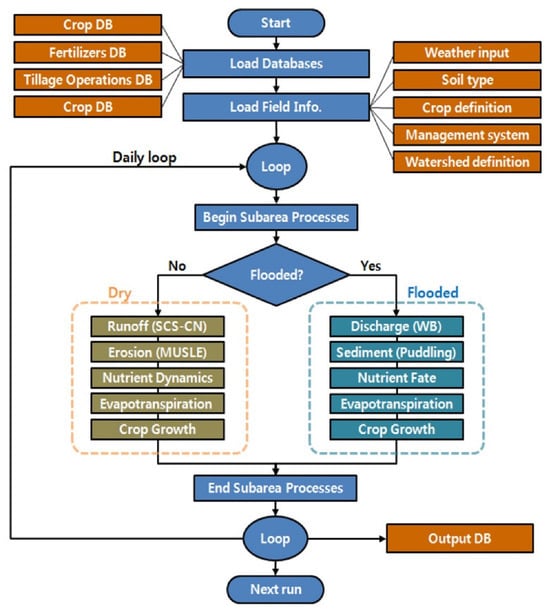
The APEX (https://epicapex.tamu.edu/apex/, accessed on 15 July 2026) is a process-based model used to simulate sustainable production efficiency and maintain environmental quality in whole farms or small watersheds [4]. As shown in Figure 1, to accurately simulate crop growth and its environmental impacts, APEX uses a database of crops, fertilizers, tillage operations, and field information such as weather, soil type, crop type, management system, and watershed type. Based on these various data and the hydrological theory implemented in APEX, responses such as runoff, erosion, nutrient dynamics, evapotranspiration, and crop growth are simulated for the target area for both dry and flood cases [26].
Figure 1.
Overview of the Agricultural Policy/Environmental Extender-Paddy (APEX-Paddy) model [26].
In particular, the APEX model simulates the time course of dry matter production of a crop from emergency until maturity, dependent on weather, soil, and crop operation schedules. In addition, this model is able to accurately simulate competition for light, nutrients, and water for several plant species [27]. The APEX operates on a daily time step and is also capable of performing long-term simulations. Thus, this model is a great tool to simulate long-term effects of climate change on plant production. The plant growth algorithms in APEX can predict more than 100 plant species [28]. A total of 56 growth parameters were used to describe plant growth characteristics and used for calculation of plant production in the model program [29,30]. There are several key plant parameters that are needed to simulate onion plant growth. The WA, called the biomass–energy ratio, describes the potential plant growth (including roots) per unit of energy intercepted photosynthetically. This value varies between different species or cultivars. There is another plant growth parameter, called RLAD, that describes the leaf area index decline rate parameter. This parameter varies by plant type. For a grain crop, when a plant approaches physiological maturity, leaf declines rapidly. Thus, RLAD should be less than 1. However, values of RLAD for vegetable crops such as onion are different from grain crops. The economic yields of vegetable crops are harvested when their leaves are still tender and green. Thus, the RLAD value should be 1. Two temperature threshold parameters, optimal growth temperature (TG, set to 20 °C) and base growth temperature (TBS or TB), govern phenological progression in the APEX model. While standard vegetative base temperatures for temperate crops are conventionally defined above 4 to 5 °C, TB was parameterized at −6 °C in conjunction with the total potential heat units (PHU = 3400) to capture the thermal regime of fall-transplanted intermediate-day onions in southern Korea. Overwintering onions cultivated under plastic film mulching maintain marginal root activity and minimal leaf turnover during mild winter intervals, resuming active canopy expansion immediately as soil temperatures moderate in early February. Because APEX uses daily mean air temperature to accumulate heat units, setting TB to −6 °C functions as an effective calibration parameter that allows thermal unit accumulation under plastic mulched ground conditions and aligns simulated physiological spring regrowth with field observations, rather than denoting an intrinsic cellular growth threshold under sub-freezing tissue temperatures. In this study, two parameter sets of bolted and non-bolted onions were created. Based on morphological measurements and literature values, the override harvest index (OPHI) was differentiated between bolted (0.64) and unbolted (0.99) onions to reflect sink competition (Table 1), with detailed parameterization discussed in Section 2.3.
2.2. Multi-Model Framework for Estimating Onion Production
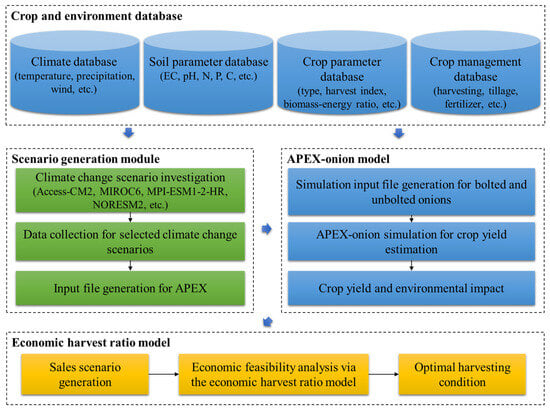
The multi-model approach proposed in this study is illustrated in Figure 2. A crop and environment database involving climate, soil parameters (EC, pH, N, P, C, etc.), crop parameters (type, harvest index, biomass–energy ratio, etc.), and crop management (harvesting, tillage, fertilizer, etc.) is utilized to run the APEX (Agricultural Policy/Environmental Extender) model for prediction of onion yield. In particular, in order to utilize the APEX model (APEX-onion) developed for predicting onion yields, the crop and environment database must be converted into the form of an input file. Using the developed APEX-onion, predictions can be made for bolted and unbolted onion yields under various climate change scenarios. Climate change scenarios such as Access-CM2, MIROC6, MPI-ESM1-2HR, and NorESM2 of the CMIP6 climate change model can be considered. The proposed approach additionally develops an economic harvest ratio model using the predicted yields of unbolted and bolted onions, which can be used to find optimal onion production conditions to maximize profits. Major components in the proposed approach will be explained in detail in the following sections.
Figure 2.
Overview of the proposed multi-model approach.
To establish a cohesive structural linkage between the biophysical crop simulation and econometric forecasting components, the modeling system is structured as an end-to-end impact evaluation pipeline. In this framework, climate-induced agro-meteorological anomalies directly govern physiological plant processes, thermal unit accumulation, and dry matter partitioning between bolted and unbolted organs in the APEX-onion model. The resulting biological yield outputs serve as direct physical supply drivers for the econometric harvest ratio model, wherein aggregated harvest volumes interact with market price elasticities to determine equilibrium wholesale prices and net farm solvency. This sequential coupling allows climate variability at the field scale to propagate mechanistically through national commodity supply dynamics, transforming physiological crop responses into actionable economic risk assessments.
2.3. Development of APEX-Onion Model
Data from a previous field study that evaluated different growth characteristics between bolted and unbolted onions were used to develop the APEX model [8]. The experimental cultivation was conducted during the 2019–2020 growing season at an onion field site located in Daeji-myeon (35°33′3″ N, 128°28′37″ E, 23 m), Changnyeong County, Republic of Korea. The site soil was characterized as silty loam. The tested cultivar was cv. Sirius, an F1 hybrid of an intermediate-day onion widely grown in southern Korea. The field experiment was laid out in a randomized complete block design (RCBD) with three replications. Each experimental plot measured 20 m2 (2 m × 10 m), with a row spacing of 20 cm and an intra-row spacing of 14 cm, achieving a plant density of 34.8 individuals m−2. Young seedlings were transplanted on 26 October 2019, and mature bulbs were harvested on 5 June 2020. Prior to transplanting, the soil was prepared by plowing to a depth of 20 cm, rototilling, and bed formation with plastic mulching. Basal fertilizers (20 ton ha−1 cattle manure, 80 kg N ha−1 as urea, 33 kg P ha−1 as fused phosphate, and 58 kg K ha−1 as potassium sulfate) were incorporated into the soil. During the spring regrowth period (late February and mid-March), split top-dressings of nitrogen and potassium (each at 40 kg N ha−1 and 30 kg K ha−1 using urea and potassium chloride) were applied. Weed management was conducted primarily via pre-emergence herbicide (e.g., Pendimethalin at 1.5 L ha−1 applied before mulching) alongside periodic manual weeding. Preventive phytosanitary treatments were conducted in April and May 2020 using standard foliar fungicides (difenoconazole at 0.5 L ha−1 for downy mildew and purple blotch) and insecticides (imidacloprid at 0.3 L ha−1 for thrips) in accordance with Rural Development Administration (RDA) guidelines. Plants were irrigated by surface flooding in October 2019, late April 2020, and late May 2020. At harvest (June 2020), the bolting incidence rate and weights of bolted and unbolted plants were systematically measured across each replicated plot. Further details regarding experimental management are described in [8]. Because comprehensive field datasets documenting simultaneous organ-level biomass differentiation between bolted and unbolted onions are scarce, calibration was necessarily anchored to this single 2019–2020 experimental dataset. While calibrating a process-based model using a single growing season and a single cultivar presents an inherent constraint on universal transferability, this phase specifically focused on parameterizing the physiological harvest index (OPHI) response to bolting. The broader multi-environment transferability and regional robustness of the parameterized model were subsequently verified across three distinct soil series and four consecutive growing seasons (2020–2023) using commercial farm survey records.
Model parameterization and evaluation followed a systematic two-stage calibration and validation protocol. As model inputs, weather, soil, management, and plant parameters were required. Detailed soil information was obtained from the National Institute of Agricultural Science, RDA (available online at http://soil.rda.go.kr/, accessed on 15 July 2026). Regional weather observations from October 2019 to June 2023, including solar radiation (MJ m−2), daily total precipitation (mm), maximum temperature (°C), minimum temperature (°C), wind speed (m s−1), and humidity (%), were obtained from a regional weather station in Hapcheon (35°56′51″ N, 128°16′99″ E). In the model, two sets of plant parameters of bolted and unbolted intermediate-day onions were created. These plant parameters were estimated based on (1) leaf development, (2) development-rate response to temperature, (3) radiation-use efficiency, and (4) nitrogen and phosphorus concentrations in plant biomass. The calibration and adjustment of APEX-Onion parameters followed a systematic multi-step criterion combining physiological plausibility and statistical goodness-of-fit metrics. First, base crop physiological thresholds, including base temperature (TB = −6 °C) and optimal temperature (TG = 20 °C), were fixed according to established agronomic literature for cold-tolerant intermediate-day onions. Second, crop growth parameters were adjusted to minimize the statistical discrepancies between simulated and observed yields, using percent bias (PBIAS < 5%) and root mean square error (RMSE) as the primary calibration stopping criteria to prioritize volume conservation and minimize absolute deviations across commercial trials. In particular, the override harvest index was fine-tuned as the primary distinguishing calibration parameter between bolted (0.64) and unbolted (0.99) onions. Field observations confirmed that pre-bolting vegetative canopy development, including leaf number, plant height, and leaf area expansion, was statistically indistinguishable between bolted and normal individuals. Following floral initiation, however, photosynthetic assimilates were heavily diverted into reproductive scape elongation, which comprised approximately 31% of total aboveground biomass, resulting in a 36% reduction in marketable bulb biomass. Because APEX lacks an explicit carbon allocation routine for reproductive floral organs versus vegetative sinks, altering vegetative parameters such as radiation-use efficiency or leaf area decline rate would introduce unwarranted parameterization artifacts without dedicated organ-level dynamic partitioning data. Therefore, modulating the override harvest index served as a parsimonious and biologically grounded operational proxy that accurately reflects reproductive sink competition while preserving observed vegetative canopy dynamics. Key plant parameters for unbolted and bolted onions are summarized in Table 1.
Table 1.
APEX-onion input parameters of unbolted and bolted intermediate-day onions.
To align the model with historical statistics, these simulated dry weights are converted to fresh-weight yields assuming a standard dry-matter content of 11% (divided by 0.11). Lee et al. [8] reported separate dry yields for bolted and unbolted onions alongside field-measured bolting incidence rates. Rather than predicting floral transition dynamically within APEX, the model simulated unit yields of bolted and unbolted populations independently under identical weather inputs. Total marketable onion yield was subsequently calculated by weighting the simulated yields with the measured bolting proportion.
The developed APEX-onion model was used to simulate multiple sites in Changnyeong County, Korea, for validation. Changnyeong County is one of the places with the most onion producers in Korea. It produced 50,286 tons of onions in 2023. The Korea Rural Economic Institute surveyed onion yields in five onion fields located in Changnyeong County from 2020 to 2023. At each site, between the end of May and early June, three random areas of 3.3 m2 were selected, and ten plants were harvested per sampling area. Fresh bulb weight per plant and bolting rate per site were measured. Cropping management was the same as described in a previous study [8]. Average yields over all five sites were compared with simulated yields. For simulation, three simulation sites in Changnyeong County were selected. Soil names of these selected sites were Pyeongtaeg, Jungdong, and Daegu. According to the Korean Soil Information System [31], these sites had favorable soil conditions for onion growth. To ensure meteorological consistency across both calibration and validation phases, daily weather observations from October 2019 to June 2023 were sourced from the automated synoptic observing system (ASOS) station in Hapcheon (Station No. 285; 35°56′51″ N, 128°16′99″ E), which is the nearest official station providing a complete and uninterrupted time series of required APEX inputs including solar radiation, wind speed, relative humidity, and temperature. Local temperature and precipitation patterns from the Changnyeong automated weather station (AWS) were concurrently cross-referenced to verify spatial representativeness. Yields of bolted and unbolted onions were simulated. Total onion harvest yields were calculated by applying measured bolting rates. To evaluate simulation accuracy, percent bias (PBIAS) and root mean square error (RMSE) were calculated alongside Pearson correlation coefficient squared (R2).
2.4. Simulation of Fall Planted Intermediate-Day Onions in Future Climate Conditions
After successful calibration and validation, the model was used to forecast onion yields in Changnyeong County, Korea, under near-future climate conditions (2026–2035). The simulation initialized in October 2025 to cover the 2025–2026 overwintering crop cycle. The overall modeling timeline was structured into three distinct phases: (1) field-scale organ-level calibration (2019–2020), (2) regional multi-site historical validation (2020–2023) using all available uninterrupted commercial survey records, and (3) decadal climate forecasting (2026–2035). The 2026–2035 window was specifically selected as a near-future planning horizon because it directly corresponds to the medium-term agricultural policy and climate adaptation planning cycles in South Korea, linking baseline validation outcomes directly to actionable decadal climate projections driven by downscaled CMIP6 general circulation models. This study examined four CMIP6 models, Access-CM2, MIROC6, MPI-ESM1-2HR, and NorESM2, for future climate weather prediction. Two shared socio-economic pathways, SSP245 and SSP585, were tested. These pathways represent different socio-economic developments (SSP2 and SSP5) as well as different pathways of atmospheric greenhouse gas concentrations (RCP4.5 and RCP8.5). The SSP245 pathway is also known as the “middle of the road”, representing the medium pathway of future greenhouse gas emissions. SSP585 represents “Inequality—A Road Divided”, describing low challenges to migrating and high challenges to adaptation. Each scenario was well described by [32]. To address systematic biases and spatial discrepancies in GCM projections, an empirical quantile mapping (QM) method was employed for bias correction and statistical downscaling. Daily meteorological variables simulated by each GCM were matched against observed daily records from the local weather stations during the baseline period (1981–2010). Specifically, cumulative distribution functions (CDFs) of historical GCM outputs were mapped onto empirical CDFs of observed station data to establish transfer functions across all quantiles. These calibrated transfer functions were then applied to near-future projections (2026–2035) under the SSP245 and SSP585 pathways to adjust local distributions while preserving climate change trends. For atmospheric composition, the historical baseline carbon dioxide concentration was set to 415 ppm, consistent with observed ambient levels monitored by the Korea Meteorological Administration and global background stations during 2019 to 2023. Under the near-future scenarios (2026 to 2035), carbon dioxide levels progress to 460 ppm under SSP245 and 480 ppm under SSP585 according to CMIP6 specifications. Simulated future weather values are summarized in Table 2.
Table 2.
CO2 concentration (ppm), monthly averages of total precipitation (mm), maximum temperature (°C, Tmax), minimum temperature (°C, Tmin), and solar radiation (MJ m−2) from October to May at simulation sites in Changnyeong County, South Korea, under historical weather conditions in 2019–2023 and different climate change phases in 2026–2035.
2.5. Economic Harvest Ratio (EHR) Model
In addition to forecasting unit yields for bolted and unbolted onions, this study formulated an economic harvest ratio (EHR) model to determine the optimal balance of bolted and unbolted harvest volumes that maximizes total sales profit. For economic evaluation, Equation (1) is devised.
In Equation (1), denotes the net farm profit per hectare (USD/ha), is the gross sales revenue (USD/ha), represents the fresh bulb yield per hectare (Mg/ha), is the wholesale farm-gate price (USD/Mg), and denotes the unit production cost (USD/ha). Note that all historical price and production cost records in this study, originally compiled in Korean won (KRW), were converted to US dollars (USD) using a fixed baseline exchange rate of 1400 KRW per USD.
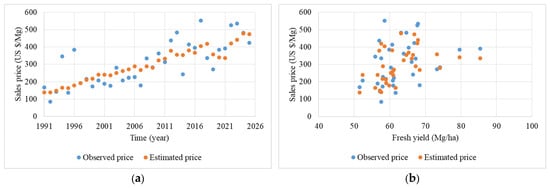
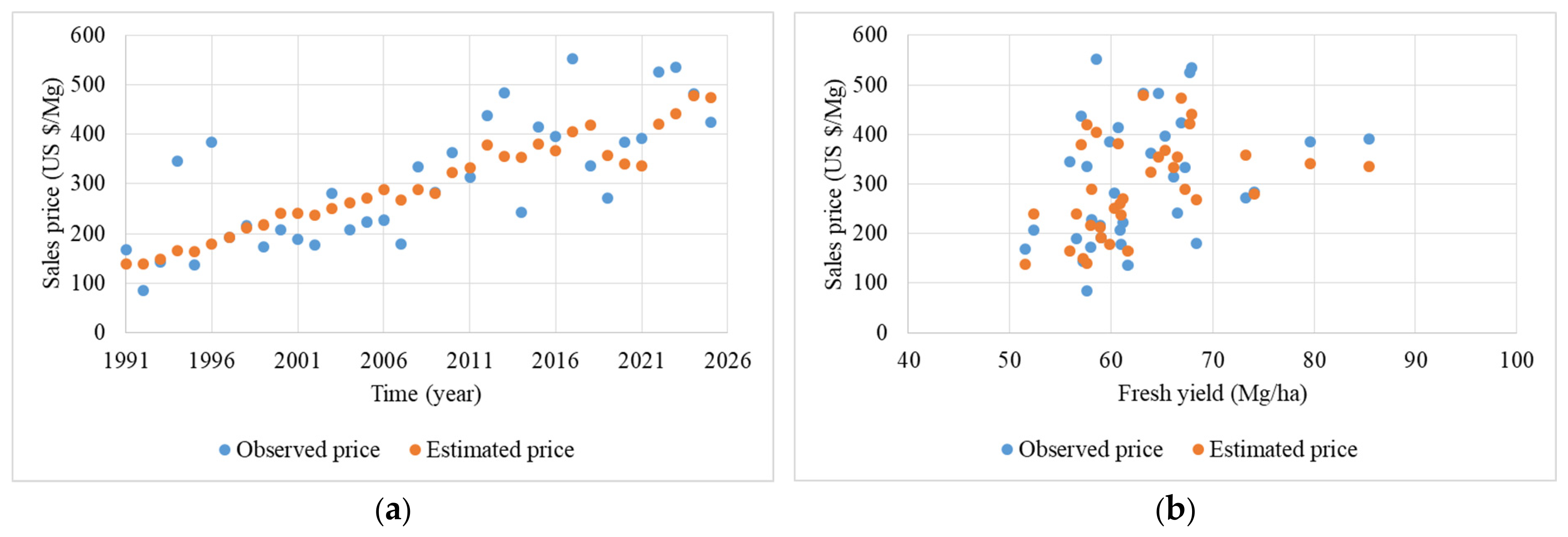
Because vegetable markets are predominantly governed by supply and demand dynamics under price-inelastic consumer demand [33,34], unconstrained maximization of production volume does not necessarily maximize net farm returns due to market saturation and subsequent farm-gate price collapses. To construct the price estimation model, historical records of farm-gate prices (USD/Mg), corresponding fresh crop yields (Mg/ha), and the Consumer Price Index (CPI) spanning from 1991 to 2025 were obtained from the onion agricultural income survey published by the Korean Statistical Information Service (KOSIS) [35,36], as illustrated in Figure 3.
Figure 3.
Historical and model-estimated farm-gate prices (USD/Mg) of onions in South Korea (1991–2025): (a) multi-decadal price trajectory over time; (b) price distribution across varying fresh yields per hectare. Blue dots indicate observed nominal prices from KOSIS, and orange dots represent the fitted equilibrium prices estimated by the structural power regression model in Equation (2).
Empirical analysis of this long-term dataset confirmed an inverse relationship between crop yield and real farm-gate prices, with a negative year-over-year correlation ( = −0.3839, < 0.05) and an estimated yield price elasticity of −0.6764. To precisely capture the observed empirical trajectory across varying supply levels without the mathematical anomalies of polynomial curves (e.g., unrealistic upward price rebounds under high production), a structural power regression model integrated with macroeconomic price dynamics was formulated in Equation (2).
Equation (2) achieved a coefficient of determination (R2) of 0.6191, successfully accounting for 61.91% of the observed farm-gate price variation across the historical baseline range of 51.51 to 85.41 Mg/ha. Unlike conventional quadratic models that require arbitrary piecewise ceilings to suppress unrealistic price expansions during severe crop failures, this model naturally and asymptotically handles acute shortfalls. It realistically simulates exponential price spikes during harvest deficits while inherently decaying toward a structural market floor established by long-term production costs, eliminating the need for artificial mathematical constraints under varying harvest yields ().
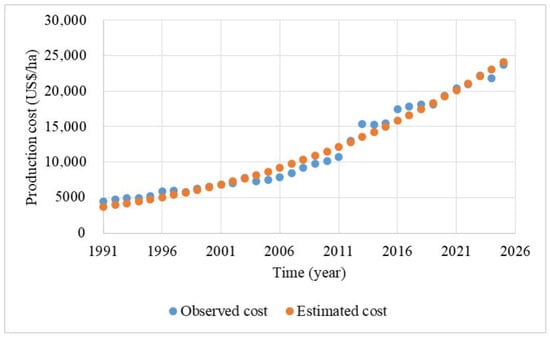
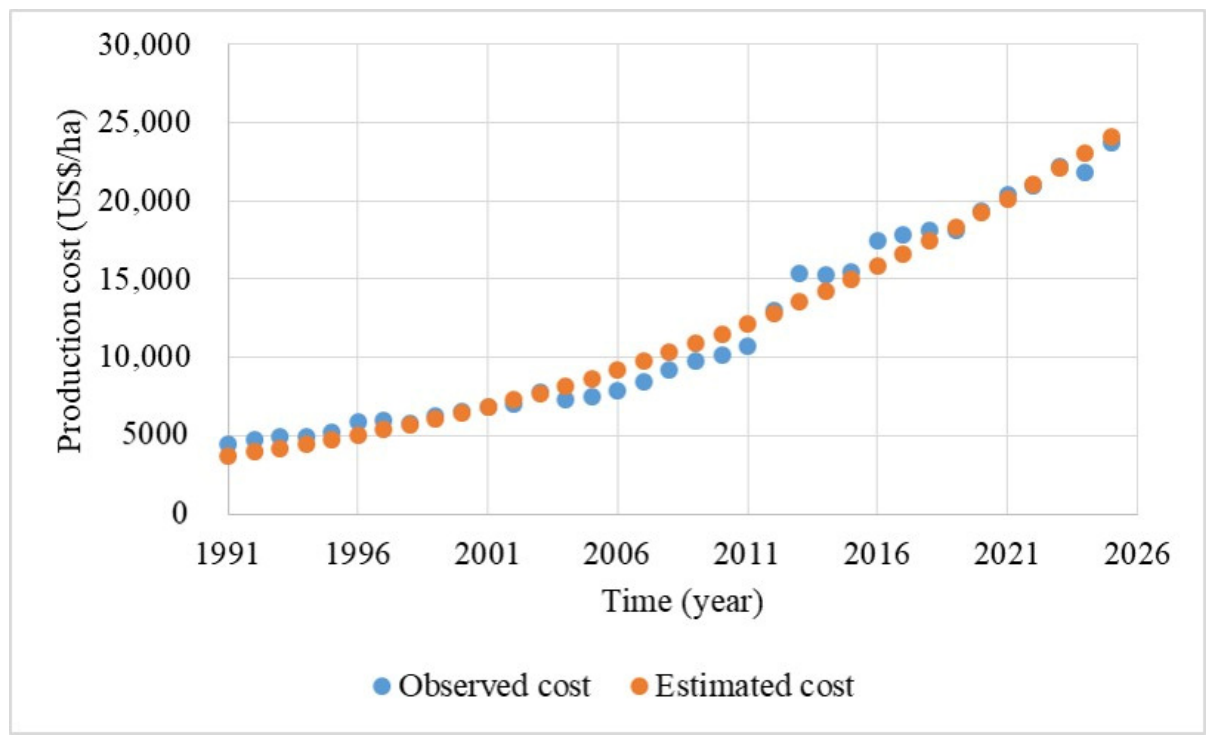
To model production costs, historical annual unit production cost data (USD/ha) for intermediate-day onions spanning from 1991 to 2025 were obtained from the Korean Statistical Information Service (KOSIS) onion income analysis data [36], as shown in Figure 4.
Figure 4.
Multi-decadal onion production costs (USD/ha) in South Korea from 1991 to 2025. Blue dots represent observed historical costs from KOSIS, and orange dots denote baseline costs estimated by the three-parameter logistic growth model formulated in Equation (3).
Incorporating long-term input price trends and inflationary pressures over time , Equation (3) is formulated.
In Equation (3), denotes the continuous time index defined by calendar years elapsed since 1990, and represents the unit production cost (USD/ha). To prevent both non-physical negative cost estimates in early baselines and unbounded polynomial explosion in future decadal projections, a three-parameter logistic growth model was fitted. Equation (3) achieved a high coefficient of determination (R2) of 0.9799, capturing 97.99% of the historical cost variation across the full 35-year baseline (1991–2025). Unlike unconstrained linear or polynomial specifications, this formulation intrinsically bounds long-term cost escalation toward a realistic structural market ceiling driven by ongoing agricultural mechanization and technological adoption.
Combining Equations (1)–(3), the EHR optimization framework was established. The formulation determines the optimal unbolted harvest ratio () across the decadal evaluation horizon () to maximize total profit, as stated in Equation (4).
Subject to
In this EHR formulation, Equations (1)–(3) are adapted into the multi-period optimization constraints represented by Equation (5), Equation (8), and Equation (9), respectively. Equation (6) calculates gross farm-gate revenue per hectare based on unit supply volume and equilibrium market pricing. In Equation (7), and denote simulated dry-matter unit yields (Mg dry weight ha−1) directly output by the APEX-onion model under the respective climate projection pathways.
To align the model with historical statistics, these simulated dry weights are converted to fresh-weight yields assuming a standard dry-matter content of 11% (divided by 0.11). The unit harvest volume () is directly determined by compiling these unit yields weighted by the unbolted ratio (), aligning seamlessly with the field-scale decision-making framework. Simulated unit yields from Changnyeong County serve as an operational benchmark for regional production fluctuations, representing overarching macro-level supply variations driven by climate scenarios.
Because the sum of the bolted and unbolted harvest ratios equals one in Equation (10), Equation (7) requires only a single decision variable, (), which is bounded within the unit interval according to Equation (11). Equation (11) refers to the range of a harvest ratio of unbolted onions at time . Through this model, it is possible to calculate profits when the yield of unbolted and bolted onions is predicted, providing a guide to adjusting the optimal harvest yield to maximize the net farm return and stabilize market-facing prices.
In commercial onion production in South Korea, standing-crop bulk contracting (locally known as pojeon-maemae) and diversion of cosmetically downgraded bulbs to regional processing sectors allow bolted biomass to retain economic utility within the total physical harvest. Equation (7) incorporates bolted yield directly into the aggregated harvest volume, enabling the model to evaluate macro-scale price elasticity without introducing unconstrained secondary parameters. Regarding expenditure structures, baseline production costs derived from KOSIS data encompass field preparation, agricultural inputs, field-level manual harvesting [37], and standard on-site sorting operations. Through this integrated formulation, the EHR framework provides quantitative economic thresholds to evaluate trade-offs between biological yield realization and farm-gate market stability under shifting climate conditions.
The historical baseline periods for the econometric models, spanning from 1991 to 2025 (35-year multi-decadal time series) for both farm-gate prices and unit production costs, were established based on the availability of standardized nationwide agricultural statistics from the Korean Statistical Information Service (KOSIS). These specific time frames provide continuous, unfragmented datasets collected under consistent macroeconomic classifications and survey methodologies, avoiding structural breaks associated with later accounting revisions. Projecting these historical econometric baselines through 2035 inevitably introduces forecasting uncertainties, because long-term market trajectories may be influenced by unforeseen exogenous factors, such as shifts in agricultural input subsidies, rapid adoption of mechanized harvesting, evolving international trade policies, or macroeconomic inflationary shocks. Nevertheless, the empirical models reliably preserve the fundamental price-inelastic demand characteristics of vegetable commodities, where supply variations predominantly govern farm-gate price formations. Consequently, the profit trajectories projected by the economic harvest ratio framework should not be interpreted as absolute financial forecasts, but rather as indicative economic benchmarks under baseline price elasticity and cost trends, providing comparative assessments across climate scenarios.
3. Results and Discussion
3.1. Model Validation
Onion bulbing is a critical factor that can reduce the economic yield of onion. Lee et al. [8] have reported that onion bolter contributes about 31% of total biomass yield. The weight of a bulb of a bolted onion is 36% less than that of an unbolted onion. In simulation, we adjusted the harvest index to create two sets of plant parameters for bolted and unbolted onions, respectively (Table 1). During calibration, APEX-onion overestimated the total yield by about 27% relative to the measured single-plot yield (Table 3). This single-site calibration was primarily designed to parameterize the differential harvest index (OPHI) and capture the relative yield reduction caused by bolting (measured 36.1% vs. simulated 35.6%), rather than fitting site-specific absolute tonnage. The 27% discrepancy was largely attributable to local micro-topographical variability and an exceptionally severe bolting rate (63%) within that specific experimental plot. Crucially, the plant growth parameters established during this step (Table 1) did not carry forward a systematic bias to regional scales; when applied across three representative regional soil series (Pyeongtaeg, Jungdong, and Daegu) and evaluated against multi-year survey averages from five commercial farms (Table 4), plot-specific micro-environmental anomalies balanced out, yielding a high multi-site simulation accuracy with minimal volume bias (PBIAS = 2.48%) and low prediction error (RMSE = 1.39 Mg ha−1). Consequently, the calibrated parameters were directly adopted for future-climate simulations without requiring arbitrary post hoc bias correction factors.
Table 3.
Bolting rate and measured and simulated economic dry yields of bolted, unbolted, and total intermediate-day onions grown in Changnyeong County, Korea (measured yields were obtained from [8]).
Table 4.
Onion bolting incident rates and measured and simulated dry yields of intermediate-day onions planted in multiple locations in Changnyeong County, Korea.
After developing bolted and unbolted onion parameters, the model simulated onion yields at multiple locations of Changnyeong County, Korea, during multiple years. According to the multi-site evaluation results shown in Table 4, the developed APEX-onion model simulated onion yields with acceptable accuracy across the four monitored growing seasons. The model achieved an RMSE of 1.39 Mg ha−1 and a percent bias (PBIAS) of 2.48%, satisfying the ‘very good’ performance rating according to established hydrological and crop model evaluation guidelines [38]. The Pearson correlation coefficient squared (R2) across the four annual averages was 0.39, primarily influenced by the single-season overestimation during the anomalous 2019–2020 winter (simulated 12.54 Mg ha−1 versus measured 9.99 Mg ha−1), whereas the subsequent three consecutive seasons (2020 to 2023) exhibited tight agreement with absolute errors below 1.0 Mg ha−1. Given the limited sample size of four annual survey cycles, the predictive validity and regional robustness of the model are primarily substantiated by the minimal overall volume bias (PBIAS = 2.48%) and low absolute error (RMSE = 1.39 Mg ha−1) across multiple commercial farm environments, rather than standalone correlation metrics.
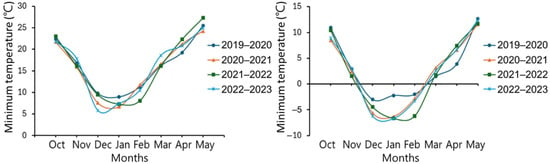
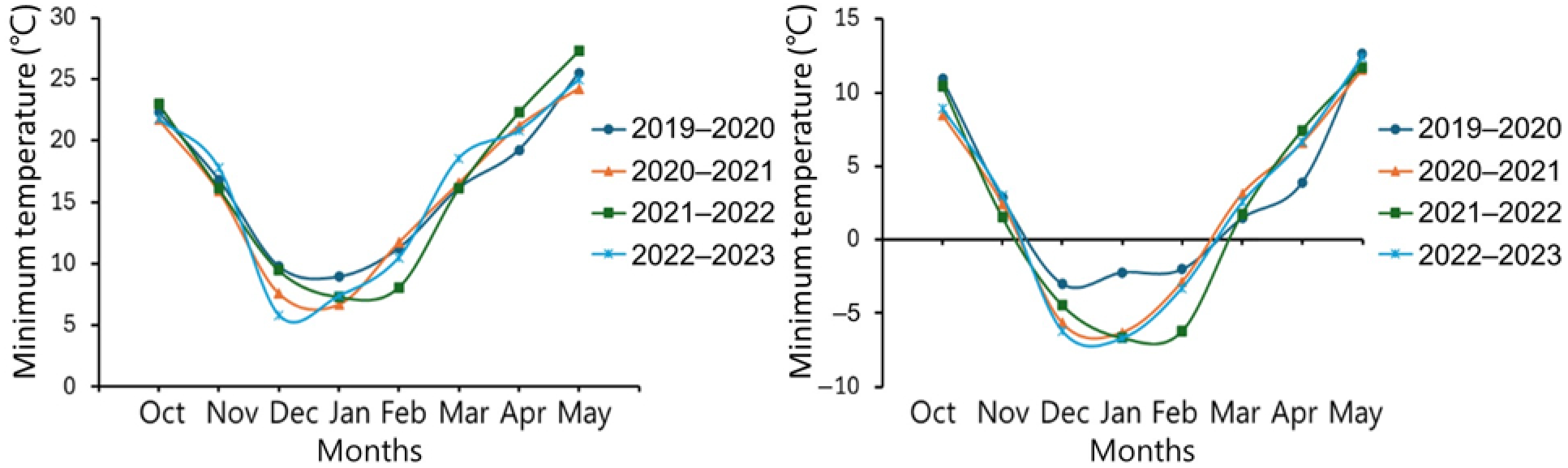
Across the multi-site commercial survey, the highest regional bolting rate was recorded as 20% in the 2019–2020 growing season (Table 4), representing the multi-farm average surveyed across five commercial fields by the Korea Rural Economic Institute. In contrast, the 63% bolting rate reported in Table 3 was derived from a single experimental research trial located in Daeji-myeon [8]. This numerical difference reflects distinct spatial scales: the Daeji-myeon trial experienced localized micro-environmental conditions and specific seedling attributes that induced exceptionally severe premature vernalization, whereas the commercial survey captures broader farm-to-farm heterogeneity across the county. The observed discrepancy between simulated and measured yields during the 2019 to 2020 growing season primarily stemmed from this spatial scale divergence and localized microclimatic extremes. The single-plot calibration trial in Daeji-myeon experienced severe bolting driven by localized micro-topographical cold air drainage, whereas the commercial survey across Changnyeong County averaged 20%. The APEX model operates on daily regional meteorological observations from synoptic stations, which inherently smooth field-scale microclimatic fluctuations and localized phytosanitary stresses. Furthermore, anomalous winter warmth followed by abrupt temperature drops in March and April 2020 induced physiological shock that exceeded standard heat unit response functions. Importantly, across the subsequent three consecutive seasons from 2020 to 2023, simulated yields closely matched multi-farm observed records with absolute errors below 1.0 Mg ha−1. With an overall percent bias of 2.48% and a root mean square error of 1.39 Mg ha−1, the model demonstrates high regional reliability according to established watershed and crop modeling criteria. While micro-scale extreme events can induce short-term deviations, the validated framework accurately captures overarching climate change trajectories, confirming the robustness and credibility of decadal yield projections. According to weather data shown in Figure 5, the maximum and minimum temperatures in 2019–2020 were higher than those in other years. For example, the average minimum temperature in January of 2020 was −2.2 °C, while minimum temperatures in 2021–2023 were below −6 °C (Figure 5). The minimum temperature of 3.89 °C in April in 2020 was much lower than minimum temperatures (above 6 °C) in other years, which might have increased bolting incidence. A similar result was observed by [39], who reported that low temperatures in March and April after a warmer winter caused bolting. This unusual weather condition and severe temperature fluctuation can be stressful for onions and lead to bolting earlier than normal.
Figure 5.
The maximum and minimum temperatures from October to May in 2019–2023 at simulated sites in Changnyeong County, Korea.
3.2. Onion Yield Expectation Under Various Climate Scenarios
As discussed in Section 2.3., onion bolting incidence was highly correlated with weather conditions. In this study, the developed APEX-onion was used to simulate onion yields in near future period (2026–2035) involving the SSP245 and SSP585 pathways (Table 2). Four climate models, including Access-CM2, MIROC6, MPI-ESM1-2HR, and NorESM2, were used to simulate temperatures, precipitation, solar radiation, wind speed, and humidity in Changnyeong County, Korea. In comparison with the historical weather conditions, all climate models predicted temperature increases from October to May. During the historical period, the minimum temperature was 2.3 °C, while the minimum temperature ranged from 4.3 °C to 7.42 °C in the future period. These warmer thermal conditions, along with elevated atmospheric CO2 concentrations (460–480 ppm) and increased cumulative heat units, generally favored biomass accumulation and contributed to yield increases across most future scenarios, though the magnitude of increase was concurrently modulated by solar radiation and water stress. Compared to the historical period, simulated bolted and unbolted onion yields were increased by 22% and 9% in future periods, respectively. In the SSP245 pathways, MPI-ESM1-2-HR predicted the highest yield of 12.05 Mg ha−1, while the MIROC6 model predicted the highest yield of 12.02 Mg ha−1 in the SSP585 pathways. The Access-CM2 model also predicted higher total precipitations in both the SSP245 (405.8 mm) and SSP585 pathways (414 mm) than other models. The NorESM2 model predicted the lowest precipitation (299 mm) in the SSP585 pathways. The MPI-ESM1-2-HR model predicted higher solar radiation (20.75 MJ m−2) in the SSP585 pathways than other models (around 13–14 MJ m−2). The exceptionally high solar radiation predicted by the MPI-ESM1-2-HR model in SSP585 (20.75 MJ m−2, compared to 13–14 MJ m−2 in other models; Table 2) accompanied by relatively low precipitation (314.4 mm) contributed to a substantially greater number of water-stress days (over 110 days; Table 5). As elevated solar radiation intensifies atmospheric evaporative demand and accelerates crop water depletion [40], the limited rainfall was insufficient to offset soil moisture loss, ultimately precipitating severe water stress during the critical bulb enlargement phase. Regarding the origin of this radiation spike, detailed examination confirms that it reflects the structural behavior of the raw MPI-ESM1-2-HR general circulation model under extreme radiative forcing rather than an artifact of empirical quantile mapping. Under SSP585, MPI-ESM1-2-HR projects a pronounced reduction in regional cloud cover and atmospheric optical depth across East Asia during the late winter and spring seasons. Because quantile mapping preserves relative changes in distribution tails while correcting baseline biases, this high radiation signal was retained in the bias-corrected local series. This divergence underscores the inherent structural uncertainty across CMIP6 climate models, demonstrating how combined heat and radiation anomalies can create severe localized agro-meteorological drought.
Table 5.
Simulated average dry yields and water-stress days of bolted and unbolted intermediate-day onions during the growing season (October to May) under historical weather (2019–2023) and future climate projections (2026–2035) in Changnyeong County, South Korea.
Elevated atmospheric temperatures and carbon dioxide levels generally stimulate onion biomass accumulation during vegetative regrowth by accelerating heat unit acquisition. However, the severe yield depression projected under the MPI-ESM1-2-HR model in SSP585 illustrates the critical vulnerability of bulb expansion to compound agro-meteorological stresses. The combination of extreme solar radiation and reduced precipitation sharply elevates atmospheric vapor pressure deficits, accelerating crop evapotranspiration beyond root uptake capacities. This moisture deficit precipitates prolonged water stress exceeding one hundred days during the critical bulbing phase, severely impairing cell enlargement and dry matter partitioning toward the bulb as documented in previous Allium physiological studies.
3.3. Economic Feasibility Analysis Under Various Climate Scenarios
The optimum economic harvest ratios (EHRs) were determined for climate scenarios using Equations (4)–(11), shown in Section 2.5. The optimization model was solved using the Generalized Reduced Gradient (GRG) Nonlinear algorithm implemented in Microsoft Excel Solver (Frontline Systems, Inc., Incline Village, NV, USA), with the convergence tolerance set to 10−6.
Table 6 summarizes the economic optimization results across the climate scenarios evaluated using the revised EHR framework. Under the SSP2-4.5 pathway, MPI-ESM1-2-HR achieved the highest average annual profit of USD 12,204/ha, supported by an average fresh yield of 96.7 Mg/ha and an optimal unbolted harvest ratio of 0.5803 (allowing an average bolting absorption buffer of 41.97%). Across all four GCMs under SSP2-4.5, average annual profits remained robust, ranging from USD 11,193/ha (ACCESS-CM2) to USD 12,204/ha (MPI-ESM1-2-HR). This pattern is governed by the price-inelastic demand dynamics formulated in Equation (8); unconstrained maximization of marketable volume during favorable growing seasons triggers wholesale price depreciation, whereas moderating marketable fresh volume through targeted bolting partitioning stabilizes unit farm-gate prices and enhances net margins. Under SSP5-8.5, MIROC6 yielded the highest average annual profit of USD 12,131/ha (average yield of 96.7 Mg/ha, unbolted ratio of 0.5804). Conversely, projected returns under MPI-ESM1-2-HR were severely constrained by compound solar radiation and drought anomalies (>110 water-stress days), which depressed fresh yields to an average of 64.3 Mg/ha and reduced net profit to USD 6869/ha.
Table 6.
Average economic harvest ratios (EHR) and total profits of bolted and unbolted onions from 2026 to 2035.
Rather than reflecting a simple monotonic relationship between tonnage and financial returns, the economic optimization underscores the inherent price elasticity governing staple vegetable markets. Because consumer demand for onions is highly price-inelastic, bumper harvests exceeding baseline market clearance capacity depress wholesale equilibrium prices sharply. Under such oversupply conditions, allowing an effective marketable supply buffer (averaging 39.0% to 42.6% bolted biomass absorption into processing and bulk channels) naturally mitigates market saturation, sustaining unit price levels and securing net farm solvency. Conversely, under severe climate-induced yield deficits (such as MPI-ESM1-2-HR in SSP5-8.5), maximizing marketable bulb volume becomes essential to offset steep multi-decadal cultivation expenditures.
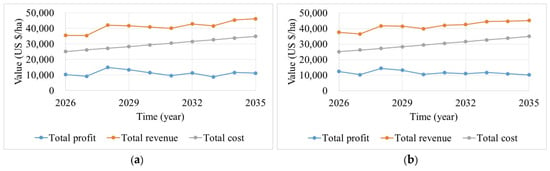
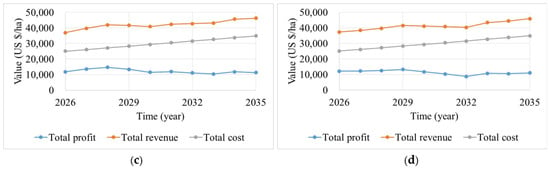
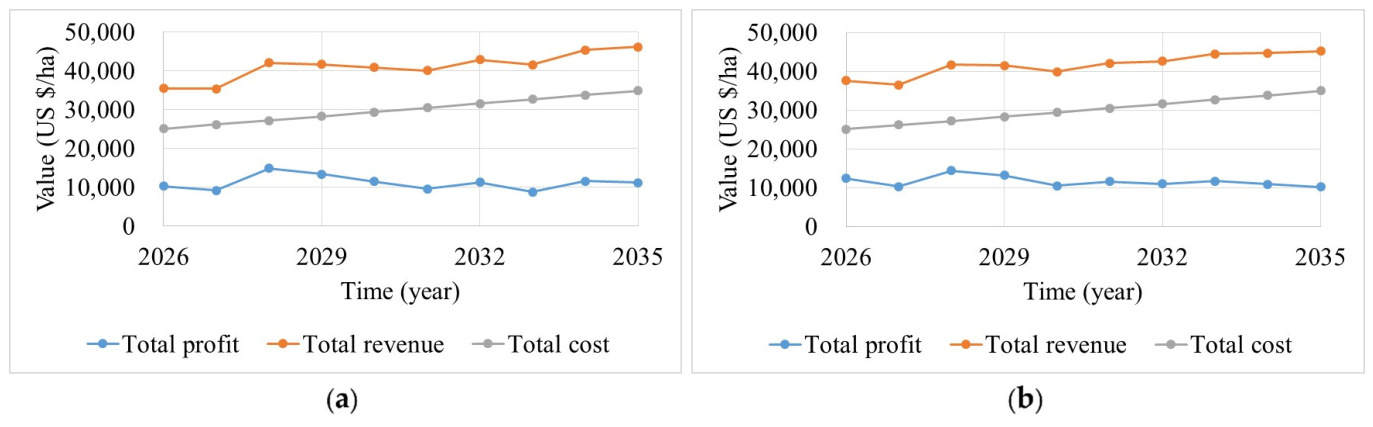
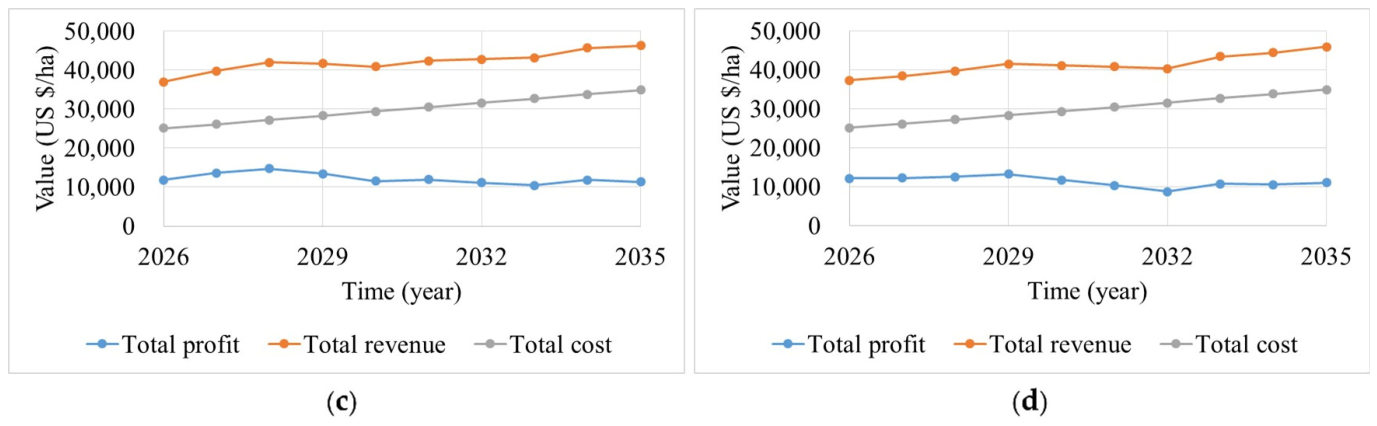
Figure 6 and Figure 7 depict the projected annual trajectories of net profit, gross revenue, and production cost of onions across the four CMIP6 models, expressed on a per-hectare basis (USD/ha). As illustrated in Figure 6 (SSP2-4.5), net profits across all models exhibited remarkable multi-decadal stability, generally oscillating between USD 8800/ha and USD 14,900/ha despite rising input costs. Total production costs steadily climbed from approximately USD 25,114/ha in 2026 to USD 34,931/ha in 2035 in accordance with the logistic trajectory in Equation (9). In ACCESS-CM2, annual profit ranged from USD 8840/ha (2033) to USD 14,889/ha (2028), closely mirroring annual yield fluctuations between 75 and 119 Mg/ha. In MPI-ESM1-2-HR, high yield realization in 2028 (118 Mg/ha) produced a peak revenue of USD 41,989/ha and a peak profit of USD 14,760/ha. Across all SSP2-4.5 projections, dynamic revenue expansion effectively neutralized steady cost increases, maintaining average annual profit margins above USD 11,000/ha.
Figure 6.
Total profit, revenue, and cost of onions under the SSP245 pathway: (a) Access-CM2, (b) MIROC6, (c) MPI-ESM1-2-HR, and (d) NorESM2. All monetary values are expressed on a per-hectare basis (USD/ha).
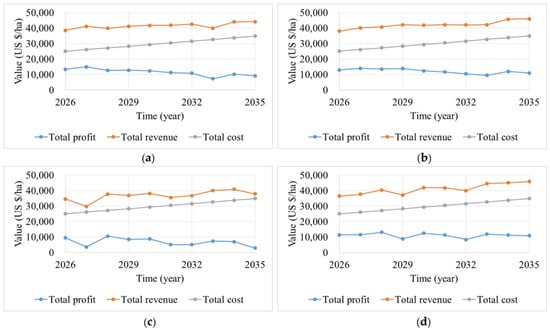
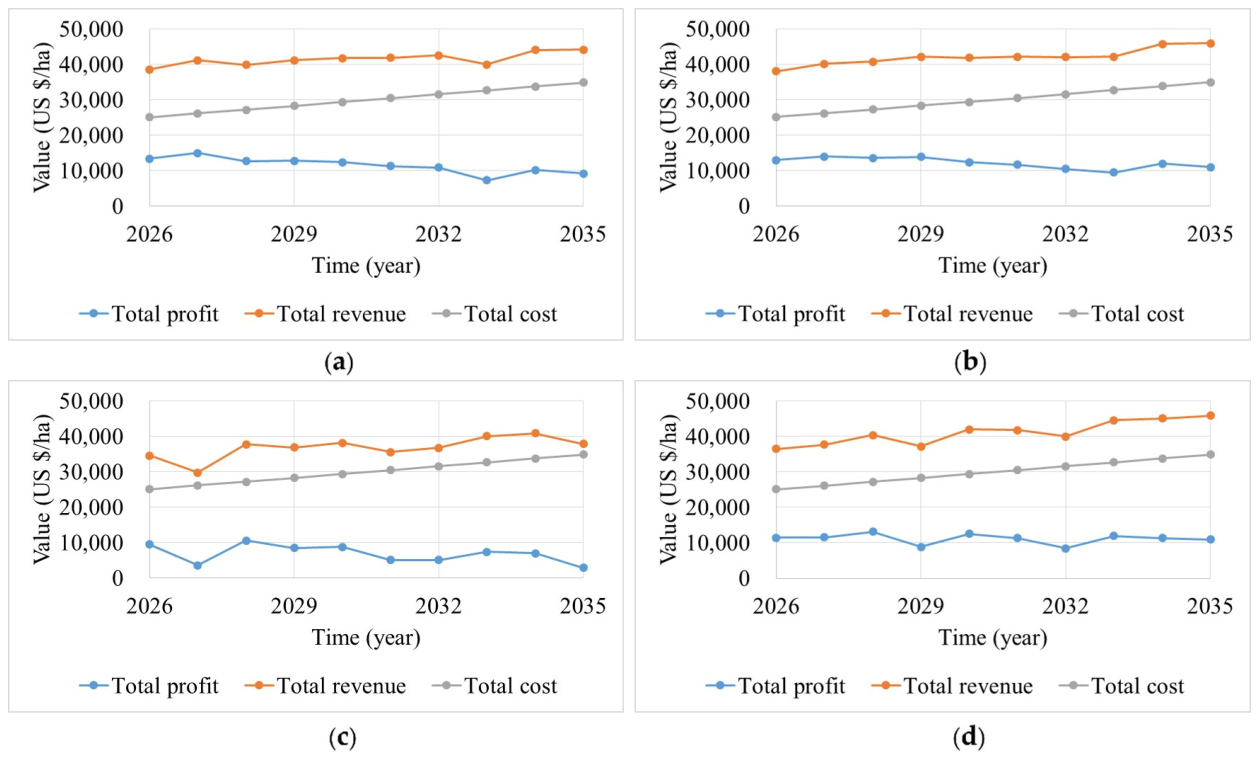
Figure 7.
Total profit, revenue, and cost of onions under the SSP585 pathway: (a) Access-CM2, (b) MIROC6, (c) MPI-ESM1-2-HR, and (d) NorESM2. All monetary values are expressed on a per-hectare basis (USD/ha).
In Figure 7 (SSP5-8.5), contrasting economic trajectories emerged across climate models. ACCESS-CM2, MIROC6, and NorESM2 maintained resilient economic returns, with annual profits averaging USD 11,539/ha, USD 12,131/ha, and USD 11,165/ha, respectively. In MIROC6, gross revenue expanded from USD 38,086/ha in 2026 to USD 45,890/ha in 2035, successfully preserving profit margins above USD 10,000/ha throughout the decadal window. In stark contrast, MPI-ESM1-2-HR exhibited substantial financial vulnerability, showing the lowest decadal average profit (USD 6869/ha) and the widest annual fluctuation, plummeting to USD 2965/ha in 2035 and USD 3644/ha in 2027. This severe contraction resulted directly from extreme soil moisture deficits that curtailed fresh yields below 50 Mg/ha, demonstrating that prolonged agro-meteorological drought overrides price compensation mechanisms.
In evaluating the projected economic outcomes, several post-harvest buffering mechanisms that could mitigate climate-induced shocks warrant consideration. In commercial markets, extensive cold storage facilities allow growers and agricultural cooperatives to buffer seasonal supply gluts and smooth release schedules during deficit periods. Furthermore, regional agro-processing facilities (such as those producing concentrated onion juice, purees, or dried seasonings) can absorb substantial quantities of lower-grade or bolted bulbs that fail fresh-market cosmetic grading standards, thereby providing residual revenue streams. Additionally, governmental market stabilization policies, including emergency tariff-rate quota (TRQ) import adjustments during severe shortfalls, play an active role in stabilizing wholesale market volatility. Because the current EHR model treats annual production as a closed equilibrium without dynamic inventory arbitrage, processing diversions, or international trade feedback, the simulated farm profit volatility represents an upper-bound scenario. Future extensions should integrate dynamic storage economics and multi-channel processing balances to refine long-term economic resilience projections.
Under the acute water-stress regimes projected by MPI-ESM1-2-HR under SSP5-8.5, where simulated annual yields dropped as low as 44 to 48 Mg/ha, estimated unit prices surged to over USD 670–796/Mg in response to acute market scarcity. Despite elevated unit prices, physical volume depletion severely reduced gross revenues, demonstrating that catastrophic yield failures undermine farm solvency even under favorable scarcity pricing.
4. Conclusions
This study is the first attempt to simulate yields of unbolted and bolted onions under various environmental conditions in Korea. Accurate price forecasting for decision makers becomes more acute as onion prices fluctuate heavily with unpredictable weather conditions in Korea. Although many scientists have reported that onion bolting can significantly contribute to yield loss, only a few studies have performed a yield comparison between bolted and unbolted onions cultivated in Korea. Developing an accurate onion growth model can provide useful information for farmers and policymakers to make better decisions on onion prices. In this study, an APEX model was developed to simulate bolted and unbolted onions in Changnyeong County, one of places with the most onion producers in Korea. After successfully simulating onion yields with bolting and unbolting occurrence rates, onion yields were simulated under different near-future climate conditions (2026–2035) with different climate change models. Through economic analysis, the economic injury level induced by bolting incidence was evaluated under various climate conditions. Since bolting is a significant factor related to yield loss, the economic threshold of bolting incidence where the maximum profits can be maintained was evaluated using economic production models. According to simulation results, 100% unbolted rates did not always produce high profits for farmers since over-production may cause an onion price drop in the market. For instance, during projected high-yield years under climate change scenarios, moderate bolting rates functioned as a natural supply dampener that buffered wholesale prices and protected net farm income against overproduction crashes. To decide on onion price, decision makers should consider the complexity of the interaction between overproduction and yield loss caused by bolting rates. While inherently subject to climate projection uncertainties, this integrated modeling framework can serve as a supportive decision-making tool, offering indicative insights into potential yield variations and economic thresholds for stabilizing farm profits under shifting climatic conditions.
A recognized limitation of this study is that baseline parameterization relied on a single intermediate-day cultivar (cv. Sirius) and a single experimental season (2019–2020), which was constrained by data availability for organ-specific bolting measurements. Although multi-site survey validation over four seasons confirmed regional accuracy, future studies should calibrate the model across diverse maturity classes, including early-maturing and late-maturing cultivars; evaluate multiple agronomic management regimes; and incorporate sudden freeze or heatwave shocks to broaden model generalizability.
Author Contributions
Conceptualization, S.K. (Sumin Kim) and S.K. (Sojung Kim); methodology, S.K. (Sumin Kim), J.J., and S.K. (Sojung Kim); software, S.K. (Sojung Kim); validation, S.K. (Sumin Kim) and S.K. (Sojung Kim); formal analysis, S.K. (Sumin Kim) and S.K. (Sojung Kim); investigation, S.K. (Sumin Kim), J.J., and S.K. (Sojung Kim); resources, S.K. (Sumin Kim), H.Y.R., J.L., and S.K. (Sojung Kim); data curation, S.K. (Sumin Kim) and S.K. (Sojung Kim); writing—original draft preparation, S.K. (Sumin Kim) and S.K. (Sojung Kim); writing—review and editing, S.K. (Sumin Kim), J.J., H.Y.R., J.L., and S.K. (Sojung Kim); visualization, S.K. (Sumin Kim) and S.K. (Sojung Kim); supervision, S.K. (Sumin Kim) and S.K. (Sojung Kim); project administration, S.K. (Sumin Kim) and S.K. (Sojung Kim); funding acquisition, S.K. (Sumin Kim) and S.K. (Sojung Kim). All authors have read and agreed to the published version of the manuscript.
Funding
This work was supported by the National Research Foundation of Korea (NRF) grant funded by the Korea government (MSIT) (Project No. RS-2026-25588259).
Data Availability Statement
The data presented in this study are available in the article.
Conflicts of Interest
The authors declare no conflicts of interest.
References
- Statistics Korea. Cultivated Area of Garlic and Onions in 2023; Social Statistics Bureau, Agriculture and Fisheries Statistics Division: Daejeon, Republic of Korea, 2023; Available online: https://kostat.go.kr/ (accessed on 22 July 2024).
- Kim, Y.; Kim, S.; Kim, S. Onion (Allium cepa) profit maximization via ensemble learning-based framework for efficient nitrogen fertilizer use. Agronomy 2024, 14, 2130. [Google Scholar] [CrossRef] [Scilit]
- Qiao, Y.; Kang, M.; Ahn, B.I. Analysis of factors affecting vegetable price fluctuation: A case study of South Korea. Agriculture 2023, 13, 577. [Google Scholar] [CrossRef] [Scilit]
- Williams, J.R.; Arnold, J.G.; Kiniry, J.R.; Gassman, P.W.; Green, C.H. History of model development at Temple, Texas. Hydrol. Sci. J. 2008, 53, 948–960. [Google Scholar] [CrossRef] [Scilit]
- Streck, N.A. A vernalization model in onion (Allium cepa L.). Rev. Bras. Agrocienc. 2003, 9, 99–105. [Google Scholar]
- Rabinowitch, H.D. Onions and other edible Alliums. In CRC Handbook of Flowering; Halevy, A.H., Ed.; CRC Press: Boca Raton, FL, USA, 1985; Volume I, pp. 398–409. [Google Scholar]
- Díaz-Pérez, J.C.; Purvis, A.C.; Paulk, J.T. Bolting, yield, and bulb decay of sweet onion as affected by nitrogen fertilization. J. Am. Soc. Hortic. Sci. 2003, 128, 144–149. [Google Scholar] [CrossRef] [Scilit]
- Lee, J.; Kim, J.; Kim, T.J.; Lee, H.M.; Kim, M.A.; Park, M.J.; Lee, M.; Min, B.; Park, G.S. Inflorescence initiation pattern as affected by air temperature in fall-transplanted intermediate-day onion. Int. J. Veg. Sci. 2023, 29, 459–472. [Google Scholar] [CrossRef] [Scilit]
- Roberts, E.H.; Summerfield, R.J.; Ellis, R.H.; Craufurd, P.Q.; Wheeler, T.R. The induction of flowering. In The Physiology of Vegetable Crops; Wien, H.C., Ed.; CAB International: Wallingford, UK, 1997; pp. 69–99. [Google Scholar]
- Sharma, P.; Negi, R.; Chandel, S.; Thakur, M. Temperature fluctuations during vernalization and their physiological consequences on bolting and quality traits in Allium cepa L. Sci. Hortic. 2022, 295, 110865. [Google Scholar] [CrossRef] [Scilit]
- Khokhar, K.M. Effect of temperature and photoperiod on the incidence of bulbing and bolting in seedlings of onion cultivars of diverse origin. J. Hortic. Sci. Biotechnol. 2008, 83, 488–496. [Google Scholar] [CrossRef] [Scilit]
- National Centers for Environmental Information (NCEI). January 2024 Global Climate Report; NOAA: Washington, DC, USA, 2024. Available online: https://www.ncei.noaa.gov/access/monitoring/monthly-report/global/202401 (accessed on 26 June 2024).
- Cho, W.; Na, M.H.; Park, Y.; Kim, D.H.; Cho, Y. Prediction of weights during growth stages of onion using agricultural data analysis method. Appl. Sci. 2020, 10, 2094. [Google Scholar] [CrossRef] [Scilit]
- Venâncio, J.B.; da Silva Dias, N.; de Medeiros, J.F.; de Morais, P.L.D.; do Nascimento, C.W.A.; de Sousa Neto, O.N.; da Silva Sá, F.V. Yield and morphophysiology of onion grown under salinity and fertilization with silicon. Sci. Hortic. 2022, 301, 111095. [Google Scholar] [CrossRef] [Scilit]
- Jhajharia, K.; Mathur, P.; Jain, S.; Nijhawan, S. Crop yield prediction using machine learning and deep learning techniques. Procedia Comput. Sci. 2023, 218, 406–417. [Google Scholar] [CrossRef] [Scilit]
- Marino, S.; Alvino, A. Hyperspectral vegetation indices for predicting onion (Allium cepa L.) yield spatial variability. Comput. Electron. Agric. 2015, 116, 109–117. [Google Scholar] [CrossRef] [Scilit]
- Qi, J.; Chehbouni, A.; Huete, A.R.; Kerr, Y.H.; Sorooshian, S. A modified soil adjusted vegetation index. Remote Sens. Environ. 1994, 48, 119–126. [Google Scholar] [CrossRef] [Scilit]
- Li, F.; Miao, Y.; Feng, G.; Yuan, F.; Yue, S.; Gao, X.; Liu, Y.; Liu, B.; Ustin, S.L.; Chen, X. Improving estimation of summer maize nitrogen status with red edge-based spectral vegetation indices. Field Crops Res. 2014, 157, 111–123. [Google Scholar] [CrossRef] [Scilit]
- Kang, Y.S.; Jang, S.H.; Park, J.W.; Song, H.Y.; Ryu, C.S.; Jun, S.R.; Kim, S.H. Yield prediction and validation of onion (Allium cepa L.) using key variables in narrowband hyperspectral imagery and effective accumulated temperature. Comput. Electron. Agric. 2020, 178, 105667. [Google Scholar] [CrossRef] [Scilit]
- Ghazal, S.; Munir, A.; Qureshi, W.S. Computer vision in smart agriculture and precision farming: Techniques and applications. Artif. Intell. Agric. 2024, 11, 85–101. [Google Scholar] [CrossRef] [Scilit]
- Kim, S.; Kim, S.; Green, C.H.; Jeong, J. Multivariate polynomial regression modeling of total dissolved-solids in rangeland stormwater runoff in the Colorado River Basin. Environ. Model. Softw. 2022, 157, 105523. [Google Scholar] [CrossRef] [Scilit]
- Rosé, C.P.; McLaughlin, E.A.; Liu, R.; Koedinger, K.R. Explanatory learner models: Why machine learning (alone) is not the answer. Br. J. Educ. Technol. 2019, 50, 2943–2958. [Google Scholar] [CrossRef] [Scilit]
- Linheiro, E.S.M.; Shinde, G.R.; Mahalle, P.N.; Mirajkar, R. Explainable AI (XAI) for agriculture. In Industry 4.0 Convergence with AI, IoT, Big Data and Cloud Computing: Fundamentals, Challenges and Applications; Shinde, G.R., Mahalle, P.N., Eds.; Chapman and Hall/CRC: Boca Raton, FL, USA, 2023; pp. 161–178. [Google Scholar] [CrossRef] [Scilit]
- Zhu, J.; Zhang, X.; Chen, Y. Development and testing of an integrated APEX-SWAT-GW model for simulations of agro-hydrological processes in a groundwater-fed plain in China. Environ. Model. Softw. 2023, 168, 105804. [Google Scholar] [CrossRef] [Scilit]
- Wang, X.; Jeong, J.; Gassman, P.W.; Reyes, M.R. Evaluation of the APEX model for simulating crop growth and hydrology under changing climate scenarios. Agric. Water Manag. 2022, 262, 107382. [Google Scholar] [CrossRef] [Scilit]
- Choi, S.-K.; Jeong, J.; Kim, M.-K. Simulating the effects of agricultural management on water quality dynamics in rice paddies for sustainable rice production—Model development and validation. Water 2017, 9, 869. [Google Scholar] [CrossRef] [Scilit]
- Kim, S.; Kim, S.; An, K. An integrated multi-modeling framework to estimate potential rice and energy production under an agrivoltaic system. Comput. Electron. Agric. 2023, 213, 108157. [Google Scholar] [CrossRef] [Scilit]
- Gassman, P.W.; Williams, J.R.; Wang, X.; Saleh, A.; Osei, E.; Hauck, L.M.; Izaurralde, R.C.; Flowers, J.D. The agricultural policy/environmental extender (APEX) model: An emerging tool for landscape and watershed environmental analysis. Trans. ASABE 2010, 53, 711–740. [Google Scholar] [CrossRef] [Scilit]
- Palta, J.P.; Levitt, J.; Stadelmann, E.J. Freezing tolerance of onion bulbs and significance of freeze-induced tissue infiltration. Cryobiology 1977, 14, 614–619. [Google Scholar] [CrossRef] [Scilit]
- Beye, N.F.; Kane, C.; Ayessou, N.; Kebe, C.M.F.; Talla, C.; Diop, C.M.; Sène, A. Modelling the dehydration kinetics of four onion varieties in an oven and a solar greenhouse. Heliyon 2019, 5, e02430. [Google Scholar] [CrossRef] [Scilit] [PubMed]
- Korean Soil Information System (KSIS). Soil Survey. Available online: https://soil.rda.go.kr/eng/ (accessed on 29 June 2024).
- Peng, L.; Li, Z. Ensemble flood risk assessment in the Yangtze River Economic Belt under CMIP6 SSP-RCP scenarios. Sustainability 2021, 13, 12097. [Google Scholar] [CrossRef] [Scilit]
- Mankiw, N.G. Teaching the principles of economics. East. Econ. J. 1998, 24, 519–524. [Google Scholar]
- Zhang, L.; Hu, Y.; Chen, Z.; Liu, Y. Price volatility, supply response, and risk management in vegetable commodity markets: Implications for farm income stabilization. Food Policy 2023, 118, 102488. [Google Scholar] [CrossRef]
- Statistics Korea. Consumer Price Index; e-Nara Indicators: Daejeon, Republic of Korea, 2024; Available online: https://www.index.go.kr/unify/idx-info.do?idxCd=4226 (accessed on 24 October 2024).
- Statistics Korea. Agricultural Products Income Survey: Onion; Korean Statistical Information Service (KOSIS): Daejeon, Republic of Korea, 2024; Available online: https://kosis.kr/statHtml/statHtml.do?tblId=DT_1EC0052&orgId=101 (accessed on 24 October 2024).
- Choi, C.G. Agricultural Management Guide 1: Onion Management; Rural Development Administration: Jeonju, Republic of Korea, 2015.
- Moriasi, D.N.; Arnold, J.G.; Van Liew, M.W.; Bingner, R.L.; Harmel, R.D.; Veith, T.L. Model evaluation guidelines for systematic quantification of accuracy in watershed simulations. Trans. ASABE 2007, 50, 885–900. [Google Scholar] [CrossRef] [Scilit]
- Lee, J. Onion: From Life Cycle to Organic and No-Till Production; Dulyouk Publishing Co.: Paju, Republic of Korea, 2015. [Google Scholar]
- Abdel-Lah, A.K.; Watanabe, K.; Kurokawa, U. Seasonal change of evapotranspiration and influence of plant density on evapotranspiration. J. Soc. Eng. Nat. Environ. 1997, 37, 446–451. [Google Scholar] [CrossRef] [Scilit]

Disclaimer/Publisher’s Note: The statements, opinions and data contained in all publications are solely those of the individual author(s) and contributor(s) and not of MDPI and/or the editor(s). MDPI and/or the editor(s) disclaim responsibility for any injury to people or property resulting from any ideas, methods, instructions or products referred to in the content. |
© 2026 by the authors. Licensee MDPI, Basel, Switzerland. This article is an open access article distributed under the terms and conditions of the Creative Commons Attribution (CC BY) license.