


Abstract
The rapid professionalization of agricultural corporations is reshaping traditional rural governance and cooperative models. This study examines the evolving business relationships between agricultural corporations and Japan Agricultural Cooperatives (JA), explicitly comparing economic (sales) and credit (financial) operations. Employing a mixed-level complementary approach, this study analyzed micro-level survey data (N = 492) via logistic regression and macro-level national data (N = 1412) via cross-tabulation. The findings reveal distinct patterns across the two domains: in economic operations, a negative relationship was found between the combined indicator for processing and direct sales (sixth-sector industrialization), employee size, and the probability that JA is the primary sales channel. In credit operations, the share of corporations naming JA as a primary financial partner is lower in larger-scale groups, whereas the shares naming regional banks and the Japan Finance Corporation are higher. As possible explanations for these patterns, the sales results may reflect asset specificity and hold-up risks, while the credit differences across scale groups may reflect limited cooperative credit capacity and a gradual shift toward commercial banks. These results suggest that multi-purpose cooperatives face inherent governance tensions as member heterogeneity increases. To remain relevant, cooperatives may benefit from transitioning from uniform service providers to flexible regional platforms, offering customized non-financial management support and coordinating with external financial institutions. This study offers vital implications for both cooperative scholars and agribusiness practitioners navigating sustainable agricultural development.
1. Introduction
In recent years, agricultural corporations worldwide have increasingly adopted sustainable and diversified business models, transitioning from conventional raw material production to strategies that emphasize Creating Shared Value (CSV) [1]. In Japan, this transition is prominently observed through “sixth-sector industrialization,” wherein corporate farmers integrate agricultural production with in-house processing and direct marketing. This strategic evolution allows them to simultaneously capture economic value (private interest) and contribute to sustainable regional agriculture (public interest), functioning as dynamic, hybrid entities. However, as these corporate farmers highly professionalize and expand, their sophisticated needs inevitably diverge from the standardized services provided by traditional agricultural cooperatives, a phenomenon recognized globally as “member heterogeneity” [2,3,4].
Historically, traditional JAs have supported farmers through comprehensive multipurpose services, including marketing (sales), credit (financial), purchasing (input supply), and mutual insurance. Yet, the growing heterogeneity among members creates inherent governance friction and control problems [5], leading to increasing debates over the role of cooperatives for advanced farming entities. To date, empirical studies have largely examined cooperative-corporate relationships in a fragmented manner, often lacking a unified theoretical framework and failing to clearly differentiate the dynamics between distinct business operations.
To address this critical gap, this study draws on transaction cost economics and the agricultural finance literature to establish two theoretical expectations. First, in economic operations, we posit that CSV practices (e.g., specialized processing and unique branding) are associated with high asset specificity [6]. This specificity incentivizes advanced corporate farmers to bypass standardized cooperative channels to internalize value-added margins and avoid the hold-up problem. Second, in credit operations, we expect that rapid scale expansion highlights a financial sophistication gap [7]. As corporate funding requirements grow exponentially, traditional cooperative credit struggles to absorb the associated risks, prompting a diversification toward specialized commercial banking partners.
Guided by these theoretical expectations, this study poses the following overarching research question: How do CSV practices and organizational growth reshape the business relationships between agricultural corporations and agricultural cooperatives across economic and credit transactions?
To robustly answer this question and address the methodological challenges of capturing both individual behavioral strategies and broad industry trends, this study deliberately employs a mixed-level complementary approach. For economic transactions, we utilize micro-level individual survey data and logistic regression to pinpoint the behavioral determinants of sales channel selection. Conversely, for credit transactions, we utilize macro-level national survey data via cross-tabulation to illustrate the compositional differences in financial partnerships across management scale groups. By theoretically and empirically comparing these two distinct transactional domains, this paper aims to provide actionable insights for redefining the institutional role of agricultural cooperatives in supporting sustainable, CSV-oriented farm management.
2. Literature Review and Hypothesis Development
2.1. Overcoming the “Institutionalized Cooperative” Model Amid Member Heterogeneity
While agricultural cooperatives globally face challenges related to “member heterogeneity” as farmers professionalize and expand [2], this issue is particularly acute in Japan. Historically, JAs have operated as homogeneous entities supported by state agricultural policies—often characterized as an “institutionalized cooperative” model [8,9,10]. However, the growing diversity in corporate management strategies and the diversification of member needs have made it increasingly difficult for JA to maintain a one-size-fits-all comprehensive business model [8]. This friction, stemming from governance structures that prioritize the “median member,” generates agency costs [5]. Consequently, it is imperative to investigate how advanced corporate farmers restructure their transactional relationships with JA across different business operations. This structural challenge is not unique to Japan but is a common phenomenon among East Asian multipurpose cooperatives. For instance, studies on Taiwan’s Farmers’ Associations demonstrate similar governance frictions as corporate farmers pursue independent value-chain integration [11,12].
2.2. CSV Practices, Hybrid Organizations, and Economic Transactions
In the realm of economic (sales) operations, modern agricultural corporations are increasingly engaging in CSV [13]. These advanced farming entities in Japan are conceptualized as “Kyo-shiteki” (a concept denoting a fusion of public and private interests), which functionally aligns with the concept of hybrid organizations, meaning they pursue private economic profitability through proactive management strategies (e.g., sixth-sector industrialization) to sustainably fulfill their public role of maintaining regional agriculture [14]. Furthermore, building social capital—trust-based relationships with local communities and external stakeholders—is essential for corporate farmers to enhance their non-financial corporate value and mitigate future uncertainties [13]. From a transaction cost perspective, however, investing in such specialized CSV strategies generates high asset specificity [6]. Because JA’s traditional sales channels rely on standardized pooling systems designed for homogeneous products, corporate farmers risk a hold-up problem where their unique added value is not fairly rewarded. To capture their fair margin and build direct social capital with consumers, they are motivated to bypass cooperative channels. Thus, we hypothesize:
Hypothesis 1 (H1).
Corporate farmers with a higher degree of engagement in CSV practices (i.e., sixth-sector industrialization) are more likely to bypass traditional cooperative sales routes and establish independent channels to capitalize on the high asset specificity of their products.
2.3. Organizational Growth, Financial Sophistication, and Credit Transactions
In credit (financial) operations, transactional dynamics are primarily driven by the scale of capital needs and risk management. As agricultural corporations expand—increasingly utilizing M&A for business succession and scale enlargement—the necessity for objective corporate valuation and complex financial restructuring grows substantially [15,16]. This rapid expansion creates a demand for financial sophistication [7].
While JA provides relationship banking rooted in local trust, its standardized credit model struggles to mitigate the severe information asymmetry and absorb the massive, long-term debt associated with industrial-scale biological assets and facility investments [16,17]. As a result, corporate farmers face a “financial sophistication gap.” To secure sustainable funding, they are naturally compelled to shift their primary financial transactions toward regional commercial banks and government finance institutions (e.g., Japan Finance Corporation (JFC)), which possess superior expertise in corporate credit screening and objective valuation schemes [16]. Accordingly, we formulate our second hypothesis:
Hypothesis 2 (H2).
As corporate farmers expand their operational scale and financial complexity, their credit transaction relationships shift from a heavy reliance on agricultural cooperatives toward external commercial banks to bridge the financial sophistication gap.
3. Research Objective
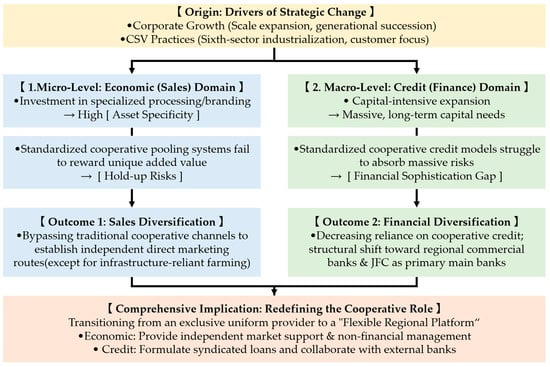
Despite the global recognition of member heterogeneity and the theoretical insights from transaction cost economics, empirical research has rarely evaluated how these forces operate asymmetrically across different cooperative business domains. To address this gap, the primary objective of this study is to empirically test Hypothesis 1 and provide descriptive evidence consistent with Hypothesis 2 by comparing the transactional behaviors of agricultural corporations in both economic (sales) and credit (financial) businesses. By employing a mixed-level complementary approach—utilizing micro-level individual survey data to analyze behavioral determinants in sales channel selection, and macro-level national survey data to illustrate compositional differences in financial partnerships across scale groups—this study aims to provide a comprehensive understanding of how CSV practices and organizational growth reshape cooperative–corporate relationships. Figure 1 illustrates the conceptual framework of this study, demonstrating how corporate growth and CSV practices are associated with asymmetric transactional patterns in cooperative–corporate relationships across the economic and credit domains.
Figure 1.
Hypothesized conceptual framework of the asymmetric transactional patterns in cooperative–corporate relationships across economic and credit domains associated with CSV practices and organizational growth. Source: elaborated by the author. Note: in this diagram, distinct background colors are used to clarify the different analytical domains. The origin and comprehensive implications (top and bottom sections) are highlighted in warm colors (e.g., beige/orange) to represent shared structural drivers and integrated cooperative strategies. The micro-level economic (sales) domain on the left is shaded in blue, illustrating individual corporate behaviors and differentiation strategies. The macro-level credit (finance) domain on the right is shaded in green, reflecting industry-wide scale-based differences and capital requirements. Arrows indicate the logical flow from the driving forces to the asymmetric transactional outcomes, culminating in the necessity of redefining the institutional role of agricultural cooperatives.
4. Methods
4.1. Data Sources and the Mixed-Level Approach
This study employs a mixed-level complementary approach to capture the multidimensional nature of cooperative–corporate relationships. Because no single database in Japan simultaneously tracks both the individual marketing strategies (CSV practices) and the comprehensive financial portfolios of agricultural corporations, we utilized independent yet complementary datasets (Table 1). While this prevents a direct firm-level matching of the datasets, meaning that behavioral changes cannot be tracked as longitudinal shifts within the exact same enterprises, it serves as a complementary approach that allows us to explore the micro-level behavioral determinants of economic transactions alongside the macro-level compositional differences in credit transactions across scale groups.
Table 1.
Overview of Questionnaire Survey Data Used in This Study.
4.2. Micro-Level Analysis: Economic Transactions
To examine the behavioral determinants of sales channel selection (economic transactions), we conducted an original mail- and web-based questionnaire survey targeting 2073 management entities listed by the Japan Agricultural Corporations Association (hereinafter referred to as the “Corporations Association”) as of December 2021. The survey, fundamentally focused on the relationship between corporate philosophy (e.g., CSV practices) and management behavior, was administered between January and April 2022, yielding 539 valid responses (a response rate of 26.0%).
We employed a logistic regression analysis to test Hypothesis 1. The dependent variable was binary, indicating whether JA was the primary sales destination (coded as 1 for ‘JA-primary’ and 0 for ‘non-JA’). Independent variables included management attributes, corporate philosophy objectives (e.g., customer satisfaction vs. farmland maintenance), and CSV-related indicators such as the sixth-sector industrialization sales ratio. (Note: The 6th-sector sales ratio is measured on an ordinal scale from 1 = 0% to 7 = ≧ 50%, representing the proportion of processed and direct-marketed sales in total revenue).
To address potential methodological concerns, several clarifications are necessary. First, out of the 539 valid questionnaire responses collected, 47 observations with missing values across the analyzed variables were excluded via listwise deletion, resulting in a final analytical sample of N = 492. Independent mean-difference and chi-square tests were conducted between the 492 analyzed enterprises and the 47 excluded observations. While this comparison shows only that no statistically significant differences were found in the examined characteristics (primary farming types, manager age, and JA sales orientation) between these two groups—and does not provide information regarding enterprises that did not participate in the survey at all—it indicates that item non-response among participants did not substantially alter the sample composition. Second, while some explanatory variables derived from questionnaire categories (e.g., sales scale brackets: 1 = <30M JPY to 5 = ≧ 300M JPY; employee counts: 1 = 1–2 persons to 8 = ≧ 51 persons) are ordinal, they were treated as continuous variables in the regression. Although this assumes equal intervals between categories, it is an accepted approximation in exploratory behavioral studies to simplify the model and interpret the general direction of effects. Finally, a backward elimination procedure was utilized. This strategy was chosen not to mine for significance, but as an exploratory technique to isolate the most robust determinants while retaining our core theoretically driven variables(the results of the initial full model prior to backward elimination are presented in Appendix A, Table A1).
4.3. Macro-Level Analysis: Credit Transactions
For the analysis of credit business transactions (Hypothesis 2), we utilized national-level cross-tabulation data from the “2022 National Survey on the Actual Conditions of Agricultural Corporations” conducted by the Corporations Association. Administered between October 2022 and February 2023, this survey targeted 2068 corporate members and collected 1412 valid responses (a response rate of 68.3%).
The analytical approach for this dataset consisted of cross-tabulating corporate management attributes (e.g., farming type and sales scale) against the types of financial institutions with which the corporations conducted general transactions or maintained “deep relationships.” In this context, a “deep relationship” is defined as a primary banking partnership wherein the financial institution serves as the main source of long-term funding or the principal advisor for corporate management and business planning. Because the survey permitted multiple responses for both general transactions and deep relationships, respondents could designate more than one financial institution as a primary financial partner; consequently, the category percentages sum to more than 100%.
In the Japanese agribusiness context, prior literature suggests that scale expansion is frequently accompanied by the succession of management resources and business transfers, which can increase the need for objective corporate valuation and complex financing [15]. Although this macro-level dataset does not directly measure succession indicators, the cross-tabulation visualizes how the composition of financial reliance differs across corporate scale groups—comparing traditional cooperative credit with external commercial banks.
5. Results
5.1. Economic Transactions: Micro-Level Logistic Regression Analysis
Table 2 presents the descriptive statistics of the valid respondents from the economic business survey. (Note that while the initial valid responses were 539, the final regression analysis in Table 3 utilized 492 observations due to missing values). Regarding manager age, respondents in their 60s accounted for the largest proportion, while rice farming (32.8%) and livestock farming (17.8%) constituted the predominant farming types. The average years since establishment was 21.6 years. In terms of management scale, the average sales category was 3.6 (corresponding to 50 to 100 million JPY), and the average number of employees fell into category 3.6 (5 to 10 employees). The average sixth-sector industrialization sales ratio was 2.8 (0 to less than 10%). Overall, approximately 30% of the corporations reported JA as their primary sales destination, with higher proportions observed among rice and livestock farming corporations.
Table 2.
Overview of Respondents Regarding Economic Business.
Table 3.
Logistic Regression Results for Primary Sales Destination (Economic Business).
To identify the behavioral determinants of relying on JA for sales, a logistic regression analysis was conducted (Table 3). As detailed in the Section 4, the final model utilized 492 observations due to missing values in some explanatory variables, with no significant differences found in the examined characteristics between the analyzed sample and the 47 excluded cases. The overall model is statistically significant (Model χ2 = 70.64, p < 0.01), and the McFadden Pseudo-R2 is 0.1155.
The results indicate that farming type significantly influences sales channel choice. Rice and livestock farming are positively associated with JA as the primary sales destination (p = 0.001 and p = 0.074, respectively), reflecting dependence on shared regional infrastructure such as country elevators. Conversely, a statistically significant negative relationship was found between the probability that JA is the primary sales channel and the combined indicator for processing and direct sales (sixth-sector industrialization ratio, p < 0.001), the number of employees (p = 0.007), and prioritizing customer satisfaction (p = 0.015). Because direct sales form part of the sixth-sector industrialization indicator while the dependent variable indicates whether JA is the main sales channel, this negative relationship cannot in itself be taken as direct confirmation that product specificity leads enterprises to bypass the cooperative.
5.2. Credit Transactions: Macro-Level Cross-Tabulation Analysis
Moving to the macro-level analysis of credit transactions, the Corporations Association dataset (N = 1412) provides insights into the compositional differences in financial partnerships across management scales. The average sales amount of the respondents was 380 million JPY, with crop farming accounting for 81.1% and livestock for 18.9%. Table 4 illustrates the financial institutions that corporate farmers conduct transactions with (General Transactions) and those they consider their primary banking partners (Deep Relationships), stratified by sales scale.
Table 4.
Financial Institutions with General Transactions and Deep Relationships by Sales Scale (Multiple Responses, N = 1412).
As shown in Table 4, the composition of financial partners differs markedly across corporate scale groups. Specifically, the share of corporations naming JA among the institutions with “deep relationships” is 67.6% in the smallest group (sales up to 70 million JPY), 55.3% in the intermediate group (70–300 million JPY), and 25.2% in the largest group (exceeding 300 million JPY). Conversely, the shares naming Regional Banks (38.1%, 49.3%, and 71.3%, respectively) and the JFC (40.2%, 55.9%, and 63.1%, respectively) are higher in the larger-scale groups. Because respondents could name multiple financial institutions, these shares do not show whether one bank replaced another or the size of the funding provided by each institution. Nevertheless, a shortage of financial capacity on the part of the cooperative (a financial sophistication gap) and a gradual shift toward commercial banks and government financial institutions serve as possible explanations for these observed differences across scale groups.
6. Discussion
6.1. Economic Transactions: Asset Specificity, Hold-Up Risks, and CSV Practices Through Hybrid Organizations
The empirical findings from the micro-level logistic regression analysis (Table 3) provide detailed insights into how agricultural corporations approach their sales transactions with agricultural cooperatives (JA). Specifically, while rice and livestock farming corporations exhibit a positive association with utilizing JA as a primary sales destination, higher sixth-sector industrialization ratios, larger employee counts, and a management focus on customer satisfaction are negatively associated with primary JA sales reliance.
To interpret these results in relation to the study’s core focus on CSV, these behavioral patterns can be contextualized through the nature of modern agricultural corporations as hybrid organizations [14]. In the literature, advanced agricultural corporations engaging in sixth-sector industrialization and prioritizing customer satisfaction are often described as seeking not only private economic profits, but also to fulfill a public role by providing safe, traceable food and maintaining regional agricultural landscapes [13]. However, because our survey does not directly measure public value outcomes such as food safety or traceability, this interpretation is presented as a possible explanation rather than a conclusion drawn directly from the survey; while the share of processing and direct sales serves to describe these business activities, it is not a direct indicator of created public value. From the perspective of transaction cost economics, investing in specialized processing and branding strategies may generate high asset specificity and potential hold-up risks [5,6]. A possible explanation for the negative association with JA sales reliance is that because traditional JA marketing channels are organized around standardized “pooling” systems designed for homogeneous commodities, the specific value of differentiated products may not be fully rewarded within averaged payout structures. Although our survey does not contain data on prices obtained or specific sales conditions, this theoretical mechanism offers a plausible explanation for why corporations pursuing differentiation strategies may establish independent sales channels to internalize downstream margins, reflecting broader international observations regarding member heterogeneity within multipurpose cooperatives [2].
Conversely, the positive association observed for rice and livestock farming suggests that the utilization of shared regional infrastructure—such as country elevators for rice and established quality-control distribution networks for livestock—remains a practical choice for these sectors. This infrastructure reliance helps mitigate operational risks and aligns with regional maintenance objectives [18,19,20], allowing JA to retain transactional ties where collective asset sharing outweighs the incentives for independent integration.
6.2. Credit Transactions: Scale Expansion, Generational Succession, and Financial Sophistication
In the credit domain, the macro-level cross-tabulation analysis (Table 4) demonstrates that transactional patterns are closely related to management scale and structural complexity rather than differentiation strategies alone. As agricultural corporations expand their sales scale and engage in capital-intensive operations—a process that may be related to generational succession, business reorganization, and management resource transfers [15]—their capital requirements increase substantially.
This structural tendency aligns with the concept of a financial sophistication gap in the agricultural finance literature [7]. While JA excels in relationship banking rooted in local mutual trust, its standardized credit models, which were originally designed for more homogeneous and smaller-scale members, may encounter structural limitations in absorbing the large-scale, long-term financing needs and complex risk profiles of industrializing, succession-oriented farms [17]. Although our macro-level credit data does not directly measure succession indicators, this suggests a plausible mechanism where regional banks and government financial institutions are generally better equipped to handle objective corporate valuations. Consequently, as corporations scale up and institutionalize their operations, their financial partnerships show a stronger tendency to diversify toward regional commercial banks and government financial institutions, such as the JFC, which possess specialized expertise in objective corporate credit evaluation and structured financing [16,21,22,23]. Specifically, while JA focuses on local relationship banking, regional commercial banks offer comprehensive corporate financial services, and JFC provides long-term, low-interest policy loans tailored for agricultural expansion. This pattern reflects similar challenges documented in the broader cooperative literature regarding the difficulty of adapting financial services to evolving member needs [24].
6.3. Implications for Cooperative Management and Institutional Roles in Supporting CSV
Taken together, the findings from both business domains illustrate that the transactional relationships between agricultural corporations and JA are shaped differently across economic and credit operations. While economic sales reliance is associated with farming type and CSV-driven differentiation strategies, credit reliance is closely linked to operational scale and succession dynamics.
These observed patterns suggest that traditional agricultural cooperatives face institutional challenges in accommodating the diverse needs of professionalized corporate members who act as CSV practitioners. To maintain functional relevance in regional agriculture and effectively support sustainable agricultural management, cooperatives may need to evolve their service portfolios.
Specifically, to operationalize this institutional transition, cooperatives should move beyond standardized service provision and develop more flexible, member-oriented support systems. In credit operations, rather than acting as the sole financial provider for large-scale corporations, cooperatives could strengthen collaborative financing arrangements with regional commercial banks and public financial institutions such as the JFC. Such collaboration would enable risk sharing while addressing increasingly sophisticated financing needs. In economic operations, cooperatives could enhance customized non-financial services, including support for market development, business succession, M&A-related coordination, and regional resource management. By complementing rather than replacing the strategic activities of advanced agricultural corporations, cooperatives may better accommodate growing member heterogeneity and maintain their institutional relevance within regional agricultural systems.
7. Conclusions and Future Directions
This study examined the transactional patterns between agricultural corporations and agricultural cooperatives in Japan across economic and credit domains, utilizing a mixed-level approach to address the complexities of cooperative–corporate interactions.
Addressing the overarching research question regarding how CSV practices and organizational growth relate to business relationships, the findings indicate distinct behavioral and structural patterns: (1) in economic transactions, rice and livestock farming corporations exhibit a positive association with JA as a primary sales destination, whereas higher sixth-sector industrialization ratios, larger employee counts, and a customer satisfaction focus show negative associations with primary JA sales reliance; and (2) in credit transactions, reliance on JA tends to decrease as management scale expands, with larger agricultural corporations demonstrating higher proportions of transactions and deep relationships with regional commercial banks and government financial institutions.
These observed patterns suggest that multi-purpose agricultural cooperatives face institutional challenges and governance tensions as member heterogeneity increases. While shared regional infrastructure helps maintain economic ties in specific farming types, advanced corporate strategies and scale expansion are associated with a diversification of marketing and financial partnerships away from traditional cooperative channels.
Finally, several limitations of this study should be noted. First, because the empirical analysis relies on independent cross-sectional datasets, firm-level matching between marketing strategies and financial portfolios was not possible, precluding definitive longitudinal causal inference regarding structural shifts over time. Consequently, the findings describe aggregate industry patterns and behavioral correlates rather than deterministic trajectories. Second, the sixth-sector industrialization indicator inherently includes direct-sales revenue, which introduces a degree of definitional overlap (endogeneity) when analyzing the avoidance of cooperative sales channels. Third, the sample predominantly consists of members of the Japan Agricultural Corporations Association, representing a relatively elite, large-scale segment of Japanese agribusiness, which requires caution when generalizing the findings. Future research should prioritize utilizing panel data to track individual firm evolution over time and expand the scope to include other cooperative business domains, thereby providing a more comprehensive understanding of cooperative–corporate dynamics.
Funding
This work was supported by MAFF (PRIMAFF) Research with Collaboration Scheme: contracting research on policy for agriculture, forestry and fisheries, Grant Number JPJ009417; and by the Japan Society for the Promotion of Science (JSPS) KAKENHI, Grant Number 24K17979.
Institutional Review Board Statement
Ethical review and approval were waived for this study, as the research is based on a corporate questionnaire survey and does not involve clinical trials or the collection of highly sensitive personal human data.
Data Availability Statement
The data presented in this study are not publicly available due to privacy and licensing restrictions. The micro-level survey data contain confidential corporate information and cannot be shared to protect respondent privacy. The macro-level cross-tabulation data were obtained from the Japan Agricultural Corporations Association through a paid service under license for this study and cannot be distributed to third parties.
Acknowledgments
During the preparation of this manuscript, the author used Google Gemini (Advanced version) for the purposes of assisting with data analysis, translating the Japanese draft into English, and language polishing. The author has thoroughly reviewed, verified, and manually edited all outputs and takes full responsibility for the content of this publication.
Conflicts of Interest
The author declares no conflicts of interest. The funders had no role in the design of the study; in the collection, analyses, or interpretation of data; in the writing of the manuscript; or in the decision to publish the results.
Abbreviations
The following abbreviations are used in this manuscript:
| JA | Japan Agricultural Cooperatives (General Agricultural Cooperatives) |
| CSV | Creating Shared Value |
| JFC | Japan Finance Corporation |
| M&A | Mergers and Acquisitions |
| JPY | Japanese Yen |
Appendix A
Full Logistic Regression Model Prior to Backward Elimination
It is important to note explicitly that the full model in Table A1 uses 362 observations due to missing values in the financial variables, whereas the final model in Table 3 uses 492 observations. Because this change in sample size makes direct comparison between the two models difficult, the differences between them cannot be attributed solely to the choice of variables. For instance, in Table A1, the number of employees (p = 0.169) and the farming type indicators no longer have a statistically significant relationship with the dependent variable. Nevertheless, the negative associations for the sixth-sector sales ratio (p < 0.001) and the customer-satisfaction objective (p = 0.018) remain statistically significant in the full model shown, indicating that the relationships for these two variables are retained across both specifications.
Table A1.
Full Logistic Regression Results for Primary Sales Destination (Before Elimination).
References
- Xu, T.; O’Shaughnessy, M.; Olmedo, L. The role of agricultural co-operatives in promoting sustainable development in rural areas: A systematic literature review. J. Co-Oper. Stud. 2025, 58, 5–20. [Google Scholar] [CrossRef] [Scilit]
- Bijman, J.; Iliopoulos, C.; Poppe, K.J.; Gijselinckx, C.; Hagedorn, K.; Hanisch, M.; Hendrikse, G.W.J.; Kühl, R.; Ollila, P.; Pyykkönen, P.; et al. Support for Farmers’ Cooperatives; Wageningen University & Research: Wageningen, The Netherlands, 2012. [Google Scholar]
- Bennison, L.; Williamson, A.K.; Chapple, E.L. How accountability of Australian farmer co-operative members hinges on the farm gate. J. Co-Oper. Stud. 2024, 57, 24–38. [Google Scholar] [CrossRef] [Scilit]
- Höhler, J.; Kühl, R. Dimensions of member heterogeneity in cooperatives and their impact on organization—A literature review. Ann. Public Coop. Econ. 2018, 89, 697–712. [Google Scholar] [CrossRef] [Scilit]
- Cook, M.L. The future of U.S. agricultural cooperatives: A neo-institutional approach. Am. J. Agric. Econ. 1995, 77, 1153–1159. [Google Scholar] [CrossRef] [Scilit]
- Hendrikse, G.W.; Bijman, J. Ownership structure in agrifood chains: The marketing cooperative. Am. J. Agric. Econ. 2002, 84, 104–119. [Google Scholar] [CrossRef] [Scilit]
- Briggeman, B.C.; Gunderson, M.A.; Gloy, B.A. The evolution of agricultural lending: The role of the Farm Credit System and commercial banks. Choices 2012, 27, 1–6. [Google Scholar]
- Kobayashi, K.; Koyama, S. Questioning JA Reforms from Hokkaido; Tsukuba Shobo: Tokyo, Japan, 2019. (In Japanese) [Google Scholar]
- House of Representatives Research Bureau. Views of Experts on JA and Agricultural Committee Reforms. 2015; (In Japanese). Available online: https://www.shugiin.go.jp/internet/itdb_rchome.nsf/html/rchome/Shiryo/nousui_201503_kaikakukankeikenkaisyu.pdf (accessed on 1 October 2026).
- Morozumi, K. From Merger to Network: Challenges of JA Reform; Norin Tokei Shuppan: Tokyo, Japan, 2022. (In Japanese) [Google Scholar]
- Wang, B.; Cheng, P.-Y.; Lee, B.; Sun, L.-C.; Chang, H.-H. Does Participation in Agricultural Cooperatives Affect Farm Sustainability? Empirical Evidence from Taiwan. Sustainability 2019, 11, 4987. [Google Scholar] [CrossRef] [Scilit]
- Kurimoto, A. Agricultural Cooperatives in Japan: An Institutional Approach. J. Rural Coop. 2004, 32, 111–128. [Google Scholar] [CrossRef]
- Yoshida, S. Theory of creating shared value and a case study on farm management. J. Farm Manag. Econ. 2025, 63, 14–26. (In Japanese) [Google Scholar]
- Tsuchiya, S. A Study of Agricultural Cooperatives and Agricultural Corporation from the Viewpoint of Management Strategy: New Concepts and Institutions to Capture the Farming Entity. J. Grad. Sch. Bus. Adm. 2013, 17, 23–41. (In Japanese) [Google Scholar]
- Inuta, T. M&A Initiatives and Management Growth in Agricultural Corporations: Results of Questionnaire Survey of Agricultural Corporations. Jpn. J. Farm Manag. 2023, 61, 24–35. (In Japanese) [Google Scholar] [CrossRef]
- Inuta, T. The structural dilemma of CSV-oriented corporate farms and the role of financial institutions: An empirical study on the determinants of M&A execution in Japan. Adm. Sci. 2026, 16, 452. [Google Scholar] [CrossRef] [Scilit]
- Yokomizo, I. An Analysis of Financial Management of Agricultural Co-operative for Livestock Farms: A Case Study on Increasing Uncollectable Debts of Beef Production Farms. J. Rural Probl. 1987, 23, 115–126. (In Japanese) [Google Scholar] [CrossRef] [Scilit]
- Araki, K.; Maezawa, S. A Study on Relationship between Sales Business of Japan Agricultural Cooperatives and Agricultural Corporation: A Case Study of Shimomiya Ward, Kobe Town, Gifu Prefecture. J. Rural Food Econ. 2019, 65, 29–35. (In Japanese) [Google Scholar]
- Narita, T. Challenges and responses of sales business in general JA. In Organization and Business of Agricultural Cooperatives and Their Development Direction; Noguchi, T., Sou, B., Eds.; Tsukuba Shobo: Tokyo, Japan, 2023; pp. 193–216. (In Japanese) [Google Scholar]
- Togashi, H. The Present Situation and Innovative Direction of Network System between Farmers’ Intermediate Organizations and Agricultural Economic Business of Agricultural Co- operative: A Case Study of Sagae -Nishimurayama Agricultural Co- operative in Yamagata Prefecture. J. CO-Oper. Stud. 2010, 29, 138–152. (In Japanese) [Google Scholar]
- Hasegawa, K. The Evolution and New Trends in Agricultural Lending by Regional Banks, as Seen in Case Studies. Mon. Rev. Agric. For. Fish. Finance 2016, 69, 2–16. (In Japanese) [Google Scholar]
- Inuta, T. Actual conditions and factors of entry into agricultural finance by regional banks. Yucho Asset Manag. Res. 2024, 31, 131–169. (In Japanese) [Google Scholar]
- Inuta, T.; Sato, J.; Arai, S.; Yamazaki, M. Recent Developments in Agricultural Finance by Regional Banks. Jpn. J. Farm Manag. 2025, 63, 46–52. (In Japanese) [Google Scholar] [CrossRef]
- Money, N.; McCarthy, O.; Jones, P.A.; Byrne, N. Understanding business models in the context of Irish credit union transformation. J. Co-Oper. Stud. 2023, 56, 23–34. [Google Scholar] [CrossRef] [Scilit]

Disclaimer/Publisher’s Note: The statements, opinions and data contained in all publications are solely those of the individual author(s) and contributor(s) and not of MDPI and/or the editor(s). MDPI and/or the editor(s) disclaim responsibility for any injury to people or property resulting from any ideas, methods, instructions or products referred to in the content. |
© 2026 by the author. Licensee MDPI, Basel, Switzerland. This article is an open access article distributed under the terms and conditions of the Creative Commons Attribution (CC BY) license.