


Abstract
Commercial peach orchards in the humid southeastern U.S. are typically managed with annual mineral fertilization, raising concerns about nutrient losses and soil degradation. The objective of this study was to determine whether annual food waste compost (FWC) applications can sustain tree nutrition and productivity while improving soil organic matter and fertility in two mature peach orchards (replanted and virgin). Trees received top-dressed annual applications of either (1) 19-19-19 chemical fertilizer at grower-standard rates (Control; mineral fertilizer reference treatment); (2) 11,209 kg ha−1 FWC plus 20% of the chemical fertilizer rate (Compost 1x); or (3) 22,417 kg ha−1 FWC without supplemental chemical fertilizer (Compost 2x). Seasonal changes in soil chemistry at 0–15 cm were monitored, and the impacts of FWC on mid-summer leaf and fruit nutrient status, tree growth parameters, and yield were evaluated. Across orchards, FWC increased soil organic matter and cation exchange capacity and maintained leaf nutrient concentrations. Compost 2x consistently increased soil phosphorus and exchangeable calcium and magnesium (more than 2-fold), and increased trunk cross-sectional area (16–21%) and tree height (7–8%) in the virgin orchard, compared to the control treatment. Annual yields did not differ statistically among treatments in either orchard, although Compost 2x consistently showed numerically higher cumulative yields than other treatments. Overall, annual FWC, particularly Compost 2x, improved soil chemical fertility and maintained tree performance with reduced or eliminated chemical fertilizer inputs, supporting circular nutrient management strategies for peach production in regions with warm, humid climates.
1. Introduction
Conventional orchards are high-input production systems, too often receiving excessive fertilization, which reduces soil life and health [1]. Organic matter (OM) amendments, such as compost, mulch, and biochar, have been reported as ecologically suitable and potential ingredients for restoring and enhancing soil OM pools with many benefits within ecosystem services [2,3], including the slow-release of macro- and micronutrients, and the stimulation of microbial processes that influence nutrient mineralization and availability [4,5]. Specifically, consistent increases in soil organic carbon, total nitrogen (N), plant-available phosphorus (P), and potassium (K), as well as the improvement of soil physical properties such as soil structure, soil aggregate stability, soil bulk density, and water-holding capacity across diverse ecosystems, in response to compost application, have been reported [6,7,8,9,10]. The increased cation exchange capacity (CEC) and microbial biomass resulting from compost application enhanced the soil capacity to retain and increase the availability of macro- and micronutrients [11,12,13] and improved tree performance and fruit quality [14,15,16,17,18].
In stone fruit crops, the beneficial effects of OM amendments, such as growth improvement, yield, and fruit quality enhancement in response to different sources and application methods, have been reported [19,20,21,22,23], and can even replace mineral fertilization [24,25,26]. Nevertheless, contradictory reports regarding these benefits in different species, tree ages, and with different source types and application methods show the complexity of these studies [27]; for instance, a sufficient supply of N has been reported in figs receiving manure application [28,29], but decreased leaf N has been seen in apple orchards under bark mulch application [30]. Therefore, more in-depth studies on the overall impact of OM amendment on soil health [31,32] and tree performance [33] are still required to deepen our understanding of orchard-based sustainable nutrient management for crop yield and productivity, especially in warm and humid climates.
In this context, changes in soil quality, tree nutrition, water status, and performance of two young peach orchards were evaluated during tree establishment in response to food waste compost (FWC) [26], but there is no information on the performance of mature orchards. The present study aims to assess the impact of annual topical applications of FWC on soil chemistry and tree nutritional status, tree physiological properties, and horticultural performance of two mature orchards (replanted and virgin) in a warm and humid climate. We hypothesized that FWC would increase soil OM and plant-available nutrients, thus enhancing crop resiliency, yield, and fruit quality during the most productive years of the orchard, supporting long-term orchard productivity and environmental sustainability.
2. Materials and Methods
2.1. Experimental Site, Design and Treatments
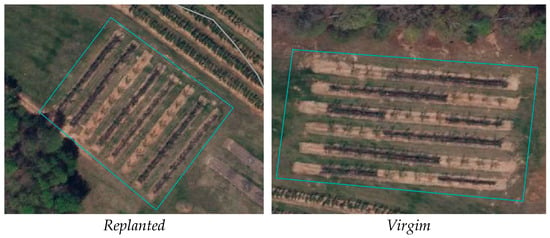
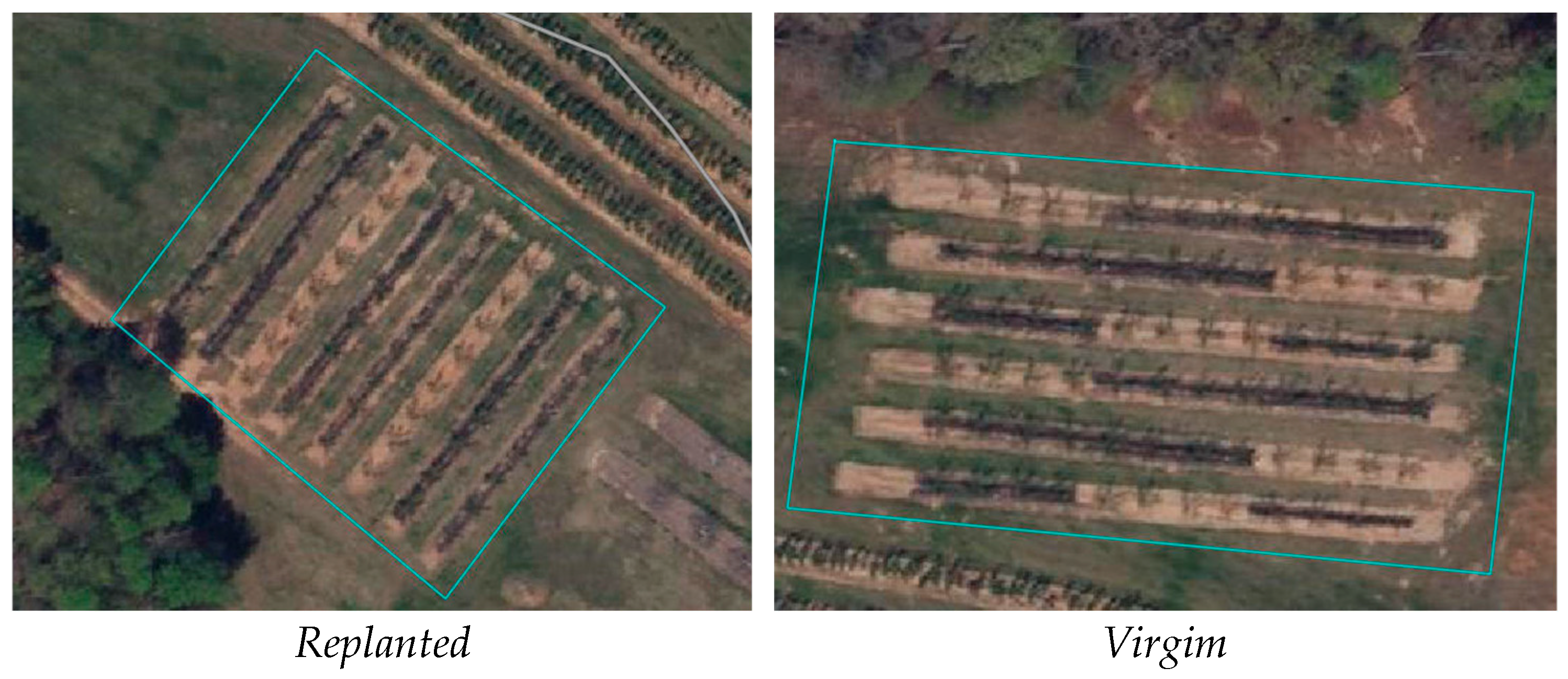
This study was conducted on two five-year-old (at the beginning of the study) peach orchards (replanted and virgin) at Clemson University Musser Fruit Research Center, Seneca, South Carolina, between Fall 2022 and Fall 2025. Peach trees (Prunus persica L. (Batsch) ‘Cresthaven’) grafted onto Guardian® rootstock, planted on berms at a planting density of 4.9 by 6.7 m and trained as an open vase, were used. The replanted site had been used for peach cultivation under commercial management practices for more than 20 years, while the virgin site had never been used for any agricultural crop (Figure 1). The soil was classified as Cecil sandy loam, with 52% sand, 18% silt, and 30% clay on moderate to highly eroded land with 15 to 30% slopes [34].
Figure 1.
Aerial photos of the replanted (left) and virgin (right) orchard.
Three treatments, including Control at grower standard rates of chemical fertilizer and two rates of FWC—Compost 1x and Compost 2x—were used in this study. The control treatment (19-19-19, i.e., 19% N, 19% P2O5, 19% K2O by mass) was a chemical fertilizer reference treatment and was applied at 100% grower standard rates as recommended for commercial peach orchards in the Southeastern region of the USA [35]. Compost 1x (11,209 kg ha−1) was applied as a follow-up to the base application of 20% chemical fertilizer (19-19-19), and Compost 2x (22,417 kg ha−1) was applied as a standalone treatment. The treatments were not designed to provide an equal nutrient input, as the compost chemical characteristics could change every year. The replanted orchard had eight trees per row and per treatment, replicated twice in a completely randomized design with rows as the experimental unit. In contrast, the virgin orchard had four trees per treatment in each row, replicated six times in a randomized complete block design with rows as blocks and row sections as the experimental unit. All treatments were topically applied annually in the Spring of 2023, 2024, and 2025 using a pre-calibrated Vicon Pendulum spreader (VICON PS403VITI, Kverneland group, Klepp Stasjon, Norway) for chemical fertilizer applications and a Millcreek row mulcher (304RM, Millcreek, Honey Brook, PA, USA) for compost application. All other management practices, including pruning, thinning, and crop load management, and herbicides/pesticide application during this study, were done according to the commercial recommendations and guidelines for peach growers in the Southeastern USA [35].
2.2. Compost Description, Soil Sampling, and Analysis
The food waste compost used in this study was obtained as a finished product from the Clemson University Cherry Crossing Research Center. Prior to compost application each year, the FWC was analyzed for its nutrient composition and concentration. Analysis of the compost used in this study, prior to tree fertilization, showed a carbon concentration of 31–34% and a C:N ratio of 11.9–12.5%. Other chemical characteristics of the compost can be found in Table A1 (Appendix A).
A composite soil sample per experimental unit across each treatment row as a replicate was collected at 15 cm deep between trees (on top and sides of the berms) from both orchards. Samples were randomly collected in April 2023, 2024, and 2025 (prior to fertilizer application) and in October 2023 and 2024 to evaluate and keep track of seasonal changes in the soil nutritional status.
Compost and soil samples were analyzed at the Clemson University Agricultural Service Laboratory. Total nitrates were analyzed using an Ammonia-Nitrate analyzer (Timberline, Boulder, CO, USA) after extracting them with 2 M KCl. Mineral element concentrations were extracted using the Mehlich-1 method and analyzed with inductively coupled plasma mass spectrometry. Furthermore, other soil indicators were analyzed, including OM concentration (loss on ignition method), CEC and percent base saturation (calculated from the Melich-1 extractable bases), and acidity (pH).
2.3. Tissue Nutrient Analysis and Horticultural Assessment
Annually, tree nutritional status, tree cross-sectional area (TCSA), canopy formation area (CFA), yield, and average fruit weight were measured. TCSA of all data trees within the experimental unit was assessed using the yearly measurement of the trunk girth (diameter) at an average of 20 cm above the graft union during tree dormancy in late Fall of 2023 and 2024 [36]. Additionally, CFA (m3) was measured during the same period and calculated as πd2h/2 [37], with canopy diameter (“d”, m) being determined by averaging the perpendicular length of the extended shoot from one end of the tree leaf canopy to the other, across the rows and between the alleys, and canopy height (“h”, m) determined by measuring the distance between the extended tip of the tallest shoot and the lowest canopy branch using a pre-calibrated PVC pipe.
Furthermore, four and two middle trees from each experimental unit in the replanted and the virgin orchards, respectively, were selected as data trees and used for all evaluations in this study. In July 2023, 2024, and 2025, 25 fully expanded leaves per tree were sampled from the 4th to 7th nodes away from the apical shoots around the trees and bulked into one sample per experimental unit. Leaves were briefly washed in double-deionized water for 10 s and air-dried for 3–5 min, bagged, and oven-dried at 70 °C to a constant weight and ground to powder. Leaf total nitrogen was analyzed using a combustion method on an FP528 Nitrogen Combustion Analyzer (LECO Corporation, St Joseph, MI, USA), while other minerals, including P, K, calcium (Ca), magnesium (Mg), zinc (Zn), manganese (Mn), copper (Cu), Iron (Fe), boron (B), and sodium (Na), were analyzed using wet ashing procedures [38,39,40] and measured with a flame atomic absorption spectrometer (PinAAcle 500, Perkin Elmer, Shelton, CT, USA) [41].
Fruit was harvested, and yield per tree within each experimental unit and section block in both orchards was recorded. The average fruit weight per tree was calculated by dividing the weight of 20 randomly picked, commercially ripe fruits. Samples of five representative fruits per tree from each experimental unit were selected, and two mesocarp cuts, each from either side of each fruit cheek, were placed in a plastic clamshell and oven-dried at 70 °C to a constant weight. These samples were ground into powder and used for Ca, K, and Mg analysis following the same protocol as for leaves.
2.4. Statistical Analysis
Consequent to the differences in experimental design, both orchards were analyzed independently using treatments (Compost 1x, Compost 2x, and Control) and years as factors. When necessary, repeated measurements along the growing season, such as changes in soil parameters (e.g., soil macronutrients, OM and CEC), were transformed and analyzed using Repeated-Measures Analysis of Variance (ANOVA) with treatments and time as the fixed effects, and replicates and their interaction with treatments and with time as the random effect. When the fixed effect was significant (p ≤ 0.05), means were separated by the “Student’s t-test” of difference in both orchards. Upon detection of possible violation of the assumption of normality through Shapiro–Wilk and Anderson–Darling “Goodness-of-Fit” tests, the yield data from both orchards were transformed using the square root function and analyzed using ANOVA with treatments as a fixed effect and replication as the random effect. Similarly, leaf and fruit mesocarp macronutrient concentrations (% DW) from both orchards were analyzed independently using ANOVA with treatment as a fixed effect and reps as a random effect. When necessary, tissue data were transformed using the arcsine square root function. All parameter measures in this study were statistically analyzed using the 2025 student version of JMP Pro 18 (SAS, Cary, NC, USA). The authors have not used generative artificial intelligence to generate text, data, graphics, or to assist in study design, data collection, analysis, or interpretation.
3. Results
3.1. Changes in Soil pH, OM, CEC and Macronutrient Concentration
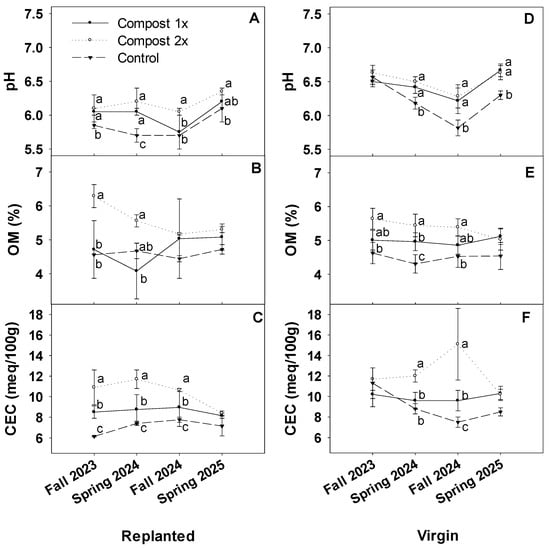
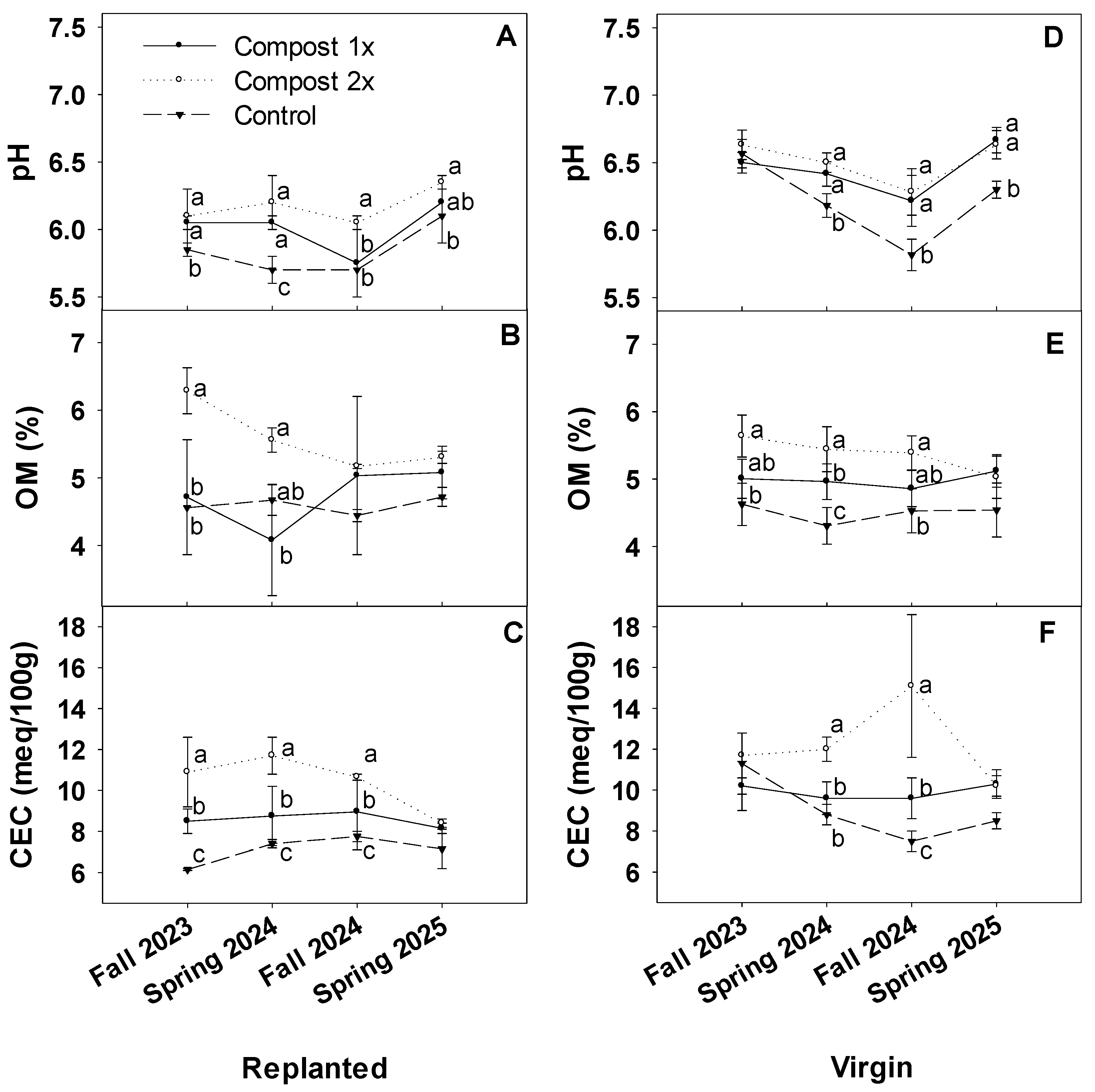
Soil pH was within the acidic range of 5.6 to 6.7, ideal for peach trees (Figure 2A,D), with FWC treatments increasing the pH compared to the control treatment. In the replant orchard, soil in the Compost 2x treatment had higher pH than in the control treatment throughout the study, with Compost 1x being similar to Compost 2x for most of the study. In the virgin orchard, both Compost 1x and 2x had higher soil pH than the control treatment for all samplings in 2024 and 2025. Similarly, soil OM content of both FWC treatments tended to be higher than that of the control treatment, although it was not consistent over time (Figure 2B,E). Specifically, in the replanted orchard, the interaction between the treatments and sampling time resulted in higher OM in Compost 2x compared to Control in Fall 2023 and Spring 2024, but there were no differences in Fall 2024 and Spring 2025. However, in the virgin orchard, soil OM of Compost 2x was consistently higher across sampling times compared to Control (p = 0.038). Compost 1x had a similar OM as the unamended Control in both orchards. Additionally, FWC treatments had higher CEC than the control treatment across all orchards (p = 0.002 and p = 0.045 for replanted and virgin orchards, respectively), with the exception of Spring 2025 for the replanted orchard and Fall 2023 for the virgin orchard (Figure 2C,F).
Figure 2.
Effect of soil amendments (Control, Compost 1x and Compost 2x) on pH (A,D), organic matter (OM, %; (B,E)), and cation exchange capacity (CEC, meq/100 g; (C,F)) at a replanted and a virgin peach orchard. For each date, different letters indicate significantly different treatments (p ≤ 0.05).
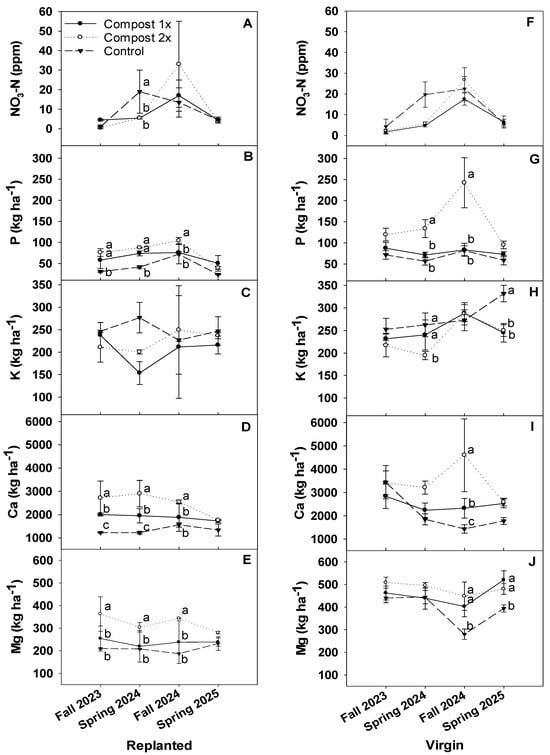
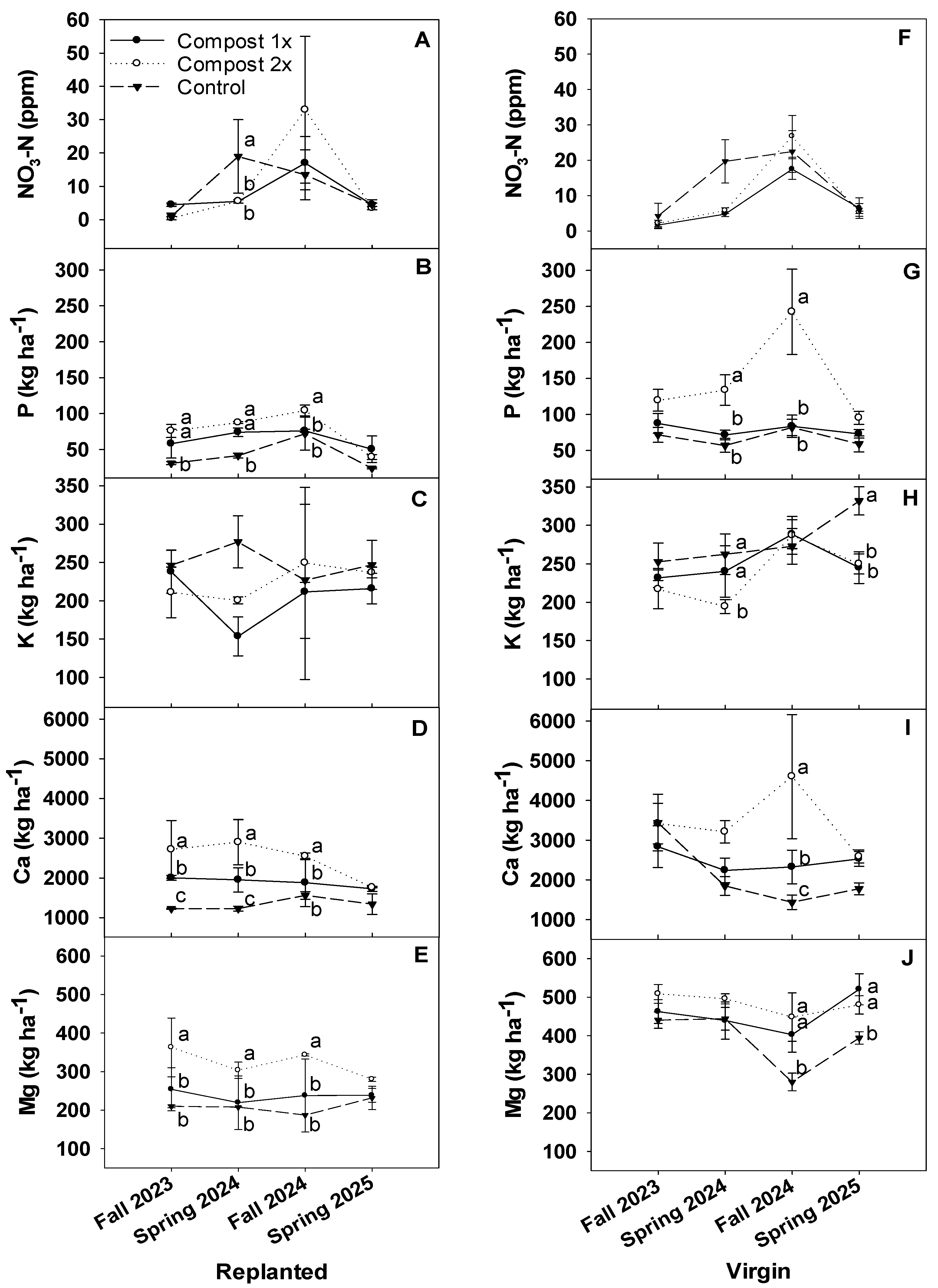
Soil extractable nitrate (NO3) varied in response to OM amendments and time, but no clear trends were observed in either orchard (Figure 3A,F). There were differences in soil macronutrient concentrations in response to compost applications. For instance, soil P in both FWC rates was higher than the control treatment across most sampling times in the replant orchard. Soil P in Compost 2x in the virgin orchard was significantly higher than Compost 1x and the control treatments in Spring and Fall 2024.
Figure 3.
Effect of soil amendments (Control, Compost 1x and Compost 2x) on soil nitrate (A,F); phosphorus (B,G); potassium (C,H); calcium (D,I); and magnesium (E,J) at a replanted and a virgin peach orchard. For each date, different letters indicate significantly different treatments (p ≤ 0.05).
No clear trends were found in soil exchangeable K, although the control treatment had higher soil K than Compost 2x at two sampling times in the virgin orchard (Figure 3C,H). Meanwhile, Ca in both FWC-amended treatments in the replant orchard was higher compared to the control treatment across all sampling times (with Compost 2x also showing higher soil Ca than Compost 1x; Figure 3D). However, these differences did not exist in the virgin orchard, except in Fall 2024, when soil Ca in FWC treatments was higher than in Control (with Compost 2x being higher than Compost 1x; Figure 3I). Compost 2x in the replanted orchard had significantly higher soil Mg than Compost 1x and the control treatment across sampling times. In the virgin orchard, soil Mg in both FWC treatments was higher than in Control in Fall 2024 and Spring 2025 (Figure 3E,J).
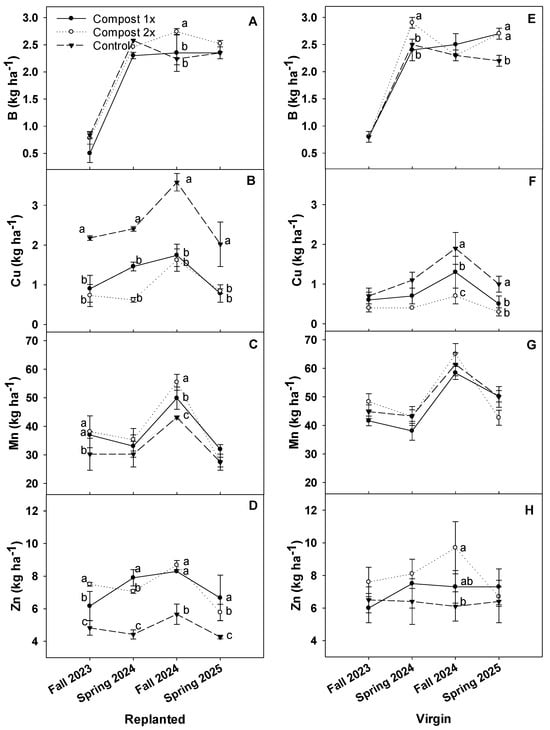
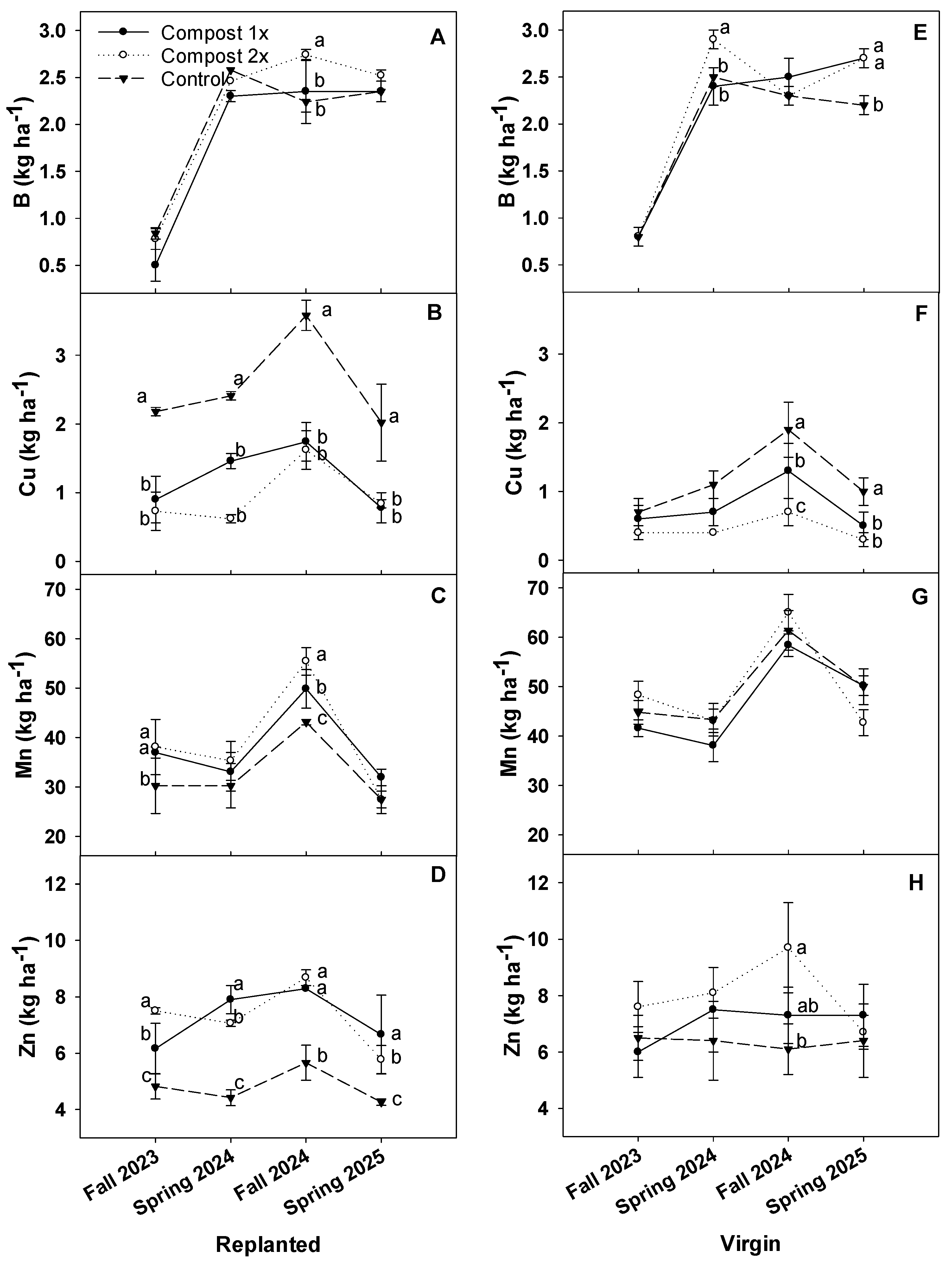
Regarding the soil micronutrients, soil B concentration was higher in Compost 2x compared to Compost 1x and Control only at one or two sampling points in both orchards, but no differences were found overall (Figure 4A,E). The concentration of Cu in both orchards was consistently lower in soils amended with compost compared to the control treatment, although differences were greater in the replant orchard than in the virgin orchard (Figure 4B,F). In the replant orchard, Mn and Zn in soil amended with compost were higher than the control treatment (Figure 4C,D). In contrast, there were no differences in soil Mn concentration among treatments in the virgin orchard (Figure 4G), and slight differences in Zn, with Compost 2x showing a higher concentration than the control treatment in Fall 2024 (Figure 4H).
Figure 4.
Effect of soil amendments (Control, Compost 1x and Compost 2x) on soil boron (A,E); copper (B,F); manganese (C,G); and zinc (D,H) at a replanted and a virgin peach orchard. For each date, different letters indicate significantly different treatments (p ≤ 0.05).
3.2. Impact of FWC on Tissue Nutrient Concentration
Leaf nutrient concentrations varied between treatments, orchards, and years in response to continuous FWC application. Specifically, Compost 2x increased leaf N concentration compared to the control treatment in the replant orchard for most years (two of the three years), although the effect was not that clear in the virgin orchard (Compost 2x only increased leaf N in one of the years). Regarding P, leaf P in FWC-amended soil in the replant orchard was higher (two of the three years) than in control trees. In contrast, in the virgin orchard, leaf P in the FWC treatments was comparable (two of the three years) or lower than in the control treatment. Leaf N and P concentrations were within the sufficiency range (2.6–3.5% for N, 0.14–0.40 for P [42]) throughout the study years except in 2025, where they were within the deficiency threshold. For N in 2025, while compost treatments were not significantly different than Control, their values were closer to the upper limit of the threshold (2.4%); for P in the replant orchard, it was deficient in the control treatment and sufficient in both FWC treatments, whereas in the virgin orchard values were between sufficiency (Control) and deficiency (FWC). Additionally, leaf K, Ca, Mg, and S varied between treatments, orchards, and years in this study, and FWC treatments did not show a consistent influence on them (Table 1).
Table 1.
Effect of annual FWC applications on leaf macro (%) and micronutrient (ppm) concentrations of two mature peach orchards.
Treatments also had different effects on leaf micronutrients (Fe, Mn, Zn, and Cu) in both orchards. FWC treatments tended to have higher Fe concentration than the control treatment in the replant orchard, but no clear effect was found in the virgin orchard. Leaf Mn in the control treatment was significantly higher than in compost treatments of the virgin orchard throughout the study. Meanwhile, leaf Zn varied across treatments, orchards, and years, and FWC did not show a clear influence on it. Leaf Cu was lower in the control trees than in FWC trees of the replant orchard, but no consistent differences were found in the virgin orchard (Table 1).
Regarding the fruit mesocarp at harvest, the application of FWC did not influence fruit Ca, Mg, K, and P concentrations in the replanted or the virgin orchard, with the exception of 2024, when fruit from the Compost 2x treatment had higher Ca, Mg, and P concentrations than the control treatment (Table 2).
Table 2.
Effect of annual FWC application on fruit Ca, Mg, K, and P concentrations at harvest of two mature peach orchards.
3.3. Impact of FWC on Tree Growth and Yield
The continuous application of FWC did not influence tree growth (TCSA, TH, and CFA) throughout the study years in the replanted orchard. In contrast, the application of Compost 2x significantly increased both TCSA and TH in the virgin orchard compared to Control and Compost 1x trees (p = 0.009 and <0.001, and p = 0.048 and 0.008, for TCSA and TH, 2023 and 2024, respectively) (Table 3). Moreover, the application of FWC did not influence fruit yield in both orchards throughout the study. Nevertheless, pairwise comparison between the treatments shows that trees treated with Compost 2x consistently had higher yield and cumulative yield than Compost 1x and Control across both orchards throughout the study years (Table 4).
Table 3.
Effect of annual FWC application on trunk cross-sectional area (TCSA, m2), tree height (m), and canopy formation area (CFA, m2) of mature replanted and virgin peach orchards.
Table 4.
Effect of continuous FWC application on yield and cumulative yield (kg tree−1) of a mature replanted and virgin peach orchard.
4. Discussion
Annual application of FWC considerably improved the nutritional status and horticultural performance of two 5+ y/o orchards used in this study. However, the effect of annual FWC application in orchard-based systems could be influenced by many factors, including the type of compost, orchard previous cultivation history, method of soil amendment, cultivated varieties, weather, and orchard-based management practices [26,43,44]. The results from this study indicated that even though annual applications of FWC enhanced soil parameters, the effects on soil and tree nutritional status, as well as growth, varied between orchard history (replanted vs. virgin) and years.
4.1. Compost Influence on Soil Parameters
The annual application of FWC improved soil chemical properties (considered as key soil health indicators) in both orchards, specifically, OM and CEC. While the influence of FWC application on soil physical and biological properties was not examined in the present study, previous studies have proven that annual applications of OM in orchard-based systems also improve soil biological and physical properties [26,45,46,47].
The replanted orchard benefited the most from the topical applications of OM, with the highest OM of 6.3% recorded in Compost 2x during the first year of this study. Interestingly, even though Compost 2x did not receive supplemental chemical fertilizer during the study years, the rate of OM decomposition and mineralization in compost-amended soil in both orchards was higher compared to Control. Additionally, the continuous decline in soil OM amended with Compost 2x highlights the rich labile carbon content of the compost used in this study, which is known to increase microbial activity, thus catalyzing OM decomposition [48].
This result suggests that the initial OM incorporated during orchard establishment [26] and the subsequent annual top-dressing of FWC applications may have interacted with the underlying soil minerals, increasing the release of essential mineral elements for plant uptake, thus supporting a previous report where surface OM amendments were found to have stronger influence on soil minerals in a loamy site than in sandy soil [45].
Conversely, the slightly higher baseline soil OM across all treatments in the replant orchard used in this study compared to the generally low soil OM obtainable in most replant orchards may be linked to the sustainable orchard floor and herbicide management practices used in this site (an experimental farm), which may have increased the OM turnover from the mineralized plant residues after mowing. However, the lower impact of the FWC on soil OM content in the virgin orchard is probably due to its yet-untapped fertility status, with its initial OM content situated within the sufficiency range. Therefore, our result emphasizes the significance of long-term application of OM amendment in improving orchard soil nutritional status and tree crop productivity [26,30,45,49,50].
The increase in the soil CEC in the replanted orchard contributed to the significant increase in the soil exchangeable cations Ca and Mg. This result agreed with [18,51], who reported that the continuous application of compost enables conditions for the exchange of cations (Ca, K and Mg) in the soil.
4.2. Effects of Compost Application on Soil Minerals
Soil N concentration and its changes due to compost applications over time, as well as the timeframe for OM applications to attain an increase in plant-available N [52,53] depend on several factors, including the weather, soil type, sources and types of compost, nutrient stewardship, and orchard floor management practices [45]. In this study, even though we only assessed the response of the soil nitrate pool (NO3, the preferred form of N for peach) and not total nitrogen, the NO3-N concentrations recorded in compost-amended soils did not influence plant-available N but were comparable to those of soils receiving chemical fertilizers [45,54,55,56]. This result confirms that despite the slow-release nature of nutrients in organic fertilizers, FWC, an organic source, can provide essential plant nutrients for tree growth and development [26,57,58,59].
Compost 2x increased soil P compared to the Control. Other studies have reported an increase in soil P in response to compost applications [26,30,60]. In our study, we found that the application of compost was able to sustain soil P levels at every sampling time throughout this study. The higher soil P in the Compost 2x treatment in the virgin orchard compared to the replanted orchard could be linked to the higher OM content associated with the activity of soil microbes that enhance the soil phosphatase activity, thus resulting in the greater mineralization of the OM content and the release of P in the soil solution [61]. In terms of K, our results were consistent with the findings of [45], where no significant difference was recorded across treatments, treatment by site interaction, or treatments by year interaction.
Regarding micronutrients, Cu is often applied as a broad-spectrum pesticide (bactericide and fungicide) within IPM programs in orchards, which increases Cu concentration in the soil [62,63]. However, the consistently lower soil Cu in the compost-amended soil in response to OM amendment in both orchards can be attributed to the continuous decomposition and mineralization of OM, which in turn increases the soil CEC and OM and reduces the bioavailability of Cu. Thus, soil amendments could help alleviate the rising Cu concentration in the soil and avoid alterations to soil microbial populations [64]. Our result supports previous literature reporting that the application of OM mitigates the biotic impact of Cu application in orchard soils [65] but contradicts [21], where long-term applications of compost resulted in higher Cu relative to the unamended soil in a commercial peach orchard.
Additionally, the sustained increase in Zn in compost-amended soil compared to the unamended soil supported the previous report of [21]. Finally, higher soil available Mn was recorded in soils receiving Compost 2x compared to the unamended Control in the replanted orchard. Previously, Ref. [26] reported a continuous decrease in the soil Mn following annual compost application of a young orchard. However, our results align with [66], who reported that with less disturbance (no tilling or soil disturbance took place in our study) and increased OM, soil Mn can be elevated in agronomic field crops.
4.3. Tissue Nutrient Concentrations with Compost Application
Compost 2x did not receive supplemental chemical fertilizer throughout the study, and trees consistently maintained a relatively sufficient level of leaf nutrient concentrations and, in some cases, higher leaf nutrient concentrations compared to the trees treated with chemical fertilizer. Our results aligned with [55], who reported that long-term application of compost can replace synthetic fertilizer. The increased leaf N concentrations in Compost 2x in some of the years were probably due to the continuous OM decomposition and mineralization, leading to higher labile carbon concentration that activates microbial functions, thereby catalyzing the release of plant-available N [26,67,68]. Nevertheless, results could be different with other soil amendments; for instance, Ref. [30] showed low leaf N concentrations in trees grown in bark mulch when compared to other treatments. Moreover, the increased leaf N highlights the importance of an adequate C:N ratio and finer particle size in OM mineralization (Table A1, Appendix A). Several studies have reported that a C:N ratio of below 20:1 would result in increased N availability due to the continuous mineralization that enhances soil microbial activity [69,70]. This increase in leaf N concentration also suggests that N is being made available through the continuous mineralization of OM [67].
An increase in soil available P in response to OM amendments does not always translate to increased leaf P concentrations, especially in summer leaf analysis [71]. Our results indicate a lack of changes in leaf P concentration relative to the increase in soil available P, which suggests that P may have been stored in permanent reserve organs [72]. Conversely, lower soil K in response to FWC amendments does not always mean leaf K deficiency, as several factors could have influenced its soil availability and tree uptake, including rootstock [73], K adsorption within the soil clay minerals [74], and soil type or condition, especially in calcareous soil [73,75] and during drought periods. In this study, the compost-mediated increase in soil OM and the highly mobile nature of K, whose leaf concentration is highly sensitive to seasonal demand and changes in environmental factors, could have shifted K acquisition and partitioning [26,59,76,77].
4.4. No Difference in Annual Yield in Response to Compost Application
In this study, the higher TCSA and tree height recorded in response to FWC application in both orchards, particularly in Compost 2x compared to the Control and Compost 1x over a long-term period, may be sufficient enough to induce higher cumulative yield, especially in the Compost 2x treatment, even though summer leaf analysis following compost application did not return excessive levels of mineral nutrients. Meanwhile, Ref. [26] reported similar observations with no differences in the yields of a peach orchard amended with compost, but long-term FWC application reportedly increased the orchard’s cumulative yield. The non-significant differences in yield, particularly under Compost 2x, following compost application suggest that organic amendments may have the potential to reduce reliance on chemical fertilizer, mitigate nutrient loss, and lower environmental risks associated with nutrient leaching. Our results aligned with [26,56], who reported that continuous application of compost over a long period of time can replace synthetic fertilizer.
5. Conclusions
In conclusion, the annual application of FWC seemed to have a positive influence on soil nutrient status through continuous decomposition and mineralization of OM, which enhances soil chemistry in both orchards. The pronounced impact on soil chemistry, especially in the replanted orchards, translates into plant-available nutrients and the ability to meet the trees’ nutritional demand and enhance their horticultural performance without undermining the yield, even when no supplemental chemical fertilizer was added. Among the two rates of compost tested in this study, Compost 2x offered the most beneficial effects across all parameters tested in this study. Even though the impact of FWC application on leaf nutrient concentrations was not always consistent, it may be possible that there are differences in how nutrients were allocated and stored in different organs, which exceed the scope of this study but would be worth future exploration. Besides meeting the orchard nutritional requirement, topical application of FWC, owing to its slow-release nature, also may have reduced the bioavailability of Cu in the soil and subsequently its uptake and accumulation in plant tissue, thereby presenting a sustainable strategy of managing peach fertilization in commercial orchards without undermining yield and productivity, thus supporting the objectives of this study.
Despite the potential as a substitute for chemical fertilizer, the overall impact of the use of compost in commercial orchards is yet unknown. Research with specific emphasis on the economic benefits of compost application may be required to ascertain: (1) after how many years of topical application yield of compost-amended soil will be higher than the chemical-based fertilizer; (2) whether compost amendments will extend the productivity and lifespan of a commercial orchard; (3) the break-even cost benefit analysis of compost application.
Author Contributions
Conceptualization, A.P.I., G.S. and J.C.M.; methodology, A.P.I., J.C.M. and W.C.B.; software, A.P.I.; validation, A.P.I., J.C.M. and W.C.B.; formal analysis, A.P.I.; investigation, A.P.I.; resources, J.C.M. and G.S.; data curation, A.P.I. and J.C.M.; writing—original draft preparation, A.P.I.; writing—review and editing, J.C.M., G.S. and W.C.B.; supervision, J.C.M. and G.S.; project administration, J.C.M.; funding acquisition, J.C.M. and G.S. All authors have read and agreed to the published version of the manuscript.
Funding
Technical Contribution No. 7565 of the Clemson University Experiment Station. This research was funded by Southern SARE project number LS22-366 and supported by the Hatch Act, project award no. SC-1700581, from the U.S. Department of Agriculture’s National Institute of Food and Agriculture. The authors also thank the College of Agriculture, Forestry, and Life Sciences, and Clemson University for supporting Ayodeji Idowu through the Wade Stackhouse scholarship and a Doctoral Dissertation Completion Grant.
Data Availability Statement
The raw data supporting the conclusions of this article can be made available by the authors on request.
Acknowledgments
The authors also acknowledge Jeff Hopkins, Luke Dallman, and the staff at the Musser Fruit Research Center, as well as graduate students Noah Willsea and Annie Bruno for their assistance with the field experiments.
Conflicts of Interest
The authors declare no conflicts of interest. The funders had no role in the design of the study; in the collection, analyses, or interpretation of data; in the writing of the manuscript; or in the decision to publish the results.
Abbreviations
The following abbreviations are used in this manuscript:
| OM | Organic matter |
| CEC | Cation exchange capacity |
| FWC | Food waste compost |
| TCSA | Trunk cross-sectional area |
| CFA | Canopy formation area |
| ANOVA | Analysis of variance |
Appendix A
Table A1.
Chemical characteristics of the FWC prior to application.
References
- Tilman, D.; Balzer, C.; Hill, J.; Befort, B.L. Global food demand and the sustainable intensification of agriculture. Proc. Natl. Acad. Sci. USA 2011, 108, 20260–20264. [Google Scholar] [CrossRef] [Scilit] [PubMed]
- Hargreaves, J.C.; Adl, M.S.; Warman, P.R. A review of the use of composted municipal solid waste in agriculture. Agric. Ecosyst. Environ. 2008, 123, 1–14. [Google Scholar] [CrossRef] [Scilit]
- Woolf, D.; Amonette, J.E.; Street-Perrott, F.A.; Lehmann, J.; Joseph, S. Sustainable biochar to mitigate global climate change. Nat. Commun. 2010, 1, 56. [Google Scholar] [CrossRef] [Scilit] [PubMed]
- García-Gil, J.C.; Plaza, C.; Soler-Rovira, P.; Polo, A. Long-term effects of municipal solid waste compost application on soil enzyme activities and microbial biomass. Soil Biol. Biochem. 2000, 32, 1907–1913. [Google Scholar] [CrossRef] [Scilit]
- Ros, M.; Pascual, J.A.; García, C.; Hernández, M.T.; Insam, H. Hydrolase activities, microbial biomass and bacterial community in a soil after long-term amendment with different composts. Soil Biol. Biochem. 2006, 38, 3443–3452. [Google Scholar] [CrossRef] [Scilit]
- Adugna, G. A review on impact of compost on soil properties, water use and crop productivity. Acad. Res. J. Agric. Sci. Res. 2016, 4, 93–104. [Google Scholar] [CrossRef]
- Chatzistathis, T.; Papadakis, I.E.; Papaioannou, A.; Chatzissavvidis, C.; Giannakoula, A. Comparative study effects between manure application and a controlled-release fertilizer on the growth, nutrient uptake, photosystem II activity and photosynthetic rate of Olea europaea L. (cv. ‘Koroneiki’). Sci. Hortic. 2020, 264, 109176. [Google Scholar] [CrossRef] [Scilit]
- Beillouin, D.; Corbeels, M.; Demenois, J.; Berre, D.; Boyer, A.; Fallot, A.; Cardinael, R. A global meta-analysis of soil organic carbon in the Anthropocene. Nat. Commun. 2023, 14, 3700. [Google Scholar] [CrossRef] [Scilit] [PubMed]
- Wang, C.; Zhao, X.; Niu, R.; Wang, F. Effects of grass on soil fertility and peach fruit quality in shallow upland peach orchard. Gansu Agric. Sci. Technol. 2021, 52, 77–81. [Google Scholar]
- Wang, D.; Li, S.; Sun, X.; Hao, D.; Li, Y.; Wang, H. Effects of compost application of green waste on soil properties: A meta-analysis. Sustainability 2024, 16, 8877. [Google Scholar] [CrossRef] [Scilit]
- Fawzi, M.; Shahin, F.; Elham, A.; Kandil, E. Effect of organic and bio-fertilizers and magnesium sulphate on growth, yield, chemical composition and fruit quality of ‘Le-Conte’ pear trees. Nat. Sci. 2010, 8, 273–280. [Google Scholar]
- Baldi, E.; Cavani, L.; Mazzon, M.; Marzadori, C.; Quartieri, M.; Toselli, M. Fourteen years of compost application in a commercial nectarine orchard: Effect on microelements and potential harmful elements in soil and plants. Sci. Total Environ. 2021, 752, 141894. [Google Scholar] [CrossRef] [Scilit] [PubMed]
- Barreto, C.F.; Antunes, L.E.C.; Toselli, M.; Baldi, E.; Sorrenti, G.; Quartieri, M. Organic fertilization and crop load in yield and quality of organic nectarines in Italy. Rev. Bras. Frutic. 2021, 43, e016. [Google Scholar] [CrossRef] [Scilit]
- Cruz, A.F.; Almeida, G.M.; Wadt, P.G.S.; Pires, M.C.; Ramos, M.L.G. Seasonal variation of plant mineral nutrition in fruit trees. Braz. Arch. Biol. Technol. 2019, 62, e19180340. [Google Scholar] [CrossRef] [Scilit]
- Maity, A.; Babu, K.D.; Sarkar, A. Guidelines for fertilizer use in pomegranate orchards based on seasonal uptake and partitioning of nutrients. Sci. Hortic. 2019, 252, 138–148. [Google Scholar] [CrossRef] [Scilit]
- Chen, M.; Zhao, T.; Peng, J.; Zhang, P.; Han, F.; Liu, X.; Zhong, C. Multivariate analysis of relationship between soil nutrients and fruit quality in ‘Donghong’ kiwifruit. Plant Sci. J. 2021, 39, 193–200. [Google Scholar] [CrossRef]
- Sun, H.; Huang, X.; Chen, T.; Zhou, P.; Huang, X.; Jin, W.; Liu, D.; Zhang, H.; Zhou, J.; Wang, Z.; et al. Fruit quality prediction based on soil mineral element content in peach orchard. Food Sci. Nutr. 2022, 10, 1756–1767. [Google Scholar] [CrossRef] [Scilit] [PubMed]
- Baldi, E.; Mazzon, M.; Cavani, L.; Quartieri, M.; Toselli, M.; Marzadori, C. Compost improves plant and soil macronutrient content in a 14-years orchard. Nutr. Cycl. Agroecosyst. 2023, 125, 425–435. [Google Scholar] [CrossRef] [Scilit]
- Chocano, C.; García, C.; González, D.; de Aguilar, J.M.; Hernández, T. Organic plum cultivation in the Mediterranean region: The medium-term effect of five different organic soil management practices on crop production and microbiological soil quality. Agric. Ecosyst. Environ. 2016, 221, 60–70. [Google Scholar] [CrossRef] [Scilit]
- Narayan, A.; Singh, P.N.; Singh, S.K.; Visen, A. Effect of organic manures on the flowering, fruiting, and yield of peach (Prunus persica Batsch) cv. Florida Prince. Res. Crops 2016, 17, 78–83. [Google Scholar] [CrossRef] [Scilit]
- Głuszek, S.; Sas-Paszt, L.; Derkowska, E.; Sumorok, B.; Sitarek, M. Influence of various biofertilizers on root growth dynamics in sweet cherry (Prunus avium L.) cv. ‘Vanda’. Hortic. Sci. 2021, 48, 105–116. [Google Scholar] [CrossRef] [Scilit]
- Mohit; Verma, M.L.; Thakur, J.; Ajender. Effect of inorganic and organic nitrogenous fertilizers on soil nutrient status, plant growth, and yield of apricot (Prunus armeniaca L.). J. Plant Nutr. 2023, 46, 1808–1821. [Google Scholar] [CrossRef] [Scilit]
- Kumar, A.; Sharma, D.D.; Sharma, D.P.; Shylla, B.; Singh, U.; Verma, P.; Mushtaq, M.; Parihar, N.S.; Wani, O.A.; Casini, R.; et al. Integrated nutrient management as a low-cost and eco-friendly strategy for sustainable fruit production in apricot (Prunus armeniaca L.). Int. J. Fruit Sci. 2024, 24, 18–32. [Google Scholar] [CrossRef] [Scilit]
- Baldi, E.; Toselli, M.; Marcolini, G.; Quartieri, M.; Cirillo, E.; Innocenti, A.; Marangoni, B. Compost can successfully replace chemical fertilizers in the nutrient management of commercial peach orchard. Soil Use Manag. 2010, 26, 346–353. [Google Scholar] [CrossRef] [Scilit]
- Diacono, M.; Montemurro, F. Long-term effects of organic amendments on soil fertility. A review. Agron. Sustain. Dev. 2010, 30, 401–422. [Google Scholar] [CrossRef] [Scilit]
- Lawrence, B.T.; Melgar, J.C. Annual compost amendments can replace synthetic fertilizer, improve soil moisture, and ensure tree performance during peach orchard establishment in a humid subtropical climate. Front. Plant Sci. 2023, 14, 1172038. [Google Scholar] [CrossRef] [Scilit] [PubMed]
- Lazicki, P.; Geisseler, D.; Lloyd, M. Nitrogen mineralization from organic amendments is variable but predictable. J. Environ. Qual. 2020, 49, 483–495. [Google Scholar] [CrossRef] [Scilit] [PubMed]
- Preusch, P.L.; Tworkoski, T.J. Nitrogen and phosphorus availability and weed suppression from composted poultry litter applied as mulch in a peach orchard. HortScience 2003, 38, 1108–1111. [Google Scholar] [CrossRef] [Scilit]
- Mordoğan, N.; Hakerlerler, H.; Ceylan, Ş.; Aydin, Ş.; Yağmur, B.; Aksoy, U. Effect of organic fertilization on fig leaf nutrients and fruit quality. J. Plant Nutr. 2013, 36, 1128–1137. [Google Scholar] [CrossRef] [Scilit]
- Neilsen, G.; Forge, T.; Angers, D.; Neilsen, D.; Hogue, E. Suitable orchard floor management strategies in organic apple orchards that augment soil organic matter and maintain tree performance. Plant Soil 2014, 378, 325–335. [Google Scholar] [CrossRef] [Scilit]
- Neilsen, G.H.; Hogue, E.J.; Forge, T.; Neilsen, D. Surface application of mulches and biosolids affect orchard soil properties after 7 years. Can. J. Soil Sci. 2003, 83, 131–137. [Google Scholar] [CrossRef] [Scilit]
- Canali, S.; Di Bartolomeo, E.; Trinchera, A.; Nisini, L.; Tittarelli, F.; Intrigliolo, F.; Roccuzzo, G.; Calabretta, M.L. Effect of different management strategies on soil quality of citrus orchards in Southern Italy. Soil Use Manag. 2009, 25, 34–42. [Google Scholar] [CrossRef] [Scilit]
- Cline, J.; Neilsen, G.; Hogue, E.; Kuchta, S.; Neilsen, D. Spray-on-mulch technology for intensively grown irrigated apple orchards: Influence on tree establishment, early yields, and soil physical properties. HortTechnology 2011, 21, 398–411. [Google Scholar] [CrossRef] [Scilit]
- Soil Survey Staff; Natural Resources Conservation Service; United States Department of Agriculture. Web Soil Survey. Available online: http://websoilsurvey.sc.egov.usda.gov/ (accessed on 15 July 2026).
- Blaauw, B.; Brannen, P.; Lockwood, D.; Schnabel, G.; Ritchie, D. Southeastern Peach, Nectarine, and Plum Pest Management and Culture Guide. UGA Coop. Ext. Bull. 2026, 1171. Available online: https://extension.uga.edu/publications/detail.html?number=B1171 (accessed on 13 March 2025).
- Whiting, M.D.; Lang, G.; Ophardt, D. Rootstock and training system affect sweet cherry growth, yield, and fruit quality. HortScience 2005, 40, 582–586. [Google Scholar] [CrossRef] [Scilit]
- Aglar, E.; Ozturk, B.; Saracoglu, O.; Edwards Long, L.; Yildiz, K.; Gun, S.; Has, S. Rootstock and training effects on growth and fruit quality of young ‘0900 Ziraat’ sweet cherry trees. Appl. Fruit Sci. 2024, 66, 61–70. [Google Scholar] [CrossRef] [Scilit]
- Jones, J.B., Jr.; Case, V.W. Sampling, handling, and analyzing plant tissue samples. In Soil Testing and Plant Analysis, 3rd ed.; Westerman, R.L., Ed.; Soil Science Society of America: Madison, WI, USA, 1990; pp. 389–427. [Google Scholar]
- Jones, J.B.; Wolf, B.; Mills, H.A. Plant Analysis Handbook; Micro-Macro Publishing, Inc.: Athens, GA, USA, 1991; pp. 1107–1120. [Google Scholar]
- Murphy, J.; Riley, J.P. A modified single solution method for the determination of phosphate in natural waters. Anal. Chim. Acta 1962, 27, 31–36. [Google Scholar] [CrossRef] [Scilit]
- Isaac, R.A.; Johnson, W.C. Collaborative study of wet and dry ashing techniques for the elemental analysis of plant tissue by atomic absorption spectrophotometry. J. Assoc. Off. Anal. Chem. 1975, 58, 436–440. [Google Scholar] [CrossRef] [Scilit]
- Johnson, R.S. Nutrient and water requirements of peach trees. In The Peach: Botany, Production and Uses; Layne, D.R., Bassi, D., Eds.; CABI: Wallingford, UK, 2008; pp. 303–331. [Google Scholar]
- Ljavić, D.; Čmelik, Z.; Zorić, L.; Keserović, Z.; Magazin, N.; Bijelić, S.; Popara, G. Influence of cultivar and fertilization treatment on the yield and leaf nutrient content of apple. Heliyon 2023, 9, e16321. [Google Scholar] [CrossRef] [Scilit] [PubMed]
- Ma, J.; Zhang, Y.; Li, J.; Liu, Y.; Sun, J.; Zhang, J. Assessing and quantifying the carbon, nitrogen, and soil biological responses to orchard cover crops. HortScience 2024, 59, 1088–1096. [Google Scholar] [CrossRef] [Scilit]
- Villa, Y.B.; Khalsa, S.D.S.; Ryals, R.; Duncan, R.A.; Brown, P.H.; Hart, S.C. Organic matter amendments improve soil fertility in almond orchards of contrasting soil texture. Nutr. Cycl. Agroecosyst. 2021, 120, 343–361. [Google Scholar] [CrossRef] [Scilit]
- Fornés, F.; Lidón, A.; Belda, R.M.; Macan, G.P.F.; Cayuela, M.L.; Sánchez-García, M.; Sánchez-Monedero, M.A. Soil fertility and plant nutrition in an organic olive orchard after 5 years of amendment with compost, biochar or their blend. Sci. Rep. 2024, 14, 16606. [Google Scholar] [CrossRef] [Scilit] [PubMed]
- Curtright, A.J.; Haas, S.M.; Zhu-Barker, X. Compost application and reduced synthetic nitrogen fertilization promote sustainable olive production in super-high-density orchards. Agron. Sustain. Dev. 2025, 45, 56. [Google Scholar] [CrossRef] [Scilit]
- Rasul, M.; Cho, J.; Shin, H.S.; Hur, J. Biochar-induced priming effects in soil via modifying the status of soil organic matter and microflora: A review. Sci. Total Environ. 2022, 805, 150304. [Google Scholar] [CrossRef] [Scilit] [PubMed]
- Gentile, R.M.; Boldingh, H.L.; Campbell, R.E.; Gee, M.; Gould, N.; Lo, P.; Walter, M. System nutrient dynamics in orchards: A research roadmap for nutrient management in apple and kiwifruit. Agron. Sustain. Dev. 2022, 42, 64. [Google Scholar] [CrossRef] [Scilit]
- Khalsa, S.D.S.; Hart, S.C.; Brown, P.H. Nutrient dynamics from surface-applied organic matter amendments on no-till orchard soil. Soil Use Manag. 2022, 38, 649–662. [Google Scholar] [CrossRef] [Scilit]
- Acharya, P.; Ghimire, R.; Cho, Y. Linking soil health to sustainable crop production: Dairy compost effects on soil properties and sorghum biomass. Sustainability 2019, 11, 3552. [Google Scholar] [CrossRef] [Scilit]
- Eghball, B. Soil properties as influenced by phosphorus- and nitrogen-based manure and compost applications. Agron. J. 2002, 94, 128. [Google Scholar] [CrossRef] [Scilit]
- Blackshaw, R.E.; Molnar, L.J.; Larney, F.J. Fertilizer, manure and compost effects on weed growth and competition with winter wheat in western Canada. Crop Prot. 2005, 24, 971–980. [Google Scholar] [CrossRef] [Scilit]
- Toselli, M.; Baldi, E.; Sorrenti, G.; Quartieri, M.; Marangoni, B. Evaluation of the effectiveness of soil-applied plant derivatives of Meliaceae species on nitrogen availability to peach trees. Sci. Hortic. 2010, 124, 183–188. [Google Scholar] [CrossRef] [Scilit]
- Baldi, E.; Toselli, M.; Marangoni, B. Nutrient partitioning in potted peach (Prunus persica L.) trees supplied with mineral and organic fertilizers. J. Plant Nutr. 2010, 33, 2050–2061. [Google Scholar] [CrossRef] [Scilit]
- Tahovská, K.; Čapek, P.; Šantrůčková, H.; Kopáček, J. In situ phosphorus dynamics in soil: Long-term ion-exchange resin study. Biogeochemistry 2018, 139, 307–320. [Google Scholar] [CrossRef] [Scilit]
- Geisseler, D.; Smith, R.; Cahn, M.; Muramoto, J. Nitrogen mineralization from organic fertilizers and composts: Literature survey and model fitting. J. Environ. Qual. 2021, 50, 1325–1338. [Google Scholar] [CrossRef] [Scilit] [PubMed]
- de Paula, B.V.; Tiecher, T.; Chaves, P.S.; Brunetto, G. Nitrogen sources in young peach trees in the presence and absence of Paspalum notatum co-cultivation. Agronomy 2022, 12, 2669. [Google Scholar] [CrossRef] [Scilit]
- Mia, M.S.; Zzaman, W. Food waste-derived organic fertilizers: Critical insights, agronomic impacts, and pathways for sustainable adoption. Int. J. Food Sci. 2025, 2025, 1551054. [Google Scholar] [CrossRef] [Scilit] [PubMed]
- Baldi, E.; Marcolini, G.; Quartieri, M.; Sorrenti, G.; Toselli, M. Effect of organic fertilization on nutrient concentration and accumulation in nectarine (Prunus persica var. nucipersica) trees: The effect of rate of application. Sci. Hortic. 2014, 179, 174–179. [Google Scholar] [CrossRef] [Scilit]
- Wanke, D.J.; Nkebiwe, P.M.; Günther, J.; Reusser, J.E.; Hartmann, T.E.; Yang, H.; Zhang, W.; Chen, X.; Müller, T. Identification and quantification of phosphate turnover indicators after long-term compost application—Long-term and single season effects. Plant Soil 2024, 504, 289–306. [Google Scholar] [CrossRef] [Scilit]
- Wang, Q.Y.; Zhou, D.M.; Cang, L. Microbial and enzyme properties of apple orchard soil as affected by long-term application of copper fungicide. Soil Biol. Biochem. 2009, 41, 1504–1509. [Google Scholar] [CrossRef] [Scilit]
- Neaman, A.; Schoffer, J.; Navarro-Villarroel, C.; Pelosi, C.; Peñaloza, P.; Dovletyarova, E.; Schneider, J. Copper contamination in agricultural soils: A review of the effects of climate, soil properties, and prolonged copper pesticide application in vineyards and orchards. Plant Soil Environ. 2024, 70, 407–417. [Google Scholar] [CrossRef] [Scilit]
- Mackie, K.A.; Marhan, S.; Ditterich, F.; Schmidt, H.P.; Kandeler, E. The effects of biochar and compost amendments on copper immobilization and soil microorganisms in a temperate vineyard. Agric. Ecosyst. Environ. 2015, 201, 58–69. [Google Scholar] [CrossRef] [Scilit]
- Jeon, D.; Robinson, B.; Dickinson, N. Organic matter mitigates biotic impact of copper in fruit orchard soil. Environ. Pollut. 2024, 363, 125145. [Google Scholar] [CrossRef] [Scilit] [PubMed]
- Moreira, S.G.; Prochnow, L.I.; de Castro Kiehl, J.; Pauletti, V.; Martin-Neto, L. Chemical forms in soil and availability of manganese and zinc to soybean in soil under different tillage systems. Soil Tillage Res. 2016, 163, 41–53. [Google Scholar] [CrossRef] [Scilit]
- Krogstad, T.; Zivanovic, V.; Simic, A.; Aksic, M.F.; Licina, V.; Meland, M. Nitrogen mineralization of apple orchard soils in regions of western and south-eastern Norway. Agronomy 2023, 13, 2570. [Google Scholar] [CrossRef] [Scilit]
- Butcaru, A.C.; Mihai, C.A.; Moț, A.; Gogoț, R.; Hoza, D.; Stănică, F. Circular pear production using compost fertilization: Influence on tree growth and nitrogen leaf concentration. Horticulturae 2024, 10, 1209. [Google Scholar] [CrossRef] [Scilit]
- Yazdanpanah, N.; Pazira, E.; Neshat, A.; Mahmoodabadi, M.; Sinobas, L.R. Reclamation of calcareous saline sodic soil with different amendments (II): Impact on nitrogen, phosphorus and potassium redistribution and on microbial respiration. Agric. Water Manag. 2013, 120, 39–45. [Google Scholar] [CrossRef] [Scilit]
- Wang, L.; Sun, X.; Li, S.; Zhang, T.; Zhang, W.; Zhai, P. Application of organic amendments to a coastal saline soil in North China: Effects on soil physical and chemical properties and tree growth. PLoS ONE 2014, 9, e89185. [Google Scholar] [CrossRef] [Scilit] [PubMed]
- El-Jendoubi, H.; Abadía, J.; Abadía, A. Assessment of nutrient removal in bearing peach trees (Prunus persica L. Batsch) based on whole tree analysis. Plant Soil 2013, 369, 421–437. [Google Scholar] [CrossRef] [Scilit]
- Zavišić, A.; Polle, A. Dynamics of phosphorus nutrition, allocation and growth of young beech (Fagus sylvatica L.) trees in P-rich and P-poor forest soil. Tree Physiol. 2018, 38, 37–51. [Google Scholar] [CrossRef] [Scilit]
- Zarrouk, O.; Gogorcena, Y.; Gómez-Aparisi, J.; Betrán, J.A.; Moreno, M.A. Influence of almond × peach hybrid rootstocks on flower and leaf mineral concentration, yield and vigour of two peach cultivars. Sci. Hortic. 2005, 106, 502–514. [Google Scholar] [CrossRef] [Scilit]
- Johnson, R.S.; Uriu, K. Mineral nutrition. In Growing and Handling Peaches for Fresh Market; LaRue, J., Johnson, R.S., Eds.; Division of Agriculture and Natural Resources, University of California: Oakland, CA, USA, 1989; pp. 68–81. [Google Scholar]
- Mestre, L.; Reig, G.; Betrán, J.A.; Pinochet, J.; Moreno, M.Á. Influence of peach–almond hybrids and plum-based rootstocks on mineral nutrition and yield characteristics of ‘Big Top’ nectarine in replant and heavy-calcareous soil conditions. Sci. Hortic. 2015, 192, 475–481. [Google Scholar] [CrossRef] [Scilit]
- Zhou, Q.; Melgar, J.C. Ripening season affects tissue mineral concentration and nutrient partitioning in peach trees. J. Plant Nutr. Soil Sci. 2019, 182, 203–209. [Google Scholar] [CrossRef] [Scilit]
- Clavijo-Herrera, J.; Sarkhosh, A.; Zotarelli, L.; Mackowiak, C.; Mylavarapu, R. Nutrient Management in Low-Chill Peach Orchards: Guidelines for Deficiency Symptoms and Leaf and Soil Sampling; HS1497. EDIS 2025, 2025, 5. [Google Scholar] [CrossRef] [Scilit]

Disclaimer/Publisher’s Note: The statements, opinions and data contained in all publications are solely those of the individual author(s) and contributor(s) and not of MDPI and/or the editor(s). MDPI and/or the editor(s) disclaim responsibility for any injury to people or property resulting from any ideas, methods, instructions or products referred to in the content. |
© 2026 by the authors. Licensee MDPI, Basel, Switzerland. This article is an open access article distributed under the terms and conditions of the Creative Commons Attribution (CC BY) license.