


Abstract
Aiming at tight farming schedules, slow straw decomposition, and severe soil-borne disease risks in the practical maize straw returning production of China’s wheat–maize double cropping zones, this study developed a field-adapted in situ rapid high-temperature straw composting technology matched with a special composite microbial inoculant. Post-harvest summer maize straw collected from the field was crushed to 3–5 cm; the inoculant group T and water control CK were arranged with three biological replicates. Raw materials were adjusted to 65% moisture and loosely stacked into trapezoidal piles equipped with layered temperature–humidity sensors covered by plastic film for continuous monitoring. After formula and pile structure optimization, the pile temperature exceeded 50 °C within 8 h and stayed at 58–63 °C for 9 days, limiting the composting cycle to within 15 days. Cellulose and lignin degradation reached 56.25% and 50.39%, respectively; available P and K rose by 12.33% and 14.69%, free amino acids doubled; the C/N ratio dropped to 18:1 and the GI exceeded 130%. High temperature enriched functional flora of Bacillus subtilis, Aspergillus niger and actinomycetes, whereas pathogenic Fusarium abundance decreased to less than 1/31 of the initial level. This technology can bring approximately 400 yuan of potential additional benefit per mu, providing an efficient and labor-saving practical candidate for straw returning in regions with a high multiple-cropping index.
1. Introduction
Crop straw is a vital by-product of grain production and ranks among the most abundant renewable biomass resources with enormous exploitation potential [1], and its efficient and comprehensive utilization is of great significance for the sustainable development of agriculture. Straw returning, as the main approach to straw resource utilization, is a key measure for increasing soil organic matter and improving soil structure. However, the practical effect of straw returning largely depends on the rate and degree of its transformation into a soil-acceptable form.
The Huang-Huai-Hai Plain, a major grain-producing region in China, generates over 100 million tons of straw annually [2,3]. Straw returning is the main method of straw resource utilization in this region and is of great significance for increasing soil organic matter and improving soil structure [4]. On the basis of straw returning, the appropriate application of nitrogen, phosphorus and potassium fertilizers can optimize the growth characteristics of winter wheat, improve tillering efficiency, promote nutrient absorption and utilization, and thereby significantly enhance wheat yield and quality [5]. However, under the widely adopted wheat–maize annual rotation system, the turnaround time between crops is extremely tight. Only a 10–20 days sowing window is available after maize harvest, imposing severe time pressure on straw management. Under such conditions, traditional off-site centralized composting can promote straw decomposition and mitigate the associated risks. However, this method usually requires one to several months for decomposition and occupies dedicated land, making it difficult to match the intensive production rhythm in both time and space. Direct straw returning can save farming time; however, due to the high carbon-to-nitrogen ratio of maize straw, it often leads to nitrogen competition between soil microorganisms and crop seedlings, resulting in yellowing and weak growth of the subsequent wheat at the seedling stage. Meanwhile, residual straw on the soil surface impairs sowing quality and provides habitats for soil-borne pathogens and insect eggs, thus increasing the overwintering base of pests and diseases [6]. Therefore, under the policy of straw burning prohibition, it has become a critical issue to be urgently resolved for the sustainable agricultural development in this region to break through the spatiotemporal constraints of off-field composting, avoid the seedling obstacles and disease–pest risks caused by direct straw returning, and develop on-site field treatment technologies that match the tight farming schedule and integrate both rapid decomposition and harmless functions.
To address this spatiotemporal mismatch, existing studies have gradually developed a technical pathway centered on functional microbial enhancement. Under this framework, rapid high-temperature decomposition technology has become a major research focus. This technology mainly achieves rapid straw degradation and sanitization by inoculating exogenous functional microorganisms and optimizing the windrow environment, thereby stimulating and sustaining a pronounced thermophilic phase (generally >55 °C) within a short period [7,8,9].
Dynamic temperature regulation is the key to this technology. An ideal thermophilic process requires rapid heating and sufficient duration to effectively inactivate plant pathogens. Studies have shown that maintaining temperatures above 55 °C for several days, or in the range of 60–70 °C for several hours to days, can significantly inactivate common pathogens such as Fusarium oxysporum and Rhizoctonia solani [10,11]. In practical applications, relevant technological innovations mainly focus on how to achieve and maintain a uniform and stable high-temperature environment. Specific measures include optimizing the physical structure of compost piles, adding functional amendments such as biochar or zeolite to regulate physicochemical properties [12,13,14], and introducing external auxiliary heating and sensor-based automatic temperature control systems [15,16]. The ultra-high-temperature aerobic fermentation technology developed on this basis can raise and maintain the compost temperature above 70 °C, thereby achieving organic matter stabilization and complete pathogen elimination in a shorter time [17,18,19].
The understanding of decomposition mechanisms has extended to the microbially driven level. During straw decomposition, the microbial community follows a temperature-driven succession pattern [20,21,22]. In the thermophilic phase, thermophilic bacteria (e.g., Bacillus), actinomycetes, and thermophilic fungi become the dominant groups. They secrete cellulase, hemicellulase, and lignin-degrading enzymes to synergistically degrade the lignocellulosic structure of straw [23,24]. As fermentation enters the mature stage, a large number of proliferated antagonistic microorganisms (e.g., Bacillus, Trichoderma) further suppress soil-borne diseases by producing antibiotics, competing for ecological niches, and other mechanisms, endowing the decomposed product with soil disease suppressiveness [25,26].
Recent studies have progressed from describing community structure to analyzing functional genes and metabolic pathways, revealing the activation patterns and regulatory mechanisms of key degrading enzyme genes [23,27]. This provides precise targets for artificial intervention and has advanced the development of straw-decomposing microbial inoculants from “empirical screening” toward “rational design”—for example, improving efficiency by constructing functionally complementary “synthetic microbial communities” [20,28]. Under this trend, remarkable progress has been made in the research and development of microbial inoculants in China. A variety of highly efficient straw-degrading indigenous microbial strains (e.g., Streptomyces) have been isolated and identified [29], with efforts devoted to developing composite inoculants featuring functional synergistic effects [30]. Field trials have shown that the application of decomposing microbial inoculants or pre-decomposed straw can effectively alleviate the phenomenon of microbial nitrogen competition, increase soil organic matter and available nutrient contents, improve the microbial community structure, and ultimately promote crop yields [31]. It is worth noting that domestic research needs to carry out technical adaptation in accordance with regional production realities. For example, in view of the slow decomposition caused by low temperatures in the cold regions of Northeast China, low-temperature-tolerant microbial inoculants and plastic-mulched composting technologies have been developed [32,33,34].
Considerable progress has been made in addressing the spatiotemporal mismatch of straw returning, with relatively well-developed technical pathways and theoretical frameworks now available. However, translating existing achievements into standardized, low-labor, and economically feasible field technical schemes suitable for intensive multiple cropping areas such as the Huang-Huai-Hai Plain still faces significant challenges. Existing research mainly has the following gaps: First, cutting-edge international technologies often rely on high-cost precision control systems, which are poorly compatible with China’s agricultural production reality characterized by family-based management and relatively scattered scales. Second, most evaluation systems focus on decomposition efficiency and soil fertility improvement effects, while lacking a systematic and comprehensive assessment of sanitation levels, long-term biosafety, and economic feasibility under specific production scenarios.
Accordingly, this study focuses on the wheat–maize double cropping system in the Huang-Huai-Hai Plain, aiming to develop and verify a technical system for in situ rapid high-temperature decomposition of maize straw under local agronomic conditions. This study systematically clarifies the temperature dynamics of straw degradation, key substance transformation rules, and their microbially driven mechanisms under this technical model, and comprehensively evaluates its decomposition quality, agricultural safety, and economic benefits. The innovations of this study are mainly reflected as follows: First, with field in situ treatment as the core, it provides a low-labor, simplified solution. Second, the coupling relationship between high-temperature dynamics and microbial community succession is deeply revealed. Third, all technical parameters are designed on the premise of matching the tight farming schedule, and a preliminary economic benefit analysis is carried out to directly address the core constraints in the popularization and application of the technology.
2. Materials and Methods
2.1. Field In Situ Composting Procedure
The field experiment was conducted in Machang Town, Taikang County, Zhoukou City, Henan Province (115.02° E, 34.02° N) in October 2025. This region has a warm-temperate continental monsoon climate, with an altitude of 45.5–59.5 m, an annual average temperature of 14.3–14.8 °C, and an annual frost-free period of approximately 204–220 days. The composite decomposition microbial inoculant consists mainly of Bacillus subtilis, Saccharomyces cerevisiae, and Aspergillus niger spore powder, with an application dosage of 2 kg per mu. The test strains used were as follows: Saccharomyces cerevisiae (CGMCC 2.540), Aspergillus niger (CGMCC 3.316) and Bacillus subtilis (CGMCC 1.1086), all supplied in lyophilized powder form. The lyophilized powders were stored at 4 °C under dry and dark conditions. Prior to use, each strain was activated in the corresponding liquid medium and cultured with shaking until reaching the stable growth phase. The liquid culture media were prepared as described below: Nutrient broth (10 g peptone, 3 g beef extract, 5 g NaCl, 1 L distilled water, pH 7.0) for culturing Bacillus subtilis; Czapek liquid medium (30 g sucrose, 3 g NaNO3, 0.5 g MgSO4·7H2O, 0.5 g KCl, 0.01 g FeSO4·4H2O, 1 g K2HPO4, 1 L distilled water, pH 6.0–6.5) for culturing Aspergillus niger; glucose–peptone–yeast extract liquid medium (10 g glucose, 10 g peptone, 5 g yeast extract, 1 L distilled water) for culturing Saccharomyces cerevisiae. The optimal culture temperatures were 25–28 °C for Saccharomyces cerevisiae and Aspergillus niger, and 37 °C for Bacillus subtilis. Once the concentration of each bacterial suspension reached ≥108 CFU/mL, the composite microbial inoculant was prepared by mixing the suspensions of Bacillus subtilis, Aspergillus niger and Saccharomyces cerevisiae at a volume ratio of 2:2:1. Agar plate confrontation assays confirmed no antagonistic interactions among the three strains. Other auxiliary materials included brown sugar at 2.5 kg per mu, urea at 2.5 kg per mu, and a water application volume of 300 L per mu. Approximately two hours before spraying, the composite inoculant and brown sugar were mixed and activated with a portion of water; urea was then added and fully dissolved under stirring immediately before field application to prepare the decomposition bacterial solution.
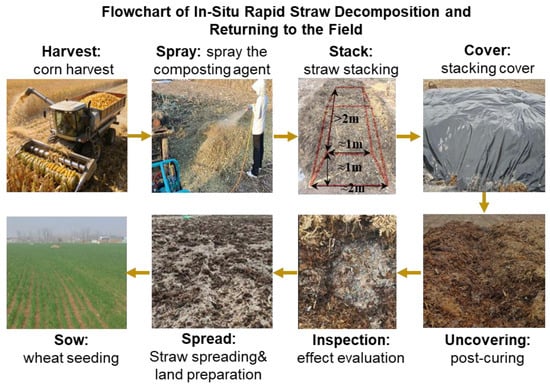
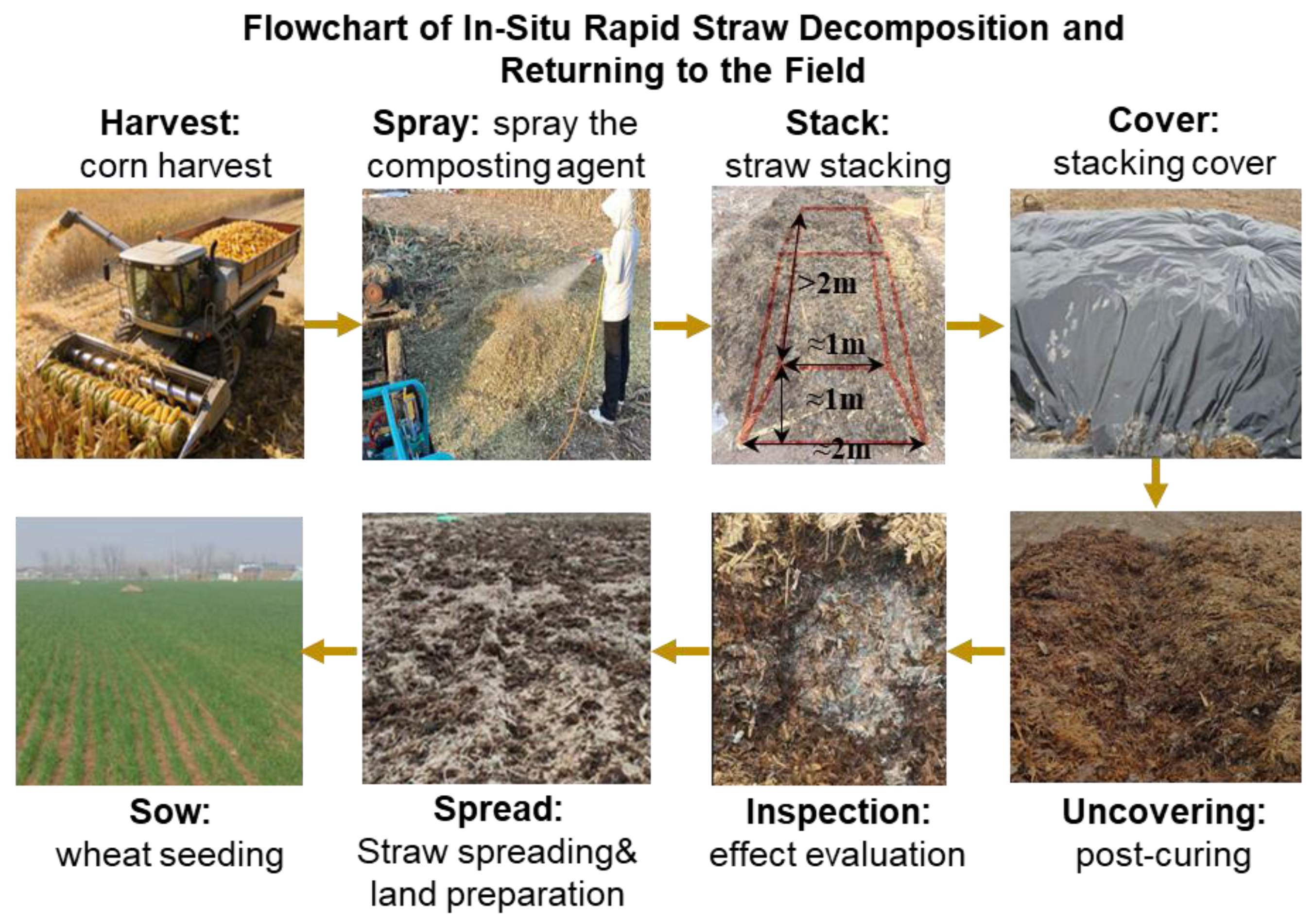
The preceding crop in the experiment was maize. At harvest, conventional stubble retention was practiced, leaving 5–10 cm of stubble in the field. The complete workflow for field-based in-situ rapid straw decomposition and returning to the field is illustrated in Figure 1. Two treatments were established in this experiment: treatment T with an equal amount of decomposing microbial inoculant added, and Control CK with the same volume of water instead of the inoculant. Each treatment was set up with three biological replicates. The initial straw material for each replicate was 1000 kg, with a total of 6000 kg of corn straw used in the experiment. The decomposing microbial inoculant was first dissolved in a certain volume of water and then thoroughly mixed with the straw substrate. Additional water was supplemented to reach the target water application rate, adjusting the moisture content of corn straw to approximately 65%.
Figure 1.
Flowchart of in situ rapid straw decomposition and returning to the field.
The crushed straw was evenly mixed with the decomposing agent and piled up. The straw piles were maintained in a loose state throughout the stacking process without compaction. Straw decomposition piles were arranged in a trapezoidal shape, with an isosceles trapezoid cross-section. The pile had a bottom width of approximately 2 m, a top width of about 1 m, and a height of 0.8–1 m; the length depended on the field conditions but was guaranteed to be greater than 2 m. During stacking, the pile was gradually narrowed inward layer by layer to form a stable slope. After stacking, temperature and humidity sensors were installed respectively at the surface layer (10–15 cm depth) and inner layer (30–35 cm depth) of each compost pile for real-time monitoring of temperature and humidity. Finally, each pile was covered with black plastic film. Finally, the pile was covered with black plastic sheeting, and no turning was performed during the experimental period. The whole decomposition process lasted for 15 days, with no turning or perforation operations carried out during the period. Sampling was conducted at the initiation of the experiment and on days 4, 8, 12 and 15. For each treatment, multi-point random sampling was performed at the surface and interior of each compost pile; samples from the same layer were fully blended. Approximately 1000 g of composite sample was collected per layer. The homogenized samples were divided into three portions for different preservation methods: one portion was stored in a refrigerator at 4 °C, the second was air-dried and ground, and the third was preserved in an ultra-low temperature freezer at −80 °C.
2.2. Analytical Methods
2.2.1. Nitrogen Metabolites
Free amino acid: A 0.2 g portion of fresh ground tissue sample was placed in a 2 mL centrifuge tube, supplemented with 1 mL of 10% acetic acid, vortexed thoroughly, and extracted under shaking on ice for 10 min. After centrifugation at 12,000 rpm for 10 min at 4 °C, 0.15 mL of the supernatant was collected for free amino acid determination. Free amino acids were quantified using the ninhydrin method. A standard curve was established using leucine as the standard to calculate the concentration of free amino acids. Each treatment was performed in triplicate.
NH4+-N: A 0.4 g portion of fresh tissue sample ground in liquid nitrogen was added to 4 mL of 1% CH3COOH, and extracted under shaking at a low temperature for 20 min. After centrifugation at 10,000 rpm and 4 °C for 10 min, 1 mL of the supernatant was collected for ammonium nitrogen determination. Into the reaction system, 7 mL of distilled water, 1 mL of supernatant, 1 mL of chromogenic agent (containing 6 g of sodium salicylate, 16 mL of 2 mol/L NaOH, and 5 g of potassium sodium tartrate per 100 mL), 0.2 mL of sodium hypochlorite solution (0.215% Cl-, 5% OH-), and 0.2 mL of 1% sodium nitroferricyanide were added sequentially. The mixture was blended and reacted at room temperature for 1 h, and the absorbance at 697 nm was measured. A standard curve was prepared using NH4Cl as the standard to calculate the N NH4+ content. The mass of N NH4+ in individual tissue was obtained by multiplying the N NH4+ content by the fresh weight of the tissue.
NO3−-N: A 0.4 g portion of fresh tissue sample ground in liquid nitrogen was added to 4 mL of 10% trichloroacetic acid and extracted under shaking for 20 min. After centrifugation at 10,000 rpm at room temperature for 10 min, 0.5 mL of the supernatant was collected for nitrate nitrogen determination. Into the reaction system, 0.5 mL of extract and 0.3 mL of salicylic acid solution (5 g salicylic acid dissolved in 100 mL of concentrated sulfuric acid) were added sequentially. The mixture was blended and reacted at room temperature for 20 min, followed by the addition of 7 mL of 2 mol/L NaOH. After cooling, the absorbance at 410 nm was measured. A standard curve was prepared using KNO3 as the standard to calculate the N-NO3− content. The mass of N-NO3− in individual tissue was obtained by multiplying the N-NO3− content by the fresh weight of the tissue.
2.2.2. Physicochemical Properties, Maturity, and Microbial Count
Real-time temperature and humidity monitoring of compost piles was performed using OSA-10T4GS-Q temperature and humidity sensors. The pile temperature of each treatment was expressed as the average temperature of the surface and inner layers. The carbon-to-nitrogen ratio (C/N) was determined using air-dried samples: total nitrogen (TN) was measured via the Kjeldahl method, and total organic carbon (TOC) was quantified with a total organic carbon analyzer(Elementar Analysensysteme GmbH, Langenselbold, Germany) to calculate the C/N ratio. Air-dried samples were also used for the determination of lignin, cellulose, available phosphorus and available potassium contents. Lignin content was determined using a Solarbio kit (BC42050, Beijing, China), and cellulose content was measured by the anthrone–sulfuric acid colorimetric method [35]. All cellulose and lignin contents were expressed on a dry-matter basis. The degradation rates of cellulose and lignin were calculated based on dry-matter mass balance. The initial dry mass of each component at compost initiation and the residual dry mass at each sampling time were obtained. The degradation rate was calculated as the relative reduction in component dry mass, namely the difference between the initial dry mass and residual dry mass divided by the initial dry mass, and the results were presented as percentages. Available phosphorus (AP) was determined by sodium bicarbonate extraction followed by molybdenum–antimony colorimetry, and available potassium (AK) by ammonium acetate extraction followed by flame photometry [36]. Fresh compost samples were used for the determination of the germination index (GI) and the enumeration of Bacillus subtilis. Compost maturity was evaluated based on the germination index (GI). Samples were mixed with deionized water at 1:10 (w/v), shaken, and centrifuged; the supernatant was used to incubate wheat seeds. The GI was calculated from the germination rate at 48 h and root length at 6 d [37]. The spore count of Bacillus subtilis was determined by the plate dilution counting method. After incubation in an optimized medium (1.0% peptone, 0.3% beef extract, 0.5% sodium chloride, 3.0% agar powder, pH 7.0 ± 0.2) following a water bath at 80 °C, colonies were counted after incubation at 30 °C for 24–48 h, and the results were expressed as colony-forming units (CFU)/g [38].
2.2.3. Microbial Community and Untargeted Metabolomics
High-Throughput Sequencing and Diversity Analysis of Microbial Communities
All sequencing and bioinformatics analyses of straw microbial communities in this study were performed by Shanghai Majorbio Bio-Pharm Technology Co., Ltd. (Shanghai, China). Briefly, a 0.5 g portion of fresh straw sample was collected for total genomic DNA extraction using the FastDNA® Spin Kit(MP Biomedicals, LLC, Solon, OH, USA) for Soil. The DNA integrity was verified by 1% agarose gel electrophoresis (5 V, 20 min), while DNA purity and concentration were determined using a NanoDrop 2000 ultra-micro spectrophotometer(Thermo Fisher Scientific, Waltham, MA, USA) to ensure qualified DNA for subsequent sequencing. All samples were analyzed in triplicate, and the qualified genomic DNA was stored at −20 °C for subsequent PCR amplification and high-throughput sequencing. The hypervariable regions of microbial genes were specifically amplified via PCR. The V5–V7 region of the bacterial 16S rRNA gene was amplified using the primer pair 799F (5′-AACMGGATTAGATACCCKG-3′) and 1193R (5′-ACGTCATCCCTACCTTCC-3′). The fungal ITS2 region was amplified using the primer pair ITS3F (5′-GCATCGATGAAGAACGCAGC-3′) and ITS4R (5′-TCCTCCGCTTATTGATATGC-3′). Qualified PCR products were purified using the AxyPrep DNA Gel Extraction Kit (Axygen Biosciences, Union City, CA, USA) and quantified with the Quantifluor™-ST Blue Fluorometric Quantitation System. Equivalent PCR products of three biological replicates from the same sample were mixed to construct amplicon libraries according to the standard Illumina metagenomic library protocol. High-throughput, 250 bp paired-end sequencing was conducted on the Illumina MiSeq platform. Negative controls were set throughout the experiment to eliminate interference from exogenous microbial contamination. Raw sequencing data were processed on the Majorbio Cloud Platform using the QIIME 1.9.1 pipeline. USEARCH v.11.0 was used to filter low-quality and invalid sequences to obtain high-quality clean reads. Operational taxonomic units (OTUs) were clustered at a 97% sequence similarity threshold, and chimeric sequences were removed using the UPARSE pipeline to guarantee data accuracy and reliability. Taxonomic annotation was performed based on the SILVA database for bacteria and the UNITE database for fungi. To eliminate analytical bias caused by uneven sequencing depth, rarefaction normalization was conducted based on the minimum sequence number across all samples. Finally, 1,037,987 valid bacterial sequences and 1,063,281 valid fungal sequences were retained for subsequent analyses of microbial community composition and alpha diversity.
Untargeted Metabolomics Analysis
Untargeted metabolomics was performed to investigate the differences in the metabolite profiles of straw before and after composting. In brief, a 50 mg portion of straw sample was placed into a 2 mL centrifuge tube with a 6 mm grinding bead, and metabolites were extracted using 400 μL of a methanol–water solution (4:1, v/v). A total of 0.02 mg/mL of L-2-chlorophenylalanine was added as an internal standard to correct quantitative errors of metabolites. The samples were ground for 6 min at −10 °C and 50 Hz using a Wonbio-96C frozen tissue grinder (Shanghai Wonbio Biotechnology Co., Ltd., Shanghai, China), followed by ultrasonic extraction at 5 °C and 40 kHz for 30 min. After standing at −20 °C for 30 min, the samples were centrifuged at 13,000 g for 15 min at 4 °C, and the supernatants were collected for instrumental detection. To evaluate instrument stability and experimental repeatability, quality control (QC) samples were prepared by mixing equal volumes of extracts from all samples and tested synchronously with experimental samples throughout the detection procedure. Metabolomics detection was conducted at Shanghai Majorbio Bio-Pharm Technology Co., Ltd. using a SCIEX UPLC-Triple TOF™ 5600+ ultra-performance liquid chromatography coupled with quadrupole time-of-flight mass spectrometry (UPLC-Q-TOF-MS) system equipped with a Waters Acquity HSS T3 column (100 mm × 2.1 mm, 1.8 μm). Mobile phase A consisted of a water–acetonitrile (95:5, v/v) containing 0.1% formic acid, and mobile phase B consisted of an acetonitrile–isopropanol–water (47.5:47.5:5, v/v/v) supplemented with 0.1% formic acid. The column temperature was maintained at 40 °C with a flow rate of 0.40 mL/min. An electrospray ionization (ESI) source was applied, and mass spectral signals were acquired in both positive and negative ion modes to achieve comprehensive qualitative and quantitative detection of metabolites. Raw mass spectrometry data were preprocessed for peak identification, peak alignment, retention time correction, peak integration, and normalization to obtain a quantitative metabolite matrix. Metabolite identification was performed by database matching, while data quality control and standardization were conducted to remove metabolites with excessive missing values and abnormal responses. Differential metabolites were screened by combining univariate and multivariate statistical analyses. The screening criteria were set as variable importance in the projection (VIP) ≥ 1 in the orthogonal partial least squares discriminant analysis (OPLS-DA) model, statistically significant differences by an independent sample t-test (p < 0.05), and fold change (FC) ≥ 1.2 or FC ≤ 0.83. Kyoto Encyclopedia of Genes and Genomes (KEGG) pathway enrichment analysis was further performed based on the screened differential metabolites to explore significantly enriched metabolic pathways and the abundance variation in key characteristic metabolites during straw composting.
2.3. Statistical Analysis
Each compost pile served as an experimental unit in this study. Three biological replicates were established for each treatment group, and all laboratory indicator measurements were performed in triplicate technical replicates to ensure data stability. Raw data were preliminarily organized in Microsoft Excel 2019 (Microsoft Corporation, Redmond, WA, USA) and subsequently imported into SPSS 26.0 (IBM Corporation, Armonk, NY, USA) for statistical inference.
Prior to data analysis, the Shapiro–Wilk test was used to assess data normality, and Levene’s test was applied for homogeneity-of-variance evaluation. When datasets satisfied the assumptions of normal distribution and homogeneity of variance, the independent-samples t-test was adopted for comparisons between the two independent groups. One-way analysis of variance (ANOVA) was performed for multi-group comparisons, followed by Tukey’s post hoc multiple-comparison test. The significance level was set at α = 0.05; differences were regarded as statistically significant when p < 0.05. Microbial diversity and untargeted metabolomics datasets were analyzed on the Majorbio Cloud Platform (https://cloud.majorbio.com).
3. Results
3.1. Rapid High-Temperature Composting: Straw Structure Degradation and Characterization of Products with Reduced Phytotoxicity
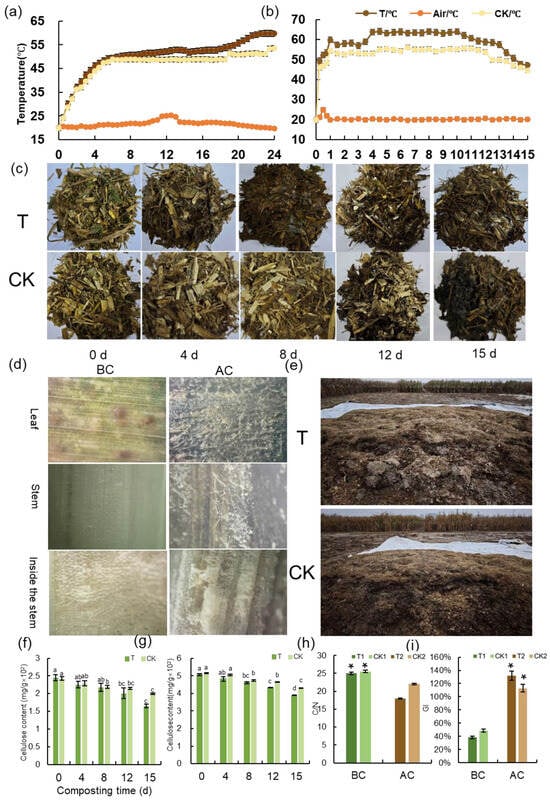
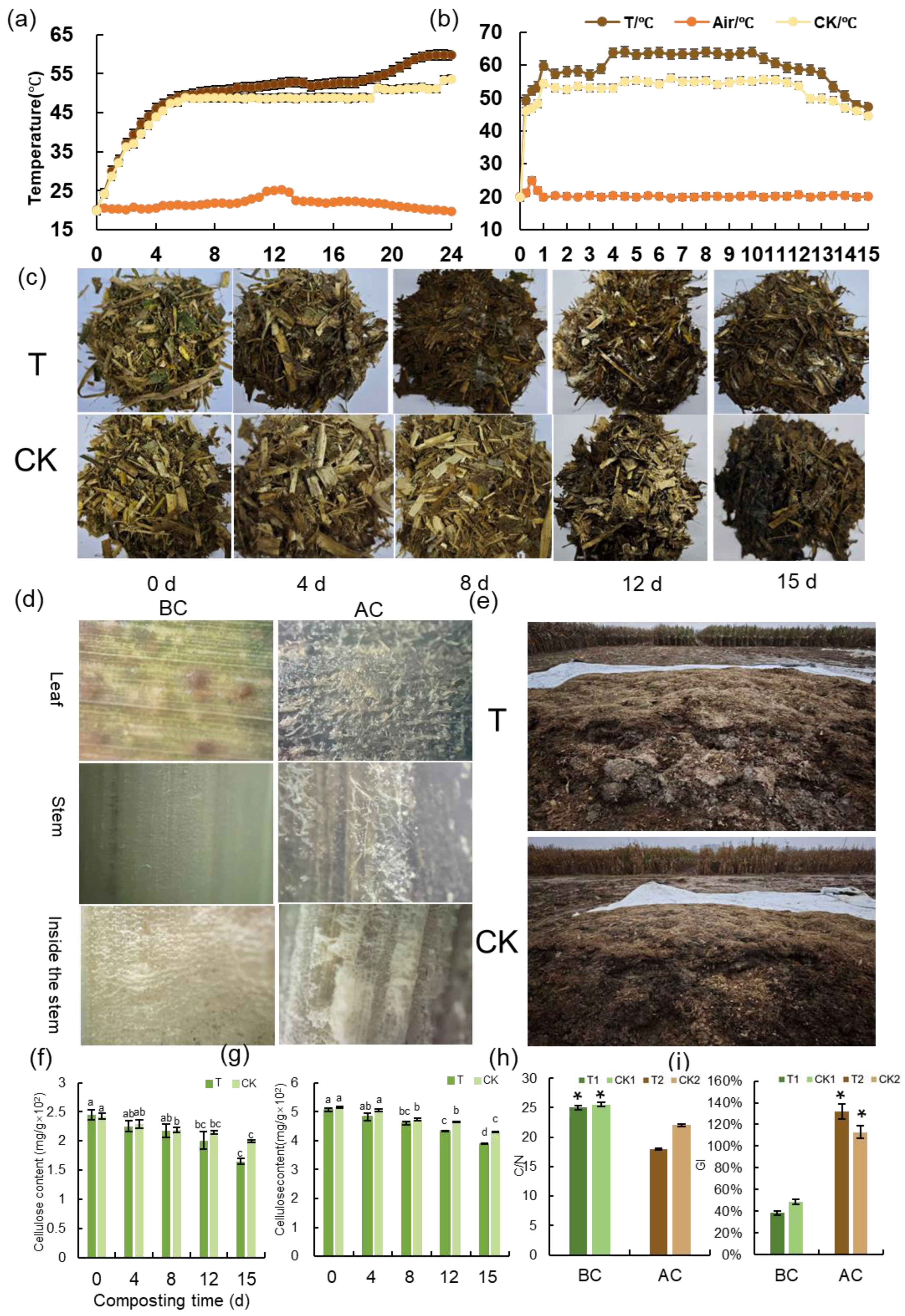
To clarify the physical and chemical changes in straw during rapid high-temperature composting, this study systematically analyzed the dynamics of pile temperature, the structural evolution of straw, and the maturity stability of the final product. The composting process exhibited typical three-stage temperature dynamics (Figure 2a,b). During the rapid heating phase (0–24 h), the pile temperature increased sharply: the central temperature of the pile amended with a microbial inoculant rose rapidly from ambient temperature (approximately 20 °C) to 60 °C, while that of the control group increased from ambient temperature to 53 °C within 24 h (Figure 2a). Subsequently, the inoculated pile entered a sustained high-temperature phase (days 2–10), with temperatures stably maintained at 58–63 °C, whereas the control group remained at around 50 °C. From day 11 onward, both piles entered a gradual cooling phase, with temperatures progressively decreasing to about 47 °C (Figure 2b).
Figure 2.
Changes in various parameters during composting. (a) Temperature variations within the first 24 h of composting. T represents the temperature of straw piles amended with decomposing inoculants, CK represents the temperature of straw piles without decomposing inoculants, and Air denotes ambient temperature (the same applies hereinafter); (b) Internal temperature dynamics of straw piles over the 15-day composting period; (c) Fresh straw samples collected on days 0, 4, 8, 12 and 15 of composting; T = treatment with decomposing inoculants, CK = control group without decomposing inoculants; (d) Microstructural morphology of straw leaves, stem epidermis and inner stem tissues in the inoculant-amended treatment before and after composting. BC refers to before composting, AC refers to after composting (the same applies hereinafter); (e) Overall appearance of straw piles from different treatments upon composting completion; (f,g) Dynamic changes in cellulose and lignin contents in straw during composting. All data are presented as mean ± standard deviation (n ≥ 3). One-way ANOVA was performed, and different lowercase letters indicate significant differences between groups; (h,i) C/N ratio and seed germination index (GI) of straw before and after composting. T1 and T2 correspond to the inoculant treatment before and after composting, respectively; CK1 and CK2 correspond to the control group before and after composting, respectively. Data are shown as mean ± standard deviation (n ≥ 3). Asterisk (*) indicates a significant difference between the two groups based on independent-samples t-test (p < 0.05).
Distinct changes in the physical morphology of straw occurred alongside temperature variations (Figure 2c–e). The straw in the upper group (treatment group) was entangled and degraded by microbial hyphae; its original compact structure gradually turned loose and fragmented, eventually transforming into dark-brown crumbly decomposed materials. In contrast, the straw in the lower group (control group) retained intact and dense structures with clearly visible light-colored fibers (Figure 2c). Microstructural observations revealed that the tissue structure of corn leaves treated with the decomposing inoculant was thoroughly destroyed by the end of decomposition. Abundant hyphae colonized both the surface and interior of stalks, leading to substantial tissue degradation (Figure 2d). In addition, Figure 2e illustrates the morphological differences between inoculant-amended and non-inoculant compost piles after decomposition. The upper inoculant-treated pile exhibited obvious subsidence and greatly enhanced compactness, with multiple sunken layered structures on the surface formed by uneven subsidence. The lower control pile without inoculant showed slight subsidence and maintained a fluffy, bulging overall shape with a loose structure, without obvious compaction or layering.
High-temperature composting had a significant effect on the degradation of cellulose and lignin in straw (Figure 2f,g). Before the experiment, the dry weight of raw straw substrate per replicate was 1000 kg, and water was added to the straw to reach a moisture content of approximately 65%. At the end of decomposition, the dry weight of substrate in the inoculant treatment group was about 648.80 kg, corresponding to a mass loss rate of 35.12%, while the control group without inoculant had a dry weight of 899.6 kg and a mass loss rate of only 10.04%. After composting, the cellulose degradation rate of the inoculant treatment reached 56.25%, which was 30.36 percentage points higher than that of the control. The lignin degradation rates were 50.39% and 25% for the inoculant group and control group, respectively, demonstrating prominent degradation efficiency in the inoculant treatment. The variations in the C/N ratio and germination index (GI) before and after decomposition are presented in Figure 2h,i. Before decomposition, the C/N ratios of the inoculant treatment and control were 25.00 and 25.52, and their GI values were 38.44% and 48.62%, respectively; no significant differences were detected between the two groups for both indicators. Upon completion of decomposition, the C/N ratios of both treatments decreased markedly. The C/N ratio of the inoculant group dropped to 18.03, which was significantly lower than the 22.04 observed in the control group. Meanwhile, the GI values of both groups increased sharply. The GI value of the inoculant treatment peaked at 131.88%, significantly higher than the control value of 113.04%. These results indicated that the decomposing inoculant could accelerate the decline of C/N ratio and reduce the phytotoxicity of decomposed straw products.
3.2. Microbial Community Succession Drives Substrate Degradation and Pathogen Inhibition
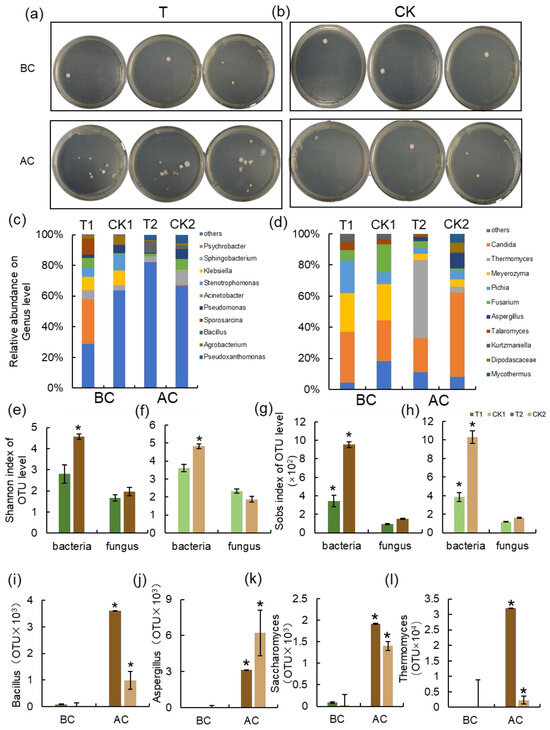
To clarify the microbial mechanism driving rapid straw degradation and detoxification, this study analyzed the dynamics of microbial community structure and nutrients during composting. First, the temporal variation in Bacillus subtilis spore count during high-temperature composting was monitored using the dilution plating method (Figure 3a). In the inoculant-amended treatment, the spore abundance of Bacillus subtilis in fresh corn straw reached 1.3 × 10⁸ CFU/g at the initial stage of decomposition (Day 1). After 15 days of composting, its population significantly increased to 8 × 10⁸ CFU/g, approximately 6.15 times the initial value. By contrast, the population of Bacillus subtilis in the control group exhibited negligible variation.
Figure 3.
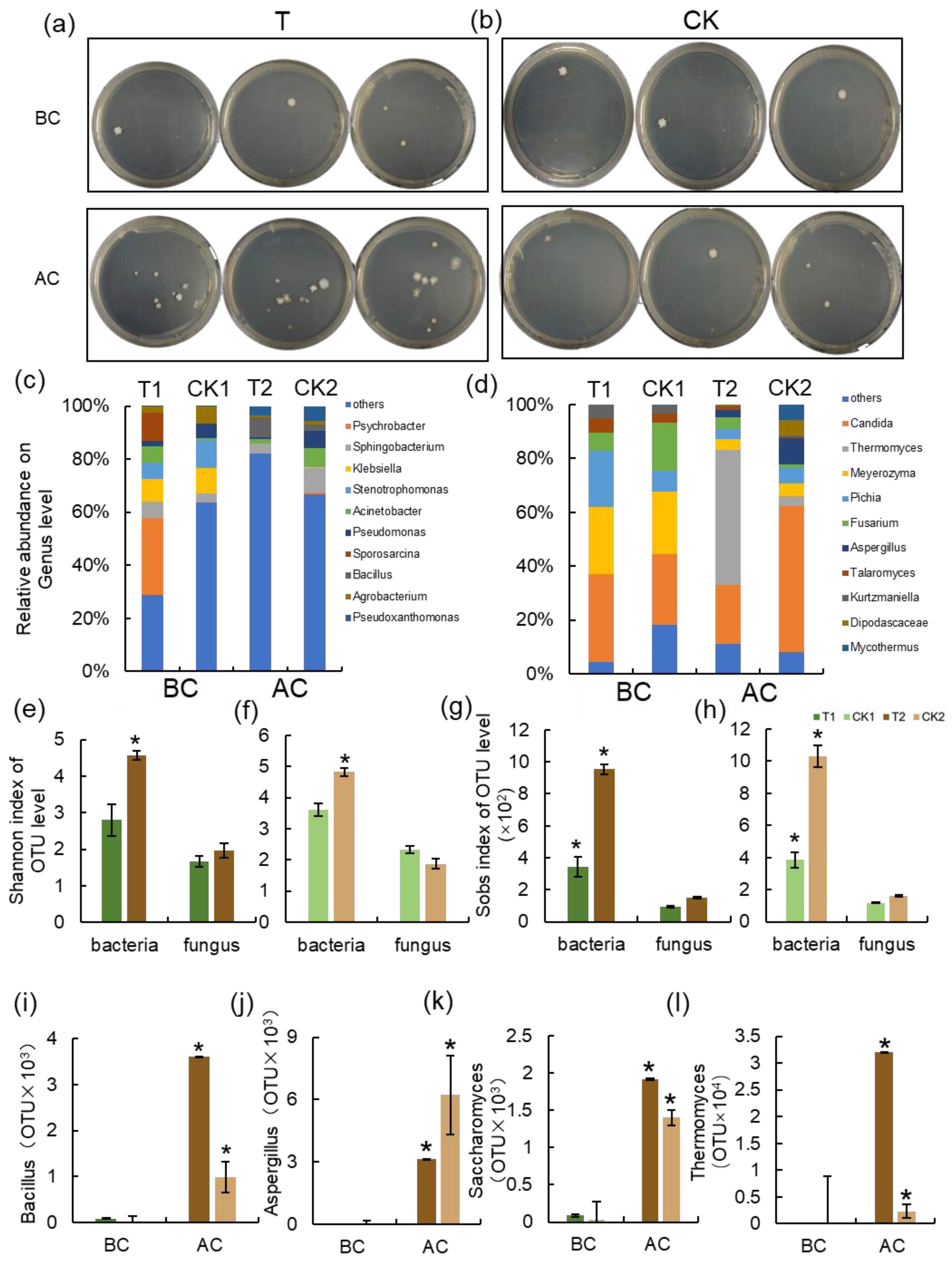
Microbial community changes before and after composting. (a,b) Plate colony images of Bacillus subtilis for treatment group T and control group CK before and after composting. Each group contained three biological replicates, reflecting the dynamics of Bacillus subtilis spore counts. (c,d) Stacked bar charts showing the relative abundance of bacterial and fungal communities at the genus level. (e–h) Microbial diversity indices: (e,f) display the Shannon index of microorganisms, and (g,h) represent the Sobs index. (i–l) Variations in the OTU counts of dominant microbial genera, including Bacillus, Aspergillus, Saccharomyces, and Thermomyces. Notes: Asterisk (*) indicates significant differences at p < 0.05 between BC and AC groups, and between T and CK groups.
We further used 16S rRNA and ITS amplicon high-throughput sequencing to analyze the dynamic changes in bacterial and fungal communities in straw before and after composting. The results revealed obvious shifts in the community composition of bacteria and fungi in straw after decomposition (Figure 3c,d). Among bacterial taxa, the relative abundance of Bacillus increased substantially in the inoculant treatment, while only a slight increment was observed in the control group. For fungal communities, inoculant application significantly elevated the relative abundance of Thermomyces and suppressed the abundance of Candida, whereas the relative abundance of Candida rose in the control group. The relative abundance of Meyerozyma decreased in both treatments by the end of composting.
Microbial community diversity and species richness were evaluated using the Shannon index and Sobs index, respectively. Compared with pre-composting, both the Shannon index and the Sobs index of bacteria in straw increased significantly after composting, whereas only the Sobs index of fungi increased significantly (Figure 3e,g). This indicated that composting improved the species diversity and richness of bacteria, while exerting a minor effect on fungal diversity and only increasing fungal species richness.
Analysis of the relative abundance of key microorganisms indicated that the decomposition process drove beneficial succession of the straw microbial community, with specific beneficial microbes becoming the dominant taxa. On day 15 of decomposition, the OTU counts of Bacillus and Aspergillus in corn straw amended with the decomposing inoculant increased to 42-fold (Figure 3e,i) and 420-fold (Figure 3j) of their initial levels, respectively. The OTU count of Saccharomyces also increased by approximately 22 times (Figure 3k). As a thermophilic fungus capable of secreting thermostable lipase and cellulase, Thermomyces was nearly undetectable in straw before decomposition; its OTU count surged to 21,381.5 times the initial value at the end of composting (Figure 3l). Although the control group exhibited a considerable increase in the OTU number of Aspergillus, the proliferation of the other target genera was far less pronounced compared with the inoculant treatment.
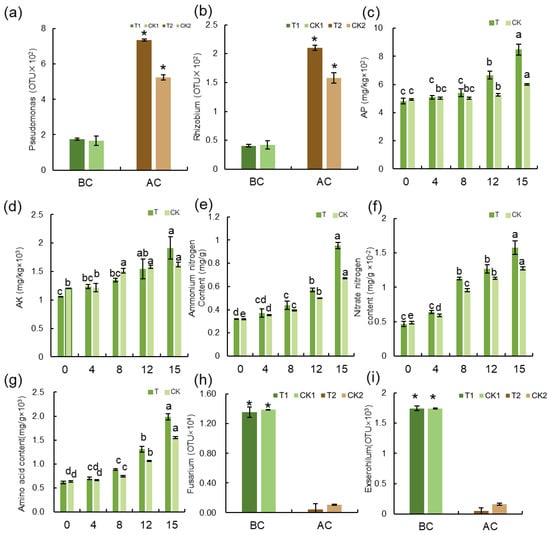
The succession and metabolic activities of the microbial community directly drove the transformation and enrichment of nutrients (Figure 4). With the progression of decomposition, the relative abundances of phosphate-solubilizing and potassium-solubilizing functional microorganisms (e.g., Pseudomonas, Rhizobium) increased by the end of composting regardless of inoculant addition (Figure 4a,b). For straw treated with the decomposing inoculant, the available phosphorus content rose from 482.1 g to 549.92 g, and available potassium content increased from 1057.7 g to 1240.83 g (Figure 4c,d). Notably, the total content of free amino acids reached 1287.61 g, which was 2.07 times the initial concentration (Figure 4g). These results demonstrated that high-temperature decomposition markedly elevated the readily available nutrients in straw that can be directly absorbed and utilized by plants.
Figure 4.
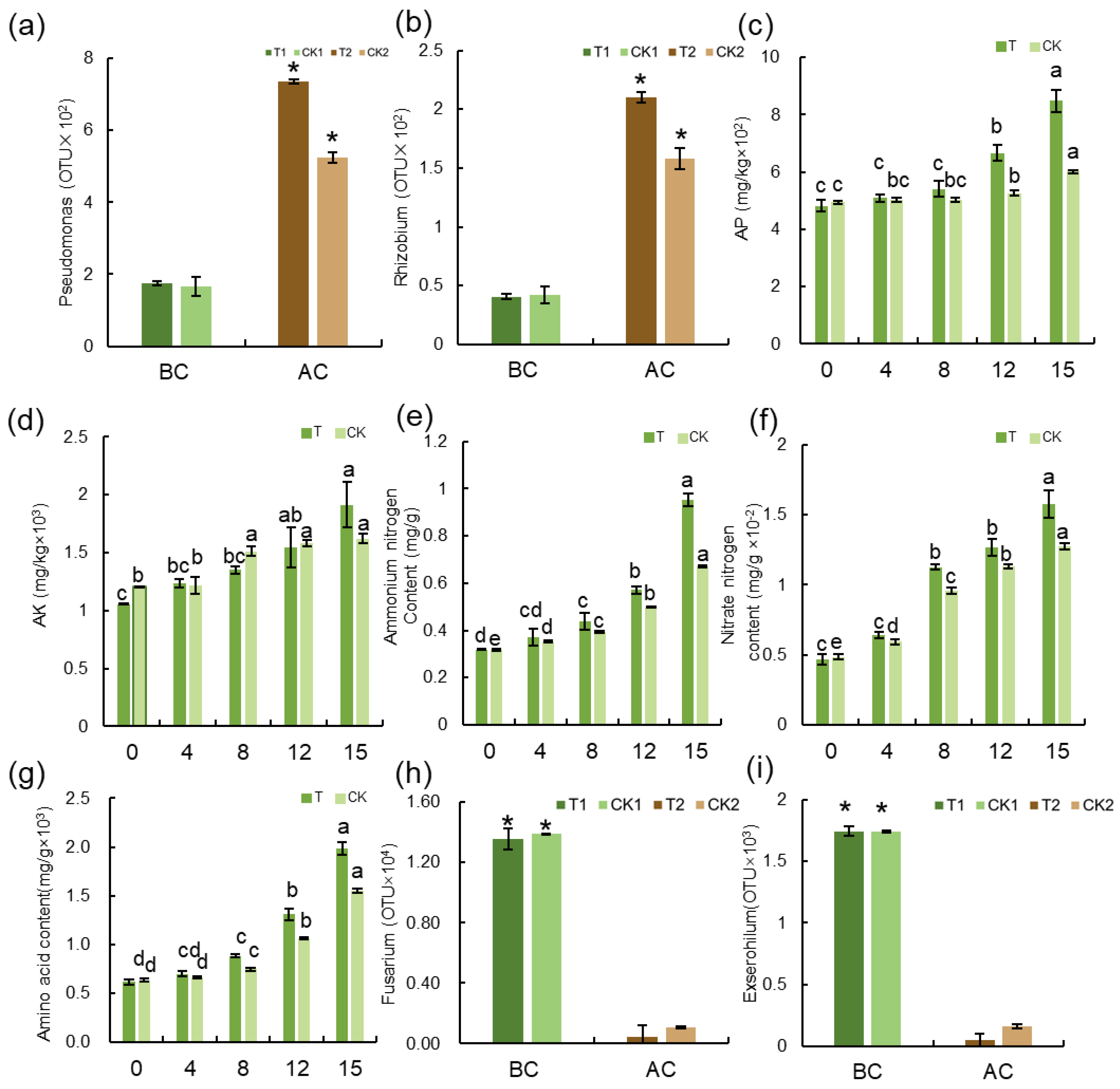
Dynamics of specific microbial OTUs and nutrient content during composting. (a) OTU variation in Pseudomonas; (b) OTU variation in Rhizobium; (c–g) Changes in available phosphorus, available potassium, ammonium nitrogen, nitrate nitrogen and amino acid content in straw at different composting stages; (h,i) Variations in OTU counts of pathogenic fungal genera. Notes: Asterisk (*) indicates significant difference at p < 0.05 between BC and AC groups. Different lowercase letters above bars denote significant differences among different sampling times (p < 0.05); the same letters indicate no significant difference.
Meanwhile, the relative OTU abundance of plant pathogenic microorganisms decreased significantly (Figure 4h,i). At the end of the high-temperature stage, the relative OTU abundances of common pathogenic fungi such as Fusarium spp. and Exserohilum spp. in the inoculant treatment group dropped to approximately 1/31 (Figure 3h) and 1/34 (Figure 3i) of their initial levels, respectively. The reduction amplitude of pathogenic OTU abundance was much weaker in the non-inoculant control group. This inhibitory effect can be attributed to physical sterilization by a sustained high temperature and resource competition from dominant functional microbes, which may substantially reduce the risk of disease transmission during straw returning to the field.
3.3. Microbial Activities Dominate Nutrient Activation and Accumulation of High-Value Metabolites
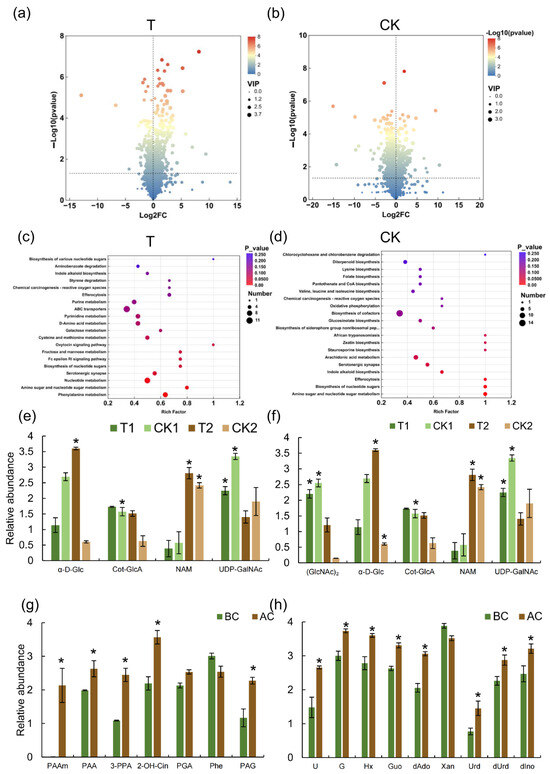
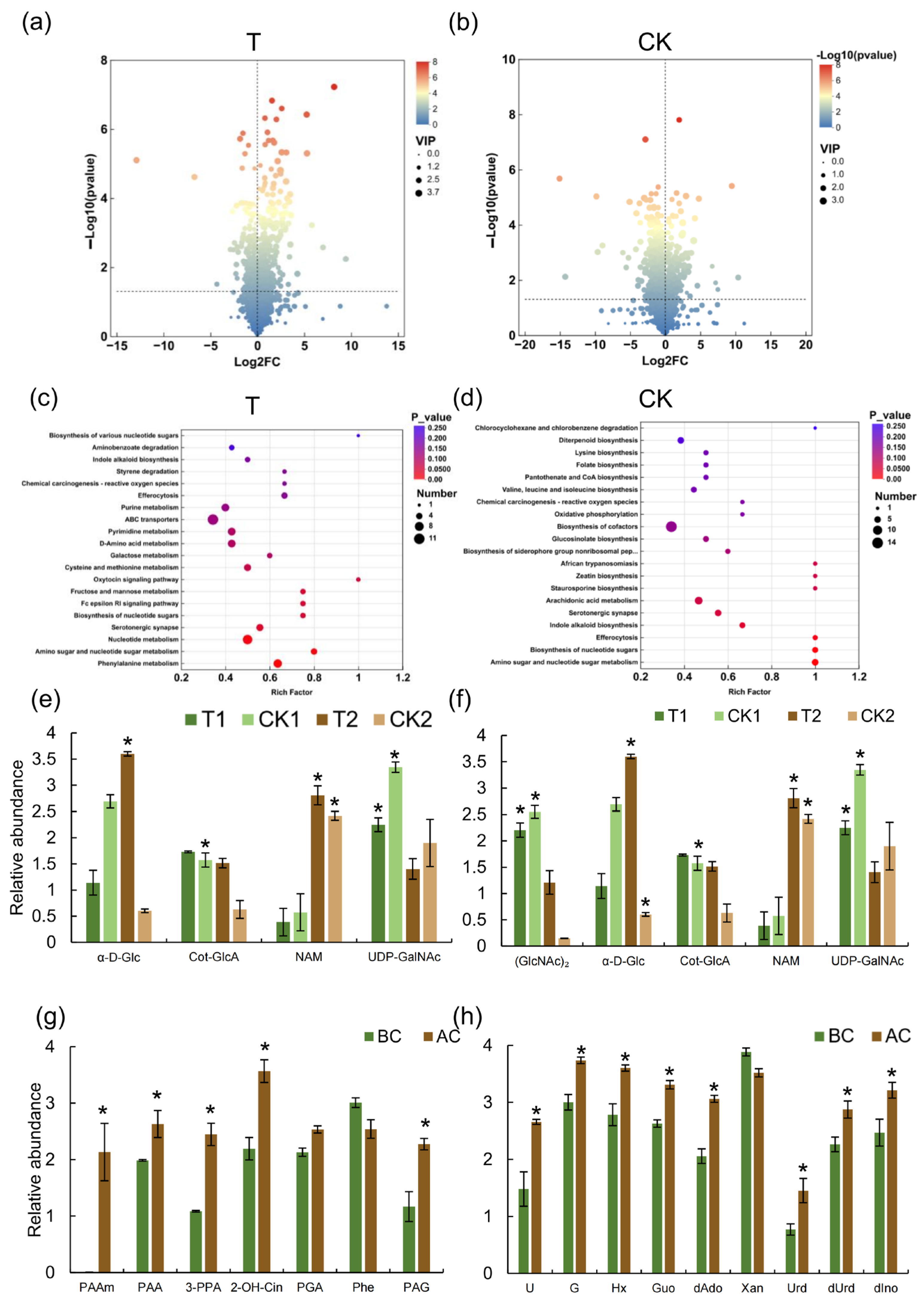
To systematically characterize the transformation patterns of endogenous metabolites in straw during decomposition, an untargeted metabolomics analysis was conducted on straw samples collected before and after composting. A total of 2701 metabolites were identified in both treatments under identical metabolomics detection conditions. In the group amended with decomposing inoculant, 340 metabolites were significantly upregulated and 228 metabolites were significantly downregulated after decomposition compared with the initial raw straw (Figure 5a). For corn straw undergoing natural decomposition (control group), 169 metabolites showed significantly elevated relative expression levels, whereas 586 metabolites were markedly downregulated (Figure 5b). Significant differential expression was observed for 34 metabolites distributed across seven metabolic pathways in the inoculant treatment (Figure 5c). In contrast, only 12 metabolites from four metabolic pathways exhibited notable expression changes in the non-inoculant control group (Figure 5d).
Figure 5.
Metabolic pathway alterations before and after composting. (a,b) Volcano plots showing differential metabolites before and after decomposition; the left panel corresponds to the inoculant treatment, and the right panel to the non-inoculant control (a consistent layout applies to all subsequent figures). (c,d) Bubble diagrams of KEGG pathway enrichment before and after decomposition. (e,f) Relative abundances of five characteristic metabolites involved in nucleotide sugar biosynthesis, as well as amino acid and nucleotide sugar metabolic pathways at different composting stages. Abbreviations: α-D-Glc = Alpha-D-Glucose; Cot-GlcA = Cotinine Glucuronide; NAM = N-Acetylmuramate; (GlcNAc)2 = N, N’-Diacetylchitobiose; UDP-GalNAc = UDP-N-Acetyl-D-Galactosamine. (g) Relative abundances of metabolites in the phenylalanine metabolism pathway. Abbreviations: PAAm = 2-Phenylacetamide; PAA = Phenylacetic Acid; 3-PPA = Hydrocinnamic Acid; 2-OH-Cin = 2-Hydroxycinnamic Acid; PGA = Phenylglyoxylic Acid; Phe = L-Phenylalanine; PAG = Phenaceturic Acid. (h) Relative abundances of metabolites in the nucleotide metabolism pathway. Abbreviations: U = Uracil; G = Guanine; Hx = Hypoxanthine; Guo = Guanosine; dAdo = Deoxyadenosine; Xan = Xanthine; Urd = Uridine; dUrd = 2′-Deoxyuridine; dIno = Deoxyinosine. Notes: Asterisk (*) indicates significant difference at p < 0.05 between T and CK groups.
The KEGG pathway enrichment analysis revealed that seven metabolic pathways underwent significant changes (p < 0.05) in the inoculant-amended compost group, mainly including nucleotide sugar biosynthesis, fructose and mannose metabolism, amino sugar and nucleotide sugar metabolism, phenylalanine metabolism, and nucleotide metabolism. Among these pathways, phenylalanine metabolism and nucleotide metabolism harbored abundant differential metabolites with particularly dramatic alterations, indicating that these two pathways were highly activated during decomposition. The two pathways of nucleotide sugar biosynthesis and amino sugar and nucleotide sugar metabolism showed significant differences in both treatments (Figure 5e–h). Three metabolites, namely (GlcNAc)2, α-D-Glc and NAM, exhibited pronounced responses to the decomposition process. As the core carbon and energy substrate for microorganisms, α-D-glucose displayed a markedly elevated relative abundance at the end of decomposition in the inoculant treatment, while its content decreased under natural composting. NAM serves as an indicator of bacterial activity within the compost system; its relative expression level increased significantly after decomposition, and more vigorous bacterial metabolism was observed under inoculant supplementation. (GlcNAc)2 can induce chitinase synthesis during composting to degrade fungal cell walls and accelerate straw decomposition. Upon inoculant addition, this metabolite exerted stronger functional potential and facilitated the overall composting process under the action of compound microbial agents.
The phenylalanine metabolism pathway starts with L-phenylalanine and generates various phenolic acids and aromatic compounds (e.g., phenylacetic acid, hydrocinnamic acid, 2-hydroxycinnamic acid) via a series of enzymatic reactions. The results of this study showed that the contents of most downstream metabolites in this pathway increased significantly after composting, while that of the precursor L-phenylalanine decreased slightly, indicating that the metabolic flux was effectively directed downstream during composting. These phenolic acids and aromatic compounds not only serve as important precursors for humification and contribute to soil organic matter formation and stabilization, but also possess multiple ecological functions. For example, substances such as phenylacetic acid can influence the composition of the rhizosphere microbial community, and some hydroxycinnamic acid derivatives can induce systemic resistance in plants and enhance crop tolerance to biotic and abiotic stresses.
Metabolites associated with the nucleotide metabolism pathway also showed an overall upward trend after composting, including purine bases (such as guanine and hypoxanthine), pyrimidine bases (such as uracil), their corresponding nucleosides (such as guanosine and uridine), and deoxynucleotides (such as deoxyadenosine, deoxyinosine). The accumulation of these compounds reflects highly active microbial nucleic acid synthesis and turnover during composting. Nucleotides and their degradation products can serve as readily available organic nitrogen and phosphorus sources in the soil and be directly absorbed by plants. In addition, certain nucleosides can act as signal molecules in the soil to regulate microbial community structure and activity, especially stimulating the metabolic activity of functional microorganisms such as phosphate-solubilizing bacteria and nitrogen-fixing bacteria, thereby indirectly improving soil nutrient cycling efficiency and crop nutrient utilization capacity.
In summary, the composting process not only promotes the release of available nutrients in straw, but also accumulates a variety of metabolites with potential roles in soil improvement and plant regulation by activating key biochemical pathways such as phenylpropanoid and nucleotide metabolism. These characteristics suggest that the composted product may possess certain fertilizing and bioregulatory potential after returning to the field. However, its practical effects on improving soil fertility, promoting crop growth and enhancing systemic stress resistance have not been evaluated in the present study and need to be further assessed in subsequent pot or field trials.
3.4. This Technology Exhibits Favorable Economic Benefits and Promotion Potential
To preliminarily evaluate the potential practical value of this technology in real agricultural production, a tentative economic benefit assessment was performed in this study. The calculation was based on the treatment of roughly 2 tons of wet straw per mu in the field (Table 1). The theoretical value increment generated by straw composting can be divided into two categories of benefits. The first is the theoretical income from chemical fertilizer substitution via extra nutrients produced in compost, calculated at approximately 52.08 Yuan per mu. The second benefit originates from the abundant highly active functional microbial communities within mature compost, where the concentration of Bacillus subtilis reaches ≥8 × 10⁸ CFU/g. Converted according to the market price of commercial bio-inoculants, this portion yields a theoretical benefit of around 406 Yuan per mu. Summing the two types of benefits, the total theoretical potential value increment of this technology amounts to roughly 458.08 Yuan per mu. No additional operating costs were incurred during the experimental operations of this study. After deducting straw treatment costs, including inoculant application and manual labor (estimated to range from 40 to 50 Yuan per mu), a theoretical net profit of nearly 400 Yuan per mu may be achieved. The above calculation results are idealized estimations obtained under the experimental conditions of this research. It can be tentatively inferred that this technology carries certain economic potential for popularization. Nevertheless, actual profits under practical production conditions are subject to numerous variables such as straw transportation and storage expenses, labor prices, and field plot scale. Further verification through large-scale field demonstration trials across diverse regions is still required.
Table 1.
Preliminary economic benefit analysis of rapid high-temperature composting technology for corn straw (Based on 2 Tons of Straw per Mu).
4. Discussion
4.1. Comparative Advantages of the Technology: A Leap from “Possibility” to “Feasibility”
Technical efficiency evaluation showed that the proposed scheme could reduce the C/N ratio of corn straw from 25:1 to below 18:1 within 15 days and increase the seed germination index to more than 130%. Meanwhile, the relative abundance of sequences related to soil-borne pathogenic microorganisms such as Fusarium was decreased, which may mitigate the risk of soil-borne pathogen contamination to a certain extent. This technology has the potential to transform straw returning from an agricultural practice that easily causes seedling damage and soil-borne disease risks into a standardized agronomic measure for producing stable and safe compost products.
Compared with laboratory studies or advanced technologies that rely on sophisticated bioreactors and costly temperature control systems [15,16], this technology reproduces the core condition of sustained high temperature (58–63 °C) in the field at a low cost by inoculating functional microbial agents and optimizing the windrow structure, achieving a balance between process efficiency and practical applicability. In contrast to common commercial composting agents that mainly promote decomposition but have unclear harmless effects, this technology is hypothesized to achieve pathogen suppression via thermal physical inactivation and microbial competition, though this potential effect remains to be verified by dedicated pathogen viability tests. A net income of approximately 400 yuan per mu after cost deduction provides a direct incentive for its popularization in agricultural production systems dominated by family-run operations.
4.2. Process Mechanism Analysis: High-Temperature-Driven Biotransformation Network and Metabolite Accumulation
The chain of “rapid heating → sustained high temperature → community succession → directional transformation” revealed in this study elucidates the biological basis of this technology. The inoculated composite microbial agent and optimized windrow structure jointly trigger explosive microbial metabolism, and their respiratory heat production acts as the direct driving force for a rapid temperature rise. After entering the thermostatic phase, high temperature, as a strong environmental selection pressure, shapes the community structure dominated by thermophilic functional microorganisms. Bacteria (e.g., Bacillus subtilis) and fungi (e.g., Thermomyces, Aspergillus niger) form a functionally complementary decomposer alliance: bacteria are adept at utilizing easily degradable components and secreting hydrolases, whereas fungi penetrate plant tissues via their mycelial networks and attack recalcitrant lignin [38,39,40]. This synergy explains the high efficiency of lignocellulose degradation achieved within a short period.
Furthermore, the succession of the microbial community directly drives the activation of nutrients and the accumulation of high-value metabolites. The proliferation of phosphorus- and potassium-solubilizing bacteria coincided with a significant increase in available phosphorus and potassium contents (Figure 4). Untargeted metabolomics further revealed that the composting process highly activated key biochemical pathways such as phenylpropanoid metabolism and nucleotide metabolism, leading to the significant accumulation of phenolic acids, aromatic compounds, and nucleosides (Figure 5). These metabolites are not only precursors for humification, but some also possess the potential to regulate rhizosphere microorganisms and induce stress resistance in plants. This study demonstrates that aside from converting straw into a quick-acting organic fertilizer, the proposed technology holds potential to develop modified soil amendments featuring both nutrient supply capacity and soil biological regulation functions, which could synergistically boost crop growth and soil health via nutrient supplementation and soil ecological remediation.
4.3. Promotion Challenges and Prospects for Systematic Solutions
Although this study has demonstrated the promising agronomic, ecological, and economic prospects of this technology, its large-scale adoption faces systematic challenges as it transitions from technical verification to model implementation. The primary challenge lies in the inoculant industry: standardizing and scaling up the production of composite inoculants targeting high efficiency, low cost and long shelf-life, with expected functions of straw decomposition and potential pathogen-antagonistic capacity to be further validated. Second, at the agronomic operation level, there is an urgent need to develop simplified and specialized agricultural machinery integrating straw crushing, precise inoculant spraying, and windrow stacking, to reduce labor intensity, ensure process consistency, and further shorten the farming time.
The future development path should rely on collaborative innovation of technology, equipment, policy, and service. Technically, based on metabolomics and other achievements, research should advance toward rational design to develop next-generation functional inoculants adapted to different regional climates and straw types. In terms of equipment, the in-depth integration of agricultural machinery and agronomy should be promoted, and low-cost integrated machines suitable for small-scale fields should be developed. For policies and services, it is suggested that this technology and its products be included in subsidies for comprehensive straw utilization, cultivated land quality improvement, and green agriculture promotion programs, and a socialized service model of decentralized collection, centralized inoculant production, and on-site services be explored. This is not only the implementation of a single technology, but also an important practice to promote the systematic transformation of agricultural waste management from end-of-pipe treatment to circular value-added utilization, which is of far-reaching significance for ensuring food security and sustainable agricultural development.
5. Conclusions
Based on field experiments and systematic analyses, the primary tentative findings of this study are presented as follows:
Inoculating a specialized composite microbial agent and optimizing the windrow structure enabled rapid heating (to 60 °C within 24 h) and sustained thermophilic conditions (58–63 °C for 9 consecutive days) for corn straw composting in situ. The entire composting cycle was shortened to within 15 days, which effectively matches the tight farming schedule in the wheat–maize double-cropping region.
This high-temperature composting process may achieve remarkable lignocellulose degradation with an estimated degradation rate of over 23%. Meanwhile, it is expected to simultaneously activate phosphorus and potassium nutrients and accumulate active substances, including free amino acids. The compost products are likely to exhibit favorable maturity stability (C/N < 20) and biosafety (GI > 130%).
The substance transformation within this system is presumed to be dominated by thermotolerant functional microbial communities such as Bacillus subtilis and Aspergillus niger. These microbes may effectively suppress harmful pathogens like Fusarium, which could offer a feasible approach to convert crop straw from potential pathogenic sources in farmlands into carriers of biofertilizers.
Preliminary economic estimates suggest that this process has considerable value-adding potential and prospective economic benefits, which may provide economic support for its subsequent large-scale popularization and application.
In conclusion, this study preliminarily proposes an integrated technical solution that may help alleviate farming-schedule conflicts associated with conventional direct straw returning in regions of China with a high multiple-cropping index. Further large-scale field trials are still required to fully verify its practical performance, including its comprehensive biosafety.
Supplementary Materials
The following supporting information can be downloaded at: https://www.mdpi.com/article/10.3390/agriculture16171816/s1, Supplementary_Table_S1_Raw_Data.xlsx: Raw experimental data for this study.
Author Contributions
Conceptualization, Y.W., X.W. and X.M.; methodology, Y.W., Z.Z. and S.X.; validation, W.S., Z.Z. and S.X.; formal analysis, W.S., L.M., M.N., Z.Z., Z.S. and W.Z.; investigation, W.S., X.Z., W.Z., J.C. (Junying Chen), Z.Z., A.S. and J.C. (Jianfeng Chen); resources, Y.W., X.W. and X.M.; data curation, W.S., L.M., M.N., Z.S., X.Z., W.Z., S.X., J.C. (Junying Chen) and J.C. (Jianfeng Chen); writing—original draft preparation, W.S. and Y.W.; writing—review and editing, W.S. and Y.W.; visualization, W.S. and W.Z.; supervision, Y.W., Z.Z., X.W. and X.M.; project administration, Y.W., S.X. and X.M.; funding acquisition, S.X. All authors have read and agreed to the published version of the manuscript.
Funding
This work was funded by the National Key Research and Development Program during the 14th Five-Year Plan Period, China (Grant No. 2023YFD2301500).
Data Availability Statement
The raw data supporting the conclusions of this article are available in the Supplementary Material Supplementary_Table_S1_Raw_Data.xlsx.
Conflicts of Interest
The authors declare no conflicts of interest.
References
- Wei, Y.H.; Zhang, X.B.; Song, W.J.; Ahmad, S.; Shen, Z.Q.; Liu, C.P.; Zhang, S.Y.; Ma, X.M. Spatiotemporal variations of wheat and maize grass-grain ratio and analysis of carbon sequestration and emission reduction effects of comprehensive straw utilization. Trans. Chin. Soc. Agric. Eng. 2025, 41, 271–279. [Google Scholar]
- Dong, X.X.; Chen, S.Y.; Wang, X.J.; Ma, Z.; Dong, L.; Sun, Z.Q.; Guo, H.H. Effects, Existing Problems, and Research Directions of Direct Straw Return in Wheat-Maize Rotation Systems. Shandong Agric. Sci. 2014, 46, 141–144. [Google Scholar]
- Sun, X.; Peng, J.M.; Zhang, Y.C.; Cheng, X.L.; Xu, F. Extension and application of wheat high-performance multiple precision uniform sowing technology in Huang-Huai-Hai wheat-corn cropping area. Agric. Eng. 2025, 15, 15–20. [Google Scholar]
- Jiang, C.Q.; Shen, J.; Chen, H.H.; Xia, H.; Zu, Z.L. Review of straw returning modes and the mechanism for reducing nitrogen application and improving efficiency. Chin. J. Eco-Agric. 2025, 1–16. [Google Scholar]
- Yang, Q.R.; Zhang, L.L.; Zhang, Y.J.; Li, L.T.; Wang, Y.L. Optimized Application of Nitrogen, Phosphorus, and Potassium Enhances Yield and Quality by Improving Nutrient Uptake Dynamics in Winter Wheat with Straw Return. J. Plant Growth Regul. 2025, 44, 5028–5047. [Google Scholar] [CrossRef] [Scilit]
- Chen, X.; Cai, H.M.; Wu, Y.; Tang, Z.W.; Weng, Y.; Zheng, B.Q.; Li, J.C. Long-term effects of straw incorporation on seedling emergence and seedling quality of winter wheat on the Huang-Huai-Hai Plain. Int. J. Agric. Biol. Eng. 2025, 18, 208–217. [Google Scholar] [CrossRef] [Scilit]
- Alkoaik, F.N. Integrating aeration and rotation processes to accelerate composting of agricultural residues. PLoS ONE 2019, 14, e0220343. [Google Scholar] [CrossRef] [Scilit] [PubMed]
- Quansah, K.E.; Asah-Asante, R.; Fan, X.D.; Shen, X.R.; Li, M.; Di, W.J.; Ma, X.; Wang, J.Z.; Miao, G. Vegetable residue valorization for soil health and climate resilience. Front. Soil Sci. 2025, 5, 1624486. [Google Scholar] [CrossRef] [Scilit]
- Roy, D.; Gunri, S.K.; Kundu, C.K.; Bandyopadhyay, P.K. Rapid composting of groundnut residues through novel microbial consortium: Evaluating maturity, stability, and microbial activity. Curr. Res. Microb. Sci. 2024, 7, 100277. [Google Scholar] [CrossRef] [Scilit] [PubMed]
- Ghaly, A.E.; Alkoaik, F.; Snow, A.; Singh, R. Effective Thermophilic Composting of Crop Residues for Inactivation of Tobacco Mosaic Virus. Am. J. Biochem. Biotechnol. 2006, 2, 111–118. [Google Scholar] [CrossRef] [Scilit]
- Suárez-Estrella, F.; Vargas-García, M.C.; Elorrieta, M.A.; López, M.J.; Moreno, J. Temperature effect on Fusarium oxysporum f.sp. melonis survival during horticultural waste composting. J. Appl. Microbiol. 2003, 94, 475–482. [Google Scholar] [CrossRef] [Scilit] [PubMed]
- Ma, Y.S.; Liu, L.Y.; Zhou, X.R.; Tian, T.; Xu, S.; Li, D.; Li, C.T.; Li, Y. Optimizing Straw-Rotting Cultivation for Sustainable Edible Mushroom Production: Composting Spent Mushroom Substrate with Straw Additions. J. Fungi 2023, 9, 925. [Google Scholar] [CrossRef] [Scilit] [PubMed]
- Song, C.; Xu, F.; Zhao, W.; Ye, F.; Wang, Q.L.; Yang, W.Y. Research on the Optimum Ratio of Sheep Manure and Maize Straw for High Temperature Compost. J. Sichuan Agric. Univ. 2018, 36, 138–144. [Google Scholar]
- Zhang, M.; Gao, T.P.; Liu, L.L.; Zhang, J.; Yue, B. Process of high-temperature compost of sheep manure with addition of wheat straw. Chin. J. Eco-Agric. 2010, 18, 566–569. [Google Scholar] [CrossRef] [Scilit]
- Noor, R.S.; Shah, A.N.; Tahir, M.B.; Umair, M.; Nawaz, M.; Ali, A.; Ercisli, S.; Abdelsalam, N.R.; Ali, H.M.; Yang, S.H.; et al. Recent Trends and Advances in Additive-Mediated Composting Technology for Agricultural Waste Resources: A Comprehensive Review. ACS Omega 2024, 9, 8632–8653. [Google Scholar] [CrossRef] [Scilit] [PubMed]
- Wang, L.K.; Li, Y.; Li, X.F. Microbe-aided thermophilic composting accelerates manure fermentation. Front. Microbiol. 2024, 15, 1472922. [Google Scholar] [CrossRef] [Scilit] [PubMed]
- Cao, Y.; Wang, J.D.; Huang, H.Y.; Sun, E.H.; Butterly, C.; Xu, Y.D.; He, H.; Zhang, J.; Chang, Z.Z. Spectroscopic evidence for hyperthermophilic pretreatment intensifying humification during pig manure and rice straw composting. Bioresour. Technol. 2019, 294, 122131. [Google Scholar] [CrossRef] [Scilit] [PubMed]
- Liao, H.P.; Zhao, Q.; Cui, P.; Chen, Z.; Yu, Z.; Geisen, S.; Friman, V.-P.; Zhou, S.G. Efficient reduction of antibiotic residues and associated resistance genes in tylosin antibiotic fermentation waste using hyperthermophilic composting. Environ. Int. 2019, 133, 105203. [Google Scholar] [CrossRef] [Scilit] [PubMed]
- Yu, Z.; Zhou, S.G. Hyperthermophilic composting of organic solid wastes: Accelerated humification and pollution control mechanisms. J. Nanjing Agric. Univ. 2020, 43, 781–789. [Google Scholar]
- Chang, C.L.; Guo, Y.; Tang, K.Q.; Hu, Y.L.; Xu, W.H.; Chen, W.J.; McLaughlin, N.; Wang, Z.G. Straw from Different Crop Species Recruits Different Communities of Lignocellulose-Degrading Microorganisms in Black Soil. Microorganisms 2024, 12, 938. [Google Scholar] [CrossRef] [Scilit] [PubMed]
- Lu, M.X.; Wang, X.; She, W.J.; Mu, Y.; Sun, R.B.; Ma, C. Dynamic changes in bacterial community construction and functional characteristics during straw degradation. J. Anhui Agric. Univ. 2025, 52, 877–884. [Google Scholar]
- Shi, F.M.; Yu, H.J.; Zhang, N.; Wang, S.; Li, P.F.; Yu, Q.Y.; Liu, J.; Pei, Z.J. Microbial succession of lignocellulose degrading bacteria during composting of corn stalk. Bioengineered 2021, 12, 12372–12382. [Google Scholar] [CrossRef] [Scilit] [PubMed]
- Alessi, A.M.; Bird, S.M.; Oates, N.C.; Li, Y.; Dowle, A.A.; Novotny, E.H.; DeAzevedo, E.R.; Bennett, J.P.; Polikarpov, I.; Young, J.P.W.; et al. Defining functional diversity for lignocellulose degradation in a microbial community using multi-omics studies. Biotechnol. Biofuels 2018, 11, 166. [Google Scholar] [CrossRef] [Scilit] [PubMed]
- Jiménez, D.J.; Dini-Andreote, F.; van Elsas, J.D. Metataxonomic profiling and prediction of functional behaviour of wheat straw degrading microbial consortia. Biotechnol. Biofuels 2014, 7, 92. [Google Scholar] [CrossRef] [Scilit] [PubMed]
- Logo, A.; Boppré, B.; Fuchs, J.; Maurhofer, M.; Oberhänsli, T.; Thürig, B.; Widmer, F.; Mayerhofer, J.; Flury, P. Analyses of 37 composts revealed microbial taxa associated with disease suppressiveness. Appl. Environ. Microbiol. 2025, 91, e01100-25. [Google Scholar] [CrossRef] [Scilit] [PubMed]
- Wang, N.; Li, H.X.; Li, X.; Ding, G.C. Advances in Compost Regulation of Rhizospheric Microbiome to Suppress Plant Diseases. Biotechnol. Bull. 2022, 38, 4–12. [Google Scholar]
- Alessi, A.M.; Bird, S.M.; Bennett, J.P.; Oates, N.C.; Li, Y.; Dowle, A.A.; Polikarpov, I.; Young, J.P.W.; McQueen-Mason, S.J.; Bruce, N.C. Revealing the insoluble metasecretome of lignocellulose-degrading microbial communities. Sci. Rep. 2017, 7, 2356. [Google Scholar] [CrossRef] [Scilit] [PubMed]
- Puentes-Téllez, P.E.; Salles, J.F. Construction of Effective Minimal Active Microbial Consortia for Lignocellulose Degradation. Microb. Ecol. 2018, 76, 419–429. [Google Scholar] [CrossRef] [Scilit] [PubMed]
- Gong, X.J.; Zou, H.T.; Qian, C.R.; Yu, Y.; Hao, Y.B.; Li, L.; Wang, Q.J.; Jiang, Y.B.; Ma, J.T. Construction of in situ degradation bacteria of corn straw and analysis of its degradation efficiency. Ann. Microbiol. 2020, 70, 62. [Google Scholar] [CrossRef] [Scilit]
- Ma, J.N.; Han, C.Y.; Zhao, X.Q.; Zheng, R.; Li, M.Y.; Lu, Z.Y.; Jiang, W.; Wu, H.L. Research progress on using cellulose-degrading bacteria to improve straw returning efficiency. Chin. J. Eco-Agric. 2025, 33, 1033–1045. [Google Scholar]
- Li, P.P.; Zhang, D.D.; Wang, X.J.; Wang, X.F.; Cui, Z.J. Effects of microbial inoculants on soil microbial diversity and degrading process of corn straw returned to field. Acta Ecol. Sin. 2012, 32, 2847–2854. [Google Scholar] [CrossRef] [Scilit]
- Hu, H.H.; Sun, J.J.; Gao, J.L.; Wang, Z.; Bao, N.G.C.L.; Hu, S.P.; Qing, G.E. Optimization of fermentation conditions for low-temperature and high-efficiency composite microbial system for corn stover degradation and preliminary development of microbial inocula. J. Agro-Environ. Sci. 2016, 35, 1602–1609. [Google Scholar]
- Zhang, S.N.; Han, S.C.; Gao, J.L.; Yu, X.F.; Hu, S.P. Low-temperature corn straw-degrading bacterial agent and moisture effects on indigenous microbes. Appl. Microbiol. Biotechnol. 2023, 107, 5241–5255. [Google Scholar] [CrossRef] [Scilit] [PubMed]
- Zhang, X.; Mu, Z.Y.; Guan, C.L.; Zhang, S.Y.; Wang, X. Research Progress of Low Temperature Degrading Bacteria of Maize Straw. Heilongjiang Sci. 2024, 15, 11–19. [Google Scholar]
- Wang, X.K. Principles and Techniques of Plant Physiological and Biochemical Experiments; Higher Education Press: Beijing, China, 2006. [Google Scholar]
- Bao, S.D. Soil and Agricultural Chemistry Analysis; China Agriculture Press: Beijing, China, 2000. [Google Scholar]
- Zhang, Y.F.; Tian, S.Z.; Bian, W.F.; Guo, H.H.; Gong, Z.Y.; Liu, Z.H.; Li, R.Q.; Chen, J.Q.; Luo, J.F. Screening of aerobic fermentation microbial agents mixed with cow dung and corn straw. Soil Fertil. Sci. China 2019, 19, 172–178. [Google Scholar]
- Wang, M.; Lu, Z.M.; Chen, Y.; Zhou, Y.; Bing, D.X.; Liu, L.L.; Guo, S.T.; Xu, X.R. Counting Method of Bacillus Subtilis. Contemp. Chem. Ind. 2020, 49, 1930–1933. [Google Scholar]
- Yu, H.Y.; Zeng, G.M.; Huang, H.L.; Xi, X.M.; Wang, R.Y.; Huang, D.L.; Huang, G.H.; Li, J.B. Microbial community succession and lignocellulose degradation during agricultural waste composting. Biodegradation 2007, 18, 793–802. [Google Scholar] [CrossRef] [Scilit] [PubMed]
- Zhang, Y.D.; Ding, F.; Shen, Y.; Cheng, W.; Xue, Y.S.; Han, B.Z.; Chen, X.X. Characteristics of the microbiota and metabolic profile of high-temperature Daqu with different grades. World J. Microbiol. Biotechnol. 2022, 38, 137. [Google Scholar] [CrossRef] [Scilit] [PubMed]

Disclaimer/Publisher’s Note: The statements, opinions and data contained in all publications are solely those of the individual author(s) and contributor(s) and not of MDPI and/or the editor(s). MDPI and/or the editor(s) disclaim responsibility for any injury to people or property resulting from any ideas, methods, instructions or products referred to in the content. |
© 2026 by the authors. Licensee MDPI, Basel, Switzerland. This article is an open access article distributed under the terms and conditions of the Creative Commons Attribution (CC BY) license.