


Abstract
Fusarium oxysporum f. sp. lycopersici (Fol) is a destructive soil-borne pathogen responsible for major global losses in tomato production, within a context of increasingly constrained fungicide use in intensive farming systems. Sustainable alternatives to chemical fungicides are urgently needed, and microbial secondary metabolites represent a promising source of antifungal compounds. This study explores the antifungal potential of secondary metabolites produced by a natural isolate of Beauveria bassiana (Bb758) previously reported to exhibit strong biocontrol activity against Fol. LC-HRMS metabolomic profiling revealed a chemically diverse metabolite profile dominated by amino acid-derived compounds, peptides and alkaloids. Purification of the crude extract by column chromatography and reverse-phase HPLC yielded beauvericin and several 2,5-diketopiperazines as the main bioactive constituents. These compounds were identified by NMR and LC-HRMS analyses. The antifungal activity of beauvericin (BEA), cyclo(l-Phe-l-Pro) (CFP) and fractions was evaluated against spore germination and germ tube development of Fol. BEA exhibited dose-dependent but limited activity, showing significant inhibition only at high concentrations (100 μg mL−1). In contrast, CFP showed significantly higher antifungal activity than BEA, inhibiting both germination and germ tube formation at concentrations as low as 10 μg mL−1. These results identify CFP as a promising antifungal compound targeting the early infection stages of Fol and highlight fungal-derived diketopiperazines as candidate molecules for sustainable disease management strategies.
1. Introduction
Tomato (Solanum lycopersicum) is among the most economically important vegetable crops worldwide, yet its productivity is persistently threatened by destructive soil-borne pathogens. Among these, Fusarium oxysporum f. sp. lycopersici (Fol), the causal agent of Fusarium wilt, remains one of the most difficult diseases to manage. The pathogen invades the plant through the root system and colonizes the xylem vessels, obstructing water and nutrient transport and ultimately leading to severe wilting, chlorosis, and plant death [1]. As a result, Fusarium wilt is responsible for substantial yield losses in regions of intensive tomato cultivation and continues to pose a major constraint to global production systems [2,3,4].
Despite decades of research, effective and sustainable management strategies remain limited. Chemical fungicides and soil fumigants are still widely employed, but their long-term application raises serious concerns regarding environmental contamination, risks to human health, and the emergence of fungicide-resistant pathogen populations [5,6]. These constraints continue to drive the search for sustainable alternatives for the management of Fusarium wilt and other soil-borne diseases [7,8].
In this context, biological control has emerged as a promising strategy for managing plant diseases, either through the direct use of beneficial microorganisms or through microbial-derived metabolites. Secondary metabolites produced by bacteria and fungi can interfere with pathogen growth, inhibit infection-related development and contribute to disease suppression. This metabolite-mediated component of biological control is increasingly relevant for the development of more targeted and environmentally compatible crop protection tools [9,10,11].
Among the microbial agents explored, the entomopathogenic fungus Beauveria bassiana has attracted growing attention due to its ecological versatility and its ability to interact with plants, insects, and pathogens [12,13]. Although traditionally known for insect biocontrol, B. bassiana is now recognized as a prolific producer of secondary metabolites with diverse biological activities, including antimicrobial, insecticidal, and cytotoxic effects [14,15,16].
Beauvericin (BEA), a cyclic hexadepsipeptide produced by B. bassiana, has attracted considerable attention due to its broad biological activity. While classified as a mycotoxin, BEA exhibits antifungal, antimicrobial, and antiviral properties [17,18,19,20]. Notably, several Fusarium species, including F. proliferatum, F. subglutinans, and F. semitectum, also produce BEA, where it contributes to pathogenicity and is frequently associated with food contamination in cereals [21]. Although beauvericin is traditionally regarded as a mycotoxin of concern, its recurrent detection in active fractions highlights its dual nature, simultaneously associated with toxicity and with measurable antifungal potential.
Beyond BEA, B. bassiana produces a wide range of secondary metabolites, including 2,5-diketopiperazines (DKPs), a class of cyclic dipeptides widely distributed among bacteria, fungi, plants, and marine organisms [22,23,24]. Among them, cyclo(l-Phe-l-Pro) (CFP) has gained particular interest due to its antimicrobial activity against both bacterial and fungal pathogens, including agriculturally relevant genera such as Aspergillus and Penicillium [25,26]. Its cyclic structure confers enhanced stability compared with linear peptides, making it an attractive candidate for agricultural applications as a natural biocontrol agent for plant disease management.
However, despite the promising activities reported for BEA and CFP and related compounds, their comparative effects on key plant pathogens such as F. oxysporum remain poorly characterized, particularly in terms of their relative efficacy and mode of action during the early stages of infection. In particular, understanding how these metabolites affect early infection processes, such as conidial germination and germ tube formation, is essential for evaluating their potential integration into disease management programs.
This study characterizes the metabolite profile of B. bassiana isolate Bb758 and evaluates the antifungal activity of chromatographic fractions, BEA, and CFP on Fol conidial germination and germ tube development, with the aim of assessing the potential of fungal-derived cyclic dipeptides as candidate molecules for sustainable plant disease management.
2. Materials and Methods
2.1. Fungal Material
The entomopathogenic ascomycete Beauveria bassiana isolate 758 (Bb758) was obtained from the Agricultural University of Plovdiv (Plovdiv, Bulgaria) and grown on Potato Dextrose Agar (PDA; HiMedia, Einhausen, Germany) for 15 days at 25 °C until sporulation. Conidia recovery was performed as previously described [13].
The soil-borne ascomycetous tomato pathogen Fusarium oxysporum f. sp. lycopersici race 2, isolate 4287 (FGSC9935; Fol), was used throughout this work. For microconidia production, cultures were grown in yeast extract peptone dextrose (YPD; HiMedia, Einhausen, Germany) medium [27] for 3–5 days at 28 °C with shaking at 170 rpm. Microconidia were collected by filtration through cheesecloth and centrifugation at 5000 rpm for 10 min. After collection, fungal conidia were routinely resuspended in 1 mL of sterile ddH2O and counted under an Axioskop 2 Plus binocular microscope (Zeiss, Milan, Italy) before storage or use as fresh conidia in experiments. All experiments were performed during 2023–2026, using cultures maintained under consistent and standardized subculturing conditions to ensure minimal variability.
2.2. Production and Extraction of Bb758 Metabolites
Mycelial plugs of uniform size (2 mm × 2 mm), obtained from 15-day PDA cultures of Bb758, were transferred to 3 L Erlenmeyer flasks containing 1.5 L of Potato Dextrose Broth medium (PDB; HiMedia Einhausen, Germany). The flasks were then incubated at 25 °C in static conditions for 30 days. Culture filtrates were obtained by filtering the culture through Miracloth filter paper (Merck KGaA, Darmstadt, Germany). The culture filtrate was extracted three times with ethyl acetate (EtOAc, Carlo Erba, Cornaredo, Milan, Italy), and the combined organic fractions were dried with anhydrous sodium sulfate (Na2SO4, Carlo Erba, Cornaredo, Milan, Italy), evaporated under vacuum at 40 °C using a rotary evaporator (RV 10, IKA®-Werke GmbH & Co. KG, Staufen, Germany), weighed, and stored.
2.3. General Chemical Procedures
Analytical thin layer chromatography (TLC) was performed on silica gel (Kieselgel 60, F254, 0.25; Merck, Darmstadt, Germany). Spots were visualized by exposure to UV radiation (254 nm) and by spraying with 10% H2SO4 in methanol (MeOH) (v/v), followed by heating at 110 °C for 10 min. All solvents were supplied by Sigma-Aldrich Co. (St. Louis, MO, USA). 1H NMR spectra were recorded in deuterated chloroform (CDCl3) or methanol d4 (MeOD) at 400 MHz on a Bruker (Karlsruhe, Germany) Anova Advance spectrometer, using the residual solvent signal as an internal reference.
2.4. Purification of Crude Extract
The culture filtrate extract (112.8 mg) was purified by column chromatography (CC) on silica gel (35 cm × 1.5 cm i.d.) eluted with CHCl3: i-PrOH (9:1, v/v) and the last fraction was eluted with MeOH. Based on their chromatographic profiles, eight groups of homogeneous fractions were collected: A = 9.6 mg, B = 7.4 mg, C = 3.9, D = 5.8 mg, E = 14.9 mg, F = 8.4 mg, G = 8.7 mg, and H = 28.8 mg. The fractions B, C and D were further purified by HPLC, using an Agilent 1260 Infinity HPLC system equipped with a WLD detector (Agilent Technologies, Santa Clara, CA, USA). Aliquots of 100 µL were injected into the system and separated on a Prodigy ODS (3) C18 column (250 mm × 10 mm, 10 µm, Phenomenex, Milan, Italy), using a linear gradient of 0.1% formic acid in water (A) and 0.1% formic acid in MeOH (B), at a flow rate of 2 mL/min. The gradient was as follows: 50% B held for 20 min, increasing to 100% B over 2 min, held at 100% B for 3 min, and returned to initial conditions over 2 min. The system was re-equilibrated before each injection.
Fractions B4 (retention time, RT = 20 min) and B5 (RT = 22 min) were identified as beauvericin as the principal metabolite, while fractions C2 (RT = 11.5 min), D3 (RT = 12 min) and D4 (RT = 15 min) were identified as a mixture of 2,5-diketopiperazines.
2.5. LC–HRMS Analysis
Crude extract and fractions were resuspended in MeOH (LC-MS grade) to achieve a final concentration of 1 mg/mL and analyzed by an Agilent HP 1260 Infinity Series liquid chromatograph (Agilent Technologies, Santa Clara, CA, USA) coupled to a Q-TOF 6530 mass spectrometer, and equipped with a diode array detector (DAD, Agilent Technologies), following a previously established method [28]. Briefly, 7 µL of each sample was injected into the system, and analytes were separated on an Adamas C18-X-Bond column (50 mm × 4.6 mm, 3.5 µm, Sepachrom Srl, Milan, Italy) at a flow of 0.4 mL/min. The solvents used were A: 0.1% formic acid aqueous solution and B: 0.1% formic acid in acetonitrile. The elution gradient was set as follows: 5–100% B in 6 min, held at 100% B for 2 min; 100–5% B in 2 min; equilibration time was 2 min. Mass spectra were acquired in positive ionization mode, and all parameters were set using MassHunter Acquisition software (version 10.1, Agilent Technologies). Identification of metabolites was obtained by comparison of experimental monoisotopic masses with the literature data and with an in-house built database of fungal secondary metabolites. Only identification with a mass error below 5 ppm and a score over 80 was considered successful. Additionally, identification and quantification of BEA and CFP were obtained by comparison with the retention time and mass spectrum of commercial standards (purchased from Apollo Scientific Ltd., Manchester, UK and MedChemExpress, Monmouth Junction, NJ, USA, respectively), and used to build a calibration curve (10, 50, 100, 250, 500 and 1000 μg mL−1). Each point and fraction were analyzed in duplicate, and results were calculated as the mean of both analyses. Quantification was performed using peak area integration, and linearity was assessed through correlation coefficient (R2) determination.
2.6. Chemical Classification of Bb758 Metabolites
Metabolites detected by LC–HRMS analysis were subjected to a downstream chemical classification workflow based on structural annotation. The metabolite list was generated by merging the compounds putatively identified in each fraction. For each compound, SMILES (Simplified Molecular Input Line Entry System) strings were obtained from publicly available chemical databases, including PubChem and KEGG. Chemical classification was performed manually using NPClassifier, a deep neural network–based tool that assigns natural products to biosynthetic pathways, superclasses, and chemical classes based on structural features encoded from SMILES representations [29]. Each compound was individually queried, and the corresponding classification output was recorded. Metabolites were assigned to three hierarchical levels: biosynthetic pathway, chemical superclass, and chemical class, according to the NPClassifier ontology. The distribution of metabolites across pathways and chemical classes was subsequently visualized using a hierarchical donut chart generated in RStudio (v4.5.0) with the ggplot2 and ggnewscale packages. Relative abundances were calculated as percentages of the total number of annotated metabolites, and the plot was structured to represent pathway-level distribution in the outer ring and the corresponding chemical classes in the inner ring.
2.7. Growth Inhibition Assays
Purified fractions, standard BEA (97% purity; Apollo Scientific Ltd., Manchester, UK) and CFP (MedChemExpress, Monmouth Junction, NJ, USA) were tested against Fol in growth inhibition assays. Stock solutions of each tested fraction and commercial standard were prepared by resuspension in dimethyl sulfoxide (DMSO), at a concentration of 2000 µg mL−1, and then diluted with Germination Medium (GM) [30], with pH adjusted to 7, to obtain a final concentration of 200 µg mL−1. Serial dilutions of BEA and CFP at 150, 100, 50 and 10 μg mL−1 were prepared in GM. Negative controls consisted of 100 μL DMSO in 900 μL GM.
Freshly prepared conidia resuspended in GM were mixed 1:1 (v/v) with fraction solutions or standards, yielding final concentrations of 3.19 × 10⁶ conidia mL−1. Samples were incubated in 96-well clear flat-bottom plates (Falcon®; Corning, NY, USA) in triplicate at 28 °C with shaking. Optical density at 600 nm (OD600) was measured at 30 min intervals for 9 h using a Tecan Infinite 200 Pro microplate reader. Absorbance was normalized as A/A0. Area under the curve (AUC) was calculated using the linear trapezoidal rule [31]. Inhibition percentage at the final time point was calculated as ((ODctrl − ODfraction)/ODctrl) × 100. Results are presented as mean ± SD. Statistical significance was determined by two-way ANOVA with Tukey’s multiple comparisons test (p < 0.001) and one-way ANOVA with Tukey’s test (p < 0.05) as appropriate.
2.8. Growth Inhibition and Germ Tube Formation Assays with Cyclo(l-Phe-l-Pro)
Four different concentrations of the standard CFP (10, 50, 100 and 150 μg mL−1) were tested on Fol and prepared as described above. Negative controls were obtained by diluting DMSO in GM. Germ tube formation was monitored using an oCelloscope automated imaging system and UniExplorer software (version 11.1.0.8756) (BioSense Solutions ApS, Farum, Denmark). Freshly prepared conidia were resuspended in GM at 1 × 10⁶ conidia mL−1, mixed 1:1 with CFP solutions, and scanned every 30 min for 15 h, with measurements initiated after 15 min of incubation to allow complete conidial settling. The oCelloScope analyzed and normalized the corresponding changing fungal mass over time per well (n = 3 per tested condition) using a built-in microconidia algorithm, which then generated the raw data for the growth curves through a segmentation and extraction of surface areas algorithm in order to quantify morphological changes. At least 500 individual conidia were tracked per well, with three biological replicates per treatment. Statistical analysis was performed using appropriate tests for comparison of germination rates between treatments, with data presented as means ± standard deviation. All treatments were performed with at least three biological replicates, and experiments were conducted on at least two independent occasions. Results are presented as means ± standard deviation, and statistical significance is determined by two-way ANOVA according to Tukey’s multiple comparisons test (p < 0.001).
2.9. Statistical Analysis
Statistical analysis of the data collected on antifungal activity was performed using a one-way and two-way Analysis of Variance (ANOVA) tests as appropriate, after verifying normality of residuals and homogeneity of variances. For multiple comparisons, Tukey’s multiple range test was applied to determine significant differences between treatments and controls. All statistical analyses were performed using GraphPad Prism 8.0 software. Results were presented as means ± standard deviation, and statistical significance was set at p < 0.001 or p < 0.05 as appropriate.
3. Results
3.1. Metabolomic Profiling and Chemical Characterization of Bb758
A crude organic extract was obtained from the culture filtrate of Bb758 following extraction with ethyl acetate, with a yield of 112.8 mg. The extract was subsequently subjected to silica gel column chromatography under normal-phase conditions, affording eight fractions (A–H) based on their chromatographic profiles. Fractions B, C, and D were further purified by reverse-phase HPLC, leading to the isolation of major and minor constituents.
LC–HRMS analysis of the crude extract and fractions revealed a chemically diverse metabolite profile, dominated by nitrogen-containing secondary metabolites. Most metabolites were putatively annotated on the basis of accurate mass measurements and database/literature comparison (confidence level 2 according to the Metabolomics Standards Initiative criteria; MSI level 2), whereas selected compounds were structurally confirmed by NMR analysis and/or comparison with authentic standards (MSI level 1) [32]. Several diketopiperazines (DKPs), including cyclo(Pro-Ala), cyclo(l-Pro-l-Tyr), cyclo(l-Pro-l-Pro), and cyclo(l-Phe-l-Pro), were identified, alongside indole derivatives (e.g., tryptophol), polyketide-related compounds (e.g., tenellin, bassiatin), and depsipeptides. Among the identified compounds, diketopiperazines and beauvericin were the most relevant due to their antifungal activity (Table 1).
Table 1.
Putatively identified metabolites from crude extract and fractions of Bb758 by LC–HRMS analysis. Compounds are listed with their molecular formula, retention time (RT, min), and accurate monoisotopic mass (Da). Annotations were based on accurate mass measurements and comparison with the literature and database data. Metabolite annotations were primarily based on accurate mass measurements and comparison with literature and database records and should therefore be considered putative identifications (MSI level 2). Compounds marked with an asterisk (*) were structurally confirmed by NMR analysis (MSI level 1), whereas those indicated with a dagger symbol (†) were confirmed by comparison with authentic commercial standards by LC-HRMS analysis.
Further chemical characterization of the fractions subjected to HPLC purification confirmed the distribution of the main metabolites. In particular, beauvericin was identified as the major metabolite in fractions B4 and B5, as confirmed by both LC–HRMS and NMR analyses. In particular the hydroxyisovaleryl group was confirmed by the presence in proton spectrum of fraction B4 (Figure S1) of two doublets (d, J = 8.1 Hz) resonating at δ 0.44 and 0.81, a multiplet at δ 2.01 and a doublet (d, J = 10.8 Hz) at δ 4.92, while the N-methyl-phenylalanyl group was consistent with the singlet at δ 3.03, the multiplet at δ 2.96, the double doublet (dd, J = 16.2 and 5.4 Hz) at δ 3.38, the broad singlet at δ 5.52 and of multiplets from δ 7.18 to 7.28 (Figure S1). These data agree with the previously reported data [33]. Bassiatin was detected in fraction B2. In the 1H NMR spectrum (Figure S2) signals of two methyl protons (δ 0.79, d, J = 6.7 Hz, and δ 0.87 d, J = 7.1 Hz), one N-methyl protons (s, δ 3.05), two methylene protons (δ 3.21, dd, J = 14.0, 4.1 Hz and δ 3.21, dd, J = 14.0, 4.5 Hz), a methine proton (δ 4.43, t, J = 4.5 Hz) and aromatic protons (δ 7.15–7.38) were observed. These data agree with those previously reported for bassiatin [34].
The same spectrum (Figure S2) showed the presence of the signals attributed to cyclo(Pro-Leu) on the basis of its NMR data [35]. In particular this spectrum showed as typical signals a broad singlet at δ 5.73 (NH), a triplet of (J = 8 Hz) at δ 4.14 and a doublet of doublet (J = 9.3, 3.4 Hz) at δ 4.03 of two methine protons in alpha at two carboxylic groups, two multiplets at δ 2.13 and 2.34 of a methylene group, and two doublet (J = 6.3 Hz) at δ 1.03 and 0.98, these latter of a isopropyl moiety.
Fractions D3 and D4 were characterized by the presence of complex mixtures of 2,5-diketopiperazines, as evidenced by NMR data (Figures S3 and S4) [36]. Moreover, the presence of cyclo(l-Phe-l-Pro) in subfractions D3 and D4 was confirmed by LC–HRMS analysis by comparison with an authentic standard.
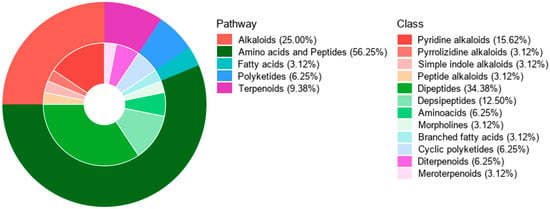
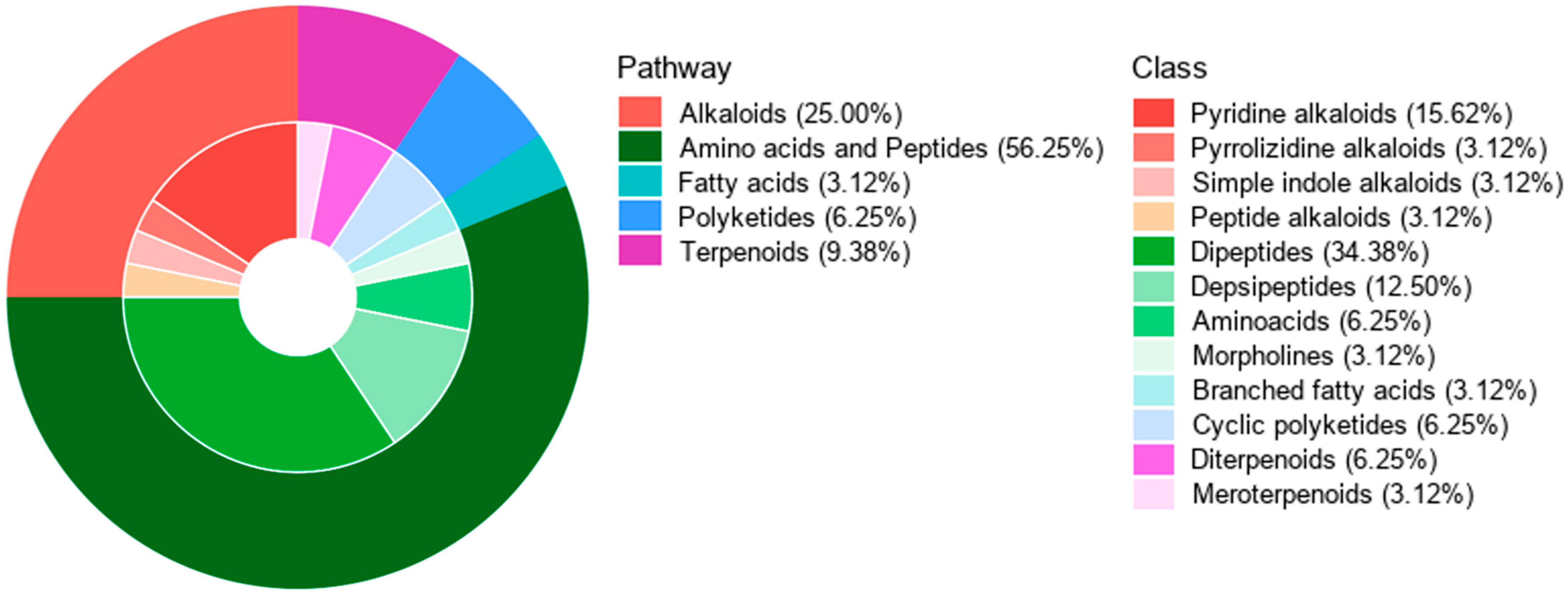
The LC–HRMS analysis led to the putative identification of 32 unique metabolites, which were classified using the NPClassifier platform (freely available at: https://npclassifier.ucsd.edu/). Amino acids and peptides represented the dominant biosynthetic pathway (56.25%), followed by alkaloids (25.00%), terpenoids (9.38%), polyketides (6.25%), and fatty acids (3.12%) (Figure 1). At the chemical class level, dipeptides (34.38%) and depsipeptides (12.50%) were the most abundant groups within the amino acid and peptide pathway. The dipeptide fraction consisted mainly of 2,5-diketopiperazines, whereas the depsipeptide group included compounds such as beauvericin and beauveriolides. Among alkaloids, pyridine alkaloids were the predominant class (15.62%), while polyketides were exclusively represented by cyclic polyketides (6.25%). Overall, the metabolite profile was characterized by a predominance of peptide-derived and nitrogen-containing secondary metabolites (Table S1).
Figure 1.
Hierarchical donut chart showing the distribution of metabolites identified by untargeted LC–HRMS analysis according to biosynthetic pathways and chemical classes. The outer ring represents the relative abundance of metabolites across major biosynthetic pathways, while the inner ring details the corresponding chemical classes. Percentages were calculated based on the total number of annotated metabolites (n = 32). Color coding reflects the hierarchical relationship between pathways and their associated chemical classes.
3.2. Bb758 Fractions Show Variable Antifungal Activity Levels Against F. oxysporum
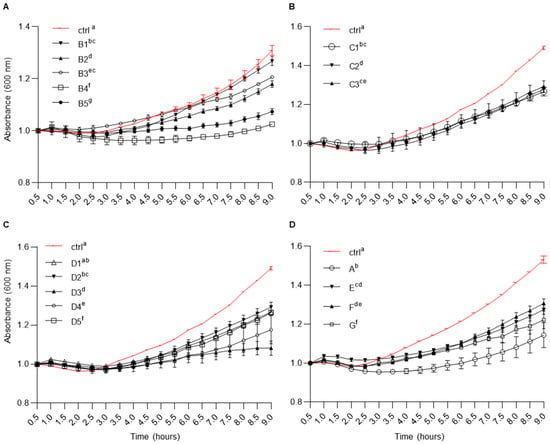
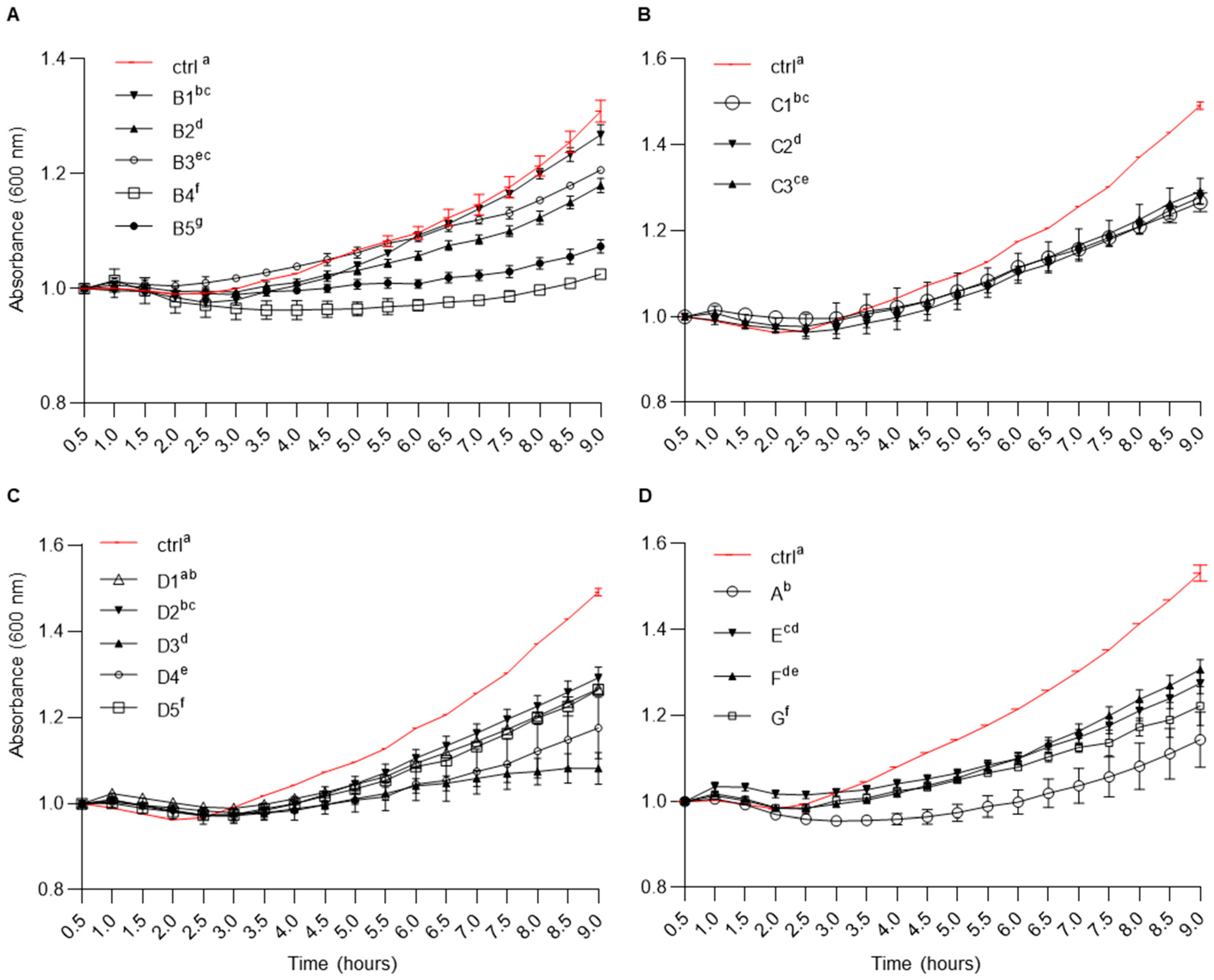
Chromatographic fractions were evaluated for antifungal activity against Fol by monitoring conidial germination over a 9 h period. The majority of tested fractions significantly inhibited Fol germination. Fractions B4, B5, D3, D4 and A showed the highest level of inhibition. Among these, fractions B4, B5 and A had in common the presence of beauvericin, while fraction D3 and fraction D4 resulted in a mixture of diketopiperazines. All other fractions exhibited lower but detectable inhibitory activity (Figure 2).
Figure 2.
Antifungal activity of chromatographic fractions from Bb758 against Fol. (A–D). Different fractions obtained by purification show variable levels of antifungal activity against Fol. Ctrl = Fol microconidia growth in Germination Medium. Measurements were conducted every 30 min for 9 h. Data are presented as mean values ± SD from two independent experiments. Statistical significances are determined by two-way ANOVA. Different letters indicate statistically significant differences according to Tukey’s multiple comparisons test (p < 0.001). Number of independent experiments (ni.ex.) = 2, with four replicates.
3.3. Beauvericin Exhibits Dose-Dependent Antifungal Activity Against Fol
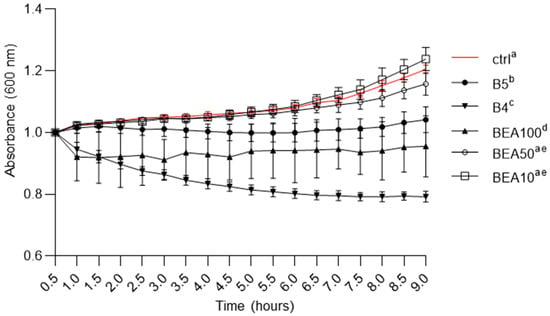
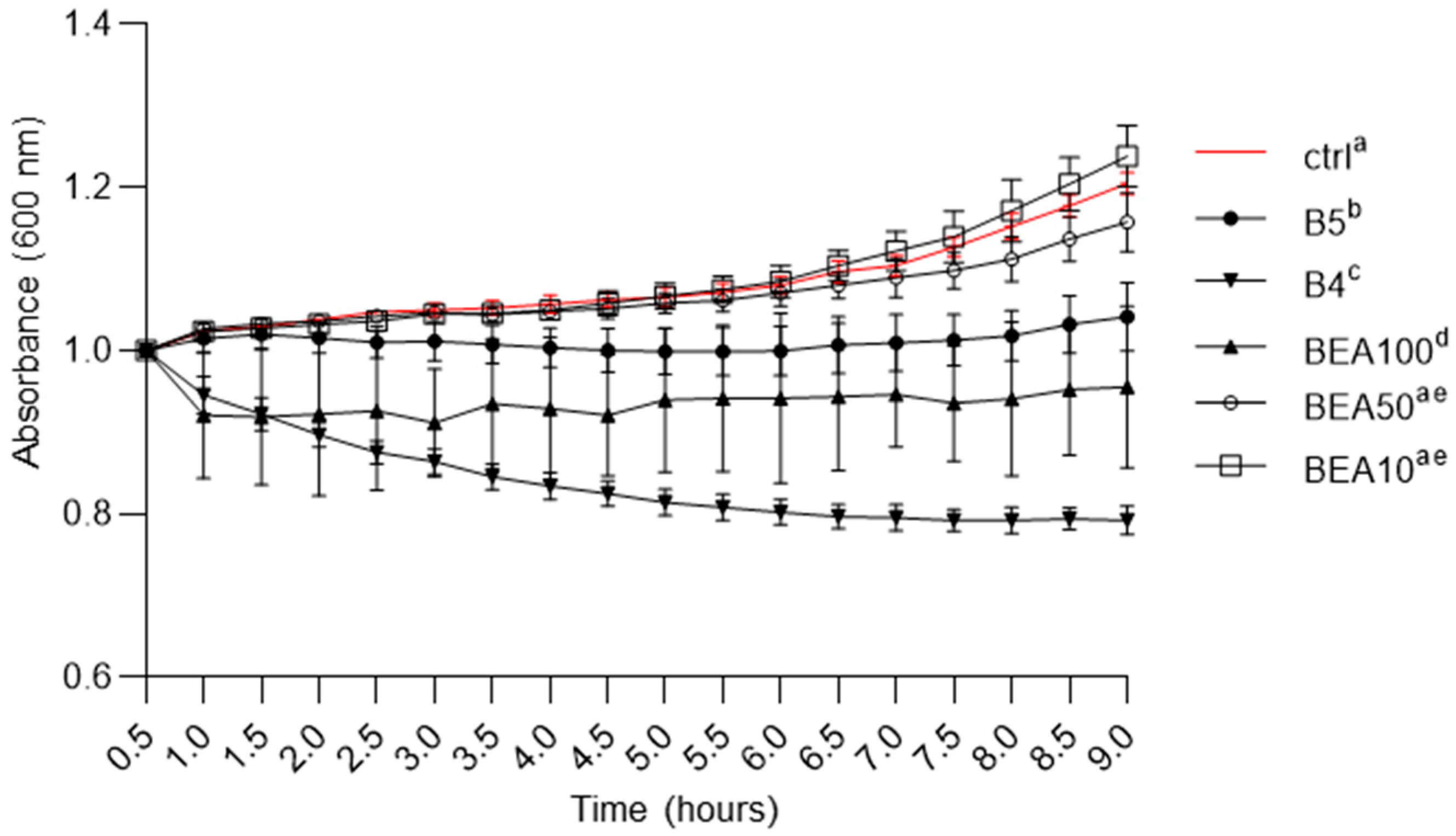
To assess the antifungal efficacy of beauvericin, fractions B4 and B5 were tested against Fol at 100 μg mL−1, and commercial BEA (97% purity) was tested at 10, 50 and 100 μg mL−1 as a reference. The lowest and intermediate concentrations of commercial BEA showed no significant inhibitory effect on Fol germination. In contrast, BEA at 100 μg mL−1 significantly reduced germination, displaying intermediate efficacy relative to fractions B4 and B5 (Figure 3). Post hoc comparisons showed that BEA100 differed significantly from both B5 (p = 0.00000002) and B4 (p < 0.00000001), and that B5 and B4 also differed significantly from each other (p < 0.00000001). To verify whether the observed activity was consistent with the actual beauvericin content, BEA was quantified in fractions B4 and B5 using an external calibration curve (R2 = 0.9965, range 10–500 μg mL−1; Figure S5). Despite both fractions being applied at the same nominal concentration (100 μg mL−1), quantification revealed effective BEA contents of 106.43 ± 0.27 μg mL−1 in B4 and 16.68 ± 0.27 μg mL−1 in B5. The lower inhibitory activity of fraction B5 is therefore consistent with its reduced beauvericin content, as well as the potential contribution of co-occurring metabolites such as beauveriolide V. Notably, fraction B4 exhibited stronger inhibition than commercial BEA100, despite comparable BEA content, possibly due to the impurity profile of the commercial standard (97%) and/or additional effects of co-occurring metabolites.
Figure 3.
Dose-dependent antifungal activity of BEA against Fol. Two different fractions obtained by purification of Bb758 show antifungal activity against Fol comparable to BEA100. BEA100 = 100 µg mL−1 (127.5 µM) of commercial BEA; BEA50 = 50 µg mL−1 (63.78 µM); BEA10 = 10 µg mL−1 (12.75 µM). Ctrl = Fol microconidia growth in GM. Measurements were conducted every 30 min for 9 h. Data are presented as mean values ± SD from two independent experiments. Statistical significances are determined by two-way ANOVA. Different letters indicate statistically significant differences according to Tukey’s multiple comparisons test (p < 0.001). Number of independent experiments (ni.ex.) = 2, with 4 replicates.
3.4. Cyclo(l-Phe-l-Pro) Inhibits Fol Germination and Germ Tube Formation Even at Low Concentration
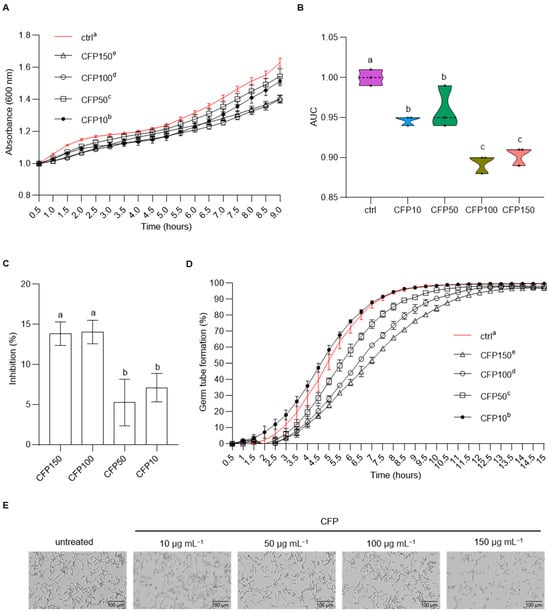
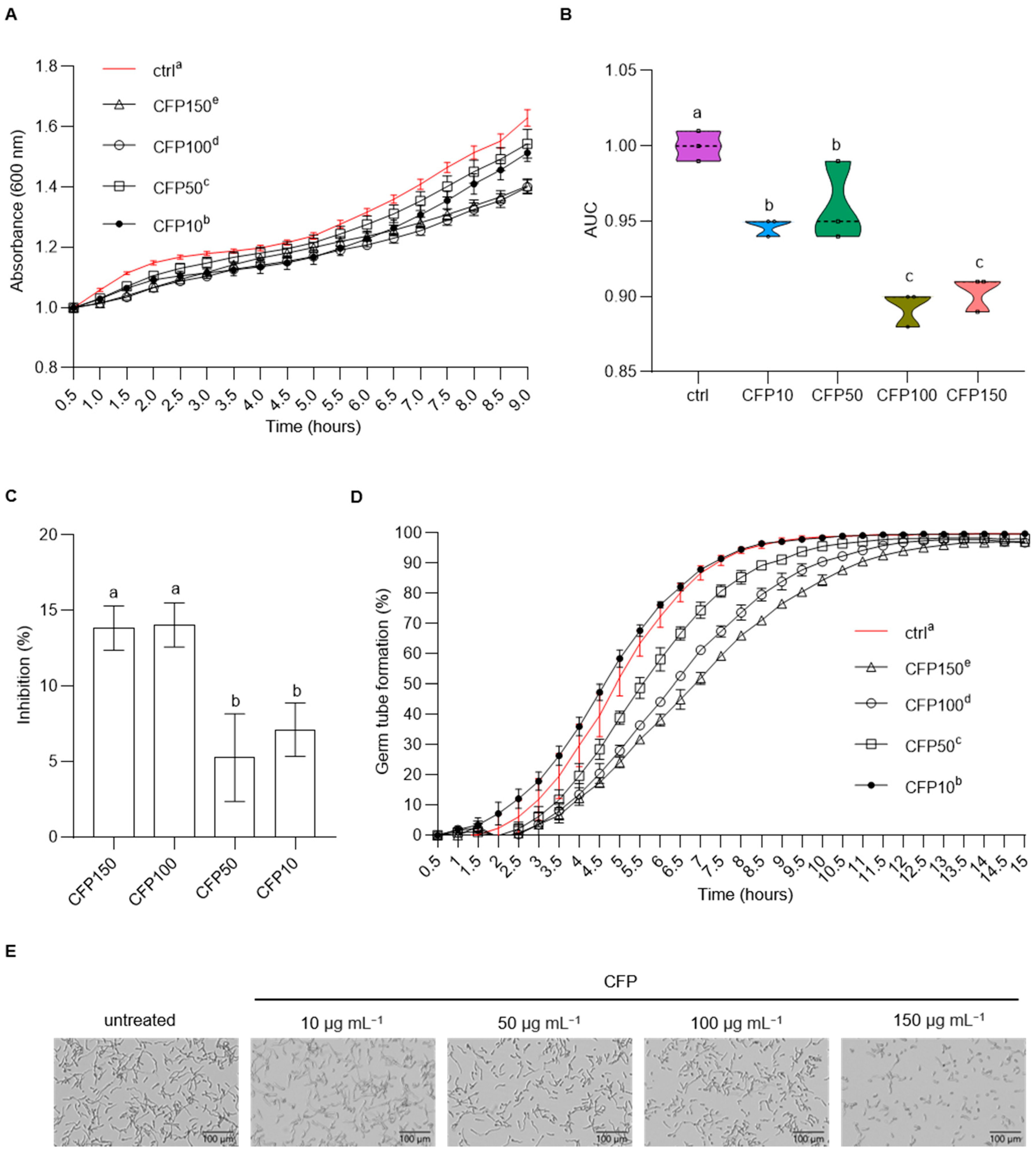
The antifungal activity of cyclo(l-Phe-l-Pro) (CFP) was evaluated across four concentrations (10, 50, 100, and 150 μg mL−1) using both spectrophotometric growth monitoring and automated image analysis. CFP was selected as a representative DKP standard, based on its exclusive detection in fractions D3 and D4 among all DKP-containing fractions. Prior to bioassays, CFP was quantified in fractions D3 and D4 by external calibration (R2 = 0.9984; range 50–1000 μg mL−1; Figure S6). Effective CFP content was 76.53 ± 0.92 μg mL−1 in D3, while in fraction D4 CFP was below the limit of quantification (LOQ < 50 μg mL−1), precluding reliable quantification (Figure S6). CFP showed significantly higher antifungal activity than beauvericin across all tested concentrations, significantly inhibiting fungal growth compared to the control, with clear dose-dependent effects observed throughout the 9 h monitoring period (Figure 4A). AUC values decreased progressively with increasing CFP concentrations. Compared with the control (set to 1), CFP10 and CFP50 showed moderate reductions, whereas CFP100 and CFP150 resulted in the strongest and statistically significant decreases (CFP100 vs. ctrl: p = 0.000038; CFP150 vs. ctrl: p = 0.000091), indicating a clear dose-dependent inhibition of cumulative growth (Figure 4B). The inhibition percentage, calculated at the final time point, showed that all concentrations were able to inhibit Fol germination, with CFP150 and CFP100 displaying the strongest activity, whereas CFP50 and CFP10 exerted a milder inhibitory effect (Figure 4C). The inhibition values shown in the graph are normalized to the control and therefore reflect the percentage reduction in fungal growth achieved by each treatment relative to the untreated condition. Post hoc analysis further confirmed that CFP150 and CFP100 did not differ significantly from each other (p = 0.9992), while both concentrations were significantly more inhibitory than CFP50 (p = 0.0033 and p = 0.0028, respectively) and CFP10 (p = 0.0139 and p = 0.0117, respectively). No significant difference was observed between CFP50 and CFP10 (p = 0.6762).
Figure 4.
Cyclo(l-Phe-l-Pro) (CFP) inhibits Fol growth and germ tube formation. (A). Four different concentrations of CFP show antifungal activity against Fol. CFP150 = 150 µg mL−1 (614.02 µM) of commercial CFP; CFP100 = 100 µg mL−1 (409.35 µM); CFP50 = 50 µg mL−1 (204.67 µM); CFP10 = 10 µg mL−1 (40.93 µM). Ctrl = Fol microconidia growth in GM. Measurements were conducted every 30 min for 9 h. (B). Area under curve (AUC) by treatment. Violin plots summarize the AUC of each tested condition. (C). Inhibition of Fol conidia germination expressed as = (ODCtrl − ODFraction)/ODCtrl) × 100. (D). Germ tube formation analysis showing germ tube formation inhibition at all tested concentrations (10–150 µg mL−1). Measurements were conducted every 30 min for 15 h. Both (B) and (C) data are presented as mean values ± SD. Statistical significance is determined by one-way ANOVA. Different letters indicate statistically significant differences according to Tukey’s multiple comparisons test (p < 0.05). Number of independent experiments (ni.ex.) = 2, with 4 replicates. Both (A) and (D) data are presented as mean values ± SD. Statistical significance is determined by two-way ANOVA. Different letters indicate statistically significant differences according to Tukey’s multiple comparisons test (p < 0.001). (E). Representative microscopy images demonstrating progressive inhibition of germination across the concentration range. Scale bar = 100 μm.
Ocelloscope analysis revealed that CFP effectively suppressed germ tube formation at all concentrations, with progressive inhibition observed as concentrations increased (Figure 4D). Microscopic imaging at oCelloscope confirmed the concentration-dependent inhibition, showing partial germination with shortened germ tubes at CFP10 and complete germination failure at CFP150, indicating primarily fungistatic activity (Figure 4E). Statistical analysis confirmed significant differences between all treatments and controls (p < 0.001), with Tukey’s multiple comparison test revealing distinct inhibitory profiles for each concentration. These results indicate that CFP exhibits a stronger antifungal effect compared to beauvericin under the tested conditions, showing significant inhibition at concentrations as low as 10 μg mL−1, whereas beauvericin required higher concentrations (100 μg mL−1) to achieve comparable effects. When expressed in molar concentrations, CFP at 10 μg mL−1 corresponds to 40.9 μM, whereas BEA at 10 μg mL−1 corresponds to 12.76 μM, indicating that CFP is approximately threefold more potent than BEA on a molar basis under the tested conditions.
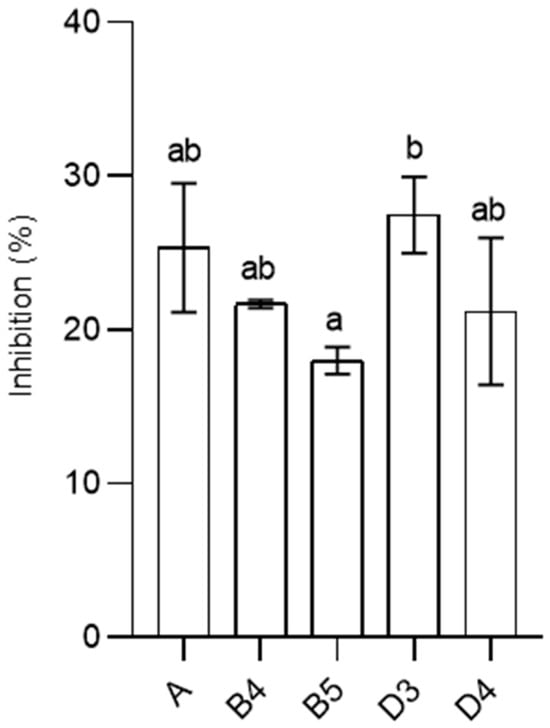
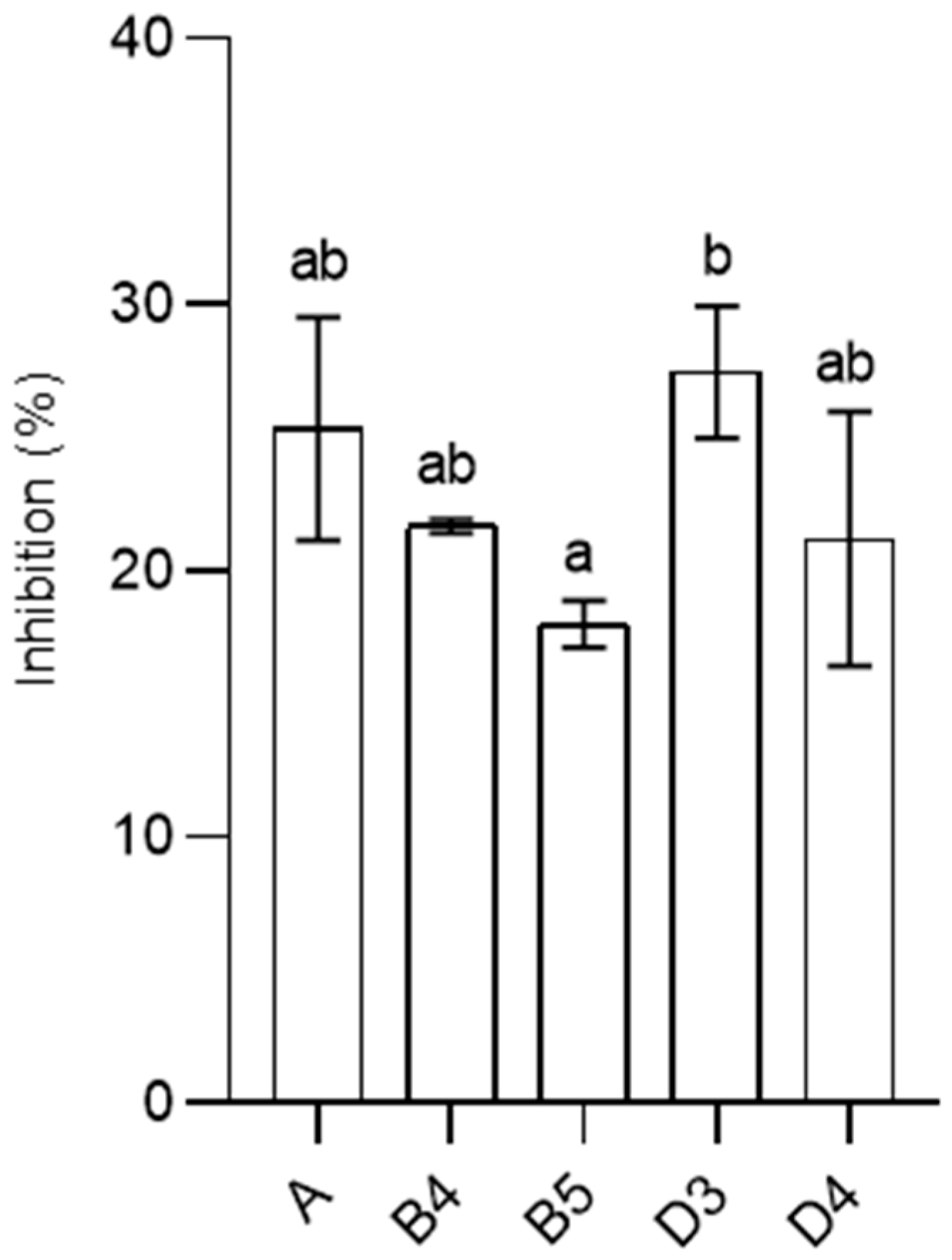
Overall, fraction D3, which contains a mixture of diketopiperazines, displayed the highest antifungal activity among all tested fractions. This enhanced activity may reflect the specific contribution of cyclo(l-Phe-l-Pro), as well as the combined effect of multiple DKPs present in D3, as indicated by assays performed with the corresponding commercial standard (Figure 5).
Figure 5.
Inhibition percentage of most effective fractions against Fol. Inhibition of Fol conidia germination expressed as = (ODCtrl − ODFraction)/ODCtrl) × 100. Data are presented as mean values ± SD from two independent experiments. Statistical significances are determined by one-way ANOVA. Letters indicate statistically significant differences according to Tukey’s multiple comparisons test (p < 0.05). Number of independent experiments (ni.ex.) = 2, with four replicates.
4. Discussion
This study provides a comparative evaluation of the antifungal activity of secondary metabolites produced by Beauveria bassiana Bb758 against Fusarium oxysporum f. sp. lycopersici. The results show that peptide-derived metabolites, particularly DKPs and depsipeptides, dominate the annotated metabolite profile of Bb758 and that selected fractions and purified compounds can inhibit early developmental stages of Fol.
The metabolomic profiling of Bb758 revealed a chemically rich profile dominated by amino acid-derived peptides, in particular dipeptides (34.4% of annotated metabolites) and depsipeptides including beauvericin (12.5%). This peptide-centric profile is consistent with previous reports on B. bassiana strains isolated from diverse ecological niches, which commonly produce cyclic peptides as major secondary metabolites [15,37]. The identification of 32 unique metabolites—including tenellin, bassiatin, and beauveriolides—underscores the chemical versatility of this isolate and highlights its potential as a source of diverse bioactive scaffolds.
One of the most notable findings of this study is the dose-dependent but limited efficacy of beauvericin against Fol. While fractions enriched in beauvericin (B4, B5) displayed marked inhibitory activity, the commercial BEA100 standard was active only at the highest concentration tested (100 μg mL−1). Notably, fraction B4 was more effective than BEA100 despite having comparable beauvericin content, and fraction B5—despite containing substantially lower BEA levels than B4—still exhibited significant inhibition. These observations suggest that the reduced activity of the commercial standard may be linked to its impurity profile (97%) and that the inhibition observed in the crude fractions likely reflects contributions from additional co-occurring metabolites. These effects may reflect combined interactions within complex natural extracts, which can arise from complementary mechanisms of action, mutual stabilization among metabolites, or enhanced membrane penetration [38,39], although no direct mechanistic assays were performed to validate this hypothesis.
A second possible explanation for the reduced sensitivity of Fol to beauvericin may lie in the evolutionary history of the pathogen itself. Several Fusarium species, including F. proliferatum, F. subglutinans, and F. semitectum, are known producers of beauvericin, where the compound acts as a mycotoxin contributing to pathogenicity [21,40]. The co-evolutionary pressure imposed by beauvericin-producing fungi may have contributed to the development of tolerance mechanisms in Fusarium species, including efflux pump activity, metabolic detoxification, or modifications of the cellular targets of beauvericin [41,42].
To refine the comparison between the two metabolites, it is important to consider their activities in molar rather than mass-based terms. Although cyclo(l-Phe-l-Pro) is active at 10 µg mL−1 while beauvericin requires 100 µg mL−1, the corresponding molarities reveal a smaller difference in intrinsic potency. At these concentrations, CFP corresponds to 40.94 µM, whereas BEA at 10 µg mL−1 corresponds to 12.76 µM. Thus, when normalized for molecular weight, CFP is approximately threefold more potent than BEA, rather than an order of magnitude more active. This molar-based comparison provides a more accurate interpretation of their relative antifungal performance and underscores the importance of molecular size when evaluating bioactivity thresholds.
The activity observed for the purified CFP standard, together with its sole occurrence in the bioactive fractions D3 and D4 as revealed by LC–HRMS analysis, suggests that this diketopiperazine may contribute to the antifungal activity of these fractions. However, since both fractions contain mixtures of DKPs, the overall bioactivity may also reflect the contribution of additional metabolites and possible combined effects. This bioactivity is consistent with reports from other pathosystems: Ström et al. [25] originally identified cyclo(l-Phe-l-Pro) as an antifungal compound produced by Lactobacillus plantarum active against Aspergillus and Penicillium species, and Kwak et al. [26] demonstrated its efficacy against a broad panel of pathogenic fungi. The present study extends these findings to a major soil-borne vascular pathogen, providing the first evidence, to our knowledge, that cyclo(l-Phe-l-Pro) produced by B. bassiana effectively targets F. oxysporum conidial germination and germ tube elongation.
DKPs are thought to exert their antifungal effects primarily through disruption of membrane integrity, possibly mediated by the hydrophobic and amphipathic nature of the cyclic scaffold [43,44]. Although the mode of action of cyclo(l-Phe-l-Pro) was not investigated in the present study, its cyclic and amphipathic structure may contribute to interactions with fungal membranes, potentially affecting processes involved in spore germination and germ tube development. In the case of cyclo(l-Phe-l-Pro), the phenylalanine residue could engage in π–π stacking interactions with membrane lipid components, whereas the proline-induced ring rigidity may facilitate membrane intercalation [23,45]. Disruption of membrane function would be consistent with the observed inhibition of both spore germination and germ-tube elongation, as these processes are highly dependent on polarized membrane dynamics and vesicle trafficking at the growing tip, which are commonly perturbed by membrane-active antifungal agents [46].
The oCelloscope imaging data provide an additional dimension of mechanistic insight. The observation that CFP at 10 μg mL−1 reduces germ tube length but does not completely suppress germination is consistent with fungistatic rather than fungicidal activity at low concentrations. This is a relevant distinction for biocontrol applications: fungistatic compounds may be sufficient to prevent infection without imposing strong selection for resistance, as the pathogen population is not eliminated but merely suppressed. At higher concentrations (100–150 μg mL−1), the activity appears to shift toward complete germination failure, a pattern consistent with predominantly fungistatic effects; however, no viability assays were performed to evaluate a possible fungicidal effect. From an applied perspective, the direct use of Bb758 as a biocontrol agent for plant disease management requires caution because the isolate produces beauvericin, a mycotoxin of regulatory concern. However, the identification of cyclo(l-Phe-l-Pro) as a potent antifungal agent with efficacy against the early infection stages of Fol has important implications for the development of next-generation biocontrol formulations. The compound’s cyclic structure confers stability under environmental conditions compared with linear peptides [47,48]. Moreover, the possibility of producing cyclo(l-Phe-l-Pro) via fermentation at scale—as demonstrated here and by others [49]—is a prerequisite for practical application.
In conclusion, the interpretation of these findings should take into account certain experimental constraints, such as the in vitro nature of the assays, the absence of plant-based validation, and the lack of direct mechanistic analyses confirming antifungal modes of action. In this context, the determination of MIC or EC50/IC50 values was not taken into account, as several assays were performed on chromatographic fractions with heterogeneous and partially unresolved compositions; under these conditions, dose-response modeling would reflect the activity of complex mixtures rather than individual metabolites. Nevertheless, the determination of these values could represent a useful extension of the present work and may offer additional comparative insight for purified compounds. Moreover, the concentrations applied were optimized for laboratory screening; thus, further formulation studies and validation under greenhouse and field conditions will be important to determine their applicability in agricultural systems.
5. Conclusions
These results demonstrate that Beauveria bassiana isolate Bb758 produces a chemically diverse array of secondary metabolites exhibiting antifungal activity against Fusarium oxysporum f. sp. lycopersici. Among the compounds identified, cyclo(l-Phe-l-Pro) showed greater inhibitory effects on conidial germination and germ tube development compared to beauvericin under the experimental conditions tested. Notably, the ability of cyclo(l-Phe-l-Pro) to suppress conidial germination—representing the most critical and determinative stage in the infection cycle—emphasizes its functional relevance in disrupting early pathogen establishment.
These findings support the potential of cyclo(l-Phe-l-Pro) as an antifungal molecule targeting early infection stages of Fol and further underscore the broader relevance of DKPs as metabolite-based tools for sustainable crop protection, while also highlighting both their promise and the need for further validation under in vivo and field conditions.
Supplementary Materials
The following supporting information can be downloaded at: https://www.mdpi.com/article/10.3390/agriculture16141497/s1. Figure S1: 1H NMR spectrum of fraction B4 recorded at 400 MHz in CDCl3; Figure S2: 1H NMR spectrum of fraction B2 recorded at 400 MHz in CDCl3; Figure S3: 1H NMR spectrum of fraction D3 recorded at 400 MHz in CDCl3; Figure S4: 1H NMR spectrum of fraction D4 recorded at 400 MHz in MeOD; Figure S5: Calibration curve of beauvericin used for quantitative analysis; Figure S6: Calibration curve of cyclo(l-Phe-l-Pro) used for quantitative analysis; Table S1: Putatively identified metabolites detected by LC–HRMS analysis and classified according to the NPClassifier framework.
Author Contributions
Conceptualization, F.V., D.T., S.L.W., A.A. and S.V.; methodology, M.R., M.S., A.S., M.M.S. and S.V.; formal analysis, M.R., M.S. and A.S.; investigation, M.R., M.S., A.S. and M.M.S., resources, F.V., D.T. and S.L.W.; data curation, M.R., M.S. and A.S.; writing: M.R., M.S., A.S. and M.M.S.; review and editing: F.V., D.T., A.A. and S.V. All authors have read and agreed to the published version of the manuscript.
Funding
This study was carried out within the Agritech National Research Center and received funding from the European Union Next-Generation EU (PIANO NAZIONALE DI RIPRESA E RESILIENZA (PNRR)–MISSIONE 4 COMPONENTE 2, INVESTIMENTO 1.4–D.D. 1032 17/06/2022, CN00000022).
Data Availability Statement
The original contributions presented in this study are included in the supplementary material. Further inquiries can be directed to the corresponding author.
Acknowledgments
The authors are grateful for the dedicated efforts and collaborative contributions of all team members in this research. We are grateful to Vili Harizanova (Department of Entomology, Agricultural University-Plovdiv, Plovdiv, Bulgaria) for sharing Beauveria bassiana isolates.
Conflicts of Interest
The authors declare no conflicts of interest.
Abbreviations
The following abbreviations are used in this manuscript:
| CFP | Cyclo(l-Phe-l-Pro) |
| BEA | Beauvericin |
| Fol | Fusarium oxysporum f.sp. lycopersici |
| Bb758 | Beauveria bassiana isolate 758 |
| AUC | Area Under the Curve |
References
- Pietro, A.D.; Madrid, M.P.; Caracuel, Z.; Delgado-Jarana, J.; Roncero, M.I.G. Fusarium oxysporum: Exploring the molecular arsenal of a vascular wilt fungus. Mol. Plant Pathol. 2003, 4, 315–325. [Google Scholar] [CrossRef] [Scilit] [PubMed]
- Dean, R.; Van Kan, J.A.L.; Pretorius, Z.A.; Hammond-Kosack, K.E.; Di Pietro, A.; Spanu, P.D.; Rudd, J.J.; Dickman, M.; Kahmann, R.; Ellis, J.; et al. The Top 10 fungal pathogens in molecular plant pathology. Mol. Plant Pathol. 2012, 13, 414–430. [Google Scholar] [CrossRef] [Scilit] [PubMed]
- McGovern, R.J. Management of tomato diseases caused by Fusarium oxysporum. Crop Prot. 2015, 73, 78–92. [Google Scholar] [CrossRef] [Scilit]
- Ekwomadu, T.I.; Mwanza, M. Fusarium fungi pathogens, identification, adverse effects, disease management, and global food security: A review of the latest research. Agriculture 2023, 13, 1810. [Google Scholar] [CrossRef] [Scilit]
- García-Bastidas, F.; Ordóñez, N.; Konkol, J.; Al-Qasim, M.; Naser, Z.; Abdelwali, M.; Salem, N.; Waalwijk, C.; Ploetz, R.; Kema, G. First report of Fusarium oxysporum f. sp. cubense tropical race 4 associated with Panama disease of banana outside Southeast Asia. Plant Dis. 2014, 98, 694. [Google Scholar] [CrossRef] [Scilit] [PubMed]
- Zhou, W.; Li, M.; Achal, V. A comprehensive review on environmental and human health impacts of chemical pesticide usage. Emerg. Contam. 2025, 11, 100410. [Google Scholar] [CrossRef] [Scilit]
- Lamichhane, J.R.; Dachbrodt-Saaydeh, S.; Kudsk, P.; Messéan, A. Toward a reduced reliance on conventional pesticides in European agriculture. Plant Dis. 2016, 100, 10–24. [Google Scholar] [CrossRef] [Scilit] [PubMed]
- Muhorakeye, M.C.; Namikoye, E.S.; Khamis, F.M.; Wanjohi, W.; Akutse, K.S. Biostimulant and antagonistic potential of endophytic fungi against fusarium wilt pathogen of tomato Fusarium oxysporum f. sp. lycopersici. Sci. Rep. 2024, 14, 15365. [Google Scholar] [CrossRef] [Scilit] [PubMed]
- Puopolo, G.; Cimmino, A.; Palmieri, M.C.; Giovannini, O.; Evidente, A.; Pertot, I. Lysobacter capsici AZ78 produces cyclo (l-Pro-l-Tyr), a 2, 5-diketopiperazine with toxic activity against sporangia of Phytophthora infestans and Plasmopara viticola. J. Appl. Microbiol. 2014, 117, 1168–1180. [Google Scholar] [CrossRef] [Scilit] [PubMed]
- Xie, Y.; Peng, Q.; Ji, Y.; Xie, A.; Yang, L.; Mu, S.; Li, Z.; He, T.; Xiao, Y.; Zhao, J.; et al. Isolation and identification of antibacterial bioactive compounds from Bacillus megaterium L2. Front. Microbiol. 2021, 12, 645484. [Google Scholar] [CrossRef] [Scilit] [PubMed]
- Castaldi, S.; Cimmino, A.; Masi, M.; Evidente, A. Bacterial lipodepsipeptides and some of their derivatives and cyclic dipeptides as potential agents for biocontrol of pathogenic bacteria and fungi of agrarian plants. J. Agric. Food Chem. 2022, 70, 4591–4598. [Google Scholar] [CrossRef] [Scilit] [PubMed]
- Sinno, M.; Ranesi, M.; Di Lelio, I.; Iacomino, G.; Becchimanzi, A.; Barra, E.; Molisso, D.; Pennacchio, F.; Digilio, M.C.; Vitale, S.; et al. Selection of Endophytic Beauveria bassiana as a Dual Biocontrol Agent of Tomato Pathogens and Pests. Pathogens 2021, 10, 1242. [Google Scholar] [CrossRef] [Scilit] [PubMed]
- Ranesi, M.; Vitale, S.; Staropoli, A.; Di Lelio, I.; Izzo, L.G.; De Luca, M.G.; Becchimanzi, A.; Pennacchio, F.; Lorito, M.; Woo, S.L.; et al. Field isolates of Beauveria bassiana exhibit biological heterogeneity in multitrophic interactions of agricultural importance. Microbiol. Res. 2024, 286, 127819. [Google Scholar] [CrossRef] [Scilit] [PubMed]
- Meyling, N.V.; Eilenberg, J. Ecology of the entomopathogenic fungi Beauveria bassiana and Metarhizium anisopliae in temperate agroecosystems: Potential for conservation biological control. Biol. Control 2007, 43, 145–155. [Google Scholar] [CrossRef] [Scilit]
- Molnár, I.; Gibson, D.M.; Krasnoff, S.B. Secondary metabolites from entomopathogenic Hypocrealean fungi. Nat. Prod. Rep. 2010, 27, 1241–1275. [Google Scholar] [CrossRef] [Scilit] [PubMed]
- Zhang, W.; Smagghe, G.; Mohamed, A.; Al-Akeel, R.K.; Alkhaibari, A.M.; Alharbi, H.M.; Fahmy, N.M.; Eleftherianos, I.; Keyhani, N.O. Secondary metabolites as multifunctional molecular weapons: New mechanistic insights into how entomopathogenic fungi suppress insect immunity. J. Invertebr. Pathol. 2026, 217, 108626. [Google Scholar] [CrossRef] [Scilit] [PubMed]
- Logrieco, A.; Rizzo, A.; Ferracane, R.; Ritieni, A. Occurrence of beauvericin and enniatins in wheat affected by Fusarium avenaceum head blight. Appl. Environ. Microbiol. 2002, 68, 82–85. [Google Scholar] [CrossRef] [Scilit] [PubMed]
- Wang, Q.; Xu, L. Beauvericin, a bioactive compound produced by fungi: A short review. Molecules 2012, 17, 2367–2377. [Google Scholar] [CrossRef] [Scilit] [PubMed]
- Wu, Q.; Patocka, J.; Nepovimova, E.; Kuca, K. A review on the synthesis and bioactivity aspects of beauvericin, a Fusarium mycotoxin. Front. Pharmacol. 2018, 9, 1338. [Google Scholar] [CrossRef] [Scilit] [PubMed]
- Caloni, F.; Fossati, P.; Anadón, A.; Bertero, A. Beauvericin: The beauty and the beast. Environ. Toxicol. Pharmacol. 2020, 75, 103349. [Google Scholar] [CrossRef] [Scilit] [PubMed]
- Logrieco, A.; Moretti, A.; Castella, G.; Kostecki, M.; Golinski, P.; Ritieni, A.; Chelkowski, J. Beauvericin production by Fusarium species. Appl. Environ. Microbiol. 1998, 64, 3084–3088. [Google Scholar] [CrossRef] [Scilit] [PubMed]
- Gondry, M.; Sauguet, L.; Belin, P.; Thai, R.; Amouroux, R.; Tellier, C.; Tuphile, K.; Jacquet, M.; Braud, S.; Courçon, M.; et al. Cyclodipeptide synthases are a family of tRNA-dependent peptide bond–forming enzymes. Nat. Chem. Biol. 2009, 5, 414–420. [Google Scholar] [CrossRef] [Scilit] [PubMed]
- Borthwick, A.D. 2,5-Diketopiperazines: Synthesis, reactions, medicinal chemistry, and bioactive natural products. Chem. Rev. 2012, 112, 3641–3716. [Google Scholar] [CrossRef] [Scilit] [PubMed]
- Huang, R.M.; Yi, X.X.; Zhou, Y.; Su, X.; Peng, Y.; Gao, C.H. An update on 2, 5-diketopiperazines from marine organisms. Mar. Drugs 2014, 12, 6213–6235. [Google Scholar] [CrossRef] [Scilit] [PubMed]
- Ström, K.; Sjögren, J.; Broberg, A.; Schnürer, J. Lactobacillus plantarum MiLAB 393 produces the antifungal cyclic dipeptides cyclo(l-Phe- l-Pro) and cyclo(L-Phe-trans-4-OH-L-Pro) and 3-phenyllactic acid. Appl. Environ. Microbiol. 2002, 68, 4322–4327. [Google Scholar] [CrossRef] [Scilit] [PubMed]
- Kwak, M.K.; Liu, R.; Kim, M.K.; Moon, D.; Kim, A.H.; Song, S.H.; Kang, S.O. Cyclic dipeptides from lactic acid bacteria inhibit the proliferation of pathogenic fungi. J. Microbiol. 2014, 52, 64–70. [Google Scholar] [CrossRef] [Scilit] [PubMed]
- Sherman, F. [1] Getting started with yeast. In Methods in Enzymology; Academic Press: Cambridge, MA, USA, 1991; Volume 194, pp. 3–21. [Google Scholar]
- Prigigallo, M.I.; Staropoli, A.; Vinale, F.; Bubici, G. Interactions between plant-beneficial microorganisms in a consortium: Streptomyces microflavus and Trichoderma harzianum. Microb. Biotechnol. 2023, 16, 2292–2312. [Google Scholar] [CrossRef] [Scilit] [PubMed]
- Kim, H.W.; Wang, M.; Leber, C.A.; Nothias, L.F.; Reher, R.; Kang, K.B.; Hooft, J.J.J.; Dorrestein, P.; Gerwick, W.; Cottrell, G.W. NPClassifier: A deep neural network-based structural classification tool for natural products. J. Nat. Prod. 2021, 84, 2795–2807. [Google Scholar] [CrossRef] [Scilit] [PubMed]
- Vitale, S.; Di Pietro, A.; Turrà, D. Autocrine pheromone signalling regulates community behaviour in the fungal pathogen Fusarium oxysporum. Nat. Microbiol. 2019, 4, 1443–1449. [Google Scholar] [CrossRef] [Scilit] [PubMed]
- Gibaldi, M.; Perrier, D. Pharmacokinetics, 2nd ed.; Marcel Dekker: New York, NY, USA, 1982. [Google Scholar]
- Fiehn, O.; Robertson, D.; Griffin, J.; van der Werf, M.; Nikolau, B.; Morrison, N.; Sumner, L.W.; Goodacre, R.; Hardy, N.W.; Taylor, C.; et al. The Metabolomics Standards Initiative (MSI). Metabolomics 2007, 3, 175–178. [Google Scholar] [CrossRef] [Scilit]
- Gupta, S.; Krasnoff, S.B.; Underwood, N.L.; Renwick, J.A.A.; Roberts, D.W. Isolation of beauvericin as an insect toxin from Fusarium semitectum and Fusarium moniliforme var. subglutinans. Mycopathologia 1991, 115, 185–189. [Google Scholar] [CrossRef] [Scilit] [PubMed]
- Kagamizono, T.; Nishino, E.; Matsumoto, K.; Kawashima, A.; Kishimoto, M.; Sakai, N.; Hae, B.-M.; Chen, Z.-X.; Adachi, T.; Morimoto, S.; et al. Bassiatin, a new platelet aggregation inhibitor produced by Beauveria bassiana K-717. J. Antibiot. 1995, 48, 1407–1413. [Google Scholar] [CrossRef] [Scilit] [PubMed]
- Adamczeski, M.; Reed, A.R.; Crews, P. New and known diketopiperazines from the Caribbean sponge, Calyx cf. podatypa. J. Nat. Prod. 1995, 58, 201–208. [Google Scholar] [CrossRef] [Scilit] [PubMed]
- He, R.; Wang, B.; Wakimoto, T.; Wang, M.; Zhu, L.; Abe, I. Cyclodipeptides from metagenomic library of a japanese marine sponge. J. Braz. Chem. Soc. 2013, 24, 1926–1932. [Google Scholar] [CrossRef] [Scilit]
- Zhang, L.; Fasoyin, O.E.; Molnár, I.; Xu, Y. Secondary metabolites from hypocrealean entomopathogenic fungi: Novel bioactive compounds. Nat. Prod. Rep. 2020, 37, 1181–1206. [Google Scholar] [CrossRef] [Scilit] [PubMed]
- Harvey, A.L.; Edrada-Ebel, R.; Quinn, R.J. The re-emergence of natural products for drug discovery in the genomics era. Nat. Rev. Drug Discov. 2015, 14, 111–129. [Google Scholar] [CrossRef] [Scilit] [PubMed]
- Caesar, L.K.; Cech, N.B. Synergy and antagonism in natural product extracts: When 1+ 1 does not equal 2. Nat. Prod. Rep. 2019, 36, 869–888. [Google Scholar] [CrossRef] [Scilit] [PubMed]
- Moretti, A.; Mule, G.; Ritieni, A.; Logrieco, A. Further data on the production of beauvericin, enniatins and fusaproliferin and toxicity to Artemia salina by Fusarium species of Gibberella fujikuroi species complex. Int. J. Food Microbiol. 2007, 118, 158–163. [Google Scholar] [CrossRef] [Scilit] [PubMed]
- Liuzzi, V.C.; Mirabelli, V.; Cimmarusti, M.T.; Haidukowski, M.; Leslie, J.F.; Logrieco, A.F.; Caliandro, R.; Fanelli, F.; Mulè, G. Enniatin and Beauvericin Biosynthesis in Fusarium Species: Production Profiles and Structural Determinant Prediction. Toxins 2017, 9, 45. [Google Scholar] [CrossRef] [Scilit] [PubMed]
- Suhajda, Á.; Al-Nussairawi, M.; Amara, I.; Sörös, C.; Tömösközi-Farkas, R.; Kriszt, B.; Farkas, M.; Cserháti, M. Co-Occurrence of Beauvericin and Fumonisin Producing Ability of Fusarium Strains Isolated from Crop Plants in Hungary. Curr. Microbiol. 2025, 82, 302. [Google Scholar] [CrossRef] [Scilit] [PubMed]
- Holden, M.T.G.; Ram Chhabra, S.; De Nys, R.; Stead, P.; Bainton, N.J.; Hill, P.J.; Manefield, M.; Kumar, N.; Labatte, M.; England, D.; et al. Quorum-sensing cross talk: Isolation and chemical characterization of cyclic dipeptides from Pseudomonas aeruginosa and other Gram-negative bacteria. Mol. Microbiol. 1999, 33, 1254–1266. [Google Scholar] [CrossRef] [Scilit] [PubMed]
- Song, Z.; Hou, Y.; Yang, Q.; Li, X.; Wu, S. Structures and Biological Activities of Diketopiperazines from Marine Organisms: A Review. Mar. Drugs 2021, 19, 403. [Google Scholar] [CrossRef] [Scilit] [PubMed]
- Martins, M.B.; Carvalho, I. Diketopiperazines: Biological activity and synthesis. Tetrahedron 2007, 63, 9923–9932. [Google Scholar] [CrossRef] [Scilit]
- Struyfs, C.; Cammue, B.P.; Thevissen, K. Membrane-interacting antifungal peptides. Front. Cell Dev. Biol. 2021, 9, 649875. [Google Scholar] [CrossRef] [Scilit] [PubMed]
- Bojarska, J.; Mieczkowski, A.; Ziora, Z.M.; Skwarczynski, M.; Toth, I.; Shalash, A.O.; Parang, K.; El-Mowafi, S.A.; Mohammed, E.H.M.; Elnagdy, S.; et al. Cyclic dipeptides: The biological and structural landscape with special focus on the anti-cancer proline-based scaffold. Biomolecules 2021, 11, 1515. [Google Scholar] [CrossRef] [Scilit] [PubMed]
- Apostolopoulos, V.; Bojarska, J.; Chai, T.-T.; Elnagdy, S.; Kaczmarek, K.; Matsoukas, J.; New, R.; Parang, K.; Lopez, O.P.; Parhiz, H.; et al. A global review on short peptides: Frontiers and perspectives. Molecules 2021, 26, 430. [Google Scholar] [CrossRef] [Scilit] [PubMed]
- Widodo, W.S.; Billerbeck, S. Natural and engineered cyclodipeptides: Biosynthesis, chemical diversity, and engineering strategies for diversification and high-yield bioproduction. Eng. Microbiol. 2023, 3, 100067. [Google Scholar] [CrossRef] [Scilit] [PubMed]

Disclaimer/Publisher’s Note: The statements, opinions and data contained in all publications are solely those of the individual author(s) and contributor(s) and not of MDPI and/or the editor(s). MDPI and/or the editor(s) disclaim responsibility for any injury to people or property resulting from any ideas, methods, instructions or products referred to in the content. |
© 2026 by the authors. Licensee MDPI, Basel, Switzerland. This article is an open access article distributed under the terms and conditions of the Creative Commons Attribution (CC BY) license.