


Abstract
Colony merging is one of the very important operations in beekeeping. For a safe merger, nestmate recognition is a prerequisite, which is caused by nestmate odors produced by certain volatile chemicals. Some of these chemicals are now known; however, knowledge about the entire spectrum of these chemicals is still lacking. In this article, we have attempted at exploring such chemicals. We investigated the recognition behavior of bees of different ages. Volatile cuticular hydrocarbons (CHCs) in bee groups before and after merging were analyzed via gas chromatography-mass spectrometry (GC-MS). The results indicated that newly emerged bees, which possess the lowest nestmate recognition ability, with less than 5% of observing time showing the defense behavior, develop recognition behaviors rapidly, reaching peak levels of over 35% of observing time showing the behavior at 8 days old and maintaining them throughout their lives. Each bee group has a unique CHCs profile. Merging significantly altered the original CHC profiles of bee groups. Four CHCs were up-regulated in the merged bee group. Ethyl oleate, hexadecanoic acid ethyl ester, and octadecanoic acid ethyl ester were further confirmed to significantly promote bee group merging by reducing 50% of the nestmate recognition ability (p < 0.05). These results highlight the importance of nestmate recognition in the social lives of honey bees, establish the chemical basis for honey bee nestmate recognition, and have potential practical applications in honey bee colony merging.
1. Introduction
As a eusocial insect, the honey bee colony is the minimal unit of survival and reproduction, with thousands of individuals undertaking a variety of tasks [1]. Chemical signals play vital roles in maintaining colony order and structure. The well-known chemical signal in the bee colony is the queen substance, which is released by the queen bee and transmitted and shared among all member bees, limiting physiological alterations in genetic female worker bees to prevent them from undertaking tasks such as egg laying [2]. Bee colonies collect and store quantities of honey and pollen, as well as rear huge quantities of larvae. Bees from other (interspecies or intraspecies) colonies or other animals can invade the colony to steal the honey, pollen, and larvae for food, which seriously threatens the survival of the colony. Accordingly, each colony assigns bees to a defensive role. Guard bees recognize and drive out these intruders by stinging and pursuing them [3]. Thus, the effective discrimination between nestmates and intruders on the part of the guard bees is essential for colony survival. However, the chemical basis of honeybee nestmate recognition is not fully understood so far. And its formation and development in the honeybee is also unknown. This definitely restricts the development of research and application in this field. The purpose of this research is to uncover the chemical basis of honeybee nestmate recognition and explore its possible practical usage.
Cuticular hydrocarbons (CHCs) are biosynthesized in oenocytes and transported to the cuticle by lipophorin proteins, forming the outer layer of the insect cuticle. They function to restrict water loss through the cuticle and prevent desiccation [4]. CHCs are normally species-specific; thus, they can be used to determine the phylogeny of insect species [5,6,7,8,9]. A previous report has shown that CHCs can be used in the analysis of intraspecific diversity in stingless bees (Hymenoptera: Meliponini) [10]. The CHCs profiles of Himalayan Bumblebees (Hymenoptera: Bombus latreille) have shown elevated variation [11]. Furthermore, CHCs exhibit an intrasexual dimorphism in wasps [12]. Mating activity shifts the female wasp of Stizus continuus toward a longer-chain CHCs profile, which drastically reduces female attractiveness to males [13]. Thus, CHCs are involved in multiple insect traits.
Honey bee CHCs have successfully been used to determine the subspecies of European honey bees [14]. They are also involved in the nesting ecology of Apis dorsata [15]. Each bee colony has a unique colony odor. This odor mainly comes from a mixture of volatile CHCs from member bees. However, other factors can also affect colony odor. Wax, a secretion from the wax glands of worker bees used in the construction of the comb, is rich in various hydrocarbons, thus contributing to the colony odor. Previous reports have shown that the hydrocarbons in honey bee comb wax vary significantly between colonies [16]. The wax comb can thus affect nestmate recognition in the honey bee [17,18,19]. Cephalic salivary gland secretions contribute to honey bee CHCs, and this might explain the role of comb wax in nestmate recognition [20]. Moreover, honey bee exposure to the biopesticide fungus Beauveria bassiana could alter their cuticular hydrocarbons and disrupt nestmate recognition at the colony level [21]. The CHC profiles of pupae and emergent adult bees parasitized by one mite and of larvae parasitized by two mites have been shown to be significantly different from those of the corresponding unparasitized individuals [22].
The composition of honey bee CHCs is also related to other factors such as bee age, the tasks undertaken by the bees, and the colony environment [23,24]. The CHC profiles of different task classes, i.e., newly emerged, nurse, and forager bees, were found to be different, but they were similar in nurse bees across different colonies, and forager bees had significantly greater amounts of alkanes [25]. Moreover, five common hydrocarbon compounds detected in both queens and workers might function as nestmate recognition cues [26].
Naturally, the most common intruders in bee colonies are bees from other colonies (both intraspecies and interspecies). Bees can distinguish the intruder from their nestmates via olfactory cues [27,28,29]. This process of identification is performed by guard bees, and it concerns the degree of chemical similarity between the CHC profiles of incoming foragers and the guard bees themselves. Guards are less restrictive in their rates of acceptance when they encounter non-nestmates with highly similar chemical profiles [30]. Nestmate honey bees can enhance their cuticle chemical signals during examinations by heating their surfaces, thereby improving the recognition efficiency of the guard bees [31]. Treating honey bees with cuticular alkanes or alkenes changes nestmate recognition behavior of guards [32]. Furthermore, the activation of the immune system alters overall CHC profiles, thus inducing agonistic nestmate recognition responses in guard bees in nestmate recognition [33]. A previous report has also shown that the gut microbiome has a role in shaping the cuticular chemistry [34]. Therefore, CHCs provide critical chemical cues in honey bee nestmate recognition, but they can be interfered with multiple internal and external factors.
As the outer layer of the insect cuticle, the non-volatile CHCs can restrict water loss through the cuticle, thereby preventing desiccation. Meanwhile, the volatile CHCs can serve as chemical cues in insect communication or as pheromones that mediate interactions throughout an insect’s life [4]. Most previous research has not distinguished volatile CHCs from non-volatile CHCs in honey bee nestmate recognition, which might have led to misinterpretations of the chemical basis of the process. Moreover, merging a weak or queenless colony with a normal colony is a common operation in practical beekeeping, which involves overcoming the impulse to discriminate between bees from rival colonies. The typical process of merging bees from two colonies in beekeeping involves first separating the two colonies into one hive with a mesh overnight to blend their respective odors, forming a new colony odor. The bees are then placed together to establish a merged colony. The specific changes in chemical cues during this process are not clear. Therefore, the objectives of this research are: (i) investigating the recognition behavior of honey bees with increasing age, (ii) determining the chemical basis of honey bee nestmate recognition, and (iii) exploring the possible utilization of CHCs in bee colony merging.
2. Materials and Methods
2.1. Honey Bees
The honey bees (Apis mellifera) examined in this study came from the apiary maintained by the College of Bee Science and Biomedicine, Fujian Agriculture and Forestry University, Fuzhou (China). Several frames with emerging adult bees without apparent diseases or parasites, after removing the adult bees, were taken out from different colonies and placed in an incubator (LHS-150HC-I, Yiheng, Shanghai, China) at 34.5 °C with 75% RH. All newly emerged 1-day-old bees (<24 h) were collected into a plastic basin to provide a uniform background for the bees. They were then randomly placed into 12 cages, each containing 75 bees. These caged bees were reared in incubators for the whole test period, with the provision of a 33.3% sugar solution (W/V) in a 5 mL syringe feeder, replenished every day, and a pollen pellet piece, around 1 cm3, renewed every two days. All the investigations were performed from April 2025 to February 2026.
2.2. Effect of Age on Honey Bee Nestmate Recognition
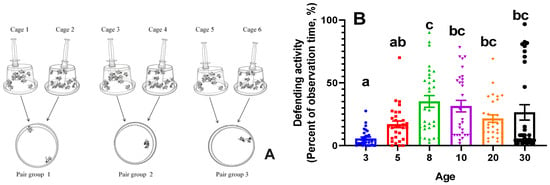
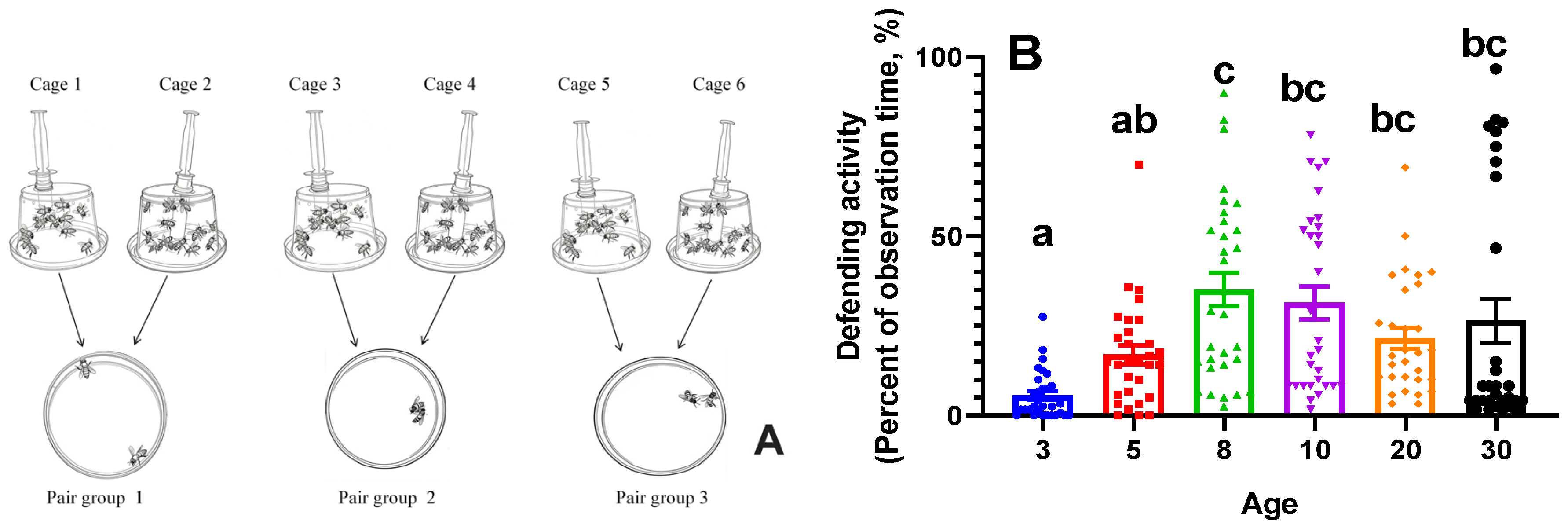
Six cages of bees (each having 75 bees) were randomly paired to form three pair groups (repeats) as shown in Figure 1A. For one pair group, ten bees (out of 75) were randomly collected from one cage of a pair group, and these were individually paired with ten bees from another cage of the same pair group, thus forming ten pairs of bees as one test set. Three such test sets were formed from the three pair groups, thus involving 30 pairs for each age group. Bees of 3, 5, 8, 10, 20, and 30 days of age were inspected. Each pair of bees was put into a Petri dish (with a diameter of 7 cm), and then their activity was immediately video-recorded for 120 s (HDR-PJ50E, SONY, Beijing, China). The two bees in the Petri dish would chase or fight each other if they identified one another as non-nestmates. The time spent pursuing and fighting was obtained by replaying the video. The percentages of pursuing and fighting time reflect their nestmate recognition ability and defending activity, and these were used to analyze the effect of age on bee nestmate recognition.
Figure 1.
Effect of age on nestmate recognition between two different groups of bees. (A): Schematic diagram of the investigation; (B): Percentage of defensive activity time between the two same-age bees from different groups. Different color of the column and associated dot, square, upright triangle, inverted triangle and diamond represent different age classes of honey bee samples. The different letters above the columns represent the difference level at p < 0.05.
2.3. Bee Group Merging Test
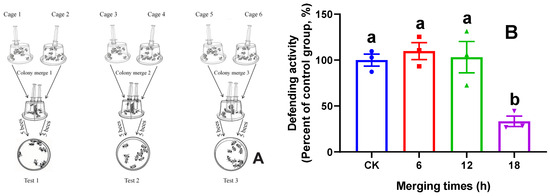
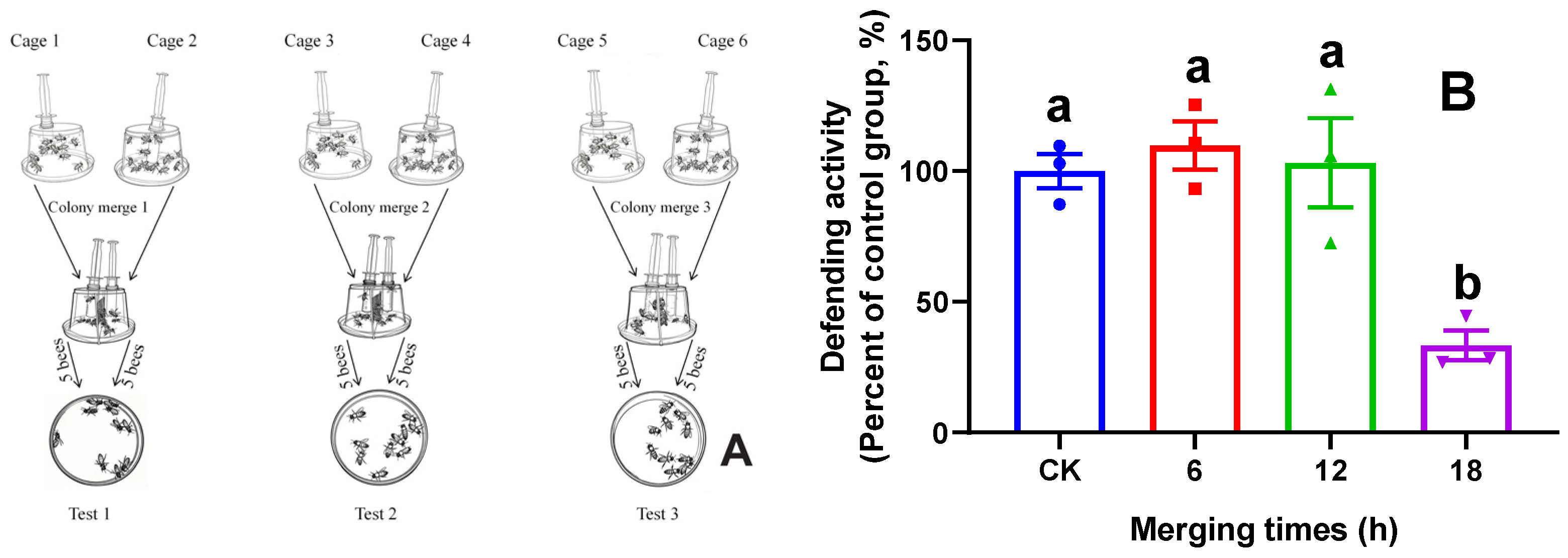
The remaining six bee cages were reared in a laboratory for 30 days and used to establish three bee group-merging tests (repeats). A total of 25 bees from each cage were randomly selected and paired with 25 bees collected from another cage. These bees were placed in two sides of a new cage, separated in the middle by a plastic mesh to establish a merging test, and reared under the same conditions as stated above (Figure 2A). To determine the time required for bee groups to successfully merge, bees from the two cage sides at three time points (i.e., 6, 12, and 18 h since merging) were collected to determine their nestmate recognition behavior. Specifically, five bees were collected from each of the two sides of the merging cage at each time point and placed into a Petri dish to investigate their nestmate recognition behavior in the same manner as stated above. The result showed that 18 h was sufficient time for bees from the two sides of the cage to accept each other. Thus, ten bees were collected as a mixed sample from each original cage and the two sides of the three 18-h-merging cages and immediately frozen at −80 °C for subsequent volatile CHCs collection via SPME and GC-MS analysis.
Figure 2.
Schematic diagram of merging two honey bee groups (A) and the effect of the merging time on bees’ defensive activity (B). Different color of the column and associated dot, square, upright triangle and inverted triangle represent honey bee samples merged for different time. The different letters above the columns represent the difference level at p < 0.05.
2.4. Volatile CHCs Collection, GC-MS Analysis and Metabolites Identification
2.4.1. Volatile CHCs Collection
An internal standard solution of 25 μg/mL deuterated styrene (CAS: 19361-62-7) in methanol was initially prepared. Then, the samples were cut into small pieces; 1 g of the sample was mixed with 20 μL of the internal standard solution. Next, we set the solid phase microextraction (SPME) conditions: the sample is shaken at 250 r/min for 15 min at 60 °C. After that, the SPME fiber was inserted into the headspace vial, and extraction was done for 30 min at 60 °C. Lastly, the extraction needle was inserted into the GC injection port for desorption at 260 °C for 5 min.
2.4.2. GC-MS Analysis
The analysis was performed using Agilent 7890 gas chromatography coupled with a 5975 mass spectrometer (GC-MS) system (Santa Clara, CA, USA). The chromatographic column used was 19091S-433UI HP-5MS Vltra Inert (30 m × 0.25 mm × 0.25 μm) (Santa Clara, CA, USA). The carrier gas was high-purity helium (99.999%), with a flow rate of 1.0 mL/min. The injection mode was split injection, with a split ratio of 25:1. The oven temperature ramp was as follows: the initial temperature was 50 °C and held for 5 min; then it was increased from 50 °C to 230 °C at a rate of 7 °C/min and held for 3 min; subsequently, it was increased from 230 °C to 320 °C at a rate of 40 °C/min and held for 5 min. The ion source and quadrupole temperatures were 240 °C and 160 °C, respectively. The mass spectrometer was operated in electron-impact (EI) mode with an electron energy of 70 electron volts. The scanning mass-to-charge ratio (m/z) range was 50–500.
2.5. Metabolite Identification
The GC-MS data was converted to .abf format using the Analysis Base File Converter, which was then further processed to perform peak finding, alignment, and integration using MSDIAL 4.60. Then, the metabolites were qualitatively identified, referring to the NIST2020 database, based on mass spectrometry matching and retention time matching.
2.6. Effect of the CHCs on Bee Group Merging
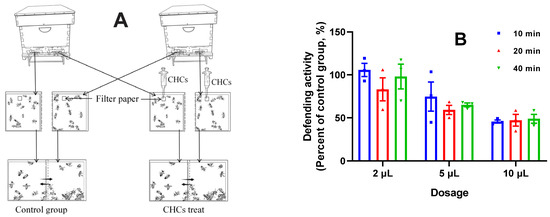
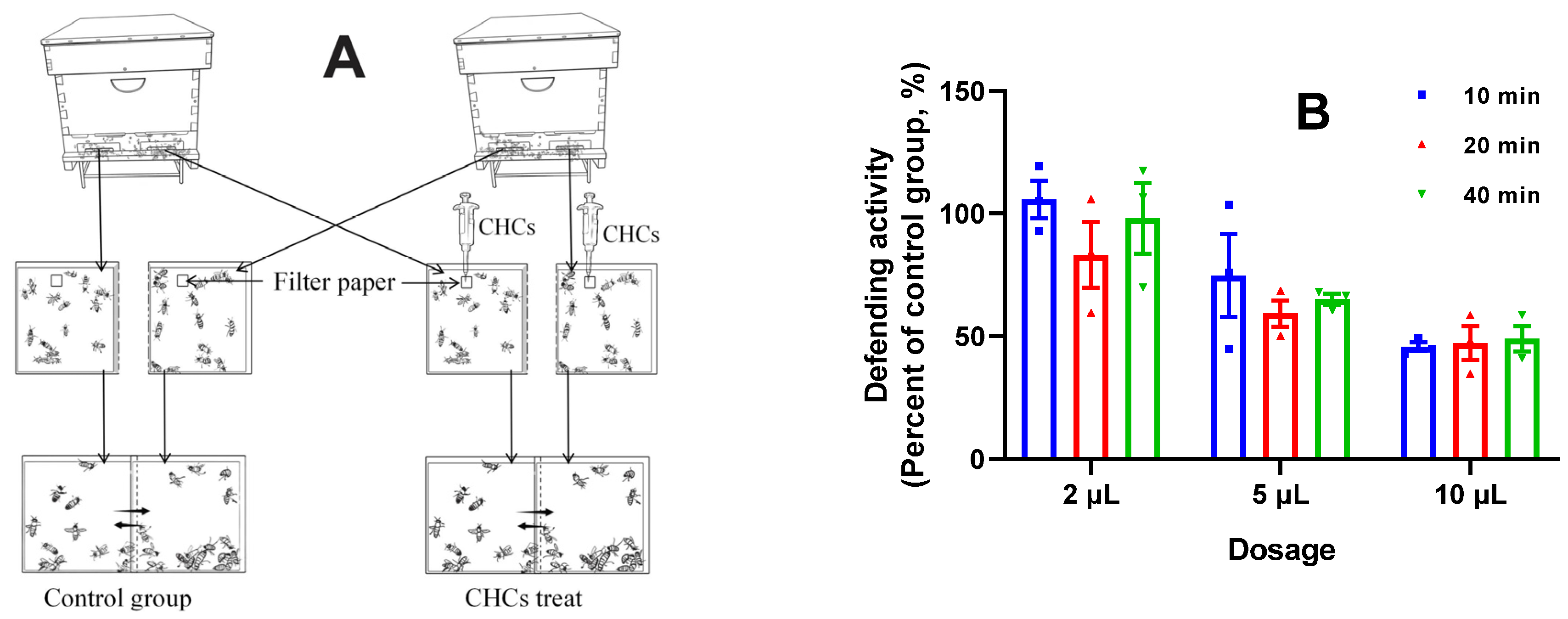
Three upregulated CHCs—namely, ethyl oleate, hexadecanoic acid ethyl ester, and octadecanoic acid ethyl ester (Sangon Biotech Co., Ltd., Shanghai, China)—from the merged bee group based on the GC-MS analysis were used to investigate their role in facilitating bee group merging. A square plastic Petri dish (100 × 15 mm) was modified by removing one side wall and replacing it with a paper strip. Ten foraging bees from each colony were collected at the hive entrance using an insect net. The collected bees from the two colonies were placed in the two modified dishes. A total of six colonies were used to establish three repeats. The above three ethyl esters were blended. The ratio of ethyl oleate to hexadecanoic acid ethyl ester to octadecanoic acid was 1:2:8, according to their relative contents determined by GC-MS analysis. The CHCs mixture was dropped onto 2 cm2 filter paper and immediately placed into two dishes, naturally volatilizing for 5, 10, 20, and 40 min, respectively, at room temperature. Different volumes (2, 5, and 10 µL) of the CHCs’ mixture were investigated. Each volume and treating time was repeated three times. Meanwhile, the same two dishes of bees with no CHCs’ mixture treatment were prepared as the control. After this, the filter paper with the ethyl ester mixture was removed. Then, the two dishes were connected by removing the paper strips such that the bees in the two dishes were placed in direct contact. Their nestmate recognition behaviors were recorded and analyzed as stated above (Figure 3A). The sum of the pursuing and fighting times of all bees was used to analyze the efficiency of these ethyl esters in bee group merging.
Figure 3.
Dosage and treatment time of the ethyl esters mixture on bees’ defensive activity. (A): Schematic diagram of CHCs treatment; (B): Defensive activity of bees treated by different dosages and times of ethyl esters mixture.
2.7. Data Analysis
The differences in nestmate recognition data among bee groups of different ages were analyzed using one-way ANOVA and Tukey’s honestly significant difference (HSD) test for post hoc pairwise comparisons using GraphPad (Version 8.0). The effects of CHCs on bee group merging, involving two factors of volumes (2, 5, and 10 µL) of the CHCs mixture and treating time (5, 10, 20, and 40 min), were analyzed using two-way ANOVA. Data were expressed as means ± SEMs. The significant differences were set as p < 0.05; GC-MS data were subjected to Partial Least Squares Discrimination Analysis (PLS-DA) [35]. The identified metabolic components of volatile CHCs were annotated in the KEGG PATHWAY database (https://www.genome.jp/kegg/pathway.html, accessed on 15 March 2026), the Human Metabolome Database (https://hmdb.ca/metabolites, accessed on 5 March 2026), and the LIPID MAPS database (https://lipidmaps.org/, accessed on 20 February 2026), respectively. The screening of differences in CHC components between bee groups before and after merging refers to three indices: VIP > 1.0 (variable importance in projection); FC > 1.2 or FC < 0.833 (fold change); and p-value < 0.05 (two-tailed T-test) [36].
3. Results
3.1. Bees Quickly Developed Nestmate Recognition Ability
Our results showed that the newly emerged bees displayed a weak recognition of bees of the same age from another group, with less than 5% of observation time identifying the defensive activity. However, this increased rapidly to nearly 20% in 5-day-old bees and to around 35% in 8-day-old bees, remaining at this high level for the rest of the bees’ lives (Figure 1B). Thus, bee recognition and defensive activities depended on bee age, and differences between age classes in these age-dependent activities were significant (one-way ANOVA, F5, 174 = 7.029; p < 0.0001).
3.2. CHCs Identification and Analysis
GC-MS analysis showed that 228 components were detected from the honey bee volatile CHCs. Among them, acetaldehyde hydroxy (CAS:141-46-8), 1,2-ethanediol 9-octadecenoic acid (Z)- (CAS:107-21-1), and methyl ester (CAS:112-62-9) comprised the majority of the volatile components, with relative contents of 19.87%, 14.75%, and 11.21%, respectively. The relative contents of 14 components were within the range of 1.0–10.0%, while 53 components exhibited relative contents of 0.1–1.0%, and the remaining 158 components showed relative contents below 0.1%. (Table S1).
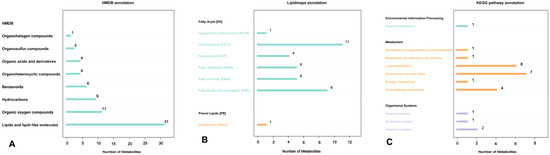
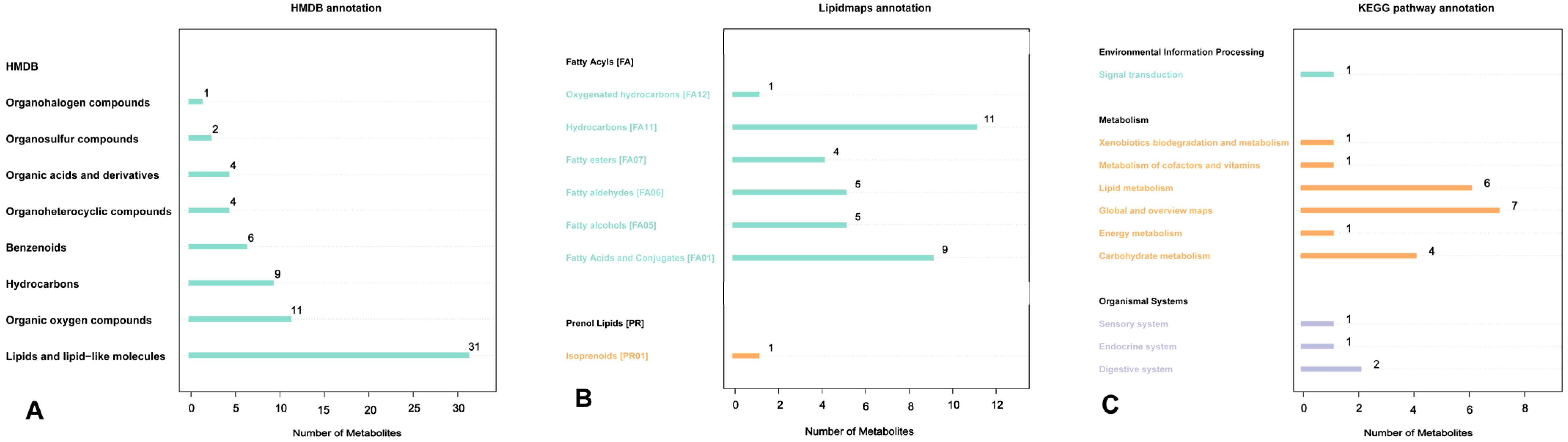
HDMB annotation showed that 31 of the volatile CHCs were lipids and lipid-like molecules, 11 were organic oxygen compounds, and 9 were hydrocarbons (Figure 4A). Further LIPID MAPS annotation showed that nearly all the lipids of volatile honey bee CHCs were classified as fatty acids (FA), with 11 components belonging to the subclass of hydrocarbons, 9 to the subclass of fatty acids and conjugates, 5 to the subclass of fatty aldehydes, and 1 to the subclass of isoprenoids within the class of prenol lipids (Figure 4B). The main components of the volatile CHCs were fatty acids and hydrocarbons. KEGG analysis showed that these volatile CHCs were mainly associated with the metabolism pathway, especially the lipid and carbohydrate metabolism, except in the global and overview maps (Figure 4C).
Figure 4.
Annotation of honey bee CHCs on the database of HDMB, LIPID MAPS and KEGG pathway. (A): HDMB annotation; (B): LIPID MAPS annotation, and (C): KEGG pathway annotation. Different colors of the items and bars represent they belong to different category in annotation.
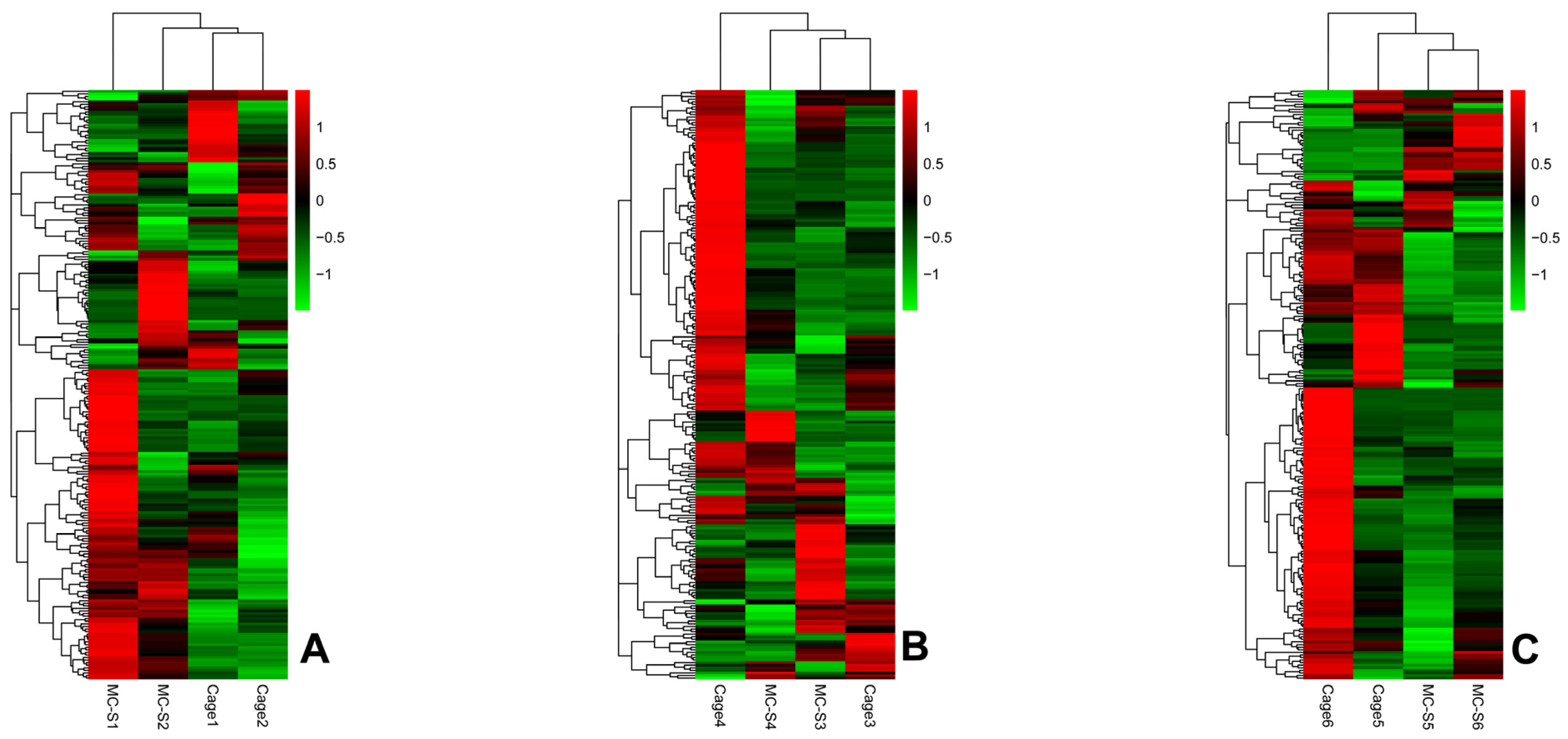
One-way ANOVA showed that the CHCs profiles from the six cages were significantly different (F4.031, 915.1 = 25.15, p < 0.0001). Further post hoc pairwise comparisons revealed that all the comparisons were significantly different (p < 0.05). The results indicated that the CHCs profiles of the six bee groups were all different; each bee cage had its own specific CHCs profile.
3.3. Time for Bee Group Merging
The results showed that the defending activity of bees changed and differed with time, and the differences between time classes were significant (one-way ANOVA, F3, 8 = 11.27; p = 0.0030). Further multiple comparisons showed that 6 and 12 h were insufficient for bees to accept each other, with bees showing similar defending behaviors to those in the control groups (for 6 h, p = 0.9117; for 12 h, p = 0.9963). A minimum of 18 h was required for a bee group to be merged, whereas the degree of defensive activity was significantly lower than that of the other time groups (p = 0.0095) (Figure 2B). Therefore, the bees that merged after 18 h were sampled to investigate their CHCs.
3.4. Merging Altered Bee Group CHCs Profiles
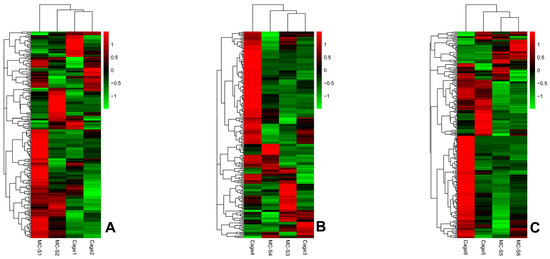
The results showed that bee group merging significantly altered the bees’ CHC profiles. However, such alterations had no consistent trend. The clusters of bee CHCs from the original two cages and the two sides of the merged cages, as shown in the heatmap of the three merged colonies, were obviously different (Figure 5).
Figure 5.
Heatmap of the CHCs of bee groups before and after group merging. (A), merged cage 1; (B), merged cage 2; and (C), merged cage 3. The bee sample name: Cage 1 denotes bees from Cage 1, with other groups defined identically; MC-S1 denotes merged cage, side of cage1 bees, with other groups defined identically. Bees’ CHCs from the two sides of the 18-h merged cage and their original cages were used to prepare the heatmap.
3.5. Bee Group Merging Upregulated Four CHCs
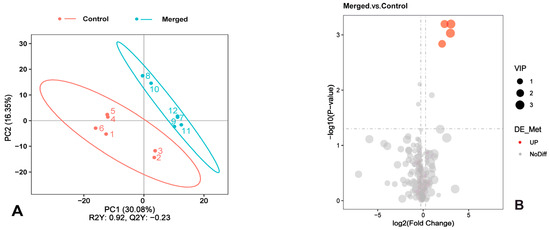
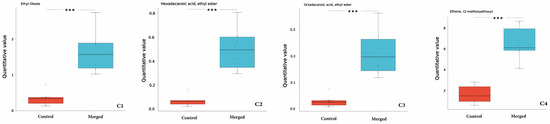
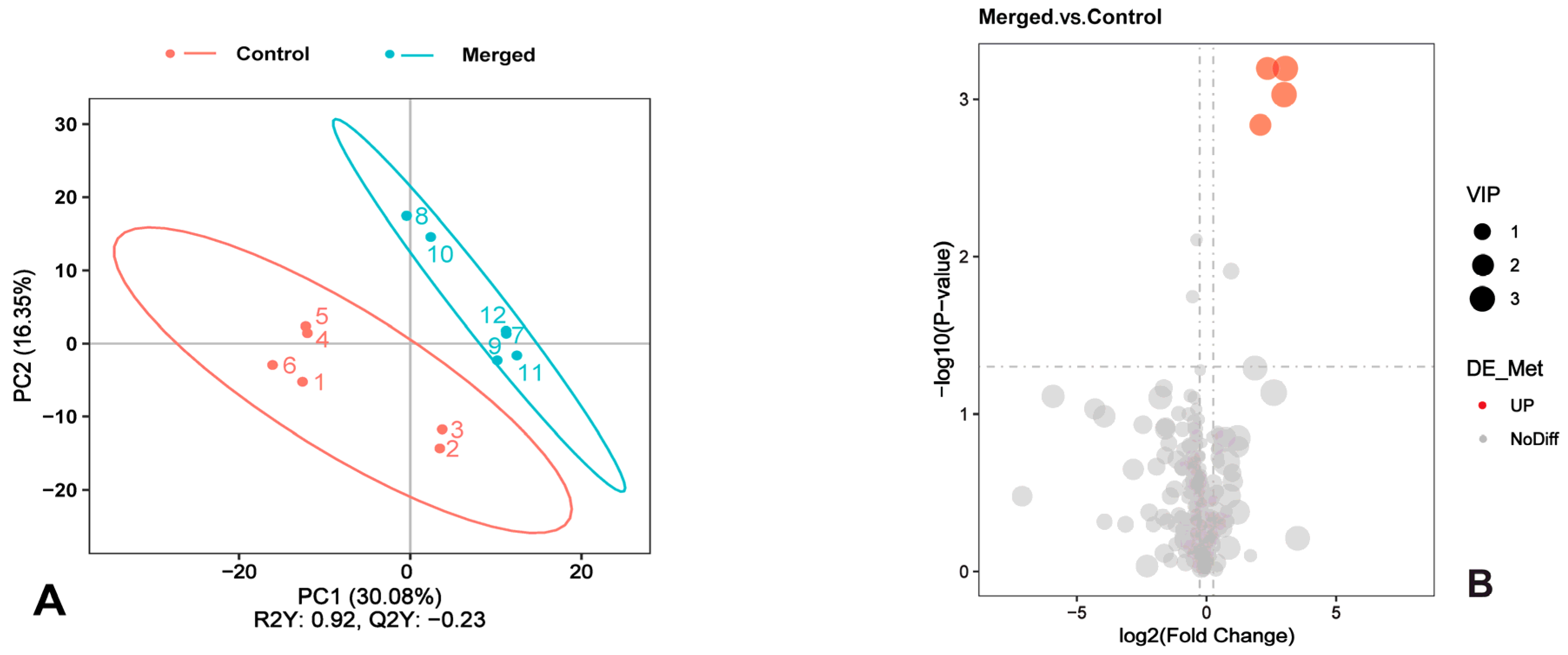
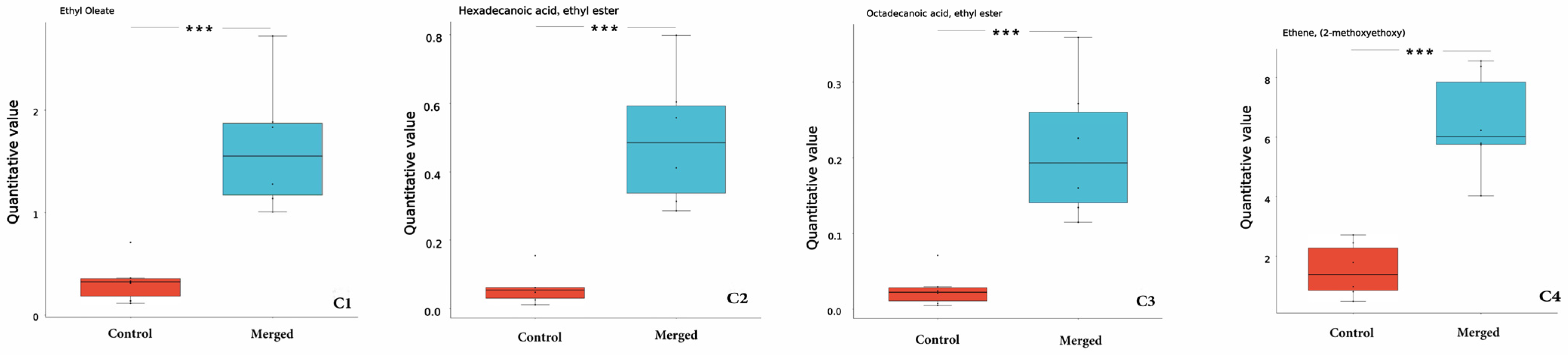
To further screen specific changes in CHCs in bee-merging groups, metabolomic methods were used to analyze the CHCs profiles. PLS-DA showed that the CHC profiles of the bees from the original six cages could be clustered into one group, which was significantly separated from the group of bees from the merged groups (Figure 6A). Comparison of their respective CHCs revealed that four components—ethyl oleate (CAS:111-62-6), hexadecanoic acid ethyl ester (CAS:628-97-7), octadecanoic acid ethyl ester (CAS:111-61-5), and 2-methoxyethyl ethenyl ether (CAS:1663-35-0)—were significantly upregulated, with over two times the expression in the bees from the merged group (for ethyl oleate, p < 0.001; for hexadecanoic acid ethyl ester, p < 0.001; for octadecanoic acid, ethyl ester, p < 0.001; for ethene, 2-methoxyethoxy, p = 0.001) (Figure 6B,C1–C4).
Figure 6.
Effect of bee group merging on honey bee CHCs. (A), LS-DA analysis of CHCs; (B), volcano map of CHCs from bees of merged cages vs. original cages; the relative content of four CHCs from merged cage bees ((C1), ethyl oleate; (C2), hexadecanoic acid ethyl ester; (C3), octadecanoic acid, ethyl ester and (C4), ethene, 2-methoxyethoxy). *** means p < 0.001.
3.6. Ethyl Esters Facilitate Bee Group Merge
Referring to the results of the metabolomic analysis, ethyl oleate, hexadecanoic acid ethyl ester, and octadecanoic acid ethyl ester were further investigated to determine their roles in honey bee group merging. The results showed that the ethyl esters treatment significantly decreased the defensive behavior of bees from two different groups, facilitating the merging of the bee groups. This effect was mainly due to the dosage of the ethyl ester mixture (two-way ANOVA, F2, 18 = 18.94, p < 0.0001). A low-dose treatment of 2 μL did not affect bees’ defensive activity, while high-dose treatments of 5 μL and 10 μL could decrease defensive activity to around 75% and 50% that of the control groups, respectively. Treatment time had no effect on bees’ defendsive activity (two-way ANOVA, F2, 18 = 1.205, p = 0.3227), and there was no interaction between dosage and time (two-way ANOVA, F4, 18 = 0.4342, p = 0.7822) (Figure 3B). Thus, the dosage of the ethyl ester mixture primarily determined the facilitation effect on bee group merging.
4. Discussion
Nestmate recognition is one of the bases of bee colony survival. In this study, we investigated the nestmate recognition behavior of bees of different ages and analyzed the specific changes in the CHC profiles during the colony-merging process. We found that newly emerged bees rapidly develop recognition and defensive abilities. A total of 228 CHCs were identified, and each bee cage had a distinctive CHC profile (Figure 5). Moreover, four CHCs were enriched from the merged bee groups (Figure 6). Among those, three ethyl esters were further verified to facilitate the merging of the bee group. These results demonstrate the chemical basis of bee group odor, and ethyl esters might be applied in practical beekeeping to improve the efficiency of colony merging.
CHCs comprise the outer layer of the insect cuticle, preventing moisture loss and providing chemical signals for individual communication. Bee colony odor is mainly derived from the volatile CHCs. However, other factors also contribute to colony odor. Previous reports have shown that wax can affect bee nestmate recognition [17,18,19,27]. Moreover, diseases caused by pathogenic bacteria or infestations of parasites such as the Varroa mite can alter the CHCs of honey bees [21,22]. These make natural bee colonies overly complex to study the composition and functional roles of honey bee CHCs. In this study, we investigated nestmate recognition and defensive behavior of bees of different ages, as well as changes in CHC profiles during the process of bee group merging using laboratory-reared caged bees. We did this to avoid the interference of these complicating factors.
Our tests showed that the newly emerged bees displayed extremely low levels of recognition and defensive activity. However, 5-day-old bees exhibited partial defensive behavior, and 8-day-old bees exhibited high defensive activity and maintained this level for the rest of their lives (Figure 1). This rapidly developing trait is consistent with honey bee colony life, which requires all individual bees to possess this ability as soon as possible to effectively defend against possible intruders.
The results showed that successfully merging two bee groups in a laboratory requires around 18 h (Figure 2). This period was longer than that required for practical bee colony merging, which normally involves keeping two colonies in one hive overnight, separated by a mesh. This time difference may result from differences in airflow efficiency between honey bee hives and cages used in the laboratory. A normal bee colony rears a large brood quantity, which requires that the colony brood area be kept at 34.5 °C [37]. There is thus a temperature difference between the brood area and the non-brood area in the beehive, which induces temperature cycling, increasing the airflow inside the hive. Moreover, a normal bee colony contains over ten thousand adult bees, undertaking a variety of activities. These activities can also speed up the airflow in the hive. In contrast, the merging cages kept in the laboratory contain a consistent number of (around 70) bees, engaging in no complicated activities. Furthermore, the cages were placed in an incubator with a constant temperature of 34.5 °C. The airflow in the cages was thus extremely low. This difference in airflow between the lab cages and beehives might explain the longer time required for bee groups to merge in the laboratory.
A total of 228 volatile CHCs were identified in the laboratory-reared bees. The majority of them were determined to be lipids and lipid-like molecules, organic oxygen compounds, and hydrocarbons in the HDMB database (Figure 4A), and as hydrocarbons, fatty acids and conjugates, and fatty aldehydes (belonging to the class of fatty acids) in the LIPID MAPS database (Figure 4B). These results were in agreement with the chemical basis of CHCs. KEGG analysis showed that the volatile CHCs were related to lipid metabolism and carbohydrate metabolism, as can be seen in the global and overview maps (Figure 4C). This indicates interactions between CHCs and the basal metabolism, energetic metabolism, lipid metabolism, and carbohydrate metabolism.
Our results have shown that the CHCs profiles of the bees from the six cages were significantly different, although all of the bees came from the same batch of newly emerged bees (Figure 5). Like other biological traits, the synthesis of CHCs was fundamentally determined by genes. Previous reports have shown that elongase and desaturase might be related to the expression of CHC [38]. CYP4G has also been proven to be related to CHC synthesis [39,40]. However, all worker bees develop from eggs fertilized by sperm stored in the spermatheca of the queen bee. The sperm are from several dozen drone bees [41,42,43,44]. This means that even worker bees from the same colony are, in fact, multi-patrilineal. This causes the genetic background of the test bees, including the CHC synthesis genes, not to be precisely equal, which might produce differences in the CHC profiles among the six cages of laboratory-reared bees.
In addition, our results showed that the CHCs’ profiles were not stable. The CHC profiles from the two sides of the merging cage were significantly different from each other, as well as from those of the source cages, indicating that the merging activity altered the CHCs’ profiles. There are similar cases in practice. Newly established colonies rapidly form their own colony odor in the honey bee swarming process, which differs from that of their mother colony, despite the new colony having the same worker bees as the mother colony. The flexibility of bee colony odor improves convenience in establishing a new colony, with significant biological implications. This variation in CHCs might be caused by three mechanisms. First, as stated above, colony merging or dividing changes the genetic background of the bees, which alters the CHC profiles. Second, wax has been shown to affect honey bee CHC profiles [17,18,19,27]. Nestmate recognition cues could thus be acquired from the hive environment [45]. There might be an active balancing process with respect to the release and absorption of volatile CHCs on the surface of the honey bee cuticle. Two groups of bees, in merging, could mutually influence their CHCs’ profiles. Third, the expression of CHCs involves the lipid and carbohydrate metabolism pathways, as shown in the global and overview maps in KEGG analysis (Figure 4). Any changes in physiologic state might also affect CHCs’ expression. Previous reports have shown that the CHC profiles of different castes—i.e., newly emerged bees, nurse bees, and forager bees—were different regardless of their unchanged genetic backgrounds [25]. Merging two bee groups might alter the bees’ physiological state, thus affecting CHCs’ expression.
Among bee CHCs, three components—namely, acetaldehyde hydroxy, 1,2-ethanediol 9-octadecenoic acid (Z), and methyl ester—accounted for approximately 45% of the total volatile CHCs and were non-differently distributed in bees from different cages. Such results indicate that these major CHCs might not play roles in nestmate recognition or defensive behavior, despite the common belief that CHCs could serve as chemical cues in insect communication or as pheromones. This might arise from differences in learning and discrimination abilities deriving from specific CHCs in honey bees. Previous reports have shown that honey bee CHCs can be classified into those that the bees learned and discriminated well and those that they did not. These well-learnt CHCs may constitute important compounds used as chemical cues in social recognition processes [46]. The three main CHCs identified in the study might not be the chemicals that bees learn and discriminate well.
After being separated by a mesh for 18 h, the bees from two different groups accepted each other and successfully formed a new, merged group. This result supports the conclusion that in eastern carpenter bees, familiarity, not relatedness, determines the nestmate discrimination [47]. However, the CHC profiles of the bees from the two groups were still significantly different (Figure 5). A previous report has shown that honey bees are more likely to accept bees with similar CHCs profiles to their own [30]. Taking the above discovery—i.e., that chemicals can be classified into those which bees learn and discriminate well and those which they do not—into consideration, the present result does not well support the conclusion that the similarity of CHC profiles determine bees’ nestmate acceptance. There may be critical components responsible for the merging of bee groups.
Improving bee colony merging efficiency has practical value in beekeeping activities. There have been several attempts to accomplish this using a variety of chemicals. For example, flax oil has been verified to increase the acceptability of bees [48]. However, contrary effects have also been reported for hexadecane, octadecane, tetracosanoic acid, and methyl docosanoate, which reduce the acceptability of bees, and some studies found no such effect for hexadecane and methyl docosanoate [45,49]. In this study, metabolomics methods were introduced to analyze GC-MS data of volatile honey bee CHCs. Four chemicals—namely, ethyl oleate, hexadecanoic acid ethyl ester, octadecanoic acid ethyl ester, and 2-methoxyethyl ethenyl ether—were enriched and consistently upregulated in the bees from the merged groups, indicating their potential roles in bee colony merging (Figure 6). Furthermore, laboratory assays confirmed that the three ethyl esters did enhance the efficiency of honey bee group merging in a dose-dependent manner (Figure 3). This result could play a role in practical bee colony merging.
5. Conclusions
In summary, we found that newly emerged adult bees rapidly developed their nestmate recognition and defensive abilities, reaching a high level at 8 days old, and maintaining this high level for the rest of their lives. This developing mode of nestmate recognition is of extreme importance in maintaining colony structure and function. Each bee group has a unique CHCs profile. Bee group merging upregulated the expression of four CHCs, and three ethyl esters were verified to facilitate bee group merging efficiency. These results demonstrate the chemical basis of bee group odor, and they may have practical value in beekeeping.
Supplementary Materials
The following supporting information can be downloaded at: https://www.mdpi.com/article/10.3390/agriculture16131462/s1, Table S1: CHCs’ profiles of bees from the six lab-reared cages. Table S2: CHCs profiles of bees from the merged cages. Video S1: honeybee in figthing1. Video S2: honeybee in figthing2. Video S3: honeybee in pursuing.
Author Contributions
Conceptualization, J.L.; methodology, M.Y., X.X., X.D. and S.H.; validation and investigation, M.Y., X.X., X.H., G.M. and Y.W.; data curation, M.Y., X.X. and X.D.; writing—original draft preparation, M.Y. and X.X.; writing—review and editing, S.H. and J.L.; visualization, M.Y., X.X. and J.L.; funding acquisition, J.L.; All authors approved the submission of the manuscript. All authors have read and agreed to the published version of the manuscript.
Funding
This research was funded by grants from the Natural Science Foundation of Fujian Province (No. 2025J01615).
Institutional Review Board Statement
Not applicable.
Informed Consent Statement
Not applicable.
Data Availability Statement
The original contributions presented in this study are included in the article. Further inquiries can be directed to the corresponding author.
Acknowledgments
We thank Novogene Co., Ltd. (Beijing, China) for their help in GC-MS and the following metabolite analysis, and the financial aid from the China Agriculture Research System (No. CARS-44-KXJ4) for publishing of the article.
Conflicts of Interest
The authors declare no conflicts of interest.
References
- Robinson, G.E. Chapter 77—Division of labor in insect societies. In Encyclopedia of Insects, 2nd ed.; Resh, V.H., Cardé, R.T., Eds.; Academic Press: San Diego, CA, USA, 2009; pp. 297–299. [Google Scholar]
- Peso, M.; Elgar, M.A.; Barron, A.B. Pheromonal control: Reconciling physiological mechanism with signalling theory. Biol. Rev. 2015, 90, 542–559. [Google Scholar]
- Breed, M.D.; Guzmán-Novoa, E.; Hunt, G.J. Defensive behavior of honey bees: Organization, genetics, and comparisons with other bees. Annu. Rev. Entomol. 2004, 49, 271–298. [Google Scholar] [PubMed]
- Blomquist, G.J.; Ginzel, M.D. Chemical ecology, biochemistry, and molecular biology of insect hydrocarbons. Annu. Rev. Entomol. 2021, 66, 45–60. [Google Scholar] [CrossRef] [Scilit] [PubMed]
- Martin, S.; Drijfhout, F. A review of ant cuticular hydrocarbons. J. Chem. Ecol. 2009, 35, 1151–1161. [Google Scholar] [CrossRef] [Scilit] [PubMed]
- Braga, M.V.; Pinto, Z.T.; de Carvalho Queiroz, M.M.; Matsumoto, N.; Blomquist, G.J. Cuticular hydrocarbons as a tool for the identification of insect species: Puparial cases from Sarcophagidae. Acta Trop. 2013, 128, 479–485. [Google Scholar] [CrossRef] [Scilit] [PubMed]
- Guillem, R.M.; Drijfhout, F.P.; Martin, S.J. Species-specific cuticular hydrocarbon stability within European Myrmica ants. J. Chem. Ecol. 2016, 42, 1052–1062. [Google Scholar] [CrossRef] [Scilit] [PubMed]
- Moore, H.E.; Hall, M.J.R.; Drijfhout, F.P.; Cody, R.B.; Whitmore, D. Cuticular hydrocarbons for identifying Sarcophagidae (Diptera). Sci. Rep. 2021, 11, 7732. [Google Scholar] [CrossRef] [Scilit] [PubMed]
- Fröhlich, D.; Zangl, L.; Raspotnig, G.; Koblmüller, S. Inter- and intrasexual variation in cuticular hydrocarbons in Trichrysis cyanea (Linnaeus, 1758) (Hymenoptera: Chrysididae). Insects 2022, 13, 159. [Google Scholar] [CrossRef] [Scilit] [PubMed]
- Rodrigues Méndez, M.P.; Muñoz-Rodríguez, D.; Aragón-Pech, R.A.J.; Macías Macías, J.O.; Quezada-Euán, J.J.G. Cuticular hydrocarbon profiles reveal geographic chemotypes in stingless bees (Hymenoptera: Meliponini). Sci. Rep. 2024, 14, 14567. [Google Scholar] [CrossRef] [Scilit] [PubMed]
- Narah, J.; Streinzer, M.; Chakravorty, J.; Megu, K.; Spaethe, J.; Brockmann, A.; Schmitt, T. Cuticular hydrocarbon profiles of himalayan bumble Bees (Hymenoptera: Bombus Latreille) are species-specific and show elevational variation. J. Chem. Ecol. 2024, 50, 969–977. [Google Scholar] [CrossRef] [Scilit] [PubMed]
- Moris, V.C.; Podsiadlowski, L.; Martin, S.; Oeyen, J.P.; Donath, A.; Petersen, M.; Wilbrandt, J.; Misof, B.; Liedtke, D.; Thamm, M.; et al. Intrasexual cuticular hydrocarbon dimorphism in a wasp sheds light on hydrocarbon biosynthesis genes in Hymenoptera. Commun. Biol. 2023, 6, 147. [Google Scholar] [CrossRef] [Scilit] [PubMed]
- Polidori, C.; Giordani, I.; Wurdack, M.; Tormos, J.; Asís, J.D.; Schmitt, T. Post-mating shift towards longer-chain cuticular hydrocarbons drastically reduces female attractiveness to males in a digger wasp. J. Insect Physiol. 2017, 100, 119–127. [Google Scholar] [PubMed]
- Rodríguez-León, D.S.; Uzunov, A.; Costa, C.; Elen, D.; Charistos, L.; Galea, T.; Gabel, M.; Scheiner, R.; Pinto, M.A.; Schmitt, T. Deciphering the variation in cuticular hydrocarbon profiles of six European honey bee subspecies. BMC Ecol. Evol. 2024, 24, 131. [Google Scholar] [CrossRef] [Scilit] [PubMed]
- Maihoff, F.; Bohlke, K.; Brockmann, A.; Schmitt, T. Increased complexity of worker CHC profiles in Apis dorsata correlates with nesting ecology. PLoS ONE 2022, 17, e0271745. [Google Scholar] [CrossRef] [Scilit] [PubMed]
- Breed, M.D.; Page, R.E.; Hibbard, B.E.; Bjostad, L.B. Interfamily variation in comb wax hydrocarbons produced by honey bees. J. Chem. Ecol. 1995, 21, 1329–1338. [Google Scholar] [CrossRef] [Scilit] [PubMed]
- Couvillon, M.J.; Caple, J.P.; Endsor, S.L.; Kärcher, M.; Russell, T.E.; Storey, D.E.; Ratnieks, F.L. Nest-mate recognition template of guard honeybees (Apis mellifera) is modified by wax comb transfer. Biol. Lett. 2007, 3, 228–230. [Google Scholar] [CrossRef] [Scilit] [PubMed]
- Breed, M.D.; Williams, K.R.; Fewell, J.H. Comb wax mediates the acquisition of nest-mate recognition cues in honey bees. Proc. Natl. Acad. Sci. USA 1988, 85, 8766–8769. [Google Scholar] [CrossRef] [Scilit] [PubMed]
- Breed, M.D.; Leger, E.A.; Pearce, A.N.; Wang, Y.J. Comb wax effects on the ontogeny of honey bee nestmate recognition. Anim. Behav. 1998, 55, 13–20. [Google Scholar] [CrossRef] [Scilit] [PubMed]
- Martin, S.J.; Correia-Oliveira, M.E.; Shemilt, S.; Drijfhout, F.P. Is the salivary gland associated with honey bee recognition compounds in worker honey Bees (Apis mellifera)? J. Chem. Ecol. 2018, 44, 650–657. [Google Scholar] [CrossRef] [Scilit] [PubMed]
- Cappa, F.; Petrocelli, I.; Dani, F.R.; Dapporto, L.; Giovannini, M.; Silva-Castellari, J.; Turillazzi, S.; Cervo, R. Natural biocide disrupts nestmate recognition in honeybees. Sci. Rep. 2019, 9, 3171. [Google Scholar] [CrossRef] [Scilit] [PubMed]
- Salvy, M.; Martin, C.; BagnÈRes, A.G.; Provost, É.; Roux, M.; Le Conte, Y.; ClÉMent, J.L. Modifications of the cuticular hydrocarbon profile of Apis mellifera worker bees in the presence of the ectoparasitic mite Varroa jacobsoni in brood cells. Parasitology 2002, 122, 145–159. [Google Scholar]
- Vernier, C.L.; Krupp, J.J.; Marcus, K.; Hefetz, A.; Levine, J.D.; Ben-Shahar, Y. The cuticular hydrocarbon profiles of honey bee workers develop via a socially-modulated innate process. eLife 2019, 8, e41855. [Google Scholar] [CrossRef] [Scilit] [PubMed]
- Hewlett, S.E.; Wareham, D.M.; Barron, A.B. Honey bee (Apis mellifera) sociability and nestmate affiliation are dependent on the social environment experienced post-eclosion. J. Exp. Biol. 2018, 221, jeb173054. [Google Scholar] [PubMed]
- Rahman, S.; Hajong, S.R.; Gévar, J.; Lenoir, A.; Darrouzet, E. Cuticular hydrocarbon compounds in worker castes and their role in nestmate recognition in Apis cerana indica. J. Chem. Ecol. 2016, 42, 444–451. [Google Scholar] [CrossRef] [Scilit] [PubMed]
- Gilley, D.C.; DeGrandi-Hoffman, G.; Hooper, J.E. Volatile compounds emitted by live European honey bee (Apis mellifera L.) queens. J. Insect Physiol. 2006, 52, 520–527. [Google Scholar] [CrossRef] [Scilit] [PubMed]
- Breed, M.D.; Garry, M.F.; Pearce, A.N.; Hibbard, B.E.; Bjostad, L.B.; Page, J.R.E. The role of wax comb in honey bee nestmate recognition. Anim. Behav. 1995, 50, 489–496. [Google Scholar] [CrossRef] [Scilit]
- van Wilgenburg, E.; Sulc, R.; Shea, K.J.; Tsutsui, N.D. Deciphering the chemical basis of nestmate recognition. J. Chem. Ecol. 2010, 36, 751–758. [Google Scholar] [CrossRef] [Scilit] [PubMed]
- Lorenzi, M.C.; d’Ettorre, P. Nestmate recognition in social insects: What does it mean to be chemically insignificant? Front. Ecol. Evol. 2020, 7, 488. [Google Scholar] [CrossRef] [Scilit]
- Nascimento, D.L.; Nascimento, F.S. Acceptance threshold hypothesis is supported by chemical similarity of cuticular hydrocarbons in a stingless bee, Melipona asilvai. J. Chem. Ecol. 2012, 38, 1432–1440. [Google Scholar] [CrossRef] [Scilit] [PubMed]
- Stabentheiner, A.; Kovac, H.; Schmaranzer, S. Honeybee nestmate recognition: The thermal behaviour of guards and their examinees. J. Exp. Biol. 2002, 205, 2637–2642. [Google Scholar] [CrossRef] [Scilit] [PubMed]
- Dani, F.R.; Jones, G.R.; Corsi, S.; Beard, R.; Pradella, D.; Turillazzi, S. Nestmate recognition cues in the honey bee: Differential importance of cuticular alkanes and alkenes. Chem. Senses 2005, 30, 477–489. [Google Scholar] [CrossRef] [Scilit] [PubMed]
- Richard, F.J.; Aubert, A.; Grozinger, C.M. Modulation of social interactions by immune stimulation in honey bee, Apis mellifera, workers. BMC Biol. 2008, 6, 50. [Google Scholar] [CrossRef] [Scilit] [PubMed]
- Ronchetti, F.; Schmitt, T.; Keller, A.; García-Reina, A.; De la Rua, P.; Steffan-Dewenter, I.; Polidori, C. The Significance of genetic relatedness and nest sharing on the worker-worker similarity of gut bacterial microbiome and cuticular hydrocarbon profile in a sweat bee. Ecol. Evol. 2025, 15, e71519. [Google Scholar] [PubMed]
- Boulesteix, A.L.; Strimmer, K. Partial least squares: A versatile tool for the analysis of high-dimensional genomic data. Brief. Bioinform. 2007, 8, 32–44. [Google Scholar] [PubMed]
- Kieffer, D.A.; Piccolo, B.D.; Vaziri, N.D.; Liu, S.; Lau, W.L.; Khazaeli, M.; Nazertehrani, S.; Moore, M.E.; Marco, M.L.; Martin, R.J.; et al. Resistant starch alters gut microbiome and metabolomic profiles concurrent with amelioration of chronic kidney disease in rats. Am. J. Physiol. Ren. Physiol. 2016, 310, F857–F871. [Google Scholar] [CrossRef] [Scilit]
- Stabentheiner, A.; Kovac, H.; Mandl, M.; Käfer, H. Coping with the cold and fighting the heat: Thermal homeostasis of a superorganism, the honeybee colony. J. Comp. Physiol. A 2021, 207, 337–351. [Google Scholar] [CrossRef] [Scilit]
- Rodríguez-León, D.S.; Schmitt, T.; Pinto, M.A.; Thamm, M.; Scheiner, R. Expression of elongase- and desaturase-encoding genes shapes the cuticular hydrocarbon profiles of honey bees. Mol. Ecol. 2025, 34, e17716. [Google Scholar] [PubMed]
- Feyereisen, R. Origin and evolution of the CYP4G subfamily in insects, cytochrome P450 enzymes involved in cuticular hydrocarbon synthesis. Mol. Phylogenet. Evol. 2020, 143, 106695. [Google Scholar] [CrossRef] [Scilit]
- Calla, B.; MacLean, M.; Liao, L.-H.; Dhanjal, I.; Tittiger, C.; Blomquist, G.J.; Berenbaum, M.R. Functional characterization of CYP4G11—A highly conserved enzyme in the western honey bee Apis mellifera. Insect Mol. Biol. 2018, 27, 661–674. [Google Scholar] [PubMed]
- Mattila, H.R.; Seeley, T.D. Genetic diversity in honey bee colonies enhances productivity and fitness. Science 2007, 317, 362–364. [Google Scholar] [CrossRef] [Scilit] [PubMed]
- Seeley, T.D.; Tarpy, D.R. Queen promiscuity lowers disease within honeybee colonies. Proc. Biol. Sci. 2007, 274, 67–72. [Google Scholar] [PubMed]
- Tarpy, D.R.; Keller, J.J.; Caren, J.R.; Delaney, D.A. Assessing the mating ‘health’ of commercial honey bee queens. J. Econ. Entomol. 2012, 105, 20–25. [Google Scholar] [CrossRef] [Scilit] [PubMed]
- Tarpy, D.R.; Vanengelsdorp, D.; Pettis, J.S. Genetic diversity affects colony survivorship in commercial honey bee colonies. Naturwissenschaften 2013, 100, 723–728. [Google Scholar] [CrossRef] [Scilit] [PubMed]
- Breed, M.D.; Julian, G.E. Do simple rules apply in honey-bee nestmate discrimination? Nature 1992, 357, 685–686. [Google Scholar] [CrossRef] [Scilit]
- Châline, N.; Sandoz, J.-C.; Martin, S.J.; Ratnieks, F.L.W.; Jones, G.R. Learning and discrimination of individual cuticular hydrocarbons by honeybees (Apis mellifera). Chem. Senses 2005, 30, 327–335. [Google Scholar] [CrossRef] [Scilit] [PubMed]
- Vickruck, J.L.; Richards, M.H. Nestmate discrimination based on familiarity but not relatedness in eastern carpenter bees. Behav. Process. 2017, 145, 73–80. [Google Scholar] [CrossRef] [Scilit]
- Breed, M.D.; Lyon, C.A.; Sutherland, A.; Buchwald, R. Use of flax oil to influence honey bee nestmate recognition. J. Econ. Entomol. 2012, 105, 1145–1148. [Google Scholar] [CrossRef] [Scilit] [PubMed]
- Breed, M.D.; Stiller, T.M. Honey bee, Apis mellifera, nestmate discrimination: Hydrocarbon effects and the evolutionary implications of comb choice. Anim. Behav. 1992, 43, 875–883. [Google Scholar]
Disclaimer/Publisher’s Note: The statements, opinions and data contained in all publications are solely those of the individual author(s) and contributor(s) and not of MDPI and/or the editor(s). MDPI and/or the editor(s) disclaim responsibility for any injury to people or property resulting from any ideas, methods, instructions or products referred to in the content. |
© 2026 by the authors. Licensee MDPI, Basel, Switzerland. This article is an open access article distributed under the terms and conditions of the Creative Commons Attribution (CC BY) license.