Article

Public Storage Infrastructure and Grain Market Regulation in Mexico

by
Jorge Alan García-Figueroa
1,
Karla Terán-Samaniego
2,
Mayra Lucía Maycotte-de la Peña
2,
María Cristina Garza-Lagler
3,
David Félix-Gurrola
1 and
Jesús Martín Robles-Parra
3,*
1
PhD Program in Regional Development, Department of Economics, Regional Development Coordination, Research Center for Food and Regional Development (Centro de Investigación en Alimentación y Desarrollo Regional, A.C./CIAD), Gustavo Enrique Astiazarán Rosas, No. 46, Hermosillo 83304, Sonora, Mexico
2
Postdoctoral Stays Program, Department of Economics, Regional Development Coordination, Research Center for Food and Regional Development (Centro de Investigación en Alimentación y Desarrollo Regional, A.C./CIAD), Gustavo Enrique Astiazarán Rosas, No. 46, Hermosillo 83304, Sonora, Mexico
3
Department of Economics, Regional Development Coordination, Research Center for Food and Regional Development (Centro de Investigación en Alimentación y Desarrollo Regional, A.C./CIAD), Gustavo Enrique Astiazarán Rosas, No. 46, Hermosillo 83304, Sonora, Mexico
*
Author to whom correspondence should be addressed.
Agriculture 2026, 16(13), 1461; https://doi.org/10.3390/agriculture16131461
Submission received: 13 May 2026 / Revised: 22 June 2026 / Accepted: 23 June 2026 / Published: 3 July 2026
(This article belongs to the Section Agricultural Economics, Policies and Rural Management)

Abstract

Grain storage is vital for a country within a framework of food sovereignty and security. It helps stabilize markets, prices, and imbalances between supply and demand. In Mexico, public storage infrastructure is almost nonexistent, having been transferred to the private sector. The objective of this article is to analyze the relationship between public storage infrastructure and distribution problems that maize producers face in Mexico. A mixed-methods analysis procedure was implemented. Semi-structured interviews were conducted with small, medium, and large distributors, selected using the snowball sampling technique. The analysis identifies a positive association between references to storage infrastructure and distribution problems in the interview materials. Additionally, Spearman’s rank correlation coefficient was applied to the counts to strengthen the analysis. The results indicated a positive and significant relationship between the variables “storage infrastructure” and “distribution problems”, but also that, around the latter, there are others: lack of government support, price fixing, guaranteed price, insecurity, production costs, and inconveniences that require attention to stabilize the maize market. Inadequate infrastructure limits storage capacity, affects grain quality, increases costs, reduces producers’ bargaining power, and contributes to price volatility. It also impacts logistics, transportation, and marketing, especially in less developed regions. Evidence suggests that public storage infrastructure is a strategic element for food security; however, its concentration and predominantly private nature generate territorial inequalities.

1. Introduction

Maize is a central element of the Mexican diet, as it is used in the preparation of a wide variety of traditional dishes. Since pre-Hispanic times, this food has been a fundamental part of the diet, reflecting its strong presence in culture and gastronomy. Maize is one of the main sources of energy in the diet, reflected in its high per capita consumption rates. Furthermore, many families depend directly on this crop for their livelihood [1,2].
In rural areas of Mexico, more than 80% of households experience some degree of food insecurity. Given this situation, the importance of maize in the national diet underscores the need to implement efficient grain storage systems. To achieve this, it is essential to have facilities with adequate infrastructure and equipment capable of maintaining grain quality and ensuring its availability throughout the year, as this enables regulating supply, stabilizing prices, and guaranteeing year-round availability [3].
For decades, the Mexican government has intervened in the grain market through price and subsidy schemes to stabilize producers’ incomes and ensure supply. After the elimination of the old guaranteed prices of the 1990s (managed by the National Company for Popular Subsistence -CONASUPO-), the government implemented marketing support programs through the Agency for Support and Services for Agricultural Marketing (ASERCA) [4].
According to data from the National Council for the Evaluation of Social Development Policy (CONEVAL) [5], these programs, formerly run by the Secretariat of Agriculture, Livestock, Rural Development, Fisheries, and Food (SAGARPA), and now the Secretariat of Agriculture and Rural Development (SADER), aimed to improve producers’ incomes by incentivizing the market, promoting crop storage, and regulating the supply of staple grains, such as maize. In recent years, these policies have evolved significantly, with the creation in 2019 of the Mexican Undersecretariat of Food Security (SEGALMEX), a decentralized agency focused on guaranteed prices for small producers [6].
In other words, Mexico’s grain support policy shifted from a market-oriented subsidy scheme via ASERCA (beneficial for commercial producers, but with limited reach for small producers) to a direct intervention model with guaranteed prices for small producers through SEGALMEX. This strategy has improved the incomes of the poorest in rural areas but faces challenges in coverage and transparent management, as it requires complementing fair prices with support for productivity, storage infrastructure, and anti-corruption measures within responsible institutions [7].
Concerns about the relevance of grain storage and its implications have been extensively addressed by multilateral organizations such as the Food and Agriculture Organization (FAO) in 2023 and the Organization for Economic Co-operation and Development and the World Bank in 2024. These organizations emphasize the importance of strategic grain reserves to mitigate price volatility and ensure food access during crises, where public storage is fundamental to reducing dependence on imports and controlling domestic markets. They also highlight the importance of modern storage systems that reduce losses and maintain grain quality in storage [8].
Mexico has a total storage capacity of 39.9 million tons (94% of the national grain harvest), and the infrastructure is highly concentrated in the northwest region [9]. Meanwhile, García-Salazar and Bautista-Mayorga [10] evaluate the availability of agricultural storage facilities as a price-stabilization strategy for maize in Guerrero and argue for investment in storage to balance supply and demand.
Along the same lines, García-Salazar et al. [11] analyze the growth in installed capacity of agricultural storage facilities between 1996 and 2019 by state. They point out that the government should increase storage capacity in southern Mexico, a region where such infrastructure is limited. In turn, the efficient management of storage has been analyzed, and it has been concluded that inadequate government policies and a lack of commitment from senior management are the main challenges for the Global Adaptation Goals Commission (GGA) [12], as well as the United Nations Office Against Climate Change (UNFCCC) [13].
In this same sense, more recent studies, such as those of Abdullahi and Dandago [14], Das et al. [15], and Nath et al. [16], have identified a scarcity of research providing an updated overview of grain storage conditions and proposing solutions to identified problems, such as grain protection, quality and safety, food security, livelihoods, and farmers’ income, among others.
Therefore, the objective of this article is to analyze the relationship between public storage infrastructure and the distribution problems that maize producers face in Mexico. The hypothesis states that the greater the deficiencies in public storage infrastructure, the greater the distribution problems faced by maize producers in Mexico.

2. Materials and Methods

A methodological framework was designed to systematically address the problem. A semi-structured interview guide was developed, based on the concept of “public storage infrastructure” as a key element in the grain distribution process in Mexico. These 33 interviews were conducted with small, medium, and large distributors, selected using snowball sampling. Interviews were applied one by one, using snowball sampling. The interview guide is in Appendix A.
While non-probability snowball sampling has limitations such as a lack of representativeness, the willingness of respondents to refer to other informants, risk of early saturation, or unpredictable sample growth, these were not restrictions for the collection of field data.
Subsequently, qualitative and quantitative techniques were applied to examine the information, facilitating a comprehensive understanding of the phenomenon. This integrated approach enabled the identification of actors, patterns, key variables, and potential factors influencing storage efficiency, thereby ensuring the validity and reliability of the results.

2.1. Description of the Study Areas

This study was conducted in the following Mexican states: Campeche, Chiapas, Chihuahua, State of Mexico, Guanajuato, Hidalgo, Jalisco, Michoacán, Nayarit, Oaxaca, Sonora, Sinaloa, Tamaulipas, and Veracruz, between 2022 and 2024.

2.2. Units and Participants

Small, medium, and large distributors were identified in the aforementioned states, and a characterization was conducted to facilitate their organization and study (Table 1).

2.3. Interview Design and Instrument Validation

For the semi-structured interview, which was based on a script, the concept of “public storage infrastructure” was identified as a key element in the grain distribution process in Mexico, and the questions were then developed accordingly.
The script’s content was validated through expert review to incorporate corrections and recommendations necessary for the interviewee’s understanding of the questions and to eliminate biases as they were identified.

2.4. Conducting Interviews

Small, medium, and large distributors in the maize system were contacted, and in-depth semi-structured interviews were conducted with the key stakeholders. These included representatives from maize distributors and purchasing companies (small, medium, and large) as well as leaders of producer organizations, selected through non-probability convenience sampling using the snowball sampling technique. This sampling method is appropriate when the target population is unknown and is suitable given the difficulty of access and the specific nature of the informants [17]. Thirty-three interviews were conducted, and to ensure no data was lost, each interview was recorded with the participants’ prior consent.

2.5. Transcript of the Interviews

Using the Cockatoo program (https://www.cockatoo.com/), the audio recordings were transcribed to convert the interviews into text format. The resulting discourses were analyzed using content and discourse analysis techniques, supported by specialized software such as MaxQDA to code emergent categories. This allowed identification of narrative patterns and the frequency of mentions of critical topics (such as “storage infrastructure,” “pricing,” “market risks”, etc.), which were exported to a frequency matrix and correlated for quantitative analysis.

2.6. Development of Codes, Subcodes, and Memos

The MaxQDA Analytics Pro (24.4.0) software was used to create codes and subcodes that referenced the research’s core concept and its components and elements. Corresponding memos were also established, containing the definitions assigned to the aforementioned concept and its derivatives.

2.7. Coding

The coding process consisted of identifying, within the interview text recorded in MaxQDA, passages in which the interviewee mentioned the previously defined codes and subcodes based on the conceptual framework. Similarly, emergent codes were recorded; these are concepts with which the interviewee is empirically familiar, and which are also related to a code previously created from the theory, or even a concept not previously considered in the codes developed based on the conceptual framework. This enriches discourse analysis by complementing empirically gathered information with theoretically collected data.
For further understanding, Table 2 is included as an example, and Appendix B, which specifies the codes and definitions for the main code “distribution problems”, is added at the end of the manuscript.

2.8. Frequency Matrix

Once all the text segments corresponding to the 33 interviews were coded, a code-occurrence matrix was generated, showing the number of text segments in the documents coded with specific codes, either individually or in combination with other codes. This matrix allows visualization of all instances of each code in each interview and, additionally, generates categories and subcategories based on the number of occurrences of each code. This provides a general understanding of the “regularity” of the problem under study.
It is important to clarify that the unit of analysis is the discourse from the interviews conducted with the respondents, who are the maize distributors. This part of the procedure was carried out in two phases: in the first, the code matrix was obtained by intersection, which measures the direct co-occurrence of codes in the same passages of the text, allowing us to understand which codes are conceptually related to those embedded in the interviewees’ discourse; the second phase consisted of exporting a code frequency matrix from MaxQDA to RStudio to statistically verify the correlation between them, which had already been identified conceptually—that is, to statistically confirm what had been found qualitatively.

2.9. Statistical Tests

Once the MaxQDA software’s tools provided information, which was condensed into a database (the frequency matrix), the Shapiro–Wilk test was applied to each variable of interest (Table 3). According to Baldeón-Báez et al. [18], this test is used to evaluate whether a sample comes from a normal distribution and is useful for small data sets (n < 50).
The Shapiro–Wilk test indicates that the counts assigned to both study variables in the coding matrix do not exhibit a normal distribution, as shown in Table 3. The p-value in both cases is less than 0.05; the statistical test rejects the assumption of normality.
Thus, given that the count data in the coding matrix are discrete and non-normal, nonparametric association tests are applied to evaluate their relationship, such as Spearman’s rank correlation coefficient, which is suitable for small samples (n = 33), to measure the monotonic relationship between ranks. Additionally, Kendall’s rank correlation coefficient is also applied to confirm the association between the variables. These two approaches are complementary and serve to evaluate the relationship between the variables [19].
With the support of the RStudio program, it was possible to import the frequency table from the MaxQDA software (as explained in the previous section) and thus obtain the Spearman and Kendall correlation coefficients. These measurements allowed us to determine the degree of correlation between the variables “public storage infrastructure” and “distribution problems”; in particular, Spearman’s correlation (Table 4) facilitates interpretation.
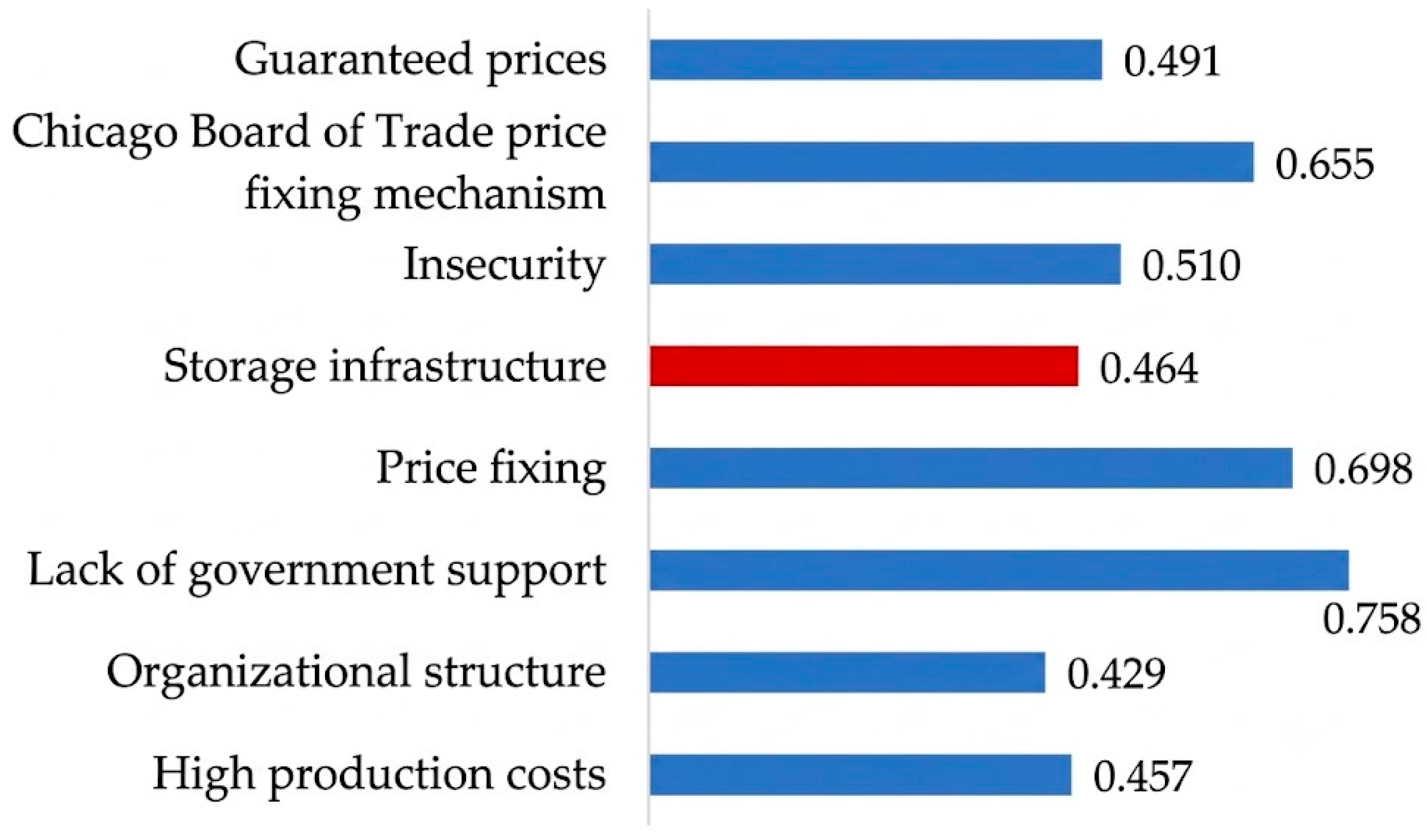
Spearman’s rank correlation coefficient (ρ) was 0.464, and p was 0.0065, indicating a moderate, statistically significant, monotonically strong positive correlation. According to Raftowicz and Korabiewski [19], Spearman’s rank correlation coefficient is robust to non-normality and outliers.
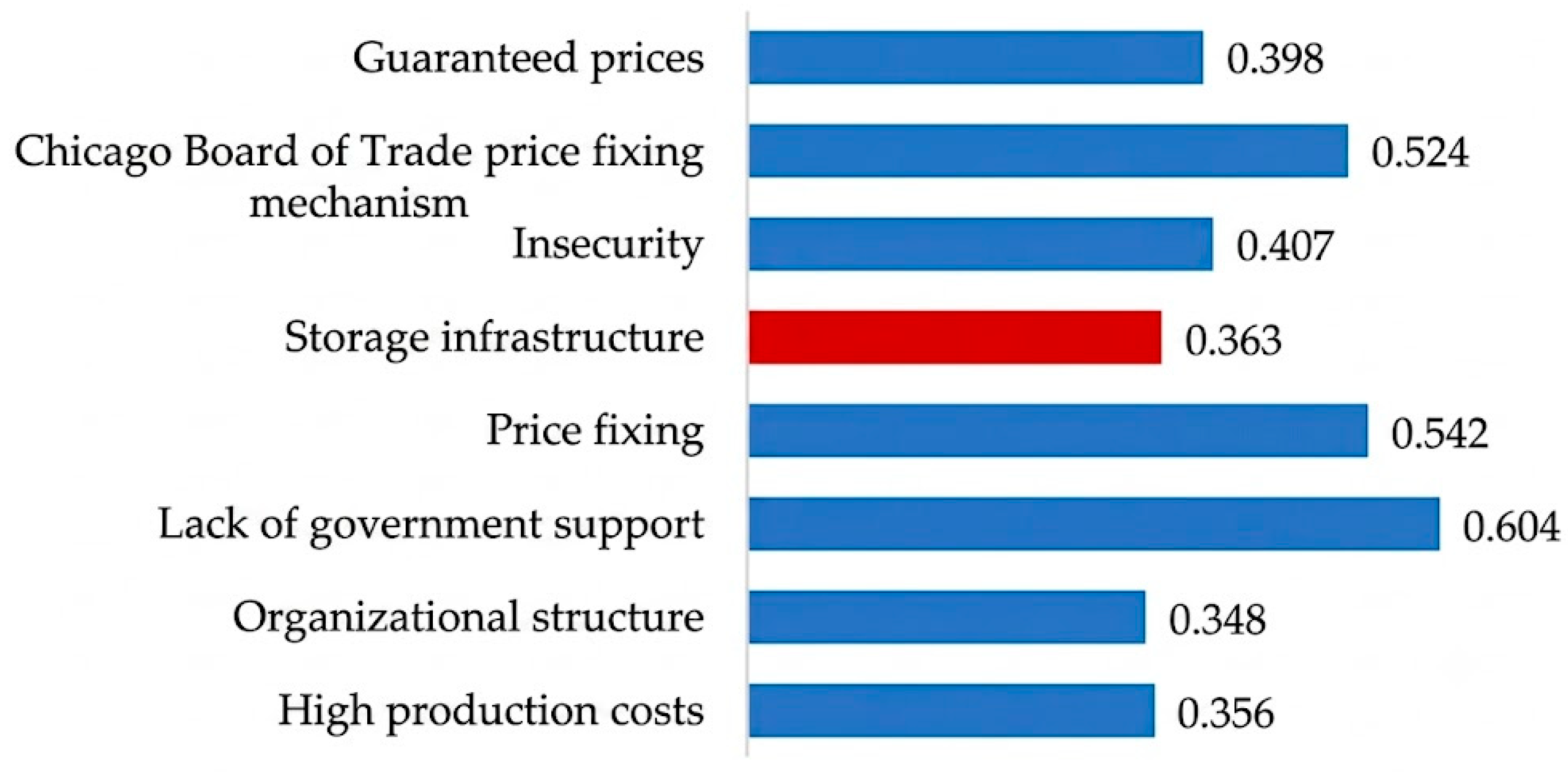
The Kendall test (Table 5) yielded τ = 0.363 and p = 0.0075, confirming Spearman’s rank correlation and indicating a positive association.

3. Results

According to the analyses presented, Spearman and Kendall’s findings are appropriate and indicate a positive, significant relationship between distribution problems and storage infrastructure. That is, subjects with more distribution problems tend to have more infrastructure incidents.

Problems in the Grain System (Distribution)

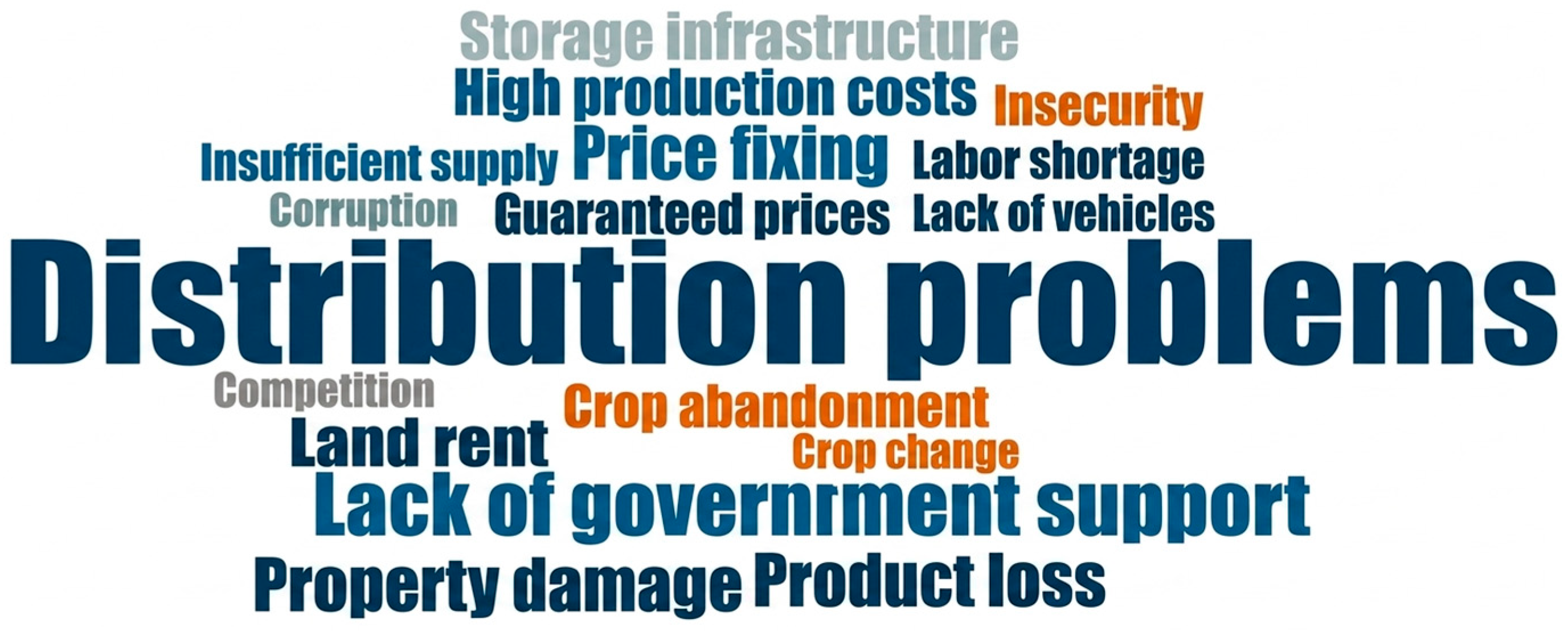
The word cloud (Figure 1) generated in MaxQDA, which uses the percentage of code occurrences related to distribution problems, highlights, with significantly larger font size and thickness, the words representing the codes most frequently encountered in the captured discourse. Thus, “storage_infrastructure” emerges as a problem facing the maize distribution system. Other relevant components include: lack of government support, high production costs, insecurity, insufficient supply, labor shortages, corruption, inaccuracy in guaranteed price setting, and lack of storage infrastructure, to name just a few.
As one interviewee from Tamaulipas stated: “Before, ASERCA existed, and it regulated you or made demands, because supposedly they weren’t giving you any support through the PROCAMPO program, well, they weren’t, they gave you X amount, but nothing was ever done, and there was little money, well, because there were indeed irregularities. Today everything is in the free market, it’s a free market, you could say”.
Figure 1 shows that the lack of storage infrastructure is one of the most frequently cited distribution problems, with an incidence of 70%. This problem not only reflects the lack of physical capacity to store the grain under optimal conditions but also directly impacts other aspects of the supply chain. Lacking adequate space, producers are forced to sell their harvest quickly, thereby weakening their bargaining power and affecting price-setting.
An interviewee from Chihuahua commented: “The old CONASUPO system worked because they moved the maize, regulated the market, took it to where it was needed, from where there was more to where there was less, and compensated, but there were no shortages”.
At another point in the interview, he mentions: “Of course, but that infrastructure disappeared, and the government can no longer do that because they left everything to the force of the market. That’s the problem. They left it to the market and withdrew as regulatory agents, leaving everything to private enterprise, and private enterprise will always be driven by maximizing profit—they’re businesspeople!”
The literature supports this perception. Sangerman-Jarquín et al. [20] document, in a study of beans in central Mexico, that deficiencies in storage and distribution infrastructure lead to deterioration in bean quality over time, thereby increasing consumer prices. The same research indicates that producers, mostly smallholders, lack the means to finance storage and therefore sell their harvests immediately, resulting in less bargaining power and unfavorable prices.
This explains why prices are determined by intermediaries or buyers with greater purchasing power rather than responding to more equitable conditions that address producers’ real needs.
An interviewee from Sinaloa explained: “We’re so used to the Chicago Mercantile Exchange, to buying hedges, to contracts with the industry, to being free to fluctuate prices—ah, the guaranteed price! Yes, it’s the biggest lie there is, the guaranteed price! Really? What for? There are guaranteed prices for those with less than 10 hectares, but what about the rest of us? We should reject the guaranteed price, not accept it, because it’s not real, it’s pure pretense. A fair price, at the very least, would give you a 20% profit. You have the right to earn something because you’re producing food. Someone’s going to eat it. For me, the guaranteed price isn’t working”.
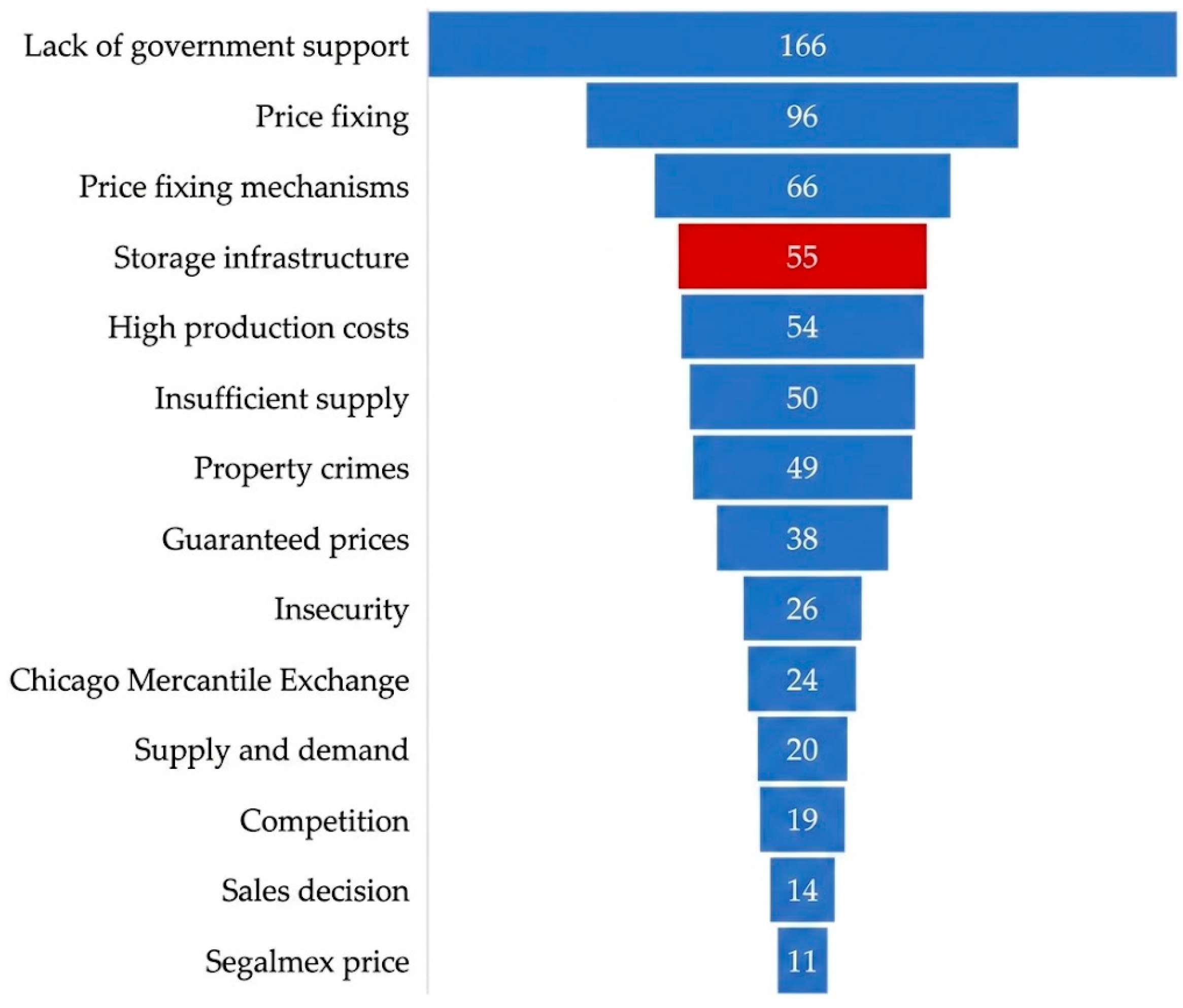
As a second step in the analysis, the intersection code matrix was obtained using the MaxQDA program. This allows for the evaluation and measurement of the direct co-occurrence of codes within the same text segments, based on the 33 interviews analyzed and the defined coding system. For a relationship to exist, the codes must coincide in the same transcribed text fragment. This helps identify which codes are conceptually related and, therefore, supports this understanding with arguments grounded in the interviewees’ discourse (Figure 2).
Applying this analysis to the distribution problems code revealed that certain factors are strongly linked in the discourse. For example, the lack of government support (166) appears most frequently, indicating that respondents consider this a central obstacle that cuts across other problems included in this code. Pricing (96) and pricing mechanisms (66) appear to be significantly associated, suggesting that uncertainty in product value is directly linked to distribution difficulties.
An informant from Veracruz explains: “Well, not having the infrastructure, because there are times when the price of maize is very, very low, and it’s not worth delivering it at that moment. It would be better to wait a month or two until the price goes up a little, right? But because we don’t have the warehouse infrastructure and enough capital to say, ‘Okay, I’m not worried, I can pay the people, I can pay for the machinery out of my own pocket, and I’ll wait two or three months,’ and then, when the price goes up, I’ll sell my product. Not having that, well, that hinders us tremendously, right? And having to deliver the product immediately, at whatever price it is.”
Likewise, storage infrastructure (55) emerges as a factor that co-occurs with distribution problems in the narratives, suggesting that system agents perceive storage capacity deficiencies not only as limiting product preservation but also as intensifying logistical problems. The co-occurrence values shown in Figure 2 indicate that distribution problems are not isolated phenomena but are constructed in actors’ perceptions as a network of interdependent factors.
As the third and final step in the analysis, the data exported from MaxQDA were entered into RStudio to measure the relationship between variables, specifically Spearman’s rank correlation coefficient, which yielded a value of 0.464. This indicates a moderate positive correlation between the “storage infrastructure” and “distribution problems” variables, meaning that, in general, as the former increases, the latter tends to increase as well (Figure 3).
As explained previously, this correlation suggests that distribution problems are associated with a greater presence or greater complexity of storage infrastructure. Kendall’s correlation analysis (Figure 4) helps confirm this. In other words, improvements and investments in the “storage infrastructure” variable are associated with the “distribution problems” variable. However, as can be seen, other factors also influence distribution problems; that is, it is not enough to explain the phenomenon solely through storage infrastructure.

4. Discussion

Recent publications corroborate this interpretation. A report by the Agricultural Markets Consulting Group, cited on the “AgroOrganico” website [9], indicates that, although Mexico has a total storage capacity of 39.9 million tons (94% of the national grain harvest), the infrastructure is highly concentrated in the northwest region and is organized into three segments (facilities in production areas, in consumption/distribution areas, and at ports). Furthermore, the same report warns that the country is only self-sufficient in 58% of its basic grains and must import the remaining 42%, indicating insufficient supply and a distribution system heavily reliant on imports.
The report agrees that existing capacity must be modernized and that participatory assessments are required to update facilities, incentivize equipment upgrades, and train personnel.
The 2019 National Agricultural Survey (ENA) shows that 53.1% of grain production units market their product through intermediaries. This intermediation accentuates the distribution problems observed in the word cloud and confirms that a large part of the market is not organized around short circuits or public procurement, but rather around private marketing networks [21].
Furthermore, the analysis in MaxQDA showed that guaranteed prices ranked among the most relevant codes (after infrastructure). When these are not effectively implemented, they leave farmers without a minimum safety net, further exposing them to the volatility of the international market. According to the Superior Audit Office of the Federation, in the historical design of the guaranteed price program, farmers do not sell at the guaranteed price because they cannot wait for the market to develop, either because they lack storage capacity or because they need the income to survive. This lack of infrastructure, along with the immediate need for liquidity, encourages immediate sales to the first intermediary, reproducing the distribution failures [22].
The audit documents why this issue is key: historically, the program has benefited only producers with surpluses, not poor farmers. Moreover, the program established limited purchase dates, so that for much of the year, marketing remained in the hands of intermediaries. It is even reported that there are no control mechanisms in place to curb intermediaries who offer prices below guaranteed levels. These shortcomings are reflected in the analysis of the information as problems of “price fixing,” “guaranteed prices,” and “corruption.”
The problem persists. According to the newspaper El Economista [23], farmers blocked highways to demand that the guaranteed price of maize be increased from $6050.00 per ton to $7200.00 per ton; they argued that the official price does not cover production costs and does not guarantee the profitability of their harvests.
Other problems, such as high production costs and insufficient government support, exacerbate producers’ vulnerability and limit farmers’ ability to sustain their operations and remain competitive. Finally, the insufficient supply reflects not only production limitations but also the entire chain of structural constraints, since, with deficient storage infrastructure and without fair prices or support tailored to producers’ needs, many farmers choose to scale back production or abandon the activity altogether.
In this regard, the 2019 National Agricultural Survey (ENA 2019) indicates that producers identify the high cost of inputs and services (fuel, electricity, seeds, fertilizers, and labor) as their main problem [21]. This perception is consistent with the farmers’ protests described by the economist in 2025 [23].

5. Conclusions

There is a positive and significant relationship between the variables “distribution problems” and “storage infrastructure,” indicating that insufficient storage facilities limit stakeholders’ ability to store grain safely and efficiently. Without adequate infrastructure, grain can deteriorate under adverse environmental conditions, resulting in economic losses and reduced product quality.
The lack of adequate storage means production surpluses cannot be held during periods of low demand, leading to lower prices for producers. This is especially critical in regions where production is high, but infrastructure is deficient, as in some areas. A more robust storage system would help stabilize prices by allowing grain to be held until market conditions improve.
Producers without access to adequate facilities face difficulties in bringing their product to market. The lack of infrastructure is not only associated with storage but also transportation and logistics, leading to additional costs and delays in the distribution process. This is particularly problematic in rural areas where road infrastructure may also be inadequate.
The lack of adequate infrastructure discourages farmers from investing in new technologies or increasing their production, as they lack assurances about how they will manage their harvest. This has a significant impact on grain distribution problems, especially for maize, thereby affecting both food security and producers’ economies.
Therefore, mixed analysis and bibliographic evidence suggest that public storage infrastructure is not only a logistical component but also a strategic element for food security. Although the country’s total storage capacity is high, its geographic concentration and the predominance of private facilities create bottlenecks in regions far from large warehouses and in those where agriculture is primarily for subsistence. The lack of public warehouses forces farmers to sell immediately, weakening their negotiating power and reducing the effectiveness of guaranteed price programs [6].
However, while the correlations and regressions performed demonstrate an association, the analyses do not prove causality and yield only particularly explanatory results, making prediction impossible. Nevertheless, the evidence suggests that strengthening public storage infrastructure, designing guaranteed prices that effectively cover production costs, and improving working conditions and safety in the agricultural sector are essential actions to reduce distribution problems and advance Mexico’s food sovereignty in a globalized context.
Future research could expand the scope of analysis by incorporating additional actors involved in the maize value chain, including producers, suppliers, processors, traders, and public-sector representatives. While distributors provide a strategic perspective on the interaction between storage infrastructure and grain commercialization, by including other stakeholders, a more comprehensive understanding of how storage constraints affect market performance and producer outcomes could be achieved.
Further studies could also examine regional differences in the availability and distribution of storage infrastructure across Mexico, as well as the role of emerging public and private investments in strengthening grain marketing systems. Additionally, comparative analyses involving different grains or agricultural commodities could help determine whether the challenges identified in this study are specific to maize or reflect broader structural issues within Mexico’s agri-food system.
Finally, future research may explore the effectiveness of alternative storage and distribution models, including cooperative arrangements, producer-led storage initiatives, and public–private partnerships, in improving market access and reducing commercialization bottlenecks for small- and medium-scale producers.

Author Contributions

Conceptualization, J.A.G.-F. and J.M.R.-P.; methodology, D.F.-G., K.T.-S., J.A.G.-F. and J.M.R.-P.; validation, J.M.R.-P.; formal analysis, M.C.G.-L. and D.F.-G.; investigation, K.T.-S., M.C.G.-L., M.L.M.-d.l.P. and J.A.G.-F.; writing—original draft preparation, M.C.G.-L., J.A.G.-F. and K.T.-S.; writing—review and editing, K.T.-S. and J.A.G.-F.; visualization, M.C.G.-L.; supervision, J.M.R.-P.; project acquisition, J.M.R.-P. All authors have read and agreed to the published version of the manuscript.

Funding

This work was supported by the Regional Center for Food Research and Development, A.C. (CIAD, by its Spanish acronym) with the contribution of CHF 2000.00 (invoice number: 4346778), while the remaining publication costs will be covered by the authors.

Institutional Review Board Statement

This study involved non-interventional research based on voluntary interviews with adult participants. Prior to participation, verbal informed consent was obtained from all subjects after they were informed about the objectives of the research, the confidential treatment of the information provided, and the voluntary nature of their participation. The study did not include clinical procedures, experimental interventions, or the collection of sensitive personal data. Participants’ anonymity and confidentiality were fully protected throughout the research process. According to Article 17 of the Mexican Reglamento de la Ley General de Salud en Materia de Investigación para la Salud, this study was considered research without risk because it involved voluntary interviews and did not include intervention or the collection of sensitive personal data. Under these conditions, formal ethical committee review and approval were not required under the applicable national regulations.

Informed Consent Statement

Verbal informed consent was obtained from all subjects involved in the study prior to their participation. Before each interview, participants were verbally informed of the research’s purpose, the confidential handling of the information provided, the ethical treatment of the data, and the possibility of accessing the research results upon request. Verbal consent was adopted because the study involved minimal risk, participation was entirely voluntary, and no sensitive personal information was collected.

Data Availability Statement

The data presented in this study are available upon request to the corresponding author due to privacy and confidentiality reasons.

Acknowledgments

The authors acknowledge the financial and technical support provided by the Secretaría de Ciencia, Humanidades, Tecnología e Innovación (SECIHTI, by its Spanish acronym), formerly the Consejo Nacional de Humanidades, Ciencias y Tecnologías (CONAHCYT, by its Spanish acronym), through Project No. 321173, which contributed to the preparation of this manuscript.

Conflicts of Interest

The authors declare no conflicts of interest.

Appendix A. Semi-Structured Interview Script

  • Company name or business name
  • What is the company’s main activity?
  • How long has the company been carrying out these activities?
  • What is the company’s area of influence?
  • What type of maize does the company buy/sell (yellow-white)?
  • From whom does the company buy its maize?
  • What is the mechanism for acquiring the maize?
  • What criteria does the company use to decide who to buy maize from?
  • Do the producers from whom the company buys maize belong to any type of organization?
  • Where are they located?
  • What is the average monthly volume of maize purchased?
  • What criteria does the company use to decide how much maize to buy?
  • During what time of year is maize most available for purchase?
  • During what time of year is maize least available for purchase?
  • What is the purchase price per ton of maize?
  • Who sets the purchase prices for maize? How?
  • What information do you use to set the purchase prices for maize?
  • What requirements do you impose for purchasing maize?
  • Is the maize seed variety important in determining the purchase? Why?
  • Does the company add value to the maize? What value? Do your customers add value to the maize? What value?
  • Do you purchase maize only in this geographic area? Or do you source it from other geographic areas? Why do you source it from other geographic areas?
  • Do you collect/store the maize?
  • Where do you store your product?
  • What conditions must the warehouse meet to preserve the product?
  • What controls do you use in the warehouses to preserve the product?
  • What techniques do you use to preserve the product?
  • What are the methods used to store the purchased maize?
  • Do you have silos for storage during the buying and selling process? What is their capacity?
  • What is the approximate distance from the maize purchasing area to the maize storage area? (Specify in your answer whether it is meters or kilometers)
  • Do you establish any type of agreement with the producer for the purchase of maize?
  • What are the payment methods you use with the producers from whom you purchase maize?
  • Do you have any commitments to the producers from whom you purchase maize? What type?
  • Do you form production or commercial alliances?
  • What means of transportation do you use to move the maize for buying and selling?
  • Are the means of transportation owned by you? Leased?
  • Do you pay a third party for the transportation or transfer of maize? To whom do you sell your products?
  • What is your marketing process? What mechanism do you use to sell maize?
  • What criteria do you use to decide who to sell your product to?
  • Do you sell maize only in this geographic area? Or do you sell your product in other regions? Which ones?
  • What is the selling price per ton of maize?
  • Who sets the selling price?
  • What information do you use to set the selling prices for maize?
  • Does the market impose requirements on you for purchasing the grain?
  • What kind?
  • Do you have any type of certification?
  • Do you establish any type of agreements with your clients?
  • What kind?
  • How do you see the possibility, the interest in the development of a clean maize market without agrochemicals?

Appendix B. Dictionary of Codes

Code Dictionary
CodeSubcodeCode Definition
Distribution_problems Obstacles faced by the maize system in distribution and commercialization.
Lack_of_organization_of_producersWhen maize producers from the same region do not have an organizational structure to address the challenges of commercialization.
CorruptionMisuse of authority by a public official and mismanagement of government programs aimed at promoting agricultural activity.
Lack_of_vehiclesAbsence of vehicle units for transporting maize or personnel.
FraudA crime that consists of causing financial harm to someone through deception, with the intent to obtain profit.
Lack_of_government_supportLack of subsidies for producers from the government, especially those focused on commercialization.
Product_lossWhen the product is no longer suitable for sale.
Lack_of_laborInsufficient workforce.
Crop_changeWhen producers choose to cultivate other products that may be more convenient for them.
Land_rentalWhen producers choose to rent out their land instead of working it.
High_production_costsHigh production costs.
Price_settingRefers to an established price that does not correspond to the conditions of the maize productive structure.
Storage_infrastructure_deficienciesLack of support for maize storage.
Guaranteed_pricesGovernment price-setting policies.
InsecurityIllegal behaviors that affect the free development of the activity.
Low_maize_availabilityInsufficient supply in relation to demand.
CompetitionRefers to the limited opportunity resulting from the available options.
Producers_abandoning_activityWhen the producer stops producing maize to engage in another activity.
Non_compliance_with_agreementsWhen the maize buyer does not respect the agreements previously established with the seller.
Marketer_distributorFormally established companies dedicated to the large-scale collection, conservation, and commercialization of maize.
Administrative_process_errorsFailures in complying with administrative procedures, such as preparing invoices or transfers, as well as filling out forms.
Lack_of_access_to_informationNo availability of information, whether due to lack of devices, internet access, or advisory services.

References

  1. Biodiversidad Mexicana. Comisión Nacional para el Conocimiento y Uso de la Biodiversidad. Diversidad Natural y Cultural. Qué Nos Aportan los Maíces 2022. Available online: https://www.biodiversidad.gob.mx/diversidad/alimentos/que-nos-aportan/N_maices (accessed on 15 November 2025).
  2. García, A. Senado de la República. INFOSEN. Gobierno de la República 2023. Available online: https://infosen.senado.gob.mx/sgsp/gaceta/65/2/2023-07-18-1/assets/documentos/PA_PRI_Sen_AGY_apoyos_productores_morelos_sequia.pdf (accessed on 3 December 2025).
  3. SAGARPA. Planeación Agrícola Nacional 2017–2030. Maíz Grano Blanco y Amarillo Mexicano; SAGARPA: Ciudad de México, Mexico, 2017; 28p. Available online: https://www.gob.mx/cms/uploads/attachment/file/256429/B_sico-Ma_z_Grano_Blanco_y_Amarillo.pdf (accessed on 3 December 2025).
  4. Steffen-Riedemann, C. La Focalización de los Subsidios a los Granos en México. Polis 2007, 3, 69–104. Available online: https://revistas-colaboracion.juridicas.unam.mx/index.php/polis/article/download/16923/15142 (accessed on 26 September 2025).
  5. CONEVAL (Consejo Nacional de Evaluación de la Política de Desarrollo Social). Ficha de Monitoreo 2017–2018; Programa de Apoyos a la Comercialización; SAGARPA: Ciudad de México, Mexico, 2018. Available online: https://www.agricultura.gob.mx/sites/default/files/sagarpa/document/2019/01/29/1612/29012019-s262-apoyos-la-comercializacion.pdf (accessed on 21 October 2025).
  6. SEGALMEX. Reglas de Operación del Programa de Precios de Garantía a Productos Alimentarios Básicos; Secretaría de Agricultura y Desarrollo Rural: Ciudad de México, Mexico, 2021. Available online: https://faolex.fao.org/docs/pdf/mex206242.pdf (accessed on 22 October 2025).
  7. Gobierno de México. Programas del BIENESTAR 2025. Available online: https://programasparaelbienestar.gob.mx (accessed on 10 November 2025).
  8. Banco Mundial (The World Bank). Strengthening Strategic Grain Reserves to Enhance Food Security; Banco Mundial: Washington, DC, USA, 2025; Available online: https://documents1.worldbank.org/curated/en/099042625211562573/pdf/P504545-488431b2-0565-40f9-852c-e8db32d22559.pdf (accessed on 7 December 2025).
  9. AgroOrgánico. Reportan Capacidad de Almacenamiento de Granos en México. 2023. Available online: https://agroorganico.info/reportan-capacidad-de-almacenamiento-de-granos-en-mexico (accessed on 7 December 2025).
  10. García-Salazar, J.A.; Bautista-Mayorga, F. Disponibilidad de Almacenes Agrícolas como una Estrategia de Estabilidad de Precios del Maíz en Guerrero. Acta Univ. 2022, 32, 2630. [Google Scholar] [CrossRef] [Scilit]
  11. García-Salazar, J.A.; Álvarez-González, X.; Mora-Flores, J.S. Crecimiento de la Capacidad de Almacenes Agrícolas en México, 1996–2019. Región Soc. 2020, 32, e1258. [Google Scholar] [CrossRef] [Scilit] [PubMed]
  12. OECD. Insights for Global Goal on Adaptation Indicators for Enabling Factors for Implementation, Including Means of Implementation 2025. Available online: https://www.oecd.org/content/dam/oecd/en/publications/reports/2025/10/insights-for-global-goal-on-adaptation-indicators-for-enabling-factors-for-implementation-including-means-of-implementation_553e86d4/855b6231-en.pdf (accessed on 20 December 2025).
  13. Rietig, K. What’s Next for International Climate Politics? Learning and Multilevel Reinforcing Dynamics in the UNFCCC. Int. Aff. 2025, 101, 1301–1321. [Google Scholar] [CrossRef] [Scilit]
  14. Abdullahi, N.; Dandago, M.A. Postharvest Losses in Food Grains–A Review. Turk. J. Food Agric. Sci. 2021, 3, 25–36. [Google Scholar] [CrossRef] [Scilit]
  15. Das, S.; Barve, A.; Sahu, N.C.; Muduli, K.; Kumar, A.; Luthra, S. Analysing the Challenges to Sustainable Food Grain Storage Management: A Path to Food Security in Emerging Nations. Int. J. Food Sci. Technol. 2023, 58, 5501–5509. [Google Scholar] [CrossRef] [Scilit]
  16. Nath, B.; Chen, G.; O’Sullivan, C.M.; Zare, D. Research and Technologies to Reduce Grain Postharvest Losses: A Review. Foods 2024, 13, 1875. [Google Scholar] [CrossRef] [Scilit] [PubMed]
  17. Hernández-Sampieri, R. Metodología de la Investigación, 5th ed.; McGraw-Hill: Ciudad de México, Mexico, 2010; 696p. [Google Scholar]
  18. Baldeón-Báez, S.; Franco-Crespo, C.; de la Fuente, A. Educación Alimentaria y Nutricional en la Producción Agroecológica: Una Revisión Integral de Estrategias y Resultados. Idesia 2025, 43, e09. [Google Scholar] [CrossRef] [Scilit]
  19. Raftowicz, M.; Korabiewski, B. Regional Determinants of the Development of Short Food Supply Chains in Poland. Sustainability 2025, 17, 9772. [Google Scholar] [CrossRef] [Scilit]
  20. Sangerman-Jarquín, D.M.; Acosta-Gallegos, J.A.; Shwenstesius-de Rinderman, R.; Damián-Huato, M.A.; Larqué-Saavedra, B.S. Consideraciones e Importancia Social en Torno al Cultivo del Frijol en el Centro de México. Rev. Mex. Cienc. Agrícolas 2010, 1, 358–375. [Google Scholar]
  21. INEGI (Instituto Nacional de Estadística y Geografía). Encuesta Nacional Agropecuaria 2019; INEGI: Ciudad de México, Mexico, 2020. Available online: https://www.inegi.org.mx/contenidos/saladeprensa/boletines/2020/ENA/Ena2019.pdf (accessed on 20 December 2025).
  22. Auditoría Superior de la Federación. Informe de Auditoría 2020_0328_a: Precios de Garantía a Productos Alimentarios Básicos; ASF: Ciudad de México, Mexico, 2020. Available online: https://www.asf.gob.mx/Trans/Informes/IR2020c/Documentos/Auditorias/2020_0328_a.pdf (accessed on 17 December 2025).
  23. El Economista. Exigen Agricultores Alza en Precios de Garantía del Maíz. El Economista 2025. Available online: https://www.eleconomista.com.mx/politica/exigen-agricultores-alza-precios-garantia-maiz-20251029-784021.html (accessed on 15 December 2025).
Figure 1. Word cloud regarding distribution problems, including storage_infrastructure.
Agriculture 16 01461 g001
Figure 2. Distribution and storage infrastructure problems, in the matrix of codes by intersection.
Agriculture 16 01461 g002
Figure 3. Spearman’s rank correlation (monotonic relationship) for storage infrastructure in distribution problems.
Agriculture 16 01461 g003
Figure 4. Kendall order correlation (conservative) for storage infrastructure in distribution problems.
Agriculture 16 01461 g004
Table 1. Informant inclusion criteria.
Federal EntityNumber of IntervieweesFormalInformalWhite MaizeYellow MaizeBoth (White and Yellow Maize)
Campeche220011
Chiapas532302
Chihuahua330021
Edomex110100
Guanajuato110100
Hidalgo514401
Jalisco110001
Michoacán110001
Nayarit330111
Sinaloa440400
Sonora110100
Tamaulipas211200
Veracruz404400
Total interviews3322112148
n = 33, non-probability sampling, convenience sampling using the “snowball” technique [17].
Table 2. Example of codes and definitions for the main code “distribution problems”.
CodeSubcodeDefinitionExcerpt from the Speech
Distribution_problemsLack_of_government_supportThis refers to the lack of government subsidies for producers, especially those focused on marketing.“If the government had not intervened in importing and making those moves it made to lower maize, we would have done well. Even if it took two years for farmers, we would have done wonderfully.”
Note: Excerpt from interview number 10.
Table 3. Shapiro–Wilk test results.
VariableValues
Distribution problemsW = 0.84343
p-value = 0.0002448
Storage infrastructureW = 0.67261
p-value = 0.0000002576
Calculations performed in RStudio 4.5.0 software using the function “Shapiro–Wilk normality test”.
Table 4. Spearman’s correlation coefficient for distribution problems and the main variables that relate to them.
Distribution ProblemsSpearman (Valor ρ)
High production costs0.457
Organizational structure0.429
Lack of Government support0.758
Price setting0.698
Storage infrastructure0.464
Insecurity0.510
Chicago Stock Exchange pricing mechanism0.655
Guaranteed prices0.491
Calculations performed in RStudio 4.5.0 software using the “Spearman correlation” function.
Table 5. Kendall’s correlation coefficient for distribution problems and the main variables related to them.
Distribution ProblemsKendall (τ)
Lack of Government support0.604
Price setting0.542
Chicago Stock Exchange pricing mechanism0.524
Insecurity0.407
Guaranteed prices0.398
Storage infrastructure0.363
High production costs0.356
Organizational structure0.348
Calculations performed in RStudio 4.5.0 software using the “Kendall” function.
Disclaimer/Publisher’s Note: The statements, opinions and data contained in all publications are solely those of the individual author(s) and contributor(s) and not of MDPI and/or the editor(s). MDPI and/or the editor(s) disclaim responsibility for any injury to people or property resulting from any ideas, methods, instructions or products referred to in the content.