Article

Influence of Harvest Stage on Theoretical Bioethanol Yield and Bagasse Feed Quality of Sweet Sorghum Varieties

by
Sebiha Erol Uyanik
* and
Emine Budakli Çarpici
Department of Field Crops, Faculty of Agriculture, Bursa Uludag University, Bursa 16059, Turkey
*
Author to whom correspondence should be addressed.
Agriculture 2026, 16(13), 1452; https://doi.org/10.3390/agriculture16131452
Submission received: 30 April 2026 / Revised: 13 June 2026 / Accepted: 30 June 2026 / Published: 2 July 2026
(This article belongs to the Special Issue Agronomic Practices for Sustainable Arable Crop Production)

Abstract

Sweet sorghum is an annual warm-season energy crop that produces high biomass, is broadly adaptable, and is tolerant of abiotic stress. This study was conducted as a two-year field experiment to determine the effects of different harvest stages (booting, 50% flowering, milk, and soft dough) on theoretical bioethanol production and bagasse feed quality in sweet sorghum varieties (Erdurmus, Gulseker, and Uzun) in the semi-humid Mediterranean transition zone. Field experiments were conducted in 2023 and 2024 using a randomized block split-plot design with three replications. In the study, characteristics such as fresh stem yield, Brix, juice yield, theoretical juice ethanol yield, dry bagasse yield, cellulose, lignin, hemicellulose, theoretical lignocellulosic ethanol yield, total theoretical ethanol yield, and bagasse feed quality (crude protein, acid detergent fiber, neutral detergent fiber, and relative feed value) were examined. According to the two-year average results, the theoretical juice ethanol yields, theoretical lignocellulosic ethanol yields, total theoretical ethanol yields, and dry bagasse yields ranged from 454.8 to 2023.9 L ha−1, 2472 to 3828 L ha−1, 3320 to 5180 L ha−1, and 7.85 to 11.67 t ha−1, respectively, in terms of the variety x harvest stage interaction. Significant differences emerged among the examined parameters across varieties. In this respect, the Erdurmus and Gulseker varieties stand out as suitable for dual use, both for bioethanol production and for bagasse utilization as animal feed. The effects of harvest stages on all examined characteristics were statistically significant. It is recommended that sweet sorghum be harvested at the latest during the milk stage to utilize the juice for bioethanol production and to evaluate the remaining bagasse as animal feed.

1. Introduction

The world population, which stood at 8.2 billion in 2024, is expected to continue growing over the next 50 to 60 years, reaching a peak of approximately 10.3 billion people by the mid-2080s [1]. While food production needs to increase in parallel with global population growth, the number of people affected by hunger worldwide rose to 828 million in 2021 [2]. Conversely, the intensification of industrial activities to meet necessities is increasing energy demand. Excessive dependence on energy sources causes environmental problems, which, in turn, lead to increased efforts to utilize alternative energy sources [3]. Plants with high biomass potential per unit area (sugarcane, sugar beet, sweet sorghum, and corn) are at the forefront of renewable energy sources that are less environmentally harmful [4]. Sweet sorghum (Sorghum bicolor var. saccharatum (L.) Mohlenbr.), a C4 crop with high photosynthetic efficiency, has significant potential not only for food production [5], but also for energy [6,7], forage [8,9,10,11,12,13], and fiber [14,15] production. Furthermore, sweet sorghum, which has high biomass yield, is also resistant to drought, salinity, and flooding [16,17,18,19,20]. On the other hand, Tamang [21] reported that biofuel production costs from sweet sorghum are lower than those from sugarcane, while Geng et al. [22] indicated that sweet sorghum requires less nitrogen fertilizer than corn. The use of food crops for energy purposes is considered a serious threat to global food security. In the future, it will be important for crops to be used for both food and energy production [23].
In addition to energy production, bagasse from sweet sorghum can also be used as animal feed [10,24,25,26]. In terms of feed quality, crude protein, acid detergent fiber (ADF), neutral detergent fiber (NDF), and relative feed value (RFV) are among the main parameters for the bagasse obtained after juice extraction. High ADF reduces digestibility, whereas high NDF generally limits voluntary intake; therefore, lower ADF and NDF values are desirable [27,28]. Therefore, sweet sorghum bagasse with high protein content, low ADF and NDF, and a high RFV is a preferred choice for livestock production.
Research on sweet sorghum across different climate zones reveals the decisive role of the harvest stage in sugar accumulation and ethanol potential. Ramesha and Sharanappa [29] reported that the highest juice yield (9777 L ha−1) in tropical semi-arid regions was obtained at the milk stage. In contrast, Teixeira et al. [30] determined that maximum juice yield occurred between the pre-flowering and mealy dough stages in Brazil’s high-altitude subtropical zone. On the other hand, studies conducted under Mediterranean semi-arid climate conditions have found that, in addition to genotype selection, the harvest stage also significantly affects sweet sorghum. Indeed, while Tas et al. [25] reported that the dry bagasse yield of sweet sorghum genotypes ranged from 51.9 to 84.8 t ha−1, Yucel et al. [31] noted that this value ranged from 42.6 to 113.9 t ha−1 and emphasized that genotype selection is essential for both yield and quality optimization. Under similar Mediterranean conditions, Nazli [26], who simultaneously examined both juice yield and bagasse feed quality, emphasized that juice yield ranged from 7.4 to 25.2 t ha−1 and dry bagasse yield ranged from 7.6 to 21.3 t ha−1, and that, in addition to variety selection, juice yield gradually decreased from flowering towards physiological maturity. Furthermore, Nazli [26] reported that the lowest ADF and NDF contents and the highest RFV were attained during the hard dough stage. Compared with the tropical, subtropical, and Mediterranean arid/semi-arid climate regimes reported in the literature, how the juice and theoretical total ethanol yields of sweet sorghum are affected by harvest stage under second-crop cultivation conditions in semi-humid Mediterranean transition zones remains unclear. Moreover, uncertainty remains regarding which harvest stage should be preferred, given the potential of the remaining bagasse after juice extraction as animal feed and the plant’s dual-purpose use. Indeed, Li et al. [32] reported that sweet sorghum, known for its high adaptability to water-scarce environments and capacity to store fermentable sugars, has high future potential for the global bioindustry.
Additionally, sudden and extreme weather events, increasing in frequency throughout the growing season due to global warming, can directly affect both the bioethanol production potential of sweet sorghum and the feed value of its bagasse. In this context, understanding the effects of different harvest stages on quality parameters in regions with transitional climates is critical for developing sustainable agro-industrial production strategies. Based on this requirement, this study was conducted to simultaneously investigate the effects of different harvest stages on the theoretical bioethanol production potential of sweet sorghum varieties and the feed quality of the bagasse remaining after juice extraction in the semi-humid Mediterranean transitional climate zone, and to determine the most suitable variety and harvest stage accordingly.

2. Materials and Methods

2.1. Site Description

This study was conducted as a field trial in 2023 and 2024 at the experimental fields of Bursa Uludag University Faculty of Agriculture, Agricultural Application and Research Center (40°13′47″ N, 28°51′23″ E, 72 m above sea level). The study area is located in a semi-humid temperate transition zone that serves as a bridge between Mediterranean and Black Sea climates [33]. Climate data for the region where the experiment was conducted are presented in Table 1.
To represent the experimental areas, soil samples were collected in 2023 and 2024 at a depth of 0–30 cm. These samples were examined at the Soil Analysis Laboratory of the Department of Soil Science and Plant Nutrition, Faculty of Agriculture, Bursa Uludag University, to ascertain their characteristics. Table 2 presents the findings of this analysis. The soil is Eutric Vertisol according to the FAO/UNESCO [34].

2.2. Crop Management, Sample Preparation, Data Collection and Calculations

In both years of the experiment, after the main crop (wheat) harvest, the field was plowed, and subsequent tillage was completed with a rotavator. At sowing, 100 kg P2O5 ha−1 and 160 kg N ha−1 were applied. Half of the nitrogen fertilizer was applied at sowing, and the other half at 40–50 cm plant height. The experiment was planned as a randomized complete block design with a split-plot arrangement with 3 replications. In the experiment, sweet sorghum varieties (V1: Erdurmus, V2: Gulseker, and V3: Uzun) were assigned to main plots, while harvest stages (H1: booting stage, H2: 50% flowering stage, H3: milk stage, and H4: soft dough stage) were assigned to subplots. Sowing in the experimental area was carried out on 12 July 2023, in the first year, and 29 June 2024, in the second year, in plots consisting of 5 rows with 70 cm row spacing, 10 cm intra-row spacing, 5 m length, and 3.5 m width (5.0 × 3.5 = 17.5 m2) at a soil depth of 2–3 cm. Drip irrigation was used to supply the plants with water during periods without sufficient rainfall. Every 13 to 15 days, irrigation was applied based on soil moisture at a depth of 0 to 30 cm.
In the experimental field, plants were cut at a height of 5 cm above the soil level using a sickle at harvest time. In the experiment, harvest operations were carried out between 15 September and 8 November 2023, in the first year, and between 9 September and 17 October 2024, in the second year, depending on the variety and harvest stage. Before harvesting, 10 plants were randomly picked from each plot, and their stems, leaves, and inflorescences were removed and weighed to determine their proportions. After the leaves and inflorescences were removed, the stems were placed in an electric-motor-driven press (4 kW/380 Volts) to measure juice yield and Brix. After this process, the resulting juice samples were measured with a graduated measuring cylinder, and the amount of juice obtained was weighed and recorded. In this study, Brix was measured using a handheld refractometer (ATC 0–32) and treated as degree Brix (°Bx), which directly represents the percentage of total soluble solids by weight in the stalk juice. The use of this linear conversion equation to estimate total sugar content is fully justified for the studied varieties and conditions, as it is based on the established methodology reported by Lingle et al. [35]. Since sucrose, glucose, and fructose constitute the overwhelming majority of soluble solids in stalk-juice crops, °Bx serves as an accurate proxy for total sugar yield under our experimental conditions. In the experiment, a 5.6 m2 (4 m × 1.4 m) area in the middle 2 rows of each plot, excluding edge effects, was mowed and weighed by hand. The data obtained were used to determine the fresh biomass yield. In the study, fresh stem yield, juice yield, total sugar, sugar yield, and theoretical juice ethanol yield were calculated as described by Nazli [26], Teetor et al. [36], Lingle et al. [35], and Teixeira et al. [30]. The formulas used in calculating the characteristics are given below.
Fresh stem yield (FSY; t ha−1) = Stem ratio (%) × Fresh biomass yield (t ha−1)
Juice yield (L ha−1) = (FSY × Juice volume)/Weight of stem
Total sugar (mg mL−1) = 8.9 × Brix (°Bx) − 13.8
Sugar yield (SY; kg ha−1) = [Total sugar (mg mL−1) × juice volume (L ha−1)]/1000
Theoretical juice ethanol yield (JEY; L ha−1) = SY (kg ha−1) × 0.581
In this study, theoretical lignocellulosic ethanol yield (LEY) and total theoretical ethanol yield (TEY) were calculated using the formulas given below as reported by Zhao et al. [37].
LEY (L ha−1) = (Cellulose + Hemicellulose)/100 × Dry bagasse yield (t ha−1) × 1.11 × 0.85 × 0.51 × 0.85 × 1000/0.79
LEY represents the theoretical lignocellulosic ethanol yield derived from cellulose and hemicellulose of the sweet sorghum bagasse, 1.11 represents the coefficient for the conversion factor of sugar from cellulose and hemicellulose, 0.85 represents the process efficiency of sugar from cellulose and hemicellulose or process efficiency of ethanol from sugar, 0.51 represents the coefficient of a conversion factor of ethanol from sugar, and 1000/0.79 g mL−1 represents the specific gravity of ethanol.
Total theoretical ethanol yield (TEY; L ha−1) = JEY (L ha−1) + LEY (L ha−1)
Fresh bagasse yield was calculated as the difference between fresh stem yield and juice yield, as reported by Briand et al. [38]. To determine the dry matter content of bagasse, approximately 500 g of fresh sample was taken and dried at 70 °C until a constant weight was achieved, and then weighed. Dry bagasse yield was calculated by multiplying the dry matter content by the fresh bagasse yield. The dried bagasse samples were ground in a plant grinding mill equipped with 1 mm diameter sieves. Subsequently, the ADF, NDF, and acid detergent lignin (ADL) contents of the bagasse were determined using the method reported by Van Soest [39]. The following formulas were used to determine cellulose [40] and hemicellulose contents [41] in the experiment.
Cellulose (%) = ADF (%) − ADL (%)
Hemicellulose (%) = NDF (%) − ADF (%)
The nitrogen content of the dried bagasse samples was measured using the Kjeldahl wet digestion method to calculate the bagasse crude protein (BCP). The crude protein ratios on a dry matter basis were then computed by multiplying the total nitrogen ratios by 6.25. The RFV of bagasse was calculated using the following equations developed by Rohweder et al. [42]. In calculating the relative feed value, digestible dry matter (DDM %) is first calculated from the ADF value. In contrast, dry matter intake (DMI, %), depending on the animal’s live weight, is calculated from the NDF value.
DDM, % = 88.9 − (0.779 × %ADF)
DMI, % = 120/(%NDF)
RFV = (DDM × DMI)/1.29

2.3. Statistical Analysis

In the data analysis, a split-plot experimental design was adopted, with varieties as main plots and harvest stage as subplots. Data for the examined traits were subjected to analysis of variance (ANOVA) using combined data from two years. In the statistical model, varieties and harvest stages were considered as fixed effects, whereas years and blocks within years were treated as random effects. According to the combined analysis results, the effects of year, variety, and harvest stages on the examined traits, as well as the two-way and three-way interactions among these factors, were evaluated. Variance analyses were performed using JMP Pro 13 software [43]. Main plots (variety) were tested against Error A (block × variety within year), while subplots (harvest stage) and variety × harvest stage interactions were tested against Error B (residual error). Statistical significance was determined using the least significant difference (LSD) test at α = 0.05. To simultaneously evaluate the relationships between bioethanol production parameters and bagasse feed quality characteristics across different harvest stages for sweet sorghum varieties, PCA was conducted separately for each experimental year (2023 and 2024) due to the significant main effect of year in the ANOVA. The analysis was performed in RStudio (version 2026.01.0) and visualized using the FactoMineR and factoextra packages [44,45]. Before the analysis, the dataset was automatically centered and scaled to unit variance (scale.unit = TRUE) to standardize the different measurement units of the traits investigated. The PCA was performed using the treatment means (averaged across three replications) for each variety–harvest stage combination, rather than individual observations. A total of 14 key traits were included in the analysis: B, BCP, BADF, L, BNDF, FSY, JY, JEY, C, HC, DBY, LEY, TEY, and BRFV.

3. Results and Discussion

In this study, the results of the examined traits were evaluated in terms of first- and second-generation bioethanol production (fresh stem yield, juice yield, Brix, theoretical juice ethanol yield, dry bagasse yield, lignin, cellulose, hemicellulose, theoretical lignocellulosic ethanol yield, and total theoretical ethanol yield) and feed quality of bagasse (BCP, BADF, BNDF, and RFV). In the research, environmental conditions varied significantly from year to year (Table 1), which was associated with fluctuations in sweet sorghum yields. Temperatures in both years were above the long-term average; however, June and July 2024 were warmer than the same months in 2023. This variation coincided with a faster progression of plant development, meaning that harvest stages advanced more rapidly in the second year than in the first. While these shifts are closely linked to climate variations, they may also reflect differences in seasonal factors such as sowing dates, cycle length, and specific water regimes. Consequently, the harvest operation was carried out between September and November in the first year and between September and October in the second year, depending on the harvest stage and variety. In the experiment, the average relative humidity between June and October was 62.88% in 2023 and 62.04% in the same period in 2024. When examining total precipitation, no rainfall was recorded in July, August, and September during the plant growth period in 2023, whereas 64.7 mm of precipitation was recorded over the same three months in 2024. Additionally, 21.4 mm more rainfall occurred in October 2024 compared to October 2023. These major differences in climate data between the two years significantly affected plant development. As a result, it was not surprising that the year effect was significant for a large portion of the examined traits (Table 1). Indeed, Maw et al. [46] reported that low temperature and high precipitation reduced plant yield for various reasons.

3.1. First- and Second-Generation Bioethanol Production

The effects of variety and harvest stage were found to be statistically significant for all first- and second-generation bioethanol production parameters (except for variety on TEY and harvest period on C and HC). Furthermore, significant differences emerged among years for all these parameters. Therefore, bioethanol parameters were evaluated separately for each year. The V × H interaction was found to be statistically significant in terms of juice yield, Brix, theoretical juice ethanol yield, total theoretical ethanol yield, dry bagasse yield, lignin, and cellulose contents. When years were evaluated separately, differences among varieties in 2023 were statistically significant for all characteristics except dry bagasse yield. Regarding harvest stages, significant differences were detected among all examined characteristics. Additionally, the V × H interaction was significant only for Brix and theoretical juice ethanol yield parameters. In 2024, statistically significant differences emerged among varieties for characteristics other than total theoretical ethanol yield and hemicellulose contents. Regarding harvest stages, statistically significant differences were observed for all characteristics except lignin, cellulose, and hemicellulose content. Regarding the V × H interaction, significant differences were observed only for Brix, theoretical juice ethanol yield, total theoretical ethanol yield, dry bagasse yield, and cellulose content (Table 3).
In this study, fresh stem yields ranged from 40.4 to 85.7 t ha−1 and from 56.0 to 79.8 t ha−1 in 2023 and 2024, respectively. These results are higher than the values determined in studies conducted under hot semi-arid tropical (India) [47] and cold semi-arid continental (Iran) [48] climate conditions. In 2023, the highest fresh stem yield was obtained from Gulseker, while in 2024 it was obtained from Erdurmus and Gulseker varieties. In both years of the experiment, the Uzun variety had the lowest yield (Table 4). In this study, the stem yield obtained from the Gulseker variety was higher than that reported by [49] in the Mediterranean climate zone, but lower than that reported by [50]. In 2023, the highest fresh stem yield across harvest stages was obtained at the 50% flowering stage (H2), while in 2024 no significant difference emerged across harvest stages; fresh stem yield declined in the soft dough stage (H4) compared with the booting stage (Table 4). This declining trend is considered a result of leaf senescence and natural dehydration [26,51]. Although some studies have shown that fresh stem yield decreases with plant maturation [26,51], others have reported that the highest yield occurs at the milk stage and that similar yields are obtained in subsequent periods [30]. Contrary to the results of this study, some researchers have reported that fresh stem yield is higher at the physiological maturity stage than at the flowering stage [48,52]. This may be attributed to differences in cultivation conditions, such as whether sweet sorghum is cultivated as a main or second crop, temperature–precipitation differences at sowing time, and varietal differences.
Juice yields ranged from 12,735 to 46,168 L ha−1 and from 18,909 to 44,051 L ha−1 in 2023 and 2024, respectively. When examining the juice yields of sweet sorghum varieties, the highest yield was obtained from Gulseker in 2023, and from Erdurmus and Gulseker varieties in 2024. The Uzun variety had the lowest yield in both years. In particular, the Erdurmus variety showed a greater tillering tendency under high temperatures. It increased the relative humidity experienced after sowing in the second year, resulting in more stems than in the first year. Consequently, the juice yield was higher in the second year (Table 4). The strong correlation between fresh stem yield and juice yield documented by Nazli [26], Teixeira et al. [30], and Yucel et al. [50] may have actually contributed to this circumstance. While the highest juice yield (30,778 L ha−1) in 2023 was obtained from the 50% flowering stage (H1), no significant difference emerged in terms of juice yield depending on harvest stages in 2024. This was not a surprising result, given the similar fresh stem yields in the years in question (Table 4). Indeed, juice yield is a consequence of fresh stem yield [30]. In previous studies, it has been reported that the highest juice yield was obtained by Chavan et al. [53] in hot semi-arid tropical climate conditions influenced by monsoon rainfall, by Cole et al. [51] at the soft dough stage in the humid subtropical climate zone, by Teixeira et al. [30] at the pre-flowering to mealy dough stage in the humid subtropical climate zone, and by Nazli [26] at the flowering stage in the Mediterranean climate zone. This situation may be due to other factors such as varietal differences, climate diversity, soil structure, and agricultural practices. In terms of V × H interaction, the highest juice yield in 2024 was only obtained from the Gulseker variety at the milk stage (H3) (Table 4).
Brix values ranged from 5.3 to 14.2 °Bx and from 4.9 to 13.8 °Bx in 2023 and 2024, respectively. On average, Brix values were 6.5% higher in 2024 compared to 2023 (Table 4). This situation may have resulted from differences in temperature and precipitation during June and July. Indeed, Cole et al. [51] emphasized that Brix values are lower in colder years. In both years, the highest Brix value was obtained from the Erdurmus variety (Table 4). The Brix values determined in this study are considerably lower than those determined in sweet sorghum varieties under different climatic conditions. For example, in the Mediterranean climate zone, Nazli [26] reported Brix values of 14.6–15.8 °Bx; in the semi-arid climate zone, Almodares et al. [48] reported 14.15–17.10 °Bx; and in the semi-arid tropical climate zone, Chavan et al. [53] reported Brix values between 18.0 and 20.5 °Bx. In contrast, similar Brix values were reported in some studies conducted in semi-arid and humid subtropical climate zones [51,54]. This situation may be largely due to the variety characteristics, whether the plant is a main or secondary crop, the types and doses of fertilizers used in cultivation, and the amount of irrigation. In terms of harvest stages, the highest Brix value was found at the milk stage in 2023 and the soft dough and milk stages in 2024. In the V × H interaction, the highest Brix value in both years was found at the milk and soft dough stages of the Erdurmus variety (Table 4). Some researchers have reported that the highest Brix value in sweet sorghum increases as the crop growth cycle progresses across different climate zones [26,29,53,55,56,57]. In sweet sorghum, although sugar accumulation essentially begins at the booting stage, it shows a slow increase from the vegetative period to the generative period. With increased carbohydrate competition after flowering, the declining trends in acid invertase and sucrose synthase activities accelerate sugar accumulation in the internodes during the milk and dough stages [26]. Indeed, at physiological maturity, while acid invertase content decreases, neutral invertase activity increases, and as a result, Brix value increases [29]. Furthermore, rainfall during the plant’s growing period is an important factor in sugar accumulation. Indeed, in a study conducted during the dry and rainy seasons, the highest Brix values were observed 3 and 4–5 weeks after booting, respectively [58].
Theoretical juice ethanol yield ranged from 359.3 to 1631.2 L ha−1 and 540.0 to 2416.7 L ha−1 in 2023 and 2024, respectively. In both years of the experiment, the highest theoretical juice ethanol yield was obtained from the Erdurmus variety. The Uzun variety recorded lower yields than the other two varieties (Table 4). The results obtained in this study are consistent with research findings indicating that theoretical juice ethanol yields of sweet sorghum varieties vary [29,59]. In 2023, the highest theoretical juice ethanol yield was recorded at the milk stage, while in 2024, it was recorded at the milk stage (H3) and soft dough stage (H4). Regarding the V × H interaction, the highest yield in both years was found at the milk stage (H3) of the Erdurmus variety. The Uzun variety showed a narrower range of theoretical juice ethanol yield across harvest stages than the other two varieties (Table 4). The stages at which the highest theoretical juice ethanol yields were obtained in the study showed a similarity to the Brix values. This is attributed to varieties with high Brix values having high theoretical juice ethanol yields [60]. Nazli [26] reported that the theoretical juice ethanol yield in sweet sorghum begins to increase after flowering and remains constant until the physiological maturity stage. The results obtained in this study fall within the wide range of reference values, indicating that theoretical juice ethanol yields vary between 276 and 3559 L ha−1, depending on many factors such as different varieties, harvest stages, planting times, and fertilization methods [26,29,59,61,62]. In addition to these agronomic factors, the damage potential of sorghum shoot fly across different regions may be another important factor behind the widespread fluctuations observed in juice ethanol yield.
Theoretical lignocellulosic ethanol yields ranged from 1988 to 3496 L ha−1 and from 2637 to 4486 L ha−1 in 2023 and 2024, respectively (Table 5). The theoretical lignocellulosic ethanol yields were higher in the second year than in the first. Tamang et al. [54] reported that theoretical lignocellulosic ethanol yields of varieties also varied from year to year under cool semi-arid climate conditions, with yields ranging from 848 to 1382 L ha−1 in the first year and from 866 to 1691 L ha−1 in the second year. In 2023, the highest theoretical lignocellulosic ethanol yield was obtained from the Gulseker and Uzun varieties, while in 2024, it was obtained from the Uzun variety (Table 5). Studies conducted under different ecological conditions with sweet sorghum varieties also identified variety differences in theoretical lignocellulosic ethanol yield, with yields ranging from 2141 to 9380 L ha−1. These findings are consistent with previous findings indicating variety differences [26,49]. While the variation among theoretical lignocellulosic ethanol yields determined in the first year was more limited in terms of harvest stages, the highest yield in the second year was obtained during the milk stage (H3) (Table 5). Contrary to our results, Nazli [26] reported that theoretical lignocellulosic ethanol yield did not vary across milk, dough, and physiological maturity stages in the Mediterranean climate zone.
Total theoretical ethanol yields varied from 2643 to 4865 L ha−1 in 2023 and from 3184 to 5906 L ha−1 in 2024. When examining varietal variations across years, the highest yield in 2023 was recorded in the Gulseker variety, while no significant difference was found among varieties in 2024 (Table 5). The significance of varietal differences in terms of total theoretical ethanol yields has also been reported by Nazli [26]. Large differences emerged across harvest stages in both years, with the highest theoretical ethanol yield observed at the milk stage. Regarding the V × H interaction, while the theoretical ethanol yields of varieties varied within a narrow range depending on harvest stages in 2023, a different development pattern emerged in 2024, particularly in the Erdurmus variety, compared to other varieties, depending on plant growth stages, resulting in the highest theoretical ethanol yield being obtained during the milk stage (H3) of the Erdurmus variety. Since total theoretical ethanol yield consists of the sum of theoretical lignocellulosic ethanol yield and theoretical juice ethanol yield, the highest yields were obtained during the milk stage (H3), as expected (Table 4 and Table 5). Contrary to the results of this study, Nazli [26] reported that the theoretical ethanol yield remained stable between the milk and physiological maturity stages.
Dry bagasse yields ranged from 6.98 to 10.72 t ha−1 and from 7.63 to 13.05 t ha−1 in 2023 and 2024, respectively. Although there was no difference in dry bagasse yield among varieties in the first year of the experiment, the highest dry bagasse yield was obtained from the Uzun variety in the second year of the experiment and in the combined data of both years. Since this variety had lower fresh stem and juice yields than other varieties, the high dry bagasse yield was not surprising. In this study, the dry bagasse yield of the Gulseker variety was 9.77 t ha−1 in the first year and 12.11 t ha−1 in the second year (Table 5). Our results were lower than the values reported by Nazli [26] and Yucel et al. [31] for the Gulseker variety in the Mediterranean climate zone (14.40 t ha−1 and 12.78 t ha−1, respectively). This situation is thought to be largely due to temperature differences. Indeed, the higher temperatures in July during the second year, compared to the first year, positively affected plant development. Contrary to the results of this study, Solomon et al. [63] reported that the dry bagasse yield of sweet sorghum varieties ranged from 12.3 to 21.3 t ha−1 and that variety differences were not significant. In both years of the experiment, the highest dry bagasse yield was obtained during the milk stage (H3) (Table 5). Contrary to our results, Nazli [26] reported in the Mediterranean climate zone that the highest yields were obtained from the soft dough stage as the harvest progressed. Those yields did not change significantly until the physiological maturity stage. Regarding the V × H interaction, in 2024 the highest yields occurred in the Uzun variety at the 50% flowering (H2), milk (H3), and booting (H1) stages (Table 5). This strong interaction between variety and harvest stage on yield parameters is consistent with previous findings in the literature [26].
Lignin contents varied from 3.82 to 7.26% and from 2.68 to 5.46% in 2023 and 2024, respectively. In both years of the experiment, the variety with the highest lignin content was Gulseker. While the highest lignin content was recorded at the soft dough stage (H4) in 2023, no significant difference was observed among harvest stages in 2024. Cellulose contents varied from 36.16 to 45.93% and from 26.65 to 36.99% in 2023 and 2024, respectively. In the first year of the experiment, the highest cellulose content was detected in the Gulseker variety. In contrast, in the second year, it was detected in both Gulseker and Uzun varieties (Table 6). Depending on harvest stage, the highest cellulose content was observed at the soft dough stage (H4) in the first year, whereas no significant change in cellulose content was observed in the second year. In terms of V × H interaction, the highest cellulose content in 2024 was detected in the Gulseker variety at the booting stage (H1), followed by the Uzun variety at the booting (H1) and 50% flowering (H2) stages (Table 6). Hemicellulose content varied between 16.02% and 22.43% in 2023 and 25.10% and 33.79% in 2024. While the highest hemicellulose content was obtained from the Uzun variety in the first year, no significant difference was recorded among varieties in the second year (Table 6). Although the Gulseker variety stands out for its high cellulose content among fiber compositions, the high lignin ratio observed in both years poses an obstacle to bioconversion of this variety. Nazli [26] reported that the Gulseker variety also had high cellulose and lignin content in the Mediterranean climate zone. Tutar [60] reported that a high lignin content prevents enzymes from accessing cellulose and hemicellulose, thereby reducing bioethanol production. The variation in hemicellulose content over the years reflects the parameter’s sensitivity to environmental factors. Although a high yield of lignocellulosic ethanol was obtained from the Uzun variety in the second year, the potential of this genotype in the semi-humid temperate transition zone should be evaluated alongside other structural components, such as lignin, ADF, NDF, and biomass yield. The Uzun variety is considered a promising genotype for lignocellulosic ethanol production in the region and warrants further investigation. Solomon et al. [63] reported that the cellulose and hemicellulose contents of varieties ranged from 25.8 to 30.8% and 18.5 to 23.3%, respectively, whereas the results obtained in this study were higher. Depending on harvest stages, the highest hemicellulose content was found at the 50% flowering stage (H2) in the first year; however, no difference was detected among hemicellulose contents in the second year (Table 6). Contrary to our results, Zhao et al. [37] and Nazli [26] reported that cellulose content was highest at the flowering stage and decreased significantly in subsequent stages. Furthermore, Zhao et al. [37] reported that the hemicellulose content of sweet sorghum varieties continuously decreased depending on the number of days after anthesis in the temperate continental monsoon climate zone, whereas Nazli [26] reported that hemicellulose content was similar at the flowering and soft dough stages in the Mediterranean climate zone. This situation may have resulted from differences in varieties, agronomic practices, and the different climatic zones in which the studies were conducted.

3.2. Feed Quality of Bagasse

According to the combined two-year variance analysis results for the characteristics examined in bagasse feed quality (BCP, BADF, BNDF, and RFV), although significant differences emerged among varieties, the effect of harvest stage was significant only for crude protein content. Furthermore, the effect of years on all examined quality characteristics (except bagasse crude protein content) was highly significant. Therefore, only the combined data from both years were evaluated for bagasse crude protein content. When the years were evaluated separately, in 2023, the main effects of varieties and harvest stages were statistically significant for all examined characteristics. In 2024, statistically significant differences emerged among varieties for all examined characteristics. Regarding harvest stages, only crude protein content showed a statistically significant difference. Regarding the V × H interaction, significant differences were observed only in the crude protein and ADF contents of bagasse (Table 3). According to the two-year average data, the crude protein content of bagasse ranged from 2.65 to 3.17%, and the highest crude protein content was observed in the Uzun variety (Table 5). Yucel et al. [31] reported that the crude protein content of bagasse silage from the Gulseker variety was 4.15% in the Mediterranean climate zone, which is considerably higher than the Gulseker variety’s crude protein content determined in this study. This difference may primarily stem from ensiling, which improves bagasse quality. Indeed, Nazli [26] reported that the crude protein content of bagasse from sweet sorghum varieties ranged from 2.8% to 3.4%. In this research, the highest crude protein content (3.23%) was found at the booting stage. Contrary to this research’s results, Nazli [26] reported that crude protein content did not change in the first year across harvest stages. In contrast, in the second year, the highest content was obtained at the physiological maturity stage. In this study, the highest crude protein content was observed at the booting stage (H1) of the Uzun variety (Table 5). Since the bagasse’s crude protein content is low, further studies could be conducted to improve its use in animal feed. Bagasse’s ADF content ranged from 40.22% to 51.65% in 2023 and 29.33% to 42.12% in 2024; NDF ranged from 56.69% to 74.04% in 2023 and 59.36% to 71.56% in 2024. Bagasse’s ADF and NDF content across the varieties showed significant differences, with the highest ADF and NDF content obtained from the Gulseker variety in the first year and the Gulseker and Uzun varieties in the second year (Table 7). In studies conducted with sweet sorghum varieties, ADF and NDF contents varied among varieties. In contrast, similar values were observed in others [26,57]. Depending on the progression of harvest stages, the highest ADF and NDF contents (48.28% and 68.62%, respectively) were determined at the soft dough stage in the first year. In contrast, no significant difference emerged among harvest stages in the second year (Table 7). Contrary to the results of this study, Nazli [26] reported that the highest ADF content was observed at the flowering stage. In contrast, the highest NDF content was found at the flowering and physiological maturity stages in the first year and only at the flowering stage in the second year. This situation may likely have resulted from differences in variety and climatic conditions. Regarding the V × H interaction, the highest ADF content was observed in the Gulseker variety during the heading stage only in 2024 (Table 7). The RFV of bagasse ranged from 59.65 to 93.95 and 72.55 to 103.73 in 2023 and 2024, respectively. In both years of the experiment, the highest RFV was obtained from the Erdurmus variety, followed by the Uzun and Gulseker varieties. In terms of harvest stages, the highest RFV was found at the milk stage (H3) in 2023, and no significant difference emerged among harvest stages in 2024 (Table 3 and Table 7). Among the varieties used in this study, although the Uzun variety had a higher crude protein content than others, the Erdurmus variety stood out for its bagasse quality, with low ADF and NDF content and a high RFV. Therefore, the Uzun variety can be used directly as animal feed in this region. The lower juice yield of the Uzun variety compared to other varieties, combined with its higher bagasse yield and crude protein content, demonstrates the potential for this variety to be utilized solely as forage rather than for dual-purpose use. Studies conducted across different climate zones have also reported significant differences in bagasse quality across different varieties [24,25,26]. Future research aimed at improving the nutritional value and feed quality of the bagasse released after juice ethanol production holds significant potential, particularly for producers facing roughage shortages. Furthermore, in the future, an alternative production strategy could be to use sweet sorghum varieties with high sugar content but low industrial juice yield as direct forage crops, harvesting them for livestock feeding rather than for ethanol production. Sweet sorghum contains a higher proportion of fermentable sugars than corn and possesses a much more drought-resistant structure, which could provide a sustainable increase in productivity in animal production, particularly in regions where water is a concern in the future.

3.3. PCA-Based Evaluation of Variety × Harvest Stage Interactions

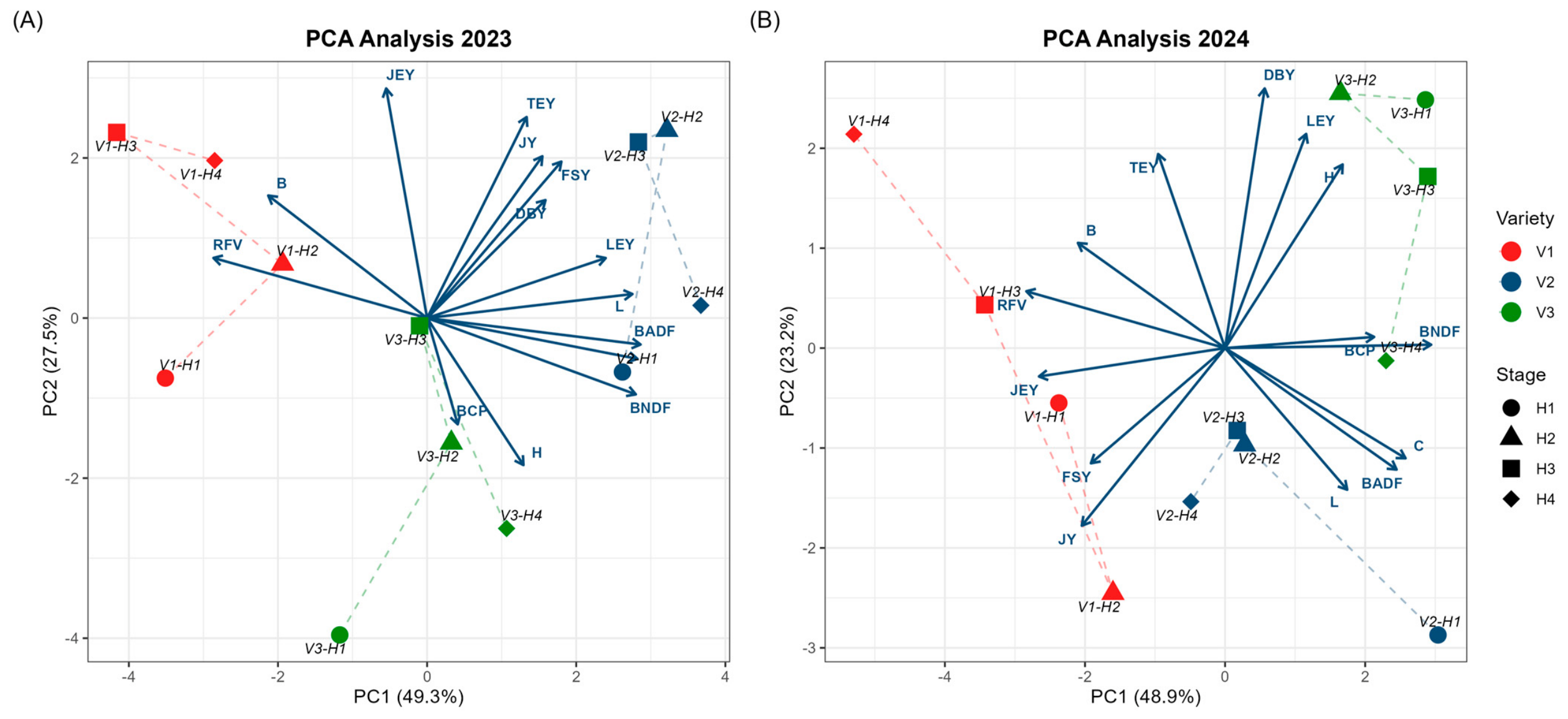
According to the PCA, in 2023, 49.3% of the total variation was explained by PC1 and 27.5% by PC2, for a total of 76.8%. In 2024, 48.9% was explained by PC1 and 23.2% by PC2, with these two axes accounting for 72.1% of the variation (Figure 1).
According to the PCA results (2023 and 2024), correlations were found among the characteristics, and these varied depending on climatic factors. In 2023, vector analysis revealed a strong positive correlation among cell wall components NDF, ADF, lignin, and cellulose. These fiber components exhibited a negative relationship with the quality parameters Brix and RFV. The Erdurmus (V1) variety was positioned away from fiber and lignin vectors and close to quality vectors at all harvest stages, distinguishing itself from other varieties. The Gulseker variety (V2) achieved the highest performance values for fresh stem, dry bagasse, and juice yields, particularly during the milk stage (H3). It was found that all varieties showed a systematic shift toward the right quadrant, indicating fiber accumulation, as the harvest stage progressed. In 2024, the strong association among fiber components (ADF, NDF, and lignin) was maintained. However, unlike 2023, yield parameters such as dry bagasse, juice, and theoretical juice ethanol yields clustered in the negative direction of the PC2 axis. The Erdurmus variety maintained its status as the most stable in terms of bagasse quality, with low lignin and fiber (NDF/ADF) content in 2024 as well. The Uzun variety, which had quite low Brix values and juice yield, had a higher dry bagasse yield in 2024 than in 2023.

4. Conclusions

In this study, the effects of different harvest stages on sweet sorghum varieties for first- and second-generation bioethanol production, as well as the utilization of the remaining bagasse as animal feed after juice extraction, were examined, and the resulting data were visualized using PCA. In both years, the dominance of fiber components in late-harvested material shows that determining the “optimum harvest stage” is extremely important for bioethanol or animal feed production. Obtaining the maximum theoretical juice ethanol yield while simultaneously using bagasse as high-quality animal feed represents the most difficult balance point in sweet sorghum cultivation. This is because while plant maturation is desired for theoretical juice ethanol yield, early harvest is preferred for feed quality (low lignin and ADF/NDF). In particular, when the Erdurmus variety is harvested at the milk stage, high theoretical juice ethanol yields can be achieved while also enabling the production of highly digestible bagasse. The milk stage (H3) of the Gulseker variety has come to the forefront, especially for first- and second-generation bioethanol production. In the future, studies should be conducted to improve bagasse feed quality, particularly for varieties such as sweet sorghum, which can be used in both first- and second-generation bioethanol production.

Author Contributions

Conceptualization, E.B.Ç. and S.E.U.; methodology, E.B.Ç. and S.E.U.; formal analysis, S.E.U.; investigation, E.B.Ç. and S.E.U.; resources, E.B.Ç. and S.E.U.; data curation, S.E.U.; writing—original draft preparation, E.B.Ç. and S.E.U.; writing—review and editing, E.B.Ç.; supervision, E.B.Ç.; project administration, E.B.Ç. All authors have read and agreed to the published version of the manuscript.

Funding

This study was financially supported by Bursa Uludag University Scientific Research Projects Coordination Unit under grant number: FGA-2024-1621 (Project Leader: Dr. Emine Budakli Carpici).

Institutional Review Board Statement

Not applicable.

Data Availability Statement

The original contributions presented in this study are included in this article. Further inquiries can be directed to the corresponding author.

Acknowledgments

The authors would like to thank Bursa Uludag University for providing the institutional infrastructure and facilities to conduct this research.

Conflicts of Interest

The authors declare no conflicts of interest.

Abbreviations

The following abbreviations are used in this manuscript:
ADFAcid detergent fiber
ADLAcid detergent lignin
ANOVAAnalysis of variance
BADFADF content of bagasse
BCPCrude protein of bagasse
BNDFNDF content of bagasse
DBYDry bagasse yield
DDMDigestible dry matter
DMIDry matter intake
FSYFresh stem yield
HHarvest stage
JEYTheoretical juice ethanol yield
JYJuice yield
LEYTheoretical lignocellulosic ethanol yield
LSDLeast significant difference
NDFNeutral detergent fiber
PCAPrincipal component analysis
RFVRelative feed values
SVSources of variation
VVariety
YYear

References

  1. UN DESA. World Population Prospects 2024. New York. 2024. Available online: https://population.un.org/wpp/assets/Files/WPP2024_Summary-of-Results.pdf (accessed on 22 May 2025).
  2. World Health Organization. 2021. Available online: https://www.who.int/news/item/06-07-2022-un-report--global-hunger-numbers-rose-to-as-many-as-828-million-in-2021#:~:text=As%20many%20as%20828%20million%20people%20were%20affected%20by%20hunger,9.8%25%20of%20the%20world%20population (accessed on 5 February 2025).
  3. Olugbemi, O.; Abiola Ababyomi, Y. Effects of nitrogen application on growth and ethanol yield of sweet sorghum (Sorghum bicolor (L.) Moench) varieties. Adv. Agric. 2016, 2016, 8329754. [Google Scholar] [CrossRef] [Scilit]
  4. Yucel, C.; Inal, I.; Gundel, F.; Oluk, C.A.; Yucel, H.; Hatipoglu, R. Bagasse yields and silage qualities from bagasse of some sweet sorghum genotypes under Adana conditions. Euroasia J. Math. Eng. Nat. Med. Sci. 2020, 7, 230–238. [Google Scholar]
  5. Anglani, C. Sorghum carbohydrates—A Review. Plant Food Hum. Nutr. 1998, 52, 77–83. [Google Scholar]
  6. Reddy, B.V.S.; Ramesh, S.; Reddy, P.S.; Ramaiah, B.; Salimath, P.M.; Kachapur, R. Sweet sorghum-a potential alternate raw material for bio-ethanol and bio-energy. Int. Sorghum Millets Newsl. 2005, 46, 79–86. [Google Scholar]
  7. Pinnamaneni, S.R.; Somanna, A.K.G.; Ramu, P.; Vanamala, J.K.P.; Srivastava, R.K. Assessment of phenotypic and genotypic diversity in elite temperate and tropical sweet sorghum cultivars. Sugar Tech. 2022, 24, 1670–1679. [Google Scholar] [CrossRef] [Scilit]
  8. Almodares, A.; Abdy, M.; Somani, R.B.; Jilani, S.K. Comparative study of sorghum sudangrass hybrids and lines for forage. Ann. Plant Physiol. 1999, 13, 6–10. [Google Scholar]
  9. Fazaeli, H.; Golmohhammadi, H.A.; Almodares, A.; Mosharraf, S.; Shaei, A. Comparing the performance of sorghum silage with maize silage in feedlot calves. Pak. J. Biol. Sci. 2006, 9, 2450–2455. [Google Scholar] [CrossRef] [Scilit]
  10. Dos Passos Bernardes, A.; Tremblay, G.F.; Bélanger, G.; Seguin, P.; Brégard, A.; Vanasse, A. Bagasse silage from sweet pearl millet and sweet sorghum as influenced by harvest dates and delays between biomass chopping and pressing. BioEnergy Res. 2016, 9, 88–97. [Google Scholar]
  11. Inal, I.; Yucel, C.; Yucel, D.; Hatipoglu, R. Nutritive value and fodder potential of different sweet sorghum genotypes under Mediterranean conditions. Turk. J. Field Crops 2021, 26, 1–7. [Google Scholar] [CrossRef] [Scilit]
  12. Sun, W.; He, Z.; Liu, B.; Ma, D.; Si, R.; Li, R.; Wang, S.; Malekian, A. Changes in photosynthetic efficiency, biomass, and sugar content of sweet sorghum under different water and salt conditions in arid region of Northwest China. Agriculture 2024, 14, 2321. [Google Scholar] [CrossRef] [Scilit]
  13. Chen, F.; Wang, J.; Zhang, S.; Chaudhry, A.S.; Khanaki, H. Assessing fermentation quality, aerobic stability, in vitro digestibility, and rumendegradation characteristics of silages mixed with sweet sorghum and aerial parts of Licorice. Agriculture 2024, 14, 212. [Google Scholar] [CrossRef] [Scilit]
  14. Murray, S.C.; Sharma, A.; Rooney, W.L.; Klein, P.E.; Mullet, J.E.; Mitchell, S.E.; Kresovich, S. Genetic improvement of sorghum as a biofuel feedstock: I. QTL for stem sugar and grain nonstructural carbohydrates. Crop Sci. 2008, 48, 2165–2179. [Google Scholar] [CrossRef] [Scilit]
  15. Murray, S.C.; Rooney, W.L.; Mitchell, S.E.; Sharma, A.; Klein, P.E.; Mullet, J.E.; Kresovich, S. Genetic improvement of sorghum as a biofuel feedstock: II. QTL for stem and leaf structural carbohydrates. Crop Sci. 2008, 48, 2180–2193. [Google Scholar] [CrossRef] [Scilit]
  16. Netondo, G.; Onyango, J.; Beck, E. Sorghum and salinity: I. Response of growth, water relations, and ion accumulation to NaCl salinity. Crop Sci. 2004, 44, 797–805. [Google Scholar] [CrossRef] [Scilit]
  17. Tesso, T.; Claflin, L.; Tuinstra, M. Analysis of stalk rot resistance and genetic diversity among drought tolerant sorghum genotypes. Crop Sci. 2005, 45, 645–652. [Google Scholar] [CrossRef] [Scilit]
  18. Almodares, A.; Hadi, M.R.; Dosti, B. Effects of salt stress on germination percentage and seedling growth in sweet sorghum cultivars. J. Biol. Sci. 2007, 7, 1492–1495. [Google Scholar] [CrossRef] [Scilit]
  19. Almodares, A.; Hadi, M.R.; Ahmadpour, H. Sorghum stem yield and soluble carbohydrates under different salinity levels. Afr. J. Biotechnol. 2008, 7, 4051–4055. [Google Scholar] [CrossRef]
  20. Almodares, A.; Hadi, M.R. Production of bioethanol from sweet sorghum: A review. Afr. J. Agric. Res. 2009, 4, 772–780. [Google Scholar]
  21. Tamang, P.L. Nitrogen Fertilizer Requirements for Ethanol Production from Sweet and Photoperiod Sensitive Sorghums in the Texas Southern High Plains. Master’s Thesis, Texas Tech University, Lubbock, TX, USA, 2010. [Google Scholar]
  22. Geng, S.; Hills, F.J.; Johnson, S.S.; Sah, R.N. Potential yields and on-farm ethanol production cost of corn, sweet sorghum, fodderbeet, and sugarbeet. J. Agron. Crop. Sci. 1989, 162, 21–29. [Google Scholar] [CrossRef] [Scilit]
  23. Yucel, C.; Hatipoglu, R.; Dweikat, I.; Inal, I.; Gundel, F.; Yucel, H. Determination of the Bioethanol Production Potentials of Different Sweet Sorghum (Sorghum bicolor var. saccharatum (L.) Mohlenbr.) Genotypes in the Cukurova and GAP Regions, TUBITAK TOVAG 1003 114O945 Project Final Report. 2018. Available online: https://search.trdizin.gov.tr/tr/yayin/detay/620304 (accessed on 5 May 2026).
  24. Mosali, J.; Rogers, J.; Huhnke, R.; Bellmer, D.; Cook, B. Effect of nitrogen fertilization timing on juice and bagasse quality of sweet sorghum for biofuel production. In Proceedings of the 19th World Congress of Soil Science, Soil Solutions for a Changing World, Brisbane, Australia, 1–6 August 2010; pp. 48–51. [Google Scholar]
  25. Tas, T.; Yucel, C.; Dondu Gundel, F.; Oktem, A.; Cetiner, H. Evaluation of sweet sorghum bagasse as an alternative feed resource for livestock in semi-arid regions. MAS J. Appl. Sci. 2021, 6, 303–311. [Google Scholar]
  26. Nazli, R.I. Effects of harvest time on bioethanol production and bagasse characteristics for combustion and forage in sweet sorghum. Field Crops Res. 2022, 280, 108464. [Google Scholar] [CrossRef] [Scilit]
  27. Aydin, N.; Mut, Z.; Mut, H.; Ayana, I. Effect of autumn and spring dates on hay yield and quality of oat (Avena sativa L.) genotypes. J. Anim. Vet. Adv. 2010, 9, 1539–1545. [Google Scholar] [CrossRef] [Scilit]
  28. Temel, S.; Keskin, B.; Akbay Tohumcu, S. The nutritional and chemical content of Atriplex nitens seeds grown under rainfall and nonfertilize conditions. Turk. J. Field Crop. 2024, 29, 1–8. [Google Scholar] [CrossRef] [Scilit]
  29. Ramesha, Y.M.; Sharanappa. Effect of harvesting stages on juice quality and ethanol yield in sweet sorghum (Sorghum bicolor) cultivars during rabi. Indian J. Agron. 2013, 58, 368–371. [Google Scholar]
  30. Teixeira, T.P.M.; Pimentel, L.D.; dos Santos Dias, L.A.; da Costa Parrella, R.A.; da Paixão, M.Q.; Biesdorf, E.M. Redefinition of sweet sorghum harvest time: New approach for sampling and decision-making in field. Ind. Crops Prod. 2017, 109, 579–586. [Google Scholar] [CrossRef] [Scilit]
  31. Yucel, C.; Bilgin, F.D.; Inal, I.; Hatipoglu, R. Bagasse yield and quality traits of silage made from juice-extracted sweet sorghum (Sorghum bicolor var. saccharatum (L.) Mohlenbr.) stalks. Emir. J. Food Agric. 2023, 35, 379–387. [Google Scholar] [CrossRef] [Scilit]
  32. Li, Y.; Feng, Q.; Zhu, X.; Bo, B.; Yu, T.; Qu, H. Effects of harvest date and nitrogen rate on silage quality and ın vitro rumen fermentation of photoperiod-sensitive sweet sorghum under rain-fed conditions. Agriculture 2026, 16, 1133. [Google Scholar] [CrossRef] [Scilit]
  33. Turkes, M.; Acar Deniz, Z. Climatology of south marmara division (North West Anatolia) and observed variations and trends. J. Hum. Sci. 2011, 8, 1579–1600. Available online: https://www.j-humansciences.com/index.php/IJHS/article/view/1558 (accessed on 5 May 2026).
  34. Ozsoy, G.; Aksoy, E. Characterization, classification and agricultural usage of vertisols developed on neogen aged calcareous marl parent materials. J. Biol. Environ. Sci. 2007, 1, 5–10. [Google Scholar]
  35. Lingle, S.E.; Tew, T.L.; Rukavina, H.; Boykin, D.L. Post-harvest changes in sweet sorghum I: Brix and sugars. BioEnergy Res. 2012, 5, 158–167. [Google Scholar]
  36. Teetor, V.H.; Duclos, D.V.; Wittenberg, E.T.; Young, K.M.; Chawhuaymak, J.; Riley, M.R.; Ray, D.T. Effects of planting date on sugar and ethanol yield of sweet sorghum grown in Arizona. Ind. Crops Prod. 2011, 34, 1293–1300. [Google Scholar] [CrossRef] [Scilit]
  37. Zhao, Y.L.; Dolat, A.; Steinberger, Y.; Wang, X.; Osman, A.; Xie, G.H. Biomass yield and changes in chemical composition of sweet sorghum cultivars grown for biofuel. Field Crops Res. 2009, 111, 55–64. [Google Scholar] [CrossRef] [Scilit]
  38. Briand, C.H.; Geleta, S.B.; Kratochvil, R.J. Sweet sorghum (Sorghum bicolor [L.] Moench) a potential biofuel feedstock: Analysis of cultivar performance in the Mid-Atlantic. Renew. Energy. 2018, 129, 328–333. [Google Scholar] [CrossRef] [Scilit]
  39. Van Soest, P.J. Use of detergents in the analysis of fibrous feeds. II. A rapid method for the determination of fiber and lignin. J. Assoc. Off. Anal. Chem. 1963, 46, 829–835. [Google Scholar] [CrossRef] [Scilit]
  40. Habyarimana, E.; Lorenzoni, C.; Laureti, D.; Di Fonzo, N. Biomass production and drought resistance at the seedling stage and in field conditions in sorghum. Maydica 2002, 47, 305–309. [Google Scholar]
  41. Rao, M.M.; Govindasamy, R.; Chandrasekaran, S. Effect of humic acid on Sorghum vulgare var. CSH-9. Curr. Sci. 1987, 56, 1273–1276. [Google Scholar]
  42. Rohweder, D.; Barnes, R.F.; Jorgensen, N. Proposed hay grading standards based on laboratory analyses for evaluating quality. J. Anim. Sci. 1978, 47, 747–759. [Google Scholar] [CrossRef] [Scilit]
  43. SAS Institute Inc. JMP® 13 Fitting Linear Models; SAS Institute Inc: Cary, NC, USA, 2016. [Google Scholar]
  44. Lê, S.; Josse, J.; Husson, F. FactoMineR: An R package for multivariate analysis. J. Stat. Software. Montp. Fr. 2008, 25, 1–18. [Google Scholar] [CrossRef] [Scilit]
  45. Kassambara, A.; Mundt, F. Factoextra: Extract and Visualize the Results of Multivariate Data Analyses, Version 1.0.7. 2020. Available online: https://CRAN.R-project.org/package=factoextra (accessed on 1 February 2026).
  46. Maw, M.J.W.; Houx, J.H.; Fritschi, F.B. Sweet sorghum ethanol yield component response to nitrogen fertilization. Ind. Crops Prod. 2016, 84, 43–49. [Google Scholar] [CrossRef] [Scilit]
  47. Kumar, C.G.; Fatima, A.; Rao, P.S.; Reddy, B.V.; Rathore, A.; Rao, R.N.; Khalid, S.; Kamal, A. Characterization of improved sweet sorghum genotypes for biochemical parameters sugar yield and its attributes at different phenological stages. Sugar Tech. 2010, 12, 322–328. [Google Scholar] [CrossRef] [Scilit]
  48. Almodares, A.; Hadi, M.R.; Ranjbar, M.; Taheri, R. The effects of nitrogen treatments, cultivars, and harvest stages on stalk yield and sugar content in sweet sorghum. Asian J. Plant Sci. 2007, 6, 423–426. [Google Scholar] [CrossRef] [Scilit]
  49. Nazli, R.I. Evaluation of different sweet sorghum cultivars for bioethanol yield potential and bagasse combustion characteristics in a semiarid Mediterranean environment. Biomass Bioener 2020, 139, 105624. [Google Scholar] [CrossRef] [Scilit]
  50. Yucel, C.; Yucel, D.; Hatipoglu, R.; Dweikat, I. Research on the potential of some sweet sorghum genotypes as biyoetanol source under Mediterranean conditions. Turk. J. Agric. For. 2022, 46, 141–151. [Google Scholar] [CrossRef] [Scilit]
  51. Cole, M.R.; Eggleston, G.; Petrie, E.; Uchimiya, S.M.; Dalley, C. Cultivar and maturity effects on the quality attributes and ethanol potential of sweet sorghum. Biomass Bioener 2017, 96, 183–192. [Google Scholar] [CrossRef] [Scilit]
  52. Zanini, J.R. Influence of physiological maturation on production and quality of seeds and on the industrial yield of sweet sorghum. Agron. Bras. 1990, 25, 881–888. [Google Scholar]
  53. Chavan, U.D.; Patil, J.V.; Shinde, M.S. An assessment of sweet sorghum cultivars for ethanol production. Sugar Tech. 2009, 11, 319–323. [Google Scholar] [CrossRef] [Scilit]
  54. Tamang, P.L.; Bronson, K.F.; Malapati, A.; Schwartz, R.; Johnsom, J.; Moore-Kucera, J. Nitrogen requirements for ethanol production from sweet and photoperiod sensitive sorghums in the southern high plains. Agron. J. 2011, 103, 431–440. [Google Scholar] [CrossRef] [Scilit]
  55. Han, K.J.; Alison, M.W.; Pitman, W.D.; Day, D.F.; Kim, M.; Madsen, L. Planting date and harvest maturity impact on biofuel feedstock productivity and quality of sweet sorghum grown under temperate Louisiana conditions. Agron. J. 2012, 104, 1618–1624. [Google Scholar] [CrossRef] [Scilit]
  56. Ekefre, D.E.; Mahapatra, A.K.; Latimore, M.; Bellmer, D.D.; Jena, U.; Whitehead, G.J.; Williams, A.L.; Mahapatra, A.K. Evaluation of three cultivars of sweet sorghum as feedstocks for ethanol production in the Southeast United States. Heliyon 2017, 3, e00490. [Google Scholar] [CrossRef] [Scilit] [PubMed]
  57. Oyier, M.O.; Owuoche, J.O.; Oyoo, M.E.; Cheruiyot, E.; Mulianga, B.; Rono, J. Effect of harvesting stage on sweet sorghum (Sorghum bicolor L.) genotypes in western Kenya. Sci. World J. 2017, 2017, 8249532. [Google Scholar] [CrossRef] [Scilit] [PubMed]
  58. Asuquo, S.O. Appropriate Harvesting Stage of Sweet-Stem Sorghum (Sorghum bicolor (L.) Moench) Cultivar for Optimum Bio-Ethanol Production in Namibia. Master’s Thesis, University of Namibia, Windhoek, Namibia, 2017. [Google Scholar]
  59. Rao, S.S.; Patil, J.V.; Prasad, P.V.V.; Reddy, D.C.S.; Mishra, J.S.; Umakanth, A.V.; Reddy, B.V.S.; Kumara, A.A. Sweet sorghum planting effects on stalk yield and sugar quality in semi-arid tropical environment. Agron. J. 2013, 105, 1458–1465. [Google Scholar]
  60. Tutar, H. Bioethanol yield of the sorghum × sudangrass hybrid under arid and semi-arid conditions: Nitrogen dose effects, orthogonal comparisons and component analyses. Turk. J. Agric. For. 2024, 48, 1070–1083. [Google Scholar] [CrossRef] [Scilit]
  61. Mursyid; Syam un, E.; Salengke; Riadi, M. Effect of fertilizer mechanism and harvest time on juice volume, sugar brix and bioethanol in three varieties of sweet sorghum (Sorghum bicolor). Indian J. Agron. 2017, 62, 228–232. [Google Scholar] [CrossRef] [Scilit]
  62. Guden, B.; Erdurmus, C.; Erdal, S.; Uzun, B. Evaluation of sweet sorghum genotypes for bioethanol yield and related traits. Biofuels Bioprod. Biorefin. 2021, 15, 545–562. [Google Scholar] [CrossRef] [Scilit]
  63. Solomon, J.K.Q.; Opoku, A.; Huber, S.; McCuin, G. Biofuel Feedstock Potential of Sweet Sorghum Varieties in Western Nevada; Extension, Ed.; University of Nevada: Reno, NV, USA, 2024; p. SP-24-05. [Google Scholar]
Figure 1. Principal component analysis (PCA) biplot of sweet sorghum traits. Panels represent (A) 2023 and (B) 2024 growing seasons. Vectors indicate the direction of trait influences. V1: Erdurmus, V2: Gulseker, V3: Uzun, H1: booting stage, H2: 50% flowering stage, H3: milk stage and H4: soft dough stage. FSY: fresh stem yield, JY: juice yield, B: brix, JEY: theoretical juice ethanol yield, LEY: theoretical lignocellulosic ethanol yield, TEY: total theoretical ethanol yield, DBY: dry bagasse yield, BCP: crude protein of bagasse, L: lignin, C: cellulose, HC: hemicellulose, BADF: ADF content of bagasse, BNDF: NDF content of bagasse, RFV: relative feed value.
Agriculture 16 01452 g001
Table 1. Climate data for the experimental area for 2023, 2024, and the long-term average (LTA: 1950–2020).
MonthsAverage Temperature
(°C)
Average Relative Humidity (%)Total Precipitation
(mm)
20232024LTA20232024LTA20232024LTA
June24.325.822.263.056.370.1-0.256.7
July26.127.224.757.860.763.5013.412.6
August27.226.325.260.257.264.50015.4
September22.622.721.562.965.666.5023.336.7
October18.216.516.170.570.474.46.730.852.2
Mean/Total23.723.721.962.962.067.86.767.7173.6
Table 2. Soil analysis data of the experimental area.
CharacteristicsDepth (0–30 cm)
20232024
TextureClayClay
pH7.757.80
EC (µS cm−1)643.50642.00
CaCO3 (%)2.112.43
Organic matter (%)2.312.73
N (%)0.070.07
Available P (mg kg−1)10.079.04
Available K (mg kg−1)58.1359.08
Table 3. F-values from analysis of variance (ANOVA) for studied traits of sweet sorghum.
SVDFFSYJYBJEYLEYTEYDBYBCPLCHCBADFBNDFRFV
Y129.87 **25.11 **68.75 **78.27 **61.94 **83.33 **39.81 **0.18 ns78.70 **221.53 **256.73 **211.15 **8.46 *62.03 **
V258.22 **197.93 **765.86 **210.82 **32.13 **0.93 ns9.41 **27.39 **127.89 **46.65 **12.90 **63.20 **241.65 **161.74 **
H35.34 **6.12 **146.58 **67.45 **7.91 **23.51 **13.71 **18.96 **5.83 **0.17 ns2.66 ns0.50 ns1.41 ns0.49 ns
Y × V225.33 **27.30 **56.91 **6.75 *19.91 **14.02 **10.82 **3.30 ns3.93 ns3.60 ns0.43 ns4.02 ns16.33 **8.02 *
Y × H32.60 ns3.00 *13.61 **8.49 **3.75 *2.41 ns2.44 ns2.12 ns0.89 ns7.10 **1.05 ns6.01 **6.89 **8.99 **
V × H61.91 ns2.47 *12.75 **6.67 **1.53 ns3.10 *2.61 *4.74 **4.23 **4.66 **0.97 ns5.19 **1.70 ns3.81 **
Y × V × H62.55 *2.57 *2.67 *2.83 *2.24 ns2.77 *3.38 **1.53 ns0.11 ns1.64 ns1.03 ns1.28 ns0.23 ns0.54 ns
CV (%) 9.3410.567.1613.7012.2911.0610.6511.2711.894.5810.294.934.035.99
*, ** indicate significance at p < 0.05 and 0.01 respectively; ns: non-significant. SV: Sources of variation, Y: year, V: variety, H: harvest stage, FSY: fresh stem yield, JY: juice yield, B: brix, JEY: theoretical juice ethanol yield, LEY: theoretical lignocellulosic ethanol yield, TEY: total theoretical ethanol yield, DBY: dry bagasse yield, BCP: crude protein of bagasse, L: lignin, C: cellulose, HC: hemicellulose, BADF: ADF content of bagasse, BNDF: NDF content of bagasse, RFV: relative feed value.
Table 4. Mean values of fresh stem yield (FSY), juice yield (JY), brix (°Bx), and theoretical juice ethanol yield (JEY) for different sweet sorghum varieties and harvest stages.
Harvest StageFSY (t ha−1)JY (L ha−1)Brix (°Bx)JEY (L ha−1)
V1V2V3MeanV1V2V3MeanV1V2V3MeanV1V2V3Mean
2023
H152.772.437.554.2 b26,17139,39912,73526,102 b8.6 d5.3 f7.1 e7.0 c955.6 de761.4 ef359.3 g692.1 c
H257.085.744.562.4 a29,34246,16816,82530,778 a10.5 c7.3 e8.8 d8.9 b1350.9 c1368.5 bc626.0 f1115.1 b
H351.376.144.557.3 b25,10441,48115,43427,339 b14.2 a8.7 d11.5 b11.4 a1631.2 a1533.4 a–c791.1 ef1318.6 a
H452.967.140.453.5 b25,59736,17313,23825,003 b13.3 a7.2 e7.5 e9.3 b1564.2 ab1046.2 d402.7 g1004.4 b
Mean53.5 b75.3 a41.7 c56.8 B26,553 b40,805 a14,558 c27,305 B11.7 a7.1 c8.7 b9.2 B1375.5 a1177.4 a544.8 b1032.5 B
2024
H178.762.056.365.740,429 ab31,436 c18,909 d30,2588.5 e4.9 g7.2 f6.9 c1453.5 de540.0 g550.3 g847.9 c
H271.864.860.665.739,354 ab35,148 bc21,215 d31,9069.6 c–e9.0 de9.3 de9.3 b1626.9 c–e1356.8 e859.5 fg1281.1 b
H376.179.856.070.639,684 ab44,051 a19,608 d34,44813.3 a9.8 c–e10.7 bc11.3 a2416.7 a1886.8 bc925.1 f1742.9 a
H465.164.356.662.034,380 bc35,829 bc21,591 d30,60013.8 a11.3 b9.9 cd11.7 a2180.1 ab1799.0 cd924.2 f1634.4 a
Mean72.9 a67.7 a57.4 b66.0 A38,462 a36,616 a20,331 b31,803 A11.3 a8.8 c9.3 b9.8 A1919.3 a1395.6 b814.8 c1376.6 A
Mean (2-year average)
H165.767.246.959.9 b33,300 a35,417 b15,822 d28,188 b8.6 de5.1 g7.1 f6.9 d1204.6 d650.7 f454.8 g770.0 d
H264.475.352.664.1 a34,348 b40,658 a19,021 d31,342 a10.1 c8.2 e9.1 d9.1 c1488.9 c1362.7 cd742.8 ef1198.1 c
H363.777.950.264.0 a32,394 bc42,766 a17,521 d30,894 a13.8 a9.3 d11.1 b11.4 a2023.9 a1710.1 b858.1 e1530.7 a
H459.065.748.557.7 b29,988 c36,001 b17,414 d27,801 b13.6 a9.3 d8.7 de10.5 b1872.1 ab1426.6 c663.4 f1319.4 b
Mean63.2 b71.5 a49.6 c 32,508 b38,711 a17,445 c 11.5 a7.9 c9.0 b 1647.4 a1286.5 b679.8 c
Means followed by the same uppercase and lowercase letters within a column do not differ at p < 0.05. FSY: LSD2023V: 9.602, LSD2023H: 4.852, LSD2024V: 6.166, LSD2023–2024V: 4.739, LSD2023–2024H: 3.887; JY: LSD2023V: 5412, LSD2023H: 2342.0, LSD2024V: 2823, LSD2024V×H: 6401, LSD2023–2024V: 2535, LSD2023–2024H: 2112, LSD2023–2024V×H: 3657; B: LSD2023V: 0.3296, LSD2023H: 0.5715, LSD2023V×H: 0.9899, LSD2024V: 0.3985, LSD2024H: 0.7602, LSD2024V×H: 1.317, LSD2023–2024V: 0.2148, LSD2023–2024H: 0.4591, LSD2023–2024V×H: 0.7951; JEY: LSD2023V: 245.4, LSD2023H: 115.7, LSD2023V×H: 200.4, LSD2024V: 98.56, LSD2024H: 201.1, LSD2024V×H: 348.3, LSD2023–2024V: 109.8, LSD2023–2024H: 112.0, LSD2023–2024V×H: 193.9. V1: Erdurmus, V2: Gulseker and V3: Uzun, H1: booting stage, H2: 50% flowering stage, H3: milk stage and H4: soft dough stage.
Table 5. Mean values of theoretical lignocellulosic ethanol yield (LEY), total theoretical ethanol yield (TEY), dry bagasse yield (DBY) and crude protein of bagasse (BCP) for different sweet sorghum varieties and harvest stages.
Harvest StageLEY (L ha−1)TEY (L ha−1)DBY (t ha−1)BCP (%)
V1V2V3MeanV1V2V3MeanV1V2V3MeanV1V2V3Mean
2023
H11988269422842322 b2944345526433014 c6.988.086.997.35 c3.24 bc3.11 bc3.70 a3.35 a
H22473349629822984 a3823486536084099 ab8.2210.609.109.30 ab2.93 b–d2.98 b–d3.10 bc3.00 b
H32196318633032895 a3827472040944214 a8.119.8810.729.57 a2.44 e3.35 ab2.87 cd2.89 b
H42458299727852747 a4023404431873751 b8.368.658.268.42 b1.98 f2.31 ef2.58 de2.29 c
Mean2279 b3093 a2839 a2737 B3654 b4271 a3383 b3769 B7.929.309.778.66 B2.65 b2.94 a3.06 a2.88
2024
H12956264443743325 b4410 de3184 f4925 b–e4173 c9.71 c–e7.63 f12.45 a9.93 b3.05 a–d2.73 cd3.54 a3.11 a
H22637304444863389 b4264 e4401 de5345 a–c4670 bc8.31 ef9.36 d–f13.05 a10.24 b3.10 a–d2.91 a–d2.82 b–d2.94 ab
H33489375443533865 a5906 a5641 ab5278 a–d5608 a11.75 ab11.29 a–c12.62 a11.89 a2.61 d2.99 a–d3.45 ab3.01 a
H42992288334813118 b5172 a–d4681 c–e4405 de4753 b10.20 b–d9.20 d–f10.33 b–d9.91 b1.87 e2.53 d3.30 a–c2.57 b
Mean3018 b3081 b4173 a3424 A4938447749884801 A9.99 b9.37 b12.11 a10.50 A2.66 b2.79 b3.28 a2.91
Mean (2-year average)
H12472266933292823 c3677 de3320 e3784 d–e3593 c8.34 ef7.85 f9.72 cd8.64 c3.15 b2.92 b3.62 a3.23 a
H22554327037343186 ab4043 cd4633 ab4477 bc4384 b8.27 ef9.98 b–d11.08 ab9.77 b3.02 b2.95 b2.96 b2.97 b
H32843347038283380 a4867 ab5180 a4686 ab4911 a9.93 b–d10.58 a–c11.67 a10.73 a2.52 c3.17 b3.16 b2.95 b
H42725294031332933 bc4597 bc4363 bc3796 de4252 b9.28 de8.93 d–f9.29 de9.17 bc1.93 d2.42 c2.94 b2.43 c
Mean2648 c3087 b3506 a 429643744186 8.95 b9.4 b10.44 a 2.65 c2.86 b3.17 a
Means followed by the same uppercase and lowercase letters within a column do not differ at p < 0.05. LEY: LSD2023V: 444.6, LSD2023H: 338.5, LSD2024V: 394.1, LSD2024H: 408.4, LSD2023–2024V: 246.7, LSD2023–2024H: 256.0; TEY: LSD2023V: 641.0, LSD2023H: 419.8, LSD2024H: 514.7, LSD2024V×H: 891.4, LSD2023–2024H: 320.6, LSD2023–2024V×H: 555.2; DBY: LSD2023H: 0.9847, LSD2024V: 1.444, LSD2024H: 1.050, LSD2024V×H: 1.818, LSD2023–2024V: 0.8198, LSD2023–2024H: 0.6947, LSD2023–2024V×H: 1.203; BCP: LSD2023V: 0.2169, LSD2023H: 0.2512, LSD2023V×H: 0.4351, LSD2024V: 0.3246, LSD2024H: 0.3821, LSD2024V×H: 0.6619, LSD2023–2024V: 0.1621, LSD2023–2024H: 0.2207, LSD2023–2024V×H: 0.3823. V1: Erdurmus, V2: Gulseker and V3: Uzun, H1: booting stage, H2: 50% flowering stage, H3: milk stage and H4: soft dough stage.
Table 6. Cell wall components as affected by variety and harvest stage.
Harvest StageLigninCelluloseHemicellulose
V1V2V3MeanV1V2V3MeanV1V2V3Mean
2023
H14.036.274.334.88 c36.7345.3840.6540.92 b18.2618.9722.4219.88 ab
H24.215.934.945.02 bc38.0142.4641.5540.67 b20.2421.1921.7021.04 a
H34.516.715.325.51 ab36.1643.7339.1639.68 b16.0218.4922.4318.31 b
H43.827.265.895.66 a38.5345.9343.4342.63 a18.3520.8621.7920.33 a
Mean4.14 c6.54 a5.12 b5.27 A37.36 c44.37 a41.20 b40.98 A18.22 b19.88 ab21.59 a19.89 B
2024
H13.395.133.624.0530.64 c36.99 a33.96 a–c33.8628.0529.8433.7930.69
H23.714.724.014.1533.53 a–c33.80 a–c33.79 a–c33.7127.3928.9932.6729.68
H34.055.444.884.7932.40 bc35.44 ab35.95 a34.5925.1028.7730.8428.24
H42.685.464.904.3526.65 d34.43ab35.97 a32.3630.0226.4828.8328.44
Mean3.46 c5.19 a4.35 b4.33 B30.80 b35.17 a34.92 a33.63 B27.7428.5231.5329.26 A
Mean (2-year average)
H13.71 ef5.70 ab3.98 de4.46 b33.68 g41.19 a37.30 de37.3923.3524.4128.1025.28
H23.96 de5.33 b4.47 cd4.59 b35.77 ef38.13 b–d37.67 c–e37.1923.8225.0927.1825.36
H34.28 de6.08 a5.10 bc5.15 a34.28 fg39.58 a–c37.55 de37.1420.5623.6325.6323.27
H43.25 f6.36 a5.39 b5.00 a32.59 g40.18 a39.71 ab37.4924.1923.6725.3124.39
Mean3.80 c5.86 a4.73 b 34.08 c39.77 a38.06 b 22.98 b24.20 b26.56 a
Means followed by the same uppercase and lowercase letters within a column do not differ at p < 0.05. Lignin: LSD2023V: 0.4531, LSD2023H: 0.5530, LSD2024V: 0.5565, LSD2023–2024V: 0.2980, LSD2023–2024H: 0.3905, LSD2023–2024V×H: 0.6763; Cellulose: LSD2023V: 4.220, LSD2023H: 1.318, LSD2024V: 2.417, LSD2024V×H: 3.468, LSD2023–2024V: 1.394, LSD2023–2024V×H: 2.004; Hemicellulose: LSD2023V: 2.023, LSD2023H: 1.771, LSD2023–2024V: 1.652. V1: Erdurmus, V2: Gulseker and V3: Uzun, H1: booting stage, H2: 50% flowering stage, H3: milk stage and H4: soft dough stage.
Table 7. Bagasse feed quality parameters as affected by variety and harvest stage.
Harvest StageBADF (%)BNDF (%)RFV
V1V2V3MeanV1V2V3MeanV1V2V3Mean
2023
H140.7651.6544.9745.79 b59.0270.6267.3965.68 b90.2464.1674.3676.25 ab
H242.2248.3846.4945.70 b62.4669.5768.1966.74 ab83.5068.5471.9574.67 b
H340.6750.4444.4845.20 b56.6968.9364.9163.51 c93.9567.0377.7679.58 a
H442.3553.1849.3248.28 a60.7074.0471.1168.62 a85.7259.6566.0570.47 c
Mean41.50 c50.91 a46.32 b46.24 B59.72 c70.79 a67.90 b66.13 B88.35 a64.84 c72.53 b75.24 B
2024
H134.03 d42.12 a37.58 b-d37.9162.4871.9671.3768.6093.0572.5577.7481.11
H237.24 b-d38.53 a-c37.80 b-d37.8564.6367.5170.4767.5486.3081.1778.6482.04
H336.45 cd40.88 ab40.82 ab39.3861.5469.6571.6767.6291.6376.2174.2280.69
H429.33 e39.89 a-c40.89 ab36.7159.3666.3769.7265.15103.7381.1376.9687.27
Mean34.26 b40.35 a39.27 a37.96 B62.00 b68.87 a70.80 a67.23 A93.68 a77.76 b76.89 b80.78 A
Mean (2-year average)
H137.39 ef46.89 a41.28 cd41.8560.7571.2969.3867.1491.64 a68.35 e76.05 c78.68
H239.73 de43.46 bc42.14 cd41.7863.5568.5469.3367.1484.90 b74.86 cd75.30 cd78.25
H338.56 e45.66 ab42.65 c42.2959.1269.2968.2965.5692.79 a71.62 c-e75.99 c80.13
H435.84 f46.54 a45.11 ab42.4960.0370.2170.4266.8894.73 a70.39 de75.51 c–e78.87
Mean37.88 c45.63 a42.79 b 60.86 b69.83 a69.35 a 91.02 a71.30 c74.71 b
Means followed by the same uppercase and lowercase letters within a column do not differ at p < 0.05. ADF: LSD2023V: 2.580, LSD2023H: 1.525, LSD2024V: 2.892, LSD2024V×H: 4.295, SD2023–2024V: 1.609, LSD2023–2024V×H: 2.434; NDF: LSD2023V: 1.118, LSD2023H:1.891, LSD2024V: 2.291, LSD2024V: 1.059; RFV: LSD2023V: 3.842, LSD2023H: 3.429, LSD2024V: 5.250, LSD2023–2024V: 2.702, LSD2023–2024V×H: 5.546. V1: Erdurmus, V2: Gulseker and V3: Uzun, H1: booting stage, H2: 50% flowering stage, H3: milk stage and H4: soft dough stage.
Disclaimer/Publisher’s Note: The statements, opinions and data contained in all publications are solely those of the individual author(s) and contributor(s) and not of MDPI and/or the editor(s). MDPI and/or the editor(s) disclaim responsibility for any injury to people or property resulting from any ideas, methods, instructions or products referred to in the content.