


Abstract
To investigate the adoption behavior and decision-making mechanism of mechanized ear harvesting for seed corn, this study analyzed 786 household survey data from the Hexi Corridor using binary logistic regression, marginal effect analysis, interaction effect tests, and mediation models. The results revealed that the overall adoption rate of mechanized ear harvesting stands at 31.8%, with significant variations across regions and farm sizes. Adoption was found to follow a sequential decision chain: ‘technical feasibility → economic feasibility → comparative benefit assessment.’ Parental line lodging resistance (OR = 3.48) and field contiguity (OR = 3.01) were shown to positively influence adoption indirectly, mediated by perceived harvest loss reduction and perceived machinery efficiency enhancement. A 1% increase in kernel breakage rate is associated with a 2.7 percentage-point reduction in adoption probability. Enterprise-organized mechanical services were identified as the strongest adoption driver (OR = 6.19) and were found to function as a ‘scale equalizer’, significantly reducing the adoption advantage of larger farms (interaction coefficient B = −0.043, p = 0.024). Additionally, a pronounced scale-threshold effect is identified: adoption rates are observed to rise sharply beyond 3.33 hm2, contradicting linear scale-adoption assumptions. These findings highlight the critical roles of inclusive enterprise services, a minimum efficient scale, and the sequential decision process. Coordinated innovation across breeding, equipment engineering, and extension systems is required for sustainable mechanization.
1. Introduction
Unlike commodity field corn harvested mechanically by removing kernels directly from the ear, seed corn production requires a multi-step process: whole-ear harvest, selective ear processing, drying, and final threshing [1]. This sequence demands precision, as crop maturity and environmental conditions significantly affect ear composition and post-harvest quality [2]. With rising labor costs and farm consolidation, developing efficient, low-loss mechanical ear-harvesting systems is essential to reduce costs, boost productivity, and modernize the seed sector. The Hexi Corridor, supplying over 50% of China’s hybrid corn seed, is a cornerstone for ensuring national food security and fostering self-sufficiency in the seed industry [3]. Hereby, mechanized harvesting is especially urgent because seed corn must meet stricter quality standards than commodity corn: kernel breakage below 5% (vs. 8%), with critical traits including lodging resistance, ear uniformity, and kernel integrity [1,4]. However, existing machinery often lacks the necessary adaptability [5], and performance hinges on crop, soil, and environmental interactions [3,6]. Although a domestic seed corn harvester was recently introduced in the Hexi Corridor [7], adoption remains limited. Genetically controlled traits further complicate seed corn harvesting: pre-harvest sprouting reduces yield and storability, while low kernel moisture at harvest is vital to minimize mechanical damage and drying costs [8,9,10,11,12]. These biological constraints influence farmers’ willingness to adopt mechanized solutions.
Recent studies on technology adoption have shifted from static, linear models toward process-based frameworks that conceptualize adoption as a sequential, multi-stage process rather than a one-time decision [13,14,15]. Brown et al. [16,17] advanced a ‘Five Ps’ framework to capture the multifaceted and variable nature of mechanization uptake, revealing that binary adoption measures miss nuances such as partial implementation and temporal lags. Despite these theoretical advances, empirical work has largely overlooked the layered, context-dependent reasoning of farmers operating within contract farming arrangements. Two gaps stand out. First, the role of enterprise-provided support services (including extension advisory systems, logistics coordination, and integrated input supply) in mediating adoption trajectories remains undertheorized and insufficiently tested. A study from China has indicated that externally supplied machinery services strongly influenced adoption, with land plot size acting as a critical determinant [18]. Contract farming, in particular, can serve as a conduit for technical assistance and risk mitigation. Second, emerging evidence has suggested that the farm size–mechanization relationship is nonlinear, potentially exhibiting thresholds, diminishing returns, or negative inflections, yet rigorous empirical confirmation in smallholder systems is lacking [9,19]. For instance, Qiu and Luo [20] identified an inverted U-shaped association between farm size and mechanization service use among Chinese wheat farmers, implying that the smallest operators are not the primary beneficiaries. Additionally, scholarship on seed corn harvesting has concentrated on agronomic and engineering aspects [8,21,22,23,24], paying minimal attention to the behavioral and socio-cognitive dimensions of how technical viability, cost–benefit expectations, perceived risks, peer influence, and institutional trust jointly shape adoption decisions.
This study addresses these gaps by:
- (1)
- Validating a three-stage decision chain (technical viability → economic viability → comparative benefit);
- (2)
- Demonstrating that enterprise-provided services act as a ‘scale equalizer’;
- (3)
- Identifying a scale-threshold effect that challenges linear scale–mechanization views.
Accordingly, the following hypotheses were formulated:
- (1)
- Farmers’ adoption follows a sequential pathway: appraisal of technical viability → assessment of economic viability → comparative evaluation of net benefits;
- (2)
- Enterprise-coordinated mechanization services positively drive adoption and attenuate the effect of farm scale, thereby boosting smallholders’ adoption and narrowing mechanization access gaps;
- (3)
- The farm scale–adoption relationship is nonlinear, with a distinct threshold: adoption increases substantially only after the operational scale exceeds a critical minimum;
- (4)
- Farmers’ perception of reduced harvest loss mediates the effect of parental line lodging resistance on adoption; perception of enhanced machinery efficiency mediates the effect of field contiguity on adoption.
This study makes three marginal contributions:
- (1)
- Mechanistically, it moves beyond factor identification to uncover farmers’ sequential decision logic;
- (2)
- Empirically, it offers the first large-sample evidence of a scale-threshold effect in seed corn mechanization;
- (3)
- Policy-wise, it identifies enterprise-organized services as a mechanism to mitigate smallholder disadvantages.
2. Methods
2.1. Survey Area
The study covered 18 specialized seed-corn-producing towns in three municipal regions of the Hexi Corridor (93°20′–104°00′ E, 37°10′–42°50′ N), western Gansu: Zhangye City (Ganzhou District, Linze County, Gaotai County), Jiuquan City (Suzhou District, Jinta County), and Wuwei City (Liangzhou District). These sites represent typical ecological and production conditions [5,25]. Field surveys were conducted during the 2024 and 2025 harvest periods to ensure data timeliness and representativeness. A total of 850 questionnaires were distributed to farming households, with 786 valid responses retained, yielding a 92.5% effective response rate (Table 1).
Table 1.
Source traceability of valid questionnaires.
A stratified random sampling design was used: villages were grouped by population size and agricultural intensity, and households were randomly drawn from official registries, ensuring proportional representation of different village types, then, sampled households averaged 52.3 ± 11.4 years of age, 9.1 ± 3.2 years of schooling, 21.4 ± 8.7 years of farming experience, a household size of 4.2 ± 1.3, and an operational landholding of 4.7 ± 3.2 hm2. These statistics serve as a baseline profile for analyzing adoption drivers.
2.2. Questionnaire Design
The questionnaire comprised five sections:
- (1)
- Socio-demographic characteristics;
- (2)
- Seed corn production practices (parental lines, contracted company, planted area, agronomic measures);
- (3)
- Harvesting method (manual vs. mechanical) and reasons (with ‘adoption’ coded 1 if the farmer used mechanized ear-harvesting equipment at least once in 2024 or 2025, 0 otherwise);
- (4)
- For adopters, experiences with service costs, field loss, kernel damage, and seed quality at delivery;
- (5)
- Perceptions of mechanical harvesting, policy support, and service systems.
Key independent variables are summarized below (detailed items in Appendix A Table A1):
- (1)
- Parental line lodging resistance: 5-point Likert scale (1 = very poor, 5 = very good).
- (2)
- Height uniformity: 5-point Likert scale.
- (3)
- Field contiguity: Binary (1 = contiguous, 0 = fragmented).
- (4)
- Operational scale: Continuous (hm2).
- (5)
- Machinery operation cost: Continuous (RMB/hm2).
- (6)
- Kernel breakage rate: Continuous (%), visually estimated by farmers.
- (7)
- Harvest season labor wage: Continuous (RMB/person/day).
- (8)
- Enterprise-organized mechanical services: Binary (1 = seed company arranged/delivered mechanical services, 0 = otherwise).
- (9)
- Perceived harvest loss reduction: 5-point Likert (1 = strongly disagree, 5 = strongly agree).
- (10)
- Perceived machinery efficiency: 5-point Likert (1 = strongly disagree, 5 = strongly agree).
- (11)
- Reliability and validity: Cronbach’s α ranged from 0.78 to 0.85. Content validity was verified through expert review (three agricultural economists, two seed production specialists) and a pilot test with 30 households.
- (12)
- Institutional context: Enterprise-organized services (variable 8) were delivered by commercial seed companies under contract farming, covering seed supply, advisory support, guaranteed purchase, and coordination of mechanical harvesting via their own fleets or local cooperatives.
For the Likert-scale variables (parental line lodging resistance, height uniformity, perceived harvest loss reduction, and perceived machinery efficiency), we treated them as continuous ordinal variables in the regression analyses, assuming equal intervals between response categories. This approach is common in adoption studies and allows odds ratios to be interpreted per unit increase in the Likert score.
2.3. Data Processing
Data analyses used SPSS (v26.0). After descriptive statistics, chi-square tests examined associations between harvest method and categorical variables; binary logistic regression identified adoption factors, with odds ratios reported. Beyond the primary regression, several mechanism analyses were performed:
- (1)
- Marginal effect analysis for continuous predictors;
- (2)
- Interaction tests (operational scale × enterprise-organized services) to assess whether enterprise services moderate scale effects (testing the ‘scale equalizer’ hypothesis);
- (3)
- Subgroup analyses by region and farm size;
- (4)
- Mediation analysis using Sobel and bootstrap methods to validate the sequential decision chain (technical → economic feasibility → comparative benefit);
Multicollinearity was checked via variance inflation factors (VIF); all VIFs were ≤2.3 (Appendix A Table A2). Descriptive statistics by adopter status appear in Appendix A Table A3, with t-tests or chi-square tests for group differences.
3. Results
3.1. Regional and Scale Differentiation: The Dual Structure of Mechanical Ear Harvesting Adoption
This section began with an examination of how adoption rates differed across geographic regions and varying scales, thereby laying a descriptive groundwork for the subsequent step-by-step analysis of the decision-making chain.
3.1.1. Statistical Validation of Regional and Scale Disparities
To assess the statistical significance of disparities in mechanical ear harvesting adoption rates across regions and farm scales, Chi-square tests were conducted. Table 2 shows significant differences between regions (χ2 = 34.27, p < 0.001) and farm scales (χ2 = 98.64, p < 0.001), confirming regional and scale disparities as key structural features of technology adoption.
Table 2.
Chi-square test results for mechanical ear harvesting adoption rates among farmers by region and operational scale.
3.1.2. Regional Adoption Patterns and Limiting Factors
As indicated in Table 3, the adoption rate of mechanical ear harvesting for seed corn in the Hexi Corridor was approximately 31.8%, and the highest rate has been achieved in Zhangye due to concentrated production, standardized management, and flat, contiguous farmland, reaching approximately 42.1%. In contrast, Jiuquan and Wuwei showed lower rates (21.3% and 23.9%, respectively), primarily constrained by fragmented plots (62.8%) and high machinery costs (51.2%) in Jiuquan, and abundant cheap labor (55.3%) and traditional manual practices (49.7%) in Wuwei.
Table 3.
Adoption rates of mechanical ear harvesting for seed corn in different regions of the Hexi corridor.
3.1.3. Operational Scale Differentiation and Threshold Effects
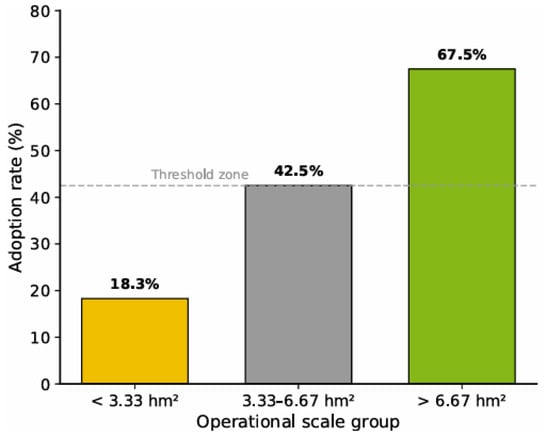
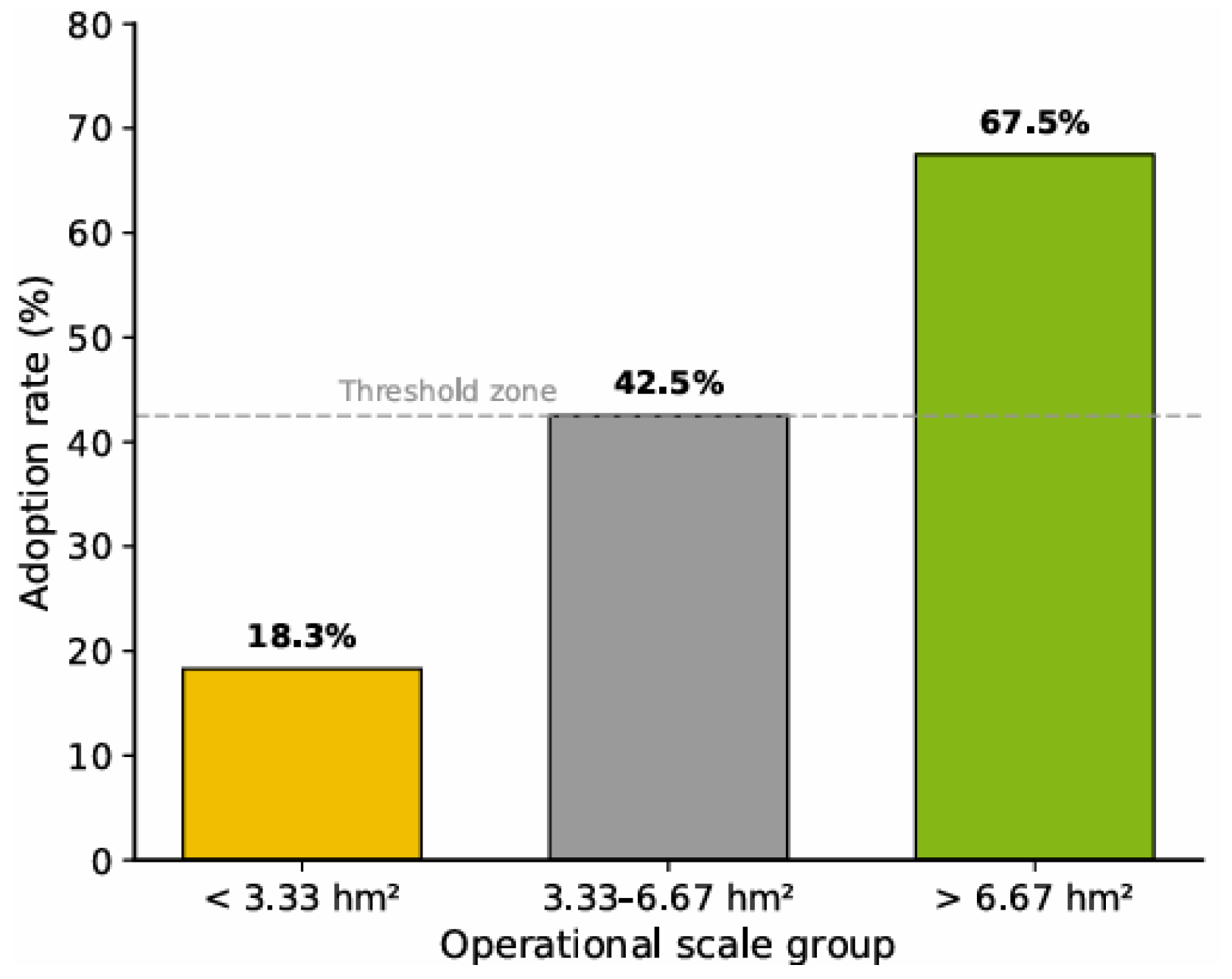
As shown in Table 4, adoption rates vary significantly by operational scale. Small-scale farmers (<3.33 hm2) adopted at 18.3%, while large-scale operators (>6.67 hm2) adopted at 67.5%. Figure 1 shows a non-linear pattern, with a sharp increase in adoption between small and medium-scale groups (threshold zone). Chi-square tests in Table 4 (p < 0.001) confirm all adjacent group differences are significant, supporting a scale-threshold effect that adoption likelihood rises sharply once scale exceeds 3.33~6.67 hm2, challenging linear assumptions.
Table 4.
Adoption rates of mechanical ear harvesting by operational scale.
Figure 1.
Adoption rates of mechanical ear harvesting by operational scale group, with threshold indication. Note: Bars show adoption rates (%) by operational scale group. Post hoc Chi-square tests with Bonferroni correction revealed significant differences between all adjacent groups (p < 0.001). The dashed horizontal line at 42.5% and the Threshold zone annotation highlight the pronounced non-linear jump.
3.1.4. Endogenous Threshold Estimation: Piecewise Logistic Regression
To determine whether the identified threshold is an artifact resulting from pre-specified grouping, piecewise logistic regression was applied with the R package ‘segmented’ (v2.1-2, https://CRAN.R-project.org/package=segmented, accessed on 13 June 2026) [26]. This method estimated the breakpoint, the predictor value at which the log-odds slope underwent a statistically meaningful shift, thereby avoiding subjective or externally imposed cut points. The model was formulated as follows:
where ψ denoted the estimated breakpoint and (scale − ψ)+ = max (0, scale − ψ) was the positive-part function. The analysis yielded an estimated breakpoint of ψ = 3.42 hm2 (95% CI: 3.18–3.66), which closely matched the a priori threshold of 3.33 hm2. A likelihood ratio test indicated that the segmented model provided a significantly superior fit compared with a standard linear logistic regression, with (χ2 (1) = 12.34, p < 0.001), offering robust statistical evidence for a true threshold effect. In particular, the slope associated with scale below the estimated threshold (scale < 3.42 hm2) was 0.12 (p = 0.056), approaching but not reaching conventional significance; in contrast, above the threshold (scale ≥ 3.42 hm2), the slope rose sharply to 0.51 (p < 0.001), reflecting a pronounced increase in the probability of adoption. Collectively, these findings confirmed that the observed nonlinearity was not an artifact of arbitrary categorization, but rather reflected a data-driven inflection point in the dose–response relationship.
Logit [P (adopt = 1) ] = β0 + β1 · scale + β2 · (scale − ψ)+ + γ· X
3.2. Drivers and Constraints of Adoption Decisions: Factor Identification Based on Farmers’ Behavior
This section outlined the key facilitators and barriers influencing adoption decisions: factors that will be integrated into the sequential decision-chain framework described in Section 3.3.
3.2.1. Binary Logistic Regression
To identify key factors influencing farmers’ adoption of mechanical ear harvesting, a binary logistic regression model was used. The model fit well (Hosmer–Lemeshow p = 0.327; Nagelkerke R2 = 0.341) and predicted outcomes accurately (78.6%). As shown in Table 5, unified enterprise-organized mechanical services had the strongest positive effect (OR = 6.19), followed by parental line lodging resistance (OR = 3.48) and field contiguity (OR = 3.01). Conversely, kernel breakage rate negatively affected adoption (OR = 0.88, p < 0.001), with each 1% increase reducing adoption odds by 12%. The cost of machinery operation was linked to an odds ratio (OR) of 0.97 for each incremental rise of 1 RMB/hm2.
Table 5.
Binary logistic regression analysis for factors influencing farmers’ adoption of mechanical ear harvesting.
3.2.2. Marginal Effects of Key Continuous Variables
To improve interpretability beyond odds ratios in Table 5, the average marginal effects (AME) for continuous predictors were calculated. As shown in Table 6, a 1% rise in kernel breakage rate reduces adoption probability by 2.7 percentage points (p < 0.001), and a 1 RMB/hm2 increase in machinery cost reduces it by 0.6 percentage points (p < 0.01). These marginal effects reveal that kernel breakage is the more economically salient constraint in absolute terms, a finding not discernible from odds ratios alone. The cost of operating machinery was expressed in RMB/hm2; the marginal effect indicated a percentage point reduction in the likelihood of adoption resulting from a one-unit increase in this cost.
Table 6.
Average marginal effects (AME) of continuous variables on the probability of adopting mechanical ear harvesting.
3.2.3. Interaction Effect: Enterprise Services as a Scale Equalizer
To test whether enterprise services moderate the effect of operational scale, an interaction term (operational scale × enterprise-organized services) was added to the model. Results in Table 7 show a significant negative coefficient (B = −0.043, p = 0.024), indicating enterprise services disproportionately benefit small-scale farmers, partially offsetting their scale disadvantage.
Table 7.
Binary logistic regression with interaction term (Operational scale × Enterprise-organized services).
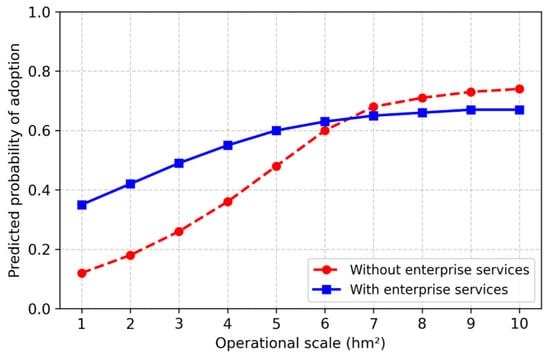
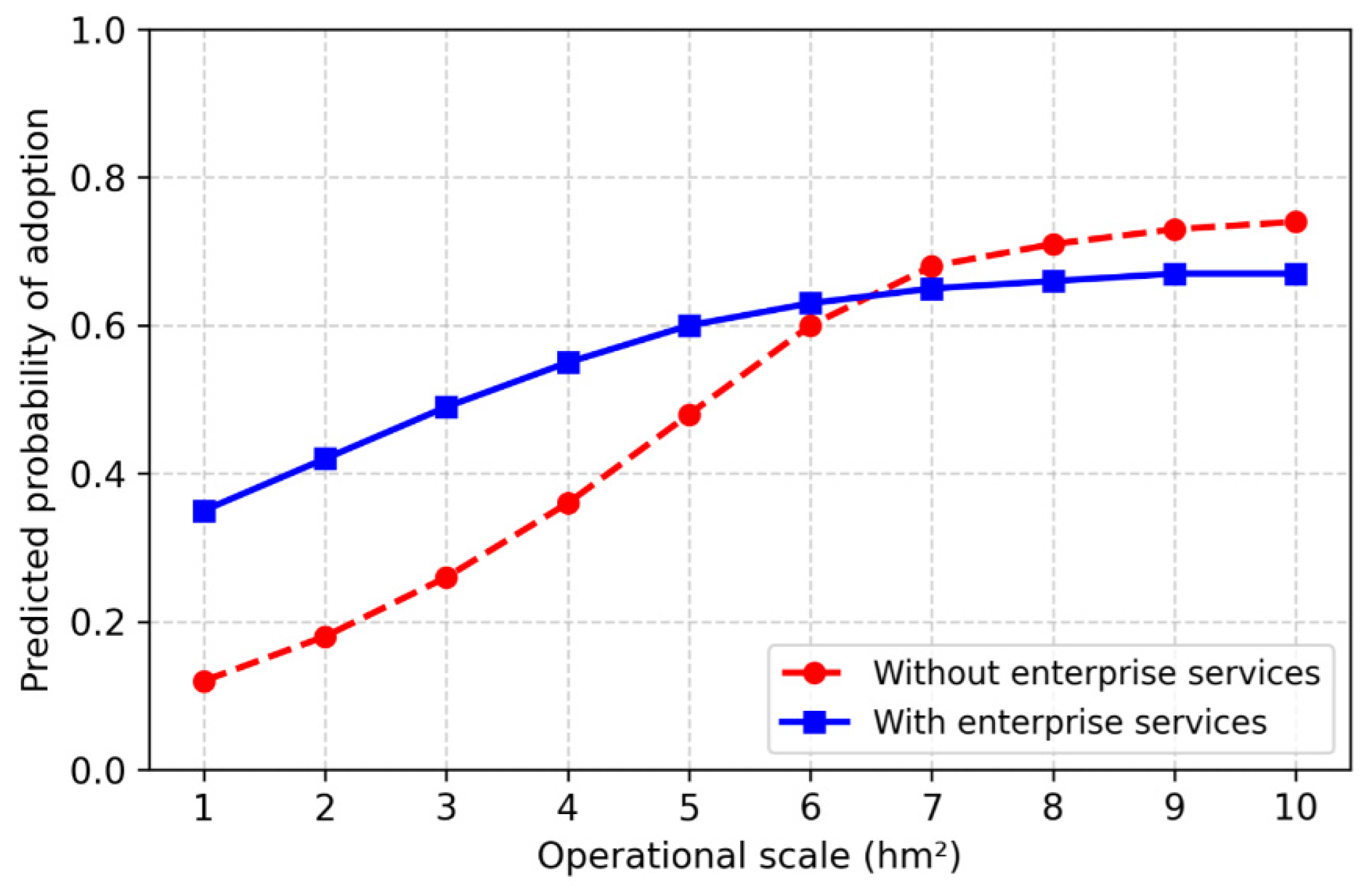
This moderating effect is further illustrated in Figure 2. Without enterprise services, adoption probability rises sharply with scale (12%~71%); while with services, the gradient flattens (35%~62%). This supports the ‘scale equalizer’ role of enterprise contracts, challenging the assumption that mechanization favors large-scale operators. Figure 2 illustrates the interaction effect: the solid line, which corresponds to farms that adopted enterprise services, had a less steep slope than the dashed line that represented farms lacking access to such services. This contrast in slope suggested that enterprise services helped reduce the gap in technology adoption among farms of different sizes.
Figure 2.
Predicted probability of adopting mechanical ear harvesting as a function of operational scale, by availability of enterprise-organized mechanical services.
3.3. Inter-Factor Logic: A Sequential Decision Chain from Technical Adaptability to Economic Feasibility
3.3.1. Conceptual Framework of the Sequential Decision Chain
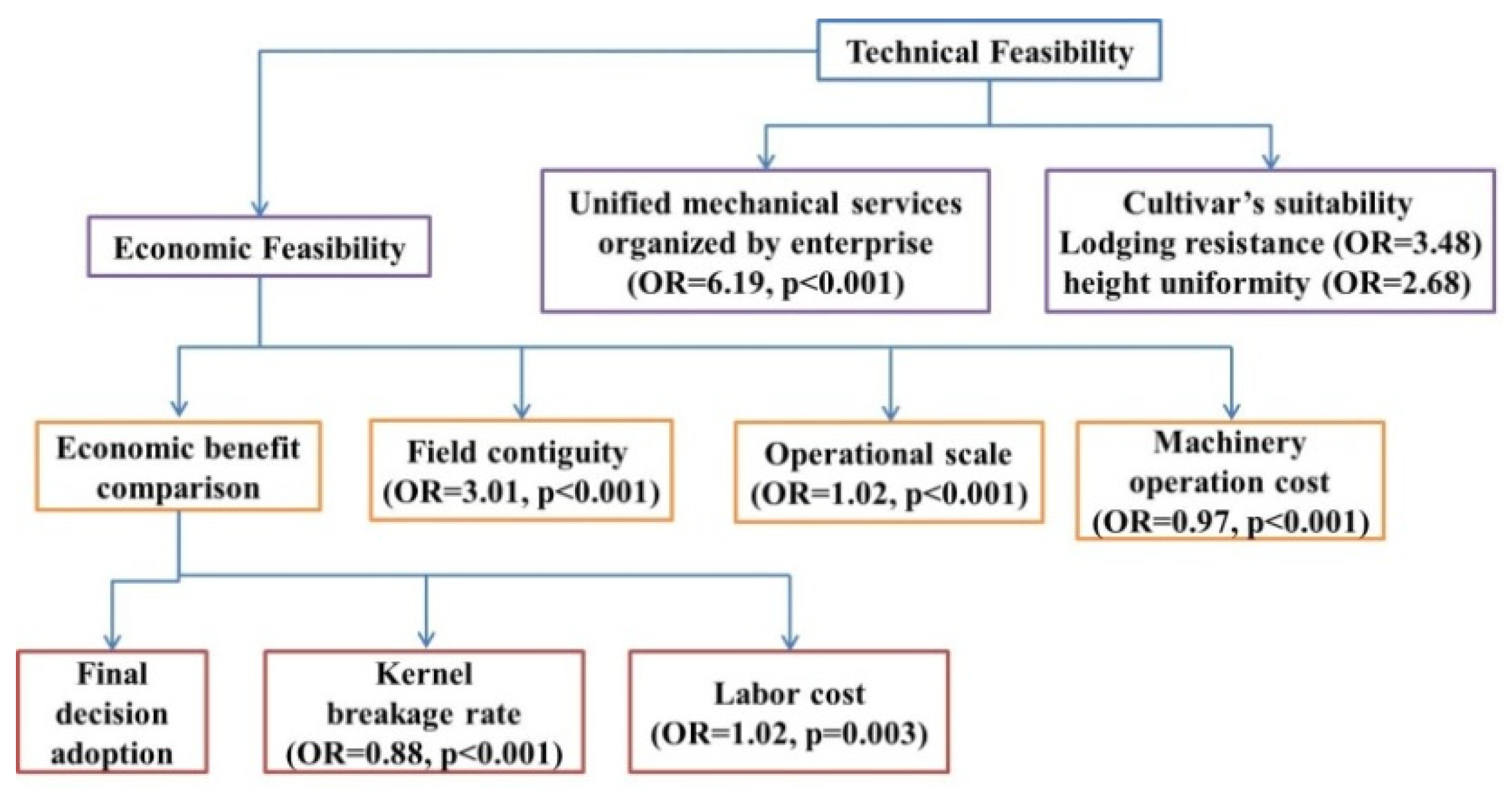
The factors from regression analysis (Table 5) follow a logical sequence: from technical feasibility to economic feasibility, and finally to a comparative assessment of economic benefits, as shown in Figure 3 and detailed in Table 8. Technical feasibility depends on the enterprise organization and cultivar suitability, economic feasibility on land conditions, operational scale, machinery cost, and benefit comparison on operation quality (kernel breakage) and labor prices. This hierarchical logic forms a cohesive, multi-stage decision framework.
Figure 3.
Schematic diagram of the decision-making process for farmers adopting mechanical ear harvesting.
Table 8.
Key factors and influence pathways in the decision chain for farmers adopting mechanical ear harvesting.
3.3.2. Empirical Validation of the Decision Chain: Mediation Analysis
To test the sequential decision chain, Sobel and bootstrap mediation analysis were conducted, beginning by reporting the individual regression pathways for establishing mediation, specifically, the path from X to MX to M, and the path from M to Y, as shown in Table 9.
Table 9.
Constitutive paths for mediation analysis.
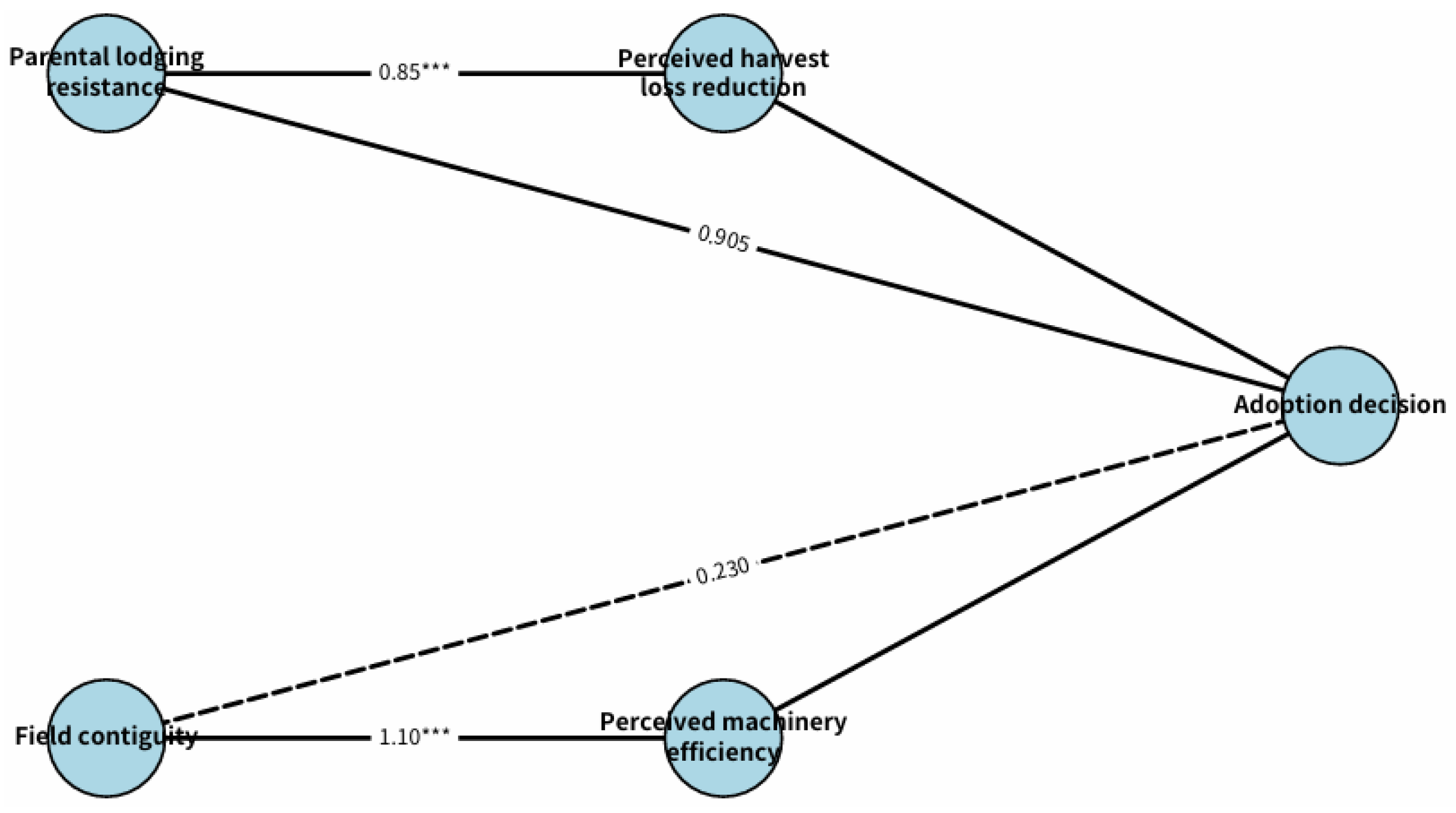
The results, as shown in Table 10 and illustrated in Figure 4, provide strong support for the framework. For Path 1, lodging resistance affected adoption via perceived harvest loss reduction (indirect effect = 0.341, Sobel z = 3.42, p < 0.001), while for Path 2, field contiguity affected adoption via perceived machinery efficiency (indirect effect = 0.873, 95% CI: 0.518–1.228), with no direct effect. Path 2 was classified as full mediation because the indirect effect was significant (95% CI excludes 0), and the direct effect was non-significant (p = 0.230). However, the non-significant direct effect could reflect low statistical power or a suppression effect; thus, this classification was tentative. It should be noted that the coefficients in Table 5 and Table 7 represent the total effects of the objective factors on adoption. In the mediation analysis (Table 9 and Figure 4), the coefficients of the independent variables reflected the direct effects after excluding the mediated pathways. Because farmers’ perceptual variables (perceived harvest loss reduction and perceived machinery efficiency) served as the cognitive bridge translating objective conditions into adoption decisions, the direct effects were naturally smaller than the total effects in Table 5 and Table 7, exhibiting partial or full mediation characteristics. This is statistically normal and consistent with our theoretical framework.
Table 10.
Mediation effects (Sobel test and Bootstrap).
Figure 4.
Mediation path diagram of the sequential decision chain for mechanical ear harvesting adoption. Note: Solid arrows indicate significant paths (p < 0.05); dashed arrows indicate non-significant direct effects; numbers adjacent to paths are unstandardized coefficients. *** p < 0.001. Path coefficients are displayed alongside significance levels.
These findings confirmed that farmers act on perceived feasibility, rather than objective conditions, supporting the decision-chain framework and advancing beyond additive models.
4. Discussion
4.1. A Sequential Decision Chain: Moving Beyond Additive Factor Models
This study empirically validates a sequential decision chain (Table 10, Figure 3 and Figure 4). Previous adoption studies have largely treated influential factors as independent and additive, failing to capture the hierarchical logic of farmers’ decisions [13,19]. Consistent with recent literature, binary metrics often obscure nuanced pathways from awareness to sustained adoption [17,27]. Our framework models intermediate cognitive stages: farmers first assess technical feasibility (e.g., land suitability and enterprise services), then economic viability (scale and costs), and finally comparative benefit (grain quality versus labor costs). Mediation analysis (Figure 4) shows that lodging resistance and field contiguity influence adoption largely through perceived harvest loss reduction and perceived machinery efficiency, challenging models that treat these as direct drivers [28].
4.2. The Dual Role of Enterprise Services: Driver, Equalizer, and Bottleneck
Enterprise-organized services are the strongest adoption driver (OR = 6.19, Table 5), yet 58.2% of all respondents in Zhangye cite the lack of such services as the key barrier (Table 3). This reveals a dual role: enterprises catalyze mechanization when actively engaged but become bottlenecks when provision is inconsistent. Importantly, non-adoption here stems from structural access deficits, not deliberate rejection. The significant positive association suggests that service delivery actively promotes adoption rather than merely reflecting pre-existing preferences.
Interaction analysis (Table 7, Figure 2) further identifies services as a ‘scale equalizer’: the negative interaction (B = −0.043, p = 0.024) shows that services disproportionately benefit smallholders, narrowing adoption gaps across farm sizes and challenging the notion that mechanization inherently favors large farms [29]. This aligns with findings that institutional support and risk reduction through extension or contract farming can boost technology uptake [30,31]. Our results demonstrate that consistent, inclusive enterprise services can reduce scale-related mechanization inequities. Research highlighted how institutional trust and risk perception shaped contract farming adoption.
4.3. The Scale-Threshold Effect: A Non-Linear Reality
A pronounced non-linear scale-threshold effect emerges: adoption stagnates below 18.3% for farms <3.33 hm2, then surges to 42.5% and 67.5% for medium and large groups (Table 4, Figure 1). Piecewise logistic regression (Section 3.1.4) confirms a data-driven breakpoint at 3.42 hm2 with significantly improved model fit, contradicting linear scale–mechanization assumptions and indicating a minimum efficient scale for seed corn mechanization [32]. This threshold is moderated by enterprise services (Figure 2), suggesting organizational support can lower the scale barrier.
Mediation pathways further reveal that farmers’ perceptions of harvest loss and machinery efficiency act as cognitive bridges from crop traits and field conditions to adoption. This resonates with evidence that subjective risk perceptions and mental models critically mediate technology uptake [33]. Thus, extension strategies must engage farmers’ subjective appraisals, not merely disseminate technical metrics.
4.4. Multiple Bottlenecks and Paths Forward
Persistent technical bottlenecks, such as breeding–mechanization mismatch, equipment limits, and poor coordination [8,34], are now interpretable within the decision-chain framework. For instance, breeding deficiencies raise perceived harvest loss, undermining technical feasibility [35]. Kernel breakage remains the most salient economic constraint (2.7% adoption reduction per 1% increase, Table 6), closely tied to grain moisture and threshing mechanism design [9,22,36,37]; low-damage threshing technologies offer clear mitigation [38,39]. Thus, advances in breeding (lodging resistance, ear uniformity) and equipment are prerequisites at the earliest decision stage.
Policy and extension should be re-prioritized accordingly: incentivizing enterprise services for smallholders can simultaneously address key drivers, scale equalization, and threshold barriers. Extension must communicate performance across all three decision stages, not merely demonstrate the existence of technology. Matching farmers’ cognitive stages (awareness → contemplation → implementation) better reflects adoption behavior than binary models [14]. This aligns with Llewellyn and Brown [40], who noted that information gaps, not economic constraints, often pose the primary barrier. In the Hexi Corridor, non-adoption stems largely from a lack of organized services, consistent with this pattern.
4.5. Limitations and Generalizability
This study has several limitations. First, the cross-sectional design limits causal inference; reverse causality and unmeasured confounders cannot be ruled out. Longitudinal or quasi-experimental designs are needed for stronger identification. Second, perceptual variables rely on self-reports, susceptible to recall and social desirability biases. Objective measures (e.g., field loss protocols, real-time monitoring) would improve validity. Third, the Hexi Corridor’s unique features, including large, irrigated plots, dense seed enterprises, and formalized contracts, may limit generalizability to fragmented, rain-fed, or institutionally weaker contexts. Comparative studies across diverse settings are essential [33]. Finally, ‘enterprise-organized services’ may be endogenous if more capable farmers self-select into contracts; instrumental variable approaches (e.g., distance to seed companies, historical enterprise presence, policy timing) could address this.
Despite these constraints, the study rigorously elucidates the phase-dependent logic of mechanization adoption, confirms a pivotal scale threshold, and provides evidence that enterprise services can function as a leveling mechanism, reducing scale-related inequities.
5. Conclusions
This study reveals a regionally and scale-differentiated adoption pattern (overall 31.8%). A key contribution is the identification of a scale-threshold effect: adoption is low (18.3%) below 3.33 hm2 but jumps to 67.5% above 6.67 hm2 (Table 4, Figure 1). Piecewise logistic regression confirms this is not a grouping artifact, with a data-driven breakpoint at 3.42 hm2 that significantly improves model fit, challenging linear scale–mechanization assumptions. This scale effect is further moderated by enterprise service provision (Table 7, Figure 2).
Unlike prior factor-analytic work, this study validates a sequential decision chain (technical feasibility → economic feasibility → comparative benefit; Figure 3). Mediation analysis (Table 10, Figure 4) demonstrates that farm and variety characteristics influence adoption primarily via perceived harvest loss reduction and machinery efficiency, marking a mechanistic advance for contract-based agricultural systems.
Enterprise-organized services act as a ‘scale equalizer’ (interaction B = −0.043, p = 0.024; Table 7). Notably, 58.2% of all respondents in Zhangye lacked access to such services, indicating structural rather than voluntary non-adoption. Policies should therefore mandate minimum service standards for enterprises and support alternative providers (e.g., cooperatives) where enterprise capacity is weak, ensuring that service availability matches the potential demand.
Future efforts should embed the validated decision logic into technology design and extension. Breeding must prioritize lodging resistance and ear uniformity; equipment innovation should target kernel breakage, the strongest negative marginal effect (Table 6); and extension should communicate performance across all three decision stages to align with farmer cognition. Ultimately, overcoming persistent bottlenecks requires synergistic innovation across breeding, engineering, management, and service systems, grounded in this empirically validated decision model.
Author Contributions
Conceptualization, W.-J.L. and L.-Y.H.; methodology, W.-J.L., Y.-S.M. and L.-Y.H.; software, W.-J.L.; validation, W.-J.L., Y.-S.M., X.-H.S., R.K. and X.-B.S.; formal analysis, W.-J.L., Y.-S.M., L.-T.M. and H.-Y.C.; investigation, Y.-Y.B., X.-Y.M., T.L. and Z.-R.L.; resources, Y.-S.M., L.-Y.H., S.-K.L., X.-H.S., R.K. and X.-B.S.; data curation, Y.-Y.B., X.-Y.M., T.L. and Z.-R.L.; writing—original draft preparation, W.-J.L. and Y.-S.M.; writing—review and editing, L.-Y.H., S.-K.L., L.-T.M. and H.-Y.C.; visualization, Y.-Y.B. and X.-Y.M.; supervision, L.-Y.H. and S.-K.L.; project administration, L.-Y.H. and S.-K.L.; funding acquisition, W.-J.L., Y.-S.M. and L.-Y.H. All authors have read and agreed to the published version of the manuscript.
Funding
This study was funded by the Innovation Fund for College Teachers in Gansu Province (2026A-195), the Young Doctor Support Program for Higher Education Institutions in Gansu province (2025QB-090), the Special Program for Science and Technology Commissioners under Gansu Provincial Scientific and Technological Planning Projects (26CXGG002), the Modern Cold-Arid Specialty Seed Industry Key R&D and Scientific Support Program of Gansu Province (KJZC-2026-32), and Gansu Provincial Technology Innovation Guidance Program—Rural Revitalization Special Project (25CXNG014).
Data Availability Statement
The data presented in this study are available on request from the corresponding author.
Acknowledgments
The authors are grateful to the farmers and local agricultural extension officers in the Hexi Corridor (Zhangye, Jiuquan, and Wuwei) for their cooperation and assistance during the field surveys. We also thank the local seed companies and cooperatives for their logistical support.
Conflicts of Interest
Author Shen X.H. was employed by the company Zhangye Fengchao Smart Agricultural Technology Co., Ltd. The remaining authors declare that the research was conducted in the absence of any commercial or financial relationships that could be construed as a potential conflict of interest.
Appendix A
Table A1.
Survey items and coding rules for key variables.
Table A2.
Correlation matrix and variance inflation factors (VIF) for all independent variables.
Table A3.
Descriptive statistics (means, standard deviations, proportions) by adopter/non-adopter.
References
- Ajayi, S.A.; Rühl, G.; Greef, J.M. Impact of mechanical damage to hybrid maize seed from harvesting and conditioning. Seed Technol. 2006, 28, 7–21. [Google Scholar]
- Protecting seed corn quality starts at harvest. Seed Today, 1 February 2026.
- Song, F.K.; Liu, S. Nationwide, 13 out of every 100 corn seeds come from Linze. China Gansu Net, 25 April 2025. (In Chinese)
- GB 1353-2018; Maize. China Standards Press: Beijing, China, 2018.
- Ma, G.S. Strong rise of seed industry boosts high grain yield: Gansu Province consolidates national food security foundation through high-quality seed industry development. Gansu Daily, 12 January 2026. (In Chinese)
- Deng, Y.J.; Zhang, G.H.; Zhang, A.Q.; Lian, J.; Yao, J.; Wang, X.; Yang, X. Experimental analysis of threshing maize seeds with high moisture content. INMATEH—Agric. Eng. 2023, 69, 131–144. [Google Scholar] [CrossRef] [Scilit]
- Shanghai Agricultural and Rural Committee. Domestic seed corn harvester debuts in Hexi Corridor. Farmers’ Daily, 12 September 2025. (In Chinese)
- Chai, Z.W.; Wang, K.R.; Guo, Y.Q.; Xie, R.Z.; Li, L.L.; Ming, B.; Hou, P.; Liu, C.W.; Chu, Z.D.; Zhang, W.X.; et al. Present status of maize mechanical grain harvesting quality and its relationship with moisture content. Sci. Agric. Sin. 2017, 50, 2036–2043. (In Chinese) [Google Scholar]
- Li, X.; Hadi, A.H.I.A.; Tey, Y.S.; Sidique, S.F.; Nawi, N.M. Adoption process of portable digital nutrient decision-support technologies: Perennial experience of Shaanxi’s kiwifruit smallholders. Smart Agric. Technol. 2026, 27, 102836. [Google Scholar]
- Oduntan, Y.; Kunduru, B.; Tabaracci, K.; Mengistie, E.; McDonald, A.G.; Sekhon, R.S.; Robertson, D.J. The effect of structural bending properties versus material bending properties on maize stalk lodging. Eur. J. Agron. 2024, 159, 127262. [Google Scholar] [CrossRef] [Scilit]
- Yu, S.C.; Li, Y.M.; Ma, Z.; Wang, J.T.; Hu, B.Y.; Xu, L.Z.; Tang, Z. Study on damage of corn kernel and cob in corn kernel harvesting. J. Agric. Mech. Res. 2019, 41, 208–212. (In Chinese) [Google Scholar]
- Zhang, J.; Zhang, Y.Y.; Zhang, F.Q.; Tian, L.; Ma, Z.; Wu, X.; Zhou, Q.; Zhang, Q.; Mu, X.; Fan, Y.; et al. Genetic dissection of maize grain moisture content and dehydration rate using high-density bin mapping in a recombinant inbred line population. BMC Plant Biol. 2025, 25, 369. [Google Scholar] [CrossRef] [Scilit] [PubMed]
- Feder, G.; Just, R.E.; Zilberman, D. Adoption of agricultural innovations in developing countries: A survey. Econ. Dev. Cult. Change 1985, 33, 255–298. [Google Scholar] [CrossRef] [Scilit]
- Gogni, V.; Picasso, E. Towards sustainable agriculture: A staged innovation model. Qual. Quant. 2025. [Google Scholar] [CrossRef] [Scilit]
- Rogers, E.M. Diffusion of Innovations, 5th ed.; Free Press: New York, NY, USA, 2003. [Google Scholar]
- Brown, B.; Paudel, G.P.; Krupnik, T.J. Visualising adoption processes through a stepwise framework: A case study of mechanization on the Nepal Terai. Agric. Syst. 2021, 192, 103200. [Google Scholar] [PubMed]
- Brown, B.; Timsina, P.; Chaudhary, A.; Karki, E.; Sharma, A.; Das, K.; Ghosh, A.; Rahman, M. There is more to it than just adoption: Exploring agricultural mechanization journeys in South Asia. Agric. Syst. 2025, 231, 104314. [Google Scholar]
- Hao, W.; Hu, X.; Wu, G.; Zhang, Z.; Cai, M.; Zhou, H.; Liu, X. The impact of plot size and farm size on crop production: Evidence from mechanization and labor input perspectives. Energy Nexus 2025, 19, 100530. [Google Scholar] [CrossRef] [Scilit]
- Ruzzante, S.; Labarta, R.; Bilton, A. Adoption of agricultural technology in the developing world: A meta-analysis of the empirical literature. World Dev. 2021, 146, 105599. [Google Scholar] [CrossRef] [Scilit]
- Qiu, T.; Luo, B. Do small farms prefer agricultural mechanization services? Evidence from wheat production in China. Appl. Econ. 2021, 53, 2962–2973. [Google Scholar] [CrossRef] [Scilit]
- Dubal, I.T.P.; Carvalho, I.R.; Pimentel, J.R.; Troyjack, C.; Szareski, V.J.; Jaques, L.B.A.; Escalera, R.A.V.; Santos, L.A.; Lautenchleger, F.; Loro, M.V.; et al. Effect of production environments on storage and physiological quality of maize seed. Agron. Sci. Biotechnol. 2021, 8, 1–15. [Google Scholar] [CrossRef] [Scilit]
- Feng, X.; Wang, L.J.; Bi, S.Y.; Wang, B.; Ma, Z.; Gao, Y. Effects of threshing devices, maize varieties and moisture content of grains on the percentage of maize grains broken in harvesting. Agronomy 2023, 13, 1615. [Google Scholar] [CrossRef] [Scilit]
- Khalide, E.; Afzal, I.; Bakhtavar, M.A. Hermetic storage reduces postharvest losses in challenging ambient environments. J. Stored Prod. Res. 2026, 115, 102836. [Google Scholar]
- Odjo, S.; Palacios-Rojas, N.; Burgueño, J.; Corrado, M.; Ortner, T.; Verhulst, N. Hermetic storage technologies preserve maize seed quality and minimize grain quality loss in smallholder farming systems in Mexico. J. Stored Prod. Res. 2022, 96, 101954. [Google Scholar] [CrossRef] [Scilit]
- Zhao, Y.M.; Dai, F.; Shi, R.J.; Chen, J.Z.; Xin, S.L.; Zhao, W.Y.; Zhang, F.W. Design and Experiment of Self-propelled Seed Corn Combine Harvester. Trans. Chin. Soc. Agric. Mach. 2024, 55, 121–134. (In Chinese) [Google Scholar]
- Muggeo, V.M.R. Segmented: An R package to fit regression models with broken-line relationships. R News 2008, 8, 20–25. [Google Scholar]
- Wang, Y.; Wang, H.; Fu, T. Can social networks facilitate smallholders’ decisions to adopt climate-smart agriculture technologies? A three-level meta-analysis. Mitig. Adapt. Strateg. Glob. Change 2024, 29, 2. [Google Scholar]
- Abetu, T.A.; Ingenbleek, P.T.M.; Giller, K.E.; Wolde-Meskel, E.; Baars, E. Why smallholders (do not) adopt productivity-increasing technologies? Developing a smallholder adoption-process model through an in-depth qualitative study in Ethiopia. Technol. Soc. 2026, 85, 102641. [Google Scholar]
- Miyata, S.; Minot, N.; Hu, D.H. Impact of contract farming on income: Linking small farmers, packers, and supermarkets in China. World Dev. 2009, 37, 1781–1790. [Google Scholar] [CrossRef] [Scilit]
- Berdegué, J.A.; Trivelli, C.; Vos, R. Employment impacts of agrifood system innovations and policies: A review of the evidence. Glob. Food Secur. 2025, 44, 100832. [Google Scholar] [CrossRef] [Scilit]
- He, R.; Dai, Y.; Sun, G. How agricultural extension services affect farmers’ adoption of climate-smart technology? Evidence from rural China. J. Environ. Plan. Manag. 2025, 1–31. [Google Scholar] [CrossRef] [Scilit]
- Mou, Z.Q.; Zhang, B.; Tian, K.P.; Huang, J.C.; Kong, F.T.; Wu, T. Current situation and technical challenges of mechanized maize harvesting in hilly and mountainous areas of Southwest China. J. Chin. Agric. Mech. 2025, 46, 331–335. (In Chinese) [Google Scholar]
- Rurii, M.W.; Nzengya, D.M. A scoping review of literature on adoption and impact of climate smart agricultural technologies by smallholder farmers in Africa. Front. Clim. 2026, 7, 1692929. [Google Scholar] [CrossRef] [Scilit]
- Li, S.K.; Wang, K.R.; Xie, R.Z.; Li, L.L.; Ming, B.; Hou, P.; Chu, Z.D.; Zhang, W.X.; Liu, C.W. Grain breakage rate of maize by mechanical harvesting in China. Crops 2017, 33, 76–80. [Google Scholar]
- Jin, R.; Li, Z.; Li, S.W.; Xia, Q.Q.; Yang, Y.; Wang, P.; Yao, P.; Pu, Q.B.; Zheng, Z.P. Effect of planting density on anti-lodging mechanical grain harvesting of maize. Chin. Agric. Sci. Bull. 2023, 39, 1–10. (In Chinese) [Google Scholar]
- Dong, P.F.; Xie, R.Z.; Wang, K.R.; Ming, B.; Hou, P.; Hou, J.-F.; Xue, J.; Li, C.-H.; Li, S.-K. Kernel crack characteristics for X-ray computed microtomography (μCT) and their relationship with the breakage rate of maize varieties. J. Integr. Agric. 2020, 19, 2681–2690. [Google Scholar]
- Jukić, Ž.; Mason, S.; Babić, M.; Vitazek, I.; Pliestić, S.; Srečec, S.; Kovačev, I.; Habuš, M. Factors influencing maize kernel breakage—A review. J. Cent. Eur. Agric. 2024, 25, 359–374. [Google Scholar]
- Zhang, L.Z.; Zhong, M.E.; Lu, W.J.; Xie, F.; Wu, Y.; Ji, B. Effects of moisture, starch, and microstructure on the mechanical properties of maize kernels during mechanical harvest after physiological maturity. INMATEH—Agric. Eng. 2025, 77, 227–237. [Google Scholar] [CrossRef] [Scilit]
- Dong, J.Q.; Cui, T.; Zhang, D.X.; Yang, L.; He, X.; Jing, M.; Li, C.; Xing, S.; Jiang, Y.; Xiao, T.; et al. Development of a low-damage maize threshing system based on discrete element technology to effectively improve maize harvest quality and yield. Powder Technol. 2024, 448, 120297. [Google Scholar] [CrossRef] [Scilit]
- Llewellyn, R.S.; Brown, B. Predicting adoption of innovations by farmers: What is different in smallholder agriculture? Appl. Econ. Perspect. Policy 2020, 42, 100–112. [Google Scholar] [CrossRef] [Scilit]

Disclaimer/Publisher’s Note: The statements, opinions and data contained in all publications are solely those of the individual author(s) and contributor(s) and not of MDPI and/or the editor(s). MDPI and/or the editor(s) disclaim responsibility for any injury to people or property resulting from any ideas, methods, instructions or products referred to in the content. |
© 2026 by the authors. Licensee MDPI, Basel, Switzerland. This article is an open access article distributed under the terms and conditions of the Creative Commons Attribution (CC BY) license.