


Abstract
Intensive duck production is shifting from greenhouse/curtain-sided houses toward closed, mechanically ventilated systems, yet low-carbon environmental control for moisture-dominated houses remains insufficiently synthesized. Using the preferred reporting items for systematic reviews and meta-analyses extension for scoping reviews (PRISMA-ScR) framework, this review aimed to identify low-carbon environmental-control pathways by integrating evidence on envelope design, ventilation, heat pump, and moisture management. Scopus, Web of Science, and PubMed were searched for English-language articles published during 2018–2025. Direct duck house evidence was separated from transferable poultry, livestock-building, and building-energy evidence. Synthesis shows that water access, wet litter, stocking density, and climate make houses latent-load-dominated systems, affecting relative humidity (RH), ammonia (NH3), particulates, heat stress, welfare, and energy demand. Greenhouse-type houses have low energy use but weak environmental stability, whereas closed/windowless houses improve control and biosecurity but increase dependence on electricity, dehumidification, and backup systems. Low-carbon housing requires staged integration of moisture-source control, drainage, litter management, roof solar-load reduction, controlled ventilation, heat recovery, climate-suitable heat pumps, renewable electricity, sensor-based control, and resilience planning. Low-carbon environmental-control packages should be selected according to house type, climate, and management conditions. Future validation should report standardized energy, carbon, air quality, litter condition, welfare, productivity, cost, and outage-resilience metrics.
1. Introduction
Intensive poultry production faces a dual challenge: reducing energy demand and greenhouse gas emissions while maintaining animal welfare, productivity, and biosecurity [1,2]. Low-carbon environmental control refers to integrated housing, equipment, energy, and management strategies that reduce operational and whole-life greenhouse gas emissions per unit of duck production while maintaining thermal comfort, relative humidity (RH), indoor air quality, litter condition, welfare, productivity, economic feasibility, and failure resilience [3,4]. This concept includes energy efficiency, low-carbon electricity use, embodied carbon of construction and equipment, refrigerant impacts, and the carbon consequences of ventilation, heating, cooling, dehumidification, and pollutant-control strategies [5,6,7]. The need for this integrated approach is particularly important in duck housing, yet duck houses remain largely overlooked in low-carbon poultry-building research [1,2,8,9,10,11]. Poultry houses are important sources of ammonia (NH3), mainly from microbial degradation of nitrogenous excreta in manure and wet litter [3,4,12]. In duck houses, high water use, wet floors or litter, and poor drainage can further increase RH, litter wetness, and NH3 generation unless litter condition, drainage, water-area management, and ventilation are properly controlled [13,14]. These characteristics distinguish duck houses from broiler and layer facilities because intensive duck houses are strongly affected by large latent moisture loads and close interactions among ventilation, RH, NH3, particulate matter (PM), microbial aerosols, and thermal comfort [9,10]. Duck housing systems also vary widely, from greenhouse-type and curtain-sided houses with largely natural ventilation to enclosed mechanically ventilated houses with stronger environmental control [11,15]. Naturally ventilated systems require less direct energy but are highly exposed to weather-driven fluctuations in temperature, RH, and airflow [8,16]. In contrast, enclosed mechanically ventilated systems provide stronger control of thermal conditions and indoor air quality but increase dependence on fans, heating, cooling, dehumidification, electricity supply, and backup systems [8,9,17]. Therefore, decarbonizing duck housing is not simply a matter of adopting efficient technologies; it requires integrated management of the building envelope, ventilation, RH control, indoor air quality, welfare risk, and energy-source carbon intensity. In this context, the building envelope refers to the duck-house shell, including the roof, walls, openings, insulation, airtightness, vapour control, thermal bridges, and floor–litter–drainage interfaces. Envelope design is therefore broader than thermal insulation alone and must be considered together with ventilation, RH control, litter management, drainage, and pollutant control.
Although low-energy and net-zero poultry-building studies have expanded, most evidence still focuses on broilers and layers, with limited attention to duck-specific water access, wet litter, high evaporation, and welfare sensitivity to humidity and air quality [1,2,10,18,19,20,21,22,23,24,25,26,27,28,29,30,31,32,33,34]. Existing duck-house studies also tend to examine ventilation, welfare, emissions, or energy use separately, despite the fact that these outcomes are physically coupled through airflow, moisture balance, pollutant transport, litter condition, and thermal stress [11,15,35]. Consequently, there is still no coherent duck-specific framework for identifying environmental-control pathways that are simultaneously low-carbon, technically robust, welfare-compatible, economically feasible, and resilient to operational failure [9,36]. Duck-house-specific environmental-control studies remain scarce for several reasons. First, poultry-building research has historically focused more on broiler and layer systems because these sectors have larger standardized production infrastructures and more widely available datasets [8,13]. Second, duck houses vary greatly in water-access design, litter or floor type, ventilation mode, stocking density, and regional construction practice, which makes cross-study comparison difficult [13,37]. Third, duck houses are moisture-dominated systems, so meaningful validation requires simultaneous measurement of temperature, relative humidity, litter moisture, ammonia, particulates, microbial aerosols, welfare, productivity, energy use, and cost [8,13]. Fourth, many commercial duck houses are greenhouse-type, curtain-sided, or semi-controlled structures that are difficult to monitor and model consistently [8,13]. These factors explain why transferable evidence from broiler, livestock-building, and building-energy studies is often needed, but also why duck-specific validation remains essential.
The key distinction between duck houses and more frequently studied broiler or layer houses is that moisture is not a secondary comfort variable but a primary system driver [8,9,11,38]. Water access, wet litter, manure, evaporation, and high stocking density create a latent-load-dominated environment in which strategies that reduce sensible heat loss may unintentionally increase RH, condensation, NH3 release, microbial aerosols, PM, and welfare risk [9,11,14,38]. Therefore, duck house decarbonization cannot be evaluated by energy reduction alone; it must be assessed through coupled heat–moisture–pollutant–welfare–carbon performance [1,8,9,11].
Sustainability in intensive duck housing requires more than reducing electricity or fuel consumption [1,39]. A housing system can be considered genuinely low-carbon only when it lowers operational and embodied emissions while maintaining duck welfare, productivity, indoor air quality, litter condition, biosecurity, economic feasibility, and resilience during equipment or power failure [1,22,27,39]. This is especially important in duck houses because energy-saving measures, such as reduced ventilation or increased airtightness, may unintentionally worsen RH, condensation, NH3 accumulation, microbial aerosols, and wet-litter-associated welfare problems [40,41]. Therefore, the low-carbon theme of this review is framed as a whole-system sustainability challenge rather than as a single-technology energy-efficiency issue.
The objective of this review was to synthesize evidence on envelope design, ventilation pathways, heat-pump-based conditioning, and moisture-management strategies in intensive duck houses and to identify technically defensible integrated packages for greenhouse-type, curtain-sided, closed, and windowless duck houses under different climatic and operational conditions. By distinguishing direct duck house evidence from transferable poultry, livestock-building, and building-energy knowledge, this review develops a structured framework for evaluating low-carbon environmental-control pathways in moisture-dominated duck house systems.
2. Materials and Methods
2.1. Review Design and Reporting Framework
This study was designed as a structured critical review with scoping-review elements. Preferred reporting items for systematic reviews and meta-analyses extension for scoping reviews (PRISMA-ScR) principles were used to guide transparent reporting of the search, screening, eligibility assessment, and evidence mapping. The review examined low-carbon environmental control in intensive duck housing, with emphasis on envelope design, ventilation, heat-pump-based conditioning, indoor air quality, welfare-relevant outcomes, and energy or carbon performance. Four guiding questions structured the review: how duck-house typology affects thermal and moisture conditions, energy demand, and seasonal stress; which envelope, ventilation, HVAC (heating, ventilation, and air conditioning), heat-pump, and control strategies can reduce energy use while maintaining suitable indoor conditions; how air pollutants and microbial or particulate emissions respond to environmental-control regimes; and how far evidence from poultry, livestock, and building-energy research can be transferred to duck house systems.
2.2. Search Strategy
Literature searches were conducted in Scopus, Web of Science, and PubMed for English-language journal articles published from 2018 to 2025. These three databases were selected to provide complementary multidisciplinary coverage. Scopus was used because it broadly indexes agricultural engineering, environmental science, energy, and animal-production studies. Web of Science was included because of its curated citation coverage across engineering, sustainability, agricultural, and environmental disciplines. PubMed was included to capture veterinary, animal-health, welfare, air quality, and bioaerosol-related studies relevant to duck house environmental control. The combination of these databases was intended to reduce disciplinary bias because the review topic spans animal science, farm engineering, indoor environmental quality, and low-carbon building technologies.
The database filters were limited to publication year, English language, and journal-article document type. No subject-area filter was applied because relevant evidence was expected to occur across agricultural engineering, poultry science, veterinary science, environmental science, indoor air quality, building energy, and sustainability research. Conference papers, book chapters, editorials, letters, notes, and non-primary review articles were not included in the final evidence synthesis unless used only for contextual framing or citation tracking.
A single Boolean search strategy was applied, with only minor syntax adjustments between databases: (duck OR ducks OR “Pekin duck” OR waterfowl) AND (“duck house” OR “poultry house” OR housing OR barn) AND (“environmental control” OR ventilation OR “air quality” OR humidity OR temperature OR envelope OR insulation OR “passive design” OR “heat pump” OR HVAC OR CFD OR “building energy simulation” OR “energy efficiency” OR “life cycle assessment” OR “low-carbon”). The search identified 957 records: 914 from Scopus, 21 from Web of Science, and 22 from PubMed.
2.3. Screening and Eligibility
All records were exported to Zotero and merged into one library. Duplicate records were first identified automatically using DOI, title, author names, publication year, and journal information. The remaining records were then manually checked to identify near-duplicates caused by minor title format differences, author name abbreviations, or missing DOI information. Nine duplicate records were removed before title and abstract screening, leaving 948 unique records. Titles and abstracts were screened by two authors according to predefined inclusion and exclusion criteria. Disagreements were resolved through discussion; unresolved cases were adjudicated by a third author. Studies were included when they met all of the following criteria: (i) they addressed intensive duck housing or closely comparable confined poultry, livestock, or agricultural/building systems; (ii) they examined at least one environmental-control component, including envelope performance, insulation, ventilation, heating, cooling, HVAC, heat pumps, dehumidification, indoor air quality, emissions, energy use, life-cycle performance, or low-carbon pathways; (iii) they reported quantitative outcomes relevant to indoor climate, relative humidity, litter moisture, air quality, welfare, productivity, energy use, emissions, carbon performance, or cost; and (iv) they provided sufficient methodological information to judge transferability or validity. Field studies were retained when housing systems, measurements, and outcomes were sufficiently described. CFD (computational fluid dynamics) and building-energy simulation studies were retained when boundary conditions, assumptions, numerical methods, and validation procedures were transparent. Life-cycle assessment and techno-economic studies were retained when system boundaries, functional units, data sources, and scenario assumptions were clearly defined. Studies were excluded when they focused on outdoor or non-intensive systems, nutrition or genetics without environmental-control relevance, emissions or biosecurity without housing-control analysis, purely conceptual or unvalidated models, non-transparent life-cycle or economic assessments, review/opinion articles without primary data, unavailable full texts, or studies outside the defined language and year range. Review papers were used only for citation tracking and contextual framing and were not included in the final evidence synthesis. After title and abstract screening, 683 records were excluded. The remaining 265 full-text records were assessed for eligibility, of which 179 were excluded. The main exclusion reasons were as follows: not relevant to intensive duck or transferable poultry/livestock housing (n = 19), no explicit environmental-control or low-carbon housing component (n = 40), no quantitative outcome relevant to climate, energy, air quality, welfare, emissions, or cost (n = 65), insufficient methodological transparency or validation (n = 35), review/opinion article without primary data (n = 14), and unavailable or incomplete full text (n = 6). The final synthesis included 86 studies. A PRISMA-ScR-style flow diagram of study identification, screening, eligibility assessment, and inclusion is shown in Figure 1.
Figure 1.
Preferred reporting items for systematic reviews and meta-analyses extension for scoping reviews (PRISMA-ScR)-style flow diagram of study selection.
2.4. Critical Appraisal
A structured appraisal framework was used to assess the strength and transferability of the included evidence. Each study was classified as low, moderate, or high across four criteria: duck house relevance, methodological transparency, outcome coverage, and validation strength shown in Table 1. This appraisal was not used as a rigid exclusion tool; rather, it informed the interpretive weight assigned to each study during synthesis.
Table 1.
Evidence classification framework used for critical appraisal.
2.5. Data Extraction and Synthesis
Data were extracted across five domains: study context, technical intervention, methodological approach, reported outcomes, and applicability to duck houses. Study context included species, housing type, climate zone, production stage, stocking conditions, and management setting. Technical interventions included envelope design, insulation, ventilation layout, fan and inlet strategy, heating and cooling systems, heat-pump integration, control systems, renewable energy components, and integrated retrofit packages. The extracted outcomes covered thermal and moisture control, indoor air quality, welfare and productivity, resource use, emissions, carbon performance, and cost. Core indicators included indoor temperature, RH, temperature–humidity index where available, NH3, CO2, CO, H2S, PM, microbial aerosols, growth performance, feed conversion ratio (FCR), mortality, gait and footpad condition, cleanliness, behaviour, total and specific energy use, greenhouse gas emissions, life-cycle impacts, and production-cycle cost. Evidence was synthesized using a systems pathway approach. Studies were first grouped into five intervention classes: envelope and passive design, ventilation and airflow management, HVAC and heat-pump systems, control strategies, and integrated low-carbon packages. Findings were then interpreted according to duck-house transferability, climate relevance, outcome domain, and evidence strength. Direct duck-house studies were prioritized, while poultry, livestock, and building-sector studies were used to fill mechanistic gaps in envelope physics, ventilation optimization, heat-pump integration, control logic, and whole-life carbon assessment. Because many available studies were conducted in broiler, livestock-building, greenhouse, or general building-energy systems, their findings were not treated as direct evidence for duck house performance. Instead, these studies were used only to support transferable mechanisms such as heat transfer, ventilation distribution, moisture removal, energy recovery, heat-pump integration, and life-cycle carbon accounting. Recommendations derived mainly from analogue evidence were therefore interpreted cautiously and identified as validation priorities for commercial duck houses. Because the included studies varied substantially in design, species, intervention type, functional unit, and outcome reporting, quantitative pooling was not appropriate.
3. Performance Requirements and Boundary Conditions
3.1. Duck-Specific Environmental Thresholds and Caution in Interpretation
Duck houses are coupled sensible–latent-load systems shaped by temperature, RH, air quality, litter moisture, stocking density, water access, and climate [8,9,11]. Reported comfort ranges should therefore be treated as indicative boundaries rather than universal setpoints. Ducklings, growing ducks, laying ducks, Pekin ducks, and Muscovy ducks differ in feather coverage, metabolic heat, activity, water use, evaporative load, and humidity tolerance [13,42,43]. Pekin and Muscovy ducks are commonly reported to have a thermoneutral range of about 7–23 °C, with heat stress beginning around 26–27 °C; summer averages of 27–29 °C and peaks of 35–46 °C are therefore adverse, especially in naturally ventilated or poorly insulated houses [8,9,44]. These values are most applicable to growing or adult ducks, not brooding ducklings, which require higher stage-specific temperatures. A RH range of approximately 60–74% was reported under specific Pekin-duck experimental conditions [45], but it should be interpreted as study-specific, not as a commercial design target. Commercial design should prioritize avoiding sustained high RH, wet litter, and condensation, particularly because winter RH can approach 95% under minimal ventilation [8,9].
Air quality depends strongly on RH and ventilation. NH3 should generally remain below 25 ppm [40], while duck studies link elevated NH3 and microbial aerosols with poorer gait, footpad lesions, reduced welfare, and lower egg production [6,14]. Nevertheless, compliance with a single NH3 threshold is not sufficient because welfare and productivity risks arise from combined exposure to humidity, wet litter, PM, microbial aerosols, temperature stress, and uneven airflow. Under extreme or poorly controlled winter conditions, particularly when ventilation is restricted and litter or manure remains wet, NH3 concentrations have been reported to exceed 50 ppm, and PM10 may range from about 35 to over 500 µg/m3 [6,14,46,47,48]. This value should be interpreted as an adverse extreme condition, not as a normal or acceptable level in commercial duck houses. Such high NH3 values are mainly relevant to poorly ventilated winter houses with floor-based litter or manure systems, wet bedding, fermentation bedding, or inadequate drainage and litter drying. They are not expected under well-managed ventilation, dry litter, and effective drainage conditions. Litter moisture is therefore a central control variable affecting RH, NH3 release, microbial load, and PM. Evaporation models and litter amendments such as zeolite or fermentation bedding can reduce moisture, NH3, H2S, CO2, and PM while supporting performance [38,46,48]. Ventilation should therefore be judged by its ability to control temperature, RH, NH3, and PM across seasons, not by fixed airflow rates alone [8,9,11,16]. Its effectiveness should also be evaluated at bird and litter levels, because total airflow may still fail if air does not reach occupied zones, dry litter surfaces, or prevent local pollutant accumulation.
3.2. Transferred Poultry, Livestock-Building, and Building Thresholds
Broader poultry, livestock-building, and low-energy-building thresholds can support preliminary duck house design, but transferred thresholds should be used as boundary checks, not as direct prescriptions. Their applicability depends on production stage, breed, stocking density, water-access system, litter type, ventilation mode, and climate. Ducklings require brooding heat; growing ducks produce increasing sensible and latent loads; and laying ducks require stable air quality and humidity control [11,13,14]. Growth increases heat and water production [8,9]; higher stocking density increases heat, litter wetting, humidity, and NH3 generation [13,49,50]; open or swimming water can reduce body temperature but increases latent load [13,15,44]; litter type affects drying demand, with straw retaining more water and sand supporting drier, lower-microbial conditions [37,43,51,52]; and climate determines whether heat stress, heating demand, or humidity control dominates [9,14,38,42]. Thus, no single thermal or ventilation target can represent all duck-house systems.
Low-carbon duck-house design should therefore be evaluated using combined performance indicators rather than energy use alone. Relevant indicators include energy demand, greenhouse gas emissions, life-cycle cost, mortality, FCR, productivity, heat-stress risk, temperature stability, RH stability, dew-point or condensation risk, NH3, CO2, PM, microbial aerosols, litter condition, and resilience indicators such as backup-energy demand and comfort-hour exceedance [2,9,11,23,53,54,55,56,57,58,59,60]. The central question is not only whether a system reduces energy use, but whether it maintains thermal comfort, dry litter, acceptable air quality, bird-level airflow, productivity, welfare, and failure resilience with lower whole-life carbon. Table 2 summarizes the main requirements, evidence basis, and design implications.
Table 2.
Key performance requirements and boundary conditions for low-carbon duck house environmental control.
4. Typologies, Limitations, and Energy-Control Requirements of Duck Production Systems
4.1. Greenhouse-Type and Curtain Houses
Greenhouse-type and curtain houses are lightweight plastic-covered or curtain-sided structures with low insulation, low thermal mass, and large openings for natural ventilation [8,11,16]. Their low cost is offset by poor thermal buffering and strong weather exposure [11,16]. Thus, they should be considered low-cost, low-control systems rather than inherently low-carbon houses, because low direct energy use can coincide with environmental instability and welfare risk. Airflow depends mainly on wind and buoyancy; measured ventilation rates can exceed design values by about 160% [16]. With high stocking density and in-place litter, unstable airflow promotes litter evaporation, high RH, condensation, NH3, PM, and microbial aerosols [8,9,11,16]. Baseline problems are usually chronic: summer overheating, winter humidity or under-ventilation, wet litter, condensation, and pollutant accumulation.
4.2. Enclosed Mechanically Ventilated Houses
Enclosed mechanically ventilated houses are closed, insulated buildings where fans, inlets, exhausts, lighting, heating, cooling, and sometimes dehumidification are mechanically controlled [28,66]. Compared with greenhouse-type or curtain-sided houses, they provide more stable control of temperature, RH, air speed, and pollutant dilution and are more compatible with filtration, exhaust treatment, sensor networks, and automation [26,28,66,67]. However, improved controllability brings higher electricity demand and greater dependence on fans, controllers, maintenance, and backup power. In winter, minimum ventilation for moisture, NH3, CO2, and particulate control may conflict with heating-energy reduction; in summer, cooling, air-speed management, and failure-safe ventilation become critical [66,67,68]. Failures or poor design can rapidly cause welfare risks, uneven airflow, pollutant build-up, frost, and high operating costs [66,67,68,69]. Therefore, windowless duck houses should be assessed by energy demand, outage risk, maintenance burden, and resilience, not controllability alone.
4.3. Comparative Failure Modes and Retrofit Triggers
In greenhouse-type houses, failure is usually chronic, including summer peaks of 35–46 °C, winter condensation, unstable ventilation, wet litter, NH3, dust, and microbial aerosols [8,11,13,16]. Structural weakness, typhoon vulnerability, disease risk, and limited suitability for ICT or sensors further restrict control [8]. In windowless houses, baseline control is stronger, but failure can be abrupt when power, fans, or controls fail [66,67,68,69]. Thus, greenhouse-type systems are limited mainly by insufficient environmental control, whereas windowless systems are limited by dependence on continuous mechanical operation and fail-safe infrastructure. Retrofit priorities therefore differ: greenhouse-type and curtain houses should first address roof heat gain, opening control, drainage, litter moisture, and hybrid ventilation; closed and windowless houses should prioritize ventilation commissioning, sensor reliability, heat recovery, heat-pump integration, backup power, emergency ventilation, and resilience.
4.4. Production-System Limitations and Environmental-Control Energy Requirements
Although duck-house typologies differ in structure, cost, and degree of environmental control, no production system should be considered inherently low-carbon based only on its apparent energy use [9,11]. A balanced assessment requires distinguishing between direct purchased energy, environmental-control stability, welfare risk, pollutant-control capacity, and failure resilience [1,70]. Greenhouse-type, poly-tunnel, and curtain-sided houses generally require less direct electricity for ventilation because they rely mainly on wind, buoyancy, and manually or semi-automatically adjusted openings [11,16]. However, their low energy input is accompanied by weak thermal buffering, unstable airflow, limited control of RH, and greater exposure to outdoor climatic variation [11,16]. During hot periods, poor solar-load control and insufficient air distribution can increase heat stress and may require additional shading, circulation fans, evaporative cooling, or stocking-density adjustment [64,71]. During cold or humid periods, attempts to conserve heat by reducing openings or ventilation can increase RH, condensation, wet litter, NH3, PM, and microbial aerosols [13,40]. Therefore, the main limitation of these systems is not necessarily high energy consumption but insufficient capacity to maintain stable indoor environmental conditions without compromising welfare and air quality.
Curtain-sided houses provide more management flexibility than simple greenhouse-type houses, but they remain vulnerable to leakage, drafts, uneven air distribution, and operator-dependent control [71,72]. Their energy requirement is typically low to moderate under favourable weather but can increase when mechanical assistance, supplemental heating, or additional fans are needed to maintain temperature, RH, and air quality [71,72]. For these systems, low-carbon improvement should prioritize roof shading or reflective covers, curtain sealing, controlled openings, drainage improvement, litter drying, water-spillage control, and hybrid ventilation before expensive mechanical conditioning is introduced.
Closed and windowless duck houses address many of the instability problems of naturally ventilated systems by using solid envelopes, insulation, planned air inlets, fans, lighting, heating, cooling, and sometimes dehumidification [8,15]. However, their main limitation is increased dependence on continuous electricity, mechanical ventilation, sensors, controllers, maintenance, and backup power [8,9]. In winter, minimum ventilation is required to control RH, NH3, CO2, PM, and microbial aerosols, but this increases heat loss and heating demand [8,9]. In summer and hot–humid conditions, fans, cooling systems, dehumidification, and emergency ventilation may dominate energy use [8]. Thus, closed and windowless systems are not automatically low-carbon; they become low-carbon only when improved control is achieved with efficient fans, well-commissioned inlets, moderate insulation, heat recovery, climate-appropriate heat pumps, renewable or low-carbon electricity, sensor-based control, and reliable backup systems.
Hybrid welfare systems, such as closed houses with yard or pool access, require separate consideration [13,44]. They may improve behavioural opportunity and water-related welfare expression, but they can increase moisture load, wet-zone management problems, biosecurity risk, and environmental variability [13,44]. Their energy and control requirements depend strongly on how wet and dry zones are separated, how drainage is managed, and whether the indoor controlled zone can maintain RH, litter condition, and air quality despite additional moisture from water access [13]. Therefore, hybrid systems require careful zoning, drainage, water-area management, and ventilation control to avoid converting welfare-oriented design features into higher latent loads and higher environmental-control energy demand.
Overall, the comparison of production systems shows that low-carbon environmental control is not a simple transition from open to closed housing. Rather, each system has a different limitation profile. Greenhouse-type and curtain-sided houses require low-cost stabilization measures to reduce climatic exposure and moisture-related welfare risks, whereas closed and windowless houses require energy-efficient mechanical systems, monitoring, maintenance, and failure-safe infrastructure. Therefore, production systems should be compared using combined indicators, including kWh per unit area or per kg duck produced, peak electricity demand, heating and cooling load, RH stability, condensation risk, NH3, CO2, PM, microbial aerosols, litter condition, welfare indicators, productivity, life-cycle cost, whole-life carbon, and outage performance. To provide a balanced comparison of duck house production systems, Table 3 summarizes not only the structural and control characteristics of each system but also their main limitations, environmental-control energy requirements, failure risks, and low-carbon implications. The progression of these production systems is further illustrated in Figure 2.
Table 3.
Comparative advantages, limitations, and environmental-control energy requirements of duck house production systems.
Figure 2.
Duck-house typologies and transition toward higher environmental control.
5. Envelope Pathways
Envelope design in intensive duck houses should be evaluated as part of a coupled heat–moisture–ventilation–welfare system, not as an isolated energy-saving measure [9,11,13,14]. In conventional building-energy studies, envelope performance is commonly assessed using U-values, infiltration, thermal bridges, heating and cooling demand, and embodied carbon. In duck houses, however, the envelope also influences RH, condensation, litter wetness, NH3 release, microbial aerosols, PM, ventilation demand, and welfare risk [9,11,13,45]. Therefore, envelope upgrades are low-carbon only when they reduce avoidable thermal loads without trapping moisture, increasing condensation, or weakening air-quality control.
Evidence from residential and general building-envelope studies should be treated as transferable building analogue evidence. Such studies are useful for heat-transfer principles, including solar-load control, insulation continuity, thermal-bridge reduction, airtightness, vapour control, and embodied-carbon trade-offs. However, they should not be used as direct evidence for duck-house welfare, litter moisture, NH3, PM, microbial aerosols, or biosecurity outcomes. Direct duck house and poultry house evidence should be prioritized wherever available.
5.1. Roof-First Heat and Solar-Load Control
For greenhouse-type, curtain-sided, and lightweight duck houses, the roof is usually the first envelope element to improve because it receives the greatest solar load and strongly affects daytime overheating, radiant heat gain, and peak cooling demand. Reflective covers, cool-roof materials, external shading, PV shading, roof insulation, and phase-change or high-mass layers can reduce summer heat gain and improve thermal stability [11,75,76,77,78,79,80,81,82,83]. However, roof solar-load control should not be treated as a stand-alone solution. Lower roof heat gain may reduce summer heat stress but can also reduce passive drying during cool or humid periods. Therefore, roof retrofits should be combined with drainage, litter-surface airflow, minimum ventilation, and condensation control.
5.2. Moderate Insulation and Thermal-Bridge Control
Closed and windowless duck houses can benefit from moderate roof and wall insulation because insulation reduces winter heat loss, summer heat gain, and cold internal surfaces that promote condensation [5,84,85,86]. A classic poultry house design study similarly found that increasing roof insulation from R = 4 to R = 8 improved RH control at lower outdoor temperatures [87]. This suggests that moderate roof insulation can support RH control by reducing heat loss during ventilation, rather than serving only as a heat-conservation measure. Envelope performance should therefore be reported using quantitative insulation-related parameters, including thermal transmittance, also expressed as U-value, W m−2 K−1; thermal resistance, also expressed as R-value, m2 K W−1; insulation thickness; thermal conductivity, λ, W m−1 K−1; airtightness or leakage control; thermal-bridge treatment; internal surface temperature; dew-point margin; and condensation risk [5,7,88].
For lightweight poultry houses in tropical or warm-to-hot climates, transferable poultry-building guidance suggests a minimum ceiling/roof insulation level of R = 1.25 m2 K W−1, equivalent to US R ≈ 7 or an approximate insulation-equivalent U-value of 0.80 W m−2 K−1, for naturally ventilated houses [89]. Higher values, such as R = 2.25 m2 K W−1, equivalent to US R ≈ 12.8 or U ≈ 0.44 W m−2 K−1, are suggested when ambient temperatures exceed 40 °C [90]. These values should not be interpreted as universal duck-house standards, because optimal insulation depends on climate, house type, bird age, ventilation strategy, RH control, litter condition, and whole-life carbon [5,6,88]. In colder or fully enclosed mechanically ventilated houses, higher roof or wall insulation may be justified, but final values should be selected using climate-specific heat–moisture modelling and condensation-risk assessment [7,88].
Reducing the roof U-value would reduce conductive heat transfer through the roof assembly under the same roof area and indoor–outdoor temperature difference [5,88]. However, in moisture-dominated duck houses, this improvement is low-carbon only if RH, ventilation, litter drying, NH3 control, and indoor air quality remain properly managed [3,14,48]. Thermal bridges at columns, beams, doors, panel joints, and roof–wall junctions should also be minimized because high indoor moisture can condense on cold localized surfaces [9,91,92]. The objective should be moisture-safe insulation, not maximum insulation by default. Weak insulation increases heating and cooling demand, but excessive or poorly detailed insulation can increase embodied carbon and trap moisture if vapour control and ventilation are inadequate [93]. Insulation should therefore be selected to maintain stable internal surface temperatures, prevent condensation, support required ventilation, and reduce whole-life carbon.
5.3. Leakage Control Only with Controlled Ventilation
Leakage control can improve energy efficiency and environmental stability in mechanically ventilated duck houses by reducing uncontrolled drafts, short-circuiting, and unpredictable infiltration [8,9]. A tighter envelope can also make fan-driven ventilation more measurable. However, airtightness must not be used to reduce safe ventilation. Tighter envelopes can trap moisture from birds, wet litter, spilled water, manure, and water-access areas, increasing RH, condensation, NH3 release, and litter wetness if minimum ventilation is inadequate [9,75,94,95,96,97]. Leakage control should therefore be paired with commissioned fans and inlets, pressure control, minimum ventilation rates, RH/NH3/CO2 monitoring, dew-point awareness, alarms, manual override, and, where needed, dehumidification or heat recovery.
5.4. Floor, Litter, Drainage, and Water-Area Design as Envelope Components
In duck houses, the floor–litter–drainage system should be treated as part of the environmental envelope because it strongly determines latent moisture load [9,11,13,42]. Water spillage, drinker location, open-water access, litter compaction, manure wetness, drainage slope, and floor material can dominate moisture generation and influence RH, NH3, microbial aerosols, PM, and welfare [13,37,40,47,48,98,99]. Thus, improving roof or wall insulation without correcting litter and drainage may reduce energy use but worsen condensation and air quality. Practical design should separate wet and dry zones, prevent water migration into resting areas, provide effective drainage, maintain litter depth and topping, and support airflow across litter surfaces.
5.5. Embodied-Carbon and Retrofit-Depth Trade-Offs
Low-carbon envelope design should aim for the lowest whole-life carbon package that maintains thermal stability, dry litter, air quality, and welfare, not the deepest possible retrofit. Transferable building analogue evidence shows that maximum insulation is not always the lowest-carbon option when embodied carbon, operational energy, climate, and service life are considered together [29,100,101,102]. For duck houses, this trade-off is even more important because envelope improvements interact with ventilation, latent moisture load, litter condition, and pollutant formation [9,11,14,45]. For greenhouse-type and curtain-sided houses, a practical retrofit sequence may begin with roof solar-load control, followed by drainage and litter correction, opening/curtain control improvement, hybrid ventilation, and targeted insulation. For closed and windowless houses, retrofit priorities may include insulation continuity, thermal-bridge reduction, leakage control with controlled ventilation, vapour control, heat recovery, and compatibility with heat pumps or dehumidification. Overall, the most defensible envelope pathway is an integrated package: roof-first solar-load control, moisture-safe insulation, controlled leakage reduction, floor/litter/drainage management, and whole-life carbon assessment. Table 4 summarizes the envelope intervention evidence matrix.
Table 4.
Envelope intervention evidence matrix for duck-house decarbonization.
6. Ventilation Pathways
Effective ventilation in duck houses requires more than a nominal airflow rate because intensive duck houses combine bird sensible heat, wet-litter evaporation, water-area moisture, NH3 volatilization, PM, microbial aerosols, and ventilation energy demand [33,62,114]. Ventilation must deliver fresh air to the occupied bird zone, support litter-surface drying, remove moisture from wet areas, dilute CO2, NH3, PM, and microbial aerosols, avoid cold drafts or excessive air speed, and maintain acceptable energy and carbon performance [9,11,33,114]. Therefore, ventilation performance should be evaluated by bird-level air distribution, litter-surface drying, RH and dew-point stability, pollutant exposure, exhaust-emission mass flow, failure safety, and energy cost, not by airflow rate alone.
A central trade-off is that reducing indoor pollutant concentration is not the same as reducing total pollutant emission [115,116,117,118]. Increasing ventilation can lower indoor NH3, CO2, PM, microbial aerosols, and humidity, thereby reducing bird and worker exposure [33,115,117,119]. However, if pollutant formation at the source remains uncontrolled, higher airflow may increase the total mass of NH3, odour, PM, and bioaerosols released outdoors [62,114,115,116]. Thus, low-carbon ventilation must combine indoor exposure control with source control, including litter drying, water-spillage reduction, drainage, bedding management, stocking-density management, litter amendments, filtration, scrubbing, or biofiltration where feasible.
6.1. Natural, Mechanical, and Hybrid Ventilation
Natural ventilation uses little fan energy but depends on wind, buoyancy, house geometry, and opening management. In greenhouse-type and curtain-sided duck houses, this can cause summer over-ventilation, winter under-ventilation, drafts, stagnant zones, and unstable control of temperature, RH, NH3, CO2, PM, and microbial aerosols [8,11,16]. This instability is especially important in duck houses because wet litter, water access, and high evaporation rapidly increase latent load when airflow is insufficient.
Mechanical ventilation provides more predictable airflow, temperature, RH, and pollutant dilution but increases electricity use and may intensify heating–ventilation conflicts during cold periods [8,9,16]. Its success depends on fan capacity, inlet design, pressure control, air distribution, commissioning, and maintenance. Hybrid systems combine natural ventilation with mechanical support and may reduce fan or ventilation energy compared with fully mechanical operation, although direct duck house validation remains limited [66,120,121,122,123]. For greenhouse-type and curtain-sided houses, hybrid ventilation is a practical transition pathway because it improves moisture and pollutant control without requiring immediate conversion to fully sealed windowless systems. However, ventilation mode should be selected according to both indoor exposure risk and external emission risk. Mechanical ventilation may reduce bird exposure, but if litter remains wet, higher exhaust airflow may export larger pollutant loads outdoors.
Bird-level air velocity should also be reported because total ventilation rate does not necessarily indicate the airflow experienced by ducks [19,124]. In cold-season or minimum-ventilation conditions, airflow should provide mixing and pollutant removal while avoiding direct drafts at bird level; as a practical transferable poultry benchmark, bird-level air speed should generally remain low, approximately 0.25–1.0 m s−1 [19]. In hot conditions, cooling airflow can be increased gradually; tunnel ventilation commonly targets approximately 0.8–1.8 m s−1 at bird level [125]. These values should not be used as fixed duck house setpoints because duck-specific validation remains limited. Instead, they should be verified by measurement at bird height and adjusted according to panting, wing spreading, huddling, litter drying, RH, and NH3 concentration.
6.2. Air Distribution and Spatial Uniformity
Ventilation effectiveness depends on air distribution as well as airflow rate [115,117]. Poor fan, inlet, or exhaust layouts can cause short-circuiting, stagnant zones, high-velocity areas, and uneven bird-level conditions [18,115,117]. Improved fan arrangements, directed supply air, optimized inlets, buffer spaces, circulation fans, and seasonal inlet adjustment can reduce temperature and velocity nonuniformity, hot and cold spots, and diurnal instability [18,19,65,126,127,128,129,130,131,132,133].
In duck houses, spatial uniformity should be assessed at both bird and litter levels. The occupied zone determines direct exposure to heat stress, drafts, NH3, CO2, PM, and microbial aerosols, while the litter surface determines moisture evaporation, NH3 generation, particulate resuspension, and microbial growth [6,8,9,33]. House-average airflow may still fail if fresh air bypasses birds, does not reach wet litter zones, or exits through short-circuit paths. Therefore, ventilation layouts should avoid cold drafts in winter, maintain air movement over litter and water-access areas, prevent stagnant corners, and ensure that fresh air reaches the occupied zone before exhaust. CFD and field measurements are most useful when they include bird-level temperature, RH, air speed, NH3, CO2, PM, microbial aerosols, litter moisture, and exhaust-flow data rather than house-average values alone [9,11,33,114].
6.3. Moisture, Ammonia, Particulate Matter, and Bioaerosol Control
Ventilation should first maintain safe moisture and air-quality conditions and then be optimized for energy. Airflow affects litter drying, litter temperature, moisture removal, NH3 volatilization, particulate resuspension, and microbial aerosol transport [9,11]. Restricting winter ventilation can reduce heat loss but may increase RH, condensation, wet litter, NH3, PM, and bioaerosols [114]. Therefore, ventilation control should use RH, dew point, NH3, CO2, PM, and, where possible, microbial indicators rather than air-change rate alone. NH3 should generally be kept below about 25 ppm, but this should be treated as a minimum air-quality safeguard, not a complete welfare standard [3,26,40,134].
The preferred control hierarchy is source control first, ventilation second, energy recovery third, and exhaust treatment where needed [33,115,119]. Source control should reduce pollutant and moisture generation before additional airflow is used; this includes litter drying, drainage, water-spillage control, bedding amendments, manure management, wet–dry zoning, stocking-density management, and drinker or water-area management [8,9,33,62]. Ventilation should then maintain safe indoor exposure for birds and workers by controlling RH, dew point, NH3, CO2, PM, microbial aerosols, and bird-level air speed [9,33,62,114]. Heat recovery can reduce the energy penalty of necessary ventilation, especially in cold or mechanically ventilated houses, but it should not be used to justify unsafe reductions in minimum ventilation [8,11,33]. Where external emissions are important, filtration, acid scrubbers, biofilters, or other exhaust-treatment systems should be considered after moisture and pollutant generation have been reduced at the source [62,114,115]. This hierarchy is essential because simply increasing airflow can improve indoor air quality while increasing heating or cooling demand and potentially increasing external emissions.
6.4. Seasonal Ventilation-Control Hierarchy
Ventilation priorities should change with season and failure risk. In cold weather, minimum ventilation must prevent RH, condensation, NH3, CO2, and PM accumulation without excessive heat loss or drafts [9,11,33]. In hot weather, ventilation must remove sensible heat and maintain bird-level air speed while avoiding unnecessary dust resuspension, humidity accumulation, or cooling-energy waste [2,47]. In hot–humid conditions, sensible cooling alone is insufficient because moisture removal, wet-litter prevention, and dehumidification become central [8,9,11]. During power or fan failure, the priority is immediate bird survival and minimum emergency air exchange. Table 5 summarizes the seasonal ventilation-control hierarchy for duck houses.
Table 5.
Seasonal ventilation-control hierarchy for duck houses.
6.5. Sensor-Based and Demand-Controlled Ventilation
Demand-controlled ventilation can reduce energy use by matching airflow to real-time environmental conditions. Building and livestock studies report energy reductions when ventilation is controlled by CO2, humidity, PM, or bioaerosol-related indicators [48,135,136]. Duck-house evidence remains limited, but recurrent neural networks have predicted indoor temperature and RH with low error, suggesting potential for predictive control [137]. Broader studies show that predictive control, reinforcement learning, and digital twins can reduce HVAC demand and improve pollutant control [138,139,140,141,142,143,144]. However, demand-controlled ventilation must not optimize energy at the expense of moisture, litter condition, or pollutant removal [13,145]. Duck house control algorithms should distinguish whether airflow is needed for heat removal, moisture removal, pollutant dilution, or emergency protection [2,8,11]. They should also recognize that lowering indoor concentration by increasing airflow may increase external emissions if source control is poor. Farm-ready systems require reliable sensors under NH3, dust, feathers, high humidity, cleaning, disinfection, and bioaerosol exposure, as well as manual override, alarm thresholds, fail-safe fan operation, sensor-drift detection, backup-power integration, and conservative safety limits for temperature, RH, NH3, CO2, PM, and pressure.
6.6. Research Gaps for Duck-House Validation
Future progress depends on validating ventilation as a coupled exposure–emission–energy control system, not only as an airflow-delivery system. Hybrid, demand-controlled, and AI-based strategies need duck-specific validation against RH stability, condensation, litter moisture, NH3, CO2, PM, microbial aerosols, welfare, productivity, mortality, energy use, total emissions, and resilience. Field studies should report ventilation rate, fan status, inlet position, pressure difference, air-speed distribution, outdoor weather, stocking density, duck age, water-access system, litter condition, energy use, failure events, and, where possible, exhaust emissions estimated from pollutant concentration and airflow. Validation should compare house-average, bird-level, litter-surface, and exhaust measurements because averages may hide wet zones, drafts, pollutant pockets, or stagnant areas. Overall, ventilation should be optimized as a multi-objective system balancing bird exposure, litter drying, source control, external emissions, energy demand, and failure resilience. Figure 3 illustrates the logic for controlling heat, moisture, and pollutants, while Table 6 summarizes the ventilation pathway evidence matrix.
Figure 3.
Heat, moisture, and pollutant control logic in duck houses. NH3, ammonia; PM, particulate matter; CO2, carbon dioxide.
Table 6.
Ventilation pathway evidence matrix for duck houses.
7. Heat-Pump Pathways
Heat pumps are a promising pathway for low-carbon duck-house environmental control because they can provide efficient heating, cooling, heat recovery, and moisture removal when integrated with ventilation and dehumidification systems [156,157,158]. However, they should be treated as field-validation priorities rather than already proven stand-alone commercial solutions for duck houses, because direct commercial-scale duck-house heat-pump trials remain very limited [156]. Current duck house evidence mainly confirms the importance of dynamic heat–moisture loads, ventilation interactions, RH control, litter evaporation, and indoor environmental prediction [8,9,11]. In contrast, most heat-pump performance evidence comes from poultry, livestock-building, greenhouse, and building-energy studies [156,157,158]. Therefore, heat-pump recommendations for duck houses should be interpreted as transferable engineering hypotheses requiring duck house validation, not as established design rules.
7.1. Evidence Status and Heat-Pump Options
The evidence base should be separated into direct duck house evidence and analogue evidence. Direct duck-house studies support the need for dynamic heat–moisture–ventilation control, because duck houses have high latent loads from wet litter, water access, manure, evaporation, and high stocking density [8,11,38]. Duck-house aerosol studies also show that PM and microbial aerosols are important indoor-air-quality concerns [62,114]. However, these studies do not yet prove long-term heat-pump reliability, seasonal coefficient of performance, fouling resistance, or maintenance feasibility under commercial duck house conditions.
Analogue evidence supports the engineering potential of heat pumps but must be used cautiously. Poultry and livestock-building studies are useful because they involve animal-house heat loads, ventilation demand, and production constraints [2,145,156]. Greenhouse and building-energy studies provide principles for air-source heat pumps, ground-source heat pumps, exhaust-air heat recovery, liquid-desiccant dehumidification, energy-recovery ventilation, and whole-life carbon assessment [156,157]. However, these systems should not be treated as direct evidence for duck-house welfare, litter moisture, NH3, PM, microbial aerosols, or commercial maintenance performance.
Air-source heat pumps are the most practical retrofit option because they are easier to install and can provide heating and cooling under suitable conditions [20,156,159,160]. Ground-source systems may offer more stable seasonal performance, but are more suitable for new-builds or large farms because of ground-loop cost and installation complexity [23,160,161]. Exhaust-air heat pumps, heat-recovery ventilation, and heat-pump-assisted dehumidification may be especially relevant because they address both ventilation heat loss and latent moisture load. Selection should depend on climate, house type, moisture load, ventilation rate, electricity carbon intensity, backup-fuel use, maintenance capacity, and failure resilience.
7.2. Duck House Constraints, Sizing, and Control
Duck houses differ from many poultry and building-energy applications because latent moisture load is a primary design constraint [9,11]. Birds, wet litter, spilled water, manure, drinkers, and open-water access generate moisture, while ventilation remains necessary to control RH, NH3, CO2, PM, odour, and microbial aerosols [26,40,162]. Reducing ventilation to improve heat-pump efficiency can therefore worsen condensation, litter wetness, NH3 release, microbial growth, and welfare risk [6,40]. Heat pumps must therefore be integrated with minimum ventilation, heat recovery, dehumidification, drainage, litter drying, and water-area management.
Duck-house air is also aggressive for HVAC equipment. Moisture, NH3, dust, feathers, microbial aerosols, cleaning agents, and disinfection cycles can foul coils and filters, corrode components, reduce sensor accuracy, increase pressure drop, lower seasonal performance, and shorten equipment life [6,40,163]. Farm-ready systems should include pre-filtration, corrosion-resistant and washable components, accessible coils, condensate drainage, protected sensors, alarms, manual override, backup heating, emergency ventilation, and safe failure modes [26,40,163].
Heat-pump sizing should be based on dynamic heat and moisture loads, not envelope heat loss alone [11]. Models should include bird sensible heat, bird and litter moisture production, water spillage, litter evaporation, ventilation heat loss, dehumidification demand, stocking density, production stage, outdoor climate, and emergency operation [9,164]. Control logic should prioritize animal safety and moisture control before maximizing the coefficient of performance: maintain stage-appropriate temperature, prevent sustained high RH and condensation, keep litter dry, control NH3, CO2, PM, odour, and microbial aerosols, and only then optimize heat-pump operation, heat recovery, storage, photovoltaic use, and demand response [6,156,165].
7.3. Carbon, Cost, and Validation Needs
Heat pumps reduce carbon emissions most reliably when electricity is low-carbon, seasonal performance is high, refrigerant leakage is low, and backup-fuel use is limited [166,167,168,169]. Electrification should therefore not automatically be equated with decarbonization. Whole-life assessment should include operational electricity, backup fuel, refrigerant production and leakage, embodied equipment impacts, filter and component replacement, maintenance, equipment lifetime, and end-of-life management [23,160].
For many farms, drainage improvement, water-spillage control, ventilation commissioning, litter management, and heat recovery should precede heat-pump installation. Commercial duck-house studies are still needed to test seasonal performance, fouling, corrosion, cleaning tolerance, refrigerant leakage, RH stability, litter moisture, NH3, CO2, PM, microbial aerosols, maintenance cost, backup-energy use, animal safety, and long-term carbon performance. Figure 4 and Table 7 summarize the integration pathways and evidence matrix.
Figure 4.
Heat-pump and heat-recovery integration pathways for duck houses. ASHP, air-source heat pump; GSHP, ground-source heat pump; PV, photovoltaic; RH, relative humidity; EAHE, earth-to-air heat exchanger; ERV, energy-recovery ventilation; HRU, heat-recovery unit; IAQ, indoor air quality.
Table 7.
Heat-pump, heat-recovery, and dehumidification pathway matrix for duck houses.
8. Integrated Decision Framework for Low-Carbon Duck House Environmental Control
Low-carbon duck-house design should be treated as a sequencing problem, not a single-technology choice. This framework is the authors’ synthesis based on Section 3, Section 4, Section 5, Section 6 and Section 7 and supporting evidence on duck house moisture loads, ventilation, envelope performance, air quality, heat-pump integration, and whole-life carbon. Because duck houses are latent-load-dominated, the best option is not necessarily the most advanced system but the least complex package that maintains bird welfare, dry litter, acceptable indoor air quality, energy efficiency, carbon reduction, affordability, and failure resilience. The decision logic is as follows: classify the house → identify the dominant constraint → correct low-cost fundamentals → add the minimum suitable low-carbon package → validate performance by monitoring.
At present, direct quantitative evidence comparing integrated low-carbon packages with single interventions in commercial duck houses remains limited. Therefore, the integrated pathways proposed in this review should be interpreted as a structured decision framework rather than as proof of a fixed percentage improvement in welfare, energy use, or carbon reduction. Future trials should compare baseline, single-intervention, and integrated-package scenarios using common metrics, including kWh per house and per kg product, kg CO2-eq per kg product, RH stability, litter moisture, NH3, CO2, PM, microbial aerosols, mortality, FCR, gait and footpad condition, cleanliness, behaviour, maintenance cost, and outage performance.
This sequence prevents inappropriate technology selection. For example, insulation in a house dominated by wet litter and high RH may worsen condensation unless ventilation, drainage, and litter drying are improved. Similarly, heat pumps installed before leakage control, airflow correction, or moisture-source reduction may underperform because equipment efficiency depends on dynamic heat–moisture loads, ventilation rate, and source control [156,191].
8.1. System Interactions
Duck houses combine sensible and latent loads. Insulation and airtightness can reduce heat loss but may increase RH, condensation, wet litter, NH3, and disease risk if ventilation and dehumidification are inadequate [8,9,11]. Ventilation improves heat removal, indoor air quality (IAQ), and litter drying but increases heating or cooling demand; reducing airflow saves energy but may worsen humidity, PM, bioaerosols, and NH3 [8,9,11]. Heat-pump performance also depends on the envelope–ventilation balance; therefore, envelope upgrades should be co-designed with ventilation setpoints, heat recovery, dehumidification, and heat-pump capacity [73,157,192,193,194]. Each intervention should therefore be evaluated by whole-system performance, not isolated energy savings.
8.2. Five-Step Decision Algorithm
A practical decision framework should proceed through five steps. Step 1: classify the house type as greenhouse-type, curtain-sided, closed, windowless, or hybrid welfare housing. Step 2: identify the dominant constraint, such as heat stress, winter cold, high RH, condensation, wet litter, NH3, CO2, PM, microbial aerosols, high energy cost, or power-failure risk. Step 3: correct low-cost fundamentals, including water leakage, drinker placement, drainage, litter management, wet–dry zoning, inlet adjustment, fan maintenance, curtain sealing, and sensor placement. Step 4: add the low-carbon package, such as roof-first envelope upgrades, leakage and thermal-bridge control, hybrid or demand-controlled ventilation, heat recovery, heat pumps, dehumidification, PV, storage, smart control, and emergency backup. Step 5: validate by monitoring temperature, RH, dew point, NH3, CO2, PM, microbial aerosols, litter moisture, ventilation status, energy use, welfare indicators, mortality, FCR, productivity, maintenance events, and outage events.
8.3. Climate and House-Type-Based Package Selection
Low-carbon packages should be matched to climate, house type, moisture load, grid carbon intensity, management capacity, and backup-power reliability. Cold climates require heat-loss reduction without winter under-ventilation. Hot–humid climates require solar-load control, moisture removal, litter drying, and failure-safe ventilation. Temperate climates often benefit from flexible hybrid systems, moderate envelope improvement, and sensor-based control rather than maximum insulation or maximum mechanical conditioning. For greenhouse-type and curtain-sided houses, priorities are roof solar-load control, drainage, litter drying, opening or curtain correction, and hybrid ventilation. For closed and windowless houses, priorities shift toward ventilation commissioning, controlled leakage reduction, heat recovery, heat-pump integration, sensor reliability, backup power, and emergency ventilation.
8.4. Retrofit, New-Build and Validation Sequencing
Retrofits should proceed in stages because existing duck houses often have structural, ventilation, drainage, and management constraints. The recommended sequence is as follows: water and litter correction → drainage and wet–dry zoning → ventilation distribution and minimum ventilation → targeted roof or envelope improvement → heat recovery, heat pumps, dehumidification, photovoltaic (PV), and smart control where justified. This order reduces latent load and pollutant formation before expensive equipment is installed, avoiding over-retrofit, unnecessary embodied carbon, and poor payback.
New-build design should integrate moisture zoning, drainage, water-access management, airflow paths, inlet and exhaust layout, service access, backup power, and monitoring infrastructure from the beginning. Envelope insulation, vapour control, heat recovery, heat pumps, dehumidification, PV, and smart control should then support these core moisture and welfare requirements. Figure 5 and Table 8 summarize the integrated pathways, while Figure 6 presents the decision tree for low-carbon duck-house environmental control.
Figure 5.
Climate and duck house-type-based low-carbon pathway selection. PV, photovoltaic; HVAC, heating, ventilation, and air conditioning; ERV, energy-recovery ventilation.
Table 8.
Integrated low-carbon retrofit and new-build packages for duck houses by climate and house type.
Figure 6.
Decision tree for low-carbon duck house environmental control. NH3, ammonia; IAQ, indoor air quality; CO2, carbon dioxide.
9. Outcomes, Trade-Offs, and Implementation Reality
Low-carbon duck-house technologies should not be judged only by energy savings or theoretical carbon reduction [13,40]. At farm level, an intervention is useful only if it protects welfare and productivity, maintains IAQ, limits external emissions, reduces whole-life carbon, remains affordable, and operates safely during equipment or power failure.
Differences among reported outcomes are partly explained by differences in climate, house type, water-access design, litter or flooring system, stocking density, ventilation control, and measurement location. For example, natural ventilation may reduce fan energy in mild or windy conditions but can increase thermal instability, condensation, and pollutant accumulation during calm, cold, or humid periods. Similarly, insulation can reduce heating demand in cold climates, but in moisture-dominated duck houses it may increase condensation risk if minimum ventilation and litter drying are not maintained. Heat pumps and heat recovery may reduce operational emissions in mechanically ventilated houses, but their benefits depend on electricity carbon intensity, seasonal performance, fouling, maintenance, and backup-energy use. Therefore, inconsistent outcomes should not be interpreted as contradictory alone; they often reflect different boundary conditions and different dominant constraints.
9.1. Welfare and Productivity Outcomes
Environmental control affects welfare, mortality, growth, FCR, egg production, gait condition, footpad health, cleanliness, and disease pressure [13,14,37,52]. The biological relevance of environmental control should therefore be evaluated using duck-level responses, not only engineering indicators. Sustained high temperature and humidity can increase heat-stress risk, panting, reduced activity, poor feed intake, impaired growth, and mortality [202,203]. Wet litter and poor drainage can increase footpad lesions, gait problems, plumage soiling, microbial exposure, and NH3 release [204,205]. Poor ventilation can increase NH3, CO2, PM, and microbial aerosols, which may affect respiratory health, immune status, productivity, and worker exposure [26,40].
However, temperature control alone is insufficient in duck houses. Bird-level airflow, litter dryness, water-area management, RH stability, and pollutant dilution must be maintained together, especially in systems with open-water access, high stocking density, or weak litter drying [15,37,39,44,206]. Therefore, future duck-house studies should combine engineering measurements with physiological indicators, behavioural observations, lesion scoring, cleanliness scoring, mortality, FCR, productivity, and health outcomes.
9.2. Indoor Air Quality Versus External Emissions
Air-quality control should distinguish between reducing indoor concentration and reducing total emission mass. Higher ventilation can reduce indoor NH3, CO2, PM, odour, and microbial aerosol concentrations, improving bird and worker exposure. However, if litter moisture, manure wetness, water spillage, and pollutant formation remain uncontrolled, increased airflow may raise total pollutant emissions to the outdoor environment [13,26]. Therefore, ventilation should be combined with source control, including litter drying, drainage, bedding management, wet–dry zoning, stocking-density control, drinker management, litter amendments, filters, scrubbers, or biofilters where feasible.
9.3. Whole-Life Carbon Versus Operational Energy
Operational energy saving does not automatically mean whole-life carbon reduction. Mechanical ventilation, envelope upgrades, heat recovery, heat pumps, dehumidification, PV, sensors, and controls may reduce heating or cooling demand, but they also introduce embodied carbon, refrigerant impacts, maintenance needs, replacement cycles, and backup-energy demand [9,11,16,23,53,54,57,207]. The preferred intervention is therefore not necessarily the one with the highest theoretical energy saving, but the one that provides the best combined welfare, IAQ, resilience, cost, and whole-life carbon benefit. For example, litter drainage and water-spillage control may provide strong welfare and IAQ gains with lower carbon uncertainty, whereas heat pumps or dehumidification require higher capital investment, reliable electricity, maintenance skill, and careful carbon accounting.
9.4. Farm-Level Adoption Barriers
Adoption is constrained by capital cost, uncertain payback, finance access, energy prices, subsidies, installer availability, technical expertise, and farm management capacity [1,208,209,210]. Duck house conditions add further barriers because dust, feathers, RH, NH3, microbial aerosols, cleaning, and disinfection can foul filters, corrode components, reduce sensor accuracy, and increase maintenance frequency [26,211].
Economic feasibility is strongly scale-dependent [26,33]. For small or resource-limited farms, the most practical first steps are low-cost interventions such as repairing water leaks, improving drainage, separating wet and dry zones, maintaining litter, correcting drinker placement, adjusting curtains or inlets, servicing fans, and using basic temperature, RH, CO2, and NH3 monitoring [3,26,33]. Medium-scale farms may be able to adopt hybrid ventilation, targeted roof upgrades, improved fan control, and simple alarm systems [24,28,212]. Large farms or new-build windowless houses are more suitable for heat recovery, heat pumps, dehumidification, photovoltaic systems, automated control, and digital monitoring because these systems require higher capital investment, reliable power supply, technical expertise, maintenance capacity, and backup infrastructure [1,72,158]. Therefore, advanced systems should be recommended only after low-cost moisture and ventilation fundamentals have been corrected.
9.5. Resilience and Failure Modes
Low-carbon systems can increase dependence on electricity, sensors, fans, heat pumps, filters, and automated controls. Power outages, fan failure, sensor drift, blocked filters, heat-pump faults, or control errors can rapidly compromise temperature, RH, air quality, and animal safety, especially in windowless and mechanically ventilated houses [26,156]. Therefore, backup ventilation, emergency heating or cooling, alarm escalation, manual override, reliable power, backup generation or storage, and maintenance access should be core design requirements.
Resilience should be quantified using measurable indicators rather than described only conceptually. Recommended indicators include backup-power autonomy, time from failure to alarm, time from alarm to corrective action, emergency ventilation capacity, duration of temperature or RH exceedance, duration above NH3 or CO2 safety thresholds, number of pollutant events per production cycle, recovery time after failure, mortality or morbidity associated with failure, production loss, additional feed or energy cost, equipment repair cost, and total economic loss per outage event. Acceptable outage duration should be defined for each farm according to season, house type, stocking density, duck age, ventilation dependence, and local climate. Windowless houses should have more conservative thresholds because loss of fans or power can rapidly compromise temperature and air quality. Table 9 summarizes the implementation readiness of major low-carbon duck house interventions by comparing their energy benefit, IAQ/welfare benefit, carbon uncertainty, management burden, and adoption readiness.
Table 9.
Implementation-readiness matrix for low-carbon duck house interventions.
10. Research Agenda for Low-Carbon Duck House Environmental-Control Science
Future research should move from isolated component studies toward integrated, field-validated duck house environmental-control science. The main question is not whether individual technologies can reduce energy use but which combined packages maintain welfare, air quality, litter condition, resilience, cost-effectiveness, and whole-life carbon performance under commercial duck house conditions. Because duck houses are moisture-dominated systems, research should evaluate the envelope, ventilation, litter management, water access, heat recovery, heat pumps, dehumidification, controls, and backup systems together rather than separately.
10.1. Immediate Priorities: Baseline Monitoring and Model Validation
The first priority is standardized baseline monitoring of temperature, RH, dew point, NH3, CO2, PM, microbial aerosols, litter moisture, ventilation rate, fan status, inlet position, air speed, energy use, outdoor weather, stocking density, duck age, water-access system, litter type, drainage condition, and management events across seasons and house typologies [13,26,40]. These data are needed for greenhouse-type, curtain-sided, closed, windowless, and hybrid welfare duck houses under commercial or commercial-scale conditions [13]. Without such baselines, low-carbon design will continue to depend on transferred broiler, livestock-building, or building-energy assumptions rather than duck-house evidence [13].
Dynamic models should be validated against field data and should couple bird sensible heat, bird and litter moisture production, litter evaporation, ventilation, condensation, envelope heat transfer, pollutant transport, and energy demand [1,8,9,11]. Model validation should report not only house-average values but also bird-level and litter-surface conditions because averages can hide wet zones, stagnant areas, drafts, and pollutant pockets.
10.2. Medium-Term Priorities: Integrated Retrofit Trials
Future trials should test staged retrofit packages rather than single technologies. A practical sequence would be the following: drainage and litter improvement, water-spillage control, ventilation commissioning, targeted envelope improvement, heat recovery, heat-pump integration, dehumidification, and sensor-based control. These trials should compare baseline, single-intervention, and integrated-package scenarios using standardized metrics, including kWh per house and per kg product, kg CO2-eq per kg product, RH stability, condensation, litter moisture, NH3, CO2, PM, microbial aerosols, mortality, FCR, gait and footpad condition, cleanliness, behaviour, maintenance cost, and outage performance.
CFD studies should be validated at bird level and linked to welfare, productivity, RH, NH3, PM, and microbial aerosols rather than airflow alone [13,16,19,226]. Heat-recovery and heat-pump systems also require duck house-specific trials under dust, feathers, NH3, humidity, cleaning, and disinfection loads because these conditions can affect fouling, corrosion, sensor reliability, maintenance burden, seasonal coefficient of performance (COP), and long-term cost [156].
10.3. Long-Term Priorities: Life-Cycle Assessment, Digital Twins, and Resilience
Long-term research should compare low-carbon packages using operational energy, embodied carbon, kg CO2-eq per kg product, life-cycle cost, welfare, IAQ, litter condition, productivity, and failure risk [1,9,11,26]. A standardized duck house carbon-footprint framework should define the functional unit, system boundary, emission sources, and co-reported welfare indicators [227,228]. Suitable functional units include kg CO2-eq per kg live-weight duck at farm gate for meat ducks and kg CO2-eq per 1000 eggs for laying ducks [227,228]. The system boundary should include envelope materials, construction or retrofit materials, fans, inlets, sensors, controllers, HVAC equipment, heat pumps, dehumidifiers, heat-recovery units, photovoltaic and storage systems where installed, refrigerant production and leakage, operational electricity, backup fuel, maintenance, filter replacement, equipment replacement, litter or manure–management interactions, and end-of-life assumptions. Results should report operational energy, embodied carbon, refrigerant-related emissions, total kg CO2-eq per functional unit, life-cycle cost, and co-benefits or trade-offs for indoor air quality, litter condition, welfare, productivity, and resilience.
AI-based monitoring, predictive control, machine learning, smart ventilation, and digital twins are promising for real-time optimization, but they should not be considered automatically farm-ready [26,118,137,229,230]. Their performance depends on reliable sensors, stable data transmission, correct calibration, protection from dust, feathers, NH3, RH, cleaning chemicals, and bioaerosols, and the ability to detect sensor drift or missing data. Predictive models trained in one house may not transfer well to another house because of differences in ventilation layout, stocking density, water access, litter condition, climate, and management [26,231]. Farm-ready systems therefore require simple user interfaces, alarm prioritization, manual override, local technical support, maintenance protocols, cybersecurity, backup-power integration, and conservative safety limits that prioritize animal welfare over energy optimization. Failure-mode research should explicitly test power outages, fan failure, blocked filters, heat-pump faults, sensor drift, control errors, emergency ventilation, backup-energy demand, animal safety, and recovery time after failure [26,156]. Ultimately, this evidence should support practical monitoring standards, retrofit decision tools, design guidelines, and policy support for low-carbon intensive duck housing. Figure 7 summarizes the transition toward technically robust, economically credible, and resilient low-carbon pathways for commercial duck houses.
Figure 7.
From greenhouse-type to windowless duck houses: conceptual framework for low-carbon environmental control. ASHP, air-source heat pump; GSHP, ground-source heat pump; EAHE, earth–air heat exchanger; RH, relative humidity; NH3, ammonia; CO2, carbon dioxide; PM, particulate matter.
11. Conclusions
Low-carbon environmental control in intensive duck houses should be developed as a moisture-centred, system-level strategy rather than as energy reduction alone. The reviewed evidence indicates that water access, wet litter or wet floors, manure, evaporation, stocking density, and climate make duck houses latent-load-dominated systems. Therefore, temperature control must be integrated with RH regulation, condensation prevention, litter management, NH3, CO2, PM, microbial aerosols, bird-level airflow, welfare, productivity, energy use, cost, and carbon emissions. Greenhouse-type and curtain-sided houses have low direct mechanical-energy demand, but weak insulation, weather-dependent airflow, and limited environmental control increase the risks of overheating, winter condensation, wet litter, pollutant accumulation, and welfare loss. Enclosed mechanically ventilated houses provide stronger control, biosecurity, and automation but increase dependence on electricity, fans, heating, cooling, dehumidification, sensors, maintenance, and backup power. Thus, no house type should be considered inherently low-carbon without evaluating welfare, air quality, resilience, and whole-life carbon performance.
For farmers, immediately feasible measures include water-spillage control, drainage and wet–dry zoning, litter management, roof solar-load reduction, curtain or opening correction, fan and inlet commissioning, basic RH/NH3/CO2 monitoring, and emergency ventilation. Advanced options, including heat recovery, heat pumps, renewable electricity, dehumidification, and sensor-based control, should be adopted only after moisture sources, airflow distribution, power reliability, and maintenance capacity are secured. For researchers, commercial-scale validation should compare baseline, single-intervention, and integrated packages across seasons using energy, whole-life carbon, air quality, litter, welfare, productivity, cost, and resilience metrics. For policymakers and industry, priorities include retrofit guidelines, monitoring standards, staged incentives, and resilience requirements for mechanically controlled duck houses.
Author Contributions
Conceptualization, M.K.H., H.-S.M., Y.-H.K. and C.-J.Y.; writing—original daft preparation, M.K.H., H.-S.M., E.B.L., M.S., A.M., J.-G.K., Y.-H.K. and H.-R.P.; writing—review and editing, M.K.H., H.-S.M., A.M., J.-G.K., M.S., E.B.L., Y.-H.K., H.-R.P. and C.-J.Y.; visualization, M.K.H. and H.-S.M.; supervision, C.-J.Y. and H.-S.M. All authors have read and agreed to the published version of the manuscript.
Funding
This research received no external funding.
Institutional Review Board Statement
Not applicable.
Data Availability Statement
No new data were created or analyzed in this study. Data sharing is not applicable to this article.
Acknowledgments
This work was supported by Korea Institute of Planning and Evaluation for Technology in Food, Agriculture and Forestry(IPET) through Sustainable and Low-Carbon Livestock Industry Promotion Technology Development Project, funded by Ministry of Agriculture, Food and Rural Affairs (MAFRA) (RS-2026-25505035).
Conflicts of Interest
The authors declare no conflicts of interest.
Abbreviations
The following abbreviations are used in this manuscript:
| PRISMA-ScR | preferred reporting items for systematic reviews and meta-analyses extension for scoping reviews |
| NH3 | ammonia |
| HVAC | heating, ventilation, and air conditioning |
| PM | particulate matter |
| RH | relative humidity |
| CFD | computational fluid dynamics |
| IAQ | indoor air quality |
| CO | carbon monoxide |
| H2S | hydrogen sulfide |
| CO2 | carbon dioxide |
| FCR | feed conversion ratio |
| PG | plastic greenhouse |
| CH | closed house |
| ICT | information and communication technology |
| PV | photovoltaic |
| BES | building energy simulation |
| LCA | life-cycle assessment |
| GHG | greenhouse gas |
| PCM | phase-change material |
| ERV | energy-recovery ventilation |
| UV | ultraviolet |
| ASHP | air-source heat pump |
| GSHP | ground-source heat pump |
| PVT-GSHP | photovoltaic–thermal ground-source heat pump |
| HRU | heat-recovery unit |
| COP | coefficient of performance |
| EAHE | earth–air heat exchanger |
| U-value or U | thermal transmittance |
| R-value or R | thermal resistance |
| λ | thermal conductivity |
References
- Li, Y.; Arulnathan, V.; Heidari, M.D.; Pelletier, N. Design Considerations for Net Zero Energy Buildings for Intensive, Confined Poultry Production: A Review of Current Insights, Knowledge Gaps, and Future Directions. Renew. Sustain. Energy Rev. 2022, 154, 111874. [Google Scholar] [CrossRef] [Scilit]
- Du, L.; Yang, L.; Yang, C.; Hu, C.; Yu, C.; Qiu, M.; Liu, S.; Zhu, S.; Ye, X. Development and Validation of an Energy Consumption Model for Animal Houses Achieving Precision Livestock Farming. Animals 2022, 12, 2580. [Google Scholar] [CrossRef] [Scilit] [PubMed]
- Naseem, S.; King, A.J. Ammonia Production in Poultry Houses Can Affect Health of Humans, Birds, and the Environment—Techniques for Its Reduction during Poultry Production. Environ. Sci. Pollut. Res. 2018, 25, 15269–15293. [Google Scholar] [CrossRef] [Scilit] [PubMed]
- Swelum, A.A.; El-Saadony, M.T.; Abd El-Hack, M.E.; Abo Ghanima, M.M.; Shukry, M.; Alhotan, R.A.; Hussein, E.O.S.; Suliman, G.M.; Ba-Awadh, H.; Ammari, A.A.; et al. Ammonia Emissions in Poultry Houses and Microbial Nitrification as a Promising Reduction Strategy. Sci. Total Environ. 2021, 781, 146978. [Google Scholar] [CrossRef] [Scilit]
- Wang, Y.; Zheng, W.; Shi, H.; Li, B. Optimising the Design of Confined Laying Hen House Insulation Requirements in Cold Climates without Using Supplementary Heat. Biosyst. Eng. 2018, 174, 282–294. [Google Scholar] [CrossRef] [Scilit]
- Huang, C.; Yu, X.; Bao, L.; Mai, L.; Li, A. Ammonia Negatively Impacted Egg Production and Altered the Diversity of Microbial Communities in Cage-Reared Muscovy Ducks. Poult. Sci. 2024, 103, 103938. [Google Scholar] [CrossRef] [Scilit] [PubMed]
- Torres-Rivas, A.; Palumbo, M.; Haddad, A.; Cabeza, L.F.; Jiménez, L.; Boer, D. Multi-Objective Optimisation of Bio-Based Thermal Insulation Materials in Building Envelopes Considering Condensation Risk. Appl. Energy 2018, 224, 602–614. [Google Scholar] [CrossRef] [Scilit]
- Lee, S.; Lee, I.; Yeo, U.; Kim, J.; Kim, R. Machine Learning Approach to Predict Air Temperature and Relative Humidity inside Mechanically and Naturally Ventilated Duck Houses: Application of Recurrent Neural Network. Agriculture 2022, 12, 318. [Google Scholar] [CrossRef] [Scilit]
- Lee, S.-Y.; Lee, I.-B.; Kim, R.-W.; Yeo, U.-H.; Kim, J.-G.; Kwon, K.-S. Dynamic Energy Modelling for Analysis of the Thermal and Hygroscopic Environment in a Mechanically Ventilated Duck House. Biosyst. Eng. 2020, 200, 431–449. [Google Scholar] [CrossRef] [Scilit]
- Yu, H.; Waqas, M.; Waqar, M.; Rahman, A.; Kazdal, S.; Sajjad, N.; Ullah, Q.; Salman, M.; Panpipat, W.; Chaijan, M.; et al. Sustainable Poultry Farming: Mitigation of Greenhouse Gas Emissions in Poultry Farming through Nutritional and Environmental Modulations. World’s Poult. Sci. J. 2025, 81, 1081–1141. [Google Scholar] [CrossRef] [Scilit]
- Lee, S.; Lee, I.; Yeo, U.; Kim, J.; Kim, R.; Kwon, K. Dynamic Energy Model of a Naturally Ventilated Duck House and Comparative Analysis of Energy Loads According to Ventilation Type. Biosyst. Eng. 2022, 219, 218–234. [Google Scholar] [CrossRef] [Scilit]
- Khodadadi, M.; Masoumi, A.; Sadeghi, M. Drying, a Practical Technology for Reduction of Poultry Litter (Environmental) Pollution: Methods and Their Effects on Important Parameters. Poult. Sci. 2024, 103, 104277. [Google Scholar] [CrossRef] [Scilit] [PubMed]
- Makagon, M.M.; Riber, A.B. Setting Research Driven Duck-Welfare Standards: A Systematic Review of Pekin Duck Welfare Research. Poult. Sci. 2022, 101, 101614. [Google Scholar] [CrossRef] [Scilit] [PubMed]
- Jones, T.A.; Dawkins, M.S. Environment and Management Factors Affecting Pekin Duck Production and Welfare on Commercial Farms in the UK. Br. Poult. Sci. 2010, 51, 12–21. [Google Scholar] [CrossRef] [Scilit] [PubMed]
- Hu, Q.; Zhang, T.; He, H.; Pu, F.; Zhang, R.; Li, L.; Hu, J.; Bai, L.; Han, C.; Wang, J.; et al. Impacts of Longitudinal Water Curtain Cooling System on Transcriptome-Related Immunity in Ducks. BMC Genom. 2024, 25, 333. [Google Scholar] [CrossRef] [Scilit] [PubMed]
- Yeo, U.-H.; Jo, Y.-S.; Kwon, K.-S.; Ha, T.-H.; Park, S.-J.; Kim, R.-W.; Lee, S.-Y.; Lee, S.-N.; Lee, I.-B.; Seo, I.-H. Analysis on Ventilation Efficiency of Standard Duck House using Computational Fluid Dynamics. J. Korean Soc. Agric. Eng. 2015, 57, 51–60. [Google Scholar] [CrossRef] [Scilit]
- Shimoda, Y.; Sugiyama, M.; Nishimoto, R.; Momonoki, T. Evaluating Decarbonization Scenarios and Energy Management Requirement for the Residential Sector in Japan through Bottom-up Simulations of Energy End-Use Demand in 2050. Appl. Energy 2021, 303, 117510. [Google Scholar] [CrossRef] [Scilit]
- Hu, C.; Li, L.; Jia, Y.; Xie, Z.; Yu, Y.; Huo, L. Numerical Study and Optimization of Thermal Environment Regulation in Poultry House Ventilation Systems. Poult. Sci. 2025, 104, 105786. [Google Scholar] [CrossRef] [Scilit] [PubMed]
- Chen, L.; Fabian-Wheeler, E.E.; Cimbala, J.M.; Hofstetter, D.; Patterson, P. Computational Fluid Dynamics Analysis of Alternative Ventilation Schemes in Cage-Free Poultry Housing. Animals 2021, 11, 2352. [Google Scholar] [CrossRef] [Scilit] [PubMed]
- Vanbaelinghem, L.; Costantino, A.; Grassauer, F.; Pelletier, N. Alternative Heating, Ventilation, and Air Conditioning (HVAC) System Considerations for Reducing Energy Use and Emissions in Egg Industries in Temperate and Continental Climates: A Systematic Review of Current Systems, Insights, and Future Directions. Sustainability 2024, 16, 4895. [Google Scholar] [CrossRef] [Scilit]
- Li, Y. Life Cycle Assessment of Net Zero Energy Poultry Housing. Doctoral Dissertation, University of British Columbia, Vancouver, BC, USA, 2020. [Google Scholar]
- Bist, R.B.; Bist, K.; Poudel, S.; Subedi, D.; Yang, X.; Paneru, B.; Mani, S.; Wang, D.; Chai, L. Sustainable Poultry Farming Practices: A Critical Review of Current Strategies and Future Prospects. Poult. Sci. 2024, 103, 104295. [Google Scholar] [CrossRef] [Scilit] [PubMed]
- Vanbaelinghem, L.; Arulnathan, V.; Costantino, A.; Pelletier, N. Comparative Life Cycle Assessment of Alternative Heating, Ventilation and Air-Conditioning (HVAC) Systems for Poultry Houses. J. Environ. Manag. 2025, 383, 125541. [Google Scholar] [CrossRef] [Scilit] [PubMed]
- Hajiyev, R.; Huseynova, M.; Taghiyev, U.; Mammadov, G.; Allahverdiyeva, G. The Study of the Efficiency Evaluation of the Ventilation System of the Poultry House in the Summer. EUREKA Phys. Eng. 2024, 82–92. [Google Scholar] [CrossRef] [Scilit]
- Cui, Y.; Theo, E.; Gurler, T.; Su, Y.; Saffa, R. A Comprehensive Review on Renewable and Sustainable Heating Systems for Poultry Farming. Int. J. Low-Carbon Technol. 2020, 15, 121–142. [Google Scholar]
- Guo, L.; Zhao, B.; Jia, Y.; He, F.; Chen, W. Mitigation Strategies of Air Pollutants for Mechanical Ventilated Livestock and Poultry Housing—A Review. Atmosphere 2022, 13, 452. [Google Scholar] [CrossRef] [Scilit]
- Campbell, E.; Keeffe, G.; Cullen, S.; Richmond, A.; Beagan, S.; Lavery, U.; McKenna, B.; Lester, S. Research-by-Design in Complex Systems: Reflections on Approaches Used to Reimagine Environmentally Sustainable, High-Welfare Poultry Housing Futures. Sustainability 2023, 15, 5808. [Google Scholar] [CrossRef] [Scilit]
- Küçüktopçu, E.; Cemek, B.; Simsek, H. Modeling Environmental Conditions in Poultry Production: Computational Fluid Dynamics Approach. Animals 2024, 14, 501. [Google Scholar] [CrossRef] [Scilit] [PubMed]
- Costantino, A.; Calvet, S.; Fabrizio, E. Identification of Energy-Efficient Solutions for Broiler House Envelopes through a Primary Energy Approach. J. Clean. Prod. 2021, 312, 127639. [Google Scholar] [CrossRef] [Scilit]
- Costantino, A.; Fabrizio, E.; Ghiggini, A.; Bariani, M. Climate Control in Broiler Houses: A Thermal Model for the Calculation of the Energy Use and Indoor Environmental Conditions. Energy Build. 2018, 169, 110–126. [Google Scholar] [CrossRef] [Scilit]
- Zheng, W.; Xiong, Y.; Gates, R.S.; Wang, Y.; Koelkebeck, K.W. Air Temperature, Carbon Dioxide, and Ammonia Assessment inside a Commercial Cage Layer Barn with Manure-Drying Tunnels. Poult. Sci. 2020, 99, 3885–3896. [Google Scholar] [CrossRef] [Scilit] [PubMed]
- Xin, H.; Gates, R.S.; Green, A.R.; Mitloehner, F.M.; Moore, P.A.; Wathes, C.M. Environmental Impacts and Sustainability of Egg Production Systems. Poult. Sci. 2011, 90, 263–277. [Google Scholar] [CrossRef] [Scilit] [PubMed]
- Bist, R.B.; Chai, L. Advanced Strategies for Mitigating Particulate Matter Generations in Poultry Houses. Appl. Sci. 2022, 12, 11323. [Google Scholar] [CrossRef] [Scilit]
- Khan, I.; Wang, W.; Ye, X.; Isa, A.M.; Khan, M.T.; Sa, R.; Liu, L.; Ma, T.; Zhang, H. Comparison of Bacterial Community Structure in PM2.5 within Broiler Houses under Different Rearing Systems in China. Sustainability 2022, 14, 1357. [Google Scholar] [CrossRef] [Scilit]
- Ferreira, J.C.; Campos, A.T.; Ferraz, P.F.P.; Bahuti, M.; Junior, T.Y.; da Silva, J.P.; Ferreira, S.C. Dynamics of the Thermal Environment in Climate-Controlled Poultry Houses for Broiler Chickens. AgriEngineering 2024, 6, 3891–3911. [Google Scholar] [CrossRef] [Scilit]
- Szendrő, Z. Poultry Farming Does Not Play a Significant Role in Global Warming—A Review. Ann. Anim. Sci. 2024, 24, 631–643. [Google Scholar] [CrossRef] [Scilit]
- Hamid, S.; Saleem, A.; Youssef, M.; Mohammed, H.; Abdelaty, A. Influence of Housing Systems on Duck Behavior and Welfare. J. Adv. Vet. Anim. Res. 2020, 7, 407. [Google Scholar] [CrossRef] [Scilit] [PubMed]
- Lee, S.-Y.; Lee, I.-B.; Kim, R.-W.; Yeo, U.-H.; Decano, C.; Kim, J.; Choi, Y.-B.; Park, Y.-M.; Jeong, H.-H. Assessment of Evaporation Rates from Litter of Duck House. J. Korean Soc. Agric. Eng. 2019, 61, 101–108. [Google Scholar]
- Schauberger, G.; Hennig-Pauka, I.; Zollitsch, W.; Hörtenhuber, S.J.; Baumgartner, J.; Niebuhr, K.; Piringer, M.; Knauder, W.; Anders, I.; Andre, K.; et al. Efficacy of Adaptation Measures to Alleviate Heat Stress in Confined Livestock Buildings in Temperate Climate Zones. Biosyst. Eng. 2020, 200, 157–175. [Google Scholar] [CrossRef] [Scilit]
- Bist, R.B.; Subedi, S.; Chai, L.; Yang, X. Ammonia Emissions, Impacts, and Mitigation Strategies for Poultry Production: A Critical Review. J. Environ. Manag. 2023, 328, 116919. [Google Scholar] [CrossRef] [Scilit] [PubMed]
- Goswami, P.K.; Salahuddin, M.; Abdel-Wareth, A.A.A.; Lohakare, J. Greenhouse Gas Sequestration in Poultry Farming: Strategies for Sustainable Production and Environmental Impact Mitigation. Poult. Sci. 2026, 105, 106646. [Google Scholar] [CrossRef] [Scilit] [PubMed]
- Chen, X.; Shafer, D.; Sifri, M.; Lilburn, M.; Karcher, D.; Cherry, P.; Wakenell, P.; Fraley, S.; Turk, M.; Fraley, G.S. Centennial Review: History and Husbandry Recommendations for Raising Pekin Ducks in Research or Commercial Production. Poult. Sci. 2021, 100, 101241. [Google Scholar] [CrossRef] [Scilit] [PubMed]
- Abo Ghanima, M.M.; El-Edel, M.A.; Ashour, E.A.; Abd El-Hack, M.E.; Othman, S.I.; Alwaili, M.A.; Allam, A.A.; Khafaga, A.F.; Abd El-Aziz, A.H. The Influences of Various Housing Systems on Growth, Carcass Traits, Meat Quality, Immunity and Oxidative Stress of Meat-Type Ducks. Animals 2020, 10, 410. [Google Scholar] [CrossRef] [Scilit] [PubMed]
- Krunt, O.; Zita, L.; Kraus, A.; Vejvodová, K.; Drábek, O.; Kuře, J.; Chmelíková, E. The Impact of Different Environments on Productive Performance, Welfare, and the Health of Muscovy Ducks during the Summer Season. Agriculture 2023, 13, 1319. [Google Scholar] [CrossRef] [Scilit]
- Sun, D.; Xu, C.; Liu, Y.; Dai, Z.; Pan, Z.; Chen, R.; Guo, R.; Chen, F.; Shi, Z.; Ying, S. The Impact of Different Relative Humidity Levels on the Production Performance, Slaughter Performance, and Meat Quality of White Pekin Ducks Aged 4 to 42 Days. Animals 2023, 13, 3711. [Google Scholar] [CrossRef] [Scilit] [PubMed]
- Han, T.; Wang, T.; Wang, Z.; Xiao, T.; Wang, M.; Zhang, Y.; Zhang, J.; Liu, D. Evaluation of Gaseous and Solid Waste in Fermentation Bedding System and Its Impact on Animal Performance: A Study of Breeder Ducks in Winter. Sci. Total Environ. 2022, 836, 155672. [Google Scholar] [CrossRef] [Scilit] [PubMed]
- Mou, C.T.; Czarick, M.; Fairchild, B.D. Evaluation of the Effects of Maintaining a Moderate Humidity (50–60%) and Increased Air Movement on Litter Moisture and Footpad Health in a Commercial Broiler House. J. Appl. Poult. Res. 2025, 34, 100476. [Google Scholar] [CrossRef] [Scilit]
- Mohammed, A.N.; ElBably, M.A. Mitigation of Air Gas Emission, and Litter Microbial Quality in Muscovy Duck Pens: The Effectiveness of Adding Clinoptilolite Zeolite as a Litter Amendment. J. Adv. Vet. Res. 2020, 10, 219–225. [Google Scholar]
- Mallick, S.B.; Mohanty, G.P.; Mishra, S.K.; Behera, K.; Dash, S.K.; Sethy, K.; Pati, P.K.; Mohapatra, L.M. Performance Study of White Pekin Ducks in Different Stocking Density in Floor Rearing System. Indian. J. Anim. Sci. 2018, 88, 578–584. [Google Scholar] [CrossRef] [Scilit]
- Abo Ghanima, M.M.; Abd El-Hack, M.E.; Taha, A.E.; Tufarelli, V.; Laudadio, V.; Naiel, M.A.E. Assessment of Stocking Rate and Housing System on Performance, Carcass Traits, Blood Indices, and Meat Quality of French Pekin Ducks. Agriculture 2020, 10, 273. [Google Scholar] [CrossRef] [Scilit]
- Tonchabayev, E.M.; Saginbayeva, M.B.; Temirbekova, G.A.; Kavtarashvili, A.S.; Aryn, B. Effects of Stocking Density on Growth and Development of Replacement Young Ducks in Separate Growing by Gender. Eurasian Agrotech. J. 2023, 73–81. [Google Scholar] [CrossRef] [Scilit] [PubMed]
- Hefnawy, E.; Sabek, A.; Elgazzar, E.; El-Laithy, S.; Ahmed, S. Effect of Different Litter Materials on Some Behavioral Patterns, Growth Performance, Welfare Indices, and Carcass Traits of Muscovy Ducks. BMC Vet. Res. 2025, 21, 236. [Google Scholar] [CrossRef] [Scilit] [PubMed]
- Bertoli, G.; Timm, J.; Ries, R.; Torres, M.; Passuello, A. Life Cycle Integrated Analysis of Thermal, Environmental and Cost Performance of Building Envelope System: Small House Case Study Considering Grid Mix Change in Brazil. Energy Build. 2024, 310, 114096. [Google Scholar] [CrossRef] [Scilit]
- Monteiro, H.; Freire, F.; Fernández, J.E. Life-Cycle Assessment of Alternative Envelope Construction for a New House in South-Western Europe: Embodied and Operational Magnitude. Energies 2020, 13, 4145. [Google Scholar] [CrossRef] [Scilit]
- Liu, P.; Tønnesen, J.; Caetano, L.; Bergsdal, H.; Justo Alonso, M.; Kind, R.; Georges, L.; Mathisen, H.M. Optimizing Ventilation Systems Considering Operational and Embodied Emissions with Life Cycle Based Method. Energy Build. 2024, 325, 115040. [Google Scholar] [CrossRef] [Scilit]
- Feng, L.; Wang, R.; Wang, R.; Xu, Q.; Yang, Y. Life Cycle Assessment of Rice-Duck Co-Culture Systems. Ecosyst. Health Sustain. 2024, 10, 0166. [Google Scholar] [CrossRef] [Scilit]
- Rivera, M.L.; MacLean, H.L.; McCabe, B. Implications of Passive Energy Efficiency Measures on Life Cycle Greenhouse Gas Emissions of High-Rise Residential Building Envelopes. Energy Build. 2021, 249, 111202. [Google Scholar] [CrossRef] [Scilit]
- Nolan, T.; Saeedian, A.; Taherpour, P.; Aghamolaei, R. Integrated Life Cycle Assessment of Residential Retrofit Strategies: Balancing Operational and Embodied Carbon, Lessons from an Irish Housing Case Study. Sustainability 2025, 17, 8173. [Google Scholar] [CrossRef] [Scilit]
- Gergely, L.Z.; Barna, E.; Horváth, M.; Szalay, Z. Assessing Embodied and Operational Carbon of Residential HVAC Systems: Baselines for Life-Cycle Sustainability. Build. Environ. 2025, 269, 112442. [Google Scholar] [CrossRef] [Scilit]
- Ren, Z.; Dong, Y.; Lin, D.; Zhang, L.; Fan, Y.; Xia, X. Managing Energy-Water-Carbon-Food Nexus for Cleaner Agricultural Greenhouse Production: A Control System Approach. Sci. Total Environ. 2022, 848, 157756. [Google Scholar] [CrossRef] [Scilit] [PubMed]
- Ahmadi Babadi, K.; Khorasanizadeh, H.; Aghaei, A. CFD Modeling of Air Flow, Humidity, CO2 and NH3 Distributions in a Caged Laying Hen House with Tunnel Ventilation System. Comput. Electron. Agric. 2022, 193, 106677. [Google Scholar] [CrossRef] [Scilit]
- Wu, B.; Qin, L.; Wang, M.; Zhou, T.; Dong, Y.; Chai, T. The Composition of Microbial Aerosols, PM2.5, and PM10 in a Duck House in Shandong Province, China. Poult. Sci. 2019, 98, 5913–5924. [Google Scholar] [CrossRef] [Scilit] [PubMed]
- Papakonstantinou, G.I.; Voulgarakis, N.; Terzidou, G.; Fotos, L.; Giamouri, E.; Papatsiros, V.G. Precision Livestock Farming Technology: Applications and Challenges of Animal Welfare and Climate Change. Agriculture 2024, 14, 620. [Google Scholar] [CrossRef] [Scilit]
- Elwakeel, A.E. A Smart Automatic Control and Monitoring System for Environmental Control in Poultry Houses Integrated with Earlier Warning System. Sci. Rep. 2025, 15, 31630. [Google Scholar] [CrossRef] [Scilit] [PubMed]
- Du, L.; Yang, C.; Dominy, R.; Yang, L.; Hu, C.; Du, H.; Li, Q.; Yu, C.; Xie, L.; Jiang, X. Computational Fluid Dynamics Aided Investigation and Optimization of a Tunnel-Ventilated Poultry House in China. Comput. Electron. Agric. 2019, 159, 1–15. [Google Scholar] [CrossRef] [Scilit]
- Zaniboni, L.; Albatici, R. Natural and Mechanical Ventilation Concepts for Indoor Comfort and Well-Being with a Sustainable Design Perspective: A Systematic Review. Buildings 2022, 12, 1983. [Google Scholar] [CrossRef] [Scilit]
- Jia, L.-R.; Han, J.; Chen, X.; Li, Q.-Y.; Lee, C.-C.; Fung, Y.-H. Interaction between Thermal Comfort, Indoor Air Quality and Ventilation Energy Consumption of Educational Buildings: A Comprehensive Review. Buildings 2021, 11, 591. [Google Scholar] [CrossRef] [Scilit]
- David, B.; Mejdell, C.; Michel, V.; Lund, V.; Moe, R.O. Air Quality in Alternative Housing Systems May Have an Impact on Laying Hen Welfare. Part II—Ammonia. Animals 2015, 5, 886–896. [Google Scholar] [CrossRef] [Scilit] [PubMed]
- Wallner, P.; Munoz, U.; Tappler, P.; Wanka, A.; Kundi, M.; Shelton, J.F.; Hutter, H.-P. Indoor Environmental Quality in Mechanically Ventilated, Energy-Efficient Buildings vs. Conventional Buildings. Int. J. Environ. Res. Public Health 2015, 12, 14132–14147. [Google Scholar] [CrossRef] [Scilit] [PubMed]
- Costantino, A. Development, Validation, and Application of Building Energy Simulation Models for Livestock Houses: A Systematic Review. Agriculture 2023, 13, 2280. [Google Scholar] [CrossRef] [Scilit]
- Mascarenhas, N.M.H.; Furtado, D.A.; de Souza, B.B.; de Oliveira, A.G.; da Costa, A.N.L.; Feitosa, J.V.; Calvacanti, C.R.; Dornelas, K.C.; Silva, R.S.; Rodrigues, R.C.M. Thermal Environment Characterization of Laying Hen-Housing Systems. J. Anim. Behav. Biometeorol. 2022, 10, 2208. [Google Scholar] [CrossRef] [Scilit]
- Godinho, A.; Vicente, R.; Silva, S.; Coelho, P.J. Wireless Environmental Monitoring and Control in Poultry Houses: A Conceptual Study. IoT 2025, 6, 32. [Google Scholar] [CrossRef] [Scilit]
- Ortiz, M.; Itard, L.; Bluyssen, P.M. Indoor Environmental Quality Related Risk Factors with Energy-Efficient Retrofitting of Housing: A Literature Review. Energy Build. 2020, 221, 110102. [Google Scholar] [CrossRef] [Scilit]
- Libanio, D.; Behingan, B.M.; Kinkpe, L.; Houndonougbo, F.M.; Oseni, S.; Chrysostome, C.A.A. Characteristics of Breeding and Performance Parameters of the Different Local Types of Moscovy Duck (Cairina moschata) Reared in South Benin, West Africa. Trop. Anim. Health Prod. 2025, 57, 65. [Google Scholar] [CrossRef] [Scilit] [PubMed]
- Feijó-Muñoz, J.; Pardal, C.; Echarri, V.; Fernández-Agüera, J.; Assiego de Larriva, R.; Montesdeoca Calderín, M.; Poza-Casado, I.; Padilla-Marcos, M.Á.; Meiss, A. Energy Impact of the Air Infiltration in Residential Buildings in the Mediterranean Area of Spain and the Canary Islands. Energy Build. 2019, 188–189, 226–238. [Google Scholar] [CrossRef] [Scilit]
- Aggarwal, C.; Molleti, S. State-of-the-Art Review: Effects of Using Cool Building Cladding Materials on Roofs. Buildings 2024, 14, 2257. [Google Scholar] [CrossRef] [Scilit]
- Salonvaara, M.; Desjarlais, A. The Impact of the Solar Absorption Coefficient of Roof and Wall Surfaces on Energy Use and Peak Demand. In 13th Nordic Symposium on Building Physics, NSB 2023; Aalborg University: Aalborg, Denmark, 2023. [Google Scholar] [CrossRef] [Scilit]
- Ibrahim, A.J.; Zangana, D.D.; Dehghanifarsani, L. Effectiveness of Building Envelope Parameters and Adopting PV Panels to Reduce Reliance on Local Generators in Hot-Dry Climate. Int. J. Renew. Energy Dev. 2024, 13, 466–479. [Google Scholar] [CrossRef] [Scilit]
- Feijó-Muñoz, J.; González-Lezcano, R.A.; Poza-Casado, I.; Padilla-Marcos, M.Á.; Meiss, A. Airtightness of Residential Buildings in the Continental Area of Spain. Build. Environ. 2019, 148, 299–308. [Google Scholar] [CrossRef] [Scilit]
- Liu, B.; Liu, Y.; Xin, Q.; Kou, X.; Song, J. Energy-Efficient Design of Immigrant Resettlement Housing in Qinghai: Solar Energy Utilization, Sunspace Temperature Control, and Envelope Optimization. Buildings 2025, 15, 1434. [Google Scholar] [CrossRef] [Scilit]
- Kysela, P.; Ponechal, R.; Michálková, D. Airtightness of a Critical Joint in a Timber-Based Building Affected by the Seasonal Climate Change. Buildings 2023, 13, 698. [Google Scholar] [CrossRef] [Scilit]
- Al-Awadi, H.; Alajmi, A.; Abou-Ziyan, H. Energy Assessment of the Thermal Bridging Effects on Different Structural Envelope Types Using Mixed-Equivalent-Wall Method. Energies 2022, 15, 4493. [Google Scholar] [CrossRef] [Scilit]
- Mazzeo, D.; Kontoleon, K.J. The Role of Inclination and Orientation of Different Building Roof Typologies on Indoor and Outdoor Environment Thermal Comfort in Italy and Greece. Sustain. Cities Soc. 2020, 60, 102111. [Google Scholar] [CrossRef] [Scilit]
- Zhou, B.; Zhao, J.; Li, Y.; Gao, J.; Huang, B.; Wu, R.; Zhang, W.; Tan, B. Optimization Strategies of the Envelope Insulation for a Detached House Based on Load Sensitivity and Thermal Storage Performance. J. Build. Phys. 2024, 47, 496–525. [Google Scholar] [CrossRef] [Scilit]
- Jezierski, W.; Sadowska, B.; Pawłowski, K. Impact of Changes in the Required Thermal Insulation of Building Envelope on Energy Demand, Heating Costs, Emissions, and Temperature in Buildings. Energies 2021, 14, 56. [Google Scholar]
- Arif, R.; Mondal, S.; Mandal, N.P. Optimization of Air-Conditioning Load Due to Different Thermal Parameters for a Residential Building Using Different Techniques. Proc. Inst. Mech. Eng. Part. C J. Mech. Eng. Sci. 2024, 238, 3634–3654. [Google Scholar]
- Reece, F.N.; Lott, B.D. Optimizing Poultry House Design for Broiler Chickens. Poult. Sci. 1982, 61, 25–32. [Google Scholar] [CrossRef] [Scilit]
- Szabóová, T.; Balková, M. Influence of Thermal Insulation from PUR Foam to Improve Thermo-Technical Parameters of Building Envelope for Broiler Housing. IOP Conf. Ser. Mater. Sci. Eng. 2019, 549, 012005. [Google Scholar] [CrossRef] [Scilit]
- Oloyo, A.; Ojerinde, A. Poultry Housing and Management. In Poultry—An Advanced Learning; IntechOpen: London, UK, 2019; ISBN 978-1-78923-820-4. [Google Scholar]
- Daghir, N.J. Poultry Production in Hot Climates, 2nd ed.; CABI: Wallingford, UK, 2008; ISBN 978-1-84593-258-9. [Google Scholar]
- Ge, H.; Baba, F. Dynamic Effect of Thermal Bridges on the Energy Performance of a Low-Rise Residential Building. Energy Build. 2015, 105, 106–118. [Google Scholar] [CrossRef] [Scilit]
- Al-Awadi, H.; Alajmi, A.; Abou-Ziyan, H. Effect of Thermal Bridges of Different External Wall Types on the Thermal Performance of Residential Building Envelope in a Hot Climate. Buildings 2022, 12, 312. [Google Scholar] [CrossRef] [Scilit]
- Sun, D.; Xu, C.; Liu, Y.; Dai, Z.; Pan, Z.; Chen, R.; Guo, R.; Chen, F.; Shi, Z.; Ying, S. The Influence of Relative Humidity during the First 21 Days Post-Hatch on the Production Performance, Biochemical Indices, and Meat Quality of Pekin Ducks. Poult. Sci. 2024, 103, 104473. [Google Scholar] [CrossRef] [Scilit] [PubMed]
- Poza-Casado, I.; Meiss, A.; Padilla-Marcos, M.Á.; Feijó-Muñoz, J. Airtightness and Energy Impact of Air Infiltration in Residential Buildings in Spain. Int. J. Vent. 2021, 20, 258–264. [Google Scholar] [CrossRef] [Scilit]
- Du, Y.; Ji, Y.; Duanmu, L.; Hu, S. A Case Study of Air Infiltration for Highly Airtight Buildings under the Typical Meteorological Conditions of China. Buildings 2024, 14, 1585. [Google Scholar] [CrossRef] [Scilit]
- Jokisalo, J.; Kurnitski, J.; Korpi, M.; Kalamees, T.; Vinha, J. Building Leakage, Infiltration, and Energy Performance Analyses for Finnish Detached Houses. Build. Environ. 2009, 44, 377–387. [Google Scholar] [CrossRef] [Scilit]
- Valladares-Rendón, L.G.; Schmid, G.; Lo, S.-L. Review on Energy Savings by Solar Control Techniques and Optimal Building Orientation for the Strategic Placement of Façade Shading Systems. Energy Build. 2017, 140, 458–479. [Google Scholar] [CrossRef] [Scilit]
- Mohammed, H.; Abdelaty, A.; Saleem, A.-S.; Youssef, M.; Abdel-Hamid, S. Effect of Bedding Materials on Duck’s Welfare and Growth Performance. Slov. Vet. Res. 2019, 56, 149–156. [Google Scholar] [CrossRef] [Scilit]
- Li, H.; Wen, X.; Alphin, R.; Zhu, Z.; Zhou, Z. Effects of Two Different Broiler Flooring Systems on Production Performances, Welfare, and Environment under Commercial Production Conditions. Poult. Sci. 2017, 96, 1108–1119. [Google Scholar] [CrossRef] [Scilit] [PubMed]
- Méndez Echenagucia, T.; Moroseos, T.; Meek, C. On the Tradeoffs between Embodied and Operational Carbon in Building Envelope Design: The Impact of Local Climates and Energy Grids. Energy Build. 2023, 278, 112589. [Google Scholar] [CrossRef] [Scilit]
- Landuyt, L.; De Turck, S.; Laverge, J.; Steeman, M.; Van Den Bossche, N. Balancing Environmental Impact, Energy Use and Thermal Comfort: Optimizing Insulation Levels for The Mobble with Standard HVAC and Personal Comfort Systems. Build. Environ. 2021, 206, 108307. [Google Scholar] [CrossRef] [Scilit]
- Dickson, T.; Pavía, S. Energy Performance, Environmental Impact and Cost of a Range of Insulation Materials. Renew. Sustain. Energy Rev. 2021, 140, 110752. [Google Scholar] [CrossRef] [Scilit]
- Ounis, S.; Aste, N.; Butera, F.M.; Pero, C.D.; Leonforte, F.; Adhikari, R.S. Optimal Balance between Heating, Cooling and Environmental Impacts: A Method for Appropriate Assessment of Building Envelope’s U-Value. Energies 2022, 15, 3570. [Google Scholar] [CrossRef] [Scilit]
- Li, X.; Wu, Y. A Review of Complex Window-Glazing Systems for Building Energy Saving and Daylight Comfort: Glazing Technologies and Their Building Performance Prediction. J. Build. Phys. 2025, 48, 496–540. [Google Scholar] [CrossRef] [Scilit]
- D’Agostino, D.; Congedo, P.M.; Albanese, P.M.; Rubino, A.; Baglivo, C. Impact of Climate Change on the Energy Performance of Building Envelopes and Implications on Energy Regulations across Europe. Energy 2024, 288, 129886. [Google Scholar] [CrossRef] [Scilit]
- Urbikain, M.K. Energy Efficient Solutions for Retrofitting a Residential Multi-Storey Building with Vacuum Insulation Panels and Low-E Windows in Two European Climates. J. Clean. Prod. 2020, 269, 121459. [Google Scholar] [CrossRef] [Scilit]
- Norouzi, M.; Haddad, A.N.; Jiménez, L.; Hoseinzadeh, S.; Boer, D. Carbon Footprint of Low-Energy Buildings in the United Kingdom: Effects of Mitigating Technological Pathways and Decarbonization Strategies. Sci. Total Environ. 2023, 882, 163490. [Google Scholar] [CrossRef] [Scilit] [PubMed]
- Norouzi, M.; Colclough, S.; Jiménez, L.; Gavaldà, J.; Boer, D. Low-Energy Buildings in Combination with Grid Decarbonization, Life Cycle Assessment of Passive House Buildings in Northern Ireland. Energy Build. 2022, 261, 111936. [Google Scholar] [CrossRef] [Scilit]
- Al-Yasiri, Q.; Szabó, M. Energetic and Thermal Comfort Assessment of Phase Change Material Passively Incorporated Building Envelope in Severe Hot Climate: An Experimental Study. Appl. Energy 2022, 314, 118957. [Google Scholar] [CrossRef] [Scilit]
- Al-Yasiri, Q.; Szabó, M. Experimental Study of PCM-Enhanced Building Envelope towards Energy-Saving and Decarbonisation in a Severe Hot Climate. Energy Build. 2023, 279, 112680. [Google Scholar] [CrossRef] [Scilit]
- Al-Yasiri, Q.; Szabó, M. Hourly Analysis of Temperature and Heat Gain Reduction for Building Envelope-Compacted Phase Change Material in Extremely Hot Conditions. J. Energy Storage 2023, 68, 107838. [Google Scholar] [CrossRef] [Scilit]
- Nematchoua, M.K.; Noelson, J.C.V.; Saadi, I.; Kenfack, H.; Andrianaharinjaka, A.-Z.F.R.; Ngoumdoum, D.F.; Sela, J.B.; Reiter, S. Application of Phase Change Materials, Thermal Insulation, and External Shading for Thermal Comfort Improvement and Cooling Energy Demand Reduction in an Office Building under Different Coastal Tropical Climates. Sol. Energy 2020, 207, 458–470. [Google Scholar] [CrossRef] [Scilit]
- Gupta, V.; Deb, C. Envelope Design for Low-Energy Buildings in the Tropics: A Review. Renew. Sustain. Energy Rev. 2023, 186, 113650. [Google Scholar] [CrossRef] [Scilit]
- Qu, Z.; Wang, H.; Li, N.; Guo, Z.; Li, J.; Lv, X.; Cui, Y.; Chai, T. Detection and High-Throughput Microbial Analysis of Particulate Matter in Houses and Downwind Areas of Duck Farms. Indoor Air 2024, 2024, 7774679. [Google Scholar] [CrossRef] [Scilit]
- Wang, Z.; Gao, T.; Jiang, Z.; Min, Y.; Mo, J.; Gao, Y. Effect of Ventilation on Distributions, Concentrations, and Emissions of Air Pollutants in a Manure-Belt Layer House. J. Appl. Poult. Res. 2014, 23, 763–772. [Google Scholar] [CrossRef] [Scilit]
- Ni, J.-Q.; Chai, L.; Chen, L.; Bogan, B.W.; Wang, K.; Cortus, E.L.; Heber, A.J.; Lim, T.-T.; Diehl, C.A. Characteristics of Ammonia, Hydrogen Sulfide, Carbon Dioxide, and Particulate Matter Concentrations in High-Rise and Manure-Belt Layer Hen Houses. Atmos. Environ. 2012, 57, 165–174. [Google Scholar] [CrossRef] [Scilit]
- Zhao, Y.; Shepherd, T.A.; Li, H.; Xin, H. Environmental Assessment of Three Egg Production Systems–Part. I: Monitoring System and Indoor Air Quality. Poult. Sci. 2015, 94, 518–533. [Google Scholar] [CrossRef] [Scilit] [PubMed]
- Zhao, H.; Li, S.; Pu, J.; Wang, H.; Dou, X.; Liu, H.; Liao, J.; Du, L. Effects and Control Mechanisms of Ammonia, Particulate Matters and Aerosol Bacterial Compositions in Poultry Houses by Spray Technology. J. Clean. Prod. 2023, 418, 138218. [Google Scholar] [CrossRef] [Scilit]
- Lou, C.; Bai, Y.; Chai, T.; Yu, H.; Lin, T.; Hu, G.; Guan, Y.; Wu, B. Research Progress on Distribution and Exposure Risk of Microbial Aerosols in Animal Houses. Front. Vet. Sci. 2022, 9, 1015238. [Google Scholar] [CrossRef] [Scilit] [PubMed]
- Tognon, G.; Marigo, M.; De Carli, M.; Zarrella, A. Mechanical, Natural and Hybrid Ventilation Systems in Different Building Types: Energy and Indoor Air Quality Analysis. J. Build. Eng. 2023, 76, 107060. [Google Scholar] [CrossRef] [Scilit]
- Peng, Y.; Lei, Y.; Tekler, Z.D.; Antanuri, N.; Lau, S.-K.; Chong, A. Hybrid System Controls of Natural Ventilation and HVAC in Mixed-Mode Buildings: A Comprehensive Review. Energy Build. 2022, 276, 112509. [Google Scholar] [CrossRef] [Scilit]
- Park, K.-Y.; Woo, D.-O.; Leigh, S.-B.; Junghans, L. Impact of Hybrid Ventilation Strategies in Energy Savings of Buildings: In Regard to Mixed-Humid Climate Regions. Energies 2022, 15, 1960. [Google Scholar] [CrossRef] [Scilit]
- Cho, H.; Cabrera, D.; Sardy, S.; Kilchherr, R.; Yilmaz, S.; Patel, M.K. Evaluation of Performance of Energy Efficient Hybrid Ventilation System and Analysis of Occupants’ Behavior to Control Windows. Build. Environ. 2021, 188, 107434. [Google Scholar] [CrossRef] [Scilit]
- Blanes-Vidal, V.; Guijarro, E.; Balasch, S.; Torres, A.G. Application of Computational Fluid Dynamics to the Prediction of Airflow in a Mechanically Ventilated Commercial Poultry Building. Biosyst. Eng. 2008, 100, 105–116. [Google Scholar] [CrossRef] [Scilit]
- Elghardouf, N.; Lahlouh, I.; Elakkary, A.; Sefiani, N. Towards Modelling, and Analysis of Differential Pressure and Air Velocity in a Mechanical Ventilation Poultry House: Application for Hot Climates. Heliyon 2023, 9, e12936. [Google Scholar] [CrossRef] [Scilit] [PubMed]
- Lillahulhaq, Z.; Widodo, W.A.; Sutardi, S.; Arinda, S. Numerical Analysis of Extra Inlet Integration in Close House Cages under Single and Multiple Exhaust Fan Operations. E3S Web Conf. 2025, 645, 02011. [Google Scholar] [CrossRef] [Scilit]
- Chen, Y.J.; Deng, S.Z.; Wang, Y.; Liu, C.; Qin, W.X.; Wei, Y.X.; Tong, Q.; Li, B.M.; Zheng, W.C. Thermal Stability of Multi-Tier Layer Hen Housing with All-Year Sidewall Inlet Ventilation System. Poult. Sci. 2025, 104, 105887. [Google Scholar] [CrossRef] [Scilit] [PubMed]
- Al Assaad, D.K.; Orabi, M.S.; Ghaddar, N.K.; Ghali, K.F.; Salam, D.A.; Ouahrani, D.; Farran, M.T.; Habib, R.R. A Sustainable Localised Air Distribution System for Enhancing Thermal Environment and Indoor Air Quality of Poultry House for Semiarid Region. Biosyst. Eng. 2021, 203, 70–92. [Google Scholar] [CrossRef] [Scilit]
- Küçüktopcu, E.; Cemek, B.; Simsek, H.; Ni, J.-Q. Computational Fluid Dynamics Modeling of a Broiler House Microclimate in Summer and Winter. Animals 2022, 12, 867. [Google Scholar] [CrossRef] [Scilit] [PubMed]
- Tong, X.; Hong, S.-W.; Zhao, L. CFD Modelling of Airflow Pattern and Thermal Environment in a Commercial Manure-Belt Layer House with Tunnel Ventilation. Biosyst. Eng. 2019, 178, 275–293. [Google Scholar] [CrossRef] [Scilit]
- Cheng, Q.; Feng, H.; Meng, H.; Zhou, H. CFD Study of the Effect of Inlet Position and Flap on the Airflow and Temperature in a Laying Hen House in Summer. Biosyst. Eng. 2021, 203, 109–123. [Google Scholar] [CrossRef] [Scilit]
- Ma, H.; Tu, Y.; Yang, X.; Yang, Z.; Liang, C. Influence of Tunnel Ventilation on the Indoor Thermal Environment of a Poultry Building in Winter. Build. Environ. 2022, 223, 109448. [Google Scholar] [CrossRef] [Scilit]
- Hu, C.; Li, L.; Jia, Y.; Xie, Z.; Yu, Y.; Huo, L. CFD Investigation on Combined Ventilation System for Multilayer-Caged-Laying Hen Houses. Animals 2024, 14, 2623. [Google Scholar] [CrossRef] [Scilit] [PubMed]
- Wood, D.J.; Van Heyst, B.J. A Review of Ammonia and Particulate Matter Control Strategies for Poultry Housing. Trans. ASABE 2016, 59, 329–344. [Google Scholar] [CrossRef] [Scilit]
- Rashid, F.L.; Al-Obaidi, M.A.; Al Maimuri, N.M.L.; Ameen, A.; Agyekum, E.B.; Chibani, A.; Kezzar, M. Mechanical Ventilation Strategies in Buildings: A Comprehensive Review of Climate Management, Indoor Air Quality, and Energy Efficiency. Buildings 2025, 15, 2579. [Google Scholar] [CrossRef] [Scilit]
- Ameen, A.; Rashid, F.L.; Al-Obaidi, M.A.; Al Maimuri, N.M.L.; Abdalrahem, M.K.; Agyekum, E.B.; Chibani, A.; Kezzar, M. Ventilation Strategies in Net-Zero Energy Buildings: Balancing Indoor Air Quality and Energy Efficiency. Energy Build. 2026, 351, 116724. [Google Scholar] [CrossRef] [Scilit]
- Yasmeen, R. A Comprehensive Review on PM, Gaseous and Biological Emissions: Monitoring Techniques, Health Impacts and Mitigation Strategies. World’s Poult. Sci. J. 2025, 81, 1143–1168. [Google Scholar] [CrossRef] [Scilit]
- Clausen, A.; Arendt, K.; Johansen, A.; Sangogboye, F.C.; Kjærgaard, M.B.; Veje, C.T.; Jørgensen, B.N. A Digital Twin Framework for Improving Energy Efficiency and Occupant Comfort in Public and Commercial Buildings. Energy Inform. 2021, 4, 40. [Google Scholar] [CrossRef] [Scilit]
- Mohseni, S.-R.; Zeitouni, M.J.; Parvaresh, A.; Abrazeh, S.; Gheisarnejad, M.; Khooban, M.-H. FMI Real-Time Co-Simulation-Based Machine Deep Learning Control of HVAC Systems in Smart Buildings: Digital-Twins Technology. Trans. Inst. Meas. Control. 2023, 45, 661–673. [Google Scholar] [CrossRef] [Scilit]
- Almadhor, A.; Ghazouani, N.; Bouallegue, B.; Kryvinska, N.; Alsubai, S.; Krichen, M.; Hejaili, A.A.; Sampedro, G.A. Digital Twin Based Deep Learning Framework for Personalized Thermal Comfort Prediction and Energy Efficient Operation in Smart Buildings. Sci. Rep. 2025, 15, 24654. [Google Scholar] [CrossRef] [Scilit] [PubMed]
- Zhuang, D.; Gan, V.J.L.; Duygu Tekler, Z.; Chong, A.; Tian, S.; Shi, X. Data-Driven Predictive Control for Smart HVAC System in IoT-Integrated Buildings with Time-Series Forecasting and Reinforcement Learning. Appl. Energy 2023, 338, 120936. [Google Scholar] [CrossRef] [Scilit]
- Luis-Gómez, J.; Martínez, F.; González-Barberá, A.; Mascarós, J.; Monrós-Andreu, G.; Chiva, S.; Borrás, E.; Martínez-Cuenca, R. AI-Driven Surrogate Model for Room Ventilation. Fluids 2025, 10, 163. [Google Scholar] [CrossRef] [Scilit]
- Amangeldy, B.; Tasmurzayev, N.; Imankulov, T.; Baigarayeva, Z.; Izmailov, N.; Riza, T.; Abdukarimov, A.; Mukazhan, M.; Zhumagulov, B. AI-Powered Building Ecosystems: A Narrative Mapping Review on the Integration of Digital Twins and LLMs for Proactive Comfort, IEQ, and Energy Management. Sensors 2025, 25, 5265. [Google Scholar] [CrossRef] [Scilit] [PubMed]
- Ren, C.; Cao, S.-J. Implementation and Visualization of Artificial Intelligent Ventilation Control System Using Fast Prediction Models and Limited Monitoring Data. Sustain. Cities Soc. 2020, 52, 101860. [Google Scholar] [CrossRef] [Scilit]
- Shin, H.; Kwak, Y.; Jo, S.-K.; Kim, S.-H.; Huh, J.-H. Applicability Evaluation of a Demand-Controlled Ventilation System in Livestock. Comput. Electron. Agric. 2022, 196, 106907. [Google Scholar] [CrossRef] [Scilit] [PubMed]
- Emesu, P.; Chepete, J.H.; Thipe, E.L. Computational Fluid Dynamics Assessment of Natural Ventilation in Three Types of Large-Scale Broiler Poultry Houses in Botswana. Sci. Afr. 2025, 27, e02587. [Google Scholar] [CrossRef] [Scilit]
- Hajare, A.; Elwakil, E. Integration of Life Cycle Cost Analysis and Energy Simulation for Building Energy-Efficient Strategies Assessment. Sustain. Cities Soc. 2020, 61, 102293. [Google Scholar] [CrossRef] [Scilit]
- Decano-Valentin, C.; Lee, I.-B.; Yeo, U.-H.; Lee, S.-Y.; Kim, J.-G.; Park, S.-J.; Choi, Y.-B.; Cho, J.-H.; Jeong, H.-H. Integrated Building Energy Simulation–Life Cycle Assessment (BES–LCA) Approach for Environmental Assessment of Agricultural Building: A Review and Application to Greenhouse Heating Systems. Agronomy 2021, 11, 1230. [Google Scholar] [CrossRef] [Scilit]
- Qavidel Fard, Z.; Zomorodian, Z.S.; Korsavi, S.S. Application of Machine Learning in Thermal Comfort Studies: A Review of Methods, Performance and Challenges. Energy Build. 2022, 256, 111771. [Google Scholar] [CrossRef] [Scilit]
- Sakamoto, K.S.; Silveira, R.M.F.; Benincasa, N.C.; Contreras Castillo, C.J.; Lobos, C.M.V.; da Silva, I.J.O. Tunnel-Ventilated Sheds with Negative Pressure Reduce Thermal Stress and Improve the Meat Quality of Broilers. Animals 2024, 14, 2017. [Google Scholar] [CrossRef] [Scilit] [PubMed]
- Newberry, P.; Harper, P.; Norman, J. Carbon Assessment of Building Shell Options for Eco Self-Build Community Housing through the Integration of Building Energy Modelling and Life Cycle Analysis Tools. J. Build. Eng. 2023, 70, 106356. [Google Scholar] [CrossRef] [Scilit]
- Feehan, A.; Nagpal, H.; Marvuglia, A.; Gallagher, J. Adopting an Integrated Building Energy Simulation and Life Cycle Assessment Framework for the Optimisation of Facades and Fenestration in Building Envelopes. J. Build. Eng. 2021, 43, 103138. [Google Scholar] [CrossRef] [Scilit]
- Kim, J.; Lee, I.; Lee, S.; Park, S.; Jeong, D.; Choi, Y.; Decano-Valentin, C.; Yeo, U. Development of an Air-Recirculated Ventilation System for a Piglet House, Part 1: Analysis of Representative Problems through Field Experiment and Aerodynamic Analysis Using CFD Simulation for Evaluating Applicability of System. Agriculture 2022, 12, 1139. [Google Scholar] [CrossRef] [Scilit]
- Kim, J.; Lee, I.; Jeong, D.; Park, S.; Cho, J.; Kim, R. Development and Validation of an Air Recirculated Ventilation System, Part 2: Evaluation of Pig Productivity in Spring and Summer Seasons Including Examination of Cooling Methods. Biosyst. Eng. 2023, 230, 83–105. [Google Scholar] [CrossRef] [Scilit]
- Binisha, X.M.; Sharmila, J.; Umadevi, G.; Mathumitha, A. Smart System for Monitoring and Controlling Harmful Gases in Avian Farming Using IOT. J. IoT Soc. Mob. Anal. Cloud 2024, 6, 121–133. [Google Scholar] [CrossRef] [Scilit]
- Han, Z.; Wang, K.; Dai, L.; Li, K.; Wang, X. Recent Application of Heat Pump Systems for Environmental Control in Livestock Facilities–A Review. Agriculture 2024, 14, 2309. [Google Scholar] [CrossRef] [Scilit]
- Tyris, D.; Gkountas, A.; Bakalis, P.; Panagakis, P.; Manolakos, D. A Dynamic Heat Pump Model for Indoor Climate Control of a Broiler House. Energies 2023, 16, 2770. [Google Scholar] [CrossRef] [Scilit]
- Gurler, T.; Elmer, T.; Cui, Y.; Omer, S.; Riffat, S. Experimental Investigation of a Novel PVt/Heat Pump System for Energy-Efficient Poultry Houses. Int. J. Low-Carbon Technol. 2018, 13, 404–413. [Google Scholar] [CrossRef] [Scilit]
- Rathnayake, D.; Mun, H.-S.; Dilawar, M.A.; Chung, I.-B.; Park, K.-W.; Lee, S.-R.; Yang, C.-J. Effect of Air Heat Pump Cooling System as a Greener Energy Source on the Air Quality, Housing Environment and Growth Performance in Pig House. Atmosphere 2021, 12, 1474. [Google Scholar] [CrossRef] [Scilit]
- Battaglia, V.; Vanoli, L.; Verde, C.; Nithiarasu, P.; Searle, J.R. Dynamic Modelling of Geothermal Heat Pump System Coupled with Positive-Energy Building. Energy 2023, 284, 128557. [Google Scholar] [CrossRef] [Scilit]
- Cui, Y.; Theo, E.; Gurler, T.; Su, Y.; Saffa, R. Feasibility of Hybrid Renewable Heating System Application in Poultry House: A Case Study of East Midlands, UK. Int. J. Low-Carbon Technol. 2021, 16, 73–88. [Google Scholar] [CrossRef] [Scilit]
- Konkol, D.; Popiela, E.; Skrzypczak, D.; Izydorczyk, G.; Mikula, K.; Moustakas, K.; Opaliński, S.; Korczyński, M.; Witek-Krowiak, A.; Chojnacka, K. Recent Innovations in Various Methods of Harmful Gases Conversion and Its Mechanism in Poultry Farms. Environ. Res. 2022, 214, 113825. [Google Scholar] [CrossRef] [Scilit] [PubMed]
- Mahdavi, A.; Siegel, J.A. Extraction of Dust Collected in HVAC Filters for Quantitative Filter Forensics. Aerosol Sci. Technol. 2020, 54, 1282–1292. [Google Scholar] [CrossRef] [Scilit]
- Li, S.; Gong, G.; Peng, J. Dynamic Coupling Method between Air-Source Heat Pumps and Buildings in China’s Hot-Summer/Cold-Winter Zone. Appl. Energy 2019, 254, 113664. [Google Scholar] [CrossRef] [Scilit]
- Sperber, E.; Frey, U.; Bertsch, V. Reduced-Order Models for Assessing Demand Response with Heat Pumps—Insights from the German Energy System. Energy Build. 2020, 223, 110144. [Google Scholar] [CrossRef] [Scilit]
- Yu, B.; Long, J.; Zhang, Y.; Ouyang, H.; Wang, D.; Shi, J.; Chen, J. Life Cycle Climate Performance Evaluation (LCCP) of Electric Vehicle Heat Pumps Using Low-GWP Refrigerants towards China’s Carbon Neutrality. Appl. Energy 2024, 353, 122061. [Google Scholar] [CrossRef] [Scilit]
- Hu, Y.; Yang, Z.; Hou, Z.; Zhao, Y. Study on the Impacts of Refrigerant Leakage on the Performance and Environmental Benefits of Heat Pumps Using R513A as Replacement of R134a. Int. J. Refrig. 2024, 168, 399–410. [Google Scholar] [CrossRef] [Scilit]
- Pistochini, T.; Dichter, M.; Chakraborty, S.; Dichter, N.; Aboud, A. Greenhouse Gas Emission Forecasts for Electrification of Space Heating in Residential Homes in the US. Energy Policy 2022, 163, 112813. [Google Scholar] [CrossRef] [Scilit]
- Lee, M.; Kim, J.; Shin, H.H.; Cho, W.; Kim, Y. CO2 Emissions and Energy Performance Analysis of Ground-Source and Solar-Assisted Ground-Source Heat Pumps Using Low-GWP Refrigerants. Energy 2022, 261, 125198. [Google Scholar] [CrossRef] [Scilit]
- Liu, S.; Ma, G.; Lv, Y.; Xu, S. Review on Heat Pump Energy Recovery Technologies and Their Integrated Systems for Building Ventilation. Build. Environ. 2024, 248, 111067. [Google Scholar] [CrossRef] [Scilit]
- Konrad, M.E.; MacDonald, B.D. Cold Climate Air Source Heat Pumps: Industry Progress and Thermodynamic Analysis of Market-Available Residential Units. Renew. Sustain. Energy Rev. 2023, 188, 113739. [Google Scholar] [CrossRef] [Scilit]
- Gurler, T.; Elmer, T.; Cui, Y.; Omer, S.; Riffat, S. Performance Evaluation of a Novel PVT-GSHP Heating System on Energy-Efficient Poultry Houses: Long-Term Monitoring. Int. J. Low-Carbon Technol. 2021, 16, 393–406. [Google Scholar] [CrossRef] [Scilit]
- Gao, Y.; Lu, L. Performance Characteristics of a Compact Self-Circulating Liquid Desiccant Air Dehumidification System Coupled with a Heat Pump: A Comprehensive Parametric Study. Appl. Therm. Eng. 2024, 236, 121640. [Google Scholar] [CrossRef] [Scilit]
- Carutasiu, M.-B.; Necula, H. Assessing the Impact of Air-Source Heat Pumps in a Residential Building’s Retrofit Process. Buildings 2024, 14, 3708. [Google Scholar] [CrossRef] [Scilit]
- Yang, C.; Lu, D.; Shan, M.; Dong, L.; Xiao, L.; He, K.; Liu, P. Assessing Climate Adaptability and Low-Carbon Efficiency of Air Source Heat Pumps in China’s Diverse Climates. J. Build. Eng. 2025, 99, 111584. [Google Scholar] [CrossRef] [Scilit]
- Wang, J.L.; Yan, T.; Tang, X.; Pan, W.G. Design and Operation of Hybrid Ground Source Heat Pump Systems: A Review. Energy 2025, 316, 134537. [Google Scholar] [CrossRef] [Scilit]
- Liravi, M.; Karkon, E.; Jamot, J.; Wemhoener, C.; Dai, Y.; Georges, L. Energy Efficiency and Borehole Sizing for Photovoltaic-Thermal Collectors Integrated to Ground Source Heat Pump System: A Nordic Case Study. Energy Convers. Manag. 2024, 313, 118590. [Google Scholar] [CrossRef] [Scilit]
- Abu-Rumman, M.; Hamdan, M.; Ayadi, O. Performance Enhancement of a Photovoltaic Thermal (PVT) and Ground-Source Heat Pump System. Geothermics 2020, 85, 101809. [Google Scholar] [CrossRef] [Scilit]
- You, T.; Wu, W.; Yang, H.; Liu, J.; Li, X. Hybrid Photovoltaic/Thermal and Ground Source Heat Pump: Review and Perspective. Renew. Sustain. Energy Rev. 2021, 151, 111569. [Google Scholar] [CrossRef] [Scilit]
- Venegas, T.; Qu, M.; Wang, L.; Liu, X.; Gluesenkamp, K.; Gao, Z. Review of Liquid Desiccant Air Dehumidification Systems Coupled with Heat Pump: System Configurations, Component Design, and Performance. Energy Build. 2023, 279, 112655. [Google Scholar] [CrossRef] [Scilit]
- Qi, R.; Dong, C.; Zhang, L.-Z. A Review of Liquid Desiccant Air Dehumidification: From System to Material Manipulations. Energy Build. 2020, 215, 109897. [Google Scholar] [CrossRef] [Scilit]
- Wang, Y.; Li, W.; Ji, Q.; Yang, B.; Dai, S.; Yin, Y. Performance Investigation and Energy-Saving Potential of a Heat Pump-Driven Liquid Desiccant Dehumidification System in Different Climatic Conditions. Energy Convers. Manag. 2025, 325, 119330. [Google Scholar] [CrossRef] [Scilit]
- Cheng, J.-H.; Wang, Z.-Y.; Cao, X.; Li, X.-Y.; Zhang, C.-L. Achieving Deep Dehumidification through a Heat Pump-Boosted Desiccant Wheel System. Energy Convers. Manag. 2024, 313, 118604. [Google Scholar] [CrossRef] [Scilit]
- Bhowmik, M.; Giampieri, A.; Bean, J.; Paul Roskilly, A.; Ma, Z. Feasibility of a Heat Pump-Assisted Liquid Desiccant System for Continuous Dehumidification and Regeneration in Temperate Oceanic Climatic Greenhouses. Energy Convers. Manag. 2025, 323, 119256. [Google Scholar] [CrossRef] [Scilit]
- Cho, H.-J.; Cheon, S.-Y.; Jeong, J.-W. Experimental Analysis on Energy Recovery Ventilator with Latent Heat Exchanger Using Hollow Fiber Membrane. Energy Convers. Manag. 2023, 278, 116706. [Google Scholar] [CrossRef] [Scilit]
- Lekshminarayanan, G.; Croal, M.; Maisonneuve, J. Recovering Latent and Sensible Energy from Building Exhaust with Membrane-Based Energy Recovery Ventilation. Sci. Technol. Built Environ. 2020, 26, 1000–1012. [Google Scholar] [CrossRef] [Scilit]
- Adebayo, P.; Beragama Jathunge, C.; Darbandi, A.; Fry, N.; Shor, R.; Mohamad, A.; Wemhöner, C.; Mwesigye, A. Development, Modeling, and Optimization of Ground Source Heat Pump Systems for Cold Climates: A Comprehensive Review. Energy Build. 2024, 320, 114646. [Google Scholar] [CrossRef] [Scilit]
- Li, W.; Yin, Y.; Wang, Y. Performance Evaluation of a Heat Pump-Driven Liquid Desiccant Dehumidification System Integrated with Fresh Air Supply. Energy Build. 2022, 275, 112473. [Google Scholar] [CrossRef] [Scilit]
- Chen, Y.; Ozaki, A.; Lee, H. Energy Saving Potential of Passive Dehumidification System Combined with Energy Recovery Ventilation Using Renewable Energy. Energy Build. 2022, 268, 112170. [Google Scholar] [CrossRef] [Scilit]
- Amani, M.; Foroushani, S.; Sultan, M.; Bahrami, M. Comprehensive Review on Dehumidification Strategies for Agricultural Greenhouse Applications. Appl. Therm. Eng. 2020, 181, 115979. [Google Scholar] [CrossRef] [Scilit]
- Bayer, D.R.; Pruckner, M. Data-Driven Heat Pump Retrofit Analysis in Residential Buildings: Carbon Emission Reductions and Economic Viability. Appl. Energy 2024, 373, 123823. [Google Scholar] [CrossRef] [Scilit]
- Cao, S.; Li, X.; Yang, B. Heat and Moisture Transfer of Building Envelopes under Dynamic and Steady-State Operation Mode of Indoor Air Conditioning. J. Build. Eng. 2021, 44, 102683. [Google Scholar] [CrossRef] [Scilit]
- Shirani, A.; Merzkirch, A.; Roesler, J.; Leyer, S.; Scholzen, F.; Maas, S. Experimental and Analytical Evaluation of Exhaust Air Heat Pumps in Ventilation-Based Heating Systems. J. Build. Eng. 2021, 44, 102638. [Google Scholar] [CrossRef] [Scilit]
- Chen, Y.; Ozaki, A.; Lee, H.; Choi, Y.; Arima, Y. Development of an Intelligent Envelope System with Energy Recovery Ventilation for Passive Dehumidification in Summer and Solar Collection in Winter. E3S Web Conf. 2023, 396, 03025. [Google Scholar] [CrossRef] [Scilit]
- Tahsildoost, M.; Zomorodian, Z. Energy, Carbon, and Cost Analysis of Rural Housing Retrofit in Different Climates. J. Build. Eng. 2020, 30, 101277. [Google Scholar] [CrossRef] [Scilit]
- Citadini de Oliveira, C.; Catão Martins Vaz, I.; Ghisi, E. Retrofit Strategies to Improve Energy Efficiency in Buildings: An Integrative Review. Energy Build. 2024, 321, 114624. [Google Scholar] [CrossRef] [Scilit]
- Weerasinghe, L.N.K.; Darko, A.; Chan, A.P.C.; Blay, K.B.; Edwards, D.J. Measures, Benefits, and Challenges to Retrofitting Existing Buildings to Net Zero Carbon: A Comprehensive Review. J. Build. Eng. 2024, 94, 109998. [Google Scholar] [CrossRef] [Scilit]
- Carratt, A.; Kokogiannakis, G.; Daly, D. A Critical Review of Methods for the Performance Evaluation of Passive Thermal Retrofits in Residential Buildings. J. Clean. Prod. 2020, 263, 121408. [Google Scholar] [CrossRef] [Scilit]
- Pope, H.; Carver, M.; Armstrong, J. Low-Carbon Climate-Resilient Retrofit Pilot: Construction Report. Buildings 2025, 15, 3666. [Google Scholar] [CrossRef] [Scilit]
- Vavanou, A.; Schwartz, Y.; Mumovic, D. The Life Cycle Impact of Refurbishment Packages on Residential Buildings with Different Initial Thermal Conditions. J. Hous. Built Environ. 2022, 37, 951–1000. [Google Scholar] [CrossRef] [Scilit]
- Moran, P.; O’Connell, J.; Goggins, J. Sustainable Energy Efficiency Retrofits as Residenial Buildings Move towards Nearly Zero Energy Building (NZEB) Standards. Energy Build. 2020, 211, 109816. [Google Scholar] [CrossRef] [Scilit]
- Olayiwola, S.F.; Adedokun, S.A. Heat Stress in Poultry: The Role of Nutritional Supplements in Alleviating Heat Stress and Enhancing Gut Health in Poultry. Front. Vet. Sci. 2025, 12, 1691532. [Google Scholar] [CrossRef] [Scilit] [PubMed]
- Xin, Q.; Li, L.; Zhao, B.; Shi, W.; Hao, X.; Zhang, L.; Miao, Z.; Zhu, Z.; Huang, Q.; Zheng, N. The Network Regulation Mechanism of the Effects of Heat Stress on the Production Performance and Egg Quality of Jinding Duck Was Analyzed by miRNA–mRNA. Poult. Sci. 2024, 103, 103255. [Google Scholar] [CrossRef] [Scilit] [PubMed]
- Dunlop, M.W.; Moss, A.F.; Groves, P.J.; Wilkinson, S.J.; Stuetz, R.M.; Selle, P.H. The Multidimensional Causal Factors of ‘Wet Litter’ in Chicken-Meat Production. Sci. Total Environ. 2016, 562, 766–776. [Google Scholar] [CrossRef] [Scilit] [PubMed]
- Kittelsen, K.E.; Vasdal, G.; Thøfner, I.; Tahamtani, F. A Walk through the Broiler Breeder Life: How Do Footpad Dermatitis and Gait Scores Develop from Rearing to Slaughter? Avian Pathol. 2024, 53, 164–173. [Google Scholar] [CrossRef] [Scilit] [PubMed]
- Bang, H.-T.; Kim, D.-W.; Hwangbo, J.; Na, J.-C.; Kang, H.-K.; Kim, M.-J.; Mushtaq, M.M.H.; Parvin, R.; Choi, H.-C.; Lee, S.-B.; et al. Effect of Various Forms of Floor System on Performance of Meat-type Duck and Environments of Duck House. Korean J. Poult. Sci. 2013, 40, 253–262. [Google Scholar] [CrossRef] [Scilit]
- Wilbur, B.; Fung, A.S.; Kumar, R. Thermal System and Net-Zero-Carbon Least-Cost Design Optimization of New Detached Houses in Canada. Buildings 2024, 14, 2870. [Google Scholar] [CrossRef] [Scilit]
- Mata, É.; Peñaloza, D.; Sandkvist, F.; Nyberg, T. What Is Stopping Low-Carbon Buildings? A Global Review of Enablers and Barriers. Energy Res. Social Sci. 2021, 82, 102261. [Google Scholar] [CrossRef] [Scilit]
- Duan, Z.; de Wilde, P.; Attia, S.; Zuo, J. Prospect of Energy Conservation Measures (ECMs) in Buildings Subject to Climate Change: A Systematic Review. Energy Build. 2024, 322, 114739. [Google Scholar] [CrossRef] [Scilit]
- Mukhtar, M.; Ameyaw, B.; Yimen, N.; Zhang, Q.; Bamisile, O.; Adun, H.; Dagbasi, M. Building Retrofit and Energy Conservation/Efficiency Review: A Techno-Environ-Economic Assessment of Heat Pump System Retrofit in Housing Stock. Sustainability 2021, 13, 983. [Google Scholar] [CrossRef] [Scilit]
- Seo, H.-J.; Seo, I.-H.; Oh, B.-W. Managemental Impacts on Particulate Matter Emission in Tunnel-Ventilated Broiler Houses. Agriculture 2024, 14, 204. [Google Scholar] [CrossRef] [Scilit]
- Su, M.; Aerts, J.-M.; Norton, T. A Review of Current Research and Development for Mechanical Ventilation Systems in Poultry Houses. Energy Build. 2026, 353, 116903. [Google Scholar] [CrossRef] [Scilit]
- Xu, G.; Liu, X.; Wang, Q.; Yu, X.; Hang, Y. Integrated Rice-Duck Farming Mitigates the Global Warming Potential in Rice Season. Sci. Total Environ. 2017, 575, 58–66. [Google Scholar] [CrossRef] [Scilit] [PubMed]
- Long, P.; Huang, H.; Liao, X.; Fu, Z.; Zheng, H.; Chen, A.; Chen, C. Mechanism and Capacities of Reducing Ecological Cost through Rice–Duck Cultivation. J. Sci. Food Agric. 2013, 93, 2881–2891. [Google Scholar] [CrossRef] [Scilit] [PubMed]
- Teng, Q.; Hu, X.-F.; Cheng, C.; Luo, Z.; Luo, F.; Xue, Y.; Jiang, Y.; Mu, Z.; Liu, L.; Yang, M. Ecological Effects of Rice-Duck Integrated Farming on Soil Fertility and Weed and Pest Control. J. Soils Sediments 2016, 16, 2395–2407. [Google Scholar] [CrossRef] [Scilit]
- Sheng, F.; Cao, C.; Li, C. Integrated Rice-Duck Farming Decreases Global Warming Potential and Increases Net Ecosystem Economic Budget in Central China. Environ. Sci. Pollut. Res. 2018, 25, 22744–22753. [Google Scholar] [CrossRef] [Scilit] [PubMed]
- Maia, A.S.C.; Moura, G.A.B.; Fonsêca, V.F.C.; Gebremedhin, K.G.; Milan, H.M.; Chiquitelli Neto, M.; Simão, B.R.; Campanelli, V.P.C.; Pacheco, R.D.L. Economically Sustainable Shade Design for Feedlot Cattle. Front. Vet. Sci. 2023, 10, 1110671. [Google Scholar] [CrossRef] [Scilit] [PubMed]
- Mazur, K.E.; Wardal, W.J.; Barwicki, J.; Tseyko, M. Thermal Insulation of Agricultural Buildings Using Different Biomass Materials. Energies 2025, 18, 636. [Google Scholar] [CrossRef] [Scilit]
- Lashari, M.H.; Karim, S.; Alhussein, M.; Hoshu, A.A.; Aurangzeb, K.; Anwar, M.S. Internet of Things-Based Sustainable Environment Management for Large Indoor Facilities. PeerJ Comput. Sci. 2023, 9, e1623. [Google Scholar] [CrossRef] [Scilit] [PubMed]
- Wang, W.; Wu, X.; Deng, Z.; Yin, C.; Xie, Y. Can Integrated Rice–Duck Farming Reduce CH4 Emissions? Environ. Sci. Pollut. Res. 2020, 27, 1004–1008. [Google Scholar] [CrossRef] [Scilit]
- Lahlouh, I.; Rerhrhaye, F.; Elakkary, A.; Sefiani, N. Experimental Implementation of a New Multi Input Multi Output Fuzzy-PID Controller in a Poultry House System. Heliyon 2020, 6, e04645. [Google Scholar] [CrossRef] [Scilit] [PubMed]
- Rodrigues, V.D.V.; Wander, A.E.; da Rosa, F.S. Poultry Eco-Controls: Performance and Accounting. Agriculture 2025, 15, 1311. [Google Scholar] [CrossRef] [Scilit]
- Harrouz, J.P.; Al Assaad, D.; Orabi, M.; Ghali, K.; Ouahrani, D.; Ghaddar, N. Modeling and Optimization of Poultry House Passive Cooling Strategies in Semiarid Climates. Int. J. Energy Res. 2021, 45, 20795–20811. [Google Scholar] [CrossRef] [Scilit]
- Yang, Z.; Tu, Y.; Ma, H.; Yang, X.; Liang, C. Numerical Simulation of a Novel Double-Duct Ventilation System in Poultry Buildings under the Winter Condition. Build. Environ. 2022, 207, 108557. [Google Scholar] [CrossRef] [Scilit]
- Sun, G.; Sun, M.; Du, L.; Zhang, Z.; Wang, Z.; Zhang, G.; Nie, S.; Xu, H.; Wang, H. Ecological Rice-Cropping Systems Mitigate Global Warming—A Meta-Analysis. Sci. Total Environ. 2021, 789, 147900. [Google Scholar] [CrossRef] [Scilit] [PubMed]
- Krajčík, M.; Arıcı, M.; Ma, Z. Trends in Research of Heating, Ventilation and Air Conditioning and Hot Water Systems in Building Retrofits: Integration of Review Studies. J. Build. Eng. 2023, 76, 107426. [Google Scholar] [CrossRef] [Scilit]
- Costantini, M.; Ferrante, V.; Guarino, M.; Bacenetti, J. Environmental Sustainability Assessment of Poultry Productions through Life Cycle Approaches: A Critical Review. Trends Food Sci. Technol. 2021, 110, 201–212. [Google Scholar] [CrossRef] [Scilit]
- Kheiralipour, K.; Rafiee, S.; Karimi, M.; Nadimi, M.; Paliwal, J. The Environmental Impacts of Commercial Poultry Production Systems Using Life Cycle Assessment: A Review. World’s Poult. Sci. J. 2024, 80, 33–54. [Google Scholar] [CrossRef] [Scilit]
- Mishra, S.; Sharma, S.K. Advanced Contribution of IoT in Agricultural Production for the Development of Smart Livestock Environments. Internet Things 2023, 22, 100724. [Google Scholar] [CrossRef] [Scilit]
- Neethirajan, S.; Kemp, B. Digital Twins in Livestock Farming. Animals 2021, 11, 1008. [Google Scholar] [CrossRef] [Scilit] [PubMed]
- Zeng, X.-Y.; Javid, A.; Tian, G.; Zhang, K.-Y.; Bai, S.-P.; Ding, X.-M.; Wang, J.-P.; Lv, L.; Xuan, Y.; Li, S.-S.; et al. Metabolomics Analysis to Interpret Changes in Physiological and Metabolic Responses to Chronic Heat Stress in Pekin Ducks. Sci. Total Environ. 2024, 912, 169382. [Google Scholar] [CrossRef] [Scilit] [PubMed]
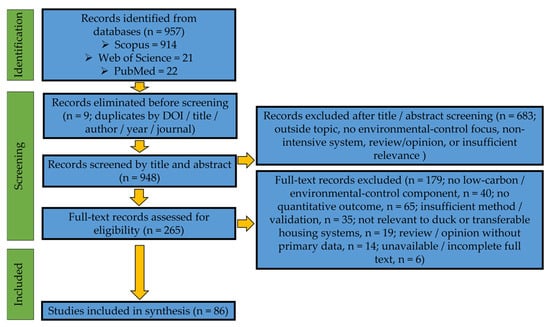
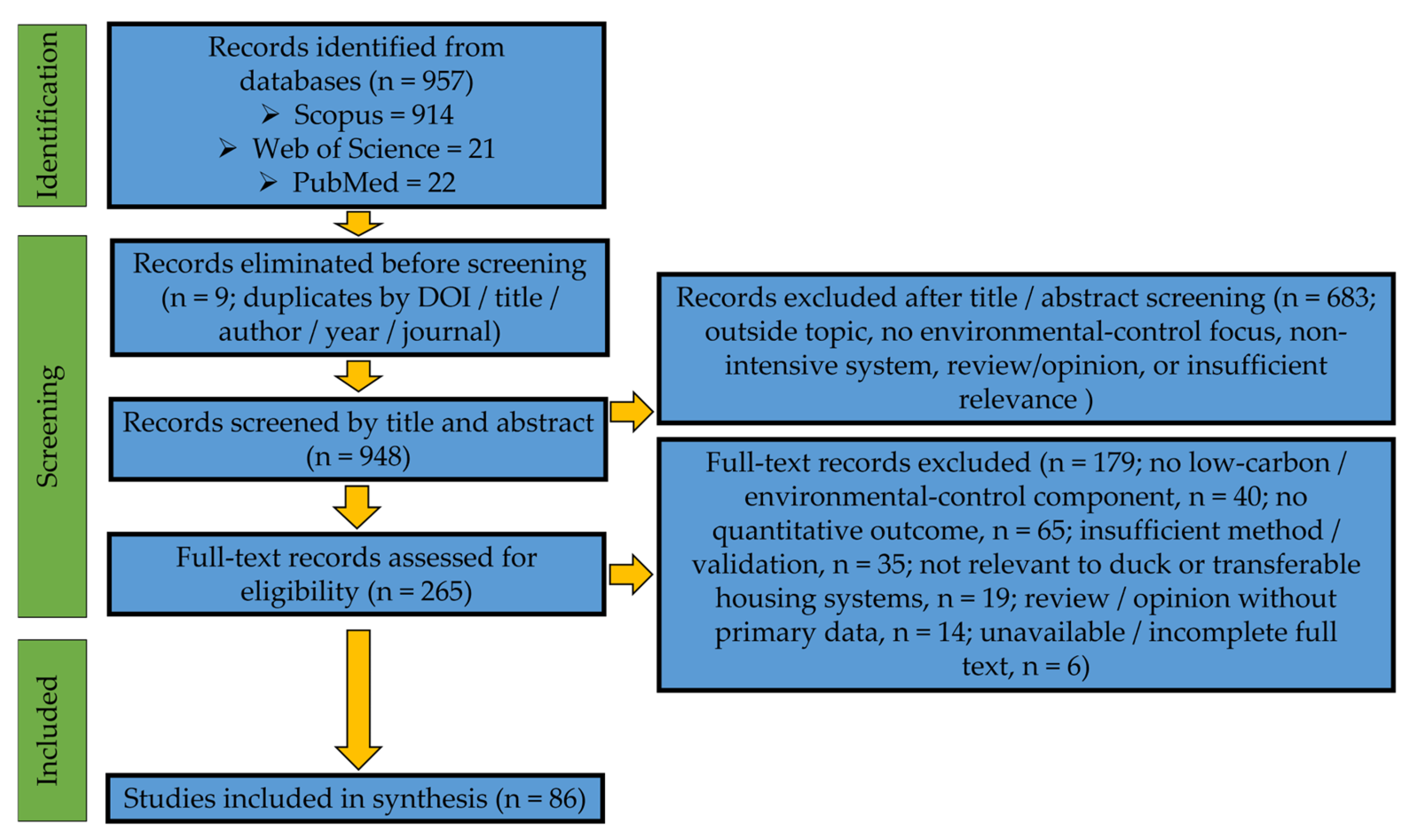
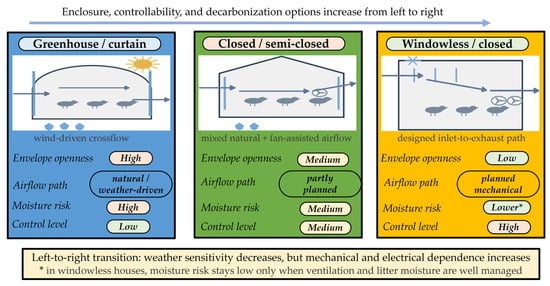
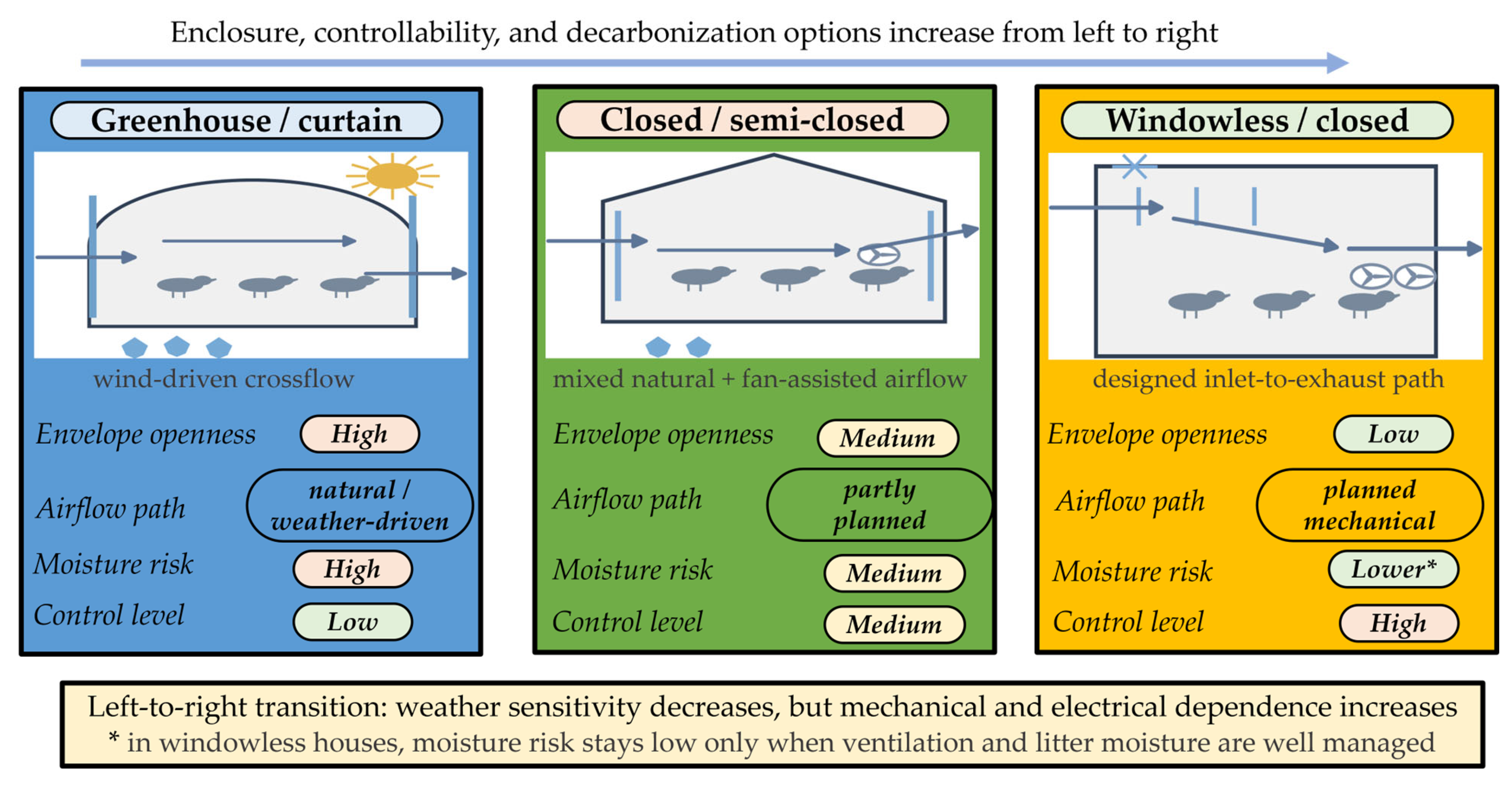
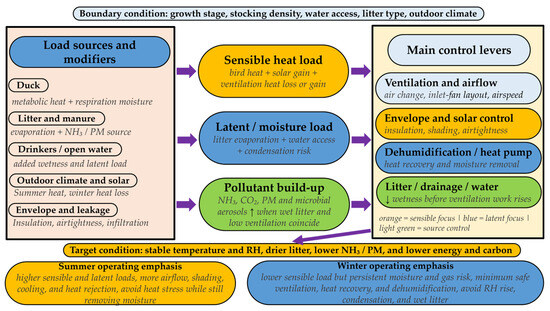
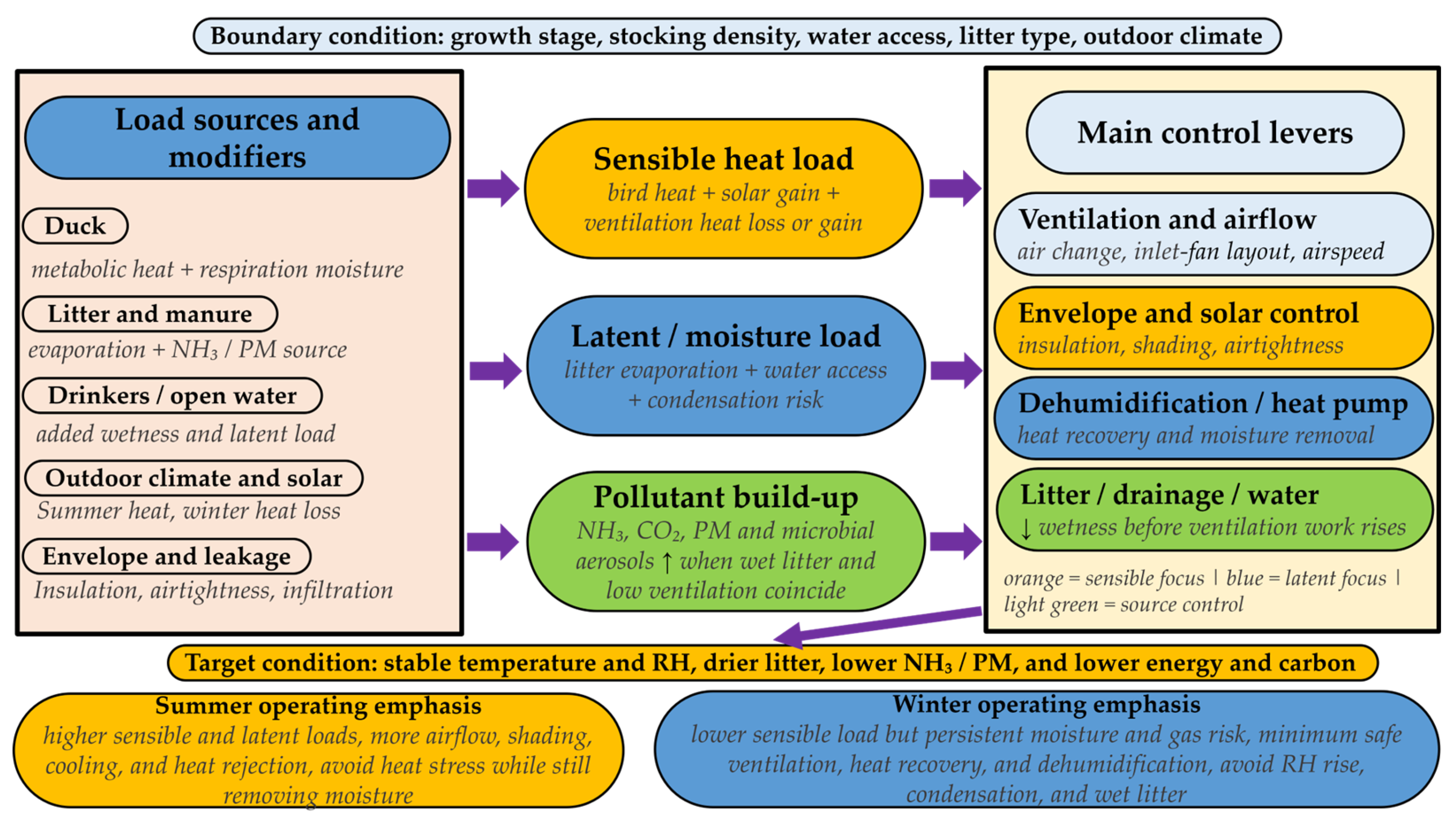
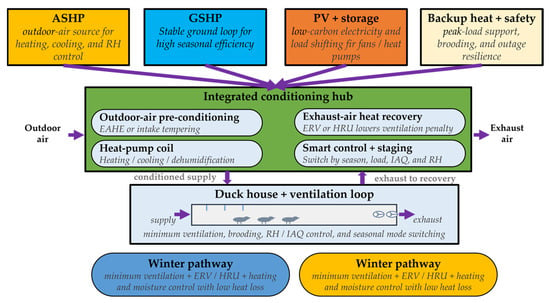
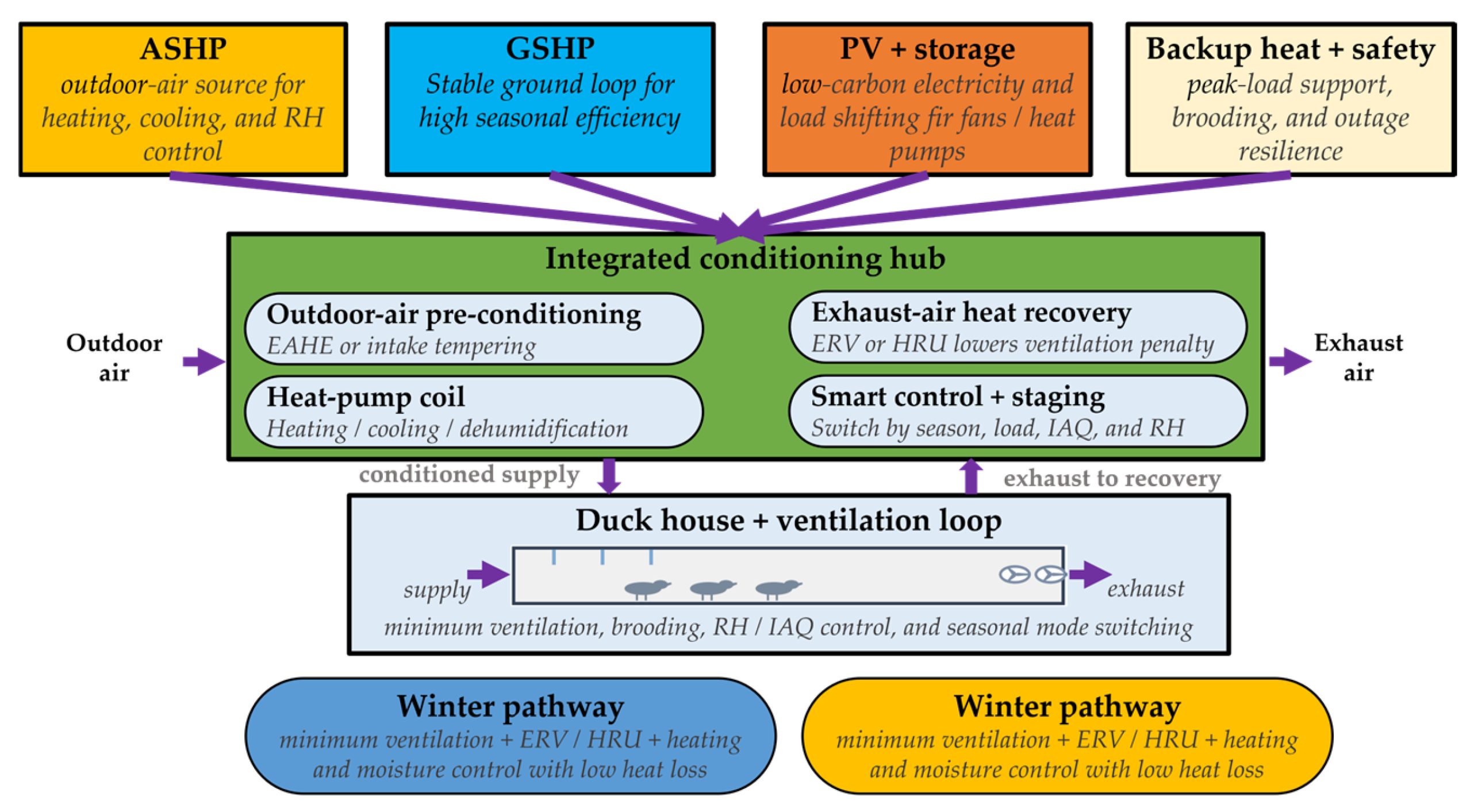
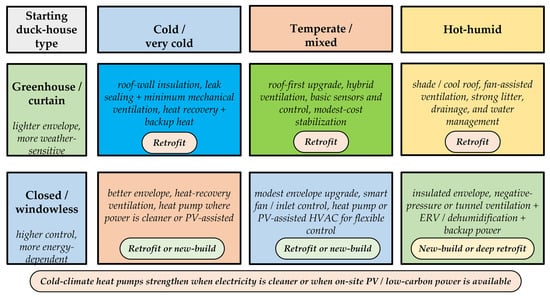
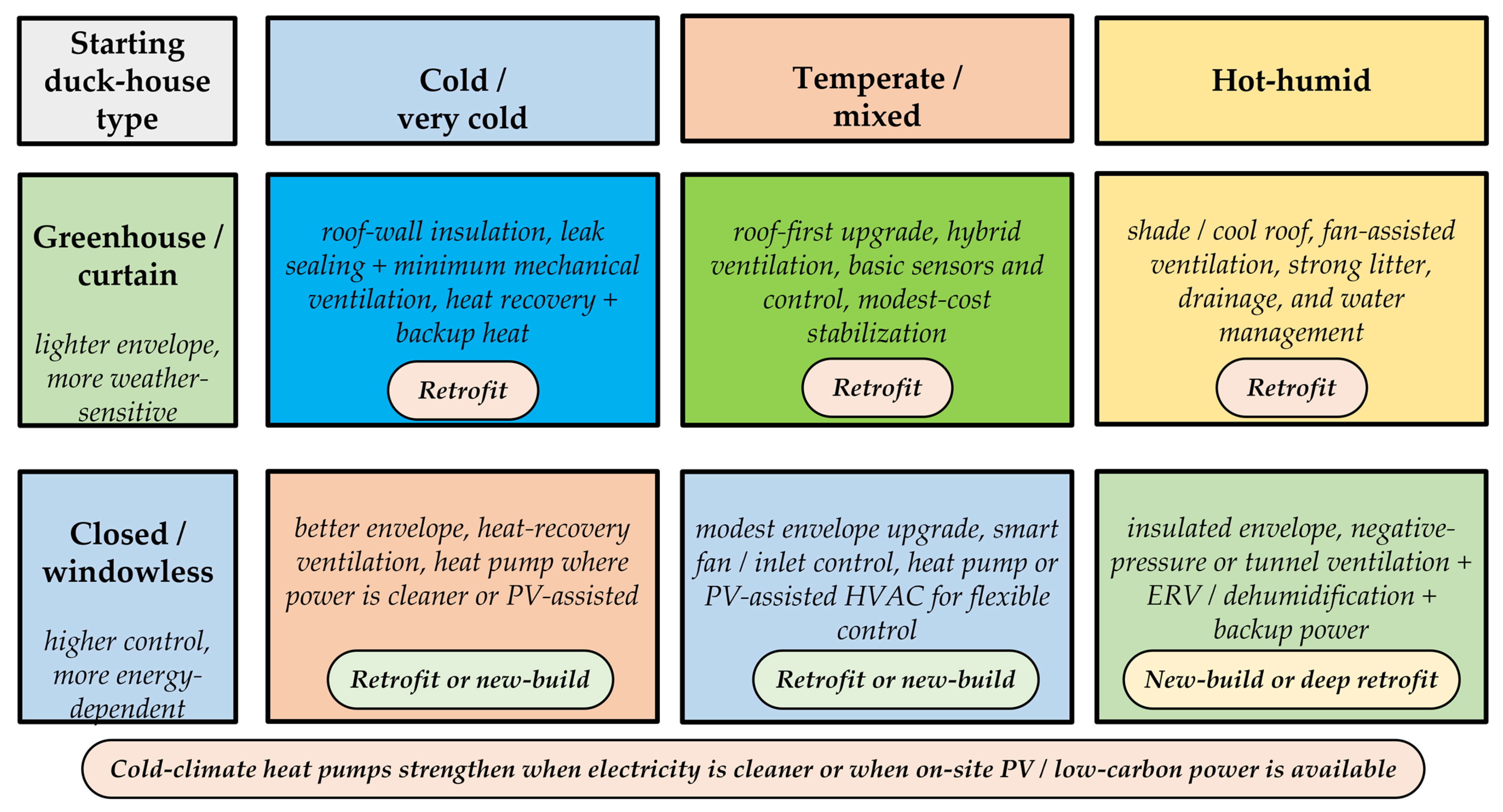
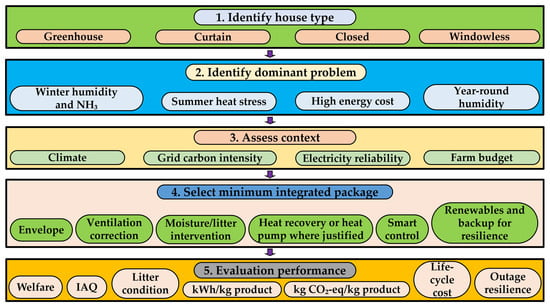
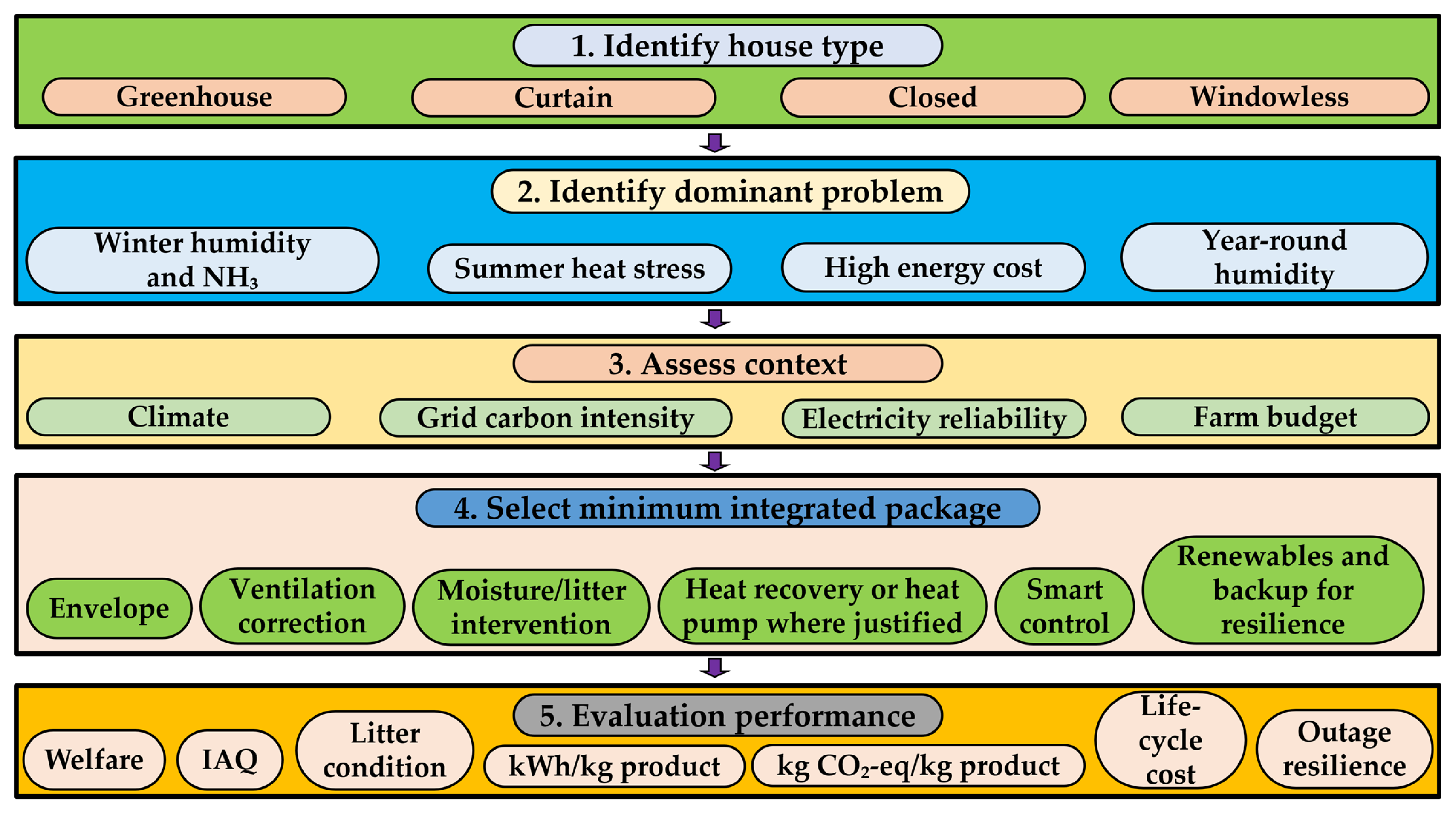
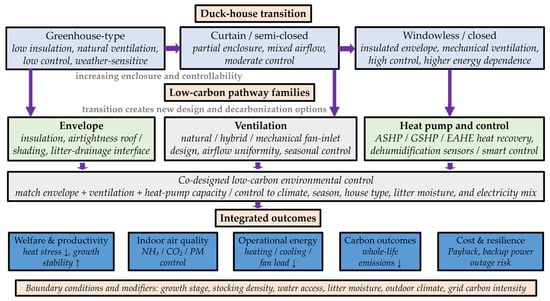
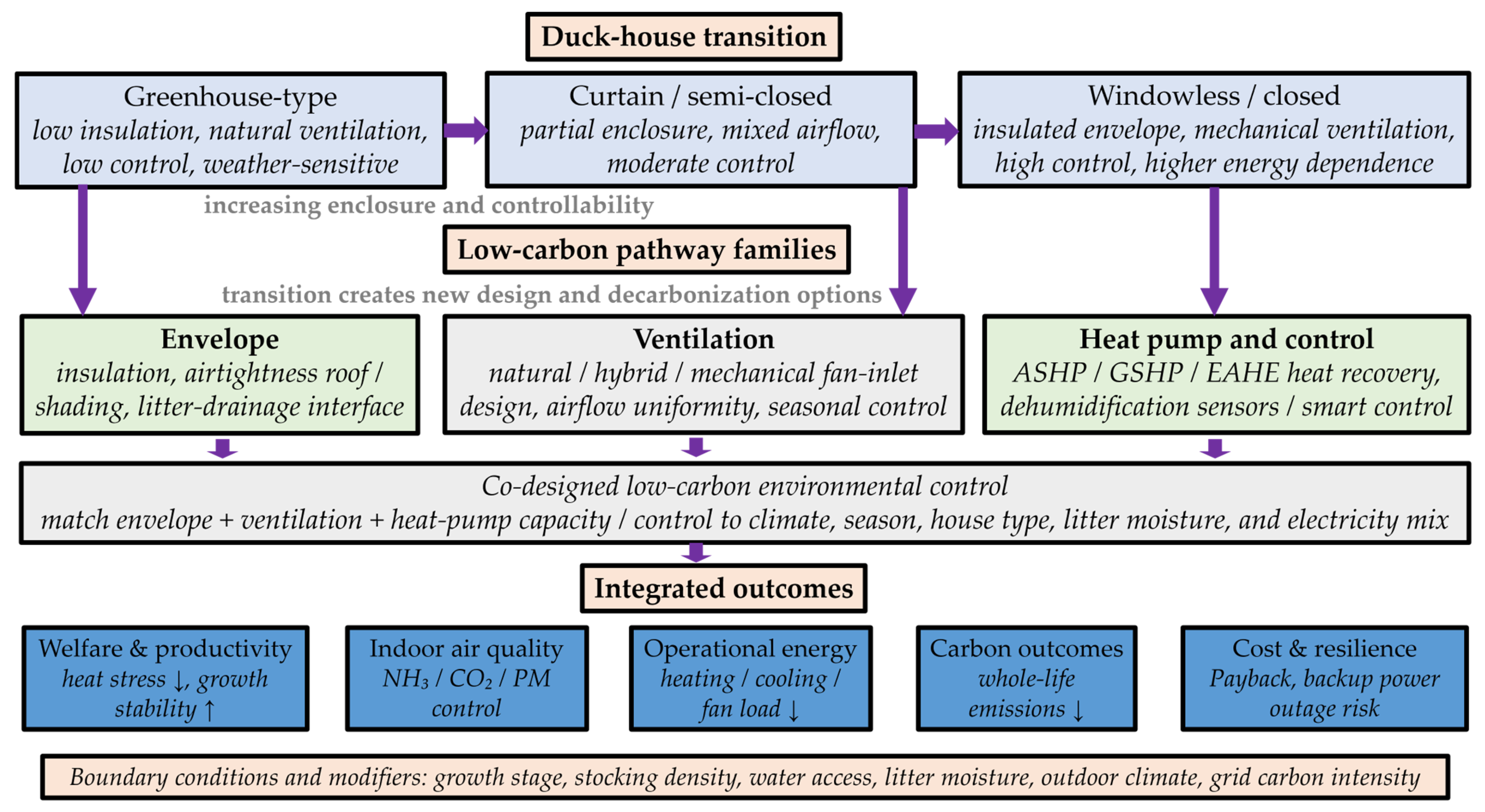

Disclaimer/Publisher’s Note: The statements, opinions and data contained in all publications are solely those of the individual author(s) and contributor(s) and not of MDPI and/or the editor(s). MDPI and/or the editor(s) disclaim responsibility for any injury to people or property resulting from any ideas, methods, instructions or products referred to in the content. |
© 2026 by the authors. Licensee MDPI, Basel, Switzerland. This article is an open access article distributed under the terms and conditions of the Creative Commons Attribution (CC BY) license.