


Abstract
Background: Postnatal bonding reflects the early emotional relationship between a mother and her infant and is shaped by psychological and perinatal factors. This study examined associations between postnatal bonding and maternal depressive symptoms, resilience, labor anxiety, and sociodemographic and health-related variables, as well as anxiety related to the COVID-19 pandemic, the war in Ukraine, and global events. Methods: This prospective cohort study included and followed 150 pregnant women in Poland from pregnancy to 12 months postpartum. Assessments were conducted during pregnancy and at 4–6 weeks, 6 months, and 12 months after delivery. Postnatal bonding was assessed using the PBQ, depressive symptoms with the EPDS, labor anxiety with the LAQ, resilience with the KOP-26, and anxiety related to external stressors with study-specific questionnaires. Non-parametric analyses were performed with a significance level of p < 0.05. Results: Postnatal bonding difficulties were most prevalent at 4–6 weeks postpartum (26.1%) and decreased over time. Maternal depressive symptoms showed the strongest and most consistent associations with bonding difficulties, whereas higher resilience, particularly in family relations and social competence, was associated with better bonding outcomes. Labor anxiety was weakly associated with bonding only in the early postpartum period, while no associations were found with sociodemographic characteristics or anxiety related to external societal stressors. Conclusions: Maternal depressive symptoms and resilience emerged as the key factors associated with postnatal bonding quality, highlighting their importance as targets for early identification and intervention.
1. Introduction
Pregnancy marks a transformative period in a woman’s life, characterized by significant hormonal, emotional, and social role changes [1]. Postnatal bonding (PB) describes the emotional connection between a mother and her infant, characterized by joy and fulfillment from their interactions. This bond fosters the infant’s emotional communication while enhancing the mother’s confidence, competence, and adaptability in meeting her child’s needs and embracing the maternal role [2]. An adequate mother–child bond constitutes a foundation for the child’s socio-emotional development and significantly influences maternal sensitivity, the effectiveness of parenting practices, and overall parental competence. In contrast, reduced maternal sensitivity and weaker bonding are associated with insecure attachment and an increased risk of depression, anxiety, and socio-emotional developmental disturbances [3,4].
The formation of PB is influenced by various demographic, perinatal, and psychological factors [5]. Among the demographic factors examined in research as potentially related to the formation of PB are maternal age, educational level, and birth order of the child [6,7,8,9]. Medical and obstetric factors are also significantly associated with the formation of maternal–infant bonding. Although pregnancy and delivery complications have been linked to disturbances in bonding, the available evidence remains inconclusive [5,7,8,10]. Breastfeeding and skin-to-skin contact are considered important factors supporting the establishment and strengthening of the maternal–infant bond, whereas the absence of breastfeeding or its early discontinuation may constitute a risk factor for persistent bonding difficulties [10,11]. Psychological aspects also play a crucial role. One of the key psychological factors associated with the formation of the mother–child bond is the presence and quality of partner support [12]. Partner support reduces stress levels in both the mother and the child after birth, whereas greater disappointment with the partner has been linked to weaker bonding with the child [13,14]. Support from the father also plays a significant role in the child’s psychosocial development at later stages of life [15]. These diverse factors highlight the multifaceted nature of the bonding process between mother and child.
Perinatal depression (PD), defined in the Diagnostic and Statistical Manual of Mental Disorders (DSM-5) as a depressive episode occurring during pregnancy or within four weeks postpartum, may weaken PB and hinder the establishment of an emotional connection with the child [16,17]. The mechanisms linking PD to bonding disturbances include reduced maternal sensitivity to fetal activity and early caregiving difficulties, such as problems with breastfeeding or excessive infant crying. These challenges may intensify depressive symptoms, creating a vicious cycle that further undermines maternal confidence and sensitivity toward the child [18,19]. Women experiencing postpartum depressive symptoms report lower satisfaction with motherhood, elevated stress levels, and pronounced discrepancies between prenatal expectations and postnatal reality [14].
Labor anxiety constitutes a distinct form of anxiety occurring during the perinatal period [20]. Factors contributing to negative subjective birth experiences, such as unforeseen medical complications, intense pain and loss of control, feelings of guilt, and the quality of intrapartum care, may indirectly increase maternal stress and anxiety and contribute to additional perinatal complications that are negatively associated with PB [21]. Moreover, elevated maternal anxiety during labor may disrupt early mother–infant interactions by reducing maternal sensitivity, thereby hindering the development of secure attachment and effective bonding processes [22].
Resilience is the ability to adapt positively and to maintain or regain mental health despite adversity, shaped by the interplay of personal, biological, and environmental factors [23]. During the perinatal period, resilience serves as a protective function and acts as a key intrapersonal regulatory mechanism supporting the stabilization of maternal emotions in challenging situations [24,25]. It also mediates the relationship between maternal attachment styles and mother–infant bonding, thereby facilitating the formation of secure emotional connections. Mothers with higher levels of resilience demonstrate a greater capacity to establish strong and enduring bonds with their infants [26].
In addition to individual stressors examined in previous studies, the potential role of macro-social, external stressors in the psychological functioning of women during the perinatal period should also be considered, as these affect entire societies. In Poland, recent years have seen significant stressors, including the COVID-19 pandemic and the outbreak of war in neighboring Ukraine. The COVID-19 pandemic significantly disrupted pregnancy and the postpartum period through restrictions in obstetric care, reduced access to support, increased social isolation, and heightened anxiety related to the risk of infection, which together contributed to poorer maternal mental health and a higher prevalence of perinatal depression [27,28,29]. Although no significant differences in PB disturbances were observed before and during the pandemic, elevated levels of depression and anxiety suggest a possible indirect adverse effect of the pandemic on the development of the mother–child relationship [30,31,32]. Research on mother–child relationships has been conducted predominantly under peaceful conditions. Although Poland is not directly affected by armed conflict, as a country neighboring the war in Ukraine, it faces significant economic, social, and psychological consequences [33]. Ongoing exposure to war-related information, involvement in humanitarian aid for refugees, and rising inflation contribute to heightened uncertainty, anxiety, and psychological burden. Recent studies indicate increased levels of anxiety and depression in the general population; however, research focusing on the mental health of perinatal women in this context remains limited, particularly regarding the impact of war-related stress on PB [34].
This study aimed to examine the relationships between PB and selected factors, including resilience, perinatal depression, labor anxiety and sociodemographic and health-related variables. Additionally, the study sought to explore associations between anxiety related to the COVID-19 pandemic and the economic situation in Poland and the quality of PB. It was hypothesized that higher levels of stress related to the COVID-19 pandemic, war, and economic crisis, as well as lower resilience, higher levels of depressiveness, and greater childbirth anxiety would be associated with lower PB quality.
2. Material and Methods
2.1. Design and Population
This prospective cohort study was conducted in two phases among the perinatal population in Poland. The first phase was carried out between 17 February 2021 and 25 November 2021 during the COVID-19 pandemic, while the second phase took place from 2 June 2022 to 11 April 2023, amidst economic instability and geopolitical tensions resulting from the armed conflict in Ukraine. Participation in the study was voluntary, and inclusion criteria required participants to be pregnant when completing the survey. Out of all the pregnant Polish women who took part in the first and second stages of the study, the present analyses included only participants who completed at least one later postpartum assessment (6 and/or 12 months postpartum).
All participants were informed about the study’s objectives and the principles of confidentiality regarding the use of the collected data. Informed electronic consent was obtained before participants completed the online questionnaires. The surveys were administered online using Google Forms. Postpartum assessments were distributed within several days of the target time points corresponding to approximately 4–6 weeks, 6 months, and 12 months after delivery. Responses across time points were linked using participants’ email addresses provided at enrollment and subsequently pseudonymized to ensure confidentiality. They were also informed of their right to withdraw from the study at any time. Recruitment was conducted through social media, parenting portals, and leaflets distributed in obstetrics and gynecology clinics.
The study received ethical approval from the Bioethics Committee of the Medical University of Lodz (No. RNN/39/21/KE, 9 February 2021). To ensure participant privacy, all personal data were pseudonymized. The manuscript has been prepared according to the STROBE State [35].
Due to participant attrition and incomplete follow-up across study phases, the number of participants contributing PBQ data varied between assessment points. Initially, 150 women were enrolled in the study, of whom PBQ data were available for 92 participants at T3, 110 participants at T4, and 115 participants at T5. Detailed information on participant flow and attrition across assessment points is presented in Supplementary Table S1. Baseline comparisons between completers and non-completers are shown in Supplementary Table S2. Significant differences were observed in previous psychiatric treatment history (χ2 = 7.480, p = 0.006), with a higher proportion of prior treatment among completers. In addition, PBQ scores at T4 differed significantly between groups (U = 825.0, Z = 2.325, p = 0.020), whereas no other sociodemographic, clinical, or psychological variables showed significant differences.
2.2. Methods
Several standardized and study-specific instruments were used to assess psychological variables relevant to the study objectives.
The Postpartum Bonding Questionnaire (PBQ) developed by I. F. Brockington served as the primary measure of the parent–infant relationship, with a specific focus on identifying potential bonding difficulties during the postpartum period. The instrument was originally designed for use alongside the Edinburgh Postnatal Depression Scale as a screening tool to facilitate the early identification of mother–infant bonding disorders. This 25-item tool comprises four subscales: mother–infant relationship disorders, rejection and pathological anger, infant-focused anxiety, and incipient abuse. Each item is rated on a 6-point Likert scale ranging from “always” to “never”, yielding a total score from 0 to 125, with higher scores indicating greater bonding difficulties. The cumulative total score is used to screen for general bonding disorders (cut-off ≥ 26) and severe bonding disturbances (cut-off ≥40), and cut-off scores have also been proposed for each subscale [36,37].
Other psychological constructs were assessed using additional measures. The Edinburgh Postnatal Depression Scale (EPDS) evaluated depressive symptoms during pregnancy and postpartum. The Labor Anxiety Questionnaire (LAQ) measured childbirth-related anxiety, and the Resilience Measure Questionnaire (KOP-26) assessed resilience across family, personal, and social domains. Furthermore, original tools were developed for this study: the COVID-19 Pandemic-Related Anxiety Questionnaire (CRAQ), administered in the first phase, and the Global Situation Anxiety Questionnaire (GSAQ) and War Anxiety Questionnaire (WAQ), both used in the second phase to examine anxiety in response to societal and geopolitical stressors. The development of these instruments was informed by a review of the relevant literature and clinical experience, with items designed to capture context-specific anxiety symptoms. The full item content of the CRAQ, GSAQ, and WAQ, along with scoring procedures, is provided in the Supplementary Material. The internal consistency of the scales was assessed using Cronbach’s alpha coefficients, which indicated acceptable reliability (see Supplementary Material). However, formal psychometric validation procedures, such as factor analysis or external validation against established measures, have not yet been conducted. Therefore, findings based on these instruments should be interpreted as exploratory.
Data were collected at five time points: T1 (<33 weeks of gestation), T2 (33–37 weeks of gestation), T3 (4 weeks postpartum), T4 (6 months postpartum), and T5 (12 months postpartum). Information on the questionnaires and scales administered at each time point is provided in Table 1.
Table 1.
Description of time points and measurement tools used in the study.
2.3. Data Analysis
Statistical analyses were performed using STATISTICA 13.1 (TIBCO Software Inc., Palo Alto, CA, USA). For continuous variables, descriptive statistics were calculated, including mean, standard deviation, and minimum and maximum values. Discrete variables were described using counts and percentages. The Shapiro–Wilk test was applied to assess the normality of distribution. The Mann–Whitney U test and the Kruskal–Wallis test were used for intergroup comparisons. Differences in psychometric scores between two time points were assessed with the Wilcoxon signed-rank test, and for multiple time points with the Friedman test. Associations between psychometric scores and sociodemographic or clinical variables were analyzed using Spearman’s rank correlation coefficients.
In addition, multiple linear regression models were constructed to examine independent predictors of PBQ scores at postpartum time points. Maternal depressive symptoms (EPDS), resilience (KOP-26), and labor anxiety (LAQ) were included as primary predictors, along with maternal age, parity, education level, and history of psychiatric treatment as covariates. Regression assumptions were evaluated using residual diagnostics to confirm linearity, homoscedasticity, and normality. Analyses were conducted using complete-case data, and no imputation of missing values was performed.
Furthermore, to analyze longitudinal changes in maternal–infant bonding and identify significant predictors across repeated postpartum measurements, a Generalized Estimating Equation (GEE) model with a Poisson distribution and an exchangeable correlation structure was employed. The GEE analysis was performed using Python (version 3.10) with the statsmodels library.
A significance level of p < 0.05 was adopted.
3. Results
3.1. Sample Characteristics
The study group comprised 150 pregnant Polish women who met the inclusion criteria. Most participants reported higher education (91%), defined as completed university-level education, and 63% resided in urban areas with populations over 100,000. At the time of the study, 51% of respondents were nulliparous. Pregnancy complications were reported by 23% of participants, and 32% indicated a history of psychiatric treatment. Detailed demographic data are presented in the Supplementary Table S7.
EPDS scores showed a peak in depressive symptoms (EPDS ≥ 14) at 4–6 weeks postpartum in 30% of participants, decreasing to 11% after one year. Childbirth-related anxiety was reported by 51% of women before 33 weeks’ gestation. Additionally, 23% reported significant anxiety related to the ongoing war, and 22% expressed considerable anxiety about global geopolitical issues. At least moderate anxiety related to the COVID-19 pandemic was observed in 56% of participants. Detailed depression and anxiety data are shown in the Supplementary Table S8.
An analysis of resilience revealed that 53% of participants demonstrated low overall resilience. Detailed results, including resilience subscales scores, are presented in the Supplementary Table S9.
3.2. Postnatal Bonding
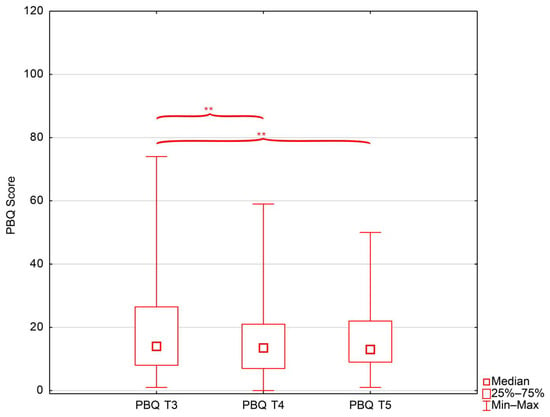
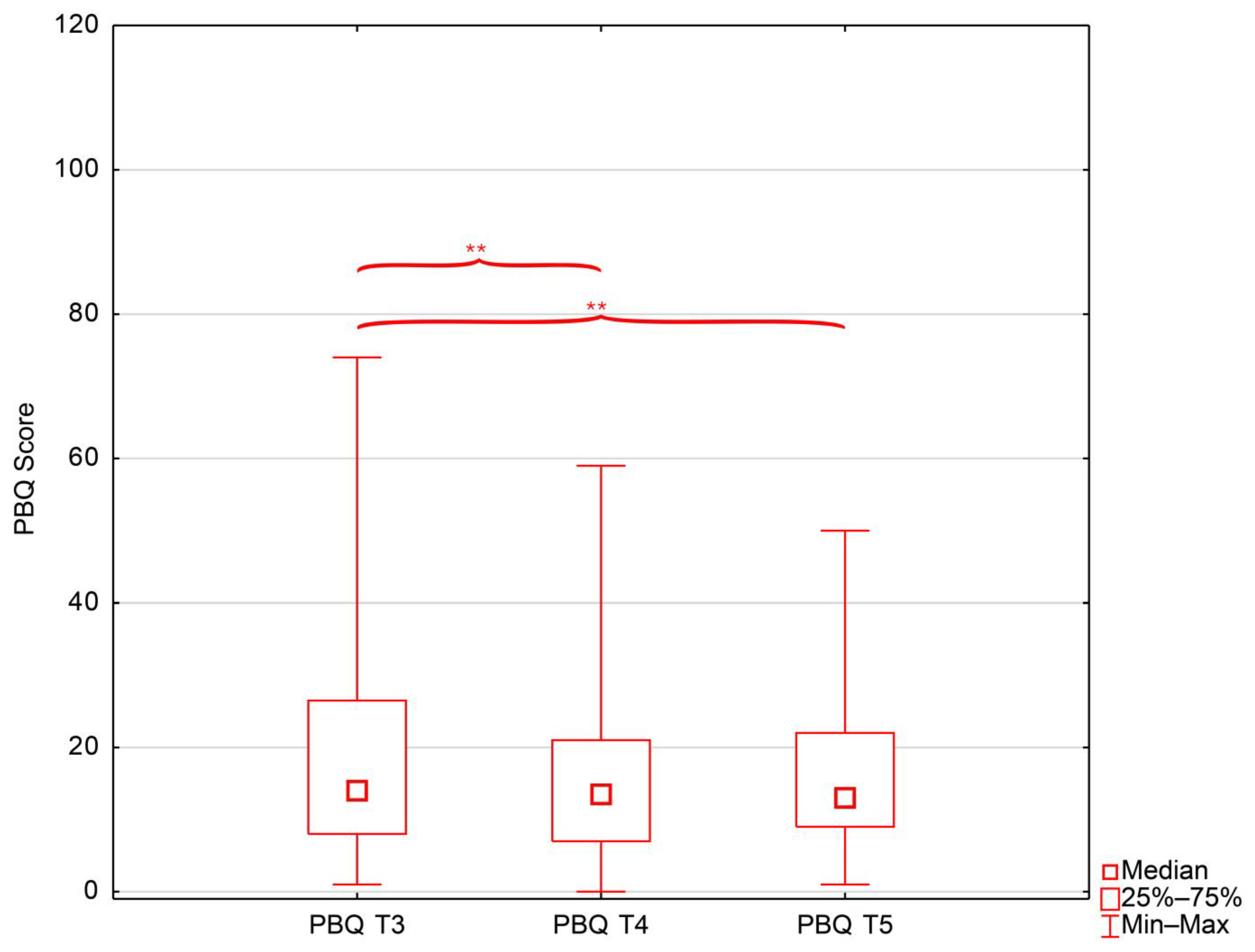
Postnatal bonding difficulties were most pronounced at 4–6 weeks postpartum, with 26.1% of mothers scoring in the impaired (PBQ ≥ 26) or severely impaired (PBQ ≥ 40) range; this proportion declined to 14.5% at 6 months and 15.6% at 12 months. A comparison of PBQ scores across time points showed significant differences (Friedman test: (χ2 (2) = 14.55, p < 0.001; W = 0.12), with mean ranks decreasing from 2.37 at 4–6 weeks postpartum to 1.91 at 6 months and 1.72 at 12 months (Figure 1). Pairwise analyses confirmed significant reductions in PBQ scores between 4 and 6 weeks and 6 months (n = 79, T = 964.5; Z = 3.01; p = 0.003) and between 4 and 6 weeks and 12 months (n = 66, T = 691.0; Z = 2.65; p = 0.008), while the difference between 6 and 12 months was not significant (n = 72, T = 1213.0; Z = 0.57; p = 0.571).
Figure 1.
Boxplot illustrating changes in postpartum bonding across time points postpartum. Abbreviations: PBQ—Postpartum Bonding Questionnaire; T3—4–6 weeks postpartum; T4—6 months postpartum; T5—12 months postpartum; **—statistical significance (p < 0.05).
Difficulties were mainly reflected in the mother–infant relationship disorders subscale, whereas scores for rejection/pathological anger and infant-focused anxiety remained consistently low; indicators of incipient abuse were virtually absent at all time points. Detailed results by time point and subscale are presented in Table 2.
Table 2.
Descriptive statistics of the Postpartum Bonding Questionnaire (PBQ) total and subscale scores across postpartum time points.
PBQ scores showed no associations with anxiety related to war, global events, or the COVID-19 pandemic at any measurement point. At 4–6 weeks postpartum, PBQ showed a weak positive correlation with labor anxiety reported before 33 weeks of gestation and a moderate positive correlation with labor anxiety reported between 33 and 37 weeks; no significant associations were observed at later postpartum assessments. Resilience was consistently negatively associated with PBQ. The overall KOP-26 score demonstrated weak-to-moderate inverse correlations with PBQ at all postpartum assessments. Among the subscales, family relations showed the strongest and most stable associations. Depressive symptoms exhibited strong and consistent associations with PBQ. EPDS scores collected during pregnancy (T1–T2) demonstrated weak-to-moderate positive correlations with PBQ at 4–6 weeks postpartum, with only the T2 assessment remaining weakly associated at 6 months. Postpartum EPDS scores (T3–T5) were moderately and positively correlated with PBQ at all corresponding time points. No consistent associations were observed between EPDS scores and parity or mode of delivery across the assessed time points. Detailed correlation coefficients are presented in Table 3.
Table 3.
Correlations between postpartum bonding and psychological factors.
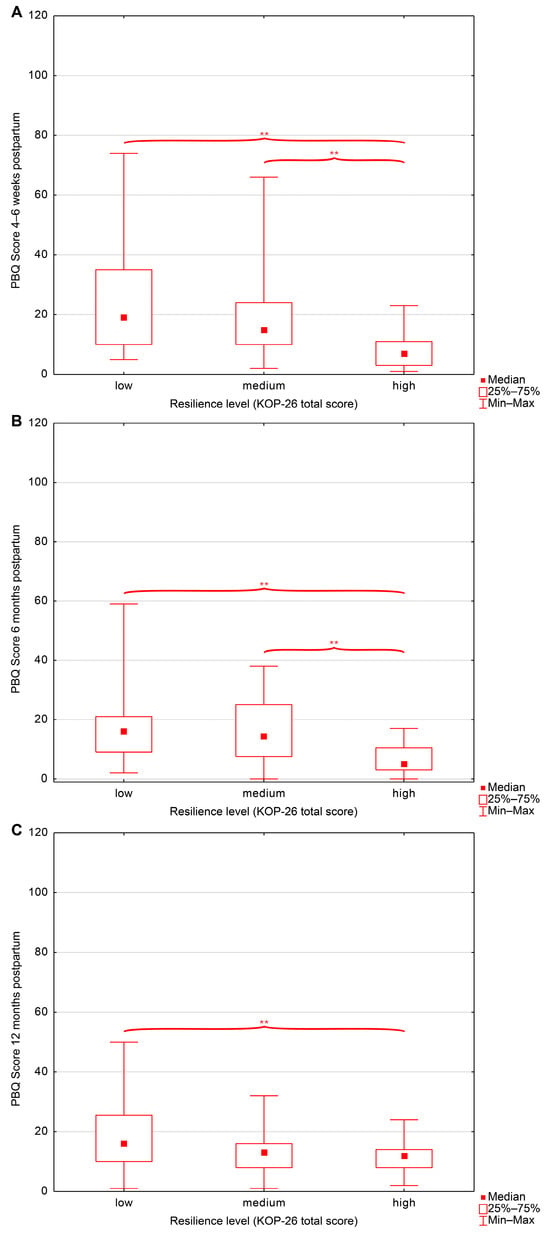
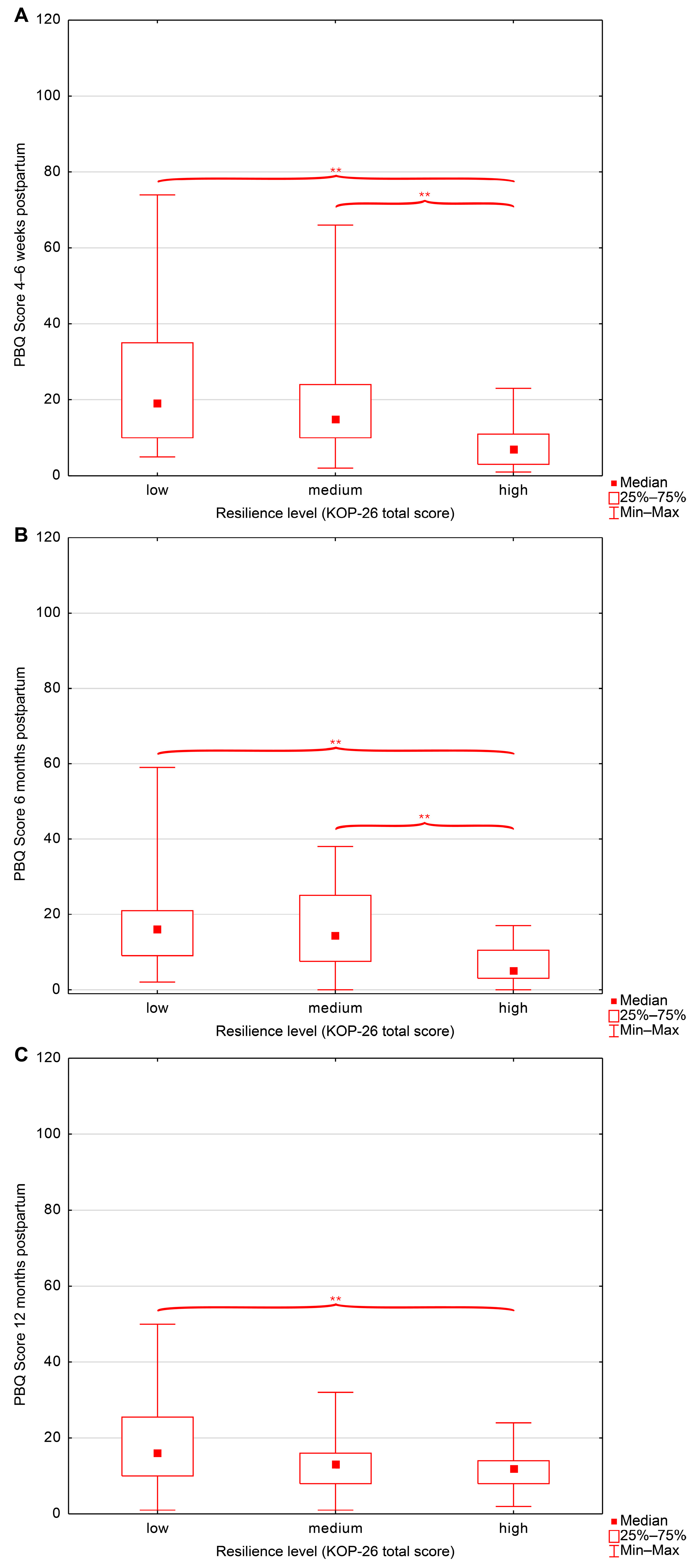
In contrast, group comparisons across overall resilience levels (low, medium, high) and resilience subscales revealed significant differences in PBQ scores at all postpartum time points (Table 4, Figure 2).
Table 4.
Group comparisons of Postpartum Bonding Questionnaire (PBQ) scores across levels of resilience (KOP-26) at postpartum time points.
Figure 2.
Postpartum Bonding Questionnaire (PBQ) scores across resilience levels (KOP-26) at (A) 4–6 weeks postpartum, (B) 6 months postpartum, and (C) 12 months postpartum. Abbreviations: PBQ—Postpartum Bonding Questionnaire, KOP26—Resilience Measure Questionnaire; **—statistical significance (p < 0.05).
Across all postpartum assessments, women with high overall resilience consistently reported fewer postnatal bonding difficulties than those with low or moderate resilience. At 4 weeks postpartum, PBQ scores were the lowest in the high-resilience group compared with both the low- and moderate-resilience groups. A similar pattern was observed at 6 months postpartum, with lower PBQ scores in the high-resilience group relative to the low- and moderate-resilience groups. At 12 months postpartum, PBQ scores remained significantly lower among women with high resilience compared with those with low resilience. Comparable patterns were observed for the family relations subscale. Women with high family-related resilience exhibited lower PBQ scores at 4 weeks postpartum than those with low or moderate resilience, and this effect persisted at 6 months postpartum. At 12 months postpartum, PBQ scores in the high-resilience group remained lower than those in the moderate-resilience group. In contrast, the personal competence subscale differentiated PBQ scores only at 6 months postpartum, with lower scores observed in the high-resilience group compared with both the low- and moderate-resilience groups. Social competence showed a broader pattern: at 6 months postpartum, PBQ scores were lower in the high-resilience group than in the low-resilience group, whereas at 12 months postpartum, PBQ scores were significantly lower in both the high- and moderate-resilience groups compared with the low-resilience group.
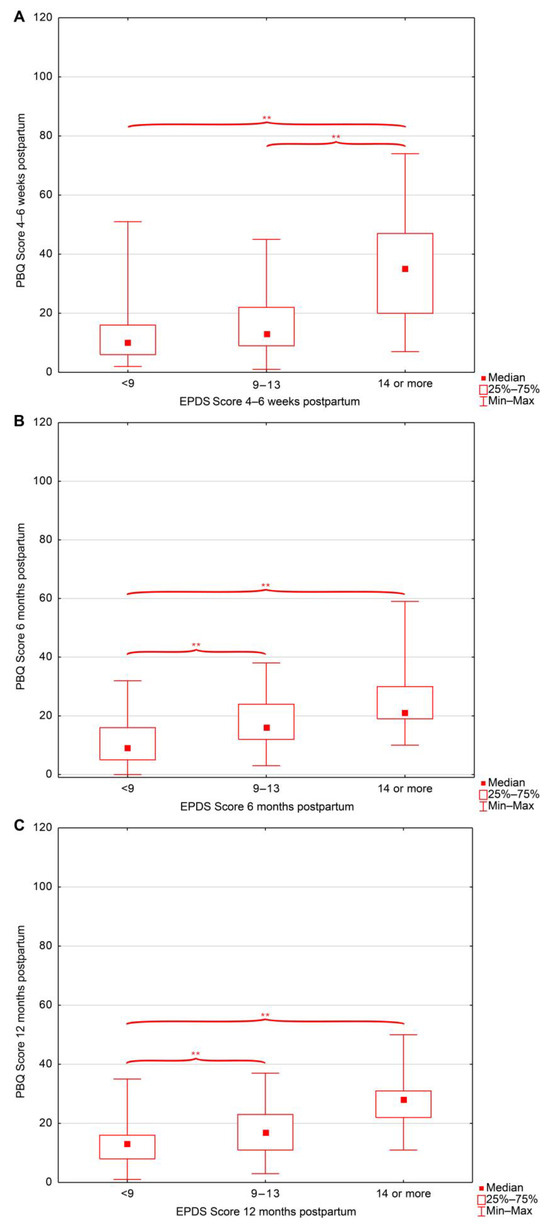
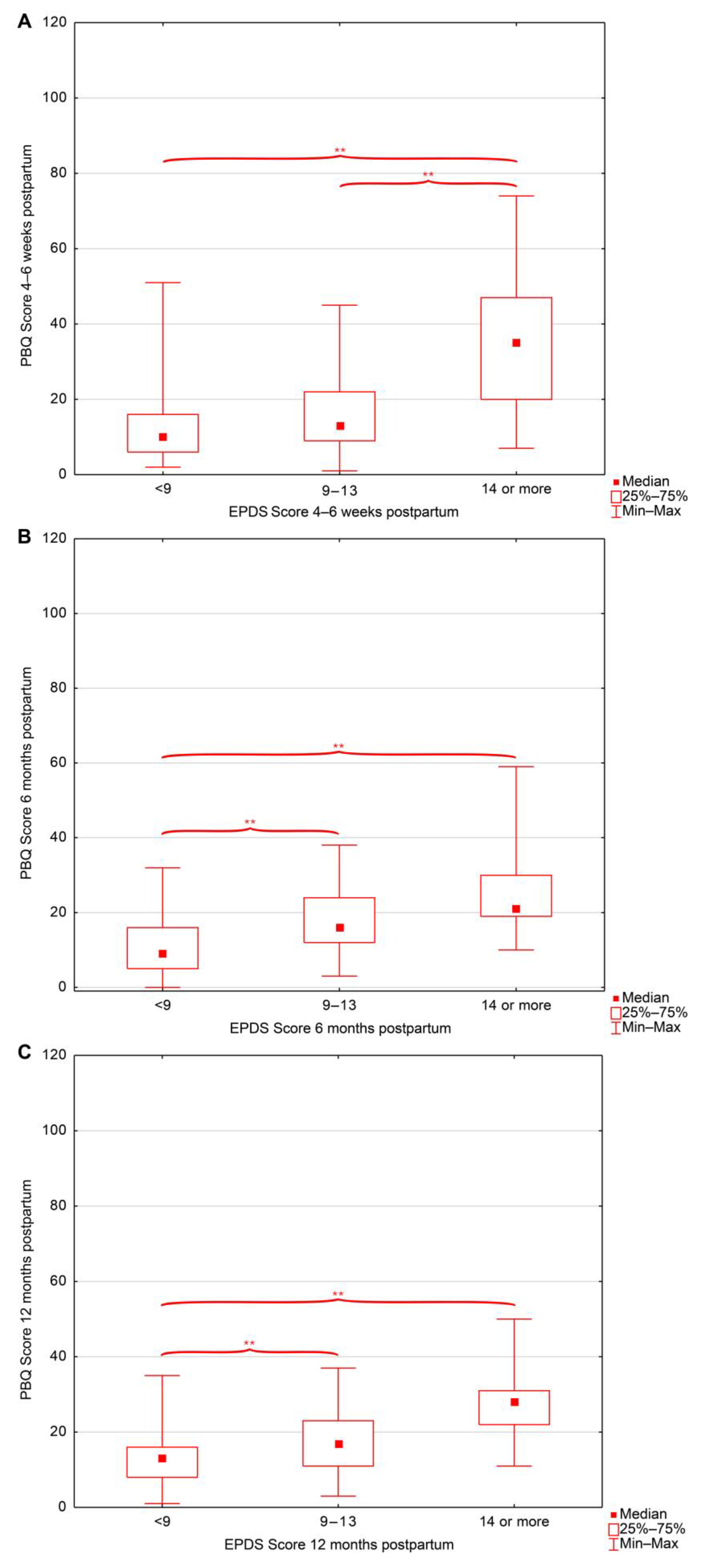
With respect to the severity of depressive symptoms assessed using the EPDS, significant differences in PBQ scores were observed depending on the timing of EPDS assessment (Table 5, Figure 3).
Table 5.
Group comparisons of Postpartum Bonding Questionnaire (PBQ) scores across levels of depressive symptoms (EPDS) at postpartum time points.
Figure 3.
Postpartum Bonding Questionnaire (PBQ) scores across depressive symptom levels (EPDS) at (A) 4–6 weeks postpartum, (B) 6 months postpartum, and (C) 12 months postpartum. Abbreviations: PBQ—Postpartum Bonding Questionnaire, EPDS—the Edinburgh Postnatal Depression Scale; **—statistical significance (p < 0.05).
Group comparisons based on depressive symptom severity, classified according to EPDS scores (low: <9, moderate: 9–13, high: ≥14), revealed consistent differences in postnatal bonding across postpartum assessments. When depressive symptoms were assessed between 33 and 37 weeks of gestation, women with low depressive symptoms reported significantly lower PBQ scores at 4–6 weeks postpartum compared with those with high depressive symptoms. Depressive symptoms measured at 4–6 weeks postpartum showed the most stable pattern of associations. At this time point, women with low depressive symptoms exhibited lower PBQ scores than those with high symptom severity, while women with moderate symptoms also reported significantly fewer bonding difficulties than those with high depressive symptoms. These group differences persisted at both 6 and 12 months postpartum. A similar pattern emerged when depressive symptoms were assessed at 6 months postpartum. Lower PBQ scores at 4–6 weeks postpartum were observed among women with low depressive symptoms compared with those with high symptoms. At 6 and 12 months postpartum, women with low depressive symptoms reported significantly fewer bonding difficulties than both the high- and moderate-depression groups. Finally, depressive symptoms assessed at 12 months postpartum were also associated with concurrent and earlier bonding outcomes. At both 6 and 12 months postpartum, women with low depressive symptoms demonstrated significantly lower PBQ scores compared with those reporting high depressive symptom severity, while differences between the low- and moderate-depression groups were additionally observed at 12 months postpartum.
Multiple regression analyses were performed to identify predictors of bonding difficulties (PBQ) at three time points (T3, T4, and T5). The regression assumptions were satisfied, with residual analysis confirming linearity, homoscedasticity, and normality. No data imputation was utilized. In all models, maternal depressive symptoms measured at T3 (EPDS T3) emerged as the most consistent and significant predictor of bonding quality. At T3 (n = 92), the model was statistically significant (F(10, 38) = 3.388, p = 0.003) and accounted for 33.2% of the variance (Adjusted R2 = 0.332). The only significant predictor was the EPDS T3 score (B = 1.187; 95% CI [0.533, 1.841]; p < 0.001). At T4 (n = 110), the model remained significant (F(10, 73) = 2.707, p = 0.007), explaining 17.1% of the variance (Adjusted R2 = 0.171). Beyond the continued impact of depressive symptoms (B = 0.721; 95% CI [0.335, 1.107]; p < 0.001), parity was found to be a significant factor. Specifically, women in their third pregnancy (B = −6.904; 95% CI [−13.636, −0.172]; p = 0.045) and fourth pregnancy (B = −11.942; 95% CI [−23.365, −0.519]; p = 0.041) reported significantly lower PBQ scores compared to the reference group. At T5 (n = 115), the model was also significant (F(10, 69) = 2.796, p = 0.006), with an Adjusted R2 of 0.185. Similar to previous time points, the EPDS T3 score was the significant predictor of bonding (B = 0.707; 95% CI [0.380, 1.035]; p < 0.001). Other variables, including age, education, previous psychiatric treatment, perinatal anxiety, and resilience, did not reach statistical significance in any of the analyzed models. Detailed results for each model are presented in the Supplementary Material (Tables S10–S12).
The Generalized Estimating Equation (GEE) analysis revealed a significant temporal improvement in bonding, with Postpartum Bonding Questionnaire (PBQ) scores decreasing significantly at T4 (β = −0.21; 95% CI: −0.35 to −0.07; p = 0.003) and T5 (β = −0.28; 95% CI: −0.43 to −0.12; p < 0.001) relative to T3 baseline. Multivariable analysis identified several critical predictors of bonding quality. Postnatal depression (EPDS at T3) was strongly associated with higher PBQ scores, indicating poorer bonding across all time points (β = 0.05; 95% CI: 0.03 to 0.07; p < 0.001). Conversely, higher levels of maternal resilience (KOP-26) were associated with significantly better bonding outcomes (β = −0.01; 95% CI: −0.01 to −0.002; p = 0.012). Furthermore, mothers in their subsequent pregnancies exhibited significantly lower PBQ scores compared to those with first pregnancy (β = −0.28; 95% CI: −0.50 to −0.07; p = 0.011). Demographic factors, including age and education level, did not significantly contribute to the model. A parsimonious model was also tested (QIC = 2311.2), and the primary predictors remained stable and significant; however, the full adjusted model (QIC = 2318.4) is presented here for clinical transparency (Tables S13 and S14).
4. Discussion
Perinatal bonding difficulties constitute a clinically relevant phenomenon observed across diverse populations. Previous research indicates that impairments in the maternal–infant bond are most common in the early postnatal period, with prevalence estimates ranging from approximately 6% to 41% of mother–infant dyads, depending on assessment timing and measurement criteria [38]. The COVID-19 pandemic introduced additional stressors associated with an increased risk of bonding difficulties; during this period, impaired mother–infant bonding, as measured by PBQ total scores, was reported in 13.4% of mothers, including severe disturbances in 3.6% [39,40]. Evidence regarding bonding in the context of armed conflict remains limited, although exposure to war has been shown to disrupt early bonding processes [41]. To date, studies directly comparing the prevalence of perinatal bonding difficulties in Poland across pre-pandemic, pandemic, and war-related periods are lacking, representing an important gap in the literature.
In the present study, postnatal bonding difficulties were most pronounced in the early postpartum period, particularly at 4–6 weeks after birth, affecting approximately one-quarter of mothers, and declined at 6 and 12 months postpartum. This pattern is consistent with evidence indicating that bonding disturbances are most common shortly after childbirth and tend to attenuate over time [42,43]. In line with this pattern, longitudinal evidence suggests a progressive decline in at-risk bonding across the postpartum period, whereas difficulties persisting beyond mid-infancy may be associated with later disturbances in the mother–child relationship [44,45].
Interestingly, no significant associations were observed between postnatal bonding and sociodemographic or clinical characteristics, including maternal age, education, place of residence, pregnancy complications, psychiatric treatment history, mode of delivery, or infant feeding method. Parity was the only exception, emerging as a significant predictor in the longitudinal GEE model, with mothers in subsequent pregnancies showing lower PBQ scores compared to first-time mothers. This finding contrasts with previous studies that have identified specific demographic or obstetric risk factors for impaired mother–infant bonding [6,7,8,10]. However, the existing literature remains inconsistent, with several studies similarly reporting no associations with age, feeding practices, or delivery mode, and mixed evidence regarding parity and birth experience [8,46,47,48,49]. The impact of sociodemographic and environmental factors on perinatal bonding therefore remains unclear. One possible explanation for the absence of significant associations in the present study is the prominent role of maternal mental health, as elevated depressive symptoms, which are known to be associated with difficulties in the mother–infant relationship and were prevalent in the studied cohort, may have been more salient than sociodemographic or obstetric characteristics.
In this context, postpartum depression emerges as a well-established risk factor for difficulties in the mother–infant bond, particularly during periods of heightened psychosocial stress [31,50]. Evidence from multiple populations, including Polish samples assessed shortly after delivery, indicates that higher levels of maternal depressive symptoms, especially when severe, are consistently associated with greater bonding difficulties [38,51,52]. Accordingly, the association between EPDS scores and postnatal bonding observed in the present study reflects a robust and widely replicated pattern. Depressive symptoms such as low mood, reduced energy, and feelings of guilt or low self-esteem may interfere with sensitive maternal responsiveness and early mother–infant interactions, thereby contributing to impaired bonding [18,19,38].
Our findings indicate that depressive symptoms were most pronounced in the early postpartum period, particularly at 4–6 weeks after birth, and declined by 6 and 12 months postpartum. This pattern aligns with studies reporting an early postnatal peak in depressive symptoms followed by a gradual decrease at the population level, although substantial heterogeneity in symptom trajectories has been documented, including stable low, increasing, and transient patterns [53,54,55]. The evidence further suggests that the association between maternal depressive symptoms and mother–infant bonding may emerge very early after childbirth and that symptom improvement is accompanied by better bonding outcomes [38,52,56,57]. Nevertheless, reports of elevated depressive symptoms and bonding difficulties extending into the second year postpartum indicate that vulnerability may persist beyond early infancy, underscoring the importance of sustained monitoring and continuity of perinatal mental health support [51].
In the present study, a weak positive correlation was observed between PBQ scores and labor anxiety (LAQ) at 4–6 weeks postpartum. Consistent with previous research, including studies conducted in Polish samples, higher levels of childbirth-related anxiety are associated with an increased risk of postnatal bonding difficulties, such as negative feelings toward the infant and reduced emotional involvement in early caregiving [38,58,59,60]. Moreover, evidence suggests that the impact of labor anxiety on the mother–infant relationship may extend beyond the early postpartum period [61].
A key finding of the present study is that maternal resilience was associated with bonding quality in the longitudinal GEE model, emerging as an independent predictor of PBQ scores across postpartum time points. In unadjusted and descriptive analyses, higher resilience levels were related to fewer bonding difficulties across multiple time points. However, in cross-sectional multivariable models at individual postpartum assessments, the association between resilience and bonding was attenuated once depressive symptoms were taken into account. This pattern suggests that while resilience contributes to bonding quality at the longitudinal population-averaged level, part of its cross-sectional effect may overlap conceptually and statistically with maternal depressive symptoms. In descriptive group comparisons, mothers classified within the high-resilience and high-competence groups consistently reported significantly lower PBQ scores compared with those in the low- and medium-resilience groups across multiple postpartum time points, indicating a consistent association in unadjusted analyses. These findings are in line with prior research demonstrating that greater psychological resilience in the early postpartum period is linked to reduced disturbances in the mother–infant bond [62,63]. In the perinatal context, resilience appears to be underpinned by adaptive cognitive, emotional, and interpersonal resources, including tolerance of uncertainty, positive cognitive appraisal, self-protective behaviors, effective family functioning, and access to supportive psychosocial resources, which may together facilitate sensitive maternal responsiveness and the development of a secure early relational bond [24].
In the present study, no significant associations were found between PBQ scores and anxiety related to war, global events, or the COVID-19 pandemic as assessed by the study-specific measures. Existing evidence on the impact of the COVID-19 pandemic on mother–infant bonding remains mixed, with some studies reporting no detrimental effects of postpartum anxiety, while others suggest impaired bonding in the context of heightened fear and uncertainty [63,64,65,66]. Research conducted in war-affected settings indicates that maternal anxiety and trauma related to armed conflict may disrupt early mother–infant bonding, although direct evidence is limited and findings are not uniform [41,67,68]. Importantly, as the present study was conducted in a country neighboring a conflict zone rather than under conditions of direct warfare, findings from conflict-exposed populations cannot be directly extrapolated, highlighting a gap in the current literature.
5. Strengths and Limitations
This study has several limitations. The sample was not fully representative, as most of the 150 participants were highly educated and resided in large urban areas, likely due to online recruitment. The high educational level and predominantly urban residence of the sample may have provided access to greater material, informational, and social resources, potentially buffering the psychological impact of external stressors such as the COVID-19 pandemic or the war in Ukraine. Consequently, the transferability of these findings to populations with lower socioeconomic status or living in more vulnerable contexts may be limited. The study also relied on self-reported pregnancy status and participation after delivery, which could not be independently verified. The lack of data on participants’ personal connections to Ukraine, such as having family members or close friends affected by the war, represents a further limitation, as such factors may have been associated with war-related anxiety. Moreover, citizenship information was unavailable for 23 of the 114 participants in the second study phase, while the remaining participants reported Polish nationality. Another limitation is the small number of participants who completed the COVID-19 anxiety measure during the first study phase (n = 36), reducing the generalizability of findings related to this stressor. In addition, partner support—an important factor associated with mother–infant bonding—was not assessed. The CRAQ, GSAQ, and WAQ were newly developed for this project and have not yet undergone full psychometric validation. Despite these limitations, the longitudinal design represents a major strength. Repeated assessments across five time points enabled the examination of temporal patterns in maternal mental health and bonding during the first postpartum year, providing a more robust and informative perspective than cross-sectional approaches.
6. Conclusions
Postnatal bonding is influenced by multiple interacting factors, with bonding difficulties reflecting the interplay of psychological and contextual influences. The present findings indicate that bonding difficulties are most pronounced in the early weeks after birth and gradually decrease over time. Maternal depressive symptoms emerged as the most consistent factor associated with poorer bonding. Maternal resilience, particularly in the domains of family relations and social competence, played a protective role in bonding quality across the postpartum period; however, its influence appeared to be reduced when depressive symptoms were taken into account. Labor-related anxiety was linked to bonding difficulties only in the early postpartum period, suggesting a transient influence. In contrast, anxiety related to the COVID-19 pandemic, the war in Ukraine, and broader socioeconomic conditions showed no direct associations with bonding quality. These findings support the inclusion of routine screening for maternal depressive symptoms during postnatal checkups, particularly in the 4–6-week postpartum period, when depressive symptoms are most strongly associated with bonding difficulties. Overall, these findings underscore the central role of maternal depressiveness in shaping early mother–infant bonding and highlight the importance of early identification for intervention, while pointing to resilience as an important psychological resource that may support bonding.
Supplementary Materials
The following supporting information can be downloaded at https://www.mdpi.com/article/10.3390/jcm15041451/s1, Table S1: Participant flow and attrition across assessment points; Table S2: Baseline sociodemographic and clinical characteristics of completers and non-completers; Table S3: Items of the COVID-19 Pandemic-Related Anxiety Questionnaire (CRAQ); Table S4: Items of the Global Situation Anxiety Questionnaire (GSAQ); Table S5: Items of the War Anxiety Questionnaire (WAQ); Table S6: Cronbach’s alpha values for the study questionnaires; Table S7: Sample characteristics; Table S8: Symptoms of depression and anxiety; Table S9: Resilience levels; Table S10: Linear regression predicting Postpartum Bonding Questionnaire (PBQ) at T3 (n = 92); Table S11: Linear regression predicting Postnatal Bonding Questionnaire (PBQ) at T4 (n = 110); Table S12: Linear regression predicting Postnatal Bonding Questionnaire (PBQ) at T5 (n = 115); Table S13: GEE model results for predictors of Postnatal Bonding Questionnaire (PBQ) scores trajectory over time; Table S14: Reduced GEE model for predictors of Postnatal Bonding Questionnaire (PBQ) scores trajectory over time [33,69,70,71,72,73,74].
Author Contributions
Conceptualization, O.G.-K., K.S. and M.K.P.; methodology, O.G.-K., K.S. and M.K.P.; formal analysis, E.B. and A.M.; investigation, O.G.-K. and M.K.P.; data curation, E.B.; writing—original draft preparation, E.B. and D.K.; writing—review and editing, O.G.-K. and A.M.; visualization, E.B.; supervision, O.G.-K., D.S. and K.N.-D. All authors have read and agreed to the published version of the manuscript.
Funding
This research received no external funding.
Institutional Review Board Statement
The study was conducted in accordance with the Declaration of Helsinki, and approved by the Bioethics Committee at the Medical University of Lodz (RNN/39/21/KE, 9 February 2021).
Informed Consent Statement
Informed consent was obtained from all subjects involved in the study.
Data Availability Statement
The data presented in this study are available on request from the corresponding author.
Conflicts of Interest
The authors declare no conflicts of interest.
References
- Lima, C.d.A.; Brito, M.F.S.F.; Pinho, L.d.; Ruas, S.J.S.; Messias, R.B.; Silveira, M.F. Maternal-Fetal Attachment and Interrelated Factors in Pregnant Women Assisted in Primary Health Care. Rev. Lat.-Am. Enferm. 2024, 32, e4404. [Google Scholar] [CrossRef] [Scilit]
- Le Bas, G.A.; Youssef, G.J.; Macdonald, J.A.; Rossen, L.; Teague, S.J.; Kothe, E.J.; McIntosh, J.E.; Olsson, C.A.; Hutchinson, D.M. The Role of Antenatal and Postnatal Maternal Bonding in Infant Development: A Systematic Review and Meta-Analysis. Soc. Dev. 2020, 29, 3–20. [Google Scholar] [CrossRef] [Scilit]
- Göbel, A.; Lüersen, L.; Asselmann, E.; Arck, P.; Diemert, A.; Garthus-Niegel, S.; Mudra, S.; Martini, J. Psychometric Properties of the Maternal Postnatal Attachment Scale and the Postpartum Bonding Questionnaire in Three German Samples. BMC Pregnancy Childbirth 2024, 24, 789. [Google Scholar] [CrossRef] [Scilit]
- Tichelman, E.; Westerneng, M.; Witteveen, A.B.; van Baar, A.L.; van der Horst, H.E.; de Jonge, A.; Berger, M.Y.; Schellevis, F.G.; Burger, H.; Peters, L.L. Correlates of Prenatal and Postnatal Mother-to-Infant Bonding Quality: A Systematic Review. PLoS ONE 2019, 14, e0222998. [Google Scholar] [CrossRef] [Scilit]
- Pisoni, C.; Garofoli, F.; Tzialla, C.; Orcesi, S.; Spinillo, A.; Politi, P.; Balottin, U.; Manzoni, P.; Stronati, M. Risk and Protective Factors in Maternal–Fetal Attachment Development. Early Hum. Dev. 2014, 90, S45–S46. [Google Scholar] [CrossRef] [Scilit]
- Gulturk, E.; Korukcu, O.; Kukulu, K. Identification of Factors Affecting Mother-Infant Bonding in Advanced Maternal Age. Lupine Online J. Nurs. Health Care 2018, 1, 001–008. [Google Scholar]
- Jamshidimanesh, M.; Astaraki, L.; Behboodi Moghadam, Z.; Taghizadeh, Z.; Haghani, H. Maternal-Fetal Attachment and Its Associated Factors. Hayat 2013, 18, 33–45. [Google Scholar]
- Tukamushabe, P.; Ngabirano, T.D.; Okonya, J.N.; Saftner, M.A. Prevalence and Factors Associated with Impaired Maternal–Infant Bonding among Mothers Attending Young Child Clinic in Kampala, Uganda. Int. J. Environ. Res. Public Health 2024, 21, 665. [Google Scholar] [CrossRef] [Scilit]
- Yoon, H.; Choi, H. Factors Influencing Maternal-Fetal Attachment in Pregnant Women during the COVID-19 Pandemic: A Cross-Sectional Study. Korean J. Women Health Nurs. 2023, 29, 55–65. [Google Scholar] [CrossRef] [Scilit] [PubMed]
- Diaz-Ogallar, M.A.; Hernandez-Martinez, A.; Linares-Abad, M.; Martinez-Galiano, J.M. Factors Related to a Disturbance in the Mother-Child Bond and Attachment. J. Pediatr. Nurs. 2024, 76, 114–123. [Google Scholar] [CrossRef] [Scilit] [PubMed]
- Maulina, R.; Kuo, S.-C.; Liu, C.-Y.; Lu, Y.Y.; Khuzaiyah, S.; Caparros-Gonzalez, R.A. Does Attachment and Prenatal Depression Affect Maternal Health-Promoting Lifestyle during Pregnancy? A Cross-Sectional Study. Clin. Epidemiol. Glob. Health 2025, 31, 101904. [Google Scholar] [CrossRef] [Scilit]
- Cuijlits, I.; van de Wetering, A.P.; Endendijk, J.J.; van Baar, A.L.; Potharst, E.S.; Pop, V.J.M. Risk and Protective Factors for Pre- and Postnatal Bonding. Infant Ment. Health J. Infancy Early Child. 2019, 40, 768–785. [Google Scholar] [CrossRef] [Scilit]
- de Waal, N.; Boekhorst, M.G.B.M.; Nyklíček, I.; Pop, V.J.M. Maternal-Infant Bonding and Partner Support during Pregnancy and Postpartum: Associations with Early Child Social-Emotional Development. Infant Behav. Dev. 2023, 72, 101871. [Google Scholar] [CrossRef] [Scilit]
- Kossakowska, K.; Śliwerski, A. Factors Affecting Mother-Infant Bonding in a Polish Group of Mothers. Sex. Reprod. Healthc. 2023, 37, 100880. [Google Scholar] [CrossRef] [Scilit]
- Dubowitz, H.; Black, M.M.; Cox, C.E.; Kerr, M.A.; Litrownik, A.J.; Radhakrishna, A.; English, D.J.; Schneider, M.W.; Runyan, D.K. Father Involvement and Children’s Functioning at Age 6 Years: A Multisite Study. Child Maltreat. 2001, 6, 300–309. [Google Scholar] [CrossRef] [Scilit] [PubMed]
- Association, A.P. Diagnostic and Statistical Manual of Mental Disorders (DSM-5®); American Psychiatric Publishing: Washington, DC, USA, 2013. [Google Scholar]
- Ohoka, H.; Koide, T.; Goto, S.; Murase, S.; Kanai, A.; Masuda, T.; Aleksic, B.; Ishikawa, N.; Furumura, K.; Ozaki, N. Effects of Maternal Depressive Symptomatology during Pregnancy and the Postpartum Period on Infant–Mother Attachment. Psychiatry Clin. Neurosci. 2014, 68, 631–639. [Google Scholar] [CrossRef] [Scilit]
- Bhat, A.; Hoeft, T.; McCoy, E.; Unutzer, J.; Reed, S.D. Parenting and Perinatal Depression: Meeting Women’s Needs. J. Psychosom. Obstet. Gynecol. 2019, 40, 274–282. [Google Scholar] [CrossRef] [Scilit]
- Li, C.; Huo, L.; Wang, R.; Qi, L.; Wang, W.; Zhou, X.; Zhou, Y.; Zhang, X. The Prevalence and Risk Factors of Depression in Prenatal and Postnatal Women in China with the Outbreak of Corona Virus Disease 2019. J. Affect. Disord. 2021, 282, 1203–1209. [Google Scholar] [CrossRef] [Scilit] [PubMed]
- Ayers, S. Fear of Childbirth, Postnatal Post-Traumatic Stress Disorder and Midwifery Care. Midwifery 2014, 30, 145–148. [Google Scholar] [CrossRef] [Scilit]
- Junge-Hoffmeister, J.; Bittner, A.; Garthus-Niegel, S.; Goeckenjan, M.; Martini, J.; Weidner, K. Subjective Birth Experience Predicts Mother–Infant Bonding Difficulties in Women With Mental Disorders. Front. Glob. Womens Health 2022, 3, 812055. [Google Scholar] [CrossRef] [Scilit]
- Ierardi, E.; Ferro, V.; Trovato, A.; Tambelli, R.; Riva Crugnola, C. Maternal and Paternal Depression and Anxiety: Their Relationship with Mother-Infant Interactions at 3 Months. Arch. Womens Ment. Health 2019, 22, 527–533. [Google Scholar] [CrossRef] [Scilit] [PubMed]
- Herrman, H.; Stewart, D.E.; Diaz-Granados, N.; Berger, E.L.; Jackson, B.; Yuen, T. What Is Resilience? Can. J. Psychiatry 2011, 56, 258–265. [Google Scholar] [CrossRef] [Scilit]
- Hajure, M.; Alemu, S.S.; Abdu, Z.; Tesfaye, G.M.; Workneh, Y.A.; Dule, A.; Adem Hussen, M.; Wedajo, L.F.; Gezimu, W. Resilience and Mental Health among Perinatal Women: A Systematic Review. Front. Psychiatry 2024, 15, 1373083. [Google Scholar] [CrossRef] [Scilit]
- Noroozi, M.; Gholami, M.; Mohebbi-Dehnavi, Z. The Relationship between Hope and Resilience with Promoting Maternal Attachment to the Fetus during Pregnancy. J. Educ. Health Promot. 2020, 9, 54. [Google Scholar] [CrossRef] [Scilit] [PubMed]
- Nie, R.; Pan, M.; Liu, X. The Mediation Role of Resilience and Postpartum Traumatic Stress Disorder on Parental Attachment and the Maternal-Infant Bonding. BMC Psychol. 2023, 11, 359. [Google Scholar] [CrossRef] [Scilit]
- Behera, D.; Bohora, S.; Tripathy, S.; Thapa, P.; Sivakami, M. Perinatal Depression and Its Associated Risk Factors during the COVID-19 Pandemic in Low- and Middle-Income Countries: A Systematic Review and Meta-Analysis. Soc. Psychiatry Psychiatr. Epidemiol. 2024, 59, 1651–1668. [Google Scholar] [CrossRef] [Scilit]
- Boekhorst, M.G.B.M.; Muskens, L.; Hulsbosch, L.P.; Van Deun, K.; Bergink, V.; Pop, V.J.M.; van den Heuvel, M.I. The COVID-19 Outbreak Increases Maternal Stress during Pregnancy, but Not the Risk for Postpartum Depression. Arch. Womens Ment. Health 2021, 24, 1037–1043. [Google Scholar] [CrossRef] [Scilit]
- Lebel, C.; MacKinnon, A.; Bagshawe, M.; Tomfohr-Madsen, L.; Giesbrecht, G. Elevated Depression and Anxiety Symptoms among Pregnant Individuals during the COVID-19 Pandemic. J. Affect. Disord. 2020, 277, 5–13. [Google Scholar] [CrossRef] [Scilit]
- Benarous, X.; Brocheton, C.; Bonnay, C.; Boissel, L.; Crovetto, C.; Lahaye, H.; Guilé, J.-M.; Theret, P.; Gondry, J.; Foulon, A. Postpartum Maternal Anxiety and Depression during COVID-19 Pandemic: Rates, Risk Factors and Relations with Maternal Bonding. Neuropsychiatr. Enfance Adolesc. 2023, 71, 44–51. [Google Scholar] [CrossRef] [Scilit]
- Diniz, B.P.; Grisi, S.J.F.E.; de Souza, D.M.; Ferrer, A.P.S. Mother-Infant Bonding and Postpartum Depression during the COVID-19 Pandemic—A Risk for Nurturing Care and Child Development. Rev. Paul. Pediatr. 2023, 42, e2022151. [Google Scholar] [CrossRef] [Scilit]
- Schaming, C.; Wendland, J. Postnatal Mental Health during the COVID-19 Pandemic: Impact on Mothers’ Postnatal Sense of Security and on Mother-to-Infant Bonding. Midwifery 2023, 117, 103557. [Google Scholar] [CrossRef] [Scilit] [PubMed]
- Barszcz, E.; Plewka, M.; Gajewska, A.; Margulska, A.; Gawlik-Kotelnicka, O. Perinatal Depression, Labor Anxiety and Mental Well-Being of Polish Women During the Perinatal Period in a War and Economic Crisis. Psychiatry 2025, 88, 126–141. [Google Scholar] [CrossRef] [Scilit] [PubMed]
- Chudzicka-Czupała, A.; Hapon, N.; Man, R.H.C.; Li, D.-J.; Żywiołek-Szeja, M.; Karamushka, L.; Grabowski, D.; Paliga, M.; McIntyre, R.S.; Chiang, S.-K.; et al. Associations between Coping Strategies and Psychological Distress among People Living in Ukraine, Poland, and Taiwan during the Initial Stage of the 2022 War in Ukraine. Eur. J. Psychotraumatol. 2023, 14, 2163129. [Google Scholar] [CrossRef] [Scilit] [PubMed]
- von Elm, E.; Altman, D.G.; Egger, M.; Pocock, S.J.; Gøtzsche, P.C.; Vandenbroucke, J.P. The Strengthening the Reporting of Observational Studies in Epidemiology (STROBE) Statement: Guidelines for Reporting Observational Studies. J. Clin. Epidemiol. 2008, 61, 344–349. [Google Scholar] [CrossRef] [Scilit]
- Brockington, I.F.; Oates, J.; George, S.; Turner, D.; Vostanis, P.; Sullivan, M.; Loh, C.; Murdoch, C. A Screening Questionnaire for Mother-Infant Bonding Disorders. Arch. Womens Ment. Health 2001, 3, 133–140. [Google Scholar] [CrossRef] [Scilit]
- Brockington, I.F.; Fraser, C.; Wilson, D. The Postpartum Bonding Questionnaire: A Validation. Arch. Womens Ment. Health 2006, 9, 233–242. [Google Scholar] [CrossRef] [Scilit]
- Lutkiewicz, K.; Bieleninik, Ł.; Cieślak, M.; Bidzan, M.; Lutkiewicz, K.; Bieleninik, Ł.; Cieślak, M.; Bidzan, M. Maternal–Infant Bonding and Its Relationships with Maternal Depressive Symptoms, Stress and Anxiety in the Early Postpartum Period in a Polish Sample. Int. J. Environ. Res. Public Health 2020, 17, 5427. [Google Scholar] [CrossRef] [Scilit]
- Alvanou, M.; Orovou, E.; Dagla, M.; Iliadou, M.; Antoniou, E. The Impact of COVID-19 Pandemic on Mother-Infant Bond: A Systematic Review. J. Biosci. Med. 2024, 12, 109–122. [Google Scholar] [CrossRef]
- UNICEF North Macedonia. The Influence of the COVID-19 Pandemic on the Perinatal Mental Health of Women in North Macedonia. Available online: https://www.unicef.org/northmacedonia/reports/influence-covid-19-pandemic-perinatal-mental-health-women-north-macedonia (accessed on 29 December 2025).
- Chasson, M.; Taubman-Ben-Ari, O.; Dekel, S. Disruptive and Adaptive Effects of War Exposure on Mother–Infant Bonding. Psychol. Trauma Theory Res. Pract. Policy, 2025; advance online publication. [CrossRef] [Scilit]
- Boekhorst, M.G.B.M.; de Waal, N.; Smit, L.; Hulsbosch, L.P.; van den Heuvel, M.I.; Schwabe, I.; Pop, V.; Nyklíček, I. A Longitudinal Study on the Association between Trait Mindfulness and Maternal Bonding across the Perinatal Period. J. Reprod. Infant Psychol. 2025, 43, 1197–1213. [Google Scholar] [CrossRef] [Scilit]
- Munro, A.; George, R.B.; Mackinnon, S.P.; Rosen, N.O. The Association between Labour Epidural Analgesia and Postpartum Depressive Symptoms: A Longitudinal Cohort Study. Can. J. Anesth./J. Can. Anesth. 2021, 68, 485–495. [Google Scholar] [CrossRef] [Scilit] [PubMed]
- Rusanen, E.A.; Vierikko, E.M.; Lahikainen, A.R.; Pölkki, P.L.; Paavonen, E.J. Maternal Postnatal Bonding and Its Risk Factors: A Longitudinal Study. Child Adolesc. Psychiatry Ment. Health 2025, 19, 140. [Google Scholar] [CrossRef] [Scilit]
- Faisal-Cury, A.; Bertazzi Levy, R.; Kontos, A.; Tabb, K.; Matijasevich, A. Postpartum Bonding at the Beginning of the Second Year of Child’s Life: The Role of Postpartum Depression and Early Bonding Impairment. J. Psychosom. Obstet. Gynecol. 2020, 41, 224–230. [Google Scholar] [CrossRef] [Scilit]
- Bieleninik, Ł.; Lutkiewicz, K.; Cieślak, M.; Preis-Orlikowska, J.; Bidzan, M.; Bieleninik, Ł.; Lutkiewicz, K.; Cieślak, M.; Preis-Orlikowska, J.; Bidzan, M. Associations of Maternal-Infant Bonding with Maternal Mental Health, Infant’s Characteristics and Socio-Demographical Variables in the Early Postpartum Period: A Cross-Sectional Study. Int. J. Environ. Res. Public Health 2021, 18, 8517. [Google Scholar] [CrossRef] [Scilit]
- Hairston, I.S.; Handelzalts, J.E.; Lehman-Inbar, T.; Kovo, M. Mother-Infant Bonding Is Not Associated with Feeding Type: A Community Study Sample. BMC Pregnancy Childbirth 2019, 19, 125. [Google Scholar] [CrossRef] [Scilit]
- Kasali, K.; Senocak, G.N.C.; Dostbil, A.; Yilmaz, E.P.T.; Kahramanlar, A.A.; Atamanalp, S.S. The Mediating Role of Delivery Mode on Postpartum Maternal Depression and Mother-Infant Bonding. Pak. J. Med. Sci. 2025, 41, 1701–1707. [Google Scholar] [CrossRef] [Scilit]
- Döblin, S.; Seefeld, L.; Weise, V.; Kopp, M.; Knappe, S.; Asselmann, E.; Martini, J.; Garthus-Niegel, S. The Impact of Mode of Delivery on Parent-Infant-Bonding and the Mediating Role of Birth Experience: A Comparison of Mothers and Fathers within the Longitudinal Cohort Study DREAM. BMC Pregnancy Childbirth 2023, 23, 285. [Google Scholar] [CrossRef] [Scilit] [PubMed]
- Richards, M.C.; Ferrario, C.A.; Yan, Y.; McDonald, N.M.; Richards, M.C.; Ferrario, C.A.; Yan, Y.; McDonald, N.M. The Impact of Postpartum Depression on the Early Mother-Infant Relationship during the COVID-19 Pandemic: Perception versus Reality. Int. J. Environ. Res. Public Health 2024, 21, 164. [Google Scholar] [CrossRef] [Scilit]
- Harasawa, N.; Chen, C.; Okawa, S.; Okubo, R.; Matsubara, T.; Nakagawa, S.; Tabuchi, T. A Network Analysis of Postpartum Depression and Mother-to-Infant Bonding Shows Common and Unique Symptom-Level Connections across Three Postpartum Periods. Commun. Psychol. 2025, 3, 7. [Google Scholar] [CrossRef] [Scilit]
- Gilden, J.; Molenaar, N.M.; Smit, A.K.; Hoogendijk, W.J.G.; Rommel, A.-S.; Kamperman, A.M.; Bergink, V.; Gilden, J.; Molenaar, N.M.; Smit, A.K.; et al. Mother-to-Infant Bonding in Women with Postpartum Psychosis and Severe Postpartum Depression: A Clinical Cohort Study. J. Clin. Med. 2020, 9, 2291. [Google Scholar] [CrossRef] [Scilit] [PubMed]
- Xiong, J.; Fang, Q.; Huang, L.; Yan, X.; Zheng, X.; Xiong, J.; Fang, Q.; Huang, L.; Yan, X.; Zheng, X. Group-Based Trajectory Analysis for Postpartum Depression Symptoms among Chinese Primiparous Women. J. Clin. Med. 2022, 11, 6249. [Google Scholar] [CrossRef] [Scilit] [PubMed]
- van Broekhoven, K.E.M.; Karreman, A.; Hartman, E.E.; Lodder, P.; Endendijk, J.J.; Bergink, V.; Pop, V.J.M. Obsessive-Compulsive Personality Disorder Symptoms as a Risk Factor for Postpartum Depressive Symptoms. Arch. Womens Ment. Health 2019, 22, 475–483. [Google Scholar] [CrossRef] [Scilit]
- Latendresse, G.; Bailey, E.; Iacob, E.; Murphy, H.; Pentecost, R.; Thompson, N.; Hogue, C. A Group Videoconference Intervention for Reducing Perinatal Depressive Symptoms: A Telehealth Pilot Study. J. Midwifery Womens Health 2021, 66, 70–77. [Google Scholar] [CrossRef] [Scilit]
- Ohara, M.; Okada, T.; Kubota, C.; Nakamura, Y.; Shiino, T.; Aleksic, B.; Morikawa, M.; Yamauchi, A.; Uno, Y.; Murase, S.; et al. Relationship between Maternal Depression and Bonding Failure: A Prospective Cohort Study of Pregnant Women. Psychiatry Clin. Neurosci. 2017, 71, 733–741. [Google Scholar] [CrossRef] [Scilit]
- Nakano, M.; Upadhyaya, S.; Chudal, R.; Skokauskas, N.; Luntamo, T.; Sourander, A.; Kaneko, H. Risk Factors for Impaired Maternal Bonding When Infants Are 3 Months Old: A Longitudinal Population Based Study from Japan. BMC Psychiatry 2019, 19, 87. [Google Scholar] [CrossRef] [Scilit] [PubMed]
- Doster, A.; Wallwiener, S.; Müller, M.; Matthies, L.M.; Plewniok, K.; Feller, S.; Kuon, R.-J.; Sohn, C.; Rom, J.; Wallwiener, M.; et al. Reliability and Validity of the German Version of the Maternal–Fetal Attachment Scale. Arch. Gynecol. Obstet. 2018, 297, 1157–1167. [Google Scholar] [CrossRef] [Scilit]
- Figueiredo, B.; Costa, R. Mother’s Stress, Mood and Emotional Involvement with the Infant: 3 Months before and 3 Months after Childbirth. Arch. Womens Ment. Health 2009, 12, 143–153. [Google Scholar] [CrossRef] [Scilit]
- McNamara, J.; Townsend, M.L.; Herbert, J.S. A Systemic Review of Maternal Wellbeing and Its Relationship with Maternal Fetal Attachment and Early Postpartum Bonding. PLoS ONE 2019, 14, e0220032. [Google Scholar] [CrossRef] [Scilit]
- Hildingsson, I.; Rubertsson, C. Postpartum Bonding and Association with Depressive Symptoms and Prenatal Attachment in Women with Fear of Birth. BMC Pregnancy Childbirth 2022, 22, 66. [Google Scholar] [CrossRef] [Scilit] [PubMed]
- Kornfield, S.L.; White, L.K.; Waller, R.; Njoroge, W.; Barzilay, R.; Chaiyachati, B.H.; Himes, M.M.; Rodriguez, Y.; Riis, V.; Simonette, K.; et al. Risk And Resilience Factors Influencing Postpartum Depression And Mother-Infant Bonding During COVID-19. Health Aff. 2021, 40, 1566–1574. [Google Scholar] [CrossRef] [Scilit]
- Harada, S.; Kataoka, K.; Miyatake, N.; Nakatsuka, M.; Harada, S.; Kataoka, K.; Miyatake, N.; Nakatsuka, M. Associations of Resilience With Bonding Status After Preterm Birth. Cureus 2025, 17, e95791. [Google Scholar] [CrossRef] [Scilit] [PubMed]
- Liu, C.H.; Hyun, S.; Mittal, L.; Erdei, C. Psychological Risks to Mother–Infant Bonding during the COVID-19 Pandemic. Pediatr. Res. 2022, 91, 853–861. [Google Scholar] [CrossRef] [Scilit]
- Layton, H.; Owais, S.; Savoy, C.D.; Van Lieshout, R.J. Depression, Anxiety, and Mother-Infant Bonding in Women Seeking Treatment for Postpartum Depression Before and During the COVID-19 Pandemic. J. Clin. Psychiatry 2021, 82, 21m13874. [Google Scholar] [CrossRef] [Scilit]
- Falcon, L.C.M.; Silang, J.P.B.T.; Hadid, S.E.-A.; Bargaoui, K.; Kassay, M.L.; Brito, J.D.S.; Hassan, N.; Alomari, A.M.A.; Rivero, T.S.E.; Singh, K. COVID-19 Mothers’ Mother–Baby Bonding, Feeding Practices, Postnatal Care Experiences in Qatar: A Mixed Methods Approach. Eur. J. Midwifery 2025, 9, 1–10. [Google Scholar] [CrossRef] [Scilit]
- Krupelnytska, L.; Morozova-Larina, O. Perinatal Experiences of Ukrainian Women at the Beginning of the War. J. Reprod. Infant Psychol. 2025, 43, 532–549. [Google Scholar] [CrossRef] [Scilit]
- Klapper-Goldstein, H.; Pariente, G.; Wainstock, T.; Dekel, S.; Binyamin, Y.; Battat, T.L.; Broder, O.W.; Kosef, T.; Sheiner, E. The Association of Delivery during a War with the Risk for Postpartum Depression, Anxiety and Impaired Maternal-Infant Bonding, a Prospective Cohort Study. Arch. Gynecol. Obstet. 2024, 310, 2863–2871. [Google Scholar] [CrossRef] [Scilit] [PubMed]
- Cox, J.L.; Holden, J.M.; Sagovsky, R. Detection of Postnatal Depression. Development of the 10-Item Edinburgh Postnatal Depression Scale. Br. J. Psychiatry 1987, 150, 782–786. [Google Scholar] [CrossRef] [Scilit] [PubMed]
- Kossakowska, K. Edynburska skala depresji poporodowej—Właściwości psychometryczne i charakterystyka. Acta Univ. Lodz. Folia Psychol. 2013, 17, 39–50. [Google Scholar] [CrossRef] [Scilit]
- Williams, J. (Ed.) Best Practice Guidelines for Mental Health Disorders in the Perinatal Period; BC Mental Health and Substance Use Services: Burnaby, BC, USA, 2014. [Google Scholar]
- Putyński, L.; Paciorek, M. Kwestionariusz Lęku Porodowego (KLP II) Wersja Zrewidowana—Konstrukcja i właściwości psychometryczne. Acta Univ. Lodz. Folia Psychol. 2008, 12, 129–133. [Google Scholar] [CrossRef] [Scilit]
- Gąsior, K.; Chodkiewicz, J.; Cechowski, W. Kwestionariusz Oceny Prężności (KOP-26): Konstrukcja i właściwości psychometryczne narzędzia. Pol. Forum Psychol. 2016, XXI, 76–92. [Google Scholar]
- Plewka, M.K.; Margulska, A.; Sójta, K.; Płeska, K.; Gawlik-Kotelnicka, O. Perinatal Depression and Labour Anxiety during the COVID-19 Pandemic in Poland. Psychiatr. Psychol. Klin. 2024, 24, 43–51. [Google Scholar] [CrossRef] [Scilit]

Disclaimer/Publisher’s Note: The statements, opinions and data contained in all publications are solely those of the individual author(s) and contributor(s) and not of MDPI and/or the editor(s). MDPI and/or the editor(s) disclaim responsibility for any injury to people or property resulting from any ideas, methods, instructions or products referred to in the content. |
© 2026 by the authors. Licensee MDPI, Basel, Switzerland. This article is an open access article distributed under the terms and conditions of the Creative Commons Attribution (CC BY) license.