Serum PTX3 Levels Correlate with Fibrous Cap Discontinuity and Focal Inflammation in Carotid Vulnerable Plaque: A High-Resolution Magnetic Resonance Vessel Wall Imaging Study


Abstract
1. Introduction
2. Materials and Methods
2.1. Patient Selection Method
2.2. Baseline Characteristics Collection and PTX3 Measurement
2.3. Imaging Protocol
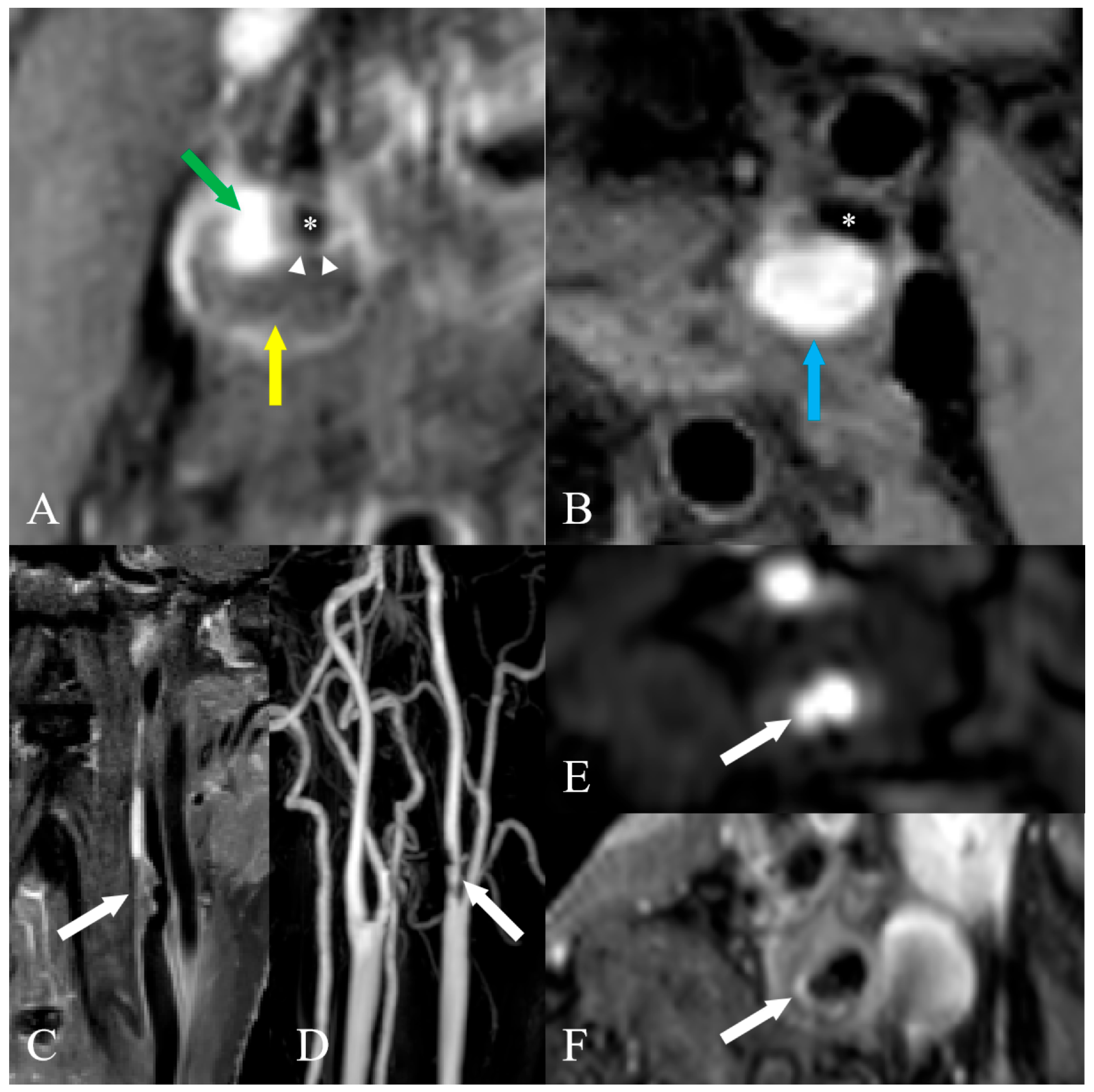
2.4. Imaging Analysis
2.5. Patient Groupings
2.6. Statistical Analysis
3. Results
3.1. Patient Baseline Characteristics Based on CVP
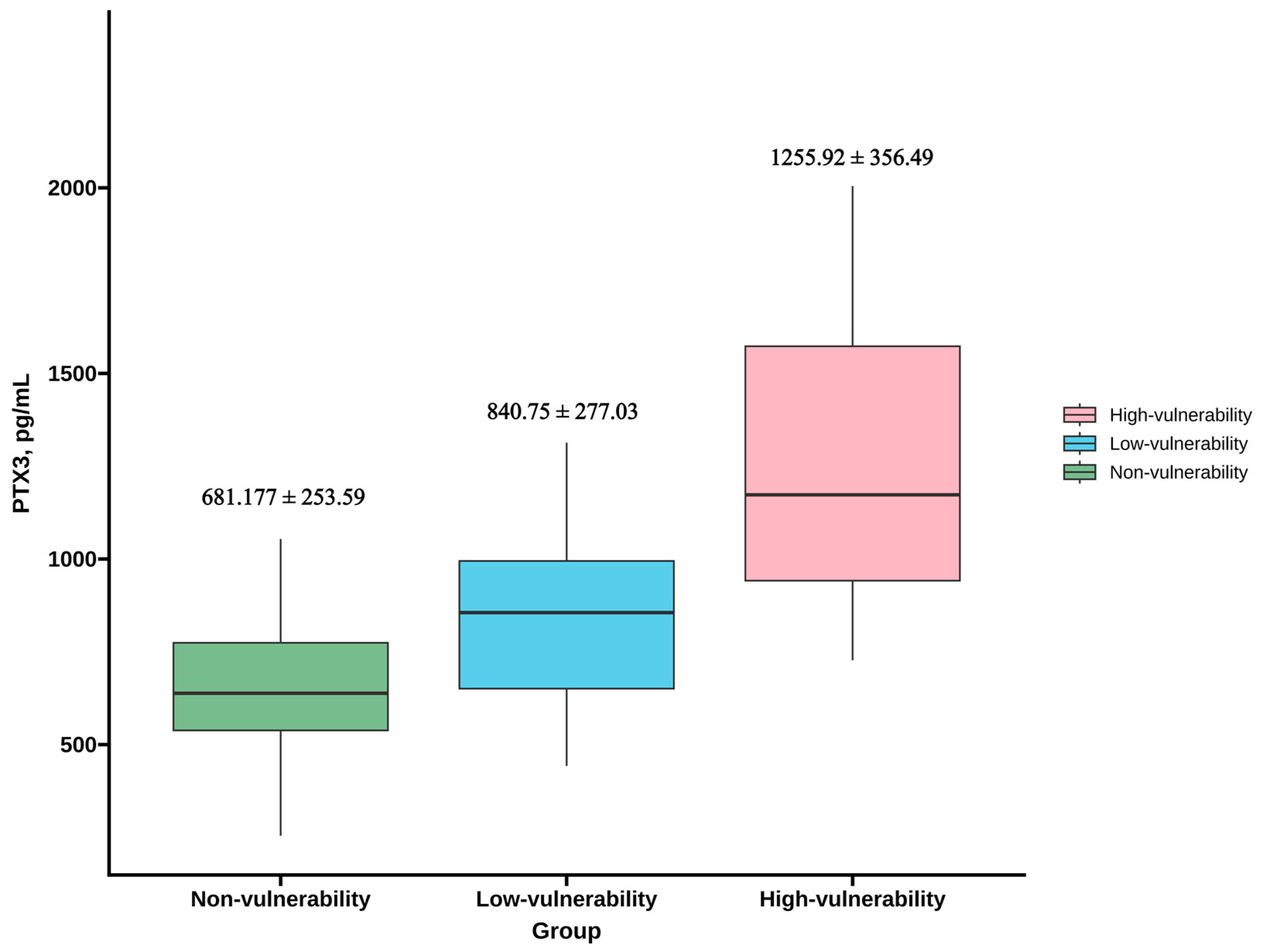
3.2. Patient Baseline and Imaging Characteristics Based on PTX3
3.3. Association of PTX3 Levels with Vulnerable Features
3.4. Analysis of Influencing Factors of CVP Presence
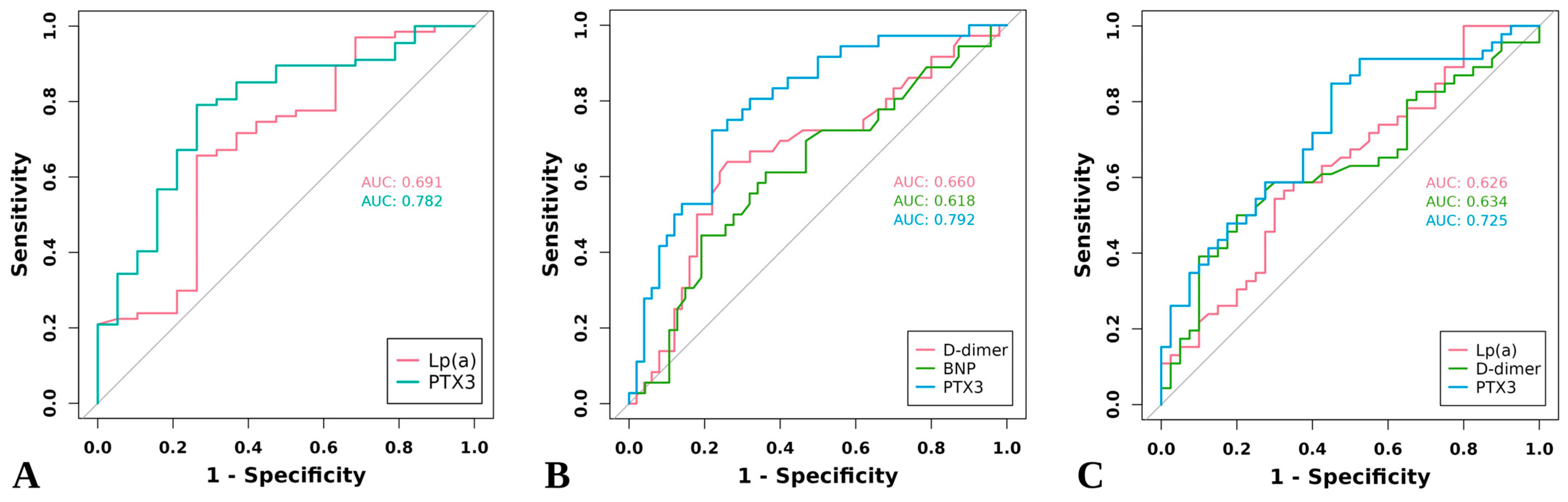
3.5. Diagnostic Efficacy of PTX3 in CVP
3.6. Analysis of Influencing Factors of Clinical and Circulating Biomarkers on Specific Vulnerable Features
3.7. Diagnostic Efficacy of PTX3 in Specific Vulnerable Features
4. Discussion
5. Conclusions
Author Contributions
Funding
Institutional Review Board Statement
Informed Consent Statement
Data Availability Statement
Acknowledgments
Conflicts of Interest
References
- van Dam-Nolen, D.H.K.; Truijman, M.T.B.; van der Kolk, A.G.; Liem, M.I.; Schreuder, F.H.B.M.; Boersma, E.; Daemen, M.J.A.P.; Mess, W.H.; van Oostenbrugge, R.J.; van der Steen, A.F.W.; et al. Carotid Plaque Characteristics Predict Recurrent Ischemic Stroke and TIA: The PARISK (Plaque At RISK) Study. JACC Cardiovasc. Imaging 2022, 15, 1715–1726. [Google Scholar] [CrossRef]
- Bentzon, J.F.; Otsuka, F.; Virmani, R.; Falk, E. Mechanisms of Plaque Formation and Rupture. Circ. Res. 2014, 114, 1852–1866. [Google Scholar] [CrossRef] [PubMed]
- Kopczak, A.; Schindler, A.; Sepp, D.; Bayer-Karpinska, A.; Malik, R.; Koch, M.L.; Zeller, J.; Strecker, C.; Janowitz, D.; Wollenweber, F.A.; et al. Complicated Carotid Artery Plaques and Risk of Recurrent Ischemic Stroke or TIA. J. Am. Coll. Cardiol. 2022, 79, 2189–2199. [Google Scholar] [CrossRef] [PubMed]
- Saba, L.; Cau, R.; Murgia, A.; Nicolaides, A.N.; Wintermark, M.; Castillo, M.; Staub, D.; Kakkos, S.K.; Yang, Q.; Paraskevas, K.I.; et al. Carotid Plaque-RADS: A Novel Stroke Risk Classification System. JACC Cardiovasc. Imaging 2024, 17, 62–75. [Google Scholar] [CrossRef] [PubMed]
- Saba, L.; Yuan, C.; Hatsukami, T.S.; Balu, N.; Qiao, Y.; DeMarco, J.K.; Saam, T.; Moody, A.R.; Li, D.; Matouk, C.C.; et al. Carotid Artery Wall Imaging: Perspective and Guidelines from the ASNR Vessel Wall Imaging Study Group and Expert Consensus Recommendations of the American Society of Neuroradiology. AJNR Am. J. Neuroradiol. 2018, 39, E9–E31. [Google Scholar] [CrossRef]
- Saba, L.; Loewe, C.; Weikert, T.; Williams, M.C.; Galea, N.; Budde, R.P.J.; Vliegenthart, R.; Velthuis, B.K.; Francone, M.; Bremerich, J.; et al. State-of-the-Art CT and MR Imaging and Assessment of Atherosclerotic Carotid Artery Disease: Standardization of Scanning Protocols and Measurements-a Consensus Document by the European Society of Cardiovascular Radiology (ESCR). Eur. Radiol. 2023, 33, 1063–1087. [Google Scholar] [CrossRef]
- Etesami, M.; Hoi, Y.; Steinman, D.A.; Gujar, S.K.; Nidecker, A.E.; Astor, B.C.; Portanova, A.; Qiao, Y.; Abdalla, W.M.A.; Wasserman, B.A. Comparison of Carotid Plaque Ulcer Detection Using Contrast-Enhanced and Time-of-Flight MRA Techniques. AJNR Am. J. Neuroradiol. 2013, 34, 177–184. [Google Scholar] [CrossRef]
- Bos, D.; van Dam-Nolen, D.H.K.; Gupta, A.; Saba, L.; Saloner, D.; Wasserman, B.A.; van der Lugt, A. Advances in Multimodality Carotid Plaque Imaging: AJR Expert Panel Narrative Review. Am. J. Roentgenol. 2021, 217, 16–26. [Google Scholar] [CrossRef]
- Puig, N.; Jiménez-Xarrié, E.; Camps-Renom, P.; Benitez, S. Search for Reliable Circulating Biomarkers to Predict Carotid Plaque Vulnerability. Int. J. Mol. Sci. 2020, 21, 8236. [Google Scholar] [CrossRef]
- Lei, M.; Weng, S.-T.; Wang, J.-J.; Qiao, S. Diagnostic Potential of TSH to HDL Cholesterol Ratio in Vulnerable Carotid Plaque Identification. Front. Cardiovasc. Med. 2024, 11, 1333908. [Google Scholar] [CrossRef]
- Nishi, K.; Itabe, H.; Uno, M.; Kitazato, K.T.; Horiguchi, H.; Shinno, K.; Nagahiro, S. Oxidized LDL in Carotid Plaques and Plasma Associates With Plaque Instability. Arter. Thromb. Vasc. Biol. 2002, 22, 1649–1654. [Google Scholar] [CrossRef]
- Van Dam-Nolen, D.H.K.; Van Dijk, A.C.; Crombag, G.A.J.C.; Lucci, C.; Kooi, M.E.; Hendrikse, J.; Nederkoorn, P.J.; Daemen, M.J.A.P.; Van Der Steen, A.F.W.; Koudstaal, P.J.; et al. Lipoprotein(a) Levels and Atherosclerotic Plaque Characteristics in the Carotid Artery: The Plaque at RISK (PARISK) Study. Atherosclerosis 2021, 329, 22–29. [Google Scholar] [CrossRef]
- Langley, S.R.; Willeit, K.; Didangelos, A.; Matic, L.P.; Skroblin, P.; Barallobre-Barreiro, J.; Lengquist, M.; Rungger, G.; Kapustin, A.; Kedenko, L.; et al. Extracellular Matrix Proteomics Identifies Molecular Signature of Symptomatic Carotid Plaques. J. Clin. Invest. 2017, 127, 1546–1560. [Google Scholar] [CrossRef] [PubMed]
- Soeki, T.; Sata, M. Inflammatory Biomarkers and Atherosclerosis. Int. Heart J. 2016, 57, 134–139. [Google Scholar] [CrossRef] [PubMed]
- Zhang, Y.; Hu, H.; Liu, C.; Wu, J.; Zhou, S.; Zhao, T. Serum Pentraxin 3 as a Biomarker for Prognosis of Acute Minor Stroke Due to Large Artery Atherosclerosis. Brain Behav. 2021, 11, e01956. [Google Scholar] [CrossRef]
- Shindo, A.; Tanemura, H.; Yata, K.; Hamada, K.; Shibata, M.; Umeda, Y.; Asakura, F.; Toma, N.; Sakaida, H.; Fujisawa, T.; et al. Inflammatory Biomarkers in Atherosclerosis: Pentraxin 3 Can Become a Novel Marker of Plaque Vulnerability. PLoS ONE 2014, 9, e100045. [Google Scholar] [CrossRef]
- Yi, L.; Tang, J.; Shi, C.; Zhang, T.; Li, J.; Guo, F.; Zhang, W. Pentraxin 3, TNF-α, and LDL-C Are Associated With Carotid Artery Stenosis in Patients With Ischemic Stroke. Front. Neurol. 2019, 10, 1365. [Google Scholar] [CrossRef]
- Sun, Y.-M.; Xu, H.-Y.; Wang, S.; Wang, Z.-J.; Zhou, Y.; Yu, W. Carotid Massive Intraplaque Hemorrhage, Lipid-Rich Necrotic Core, and Heavy Circumferential Calcification Were Associated with New Ipsilateral Ischemic Cerebral Lesions after Carotid Artery Stenting: High-Resolution Magnetic Resonance Vessel Wall Imaging Study. Cardiovasc. Diagn. Ther. 2023, 13, 355–366. [Google Scholar] [CrossRef] [PubMed]
- Saba, L.; Saam, T.; Jäger, H.R.; Yuan, C.; Hatsukami, T.S.; Saloner, D.; Wasserman, B.A.; Bonati, L.H.; Wintermark, M. Imaging Biomarkers of Vulnerable Carotid Plaques for Stroke Risk Prediction and Their Potential Clinical Implications. Lancet Neurol. 2019, 18, 559–572. [Google Scholar] [CrossRef]
- Millon, A.; Boussel, L.; Brevet, M.; Mathevet, J.-L.; Canet-Soulas, E.; Mory, C.; Scoazec, J.-Y.; Douek, P. Clinical and Histological Significance of Gadolinium Enhancement in Carotid Atherosclerotic Plaque. Stroke 2012, 43, 3023–3028. [Google Scholar] [CrossRef]
- Shirakawa, M.; Yamada, K.; Watase, H.; Chu, B.; Enomoto, Y.; Kojima, T.; Wakabayashi, K.; Sun, J.; Hippe, D.S.; Ferguson, M.S.; et al. Atherosclerotic Carotid Plaque Characteristics Vary with Time from Ischemic Event: A Multicenter, Prospective Magnetic Resonance Vessel Wall Imaging Registry Study. J. Neurol. Sci. 2023, 446, 120582. [Google Scholar] [CrossRef]
- Huang, Q.; Liu, L.; Liu, W.; Zhang, S.; Yang, Y.; Zhu, X.; Liu, Z. Lipoprotein(a) Associates with High-Resolution MRI-Assessed Intracranial Plaque Vulnerability and Long-Term Stroke Recurrence. Eur. Radiol. 2025, 35, 7605–7616. [Google Scholar] [CrossRef]
- Casula, M.; Montecucco, F.; Bonaventura, A.; Liberale, L.; Vecchié, A.; Dallegri, F.; Carbone, F. Update on the Role of Pentraxin 3 in Atherosclerosis and Cardiovascular Diseases. Vasc. Pharmacol. 2017, 99, 1–12. [Google Scholar] [CrossRef]
- Fornai, F.; Carrizzo, A.; Forte, M.; Ambrosio, M.; Damato, A.; Ferrucci, M.; Biagioni, F.; Busceti, C.; Puca, A.A.; Vecchione, C. The Inflammatory Protein Pentraxin 3 in Cardiovascular Disease. Immun. Ageing 2016, 13, 25. [Google Scholar] [CrossRef]
- Nerkiz, P.; Doganer, Y.C.; Aydogan, U.; Akbulut, H.; Parlak, A.; Aydogdu, A.; Sari, O.; Cayci, T.; Barcin, C.; Koc, B. Serum Pentraxin-3 Level in Patients Who Underwent Coronary Angiography and Relationship with Coronary Atherosclerosis. Med. Princ. Pract. 2015, 24, 369–375. [Google Scholar] [CrossRef] [PubMed]
- Tian, Y.; Lu, L.; Zhang, Y.; Wei, J. The Value of Lp(a) and TG/HDLC in Peripheral Blood to Assess the Stability of Carotid Plaque in Patients with Ischemic Stroke. Brain Behav. 2024, 14, e3355. [Google Scholar] [CrossRef]
- Kraaijenhof, J.M.; Mol, B.M.; Nurmohamed, N.S.; Dzobo, K.E.; Kroon, J.; Hovingh, G.K.; Mokry, M.; de Borst, G.J.; Stroes, E.S.G.; de Kleijn, D.P.V. Plasma C-Reactive Protein Is Associated with a pro-Inflammatory and Adverse Plaque Phenotype. Atherosclerosis 2024, 396, 118532. [Google Scholar] [CrossRef]
- Liu, H.; Chen, Z.; Ding, J.; Mamateli, S.; Cai, J.; Qiao, T. Relationship of the Low-Density Lipoprotein Cholesterol/High-DensityLipoprotein Cholesterol Ratio with a Vulnerable Plaque in Patients withSevere Carotid Artery Stenosis: A Case-Control Study in the Han ChinesePopulation. CNR 2022, 19, 160–170. [Google Scholar] [CrossRef]
- Koga, S.; Ikeda, S.; Yoshida, T.; Nakata, T.; Takeno, M.; Masuda, N.; Koide, Y.; Kawano, H.; Maemura, K. Elevated Levels of Systemic Pentraxin 3 Are Associated With Thin-Cap Fibroatheroma in Coronary Culprit Lesions. JACC Cardiovasc. Interv. 2013, 6, 945–954. [Google Scholar] [CrossRef] [PubMed]
- Kimura, S.; Inagaki, H.; Haraguchi, G.; Sugiyama, T.; Miyazaki, T.; Hatano, Y.; Yoshikawa, S.; Ashikaga, T.; Isobe, M. Relationships of Elevated Systemic Pentraxin-3 Levels With High-Risk Coronary Plaque Components and Impaired Myocardial Perfusion After Percutaneous Coronary Intervention in Patients With ST-Elevation Acute Myocardial Infarction. Circ. J. 2014, 78, 159–169. [Google Scholar] [CrossRef] [PubMed]
- Savchenko, A.; Imamura, M.; Ohashi, R.; Jiang, S.; Kawasaki, T.; Hasegawa, G.; Emura, I.; Iwanari, H.; Sagara, M.; Tanaka, T.; et al. Expression of Pentraxin 3 (PTX3) in Human Atherosclerotic Lesions. J. Pathol. 2008, 215, 48–55. [Google Scholar] [CrossRef]
- Marnane, M.; Prendeville, S.; McDonnell, C.; Noone, I.; Barry, M.; Crowe, M.; Mulligan, N.; Kelly, P.J. Plaque Inflammation and Unstable Morphology Are Associated With Early Stroke Recurrence in Symptomatic Carotid Stenosis. Stroke 2014, 45, 801–806. [Google Scholar] [CrossRef] [PubMed]
- Sezer, S.; Uçar, F.; Ulusoy, E.; Erdoğan, S.; Bilen, Ş.; Züngün, C.; Uysal, S.; Erdemli, H. Serum Amyloid A, Fetuin-A, and Pentraxin-3 Levels in Patients with Ischemic Stroke: Novel Prognostic Biomarkers? Turk. J. Med. Sci. 2014, 44, 16–23. [Google Scholar] [CrossRef] [PubMed]
- Ryu, W.-S.; Kim, C.K.; Kim, B.J.; Kim, C.; Lee, S.-H.; Yoon, B.-W. Pentraxin 3: A Novel and Independent Prognostic Marker in Ischemic Stroke. Atherosclerosis 2012, 220, 581–586. [Google Scholar] [CrossRef]
- Qin, L.-Z.; Li, W.; Huang, Y.; Lu, F.; Li, S.-J.; Yang, H.-Q.; Zhang, J.-W. PTX3 Expression in the Plasma of Elderly ACI Patients and Its Relationship with Severity and Prognosis of the Disease. Eur. Rev. Med. Pharmacol. Sci. 2016, 20, 4112–4118. [Google Scholar]
- Pucci, S.; Fisco, T.; Zonetti, M.J.; Bonanno, E.; Mazzarelli, P.; Mauriello, A. PTX3: A Modulator of Human Coronary Plaque Vulnerability Acting by Macrophages Type 2. Int. J. Cardiol. 2014, 176, 710–717. [Google Scholar] [CrossRef] [PubMed]
- Daigo, K.; Mantovani, A.; Bottazzi, B. The Yin-Yang of Long Pentraxin PTX3 in Inflammation and Immunity. Immunol. Lett. 2014, 161, 38–43. [Google Scholar] [CrossRef]
- Ye, X.; Wang, Z.; Lei, W.; Shen, M.; Tang, J.; Xu, X.; Yang, Y.; Zhang, H. Pentraxin 3: A Promising Therapeutic Target for Cardiovascular diseases. Ageing Res. Rev. 2024, 93, 102163. [Google Scholar] [CrossRef]
- Iwata, A.; Miura, S.; Tanaka, T.; Ike, A.; Sugihara, M.; Nishikawa, H.; Kawamura, A.; Saku, K. Plasma Pentraxin-3 Levels Are Associated with Coronary Plaque Vulnerability and Are Decreased by Statin. Coron. Artery Dis. 2012, 23, 315–321. [Google Scholar] [CrossRef]
- Zanetti, M.; Zenti, M.; Barazzoni, R.; Zardi, F.; Semolic, A.; Messa, M.G.; Mearelli, F.; Russi, G.; Fonda, M.; Scarano, L.; et al. HELP LDL Apheresis Reduces Plasma Pentraxin 3 in Familial Hypercholesterolemia. PLoS ONE 2014, 9, e101290. [Google Scholar] [CrossRef]
- Soeki, T.; Niki, T.; Kusunose, K.; Bando, S.; Hirata, Y.; Tomita, N.; Yamaguchi, K.; Koshiba, K.; Yagi, S.; Taketani, Y.; et al. Elevated Concentrations of Pentraxin 3 Are Associated with Coronary Plaque Vulnerability. J. Cardiol. 2011, 58, 151–157. [Google Scholar] [CrossRef] [PubMed]
- Shiraki, A.; Kotooka, N.; Komoda, H.; Hirase, T.; Oyama, J.; Node, K. Pentraxin-3 Regulates the Inflammatory Activity of Macrophages. Biochem. Biophys. Rep. 2016, 5, 290–295. [Google Scholar] [CrossRef]
- Ruzanovic, A.; Saric-Matutinovic, M.; Milinkovic, N.; Jovicic, S.; Dimic, A.; Matejevic, D.; Kostic, O.; Koncar, I.; Ignjatovic, S. Significance of Myeloperoxidase, Pentraxin-3 and Soluble Urokinase Plasminogen Activator Receptor Determination in Patients with Moderate Carotid Artery Stenosis. Scand. J. Clin. Lab. Investig. 2024, 84, 486–492. [Google Scholar] [CrossRef] [PubMed]
- Rolph, M.S.; Zimmer, S.; Bottazzi, B.; Garlanda, C.; Mantovani, A.; Hansson, G.K. Production of the Long Pentraxin PTX3 in Advanced Atherosclerotic Plaques. Arter. Thromb. Vasc. Biol. 2002, 22, e10–e14. [Google Scholar] [CrossRef] [PubMed]



| Parameters | 3D TOF | 2D T1WI/CE-T1WI | 2D T2WI | 2D SNAP |
|---|---|---|---|---|
| TE/TR, ms | 4/20 | 10/800 | 50/4800 | 6.8/12 |
| FOV, mm2 | 160 × 160 | 160 × 160 | 160 × 160 | 160 × 160 |
| Resolution, mm2 | 0.5 × 0.5 | 0.5 × 0.5 | 0.5 × 0.5 | 0.5 × 0.5 |
| Slice thickness, mm2 | 2 | 2 | 2 | 2 |
| No. of slices | 40 | 20 | 20 | 20 |
| Biomarkers | CVP (n = 6) | NCVP (n = 19) | p-Value | |||||
|---|---|---|---|---|---|---|---|---|
| BCVP (n = 30) | UCVP (n = 37) | CVP vs. NCVP | K–W Test | Post Hoc | ||||
| UCVP vs. BCVP | BCVP vs. NCVP | UCVP vs. NCVP | ||||||
| Age, years | 68.90 ± 6.562 | 68.03 ± 7.869 | 65.79 ± 8.973 | 0.252 | 0.466 | - | - | - |
| Gender, Male, n (%) | 28 (93.3%) | 34 (91.9%) | 14 (73.7%) | 0.038 | 0.078 | - | - | - |
| BMI, kg/m2 | 24.72 ± 2.653 | 24.30 ± 3.399 | 25.45 ± 2.281 | 0.063 | 0.140 | - | - | - |
| Cerebrovascular disease, n (%) | 19 (63.3%) | 18 (48.6%) | 3 (15.8%) | 0.002 | 0.005 | 0.234 | 0.001 | 0.020 |
| Hypertension, n (%) | 22 (73.3%) | 27 (73.0%) | 15 (78.9%) | 0.769 | 0.878 | - | - | - |
| Dyslipidemia, n (%) | 24 (80.0%) | 26 (70.3%) | 14 (73.7%) | >0.999 | 0.663 | - | - | - |
| Coronary artery disease, n (%) | 23 (76.7%) | 19 (51.4%) | 6 (31.6%) | 0.016 | 0.007 | 0.039 | 0.002 | 0.161 |
| Diabetes mellitus, n (%) | 15 (50.0%) | 11 (29.7%) | 8 (42.1%) | 0.795 | 0.237 | - | - | - |
| History of statin use, n (%) | 20 (66.7%) | 26 (70.3%) | 13 (68.4%) | 0.984 | 0.952 | - | - | - |
| History of antihypertensive drug use, n (%) | 19 (63.3%) | 25 (67.6%) | 15 (78.9%) | 0.271 | 0.513 | - | - | - |
| Smoking, n (%) | 21 (70.0%) | 22 (59.5%) | 11 (57.9%) | 0.617 | 0.599 | - | - | - |
| Alcohol consumption, n (%) | 15 (50.0%) | 14 (37.8%) | 4 (21.1%) | 0.079 | 0.130 | - | - | - |
| Lp(a), nmol/L | 48.25 (16.60, 86.20) | 35.70 (14.50, 68.60) | 14.60 (5.80, 63.90) | 0.012 | 0.025 | 0.329 | 0.007 | 0.051 |
| Hcy, umol/L | 12.65 (11.20, 14.10) | 13.50 (11.20, 15.10) | 11.30 (9.00, 15.00) | 0.083 | 0.165 | - | - | - |
| hs-CPR, mg/L | 1.25 (0.96, 2.74) | 0.85 (0.49, 2.00) | 0.80 (0.40, 2.23) | 0.338 | 0.153 | - | - | - |
| TG, mmol/L | 1.29 (1.01, 1.68) | 1.21 (0.86, 1.74) | 1.24 (0.97, 1.87) | 0.621 | 0.793 | - | - | - |
| TC, mmol/L | 3.52 ± 0.901 | 3.75 ± 0.866 | 3.70 ± 0.784 | 0.794 | 0.434 | - | - | - |
| HDL-C, mmol/L | 1.00 (0.91, 1.12) | 1.06 (0.92, 1.27) | 1.03 (0.97, 1.15) | 0.673 | 0.295 | - | - | - |
| LDL-C, mmol/L | 1.96 (1.34, 2.19) | 1.92 (1.62, 2.50) | 1.89 (1.54, 2.44) | 0.835 | 0.610 | - | - | - |
| sdLDL, mmol/L | 0.54 (0.43, 0.73) | 0.56 (0.42, 0.71) | 0.54 (0.36, 0.94) | 0.823 | 0.974 | - | - | - |
| nonHDL, mmol/L | 2.44 ± 0.921 | 2.70 ± 0.870 | 2.62 ± 0.795 | 0.887 | 0.531 | - | - | - |
| RLP-C, mmol/L | 0.51 (0.42, 0.74) | 0.50 (0.34, 0.69) | 0.54 (0.41, 0.68) | 0.731 | 0.762 | - | - | - |
| D-dimer, ng/mL | 142.00 (69.00, 206.00) | 81.00 (39.00, 149.00) | 96.00 (59.00, 116.00) | 0.325 | 0.046 | 0.023 | 0.054 | 0.982 |
| BNP, pg/mL | 45.50 (28.00, 84.00) | 41.00 (18.00, 97.00) | 30.50 (21.00, 68.00) | 0.558 | 0.826 | - | - | - |
| PTX3, pg/mL | 1113.62 (862.74, 1573.07) | 858.52 (700.66, 1039.77) | 638.23 (538.17, 826.21) | <0.001 | <0.001 | 0.003 | <0.001 | 0.022 |
| Biomarkers | High PTX3 (≥938.34 pg/mL) (n = 38) | Low PTX3 (<938.34 pg/mL) (n = 48) | p-Value |
|---|---|---|---|
| Age, years | 69.21 ± 6.683 | 66.75 ± 8.330 | 0.132 |
| Gender, Male, n (%) | 36 (94.7%) | 40 (83.3%) | 0.174 |
| BMI, kg/m2 | 24.43 ± 2.989 | 24.91 ± 2.898 | 0.448 |
| Cerebrovascular disease, n (%) | 22 (57.9%) | 18 (37.5%) | 0.060 |
| Hypertension, n (%) | 29 (76.3%) | 35 (72.9%) | 0.720 |
| Dyslipidemia, n (%) | 30 (78.9%) | 34 (70.8%) | 0.392 |
| Coronary artery disease, n (%) | 28 (73.7%) | 20 (41.7%) | 0.003 |
| Diabetes mellitus, n (%) | 18 (47.4%) | 16 (33.3%) | 0.186 |
| History of statin use, n (%) | 28 (73.7%) | 31 (64.6%) | 0.366 |
| History of antihypertensive drug use, n (%) | 26 (68.4%) | 33 (68.8%) | 0.974 |
| Smoking, n (%) | 22 (57.9%) | 32 (66.7%) | 0.403 |
| Alcohol consumption, n (%) | 16 (42.1%) | 17 (35.4%) | 0.526 |
| Lp(a), nmol/L | 38.50 (11.60, 73.80) | 32.70 (12.64, 68.65) | 0.617 |
| Hcy, umol/L | 13.15 (11.80, 15.30) | 12.05 (10.95, 14.80) | 0.240 |
| hs-CPR, mg/L | 1.15 (0.54, 2.22) | 1.12 (0.48, 2.27) | 0.821 |
| TG, mmol/L | 1.22 (0.92, 1.90) | 1.25 (0.95, 1.75) | 0.938 |
| TC, mmol/L | 3.37 ± 0.919 | 3.89 ± 0.736 | 0.006 |
| HDL-C, mmol/L | 1.00 (0.84, 1.13) | 1.06 (0.98, 1.26) | 0.019 |
| LDL-C, mmol/L | 1.69 (1.22, 2.19) | 1.96 (1.75, 2.52) | 0.007 |
| sdLDL, mmol/L | 0.51 (0.36, 0.63) | 0.59 (0.43, 0.86) | 0.036 |
| nonHDL, mmol/L | 2.43 ± 0.926 | 2.72 ± 0.808 | 0.124 |
| RLP-C, mmol/L | 0.50 (0.40, 0.69) | 0.52 (0.41, 0.69) | 0.976 |
| D-dimer, ng/mL | 114.00 (68.00, 206.00) | 85.00 (50.50, 146.00) | 0.114 |
| BNP, pg/mL | 62.50 (32.00, 115.00) | 30.00 (19.00, 55.00) | 0.005 |
| Biomarkers | High PTX3 (≥938.34 pg/mL) (n = 38) | Low PTX3 (<938.34 pg/mL) (n = 48) | p-Value |
|---|---|---|---|
| Plaque burden, mean value | |||
| LA, mm2 | 24.41 ± 5.425 | 27.48 ± 8.175 | 0.074 |
| WA, mm2 | 42.72 ± 7.949 | 41.25 ± 10.002 | 0.277 |
| VA, mm2 | 67.14 ± 11.410 | 68.73 ± 15.478 | 0.938 |
| WT, mm | 1.65 ± 0.188 | 1.58 ± 0.231 | 0.098 |
| NWI, % | 63.82 ± 4.725 | 60.75 ± 6.066 | 0.010 |
| Lumen volume, mm3 | 987.77 ± 217.827 | 1096.62 ± 308.413 | 0.088 |
| Wall volume, mm3 | 1731.44 ± 349.831 | 1657.58 ± 412.692 | 0.284 |
| Vessel volume, mm3 | 2719.21 ± 490.934 | 2754.20 ± 620.443 | 0.935 |
| CVP, n (%) | 35 (92.1%) | 32 (66.7%) | 0.005 |
| FC discontinuity, n (%) | 26 (68.4%) | 10 (20.8%) | <0.001 |
| Maximum area percentage of plaque components | |||
| Calcification, % | 14.44 ± 9.598 | 15.56 ± 9.804 | 0.587 |
| LRNC, % | 41.03 ± 14.380 | 39.29 ± 15.074 | 0.687 |
| IPH, % | 14.08 ± 15.026 | 10.26 ± 14.220 | 0.157 |
| Focal Inflammation, % | 8.38 ± 9.391 | 4.83 ± 8.507 | 0.002 |
| Total volume of plaque components | |||
| Calcification, mm3 | 177.52 ± 195.350 | 161.06 ± 170.483 | 0.928 |
| LRNC, mm3 | 395.52 ± 275.799 | 392.61 ± 327.957 | 0.631 |
| IPH, mm3 | 102.08 ± 140.807 | 79.43 ± 143.984 | 0.136 |
| Focal Inflammation, mm3 | 21.34 ± 29.880 | 12.39 ± 22.049 | 0.007 |
| Indicators | Univariable Analysis | Multivariable Analysis | |||||
|---|---|---|---|---|---|---|---|
| OR | 95% CI | p-Value | OR | 95% CI | p-Value | ||
| CVP | Gender | 4.43 | 1.13, 17.40 | 0.033 | 2.88 | 0.54, 15.33 | 0.215 |
| Cerebrovascular disease | 6.58 | 1.75, 24.72 | 0.005 | 4.50 | 1.06, 19.00 | 0.041 | |
| Coronary artery disease | 3.64 | 1.23, 10.79 | 0.020 | 2.11 | 0.58, 7.64 | 0.256 | |
| Lp(a) | 3.09 | 0.97, 9.88 | 0.057 | 3.06 | 0.83, 11.34 | 0.094 | |
| PTX3 | 4.39 | 1.76, 10.95 | 0.002 | 2.88 | 1.05, 7.87 | 0.039 | |
| FC Discontinuity-associated CVP | Coronary artery disease | 8.89 | 3.11, 25.39 | <0.001 | 5.88 | 1.77, 19.56 | 0.004 |
| Alcohol consumption | 2.33 | 0.96, 5.68 | 0.062 | 2.00 | 0.63, 6.35 | 0.240 | |
| D-dimer | 0.95 | 0.61, 1.50 | 0.834 | 0.82 | 0.45, 1.48 | 0.511 | |
| BNP | 1.46 | 0.78, 2.73 | 0.237 | 1.49 | 0.85, 2.59 | 0.164 | |
| PTX3 | 3.16 | 1.72, 5.77 | <0.001 | 2.47 | 1.32, 4.63 | 0.005 | |
| Focal Inflammation-associated CVP | Gender | 11.73 | 1.41, 97.22 | 0.023 | 8.34 | 0.94, 74.11 | 0.057 |
| Coronary artery disease | 2.80 | 1.16, 6.74 | 0.022 | 1.80 | 0.65, 4.99 | 0.260 | |
| Lp(a) | 1.62 | 0.95, 2.74 | 0.075 | 1.34 | 0.75, 2.41 | 0.322 | |
| D-dimer | 5.19 | 0.84, 32.12 | 0.076 | 2.21 | 0.36, 13.41 | 0.390 | |
| PTX3 | 2.69 | 1.49, 4.83 | <0.001 | 2.25 | 1.18, 4.32 | 0.014 | |
Disclaimer/Publisher’s Note: The statements, opinions and data contained in all publications are solely those of the individual author(s) and contributor(s) and not of MDPI and/or the editor(s). MDPI and/or the editor(s) disclaim responsibility for any injury to people or property resulting from any ideas, methods, instructions or products referred to in the content. |
© 2026 by the authors. Licensee MDPI, Basel, Switzerland. This article is an open access article distributed under the terms and conditions of the Creative Commons Attribution (CC BY) license.
Share and Cite
Li, T.; Li, L.; Wang, Q.; Sun, Y.; Lian, J.; Yu, W. Serum PTX3 Levels Correlate with Fibrous Cap Discontinuity and Focal Inflammation in Carotid Vulnerable Plaque: A High-Resolution Magnetic Resonance Vessel Wall Imaging Study. J. Clin. Med. 2026, 15, 1452. https://doi.org/10.3390/jcm15041452
Li T, Li L, Wang Q, Sun Y, Lian J, Yu W. Serum PTX3 Levels Correlate with Fibrous Cap Discontinuity and Focal Inflammation in Carotid Vulnerable Plaque: A High-Resolution Magnetic Resonance Vessel Wall Imaging Study. Journal of Clinical Medicine. 2026; 15(4):1452. https://doi.org/10.3390/jcm15041452
Chicago/Turabian StyleLi, Tingting, Lu Li, Qingyuan Wang, Yumeng Sun, Jianxiu Lian, and Wei Yu. 2026. "Serum PTX3 Levels Correlate with Fibrous Cap Discontinuity and Focal Inflammation in Carotid Vulnerable Plaque: A High-Resolution Magnetic Resonance Vessel Wall Imaging Study" Journal of Clinical Medicine 15, no. 4: 1452. https://doi.org/10.3390/jcm15041452
APA StyleLi, T., Li, L., Wang, Q., Sun, Y., Lian, J., & Yu, W. (2026). Serum PTX3 Levels Correlate with Fibrous Cap Discontinuity and Focal Inflammation in Carotid Vulnerable Plaque: A High-Resolution Magnetic Resonance Vessel Wall Imaging Study. Journal of Clinical Medicine, 15(4), 1452. https://doi.org/10.3390/jcm15041452