


Abstract
Background/Objectives: Coffee consumption has been suggested to influence arginine vasopressin-related pathways and cardiovascular function. However, its relationships with serum copeptin and cardiac parameters in patients with autosomal dominant polycystic kidney disease (ADPKD) remain unclear. This study aimed to investigate the association between habitual coffee consumption and serum copeptin concentrations and selected echocardiographic parameters in patients with ADPKD. Methods: In this cross-sectional study, 73 patients with ADPKD were classified as coffee consumers (n = 35) or non-consumers (n = 38). Serum copeptin measurements were available for 62 patients. Coffee consumption was assessed using a standardized questionnaire and expressed as grams of dry coffee per month. Multivariable models were used to assess associations with log-transformed copeptin, mitral annular e′ velocity, and E/e′ ratio. Results: Serum copeptin levels were lower among coffee consumers than non-consumers (median, 263.51 vs. 332.77 ng/L; p = 0.013). After adjustment, coffee consumption was associated with lower log-transformed copeptin levels (B = −0.263; p = 0.047), although this association was not statistically significant when using heteroskedasticity-consistent (HC3) robust standard errors (p = 0.074). Coffee consumers had higher mitral annular e′ velocity (8.61 vs. 5.86 cm/s; p < 0.001), which remained significant after adjustment (B = 2.531; p < 0.001), and a lower E/e′ ratio (B = −4.548; p = 0.007). Conclusions: In this ADPKD cohort, coffee consumption was associated with lower serum copeptin levels, higher mitral annular e′ velocity, and lower E/e′ ratio. These findings raise the hypothesis that habitual coffee consumption may be associated with vasopressin–copeptin system activity and diastolic myocardial relaxation in patients with ADPKD. However, the copeptin association was not robust to HC3 analysis, and the echocardiographic findings should be considered exploratory.
1. Introduction
Autosomal dominant polycystic kidney disease (ADPKD) is the most common inherited monogenic kidney disease and is characterized by progressive cyst formation, kidney enlargement, and gradual deterioration of renal function [1]. Beyond pathogenic variants in the PKD1 and PKD2 genes, arginine vasopressin (AVP)-mediated signaling plays an important role in disease progression [2]. Activation of the vasopressin V2 receptor stimulates intracellular cyclic adenosine monophosphate (cAMP) signaling, thereby promoting cyst growth and fluid secretion [2,3]. The clinical relevance of this pathway is supported by evidence that V2 receptor antagonism with tolvaptan slows kidney growth and decline in renal function in patients with ADPKD [4]. Because circulating AVP is unstable and technically challenging to measure, direct assessment of AVP activity is difficult. Copeptin, the C-terminal fragment of the AVP precursor peptide, is released in equimolar amounts with AVP and is substantially more stable in the circulation. It is therefore considered a useful surrogate biomarker of endogenous AVP secretion [5]. Circulating copeptin concentrations have been associated with renal outcomes in patients with type 2 diabetes and albuminuria, suggesting that copeptin may provide clinically relevant information on AVP system activity [6]. In ADPKD, the established role of the AVP–V2 receptor–cAMP pathway further supports the use of copeptin as a measurable marker of AVP activity [2,7]. Indeed, higher copeptin concentrations have been associated with kidney function decline and increases in total kidney volume in patients with ADPKD, supporting its potential value as a biomarker of disease progression [8,9].
Coffee is one of the most widely consumed beverages worldwide. Experimental studies have suggested that caffeine may increase intracellular cAMP accumulation in renal epithelial cells derived from patients with ADPKD, potentially promoting pathways involved in cyst epithelial cell proliferation and fluid secretion [3]. Studies in a Pkd1-deficient mouse model have suggested that caffeine consumption may accelerate cystic kidney disease, although renal cAMP levels did not differ between caffeine-treated and control animals [10]. However, clinical evidence regarding the effects of caffeine consumption on renal disease characteristics in ADPKD remains limited and inconsistent. For example, a study of 102 patients with ADPKD found no significant association between caffeine intake and renal volume [11]. The 2025 KDIGO Clinical Practice Guideline for ADPKD acknowledges that caffeine can accelerate cyst enlargement in experimental models, but caffeine restriction has not been shown to be effective in people with ADPKD. Accordingly, the guideline recommends limiting caffeine intake to less than 400 mg/day, consistent with recommendations for the general population [12]. More recently, an epidemiological and experimental study in the general population reported that higher coffee consumption was associated with lower plasma copeptin concentrations, while an experimental study in healthy volunteers showed a transient reduction in copeptin after consumption of 400 mL of coffee [13]. Whether a similar association exists in patients with ADPKD has not been established. Despite these findings, the relationship between habitual coffee consumption and serum copeptin, a clinically measurable surrogate marker of AVP activity, remains insufficiently studied in patients with ADPKD. Therefore, investigating the relationship between coffee consumption and serum copeptin may help clarify whether coffee intake is associated with a circulating marker of AVP system activity in patients with ADPKD.
Cardiovascular disease is a major cause of morbidity and mortality in patients with ADPKD [14]. Left ventricular hypertrophy (LVH) is among the most common cardiovascular manifestations and has been associated with hypertension and declining renal function [14,15]. Previous echocardiographic studies have demonstrated structural and functional cardiac abnormalities in patients with ADPKD, including increased left ventricular mass [15,16]. In addition to its established role as a marker of AVP activity, copeptin has also been investigated in relation to cardiovascular stress and cardiac function. In patients with heart failure and preserved ejection fraction, the KaRen study reported that copeptin was positively correlated with E/e′ and negatively correlated with e′ among patients with diastolic dysfunction [17]. Similarly, copeptin concentrations have been reported to be independently associated with E/e′ in patients receiving hemodialysis [18]. These findings suggest that copeptin may be related not only to renal and fluid-regulatory pathways but also to myocardial function and filling hemodynamics [17,18]. However, the relationship between copeptin and echocardiographic measures of diastolic function has not been sufficiently investigated in patients with ADPKD. Coffee consumption itself has also been investigated in relation to cardiac function. In the CARDIA study, low-to-moderate long-term coffee consumption was associated with a lower E/e′ ratio and some more favorable indices of cardiac function [19]. In contrast, in the Hamburg City Health Study including 9009 participants, different levels of coffee consumption were not significantly associated with any of the investigated echocardiographic parameters after adjustment for cardiovascular risk factors [20]. These inconsistent findings suggest that the relationship between coffee consumption and cardiac function may vary according to the population studied and the echocardiographic parameter evaluated [19,20]. In ADPKD, however, the potential relationships among coffee consumption, copeptin, and echocardiographic parameters of cardiac structure and function have not been adequately investigated.
Therefore, the primary objective of this study was to investigate the association between habitual coffee consumption and serum copeptin concentrations in patients with ADPKD. Secondary objectives were to examine the relationships between serum copeptin and echocardiographic parameters and to compare cardiac structural and functional parameters according to coffee consumption status. These secondary analyses were considered exploratory and were intended to generate hypotheses regarding the potential relationships among coffee consumption, vasopressin–copeptin system activity, and cardiac function in ADPKD, rather than to establish causal relationships.
2. Materials and Methods
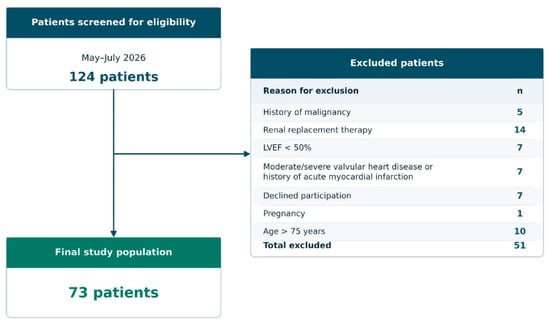
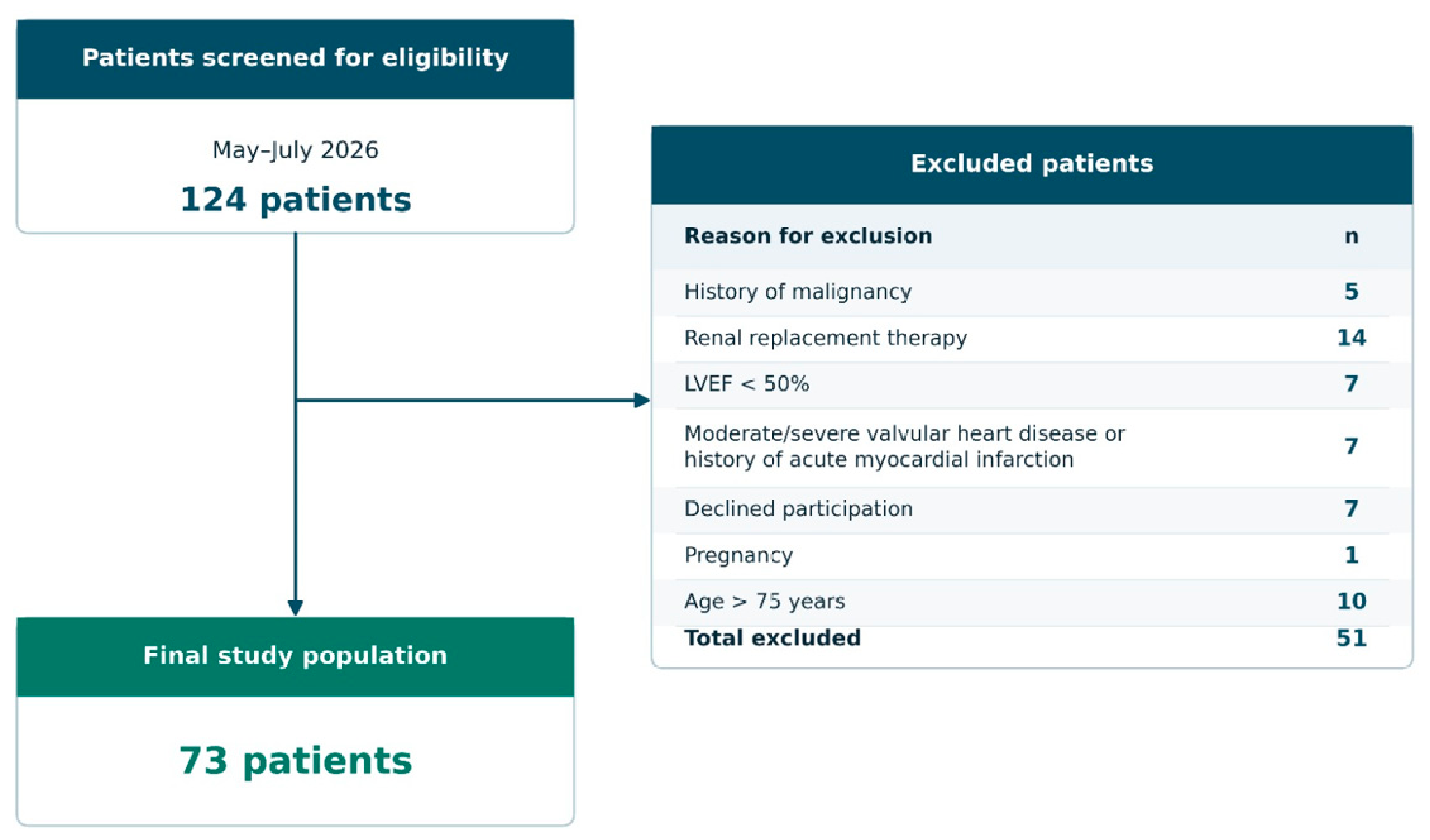
From May to July 2026, a total of 124 patients with ADPKD registered in the Turkish Society of Nephrology Cystic Kidney Diseases Study Group database and evaluated at the Nephrology Outpatient Clinic of Bağcılar Training and Research Hospital were screened for eligibility. Five patients were excluded due to a history of malignancy, 14 because they had initiated renal replacement therapy, 7 because their left ventricular ejection fraction (LVEF) was <50%, 7 because of moderate or severe valvular heart disease or a history of acute myocardial infarction, 7 because they declined to participate in the study, 1 because of pregnancy, and 10 because they were older than 75 years. Thus, the final study population consisted of 73 patients. Serum copeptin measurements were available for 62 of the 73 patients included in the clinical and echocardiographic analyses. The patient selection process is summarized in Figure 1. Copeptin data were unavailable for 11 patients because of sample deterioration, refusal to provide an additional blood sample, or failure to return for repeat blood sampling.
Figure 1.
Flow diagram of patient selection and exclusion (LVEF: left ventricular ejection fraction).
Eligible participants were aged 18–75 years and were not receiving renal replacement therapy. The exclusion criteria were active infection, malignancy, rheumatologic disease, previous acute myocardial infarction, moderate or severe valvular heart disease, LVEF <50%, and pregnancy. All clinical, laboratory, coffee consumption, and echocardiographic assessments were performed during the same study visit, and the analyses were based on cross-sectional data.
The Medipol University Faculty of Medicine Non-Interventional Clinical Research Ethics Committee approved the study (Decision No. E-10840098-50.04-3293; 12 May 2026). The study was conducted in accordance with the principles of the Declaration of Helsinki, and written informed consent was obtained from all participants.
Venous blood samples were collected in the early morning, between 08:00 and 09:00, after at least 8 h of fasting, during which no food or fluids were consumed. Participants had not consumed coffee since the previous evening. Blood samples were centrifuged at 3000 revolutions per minute for 10 min. using a centrifuge (NF 400; Nüve, Ankara, Türkiye). Serum samples were stored at −80 °C in a deep freezer (DF 490; Nüve, Ankara, Türkiye) until analysis. Biochemical parameters were measured using an automated analyzer (Shenzhen Mindray Bio-Medical Electronics Co., Ltd., Shenzhen, China), hormonal parameters were analyzed using an ADVIA 1800 automated analyzer (Siemens Healthineers, Tarrytown, NY, USA), and hematological parameters were assessed using an XN-1000 hematology analyzer (Sysmex Corporation, Kobe, Japan). Serum copeptin concentrations were determined using a commercially available enzyme-linked immunosorbent assay (ELISA) kit (Human Copeptin ELISA, CEA365Hu; Cloud-Clone Corp., Katy, TX, USA) according to the manufacturer’s instructions. Spot urine samples were collected during the same visit, and the urinary albumin-to-creatinine ratio (UACR) was calculated. A UACR ≥30 mg/g was considered indicative of albuminuria [21].
Hypertension and diabetes mellitus were defined in accordance with current guidelines from the European Society of Cardiology (ESC) and the American Diabetes Association (ADA), respectively [22,23]. Blood pressure was recorded as the mean of two measurements obtained 15 min apart. Demographic characteristics, clinical information, smoking status, and concomitant medications were recorded during the study visit.
Coffee consumption was assessed using a standardized questionnaire administered during the study visit. Participants were asked to report the frequency and amount of Turkish coffee, filter coffee, and instant coffee consumed during the preceding month (1-month recall period) [24]. For the purposes of this study, participants who reported no coffee consumption during this period were classified as non-consumers, whereas participants who reported any coffee consumption during this period were classified as consumers. Reported intake was converted to standardized amounts of dry coffee and expressed as grams per month (g/month). Because coffee consumption expressed solely in cups may vary according to cup size and preparation method, we standardized reported intake according to the type of coffee consumed [25]. For the purposes of this study, predefined conversion factors of 7 g of dry coffee per cup of Turkish coffee, 10 g per serving of filter coffee, and 2 g per serving of instant coffee were applied. The amounts consumed for each coffee type were summed to calculate mean monthly coffee consumption. The resulting exposure variable was therefore expressed as standardized dry coffee intake (g/month) rather than estimated caffeine intake. As caffeine content varies according to coffee type and preparation method [26,27], the calculated coffee amount was not considered a direct measure of caffeine exposure. Accordingly, total monthly coffee consumption was used as the primary coffee exposure variable.
Transthoracic echocardiography was performed in accordance with the recommendations of the American Society of Echocardiography and the European Association of Cardiovascular Imaging by the same experienced cardiologist, who was blinded to the participants’ clinical and laboratory data [28]. Left ventricular end-diastolic diameter (LVDd), left ventricular end-systolic diameter (LVSd), left ventricular end-diastolic volume (LVEDV), left ventricular end-systolic volume (LVESV), left atrial diameter (LAD), posterior wall thickness (PWT), interventricular septal thickness (IVST), LVEF, fractional shortening (FS), aortic root diameter (Ao), ascending aortic diameter (AscAo), early (e′) and late (a′) diastolic mitral annular velocities, peak transmitral flow velocity (E), tricuspid annular plane systolic excursion (TAPSE), and systolic pulmonary artery pressure (sPAP) were assessed [28,29].
Left ventricular mass (LVM) was calculated using the Devereux formula and indexed to body surface area (BSA) to obtain LVMI. BSA was calculated using the Mosteller formula. Increased LVMI was defined according to the sex-specific upper reference limits recommended by the American Society of Echocardiography (>115 g/m2 in men and >95 g/m2 in women) [28]. Participants were subsequently classified into groups with normal or increased LVMI.
Estimated glomerular filtration rate (eGFR) was calculated using the 2021 Chronic Kidney Disease Epidemiology Collaboration (CKD-EPI) creatinine equation, which does not include a race coefficient [30].
2.1. Sample Size
No formal a priori sample size calculation was performed before the study. The sample size was determined by the number of eligible patients available during the predefined study period. As a post hoc sensitivity analysis, G*Power version 3.1.9.4 was used for the primary multivariable linear regression model of log-transformed serum copeptin levels. Based on 62 patients, six independent variables, a two-sided α of 0.05, and a target statistical power of 95%, the minimum detectable effect size for the additional contribution of coffee consumption was f2 = 0.217. This sensitivity analysis was not interpreted as evidence of 95% statistical power or as demonstrating adequate sample size for all analyses. The precision of the estimates was additionally assessed using 95% confidence intervals.
2.2. Statistical Analysis
Statistical analyses were performed using IBM SPSS Statistics for Windows, version 31.0 (IBM Corp., Armonk, NY, USA). Categorical variables were presented as numbers (n) and percentages (%), whereas continuous variables were presented as mean ± standard deviation and median (minimum–maximum). The normality of continuous variables was assessed using skewness and kurtosis coefficients. For the present sample size, absolute z-scores for skewness and kurtosis below 3.29 were considered compatible with an approximately normal distribution [31]. The independent-samples t-test was used to compare normally distributed continuous variables between the two groups, whereas the Mann–Whitney U test was used for non-normally distributed variables. Pearson’s chi-square test or Fisher’s exact test was used for categorical variables. Effect sizes were calculated and expressed as Cohen’s d for the independent-samples t-test and r = |Z|/√N for the Mann–Whitney U test.
Associations between coffee consumption status and clinical, laboratory, and echocardiographic variables were assessed using Spearman’s rank correlation analysis. Correlations involving coffee consumption status were evaluated in the entire study population, whereas correlations involving monthly coffee consumption were assessed only among coffee consumers. Because serum copeptin levels showed a skewed distribution, a natural logarithmic transformation was applied before multivariable linear regression analysis. Coffee consumption status was included as the primary independent variable in the multivariable linear regression model for log-transformed serum copeptin levels, together with age, sex, smoking status, total daily fluid intake, and eGFR. Potential confounders were selected based on their clinical relevance and their potential associations with coffee consumption, serum copeptin levels, renal function, and cardiovascular function. A sensitivity analysis was performed by replacing smoking status with pack-years. Among coffee consumers, the association between monthly coffee consumption and log-transformed serum copeptin levels was additionally evaluated using unadjusted and adjusted linear regression models.
Separate multivariable linear regression models were also constructed with mitral annular e′ velocity and the mitral E/e′ ratio as dependent variables. In both models, coffee consumption status was included as the primary independent variable, with age, sex, smoking status, hypertension, and eGFR included as covariates. All independent variables were entered simultaneously using the Enter method.
Missing data were excluded on an analysis-specific basis, and no imputation was performed. Missingness occurred at the variable level rather than as complete exclusion of participants; copeptin measurements were available for 62 patients and anthropometric measurements for 67 patients. Accordingly, regression analyses included only patients with complete data for all variables included in the respective model. Multicollinearity and model assumptions were assessed, and sensitivity analyses using HC3 heteroskedasticity-robust standard errors were performed. All statistical tests were two-sided, and p < 0.05 was considered statistically significant. Multiple secondary comparisons were considered exploratory, and unadjusted p values were reported.
3. Results
The demographic, clinical, lifestyle, and anthropometric characteristics of the study population according to coffee consumption status are presented in Table 1. A total of 73 patients with ADPKD were included, of whom 38 (52.1%) were non-coffee consumers and 35 (47.9%) were coffee consumers. The mean age of the study population was 47.85 ± 15.83 years. Overall, 41 patients (56.2%) were female, 32 patients (43.8%) were male, 13 (17.8%) had diabetes mellitus, 38 (52.1%) had hypertension, and 30 (41.1%) were smokers. No statistically significant differences were observed between the two groups for sex, age, diabetes mellitus, hypertension, disease duration, follow-up duration, total daily fluid intake, blood pressure, body mass index, height, body weight, total body water, or body surface area (all p > 0.05). Current smoking was more frequent among coffee consumers than non-coffee consumers (57.1% vs. 26.3%, p = 0.007), and smoking exposure was also higher in coffee consumers (18.62 ± 14.88 vs. 9.70 ± 8.68 pack-years, p = 0.045). Among coffee consumers, the mean monthly coffee consumption was 122.29 ± 133.55 g, with a median of 60 g/month (range, 10–540 g/month).
Table 1.
Comparison of demographic, clinical, lifestyle, and anthropometric characteristics of patients with autosomal dominant polycystic kidney disease according to coffee consumption status.
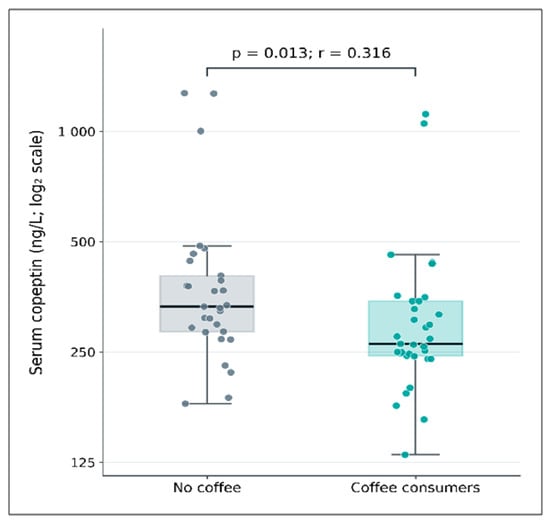
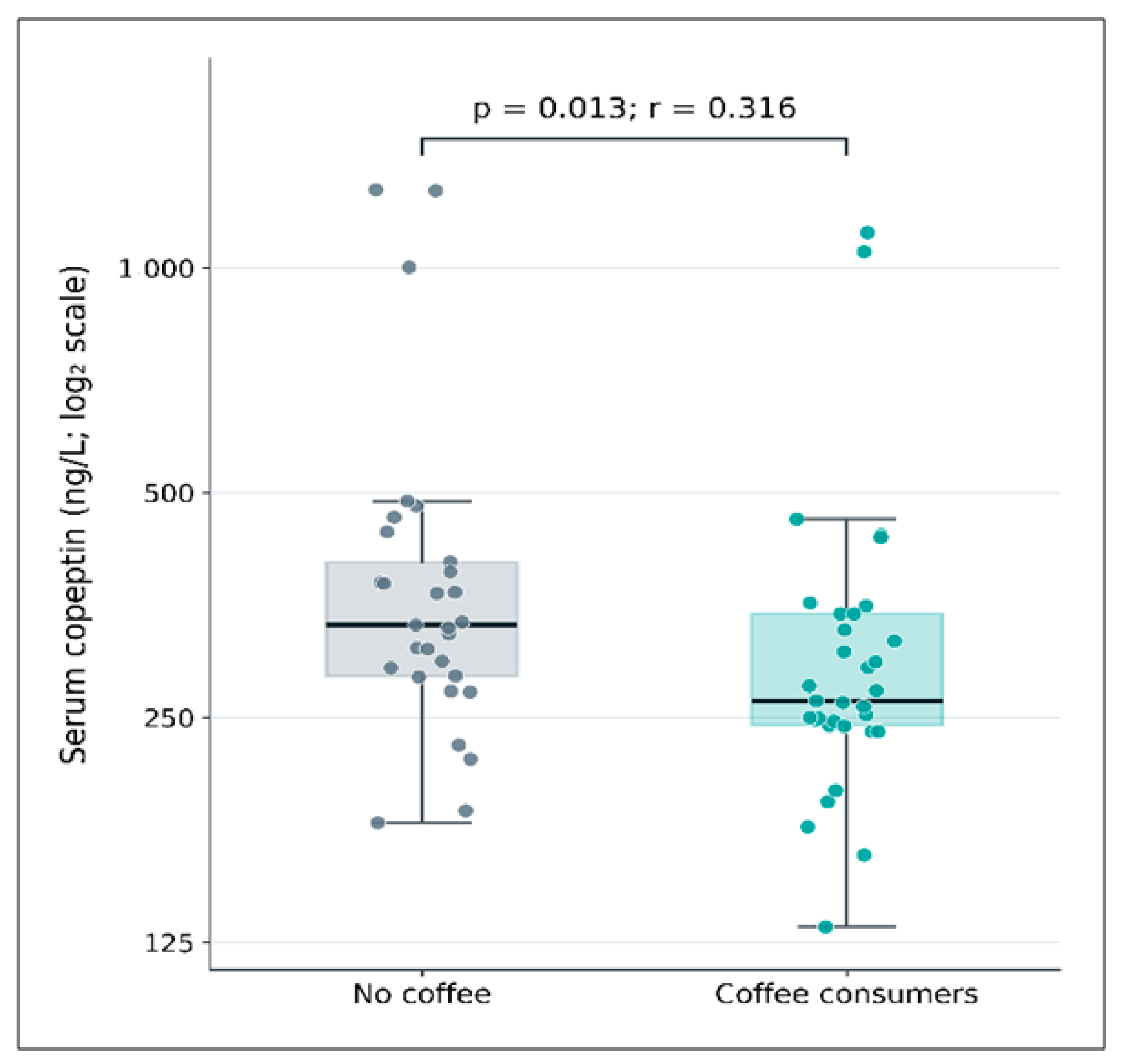
The serum copeptin level and other laboratory parameters according to coffee consumption status are presented in Table 2. Serum copeptin levels were significantly lower among coffee consumers than among non-coffee consumers (median: 263.51 vs. 332.77 ng/L, p = 0.013; r = 0.316). As illustrated in Figure 2, copeptin levels were higher among non-coffee consumers. No significant differences were observed between the groups in glucose, urea, creatinine, eGFR, uric acid, calcium, sodium, potassium, phosphate, parathyroid hormone, leukocyte count, hemoglobin, hematocrit, platelet count, or spot urine albumin-to-creatinine ratio (all p > 0.05). Serum copeptin measurements were available for 62 of the 73 included patients; therefore, the comparison of copeptin levels was based on these 62 patients.
Table 2.
Serum Copeptin Levels and Laboratory Parameters According to Coffee Consumption Status in Patients with Autosomal Dominant Polycystic Kidney Disease.
Figure 2.
The distribution of serum copeptin levels.
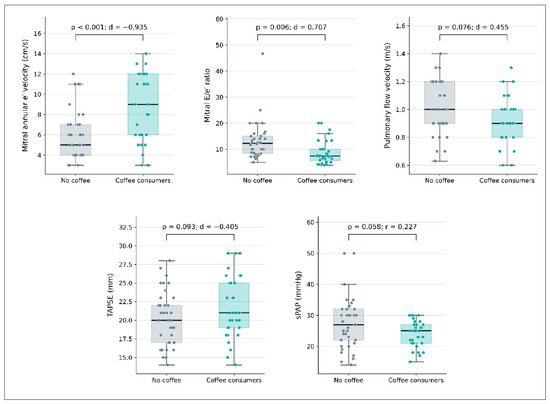
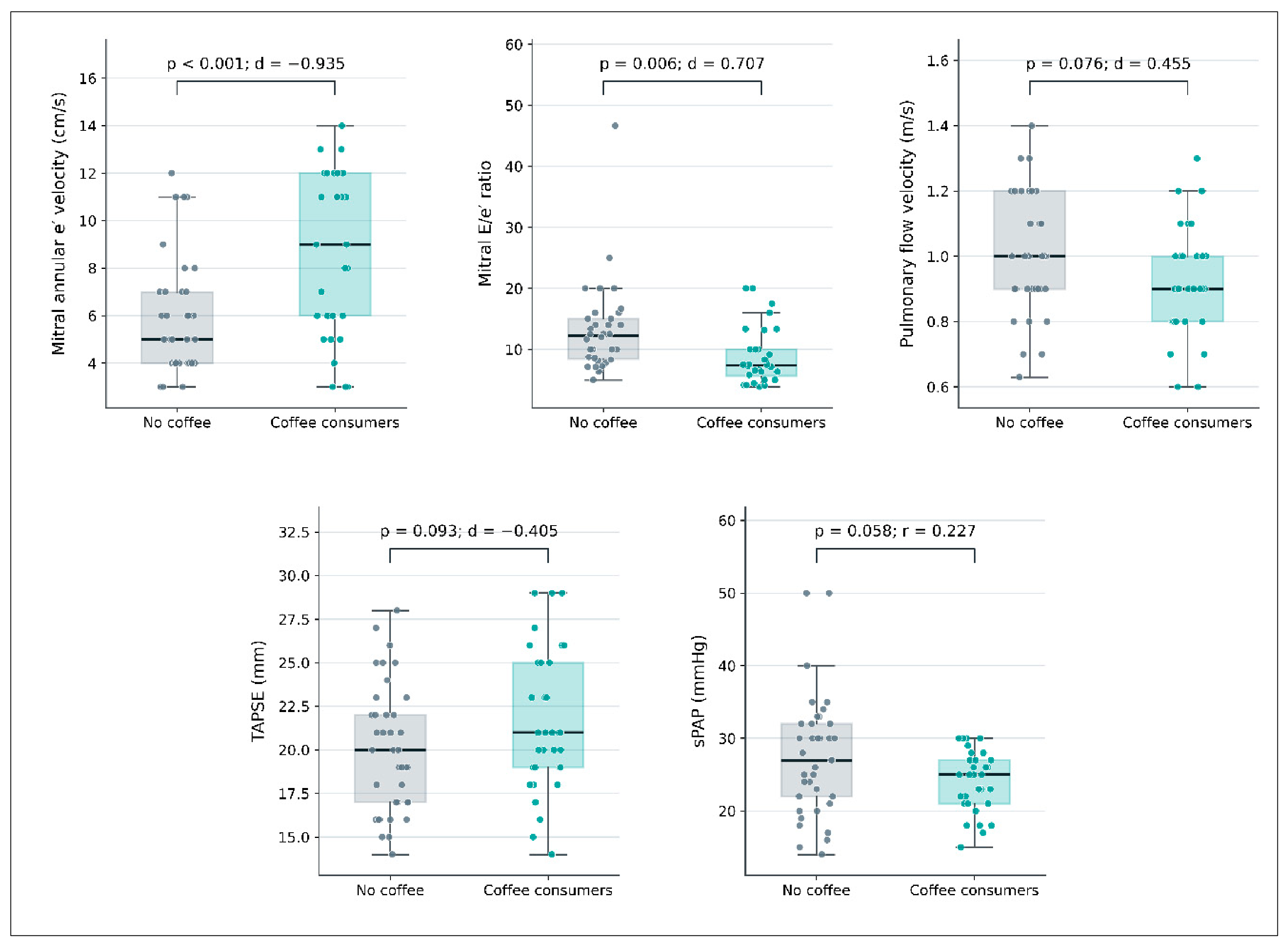
Echocardiographic parameters according to coffee consumption status are presented in Table 3. Mitral annular early diastolic tissue velocity (e′) was significantly higher in coffee consumers than in non-consumers (8.61 ± 3.43 vs. 5.86 ± 2.41 cm/s, p < 0.001; Cohen’s d = −0.935), indicating a large effect size. The mitral E/e′ ratio was significantly lower in coffee consumers than in non-consumers (8.75 ± 4.55 vs. 13.18 ± 7.52, p = 0.006; Cohen’s d = 0.707), indicating a moderate effect size. No statistically significant differences were observed between the groups in other cardiac structural measurements, left ventricular systolic or diastolic function parameters, valvular or flow parameters, systolic pulmonary artery pressure, left ventricular mass, or left ventricular mass index (all p > 0.05). The prevalence of mitral, aortic, and tricuspid regurgitation and increased left ventricular mass index also did not differ significantly between the groups (all p > 0.05). Selected cardiac functional and hemodynamic parameters are illustrated in Figure 3.
Table 3.
Comparison of Echocardiographic Parameters According to Coffee Consumption Status in Patients with Autosomal Dominant Polycystic Kidney Disease.
Figure 3.
The distribution of selected cardiac functional and hemodynamic parameters according to coffee consumption status.
Correlation analyses were performed to further evaluate the relationships between coffee consumption and selected clinical, biochemical, and echocardiographic variables (Table 4). Coffee consumption status was positively correlated with smoking status (r = 0.313, p = 0.007) and mitral annular early diastolic tissue velocity (e′) (r = 0.408, p < 0.001), whereas inverse correlations were observed with serum copeptin levels (r = −0.319, p = 0.012) and the E/e′ ratio (r = −0.414, p < 0.001).
Table 4.
Correlation Analysis of Coffee Consumption Status and Monthly Coffee Consumption with Selected Clinical, Biochemical, and Echocardiographic Variables.
Among coffee consumers, monthly coffee consumption was positively correlated with smoking status (r = 0.380, p = 0.025), mitral regurgitation (r = 0.549, p < 0.001), age (r = 0.442, p = 0.008), follow-up duration (r = 0.423, p = 0.011), and serum copeptin levels (r = 0.393, p = 0.024) and mitral late diastolic flow velocity (A) (r = 0.352, p = 0.044). Monthly coffee consumption amount was not significantly correlated with e′ (r = 0.044, p = 0.807) or the E/e′ ratio (r = −0.058, p = 0.752).
Given the skewed distribution of serum copeptin levels, a natural logarithmic transformation was applied before regression analysis. In the correlation analysis, coffee consumption status was inversely correlated with serum copeptin levels (Spearman’s r = −0.319, p = 0.012), whereas, among coffee consumers, monthly coffee consumption was positively correlated with serum copeptin levels (r = 0.393, p = 0.024) (Table 4). These findings were considered separately because coffee consumption status and monthly coffee consumption amount represent different exposure measures.
To further evaluate the association observed between monthly coffee consumption and serum copeptin levels among coffee consumers, additional regression analyses were performed. The results of the unadjusted model and the model adjusted for age, smoking status, and eGFR are presented in Table 5. Age and smoking status were selected as adjustment variables because they were associated with coffee consumption amount, whereas eGFR was included as a marker of kidney function.
Table 5.
Log-Linear Regression Analysis of the Association Between Monthly Coffee Consumption Amount and Serum Copeptin Levels in Coffee-Consuming Patients with Autosomal Dominant Polycystic Kidney Disease.
Among 33 coffee-consuming patients with complete data, the unadjusted model showed a significant positive association between LN (coffee consumption amount) and LN(copeptin) (B = 0.154; β = 0.408; 95% CI: 0.028–0.280; p = 0.018; R2 = 0.167). After adjustment for age, smoking status, and eGFR, the coefficient for coffee consumption amount remained positive but was no longer statistically significant (B = 0.133; β = 0.353; 95% CI: −0.018–0.284; p = 0.082). The adjusted model was also not statistically significant overall [F(4,28) = 2.180; p = 0.097].
Therefore, the positive association observed between coffee consumption amount and copeptin levels among coffee consumers was not confirmed after adjustment. However, the persistence of a positive coefficient and the wide confidence interval do not allow us to conclude that the association was absent or entirely attributable to confounding. Given the small sample size and cross-sectional design, these findings were interpreted cautiously.
A multivariable linear regression model was constructed to examine the association between coffee consumption status and ln(copeptin), adjusting for age, sex, smoking status, total daily fluid intake, and eGFR (Table 6). The model explained 14.9% of the variance in ln(copeptin) (R2 = 0.149; adjusted R2 = 0.056), although the overall model was not statistically significant [F(6,55) = 1.606, p = 0.163]. In the conventional regression analysis, coffee consumption was associated with lower ln(copeptin) levels (B = −0.263, β = −0.286, 95% CI: −0.522 to −0.004; p = 0.047), corresponding to an approximately 23.1% lower adjusted geometric mean copeptin level among coffee consumers (ratio = 0.769, 95% CI: 0.593–0.997). However, this association did not remain statistically significant when HC3 robust standard errors were applied (p = 0.074), and the finding was therefore interpreted cautiously.
Table 6.
Multivariable Linear Regression Analysis of the Association Between Coffee Consumption and Serum Copeptin Levels Adjusted for Smoking Status and Other Covariates.
A sensitivity analysis was performed by replacing smoking status with cumulative smoking exposure, expressed as pack-years, while retaining age, sex, total daily fluid intake, and eGFR in the model (Table 7). The model explained 14.6% of the variance in ln(copeptin) (R2 = 0.146; adjusted R2 = 0.053) and was not statistically significant overall [F(6,55) = 1.571, p = 0.173]. In the sensitivity analysis, the association between coffee consumption and ln(copeptin) remained negative but was no longer statistically significant (B = −0.248, β = −0.270, 95% CI: −0.510 to 0.015; p = 0.064). Smoking exposure and the other covariates were not significantly associated with ln(copeptin) (all p > 0.05). VIF values ranged from 1.141 to 2.065, indicating no substantial multicollinearity.
Table 7.
Multivariable Linear Regression Sensitivity Analysis of the Association Between Coffee Consumption and Serum Copeptin Levels Using Pack-Years as a Measure of Smoking Exposure.
Compared with the main model using smoking status, the coefficient for coffee consumption remained similar in direction and magnitude, although statistical significance was not maintained. This finding indicates that the statistical significance of the association between coffee consumption and ln(copeptin) was sensitive to how smoking exposure was modeled. However, the result was not interpreted as evidence that the association was entirely attributable to smoking exposure. The assignment of 0 pack-years to participants who reported no smoking but had missing pack-year records was considered an assumption of this sensitivity analysis.
Two multivariable linear regression models were constructed to evaluate the associations of coffee consumption with mitral annular e′ velocity and the mitral E/e′ ratio, with each parameter analyzed separately as the dependent variable (Table 8). Both models were statistically significant overall. The e′ velocity model explained 29.5% of the variance (R2 = 0.295; adjusted R2 = 0.227; p < 0.001), whereas the E/e′ ratio model explained 21.6% of the variance (R2 = 0.216; adjusted R2 = 0.136; p = 0.022).
Table 8.
Multivariable Linear Regression Analyses of the Associations of Coffee Consumption with Mitral Annular e′ Velocity and Mitral E/e′ Ratio.
After adjustment for age, sex, smoking status, hypertension, and eGFR, coffee consumption was associated with higher mitral annular e′ velocity (B = 2.531, β = 0.395, 95% CI: 1.081–3.981; p < 0.001). Age was also inversely associated with e′ velocity (B = −0.066; p = 0.021), whereas the other covariates were not significantly associated with e′ velocity (all p > 0.05).
In the E/e′ ratio model, coffee consumption was associated with a lower E/e′ ratio after adjustment (B = −4.548, β = −0.347, 95% CI: −7.786 to −1.310; p = 0.007). Hypertension was also associated with a lower E/e′ ratio (B = −3.404, β = −0.260, 95% CI: −6.655 to −0.153; p = 0.040), whereas age, sex, smoking status, and eGFR were not significantly associated with E/e′ (all p > 0.05). VIF values did not indicate substantial multicollinearity in either model.
4. Discussion
In this study, we evaluated the relationships between coffee consumption, serum copeptin levels, and cardiac parameters in patients with autosomal dominant polycystic kidney disease (ADPKD). Coffee consumers had significantly lower serum copeptin levels and higher mitral annular early diastolic tissue velocity (e′) than non-consumers. The association between coffee consumption and e′ remained statistically significant after multivariable adjustment, and coffee consumption was also associated with a lower E/e′ ratio following multivariable adjustment, whereas no significant associations were observed with left ventricular mass index (LVMI), left ventricular ejection fraction (LVEF), or other major echocardiographic parameters. Coffee consumption was inversely correlated with serum copeptin levels, whereas monthly coffee consumption was positively correlated with copeptin among coffee consumers. The echocardiographic findings were exploratory, and the observed associations should be interpreted in the context of the cross-sectional study design.
Experimental studies have suggested that caffeine may accelerate cyst growth in ADPKD, providing a rationale for recommendations to limit caffeine intake [3,10]. However, clinical evidence regarding coffee and caffeine consumption remains inconsistent [11,32,33]. Accordingly, the 2025 KDIGO ADPKD guideline recommends limiting caffeine intake to less than 400 mg/day, while acknowledging that caffeine restriction has not been shown to be effective in people with ADPKD [12].
In ADPKD, higher circulating copeptin levels have been associated with greater kidney volume and subsequent kidney growth [9,34]. In the CRISP cohort, baseline copeptin was independently associated with change in total kidney volume during long-term follow-up [9]. Similarly, in the TEMPO 3:4 trial, higher baseline copeptin predicted kidney growth and eGFR decline, although these associations were attenuated after adjustment for baseline total kidney volume [34]. These findings support copeptin as a marker of disease severity and progression, consistent with the proposed role of vasopressin signaling in ADPKD [7,8,9,34].
Echocardiographic studies in ADPKD have mainly demonstrated left ventricular hypertrophy and diastolic dysfunction, which may occur even in patients with preserved renal function [14,15,16]. Increased LV mass, impaired relaxation, left atrial enlargement, and other abnormalities of diastolic function have been reported, although findings across studies are not entirely consistent [14,15,16]. Overall, the available evidence suggests that cardiac involvement, particularly abnormalities of diastolic function, may be part of the cardiovascular phenotype of ADPKD [14,15,16].
Taken together, these observations provided the rationale for our hypothesis that coffee consumption might be associated with vasopressin-related activity, reflected by serum copeptin levels, and with cardiac function, particularly indices of diastolic function, in patients with ADPKD.
In our study, serum copeptin levels were significantly lower in coffee-consuming patients with ADPKD than in non-consumers, suggesting a possible relationship between coffee consumption and the vasopressin system. This finding is consistent with the results reported by Schill et al. [13] in an epidemiological analysis of 3270 participants from the Malmö Offspring Study, in which higher coffee consumption was associated with lower plasma copeptin concentrations after adjustment for total fluid intake and other potential confounding factors. In the experimental component of the same study, copeptin concentrations decreased significantly after consumption of 400 mL of coffee, with a maximum reduction of approximately 27% at 150 min [13]. In the present study, blood samples were collected in the early morning after at least 8 h of fasting, and the participants had not consumed coffee since the previous evening. Therefore, the observed differences in copeptin levels were assessed under standardized fasting and pre-sampling conditions, although no standardized hydration protocol was applied, and were primarily intended to reflect habitual coffee consumption rather than acute coffee intake.
Notably, water consumption also produced a more modest reduction in copeptin concentrations, suggesting that the observed effect may not be attributable exclusively to caffeine [13]. In our study, caffeine intake was not directly quantified; therefore, the lower copeptin concentrations could not be specifically attributed to caffeine, other coffee components, or differences in fluid intake. Importantly, the positive correlation between monthly coffee consumption and serum copeptin levels among coffee consumers (r = 0.393, p = 0.024) does not support a simple linear dose–response relationship. Coffee consumption status and coffee amount among consumers represent different exposure comparisons and therefore should not be interpreted as equivalent measures of dose–response. In the additional regression analysis, the positive association between log-transformed monthly coffee consumption and log-transformed copeptin was no longer statistically significant after adjustment for age, smoking status, and eGFR (B = 0.133, p = 0.082). This finding should be interpreted cautiously given the small number of coffee consumers (n = 35) and the observed differences in smoking exposure. Moreover, the higher prevalence and cumulative exposure to smoking among coffee consumers may represent an additional source of residual confounding, despite adjustment for smoking in the multivariable model. In the sensitivity analysis using pack-years instead of smoking status, the association between coffee consumption and log-transformed copeptin was attenuated and did not reach statistical significance (p = 0.064), further supporting cautious interpretation of this finding. Residual confounding and differences in coffee type and preparation may also have contributed to this finding.
The potential importance of copeptin in ADPKD is closely related to the established role of the vasopressin system in disease progression. Copeptin is released in equimolar amounts with arginine vasopressin (AVP) and, because of its greater stability in the circulation, is widely used as a surrogate marker of AVP secretion [5]. AVP activates the V2 receptor and increases intracellular cAMP signaling, thereby promoting cyst growth and fluid secretion in ADPKD [35]. Pharmacological inhibition of this pathway with the V2-receptor antagonist tolvaptan has been shown to slow kidney enlargement and loss of renal function [4]. Because total kidney volume and longitudinal renal outcomes were not assessed in the present study, the clinical significance of the observed copeptin difference remains uncertain. Previous studies of coffee and copeptin have primarily involved non-ADPKD populations; therefore, whether this association is specific to ADPKD cannot be determined from our findings.
Clinical evidence regarding the effects of coffee and caffeine consumption on renal outcomes in ADPKD has not demonstrated a consistent adverse effect on kidney function. Vendramini et al. found no significant association between caffeine consumption and renal volume or eGFR [11]. Similarly, Girardat-Rotar et al. reported no significant association between coffee consumption and height-adjusted total kidney volume (htTKV) or eGFR in a prospective longitudinal ADPKD cohort [32]. In a longer-term analysis of the CRISP cohort, caffeine consumption was associated with an approximately 0.6% annual increase in htTKV growth, but no significant associations were observed with measured GFR, end-stage kidney disease, or mortality [33]. Consistent with these findings, we observed no significant association between coffee consumption and eGFR. However, the small sample size and cross-sectional design preclude conclusions regarding the long-term renal effects of coffee or caffeine consumption.
In our study, coffee-consuming patients with ADPKD had higher e′ velocities than non-consumers, and coffee consumption was associated with both higher e′ velocities and lower E/e′ ratios after multivariable adjustment, suggesting a possible association between coffee consumption and selected indices of left ventricular diastolic function. In a study evaluating the acute effects of 100 mg of caffeine in healthy individuals, caffeine alone did not significantly alter ventricular long-axis function, whereas smoking was associated with acute changes in ventricular diastolic function [36]. In contrast, the CARDIA study reported that low-to-moderate coffee consumption was associated with lower E/e′ and more favorable global longitudinal strain, whereas total caffeine intake was not significantly associated with cardiac function [19]. Similarly, in a large population-based study of 9009 participants from the Hamburg City Health Study, coffee consumption was not significantly associated with the investigated echocardiographic parameters after adjustment for cardiovascular risk factors [20]. A population-based study using cardiac magnetic resonance imaging also reported associations between habitual coffee consumption and selected cardiac functional parameters, although the imaging modality and outcomes differed from those evaluated in the present study [37]. These differing findings may partly reflect variations in study populations, the dose and assessment of coffee or caffeine exposure, smoking and other cardiovascular risk factors, and the specific echocardiographic parameters evaluated, such as e′ and E/e′. The relationship between habitual coffee consumption and these echocardiographic parameters has not previously been directly examined in this population. Our study therefore provides preliminary data regarding this association within an ADPKD cohort. The underlying mechanism remains uncertain, and because caffeine intake was not directly quantified, the observed association cannot be specifically attributed to caffeine.
Coffee consumption was associated with higher e′ and lower E/e′, but was not significantly associated with LVMI, LVEF, or other major echocardiographic parameters, suggesting that the observed associations were limited to selected diastolic indices rather than representing a consistent change across cardiac parameters. Therefore, the higher e′ velocity and lower E/e′ ratio should not be interpreted as evidence of a direct cardioprotective effect of coffee. Prospective studies with standardized assessment of coffee and caffeine intake and serial echocardiographic measurements are needed to determine whether these findings are reproducible and clinically meaningful.
Several limitations should be considered when interpreting our findings. First, the cross-sectional design precludes establishing temporal or causal relationships. Second, caffeine intake was not directly quantified, and differences in caffeine content related to coffee type and preparation could not be fully accounted for. Third, total kidney volume and longitudinal measures of ADPKD progression were not available, limiting assessment of the long-term clinical significance of the observed copeptin findings. Fourth, the relatively small sample size, particularly the limited number of coffee consumers in the correlation analyses, may have reduced statistical power and increased the uncertainty of some estimates. Fifth, coffee consumption was self-reported and assessed at a single time point, and recall bias cannot be excluded. Finally, residual confounding, particularly from smoking and other lifestyle factors, cannot be completely excluded, despite adjustment for selected covariates. The single-center design may also limit generalizability.
5. Conclusions
In this cross-sectional study of patients with ADPKD, coffee consumption was associated with lower serum copeptin levels and selected echocardiographic parameters, including higher mitral annular e′ velocity and lower E/e′ ratio. No significant association was observed with eGFR or other major echocardiographic parameters. These findings provide preliminary evidence of an association between coffee consumption, serum copeptin levels, and selected indices of diastolic function in patients with ADPKD; however, because these associations have not been similarly evaluated in healthy individuals, whether the observed findings are specific to ADPKD cannot be determined. These findings should be considered hypothesis-generating and require confirmation in larger, prospective studies.
Author Contributions
Conceptualization, B.E. and A.E.A.; methodology, B.E. and I.S.; software, B.E.; validation, B.E. and A.E.A.; formal analysis, B.E., I.S. and A.E.A.; investigation, F.K., B.E. and A.E.A.; resources, F.K., B.E. and A.E.A.; data curation, B.E.; writing—original draft preparation, B.E.; writing—review and editing, B.E. and A.E.A.; visualization, B.E. and A.E.A.; supervision, B.E. and A.E.A.; project administration, B.E.; funding acquisition, B.E. All authors have read and agreed to the published version of the manuscript.
Funding
This research received no external funding.
Institutional Review Board Statement
The Medipol University Faculty of Medicine Non-Interventional Clinical Research Ethics Committee approved the study (Decision No. E-10840098-50.04-3293; 12 May 2026). The study was conducted in accordance with the principles of the Declaration of Helsinki, and written informed consent was obtained from all participants.
Informed Consent Statement
Informed consent was obtained from all subjects involved in the study.
Data Availability Statement
Data are unavailable due to privacy or ethical restrictions.
Conflicts of Interest
The authors declare no conflicts of interest.
References
- Torres, V.E.; Harris, P.C. Autosomal dominant polycystic kidney disease: The last 3 years. Kidney Int. 2009, 76, 149–168. [Google Scholar] [CrossRef] [Scilit] [PubMed] [PubMed Central]
- Chapman, A.B.; Devuyst, O.; Eckardt, K.U.; Gansevoort, R.T.; Harris, T.; Horie, S.; Kasiske, B.L.; Odland, D.; Pei, Y.; Perrone, R.D.; et al. Conference Participants. Autosomal-dominant polycystic kidney disease (ADPKD): Executive summary from a Kidney Disease: Improving Global Outcomes (KDIGO) Controversies Conference. Kidney Int. 2015, 88, 17–27. [Google Scholar] [CrossRef] [Scilit] [PubMed] [PubMed Central]
- Belibi, F.A.; Wallace, D.P.; Yamaguchi, T.; Christensen, M.; Reif, G.; Grantham, J.J. The effect of caffeine on renal epithelial cells from patients with autosomal dominant polycystic kidney disease. J. Am. Soc. Nephrol. 2002, 13, 2723–2729. [Google Scholar] [CrossRef] [Scilit] [PubMed]
- Torres, V.E.; Chapman, A.B.; Devuyst, O.; Gansevoort, R.T.; Grantham, J.J.; Higashihara, E.; Perrone, R.D.; Krasa, H.B.; Ouyang, J.; Czerwiec, F.S. TEMPO 3:4 Trial Investigators. Tolvaptan in patients with autosomal dominant polycystic kidney disease. N. Engl. J. Med. 2012, 367, 2407–2418. [Google Scholar] [CrossRef] [Scilit] [PubMed] [PubMed Central]
- Morgenthaler, N.G.; Struck, J.; Jochberger, S.; Dünser, M.W. Copeptin: Clinical use of a new biomarker. Trends Endocrinol. Metab. 2008, 19, 43–49. [Google Scholar] [CrossRef] [Scilit] [PubMed]
- Velho, G.; Bouby, N.; Hadjadj, S.; Matallah, N.; Mohammedi, K.; Fumeron, F.; Potier, L.; Bellili-Munoz, N.; Taveau, C.; Alhenc-Gelas, F.; et al. Plasma copeptin and renal outcomes in patients with type 2 diabetes and albuminuria. Diabetes Care 2013, 36, 3639–3645. [Google Scholar] [CrossRef] [Scilit] [PubMed] [PubMed Central]
- Zittema, D.; Boertien, W.E.; van Beek, A.P.; Dullaart, R.P.; Franssen, C.F.; de Jong, P.E.; Meijer, E.; Gansevoort, R.T. Vasopressin, copeptin, and renal concentrating capacity in patients with autosomal dominant polycystic kidney disease without renal impairment. Clin. J. Am. Soc. Nephrol. 2012, 7, 906–913. [Google Scholar] [CrossRef] [Scilit] [PubMed]
- Boertien, W.E.; Meijer, E.; Zittema, D.; van Dijk, M.A.; Rabelink, T.J.; Breuning, M.H.; Struck, J.; Bakker, S.J.; Peters, D.J.; de Jong, P.E.; et al. Copeptin, a surrogate marker for vasopressin, is associated with kidney function decline in subjects with autosomal dominant polycystic kidney disease. Nephrol. Dial. Transplant. 2012, 27, 4131–4137. [Google Scholar] [CrossRef] [Scilit] [PubMed]
- Boertien, W.E.; Meijer, E.; Li, J.; Bost, J.E.; Struck, J.; Flessner, M.F.; Gansevoort, R.T.; Torres, V.E. Consortium for Radiologic Imaging Studies of Polycystic Kidney Disease CRISP. Relationship of copeptin, a surrogate marker for arginine vasopressin, with change in total kidney volume and GFR decline in autosomal dominant polycystic kidney disease: Results from the CRISP cohort. Am. J. Kidney Dis. 2013, 61, 420–429. [Google Scholar] [CrossRef] [Scilit] [PubMed] [PubMed Central]
- Meca, R.; Balbo, B.E.; Ormanji, M.S.; Fonseca, J.M.; Iannuzzi, L.R.; Santana Costa, E.; Onuchic, L.F.; Heilberg, I.P. Caffeine accelerates cystic kidney disease in a Pkd1-deficient mouse model. Cell. Physiol. Biochem. 2019, 52, 1061–1074. [Google Scholar] [CrossRef] [Scilit] [PubMed]
- Vendramini, L.C.; Nishiura, J.L.; Baxmann, A.C.; Heilberg, I.P. Caffeine intake by patients with autosomal dominant polycystic kidney disease. Braz. J. Med. Biol. Res. 2012, 45, 834–840. [Google Scholar] [CrossRef] [Scilit] [PubMed] [PubMed Central]
- Kidney Disease: Improving Global Outcomes (KDIGO) ADPKD Work Group. KDIGO 2025 Clinical Practice Guideline for the Evaluation, Management, and Treatment of Autosomal Dominant Polycystic Kidney Disease (ADPKD). Kidney Int. 2025, 107, S1–S239. [CrossRef] [Scilit] [PubMed]
- Schill, F.; Timpka, S.; Hellstrand, S.; Melander, O.; Enhörning, S. Coffee intake and the vasopressin system: An epidemiological and experimental study. Endocr. Connect. 2025, 14, e250100. [Google Scholar] [CrossRef] [Scilit] [PubMed] [PubMed Central]
- Ecder, T. Cardiovascular complications in autosomal dominant polycystic kidney disease. Curr. Hypertens. Rev. 2013, 9, 2–11. [Google Scholar] [CrossRef] [Scilit] [PubMed]
- Chapman, A.B.; Johnson, A.M.; Rainguet, S.; Hossack, K.; Gabow, P.; Schrier, R.W. Left ventricular hypertrophy in autosomal dominant polycystic kidney disease. J. Am. Soc. Nephrol. 1997, 8, 1292–1297. [Google Scholar] [CrossRef] [Scilit] [PubMed]
- Chen, H.; Watnick, T.; Hong, S.N.; Daly, B.; Li, Y.; Seliger, S.L. Left ventricular hypertrophy in a contemporary cohort of autosomal dominant polycystic kidney disease patients. BMC Nephrol. 2019, 20, 386. [Google Scholar] [CrossRef] [Scilit] [PubMed] [PubMed Central]
- Hage, C.; Lund, L.H.; Donal, E.; Daubert, J.C.; Linde, C.; Mellbin, L. Copeptin in patients with heart failure and preserved ejection fraction: A report from the prospective KaRen-study. Open Heart 2015, 2, e000260. [Google Scholar] [CrossRef] [Scilit] [PubMed]
- Lupa, M.; Pardała, A.; Bednarek, A.; Mrochem-Kwarciak, J.; Deja, R.; Mizia-Stec, K.; Kolonko, A. The association between echocardiographic parameters of heart failure with preserved ejection fraction and fluid status biomarkers in hemodialysis patients. Diagnostics 2024, 14, 1310. [Google Scholar] [CrossRef] [Scilit] [PubMed]
- Nwabuo, C.C.; Betoko, A.S.; Reis, J.P.; Moreira, H.T.; Vasconcellos, H.D.; Guallar, E.; Cox, C.; Sidney, S.; Ambale-Venkatesh, B.; Lewis, C.E.; et al. Coffee and tea consumption in the early adult lifespan and left ventricular function in middle age: The CARDIA study. ESC Heart Fail. 2020, 7, 1510–1519. [Google Scholar] [CrossRef] [Scilit] [PubMed] [PubMed Central]
- Senftinger, J.; Nikorowitsch, J.; Borof, K.; Ojeda, F.; Aarabi, G.; Beikler, T.; Mayer, C.; Behrendt, C.A.; Walther, C.; Zyriax, B.C.; et al. Coffee consumption and associations with blood pressure, LDL-cholesterol and echocardiographic measures in the general population. Sci. Rep. 2023, 13, 4668. [Google Scholar] [CrossRef] [Scilit] [PubMed]
- Kidney Disease: Improving Global Outcomes (KDIGO) CKD Work Group. KDIGO 2024 Clinical Practice Guideline for the Evaluation and Management of Chronic Kidney Disease. Kidney Int. 2024, 105, S117–S314. [CrossRef] [Scilit] [PubMed]
- McEvoy, J.W.; McCarthy, C.P.; Bruno, R.M.; Brouwers, S.; Canavan, M.D.; Ceconi, C.; Christodorescu, R.M.; Daskalopoulou, S.S.; Ferro, C.J.; Gerdts, E.; et al. ESC Scientific Document Group. 2024 ESC Guidelines for the management of elevated blood pressure and hypertension. Eur. Heart J. 2024, 45, 3912–4018, Erratum in Eur. Heart J. 2025, 46, 1300. https://doi.org/10.1093/eurheartj/ehaf031. Erratum in Eur. Heart J. 2025, 46, 4949. https://doi.org/10.1093/eurheartj/ehaf659. [Google Scholar] [CrossRef] [Scilit] [PubMed]
- American Diabetes Association Professional Practice Committee for Diabetes. 2. Diagnosis and classification of diabetes: Standards of Care in Diabetes—2026. Diabetes Care 2026, 49, S27–S49. [Google Scholar] [CrossRef] [Scilit] [PubMed]
- Sääksjärvi, K.; Knekt, P.; Männistö, S.; Heliövaara, M. Self-administered questionnaire is a reliable measure of coffee consumption. J. Epidemiol. 2010, 20, 363–369. [Google Scholar] [CrossRef] [Scilit] [PubMed][Green Version]
- Poole, R.; Ewings, S.; Parkes, J.; Fallowfield, J.A.; Roderick, P. Misclassification of coffee consumption data and the development of a standardised coffee unit measure. BMJ Nutr. Prev. Health 2019, 2, 11–19. [Google Scholar] [CrossRef] [Scilit] [PubMed] [PubMed Central]
- Bell, L.N.; Wetzel, C.R.; Grand, A.N. Caffeine content in coffee as influenced by grinding and brewing techniques. Food Res. Int. 1996, 29, 785–789. [Google Scholar] [CrossRef] [Scilit]
- Heckman, M.A.; Weil, J.; Gonzalez de Mejia, E. Caffeine (1, 3, 7-trimethylxanthine) in foods: A comprehensive review on consumption, functionality, safety, and regulatory matters. J. Food Sci. 2010, 75, R77–R87. [Google Scholar] [CrossRef] [Scilit] [PubMed]
- Lang, R.M.; Badano, L.P.; Mor-Avi, V.; Afilalo, J.; Armstrong, A.; Ernande, L.; Flachskampf, F.A.; Foster, E.; Goldstein, S.A.; Kuznetsova, T.; et al. Recommendations for cardiac chamber quantification by echocardiography in adults: An update from the American Society of Echocardiography and the European Association of Cardiovascular Imaging. J. Am. Soc. Echocardiogr. 2015, 28, 1–39.e14. [Google Scholar] [CrossRef] [Scilit] [PubMed]
- Nagueh, S.F.; Smiseth, O.A.; Appleton, C.P.; Byrd, B.F., 3rd; Dokainish, H.; Edvardsen, T.; Flachskampf, F.A.; Gillebert, T.C.; Klein, A.L.; Lancellotti, P.; et al. Recommendations for the Evaluation of Left Ventricular Diastolic Function by Echocardiography: An Update from the American Society of Echocardiography and the European Association of Cardiovascular Imaging. J. Am. Soc. Echocardiogr. 2016, 29, 277–314. [Google Scholar] [CrossRef] [Scilit] [PubMed]
- Inker, L.A.; Eneanya, N.D.; Coresh, J.; Tighiouart, H.; Wang, D.; Sang, Y.; Crews, D.C.; Doria, A.; Estrella, M.M.; Froissart, M.; et al. New Creatinine- and Cystatin C-Based Equations to Estimate GFR without Race. N. Engl. J. Med. 2021, 385, 1737–1749. [Google Scholar] [CrossRef] [Scilit] [PubMed] [PubMed Central]
- Kim, H.Y. Statistical notes for clinical researchers: Assessing normal distribution (2) using skewness and kurtosis. Restor. Dent. Endod. 2013, 38, 52–54. [Google Scholar] [CrossRef] [Scilit] [PubMed] [PubMed Central]
- Girardat-Rotar, L.; Puhan, M.A.; Braun, J.; Serra, A.L. Long-term effect of coffee consumption on autosomal dominant polycystic kidney disease progression: Results from the Suisse ADPKD, a Prospective Longitudinal Cohort Study. J. Nephrol. 2018, 31, 87–94. [Google Scholar] [CrossRef] [Scilit] [PubMed] [PubMed Central]
- McKenzie, K.A.; El Ters, M.; Torres, V.E.; Harris, P.C.; Chapman, A.B.; Mrug, M.; Rahbari-Oskoui, F.F.; Bae, K.T.; Landsittel, D.P.; Bennett, W.M.; et al. Relationship between caffeine intake and autosomal dominant polycystic kidney disease progression: A retrospective analysis using the CRISP cohort. BMC Nephrol. 2018, 19, 378. [Google Scholar] [CrossRef] [Scilit] [PubMed] [PubMed Central]
- Gansevoort, R.T.; van Gastel, M.D.A.; Chapman, A.B.; Blais, J.D.; Czerwiec, F.S.; Higashihara, E.; Lee, J.; Ouyang, J.; Perrone, R.D.; Stade, K.; et al. TEMPO 3:4 Investigators. Plasma copeptin levels predict disease progression and tolvaptan efficacy in autosomal dominant polycystic kidney disease. Kidney Int. 2019, 96, 159–169. [Google Scholar] [CrossRef] [Scilit] [PubMed] [PubMed Central]
- Torres, V.E.; Harris, P.C. Strategies targeting cAMP signaling in the treatment of polycystic kidney disease. J. Am. Soc. Nephrol. 2014, 25, 18–32. [Google Scholar] [CrossRef] [Scilit] [PubMed] [PubMed Central]
- Giacomin, E.; Palmerini, E.; Ballo, P.; Zacà, V.; Bova, G.; Mondillo, S. Acute effects of caffeine and cigarette smoking on ventricular long-axis function in healthy subjects. Cardiovasc. Ultrasound 2008, 6, 9. [Google Scholar] [CrossRef] [Scilit] [PubMed] [PubMed Central]
- Beller, E.; Lorbeer, R.; Keeser, D.; Galiè, F.; Meinel, F.G.; Grosu, S.; Bamberg, F.; Storz, C.; Schlett, C.L.; Peters, A.; et al. Significant impact of coffee consumption on MR-based measures of cardiac function in a population-based cohort study without manifest cardiovascular disease. Nutrients 2021, 13, 1275. [Google Scholar] [CrossRef] [Scilit] [PubMed]

Disclaimer/Publisher’s Note: The statements, opinions and data contained in all publications are solely those of the individual author(s) and contributor(s) and not of MDPI and/or the editor(s). MDPI and/or the editor(s) disclaim responsibility for any injury to people or property resulting from any ideas, methods, instructions or products referred to in the content. |
© 2026 by the authors. Licensee MDPI, Basel, Switzerland. This article is an open access article distributed under the terms and conditions of the Creative Commons Attribution (CC BY) license.